EP1217673A2 - Method for manufacturing electrode plate group for prismatic battery - Google Patents
Method for manufacturing electrode plate group for prismatic battery Download PDFInfo
- Publication number
- EP1217673A2 EP1217673A2 EP01310424A EP01310424A EP1217673A2 EP 1217673 A2 EP1217673 A2 EP 1217673A2 EP 01310424 A EP01310424 A EP 01310424A EP 01310424 A EP01310424 A EP 01310424A EP 1217673 A2 EP1217673 A2 EP 1217673A2
- Authority
- EP
- European Patent Office
- Prior art keywords
- electrode plates
- single electrode
- plates
- plate group
- electrode plate
- Prior art date
- Legal status (The legal status is an assumption and is not a legal conclusion. Google has not performed a legal analysis and makes no representation as to the accuracy of the status listed.)
- Granted
Links
Images



Classifications
-
- H—ELECTRICITY
- H01—ELECTRIC ELEMENTS
- H01M—PROCESSES OR MEANS, e.g. BATTERIES, FOR THE DIRECT CONVERSION OF CHEMICAL ENERGY INTO ELECTRICAL ENERGY
- H01M10/00—Secondary cells; Manufacture thereof
- H01M10/24—Alkaline accumulators
- H01M10/28—Construction or manufacture
-
- H—ELECTRICITY
- H01—ELECTRIC ELEMENTS
- H01M—PROCESSES OR MEANS, e.g. BATTERIES, FOR THE DIRECT CONVERSION OF CHEMICAL ENERGY INTO ELECTRICAL ENERGY
- H01M4/00—Electrodes
- H01M4/02—Electrodes composed of, or comprising, active material
- H01M4/04—Processes of manufacture in general
- H01M4/0402—Methods of deposition of the material
-
- H—ELECTRICITY
- H01—ELECTRIC ELEMENTS
- H01M—PROCESSES OR MEANS, e.g. BATTERIES, FOR THE DIRECT CONVERSION OF CHEMICAL ENERGY INTO ELECTRICAL ENERGY
- H01M4/00—Electrodes
- H01M4/02—Electrodes composed of, or comprising, active material
- H01M4/24—Electrodes for alkaline accumulators
- H01M4/26—Processes of manufacture
-
- H—ELECTRICITY
- H01—ELECTRIC ELEMENTS
- H01M—PROCESSES OR MEANS, e.g. BATTERIES, FOR THE DIRECT CONVERSION OF CHEMICAL ENERGY INTO ELECTRICAL ENERGY
- H01M50/00—Constructional details or processes of manufacture of the non-active parts of electrochemical cells other than fuel cells, e.g. hybrid cells
- H01M50/10—Primary casings; Jackets or wrappings
- H01M50/102—Primary casings; Jackets or wrappings characterised by their shape or physical structure
- H01M50/103—Primary casings; Jackets or wrappings characterised by their shape or physical structure prismatic or rectangular
-
- Y—GENERAL TAGGING OF NEW TECHNOLOGICAL DEVELOPMENTS; GENERAL TAGGING OF CROSS-SECTIONAL TECHNOLOGIES SPANNING OVER SEVERAL SECTIONS OF THE IPC; TECHNICAL SUBJECTS COVERED BY FORMER USPC CROSS-REFERENCE ART COLLECTIONS [XRACs] AND DIGESTS
- Y02—TECHNOLOGIES OR APPLICATIONS FOR MITIGATION OR ADAPTATION AGAINST CLIMATE CHANGE
- Y02E—REDUCTION OF GREENHOUSE GAS [GHG] EMISSIONS, RELATED TO ENERGY GENERATION, TRANSMISSION OR DISTRIBUTION
- Y02E60/00—Enabling technologies; Technologies with a potential or indirect contribution to GHG emissions mitigation
- Y02E60/10—Energy storage using batteries
-
- Y—GENERAL TAGGING OF NEW TECHNOLOGICAL DEVELOPMENTS; GENERAL TAGGING OF CROSS-SECTIONAL TECHNOLOGIES SPANNING OVER SEVERAL SECTIONS OF THE IPC; TECHNICAL SUBJECTS COVERED BY FORMER USPC CROSS-REFERENCE ART COLLECTIONS [XRACs] AND DIGESTS
- Y02—TECHNOLOGIES OR APPLICATIONS FOR MITIGATION OR ADAPTATION AGAINST CLIMATE CHANGE
- Y02P—CLIMATE CHANGE MITIGATION TECHNOLOGIES IN THE PRODUCTION OR PROCESSING OF GOODS
- Y02P70/00—Climate change mitigation technologies in the production process for final industrial or consumer products
- Y02P70/50—Manufacturing or production processes characterised by the final manufactured product
-
- Y—GENERAL TAGGING OF NEW TECHNOLOGICAL DEVELOPMENTS; GENERAL TAGGING OF CROSS-SECTIONAL TECHNOLOGIES SPANNING OVER SEVERAL SECTIONS OF THE IPC; TECHNICAL SUBJECTS COVERED BY FORMER USPC CROSS-REFERENCE ART COLLECTIONS [XRACs] AND DIGESTS
- Y10—TECHNICAL SUBJECTS COVERED BY FORMER USPC
- Y10T—TECHNICAL SUBJECTS COVERED BY FORMER US CLASSIFICATION
- Y10T29/00—Metal working
- Y10T29/49—Method of mechanical manufacture
- Y10T29/49002—Electrical device making
- Y10T29/49108—Electric battery cell making
-
- Y—GENERAL TAGGING OF NEW TECHNOLOGICAL DEVELOPMENTS; GENERAL TAGGING OF CROSS-SECTIONAL TECHNOLOGIES SPANNING OVER SEVERAL SECTIONS OF THE IPC; TECHNICAL SUBJECTS COVERED BY FORMER USPC CROSS-REFERENCE ART COLLECTIONS [XRACs] AND DIGESTS
- Y10—TECHNICAL SUBJECTS COVERED BY FORMER USPC
- Y10T—TECHNICAL SUBJECTS COVERED BY FORMER US CLASSIFICATION
- Y10T29/00—Metal working
- Y10T29/49—Method of mechanical manufacture
- Y10T29/49002—Electrical device making
- Y10T29/49108—Electric battery cell making
- Y10T29/49112—Electric battery cell making including laminating of indefinite length material
Definitions
- the present invention relates to a method for manufacturing an electrode plate group for a prismatic battery, and more particularly to a method for manufacturing an electrode plate group having little variation in weight at low cost and with high productivity.
- an electrode plate group is formed by stacking rectangular-shaped positive electrode plates and negative electrode plates with separators interposed therebetween. This electrode plate group is accommodated in a prismatic battery case along with an electrolyte, and an opening at the top of the battery case is closed by a lid having a safety vent.
- Electrode plates such as positive electrode plates and negative electrode plates need to be mass-produced since a number of electrode plates are used in each cell. If such electrode plates were to be manufactured individually, this would result in extremely poor productivity. Accordingly, single electrode plates are normally produced by manufacturing a large plate from which a plurality of electrode plates are cut and then simultaneously cutting out a number of single electrode plates from the large plate.
- an electrode plate group is formed by stacking the heaviest positive electrode plates, the lightest negative electrode plates and separators, there will be a marked imbalance in capacity between the positive and negative electrodes. This leads to poor absorption of gas during charging, resulting in a rise in internal pressure and a risk of the battery leaking. Alternatively, this may lead to the safety vent opening frequently, resulting in a reduction in the cycle life of the battery due to a decrease in the amount of electrolyte, etc.
- Japanese Laid-Open Patent Publication No. Hei. 11-154531 teaches one example of a method for manufacturing electrode plate groups with a similar capacity so as to overcome the above problem.
- the weights of single electrode plates are measured and the single electrode plates are then sorted according to their weight, with the electrode plates being combined so that the total weight of the single electrode plates composing an electrode plate group is within a predetermined range.
- an object of the present invention is to provide a method for manufacturing an electrode plate group for a prismatic battery, the electrode plate group having little variation in weight at low cost and with high productivity.
- a method for manufacturing an electrode plate group for a prismatic battery according to the invention includes the steps of manufacturing a large plate from which a plurality of single electrode plates that form the electrode plate group are cut, cutting a plurality of single electrode plates from the large plate, stacking the single electrode plates by grouping together single electrode plates from different positions on the large plates, and forming the electrode plate group by successively taking single electrode plates from the stacked single electrode plates and alternately stacking the taken single electrode plates with single electrode plates of the opposite polarity.
- Single electrode plates are successively taken from the stacks and used to form an electrode plate group, the weight of which is therefore within a predetermined range.
- high-output, long-life prismatic batteries are manufactured without requiring a weight sorting device or the like and without increases in equipment costs or decreases in productivity.
- An operation which (i) divides the single electrode plates cut from the large plate into a plurality of different kinds of sets that are each composed of a plurality of single electrode plates and (ii) interchanges the positions of the single electrode plates composing a set by rotating the single electrode plates about a central point, may be performed with a combination of sets that are rotated and an order in which the sets are rotated being successively changed for each large plate so as to interchange the positions of the single electrode plates.
- a simple, low-cost construction can be used to support and rotate a set of single electrode plates so that single electrode plates from different positions on the large plates are stacked together.
- the single electrode plates from different positions on the large plates may be stacked by successively repeating operations with four patterns, the four patterns being produced by combining a first operation where a single set composed of all of the single electrode plates are rotated and a second operation where the single electrode plates in one of two sets, which are each composed of half of the single electrode plates, are rotated.
- first operation where a single set composed of all of the single electrode plates are rotated
- second operation where the single electrode plates in one of two sets, which are each composed of half of the single electrode plates, are rotated.
- single electrode plates may be alternately taken from two sets of electrode plates that have been stacked from different positions as described above and then used to manufacture an electrode plate group. By doing so, an electrode plate group with less variation in weight is manufactured.
- reference numeral 3 denotes a prismatic battery case that is in the form of a flat rectangular parallelepiped.
- a plurality of prismatic cell cases 4 for cells 2 having short lateral walls and long lateral walls are connected together to form the prismatic battery case 3.
- the each pair of cell cases 4 shares short lateral walls thereof as a separation wall 5 of cell cases, and openings of the cell cases 4 are closed by a unitary lid 6.
- Connection holes 7 are provided on the upper portions of the short lateral walls on the outsides of cell cases 4 positioned at the ends of the prismatic battery module 1 and on the upper portions of the separation walls 5 between the cell cases 4.
- the cells 2 are formed by placing an electrode plate group 8, formed by stacking rectangular-shaped positive electrode plates and negative electrode plates with intervening separators, in each of the cell cases 4 together with electrolyte.
- a positive electrode plate and negative electrode plate in the electrode plate group 8 project outward from opposite sides of the electrode plate group 8 to form lead portions 9a and 9b for the positive electrode plates and negative electrode plates.
- the side edges of the lead portions 9a and 9b are respectively connected, such as by welding, to collector plates 10a and 10b.
- Connecting projections 11 that fit into the connection holes 7 are provided so as to project outwards from the upper portions of the collector plates 10a and 10b, with the connecting projections 11 of collector plates 10a and 10b of positive and negative polarities of adjacent cell cases 4 being welded together to connect the collector plates 10a and 10b.
- a connection terminal 12 of positive or negative electrode is provided in each of the connection holes 7 of the short lateral walls on the outsides of the cell cases 4 positioned at the ends of the prismatic battery module 1.
- a connecting projection 13 of each connection terminal 12 is connected to the collector plate 10a or 10b by welding. Accordingly, a plurality of cells 2 that are accommodated in the prismatic battery case 3 are connected together in series.
- the lid 6 is equipped with a connecting path 14 for keeping the internal pressure of the cell cases 4 even, a safety vent (not shown) for releasing pressure when the internal pressure in the cell cases 4 has reached or exceeded a predetermined value, and a sensor fixing hole 15 for fixing a temperature sensor for detecting a temperature of a coll 2.
- the electrode plate group 8 is formed as follows.
- the positive electrode plate is made such that a nickel foamed metal is plated with a positive electrode material whose main active component is nickel hydroxide.
- the negative electrode plate is made by applying a negative electrode material, whose main active component is a hydrogen-occluding alloy, onto a punched metal.
- These positive electrode plates and negative electrode plates are stacked with intervening separators composed of a polypropylene nonwoven fabric.
- Such electrode plate groups 8 are formed by covering the positive electrode plates with bag-like separators and alternating the positive electrode plates and negative electrode plates.
- the process for manufacturing the electrode plate group 8 will be described with reference to FIG. 1.
- a large plate from which a plurality of electrode plates (hereafter, “single electrode plates”) that have the right size and shape for forming the electrode plate group 8 are cut is manufactured.
- a large plate 21 from which eight single electrode plates can be cut is shown in FIG. 2.
- These large plates may be manufactured as single sheets, or the large plates may be manufactured as a coiled material in which many plates are joined together, with this material then being cut to appropriate lengths.
- each of the eight single electrode plates 22 is given a number 22a to 22h in accordance with its position on the large plate 21. These numbers are used later in this description.
- the positional relationship of the eight single electrode plates 22 is maintained, and the single electrode plates 22 are subjected to an interchanging process.
- the single electrode plates 22 are successively loaded into single electrode plate holding magazines that are provided corresponding to the positions of the single electrode plates 22.
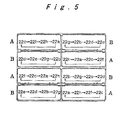
- the interchanging process includes a first process, in which a set of eight single aleeLrode plates 22 is supported and are rotated by 180° as necessary about a rotational axis X positioned at the center of the eight single electrode plates 22 and a second process in which the eight single electrode plates 22 are divided into two sets of four single electrode plates 22 and the single electrode plates 22 in one of the sets are rotated by 180° about a rotational axis Y or Z positioned at the center of each set of four single electrode plates 22.
- pattern 1 the set of eight single electrode plates 22 is rotated by 180° about the rotational axis X in the first process, and then rotation is performed about the rotational axis Y but not about the rotational axis Z in the second process. This results in the arrangement shown in FIG. 4.
- the single electrode plates 22a, 22c, 22f, and 22h are loaded into the single electrode plate holding magazines provided corresponding to the positions of the single electrode plates 22a, 22c, 22f, and 22h with the order of arrangement of these single electrode plates 22 being changed.
- the single electrode plates 22b, 22d, 22e, and 22g are loaded into the single electrode plate holding magazines provided corresponding to the positions of the single electrode plates 22b, 22d, 22e, and 22g with the order of arrangement of these single electrode plates 22 being changed. Since the single electrode plates 22 loaded into each set of holding magazines is limited, these two sets of single electrode plates 22 are treated as set A and set B.
- single electrode plates that are positive electrode plates are covered with separators and are loaded in a positive electrode holding magazine.
- single electrode plates 22 are taken alternately from the single electrode plate holding magazines for set A and the single electrode plate holding magazines for set B, are covered with separators, and are loaded in the positive electrode holding magazine.
- single electrode plates 22 are taken alternately from the single electrode plate holding magazines for set A and the single electrode plate holding magazines for set B and are loaded in the negative electrode holding magazine.
- single electrode plates 22 are taken alternately from the positive electrode holding magazine and the negative electrode holding magazine and a predetermined number of each kind of electrode plates are stacked to form an electrode plate group.
- the following battery modules were produced: a prismatic battery module including a plurality of electrode plate groups manufactured in accordance with the method for manufacturing described above; a prismatic battery module including a plurality of electrode plate groups in each of which electrode plates are not alternated between the set A and the set B; a prismatic battery module that is a comparative example and includes a plurality of electrode plate groups produced without interchanging the single electrode platee; and a prismatic battery module that is a related art example and includes a plurality of electrode plate groups that was manufactured by sorting the single electrode plates according to weight.
- the variation in capacity of cells in each battery module was measured and the results are given in Table 1 below.
- Example 1 A variation in capacity of ⁇ 7.0% was observed for the comparative example where the electrode plate groups are formed without interchanging the single electrode plates. For Example 1, however, the variation in capacity was kept to just ⁇ 2.1%, so that variations in capacity are suppressed to a similar extent as the related art with high productivity and at low cost. Note that there is slightly more variation in Example 2 where the single electrode plates are not alternated between the sets A and B.
- an electrode plate group of the invention when stacking single electrode plates that have been cut from a large plate, single electrode plates from different positions on the large plates grouped together.
- the resulting sets of single electrode plates have consistent weights, so that if the single electrode plates are taken from the stacked single electrode plates and used to form an electrode plate group, the weights of the resulting electrode plate groups are kept within a predetermined range. Consequently, long-life, high-output prismatic batteries are manufactured at low cost and with high productivity without requiring equipment such as a weight sorting device.
Landscapes
- Engineering & Computer Science (AREA)
- Manufacturing & Machinery (AREA)
- Chemical & Material Sciences (AREA)
- Chemical Kinetics & Catalysis (AREA)
- Electrochemistry (AREA)
- General Chemical & Material Sciences (AREA)
- Secondary Cells (AREA)
- Battery Electrode And Active Subsutance (AREA)
Abstract
Description
| Example 1 | Example 2 | Comparative Example | Related Art | |
| Sorting by weight? | No | No | No | Yes |
| Interchanging of plates? | Yes | Yes | No | No |
| Alternate Set A and Set B? | Yes | No | No | No |
| Variation in capacity | +2.1% | ±3.5% | ±7.0% | ±2.0% |
Claims (4)
- A method for manufacturing an electrode plate group (8) for a prismatic battery (1), comprising the steps of:manufacturing a large plate (21) from which a plurality of single electrode plates (22) that form the electrode plate group (8) are cut;cutting a plurality of single electrode plates (22) from the large plate (21) ;stacking the single electrode plates (22) by grouping together single electrode plates from different positions on the large plates (21); andsuccessively taking single electrode plates (22) from the stacked single electrode plates and alternately stacking the successively taken single electrode plates with single electrode plates of the opposite polarity, thereby forming the electrode plate group (8).
- The method for manufacturing an electrode plate group (8) for a prismatic battery (1) according to claim 1, wherein the single electrode plates (22) from different positions on the large plates (21) are stacked by performing an operation, whichwherein a combination of sets that undergo the positional interchange step and an order in which they are rotated are successively changed for each large plate.(a) divides the plurality of single electrode plates (22) cut from the large plate (21) into a plurality of sets that are each composed of a plurality of single electrode plates (22), and(b) interchanges positions of the single electrode plates in at least one set by rotating the single electrode plates (22) about a central point of the set,
- The method for manufacturing an electrode plate (8) group for a prismatic battery (1) according to claim 1 or claim 2, wherein the single electrode plates (22) from different positions on the large plates (21) are stacked by successively repeating operations with four patterns, the four patterns being produced by combining a first operation where a single set composed of all of the single electrode plates are rotated about a central point of the set and a second operation where the single electrode plates in one of two sets, which are each composed of half of the single electrode plates, are rotated about a central point of the set.
- A method for manufacturing an electrode plate group for a prismatic battery, wherein single electrode plates (22) are alternately taken from two sets (A, B) of electrode plates stacked in accordance with the method for manufacturing of claim 3 and are used to form the electrode plate group (8).
Applications Claiming Priority (2)
| Application Number | Priority Date | Filing Date | Title |
|---|---|---|---|
| JP2000378716A JP4418585B2 (en) | 2000-12-13 | 2000-12-13 | Method for forming electrode group for prismatic battery |
| JP2000378716 | 2000-12-13 |
Publications (3)
| Publication Number | Publication Date |
|---|---|
| EP1217673A2 true EP1217673A2 (en) | 2002-06-26 |
| EP1217673A3 EP1217673A3 (en) | 2004-10-13 |
| EP1217673B1 EP1217673B1 (en) | 2011-02-09 |
Family
ID=18847228
Family Applications (1)
| Application Number | Title | Priority Date | Filing Date |
|---|---|---|---|
| EP01310424A Expired - Lifetime EP1217673B1 (en) | 2000-12-13 | 2001-12-13 | Method for manufacturing electrode plate group for prismatic battery |
Country Status (4)
| Country | Link |
|---|---|
| US (1) | US6902587B2 (en) |
| EP (1) | EP1217673B1 (en) |
| JP (1) | JP4418585B2 (en) |
| DE (1) | DE60144009D1 (en) |
Families Citing this family (6)
| Publication number | Priority date | Publication date | Assignee | Title |
|---|---|---|---|---|
| JP5217723B2 (en) * | 2008-07-22 | 2013-06-19 | 株式会社村田製作所 | Battery manufacturing method |
| TW201304245A (en) * | 2011-07-15 | 2013-01-16 | Growin Automation Co Ltd | Process for combining pole groups into the outer casing |
| JP2014017196A (en) * | 2012-07-11 | 2014-01-30 | Sharp Corp | Laminate selection device, control method of laminate selection device, battery manufacturing system, control program, and computer readable recording medium with control program recorded thereon |
| JP6233029B2 (en) * | 2014-01-09 | 2017-11-22 | 株式会社豊田自動織機 | Manufacturing method of stacked power storage device and electrode plate cutting and stacking device |
| JP6201862B2 (en) * | 2014-03-28 | 2017-09-27 | 株式会社豊田自動織機 | Method for manufacturing stacked power storage device and stacked device for electrode plate |
| CN110148791B (en) * | 2019-05-14 | 2024-04-16 | 广东鸿宝科技有限公司 | Fully automatic liquid extraction and molding production line for special-shaped batteries |
Family Cites Families (3)
| Publication number | Priority date | Publication date | Assignee | Title |
|---|---|---|---|---|
| US3708349A (en) * | 1971-06-25 | 1973-01-02 | Esb Inc | Method of constructing multicell batteries |
| DE3921288C1 (en) * | 1989-06-29 | 1990-08-23 | Accumulatorenwerke Hoppecke Carl Zoellner & Sohn Gmbh & Co Kg, 5790 Brilon, De | |
| JP3523775B2 (en) | 1997-11-19 | 2004-04-26 | 東芝電池株式会社 | Manufacturing method of alkaline secondary battery |
-
2000
- 2000-12-13 JP JP2000378716A patent/JP4418585B2/en not_active Expired - Lifetime
-
2001
- 2001-12-13 EP EP01310424A patent/EP1217673B1/en not_active Expired - Lifetime
- 2001-12-13 DE DE60144009T patent/DE60144009D1/en not_active Expired - Lifetime
- 2001-12-13 US US10/013,513 patent/US6902587B2/en not_active Expired - Lifetime
Also Published As
| Publication number | Publication date |
|---|---|
| EP1217673A3 (en) | 2004-10-13 |
| US20020106556A1 (en) | 2002-08-08 |
| JP2002184450A (en) | 2002-06-28 |
| US6902587B2 (en) | 2005-06-07 |
| JP4418585B2 (en) | 2010-02-17 |
| EP1217673B1 (en) | 2011-02-09 |
| DE60144009D1 (en) | 2011-03-24 |
Similar Documents
| Publication | Publication Date | Title |
|---|---|---|
| EP3357105B1 (en) | Elastic plates and battery cell assemblies including same | |
| US9929439B2 (en) | Stepped electrode assembly including stepped unit cell | |
| KR101336309B1 (en) | Electrode assembly, battery cell and device comprising the same | |
| CN108808059B (en) | Laminated secondary battery based on cross stacking and preparation method thereof | |
| US6506515B1 (en) | Lithium secondary battery | |
| US9543550B2 (en) | Battery cell module, battery, and motor vehicle | |
| EP2648263B1 (en) | Device for manufacturing battery cell | |
| US9231279B2 (en) | Electrode assembly including electrode units having the same length and different widths, and battery cell and device including the electrode assembly | |
| US10340527B2 (en) | Lithium-ion secondary battery and method of manufacturing the same | |
| WO2011130433A1 (en) | Continuous prismatic cell stacking system and method | |
| KR101872083B1 (en) | Producing method of assembled battery | |
| CN108292720A (en) | Elastic bellows and battery cell assemblies including elastic bellows | |
| EP1217673B1 (en) | Method for manufacturing electrode plate group for prismatic battery | |
| KR102758717B1 (en) | System and method for discriminating defective folded electrode tabs of battery cell | |
| KR20160050920A (en) | Electrode Assembly Comprising Bi-cell and Full-Cell and Secondary Battery Having the Same | |
| KR20210017086A (en) | Electrode-assembly and manufacturing method thereof | |
| US20030182793A1 (en) | Apparatus for forming flat galvanic elements | |
| KR100739841B1 (en) | Fixed unit cell battery | |
| CN222373330U (en) | Transfer tray and battery production line | |
| KR20210104264A (en) | Electrode Manufacturing Method and Electrode Manufacturing Apparatus Used Therefor | |
| JP7763208B2 (en) | Energy storage module and manufacturing method thereof | |
| KR20260035439A (en) | Apparatus and method for loading electrodes | |
| KR100462128B1 (en) | Spirally-rolled electrodes with separator, the batteries therewith, and electrode for batteries | |
| JPH06314573A (en) | Storage battery storage jig and charging / discharging device using the same | |
| JP2026501546A (en) | Spacer for supporting winding core used in battery slitting process and structure including the spacer |
Legal Events
| Date | Code | Title | Description |
|---|---|---|---|
| PUAI | Public reference made under article 153(3) epc to a published international application that has entered the european phase |
Free format text: ORIGINAL CODE: 0009012 |
|
| AK | Designated contracting states |
Kind code of ref document: A2 Designated state(s): AT BE CH CY DE DK ES FI FR GB GR IE IT LI LU MC NL PT SE TR |
|
| AX | Request for extension of the european patent |
Free format text: AL;LT;LV;MK;RO;SI |
|
| PUAL | Search report despatched |
Free format text: ORIGINAL CODE: 0009013 |
|
| AK | Designated contracting states |
Kind code of ref document: A3 Designated state(s): AT BE CH CY DE DK ES FI FR GB GR IE IT LI LU MC NL PT SE TR |
|
| AX | Request for extension of the european patent |
Extension state: AL LT LV MK RO SI |
|
| 17P | Request for examination filed |
Effective date: 20050405 |
|
| AKX | Designation fees paid |
Designated state(s): DE FR GB |
|
| RAP1 | Party data changed (applicant data changed or rights of an application transferred) |
Owner name: PANASONIC CORPORATION Owner name: TOYOTA JIDOSHA KABUSHIKI KAISHA |
|
| GRAP | Despatch of communication of intention to grant a patent |
Free format text: ORIGINAL CODE: EPIDOSNIGR1 |
|
| GRAS | Grant fee paid |
Free format text: ORIGINAL CODE: EPIDOSNIGR3 |
|
| GRAA | (expected) grant |
Free format text: ORIGINAL CODE: 0009210 |
|
| AK | Designated contracting states |
Kind code of ref document: B1 Designated state(s): DE FR GB |
|
| REG | Reference to a national code |
Ref country code: GB Ref legal event code: FG4D |
|
| REF | Corresponds to: |
Ref document number: 60144009 Country of ref document: DE Date of ref document: 20110324 Kind code of ref document: P |
|
| REG | Reference to a national code |
Ref country code: DE Ref legal event code: R096 Ref document number: 60144009 Country of ref document: DE Effective date: 20110324 |
|
| PLBE | No opposition filed within time limit |
Free format text: ORIGINAL CODE: 0009261 |
|
| STAA | Information on the status of an ep patent application or granted ep patent |
Free format text: STATUS: NO OPPOSITION FILED WITHIN TIME LIMIT |
|
| 26N | No opposition filed |
Effective date: 20111110 |
|
| REG | Reference to a national code |
Ref country code: DE Ref legal event code: R097 Ref document number: 60144009 Country of ref document: DE Effective date: 20111110 |
|
| REG | Reference to a national code |
Ref country code: FR Ref legal event code: PLFP Year of fee payment: 15 |
|
| REG | Reference to a national code |
Ref country code: DE Ref legal event code: R084 Ref document number: 60144009 Country of ref document: DE |
|
| REG | Reference to a national code |
Ref country code: GB Ref legal event code: 746 Effective date: 20160928 |
|
| REG | Reference to a national code |
Ref country code: FR Ref legal event code: PLFP Year of fee payment: 16 |
|
| REG | Reference to a national code |
Ref country code: FR Ref legal event code: PLFP Year of fee payment: 17 |
|
| PGFP | Annual fee paid to national office [announced via postgrant information from national office to epo] |
Ref country code: FR Payment date: 20201112 Year of fee payment: 20 Ref country code: DE Payment date: 20201201 Year of fee payment: 20 Ref country code: GB Payment date: 20201203 Year of fee payment: 20 |
|
| REG | Reference to a national code |
Ref country code: DE Ref legal event code: R071 Ref document number: 60144009 Country of ref document: DE |
|
| REG | Reference to a national code |
Ref country code: GB Ref legal event code: PE20 Expiry date: 20211212 |
|
| PG25 | Lapsed in a contracting state [announced via postgrant information from national office to epo] |
Ref country code: GB Free format text: LAPSE BECAUSE OF EXPIRATION OF PROTECTION Effective date: 20211212 |