EP1217543A1 - Procédé et dispositif d'indexage automatique de documents d'un groupe d'ordinateurs dans un réseau - Google Patents
Procédé et dispositif d'indexage automatique de documents d'un groupe d'ordinateurs dans un réseau Download PDFInfo
- Publication number
- EP1217543A1 EP1217543A1 EP00410160A EP00410160A EP1217543A1 EP 1217543 A1 EP1217543 A1 EP 1217543A1 EP 00410160 A EP00410160 A EP 00410160A EP 00410160 A EP00410160 A EP 00410160A EP 1217543 A1 EP1217543 A1 EP 1217543A1
- Authority
- EP
- European Patent Office
- Prior art keywords
- files
- indexing
- backup
- documents
- file
- Prior art date
- Legal status (The legal status is an assumption and is not a legal conclusion. Google has not performed a legal analysis and makes no representation as to the accuracy of the status listed.)
- Withdrawn
Links
Images



Classifications
-
- G—PHYSICS
- G06—COMPUTING OR CALCULATING; COUNTING
- G06F—ELECTRIC DIGITAL DATA PROCESSING
- G06F16/00—Information retrieval; Database structures therefor; File system structures therefor
- G06F16/90—Details of database functions independent of the retrieved data types
- G06F16/93—Document management systems
Definitions
- the invention relates to telecommunications and more particularly to a process for automatically indexing files and documents associated with computers connected to a network.
- indexing process involves the successive scanning of all the documents stored within a machine
- a process requires a non-negligible amount of processing resources at the level of the individual machine. This may hinder the use and the generalization of the indexing technique on the end user's computer.
- Intranets An example of such networks are referred to as Intranets.
- Intranets An example of such networks.
- the indexing operation should not be retained at the individual level of the end user of the computer but at the level of the network manager, e.g. the Information Technology (I.T.) Administrator.
- I.T. Information Technology
- the IT Administrator Because the information which is continuously created, processed and stored within the network of a company has increased in importance, the IT Administrator now receives, in addition to his traditional remit, the task of preserving and indexing the documents of a corporation. It is also usually the responsibility of the IT Administrator to manage security issues raised by these particular type of intellectual assets.
- the problem to be solved by the present invention is to facilitate the incorporation of the indexing processes and techniques which are particularly adapted to a corporate environment for instance, while minimizing the processing resources required at the level of the local machine.
- the invention provides for a process for indexing files residing on a computer, characterized by the steps of:
- the process preferably executes a periodic backup of the system and/or user files, wherein preferably the user files are indexed.
- the process may index the files for the purpose of creating a set of itemized indexes which can serve as a set of access points to those files.
- a scanning operation may be used for both generating the signature of a file and for extracting the key words and indexes for that files.
- This provides an indexing process which is well adapted to a corporate environment and which allows the creation of a centralized indexing system allowing storage and indexing of documents on a network while minimizing the processing resources required by the end user computers attached to the network.
- the process can be used for indexing a wide number of documents, including WORD TM files, as well as compounds files such as emails, .cab files and the like.
- access to the files may be optimized as can be the amount of processing resources required for the backup and indexing operations.
- the backup and the indexing operations can be readily and simultaneously automated without requiring an additional intervention from the user.
- the process is particularly adapted for use in network environments and for providing a centralized index of all the documents available within said networks.
- Each local computer which is connected to the network may incorporate a Backup and Indexing agent which is adapted to substantially simultaneously perform a backup of the files - including the user's personal files - and the indexing of said files by a Backup and Indexing server communicating with said network.
- the IT administrator is given the technical tools to manage the intellectual assets of a given company by simultaneously controlling the backup and the indexing process at the server.
- the Backup and Indexing server incorporates a centralized index which allows direct reference to and access from a local computer to documents available on the network, as well as a local indexes which may be transmitted back to the local computer.
- At least one indexing attribute is associated with each file for the purpose of controlling the indexing process executed by said Backup and Indexing server.
- the indexing attribute may employ an Access Control List (A.C.L.) such as that which is available in WINDOWS TM NT-type or UNIX type machines.
- A.C.L. Access Control List
- the indexing process is executed by means of a server which is associated with a centralized database for storing the backup files.
- the local computer is not burdened with the task of indexing the files, and the full processing resources of the local machine are available for the user.
- the server compiles an overall index of all the files stored within the different machines of the network, it can be seen that the whole set of files forming the knowledge-based assets of a company or a private organisation can be stored within a centralized database and become accessible, via an unique indexing table, to the users of the network.
- the server and the database of backup files and documents may be located outside the Intranet network, and the size of the software code of the agent may be substantially minimized by means of the Hyper Text Transfer (H.T.T.P. or the secure version H.T.T.P.s) or File Transfer (F.T.P.) protocols.
- H.T.T.P. Hyper Text Transfer
- H.T.T.P. Secure version
- F.T.P. File Transfer
- a signature is computed for each individual file or document for the purpose of determining whether said file or document is already loaded within the database of backup files and whether it has been included within the table of indexes.
- each file or document which is to be backed up and indexed is allocated a specific attribute which is used for controlling the indexing process of that file.
- each individual user who creates a file may retain full control of the indexing process executed in relation to that file, and therefore the files referenced within the table of indexes.
- the invention also provides for a knowledge-base system adapted to automate, at the same time in a manner of which the user is unaware, the periodic backup and indexing of a user's documents stored on the computers of a network.
- the invention further provides for a process which is adapted to carry out an enhanced backup system, preferably by means of a software program for a stand-alone computer, the process including the steps of opening each file which is to be backed up and, during the same operation, compiling a set of indexes representing that file for the purpose of adding to a table of indexes thereby allowing direct access to said user's documents.
- the invention provides for a computer or network of computers adapted to carry out the method as hereinbefore described.
- An intranet network includes a first sub-network 10 and a second sub-network 20.
- First sub-network 10 includes computers 1 and 4, a server 2 and a router 3 which is used for the direct connection to sub-network 20, the latter comprising a computer 11, a printer 12, router 13 and a server 14.
- the intranet network communicates with the Internet network 70 via a proxy 30.
- a firewall arrangement 80 may be used for securing the exchange of communication between the Internet network 70 and the Intranet network.
- a firewall is generally based on two distinctive servers: a first one collecting the information received from the Internet and which is to be forwarded inside the Intranet and a second server which is used for requests originating from the Intranet and which are to be forwarded outside the Intranet.
- the arrangement and operation of a firewall is well known to the skilled man and will be not be discussed further.
- Each computer such as computer 1, incorporates a Backup & Indexing agent for executing a backup procedure with respect to the files of the user's computer.
- This may include the system files and the documents containing user's data.
- the Backup & Indexing agent periodically collects a copy of the files which were created or modified during to the last backup operation.
- an external server 50 is associated with a backup database 60 for storing the backup files and documents from all the computers and systems of the Intranet network.
- Figure 1 shows a server 50 with a backup database 60 that is located outside the boundaries of the Intranet network, and which can be accessed from the Intranet via the Uniform Resources Locator (U.R.L.). It is considered that the skilled man can readily adapt the process which is described below for the purpose of storing the backup files within a database and a server located within the Intranet, for instance server 2 or server 14.
- U.R.L. Uniform Resources Locator
- the procedure may implement the backup process which is specifically described in European patent application 00410062.4 entitled "Automatic Backup / recovery Process” , the disclosure of which is herein incorporated by reference.
- the backup process which is described below is based on the successive transmission of a copy of the files and documents of the computers of the network to external server 50 via the firewall 80.
- Each document or file which is to be backed up is analysed in terms of object, and is transmitted with an object identification, an object attribute including a specific set of indexing attributes, an object signature and an object content.
- the documents are stored within database 60 in order to form a backup data set, which comprises the description of all the files, the attributes, the directories, and labels.
- This data constitutes a saved volume.
- Each stored object consists of an image of a backup object of the original configuration of said volume, and which is to be stored within the database 60.
- the identification, the attributes and the signature are used for uniquely comparing a stored object with a backup object. Additionally, the contents may be used for rebuilding an object which is saved from a previous backup.
- the transmission of the backup objects may take substantial advantage of the FTP and particularly from the HyperText Transfer (HTTP - or its secured version HTTPs) protocol.
- HTTP HyperText Transfer
- Such an arrangement entails two substantial advantages.
- the first results in a simpler design of the agent component which can exploit the HTTP protocol and transmit, potentially in a secured fashion, the different backup documents through the Intranet and internet network, to the server 50.
- the backup objects can be reliably conveyed throughout the network even where a firewall system has been implemented in order to secure the Intranet.
- no adaptation of the pre-existing firewall system settings are necessary and the backup process can be immediately executed and applied, at no additional cost.
- This results in a substantial advantage as the skilled man is aware that, in most cases, the adaptation of existing firewall parameters can be a complex and costly operation.
- the process which will be described below achieves an effective backup procedure without specific adaptation of the pre-existing network configuration.
- the backup and indexing process involves an initialization procedure for the purpose of creating a first set of backup files and documents stored within database 60.
- the initialization procedure may be launched in response to a request from the user.
- the backup and indexing agent may be pre-installed in the local computer and be represented by a corresponding icon on the Desktop. This can be used to launch the initialization procedure.
- the Backup & Indexing agent can be downloaded from backup server 50 when the user accesses the latter via his browser.
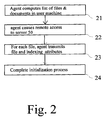
- the initialization procedure starts with a step 21 which corresponds to a compilation of an exhaustive list of the files and/or documents residing on the local user machine.
- the Backup & Indexing agent initiates remote access to the server 50 and transmits the list of system files and user documents to the server 50
- this may be by means of the HTTP protocol such as a HTTP POST.
- Other protocols can be used such as File Transfer Protocol (F.T.P.), the Network File System (N.F.S.) approach or similar models of network file systems.
- F.T.P. File Transfer Protocol
- N.F.S. Network File System
- the secure version of the latter may be particularly appropriate.
- the Backup and Indexing agent transmits to the remote server 50 a copy of each file and document, including the attributes.
- the Backup and Indexing agent transmits at least one additional attribute which is used for the purpose of controlling the indexing process executed in the server.
- an indexing attribute the skilled man can use of the Access Control List (A.C.L.) known in relation to the WINDOWS TM, NT or UNIX type operating systems.
- a first indexing attribute is used for controlling the indexing process of the considered document and the incorporation of at least one reference to that document within the centralized index which is maintained by server 50.
- the first indexing attribute is associated with a second indexing attribute which may be used for more precisely controlling, during the search process, selective access to the documents stored within database 60.
- the process is designed for analyzing a wide variety of different user's documents, including text documents such as WORD TM, WORDPERFECT TM, OFFICE TM documents etc...., as well as compound files which might include textual information.
- the analysis of the different files can be based upon an examination of the filename extension of the document files by the Backup & Indexing agent on the local machine.
- step 24 When all the files and documents are transmitted to server 50, the initialization process terminates by means of step 24.
- step 31 This can be performed by means of a system scheduler mechanism, such as the Sleep function which is known for instance in relation to the WINDOWS TM NT-type operating system. In another embodiment, it may be possible to start the backup upon the request from the user.
- a system scheduler mechanism such as the Sleep function which is known for instance in relation to the WINDOWS TM NT-type operating system.
- the Backup and Indexing agent initiates remote access to server 50 and a HTTP "GET" request for the purpose of obtaining a representation of the remote data set of the backup documents which are stored within the database 60.
- the server 50 transmits the list of the backup files and documents.
- the information is transmitted by means of an XML file which contains a table with the list of the backup files and documents, including the identifiers, the attributes and the signatures. While this step is not absolutely necessary, since it is possible to keep a local image of the data set within the user's machine, it has been found to be useful to retrieve the remote data set which is actually stored within the backup server.
- the server 50 transmits a local table of indexes of the documents in the local machine.
- this index takes the form of a table which provides, for each itemized reference, a list of the relevant documents with the paths for permitting a direct access.
- the local table of indexes will be used during the search process carried out by the Backup & Indexing agent when the user will execute a search using his machine.
- step 34 the Backup & Indexing agent receives that information from server 50 and stores it in the local machine.
- the Agent performs a local analysis of the user's configuration and identifies all the backup files which are representative of that configuration. It then establishes a local data set of backup files and documents, including the identifier, the signature, the attributes and particularly the indexing attribute(s). It should be noticed that, for the purpose of computing the signature, the agent may create a copy of the considered object, after having locked access to the latter.
- step 36 the Agent then iteratively processes each backup file or document which was identified within the local data set of backup objects.
- step 37 the process determines whether the considered file or document has the same identification on the remote data set transmitted by the server 50.
- step 38 If the answer is yes, then the process checks at step 38 whether the signature of the considered backup object appears to be the same than that which is reported in the remote data set. If this is the case, the considered object appears to be unmodified, and the process then proceeds with step 39 which loops again to step 36 for processing the next file or document within the list of the local data set.
- step 40 the process proceeds with the transmission of the considered backup file to the server 50 in step 40.
- This is achieved by means of an appropriate HTTP s POST request with the considered object, including the identifier, the attributes, the contents and the signature.
- the backup agent may advantageously create a local copy of the considered object, once it has been locked. As soon as the local copy is made, the original object can then be unlocked and the Agent may compute the signature on the local copy. This ensures that the considered object does not remain locked too long.
- the backup and indexing agent incorporates a means for processing the compound files for the purpose of extracting from those the different objects and computing their signatures for the purpose of processing as explained above.
- This permits the processing and transmission, where necessary, of the individual components of compound files, for the purpose of reducing the amount of data to be transmitted through the network.
- compound files include .eml, .avi, .wav, .riff, .zip files.
- the backup technique may further use differential backup and/or compression techniques for the purpose of reducing the volume of the data to be transmitted to the server.
- the use of the HTTP protocol allows a substantial reduction in the size of the software program necessary for implementing the Backup & Indexing agent, since it is the HTTP protocol, and particularly the secured version HTTP s which handles the main parts of the transmission process. Additionally, since the HTTP protocol is able to be readily interpreted by the firewall procedures which the IT Manager may have arranged for securing a network, the backup procedure may be readily applied within a corporate organization, and an Intranet network.
- the loop terminates and the Backup and Indexing Agent transmits at step 41, the list of the local set of files and documents computed in step 35.
- the server 50 receives that local data set and then launches a loop for processing all the files and documents contained within the remote data set. For each object which is identified within the remote set of data, the server checks whether the considered identification exists in the local data set, in which case the process loops back to the next object identified within the remote data set. However, if the file or document appears to be no longer reported within the local data set received from the backup agent, the server erases the latter from the remote data set and deletes the contents of that object within the database 60.
- an indexing process is launched in a step 42 and controlled in accordance with the value of the indexing attribute assigned to that document.
- step 43 the server updates the centralized index containing the reference to all the documents existing within the Intranet network, as well as the local index.
- step 44 the server transmits to the Backup and Indexing Agent in the local machine the revised version of the local index which was computed. That local index will be used in a search process for a document which will be described hereinafter.
- the Backup and Indexing Agent stores the local index at step 45, this completes the periodic backup and indexing procedure.
- the technique modifies and extends known backup procedures which are traditionally used for creating a backup database by automatically and in parallel compiling a set of indexes which can be stored within a centralized database.
- the process may then use that centralized index, in association with a search engine, for automatically retrieving the documents stored within the database of backup files and documents, whatever the types of documents being considered: for example HTML, WORD TM or even ADOBE TM files.
- the two processes are combined in such a way as to permit systematic scanning and indexing of the files located on a machine, for the purpose of constructing an index table of the files . Further, by combining the backup and the indexing facility in the same entity, i.e.; server 50, the user's computer resources remain fully dedicated to the user. This represents a substantial advantage.
- process is particularly adapted for use in a corporate environment, it should be noted, however, that the process can be readily adapted for use with a stand-alone computer for permitting a simultaneous backup and indexing of the files located in that computer.
- the process may also be readily adapted to the WINDOWS/NT-type, or LINUX operating system where attributes and rights exist for each file.
- step 51 the Backup and Indexing agent receives a request from the user.
- step 52 a first local search is being conducted on the local index which was received from server 50 in step 44 of figure 4.
- step 53 the local search is completed, upon request from the user, by means of an extensive search within the centralized index elaborated by server 50.
- the server 50 prepares a list of documents which are presented in accordance with the value of the second indexing attribute controlling the selective access.
- the server can produce a HTML page containing a list of links allowing access to the documents. More particularly, for the citations of documents having a selective access attributes, the user who has requested the search is made aware of the existence of one citation within the centralized database but he may not have a direct access to that document.
- the process automatically prepares an electronic mail which is automatically transmitted to the originator of the considered document in step 55.
- the server 50 In response to the originators agreement, the server 50 then automatically allows the access to the requester in step 56.
- the search process then terminates at step 57.
- the present invention facilitates the incorporation of indexing procedures and techniques, in a way which reduces or eliminates the use of local user-based resources. This may be particularly useful in the context of a corporate environment where it is generally desirable to minimize the impact of backup, or related processes, on the performance of a local machine.
Landscapes
- Engineering & Computer Science (AREA)
- Databases & Information Systems (AREA)
- Theoretical Computer Science (AREA)
- Business, Economics & Management (AREA)
- General Business, Economics & Management (AREA)
- Data Mining & Analysis (AREA)
- Physics & Mathematics (AREA)
- General Engineering & Computer Science (AREA)
- General Physics & Mathematics (AREA)
- Information Retrieval, Db Structures And Fs Structures Therefor (AREA)
Priority Applications (2)
| Application Number | Priority Date | Filing Date | Title |
|---|---|---|---|
| EP00410160A EP1217543A1 (fr) | 2000-12-22 | 2000-12-22 | Procédé et dispositif d'indexage automatique de documents d'un groupe d'ordinateurs dans un réseau |
| US10/012,466 US20020083053A1 (en) | 2000-12-22 | 2001-12-12 | Method and apparatus for indexing files |
Applications Claiming Priority (1)
| Application Number | Priority Date | Filing Date | Title |
|---|---|---|---|
| EP00410160A EP1217543A1 (fr) | 2000-12-22 | 2000-12-22 | Procédé et dispositif d'indexage automatique de documents d'un groupe d'ordinateurs dans un réseau |
Publications (1)
| Publication Number | Publication Date |
|---|---|
| EP1217543A1 true EP1217543A1 (fr) | 2002-06-26 |
Family
ID=8174054
Family Applications (1)
| Application Number | Title | Priority Date | Filing Date |
|---|---|---|---|
| EP00410160A Withdrawn EP1217543A1 (fr) | 2000-12-22 | 2000-12-22 | Procédé et dispositif d'indexage automatique de documents d'un groupe d'ordinateurs dans un réseau |
Country Status (2)
| Country | Link |
|---|---|
| US (1) | US20020083053A1 (fr) |
| EP (1) | EP1217543A1 (fr) |
Cited By (3)
| Publication number | Priority date | Publication date | Assignee | Title |
|---|---|---|---|---|
| EP2009561A3 (fr) * | 2007-06-29 | 2009-01-14 | Symantec Corporation | Exécution d'indexation intelligente de contenu dans une méthode, signal, support de données et système |
| EP2031508A1 (fr) * | 2007-08-31 | 2009-03-04 | Ricoh Europe PLC | Appareil et procédé d'impression en réseau |
| WO2015167320A1 (fr) * | 2014-04-28 | 2015-11-05 | Mimos Berhad | Système et procédé pour une solution de sauvegarde intégrée dans des environnements de virtualisation |
Families Citing this family (26)
| Publication number | Priority date | Publication date | Assignee | Title |
|---|---|---|---|---|
| US7484172B2 (en) * | 1997-05-23 | 2009-01-27 | Walker Digital, Llc | System and method for providing a customized index with hyper-footnotes |
| AU2001261232A1 (en) | 2000-05-08 | 2001-11-20 | Walker Digital, Llc | Method and system for providing a link in an electronic file being presented to a user |
| US9678967B2 (en) * | 2003-05-22 | 2017-06-13 | Callahan Cellular L.L.C. | Information source agent systems and methods for distributed data storage and management using content signatures |
| US7529775B2 (en) * | 2003-08-20 | 2009-05-05 | Microsoft Corporation | Method and system for collecting information about applications on a computer system |
| US7822715B2 (en) * | 2004-11-16 | 2010-10-26 | Petruzzo Stephen E | Data mirroring method |
| US7627776B2 (en) * | 2004-11-16 | 2009-12-01 | Petruzzo Stephen E | Data backup method |
| US8364670B2 (en) | 2004-12-28 | 2013-01-29 | Dt Labs, Llc | System, method and apparatus for electronically searching for an item |
| US9454440B2 (en) * | 2004-12-31 | 2016-09-27 | Emc Corporation | Versatile information management |
| US8260753B2 (en) * | 2004-12-31 | 2012-09-04 | Emc Corporation | Backup information management |
| US7672979B1 (en) * | 2005-04-22 | 2010-03-02 | Symantec Operating Corporation | Backup and restore techniques using inconsistent state indicators |
| US9026512B2 (en) * | 2005-08-18 | 2015-05-05 | Emc Corporation | Data object search and retrieval |
| US7716171B2 (en) * | 2005-08-18 | 2010-05-11 | Emc Corporation | Snapshot indexing |
| US20070043705A1 (en) * | 2005-08-18 | 2007-02-22 | Emc Corporation | Searchable backups |
| US7505973B2 (en) * | 2007-01-16 | 2009-03-17 | Microsoft Corporation | Efficient paging of search query results |
| US8219544B2 (en) * | 2008-03-17 | 2012-07-10 | International Business Machines Corporation | Method and a computer program product for indexing files and searching files |
| JP5303172B2 (ja) * | 2008-03-28 | 2013-10-02 | Necパーソナルコンピュータ株式会社 | 情報処理装置、ファイル制御システム、制御方法及びプログラム |
| US9792384B2 (en) * | 2009-02-26 | 2017-10-17 | Red Hat, Inc. | Remote retreival of data files |
| US9158632B1 (en) | 2011-06-30 | 2015-10-13 | Emc Corporation | Efficient file browsing using key value databases for virtual backups |
| US8949829B1 (en) | 2011-06-30 | 2015-02-03 | Emc Corporation | Virtual machine disaster recovery |
| US9229951B1 (en) | 2011-06-30 | 2016-01-05 | Emc Corporation | Key value databases for virtual backups |
| US8843443B1 (en) | 2011-06-30 | 2014-09-23 | Emc Corporation | Efficient backup of virtual data |
| US9311327B1 (en) | 2011-06-30 | 2016-04-12 | Emc Corporation | Updating key value databases for virtual backups |
| US8671075B1 (en) | 2011-06-30 | 2014-03-11 | Emc Corporation | Change tracking indices in virtual machines |
| US8849777B1 (en) * | 2011-06-30 | 2014-09-30 | Emc Corporation | File deletion detection in key value databases for virtual backups |
| US8849769B1 (en) | 2011-06-30 | 2014-09-30 | Emc Corporation | Virtual machine file level recovery |
| WO2013025553A2 (fr) | 2011-08-12 | 2013-02-21 | Splunk Inc. | Gestion de volume de données |
Citations (2)
| Publication number | Priority date | Publication date | Assignee | Title |
|---|---|---|---|---|
| US5806065A (en) * | 1996-05-06 | 1998-09-08 | Microsoft Corporation | Data system with distributed tree indexes and method for maintaining the indexes |
| EP0899662A1 (fr) * | 1997-08-29 | 1999-03-03 | Hewlett-Packard Company | Système de sauvegarde et de restauration de données pour réseau informatique |
Family Cites Families (5)
| Publication number | Priority date | Publication date | Assignee | Title |
|---|---|---|---|---|
| US5485606A (en) * | 1989-07-10 | 1996-01-16 | Conner Peripherals, Inc. | System and method for storing and retrieving files for archival purposes |
| US5778395A (en) * | 1995-10-23 | 1998-07-07 | Stac, Inc. | System for backing up files from disk volumes on multiple nodes of a computer network |
| US6278992B1 (en) * | 1997-03-19 | 2001-08-21 | John Andrew Curtis | Search engine using indexing method for storing and retrieving data |
| US6574733B1 (en) * | 1999-01-25 | 2003-06-03 | Entrust Technologies Limited | Centralized secure backup system and method |
| US6675177B1 (en) * | 2000-06-21 | 2004-01-06 | Teradactyl, Llc | Method and system for backing up digital data |
-
2000
- 2000-12-22 EP EP00410160A patent/EP1217543A1/fr not_active Withdrawn
-
2001
- 2001-12-12 US US10/012,466 patent/US20020083053A1/en not_active Abandoned
Patent Citations (2)
| Publication number | Priority date | Publication date | Assignee | Title |
|---|---|---|---|---|
| US5806065A (en) * | 1996-05-06 | 1998-09-08 | Microsoft Corporation | Data system with distributed tree indexes and method for maintaining the indexes |
| EP0899662A1 (fr) * | 1997-08-29 | 1999-03-03 | Hewlett-Packard Company | Système de sauvegarde et de restauration de données pour réseau informatique |
Non-Patent Citations (2)
| Title |
|---|
| BOWMAN C M ET AL: "The Harvest information discovery and access system", COMPUTER NETWORKS AND ISDN SYSTEMS, NORTH HOLLAND PUBLISHING. AMSTERDAM, NL, vol. 28, no. 1, 1 December 1995 (1995-12-01), pages 119 - 125, XP004001217, ISSN: 0169-7552 * |
| KOSTER M: "ALIWEB - Archie-like indexing in the WEB", COMPUTER NETWORKS AND ISDN SYSTEMS, NORTH HOLLAND PUBLISHING. AMSTERDAM, NL, vol. 27, no. 2, 1 November 1994 (1994-11-01), pages 175 - 182, XP004037988, ISSN: 0169-7552 * |
Cited By (4)
| Publication number | Priority date | Publication date | Assignee | Title |
|---|---|---|---|---|
| EP2009561A3 (fr) * | 2007-06-29 | 2009-01-14 | Symantec Corporation | Exécution d'indexation intelligente de contenu dans une méthode, signal, support de données et système |
| US10133820B2 (en) | 2007-06-29 | 2018-11-20 | Veritas Technologies Llc | Techniques for performing intelligent content indexing |
| EP2031508A1 (fr) * | 2007-08-31 | 2009-03-04 | Ricoh Europe PLC | Appareil et procédé d'impression en réseau |
| WO2015167320A1 (fr) * | 2014-04-28 | 2015-11-05 | Mimos Berhad | Système et procédé pour une solution de sauvegarde intégrée dans des environnements de virtualisation |
Also Published As
| Publication number | Publication date |
|---|---|
| US20020083053A1 (en) | 2002-06-27 |
Similar Documents
| Publication | Publication Date | Title |
|---|---|---|
| US20020083053A1 (en) | Method and apparatus for indexing files | |
| US6638314B1 (en) | Method of web crawling utilizing crawl numbers | |
| US7818663B2 (en) | Editable information management system and method | |
| Cederqvist et al. | Version management with CVS | |
| US7062750B2 (en) | Accessing remote stores of source and symbol data for use by computing tools | |
| US8230326B2 (en) | Method for associating annotations with document families | |
| US20060101443A1 (en) | Source code management system and method | |
| US20040098387A1 (en) | Method and system for gathering information resident on global computer netowrks | |
| EP2463816A1 (fr) | Procédés, appareils, systèmes et supports lisibles sur ordinateur pour utilisation dans le partage d'informations entre entités | |
| US7062529B2 (en) | Server configuration tool | |
| US8661003B2 (en) | Policy performance in an information management system | |
| JP2008533544A (ja) | ソースコード・サーチ・エンジンを操作する方法およびシステム | |
| WO2005124551A2 (fr) | Systeme et procede de construction d'environnements de test de lot complet | |
| US20080147841A1 (en) | Annotation management program, device, and method | |
| EP1386263A2 (fr) | Utilisation d'une technique de tirer-lacher pour construire des requetes | |
| US8707299B1 (en) | Method and apparatus for preserving virtual desktops for e-discovery through an agent-less solution | |
| JP2002207726A (ja) | 文書管理装置、関連文書抽出方法、文書操作支援方法 | |
| US8127217B2 (en) | Document management system for transferring a plurality of documents | |
| US20060015527A1 (en) | System and method for transport of objects utilizing LDAP directory structure | |
| US20020007375A1 (en) | Document management method and computer-readable storage medium storing program code for executing the same | |
| US8412681B2 (en) | Content archival and retrieval | |
| US7536404B2 (en) | Electronic files preparation for storage in a server | |
| US8788460B2 (en) | Exploring attached and unattached content databases | |
| US7650336B1 (en) | File system atomic lock | |
| JP2003131919A (ja) | 文書管理装置 |
Legal Events
| Date | Code | Title | Description |
|---|---|---|---|
| PUAI | Public reference made under article 153(3) epc to a published international application that has entered the european phase |
Free format text: ORIGINAL CODE: 0009012 |
|
| AK | Designated contracting states |
Kind code of ref document: A1 Designated state(s): AT BE CH CY DE DK ES FI FR GB GR IE IT LI LU MC NL PT SE TR |
|
| AX | Request for extension of the european patent |
Free format text: AL;LT;LV;MK;RO;SI |
|
| 17P | Request for examination filed |
Effective date: 20021112 |
|
| AKX | Designation fees paid |
Designated state(s): DE FR GB |
|
| 17Q | First examination report despatched |
Effective date: 20070111 |
|
| STAA | Information on the status of an ep patent application or granted ep patent |
Free format text: STATUS: THE APPLICATION HAS BEEN WITHDRAWN |
|
| 18W | Application withdrawn |
Effective date: 20080403 |