EP1215824A2 - System and method for fine acquisition of a spread spectrum signal - Google Patents
System and method for fine acquisition of a spread spectrum signal Download PDFInfo
- Publication number
- EP1215824A2 EP1215824A2 EP01310456A EP01310456A EP1215824A2 EP 1215824 A2 EP1215824 A2 EP 1215824A2 EP 01310456 A EP01310456 A EP 01310456A EP 01310456 A EP01310456 A EP 01310456A EP 1215824 A2 EP1215824 A2 EP 1215824A2
- Authority
- EP
- European Patent Office
- Prior art keywords
- signal
- carrier
- data
- wiped
- acquisition
- Prior art date
- Legal status (The legal status is an assumption and is not a legal conclusion. Google has not performed a legal analysis and makes no representation as to the accuracy of the status listed.)
- Withdrawn
Links
Images






Classifications
-
- H—ELECTRICITY
- H04—ELECTRIC COMMUNICATION TECHNIQUE
- H04B—TRANSMISSION
- H04B1/00—Details of transmission systems, not covered by a single one of groups H04B3/00 - H04B13/00; Details of transmission systems not characterised by the medium used for transmission
- H04B1/69—Spread spectrum techniques
- H04B1/707—Spread spectrum techniques using direct sequence modulation
- H04B1/7073—Synchronisation aspects
- H04B1/7075—Synchronisation aspects with code phase acquisition
Definitions
- This method relates, in general, to CDMA (Code Division Multiple Access) spread spectrum receivers, and more specifically, to fast acquisition of a spread spectrum signal, such as is performed by a fast acquisition GPS (Global Positioning System) receiver.
- CDMA Code Division Multiple Access
- GPS Global Positioning System
- Spread spectrum communication in its basic form is a method of taking a data signal that is used to modulate a sinusoidal carrier and then spreading its bandwidth to a much larger value, e.g. in a global positioning system (GPS) application by multiplying a single-frequency carrier by a high-rate binary (-1,1) pseudo-random noise (PRN) code sequence that is known to GPS users.
- the signal that is transmitted includes a data component, a PRN component, and a (sinusoidal) carrier component.
- a synchronized replica of the transmitted PRN code is required to de-spread the data sequence.
- Initial synchronization called acquisition
- fine synchronization which is called tracking.
- the present invention relates to acquisition.
- Acquisition is the process by which the replica PRN code is synchronized (to within a small timing offset) with the code conveyed by the received signal either for the first time or after losing a previously acquired signal, and also by which the carrier frequency of the received signal is determined.
- an acquisition system must accurately determine any frequency-shifting of the received signal from the transmitted frequency in order to accurately wipeoff (remove) the carrier signal.
- Frequency-shifting can be caused by relative motion of the transmitter and receiver (Doppler-shifting) as well as by clock inaccuracies (so that a transmitter and receiver sometimes do not agree on what is in fact the same frequency).
- the carrier frequency-shifting results in a modulation of a code component after carrier wipe-off in the receiver.
- the replica code sequence be not only time-aligned with the received code sequence, but also modulated to compensate for the frequency-shifting so as to fully eliminate the PRN sequence and leave behind only the data conveyed by the received signal.
- the acquisition process is therefore a two-dimensional search, a search both in code phase and in frequency.
- a bottleneck here is the data modulation, i.e. the modulation of the signal by the data.
- one strategy that is used is to take the frequency information from a coherent stage.
- the coherence length increase is limited due to 50Hz navigation message and it reduces the gain of the system beyond 20msec integration.
- the resolution of coherent processing based methods is limited to 50Hz. To go beyond this range one must either compensate for data modulation or sacrifice gain.
- a fine acquisition stage is required for tracking initialization.
- the frequency resolution of initial acquisition schemes is limited, due to the complexity of the two-dimensional search (i.e. for code phase and for any shift in the carrier frequency) and due to the data rate of 50Hz (i.e. the navigation data rate for a GPS receiver).
- the data modulation must be wiped off, which according to the prior art has been accomplished either by bit detection, which is not always possible in weak signal conditions, or by a search over all possible data modulations of the signal as sampled in a set of samples, which imposes a significant computational burden.
- Zero-padding of a short segment of a signal so as to end up with a segment of a desired length, suitable for spectral analysis using a discrete Fourier transform (DFT) with a frequency spacing determined by the length of the zero-padded signal segment.
- DFT discrete Fourier transform
- the present invention provides a method, corresponding apparatus, and corresponding system for acquiring a received spread spectrum signal, the received signal having a carrier component at a carrier frequency, a code component having a code period, and a data component, the acquiring including matching the phase of a replica of the code component to the phase of the received code component and also determining any shift in the carrier frequency away from a transmitted carrier frequency, the method including the steps of: performing a first acquisition of the received signal so as to provide an approximately estimated carrier frequency and a phase of the replica and also so as to provide a code-wiped and an approximately carrier-wiped signal; and performing a second acquisition of the approximately carrier-wiped signal, the second acquisition including a substep of data wipe-off involving a squaring or similar operation on a signal derived from the approximately carrier-wiped signal; thereby providing a correction to the approximately estimated carrier frequency, a correction that accounts for the carrier frequency shift remaining after the first acquisition.
- the step of performing a second acquisition of the approximately carrier-wiped signal includes the substeps of: mixing the approximately carrier-wiped signal with a plurality of sinusoids in turn, each sinusoid at a different frequency in a range of frequencies serving as trial corrections to the approximately estimated carrier frequency determined in the step of performing a first acquisition, so as to provide a mixed signal; performing a first coherent processing of the mixed signal so as to provide a carrier-amplified signal; performing a data wipeoff using the carrier-amplified signal so as to provide a data-wiped signal, the data wipeoff including a squaring or similar operation on the carrier-amplified signal, thus retaining in the data-wiped signal, information about the carrier frequency shift remaining after the first acquisition; performing a second coherent processing of the data-wiped signal, the second coherent processing for providing a further correlated and filtered signal; and detecting the best value to use for the correction to the approximately estimated carrier frequency based on the further correlated and filtered signal for each different trial frequency correction.
- the step of performing a second acquisition of the approximately carrier-wiped signal includes the substeps of: performing a first coherent processing of the approximately carrier-wiped signal so as to provide a carrier-amplified signal; performing a data wipeoff using the carrier-amplified signal so as to provide a data-wiped signal, the data wipeoff including a squaring or similar operation on the carrier-amplified signal, thus retaining in the data-wiped signal, information about the carrier frequency shift remaining after the first acquisition; and performing a mixing and second coherent processing, the mixing being performed on the data-wiped signal using a plurality of sinusoids in turn, each sinusoid at a different frequency in a range of frequencies serving as trial corrections to the approximately estimated carrier frequency determined in the step of performing a first acquisition, to provide a mixed and data-wiped signal, and the second coherent processing being performed on the mixed and data-wiped signal, the second coherent processing for providing a further correlated and filtered signal.
- the step of performing a second acquisition of the approximately carrier-wiped signal includes the substeps of: performing a first coherent processing of the approximately carrier-wiped signal so as to provide a carrier-amplified signal; performing a data wipeoff using the carrier-amplified signal so as to provide a data-wiped signal, the data wipeoff including a squaring or similar operation on the carrier-amplified signal, thus retaining in the data-wiped signal, information about the carrier frequency shift remaining after the first acquisition; and performing a cross correlation of the data-wiped signal, the cross correlation including estimating the phase and then the correction to the approximately estimated carrier frequency.
- the step of performing a second acquisition of the approximately carrier-wiped signal includes the substeps of: performing a common coherent processing of the approximately carrier-wiped signal so as to provide a first-processed; mixing the first-processed approximately carrier-wiped signal with a plurality of sinusoids in turn, each sinusoid at a different frequency in a range of frequencies serving as trial corrections to the approximately estimated carrier frequency determined in the step of performing a first acquisition, so as to provide a mixed signal; performing a first coherent channel processing of the mixed signal so as to provide a carrier-amplified signal; performing a data wipeoff using the carrier-amplified signal so as to provide a data-wiped signal, the data wipeoff including a squaring or similar operation on the carrier-amplified signal, thus retaining in the data-wiped signal, information about the; performing a second coherent channel processing on the data-wiped signal, the second coherent processing for providing a further correlated and filtered signal; and detecting the best value to use for the
- the invention also comprehends a method including only a single acquisition, an acquisition including a data wipe-off involving a squaring or similar operation on a signal having a data component and a frequency component, i.e. the invention is of use in acquiring any kind of signal having a carrier component and a data component, regardless of whether a first, typically relatively coarse acquisition is performed.
- the data modulation of a CDMA signal is compensated for by complex squaring of the signal (or a similar operation).
- BPSK binary phase shift keying
- d(t) ⁇ 1 with frequency shift modulation exp( jwt ) (i.e. w is the shift in the frequency of the carrier)
- the data modulation can be wiped off.
- S/N signal-to-noise
- the squaring technique must be combined with properly incorporated coherent accumulation (i.e. accumulation of terms taking into account both their magnitude and sign or phase) and filtering stages to achieve fine resolution better than 1Hz with only a moderate computational burden.
- a system for acquiring a spread spectrum signal is not limited to acquiring a spread spectrum signal in any particular context, such as GPS, nor is it limited to acquiring a particular kind of spread spectrum signal.
- a system according to the present invention for acquiring a spread spectrum signal can be of use in any application in which a spread spectrum signal is to be acquired, as long as the spread spectrum signal includes a code component and a carrier component.
- s ( n ) is the received signal at the receiver
- x noise ( n ) is the noise component of the received signal
- A is a scaling factor
- s 0 ( n ) is the signal with zero code phase and Doppler frequency or other frequency shift offsets
- n c is the unknown code phase of the received signal (with respect to the replica code) measured in for example samples
- N dp is the duration of a data bit (in samples)
- N cp is the code period (in samples)
- f D is the unknown frequency shift appearing because of relative motion of the receiver and the transmitter and because of other causes
- w' D is the corresponding angular frequency normalized to the sampling frequency
- d ( n ) ⁇ -1,1 ⁇ is the sample value obtained in sampling a data bit
- r ( n ) ⁇ -1,1 ⁇ is a sample of the replica code.
- the disclosure also uses the variable w', as above, to represent the digital signal processing analog of the ordinary angular frequency.
- a sinusoid sampled at time t the sample being the n th sample in a series of samples, can be expressed as either exp( jwt ) or exp( jw ' n ).
- the data bit duration is usually several code periods (usually 20 code periods in the case of a GPS signal).
- the common scaling factor Ae j ⁇ is also ignored since it does not affect the system design.
- x ( n ) r ⁇ ( n - n c )mod N cp ⁇ e jw '( n - n c ) + x noise ( n ).
- Coherent processing a process in which consecutive signal data points are summed after possibly being multiplied by factors that may depend on frequency; implemented as e.g. by an integrate and dump module followed by a filter, or by a lowpass filter followed by a downsampler.
- Filter for filtering a signal: typically a finite impulse response (FIR) filter, i.e. a convolution of a signal with some predetermined short signal (the filter coefficients), which can be implemented as, where x (..) is the signal being filtered, h (..) is a filter coefficient, and y (..) is the filtered signal; but could also be an infinite impulse response (IIR) filter (implemented e.g. using constant coefficient difference equations).
- FIR finite impulse response
- IIR infinite impulse response
- Noncoherent processing a process in which the magnitudes or squares of the magnitudes of consecutive data values are summed.
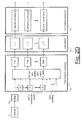
- an initial acquisition stage 15 analyzes a received spread spectrum signal x ( t ) and then provides a coarse estimate w 0 of the carrier frequency and a value for the phase to be used for the replica code to wipe off (remove) the code component of the received spread spectrum signal.
- the value for the coarse estimate of the carrier frequency and the value for the code phase are provided to a fine acquisition module 16, which is also provided with the received spread spectrum signal x ( t ).
- the fine acquisition module determines a correction ⁇ w 0 to the coarse estimate w 0 of the carrier frequency.
- the fine acquisition module 16 is shown as including a correlator 12 and a fine acquisition kernel 11.
- the correlator 12 is typically a conventional correlator, of the type that would be used in a tracking module. Therefore, in a GPS application, the correlator would perform correlations of the received spread spectrum signal x ( t ) over one code period (1023 chips).
- the correlator wipes off the code component of the received signal x ( t ) and also performs a partial demodulation of the received signal x ( t ), based on the coarse estimate w 0 of the carrier frequency, so as to partially remove the carrier.
- the output of the correlator 12 is therefore the navigation data corrupted by noise and modulated by the remaining frequency shift.
- the bandwidth of the resulting signal is 1 kHz, (i.e. the correlator output will be attenuated for a remnant frequency modulation more than 500Hz from the estimate of the carrier frequency determined in the initial acquisition stage).
- the method presented here analyzes the output of the correlator 12 at each frequency in a predetermined set of frequencies to be tried as guesses at the remaining frequency shift.
- the method further demodulates the signal x ( t ) using each guess (trial value) at the carrier frequency, enhances the signal processed according to the guess, and uses the enhanced signal in a detection unit that decides whether the guess is approximately correct.
- the mixed signals y 1 i ( t ) (there being one for each different trial correction ⁇ w 0 i ) are provided to a first coherent processing module 11b, which is implemented as either a low pass filter followed by a downsampler, or by an integrate and dump module followed by a filter.
- the first coherent processing module 11b includes a (coherent) summation over a number L of mixed samples, and so produces one output for every L samples.
- the summation can be expressed as, where L is the coherent integration length, i.e.
- n indicates the n th output, and so plays the role of time, but according to a different time scale than the corresponding index L ⁇ n+k used to indicate the different inputs (mixed samples) y 1 i ( L ⁇ n+k ); the index n is incremented only once for every L increments of the index L ⁇ n+k .
- the first coherent processing module 11b then filters the summation result y 2 i ,int ( n ).
- the filtering is performed to increase the coherence length (the number of samples over which the effect of the data modulation is negligible) without downsampling and so keep the signal oversampled (relative to the sampling that would be required for the received signal) in anticipation of the code wipeoff, which, as explained below, has the effect of doubling the remnant carrier frequency.
- the filter further reduces the signal bandwidth, keeping the signal oversampled.
- the filtering here can be either a finite impulse response (FIR) filtering or infinite impulse response (IIR) filtering, for purposes of illustration, the invention is here described as using FIR filtering.
- FIR finite impulse response
- IIR infinite impulse response
- the first coherent processing module 11b provides the final output, where h 2 (..) are the filter coefficients.
- the output y 3 i of the data wipeoff module 11c is provided to a second coherent processing module 22d, which, in the preferred embodiment, operates on y 3 i in the same way as the first coherent processing module operates on its input y 1 i , thus providing as its output, where h 4 (..) are the filter coefficients, and where L 4 is the coherent integration length.
- the second coherent processing is simply a coherent accumulation.
- the output y 4 i of the second coherent processing module 11d is, optionally, provided to a noncoherent processing module 11e, which has the effect of further elevating over any noise the sought after signal indicating the best correction ⁇ w oi to the coarse estimate of the carrier frequency provided by the correlator 12.
- a noncoherent processing is, in the preferred embodiment, implemented as any simply noncoherent accumulation/summation, i.e. an accumulation (summation) that ignores the sign or phase of the terms being summed.
- possible expressions for the output of the noncoherent processing module 11e include, and where L nc is the coherent integration length, and where
- the output of the noncoherent processing module 11e, if included in an implementation of the invention, or of the second coherent processing module 11d if noncoherent processing is not performed in the implementation, is provided to a detector 11f.
- the detector module 11f ultimately receives an input corresponding to each channel.
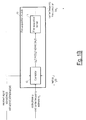
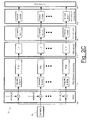
- Fig. 2B an implementation of the first embodiment of the present invention is shown in which parallel processing paths are used for different estimates of the fine frequency correction, the embodiment otherwise being the same as that illustrated in Fig. 2A.
- the number of different parallel processing paths, or grid steps, is determined by the required frequency resolution of the acquisition system and the resolution provided by the correlator 12 (Fig. 1).
- the first coherent processing module 11b of Fig. 2A is implemented as a lowpass filter module followed by a downsample module.
- the bandwidth is reduced by means of the lowpass filter module and then downsampled by the downsample module to remove redundant data from each channel.
- an integrate and dump module can be used, followed by a filter.
- a DFT module is used to demodulate the signal with zero-padding on the input to the DFT module and with output pruning (i.e. taking a subset of the output values for further processing).
- a DFT matrix is the collection of sinusoidal signals of a certain length (DFT size), each signal appearing as the row of the DFT matrix.
- DFT size the number of sinusoidal signals of a certain length
- the signal is represented as a vector, the components of which are sample values of the signal.
- the result of the DFT analysis is the matrix multiplication of the signal vector.
- Such a multiplication involves both an elementwise multiplication producing a set of products, and then a summing of the products.
- the bandwidth of the correlator 12 (Fig. 1) cannot be reduced to achieve resolution finer than 50 Hz (corresponding to a period of 20 msec), and the integration length (for coherent integration) is therefore limited to 20 msec duration.
- the correlator output is, for typical GPS applications, at a rate of 1 msec, and the coherent integration length is therefore limited to 20 samples (correlator outputs).
- Such a coherent integration length provides 50Hz resolution.
- the signal samples are complex squared so as to wipe off the navigation data, as indicated by the data wipe off module 11c (Figs. 2A-2C). But there are also similar operations that can be used, such as neighbor multiplication.
- complex squaring is intended to convey that each sample is multiplied by itself (not by its complex conjugate) i.e. given a sampled signal x 1 , x 2 ,.., x i ,x i +1 ,..., x N , complex squaring provides the signal x 1 x 1 , x 2 x 2 ,..., x i x i ,x i +1 x i +1 ,..., x N x N .
- the terminology neighbor multiplied is intended to indicate multiplying each sample in a sampled signal by a neighbor.
- neighbor multiplication provides x 1 x 2 ,x 2 x 3 ,..., x i x i+ 1 , x i+ 1 x i+ 2 ,..., x N -1 x N ).
- a GPS signal in a receiver is typically implemented as a complex number by providing by an in-phase and quadrature-phase component, and treating one component as real and the other as imaginary.
- the oversampling can be provided by an integrate and dump procedure followed by the trivial filter (i.e. the filter with coefficients [1 1] or in other words the filter of size 2 which has coefficients 1.0) or other type of filter.
- ⁇ is the degradation factor caused by the data modulation.
- a first coherent processing performed by a first coherent processing module 11b i.e. lowpass filtering followed by downsampling (which can be implemented as an integrate and dump module followed by a filter);
- a data wipeoff performed by a data wipeoff module 11c i.e. complex squaring, neighbor multiplication or other procedure wiping off the data modulation
- Noncoherent processing performed by a noncoherent processing module 11e, i.e. a combining of the magnitude of the results of the above steps over several periods of the carrier frequency.
- These channel steps i.e. steps for each frequency shift guess correction w 0 i
- a detection step performed by a detector module 11f in which the most likely correct estimate of the frequency shift is made by examining the results obtained for each channel via the channel steps.
- the first coherent processing module 11b helps to increase the carrier to noise (C/N) ratio in a way similar to what is done by the correlator 12. Even in the presence of data modulation, the first coherent processing module 11b enhances the signal.
- the low-pass filtering of the first coherent processing module 11b increases the coherence length (i.e. number of samples per data bit) without downsampling and keeps the signal oversampled.
- the next step, performed by the data wipeoff module 11c, (i.e. the step of e.g. complex squaring) doubles the frequency of the signal by a factor of two with some loss in gain.
- Performing the step of data wipeoff by complex squaring of the signal input to the step preserves the phase information about the carrier frequency shift conveyed by the signal input to the step.
- the data wipeoff step is followed by a second coherent step, performed by the second coherent processing module 11d, to narrow the bandwidth (frequency of the signal) down to a resolution of 1 Hz resolution (in case of a GPS signal).
- the further correction to the carrier frequency provided by the invention is the frequency of the sinusoid having the largest correlation with the output of the correlator, and it is only by removing the navigation data modulation of the output of the correlator 12 that it is possible to distinguish between correlations of the output of the correlator 12 with sinusoids at frequencies separated by less than the frequency of the navigation data modulation.
- the first coherent processing is performed directly on the output of the correlator, and the result is then complex squared (or a similar data wipeoff operation is performed) by the data wipeoff module and then analyzed for spectral content, invoking any of the methods of known in the art.
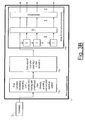
- Decoupling the coherent processing from the analyzed frequency range allows having several channels, each of the form illustrated in either Fig 3A, 3B or 3C.
- the purpose of the first coherent stage is to reduce further the bandwidth by a factor of 2 ⁇ L compared to the correlator output, and also to oversample the signal.
- the basic idea in the approaches illustrated in Figs. 3A-C is to apply the first coherent processing step for different fine frequency estimates, square the result (to perform data wipeoff), and then analyze the frequency content using one or another spectral analysis tool (such as correlation of the result with sinusoids).
- Using a single first coherent processing module for a group of frequencies reduces the complexity of the fine acquisition twofold because demodulations are applied at a reduced rate, i.e. the complexity is reduced not simply because of not providing parallel paths (one for each channel) until after the data wipeoff module, but also because demodulations are applied at a reduced rate, i.e. after the first coherent processing, which produces outputs at a rate that is down by a factor of the integration length compared to the input to the coherent processing. (For example, if the coherent processing involves an integration over 10 samples, then there is one output for every ten inputs.)
- the output of the correlator 12 includes frequencies in the range [-500,500]Hz (i.e. including both the navigation data modulation and the residual carrier frequency).
- the first coherent processing module 11b integrates 20 consecutive samples, frequencies in the range [-25,25]Hz will be filtered out by the first coherent processing process (since there are 20 such 50Hz intervals in the 1000Hz interval). Each such filtering produces a 50Hz bandwidth channel, and four such channels are included in the 200Hz-wide range of [-100,100]Hz. Therefore, after the correlator 12, four fine acquisition kernels 11 as in Fig. 3A are used.
- the spectral estimation module 11d'' is used to pick out the remnant carrier modulation amidst noise, providing a correction to the coarse estimate (provided by the correlator 12) with an uncertainty down to as little as 1 Hz.
- the implementation illustrated in Fig. 3B although fast, has as a drawback that when the integrate and dump unit is used for the first coherent processing, the frequency response is degraded for the frequencies close to the edges of the analyzed frequency interval because the first coherent processing module 11b is not an ideal filter. The degradation is enhanced by the data wipeoff module.
- a common first coherent processing module 41 is used to reduce the bandwidth of the signal after correlation. For example, if the frequency resolution of the initial acquisition is 100Hz, then the bandwidth of the signal after correlation is reduced by filtering the signal to 100Hz. Then the signal is demodulated as in the first embodiment (see Fig. 2A).
- the fine acquisition kernel 11 (Fig. 1) will have the following modules:
- Oversampling compensates for the doubling of the bandwidth (resulting in aliasing) caused by complex squaring (or other, similar operation) of a critically sampled signal.
- Oversampling (by an appropriate factor) can provide a normalized bandwidth (i.e. a bandwidth divided by sampling frequency) that is approximately one half that for a critically sampled signal .
- the Fourier transform of the complex square (or similar operation) of a critically sampled signal because of the doubling of the bandwidth of the signal by the complex squaring, will show aliasing, but the oversampled spectrum of the complex squared signal will not.
- Oversampling is of use not only in avoiding the aliasing effects that appear due to the bandwidth expansion after complex squaring (or other, similar data wipeoff operation), but also noise amplification effects due to noise aliasing caused by the complex squaring.
- the data of a short signal segment are padded by adding a segment of zeroes before applying a DFT or a fast Fourier transform (FFT).
- FFT fast Fourier transform
- the response of a system using zero-padding includes a main lobe having a width that is typically tens of times the width of the main lobe in the response of a system using the data wipeoff techniques of the invention.
- the present invention reduces to zero-padding in an implementation that does not include a second coherent processing and complex squaring.
- the method for fine acquisition according to the invention is used directly at the output of the correlator 12 (Fig. 1B).
- the correlator output provides samples of the signal at lms intervals, and there are 20 such samples per data bit. It is assumed that the timing of the bit transitions (i.e. when they occur) is unknown, and the inventors have verified the method of the invention based on such an assumption.
- the processing after the correlator starts somewhere in the middle of a data (navigation) bit (i.e. somewhere in the middle of a 20-sample interval) at one or another sample.
- the method starts from two or several different samples.
- the method first starts as in the preferred embodiment, at one or another sample, and proceeds as described above. But then the some predetermined number of samples (e.g. 10 samples) are skipped, and the method is restarted at a new starting point and again proceeds as described above.
- the procedure is performed for each of selected samples. In such an embodiment, therefore, the "phase" of the starting point with respect to the navigation data bit edge is changed.
- the processing for the two or several starting points is performed seriatim. In an alternative implementation, one designed to reduce acquisition time, the processing for the two starting points is performed in parallel.
Landscapes
- Engineering & Computer Science (AREA)
- Computer Networks & Wireless Communication (AREA)
- Signal Processing (AREA)
- Mobile Radio Communication Systems (AREA)
- Complex Calculations (AREA)
- Digital Transmission Methods That Use Modulated Carrier Waves (AREA)
Abstract
Description






These channel steps (i.e. steps for each frequency shift guess correction w 0 i ) are followed by a detection step performed by a detector module 11f in which the most likely correct estimate of the frequency shift is made by examining the results obtained for each channel via the channel steps.
where a signal includes a carrier component that must be estimated, but does not include a code component (i.e. in case of a code division multiple access signal, the code is wiped off the signal before the signal is processed according to the invention). In addition, other parallel and sequential architectures are comprehended besides what are expressly indicated herein, and numerous other modifications and alternative arrangements may be devised by those skilled in the art without departing from the spirit and scope of the present invention, and the appended claims are intended to cover such modifications and arrangements.
Claims (32)
- A method for acquiring a received spread spectrum signal, the received signal having a carrier component at a carrier frequency, a code component having a code period, and a data component, the acquiring including matching the phase of a replica of the code component to the phase of the received code component and also determining any shift in the carrier frequency away from a transmitted carrier frequency, the method comprising the steps of:thereby providing a correction to the approximately estimated carrier frequency, a correction that accounts for the carrier frequency shift remaining after the first acquisition.a) performing a first acquisition of the received signal so as to provide an approximately estimated carrier frequency and a phase of the replica and also so as to provide a code-wiped and an approximately carrier-wiped signal; andb) performing a second acquisition of the approximately carrier-wiped signal, the second acquisition including a substep of data wipe-off involving a squaring or similar operation on a signal derived from the approximately carrier-wiped signal;
- A method as claimed in claim 1, wherein the step of performing a second acquisition of the approximately carrier-wiped signal comprises the substeps of:a) mixing the approximately carrier-wiped signal with a plurality of sinusoids in turn, each sinusoid at a different frequency in a range of frequencies serving as trial corrections to the approximately estimated carrier frequency determined in the step of performing a first acquisition, so as to provide a mixed signal;b) performing a first coherent processing of the mixed signal so as to provide a carrier-amplified signal;c) performing a data wipeoff using the carrier-amplified signal so as to provide a data-wiped signal, the data wipeoff including a squaring or similar operation on the carrier-amplified signal, thus retaining in the data-wiped signal, information about the carrier frequency shift remaining after the first acquisition;d) performing a second coherent processing of the data-wiped signal, the second coherent processing for providing a further correlated and filtered signal; ande) detecting the best value to use for the correction to the approximately estimated carrier frequency based on the further correlated and filtered signal for each different trial frequency correction.
- A method as claimed in claim 2, wherein the first coherent processing comprises a lowpass filtering and a downsampling, and the second coherent processing comprises a coherent accumulation.
- A method as claimed in claim 2, wherein the first coherent processing comprises an integrate and dump processing followed by a filtering, and the second coherent processing comprises a coherent accumulation.
- A method as claimed in claim 2, wherein the first coherent processing comprises a discrete Fourier transform (DFT) processing using zero padding and output pruning, and the second coherent processing comprises a coherent accumulation.
- A method as claimed in claim 1, wherein the step of performing a second acquisition of the approximately carrier-wiped signal comprises the substeps of:a) performing a first coherent processing of the approximately carrier-wiped signal so as to provide a carrier-amplified signal;b) performing a data wipeoff using the carrier-amplified signal so as to provide a data-wiped signal, the data wipeoff including a squaring or similar operation on the carrier-amplified signal, thus retaining in the data-wiped signal, information about the carrier frequency shift remaining after the first acquisition; andc) performing a mixing and second coherent processing, the mixing being performed on the data-wiped signal using a plurality of sinusoids in turn, each sinusoid at a different frequency in a range of frequencies serving as trial corrections to the approximately estimated carrier frequency determined in the step of performing a first acquisition, to provide a mixed and data-wiped signal, and the second coherent processing being performed on the mixed and data-wiped signal, the second coherent processing for providing a further correlated and filtered signal.
- A method as claimed in claim 6, wherein in the step of performing a mixing and second coherent processing, the coherent processing includes a discrete Fourier transform of the mixed and data-wiped signal followed by an accumulation.
- A method as claimed in claim 1, wherein the step of performing a second acquisition of the approximately carrier-wiped signal comprises the substeps of:a) performing a first coherent processing of the approximately carrier-wiped signal so as to provide a carrier-amplified signal;b) performing a data wipeoff using the carrier-amplified signal so as to provide a data-wiped signal, the data wipeoff including a squaring or similar operation on the carrier-amplified signal, thus retaining in the data-wiped signal, information about the carrier frequency shift remaining after the first acquisition; andc) performing a cross correlation of the data-wiped signal, the cross correlation including estimating the phase and then the correction to the approximately estimated carrier frequency.
- A method as claimed in claim 1, wherein the step of performing a second acquisition of the approximately carrier-wiped signal comprises the substeps of:a) performing a common coherent processing of the approximately carrier-wiped signal so as to provide a first-processed approximately carrier-wiped signal;b) mixing the first-processed approximately carrier-wiped signal with a plurality of sinusoids in turn, each sinusoid at a different frequency in a range of frequencies serving as trial corrections to the approximately estimated carrier frequency determined in the step of performing a first acquisition, so as to provide a mixed signal;c) performing a first coherent channel processing of the mixed signal so as to provide a carrier-amplified signal;d) performing a data wipeoff using the carrier-amplified signal so as to provide a data-wiped signal, the data wipeoff including a squaring or similar operation on the carrier-amplified signal, thus retaining in the data-wiped signal, information about the carrier frequency shift remaining after the first acquisition;e) performing a second coherent channel processing on the data-wiped signal, the second coherent processing for providing a further correlated and filtered signal; andf) detecting the best value to use for the correction to the approximately estimated carrier frequency based on the further correlated and filtered signal for each different trial frequency correction.
- An apparatus for acquiring a received spread spectrum signal, the received signal having a carrier component at a carrier frequency, a code component having a code period, and a data component, the acquiring including matching the phase of a replica of the code component to the phase of the received code component and also determining any shift in the carrier frequency away from a transmitted carrier frequency, the apparatus comprising:thereby providing a correction to the approximately estimated carrier frequency, a correction that accounts for the carrier frequency shift remaining after the first acquisition.a) means for performing a first acquisition of the received signal so as to provide an approximately estimated carrier frequency and a phase of the replica and also so as to provide a code-wiped and an approximately carrier-wiped signal; andb) means for performing a second acquisition of the approximately carrier-wiped signal, the second acquisition including means for performing a data wipe-off involving a squaring or similar operation on a signal derived from the approximately carrier-wiped signal;
- An apparatus as claimed in claim 10, wherein the means for performing a second acquisition of the approximately carrier-wiped signal comprises:a) means for mixing the approximately carrier-wiped signal with a plurality of sinusoids in turn, each sinusoid at a different frequency in a range of frequencies serving as trial corrections to the approximately estimated carrier frequency determined using the means for performing a first acquisition, so as to provide a mixed signal;b) means for performing a first coherent processing of the mixed signal so as to provide a carrier-amplified signal;c) means for performing a data wipeoff using the carrier-amplified signal so as to provide a data-wiped signal, the data wipeoff including a squaring or similar operation on the carrier-amplified signal, thus retaining in the data-wiped signal, information about the carrier frequency shift remaining after the first acquisition;d) means for performing a second coherent processing of the data-wiped signal, the second coherent processing for providing a further correlated and filtered signal; ande) means for detecting the best value to use for the correction to the approximately estimated carrier frequency based on the further correlated and filtered signal for each different trial frequency correction.
- An apparatus as claimed in claim 11, wherein the means for performing a first coherent processing comprises a lowpass filter and a downsampler, and the means for performing a second coherent processing comprises a coherent accumulator.
- An apparatus as claimed in claim 11, wherein the means for performing a first coherent processing comprises an integrate and dump module followed by a filter, and the means for performing a second coherent processing comprises a coherent accumulator.
- An apparatus as claimed in claim 11, wherein the means for performing a first coherent processing comprises a discrete Fourier transform (DFT) module using zero padding and output pruning, and the means for performing a second coherent processing comprises a coherent accumulator.
- An apparatus as claimed in claim 10, wherein the means for performing a second acquisition of the approximately carrier-wiped signal comprises:a) means for performing a first coherent processing of the approximately carrier-wiped signal so as to provide a carrier-amplified signal;b) means for performing a data wipeoff using the carrier-amplified signal so as to provide a data-wiped signal, the data wipeoff including a squaring or similar operation on the carrier-amplified signal, thus retaining in the data-wiped signal, information about the carrier frequency shift remaining after the first acquisition; andc) means for performing a mixing and second coherent processing, the mixing being performed on the data-wiped signal using a plurality of sinusoids in turn, each sinusoid at a different frequency in a range of frequencies serving as trial corrections to the approximately estimated carrier frequency determined by the means for performing a first acquisition, to provide a mixed and data-wiped signal, and the second coherent processing being performed on the mixed and data-wiped signal, the second coherent processing for providing a further correlated and filtered signal.
- An apparatus as claimed in claim 15, wherein the means for performing a mixing and second coherent processing includes a means for performing a discrete Fourier transform of the mixed and data-wiped signal followed by an accumulator.
- An apparatus as claimed in claim 10, wherein the means for performing a second acquisition of the approximately carrier-wiped signal comprises:a) means for performing a first coherent processing of the approximately carrier-wiped signal so as to provide a carrier-amplified signal;b) means for performing a data wipeoff using the carrier-amplified signal so as to provide a data-wiped signal, the data wipeoff including a squaring or similar operation on the carrier-amplified signal, thus retaining in the data-wiped signal, information about the carrier frequency shift remaining after the first acquisition; andc) means for performing a cross correlation of the data-wiped signal, the cross correlation including estimating the phase and then the correction to the approximately estimated carrier frequency.
- An apparatus as claimed in claim 10, wherein the means for performing a second acquisition of the approximately carrier-wiped signal comprises:a) means for performing a common coherent processing of the approximately carrier-wiped signal so as to provide a first-processed approximately carrier-wiped signal;b) means for mixing the first-processed approximately carrier-wiped signal with a plurality of sinusoids in turn, each sinusoid at a different frequency in a range of frequencies serving as trial corrections to the approximately estimated carrier frequency determined using the means for performing a first acquisition, so as to provide a mixed signal;c) means for performing a first coherent channel processing of the mixed signal so as to provide a carrier-amplified signal;d) means for performing a data wipeoff using the carrier-amplified signal so as to provide a data-wiped signal, the data wipeoff including a squaring or similar operation on the carrier-amplified signal, thus retaining in the data-wiped signal, information about the carrier frequency shift remaining after the first acquisition;e) means for performing a second coherent channel processing on the data-wiped signal, the second coherent processing for providing a further correlated and filtered signal; andf) means for detecting the best value to use for the correction to the approximately estimated carrier frequency based on the further correlated and filtered signal for each different trial frequency correction.
- A system for acquiring a spread spectrum signal, the signal having a carrier component at a carrier frequency, a code component having a code period, and a data component, the acquiring including matching the phase of a replica of the code component to the phase of the code component and also determining any shift in the carrier frequency away from a transmitted carrier frequency, the apparatus comprising:a) a receiver, for receiving the spread spectrum signal as a sequence of samples, for providing a received signal; andb) the apparatus of claim 10 or claim 11 or claim 12 or claim 13 or claim 14 or claim 15 or claim 16 or claim 17 or claim 18, responsive to the received signal.
- A method for acquiring a signal having a carrier component at a carrier frequency and a data component, the acquiring including determining the carrier frequency, the method comprising the steps of:thereby acquiring the signal to a finer resolution than would be possible without performing a data wipe-off of the data component.a) providing a signal including a carrier component and a data component;b) performing an acquisition of the signal, the acquisition including a substep of data wipe-off involving a squaring or similar operation on the provided signal;
- A method as claimed in claim 20, wherein the step of performing an acquisition of the signal comprises the substeps of:a) mixing the signal with a plurality of sinusoids in turn, each sinusoid at a different frequency in a range of frequencies serving as trial estimates of the carrier frequency, so as to provide a mixed signal;b) performing a first coherent processing of the mixed signal so as to provide a carrier-amplified signal;c) performing a data wipeoff using the carrier-amplified signal so as to provide a data-wiped signal, the data wipeoff including a squaring or similar operation on the carrier-amplified signal, thus retaining in the data-wiped signal, information about the carrier frequency;d) performing a second coherent processing of the data-wiped signal, the second coherent processing for providing a further correlated and filtered signal; ande) detecting the best value to use for the estimate of the carrier frequency based on the further correlated and filtered signal for each different trial frequency estimate.
- A method as claimed in claim 20, wherein the step of performing an acquisition of the signal comprises the substeps of:a) performing a first coherent processing of the approximately carrier-wiped signal so as to provide a carrier-amplified signal;b) performing a data wipeoff using the carrier-amplified signal so as to provide a data-wiped signal, the data wipeoff including a squaring or similar operation on the carrier-amplified signal, thus retaining in the data-wiped signal, information about the carrier frequency; andc) performing a mixing and second coherent processing, the mixing being performed on the data-wiped signal using a plurality of sinusoids in turn, each sinusoid at a different frequency in a range of frequencies serving as trial estimates of the carrier frequency, to provide a mixed and data-wiped signal, and the second coherent processing being performed on the mixed and data-wiped signal, the second coherent processing for providing a further correlated and filtered signal.
- A method as claimed in claim 22, wherein in the step of performing a mixing and second coherent processing, the coherent processing includes a discrete Fourier transform of the mixed and data-wiped signal followed by an accumulation.
- A method as claimed in claim 20, wherein the step of performing an acquisition of the signal comprises the substeps of:a) performing a first coherent processing of the approximately carrier-wiped signal so as to provide a carrier-amplified signal;b) performing a data wipeoff using the carrier-amplified signal so as to provide a data-wiped signal, the data wipeoff including a squaring or similar operation on the carrier-amplified signal, thus retaining in the data-wiped signal, information about the carrier frequency of the signal; andc) performing a cross correlation of the data-wiped signal, the cross correlation including estimating the phase and then the carrier frequency of the signal.
- A method as claimed in claim 20, wherein the step of performing an acquisition of the signal comprises the substeps of:a) performing a common coherent processing of the signal so as to provide a first-processed signal;b) mixing the first-processed signal with a plurality of sinusoids in turn, each sinusoid at a different frequency in a range of frequencies serving as trial estimates of the carrier frequency, so as to provide a mixed signal;c) performing a first coherent channel processing of the mixed signal so as to provide a carrier-amplified signal;d) performing a data wipeoff using the carrier-amplified signal so as to provide a data-wiped signal, the data wipeoff including a squaring or similar operation on the carrier-amplified signal, thus retaining in the data-wiped signal, information about the carrier frequency of the signal;e) performing a second coherent channel processing on the data-wiped signal, the second coherent processing for providing a further correlated and filtered signal; andf) detecting the best value to use for the estimate of the carrier frequency based on the further correlated and filtered signal for each different trial frequency.
- An apparatus for acquiring a signal having a carrier component at a carrier frequency and a data component, the acquiring including determining the carrier frequency, the apparatus comprising:thereby acquiring the signal to a finer resolution than would be possible without performing a data wipe-off of the data component.a) means, responsive to a received signal, for providing the signal having a carrier component and a data component;b) means for performing an acquisition of the signal, the acquisition including means for performing a data wipe-off involving a squaring or similar operation on the provided signal;
- An apparatus as claimed in claim 26, wherein the means for performing an acquisition of the signal comprises:a) means for mixing the signal with a plurality of sinusoids in turn, each sinusoid at a different frequency in a range of frequencies serving as trial estimates of the carrier frequency, so as to provide a mixed signal;b) means for performing a first coherent processing of the mixed signal so as to provide a carrier-amplified signal;c) means for performing a data wipeoff using the carrier-amplified signal so as to provide a data-wiped signal, the data wipeoff including a squaring or similar operation on the carrier-amplified signal, thus retaining in the data-wiped signal, information about the carrier frequency;d) means for performing a second coherent processing of the data-wiped signal, the second coherent processing for providing a further correlated and filtered signal; ande) means for detecting the best value to use for the estimate of the carrier frequency based on the further correlated and filtered signal for each different trial frequency estimate.
- An apparatus as claimed in claim 26, wherein the means for performing an acquisition of the signal comprises:a) means for performing a first coherent processing of the approximately carrier-wiped signal so as to provide a carrier-amplified signal;b) means for performing a data wipeoff using the carrier-amplified signal so as to provide a data-wiped signal, the data wipeoff including a squaring or similar operation on the carrier-amplified signal, thus retaining in the data-wiped signal, information about the carrier frequency; andc) means for performing a mixing and second coherent processing, the mixing being performed on the data-wiped signal using a plurality of sinusoids in turn, each sinusoid at a different frequency in a range of frequencies serving as trial estimates of the carrier frequency, to provide a mixed and data-wiped signal, and the second coherent processing being performed on the mixed and data-wiped signal, the second coherent processing for providing a further correlated and filtered signal.
- An apparatus as claimed in claim 28, wherein the means for performing a mixing and second coherent processing includes means for performing a discrete Fourier transform of the mixed and data-wiped signal followed by an accumulation.
- An apparatus as claimed in claim 26, wherein the means for performing an acquisition of the signal comprises:a) means for performing a first coherent processing of the approximately carrier-wiped signal so as to provide a carrier-amplified signal;b) means for performing a data wipeoff using the carrier-amplified signal so as to provide a data-wiped signal, the data wipeoff including a squaring or similar operation on the carrier-amplified signal, thus retaining in the data-wiped signal, information about the carrier frequency of the signal; andc) means for performing a cross correlation of the data-wiped signal, the cross correlation including estimating the phase and then the carrier frequency of the signal.
- An apparatus as claimed in claim 26, wherein the means for performing an acquisition of the signal comprises:a) means for performing a common coherent processing of the signal so as to provide a first-processed signal;b) means for mixing the first-processed signal with a plurality of sinusoids in turn, each sinusoid at a different frequency in a range of frequencies serving as trial estimates of the carrier frequency, so as to provide a mixed signal;c) means for performing a first coherent channel processing of the mixed signal so as to provide a carrier-amplified signal;d) means for performing a data wipeoff using the carrier-amplified signal so as to provide a data-wiped signal, the data wipeoff including a squaring or similar operation on the carrier-amplified signal, thus retaining in the data-wiped signal, information about the carrier frequency of the signal;e) means for performing a second coherent channel processing on the data-wiped signal, the second coherent processing for providing a further correlated and filtered signal; andf) means for detecting the best value to use for the estimate of the carrier frequency based on the further correlated and filtered signal for each different trial frequency.
- A system for acquiring a signal having a carrier component at a carrier frequency and a data component, the acquiring including determining the carrier frequency, the system comprising:a) a receiver, for receiving a transmitted signal as a sequence of samples, for providing a received signal; andb) the apparatus of claim 26 or claim 27 or claim 28 or claim 29 or claim 30 or claim 31, responsive to the received signal.
Applications Claiming Priority (2)
| Application Number | Priority Date | Filing Date | Title |
|---|---|---|---|
| US09/737,166 US6909736B2 (en) | 2000-12-14 | 2000-12-14 | System for method for fine acquisition of a spread spectrum signal |
| US737166 | 2000-12-14 |
Publications (2)
| Publication Number | Publication Date |
|---|---|
| EP1215824A2 true EP1215824A2 (en) | 2002-06-19 |
| EP1215824A3 EP1215824A3 (en) | 2004-01-07 |
Family
ID=24962837
Family Applications (1)
| Application Number | Title | Priority Date | Filing Date |
|---|---|---|---|
| EP01310456A Withdrawn EP1215824A3 (en) | 2000-12-14 | 2001-12-14 | System and method for fine acquisition of a spread spectrum signal |
Country Status (2)
| Country | Link |
|---|---|
| US (1) | US6909736B2 (en) |
| EP (1) | EP1215824A3 (en) |
Cited By (5)
| Publication number | Priority date | Publication date | Assignee | Title |
|---|---|---|---|---|
| EP1847838A1 (en) * | 2006-04-21 | 2007-10-24 | Fondazione Torino Wireless | Method and apparatus for frequency estimation |
| WO2013098580A1 (en) * | 2011-12-27 | 2013-07-04 | Renesas Mobile Corporation | Method and device for determining a delay profile of a code division multiple access transmission |
| US9117260B2 (en) | 2004-10-18 | 2015-08-25 | Thomson Licensing | Methods for determining block averages for film grain simulation |
| CN109150234A (en) * | 2018-08-07 | 2019-01-04 | 电子科技大学 | A kind of direct sequence signal transmission method based on direct differential coherent accumulation |
| CN119199925A (en) * | 2024-11-27 | 2024-12-27 | 北京凯芯微科技有限公司 | Satellite navigation system signal acquisition device and method |
Families Citing this family (14)
| Publication number | Priority date | Publication date | Assignee | Title |
|---|---|---|---|---|
| US7027534B2 (en) * | 2001-06-22 | 2006-04-11 | Sirf Technology, Inc. | Extracting fine-tuned estimates from correlation functions evaluated at a limited number of values |
| GB0124952D0 (en) * | 2001-10-17 | 2001-12-05 | Nokia Corp | A receiver and a receiving method |
| WO2004038944A1 (en) * | 2002-10-24 | 2004-05-06 | Nokia Corporation | Determination of the correlation phase between a signal and a replica sequence |
| US20050141657A1 (en) * | 2003-12-30 | 2005-06-30 | Maltsev Alexander A. | Adaptive channel equalizer for wireless system |
| CN100588195C (en) * | 2005-04-29 | 2010-02-03 | 中国科学院上海微系统与信息技术研究所 | A Hierarchical Parallel Frequency Acquisition Method |
| US8036312B2 (en) * | 2007-03-30 | 2011-10-11 | Freescale Semiconductor, Inc. | System and method for determining signal phase |
| US7800536B2 (en) * | 2007-10-11 | 2010-09-21 | Mediatek, Inc. | Signal acquisition/tracking method and correlator for the same |
| US8390513B2 (en) * | 2007-11-15 | 2013-03-05 | Qualcomm Incorporated | GNSS receiver and signal tracking circuit and system |
| WO2010026514A1 (en) * | 2008-09-04 | 2010-03-11 | Koninklijke Philips Electronics N.V. | Distributed spectrum sensing |
| US20110241937A1 (en) * | 2010-04-02 | 2011-10-06 | Electronics And Telecommunications Research Institute | Apparatus and method for signal acquisition in global navigation satellite system receiver |
| US9025640B2 (en) * | 2012-06-18 | 2015-05-05 | The United States Of America As Represented By The Secretary Of The Air Force | Global navigation satellite system signal decomposition and parameterization algorithm |
| FR3054941B1 (en) * | 2016-08-05 | 2018-08-31 | Airbus Defence And Space Sas | METHOD AND SYSTEM FOR DETECTING USEFUL SIGNALS WITH RESPECTIVE NON-NEGLIGIBLE FREQUENTIAL DERIVATIVES IN A GLOBAL SIGNAL |
| US10728853B2 (en) * | 2016-10-06 | 2020-07-28 | Huawei Technologies Co., Ltd. | Wake up radio frame with spectrum spreading based single carrier |
| US11630217B2 (en) * | 2019-05-21 | 2023-04-18 | Deere & Company | Methods and devices for global navigation satellite system (GNSS) signal acquisition |
Family Cites Families (15)
| Publication number | Priority date | Publication date | Assignee | Title |
|---|---|---|---|---|
| DE3174147D1 (en) * | 1981-11-30 | 1986-04-24 | Ibm | Method for receiving a data signal with double side-band quadrature carrier modulation |
| JPH0779279B2 (en) * | 1989-11-02 | 1995-08-23 | クラリオン株式会社 | Spread spectrum receiver |
| US5271034A (en) * | 1991-08-26 | 1993-12-14 | Avion Systems, Inc. | System and method for receiving and decoding global positioning satellite signals |
| US5313491A (en) | 1992-12-31 | 1994-05-17 | Gte Government Systems Corporation | Acquisition method for DSSS communications |
| WO1995010903A1 (en) * | 1993-10-14 | 1995-04-20 | Ntt Mobile Communications Network Inc. | Correlation detector and communication apparatus |
| US5577066A (en) * | 1994-05-13 | 1996-11-19 | Stanford Telecommunications, Inc. | Charge-coupled-device based data-in-voice modem |
| CA2197341C (en) * | 1995-06-13 | 2007-03-27 | Mamoru Sawahashi | Acquisition method and system of spreading code |
| GB9523578D0 (en) * | 1995-11-17 | 1996-01-17 | Philips Electronics Nv | Demodulator |
| US5742637A (en) * | 1996-08-20 | 1998-04-21 | Golden Bridge Technology, Inc. | Fast phase estimation in digital communication systems |
| JPH1141141A (en) * | 1997-05-21 | 1999-02-12 | Mitsubishi Electric Corp | Spread spectrum signal receiving method and spread spectrum signal receiving apparatus |
| US6373899B1 (en) * | 1997-06-30 | 2002-04-16 | Spacenet, Inc. | Combined preamble detection and information method for burst-type digital communication system |
| GB9724048D0 (en) | 1997-11-14 | 1998-01-14 | Univ Edinburgh | Communications terminal and operating method |
| US6232922B1 (en) * | 1998-05-12 | 2001-05-15 | Mcintosh John C. | Passive three dimensional track of non-cooperative targets through opportunistic use of global positioning system (GPS) and GLONASS signals |
| US6208291B1 (en) * | 1998-05-29 | 2001-03-27 | Snaptrack, Inc. | Highly parallel GPS correlator system and method |
| US6363108B1 (en) | 1999-03-31 | 2002-03-26 | Qualcomm Inc. | Programmable matched filter searcher |
-
2000
- 2000-12-14 US US09/737,166 patent/US6909736B2/en not_active Expired - Fee Related
-
2001
- 2001-12-14 EP EP01310456A patent/EP1215824A3/en not_active Withdrawn
Cited By (6)
| Publication number | Priority date | Publication date | Assignee | Title |
|---|---|---|---|---|
| US9117260B2 (en) | 2004-10-18 | 2015-08-25 | Thomson Licensing | Methods for determining block averages for film grain simulation |
| EP1847838A1 (en) * | 2006-04-21 | 2007-10-24 | Fondazione Torino Wireless | Method and apparatus for frequency estimation |
| EP1847837A1 (en) * | 2006-04-21 | 2007-10-24 | Fondazione Torino Wireless | Method and apparatus for frequency estimation |
| WO2013098580A1 (en) * | 2011-12-27 | 2013-07-04 | Renesas Mobile Corporation | Method and device for determining a delay profile of a code division multiple access transmission |
| CN109150234A (en) * | 2018-08-07 | 2019-01-04 | 电子科技大学 | A kind of direct sequence signal transmission method based on direct differential coherent accumulation |
| CN119199925A (en) * | 2024-11-27 | 2024-12-27 | 北京凯芯微科技有限公司 | Satellite navigation system signal acquisition device and method |
Also Published As
| Publication number | Publication date |
|---|---|
| EP1215824A3 (en) | 2004-01-07 |
| US20020110184A1 (en) | 2002-08-15 |
| US6909736B2 (en) | 2005-06-21 |
Similar Documents
| Publication | Publication Date | Title |
|---|---|---|
| US6909736B2 (en) | System for method for fine acquisition of a spread spectrum signal | |
| EP1322044B1 (en) | Method and apparatus for detecting spread spectrum signal spread code synchronization | |
| KR102316003B1 (en) | Method and apparatus for receiving DS/FH signal | |
| RU2360263C2 (en) | Device and method of high-speed detection of gps signals | |
| US7010066B2 (en) | System and method for fast code phase and carrier frequency acquisition in GPS receiver | |
| EP2280491B1 (en) | Apparatus and method for estimating a frequency shift and a time shift | |
| EP1538454A1 (en) | GPS position measuring method and GPS position measuring system | |
| EP3282287A1 (en) | Improvement of receiving spread spectrum signals | |
| EP1205764A2 (en) | Method, apparatus and system for fast acquisition of a spread spectrum signal | |
| KR20080077953A (en) | Fast Fourier Transform for Down-Sampling-Based Navigation Satellite Signal Tracking | |
| EP2095150B1 (en) | Method and device for receiving a boc modulation radio-navigation signal | |
| JPH09162940A (en) | Evaluating method for signal quality for direct sequence spectrum diffusion receiver | |
| EP2941828A1 (en) | Pn code sync detection for the direct sequence spread spectrum receiver | |
| JP4861428B2 (en) | Processing signal sample sequences | |
| EP1152546A2 (en) | System for acquiring spread spectrum signals | |
| US7995676B2 (en) | Interpolation processing for enhanced signal acquisition | |
| US7660373B2 (en) | Data demodulation from weak navigational satellite signals | |
| JP3956722B2 (en) | Matched filter device, correlation detection method, and receiver | |
| US20040130486A1 (en) | Determination of the correlation phase between a signal and a replica sequence | |
| HK1188829A (en) | Processing a sequence of samples of a signal | |
| HK1165120A (en) | Method and system for spread spectrum signal acquisition | |
| HK1035932B (en) | Fast acquisition, high sensitivity gps receiver | |
| HK1035932A1 (en) | Fast acquisition, high sensitivity gps receiver |
Legal Events
| Date | Code | Title | Description |
|---|---|---|---|
| PUAI | Public reference made under article 153(3) epc to a published international application that has entered the european phase |
Free format text: ORIGINAL CODE: 0009012 |
|
| AK | Designated contracting states |
Kind code of ref document: A2 Designated state(s): AT BE CH CY DE DK ES FI FR GB GR IE IT LI LU MC NL PT SE TR |
|
| AX | Request for extension of the european patent |
Free format text: AL;LT;LV;MK;RO;SI |
|
| PUAL | Search report despatched |
Free format text: ORIGINAL CODE: 0009013 |
|
| AK | Designated contracting states |
Kind code of ref document: A3 Designated state(s): AT BE CH CY DE DK ES FI FR GB GR IE IT LI LU MC NL PT SE TR |
|
| AX | Request for extension of the european patent |
Extension state: AL LT LV MK RO SI |
|
| RIC1 | Information provided on ipc code assigned before grant |
Ipc: 7G 01S 5/14 B Ipc: 7H 04L 27/00 B Ipc: 7H 04B 1/707 A |
|
| 17P | Request for examination filed |
Effective date: 20040312 |
|
| AKX | Designation fees paid |
Designated state(s): AT BE CH CY DE DK ES FI FR GB GR IE IT LI LU MC NL PT SE TR |
|
| 17Q | First examination report despatched |
Effective date: 20050422 |
|
| STAA | Information on the status of an ep patent application or granted ep patent |
Free format text: STATUS: THE APPLICATION IS DEEMED TO BE WITHDRAWN |
|
| 18D | Application deemed to be withdrawn |
Effective date: 20050901 |