EP1215200A1 - Aromatic diamide derivatives or salts thereof, agricultural/horticultural chemicals and method of using the same - Google Patents
Aromatic diamide derivatives or salts thereof, agricultural/horticultural chemicals and method of using the same Download PDFInfo
- Publication number
- EP1215200A1 EP1215200A1 EP00961197A EP00961197A EP1215200A1 EP 1215200 A1 EP1215200 A1 EP 1215200A1 EP 00961197 A EP00961197 A EP 00961197A EP 00961197 A EP00961197 A EP 00961197A EP 1215200 A1 EP1215200 A1 EP 1215200A1
- Authority
- EP
- European Patent Office
- Prior art keywords
- groups
- halo
- group
- alkyl
- alkylthio
- Prior art date
- Legal status (The legal status is an assumption and is not a legal conclusion. Google has not performed a legal analysis and makes no representation as to the accuracy of the status listed.)
- Granted
Links
Classifications
-
- C—CHEMISTRY; METALLURGY
- C07—ORGANIC CHEMISTRY
- C07D—HETEROCYCLIC COMPOUNDS
- C07D213/00—Heterocyclic compounds containing six-membered rings, not condensed with other rings, with one nitrogen atom as the only ring hetero atom and three or more double bonds between ring members or between ring members and non-ring members
- C07D213/02—Heterocyclic compounds containing six-membered rings, not condensed with other rings, with one nitrogen atom as the only ring hetero atom and three or more double bonds between ring members or between ring members and non-ring members having three double bonds between ring members or between ring members and non-ring members
- C07D213/04—Heterocyclic compounds containing six-membered rings, not condensed with other rings, with one nitrogen atom as the only ring hetero atom and three or more double bonds between ring members or between ring members and non-ring members having three double bonds between ring members or between ring members and non-ring members having no bond between the ring nitrogen atom and a non-ring member or having only hydrogen or carbon atoms directly attached to the ring nitrogen atom
- C07D213/60—Heterocyclic compounds containing six-membered rings, not condensed with other rings, with one nitrogen atom as the only ring hetero atom and three or more double bonds between ring members or between ring members and non-ring members having three double bonds between ring members or between ring members and non-ring members having no bond between the ring nitrogen atom and a non-ring member or having only hydrogen or carbon atoms directly attached to the ring nitrogen atom with hetero atoms or with carbon atoms having three bonds to hetero atoms with at the most one bond to halogen, e.g. ester or nitrile radicals, directly attached to ring carbon atoms
- C07D213/72—Nitrogen atoms
- C07D213/75—Amino or imino radicals, acylated by carboxylic or carbonic acids, or by sulfur or nitrogen analogues thereof, e.g. carbamates
-
- A—HUMAN NECESSITIES
- A01—AGRICULTURE; FORESTRY; ANIMAL HUSBANDRY; HUNTING; TRAPPING; FISHING
- A01N—PRESERVATION OF BODIES OF HUMANS OR ANIMALS OR PLANTS OR PARTS THEREOF; BIOCIDES, e.g. AS DISINFECTANTS, AS PESTICIDES OR AS HERBICIDES; PEST REPELLANTS OR ATTRACTANTS; PLANT GROWTH REGULATORS
- A01N37/00—Biocides, pest repellants or attractants, or plant growth regulators containing organic compounds containing a carbon atom having three bonds to hetero atoms with at the most two bonds to halogen, e.g. carboxylic acids
- A01N37/18—Biocides, pest repellants or attractants, or plant growth regulators containing organic compounds containing a carbon atom having three bonds to hetero atoms with at the most two bonds to halogen, e.g. carboxylic acids containing the group —CO—N<, e.g. carboxylic acid amides or imides; Thio analogues thereof
- A01N37/22—Biocides, pest repellants or attractants, or plant growth regulators containing organic compounds containing a carbon atom having three bonds to hetero atoms with at the most two bonds to halogen, e.g. carboxylic acids containing the group —CO—N<, e.g. carboxylic acid amides or imides; Thio analogues thereof the nitrogen atom being directly attached to an aromatic ring system, e.g. anilides
-
- A—HUMAN NECESSITIES
- A01—AGRICULTURE; FORESTRY; ANIMAL HUSBANDRY; HUNTING; TRAPPING; FISHING
- A01N—PRESERVATION OF BODIES OF HUMANS OR ANIMALS OR PLANTS OR PARTS THEREOF; BIOCIDES, e.g. AS DISINFECTANTS, AS PESTICIDES OR AS HERBICIDES; PEST REPELLANTS OR ATTRACTANTS; PLANT GROWTH REGULATORS
- A01N37/00—Biocides, pest repellants or attractants, or plant growth regulators containing organic compounds containing a carbon atom having three bonds to hetero atoms with at the most two bonds to halogen, e.g. carboxylic acids
- A01N37/18—Biocides, pest repellants or attractants, or plant growth regulators containing organic compounds containing a carbon atom having three bonds to hetero atoms with at the most two bonds to halogen, e.g. carboxylic acids containing the group —CO—N<, e.g. carboxylic acid amides or imides; Thio analogues thereof
- A01N37/30—Biocides, pest repellants or attractants, or plant growth regulators containing organic compounds containing a carbon atom having three bonds to hetero atoms with at the most two bonds to halogen, e.g. carboxylic acids containing the group —CO—N<, e.g. carboxylic acid amides or imides; Thio analogues thereof containing the groups —CO—N< and, both being directly attached by their carbon atoms to the same carbon skeleton, e.g. H2N—NH—CO—C6H4—COOCH3; Thio-analogues thereof
-
- A—HUMAN NECESSITIES
- A01—AGRICULTURE; FORESTRY; ANIMAL HUSBANDRY; HUNTING; TRAPPING; FISHING
- A01N—PRESERVATION OF BODIES OF HUMANS OR ANIMALS OR PLANTS OR PARTS THEREOF; BIOCIDES, e.g. AS DISINFECTANTS, AS PESTICIDES OR AS HERBICIDES; PEST REPELLANTS OR ATTRACTANTS; PLANT GROWTH REGULATORS
- A01N37/00—Biocides, pest repellants or attractants, or plant growth regulators containing organic compounds containing a carbon atom having three bonds to hetero atoms with at the most two bonds to halogen, e.g. carboxylic acids
- A01N37/44—Biocides, pest repellants or attractants, or plant growth regulators containing organic compounds containing a carbon atom having three bonds to hetero atoms with at the most two bonds to halogen, e.g. carboxylic acids containing at least one carboxylic group or a thio analogue, or a derivative thereof, and a nitrogen atom attached to the same carbon skeleton by a single or double bond, this nitrogen atom not being a member of a derivative or of a thio analogue of a carboxylic group, e.g. amino-carboxylic acids
- A01N37/46—N-acyl derivatives
-
- A—HUMAN NECESSITIES
- A01—AGRICULTURE; FORESTRY; ANIMAL HUSBANDRY; HUNTING; TRAPPING; FISHING
- A01N—PRESERVATION OF BODIES OF HUMANS OR ANIMALS OR PLANTS OR PARTS THEREOF; BIOCIDES, e.g. AS DISINFECTANTS, AS PESTICIDES OR AS HERBICIDES; PEST REPELLANTS OR ATTRACTANTS; PLANT GROWTH REGULATORS
- A01N41/00—Biocides, pest repellants or attractants, or plant growth regulators containing organic compounds containing a sulfur atom bound to a hetero atom
- A01N41/02—Biocides, pest repellants or attractants, or plant growth regulators containing organic compounds containing a sulfur atom bound to a hetero atom containing a sulfur-to-oxygen double bond
- A01N41/10—Sulfones; Sulfoxides
-
- A—HUMAN NECESSITIES
- A01—AGRICULTURE; FORESTRY; ANIMAL HUSBANDRY; HUNTING; TRAPPING; FISHING
- A01N—PRESERVATION OF BODIES OF HUMANS OR ANIMALS OR PLANTS OR PARTS THEREOF; BIOCIDES, e.g. AS DISINFECTANTS, AS PESTICIDES OR AS HERBICIDES; PEST REPELLANTS OR ATTRACTANTS; PLANT GROWTH REGULATORS
- A01N43/00—Biocides, pest repellants or attractants, or plant growth regulators containing heterocyclic compounds
- A01N43/34—Biocides, pest repellants or attractants, or plant growth regulators containing heterocyclic compounds having rings with one nitrogen atom as the only ring hetero atom
- A01N43/40—Biocides, pest repellants or attractants, or plant growth regulators containing heterocyclic compounds having rings with one nitrogen atom as the only ring hetero atom six-membered rings
-
- C—CHEMISTRY; METALLURGY
- C07—ORGANIC CHEMISTRY
- C07C—ACYCLIC OR CARBOCYCLIC COMPOUNDS
- C07C233/00—Carboxylic acid amides
- C07C233/64—Carboxylic acid amides having carbon atoms of carboxamide groups bound to carbon atoms of six-membered aromatic rings
- C07C233/81—Carboxylic acid amides having carbon atoms of carboxamide groups bound to carbon atoms of six-membered aromatic rings having the nitrogen atom of at least one of the carboxamide groups bound to a carbon atom of a hydrocarbon radical substituted by carboxyl groups
- C07C233/82—Carboxylic acid amides having carbon atoms of carboxamide groups bound to carbon atoms of six-membered aromatic rings having the nitrogen atom of at least one of the carboxamide groups bound to a carbon atom of a hydrocarbon radical substituted by carboxyl groups with the substituted hydrocarbon radical bound to the nitrogen atom of the carboxamide group by an acyclic carbon atom
- C07C233/83—Carboxylic acid amides having carbon atoms of carboxamide groups bound to carbon atoms of six-membered aromatic rings having the nitrogen atom of at least one of the carboxamide groups bound to a carbon atom of a hydrocarbon radical substituted by carboxyl groups with the substituted hydrocarbon radical bound to the nitrogen atom of the carboxamide group by an acyclic carbon atom of an acyclic saturated carbon skeleton
-
- C—CHEMISTRY; METALLURGY
- C07—ORGANIC CHEMISTRY
- C07C—ACYCLIC OR CARBOCYCLIC COMPOUNDS
- C07C233/00—Carboxylic acid amides
- C07C233/64—Carboxylic acid amides having carbon atoms of carboxamide groups bound to carbon atoms of six-membered aromatic rings
- C07C233/81—Carboxylic acid amides having carbon atoms of carboxamide groups bound to carbon atoms of six-membered aromatic rings having the nitrogen atom of at least one of the carboxamide groups bound to a carbon atom of a hydrocarbon radical substituted by carboxyl groups
- C07C233/82—Carboxylic acid amides having carbon atoms of carboxamide groups bound to carbon atoms of six-membered aromatic rings having the nitrogen atom of at least one of the carboxamide groups bound to a carbon atom of a hydrocarbon radical substituted by carboxyl groups with the substituted hydrocarbon radical bound to the nitrogen atom of the carboxamide group by an acyclic carbon atom
- C07C233/85—Carboxylic acid amides having carbon atoms of carboxamide groups bound to carbon atoms of six-membered aromatic rings having the nitrogen atom of at least one of the carboxamide groups bound to a carbon atom of a hydrocarbon radical substituted by carboxyl groups with the substituted hydrocarbon radical bound to the nitrogen atom of the carboxamide group by an acyclic carbon atom of an acyclic unsaturated carbon skeleton
-
- C—CHEMISTRY; METALLURGY
- C07—ORGANIC CHEMISTRY
- C07C—ACYCLIC OR CARBOCYCLIC COMPOUNDS
- C07C237/00—Carboxylic acid amides, the carbon skeleton of the acid part being further substituted by amino groups
- C07C237/02—Carboxylic acid amides, the carbon skeleton of the acid part being further substituted by amino groups having the carbon atoms of the carboxamide groups bound to acyclic carbon atoms of the carbon skeleton
- C07C237/22—Carboxylic acid amides, the carbon skeleton of the acid part being further substituted by amino groups having the carbon atoms of the carboxamide groups bound to acyclic carbon atoms of the carbon skeleton having nitrogen atoms of amino groups bound to the carbon skeleton of the acid part, further acylated
-
- C—CHEMISTRY; METALLURGY
- C07—ORGANIC CHEMISTRY
- C07C—ACYCLIC OR CARBOCYCLIC COMPOUNDS
- C07C251/00—Compounds containing nitrogen atoms doubly-bound to a carbon skeleton
- C07C251/32—Oximes
- C07C251/34—Oximes with oxygen atoms of oxyimino groups bound to hydrogen atoms or to carbon atoms of unsubstituted hydrocarbon radicals
- C07C251/36—Oximes with oxygen atoms of oxyimino groups bound to hydrogen atoms or to carbon atoms of unsubstituted hydrocarbon radicals with the carbon atoms of the oxyimino groups bound to hydrogen atoms or to acyclic carbon atoms
- C07C251/38—Oximes with oxygen atoms of oxyimino groups bound to hydrogen atoms or to carbon atoms of unsubstituted hydrocarbon radicals with the carbon atoms of the oxyimino groups bound to hydrogen atoms or to acyclic carbon atoms to carbon atoms of a saturated carbon skeleton
-
- C—CHEMISTRY; METALLURGY
- C07—ORGANIC CHEMISTRY
- C07C—ACYCLIC OR CARBOCYCLIC COMPOUNDS
- C07C251/00—Compounds containing nitrogen atoms doubly-bound to a carbon skeleton
- C07C251/32—Oximes
- C07C251/34—Oximes with oxygen atoms of oxyimino groups bound to hydrogen atoms or to carbon atoms of unsubstituted hydrocarbon radicals
- C07C251/36—Oximes with oxygen atoms of oxyimino groups bound to hydrogen atoms or to carbon atoms of unsubstituted hydrocarbon radicals with the carbon atoms of the oxyimino groups bound to hydrogen atoms or to acyclic carbon atoms
- C07C251/40—Oximes with oxygen atoms of oxyimino groups bound to hydrogen atoms or to carbon atoms of unsubstituted hydrocarbon radicals with the carbon atoms of the oxyimino groups bound to hydrogen atoms or to acyclic carbon atoms to carbon atoms of an unsaturated carbon skeleton
-
- C—CHEMISTRY; METALLURGY
- C07—ORGANIC CHEMISTRY
- C07C—ACYCLIC OR CARBOCYCLIC COMPOUNDS
- C07C317/00—Sulfones; Sulfoxides
- C07C317/26—Sulfones; Sulfoxides having sulfone or sulfoxide groups and nitrogen atoms, not being part of nitro or nitroso groups, bound to the same carbon skeleton
- C07C317/28—Sulfones; Sulfoxides having sulfone or sulfoxide groups and nitrogen atoms, not being part of nitro or nitroso groups, bound to the same carbon skeleton with sulfone or sulfoxide groups bound to acyclic carbon atoms of the carbon skeleton
-
- C—CHEMISTRY; METALLURGY
- C07—ORGANIC CHEMISTRY
- C07C—ACYCLIC OR CARBOCYCLIC COMPOUNDS
- C07C317/00—Sulfones; Sulfoxides
- C07C317/44—Sulfones; Sulfoxides having sulfone or sulfoxide groups and carboxyl groups bound to the same carbon skeleton
- C07C317/48—Sulfones; Sulfoxides having sulfone or sulfoxide groups and carboxyl groups bound to the same carbon skeleton the carbon skeleton being further substituted by singly-bound nitrogen atoms, not being part of nitro or nitroso groups
- C07C317/50—Sulfones; Sulfoxides having sulfone or sulfoxide groups and carboxyl groups bound to the same carbon skeleton the carbon skeleton being further substituted by singly-bound nitrogen atoms, not being part of nitro or nitroso groups at least one of the nitrogen atoms being part of any of the groups, X being a hetero atom, Y being any atom
-
- C—CHEMISTRY; METALLURGY
- C07—ORGANIC CHEMISTRY
- C07C—ACYCLIC OR CARBOCYCLIC COMPOUNDS
- C07C323/00—Thiols, sulfides, hydropolysulfides or polysulfides substituted by halogen, oxygen or nitrogen atoms, or by sulfur atoms not being part of thio groups
- C07C323/10—Thiols, sulfides, hydropolysulfides or polysulfides substituted by halogen, oxygen or nitrogen atoms, or by sulfur atoms not being part of thio groups containing thio groups and singly-bound oxygen atoms bound to the same carbon skeleton
- C07C323/11—Thiols, sulfides, hydropolysulfides or polysulfides substituted by halogen, oxygen or nitrogen atoms, or by sulfur atoms not being part of thio groups containing thio groups and singly-bound oxygen atoms bound to the same carbon skeleton having the sulfur atoms of the thio groups bound to acyclic carbon atoms of the carbon skeleton
- C07C323/12—Thiols, sulfides, hydropolysulfides or polysulfides substituted by halogen, oxygen or nitrogen atoms, or by sulfur atoms not being part of thio groups containing thio groups and singly-bound oxygen atoms bound to the same carbon skeleton having the sulfur atoms of the thio groups bound to acyclic carbon atoms of the carbon skeleton the carbon skeleton being acyclic and saturated
-
- C—CHEMISTRY; METALLURGY
- C07—ORGANIC CHEMISTRY
- C07C—ACYCLIC OR CARBOCYCLIC COMPOUNDS
- C07C323/00—Thiols, sulfides, hydropolysulfides or polysulfides substituted by halogen, oxygen or nitrogen atoms, or by sulfur atoms not being part of thio groups
- C07C323/23—Thiols, sulfides, hydropolysulfides or polysulfides substituted by halogen, oxygen or nitrogen atoms, or by sulfur atoms not being part of thio groups containing thio groups and nitrogen atoms, not being part of nitro or nitroso groups, bound to the same carbon skeleton
- C07C323/39—Thiols, sulfides, hydropolysulfides or polysulfides substituted by halogen, oxygen or nitrogen atoms, or by sulfur atoms not being part of thio groups containing thio groups and nitrogen atoms, not being part of nitro or nitroso groups, bound to the same carbon skeleton at least one of the nitrogen atoms being part of any of the groups, X being a hetero atom, Y being any atom
- C07C323/40—Y being a hydrogen or a carbon atom
- C07C323/41—Y being a hydrogen or an acyclic carbon atom
-
- C—CHEMISTRY; METALLURGY
- C07—ORGANIC CHEMISTRY
- C07D—HETEROCYCLIC COMPOUNDS
- C07D213/00—Heterocyclic compounds containing six-membered rings, not condensed with other rings, with one nitrogen atom as the only ring hetero atom and three or more double bonds between ring members or between ring members and non-ring members
- C07D213/02—Heterocyclic compounds containing six-membered rings, not condensed with other rings, with one nitrogen atom as the only ring hetero atom and three or more double bonds between ring members or between ring members and non-ring members having three double bonds between ring members or between ring members and non-ring members
- C07D213/04—Heterocyclic compounds containing six-membered rings, not condensed with other rings, with one nitrogen atom as the only ring hetero atom and three or more double bonds between ring members or between ring members and non-ring members having three double bonds between ring members or between ring members and non-ring members having no bond between the ring nitrogen atom and a non-ring member or having only hydrogen or carbon atoms directly attached to the ring nitrogen atom
- C07D213/60—Heterocyclic compounds containing six-membered rings, not condensed with other rings, with one nitrogen atom as the only ring hetero atom and three or more double bonds between ring members or between ring members and non-ring members having three double bonds between ring members or between ring members and non-ring members having no bond between the ring nitrogen atom and a non-ring member or having only hydrogen or carbon atoms directly attached to the ring nitrogen atom with hetero atoms or with carbon atoms having three bonds to hetero atoms with at the most one bond to halogen, e.g. ester or nitrile radicals, directly attached to ring carbon atoms
- C07D213/78—Carbon atoms having three bonds to hetero atoms, with at the most one bond to halogen, e.g. ester or nitrile radicals
- C07D213/81—Amides; Imides
-
- C—CHEMISTRY; METALLURGY
- C07—ORGANIC CHEMISTRY
- C07D—HETEROCYCLIC COMPOUNDS
- C07D213/00—Heterocyclic compounds containing six-membered rings, not condensed with other rings, with one nitrogen atom as the only ring hetero atom and three or more double bonds between ring members or between ring members and non-ring members
- C07D213/02—Heterocyclic compounds containing six-membered rings, not condensed with other rings, with one nitrogen atom as the only ring hetero atom and three or more double bonds between ring members or between ring members and non-ring members having three double bonds between ring members or between ring members and non-ring members
- C07D213/04—Heterocyclic compounds containing six-membered rings, not condensed with other rings, with one nitrogen atom as the only ring hetero atom and three or more double bonds between ring members or between ring members and non-ring members having three double bonds between ring members or between ring members and non-ring members having no bond between the ring nitrogen atom and a non-ring member or having only hydrogen or carbon atoms directly attached to the ring nitrogen atom
- C07D213/60—Heterocyclic compounds containing six-membered rings, not condensed with other rings, with one nitrogen atom as the only ring hetero atom and three or more double bonds between ring members or between ring members and non-ring members having three double bonds between ring members or between ring members and non-ring members having no bond between the ring nitrogen atom and a non-ring member or having only hydrogen or carbon atoms directly attached to the ring nitrogen atom with hetero atoms or with carbon atoms having three bonds to hetero atoms with at the most one bond to halogen, e.g. ester or nitrile radicals, directly attached to ring carbon atoms
- C07D213/78—Carbon atoms having three bonds to hetero atoms, with at the most one bond to halogen, e.g. ester or nitrile radicals
- C07D213/81—Amides; Imides
- C07D213/82—Amides; Imides in position 3
-
- C—CHEMISTRY; METALLURGY
- C07—ORGANIC CHEMISTRY
- C07D—HETEROCYCLIC COMPOUNDS
- C07D239/00—Heterocyclic compounds containing 1,3-diazine or hydrogenated 1,3-diazine rings
- C07D239/02—Heterocyclic compounds containing 1,3-diazine or hydrogenated 1,3-diazine rings not condensed with other rings
- C07D239/24—Heterocyclic compounds containing 1,3-diazine or hydrogenated 1,3-diazine rings not condensed with other rings having three or more double bonds between ring members or between ring members and non-ring members
- C07D239/28—Heterocyclic compounds containing 1,3-diazine or hydrogenated 1,3-diazine rings not condensed with other rings having three or more double bonds between ring members or between ring members and non-ring members with hetero atoms or with carbon atoms having three bonds to hetero atoms with at the most one bond to halogen, directly attached to ring carbon atoms
Definitions
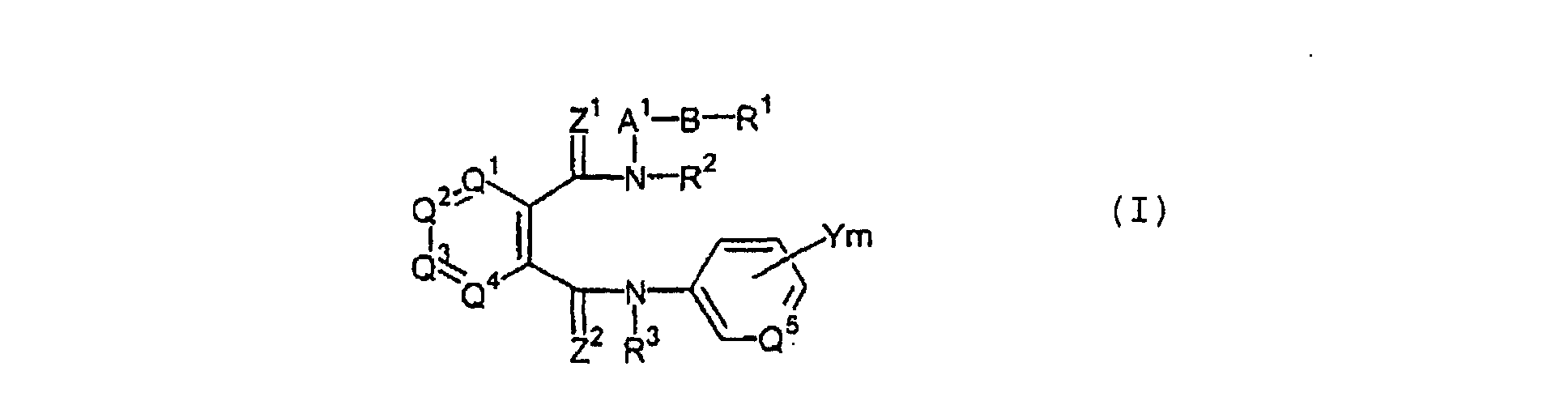
- the present invention relates to an aromatic diamide derivative or a salt thereof; an agrohorticultural composition, particularly an agrohorticultural insecticide both containing the derivative or the salt as an effective ingredient; and a method for using the same.
- the present inventors made an intensive study in order to develop a novel agrohorticultural composition, particularly an agrohorticultural insecticide and, as a result, found out that an aromatic diamide derivative represented by the general formula (I) or a salt thereof according to the present invention is a novel compound not described in any literature and is useful as an agrohorticultural composition, particularly as an agrohorticultural insecticide.
- the present invention has been completed based on the above finding.
- the present invention relates to an aromatic diamide derivative represented by the following general formula (I) or a salt thereof; an agrohorticultural composition, particularly an agrohorticultural insecticide; and a method for using the insecticide: ⁇ wherein A 1 is a (C 1 -C 8 )alkylene group; a substituted (C 1 -C 8 ) alkylene group having one or more same or different substituents selected from halogen atoms, cyano group, nitro group, halo(C 1 -C 6 )alkyl groups, (C 1 -C 6 )alkoxy groups, halo(C 1 -C 6 )alkoxy groups, (C 1 -C 6 )alkylthio groups, halo (C 1 -C 6 ) alkylthio groups, (C 1 -C 6 )alkylsulfinyl groups, halo(C 1 -C 6 )alkylsulfinyl groups, (C 1
- halogen atom refers to chlorine atom, bromine atom, iodine atom or fluorine atom
- (C 1 -C 6 )alkyl group refers to a straight chain or branched chain alkyl group having 1 to 6 carbon atoms, such as methyl, ethyl, n-propyl, isopropyl, n-butyl, isobutyl, sec-butyl, tert-butyl, n-pentyl, n-hexyl or the like
- halo(C 1 -C 6 )alkyl group refers to a straight chain or branched chain alkyl group having 1 to 6 carbon atoms, substituted with one or more same or different halogen atoms
- (C 1 -C 8 )alkylene group refers to a straight chain or branched chain al
- (C 3 -C 6 )cycloalkyl group refers to an alicyclic alkyl group having 3 to 6 carbon atoms, such as cyclopropyl, cyclobutyl, cyclopentyl, cyclohexyl or the like.
- the 4- to 7-membered ring which may contain one or two same or different atoms selected from oxygen, sulfur and nitrogen atoms, which is formed by bonding of R 1 to A 1 or by bonding of R 2 to A 1 " can be exemplified by cyclobutane ring, cyclopentane ring, cyclohexane ring, azetidine ring, pyrrolidine ring, pyrroline ring, piperidine ring, imidazolidine ring, imidazoline ring, oxazolidine ring, thiazolidine ring, isoxazolidine ring, isothiazolidine ring, tetrahydropyridine ring, piperazine ring, morpholine ring, thiomorpholine ring, dioxazine ring and dithiazine ring.
- the 4- to 7-membered ring which may contain one or two same or different atoms selected form oxygen, sulfur and nitrogen atoms, which is formed by bonding of R 2 to R 1 " can be exemplified by azetidine ring, pyrrolidine ring, pyrroline ring, piperidine ring, imidazolidine ring, imidazoline ring, oxazolidine ring, thiazolidine ring, isoxazolidine ring, isothiazolidine ring, tetrahydropyridine ring, piperazine ring, morpholine ring, thiomorpholine ring, dioxazine ring and dithiazine ring.
- Heterocyclic ring can be exemplified by pyridyl group, pyridine-N-oxide group, pyrimidyl group, furyl group, tetrahydrofuryl group, thienyl group, tetrahydrothienyl group, tetrahydropyranyl group, tetrahydrothiopyranyl group, oxazolyl group, isoxazolyl group, oxadiazolyl group, thiazolyl group, isothiazolyl group, thiadiazolyl group, imidazolyl group, triazolyl group and pyrazolyl group.
- Condensed ring can be exemplified by naphthalene, tetrahydronaphthalene, indene, indane, quinoline, quinazoline, indole, indoline, coumarone, isocoumarone, benzodioxane, benzodioxole, benzofuran, dihydrobenzofuran, benzothiophene, dihydrobenzothiophene, benzoxazole, benzothiazole, benzimidazole and indazole.
- Salt can be exemplified by inorganic acid salts such as hydrochloride, sulfate, nitrate, phosphate and the like; organic acid salts such as acetate, fumarate, maleate, oxalate, methanesulfonate, benzenesulfonate, paratoluenesulfonate and the like; and salts with metal ions such as sodium ion, potassium ion, calcium ion and the like.
- inorganic acid salts such as hydrochloride, sulfate, nitrate, phosphate and the like
- organic acid salts such as acetate, fumarate, maleate, oxalate, methanesulfonate, benzenesulfonate, paratoluenesulfonate and the like
- salts with metal ions such as sodium ion, potassium ion, calcium ion and the like.
- the aromatic diamide derivative represented by the general formula (I) or the salt thereof according to the present invention may contain, in the structural formula, one or more asymmetric carbon atoms or asymmetric centers, and may contain two or more kinds of optical isomers or diastereomers; and the present aromatic diamide derivative or salt thereof includes even these individual optical isomers and mixtures of any proportions of the optical isomers.
- the aromatic diamide derivative represented by the general formula (I) or the salt thereof according to the present invention may contain, in the structural formula, two kinds of geometrical isomers owing to the carbon-to-carbon double bond or carbon-to-nitrogen double bond; and the present aromatic diamide derivative or salt thereof includes even these individual geometrical isomers and mixtures of any proportions of the geometrical isomers.
- a 1 is a (C 1 -C 4 )alkylene group, a (C 3 -C 5 )-alkenylene group or a (C 3 -C 5 )alkynylene group;
- R 1 is a (C 1 -C 3 )alkyl group, a (C 1 -C 3 )alkoxy group, a mono(C 1 -C 3 )alkylamino group or a di(C 1 -C 3 )alkylamino group wherein the two alkyl groups may be the same or different;
- R 2 and R 3 are each a hydrogen atom;
- Q 1 and Q 2 are each a carbon atom;
- X may be the same or different, and is a
- the aromatic diamide derivative represented by the general formula (I) or the salt thereof according to the present invention can be produced, for example, by the processes shown in the following schemes.
- the present aromatic diamide derivative or salt thereof can also be produced, for example, by the process disclosed in Japanese Patent Application No. 10-350768.
- the processes for producing the present aromatic diamide derivative or salt thereof are not restricted to these processes.
- R 1 , R 2 , A 1 , B, Q 1 to Q 5 , Y, m, Z 1 and Z 2 each have the same definition as given above).
- a carboxylic anhydride derivative represented by the general formula (II) is reacted with an amine represented by the general formula (III) in the presence of an inert solvent to obtain an imide derivative represented by the general formula (IV); the imide derivative (IV) is reacted, after being isolated or without being isolated, with an amine represented by the general formula (V); thereby, an aromatic diamide derivative represented by the general formula (I) can be produced.
- the inert solvent usable in the present reaction can be any solvent as long as it does not impair the progress of the present reaction. It can be exemplified by aromatic hydrocarbons such as benzene, toluene, xylene and the like; halogenated hydrocarbons such as methylene chloride, chloroform, carbon tetrachloride and the like; chlorinated aromatic hydrocarbons such as chlorobenzene, dichlorobenzene and the like; chain or cyclic ethers such as diethyl ether, dioxane, tetrahydrofuran and the like; esters such as ethyl acetate and the like; amides such as dimethylformamide, dimethylacetamide and the like; acids such as acetic acid and the like; dimethyl sulfoxide; and 1,3-dimethyl-2-imidazolidinone. These inert solvents can be used singly or in admixture of two or more kinds.
- the present reaction is an equimolar reaction
- the individual reactants can be used by the same mole, but any reactant may be used in excess.
- the present reaction may be conducted under a dehydrating condition as necessary.
- the reaction temperature can be room temperature to the refluxing temperature of the inert solvent used.
- the reaction time varies depending upon, for example, the size or temperature of reaction, but can appropriately be determined in a range of several minutes to 48 hours.
- reaction mixture containing an intended product is subjected to an isolation treatment according to an ordinary method and, as necessary, purification is conducted by recrystallization, column chromatography or the like, whereby the intended product can be obtained.
- the reaction mixture per se may be used in the next reaction without being subjected to the above isolation treatment for obtaining the intended product.
- the carboxylic anhydride derivative represented by the general formula (II) can be produced by one of the processes described in J. Org. Chem., 52 , 129 (1987); J. Am. Chem. Soc., 51 , 1865 (1929); ibidem, 63 , 1542 (1941); etc.
- the amine represented by the general formula (III) can be produced by one of the processes described in J. Org. Chem., 29 , 1 (1964); Angew. Chem. Int. Ed. Engl., 24 , 871 (1985); Synthesis, 1984 , 667; Nippon Kagaku Kaishi, 1973 , 2351; DE-2606982; JP-A-1-90163; etc.
- the amine represented by the general formula (V) can be produced by one of the processes described in Chem. Pharm. Bull., 30(5), 1921-1924 (1982); Jikken Kagaku Koza 22, Organic Synthesis IV (Amino Acids and Peptides) (1992); etc.
- the inert solvent usable in the present reaction can be exemplified by those inert solvents usable in the above reaction (1).
- the individual reactants can be used by the same mole, but the amine represented by the general formula (V) may be used in excess.
- the reaction temperature can be room temperature to the refluxing temperature of the inert solvent used.
- the reaction time varies depending upon, for example, the size or temperature of reaction, but can appropriately be determined in a range of several minutes to 48 hours.
- reaction mixture containing an intended product is subjected to an isolation treatment according to an ordinary method and, as necessary, purification is conducted by recrystallization, column chromatography or the like, whereby the intended product can be obtained.
- R 1 , R 2 , R 3 , A 1 , B, Q 1 to Q 5 , Y and m each have the same definition as given above).
- a carboxylic anhydride derivative represented by the general formula (II-1) is reacted with an amine represented by the general formula (V) in the presence of an inert solvent to obtain a carboxamide represented by the general formula (VI-2).
- This carboxamide (VI-2) is subjected to the following procedure after being isolated or without being isolated.
- the carboxamide (VI-2), wherein R 2 is a hydrogen atom is subjected to a condensation reaction in the presence of a condensation agent to obtain a compound represented by the general formula (VII-2); the compound (VII-2) is reacted, after being isolated or without being isolated, with an amine represented by the general formula (III-1) in the presence of an inert solvent; or, the carboxamide (VI-2), wherein R 2 is other than hydrogen atom, is condensed with an amine represented by the general formula (III-1) in the presence of a condensation agent; thereby, an aromatic diamide derivative represented by the general formula (I-1) can be produced.
- a carboxylic anhydride derivative represented by the general formula (II-1) is reacted with an amine represented by the general formula (III-1) in the presence of an inert solvent to obtain a carboxamide represented by the general formula (VI-1).
- This carboxamide (VI-1) is subjected to the following procedure after being isolated or without being isolated.
- the carboxamide (VI-1), wherein R 3 is a hydrogen atom is subjected to a condensation reaction in the presence of a condensation agent to obtain a compound represented by the general formula (VII-1) and this compound (VII-1) is reacted, after being isolated or without being isolated, with an amine represented by the general formula (V) in the presence of an inert solvent; or, the carboxamide (VI-1), wherein R 3 is other than hydrogen atom, is condensed with an amine represented by the general formula (V) in the presence of a condensation agent; thereby, an aromatic diamide derivative represented by the general formula (I-1) can be produced.
- the present reaction is conducted in the same manner as in the production process 1 (2), whereby an intended compound can be produced.
- the present reaction is conducted in the same manner as in the production process 1 (2), whereby an intended product can be produced.
- a carboxamide derivative represented by the general formula (VI-1) or the general formula (VI-2) is reacted with an amine represented by the general formula (V) or the general formula (III-1) in the presence of a condensation agent and an inert solvent, whereby an intended compound can be produced.
- the present invention may be conducted in the presence of a base, as necessary.
- the inert solvent used in the present reaction can be exemplified by tetrahydrofuran, diethyl ether, dioxane, methylene chloride and chloroform.
- the condensation agent used in the present reaction can be any condensation agent used in ordinary amide production, and can be exemplified by Mukaiyama reagent (2-choro-N-methyl pyridinium iodide), DCC (1,3-dicyclohexylcarbodiimide), CDI (carbonyl diimidazole) and DEPC (diethyl phosphoric cyanide).
- the amount of the condensation agent used can appropriately be determined at one or more moles per mole of the carboxamide represented by the general formula (VI-1) or the general formula (VI-2).
- the base usable in the present reaction can be exemplified by organic bases (e.g. triethylamine and pyridine) and inorganic bases (e.g. potassium carbonate).
- organic bases e.g. triethylamine and pyridine
- inorganic bases e.g. potassium carbonate
- the amount of the base used can appropriately be determined at one or more moles per mole of the carboxamide represented by the general formula (VI-1) or the general formula (VI-2).
- the reaction temperature can be 0°C to the boiling point of the inert solvent used.
- the reaction time varies depending upon, for example, the size or temperature of reaction, but is several minutes to 48 hours.
- reaction mixture containing an intended product is subjected to an isolation treatment according to an ordinary method and, as necessary, purification is conducted by recrystallization, column chromatography or the like, whereby the intended product can be obtained.
- Q 1 is at 3-position; Q 2 is at 4-position; Q 3 is at 5-position; and Q 4 is at 6-position.
- the agrohorticultural composition particularly, agrohorticultural insecticides containing the aromatic diamide derivative represented by the formula (I) or salt thereof of the present invention as an active ingredient are suitable for controlling various insect pests such as agrohorticultural insect pests, stored grain insect pests, sanitary insect pests, nematodes, etc., which are injurious to paddy rice, fruit trees, vegetables, other crops, flowers, ornamental plants, etc. They have a marked insecticidal effect, for example, on LEPIDOPTERA including summer fruit tortrix ( Adoxophes orana fasciata ), smaller tea tortrix ( Adoxophyes sp.
- Adoxophes orana fasciata Adoxophyes sp.
- Manchurian fruit moth Grapholita inopinata
- oriental fruit moth Grapholita molesta
- soybean pod border Leguminovora glycinivorella
- mulberry leafroller Olethreutes mori
- tea leafroller Caloptilia thevivora
- Caloptilia sp. Caloptilia zachrysa
- apple leafminer Phyllonorycter ringoniella
- pear barkminer Spulerrina astaurota
- common white Piers rapae crucivora
- tobacco budworm Heliothis sp.
- codling moth Laspey resia pomonella
- diamondback moth Plutella xylostella
- apple fruit moth Argyresthia conjugella
- peach fruit moth Carposina niponensis
- rice stem borer Chilo suppressalis
- rice leafroller Cnaphalocrocis medinalis
- tobacco moth Ephestia elutella
- mulberry pyralid Glyphodes pyloalis
- yellow rice borer Scirpophaga incertulas
- rice skipper Parnara guttata, ), rice armyworm ( Pseudaletia separata) , pink borer (Sesamia inferens ), common cutworm ( Spodoptera litura ), beet armyworm ( Spodoptera exigua), etc.
- HEMIPTERA including aster leafhopper (Macrosteles fascifrons ), green rice leafhopper (Nephos fascifrons ), green rice leaf
- coffee root-lesion nematode Pratylenchus coffeae
- potato cyst nematode Globodera rostochiensis
- root-knot nematode Meloidogyne sp .
- citrus nematode Teylenchulus semipenetrans
- Aphelenchus sp. Aphelenchus avenae
- chrysanthemum foliar Aphelenchoides ritzemabosi
- the agrohorticultural composition particularly, agrohorticultural insecticides containing the aromatic diamide derivative represented by formula (I) or salt thereof of the present invention has a marked controlling effect on the above-exemplified insect pests, sanitary pests and/or nematodes, which are injurious to paddy field crops, upland crops, fruit trees, vegetables and other crops, flowers and ornament plants, and the like.
- the desired effect of the agrohorticultural insecticide of the present invention can be exhibited by applying the insecticide to the paddy field water, stalks and leaves or soil of paddy field, upland field, fruit trees, vegetables, other crops or flowers and ornament plants at a season at which the insect pests, sanitary pests or nematodes are expected to appear, before their appearance or at the time when their appearance is confirmed.
- the agrohorticultural composition of the present invention is used after being prepared into conveniently usable forms according to ordinary manner for preparation of agrochemicals.
- aromatic diamide derivative of formula (I) or salt thereof and an appropriate carrier are blended optionally together with an adjuvant in a proper proportion and prepared into a suitable preparation form such as suspension, emulsifiable concentrate, soluble concentrate, wettable powder, granules, dust or tablets through dissolution, separation, suspension, mixing, impregnation, adsorption or sticking.
- a suitable preparation form such as suspension, emulsifiable concentrate, soluble concentrate, wettable powder, granules, dust or tablets through dissolution, separation, suspension, mixing, impregnation, adsorption or sticking.
- the inert carrier used in the present invention may be either solid or liquid.
- synthetic high-dispersion silicic acid also called finely divided hydrated silica or hydrated silicic acid
- some of the commercially available products contain calcium silicate as the major component
- activated carbon powdered sulfur, pumice, calcined diatomaceous earth, ground brick, fly ash, sand, calcium carbonate, calcium phosphate and other inorganic or mineral powders
- chemical fertilizers such as ammonium sulfate, ammonium phosphate, ammonium nitrate, urea, ammonium chloride and the like, and compost.
- These carriers may be used either alone or as a mixture of two or more carriers.
- the liquid carrier is that which itself has a solubility or which is without such solubility but is capable of dispersing an active ingredient with the aid of an adjuvant.
- the following are typical examples of the liquid carrier and can be used alone or as a mixture thereof.
- Water alcohols such as methanol, ethanol, isopropanol, butanol and ethylene glycol; ketones such as acetone, methyl ethyl ketone, methyl isobutyl ketone, diisobutyl ketone and cyclohexanone; ethers such as ethyl ether, dioxane, cellosolve, dipropyl ether and tetrahydrofuran; aliphatic hydrocarbons such as kerosene and mineral oil; aromatic hydrocarbons such as benzene, toluene, xylene, solvent naphtha and alkylnaphthalene; halogenated hydrocarbons such as dichlorethane, chloro
- a surfactant is used.
- the surfactant there can be exemplified polyoxyethylene alkyl ethers, polyoxyethylene alkylaryl ethers, polyoxyethylene higher fatty acid esters, polyoxyethylene resinates, polyoxyethylene sorbitan monolaurate, polyoxyethylene sorbitan monooleate, alkylarylsulfonates, naphthalene-sulfonic acid condensation products, ligninsulfonates and higher alcohol sulfate esters.
- adjuvants such as casein, gelatin, starch, methyl cellulose, carboxymethyl cellulose, gum arabic, polyvinyl alcohols, turpentine, bran oil, bentonite and ligninsulfonates.
- adjuvants such as waxes, stearates and alkyl phosphates.
- Adjuvants such as naphthalenesulfonic acid condensation products and polycondensates of phosphates may be used as a peptizer for dispersible products.
- Adjuvants such as silicone oil may also be used as a defoaming agent.
- the content of the active ingredient may be varied according to the need.
- the suitable content thereof in dusts or granules, is from 0.01 to 50% by weight.
- the suitable content in emulsifiable concentrate and flowable wettable powder, too, is from 0.01 to 50% by weight.
- the agrohorticultural composition, particularly agrohorticultural insecticide of the present invention is used to control a variety of insect pests in the following manner. That is, it is applied to a crop on which the insect pests are expected to appear or a site where appearance of the insect pests is undesirable, as it is or after being properly diluted with or suspended in water or the like, in an amount effective for control of the insect pests.
- the agrohorticultural composition, particularly the agrohorticultural insecticide of the present invention can also be used to, for example, seeds of plants to be protected from pests, or to cultivation carriers in which the above seeds are to be sown (e.g. sowing soil, nursery mat, water, etc.); and can be used by a method such as application to rice nursery bed, seed dressing, seed disinfection or the like.
- seed treatments such as dressing, soaking and the like, or by drenching or surface spraying/watering to, for example, seedling-raising carriers such as cultivation vessel, planting hole and the like to allow the crops to absorb the present insecticide, or by application to water culture solution for water culture.
- the applying dosage of the agrohorticultural composition of the present invention is varied depending upon various factors such as a purpose, insect pests to be controlled, a growth state of a plant, tendency of insect pests appearance, weather, environmental conditions, a preparation form, an application method, an application site and an application time. It may be properly chosen in a range of 0.1 g to 10 kg (in terms of active ingredient compound) per 10 ares depending upon purposes.
- the agrohorticultural composition of the present invention may be used in admixture with other agricultural and horticultural disease or pest controllers in order to expand both spectrum of controllable diseases and insect pest species and the period of time when effective applications are possible or to reduce the dosage.
- Granules were prepared by mixing the above ingredients uniformly, and kneading the resulting mixture together with a suitable amount of water, followed by granulation and drying.
- Formulation Example 4 Each compound listed in Tables 1 to 3 20 parts Mixture of kaolin and synthetic high-dispersion silicic acid 75 parts Mixture of polyoxyethylene nonylphenyl ether and calcium alkylbenzenesulfonate 5 parts
- a wettable powder was prepared by mixing uniformly and grinding the above ingredients.
- Formulation Example 5 Each compound listed in Tables 1 to 3 20 parts Sodium alkylnaphthalenesulfonate 3 parts Propylene glycol 5 parts Dimethylpolysiloxane 0.25 part p-Chloro-m-xylenol 0.10 part Xanthan gum 0.30 part Water 71.35 part
- a wettable powder or wettable suspension was prepared by mixing uniformly and wet-grinding the above ingredients.
- Tea leaves were immersed for about 30 seconds in a liquid chemical prepared by diluting a preparation containing each compound listed in Tables 1 to 3 as an active ingredient to adjust the concentration to 50 ppm. After air-dryness, the tea leaves were placed in a plastic Petri dish with a diameter of 9 cm and inoculated with larvae of smaller tea tortrix, after which the dish was allowed to stand in a room thermostatted at 25°C and having a humidity of 70%. Eight days after the inoculation, the dead and alive were counted and the insecticidal effect was judged according to the criterion shown in Test Example 1. The test was carried out with triplicate groups of 10 insects.
- the compounds which exhibited an activity ranking B or higher against diamond back moth were as follows: 2 ⁇ 11, 70 ⁇ 78, 134, 136 ⁇ 141, 177, 204, 205, 207, 215 ⁇ 219, 226, 229, 230 ⁇ 237, 239, 241 ⁇ 296, 298, 302, 304, 306, 309, III-3, III-5, III-9 ⁇ III-11, III-14, III-15, III-26 and III-30.
- the compounds which exhibited an activity ranking B or higher against Common cutworm were as follows: 11, 71 ⁇ 74, 77, 78, 136 ⁇ 140, 204, 205, 207, 216, 226, 246, 248, 256, 258, 260, 263, 265, 272, 275, 277 ⁇ 279, 284 ⁇ 286, 291, 292, 309, III-3, III-5 and III-11.
- the compounds which exhibited an activity ranking B or higher against smaller tea tortrix were as follows: 7, 11, 70 ⁇ 72, 74 ⁇ 78, 134, 136 ⁇ 140, 204, 205, 207, 216, 218, 219, 226, 246 ⁇ 250, 253, 254, 256, 258, 259, 263, 265, 266, 271 ⁇ 273, 275 ⁇ 279, 281, 283, 285, 286, 290, 291, 296, 298, 304, 309, III-3, III-5, III-10, III-11, III-15 and III-26.
Landscapes
- Chemical & Material Sciences (AREA)
- Organic Chemistry (AREA)
- Life Sciences & Earth Sciences (AREA)
- Wood Science & Technology (AREA)
- Environmental Sciences (AREA)
- Plant Pathology (AREA)
- Health & Medical Sciences (AREA)
- Engineering & Computer Science (AREA)
- Dentistry (AREA)
- General Health & Medical Sciences (AREA)
- Agronomy & Crop Science (AREA)
- Zoology (AREA)
- Pest Control & Pesticides (AREA)
- Agricultural Chemicals And Associated Chemicals (AREA)
- Organic Low-Molecular-Weight Compounds And Preparation Thereof (AREA)
- Plural Heterocyclic Compounds (AREA)
- Thiazole And Isothizaole Compounds (AREA)
- Nitrogen- Or Sulfur-Containing Heterocyclic Ring Compounds With Rings Of Six Or More Members (AREA)
- Heterocyclic Carbon Compounds Containing A Hetero Ring Having Nitrogen And Oxygen As The Only Ring Hetero Atoms (AREA)
- Nitrogen And Oxygen Or Sulfur-Condensed Heterocyclic Ring Systems (AREA)
Abstract
Description
- The present invention relates to an aromatic diamide derivative or a salt thereof; an agrohorticultural composition, particularly an agrohorticultural insecticide both containing the derivative or the salt as an effective ingredient; and a method for using the same.
- A compound similar to the aromatic diamide derivative represented by the general formula (I) of the present invention is disclosed in EP 919542 A2.
- The present inventors made an intensive study in order to develop a novel agrohorticultural composition, particularly an agrohorticultural insecticide and, as a result, found out that an aromatic diamide derivative represented by the general formula (I) or a salt thereof according to the present invention is a novel compound not described in any literature and is useful as an agrohorticultural composition, particularly as an agrohorticultural insecticide. The present invention has been completed based on the above finding.
- The present invention relates to an aromatic diamide derivative represented by the following general formula (I) or a salt thereof; an agrohorticultural composition, particularly an agrohorticultural insecticide; and a method for using the insecticide:{wherein A1 is a (C1-C8)alkylene group; a substituted (C1-C8) alkylene group having one or more same or different substituents selected from halogen atoms, cyano group, nitro group, halo(C1-C6)alkyl groups, (C1-C6)alkoxy groups, halo(C1-C6)alkoxy groups, (C1-C6)alkylthio groups, halo (C1-C6) alkylthio groups, (C1-C6)alkylsulfinyl groups, halo(C1-C6)alkylsulfinyl groups, (C1-C6) alkylsulfonyl groups, halo (C1-C6) alkylsulfonyl groups, (C1-C6)alkylthio(C1-C6)alkyl groups, (C1-C6)alkoxycarbonyl groups and phenyl group; a (C3-C8)alkenylene group; a substituted (C3-C8)alkenylene group having one or more same or different substituents selected from halogen atoms, cyano group, nitro group, halo (C1-C6)alkyl groups, (C1-C6)alkoxy groups, halo (C1-C6)alkoxy groups, (C1-C6)alkylthio groups, halo (C1-C6) alkylthio groups, (C1-C6)alkylsulfinyl groups, halo (C1-C6) alkylsulfinyl groups, (C1-C6) alkylsulfonyl groups, halo (C1-C6) alkylsulfonyl groups, (C1-C6) - alkylthio (C1-C6) alkyl groups, (C1-C6) alkoxycarbonyl groups and phenyl group; a (C3-C8)alkynylene group; or a substituted (C3-C8)alkynylene group having one or more same or different substituents selected from halogen atoms, cyano group, nitro group, halo(C1-C6)alkyl groups, (C1-C6)alkoxy groups, halo(C1-C6)alkoxy groups, (C1-C6)alkylthio groups, halo (C1-C6) alkylthio groups, (C1-C6) alkylsulfinyl groups, halo (C1-C6) alkylsulfinyl groups, (C1-C6) alkylsulfonyl groups, halo(C1-C6)alkylsulfonyl groups, (C1-C6)alkylthio (C1-C6) alkyl groups, (C1-C6)alkoxycarbonyl groups and phenyl group;

- in the (C1-C8)alkylene group, the substituted (C1-C8) alkylene group, the (C3-C8)alkenylene group, the substituted (C3-C8) alkenylene group, the (C3-C8)-alkynylene group or the substituted (C3-C8)alkynylene group, any saturated carbon atom may be substituted with a (C2-C5)alkylene group to form a (C3-C6)cycloalkane ring; further in the (C1-C8)alkylene group, the substituted (C1-C8) alkylene group, the (C3-C8)alkenylene group or the substituted (C3-C8) alkenylene group, any two carbon atoms may be combined with an alkylene group or an alkenylene group to form a (C3-C6)cycloalkane ring or a (C3-C6)cycloalkene ring;
- B is -CO- or -C(=N-OR4)- (wherein R4 is a hydrogen atom; a (C1-C6)alkyl group; a halo (C1-C6) alkyl group; a (C3-C6)alkenyl group; a halo(C3-C6)alkenyl group; a (C3-C6)alkynyl group; a (C3-C6)cycloalkyl group; a phenyl(C1-C4)alkyl group; or a substituted phenyl(C1-C4)alkyl group having, on the ring, one or more same or different substituents selected from halogen atoms, cyano group, nitro group, (C1-C6)alkyl groups, halo(C1-C6)alkyl groups, (C1-C6)alkoxy groups, halo (C1-C6) alkoxy groups, (C1-C6) alkylthio groups, halo (C1-C6) alkylthio groups, (C1-C6) alkylsulfinyl groups, halo(C1-C6)-alkylsulfinyl groups, (C1-C6)alkylsulfonyl groups, halo (C1-C6) alkylsulfonyl groups, mono (C1-C6) alkylamino groups, di(C1-C6)alkylamino groups wherein the two alkyl groups may be the same or different, and (C1-C6) alkoxycarbonyl groups);
- R1 is a hydrogen atom; a (C1-C6)alkyl group; a halo(C1-C6)alkyl group; a (C2-C6)alkenyl group; a halo(C2-C6)alkenyl group; a (C3-C6)cycloalkyl group; a halo(C3-C6)cycloalkyl group; a (C1-C6)alkoxy group; a halo(C1-C6)alkoxy group; a (C1-C6)alkylthio group; a halo (C1-C6) alkylthio group; a mono (C1-C6) alkylamino group; a di(C1-C6)alkylamino group wherein the two alkyl groups may be the same or different; a phenyl group; a substituted phenyl group having one or more same or different substituents selected from halogen atoms, cyano group, nitro group, (C1-C6)alkyl groups, halo(C1-C6)alkyl groups, (C1-C6)alkoxy groups, halo(C1-C6)alkoxy groups, (C1-C6)alkylthio groups, halo (C1-C6) alkylthio groups, (C1-C6)alkylsulfinyl groups, halo(C1-C6)-alkylsulfinyl groups, (C1-C6)alkylsulfonyl groups, halo (C1-C6) alkylsulfonyl groups, mono (C1-C6) alkylamino groups, di(C1-C6)alkylamino groups wherein the two alkyl groups may be the same or different, and (C1-C6)-alkoxycarbonyl groups; a phenylamino group; a substituted phenylamino group having, on the ring, one or more same or different substituents selected from halogen atoms, cyano group, nitro group, (C1-C6)alkyl groups, halo(C1-C6)alkyl groups, (C1-C6)alkoxy groups, halo(C1-C6)alkoxy groups, (C1-C6)alkylthio groups, halo (C1-C6) alkylthio groups, (C1-C6) alkylsulfinyl groups, halo (C1-C6) alkylsulfinyl groups, (C1-C6) alkylsulfonyl groups, halo (C1-C6) alkylsulfonyl groups, mono (C1-C6)alkylamino groups, di(C1-C6)alkylamino groups wherein the two alkyl groups may be the same or different, and (C1-C6)alkoxycarbonyl groups; a phenyloxy group; a substituted phenyloxy group having one or more same or different substituents selected from halogen atoms, cyano groups, nitro group, (C1-C6)alkyl groups, halo(C1-C6)alkyl groups, (C1-C6)alkoxy groups, halo(C1-C6)alkoxy groups, (C1-C6)alkylthio groups, halo (C1-C6) alkylthio groups, (C1-C6) alkylsulfinyl groups, halo(C1-C6)-alkylsulfinyl groups, (C1-C6)alkylsulfonyl groups, halo (C1-C6) alkylsulfonyl groups, mono (C1-C6) alkylamino groups, di(C1-C6)alkylamino groups wherein the two alkyl groups may be the same or different, and (C1-C6)-alkoxycarbonyl groups; a phenylthio group; a substituted phenylthio group having one or more same or different substituents selected from halogen atoms, cyano group, nitro group, (C1-C6)alkyl groups, halo(C1-C6)alkyl groups, (C1-C6)alkoxy groups, halo (C1-C6) alkoxy groups, (C1-C6)alkylthio groups, halo (C1-C6) alkylthio groups, (C1-C6)alkylsulfinyl groups, halo(C1-C6)-alkylsulfinyl groups, (C1-C6)alkylsulfonyl groups, halo (C1-C6) alkylsulfonyl groups, mono (C1-C6) alkylamino groups, di(C1-C6)alkylamino groups wherein the two alkyl groups may be the same or different, and (C1-C6)alkoxycarbonyl groups; a heterocyclic group; or a substituted heterocyclic group having one or more same or different substituents selected from halogen atoms, cyano group, nitro group, (C1-C6)alkyl groups, halo(C1-C6)alkyl groups, (C1-C6)alkoxy groups, halo (C1-C6) alkoxy groups, (C1-C6)alkylthio groups, halo (C1-C6) alkylthio groups, (C1-C6)alkylsulfinyl groups, halo(C1-C6)-alkylsulfinyl groups, (C1-C6)alkylsulfonyl groups, halo (C1-C6) alkylsulfonyl groups, mono (C1-C6) alkylamino groups, di(C1-C6)alkylamino groups wherein the two alkyl groups may be the same or different, and (C1-C6)-alkoxycarbonyl groups;
- R1 may bond with A1 to form a 4- to 7-membered ring which may contain, as a ring-constituting atom(s), one or two same or different atoms selected from oxygen, sulfur and nitrogen atoms;
- R2 and R3 may be the same or different and are each a hydrogen atom, a (C3-C6)cycloalkyl group or -A2-R5 [wherein A2 is -C(=O)-, -C(=S)-, -C(=NR6)- (wherein R6 is a hydrogen atom; a (C1-C6)alkyl group; a (C1-C6)alkoxy group; a mono(C1-C6)alkylamino group; a di(C1-C6)-alkylamino group wherein the two alkyl groups may be the same or different; a (C1-C6)alkoxycarbonyl group; a phenyl group; or a substituted phenyl group having one or more same or different substituents selected from halogen atoms, cyano group, nitro group, (C1-C6)alkyl groups, halo(C1-C6)alkyl groups, (C1-C6)alkoxy groups, halo (C1-C6)alkoxy groups, (C1-C6)alkylthio groups, halo (C1-C6)alkylthio groups, (C1-C6)alkylsulfinyl groups, halo (C1-C6)alkylsulfinyl groups, (C1-C6)alkylsulfonyl groups, halo(C1-C6)alkylsulfonyl groups, mono(C1-C6)alkylamino groups, di(C1-C6)alkylamino groups wherein the two alkyl groups may be the same or different, and (C1-C6)alkoxycarbonyl groups), a (C1-C8)alkylene group, a halo(C1-C8)alkylene group, a (C3-C6)alkenylene group, a halo (C3-C6)alkenylene group, a (C3-C6)alkynylene group or a halo(C3-C6)alkynylene group;
- (1) when A2 is -C(=O)-, -C(=S)- or -C(=NR6)-(wherein R6 has the same definition as given above), R5 is a hydrogen atom; a (C1-C6)alkyl group; a halo(C1-C6)-alkyl group; a (C1-C6)alkoxy group; a (C3-C6)cycloalkyl group; a halo(C3-C6)cycloalkyl group; a phenyl group; a substituted phenyl group having one or more same or different substituents selected from halogen atoms, cyano group, nitro group, (C1-C6)alkyl groups, halo(C1-C6)alkyl groups, (C1-C6)alkoxy groups, halo (C1-C6) alkoxy groups, (C1-C6)alkylthio groups, halo (C1-C6) alkylthio groups, (C1-C6)alkylsulfinyl groups, halo (C1-C6)-alkylsulfinyl groups, (C1-C6)alkylsulfonyl groups, halo (C1-C6)alkylsulfonyl groups, mono (C1-C6)alkylamino groups, di(C1-C6)alkylamino groups wherein the two alkyl groups may be the same or different, and (C1-C6)-alkoxycarbonyl groups; a heterocyclic group; a substituted heterocyclic group having one or more same or different substituents selected from halogen atoms, cyano group, nitro group, (C1-C6)alkyl groups, halo(C1-C6)alkyl groups, (C1-C6)alkoxy groups, halo (C1-C6)alkoxy groups, (C1-C6)alkylthio groups, halo (C1-C6)alkylthio groups, (C1-C6)alkylsulfinyl groups, halo(C1-C6)-alkylsulfinyl groups, (C1-C6)alkylsulfonyl groups, halo (C1-C6)alkylsulfonyl groups, mono (C1-C6)alkylamino groups, di(C1-C6)alkylamino groups wherein the two alkyl groups may be the same or different, and (C1-C6)-alkoxycarbonyl groups; or -A3-R7 (wherein A3 is -O-, -S- or -N(R8)- (wherein R8 is a hydrogen atom; a (C1-C6)-alkylcarbonyl group; a halo(C1-C6)alkylcarbonyl group; a (C1-C6)alkoxycarbonyl group; a phenylcarbonyl group; a substituted phenylcarbonyl group having one or more same or different substituents selected from halogen atoms, cyano group, nitro group, (C1-C6)alkyl groups, halo(C1-C6)alkyl groups, (C1-C6)alkoxy groups, halo(C1-C6)alkoxy groups, (C1-C6)alkylthio groups, halo(C1-C6)alkylthio groups, (C1-C6)alkylsulfinyl groups, halo(C1-C6)alkylsulfinyl groups, (C1-C6)alkylsulfonyl groups, halo (C1-C6)alkylsulfonyl groups, mono (C1-C6)-alkylamino groups, di(C1-C6)alkylamino groups wherein the two alkyl groups may be the same or different, and (C1-C6) alkoxycarbonyl groups; a phenyl (C1-C4)-alkoxycarbonyl group; or a substituted phenyl(C1-C4)-alkoxycarbonyl group having, on the ring, one or more same or different substituents selected from halogen atoms, cyano group, nitro group, (C1-C6)alkyl groups, halo (C1-C6) alkyl groups, (C1-C6) alkoxy groups, halo (C1-C6)-alkoxy groups, (C1-C6)alkylthio groups, halo(C1-C6)alkylthio groups, (C1-C6) alkylsulfinyl groups, halo (C1-C6) alkylsulfinyl groups, (C1-C6) alkylsulfonyl groups, halo (C1-C6)alkylsulfonyl groups, mono(C1-C6)-alkylamino groups, di(C1-C6)alkylamino groups wherein the two alkyl groups may be the same or different, and (C1-C6)alkoxycarbonyl groups); and R7 is a (C1-C6)alkyl group; a halo(C1-C6)alkyl group; a (C3-C6)alkenyl group; a halo(C3-C6)alkenyl group; a (C3-C6)alkynyl group; a halo(C3-C6)alkynyl group; a (C3-C6)cycloalkyl group; a halo (C3-C6)cycloalkyl group; a (C1-C6) alkylcarbonyl group; a halo(C1-C6)alkylcarbonyl group; a (C1-C6)-alkoxycarbonyl group; a phenyl group; a substituted phenyl group having one or more same or different substituents selected from halogen atoms, cyano group, nitro group, (C1-C6)alkyl groups, halo(C1-C6)alkyl groups, (C1-C6)alkoxy groups, halo (C1-C6)alkoxy groups, (C1-C6)alkylthio groups, halo (C1-C6)alkylthio groups, (C1-C6)alkylsulfinyl groups, halo (C1-C6)alkylsulfinyl groups, (C1-C6)alkylsulfonyl groups, halo(C1-C6)-alkylsulfonyl groups, mono(C1-C6)alkylamino groups, di(C1-C6)alkylamino groups wherein the two alkyl groups may be the same or different, and (C1-C6)alkoxycarbonyl groups; a phenyl(C1-C4)alkyl group; a substituted phenyl(C1-C4)alkyl group having, on the ring, one or more same or different substituents selected from halogen atoms, cyano group, nitro group, (C1-C6)alkyl groups, halo(C1-C6)alkyl groups, (C1-C6)alkoxy groups, halo (C1-C6)alkoxy groups, (C1-C6)alkylthio groups, halo (C1-C6)alkylthio groups, (C1-C6)alkylsulfinyl groups, halo (C1-C6)alkylsulfinyl groups, (C1-C6)alkylsulfonyl groups, halo (C1-C6)alkylsulfonyl groups, mono(C1-C6)-alkylamino groups, di(C1-C6)alkylamino groups wherein the two alkyl groups may be the same or different, and (C1-C6)alkoxycarbonyl groups; a heterocyclic group; or a substituted heterocyclic group having one or more same or different substituents selected from halogen atoms, cyano group, nitro group, (C1-C6)alkyl groups, halo(C1-C6)alkyl groups, (C1-C6)alkoxy groups, halo(C1-C6)alkoxy groups, (C1-C6)alkylthio groups, halo (C1-C6)alkylthio groups, (C1-C6)alkylsulfinyl groups, halo (C1-C6)-alkylsulfinyl groups, (C1-C6)alkylsulfonyl groups, halo (C1-C6)alkylsulfonyl groups, mono (C1-C6)alkylamino groups, di(C1-C6)alkylamino groups wherein the two alkyl groups may be the same or different, and (C1-C6)-alkoxycarbonyl groups);
- (2) when A2 is a (C1-C8)alkylene group, a halo (C1-C8)alkylene group, a (C3-C6)alkenylene group, a halo(C3-C6)alkenylene group, a (C3-C6)alkynylene group or a halo(C3-C6)alkynylene group, R5 is a hydrogen atom; a halogen atom; a cyano group; a nitro group; a (C3-C6)cycloalkyl group; a halo (C3-C6)cycloalkyl group; a (C1-C6)alkoxycarbonyl group; a phenyl group; a substituted phenyl group having one or more same or different substituents selected from halogen atoms, cyano group, nitro group, (C1-C6)alkyl groups, halo(C1-C6)alkyl groups, (C1-C6)alkoxy groups, halo (C1-C6) alkoxy groups, (C1-C6)alkylthio groups, halo (C1-C6) alkylthio groups, (C1-C6) alkylsulfinyl groups, halo(C1-C6)-alkylsulfinyl groups, (C1-C6)alkylsulfonyl groups, halo (C1-C6) alkylsulfonyl groups, mono (C1-C6) alkylamino groups, di(C1-C6)alkylamino groups wherein the two alkyl groups may be the same or different, and (C1-C6)-alkoxycarbonyl groups; a heterocyclic group; a substituted heterocyclic group having one or more same or different substituents selected from halogen atoms, cyano group, nitro group, (C1-C6)alkyl groups, halo(C1-C6)alkyl groups, (C1-C6)alkoxy groups, halo (C1-C6) alkoxy groups, (C1-C6)alkylthio groups, halo (C1-C6)alkylthio groups, (C1-C6) alkylsulfinyl groups, halo(C1-C6)-alkylsulfinyl groups, (C1-C6)alkylsulfonyl groups, halo (C1-C6) alkylsulfonyl groups, mono (C1-C6) alkylamino groups, di(C1-C6)alkylamino groups wherein the two alkyl groups may be the same or different, and (C1-C6)-alkoxycarbonyl groups; or -A4-R9 (wherein A4 is -O-, -S-, -SO-, -SO2-, -N(R8)- (R8 has the same definition as given above), -C(=O)- or -C(=NOR4)- (R4 has the same definition as given above);
- (i) when A4 is -O-, -S-, -SO-, -SO2- or -N(R8)-(R8 has the same definition as given above), R9 is a hydrogen atom; a (C1-C6)alkyl group; a halo(C1-C6)alkyl group; a (C3-C6)alkenyl group; a halo(C3-C6)alkenyl group; a (C3-C6)alkynyl group; a halo (C3-C6) alkynyl group; a (C3-C6)cycloalkyl group; a halo (C3-C6)cycloalkyl group; a (C1-C6)alkylcarbonyl group; a halo(C1-C6)-alkylcarbonyl group; a (C1-C6)alkoxycarbonyl group; a phenyl group; a substituted phenyl group having one or more same or different substituents selected from halogen atoms, cyano group, nitro group, (C1-C6)alkyl groups, halo (C1-C6)alkyl groups, (C1-C6)alkoxy groups, halo(C1-C6)alkoxy groups, (C1-C6)alkylthio groups, halo (C1-C6)alkylthio groups, (C1-C6)alkylsulfinyl groups, halo (C1-C6)alkylsulfinyl groups, (C1-C6)alkylsulfonyl groups, halo (C1-C6)alkylsulfonyl groups, mono(C1-C6)-alkylamino groups, di(C1-C6)alkylamino groups wherein the two alkyl groups may be the same or different, and (C1-C6)alkoxycarbonyl groups; a phenyl (C1-C4)alkyl group; a substituted phenyl(C1-C4)alkyl group having, on the ring, one or more same or different substituents selected from halogen atoms, cyano group, nitro group, (C1-C6)alkyl groups, halo(C1-C6)alkyl groups, (C1-C6)-alkoxy groups, halo (C1-C6) alkoxy groups, (C1-C6) alkylthio groups, halo (C1-C6) alkylthio groups, (C1-C6) alkylsulfinyl groups, halo (C1-C6) alkylsulfinyl groups, (C1-C6)-alkylsulfonyl groups, halo(C1-C6)alkylsulfonyl groups, mono (C1-C6)alkylamino groups, di (C1-C6)alkylamino groups wherein the two alkyl groups may be the same or different, and (C1-C6)alkoxycarbonyl groups; a heterocyclic group; or a substituted heterocyclic group having one or more same or different substituents selected from halogen atoms, cyano group, nitro group, (C1-C6) alkyl groups, halo (C1-C6) alkyl groups, (C1-C6)-alkoxy groups, halo(C1-C6)alkoxy groups, (C1-C6)alkylthio groups, halo (C1-C6) alkylthio groups, (C1-C6) alkylsulfinyl groups, halo (C1-C6) alkylsulfinyl groups, (C1-C6)-alkylsulfonyl groups, halo(C1-C6)alkylsulfonyl groups, mono (C1-C6) alkylamino groups, di (C1-C6) alkylamino groups wherein the two alkyl groups may be the same or different, and (C1-C6)alkoxycarbonyl groups;
- (ii) when A4 is -C(=O)- or -C(=N-OR4)- (R4 has the same definition as given above), R9 is a hydrogen atom; a (C1-C6)alkyl group; a halo(C1-C6)alkyl group; a (C2-C6)alkenyl group; a halo (C2-C6) alkenyl group; a (C3-C6)cycloalkyl group; a halo (C3-C6)cycloalkyl group; a (C1-C6) alkoxy group; a halo (C1-C6) alkoxy group; a (C1-C6)alkylthio group; a halo(C1-C6)alkylthio group; a mono (C1-C6) alkylamino group; a di (C1-C6) alkylamino group wherein the two alkyl groups may be the same or different; a phenyl group; a substituted phenyl group having one or more same or different substituents selected from halogen atoms, cyano group, nitro group, (C1-C6)alkyl groups, halo(C1-C6)alkyl groups, (C1-C6)-alkoxy groups, halo (C1-C6)alkoxy groups, (C1-C6)alkylthio groups, halo (C1-C6)alkylthio groups, (C1-C6)alkylsulfinyl groups, halo (C1-C6)alkylsulfinyl groups, (C1-C6)-alkylsulfonyl groups, halo(C1-C6)alkylsulfonyl groups, mono (C1-C6)alkylamino groups, di (C1-C6)alkylamino groups wherein the two alkyl groups may be the same or different, and (C1-C6)alkoxycarbonyl groups; a phenylamino group; a substituted phenylamino group having, on the ring, one or more same or different substituents selected from halogen atoms, cyano group, nitro group, (C1-C6)alkyl groups, halo(C1-C6)alkyl groups, (C1-C6)alkoxy groups, halo(C1-C6)alkoxy groups, (C1-C6)alkylthio groups, halo (C1-C6)alkylthio groups, (C1-C6) alkylsulfinyl groups, halo (C1-C6) alkylsulfinyl groups, (C1-C6) alkylsulfonyl groups, halo(C1-C6)-alkylsulfonyl groups, mono(C1-C6)alkylamino groups, di(C1-C6)alkylamino groups wherein the two alkyl groups may be the same or different, and (C1-C6)alkoxycarbonyl groups; a phenyloxy group; a substituted phenyloxy group having one or more same or different substituents selected from halogen atoms, cyano group, nitro group, (C1-C6)alkyl groups, halo (C1-C6) alkyl groups, (C1-C6)-alkoxy groups, halo(C1-C6)alkoxy groups, (C1-C6)alkylthio groups, halo (C1-C6)alkylthio groups, (C1-C6)alkylsulfinyl groups, halo (C1-C6)alkylsulfinyl groups, (C1-C6)-alkylsulfonyl groups, halo(C1-C6)alkylsulfonyl groups, mono (C1-C6)alkylamino groups, di (C1-C6)alkylamino groups wherein the two alkyl groups may be the same or different, and (C1-C6)alkoxycarbonyl groups; a phenylthio group; a substituted phenylthio group having, on the ring, one or more same or different substituents selected from halogen atoms, cyano group, nitro group, (C1-C6)alkyl groups, halo(C1-C6)alkyl groups, (C1-C6)alkoxy groups, halo (C1-C6)alkoxy groups, (C1-C6)alkylthio groups, halo (C1-C6)alkylthio groups, (C1-C6)alkylsulfinyl groups, halo (C1-C6)alkylsulfinyl groups, (C1-C6)alkylsulfonyl groups, halo(C1-C6)-alkylsulfonyl groups, mono(C1-C6)alkylamino groups, di(C1-C6)alkylamino groups wherein the two alkyl groups may be the same or different, and (C1-C6)alkoxycarbonyl groups; a heterocyclic group; or a substituted heterocyclic group having one or more same or different substituents selected from halogen atoms, cyano group, nitro group, (C1-C6) alkyl groups, halo (C1-C6) alkyl groups, (C1-C6)alkoxy groups, halo(C1-C6)alkoxy groups, (C1-C6) alkylthio groups, halo (C1-C6) alkylthio groups, (C1-C6) alkylsulfinyl groups, halo (C1-C6) alkylsulfinyl groups, (C1-C6)alkylsulfonyl groups, halo(C1-C6)-alkylsulfonyl groups, mono(C1-C6)alkylamino groups, di(C1-C6)alkylamino groups wherein the two alkyl groups may be the same or different, and (C1-C6)alkoxycarbonyl groups)];
- R2 may bond with A1 or R1 to form a 4- to 7-membered ring which may contain, as a ring-constituting atom(s), one or two same or different atoms selected from oxygen, sulfur and nitrogen atoms;
- Q1 to Q4 may be the same or different and are each a nitrogen atom or a carbon atom which may be substituted with X, and X may be the same or different, and is a halogen atom; a cyano group; a nitro group; a (C3-C6)cycloalkyl group; a halo(C3-C6)cycloalkyl group; a (C1-C6)alkoxycarbonyl group; a phenyl group; a substituted phenyl group having one or more same or different substituents selected from halogen atoms, cyano group, nitro group, (C1-C6)alkyl groups, halo(C1-C6)alkyl groups, (C1-C6)alkoxy groups, halo (C1-C6)alkoxy groups, (C1-C6)alkylthio groups, halo (C1-C6)alkylthio groups, (C1-C6)alkylsulfinyl groups, halo(C1-C6)-alkylsulfinyl groups, (C1-C6)alkylsulfonyl groups, halo (C1-C6)alkylsulfonyl groups, mono (C1-C6)alkylamino groups, di(C1-C6)alkylamino groups wherein the two alkyl groups may be the same or different, and (C1-C6)-alkoxycarbonyl groups; a heterocyclic group; a substituted heterocyclic group having one or more same or different substituents selected from halogen atoms, cyano group, nitro group, (C1-C6)alkyl groups, halo(C1-C6)alkyl groups, (C1-C6)alkoxy groups, halo(C1-C6)alkoxy groups, (C1-C6)alkylthio groups, halo(C1-C6)alkylthio groups, (C1-C6)alkylsulfinyl groups, halo (C1-C6)-alkylsulfinyl groups, (C1-C6)alkylsulfonyl groups, halo (C1-C6)alkylsulfonyl groups, mono (C1-C6)alkylamino groups, di(C1-C6)alkylamino groups wherein the two alkyl groups may be the same or different, and (C1-C6)-alkoxycarbonyl groups; or -A5-R10 [wherein A5 is -O-, -S-, -SO-, -SO2-, -C(=O)-, -C(=NOR4)- (R4 has the same definition as given above), a (C1-C6)alkylene group, a halo(C1-C6)alkylene group, a (C2-C6)alkenylene group, a halo(C2-C6)alkenylene group, a (C2-C6)alkynylene group or a halo (C2-C6)alkynylene group;
- (1) when A5 is -O-, -S-, -SO- or -SO2-, R10 is a halo(C3-C6)cycloalkyl group; a halo(C3-C6)cycloalkenyl group; a phenyl group; a substituted phenyl group having one or more same or different substituents selected from halogen atoms, cyano group, nitro group, (C1-C6)alkyl groups, halo(C1-C6)alkyl groups, (C1-C6)-alkoxy groups, halo(C1-C6)alkoxy groups, (C1-C6)alkylthio groups, halo (C1-C6)alkylthio groups, (C1-C6)alkylsulfinyl groups, halo (C1-C6)alkylsulfinyl groups, (C1-C6)-alkylsulfonyl groups, halo(C1-C6)alkylsulfonyl groups, mono (C1-C6)alkylamino groups, di (C1-C6)alkylamino groups wherein the two alkyl groups may be the same or different, and (C1-C6)alkoxycarbonyl groups; a heterocyclic group; a substituted heterocyclic group having one or more same or different substituents selected from halogen atoms, cyano group, nitro group, (C1-C6)alkyl groups, halo (C1-C6)alkyl groups, (C1-C6)-alkoxy groups, halo(C1-C6)alkoxy groups, (C1-C6)alkylthio groups, halo (C1-C6)alkylthio groups, (C1-C6)alkylsulfinyl groups, halo (C1-C6)alkylsulfinyl groups, (C1-C6)-alkylsulfonyl groups, halo(C1-C6)alkylsulfonyl groups, mono (C1-C6)alkylamino groups, di (C1-C6)alkylamino groups wherein the two alkyl groups may be the same or different, and (C1-C6)alkoxycarbonyl groups; or -A6-R11 (wherein A6 is a (C1-C6)alkylene group, a halo(C1-C6)-alkylene group, a (C3-C6)alkenylene group, a halo(C3-C6)alkenylene group, a (C3-C6)alkynylene group or a halo(C3-C6)alkynylene group, and R11 is a hydrogen atom; a halogen atom; a (C3-C6)cycloalkyl group; a halo(C3-C6)cycloalkyl group; a (C1-C6)alkoxycarbonyl group; a phenyl group; a substituted phenyl group having one or more same or different substituents selected from halogen atoms, cyano group, nitro group, (C1-C6)alkyl groups, halo(C1-C6)alkyl groups, (C1-C6)alkoxy groups, halo(C1-C6)alkoxy groups, (C1-C6)alkylthio groups, halo (C1-C6) alkylthio groups, (C1-C6) alkylsulfinyl groups, halo (C1-C6) alkylsulfinyl groups, (C1-C6) alkylsulfonyl groups, halo (C1-C6) alkylsulfonyl groups, mono(C1-C6)-alkylamino groups, di(C1-C6)alkylamino groups wherein the two alkyl groups may be the same or different, and (C1-C6)alkoxycarbonyl groups; or -A7-R12 (wherein A7 is - O-, -S-, -SO- or -SO2-, and R12 is a (C1-C6)alkyl group; a halo(C1-C6)alkyl group; a (C3-C6)alkenyl group; a halo (C3-C6) alkenyl group; a (C3-C6) alkynyl group; a halo(C3-C6)alkynyl group; a (C3-C6)cycloalkyl group; a halo(C3-C6)cycloalkyl group; a phenyl group; a substituted phenyl group having one or more same or different substituents selected from halogen atoms, cyano group, nitro group, (C1-C6)alkyl groups, halo(C1-C6)alkyl groups, (C1-C6)alkoxy groups, halo (C1-C6)alkoxy groups, (C1-C6)alkylthio groups, halo (C1-C6)alkylthio groups, (C1-C6) alkylsulfinyl groups, halo (C1-C6)-alkylsulfinyl groups, (C1-C6)alkylsulfonyl groups, halo (C1-C6) alkylsulfonyl groups, mono (C1-C6) alkylamino groups, di(C1-C6)alkylamino groups wherein the two alkyl groups may be the same or different, and (C1-C6)-alkoxycarbonyl groups; a heterocyclic group; or a substituted heterocyclic group having one or more same or different substituents selected from halogen atoms, cyano group, nitro group, (C1-C6)alkyl groups, halo(C1-C6)alkyl groups, (C1-C6)alkoxy groups, halo (C1-C6)alkoxy groups, (C1-C6)alkylthio groups, halo(C1-C6)alkylthio groups, (C1-C6)alkylsulfinyl groups, halo(C1-C6)-alkylsulfinyl groups, (C1-C6)alkylsulfonyl groups, halo (C1-C6)alkylsulfonyl groups, mono (C1-C6)alkylamino groups, di(C1-C6)alkylamino groups wherein the two alkyl groups may be the same or different, and (C1-C6)-alkoxycarbonyl groups));
- (2) when A5 is -C(=O)- or -C(=NOR4)- (R4 has the same definition as given above), R10 is a (C1-C6)-alkyl group; a halo(C1-C6)alkyl group; a (C2-C6)alkenyl group; a halo(C2-C6)alkenyl group; a (C3-C6)cycloalkyl group; a halo(C3-C6)cycloalkyl group; a (C1-C6)alkoxy group; a (C1-C6)alkylthio group; a mono(C1-C6)alkylamino group; a di(C1-C6)alkylamino group wherein the two alkyl groups may be the same or different; a phenyl group; a substituted phenyl group having one or more same or different substituents selected from halogen atoms, cyano group, nitro group, (C1-C6)alkyl groups, halo(C1-C6)alkyl groups, (C1-C6)alkoxy groups, halo (C1-C6) alkoxy groups, (C1-C6)alkylthio groups, halo (C1-C6) alkylthio groups, (C1-C6) alkylsulfinyl groups, halo (C1-C6)-alkylsulfinyl groups, (C1-C6)alkylsulfonyl groups, halo (C1-C6) alkylsulfonyl groups, mono (C1-C6) alkylamino groups, di(C1-C6)alkylamino groups wherein the two alkyl groups may be the same or different, and (C1-C6)-alkoxycarbonyl groups; a phenylamino group; a substituted phenylamino group having, on the ring, one or more same or different substituents selected from halogen atoms, cyano group, nitro group, (C1-C6)alkyl groups, halo(C1-C6)alkyl groups, (C1-C6)alkoxy groups, halo (C1-C6) alkoxy groups, (C1-C6) alkylthio groups, halo (C1-C6) alkylthio groups, (C1-C6)alkylsulfinyl groups, halo (C1-C6) alkylsulfinyl groups, (C1-C6) alkylsulfonyl groups, halo (C1-C6) alkylsulfonyl groups, mono(C1-C6)-alkylamino groups, di(C1-C6)alkylamino groups wherein the two alkyl groups may be the same or different, and (C1-C6)alkoxycarbonyl groups; a heterocyclic group; or a substituted heterocyclic group having one or more same or different substituents selected from halogen atoms, cyano group, nitro group, (C1-C6)alkyl groups, halo(C1-C6)alkyl groups, (C1-C6)alkoxy groups, halo(C1-C6)alkoxy groups, (C1-C6)alkylthio groups, halo (C1-C6)alkylthio groups, (C1-C6)alkylsulfinyl groups, halo (C1-C6)-alkylsulfinyl groups, (C1-C6)alkylsulfonyl groups, halo (C1-C6)alkylsulfonyl groups, mono (C1-C6)alkylamino groups, di(C1-C6)alkylamino groups wherein the two alkyl groups may be the same or different, and (C1-C6)-alkoxycarbonyl groups;
- (3) when A5 is a (C1-C6)alkylene group, a halo(C1-C6)alkylene group, a (C2-C6)alkenylene group, a halo(C2-C6)alkenylene group, a (C2-C6)alkynylene group or a halo(C2-C6)alkynylene group, R10 is a hydrogen atom; a halogen atom; a (C3-C6)cycloalkyl group; a halo(C3-C6)-cycloalkyl group; a (C1-C6)alkoxycarbonyl group; a phenyl group; a substituted phenyl group having one or more same or different substituents selected from halogen atoms, cyano group, nitro group, (C1-C6)alkyl groups, halo(C1-C6)alkyl groups, (C1-C6)alkoxy groups, halo (C1-C6) alkoxy groups, (C1-C6) alkylthio groups, halo (C1-C6) alkylthio groups, (C1-C6)alkylsulfinyl groups, halo (C1-C6) alkylsulfinyl groups, (C1-C6) alkylsulfonyl groups, halo (C1-C6) alkylsulfonyl groups, mono(C1-C6)-alkylamino groups, di(C1-C6)alkylamino groups wherein the two alkyl groups may be the same or different, and (C1-C6)alkoxycarbonyl groups; a heterocyclic group; a substituted heterocyclic group having one or more same or different substituents selected from halogen atoms, cyano group, nitro group, (C1-C6)alkyl groups, halo(C1-C6)alkyl groups, (C1-C6) alkoxy groups, halo (C1-C6) alkoxy groups, (C1-C6) alkylthio groups, halo (C1-C6) alkylthio groups, (C1-C6) alkylsulfinyl groups, halo(C1-C6)-alkylsulfinyl groups, (C1-C6)alkylsulfonyl groups, halo (C1-C6) alkylsulfonyl groups, mono (C1-C6) alkylamino groups, di(C1-C6)alkylamino groups wherein the two alkyl groups may be the same or different, and (C1-C6)-alkoxycarbonyl groups; or -A8-R13 (wherein A8 is -O-, -S-, -SO- or -SO2-, and R13 is a (C3-C6)cycloalkyl group; a halo(C3-C6)cycloalkyl group; a phenyl group; a substituted phenyl group having one or more same or different substituents selected from halogen atoms, cyano group, nitro group, (C1-C6)alkyl groups, halo(C1-C6)alkyl groups, (C1-C6) alkoxy groups, halo (C1-C6) alkoxy groups, (C1-C6) alkylthio groups, halo (C1-C6) alkylthio groups, (C1-C6) alkylsulfinyl groups, halo(C1-C6)-alkylsulfinyl groups, (C1-C6)alkylsulfonyl groups, halo (C1-C6) alkylsulfonyl groups, mono (C1-C6) alkylamino groups, di(C1-C6)alkylamino groups wherein the two alkyl groups may be the same or different, and (C1-C6)-alkoxycarbonyl groups; a heterocyclic group; a substituted heterocyclic group having one or more same or different substituents selected from halogen atoms, cyano group, nitro group, (C1-C6)alkyl groups, halo(C1-C6)alkyl groups, (C1-C6)alkoxy groups, halo (C1-C6)alkoxy groups, (C1-C6)alkylthio groups, halo (C1-C6)alkylthio groups, (C1-C6)alkylsulfinyl groups, halo (C1-C6)-alkylsulfinyl groups, (C1-C6)alkylsulfonyl groups, halo (C1-C6)alkylsulfonyl groups, mono (C1-C6)alkylamino groups, di(C1-C6)alkylamino groups wherein the two alkyl groups may be the same or different, and (C1-C6)-alkoxycarbonyl groups; or -A9-R14 (wherein A9 is a (C1-C6)alkylene group, a halo(C1-C6)alkylene group, a (C2-C6)alkenylene group, a halo(C2-C6)alkenylene group, a (C2-C6)alkynylene group or a halo(C3-C5)alkynylene group, and R14 is a hydrogen atom; a halogen atom; a (C3-C6)-cycloalkyl group; a halo(C3-C6)cycloalkyl group; a (C1-C6)alkoxy group; a halo (C1-C6)alkoxy group; a (C1-C6)alkylthio group; a halo (C1-C6)alkylthio group; a (C1-C6)alkylsulfinyl group; a halo(C1-C6)alkylsulfinyl group; a (C1-C6)alkylsulfonyl group; a halo (C1-C6)alkylsulfonyl group; a phenyl group; a substituted phenyl group having one or more same or different substituents selected from halogen atoms, cyano group, nitro group, (C1-C6) alkyl groups, halo (C1-C6) alkyl groups, (C1-C6)alkoxy groups, halo (C1-C6) alkoxy groups, (C1-C6)alkylthio groups, halo (C1-C6)alkylthio groups, (C1-C6)alkylsulfinyl groups, halo(C1-C6)alkylsulfinyl groups, (C1-C6) alkylsulfonyl groups, halo (C1-C6) alkylsulfonyl groups, mono (C1-C6) alkylamino groups, di (C1-C6) alkylamino groups wherein the two alkyl groups may be the same or different, and (C1-C6)alkoxycarbonyl groups; a phenyloxy group; a substituted phenyloxy group having one or more same or different substituents selected from halogen atoms, cyano group, nitro group, (C1-C6)alkyl groups, halo(C1-C6)alkyl groups, (C1-C6)alkoxy groups, halo(C1-C6)alkoxy groups, (C1-C6)alkylthio groups, halo (C1-C6)alkylthio groups, (C1-C6)alkylsulfinyl groups, halo (C1-C6)alkylsulfinyl groups, (C1-C6)alkylsulfonyl groups, halo (C1-C6)alkylsulfonyl groups, mono(C1-C6)alkylamino groups, di(C1-C6)alkylamino groups wherein the two alkyl groups may be the same or different, and (C1-C6)alkoxycarbonyl groups; a phenylthio group; a substituted phenylthio group having one or more same or different substituents selected from halogen atoms, cyano group, nitro group, (C1-C6)alkyl groups, halo(C1-C6)alkyl groups, (C1-C6) alkoxy groups, halo (C1-C6) alkoxy groups, (C1-C6) alkylthio groups, halo (C1-C6) alkylthio groups, (C1-C6)alkylsulfinyl groups, halo(C1-C6)-alkylsulfinyl groups, (C1-C6)alkylsulfonyl groups, halo (C1-C6) alkylsulfonyl groups, mono (C1-C6) alkylamino groups, di(C1-C6)alkylamino groups wherein the two alkyl groups may be the same or different, and (C1-C6)-alkoxycarbonyl groups; a heterocyclic group; or a substituted heterocyclic group having one or more same or different substituents selected from halogen atoms, cyano group, nitro group, (C1-C6)alkyl groups, halo(C1-C6)alkyl groups, (C1-C6)alkoxy groups, halo(C1-C6)alkoxy groups, (C1-C6)alkylthio groups, halo (C1-C6)alkylthio groups, (C1-C6)alkylsulfinyl groups, halo(C1-C6)-alkylsulfinyl groups, (C1-C6)alkylsulfonyl groups, halo (C1-C6)alkylsulfonyl groups, mono (C1-C6)alkylamino groups, di(C1-C6)alkylamino groups wherein the two alkyl groups may be the same or different, and (C1-C6)-alkoxycarbonyl groups))];
- the two Xs bonding to the adjacent two carbon atoms constituting the aromatic ring containing Q1 to Q4 may bond to each other to form a condensed ring; the condensed ring may have one or more same or different substituents selected from halogen atoms, cyano group, nitro group, (C1-C6)alkyl groups, halo(C1-C6)alkyl groups, (C1-C6)alkoxy groups, halo(C1-C6)alkoxy groups, (C1-C6)alkylthio groups, halo (C1-C6)alkylthio groups, (C1-C6) alkylsulfinyl groups, halo (C1-C6) alkylsulfinyl groups, (C1-C6) alkylsulfonyl groups, halo (C1-C6)-alkylsulfonyl groups, mono(C1-C6)alkylamino groups, di(C1-C6)alkylamino groups wherein the two alkyl groups may be the same or different, and (C1-C6)alkoxycarbonyl groups;
- Q5 is a nitrogen atom or a carbon atom;
- Y may be the same or different, and is a halogen atom; a cyano group; a nitro group; a halo(C3-C6)cycloalkyl group; a phenyl group; a substituted phenyl group having one or more same or different substituents selected from halogen atoms, cyano group, nitro group, (C1-C6)alkyl groups, halo(C1-C6)alkyl groups, (C1-C6)alkoxy groups, halo(C1-C6)alkoxy groups, (C1-C6)alkylthio groups, halo (C1-C6) alkylthio groups, (C1-C6)alkylsulfinyl groups, halo (C1-C6) alkylsulfinyl groups, (C1-C6) alkylsulfonyl groups, halo (C1-C6)alkylsulfonyl groups, mono(C1-C6)alkylamino groups, di(C1-C6)alkylamino groups wherein the two alkyl groups may be the same or different, and (C1-C6)alkoxycarbonyl groups; a heterocyclic group; a substituted heterocyclic group having one or more same or different substituents selected from halogen atoms, cyano group, nitro group, (C1-C6)alkyl groups, halo(C1-C6)alkyl groups, (C1-C6)alkoxy groups, halo (C1-C6)alkoxy groups, (C1-C6)alkylthio groups, halo (C1-C6)alkylthio groups, (C1-C6)alkylsulfinyl groups, halo (C1-C6)alkylsulfinyl groups, (C1-C6)alkylsulfonyl groups, halo (C1-C6)-alkylsulfonyl groups, mono(C1-C6)alkylamino groups, di(C1-C6)alkylamino groups wherein the two alkyl groups may be the same or different, and (C1-C6)alkoxycarbonyl groups; or -A5-R10 (A5 and R10 each have the same definition as given above);
- the two Ys bonding to the adjacent two carbon atoms constituting the aromatic ring containing Q5 may bond to each other to form a condensed ring; the condensed ring may have one or more same or different substituents selected from halogen atoms, (C1-C6)alkyl groups, halo (C1-C6) alkyl groups, (C1-C6) alkoxy groups, halo (C1-C6) alkoxy groups, (C1-C6) alkylthio groups, halo (C1-C6) alkylthio groups, (C1-C6)alkylsulfinyl groups, halo (C1-C6) alkylsulfinyl groups, (C1-C6) alkylsulfonyl groups, halo(C1-C6)alkylsulfonyl groups, phenyl group, substituted phenyl groups having one or more same or different substituents selected from halogen atoms, cyano group, nitro group, (C1-C6)alkyl groups, halo(C1-C6)alkyl groups, (C1-C6) alkoxy groups, halo(C1-C6)alkoxy groups, (C1-C6)alkylthio groups, halo(C1-C6)alkylthio groups, (C1-C6)alkylsulfinyl groups, halo(C1-C6)-alkylsulfinyl groups, (C1-C6)alkylsulfonyl groups, halo (C1-C6)alkylsulfonyl groups, mono (C1-C6)alkylamino groups, di(C1-C6)alkylamino groups wherein the two alkyl groups may be the same or different, and (C1-C6)-alkoxycarbonyl groups, heterocyclic groups, and substituted heterocyclic groups having one or more same or different substituents selected from halogen atoms, cyano group, nitro group, (C1-C6)alkyl groups, halo(C1-C6)alkyl groups, (C1-C6)alkoxy groups, halo(C1-C6)alkoxy groups, (C1-C6)alkylthio groups, halo (C1-C6)alkylthio groups, (C1-C6)alkylsulfinyl groups, halo (C1-C6)-alkylsulfinyl groups, (C1-C6)alkylsulfonyl groups, halo (C1-C6)alkylsulfonyl groups, mono (C1-C6)alkylamino groups, di(C1-C6)alkylamino groups wherein the two alkyl groups may be the same or different, and (C1-C6)-alkoxycarbonyl groups;
- m is an integer of 0 to 5;
- Z1 and Z2 may be the same or different and are each an oxygen atom or a sulfur atom}.
-
- In the definition of the aromatic diamide derivative represented by the general formula (I) or the salt thereof according to the present invention, "halogen atom" refers to chlorine atom, bromine atom, iodine atom or fluorine atom; "(C1-C6)alkyl group" refers to a straight chain or branched chain alkyl group having 1 to 6 carbon atoms, such as methyl, ethyl, n-propyl, isopropyl, n-butyl, isobutyl, sec-butyl, tert-butyl, n-pentyl, n-hexyl or the like; "halo(C1-C6)alkyl group" refers to a straight chain or branched chain alkyl group having 1 to 6 carbon atoms, substituted with one or more same or different halogen atoms; "(C1-C8)alkylene group" refers to a straight chain or branched chain alkylene group having 1 to 8 carbon atoms, such as methylene, ethylene, propylene, trimethylene, dimethylmethylene, tetramethylene, isobutylene, dimethylethylene, octamethylene or the like.
- "(C3-C6)cycloalkyl group" refers to an alicyclic alkyl group having 3 to 6 carbon atoms, such as cyclopropyl, cyclobutyl, cyclopentyl, cyclohexyl or the like.
- "The 4- to 7-membered ring which may contain one or two same or different atoms selected from oxygen, sulfur and nitrogen atoms, which is formed by bonding of R1 to A1 or by bonding of R2 to A1" can be exemplified by cyclobutane ring, cyclopentane ring, cyclohexane ring, azetidine ring, pyrrolidine ring, pyrroline ring, piperidine ring, imidazolidine ring, imidazoline ring, oxazolidine ring, thiazolidine ring, isoxazolidine ring, isothiazolidine ring, tetrahydropyridine ring, piperazine ring, morpholine ring, thiomorpholine ring, dioxazine ring and dithiazine ring. "The 4- to 7-membered ring which may contain one or two same or different atoms selected form oxygen, sulfur and nitrogen atoms, which is formed by bonding of R2 to R1" can be exemplified by azetidine ring, pyrrolidine ring, pyrroline ring, piperidine ring, imidazolidine ring, imidazoline ring, oxazolidine ring, thiazolidine ring, isoxazolidine ring, isothiazolidine ring, tetrahydropyridine ring, piperazine ring, morpholine ring, thiomorpholine ring, dioxazine ring and dithiazine ring.
- "Heterocyclic ring" can be exemplified by pyridyl group, pyridine-N-oxide group, pyrimidyl group, furyl group, tetrahydrofuryl group, thienyl group, tetrahydrothienyl group, tetrahydropyranyl group, tetrahydrothiopyranyl group, oxazolyl group, isoxazolyl group, oxadiazolyl group, thiazolyl group, isothiazolyl group, thiadiazolyl group, imidazolyl group, triazolyl group and pyrazolyl group. "Condensed ring" can be exemplified by naphthalene, tetrahydronaphthalene, indene, indane, quinoline, quinazoline, indole, indoline, coumarone, isocoumarone, benzodioxane, benzodioxole, benzofuran, dihydrobenzofuran, benzothiophene, dihydrobenzothiophene, benzoxazole, benzothiazole, benzimidazole and indazole.
- "Salt" can be exemplified by inorganic acid salts such as hydrochloride, sulfate, nitrate, phosphate and the like; organic acid salts such as acetate, fumarate, maleate, oxalate, methanesulfonate, benzenesulfonate, paratoluenesulfonate and the like; and salts with metal ions such as sodium ion, potassium ion, calcium ion and the like.
- The aromatic diamide derivative represented by the general formula (I) or the salt thereof according to the present invention may contain, in the structural formula, one or more asymmetric carbon atoms or asymmetric centers, and may contain two or more kinds of optical isomers or diastereomers; and the present aromatic diamide derivative or salt thereof includes even these individual optical isomers and mixtures of any proportions of the optical isomers. Also, the aromatic diamide derivative represented by the general formula (I) or the salt thereof according to the present invention may contain, in the structural formula, two kinds of geometrical isomers owing to the carbon-to-carbon double bond or carbon-to-nitrogen double bond; and the present aromatic diamide derivative or salt thereof includes even these individual geometrical isomers and mixtures of any proportions of the geometrical isomers.
- In a preferred embodiment of the aromatic diamide derivative represented by the general formula (I) or the salt thereof according to the present invention, A1 is a (C1-C4)alkylene group, a (C3-C5)-alkenylene group or a (C3-C5)alkynylene group; B is -CO- or -C(=N-OR4)- (R4 is a hydrogen atom or a (C1-C3)alkyl group); R1 is a (C1-C3)alkyl group, a (C1-C3)alkoxy group, a mono(C1-C3)alkylamino group or a di(C1-C3)alkylamino group wherein the two alkyl groups may be the same or different; R2 and R3 are each a hydrogen atom; Q1 and Q2 are each a carbon atom; X may be the same or different, and is a halogen atom, a nitro group, a halo(C1-C6)alkyl group or a halo(C1-C6)alkoxy group; Q3 and Q4 are each a carbon atom; Q5 is a nitrogen atom or a carbon atom; Y may be the same or different, and is a halogen atom, a (C1-C6)alkyl group, a halo(C1-C6)alkyl group, a (C1-C6) alkoxy group, a halo(C1-C6)-alkoxy group or a halo (C1-C6) alkoxyhalo (C1-C6) alkoxy group; m is an integer of 1 to 3; and Z1 and Z2 are each an oxygen atom.
- The aromatic diamide derivative represented by the general formula (I) or the salt thereof according to the present invention can be produced, for example, by the processes shown in the following schemes. The present aromatic diamide derivative or salt thereof can also be produced, for example, by the process disclosed in Japanese Patent Application No. 10-350768. However, the processes for producing the present aromatic diamide derivative or salt thereof are not restricted to these processes.
- (wherein R1, R2, A1, B, Q1 to Q5, Y, m, Z1 and Z2 each have the same definition as given above).
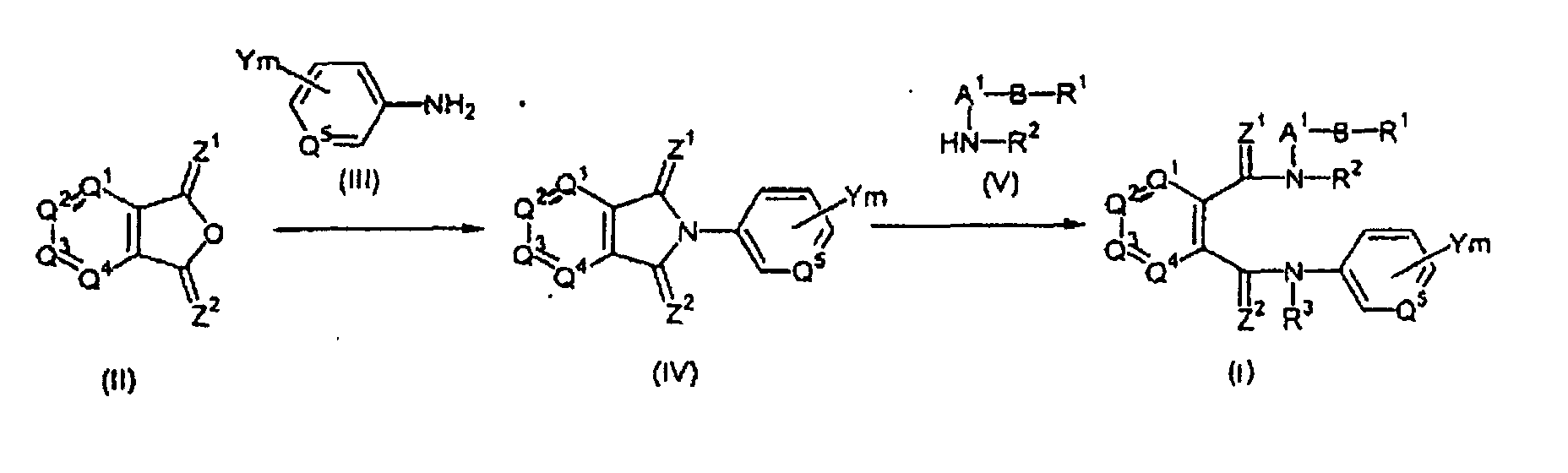
- A carboxylic anhydride derivative represented by the general formula (II) is reacted with an amine represented by the general formula (III) in the presence of an inert solvent to obtain an imide derivative represented by the general formula (IV); the imide derivative (IV) is reacted, after being isolated or without being isolated, with an amine represented by the general formula (V); thereby, an aromatic diamide derivative represented by the general formula (I) can be produced.
- The inert solvent usable in the present reaction can be any solvent as long as it does not impair the progress of the present reaction. It can be exemplified by aromatic hydrocarbons such as benzene, toluene, xylene and the like; halogenated hydrocarbons such as methylene chloride, chloroform, carbon tetrachloride and the like; chlorinated aromatic hydrocarbons such as chlorobenzene, dichlorobenzene and the like; chain or cyclic ethers such as diethyl ether, dioxane, tetrahydrofuran and the like; esters such as ethyl acetate and the like; amides such as dimethylformamide, dimethylacetamide and the like; acids such as acetic acid and the like; dimethyl sulfoxide; and 1,3-dimethyl-2-imidazolidinone. These inert solvents can be used singly or in admixture of two or more kinds.
- Since the present reaction is an equimolar reaction, the individual reactants can be used by the same mole, but any reactant may be used in excess. The present reaction may be conducted under a dehydrating condition as necessary.
- The reaction temperature can be room temperature to the refluxing temperature of the inert solvent used. The reaction time varies depending upon, for example, the size or temperature of reaction, but can appropriately be determined in a range of several minutes to 48 hours.
- After the completion of the reaction, the reaction mixture containing an intended product is subjected to an isolation treatment according to an ordinary method and, as necessary, purification is conducted by recrystallization, column chromatography or the like, whereby the intended product can be obtained. The reaction mixture per se may be used in the next reaction without being subjected to the above isolation treatment for obtaining the intended product.
- The carboxylic anhydride derivative represented by the general formula (II) can be produced by one of the processes described in J. Org. Chem., 52, 129 (1987); J. Am. Chem. Soc., 51, 1865 (1929); ibidem, 63, 1542 (1941); etc. The amine represented by the general formula (III) can be produced by one of the processes described in J. Org. Chem., 29, 1 (1964); Angew. Chem. Int. Ed. Engl., 24, 871 (1985); Synthesis, 1984, 667; Nippon Kagaku Kaishi, 1973, 2351; DE-2606982; JP-A-1-90163; etc. The amine represented by the general formula (V) can be produced by one of the processes described in Chem. Pharm. Bull., 30(5), 1921-1924 (1982); Jikken Kagaku Koza 22, Organic Synthesis IV (Amino Acids and Peptides) (1992); etc.
- The inert solvent usable in the present reaction can be exemplified by those inert solvents usable in the above reaction (1).
- Since the present reaction is an equimolar reaction, the individual reactants can be used by the same mole, but the amine represented by the general formula (V) may be used in excess.
- The reaction temperature can be room temperature to the refluxing temperature of the inert solvent used. The reaction time varies depending upon, for example, the size or temperature of reaction, but can appropriately be determined in a range of several minutes to 48 hours.
- After the completion of the reaction, the reaction mixture containing an intended product is subjected to an isolation treatment according to an ordinary method and, as necessary, purification is conducted by recrystallization, column chromatography or the like, whereby the intended product can be obtained.(wherein R1, R2, R3, A1, B, Q1 to Q5, Y and m each have the same definition as given above).

- A carboxylic anhydride derivative represented by the general formula (II-1) is reacted with an amine represented by the general formula (V) in the presence of an inert solvent to obtain a carboxamide represented by the general formula (VI-2). This carboxamide (VI-2) is subjected to the following procedure after being isolated or without being isolated. That is, the carboxamide (VI-2), wherein R2 is a hydrogen atom, is subjected to a condensation reaction in the presence of a condensation agent to obtain a compound represented by the general formula (VII-2); the compound (VII-2) is reacted, after being isolated or without being isolated, with an amine represented by the general formula (III-1) in the presence of an inert solvent; or, the carboxamide (VI-2), wherein R2 is other than hydrogen atom, is condensed with an amine represented by the general formula (III-1) in the presence of a condensation agent; thereby, an aromatic diamide derivative represented by the general formula (I-1) can be produced.
- Alternatively, a carboxylic anhydride derivative represented by the general formula (II-1) is reacted with an amine represented by the general formula (III-1) in the presence of an inert solvent to obtain a carboxamide represented by the general formula (VI-1). This carboxamide (VI-1) is subjected to the following procedure after being isolated or without being isolated. That is, the carboxamide (VI-1), wherein R3 is a hydrogen atom, is subjected to a condensation reaction in the presence of a condensation agent to obtain a compound represented by the general formula (VII-1) and this compound (VII-1) is reacted, after being isolated or without being isolated, with an amine represented by the general formula (V) in the presence of an inert solvent; or, the carboxamide (VI-1), wherein R3 is other than hydrogen atom, is condensed with an amine represented by the general formula (V) in the presence of a condensation agent; thereby, an aromatic diamide derivative represented by the general formula (I-1) can be produced.
- The present reaction is conducted in the same manner as in the production process 1 (2), whereby an intended compound can be produced.
- The present reaction is conducted in the same manner as in the production process 1 (2), whereby an intended product can be produced.
- The present reaction is conducted in the same manner as described in J. Med. Chem., 10, 982 (1967), whereby an intended compound can be produced.
- A carboxamide derivative represented by the general formula (VI-1) or the general formula (VI-2) is reacted with an amine represented by the general formula (V) or the general formula (III-1) in the presence of a condensation agent and an inert solvent, whereby an intended compound can be produced. The present invention may be conducted in the presence of a base, as necessary.
- The inert solvent used in the present reaction can be exemplified by tetrahydrofuran, diethyl ether, dioxane, methylene chloride and chloroform.
- The condensation agent used in the present reaction can be any condensation agent used in ordinary amide production, and can be exemplified by Mukaiyama reagent (2-choro-N-methyl pyridinium iodide), DCC (1,3-dicyclohexylcarbodiimide), CDI (carbonyl diimidazole) and DEPC (diethyl phosphoric cyanide). The amount of the condensation agent used can appropriately be determined at one or more moles per mole of the carboxamide represented by the general formula (VI-1) or the general formula (VI-2).
- The base usable in the present reaction can be exemplified by organic bases (e.g. triethylamine and pyridine) and inorganic bases (e.g. potassium carbonate). The amount of the base used can appropriately be determined at one or more moles per mole of the carboxamide represented by the general formula (VI-1) or the general formula (VI-2).
- The reaction temperature can be 0°C to the boiling point of the inert solvent used. The reaction time varies depending upon, for example, the size or temperature of reaction, but is several minutes to 48 hours.
- After the completion of the reaction, the reaction mixture containing an intended product is subjected to an isolation treatment according to an ordinary method and, as necessary, purification is conducted by recrystallization, column chromatography or the like, whereby the intended product can be obtained.
- Representative compounds of the aromatic diamide derivative represented by the general formula (I) are shown below in Table 1, Table 2 and Table 3. However, the present aromatic diamide derivative is not restricted to these compounds. In the following tables, Me refers to methyl group; Et refers to ethyl group; Pr refers to propyl group; Bu refers to butyl group; Ph refers to phenyl group; Pyr refers to pyridyl group; c- refers to alicyclic hydrocarbon group; and Physical property refers to melting point (°C).
- In Table 1, with respect to Q1 to Q4 which are each C-X, Q1 is at 3-position; Q2 is at 4-position; Q3 is at 5-position; and Q4 is at 6-position.
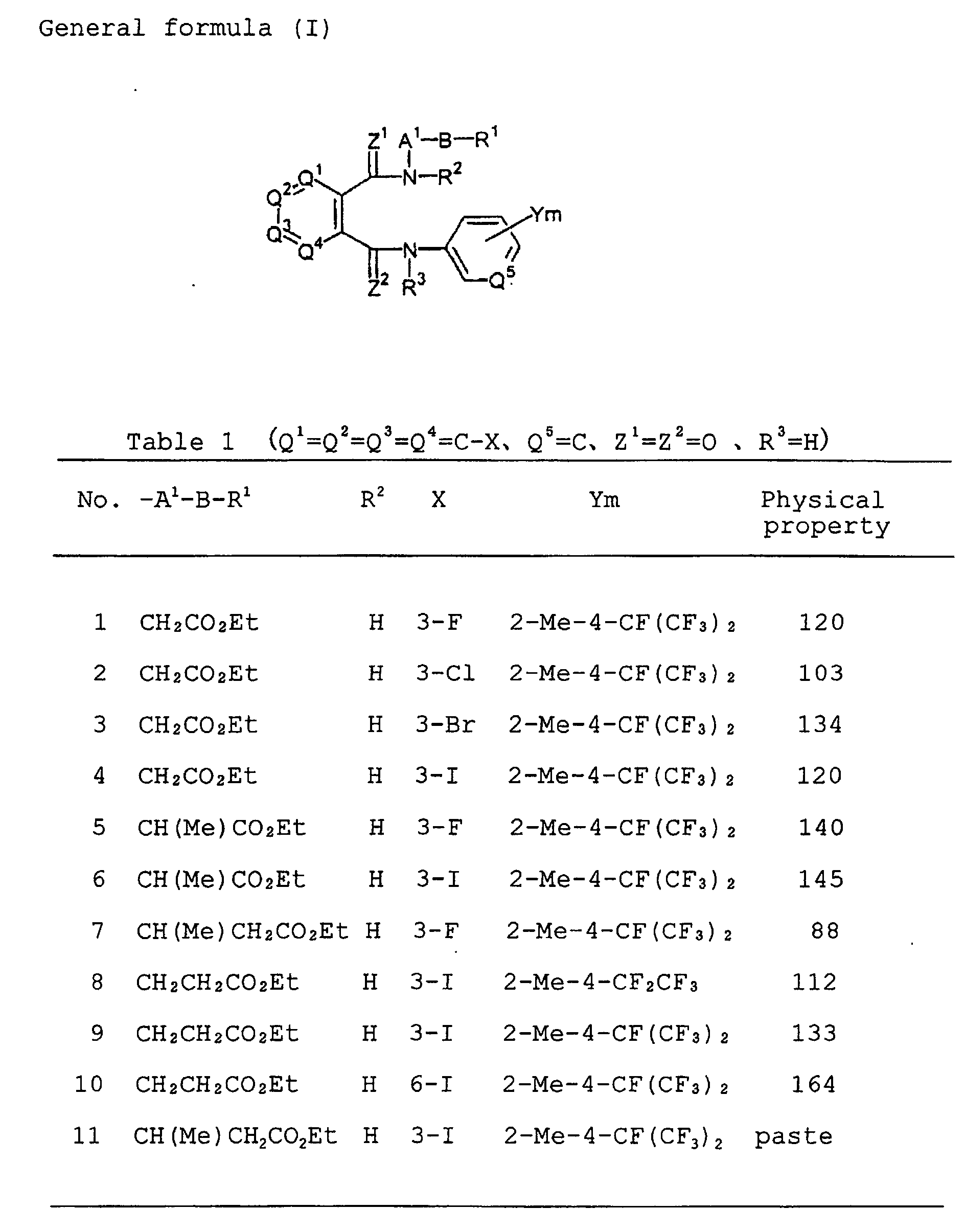
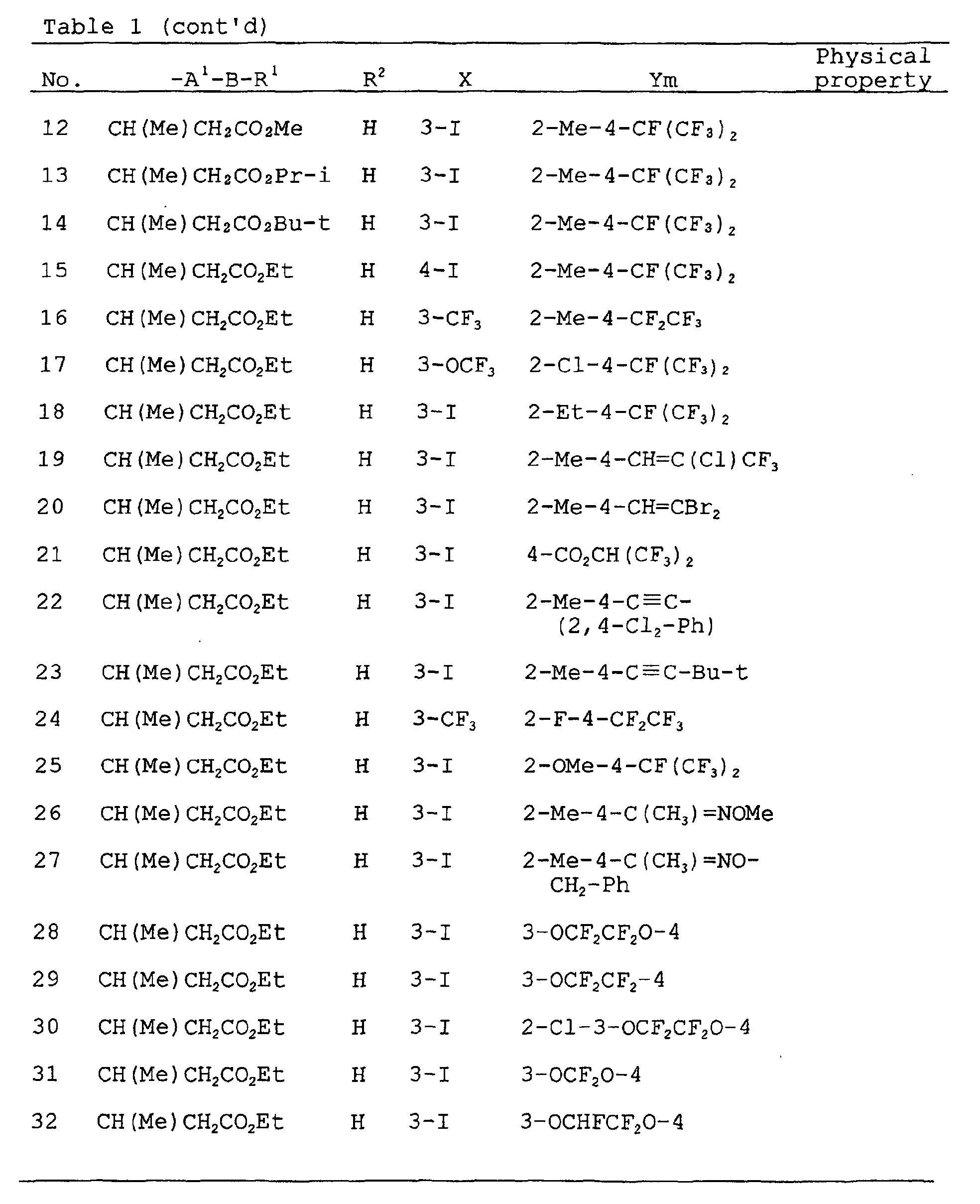
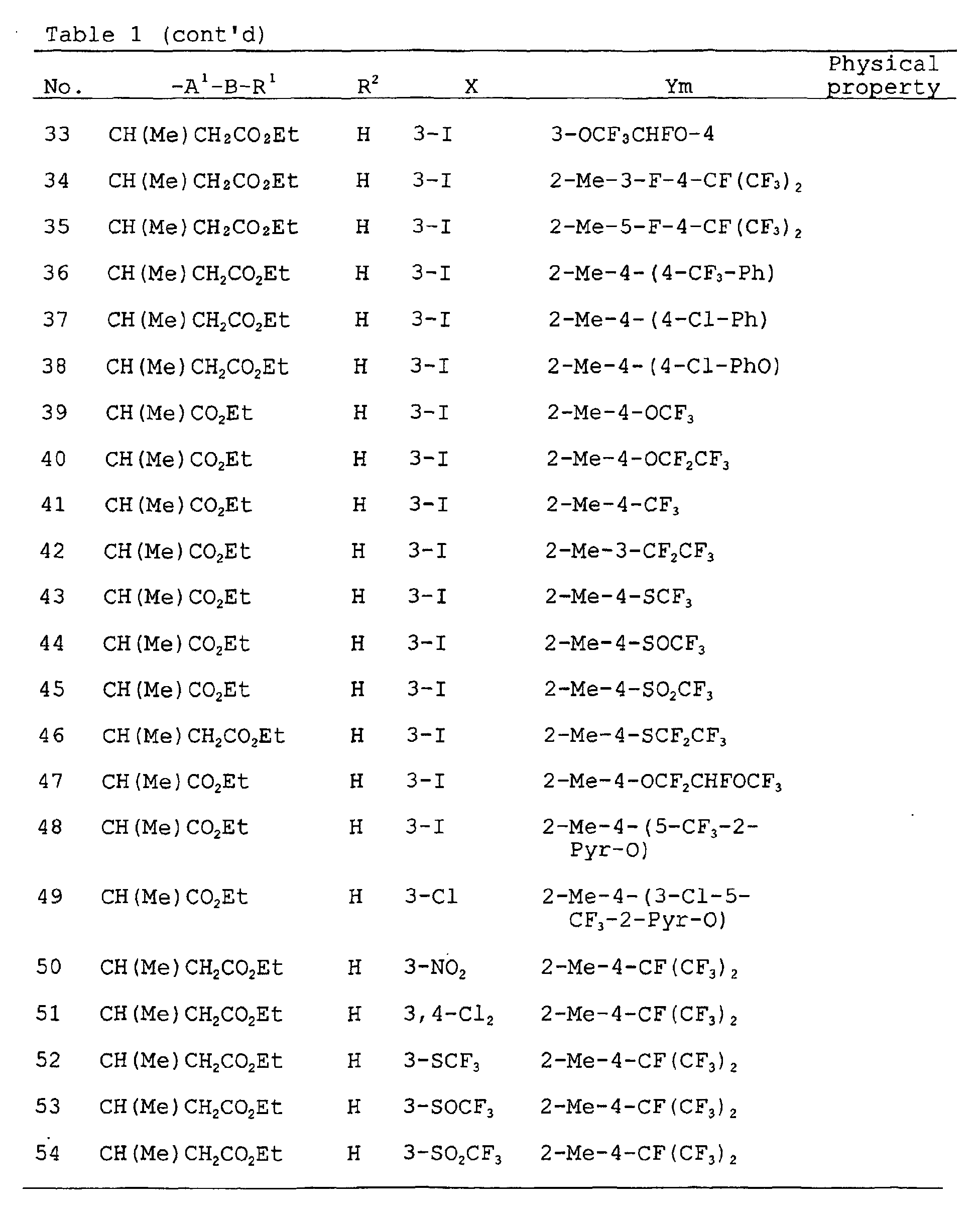
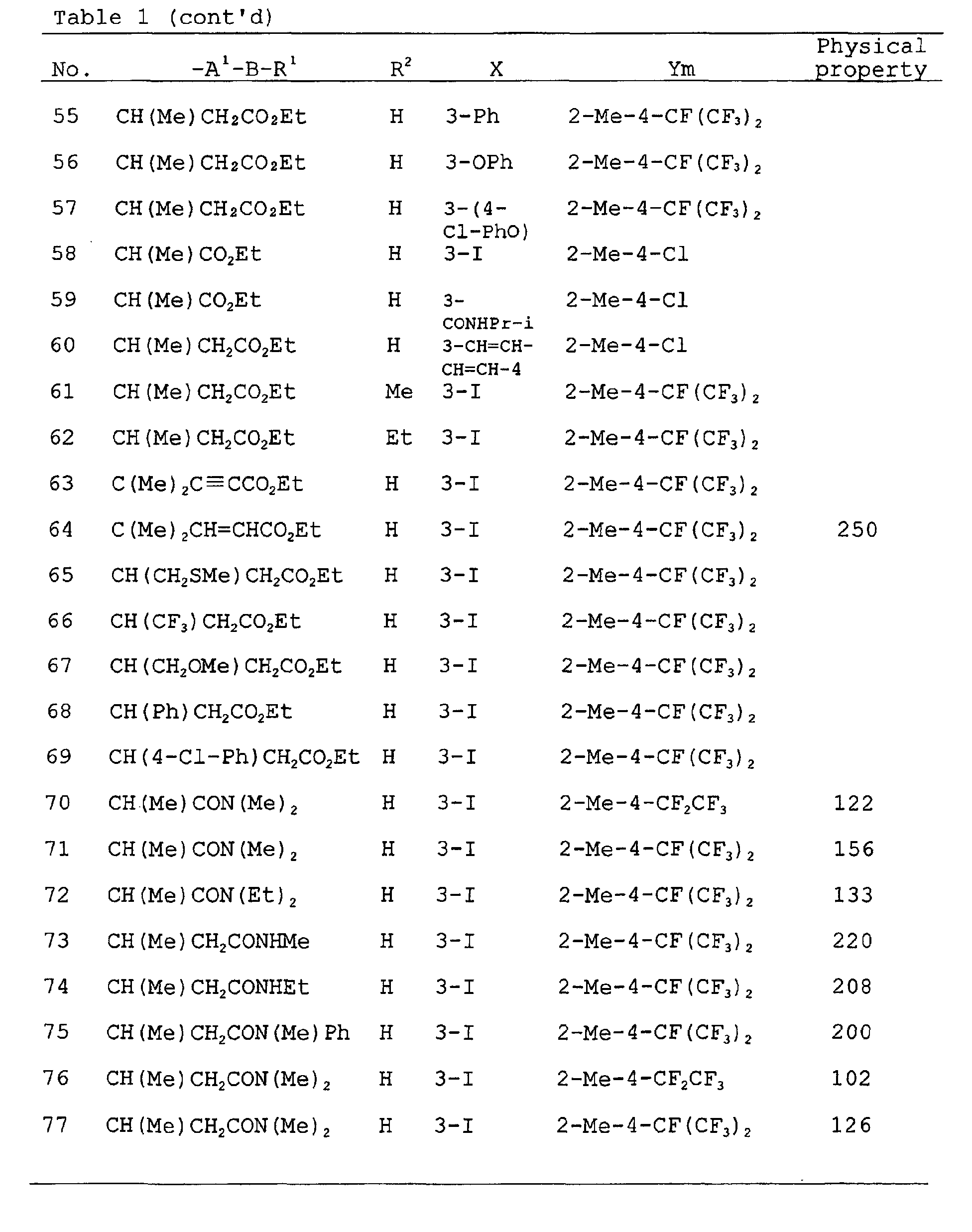
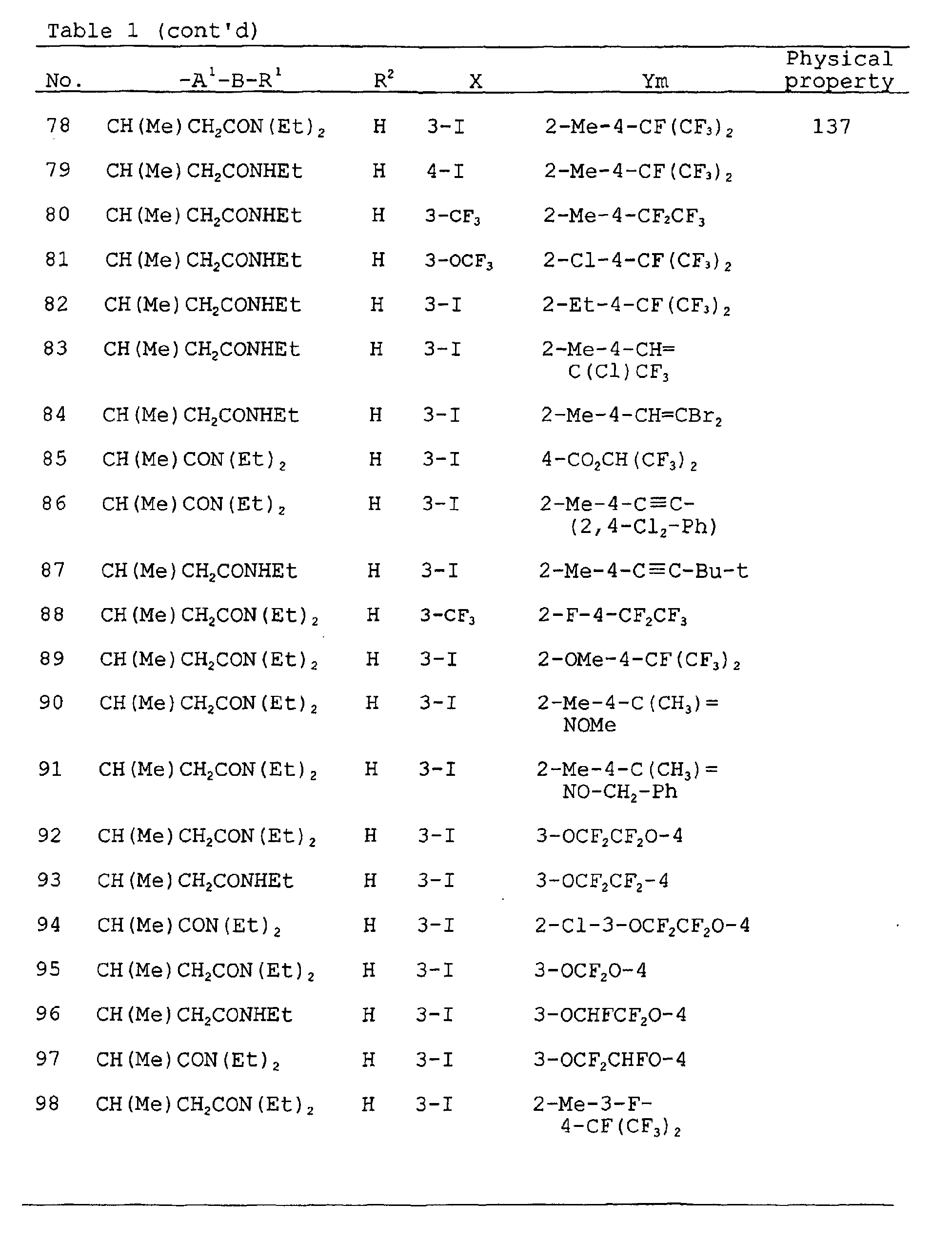

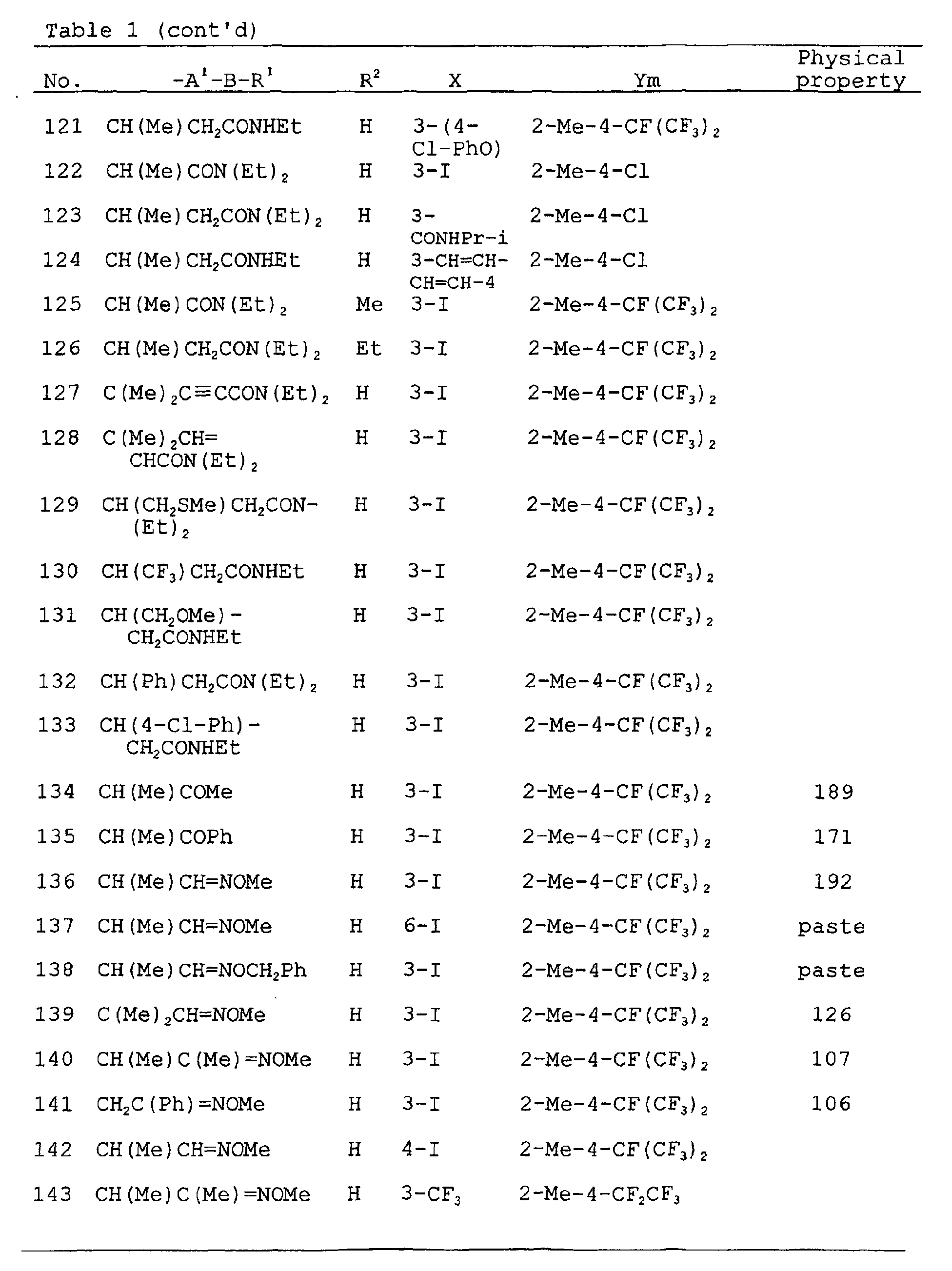


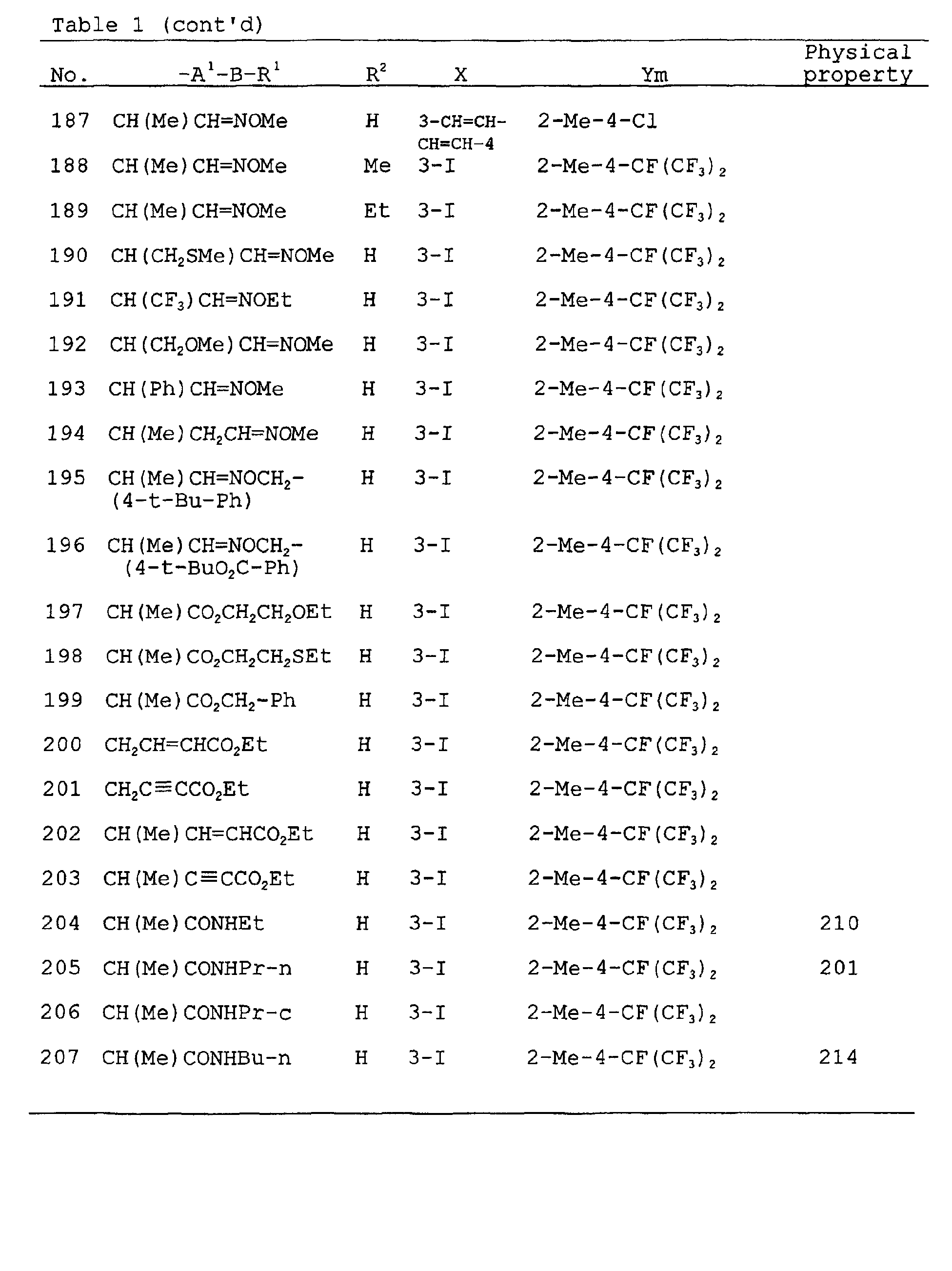
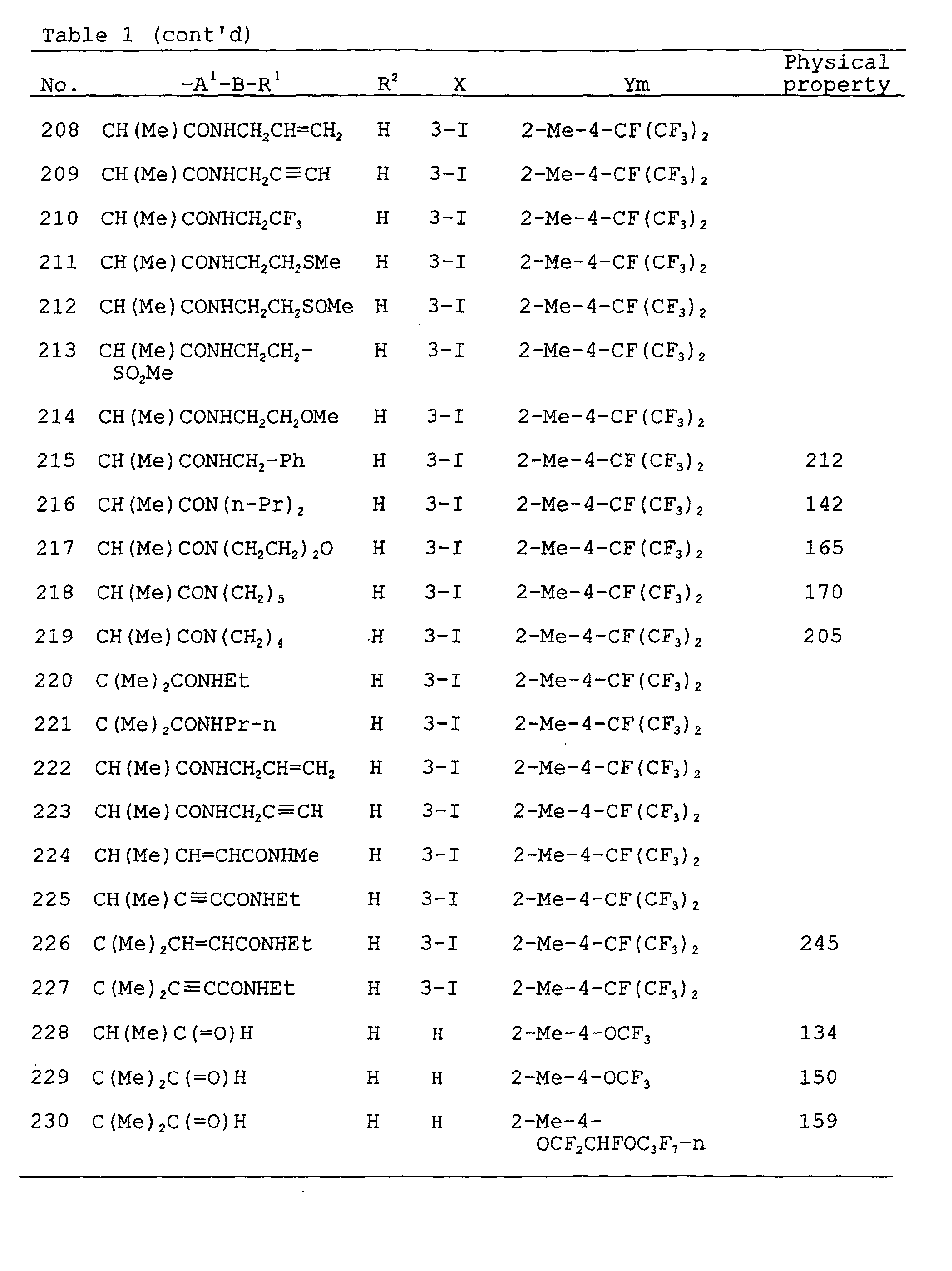
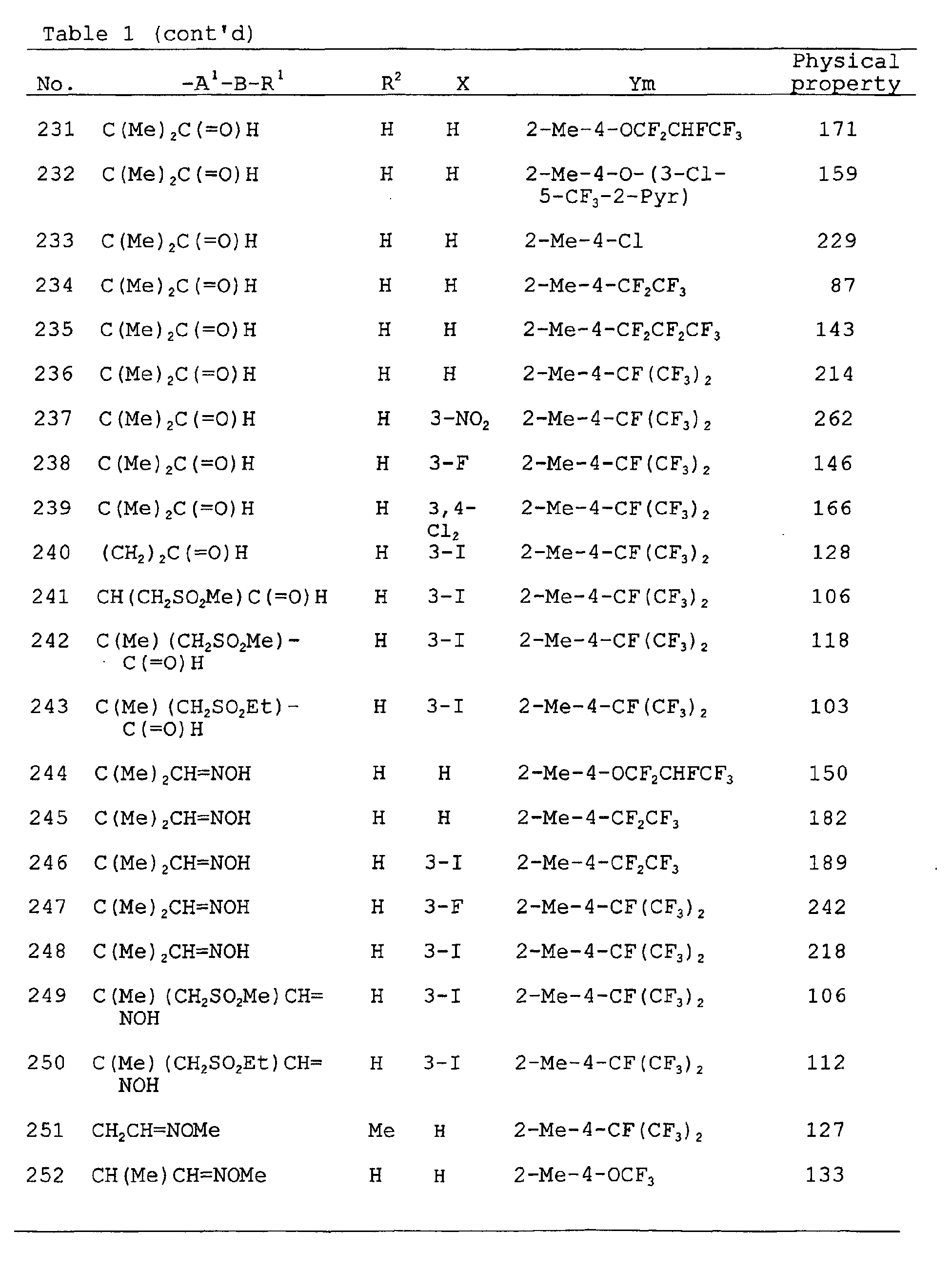
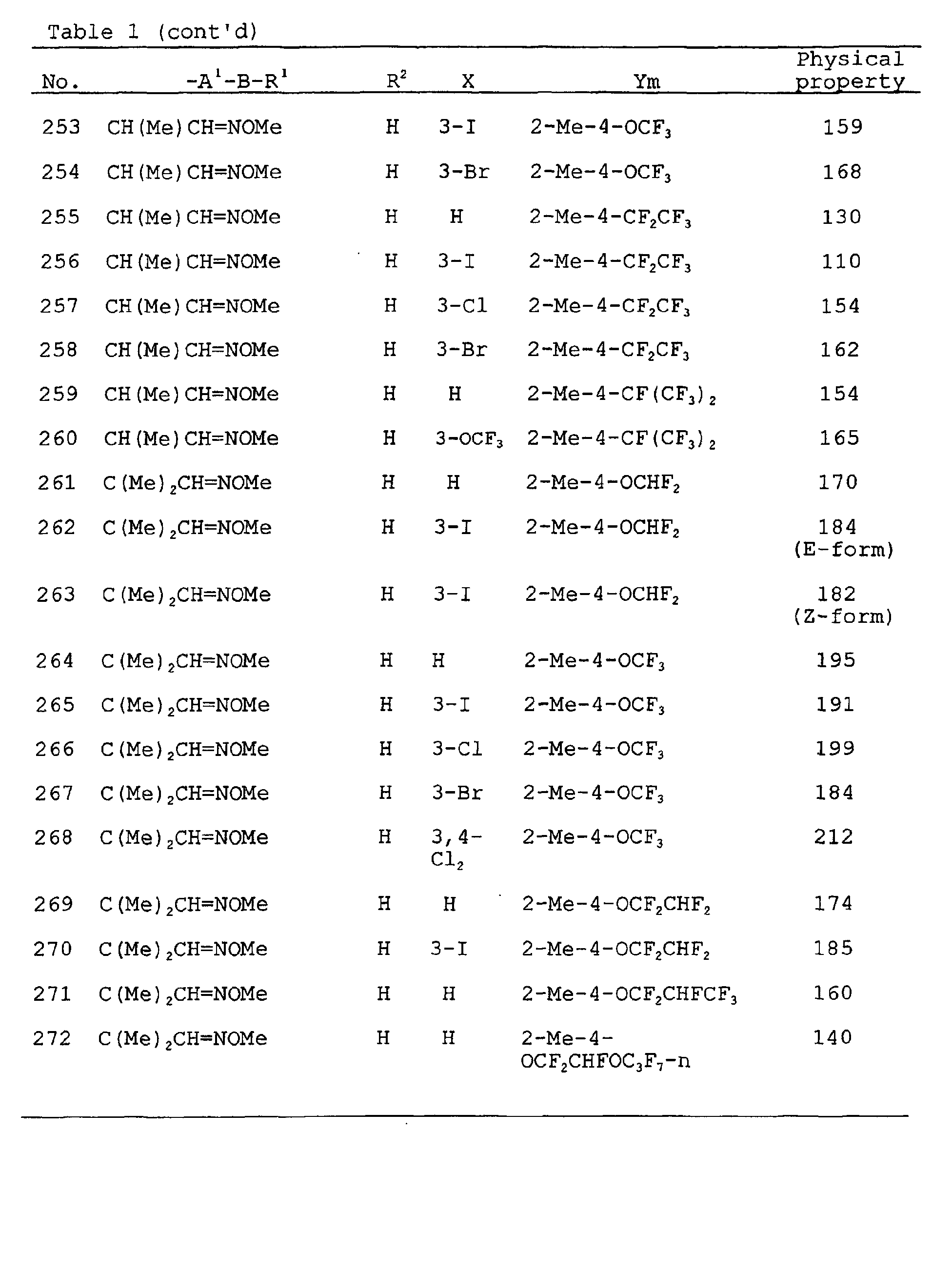
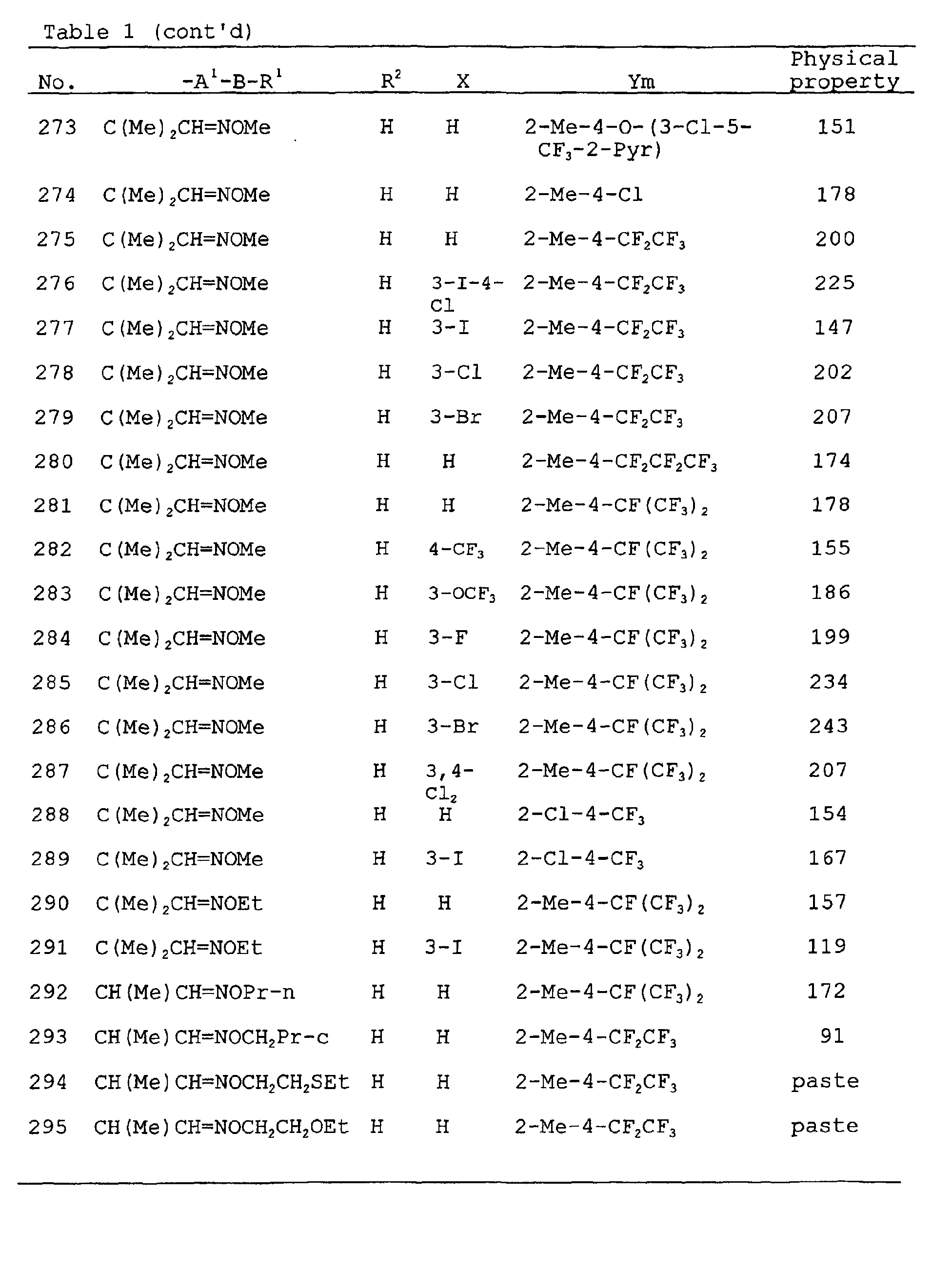

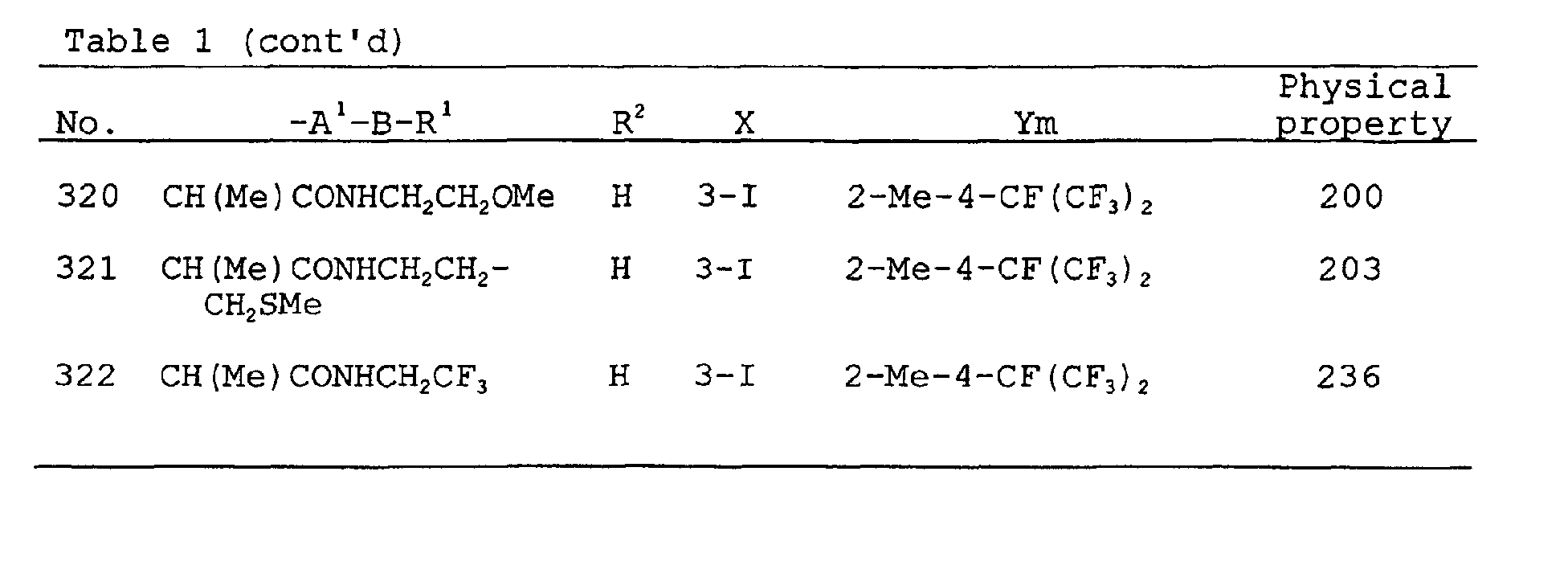
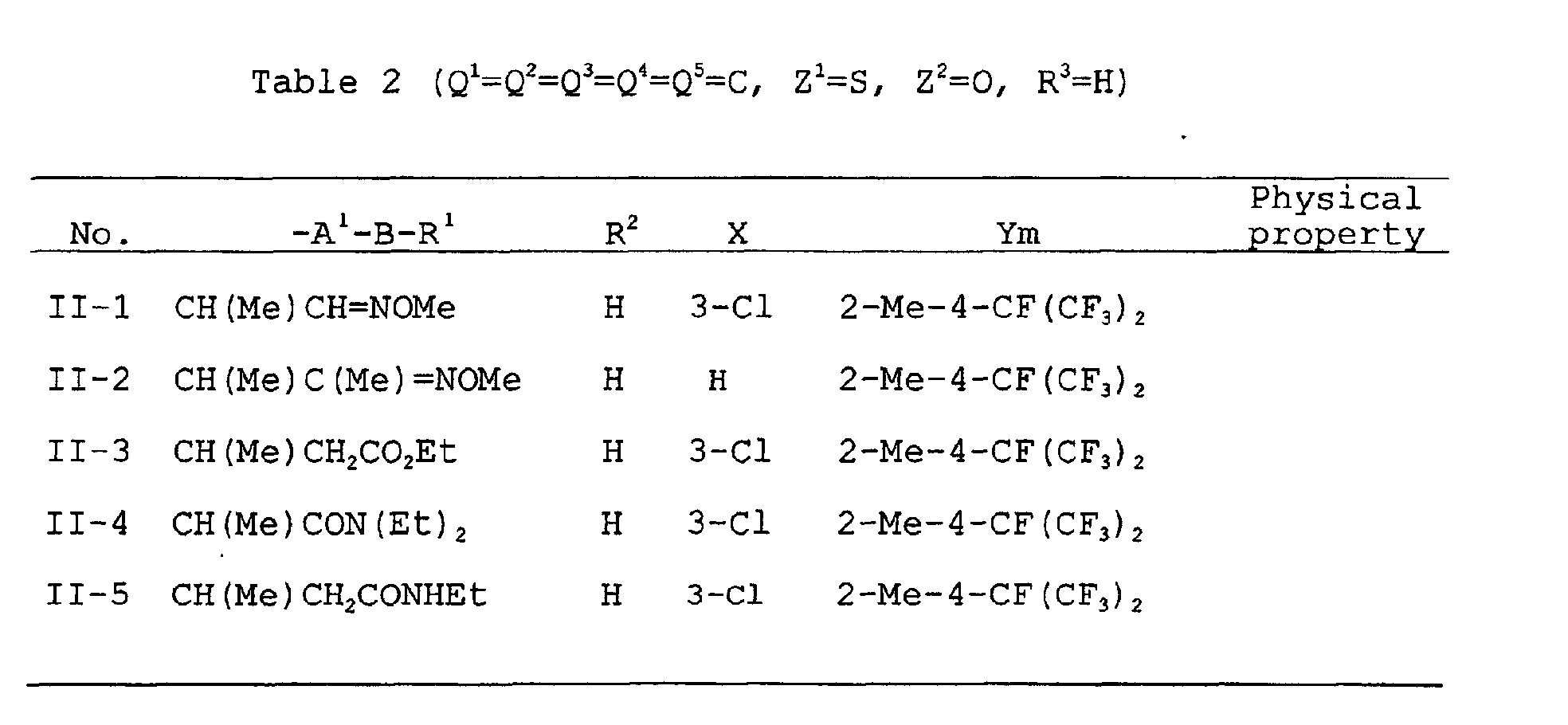
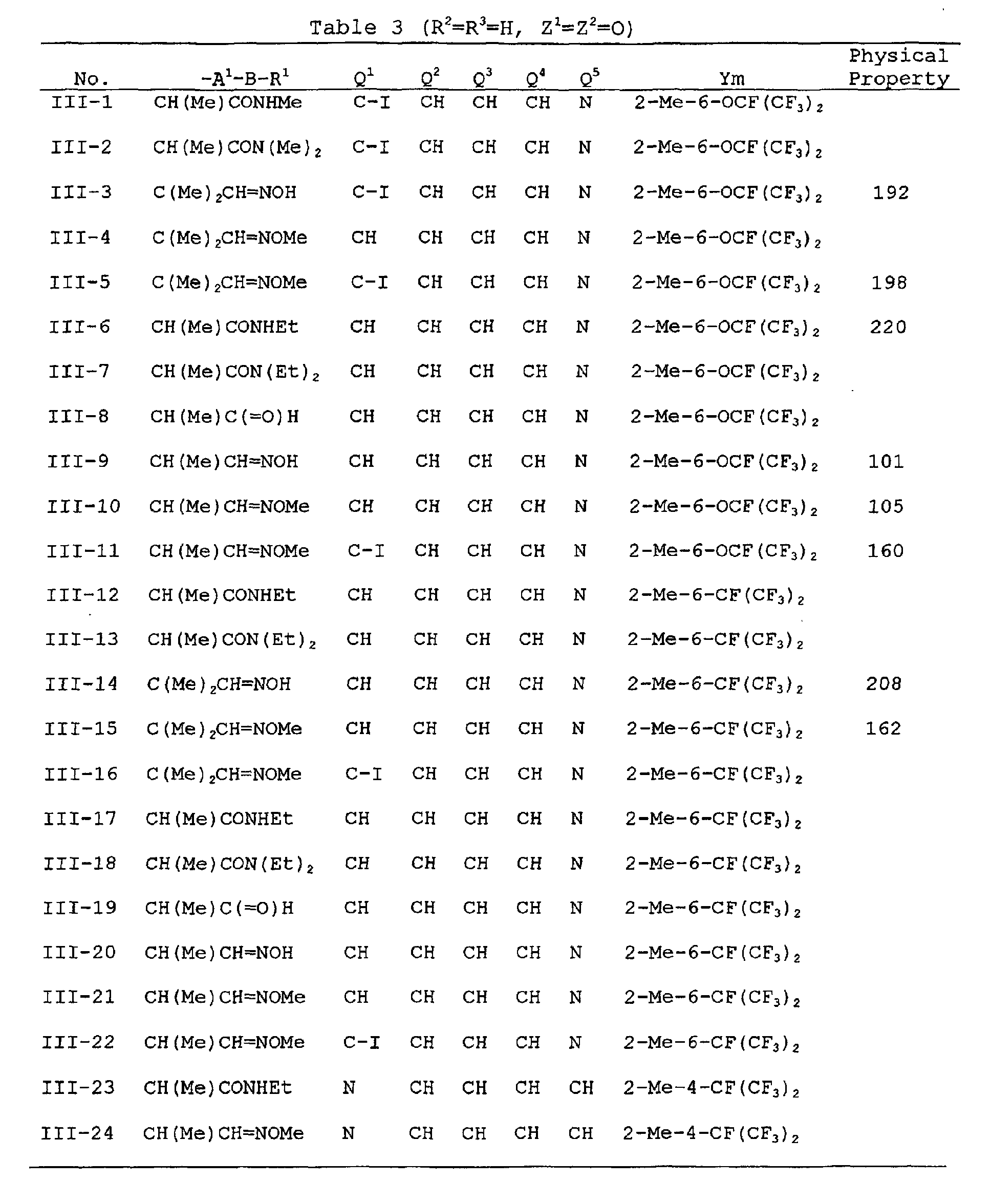
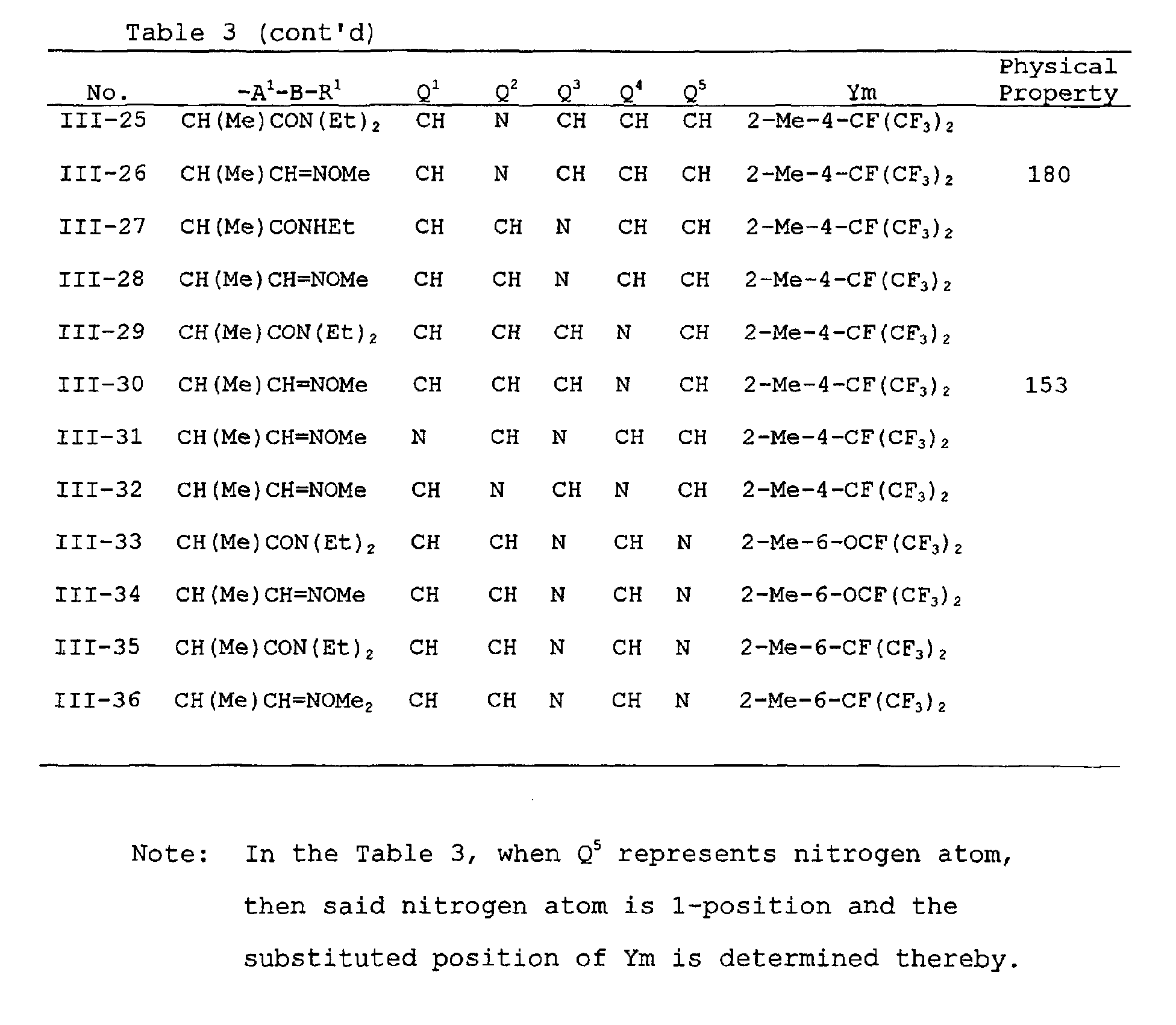
- The agrohorticultural composition, particularly, agrohorticultural insecticides containing the aromatic diamide derivative represented by the formula (I) or salt thereof of the present invention as an active ingredient are suitable for controlling various insect pests such as agrohorticultural insect pests, stored grain insect pests, sanitary insect pests, nematodes, etc., which are injurious to paddy rice, fruit trees, vegetables, other crops, flowers, ornamental plants, etc. They have a marked insecticidal effect, for example, on LEPIDOPTERA including summer fruit tortrix (Adoxophes orana fasciata), smaller tea tortrix (Adoxophyes sp.), Manchurian fruit moth (Grapholita inopinata), oriental fruit moth (Grapholita molesta), soybean pod border (Leguminovora glycinivorella), mulberry leafroller (Olethreutes mori), tea leafroller (Caloptilia thevivora), Caloptilia sp. (Caloptilia zachrysa), apple leafminer (Phyllonorycter ringoniella), pear barkminer (Spulerrina astaurota), common white (Piers rapae crucivora), tobacco budworm (Heliothis sp.), codling moth (Laspey resia pomonella), diamondback moth (Plutella xylostella), apple fruit moth (Argyresthia conjugella), peach fruit moth (Carposina niponensis), rice stem borer (Chilo suppressalis), rice leafroller (Cnaphalocrocis medinalis), tobacco moth (Ephestia elutella), mulberry pyralid (Glyphodes pyloalis), yellow rice borer (Scirpophaga incertulas), rice skipper (Parnara guttata,), rice armyworm (Pseudaletia separata), pink borer (Sesamia inferens), common cutworm (Spodoptera litura), beet armyworm (Spodoptera exigua), etc.; HEMIPTERA including aster leafhopper (Macrosteles fascifrons), green rice leafhopper (Nephotettix cincticepts), brown rice planthopper (Nilaparvata lugens), whitebacked rice planthopper (Sogatella furcifera), citrus psylla (Diaphorina citri), grape whitefly (Aleurolibus taonabae), sweetpotato whitefly (Bemisia tabaci), greenhouse whitefly (Trialeurodes vaporariorum), turnup aphid (Lipaphis erysimi), green peach aphid (Myzus persicae), Indian wax scale (Ceroplastes ceriferus), cottony citrus scale (Pulvinaria aurantii), camphor scale (Pseudaonidia duplex), san Jose scale (Comstockaspis perniciosa), arrowhead scale (Unapsis yanonensis), etc.; TYLENCHIDA including soybean beetle (Anomala rufocuprea), Japanese beetle (Popillia japonica), tobacco beetle (Lasioderma serricorne), powderpost beetle (Lyctus brunneus), twenty-eight-spotted ladybird (Epilachna vigintiotopunctata), azuki bean weevil (Callosobruchus chinensis), vegetable weevil (Listroderes costirostris), maize weevil (Sitophilus zeamais), boll weevil (Anthonomus gradis gradis), rice water weevil (Lissorhoptrus oryzophilus), cucurbit leaf beetle (Aulacophora femoralis), rice leaf beetle (Oulema oryzae), striped flea beetle (Phyllotreta striolata), pine shoot beetle (Tomicus piniperda), Colorado potato beetle (Leptinotarsa decemlineata), Mexican bean beetle (Epilachna varivestis), corn rootworm (Diabrotica sp.), etc.; DIPTERA including (Dacus(Zeugodacus) cucurbitae), oriental fruit fly (Dacus(Bactrocera) dorsalis), rice leafminer (Agnomyza oryzae), onion maggot (Delia antiqua), seedcorn maggot (Delia platura), soybean pod gall midge (Asphondylia sp.), muscid fly (Musca domestica), house mosquito (Culex pipiens pipiens), etc.; and TYLENCHIDA including root-lesion nematode (Pratylenchus sp.), coffee root-lesion nematode (Pratylenchus coffeae), potato cyst nematode (Globodera rostochiensis), root-knot nematode (Meloidogyne sp.), citrus nematode (Tylenchulus semipenetrans), Aphelenchus sp. (Aphelenchus avenae), chrysanthemum foliar (Aphelenchoides ritzemabosi), etc.
- The agrohorticultural composition, particularly, agrohorticultural insecticides containing the aromatic diamide derivative represented by formula (I) or salt thereof of the present invention has a marked controlling effect on the above-exemplified insect pests, sanitary pests and/or nematodes, which are injurious to paddy field crops, upland crops, fruit trees, vegetables and other crops, flowers and ornament plants, and the like. Therefore, the desired effect of the agrohorticultural insecticide of the present invention can be exhibited by applying the insecticide to the paddy field water, stalks and leaves or soil of paddy field, upland field, fruit trees, vegetables, other crops or flowers and ornament plants at a season at which the insect pests, sanitary pests or nematodes are expected to appear, before their appearance or at the time when their appearance is confirmed.
- In general, the agrohorticultural composition of the present invention is used after being prepared into conveniently usable forms according to ordinary manner for preparation of agrochemicals.
- That is, the aromatic diamide derivative of formula (I) or salt thereof and an appropriate carrier are blended optionally together with an adjuvant in a proper proportion and prepared into a suitable preparation form such as suspension, emulsifiable concentrate, soluble concentrate, wettable powder, granules, dust or tablets through dissolution, separation, suspension, mixing, impregnation, adsorption or sticking.
- The inert carrier used in the present invention may be either solid or liquid. As the solid carrier, soybean flour, cereal flour, wood flour, bark flour, saw dust, powdered tobacco stalks, powdered walnut shells, bran, powdered cellulose, extraction residues of vegetables, powdered synthetic polymers or resins, clay (e.g. kaolin, bentonite and acid clay), talc (e.g. talc and pyrophyllite), silica materials (e.g. diatomaceous earth, siliceous sand, mica, white carbon, i.e. synthetic high-dispersion silicic acid, also called finely divided hydrated silica or hydrated silicic acid, some of the commercially available products contain calcium silicate as the major component), activated carbon, powdered sulfur, pumice, calcined diatomaceous earth, ground brick, fly ash, sand, calcium carbonate, calcium phosphate and other inorganic or mineral powders, chemical fertilizers such as ammonium sulfate, ammonium phosphate, ammonium nitrate, urea, ammonium chloride and the like, and compost. These carriers may be used either alone or as a mixture of two or more carriers.
- The liquid carrier is that which itself has a solubility or which is without such solubility but is capable of dispersing an active ingredient with the aid of an adjuvant. The following are typical examples of the liquid carrier and can be used alone or as a mixture thereof. Water; alcohols such as methanol, ethanol, isopropanol, butanol and ethylene glycol; ketones such as acetone, methyl ethyl ketone, methyl isobutyl ketone, diisobutyl ketone and cyclohexanone; ethers such as ethyl ether, dioxane, cellosolve, dipropyl ether and tetrahydrofuran; aliphatic hydrocarbons such as kerosene and mineral oil; aromatic hydrocarbons such as benzene, toluene, xylene, solvent naphtha and alkylnaphthalene; halogenated hydrocarbons such as dichlorethane, chloroform, carbon tetrachloride and chlorobenzene; esters such as ethyl acetate, diisopropyl phthalate, dibutyl phthalate and dioctyl phthalate; amides such as dimethylformamide, diethylformamide and dimethylacetamide; nitriles such as acetonitrile; and dimethyl sulfoxide.
- The following are typical examples of the adjuvant, which are used depending upon purposes and used alone or in combination of two or more adjuvants in some cases, or need not to be used at all.
- To emulsify, disperse, dissolve and/or wet an active ingredient, a surfactant is used. As the surfactant, there can be exemplified polyoxyethylene alkyl ethers, polyoxyethylene alkylaryl ethers, polyoxyethylene higher fatty acid esters, polyoxyethylene resinates, polyoxyethylene sorbitan monolaurate, polyoxyethylene sorbitan monooleate, alkylarylsulfonates, naphthalene-sulfonic acid condensation products, ligninsulfonates and higher alcohol sulfate esters.
- Further, to stabilize the dispersion of an active ingredient, tackify it and/or bind it, there may be used adjuvants such as casein, gelatin, starch, methyl cellulose, carboxymethyl cellulose, gum arabic, polyvinyl alcohols, turpentine, bran oil, bentonite and ligninsulfonates.
- To improve the flowability of a solid product, there may be used adjuvants such as waxes, stearates and alkyl phosphates.
- Adjuvants such as naphthalenesulfonic acid condensation products and polycondensates of phosphates may be used as a peptizer for dispersible products.
- Adjuvants such as silicone oil may also be used as a defoaming agent.
- The content of the active ingredient may be varied according to the need. For example, in dusts or granules, the suitable content thereof is from 0.01 to 50% by weight. In emulsifiable concentrate and flowable wettable powder, too, the suitable content is from 0.01 to 50% by weight.
- The agrohorticultural composition, particularly agrohorticultural insecticide of the present invention is used to control a variety of insect pests in the following manner. That is, it is applied to a crop on which the insect pests are expected to appear or a site where appearance of the insect pests is undesirable, as it is or after being properly diluted with or suspended in water or the like, in an amount effective for control of the insect pests.
- The agrohorticultural composition, particularly the agrohorticultural insecticide of the present invention can also be used to, for example, seeds of plants to be protected from pests, or to cultivation carriers in which the above seeds are to be sown (e.g. sowing soil, nursery mat, water, etc.); and can be used by a method such as application to rice nursery bed, seed dressing, seed disinfection or the like. When applied to pests which verminate in upland crops such as fruit trees, grains, vegetables and the like, it can be used by seed treatments such as dressing, soaking and the like, or by drenching or surface spraying/watering to, for example, seedling-raising carriers such as cultivation vessel, planting hole and the like to allow the crops to absorb the present insecticide, or by application to water culture solution for water culture.
- The applying dosage of the agrohorticultural composition of the present invention is varied depending upon various factors such as a purpose, insect pests to be controlled, a growth state of a plant, tendency of insect pests appearance, weather, environmental conditions, a preparation form, an application method, an application site and an application time. It may be properly chosen in a range of 0.1 g to 10 kg (in terms of active ingredient compound) per 10 ares depending upon purposes.
- The agrohorticultural composition of the present invention may be used in admixture with other agricultural and horticultural disease or pest controllers in order to expand both spectrum of controllable diseases and insect pest species and the period of time when effective applications are possible or to reduce the dosage.
- Next, typical examples and test examples of the invention are presented below. The present invention is by no means limited by these examples.
- Representative examples of the present invention are shown below. However, the present invention is not restricted to these examples.
- A solution of 3.5 g of 4-heptafluoro-isopropyl-2-methylaniline dissolved in 3 ml of acetonitrile was dropwise added slowly to a suspension of 3.5 g of 3-iodophthalic anhydride suspended in 30 ml of acetonitrile, with ice-cooling. After the completion of the dropwise addition, a reaction was conducted for 3 hours at room temperature, with stirring. After the completion of the reaction, the precipitated crystals were collected by filtration and washed with a small amount of acetonitrile to obtain 4.0 g of an intended compound.
Physical property: melting point = 174-181°C Yield: 57% - 1.1 g of trifluoroacetic anhydride was added to a suspension of 2.0 g of 3-iodo-1-N-(4-hepta-fluoroisopropyl-2-methylphenyl)-phthalamic acid suspended in 10 ml of toluene. A reaction was conducted at room temperature for 30 minutes, with stirring. After the completion of the reaction, the solvent was removed by vacuum distillation to obtain 2.0 g of a crude intended compound. The compound was used in the next reaction without being purified.
1H-NMR [CDCl3/TMS, δ (ppm) ]
2.4 (3H,s), 7.3 (1H,d), 7.4 (2H,m), 7.5 (1H,t), 8.1 (1H,d), 8.2 (1H,d) - 1.0 g of 3-iodo-N-(4-heptafluoroisopropyl-2-methylphenyl)phthalisoimide was dissolved in 10 ml of acetonitrile. To the resulting solution were added 0.35 g of 3-amino-N,N-dimethylbutyramide hydrochloride and 0.21 g of triethylamine. The resulting mixture was stirred at room temperature for 10 hours to give rise to a reaction. After the completion of the reaction, the reaction mixture was poured into ice water, followed by extraction with ethyl acetate. The organic layer was washed with an aqueous sodium chloride solution and then dried over anhydrous magnesium sulfate. The solvent was removed by vacuum distillation, and the resulting residue was purified by silica gel column chromatography to obtain 0.4 g of an intended product.
Physical property: melting point = 126°C Yield: 32% - 0.9 g of 3-iodo-N-(4-heptafluoroisopropyl-2-methylphenyl)phthalisoimide was dissolved in 10 ml of acetonitrile. To the resulting solution were added 0.34 g of 1-methyl-2-(methoxyimino)ethylamine hydrochloride and 0.25 g of triethylamine. The resulting mixture was stirred at room temperature for 10 hours to give rise to a reaction. After the completion of the reaction, the reaction mixture was poured into ice water, followed by extraction with ethyl acetate. The organic layer was washed with an aqueous sodium chloride solution and then dried over anhydrous magnesium sulfate. The solvent was removed by vacuum distillation, and the resulting residue was purified by silica gel column chromatography to obtain 0.36 g of an intended product.
Physical property: melting point = 192°C Yield: 36% - A solution of 1.4 g of ethyl 3-aminobutyrate dissolved in 3 ml of acetonitrile was dropwise added slowly to a suspension of 2.7 g of 3-iodophthalic anhydride suspended in 30 ml of acetonitrile, with ice-cooling. After the completion of the dropwise addition, a reaction was conducted for 3 hours at room temperature, with stirring. After the completion of the reaction, the precipitated crystals were collected by filtration and washed with a small amount of acetonitrile to obtain 3.8 g of an intended compound.
Yield: 97% - 1.1 g of trifluoroacetic anhydride was added to a suspension of 1.0 g of 3-iodo-2-N-[1-methyl-2-(ethoxycarbonyl)ethyl]phthalamic acid suspended in 10 ml of toluene. A reaction was conducted at room temperature for 30 minutes, with stirring. After the completion of the reaction, the solvent was removed by vacuum distillation to obtain 0.9 g of a crude intended compound. The compound was used in the next reaction without being purified.
- 0.90 g of 6-iodo-N-[1-methyl-2-(ethoxycarbonyl)ethyl]phthalisoimide was dissolved in 10 ml of acetonitrile. To the resulting solution were added 0.5 g of 4-heptafluoroisopropyl-2-methylaniline and two drops of trifluoroacetic acid. The resulting mixture was stirred at room temperature for 10 hours to give rise to a reaction. After the completion of the reaction, the reaction mixture was poured into ice water, followed by extraction with ethyl acetate. The organic layer was washed with an aqueous sodium chloride solution and then dried over anhydrous magnesium sulfate. The solvent was removed by vacuum distillation, and the resulting residue was purified by silica gel column chromatography to obtain 0.50 g of an intended product.
Physical property: paste-like
Yield: 31%
1H-NMR [CDCl3/TMS, δ (ppm)]
1.1-1.4 (5H,m), 2.4 (3H,s), 2.5-2.6 (2H,m), 4.1 (2H,q), 4.4-4.5 (1H,m), 6.8 (1H,d), 7.2 (1H,t), 7.4-7.5 (2H,m), 7.8 (1H,d), 7.9 (1H,d), 8.3 (1H,d), 8.5 (1H,s) - 1.5 g of 3-iodo-N-(4-heptafluoroisopropyl-2-methylphenyl)phthalisoimide was dissolved in 10 ml of acetonitrile. To the resulting solution were added 0.35 g of 3-aminobutanone hydrochloride and 0.29 g of triethylamine. The resulting mixture was stirred at room temperature for 10 hours to give rise to a reaction. After the completion of the reaction, the reaction mixture was poured into ice water, followed by extraction with ethyl acetate. The organic layer was washed with an aqueous sodium chloride solution and then dried over anhydrous magnesium sulfate. The solvent was removed by vacuum distillation, and the resulting residue was purified by silica gel column chromatography to obtain 0.70 g of an intended product.
Physical property: melting point = 189°C
Yield: 41%
Next, typical formulation examples and test examples of the invention are presented below. The present invention is by no means limited by these examples. - In the formulation examples, the term "parts" means "parts by weight".
Formulation Example 1 Each compound listed in Tables 1 to 3 50 parts Xylene 40 parts Mixture of polyoxyethylene nonylphenyl ether and calcium alkylbenzenesulfonate 10 parts - An emulsifiable concentrate was prepared by mixing uniformly the above ingredients to effect dissolution.
Formulation Example 2 Each compound listed in Tables 1 to 3 3 parts Clay powder 82 parts Diatomaceous earth powder 15 parts - A dust was prepared by mixing uniformly and grinding the above ingredients.
Formulation Example 3 Each compound listed in Tables 1 to 3 5 parts Mixed powder of bentonite and clay 90 parts Calcium ligninsulfonate 5 parts - Granules were prepared by mixing the above ingredients uniformly, and kneading the resulting mixture together with a suitable amount of water, followed by granulation and drying.
Formulation Example 4 Each compound listed in Tables 1 to 3 20 parts Mixture of kaolin and synthetic high-dispersion silicic acid 75 parts Mixture of polyoxyethylene nonylphenyl ether and calcium alkylbenzenesulfonate 5 parts - A wettable powder was prepared by mixing uniformly and grinding the above ingredients.
Formulation Example 5 Each compound listed in Tables 1 to 3 20 parts Sodium alkylnaphthalenesulfonate 3 parts Propylene glycol 5 parts Dimethylpolysiloxane 0.25 part p-Chloro-m-xylenol 0.10 part Xanthan gum 0.30 part Water 71.35 part - A wettable powder or wettable suspension was prepared by mixing uniformly and wet-grinding the above ingredients.
- Adult diamond back moths were released and allowed to oviposit on a Chinese cabbage seedling. Two days after the release, the seedling having the eggs deposited thereon was immersed for about 30 seconds in a liquid chemical prepared by diluting a preparation containing each compound listed in Tables 1 to 3 as an active ingredient to adjust the concentration to 50 ppm. After air-dryness, it was allowed to stand in a room thermostatted at 25°C. Six days after the immersion, the hatched insects were counted. The mortality was calculated according to the following equation and the insecticidal effect was judged according to the criterion shown below. The test was carried out with triplicate groups of 10 insects.
-
- A --- Mortality 100%
- B --- Mortality 99-90%
- C --- Mortality 89-80%
- D --- Mortality 79-50%
-
- A piece of cabbage leaf (cultivar; Shikidori) was immersed for about 30 seconds in a liquid chemical prepared by diluting a preparation containing each compound listed in Tables 1 to 3 as an active ingredient to adjust the concentration to 500 ppm. After air-dryness, it was placed in a plastic Petri dish with a diameter of 9 cm and inoculated with second-instar larvae of common cutworm, after which the dish was closed and then allowed to stand in a room thermostatted at 25°C. Eight days after the inoculation, the dead and alive were counted. The mortality was calculated according to the following equation and the insecticidal effect was judged according to the criterion shown in Test Example 1. The test was carried out with triplicate groups of 10 insects.
- Tea leaves were immersed for about 30 seconds in a liquid chemical prepared by diluting a preparation containing each compound listed in Tables 1 to 3 as an active ingredient to adjust the concentration to 50 ppm. After air-dryness, the tea leaves were placed in a plastic Petri dish with a diameter of 9 cm and inoculated with larvae of smaller tea tortrix, after which the dish was allowed to stand in a room thermostatted at 25°C and having a humidity of 70%. Eight days after the inoculation, the dead and alive were counted and the insecticidal effect was judged according to the criterion shown in Test Example 1. The test was carried out with triplicate groups of 10 insects.
- In the test mentioned above, the compounds which exhibited an activity ranking B or higher against diamond back moth (Plutella xylostella) were as follows:
2~11, 70~78, 134, 136~141, 177, 204, 205, 207, 215~219, 226, 229, 230~237, 239, 241~296, 298, 302, 304, 306, 309, III-3, III-5, III-9~III-11, III-14, III-15, III-26 and III-30. - Further, the compounds which exhibited an activity ranking B or higher against Common cutworm (Spodoptera litura) were as follows:
11, 71~74, 77, 78, 136~140, 204, 205, 207, 216, 226, 246, 248, 256, 258, 260, 263, 265, 272, 275, 277~279, 284~286, 291, 292, 309, III-3, III-5 and III-11. - Furthermore, the compounds which exhibited an activity ranking B or higher against smaller tea tortrix (Adxophyes sp.) were as follows:
7, 11, 70~72, 74~78, 134, 136~140, 204, 205, 207, 216, 218, 219, 226, 246~250, 253, 254, 256, 258, 259, 263, 265, 266, 271~273, 275~279, 281, 283, 285, 286, 290, 291, 296, 298, 304, 309, III-3, III-5, III-10, III-11, III-15 and III-26.
Claims (6)
- An aromatic diamide derivative represented by the following general formula (I) or a salt thereof:{wherein A1 is a (C1-C8)alkylene group; a substituted (C1-C8) alkylene group having one or more same or different substituents selected from halogen atoms, cyano group, nitro group, halo(C1-C6)alkyl groups, (C1-C6)alkoxy groups, halo(C1-C6)alkoxy groups, (C1-C6)alkylthio groups, halo(C1-C6)alkylthio groups, (C1-C6) alkylsulfinyl groups, halo (C1-C6) alkylsulfinyl groups, (C1-C6) alkylsulfonyl groups, halo (C1-C6) alkylsulfonyl groups, (C1-C6) alkylthio (C1-C6) alkyl groups, (C1-C6)-alkoxycarbonyl groups and phenyl group; a (C3-C8)-alkenylene group; a substituted (C3-C8)alkenylene group having one or more same or different substituents selected from halogen atoms, cyano group, nitro group, halo (C1-C6)alkyl groups, (C1-C6)alkoxy groups, halo(C1-C6)alkoxy groups, (C1-C6)alkylthio groups, halo(C1-C6)alkylthio groups, (C1-C6)alkylsulfinyl groups, halo (C1-C6)alkylsulfinyl groups, (C1-C6)alkylsulfonyl groups, halo (C1-C6)alkylsulfonyl groups, (C1-C6)-alkylthio (C1-C6)alkyl groups, (C1-C6)alkoxycarbonyl groups and phenyl group; a (C3-C8)alkynylene group; or a substituted (C3-C8)alkynylene group having one or more same or different substituents selected from halogen atoms, cyano group, nitro group, halo(C1-C6)alkyl groups, (C1-C6)alkoxy groups, halo (C1-C6)alkoxy groups, (C1-C6)-alkylthio groups, halo (C1-C6)alkylthio groups, (C1-C6)alkylsulfinyl groups, halo (C1-C6)alkylsulfinyl groups, (C1-C6)alkylsulfonyl groups, halo(C1-C6)alkylsulfonyl groups, (C1-C6)alkylthio (C1-C6)alkyl groups, (C1-C6)alkoxycarbonyl groups and phenyl group;
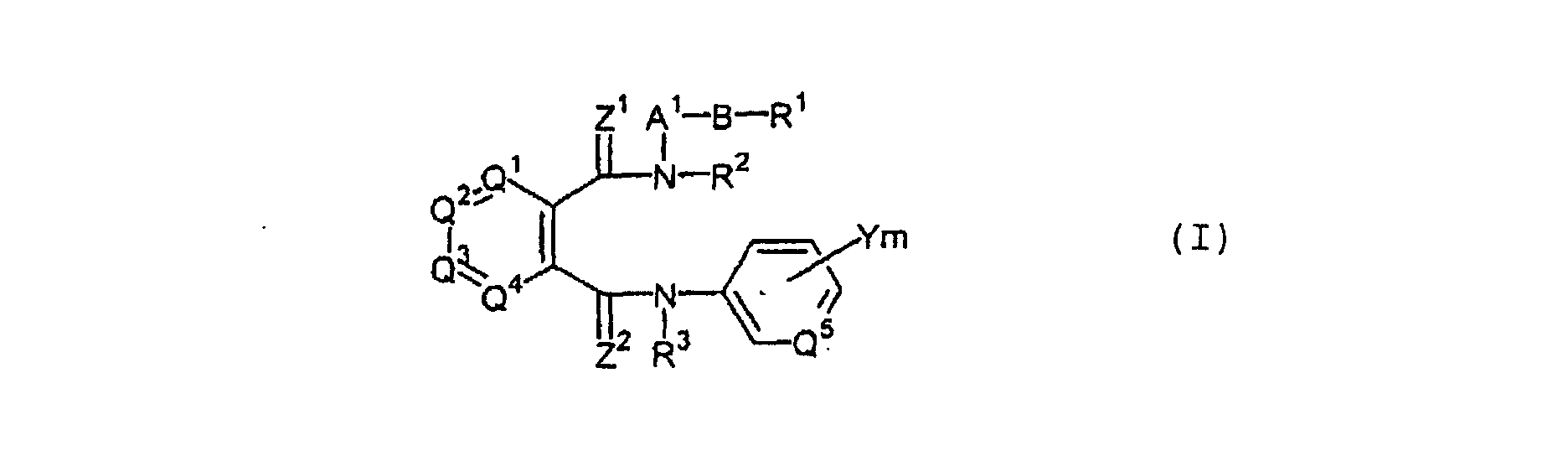 in the (C1-C8)alkylene group, the substituted (C1-C8) alkylene group, the (C3-C8)alkenylene group, the substituted (C3-C8) alkenylene group, the (C3-C8)-alkynylene group or the substituted (C3-C8)alkynylene group, any saturated carbon atom may be substituted with a (C2-C5)alkylene group to form a (C3-C6)cycloalkane ring; further in the (C1-C8)alkylene group, the substituted (C1-C8) alkylene group, the (C3-C8)alkenylene group or the substituted (C3-C8) alkenylene group, any two carbon atoms may be combined with an alkylene group or an alkenylene group to form a (C3-C6)cycloalkane ring or a (C3-C6)cycloalkene ring;B is -CO- or -C(=N-OR4)- (wherein R4 is a hydrogen atom; a (C1-C6)alkyl group; a halo(C1-C6)alkyl group; a (C3-C6)alkenyl group; a halo (C3-C6)alkenyl group; a (C3-C6)alkynyl group; a (C3-C6)cycloalkyl group; a phenyl(C1-C4)alkyl group; or a substituted phenyl(C1-C4)alkyl group having, on the ring, one or more same or different substituents selected from halogen atoms, cyano group, nitro group, (C1-C6)alkyl groups, halo(C1-C6)alkyl groups, (C1-C6)alkoxy groups, halo (C1-C6)alkoxy groups, (C1-C6)alkylthio groups, halo (C1-C6)alkylthio groups, (C1-C6)alkylsulfinyl groups, halo (C1-C6)alkylsulfinyl groups, (C1-C6)alkylsulfonyl groups, halo (C1-C6)alkylsulfonyl groups, mono (C1-C6)alkylamino groups, di(C1-C6)alkylamino groups wherein the two alkyl groups may be the same or different, and (C1-C6)-alkoxycarbonyl groups);R1 is a hydrogen atom; a (C1-C6)alkyl group; a halo(C1-C6)alkyl group; a (C2-C6)alkenyl group; a halo(C2-C6)alkenyl group; a (C3-C6)cycloalkyl group; a halo(C3-C6)cycloalkyl group; a (C1-C6)alkoxy group; a halo(C1-C6)alkoxy group; a (C1-C6)alkylthio group; a halo (C1-C6)alkylthio group; a mono (C1-C6)alkylamino group; a di(C1-C6)alkylamino group wherein the two alkyl groups may be the same or different; a phenyl group; a substituted phenyl group having one or more same or different substituents selected from halogen atoms, cyano group, nitro group, (C1-C6)alkyl groups, halo(C1-C6)alkyl groups, (C1-C6)alkoxy groups, halo (C1-C6) alkoxy groups, (C1-C6)alkylthio groups, halo (C1-C6) alkylthio groups, (C1-C6) alkylsulfinyl groups, halo(C1-C6)alkylsulfinyl groups, (C1-C6)alkylsulfonyl groups, halo (C1-C6) alkylsulfonyl groups, mono (C1-C6) alkylamino groups, di(C1-C6)alkylamino groups wherein the two alkyl groups may be the same or different, and (C1-C6)-alkoxycarbonyl groups; a phenylamino group; a substituted phenylamino group having, on the ring, one or more same or different substituents selected from halogen atoms, cyano group, nitro group, (C1-C6)alkyl groups, halo(C1-C6)alkyl groups, (C1-C6)alkoxy groups, halo (C1-C6)alkoxy groups, (C1-C6)alkylthio groups, halo (C1-C6)alkylthio groups, (C1-C6)alkylsulfinyl groups, halo (C1-C6)alkylsulfinyl groups, (C1-C6)alkylsulfonyl groups, halo(C1-C6)alkylsulfonyl groups, mono(C1-C6)alkylamino groups, di(C1-C6)alkylamino groups wherein the two alkyl groups may be the same or different, and (C1-C6)alkoxycarbonyl groups; a phenyloxy group; a substituted phenyloxy group having one or more same or different substituents selected from halogen atoms, cyano group, nitro group, (C1-C6)alkyl groups, halo(C1-C6)alkyl groups, (C1-C6)alkoxy groups, halo(C1-C6)alkoxy groups, (C1-C6)alkylthio groups, halo (C1-C6)alkylthio groups, (C1-C6)alkylsulfinyl groups, halo (C1-C6)alkylsulfinyl groups, (C1-C6)alkylsulfonyl groups, halo (C1-C6)alkylsulfonyl groups, mono (C1-C6)alkylamino groups, di(C1-C6)alkylamino groups wherein the two alkyl groups may be the same or different, and (C1-C6)-alkoxycarbonyl groups; a phenylthio group; a substituted phenylthio group having one or more same or different substituents selected from halogen atoms, cyano group, nitro group, (C1-C6)alkyl groups, halo(C1-C6)alkyl groups, (C1-C6)alkoxy groups, halo (C1-C6)alkoxy groups, (C1-C6)alkylthio groups, halo (C1-C6) alkylthio groups, (C1-C6)alkylsulfinyl groups, halo(C1-C6)-alkylsulfinyl groups, (C1-C6)alkylsulfonyl groups, halo (C1-C6) alkylsulfonyl groups, mono (C1-C6) alkylamino groups, di(C1-C6)alkylamino groups wherein the two alkyl groups may be the same or different, and (C1-C6)-alkoxycarbonyl groups; a heterocyclic group; or a substituted heterocyclic group having one or more same or different substituents selected from halogen atoms, cyano group, nitro group, (C1-C6)alkyl groups, halo(C1-C6)alkyl groups, (C1-C6)alkoxy groups, halo (C1-C6)alkoxy groups, (C1-C6)alkylthio groups, halo (C1-C6)alkylthio groups, (C1-C6)alkylsulfinyl groups, halo(C1-C6)alkylsulfinyl groups, (C1-C6)alkylsulfonyl groups, halo (C1-C6)alkylsulfonyl groups, mono (C1-C6)alkylamino groups, di(C1-C6)alkylamino groups wherein the two alkyl groups may be the same or different, and (C1-C6)alkoxycarbonyl groups;R1 may bond with A1 to form a 4- to 7-membered ring which may contain, as a ring-constituting atom(s), one or two same or different atoms selected from oxygen, sulfur and nitrogen atoms;R2 and R3 may be the same or different and are each a hydrogen atom, a (C3-C6)cycloalkyl group or -A2-R5 [wherein A2 is -C(=O)-, -C(=S)-, -C(=NR6)- (wherein R6 is a hydrogen atom; a (C1-C6)alkyl group; a (C1-C6)alkoxy group; a mono(C1-C6)alkylamino group; a di(C1-C6)-alkylamino group wherein the two alkyl groups may be the same or different; a (C1-C6)alkoxycarbonyl group; a phenyl group; or a substituted phenyl group having one or more same or different substituents selected from halogen atoms, cyano group, nitro group, (C1-C6)alkyl groups, halo(C1-C6)alkyl groups, (C1-C6)alkoxy groups, halo (C1-C6)alkoxy groups, (C1-C6)alkylthio groups, halo (C1-C6)alkylthio groups, (C1-C6)alkylsulfinyl groups, halo (C1-C6)alkylsulfinyl groups, (C1-C6)alkylsulfonyl groups, halo (C1-C6)alkylsulfonyl groups, mono(C1-C6)alkylamino groups, di(C1-C6)alkylamino groups wherein the two alkyl groups may be the same or different, and (C1-C6)alkoxycarbonyl groups), a (C1-C8)alkylene group, a halo (C1-C8)alkylene group, a (C3-C6)alkenylene group, a halo (C3-C6)alkenylene group, a (C3-C6)alkynylene group or a halo(C3-C6)alkynylene group;(1) when A2 is -C(=O)-, -C(=S)- or -C(=NR6)-(wherein R6 has the same definition as given above), R5 is a hydrogen atom; a (C1-C6)alkyl group; a halo(C1-C6)-alkyl group; a (C1-C6)alkoxy group; a (C3-C6)cycloalkyl group; a halo(C3-C6)cycloalkyl group; a phenyl group; a substituted phenyl group having one or more same or different substituents selected from halogen atoms, cyano group, nitro group, (C1-C6)alkyl groups, halo(C1-C6)alkyl groups, (C1-C6) alkoxy groups, halo (C1-C6) alkoxy groups, (C1-C6)alkylthio groups, halo (C1-C6) alkylthio groups, (C1-C6) alkylsulfinyl groups, halo (C1-C6)-alkylsulfinyl groups, (C1-C6)alkylsulfonyl groups, halo (C1-C6) alkylsulfonyl groups, mono (C1-C6) alkylamino groups, di(C1-C6)alkylamino groups wherein the two alkyl groups may be the same or different, and (C1-C6)-alkoxycarbonyl groups; a heterocyclic group; a substituted heterocyclic group having one or more same or different substituents selected from halogen atoms, cyano group, nitro group, (C1-C6)alkyl groups, halo(C1-C6)alkyl groups, (C1-C6)alkoxy groups, halo (C1-C6)alkoxy groups, (C1-C6)alkylthio groups, halo (C1-C6)alkylthio groups, (C1-C6)alkylsulfinyl groups, halo(C1-C6)-alkylsulfinyl groups, (C1-C6)alkylsulfonyl groups, halo (C1-C6)alkylsulfonyl groups, mono (C1-C6)alkylamino groups, di(C1-C6)alkylamino groups wherein the two alkyl groups may be the same or different, and (C1-C6)-alkoxycarbonyl groups; or -A3-R7 (wherein A3 is -O-, -S- or -N(R8)- (wherein R8 is a hydrogen atom; a (C1-C6)-alkylcarbonyl group; a halo(C1-C6)alkylcarbonyl group; a (C1-C6)alkoxycarbonyl group; a phenylcarbonyl group; a substituted phenylcarbonyl group having one or more same or different substituents selected from halogen atoms, cyano group, nitro group, (C1-C6)alkyl groups, halo (C1-C6)alkyl groups, (C1-C6)alkoxy groups, halo(C1-C6)alkoxy groups, (C1-C6)alkylthio groups, halo(C1-C6)-alkylthio groups, (C1-C6)alkylsulfinyl groups, halo(C1-C6)alkylsulfinyl groups, (C1-C6)alkylsulfonyl groups, halo (C1-C6)alkylsulfonyl groups, mono (C1-C6)alkylamino groups, di(C1-C6)alkylamino groups wherein the two alkyl groups may be the same or different, and (C1-C6)-alkoxycarbonyl groups; a phenyl(C1-C4)alkoxycarbonyl group; or a substituted phenyl (C1-C4)alkoxycarbonyl group having, on the ring, one or more same or different substituents selected from halogen atoms, cyano group, nitro group, (C1-C6)alkyl groups, halo(C1-C6)alkyl groups, (C1-C6)alkoxy groups, halo (C1-C6)alkoxy groups, (C1-C6)alkylthio groups, halo (C1-C6)alkylthio groups, (C1-C6)alkylsulfinyl groups, halo(C1-C6)alkylsulfinyl groups, (C1-C6)alkylsulfonyl groups, halo (C1-C6)alkylsulfonyl groups, mono (C1-C6)alkylamino groups, di(C1-C6)alkylamino groups wherein the two alkyl groups may be the same or different, and (C1-C6)alkoxycarbonyl groups); and R7 is a (C1-C6)alkyl group; a halo(C1-C6)alkyl group; a (C3-C6)alkenyl group; a halo(C3-C6)alkenyl group; a (C3-C6)alkynyl group; a halo(C3-C6)alkynyl group; a (C3-C6)cycloalkyl group; a halo (C3-C6)cycloalkyl group; a (C1-C6)alkylcarbonyl group; a halo (C1-C6)alkylcarbonyl group; a (C1-C6)-alkoxycarbonyl group; a phenyl group; a substituted phenyl group having one or more same or different substituents selected from halogen atoms, cyano group, nitro group, (C1-C6)alkyl groups, halo(C1-C6)alkyl groups, (C1-C6)alkoxy groups, halo(C1-C6)alkoxy groups, (C1-C6)alkylthio groups, halo (C1-C6)alkylthio groups, (C1-C6)alkylsulfinyl groups, halo (C1-C6)alkylsulfinyl groups, (C1-C6)alkylsulfonyl groups, halo(C1-C6)-alkylsulfonyl groups, mono(C1-C6)alkylamino groups, di(C1-C6)alkylamino groups wherein the two alkyl groups may be the same or different, and (C1-C6)alkoxycarbonyl groups; a phenyl(C1-C4)alkyl group; a substituted phenyl(C1-C4)alkyl group having, on the ring, one or more same or different substituents selected from halogen atoms, cyano group, nitro group, (C1-C6)alkyl groups, halo(C1-C6)alkyl groups, (C1-C6)alkoxy groups, halo (C1-C6)alkoxy groups, (C1-C6)alkylthio groups, halo (C1-C6)alkylthio groups, (C1-C6)alkylsulfinyl groups, halo (C1-C6)alkylsulfinyl groups, (C1-C6)alkylsulfonyl groups, halo (C1-C6)alkylsulfonyl groups, mono (C1-C6)alkylamino groups, di(C1-C6)alkylamino groups wherein the two alkyl groups may be the same or different, and (C1-C6)alkoxycarbonyl groups; a heterocyclic group; or a substituted heterocyclic group having one or more same or different substituents selected from halogen atoms, cyano group, nitro group, (C1-C6)alkyl groups, halo(C1-C6)alkyl groups, (C1-C6) alkoxy groups, halo (C1-C6) alkoxy groups, (C1-C6)alkylthio groups, halo (C1-C6) alkylthio groups, (C1-C6)alkylsulfinyl groups, halo(C1-C6)alkylsulfinyl groups, (C1-C6)alkylsulfonyl groups, halo (C1-C6) alkylsulfonyl groups, mono (C1-C6) alkylamino groups, di(C1-C6)alkylamino groups wherein the two alkyl groups may be the same or different, and (C1-C6)alkoxycarbonyl groups);(2) when A2 is a (C1-C8)alkylene group, a halo (C1-C8) alkylene group, a (C3-C6) alkenylene group, a halo(C3-C6)alkenylene group, a (C3-C6)alkynylene group or a halo(C3-C6)alkynylene group, R5 is a hydrogen atom; a halogen atom; a cyano group; a nitro group; a (C3-C6)-cycloalkyl group; a halo(C3-C6)cycloalkyl group; a (C1-C6)alkoxycarbonyl group; a phenyl group; a substituted phenyl group having one or more same or different substituents selected from halogen atoms, cyano group, nitro group, (C1-C6)alkyl groups, halo(C1-C6)alkyl groups, (C1-C6)alkoxy groups, halo (C1-C6) alkoxy groups, (C1-C6)alkylthio groups, halo(C1-C6)alkylthio groups, (C1-C6) alkylsulfinyl groups, halo (C1-C6) alkylsulfinyl groups, (C1-C6)alkylsulfonyl groups, halo(C1-C6)alkylsulfonyl groups, mono(C1-C6)alkylamino groups, di(C1-C6)alkylamino groups wherein the two alkyl groups may be the same or different, and (C1-C6)alkoxycarbonyl groups; a heterocyclic group; a substituted heterocyclic group having one or more same or different substituents selected from halogen atoms, cyano group, nitro group, (C1-C6)alkyl groups, halo(C1-C6)alkyl groups, (C1-C6)alkoxy groups, halo (C1-C6)alkoxy groups, (C1-C6)alkylthio groups, halo (C1-C6)alkylthio groups, (C1-C6)alkylsulfinyl groups, halo (C1-C6)alkylsulfinyl groups, (C1-C6)alkylsulfonyl groups, halo(C1-C6)alkylsulfonyl groups, mono(C1-C6)alkylamino groups, di(C1-C6)alkylamino groups wherein the two alkyl groups may be the same or different, and (C1-C6)alkoxycarbonyl groups; or -A4-R9 (wherein A4 is -O-, -S-, -SO-, -SO2-, -N(R8)- (R8 has the same definition as given above), -C(=O)- or -C(=NOR4)- (R4 has the same definition as given above);(i) when A4 is -O-, -S-, -SO-, -SO2- or -N(R8)-(R8 has the same definition as given above), R9 is a hydrogen atom; a (C1-C6)alkyl group; a halo(C1-C6)alkyl group; a (C3-C6)alkenyl group; a halo(C3-C6)alkenyl group; a (C3-C6)alkynyl group; a halo(C3-C6)alkynyl group; a (C3-C6)cycloalkyl group; a halo(C3-C6)cycloalkyl group; a (C1-C6)alkylcarbonyl group; a halo(C1-C6)-alkylcarbonyl group; a (C1-C6)alkoxycarbonyl group; a phenyl group; a substituted phenyl group having one or more same or different substituents selected from halogen atoms, cyano group, nitro group, (C1-C6)alkyl groups, halo (C1-C6) alkyl groups, (C1-C6) alkoxy groups, halo (C1-C6) alkoxy groups, (C1-C6) alkylthio groups, halo (C1-C6) alkylthio groups, (C1-C6) alkylsulfinyl groups, halo (C1-C6) alkylsulfinyl groups, (C1-C6) alkylsulfonyl groups, halo (C1-C6)alkylsulfonyl groups, mono(C1-C6)alkylamino groups, di(C1-C6)alkylamino groups wherein the two alkyl groups may be the same or different, and (C1-C6) alkoxycarbonyl groups; a phenyl (C1-C4) alkyl group; a substituted phenyl(C1-C4)alkyl group having, on the ring, one or more same or different substituents selected from halogen atoms, cyano group, nitro group, (C1-C6)alkyl groups, halo (C1-C6)alkyl groups, (C1-C6)alkoxy groups, halo(C1-C6)alkoxy groups, (C1-C6)alkylthio groups, halo(C1-C6)alkylthio groups, (C1-C6)alkylsulfinyl groups, halo(C1-C6)alkylsulfinyl groups, (C1-C6)alkylsulfonyl groups, halo (C1-C6)alkylsulfonyl groups, mono (C1-C6)alkylamino groups, di (C1-C6)alkylamino groups wherein the two alkyl groups may be the same or different, and (C1-C6)alkoxycarbonyl groups; a heterocyclic group; or a substituted heterocyclic group having one or more same or different substituents selected from halogen atoms, cyano group, nitro group, (C1-C6)alkyl groups, halo(C1-C6)alkyl groups, (C1-C6)-alkoxy groups, halo(C1-C6)alkoxy groups, (C1-C6)alkylthio groups, halo (C1-C6) alkylthio groups, (C1-C6) alkylsulfinyl groups, halo (C1-C6)alkylsulfinyl groups, (C1-C6)-alkylsulfonyl groups, halo(C1-C6)alkylsulfonyl groups, mono (C1-C6) alkylamino groups, di (C1-C6) alkylamino groups wherein the two alkyl groups may be the same or different, and (C1-C6)alkoxycarbonyl groups;(ii) when A4 is -C(=O)- or -C(=N-OR4)- (R4 has the same definition as given above), R9 is a hydrogen atom; a (C1-C6)alkyl group; a halo(C1-C6)alkyl group; a (C2-C6)alkenyl group; a halo(C2-C6)alkenyl group; a (C3-C6)cycloalkyl group; a halo(C3-C6)cycloalkyl group; a (C1-C6) alkoxy group; a halo (C1-C6) alkoxy group; a (C1-C6)alkylthio group; a halo(C1-C6)alkylthio group; a mono (C1-C6) alkylamino group; a di (C1-C6) alkylamino group wherein the two alkyl groups may be the same or different; a phenyl group; a substituted phenyl group having one or more same or different substituents selected from halogen atoms, cyano group, nitro group, (C1-C6) alkyl groups, halo (C1-C6) alkyl groups, (C1-C6) - alkoxy groups, halo(C1-C6)alkoxy groups, (C1-C6)alkylthio groups, halo (C1-C6) alkylthio groups, (C1-C6) alkylsulfinyl groups, halo (C1-C6) alkylsulfinyl groups, (C1-C6)-alkylsulfonyl groups, halo(C1-C6)alkylsulfonyl groups, mono (C1-C6) alkylamino groups, di (C1-C6) alkylamino groups wherein the two alkyl groups may be the same or different, and (C1-C6)alkoxycarbonyl groups; a phenylamino group; a substituted phenylamino group having, on the ring, one or more same or different substituents selected from halogen atoms, cyano group, nitro group, (C1-C6)alkyl groups, halo(C1-C6)alkyl groups, (C1-C6)alkoxy groups, halo (C1-C6)alkoxy groups, (C1-C6)alkylthio groups, halo (C1-C6)alkylthio groups, (C1-C6)alkylsulfinyl groups, halo (C1-C6)alkylsulfinyl groups, (C1-C6)alkylsulfonyl groups, halo(C1-C6)alkylsulfonyl groups, mono(C1-C6)alkylamino groups, di(C1-C6)alkylamino groups wherein the two alkyl groups may be the same or different, and (C1-C6)alkoxycarbonyl groups; a phenyloxy group; a substituted phenyloxy group having one or more same or different substituents selected from halogen atoms, cyano group, nitro group, (C1-C6)alkyl groups, halo (C1-C6)alkyl groups, (C1-C6)alkoxy groups, halo(C1-C6)alkoxy groups, (C1-C6)alkylthio groups, halo (C1-C6)alkylthio groups, (C1-C6)alkylsulfinyl groups, halo(C1-C6)alkylsulfinyl groups, (C1-C6)alkylsulfonyl groups, halo (C1-C6)alkylsulfonyl groups, mono (C1-C6)alkylamino groups, di (C1-C6)alkylamino groups wherein the two alkyl groups may be the same or different, and (C1-C6)alkoxycarbonyl groups; a phenylthio group; a substituted phenylthio group having, on the ring, one or more same or different substituents selected from halogen atoms, cyano group, nitro group, (C1-C6)alkyl groups, halo (C1-C6)alkyl groups, (C1-C6)alkoxy groups, halo(C1-C6)alkoxy groups, (C1-C6)alkylthio groups, halo (C1-C6)alkylthio groups, (C1-C6)alkylsulfinyl groups, halo (C1-C6)alkylsulfinyl groups, (C1-C6)alkylsulfonyl groups, halo(C1-C6)alkylsulfonyl groups, mono (C1-C6)alkylamino groups, di(C1-C6)alkylamino groups wherein the two alkyl groups may be the same or different, and (C1-C6)alkoxycarbonyl groups; a heterocyclic group; or a substituted heterocyclic group having one or more same or different substituents selected from halogen atoms, cyano group, nitro group, (C1-C6)alkyl groups, halo (C1-C6) alkyl groups, (C1-C6) alkoxy groups, halo (C1-C6) alkoxy groups, (C1-C6) alkylthio groups, halo (C1-C6) alkylthio groups, (C1-C6) alkylsulfinyl groups, halo (C1-C6) alkylsulfinyl groups, (C1-C6)alkylsulfonyl groups, halo(C1-C6)alkylsulfonyl groups, mono(C1-C6)alkylamino groups, di(C1-C6)alkylamino groups wherein the two alkyl groups may be the same or different, and (C1-C6)alkoxycarbonyl groups)];R2 may bond with A1 or R1 to form a 4- to 7-membered ring which may contain, as a ring-constituting atom(s), one or two same or different atoms selected from oxygen, sulfur and nitrogen atoms;Q1 to Q4 may be the same or different and are each a nitrogen atom or a carbon atom which may be substituted with X, and X may be the same or different, and is a halogen atom; a cyano group; a nitro group; a (C3-C6)cycloalkyl group; a halo (C3-C6)cycloalkyl group; a (C1-C6)alkoxycarbonyl group; a phenyl group; a substituted phenyl group having one or more same or different substituents selected from halogen atoms, cyano group, nitro group, (C1-C6)alkyl groups, halo(C1-C6)alkyl groups, (C1-C6)alkoxy groups, halo (C1-C6) alkoxy groups, (C1-C6)alkylthio groups, halo (C1-C6) alkylthio groups, (C1-C6) alkylsulfinyl groups, halo (C1-C6)alkylsulfinyl groups, (C1-C6)alkylsulfonyl groups, halo (C1-C6) alkylsulfonyl groups, mono (C1-C6) alkylamino groups, di(C1-C6)alkylamino groups wherein the two alkyl groups may be the same or different, and (C1-C6)alkoxycarbonyl groups; a heterocyclic group; a substituted heterocyclic group having one or more same or different substituents selected from halogen atoms, cyano group, nitro group, (C1-C6)alkyl groups, halo(C1-C6)alkyl groups, (C1-C6)alkoxy groups, halo(C1-C6)alkoxy groups, (C1-C6) alkylthio groups, halo (C1-C6) alkylthio groups, (C1-C6) alkylsulfinyl groups, halo(C1-C6)-alkylsulfinyl groups, (C1-C6)alkylsulfonyl groups, halo (C1-C6) alkylsulfonyl groups, mono (C1-C6) alkylamino groups, di(C1-C6)alkylamino groups wherein the two alkyl groups may be the same or different, and (C1-C6)-alkoxycarbonyl groups; or -A5-R10 [wherein A5 is -O-, -S-, -SO-, -SO2-, -C(=O)-, -C(=NOR4)- (R4 has the same definition as given above), a (C1-C6)alkylene group, a halo(C1-C6)alkylene group, a (C2-C6)alkenylene group, a halo (C2-C6)alkenylene group, a C2-C6)alkynylene group or a halo (C2-C6)alkynylene group;(1) when A5 is -O-, -S-, -SO- or -SO2-, R10 is a halo (C3-C6)cycloalkyl group; a halo (C3-C6)cycloalkenyl group; a phenyl group; a substituted phenyl group having one or more same or different substituents selected from halogen atoms, cyano group, nitro group, (C1-C6)alkyl groups, halo(C1-C6)alkyl groups, (C1-C6)-alkoxy groups, halo(C1-C6)alkoxy groups, (C1-C6)alkylthio groups, halo(C1-C6)alkylthio groups, (C1-C6)alkylsulfinyl groups, halo (C1-C6) alkylsulfinyl groups, (C1-C6)-alkylsulfonyl groups, halo(C1-C6)alkylsulfonyl groups, mono (C1-C6) alkylamino groups, di (C1-C6) alkylamino groups wherein the two alkyl groups may be the same or different, and (C1-C6)alkoxycarbonyl groups; a heterocyclic group; a substituted heterocyclic group having one or more same or different substituents selected from halogen atoms, cyano group, nitro group, (C1-C6)alkyl groups, halo (C1-C6)alkyl groups, (C1-C6)alkoxy groups, halo(C1-C6)alkoxy groups, (C1-C6)alkylthio groups, halo(C1-C6)alkylthio groups, (C1-C6)alkylsulfinyl groups, halo(C1-C6)alkylsulfinyl groups, (C1-C6)alkylsulfonyl groups, halo(C1-C6)alkylsulfonyl groups, mono (C1-C6)alkylamino groups, di (C1-C6)alkylamino groups wherein the two alkyl groups may be the same or different, and (C1-C6)alkoxycarbonyl groups; or -A6-R11 (wherein A6 is a (C1-C6)alkylene group, a halo(C1-C6)-alkylene group, a (C3-C6)alkenylene group, a halo (C3-C6)-alkenylene group, a (C3-C6)alkynylene group or a halo(C3-C6)alkynylene group, and R11 is a hydrogen atom; a halogen atom; a (C3-C6)cycloalkyl group; a halo(C3-C6)-cycloalkyl group; a (C1-C6)alkoxycarbonyl group; a phenyl group; a substituted phenyl group having one or more same or different substituents selected from halogen atoms, cyano group, nitro group, (C1-C6)alkyl groups, halo(C1-C6)alkyl groups, (C1-C6)alkoxy groups, halo (C1-C6) alkoxy groups, (C1-C6) alkylthio groups, halo (C1-C6) alkylthio groups, (C1-C6) alkylsulfinyl groups, halo(C1-C6) alkylsulfinyl groups, (C1-C6) alkylsulfonyl groups, halo (C1-C6) alkylsulfonyl groups, mono(C1-C6)alkylamino groups, di(C1-C6)alkylamino groups wherein the two alkyl groups may be the same or different, and (C1-C6)alkoxycarbonyl groups; or -A7-R12 (wherein A7 is -O-, -S-, -SO- or -SO2-, and R12 is a (C1-C6)alkyl group; a halo(C1-C6)alkyl group; a (C3-C6)alkenyl group; a halo(C3-C6) alkenyl group; a (C3-C6) alkynyl group; a halo(C3-C6)alkynyl group; a (C3-C6)cycloalkyl group; a halo (C3-C6)cycloalkyl group; a phenyl group; a substituted phenyl group having one or more same or different substituents selected from halogen atoms, cyano group, nitro group, (C1-C6)alkyl groups, halo(C1-C6)alkyl groups, (C1-C6)alkoxy groups, halo(C1-C6)alkoxy groups, (C1-C6)alkylthio groups, halo (C1-C6) alkylthio groups, (C1-C6) alkylsulfinyl groups, halo(C1-C6)-alkylsulfinyl groups, (C1-C6)alkylsulfonyl groups, halo (C1-C6) alkylsulfonyl groups, mono (C1-C6) alkylamino groups, di(C1-C6)alkylamino groups wherein the two alkyl groups may be the same or different, and (C1-C6)-alkoxycarbonyl groups; a heterocyclic group; or a substituted heterocyclic group having one or more same or different substituents selected from halogen atoms, cyano group, nitro group, (C1-C6)alkyl groups, halo(C1-C6)alkyl groups, (C1-C6)alkoxy groups, halo (C1-C6)alkoxy groups, (C1-C6)alkylthio groups, halo (C1-C6)alkylthio groups, (C1-C6)alkylsulfinyl groups, halo(C1-C6)-alkylsulfinyl groups, (C1-C6)alkylsulfonyl groups, halo (C1-C6)alkylsulfonyl groups, mono (C1-C6)alkylamino groups, di(C1-C6)alkylamino groups wherein the two alkyl groups may be the same or different, and (C1-C6)-alkoxycarbonyl groups));(2) when A5 is -C(=O)- or -C(=NOR4)- (R4 has the same definition as given above), R10 is a (C1-C6)-alkyl group; a halo(C1-C6)alkyl group; a (C2-C6)alkenyl group; a halo(C2-C6)alkenyl group; a (C3-C6)cycloalkyl group; a halo(C3-C6)cycloalkyl group; a (C1-C6)alkoxy group; a (C1-C6)alkylthio group; a mono(C1-C6)alkylamino group; a di(C1-C6)alkylamino group wherein the two alkyl groups may be the same or different; a phenyl group; a substituted phenyl group having one or more same or different substituents selected from halogen atoms, cyano group, nitro group, (C1-C6)alkyl groups, halo(C1-C6)alkyl groups, (C1-C6)alkoxy groups, halo(C1-C6)alkoxy groups, (C1-C6)alkylthio groups, halo (C1-C6)alkylthio groups, (C1-C6)alkylsulfinyl groups, halo(C1-C6)-alkylsulfinyl groups, (C1-C6)alkylsulfonyl groups, halo (C1-C6) alkylsulfonyl groups, mono (C1-C6) alkylamino groups, di(C1-C6)alkylamino groups wherein the two alkyl groups may be the same or different, and (C1-C6)-alkoxycarbonyl groups; a phenylamino group; a substituted phenylamino group having, on the ring, one or more same or different substituents selected from halogen atoms, cyano group, nitro group, (C1-C6)alkyl groups, halo (C1-C6) alkyl groups, (C1-C6) alkoxy groups, halo (C1-C6) alkoxy groups, (C1-C6) alkylthio groups, halo(C1-C6)alkylthio groups, (C1-C6) alkylsulfinyl groups, halo (C1-C6) alkylsulfinyl groups, (C1-C6) alkylsulfonyl groups, halo (C1-C6) alkylsulfonyl groups, mono (C1-C6)-alkylamino groups, di(C1-C6)alkylamino groups wherein the two alkyl groups may be the same or different, and (C1-C6)alkoxycarbonyl groups; a heterocyclic group; or a substituted heterocyclic group having one or more same or different substituents selected from halogen atoms, cyano group, nitro group, (C1-C6)alkyl groups, halo(C1-C6)alkyl groups, (C1-C6)alkoxy groups, halo (C1-C6)alkoxy groups, (C1-C6)alkylthio groups, halo (C1-C6)alkylthio groups, (C1-C6)alkylsulfinyl groups, halo(C1-C6)-alkylsulfinyl groups, (C1-C6)alkylsulfonyl groups, halo (C1-C6)alkylsulfonyl groups, mono (C1-C6)alkylamino groups, di(C1-C6)alkylamino groups wherein the two alkyl groups may be the same or different, and (C1-C6)-alkoxycarbonyl groups;(3) when A5 is a (C1-C6)alkylene group, a halo(C1-C6)alkylene group, a (C2-C6)alkenylene group, a halo(C2-C6)alkenylene group, a (C2-C6)alkynylene group or . a halo(C2-C6)alkynylene group, R10 is a hydrogen atom; a halogen atom; a (C3-C6)cycloalkyl group; a halo(C3-C6)cycloalkyl group; a (C1-C6)alkoxycarbonyl group; a phenyl group; a substituted phenyl group having one or more same or different substituents selected from halogen atoms, cyano group, nitro group, (C1-C6)alkyl groups, halo (C1-C6)alkyl groups, (C1-C6)alkoxy groups, halo (C1-C6)alkoxy groups, (C1-C6)alkylthio groups, halo (C1-C6)alkylthio groups, (C1-C6)alkylsulfinyl groups, halo (C1-C6)alkylsulfinyl groups, (C1-C6)alkylsulfonyl groups, halo (C1-C6)alkylsulfonyl groups, mono (C1-C6)alkylamino groups, di(C1-C6)alkylamino groups wherein the two alkyl groups may be the same or different, and (C1-C6)alkoxycarbonyl groups; a heterocyclic group; a substituted heterocyclic group having one or more same or different substituents selected from halogen atoms, cyano group, nitro group, (C1-C6)alkyl groups, halo(C1-C6)alkyl groups, (C1-C6)alkoxy groups, halo (C1-C6) alkoxy groups, (C1-C6)alkylthio groups, halo (C1-C6)alkylthio groups, (C1-C6)alkylsulfinyl groups, halo (C1-C6)-alkylsulfinyl groups, (C1-C6)alkylsulfonyl groups, halo (C1-C6)alkylsulfonyl groups, mono (C1-C6)alkylamino groups, di(C1-C6)alkylamino groups wherein the two alkyl groups may be the same or different, and (C1-C6)-alkoxycarbonyl groups; or -A8-R13 (wherein A8 is -O-, -S-, -SO- or -SO2-, and R13 is a (C3-C6)cycloalkyl group; a halo(C3-C6)cycloalkyl group; a phenyl group; a substituted phenyl group having one or more same or different substituents selected from halogen atoms, cyano group, nitro group, (C1-C6)alkyl groups, halo(C1-C6)alkyl groups, (C1-C6)alkoxy groups, halo(C1-C6)alkoxy groups, (C1-C6) alkylthio groups, halo (C1-C6) alkylthio groups, (C1-C6) alkylsulfinyl groups, halo(C1-C6)alkylsulfinyl groups, (C1-C6)alkylsulfonyl groups, halo (C1-C6) alkylsulfonyl groups, mono (C1-C6) alkylamino groups, di(C1-C6)alkylamino groups wherein the two alkyl groups may be the same or different, and (C1-C6)alkoxycarbonyl groups; a heterocyclic group; a substituted heterocyclic group having one or more same or different substituents selected from halogen atoms, cyano group, nitro group, (C1-C6)alkyl groups, halo(C1-C6)alkyl groups, (C1-C6)alkoxy groups, halo (C1-C6) alkoxy groups, (C1-C6) alkylthio groups, halo (C1-C6)alkylthio groups, (C1-C6) alkylsulfinyl groups, halo(C1-C6)-alkylsulfinyl groups, (C1-C6)alkylsulfonyl groups, halo (C1-C6) alkylsulfonyl groups, mono (C1-C6) alkylamino groups, di(C1-C6)alkylamino groups wherein the two alkyl groups may be the same or different, and (C1-C6)-alkoxycarbonyl groups; or -A9-R14 (wherein A9 is a (C1-C6)alkylene group, a halo(C1-C6)alkylene group, a (C2-C6)alkenylene group, a halo(C2-C6)alkenylene group, a (C2-C6)alkynylene group or a halo(C3-C5)alkynylene group, and R14 is a hydrogen atom; a halogen atom; a (C3-C6)-cycloalkyl group; a halo(C3-C6)cycloalkyl group; a (C1-C6)alkoxy group; a halo (C1-C6)alkoxy group; a (C1-C6)alkylthio group; a halo(C1-C6)alkylthio group; a (C1-C6)alkylsulfinyl group; a halo(C1-C6)alkylsulfinyl group; a (C1-C6)alkylsulfonyl group; a halo (C1-C6)alkylsulfonyl group; a phenyl group; a substituted phenyl group having one or more same or different substituents selected from halogen atoms, cyano group, nitro group, (C1-C6) alkyl groups, halo (C1-C6) alkyl groups, (C1-C6)-alkoxy groups, halo(C1-C6)alkoxy groups, (C1-C6)alkylthio groups, halo (C1-C6) alkylthio groups, (C1-C6) alkylsulfinyl groups, halo (C1-C6)alkylsulfinyl groups, (C1-C6)-alkylsulfonyl groups, halo(C1-C6)alkylsulfonyl groups, mono (C1-C6) alkylamino groups, di (C1-C6) alkylamino groups wherein the two alkyl groups may be the same or different, and (C1-C6)alkoxycarbonyl groups; a phenyloxy group; a substituted phenyloxy group having one or more same or different substituents selected from halogen atoms, cyano group, nitro group, (C1-C6)alkyl groups, halo (C1-C6)alkyl groups, (C1-C6)alkoxy groups, halo(C1-C6)alkoxy groups, (C1-C6)alkylthio groups, halo(C1-C6)alkylthio groups, (C1-C6)alkylsulfinyl groups, halo(C1-C6)alkylsulfinyl groups, (C1-C6)alkylsulfonyl groups, halo (C1-C6)alkylsulfonyl groups, mono (C1-C6)-alkylamino groups, di(C1-C6)alkylamino groups wherein the two alkyl groups may be the same or different, and (C1-C6)alkoxycarbonyl groups; a phenylthio group; a substituted phenylthio group having one or more same or different substituents selected from halogen atoms, cyano group, nitro group, (C1-C6)alkyl groups, halo(C1-C6)alkyl groups, (C1-C6) alkoxy groups, halo (C1-C6) alkoxy groups, (C1-C6)alkylthio groups, halo (C1-C6) alkylthio groups, (C1-C6) alkylsulfinyl groups, halo(C1-C6)-alkylsulfinyl groups, (C1-C6)alkylsulfonyl groups, halo (C1-C6) alkylsulfonyl groups, mono (C1-C6) alkylamino groups, di(C1-C6)alkylamino groups wherein the two alkyl groups may be the same or different, and (C1-C6)-alkoxycarbonyl groups; a heterocyclic group; or a substituted heterocyclic group having one or more same or different substituents selected from halogen atoms, cyano group, nitro group, (C1-C6)alkyl groups, halo(C1-C6)alkyl groups, (C1-C6)alkoxy groups, halo(C1-C6)alkoxy groups, (C1-C6)alkylthio groups, halo (C1-C6)alkylthio groups, (C1-C6)alkylsulfinyl groups, halo(C1-C6)-alkylsulfinyl groups, (C1-C6)alkylsulfonyl groups, halo (C1-C6) alkylsulfonyl groups, mono (C1-C6) alkylamino groups, di(C1-C6)alkylamino groups wherein the two alkyl groups may be the same or different, and (C1-C6)-alkoxycarbonyl groups))];the two Xs bonding to the adjacent two carbon atoms constituting the aromatic ring containing Q1 to Q4 may bond to each other to form a condensed ring; the condensed ring may have one or more same or different substituents selected from halogen atoms, cyano group, nitro group, (C1-C6)alkyl groups, halo(C1-C6)alkyl groups, (C1-C6)alkoxy groups, halo (C1-C6)alkoxy groups, (C1-C6)alkylthio groups, halo (C1-C6)alkylthio groups, (C1-C6)alkylsulfinyl groups, halo (C1-C6)alkylsulfinyl groups, (C1-C6)alkylsulfonyl groups, halo(C1-C6)-alkylsulfonyl groups, mono(C1-C6)alkylamino groups, di(C1-C6)alkylamino groups wherein the two alkyl groups may be the same or different, and (C1-C6)alkoxycarbonyl groups;Q5 is a nitrogen atom or a carbon atom;Y may be the same or different, and is a halogen atom; a cyano group; a nitro group; a halo(C3-C6)cycloalkyl group; a phenyl group; a substituted phenyl group having one or more same or different substituents selected from halogen atoms, cyano group, nitro group, (C1-C6)alkyl groups, halo(C1-C6)alkyl groups, (C1-C6)alkoxy groups, halo (C1-C6)alkoxy groups, (C1-C6)alkylthio groups, halo (C1-C6)alkylthio groups, (C1-C6)alkylsulfinyl groups, halo (C1-C6)alkylsulfinyl groups, (C1-C6)alkylsulfonyl groups, halo(C1-C6)-alkylsulfonyl groups, mono(C1-C6)alkylamino groups, di(C1-C6)alkylamino groups wherein the two alkyl groups may be the same or different, and (C1-C6)alkoxycarbonyl groups; a heterocyclic group; a substituted heterocyclic group having one or more same or different substituents selected from halogen atoms, cyano group, nitro group, (C1-C6)alkyl groups, halo (C1-C6)alkyl groups, (C1-C6)alkoxy groups, halo(C1-C6)alkoxy groups, (C1-C6)alkylthio groups, halo (C1-C6)alkylthio groups, (C1-C6)alkylsulfinyl groups, halo (C1-C6)alkylsulfinyl groups, (C1-C6)alkylsulfonyl groups, halo (C1-C6)-alkylsulfonyl groups, mono(C1-C6)alkylamino groups, di(C1-C6)alkylamino groups wherein the two alkyl groups may be the same or different, and (C1-C6)alkoxycarbonyl groups; or -A5-R10 (A5 and R10 each have the same definition as given above);the two Ys bonding to the adjacent two carbon atoms constituting the aromatic ring containing Q5 may bond to each other to form a condensed ring; the condensed ring may have one or more same or different substituents selected from halogen atoms, (C1-C6)alkyl groups, halo (C1-C6) alkyl groups, (C1-C6) alkoxy groups, halo (C1-C6) alkoxy groups, (C1-C6) alkylthio groups, halo(C1-C6)alkylthio groups, (C1-C6)alkylsulfinyl groups, halo (C1-C6) alkylsulfinyl groups, (C1-C6) alkylsulfonyl groups, halo(C1-C6)alkylsulfonyl groups, phenyl group, substituted phenyl groups having one or more same or different substituents selected from halogen atoms, cyano group, nitro group, (C1-C6)alkyl groups, halo(C1-C6)alkyl groups, (C1-C6) alkoxy groups, halo (C1-C6) alkoxy groups, (C1-C6) alkylthio groups, halo (C1-C6) alkylthio groups, (C1-C6)alkylsulfinyl groups, halo (C1-C6)-alkylsulfinyl groups, (C1-C6)alkylsulfonyl groups, halo (C1-C6) alkylsulfonyl groups, mono (C1-C6) alkylamino groups, di(C1-C6)alkylamino groups wherein the two alkyl groups may be the same or different, and (C1-C6)-alkoxycarbonyl groups, heterocyclic groups, and substituted heterocyclic groups having one or more same or different substituents selected from halogen atoms, cyano group, nitro group, (C1-C6)alkyl groups, halo(C1-C6)alkyl groups, (C1-C6) alkoxy groups, halo (C1-C6) alkoxy groups, (C1-C6) alkylthio groups, halo (C1-C6) alkylthio groups, (C1-C6) alkylsulfinyl groups, halo(C1-C6)-alkylsulfinyl groups, (C1-C6)alkylsulfonyl groups, halo (C1-C6) alkylsulfonyl groups, mono (C1-C6) alkylamino groups, di(C1-C6)alkylamino groups wherein the two alkyl groups may be the same or different, and (C1-C6)-alkoxycarbonyl groups;m is an integer of 0 to 5;Z1 and Z2 may be the same or different and are each an oxygen atom or a sulfur atom}.
 - An aromatic diamide derivative or a salt thereof according to Claim 1, wherein A1 is a (C1-C8)alkylene group; a substituted (C1-C8) alkylene group having one or more same or different substituents selected from halogen atoms, cyano group, nitro group, halo (C1-C6) alkyl groups, (C1-C6) alkoxy groups, halo (C1-C6)alkoxy groups, (C1-C6) alkylthio groups, halo(C1-C6)-alkylthio groups, (C1-C6)alkylsulfinyl groups, halo(C1-C6)alkylsulfinyl groups, (C1-C6)alkylsulfonyl groups, halo (C1-C6) alkylsulfonyl groups, (C1-C6) alkylthio(C1-C6)alkyl groups, (C1-C6)alkoxycarbonyl groups and phenyl group; a (C3-C6)alkenylene group; a substituted (C3-C8)alkenylene group having one or more same or different substituents selected form halogen atoms, cyano group, nitro group, halo (C1-C6)alkyl groups, (C1-C6)alkoxy groups, halo (C1-C6)alkoxy groups, (C1-C6)alkylthio groups, halo (C1-C6)alkylthio groups, (C1-C6)alkylsulfinyl groups, halo (C1-C6)alkylsulfinyl groups, (C1-C6)-alkylsulfonyl groups, halo(C1-C6)alkylsulfonyl groups, (C1-C6)alkylthio (C1-C6)alkyl groups, (C1-C6)alkoxycarbonyl groups and phenyl group; a (C3-C8)alkynylene group; or a substituted (C3-C8)alkynylene group having one or more same or different substituents selected form halogen atoms, cyano group, nitro group, halo(C1-C6)alkyl groups, (C1-C6)alkoxy groups, halo(C1-C6)alkoxy groups, (C1-C6) alkylthio groups, halo (C1-C6) alkylthio groups, (C1-C6) alkylsulfinyl groups, halo (C1-C6) alkylsulfinyl groups, (C1-C6) alkylsulfonyl groups, halo (C1-C6)-alkylsulfonyl groups, (C1-C6) alkylthio (C1-C6) alkyl groups, (C1-C6)alkoxycarbonyl groups and phenyl group;in the (C1-C8)alkylene group, the substituted (C1-C8)alkylene group, the (C3-C8)alkenylene group, the substituted (C3-C8) alkenylene group, the (C3-C8)-alkynylene group or the substituted (C3-C8)alkynylene group, any saturated carbon atom may be substituted with a (C2-C5)alkylene group to form a (C3-C6)cycloalkane ring; further in the (C1-C8)alkylene group, the substituted (C1-C8) alkylene group, the (C3-C8)alkenylene group or the substituted (C3-C8) alkenylene group, any two carbon atoms may be combined with an alkylene group or an alkenylene group to form a (C3-C6)cycloalkane ring or a (C3-C6)cycloalkene ring;B is -CO- or -C(=N-OR4)- (wherein R4 is a hydrogen atom; a (C1-C6)alkyl group; a halo(C1-C6)alkyl group; a (C3-C6)alkenyl group; a halo (C3-C6)alkenyl group; a (C3-C6)alkynyl group; a (C3-C6)cycloalkyl group; a phenyl(C1-C4)alkyl group; or a substituted phenyl(C1-C4)alkyl group having, on the ring, one or more same or different substituents selected from halogen atoms, cyano group, nitro group, (C1-C6)alkyl groups, halo(C1-C6)alkyl groups, (C1-C6)alkoxy groups, halo(C1-C6)alkoxy groups, (C1-C6)alkylthio groups, halo (C1-C6)alkylthio groups, (C1-C6)alkylsulfinyl groups, halo(C1-C6)-alkylsulfinyl groups, (C1-C6)alkylsulfonyl groups, halo(C1-C6)alkylsulfonyl groups, mono (C1-C6)alkylamino groups, di(C1-C6)alkylamino groups wherein the two alkyl groups may be the same or different, and (C1-C6)alkoxycarbonyl groups);R1 is a hydrogen atom; a (C1-C6)alkyl group; a halo (C1-C6)alkyl group; a (C2-C6)alkenyl group; a halo(C2-C6)alkenyl group; a (C3-C6)cycloalkyl group; a halo(C3-C6)cycloalkyl group; a (C1-C6)alkoxy group; a halo(C1-C6)alkoxy group; a (C1-C6)alkylthio group; a halo (C1-C6)alkylthio group; a mono (C1-C6)alkylamino group; a di(C1-C6)alkylamino group wherein the two alkyl groups may be the same or different; a phenyl group; a substituted phenyl group having one or more same or different substituents selected from halogen atoms, cyano group, nitro group, (C1-C6)alkyl groups, halo(C1-C6)alkyl groups, (C1-C6)alkoxy groups, halo (C1-C6)alkoxy groups, (C1-C6)alkylthio groups, halo (C1-C6)alkylthio groups, (C1-C6)alkylsulfinyl groups, halo(C1-C6)-alkylsulfinyl groups, (C1-C6)alkylsulfonyl groups, halo (C1-C6) alkylsulfonyl groups, mono (C1-C6) alkylamino groups, di(C1-C6)alkylamino groups wherein the two alkyl groups may be the same or different, and (C1-C6)-alkoxycarbonyl groups; a phenylamino group; a substituted phenylamino group having, on the ring, one or more same or different substituents selected from halogen atoms, cyano group, nitro group, (C1-C6)alkyl groups, halo (C1-C6) alkyl groups, (C1-C6) alkoxy groups, halo (C1-C6) alkoxy groups, (C1-C6) alkylthio groups, halo (C1-C6) alkylthio groups, (C1-C6) alkylsulfinyl groups, halo (C1-C6) alkylsulfinyl groups, (C1-C6) alkylsulfonyl groups, halo (C1-C6) alkylsulfonyl groups, mono (C1-C6)-alkylamino groups, di(C1-C6)alkylamino groups wherein the two alkyl groups may be the same or different, and (C1-C6)alkoxycarbonyl groups; a phenyloxy group; a substituted phenyloxy group having one or more same or different substituents selected from halogen atoms, cyano group, nitro group, (C1-C6)alkyl groups, halo(C1-C6)alkyl groups, (C1-C6)alkoxy groups, halo (C1-C6)alkoxy groups, (C1-C6)alkylthio groups, halo (C1-C6)alkylthio groups, (C1-C6)alkylsulfinyl groups, halo(C1-C6)-alkylsulfinyl groups, (C1-C6)alkylsulfonyl groups, halo (C1-C6)alkylsulfonyl groups, mono (C1-C6)alkylamino groups, di(C1-C6)alkylamino groups wherein the two alkyl groups may be the same or different, and (C1-C6)-alkoxycarbonyl groups; a phenylthio group; a substituted phenylthio group having one or more same or different substituents selected from halogen atoms, cyano group, nitro group, (C1-C6)alkyl groups, halo(C1-C6)alkyl groups, (C1-C6) alkoxy groups, halo (C1-C6) alkoxy groups, (C1-C6) alkylthio groups, halo (C1-C6) alkylthio groups, (C1-C6) alkylsulfinyl groups, halo(C1-C6)-alkylsulfinyl groups, (C1-C6)alkylsulfonyl groups, halo (C1-C6) alkylsulfonyl groups, mono (C1-C6) alkylamino groups, di(C1-C6)alkylamino groups wherein the two alkyl groups may be the same or different, and (C1-C6)-alkoxycarbonyl groups; a heterocyclic group; or a substituted heterocyclic group having one or more same or different substituents selected from halogen atoms, cyano group, nitro group, (C1-C6)alkyl groups, halo(C1-C6)alkyl groups, (C1-C6) alkoxy groups, halo (C1-C6) alkoxy groups, (C1-C6) alkylthio groups, halo (C1-C6) alkylthio groups, (C1-C6) alkylsulfinyl groups, halo(C1-C6)-alkylsulfinyl groups, (C1-C6)alkylsulfonyl groups, halo (C1-C6) alkylsulfonyl groups, mono (C1-C6) alkylamino groups, di(C1-C6)alkylamino groups wherein the two alkyl groups may be the same or different, and (C1-C6)-alkoxycarbonyl groups;R1 may bond with A1 to form a 4- to 7-membered ring which may contain, as a ring-constituting atom(s), one or two same or different atoms selected from oxygen, sulfur and nitrogen atoms;R2 and R3 may be the same or different and are each a hydrogen atom or a (C1-C6)alkyl group;Q1 to Q4 may be the same or different and are each a nitrogen atom or a carbon atom which may be substituted with X; X may be the same or different, and is a halogen atom, a nitro group, a (C1-C6)alkyl group, a halo(C1-C6)alkyl group, a (C2-C6)alkenyl group, a halo(C2-C6) alkenyl group, a (C2-C6) alkynyl group, a halo(C2-C6)alkynyl group, a halo(C1-C6)alkoxy group or a halo(C1-C6)alkylthio group; the two Xs bonding to the adjacent two carbon atoms constituting the aromatic ring containing Q1 to Q4 may bond to each other to form a condensed ring; the condensed ring may have one or more same or different substituents selected from halogen atoms, (C1-C6)alkyl groups, halo(C1-C6)alkyl groups, (C1-C6) alkoxy groups, halo (C1-C6) alkoxy groups, (C1-C6)alkylthio groups, halo(C1-C6)alkylthio groups, (C1-C6) alkylsulfinyl groups, halo (C1-C6) alkylsulfinyl groups, (C1-C6)alkylsulfonyl groups and halo(C1-C6)-alkylsulfonyl groups;Q5 is a nitrogen atom or a carbon atom;Y may be the same or different when it is more than one, and is a halogen atom; a cyano group; a nitro group; a halo(C3-C6)cycloalkyl group; a phenyl group; a substituted phenyl group having one or more same or different substituents selected from halogen atoms, cyano group, nitro group, (C1-C6)alkyl groups, halo (C1-C6)alkyl groups, (C1-C6)alkoxy groups, halo (C1-C6)alkoxy groups, (C1-C6)alkylthio groups, halo(C1-C6)alkylthio groups, (C1-C6)alkylsulfinyl groups, halo (C1-C6)alkylsulfinyl groups, (C1-C6) alkylsulfonyl groups, halo (C1-C6)alkylsulfonyl groups, mono (C1-C6)-alkylamino groups, di(C1-C6)alkylamino groups wherein the two alkyl groups may be the same or different, and (C1-C6)alkoxycarbonyl groups; a heterocyclic group; a substituted heterocyclic group having one or more same or different substituents selected from halogen atoms, cyano group, nitro group, (C1-C6)alkyl groups, halo(C1-C6)alkyl groups, (C1-C6)alkoxy groups, halo (C1-C6)alkoxy groups, (C1-C6)alkylthio groups, halo (C1-C6)alkylthio groups, (C1-C6)alkylsulfinyl groups, halo(C1-C6)-alkylsulfinyl groups, (C1-C6)alkylsulfonyl groups, halo (C1-C6)alkylsulfonyl groups, mono (C1-C6)alkylamino groups, di(C1-C6)alkylamino groups wherein the two alkyl groups may be the same or different, and (C1-C6)-alkoxycarbonyl groups; or -A5-R10 (A5 and R10 each have the same definition as given in Claim 1);the two Ys bonding to the adjacent two carbon atoms constituting the aromatic ring containing Q5 may bond to each other to form a condensed ring; the condensed ring may have one or more same or different substituents selected from halogen atoms, (C1-C6)alkyl groups, halo(C1-C6)alkyl groups, (C1-C6)alkoxy groups, halo (C1-C6) alkoxy groups, (C1-C6) alkylthio groups, halo (C1-C6)alkylthio groups, (C1-C6)alkylsulfinyl groups, halo (C1-C6) alkylsulfinyl groups, (C1-C6) alkylsulfonyl groups, halo(C1-C6)alkylsulfonyl groups, phenyl group, substituted phenyl groups having one or more same or different substituents selected from halogen atoms, cyano group, nitro group, (C1-C6)alkyl groups, halo(C1-C6)alkyl groups, (C1-C6)alkoxy groups, halo (C1-C6)alkoxy groups, (C1-C6)alkylthio groups, halo (C1-C6)alkylthio groups, (C1-C6)alkylsulfinyl groups, halo(C1-C6)-alkylsulfinyl groups, (C1-C6)alkylsulfonyl groups, halo (C1-C6)alkylsulfonyl groups, mono (C1-C6)alkylamino groups, di(C1-C6)alkylamino groups wherein the two alkyl groups may be the same or different, and (C1-C6)-alkoxycarbonyl groups, heterocyclic groups, and substituted heterocyclic groups having one or more same or different substituents selected from halogen atoms, cyano group, nitro group, (C1-C6)alkyl groups, halo(C1-C6)alkyl groups, (C1-C6)alkoxy groups, halo(C1-C6)alkoxy groups, (C1-C6)alkylthio groups, halo (C1-C6) alkylthio groups, (C1-C6) alkylsulfinyl groups, halo(C1-C6)-alkylsulfinyl groups, (C1-C6)alkylsulfonyl groups, halo (C1-C6) alkylsulfonyl groups, mono(C1-C6) alkylamino groups, di(C1-C6)alkylamino groups wherein the two alkyl groups may be the same or different, and (C1-C6)-alkoxycarbonyl groups;m is an integer of 0 to 5;Z1 and Z2 are each an oxygen atom.
- An aromatic diamide derivative or a salt thereof according to Claim 2, wherein A1 is a (C1-C8)-alkylene group; a substituted (C1-C8) alkylene group having one or more same or different substituents selected form halogen atoms, cyano group, nitro group, halo(C1-C6)alkyl groups, (C1-C6)alkoxy groups, halo(C1-C6)alkoxy groups, (C1-C6)alkylthio groups, halo(C1-C6)alkylthio groups, (C1-C6) alkylsulfinyl groups, halo (C1-C6) alkylsulfinyl groups, (C1-C6) alkylsulfonyl groups, halo (C1-C6) alkylsulfonyl groups, (C1-C6)-alkylthio (C1-C6) alkyl groups, (C1-C6) alkoxycarbonyl groups and phenyl group; a (C3-C8)alkenylene group; a substituted (C3-C8)alkenylene group having one or more same or different substituents selected form halogen atoms, cyano group, nitro group, halo(C1-C6)alkyl groups, (C1-C6)alkoxy groups, halo (C1-C6) alkoxy groups, (C1-C6)alkylthio groups, halo(C1-C6)alkylthio groups, (C1-C6) alkylsulfinyl groups, halo (C1-C6) alkylsulfinyl groups, (C1-C6)alkylsulfonyl groups, halo(C1-C6)-alkylsulfonyl groups, (C1-C6) alkylthio (C1-C6) alkyl groups, (C1-C6)alkoxycarbonyl groups and phenyl group; a (C3-C8)alkynylene group; or a substituted (C3-C8)alkynylene group having one or more same or different substituents selected form halogen atoms, cyano group, nitro group, halo(C1-C6)alkyl groups, (C1-C6)alkoxy groups, halo (C1-C6)alkoxy groups, (C1-C6)alkylthio groups, halo (C1-C6)alkylthio groups, (C1-C6)alkylsulfinyl groups, halo (C1-C6)alkylsulfinyl groups, (C1-C6)alkyl-sulfonyl groups, halo(C1-C6)alkylsulfonyl groups, (C1-C6)alkylthio (C1-C6)alkyl groups, (C1-C6)alkoxycarbonyl groups and phenyl group;in the (C1-C8)alkylene group, the substituted (C1-C8)alkylene group, the (C3-C8)alkenylene group, the substituted (C3-C8) alkenylene group, the (C3-C8)-alkynylene group or the substituted (C3-C8)alkynylene group, any saturated carbon atom may be substituted with a (C2-C5)alkylene group to form a (C3-C6)cycloalkane ring; further in the (C1-C8)alkylene group, the substituted (C1-C8) alkylene group, the (C3-C8)alkenylene group or the substituted (C3-C8) alkenylene group, any two carbon atoms may be combined with an alkylene group or an alkenylene group to form a (C3-C6)cycloalkane ring or a (C3-C6)cycloalkene ring;B is -CO- or -C(=N-OR4)- (wherein R4 is a hydrogen atom; a (C1-C6)alkyl group; a halo(C1-C6)alkyl group; a (C3-C6)alkenyl group; a halo (C3-C6) alkenyl group; a (C3-C6)alkynyl group; a (C3-C6)cycloalkyl group; a phenyl (C1-C4) alkyl group; or a substituted phenyl(C1-C4)alkyl group having, on the ring, one or more same or different substituents selected from halogen atoms, cyano group, nitro group, (C1-C6)alkyl groups, halo(C1-C6)alkyl groups, (C1-C6)alkoxy groups, halo(C1-C6)alkoxy groups, (C1-C6)alkylthio groups, halo (C1-C6)alkylthio groups, (C1-C6)alkylsulfinyl groups, halo(C1-C6)-alkylsulfinyl groups, (C1-C6)alkylsulfonyl groups, halo (C1-C6)alkylsulfonyl groups, mono (C1-C6)alkylamino groups, di(C1-C6)alkylamino groups wherein the two alkyl groups may be the same or different, and (C1-C6)-alkoxycarbonyl groups);R1 is a hydrogen atom; a (C1-C6)alkyl group; a halo(C1-C6)alkyl group; a (C2-C6)alkenyl group; a halo(C2-C6)alkenyl group; a (C3-C6)cycloalkyl group; a halo (C3-C6)cycloalkyl group; a (C1-C6)alkoxy group; a halo(C1-C6)alkoxy group; a (C1-C6)alkylthio group; a halo (C1-C6) alkylthio group; a mono (C1-C6) alkylamino group; a di(C1-C6)alkylamino group wherein the two alkyl groups may be the same or different; a phenyl group; a substituted phenyl group having one or more same or different substituents selected from halogen atoms, cyano group, nitro group, (C1-C6)alkyl groups, halo(C1-C6)alkyl groups, (C1-C6)alkoxy groups, halo (C1-C6)alkoxy groups, (C1-C6)alkylthio groups, halo (C1-C6)alkylthio groups, (C1-C6)alkylsulfinyl groups, halo (C1-C6)-alkylsulfinyl groups, (C1-C6)alkylsulfonyl groups, halo (C1-C6)alkylsulfonyl groups, mono (C1-C6)alkylamino groups, di(C1-C6)alkylamino groups wherein the two alkyl groups may be the same or different, and (C1-C6)-alkoxycarbonyl groups; a phenylamino group; a substituted phenylamino group having, on the ring, one or more same or different substituents selected from halogen atoms, cyano group, nitro group, (C1-C6)alkyl groups, halo (C1-C6) alkyl groups, (C1-C6) alkoxy groups, halo (C1-C6) alkoxy groups, (C1-C6) alkylthio groups, halo (C1-C6) alkylthio groups, (C1-C6) alkylsulfinyl groups, halo (C1-C6) alkylsulfinyl groups, (C1-C6) alkylsulfonyl groups, halo (C1-C6) alkylsulfonyl groups, mono (C1-C6)-alkylamino groups, di(C1-C6)alkylamino groups wherein the two alkyl groups may be the same or different, and (C1-C6)alkoxycarbonyl groups; a phenyloxy group; a substituted phenyloxy group having one or more same or different substituents selected from halogen atoms, cyano group, nitro group, (C1-C6)alkyl groups, halo(C1-C6)alkyl groups, (C1-C6) alkoxy groups, halo (C1-C6) alkoxy groups, (C1-C6) alkylthio groups, halo (C1-C6) alkylthio groups, (C1-C6) alkylsulfinyl groups, halo (C1-C6)-alkylsulfinyl groups, (C1-C6)alkylsulfonyl groups, halo (C1-C6) alkylsulfonyl groups, mono (C1-C6) alkylamino groups, di(C1-C6)alkylamino groups wherein the two alkyl groups may be the same or different, and (C1-C6)-alkoxycarbonyl groups; a phenylthio group; a substituted phenylthio group having one or more same or different substituents selected from halogen atoms, cyano group, nitro group, (C1-C6)alkyl groups, halo(C1-C6)alkyl groups, (C1-C6) alkoxy groups, halo (C1-C6) alkoxy groups, (C1-C6) alkylthio groups, halo (C1-C6) alkylthio groups, (C1-C6) alkylsulfinyl groups, halo (C1-C6)-alkylsulfinyl groups, (C1-C6)alkylsulfonyl groups, halo (C1-C6) alkylsulfonyl groups, mono (C1-C6) alkylamino groups, di(C1-C6)alkylamino groups wherein the two alkyl groups may be the same or different, and (C1-C6)-alkoxycarbonyl groups; a heterocyclic group; or a substituted heterocyclic group having one or more same or different substituents selected from halogen atoms, cyano group, nitro group, (C1-C6)alkyl groups, halo(C1-C6)alkyl groups, (C1-C6)alkoxy groups, halo (C1-C6)alkoxy groups, (C1-C6)alkylthio groups, halo (C1-C6)alkylthio groups, (C1-C6)alkylsulfinyl groups, halo(C1-C6)-alkylsulfinyl groups, (C1-C6)alkylsulfonyl groups, halo (C1-C6)alkylsulfonyl groups, mono (C1-C6) alkylamino groups, di(C1-C6)alkylamino groups wherein the two alkyl groups may be the same or different, and (C1-C6)-alkoxycarbonyl groups;R1 may bond with A1 to form a 4- to 7-membered ring which may contain, as a ring-constituting atom(s), one or two same or different atoms selected from oxygen, sulfur and nitrogen atoms;R2 and R3 may be the same or different and are each a hydrogen atom or a (C1-C6)alkyl group;Q1 to Q4 may be the same or different and are each a carbon atom which may be substituted with X; X may be the same or different when it is more than one, and is a halogen atom, a nitro group, a (C1-C6)alkyl group, a halo(C1-C6)alkyl group, a (C2-C6)alkenyl group, a halo(C2-C6)alkenyl group, a (C2-C6)alkynyl group, a halo(C2-C6)alkynyl group, a halo(C1-C6)alkoxy group or a halo(C1-C6)alkylthio group; the two Xs bonding to the adjacent two carbon atoms constituting the aromatic ring containing Q1 to Q4 may bond to each other to form a condensed ring; the condensed ring may have one or more same or different substituents selected from halogen atoms, (C1-C6)alkyl groups, halo(C1-C6)alkyl groups, (C1-C6)alkoxy groups, halo (C1-C6)alkoxy groups, (C1-C6)alkylthio groups, halo (C1-C6)alkylthio groups, (C1-C6)alkylsulfinyl groups, halo (C1-C6)alkylsulfinyl groups, (C1-C6)alkylsulfonyl groups and halo(C1-C6)alkylsulfonyl groups;Q5 is a nitrogen atom or a carbon atom;Y may be the same or different when it is more than one, and is a halogen atom; a (C1-C6)alkyl group; a halo(C1-C6)alkyl group; a (C1-C6)alkoxy group; a halo(C1-C6)alkoxy group; a (C1-C6)alkylthio group; a halo(C1-C6)alkylthio group; a (C1-C6)alkylsulfinyl group; a halo (C1-C6) alkylsulfinyl group; a (C1-C6) alkylsulfonyl group; a halo (C1-C6)alkylsulfonyl group; a halo(C1-C6)alkoxy halo(C1-C6)alkoxy group; a phenyl group; a substituted phenyl group having one or more same or different substituents selected from halogen atoms, cyano group, halo (C1-C6) alkyl groups, halo (C1-C6) alkoxy groups, halo (C1-C6) alkylthio groups, halo (C1-C6)-alkylsulfinyl groups and halo(C1-C6)alkylsulfonyl groups; a phenyloxy group; a substituted phenyloxy group having one or more same or different substituents selected from halogen atoms, cyano group, halo(C1-C6)-alkyl groups, halo (C1-C6) alkoxy groups, halo(C1-C6)-alkylthio groups, halo(C1-C6)alkylsulfinyl groups and halo(C1-C6)alkylsulfonyl groups; a pyridyloxy group; or a substituted pyridyloxy group having one or more same or different substituents selected from halogen atoms, cyano group, halo (C1-C6)alkyl groups, halo (C1-C6)alkoxy groups, halo (C1-C6)alkylthio groups, halo(C1-C6)-alkylsulfinyl groups and halo(C1-C6)alkylsulfonyl groups;the two Ys bonding to the adjacent two carbon atoms constituting the aromatic ring containing Q5 may bond to each other to form a condensed ring; the condensed ring may have one or more same or different substituents selected from halogen atoms; (C1-C6)alkyl groups; halo (C1-C6) alkyl groups; (C1-C6) alkoxy groups; halo(C1-C6)alkoxy groups; (C1-C6)alkylthio groups; halo(C1-C6)alkylthio groups; (C1-C6)alkylsulfinyl groups; halo(C1-C6)alkylsulfinyl groups; (C1-C6) alkylsulfonyl groups; halo(C1-C6)alkylsulfonyl groups; phenyl group; and substituted phenyl groups having one or more same or different substituents selected from halogen atoms, halo(C1-C6)alkyl groups, halo (C1-C6) alkoxy groups, halo (C1-C6) alkylthio groups, halo (C1-C6) alkylsulfinyl groups and halo(C1-C6)alkylsulfonyl groups;m is an integer of 1 to 5;Z1 and Z2 are each an oxygen atom.
- An agrohorticultural composition characterized by containing, as an effective ingredient, an aromatic diamide derivative or a salt thereof according to any of Claims 1 to 3.
- An agrohorticultural composition according to Claim 4, which is an insecticide.
- A method for using an agrohorticultural composition according to Claim 4 or 5, characterized by applying the agrohorticultural composition to a target crop or soil in an effective amount to protect the crop or soil from pests.
Applications Claiming Priority (3)
| Application Number | Priority Date | Filing Date | Title |
|---|---|---|---|
| JP27058299 | 1999-09-24 | ||
| JP27058299 | 1999-09-24 | ||
| PCT/JP2000/006514 WO2001021576A1 (en) | 1999-09-24 | 2000-09-22 | Aromatic diamide derivatives or salts thereof, agricultural/horticultural chemicals and method of using the same |
Publications (3)
| Publication Number | Publication Date |
|---|---|
| EP1215200A1 true EP1215200A1 (en) | 2002-06-19 |
| EP1215200A4 EP1215200A4 (en) | 2002-09-18 |
| EP1215200B1 EP1215200B1 (en) | 2005-03-16 |
Family
ID=17488146
Family Applications (1)
| Application Number | Title | Priority Date | Filing Date |
|---|---|---|---|
| EP00961197A Expired - Lifetime EP1215200B1 (en) | 1999-09-24 | 2000-09-22 | Aromatic diamide derivatives or salts thereof, agricultural/horticultural chemicals and method of using the same |
Country Status (16)
| Country | Link |
|---|---|
| US (1) | US6864289B1 (en) |
| EP (1) | EP1215200B1 (en) |
| KR (1) | KR100531990B1 (en) |
| CN (1) | CN100358863C (en) |
| AT (1) | ATE291008T1 (en) |
| AU (1) | AU768851B2 (en) |
| BR (1) | BR0014139B1 (en) |
| CZ (1) | CZ20021074A3 (en) |
| DE (1) | DE60018769T2 (en) |
| ES (1) | ES2239035T3 (en) |
| HU (1) | HUP0203075A3 (en) |
| IL (1) | IL148814A0 (en) |
| PL (1) | PL353791A1 (en) |
| TR (1) | TR200200773T2 (en) |
| WO (1) | WO2001021576A1 (en) |
| ZA (1) | ZA200201907B (en) |
Cited By (4)
| Publication number | Priority date | Publication date | Assignee | Title |
|---|---|---|---|---|
| WO2002048137A3 (en) * | 2000-12-11 | 2003-06-05 | Du Pont | Substituted heterocyclic phthalic acid diamide arthropodicides |
| WO2005095351A1 (en) * | 2004-03-12 | 2005-10-13 | Bayer Cropscience Ag | N1 - ((pyrazol-1-ymethyl) -2-methylphenyl)- phatalamide derivatives and related compounds insecticides |
| WO2006053643A1 (en) * | 2004-11-18 | 2006-05-26 | Bayer Cropscience Ag | N-heterocyclyl phthalic acid diamides as insecticides |
| EP1544193A4 (en) * | 2002-08-26 | 2007-05-23 | Nihon Nohyaku Co Ltd | SULFONAMIDE DERIVATIVES, INSECTICIDES FOR AGRICULTURAL AND HORTICULTURAL USE, AND THEIR APPLICATIONS |
Families Citing this family (34)
| Publication number | Priority date | Publication date | Assignee | Title |
|---|---|---|---|---|
| CN1249020C (en) * | 1999-12-22 | 2006-04-05 | 日本农药株式会社 | Aromatic diamide derivatives, agricultural and horticultural chemicals and uses thereof |
| PT1380209E (en) * | 2001-04-17 | 2012-09-27 | Nihon Nohyaku Co Ltd | Pest control agent composition and method of using the same |
| JP2004018506A (en) * | 2002-06-20 | 2004-01-22 | Bayer Ag | Insecticidal phthalamide derivative |
| CN1738797A (en) | 2002-11-19 | 2006-02-22 | 阿基里昂药品公司 | Substituted aryl thioureas and related compounds, inhibitors of viral replication |
| JP2004277333A (en) | 2003-03-14 | 2004-10-07 | Bayer Cropscience Ag | Insecticidal phthalamide derivative |
| DE10330724A1 (en) | 2003-07-08 | 2005-01-27 | Bayer Cropscience Ag | Drug combinations with insecticidal and acaricidal properties |
| DE10330723A1 (en) * | 2003-07-08 | 2005-02-03 | Bayer Cropscience Ag | Drug combinations with insecticidal and acaricidal properties |
| ZA200601765B (en) * | 2003-08-29 | 2008-03-26 | Mitsui Chemicals Inc | Insecticide for agricultural or horticultural use and method of use thereof |
| US7459562B2 (en) | 2004-04-23 | 2008-12-02 | Bristol-Myers Squibb Company | Monocyclic heterocycles as kinase inhibitors |
| TW200538453A (en) | 2004-04-26 | 2005-12-01 | Bristol Myers Squibb Co | Bicyclic heterocycles as kinase inhibitors |
| TW200600492A (en) * | 2004-05-18 | 2006-01-01 | Achillion Pharmaceuticals Inc | Substituted aryl acylthioureas and related compounds; inhibitors of viral replication |
| US7439246B2 (en) | 2004-06-28 | 2008-10-21 | Bristol-Myers Squibb Company | Fused heterocyclic kinase inhibitors |
| US20050288290A1 (en) | 2004-06-28 | 2005-12-29 | Borzilleri Robert M | Fused heterocyclic kinase inhibitors |
| US7432373B2 (en) | 2004-06-28 | 2008-10-07 | Bristol-Meyers Squibb Company | Processes and intermediates useful for preparing fused heterocyclic kinase inhibitors |
| DE102004035134A1 (en) * | 2004-07-20 | 2006-02-16 | Bayer Cropscience Ag | Selective insecticides based on Halogenalkylnicotinsäurederivaten, Anthranilsäureamiden or phthalic diamides and safeners |
| JP2006347936A (en) | 2005-06-15 | 2006-12-28 | Bayer Cropscience Ag | Insecticidal benzanilides |
| DE102005059466A1 (en) * | 2005-12-13 | 2007-06-14 | Bayer Cropscience Ag | Insecticidal compositions having improved activity |
| US20100087542A1 (en) * | 2006-09-30 | 2010-04-08 | Bayer Cropscience Aktiengesellshaft | Improvement of the biological action of agrochemical compositions when applied to the cultivation substrate, suitable formulations and use thereof |
| JP2010030970A (en) * | 2008-07-31 | 2010-02-12 | Bayer Cropscience Ag | Insecticidal benzenedicarboxamide derivative |
| CN101935291B (en) * | 2010-09-13 | 2013-05-01 | 中化蓝天集团有限公司 | Cyano phthalic diamide compounds, preparation method thereof and use thereof as agricultural chemical pesticide |
| JP2015027951A (en) * | 2011-11-02 | 2015-02-12 | 日本農薬株式会社 | Phthalamide derivatives, agricultural and horticultural insecticides containing the derivatives, and methods of use thereof |
| UA115666C2 (en) | 2012-07-12 | 2017-12-11 | Ніссан Кемікал Індастріз, Лтд. | Oxime-substituted amide compound and pest control agent |
| IL292977A (en) | 2016-09-09 | 2022-07-01 | Incyte Corp | Pyrazolopyridine derivatives as hpk1 modulators and uses thereof for the treatment of cancer |
| AR109595A1 (en) | 2016-09-09 | 2018-12-26 | Incyte Corp | PIRAZOLOPIRIMIDINE COMPOUNDS AND USES OF THESE AS HPK1 INHIBITORS |
| US20180072718A1 (en) | 2016-09-09 | 2018-03-15 | Incyte Corporation | Pyrazolopyridine compounds and uses thereof |
| WO2018152220A1 (en) | 2017-02-15 | 2018-08-23 | Incyte Corporation | Pyrazolopyridine compounds and uses thereof |
| US10722495B2 (en) | 2017-09-08 | 2020-07-28 | Incyte Corporation | Cyanoindazole compounds and uses thereof |
| US10745388B2 (en) | 2018-02-20 | 2020-08-18 | Incyte Corporation | Indazole compounds and uses thereof |
| US10752635B2 (en) | 2018-02-20 | 2020-08-25 | Incyte Corporation | Indazole compounds and uses thereof |
| JP7526673B2 (en) | 2018-02-20 | 2024-08-01 | インサイト・コーポレイション | N-(phenyl)-2-(phenyl)pyrimidine-4-carboxamide derivatives and related compounds as HPK1 inhibitors for treating cancer - Patents.com |
| US11299473B2 (en) | 2018-04-13 | 2022-04-12 | Incyte Corporation | Benzimidazole and indole compounds and uses thereof |
| US10899755B2 (en) | 2018-08-08 | 2021-01-26 | Incyte Corporation | Benzothiazole compounds and uses thereof |
| ES2973117T3 (en) | 2018-09-25 | 2024-06-18 | Incyte Corp | Pyrazolo[4,3-d]pyrimidine compounds as modulators of ALK2 and/or FGFR |
| KR20220059480A (en) | 2019-08-06 | 2022-05-10 | 인사이트 코포레이션 | HPK1 inhibitor in solid form |
Family Cites Families (4)
| Publication number | Priority date | Publication date | Assignee | Title |
|---|---|---|---|---|
| DE3140275A1 (en) | 1981-10-10 | 1983-04-28 | Bayer Ag, 5090 Leverkusen | SUBSTITUTED HYDROXY-MALONIC ACID DIAMOND, METHOD FOR THE PRODUCTION THEREOF AND THEIR USE AS A PEST CONTROL |
| GB9620795D0 (en) | 1996-10-05 | 1996-11-20 | Smithkline Beecham Plc | Vaccines |
| TW366261B (en) * | 1996-04-02 | 1999-08-11 | Nihon Nohyaku Co Ltd | Pyridine-2,3-dicarboxylic acid diamide derivatives and herbicides comprising said derivatives as active ingredient |
| TW515786B (en) | 1997-11-25 | 2003-01-01 | Nihon Nohyaku Co Ltd | Phthalic acid diamide derivatives, agricultural and horticultural insecticides, and a method for application of the insecticides |
-
2000
- 2000-09-22 EP EP00961197A patent/EP1215200B1/en not_active Expired - Lifetime
- 2000-09-22 HU HU0203075A patent/HUP0203075A3/en unknown
- 2000-09-22 CZ CZ20021074A patent/CZ20021074A3/en unknown
- 2000-09-22 DE DE60018769T patent/DE60018769T2/en not_active Expired - Lifetime
- 2000-09-22 CN CNB008131821A patent/CN100358863C/en not_active Expired - Fee Related
- 2000-09-22 WO PCT/JP2000/006514 patent/WO2001021576A1/en not_active Ceased
- 2000-09-22 TR TR2002/00773T patent/TR200200773T2/en unknown
- 2000-09-22 US US10/088,543 patent/US6864289B1/en not_active Expired - Fee Related
- 2000-09-22 KR KR10-2002-7003744A patent/KR100531990B1/en not_active Expired - Fee Related
- 2000-09-22 ES ES00961197T patent/ES2239035T3/en not_active Expired - Lifetime
- 2000-09-22 PL PL00353791A patent/PL353791A1/en not_active Application Discontinuation
- 2000-09-22 AT AT00961197T patent/ATE291008T1/en not_active IP Right Cessation
- 2000-09-22 AU AU73204/00A patent/AU768851B2/en not_active Ceased
- 2000-09-22 BR BRPI0014139-9A patent/BR0014139B1/en not_active IP Right Cessation
- 2000-09-22 IL IL14881400A patent/IL148814A0/en unknown
-
2002
- 2002-03-07 ZA ZA200201907A patent/ZA200201907B/en unknown
Non-Patent Citations (2)
| Title |
|---|
| No further relevant documents disclosed * |
| See also references of WO0121576A1 * |
Cited By (5)
| Publication number | Priority date | Publication date | Assignee | Title |
|---|---|---|---|---|
| WO2002048137A3 (en) * | 2000-12-11 | 2003-06-05 | Du Pont | Substituted heterocyclic phthalic acid diamide arthropodicides |
| EP1544193A4 (en) * | 2002-08-26 | 2007-05-23 | Nihon Nohyaku Co Ltd | SULFONAMIDE DERIVATIVES, INSECTICIDES FOR AGRICULTURAL AND HORTICULTURAL USE, AND THEIR APPLICATIONS |
| WO2005095351A1 (en) * | 2004-03-12 | 2005-10-13 | Bayer Cropscience Ag | N1 - ((pyrazol-1-ymethyl) -2-methylphenyl)- phatalamide derivatives and related compounds insecticides |
| WO2006053643A1 (en) * | 2004-11-18 | 2006-05-26 | Bayer Cropscience Ag | N-heterocyclyl phthalic acid diamides as insecticides |
| AU2005306072B2 (en) * | 2004-11-18 | 2012-01-19 | Bayer Cropscience Ag | N-heterocyclyl phthalic acid diamides as insecticides |
Also Published As
| Publication number | Publication date |
|---|---|
| DE60018769D1 (en) | 2005-04-21 |
| CN1423632A (en) | 2003-06-11 |
| BR0014139B1 (en) | 2011-09-20 |
| HUP0203075A3 (en) | 2003-02-28 |
| ES2239035T3 (en) | 2005-09-16 |
| BR0014139A (en) | 2002-08-20 |
| KR100531990B1 (en) | 2005-12-02 |
| KR20020030125A (en) | 2002-04-22 |
| IL148814A0 (en) | 2002-09-12 |
| CN100358863C (en) | 2008-01-02 |
| HUP0203075A2 (en) | 2003-01-28 |
| ZA200201907B (en) | 2003-05-28 |
| AU7320400A (en) | 2001-04-24 |
| WO2001021576A1 (en) | 2001-03-29 |
| AU768851B2 (en) | 2004-01-08 |
| CZ20021074A3 (en) | 2002-08-14 |
| DE60018769T2 (en) | 2005-08-04 |
| EP1215200B1 (en) | 2005-03-16 |
| TR200200773T2 (en) | 2002-06-21 |
| ATE291008T1 (en) | 2005-04-15 |
| EP1215200A4 (en) | 2002-09-18 |
| US6864289B1 (en) | 2005-03-08 |
| PL353791A1 (en) | 2003-12-01 |
Similar Documents
| Publication | Publication Date | Title |
|---|---|---|
| EP1215200B1 (en) | Aromatic diamide derivatives or salts thereof, agricultural/horticultural chemicals and method of using the same | |
| KR100582492B1 (en) | Phthalic acid diamide derivatives, agricultural and horticultural insecticides, and a method for application of the insecticides | |
| KR100404009B1 (en) | Phthalamide derivatives, or salt thereof, agrohorticultural insecticide, and method for using the same | |
| JP4310717B2 (en) | Aminoacetonitrile derivative, agricultural and horticultural insecticide and method of use thereof | |
| KR100429276B1 (en) | Phthalamide derivatives, intermediates in the production thereof, and agricultural/horticultural insecticides and method of using the same | |
| EP0462456B1 (en) | Hydrazinecarboxamide derivatives, a process for production thereof, and uses thereof | |
| EP1188745B1 (en) | Heterocyclic dicarboxylic acid diamide derivatives, agricultural/horticultural insecticides and method of using the same | |
| US7696129B2 (en) | Substituted aromatic amide derivative, intermediate thereof, agrohorticultural insecticide containing thereof and method for the use thereof | |
| EP1195375B1 (en) | Benzamide derivatives, insecticides for agricultural and horticultural use and usage thereof | |
| JP4993049B2 (en) | Aromatic diamide derivatives or salts thereof, agricultural and horticultural agents and methods of use thereof | |
| EP0657421B1 (en) | Hydrazine derivatives and their use as insecticides | |
| JP4573075B2 (en) | Phthalic acid diamide derivatives, agricultural and horticultural insecticides and methods of use thereof | |
| JP4411582B2 (en) | Sulfonamide derivatives, agricultural and horticultural insecticides and methods of use thereof |
Legal Events
| Date | Code | Title | Description |
|---|---|---|---|
| PUAI | Public reference made under article 153(3) epc to a published international application that has entered the european phase |
Free format text: ORIGINAL CODE: 0009012 |
|
| 17P | Request for examination filed |
Effective date: 20020321 |
|
| AK | Designated contracting states |
Kind code of ref document: A1 Designated state(s): AT BE CH CY DE DK ES FI FR GB GR IE IT LI LU MC NL PT SE |
|
| AX | Request for extension of the european patent |
Free format text: AL;LT;LV;MK;RO;SI |
|
| RIN1 | Information on inventor provided before grant (corrected) |
Inventor name: TOHNISHI, MASANORI Inventor name: KOHNO, EIJI Inventor name: SEO, AKIRA Inventor name: NAKAO, HAYAMI Inventor name: SHIMIZU, TOSHIAKI Inventor name: SAKATA, KAZUYUKI Inventor name: FURUYA, TAKASHI Inventor name: NISHIDA, TATEKI |
|
| A4 | Supplementary search report drawn up and despatched |
Effective date: 20020805 |
|
| AK | Designated contracting states |
Kind code of ref document: A4 Designated state(s): AT BE CH CY DE DK ES FI FR GB GR IE IT LI LU MC NL PT SE |
|
| RIC1 | Information provided on ipc code assigned before grant |
Free format text: 7C 07C 233/83 A, 7C 07C 237/22 B, 7C 07C 251/38 B, 7C 07C 317/28 B, 7C 07C 323/12 B, 7C 07C 323/41 B, 7C 07D 213/75 B, 7C 07D 213/81 B, 7C 07D 213/82 B, 7C 07D 239/28 B, 7A 01N 37/46 B, 7A 01N 37/22 B, 7A 01N 41/10 B, 7C 07C 317/50 B |
|
| 17Q | First examination report despatched |
Effective date: 20030131 |
|
| GRAP | Despatch of communication of intention to grant a patent |
Free format text: ORIGINAL CODE: EPIDOSNIGR1 |
|
| GRAS | Grant fee paid |
Free format text: ORIGINAL CODE: EPIDOSNIGR3 |
|
| GRAA | (expected) grant |
Free format text: ORIGINAL CODE: 0009210 |
|
| AK | Designated contracting states |
Kind code of ref document: B1 Designated state(s): AT BE CH CY DE DK ES FI FR GB GR IE IT LI LU MC NL PT SE |
|
| PG25 | Lapsed in a contracting state [announced via postgrant information from national office to epo] |
Ref country code: BE Free format text: LAPSE BECAUSE OF FAILURE TO SUBMIT A TRANSLATION OF THE DESCRIPTION OR TO PAY THE FEE WITHIN THE PRESCRIBED TIME-LIMIT Effective date: 20050316 Ref country code: AT Free format text: LAPSE BECAUSE OF FAILURE TO SUBMIT A TRANSLATION OF THE DESCRIPTION OR TO PAY THE FEE WITHIN THE PRESCRIBED TIME-LIMIT Effective date: 20050316 Ref country code: NL Free format text: LAPSE BECAUSE OF FAILURE TO SUBMIT A TRANSLATION OF THE DESCRIPTION OR TO PAY THE FEE WITHIN THE PRESCRIBED TIME-LIMIT Effective date: 20050316 Ref country code: FI Free format text: LAPSE BECAUSE OF FAILURE TO SUBMIT A TRANSLATION OF THE DESCRIPTION OR TO PAY THE FEE WITHIN THE PRESCRIBED TIME-LIMIT Effective date: 20050316 |
|
| REG | Reference to a national code |
Ref country code: GB Ref legal event code: FG4D |
|
| REG | Reference to a national code |
Ref country code: CH Ref legal event code: NV Representative=s name: AMMANN PATENTANWAELTE AG BERN Ref country code: CH Ref legal event code: EP |
|
| REG | Reference to a national code |
Ref country code: IE Ref legal event code: FG4D |
|
| REF | Corresponds to: |
Ref document number: 60018769 Country of ref document: DE Date of ref document: 20050421 Kind code of ref document: P |
|
| PG25 | Lapsed in a contracting state [announced via postgrant information from national office to epo] |
Ref country code: GR Free format text: LAPSE BECAUSE OF FAILURE TO SUBMIT A TRANSLATION OF THE DESCRIPTION OR TO PAY THE FEE WITHIN THE PRESCRIBED TIME-LIMIT Effective date: 20050616 Ref country code: DK Free format text: LAPSE BECAUSE OF FAILURE TO SUBMIT A TRANSLATION OF THE DESCRIPTION OR TO PAY THE FEE WITHIN THE PRESCRIBED TIME-LIMIT Effective date: 20050616 |
|
| NLV1 | Nl: lapsed or annulled due to failure to fulfill the requirements of art. 29p and 29m of the patents act | ||
| PG25 | Lapsed in a contracting state [announced via postgrant information from national office to epo] |
Ref country code: PT Free format text: LAPSE BECAUSE OF FAILURE TO SUBMIT A TRANSLATION OF THE DESCRIPTION OR TO PAY THE FEE WITHIN THE PRESCRIBED TIME-LIMIT Effective date: 20050907 |
|
| REG | Reference to a national code |
Ref country code: ES Ref legal event code: FG2A Ref document number: 2239035 Country of ref document: ES Kind code of ref document: T3 |
|
| PG25 | Lapsed in a contracting state [announced via postgrant information from national office to epo] |
Ref country code: IE Free format text: LAPSE BECAUSE OF NON-PAYMENT OF DUE FEES Effective date: 20050922 Ref country code: CY Free format text: LAPSE BECAUSE OF FAILURE TO SUBMIT A TRANSLATION OF THE DESCRIPTION OR TO PAY THE FEE WITHIN THE PRESCRIBED TIME-LIMIT Effective date: 20050922 |
|
| PG25 | Lapsed in a contracting state [announced via postgrant information from national office to epo] |
Ref country code: LU Free format text: LAPSE BECAUSE OF NON-PAYMENT OF DUE FEES Effective date: 20050930 Ref country code: MC Free format text: LAPSE BECAUSE OF NON-PAYMENT OF DUE FEES Effective date: 20050930 |
|
| PLBE | No opposition filed within time limit |
Free format text: ORIGINAL CODE: 0009261 |
|
| STAA | Information on the status of an ep patent application or granted ep patent |
Free format text: STATUS: NO OPPOSITION FILED WITHIN TIME LIMIT |
|
| 26N | No opposition filed |
Effective date: 20051219 |
|
| ET | Fr: translation filed | ||
| REG | Reference to a national code |
Ref country code: IE Ref legal event code: MM4A |
|
| PG25 | Lapsed in a contracting state [announced via postgrant information from national office to epo] |
Ref country code: SE Free format text: LAPSE BECAUSE OF FAILURE TO SUBMIT A TRANSLATION OF THE DESCRIPTION OR TO PAY THE FEE WITHIN THE PRESCRIBED TIME-LIMIT Effective date: 20050616 |
|
| PGFP | Annual fee paid to national office [announced via postgrant information from national office to epo] |
Ref country code: DE Payment date: 20101029 Year of fee payment: 11 |
|
| PGFP | Annual fee paid to national office [announced via postgrant information from national office to epo] |
Ref country code: CH Payment date: 20110928 Year of fee payment: 12 |
|
| PGFP | Annual fee paid to national office [announced via postgrant information from national office to epo] |
Ref country code: ES Payment date: 20110718 Year of fee payment: 12 Ref country code: GB Payment date: 20110921 Year of fee payment: 12 |
|
| PGFP | Annual fee paid to national office [announced via postgrant information from national office to epo] |
Ref country code: IT Payment date: 20110916 Year of fee payment: 12 |
|
| PGFP | Annual fee paid to national office [announced via postgrant information from national office to epo] |
Ref country code: FR Payment date: 20111018 Year of fee payment: 12 |
|
| REG | Reference to a national code |
Ref country code: CH Ref legal event code: PL |
|
| GBPC | Gb: european patent ceased through non-payment of renewal fee |
Effective date: 20120922 |
|
| REG | Reference to a national code |
Ref country code: FR Ref legal event code: ST Effective date: 20130531 |
|
| PG25 | Lapsed in a contracting state [announced via postgrant information from national office to epo] |
Ref country code: GB Free format text: LAPSE BECAUSE OF NON-PAYMENT OF DUE FEES Effective date: 20120922 Ref country code: CH Free format text: LAPSE BECAUSE OF NON-PAYMENT OF DUE FEES Effective date: 20120930 Ref country code: LI Free format text: LAPSE BECAUSE OF NON-PAYMENT OF DUE FEES Effective date: 20120930 Ref country code: DE Free format text: LAPSE BECAUSE OF NON-PAYMENT OF DUE FEES Effective date: 20130403 |
|
| PG25 | Lapsed in a contracting state [announced via postgrant information from national office to epo] |
Ref country code: FR Free format text: LAPSE BECAUSE OF NON-PAYMENT OF DUE FEES Effective date: 20121001 Ref country code: IT Free format text: LAPSE BECAUSE OF NON-PAYMENT OF DUE FEES Effective date: 20120922 |
|
| REG | Reference to a national code |
Ref country code: DE Ref legal event code: R119 Ref document number: 60018769 Country of ref document: DE Effective date: 20130403 |
|
| REG | Reference to a national code |
Ref country code: ES Ref legal event code: FD2A Effective date: 20131030 |
|
| PG25 | Lapsed in a contracting state [announced via postgrant information from national office to epo] |
Ref country code: ES Free format text: LAPSE BECAUSE OF NON-PAYMENT OF DUE FEES Effective date: 20120923 |