EP1215173B1 - 12CaO . 7AL2O3 COMPOUND CLATHRATING ACTIVE OXYGEN SPECIES AND METHOD FOR PREPARING THE SAME - Google Patents
12CaO . 7AL2O3 COMPOUND CLATHRATING ACTIVE OXYGEN SPECIES AND METHOD FOR PREPARING THE SAME Download PDFInfo
- Publication number
- EP1215173B1 EP1215173B1 EP01921850A EP01921850A EP1215173B1 EP 1215173 B1 EP1215173 B1 EP 1215173B1 EP 01921850 A EP01921850 A EP 01921850A EP 01921850 A EP01921850 A EP 01921850A EP 1215173 B1 EP1215173 B1 EP 1215173B1
- Authority
- EP
- European Patent Office
- Prior art keywords
- compound
- 12cao
- ion radical
- ion
- concentration
- Prior art date
- Legal status (The legal status is an assumption and is not a legal conclusion. Google has not performed a legal analysis and makes no representation as to the accuracy of the status listed.)
- Expired - Lifetime
Links
Images


Classifications
-
- H—ELECTRICITY
- H01—ELECTRIC ELEMENTS
- H01M—PROCESSES OR MEANS, e.g. BATTERIES, FOR THE DIRECT CONVERSION OF CHEMICAL ENERGY INTO ELECTRICAL ENERGY
- H01M4/00—Electrodes
- H01M4/86—Inert electrodes with catalytic activity, e.g. for fuel cells
- H01M4/90—Selection of catalytic material
- H01M4/9016—Oxides, hydroxides or oxygenated metallic salts
- H01M4/9025—Oxides specially used in fuel cell operating at high temperature, e.g. SOFC
-
- A—HUMAN NECESSITIES
- A01—AGRICULTURE; FORESTRY; ANIMAL HUSBANDRY; HUNTING; TRAPPING; FISHING
- A01N—PRESERVATION OF BODIES OF HUMANS OR ANIMALS OR PLANTS OR PARTS THEREOF; BIOCIDES, e.g. AS DISINFECTANTS, AS PESTICIDES OR AS HERBICIDES; PEST REPELLANTS OR ATTRACTANTS; PLANT GROWTH REGULATORS
- A01N59/00—Biocides, pest repellants or attractants, or plant growth regulators containing elements or inorganic compounds
- A01N59/06—Aluminium; Calcium; Magnesium; Compounds thereof
-
- C—CHEMISTRY; METALLURGY
- C01—INORGANIC CHEMISTRY
- C01F—COMPOUNDS OF THE METALS BERYLLIUM, MAGNESIUM, ALUMINIUM, CALCIUM, STRONTIUM, BARIUM, RADIUM, THORIUM, OR OF THE RARE-EARTH METALS
- C01F7/00—Compounds of aluminium
- C01F7/02—Aluminium oxide; Aluminium hydroxide; Aluminates
- C01F7/16—Preparation of alkaline-earth metal aluminates or magnesium aluminates; Aluminium oxide or hydroxide therefrom
- C01F7/164—Calcium aluminates
-
- H—ELECTRICITY
- H01—ELECTRIC ELEMENTS
- H01B—CABLES; CONDUCTORS; INSULATORS; SELECTION OF MATERIALS FOR THEIR CONDUCTIVE, INSULATING OR DIELECTRIC PROPERTIES
- H01B1/00—Conductors or conductive bodies characterised by the conductive materials; Selection of materials as conductors
- H01B1/06—Conductors or conductive bodies characterised by the conductive materials; Selection of materials as conductors mainly consisting of other non-metallic substances
- H01B1/08—Conductors or conductive bodies characterised by the conductive materials; Selection of materials as conductors mainly consisting of other non-metallic substances oxides
-
- H—ELECTRICITY
- H01—ELECTRIC ELEMENTS
- H01M—PROCESSES OR MEANS, e.g. BATTERIES, FOR THE DIRECT CONVERSION OF CHEMICAL ENERGY INTO ELECTRICAL ENERGY
- H01M4/00—Electrodes
- H01M4/86—Inert electrodes with catalytic activity, e.g. for fuel cells
- H01M4/90—Selection of catalytic material
- H01M4/9016—Oxides, hydroxides or oxygenated metallic salts
-
- C—CHEMISTRY; METALLURGY
- C01—INORGANIC CHEMISTRY
- C01P—INDEXING SCHEME RELATING TO STRUCTURAL AND PHYSICAL ASPECTS OF SOLID INORGANIC COMPOUNDS
- C01P2002/00—Crystal-structural characteristics
- C01P2002/80—Crystal-structural characteristics defined by measured data other than those specified in group C01P2002/70
-
- C—CHEMISTRY; METALLURGY
- C01—INORGANIC CHEMISTRY
- C01P—INDEXING SCHEME RELATING TO STRUCTURAL AND PHYSICAL ASPECTS OF SOLID INORGANIC COMPOUNDS
- C01P2002/00—Crystal-structural characteristics
- C01P2002/80—Crystal-structural characteristics defined by measured data other than those specified in group C01P2002/70
- C01P2002/82—Crystal-structural characteristics defined by measured data other than those specified in group C01P2002/70 by IR- or Raman-data
-
- C—CHEMISTRY; METALLURGY
- C01—INORGANIC CHEMISTRY
- C01P—INDEXING SCHEME RELATING TO STRUCTURAL AND PHYSICAL ASPECTS OF SOLID INORGANIC COMPOUNDS
- C01P2002/00—Crystal-structural characteristics
- C01P2002/90—Other crystal-structural characteristics not specified above
-
- H—ELECTRICITY
- H01—ELECTRIC ELEMENTS
- H01M—PROCESSES OR MEANS, e.g. BATTERIES, FOR THE DIRECT CONVERSION OF CHEMICAL ENERGY INTO ELECTRICAL ENERGY
- H01M8/00—Fuel cells; Manufacture thereof
- H01M8/10—Fuel cells with solid electrolytes
- H01M8/12—Fuel cells with solid electrolytes operating at high temperature, e.g. with stabilised ZrO2 electrolyte
- H01M2008/1293—Fuel cells with solid oxide electrolytes
-
- Y—GENERAL TAGGING OF NEW TECHNOLOGICAL DEVELOPMENTS; GENERAL TAGGING OF CROSS-SECTIONAL TECHNOLOGIES SPANNING OVER SEVERAL SECTIONS OF THE IPC; TECHNICAL SUBJECTS COVERED BY FORMER USPC CROSS-REFERENCE ART COLLECTIONS [XRACs] AND DIGESTS
- Y02—TECHNOLOGIES OR APPLICATIONS FOR MITIGATION OR ADAPTATION AGAINST CLIMATE CHANGE
- Y02E—REDUCTION OF GREENHOUSE GAS [GHG] EMISSIONS, RELATED TO ENERGY GENERATION, TRANSMISSION OR DISTRIBUTION
- Y02E60/00—Enabling technologies; Technologies with a potential or indirect contribution to GHG emissions mitigation
- Y02E60/30—Hydrogen technology
- Y02E60/50—Fuel cells
Definitions
- the present invention relates to a 12CaO • 7Al 2 O 3 compound which is an oxide clathrating an O 2 - ion radical and an O - ion radical as active oxygen species in a high concentration (hereinafter, these two ion radicals are referred collectively to as "active oxygen species").
- active oxygen species these two ion radicals are referred collectively to as "active oxygen species").
- the present invention also relates to a method for producing such a compound and to the use thereof.
- O 2 - ion radical is known as one of active oxygen species which has a key role in oxidizing processes of various organic and inorganic materials.
- Extensive researches have heretofore been made on O 2 - absorbed on the solid surface of an oxide compound ( J. H. Lunsford, Catal, Rev. 8, 135, 1973 , M. Che and A. J. Tench, Adv. Catal, 32, 1, 1983 ).
- high-energy gamma rays are irradiated onto the surface of an oxide compound to create O 2 - ion radicals thereon.
- RO 2 (R: alkali metal) is known as a crystal including an O 2 - ion radical as a constituent anion.
- the related compounds are unavailable for a certain application such as oxidation catalysts or ionic conductors, because all of the compounds will be readily decomposed even at a temperature of 300°C or less.
- O - ion radicals As compared to O 2 - ion radicals, O - ion radicals have higher activity.
- O - ion radicals have higher activity.
- Several articles have reported that a small amount of O - ion radicals was included in alkali halide glasses, calcium-aluminosilicate glasses or the like ( J. R. Bralsford et al., J. Chem. Physics, Vol. 49, pp 2237, 1968 , H. Hosono et al., J. Am. Ceramic. Soc., 70, 867, 1987 ).
- 12CaO • 7Al 2 O 3 is inherently a stable oxide having a melting point of 1415°C. If a larger amount of active oxygen species can be clathrated in this oxide and then a reversible incorporation and release of oxygen can be achieved, the oxide would have a desirable availability for various purposes, such as oxidation catalysts or ionic conductors.
- the inventers have discovered that a 12CaO • 7Al 2 O 3 compound clathrating active oxygen species in a high concentration of 10 20 cm -3 or more is obtained by preparing a raw material including calcium and aluminum mixed with each other in an atomic equivalent ratio of approximately 12 : 14 and then reacting the raw material in a solid phase reaction at a controlled temperature under a controlled atmosphere.
- the present invention is directed to such a compound itself, a method for producing the same, a method for releasing clathrated ions, and the use of the compound.
- the present invention provides a 12CaO • 7Al 2 O 3 compound as set forth in claim 1, an oxidization catalyst comprising this compound as set forth in claim 5, an antibacterial agent comprising this compound as set forth in claim 6, an ion conductor comprising this compound as set forth in claim 7 and an electrode material for solid-oxide fuel cells, comprising this compound as set forth in claim 8.
- Preferred embodiments of the subject matters of claims 1 and 5 to 8 are set forth in the dependent claims 9 to 13, respectively.
- the present invention provides a 12CaO • 7Al 2 O 3 compound produced by preparing a raw material including calcium and aluminum mixed with each other in an atomic equivalent ratio of approximately 12 : 14, preferably a raw material including calcium carbonate and gamma-aluminum oxide mixed with each other in a molecular equivalent ratio of approximately 12 : 7, and then reacting the raw material in a solid phase reaction at a sintering temperature of 1200°C or more, preferably 1300°C, and less than 1415°C under an atmosphere with an oxygen partial pressure of 10 4 Pa or more and a water-vapor partial pressure of 10 2 Pa or less, preferably an oxygen partial pressure of 10 5 Pa or more and a water-vapor partial pressure of 1 Pa or less.
- This compound can include 10 20 cm -3 or more of clathrated active oxygen species. The amount of the clathrated active oxygen species can be determined by an electron spin resonance analysis and a Raman spectrum analysis.
- the concentration of the clathrated active oxygen species will be less than 10 20 cm -3 .
- the concentration of the clathrated active oxygen species will be less than 10 20 cm -3 .
- the sintering temperature is arranged in less than 1200°C, it will be difficult to synthesize the desired 12CaO • 7Al 2 O 3 compound.
- the sintering temperature exceeds 1415°C, the raw material will be undesirably molten. Thus, it will also be hard to obtain the desired 12CaO • 7Al 2 O 3 compound.
- the mixture of calcium carbonate and gamma-aluminum oxide is suitable for the raw material.
- any combination of calcium hydroxide or calcium oxide and aluminum hydroxide or one of various aluminum oxides (alpha, gamma or theta aluminum oxide) may be used as the raw material to synthesize the above compound.
- ESR electron spin resonance
- the absorption band shape in the ESR spectrum is symmetric at room temperature and becomes asymmetric at a low temperature of 77K. This indicates that O 2 - ion radicals and O - ion radicals rotationally move within each cage structures at room temperature, while they are coupled electrostatically with and retained spatially by Ca 2+ ions residing on each wall of the cage structures at low temperature. Each concentration of O 2 - ion radicals and O - ion radicals can be quantitatively determined from the intensity of the absorption band.
- 12CaO • 7Al 2 O 3 has a cubic crystal system with the space group 143d, and 2 molecules of 12CaO • 7Al 2 O 3 exist in each unit lattice or unit cell of the crystal.
- 12CaO • 7Al 2 O 3 has a melting point of 1415°C.
- the crystal has a structure in which Ca 2- ions are located on a network structure formed of polymerized tetrahedrons of AlO 4 .
- Each crystal lattice defines a space (cage) therewithin
- the O 2- is referred to as a free oxygen, which exists within the cage. Generally, the O 2- is coordinated by a cation all the time and thereby hardly to be free. However, in the 12CaO • 7Al 2 O 3 crystal, the O 2- ion resides within the cage. Thus, the O 2- ion can be free without coupling with the cation. This state is referred to as "calthration". In this state, the O 2- ion is chemically active as in the state when absorbed on a solid surface.
- the O 2- ion clathrated by the cage is confined within the cage so as to prevent any reaction with the outside atmosphere.
- the size of the cage is thermally expanded. This allows oxygen molecules from the atmosphere to pass through the bottleneck of the cage. Consequently, the following reaction will be caused.
- O 2- (within the cage) + O 2 (from the atmosphere) O - (within the cage) + O 2 - (within the cage)
- a pair of O - and O 2 - is generated from an oxygen ion O 2- residing in each of the unit cell as a result of the reaction with O 2 molecule.
- the 12CaO • 7Al 2 O 3 compound clathrating O - and O 2 - in a high concentration can be represented by [Ca 24 Al 28 O 64 ] 4+ • m O 2 - • m O - • (2 - m) O 2- , where m ⁇ 2, and the O 2 - and O 2- are clathrated within the cage.
- the O 2 - ion radicals clathrated in the 12CaO • 7Al 2 O 3 compound of the present invention can be quantitatively analyzed through the use of a scattering intensity caused by the O 2 - ion radicals around a Raman shift of 1128 cm -1 .
- a powder of raw material including calcium carbonate and gamma-alumina mixed with each other in a molecular equivalent ratio of 12 : 7 was sintered at 1300°C under an atmosphere with an oxygen partial pressure of 1 Atm for two hours (sample 1). Through an X-ray diffraction analysis, the obtained sample 1 was verified as a 12CaO • 7Al 2 O 3 compound. An ESR spectrum of the obtained compound was measured at each of room temperature and 77K.
- Figs. 2 and 3 show ESR spectra of the obtained compound of the example 1 measured at room temperature and 77K, respectively.
- the wavelength of microwave used was 9.75 GHz.
- an absorption band having a symmetric shape with respect to a magnetic field intensity of 343 mT was observed.
- the g value was determined as 2.02.
- an asymmetric absorption band was observed.
- Each concentration of the O 2 - ion radicals and the O - ion radicals is quantitatively determined as 1 x 10 21 cm -3 from respective intensities of the absorption bands.
- a powder of raw material including calcium carbonate and gamma-alumina mixed with each other in a molecular equivalent ratio of 12 : 7 was sintered at 1300°C in air for two hours (sample 2 or comparative example 1). Through an X-ray diffraction analysis, the obtained sample 2 was verified as a 12CaO • 7Al 2 O 3 compound.
- Fig. 3 shows an ESR spectrum at 77K.
- FIG. 4 shows the Raman spectra obtained from the inventive example 1 and the comparative example 1. In both the spectra, several scattering lines arising from [Ca 24 Al 28 O 64 ] 4+ were observed in the energy range of 1000 cm -1 or less. In the inventive example 1 (sample 1), an additional Raman peak arising from the O 2 - ion radicals was observed at a Raman shift of 1128 cm -1 .
- a powder of raw material including calcium carbonate and gamma-alumina mixed with each other in a molecular equivalent ratio of 12 : 7 was sintered at 1300°C in room air for two hours (sample 1), and then additionally annealed at 1300°C under an atmosphere with an oxygen partial pressure of 1 Atm for two hours (sample 3).
- sample 3 was verified as a 12CaO • 7Al 2 O 3 compound.
- concentration of O 2 - ion radicals included in the obtained 12CaO • 7Al 2 O 3 compound was quantitatively determined from ESR and Raman-scattering spectra.
- the determined amount of the clathrated O 2 - ion radicals was 1 x 10 21 cm -3 . From the ESR spectrum, it was also proved that O - ion radicals were clathrated by a concentration of 1 x 10 21 cm -3 .
- the 12CaO • 7Al 2 O 3 compound obtained from the inventive example 1 was subjected to a heat treatment at 1300°C in air for two hours (sample 4).
- the concentration of O 2 - ion radicals included in the 12CaO • 7Al 2 O 3 compound after the heat treatment was quantitatively determined from ESR and Raman-scattering spectra.
- clathrated active oxygen species and incorporating oxygen from the atmosphere can be achieved by controlling the temperature and the oxygen partial pressure of the atmosphere during the sintering process of 12CaO • 7Al 2 O 3 , and releasing of the clathrated active oxygen species can be achieved by the heat treatment of the obtained 12CaO • 7Al 2 O 3 compound under the controlled oxygen partial pressure of the atmosphere.
- the present invention provides a 12CaO • 7Al 2 O 3 compound which clathrates active oxygen species in a high concentration of 10 20 cm -3 or more and allows the clathrated active oxygen species or oxygen ions to be released at a high temperature of 1250°C or more.
- this compound can be used as an oxidization catalyst, for example, in order to oxidize organic materials.
- the active oxygen species has an excellent antibacterial action as is generally known.
- the 12CaO • 7Al 2 O 3 compound clathrating a large amount of active oxygen species according to the present invention can also be used as an effective antibacterial agent.
- the active oxygen species in the 12CaO • 7Al 2 O 3 compound clathrating a large amount of them can substantially freely move within the crystal structure. This opens the way for applying the 12CaO • 7Al 2 O 3 compound of the present invention to an ion conductor. Moreover, by combining the ion conductivity with the ability of oxidizing organic materials, this compound can be used as an electrode material for solid-oxide fuel cells.
Landscapes
- Chemical & Material Sciences (AREA)
- Life Sciences & Earth Sciences (AREA)
- Engineering & Computer Science (AREA)
- Materials Engineering (AREA)
- Organic Chemistry (AREA)
- Inorganic Chemistry (AREA)
- General Chemical & Material Sciences (AREA)
- Electrochemistry (AREA)
- Chemical Kinetics & Catalysis (AREA)
- Health & Medical Sciences (AREA)
- Pest Control & Pesticides (AREA)
- Zoology (AREA)
- Environmental Sciences (AREA)
- General Health & Medical Sciences (AREA)
- Dentistry (AREA)
- Plant Pathology (AREA)
- Wood Science & Technology (AREA)
- Geology (AREA)
- Agronomy & Crop Science (AREA)
- Compounds Of Alkaline-Earth Elements, Aluminum Or Rare-Earth Metals (AREA)
- Catalysts (AREA)
- Inert Electrodes (AREA)
- Agricultural Chemicals And Associated Chemicals (AREA)
- Conductive Materials (AREA)
Abstract
Description
- The present invention relates to a 12CaO • 7Al2O3 compound which is an oxide clathrating an O2 - ion radical and an O - ion radical as active oxygen species in a high concentration (hereinafter, these two ion radicals are referred collectively to as "active oxygen species"). The present invention also relates to a method for producing such a compound and to the use thereof.
- An O2 - ion radical is known as one of active oxygen species which has a key role in oxidizing processes of various organic and inorganic materials. Extensive researches have heretofore been made on O2 - absorbed on the solid surface of an oxide compound (J. H. Lunsford, Catal, Rev. 8, 135, 1973, M. Che and A. J. Tench, Adv. Catal, 32, 1, 1983). In most of such researches, high-energy gamma rays are irradiated onto the surface of an oxide compound to create O2 - ion radicals thereon.
- RO2 (R: alkali metal) is known as a crystal including an O2 - ion radical as a constituent anion. However, the related compounds are unavailable for a certain application such as oxidation catalysts or ionic conductors, because all of the compounds will be readily decomposed even at a temperature of 300°C or less.
- As compared to O2 - ion radicals, O - ion radicals have higher activity. Several articles have reported that a small amount of O - ion radicals was included in alkali halide glasses, calcium-aluminosilicate glasses or the like (J. R. Bralsford et al., J. Chem. Physics, Vol. 49, pp 2237, 1968, H. Hosono et al., J. Am. Ceramic. Soc., 70, 867, 1987). However, there has not been known any crystal having an O - ion radical as a constituent ion.
- In 1970, H. B. Bartl et al. made a point that among sixty-six oxygens within a unit cell containing two molecules in a 12CaO • 7Al2O3 crystal, so-called C12A7, two oxygens of them existed within a space of each cage structure in the crystal as "free oxygens" without residing in a network of the crystal (H. B. Bartl and T. Scheller, Neuses Jarhrb. Mineral., Monatsh, 1970, 547).
- Based on an electron spin resonance analysis, Hosono, one of the inventors, et al. have discovered that about 1 x 1019 cm-3 of O2 - was clathrated in a 12CaO·7Al2O3 crystal synthesized by reacting two raw materials, CaCO3 and Al2O3 or CaCO3 and Al (OH)2, in a solid phase reaction at a temperature of 1200°C in ambient atmosphere. They have proposed a model in which a part of free oxygens exists in each cage structure in the form of O2 - (H. Hosono and Y. Abe, Inorg. Che. 26, 1193, 1987).
- 12CaO • 7Al2O3 is inherently a stable oxide having a melting point of 1415°C. If a larger amount of active oxygen species can be clathrated in this oxide and then a reversible incorporation and release of oxygen can be achieved, the oxide would have a desirable availability for various purposes, such as oxidation catalysts or ionic conductors.
- While one of the inventers, et al. have found out that O2 - was clathrated in the 12CaO • 7Al2O3 crystal, the concentration of O2 - was a relatively low value of 1019 cm-3 and any O - ion radical having higher activity has not been identified. Further, any effective technique for controlling the amount of O2 - and releasing/incorporating it from/into the crystal reversibly has not been achieved.
- The document R. STOSSER ET AL, JOURNAL OF SOLID STATE CHEMISTRY vol. 81, 1989, pages 152 to 164, discloses a 12CaO • 7Al2O3 compound which contains O2 at a concentration of about 2.7 • 1019 atoms/cm-3. This compound is prepared by synthesis and heat treatment in air.
- For using such a compound as high-efficiency oxidation catalysts or antibacterial agents, it is required to clathrate the active oxygen species in a higher concentration and to provide a reversible function for releasing the clathrated active oxygen species and incorporating oxygen from outside. It is also necessary to establish a technique for quantitatively analyzing the concentration of the clathrated active oxygen species.
- The inventers have discovered that a 12CaO • 7Al2O3 compound clathrating active oxygen species in a high concentration of 1020 cm-3 or more is obtained by preparing a raw material including calcium and aluminum mixed with each other in an atomic equivalent ratio of approximately 12 : 14 and then reacting the raw material in a solid phase reaction at a controlled temperature under a controlled atmosphere. The present invention is directed to such a compound itself, a method for producing the same, a method for releasing clathrated ions, and the use of the compound.
- The present invention provides a 12CaO • 7Al2O3 compound as set forth in
claim 1, an oxidization catalyst comprising this compound as set forth in claim 5, an antibacterial agent comprising this compound as set forth in claim 6, an ion conductor comprising this compound as set forth in claim 7 and an electrode material for solid-oxide fuel cells, comprising this compound as set forth in claim 8. Preferred embodiments of the subject matters ofclaims 1 and 5 to 8 are set forth in the dependent claims 9 to 13, respectively. - The inventive method is set forth in
claim 2. A preferred embodiment of this method is stated in the sub-claim 3. - More specifically, the present invention provides a 12CaO • 7Al2O3 compound produced by preparing a raw material including calcium and aluminum mixed with each other in an atomic equivalent ratio of approximately 12 : 14, preferably a raw material including calcium carbonate and gamma-aluminum oxide mixed with each other in a molecular equivalent ratio of approximately 12 : 7, and then reacting the raw material in a solid phase reaction at a sintering temperature of 1200°C or more, preferably 1300°C, and less than 1415°C under an atmosphere with an oxygen partial pressure of 104 Pa or more and a water-vapor partial pressure of 102 Pa or less, preferably an oxygen partial pressure of 105 Pa or more and a water-vapor partial pressure of 1 Pa or less. This compound can include 1020 cm-3 or more of clathrated active oxygen species. The amount of the clathrated active oxygen species can be determined by an electron spin resonance analysis and a Raman spectrum analysis.
- When the sintering atmosphere is arranged in an oxygen partial pressure of 104 Pa or less and a water-vapor partial pressure of 102 Pa or more, the concentration of the clathrated active oxygen species will be less than 1020 cm-3. Further, even under a dry oxidation atmosphere with an oxygen partial pressure of 104 Pa or more and a water-vapor partial pressure of 102 Pa or less, when the sintering temperature is arranged in less than 1200°C, it will be difficult to synthesize the desired 12CaO • 7Al2O3 compound. Conversely, when the sintering temperature exceeds 1415°C, the raw material will be undesirably molten. Thus, it will also be hard to obtain the desired 12CaO • 7Al2O3 compound. In case of synthesizing the 12CaO • 7Al2O3 compound through a solid phase reaction, the mixture of calcium carbonate and gamma-aluminum oxide is suitable for the raw material. However, any combination of calcium hydroxide or calcium oxide and aluminum hydroxide or one of various aluminum oxides (alpha, gamma or theta aluminum oxide) may be used as the raw material to synthesize the above compound.
- An electron spin resonance (ESR) spectrum (at 77 K) of the 12CaO • 7Al2O3 compound clathrating the active oxygen species is formed of a superposition of two spectrums; one defined by gx = 2.00, gy = 2.01 and gz = 2.04, the other defined by gx = gy = 2.05 and gz = 2.00. These g values correspond to those of O2 - ion radicals and O - ion radicals in the solid, respectively. Thus, it can be concluded that O2 - ion radicals and O - ion radicals are clathrated in the 12CaO • 7Al2O3 compound.
- The absorption band shape in the ESR spectrum is symmetric at room temperature and becomes asymmetric at a low temperature of 77K. This indicates that O2 - ion radicals and O - ion radicals rotationally move within each cage structures at room temperature, while they are coupled electrostatically with and retained spatially by Ca 2+ ions residing on each wall of the cage structures at low temperature. Each concentration of O2 - ion radicals and O - ion radicals can be quantitatively determined from the intensity of the absorption band.
- In a Raman scattering spectrum of the above compound, a strong scattering peak is exhibited around 1130 cm-1. This peak corresponds to the peak of O2 - ion radicals which has been reported by K. Nakamoto et al. (K. Nakamoto, Infrared and Raman Spectra of Inorganic and Coordination Compound, 1978, Wiley). Since there is a certain dependence between the ESR absorption band and the Raman scattering intensity, the intensity of clathrated O2 - ion radicals can be quantitatively determined from the Raman scattering intensity. When the above compound is heated at 1200°C or more under an oxygen partial pressure of 104 Pa or less or a water-vapor partial pressure of 102 Pa or more, the active oxygen species or oxygen molecules will be released from the compound.
-
-
Fig. 1 is a schematic diagram showing the crystal structure of 12CaO • 7Al2O3. -
Fig. 2 is a graph showing an ESR spectrum of a compound obtained in an inventive example 1, at room temperature. -
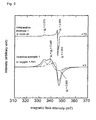
Fig. 3 is a graph showing an ESR spectrum (at 77K) of each compound obtained in the inventive example 1 and a comparative example 1. -
Fig. 4 is a graph showing each Raman spectrum of the compounds obtained in the inventive example 1 and the comparative example 1. -
Fig. 5 is a graph showing an analytical curve of temperature to release-gas intensity with a molecular mass/charge ratio = 32 in each of the 12CaO • 7Al2O3 compounds of the inventive example 1 and comparative example 1. - As shown in
Fig. 1 , 12CaO • 7Al2O3 has a cubic crystal system with thespace group 143d, and 2 molecules of 12CaO • 7Al2O3 exist in each unit lattice or unit cell of the crystal. 12CaO • 7Al2O3 has a melting point of 1415°C. The crystal has a structure in which Ca 2- ions are located on a network structure formed of polymerized tetrahedrons of AlO4. Each crystal lattice defines a space (cage) therewithin - That is, 2 (12CaO • 7Al2O3) = Ca24Al28O66 = [Ca24Al28O64]4+ • 2O2-. The O2- is referred to as a free oxygen, which exists within the cage. Generally, the O2- is coordinated by a cation all the time and thereby hardly to be free. However, in the 12CaO • 7Al2O3 crystal, the O2- ion resides within the cage. Thus, the O2- ion can be free without coupling with the cation. This state is referred to as "calthration". In this state, the O2- ion is chemically active as in the state when absorbed on a solid surface.
- The O2- ion clathrated by the cage is confined within the cage so as to prevent any reaction with the outside atmosphere. However, in a high temperature of 1200°C or more, the size of the cage is thermally expanded. This allows oxygen molecules from the atmosphere to pass through the bottleneck of the cage. Consequently, the following reaction will be caused.
O2- (within the cage) + O2 (from the atmosphere) = O- (within the cage) + O2 - (within the cage)
- Thus, a pair of O- and O2 - is generated from an oxygen ion O2- residing in each of the unit cell as a result of the reaction with O2 molecule. The 12CaO • 7Al2O3 compound clathrating O- and O2 - in a high concentration can be represented by [Ca24Al28O64]4+ • m O2 - • m O- • (2 - m) O2-, where m ≦ 2, and the O2 - and O2- are clathrated within the cage.
- By subjecting the compound to a heat treatment at a temperature of 1200°C or more under an atmosphere with an oxygen partial pressure of 104 Pa or less or a water-vapor partial pressure of 102 Pa or more, oxygen molecules from the atmosphere actively pass through the bottleneck of the cage. Thus, during the course of the transition of the concentration of the active oxygen ion radicals to a certain equilibrium concentration, the active oxygen ion radicals can be released from the cage to the atmosphere.
- The O2 - ion radicals clathrated in the 12CaO • 7Al2O3 compound of the present invention can be quantitatively analyzed through the use of a scattering intensity caused by the O2 - ion radicals around a Raman shift of 1128 cm-1.
- The O2 - ion radicals and the O - ion radicals each clathrated in the 12CaO • 7Al2O3 compound can also be quantitatively analyzed through the use of two electron spin resonance absorption intensities; one defined by gx = 2.00, gy = 2.01 and gz = 2.04, the other defined by gx = gy = 2.05 and gz = 2.00.
- The present invention will be more specifically described in connection with inventive examples and a comparative example.
- A powder of raw material including calcium carbonate and gamma-alumina mixed with each other in a molecular equivalent ratio of 12 : 7 was sintered at 1300°C under an atmosphere with an oxygen partial pressure of 1 Atm for two hours (sample 1). Through an X-ray diffraction analysis, the obtained
sample 1 was verified as a 12CaO • 7Al2O3 compound. An ESR spectrum of the obtained compound was measured at each of room temperature and 77K. -
Figs. 2 and3 show ESR spectra of the obtained compound of the example 1 measured at room temperature and 77K, respectively. The wavelength of microwave used was 9.75 GHz. At room temperature, an absorption band having a symmetric shape with respect to a magnetic field intensity of 343 mT was observed. The g value was determined as 2.02. At 77K, an asymmetric absorption band was observed. Each of these absorption bands was formed of a superposition of one absorption band defined by gx = 2.002, gy = 2.009 and gz = 2.073 arising from O2 - ion radicals, and another absorption band defined by gx = gy = 2.042 and gz = 2.001 arising from O - ion radicals. Each concentration of the O2 - ion radicals and the O - ion radicals is quantitatively determined as 1 x 1021 cm-3 from respective intensities of the absorption bands. - A powder of raw material including calcium carbonate and gamma-alumina mixed with each other in a molecular equivalent ratio of 12 : 7 was sintered at 1300°C in air for two hours (
sample 2 or comparative example 1). Through an X-ray diffraction analysis, the obtainedsample 2 was verified as a 12CaO • 7Al2O3 compound.Fig. 3 shows an ESR spectrum at 77K. In the comparative example 1 (sample 2), an absorption band is divided into three components, which are determined as gx = 2.009, gy = 2.002 and gz = 2.073, respectively. This absorption band is caused by O2 - ion radicals, and the concentration of the O2 - ion radicals is quantitatively determined as 1 x 1019 cm-3. - A Raman spectrum was measured for each of the inventive example 1 (sample 1) and the comparative example 1 (sample 2).
Fig. 4 shows the Raman spectra obtained from the inventive example 1 and the comparative example 1. In both the spectra, several scattering lines arising from [Ca24Al28O64]4+ were observed in the energy range of 1000 cm-1 or less. In the inventive example 1 (sample 1), an additional Raman peak arising from the O2 - ion radicals was observed at a Raman shift of 1128 cm-1. - A powder of raw material including calcium carbonate and gamma-alumina mixed with each other in a molecular equivalent ratio of 12 : 7 was sintered at 1300°C in room air for two hours (sample 1), and then additionally annealed at 1300°C under an atmosphere with an oxygen partial pressure of 1 Atm for two hours (sample 3). Through an X-ray diffraction analysis, the obtained sample 3 was verified as a 12CaO • 7Al2O3 compound. The concentration of O2 - ion radicals included in the obtained 12CaO • 7Al2O3 compound was quantitatively determined from ESR and Raman-scattering spectra. The determined amount of the clathrated O2 - ion radicals was 1 x 1021 cm-3. From the ESR spectrum, it was also proved that O - ion radicals were clathrated by a concentration of 1 x 1021 cm-3.
- The 12CaO • 7Al2O3 compound obtained from the inventive example 1 was subjected to a heat treatment at 1300°C in air for two hours (sample 4). The concentration of O2 - ion radicals included in the 12CaO • 7Al2O3 compound after the heat treatment was quantitatively determined from ESR and Raman-scattering spectra. The determined amount of the clathrated O2 - ion radicals was 1 x 1019 cm-3. It is proved that the active oxygen species have been reduced by 3.8 - 0.02 = 3.78 for each of the unit cell through the heat treatment. Most of these active oxygen species were released to the atmosphere.
- The 12CaO • 7Al2O3 compound obtained from the inventive example 1 was subjected to an analysis for determining a release-gas intensity with increasing temperature. The measurement was done in a vacuum atmosphere. It was confirmed that the obtained compound of the inventive example 1 exhibited a sharply rising peak with a molecular mass/charge ratio = 32, and the active oxygen species were released from the compound.
Fig. 5 shows an analytical curve of temperature to release-gas intensity with a molecular mass/charge ratio = 32 in each of the 12CaO • 7Al2O3 compounds obtained from the inventive example 1 and comparative example 1. - Concentrations of the active oxygens in the inventive examples and the comparative example will be shown in Table 1.
Table 1 Conditions of Burning and heating concentration of O2 - ion radical (cm-3) (per unit cell) concentration of O - ion radical (cm-3) (per unit cell) Inventive Example 1 In oxygen 1 Atm1 x 1021 / 1.9 1 x 10²¹ / 1.9 1300°C, two hours Inventive Example 2 In air 1300°C, two hours 1 x 10²¹/1.9 1 x 10²¹/1.9 + In oxygen 1 Atm1300°C, two hours Inventive Example 3 In oxygen 1 Atm1 x 1019 / 0.02 below sensitivity limits/ 1300°C, two hours below sensitivity limits + In air 1300°C, two hours Comparative Example 1 In air 1 x 10¹⁹ / 0.02 below sensitivity limits/ 1300°C, two hours below sensitivity limits - The amount of active oxygen species clathrated in each of the inventive example 1 (sample 1) and the inventive example 2 (sample 3) is 3.8 per unit cell. This value is almost equal to the theoretically calculated maximum total value of 2 + 2 = 4.
- As shown the above examples, clathrated active oxygen species and incorporating oxygen from the atmosphere can be achieved by controlling the temperature and the oxygen partial pressure of the atmosphere during the sintering process of 12CaO • 7Al2O3, and releasing of the clathrated active oxygen species can be achieved by the heat treatment of the obtained 12CaO • 7Al2O3 compound under the controlled oxygen partial pressure of the atmosphere.
- The present invention provides a 12CaO • 7Al2O3 compound which clathrates active oxygen species in a high concentration of 1020 cm-3 or more and allows the clathrated active oxygen species or oxygen ions to be released at a high temperature of 1250°C or more. Thus, this compound can be used as an oxidization catalyst, for example, in order to oxidize organic materials. Further, the active oxygen species has an excellent antibacterial action as is generally known. Thus, the 12CaO • 7Al2O3 compound clathrating a large amount of active oxygen species according to the present invention can also be used as an effective antibacterial agent.
- Furthermore, the active oxygen species in the 12CaO • 7Al2O3 compound clathrating a large amount of them can substantially freely move within the crystal structure. This opens the way for applying the 12CaO • 7Al2O3 compound of the present invention to an ion conductor. Moreover, by combining the ion conductivity with the ability of oxidizing organic materials, this compound can be used as an electrode material for solid-oxide fuel cells.
Claims (13)
- A 12CaO • 7Al2O3 compound comprising an O2 - ion radical and/or an O - ion radical serving as active oxygen species, said ion radical being clathrated in said compound in a concentration of 1020 cm-3 or more.
- A method for producing a 12CaO • 7Al2O3 compound comprising the steps of:preparing a raw material powder including calcium (Ca) and aluminum (Al) mixed with each other in an atomic equivalent ratio of 12 : 14; andreacting said raw material in a solid phase reaction at a sintering temperature ranging between 1200°C or more and less than 1415°C, under a dry oxidization atmosphere with an oxygen partial pressure of 104 Pa or more and a water-vapor partial pressure of 102 Pa or less.
- A method as defined in claim 2, wherein said raw material includes a calcium component selected from the group consisting of calcium carbonate, calcium hydroxide and calcium oxide, and an aluminum component selected from the group consisting of aluminum oxide and aluminum hydroxide.
- A method for releasing an active oxygen species clathrated in the 12CaO • 7Al2O3 compound as defined in claim 1, characterized by subjecting said 12CaO • 7Al2O3 compound to a heat treatment at a temperature of 1200°C or more under an atmosphere with an oxygen partial pressure of less than 104 Pa or a water-vapor partial pressure of 102 Pa or more.
- An oxidization catalyst comprising a 12CaO • 7Al2O3 compound including an O2 - ion radical and/or an O - ion radical serving as active oxygen species, said ion radical being clathrated in said compound in a concentration of 1020 cm-3 or more.
- An antibacterial agent comprising a 12CaO • 7Al2O3 compound including an O2 - ion radical and/or an O - ion radical serving as active oxygen species, said ion radical being clathrated in said compound in a concentration of 1020 cm-3 or more.
- An ion conductor comprising a 12CaO • 7Al2O3 compound including an O2 - ion radical and/or an O - ion radical serving as active oxygen species, said ion radical being clathrated in said compound in a concentration of 1020 cm-3 or more.
- An electrode material for solid-oxide fuel cells, comprising a 12CaO • 7Al2O3 compound including an O2 - ion radical and/or an O - ion radical serving as active oxygen species, said ion radical being clathrated in said compound in a concentration of 1020 cm-3 or more.
- A compound, as defined in claim 1, comprising an O - ion radical in a concentration of 1020 cm-3 or more.
- An oxidization catalyst, as defined in claim 5, wherein said 12CaO • 7Al2O3 compound includes an O - ion radical in a concentration of 1020 cm-3 or more.
- An antibacterial agent, as defined in claim 6, wherein said 12CaO • 7Al2O3 compound includes an O - ion radical in a concentration of 1020 cm-3 or more.
- An ion conductor, as defined in claim 7, wherein said 12CaO • 7Al2O3 compound includes an O - ion radical in a concentration of 1020 cm-3 or more.
- An electrode material, as defined in claim 8, wherein said 12CaO • 7Al2O3 compound includes an O - ion radical in a concentration of 1020 cm-3 or more.
Applications Claiming Priority (5)
| Application Number | Priority Date | Filing Date | Title |
|---|---|---|---|
| JP2000122368 | 2000-04-18 | ||
| JP2000122368 | 2000-04-18 | ||
| JP2001049524A JP3531868B2 (en) | 2000-04-18 | 2001-02-26 | 12CaO · 7Al2O3 compound that includes active oxygen species and method for producing the same |
| JP2001049524 | 2001-02-26 | ||
| PCT/JP2001/003252 WO2001079115A1 (en) | 2000-04-18 | 2001-04-16 | 12CaO . 7Al2O3 COMPOUND CLATHRATING ACTIVE OXYGEN SPECIES AND METHOD FOR PREPARING THE SAME |
Publications (3)
| Publication Number | Publication Date |
|---|---|
| EP1215173A1 EP1215173A1 (en) | 2002-06-19 |
| EP1215173A4 EP1215173A4 (en) | 2006-06-07 |
| EP1215173B1 true EP1215173B1 (en) | 2010-08-11 |
Family
ID=26590644
Family Applications (1)
| Application Number | Title | Priority Date | Filing Date |
|---|---|---|---|
| EP01921850A Expired - Lifetime EP1215173B1 (en) | 2000-04-18 | 2001-04-16 | 12CaO . 7AL2O3 COMPOUND CLATHRATING ACTIVE OXYGEN SPECIES AND METHOD FOR PREPARING THE SAME |
Country Status (5)
| Country | Link |
|---|---|
| US (1) | US6818192B2 (en) |
| EP (1) | EP1215173B1 (en) |
| JP (1) | JP3531868B2 (en) |
| DE (1) | DE60142768D1 (en) |
| WO (1) | WO2001079115A1 (en) |
Families Citing this family (35)
| Publication number | Priority date | Publication date | Assignee | Title |
|---|---|---|---|---|
| JP3533648B2 (en) | 2001-07-26 | 2004-05-31 | 独立行政法人 科学技術振興機構 | Reactive oxygen species inclusion calcia-alumina oxide single crystal and method for producing the same |
| JP3560580B2 (en) * | 2001-10-18 | 2004-09-02 | 独立行政法人 科学技術振興機構 | 12CaO · 7Al2O3 compound and method for producing the same |
| JP4147324B2 (en) * | 2001-12-11 | 2008-09-10 | 独立行政法人科学技術振興機構 | Method and apparatus for producing negatively charged oxygen atoms |
| US7662357B2 (en) | 2002-04-19 | 2010-02-16 | Japan Science And Technology Agency | Hydrogen-containing electrically conductive inorganic compound |
| JP2004075431A (en) * | 2002-08-13 | 2004-03-11 | Japan Science & Technology Corp | Oxygen negative ion generation method and oxygen negative ion generator |
| AU2003257608A1 (en) | 2002-08-21 | 2004-03-11 | National Institute Of Advanced Industrial Science And Technology | Inorganic compound containing active oxygen and process for producing the same |
| JP4010414B2 (en) * | 2003-01-21 | 2007-11-21 | 電気化学工業株式会社 | Method for producing oxygen radical-containing calcium aluminate film and laminate |
| US7507289B2 (en) | 2003-06-26 | 2009-03-24 | Japan Science And Technology Agency | Electroconductive 12CaO—7Al2O3 and compound of same type, and method for preparation thereof |
| TWI283234B (en) | 2004-02-13 | 2007-07-01 | Asahi Glass Co Ltd | Method for preparing electroconductive Mayenite type compound |
| JP2006006670A (en) * | 2004-06-28 | 2006-01-12 | Oxy Japan:Kk | Negative charge oxygen atom transfer device |
| JP2006083009A (en) * | 2004-09-15 | 2006-03-30 | National Institute Of Advanced Industrial & Technology | INORGANIC COMPOUND MATERIAL INCLUDING OR OBTAINING ACTIVE OXYGEN AND METHOD FOR PRODUCING THE SAME |
| JP2006240954A (en) * | 2005-03-07 | 2006-09-14 | Denki Kagaku Kogyo Kk | Oxidation reaction promotion material and oxidation reaction promotion method using the same |
| EP1876628A4 (en) * | 2005-04-18 | 2009-11-04 | Asahi Glass Co Ltd | ELECTRON TRANSMITTER, FIELD EMISSION DISPLAY UNIT, COLD-CATHODE FLUORESCENT TUBE, FLAT-TYPE ILLUMINATION DEVICE, AND ELECTRON TRANSMITTER MATERIAL |
| JP4800662B2 (en) * | 2005-05-09 | 2011-10-26 | 電気化学工業株式会社 | Underwater organism adhesion prevention paint and application |
| KR101245943B1 (en) | 2005-05-30 | 2013-03-21 | 도오쿄 인스티튜드 오브 테크놀로지 | Process for producing conductive mayenite compound |
| EP1900689B1 (en) | 2005-05-30 | 2016-03-30 | Asahi Glass Company, Limited | Process for producing electroconductive mayenite compound |
| JP2006341223A (en) * | 2005-06-10 | 2006-12-21 | Oxy Japan:Kk | Apparatus and method for treating gaseous organic compound |
| EP1961702A4 (en) * | 2005-11-24 | 2012-01-18 | Japan Science & Tech Agency | 12Caoû7Al2O3 ELECTROCONDUCTIVE METALLIC COMPOUND AND PROCESS FOR PRODUCING THE SAME |
| JP5408517B2 (en) * | 2006-03-15 | 2014-02-05 | 日本電気株式会社 | COMPOSITE STRUCTURE, ITS MANUFACTURING METHOD, AND THERMOELECTRIC CONVERSION DEVICE USING THE SAME |
| WO2008038801A1 (en) * | 2006-09-29 | 2008-04-03 | Japan Science And Technology Agency | Method of producing diol, polydiol, secondary alcohol or diketone compound |
| KR101410636B1 (en) * | 2007-01-18 | 2014-06-20 | 고쿠리츠다이가쿠호진 토쿄고교 다이가꾸 | Antioxidant |
| JP4885001B2 (en) * | 2007-02-14 | 2012-02-29 | 独立行政法人科学技術振興機構 | Compound superconductor and method for producing the same |
| JP5396722B2 (en) * | 2008-03-03 | 2014-01-22 | 住友大阪セメント株式会社 | Fuel additives and composite fuels |
| JP5347345B2 (en) * | 2008-06-16 | 2013-11-20 | 旭硝子株式会社 | Process for producing conductive mayenite type compound |
| JP5569399B2 (en) * | 2009-02-05 | 2014-08-13 | 旭硝子株式会社 | Method for producing mayenite-containing oxide and method for producing conductive mayenite-containing oxide |
| US9017897B2 (en) * | 2012-12-13 | 2015-04-28 | Delphi Technologies, Inc. | Metal composite material for attachment to ceramic |
| JP6188569B2 (en) * | 2013-12-25 | 2017-08-30 | 株式会社ノリタケカンパニーリミテド | Electrode materials and their use |
| JP6042320B2 (en) * | 2013-12-25 | 2016-12-14 | 株式会社ノリタケカンパニーリミテド | Electrode materials and their use |
| US10016742B2 (en) | 2014-03-07 | 2018-07-10 | Japan Science And Technology Agency | Mayenite-type compound containing imide anion, and method for producing same |
| JP6310413B2 (en) * | 2015-04-02 | 2018-04-11 | 日本電信電話株式会社 | Lithium air secondary battery, method for producing catalyst for air electrode, and method for producing lithium air secondary battery |
| JP6941454B2 (en) * | 2017-03-03 | 2021-09-29 | 太平洋マテリアル株式会社 | Method for producing catalyst carrier |
| JP7138968B2 (en) * | 2018-03-29 | 2022-09-20 | 国立研究開発法人科学技術振興機構 | Electrolytic cell and electrolytic device |
| CN109621935B (en) * | 2018-11-02 | 2022-02-08 | 中国石油大学(华东) | Step-by-step solid-phase synthesis of micro-mesoporous calcium aluminate catalysts |
| CN110182836A (en) * | 2019-05-28 | 2019-08-30 | 中国铝业股份有限公司 | A kind of method that bauxite prepares PAC calcium aluminate powder |
| WO2021240602A1 (en) * | 2020-05-25 | 2021-12-02 | 日本電信電話株式会社 | Metal-air battery and method for manufacturing air electrode |
Family Cites Families (3)
| Publication number | Priority date | Publication date | Assignee | Title |
|---|---|---|---|---|
| US3560256A (en) * | 1966-10-06 | 1971-02-02 | Western Electric Co | Combined thick and thin film circuits |
| US5908713A (en) * | 1997-09-22 | 1999-06-01 | Siemens Westinghouse Power Corporation | Sintered electrode for solid oxide fuel cells |
| US6509590B1 (en) * | 1998-07-20 | 2003-01-21 | Micron Technology, Inc. | Aluminum-beryllium alloys for air bridges |
-
2001
- 2001-02-26 JP JP2001049524A patent/JP3531868B2/en not_active Expired - Fee Related
- 2001-04-16 US US09/926,765 patent/US6818192B2/en not_active Expired - Lifetime
- 2001-04-16 EP EP01921850A patent/EP1215173B1/en not_active Expired - Lifetime
- 2001-04-16 DE DE60142768T patent/DE60142768D1/en not_active Expired - Lifetime
- 2001-04-16 WO PCT/JP2001/003252 patent/WO2001079115A1/en not_active Ceased
Also Published As
| Publication number | Publication date |
|---|---|
| WO2001079115A1 (en) | 2001-10-25 |
| EP1215173A4 (en) | 2006-06-07 |
| EP1215173A1 (en) | 2002-06-19 |
| JP3531868B2 (en) | 2004-05-31 |
| JP2002003218A (en) | 2002-01-09 |
| US20020172726A1 (en) | 2002-11-21 |
| US6818192B2 (en) | 2004-11-16 |
| DE60142768D1 (en) | 2010-09-23 |
Similar Documents
| Publication | Publication Date | Title |
|---|---|---|
| EP1215173B1 (en) | 12CaO . 7AL2O3 COMPOUND CLATHRATING ACTIVE OXYGEN SPECIES AND METHOD FOR PREPARING THE SAME | |
| Terribile et al. | The preparation of high surface area CeO2–ZrO2 mixed oxides by a surfactant-assisted approach | |
| JP3560580B2 (en) | 12CaO · 7Al2O3 compound and method for producing the same | |
| Das et al. | Nanocrystalline α‐Al2O3 using sucrose | |
| Artizzu-Duart et al. | Catalytic combustion of methane over copper-and manganese-substituted barium hexaaluminates | |
| Mekhemer | Characterization of phosphated zirconia by XRD, Raman and IR spectroscopy | |
| Huang et al. | Hydrothermal synthesis and properties of terbium-or praseodymium-doped Ce1− xSmxO2− x/2 solid solutions | |
| Mekhemer et al. | Thermal genesis course and characterization of lanthanum oxide | |
| Zinkevich | Constitution of the Sr–Ni–O system | |
| JPWO2007004684A1 (en) | Oxygen-rich metal oxide, oxygen storage or oxygen selective membrane ceramic, and method and apparatus using the metal oxide | |
| Potdar et al. | Synthesis of nanosized Ce0. 75Zr0. 25O2 porous powders via an autoignition: glycine nitrate process | |
| Mitsuyama et al. | Enhanced photocatalytic water splitting of hydrous LiCa2Ta3O10 prepared by hydrothermal treatment | |
| JP4105447B2 (en) | 12SrO · 7Al2O3 compound and synthesis method thereof | |
| Traversa et al. | Synthesis and structural characterization of trimetallic perovskite-type oxides, LaFexCo1− xO3, by the thermal decomposition of cyano complexes, La [FexCo1− x (CN6)]· nH2O | |
| Kim et al. | Proton conduction in La0. 6Ba0. 4ScO2. 8 cubic perovskite | |
| Ruszak et al. | EPR and Raman investigations into anionic redox chemistry of nanoporous 12CaO· 7Al2O3 interacting with O2, H2 and N2O | |
| Ran et al. | Rapid synthesis of La0. 7Sr0. 3MnO3+ λ catalysts by microwave irradiation process | |
| Kriegel et al. | Dilatometric determination of phase transition temperatures and oxidation temperatures on the compounds SrMnO3− y and Sr2MnO4− y′ | |
| Marinho et al. | Lanthanum chromites partially substituted by calcium, strontium and barium synthesized by urea combustion: Thermogravimetric study | |
| Shao et al. | New methods to prepare perovskite-type La0. 8Sr0. 2CoO3 catalyst at low temperature | |
| Denis et al. | Two alternative products from the intercalation of alkali metals into cation-defective Ruddlesden–Popper oxysulfides | |
| Sakamoto et al. | Thermal decomposition products of heteronuclear Cu Re complexes, CuRE (dhbaen)(NO3)· nH2O (RE La, Eu, Gd, Tb, Dy, Y, Ho, Er, Tm, Yb, and Lu) | |
| Jana et al. | Processing of low-density alumina foam | |
| Laberty-Robert et al. | X-ray diffraction studies of perovskite or derived perovskite phase formation | |
| Dash et al. | Study on phase formation and sintering kinetics of BaTi0. 6Zr0. 4O3 powder synthesized through modified chemical route |
Legal Events
| Date | Code | Title | Description |
|---|---|---|---|
| PUAI | Public reference made under article 153(3) epc to a published international application that has entered the european phase |
Free format text: ORIGINAL CODE: 0009012 |
|
| 17P | Request for examination filed |
Effective date: 20011218 |
|
| AK | Designated contracting states |
Kind code of ref document: A1 Designated state(s): AT BE CH CY DE DK ES FI FR GB GR IE IT LI LU MC NL PT SE TR |
|
| RAP1 | Party data changed (applicant data changed or rights of an application transferred) |
Owner name: JAPAN SCIENCE AND TECHNOLOGY AGENCY |
|
| RBV | Designated contracting states (corrected) |
Designated state(s): DE FR GB |
|
| A4 | Supplementary search report drawn up and despatched |
Effective date: 20060504 |
|
| 17Q | First examination report despatched |
Effective date: 20060912 |
|
| GRAJ | Information related to disapproval of communication of intention to grant by the applicant or resumption of examination proceedings by the epo deleted |
Free format text: ORIGINAL CODE: EPIDOSDIGR1 |
|
| GRAP | Despatch of communication of intention to grant a patent |
Free format text: ORIGINAL CODE: EPIDOSNIGR1 |
|
| GRAP | Despatch of communication of intention to grant a patent |
Free format text: ORIGINAL CODE: EPIDOSNIGR1 |
|
| GRAS | Grant fee paid |
Free format text: ORIGINAL CODE: EPIDOSNIGR3 |
|
| GRAA | (expected) grant |
Free format text: ORIGINAL CODE: 0009210 |
|
| AK | Designated contracting states |
Kind code of ref document: B1 Designated state(s): DE FR GB |
|
| REG | Reference to a national code |
Ref country code: GB Ref legal event code: FG4D |
|
| REF | Corresponds to: |
Ref document number: 60142768 Country of ref document: DE Date of ref document: 20100923 Kind code of ref document: P |
|
| PLBE | No opposition filed within time limit |
Free format text: ORIGINAL CODE: 0009261 |
|
| STAA | Information on the status of an ep patent application or granted ep patent |
Free format text: STATUS: NO OPPOSITION FILED WITHIN TIME LIMIT |
|
| 26N | No opposition filed |
Effective date: 20110512 |
|
| REG | Reference to a national code |
Ref country code: DE Ref legal event code: R097 Ref document number: 60142768 Country of ref document: DE Effective date: 20110512 |
|
| REG | Reference to a national code |
Ref country code: FR Ref legal event code: PLFP Year of fee payment: 16 |
|
| REG | Reference to a national code |
Ref country code: FR Ref legal event code: PLFP Year of fee payment: 17 |
|
| PGFP | Annual fee paid to national office [announced via postgrant information from national office to epo] |
Ref country code: FR Payment date: 20170309 Year of fee payment: 17 |
|
| PGFP | Annual fee paid to national office [announced via postgrant information from national office to epo] |
Ref country code: GB Payment date: 20170308 Year of fee payment: 17 |
|
| PGFP | Annual fee paid to national office [announced via postgrant information from national office to epo] |
Ref country code: DE Payment date: 20170307 Year of fee payment: 17 |
|
| REG | Reference to a national code |
Ref country code: DE Ref legal event code: R119 Ref document number: 60142768 Country of ref document: DE |
|
| GBPC | Gb: european patent ceased through non-payment of renewal fee |
Effective date: 20180416 |
|
| PG25 | Lapsed in a contracting state [announced via postgrant information from national office to epo] |
Ref country code: DE Free format text: LAPSE BECAUSE OF NON-PAYMENT OF DUE FEES Effective date: 20181101 |
|
| PG25 | Lapsed in a contracting state [announced via postgrant information from national office to epo] |
Ref country code: GB Free format text: LAPSE BECAUSE OF NON-PAYMENT OF DUE FEES Effective date: 20180416 |
|
| PG25 | Lapsed in a contracting state [announced via postgrant information from national office to epo] |
Ref country code: FR Free format text: LAPSE BECAUSE OF NON-PAYMENT OF DUE FEES Effective date: 20180430 |