EP1213337A1 - Liquid crystalline medium and liquid crystal display - Google Patents
Liquid crystalline medium and liquid crystal display Download PDFInfo
- Publication number
- EP1213337A1 EP1213337A1 EP01126469A EP01126469A EP1213337A1 EP 1213337 A1 EP1213337 A1 EP 1213337A1 EP 01126469 A EP01126469 A EP 01126469A EP 01126469 A EP01126469 A EP 01126469A EP 1213337 A1 EP1213337 A1 EP 1213337A1
- Authority
- EP
- European Patent Office
- Prior art keywords
- liquid crystal
- compounds
- independently
- formula
- trans
- Prior art date
- Legal status (The legal status is an assumption and is not a legal conclusion. Google has not performed a legal analysis and makes no representation as to the accuracy of the status listed.)
- Granted
Links
- 239000004973 liquid crystal related substance Substances 0.000 title claims abstract description 59
- 239000007788 liquid Substances 0.000 title description 4
- 150000001875 compounds Chemical class 0.000 claims abstract description 76
- 229910052731 fluorine Inorganic materials 0.000 claims description 21
- 125000004432 carbon atom Chemical group C* 0.000 claims description 11
- 125000000876 trifluoromethoxy group Chemical group FC(F)(F)O* 0.000 claims description 8
- 125000003342 alkenyl group Chemical group 0.000 claims description 7
- 229910052801 chlorine Inorganic materials 0.000 claims description 5
- 125000004786 difluoromethoxy group Chemical group [H]C(F)(F)O* 0.000 claims description 5
- 125000003302 alkenyloxy group Chemical group 0.000 claims description 2
- 125000004183 alkoxy alkyl group Chemical group 0.000 claims description 2
- 125000004435 hydrogen atom Chemical group [H]* 0.000 claims description 2
- 239000005276 holographic polymer dispersed liquid crystals (HPDLCs) Substances 0.000 claims 1
- 239000004983 Polymer Dispersed Liquid Crystal Substances 0.000 abstract description 4
- 239000000203 mixture Substances 0.000 description 23
- 239000002131 composite material Substances 0.000 description 12
- 125000000217 alkyl group Chemical group 0.000 description 11
- 239000010410 layer Substances 0.000 description 7
- 125000003545 alkoxy group Chemical group 0.000 description 6
- 230000003287 optical effect Effects 0.000 description 5
- 239000003086 colorant Substances 0.000 description 4
- 239000000463 material Substances 0.000 description 4
- 229920000642 polymer Polymers 0.000 description 4
- 239000000654 additive Substances 0.000 description 3
- JRXXLCKWQFKACW-UHFFFAOYSA-N biphenylacetylene Chemical class C1=CC=CC=C1C#CC1=CC=CC=C1 JRXXLCKWQFKACW-UHFFFAOYSA-N 0.000 description 3
- 230000005684 electric field Effects 0.000 description 3
- 238000000034 method Methods 0.000 description 3
- 230000007935 neutral effect Effects 0.000 description 3
- 230000000704 physical effect Effects 0.000 description 3
- 0 *c(cc1)ccc1-c(cc1)ccc1C#Cc1cc(*)c(*)c(*=C)c1 Chemical compound *c(cc1)ccc1-c(cc1)ccc1C#Cc1cc(*)c(*)c(*=C)c1 0.000 description 2
- 101100132433 Arabidopsis thaliana VIII-1 gene Proteins 0.000 description 2
- 239000004990 Smectic liquid crystal Substances 0.000 description 2
- 230000015572 biosynthetic process Effects 0.000 description 2
- 239000000470 constituent Substances 0.000 description 2
- 238000005259 measurement Methods 0.000 description 2
- 125000001997 phenyl group Chemical group [H]C1=C([H])C([H])=C(*)C([H])=C1[H] 0.000 description 2
- 239000002243 precursor Substances 0.000 description 2
- 230000004044 response Effects 0.000 description 2
- 239000000758 substrate Substances 0.000 description 2
- IIZPXYDJLKNOIY-JXPKJXOSSA-N 1-palmitoyl-2-arachidonoyl-sn-glycero-3-phosphocholine Chemical compound CCCCCCCCCCCCCCCC(=O)OC[C@H](COP([O-])(=O)OCC[N+](C)(C)C)OC(=O)CCC\C=C/C\C=C/C\C=C/C\C=C/CCCCC IIZPXYDJLKNOIY-JXPKJXOSSA-N 0.000 description 1
- JAGBWIHWQBQGAX-UHFFFAOYSA-N 4-(5-phenylpyridine-3-carbonyl)-1,3-dihydroquinoxalin-2-one Chemical compound O=C(N1CC(=O)Nc2ccccc12)c1cncc(c1)-c1ccccc1 JAGBWIHWQBQGAX-UHFFFAOYSA-N 0.000 description 1
- 101001053395 Arabidopsis thaliana Acid beta-fructofuranosidase 4, vacuolar Proteins 0.000 description 1
- 101100459319 Arabidopsis thaliana VIII-2 gene Proteins 0.000 description 1
- 239000004642 Polyimide Substances 0.000 description 1
- 235000010290 biphenyl Nutrition 0.000 description 1
- 150000004074 biphenyls Chemical class 0.000 description 1
- 230000008859 change Effects 0.000 description 1
- 238000002425 crystallisation Methods 0.000 description 1
- 125000004093 cyano group Chemical group *C#N 0.000 description 1
- 238000004090 dissolution Methods 0.000 description 1
- 239000002019 doping agent Substances 0.000 description 1
- 239000000374 eutectic mixture Substances 0.000 description 1
- 230000002349 favourable effect Effects 0.000 description 1
- 229910052736 halogen Inorganic materials 0.000 description 1
- 150000002367 halogens Chemical class 0.000 description 1
- 229910052740 iodine Inorganic materials 0.000 description 1
- 229940067606 lecithin Drugs 0.000 description 1
- 235000010445 lecithin Nutrition 0.000 description 1
- 239000000787 lecithin Substances 0.000 description 1
- 238000004519 manufacturing process Methods 0.000 description 1
- 238000002844 melting Methods 0.000 description 1
- 230000008018 melting Effects 0.000 description 1
- 238000012986 modification Methods 0.000 description 1
- 230000004048 modification Effects 0.000 description 1
- 230000000737 periodic effect Effects 0.000 description 1
- 238000005191 phase separation Methods 0.000 description 1
- 229920001721 polyimide Polymers 0.000 description 1
- 230000008569 process Effects 0.000 description 1
- 239000002356 single layer Substances 0.000 description 1
- 125000001424 substituent group Chemical group 0.000 description 1
- 229920003051 synthetic elastomer Polymers 0.000 description 1
- 239000005061 synthetic rubber Substances 0.000 description 1
- 150000001911 terphenyls Chemical class 0.000 description 1
- 230000009466 transformation Effects 0.000 description 1
- 230000007704 transition Effects 0.000 description 1
Classifications
-
- C—CHEMISTRY; METALLURGY
- C09—DYES; PAINTS; POLISHES; NATURAL RESINS; ADHESIVES; COMPOSITIONS NOT OTHERWISE PROVIDED FOR; APPLICATIONS OF MATERIALS NOT OTHERWISE PROVIDED FOR
- C09K—MATERIALS FOR MISCELLANEOUS APPLICATIONS, NOT PROVIDED FOR ELSEWHERE
- C09K19/00—Liquid crystal materials
- C09K19/04—Liquid crystal materials characterised by the chemical structure of the liquid crystal components, e.g. by a specific unit
- C09K19/06—Non-steroidal liquid crystal compounds
- C09K19/08—Non-steroidal liquid crystal compounds containing at least two non-condensed rings
- C09K19/10—Non-steroidal liquid crystal compounds containing at least two non-condensed rings containing at least two benzene rings
- C09K19/14—Non-steroidal liquid crystal compounds containing at least two non-condensed rings containing at least two benzene rings linked by a carbon chain
- C09K19/18—Non-steroidal liquid crystal compounds containing at least two non-condensed rings containing at least two benzene rings linked by a carbon chain the chain containing carbon-to-carbon triple bonds, e.g. tolans
-
- C—CHEMISTRY; METALLURGY
- C09—DYES; PAINTS; POLISHES; NATURAL RESINS; ADHESIVES; COMPOSITIONS NOT OTHERWISE PROVIDED FOR; APPLICATIONS OF MATERIALS NOT OTHERWISE PROVIDED FOR
- C09K—MATERIALS FOR MISCELLANEOUS APPLICATIONS, NOT PROVIDED FOR ELSEWHERE
- C09K19/00—Liquid crystal materials
- C09K19/04—Liquid crystal materials characterised by the chemical structure of the liquid crystal components, e.g. by a specific unit
- C09K19/42—Mixtures of liquid crystal compounds covered by two or more of the preceding groups C09K19/06 - C09K19/40
Definitions
- the present invention relates to liquid crystalline media and to liquid crystal displays comprising these media, in particular to displays of the optically compensated bend mode and to displays of the composite systems type like PDLCs and most particular amongst these to holographic PDLCs.
- Electro-optical modes employed are e.g. the t wisted n ematic (TN)-, the s uper t wisted n ematic (STN)- and the e lectrically c ontrolled b irefringence (ECB)-mode with their various modifications, as well as others.
- electro-optical modes which all do use an electrical field, which is substantially perpendicular to the substrates, respectively to the liquid crystal layer
- electro-optical modes employing an electrical field substantially parallel to the substrates, respectively the liquid crystal layer like e.g. the i n- p lane s witching (IPS)-mode (as disclosed e.g. in DE 40 00 451 and EP 0 588 568).
- IPS i n- p lane s witching
- a promising electrooptical mode for LCDs is the o ptically c ompensated b end (OCB) mode.
- This mode has a favourable small viewing angle dependence of the contrast. Further the response times in this mode are small.
- liquid crystal materials of low molecular weight together with polymeric materials such as e.g. p olymer d ispersed l iquid c rystal (PDLC)-, n ematic c urvilinearily a capitad p hase (NCAP)- and p olymer n etwork (PN)-systems, as disclosed for example in WO 91/05 029.
- PDLC p olymer d ispersed l iquid c rystal
- NCAP n ematic c urvilinearily a ligned p hase
- PN p olymer n etwork
- LCDs are used for direct view displays, as well as for projection type displays. Besides these applications LCDs, especially LCDs comprising composite systems like PDLCs and in particular so called holographic PDLC (HPDLC) systems are used in practical applications.
- HPDLCs are described e.g. in Date, Takeuchi, Tanaka, and Kato, Journal of the SID 7/1 (1999), p. 17 to 22, which is incorporated by reference.
- HPDLC displays are generating three bright colors, preferably primary colors, utilizing Bragg reflection. This technique results in excellent bright colors as it does neither need polarizers, nor color filters.
- a single layer of the periodic structure of polymer and liquid crystal controls the reflection of one particular color. To realize three primary colors consequently three layers, one for each color are required.
- Each of the three layers has to be addressed independently. This requires three sets of HPDLC films, each with corresponding electrodes. This large number of layers and corresponding electrodes, which is difficult to realize with a good yield in mass production, can beneficiaiously be reduced when the "two-frequency" drive method is applied.
- Liquid crystal compounds with a terminal phenyl ring bearing a terminal SF5 group are known e. g. from DE 37 21 268. Tolane compounds with this terminal group are mentioned e. g. in DE 197 48 108, DE 197 48 109 and DE 199 33 175.
- Liquid crystal mixtures consisting predominantly or even entirely of terminally cyano substituted biphenyls and terphenyls are as a rule characterized by suitable high ⁇ values, but have limited values of ⁇ n and already are likely to show insufficient stability at low temperatures, i.e. in most cases either formation of a smectic phase and or crystallisation.
- Liquid crystal mixtures using large quantities of halogenated tolane compounds with three phenyl rings, which are almost dielectrically neutrals, as disclosed, e.g. in the European Patent Application No. EP 99111782.1 are characterized by comparatively low ⁇ values which are not suitable for most applications and often even show severe problems with respect to the stability of the nematic phase at low temperatures.
- liquid crystal media with suitable properties for practical applications such as a wide nematic phase range, low viscosities, appropriate optical anisotropy ⁇ n according to the display mode used especially a suitably high ⁇ n for OCB displays and for composite systems like PDLCs and in particular with suitably large good compatibility with polymer precursors for composite systems.
- liquid crystal media with high ⁇ n especially useful for OCB displays and for composite systems can be realized which do not exhibit these drawbacks of the materials of the prior art or at least do exhibit them to a significantly lesser degree.
- liquid crystalline media according to the instant invention contain a component A comprising, preferably predominantly consisting of and most preferably entirely consisting of compounds of formula I.
- Comprising in this application means in the context of compositions that the entity referred to, e.g. the medium or the component, contains the compound or compounds in question, preferably in a total concentration of 10 % or more and most preferably of 20 % or more.
- Predominantly consisting, in this context, means that the entity referred to contains 80 % or more, preferably 90 % or more and most preferably 95 % or more of the compound or compounds in question.
- Entirely consisting, in this context, means that the entity referred to contains 98 % or more, preferably 99 % or more and most preferably 100.0 % of the compound or compounds in question.
- the compounds of formula I are preferably selected from the group of sub-formulae I-1 to I-5 wherein
- liquid crystalline media according to the instant invention contains a component B comprising, preferably predominantly consisting of and most preferably entirely consisting of compounds of formula II.
- the compounds of formula II are preferably selected from the group of sub-formulae II-1 to II-3 wherein
- the liquid crystal medium contains a liquid crystal component C which is preferably predominantly consisting of and most preferably entirely consisting of compounds of formula III
- the compounds of formula III are preferably selected from the group of sub-formulae III-1 to III-3.
- This component C may be, and preferably is, present besides component B.
- the medium contains compounds of formula I selected from the group of sub-formulae I-1 to 1-3. Most prefered of these are compounds of sub-formulae I-1a, I-1b, I-2a, I-2b, I-3a and I-3b wherein
- the media contain compounds selected from the group of formulae I-1a, I-1b and I-2a.
- the compounds of formula V are chosen from the group of compounds of sub-formulae V-1 to V-3. wherein
- the compounds of formula VI are chosen from the group of compounds of sub-formulae VI-1 to VI-4 wherein
- the compounds of formula VII are chosen from the group of compounds of sub-formulae VII-1 to VII-4 wherein
- R 7 is preferably alkyl or alkoxy and Y 71 is preferably F.
- R 7 is preferably alkyl or alkenyl and Y 71 is preferably F.
- the compounds of formula VIII are chosen from the group of compounds of sub-formulae VIII-1 to VIII-6 wherein
- X 8 preferably is F or OCF 3 and R 8 preferably is alkyl, alkoxy or alkenyoxy.
- R 8 preferably is alkyl, alkoxy or alkenyoxy.
- X 8 is F preferably Y 81 is F and most preferably both Y 81 and Y 82 are F.
- X 8 preferably is F or OCF 3
- R 8 preferably is alkyl or alkenyl
- Y 81 most preferably is F.
- Component A is used in a concentration from 1 to 70 %, preferably from 4 to 50 % and most preferably from 9 to 40 % of the total mixture.
- Component B is used in a concentration from 0 to 90 %, preferably from 10 to 80 % and most preferably from 20 to 75 % of the total mixture.
- Component C is used in a concentration from 0 to 50 %, preferably from 10 to 40 % and most preferably from 12 to 35 % of the total mixture.
- the total concentration of these further compounds of formulae IV to VIII in the liquid crystal medium according to the present invention is preferably 0 % to 50 %, more preferably 0 % to 30 %, most preferably 0 % to 20 % and in particular 4 % to 16 %.
- the inventive media can comprise further liquid crystal compounds in order to adjust the physical properties.
- Such compounds are known to the expert.
- Their concentration in the media according to the instant invention is preferably 0 % to 30 %, more preferably 0 % to 20 % and most preferably 5 % to 15 %.
- the liquid crystal medium contains 50 % to 100 %, more preferably 70 % to 100 % and most preferably 80 % to 100 % and in particular 90 % to 100 % totally of components A, B and C, which contain, preferably predominantly consist of and most preferalby entirely consist of one or more of compounds of formulae I, II and III, respectively.
- the liquid crystal media according to the instant invention are characterized by a clearing point above 80 °C, preferably of 90 °C or more, especially preferred of 100 °C or more and in particular of 110 °C.
- the ⁇ n of the liquid crystal media according to the instant invention is 0.25 or more, preferably in the range of 0.30 to 0.60, more preferably in the range of 0.32 to 0.50, most preferably in the range of 0.33 to 0.45 and in particular in the range of 0.35 to 0.40.
- the ⁇ , at 1 kHz and 20 °C, of the liquid crystal medium according to the invention is 6 or more, preferably 10 or more, most preferably 15 or more and in particular 19 or more.
- the liquid crystal media of the state of the art have been limited by low ⁇ values at high ⁇ n values and vice versa.
- the inventive media have pairs of ( ⁇ n, ⁇ ), which are above a line passing through the points (0.290, 18.0) and (0.370, 4.0) in a plot of ⁇ as a function of ⁇ n of the same medium.
- they are above a line through (0.290, 20.0) and (0.370, 6.0), most preferably above a line through (0.310, 20.0) and (0.370, 8.0) and in particular above a line through (0.350, 18.0) and (0.390, 8.0).
- the nematic phase of the inventive media extends at least from 0 °C to 70 °C, most preferably at least -20 °C to 70 °C and most preferably at least from -30 °C to 80 °C, wherein at least means that preferably the lower limit is under cut, wherein the upper limit is surpassed.
- dielectrically positive compounds describes compounds with ⁇ > 1,5
- dielectrically neutral compounds are compounds with -1,5 ⁇ ⁇ ⁇ 1,5
- dielectrically negative compounds are compounds with ⁇ ⁇ -1,5.
- ⁇ is determined at 1 kHz and 20 °C.
- the dielectrical anisotropies of the compounds is determined from the results of a solution of 10 % of the individual compounds in a nematic host mixture.
- the capacities of these test mixtures are determined both in a cell with homeotropic and with homogeneous alignment.
- the cell gap of both types of cells is approximately 10 ⁇ m.
- the voltage applied is a rectangular wave with a frequency of 1 kHz and a root mean square value typically of 0.5 V to 1.0 V, however, it is always selected to be below the capacitive threshold of the respective test mixture.
- the mixture ZLI-4792 and for dielectrically neutral, as well as for dielectrically negative compounds are used as host mixture, respectively.
- the dielectric permittivities of the compounds are determined from the change of the respective values of the host mixture upon addition of the compounds of interest and are extrapolated to a concentration of the compounds of interest of 100 %.
- Components having a nematic phase at the measurement temperature of 20 °C are measured as such, all others are treated like compounds.
- threshold voltage refers in the instant application to the optical threshold and is given for 10 % relative contrast (V 10 ) and the term saturation voltage refers to the optical saturation and is given for 90 % relative contrast (V 90 ) both, if not explicitly stated otherwise.
- the capacitive threshold voltage V 0 , also called Freedericksz-threshold V Fr ) is only used if explicitly mentioned.
- the threshold voltages, as well as all other electro-optical properties have been determined with test cells prepared at Merck KGaA, Germany.
- the test cells for the determination of ⁇ had a cell gap of 22 ⁇ m.
- the electrode was a circular ITO electrode with an area of 1.13 cm 2 and a guard ring.
- the orientation layers were lecithin for homeotropic orientation ( ⁇
- the capacities were determined with a frequency response analyser Solatron 1260 using a sine wave with a voltage of 0.3 V rms .
- the light used in the electro-optical measurements was white light.
- the set up used was a commercially available equipment of Otsuka, Japan.
- the characteristic voltages have been determined under perpendicular observation.
- the threshold (V 10 ) - mid grey (V 50 ) - and saturation (V 90 ) voltages have been determined for 10 %, 50
- the liquid crystal media according to the present invention can contain further additives and chiral dopants in usual concentrations.
- the total concentration of these further constituents is in the range of 0 % to 10 %, preferably 0.1 % to 6 %, based on the total mixture.
- the concentrations of the individual compounds used each are preferably in the range of 0.1 to 3 %.
- the concentration of these and of similar additives is not taken into consideration for the values and ranges of the concentrations of the liquid crystal components and compounds of the liquid crystal media in this application.
- the inventive liquid crystal media according to the present invention consist of several compounds, preferably of 3 to 30, more preferably of 5 to 20 and most preferably of 6 to 14 compounds. These compounds are mixed in conventional way. As a rule, the required amount of the compound used in the smaller amount is dissolved in the compound used in the greater amount. In case the temperature is above the clearing point of the compound used in the higher concentration, it is particularly easy to observe completion of the process of dissolution. It is, however, also possible to prepare the media by other conventional ways, e. g. using so called pre-mixtures, which can be e. g. homologous or eutectic mixtures of compounds or using so called multi-bottle-systems, the constituents of which are ready to use mixtures themselves.
- pre-mixtures which can be e. g. homologous or eutectic mixtures of compounds or using so called multi-bottle-systems, the constituents of which are ready to use mixtures themselves.
- liquid crystal media according to the instant invention can be modified in such a way, that they are usable in all known types of liquid crystal displays, either using the liquid crystal media as such, like TN-, TN-AMD, ECB-, VAN-AMD IPS and OCB LCDs and in particular in composite systems, like PDLC-, NCAP- and PN-LCDs and especially in HPDLCs.
- the melting point T(C,N), the transition from the smectic (S) to the nematic (N) phase T(S,N) and the clearing point T (N,I) of the liquid crystals are given in degrees centigrade.
- the structures of the liquid crystal compounds are represented by abbreviations also called acronyms.
- the transformation of the abbreviations into the corresponding structures is straight forward according to the following two tables A and B. All groups C n H 2n+1 and C m H 2m+1 are straight chain alkyl groups with n respectively m C-atoms. The interpretation of table B is self evident.
- Table A does only list the abbreviations for the cores of the structures.
- liquid crystal media according to the instant invention do contain preferably
- the phyiscal data especially of the compounds illustrate to the expert which properties can be achieved in which ranges. Especially the combination of the various properties which can be preferably achieved is thus well defined.
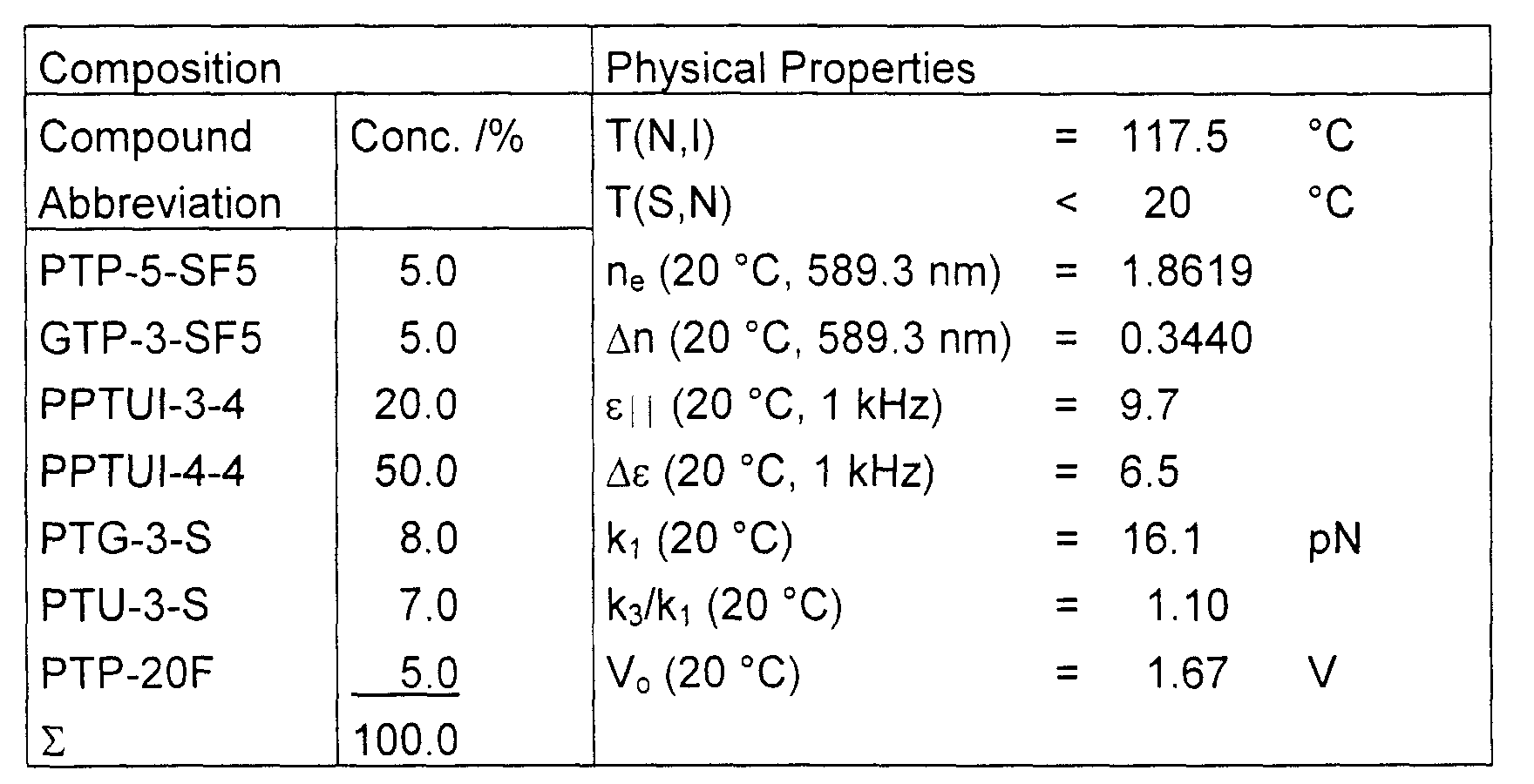
- a liquid crystal mixture is realized with the composition and properties given in the following table.
- a liquid crystal mixture is realized with the composition and properties given in the following table.
Landscapes
- Chemical & Material Sciences (AREA)
- Crystallography & Structural Chemistry (AREA)
- Engineering & Computer Science (AREA)
- Materials Engineering (AREA)
- Organic Chemistry (AREA)
- Liquid Crystal Substances (AREA)
Abstract
Description
- The present invention relates to liquid crystalline media and to liquid crystal displays comprising these media, in particular to displays of the optically compensated bend mode and to displays of the composite systems type like PDLCs and most particular amongst these to holographic PDLCs.
- Liquid Crystal Displays (LCDs) are widely used to display information. Electro-optical modes employed are e.g. the twisted nematic (TN)-, the super twisted nematic (STN)- and the electrically controlled birefringence (ECB)-mode with their various modifications, as well as others. Besides these modes, which all do use an electrical field, which is substantially perpendicular to the substrates, respectively to the liquid crystal layer, there are also electro-optical modes employing an electrical field substantially parallel to the substrates, respectively the liquid crystal layer like e.g. the in-plane switching (IPS)-mode (as disclosed e.g. in
DE 40 00 451 and EP 0 588 568). - A promising electrooptical mode for LCDs is the optically compensated bend (OCB) mode. This mode has a favourable small viewing angle dependence of the contrast. Further the response times in this mode are small.
- Besides the various different modes using the liquid crystal medium as such, oriented on surfaces, which typically are pre-treated to achieve uniform alignment of the liquid crystal material, there are applications using composite systems of liquid crystal materials of low molecular weight together with polymeric materials such as e.g. polymer dispersed liquid crystal (PDLC)-, nematic curvilinearily aligned phase (NCAP)- and polymer network (PN)-systems, as disclosed for example in WO 91/05 029. These composite systems typically use an electrical field substantially perpendicular to the composite layer.
- LCDs are used for direct view displays, as well as for projection type displays. Besides these applications LCDs, especially LCDs comprising composite systems like PDLCs and in particular so called holographic PDLC (HPDLC) systems are used in practical applications. HPDLCs are described e.g. in Date, Takeuchi, Tanaka, and Kato, Journal of the SID 7/1 (1999), p. 17 to 22, which is incorporated by reference. These HPDLC displays are generating three bright colors, preferably primary colors, utilizing Bragg reflection. This technique results in excellent bright colors as it does neither need polarizers, nor color filters. A single layer of the periodic structure of polymer and liquid crystal controls the reflection of one particular color. To realize three primary colors consequently three layers, one for each color are required. Each of the three layers has to be addressed independently. This requires three sets of HPDLC films, each with corresponding electrodes. This large number of layers and corresponding electrodes, which is difficult to realize with a good yield in mass production, can beneficiously be reduced when the "two-frequency" drive method is applied.
- For composite systems a high Δn of the liquid crystal used is required in order to achieve an efficiently scattering state and to realize a good contrast. Though there have been proposed PDLC-systems with liquid crystal mixtures with low Δn to improve the so called off axis haze, the predominant problem in most cases is to achieve sufficient contrast in the first place. This is especially the case for PDLC-systems, which are disclosed e.g. in Date, Takeuchi, Tanaka, and Kanto, Journal of the SID 7/1 (1999), p. 17-22. The liquid crystals available typically are characterized by Δn values of up to 0.280 or even up to 0.290. This upper limit, however, is still insufficiently low for many applications. Further it has so far only been achieved accepting various compromises with respect to the other properties of the liquid crystal mixtures used. The most typical undesired trade-offs are an insufficiently high clearing point, an unfavourably narrow nematic phase range, a rather high temperature for the lower end of the stability of the nematic phase, too low dielectric anisotropy and hence too high operating voltages, unfavourable elastic constants and last not least too high viscosity values or combinations thereof.
- Good compatibility with the precursors of the polymers of the composite systems and easy phase separation during the formation of the composite systems are obvious prerequisites for liquid crystals for such applications.
- Liquid crystal compounds with a terminal phenyl ring bearing a terminal SF5 group are known e. g. from DE 37 21 268. Tolane compounds with this terminal group are mentioned e. g. in DE 197 48 108, DE 197 48 109 and DE 199 33 175.
- Liquid crystal mixtures consisting predominantly or even entirely of terminally cyano substituted biphenyls and terphenyls are as a rule characterized by suitable high Δε values, but have limited values of Δn and already are likely to show insufficient stability at low temperatures, i.e. in most cases either formation of a smectic phase and or crystallisation. Liquid crystal mixtures using large quantities of halogenated tolane compounds with three phenyl rings, which are almost dielectrically neutrals, as disclosed, e.g. in the European Patent Application No. EP 99111782.1 are characterized by comparatively low Δε values which are not suitable for most applications and often even show severe problems with respect to the stability of the nematic phase at low temperatures.
- Thus, there is a significant need for liquid crystal media with suitable properties for practical applications such as a wide nematic phase range, low viscosities, appropriate optical anisotropy Δn according to the display mode used especially a suitably high Δn for OCB displays and for composite systems like PDLCs and in particular with suitably large good compatibility with polymer precursors for composite systems.
- Surprisingly, it now has been found that liquid crystal media with high Δn especially useful for OCB displays and for composite systems can be realized which do not exhibit these drawbacks of the materials of the prior art or at least do exhibit them to a significantly lesser degree.
- These improved liquid crystal media according to the instant application are realized by using at least two components:
- a first liquid crystal component (called component A),
- comprising compounds of formula I, which are strongly dielectrically
positive compounds with very high values of Δn
 wherein
-
- R1
- is n-alkyl, n-alkoxy with 1 to 7 C-atoms preferably 2 to 5 C-atoms, alkenyl, alkenyloxy or alkoxyalkyl with 2 to 7 C-atoms, preferably with 2 to 5 C-atoms or CN, NCS, halogen, preferably F, Cl, halogenated alkyl, alkenyl or alkoxy, preferably mono-, di- or oligo-fluorinated alkyl, alkenyl or alkoxy, especially preferred n-alkyl,
- one of Z11 and Z12
- is -C≡C- and the other one, if present -C≡C-, -CF2O-, trans- -CH=CH-, trans- -CF=CF- or a single bond, preferably a single bond and
- n
- is 0 or 1,
- R21 and R22
- independently of each other have the meaning given for R1 under formula I above,
- at least one of Z21 and Z22
- is -C≡C-, the other, if present, is -CH2CH2-, -COO-, -C≡C-, trans- CH=CH-, trans- -CF=CF-, -CH2O-, -CF2O- or a single bond, preferably a single bond and
- m
- is 0 or 1
- R3
- has the meaning given for R1 under formula I above,
- at least one of Z31 and Z32
- is -C≡C-, the other, if present, is -CH2CH2-, -COO-, -C≡C-, trans- CH=CH-, trans- -CF=CF-, -CH2O-, -CF2O- or a single bond, preferably a single bond,
- X3
- is CN, F, Cl or NCS, preferably CN or NCS, most preferably NCS and
- k
- is 0 or 1.
- Preferably the liquid crystalline media according to the instant invention contain a component A comprising, preferably predominantly consisting of and most preferably entirely consisting of compounds of formula I.
- Comprising in this application means in the context of compositions that the entity referred to, e.g. the medium or the component, contains the compound or compounds in question, preferably in a total concentration of 10 % or more and most preferably of 20 % or more.
- Predominantly consisting, in this context, means that the entity referred to contains 80 % or more, preferably 90 % or more and most preferably 95 % or more of the compound or compounds in question.
- Entirely consisting, in this context, means that the entity referred to contains 98 % or more, preferably 99 % or more and most preferably 100.0 % of the compound or compounds in question.
- The compounds of formula I are preferably selected from the group of sub-formulae I-1 to I-5
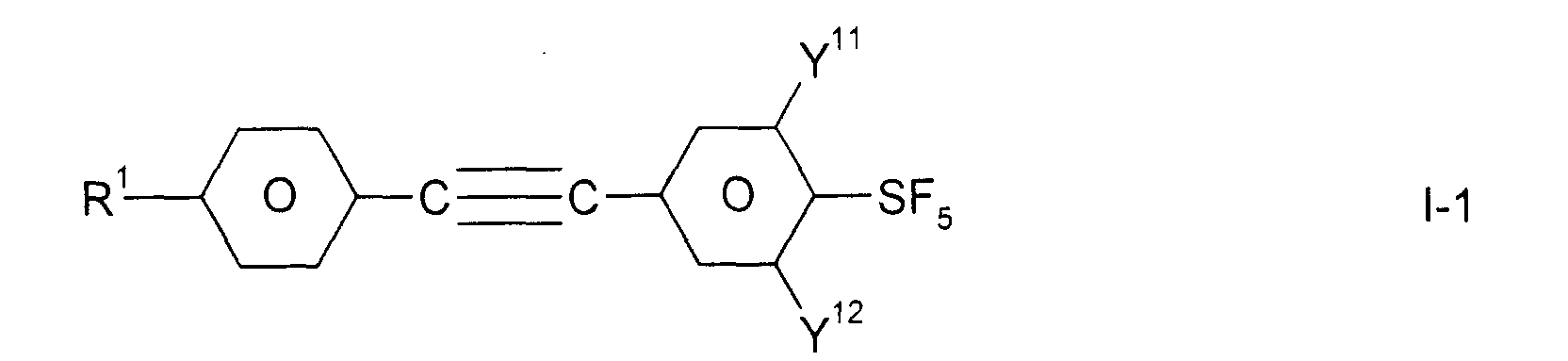
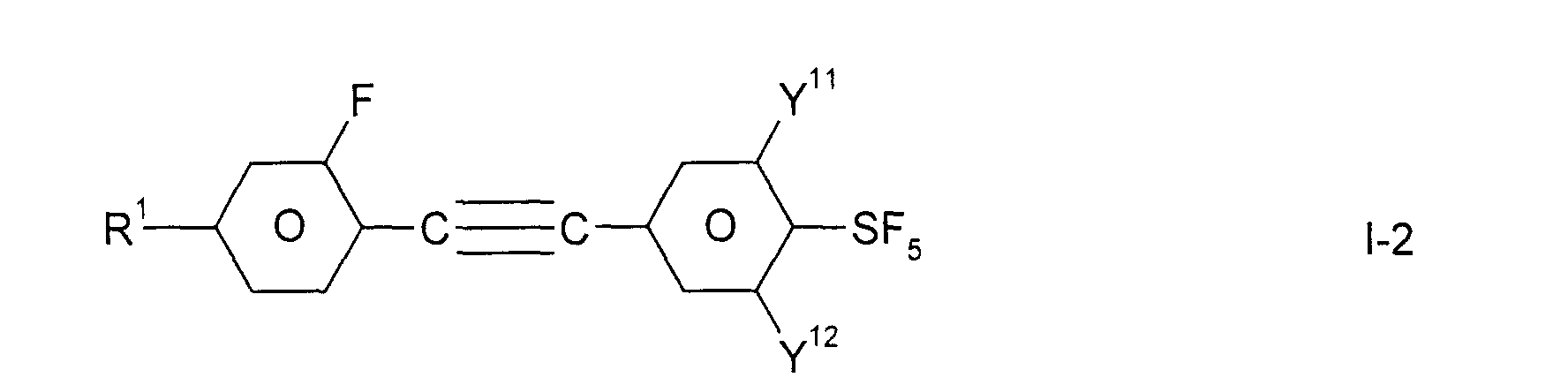

 wherein
- R1
- has the meaning given under formula I above
- Y11 and Y12
- are independently of each other H or F.
- In a preferred embodiment the liquid crystalline media according to the instant invention contains a component B comprising, preferably predominantly consisting of and most preferably entirely consisting of compounds of formula II.
- The compounds of formula II are preferably selected from the group of sub-formulae II-1 to II-3
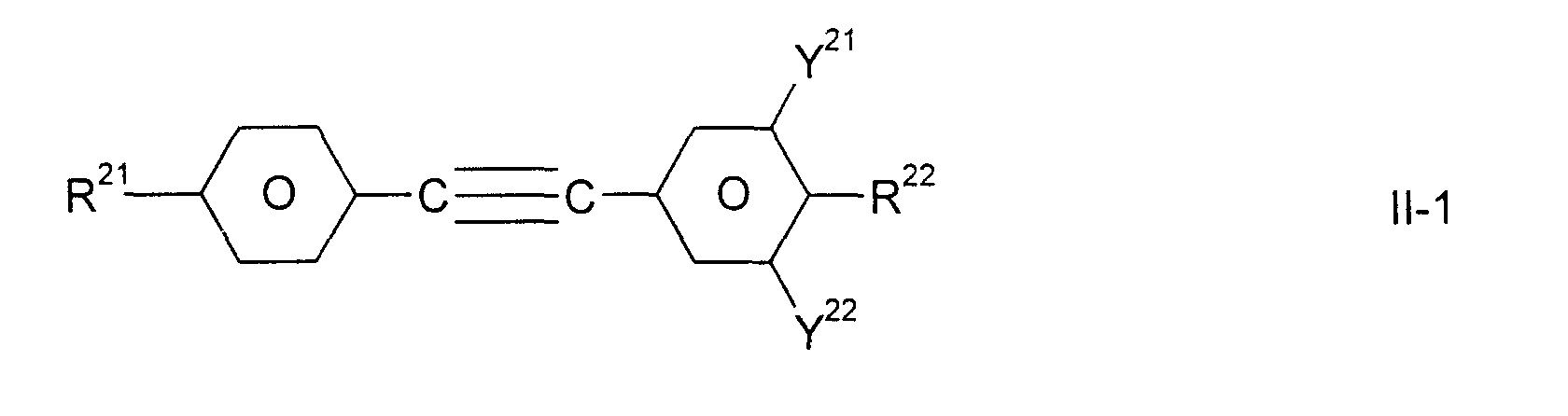
 wherein
- R21 and R22
- have the meaning given under formula II above and
- Y21 and Y22
- are independently of each other H or F.
- In a further preferred embodiment the liquid crystal medium contains a liquid crystal component C which is preferably predominantly consisting of and most preferably entirely consisting of compounds of formula III
- The compounds of formula III are preferably selected from the group of sub-formulae III-1 to III-3.

 wherein
- R3
- has the meaning given under formula III above
- Y31 and Y32
- are independently of each other H or F and
- X3
- has the meaning given under formula III above and is preferably CN or NCS and most preferably NCS.
- This component C may be, and preferably is, present besides component B.
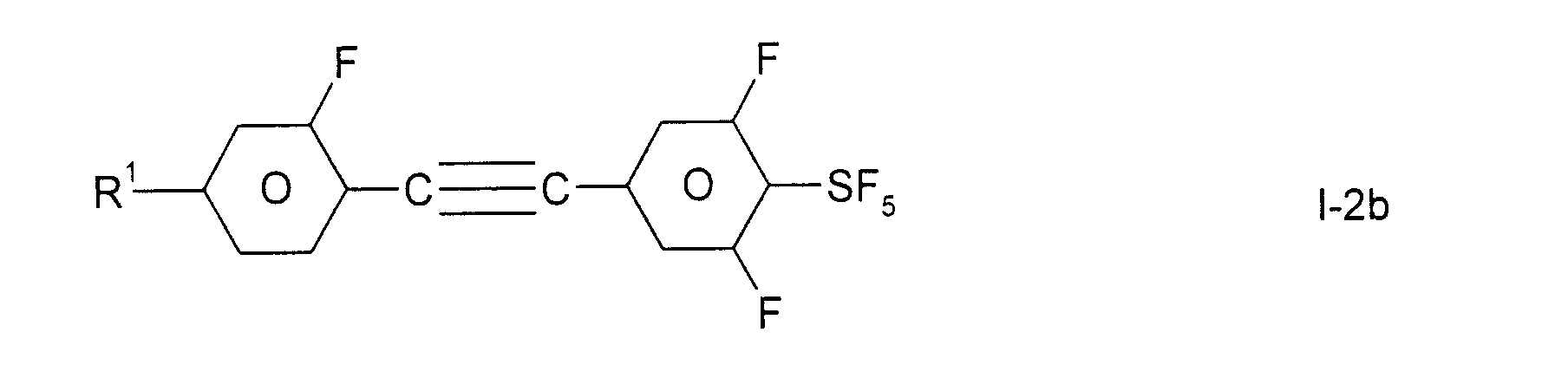
- Most preferably the medium contains compounds of formula I selected from the group of sub-formulae I-1 to 1-3. Most prefered of these are compounds of sub-formulae I-1a, I-1b, I-2a, I-2b, I-3a and I-3b


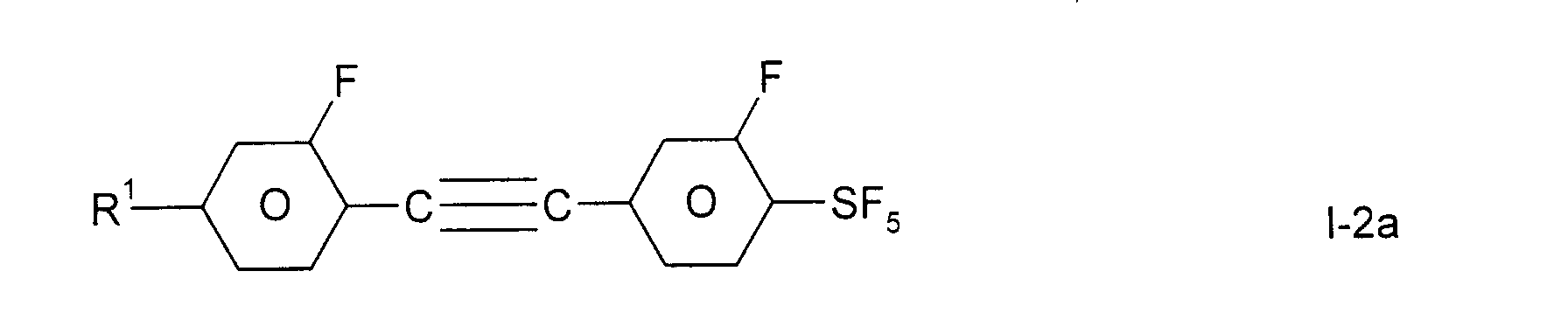
 wherein
- R1
- has the meaning given under formula I above and preferably is n-alkyl with 1 to 5 C-atoms or n-alkoxy with 1 to 4 C-atoms, or 1-E-alkenyl with 2 to 5 C-atoms.
- Most prefered the media contain compounds selected from the group of formulae I-1a, I-1b and I-2a.
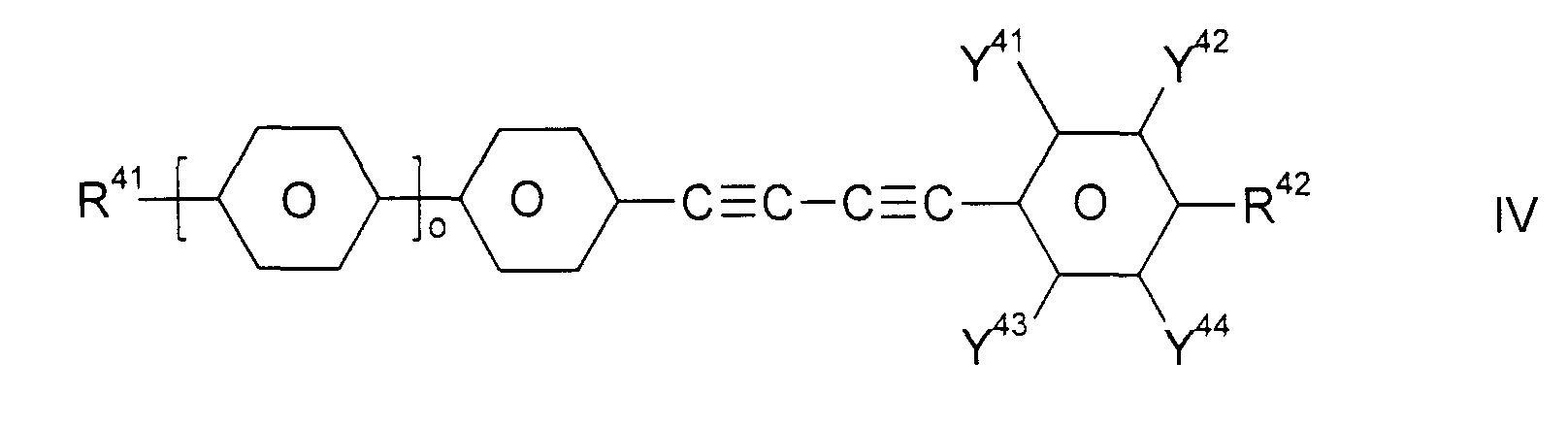
- Another type of compounds which optionally and beneficiously can be used in the media according to the instant invention are compounds of formula IVwherein
- R41 and R42
- independently of each other, have the meaning given for R1 above under formula I and alternatively may be an H atom,
- Y41, Y42, Y43 and Y44
- are, independently of each other H or F and
- o
- is 0 or 1.
- Other compounds which optionally and beneficiously can be used in the media according to the instant invention are compounds of formulae V, VI, VII and VIII


 wherein
- R5, R6, R7 and R8
- all, independently of each other, have the meaning given for R1 above under formula I and
- Y51 and Y52
- are, independently of each other, H or F,
- p
- is 0 or 1,
- Y61 and Y62
- are, independently of each other, H or F,
- L61 to L66
- are, independently of each other H or F, preferably up to two of them are H, preferably one or two of L61 to L66 are F, preferably L61 is F, the others are H, or L61 and L63 are F or L62 and L64 are F, all others are H,
- X6
- is Cl or NCS, preferably NCS,
- Y71 and Y72
- are, independently of each other, H or F,
- X7
- is CN or NCS,
- q
- is 0 or 1,
- Z8
- is trans- -CH=CH-, trans- -CF=CF-, -CH2CH2-, -CF2CF2-, -CF2O-, -COO- or a single bond, preferably a single bond,
- Y81 and Y82
- are, independently of each other, H or F,
- X8
- is F, Cl, -OCF3 or -OCF2H, preferably F or -OCF3,
- r
- is 0 or 1, preferably 0.
- Preferably the compounds of formula V are chosen from the group of compounds of sub-formulae V-1 to V-3.

 wherein
- R5
- has the meaning given above under formula V and for sub-formula V-1 preferably is alkyl or alkoxy and for sub-formulae V-2 and V-3 preferably alkyl.
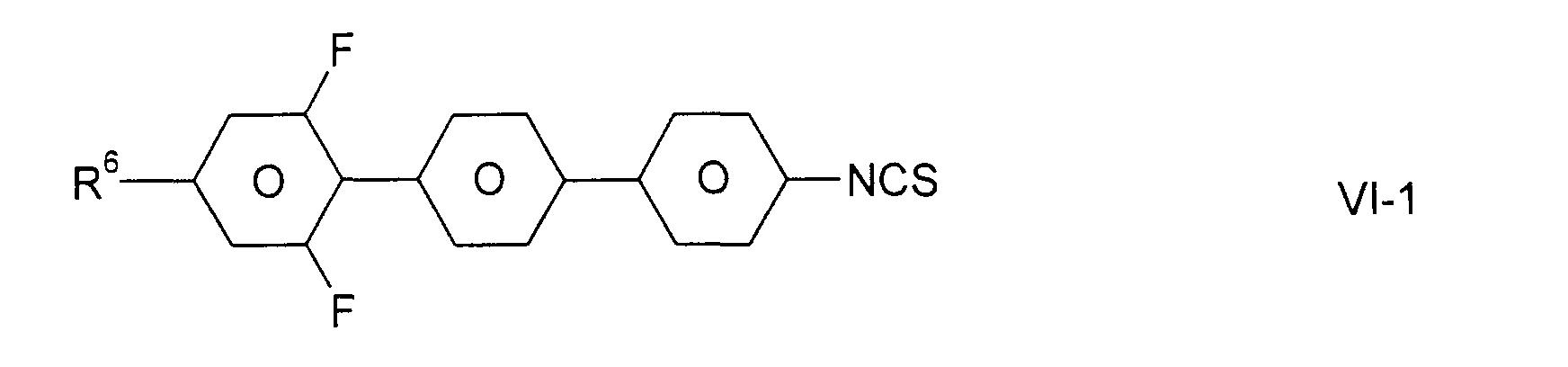
- Preferably the compounds of formula VI are chosen from the group of compounds of sub-formulae VI-1 to VI-4

 wherein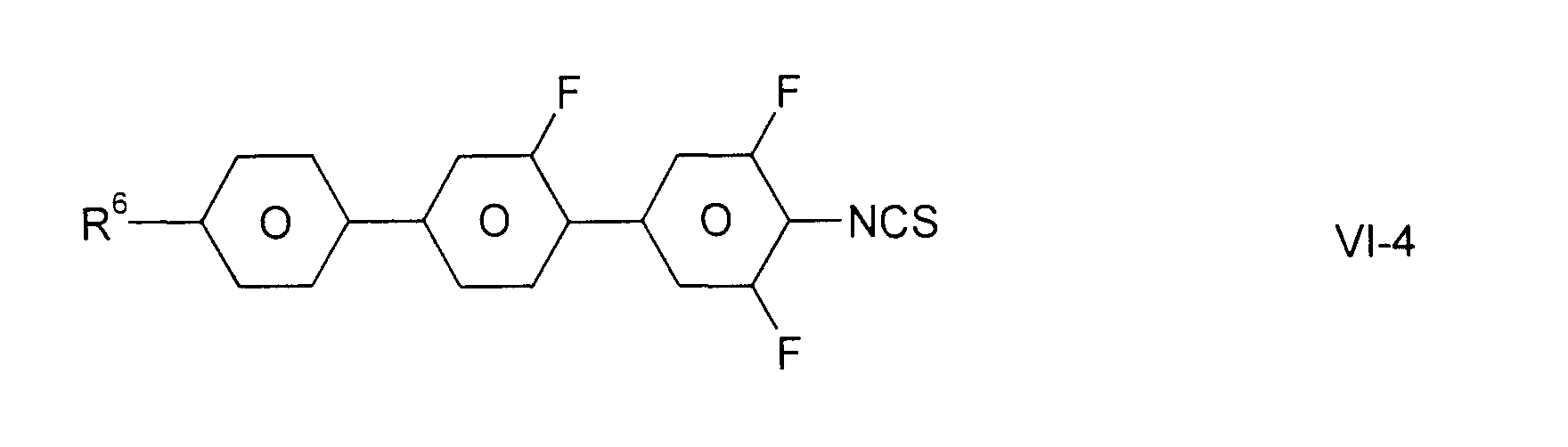
- R6
- has the meaning given above under formula VI and preferably is n-alkyl or 1-E-alkenyl, most preferably alkyl.
- Preferably the compounds of formula VII are chosen from the group of compounds of sub-formulae VII-1 to VII-4
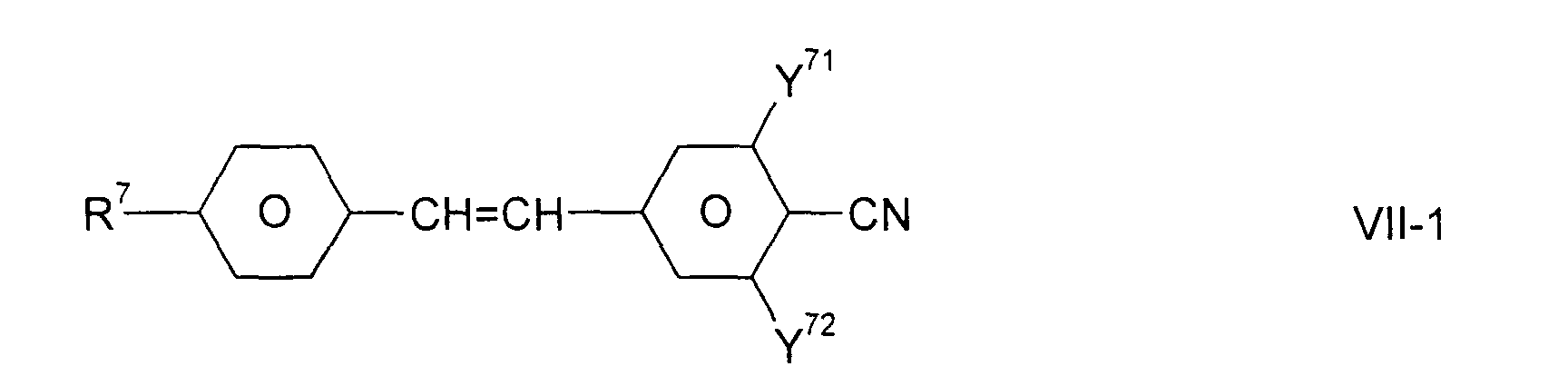

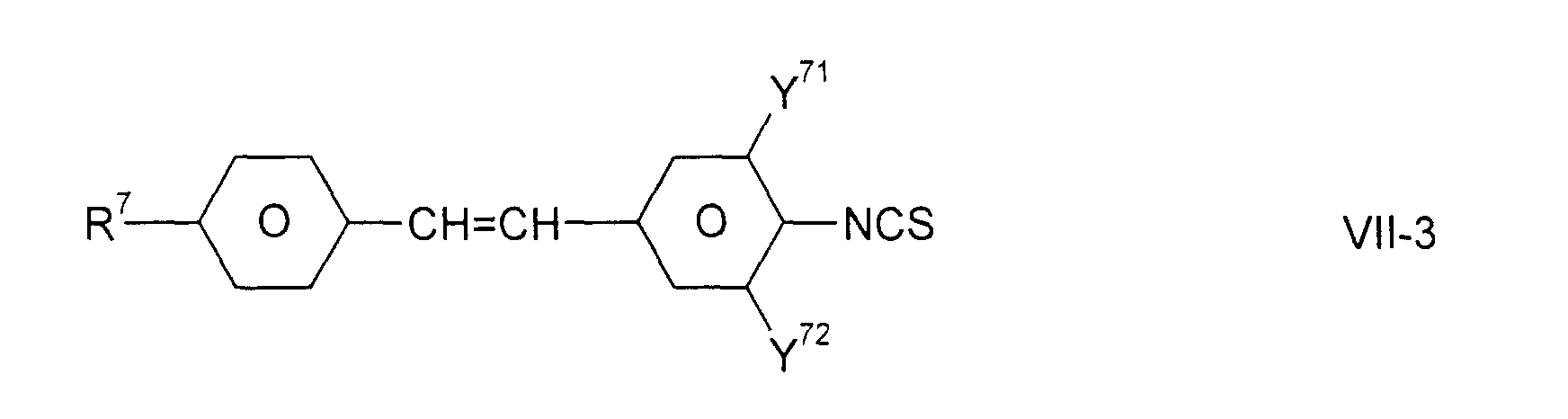 wherein
- R7 Y71 and Y72
- have the respective meanings given above under formula VII and preferably R7 is alkyl, alkoxy or alkenyl.
- In formula VII-3 R7 is preferably alkyl or alkoxy and Y71 is preferably F. In formula VII-4 R7 is preferably alkyl or alkenyl and Y71 is preferably F.
- Preferably the compounds of formula VIII are chosen from the group of compounds of sub-formulae VIII-1 to VIII-6
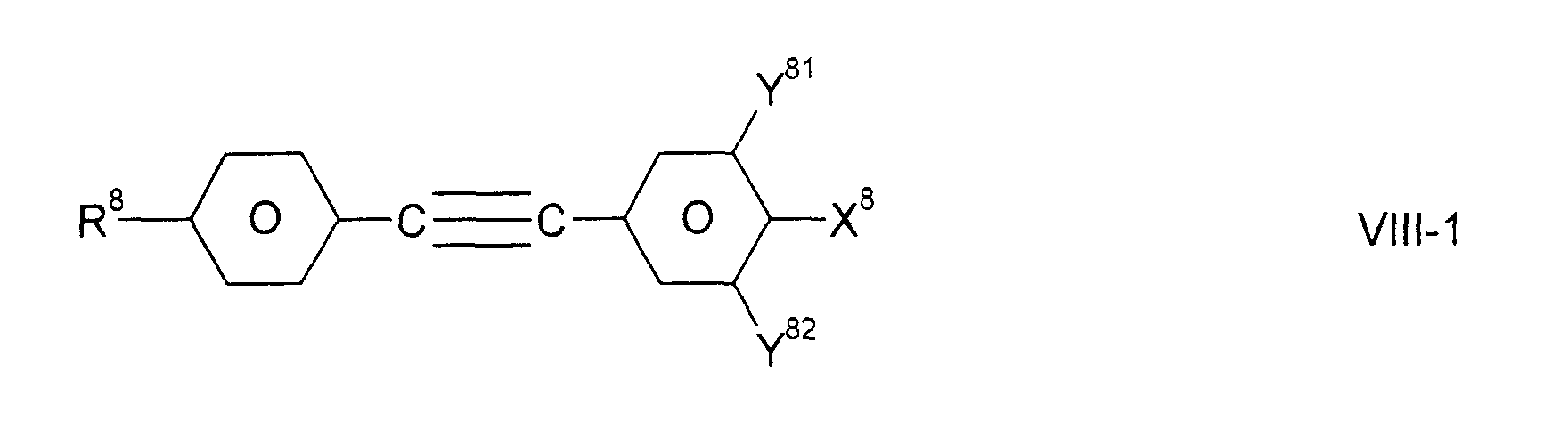

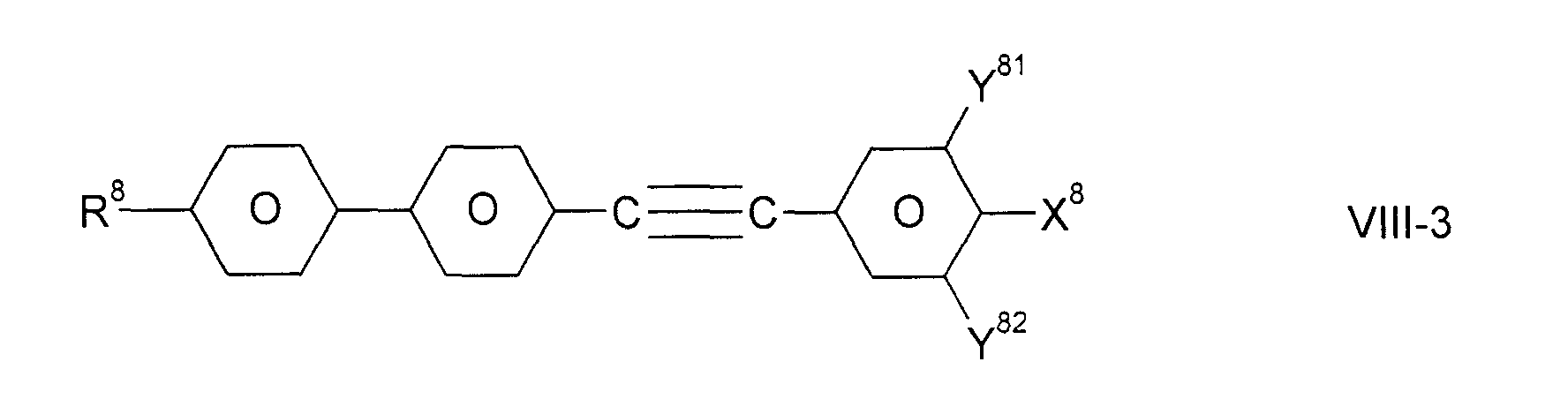
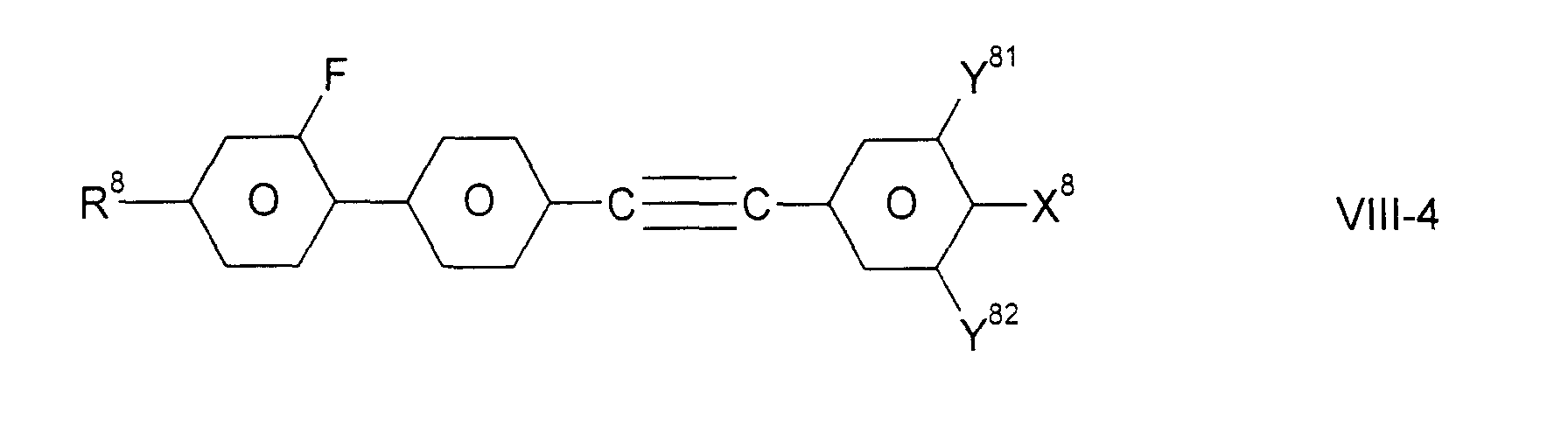
 wherein
- R8, Y81, Y82 and X8
- have the respective meanings given above under formula VIII and in case X8 is F, preferably Y81 is F.
- In formula VIII-1 X8 preferably is F or OCF3 and R8 preferably is alkyl, alkoxy or alkenyoxy. In case X8 is F preferably Y81 is F and most preferably both Y81 and Y82 are F.
- In formula VIII-2 X8 preferably is F or OCF3, R8 preferably is alkyl or alkenyl and Y81 most preferably is F.
- Component A is used in a concentration from 1 to 70 %, preferably from 4 to 50 % and most preferably from 9 to 40 % of the total mixture.
- Component B is used in a concentration from 0 to 90 %, preferably from 10 to 80 % and most preferably from 20 to 75 % of the total mixture.
- Component C is used in a concentration from 0 to 50 %, preferably from 10 to 40 % and most preferably from 12 to 35 % of the total mixture.
- Further the medium contains compounds of
- formula IV
- in a concentration from 0 to 40 %, preferably from 5 to 25 % and/or
- formula V
- in a concentration from Oto 30 %, preferably from 4 to 20 % and/or
- formula VI
- in a concentration from 0 to 25 %, preferably from 5 to 25 % and/or
- formula VII
- in a concentration from 0 to 30 %, preferably from 5 to 30 % and/or
- formula VIII
- in a concentration from 0 to 30 %, preferably from 5 to 30 %.
- These further compounds are used to adjust especially the phase range and the optical anisotropy of the inventive liquid crystal media.
- The total concentration of these further compounds of formulae IV to VIII in the liquid crystal medium according to the present invention is preferably 0 % to 50 %, more preferably 0 % to 30 %, most preferably 0 % to 20 % and in particular 4 % to 16 %.
- Optionally, the inventive media can comprise further liquid crystal compounds in order to adjust the physical properties. Such compounds are known to the expert. Their concentration in the media according to the instant invention is preferably 0 % to 30 %, more preferably 0 % to 20 % and most preferably 5 % to 15 %.
- Preferably the liquid crystal medium contains 50 % to 100 %, more preferably 70 % to 100 % and most preferably 80 % to 100 % and in particular 90 % to 100 % totally of components A, B and C, which contain, preferably predominantly consist of and most preferalby entirely consist of one or more of compounds of formulae I, II and III, respectively.
- The liquid crystal media according to the instant invention are characterized by a clearing point above 80 °C, preferably of 90 °C or more, especially preferred of 100 °C or more and in particular of 110 °C.
- The Δn of the liquid crystal media according to the instant invention is 0.25 or more, preferably in the range of 0.30 to 0.60, more preferably in the range of 0.32 to 0.50, most preferably in the range of 0.33 to 0.45 and in particular in the range of 0.35 to 0.40.
- The Δε, at 1 kHz and 20 °C, of the liquid crystal medium according to the invention is 6 or more, preferably 10 or more, most preferably 15 or more and in particular 19 or more.
- The liquid crystal media of the state of the art have been limited by low Δε values at high Δn values and vice versa. In contrast, the inventive media have pairs of (Δn, Δε), which are above a line passing through the points (0.290, 18.0) and (0.370, 4.0) in a plot of Δε as a function of Δn of the same medium. Preferably they are above a line through (0.290, 20.0) and (0.370, 6.0), most preferably above a line through (0.310, 20.0) and (0.370, 8.0) and in particular above a line through (0.350, 18.0) and (0.390, 8.0).
- Preferably the nematic phase of the inventive media extends at least from 0 °C to 70 °C, most preferably at least -20 °C to 70 °C and most preferably at least from -30 °C to 80 °C, wherein at least means that preferably the lower limit is under cut, wherein the upper limit is surpassed.
- In the present application the term dielectrically positive compounds describes compounds with Δε > 1,5, dielectrically neutral compounds are compounds with -1,5 ≤ Δε ≤ 1,5 and dielectrically negative compounds are compounds with Δε < -1,5. The same holds for components. Δε is determined at 1 kHz and 20 °C. The dielectrical anisotropies of the compounds is determined from the results of a solution of 10 % of the individual compounds in a nematic host mixture. The capacities of these test mixtures are determined both in a cell with homeotropic and with homogeneous alignment. The cell gap of both types of cells is approximately 10 µm. The voltage applied is a rectangular wave with a frequency of 1 kHz and a root mean square value typically of 0.5 V to 1.0 V, however, it is always selected to be below the capacitive threshold of the respective test mixture.
- For dielectrically positive compounds the mixture ZLI-4792 and for dielectrically neutral, as well as for dielectrically negative compounds, the mixture ZLI-3086, both of Merck KGaA, Germany are used as host mixture, respectively. The dielectric permittivities of the compounds are determined from the change of the respective values of the host mixture upon addition of the compounds of interest and are extrapolated to a concentration of the compounds of interest of 100 %.
- Components having a nematic phase at the measurement temperature of 20 °C are measured as such, all others are treated like compounds.
- The term threshold voltage refers in the instant application to the optical threshold and is given for 10 % relative contrast (V10) and the term saturation voltage refers to the optical saturation and is given for 90 % relative contrast (V90) both, if not explicitly stated otherwise. The capacitive threshold voltage (V0, also called Freedericksz-threshold VFr) is only used if explicitly mentioned.
- The ranges of parameters given in this application are all including the limiting values, unless explicitly stated otherwise.
- Throughout this application, unless explicitly stated otherwise, all concentrations are given in mass percent and relate to the respective complete mixture, all temperatures are given in degrees centigrade (Celsius) and all differences of temperatures in degrees centigrade. All physical properties have been and are determined according to "Merck Liquid Crystals, Physical Properties of Liquid Crystals", Status Nov. 1997, Merck KGaA, Germany and are given for a temperature of 20 °C, unless explicitly stated otherwise. The optical anisotropy (Δn) is determined at a wavelength of 589.3 nm. The dielectric anisotropy (Δε) is determined at a frequency of 1 kHz. The threshold voltages, as well as all other electro-optical properties have been determined with test cells prepared at Merck KGaA, Germany. The test cells for the determination of Δε had a cell gap of 22 µm. The electrode was a circular ITO electrode with an area of 1.13 cm2 and a guard ring. The orientation layers were lecithin for homeotropic orientation (ε||) and polyimide AL-1054 from Japan Synthetic Rubber for homogeneuous orientation (ε┴). The capacities were determined with a frequency response analyser Solatron 1260 using a sine wave with a voltage of 0.3 Vrms. The light used in the electro-optical measurements was white light. The set up used was a commercially available equipment of Otsuka, Japan. The characteristic voltages have been determined under perpendicular observation. The threshold (V10) - mid grey (V50) - and saturation (V90) voltages have been determined for 10 %, 50 % and 90 % relative contrast, respectively.
- The liquid crystal media according to the present invention can contain further additives and chiral dopants in usual concentrations. The total concentration of these further constituents is in the range of 0 % to 10 %, preferably 0.1 % to 6 %, based on the total mixture. The concentrations of the individual compounds used each are preferably in the range of 0.1 to 3 %. The concentration of these and of similar additives is not taken into consideration for the values and ranges of the concentrations of the liquid crystal components and compounds of the liquid crystal media in this application.
- The inventive liquid crystal media according to the present invention consist of several compounds, preferably of 3 to 30, more preferably of 5 to 20 and most preferably of 6 to 14 compounds. These compounds are mixed in conventional way. As a rule, the required amount of the compound used in the smaller amount is dissolved in the compound used in the greater amount. In case the temperature is above the clearing point of the compound used in the higher concentration, it is particularly easy to observe completion of the process of dissolution. It is, however, also possible to prepare the media by other conventional ways, e. g. using so called pre-mixtures, which can be e. g. homologous or eutectic mixtures of compounds or using so called multi-bottle-systems, the constituents of which are ready to use mixtures themselves.
- By addition of suitable additives, the liquid crystal media according to the instant invention can be modified in such a way, that they are usable in all known types of liquid crystal displays, either using the liquid crystal media as such, like TN-, TN-AMD, ECB-, VAN-AMD IPS and OCB LCDs and in particular in composite systems, like PDLC-, NCAP- and PN-LCDs and especially in HPDLCs.
- The melting point T(C,N), the transition from the smectic (S) to the nematic (N) phase T(S,N) and the clearing point T (N,I) of the liquid crystals are given in degrees centigrade.
- In the present application and especially in the following examples, the structures of the liquid crystal compounds are represented by abbreviations also called acronyms. The transformation of the abbreviations into the corresponding structures is straight forward according to the following two tables A and B. All groups CnH2n+1 and CmH2m+1 are straight chain alkyl groups with n respectively m C-atoms. The interpretation of table B is self evident. Table A does only list the abbreviations for the cores of the structures. The individual compounds are denoted by the abbreviation of the core followed by a hyphen and a code specifying the substituents R1, R2, L1 and L2 follows:
Code for R1, R2, L1, L2 R1 R2 L1 L2 nm CnH2n+1 CmH2m+1 H H nOm CnH2n+1 OCmH2m+1 H H nO.m OCnH2n+1 CmH2m+1 H H n CnH2n+1 CN H H nN.F CnH2n+1 CN H F nN.F.F CnH2n+1 CN F F nF CnH2n+1 F H H nF.F CnH2n+1 F H F nF.F.F CnH2n+1 F F F nOF OCnH2n+1 F H H nCl CnH2n+1 Cl H H nCl.F CnH2n+1 Cl H F nCl.F.F CnH2n+1 Cl F F nCF3 CnH2n+1 CF3 H H nCF3.F CnH2n+1 CF3 H F nCF3.F.F CnH2n+1 CF3 F F nOCF3 CnH2n+1 OCF3 H H nOCF3.F CnH2n+1 OCF3 H F nOCF3.F.F CnH2n+1 OCF3 F F nOCF2 CnH2n+1 OCHF2 H H nOCF2.F CnH2n+1 OCHF2 H F nOCF2.F.F CnH2n+1 OCHF2 F F nS CnH2n+1 NCS H H nS.F CnH2n+1 NCS H F nS.F.F CnH2n+1 NCS F F rVsN CrH2r+1-CH=CH-CsH2s- CN H H rEsN CrH2r+1-O-CsH2s- CN H H nAm CnH2n+1 COOCmH2m+1 H H 

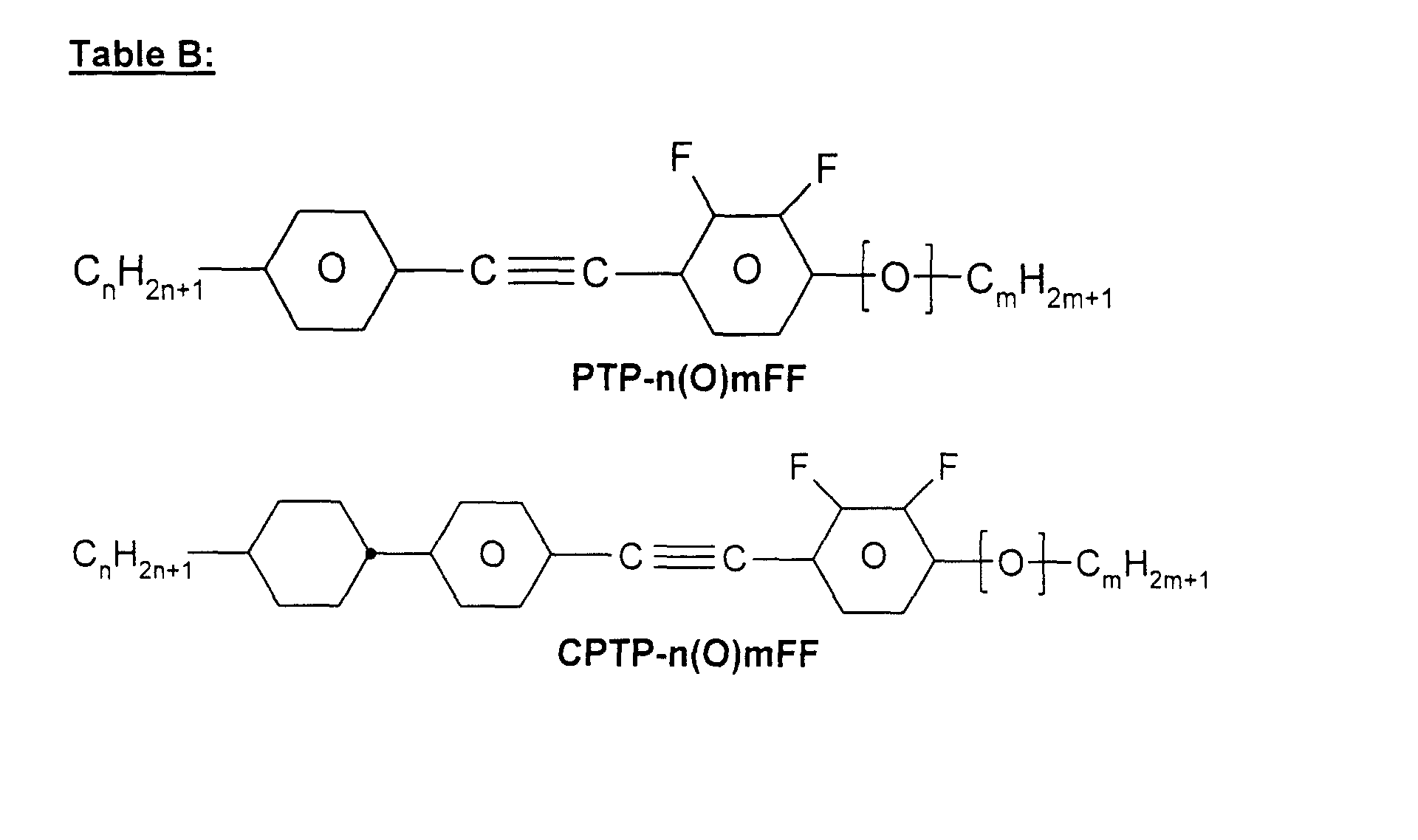


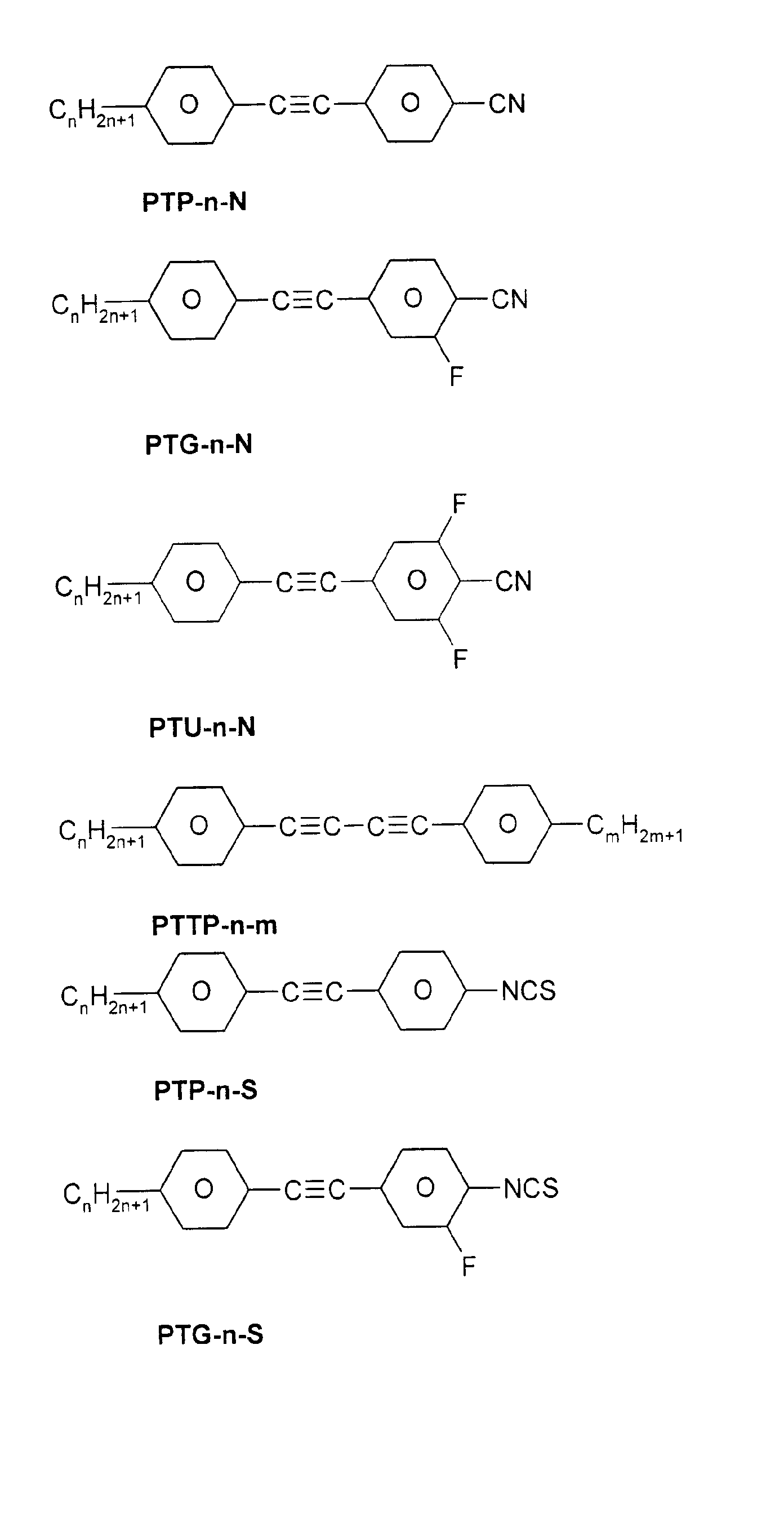
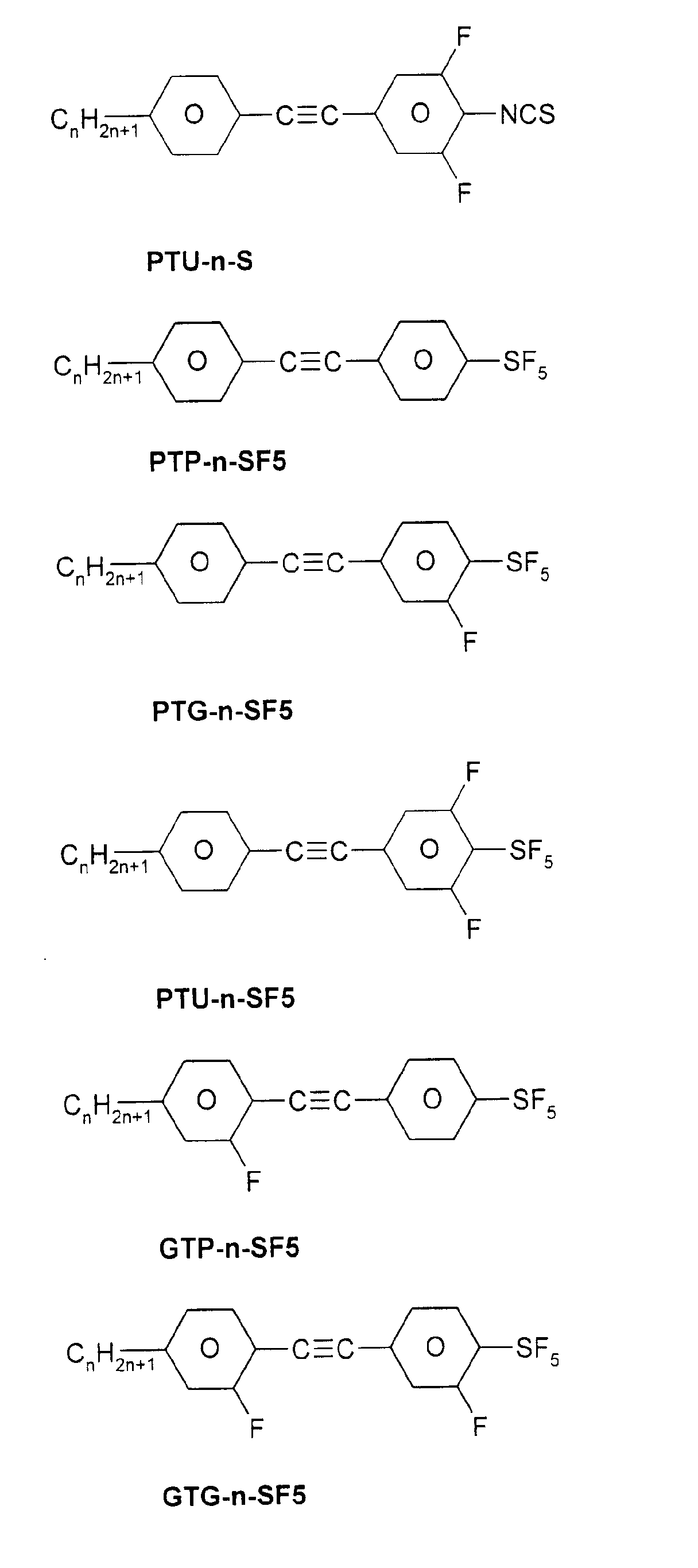

- The liquid crystal media according to the instant invention do contain preferably
- four or more compounds selected from the group of compounds of tables A and B and/or
- five or more compounds selected from the group of compounds of table B and/or
- two or more compounds selected from the group of compounds of table A.
- The examples given in the following are illustrating the present invention without limiting it in any way.
- However, the phyiscal data especially of the compounds illustrate to the expert which properties can be achieved in which ranges. Especially the combination of the various properties which can be preferably achieved is thus well defined.
- A liquid crystal mixture is realized with the composition and properties given in the following table.

- A liquid crystal mixture is realized with the composition and properties given in the following table.


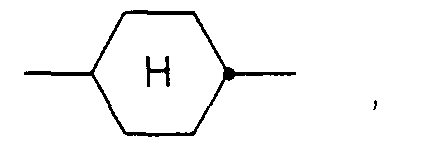
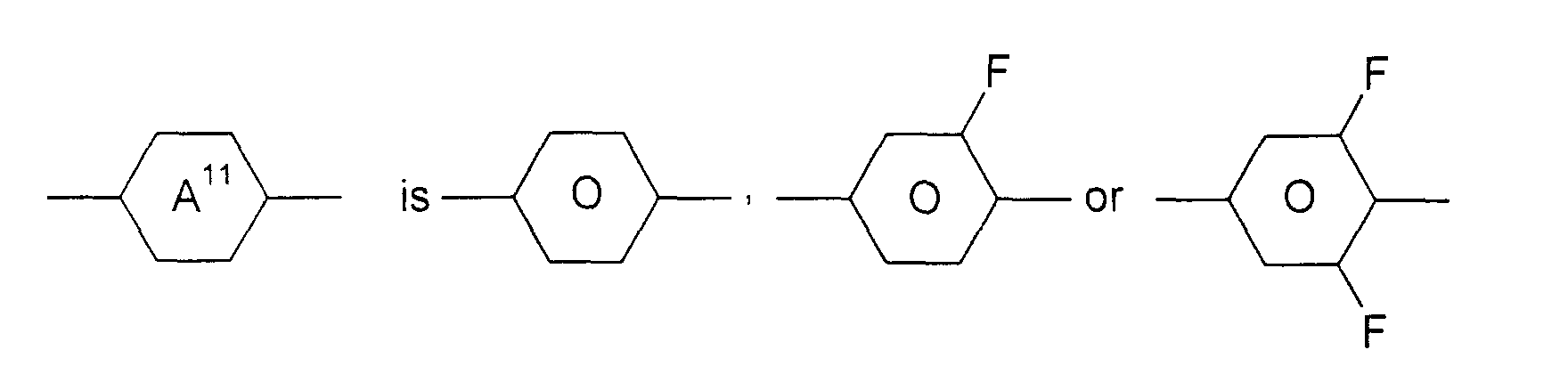
and/or preferably
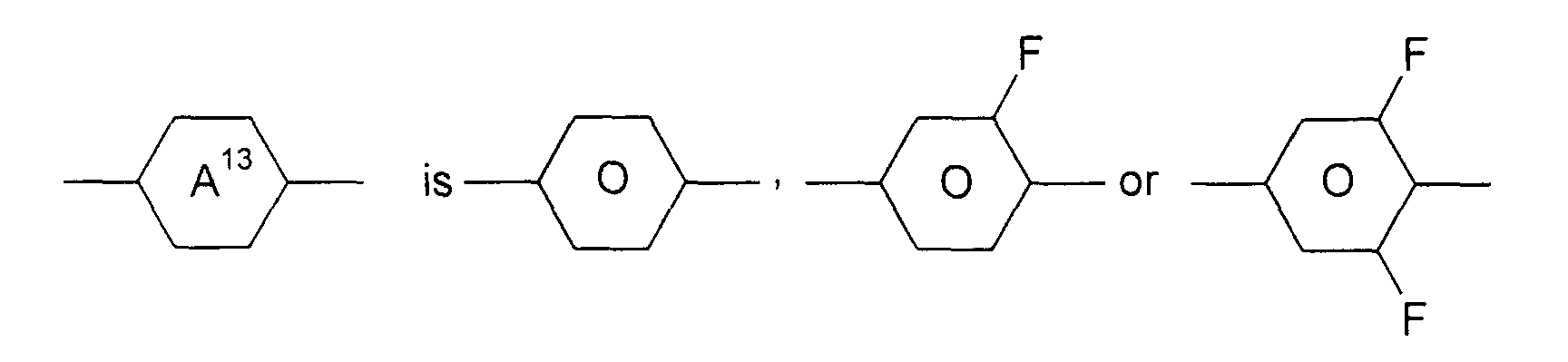
and simultaneously one or more further components, which optionally, preferably obligatory, are selected from the group of components B and C
component B is comprising laterally fluorinated tolane compounds of formula II



component C is comprising dielectrically positive compounds of formula III



Claims (10)
- Liquid crystal medium, characterized in that it comprizes a component A comprizing one or more strongly dielectrically positive compounds with very high values of Δn of formula Iwherein

- R1
- is n-alkyl, n-alkoxy with 1 to 7 C-atoms preferably 2 to 5 C-atoms, alkenyl, alkenyloxy or alkoxyalkyl with 2 to 7 C-atoms,
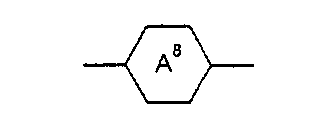
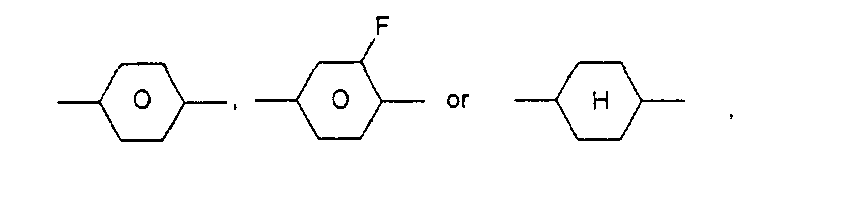
each, independently of each other, are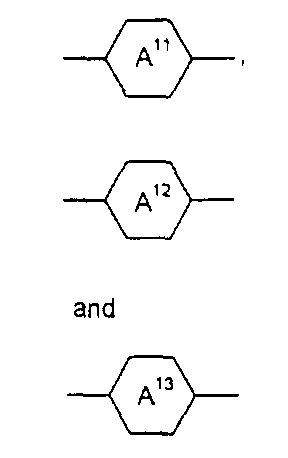 and alternatively
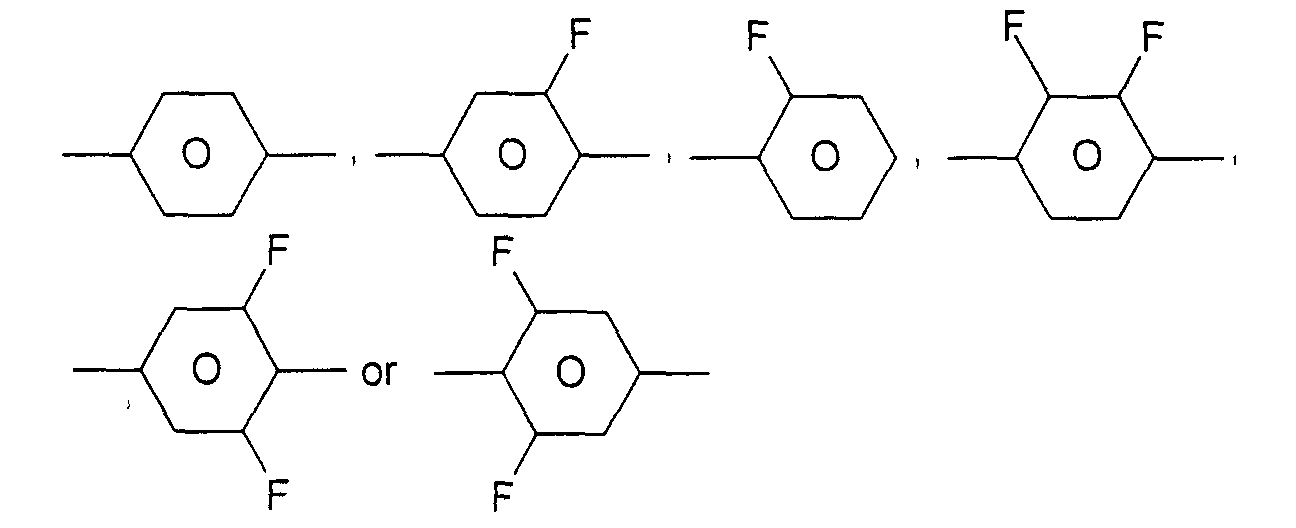 may also be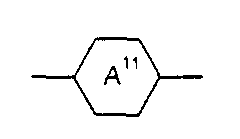

- one of Z11 and Z12
- is -C≡C- and the other one, if present -C≡C-, -CF2O-, trans- -CH=CH-, trans- -CF=CF- or a single bond, and
- n
- is 0 or 1.
- Liquid crystal medium according to claim 1, characterized in that it comprises a component B comprizing one or more compounds of formula IIwherein

- R21 and R22
- independently of each other, have the meaning given for R1 in claim 1,
each have the meaning given for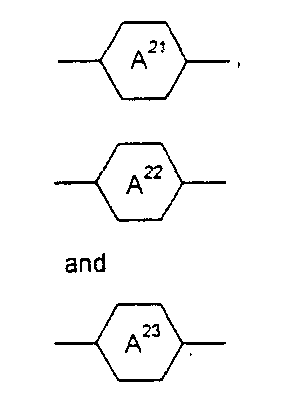 respectively, in claim 1,
- at least one of Z21 and Z22
- is -C≡C-, the other, if present, is -CH2CH2-, -COO-, -C≡C-, trans- CH=CH-, trans- -CF=CF-, -CH2O-, -CF2O- or a single bond and
- m
- is 0 or 1.
- Liquid crystal medium according to at least one of claims 1 and 2, characterized in that the it comprizes a component C comprizing one or compounds of formula IIIwherein

- R3
- has the meaning given for R1 in claim 1,
- at least one of Z31 and Z32
- is -C≡C-, the other, if present, is -CH2CH2-, -COO-, -C≡C-, trans- CH=CH-, trans- -CF=CF-, -CH2O-, -CF2O- or a single bond,
each have the meaning given for respectively, above under formula I,
- k
- is 0 or 1 and
- X3
- is CN, F, Cl or NCS.
- Liquid crystal medium according to at least one of claims 1 to 3, characterized in that it comprizes one or more compounds of formula IVwherein
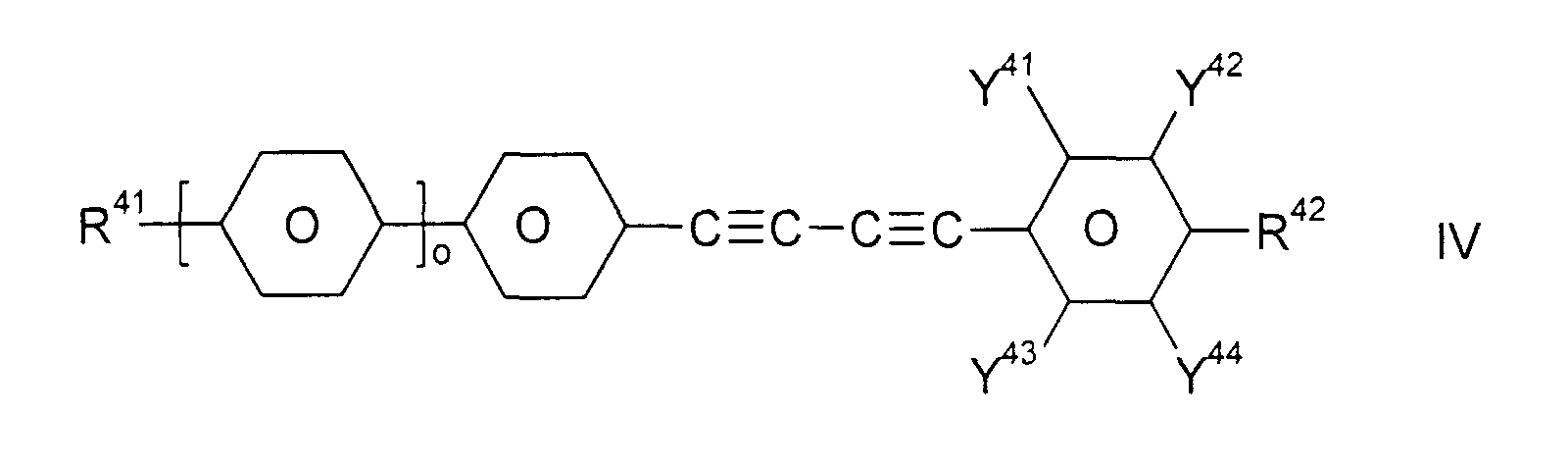
- R41 and R42
- independently of one another, have the meaning given for R1 above under formula I and alternatively may be an H atom,
- Y41, Y42, Y43 and Y44
- are, independently of each other H or F and
- o
- is 0 or 1.
- Liquid crystal medium according to at least one of claims 1 to 4, characterized in that it comprises one or more compounds selected from the group of formulae V to VII
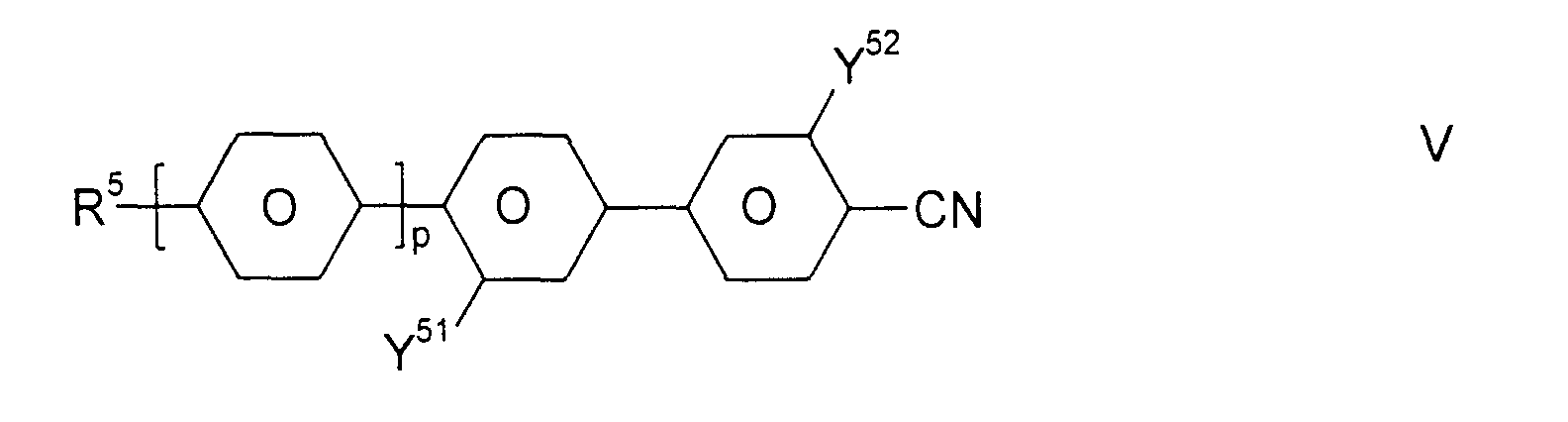
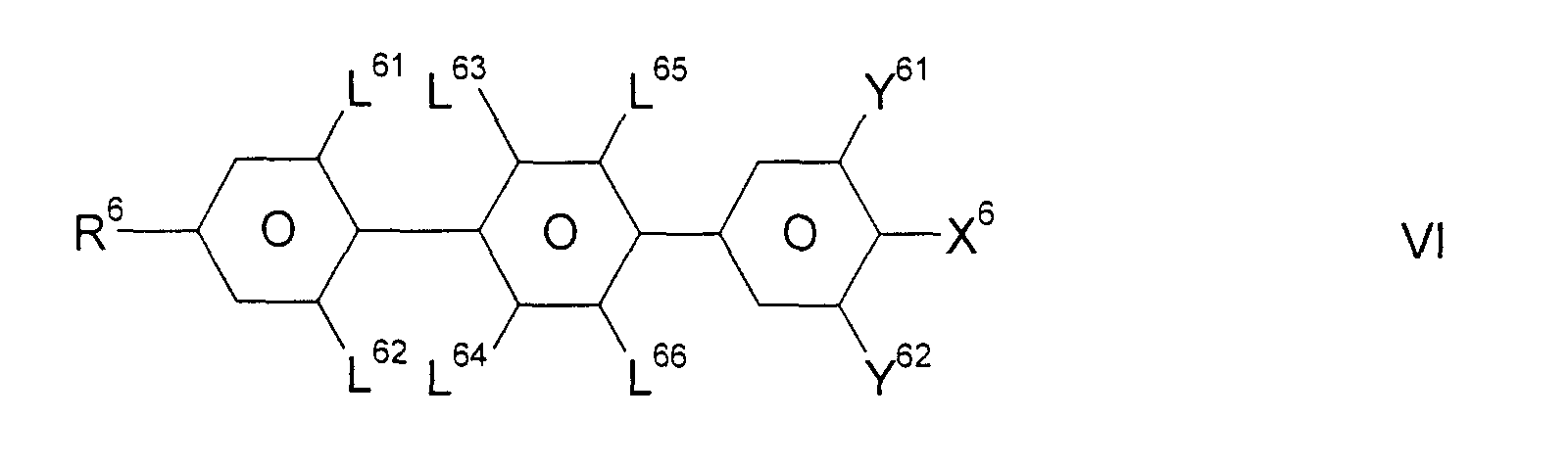
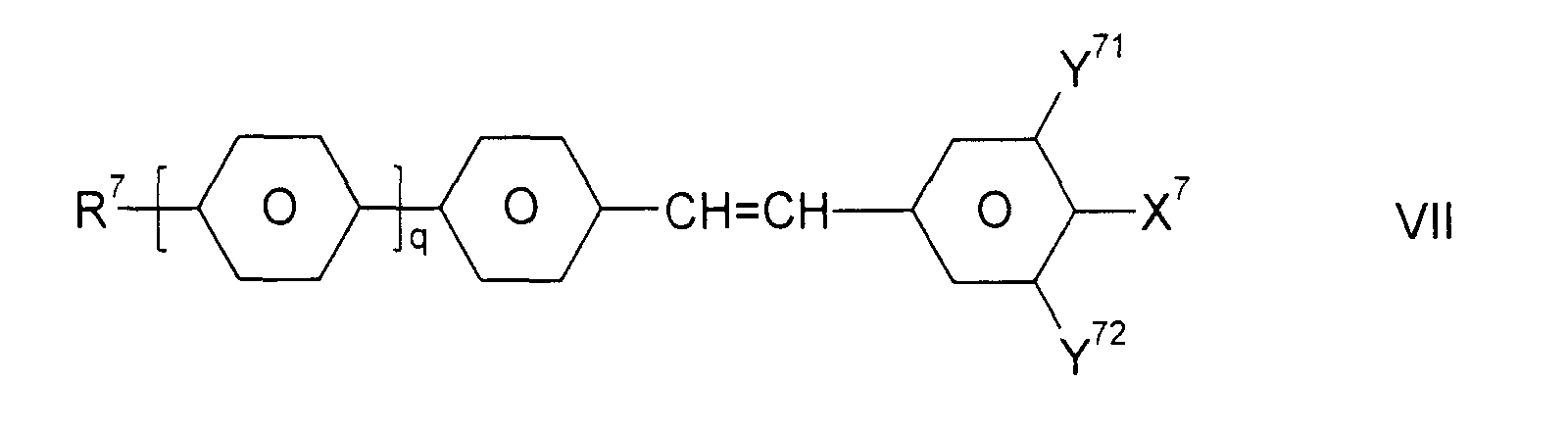 wherein
- R5, R6, R7 and R8
- independently of each other, have the meaning given for R1 above under formula I and
- Y51 and Y52
- are, independently of each other, H or F,
- p
- is 0 or 1,
- Y61 and Y62
- are, independently of each other, H or F,
- L61 to L66
- are, independently of each other, H or F,
- X6
- is Cl or NCS, preferably NCS,
- Y71 and Y72
- are, independently of each other, H or F,
- X7
- is CN or NCS,
- q
- is 0 or 1,
is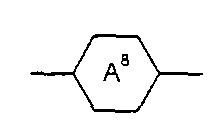

- Z8
- is trans- -CH=CH-, trans- -CF=CF-, -CH2CH2-, -CF2CF2-, -CF2O-, -COO- or a single bond,
- Y81 and Y82
- are, independently of each other, H or F,
- X8
- is F, Cl, -OCF3 or -OCF2H and
- r
- is 0 or 1.
- Liquid crystal medium according to claim 1, characterized in that the component A comprises one or more compounds selected from the group of of formulae I-1 to I-5


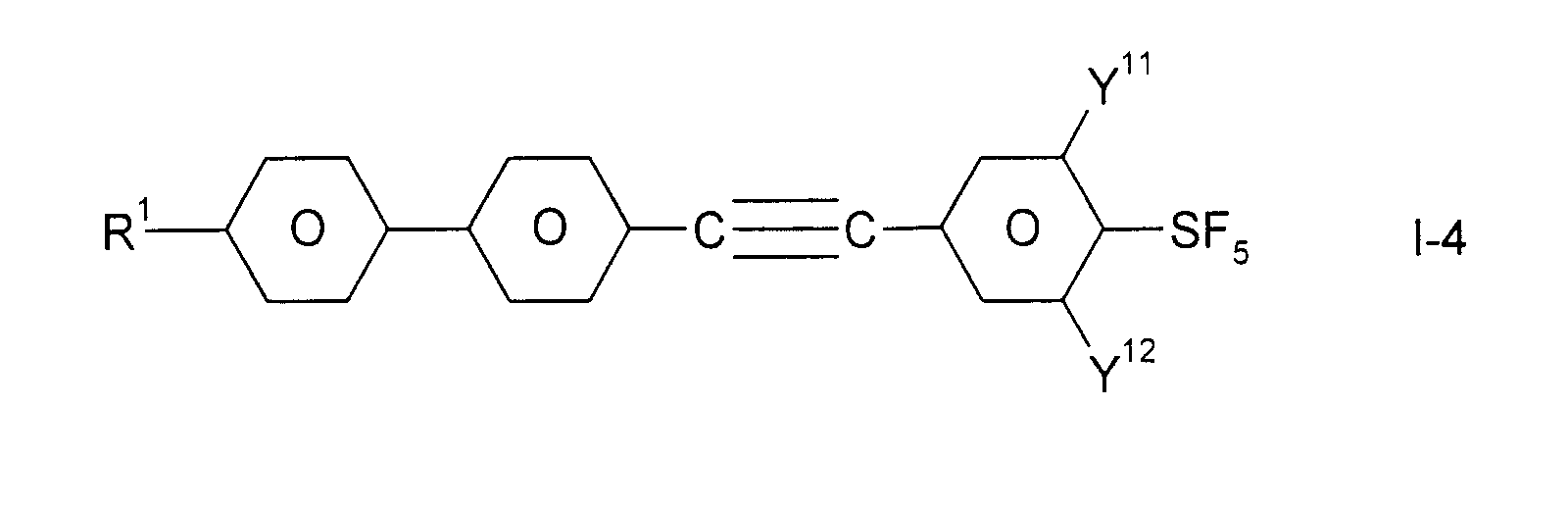 wherein
- R1
- has the meaning given under formula I above
- Y11 and Y12
- are independently of each other H or F.
- Liquid crystal display, characterized in that it comprises a liquid crystal medium according to at least one of claims 1 to 6.
- Liquid crystal display according to claim 7, characterized in that it operates in the OCB mode.
- Liquid crystal display system according to claim 7, characterized in that it is a HPDLC display system.
- Use of a liquid crystal medium according to at least one of claims 1 to 6 in a liquid crystal display.
Priority Applications (1)
| Application Number | Priority Date | Filing Date | Title |
|---|---|---|---|
| EP20010126469 EP1213337B1 (en) | 2000-12-06 | 2001-11-09 | Liquid crystalline medium and liquid crystal display |
Applications Claiming Priority (3)
| Application Number | Priority Date | Filing Date | Title |
|---|---|---|---|
| EP00126754 | 2000-12-06 | ||
| EP00126754 | 2000-12-06 | ||
| EP20010126469 EP1213337B1 (en) | 2000-12-06 | 2001-11-09 | Liquid crystalline medium and liquid crystal display |
Publications (2)
| Publication Number | Publication Date |
|---|---|
| EP1213337A1 true EP1213337A1 (en) | 2002-06-12 |
| EP1213337B1 EP1213337B1 (en) | 2005-11-02 |
Family
ID=26071645
Family Applications (1)
| Application Number | Title | Priority Date | Filing Date |
|---|---|---|---|
| EP20010126469 Expired - Lifetime EP1213337B1 (en) | 2000-12-06 | 2001-11-09 | Liquid crystalline medium and liquid crystal display |
Country Status (1)
| Country | Link |
|---|---|
| EP (1) | EP1213337B1 (en) |
Cited By (3)
| Publication number | Priority date | Publication date | Assignee | Title |
|---|---|---|---|---|
| DE10241721B4 (en) * | 2001-10-09 | 2012-01-12 | Merck Patent Gmbh | Nematic liquid-crystal mixture and its use |
| CN103842474A (en) * | 2011-09-27 | 2014-06-04 | 默克专利股份有限公司 | Liquid crystal media and high frequency components containing them |
| CN104513667A (en) * | 2013-09-26 | 2015-04-15 | 江苏和成显示科技股份有限公司 | OCB mode liquid crystal display (LCD) |
Families Citing this family (8)
| Publication number | Priority date | Publication date | Assignee | Title |
|---|---|---|---|---|
| KR20250036969A (en) | 2017-04-26 | 2025-03-14 | 오티아이 루미오닉스 인크. | Method for patterning a coating on a surface and device including a patterned coating |
| US11751415B2 (en) | 2018-02-02 | 2023-09-05 | Oti Lumionics Inc. | Materials for forming a nucleation-inhibiting coating and devices incorporating same |
| CN116456753A (en) | 2019-03-07 | 2023-07-18 | Oti照明公司 | Optoelectronic device |
| KR20250110358A (en) | 2019-04-18 | 2025-07-18 | 오티아이 루미오닉스 인크. | Materials for forming a nucleation-inhibiting coating and devices incorporating the same |
| WO2020225778A1 (en) | 2019-05-08 | 2020-11-12 | Oti Lumionics Inc. | Materials for forming a nucleation-inhibiting coating and devices incorporating same |
| US12113279B2 (en) | 2020-09-22 | 2024-10-08 | Oti Lumionics Inc. | Device incorporating an IR signal transmissive region |
| US12672476B2 (en) | 2020-10-29 | 2026-06-30 | Oti Lumionics Inc. | Opto-electronic device with nanoparticle deposited layers |
| KR20250139404A (en) | 2020-12-07 | 2025-09-23 | 오티아이 루미오닉스 인크. | Patterning a conductive deposited layer using a nucleation inhibiting coating and an underlying metallic coating |
Citations (2)
| Publication number | Priority date | Publication date | Assignee | Title |
|---|---|---|---|---|
| DE19748109A1 (en) * | 1997-10-31 | 1999-05-06 | Merck Patent Gmbh | New sulfur pentafluoride derivative liquid crystal media components |
| DE19933175A1 (en) * | 1998-07-17 | 2000-01-20 | Merck Patent Gmbh | New sulfur pentafluoride derivatives with para-linked benzene rings, one of which is fluorine-substituted, useful as components of liquid crystal media for LC and electro-optical displays |
-
2001
- 2001-11-09 EP EP20010126469 patent/EP1213337B1/en not_active Expired - Lifetime
Patent Citations (2)
| Publication number | Priority date | Publication date | Assignee | Title |
|---|---|---|---|---|
| DE19748109A1 (en) * | 1997-10-31 | 1999-05-06 | Merck Patent Gmbh | New sulfur pentafluoride derivative liquid crystal media components |
| DE19933175A1 (en) * | 1998-07-17 | 2000-01-20 | Merck Patent Gmbh | New sulfur pentafluoride derivatives with para-linked benzene rings, one of which is fluorine-substituted, useful as components of liquid crystal media for LC and electro-optical displays |
Non-Patent Citations (2)
| Title |
|---|
| KIRSCH, PEER ET AL: "Liquid crystals based on hypervalent sulfur fluorides: pentafluorosulfuranyl as polar terminal group", ANGEW. CHEM., INT. ED. (1999), 38(13/14), 1989-1992, 1999, XP001065436 * |
| MOLECULAR CRYSTALS AND LIQUID CRYSTALS, vol. 346, 2000, READING GB, pages 193 - 199, XP008001419 * |
Cited By (4)
| Publication number | Priority date | Publication date | Assignee | Title |
|---|---|---|---|---|
| DE10241721B4 (en) * | 2001-10-09 | 2012-01-12 | Merck Patent Gmbh | Nematic liquid-crystal mixture and its use |
| CN103842474A (en) * | 2011-09-27 | 2014-06-04 | 默克专利股份有限公司 | Liquid crystal media and high frequency components containing them |
| CN103842474B (en) * | 2011-09-27 | 2016-01-13 | 默克专利股份有限公司 | Liquid crystal media and high frequency components containing them |
| CN104513667A (en) * | 2013-09-26 | 2015-04-15 | 江苏和成显示科技股份有限公司 | OCB mode liquid crystal display (LCD) |
Also Published As
| Publication number | Publication date |
|---|---|
| EP1213337B1 (en) | 2005-11-02 |
Similar Documents
| Publication | Publication Date | Title |
|---|---|---|
| TWI564369B (en) | Liquid crystal medium and liquid crystal display | |
| EP1306418B1 (en) | Liquid crystalline medium and liquid crystal display | |
| JP5627857B2 (en) | Liquid crystal medium and liquid crystal display | |
| JP5105669B2 (en) | Liquid crystal compound, liquid crystal medium and liquid crystal display | |
| WO2009115226A1 (en) | Liquid crystalline medium and liquid crystal display | |
| KR100743725B1 (en) | Liquid-crystalline mixtures | |
| KR101863377B1 (en) | Liquid crystalline medium and liquid crystalline display | |
| KR101851888B1 (en) | Liquid crystalline medium and liquid crystal display | |
| EP1213337B1 (en) | Liquid crystalline medium and liquid crystal display | |
| EP1126006B1 (en) | Liquid crystal compounds, liquid crystal medium and liquid crystal display | |
| JP5546711B2 (en) | Liquid crystal medium and liquid crystal display | |
| JP2007277557A (en) | Liquid crystal medium and liquid crystal display | |
| EP1472325B1 (en) | Liquid crystalline medium and liquid crystal display | |
| US6692796B2 (en) | Liquid crystalline medium and liquid crystal display | |
| US6793985B2 (en) | Liquid crystalline medium and liquid crystal display | |
| JP5220653B2 (en) | Liquid crystal medium and liquid crystal display | |
| JP5160727B2 (en) | Liquid crystal medium and liquid crystal display | |
| JP5013635B2 (en) | Liquid crystal medium and liquid crystal display | |
| JP2004182986A (en) | Liquid crystal medium and liquid crystal display | |
| JP4430849B2 (en) | Liquid crystal medium and liquid crystal display | |
| EP1298184B1 (en) | Liquid crystalline medium and liquid crystal display | |
| JP2004131705A (en) | Liquid crystal medium and liquid crystal display |
Legal Events
| Date | Code | Title | Description |
|---|---|---|---|
| PUAI | Public reference made under article 153(3) epc to a published international application that has entered the european phase |
Free format text: ORIGINAL CODE: 0009012 |
|
| 17P | Request for examination filed |
Effective date: 20011109 |
|
| AK | Designated contracting states |
Kind code of ref document: A1 Designated state(s): AT BE CH CY DE DK ES FI FR GB GR IE IT LI LU MC NL PT SE TR |
|
| AX | Request for extension of the european patent |
Free format text: AL;LT;LV;MK;RO;SI |
|
| AKX | Designation fees paid |
Designated state(s): AT BE CH CY DE DK ES FI FR GB GR IE IT LI LU MC NL PT SE TR |
|
| 17Q | First examination report despatched |
Effective date: 20030417 |
|
| GRAP | Despatch of communication of intention to grant a patent |
Free format text: ORIGINAL CODE: EPIDOSNIGR1 |
|
| GRAS | Grant fee paid |
Free format text: ORIGINAL CODE: EPIDOSNIGR3 |
|
| GRAA | (expected) grant |
Free format text: ORIGINAL CODE: 0009210 |
|
| AK | Designated contracting states |
Kind code of ref document: B1 Designated state(s): AT BE CH CY DE DK ES FI FR GB GR IE IT LI LU MC NL PT SE TR |
|
| PG25 | Lapsed in a contracting state [announced via postgrant information from national office to epo] |
Ref country code: IT Free format text: LAPSE BECAUSE OF FAILURE TO SUBMIT A TRANSLATION OF THE DESCRIPTION OR TO PAY THE FEE WITHIN THE PRESCRIBED TIME-LIMIT;WARNING: LAPSES OF ITALIAN PATENTS WITH EFFECTIVE DATE BEFORE 2007 MAY HAVE OCCURRED AT ANY TIME BEFORE 2007. THE CORRECT EFFECTIVE DATE MAY BE DIFFERENT FROM THE ONE RECORDED. Effective date: 20051102 Ref country code: NL Free format text: LAPSE BECAUSE OF FAILURE TO SUBMIT A TRANSLATION OF THE DESCRIPTION OR TO PAY THE FEE WITHIN THE PRESCRIBED TIME-LIMIT Effective date: 20051102 Ref country code: FI Free format text: LAPSE BECAUSE OF FAILURE TO SUBMIT A TRANSLATION OF THE DESCRIPTION OR TO PAY THE FEE WITHIN THE PRESCRIBED TIME-LIMIT Effective date: 20051102 Ref country code: LI Free format text: LAPSE BECAUSE OF FAILURE TO SUBMIT A TRANSLATION OF THE DESCRIPTION OR TO PAY THE FEE WITHIN THE PRESCRIBED TIME-LIMIT Effective date: 20051102 Ref country code: TR Free format text: LAPSE BECAUSE OF FAILURE TO SUBMIT A TRANSLATION OF THE DESCRIPTION OR TO PAY THE FEE WITHIN THE PRESCRIBED TIME-LIMIT Effective date: 20051102 Ref country code: CH Free format text: LAPSE BECAUSE OF FAILURE TO SUBMIT A TRANSLATION OF THE DESCRIPTION OR TO PAY THE FEE WITHIN THE PRESCRIBED TIME-LIMIT Effective date: 20051102 Ref country code: AT Free format text: LAPSE BECAUSE OF FAILURE TO SUBMIT A TRANSLATION OF THE DESCRIPTION OR TO PAY THE FEE WITHIN THE PRESCRIBED TIME-LIMIT Effective date: 20051102 Ref country code: BE Free format text: LAPSE BECAUSE OF FAILURE TO SUBMIT A TRANSLATION OF THE DESCRIPTION OR TO PAY THE FEE WITHIN THE PRESCRIBED TIME-LIMIT Effective date: 20051102 |
|
| REG | Reference to a national code |
Ref country code: GB Ref legal event code: FG4D |
|
| PG25 | Lapsed in a contracting state [announced via postgrant information from national office to epo] |
Ref country code: IE Free format text: LAPSE BECAUSE OF NON-PAYMENT OF DUE FEES Effective date: 20051109 Ref country code: CY Free format text: LAPSE BECAUSE OF FAILURE TO SUBMIT A TRANSLATION OF THE DESCRIPTION OR TO PAY THE FEE WITHIN THE PRESCRIBED TIME-LIMIT Effective date: 20051109 |
|
| REG | Reference to a national code |
Ref country code: CH Ref legal event code: EP |
|
| PG25 | Lapsed in a contracting state [announced via postgrant information from national office to epo] |
Ref country code: MC Free format text: LAPSE BECAUSE OF NON-PAYMENT OF DUE FEES Effective date: 20051130 |
|
| REF | Corresponds to: |
Ref document number: 60114551 Country of ref document: DE Date of ref document: 20051208 Kind code of ref document: P |
|
| PG25 | Lapsed in a contracting state [announced via postgrant information from national office to epo] |
Ref country code: LU Free format text: LAPSE BECAUSE OF NON-PAYMENT OF DUE FEES Effective date: 20060102 |
|
| PG25 | Lapsed in a contracting state [announced via postgrant information from national office to epo] |
Ref country code: SE Free format text: LAPSE BECAUSE OF FAILURE TO SUBMIT A TRANSLATION OF THE DESCRIPTION OR TO PAY THE FEE WITHIN THE PRESCRIBED TIME-LIMIT Effective date: 20060202 Ref country code: GR Free format text: LAPSE BECAUSE OF FAILURE TO SUBMIT A TRANSLATION OF THE DESCRIPTION OR TO PAY THE FEE WITHIN THE PRESCRIBED TIME-LIMIT Effective date: 20060202 Ref country code: DK Free format text: LAPSE BECAUSE OF FAILURE TO SUBMIT A TRANSLATION OF THE DESCRIPTION OR TO PAY THE FEE WITHIN THE PRESCRIBED TIME-LIMIT Effective date: 20060202 |
|
| PG25 | Lapsed in a contracting state [announced via postgrant information from national office to epo] |
Ref country code: ES Free format text: LAPSE BECAUSE OF FAILURE TO SUBMIT A TRANSLATION OF THE DESCRIPTION OR TO PAY THE FEE WITHIN THE PRESCRIBED TIME-LIMIT Effective date: 20060213 |
|
| PG25 | Lapsed in a contracting state [announced via postgrant information from national office to epo] |
Ref country code: PT Free format text: LAPSE BECAUSE OF FAILURE TO SUBMIT A TRANSLATION OF THE DESCRIPTION OR TO PAY THE FEE WITHIN THE PRESCRIBED TIME-LIMIT Effective date: 20060403 |
|
| NLV1 | Nl: lapsed or annulled due to failure to fulfill the requirements of art. 29p and 29m of the patents act | ||
| REG | Reference to a national code |
Ref country code: CH Ref legal event code: PL |
|
| REG | Reference to a national code |
Ref country code: IE Ref legal event code: MM4A |
|
| PLBE | No opposition filed within time limit |
Free format text: ORIGINAL CODE: 0009261 |
|
| STAA | Information on the status of an ep patent application or granted ep patent |
Free format text: STATUS: NO OPPOSITION FILED WITHIN TIME LIMIT |
|
| 26N | No opposition filed |
Effective date: 20060803 |
|
| PGFP | Annual fee paid to national office [announced via postgrant information from national office to epo] |
Ref country code: DE Payment date: 20061102 Year of fee payment: 6 |
|
| EN | Fr: translation not filed | ||
| PG25 | Lapsed in a contracting state [announced via postgrant information from national office to epo] |
Ref country code: FR Free format text: LAPSE BECAUSE OF FAILURE TO SUBMIT A TRANSLATION OF THE DESCRIPTION OR TO PAY THE FEE WITHIN THE PRESCRIBED TIME-LIMIT Effective date: 20061222 |
|
| GBPC | Gb: european patent ceased through non-payment of renewal fee |
Effective date: 20061109 |
|
| PG25 | Lapsed in a contracting state [announced via postgrant information from national office to epo] |
Ref country code: GB Free format text: LAPSE BECAUSE OF NON-PAYMENT OF DUE FEES Effective date: 20061109 |
|
| PG25 | Lapsed in a contracting state [announced via postgrant information from national office to epo] |
Ref country code: FR Free format text: LAPSE BECAUSE OF FAILURE TO SUBMIT A TRANSLATION OF THE DESCRIPTION OR TO PAY THE FEE WITHIN THE PRESCRIBED TIME-LIMIT Effective date: 20051130 Ref country code: DE Free format text: LAPSE BECAUSE OF NON-PAYMENT OF DUE FEES Effective date: 20080603 |
|
| PGFP | Annual fee paid to national office [announced via postgrant information from national office to epo] |
Ref country code: GB Payment date: 20051201 Year of fee payment: 5 |
|
| PG25 | Lapsed in a contracting state [announced via postgrant information from national office to epo] |
Ref country code: FR Free format text: LAPSE BECAUSE OF FAILURE TO SUBMIT A TRANSLATION OF THE DESCRIPTION OR TO PAY THE FEE WITHIN THE PRESCRIBED TIME-LIMIT Effective date: 20051102 |