EP1213086A2 - Widerstand-Rollennahtschweissmaschine - Google Patents
Widerstand-Rollennahtschweissmaschine Download PDFInfo
- Publication number
- EP1213086A2 EP1213086A2 EP01115295A EP01115295A EP1213086A2 EP 1213086 A2 EP1213086 A2 EP 1213086A2 EP 01115295 A EP01115295 A EP 01115295A EP 01115295 A EP01115295 A EP 01115295A EP 1213086 A2 EP1213086 A2 EP 1213086A2
- Authority
- EP
- European Patent Office
- Prior art keywords
- clamp device
- leading
- strip
- trailing
- side clamp
- Prior art date
- Legal status (The legal status is an assumption and is not a legal conclusion. Google has not performed a legal analysis and makes no representation as to the accuracy of the status listed.)
- Granted
Links
Images



Classifications
-
- B—PERFORMING OPERATIONS; TRANSPORTING
- B23—MACHINE TOOLS; METAL-WORKING NOT OTHERWISE PROVIDED FOR
- B23K—SOLDERING OR UNSOLDERING; WELDING; CLADDING OR PLATING BY SOLDERING OR WELDING; CUTTING BY APPLYING HEAT LOCALLY, e.g. FLAME CUTTING; WORKING BY LASER BEAM
- B23K11/00—Resistance welding; Severing by resistance heating
- B23K11/06—Resistance welding; Severing by resistance heating using roller electrodes
- B23K11/061—Resistance welding; Severing by resistance heating using roller electrodes for welding rectilinear seams
- B23K11/062—Resistance welding; Severing by resistance heating using roller electrodes for welding rectilinear seams for welding longitudinal seams of tubes
- B23K11/063—Lap welding
-
- B—PERFORMING OPERATIONS; TRANSPORTING
- B23—MACHINE TOOLS; METAL-WORKING NOT OTHERWISE PROVIDED FOR
- B23K—SOLDERING OR UNSOLDERING; WELDING; CLADDING OR PLATING BY SOLDERING OR WELDING; CUTTING BY APPLYING HEAT LOCALLY, e.g. FLAME CUTTING; WORKING BY LASER BEAM
- B23K2101/00—Articles made by soldering, welding or cutting
- B23K2101/16—Bands or sheets of indefinite length
Definitions
- the present invention relates to a seam welding machine, and more particularly to a seam welding machine in which respective end portions of a leading strip and a trailing strip are cut, thereafter the end portions of the two strips are slightly overlapped together, and a current is caused to flow through the end portions that are pressurized by a pair of rotary disc electrodes to perform welding utilizing resistance heat while depressing and crashing the overlapped portions.
- Fig. 7 is a perspective view showing an overall structure of the conventional seam welding machine.
- Fig. 8 is a perspective view showing a carriage of the seam welding machine shown in Fig. 7.
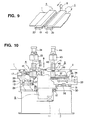
- Fig. 9 is a perspective view showing a condition immediately before the mushroom welding.
- the seam welding machine is adapted to weld a leading strip 1 and a trailing strip 2 together for continuous processing in a steel process line.
- reference numeral 2a denotes a trailing strip.
- the trailing strip 2a stands by above the trailing strip 2 to shorten the time for welding.
- a common base 3 is provided with an outlet side clamp device 4 for fixing the trailing strip 1 onto the common base 3 and an inlet side clamp device 5 for fixing the trailing strip 2 on to the common base 3.
- the upper and lower clamps mounted on the outlet side clamp device 4 are slantable relative to the common base 3.
- the inlet side clamp device 5 is adapted to be movable back and forth relative to the outlet side clamp device 4 on and along the common base 3.
- a carriage 6 is disposed between the outlet side clamp device 4 and the inlet side clamp device 5.
- a pair of disc electrodes 8 mounted on this carriage 6 are a pair of disc electrodes 8, a double-cut type shear unit (i.e., guillotine shear) 9 for simultaneously cutting the tail end of the leading strip 1 and the leading end of the trailing strip 2, a secondary conductor 7 for connecting the disc electrodes 8 and a welding transformer 10 with each other, and the like.
- the pair of disc electrodes 8 are adapted to apply a pressure and a current to the overlapped portion of the leading strip 1 and the trailing strip 2 while rotating it for resistance welding. Then, the carriage 6 is moved by means of a drive unit 11 along a pair of guide rails (not shown in Figs. 7 to 9) fixed on the common base 3.
- the upper and lower clamps 20 and 19 of the outlet side clamp device 4 are slanted, and furthermore, the inlet side clamp device 5 is forwarded so that the tail end portion of the leading strip 1 and the leading end portion of the trailing strip 2 are slightly overlapped with each other. Thereafter, the carriage 6 is moved pressurizing the overlapped end portions of the two strips 1 and 2 by the pair of disc electrodes 8 while pressurizing them and applying the current thereto to thereby perform welding by resistance heat.
- Figs. 10 and 11 are a front view and a side elevational view showing the structure of the seam welding machine, respectively.
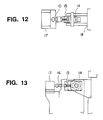
- Fig. 12 is a plan view of a spherical bearing portion of the outlet side clamp device.
- Fig. 13 is a front view of the same.
- the outlet side clamp device 4, the inlet side clamp device 5 and the carriage 6 are mounted on the common base 3.
- the carriage 6 is laid on the guide rails 12 fixed between the outlet side clamp device 4 and the inlet side clamp device 5 on the common base 3 and adapted to move along the guide rails 12 by the drive unit 11.
- a support base 30 is mounted on the common base 3 and a pair of guide rails 31 are fixed to the support base 30.
- a base 33 is laid on the guide rails 31.
- the base 33 is moved in a direction perpendicular to the paper surface of Fig. 10 by driving a cylinder 32.
- This structure is adapted to identify the position in the widthwise direction of the leading strip 1 fixed by the outlet side clamp device 4 with the position in the widthwise direction of the trailing strip 2 fixed by the inlet side clamp device 5.
- the structure thus described so far is a widthwise alignment mechanism of the trailing strip mounted on the inlet side clamp device 5.
- Two guide rails 37 and a retracted position determining stop 34 are mounted on the base 33.
- a moving base 38 is laid on the base 33 to be slidable.
- the moving base 38 is slid, i.e., moved back and forth on the guide rails in the right and left direction (Y1-Y2 direction) by driving a moving cylinder 36.
- the moving base 38 is stopped in a position where a retracted position determining stop 35 mounted on the moving base 38 is in abutment with the retracted position determining stop 34 mounted on the base 33 when retracting, and is stopped by a stop (not shown) also in forward motion.
- both end portions of the leading strip 1 and the trailing strip 2 are welded together, and in the stop position upon retracting motion of the base 33, both end portions of the leading strip 1 and the trailing strip 2 are cut simultaneously.
- the feed mechanism for feeding the trailing strip 2 in the moving direction when both ends, facing each other, of the two strips 1 and 2 are to be overlapped with each other is thus constructed.
- a lower clamp 39 and a lower end portion of a guide rod 42 are fixed to the moving base 38.
- the lower end portion of the guide rod 42 is fitted with a guide bush 41 mounted on an upper clamp 40.
- the upper end portion of the guide rod 42 is fixed to a beam 43.
- a clamp cylinder 44 is mounted on the beam 43 and the clamp cylinder 44 and the upper clamp 40 are coupled with each other by means of an operating rod (not shown) . Accordingly, the clamp cylinder 44 is driven so that the upper clamp 40 is moved up and down while being guided by the guide rod 42.
- the drive mechanism for the upper clamp 40 in the inlet side clamp device 5 is as described above and is adapted to work when the trailing strip 2 is to be fixed or released.
- the drive mechanism for the upper clamp 20 in the outlet side clamp device 4 is structured in the same manner as the drive mechanism of the upper clamp 40 in the above-described inlet side clamp device 5. That is, as shown in Fig. 10, the drive mechanism of the upper clamp 20 in the outlet side clamp device 4 is composed of a guide bush 21, a guide rod 22, a beam 23, a clamp cylinder 24 and the like. The clamp cylinder 24 and the upper clamp 20 are coupled with each other by means of an operating rod (not shown), and the clamp cylinder 24 is caused to work so that the upper clamp 20 is moved up and down while being guided by the guide rod 42.
- a support base 13 is mounted on the common base 3. Then, spherical bearings 14 supported by guide blocks 15 are arranged on the upper portion on both ends of the support base 13 in the direction perpendicular to the moving direction of the strips 1 and 2, respectively.
- a clamp base 18 is mounted to be rotatable relative to the support base 13 through both spherical bearings 14. Each guide block 15 is moved in a horizontal direction by drivingly rotating a screw 16 by a motor 17. Thus, the positions of both end portions of the clamp base 18 are adjusted so that the positions of both end portions in the tail end of the leading strip 1 may be adjusted.
- the tip end portion of a feed screw 28 that is an abutment portion for this stop 27 is adjusted by rotating the feed screw 28 by a motor 29 so that the tip end portion of the feed screw 28 is brought into contact with the stop 27.
- the overlap amount adjustment mechanism for both strips 1 and 2 is as described above and is provided on the outlet side clamp device 4.
- a lower portion of the clamp base 18 and a slanting cylinder 26 are articulated by means of a spherical bearing 25, and the slanting cylinder 26 is mounted rotatably to the common base 3.
- the clamp base 18 is slanted in counterclockwise in the paper surface of Fig. 10.
- a structure, particularly around the upper and lower clamps 20 and 19 in the outlet side clamp device 4 is lifted upwardly.
- the tail end portion of the leading strip 1 may be lifted so that the tail end portion of the leading strip 1 and the leading end portion of the trailing strip 2 may be overlapped with each other.
- the stop 27 is brought into abutment with the tip end portion of the feed screw 28 and the outlet side clamp device 4 is returned back to a predetermined horizontal position.
- the elevating device for lifting the upper and lower clamps 20 and 19 of the outlet side clamp device 4 is as described above.
- the portion constituted by the spherical bearings 14, the guide blocks 15, the motor 17, the screws 16, the clamp base 18, the lower clamp 19, the upper clamp 20, the guide bush 21, the guide rod 22, the beam 23, the clamp cylinder 24, the spherical bearings 25, the slanting cylinder 26, the feed screw 28 and the motor 29 is generally called the outlet side clamp device 4.
- the portion constituted by the support base 30, the guide rails 31, the cylinder 32, the base 33, the retracted position determining stop 34, the retracted position determining stop 35, the moving cylinder 36, the guide rails 37, the moving base 38, the lower clamp 39, the upper clamp 40, the beam 43 and the clamp cylinder 44 is generally called the input side clamp device 5.
- Fig. 14 is an explanatory view of a process for cutting the end portions of the two strips in mushroom welding.
- Fig. 15 is an explanatory view of a process for lifting up the tail end of the leading strip.
- Fig. 16 is an explanatory view of a condition where the overlapped end portions of the two strips in mushroom welding are welded.
- the strip In the steel process line, in the case where the strip being subjected to a continuous process such as acid washing, plating and heat processing, the strip travels in the direction indicated by the arrow in Fig. 7.
- the leading strip 1 is fed to reach a terminal, the leading strip 1 is introduced to the blade width of the double guillotine shears 9 and stopped there. Under this condition, the tip end portion of the trailing strip 2 is fed within the blade width of the double guillotine shears 9 and stopped there. Note that, in Fig. 7, in order to shorten the time for insertion of the trailing strip 2, i.e., the line stop time, the next trailing strip 2a is on standby above the trailing strip 2.
- the slanting cylinder 26 is caused to work to slant the clamp base 18, i.e., the upper and lower clamps 20 and 19 of the outlet side clamp device 4 to which the strip 1 is fixed. Furthermore, the inlet side clamp device 5 to which the trailing strip 2 is fixed is advanced so that the leading end portion of the trailing strip 2 is overlapped with the tail end portion of the leading strip 1. Then, the one side or both sides of the clamp base 18 are moved horizontally by rotating the screw 16 by the motor 17 so that the overlap amount of the end portions of the two strips 1 and 2 is adjusted. In this case, the adjustment is effected so that the overlap amount is increased from the weld start end to the weld terminal end (Fig. 15). Note that, as the clamp base 18 is moved, the adjustment is effected so that the tip end portion of the feed screw 28 is brought into contact with the stop 27 by drivingly rotating the screw 28 by the motor 29.
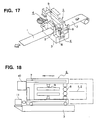
- FIGs. 17 and 18 show a concept of another conventional seam welding machine described in Japanese Patent Application Laid-Open No. Hei 10-329453.
- Fig. 17 is a perspective view showing the concept of the conventional seam welding machine.
- Fig. 18 is a side elevational view of a carriage portion of this seam welding machine.
- the components indicated by reference numerals 1 to 11 are the same as those of the above-described conventional seam welding machine.
- This conventional seam welding machine is improved in the shape of the frame of the carriage 6. It is changed from the conventional gate type (rectangular shape) to a C-shaped type (U-shaped). With such a change, it is possible to reduce the dimension of the carriage 6, i.e., the overall dimension including the common base 3.
- the feed mechanism for moving the trailing strip 2 when the two facing end portions of the two strips 1 and 2 are to be overlapped with each other and the widthwise alignment mechanism for the trailing strip are provided in the inlet side clamp device 5 in addition to the drive mechanism for the upper clamps 20 and 40 for gripping the strip, whereas the overlap amount adjustment mechanism of the two strips 1 and 2 and an elevating unit for lifting the upper and lower clamps 20 and 19 are provided in the outlet side clamp device 4. Accordingly, since the adjustment mechanism that is needed when the two facing end portions of the two strips 1 and 2 is diffused to the two clamp devices 4 and 5, it is difficult to enhance rigidity of both clamp devices 4 and 5.
- the pressure is applied between the end portions of the two strips 1 and 2 upon welding so that the force that tends to expand the interval between the two end portions is applied to the outlet side clamp device 4 and the inlet side clamp device 5.
- the two clamp devices 4 and 5 constitute a structure where it is difficult to enhance the rigidity as described above so that both of the devices are likely to be affected by the expanding force, resulting in unstability in welding quality.
- the frame shape of the carriage 6 is C-shaped resulting in weak rigidity of the frame.
- the pressure of the disc electrodes 8 is increased as in the case where the thickness of the strips 1 and 2 is increased, the upper disc electrode 8 escapes to the inlet side or the outlet side.
- the welding quality becomes unstable.
- the traveling guide rails have to be provided in the common base 3 so that the machine is enlarged to become very heavy.
- an object of the present invention is to provide a seam welding machine that may ensure the seam welding with high quality without increasing the size of the machine.
- a seam welding machine comprising: an outlet side clamp device for fixing a tail end of a leading strip; an inlet side clamp device arranged to face the outlet side clamp device at a predetermined interval for fixing a leading end of a trailing strip; a carriage adapted to be movable in a direction perpendicular to a moving direction of the leading and trailing strips between the inlet and outlet side clamp devices and provided with a shear unit for simultaneously cutting both end portions, facing each other, of the leading and trailing strips and a pair of disc electrodes for overlapping both end portions, facing each other, of the leading and trailing strips, pressurizing and applying a current while rotating along the overlapped portions, thereby welding; a common base on which mounted are the inlet side clamp device, the outlet side clamp device and the carriage; an adjustment mechanism for adjusting an overlap amount of the two end portions, facing each other, of the leading and trailing strips; an elevating mechanism for moving up and down upper and lower clamps to
- the mechanical rigidity of one of the clamp devices onto which the three mechanisms are concentrated i.e., the adjustment mechanism for adjusting the overlap amount, the elevating mechanism for moving the upper and lower clamps up and down and the feed mechanism for feeding the strips in the overlap direction is substantially the same as that of the conventional case, but the mechanical rigidity of the other clamp device may be considerably enhanced in comparison with the conventional case. Accordingly, it is generally possible to improve the quality of welding because the adverse effect of the expansion force upon welding is hardly received due to the increased mechanical rigidity of one clamp device.
- the adjustment mechanism includes a rotary mechanism for making it possible to rotate the clamp device relative to the common base in a horizontal direction and an angular adjustment mechanism for adjusting a fixed angle of the clamp device so that the overlap amount of the two end portions, facing each other, of the leading and trailing strips is increased from a weld start end to a weld terminal end.
- the angular adjustment mechanism includes two positioning stops for determining one of a forward and retracted positions of the two end portions in a direction perpendicular to the moving direction of the leading and trailing strips of the clamp device, and one of the two positioning stops is adapted to adjust the position thereof individually. With such an arrangement, it is possible to make the adjustment mechanism simpler.
- an upper portion of the carriage and an upper portion of the clamp device fixed to the common base are engaged with each other through guide rails.
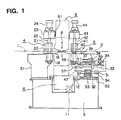
- Fig. 1 is a front view of a seam welding machine according to this invention.
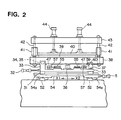
- Fig. 2 is a side view of the machine as viewed from the inlet side clamp device side.
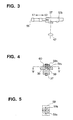
- Fig. 3 is a plan view of a stop portion that constitutes a primary part of an angular adjustment mechanism for adjusting a fixed angle of the inlet side clamp device.
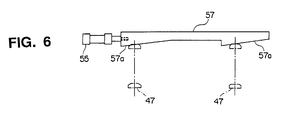
- Fig. 4 is a side cross-sectional view of a rotary mechanism that makes it possible to rotate an inlet side clamp device in the horizontal direction.
- Fig. 5 is a cross-sectional view taken along the line V-V of Fig. 4.
- An outlet side clamp device 4 in this embodiment is composed of a clamp base 18, a lower clamp 19, an upper clamp 20, a guide bush 21, a guide rod 22, a beam 23 and a clamp cylinder 24. Then, a clamp base 18 is fixed to a support base 51 fixed to a common base 3.
- the adjustment mechanism for adjusting the overlap amount of both facing end portions of two strips 1 and 2 i.e., the elevating mechanism for moving up and down the upper and lower clamps 20 and 19 to which the tail end of the above-described leading strip is fixed when both facing end portions of the two strips 1 and 2 are overlapped with each other is not provided in the outlet side clamp device 4 as in the conventional case.
- carriage traveling guide rails 61 are mounted on a side surface of a carriage 6 side of the upper side of the outlet side clamp device 4 .
- the upper side surface of the carriage 6 is slidably engaged with the carriage traveling guide rails 61. Accordingly, when the carriage 6 moves in a direction perpendicular to the moving direction of the strips 1 and 2, the mechanical rigidity is reinforced by the guide rails 61.
- an inlet side clamp device 5 will now be described.
- a lower clamp 39 and a guide rod 42 are fixed to a moving base 38, the lower end portion of the guide rod 42 is fitted in a guide bush 41 mounted on a upper clamp 40, a beam 43 is fixed to the upper end portion of the guide rod 42, a clamp cylinder 44 is mounted on the beam 43, and the clamp cylinder 44 and the upper clamp 40 are coupled with each other by means of an operating rod (not shown).
- the moving base 38 is mounted on two guide rails 37 so as to be moved in the Y1-Y2 direction by the drive of a moving cylinder 36 in the same manner as in the conventional case, the moving base 38 is not simply moved along the guide rails 37.
- the moving base 38 is mounted through two support seats 59 arranged and distributed on the respective guide rails 37. Namely, the support seats 59 are provided at four positions so as to be distributed at four corners of the moving base 38. Also, the upper portion of each support seat 59 is constituted as a shaft portion 59a.
- This shaft portion 59a passes through a base plate of the moving base 38 and is fixed by fastening means such as a screw through a retainer plate 60 made of steel from above the base plate off the moving base 38 so that the moving base 38 and the support seat 59 are coupled with each other.
- a gap 59b is provided between each shaft portion 59a and the base plate of the moving base 38.
- a retracted position determined stop 35 is provided in the moving base 38.
- a stop 34 facing the retracted position determining stop 35 is provided on a base 33.
- Stationary stops 47 are provided on the moving base 38 at two positions away in a direction perpendicular to the moving direction of the strips 1 and 2 as shown in Fig. 2 (see Figs. 1 to 3).
- Forward positioning stops 57 provided with slant stop surfaces 57a as shown in Fig. 3 are provided corresponding to the stops 47 on the base 33 side, respectively.
- the forward positioning stops 57 provided with the slant stop surfaces 57a may be moved in the right and left direction in Figs. 2 and 3 by driving an overlap amount adjustment cylinder 55.
- the forward positioning stops 57 are moved so that the position where the stationary stops 47 are in abutment is adjusted corresponding to the movement of the slant stop surfaces 57.
- the above-described rotary mechanism and the angular adjustment mechanism constitute an adjustment mechanism for adjusting the overlap amount of both facing end portions of the two strips 1 and 2 to be increased from the weld start end to the weld terminal end.
- the base 33 is not provided on the fixed support base as in the conventional system but is provided on a base 54 that may be moved up and down by the elevating unit.
- the elevating mechanism is composed of guide rails 52 fixed to the common base 3 and having slant surfaces with top surfaces slanted in the X1-X2 direction, the base 54 provided with a slant surface 54a slidably contactable with the slant surfaces of the top surfaces of the guide rails 52 and an elevating cylinder 53 for sliding the base 54 in the X1-X2 direction. Accordingly, when the elevating cylinder 53 is driven to cause the base 54 to slide in the X1-X2 direction, the base 54 carrying the inlet side clamp device 5 is moved up and down along the slanted surfaces.
- the upper clamps 20 and 40 are lowered by the clamp cylinders 24 and 25, a leading strip 1 is fixed by the upper clamp 20 and the lower clamp 19 and the trailing strip 2 is fixed by the upper clamp 40 and the lower clamp 39. Subsequently, the leading strip 1 and the trailing strip 2 are simultaneously cut by means of a double guillotine shears 9.
- the base 54 i.e., the inlet side clamp device 5 to which the trailing strip 2 is fixed is raised over a thickness of the leading strip 1 by operating the elevating cylinder 53.
- the moving cylinder 36 is operated so that the moving base 38, i.e., the inlet side clamp device 5 to which the trailing strip 2 is fixed is forwarded so that the forward positioning stops 47 are brought into contact with the forward positioning stops 57.
- the inlet side clamp device 5 is lowered by means of the above-described elevating cylinder 53 so that the terminal end portion of the leading strip 1 and the leading end portion of the trailing strip 2 are overlapped with each other.
- the positional adjustment of the position of each forward positioning stop 57 is effected by means of the overlap amount adjustment cylinder 55.
- the weld start side forward amount and the weld end side forward amount of the inlet side clamp device 5 are adjusted. That is, the forward position and the stationary angle of the inlet side clamp device 5 are adjusted.
- the overlap amount of the both facing end portions of the leading strip 1 and the trailing strip 2 may be adjusted easily so as to be increased from the weld start end to the weld terminal end.
- the carriage 6 is moved by means of a drive unit 11 under the condition that a pair of disc electrodes 8 are pressurized to the overlapped portions of the leading end portion of the trailing strip 2 with the trailing end portion of the leading strip 1 while rotating it and the current is caused to flow through a secondary conductor 7 by a welding transformer 10, whereby the overlapped portions of the leading strip 1 and the trailing strip 2 are welded together by resistance heat.
- a welding transformer 10 since the upper portion of the carriage 6 is coupled with the top portion of the outlet side clamp device 4 by the traveling guide rails 61, the mechanical rigidity of the carriage 6 is enhanced. It is therefore possible to suppress the escape of the top disc electrodes 8 in the inlet side or the outlet side direction.
- the fixture of the end portions of the two strips 1 and 2 by the inlet side clamp device 4 and the outlet side clamp device 5 is released to pass and send the welded leading and trailing strips 1 and 2 to the next processing unit.
- the adjustment mechanism includes a rotary mechanism for making it possible to rotate the clamp device relative to the common base in a horizontal direction and an angular adjustment mechanism for adjusting a fixed angle of the clamp device so that the overlap amount of the two end portions, facing each other, of the leading and trailing strips is increased from a weld start end to a weld terminal end, it is possible to increase the overlap amount of the trailing end portion of the leading strip and the leading end portion of the trailing strip from the weld start end to the weld terminal end with ease.
- the angular adjustment mechanism includes two positioning stops for determining one of a forward and retracted positions of the two end portions in a direction perpendicular to the moving direction of the clamp device, and one of the two positioning stops is adapted to adjust the position thereof individually, it is possible to simplify the adjustment mechanism.
Landscapes
- Engineering & Computer Science (AREA)
- Mechanical Engineering (AREA)
- Butt Welding And Welding Of Specific Article (AREA)
Applications Claiming Priority (2)
| Application Number | Priority Date | Filing Date | Title |
|---|---|---|---|
| JP2000372979 | 2000-12-07 | ||
| JP2000372979A JP3668932B2 (ja) | 2000-12-07 | 2000-12-07 | シーム溶接装置 |
Publications (3)
| Publication Number | Publication Date |
|---|---|
| EP1213086A2 true EP1213086A2 (de) | 2002-06-12 |
| EP1213086A3 EP1213086A3 (de) | 2003-11-05 |
| EP1213086B1 EP1213086B1 (de) | 2005-08-31 |
Family
ID=18842438
Family Applications (1)
| Application Number | Title | Priority Date | Filing Date |
|---|---|---|---|
| EP01115295A Expired - Lifetime EP1213086B1 (de) | 2000-12-07 | 2001-06-25 | Widerstand-Rollennahtschweissmaschine |
Country Status (3)
| Country | Link |
|---|---|
| EP (1) | EP1213086B1 (de) |
| JP (1) | JP3668932B2 (de) |
| DE (1) | DE60113045T2 (de) |
Cited By (4)
| Publication number | Priority date | Publication date | Assignee | Title |
|---|---|---|---|---|
| CN106271075A (zh) * | 2016-08-26 | 2017-01-04 | 武汉法利莱切焊系统工程有限公司 | 拼焊拼接机械手以及激光拼焊系统 |
| CN112109331A (zh) * | 2020-09-10 | 2020-12-22 | 廖菲 | 一种高精度板料叠合装置 |
| CN117086635A (zh) * | 2023-09-28 | 2023-11-21 | 南京众得利科技有限公司 | 一种地暖集水器多排孔加工组合机床 |
| CN118268728A (zh) * | 2024-04-07 | 2024-07-02 | 东莞市永勤精密技术有限公司 | 一种旋转式多角度镭雕装置 |
Family Cites Families (1)
| Publication number | Priority date | Publication date | Assignee | Title |
|---|---|---|---|---|
| JP2677097B2 (ja) * | 1992-02-06 | 1997-11-17 | 三菱電機株式会社 | シーム溶接装置 |
-
2000
- 2000-12-07 JP JP2000372979A patent/JP3668932B2/ja not_active Expired - Fee Related
-
2001
- 2001-06-25 EP EP01115295A patent/EP1213086B1/de not_active Expired - Lifetime
- 2001-06-25 DE DE60113045T patent/DE60113045T2/de not_active Expired - Lifetime
Cited By (5)
| Publication number | Priority date | Publication date | Assignee | Title |
|---|---|---|---|---|
| CN106271075A (zh) * | 2016-08-26 | 2017-01-04 | 武汉法利莱切焊系统工程有限公司 | 拼焊拼接机械手以及激光拼焊系统 |
| CN106271075B (zh) * | 2016-08-26 | 2018-05-22 | 武汉法利莱切焊系统工程有限公司 | 拼焊拼接机械手以及激光拼焊系统 |
| CN112109331A (zh) * | 2020-09-10 | 2020-12-22 | 廖菲 | 一种高精度板料叠合装置 |
| CN117086635A (zh) * | 2023-09-28 | 2023-11-21 | 南京众得利科技有限公司 | 一种地暖集水器多排孔加工组合机床 |
| CN118268728A (zh) * | 2024-04-07 | 2024-07-02 | 东莞市永勤精密技术有限公司 | 一种旋转式多角度镭雕装置 |
Also Published As
| Publication number | Publication date |
|---|---|
| EP1213086B1 (de) | 2005-08-31 |
| JP2002178159A (ja) | 2002-06-25 |
| DE60113045T2 (de) | 2006-03-02 |
| DE60113045D1 (de) | 2005-10-06 |
| JP3668932B2 (ja) | 2005-07-06 |
| EP1213086A3 (de) | 2003-11-05 |
Similar Documents
| Publication | Publication Date | Title |
|---|---|---|
| KR100254655B1 (ko) | 레이저빔에 의한 박판 용접장치 | |
| JP3721507B2 (ja) | バリ取り方法およびその装置 | |
| JPWO1996026036A1 (ja) | シーム溶接方法およびシーム溶接装置 | |
| US6572003B2 (en) | Seam welding apparatus and seam welding method | |
| US6635843B1 (en) | Strip connecting apparatus and method therefore | |
| US4721241A (en) | Welding apparatus assembled together with grinding device | |
| EP1213086B1 (de) | Widerstand-Rollennahtschweissmaschine | |
| US6640600B2 (en) | Bending device | |
| US3510045A (en) | Apparatus for joining strip material | |
| CN119057283B (zh) | 一种金属板包边激光焊接固定装置 | |
| CN119115552B (zh) | 一种用于金属带状材料的焊接设备 | |
| JP3087600B2 (ja) | レーザー溶接機 | |
| US4586644A (en) | Device for shearing aligning and welding metal sheets | |
| JP2677097B2 (ja) | シーム溶接装置 | |
| JP3604359B2 (ja) | サイドトリマーの幅変え機構およびその幅変え方法 | |
| RU2450900C1 (ru) | Способ подготовки концов полос к контактной стыковой сварке | |
| RU2450899C1 (ru) | Машина для контактной стыковой сварки полос | |
| JPS6116927Y2 (de) | ||
| JP3073038U (ja) | 極薄板突き合わせ溶接装置 | |
| JP2665234B2 (ja) | シャーリングマシン | |
| JP2002224842A (ja) | シーム溶接方法と溶接軌跡誘導装置 | |
| JPH0211999Y2 (de) | ||
| JP3558606B2 (ja) | シーム溶接装置 | |
| JP2025172572A (ja) | 帯状金属板の突合せ接合装置及び突合せ接合方法 | |
| JPH0519128Y2 (de) |
Legal Events
| Date | Code | Title | Description |
|---|---|---|---|
| PUAI | Public reference made under article 153(3) epc to a published international application that has entered the european phase |
Free format text: ORIGINAL CODE: 0009012 |
|
| AK | Designated contracting states |
Kind code of ref document: A2 Designated state(s): AT BE CH CY DE DK ES FI FR GB GR IE IT LI LU MC NL PT SE TR |
|
| AX | Request for extension of the european patent |
Free format text: AL;LT;LV;MK;RO;SI |
|
| PUAL | Search report despatched |
Free format text: ORIGINAL CODE: 0009013 |
|
| AK | Designated contracting states |
Kind code of ref document: A3 Designated state(s): AT BE CH CY DE DK ES FI FR GB GR IE IT LI LU MC NL PT SE TR |
|
| AX | Request for extension of the european patent |
Extension state: AL LT LV MK RO SI |
|
| 17P | Request for examination filed |
Effective date: 20031112 |
|
| AKX | Designation fees paid |
Designated state(s): DE FR |
|
| GRAP | Despatch of communication of intention to grant a patent |
Free format text: ORIGINAL CODE: EPIDOSNIGR1 |
|
| GRAS | Grant fee paid |
Free format text: ORIGINAL CODE: EPIDOSNIGR3 |
|
| GRAA | (expected) grant |
Free format text: ORIGINAL CODE: 0009210 |
|
| AK | Designated contracting states |
Kind code of ref document: B1 Designated state(s): DE FR |
|
| REF | Corresponds to: |
Ref document number: 60113045 Country of ref document: DE Date of ref document: 20051006 Kind code of ref document: P |
|
| RAP2 | Party data changed (patent owner data changed or rights of a patent transferred) |
Owner name: MITSUBISHI DENKI KABUSHIKI KAISHA |
|
| ET | Fr: translation filed | ||
| PLBE | No opposition filed within time limit |
Free format text: ORIGINAL CODE: 0009261 |
|
| STAA | Information on the status of an ep patent application or granted ep patent |
Free format text: STATUS: NO OPPOSITION FILED WITHIN TIME LIMIT |
|
| 26N | No opposition filed |
Effective date: 20060601 |
|
| REG | Reference to a national code |
Ref country code: FR Ref legal event code: PLFP Year of fee payment: 16 |
|
| REG | Reference to a national code |
Ref country code: FR Ref legal event code: PLFP Year of fee payment: 17 |
|
| REG | Reference to a national code |
Ref country code: FR Ref legal event code: PLFP Year of fee payment: 18 |
|
| PGFP | Annual fee paid to national office [announced via postgrant information from national office to epo] |
Ref country code: DE Payment date: 20180612 Year of fee payment: 18 |
|
| PGFP | Annual fee paid to national office [announced via postgrant information from national office to epo] |
Ref country code: FR Payment date: 20180511 Year of fee payment: 18 |
|
| REG | Reference to a national code |
Ref country code: DE Ref legal event code: R119 Ref document number: 60113045 Country of ref document: DE |
|
| PG25 | Lapsed in a contracting state [announced via postgrant information from national office to epo] |
Ref country code: DE Free format text: LAPSE BECAUSE OF NON-PAYMENT OF DUE FEES Effective date: 20200101 |
|
| PG25 | Lapsed in a contracting state [announced via postgrant information from national office to epo] |
Ref country code: FR Free format text: LAPSE BECAUSE OF NON-PAYMENT OF DUE FEES Effective date: 20190630 |