EP1213000A1 - Disposable undergarment - Google Patents
Disposable undergarment Download PDFInfo
- Publication number
- EP1213000A1 EP1213000A1 EP01310219A EP01310219A EP1213000A1 EP 1213000 A1 EP1213000 A1 EP 1213000A1 EP 01310219 A EP01310219 A EP 01310219A EP 01310219 A EP01310219 A EP 01310219A EP 1213000 A1 EP1213000 A1 EP 1213000A1
- Authority
- EP
- European Patent Office
- Prior art keywords
- skin
- contactable
- undergarment
- side edge
- longitudinal direction
- Prior art date
- Legal status (The legal status is an assumption and is not a legal conclusion. Google has not performed a legal analysis and makes no representation as to the accuracy of the status listed.)
- Granted
Links
Images





Classifications
-
- A—HUMAN NECESSITIES
- A61—MEDICAL OR VETERINARY SCIENCE; HYGIENE
- A61F—FILTERS IMPLANTABLE INTO BLOOD VESSELS; PROSTHESES; DEVICES PROVIDING PATENCY TO, OR PREVENTING COLLAPSING OF, TUBULAR STRUCTURES OF THE BODY, e.g. STENTS; ORTHOPAEDIC, NURSING OR CONTRACEPTIVE DEVICES; FOMENTATION; TREATMENT OR PROTECTION OF EYES OR EARS; BANDAGES, DRESSINGS OR ABSORBENT PADS; FIRST-AID KITS
- A61F13/00—Bandages or dressings; Absorbent pads
- A61F13/15—Absorbent pads, e.g. sanitary towels, swabs or tampons for external or internal application to the body; Supporting or fastening means therefor; Tampon applicators
- A61F13/45—Absorbent pads, e.g. sanitary towels, swabs or tampons for external or internal application to the body; Supporting or fastening means therefor; Tampon applicators characterised by the shape
- A61F13/49—Absorbent pads, e.g. sanitary towels, swabs or tampons for external or internal application to the body; Supporting or fastening means therefor; Tampon applicators characterised by the shape specially adapted to be worn around the waist, e.g. diapers or nappies
- A61F13/494—Absorbent pads, e.g. sanitary towels, swabs or tampons for external or internal application to the body; Supporting or fastening means therefor; Tampon applicators characterised by the shape specially adapted to be worn around the waist, e.g. diapers or nappies characterised by edge leakage prevention means
-
- A—HUMAN NECESSITIES
- A61—MEDICAL OR VETERINARY SCIENCE; HYGIENE
- A61F—FILTERS IMPLANTABLE INTO BLOOD VESSELS; PROSTHESES; DEVICES PROVIDING PATENCY TO, OR PREVENTING COLLAPSING OF, TUBULAR STRUCTURES OF THE BODY, e.g. STENTS; ORTHOPAEDIC, NURSING OR CONTRACEPTIVE DEVICES; FOMENTATION; TREATMENT OR PROTECTION OF EYES OR EARS; BANDAGES, DRESSINGS OR ABSORBENT PADS; FIRST-AID KITS
- A61F13/00—Bandages or dressings; Absorbent pads
- A61F13/15—Absorbent pads, e.g. sanitary towels, swabs or tampons for external or internal application to the body; Supporting or fastening means therefor; Tampon applicators
- A61F13/45—Absorbent pads, e.g. sanitary towels, swabs or tampons for external or internal application to the body; Supporting or fastening means therefor; Tampon applicators characterised by the shape
- A61F13/49—Absorbent pads, e.g. sanitary towels, swabs or tampons for external or internal application to the body; Supporting or fastening means therefor; Tampon applicators characterised by the shape specially adapted to be worn around the waist, e.g. diapers or nappies
- A61F13/494—Absorbent pads, e.g. sanitary towels, swabs or tampons for external or internal application to the body; Supporting or fastening means therefor; Tampon applicators characterised by the shape specially adapted to be worn around the waist, e.g. diapers or nappies characterised by edge leakage prevention means
- A61F13/49406—Absorbent pads, e.g. sanitary towels, swabs or tampons for external or internal application to the body; Supporting or fastening means therefor; Tampon applicators characterised by the shape specially adapted to be worn around the waist, e.g. diapers or nappies characterised by edge leakage prevention means the edge leakage prevention means being at the crotch region
- A61F13/49413—Absorbent pads, e.g. sanitary towels, swabs or tampons for external or internal application to the body; Supporting or fastening means therefor; Tampon applicators characterised by the shape specially adapted to be worn around the waist, e.g. diapers or nappies characterised by edge leakage prevention means the edge leakage prevention means being at the crotch region the edge leakage prevention means being an upstanding barrier
- A61F13/4942—Absorbent pads, e.g. sanitary towels, swabs or tampons for external or internal application to the body; Supporting or fastening means therefor; Tampon applicators characterised by the shape specially adapted to be worn around the waist, e.g. diapers or nappies characterised by edge leakage prevention means the edge leakage prevention means being at the crotch region the edge leakage prevention means being an upstanding barrier the barrier not being integral with the top- or back-sheet
-
- A—HUMAN NECESSITIES
- A61—MEDICAL OR VETERINARY SCIENCE; HYGIENE
- A61F—FILTERS IMPLANTABLE INTO BLOOD VESSELS; PROSTHESES; DEVICES PROVIDING PATENCY TO, OR PREVENTING COLLAPSING OF, TUBULAR STRUCTURES OF THE BODY, e.g. STENTS; ORTHOPAEDIC, NURSING OR CONTRACEPTIVE DEVICES; FOMENTATION; TREATMENT OR PROTECTION OF EYES OR EARS; BANDAGES, DRESSINGS OR ABSORBENT PADS; FIRST-AID KITS
- A61F13/00—Bandages or dressings; Absorbent pads
- A61F13/15—Absorbent pads, e.g. sanitary towels, swabs or tampons for external or internal application to the body; Supporting or fastening means therefor; Tampon applicators
- A61F13/45—Absorbent pads, e.g. sanitary towels, swabs or tampons for external or internal application to the body; Supporting or fastening means therefor; Tampon applicators characterised by the shape
- A61F13/49—Absorbent pads, e.g. sanitary towels, swabs or tampons for external or internal application to the body; Supporting or fastening means therefor; Tampon applicators characterised by the shape specially adapted to be worn around the waist, e.g. diapers or nappies
- A61F13/495—Absorbent pads, e.g. sanitary towels, swabs or tampons for external or internal application to the body; Supporting or fastening means therefor; Tampon applicators characterised by the shape specially adapted to be worn around the waist, e.g. diapers or nappies with faecal cavity
Definitions
- This invention relates to a disposable undergarment adapted to absorb body excretion and then to hold it.
- Japanese Utility Model Application Publication No. 1992-15921A discloses a disposable diaper comprising a liquid-pervious topsheet, a liquid-impervious base sheet, a liquid-absorbent panel disposed between these two sheets, and a non-stretchable apertured sheet having a plurality of pores wherein each of the apertures has an opening area of about 2mm 2 - about 100mm 2 .
- This diaper is partially depressed in its thickness direction to define a pocket for feces.
- the porous sheet has its length as measured in a longitudinal direction shorter than that of the diaper and longitudinally opposite end portions of this apertured sheet are bonded to longitudinally opposite end portions of the diaper so as to cover the topsheet.
- the longitudinally opposite end portions lie above a level of the topsheet so that a longitudinally middle region of the apertured sheet is spaced upward from the topsheet and thereby defines a space between the topsheet and the apertured sheet.
- the apertured sheet has a plurality of apertures each dimensioned to pass body excretion such as urine or loose feces and therefore such excretion still held on the topsheet may flow back as the apertured sheet and the topsheet come in contact with each other.
- the apertured sheet is not elastically stretchable in the longitudinal direction of the diaper.
- the apertured sheet has no elastic force under which the longitudinally middle region of the apertured sheet is spaced upward from the topsheet as the diaper curves in the longitudinal direction with the topsheet inside and thereby this middle region comes in close contact with the wearer's crotch region.
- the apertured sheet is slackened and its longitudinally middle region comes in contact with the topsheet. Consequently, the amount of body excretion flowing back through the apertured sheet may cling to the wearer's skin.
- a disposable undergarment comprising a liquid-impervious base sheet contoured by longitudinally opposite end portions extending in a transverse direction and transversely opposite side edge portions extending in a longitudinal direction, and a liquid-absorbent panel attached to the base sheet wherein the article has a skin-contactable surface on which the panel lies and a non skin-contactable surface opposed to the skin-contactable surface.
- the skin-contactable sheets being stretchable in the longitudinal direction and substantially liquid-impervious are attached under extension in the longitudinal direction to the skin-contactable surface of the undergarment so as to cover the panel, the skin-contactable sheets having fixed surface areas secured to the longitudinally opposite end portions, respectively, and free surface areas extending between respective pairs of the fixed surface areas and not fixed to the undergarment so as to be spaced upward from the panel as the article curves in the longitudinal direction with its skin-contactable surface inside, wherein the skin-contactable surface of the article is provided with regions in which the skin-contactable sheets are absent so that the skin-contacting surface inclusive of the panel is partially surface in the regions.
- the skin-contactable sheets actually comprise a pair of belt-like strips spaced from and opposed to each other in the transverse direction and respectively extending along the transversely opposite side edge portions of the undergarment in the longitudinal direction so that the skin-contactable surface inclusive of the panel may be partially surfaced between these skin-contactable sheets.
- the undergarment further comprises a pair of substantially liquid-impervious leak-barrier cuffs spaced apart from and opposed to each other in the transverse direction and respectively extending along the transversely opposite side edge portions of the undergarment, the leak-barrier cuffs being disposed between the base sheet and the skin-contactable sheets and attached under extension in the longitudinal direction to the skin-contacting surface of the undergarment, the leak-barrier cuffs having fixed side edge portions secured to the transversely opposite side edge portions of the undergarment and extending in the longitudinal direction, free side edge portions being stretchable in the longitudinal direction and normally biased to rise on the skin-contactable surface and longitudinally opposite fixed end portions collapsed onto the skin-contactable surface and fixed to the longitudinally opposite end portions of the undergarment in such collapsed state so that the free surface area of the skin-contactable sheet is kept spaced upward from the free side edge portions of the leak-barrier cuffs.
- the skin-contactable sheet is made of an elastically stretchable fibrous nonwoven fabric.
- the skin-contactable sheet is made of a non-stretchable fibrous nonwoven fabric and elastically stretchable members are attached under extension in the longitudinal direction to the non-stretchable fibrous fabric so that the skin-contactable sheet may have stretchability in the longitudinal direction.
- Fig 1 is a partially cutaway perspective view of the diaper 1A viewed from the side of a skin-contactable surface 1a thereof
- Fig. 2 is a partially cutaway perspective view of the diaper 1A in a state of being worn with front and rear waist regions 20, 22 thereof connected to each other
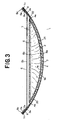
- Fig. 3 is a sectional view taken along a line A - A in Fig. 1
- Fig. 4 is a sectional view of the diaper taken along a line B - B in Fig. 1.
- a longitudinal direction is indicated by an arrow Y and a transverse direction is indicated by an arrow X.
- the surface referred to herein as the skin-contactable surface 1a should be understood to be the surface of the diaper 1A intended to be opposed to the wearer's skin and the surface of the diaper 1A referred to herein as a non skin-contactable surface 1b should be understood to be the surface of the diaper 1A intended to be not opposed to the wearer's skin when the diaper 1A is put on the wearer's body.
- the diaper 1A comprises a liquid-pervious topsheet 2, a liquid-impervious base sheet 3 and a liquid-absorbent panel 4 disposed between these topsheet 2 and base sheet 3, and this panel 4 is entirely covered with and bonded to tissue paper (not shown).
- the panel 4 is bonded to the topsheet 2 as well as to the base sheet 3 with the tissue paper lying therebetween.
- the diaper 1A comprises substantially liquid-impervious skin-contacting sheets 5 and substantially liquid-impervious leak-barrier cuffs 6.
- the diaper 1A is composed, in the longitudinal direction, of a front waist region 20, a rear waist region 22 and a crotch region 21 extending between these front and rear waist regions 20, 22, and has longitudinally opposite end portions 1c and transversely opposite side edge portions 1d. In the crotch region 21, the transversely opposite side edge portions 1d are curved inward by in the transverse direction like an ark.
- the topsheet 2 defines the skin-contactable surface 1a and the base sheet 3 defines the non skin-contacting surface 1b.
- the skin-contactable sheets 5 actually comprise a pair of belt-like strips spaced apart from and opposed to each other in the transverse direction and extending along the respective side edge portions 1d in the longitudinal direction. These skin-contacting sheets 5 are made of a fibrous nonwoven fabric having elastic stretchability in the longitudinal direction as well as in the transverse direction. The skin-contactable sheets 5 are attached under extension in the longitudinal direction to the skin-contactable surface 1a.
- the skin-contactable sheets 5 respectively have fixed surface areas 5a secured to the longitudinally opposite end portions 1c and free surface areas 5b extending between the fixed surface areas 5a and not fixed to the diaper 1A so that the respective free surface areas 5b intermittently cover the vicinity of transversely opposite side edges 4b of the panel 4 with the topsheet 2 lying therebetween.
- the tensile force of the respective skin-contactable sheets 5 enables the free surface areas 5b thereof to be separated upward from the panel 4 as the diaper 1A curves in the longitudinal direction with the topsheet 2 inside. Between these skin-contactable sheets 5, the topsheet 2 is partially surfaced.
- the leak-barrier cuffs 6 are disposed between the topsheet 2 and the skin-contactable sheets 5 so as to be spaced apart from and opposed to each other in the transverse direction and to extend along the respective side edge portions 1d in the longitudinal direction.
- the leak-barrier cuffs 6 respectively comprise fixed side edge portions 6a secured to the respective side edge portions 1d, free side edge portions 6b adapted to rise on the topsheet 2 and fixed longitudinally opposite end portions 6c collapsed inward in the transverse direction of the diaper 1A and fixed to the associated longitudinally opposite end portions 1c in such collapsed state.
- the leak-barrier cuffs 6 further comprise outermost lateral portions 6d extending outward from the respective fixed side edge portions 6a in the transverse direction.
- the fixed side edge portions 6a extend in the longitudinal direction immediately outside the transversely opposite side edges 4b of the panel 4.
- the free side edge portions 6b extend in the longitudinal direction in parallel to the respective fixed side edge portions 6a.
- the free side edge portions 6b are respectively provided with elastic members 7 bonded under extension thereto. These elastic members 7 associated with the respective cuffs are covered with parts of the respective free side edge portions 6b.
- the longitudinally opposite end portions 1c of the diaper 1A are respectively provided with ribbon-like elastic members 8 extending in the transverse direction bonded under extension thereto.
- the transversely opposite side edge portions 1d are respectively provided with a plurality of elastic members 9 extending in the longitudinal direction bonded under extension thereto.
- the transversely opposite side edge portions 1d are respectively provided with tape fasteners 10 extending inward in the transverse direction.
- the tape fasteners 10 respectively have proximal end portions disposed between the base sheet 3 and the outermost lateral portions 6d of the associated leak-barrier cuffs 6 and bonded to them.
- the tape fasteners 10 respectively have free end portions coated with pressure-sensitive adhesive (not shown).
- the non skin-contactable surfaces 1b is provided with a rectangular target tape strip 11 (See Fig. 2) made of a plastic film.
- the target tape strip 11 serves as a fastening zone for the tape fasteners 10.
- the transversely opposite side edge portions 1d in the rear waist region 22 may be placed upon the outer side of the transversely opposite side edge portions 1d in the front waist region 20, then the free end portions of the respective tape fasteners 10 may be anchored on the target tape strip 11 by means of the pressure-sensitive adhesive to connect the front waist region 20 with the rear waist region 22.
- a waist-opening 12 and a pair of leg-openings 13 are defined in the diaper 1A, as seen in Fig. 2, as the front and rear waist regions 20, 22 are connected to each other in the manner as described above.
- the diaper 1A curves in the longitudinal direction with the topsheet 2 inside whereupon contract of the elastic members 7 associated with the respective leak-barrier cuffs 6 causes the free side edge portions 6b of the respective cuffs 6 to rise on the topsheet 2 and the tension of the skin-contactable sheets 5 causes the free surface areas 5b thereof to be spaced above the free side edge portions 6b of the leak-barrier cuffs 6.
- the free surface areas 5b of the respective skin-contactable sheets 5 spaced above the free side edge portions 6b of the respective cuffs 6 are reliably maintained in close contact with the wearer's crotch region. Specifically, it is not likely that the skin-contactable sheets 5 might slide away from the wearer's crotch region even if the diaper 1A moves from its initial position to some degree due to movement of the wearer.
- the skin-contactable sheets 5 disposed between the wearer's skin and the topsheet 2 advantageously prevent urine or loose feces held on the topsheet 2 from clinging to the wearer's skin.
- the skin-contactable sheets 5 are made of a liquid-impervious fibrous nonwoven fabric and therefore are capable of preventing any quantity of urine or loose feces held on the topsheet 2 from permeating these skin-contactable sheets 5 and clinging to the wearer's skin even if the skin-contactable sheets 5 come in contact with the topsheet 2.
- the free side edge portions 6b of the leak-barrier cuffs 6 rising on the topsheet 2 form barriers against excretion such as urine or loose feces which may spread over the topsheet 2 and reach the transversely opposite side edge portions 1d of the diaper 1A and these barriers reliably prevent such excretion from leaking beyond the respective side edge portions 1d.
- the free surface areas 5b of the skin-contactable sheets 5 are kept to be spaced above the free side edge portions 6b of the respective leak-barrier cuffs 6 and therefore there is no anxiety that the free surface areas 5b might collapse the free side edge portion from above and thereby impair the desired function of the free side edge portions 6b as the barriers.
- the longitudinally opposite end portions 2a of the topsheet 2 and the longitudinally opposite end portions 3a of the base sheet 3 extend outward beyond the longitudinally opposite edges 4a of the core 4 in the longitudinal direction so that these end portions 2a, 3a are overlaid with each other and bonded together.
- the fixed end portions 6c of the respective leak-barrier cuffs 6 are bonded to the end portions 2a of the topsheet 2.
- the fixed surface areas 5a of the respective skin-contactable sheets 5 are bonded to the end portions 2a of the topsheet 2 as well as to the fixed end portions 6c of the respective leak-barrier cuffs 6.
- the elastic members 8 associated with the waist-opening are disposed between and bonded to the respective end portions 2a and end portions 3a.
- the transversely opposite side edge portions 2b of the topsheet 2 extend outward slightly beyond transversely opposite side edges 4b of the core 4 in the transverse direction and the transversely opposite side edge portions 3b of the base sheet 3 as well as the outermost lateral portions 6d of the leak-barrier cuffs 6 extend further outward beyond the side edge portions 2b of the topsheet 2 in the transverse direction.
- the side edge portions 2b of the topsheet 2 are disposed between and bonded to the side edge portions 3b and the outermost lateral portions 6d, respectively.
- the side edge portions 3b and the outermost lateral portions 6d are overlaid with each other and bonded together.
- the fixed side edge portions 6a of the respective leak-barrier cuffs 6 are bonded to the respective side edge portions 2b of the topsheet 2.
- the elastic members 9 associated with the leg-openings are disposed between and bonded to the side edge portions 3b of the base sheet 3 and the outermost lateral portions 6d of the leak-barrier cuffs 6, respectively.
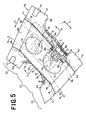
- Fig. 5 is a partially cutaway perspective view showing a diaper 1B according to another embodiment of this invention
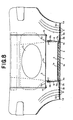
- Fig. 6 is a partially cutaway perspective view showing this diaper 1B as put on the wearer's body with the front and rear waist regions 20, 22 connected to each other and
- Fig. 7 is a sectional view taken along a line A - A in Fig. 5
- Fig. 8 is a sectional view taken along a line B - B in Fig. 5.
- the longitudinal direction is indicated by an arrow Y and the transverse direction is indicated by an arrow X.
- the diaper 1B shown in Fig. 5 is distinguished from the diaper 1A shown in Fig. 1 in arrangement as will be described.
- the skin-contacting sheet 5 is formed by a non-stretchable fibrous nonwoven fabric presenting a substantially rectangular shape which is larger in the longitudinal direction.
- the skin-contactable sheet 5 is provided along transversely opposite side edge portions 5c thereof with longitudinally extending elastic members 16 bonded under extension thereto, respectively, so that the skin-contactable sheet 5 may be stretchable in the longitudinal direction.
- the elastic members 16 are covered with parts of the respective side edge portions 5c.
- the skin-contactable sheet 5 is attached under extension in the longitudinal direction to the skin-contactable surface 1a of the diaper 1B.
- the skin-contactable sheet 5 has the fixed surface areas 5a secured to the longitudinally opposite end portions 1c of the diaper 1B and the free surface area 5b extending between the fixed surface areas 5a and not fixed to the diaper 1B so that the free surface area 5b indirectly cover the panel 4 substantially over its entire area with the topsheet 2 lying therebetween.
- the free surface area 5b of the skin-contactable sheet 5 defines an opening 14 in the front waist region 20 and an opening 15 in the rear waist region 22.
- the topsheet 2 is partially surfaced in these openings 14, 15.
- the tensile force of the skin-contactable sheet 5 enables its free surface area 5b to be separated upward from the panel 4 as the diaper 1B curves in the longitudinal direction with the topsheet 2 inside.
- the free side edge portions 6b of the respective leak-barrier cuffs 6 rise on the topsheet 2 as the elastic members 7 associated therewith contract and the free surface area 5b of the skin-contactable sheet 5 is spaced upward from the free side edge portions 6b of the leak-barrier cuffs 6, as will be apparent from Fig. 6.
- the openings 14, 15 of the skin-contactable sheet 5 correspond to the positions of the urinary organs and the anus of the wearer, respectively, as the diaper 1B is worn.
- the skin-contactable sheet 5 is maintained in close contact with the wearer's crotch region more stably than in the case of the paired skin-contactable sheets 5 and the preventive effect against the anxiety that the amount of urine or loose feces held on the topsheet 2 might cling to the wearer's skin can be correspondingly improved.
- the free side edge portions 6b of the respective leak-barrier cuffs 6 rising on the topsheet 2 advantageously function as the barriers as in the case of Fig. 1 and therefore there is not likely that urine or loose feces might leak beyond the transversely opposite side edge portions 1d of the diaper 1B.
- the skin-contactable sheets 5 in Fig. 1 may be formed using an elastically stretchable hydrophobic fibrous nonwoven fabric obtained by the melt blown or spun bond process.
- Component fiber of such elastic stretchable nonwoven fabric may be stretchable fibers may be stretchable fibers obtained by melting and spinning thermoplastic elastomer resin.
- the elastically stretchable fibrous nonwoven fabric may be a composite nonwoven fabric consisting of a hydrophobic fibrous nonwoven fabric made of thermoplastic elastomer resin fiber and a hydrophobic fibrous nonwoven fabric comprising crimped fiber which is obtained by melting and spinning thermoplastic synthetic resin such as polypropylene, polyethylene or polyester bonded to at least one surface of the hydrophobic fibrous nonwoven fabric.
- the topsheet 2 may be formed of a hydrophilic fibrous nonwoven fabric or finely porous plastic film.
- the base sheet 3 may be formed of a hydrophobic fibrous nonwoven fabric, a liquid-impervious plastic film, a two-layered hydrophobic nonwoven fabric, or a composite sheet consisting of hydrophobic fibrous nonwoven fabric laminated with a plastic film.
- the skin-contacting sheet 5 as well as the leak-barrier cuffs 6 in Fig. 6 may be formed of a hydrophobic fibrous nonwoven fabric.
- the base sheet 3 as well as the skin-contactable sheet 5 and the leak-barrier cuffs 6 as shown in Fig. 6 using a composite nonwoven fabric comprising a melt blown fibrous nonwoven fabric with a high water-resistance property sandwiched between two layers of spun bond fibrous nonwoven fabric having high strength and flexibility.
- the nonwoven fabric used as stock material for the topsheet 2 and the base sheet 3 as well as for the skin-contactable sheet 5 and the leak-barrier cuffs 6 as shown in Fig. 6 may be selected from a group consisting of those obtained by spun lacing, needle punching, melt blowing, thermal bonding, spun bonding, chemical bonding and air-through processes.
- the component fiber of such nonwoven fabric may be selected from a group consisting of polyolefine-, polyester- and polyamide-fiber, and core-sheath type conjugated fiber or side-by-side type conjugated fiber of polyethylene/polypropylene or polyethylene/polyester.
- the core 4 comprises a mixture of fluff pulp and superabsorptive polymer particles or a mixture of fluff pulp, superabsorptive polymer particles and thermoplastic synthetic resin fiber compressed to a desired thickness.
- the superabsorptive polymer may be selected from a group consisting of starch-based polymer, cellulose-based polymer and synthetic polymer.
- the panel 4 preferably comprises fibrous web with appropriate compressive restoring elasticity, which contains the superabsorptive polymer particles dispersed and held in fiber-interstices thereof and which has been compressed to a desired thickness to give a shape stability.
- the component fiber of such fibrous web may be selected from a group consisting of polyolefine-based fiber such as polypropylene or polyethylene, polyester-based fiber such as polyethylene terephthalate, polyamide-based fiber such as nylon 66 or nylon 6, acryl-based fiber, and cellulose-based fiber such as pulp, rayon or acetate.
- Bonding between the topsheet 2 and the base sheet 3, fixing of the skin-contactable sheets 5 and the leak-barrier cuffs 6, joining of the core 4, and attachment of the respective elastic members 7, 8, 9, 16 may be achieved using hot melt adhesive or heat welding technique such as heat-sealing or sonic-sealing.
- This invention is applicable not only to the open-type diaper but also to a pants-type diaper having its front and rear waist regions previously connected to each other.
- the free surface areas of the respective skin-contactable sheets are spaced upward from the liquid-absorbent panel by tensile force of the skin-contactable sheets as the undergarment longitudinally curved with its skin-contactable surface inside.
- the free surface areas of the respective skin-contactable sheets are kept in sufficiently close contact with the wearer's crotch region to prevent the skin-contactable sheets from getting out of the wearer's crotch region even if the undergarment moves away due to movement of the wearer's body.
- the skin-contactable sheets disposed between the wearer's skin and the skin-contactable surface of the undergarment are substantially liquid-impervious, so there is no anxiety that any amount of urine or loose feces still held on the skin-contactable surface might cling to the wearer's skin. Should the skin-contactable sheets come in contact with the skin-contactable surface, there is no fear that such excretion still held on the skin-contactable surface might permeate the skin-contactable sheets and cling to the wearer's skin.
- the leak-barrier cuffs respectively extend along the transversely opposite side edge portions of the article in the longitudinal direction
- contraction of the elastic members associated with these leak-barrier cuffs causes the free side edge portions of these leak-barrier cuffs to rise on the skin-contactable surface as the article is put on the wearer's body.
- the free side edge portions rising in this manner form the barriers against urine or loose feces so that such excretion is reliably prevented thereby from leaking beyond the transversely opposite side edge portions of the article even when such excretion spreads on the skin-contacting surface and then reaches the side edge portions of the undergarment.
- the free surface areas of the respective skin-contactable sheets remain spaced upward from the free side edge portions of the respective leak-barrier cuffs so that the free side edge portions can reliably function as the barriers without being collapsed downward by the free surface area.
Landscapes
- Health & Medical Sciences (AREA)
- Epidemiology (AREA)
- Engineering & Computer Science (AREA)
- Biomedical Technology (AREA)
- Heart & Thoracic Surgery (AREA)
- Vascular Medicine (AREA)
- Life Sciences & Earth Sciences (AREA)
- Animal Behavior & Ethology (AREA)
- General Health & Medical Sciences (AREA)
- Public Health (AREA)
- Veterinary Medicine (AREA)
- Absorbent Articles And Supports Therefor (AREA)
- Orthopedics, Nursing, And Contraception (AREA)
Abstract
Description
- This invention relates to a disposable undergarment adapted to absorb body excretion and then to hold it.
- Japanese Utility Model Application Publication No. 1992-15921A discloses a disposable diaper comprising a liquid-pervious topsheet, a liquid-impervious base sheet, a liquid-absorbent panel disposed between these two sheets, and a non-stretchable apertured sheet having a plurality of pores wherein each of the apertures has an opening area of about 2mm2 - about 100mm2. This diaper is partially depressed in its thickness direction to define a pocket for feces. The porous sheet has its length as measured in a longitudinal direction shorter than that of the diaper and longitudinally opposite end portions of this apertured sheet are bonded to longitudinally opposite end portions of the diaper so as to cover the topsheet. The longitudinally opposite end portions lie above a level of the topsheet so that a longitudinally middle region of the apertured sheet is spaced upward from the topsheet and thereby defines a space between the topsheet and the apertured sheet.
- With this diaper of prior art, loose feces is guided through the apertures of the apertured sheet into the pocket and only a small amount of loose feces held on the apertured sheet may cling to the wearer's skin. In this way, eruption of the wearer's skin due to loose feces clinging thereto can be minimized.
- The apertured sheet has a plurality of apertures each dimensioned to pass body excretion such as urine or loose feces and therefore such excretion still held on the topsheet may flow back as the apertured sheet and the topsheet come in contact with each other. With this diaper of prior art, the apertured sheet is not elastically stretchable in the longitudinal direction of the diaper. In other words, the apertured sheet has no elastic force under which the longitudinally middle region of the apertured sheet is spaced upward from the topsheet as the diaper curves in the longitudinal direction with the topsheet inside and thereby this middle region comes in close contact with the wearer's crotch region. With this known diaper put on the wearer's body, the apertured sheet is slackened and its longitudinally middle region comes in contact with the topsheet. Consequently, the amount of body excretion flowing back through the apertured sheet may cling to the wearer's skin.
- It is an object of this invention to provide a disposable undergarment provided with skin-contactable sheets adapted to be placed very stably against the wearer's crotch region as the undergarment is put on the wearer's body and thereby to prevent an amount of urine or loose feces still held on a skin-contactable surface of the undergarment from clinging to the wearer's skin.
- According to this invention, there is provided a disposable undergarment comprising a liquid-impervious base sheet contoured by longitudinally opposite end portions extending in a transverse direction and transversely opposite side edge portions extending in a longitudinal direction, and a liquid-absorbent panel attached to the base sheet wherein the article has a skin-contactable surface on which the panel lies and a non skin-contactable surface opposed to the skin-contactable surface.
- The skin-contactable sheets being stretchable in the longitudinal direction and substantially liquid-impervious are attached under extension in the longitudinal direction to the skin-contactable surface of the undergarment so as to cover the panel, the skin-contactable sheets having fixed surface areas secured to the longitudinally opposite end portions, respectively, and free surface areas extending between respective pairs of the fixed surface areas and not fixed to the undergarment so as to be spaced upward from the panel as the article curves in the longitudinal direction with its skin-contactable surface inside, wherein the skin-contactable surface of the article is provided with regions in which the skin-contactable sheets are absent so that the skin-contacting surface inclusive of the panel is partially surface in the regions.
- According to one preferred embodiment of this invention, the skin-contactable sheets actually comprise a pair of belt-like strips spaced from and opposed to each other in the transverse direction and respectively extending along the transversely opposite side edge portions of the undergarment in the longitudinal direction so that the skin-contactable surface inclusive of the panel may be partially surfaced between these skin-contactable sheets.
- According to another preferred embodiment of this invention, the undergarment further comprises a pair of substantially liquid-impervious leak-barrier cuffs spaced apart from and opposed to each other in the transverse direction and respectively extending along the transversely opposite side edge portions of the undergarment, the leak-barrier cuffs being disposed between the base sheet and the skin-contactable sheets and attached under extension in the longitudinal direction to the skin-contacting surface of the undergarment, the leak-barrier cuffs having fixed side edge portions secured to the transversely opposite side edge portions of the undergarment and extending in the longitudinal direction, free side edge portions being stretchable in the longitudinal direction and normally biased to rise on the skin-contactable surface and longitudinally opposite fixed end portions collapsed onto the skin-contactable surface and fixed to the longitudinally opposite end portions of the undergarment in such collapsed state so that the free surface area of the skin-contactable sheet is kept spaced upward from the free side edge portions of the leak-barrier cuffs.
- According to still another preferred embodiment of this invention, the skin-contactable sheet is made of an elastically stretchable fibrous nonwoven fabric.
- According to further another preferred embodiment of this invention, the skin-contactable sheet is made of a non-stretchable fibrous nonwoven fabric and elastically stretchable members are attached under extension in the longitudinal direction to the non-stretchable fibrous fabric so that the skin-contactable sheet may have stretchability in the longitudinal direction.
- Fig. 1 is a perspective view of a diaper viewed from skin-contacting surface thereof as partially broken away;
- Fig. 2 is a partially cutaway perspective view of the diaper in a state worn with front and rear waist regions thereof connected to each other;
- Fig. 3 is a sectional view of the diaper taken along a line A - A in Fig. 1;
- Fig. 4 is a sectional view of the diaper taken along a line B - B in Fig. 1;
- Fig. 5 is a partially cutaway perspective view of another embodiment of the diaper;
- Fig. 6 is a partially cutaway perspective view of another embodiment of the diaper in a state of being worn with front and rear waist regions thereof connected to each other;
- Fig. 7 is a sectional view of the diaper taken along a line C - C in Fig. 5; and
- Fig. 8 is a sectional view of the diaper taken along a line D - D in Fig. 5.
-
- Details of a disposable undergarment according to this invention will be more fully understood from the description of an open-type diaper given hereunder with reference to the accompanying drawings as a typical embodiment of this invention.
- Fig 1 is a partially cutaway perspective view of the
diaper 1A viewed from the side of a skin-contactable surface 1a thereof, Fig. 2 is a partially cutaway perspective view of thediaper 1A in a state of being worn with front andrear waist regions contactable surface 1a should be understood to be the surface of thediaper 1A intended to be opposed to the wearer's skin and the surface of thediaper 1A referred to herein as a non skin-contactable surface 1b should be understood to be the surface of thediaper 1A intended to be not opposed to the wearer's skin when thediaper 1A is put on the wearer's body. - The
diaper 1A comprises a liquid-pervious topsheet 2, a liquid-impervious base sheet 3 and a liquid-absorbent panel 4 disposed between thesetopsheet 2 andbase sheet 3, and thispanel 4 is entirely covered with and bonded to tissue paper (not shown). Thepanel 4 is bonded to thetopsheet 2 as well as to thebase sheet 3 with the tissue paper lying therebetween. In addition to thesesheets panel 4, thediaper 1A comprises substantially liquid-impervious skin-contacting sheets 5 and substantially liquid-impervious leak-barrier cuffs 6. - The
diaper 1A is composed, in the longitudinal direction, of afront waist region 20, arear waist region 22 and acrotch region 21 extending between these front andrear waist regions opposite end portions 1c and transversely oppositeside edge portions 1d. In thecrotch region 21, the transversely oppositeside edge portions 1d are curved inward by in the transverse direction like an ark. Of thediaper 1A, thetopsheet 2 defines the skin-contactable surface 1a and thebase sheet 3 defines the non skin-contactingsurface 1b. - The skin-
contactable sheets 5 actually comprise a pair of belt-like strips spaced apart from and opposed to each other in the transverse direction and extending along the respectiveside edge portions 1d in the longitudinal direction. These skin-contactingsheets 5 are made of a fibrous nonwoven fabric having elastic stretchability in the longitudinal direction as well as in the transverse direction. The skin-contactable sheets 5 are attached under extension in the longitudinal direction to the skin-contactable surface 1a. The skin-contactable sheets 5 respectively havefixed surface areas 5a secured to the longitudinallyopposite end portions 1c andfree surface areas 5b extending between thefixed surface areas 5a and not fixed to thediaper 1A so that the respectivefree surface areas 5b intermittently cover the vicinity of transverselyopposite side edges 4b of thepanel 4 with thetopsheet 2 lying therebetween. - The tensile force of the respective skin-
contactable sheets 5 enables thefree surface areas 5b thereof to be separated upward from thepanel 4 as thediaper 1A curves in the longitudinal direction with thetopsheet 2 inside. Between these skin-contactable sheets 5, thetopsheet 2 is partially surfaced. - The leak-
barrier cuffs 6 are disposed between thetopsheet 2 and the skin-contactable sheets 5 so as to be spaced apart from and opposed to each other in the transverse direction and to extend along the respectiveside edge portions 1d in the longitudinal direction. The leak-barrier cuffs 6 respectively comprise fixedside edge portions 6a secured to the respectiveside edge portions 1d, freeside edge portions 6b adapted to rise on thetopsheet 2 and fixed longitudinallyopposite end portions 6c collapsed inward in the transverse direction of thediaper 1A and fixed to the associated longitudinallyopposite end portions 1c in such collapsed state. The leak-barrier cuffs 6 further comprise outermostlateral portions 6d extending outward from the respective fixedside edge portions 6a in the transverse direction. - The fixed
side edge portions 6a extend in the longitudinal direction immediately outside the transverselyopposite side edges 4b of thepanel 4. The freeside edge portions 6b extend in the longitudinal direction in parallel to the respective fixedside edge portions 6a. The freeside edge portions 6b are respectively provided withelastic members 7 bonded under extension thereto. Theseelastic members 7 associated with the respective cuffs are covered with parts of the respective freeside edge portions 6b. - The longitudinally
opposite end portions 1c of thediaper 1A are respectively provided with ribbon-likeelastic members 8 extending in the transverse direction bonded under extension thereto. The transversely oppositeside edge portions 1d are respectively provided with a plurality ofelastic members 9 extending in the longitudinal direction bonded under extension thereto. - In the
rear waist region 22, the transversely oppositeside edge portions 1d are respectively provided withtape fasteners 10 extending inward in the transverse direction. Thetape fasteners 10 respectively have proximal end portions disposed between thebase sheet 3 and the outermostlateral portions 6d of the associated leak-barrier cuffs 6 and bonded to them. Thetape fasteners 10 respectively have free end portions coated with pressure-sensitive adhesive (not shown). In thefront waist region 20, the non skin-contactable surfaces 1b is provided with a rectangular target tape strip 11 (See Fig. 2) made of a plastic film. Thetarget tape strip 11 serves as a fastening zone for thetape fasteners 10. - To wear the
diaper 1A, the transversely oppositeside edge portions 1d in therear waist region 22 may be placed upon the outer side of the transversely oppositeside edge portions 1d in thefront waist region 20, then the free end portions of therespective tape fasteners 10 may be anchored on thetarget tape strip 11 by means of the pressure-sensitive adhesive to connect thefront waist region 20 with therear waist region 22. - A waist-opening 12 and a pair of leg-
openings 13 are defined in thediaper 1A, as seen in Fig. 2, as the front andrear waist regions diaper 1A curves in the longitudinal direction with thetopsheet 2 inside whereupon contract of theelastic members 7 associated with the respective leak-barrier cuffs 6 causes the freeside edge portions 6b of therespective cuffs 6 to rise on thetopsheet 2 and the tension of the skin-contactable sheets 5 causes thefree surface areas 5b thereof to be spaced above the freeside edge portions 6b of the leak-barrier cuffs 6. - With the
diaper 1A put on the wearer's body, thefree surface areas 5b of the respective skin-contactable sheets 5 spaced above the freeside edge portions 6b of therespective cuffs 6 are reliably maintained in close contact with the wearer's crotch region. Specifically, it is not likely that the skin-contactable sheets 5 might slide away from the wearer's crotch region even if thediaper 1A moves from its initial position to some degree due to movement of the wearer. The skin-contactable sheets 5 disposed between the wearer's skin and thetopsheet 2 advantageously prevent urine or loose feces held on thetopsheet 2 from clinging to the wearer's skin. - The skin-
contactable sheets 5 are made of a liquid-impervious fibrous nonwoven fabric and therefore are capable of preventing any quantity of urine or loose feces held on thetopsheet 2 from permeating these skin-contactable sheets 5 and clinging to the wearer's skin even if the skin-contactable sheets 5 come in contact with thetopsheet 2. - With this
diaper 1A, the freeside edge portions 6b of the leak-barrier cuffs 6 rising on thetopsheet 2 form barriers against excretion such as urine or loose feces which may spread over thetopsheet 2 and reach the transversely oppositeside edge portions 1d of thediaper 1A and these barriers reliably prevent such excretion from leaking beyond the respectiveside edge portions 1d. - With the
diaper 1A put on the wearer's body, thefree surface areas 5b of the skin-contactable sheets 5 are kept to be spaced above the freeside edge portions 6b of the respective leak-barrier cuffs 6 and therefore there is no anxiety that thefree surface areas 5b might collapse the free side edge portion from above and thereby impair the desired function of the freeside edge portions 6b as the barriers. - Along the longitudinally
opposite end portions 1c of thediaper 1A, as best seen in Fig. 3, the longitudinallyopposite end portions 2a of thetopsheet 2 and the longitudinallyopposite end portions 3a of thebase sheet 3 extend outward beyond the longitudinallyopposite edges 4a of thecore 4 in the longitudinal direction so that theseend portions fixed end portions 6c of the respective leak-barrier cuffs 6 are bonded to theend portions 2a of thetopsheet 2. The fixedsurface areas 5a of the respective skin-contactable sheets 5 are bonded to theend portions 2a of thetopsheet 2 as well as to thefixed end portions 6c of the respective leak-barrier cuffs 6. Theelastic members 8 associated with the waist-opening are disposed between and bonded to therespective end portions 2a andend portions 3a. - Along the transversely opposite
side edge portions 1d of thediaper 1A, as best seen in Fig. 4, the transversely oppositeside edge portions 2b of thetopsheet 2 extend outward slightly beyond transverselyopposite side edges 4b of thecore 4 in the transverse direction and the transversely oppositeside edge portions 3b of thebase sheet 3 as well as theoutermost lateral portions 6d of the leak-barrier cuffs 6 extend further outward beyond theside edge portions 2b of thetopsheet 2 in the transverse direction. Theside edge portions 2b of thetopsheet 2 are disposed between and bonded to theside edge portions 3b and theoutermost lateral portions 6d, respectively. Theside edge portions 3b and theoutermost lateral portions 6d are overlaid with each other and bonded together. The fixedside edge portions 6a of the respective leak-barrier cuffs 6 are bonded to the respectiveside edge portions 2b of thetopsheet 2. Theelastic members 9 associated with the leg-openings are disposed between and bonded to theside edge portions 3b of thebase sheet 3 and theoutermost lateral portions 6d of the leak-barrier cuffs 6, respectively. - Fig. 5 is a partially cutaway perspective view showing a
diaper 1B according to another embodiment of this invention, Fig. 6 is a partially cutaway perspective view showing thisdiaper 1B as put on the wearer's body with the front andrear waist regions diaper 1B shown in Fig. 5 is distinguished from thediaper 1A shown in Fig. 1 in arrangement as will be described. - In the case of this
diaper 1B, the skin-contactingsheet 5 is formed by a non-stretchable fibrous nonwoven fabric presenting a substantially rectangular shape which is larger in the longitudinal direction. The skin-contactable sheet 5 is provided along transversely oppositeside edge portions 5c thereof with longitudinally extendingelastic members 16 bonded under extension thereto, respectively, so that the skin-contactable sheet 5 may be stretchable in the longitudinal direction. Theelastic members 16 are covered with parts of the respectiveside edge portions 5c. - The skin-
contactable sheet 5 is attached under extension in the longitudinal direction to the skin-contactable surface 1a of thediaper 1B. The skin-contactable sheet 5 has the fixedsurface areas 5a secured to the longitudinallyopposite end portions 1c of thediaper 1B and thefree surface area 5b extending between the fixedsurface areas 5a and not fixed to thediaper 1B so that thefree surface area 5b indirectly cover thepanel 4 substantially over its entire area with thetopsheet 2 lying therebetween. - The
free surface area 5b of the skin-contactable sheet 5 defines anopening 14 in thefront waist region 20 and anopening 15 in therear waist region 22. Thetopsheet 2 is partially surfaced in theseopenings - In the similar manner to the case shown by Fig. 1, the tensile force of the skin-
contactable sheet 5 enables itsfree surface area 5b to be separated upward from thepanel 4 as thediaper 1B curves in the longitudinal direction with thetopsheet 2 inside. - With the
diaper 1B put on the wearer's body, the freeside edge portions 6b of the respective leak-barrier cuffs 6 rise on thetopsheet 2 as theelastic members 7 associated therewith contract and thefree surface area 5b of the skin-contactable sheet 5 is spaced upward from the freeside edge portions 6b of the leak-barrier cuffs 6, as will be apparent from Fig. 6. More specifically, theopenings contactable sheet 5 correspond to the positions of the urinary organs and the anus of the wearer, respectively, as thediaper 1B is worn. - With this
diaper 1B worn, the skin-contactable sheet 5 is maintained in close contact with the wearer's crotch region more stably than in the case of the paired skin-contactable sheets 5 and the preventive effect against the anxiety that the amount of urine or loose feces held on thetopsheet 2 might cling to the wearer's skin can be correspondingly improved. In thisdiaper 1B also, the freeside edge portions 6b of the respective leak-barrier cuffs 6 rising on thetopsheet 2 advantageously function as the barriers as in the case of Fig. 1 and therefore there is not likely that urine or loose feces might leak beyond the transversely oppositeside edge portions 1d of thediaper 1B. - The skin-
contactable sheets 5 in Fig. 1 may be formed using an elastically stretchable hydrophobic fibrous nonwoven fabric obtained by the melt blown or spun bond process. Component fiber of such elastic stretchable nonwoven fabric may be stretchable fibers may be stretchable fibers obtained by melting and spinning thermoplastic elastomer resin. The elastically stretchable fibrous nonwoven fabric may be a composite nonwoven fabric consisting of a hydrophobic fibrous nonwoven fabric made of thermoplastic elastomer resin fiber and a hydrophobic fibrous nonwoven fabric comprising crimped fiber which is obtained by melting and spinning thermoplastic synthetic resin such as polypropylene, polyethylene or polyester bonded to at least one surface of the hydrophobic fibrous nonwoven fabric. - The
topsheet 2 may be formed of a hydrophilic fibrous nonwoven fabric or finely porous plastic film. Thebase sheet 3 may be formed of a hydrophobic fibrous nonwoven fabric, a liquid-impervious plastic film, a two-layered hydrophobic nonwoven fabric, or a composite sheet consisting of hydrophobic fibrous nonwoven fabric laminated with a plastic film. The skin-contactingsheet 5 as well as the leak-barrier cuffs 6 in Fig. 6 may be formed of a hydrophobic fibrous nonwoven fabric. - It is also possible to form the
base sheet 3 as well as the skin-contactable sheet 5 and the leak-barrier cuffs 6 as shown in Fig. 6 using a composite nonwoven fabric comprising a melt blown fibrous nonwoven fabric with a high water-resistance property sandwiched between two layers of spun bond fibrous nonwoven fabric having high strength and flexibility. - The nonwoven fabric used as stock material for the
topsheet 2 and thebase sheet 3 as well as for the skin-contactable sheet 5 and the leak-barrier cuffs 6 as shown in Fig. 6 may be selected from a group consisting of those obtained by spun lacing, needle punching, melt blowing, thermal bonding, spun bonding, chemical bonding and air-through processes. The component fiber of such nonwoven fabric may be selected from a group consisting of polyolefine-, polyester- and polyamide-fiber, and core-sheath type conjugated fiber or side-by-side type conjugated fiber of polyethylene/polypropylene or polyethylene/polyester. - The
core 4 comprises a mixture of fluff pulp and superabsorptive polymer particles or a mixture of fluff pulp, superabsorptive polymer particles and thermoplastic synthetic resin fiber compressed to a desired thickness. The superabsorptive polymer may be selected from a group consisting of starch-based polymer, cellulose-based polymer and synthetic polymer. - Both in the
diaper 1A and thediaper 1B, the presence of thetopsheet 2 is not essential so far as thebase sheet 3 is provided with the liquid-absorbent panel 4 attached thereto. In this case, thepanel 4 preferably comprises fibrous web with appropriate compressive restoring elasticity, which contains the superabsorptive polymer particles dispersed and held in fiber-interstices thereof and which has been compressed to a desired thickness to give a shape stability. The component fiber of such fibrous web may be selected from a group consisting of polyolefine-based fiber such as polypropylene or polyethylene, polyester-based fiber such as polyethylene terephthalate, polyamide-based fiber such as nylon 66 ornylon 6, acryl-based fiber, and cellulose-based fiber such as pulp, rayon or acetate. - Bonding between the
topsheet 2 and thebase sheet 3, fixing of the skin-contactable sheets 5 and the leak-barrier cuffs 6, joining of thecore 4, and attachment of the respectiveelastic members - This invention is applicable not only to the open-type diaper but also to a pants-type diaper having its front and rear waist regions previously connected to each other.
- With the disposable undergarment according to this invention, the free surface areas of the respective skin-contactable sheets are spaced upward from the liquid-absorbent panel by tensile force of the skin-contactable sheets as the undergarment longitudinally curved with its skin-contactable surface inside. With the undergarment put on the wearer's body, the free surface areas of the respective skin-contactable sheets are kept in sufficiently close contact with the wearer's crotch region to prevent the skin-contactable sheets from getting out of the wearer's crotch region even if the undergarment moves away due to movement of the wearer's body. The skin-contactable sheets disposed between the wearer's skin and the skin-contactable surface of the undergarment are substantially liquid-impervious, so there is no anxiety that any amount of urine or loose feces still held on the skin-contactable surface might cling to the wearer's skin. Should the skin-contactable sheets come in contact with the skin-contactable surface, there is no fear that such excretion still held on the skin-contactable surface might permeate the skin-contactable sheets and cling to the wearer's skin.
- According to the embodiment in which the leak-barrier cuffs respectively extend along the transversely opposite side edge portions of the article in the longitudinal direction, contraction of the elastic members associated with these leak-barrier cuffs causes the free side edge portions of these leak-barrier cuffs to rise on the skin-contactable surface as the article is put on the wearer's body. The free side edge portions rising in this manner form the barriers against urine or loose feces so that such excretion is reliably prevented thereby from leaking beyond the transversely opposite side edge portions of the article even when such excretion spreads on the skin-contacting surface and then reaches the side edge portions of the undergarment. In the undergarment provided with the leak-barrier cuffs, the free surface areas of the respective skin-contactable sheets remain spaced upward from the free side edge portions of the respective leak-barrier cuffs so that the free side edge portions can reliably function as the barriers without being collapsed downward by the free surface area.
Claims (5)
- A disposable undergarment comprising a liquid-impervious base sheet contoured by longitudinally opposite end portions extending in a transverse direction and transversely opposite side edge portions extending in a longitudinal direction, and a liquid-absorbent panel attached to said base sheet wherein said undergarment has a skin-contactable surface on which said panel lies and a non skin-contactable surface opposed to said skin-contactable surface, wherein:skin-contacting sheets is stretchable in said longitudinal direction and substantially liquid-impervious are attached under extension in said longitudinal direction to said skin-contactable surface of said undergarment so as to cover said panel, said skin-contactable sheets having fixed surface areas secured to said longitudinally opposite end portions, respectively, and free surface areas extending between respective pairs of said fixed surface areas and not fixed to said undergarment so as to be spaced upward from said panel as said article curves in said longitudinal direction with its skin-contactable surface inside, wherein said skin-contactable surface of said undergarment is provided with regions in which said skin-contactable sheets are absent so that said skin-contactable surface inclusive of said panel is partially surfaced in said regions.
- The disposable undergarment according to Claim 1, wherein said skin-contactable sheets actually comprise a pair of belt-like strips spaced apart from and opposed to each other in said transverse direction and respectively extending along said transversely opposite side edge portions of said undergarment in said longitudinal direction so that said skin-contactable surface inclusive of said panel is partially surfaced between these skin-contactable sheets.
- The disposable undergarment according to Claim 1, further comprising a pair of substantially liquid-impervious leak-barrier cuffs spaced apart from and opposed to each other in said transverse direction and respectively extending along said transversely opposite side edge portions of said undergarment, said leak-barrier cuffs being disposed between said base sheet and said skin-contactable sheets and attached under extension in said longitudinal direction to said skin-contactable surface of said article, said leak-barrier cuffs having fixed side edge portions secured to said transversely opposite side edge portions of said undergarment and extending in said longitudinal direction, free side edge portions being stretchable in said longitudinal direction and normally biased to rise on said skin-contactable surface and longitudinally opposite fixed end portions collapsed onto said skin-contactable surface and fixed to said longitudinally opposite end portions of said undergarment in such collapsed state so that said free surface areas of said skin-contactable sheets may be kept spaced upward from said free side edge portions of said leak-barrier cuffs.
- The disposal undergarment according to Claim 1, wherein said skin-contactable sheets are made of an elastically stretchable fibrous nonwoven fabric.
- The disposal undergarment according to Claim 1, wherein said skin-contactable sheets are made of a non-stretchable fibrous nonwoven fabric and elastically stretchable members are attached under extension in said longitudinal direction to said non-stretchable fibrous fabric so that said skin-contactable sheets may have stretchability in said longitudinal direction.
Applications Claiming Priority (2)
| Application Number | Priority Date | Filing Date | Title |
|---|---|---|---|
| JP2000371922A JP3811001B2 (en) | 2000-12-06 | 2000-12-06 | Disposable wearing items |
| JP2000371922 | 2000-12-06 |
Publications (2)
| Publication Number | Publication Date |
|---|---|
| EP1213000A1 true EP1213000A1 (en) | 2002-06-12 |
| EP1213000B1 EP1213000B1 (en) | 2009-03-11 |
Family
ID=18841562
Family Applications (1)
| Application Number | Title | Priority Date | Filing Date |
|---|---|---|---|
| EP01310219A Expired - Lifetime EP1213000B1 (en) | 2000-12-06 | 2001-12-06 | Disposable undergarment |
Country Status (7)
| Country | Link |
|---|---|
| US (2) | US6692475B2 (en) |
| EP (1) | EP1213000B1 (en) |
| JP (1) | JP3811001B2 (en) |
| KR (1) | KR100807635B1 (en) |
| CN (1) | CN1202793C (en) |
| DE (1) | DE60137900D1 (en) |
| TW (1) | TW532151U (en) |
Cited By (3)
| Publication number | Priority date | Publication date | Assignee | Title |
|---|---|---|---|---|
| EP2133051A4 (en) * | 2007-03-19 | 2012-05-02 | Uni Charm Corp | Disposable diaper |
| EP2127622A4 (en) * | 2007-03-19 | 2012-12-19 | Uni Charm Corp | Disposable diaper |
| EP2815732A4 (en) * | 2012-02-14 | 2015-10-14 | Daio Seishi Kk | Absorbent article provided with novel leg gathers |
Families Citing this family (38)
| Publication number | Priority date | Publication date | Assignee | Title |
|---|---|---|---|---|
| US6699228B1 (en) * | 1998-06-11 | 2004-03-02 | Paragon Trade Brands, Inc. | Diaper for isolating bowel movement or stools from skin |
| US20010018579A1 (en) | 1998-12-18 | 2001-08-30 | Walter Klemp | Disposable absorbent garment having stretchable side waist regions |
| JP3811001B2 (en) * | 2000-12-06 | 2006-08-16 | ユニ・チャーム株式会社 | Disposable wearing items |
| US20070191797A1 (en) * | 2006-02-10 | 2007-08-16 | Roe Donald C | Absorbent article with sensation member |
| US7491863B2 (en) * | 2002-12-31 | 2009-02-17 | Kimberly-Clark Worldwide, Inc. | Secondary lotioned article |
| JP3822869B2 (en) * | 2003-08-14 | 2006-09-20 | ユニ・チャーム株式会社 | Disposable diapers |
| JP4473032B2 (en) * | 2004-04-12 | 2010-06-02 | ユニ・チャーム株式会社 | Disposable wearing items |
| US7806880B2 (en) * | 2005-03-18 | 2010-10-05 | The Procter & Gamble Company | Pull-on wearable article with informational image |
| US20060264858A1 (en) * | 2005-05-20 | 2006-11-23 | Roe Donald C | Multi-functional training garment |
| US7785309B2 (en) * | 2005-08-31 | 2010-08-31 | Kimberly-Clark Worldwide, Inc. | Disposable garment with biaxially stretchable inner layer |
| US7534226B2 (en) * | 2005-09-26 | 2009-05-19 | M2 Group Holdings, Inc. | Dispensing fluid from an infusion pump system |
| JP2007105128A (en) * | 2005-10-11 | 2007-04-26 | Kao Corp | Absorbent articles |
| US20070142798A1 (en) * | 2005-12-16 | 2007-06-21 | The Procter & Gamble Company | Disposable absorbent article having serviceable indicia indicating improper fit |
| US7432413B2 (en) | 2005-12-16 | 2008-10-07 | The Procter And Gamble Company | Disposable absorbent article having side panels with structurally, functionally and visually different regions |
| US8057450B2 (en) * | 2006-03-31 | 2011-11-15 | The Procter & Gamble Company | Absorbent article with sensation member |
| US8491558B2 (en) * | 2006-03-31 | 2013-07-23 | The Procter & Gamble Company | Absorbent article with impregnated sensation material for toilet training |
| US8664467B2 (en) * | 2006-03-31 | 2014-03-04 | The Procter & Gamble Company | Absorbent articles with feedback signal upon urination |
| US20070233027A1 (en) * | 2006-03-31 | 2007-10-04 | The Procter & Gamble Company | Absorbent article with sensation member |
| JP4871095B2 (en) * | 2006-04-06 | 2012-02-08 | ユニ・チャーム株式会社 | Disposable pants-type diapers |
| JP2008061898A (en) * | 2006-09-08 | 2008-03-21 | Uni Charm Corp | Disposable diaper |
| US7896858B2 (en) * | 2006-12-04 | 2011-03-01 | The Procter & Gamble Company | Absorbent articles comprising graphics |
| CA2680466A1 (en) * | 2007-03-19 | 2008-09-25 | Uni-Charm Corporation | Disposable diaper |
| US20080255532A1 (en) * | 2007-04-12 | 2008-10-16 | Arquest, Inc. | Multiple barrier leg cuff |
| JP4818993B2 (en) * | 2007-06-15 | 2011-11-16 | ユニ・チャーム株式会社 | Disposable pants-type diapers |
| JP2009148309A (en) * | 2007-12-18 | 2009-07-09 | Uni Charm Corp | Absorbent article |
| JP2009125315A (en) * | 2007-11-22 | 2009-06-11 | Uni Charm Corp | Absorbent article |
| JP2009285196A (en) * | 2008-05-29 | 2009-12-10 | Uni Charm Corp | Absorptive article |
| US20100152689A1 (en) * | 2008-12-15 | 2010-06-17 | Andrew Mark Long | Physical sensation absorbent article |
| JP5414099B2 (en) * | 2009-03-31 | 2014-02-12 | ユニ・チャーム株式会社 | Absorbent articles |
| JP5328590B2 (en) * | 2009-09-30 | 2013-10-30 | ユニ・チャーム株式会社 | Disposable diapers |
| JP5225339B2 (en) * | 2010-08-10 | 2013-07-03 | 昭 吉沢 | Diapers |
| WO2013170433A1 (en) | 2012-05-15 | 2013-11-21 | The Procter & Gamble Company | Absorbent article having characteristic waist end |
| DE112014007191T5 (en) * | 2014-12-30 | 2017-08-24 | Kimberly-Clark Worldwide, Inc. | Absorbent article with increased, skin-contacting top layer |
| GB2574985B (en) | 2017-03-31 | 2022-09-07 | Kimberly Clark Co | Absorbent article with an exudate management layer |
| CN110494110B (en) | 2017-03-31 | 2022-07-15 | 金伯利-克拉克环球有限公司 | Absorbent article with exudate management layer |
| KR102164776B1 (en) * | 2017-03-31 | 2020-10-13 | 킴벌리-클라크 월드와이드, 인크. | Absorbent article with exudate management layer |
| JP6976129B2 (en) * | 2017-10-12 | 2021-12-08 | ユニ・チャーム株式会社 | Worn items |
| CN109223321A (en) * | 2018-11-02 | 2019-01-18 | 长沙浩然医疗科技有限公司 | A kind of infant's paper diaper |
Citations (5)
| Publication number | Priority date | Publication date | Assignee | Title |
|---|---|---|---|---|
| EP0346477A1 (en) * | 1987-09-07 | 1989-12-20 | Uni-Charm Company Limited | Disposable diaper |
| EP0382022A2 (en) * | 1989-02-08 | 1990-08-16 | Kao Corporation | Absorbent article |
| US5947947A (en) * | 1996-04-19 | 1999-09-07 | Kimberly-Clark Worldwide, Inc. | Absorbent article with body contacting liquid control member |
| EP0955028A2 (en) * | 1998-05-08 | 1999-11-10 | Uni-Charm Corporation | Disposable diaper |
| US6017336A (en) * | 1996-12-10 | 2000-01-25 | Kimberly-Clark Worldwide, Inc. | Absorbent article having three dimensional longitudinal containment barriers |
Family Cites Families (15)
| Publication number | Priority date | Publication date | Assignee | Title |
|---|---|---|---|---|
| US4846823A (en) * | 1984-07-02 | 1989-07-11 | Kimberly-Clark Corporation | Diapers with elasticized side pockets |
| JPH0415921A (en) | 1990-05-09 | 1992-01-21 | Sumitomo Metal Ind Ltd | Method and apparatus for activating plasma |
| US5707364A (en) * | 1993-08-11 | 1998-01-13 | Tailored Technologies, Inc. | Tailored and protective undergarments |
| JP2580205Y2 (en) * | 1993-11-26 | 1998-09-03 | ユニ・チャーム株式会社 | Disposable training pants |
| US5601544A (en) * | 1993-12-23 | 1997-02-11 | Kimberly-Clark Corporation | Child's training pant with elasticized shaped absorbent and method of making the same |
| US5669896A (en) * | 1994-06-16 | 1997-09-23 | Kimberly-Clark Worldwide, Inc. | Absorbent garment comprising dual containment flaps |
| US6120488A (en) * | 1994-11-28 | 2000-09-19 | The Procter & Gamble Company | Absorbent articles having cuffs and topsheet with skin care composition(s) disposed thereon |
| SE509537C2 (en) * | 1997-06-24 | 1999-02-08 | Moelnlycke Ab | Absorbent articles with improved body contact |
| JP3294203B2 (en) * | 1998-09-08 | 2002-06-24 | ユニ・チャーム株式会社 | Sanitary napkin |
| JP3474797B2 (en) * | 1999-03-05 | 2003-12-08 | ユニ・チャーム株式会社 | Worn article |
| JP3557133B2 (en) * | 1999-09-03 | 2004-08-25 | ユニ・チャーム株式会社 | Disposable diapers |
| JP3859418B2 (en) * | 2000-03-07 | 2006-12-20 | ユニ・チャーム株式会社 | Absorbent articles |
| KR100945976B1 (en) * | 2000-06-29 | 2010-03-09 | 제팬 어브소번트 테크놀로지 인스티튜트 | Absorber products |
| JP3699360B2 (en) * | 2000-09-01 | 2005-09-28 | ユニ・チャーム株式会社 | Disposable wearing items |
| JP3811001B2 (en) * | 2000-12-06 | 2006-08-16 | ユニ・チャーム株式会社 | Disposable wearing items |
-
2000
- 2000-12-06 JP JP2000371922A patent/JP3811001B2/en not_active Expired - Fee Related
-
2001
- 2001-12-06 US US10/016,051 patent/US6692475B2/en not_active Expired - Fee Related
- 2001-12-06 TW TW090221262U patent/TW532151U/en not_active IP Right Cessation
- 2001-12-06 DE DE60137900T patent/DE60137900D1/en not_active Expired - Lifetime
- 2001-12-06 KR KR1020010077094A patent/KR100807635B1/en not_active Expired - Fee Related
- 2001-12-06 CN CNB011457643A patent/CN1202793C/en not_active Expired - Fee Related
- 2001-12-06 EP EP01310219A patent/EP1213000B1/en not_active Expired - Lifetime
-
2003
- 2003-12-16 US US10/737,310 patent/US7033341B2/en not_active Expired - Fee Related
Patent Citations (5)
| Publication number | Priority date | Publication date | Assignee | Title |
|---|---|---|---|---|
| EP0346477A1 (en) * | 1987-09-07 | 1989-12-20 | Uni-Charm Company Limited | Disposable diaper |
| EP0382022A2 (en) * | 1989-02-08 | 1990-08-16 | Kao Corporation | Absorbent article |
| US5947947A (en) * | 1996-04-19 | 1999-09-07 | Kimberly-Clark Worldwide, Inc. | Absorbent article with body contacting liquid control member |
| US6017336A (en) * | 1996-12-10 | 2000-01-25 | Kimberly-Clark Worldwide, Inc. | Absorbent article having three dimensional longitudinal containment barriers |
| EP0955028A2 (en) * | 1998-05-08 | 1999-11-10 | Uni-Charm Corporation | Disposable diaper |
Cited By (3)
| Publication number | Priority date | Publication date | Assignee | Title |
|---|---|---|---|---|
| EP2133051A4 (en) * | 2007-03-19 | 2012-05-02 | Uni Charm Corp | Disposable diaper |
| EP2127622A4 (en) * | 2007-03-19 | 2012-12-19 | Uni Charm Corp | Disposable diaper |
| EP2815732A4 (en) * | 2012-02-14 | 2015-10-14 | Daio Seishi Kk | Absorbent article provided with novel leg gathers |
Also Published As
| Publication number | Publication date |
|---|---|
| TW532151U (en) | 2003-05-11 |
| CN1366872A (en) | 2002-09-04 |
| US6692475B2 (en) | 2004-02-17 |
| JP2002172135A (en) | 2002-06-18 |
| CN1202793C (en) | 2005-05-25 |
| US20040133182A1 (en) | 2004-07-08 |
| EP1213000B1 (en) | 2009-03-11 |
| US20020068920A1 (en) | 2002-06-06 |
| JP3811001B2 (en) | 2006-08-16 |
| US7033341B2 (en) | 2006-04-25 |
| KR20020045570A (en) | 2002-06-19 |
| KR100807635B1 (en) | 2008-02-28 |
| DE60137900D1 (en) | 2009-04-23 |
Similar Documents
| Publication | Publication Date | Title |
|---|---|---|
| US6692475B2 (en) | Disposable diaper with skin-contactable sheets spaced above skin-contactable surface | |
| US7014632B2 (en) | Pants-type disposable wearing article | |
| US6808516B2 (en) | Disposable wearing article | |
| US7955311B2 (en) | Disposable diaper with stretchable suspender members joined outside absorbent pad | |
| US6913599B2 (en) | Disposable undergarment | |
| CA2336433C (en) | Disposable diaper | |
| US6702799B2 (en) | Disposable wearing article | |
| US6638260B2 (en) | Disposable diaper | |
| EP1224922A2 (en) | Disposable diaper | |
| KR20060033925A (en) | Disposable diapers | |
| EP1166733B1 (en) | Disposable absorbent article | |
| AU2003289218B2 (en) | Disposable diaper | |
| US6758838B2 (en) | Disposable undergarment | |
| JP2004261368A (en) | Liquid-permeable surface sheet |
Legal Events
| Date | Code | Title | Description |
|---|---|---|---|
| PUAI | Public reference made under article 153(3) epc to a published international application that has entered the european phase |
Free format text: ORIGINAL CODE: 0009012 |
|
| AK | Designated contracting states |
Kind code of ref document: A1 Designated state(s): AT BE CH CY DE DK ES FI FR GB GR IE IT LI LU MC NL PT SE TR |
|
| AX | Request for extension of the european patent |
Free format text: AL;LT;LV;MK;RO;SI |
|
| AKX | Designation fees paid |
Designated state(s): DE FR GB NL SE |
|
| RAP1 | Party data changed (applicant data changed or rights of an application transferred) |
Owner name: UNI-CHARM CORPORATION |
|
| 17P | Request for examination filed |
Effective date: 20021221 |
|
| 17Q | First examination report despatched |
Effective date: 20060627 |
|
| GRAP | Despatch of communication of intention to grant a patent |
Free format text: ORIGINAL CODE: EPIDOSNIGR1 |
|
| GRAS | Grant fee paid |
Free format text: ORIGINAL CODE: EPIDOSNIGR3 |
|
| GRAA | (expected) grant |
Free format text: ORIGINAL CODE: 0009210 |
|
| AK | Designated contracting states |
Kind code of ref document: B1 Designated state(s): DE FR GB NL SE |
|
| REG | Reference to a national code |
Ref country code: GB Ref legal event code: FG4D |
|
| REF | Corresponds to: |
Ref document number: 60137900 Country of ref document: DE Date of ref document: 20090423 Kind code of ref document: P |
|
| REG | Reference to a national code |
Ref country code: SE Ref legal event code: TRGR |
|
| PLBE | No opposition filed within time limit |
Free format text: ORIGINAL CODE: 0009261 |
|
| STAA | Information on the status of an ep patent application or granted ep patent |
Free format text: STATUS: NO OPPOSITION FILED WITHIN TIME LIMIT |
|
| 26N | No opposition filed |
Effective date: 20091214 |
|
| PGFP | Annual fee paid to national office [announced via postgrant information from national office to epo] |
Ref country code: DE Payment date: 20121128 Year of fee payment: 12 |
|
| PGFP | Annual fee paid to national office [announced via postgrant information from national office to epo] |
Ref country code: SE Payment date: 20121217 Year of fee payment: 12 Ref country code: GB Payment date: 20121205 Year of fee payment: 12 |
|
| PGFP | Annual fee paid to national office [announced via postgrant information from national office to epo] |
Ref country code: FR Payment date: 20130107 Year of fee payment: 12 Ref country code: NL Payment date: 20121215 Year of fee payment: 12 |
|
| REG | Reference to a national code |
Ref country code: DE Ref legal event code: R119 Ref document number: 60137900 Country of ref document: DE |
|
| REG | Reference to a national code |
Ref country code: NL Ref legal event code: V1 Effective date: 20140701 |
|
| REG | Reference to a national code |
Ref country code: SE Ref legal event code: EUG |
|
| GBPC | Gb: european patent ceased through non-payment of renewal fee |
Effective date: 20131206 |
|
| PG25 | Lapsed in a contracting state [announced via postgrant information from national office to epo] |
Ref country code: SE Free format text: LAPSE BECAUSE OF NON-PAYMENT OF DUE FEES Effective date: 20131207 |
|
| REG | Reference to a national code |
Ref country code: DE Ref legal event code: R119 Ref document number: 60137900 Country of ref document: DE Effective date: 20140701 |
|
| REG | Reference to a national code |
Ref country code: FR Ref legal event code: ST Effective date: 20140829 |
|
| PG25 | Lapsed in a contracting state [announced via postgrant information from national office to epo] |
Ref country code: DE Free format text: LAPSE BECAUSE OF NON-PAYMENT OF DUE FEES Effective date: 20140701 Ref country code: NL Free format text: LAPSE BECAUSE OF NON-PAYMENT OF DUE FEES Effective date: 20140701 |
|
| PG25 | Lapsed in a contracting state [announced via postgrant information from national office to epo] |
Ref country code: FR Free format text: LAPSE BECAUSE OF NON-PAYMENT OF DUE FEES Effective date: 20131231 Ref country code: GB Free format text: LAPSE BECAUSE OF NON-PAYMENT OF DUE FEES Effective date: 20131206 |