EP1211913A2 - Method for controlling defrosting in microwave oven - Google Patents
Method for controlling defrosting in microwave oven Download PDFInfo
- Publication number
- EP1211913A2 EP1211913A2 EP01127145A EP01127145A EP1211913A2 EP 1211913 A2 EP1211913 A2 EP 1211913A2 EP 01127145 A EP01127145 A EP 01127145A EP 01127145 A EP01127145 A EP 01127145A EP 1211913 A2 EP1211913 A2 EP 1211913A2
- Authority
- EP
- European Patent Office
- Prior art keywords
- defrosting
- temperature
- frozen food
- time point
- time period
- Prior art date
- Legal status (The legal status is an assumption and is not a legal conclusion. Google has not performed a legal analysis and makes no representation as to the accuracy of the status listed.)
- Granted
Links
Images



Classifications
-
- F—MECHANICAL ENGINEERING; LIGHTING; HEATING; WEAPONS; BLASTING
- F24—HEATING; RANGES; VENTILATING
- F24C—DOMESTIC STOVES OR RANGES ; DETAILS OF DOMESTIC STOVES OR RANGES, OF GENERAL APPLICATION
- F24C7/00—Stoves or ranges heated by electric energy
- F24C7/08—Arrangement or mounting of control or safety devices
-
- H—ELECTRICITY
- H05—ELECTRIC TECHNIQUES NOT OTHERWISE PROVIDED FOR
- H05B—ELECTRIC HEATING; ELECTRIC LIGHT SOURCES NOT OTHERWISE PROVIDED FOR; CIRCUIT ARRANGEMENTS FOR ELECTRIC LIGHT SOURCES, IN GENERAL
- H05B6/00—Heating by electric, magnetic or electromagnetic fields
- H05B6/64—Heating using microwaves
- H05B6/66—Circuits
- H05B6/68—Circuits for monitoring or control
- H05B6/688—Circuits for monitoring or control for thawing
Definitions
- the present invention relates to a microwave oven, and more particularly, to a method for controlling defrosting in a microwave oven, in which an actual temperature of a surface of food is detected continuously during defrosting of the food, for controlling a defrosting process.
- the microwave oven heats food in a cavity by means of an ultra high frequency wave (2450 MHz) from a magnetron.
- an infrared sensor is fitted on one side of the cavity, for projection to the food, to detect a surface temperature of the surface of the food, and transmission of the information to a microprocessor in the microwave oven, so that the microprocessor can determine heating and control conditions thereafter based on the detected surface temperature of the food.
- a related art microwave oven is provided with a turntable 11 for placing food to be cooked thereon, a magnetron 12 for generating, and supplying a microwave to the food in the cavity 10 through a waveguide, a cooling fan 13 for cooling the heated magnetron 12, an infrared sensor 14 for detecting a temperature of the food, and a control part (not shown) for controlling operation of the magnetron 12.
- the control part puts the magnetron 12 into operation.
- a microwave generated at the magnetron 12 is directed to the cavity 10 through the waveguide, and heats the food.
- the infrared sensor 14 detects a surface temperature of the food, and provides a voltage for a surface temperature of the food, which signal is passed through a series of signal processing, and provided to the control part.
- the control part operates the magnetron 12 to heat the food until a cooking temperature reaches to a target temperature, and the cooling fan 13 during cooking for cooling the heated magnetron 12.
- Positions of the infrared sensor 14 and the cooling fan 13 are not limited to the positions shown in FIG. 1, but may differ depending on types of the microwave oven; different from the positions shown in FIG. 1, the positions may be varied, such that the infrared sensor is fitted to a right side of the cavity, and the cooling fan is fitted to a top of the cavity.
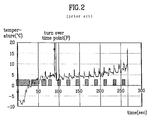
- FIG. 2 illustrates a graph showing time vs. a temperature variation of frozen food, wherein hatched blocks denote power turned on time periods during which a power is supplied into the cavity 10 as a heating energy. That is, the magnetron is operative in periods shown in hatched blocks to direct the microwave to the frozen food inside of the cavity 10.
- the microwave oven is put into operation in a state a surface temperature thereof is below zero, when the infrared sensor 14 at one side of the cavity 10 detects a variation of the surface temperature of the frozen food.
- the power turned on time period becomes shorter, gradually. That is, because a temperature of the frozen food rises gradually as the defrosting proceeds, the power turned on time periods become the shorter as a frozen food turn over time period 'P' approaches.
- the user opens a door on the microwave oven, turns the frozen food over, and proceeds the defrosting, again.
- a power turned on time period of the magnetron is controlled at fixed intervals based on a time period taken from the initial defrosting to the turn over 'P', and a power condition until the turn over time period 'P' is reached. That is, after the frozen food is turned over, the defrosting is carried out in a certain time period and power, taking a time period taken in a first defrosting of the frozen food (a defrosting process until the turn over) and a power condition in the time period into account. Therefore, in the second defrosting process after the frozen food is turned over, a process proceeds, in which merely the magnetron 12 is turned on/off periodically based on the time period taken in the first defrosting and the power condition in the time period.
- the related art defrosting in the microwave oven has a problem in that defrosting of frozen food is not made properly in a case frozen states differ on both sides of the frozen food to be defrosted due to shape or other.
- the defrosting after the frozen food is turned over is carried out regardless of the surface temperature of the turned over frozen food, that causes problems of a product reliability deterioration coming from pre-mature defrosting, or excessive defrosting, or inconvenience to the user.
- the present invention is directed to a method for controlling defrosting in a microwave oven that substantially obviates one or more of the problems due to limitations and disadvantages of the related art.
- An object of the present invention is to provide a method for controlling defrosting in a microwave oven, which can control a second defrosting according to an actual temperature of frozen food.
- the method for controlling defrosting in a microwave oven having an infrared sensor includes the steps of (a) controlling a first defrosting up to a preset temperature upon reception of defrosting key application from a user, (b) turning over frozen food upon completion of the first defrosting, and (c) periodically detecting a surface temperature of the turned over frozen food by using the infrared sensor, and controlling a second defrosting according to the detected surface temperature and temperature variation.
- An initial voltage application time period in the step (a) or (c) is made relatively longer than the voltage application time period in a later half of each of the steps.
- the step (a) includes the steps of calculating a turning over time point by using the presently progressive minimum temperature Min_T and a minimum temperature variation ⁇ T, calculating a first defrosting voltage by using a greater value ⁇ Tmax of the minimum temperature variation ⁇ T and a maximum temperature variation ⁇ Tm, and the presently progressive minimum temperature Min_T, and carrying out defrosting according to the calculation, and generating a signal sound if the minimum temperature Min_T or a maximum temperature Max_T is higher than a preset temperature, or if the turning over time point is over a preset time point.
- the step (c) includes the steps of calculating a defrosting finish time point and a second defrosting time period upon reception of a starting key again after the frozen food is turned over, calculating a second defrosting voltage by using a smaller temperature variation value ⁇ Tmin, and the presently progressive minimum temperature Min_T upon calculation of the defrosting finish time point and the second defrosting time period, the smaller temperature variation value ⁇ Tmin being selected from the minimum temperature variation ⁇ T and a maximum temperature variation ⁇ Tm obtained based on the surface temperature detection of the frozen food, and finishing defrosting if the minimum temperature Min_T or the maximum temperature Max_T is higher than a preset temperature, the present time point is the same with the calculated finish time point, or the calculated defrosting time period is passed.
- the voltage application condition control according to the periodic detection of a surface temperature of frozen food by an infrared sensor, not only in the first defrosting when one side of the frozen food is heated, but also in the second defrosting after the turn over of the frozen food permits an optimal defrosting of the frozen food. That is, the defrosting control based on the surface temperature and the temperature variation of the frozen food permits to prevent a pre-mature, or excessive defrosting, and the optimal defrosting made available by the present invention provides a satisfaction and reliability on the product to the user.
- FIGS. 3A and 3B illustrate a flow chart showing a method for controlling defrosting in a microwave oven in accordance with a preferred embodiment of the present invention
- FIG. 4 illustrates a graph showing time vs. a temperature variation of frozen food in accordance with a preferred embodiment of the present invention.
- selection of a defrosting key by the user is determined S11.
- User's pressing of a start button is determined S12.
- a data for an initial 5 seconds is not stored, but lets pass, and 25 temperature data detected from 6th second to 10th second thereafter is stored S13.
- the presently progressive minimum temperature Min_T and minimum temperature variation ⁇ T are detected and applied to the following equation (1), for calculating a turn over point (Detection Point; DP) S14.
- Min_T is defined as a minimum temperature among temperatures read periodically, and the minimum temperature variation ⁇ T is defined as a difference of the present period minimum temperature and the initial minimum temperature.
- DP (Min_T * 0.5) + ( ⁇ T * 0.5)
- a greater value ⁇ Tmax of a maximum temperature variation ⁇ Tm and a minimum temperature variation ⁇ T, and the presently progressive minimum temperature Min_T are applied to the following equation (2), to calculate a heating voltage in the first defrosting S15.
- the defrosting it is determined that whether the minimum temperature Min_T is higher than a preset temperature 18 °C, or the maximum temperature Max_T is higher than 40 °C for two minutes continuously S16. As a result of the determination, if the minimum temperature Min_T is higher than the preset temperature 18 °C, or the maximum temperature Max_T is higher than 40°C for two minutes continuously, the defrosting is ended. However, as a result of the determination, if the minimum temperature Min_T is lower than the preset temperature 18 °C, or the maximum temperature Max_T fails to be higher than 40 °C for two minutes continuously, the turn over time 'DP' is determined of being higher than a preset value 7.5 S17.
- the time period T1 required before the door is opened is applied to the following equation (4), to calculate a constant K, which is applied to the following equation (5), to calculate a second defrosting time period S22.
- K (1.4 * T1 + 185)/100
- a second defrosting time period T1 * KT1
- Second defrosting voltage 5 * ⁇ 15 * (0.5 * Min_T) + (0.5 * ⁇ Tmin) ⁇
- the second defrosting it is determined that the minimum temperature Min_T is higher than the preset temperature 18 °C, or the maximum temperature Max_T is higher than 40 °C for two seconds continuously S24.
- the determination S24 if the minimum temperature Min_T is higher than the preset temperature 18 °C, or the maximum temperature Max_T is higher than 40 °C for two seconds continuously S24, the second defrosting is finished.
- the defrosting finish time point EPF calculated in the step S21 is determined of being the present time S25.
- the defrosting is started at the calculated first defrosting voltage, to defrost frozen food of which surface temperature is below zero. Since the frozen food is below zero at an initial defrosting, a defrosting voltage is applied for a relatively long time period based on the temperature of the frozen food. Upon the surface temperature of the frozen food rises, the voltage applying time period becomes shorter, gradually.
- the frozen food is required to be turned over at a time point when it is determined that the first defrosting is finished as the surface temperature of the frozen food rises a certain temperature through the foregoing steps, of which turning over time DP is determined with reference to the minimum temperature Min_T and a minimum temperature variation ⁇ T.
- the infrared sensor is used for detecting the surface temperature and the temperature variation of the frozen food, for controlling the second defrosting. That is, since an initial voltage in the second defrosting is fixed based on an actual surface temperature of the frozen food detected by the infrared sensor, the voltage application time period becomes relatively long at an initial stage of the second defrosting. During defrosting the frozen food as the voltage application is kept on, the voltage application time period is made gradually shorter based on the temperature and the temperature variation detected periodically by the infrared sensor. Therefore, the temperature detection of the frozen food by the infrared sensor in the second defrosting is continued periodically until completion of the defrosting.
- the voltage application after the turn over time point DP is long initially, and becomes shorter gradually, and the on and off of the voltage application is dropping of a power application according to an extent of defrosting of the frozen food by detecting an actual surface temperature of the frozen food by the infrared sensor.
- the method for controlling defrosting in a microwave oven of the present invention regulates a voltage application condition according to a defrosted level according to the surface temperature of the frozen food detected by the infrared sensor continuously even in the second defrosting after turn over of the frozen food.
- the method for controlling defrosting in a microwave oven of the present invention has the following advantages.
- the voltage application condition control according to the periodic detection of a surface temperature of frozen food by an infrared sensor, not only in the first defrosting when one side of the frozen food is heated, but also in the second defrosting after the turn over of the frozen food permits an optimal defrosting of the frozen food. That is, the defrosting control based on the surface temperature and the temperature variation of the frozen food permits to prevent a pre-mature, or excessive defrosting.
- the optimal defrosting made available by the present invention provides a satisfaction and reliability on the product to the user.
Landscapes
- Physics & Mathematics (AREA)
- Electromagnetism (AREA)
- Engineering & Computer Science (AREA)
- Chemical & Material Sciences (AREA)
- Combustion & Propulsion (AREA)
- Mechanical Engineering (AREA)
- General Engineering & Computer Science (AREA)
- Electric Ovens (AREA)
- Freezing, Cooling And Drying Of Foods (AREA)
Abstract
Description
- FIG. 1
- illustrates a related art microwave oven;
- FIG. 2
- illustrates a graph showing a related art time vs. a temperature variation of frozen food;
- FIGS. 3A and 3B
- illustrate a flow chart showing a method for controlling defrosting in a microwave oven in accordance with a preferred embodiment of the present invention; and
- FIG. 4
- illustrates a graph showing time vs. a temperature variation of frozen food in accordance with a preferred embodiment of the present invention.
Claims (4)
- A method for controlling defrosting in a microwave oven having an infrared sensor (14), comprising the steps of:(a) controlling a first defrosting up to a preset temperature upon reception of defrosting key application from a user;(b) turning over frozen food upon completion of the first defrosting; and(c) periodically detecting a surface temperature of the turned over frozen food by using the infrared sensor (14), and controlling a second defrosting according to the detected surface temperature and temperature variation.
- A method as claimed in claim 1, characterized in that an initial voltage application time period in the step (a) or (c) is made relatively longer than the voltage application time period in a later half of each of the steps.
- A method as claimed in claim 1 or 2, characterized in that the step (a) includes the steps of:calculating a turning over time point (DP) by using the presently progressive minimum temperature (Min_T) and a minimum temperature variation (ΔT),calculating a first defrosting voltage by using a greater value (ΔTmax) of the minimum temperature variation (ΔT) and a maximum temperature variation (ΔTm), and the presently progressive minimum temperature (Min_T), and carrying out defrosting according to the calculation, andgenerating a signal sound if the minimum temperature (Min_T) or a maximum temperature (Max_T) is higher than a preset temperature, or if the turning over time point (DP) is over a preset time point.
- A method as claimed in any of claims 1 to 3, characterized in that the step (c) includes the steps of:calculating a defrosting finish time point (EPF) and a second defrosting time period upon reception of a starting key again after the frozen food is turned over,calculating a second defrosting voltage by using a smaller temperature variation value (ΔTmin), and the presently progressive minimum temperature (Min_T) upon calculation of the defrosting finish time point (EPF) and the second defrosting time period, the smaller temperature variation value (ΔTmin) being selected from the minimum temperature variation (ΔT) and a maximum temperature variation (ΔTm) obtained based on the surface temperature detection of the frozen food, andfinishing defrosting if the minimum temperature (Min_T) or the maximum temperature (Max_T) is higher than a preset temperature, the present time point (EPF) is the same with the calculated finish time point, or the calculated defrosting time period is passed.
Applications Claiming Priority (2)
| Application Number | Priority Date | Filing Date | Title |
|---|---|---|---|
| KR10-2000-0071985A KR100396662B1 (en) | 2000-11-30 | 2000-11-30 | Method for controlling defrost of micro wave oven |
| KR2000071985 | 2000-11-30 |
Publications (3)
| Publication Number | Publication Date |
|---|---|
| EP1211913A2 true EP1211913A2 (en) | 2002-06-05 |
| EP1211913A3 EP1211913A3 (en) | 2004-04-07 |
| EP1211913B1 EP1211913B1 (en) | 2012-04-18 |
Family
ID=19702494
Family Applications (1)
| Application Number | Title | Priority Date | Filing Date |
|---|---|---|---|
| EP01127145A Expired - Lifetime EP1211913B1 (en) | 2000-11-30 | 2001-11-15 | Method for controlling defrosting in microwave oven |
Country Status (5)
| Country | Link |
|---|---|
| US (1) | US6501058B2 (en) |
| EP (1) | EP1211913B1 (en) |
| KR (1) | KR100396662B1 (en) |
| CN (1) | CN1188630C (en) |
| AT (1) | ATE554633T1 (en) |
Cited By (3)
| Publication number | Priority date | Publication date | Assignee | Title |
|---|---|---|---|---|
| WO2006007617A1 (en) * | 2004-07-16 | 2006-01-26 | Siegfried Marx | Control method for the air-conditioning treatment of products |
| CN102003996A (en) * | 2009-08-29 | 2011-04-06 | 乐金电子(天津)电器有限公司 | Method for identifying shape, size, placing position and temperature of food in micro-wave oven |
| WO2014102746A1 (en) * | 2012-12-27 | 2014-07-03 | Koninklijke Philips N.V. | Apparatus and method for determining core temperature of food |
Families Citing this family (14)
| Publication number | Priority date | Publication date | Assignee | Title |
|---|---|---|---|---|
| US6862494B2 (en) * | 2001-12-13 | 2005-03-01 | General Electric Company | Automated cooking system for food accompanied by machine readable indicia |
| US7176383B2 (en) * | 2003-12-22 | 2007-02-13 | Endicott Interconnect Technologies, Inc. | Printed circuit board with low cross-talk noise |
| CN100343583C (en) * | 2003-02-21 | 2007-10-17 | 乐金电子(天津)电器有限公司 | Microwave oven defrosting control method |
| US6963058B2 (en) * | 2003-06-10 | 2005-11-08 | General Electric Company | Microwave oven systems and methods |
| US7961663B2 (en) * | 2004-04-05 | 2011-06-14 | Daniel J. LIN | Peer-to-peer mobile instant messaging method and device |
| DE502005000527D1 (en) * | 2005-02-02 | 2007-05-10 | Frima Sa | Method and device for determining a turning point of a food |
| CN101940351B (en) * | 2009-07-10 | 2013-09-25 | 乐金电子(天津)电器有限公司 | Food defrosting method for microwave oven |
| CN104919891B (en) * | 2012-12-27 | 2018-07-06 | 皇家飞利浦有限公司 | For determining the device and method of the core temperature of food |
| US20150118368A1 (en) * | 2013-10-24 | 2015-04-30 | Ching-Chuan Lin | Method for executing heating according property of food |
| CN104676680B (en) * | 2014-02-14 | 2018-09-14 | 广东美的厨房电器制造有限公司 | Micro-wave oven and microwave thawing method for micro-wave oven |
| ES2579978B2 (en) * | 2015-02-16 | 2017-04-07 | Smart Spirits, S.L. | Alcoholic beverage infuser |
| US10009957B2 (en) | 2016-03-30 | 2018-06-26 | The Markov Corporation | Electronic oven with infrared evaluative control |
| CN109990563B (en) * | 2017-12-29 | 2021-01-01 | 青岛海尔股份有限公司 | Air-cooled refrigerator and control method thereof |
| US11882956B2 (en) | 2021-05-28 | 2024-01-30 | Whirlpool Corporation | Cooking adjustment system |
Family Cites Families (12)
| Publication number | Priority date | Publication date | Assignee | Title |
|---|---|---|---|---|
| US4171382A (en) * | 1977-08-30 | 1979-10-16 | Litton Systems, Inc. | Method of cooking meats in a microwave oven |
| JPS5616032A (en) * | 1979-07-18 | 1981-02-16 | Matsushita Electric Ind Co Ltd | Heating cooker |
| JPS61134525A (en) * | 1984-12-03 | 1986-06-21 | Sanyo Electric Co Ltd | Electronic control type cooking unit |
| GB9302860D0 (en) * | 1993-02-12 | 1993-03-31 | Kodak Ltd | Photographic elements for producing blue,green and red exposure records of the same hue and methods for the retrival and differentiation of the exposure |
| KR960007113B1 (en) * | 1993-09-28 | 1996-05-27 | 엘지전자주식회사 | Auto-thawing method in microwave oven |
| FR2734893B1 (en) * | 1995-05-31 | 1997-09-19 | Moulinex Sa | METHOD FOR AUTOMATIC DEFROSTING OF A FOOD PLACED IN A MICROWAVE OVEN |
| KR970021971A (en) * | 1995-10-23 | 1997-05-28 | 배순훈 | Control method when defrosting microwave |
| US6013907A (en) * | 1997-06-09 | 2000-01-11 | Lg Electronics Inc. | Microwave oven equipped with thermopile sensor and thawing method using the same |
| GB2324889B (en) * | 1996-06-11 | 1999-06-16 | Lg Electronics Inc | Microwave oven equipped with thermopile sensor and thawing method using the same |
| KR100353354B1 (en) * | 1998-10-14 | 2002-12-28 | 엘지전자주식회사 | Defrost control method of microwave oven |
| US6299920B1 (en) * | 1998-11-05 | 2001-10-09 | Premark Feg L.L.C. | Systems and method for non-invasive assessment of cooked status of food during cooking |
| KR100366020B1 (en) * | 1999-07-12 | 2002-12-26 | 삼성전자 주식회사 | Defrosting method for a microwave oven |
-
2000
- 2000-11-30 KR KR10-2000-0071985A patent/KR100396662B1/en not_active Expired - Fee Related
-
2001
- 2001-10-02 US US09/967,988 patent/US6501058B2/en not_active Expired - Fee Related
- 2001-10-16 CN CNB011364262A patent/CN1188630C/en not_active Expired - Fee Related
- 2001-11-15 AT AT01127145T patent/ATE554633T1/en active
- 2001-11-15 EP EP01127145A patent/EP1211913B1/en not_active Expired - Lifetime
Cited By (6)
| Publication number | Priority date | Publication date | Assignee | Title |
|---|---|---|---|---|
| WO2006007617A1 (en) * | 2004-07-16 | 2006-01-26 | Siegfried Marx | Control method for the air-conditioning treatment of products |
| US7810338B2 (en) | 2004-07-16 | 2010-10-12 | Siegfried Marx | Control method for the air-conditioning treatment of products |
| CN102003996A (en) * | 2009-08-29 | 2011-04-06 | 乐金电子(天津)电器有限公司 | Method for identifying shape, size, placing position and temperature of food in micro-wave oven |
| WO2014102746A1 (en) * | 2012-12-27 | 2014-07-03 | Koninklijke Philips N.V. | Apparatus and method for determining core temperature of food |
| US9927304B2 (en) | 2012-12-27 | 2018-03-27 | Koninklijke Philips N.V. | Apparatus and method for determining core temperature of food |
| RU2664766C2 (en) * | 2012-12-27 | 2018-08-23 | Конинклейке Филипс Н.В. | Method and device for the temperature inside the food determination |
Also Published As
| Publication number | Publication date |
|---|---|
| EP1211913A3 (en) | 2004-04-07 |
| ATE554633T1 (en) | 2012-05-15 |
| KR100396662B1 (en) | 2003-09-02 |
| CN1355401A (en) | 2002-06-26 |
| CN1188630C (en) | 2005-02-09 |
| US6501058B2 (en) | 2002-12-31 |
| EP1211913B1 (en) | 2012-04-18 |
| KR20020042195A (en) | 2002-06-05 |
| US20020063127A1 (en) | 2002-05-30 |
Similar Documents
| Publication | Publication Date | Title |
|---|---|---|
| EP1211913A2 (en) | Method for controlling defrosting in microwave oven | |
| JPS61143630A (en) | Cooking heater | |
| US5496576A (en) | Method for thawing food in microwave oven | |
| JPH07269878A (en) | Automatic cooking control method of microwave oven | |
| JPS60258895A (en) | High frequency heater | |
| US20200281234A1 (en) | High-frequency thawing apparatus | |
| EP1397025B1 (en) | Toaster cum microwave oven and method for operating the same | |
| JP2856679B2 (en) | How to defrost food and drink in the microwave | |
| EP1021068A2 (en) | Microwave defrosting method | |
| JPH0587346A (en) | Reserved cooking control system for microwave oven cooker | |
| EP0928125B1 (en) | Method and apparatus for compensating temperature of microwave oven | |
| JP3777509B2 (en) | Induction heating cooker | |
| US5395633A (en) | Method for automatically controlling cooking of food with low moisture content | |
| KR100214598B1 (en) | Microwave oven with temperature sensor | |
| JPS642858B2 (en) | ||
| JPH0898670A (en) | Defroster | |
| JPH0618045A (en) | microwave | |
| KR19980057987A (en) | Microwave temperature control method | |
| JP3654202B2 (en) | Heating device | |
| JP3424298B2 (en) | Heating equipment | |
| KR20000025807A (en) | Control method of thawing for microwave oven | |
| JP3282299B2 (en) | High frequency heating equipment | |
| JP2003074866A (en) | Cooking appliance | |
| JPS621177B2 (en) | ||
| JP2004190987A (en) | High frequency heating equipment |
Legal Events
| Date | Code | Title | Description |
|---|---|---|---|
| PUAI | Public reference made under article 153(3) epc to a published international application that has entered the european phase |
Free format text: ORIGINAL CODE: 0009012 |
|
| AK | Designated contracting states |
Kind code of ref document: A2 Designated state(s): AT BE CH CY DE DK ES FI FR GB GR IE IT LI LU MC NL PT SE TR |
|
| AX | Request for extension of the european patent |
Free format text: AL;LT;LV;MK;RO;SI |
|
| PUAL | Search report despatched |
Free format text: ORIGINAL CODE: 0009013 |
|
| AK | Designated contracting states |
Kind code of ref document: A3 Designated state(s): AT BE CH CY DE DK ES FI FR GB GR IE IT LI LU MC NL PT SE TR |
|
| AX | Request for extension of the european patent |
Extension state: AL LT LV MK RO SI |
|
| RIC1 | Information provided on ipc code assigned before grant |
Ipc: 7H 05B 6/68 A |
|
| 17P | Request for examination filed |
Effective date: 20040505 |
|
| 17Q | First examination report despatched |
Effective date: 20040708 |
|
| AKX | Designation fees paid |
Designated state(s): AT BE CH CY DE DK ES FI FR GB GR IE IT LI LU MC NL PT SE TR |
|
| 17Q | First examination report despatched |
Effective date: 20040708 |
|
| GRAP | Despatch of communication of intention to grant a patent |
Free format text: ORIGINAL CODE: EPIDOSNIGR1 |
|
| GRAC | Information related to communication of intention to grant a patent modified |
Free format text: ORIGINAL CODE: EPIDOSCIGR1 |
|
| RAP1 | Party data changed (applicant data changed or rights of an application transferred) |
Owner name: LG ELECTRONICS INC. |
|
| GRAS | Grant fee paid |
Free format text: ORIGINAL CODE: EPIDOSNIGR3 |
|
| GRAA | (expected) grant |
Free format text: ORIGINAL CODE: 0009210 |
|
| AK | Designated contracting states |
Kind code of ref document: B1 Designated state(s): AT BE CH CY DE DK ES FI FR GB GR IE IT LI LU MC NL PT SE TR |
|
| REG | Reference to a national code |
Ref country code: GB Ref legal event code: FG4D |
|
| REG | Reference to a national code |
Ref country code: CH Ref legal event code: EP |
|
| REG | Reference to a national code |
Ref country code: IE Ref legal event code: FG4D |
|
| REG | Reference to a national code |
Ref country code: AT Ref legal event code: REF Ref document number: 554633 Country of ref document: AT Kind code of ref document: T Effective date: 20120515 |
|
| REG | Reference to a national code |
Ref country code: DE Ref legal event code: R096 Ref document number: 60146421 Country of ref document: DE Effective date: 20120614 |
|
| REG | Reference to a national code |
Ref country code: NL Ref legal event code: VDEP Effective date: 20120418 |
|
| REG | Reference to a national code |
Ref country code: AT Ref legal event code: MK05 Ref document number: 554633 Country of ref document: AT Kind code of ref document: T Effective date: 20120418 |
|
| PG25 | Lapsed in a contracting state [announced via postgrant information from national office to epo] |
Ref country code: FI Free format text: LAPSE BECAUSE OF FAILURE TO SUBMIT A TRANSLATION OF THE DESCRIPTION OR TO PAY THE FEE WITHIN THE PRESCRIBED TIME-LIMIT Effective date: 20120418 Ref country code: SE Free format text: LAPSE BECAUSE OF FAILURE TO SUBMIT A TRANSLATION OF THE DESCRIPTION OR TO PAY THE FEE WITHIN THE PRESCRIBED TIME-LIMIT Effective date: 20120418 Ref country code: CY Free format text: LAPSE BECAUSE OF FAILURE TO SUBMIT A TRANSLATION OF THE DESCRIPTION OR TO PAY THE FEE WITHIN THE PRESCRIBED TIME-LIMIT Effective date: 20120418 |
|
| PG25 | Lapsed in a contracting state [announced via postgrant information from national office to epo] |
Ref country code: PT Free format text: LAPSE BECAUSE OF FAILURE TO SUBMIT A TRANSLATION OF THE DESCRIPTION OR TO PAY THE FEE WITHIN THE PRESCRIBED TIME-LIMIT Effective date: 20120820 Ref country code: GR Free format text: LAPSE BECAUSE OF FAILURE TO SUBMIT A TRANSLATION OF THE DESCRIPTION OR TO PAY THE FEE WITHIN THE PRESCRIBED TIME-LIMIT Effective date: 20120719 |
|
| PG25 | Lapsed in a contracting state [announced via postgrant information from national office to epo] |
Ref country code: BE Free format text: LAPSE BECAUSE OF FAILURE TO SUBMIT A TRANSLATION OF THE DESCRIPTION OR TO PAY THE FEE WITHIN THE PRESCRIBED TIME-LIMIT Effective date: 20120418 |
|
| PG25 | Lapsed in a contracting state [announced via postgrant information from national office to epo] |
Ref country code: DK Free format text: LAPSE BECAUSE OF FAILURE TO SUBMIT A TRANSLATION OF THE DESCRIPTION OR TO PAY THE FEE WITHIN THE PRESCRIBED TIME-LIMIT Effective date: 20120418 Ref country code: AT Free format text: LAPSE BECAUSE OF FAILURE TO SUBMIT A TRANSLATION OF THE DESCRIPTION OR TO PAY THE FEE WITHIN THE PRESCRIBED TIME-LIMIT Effective date: 20120418 Ref country code: NL Free format text: LAPSE BECAUSE OF FAILURE TO SUBMIT A TRANSLATION OF THE DESCRIPTION OR TO PAY THE FEE WITHIN THE PRESCRIBED TIME-LIMIT Effective date: 20120418 |
|
| PLBE | No opposition filed within time limit |
Free format text: ORIGINAL CODE: 0009261 |
|
| STAA | Information on the status of an ep patent application or granted ep patent |
Free format text: STATUS: NO OPPOSITION FILED WITHIN TIME LIMIT |
|
| PG25 | Lapsed in a contracting state [announced via postgrant information from national office to epo] |
Ref country code: IT Free format text: LAPSE BECAUSE OF FAILURE TO SUBMIT A TRANSLATION OF THE DESCRIPTION OR TO PAY THE FEE WITHIN THE PRESCRIBED TIME-LIMIT Effective date: 20120418 |
|
| 26N | No opposition filed |
Effective date: 20130121 |
|
| PG25 | Lapsed in a contracting state [announced via postgrant information from national office to epo] |
Ref country code: ES Free format text: LAPSE BECAUSE OF FAILURE TO SUBMIT A TRANSLATION OF THE DESCRIPTION OR TO PAY THE FEE WITHIN THE PRESCRIBED TIME-LIMIT Effective date: 20120729 |
|
| REG | Reference to a national code |
Ref country code: DE Ref legal event code: R097 Ref document number: 60146421 Country of ref document: DE Effective date: 20130121 |
|
| REG | Reference to a national code |
Ref country code: CH Ref legal event code: PL |
|
| GBPC | Gb: european patent ceased through non-payment of renewal fee |
Effective date: 20121115 |
|
| PG25 | Lapsed in a contracting state [announced via postgrant information from national office to epo] |
Ref country code: CH Free format text: LAPSE BECAUSE OF NON-PAYMENT OF DUE FEES Effective date: 20121130 Ref country code: LI Free format text: LAPSE BECAUSE OF NON-PAYMENT OF DUE FEES Effective date: 20121130 |
|
| REG | Reference to a national code |
Ref country code: IE Ref legal event code: MM4A |
|
| PG25 | Lapsed in a contracting state [announced via postgrant information from national office to epo] |
Ref country code: IE Free format text: LAPSE BECAUSE OF NON-PAYMENT OF DUE FEES Effective date: 20121115 |
|
| PG25 | Lapsed in a contracting state [announced via postgrant information from national office to epo] |
Ref country code: GB Free format text: LAPSE BECAUSE OF NON-PAYMENT OF DUE FEES Effective date: 20121115 |
|
| PG25 | Lapsed in a contracting state [announced via postgrant information from national office to epo] |
Ref country code: MC Free format text: LAPSE BECAUSE OF NON-PAYMENT OF DUE FEES Effective date: 20121130 Ref country code: TR Free format text: LAPSE BECAUSE OF FAILURE TO SUBMIT A TRANSLATION OF THE DESCRIPTION OR TO PAY THE FEE WITHIN THE PRESCRIBED TIME-LIMIT Effective date: 20120418 |
|
| PG25 | Lapsed in a contracting state [announced via postgrant information from national office to epo] |
Ref country code: LU Free format text: LAPSE BECAUSE OF NON-PAYMENT OF DUE FEES Effective date: 20121115 |
|
| PGFP | Annual fee paid to national office [announced via postgrant information from national office to epo] |
Ref country code: FR Payment date: 20141015 Year of fee payment: 14 |
|
| PGFP | Annual fee paid to national office [announced via postgrant information from national office to epo] |
Ref country code: DE Payment date: 20151028 Year of fee payment: 15 |
|
| REG | Reference to a national code |
Ref country code: FR Ref legal event code: ST Effective date: 20160729 |
|
| PG25 | Lapsed in a contracting state [announced via postgrant information from national office to epo] |
Ref country code: FR Free format text: LAPSE BECAUSE OF NON-PAYMENT OF DUE FEES Effective date: 20151130 |
|
| REG | Reference to a national code |
Ref country code: DE Ref legal event code: R119 Ref document number: 60146421 Country of ref document: DE |
|
| PG25 | Lapsed in a contracting state [announced via postgrant information from national office to epo] |
Ref country code: DE Free format text: LAPSE BECAUSE OF NON-PAYMENT OF DUE FEES Effective date: 20170601 |