EP1211625A1 - Probabilistic privacy protection - Google Patents
Probabilistic privacy protection Download PDFInfo
- Publication number
- EP1211625A1 EP1211625A1 EP01309067A EP01309067A EP1211625A1 EP 1211625 A1 EP1211625 A1 EP 1211625A1 EP 01309067 A EP01309067 A EP 01309067A EP 01309067 A EP01309067 A EP 01309067A EP 1211625 A1 EP1211625 A1 EP 1211625A1
- Authority
- EP
- European Patent Office
- Prior art keywords
- activities
- information
- accuracy level
- activity
- level
- Prior art date
- Legal status (The legal status is an assumption and is not a legal conclusion. Google has not performed a legal analysis and makes no representation as to the accuracy of the status listed.)
- Withdrawn
Links
Images


Classifications
-
- G—PHYSICS
- G06—COMPUTING OR CALCULATING; COUNTING
- G06Q—INFORMATION AND COMMUNICATION TECHNOLOGY [ICT] SPECIALLY ADAPTED FOR ADMINISTRATIVE, COMMERCIAL, FINANCIAL, MANAGERIAL OR SUPERVISORY PURPOSES; SYSTEMS OR METHODS SPECIALLY ADAPTED FOR ADMINISTRATIVE, COMMERCIAL, FINANCIAL, MANAGERIAL OR SUPERVISORY PURPOSES, NOT OTHERWISE PROVIDED FOR
- G06Q30/00—Commerce
- G06Q30/02—Marketing; Price estimation or determination; Fundraising
Definitions
- the present invention concerns gathering usage information and pertains particularly to providing privacy protection using probabilistic accumulation of data.
- information about activities is gathered. Performed activities are monitored and recorded. Each recording of a performed activity has an accuracy level. The accuracy level indicates a probability level that any particular recorded activity accurately records a performed activity. Random selection of activities from a list of activities is used to inaccurately record some performed activities.
- the performed activities include monitoring accesses of sites through a network or using a network to purchase products.
- a user is allowed to select the accuracy level. Recordings of the performed activities are aggregated with recordings of other performed activities to obtain aggregated information.
- the present invention allows gathering of information while retaining a degree of privacy. Because the information is not always true, individual pieces of information are not worth much. However, when aggregated with other information, the aggregated information can be useful. The accuracy of the aggregated information depends on the probability of individual answers being true. If the individual answers have a higher probability of truth, the aggregated answers provide results closer to the true probability.
- the present invention allows gathering statistical information about the activities of clients while allowing the clients to choose levels of protection in return for levels of compensation.
- a program residing on a client's computer monitors client activities. When recording the activities, however, the truth is not always recorded.
- the probability that any recorded activity actually occurred is greater than the probability that a recorded activity did not occur (distantly related to a survey technique purportedly used in surveying potential AIDS patients where a surveyor requested the person being surveyed to "roll a die, tell me a lie if you roll a one, the truth otherwise, and don't tell me what you rolled").
- the higher the probability the less privacy afforded the client, but the more valuable the information to an information gatherer.
- the program selects at random one activity from a list of all possible activities.
- the random selection is weighted so that the probability of choosing the activity actually performed is greater than the probability of choosing some other activity.
- the randomly selected activity is the one reported to a server that is gathering information on activities.
- Reported information from several clients is aggregated. Provided enough information is aggregated, it is possible to calculate an approximation to the true activity rates of all the clients as a group. Over a period of time, the frequency of activities reported will approach the actual frequencies of the activities. Since it takes a large number of activities reported to accurately calculate the true activity rates, the activities reported by a large number of clients must be aggregated to get useable results. This means that a client no longer has to trust the information gatherer to average the results over many users. The information gatherer has to aggregate data in order to get accurate information. To further improve privacy, reporting can be skewed so that averaging over only a single client does not result in statistical accuracy. This is done, for example, by biasing the reporting from each client so that averaging over different clients averages out the bias.
- a server can observe the activities of a group of users and choose to sometimes accurately record the activities performed, and sometimes to inaccurately record which activities were performed.
- the probability of recording the correct activity is higher than the probability of recording some other activity.
- the server is internal to a workgroup and only the activity of the workgroup as a whole is reported to an information gatherer.
- a server is at a distributor site and gathers and reports information so that the distributor protects client privacy while selling information about the clients.
- Calculated activity patterns can be sold or otherwise made available to commercial interests without disclosing the identities of the clients. This is valuable information, and the clients or the servers can bargain for a price reduction or for other compensation in return. This compensation can depend on the probability with which accurate information is provided. The higher the probability of accurate information, the more valuable is each individual piece of information. However, the higher the probability of accurate information, the more intrusive to a client is the disclosure of recorded information .
- Figure 1 illustrates the case where book selections employed by a company are monitored.
- employees of the company order books online from many book suppliers. Perhaps one of the book suppliers arranges to become an exclusive provider of work-related books to employees in exchange for a discount.
- the book supplier requires information about the reading habits of the employees of the company.
- Figure 1 illustrates how this information can be obtained while still providing for the protection of the privacy of each employee.
- each employee selects a privacy level.
- a random number generator decides when accurate information will be recorded. For example, an employee selects one of the following accuracy levels: 0.6, 0.65, 0.7, 0.75, 0.85, 0.95.
- An accuracy level of 0.6 indicates that 60% of the time an employee's book selection is recorded accurately and 40% of the time the employee's book selection is recorded inaccurately.
- An accuracy level of 0.65 indicates that 65% of the time an employee's book selection is recorded accurately and 35% of the time the employee's book selection is recorded inaccurately. And so on.
- a server through which the employees order books monitors each employee's accesses to online bookstores For example the server includes a master list of books which employees can select to order.
- each time an employee selects a book to order information about the book purchase is recorded.
- the privacy level selected by the employee determines the accuracy of the recorded information. For example, if an employee has selected an accuracy level of 0.7, 70% of the time the employee's book selection is recorded accurately. That means 30% of the time the employee's book selection is recorded inaccurately. An inaccurate record, for example, results in another book selected at random from the master list of books to be recorded as ordered, instead of the book actually ordered by the employee.
- ordering information are aggregated for all employees to determine an overall pattern of book selection. In this way, a relative accurate summary of employee book selection can be determined in such a way that the privacy of individual employees is protected.
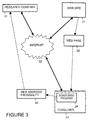
- FIGS. 1 and Figure 3 are block diagrams that illustrate tracking web site access in accordance with an alternative preferred embodiment of the present invention.
- monitoring program 24 allows a consumer to choose a privacy setting.
- the available privacy settings are, for example, highly private, very private, private, moderately private, disclosure, serious disclosure.
- Each setting corresponds, for example, to the following probabilities of truth: 0.6, 0.65, 0.7, 0.75, 0.85, 0.95.
- the probability of truth decreases with an increase in the privacy setting.
- different numbers of privacy levels may be chosen as well as different probabilities for selected privacy levels.
- monitoring program 24 may designate a privacy level and probability of truth without allowing a client selection.
- the privacy level selected determines the accuracy of the recorded information. For example, if an accuracy level of 0.75 has been selected, 75% of the time the address of the web site is recorded accurately. That means 25% of the time the address of the web site is recorded inaccurately.
- An inaccurate record for example, results in another web site address selected at random from a list of available web sites is recorded as being accessed, instead of the web site actually accessed. This is implemented in monitoring program 24, for example, using a random number generator.
- monitoring program 24 reports a number of addressed web sites. For example, monitoring program 24 may forward information to research company 21 at set periods, or may forward information to research company 21 after a predetermined number of web sites have been accessed.
- Web site access and reporting is illustrated in Figure 3 by consumer 23 utilizing internet 22 to access a web page 32 from a web site 31.
- monitoring program 24 forwards through the internet 22 to research company 21 a report 33 that includes a web address and a probability that the web address is the web address of the web site actually accessed.
- This report is done, for example, immediately after access of web site 31, or alternatively, as part of a report of several web accesses.
- Research company 21 averages the information it gets from many consumers to obtain information about web browsing habits.
- the accuracy of the results obtained by the market research company depend on the number and accuracy level of recorded accessed web sites.
- results with higher accuracy levels are more valuable, research company 21 can choose to compensate consumers based on the selected privacy level. Higher privacy levels (and lower accuracy) results in lower compensation because more individual responses need to be averaged to obtain meaningful results. For example, compensation is in the form of discounts at certain online or physical stores. Alternatively, compensation can be in the form of "digital cash", goods, services, credits at certain organizations, refunds to credit card accounts, or checks sent to the consumer's home.
- personal information obtained about consumers can also be recorded with a known amount of inaccuracy.
- Personal information includes, for example, age, color of eyes and hair, race, income level marriage status, number of children and so on. How often accurate (verses inaccurate) information is recorded is also determined by the selected privacy level. Given the probability with which accurate information is recorded, a random number generator decides when accurate information will be recorded. For example, for an accuracy level of 0.8 indicates that 80% of the time personal information is recorded accurately and 20% of the time personal information is recorded inaccurately.
Landscapes
- Business, Economics & Management (AREA)
- Strategic Management (AREA)
- Engineering & Computer Science (AREA)
- Accounting & Taxation (AREA)
- Development Economics (AREA)
- Finance (AREA)
- Economics (AREA)
- Game Theory and Decision Science (AREA)
- Entrepreneurship & Innovation (AREA)
- Marketing (AREA)
- Physics & Mathematics (AREA)
- General Business, Economics & Management (AREA)
- General Physics & Mathematics (AREA)
- Theoretical Computer Science (AREA)
- Storage Device Security (AREA)
- Information Retrieval, Db Structures And Fs Structures Therefor (AREA)
- Management, Administration, Business Operations System, And Electronic Commerce (AREA)
Applications Claiming Priority (2)
| Application Number | Priority Date | Filing Date | Title |
|---|---|---|---|
| US09/705,469 US6470299B1 (en) | 2000-11-02 | 2000-11-02 | Probabilistic privacy protection |
| US705469 | 2000-11-02 |
Publications (1)
| Publication Number | Publication Date |
|---|---|
| EP1211625A1 true EP1211625A1 (en) | 2002-06-05 |
Family
ID=24833597
Family Applications (1)
| Application Number | Title | Priority Date | Filing Date |
|---|---|---|---|
| EP01309067A Withdrawn EP1211625A1 (en) | 2000-11-02 | 2001-10-25 | Probabilistic privacy protection |
Country Status (3)
| Country | Link |
|---|---|
| US (1) | US6470299B1 (enExample) |
| EP (1) | EP1211625A1 (enExample) |
| JP (1) | JP2002169931A (enExample) |
Families Citing this family (4)
| Publication number | Priority date | Publication date | Assignee | Title |
|---|---|---|---|---|
| US20040098584A1 (en) * | 1998-03-25 | 2004-05-20 | Sherman Edward G. | Method and system for embedded, automated, component-level control of computer systems and other complex systems |
| US7788706B2 (en) * | 2005-06-27 | 2010-08-31 | International Business Machines Corporation | Dynamical dual permissions-based data capturing and logging |
| US7539585B2 (en) * | 2007-06-14 | 2009-05-26 | International Business Machines Corporation | System and method for rule-based data mining and problem detection for semiconductor fabrication |
| US11017436B1 (en) | 2008-03-04 | 2021-05-25 | Conviva Inc. | Advertising engine |
Family Cites Families (2)
| Publication number | Priority date | Publication date | Assignee | Title |
|---|---|---|---|---|
| GB2324892B (en) * | 1997-03-14 | 1999-12-01 | Interactuality Limited | Process monitoring system |
| US6321263B1 (en) * | 1998-05-11 | 2001-11-20 | International Business Machines Corporation | Client-based application availability |
-
2000
- 2000-11-02 US US09/705,469 patent/US6470299B1/en not_active Expired - Fee Related
-
2001
- 2001-10-25 EP EP01309067A patent/EP1211625A1/en not_active Withdrawn
- 2001-10-30 JP JP2001332990A patent/JP2002169931A/ja not_active Withdrawn
Non-Patent Citations (1)
| Title |
|---|
| No Search * |
Also Published As
| Publication number | Publication date |
|---|---|
| US6470299B1 (en) | 2002-10-22 |
| JP2002169931A (ja) | 2002-06-14 |
Similar Documents
| Publication | Publication Date | Title |
|---|---|---|
| Johnson et al. | Consumer privacy choice in online advertising: Who opts out and at what cost to industry? | |
| JP5153814B2 (ja) | 広告キャンペーンの管理を容易にするための方法及びシステム | |
| US8612891B2 (en) | System and method for rewarding a user for sharing activity information with a third party | |
| US7181412B1 (en) | Systems and methods for collecting consumer data | |
| US8909542B2 (en) | Systems and methods for managing brand loyalty | |
| US20080183561A1 (en) | Marketplace for interactive advertising targeting events | |
| US20050131757A1 (en) | System for permission-based communication and exchange of information | |
| Johnson | The impact of privacy policy on the auction market for online display advertising | |
| US20050246391A1 (en) | System & method for monitoring web pages | |
| US20120166272A1 (en) | Method and system for anonymous measurement of online advertisement using offline sales | |
| US20110125593A1 (en) | Online marketing payment monitoring method and system | |
| KR101586335B1 (ko) | 온라인 광고 과금 시스템, 방법 및 컴퓨터 판독 가능한 기록 매체 | |
| US20050246358A1 (en) | System & method of identifying and predicting innovation dissemination | |
| CA2460322A1 (en) | Vendor comparison, advertising and switching | |
| WO2006099289A2 (en) | System and method for listing administration | |
| US9076174B2 (en) | Method and service for providing access to premium content and dispersing payment therefore | |
| US20110270670A1 (en) | Method and system for facilitating online advertising | |
| US6470299B1 (en) | Probabilistic privacy protection | |
| US20230195798A1 (en) | Utility based inquiry selection in a streaming data pipeline | |
| WO2002017205A2 (en) | Tracking and recording techniques for online content | |
| Sparks | The direct marketing model and virtual identity: Why the United States should not create legislative controls on the use of online consumer personal data | |
| Maillé et al. | Search Neutrality | |
| JP7189942B2 (ja) | コンピュータプログラム | |
| AU2003247258B2 (en) | System for permission-based communication and exchange of information | |
| Warrington | An investigation of Internet users' level of awareness, understanding, and overall perceptions of Internet cookies in regard to online privacy and security |
Legal Events
| Date | Code | Title | Description |
|---|---|---|---|
| PUAI | Public reference made under article 153(3) epc to a published international application that has entered the european phase |
Free format text: ORIGINAL CODE: 0009012 |
|
| AK | Designated contracting states |
Kind code of ref document: A1 Designated state(s): AT BE CH CY DE DK ES FI FR GB GR IE IT LI LU MC NL PT SE TR |
|
| AX | Request for extension of the european patent |
Free format text: AL;LT;LV;MK;RO;SI |
|
| AKX | Designation fees paid | ||
| REG | Reference to a national code |
Ref country code: DE Ref legal event code: 8566 |
|
| STAA | Information on the status of an ep patent application or granted ep patent |
Free format text: STATUS: THE APPLICATION IS DEEMED TO BE WITHDRAWN |
|
| 18D | Application deemed to be withdrawn |
Effective date: 20021206 |