EP1211282B1 - Kautschukmischung mit expandierten Schichtsilikaten - Google Patents
Kautschukmischung mit expandierten Schichtsilikaten Download PDFInfo
- Publication number
- EP1211282B1 EP1211282B1 EP01125099A EP01125099A EP1211282B1 EP 1211282 B1 EP1211282 B1 EP 1211282B1 EP 01125099 A EP01125099 A EP 01125099A EP 01125099 A EP01125099 A EP 01125099A EP 1211282 B1 EP1211282 B1 EP 1211282B1
- Authority
- EP
- European Patent Office
- Prior art keywords
- rubber
- rubber mixture
- mixture according
- vulcanisable
- phr
- Prior art date
- Legal status (The legal status is an assumption and is not a legal conclusion. Google has not performed a legal analysis and makes no representation as to the accuracy of the status listed.)
- Expired - Lifetime
Links
- 229920001971 elastomer Polymers 0.000 title claims abstract description 115
- 239000005060 rubber Substances 0.000 title claims abstract description 112
- 150000004760 silicates Chemical class 0.000 title description 27
- 239000000203 mixture Substances 0.000 claims abstract description 95
- BPQQTUXANYXVAA-UHFFFAOYSA-N Orthosilicate Chemical compound [O-][Si]([O-])([O-])[O-] BPQQTUXANYXVAA-UHFFFAOYSA-N 0.000 claims abstract description 50
- QGZKDVFQNNGYKY-UHFFFAOYSA-O ammonium group Chemical group [NH4+] QGZKDVFQNNGYKY-UHFFFAOYSA-O 0.000 claims abstract description 5
- 125000005210 alkyl ammonium group Chemical group 0.000 claims abstract 3
- WSFSSNUMVMOOMR-UHFFFAOYSA-N Formaldehyde Chemical compound O=C WSFSSNUMVMOOMR-UHFFFAOYSA-N 0.000 claims description 33
- -1 alkyl ammonium ions Chemical group 0.000 claims description 27
- 229920000642 polymer Polymers 0.000 claims description 23
- 238000004132 cross linking Methods 0.000 claims description 22
- NINIDFKCEFEMDL-UHFFFAOYSA-N Sulfur Chemical compound [S] NINIDFKCEFEMDL-UHFFFAOYSA-N 0.000 claims description 13
- 229920005989 resin Polymers 0.000 claims description 11
- 239000011347 resin Substances 0.000 claims description 11
- 239000002253 acid Substances 0.000 claims description 10
- 150000007513 acids Chemical class 0.000 claims description 10
- 229920002943 EPDM rubber Polymers 0.000 claims description 9
- 229920006168 hydrated nitrile rubber Polymers 0.000 claims description 8
- 239000003431 cross linking reagent Substances 0.000 claims description 7
- 150000003839 salts Chemical class 0.000 claims description 7
- 125000004432 carbon atom Chemical group C* 0.000 claims description 6
- 229920006395 saturated elastomer Polymers 0.000 claims description 6
- 125000004417 unsaturated alkyl group Chemical group 0.000 claims description 6
- MIIBUHIQXLFJFP-UHFFFAOYSA-N 3-methyl-1-[[3-[(3-methyl-2,5-dioxopyrrol-1-yl)methyl]phenyl]methyl]pyrrole-2,5-dione Chemical compound O=C1C(C)=CC(=O)N1CC1=CC=CC(CN2C(C(C)=CC2=O)=O)=C1 MIIBUHIQXLFJFP-UHFFFAOYSA-N 0.000 claims description 5
- 229910052751 metal Inorganic materials 0.000 claims description 5
- 239000002184 metal Chemical class 0.000 claims description 5
- 229920001084 poly(chloroprene) Polymers 0.000 claims description 5
- 229920000459 Nitrile rubber Polymers 0.000 claims description 4
- ISWSIDIOOBJBQZ-UHFFFAOYSA-N Phenol Chemical compound OC1=CC=CC=C1 ISWSIDIOOBJBQZ-UHFFFAOYSA-N 0.000 claims description 4
- 125000003118 aryl group Chemical group 0.000 claims description 4
- 150000002989 phenols Chemical class 0.000 claims description 4
- 125000001797 benzyl group Chemical group [H]C1=C([H])C([H])=C(C([H])=C1[H])C([H])([H])* 0.000 claims description 3
- 229910052739 hydrogen Inorganic materials 0.000 claims description 3
- 239000001257 hydrogen Substances 0.000 claims description 3
- OKTJSMMVPCPJKN-UHFFFAOYSA-N Carbon Chemical compound [C] OKTJSMMVPCPJKN-UHFFFAOYSA-N 0.000 claims description 2
- 229910052799 carbon Inorganic materials 0.000 claims description 2
- FPYJFEHAWHCUMM-UHFFFAOYSA-N maleic anhydride Chemical compound O=C1OC(=O)C=C1 FPYJFEHAWHCUMM-UHFFFAOYSA-N 0.000 claims description 2
- 150000002978 peroxides Chemical class 0.000 claims description 2
- 229920001515 polyalkylene glycol Polymers 0.000 claims description 2
- 229920003245 polyoctenamer Polymers 0.000 claims description 2
- 125000005396 acrylic acid ester group Chemical group 0.000 claims 2
- 125000005397 methacrylic acid ester group Chemical group 0.000 claims 2
- 239000005864 Sulphur Substances 0.000 claims 1
- 125000000118 dimethyl group Chemical group [H]C([H])([H])* 0.000 claims 1
- WIKCBLFVRLUGHF-UHFFFAOYSA-N heptadec-8-enyl(trimethyl)azanium Chemical compound CCCCCCCCC=CCCCCCCC[N+](C)(C)C WIKCBLFVRLUGHF-UHFFFAOYSA-N 0.000 claims 1
- 125000004435 hydrogen atom Chemical class [H]* 0.000 claims 1
- 239000004971 Cross linker Substances 0.000 abstract description 7
- 238000002203 pretreatment Methods 0.000 abstract 2
- 239000000945 filler Substances 0.000 description 12
- 239000000126 substance Substances 0.000 description 12
- 229910052717 sulfur Inorganic materials 0.000 description 12
- 239000011593 sulfur Substances 0.000 description 12
- 150000002148 esters Chemical class 0.000 description 11
- 238000000034 method Methods 0.000 description 11
- 239000002114 nanocomposite Substances 0.000 description 11
- NIXOWILDQLNWCW-UHFFFAOYSA-N Acrylic acid Chemical compound OC(=O)C=C NIXOWILDQLNWCW-UHFFFAOYSA-N 0.000 description 9
- CERQOIWHTDAKMF-UHFFFAOYSA-N Methacrylic acid Chemical compound CC(=C)C(O)=O CERQOIWHTDAKMF-UHFFFAOYSA-N 0.000 description 9
- 238000004073 vulcanization Methods 0.000 description 9
- VYPSYNLAJGMNEJ-UHFFFAOYSA-N Silicium dioxide Chemical compound O=[Si]=O VYPSYNLAJGMNEJ-UHFFFAOYSA-N 0.000 description 8
- 150000001875 compounds Chemical class 0.000 description 8
- 230000000694 effects Effects 0.000 description 8
- 238000002156 mixing Methods 0.000 description 8
- 230000035882 stress Effects 0.000 description 8
- 238000004519 manufacturing process Methods 0.000 description 7
- 230000008569 process Effects 0.000 description 7
- 238000012545 processing Methods 0.000 description 6
- SMZOUWXMTYCWNB-UHFFFAOYSA-N 2-(2-methoxy-5-methylphenyl)ethanamine Chemical compound COC1=CC=C(C)C=C1CCN SMZOUWXMTYCWNB-UHFFFAOYSA-N 0.000 description 5
- 239000007789 gas Substances 0.000 description 5
- 230000006872 improvement Effects 0.000 description 5
- XLOMVQKBTHCTTD-UHFFFAOYSA-N Zinc monoxide Chemical compound [Zn]=O XLOMVQKBTHCTTD-UHFFFAOYSA-N 0.000 description 4
- 230000008901 benefit Effects 0.000 description 4
- 230000006835 compression Effects 0.000 description 4
- 238000007906 compression Methods 0.000 description 4
- 238000013016 damping Methods 0.000 description 4
- 239000000463 material Substances 0.000 description 4
- 239000011159 matrix material Substances 0.000 description 4
- 239000000377 silicon dioxide Substances 0.000 description 4
- 238000012360 testing method Methods 0.000 description 4
- XKMZOFXGLBYJLS-UHFFFAOYSA-L zinc;prop-2-enoate Chemical compound [Zn+2].[O-]C(=O)C=C.[O-]C(=O)C=C XKMZOFXGLBYJLS-UHFFFAOYSA-L 0.000 description 4
- 150000005207 1,3-dihydroxybenzenes Chemical class 0.000 description 3
- 239000006087 Silane Coupling Agent Substances 0.000 description 3
- YXFVVABEGXRONW-UHFFFAOYSA-N Toluene Chemical compound CC1=CC=CC=C1 YXFVVABEGXRONW-UHFFFAOYSA-N 0.000 description 3
- 239000000654 additive Substances 0.000 description 3
- 238000006243 chemical reaction Methods 0.000 description 3
- 239000003795 chemical substances by application Substances 0.000 description 3
- WITDFSFZHZYQHB-UHFFFAOYSA-N dibenzylcarbamothioylsulfanyl n,n-dibenzylcarbamodithioate Chemical compound C=1C=CC=CC=1CN(CC=1C=CC=CC=1)C(=S)SSC(=S)N(CC=1C=CC=CC=1)CC1=CC=CC=C1 WITDFSFZHZYQHB-UHFFFAOYSA-N 0.000 description 3
- 239000000806 elastomer Substances 0.000 description 3
- 238000005342 ion exchange Methods 0.000 description 3
- 229920000831 ionic polymer Polymers 0.000 description 3
- CPLXHLVBOLITMK-UHFFFAOYSA-N magnesium oxide Inorganic materials [Mg]=O CPLXHLVBOLITMK-UHFFFAOYSA-N 0.000 description 3
- 239000003960 organic solvent Substances 0.000 description 3
- 230000035699 permeability Effects 0.000 description 3
- 239000012071 phase Substances 0.000 description 3
- 230000002787 reinforcement Effects 0.000 description 3
- 239000004071 soot Substances 0.000 description 3
- KUAZQDVKQLNFPE-UHFFFAOYSA-N thiram Chemical class CN(C)C(=S)SSC(=S)N(C)C KUAZQDVKQLNFPE-UHFFFAOYSA-N 0.000 description 3
- YXIWHUQXZSMYRE-UHFFFAOYSA-N 1,3-benzothiazole-2-thiol Chemical compound C1=CC=C2SC(S)=NC2=C1 YXIWHUQXZSMYRE-UHFFFAOYSA-N 0.000 description 2
- XQUPVDVFXZDTLT-UHFFFAOYSA-N 1-[4-[[4-(2,5-dioxopyrrol-1-yl)phenyl]methyl]phenyl]pyrrole-2,5-dione Chemical compound O=C1C=CC(=O)N1C(C=C1)=CC=C1CC1=CC=C(N2C(C=CC2=O)=O)C=C1 XQUPVDVFXZDTLT-UHFFFAOYSA-N 0.000 description 2
- IANQTJSKSUMEQM-UHFFFAOYSA-N 1-benzofuran Chemical compound C1=CC=C2OC=CC2=C1 IANQTJSKSUMEQM-UHFFFAOYSA-N 0.000 description 2
- KJCVRFUGPWSIIH-UHFFFAOYSA-N 1-naphthol Chemical class C1=CC=C2C(O)=CC=CC2=C1 KJCVRFUGPWSIIH-UHFFFAOYSA-N 0.000 description 2
- ZNRLMGFXSPUZNR-UHFFFAOYSA-N 2,2,4-trimethyl-1h-quinoline Chemical compound C1=CC=C2C(C)=CC(C)(C)NC2=C1 ZNRLMGFXSPUZNR-UHFFFAOYSA-N 0.000 description 2
- HCLJOFJIQIJXHS-UHFFFAOYSA-N 2-[2-[2-(2-prop-2-enoyloxyethoxy)ethoxy]ethoxy]ethyl prop-2-enoate Chemical compound C=CC(=O)OCCOCCOCCOCCOC(=O)C=C HCLJOFJIQIJXHS-UHFFFAOYSA-N 0.000 description 2
- 125000003903 2-propenyl group Chemical group [H]C([*])([H])C([H])=C([H])[H] 0.000 description 2
- ATVJXMYDOSMEPO-UHFFFAOYSA-N 3-prop-2-enoxyprop-1-ene Chemical compound C=CCOCC=C ATVJXMYDOSMEPO-UHFFFAOYSA-N 0.000 description 2
- ZRALSGWEFCBTJO-UHFFFAOYSA-N Guanidine Chemical compound NC(N)=N ZRALSGWEFCBTJO-UHFFFAOYSA-N 0.000 description 2
- 235000021355 Stearic acid Nutrition 0.000 description 2
- GWEVSGVZZGPLCZ-UHFFFAOYSA-N Titan oxide Chemical compound O=[Ti]=O GWEVSGVZZGPLCZ-UHFFFAOYSA-N 0.000 description 2
- 235000012211 aluminium silicate Nutrition 0.000 description 2
- 230000003712 anti-aging effect Effects 0.000 description 2
- 239000006229 carbon black Substances 0.000 description 2
- 238000005341 cation exchange Methods 0.000 description 2
- 238000001816 cooling Methods 0.000 description 2
- 238000011161 development Methods 0.000 description 2
- 230000018109 developmental process Effects 0.000 description 2
- 238000005516 engineering process Methods 0.000 description 2
- 239000000499 gel Substances 0.000 description 2
- 150000002431 hydrogen Chemical class 0.000 description 2
- 150000005204 hydroxybenzenes Chemical class 0.000 description 2
- 229920002681 hypalon Polymers 0.000 description 2
- 238000010348 incorporation Methods 0.000 description 2
- 239000004816 latex Substances 0.000 description 2
- 229920000126 latex Polymers 0.000 description 2
- 239000007788 liquid Substances 0.000 description 2
- 239000000395 magnesium oxide Substances 0.000 description 2
- AXZKOIWUVFPNLO-UHFFFAOYSA-N magnesium;oxygen(2-) Chemical compound [O-2].[Mg+2] AXZKOIWUVFPNLO-UHFFFAOYSA-N 0.000 description 2
- 239000012528 membrane Substances 0.000 description 2
- 239000000178 monomer Substances 0.000 description 2
- QIQXTHQIDYTFRH-UHFFFAOYSA-N octadecanoic acid Chemical compound CCCCCCCCCCCCCCCCCC(O)=O QIQXTHQIDYTFRH-UHFFFAOYSA-N 0.000 description 2
- OQCDKBAXFALNLD-UHFFFAOYSA-N octadecanoic acid Natural products CCCCCCCC(C)CCCCCCCCC(O)=O OQCDKBAXFALNLD-UHFFFAOYSA-N 0.000 description 2
- 239000003921 oil Substances 0.000 description 2
- 235000019198 oils Nutrition 0.000 description 2
- 229920003192 poly(bis maleimide) Polymers 0.000 description 2
- 238000006116 polymerization reaction Methods 0.000 description 2
- 239000002904 solvent Substances 0.000 description 2
- 239000008117 stearic acid Substances 0.000 description 2
- 229920003048 styrene butadiene rubber Polymers 0.000 description 2
- 229920001169 thermoplastic Polymers 0.000 description 2
- 239000004416 thermosoftening plastic Substances 0.000 description 2
- 229960002447 thiram Drugs 0.000 description 2
- 239000001993 wax Substances 0.000 description 2
- 239000011787 zinc oxide Substances 0.000 description 2
- ROLAGNYPWIVYTG-UHFFFAOYSA-N 1,2-bis(4-methoxyphenyl)ethanamine;hydrochloride Chemical compound Cl.C1=CC(OC)=CC=C1CC(N)C1=CC=C(OC)C=C1 ROLAGNYPWIVYTG-UHFFFAOYSA-N 0.000 description 1
- KOMNUTZXSVSERR-UHFFFAOYSA-N 1,3,5-tris(prop-2-enyl)-1,3,5-triazinane-2,4,6-trione Chemical compound C=CCN1C(=O)N(CC=C)C(=O)N(CC=C)C1=O KOMNUTZXSVSERR-UHFFFAOYSA-N 0.000 description 1
- OWRCNXZUPFZXOS-UHFFFAOYSA-N 1,3-diphenylguanidine Chemical compound C=1C=CC=CC=1NC(=N)NC1=CC=CC=C1 OWRCNXZUPFZXOS-UHFFFAOYSA-N 0.000 description 1
- GWQOYRSARAWVTC-UHFFFAOYSA-N 1,4-bis(2-tert-butylperoxypropan-2-yl)benzene Chemical compound CC(C)(C)OOC(C)(C)C1=CC=C(C(C)(C)OOC(C)(C)C)C=C1 GWQOYRSARAWVTC-UHFFFAOYSA-N 0.000 description 1
- LGBYJXBCVZKJBL-UHFFFAOYSA-N 1-[(2-oxoazepan-1-yl)disulfanyl]azepan-2-one Chemical compound O=C1CCCCCN1SSN1C(=O)CCCCC1 LGBYJXBCVZKJBL-UHFFFAOYSA-N 0.000 description 1
- YBYIRNPNPLQARY-UHFFFAOYSA-N 1H-indene Chemical compound C1=CC=C2CC=CC2=C1 YBYIRNPNPLQARY-UHFFFAOYSA-N 0.000 description 1
- BJELTSYBAHKXRW-UHFFFAOYSA-N 2,4,6-triallyloxy-1,3,5-triazine Chemical compound C=CCOC1=NC(OCC=C)=NC(OCC=C)=N1 BJELTSYBAHKXRW-UHFFFAOYSA-N 0.000 description 1
- DMWVYCCGCQPJEA-UHFFFAOYSA-N 2,5-bis(tert-butylperoxy)-2,5-dimethylhexane Chemical compound CC(C)(C)OOC(C)(C)CCC(C)(C)OOC(C)(C)C DMWVYCCGCQPJEA-UHFFFAOYSA-N 0.000 description 1
- XMNIXWIUMCBBBL-UHFFFAOYSA-N 2-(2-phenylpropan-2-ylperoxy)propan-2-ylbenzene Chemical compound C=1C=CC=CC=1C(C)(C)OOC(C)(C)C1=CC=CC=C1 XMNIXWIUMCBBBL-UHFFFAOYSA-N 0.000 description 1
- LTHJXDSHSVNJKG-UHFFFAOYSA-N 2-[2-[2-[2-(2-methylprop-2-enoyloxy)ethoxy]ethoxy]ethoxy]ethyl 2-methylprop-2-enoate Chemical compound CC(=C)C(=O)OCCOCCOCCOCCOC(=O)C(C)=C LTHJXDSHSVNJKG-UHFFFAOYSA-N 0.000 description 1
- CPGFMWPQXUXQRX-UHFFFAOYSA-N 3-amino-3-(4-fluorophenyl)propanoic acid Chemical compound OC(=O)CC(N)C1=CC=C(F)C=C1 CPGFMWPQXUXQRX-UHFFFAOYSA-N 0.000 description 1
- QRYFCNPYGUORTK-UHFFFAOYSA-N 4-(1,3-benzothiazol-2-yldisulfanyl)morpholine Chemical compound C1COCCN1SSC1=NC2=CC=CC=C2S1 QRYFCNPYGUORTK-UHFFFAOYSA-N 0.000 description 1
- ZZMVLMVFYMGSMY-UHFFFAOYSA-N 4-n-(4-methylpentan-2-yl)-1-n-phenylbenzene-1,4-diamine Chemical compound C1=CC(NC(C)CC(C)C)=CC=C1NC1=CC=CC=C1 ZZMVLMVFYMGSMY-UHFFFAOYSA-N 0.000 description 1
- CWIYBOJLSWJGKV-UHFFFAOYSA-N 5-methyl-1,3-dihydrobenzimidazole-2-thione Chemical compound CC1=CC=C2NC(S)=NC2=C1 CWIYBOJLSWJGKV-UHFFFAOYSA-N 0.000 description 1
- PNEYBMLMFCGWSK-UHFFFAOYSA-N Alumina Chemical class [O-2].[O-2].[O-2].[Al+3].[Al+3] PNEYBMLMFCGWSK-UHFFFAOYSA-N 0.000 description 1
- 239000005995 Aluminium silicate Substances 0.000 description 1
- 244000059549 Borneo rubber Species 0.000 description 1
- 239000004709 Chlorinated polyethylene Substances 0.000 description 1
- 239000004641 Diallyl-phthalate Substances 0.000 description 1
- BWGNESOTFCXPMA-UHFFFAOYSA-N Dihydrogen disulfide Chemical compound SS BWGNESOTFCXPMA-UHFFFAOYSA-N 0.000 description 1
- 239000004908 Emulsion polymer Substances 0.000 description 1
- 239000004593 Epoxy Substances 0.000 description 1
- PDQAZBWRQCGBEV-UHFFFAOYSA-N Ethylenethiourea Chemical compound S=C1NCCN1 PDQAZBWRQCGBEV-UHFFFAOYSA-N 0.000 description 1
- 244000043261 Hevea brasiliensis Species 0.000 description 1
- UFHFLCQGNIYNRP-UHFFFAOYSA-N Hydrogen Chemical compound [H][H] UFHFLCQGNIYNRP-UHFFFAOYSA-N 0.000 description 1
- OUBMGJOQLXMSNT-UHFFFAOYSA-N N-isopropyl-N'-phenyl-p-phenylenediamine Chemical compound C1=CC(NC(C)C)=CC=C1NC1=CC=CC=C1 OUBMGJOQLXMSNT-UHFFFAOYSA-N 0.000 description 1
- CHJJGSNFBQVOTG-UHFFFAOYSA-N N-methyl-guanidine Natural products CNC(N)=N CHJJGSNFBQVOTG-UHFFFAOYSA-N 0.000 description 1
- 239000006057 Non-nutritive feed additive Substances 0.000 description 1
- 239000004952 Polyamide Substances 0.000 description 1
- 239000005062 Polybutadiene Substances 0.000 description 1
- 235000019484 Rapeseed oil Nutrition 0.000 description 1
- 229920002472 Starch Polymers 0.000 description 1
- FZWLAAWBMGSTSO-UHFFFAOYSA-N Thiazole Chemical compound C1=CSC=N1 FZWLAAWBMGSTSO-UHFFFAOYSA-N 0.000 description 1
- DAKWPKUUDNSNPN-UHFFFAOYSA-N Trimethylolpropane triacrylate Chemical compound C=CC(=O)OCC(CC)(COC(=O)C=C)COC(=O)C=C DAKWPKUUDNSNPN-UHFFFAOYSA-N 0.000 description 1
- OKKRPWIIYQTPQF-UHFFFAOYSA-N Trimethylolpropane trimethacrylate Chemical compound CC(=C)C(=O)OCC(CC)(COC(=O)C(C)=C)COC(=O)C(C)=C OKKRPWIIYQTPQF-UHFFFAOYSA-N 0.000 description 1
- HVVWZTWDBSEWIH-UHFFFAOYSA-N [2-(hydroxymethyl)-3-prop-2-enoyloxy-2-(prop-2-enoyloxymethyl)propyl] prop-2-enoate Chemical compound C=CC(=O)OCC(CO)(COC(=O)C=C)COC(=O)C=C HVVWZTWDBSEWIH-UHFFFAOYSA-N 0.000 description 1
- 238000005299 abrasion Methods 0.000 description 1
- 230000009471 action Effects 0.000 description 1
- 230000000996 additive effect Effects 0.000 description 1
- 230000002411 adverse Effects 0.000 description 1
- 230000032683 aging Effects 0.000 description 1
- 229910052782 aluminium Inorganic materials 0.000 description 1
- 229910000323 aluminium silicate Inorganic materials 0.000 description 1
- 150000001412 amines Chemical class 0.000 description 1
- 239000004760 aramid Substances 0.000 description 1
- 229920003235 aromatic polyamide Polymers 0.000 description 1
- 230000004888 barrier function Effects 0.000 description 1
- 239000000440 bentonite Substances 0.000 description 1
- 229910000278 bentonite Inorganic materials 0.000 description 1
- SVPXDRXYRYOSEX-UHFFFAOYSA-N bentoquatam Chemical compound O.O=[Si]=O.O=[Al]O[Al]=O SVPXDRXYRYOSEX-UHFFFAOYSA-N 0.000 description 1
- QUDWYFHPNIMBFC-UHFFFAOYSA-N bis(prop-2-enyl) benzene-1,2-dicarboxylate Chemical compound C=CCOC(=O)C1=CC=CC=C1C(=O)OCC=C QUDWYFHPNIMBFC-UHFFFAOYSA-N 0.000 description 1
- ZDNFTNPFYCKVTB-UHFFFAOYSA-N bis(prop-2-enyl) benzene-1,4-dicarboxylate Chemical compound C=CCOC(=O)C1=CC=C(C(=O)OCC=C)C=C1 ZDNFTNPFYCKVTB-UHFFFAOYSA-N 0.000 description 1
- 229920005549 butyl rubber Polymers 0.000 description 1
- DKVNPHBNOWQYFE-UHFFFAOYSA-N carbamodithioic acid Chemical compound NC(S)=S DKVNPHBNOWQYFE-UHFFFAOYSA-N 0.000 description 1
- 238000012512 characterization method Methods 0.000 description 1
- 239000002734 clay mineral Substances 0.000 description 1
- 238000005345 coagulation Methods 0.000 description 1
- 230000015271 coagulation Effects 0.000 description 1
- 230000000052 comparative effect Effects 0.000 description 1
- 229920001577 copolymer Polymers 0.000 description 1
- 230000006866 deterioration Effects 0.000 description 1
- LSXWFXONGKSEMY-UHFFFAOYSA-N di-tert-butyl peroxide Chemical compound CC(C)(C)OOC(C)(C)C LSXWFXONGKSEMY-UHFFFAOYSA-N 0.000 description 1
- 235000014113 dietary fatty acids Nutrition 0.000 description 1
- SWSQBOPZIKWTGO-UHFFFAOYSA-N dimethylaminoamidine Natural products CN(C)C(N)=N SWSQBOPZIKWTGO-UHFFFAOYSA-N 0.000 description 1
- 238000009826 distribution Methods 0.000 description 1
- 150000002019 disulfides Chemical class 0.000 description 1
- 239000012990 dithiocarbamate Substances 0.000 description 1
- 238000001035 drying Methods 0.000 description 1
- 239000000839 emulsion Substances 0.000 description 1
- 229920005558 epichlorohydrin rubber Polymers 0.000 description 1
- ZOOODBUHSVUZEM-UHFFFAOYSA-N ethoxymethanedithioic acid Chemical compound CCOC(S)=S ZOOODBUHSVUZEM-UHFFFAOYSA-N 0.000 description 1
- 229920006229 ethylene acrylic elastomer Polymers 0.000 description 1
- 238000004299 exfoliation Methods 0.000 description 1
- 239000000194 fatty acid Substances 0.000 description 1
- 229930195729 fatty acid Natural products 0.000 description 1
- 150000004665 fatty acids Chemical class 0.000 description 1
- 239000000835 fiber Substances 0.000 description 1
- 239000010419 fine particle Substances 0.000 description 1
- 239000003063 flame retardant Substances 0.000 description 1
- 229920001973 fluoroelastomer Polymers 0.000 description 1
- 229920000578 graft copolymer Polymers 0.000 description 1
- 125000005843 halogen group Chemical group 0.000 description 1
- 238000010438 heat treatment Methods 0.000 description 1
- 229930195733 hydrocarbon Natural products 0.000 description 1
- 150000002430 hydrocarbons Chemical class 0.000 description 1
- 230000005660 hydrophilic surface Effects 0.000 description 1
- 230000001771 impaired effect Effects 0.000 description 1
- 238000011065 in-situ storage Methods 0.000 description 1
- 239000004615 ingredient Substances 0.000 description 1
- 230000003993 interaction Effects 0.000 description 1
- 230000002687 intercalation Effects 0.000 description 1
- 238000009830 intercalation Methods 0.000 description 1
- 230000002452 interceptive effect Effects 0.000 description 1
- NLYAJNPCOHFWQQ-UHFFFAOYSA-N kaolin Chemical compound O.O.O=[Al]O[Si](=O)O[Si](=O)O[Al]=O NLYAJNPCOHFWQQ-UHFFFAOYSA-N 0.000 description 1
- 239000000314 lubricant Substances 0.000 description 1
- 238000010077 mastication Methods 0.000 description 1
- 230000018984 mastication Effects 0.000 description 1
- 238000002844 melting Methods 0.000 description 1
- 230000008018 melting Effects 0.000 description 1
- 229910044991 metal oxide Inorganic materials 0.000 description 1
- 150000004706 metal oxides Chemical class 0.000 description 1
- YDKNBNOOCSNPNS-UHFFFAOYSA-N methyl 1,3-benzoxazole-2-carboxylate Chemical compound C1=CC=C2OC(C(=O)OC)=NC2=C1 YDKNBNOOCSNPNS-UHFFFAOYSA-N 0.000 description 1
- 230000004048 modification Effects 0.000 description 1
- 238000012986 modification Methods 0.000 description 1
- 229910052901 montmorillonite Inorganic materials 0.000 description 1
- 150000002780 morpholines Chemical class 0.000 description 1
- DEQZTKGFXNUBJL-UHFFFAOYSA-N n-(1,3-benzothiazol-2-ylsulfanyl)cyclohexanamine Chemical compound C1CCCCC1NSC1=NC2=CC=CC=C2S1 DEQZTKGFXNUBJL-UHFFFAOYSA-N 0.000 description 1
- ZHMIOPLMFZVSHY-UHFFFAOYSA-N n-[2-[(2-benzamidophenyl)disulfanyl]phenyl]benzamide Chemical compound C=1C=CC=CC=1C(=O)NC1=CC=CC=C1SSC1=CC=CC=C1NC(=O)C1=CC=CC=C1 ZHMIOPLMFZVSHY-UHFFFAOYSA-N 0.000 description 1
- AGVKXDPPPSLISR-UHFFFAOYSA-N n-ethylcyclohexanamine Chemical compound CCNC1CCCCC1 AGVKXDPPPSLISR-UHFFFAOYSA-N 0.000 description 1
- 229920003052 natural elastomer Polymers 0.000 description 1
- 229920001194 natural rubber Polymers 0.000 description 1
- 150000001451 organic peroxides Chemical class 0.000 description 1
- 239000012074 organic phase Substances 0.000 description 1
- 150000001282 organosilanes Chemical class 0.000 description 1
- 239000002245 particle Substances 0.000 description 1
- 229910052615 phyllosilicate Inorganic materials 0.000 description 1
- 239000004014 plasticizer Substances 0.000 description 1
- 229920001200 poly(ethylene-vinyl acetate) Polymers 0.000 description 1
- 229920002647 polyamide Polymers 0.000 description 1
- 229920002857 polybutadiene Polymers 0.000 description 1
- 229920000728 polyester Polymers 0.000 description 1
- 229920001223 polyethylene glycol Polymers 0.000 description 1
- 239000002861 polymer material Substances 0.000 description 1
- 239000005077 polysulfide Substances 0.000 description 1
- 229920001021 polysulfide Polymers 0.000 description 1
- 150000008117 polysulfides Polymers 0.000 description 1
- 239000010734 process oil Substances 0.000 description 1
- 230000001681 protective effect Effects 0.000 description 1
- 230000009467 reduction Effects 0.000 description 1
- 230000003014 reinforcing effect Effects 0.000 description 1
- 239000012763 reinforcing filler Substances 0.000 description 1
- 238000000926 separation method Methods 0.000 description 1
- RMAQACBXLXPBSY-UHFFFAOYSA-N silicic acid Chemical compound O[Si](O)(O)O RMAQACBXLXPBSY-UHFFFAOYSA-N 0.000 description 1
- 235000012239 silicon dioxide Nutrition 0.000 description 1
- 229920002379 silicone rubber Polymers 0.000 description 1
- 239000004945 silicone rubber Substances 0.000 description 1
- 239000008107 starch Substances 0.000 description 1
- 235000019698 starch Nutrition 0.000 description 1
- 239000007858 starting material Substances 0.000 description 1
- QAZLUNIWYYOJPC-UHFFFAOYSA-M sulfenamide Chemical compound [Cl-].COC1=C(C)C=[N+]2C3=NC4=CC=C(OC)C=C4N3SCC2=C1C QAZLUNIWYYOJPC-UHFFFAOYSA-M 0.000 description 1
- 125000004434 sulfur atom Chemical group 0.000 description 1
- 230000008961 swelling Effects 0.000 description 1
- 230000002195 synergetic effect Effects 0.000 description 1
- 229920003051 synthetic elastomer Polymers 0.000 description 1
- 238000009864 tensile test Methods 0.000 description 1
- GJBRNHKUVLOCEB-UHFFFAOYSA-N tert-butyl benzenecarboperoxoate Chemical compound CC(C)(C)OOC(=O)C1=CC=CC=C1 GJBRNHKUVLOCEB-UHFFFAOYSA-N 0.000 description 1
- 238000010998 test method Methods 0.000 description 1
- 150000003585 thioureas Chemical class 0.000 description 1
- 239000004408 titanium dioxide Substances 0.000 description 1
- 230000002110 toxicologic effect Effects 0.000 description 1
- 231100000027 toxicology Toxicity 0.000 description 1
- 238000012549 training Methods 0.000 description 1
- GRPURDFRFHUDSP-UHFFFAOYSA-N tris(prop-2-enyl) benzene-1,2,4-tricarboxylate Chemical compound C=CCOC(=O)C1=CC=C(C(=O)OCC=C)C(C(=O)OCC=C)=C1 GRPURDFRFHUDSP-UHFFFAOYSA-N 0.000 description 1
- UKRDPEFKFJNXQM-UHFFFAOYSA-N vinylsilane Chemical class [SiH3]C=C UKRDPEFKFJNXQM-UHFFFAOYSA-N 0.000 description 1
- 239000012936 vulcanization activator Substances 0.000 description 1
- 239000012991 xanthate Substances 0.000 description 1
- 150000003751 zinc Chemical class 0.000 description 1
- PIMBTRGLTHJJRV-UHFFFAOYSA-L zinc;2-methylprop-2-enoate Chemical class [Zn+2].CC(=C)C([O-])=O.CC(=C)C([O-])=O PIMBTRGLTHJJRV-UHFFFAOYSA-L 0.000 description 1
- AUMBZPPBWALQRO-UHFFFAOYSA-L zinc;n,n-dibenzylcarbamodithioate Chemical compound [Zn+2].C=1C=CC=CC=1CN(C(=S)[S-])CC1=CC=CC=C1.C=1C=CC=CC=1CN(C(=S)[S-])CC1=CC=CC=C1 AUMBZPPBWALQRO-UHFFFAOYSA-L 0.000 description 1
Classifications
-
- C—CHEMISTRY; METALLURGY
- C08—ORGANIC MACROMOLECULAR COMPOUNDS; THEIR PREPARATION OR CHEMICAL WORKING-UP; COMPOSITIONS BASED THEREON
- C08K—Use of inorganic or non-macromolecular organic substances as compounding ingredients
- C08K9/00—Use of pretreated ingredients
- C08K9/04—Ingredients treated with organic substances
Definitions
- the invention relates to a vulcanizable rubber mixture.
- Rubber mixtures are various fillers, such as. B. carbon black, silica, Aluminum silicates, kaolins, metal oxides or chalk added.
- the fillers contribute not only to make the rubber compounds cheaper, but also influence them through their specific effect on the rubber also the properties of the uncured Rubber compound and vulcanizates.
- Active fillers including reinforcing fillers called, to which most carbon black, silica and most fine-particle silicates count, generally improve a number of vulcanizate properties, such as Tensile strength, tension value (module) and tear resistance, while others Properties such as elongation at break and rebound resilience are adversely affected.
- the activity of the filler depends on the particle size, the specific one Surface, the geometric shape of the surface and the chemical Composition.
- the layered silicates form a filler class, whereby the problem arises with layered silicates shows that due to their polar surface they are not compatible with conventional rubbers are compatible. I.e. you have to put them in a rubber mixture like this modify it to be organophilic and compatible with the surrounding rubber matrix are.
- the layered silicate can only be distributed well in the rubber matrix. To do this To achieve, it has long been known, the normally hydrophilic surface of the To modify layered silicates by cation exchange with alkylammonium ions in such a way that she will become organophilic.
- the individual organically modified layers are stored parallel to each other and form small stacks in which organic and Alternate inorganic layers regularly.
- Such organically modified layered silicates can be used to make nanocomposites Generate polymers and layered silicates.
- a nanocomposite is defined as one interactive mixture of two phases, in this case polymer / organic phase and layered silicate / inorganic phase, of which one phase at least in one Dimension is on the order of a few nanometers.
- the individual layers have a thickness of approx. 1 nm and are surrounded by polymer.
- the presence of nanocomposites in polymer materials makes it possible to provide the polymer products made from them with new and improved properties.
- the concept of nanocomposites based on layered silicates is mainly used in the field of thermoplastics. B. to improve in terms of tensile strength.
- the four processes mentioned for the production of nanocomposites can be used for thermoplastics, whereas for rubbers the direct incorporation of the molten polymer is not possible due to the high viscosities in the conventional processing temperature range.
- the other three methods can also be used for rubber, but these methods are technologically very complex and always involve the use of solvents which, in the further course of processing such nanocomposites, e.g. B. for mixing in a vulcanizable rubber mixture again i. A. must be removed completely.
- a latex that includes layered silicate contains embedded emulsion polymer.
- Layered silicate is first formed organophilically by ion exchange with onium salts and then in an emulsion a rubber is made from its monomers in Presence of the organophilic layered silicate in the layers of the silicate in copolymerized form. This forms nanocomposites. After coagulation and the Drying such nanocomposites in rubber mixtures such.
- B. for Inner tire rubbers with reduced gas permeability can be used.
- No. 5,576,372 describes the use of layered silicates in inner tire rubbers described reduced gas permeability, the layered silicates having a reactive Rubber can be provided with positively charged groups.
- the layered silicates are to do this with a solution containing the reactive rubber, i. A. a solution with organic solvent such as toluene, treated.
- the reactive rubber swells in and between the layers. All solvents must be connected before the next one Processing, e.g. B. the interference in a tire inner rubber mixture, are removed.
- many organic solvents are considered ecological and toxicological to classify.
- Specially treated layered silicates for rubber compounds with improved mechanical properties and reduced gas permeability are also from the US 6,103,817 known.
- the special layered silicates are mixed into the Rubber mixture first organophilized by ion exchange with onium salts formed and then further organic guest molecules from organic Solvent or by treating the organophilic layered silicate with the liquid Guest molecules (for substances with a low melting point) introduced / swollen in order to increase the distance between the layers in the layered silicate and to facilitate and improve the distribution in the rubber compound. It one or two different substances can be introduced into the layered silicate, at least one of the substances must have polar groups.
- the three processes described have in common that the layered silicates before Interference in a rubber mixture with complex methods so formed be that the individual silicate layers through before the mixing Rubber molecules are separated from one another so that nanocomposites are present.
- Reinforced elastomers are also known from US 2,531,396 and US 2,886,550. which contain layered silicates as fillers, which are modified with alkylammonium ions. From US 6,034,164 it is known to be modified with alkylammonium ions Layered silicates directly into a rubber mixture made from two special rubbers without previous swelling or polymerization of rubber or guest molecules interfere. On the one hand, the rubbers are non-ionic Polymer with a molecular weight> 50000 g / mol and secondly a non-ionic Polymer that is compatible with and the first polymer Molecular weight is less than that of the first polymer.
- the present invention is based on the object of a rubber mixture to provide, which is easy and environmentally friendly to manufacture and their Vulcanizate itself through a high tension value and a high Tear resistance with good elongation at break or a high elongation at break with good tension value and good tear resistance. It Accordingly, materials are to be provided which, despite high hardness, moduli and Strength does not show embrittlement.
- Cover networkers also called coagents, are known as substances that Rubber mixtures are added to increase the degree of crosslinking.
- the rubber mixture with the invention Combination of modified layered silicate with cover network found that of conventional rubber compounds i.
- One reason for the surprising effect of the mixture according to the invention could be be that those modified with alkylammonium ions, organophilic and Layer-expanded layered silicates blend well in the surrounding area during the mixing process Distribute the rubber matrix and, if necessary, even extensively exfoliate it - although before the mixing in addition to the ammonium ions no other guest molecules between the Layers were swollen or polymerized - and while mixing, the Further processing and vulcanization a connection of the modified Layer silicates to the surrounding rubber molecules via the cover mesh in the Interaction with the existing in the vulcanizable rubber mixture Crosslinking agent takes place.
- the mixtures according to the invention also have the advantages that they, as vulcanizates, have a good barrier action for gases and liquids as a result of the presence of the thin flakes of the layered silicate and have a high resistance to a wide variety of organic media.
- the vulcanizates have good flame resistance.
- the very thin platelets of the exfoliated layered silicate align when processing the mixture (straightening effect, anisotropy) and cause two-dimensional reinforcement.
- the vulcanizate takes on anisotropic properties.
- Such conventional two-dimensional reinforcement can hardly be achieved with conventional, unmodified phyllosilicates, since the individual layers of the silicate are not exfoliated, but rather are present in the mixture as larger clusters.
- the rubber mixtures according to the invention can be used for the production of various products can be used.
- the rubber mixture contains 2 to 25 phr of the layered silicate; even these minor ones In combination with the cover network, quantities are sufficient to produce high-vulcanisates To obtain the level of tension value, tear resistance and elongation at break, whereby other desired vulcanizate properties are also not impaired.
- the rubber mixture 2 contains up to 35 phr of the cover network. These amounts of cover netting are enough to cover the To improve vulcanizate properties and an adequate connection of the to effect modified layered silicate on the surrounding rubber molecules.
- modified layered silicates well-known natural and synthetic layered silicates that are used for ion exchange are suitable, such as. B. montmorillonites, smectites, kaolinites and mixtures thereof, the z. B. occur as a wide variety of clay minerals (e.g. bentonite and kaolin) in nature, be used.
- the individual layers of the layered silicates used should be one Layer thickness of 0.8 to 2.0 nm and the layered silicate flakes an average Have diameters from 80 to 800 nm.
- the small, extremely thin plates can optimally distributed in the rubber mixture and connected there.
- the surface of the layered silicates is modified by cation exchange with ammonium ions of the general formula + NR 4 , the modified layered silicate having a preferred carbon content of 5 to 50% by weight.
- the R in the ammonium ion used for the modification can be the same or different and are selected from the group consisting of hydrogen, substituted or unsubstituted, saturated or unsaturated alkyl groups having 1 to 40 carbon atoms with or without branching and substituted or unsubstituted aryl and benzyl groups, wherein at least one R is a substituted or unsubstituted, saturated or unsaturated alkyl group having more than 8 carbon atoms.
- Layer silicates are thereby produced, the distances between the individual layers of 1.1 to 5 nm before further processing or mixing. It is particularly preferred if a sheet silicate is used for the rubber mixture according to the invention, which is modified with a dimethyldioctadecyl, a benzyldioctadecylmethyl or a heptadec-8-en-1-yltrimethylammonium ion. Layered silicates modified in this way have proven to be particularly advantageous in solving the conflict between stress value and elongation at break.
- the vulcanizable rubber mixture can do all of this as rubber components Rubber types known to those skilled in the art, such as, for. B. natural rubber, synthetic Polyisoprene, polybutadiene, styrene-butadiene copolymer, butyl rubber, ethylene-propylene-diene rubber (EPDM), ethylene-propylene copolymer.
- Rubber types known to those skilled in the art such as, for. B. natural rubber, synthetic Polyisoprene, polybutadiene, styrene-butadiene copolymer, butyl rubber, ethylene-propylene-diene rubber (EPDM), ethylene-propylene copolymer.
- EPDM ethylene-propylene copolymer
- the rubber mixture contains at least one rubber as rubber components polar groups, preferably only one or more rubbers with polar Groups, e.g. B.
- acrylonitrile butadiene rubber hydrogenated acrylonitrile butadiene rubber (HNBR), hydrogenated acrylonitrile butadiene rubber with side groups for improved Cold flexibility, carboxylated acrylonitrile-butadiene rubber, styrene-butadiene copolymers and graft polymers with further unsaturated polar monomers, silicone rubber, Ethylene vinyl acetate rubber, ethylene acrylic elastomers, rubbers with Halogen atoms such as chloroprene rubber, fluororubber, epichlorohydrin rubber, alkylated chlorosulfonated polyethylene, chlorosulfonated polyethylene, chlorinated Polyethylene. It has been shown that rubbers with polar groups Connection of the modified layered silicate to the rubber using the Cover networkers still support and thus a particularly good reinforcement arrives. In addition, the rubbers with polar groups are characterized by a high Resistance to oils and many chemicals.
- the rubbers with the polar groups are preferably hydrogenated acrylonitrile butadiene rubber or chloroprene rubber.
- chloroprene rubber particularly high abrasion resistance.
- Hydrogenated acrylonitrile butadiene rubber has good aging behavior and high resistance to hot air.
- the rubber mixture according to the invention can also have a crosslinking system Sulfur base, d. H. with sulfur or sulfur donors, optionally in Presence of accelerators to be vulcanized. It is used as a cover network advantageously used a resin crosslinking system.
- a resin cross-linking systems can B. those based on phenol or a Phenol derivative and formaldehyde or a formaldehyde donor, from Inden and Coumarone, epoxy, hydrocarbons or alkyl vinyl ether can be used.
- the system, which cross-links to form a resin allows for during the vulcanization Sulfur an additional crosslinking reaction that also binds the modified layered silicate on the rubber via an additional network of resin allowed.
- a system based on phenol or a phenol derivative is preferred and formaldehyde or a formaldehyde donor.
- a reaction from Formaldehyde or formaldehyde donor and phenol or phenol derivative with the modified layered silicate can be done particularly easily if the Alkylammonium ions have at least one aromatic radical R, which is simply in the crosslinking reaction to the resin can be included.
- the rubber mixture contains at least one low molecular weight polymer with an average molecular weight less than 150,000 g / mol, preferably a polyalkylene glycol, ethylene-propylene-diene rubber, maleic anhydride grafted ethylene propylene diene rubber, acrylonitrile butadiene rubber or trans-polyoctenamer.
- the low molecular weight polymers can also deal with those that are not compatible with the surrounding rubber matrix are.
- the advantages of this training can be seen in the fact that vulcanizates are made from such Rubber compounds have a reduced tendency to flow, i.e. H. a lesser Compression set, and low damping, i. H. high rebound resilience, exhibit.
- By adding the low molecular weight polymers depending on Set the desired damping for the intended use.
- the rubber mixtures according to the invention can be used in the rubber industry Contain usual fillers and additives.
- the rubber mixture as additional fillers such.
- the total filler content can be up to to be 150 phr.
- Short fibers such.
- the rubber mixture according to the invention can contain conventional additives usual parts by weight included.
- additives include anti-aging agents, such as B. N-phenyl-N '- (1,3-dimethylbutyl) -p-phenylenediamine (6PPD), N-isopropyl-N'phenyl-p-phenylenediamine (IPPD), 2,2,4-trimethyl-1,2-dihydroquinoline (TMQ), zinc salts of 4- and 5-methyl mercaptobenzimidazole and other substances such as them from J. Schnetger, Lexicon of Rubber Technology, 2nd edition, Hüthig Buch Verlag, Heidelberg, 1991, pp. 42-48 are known, silane coupling agents such. B.
- Organosilane polysulfides with two to eight sulfur atoms and vinylsilanes Processing aids and plasticizers such.
- DBD 2,2'-dibenzamidodiphenyl disulfide
- a crosslinking system based on sulfur carried out as a sulfur donor for example thiuram derivatives such as tetrabenzylthiuram disulfide and Dipentamethylene thiuram tetrasulfide, morpholine derivatives such as dimorpholyl disulfide, Dimorpholyl tetrasulfide and 2-morpholinodithiobenzothiazole and caprolactam disulfide can be used, the rubber compound can further vulcanization-influencing substances such as vulcanization accelerators, Contain vulcanization retarders and vulcanization activators in usual amounts, at the required time and / or temperature of the vulcanization control and improve the vulcanizate properties.
- the Vulcanization accelerators can be selected from the following, for example Accelerator groups: thiazole accelerators such as B. 2-mercaptobenzothiazole, Sulfenamide accelerators such as e.g. B. benzothiazyl-2-cyclohexylsulfenamide, Guanidine accelerators such as e.g. B. diphenylguanidine, thiuram accelerators such. B. Tetramethylthiuram disulfide, dithiocarbamate accelerators such. B. Zinc dibenzyldithiocarbamate, amine accelerators such. B. cyclohexylethylamine, Thioureas such as B. ethylene thiourea (ETU), xanthate accelerators, disulfides.
- the accelerators can also be used in combination with each other synergistic effects can arise.
- the rubber mixture according to the invention is produced in a conventional manner and in one or more mixing stages. Then it is processed further and brought into the desired shape. Then in the manner known to those skilled in the art and vulcanized, the products obtained having advantages in terms Tension value, tear propagation resistance and elongation at break.
- Table 1 lists peroxide-crosslinked mixtures in which Zinc diacrylate, unmodified layered silicate, with dimethyldioctadecylammonium ions modified layered silicate and low molecular weight polymer alone or in combination can be used together. A comparison mix without the above Substances are also included in the table.
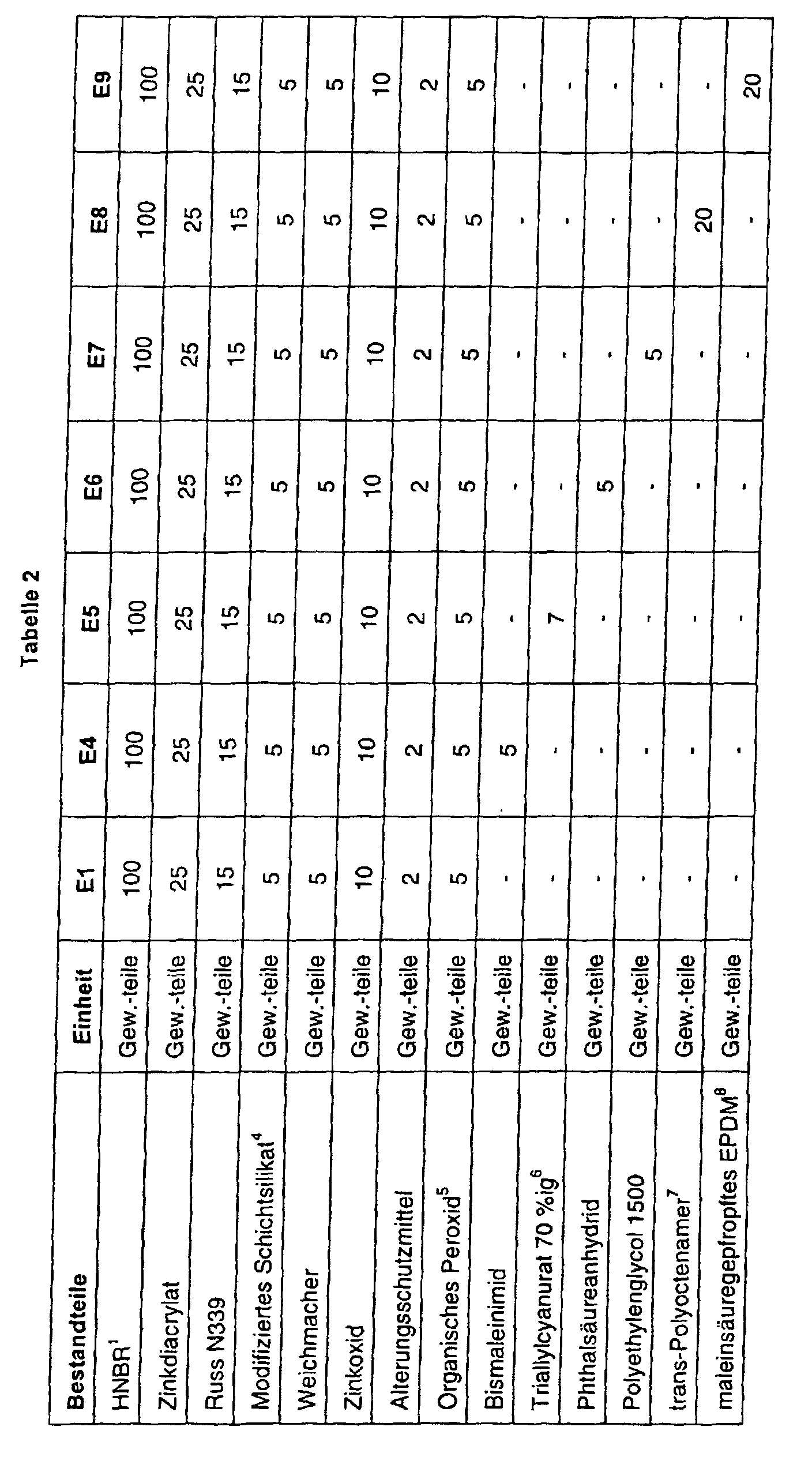
- Table 2 lists peroxide-crosslinked mixtures which start from the mixture E1 were produced and in addition to zinc diacrylate other cover crosslinkers or contain special low molecular weight polymers.
- Table 3 shows mixtures with a sulfur-based crosslinking system, namely linked with a sulfur donor.
- a sulfur-based crosslinking system namely linked with a sulfur donor.
- Resin crosslinking system based on a resorcinol derivative and a Formaldehyde dispenser used.
- the layered silicate is with Modified benzyldioctadecylmethylammonium ions.
- low molecular weight polymers such as low molecular weight EPDM
- cover crosslinker V5
- modified layered silicate and low molecular weight EPDM V6
- the highest tension values and tear resistance can only be obtained from Use of cover network, modified layered silicate and low molecular weight EPDM.
- Table 2 shows that the addition of additional coverers or low molecular weight Polymers can bring additional advantages in the vulcanizate properties. For example, can this reduces the flow of the vulcanizates, which is different from the E1 is reflected in lower compression set. Also the damping behavior, measurable via the resilience, can be influenced and thus controlled. So for example, the damping of the vulcanizates from the mixtures E6 to E9 in Further improvement compared to vulcanizates from the E1.
- the vulcanizates from the mixtures in Table 3 show that the Mixtures E10 and E11 according to the invention in comparison to mixtures V6 and V7 a particularly high tear resistance with particularly good elongation at break and also have slightly improved tension at 100% elongation. This Surprisingly, good values are also achieved when, as with the mixture E11, on the silane coupling agent, which is used to bind the silica to the Rubber is used, dispensed with.
- Vulcanizates of the starting mixture without a system crosslinking to a resin and without modified layered silicate a stress value of 100% of 2.6 MPa, a Tensile strength of 29.9 MPa, an elongation at break of 562% and a Tear resistance of 25.6 N / mm while the same mixture with one too following a resin crosslinking system and a modified layered silicate Features: Stress value 100%: 3.6 MPa, tensile strength: 24.3 MPa, Elongation at break: 617% and tear resistance: 47.1 N / mm.
Landscapes
- Chemical & Material Sciences (AREA)
- Health & Medical Sciences (AREA)
- Chemical Kinetics & Catalysis (AREA)
- Medicinal Chemistry (AREA)
- Polymers & Plastics (AREA)
- Organic Chemistry (AREA)
- Compositions Of Macromolecular Compounds (AREA)
Description
Für die Herstellung von Nanocompositen auf Basis von Polymeren und Schichtsilikaten werden dort vier Verfahren vorgestellt: die In-situ-Polymerisation, die Einlagerung (Intercalation) des Polmers aus einer Lösung, die direkte Einlagerung von geschmolzenem Polymer und die Sol/Gel-Technologie. Diese Verfahren führen dazu, dass die einzelnen Schichten des Silikates aufgeweitet werden und gegebenfalls sogar vollständig auseinander geblättert (exfoliert) werden. Die einzelnen Schichten haben eine Dicke von ca. 1 nm und sind von Polymer umgeben. Das Vorliegen von Nanocompositen in Polymerwerkstoffen ermöglicht es, die daraus hergestellten Polymerprodukte mit neuen und verbesserten Eigenschaften auszustatten. Das Konzept der Nanocomposite auf Basis von Schichtsilikaten wird vor allem im Bereich der Thermoplaste eingesetzt, um deren Eigenschaften z. B. im Hinblick auf die Zugfestigkeit zu verbessern. Für Thermoplaste sind die vier genannten Verfahren zur Herstellung von Nanocompositen anwendbar, wohingegen für Kautschuke die direkte Einlagerung des geschmolzenen Polymers aufgrund der hohen Viskositäten im herkömmlichen Verarbeitungstempraturbereich nicht möglich ist. Die anderen drei Verfahren sind auch für Kautschuk anwendbar, allerdings sind diese Verfahren technologisch sehr aufwendig und immer mit der Verwendung von Lösungsmitteln verbunden, die im weiteren Verlauf der Verarbeitung solcher Nanocomposite z. B. für die Einmischung in eine vulkaniserbare Kautschukmischung wieder i. A. vollständig entfernt werden müssen.
- 2 bis 25 phr zumindest eines Schichtsilikates, welches mit Alkylammoniumionen der allgemeinen Formel +NR4 modifiziert und frei von weiteren durch vorherige Behandlung eingequollenen oder einpolymerisierten Gastmolekülen ist, wobei die R in dem Alkylammoniumion gleich oder verschieden sein können und ausgewählt sind aus der Gruppe, bestehend aus Wasserstoff, substituierten oder unsubstituierten, gesättigten oder ungesättigten Alkylgruppen mit 1 bis 40 Kohlenstoffatomen mit oder ohne Verzweigung und substituierten oder unsubstituierten Aryl- und Benzylgruppen, wobei zumindest ein R eine substituierte oder unsubstituierte, gesättigte oder ungesättigte Alkylgruppe mit mehr als 8 Kohlenstoffatomen ist und
- 1 bis 50 phr zumindest eines Covemetzers zur Anbindung des modifizierten Schichtsilikates an die umgebenden Kautschukmoleküle, ausgewählt aus α,β-ungesättigten Säuren, Metallsalzen von α, β-ungesättigten Säuren, Estern der Acrylsäure, Estem der Methacrylsäure, aromatischen Allylestem, Allylethem, Allylcyanuraten, Bismaleinimid und 1,3-Bis(Citraconimidomethyl)benzol und einem zu einem Harz vemetzenden System, enthält.
Die sehr dünnen Plättchen des exfolierten Schichtsilikates richten sich bei der Verarbeitung der Mischung aus (Richteffekt, Anisotropie) und bewirken eine zweidimensionale Verstärkung. Das Vulkanisat nimmt anisotrope Eigenschaften an. Mit herkömmlichen, nicht modifizierten Schichtsilikaten kann eine solche zweidimensionale Verstärkung kaum erreicht werden, da die einzelnen Schichten des Siikates nicht exfoliert werden, sondern als größere Anhäufungen in der Mischung vorliegen.
Im Folgenden seien Beispiele für vorteilhaft mit dem peroxidischen Vernetzungssystem wirkende Covernetzer genannt:
- Shore-A-Härte bei Raumtemperatur gemäß DIN 53 505
- Rückprallelastizität bei Raumtemperatur gemäß DIN 53 512
- Zugfestigkeit bei Raumtemperatur gemäß DIN 53 504
- Reißdehnung bei Raumtemperatur gemäß DIN 53 504
- Spannungswerte bei 50 und 100 % Dehnung bei Raumtemperatur gemäß DIN 53 504
- Weiterreißwiderstand bei Raumtemperatur gemäß DIN 53 507
- Druckverformungsrest gemäß DIN 53 517, Zusammendrückung über 24 h bei 140 °C, Abkühlen im zusammengedrückten Zustand
- Zugverformungsrest gemäß DIN 53 518, Dehnung über 24 h bei 100 °C, Abkühlen im eingespannten Zustand


| Bestandteile | Einheit | V6 | V7 | E10 | E11 |
| Chloroprenkautschuk | phr | 100 | 100 | 100 | 100 |
| Russ N990 | phr | 22 | 7 | 7 | 7 |
| Kieselsäure | phr | 20 | 20 | 20 | 20 |
| Silankupplungsagens | phr | 2,2 | 2,2 | 2,2 | - |
| Modifiziertes Schichtsilikat | phr | - | 15 | 15 | 15- |
| Zinkoxid | phr | 4 | 4 | 4 | 4 |
| Magnesiumoxid | phr | 3 | 3 | 3 | 3 |
| Weichmacher | phr | 16 | 16 | 16 | 16 |
| Lichtschutzwachs | phr | 1 | 1 | 1 | 1 |
| Stearinsäure | phr | 1 | 1 | 1 | 1 |
| Alterungsschutzmittel | phr | 4 | 4 | 4 | 4 |
| Schwefelspender TBzTD | phr | 2,2 | 2,2 | 2,2 | 2,2 |
| Beschleuniger | phr | 1,5 | 1,5 | 1,5 | 1,5 |
| Resorcinderivat | phr | - | - | 4,5 | 4,5 |
| Formaldehydspender HMMM | phr | - | - | 2,3 | 2,3 |
| Eigenschaften | |||||
| Shorehärte | Shore A | 50 | 59 | 61 | 60 |
| Rückprallelastizität | % | 55 | 52 | 48 | 50 |
| Zugfestigkeit | MPa | 12,5 | 12,3 | 12,5 | 17,4 |
| Reißdehnung | % | 510 | 649 | 611 | 726 |
| Spannungswert 100 % | MPa | 1,2 | 1,6 | 2 | 2 |
| Zugverformungsrest | % | 20,4 | 35,4 | 29,4 | 28,5 |
| Weiterreißwiderstand | N/mm | 8,0 | 15,7 | 18,8 | 18,3 |
Aus der starken Zunahme von Fe-Fa bei den erfindungsgemäßen Mischungen im Vergleich zu den herkömmlichen Mischungen, kann man schließen, dass vermutlich eine sehr gute Anbindung des modifizierten Schichtsilikates an die umgebenden Kautschukmoleküle vorliegt.
Claims (13)
- Vulkanisierbare Kautschukmischung enthaltend, bezogen auf 100 Gewichtsteile der gesamten Kautschukkomponenten in der Kautschukmischung,2 bis 25 phr zumindest eines Schichtsilikates, welches mit Alkylammoniumionen der allgemeinen Formel +NR4 modifiziert und frei von weiteren durch vorherige Behandlung eingequollenen oder einpolymerisierten Gastmolekülen ist, wobei die R in dem Alkylammoniumion gleich oder verschieden sein können und ausgewählt sind aus der Gruppe, bestehend aus Wasserstoff, substituierten oder unsubstituierten, gesättigten oder ungesättigten Alkylgruppen mit 1 bis 40 Kohlenstoffatomen mit oder ohne Verzweigung und substituierten oder unsubstituierten Aryl- und Benzylgruppe, wobei zumindest ein R eine substituierte oder unsubstituierte, gesättigte oder ungesättigte Alkylgruppe mit mehr als 8 Kohlenstoffatomen ist und1 bis 50 phr zumindest eines Covernetzers zur Anbindung des modifizierten Schichtsilikates an die umgebenden Kautschukmoleküle, ausgewählt aus α,β-ungesättigten Säuren, Metallsalzen von α,β-ungesättigten Säuren, Estern der Acrylsäure, Estern der Methacrylsäure, aromatischen Allylestern, Allylethem, Allylcyanuraten, Bismaleinimid und 1,3-Bis(Citraconimidomethyl)benzol und einem zu einem Harz vemetzenden System.
- Vulkanisierbare Kautschukmischung nach Anspruch 1, dadurch gekennzeichnet, dass sie 2 bis 35 phr des Covernetzers enthält.
- Vulkanisierbare Kautschukmischung nach zumindest einem der Ansprüche 1 oder 2, dadurch gekennzeichnet, dass das modifizierte Schichtsilikat einen Kohlenstoffgehalt von 5 bis 50 Gew.% aufweist.
- Vulkanisierbare Kautschukmischung nach zumindest einem der Ansprüche 1 bis 3, dadurch gekennzeichnet, dass das Ammoniumion ein Dimethyldioctadecyl-, ein Benzyldioctadecylmethyl- oder ein Heptadec-8-en-1 -yltrimethylammoniumion ist.
- Vulkanisierbare Kautschukmischung nach zumindest einem der Ansprüche 1 bis 4, dadurch gekennzeichnet, dass sie als Kautschukkomponenten zumindest einen Kautschuk mit polaren Gruppen enthält.
- Vulkanisierbare Kautschukmischung nach Anspruch 5, dadurch gekennzeichnet, dass sie als Kautschukkomponenten nur einen oder mehrere Kautschuke mit polaren Gruppen enthält.
- Vulkanisierbare Kautschukmischung nach Anspruch 5 oder 6, dadurch gekennzeichnet, dass der Kautschuk mit den polaren Gruppen hydrierter Acrylnitril-Butadien-Kautschuk oder Chloroprenkautschuk ist.
- Vulkanisierbare Kautschukmischung nach zumindest einem der Ansprüche 1 bis 7, dadurch gekennzeichnet, dass sie ein peroxidisches Vemetzungssystem enthält.
- Vulkanisierbare Kautschukmischung nach Anspruch 8, dadurch gekennzeichnet, dass der oder die Covernetzer ausgewählt ist bzw. sind aus der Gruppe, bestehend aus α,β-ungesättigten Säuren, Metallsalzen von α,β-ungesättigten Säuren, Estern der Acrylsäure, Estern der Methacrylsäure, aromatischen Allylestern, Allylethem, Allylcyanuraten, Bismaleinimid und 1,3-Bis(Citraconimidomethyl)benzol.
- Vulkanisierbare Kautschukmischung nach zumindest einem der Ansprüche 1 bis 7. dadurch gekennzeichnet, dass sie ein Vernetzungssystem auf Schwefelbasis enthält.
- Vulkanisierbare Kautschukmischung nach Anspruch 10, dadurch gekennzeichnet, dass der Covernetzer ein zu einem Harz vernetzendes System, vorzugsweise auf der Basis von Phenol oder einem Phenolderivat und Formaldehyd oder einem Formaldehydspender, ist.
- Vulkanisierbare Kautschukmischung nach zumindest einem der Ansprüche 1 bis 11, dadurch gekennzeichnet, dass sie zumindest ein niedermolekulares Polymer mit einem mittleren Molekulargewicht von weniger als 150000 g/mol enthält.
- Vulkanisierbare Kautschukmischung nach Anspruch 12, dadurch gekennzeichnet, dass das niedermolekulare Polymer ausgewählt ist aus Polyalkylenglykolen, Ethylen-Propylen-Dienkautschuk, maleinsäureanhydridgepfropften Ethylen-Propylen-Dienkautschuk, Acrylnitril-Butadien-Kautschuk und trans-Polyoctenamer.
Applications Claiming Priority (2)
| Application Number | Priority Date | Filing Date | Title |
|---|---|---|---|
| DE10058297A DE10058297A1 (de) | 2000-11-29 | 2000-11-29 | Kautschukmischung mit Schichtsilikaten |
| DE10058297 | 2000-11-29 |
Publications (2)
| Publication Number | Publication Date |
|---|---|
| EP1211282A1 EP1211282A1 (de) | 2002-06-05 |
| EP1211282B1 true EP1211282B1 (de) | 2004-12-01 |
Family
ID=7664472
Family Applications (1)
| Application Number | Title | Priority Date | Filing Date |
|---|---|---|---|
| EP01125099A Expired - Lifetime EP1211282B1 (de) | 2000-11-29 | 2001-10-23 | Kautschukmischung mit expandierten Schichtsilikaten |
Country Status (3)
| Country | Link |
|---|---|
| EP (1) | EP1211282B1 (de) |
| AT (1) | ATE283895T1 (de) |
| DE (2) | DE10058297A1 (de) |
Families Citing this family (5)
| Publication number | Priority date | Publication date | Assignee | Title |
|---|---|---|---|---|
| US7013998B2 (en) * | 2003-11-20 | 2006-03-21 | Halliburton Energy Services, Inc. | Drill bit having an improved seal and lubrication method using same |
| US20050109502A1 (en) | 2003-11-20 | 2005-05-26 | Jeremy Buc Slay | Downhole seal element formed from a nanocomposite material |
| DE102007023995A1 (de) * | 2007-05-23 | 2008-11-27 | Contitech Luftfedersysteme Gmbh | Schutzschicht für elastomere Elemente |
| DE102009026229A1 (de) | 2008-09-29 | 2010-04-01 | Continental Reifen Deutschland Gmbh | Kautschukmischung mit verbesserter Ermüdungsbeständigkeit |
| DE102008049313A1 (de) | 2008-09-29 | 2010-04-01 | Continental Reifen Deutschland Gmbh | Kautschukmischung und Fahrzeugluftreifen mit verbesserter Luftdichtigkeit und verbesserter Ermüdungsbeständigkeit |
Family Cites Families (8)
| Publication number | Priority date | Publication date | Assignee | Title |
|---|---|---|---|---|
| US2531396A (en) * | 1947-03-29 | 1950-11-28 | Nat Lead Co | Elastomer reinforced with a modified clay |
| US2886550A (en) * | 1956-05-24 | 1959-05-12 | Kerr Mc Gee Oil Ind Inc | Process for compounding rubbery polymers with hydrocarbon extended and modified clayand product obtained |
| DE3139090C1 (de) * | 1981-10-01 | 1983-07-28 | Röhm GmbH, 6100 Darmstadt | Plastisole aus Copolymerisaten des Methylmethacrylats mit verbesserter Haftfestigkeit und ihre Verwendung |
| US5473017A (en) * | 1993-09-30 | 1995-12-05 | Exxon Chemical Patents Inc. | Intervulcanized elastomer blends |
| US5651995A (en) * | 1994-09-30 | 1997-07-29 | Nippon Zeon Co., Ltd. | Highly saturated nitrile rubber, process for producing same, vulcanizable rubber composition, aqueous emulsion and adhesive composition |
| DE69615090T2 (de) * | 1995-06-05 | 2002-06-06 | Kabushiki Kaisha Toyota Chuo Kenkyusho, Aichi | Verbundtonmaterial und Verfahren zu seiner Herstellung, Mischungsmaterial und Verbundtonkautschuk, die es anwenden, und Verfahren zu ihrer Herstellung |
| CN1130412C (zh) * | 1996-02-23 | 2003-12-10 | 陶氏环球技术公司 | 聚合物泡沫体中层离颗粒的分散 |
| US6034164A (en) * | 1997-02-21 | 2000-03-07 | Exxon Research And Engineering Co. | Nanocomposite materials formed from inorganic layered materials dispersed in a polymer matrix |
-
2000
- 2000-11-29 DE DE10058297A patent/DE10058297A1/de not_active Ceased
-
2001
- 2001-10-23 AT AT01125099T patent/ATE283895T1/de not_active IP Right Cessation
- 2001-10-23 EP EP01125099A patent/EP1211282B1/de not_active Expired - Lifetime
- 2001-10-23 DE DE50104677T patent/DE50104677D1/de not_active Expired - Lifetime
Also Published As
| Publication number | Publication date |
|---|---|
| DE50104677D1 (de) | 2005-01-05 |
| DE10058297A1 (de) | 2002-07-18 |
| ATE283895T1 (de) | 2004-12-15 |
| EP1211282A1 (de) | 2002-06-05 |
Similar Documents
| Publication | Publication Date | Title |
|---|---|---|
| DE10059236B4 (de) | Verwendung einer Kautschukmischung für Reifenlaufstreifen | |
| DE60133829T2 (de) | Verbundstoff aus dienkautschuk und anorganischer verbindung und verfahren zu dessen herstellung und kautschukzusammensetzung | |
| EP2088169B1 (de) | Kautschukmischung und daraus hergestellte reifen | |
| DE69500759T2 (de) | Hochgesättigter Nitridkautschuk, Verfahren zu seiner Herstellung, vulkanisierbare Kautschukzusammensetzung, wässrige Emulsion und Klebstoffzusammensetzung | |
| WO2010012531A1 (de) | Kautschukmischung mit umweltfreundlichem weichmacher | |
| EP3827064B1 (de) | Haftmischungen für kautschuke | |
| DE4319142A1 (de) | Verfahren zur Herstellung von Verbundgegenständen aus Polyamiden und Elastomeren | |
| DE102007042496A1 (de) | Kautschukmischungen und daraus erhaltene Elastomere mit modifizierten Schichtsilikat-Füllstoffen und Verfahren zu ihrer Herstellung | |
| WO2012084377A1 (de) | Kautschukmischung mit umweltfreundlichem weichmacher | |
| DE10059287A1 (de) | Atriebsriemen aus Kautschukmischung mit Schichtsilikaten | |
| EP1211282A1 (de) | Kautschukmischung mit expandierten Schichtsilikaten | |
| EP2469123B9 (de) | Riemen mit hoher dynamischer Belastbarkeit | |
| DE10059237A1 (de) | Dichtung aus Kautschukmischung mit Schichtsilikaten | |
| DE102021209766A1 (de) | Gummierter, metallischer Festigkeitsträger und Fahrzeugluftreifen | |
| DE102009059207B4 (de) | Kautschukmischung und deren Verwendung | |
| DE102015215327B4 (de) | Vulkanisat, Verwendung dessen und Fahrzeugreifen | |
| DE102018211763A1 (de) | Schwefelvernetzbare Kautschukmischung, Vulkanisat und Fahrzeugreifen | |
| EP2080782A1 (de) | Kautschukmischung mit verbesserter Steifigkeit | |
| DE102018212821B4 (de) | Schwefelvernetzbare Kautschukmischung und Fahrzeugluftreifen | |
| EP1041103A2 (de) | Verbundgegenstand aus Polyestern und Elastomeren | |
| EP1364987B1 (de) | Kautschukmischung | |
| DE102018213702B4 (de) | Schwefelvernetzbare Kautschukmischung und Fahrzeugluftreifen | |
| DE102024117641A1 (de) | Walzenzylinder mit einer vernetzten Haftungsschicht aus einem vernetzten Kautschuk zur Haftung einer Funktionsschicht auf dem Walzenzylinderkern | |
| DE102021209764A1 (de) | Schwefelvernetzbare Gummierungsmischung und Fahrzeugluftreifen | |
| DE102021206277A1 (de) | Kautschukmischung und Reifen |
Legal Events
| Date | Code | Title | Description |
|---|---|---|---|
| PUAI | Public reference made under article 153(3) epc to a published international application that has entered the european phase |
Free format text: ORIGINAL CODE: 0009012 |
|
| AK | Designated contracting states |
Kind code of ref document: A1 Designated state(s): AT BE CH CY DE DK ES FI FR GB GR IE IT LI LU MC NL PT SE TR |
|
| AX | Request for extension of the european patent |
Free format text: AL;LT;LV;MK;RO;SI |
|
| 17P | Request for examination filed |
Effective date: 20021205 |
|
| AKX | Designation fees paid |
Designated state(s): AT BE CH CY DE DK ES FI FR GB GR IE IT LI LU MC NL PT SE TR |
|
| 17Q | First examination report despatched |
Effective date: 20030620 |
|
| GRAP | Despatch of communication of intention to grant a patent |
Free format text: ORIGINAL CODE: EPIDOSNIGR1 |
|
| GRAS | Grant fee paid |
Free format text: ORIGINAL CODE: EPIDOSNIGR3 |
|
| GRAA | (expected) grant |
Free format text: ORIGINAL CODE: 0009210 |
|
| AK | Designated contracting states |
Kind code of ref document: B1 Designated state(s): AT BE CH CY DE DK ES FI FR GB GR IE IT LI LU MC NL PT SE TR |
|
| PG25 | Lapsed in a contracting state [announced via postgrant information from national office to epo] |
Ref country code: TR Free format text: LAPSE BECAUSE OF FAILURE TO SUBMIT A TRANSLATION OF THE DESCRIPTION OR TO PAY THE FEE WITHIN THE PRESCRIBED TIME-LIMIT Effective date: 20041201 Ref country code: FI Free format text: LAPSE BECAUSE OF FAILURE TO SUBMIT A TRANSLATION OF THE DESCRIPTION OR TO PAY THE FEE WITHIN THE PRESCRIBED TIME-LIMIT Effective date: 20041201 Ref country code: NL Free format text: LAPSE BECAUSE OF FAILURE TO SUBMIT A TRANSLATION OF THE DESCRIPTION OR TO PAY THE FEE WITHIN THE PRESCRIBED TIME-LIMIT Effective date: 20041201 Ref country code: FR Free format text: LAPSE BECAUSE OF NON-PAYMENT OF DUE FEES Effective date: 20041201 Ref country code: GB Free format text: LAPSE BECAUSE OF FAILURE TO SUBMIT A TRANSLATION OF THE DESCRIPTION OR TO PAY THE FEE WITHIN THE PRESCRIBED TIME-LIMIT Effective date: 20041201 Ref country code: IE Free format text: LAPSE BECAUSE OF FAILURE TO SUBMIT A TRANSLATION OF THE DESCRIPTION OR TO PAY THE FEE WITHIN THE PRESCRIBED TIME-LIMIT Effective date: 20041201 Ref country code: IT Free format text: LAPSE BECAUSE OF FAILURE TO SUBMIT A TRANSLATION OF THE DESCRIPTION OR TO PAY THE FEE WITHIN THE PRESCRIBED TIME-LIMIT;WARNING: LAPSES OF ITALIAN PATENTS WITH EFFECTIVE DATE BEFORE 2007 MAY HAVE OCCURRED AT ANY TIME BEFORE 2007. THE CORRECT EFFECTIVE DATE MAY BE DIFFERENT FROM THE ONE RECORDED. Effective date: 20041201 |
|
| REG | Reference to a national code |
Ref country code: GB Ref legal event code: FG4D Free format text: NOT ENGLISH |
|
| REG | Reference to a national code |
Ref country code: CH Ref legal event code: EP |
|
| REG | Reference to a national code |
Ref country code: IE Ref legal event code: FG4D Free format text: GERMAN |
|
| REF | Corresponds to: |
Ref document number: 50104677 Country of ref document: DE Date of ref document: 20050105 Kind code of ref document: P |
|
| PG25 | Lapsed in a contracting state [announced via postgrant information from national office to epo] |
Ref country code: SE Free format text: LAPSE BECAUSE OF FAILURE TO SUBMIT A TRANSLATION OF THE DESCRIPTION OR TO PAY THE FEE WITHIN THE PRESCRIBED TIME-LIMIT Effective date: 20050301 Ref country code: GR Free format text: LAPSE BECAUSE OF FAILURE TO SUBMIT A TRANSLATION OF THE DESCRIPTION OR TO PAY THE FEE WITHIN THE PRESCRIBED TIME-LIMIT Effective date: 20050301 Ref country code: DK Free format text: LAPSE BECAUSE OF FAILURE TO SUBMIT A TRANSLATION OF THE DESCRIPTION OR TO PAY THE FEE WITHIN THE PRESCRIBED TIME-LIMIT Effective date: 20050301 |
|
| PG25 | Lapsed in a contracting state [announced via postgrant information from national office to epo] |
Ref country code: ES Free format text: LAPSE BECAUSE OF FAILURE TO SUBMIT A TRANSLATION OF THE DESCRIPTION OR TO PAY THE FEE WITHIN THE PRESCRIBED TIME-LIMIT Effective date: 20050312 |
|
| NLV1 | Nl: lapsed or annulled due to failure to fulfill the requirements of art. 29p and 29m of the patents act | ||
| GBV | Gb: ep patent (uk) treated as always having been void in accordance with gb section 77(7)/1977 [no translation filed] |
Effective date: 20041201 |
|
| REG | Reference to a national code |
Ref country code: IE Ref legal event code: FD4D |
|
| PLBE | No opposition filed within time limit |
Free format text: ORIGINAL CODE: 0009261 |
|
| STAA | Information on the status of an ep patent application or granted ep patent |
Free format text: STATUS: NO OPPOSITION FILED WITHIN TIME LIMIT |
|
| PG25 | Lapsed in a contracting state [announced via postgrant information from national office to epo] |
Ref country code: CY Free format text: LAPSE BECAUSE OF FAILURE TO SUBMIT A TRANSLATION OF THE DESCRIPTION OR TO PAY THE FEE WITHIN THE PRESCRIBED TIME-LIMIT Effective date: 20051023 Ref country code: AT Free format text: LAPSE BECAUSE OF NON-PAYMENT OF DUE FEES Effective date: 20051023 |
|
| PG25 | Lapsed in a contracting state [announced via postgrant information from national office to epo] |
Ref country code: MC Free format text: LAPSE BECAUSE OF NON-PAYMENT OF DUE FEES Effective date: 20051031 Ref country code: LI Free format text: LAPSE BECAUSE OF NON-PAYMENT OF DUE FEES Effective date: 20051031 Ref country code: LU Free format text: LAPSE BECAUSE OF NON-PAYMENT OF DUE FEES Effective date: 20051031 Ref country code: CH Free format text: LAPSE BECAUSE OF NON-PAYMENT OF DUE FEES Effective date: 20051031 Ref country code: BE Free format text: LAPSE BECAUSE OF NON-PAYMENT OF DUE FEES Effective date: 20051031 |
|
| 26N | No opposition filed |
Effective date: 20050902 |
|
| EN | Fr: translation not filed | ||
| REG | Reference to a national code |
Ref country code: CH Ref legal event code: PL |
|
| BERE | Be: lapsed |
Owner name: *CONITECH HOLDING G.M.B.H. Effective date: 20051031 |
|
| PG25 | Lapsed in a contracting state [announced via postgrant information from national office to epo] |
Ref country code: PT Free format text: LAPSE BECAUSE OF NON-PAYMENT OF DUE FEES Effective date: 20050501 |
|
| PGFP | Annual fee paid to national office [announced via postgrant information from national office to epo] |
Ref country code: DE Payment date: 20181031 Year of fee payment: 18 |
|
| REG | Reference to a national code |
Ref country code: DE Ref legal event code: R119 Ref document number: 50104677 Country of ref document: DE |
|
| PG25 | Lapsed in a contracting state [announced via postgrant information from national office to epo] |
Ref country code: DE Free format text: LAPSE BECAUSE OF NON-PAYMENT OF DUE FEES Effective date: 20200501 |