EP1208097B1 - Substituted oxoazaheterocyclyl compounds - Google Patents
Substituted oxoazaheterocyclyl compounds Download PDFInfo
- Publication number
- EP1208097B1 EP1208097B1 EP00951781A EP00951781A EP1208097B1 EP 1208097 B1 EP1208097 B1 EP 1208097B1 EP 00951781 A EP00951781 A EP 00951781A EP 00951781 A EP00951781 A EP 00951781A EP 1208097 B1 EP1208097 B1 EP 1208097B1
- Authority
- EP
- European Patent Office
- Prior art keywords
- ylmethyl
- chloro
- thiophen
- isoxazol
- piperazin
- Prior art date
- Legal status (The legal status is an assumption and is not a legal conclusion. Google has not performed a legal analysis and makes no representation as to the accuracy of the status listed.)
- Expired - Lifetime
Links
- 150000001875 compounds Chemical class 0.000 title claims abstract description 63
- 239000008194 pharmaceutical composition Substances 0.000 claims abstract description 8
- 239000003146 anticoagulant agent Substances 0.000 claims description 14
- 230000015572 biosynthetic process Effects 0.000 claims description 12
- 238000002560 therapeutic procedure Methods 0.000 claims description 12
- 208000007536 Thrombosis Diseases 0.000 claims description 11
- 238000002360 preparation method Methods 0.000 claims description 10
- 206010051055 Deep vein thrombosis Diseases 0.000 claims description 7
- 238000011282 treatment Methods 0.000 claims description 7
- KPCCBZMZLJTXIX-MRXNPFEDSA-N (6r)-1-[(4-aminoquinazolin-7-yl)methyl]-4-[[5-(5-chlorothiophen-2-yl)-1,2-oxazol-3-yl]methyl]-6-(methoxymethyl)piperazin-2-one Chemical compound C([C@@H](N(C(=O)C1)CC=2C=C3N=CN=C(N)C3=CC=2)COC)N1CC(=NO1)C=C1C1=CC=C(Cl)S1 KPCCBZMZLJTXIX-MRXNPFEDSA-N 0.000 claims description 6
- 208000037803 restenosis Diseases 0.000 claims description 6
- 206010000891 acute myocardial infarction Diseases 0.000 claims description 5
- 210000001367 artery Anatomy 0.000 claims description 5
- 230000002093 peripheral effect Effects 0.000 claims description 5
- 210000005166 vasculature Anatomy 0.000 claims description 5
- DRGIGDYIMYVIPD-TXEPZDRESA-N (3s)-1-[(4-aminoquinazolin-7-yl)methyl]-4-[[5-(5-chlorothiophen-2-yl)-1,2-oxazol-3-yl]methyl]-3-propylpiperazin-2-one;2,2,2-trifluoroacetic acid Chemical compound OC(=O)C(F)(F)F.OC(=O)C(F)(F)F.N1([C@H](C(N(CC=2C=C3N=CN=C(N)C3=CC=2)CC1)=O)CCC)CC(=NO1)C=C1C1=CC=C(Cl)S1 DRGIGDYIMYVIPD-TXEPZDRESA-N 0.000 claims description 4
- UZZJCFODHGBNAP-QGZVFWFLSA-N (6r)-1-[(4-aminoquinazolin-7-yl)methyl]-4-[[5-(5-chlorothiophen-2-yl)-1,2-oxazol-3-yl]methyl]-6-(ethoxymethyl)piperazin-2-one Chemical compound C([C@@H](N(C(=O)C1)CC=2C=C3N=CN=C(N)C3=CC=2)COCC)N1CC(=NO1)C=C1C1=CC=C(Cl)S1 UZZJCFODHGBNAP-QGZVFWFLSA-N 0.000 claims description 4
- UGAMPVZERUGBMO-UHFFFAOYSA-N 1-[(4-aminoquinazolin-7-yl)methyl]-4-[[3-(5-chlorothiophen-2-yl)-1,2-oxazol-5-yl]methyl]-3-methylpiperazin-2-one;2,2,2-trifluoroacetic acid Chemical compound OC(=O)C(F)(F)F.OC(=O)C(F)(F)F.C1CN(CC=2C=C3N=CN=C(N)C3=CC=2)C(=O)C(C)N1CC(ON=1)=CC=1C1=CC=C(Cl)S1 UGAMPVZERUGBMO-UHFFFAOYSA-N 0.000 claims description 4
- CIRUOCWGWWYEOA-UHFFFAOYSA-N 1-[(4-aminoquinazolin-7-yl)methyl]-4-[[3-(5-chlorothiophen-2-yl)-1,2-oxazol-5-yl]methyl]piperazin-2-one;2,2,2-trifluoroacetic acid Chemical compound OC(=O)C(F)(F)F.OC(=O)C(F)(F)F.C=1C=C2C(N)=NC=NC2=CC=1CN(C(C1)=O)CCN1CC(ON=1)=CC=1C1=CC=C(Cl)S1 CIRUOCWGWWYEOA-UHFFFAOYSA-N 0.000 claims description 4
- 206010053567 Coagulopathies Diseases 0.000 claims description 4
- 230000001154 acute effect Effects 0.000 claims description 4
- ILROOURZVRAYGD-GXKRWWSZSA-N (3s)-1-[(4-aminoquinazolin-7-yl)methyl]-4-[[5-(5-chlorothiophen-2-yl)-1,2-oxazol-3-yl]methyl]-3-methylpiperazin-2-one;2,2,2-trifluoroacetic acid Chemical compound OC(=O)C(F)(F)F.OC(=O)C(F)(F)F.N1([C@H](C(N(CC=2C=C3N=CN=C(N)C3=CC=2)CC1)=O)C)CC(=NO1)C=C1C1=CC=C(Cl)S1 ILROOURZVRAYGD-GXKRWWSZSA-N 0.000 claims description 3
- TZASSKUFFUBNAV-UHFFFAOYSA-N 1-[(4-aminoquinazolin-7-yl)methyl]-4-[[5-(5-chlorothiophen-2-yl)-1,2-oxazol-3-yl]methyl]piperazin-2-one;2,2,2-trifluoroacetic acid Chemical compound OC(=O)C(F)(F)F.OC(=O)C(F)(F)F.C=1C=C2C(N)=NC=NC2=CC=1CN(C(C1)=O)CCN1CC(=NO1)C=C1C1=CC=C(Cl)S1 TZASSKUFFUBNAV-UHFFFAOYSA-N 0.000 claims description 3
- BKLLPBOJHRLNSI-UHFFFAOYSA-N 4-[[5-(5-chlorothiophen-2-yl)-1,2-oxazol-3-yl]methyl]-1-(1h-pyrrolo[3,2-c]pyridin-2-ylmethyl)piperazin-2-one;2,2,2-trifluoroacetic acid Chemical compound OC(=O)C(F)(F)F.OC(=O)C(F)(F)F.S1C(Cl)=CC=C1C1=CC(CN2CC(=O)N(CC=3NC4=CC=NC=C4C=3)CC2)=NO1 BKLLPBOJHRLNSI-UHFFFAOYSA-N 0.000 claims description 3
- 206010002388 Angina unstable Diseases 0.000 claims description 3
- 208000005189 Embolism Diseases 0.000 claims description 3
- 206010022562 Intermittent claudication Diseases 0.000 claims description 3
- 208000006011 Stroke Diseases 0.000 claims description 3
- 208000001435 Thromboembolism Diseases 0.000 claims description 3
- 208000032109 Transient ischaemic attack Diseases 0.000 claims description 3
- 208000007814 Unstable Angina Diseases 0.000 claims description 3
- 206010047249 Venous thrombosis Diseases 0.000 claims description 3
- 230000003187 abdominal effect Effects 0.000 claims description 3
- 208000015294 blood coagulation disease Diseases 0.000 claims description 3
- 238000007887 coronary angioplasty Methods 0.000 claims description 3
- 201000004332 intermediate coronary syndrome Diseases 0.000 claims description 3
- 208000021156 intermittent vascular claudication Diseases 0.000 claims description 3
- 210000003127 knee Anatomy 0.000 claims description 3
- 210000003141 lower extremity Anatomy 0.000 claims description 3
- 210000004789 organ system Anatomy 0.000 claims description 3
- 230000001575 pathological effect Effects 0.000 claims description 3
- 238000001356 surgical procedure Methods 0.000 claims description 3
- 230000009885 systemic effect Effects 0.000 claims description 3
- 230000002537 thrombolytic effect Effects 0.000 claims description 3
- 201000010875 transient cerebral ischemia Diseases 0.000 claims description 3
- 210000003462 vein Anatomy 0.000 claims description 3
- 239000003814 drug Substances 0.000 claims description 2
- 239000003937 drug carrier Substances 0.000 claims description 2
- 108010074860 Factor Xa Proteins 0.000 abstract description 42
- 238000000034 method Methods 0.000 abstract description 18
- 239000000543 intermediate Substances 0.000 abstract description 14
- 108010029144 Factor IIa Proteins 0.000 abstract description 7
- 230000002401 inhibitory effect Effects 0.000 abstract description 6
- XEKOWRVHYACXOJ-UHFFFAOYSA-N Ethyl acetate Chemical compound CCOC(C)=O XEKOWRVHYACXOJ-UHFFFAOYSA-N 0.000 description 104
- YMWUJEATGCHHMB-UHFFFAOYSA-N Dichloromethane Chemical compound ClCCl YMWUJEATGCHHMB-UHFFFAOYSA-N 0.000 description 69
- 239000000243 solution Substances 0.000 description 67
- OKKJLVBELUTLKV-UHFFFAOYSA-N Methanol Chemical compound OC OKKJLVBELUTLKV-UHFFFAOYSA-N 0.000 description 55
- 239000000203 mixture Substances 0.000 description 45
- HEDRZPFGACZZDS-MICDWDOJSA-N Trichloro(2H)methane Chemical compound [2H]C(Cl)(Cl)Cl HEDRZPFGACZZDS-MICDWDOJSA-N 0.000 description 42
- 235000019439 ethyl acetate Nutrition 0.000 description 41
- CSNNHWWHGAXBCP-UHFFFAOYSA-L Magnesium sulfate Chemical compound [Mg+2].[O-][S+2]([O-])([O-])[O-] CSNNHWWHGAXBCP-UHFFFAOYSA-L 0.000 description 40
- 238000005160 1H NMR spectroscopy Methods 0.000 description 34
- XLYOFNOQVPJJNP-UHFFFAOYSA-N water Chemical compound O XLYOFNOQVPJJNP-UHFFFAOYSA-N 0.000 description 34
- 108090000190 Thrombin Proteins 0.000 description 33
- 229960004072 thrombin Drugs 0.000 description 33
- 239000007787 solid Substances 0.000 description 27
- VLKZOEOYAKHREP-UHFFFAOYSA-N n-Hexane Chemical class CCCCCC VLKZOEOYAKHREP-UHFFFAOYSA-N 0.000 description 25
- IAZDPXIOMUYVGZ-UHFFFAOYSA-N Dimethylsulphoxide Chemical compound CS(C)=O IAZDPXIOMUYVGZ-UHFFFAOYSA-N 0.000 description 24
- 239000000047 product Substances 0.000 description 24
- 229910052943 magnesium sulfate Inorganic materials 0.000 description 20
- ZMANZCXQSJIPKH-UHFFFAOYSA-N Triethylamine Chemical compound CCN(CC)CC ZMANZCXQSJIPKH-UHFFFAOYSA-N 0.000 description 19
- 230000000694 effects Effects 0.000 description 19
- 239000003112 inhibitor Substances 0.000 description 15
- LFQSCWFLJHTTHZ-UHFFFAOYSA-N Ethanol Chemical compound CCO LFQSCWFLJHTTHZ-UHFFFAOYSA-N 0.000 description 14
- VYPSYNLAJGMNEJ-UHFFFAOYSA-N Silicium dioxide Chemical compound O=[Si]=O VYPSYNLAJGMNEJ-UHFFFAOYSA-N 0.000 description 14
- 239000012267 brine Substances 0.000 description 13
- 229910052739 hydrogen Inorganic materials 0.000 description 13
- HPALAKNZSZLMCH-UHFFFAOYSA-M sodium;chloride;hydrate Chemical compound O.[Na+].[Cl-] HPALAKNZSZLMCH-UHFFFAOYSA-M 0.000 description 13
- HEMHJVSKTPXQMS-UHFFFAOYSA-M Sodium hydroxide Chemical compound [OH-].[Na+] HEMHJVSKTPXQMS-UHFFFAOYSA-M 0.000 description 12
- WEVYAHXRMPXWCK-UHFFFAOYSA-N Acetonitrile Chemical compound CC#N WEVYAHXRMPXWCK-UHFFFAOYSA-N 0.000 description 11
- 229940127219 anticoagulant drug Drugs 0.000 description 11
- 210000004027 cell Anatomy 0.000 description 10
- 238000003818 flash chromatography Methods 0.000 description 10
- 230000005764 inhibitory process Effects 0.000 description 10
- 239000002904 solvent Substances 0.000 description 10
- QTBSBXVTEAMEQO-UHFFFAOYSA-N Acetic acid Chemical compound CC(O)=O QTBSBXVTEAMEQO-UHFFFAOYSA-N 0.000 description 9
- 239000010410 layer Substances 0.000 description 9
- 239000011541 reaction mixture Substances 0.000 description 9
- JUJWROOIHBZHMG-UHFFFAOYSA-N Pyridine Chemical compound C1=CC=NC=C1 JUJWROOIHBZHMG-UHFFFAOYSA-N 0.000 description 8
- 108090000790 Enzymes Proteins 0.000 description 7
- 102000004190 Enzymes Human genes 0.000 description 7
- 230000015271 coagulation Effects 0.000 description 7
- 238000005345 coagulation Methods 0.000 description 7
- 229940088598 enzyme Drugs 0.000 description 7
- 239000012044 organic layer Substances 0.000 description 7
- 238000000746 purification Methods 0.000 description 7
- 230000002829 reductive effect Effects 0.000 description 7
- 230000001732 thrombotic effect Effects 0.000 description 7
- NLXLAEXVIDQMFP-UHFFFAOYSA-N Ammonia chloride Chemical compound [NH4+].[Cl-] NLXLAEXVIDQMFP-UHFFFAOYSA-N 0.000 description 6
- RTZKZFJDLAIYFH-UHFFFAOYSA-N Diethyl ether Chemical compound CCOCC RTZKZFJDLAIYFH-UHFFFAOYSA-N 0.000 description 6
- 229940123583 Factor Xa inhibitor Drugs 0.000 description 6
- DNIAPMSPPWPWGF-UHFFFAOYSA-N Propylene glycol Chemical compound CC(O)CO DNIAPMSPPWPWGF-UHFFFAOYSA-N 0.000 description 6
- YXFVVABEGXRONW-UHFFFAOYSA-N Toluene Chemical compound CC1=CC=CC=C1 YXFVVABEGXRONW-UHFFFAOYSA-N 0.000 description 6
- 230000004913 activation Effects 0.000 description 6
- 238000006243 chemical reaction Methods 0.000 description 6
- 239000003795 chemical substances by application Substances 0.000 description 6
- 239000012043 crude product Substances 0.000 description 6
- 208000037265 diseases, disorders, signs and symptoms Diseases 0.000 description 6
- 238000001819 mass spectrum Methods 0.000 description 6
- 229920006395 saturated elastomer Polymers 0.000 description 6
- 239000000741 silica gel Substances 0.000 description 6
- 229910002027 silica gel Inorganic materials 0.000 description 6
- 239000012279 sodium borohydride Substances 0.000 description 6
- 229910000033 sodium borohydride Inorganic materials 0.000 description 6
- RIOQSEWOXXDEQQ-UHFFFAOYSA-N triphenylphosphine Chemical compound C1=CC=CC=C1P(C=1C=CC=CC=1)C1=CC=CC=C1 RIOQSEWOXXDEQQ-UHFFFAOYSA-N 0.000 description 6
- UBIXPIXAVFHKMM-UHFFFAOYSA-N 3-(bromomethyl)-5-(5-chlorothiophen-2-yl)-1,2-oxazole Chemical compound S1C(Cl)=CC=C1C1=CC(CBr)=NO1 UBIXPIXAVFHKMM-UHFFFAOYSA-N 0.000 description 5
- IAZDPXIOMUYVGZ-WFGJKAKNSA-N Dimethyl sulfoxide Chemical compound [2H]C([2H])([2H])S(=O)C([2H])([2H])[2H] IAZDPXIOMUYVGZ-WFGJKAKNSA-N 0.000 description 5
- HTTJABKRGRZYRN-UHFFFAOYSA-N Heparin Chemical compound OC1C(NC(=O)C)C(O)OC(COS(O)(=O)=O)C1OC1C(OS(O)(=O)=O)C(O)C(OC2C(C(OS(O)(=O)=O)C(OC3C(C(O)C(O)C(O3)C(O)=O)OS(O)(=O)=O)C(CO)O2)NS(O)(=O)=O)C(C(O)=O)O1 HTTJABKRGRZYRN-UHFFFAOYSA-N 0.000 description 5
- 108010094028 Prothrombin Proteins 0.000 description 5
- 230000002159 abnormal effect Effects 0.000 description 5
- 230000023555 blood coagulation Effects 0.000 description 5
- 125000001309 chloro group Chemical group Cl* 0.000 description 5
- 230000001684 chronic effect Effects 0.000 description 5
- 238000004440 column chromatography Methods 0.000 description 5
- 239000000706 filtrate Substances 0.000 description 5
- 229960002897 heparin Drugs 0.000 description 5
- 229920000669 heparin Polymers 0.000 description 5
- 238000001990 intravenous administration Methods 0.000 description 5
- 150000002500 ions Chemical class 0.000 description 5
- 239000002480 mineral oil Substances 0.000 description 5
- 235000010446 mineral oil Nutrition 0.000 description 5
- 239000012074 organic phase Substances 0.000 description 5
- 229910000104 sodium hydride Inorganic materials 0.000 description 5
- 239000007921 spray Substances 0.000 description 5
- 239000000725 suspension Substances 0.000 description 5
- 229940086542 triethylamine Drugs 0.000 description 5
- 230000002792 vascular Effects 0.000 description 5
- 102000004411 Antithrombin III Human genes 0.000 description 4
- 108090000935 Antithrombin III Proteins 0.000 description 4
- OKKJLVBELUTLKV-MZCSYVLQSA-N Deuterated methanol Chemical compound [2H]OC([2H])([2H])[2H] OKKJLVBELUTLKV-MZCSYVLQSA-N 0.000 description 4
- 241001465754 Metazoa Species 0.000 description 4
- PCLIMKBDDGJMGD-UHFFFAOYSA-N N-bromosuccinimide Chemical compound BrN1C(=O)CCC1=O PCLIMKBDDGJMGD-UHFFFAOYSA-N 0.000 description 4
- JRNVZBWKYDBUCA-UHFFFAOYSA-N N-chlorosuccinimide Chemical compound ClN1C(=O)CCC1=O JRNVZBWKYDBUCA-UHFFFAOYSA-N 0.000 description 4
- 102100027378 Prothrombin Human genes 0.000 description 4
- 229960005348 antithrombin iii Drugs 0.000 description 4
- 238000003556 assay Methods 0.000 description 4
- 239000000460 chlorine Substances 0.000 description 4
- 201000010099 disease Diseases 0.000 description 4
- 239000006185 dispersion Substances 0.000 description 4
- 239000007789 gas Substances 0.000 description 4
- 229940127215 low-molecular weight heparin Drugs 0.000 description 4
- 230000002297 mitogenic effect Effects 0.000 description 4
- XHXFXVLFKHQFAL-UHFFFAOYSA-N phosphoryl trichloride Chemical compound ClP(Cl)(Cl)=O XHXFXVLFKHQFAL-UHFFFAOYSA-N 0.000 description 4
- 239000002244 precipitate Substances 0.000 description 4
- 230000035755 proliferation Effects 0.000 description 4
- 229940039716 prothrombin Drugs 0.000 description 4
- UMJSCPRVCHMLSP-UHFFFAOYSA-N pyridine Natural products COC1=CC=CN=C1 UMJSCPRVCHMLSP-UHFFFAOYSA-N 0.000 description 4
- 238000004007 reversed phase HPLC Methods 0.000 description 4
- 150000003839 salts Chemical class 0.000 description 4
- 238000012360 testing method Methods 0.000 description 4
- 230000001225 therapeutic effect Effects 0.000 description 4
- NCFOWBJWOCZVNZ-OAHLLOKOSA-N (6R)-4-benzyl-6-(2-tert-butylsilyloxypropan-2-yl)piperazin-2-one Chemical compound C(C1=CC=CC=C1)N1CC(N[C@H](C1)C(O[SiH2]C(C)(C)C)(C)C)=O NCFOWBJWOCZVNZ-OAHLLOKOSA-N 0.000 description 3
- DZTOIPQEARRTCN-OAHLLOKOSA-N (6R)-6-(2-tert-butylsilyloxypropan-2-yl)-4-[[5-(5-chlorothiophen-2-yl)-1,2-oxazol-3-yl]methyl]piperazin-2-one Chemical compound C(C)(C)(C)[SiH2]OC([C@H]1CN(CC(N1)=O)CC1=NOC(=C1)C=1SC(=CC1)Cl)(C)C DZTOIPQEARRTCN-OAHLLOKOSA-N 0.000 description 3
- FTSXYJTZYKNHJM-MRVPVSSYSA-N (6R)-6-(2-tert-butylsilyloxypropan-2-yl)piperazin-2-one Chemical compound C(C)(C)(C)[SiH2]OC([C@H]1CNCC(N1)=O)(C)C FTSXYJTZYKNHJM-MRVPVSSYSA-N 0.000 description 3
- YFUKVRGSOSXBNR-UHFFFAOYSA-N 1-[(4-aminoquinazolin-7-yl)methyl]-4-[[5-(5-chlorothiophen-2-yl)-1,2-oxazol-3-yl]methyl]piperazine-2,3-dione Chemical compound C=1C=C2C(N)=NC=NC2=CC=1CN(C(C1=O)=O)CCN1CC(=NO1)C=C1C1=CC=C(Cl)S1 YFUKVRGSOSXBNR-UHFFFAOYSA-N 0.000 description 3
- -1 2-(1H-benzotriazol-1-yl)-1,1,3,3-tetramethyluronium tetrafluoroborate Chemical compound 0.000 description 3
- RHXQSLBRXCZZIF-PGUFJCEWSA-N 2-(benzhydrylideneamino)-4-[[(2R)-2-(2-tert-butylsilyloxypropan-2-yl)-4-[[5-(5-chlorothiophen-2-yl)-1,2-oxazol-3-yl]methyl]-6-oxopiperazin-1-yl]methyl]benzonitrile Chemical compound C(C1=CC=CC=C1)(C1=CC=CC=C1)=NC1=C(C#N)C=CC(=C1)CN1[C@H](CN(CC1=O)CC1=NOC(=C1)C=1SC(=CC1)Cl)C(O[SiH2]C(C)(C)C)(C)C RHXQSLBRXCZZIF-PGUFJCEWSA-N 0.000 description 3
- DDJSYZCIAVPXHL-MUUNZHRXSA-N 2-(benzhydrylideneamino)-4-[[(2r)-4-[[5-(5-chlorothiophen-2-yl)-1,2-oxazol-3-yl]methyl]-2-(hydroxymethyl)-6-oxopiperazin-1-yl]methyl]benzonitrile Chemical compound C([C@@H](N(C(=O)C1)CC=2C=C(C(C#N)=CC=2)N=C(C=2C=CC=CC=2)C=2C=CC=CC=2)CO)N1CC(=NO1)C=C1C1=CC=C(Cl)S1 DDJSYZCIAVPXHL-MUUNZHRXSA-N 0.000 description 3
- ZCJMSYXWPHRMGA-GDLZYMKVSA-N 2-(benzhydrylideneamino)-4-[[(2r)-4-[[5-(5-chlorothiophen-2-yl)-1,2-oxazol-3-yl]methyl]-2-(methoxymethyl)-6-oxopiperazin-1-yl]methyl]benzonitrile Chemical compound C([C@@H](N(C(=O)C1)CC=2C=C(C(C#N)=CC=2)N=C(C=2C=CC=CC=2)C=2C=CC=CC=2)COC)N1CC(=NO1)C=C1C1=CC=C(Cl)S1 ZCJMSYXWPHRMGA-GDLZYMKVSA-N 0.000 description 3
- ILULPSSTRBOZCA-QGZVFWFLSA-N 2-amino-4-[[(2r)-4-[[5-(5-chlorothiophen-2-yl)-1,2-oxazol-3-yl]methyl]-2-(methoxymethyl)-6-oxopiperazin-1-yl]methyl]benzonitrile Chemical compound C([C@@H](N(C(=O)C1)CC=2C=C(N)C(C#N)=CC=2)COC)N1CC(=NO1)C=C1C1=CC=C(Cl)S1 ILULPSSTRBOZCA-QGZVFWFLSA-N 0.000 description 3
- SVMYSVAYBMBEIO-UHFFFAOYSA-N 3-(bromomethyl)-5-(4-chlorophenyl)-1,2-oxazole Chemical compound C1=CC(Cl)=CC=C1C1=CC(CBr)=NO1 SVMYSVAYBMBEIO-UHFFFAOYSA-N 0.000 description 3
- VHUUQVKOLVNVRT-UHFFFAOYSA-N Ammonium hydroxide Chemical compound [NH4+].[OH-] VHUUQVKOLVNVRT-UHFFFAOYSA-N 0.000 description 3
- UHOVQNZJYSORNB-UHFFFAOYSA-N Benzene Chemical compound C1=CC=CC=C1 UHOVQNZJYSORNB-UHFFFAOYSA-N 0.000 description 3
- 102000015081 Blood Coagulation Factors Human genes 0.000 description 3
- 108010039209 Blood Coagulation Factors Proteins 0.000 description 3
- 108010073385 Fibrin Proteins 0.000 description 3
- 102000009123 Fibrin Human genes 0.000 description 3
- BWGVNKXGVNDBDI-UHFFFAOYSA-N Fibrin monomer Chemical compound CNC(=O)CNC(=O)CN BWGVNKXGVNDBDI-UHFFFAOYSA-N 0.000 description 3
- 108010049003 Fibrinogen Proteins 0.000 description 3
- 102000008946 Fibrinogen Human genes 0.000 description 3
- PEDCQBHIVMGVHV-UHFFFAOYSA-N Glycerine Chemical compound OCC(O)CO PEDCQBHIVMGVHV-UHFFFAOYSA-N 0.000 description 3
- 241000282412 Homo Species 0.000 description 3
- WTDHULULXKLSOZ-UHFFFAOYSA-N Hydroxylamine hydrochloride Chemical compound Cl.ON WTDHULULXKLSOZ-UHFFFAOYSA-N 0.000 description 3
- 241000124008 Mammalia Species 0.000 description 3
- 206010028980 Neoplasm Diseases 0.000 description 3
- FAPWRFPIFSIZLT-UHFFFAOYSA-M Sodium chloride Chemical class [Na+].[Cl-] FAPWRFPIFSIZLT-UHFFFAOYSA-M 0.000 description 3
- 230000033115 angiogenesis Effects 0.000 description 3
- 239000007864 aqueous solution Substances 0.000 description 3
- 239000003114 blood coagulation factor Substances 0.000 description 3
- 230000037396 body weight Effects 0.000 description 3
- 201000011510 cancer Diseases 0.000 description 3
- 230000003915 cell function Effects 0.000 description 3
- 230000004663 cell proliferation Effects 0.000 description 3
- 238000003776 cleavage reaction Methods 0.000 description 3
- 239000000284 extract Substances 0.000 description 3
- 229950003499 fibrin Drugs 0.000 description 3
- 229940012952 fibrinogen Drugs 0.000 description 3
- RAXXELZNTBOGNW-UHFFFAOYSA-N imidazole Natural products C1=CNC=N1 RAXXELZNTBOGNW-UHFFFAOYSA-N 0.000 description 3
- 238000012423 maintenance Methods 0.000 description 3
- 238000004519 manufacturing process Methods 0.000 description 3
- 239000003921 oil Substances 0.000 description 3
- 235000019198 oils Nutrition 0.000 description 3
- 230000000144 pharmacologic effect Effects 0.000 description 3
- 108010014806 prothrombinase complex Proteins 0.000 description 3
- 238000010992 reflux Methods 0.000 description 3
- 230000007017 scission Effects 0.000 description 3
- 238000003756 stirring Methods 0.000 description 3
- 239000000758 substrate Substances 0.000 description 3
- 238000003786 synthesis reaction Methods 0.000 description 3
- 210000005167 vascular cell Anatomy 0.000 description 3
- ZEIJWLQVULZDCE-UHFFFAOYSA-N (2-methylsulfanylpyrimidin-5-yl)methanol Chemical compound CSC1=NC=C(CO)C=N1 ZEIJWLQVULZDCE-UHFFFAOYSA-N 0.000 description 2
- VZJULMBOIKAMJY-ZDUSSCGKSA-N (3s)-1-[[2-[2-(dimethylamino)ethylamino]pyrimidin-5-yl]methyl]-3-(methoxymethyl)piperazin-2-one Chemical compound O=C1[C@H](COC)NCCN1CC1=CN=C(NCCN(C)C)N=C1 VZJULMBOIKAMJY-ZDUSSCGKSA-N 0.000 description 2
- GVGWTUVZAWCGGI-INIZCTEOSA-N (3s)-4-[2-(5-chlorothiophen-2-yl)oxyacetyl]-1-[[2-[2-(dimethylamino)ethylamino]pyrimidin-5-yl]methyl]-3-(methoxymethyl)piperazin-2-one Chemical compound C=1C=C(Cl)SC=1OCC(=O)N([C@H](C1=O)COC)CCN1CC1=CN=C(NCCN(C)C)N=C1 GVGWTUVZAWCGGI-INIZCTEOSA-N 0.000 description 2
- HONRSHHPFBMLBT-OWOJBTEDSA-N (e)-3-(4-chlorophenyl)prop-2-enal Chemical compound ClC1=CC=C(\C=C\C=O)C=C1 HONRSHHPFBMLBT-OWOJBTEDSA-N 0.000 description 2
- PNRTXGXLSDZDTN-UHFFFAOYSA-N 1-[(4-aminoquinazolin-7-yl)methyl]piperazin-2-one Chemical compound C=1C=C2C(N)=NC=NC2=CC=1CN1CCNCC1=O PNRTXGXLSDZDTN-UHFFFAOYSA-N 0.000 description 2
- DRIYIVKFHOUPLZ-UHFFFAOYSA-N 3-(bromomethyl)-5-(3-chlorophenyl)-1,2-oxazole Chemical compound ClC1=CC=CC(C=2ON=C(CBr)C=2)=C1 DRIYIVKFHOUPLZ-UHFFFAOYSA-N 0.000 description 2
- AFAKTNCRNSVBKA-UHFFFAOYSA-N 4-chloro-7-(chloromethyl)quinazoline Chemical compound ClC1=NC=NC2=CC(CCl)=CC=C21 AFAKTNCRNSVBKA-UHFFFAOYSA-N 0.000 description 2
- SOSDEQHBZAMJQC-UHFFFAOYSA-N 5-(bromomethyl)-2-methylsulfanylpyrimidine Chemical compound CSC1=NC=C(CBr)C=N1 SOSDEQHBZAMJQC-UHFFFAOYSA-N 0.000 description 2
- GGUBGJHROIMMNE-UHFFFAOYSA-N 7-(chloromethyl)quinazolin-4-amine Chemical compound ClCC1=CC=C2C(N)=NC=NC2=C1 GGUBGJHROIMMNE-UHFFFAOYSA-N 0.000 description 2
- SPCJPARFAUAJST-UHFFFAOYSA-N 7-(hydroxymethyl)-1h-quinazolin-4-one Chemical compound N1=CNC(=O)C=2C1=CC(CO)=CC=2 SPCJPARFAUAJST-UHFFFAOYSA-N 0.000 description 2
- 208000024827 Alzheimer disease Diseases 0.000 description 2
- 201000001320 Atherosclerosis Diseases 0.000 description 2
- IJGRMHOSHXDMSA-UHFFFAOYSA-N Atomic nitrogen Chemical compound N#N IJGRMHOSHXDMSA-UHFFFAOYSA-N 0.000 description 2
- OYPRJOBELJOOCE-UHFFFAOYSA-N Calcium Chemical compound [Ca] OYPRJOBELJOOCE-UHFFFAOYSA-N 0.000 description 2
- VTYYLEPIZMXCLO-UHFFFAOYSA-L Calcium carbonate Chemical compound [Ca+2].[O-]C([O-])=O VTYYLEPIZMXCLO-UHFFFAOYSA-L 0.000 description 2
- HEDRZPFGACZZDS-UHFFFAOYSA-N Chloroform Chemical compound ClC(Cl)Cl HEDRZPFGACZZDS-UHFFFAOYSA-N 0.000 description 2
- 208000017667 Chronic Disease Diseases 0.000 description 2
- 229940123900 Direct thrombin inhibitor Drugs 0.000 description 2
- 108010074105 Factor Va Proteins 0.000 description 2
- ZHNUHDYFZUAESO-UHFFFAOYSA-N Formamide Chemical compound NC=O ZHNUHDYFZUAESO-UHFFFAOYSA-N 0.000 description 2
- GUBGYTABKSRVRQ-QKKXKWKRSA-N Lactose Natural products OC[C@H]1O[C@@H](O[C@H]2[C@H](O)[C@@H](O)C(O)O[C@@H]2CO)[C@H](O)[C@@H](O)[C@H]1O GUBGYTABKSRVRQ-QKKXKWKRSA-N 0.000 description 2
- BSCXOEKTNDPEQX-CLTKARDFSA-N O\N=C/C1=CC=C(Cl)S1 Chemical compound O\N=C/C1=CC=C(Cl)S1 BSCXOEKTNDPEQX-CLTKARDFSA-N 0.000 description 2
- 208000010378 Pulmonary Embolism Diseases 0.000 description 2
- 206010040070 Septic Shock Diseases 0.000 description 2
- CDBYLPFSWZWCQE-UHFFFAOYSA-L Sodium Carbonate Chemical compound [Na+].[Na+].[O-]C([O-])=O CDBYLPFSWZWCQE-UHFFFAOYSA-L 0.000 description 2
- UIIMBOGNXHQVGW-UHFFFAOYSA-M Sodium bicarbonate Chemical class [Na+].OC([O-])=O UIIMBOGNXHQVGW-UHFFFAOYSA-M 0.000 description 2
- 102000003790 Thrombin receptors Human genes 0.000 description 2
- 108090000166 Thrombin receptors Proteins 0.000 description 2
- 208000024248 Vascular System injury Diseases 0.000 description 2
- 208000012339 Vascular injury Diseases 0.000 description 2
- 208000036142 Viral infection Diseases 0.000 description 2
- XZFHLPTXERUCSC-UHFFFAOYSA-N [3-(5-chlorothiophen-2-yl)-1,2-oxazol-5-yl]methanol Chemical compound O1C(CO)=CC(C=2SC(Cl)=CC=2)=N1 XZFHLPTXERUCSC-UHFFFAOYSA-N 0.000 description 2
- 230000003213 activating effect Effects 0.000 description 2
- 239000002671 adjuvant Substances 0.000 description 2
- 235000011114 ammonium hydroxide Nutrition 0.000 description 2
- 239000007900 aqueous suspension Substances 0.000 description 2
- 210000005249 arterial vasculature Anatomy 0.000 description 2
- 206010003246 arthritis Diseases 0.000 description 2
- 230000009286 beneficial effect Effects 0.000 description 2
- NOWJMQUBRUFDAJ-KRWDZBQOSA-N benzyl (2s)-2-(methoxymethyl)-4-[(2-methylsulfanylpyrimidin-5-yl)methyl]-3-oxopiperazine-1-carboxylate Chemical compound C=1C=CC=CC=1COC(=O)N([C@H](C1=O)COC)CCN1CC1=CN=C(SC)N=C1 NOWJMQUBRUFDAJ-KRWDZBQOSA-N 0.000 description 2
- AXPNVJPSOKQAQN-FQEVSTJZSA-N benzyl (2s)-4-[[2-[2-(dimethylamino)ethylamino]pyrimidin-5-yl]methyl]-2-(methoxymethyl)-3-oxopiperazine-1-carboxylate Chemical compound C=1C=CC=CC=1COC(=O)N([C@H](C1=O)COC)CCN1CC1=CN=C(NCCN(C)C)N=C1 AXPNVJPSOKQAQN-FQEVSTJZSA-N 0.000 description 2
- 239000000872 buffer Substances 0.000 description 2
- 239000011575 calcium Substances 0.000 description 2
- 229910052791 calcium Inorganic materials 0.000 description 2
- 230000002490 cerebral effect Effects 0.000 description 2
- 229910052681 coesite Inorganic materials 0.000 description 2
- 239000012230 colorless oil Substances 0.000 description 2
- 229910052906 cristobalite Inorganic materials 0.000 description 2
- 239000013058 crude material Substances 0.000 description 2
- 239000003085 diluting agent Substances 0.000 description 2
- 208000035475 disorder Diseases 0.000 description 2
- 238000001952 enzyme assay Methods 0.000 description 2
- WDAZHKHLVOUBBY-UHFFFAOYSA-N ethyl 5-(5-chlorothiophen-2-yl)-1,2-oxazole-3-carboxylate Chemical compound O1N=C(C(=O)OCC)C=C1C1=CC=C(Cl)S1 WDAZHKHLVOUBBY-UHFFFAOYSA-N 0.000 description 2
- 238000004992 fast atom bombardment mass spectroscopy Methods 0.000 description 2
- 238000001631 haemodialysis Methods 0.000 description 2
- 238000010438 heat treatment Methods 0.000 description 2
- 230000000322 hemodialysis Effects 0.000 description 2
- 238000000099 in vitro assay Methods 0.000 description 2
- 230000003993 interaction Effects 0.000 description 2
- 239000013067 intermediate product Substances 0.000 description 2
- 239000008101 lactose Substances 0.000 description 2
- 230000007774 longterm Effects 0.000 description 2
- HQKMJHAJHXVSDF-UHFFFAOYSA-L magnesium stearate Chemical compound [Mg+2].CCCCCCCCCCCCCCCCCC([O-])=O.CCCCCCCCCCCCCCCCCC([O-])=O HQKMJHAJHXVSDF-UHFFFAOYSA-L 0.000 description 2
- KAVHHQDCLHUMBC-UHFFFAOYSA-N methyl 2-amino-4-(hydroxymethyl)benzoate Chemical compound COC(=O)C1=CC=C(CO)C=C1N KAVHHQDCLHUMBC-UHFFFAOYSA-N 0.000 description 2
- 239000002808 molecular sieve Substances 0.000 description 2
- 208000015122 neurodegenerative disease Diseases 0.000 description 2
- 239000000546 pharmaceutical excipient Substances 0.000 description 2
- 150000003904 phospholipids Chemical class 0.000 description 2
- 230000035790 physiological processes and functions Effects 0.000 description 2
- 229920001223 polyethylene glycol Polymers 0.000 description 2
- BWHMMNNQKKPAPP-UHFFFAOYSA-L potassium carbonate Chemical compound [K+].[K+].[O-]C([O-])=O BWHMMNNQKKPAPP-UHFFFAOYSA-L 0.000 description 2
- 230000002265 prevention Effects 0.000 description 2
- 238000011321 prophylaxis Methods 0.000 description 2
- 230000036303 septic shock Effects 0.000 description 2
- 239000000377 silicon dioxide Substances 0.000 description 2
- URGAHOPLAPQHLN-UHFFFAOYSA-N sodium aluminosilicate Chemical compound [Na+].[Al+3].[O-][Si]([O-])=O.[O-][Si]([O-])=O URGAHOPLAPQHLN-UHFFFAOYSA-N 0.000 description 2
- 239000007858 starting material Substances 0.000 description 2
- 229910052682 stishovite Inorganic materials 0.000 description 2
- 239000003826 tablet Substances 0.000 description 2
- UHRUIWIRUCLMRX-UHFFFAOYSA-N tert-butyl 4-[(4-chloroquinazolin-7-yl)methyl]-3-oxopiperazine-1-carboxylate Chemical compound O=C1CN(C(=O)OC(C)(C)C)CCN1CC1=CC=C(C(Cl)=NC=N2)C2=C1 UHRUIWIRUCLMRX-UHFFFAOYSA-N 0.000 description 2
- HJUGFYREWKUQJT-UHFFFAOYSA-N tetrabromomethane Chemical compound BrC(Br)(Br)Br HJUGFYREWKUQJT-UHFFFAOYSA-N 0.000 description 2
- 239000003868 thrombin inhibitor Substances 0.000 description 2
- 230000009466 transformation Effects 0.000 description 2
- 229910052905 tridymite Inorganic materials 0.000 description 2
- 239000003981 vehicle Substances 0.000 description 2
- 230000009385 viral infection Effects 0.000 description 2
- KXNPVXPOPUZYGB-IOVMHBDKSA-N (2R,4R)-1-[(2S)-5-(diaminomethylideneamino)-2-[(3-methyl-1,2,3,4-tetrahydroquinolin-8-yl)sulfonylamino]-1-oxopentyl]-4-methyl-2-piperidinecarboxylic acid Chemical compound OC(=O)[C@H]1C[C@H](C)CCN1C(=O)[C@H](CCCN=C(N)N)NS(=O)(=O)C1=CC=CC2=C1NCC(C)C2 KXNPVXPOPUZYGB-IOVMHBDKSA-N 0.000 description 1
- PGOHTUIFYSHAQG-LJSDBVFPSA-N (2S)-6-amino-2-[[(2S)-5-amino-2-[[(2S)-2-[[(2S)-2-[[(2S)-2-[[(2S)-4-amino-2-[[(2S)-2-[[(2S)-2-[[(2S)-2-[[(2S)-2-[[(2S)-5-amino-2-[[(2S)-5-amino-2-[[(2S)-2-[[(2S)-2-[[(2S)-2-[[(2S,3R)-2-[[(2S)-5-amino-2-[[(2S)-2-[[(2S)-2-[[(2S,3R)-2-[[(2S)-2-[[(2S)-2-[[(2S)-2-[[(2S)-2-[[(2S)-5-amino-2-[[(2S)-1-[(2S,3R)-2-[[(2S)-2-[[(2S)-2-[[(2R)-2-[[(2S)-2-[[(2S)-2-[[2-[[(2S)-2-[[(2S)-2-[[(2S)-2-[[(2S)-1-[(2S)-2-[[(2S)-2-[[(2S)-2-[[(2S)-2-amino-4-methylsulfanylbutanoyl]amino]-3-(1H-indol-3-yl)propanoyl]amino]-5-carbamimidamidopentanoyl]amino]propanoyl]pyrrolidine-2-carbonyl]amino]-3-methylbutanoyl]amino]-4-methylpentanoyl]amino]-4-methylpentanoyl]amino]acetyl]amino]-3-hydroxypropanoyl]amino]-4-methylpentanoyl]amino]-3-sulfanylpropanoyl]amino]-4-methylsulfanylbutanoyl]amino]-5-carbamimidamidopentanoyl]amino]-3-hydroxybutanoyl]pyrrolidine-2-carbonyl]amino]-5-oxopentanoyl]amino]-3-hydroxypropanoyl]amino]-3-hydroxypropanoyl]amino]-3-(1H-imidazol-5-yl)propanoyl]amino]-4-methylpentanoyl]amino]-3-hydroxybutanoyl]amino]-3-(1H-indol-3-yl)propanoyl]amino]-5-carbamimidamidopentanoyl]amino]-5-oxopentanoyl]amino]-3-hydroxybutanoyl]amino]-3-hydroxypropanoyl]amino]-3-carboxypropanoyl]amino]-3-hydroxypropanoyl]amino]-5-oxopentanoyl]amino]-5-oxopentanoyl]amino]-3-phenylpropanoyl]amino]-5-carbamimidamidopentanoyl]amino]-3-methylbutanoyl]amino]-4-methylpentanoyl]amino]-4-oxobutanoyl]amino]-5-carbamimidamidopentanoyl]amino]-3-(1H-indol-3-yl)propanoyl]amino]-4-carboxybutanoyl]amino]-5-oxopentanoyl]amino]hexanoic acid Chemical compound CSCC[C@H](N)C(=O)N[C@@H](Cc1c[nH]c2ccccc12)C(=O)N[C@@H](CCCNC(N)=N)C(=O)N[C@@H](C)C(=O)N1CCC[C@H]1C(=O)N[C@@H](C(C)C)C(=O)N[C@@H](CC(C)C)C(=O)N[C@@H](CC(C)C)C(=O)NCC(=O)N[C@@H](CO)C(=O)N[C@@H](CC(C)C)C(=O)N[C@@H](CS)C(=O)N[C@@H](CCSC)C(=O)N[C@@H](CCCNC(N)=N)C(=O)N[C@@H]([C@@H](C)O)C(=O)N1CCC[C@H]1C(=O)N[C@@H](CCC(N)=O)C(=O)N[C@@H](CO)C(=O)N[C@@H](CO)C(=O)N[C@@H](Cc1cnc[nH]1)C(=O)N[C@@H](CC(C)C)C(=O)N[C@@H]([C@@H](C)O)C(=O)N[C@@H](Cc1c[nH]c2ccccc12)C(=O)N[C@@H](CCCNC(N)=N)C(=O)N[C@@H](CCC(N)=O)C(=O)N[C@@H]([C@@H](C)O)C(=O)N[C@@H](CO)C(=O)N[C@@H](CC(O)=O)C(=O)N[C@@H](CO)C(=O)N[C@@H](CCC(N)=O)C(=O)N[C@@H](CCC(N)=O)C(=O)N[C@@H](Cc1ccccc1)C(=O)N[C@@H](CCCNC(N)=N)C(=O)N[C@@H](C(C)C)C(=O)N[C@@H](CC(C)C)C(=O)N[C@@H](CC(N)=O)C(=O)N[C@@H](CCCNC(N)=N)C(=O)N[C@@H](Cc1c[nH]c2ccccc12)C(=O)N[C@@H](CCC(O)=O)C(=O)N[C@@H](CCC(N)=O)C(=O)N[C@@H](CCCCN)C(O)=O PGOHTUIFYSHAQG-LJSDBVFPSA-N 0.000 description 1
- LJCBAPRMNYSDOP-LVCYMWGESA-N (2s)-3-(7-carbamimidoylnaphthalen-2-yl)-2-[4-[(3s)-1-ethanimidoylpyrrolidin-3-yl]oxyphenyl]propanoic acid;hydron;chloride;pentahydrate Chemical compound O.O.O.O.O.Cl.C1N(C(=N)C)CC[C@@H]1OC1=CC=C([C@H](CC=2C=C3C=C(C=CC3=CC=2)C(N)=N)C(O)=O)C=C1 LJCBAPRMNYSDOP-LVCYMWGESA-N 0.000 description 1
- PPDBHJIKWGZCBH-LLVKDONJSA-N (6r)-4-benzyl-6-(hydroxymethyl)piperazin-2-one Chemical compound C1C(=O)N[C@@H](CO)CN1CC1=CC=CC=C1 PPDBHJIKWGZCBH-LLVKDONJSA-N 0.000 description 1
- VVTFJSBWNUMZSZ-OWOJBTEDSA-N (e)-3-(5-chlorothiophen-2-yl)prop-2-enal Chemical compound ClC1=CC=C(\C=C\C=O)S1 VVTFJSBWNUMZSZ-OWOJBTEDSA-N 0.000 description 1
- JIHQDMXYYFUGFV-UHFFFAOYSA-N 1,3,5-triazine Chemical compound C1=NC=NC=N1 JIHQDMXYYFUGFV-UHFFFAOYSA-N 0.000 description 1
- HTZGPEHWQCRXGZ-UHFFFAOYSA-N 1-(5-chlorothiophen-2-yl)ethanone Chemical compound CC(=O)C1=CC=C(Cl)S1 HTZGPEHWQCRXGZ-UHFFFAOYSA-N 0.000 description 1
- FOMGIDMGPTYDOQ-UHFFFAOYSA-N 1-[(4-aminoquinazolin-7-yl)methyl]-4-[5-(1,2-oxazol-3-yl)thiophen-2-yl]sulfonylpiperazin-2-one Chemical compound C=1C=C2C(N)=NC=NC2=CC=1CN(C(C1)=O)CCN1S(=O)(=O)C(S1)=CC=C1C=1C=CON=1 FOMGIDMGPTYDOQ-UHFFFAOYSA-N 0.000 description 1
- PNIFAQRCVWPHAL-UHFFFAOYSA-N 2-(5-chlorothiophen-2-yl)oxyacetic acid Chemical compound OC(=O)COC1=CC=C(Cl)S1 PNIFAQRCVWPHAL-UHFFFAOYSA-N 0.000 description 1
- YDDKTDCJSIMZQH-UHFFFAOYSA-N 2-(benzhydrylideneamino)-4-(bromomethyl)benzonitrile Chemical compound BrCC1=CC=C(C#N)C(N=C(C=2C=CC=CC=2)C=2C=CC=CC=2)=C1 YDDKTDCJSIMZQH-UHFFFAOYSA-N 0.000 description 1
- WNKXWBFFIQNUES-UHFFFAOYSA-N 2-methylpyrimidine-5-carbothialdehyde Chemical compound CC1=NC=C(C=S)C=N1 WNKXWBFFIQNUES-UHFFFAOYSA-N 0.000 description 1
- GPJDVJRMHQFPBL-UHFFFAOYSA-N 3-(5-chlorothiophen-2-yl)-5-methyl-1h-pyrazole Chemical compound N1C(C)=CC(C=2SC(Cl)=CC=2)=N1 GPJDVJRMHQFPBL-UHFFFAOYSA-N 0.000 description 1
- NHQDETIJWKXCTC-UHFFFAOYSA-N 3-chloroperbenzoic acid Chemical compound OOC(=O)C1=CC=CC(Cl)=C1 NHQDETIJWKXCTC-UHFFFAOYSA-N 0.000 description 1
- VXONTEUOQXFJJS-UHFFFAOYSA-N 4-({4-[(6-chloro-1-benzothien-2-yl)sulfonyl]-2-oxopiperazin-1-yl}methyl)benzenecarboximidamide Chemical compound C1=CC(C(=N)N)=CC=C1CN1C(=O)CN(S(=O)(=O)C=2SC3=CC(Cl)=CC=C3C=2)CC1 VXONTEUOQXFJJS-UHFFFAOYSA-N 0.000 description 1
- UZIKHPWQNYBLJD-UHFFFAOYSA-N 4-[(2-oxopiperazin-1-yl)methyl]benzenecarboximidamide;2,2,2-trifluoroacetic acid Chemical compound OC(=O)C(F)(F)F.OC(=O)C(F)(F)F.C1=CC(C(=N)N)=CC=C1CN1C(=O)CNCC1 UZIKHPWQNYBLJD-UHFFFAOYSA-N 0.000 description 1
- MBJXDIYHLGBQOT-UHFFFAOYSA-N 4-pyridin-4-ylbenzaldehyde Chemical compound C1=CC(C=O)=CC=C1C1=CC=NC=C1 MBJXDIYHLGBQOT-UHFFFAOYSA-N 0.000 description 1
- BZFMYQAAPNZQHL-UHFFFAOYSA-N 5-(bromomethyl)-3-(5-chlorothiophen-2-yl)-1,2-oxazole Chemical compound S1C(Cl)=CC=C1C1=NOC(CBr)=C1 BZFMYQAAPNZQHL-UHFFFAOYSA-N 0.000 description 1
- VWYFITBWBRVBSW-UHFFFAOYSA-N 5-chlorothiophene-2-carbaldehyde Chemical compound ClC1=CC=C(C=O)S1 VWYFITBWBRVBSW-UHFFFAOYSA-N 0.000 description 1
- PHPBFBHVSTXJOL-UHFFFAOYSA-N 6-chloro-1-benzothiophene-2-sulfonyl chloride Chemical compound ClC1=CC=C2C=C(S(Cl)(=O)=O)SC2=C1 PHPBFBHVSTXJOL-UHFFFAOYSA-N 0.000 description 1
- YXMZSPUJMICFKD-UHFFFAOYSA-N 7-(bromomethyl)-4-chloroquinazoline Chemical compound BrCC1=CC=C2C(Cl)=NC=NC2=C1 YXMZSPUJMICFKD-UHFFFAOYSA-N 0.000 description 1
- GUBGYTABKSRVRQ-XLOQQCSPSA-N Alpha-Lactose Chemical compound O[C@@H]1[C@@H](O)[C@@H](O)[C@@H](CO)O[C@H]1O[C@@H]1[C@@H](CO)O[C@H](O)[C@H](O)[C@H]1O GUBGYTABKSRVRQ-XLOQQCSPSA-N 0.000 description 1
- BSYNRYMUTXBXSQ-UHFFFAOYSA-N Aspirin Chemical compound CC(=O)OC1=CC=CC=C1C(O)=O BSYNRYMUTXBXSQ-UHFFFAOYSA-N 0.000 description 1
- KZBUYRJDOAKODT-UHFFFAOYSA-N Chlorine Chemical compound ClCl KZBUYRJDOAKODT-UHFFFAOYSA-N 0.000 description 1
- ZAMOUSCENKQFHK-UHFFFAOYSA-N Chlorine atom Chemical compound [Cl] ZAMOUSCENKQFHK-UHFFFAOYSA-N 0.000 description 1
- 235000019739 Dicalciumphosphate Nutrition 0.000 description 1
- LVGKNOAMLMIIKO-UHFFFAOYSA-N Elaidinsaeure-aethylester Natural products CCCCCCCCC=CCCCCCCCC(=O)OCC LVGKNOAMLMIIKO-UHFFFAOYSA-N 0.000 description 1
- 108010071289 Factor XIII Proteins 0.000 description 1
- WQZGKKKJIJFFOK-GASJEMHNSA-N Glucose Natural products OC[C@H]1OC(O)[C@H](O)[C@@H](O)[C@@H]1O WQZGKKKJIJFFOK-GASJEMHNSA-N 0.000 description 1
- 229940121710 HMGCoA reductase inhibitor Drugs 0.000 description 1
- 239000004705 High-molecular-weight polyethylene Substances 0.000 description 1
- 102000007625 Hirudins Human genes 0.000 description 1
- 108010007267 Hirudins Proteins 0.000 description 1
- UFHFLCQGNIYNRP-UHFFFAOYSA-N Hydrogen Chemical compound [H][H] UFHFLCQGNIYNRP-UHFFFAOYSA-N 0.000 description 1
- LOMVENUNSWAXEN-UHFFFAOYSA-N Methyl oxalate Chemical compound COC(=O)C(=O)OC LOMVENUNSWAXEN-UHFFFAOYSA-N 0.000 description 1
- 239000007832 Na2SO4 Substances 0.000 description 1
- 238000010934 O-alkylation reaction Methods 0.000 description 1
- 241000283973 Oryctolagus cuniculus Species 0.000 description 1
- KDLHZDBZIXYQEI-UHFFFAOYSA-N Palladium Chemical compound [Pd] KDLHZDBZIXYQEI-UHFFFAOYSA-N 0.000 description 1
- 235000019483 Peanut oil Nutrition 0.000 description 1
- 108091005804 Peptidases Proteins 0.000 description 1
- 239000002202 Polyethylene glycol Substances 0.000 description 1
- 241000288906 Primates Species 0.000 description 1
- 239000004365 Protease Substances 0.000 description 1
- 102100037486 Reverse transcriptase/ribonuclease H Human genes 0.000 description 1
- KEAYESYHFKHZAL-UHFFFAOYSA-N Sodium Chemical compound [Na] KEAYESYHFKHZAL-UHFFFAOYSA-N 0.000 description 1
- PMZURENOXWZQFD-UHFFFAOYSA-L Sodium Sulfate Chemical compound [Na+].[Na+].[O-]S([O-])(=O)=O PMZURENOXWZQFD-UHFFFAOYSA-L 0.000 description 1
- DBMJMQXJHONAFJ-UHFFFAOYSA-M Sodium laurylsulphate Chemical compound [Na+].CCCCCCCCCCCCOS([O-])(=O)=O DBMJMQXJHONAFJ-UHFFFAOYSA-M 0.000 description 1
- 229920002472 Starch Polymers 0.000 description 1
- 108010023197 Streptokinase Proteins 0.000 description 1
- 229930006000 Sucrose Natural products 0.000 description 1
- CZMRCDWAGMRECN-UGDNZRGBSA-N Sucrose Chemical compound O[C@H]1[C@H](O)[C@@H](CO)O[C@@]1(CO)O[C@@H]1[C@H](O)[C@@H](O)[C@H](O)[C@@H](CO)O1 CZMRCDWAGMRECN-UGDNZRGBSA-N 0.000 description 1
- 108010000499 Thromboplastin Proteins 0.000 description 1
- 102000002262 Thromboplastin Human genes 0.000 description 1
- 108090000373 Tissue Plasminogen Activator Proteins 0.000 description 1
- 102000003978 Tissue Plasminogen Activator Human genes 0.000 description 1
- 108090000435 Urokinase-type plasminogen activator Proteins 0.000 description 1
- 102000003990 Urokinase-type plasminogen activator Human genes 0.000 description 1
- 208000027418 Wounds and injury Diseases 0.000 description 1
- BWNMPNDQADYZDG-UHFFFAOYSA-N [5-(5-chlorothiophen-2-yl)-1,2-oxazol-3-yl]methanol Chemical compound O1N=C(CO)C=C1C1=CC=C(Cl)S1 BWNMPNDQADYZDG-UHFFFAOYSA-N 0.000 description 1
- GOPYZMJAIPBUGX-UHFFFAOYSA-N [O-2].[O-2].[Mn+4] Chemical class [O-2].[O-2].[Mn+4] GOPYZMJAIPBUGX-UHFFFAOYSA-N 0.000 description 1
- 229960001138 acetylsalicylic acid Drugs 0.000 description 1
- 230000009471 action Effects 0.000 description 1
- 239000004480 active ingredient Substances 0.000 description 1
- 239000013543 active substance Substances 0.000 description 1
- 230000006978 adaptation Effects 0.000 description 1
- 239000000443 aerosol Substances 0.000 description 1
- 238000007605 air drying Methods 0.000 description 1
- 229920000615 alginic acid Polymers 0.000 description 1
- 235000010443 alginic acid Nutrition 0.000 description 1
- 150000004781 alginic acids Chemical class 0.000 description 1
- 230000001668 ameliorated effect Effects 0.000 description 1
- 239000000908 ammonium hydroxide Substances 0.000 description 1
- 239000005557 antagonist Substances 0.000 description 1
- 230000000702 anti-platelet effect Effects 0.000 description 1
- 239000004019 antithrombin Substances 0.000 description 1
- 239000012736 aqueous medium Substances 0.000 description 1
- 239000002152 aqueous-organic solution Substances 0.000 description 1
- 229960003856 argatroban Drugs 0.000 description 1
- 230000007214 atherothrombosis Effects 0.000 description 1
- 239000012298 atmosphere Substances 0.000 description 1
- 230000008901 benefit Effects 0.000 description 1
- VUYLDVZOLYHPLL-LBPRGKRZSA-N benzyl (2s)-2-(methoxymethyl)-3-oxopiperazine-1-carboxylate Chemical compound C1CNC(=O)[C@H](COC)N1C(=O)OCC1=CC=CC=C1 VUYLDVZOLYHPLL-LBPRGKRZSA-N 0.000 description 1
- WQZGKKKJIJFFOK-VFUOTHLCSA-N beta-D-glucose Chemical compound OC[C@H]1O[C@@H](O)[C@H](O)[C@@H](O)[C@@H]1O WQZGKKKJIJFFOK-VFUOTHLCSA-N 0.000 description 1
- 230000004071 biological effect Effects 0.000 description 1
- 239000012472 biological sample Substances 0.000 description 1
- 239000008280 blood Substances 0.000 description 1
- 210000004369 blood Anatomy 0.000 description 1
- 238000009835 boiling Methods 0.000 description 1
- 229910000019 calcium carbonate Inorganic materials 0.000 description 1
- 239000001506 calcium phosphate Substances 0.000 description 1
- 239000002775 capsule Substances 0.000 description 1
- 210000001715 carotid artery Anatomy 0.000 description 1
- 229910052801 chlorine Inorganic materials 0.000 description 1
- 230000035602 clotting Effects 0.000 description 1
- 229940105784 coagulation factor xiii Drugs 0.000 description 1
- AGVAZMGAQJOSFJ-WZHZPDAFSA-M cobalt(2+);[(2r,3s,4r,5s)-5-(5,6-dimethylbenzimidazol-1-yl)-4-hydroxy-2-(hydroxymethyl)oxolan-3-yl] [(2r)-1-[3-[(1r,2r,3r,4z,7s,9z,12s,13s,14z,17s,18s,19r)-2,13,18-tris(2-amino-2-oxoethyl)-7,12,17-tris(3-amino-3-oxopropyl)-3,5,8,8,13,15,18,19-octamethyl-2 Chemical compound [Co+2].N#[C-].[N-]([C@@H]1[C@H](CC(N)=O)[C@@]2(C)CCC(=O)NC[C@@H](C)OP(O)(=O)O[C@H]3[C@H]([C@H](O[C@@H]3CO)N3C4=CC(C)=C(C)C=C4N=C3)O)\C2=C(C)/C([C@H](C\2(C)C)CCC(N)=O)=N/C/2=C\C([C@H]([C@@]/2(CC(N)=O)C)CCC(N)=O)=N\C\2=C(C)/C2=N[C@]1(C)[C@@](C)(CC(N)=O)[C@@H]2CCC(N)=O AGVAZMGAQJOSFJ-WZHZPDAFSA-M 0.000 description 1
- 238000004040 coloring Methods 0.000 description 1
- 230000006957 competitive inhibition Effects 0.000 description 1
- 230000009918 complex formation Effects 0.000 description 1
- 230000001276 controlling effect Effects 0.000 description 1
- 230000006378 damage Effects 0.000 description 1
- 230000001419 dependent effect Effects 0.000 description 1
- 239000000032 diagnostic agent Substances 0.000 description 1
- NEFBYIFKOOEVPA-UHFFFAOYSA-K dicalcium phosphate Chemical compound [Ca+2].[Ca+2].[O-]P([O-])([O-])=O NEFBYIFKOOEVPA-UHFFFAOYSA-K 0.000 description 1
- 229940038472 dicalcium phosphate Drugs 0.000 description 1
- 229910000390 dicalcium phosphate Inorganic materials 0.000 description 1
- WYACBZDAHNBPPB-UHFFFAOYSA-N diethyl oxalate Chemical compound CCOC(=O)C(=O)OCC WYACBZDAHNBPPB-UHFFFAOYSA-N 0.000 description 1
- 239000012895 dilution Substances 0.000 description 1
- 238000010790 dilution Methods 0.000 description 1
- DSSKDXUDARIMTR-UHFFFAOYSA-N dimethyl 2-aminobenzene-1,4-dicarboxylate Chemical compound COC(=O)C1=CC=C(C(=O)OC)C(N)=C1 DSSKDXUDARIMTR-UHFFFAOYSA-N 0.000 description 1
- 239000012153 distilled water Substances 0.000 description 1
- 229940112141 dry powder inhaler Drugs 0.000 description 1
- 230000009977 dual effect Effects 0.000 description 1
- 239000012636 effector Substances 0.000 description 1
- 239000012039 electrophile Substances 0.000 description 1
- 239000003995 emulsifying agent Substances 0.000 description 1
- 239000000839 emulsion Substances 0.000 description 1
- 210000002889 endothelial cell Anatomy 0.000 description 1
- 230000002255 enzymatic effect Effects 0.000 description 1
- 238000006911 enzymatic reaction Methods 0.000 description 1
- MACNTWRGBFEBAU-UHFFFAOYSA-N ethyl 3-(5-chlorothiophen-2-yl)-1,2-oxazole-5-carboxylate Chemical compound O1C(C(=O)OCC)=CC(C=2SC(Cl)=CC=2)=N1 MACNTWRGBFEBAU-UHFFFAOYSA-N 0.000 description 1
- DZGRSWOCHJWVCI-UHFFFAOYSA-N ethyl 4-(5-chlorothiophen-2-yl)-2,4-dioxobutanoate Chemical compound CCOC(=O)C(=O)CC(=O)C1=CC=C(Cl)S1 DZGRSWOCHJWVCI-UHFFFAOYSA-N 0.000 description 1
- LVGKNOAMLMIIKO-QXMHVHEDSA-N ethyl oleate Chemical compound CCCCCCCC\C=C/CCCCCCCC(=O)OCC LVGKNOAMLMIIKO-QXMHVHEDSA-N 0.000 description 1
- 229940093471 ethyl oleate Drugs 0.000 description 1
- 238000011156 evaluation Methods 0.000 description 1
- 239000002360 explosive Substances 0.000 description 1
- 230000006624 extrinsic pathway Effects 0.000 description 1
- 229940125753 fibrate Drugs 0.000 description 1
- 239000002319 fibrinogen receptor antagonist Substances 0.000 description 1
- 239000003527 fibrinolytic agent Substances 0.000 description 1
- 238000001914 filtration Methods 0.000 description 1
- 235000003599 food sweetener Nutrition 0.000 description 1
- 238000009472 formulation Methods 0.000 description 1
- 239000008103 glucose Substances 0.000 description 1
- 239000008187 granular material Substances 0.000 description 1
- 230000036541 health Effects 0.000 description 1
- 229940006607 hirudin Drugs 0.000 description 1
- WQPDUTSPKFMPDP-OUMQNGNKSA-N hirudin Chemical compound C([C@@H](C(=O)N[C@@H](CCC(O)=O)C(=O)N[C@@H](CCC(O)=O)C(=O)N[C@@H]([C@@H](C)CC)C(=O)N1[C@@H](CCC1)C(=O)N[C@@H](CCC(O)=O)C(=O)N[C@@H](CCC(O)=O)C(=O)N[C@@H](CC=1C=CC(OS(O)(=O)=O)=CC=1)C(=O)N[C@@H](CC(C)C)C(=O)N[C@@H](CCC(N)=O)C(O)=O)NC(=O)[C@H](CC(O)=O)NC(=O)CNC(=O)[C@H](CC(O)=O)NC(=O)[C@H](CC(N)=O)NC(=O)[C@H](CC=1NC=NC=1)NC(=O)[C@H](CO)NC(=O)[C@H](CCC(N)=O)NC(=O)[C@H]1N(CCC1)C(=O)[C@H](CCCCN)NC(=O)[C@H]1N(CCC1)C(=O)[C@@H](NC(=O)CNC(=O)[C@H](CCC(O)=O)NC(=O)CNC(=O)[C@@H](NC(=O)[C@@H](NC(=O)[C@H]1NC(=O)[C@H](CCC(N)=O)NC(=O)[C@H](CC(N)=O)NC(=O)[C@H](CCCCN)NC(=O)[C@H](CCC(O)=O)NC(=O)CNC(=O)[C@H](CC(O)=O)NC(=O)[C@H](CO)NC(=O)CNC(=O)[C@H](CC(C)C)NC(=O)[C@H]([C@@H](C)CC)NC(=O)[C@@H]2CSSC[C@@H](C(=O)N[C@@H](CCC(O)=O)C(=O)NCC(=O)N[C@@H](CO)C(=O)N[C@@H](CC(N)=O)C(=O)N[C@H](C(=O)N[C@H](C(NCC(=O)N[C@@H](CCC(N)=O)C(=O)NCC(=O)N[C@@H](CC(N)=O)C(=O)N[C@@H](CCCCN)C(=O)N2)=O)CSSC1)C(C)C)NC(=O)[C@H](CC(C)C)NC(=O)[C@H]1NC(=O)[C@H](CC(C)C)NC(=O)[C@H](CC(N)=O)NC(=O)[C@H](CCC(N)=O)NC(=O)CNC(=O)[C@H](CO)NC(=O)[C@H](CCC(O)=O)NC(=O)[C@H]([C@@H](C)O)NC(=O)[C@@H](NC(=O)[C@H](CC(O)=O)NC(=O)[C@@H](NC(=O)[C@H](CC=2C=CC(O)=CC=2)NC(=O)[C@@H](NC(=O)[C@@H](N)C(C)C)C(C)C)[C@@H](C)O)CSSC1)C(C)C)[C@@H](C)O)[C@@H](C)O)C1=CC=CC=C1 WQPDUTSPKFMPDP-OUMQNGNKSA-N 0.000 description 1
- 150000004678 hydrides Chemical class 0.000 description 1
- 239000001257 hydrogen Substances 0.000 description 1
- 230000007062 hydrolysis Effects 0.000 description 1
- 238000006460 hydrolysis reaction Methods 0.000 description 1
- 239000002471 hydroxymethylglutaryl coenzyme A reductase inhibitor Substances 0.000 description 1
- 239000005457 ice water Substances 0.000 description 1
- 238000001727 in vivo Methods 0.000 description 1
- 238000011065 in-situ storage Methods 0.000 description 1
- 238000001802 infusion Methods 0.000 description 1
- 208000014674 injury Diseases 0.000 description 1
- 238000007918 intramuscular administration Methods 0.000 description 1
- 238000010255 intramuscular injection Methods 0.000 description 1
- 239000007927 intramuscular injection Substances 0.000 description 1
- 238000007912 intraperitoneal administration Methods 0.000 description 1
- 238000007913 intrathecal administration Methods 0.000 description 1
- 230000006623 intrinsic pathway Effects 0.000 description 1
- 230000000670 limiting effect Effects 0.000 description 1
- 238000011866 long-term treatment Methods 0.000 description 1
- 239000003055 low molecular weight heparin Substances 0.000 description 1
- 239000000314 lubricant Substances 0.000 description 1
- 235000019359 magnesium stearate Nutrition 0.000 description 1
- 239000003550 marker Substances 0.000 description 1
- 239000000463 material Substances 0.000 description 1
- 229940126601 medicinal product Drugs 0.000 description 1
- 239000002609 medium Substances 0.000 description 1
- 125000002496 methyl group Chemical group [H]C([H])([H])* 0.000 description 1
- IMAKHNTVDGLIRY-UHFFFAOYSA-N methyl prop-2-ynoate Chemical compound COC(=O)C#C IMAKHNTVDGLIRY-UHFFFAOYSA-N 0.000 description 1
- 238000001471 micro-filtration Methods 0.000 description 1
- DAZXVJBJRMWXJP-UHFFFAOYSA-N n,n-dimethylethylamine Chemical compound CCN(C)C DAZXVJBJRMWXJP-UHFFFAOYSA-N 0.000 description 1
- 239000006199 nebulizer Substances 0.000 description 1
- 230000017570 negative regulation of blood coagulation Effects 0.000 description 1
- 230000014508 negative regulation of coagulation Effects 0.000 description 1
- 229910052757 nitrogen Inorganic materials 0.000 description 1
- 229910000069 nitrogen hydride Inorganic materials 0.000 description 1
- 231100000252 nontoxic Toxicity 0.000 description 1
- 230000003000 nontoxic effect Effects 0.000 description 1
- 239000004006 olive oil Substances 0.000 description 1
- 235000008390 olive oil Nutrition 0.000 description 1
- 150000002895 organic esters Chemical class 0.000 description 1
- 239000003960 organic solvent Substances 0.000 description 1
- NXJCBFBQEVOTOW-UHFFFAOYSA-L palladium(2+);dihydroxide Chemical compound O[Pd]O NXJCBFBQEVOTOW-UHFFFAOYSA-L 0.000 description 1
- 238000007911 parenteral administration Methods 0.000 description 1
- 230000036961 partial effect Effects 0.000 description 1
- 239000000312 peanut oil Substances 0.000 description 1
- 230000004962 physiological condition Effects 0.000 description 1
- 239000006187 pill Substances 0.000 description 1
- JTHRRMFZHSDGNJ-UHFFFAOYSA-N piperazine-2,3-dione Chemical class O=C1NCCNC1=O JTHRRMFZHSDGNJ-UHFFFAOYSA-N 0.000 description 1
- 239000000106 platelet aggregation inhibitor Substances 0.000 description 1
- 230000031915 positive regulation of coagulation Effects 0.000 description 1
- 229910000027 potassium carbonate Inorganic materials 0.000 description 1
- 239000000843 powder Substances 0.000 description 1
- 230000008569 process Effects 0.000 description 1
- YORCIIVHUBAYBQ-UHFFFAOYSA-N propargyl bromide Chemical compound BrCC#C YORCIIVHUBAYBQ-UHFFFAOYSA-N 0.000 description 1
- 230000000069 prophylactic effect Effects 0.000 description 1
- 102000004169 proteins and genes Human genes 0.000 description 1
- 108090000623 proteins and genes Proteins 0.000 description 1
- 125000006514 pyridin-2-ylmethyl group Chemical group [H]C1=C([H])C([H])=C([H])C(=N1)C([H])([H])* 0.000 description 1
- 108700038606 rat Smooth muscle Proteins 0.000 description 1
- 230000009467 reduction Effects 0.000 description 1
- 230000001105 regulatory effect Effects 0.000 description 1
- 239000011347 resin Substances 0.000 description 1
- 229920005989 resin Polymers 0.000 description 1
- 239000012047 saturated solution Substances 0.000 description 1
- 239000008159 sesame oil Substances 0.000 description 1
- 235000011803 sesame oil Nutrition 0.000 description 1
- 150000004760 silicates Chemical class 0.000 description 1
- 210000000329 smooth muscle myocyte Anatomy 0.000 description 1
- 229910000029 sodium carbonate Inorganic materials 0.000 description 1
- 239000011780 sodium chloride Substances 0.000 description 1
- 239000001509 sodium citrate Substances 0.000 description 1
- NLJMYIDDQXHKNR-UHFFFAOYSA-K sodium citrate Chemical compound O.O.[Na+].[Na+].[Na+].[O-]C(=O)CC(O)(CC([O-])=O)C([O-])=O NLJMYIDDQXHKNR-UHFFFAOYSA-K 0.000 description 1
- 239000012312 sodium hydride Substances 0.000 description 1
- 235000019333 sodium laurylsulphate Nutrition 0.000 description 1
- 229910052938 sodium sulfate Inorganic materials 0.000 description 1
- 239000008247 solid mixture Substances 0.000 description 1
- 239000003381 stabilizer Substances 0.000 description 1
- 239000008107 starch Substances 0.000 description 1
- 235000019698 starch Nutrition 0.000 description 1
- 238000003860 storage Methods 0.000 description 1
- 229960005202 streptokinase Drugs 0.000 description 1
- 238000007920 subcutaneous administration Methods 0.000 description 1
- 238000010254 subcutaneous injection Methods 0.000 description 1
- 239000007929 subcutaneous injection Substances 0.000 description 1
- 239000000126 substance Substances 0.000 description 1
- 239000005720 sucrose Substances 0.000 description 1
- 125000000472 sulfonyl group Chemical group *S(*)(=O)=O 0.000 description 1
- 239000000829 suppository Substances 0.000 description 1
- 239000003765 sweetening agent Substances 0.000 description 1
- 235000020357 syrup Nutrition 0.000 description 1
- 239000006188 syrup Substances 0.000 description 1
- 238000007910 systemic administration Methods 0.000 description 1
- 239000000454 talc Substances 0.000 description 1
- 229910052623 talc Inorganic materials 0.000 description 1
- 235000012222 talc Nutrition 0.000 description 1
- WFJLQMCXRVHDAY-UHFFFAOYSA-N tert-butyl 2-[(2-oxopiperazin-1-yl)methyl]pyrrolo[3,2-c]pyridine-1-carboxylate Chemical compound C=1C2=CN=CC=C2N(C(=O)OC(C)(C)C)C=1CN1CCNCC1=O WFJLQMCXRVHDAY-UHFFFAOYSA-N 0.000 description 1
- FCMLWBBLOASUSO-UHFFFAOYSA-N tert-butyl 3-oxopiperazine-1-carboxylate Chemical compound CC(C)(C)OC(=O)N1CCNC(=O)C1 FCMLWBBLOASUSO-UHFFFAOYSA-N 0.000 description 1
- YOAFNSCTBWZBSJ-UHFFFAOYSA-N tert-butyl 4-[(4-aminoquinazolin-7-yl)methyl]-3-oxopiperazine-1-carboxylate Chemical compound O=C1CN(C(=O)OC(C)(C)C)CCN1CC1=CC=C(C(N)=NC=N2)C2=C1 YOAFNSCTBWZBSJ-UHFFFAOYSA-N 0.000 description 1
- AOCSUUGBCMTKJH-UHFFFAOYSA-N tert-butyl n-(2-aminoethyl)carbamate Chemical compound CC(C)(C)OC(=O)NCCN AOCSUUGBCMTKJH-UHFFFAOYSA-N 0.000 description 1
- JRMUNVKIHCOMHV-UHFFFAOYSA-M tetrabutylammonium bromide Chemical compound [Br-].CCCC[N+](CCCC)(CCCC)CCCC JRMUNVKIHCOMHV-UHFFFAOYSA-M 0.000 description 1
- FPGGTKZVZWFYPV-UHFFFAOYSA-M tetrabutylammonium fluoride Chemical compound [F-].CCCC[N+](CCCC)(CCCC)CCCC FPGGTKZVZWFYPV-UHFFFAOYSA-M 0.000 description 1
- 230000004797 therapeutic response Effects 0.000 description 1
- 229960000187 tissue plasminogen activator Drugs 0.000 description 1
- 238000004448 titration Methods 0.000 description 1
- 238000011200 topical administration Methods 0.000 description 1
- 230000000699 topical effect Effects 0.000 description 1
- 238000000844 transformation Methods 0.000 description 1
- ILWRPSCZWQJDMK-UHFFFAOYSA-N triethylazanium;chloride Chemical compound Cl.CCN(CC)CC ILWRPSCZWQJDMK-UHFFFAOYSA-N 0.000 description 1
- 210000003606 umbilical vein Anatomy 0.000 description 1
- 229960005356 urokinase Drugs 0.000 description 1
- 208000019553 vascular disease Diseases 0.000 description 1
- 210000004509 vascular smooth muscle cell Anatomy 0.000 description 1
- 235000015112 vegetable and seed oil Nutrition 0.000 description 1
- 239000008158 vegetable oil Substances 0.000 description 1
- 238000010792 warming Methods 0.000 description 1
Classifications
-
- C—CHEMISTRY; METALLURGY
- C07—ORGANIC CHEMISTRY
- C07D—HETEROCYCLIC COMPOUNDS
- C07D417/00—Heterocyclic compounds containing two or more hetero rings, at least one ring having nitrogen and sulfur atoms as the only ring hetero atoms, not provided for by group C07D415/00
- C07D417/14—Heterocyclic compounds containing two or more hetero rings, at least one ring having nitrogen and sulfur atoms as the only ring hetero atoms, not provided for by group C07D415/00 containing three or more hetero rings
-
- C—CHEMISTRY; METALLURGY
- C07—ORGANIC CHEMISTRY
- C07D—HETEROCYCLIC COMPOUNDS
- C07D401/00—Heterocyclic compounds containing two or more hetero rings, having nitrogen atoms as the only ring hetero atoms, at least one ring being a six-membered ring with only one nitrogen atom
- C07D401/02—Heterocyclic compounds containing two or more hetero rings, having nitrogen atoms as the only ring hetero atoms, at least one ring being a six-membered ring with only one nitrogen atom containing two hetero rings
- C07D401/06—Heterocyclic compounds containing two or more hetero rings, having nitrogen atoms as the only ring hetero atoms, at least one ring being a six-membered ring with only one nitrogen atom containing two hetero rings linked by a carbon chain containing only aliphatic carbon atoms
-
- A—HUMAN NECESSITIES
- A61—MEDICAL OR VETERINARY SCIENCE; HYGIENE
- A61P—SPECIFIC THERAPEUTIC ACTIVITY OF CHEMICAL COMPOUNDS OR MEDICINAL PREPARATIONS
- A61P19/00—Drugs for skeletal disorders
- A61P19/02—Drugs for skeletal disorders for joint disorders, e.g. arthritis, arthrosis
-
- A—HUMAN NECESSITIES
- A61—MEDICAL OR VETERINARY SCIENCE; HYGIENE
- A61P—SPECIFIC THERAPEUTIC ACTIVITY OF CHEMICAL COMPOUNDS OR MEDICINAL PREPARATIONS
- A61P25/00—Drugs for disorders of the nervous system
- A61P25/28—Drugs for disorders of the nervous system for treating neurodegenerative disorders of the central nervous system, e.g. nootropic agents, cognition enhancers, drugs for treating Alzheimer's disease or other forms of dementia
-
- A—HUMAN NECESSITIES
- A61—MEDICAL OR VETERINARY SCIENCE; HYGIENE
- A61P—SPECIFIC THERAPEUTIC ACTIVITY OF CHEMICAL COMPOUNDS OR MEDICINAL PREPARATIONS
- A61P35/00—Antineoplastic agents
-
- A—HUMAN NECESSITIES
- A61—MEDICAL OR VETERINARY SCIENCE; HYGIENE
- A61P—SPECIFIC THERAPEUTIC ACTIVITY OF CHEMICAL COMPOUNDS OR MEDICINAL PREPARATIONS
- A61P41/00—Drugs used in surgical methods, e.g. surgery adjuvants for preventing adhesion or for vitreum substitution
-
- A—HUMAN NECESSITIES
- A61—MEDICAL OR VETERINARY SCIENCE; HYGIENE
- A61P—SPECIFIC THERAPEUTIC ACTIVITY OF CHEMICAL COMPOUNDS OR MEDICINAL PREPARATIONS
- A61P43/00—Drugs for specific purposes, not provided for in groups A61P1/00-A61P41/00
-
- A—HUMAN NECESSITIES
- A61—MEDICAL OR VETERINARY SCIENCE; HYGIENE
- A61P—SPECIFIC THERAPEUTIC ACTIVITY OF CHEMICAL COMPOUNDS OR MEDICINAL PREPARATIONS
- A61P7/00—Drugs for disorders of the blood or the extracellular fluid
- A61P7/02—Antithrombotic agents; Anticoagulants; Platelet aggregation inhibitors
-
- A—HUMAN NECESSITIES
- A61—MEDICAL OR VETERINARY SCIENCE; HYGIENE
- A61P—SPECIFIC THERAPEUTIC ACTIVITY OF CHEMICAL COMPOUNDS OR MEDICINAL PREPARATIONS
- A61P9/00—Drugs for disorders of the cardiovascular system
- A61P9/02—Non-specific cardiovascular stimulants, e.g. drugs for syncope, antihypotensives
-
- A—HUMAN NECESSITIES
- A61—MEDICAL OR VETERINARY SCIENCE; HYGIENE
- A61P—SPECIFIC THERAPEUTIC ACTIVITY OF CHEMICAL COMPOUNDS OR MEDICINAL PREPARATIONS
- A61P9/00—Drugs for disorders of the cardiovascular system
- A61P9/04—Inotropic agents, i.e. stimulants of cardiac contraction; Drugs for heart failure
-
- A—HUMAN NECESSITIES
- A61—MEDICAL OR VETERINARY SCIENCE; HYGIENE
- A61P—SPECIFIC THERAPEUTIC ACTIVITY OF CHEMICAL COMPOUNDS OR MEDICINAL PREPARATIONS
- A61P9/00—Drugs for disorders of the cardiovascular system
- A61P9/10—Drugs for disorders of the cardiovascular system for treating ischaemic or atherosclerotic diseases, e.g. antianginal drugs, coronary vasodilators, drugs for myocardial infarction, retinopathy, cerebrovascula insufficiency, renal arteriosclerosis
-
- C—CHEMISTRY; METALLURGY
- C07—ORGANIC CHEMISTRY
- C07D—HETEROCYCLIC COMPOUNDS
- C07D401/00—Heterocyclic compounds containing two or more hetero rings, having nitrogen atoms as the only ring hetero atoms, at least one ring being a six-membered ring with only one nitrogen atom
- C07D401/14—Heterocyclic compounds containing two or more hetero rings, having nitrogen atoms as the only ring hetero atoms, at least one ring being a six-membered ring with only one nitrogen atom containing three or more hetero rings
-
- C—CHEMISTRY; METALLURGY
- C07—ORGANIC CHEMISTRY
- C07D—HETEROCYCLIC COMPOUNDS
- C07D403/00—Heterocyclic compounds containing two or more hetero rings, having nitrogen atoms as the only ring hetero atoms, not provided for by group C07D401/00
- C07D403/02—Heterocyclic compounds containing two or more hetero rings, having nitrogen atoms as the only ring hetero atoms, not provided for by group C07D401/00 containing two hetero rings
- C07D403/06—Heterocyclic compounds containing two or more hetero rings, having nitrogen atoms as the only ring hetero atoms, not provided for by group C07D401/00 containing two hetero rings linked by a carbon chain containing only aliphatic carbon atoms
-
- C—CHEMISTRY; METALLURGY
- C07—ORGANIC CHEMISTRY
- C07D—HETEROCYCLIC COMPOUNDS
- C07D409/00—Heterocyclic compounds containing two or more hetero rings, at least one ring having sulfur atoms as the only ring hetero atoms
- C07D409/14—Heterocyclic compounds containing two or more hetero rings, at least one ring having sulfur atoms as the only ring hetero atoms containing three or more hetero rings
-
- C—CHEMISTRY; METALLURGY
- C07—ORGANIC CHEMISTRY
- C07D—HETEROCYCLIC COMPOUNDS
- C07D471/00—Heterocyclic compounds containing nitrogen atoms as the only ring hetero atoms in the condensed system, at least one ring being a six-membered ring with one nitrogen atom, not provided for by groups C07D451/00 - C07D463/00
- C07D471/02—Heterocyclic compounds containing nitrogen atoms as the only ring hetero atoms in the condensed system, at least one ring being a six-membered ring with one nitrogen atom, not provided for by groups C07D451/00 - C07D463/00 in which the condensed system contains two hetero rings
- C07D471/04—Ortho-condensed systems
-
- Y—GENERAL TAGGING OF NEW TECHNOLOGICAL DEVELOPMENTS; GENERAL TAGGING OF CROSS-SECTIONAL TECHNOLOGIES SPANNING OVER SEVERAL SECTIONS OF THE IPC; TECHNICAL SUBJECTS COVERED BY FORMER USPC CROSS-REFERENCE ART COLLECTIONS [XRACs] AND DIGESTS
- Y02—TECHNOLOGIES OR APPLICATIONS FOR MITIGATION OR ADAPTATION AGAINST CLIMATE CHANGE
- Y02P—CLIMATE CHANGE MITIGATION TECHNOLOGIES IN THE PRODUCTION OR PROCESSING OF GOODS
- Y02P20/00—Technologies relating to chemical industry
- Y02P20/50—Improvements relating to the production of bulk chemicals
- Y02P20/582—Recycling of unreacted starting or intermediate materials
Definitions
- This invention is directed to oxoazaheterocyclyl compounds which inhibit Factor
- This invention is directed to oxoazaheterocyclyl compounds which inhibit Factor Xa, to pharmaceutical compositions comprising these compounds, to intermediates useful for preparing these compounds and to a method of inhibiting Factor Xa.
- This invention is also directed to oxoazaheterocyclyl compounds which directly inhibit both Factor Xa and Factor IIa (thrombin), to pharmaceutical compositions comprising these compounds, to intermediates useful for preparing these compounds and to a method of simultaneously directly inhibiting both Factor Xa and Factor IIa (thrombin).
- Factor Xa and Factor Xa assembled in the prothrombinase complex activate prothrombin (Factor II) to generate thrombin (Factor IIa).
- Factor Xa is strategically located at the intersection of extrinsic and intrinsic pathways of the blood coagulation system.
- an inhibitor of Factor Xa inhibits the formation of thrombin and, therefore, is useful for preventing or treating disorders related to blood coagulation in mammals.
- Anticoagulant therapy is indicated for the treatment and prophylaxis of a variety of thrombotic conditions of both the venous and arterial vasculature.
- abnormal thrombus formation is primarily associated with arteries of the coronary, cerebral and peripheral vasculature.
- the diseases associated with thrombotic occlusion of these vessels principally include acute myocardial infarction (AMI), unstable angina, thromboembolism, acute vessel closure associated with thrombolytic therapy and percutaneous transluminal coronary angioplasty (PTCA), transient ischemic attacks, stroke, intermittent claudication and bypass grafting (CABG) of the coronary or peripheral arteries.
- AMI acute myocardial infarction
- PTCA percutaneous transluminal coronary angioplasty
- CABG bypass grafting
- Chronic anticoagulant therapy may also be beneficial in preventing the vessel luminal narrowing (restenosis) that often occurs following PTCA and CABG, and in the maintenance of vascular access patency in long-term hemodialysis patients.
- restenosis vessel luminal narrowing
- CABG CABG-like vessel luminal narrowing
- DVT deep vein thrombosis
- DIC systemic, disseminated intravascular coagulopathy
- Factor Xa inhibitors are useful in the treatment or prevention of other diseases in which the generation of thrombin has been implicated as playing a physiologic role.
- thrombin has been proposed two contribute to the morbidity and mortality of such chronic and degenerative diseases as arthritis, cancer, atherosclerosis and Alzheimer's disease by virtue of its ability to regulate many different cell types through specific cleavage and activation of a cell surface thrombin receptor, mitogenic effects, diverse cellular functions such as cell proliferation, for example, abnormal proliferation of vascular cells resulting in restenosis or angiogenesis, release of PDGF and DNA syntheses. Inhibition of Factor Xa will effectively block thrombin generation and therefore neutralize any physiologic effects of thrombin on various cell types.
- Oxoazaheterocyclyl Factor Xa inhibitors are disclosed in International Patent Application Numbers PCT/US98/07158, published Oct. 22, 1998 ; PCT/US98/07159, published Oct. 22, 1998 ; PCT/US98/07160, published Oct. 22, 1998 ; PCT/US98/07161, published Oct. 22, 1998 ; and PCT/US96/09290, published Dec. 19, 1996 .
- Oxoazaheterocyclyl fibrinogen antagonists are disclosed in International Patent Application Number PCT/US92/09467, published May 13, 1993 .
- Substituted oxoazaheterocyclyl Factor Xa inhibitors are disclosed in International Patent Application Number WO 99/37304 .
- thrombin vascular injury, caused by biochemical or physical perturbations, results in the activation of the coagulation system, culminating in the generation of thrombin.
- Thrombin promotes thrombus formation by catalyzing the transformation of fibrinogen to fibrin, by activating Coagulation Factor XIII, which stabilizes the thrombus, and by activating platelets.
- Thrombin promotes further thrombus growth by positive feedback to the coagulation cascade (activation of Coagulation Factors V and VIII), resulting in the explosive production of thrombin.
- Thrombin is present, and active, in the thrombi of patients with thrombotic vascular disease.
- Thrombin inhibition prevents the action of thrombin after thrombin has been activated from prothrombin.
- An inhibitor of thrombin inhibits cleavage of fibrinogen to fibrin, activation of Factor Xllla, activation of platelets, and feedback of thrombin to the coagulation cascade to generate more thrombin. Consequently, inhibition of thrombin activity with a direct thrombin inhibitor would be useful for preventing or treating disorders related to blood coagulation in mammals.
- the combined inhibitors of Factor Xa and Factor IIa described herein inhibit thrombin activity (via IIa inhibition) and thrombin production (via Factor Xa inhibition). Therefore, these agents inhibit any thrombin that may be present and also inhibit the further production of thrombin.
- Other agents which have this dual activity include heparin and low molecular weight heparins (LMWHs), which have demonstrated efficacy in thrombotic diseases
- LMWHs low molecular weight heparins
- ATIII antithrombin-III
- the heparin/ATIII complex is too large, however, to inhibit thrombus-bound Xa and IIa, thus limiting its efficacy.
- Direct inhibitors of Factor Xa and Factor IIa as described herein, are capable of inhibiting soluble and thrombus-bound Xa and IIa, thus providing an important therapeutic advantage over currently available Xa/IIa inhibitors.
- This invention is directed to a compound selected from the group consisting of 1-(4-Amino-quinazolin-7-ylmethyl)-4-[5-(5-chloro-thiophen-2-yl)-isoxazol-3-ylmethyl]-piperazine-2,3-dione, ( R )-1-(4-Amino-quinazolin-7-ylmethyl)-4-[5-(5-chloro-thiophen-2-yl)-isoxazol-3-ylmethyl]-6-methoxymethyl-piperazin-2-one, (6R)-1-(4-Amino-quinazolin-7-ylmethyl)-4-[5-(5-chloro-thiophen-2-yl)-isoxazol-3-ylmethyl]-6-ethoxymethyl-piperazin-2-one, 1-(4-Amino-quinazolin-7-ylmethyl)-4-[5-(5-chloro-thiophen-2-y
- a preferred aspect of the invention is 1-(4-Amino-quinazolin-7-ylmethyl)-4-[5-(5-chloro-thiophen-2-yl) - isoxazol-3-ylmethyl]-piperazine-2,3-dione, ( R )-1-(4-Amino-quinazolin-7-ylmethyl)-4-[5-(5-chloro-thiophen-2-yl)-isoxazol-3-ylmethyl]-6-methoxymethyl-piperazin-2-one, (6R)-1-(4-Amino-quinazolin-7-ylmethyl)-4-[5-(5-chloro-thiophen-2-yl)-isoxazol-3-ylmethyl]-6-ethoxymethyl-piperazin-2-one, 1-(4-Amino-quinazolin-7-ylmethyl)-4-[5-(5-chloro-thiophen-2-yl)-isoxa
- This invention is further exemplified by the following examples which further illustrate the preparation of the compounds of this invention.
- the starting materials and intermediates are prepared by the application or adaptation of known methods, for example methods used heretofore or described in the literature, for example those described by R. C. Larock in Comprehensive Organic Transformations, VCH publishers, 1989.
- EXAMPLE 7 To a solution of 3-oxopiperazine-1-carboxylic acid tert-butyl ester (3.93 g, 19.6 mmol) and 7-bromomethyl-4-chloroquinazoline, EXAMPLE 7, (5.0 g, 19.6 mmol) in 150 mL of THF and 15 mL of DMF at 0°C is added a 60% dispersion in mineral oil of NaH (0.79 g, 19.6 mmol). The solution is stirred at 0°C for 0.5 hours and then is allowed to warm to ambient temperature. After 4 hours, the solution is poured into a saturated solution of NH 4 Cl.
- EXAMPLE 66 To a solution of 4-(2-oxopiperazin-1-ylmethyl)benzamidine bistrifluoroacetate (0.38 g, 0.83mmol), EXAMPLE 66, in CH 2 Cl 2 (5 mL) is added Et 3 N (0.35 mL, 2.6 mmol) and 6-chlorobenzo[b]thiophene-2-sulfonyl chloride (0.23 g, 0.85 mmol, EXAMPLE 1. After 6 hours, the solution is concentrated. The product is purified by RP-HPLC eluting in a gradient of 10% CH 3 CN/H 2 O(0.1% TFA) to 70% CH 3 CN/H 2 O(0.1 % TFA).
- Example 190 1-(4-Amino-quinazolin-7-ylmethyl)-4-(5-isoxazol-3-yl-thiophene-2-sulfonyl)-piperazin-2-one 471
- the title compound can be prepared by placing 1-[(2- ⁇ [N,N-dimethylaminoethyl]-amino ⁇ -pyrimidin-5-yl)-methyl]-3-( S )-methoxymethyl-piperazine-2-one, (5-chloro-thiophen-2-yloxy)-acetic acid, 2-(1H-benzotriazol-1-yl)-1,1,3,3-tetramethyluronium tetrafluoroborate and triethylamine in DMF and stirring 8-16 h. The mixture is evaporated and is diluted with ethyl acetate.
- Triethylamine (0.5 mL, 3.53 mmol) is added and the resulting solution is stirred at room temperature overnight.
- the solution is concentrated under reduced pressure and partitioned between CH 2 Cl 2 and H 2 O.
- the aqueous layer is basified with 0.5N NaOH.
- the organic layer is washed with H 2 O, brine, then dried over MgSO 4 , filtered and concentrated.
- the title intermediate compound is obtained as a white solid (0.32 g, 1.21 mmol).
- 1 H NMR (CDCl 3 , 300MHz) ⁇ 7.82 (bs, 1H), 7.30 (s, 4H), 6.56 (d, 1H), 6.14 (dt, 1H), 4.27 (d, 2H), 3.58 (m, 4H).
- the crude product is purified by RP-HPLC, eluting in a gradient of 10% CH 3 CN/H 2 O (0.1% TFA) to 70% CH 3 CN/H 2 O (0.1% TFA) over 30 minutes, and the appropriate product fractions are combined and lyopholized to provide the title compound (56 mg, 0.10 mmol) as a white solid.
- Example Compound Name m / z (M+H) 1524 (6R)-1-(4-Amino-quinazolin-7-ylmethyl)-4-[5-(5-chloro-thiophen-2-yl)-isoxazol-3-ylmethyl]-6-ethoxymethyl-piperazin-2-one 513
- N-chlorosuccinimide (0.28 g, 2.10 mmol) was added to the solution of 5-Chloro-thiophene-2-carbaldehyde oxime (0.33 g, 2.04 mmol) in 10 ml of anhydrous DMF at room temperature under N 2 , followed by the addition of two drops of pyridine. The mixture was stirred at r.t. for one hour, at 60 °C for 3 hours, the mixture was cooled to 0°C and to which was added propargyl bromide (80 wt.
- N-chlorosuccinimide (0.32 g, 2.41 mmol) was added to the solution of 5-Chloro-thiophene-2-carbaldehyde oxime (0.39 g, 2.41 mmol) in 10 ml of anhydrous DMF at room temperature under N 2 , followed by the addition of two drops of pyridine. After stirred at 60 °C for 3 hours, the mixture was cooled to 0 °C and to which was added methyl propiolate (1.0 ml, 12.1 mmol), a solution of triethyl amine (0.34 ml, 2.41 mmol) in 2.5 ml of DMF was then added slowly in a period of 30 minutes .
- N-bromosuccinimide (0.14 g, 0.78 mmol) was added to the mixture of [3-(5-chloro-thiophen-2-yl)-isoxazol-5-yl]-methanol (0.14 g, 0.65 mmol) and triphenyl phosphine (0.21 g, 0.78 mmol) in 15 ml of anhydrous methylene chloride at 0 °C under N 2 . The mixture was then stirred at room temperature for 1 hour. The solvents was removed, the residue was purified by flash column chromatography (10 % of ethyl acetate/hexanes), 0.13 g of the product was obtained as a white solid, 72%.
- Example 1535 1-(4-Amino-quinazolin-7-ylmethyl)-4-[5-(5-chloro-thiophen-2-yl)-isoxazol-3-ylmethyl]-3-(S)-propyl-piperazin-2-one ditrifluoroacetate.
- Example 1536 1-(4-Amino-quinazolin-7-ylmethyl)-4-[5-(5-chloro-thiophen-2-yl)-isoxazol-3-ylmethyl]-3-(S)-methyl-piperazin-2-one ditrifluoroacetate.
- Example 1537 1-(4-Amino-quinazolin-7-ylmethyl)-4-[3-(5-chloro-thiophen-2-yl)-isoxazol-5-ylmethyl]- piperazin-2-one ditrifluoroacetate.
- Example 1539 1-(4-Amino-quinazolin-7-ylmethyl)-4-[3-(5-chloro-thiophen-2-yl)-isoxazol-5-ylmethyl]-3- methyl-piperazin-2-one ditrifluoroacetate.
- Example 1558 1-4-Amino-quinazolin-7-ylmethyl)-4-[5-(5-chloro-thiophen-2-yl)-isoxazol-3-ylmethyl]-piperazin-2-one ditrifluoroacetate.
- the compounds described herein inhibit blood coagulation by virtue of their ability to inhibit the penultimate enzyme in the coagulation cascade, controlling the activity of Factor Xa.
- Both the activity of free Factor Xa and Factor Xa assembled in the prothrombinase complex are inhibited by compounds described herein.
- the inhibition of the Factor Xa activity is obtained by direct complex formation between the inhibitor and the enzyme and is therefore independent of the plasma co-factor antithrombin III.
- Effective inhibition of the Factor Xa activity is achieved by administering the compounds either by oral administration, continuous intravenous infusion, bolus intravenous administration or any other parenteral route such that it achieves the desired effect of preventing the activity of Factor Xa induced formation of thrombin from prothrombin.
- Anticoagulant therapy is indicated for the treatment and prophylaxis of a variety of thrombotic conditions of both the venous and arterial vasculature.
- abnormal thrombus formation is primarily associated with arteries of the coronary, cerebral and peripheral vasculature.
- the diseases associated with thrombotic occlusion of these vessels principally include acute myocardial infarction (AMI), unstable angina, thromboembolism, acute vessel closure associated with thrombolytic therapy and percutaneous transluminal coronary angioplasty (PTCA), transient ischemic attacks, stroke, intermittent claudication and bypass grafting of the coronary (CABG) or peripheral arteries.
- AMI acute myocardial infarction
- PTCA percutaneous transluminal coronary angioplasty
- CABG bypass grafting of the coronary
- Chronic anticoagulant therapy may also be beneficial in preventing the vessel luminal narrowing (restenosis) that often occurs following PTCA and CABG, and in the maintenance of vascular access patency in long-term hemodialysis patients.
- restenosis vessel luminal narrowing
- CABG vessel luminal narrowing
- DVT deep vein thrombosis
- DVT further predisposes the patient to a higher risk of pulmonary thromboembolism.
- a systemic, disseminated intravascular coagulopathy (DIC) commonly occurs in both vascular systems during septic shock, certain viral infections and cancer.
- This condition is characterized by a rapid consumption of coagulation factors and their plasma inhibitors resulting in the formation of life-threatening thrombin throughout the microvasculature of several organ systems.
- the indications discussed above include some, but not all, of the possible clinical situations where anticoagulant therapy is warranted. Those experienced in this field are well aware of the circumstances requiring either acute or chronic prophylactic anticoagulant therapy.
- EPR-1 effector cell protease receptor-1, recognizing Factor Xa
- EPR-1 effector cell protease receptor-1, recognizing Factor Xa
- It has been shown to be expressed on human umbilical vein endothelial cells, rat smooth muscle cells and platelets( CR McKenzie, et al., Arterioscler Thromb Vasc Biol 16 1285-91 (1996 ); also F Bono, et al., J Cell Physiol 172 36-43 (1997 ), AC Nicholson, et al., J Biol Chem 271 28407-13 (1996 ), J.M.
- TAP for example inhibited the mitogenesis of human and rat cultured vascular smooth muscle cells ( F Bono, et al., J Cell Physiol 172 36-43 (1997 )).
- increased EPR-1 expression is detected after vascular injury.
- Animals treated with the specific Factor Xa inhibitor, DX-9065a exhibited less neointimal proliferation.
- the important regulatory role of Factor Xa in the coagulation process coupled with its mitogenic effects points to Factor Xa's involvement in the formation of thrombin at the luminal surface of the vessel wall and contribution to the atherothrombotic process and abnormal proliferation of vascular cells resulting in restenosis or angiogenesis.
- These compounds may be used alone or in combination with other diagnostic, anticoagulant, antiplatelet or fibrinolytic agents.
- the compounds described herein may be administered to treat thrombotic complications in a variety of animals such as primates including humans.
- Inhibition of factor Xa is useful not only in the anticoagulant therapy of individuals having thrombotic conditions but is useful whenever inhibition of blood coagulation is required such as to prevent coagulation of stored whole blood and to prevent coagulation in other biological samples for testing or storage.
- any inhibitor of Factor Xa activity can be added to or contacted with any medium containing or suspected of containing Factor Xa and in which it is desired that blood coagulation be inhibited.
- Factor Xa inhibitors may find utility in the treatment or prevention of other diseases in which the generation of thrombin has been implicated as playing a physiologic role.
- thrombin has been proposed to contribute to the morbidity and mortality of such chronic and degenerative diseases as arthritis, cancer, atherosclerosis and Alzheimer's disease by virtue of its ability to regulate many different cell types through specific cleavage and activation of a cell surface thrombin receptor, mitogenic effects, diverse cellular functions such as cell proliferation, for example, abnormal proliferation of vascular cells resulting in restenosis or angiogenesis, release of PDGF and DNA syntheses. Inhibition of Factor Xa will effectively block thrombin generation and therefore neutralize any physiologic effects of thrombin on various cell types.
- a method for the treatment of a human or animal patient suffering from, or subject to, a physiological condition which can be ameliorated by the administration of an inhibitor of the Factor Xa activity for example conditions as hereinbefore described, which comprises the administration to the patient of a therapeutically effective amount of the compounds described herein, or a composition containing the compounds described herein.
- Effective amount is meant to describe an amount of compound of the present invention effective in inhibiting the activity of Factor Xa and thus producing the desired therapeutic effect.
- the present invention also includes within its scope pharmaceutical formulations which comprise at least one of the compounds described herein in association with a pharmaceutically acceptable carrier.
- compositions can be administered in a suitable formulation to humans and animals by topical or systemic administration, including oral, inhalational, rectal, nasal, buccal, sublingual, vaginal, parenteral (including subcutaneous, intramuscular, intravenous, intradermal, intrathecal and epidural), intracisternal and intraperitoneal. It will be appreciated that the preferred route may vary with for example the condition of the recipient.
- compositions containing at least one product according to the invention which are suitabte for use in human or veterinary medicine.
- These compositions may be prepared according to the customary methods, using one or more pharmaceutically acceptable adjuvants or excipients.
- the adjuvants comprise, inter alia, diluents, sterile aqueous media and the various non-toxic organic solvents.
- compositions may be presented in the form of tablets, pills, granules, powders, aqueous solutions or suspensions, injectable solutions, elixirs or syrups, and can contain one or more agents chosen from the group comprising sweeteners, flavorings, colorings, or stabilizers in order to obtain pharmaceutical acceptable preparations.
- excipients such as lactose, sodium citrate, calcium carbonate, dicalcium phosphate and disintegrating agents such as starch, alginic acids and certain complex silicates combined with lubricants such as magnesium stearate, sodium lauryl sulfate and talc may be used for preparing tablets.
- lactose and high molecular weight polyethylene glycols When aqueous suspensions are used they can contain emulsifying agents or agents which facilitate suspension.
- Diluents such as sucrose, ethanol, polyethylene glycol, propylene glycol, glycerol and chloroform or mixtures thereof may also be used.
- emulsions, suspensions or solutions of the products according to the invention in vegetable oil for example sesame oil, groundnut oil or olive oil, or aqueous-organic solutions such as water and propylene glycol, injectable organic esters such as ethyl oleate, as well as sterile aqueous solutions of the pharmaceutically acceptable salts, are used.
- vegetable oil for example sesame oil, groundnut oil or olive oil
- aqueous-organic solutions such as water and propylene glycol
- injectable organic esters such as ethyl oleate
- sterile aqueous solutions of the pharmaceutically acceptable salts are used.
- the solutions of the salts of the products according to the invention are especially useful for administration by intramuscular or subcutaneous injection.
- aqueous solutions also comprising solutions of the salts in pure distilled water, may be used for intravenous administration with the proviso that their pH is suitably adjusted, that they are judiciously buffered and rendered isotonic with a sufficient quantity of glucose or sodium chloride and that they are sterilized by heating, irradiation or microfiltration.
- compositions containing the compounds of the invention may be prepared by conventional means.
- compounds of the invention may be dissolved or suspended in a suitable carrier for use in a nebulizer or a suspension or solution aerosol, or may be absorbed or adsorbed onto a suitable solid carrier for use in a dry powder inhaler.
- Solid compositions for rectal administration include suppositories formulated in accordance with known methods and containing at least one compound of formula I or formula II.
- Actual dosage levels of active ingredients in the pharmaceutical compositions of this invention may be varied so as to obtain an amount of the active compound(s) that is effective to achieve the desired therapeutic response for a particular patient, composition, and mode of administration.
- the selected dosage level will depend upon the activity of the particular compound, the route of administration, the severity of the condition being treated, and the condition and prior medical history of the patient being treated. However, it is within the skill of the art to start doses of the compound at levels lower than required for to achieve the desired therapeutic effect and to gradually increase the dosage until the desired effect is achieved.
- the doses are generally from about 0.01 to about 100, preferably about 0.01 to about 10, mg/kg body weight per day by inhalation, from about 0.01 to about 100, preferably 0.1 to 70, more especially 0.5 to 10, mg/kg body weight per day by oral administration, and from about 0.01 to about 50, preferably 0.01 to 10, mg/kg body weight per day by intravenous administration.
- the doses will be determined in accordance with the factors distinctive to the subject to be treated, such as age, weight, general state of health and other characteristics which can influence the efficacy of the medicinal product.
- the products according to the invention may be administered as frequently as necessary in order to obtain the desired therapeutic effect. Some patients may respond rapidly to a higher or lower dose and may find much weaker maintenance doses adequate. For other patients, it may be necessary to have long-term treatments at the rate of 1 to 4 doses per day, in accordance with the physiological requirements of each particular patient. Generally, the active product may be administered orally 1 to 4 times per day. It goes without saying that, for other patients, it will be necessary to prescribe not more than one or two doses per day.
- the ability of the compounds in the present invention to act as inhibitors of factor Xa is evaluated by determining the concentration of inhibitor which resulted in a 50% loss in enzyme activity (IC50) using purified enzymes.
- All enzyme assays are carried out at room temperature in 96-well microtiter plates using a final enzyme concentration of 1 nM.
- concentrations of factor Xa are determined by active site titration and the concentrations of all other enzymes are based on the protein concentration supplied by the manufacturer.
- Compounds according to the invention are dissolved in DMSO, diluted with their respective buffers and assayed at a maximal final DMSO concentration of 1.25%. Compound dilutions are added to wells containing buffer and enzyme and pre-equilibrated for between 5 and 30 minutes.
- An additional in vitro assay may be used to evaluate the potency of compounds according to the invention in normal human plasma.
- the activated partial thromboplastin time is a plasma-based clotting assay that relies on the in situ generation of factor Xa, its assembly into the prothrombinase complex and the subsequent generation of thrombin and fibrin which ultimately yields the formation of a clot as the assay endpoint.
- This assay is currently used clinically to monitor the ex vivo effects of the commonly used anticoagulant drug heparin as well as direct acting antithrombin agents undergoing clinical evaluation. Therefore, activity in this in vitro assay is considered as a surrogate marker for in vivo anticoagulant activity.
Landscapes
- Health & Medical Sciences (AREA)
- Chemical & Material Sciences (AREA)
- Organic Chemistry (AREA)
- Engineering & Computer Science (AREA)
- Bioinformatics & Cheminformatics (AREA)
- Chemical Kinetics & Catalysis (AREA)
- Public Health (AREA)
- General Chemical & Material Sciences (AREA)
- Medicinal Chemistry (AREA)
- Nuclear Medicine, Radiotherapy & Molecular Imaging (AREA)
- Veterinary Medicine (AREA)
- Pharmacology & Pharmacy (AREA)
- Life Sciences & Earth Sciences (AREA)
- Animal Behavior & Ethology (AREA)
- General Health & Medical Sciences (AREA)
- Cardiology (AREA)
- Heart & Thoracic Surgery (AREA)
- Biomedical Technology (AREA)
- Neurosurgery (AREA)
- Neurology (AREA)
- Hospice & Palliative Care (AREA)
- Psychiatry (AREA)
- Physical Education & Sports Medicine (AREA)
- Urology & Nephrology (AREA)
- Diabetes (AREA)
- Surgery (AREA)
- Hematology (AREA)
- Immunology (AREA)
- Orthopedic Medicine & Surgery (AREA)
- Rheumatology (AREA)
- Vascular Medicine (AREA)
- Pharmaceuticals Containing Other Organic And Inorganic Compounds (AREA)
- Nitrogen Condensed Heterocyclic Rings (AREA)
- Plural Heterocyclic Compounds (AREA)
- Heterocyclic Carbon Compounds Containing A Hetero Ring Having Oxygen Or Sulfur (AREA)
- Dental Preparations (AREA)
- Steroid Compounds (AREA)
- Nitrogen And Oxygen Or Sulfur-Condensed Heterocyclic Ring Systems (AREA)
Abstract
Description
- This invention is directed to oxoazaheterocyclyl compounds which inhibit Factor
- This invention is directed to oxoazaheterocyclyl compounds which inhibit Factor Xa, to pharmaceutical compositions comprising these compounds, to intermediates useful for preparing these compounds and to a method of inhibiting Factor Xa. This invention is also directed to oxoazaheterocyclyl compounds which directly inhibit both Factor Xa and Factor IIa (thrombin), to pharmaceutical compositions comprising these compounds, to intermediates useful for preparing these compounds and to a method of simultaneously directly inhibiting both Factor Xa and Factor IIa (thrombin).
- Factor Xa and Factor Xa assembled in the prothrombinase complex (Factor Xa, Factor Va, calcium and phospholipid) activate prothrombin (Factor II) to generate thrombin (Factor IIa). Factor Xa is strategically located at the intersection of extrinsic and intrinsic pathways of the blood coagulation system. Thus, an inhibitor of Factor Xa inhibits the formation of thrombin and, therefore, is useful for preventing or treating disorders related to blood coagulation in mammals.
- Anticoagulant therapy is indicated for the treatment and prophylaxis of a variety of thrombotic conditions of both the venous and arterial vasculature. In the arterial system, abnormal thrombus formation is primarily associated with arteries of the coronary, cerebral and peripheral vasculature. The diseases associated with thrombotic occlusion of these vessels principally include acute myocardial infarction (AMI), unstable angina, thromboembolism, acute vessel closure associated with thrombolytic therapy and percutaneous transluminal coronary angioplasty (PTCA), transient ischemic attacks, stroke, intermittent claudication and bypass grafting (CABG) of the coronary or peripheral arteries. Chronic anticoagulant therapy may also be beneficial in preventing the vessel luminal narrowing (restenosis) that often occurs following PTCA and CABG, and in the maintenance of vascular access patency in long-term hemodialysis patients. With respect to the venous vasculature, pathologic thrombus formation frequently occurs in the veins of the lower extremities following abdominal, knee and hip surgery (deep vein thrombosis, DVT). DVT further predisposes the patient to a higher risk of pulmonary thromboembolism. A systemic, disseminated intravascular coagulopathy (DIC) commonly occurs in both vascular systems during septic shock, certain viral infections and rapid consumption of coagulation factors and their plasma inhibitors resulting in the formation of life-threatening clots throughout the microvasculature of several organ systems.
- In addition to their use in anticoagulant therapy, Factor Xa inhibitors are useful in the treatment or prevention of other diseases in which the generation of thrombin has been implicated as playing a physiologic role. For example, thrombin has been proposed two contribute to the morbidity and mortality of such chronic and degenerative diseases as arthritis, cancer, atherosclerosis and Alzheimer's disease by virtue of its ability to regulate many different cell types through specific cleavage and activation of a cell surface thrombin receptor, mitogenic effects, diverse cellular functions such as cell proliferation, for example, abnormal proliferation of vascular cells resulting in restenosis or angiogenesis, release of PDGF and DNA syntheses. Inhibition of Factor Xa will effectively block thrombin generation and therefore neutralize any physiologic effects of thrombin on various cell types.
- The representative indications discussed above include some, but not all, of the possible clinical situations amenable to treatment with a Factor Xa inhibitor.
- Oxoazaheterocyclyl Factor Xa inhibitors are disclosed in International Patent Application Numbers
PCT/US98/07158, published Oct. 22, 1998 PCT/US98/07159, published Oct. 22, 1998 PCT/US98/07160, published Oct. 22, 1998 PCT/US98/07161, published Oct. 22, 1998 PCT/US96/09290, published Dec. 19, 1996 PCT/US92/09467, published May 13, 1993
Substituted oxoazaheterocyclyl Factor Xa inhibitors are disclosed in International Patent Application NumberWO 99/37304 - Vascular injury, caused by biochemical or physical perturbations, results in the activation of the coagulation system, culminating in the generation of thrombin. Thrombin promotes thrombus formation by catalyzing the transformation of fibrinogen to fibrin, by activating Coagulation Factor XIII, which stabilizes the thrombus, and by activating platelets. Thrombin promotes further thrombus growth by positive feedback to the coagulation cascade (activation of Coagulation Factors V and VIII), resulting in the explosive production of thrombin. Thrombin is present, and active, in the thrombi of patients with thrombotic vascular disease. Thrombin inhibition prevents the action of thrombin after thrombin has been activated from prothrombin. An inhibitor of thrombin inhibits cleavage of fibrinogen to fibrin, activation of Factor Xllla, activation of platelets, and feedback of thrombin to the coagulation cascade to generate more thrombin. Consequently, inhibition of thrombin activity with a direct thrombin inhibitor would be useful for preventing or treating disorders related to blood coagulation in mammals.
- The combined inhibitors of Factor Xa and Factor IIa described herein inhibit thrombin activity (via IIa inhibition) and thrombin production (via Factor Xa inhibition). Therefore, these agents inhibit any thrombin that may be present and also inhibit the further production of thrombin. Other agents which have this dual activity include heparin and low molecular weight heparins (LMWHs), which have demonstrated efficacy in thrombotic diseases However, heparin and LMWHs act indirectly through a cofactor, antithrombin-III (ATIII), to inhibit Xa and IIa. The heparin/ATIII complex is too large, however, to inhibit thrombus-bound Xa and IIa, thus limiting its efficacy. Direct inhibitors of Factor Xa and Factor IIa, as described herein, are capable of inhibiting soluble and thrombus-bound Xa and IIa, thus providing an important therapeutic advantage over currently available Xa/IIa inhibitors.
- This invention is directed to a compound selected from the group consisting of 1-(4-Amino-quinazolin-7-ylmethyl)-4-[5-(5-chloro-thiophen-2-yl)-isoxazol-3-ylmethyl]-piperazine-2,3-dione,
(R)-1-(4-Amino-quinazolin-7-ylmethyl)-4-[5-(5-chloro-thiophen-2-yl)-isoxazol-3-ylmethyl]-6-methoxymethyl-piperazin-2-one,
(6R)-1-(4-Amino-quinazolin-7-ylmethyl)-4-[5-(5-chloro-thiophen-2-yl)-isoxazol-3-ylmethyl]-6-ethoxymethyl-piperazin-2-one,
1-(4-Amino-quinazolin-7-ylmethyl)-4-[5-(5-chloro-thiophen-2-yl)-isoxazol-3-ylmethyl]-3-(S)-propyl-piperazin-2-one ditrifluoroacetate,
1-(4-Amino-quinazolin-7-ylmethyl)-4-[5-(5-chlore-thiophen-2-yl)-isoxazol-3-ylmethyl]-3-(S)-methyl-piperazin-2-one ditrifluoroacetate,
1-(4-Amino-quinazolin-7-ylmethyl)-4-[3-(5-chloro-thiophen-2-yl)-isoxazol-5-ylmethyl]-piperazin-2-one ditrifluoroacetate,
1-(4-Amino-quinazolin-7-ylmethyl)-4-[3-(5-chloro-thiophen-2-yl)-isoxazol-5-ylmethyl]-3-methyl-piperazin-2-one ditrifluoroacetate,
1-(4-Amino-quinazolin-7-ylmethyl)-4-[5-(5-chloro-thiophen-2-yl)-isoxazol-3-ylmethyl]-piperazin-2-one ditrifluoroacetate or
4-[5-(5-Chloro-thiophen-2-yl)-isoxazol-3-ylmethyl]-1-(1H-pyrrolo[3,2-c]pyridin-2-ylmethyl)-piperazin-2-one ditrifluoroacetate. - A preferred aspect of the invention is 1-(4-Amino-quinazolin-7-ylmethyl)-4-[5-(5-chloro-thiophen-2-yl)-isoxazol-3-ylmethyl]-piperazine-2,3-dione,
(R)-1-(4-Amino-quinazolin-7-ylmethyl)-4-[5-(5-chloro-thiophen-2-yl)-isoxazol-3-ylmethyl]-6-methoxymethyl-piperazin-2-one,
(6R)-1-(4-Amino-quinazolin-7-ylmethyl)-4-[5-(5-chloro-thiophen-2-yl)-isoxazol-3-ylmethyl]-6-ethoxymethyl-piperazin-2-one,
1-(4-Amino-quinazolin-7-ylmethyl)-4-[5-(5-chloro-thiophen-2-yl)-isoxazol-3-ylmethyl]-3-(S)-propyl-piperazin-2-one ditrifluoroacetate,
1-(4-Amino-quinazolin-7-ylmethyl)-4-[5-(5-chloro-thiophen-2-yl)-isoxazol-3-ylmethyl]-3-(S)-methyl-piperazin-2-one ditrifluoroacetate,
1-(4-Amino-quinazolin-7-ylmethyl)-4-[3-(5-chloro-thiophen-2-yl)-isoxazol-5-ylmethyl]-piperazin-2-one ditrifluoroacetate,
1-(4-Amino-quinazolin-7-ylmethyl)-4-[3-(5-chloro-thiophen-2-yl)-isoxazol-5-ylmethyl]-3-methyl-piperazin-2-one ditrifluoroacetate,
1-(4-Amino-quinazolin-7-ylmethyl)-4-[5-(5-chloro-thiophen-2-yl)-isoxazol-3-ylmethyl]-piperazin-2-one ditrifluoroacetate or
4-[5-(5-Chloro-thiophen-2-yl)-isoxazol-3-ylmethyl]-1-(H-pyrrolo[3,2-c]pyridin-2-ylmethyl)-piperazin-2-one ditrifluoroacetate. - This invention is further exemplified by the following examples which further illustrate the preparation of the compounds of this invention. The starting materials and intermediates are prepared by the application or adaptation of known methods, for example methods used heretofore or described in the literature, for example those described by R. C. Larock in Comprehensive Organic Transformations, VCH publishers, 1989.
- To a solution of 3-oxopiperazine-1-carboxylic acid tert-butyl ester (3.93 g, 19.6 mmol) and 7-bromomethyl-4-chloroquinazoline, EXAMPLE 7, (5.0 g, 19.6 mmol) in 150 mL of THF and 15 mL of DMF at 0°C is added a 60% dispersion in mineral oil of NaH (0.79 g, 19.6 mmol). The solution is stirred at 0°C for 0.5 hours and then is allowed to warm to ambient temperature. After 4 hours, the solution is poured into a saturated solution of NH4Cl. The layers are separated and the organic layer is washed with H2O, and saturated NaCl, dried over MgSO4, filtered and concentrated. The title compound is obtained as a white solid (5.1 g, 13.4 mmol). MS (FAB) m/z 377, 379, (M+H), chlorine pattern.
- A solution of 4-(4-chloroquinazoline-7-ylmethyl)-3-oxopiperazine-1-carboxylic acid tert-butyl ester (1.84 g, 4.9 mmol) in 120 mL of ethanol is saturated with NH3 gas. To the resulting solution is added acetic acid (0.03 mL). The solution is heated to reflux. After 16 hours, the solution is concentrated. The resulting solid is dissolved in CH2Cl2 and the inorganic salts are filtered off. The organic solution is concentrated. The resulting solid is triturated with EtOAc. The title compound is obtained a a white solid (1.59 g, 4.5 mmol). MS (FAB) m/z 356, (M+H).
- A solution of 4-(4-aminoquinazoline-7-ylmethyl)-3-oxo-piperazine-1-carboxylic acid tert-butyl ester (1.92 g, 5.4 mmol) in EtOAc (200 mL) at 0 °C is saturated with HCl gas. The solution is stirred at 0°C for 4 hours. After this time, the solution is concentrated. The title compound is obtained as a white solid (1.79 g, 5.4 mmol). 1HNMR (d6-DMSO, 300 MHz) δ 9.9 (bs, 3H), 9.7 (bs, 2H), 8.8 (s, 1H), 8.46 (d, 1 H), 7.72 (s, 1H), 7.61 (d, 1 H), 4.78 (s, 2H), 3.83 (s, 2H), 3.4 (m, 4H).
- To a solution of 4-(2-oxopiperazin-1-ylmethyl)benzamidine bistrifluoroacetate (0.38 g, 0.83mmol), EXAMPLE 66, in CH2Cl2 (5 mL) is added Et3N (0.35 mL, 2.6 mmol) and 6-chlorobenzo[b]thiophene-2-sulfonyl chloride (0.23 g, 0.85 mmol, EXAMPLE 1. After 6 hours, the solution is concentrated. The product is purified by RP-HPLC eluting in a gradient of 10% CH3CN/H2O(0.1% TFA) to 70% CH3CN/H2O(0.1 % TFA). The appropriate collected fractions are lyophilized to afford the title compound as a white solid (0.37 g, 0.65 mmol). 1H NMR (d6-DMSO, 300MHz) δ 9.33 (bs, 2H), 8.96 (bs, 2H), 8.30 (s, 1H), 8.18 (s, 1H), 8.04 (d, 1H), 7.70 (m, 2H), 7.50 (m, 1H), 7.28 (m, 2H), 4.55 (s, 2H), 3.86 (s, 2H), 3.44 (m, 2H), 3.22 (m, 2H).
- The following compound is prepared from the compound of Example 72 and the appropriate sulfonyl choride using the method of Example 101.
Reference Name m/z (M+H) Example 190 1-(4-Amino-quinazolin-7-ylmethyl)-4-(5-isoxazol-3-yl-thiophene-2-sulfonyl)-piperazin-2-one 471 - To a solution of 2-methylthiopyrimidine-5-carboxaldehyde (1.35 g, 8.7 mmol), prepared according to the method of Gupton et al. (J. Het. Chem. 28, 1991, 1281), in methanol (1 mL) at 0°C is added sodium borohydride (0.3 g, 7.9 mmol). The mixture is stirred for 0.5 h and is concentrated in vacuo. The residue is partitioned between EtOAc and 1 N NaOH. The organic phase is dried (MgSO4) and is evaporated to yield the intermediate title compound as a yellow solid (1.18 g, 87%). MS (ES), 157 [M+H]+.
- 5-hydroxymethyl-2-methylthiopyrimidine (0.1 g, 0.61 mmol), triphenylphosphine (0.45 g, 1.7 mmol) and carbon tetrabromide (0.28 g, 0.85 mmol) are stirred in benzene (5 mL) for 24 h. The mixture is evaporated and the residue is purified by flash chromatography (silica gel, 4:1 1 hexanes/ethyl acetate) to provide the intermediate title compound as a white solid (0.08 g, 61%). MS (ES), 219/221 [M+H]+ (Br).
- 4-Benzyloxycarbonyl-3-(S)-methoxymethyl-piperazine-2-one (0.1 g 0.37 mmol), 5-bromomethyl-2-methylthiopyrimidine (0.08 g, 0.37 mmol) and tetra-n-butylammonium bromide (0.06 g, 0.19 mmol) are placed in dichloromethane (1 mL) and 50% aqueous NaOH (0.03 mL) and stirred for 4 h. The mixture is diluted with water and is extracted with dichloromethane (2 X 20 mL). The combined organic extracts are dried (MgSO4) and are evaporated. The residue is purified by flash chromatography (silica gel, 98:2 dichloromethane/methanol) to provide the intermediate title compound as a colorless oil (0.05 g, 33%). MS (ES), 417 [M+H]+.
- 4-benzyloxycarbonyl-3-(S)-methoxymethyl-1-[(2-methylthiopyrimidin-5-yl)-methyl]-piperazine-2-one (0.045 g, 0.11 mmol) is dissolved in dichloromethane (3 mL) and cooled to -78°C. 57-86% 3-Chloroperoxybenzoic acid (0.095 g, 0.33 mmol) is added and the mixture is warmed to room temperature. The mixture is diluted with dichloromethane (20 mL) and is washed with dilute aqueous Na2CO3. The organic phase is dried (Na2SO4) and is evaporated. The crude residue is used without further purification. MS (ES), 449 [M+H]+. The residue is placed in DMF (1 mL) and N,N-dimethylethylamine (0.05 g, 0.6 mmol) is added. The mixture is stirred for 4 h and is concentrated in vacuo. Purification by flash chromatography (silica gel, 9:1 dichloromethane/methanol) provided the intermediate title compound as a colorless resin (0.01 g, 20%). MS (ES), 457 [M+H]+.
- 4-Benzyloxycarbonyl-1-[(2-{[N, N-dimethylaminoethyl]-amino}-pyrimidin-5-yl)-methyl]-3-(S)-methoxymethyl-piperazine-2-one (0.01 g, 0.02 mmol) and 10% Pd on carbon (0.01 g) are stirred in acetic acid (3 mL) under a hydrogen atmosphere for 18 h. The mixture is filtered through Celite@ and is evaporated to provide the intermediate title compound as a clear colorless oil (0.002 g). MS (ES), 323 [M+H]+.
- The title compound can be prepared by placing 1-[(2-{[N,N-dimethylaminoethyl]-amino}-pyrimidin-5-yl)-methyl]-3-(S)-methoxymethyl-piperazine-2-one, (5-chloro-thiophen-2-yloxy)-acetic acid, 2-(1H-benzotriazol-1-yl)-1,1,3,3-tetramethyluronium tetrafluoroborate and triethylamine in DMF and stirring 8-16 h. The mixture is evaporated and is diluted with ethyl acetate. The organic phase is washed with water, 2 N HCl, 1 N NaOH and brine, is dried (MgSO4) and is evaporated. The residue is purified by flash chromatography (silica gel, 4:1 ethyl acetate/hexanes) to provide the title compound.
- To a solution of 16.0 g (76.6 mmole) of dimethyl aminoterephthalate in 200 ml of anhydrous THF cooled to -78°C is added 250 ml (250 mmole) of 1 M Super Hydride dropwise over 1 hour. The mixture is stirred for an additional 1.5 hours warming to 0°C (a little starting material on TLC is observed). The mixture is poured into 300 ml of cold water and extracted with ethyl acetate. The organic layer is washed with water and the two layers are allowed to stand for 30 minutes. The organic layer is dried over MgSO4 and filtered. The filtrate is evaporated. The residue is dissolved in ethyl acetate and the solution is poured over a Buchner funnel containing silica gel, using 150 ml of ethyl acetate to wash the funnel. The filtrate is evaporated. The residue is dissolved in the minimum amount of ethyl acetate and the solution is diluted to the cloudy point with hexane. Additional hexane is added as the product precipitates. A total of 100 ml of hexane is added and the solid is collected and vacuum dried to give 8.4 g of the title intermediate material, 98-100°C mp; 61% yield. 1H NMR (CDCl3, 300MHz) δ 7.82 (d, 1H), 6.67 (s, 1H), 6.60 (d, 1 H), 5.75 (bs, 2H), 4.62 (s, 2H), 3.86 (s, 3H), 1.83 (bs, 1 H). EI MS, [M]+=181.
- A mixture of 2.0 g (19.1 mmole) of methyl 2-amino-4-hydroxymethlybenzoate in 4 ml of formamide is heated in an oil bath of 180°C for three hours. The mixture is cooled and triturated with 70 ml of boiling ethyl acetate. The ethyl acetate is then decanted from the dark oil and cooled in a freezer overnight to precipitate 0.7 g 205-12°C mp; 40% yield. 1H NMR (d6-DMSO. 300MHz) δ 8.08 (s, 1H), 8.06 (d, 1H), 7.60 (s, 1H), 7.45 (d, 1H), 5.48 (bs, 1 H), 4.65 (s, 2H), 3.35 (bs, 1 H). EI MS, [M]+=176.
- A mixture of 2.0 g (11.3 mmole) of 7-hydroxymethylquinazolin-4-one in 25 ml of phosphorus oxychloride is heated under reflux for 30 minutes. A very thick mixture is formed and the heating is continued for an additional 1.5 hours to give a solution. The phosphorus oxychloride is evaporated in a rotary evaporator and the residue is poured into ice water. The mixture is extracted with ether. The ether is dried over MgSO4, filtered, and the filtrate evaporated. The residue is treated with 10 ml of ether and filtered. The filtrate is evaporated to afford 0.8 g of intermediate product which is used directly in the next step without further purification; 33% yield. 1H NMR (CDCl3, 300MHz) δ 9.07 (s, 1H). 8.30 (d, 1H), 8.06 (s, 1H), 7.78 (d, 1H), 4.78 (s, 2H). EI MS, [M]+=212, 214, 216 (Cl2 pattern).
- To 15 ml of a saturated ethanolic ammonia solution is added 1.0 g (4.7 mmole) of 4-chloro-7-chloromethylquinazoline. The mixture is stirred at room temperature overnight. The precipitate which forms is collected to give 0.7 g of the title intermediate product, mp>300°C; 77% yield. 1H NMR (d6-DMSO, 300MHz) δ 8.38 (s, 1H), 8.20 (d, 1H), 7.78 (bs, 2H), 7.70 (s, 1H), 7.51 (d, 1H), 4.92 (s, 2H). EI MS, [M]+=193, 195 (Cl pattern).
- To a solution of 3-(4-chloro-phenyl)-prop-2-(E)-en-1-ol (2.33 g, 13.8 mmol, prepared as described in J. Med. Chem. 1997, 1827) in 50 ml of CH2Cl2 is added activated manganese (IV) oxide (4.80 g , 55.3 mmol) in three portions over 3 hours and the resulting suspension is stirred at room temperature overnight. After filtration through a pad of celite and concentration in vacuo, the crude residue is purified by column chromatography eluting with 10% EtOAc/hexanes to provide the title intermediate compound (0.80 g , 4.80 mmol) as a pale yellow oil. 1H NMR (CDCl3, 300MHz) δ 9.71 (d, 1H), 7.48 (m, 3H), 7.41 (dd, 2H), 6.68 (dd, 1H).
- To a solution of N-Boc-ethylenediamine (0.63 g, 4.80 mmol) in 20mL of MeOH is added 3-(4-chloro-phenyl)-(E)-propenal (0.80 g, 4.80 mmol). After stirring for 3 hours at room temperature over 4A molecular sieves, NaBH4 (0.19 g, 5.00 mmol) is added. The reaction mixture is stirred for 16 hours, then diluted with EtOAc and filtered through Celite plug. The solution is concentrated under reduced pressure. The residue is partitioned between EtOAc and H2O and the layers are separated. The aqueous layer is extracted with EtOAc. The combined organic layers are washed with H2O, brine, then dried over MgSO4, filtered and concentrated. The crude title product is purified by column chromatography, eluting with a gradient of 25% EtOAc/CH2Cl2 to 50% EtOAc/CH2Cl2, to provide the title intermediate compound (0.80g, 2.57 mmol). 1H NMR (CDCl3, 300MHz) δ 7.26 (s, 4H), 6.49 (d, 1 H), 6.23 (dt, 1H), 4.96 (bs, 1H), 3.40 (m, 2H), 3.25 (m, 2H), 2.76 (m, 2H), 1.60 (bs, 1H), 1.45 (s, 9H).
- To a solution of {2-[3-(4-chloro-phenyl)-allylamino]-ethyl}-carbamic acid tert-butyl ester (0.80 g, 2.57 mmol) in 15 ml of CH2Cl2 at 0°C is added triethylamine (0.54 mL , 3.85 mmol) and methyl chlorooxoacatate (0.25 mL, 2.70 mmol). The resulting mixture is stirred at 0°C for 1 h, then at room temperature for 1 h. The solution is partitioned between EtOAc and H2O and the layers separated. The organic layer is washed with 1 N HCl solution, H2O, saturated NaHCO3 solution and brine, then dried over MgSO4, filtered and concentrated. The crude product is purified by column chromatography eluting with 25% EtOAc/CH2Cl2 to provide the title intermediate compound (0.98g, 2.47 mmol). 1H NMR (CDCl3, 300MHz) δ 7.31 (m, 4H), 6.55 (dd, 1H), 6.14 (m, 1 H), 4.88 (bs, 1H), 4.21, 4.10 (d, 2H, rotamers), 3.91, 3.86 (s, 3H, rotamers), 3.55, 3.44 (m, 2H, rotamers), 3.36 (m, 2H), 1.43 (s, 9H).
- A solution of N-(2-tert-butoxycarbonylamino-ethyl)-N-[3-(4-chloro-phenyl)-allyl]-oxalamic acid methyl ester (0.49 g, 1.23 mmol) in 6 mL of EtOAc at 0 °C is saturated with HCl gas. The ice-bath is removed and the solution is stirred at room temperature for 30 min as a white precipitate forms after about 5-10 min. After this time, the solution is concentrated to a white solid (0.41 g). The crude amine salt is suspended in 6 mL CH2Cl2 and 1.5 mL of MeOH. Triethylamine (0.5 mL, 3.53 mmol) is added and the resulting solution is stirred at room temperature overnight. The solution is concentrated under reduced pressure and partitioned between CH2Cl2 and H2O. The aqueous layer is basified with 0.5N NaOH. The organic layer is washed with H2O, brine, then dried over MgSO4, filtered and concentrated. The title intermediate compound is obtained as a white solid (0.32 g, 1.21 mmol). 1H NMR (CDCl3, 300MHz) δ 7.82 (bs, 1H), 7.30 (s, 4H), 6.56 (d, 1H), 6.14 (dt, 1H), 4.27 (d, 2H), 3.58 (m, 4H).
- To a solution of 1-[3-(4-chloro-phenyl)-allyl]-piperazine-2,3-dione (60 mg, 0.23 mmol) in 1.5 mL of DMF is added NaH (10 mg of a 60% dispersion in mineral oil, 0.24 mmol). The mixture is heated at 55°C for 20 min. To the solution is added 4-amino-7-chloromethyl-quinazoline (49 mg, 0.25 mmol), and the resulting mixture is heated at 55°C for 20 min as a white precipitate is formed. After this time, reaction mixture is quenched with a few drops of H2O and MeOH, then concentrated. The crude product is purified by RP-HPLC, eluting in a gradient of 10% CH3CN/H2O (0.1% TFA) to 70% CH3CN/H2O (0.1% TFA) over 30 minutes, and the appropriate product fractions are combined and lyopholized to provide the title compound (56 mg, 0.10 mmol) as a white solid. 1H NMR (d6-DMSO, 300 MHz) δ 9.78 (bs, 2H), 8.83 (s, 1 H), 8.40 (s, 1H), 7.72 (d, 1H), 7.65 (s, 1H), 7.49 (d, 2H), 7.38 (d, 2H), 6.61 (d, 1 H), 6.30 (dt, 1 H), 4.80 (s, 2H), 4.18 (d, 2H), 3.59 (m, 4H). ISP MS, [M+H]+=422.
- The title compound is prepared as described in EXAMPLE 1306, Part F from 3-(5-chloro-thiophen-2-yl)-(E)-propenal. 1H NMR (CDCl3, 300MHz) δ 6.77 (d, 1H), 6.67 (d, 1H), 6.52 (d, 1H), 5.99 (dt, 1H), 4.95 (bs, 1H), 3.37 (m, 2H), 3.24 (m, 2H), 2.76 (m, 2H), 1.48 (bs, 1H), 1.45 (s, 9H).
- A solution of {2-[3-(5-chloro-thiophen-2-yl)-allylamino]-ethyl}-carbamic acid tert-butyl ester (0.11 g, 0.35 mmol) in 20 mL of EtOAc at 0 °C is saturated with HCl gas. The ice-bath is removed and the solution is stirred at room temperature for 1 h. After this time, the solution is concentrated to a white solid (0.41 g). The title compound is obtained as a white solid (0.07 g, 0.27 mmol) and used as is in the following step. 1H NMR (CDCl3, 300MHz) δ 6.76 (d, 1 H), 6.68 (d, 1H), 6.54 (d, 1H), 6.01 (dt, 1H), 3.38 (m, 2H), 2.82 (m, 2H), 2.71 (m, 2H), 1.40 (bs, 3H).
- To a solution of N-1-[3-(5-chloro-thiophen-2-yl)-allylamino]-ethane-1,2-diamine hydrochloride (0.07 g, 0.27 mmol) in 10mL of MeOH is added 4-pyridin-4-yl-benzaldehyde (0.05 g, 0.27 mmol). After stirring for 16 h at room temperature over 4A molecular sieves, NaBH4 (0.01 g, 0.27 mmol) is added. The reaction mixture is stirred for 5 h, filtered through a Celite plug and concentrated. The residue is partitioned between EtOAc and H2O and the layers are separated. The aqueous layer is extracted with EtOAc. The combined organic layers are washed with H2O (3X), brine, then dried over MgSO4, filtered and concentrated. The crude material is purified by column chromatography, eluting with a gradient of 5% MeOH/CH2Cl2 to 10% MeOH/CH2Cl2 with 2% NH4OH present to provide the title compound (0.042g, 0.11 mmol). 1H NMR (CDCl3, 300MHz) δ 8.65 (d, 2H), 7.61, (d, 2H), 7.50 (d, 2H), 7.45 (d, 2H), 6.76 (d, 1H), 6.67 (d, 1H), 6.52 (d, 1H), 6.00 (dt, 1H), 3.38 (s, 2H), 3.35 (d, 2H), 2.78 (s, 4H), 1.78 (bs, 2H).
- To a solution of N-[3-(5-Chloro-thiophen-2-yl)-allyl]-N'-(4-pyridin-4-yl-benzyl)-ethane-1,2-diamine (0.037 g, 0.10 mmol) in 1.5 ml of EtOH is added dimethyl oxalate (0.012 g, 0.10 mmol). The resulting mixture is stirred at room temperature for 16 h, then heated at 50°C for 16 h. The solution is concentrated. The crude product is purified by column chromatography, eluting with a gradient of 5% MeOH/CH2Cl2 to 10% MeOH/CH2Cl2 to provide the title compound as a white solid (0.024 g, 0.04 mmol). 1H NMR (CDCl3, 300MHz) δ 8.68 (d, 2H), 7.63, (d, 2H), 7.50 (m, 2H), 7.43 (d, 2H), 6.79 (d, 1H), 6.672(d, 1H), 6.59 (d, 1 H), 5.87 (dt, 1H), 4.76 (s, 2H), 4.20 (d, 2H), 3.48 (s, 4H). ISP MS, [M+H]+=438, 440, Cl pattern.
- The following 2,3-diketopiperazine compounds are prepared in a similar fashion using the procedures described above.
Example Name m/z [M+H] 1361 1-(4-Amino-quinazolin-7-ylmethyl)-4-[5-(5-chloro-thiophen-2-yl)-isoxazol-3-ylmethyl]-piperazine-2,3-dione ISP-469, Cl -
- A: (R)-4-Benzyl-6-(tert-butyl-dimethyl-silanyloxymethyl)-piperazin-2-one. A solution of (R)-4-benzyl-6-hydroxymethyl-piperazin-2-one (9 g, 41 mmol) and imidazole (4.2 g, 62 mmol) in CH2Cl2 (80 mL) at 0 °C was treated with TBSCI (6.24 g, 42 mmol). After 1 h at ambient temperature, the mixture was concentrated, diluted with EtOAc, and filtered to remove most of the triethylamine hydrochloride. Concentration of the solution provided 12.8 g (93%) of the crude (R)-4-benzyl-6-(tert-butyl-dimethyl-silanyloxymethyl)-piperazin-2-one which was used for the next reaction without further purification. Mass Spectrum: (ESI) m/z 335 (M+H)+.
- B: (R)-6-(tert-Butyl-dimethyl-silanyloxymethyl)-piperazin-2-one. To a solution of (R)-4-benzyl-6-(tert-butyl-dimethyl-silanyloxymethyl)-piperazin-2-one (2.1 g, 6.3 mmol) in MeOH (80 mL) was added 10% palladium hydroxide on C (0.3 g). The reaction mixture was hydrogenated at ambient temperature under a balloon of H2 for 20 h. The reaction mixture was filtered through a pad of celite, and the filtrate was concentrated to afford 1.36 g (88%) of (R)-6-(tert-butyl-dimethyl-silanyloxymethyl)-piperazin-2-one. Mass Spectrum (ESI) m/z 245 (M+H)+.
- C: (R)-6-(tert-Butyl-dimethyl-silanyloxymethyl)-4-[5-(5-chloro-thiophen-2-yl)-isoxazol-3-ylmethyl]-piperazin-2-one. To a mixture of (R)-6-(tert-butyl-dimethyl-silanyloxymethyl)-piperazin-2-one (1.36 g, 5.6 mmol) and K2CO3 (3.1 g, 22 mmol) in anhydrous DMF (10 mL) at 0 °C was added 3-bromomethyl-5-(5-chloro-thiophen-2-yl)-isoxazole (1.72 g, 6.2 mmol). After 2 h at ambient temperature, the reaction mixture was diluted with EtOAc and water, and the layers were separated. The organic phase was washed twice with water, brine, dried (MgSO4), filtered and concentrated. The crude residue was chromatographed on SiO2 (CH2Cl2 to 10% MeOH in CH2Cl2) to provide 2.55 g (100%) of (R)-6-(tert-butyl-dimethyl-silanyloxymethyl)-4-[5-(5-chloro-thiophen-2-yl)-isoxazol-3-ylmethyl]-piperazin-2-one.
1H NMR (300 MHz, CDCl3) δ- 7.27 (d, J = 4.2 Hz, 1H), 6.95 (d, J = 4.2 Hz, 1H), 6.35 (s, 1H), 6.09 (s, 1 H), 3.7-3.45 (m, 5H), 3.33 (d, J = 16 Hz, 1 H), 3.14 (d, J = 16 Hz, 1H), 2.76 (dd, J = 15, 3.6 Hz, 1H), 2.4-2.33 (m, 1 H), 0.87 (s, 9H), 0.05 (s, 6H) ppm. Mass Spectrum: (ESI) m/z 442 (M+H)+, - D: (R)-2-(Benzhydrylidene-amino)-4-{2-(tert-butyl-dimethyl-silanyloxymethyl)-4-[5-(5-chloro-thiophen-2-yl)-isoxazol-3-ylmethyl]-6-oxo-piperazin-1-ylmethyl}-benzonitrile. To a solution of (R)-6-(tert-butyl-dimethyl-silanyloxymethyl)-4-[5-(5-chloro-thiophen-2-yl)-isoxazol-3-ylmethyl]-piperazin-2-one (2.55 g, 5.7 mmol) in a mixture of 5:1 THF:DMF (25 mL) at 0 °C was added NaH (a 60% dispersion in mineral oil, 0.32 g, 8 mmol) followed by 2-(benzhydrylidene-amino)-4-bromomethyl-benzonitrile (2.35 g, 6.3 mmol). After 0.5 h at 0 °C, the reaction mixture was diluted with saturated NH4Cl, and extracted with EtOAc. The combined organic extracts were washed with water (twice), dried (MgSO4), filtered and concentrated. The crude (R)-2-(benzhydrylidene-amino)-4-{2-(tert-butyl-dimethyl-silanyloxymethyl)-4-[5-(5-chloro-thiophen-2-yl)-isoxazol-3-ylmethyl]-6-oxo-piperazin-1-ylmethyl}-benzonitrile was used directly in the next reaction without further purification.
- E: (R)-2-(Benzhydrylidene-amino)-4-{4-[5-(5-chloro-thiophen-2-yl)-isoxazol-3-ylmethyl]-2-hydroxymethyl-6-oxo-piperazin-1-ylmethyl}-benzonitrile. A solution of (R)-2-(benzhydrylidene-amino)-4-{2-(tert-butyl-dimethyl-silanyloxymethyl)-4-[5-(5-chloro-thiophen-2-yl)-isoxazol-3-ylmethyl]-6-oxo-piperazin-1-ylmethyl}-benzonitrile in THF (30 mL) was treated with a 1.0 M solution of TBAF in THF (7 mL, 7 mmol). The reaction mixture was stirred for 0.5 h at ambient temperature, concentrated and chromatographed on SiO2 (CH2Cl2 to 4% MeOH in CH2Cl2) to yield 3.3 g (95%) of (R)-2-(benzhydrylidene-amino)-4-{4-[5-(5-chloro-thiophen-2-yl)-isoxazol-3-ylmethyl]-2-hydroxymethyl-6-oxo-piperazin-1-ylmethyl}-benzonitrile.
1H NMR (300 MHz, CDCl3) δ- 7.79 (d, J = 7.2 Hz, 2H), 7.6-7.2 (m, 10 H), 6.95 (d, J = 4.1 Hz, 1H), 6.90 (d, J = 6.9 Hz, 1H), 6.62 (s, 1H), 6.31 (s, 1H), 5.15 (d, J = 15.4 Hz, 1H), 3.96 (d, J = 15.4 Hz, 1H), 3.75-3.6 (m, 5H), 3.2-2.9 (m, 3H), 2.51 (dd, J = 11.7, 2.8 Hz, 1 H) ppm. Mass Spectrum: (ESI) m/z 622 (M+H)+. - F: (R)-2-(Benzhydrylidene-amino)-4-{4-[5-(5-chloro-thiophen-2-yl)-isoxazol-3-ylmethyl]-2-methoxymethyl-6-oxo-piperazin-1-ylmethyl}-benzonitrile. To a solution of (R)-2-(benzhydrylidene-amino)-4-{4-[5-(5-chloro-thiophen-2-yl)-isoxazol-3-ylmethyl]-2-hydroxymethyl-6-oxo-piperazin-1-ylmethyl}-benzonitrile (0.15 g, 0.24 mmol) in THF/DMF (5:1, 6 mL) at 0 °C were added 60% NaH in mineral oil (26 mg, 0.68 mmol), followed, after 15 min, by the addition of Mel (0.018 mL, 0.29 mmol). After 1 h at ambient temperature, the mixture was quenched with saturated aqueous NH4Cl solution and extracted with EtOAc. The combined organic extracts were dried (MgSO4), filtered, and concentrated. The crude (R)-2-(benzhydrylidene-amino)-4-{4-[5-(5-chloro-thiophen-2-yl)-isoxazol-3-ylmethyl]-2-methoxymethyl-6-oxo-piperazin-1-ylmethyl}-benzonitrile was used directly in the next reaction without further purification.
- G: (R)-2-Amino-4-{4-[5-(5-chloro-thiophen-2-yl)-isoxazol-3-ylmethyl]-2-methoxymethyl-6-oxo-piperazin-1-ylmethyl}-benzonitrile. Concentrated HCl (12M, 5 drops) was added at 0 °C to a solution of (R)-2-(benzhydrylidene-amino)-4-{4-[5-(5-chloro-thiophen-2-yl)-isoxazol-3-ylmethyl]-2-methoxymethyl-6-oxo-piperazin-1-ylmethyl}-benzonitrile in MeOH (5 mL). After 1 h at ambient temperature, the reaction mixture was concentrated and partitioned between EtOAc and saturated NaHCO3 solution. The separated organic phase was washed with brine, dried (MgSO4), filtered and concentrated. The crude residue was chromatographed on silica gel (CH2Cl2 to 5% MeOH in CH2Cl2) to provide 90 mg (79%) of (R)-2-amino-4-{4-[5-(5-chloro-thiophen-2-yl)-isoxazol-3-ylmethyl]-2-methoxymethyl-6-oxo-piperazin-1-ylmethyl}-benzonitrile. Mass Spectrum: (ESI) m/z 472 (M+H)+.
- H: (R)-1-(4-Amino-quinazolin-7-ylmethyl)-4-[5-(5-chloro-thiophen-2-yl)-isoxazol-3-ylmethyl]-6-methoxymethyl-piperazin-2-one (RPR257852A). To a solution of (R)-2-amino-4-{4-[5-(5-chloro-thiophen-2-yl)-isoxazol-3-ylmethyl]-2-methoxymethyl-6-oxo-piperazin-1-ylmethyl}-benzonitrile (90 mg, 0.19 mmol) in absolute ethanol (3 mL) was added 1,3,5-triazine (0.16 g, 1.9 mmol) and acetic acid (0.11 mL, 1.9 mmol). The solution was heated to reflux. After 15 h, the solution was concentrated and diluted with water and acetonitrile to make 10 mL of solution. The crude material was purified by RP-HPLC eluting with a gradient of 10% CH3CN/H2O (0.1% TFA) to 80% CH3CN/H2O (0.1% TFA) and the appropriate product fractions were combined and lyophilized to give 75 mg (79%) of (R)-1-(4-amino-quinazolin-7-ylmethyl)-4-[5-(5-chloro-thiophen-2-yl)-isoxazol-3-ylmethyl]-6-methoxymethyl-piperazin-2-one as a white solid. Mass Spectrum: (ESI) m/z 499 (M+H)+.
- The following compounds were prepared by the O-alkylation reaction of the C(6)-hydroxymethyl templates with appropriate electrophiles as described in above examples.
Example Compound Name m/z (M+H) 1524 (6R)-1-(4-Amino-quinazolin-7-ylmethyl)-4-[5-(5-chloro-thiophen-2-yl)-isoxazol-3-ylmethyl]-6-ethoxymethyl-piperazin-2-one 513 -

- Sodium hydride (60% dispersion in mineral oil, 2.43 g, 60.8 mmol) was added to the solution of 2-acetyl-5-chlorothiophene (4.88 g, 30.4 mmol) in 150 ml of anhydrous toluene at 0°C under nitrogen in two portions. After the mixture was stirred at 0 °C for 10 minutes, diethyl oxalate (6.20 ml, 45.6 mmol) was added via syringe, the resulting mixture was stirred at 0 °C for half an hour, then heated to 140 °C gradually and refluxed for 1 hour. The solvents were removed under reduced pressure, 250 ml of water was added to the residue which was then washed with ethyl acetate ( 75 ml x 2), the aqueous portion was cooled to 0°C and to which was added 2N HCl till PH = 2, ethyl acetate was used to extract the acidified aqueous portion (100 ml x 4), the combined organic portions were then washed with brine, dried with MgSO4. Removal of the solvents afforded the desired product as a brownish solid, 7.10 g, which was used in the following reaction without further purification, 90%. 1H NMR (CD3OD) δ1.36 (t, 3H, J = 7.1 Hz), 4.35 (q, 2H, J = 7.1 Hz), 6.95 (s, 1H), 7.15 (m, 1H), 7.87 (m, 1H).
- The mixture of -(5-Chloro-thiophen-2-yl)-2,4-dioxo-butyric acid ethyl ester (5.40 g, 20.7 mmol) and hydroxylamine hydrochloride (5.04 g, 72.5 mmol) in 150 ml of anhydrous ethanol was refluxed for three hours. The solvents were removed under reduced pressure, 150 ml of H2O was added to the residue, followed by ammonium hydroxide (28-30 %) till PH=7. The aqueous mixture was then extracted with ethyl acetate (75ml x3 ), the combined organic portions were washed with brine, dried with MgSO4. After the solvents were removed, the crude product was purified flash column chromatography (10% of ethyl acetate/hexanes), 4.35 g of the desired product was obtained as a pale solid, 82%. 1H NMR (CDCl3) δ 1.41 (t, 3H, J = 7.1 Hz), 4.44 (q, 2H, J = 7.1 Hz), 6.71 (s, 1H), 6.95 (d, 1H. J = 4.0 Hz), 7.31 (d, 1H, J = 4.0 Hz).
- Sodium borohydride (3.20 g, 84.4 mmol) was added to the solution of 5-(5-chloro-thiophen-2-yl)-isoxazole-3-carboxylic acid ethyl ester (4.35 g, 16.9 mmol) in 80 ml of anhydrous ethanol at 0 °C, the mixture was then stirred at room temperature for 12 hours. Ethanol was removed under reduced pressure, the residue was taken up in H2O (100ml), and NH4Cl (aq) was added to consume the excess NaBH4. The product was extracted with ethyl acetate (75ml x 3), the combined organic portions were washed with brine, dried with MgSO4, removal of the solvents afforded 3.53 g of white solid as the desired product, 97%. 1H NMR (CDCl3) δ 4.78 (s, 2H), 6.40 (s, 1 H), 6.94 (d, 1H, J = 3.9 Hz), 7.27 (d, 1H, J = 3.9 Hz).
- NBS (3.19 g, 17.9 mmol) was added to the mixture of 5-(5-chloro-thiophen-2-yl)-isoxazol-3-yl]-methanol (3.50 g, 16.2 mmol) and triphenyl phosphine (4.68 g, 17.9 mmol) in 80 ml of anhydrous methylene chloride at 0 °C. The mixture was then stirred at room temperature for 1 hour. The solvents were removed, the residue was purified by flash column chromatography (10 % of ethyl acetate/hexanes), 4.0 g of the product was obtained as a white solid, 89%. 1H NMR (CDCl3) δ 4.42 (s, 2H), 6.42 (s, 1H), 6.95 (d, 1H, J = 4.0 Hz), 7.28 (d, 1 H, J = 4.0 Hz).
-
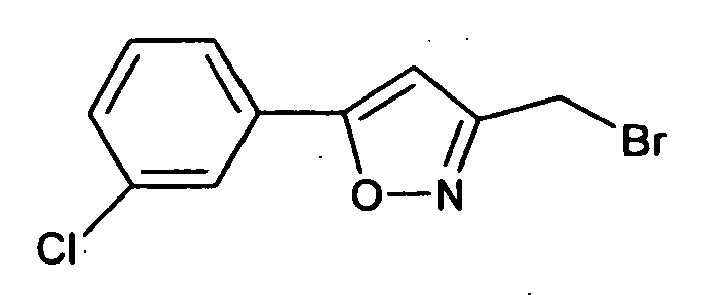
- 3-Bromomethyl-5-(3-chloro-phenyl)-isoxazole was prepared according to the methods described for 3-methyl-5=(5-chloro-thiophen-2-yl)-1 H-pyrazole. 1H NMR (CDCl3) δ 4.46 (s, 2H), 6.64 (s, 1 H), 7.41-7.43 (m, 2H), 7.64-7.67 (m, 1 H), 7.77 (m, 1 H).
-

- 3-Bromomethyl-5-(4-chlorophenyl)-isoxazole was prepared according to the methods described for 3-methyl-5-(5-chloro-thiophen-2-yl)-1H-pyrazole. 1H NMR (CDCl3) δ 4.45 (s, 2H), 6.60 (s, 1H), 7.44 (d, 2H, J=8.6 Hz), 7.70(d, 2H, J= 8.6 Hz).
-

- A mixture of 5-chloro-2-thiophene carboxaldehyde (1.36 g, 9.28 mmol) and hydroxyamine hydrochloride (0.71 g, 10.2 mmol) in 8 ml of pyridine was stirred at room temperature overnight. Pyridine was removed under reduced pressure, the residue was purified by flash column chromatography (5% -10% of ethyl acetate in methylene chloride), 1.02 g of the product was obtained as a white solid, 68%. 1H NMR (CD3OD) δ 6.94 (d, 1 H, J=4.0 Hz), 7.14 (d, 1H, J=4.0 Hz), 7.60 (s, 1 H), 8.81 (broad, 1 H, OH).
- N-chlorosuccinimide (0.28 g, 2.10 mmol) was added to the solution of 5-Chloro-thiophene-2-carbaldehyde oxime (0.33 g, 2.04 mmol) in 10 ml of anhydrous DMF at room temperature under N2, followed by the addition of two drops of pyridine. The mixture was stirred at r.t. for one hour, at 60 °C for 3 hours, the mixture was cooled to 0°C and to which was added propargyl bromide (80 wt. % in toluene, 2.30 ml, 20.4 mmol), a solution of triethyl amine (0.29 ml, 2.04 mmol) in 2.5 ml of DMF was then added dropwise slowly in a period of 25 minutes . The reaction was warmed to room temperature and stirred for 18 hours, diluted with water (200 ml), extracted with ethyl acetate (50ml x 3), the combined organic portions were washed with water (100 ml x 2), brine, dried with MgSO4. After the solvents were removed, the crude product was purified flash column chromatography (5%-10% of ethyl acetate/hexanes), 0.28 g of the desired product was obtained as a white solid, 49%. 1H NMR (CDCl3) δ 4.46 (s, 2H), 6.51 (s, 1H), 6.92 (d, 1H, J = 3.9 Hz), 7.19 (d, 1H, J = 3.9 Hz).
- N-chlorosuccinimide (0.32 g, 2.41 mmol) was added to the solution of 5-Chloro-thiophene-2-carbaldehyde oxime (0.39 g, 2.41 mmol) in 10 ml of anhydrous DMF at room temperature under N2, followed by the addition of two drops of pyridine. After stirred at 60 °C for 3 hours, the mixture was cooled to 0 °C and to which was added methyl propiolate (1.0 ml, 12.1 mmol), a solution of triethyl amine (0.34 ml, 2.41 mmol) in 2.5 ml of DMF was then added slowly in a period of 30 minutes . The reaction was warmed to room temperature and stirred for 12 hours, diluted with water (200 ml), extracted with ethyl acetate (50ml x 2), the combined organic portions were washed with water, brine, dried with MgSO4. After the solvents were removed, the crude product was purified flash column chromatography (3%-10% of ethyl acetate/hexanes), 0.19 g of the desired product was obtained as a white solid, 32%. 1H NMR (CDCl3) δ 3.99 (s, 3H), 6.95 (d, 1H, J=3.9 Hz), 7.11 (s, 1H), 7.26 (d, 1 H, J=3.9 Hz).
- Sodium borohydride (0.14 g, 3.90 mmol) was added to a suspension of 3-(5-chloro-thiophen-2-yl)-isoxazole-5-carboxylic acid ethyl ester (0.19 g, 0.78 mmol) in 15 ml of anhydrous methanol at 0 °C. The mixture was then stirred at 0 °C under N2, at room temperature for half an hour. Methanol was removed under reduced pressure, the residue was taken up in H2O (50ml), and NH4Cl (aq) was added until pH = 7 was obtained. The product was extracted with ethyl acetate (30 ml x 2), the combined organic portions were washed with brine, dried with MgSO4, removal of the solvents afforded 0.14 g of white solid as the desired product, 83%. 1H NMR (CDCl3) δ 4.79 (s, 2H), 6.44 (s, 1 H), 6.92 (d, 1 H, J = 3.9 Hz), 7.19 (d, 1 H, J = 3.9 Hz).
- N-bromosuccinimide (0.14 g, 0.78 mmol) was added to the mixture of [3-(5-chloro-thiophen-2-yl)-isoxazol-5-yl]-methanol (0.14 g, 0.65 mmol) and triphenyl phosphine (0.21 g, 0.78 mmol) in 15 ml of anhydrous methylene chloride at 0 °C under N2. The mixture was then stirred at room temperature for 1 hour. The solvents was removed, the residue was purified by flash column chromatography (10 % of ethyl acetate/hexanes), 0.13 g of the product was obtained as a white solid, 72%. 1H NMR (CDCl3) δ 4.46 (s, 2H), 6.51 (s, 1 H), 6.92 (d, 1 H, J = 3.9 Hz), 7.19 (d, 1 H, J = 3.9 Hz).
- Using the methylhalides described in the preparations and the methods of the previous examples the following inhibitors were prepared:
- 1H NMR (300 MHz, DMSO) δ 9.74 (2H, bs), 8.81 (1H, s), 8.37 (1 H, d, J = 8.5 Hz), 7.54 - 7.61 (3H, m), 7.28 - 7.29 (1H, m), 6.88 (1H, s), 4.64 - 4.76 (2H, m), 3.91 (1 H, d, J = 14.4 Hz), 3.71 (1H, d, J = 14.4 Hz), 3.27 - 3.30 (2H, m), 3.13 91H, t, J = 4.7 Hz), 3.01 - 3.05 (1H, m), 2.61 - 2.65 (1 H, m), 1.80 - 1.86 (2H, m), 1.39 -1.52 (1 H, m), 1.13 - 1.27 (1 H, m), 0.80 - 0.85 (3H, m). MS (Ion spray) [M+H]+ of 497/499 observed, chloro pattern.
- 1H NMR (300 MHz, DMSO) δ 9.76 (2H, bs), 8.81 (1 H, s), 8.36 (1 H, d, J = 8.6 Hz), 7.59 - 7.61 (2H, m), 7.52 (1 H, s), 7.29 (1 H, d, J = 4.0 Hz), 6.92 (1 H, s), 4.63 - 4.70 (2H, m), 3.95 (1H, d, J = 14.5 Hz), 3.76 (1 H, d, J = 14.5 Hz), 3.24 - 3.32 (3H, m), 2.97 - 3.05 (1H, m), 2.60 - 2.70 (1 H, m), 1.40 (3H, d, J = 6.8 Hz). MS (Ion spray) [M+H]+ of 469/471 observed, chloro pattern.
- 1H NMR (300 MHz, DMSO) δ 9.81 (1H, bs), 9.77 (1H, s), 8.80 (1H, s), 8.38 (1H, d, J = 8.5 Hz), 7.59 - 7.62 (2H, m), 7.24 (1 H, d, J = 3.9 Hz), 7.04 (1 H, s), 4.71 (2H, s), 3.91 (2H, s), 3.30 - 3.34 (4H, m), 2.82 - 2.85 (2H, m). MS (Ion spray) [M+H]+ of 455/457 observed, chloro pattern.
- 1H NMR (300 MHz, DMSO) δ 9.76 (2H, bs), 8.81 (1H, s), 8.36 (1 H, d, J = 8.6 Hz), 7.59 - 7.62 (2H, m), 7.51 (1H, s), 7.25 (1H, d, J = 3.9 Hz), 7.03 (1H, s), 4.69 (2H, s), 4.05 (1H, d, J = 15.6 Hz), 3.94 (1 H, d, J = 15.5 Hz), 3.34 - 3.36 (1 H, m), 3.20 - 3.26 (2H, m), 3.04 - 3.08 (1H, m), 2.65 - 2.71 (1 H, m), 1.40 (3H, d, J = 6.8 Hz). MS (Ion spray) [M+H]+ of 469/471 observed, chloro pattern.
- 1H NMR (300 MHz, DMSO) δ 9.75 (2H, bs), 8.81 (1H, s), 8.36 (1H, d, J = 8.6 Hz), 7.55 - 7.63 (3H, m), 7.29 (1H, d, J = 4.0 Hz), 6.92 (1H, s), 4.71 (2H, s), 3.74 (2H, s), 3.18 - 3.29 (4H, m), 2.76 - 2.78 (2H, m). MS (Ion spray) [M+H]+ of 455/457 observed, chloro pattern.
- To a solution of 2-(2-oxo-piperazin-1-ylmethyl)-pyrrolo[3,2-c]pyridine-1-carboxylic acid tert-butyl ester (0.33g, 1.0 mmol) and Et3N (0.34 mL, 2.4 mmol) in MeCN (40 mL) was added a solution of 3-bromomethyl-5-(5-chloro-thiophen-2-yl)-isoxazole in MeCN (10 mL). The solution was stirred at r.t. overnight and concentrated to dryness. The residue was then treated with 20% TFA/DCM (40 mL) overnight. The solution was concentrated. The residue was purified by RP HPLC to give the product as a white solid (0.23 g, 0.35 mmol). 1H NMR (DMSO) δ 14.6 (br, 1H), 12.7 (s, 1H), 9.14 (s, 1 H), 8.36 (d, 1H), 7.86 (d, 1H), 7.61 (d, 1 H), 7.33 (d, 1H), 6.93 (s, 1H), 6.87 (s, 1H), 4.75 (s, 2H), 3.75 (s, 2H), 3.36 (t, 2H), 3.23 (s, 2H), 2.75 (t, 2H). MS M+1: 428, 430.
- The compounds described herein inhibit blood coagulation by virtue of their ability to inhibit the penultimate enzyme in the coagulation cascade, controlling the activity of Factor Xa. Both the activity of free Factor Xa and Factor Xa assembled in the prothrombinase complex (Factor Xa, Factor Va, calcium and phospholipid) are inhibited by compounds described herein. The inhibition of the Factor Xa activity is obtained by direct complex formation between the inhibitor and the enzyme and is therefore independent of the plasma co-factor antithrombin III. Effective inhibition of the Factor Xa activity is achieved by administering the compounds either by oral administration, continuous intravenous infusion, bolus intravenous administration or any other parenteral route such that it achieves the desired effect of preventing the activity of Factor Xa induced formation of thrombin from prothrombin.
- Anticoagulant therapy is indicated for the treatment and prophylaxis of a variety of thrombotic conditions of both the venous and arterial vasculature. In the arterial system, abnormal thrombus formation is primarily associated with arteries of the coronary, cerebral and peripheral vasculature. The diseases associated with thrombotic occlusion of these vessels principally include acute myocardial infarction (AMI), unstable angina, thromboembolism, acute vessel closure associated with thrombolytic therapy and percutaneous transluminal coronary angioplasty (PTCA), transient ischemic attacks, stroke, intermittent claudication and bypass grafting of the coronary (CABG) or peripheral arteries. Chronic anticoagulant therapy may also be beneficial in preventing the vessel luminal narrowing (restenosis) that often occurs following PTCA and CABG, and in the maintenance of vascular access patency in long-term hemodialysis patients. With respect to the venous vasculature, pathologic thrombus formation frequently occurs in the veins of the lower extremities following abdominal, knee and hip surgery (deep vein thrombosis, DVT). DVT further predisposes the patient to a higher risk of pulmonary thromboembolism. A systemic, disseminated intravascular coagulopathy (DIC) commonly occurs in both vascular systems during septic shock, certain viral infections and cancer. This condition is characterized by a rapid consumption of coagulation factors and their plasma inhibitors resulting in the formation of life-threatening thrombin throughout the microvasculature of several organ systems. The indications discussed above include some, but not all, of the possible clinical situations where anticoagulant therapy is warranted. Those experienced in this field are well aware of the circumstances requiring either acute or chronic prophylactic anticoagulant therapy.
- Accumulated experimental evidence has also reflected that prothrombin activation is only one of the biological activities of Factor Xa. EPR-1 (effector cell protease receptor-1, recognizing Factor Xa), is believed to mediate several of the vascular wall interactions by Factor Xa. It has been shown to be expressed on human umbilical vein endothelial cells, rat smooth muscle cells and platelets(CR McKenzie, et al., Arterioscler Thromb Vasc Biol 16 1285-91 (1996); also F Bono, et al., J Cell Physiol 172 36-43 (1997), AC Nicholson, et al., J Biol Chem 271 28407-13 (1996),J.M. Herbert, et al., J Clin Invest 101 993-1000 (1998)). This protease-receptor interaction could mediate not only prothrombinase-catalyzed thrombin generation, but also diverse cellular functions such as cell proliferation, release of PDGF and DNA syntheses. The mitogenic effect of Factor Xa has been reported to be dependent on Factor Xa enzymatic activity (F Bono, et al., J Cell Physiol 172 36-43 (1997), J.M. Herbert, et al., J Clin Invest 101 993-1000 (1998)). TAP for example inhibited the mitogenesis of human and rat cultured vascular smooth muscle cells (F Bono, et al., J Cell Physiol 172 36-43 (1997)). In a study of the rabbit carotid artery air-drying injury model, increased EPR-1 expression is detected after vascular injury. Animals treated with the specific Factor Xa inhibitor, DX-9065a, exhibited less neointimal proliferation. The important regulatory role of Factor Xa in the coagulation process coupled with its mitogenic effects points to Factor Xa's involvement in the formation of thrombin at the luminal surface of the vessel wall and contribution to the atherothrombotic process and abnormal proliferation of vascular cells resulting in restenosis or angiogenesis.
- These compounds may be used alone or in combination with other diagnostic, anticoagulant, antiplatelet or fibrinolytic agents. For example adjunctive administration of inhibitors of the activity of Factor Xa with standard heparin, low molecular weight heparin(s), synthetic pentasaccharides, direct thrombin inhibitors (e.g. hirudin, Agratroban (Novastan®, aspirin, fibrinogen receptor antagonists, statins / fibrates streptokinase, urokinase and/or tissue plasminogen activator. The compounds described herein may be administered to treat thrombotic complications in a variety of animals such as primates including humans. Inhibition of factor Xa is useful not only in the anticoagulant therapy of individuals having thrombotic conditions but is useful whenever inhibition of blood coagulation is required such as to prevent coagulation of stored whole blood and to prevent coagulation in other biological samples for testing or storage. Thus, any inhibitor of Factor Xa activity can be added to or contacted with any medium containing or suspected of containing Factor Xa and in which it is desired that blood coagulation be inhibited.
- In addition to their use in anticoagulant therapy, Factor Xa inhibitors may find utility in the treatment or prevention of other diseases in which the generation of thrombin has been implicated as playing a physiologic role. For example, thrombin has been proposed to contribute to the morbidity and mortality of such chronic and degenerative diseases as arthritis, cancer, atherosclerosis and Alzheimer's disease by virtue of its ability to regulate many different cell types through specific cleavage and activation of a cell surface thrombin receptor, mitogenic effects, diverse cellular functions such as cell proliferation, for example, abnormal proliferation of vascular cells resulting in restenosis or angiogenesis, release of PDGF and DNA syntheses. Inhibition of Factor Xa will effectively block thrombin generation and therefore neutralize any physiologic effects of thrombin on various cell types.
- According to a further feature of the invention there is provided a method for the treatment of a human or animal patient suffering from, or subject to, a physiological condition which can be ameliorated by the administration of an inhibitor of the Factor Xa activity, for example conditions as hereinbefore described, which comprises the administration to the patient of a therapeutically effective amount of the compounds described herein, or a composition containing the compounds described herein. "Effective amount" is meant to describe an amount of compound of the present invention effective in inhibiting the activity of Factor Xa and thus producing the desired therapeutic effect.
- The present invention also includes within its scope pharmaceutical formulations which comprise at least one of the compounds described herein in association with a pharmaceutically acceptable carrier.
- The pharmaceutical compositions can be administered in a suitable formulation to humans and animals by topical or systemic administration, including oral, inhalational, rectal, nasal, buccal, sublingual, vaginal, parenteral (including subcutaneous, intramuscular, intravenous, intradermal, intrathecal and epidural), intracisternal and intraperitoneal. It will be appreciated that the preferred route may vary with for example the condition of the recipient.
- The products according to the invention may be presented in forms permitting administration by the most suitable route and the invention also relates to pharmaceutical compositions containing at least one product according to the invention which are suitabte for use in human or veterinary medicine. These compositions may be prepared according to the customary methods, using one or more pharmaceutically acceptable adjuvants or excipients. The adjuvants comprise, inter alia, diluents, sterile aqueous media and the various non-toxic organic solvents. The compositions may be presented in the form of tablets, pills, granules, powders, aqueous solutions or suspensions, injectable solutions, elixirs or syrups, and can contain one or more agents chosen from the group comprising sweeteners, flavorings, colorings, or stabilizers in order to obtain pharmaceutical acceptable preparations.
- The choice of vehicle and the content of active substance in the vehicle are generally determined in accordance with the solubility and chemical properties of the product, the particular mode of administration and the provisions to be observed in pharmaceutical practice. For example, excipients such as lactose, sodium citrate, calcium carbonate, dicalcium phosphate and disintegrating agents such as starch, alginic acids and certain complex silicates combined with lubricants such as magnesium stearate, sodium lauryl sulfate and talc may be used for preparing tablets. To prepare a capsule, it is advantageous to use lactose and high molecular weight polyethylene glycols. When aqueous suspensions are used they can contain emulsifying agents or agents which facilitate suspension. Diluents such as sucrose, ethanol, polyethylene glycol, propylene glycol, glycerol and chloroform or mixtures thereof may also be used.
- For parenteral administration, emulsions, suspensions or solutions of the products according to the invention in vegetable oil, for example sesame oil, groundnut oil or olive oil, or aqueous-organic solutions such as water and propylene glycol, injectable organic esters such as ethyl oleate, as well as sterile aqueous solutions of the pharmaceutically acceptable salts, are used. The solutions of the salts of the products according to the invention are especially useful for administration by intramuscular or subcutaneous injection. The aqueous solutions, also comprising solutions of the salts in pure distilled water, may be used for intravenous administration with the proviso that their pH is suitably adjusted, that they are judiciously buffered and rendered isotonic with a sufficient quantity of glucose or sodium chloride and that they are sterilized by heating, irradiation or microfiltration.
- Suitable compositions containing the compounds of the invention may be prepared by conventional means. For example, compounds of the invention may be dissolved or suspended in a suitable carrier for use in a nebulizer or a suspension or solution aerosol, or may be absorbed or adsorbed onto a suitable solid carrier for use in a dry powder inhaler.
- Solid compositions for rectal administration include suppositories formulated in accordance with known methods and containing at least one compound of formula I or formula II.
- Actual dosage levels of active ingredients in the pharmaceutical compositions of this invention may be varied so as to obtain an amount of the active compound(s) that is effective to achieve the desired therapeutic response for a particular patient, composition, and mode of administration. The selected dosage level will depend upon the activity of the particular compound, the route of administration, the severity of the condition being treated, and the condition and prior medical history of the patient being treated. However, it is within the skill of the art to start doses of the compound at levels lower than required for to achieve the desired therapeutic effect and to gradually increase the dosage until the desired effect is achieved. In the adult, the doses are generally from about 0.01 to about 100, preferably about 0.01 to about 10, mg/kg body weight per day by inhalation, from about 0.01 to about 100, preferably 0.1 to 70, more especially 0.5 to 10, mg/kg body weight per day by oral administration, and from about 0.01 to about 50, preferably 0.01 to 10, mg/kg body weight per day by intravenous administration. In each particular case, the doses will be determined in accordance with the factors distinctive to the subject to be treated, such as age, weight, general state of health and other characteristics which can influence the efficacy of the medicinal product.
- The products according to the invention may be administered as frequently as necessary in order to obtain the desired therapeutic effect. Some patients may respond rapidly to a higher or lower dose and may find much weaker maintenance doses adequate. For other patients, it may be necessary to have long-term treatments at the rate of 1 to 4 doses per day, in accordance with the physiological requirements of each particular patient. Generally, the active product may be administered orally 1 to 4 times per day. It goes without saying that, for other patients, it will be necessary to prescribe not more than one or two doses per day.
- Compounds within the scope of the present invention exhibit marked pharmacological activities according to tests described in the literature which tests results are believed to correlate to pharmacological activity in humans and other mammals. The following pharmacological test results are typical characteristics of compounds of the present invention.
- The ability of the compounds in the present invention to act as inhibitors of factor Xa, is evaluated by determining the concentration of inhibitor which resulted in a 50% loss in enzyme activity (IC50) using purified enzymes.
- All enzyme assays are carried out at room temperature in 96-well microtiter plates using a final enzyme concentration of 1 nM. The concentrations of factor Xa are determined by active site titration and the concentrations of all other enzymes are based on the protein concentration supplied by the manufacturer. Compounds according to the invention are dissolved in DMSO, diluted with their respective buffers and assayed at a maximal final DMSO concentration of 1.25%. Compound dilutions are added to wells containing buffer and enzyme and pre-equilibrated for between 5 and 30 minutes. The enzyme reactions are initiated by the addition of substrate and the color developed from the hydrolysis of the peptide-p-nitroanilide substrates is monitored continuously for 5 minutes at 405 nm on a Vmax microplate reader (Molecular Devices). Under these conditions, less than 10% of the substrate is utilized in all assays. The initial velocities measured are used to calculate the amount of inhibitor which resulted in a 50% reduction of the control velocity (IC50). The apparent Ki values are then determined according to the Cheng-Prusoff equation (IC50 = Ki [1 +[S]/Km]) assuming competitive inhibition kinetics.
- An additional in vitro assay may be used to evaluate the potency of compounds according to the invention in normal human plasma. The activated partial thromboplastin time is a plasma-based clotting assay that relies on the in situ generation of factor Xa, its assembly into the prothrombinase complex and the subsequent generation of thrombin and fibrin which ultimately yields the formation of a clot as the assay endpoint. This assay is currently used clinically to monitor the ex vivo effects of the commonly used anticoagulant drug heparin as well as direct acting antithrombin agents undergoing clinical evaluation. Therefore, activity in this in vitro assay is considered as a surrogate marker for in vivo anticoagulant activity.
Claims (3)
- A compound selected from the group consisting of
1-(4-Amino-quinazolin-7-ylmethyl)-4-[5-(5-chloro-thiophen-2-yl]-isoxazol-3-ylmethyl]-piperazine-2,3-dione,
(R)-1-(4-Amino-quinazolin-7-ylmethyl)-4-[5-(5-chloro-thiophen-2-yl)-isoxazol-3-ylmethyl]-6-methoxymethyl-piperazin-2-one,
(6R)-1-(4-Amino-quinazolin-7-ylmethyl)-4-[5-(5-chloro-thiophen-2-yl)-isoxazol-3-ylmethyl]-6-ethoxymethyl-piperazin-2-one,
1-(4-Amino-quinazolin-7-ylmethyl)-4-[5-(5-chloro-thiophen-2-yl)-isoxazol-3-ylmethyl]-3-(S)-propyl-piperazin-2-one ditrifluoroacetate,
1-(4-Amino-quinazolin-7-ylmethyl)-4-[5-(5-chloro-thiophen-2-yl)-isoxazol-3-ylmethyl]-3-(S)-methyl-piperazin-2-one ditrifluoroacetate,
1-(4-Amino-quinazolin-7-ylmethyl)-4-[3-(5-chloro-thiophen-2-yl)-isoxazol-5-ylmethyl]-piperazin-2-one ditrifluoroacetate,
1-(4-Amino-quinazolin-7-ylmethyl)-4-[3-(5-chloro-thiophen-2-yl)-isoxazol-5-ylmethyl]-3-methyl-piperazin-2-one ditrifluoroacetate,
1-(4-Amino-quinazolin-7-ylmethyl)-4-[5-(5-chloro-thiophen-2-yl)-isoxazol-3-ylmethyl]-piperazin-2-one ditrifluoroacetate or
4-[5-(5-Chloro-thiophen-2-yl)-isoxazol-3-ylmethyl]-1-(1H-pyrrolo[3,2-c]pyridin-2-ylmethyl)-piperazin-2-one ditrifluoroacetate. - A pharmaceutical composition comprising a compound according to claim 1 and a pharmaceutically acceptable carrier.
- The use of a compound as claimed in claim 1 for the preparation of a medicament for the treatment of acute myocardial infarction, unstable angina, thromboembolism, acute vessel closure associated with thrombolytic therapy, percutaneous transluminal coronary angioplasty (PTCA), transient ischemic attacks, stroke, intermittent claudication, bypass grafting of the coronary or peripheral arteries (CABG), preventing the vessel luminal narrowing (restenosis) that often occur following PTCA and CABG, venous vasculature, pathologic thrombus formation frequently occurring in the veins of the lower extremities following abdominal, knee and hip surgery, deep vein thrombosis or a systemic, disseminated intravascular coagulopathy of several organ systems.
Applications Claiming Priority (3)
| Application Number | Priority Date | Filing Date | Title |
|---|---|---|---|
| US363196 | 1994-12-22 | ||
| US36319699A | 1999-07-28 | 1999-07-28 | |
| PCT/IB2000/001156 WO2001007436A2 (en) | 1999-07-28 | 2000-07-26 | Substituted oxoazaheterocyclyl compounds |
Publications (2)
| Publication Number | Publication Date |
|---|---|
| EP1208097A2 EP1208097A2 (en) | 2002-05-29 |
| EP1208097B1 true EP1208097B1 (en) | 2009-02-18 |
Family
ID=23429232
Family Applications (1)
| Application Number | Title | Priority Date | Filing Date |
|---|---|---|---|
| EP00951781A Expired - Lifetime EP1208097B1 (en) | 1999-07-28 | 2000-07-26 | Substituted oxoazaheterocyclyl compounds |
Country Status (25)
| Country | Link |
|---|---|
| EP (1) | EP1208097B1 (en) |
| JP (1) | JP4829449B2 (en) |
| KR (1) | KR20020087041A (en) |
| CN (1) | CN1420882A (en) |
| AT (1) | ATE423113T1 (en) |
| AU (1) | AU773227B2 (en) |
| BG (1) | BG106340A (en) |
| BR (1) | BR0013179A (en) |
| CA (1) | CA2382755A1 (en) |
| CR (1) | CR6563A (en) |
| CZ (1) | CZ2002323A3 (en) |
| DE (1) | DE60041584D1 (en) |
| EE (1) | EE200200045A (en) |
| HK (1) | HK1054227A1 (en) |
| HR (1) | HRP20020076A2 (en) |
| HU (1) | HUP0203375A3 (en) |
| IL (2) | IL147495A0 (en) |
| MX (1) | MXPA02000888A (en) |
| NO (1) | NO20020214L (en) |
| PL (1) | PL354998A1 (en) |
| RU (1) | RU2002105011A (en) |
| SK (1) | SK1182002A3 (en) |
| TR (1) | TR200200225T2 (en) |
| WO (1) | WO2001007436A2 (en) |
| ZA (1) | ZA200200543B (en) |
Families Citing this family (95)
| Publication number | Priority date | Publication date | Assignee | Title |
|---|---|---|---|---|
| AU4344101A (en) | 2000-03-21 | 2001-10-03 | Smithkline Beecham Corp | Protease inhibitors |
| BR0107282A (en) * | 2000-09-29 | 2004-07-06 | Cor Therapeutics Inc | Compound, pharmaceutical composition and methods for preventing or treating a condition in a mammal and for inhibiting coagulation of biological samples. |
| RU2303038C2 (en) * | 2001-02-02 | 2007-07-20 | Бристол-Маерс Сквибб Компани | Azaindoleoxoacetic derivatives of piperazine and pharmaceutical composition based on thereof |
| GB0112836D0 (en) | 2001-05-25 | 2001-07-18 | Smithkline Beecham Plc | Medicaments |
| GB0114004D0 (en) | 2001-06-08 | 2001-08-01 | Glaxo Group Ltd | Chemical compounds |
| GB0114005D0 (en) | 2001-06-08 | 2001-08-01 | Glaxo Group Ltd | Chemical compounds |
| EP1604982A1 (en) | 2001-07-02 | 2005-12-14 | AstraZeneca AB | Intermediates for the preparation of piperidine derivatives useful as modulators of chemokine receptor activity |
| GB0120461D0 (en) | 2001-08-22 | 2001-10-17 | Astrazeneca Ab | Novel compounds |
| AU2007229363B2 (en) * | 2001-08-24 | 2009-06-04 | University Of South Florida | Piperazinone Compounds as Anti-Tumor and Anti-Cancer Agents and the Methods of Treatment |
| US7763620B2 (en) | 2001-08-24 | 2010-07-27 | Yale University | Piperazinone compounds as anti-tumor and anti-cancer agents and methods of treatment |
| GB0122503D0 (en) | 2001-09-18 | 2001-11-07 | Astrazeneca Ab | Chemical compounds |
| EP1314733A1 (en) | 2001-11-22 | 2003-05-28 | Aventis Pharma Deutschland GmbH | Indole-2-carboxamides as factor Xa inhibitors |
| WO2003075853A2 (en) | 2002-03-08 | 2003-09-18 | Bristol-Myers Squibb Company | Cyclic derivatives as modulators of chemokine receptor activity |
| SE0200844D0 (en) | 2002-03-19 | 2002-03-19 | Astrazeneca Ab | Chemical compounds |
| SE0200843D0 (en) | 2002-03-19 | 2002-03-19 | Astrazeneca Ab | Chemical compounds |
| CA2484261A1 (en) | 2002-04-16 | 2003-10-23 | Teijin Limited | Piperidine derivatives having ccr3 antagonism |
| US7524841B2 (en) | 2002-04-25 | 2009-04-28 | Teijin Limited | 4,4-disubstituted piperidine derivatives having CCR3 antagonism |
| TW200409637A (en) | 2002-06-26 | 2004-06-16 | Glaxo Group Ltd | Compounds |
| AU2003272972A1 (en) * | 2002-10-11 | 2004-05-04 | Kowa Co., Ltd. | Method of treatment for cancer |
| US7358268B2 (en) | 2002-12-04 | 2008-04-15 | Sanofi-Aventis Deutschland Gmbh | Imidazole derivatives as factor Xa inhibitors |
| EP1567497B1 (en) * | 2002-12-06 | 2009-09-23 | Purdue Research Foundation | Pyridines for treating injured mammalian nerve tissue |
| US8729107B2 (en) | 2002-12-06 | 2014-05-20 | Purdue Research Foundation | Pyridines for treating injured mammalian nerve tissue |
| US7429581B2 (en) | 2002-12-23 | 2008-09-30 | Sanofi-Aventis Deutschland Gmbh | Pyrazole-derivatives as factor Xa inhibitors |
| ZA200507486B (en) | 2003-03-07 | 2007-03-28 | Astellas Pharma Inc | Nitrogenous heterocyclic derivative having 2,6-disubstituted styryl |
| SE0300957D0 (en) | 2003-04-01 | 2003-04-01 | Astrazeneca Ab | Chemical compounds |
| US7741341B2 (en) | 2003-05-19 | 2010-06-22 | Sanofi-Aventis Deutschland Gmbh | Benzimidazole-derivatives as factor Xa inhibitors |
| US7223780B2 (en) | 2003-05-19 | 2007-05-29 | Sanofi-Aventis Deutschland Gmbh | Triazole-derivatives as blood clotting enzyme factor Xa inhibitors |
| EP1479675A1 (en) | 2003-05-19 | 2004-11-24 | Aventis Pharma Deutschland GmbH | Indazole-derivatives as factor Xa inhibitors |
| US7317027B2 (en) | 2003-05-19 | 2008-01-08 | Sanofi-Aventis Deutschland Gmbh | Azaindole-derivatives as factor Xa inhibitors |
| GB0315111D0 (en) | 2003-06-27 | 2003-07-30 | Cancer Rec Tech Ltd | Substituted 5-membered ring compounds and their use |
| EP1558582B1 (en) | 2003-07-22 | 2005-12-21 | Arena Pharmaceuticals, Inc. | Diaryl and arylheteroaryl urea derivatives as modulators of the 5-ht2a serotonin receptor useful for the prophylaxis and treatment of disorders related thereto |
| SE0303180D0 (en) | 2003-11-26 | 2003-11-26 | Astrazeneca Ab | Novel compounds |
| TWI396686B (en) | 2004-05-21 | 2013-05-21 | Takeda Pharmaceutical | Cyclic guanamine derivatives, as well as their products and usage |
| WO2006019497A2 (en) | 2004-06-17 | 2006-02-23 | Neurocrine Biosciences, Inc. | Sleep-inducing compounds and methods related thereto |
| GB0420831D0 (en) | 2004-09-17 | 2004-10-20 | Glaxo Group Ltd | Novel compounds |
| MX2007010076A (en) | 2005-02-17 | 2007-10-16 | Astellas Pharma Inc | Pyridyl non-aromatic nitrogenated heterocyclic-1-carboxylate ester derivative. |
| WO2007008146A1 (en) * | 2005-07-08 | 2007-01-18 | Astrazeneca Ab | Heterocyclic sulfonamide derivatives as inhibitors of factor xa |
| WO2007008144A1 (en) * | 2005-07-08 | 2007-01-18 | Astrazeneca Ab | Heterocyclic sulfonamide derivatives as inhibitors of factor xa |
| BRPI0613563A2 (en) | 2005-07-21 | 2012-01-17 | Astrazeneca Ab | new piperidine derivatives |
| EP1932839A4 (en) * | 2005-09-06 | 2014-09-10 | Shionogi & Co | Indolecarboxylic acid derivative having pgd2 receptor antagonistic activity |
| EP2270014A1 (en) | 2005-09-22 | 2011-01-05 | Incyte Corporation | Azepine inhibitors of janus kinases |
| WO2007037187A1 (en) | 2005-09-27 | 2007-04-05 | Shionogi & Co., Ltd. | Sulfonamide derivative having pgd2 receptor antagonistic activity |
| DK1966130T3 (en) | 2005-12-23 | 2014-02-10 | Zealand Pharma As | Modified lysine mimetic compounds |
| WO2007099828A1 (en) | 2006-02-23 | 2007-09-07 | Shionogi & Co., Ltd. | Nirogenous heterocyclic derivatives substituted with cyclic groups |
| WO2007118130A2 (en) | 2006-04-06 | 2007-10-18 | Glaxo Group Limited | Antibacterial agents |
| US8017612B2 (en) | 2006-04-18 | 2011-09-13 | Japan Tobacco Inc. | Piperazine compound and use thereof as a HCV polymerase inhibitor |
| CN101528039A (en) * | 2006-05-26 | 2009-09-09 | 路易斯维尔大学研究基金会公司 | Macrophage migration inhibitory factor antagonists and methods of using same |
| EP1882688A1 (en) | 2006-07-25 | 2008-01-30 | EPFL Ecole Polytechnique Fédérale de Lausanne | Labelling of fusion proteins with synthetic probes |
| TWI415845B (en) | 2006-10-03 | 2013-11-21 | Arena Pharm Inc | Pyrazole derivatives as modulators of the 5-ht2a serotonin receptor useful for the treatment of disorders related thereto |
| WO2008079266A2 (en) | 2006-12-21 | 2008-07-03 | Wyeth | Synthesis of pyrrolidine compounds |
| BRPI0808301B1 (en) * | 2007-03-20 | 2022-05-03 | Curis, Inc | Compound and pharmaceutical composition |
| US9567327B2 (en) | 2007-08-15 | 2017-02-14 | Arena Pharmaceuticals, Inc. | Imidazo[1,2-a]pyridine derivatives as modulators of the 5-HT2A serotonin receptor useful for the treatment of disorders related thereto |
| US20110021538A1 (en) | 2008-04-02 | 2011-01-27 | Arena Pharmaceuticals, Inc. | Processes for the preparation of pyrazole derivatives useful as modulators of the 5-ht2a serotonin receptor |
| TW200944526A (en) | 2008-04-22 | 2009-11-01 | Vitae Pharmaceuticals Inc | Carbamate and urea inhibitors of 11β-hydroxysteroid dehydrogenase 1 |
| TR201805216T4 (en) | 2008-10-28 | 2018-06-21 | Arena Pharm Inc | COMPOSITIONS OF A USEFUL 5-HT2A SEROTONINE RECEPTOR MODULATOR FOR THE TREATMENT OF RELATED DISORDERS |
| WO2010062321A1 (en) | 2008-10-28 | 2010-06-03 | Arena Pharmaceuticals, Inc. | Processes useful for the preparation of 1-[3-(4-bromo-2-methyl-2h-pyrazol-3-yl)-4-methoxy-phenyl]-3-(2,4-difluoro-phenyl)-urea and crystalline forms related thereto |
| WO2011038234A2 (en) | 2009-09-24 | 2011-03-31 | University Of Louisville Research Foundation, Inc. | Novel iodo pyrimidine derivatives useful for the treatment of macrophage migration inhibitory factor (mif)-implicated diseases and conditions |
| US9155790B2 (en) | 2010-05-20 | 2015-10-13 | University of Lousiville Research Foundation, Inc. | Methods and compositions for modulating ocular damage |
| KR101251282B1 (en) | 2010-10-18 | 2013-04-10 | 서울대학교산학협력단 | Sulfonamide derivatives to inhibit Prostaglandin E2 production and the pharmaceutical composition comprising the derivatives |
| CN102532159B (en) * | 2010-11-12 | 2015-02-11 | 姚雪彪 | Small molecule inhibitors Syntelin for centromere-associated protein E (CENP-E) |
| EP2642998B1 (en) | 2010-11-24 | 2020-09-16 | The Trustees of Columbia University in the City of New York | A non-retinoid rbp4 antagonist for treatment of age-related macular degeneration and stargardt disease |
| PL395470A1 (en) | 2011-06-29 | 2013-01-07 | Adamed Spólka Z Ograniczona Odpowiedzialnoscia | Alicyclic amines sulfonamide derivatives for the treatment of diseases of the central nervous system |
| WO2013166037A1 (en) | 2012-05-01 | 2013-11-07 | The Trustees Of Columbia University In The City Of New York | Non-retinoid antagonists for treatment of eye disorders |
| US9938291B2 (en) | 2013-03-14 | 2018-04-10 | The Trustess Of Columbia University In The City Of New York | N-alkyl-2-phenoxyethanamines, their preparation and use |
| WO2014152013A1 (en) | 2013-03-14 | 2014-09-25 | The Trustees Of Columbia University In The City Of New York | 4-phenylpiperidines, their preparation and use |
| US8669281B1 (en) | 2013-03-14 | 2014-03-11 | Alkermes Pharma Ireland Limited | Prodrugs of fumarates and their use in treating various diseases |
| ES2700541T3 (en) | 2013-03-14 | 2019-02-18 | Univ Columbia | Octahidrociclopentapirroles, its preparation and use |
| WO2014151936A1 (en) | 2013-03-14 | 2014-09-25 | The Trustees Of Columbia University In The City Of New York | Octahydropyrrolopyrroles, their preparation and use |
| DK4036094T3 (en) | 2014-04-30 | 2026-03-23 | Univ Columbia | SUBSTITUTED 4-PHENYLPIPERIDINES, THEIR PRODUCTION AND USE |
| KR102531217B1 (en) | 2014-07-31 | 2023-05-10 | 바스프 에스이 | Process for preparing pyrazoles |
| CN104672236B (en) * | 2015-02-14 | 2016-03-30 | 佛山市赛维斯医药科技有限公司 | One class contains FXa inhibitor of bisamide base and halogeno-benzene structure and uses thereof |
| CN104610260B (en) * | 2015-02-14 | 2016-03-30 | 佛山市赛维斯医药科技有限公司 | FXa inhibitor, the preparation method and its usage of one class amide containing and nitrogen heterocyclic structure |
| CN104557929B (en) * | 2015-02-14 | 2016-06-01 | 佛山市赛维斯医药科技有限公司 | One class contains coagulation factor xa inhibitors and the purposes thereof of bicyclic amide structure |
| CN104557927B (en) * | 2015-02-14 | 2016-06-01 | 佛山市赛维斯医药科技有限公司 | A kind of coagulation factor xa inhibitors containing bicyclic amide structure and purposes thereof |
| CN104592227B (en) * | 2015-02-14 | 2016-06-01 | 佛山市赛维斯医药科技有限公司 | The FXa inhibitor of one class amide containing and halogeno-benzene structure, preparation method and its usage |
| CN104610257B (en) * | 2015-02-14 | 2016-06-01 | 佛山市赛维斯医药科技有限公司 | The FXa inhibitor of one class amide containing structure, preparation method and its usage |
| CN104610259B (en) * | 2015-02-14 | 2016-06-01 | 佛山市赛维斯医药科技有限公司 | The FXa inhibitor of amide containing and nitrogen heterocyclic structure, preparation method and its usage |
| CN104672235B (en) * | 2015-02-14 | 2016-02-17 | 佛山市赛维斯医药科技有限公司 | One class contains FXa inhibitor of bisamide base and alkoxyphenyl radical structure and uses thereof |
| CN104557930B (en) * | 2015-02-14 | 2016-06-01 | 佛山市赛维斯医药科技有限公司 | A kind of containing bicyclic amide structure coagulation factor xa inhibitors and purposes thereof |
| CN104650081B (en) * | 2015-02-14 | 2016-06-01 | 佛山市赛维斯医药科技有限公司 | Coagulation factor xa inhibitors, preparation method and its usage |
| CN104650082B (en) * | 2015-02-14 | 2016-06-01 | 佛山市赛维斯医药科技有限公司 | One class coagulation factor xa inhibitors, preparation method and its usage |
| CN104557928B (en) * | 2015-02-14 | 2016-08-24 | 佛山市赛维斯医药科技有限公司 | A kind of containing bicyclic amide structure coagulation factor xa inhibitors, Its Preparation Method And Use |
| CN104610258B (en) * | 2015-02-14 | 2016-03-30 | 佛山市赛维斯医药科技有限公司 | FXa inhibitor, the preparation method and its usage of one class amide containing and methoxy benzene structure |
| PE20180327A1 (en) | 2015-05-11 | 2018-02-13 | Basf Se | PROCESS TO PREPARE 4-AMINO-PYRIDAZINES |
| HK1245660A1 (en) | 2015-06-12 | 2018-08-31 | Axovant Sciences Gmbh | Diaryl and arylheteroaryl urea derivatives useful for the prophylaxis and treatment of rem sleep behavior disorder |
| KR20180019234A (en) | 2015-06-26 | 2018-02-23 | 다케다 야쿠힌 고교 가부시키가이샤 | 2,3-dihydro-4h-1,3-benzoxazin-4-one derivatives as modulators of cholinergic muscarinic m1 receptor |
| WO2017011767A2 (en) | 2015-07-15 | 2017-01-19 | Axovant Sciences Ltd. | Diaryl and arylheteroaryl urea derivatives as modulators of the 5-ht2a serotonin receptor useful for the prophylaxis and treatment of hallucinations associated with a neurodegenerative disease |
| JP6787913B2 (en) * | 2015-10-20 | 2020-11-18 | 武田薬品工業株式会社 | Heterocyclic compound |
| WO2018082964A1 (en) | 2016-11-04 | 2018-05-11 | Basf Se | Process for the production of pyridazinyl-amides in a one-pot synthesis |
| JP7145875B2 (en) | 2017-04-18 | 2022-10-03 | 武田薬品工業株式会社 | Heterocyclic compounds useful as modulators of acetylcholine receptors |
| JP6989864B2 (en) | 2017-05-05 | 2022-02-03 | ジーランド ファーマ,アー/エス | Gap junction intercellular communication modulators and their use for the treatment of diabetic eye disease |
| CN110054619A (en) * | 2018-01-18 | 2019-07-26 | 西北农林科技大学 | Novel diketopiperazine histone deacetylases inhibitor |
| US20210147371A1 (en) | 2018-04-10 | 2021-05-20 | Bayer Aktiengesellschaft | Oxadiazoline derivatives |
| CN109991355B (en) * | 2019-04-12 | 2021-05-11 | 中国烟草总公司郑州烟草研究院 | Method for identifying NAB metabolite in animal body and method for evaluating exposure risk of NAB in animal body |
| WO2022228387A1 (en) * | 2021-04-26 | 2022-11-03 | Fochon Biosciences, Ltd. | Compounds as parp inhibitors |
Family Cites Families (10)
| Publication number | Priority date | Publication date | Assignee | Title |
|---|---|---|---|---|
| CN1118139A (en) * | 1993-02-22 | 1996-03-06 | 麦克公司 | Fibrinogen receptor antagonist |
| US5849736A (en) * | 1993-11-24 | 1998-12-15 | The Dupont Merck Pharmaceutical Company | Isoxazoline and isoxazole fibrinogen receptor antagonists |
| US5612353A (en) * | 1995-06-07 | 1997-03-18 | Rhone-Poulenc Rorer Pharmaceuticals Inc. | Substituted (sulfinic acid, sulfonic acid, sulfonylamino or sulfinylamino) N-[(aminoiminomethyl)phenylalkyl]-azaheterocyclylamide compounds |
| UA56197C2 (en) * | 1996-11-08 | 2003-05-15 | Зенека Лімітед | Heterocyclic derivatives |
| AU747531B2 (en) * | 1997-04-14 | 2002-05-16 | Millennium Pharmaceuticals, Inc. | Selective factor Xa inhibitors |
| CA2318351A1 (en) * | 1997-12-26 | 1999-07-08 | Hidemitsu Nishida | Aromatic compounds having cyclic amino or salts thereof |
| DE69934093T2 (en) * | 1998-01-27 | 2007-06-21 | Aventis Pharmaceuticals Inc. | SUBSTITUTED OXOAZAHETEROCYCLYL FACTOR Xa HEMMER |
| JP2000204081A (en) * | 1998-02-05 | 2000-07-25 | Takeda Chem Ind Ltd | Sulfonamide derivative, its production and use |
| US6403595B1 (en) * | 1998-02-05 | 2002-06-11 | Takeda Chemical Industries, Ltd. | Sulfonamide derivatives, processes for producing the same and utilization thereof |
| JP2003529531A (en) * | 1998-11-25 | 2003-10-07 | アヴェンティス ファーマシューティカルズ インコーポレイテッド | Substituted oxoazaheterocyclyl factor Xa inhibitors |
-
2000
- 2000-07-26 CA CA002382755A patent/CA2382755A1/en not_active Abandoned
- 2000-07-26 CZ CZ2002323A patent/CZ2002323A3/en unknown
- 2000-07-26 KR KR1020027001192A patent/KR20020087041A/en not_active Withdrawn
- 2000-07-26 IL IL14749500A patent/IL147495A0/en active IP Right Grant
- 2000-07-26 MX MXPA02000888A patent/MXPA02000888A/en active IP Right Grant
- 2000-07-26 AU AU64628/00A patent/AU773227B2/en not_active Ceased
- 2000-07-26 JP JP2001512520A patent/JP4829449B2/en not_active Expired - Fee Related
- 2000-07-26 AT AT00951781T patent/ATE423113T1/en not_active IP Right Cessation
- 2000-07-26 EP EP00951781A patent/EP1208097B1/en not_active Expired - Lifetime
- 2000-07-26 SK SK118-2002A patent/SK1182002A3/en unknown
- 2000-07-26 TR TR2002/00225T patent/TR200200225T2/en unknown
- 2000-07-26 HK HK03106404.4A patent/HK1054227A1/en unknown
- 2000-07-26 EE EEP200200045A patent/EE200200045A/en unknown
- 2000-07-26 CN CN00810877A patent/CN1420882A/en active Pending
- 2000-07-26 HU HU0203375A patent/HUP0203375A3/en unknown
- 2000-07-26 BR BR0013179-2A patent/BR0013179A/en not_active IP Right Cessation
- 2000-07-26 RU RU2002105011/04A patent/RU2002105011A/en unknown
- 2000-07-26 PL PL00354998A patent/PL354998A1/en not_active Application Discontinuation
- 2000-07-26 DE DE60041584T patent/DE60041584D1/en not_active Expired - Lifetime
- 2000-07-26 HR HR20020076A patent/HRP20020076A2/en not_active Application Discontinuation
- 2000-07-26 WO PCT/IB2000/001156 patent/WO2001007436A2/en not_active Ceased
-
2002
- 2002-01-06 IL IL147495A patent/IL147495A/en not_active IP Right Cessation
- 2002-01-15 NO NO20020214A patent/NO20020214L/en not_active Application Discontinuation
- 2002-01-22 ZA ZA200200543A patent/ZA200200543B/en unknown
- 2002-01-22 BG BG106340A patent/BG106340A/en unknown
- 2002-01-25 CR CR6563A patent/CR6563A/en unknown
Also Published As
| Publication number | Publication date |
|---|---|
| HUP0203375A2 (en) | 2002-12-28 |
| IL147495A0 (en) | 2002-08-14 |
| ZA200200543B (en) | 2003-08-27 |
| KR20020087041A (en) | 2002-11-21 |
| PL354998A1 (en) | 2004-03-22 |
| NO20020214L (en) | 2002-04-02 |
| CN1420882A (en) | 2003-05-28 |
| EP1208097A2 (en) | 2002-05-29 |
| TR200200225T2 (en) | 2002-06-21 |
| HUP0203375A3 (en) | 2005-03-29 |
| RU2002105011A (en) | 2004-01-20 |
| CR6563A (en) | 2008-11-25 |
| MXPA02000888A (en) | 2002-07-30 |
| AU6462800A (en) | 2001-02-13 |
| SK1182002A3 (en) | 2002-11-06 |
| JP4829449B2 (en) | 2011-12-07 |
| CZ2002323A3 (en) | 2002-05-15 |
| BG106340A (en) | 2002-10-31 |
| EE200200045A (en) | 2003-06-16 |
| CA2382755A1 (en) | 2001-02-01 |
| BR0013179A (en) | 2002-04-02 |
| IL147495A (en) | 2007-07-24 |
| ATE423113T1 (en) | 2009-03-15 |
| DE60041584D1 (en) | 2009-04-02 |
| NO20020214D0 (en) | 2002-01-15 |
| JP2003508353A (en) | 2003-03-04 |
| AU773227B2 (en) | 2004-05-20 |
| HRP20020076A2 (en) | 2003-12-31 |
| WO2001007436A3 (en) | 2001-08-23 |
| HK1054227A1 (en) | 2003-11-21 |
| WO2001007436A2 (en) | 2001-02-01 |
Similar Documents
| Publication | Publication Date | Title |
|---|---|---|
| US7947684B2 (en) | 1-aroyl-piperidinyl benzamidines | |
| EP1051176B1 (en) | SUBSTITUTED OXOAZAHETEROCYCLYL FACTOR Xa INHIBITORS | |
| US5612353A (en) | Substituted (sulfinic acid, sulfonic acid, sulfonylamino or sulfinylamino) N-[(aminoiminomethyl)phenylalkyl]-azaheterocyclylamide compounds | |
| EP0931060B1 (en) | Substituted n- (aminoiminomethyl or aminomethyl)phenyl propyl amides | |
| JP4053597B2 (en) | Substituted N-[(aminoiminomethyl or aminomethyl) phenyl] propylamide | |
| US20030207882A1 (en) | Aminoheterocyclic derivatives as antithrombotic or anticoagulant agents | |
| KR20180031037A (en) | Newly substituted glycine-induced FXIA inhibitors | |
| NO312894B1 (en) | Heterocycle derivatives that inhibit factor Xa, pharmaceutical formulation and process for its preparation | |
| KR20000068173A (en) | Bicyclic Pyrimidine Derivatives And Their Use As Anti-Coagulants | |
| EP1086099B1 (en) | Sulfonic acid or sulfonylamino n-(heteroaralkyl)-azaheterocyclylamide compounds | |
| KR100587434B1 (en) | New compounds | |
| EP2170877B1 (en) | Substituted (oxazolidinon-5-yl-methyl) -2-thiophene-carboxamides and use thereof in the field of blood coagulation | |
| JP2002535250A (en) | New amidinobenzylamine derivatives and their use as thrombin inhibitors | |
| CZ20012094A3 (en) | Novel amidine derivative and its use as thrombin inhibitor | |
| EP1794147A1 (en) | Compounds | |
| KR20180033267A (en) | XIa < / RTI > having a non-aromatic P2 ' | |
| JP2009538848A (en) | Dihydro-pyrrolopyridine, dihydro-pyrrolopyridazine and dihydro-pyrrolopyrimidine derivatives and their use | |
| AU757738B2 (en) | Heterocyclic derivatives as inhibitors of Factor Xa | |
| EP1263726B1 (en) | N-acylpyrrolidin-2-ylalkylbenzamidine derivatives as inhibitors of factor xa | |
| CA2628963C (en) | Benzene derivative or salt thereof | |
| IL152364A (en) | Gimbaled scanning system and method | |
| AU2007202110B2 (en) | 1-aroyl-piperidinyl benzamidines | |
| JP2009538850A (en) | Isoindoline-1-one, isoindoline-3-one and isoindoline-1,3-dione derivatives and uses thereof | |
| US5958918A (en) | Substituted (sulfinic acid, sulfonic acid, sulfonylamino or sulfinylamino) N- (aminominomethyl)phenylalkyl!-azaheterocyclylamide compounds | |
| KR20080021145A (en) | Thrombin inhibitory 2-oxo-1,2,5,6-tetrahydropyridine derivatives |
Legal Events
| Date | Code | Title | Description |
|---|---|---|---|
| PUAI | Public reference made under article 153(3) epc to a published international application that has entered the european phase |
Free format text: ORIGINAL CODE: 0009012 |
|
| 17P | Request for examination filed |
Effective date: 20020228 |
|
| AK | Designated contracting states |
Kind code of ref document: A2 Designated state(s): AT BE CH CY DE DK ES FI FR GB GR IE IT LI LU MC NL PT SE |
|
| AX | Request for extension of the european patent |
Free format text: AL PAYMENT 20020228;LT PAYMENT 20020228;LV PAYMENT 20020228;MK PAYMENT 20020228;RO PAYMENT 20020228;SI PAYMENT 20020228 |
|
| 17Q | First examination report despatched |
Effective date: 20020710 |
|
| RAP1 | Party data changed (applicant data changed or rights of an application transferred) |
Owner name: AVENTIS PHARMACEUTICALS INC. |
|
| APAF | Appeal reference modified |
Free format text: ORIGINAL CODE: EPIDOSCREFNE |
|
| RAP1 | Party data changed (applicant data changed or rights of an application transferred) |
Owner name: AVENTIS PHARMACEUTICALS, INC. |
|
| APBT | Appeal procedure closed |
Free format text: ORIGINAL CODE: EPIDOSNNOA9E |
|
| 17Q | First examination report despatched |
Effective date: 20020710 |
|
| GRAP | Despatch of communication of intention to grant a patent |
Free format text: ORIGINAL CODE: EPIDOSNIGR1 |
|
| GRAS | Grant fee paid |
Free format text: ORIGINAL CODE: EPIDOSNIGR3 |
|
| GRAA | (expected) grant |
Free format text: ORIGINAL CODE: 0009210 |
|
| AK | Designated contracting states |
Kind code of ref document: B1 Designated state(s): AT BE CH CY DE DK ES FI FR GB GR IE IT LI LU MC NL PT SE |
|
| AX | Request for extension of the european patent |
Extension state: AL LT LV MK RO SI |
|
| REG | Reference to a national code |
Ref country code: GB Ref legal event code: FG4D |
|
| REG | Reference to a national code |
Ref country code: CH Ref legal event code: EP |
|
| REG | Reference to a national code |
Ref country code: IE Ref legal event code: FG4D |
|
| REF | Corresponds to: |
Ref document number: 60041584 Country of ref document: DE Date of ref document: 20090402 Kind code of ref document: P |
|
| LTIE | Lt: invalidation of european patent or patent extension |
Effective date: 20090218 |
|
| PG25 | Lapsed in a contracting state [announced via postgrant information from national office to epo] |
Ref country code: FI Free format text: LAPSE BECAUSE OF FAILURE TO SUBMIT A TRANSLATION OF THE DESCRIPTION OR TO PAY THE FEE WITHIN THE PRESCRIBED TIME-LIMIT Effective date: 20090218 Ref country code: NL Free format text: LAPSE BECAUSE OF FAILURE TO SUBMIT A TRANSLATION OF THE DESCRIPTION OR TO PAY THE FEE WITHIN THE PRESCRIBED TIME-LIMIT Effective date: 20090218 Ref country code: ES Free format text: LAPSE BECAUSE OF FAILURE TO SUBMIT A TRANSLATION OF THE DESCRIPTION OR TO PAY THE FEE WITHIN THE PRESCRIBED TIME-LIMIT Effective date: 20090529 |
|
| NLV1 | Nl: lapsed or annulled due to failure to fulfill the requirements of art. 29p and 29m of the patents act | ||
| PG25 | Lapsed in a contracting state [announced via postgrant information from national office to epo] |
Ref country code: AT Free format text: LAPSE BECAUSE OF FAILURE TO SUBMIT A TRANSLATION OF THE DESCRIPTION OR TO PAY THE FEE WITHIN THE PRESCRIBED TIME-LIMIT Effective date: 20090218 Ref country code: SE Free format text: LAPSE BECAUSE OF FAILURE TO SUBMIT A TRANSLATION OF THE DESCRIPTION OR TO PAY THE FEE WITHIN THE PRESCRIBED TIME-LIMIT Effective date: 20090518 |
|
| PG25 | Lapsed in a contracting state [announced via postgrant information from national office to epo] |
Ref country code: BE Free format text: LAPSE BECAUSE OF FAILURE TO SUBMIT A TRANSLATION OF THE DESCRIPTION OR TO PAY THE FEE WITHIN THE PRESCRIBED TIME-LIMIT Effective date: 20090218 |
|
| PG25 | Lapsed in a contracting state [announced via postgrant information from national office to epo] |
Ref country code: DK Free format text: LAPSE BECAUSE OF FAILURE TO SUBMIT A TRANSLATION OF THE DESCRIPTION OR TO PAY THE FEE WITHIN THE PRESCRIBED TIME-LIMIT Effective date: 20090218 Ref country code: PT Free format text: LAPSE BECAUSE OF FAILURE TO SUBMIT A TRANSLATION OF THE DESCRIPTION OR TO PAY THE FEE WITHIN THE PRESCRIBED TIME-LIMIT Effective date: 20090727 |
|
| PLBE | No opposition filed within time limit |
Free format text: ORIGINAL CODE: 0009261 |
|
| STAA | Information on the status of an ep patent application or granted ep patent |
Free format text: STATUS: NO OPPOSITION FILED WITHIN TIME LIMIT |
|
| 26N | No opposition filed |
Effective date: 20091119 |
|
| PG25 | Lapsed in a contracting state [announced via postgrant information from national office to epo] |
Ref country code: MC Free format text: LAPSE BECAUSE OF NON-PAYMENT OF DUE FEES Effective date: 20090731 |
|
| REG | Reference to a national code |
Ref country code: CH Ref legal event code: PL |
|
| REG | Reference to a national code |
Ref country code: IE Ref legal event code: MM4A |
|
| PG25 | Lapsed in a contracting state [announced via postgrant information from national office to epo] |
Ref country code: LI Free format text: LAPSE BECAUSE OF NON-PAYMENT OF DUE FEES Effective date: 20090731 Ref country code: CH Free format text: LAPSE BECAUSE OF NON-PAYMENT OF DUE FEES Effective date: 20090731 |
|
| PG25 | Lapsed in a contracting state [announced via postgrant information from national office to epo] |
Ref country code: IE Free format text: LAPSE BECAUSE OF NON-PAYMENT OF DUE FEES Effective date: 20090726 |
|
| PG25 | Lapsed in a contracting state [announced via postgrant information from national office to epo] |
Ref country code: GR Free format text: LAPSE BECAUSE OF FAILURE TO SUBMIT A TRANSLATION OF THE DESCRIPTION OR TO PAY THE FEE WITHIN THE PRESCRIBED TIME-LIMIT Effective date: 20090519 |
|
| PG25 | Lapsed in a contracting state [announced via postgrant information from national office to epo] |
Ref country code: IT Free format text: LAPSE BECAUSE OF FAILURE TO SUBMIT A TRANSLATION OF THE DESCRIPTION OR TO PAY THE FEE WITHIN THE PRESCRIBED TIME-LIMIT Effective date: 20090218 |
|
| PG25 | Lapsed in a contracting state [announced via postgrant information from national office to epo] |
Ref country code: LU Free format text: LAPSE BECAUSE OF NON-PAYMENT OF DUE FEES Effective date: 20090726 |
|
| PG25 | Lapsed in a contracting state [announced via postgrant information from national office to epo] |
Ref country code: CY Free format text: LAPSE BECAUSE OF FAILURE TO SUBMIT A TRANSLATION OF THE DESCRIPTION OR TO PAY THE FEE WITHIN THE PRESCRIBED TIME-LIMIT Effective date: 20090218 |
|
| PGFP | Annual fee paid to national office [announced via postgrant information from national office to epo] |
Ref country code: FR Payment date: 20110727 Year of fee payment: 12 |
|
| PGFP | Annual fee paid to national office [announced via postgrant information from national office to epo] |
Ref country code: DE Payment date: 20110720 Year of fee payment: 12 Ref country code: GB Payment date: 20110720 Year of fee payment: 12 |
|
| GBPC | Gb: european patent ceased through non-payment of renewal fee |
Effective date: 20120726 |
|
| REG | Reference to a national code |
Ref country code: FR Ref legal event code: ST Effective date: 20130329 |
|
| PG25 | Lapsed in a contracting state [announced via postgrant information from national office to epo] |
Ref country code: FR Free format text: LAPSE BECAUSE OF NON-PAYMENT OF DUE FEES Effective date: 20120731 Ref country code: GB Free format text: LAPSE BECAUSE OF NON-PAYMENT OF DUE FEES Effective date: 20120726 Ref country code: DE Free format text: LAPSE BECAUSE OF NON-PAYMENT OF DUE FEES Effective date: 20130201 |
|
| REG | Reference to a national code |
Ref country code: DE Ref legal event code: R119 Ref document number: 60041584 Country of ref document: DE Effective date: 20130201 |