EP1207150A1 - N-epsilon-long chain acyllysine crystals, process for producing the same and cosmetics containing the same - Google Patents
N-epsilon-long chain acyllysine crystals, process for producing the same and cosmetics containing the same Download PDFInfo
- Publication number
- EP1207150A1 EP1207150A1 EP00953511A EP00953511A EP1207150A1 EP 1207150 A1 EP1207150 A1 EP 1207150A1 EP 00953511 A EP00953511 A EP 00953511A EP 00953511 A EP00953511 A EP 00953511A EP 1207150 A1 EP1207150 A1 EP 1207150A1
- Authority
- EP
- European Patent Office
- Prior art keywords
- long chain
- crystals
- acyllysine
- chain acyllysine
- cosmetics
- Prior art date
- Legal status (The legal status is an assumption and is not a legal conclusion. Google has not performed a legal analysis and makes no representation as to the accuracy of the status listed.)
- Granted
Links
Classifications
-
- A—HUMAN NECESSITIES
- A61—MEDICAL OR VETERINARY SCIENCE; HYGIENE
- A61K—PREPARATIONS FOR MEDICAL, DENTAL OR TOILETRY PURPOSES
- A61K8/00—Cosmetics or similar toiletry preparations
- A61K8/02—Cosmetics or similar toiletry preparations characterised by special physical form
-
- A—HUMAN NECESSITIES
- A61—MEDICAL OR VETERINARY SCIENCE; HYGIENE
- A61K—PREPARATIONS FOR MEDICAL, DENTAL OR TOILETRY PURPOSES
- A61K8/00—Cosmetics or similar toiletry preparations
- A61K8/18—Cosmetics or similar toiletry preparations characterised by the composition
- A61K8/30—Cosmetics or similar toiletry preparations characterised by the composition containing organic compounds
- A61K8/40—Cosmetics or similar toiletry preparations characterised by the composition containing organic compounds containing nitrogen
- A61K8/44—Aminocarboxylic acids or derivatives thereof, e.g. aminocarboxylic acids containing sulfur; Salts; Esters or N-acylated derivatives thereof
-
- A—HUMAN NECESSITIES
- A61—MEDICAL OR VETERINARY SCIENCE; HYGIENE
- A61Q—SPECIFIC USE OF COSMETICS OR SIMILAR TOILETRY PREPARATIONS
- A61Q1/00—Make-up preparations; Body powders; Preparations for removing make-up
- A61Q1/02—Preparations containing skin colorants, e.g. pigments
-
- A—HUMAN NECESSITIES
- A61—MEDICAL OR VETERINARY SCIENCE; HYGIENE
- A61Q—SPECIFIC USE OF COSMETICS OR SIMILAR TOILETRY PREPARATIONS
- A61Q1/00—Make-up preparations; Body powders; Preparations for removing make-up
- A61Q1/12—Face or body powders for grooming, adorning or absorbing
-
- A—HUMAN NECESSITIES
- A61—MEDICAL OR VETERINARY SCIENCE; HYGIENE
- A61Q—SPECIFIC USE OF COSMETICS OR SIMILAR TOILETRY PREPARATIONS
- A61Q5/00—Preparations for care of the hair
-
- C—CHEMISTRY; METALLURGY
- C07—ORGANIC CHEMISTRY
- C07C—ACYCLIC OR CARBOCYCLIC COMPOUNDS
- C07C233/00—Carboxylic acid amides
- C07C233/01—Carboxylic acid amides having carbon atoms of carboxamide groups bound to hydrogen atoms or to acyclic carbon atoms
- C07C233/45—Carboxylic acid amides having carbon atoms of carboxamide groups bound to hydrogen atoms or to acyclic carbon atoms having the nitrogen atom of at least one of the carboxamide groups bound to a carbon atom of a hydrocarbon radical substituted by carboxyl groups
- C07C233/46—Carboxylic acid amides having carbon atoms of carboxamide groups bound to hydrogen atoms or to acyclic carbon atoms having the nitrogen atom of at least one of the carboxamide groups bound to a carbon atom of a hydrocarbon radical substituted by carboxyl groups with the substituted hydrocarbon radical bound to the nitrogen atom of the carboxamide group by an acyclic carbon atom
- C07C233/47—Carboxylic acid amides having carbon atoms of carboxamide groups bound to hydrogen atoms or to acyclic carbon atoms having the nitrogen atom of at least one of the carboxamide groups bound to a carbon atom of a hydrocarbon radical substituted by carboxyl groups with the substituted hydrocarbon radical bound to the nitrogen atom of the carboxamide group by an acyclic carbon atom having the carbon atom of the carboxamide group bound to a hydrogen atom or to a carbon atom of an acyclic saturated carbon skeleton
Definitions
- the present invention relates to N ⁇ -long chain acyllysine crystals.
- N ⁇ -long chain acyllysine crystals were used in cosmetics, there is provided cosmetics which have a good feeling during use such as spreadability, etc., no gleam caused by irregular light reflection, and which reduce the "stickiness" based on the oily raw materials incorporated therein and which are excellent in sustaining the makeup effect.
- N ⁇ -Long chain acyllysine has a good lubricity owing to its peculiar plate crystal structure so that it is being used in cosmetics for the purpose of adjusting the feeling, etc. during use.
- the N ⁇ -long chain acyllysine may be prepared, for example by a process which comprises heating a higher fatty acid salt of lysine at 100 ⁇ 250 °C to cause dehydration (Japanese Patent Application Laid-Open No. 1513/1974).
- an average particle diameter or a mode diameter of the N ⁇ -long chain acyllysine crystals obtained by these known processes is as large as 15 ⁇ m or more so that when they were incorporated into cosmetics there occurs an irregular light reflection due to their plate structure to cause the so-called "gleam". And, in the case of cosmetics where this "gleam” is not preferable, there was a problem that the amount added of the N ⁇ -long chain acyllysine is restricted to some extent.
- oily raw materials such as an oil and fat, a wax, a hydrocarbon, a fatty acid, a higher alcohol, esters and the like are being used in cosmetics for enhancing emollient effect including controlling transpiration of water from the skin.
- oily raw materials were incorporated in a large amount for enhancing emollient effect, the "stickiness" is increased so that the feeling during use is not preferable.
- N ⁇ -long chain acyllysine crystals are known to be incorporated in cosmetics (Japanese Patent Application Laid-Open No. 74312/1991).
- the average particle diameter or the mode diameter of the N ⁇ -long chain acyllysine crystals is as large as 15 ⁇ m or more as stated above, their reducing effect on the "stickiness" is small and for this reason their use was not necessarily satisfactory.
- Another object of the invention is to provide cosmetics containing an oily raw material, said cosmetics having a high emollient effect and no "stickiness" and being excellent in lubricity during use.
- N ⁇ -long chain acyllysine crystals whose average particle diameter or mode diameter is set to the range of 3 ⁇ 15 ⁇ m without being mechanically pulverized there can be provided cosmetics which do not have gleam and stickiness when applied to the skin and the hair, giving a good feeling during use such as spreadability, etc., and being excellent in sustaining the makeup effect.
- the present invention has been completed based on the above finding.
- the present invention is characterized by being non-pulverized N ⁇ -long chain acyllysine crystals whose average particle diameter and/or mode diameter is 3 ⁇ 15 ⁇ m.
- the present invention is characterized by being N ⁇ - long chain acyllysine crystals obtained by dissolving N ⁇ -long chain acyllysine in an acidic solvent or a basic solvent consisting of one or more selected from lower alcohols and/or water and thereafter neutralizing the resultant solution by adding dropwise a basic solution or an acidic solution at a temperature below 35 °C to crystallize out N ⁇ -long chain acyllysine.
- the present invention is cosmetics which are characterized by containing an oily raw material in combination with said crystals.
- the present invention relates to a process for preparing N ⁇ -long chain acyllysine crystals which is characterized by dissolving N ⁇ -long chain acyllysine in an acidic solvent or a basic solvent consisting of one or more selected from lower alcohols and/or water and thereafter neutralizing the resultant solution by adding dropwise a basic solution or an acidic solution at a temperature below 35 °C to crystallize out N ⁇ -long chain acyllysine.
- the raw material N ⁇ -long chain acyllysine which may be employed in a process for preparing crystals of the present invention may be synthesized by the known process described in Japanese Patent Application Laid-Open No. 1513/1974. Also, a commercially available product (for example, "Amihope", a trade name, a product of Ajinomoto Co., Inc.) may be employed.
- the long chain acyl groups in the N ⁇ -long chain acyllysine are those of saturated or unsaturated fatty acids having 8 ⁇ 22 carbon atoms. If they are exemplified, oleyl, lauroyl, myristyl, stearyl, palmityl, octyldodecyl, behenyl, acyl of coconut oil fatty acid, acyl of palm kernel oil fatty acid, acyl of tallow oil fatty acid and so on are taken, but lauroyl group is preferred from the standpoint of view of being widely available.
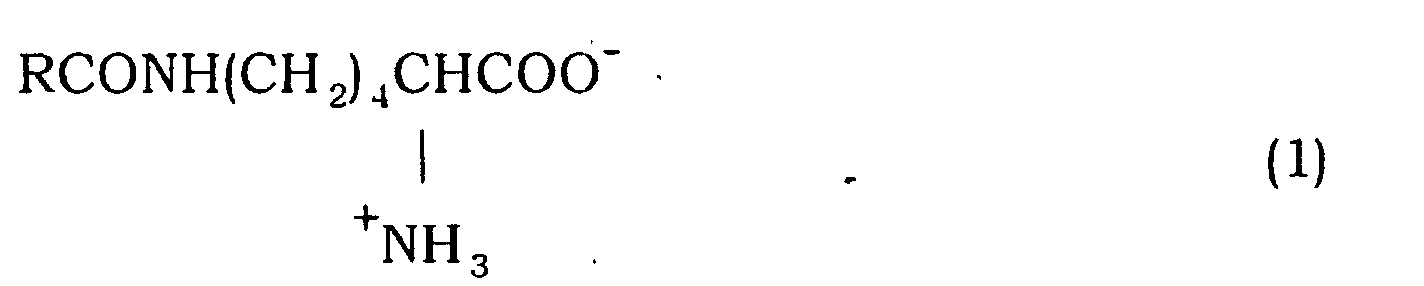
- N ⁇ -long chain acyllysine for use in the present invention may be represented by the following general formula (1) (wherein R represents a straight or branched chain alkyl or alkenyl group having 7 ⁇ 21 carbon atoms)
- aliphatic alcohols having 1 ⁇ 4 carbon atoms such as methanol, ethanol, propanol, butanol, isopropanol and the like are taken.
- methanol, ethanol, isopropanol are preferred.
- These lower alcohols may be used singly or in admixture with two or more of kinds.
- an acid to be used it may be either an organic acid or an inorganic acid. If it is exemplified, sulfuric acid, hydrochloric acid, nitric acid, phosphoric acid, citric acid, lactic acid, glutamic acid, pyrrolidonecarboxylic acid and the like are taken, but sulfuric acid and hydrochloric acid are preferred.
- a base to be used it may be either an organic base or an inorganic base.
- sodium hydroxide, potassium hydroxide, calcium hydroxide, barium hydroxide, sodium carbonate, ammonia, triethylamine, triethanolamine, monoethanolamine, pyridine and the like are taken, but sodium hydroxide and potassium hydroxide are preferred.
- the amount of the acid or the base to be added in this case is not limited particularly and it may be any one if it is sufficient to dissolve N ⁇ -long chain acyllysine.
- the acidic solvent or the basic solvent in which N-long chain acyllysine has been dissolved is kept to a temperature below 35 °C and neutralized by adding dropwise a basic solution or an acidic solution to crystallize out N-long chain acyllysine.
- the temperature at which the crystallization is conducted is not limited particularly so long as it is below 35 °C. However, the temperature below 28 °C is particularly preferable from the standpoint of view that the crystals having a small average particle diameter and/or mode diameter may be obtained. Also, the lower limitation of the crystallization temperature may be below the coagulation point of the solvent used.
- the obtained N ⁇ -long chain acyllysine crystals have such a large average particle diameter and mode diameter as 15 ⁇ m or more and become thick and plate crystal so that when they were incorporated into cosmetics, not only the gleam is recognized due to their plate structure but also the "stickiness" based on the oily raw material can not be reduced sufficiently because of their large size diameter, thus being not preferable.
- the basic or acidic solution for use in the crystallization may be prepared with the acid or the base as stated above.
- the process to isolate and dry the formed crystals may be conducted according to the conventional manner.
- the measurement of the average diameter and the mode diameter is conducted by using isopropanol as a dispersing solvent, adjusting the concentration of the compound to be tested in said dispersing solvent so as to become about 16 % and controlling the circulation speed so as to be 10 L/min.
- the average diameter and the mode diameter defined herein are ones determined using a volume cumulative value. Also, the mode diameter means the particle size which becomes the maximum frequency.
- the followings illustrate the powders treated which is characterized by having subjected powders for cosmetic use to dry surface treatment with one or more selected from said crystals.
- the powders for cosmetic use which may be used in the present invention are not particularly limited if they are ones (pigments, coloring materials, resins) used in cosmetics.
- examples of such powders include resin powders such as nylon beads, silicone beads and the like; nylon powder, metallic fatty acid soap, yellow iron oxide, red iron oxide, black iron oxide, chromium oxide, cobalt oxide, carbon black, Ultramarine, iron blue, zinc oxide, titanium oxide, zirconium oxide, silicon dioxide, aluminum oxide, cerium oxide, mica titanium, boron nitride, barium sulfate, calcium carbonate, magnesium carbonate, aluminum silicate, magnesium silicate, silicon carbide, pigment, lake, sericite, mica, talc, kaolin, plate barium sulfate, butterfly barium sulfate, fine particle titanium oxide, fine particle zinc oxide, fine particle iron oxide and the like.
- ⁇ -treatment such as silicon-treatment, fluorine compound-treatment, silane coupling agent-treatment, silane treated organic titanate-treatment, fatty acid-treatment, metallic soap-treatment, oil agent-treatment, amino acid-treatment or the like.
- the process for surface-treatment may be conducted by a dry treatment usually used.
- the amount of said crystals or said powders treated to be incorporated into cosmetics may be greatly varied depending on the form of cosmetics, it is 0.1 ⁇ 99 % by weight in makeup and basic cosmetics while it is 0.1 ⁇ 30 % by weight in hair and cleaning cosmetics.
- an oily raw material for use in the present invention is not limited particularly and there may be used oils which have been widely used as the raw material for cosmetics.
- an oil examples include higher alcohols such as cetyl alcohol, isostearyl alcohol, lauryl alcohol, hexadexyl alcohol, octyl dodecanol and the like; fatty acids such as isostearic acid, undecylic acid, oleic acid and the like; polydric alcohols such as glycerin, sorbitol, ethylene glycol, propylene glycol, polyethlene glycol and the like; esters such as myristyl myristate, hexyl laurate, decyl oleate, isopropyl myristate, hexyldecyl dimethyloctanoate, glycerol monostearate, diethyl phthalate, ethylene glycol monostearate, octyl hydroxystearate and the like; hydrocarbons such as liquid paraffin, vaseline, squalane and the like; waxes such as lanolin, hydrogenated lanolin
- oils examples include silicone compounds such as dimethyl polysiloxane, methyl hydrogen polysiloxane, methyl phenyl polysiloxane, polyether-modified organopolysiloxane, fluoroalkyl polyoxyalkylene co-modified organopolysiloxane, alkyl-modified organopolysiloxane, terminal-modified organopolysiloxane, fluoro-modified organopolysiloxane, aminodimethicone, amino-modified organopolysiloxane, silicone gel, acryl silicone, trimethylsiloxy silicic acid, silicone RTV rubber and the like; fluorine compounds such as perfluorocarbon, fluoroalcohol and the like.
- silicone compounds such as dimethyl polysiloxane, methyl hydrogen polysiloxane, methyl phenyl polysiloxane, polyether-modified organopolysiloxane, fluoroalkyl polyoxy
- ком ⁇ онентs there may be incorporated into the cosmetics of the present invention at the same time components usually used in cosmetics inclusive a fluorine compound, a resin, a surfactant, a thickener, a high molecular compound, an antiseptic, a perfume, an ultraviolet absorber (includes an organic and an inorganic ones, and may be one susceptible to either UV-A or UV-B), a humectant, a hystologically active substance, salts, a solvent, an antioxidant, an antibacterial agent, an anhidrotics, a chelating agent, a neutralizer, a pH adjusting agent and the like.
- a fluorine compound e.g., a fluorine compound, a resin, a surfactant, a thickener, a high molecular compound, an antiseptic, a perfume, an ultraviolet absorber (includes an organic and an inorganic ones, and may be one susceptible to either UV-A or UV-B),
- a surfactant for example an anionic surfactant, a cationic surfactant, a nonionic surfactant and betaine type surfactant may be used.
- an organic ultraviolet absorber examples include 2-ethylhexyl p -methoxy cinnamate, 2-ethylhexyl p -dimethyl-aminobenzoate, 2-hydroxy-4-methoxybenzophenone-5-sulfuric acid, 2,2'-dihydroxy-4-methoxybenzophenone, diethanolamine salt of p -methoxyhydrocinnamic acid, p -aminobenzoic acid (hereinafter, referred to as PABA), ethyl dihydroxy propyl PABA, gryceryl PABA, homomethyl salicylate, methyl- o -aminobenzoate, 2-ethylhexyl-2-cyano-3,3-diphenylacrylate, octyl dimethyl PABA, octyl methoxycinnamate, 2-phenyl-benzimidazole-5-sulfuric acid, triethanolamine salt of salicylic acid, 3-(4-
- solvent examples include cyclic silicone, ethanol, soft liquid isoparaffin, lower alcohol, ethers, LPG, fluorocarbon, N-methylpyrrolidone, fluoroalcohol, volatile straight chain silicone and the like.
- the cosmetics of the present invention may be any form inclusive powders, liquid, cream, paste, cake and solid.
- makeup cosmetics such as a foundation, a face powder, a cheek rouge, an eye shadow and the like
- body cosmetics such as a body powder, a baby powder and the like
- basic cosmetics such as a lotion, a milky lotion, a facial liquid essence, a skin cream, a sun care product and the like
- cleaning agents such as a cleansing powder, a hair shampoo, a body shampoo, a hand soap, a solid soap and the like
- hair cosmetics such as a rinse, a treatment, a styling agent, an anhidrotics, a bathing agent, a hair dye and the like.
- the cosmetics of the present invention may be prepared according to the conventional process.
- the crystals were measured for their average diameter and for their mode diameter using a particle size distribution meter LS230 type manufactured by Coulter Inc. wherein isopropanol was used as a dispersing solvent, and an absorbance and a circulation speed were set to about 16 % and to 10 L/min., respectively.
- the average diameter and the mode diameter determined using volume cumulative value were 6 ⁇ m and 7 ⁇ m, respectively.
- the crystals were measured for their average diameter and for their mode diameter using a particle size distribution meter LS230 type manufactured by Coulter Inc. wherein isopropanol was used as a dispersing solvent, and an absorbance and a circulation speed were set to about 16 % and to 10 L/min., respectively.
- the average diameter and the mode diameter determined using volume cumulative value were 7 ⁇ m and 7 ⁇ m, respectively.
- the crystals were measured for their average diameter and for their mode diameter using a particle size distribution meter LS230 type manufactured by Coulter Inc. wherein isopropanol was used as a dispersing solvent, and an absorbance and a circulation speed were set to about 16 % and to 10 L/min., respectively.
- the average diameter and the mode diameter determined using volume cumulative value were 14 ⁇ m and 15 ⁇ m, respectively.
- N ⁇ -Lauroyllysine was pulverized by dry process using a supersonic JET grinder manufactured by Nippon Pneumatic Mfg. Co., Ltd.
- the pulverized product was measured for its average diameter and for its mode diameter using a particle size distribution meter LS230 type manufactured by Coulter Inc. wherein isopropanol was used as a dispersing solvent, and an absorbance and a circulation speed were set to about 16 % and to 10 L/min., respectively.
- the average diameter and the mode diameter determined using volume cumulative value were 10 ⁇ m and 9 ⁇ m, respectively.
- N ⁇ -Lauroyllysine powders were spread to each front arms of five panelists consisting of men and women, and the extent of the gleam was visually evaluated. The evaluation was made by 3-grades of 0 point (appreciable gleam is recognized) ⁇ 2 points (no gleam) and the average value was calculated. The average value of above 0 point and less than 0.7 point was assigned to ⁇ , that of above 0.7 point and less than 1.4 points was assigned to ⁇ and that of above 1.4 points and less than 2.0 points was assigned to ⁇ . The results are shown in table 1.
- the products of the present invention have a good feeling during use such as spreadability, etc.
- the face powder obtained in Comparative Formulation Example has a low water repellency so that when it was applied to the skin and the hair, the makeup-comes-off of the makeup by waterdrop and sweat occurs easily while the face powder of the present invention has a high water repellency so that the makeup-comes-off of the makeup by waterdrop and sweat occurs with difficulty, thus it is excellent in the sustaining of the makeup effect.
- the product of the present invention has no defect in such feeling during use as “stickiness” and “gleam”, and is excellent in “lubricity” in comparison with the comparison products.
- the product of the present invention has no defect in such feeling during use as “stickiness” and “gleam” and is excellent in “lubricity” in comparison with the comparison products.
- a liquid foundation was prepared having a composition shown in table 4 and there was obtained the liquid foundation having no disadvantage in such feeling during use as "stickiness” and “gleam", and having an excellent “lubricity”.
- Stearic acid 3.0 Isopropyl stearate 9.0 Liquid paraffin 1.5
- Cetanol 1.0 Powder of Preparation Example 1 6.0
- Triethanolamine 1.5
- Propylene glycol 5.0
- Glycine betaine 2.0 Bentonite (1 % aqueous solution) 15.0
- Oil phase component Carnauba wax 2 Candelilla wax 6.5 Beeswax 5.5 Hardened castor oil 2 Liquid lanolin 16.8 Microcrystalline wax 3 Octyldodecanol 15 Octyldodecyl myristate 9.5 Castor oil 23.7 Pigment component Pearl pigment 2 Titanium oxide 1.5 Powder of Preparation Example 1 9 Red oxide 1.3 Red No. 202 pigment 2.2
- Oil phase components and aqueous phase components shown in table 7 were separately mixed under heating, and the aqueous phase components were added to the oil phase components.
- the resultant mixture was emulsified with a homomixer and cooled to 40°C on standing while stirring.
- a perfume was added thereto to prepare a hair treatment having no defect in such feeling during use as "stickiness” and “gleam", and having an excellent “lubricity” after use.
- Oil phase component Liquid paraffin 3.5 Cetanol 5.0 Self-emulsifiable type glycerin monostearate 6.0 Pyroglutamic acid isostearic acid polyoxyethylene glyceryl 1.0 Dioctyldodecyl N-I auroylglutamate 2.0 Aqueous phase component Powder of Preparation Example 1 3.0 1,3-Butylene glycol 3.0 Glycine betaine 7.0 Stearyl trimethylammonium chloride 1.5 Distearyl dimethylammonium chloride 1.5 Purified water Remainder Perfume 0.2
- cosmetics which cause neither “gleam” nor “stickiness” when applied to the skin and the hair, giving a good feeling during use such as spreadability, etc., and being excellent in the sustaining of the makeup effect in the formulation.
Landscapes
- Health & Medical Sciences (AREA)
- Life Sciences & Earth Sciences (AREA)
- Animal Behavior & Ethology (AREA)
- General Health & Medical Sciences (AREA)
- Public Health (AREA)
- Veterinary Medicine (AREA)
- Chemical & Material Sciences (AREA)
- Organic Chemistry (AREA)
- Birds (AREA)
- Epidemiology (AREA)
- Cosmetics (AREA)
Abstract
Description
| Crystallization temperature or Preparation process | Average particle size (µm) | Gleam | Spreadability | |
| Preparation Example 1 | Crystallization temperature: 25 °C | 6 | ○ | ○ |
| Preparation Example 2 | Crystallization temperature: 10 °C | 7 | ○ | ○ |
| Preparation Example 3 | Crystallization temperature: 20 °C | 6 | ○ | ○ |
| Preparation Example 4 | Crystallization temperature: 30 °C | 14 | ○ | ○ |
| Comparative Preparation Example 1 | Crystallization temperature: 40 °C | 21 | × | ○ |
| Comparative Preparation Example 2 | Process described in Japanese Patent Application Laid-Open No. 337519/1996 | 18 | × | ○ |
| Comparative Preparation Example 3 | Wet pulverization process | 3 | ○ | × |
| Comparative Preparation Example 4 | Dry pulverization process | 10 | ○ | × |
| (% by weight) | ||
| Formulation Example | Comparative Formulation Example | |
| Crystals of Preparation Example 1 | 5 | - |
| Crystals of Comparative Preparation Example 1 | - | 5 |
| Talc | 95 | 95 |
| The sustaining of the makeup effect | ○ | Δ |
| (% by weight) | |||||
| Formulation Example 2 | Comparative Formulation Example | ||||
| Talc | 30.0 | 30.0 | 30.0 | 30.0 | 30.0 |
| Sericite | 30.0 | 30.0 | 30.0 | 30.0 | 30.0 |
| Mica | 10.0 | 10.0 | 10.0 | 10.0 | 10.0 |
| Magnesium stearate | 2.0 | 2.0 | 2.0 | 2.0 | 2.0 |
| Titanium oxide | 8.0 | 8.0 | 8.0 | 8.0 | 8.0 |
| Powder of Preparation Example 1 | 10.0 | ||||
| Powder of Comparative Preparation Example 1 | 10.0 | ||||
| Powder of Comparative Preparation Example 2 | 10.0 | ||||
| Powder of Comparative Preparation Example 3 | 10.0 | ||||
| Powder of Comparative Preparation Example 4 | 10.0 | ||||
| Silicone oil | 6.0 | 6.0 | 6.0 | 6.0 | 6.0 |
| Octyl dodecanol | 4.0 | 4.0 | 4.0 | 4.0 | 4.0 |
| Stickiness | o ○ | ○ | ○ | o ○ | o ○ |
| Gleam | o ○ | Δ | Δ | o ○ | o ○ |
| Lubricity | o ○ | o ○ | o ○ | Δ | Δ |
| (% by weight) | ||||||
| Formulation Example 3 | Comparative Formulation Example | |||||
| Oil phase component | Liquid paraffin | 5.0 | 5.0 | 5.0 | 5.0 | 5.0 |
| Dioctyldodecyl lauroylglutamate | 2.0 | 2.0 | 2.0 | 2.0 | 2.0 | |
| Propylene glycol monostearete | 0.5 | 0.5 | 0.5 | 0.5 | 0.5 | |
| POE (5) hardened castor oil | 1.5 | 1.5 | 1.5 | 1.5 | 1.5 | |
| POE (5) glyceryl monostearate | 2.5 | 2.5 | 2.5 | 2.5 | 2.5 | |
| Butylparaben | 0.1 | 0.1 | 0.1 | 0.1 | 0.1 | |
| Powder of Preparation Example 1 | 3.0 | |||||
| Powder of Comparative Preparation Example 1 | 3.0 | |||||
| Powder of Comparative Preparation Example 2 | 3.0 | |||||
| Powder of Comparative Preparation Example 3 | 3.0 | |||||
| Powder of Comparative Preparation Example 4 | 3.0 | |||||
| Aqueous phase component | Sodium N-stearyl L-glutamate | 0.3 | 0.3 | 0.3 | 0.3 | 0.3 |
| Carboxy vinyl polymer | 0.2 | 0.2 | 0.2 | 0.2 | 0.2 | |
| Sodium hydroxide | 0.08 | 0.08 | 0.08 | 0.08 | 0.08 | |
| 1,3-Butylene glycol | 5.0 | 5.0 | 5.0 | 5.0 | 5.0 | |
| Methylparaben | 0.1 | 0.1 | 0.1 | 0.1 | 0.1 | |
| Purified water | Remainder | Remainder | Remainder | Remainder | Remainder | |
| Stickiness | o ○ | ○ | ○ | o ○ | o ○ | |
| Gleam | o ○ | Δ | Δ | o ○ | o ○ | |
| Lubricity | o ○ | o ○ | o ○ | Δ | Δ |
| (% by weight) | |
| Stearic acid | 3.0 |
| Isopropyl stearate | 9.0 |
| Liquid paraffin | 1.5 |
| Cetanol | 1.0 |
| Powder of Preparation Example 1 | 6.0 |
| Triethanolamine | 1.5 |
| Propylene glycol | 5.0 |
| Glycine betaine | 2.0 |
| Bentonite (1 % aqueous solution) | 15.0 |
| Purified water | Remainder |
| (% by weight) | ||
| Oil phase component | Carnauba wax | 2 |
| Candelilla wax | 6.5 | |
| Beeswax | 5.5 | |
| Hardened castor oil | 2 | |
| Liquid lanolin | 16.8 | |
| Microcrystalline wax | 3 | |
| Octyldodecanol | 15 | |
| Octyldodecyl myristate | 9.5 | |
| Castor oil | 23.7 | |
| Pigment component | Pearl pigment | 2 |
| Titanium oxide | 1.5 | |
| Powder of Preparation Example 1 | 9 | |
| Red oxide | 1.3 | |
| Red No. 202 pigment | 2.2 |
| (% by weight) | ||
| Oil phase component | Liquid paraffin | 3.5 |
| Cetanol | 5.0 | |
| Self-emulsifiable type glycerin monostearate | 6.0 | |
| Pyroglutamic acid isostearic acid polyoxyethylene glyceryl | 1.0 | |
| Dioctyldodecyl N-I auroylglutamate | 2.0 | |
| Aqueous phase component | Powder of Preparation Example 1 | 3.0 |
| 1,3-Butylene glycol | 3.0 | |
| Glycine betaine | 7.0 | |
| Stearyl trimethylammonium chloride | 1.5 | |
| Distearyl dimethylammonium chloride | 1.5 | |
| Purified water | Remainder | |
| Perfume | 0.2 |
Claims (9)
- Non-pulverized Nε -long chain acyllysine crystals having an average particle diameter of 3 ∼ 15 µm.
- Non-pulverized Nε -long chain acyllysine crystals having a mode diameter of 3 ∼ 15 µm.
- Nε -Long chain acyllysine crystals obtained by dissolving Nε -long chain acyllysine in an acidic or a basic solvent consisting of one or more selected from lower alcohols and/or water, thereafter neutralizing the resultant solution by adding dropwise a basic solution or an acidic solution at a temperature below 35 °C whereupon crystallization occurs.
- N ε -Long chain acyllysine crystals as claimed in claims 1 to 3 wherein the N ε -Long chain acyllysine is one represented by the following general formula (1)(wherein R represents a straight or branched chain alkyl or alkenyl group having 7 ∼ 21 carbon atoms)

- Cosmetics which are characterized by containing N ε -long chain acyllysine crystals as claimed in claims 1 to 4.
- Powders treated which are characterized by having subjected powders for cosmetic use to a dry surface treatment with Nε -long chain acyllysine crystals as claimed in claims 1 to 4.
- Cosmetics which are characterized by containing the powders treated as claimed in claim 6.
- Cosmetics as claimed in claim 5 or 7 containing further an oil raw material.
- A process for preparing Nε -long chain acyllysine-crystals which is characterized by dissolving Nε -long chain acyllysine in an acidic solvent or a basic solvent consisting of one or more selected from lower alcohol and/or water and thereafter neutralizing the resultant solution by adding dropwise a basic solution or an acidic solution at a temperature below 35°C thereby Nε -long chain acyllysine is crystallized out.
Applications Claiming Priority (5)
| Application Number | Priority Date | Filing Date | Title |
|---|---|---|---|
| JP23253599 | 1999-08-19 | ||
| JP23253799 | 1999-08-19 | ||
| JP23253799 | 1999-08-19 | ||
| JP23253599 | 1999-08-19 | ||
| PCT/JP2000/005556 WO2001014317A1 (en) | 1999-08-19 | 2000-08-18 | Nε-LONG CHAIN ACYLLYSINE CRYSTALS, PROCESS FOR PRODUCING THE SAME AND COSMETICS CONTAINING THE SAME |
Publications (3)
| Publication Number | Publication Date |
|---|---|
| EP1207150A1 true EP1207150A1 (en) | 2002-05-22 |
| EP1207150A4 EP1207150A4 (en) | 2005-01-19 |
| EP1207150B1 EP1207150B1 (en) | 2008-06-25 |
Family
ID=26530515
Family Applications (1)
| Application Number | Title | Priority Date | Filing Date |
|---|---|---|---|
| EP00953511A Expired - Lifetime EP1207150B1 (en) | 1999-08-19 | 2000-08-18 | N-epsilon-long chain acyllysine crystals, process for producing the same and cosmetics containing the same |
Country Status (6)
| Country | Link |
|---|---|
| US (1) | US6555708B1 (en) |
| EP (1) | EP1207150B1 (en) |
| JP (1) | JP4826049B2 (en) |
| CN (1) | CN1229333C (en) |
| DE (1) | DE60039304D1 (en) |
| WO (1) | WO2001014317A1 (en) |
Cited By (2)
| Publication number | Priority date | Publication date | Assignee | Title |
|---|---|---|---|---|
| US10195127B2 (en) | 2013-03-14 | 2019-02-05 | Ajinomoto Co., Inc. | Cosmetic composition |
| EP3928837A4 (en) * | 2019-02-22 | 2023-03-08 | Ajinomoto Co., Inc. | POWDER AND COSMETIC PREPARATION |
Families Citing this family (9)
| Publication number | Priority date | Publication date | Assignee | Title |
|---|---|---|---|---|
| JP3816042B2 (en) * | 2002-09-05 | 2006-08-30 | 株式会社コーセー | Powder cosmetics |
| WO2006009320A1 (en) * | 2004-07-23 | 2006-01-26 | Ajinomoto Co., Inc. | Process for production of powdery n-(long-chain acyl)- amino acids or salts thereof, powdery n-(long-chain acyl)amino acids or salts thereof, and facial cleansing powders |
| TWI382855B (en) * | 2005-03-30 | 2013-01-21 | 味之素股份有限公司 | Cosmetic powder |
| WO2011088327A2 (en) | 2010-01-15 | 2011-07-21 | Ajinomoto Co., Inc. | N-acyl basic amino acid dispersion |
| JP6130646B2 (en) * | 2012-10-26 | 2017-05-17 | 株式会社ミルボン | O / W emulsion |
| CN107106443A (en) | 2014-12-25 | 2017-08-29 | 味之素株式会社 | Cosmetic hair preparation composition containing acyl group basic amino acid derivant |
| JP7679769B2 (en) * | 2019-06-27 | 2025-05-20 | 味の素株式会社 | Method for producing Nε-long chain acyl lysine crystals and composition containing the crystals |
| EP4268902A4 (en) * | 2020-12-28 | 2025-03-05 | Ajinomoto Co., Inc. | POWDER COMPOSITION FOR COSMETICS OR SKIN SURFACE PRODUCTS AND MANUFACTURING METHOD THEREFOR |
| CN117586142B (en) * | 2023-12-04 | 2026-03-31 | 烟台海川化学制品有限公司 | A purification method for lauroyl lysine |
Family Cites Families (4)
| Publication number | Priority date | Publication date | Assignee | Title |
|---|---|---|---|---|
| JPH01242563A (en) * | 1988-03-22 | 1989-09-27 | Ajinomoto Co Inc | Production of organic plate crystal |
| FR2658719B1 (en) * | 1990-02-28 | 1992-05-15 | Oreal | USE IN ASSOCIATION, IN THE PREPARATION OF COSMETIC COMPOSITIONS IN THE FORM OF COMPACTED POWDERS, HOLLOW MICROSPHERES OF THERMOPLASTIC SYNTHETIC MATERIAL, HEXAGONAL BORON NITRIDE, AND N-ACYL LYSINE. |
| JPH08337519A (en) * | 1995-06-13 | 1996-12-24 | Ajinomoto Co Inc | Cosmetic |
| JPH09323914A (en) * | 1996-06-03 | 1997-12-16 | Kanebo Ltd | Cosmetic |
-
2000
- 2000-08-18 JP JP2001518408A patent/JP4826049B2/en not_active Expired - Lifetime
- 2000-08-18 DE DE60039304T patent/DE60039304D1/en not_active Expired - Lifetime
- 2000-08-18 US US10/048,994 patent/US6555708B1/en not_active Expired - Lifetime
- 2000-08-18 EP EP00953511A patent/EP1207150B1/en not_active Expired - Lifetime
- 2000-08-18 WO PCT/JP2000/005556 patent/WO2001014317A1/en not_active Ceased
- 2000-08-18 CN CN00811605.9A patent/CN1229333C/en not_active Expired - Lifetime
Cited By (2)
| Publication number | Priority date | Publication date | Assignee | Title |
|---|---|---|---|---|
| US10195127B2 (en) | 2013-03-14 | 2019-02-05 | Ajinomoto Co., Inc. | Cosmetic composition |
| EP3928837A4 (en) * | 2019-02-22 | 2023-03-08 | Ajinomoto Co., Inc. | POWDER AND COSMETIC PREPARATION |
Also Published As
| Publication number | Publication date |
|---|---|
| WO2001014317A1 (en) | 2001-03-01 |
| DE60039304D1 (en) | 2008-08-07 |
| JP4826049B2 (en) | 2011-11-30 |
| EP1207150B1 (en) | 2008-06-25 |
| US6555708B1 (en) | 2003-04-29 |
| CN1370142A (en) | 2002-09-18 |
| CN1229333C (en) | 2005-11-30 |
| EP1207150A4 (en) | 2005-01-19 |
Similar Documents
| Publication | Publication Date | Title |
|---|---|---|
| KR100594548B1 (en) | Cosmetic composition | |
| JP4491549B2 (en) | Cosmetics | |
| EP1213006B1 (en) | Use of the organopolysiloxane M3T in cosmetic compositions | |
| CN101107214B (en) | Esterification reaction product and cosmetic | |
| US20030082218A1 (en) | Cosmetics | |
| JP2001039819A (en) | Novel silicone compound and cosmetic containing the same | |
| CN101918475A (en) | Method for producing amino acid modified organopolysiloxane emulsion | |
| US6555708B1 (en) | N-ε-long chain acyllsine crystals, process for producing the same and cosmetics containing the same | |
| CA3169886A1 (en) | Surfactants for personal care and cosmetic products | |
| JPWO2001014317A1 (en) | Nε-long chain acyl lysine crystal, its method of production and cosmetic containing the same | |
| CN115175662B (en) | Cosmetic product | |
| JP3604621B2 (en) | Oily cosmetics | |
| US8399524B2 (en) | Acyl acidic amino acid ester | |
| JPH09323914A (en) | Cosmetic | |
| JP2000044423A (en) | Cosmetic and makeup foundation | |
| JP2021187751A (en) | Cosmetic | |
| JP3737979B2 (en) | Whitening cosmetics | |
| JPH11236308A (en) | Solid-like water-in-oil type cosmetic | |
| JP7787768B2 (en) | Surfactants and cosmetics | |
| JP3457634B2 (en) | Cosmetics | |
| EP4239037A1 (en) | Composition, method for producing same, and cosmetic | |
| JP2001058930A (en) | Shampoo composition | |
| JPH0925216A (en) | Makeup cosmetic | |
| HK1224956B (en) | Oil-in-water emulsion cosmetic for skin |
Legal Events
| Date | Code | Title | Description |
|---|---|---|---|
| PUAI | Public reference made under article 153(3) epc to a published international application that has entered the european phase |
Free format text: ORIGINAL CODE: 0009012 |
|
| 17P | Request for examination filed |
Effective date: 20020306 |
|
| RBV | Designated contracting states (corrected) |
Designated state(s): DE FR GB IT |
|
| A4 | Supplementary search report drawn up and despatched |
Effective date: 20041207 |
|
| 17Q | First examination report despatched |
Effective date: 20050509 |
|
| 17Q | First examination report despatched |
Effective date: 20050509 |
|
| GRAP | Despatch of communication of intention to grant a patent |
Free format text: ORIGINAL CODE: EPIDOSNIGR1 |
|
| RIC1 | Information provided on ipc code assigned before grant |
Ipc: A61Q 1/02 20060101ALI20071002BHEP Ipc: A61K 8/44 20060101AFI20071002BHEP Ipc: A61K 8/04 20060101ALI20071002BHEP |
|
| GRAS | Grant fee paid |
Free format text: ORIGINAL CODE: EPIDOSNIGR3 |
|
| GRAA | (expected) grant |
Free format text: ORIGINAL CODE: 0009210 |
|
| AK | Designated contracting states |
Kind code of ref document: B1 Designated state(s): DE FR GB IT |
|
| REG | Reference to a national code |
Ref country code: GB Ref legal event code: FG4D |
|
| REF | Corresponds to: |
Ref document number: 60039304 Country of ref document: DE Date of ref document: 20080807 Kind code of ref document: P |
|
| PLBE | No opposition filed within time limit |
Free format text: ORIGINAL CODE: 0009261 |
|
| STAA | Information on the status of an ep patent application or granted ep patent |
Free format text: STATUS: NO OPPOSITION FILED WITHIN TIME LIMIT |
|
| GBPC | Gb: european patent ceased through non-payment of renewal fee |
Effective date: 20080925 |
|
| 26N | No opposition filed |
Effective date: 20090326 |
|
| PG25 | Lapsed in a contracting state [announced via postgrant information from national office to epo] |
Ref country code: IT Free format text: LAPSE BECAUSE OF FAILURE TO SUBMIT A TRANSLATION OF THE DESCRIPTION OR TO PAY THE FEE WITHIN THE PRESCRIBED TIME-LIMIT Effective date: 20080625 |
|
| PG25 | Lapsed in a contracting state [announced via postgrant information from national office to epo] |
Ref country code: GB Free format text: LAPSE BECAUSE OF NON-PAYMENT OF DUE FEES Effective date: 20080925 |
|
| REG | Reference to a national code |
Ref country code: FR Ref legal event code: PLFP Year of fee payment: 17 |
|
| REG | Reference to a national code |
Ref country code: FR Ref legal event code: PLFP Year of fee payment: 18 |
|
| REG | Reference to a national code |
Ref country code: FR Ref legal event code: PLFP Year of fee payment: 19 |
|
| PGFP | Annual fee paid to national office [announced via postgrant information from national office to epo] |
Ref country code: DE Payment date: 20190806 Year of fee payment: 20 Ref country code: FR Payment date: 20190711 Year of fee payment: 20 |
|
| REG | Reference to a national code |
Ref country code: DE Ref legal event code: R071 Ref document number: 60039304 Country of ref document: DE |