EP1205579A1 - A chemically processed steel sheet excellent in corrosion resistance - Google Patents
A chemically processed steel sheet excellent in corrosion resistance Download PDFInfo
- Publication number
- EP1205579A1 EP1205579A1 EP01125363A EP01125363A EP1205579A1 EP 1205579 A1 EP1205579 A1 EP 1205579A1 EP 01125363 A EP01125363 A EP 01125363A EP 01125363 A EP01125363 A EP 01125363A EP 1205579 A1 EP1205579 A1 EP 1205579A1
- Authority
- EP
- European Patent Office
- Prior art keywords
- steel sheet
- layer
- converted
- converted layer
- soluble
- Prior art date
- Legal status (The legal status is an assumption and is not a legal conclusion. Google has not performed a legal analysis and makes no representation as to the accuracy of the status listed.)
- Granted
Links
- 229910000831 Steel Inorganic materials 0.000 title claims abstract description 90
- 239000010959 steel Substances 0.000 title claims abstract description 90
- 230000007797 corrosion Effects 0.000 title abstract description 15
- 238000005260 corrosion Methods 0.000 title abstract description 15
- 238000007747 plating Methods 0.000 claims abstract description 55
- 150000001875 compounds Chemical class 0.000 claims abstract description 29
- 229910021364 Al-Si alloy Inorganic materials 0.000 claims abstract description 21
- XLYOFNOQVPJJNP-UHFFFAOYSA-M hydroxide Chemical compound [OH-] XLYOFNOQVPJJNP-UHFFFAOYSA-M 0.000 claims abstract description 15
- AMWRITDGCCNYAT-UHFFFAOYSA-L hydroxy(oxo)manganese;manganese Chemical compound [Mn].O[Mn]=O.O[Mn]=O AMWRITDGCCNYAT-UHFFFAOYSA-L 0.000 claims abstract description 7
- 239000011572 manganese Substances 0.000 claims description 31
- 239000010936 titanium Substances 0.000 claims description 31
- 229910019142 PO4 Inorganic materials 0.000 claims description 30
- 235000021317 phosphate Nutrition 0.000 claims description 29
- 229910052751 metal Inorganic materials 0.000 claims description 25
- 239000002184 metal Substances 0.000 claims description 25
- 150000003609 titanium compounds Chemical class 0.000 claims description 24
- NBIIXXVUZAFLBC-UHFFFAOYSA-K phosphate Chemical compound [O-]P([O-])([O-])=O NBIIXXVUZAFLBC-UHFFFAOYSA-K 0.000 claims description 21
- 239000010452 phosphate Substances 0.000 claims description 21
- KRHYYFGTRYWZRS-UHFFFAOYSA-M Fluoride anion Chemical compound [F-] KRHYYFGTRYWZRS-UHFFFAOYSA-M 0.000 claims description 20
- 229910052719 titanium Inorganic materials 0.000 claims description 18
- 239000000314 lubricant Substances 0.000 claims description 10
- 229910052748 manganese Inorganic materials 0.000 claims description 10
- 229910001463 metal phosphate Inorganic materials 0.000 claims description 9
- 150000003013 phosphoric acid derivatives Chemical class 0.000 claims description 8
- 229910052735 hafnium Inorganic materials 0.000 claims description 6
- 229910052726 zirconium Inorganic materials 0.000 claims description 6
- 229910052750 molybdenum Inorganic materials 0.000 claims description 4
- 229910052721 tungsten Inorganic materials 0.000 claims description 4
- GWEVSGVZZGPLCZ-UHFFFAOYSA-N Titan oxide Chemical compound O=[Ti]=O GWEVSGVZZGPLCZ-UHFFFAOYSA-N 0.000 claims description 3
- 229910052758 niobium Inorganic materials 0.000 claims description 3
- 239000002245 particle Substances 0.000 claims description 3
- 229910052715 tantalum Inorganic materials 0.000 claims description 3
- OGIDPMRJRNCKJF-UHFFFAOYSA-N titanium oxide Inorganic materials [Ti]=O OGIDPMRJRNCKJF-UHFFFAOYSA-N 0.000 claims description 3
- 229910052720 vanadium Inorganic materials 0.000 claims description 3
- PWHULOQIROXLJO-UHFFFAOYSA-N Manganese Chemical compound [Mn] PWHULOQIROXLJO-UHFFFAOYSA-N 0.000 claims 1
- 230000002950 deficient Effects 0.000 abstract description 16
- 230000007547 defect Effects 0.000 abstract description 14
- XLYOFNOQVPJJNP-UHFFFAOYSA-N water Substances O XLYOFNOQVPJJNP-UHFFFAOYSA-N 0.000 abstract description 9
- 238000005536 corrosion prevention Methods 0.000 abstract description 7
- 238000001226 reprecipitation Methods 0.000 abstract description 7
- 229910001512 metal fluoride Inorganic materials 0.000 abstract description 6
- 239000004033 plastic Substances 0.000 abstract description 5
- 229920003023 plastic Polymers 0.000 abstract description 5
- 230000004888 barrier function Effects 0.000 abstract description 3
- 239000000126 substance Substances 0.000 description 52
- 239000002585 base Substances 0.000 description 26
- 238000012360 testing method Methods 0.000 description 21
- 150000007524 organic acids Chemical class 0.000 description 16
- 150000002697 manganese compounds Chemical class 0.000 description 15
- NBIIXXVUZAFLBC-UHFFFAOYSA-N Phosphoric acid Chemical compound OP(O)(O)=O NBIIXXVUZAFLBC-UHFFFAOYSA-N 0.000 description 14
- 239000003973 paint Substances 0.000 description 12
- 238000006243 chemical reaction Methods 0.000 description 9
- 230000000694 effects Effects 0.000 description 9
- 150000002739 metals Chemical class 0.000 description 8
- 229910000147 aluminium phosphate Inorganic materials 0.000 description 7
- 150000002222 fluorine compounds Chemical class 0.000 description 7
- 238000003754 machining Methods 0.000 description 7
- 229920005989 resin Polymers 0.000 description 7
- 239000011347 resin Substances 0.000 description 7
- ZCDOYSPFYFSLEW-UHFFFAOYSA-N chromate(2-) Chemical compound [O-][Cr]([O-])(=O)=O ZCDOYSPFYFSLEW-UHFFFAOYSA-N 0.000 description 6
- 230000006872 improvement Effects 0.000 description 6
- -1 organic acid salts Chemical class 0.000 description 6
- 235000002639 sodium chloride Nutrition 0.000 description 6
- 229910052784 alkaline earth metal Inorganic materials 0.000 description 5
- 239000011651 chromium Substances 0.000 description 5
- XROWMBWRMNHXMF-UHFFFAOYSA-J titanium tetrafluoride Chemical compound [F-].[F-].[F-].[F-].[Ti+4] XROWMBWRMNHXMF-UHFFFAOYSA-J 0.000 description 5
- 241001163841 Albugo ipomoeae-panduratae Species 0.000 description 4
- 150000001342 alkaline earth metals Chemical class 0.000 description 4
- 238000004090 dissolution Methods 0.000 description 4
- 239000000203 mixture Substances 0.000 description 4
- 150000003839 salts Chemical class 0.000 description 4
- 238000005406 washing Methods 0.000 description 4
- 238000003466 welding Methods 0.000 description 4
- SMZOUWXMTYCWNB-UHFFFAOYSA-N 2-(2-methoxy-5-methylphenyl)ethanamine Chemical compound COC1=CC=C(C)C=C1CCN SMZOUWXMTYCWNB-UHFFFAOYSA-N 0.000 description 3
- NIXOWILDQLNWCW-UHFFFAOYSA-N 2-Propenoic acid Natural products OC(=O)C=C NIXOWILDQLNWCW-UHFFFAOYSA-N 0.000 description 3
- 229910018125 Al-Si Inorganic materials 0.000 description 3
- 229910018520 Al—Si Inorganic materials 0.000 description 3
- 238000004833 X-ray photoelectron spectroscopy Methods 0.000 description 3
- 229910052783 alkali metal Inorganic materials 0.000 description 3
- 150000001340 alkali metals Chemical class 0.000 description 3
- 229910052782 aluminium Inorganic materials 0.000 description 3
- 238000004458 analytical method Methods 0.000 description 3
- 239000011324 bead Substances 0.000 description 3
- 230000015556 catabolic process Effects 0.000 description 3
- BFGKITSFLPAWGI-UHFFFAOYSA-N chromium(3+) Chemical compound [Cr+3] BFGKITSFLPAWGI-UHFFFAOYSA-N 0.000 description 3
- 238000006731 degradation reaction Methods 0.000 description 3
- 238000001035 drying Methods 0.000 description 3
- 150000004679 hydroxides Chemical class 0.000 description 3
- 150000002500 ions Chemical class 0.000 description 3
- 150000002736 metal compounds Chemical class 0.000 description 3
- 229910044991 metal oxide Inorganic materials 0.000 description 3
- 150000004706 metal oxides Chemical class 0.000 description 3
- 235000005985 organic acids Nutrition 0.000 description 3
- 238000004876 x-ray fluorescence Methods 0.000 description 3
- 229910019985 (NH4)2TiF6 Inorganic materials 0.000 description 2
- 239000004698 Polyethylene Substances 0.000 description 2
- 239000004743 Polypropylene Substances 0.000 description 2
- 239000004793 Polystyrene Substances 0.000 description 2
- VYPSYNLAJGMNEJ-UHFFFAOYSA-N Silicium dioxide Chemical compound O=[Si]=O VYPSYNLAJGMNEJ-UHFFFAOYSA-N 0.000 description 2
- FAPWRFPIFSIZLT-UHFFFAOYSA-M Sodium chloride Chemical compound [Na+].[Cl-] FAPWRFPIFSIZLT-UHFFFAOYSA-M 0.000 description 2
- PPBRXRYQALVLMV-UHFFFAOYSA-N Styrene Chemical compound C=CC1=CC=CC=C1 PPBRXRYQALVLMV-UHFFFAOYSA-N 0.000 description 2
- 229910011011 Ti(OH)4 Inorganic materials 0.000 description 2
- 229910003074 TiCl4 Inorganic materials 0.000 description 2
- 229910010298 TiOSO4 Inorganic materials 0.000 description 2
- RTAQQCXQSZGOHL-UHFFFAOYSA-N Titanium Chemical compound [Ti] RTAQQCXQSZGOHL-UHFFFAOYSA-N 0.000 description 2
- 235000011054 acetic acid Nutrition 0.000 description 2
- 125000000218 acetic acid group Chemical class C(C)(=O)* 0.000 description 2
- 239000002253 acid Substances 0.000 description 2
- 239000003513 alkali Substances 0.000 description 2
- 239000007864 aqueous solution Substances 0.000 description 2
- 239000013043 chemical agent Substances 0.000 description 2
- 238000006757 chemical reactions by type Methods 0.000 description 2
- 238000004532 chromating Methods 0.000 description 2
- 150000001845 chromium compounds Chemical class 0.000 description 2
- 238000001816 cooling Methods 0.000 description 2
- 238000005238 degreasing Methods 0.000 description 2
- NMGYKLMMQCTUGI-UHFFFAOYSA-J diazanium;titanium(4+);hexafluoride Chemical compound [NH4+].[NH4+].[F-].[F-].[F-].[F-].[F-].[F-].[Ti+4] NMGYKLMMQCTUGI-UHFFFAOYSA-J 0.000 description 2
- QDOXWKRWXJOMAK-UHFFFAOYSA-N dichromium trioxide Chemical compound O=[Cr]O[Cr]=O QDOXWKRWXJOMAK-UHFFFAOYSA-N 0.000 description 2
- 238000010494 dissociation reaction Methods 0.000 description 2
- 230000005593 dissociations Effects 0.000 description 2
- 238000005530 etching Methods 0.000 description 2
- 238000011156 evaluation Methods 0.000 description 2
- 150000004820 halides Chemical class 0.000 description 2
- 230000007062 hydrolysis Effects 0.000 description 2
- 238000006460 hydrolysis reaction Methods 0.000 description 2
- 238000009413 insulation Methods 0.000 description 2
- 235000014655 lactic acid Nutrition 0.000 description 2
- 229910000000 metal hydroxide Inorganic materials 0.000 description 2
- 238000000034 method Methods 0.000 description 2
- 238000002156 mixing Methods 0.000 description 2
- KADRTWZQWGIUGO-UHFFFAOYSA-L oxotitanium(2+);sulfate Chemical compound [Ti+2]=O.[O-]S([O-])(=O)=O KADRTWZQWGIUGO-UHFFFAOYSA-L 0.000 description 2
- 238000005554 pickling Methods 0.000 description 2
- 229920000573 polyethylene Polymers 0.000 description 2
- 229920000137 polyphosphoric acid Polymers 0.000 description 2
- 229920001155 polypropylene Polymers 0.000 description 2
- 229920002223 polystyrene Polymers 0.000 description 2
- 238000001556 precipitation Methods 0.000 description 2
- 230000008439 repair process Effects 0.000 description 2
- 230000004044 response Effects 0.000 description 2
- 238000006748 scratching Methods 0.000 description 2
- 239000011780 sodium chloride Substances 0.000 description 2
- 238000003892 spreading Methods 0.000 description 2
- 230000007480 spreading Effects 0.000 description 2
- XJDNKRIXUMDJCW-UHFFFAOYSA-J titanium tetrachloride Chemical compound Cl[Ti](Cl)(Cl)Cl XJDNKRIXUMDJCW-UHFFFAOYSA-J 0.000 description 2
- 238000012546 transfer Methods 0.000 description 2
- 229910052725 zinc Inorganic materials 0.000 description 2
- 150000003755 zirconium compounds Chemical class 0.000 description 2
- 229910019672 (NH4)F Inorganic materials 0.000 description 1
- OEPOKWHJYJXUGD-UHFFFAOYSA-N 2-(3-phenylmethoxyphenyl)-1,3-thiazole-4-carbaldehyde Chemical compound O=CC1=CSC(C=2C=C(OCC=3C=CC=CC=3)C=CC=2)=N1 OEPOKWHJYJXUGD-UHFFFAOYSA-N 0.000 description 1
- 229920000178 Acrylic resin Polymers 0.000 description 1
- 239000004925 Acrylic resin Substances 0.000 description 1
- OKTJSMMVPCPJKN-UHFFFAOYSA-N Carbon Chemical compound [C] OKTJSMMVPCPJKN-UHFFFAOYSA-N 0.000 description 1
- 229910000881 Cu alloy Inorganic materials 0.000 description 1
- 239000004593 Epoxy Substances 0.000 description 1
- JOYRKODLDBILNP-UHFFFAOYSA-N Ethyl urethane Chemical compound CCOC(N)=O JOYRKODLDBILNP-UHFFFAOYSA-N 0.000 description 1
- 229910020491 K2TiF6 Inorganic materials 0.000 description 1
- 229910021380 Manganese Chloride Inorganic materials 0.000 description 1
- GLFNIEUTAYBVOC-UHFFFAOYSA-L Manganese chloride Chemical compound Cl[Mn]Cl GLFNIEUTAYBVOC-UHFFFAOYSA-L 0.000 description 1
- 229910021569 Manganese fluoride Inorganic materials 0.000 description 1
- 229910018337 Mn(C2 H3 O2)2 Inorganic materials 0.000 description 1
- 229920001890 Novodur Polymers 0.000 description 1
- 229920000388 Polyphosphate Polymers 0.000 description 1
- FEWJPZIEWOKRBE-UHFFFAOYSA-N Tartaric acid Natural products [H+].[H+].[O-]C(=O)C(O)C(O)C([O-])=O FEWJPZIEWOKRBE-UHFFFAOYSA-N 0.000 description 1
- 229910011006 Ti(SO4)2 Inorganic materials 0.000 description 1
- 229910010342 TiF4 Inorganic materials 0.000 description 1
- BZHJMEDXRYGGRV-UHFFFAOYSA-N Vinyl chloride Chemical compound ClC=C BZHJMEDXRYGGRV-UHFFFAOYSA-N 0.000 description 1
- 150000007513 acids Chemical class 0.000 description 1
- 229920006243 acrylic copolymer Polymers 0.000 description 1
- XAGFODPZIPBFFR-UHFFFAOYSA-N aluminium Chemical compound [Al] XAGFODPZIPBFFR-UHFFFAOYSA-N 0.000 description 1
- LFVGISIMTYGQHF-UHFFFAOYSA-N ammonium dihydrogen phosphate Chemical compound [NH4+].OP(O)([O-])=O LFVGISIMTYGQHF-UHFFFAOYSA-N 0.000 description 1
- LDDQLRUQCUTJBB-UHFFFAOYSA-N ammonium fluoride Chemical compound [NH4+].[F-] LDDQLRUQCUTJBB-UHFFFAOYSA-N 0.000 description 1
- 238000004873 anchoring Methods 0.000 description 1
- 150000001450 anions Chemical class 0.000 description 1
- QVGXLLKOCUKJST-UHFFFAOYSA-N atomic oxygen Chemical compound [O] QVGXLLKOCUKJST-UHFFFAOYSA-N 0.000 description 1
- 238000000889 atomisation Methods 0.000 description 1
- IDDRQDSRIZZVSG-UHFFFAOYSA-N azanium;2-iodylbenzoate Chemical compound [NH4+].[O-]C(=O)C1=CC=CC=C1I(=O)=O IDDRQDSRIZZVSG-UHFFFAOYSA-N 0.000 description 1
- JOPOVCBBYLSVDA-UHFFFAOYSA-N chromium(6+) Chemical compound [Cr+6] JOPOVCBBYLSVDA-UHFFFAOYSA-N 0.000 description 1
- 239000011248 coating agent Substances 0.000 description 1
- 238000000576 coating method Methods 0.000 description 1
- 239000012141 concentrate Substances 0.000 description 1
- 230000001276 controlling effect Effects 0.000 description 1
- 238000007796 conventional method Methods 0.000 description 1
- 229920001577 copolymer Polymers 0.000 description 1
- 230000000593 degrading effect Effects 0.000 description 1
- 238000000151 deposition Methods 0.000 description 1
- 230000008021 deposition Effects 0.000 description 1
- CTNMMTCXUUFYAP-UHFFFAOYSA-L difluoromanganese Chemical compound F[Mn]F CTNMMTCXUUFYAP-UHFFFAOYSA-L 0.000 description 1
- 238000003618 dip coating Methods 0.000 description 1
- 238000007598 dipping method Methods 0.000 description 1
- BNIILDVGGAEEIG-UHFFFAOYSA-L disodium hydrogen phosphate Chemical compound [Na+].[Na+].OP([O-])([O-])=O BNIILDVGGAEEIG-UHFFFAOYSA-L 0.000 description 1
- 239000006185 dispersion Substances 0.000 description 1
- 238000009826 distribution Methods 0.000 description 1
- 238000002474 experimental method Methods 0.000 description 1
- 239000012530 fluid Substances 0.000 description 1
- 125000001153 fluoro group Chemical group F* 0.000 description 1
- 229920002313 fluoropolymer Polymers 0.000 description 1
- 239000007789 gas Substances 0.000 description 1
- 229910002804 graphite Inorganic materials 0.000 description 1
- 239000010439 graphite Substances 0.000 description 1
- CPSYWNLKRDURMG-UHFFFAOYSA-L hydron;manganese(2+);phosphate Chemical compound [Mn+2].OP([O-])([O-])=O CPSYWNLKRDURMG-UHFFFAOYSA-L 0.000 description 1
- 238000010348 incorporation Methods 0.000 description 1
- GVALZJMUIHGIMD-UHFFFAOYSA-H magnesium phosphate Chemical compound [Mg+2].[Mg+2].[Mg+2].[O-]P([O-])([O-])=O.[O-]P([O-])([O-])=O GVALZJMUIHGIMD-UHFFFAOYSA-H 0.000 description 1
- 239000004137 magnesium phosphate Substances 0.000 description 1
- 229910000157 magnesium phosphate Inorganic materials 0.000 description 1
- 229960002261 magnesium phosphate Drugs 0.000 description 1
- 235000010994 magnesium phosphates Nutrition 0.000 description 1
- 239000011656 manganese carbonate Substances 0.000 description 1
- 239000011565 manganese chloride Substances 0.000 description 1
- IPJKJLXEVHOKSE-UHFFFAOYSA-L manganese dihydroxide Chemical compound [OH-].[OH-].[Mn+2] IPJKJLXEVHOKSE-UHFFFAOYSA-L 0.000 description 1
- 229910000016 manganese(II) carbonate Inorganic materials 0.000 description 1
- MIVBAHRSNUNMPP-UHFFFAOYSA-N manganese(II) nitrate Inorganic materials [Mn+2].[O-][N+]([O-])=O.[O-][N+]([O-])=O MIVBAHRSNUNMPP-UHFFFAOYSA-N 0.000 description 1
- SQQMAOCOWKFBNP-UHFFFAOYSA-L manganese(II) sulfate Chemical compound [Mn+2].[O-]S([O-])(=O)=O SQQMAOCOWKFBNP-UHFFFAOYSA-L 0.000 description 1
- 229910000357 manganese(II) sulfate Inorganic materials 0.000 description 1
- 239000000463 material Substances 0.000 description 1
- 229910021645 metal ion Inorganic materials 0.000 description 1
- CWQXQMHSOZUFJS-UHFFFAOYSA-N molybdenum disulfide Chemical compound S=[Mo]=S CWQXQMHSOZUFJS-UHFFFAOYSA-N 0.000 description 1
- 229910052982 molybdenum disulfide Inorganic materials 0.000 description 1
- 229910000403 monosodium phosphate Inorganic materials 0.000 description 1
- 235000019799 monosodium phosphate Nutrition 0.000 description 1
- 230000001590 oxidative effect Effects 0.000 description 1
- 229910052760 oxygen Inorganic materials 0.000 description 1
- 239000001301 oxygen Substances 0.000 description 1
- 125000004430 oxygen atom Chemical group O* 0.000 description 1
- 150000002989 phenols Chemical class 0.000 description 1
- 235000011007 phosphoric acid Nutrition 0.000 description 1
- 229920000728 polyester Polymers 0.000 description 1
- 229920005672 polyolefin resin Polymers 0.000 description 1
- 239000001205 polyphosphate Substances 0.000 description 1
- 235000011176 polyphosphates Nutrition 0.000 description 1
- 239000000843 powder Substances 0.000 description 1
- 230000008569 process Effects 0.000 description 1
- 238000012545 processing Methods 0.000 description 1
- 230000009467 reduction Effects 0.000 description 1
- 230000001105 regulatory effect Effects 0.000 description 1
- 238000011160 research Methods 0.000 description 1
- 229920006395 saturated elastomer Polymers 0.000 description 1
- 230000002393 scratching effect Effects 0.000 description 1
- 239000000377 silicon dioxide Substances 0.000 description 1
- AJPJDKMHJJGVTQ-UHFFFAOYSA-M sodium dihydrogen phosphate Chemical compound [Na+].OP(O)([O-])=O AJPJDKMHJJGVTQ-UHFFFAOYSA-M 0.000 description 1
- 239000000243 solution Substances 0.000 description 1
- 239000007921 spray Substances 0.000 description 1
- 238000005507 spraying Methods 0.000 description 1
- 238000004544 sputter deposition Methods 0.000 description 1
- 239000000758 substrate Substances 0.000 description 1
- 230000001629 suppression Effects 0.000 description 1
- 229920003002 synthetic resin Polymers 0.000 description 1
- 239000000057 synthetic resin Substances 0.000 description 1
- 235000002906 tartaric acid Nutrition 0.000 description 1
- 239000011975 tartaric acid Substances 0.000 description 1
- 238000005979 thermal decomposition reaction Methods 0.000 description 1
- 230000008719 thickening Effects 0.000 description 1
- HDUMBHAAKGUHAR-UHFFFAOYSA-J titanium(4+);disulfate Chemical compound [Ti+4].[O-]S([O-])(=O)=O.[O-]S([O-])(=O)=O HDUMBHAAKGUHAR-UHFFFAOYSA-J 0.000 description 1
- ITRNXVSDJBHYNJ-UHFFFAOYSA-N tungsten disulfide Chemical compound S=[W]=S ITRNXVSDJBHYNJ-UHFFFAOYSA-N 0.000 description 1
- 239000002699 waste material Substances 0.000 description 1
Classifications
-
- C—CHEMISTRY; METALLURGY
- C23—COATING METALLIC MATERIAL; COATING MATERIAL WITH METALLIC MATERIAL; CHEMICAL SURFACE TREATMENT; DIFFUSION TREATMENT OF METALLIC MATERIAL; COATING BY VACUUM EVAPORATION, BY SPUTTERING, BY ION IMPLANTATION OR BY CHEMICAL VAPOUR DEPOSITION, IN GENERAL; INHIBITING CORROSION OF METALLIC MATERIAL OR INCRUSTATION IN GENERAL
- C23C—COATING METALLIC MATERIAL; COATING MATERIAL WITH METALLIC MATERIAL; SURFACE TREATMENT OF METALLIC MATERIAL BY DIFFUSION INTO THE SURFACE, BY CHEMICAL CONVERSION OR SUBSTITUTION; COATING BY VACUUM EVAPORATION, BY SPUTTERING, BY ION IMPLANTATION OR BY CHEMICAL VAPOUR DEPOSITION, IN GENERAL
- C23C22/00—Chemical surface treatment of metallic material by reaction of the surface with a reactive liquid, leaving reaction products of surface material in the coating, e.g. conversion coatings, passivation of metals
- C23C22/05—Chemical surface treatment of metallic material by reaction of the surface with a reactive liquid, leaving reaction products of surface material in the coating, e.g. conversion coatings, passivation of metals using aqueous solutions
- C23C22/06—Chemical surface treatment of metallic material by reaction of the surface with a reactive liquid, leaving reaction products of surface material in the coating, e.g. conversion coatings, passivation of metals using aqueous solutions using aqueous acidic solutions with pH less than 6
- C23C22/07—Chemical surface treatment of metallic material by reaction of the surface with a reactive liquid, leaving reaction products of surface material in the coating, e.g. conversion coatings, passivation of metals using aqueous solutions using aqueous acidic solutions with pH less than 6 containing phosphates
-
- C—CHEMISTRY; METALLURGY
- C23—COATING METALLIC MATERIAL; COATING MATERIAL WITH METALLIC MATERIAL; CHEMICAL SURFACE TREATMENT; DIFFUSION TREATMENT OF METALLIC MATERIAL; COATING BY VACUUM EVAPORATION, BY SPUTTERING, BY ION IMPLANTATION OR BY CHEMICAL VAPOUR DEPOSITION, IN GENERAL; INHIBITING CORROSION OF METALLIC MATERIAL OR INCRUSTATION IN GENERAL
- C23C—COATING METALLIC MATERIAL; COATING MATERIAL WITH METALLIC MATERIAL; SURFACE TREATMENT OF METALLIC MATERIAL BY DIFFUSION INTO THE SURFACE, BY CHEMICAL CONVERSION OR SUBSTITUTION; COATING BY VACUUM EVAPORATION, BY SPUTTERING, BY ION IMPLANTATION OR BY CHEMICAL VAPOUR DEPOSITION, IN GENERAL
- C23C22/00—Chemical surface treatment of metallic material by reaction of the surface with a reactive liquid, leaving reaction products of surface material in the coating, e.g. conversion coatings, passivation of metals
- C23C22/05—Chemical surface treatment of metallic material by reaction of the surface with a reactive liquid, leaving reaction products of surface material in the coating, e.g. conversion coatings, passivation of metals using aqueous solutions
- C23C22/06—Chemical surface treatment of metallic material by reaction of the surface with a reactive liquid, leaving reaction products of surface material in the coating, e.g. conversion coatings, passivation of metals using aqueous solutions using aqueous acidic solutions with pH less than 6
- C23C22/40—Chemical surface treatment of metallic material by reaction of the surface with a reactive liquid, leaving reaction products of surface material in the coating, e.g. conversion coatings, passivation of metals using aqueous solutions using aqueous acidic solutions with pH less than 6 containing molybdates, tungstates or vanadates
- C23C22/44—Chemical surface treatment of metallic material by reaction of the surface with a reactive liquid, leaving reaction products of surface material in the coating, e.g. conversion coatings, passivation of metals using aqueous solutions using aqueous acidic solutions with pH less than 6 containing molybdates, tungstates or vanadates containing also fluorides or complex fluorides
-
- C—CHEMISTRY; METALLURGY
- C23—COATING METALLIC MATERIAL; COATING MATERIAL WITH METALLIC MATERIAL; CHEMICAL SURFACE TREATMENT; DIFFUSION TREATMENT OF METALLIC MATERIAL; COATING BY VACUUM EVAPORATION, BY SPUTTERING, BY ION IMPLANTATION OR BY CHEMICAL VAPOUR DEPOSITION, IN GENERAL; INHIBITING CORROSION OF METALLIC MATERIAL OR INCRUSTATION IN GENERAL
- C23C—COATING METALLIC MATERIAL; COATING MATERIAL WITH METALLIC MATERIAL; SURFACE TREATMENT OF METALLIC MATERIAL BY DIFFUSION INTO THE SURFACE, BY CHEMICAL CONVERSION OR SUBSTITUTION; COATING BY VACUUM EVAPORATION, BY SPUTTERING, BY ION IMPLANTATION OR BY CHEMICAL VAPOUR DEPOSITION, IN GENERAL
- C23C22/00—Chemical surface treatment of metallic material by reaction of the surface with a reactive liquid, leaving reaction products of surface material in the coating, e.g. conversion coatings, passivation of metals
- C23C22/05—Chemical surface treatment of metallic material by reaction of the surface with a reactive liquid, leaving reaction products of surface material in the coating, e.g. conversion coatings, passivation of metals using aqueous solutions
- C23C22/06—Chemical surface treatment of metallic material by reaction of the surface with a reactive liquid, leaving reaction products of surface material in the coating, e.g. conversion coatings, passivation of metals using aqueous solutions using aqueous acidic solutions with pH less than 6
- C23C22/34—Chemical surface treatment of metallic material by reaction of the surface with a reactive liquid, leaving reaction products of surface material in the coating, e.g. conversion coatings, passivation of metals using aqueous solutions using aqueous acidic solutions with pH less than 6 containing fluorides or complex fluorides
- C23C22/36—Chemical surface treatment of metallic material by reaction of the surface with a reactive liquid, leaving reaction products of surface material in the coating, e.g. conversion coatings, passivation of metals using aqueous solutions using aqueous acidic solutions with pH less than 6 containing fluorides or complex fluorides containing also phosphates
- C23C22/364—Chemical surface treatment of metallic material by reaction of the surface with a reactive liquid, leaving reaction products of surface material in the coating, e.g. conversion coatings, passivation of metals using aqueous solutions using aqueous acidic solutions with pH less than 6 containing fluorides or complex fluorides containing also phosphates containing also manganese cations
-
- C—CHEMISTRY; METALLURGY
- C23—COATING METALLIC MATERIAL; COATING MATERIAL WITH METALLIC MATERIAL; CHEMICAL SURFACE TREATMENT; DIFFUSION TREATMENT OF METALLIC MATERIAL; COATING BY VACUUM EVAPORATION, BY SPUTTERING, BY ION IMPLANTATION OR BY CHEMICAL VAPOUR DEPOSITION, IN GENERAL; INHIBITING CORROSION OF METALLIC MATERIAL OR INCRUSTATION IN GENERAL
- C23C—COATING METALLIC MATERIAL; COATING MATERIAL WITH METALLIC MATERIAL; SURFACE TREATMENT OF METALLIC MATERIAL BY DIFFUSION INTO THE SURFACE, BY CHEMICAL CONVERSION OR SUBSTITUTION; COATING BY VACUUM EVAPORATION, BY SPUTTERING, BY ION IMPLANTATION OR BY CHEMICAL VAPOUR DEPOSITION, IN GENERAL
- C23C22/00—Chemical surface treatment of metallic material by reaction of the surface with a reactive liquid, leaving reaction products of surface material in the coating, e.g. conversion coatings, passivation of metals
- C23C22/05—Chemical surface treatment of metallic material by reaction of the surface with a reactive liquid, leaving reaction products of surface material in the coating, e.g. conversion coatings, passivation of metals using aqueous solutions
- C23C22/06—Chemical surface treatment of metallic material by reaction of the surface with a reactive liquid, leaving reaction products of surface material in the coating, e.g. conversion coatings, passivation of metals using aqueous solutions using aqueous acidic solutions with pH less than 6
- C23C22/34—Chemical surface treatment of metallic material by reaction of the surface with a reactive liquid, leaving reaction products of surface material in the coating, e.g. conversion coatings, passivation of metals using aqueous solutions using aqueous acidic solutions with pH less than 6 containing fluorides or complex fluorides
- C23C22/36—Chemical surface treatment of metallic material by reaction of the surface with a reactive liquid, leaving reaction products of surface material in the coating, e.g. conversion coatings, passivation of metals using aqueous solutions using aqueous acidic solutions with pH less than 6 containing fluorides or complex fluorides containing also phosphates
- C23C22/368—Chemical surface treatment of metallic material by reaction of the surface with a reactive liquid, leaving reaction products of surface material in the coating, e.g. conversion coatings, passivation of metals using aqueous solutions using aqueous acidic solutions with pH less than 6 containing fluorides or complex fluorides containing also phosphates containing magnesium cations
-
- Y—GENERAL TAGGING OF NEW TECHNOLOGICAL DEVELOPMENTS; GENERAL TAGGING OF CROSS-SECTIONAL TECHNOLOGIES SPANNING OVER SEVERAL SECTIONS OF THE IPC; TECHNICAL SUBJECTS COVERED BY FORMER USPC CROSS-REFERENCE ART COLLECTIONS [XRACs] AND DIGESTS
- Y10—TECHNICAL SUBJECTS COVERED BY FORMER USPC
- Y10T—TECHNICAL SUBJECTS COVERED BY FORMER US CLASSIFICATION
- Y10T428/00—Stock material or miscellaneous articles
- Y10T428/12—All metal or with adjacent metals
- Y10T428/12493—Composite; i.e., plural, adjacent, spatially distinct metal components [e.g., layers, joint, etc.]
- Y10T428/12535—Composite; i.e., plural, adjacent, spatially distinct metal components [e.g., layers, joint, etc.] with additional, spatially distinct nonmetal component
- Y10T428/12611—Oxide-containing component
-
- Y—GENERAL TAGGING OF NEW TECHNOLOGICAL DEVELOPMENTS; GENERAL TAGGING OF CROSS-SECTIONAL TECHNOLOGIES SPANNING OVER SEVERAL SECTIONS OF THE IPC; TECHNICAL SUBJECTS COVERED BY FORMER USPC CROSS-REFERENCE ART COLLECTIONS [XRACs] AND DIGESTS
- Y10—TECHNICAL SUBJECTS COVERED BY FORMER USPC
- Y10T—TECHNICAL SUBJECTS COVERED BY FORMER US CLASSIFICATION
- Y10T428/00—Stock material or miscellaneous articles
- Y10T428/12—All metal or with adjacent metals
- Y10T428/12493—Composite; i.e., plural, adjacent, spatially distinct metal components [e.g., layers, joint, etc.]
- Y10T428/12535—Composite; i.e., plural, adjacent, spatially distinct metal components [e.g., layers, joint, etc.] with additional, spatially distinct nonmetal component
- Y10T428/12611—Oxide-containing component
- Y10T428/12618—Plural oxides
-
- Y—GENERAL TAGGING OF NEW TECHNOLOGICAL DEVELOPMENTS; GENERAL TAGGING OF CROSS-SECTIONAL TECHNOLOGIES SPANNING OVER SEVERAL SECTIONS OF THE IPC; TECHNICAL SUBJECTS COVERED BY FORMER USPC CROSS-REFERENCE ART COLLECTIONS [XRACs] AND DIGESTS
- Y10—TECHNICAL SUBJECTS COVERED BY FORMER USPC
- Y10T—TECHNICAL SUBJECTS COVERED BY FORMER US CLASSIFICATION
- Y10T428/00—Stock material or miscellaneous articles
- Y10T428/12—All metal or with adjacent metals
- Y10T428/12493—Composite; i.e., plural, adjacent, spatially distinct metal components [e.g., layers, joint, etc.]
- Y10T428/12736—Al-base component
- Y10T428/12743—Next to refractory [Group IVB, VB, or VIB] metal-base component
-
- Y—GENERAL TAGGING OF NEW TECHNOLOGICAL DEVELOPMENTS; GENERAL TAGGING OF CROSS-SECTIONAL TECHNOLOGIES SPANNING OVER SEVERAL SECTIONS OF THE IPC; TECHNICAL SUBJECTS COVERED BY FORMER USPC CROSS-REFERENCE ART COLLECTIONS [XRACs] AND DIGESTS
- Y10—TECHNICAL SUBJECTS COVERED BY FORMER USPC
- Y10T—TECHNICAL SUBJECTS COVERED BY FORMER US CLASSIFICATION
- Y10T428/00—Stock material or miscellaneous articles
- Y10T428/12—All metal or with adjacent metals
- Y10T428/12493—Composite; i.e., plural, adjacent, spatially distinct metal components [e.g., layers, joint, etc.]
- Y10T428/12736—Al-base component
- Y10T428/1275—Next to Group VIII or IB metal-base component
- Y10T428/12757—Fe
-
- Y—GENERAL TAGGING OF NEW TECHNOLOGICAL DEVELOPMENTS; GENERAL TAGGING OF CROSS-SECTIONAL TECHNOLOGIES SPANNING OVER SEVERAL SECTIONS OF THE IPC; TECHNICAL SUBJECTS COVERED BY FORMER USPC CROSS-REFERENCE ART COLLECTIONS [XRACs] AND DIGESTS
- Y10—TECHNICAL SUBJECTS COVERED BY FORMER USPC
- Y10T—TECHNICAL SUBJECTS COVERED BY FORMER US CLASSIFICATION
- Y10T428/00—Stock material or miscellaneous articles
- Y10T428/12—All metal or with adjacent metals
- Y10T428/12493—Composite; i.e., plural, adjacent, spatially distinct metal components [e.g., layers, joint, etc.]
- Y10T428/12771—Transition metal-base component
- Y10T428/12861—Group VIII or IB metal-base component
- Y10T428/12951—Fe-base component
Definitions
- the present invention relates to a chemically processed steel sheet having a converted layer, which is excellent in workability and corrosion resistance at both a flat plane and a worked or machined part, generated on a surface of an Al-Si alloy plating layer.
- Al-coated steel sheets have been used as steel material excellent in the corrosion-resistance. But, when the Al-coated steel sheet is held as such in a humid atmosphere, exhaust gas or an environment subjected to dispersion of sea salt grains for a long time, its external appearance is worsened due to generation of white rust on the Al plating layer. Chromating effectively inhibits generation of white rust on a surface of the Al-coated steel sheet from the following reasons.
- a chromate layer generated on a surface of a steel base is composed of complex oxides and hydroxides of trivalent and hexavalent Cr.
- Scarcely-soluble compounds of Cr(III) such as Cr 2 O 3 acts as a barrier against a corrosive atmosphere and protects a steel base from corroding reaction.
- Compounds of Cr(VI) are dissolved as oxoatic anions such as Cr 2 O 7 2- from the converted layer and re-precipitated as scarcely-soluble compounds of Cr(III) due to reducing reaction with exposed parts of a steel base formed by working or machining.
- Re-precipitation of Cr(III) compounds autogenously repairs defective parts of the converted layer, so that a corrosion-preventing effect of the converted layer is still maintained after working or machining.
- Cr-free layers converted layers
- JP 9-20984 A1 proposed an aqueous solution containing titanium compound, sulfuric phosphate, fluorides and an accelerator for coating an Al-containing metal part with a chemically converted (titanium compound) layer.
- Titanium compound, zirconium compound or phosphate-containing converted layers which have been proposed instead of the conventional chromate layer, do not exhibit such a self-repairing faculty as the chromate layer.
- a titanium compound layer does not exhibit a self-repairing faculty due to insolubility, although it is uniformly generated on a surface of a steel base in the same way as the chromate layer.
- the titanium compound layer is ineffective for suppression of corrosion starting at defective parts formed during chemical conversion or plastic deformation of a steel sheet.
- the other Cr-free layers are also insufficient for corrosion prevention due to poor self-repairing faculty.
- an A1 plating layer is not uniformly coated with a converted layer.
- the un-coated parts i.e. surface parts where the Al plating layer is exposed to an atmosphere, act as starting points for corrosion or scratching during working, resulting in occurrence of damages in the converted layer or the Al plating layer.
- a relatively thick converted layer is generated so as to completely cover the plating layer by spreading an excessive amount of a Cr-free chemical liquor on the contrary, defects such as cracks easily occur in the converted layer during press-working, since the converted layer cannot follow to deformation of a steel base. The defects in addition to an insufficient self-repairing faculty cause degradation of corrosion-resistance.
- the present invention aims at provision of a chemically processed steel sheet remarkably improved in corrosion resistance by generating a converted layer, which contains both soluble and scarcely-soluble metal compounds, with a self-repairing faculty on an Al-Si alloy plating layer formed on a steel base.
- the present invention proposes a new chemically processed steel sheet having a steel base coated with an Al-Si alloy plating layer containing 5-13 mass % Si.
- a surface of the plating layer is preferably reformed to a rugged state by concentration of Si so as to distribute Si-rich particles as convex parts thereon. Such distribution of Si-rich particles is attained concentration of Si to 7-80 mass % at a surface of the plating layer.
- a converted layer which is generated on the rugged surface, contains a complex compound of Ti and Mn.
- the complex compound may be one or more of oxides, hydroxides, fluorides and organic acid salts.
- the converted layer may further contain one or more of phosphates, complex phosphates and lubricants. Concentration of Si at a surface of the plating layer is preferably controlled under the condition such that Si content within a range from the surface to at least 100nm depth is adjusted to 7-80 mass %.
- Another converted layer which contains one or more oxides or hydroxides of valve metals together with fluorides, is also effective for corrosion prevention.
- the valve metal has the feature that its oxide exhibits high insulation resistance.
- the valve metal is selected from Ti, Zr, Hf, V, Nb, Ta, Mo and W.
- the self-repairing faculty of the converted layer is typically noted by addition of one or more fluorides to the converted layer at an F/O atomic ratio not less than 1/100.
- the converted layer optionally contains organic or inorganic lubricants.
- the converted layer may further contain one or more of soluble or scarcely-soluble metal phosphates or complex phosphates.
- the soluble metal phosphate or complex phosphate may be a salt of alkali metal, alkaline earth metal or Mn.
- the scarcely-soluble metal phosphate or complex phosphate may be a salt of Al, Ti, Zr, Hf or Zn.
- Manganese compounds and valve metal fluorides are effective components other than chromium compound, which give a self-repairing faculty to a converted layer, since these compounds are dissolved in water and then re-precipitated as scarcely-soluble compounds at defective parts of the converted layer.
- the manganese compound in the converted layer is partially changed to a soluble component with a self-repairing faculty.
- accounting the self-repairing faculty of the manganese compound the inventors experimentally added various kinds of chemical agents to a liquor for generation of a converted layer containing the manganese compound, and researched effects of the chemical agents on corrosion-resistance of the converted layer.
- the inventors discovered that addition of a titanium compound to the chemical liquor is effective for suppressing dissolution of the converted layer and for bestowing the converted layer with a self-repairing faculty, as disclosed in JP Application No. 2000-137136.
- the titanium compound improves stability and corrosion-resistance of a converted layer containing a manganese compound.
- the inventors have further researched for a method which can inhibit exposure of an Al plating layer through a converted layer generated even at a relatively small ratio, and discovered that a substrate suitable for improvement of corrosion-resistance is an Al-Si alloy-coated steel sheet with concentration of Si at a surface of a plating layer. It is assumed that increase of Si content in at surface improves corrosion-resistance of the converted layer from the following reason:
- Al-Si alloy-coated steel sheet having Si concentrated at its surface is held in contact with a chemical liquor, Al is selectively etched away from the surface of the Al-Si plating layer, so that the surface of the plating layer is reformed to a rugged state having convex parts composed of metallic Si and concave parts enriched with Al. Since the chemical liquor is easily gathered in the concave parts, the concave parts are preferentially coated with complex compounds of Ti and Mn.
- the Si-rich convex parts and the Al-rich concave parts may be formed by acid-pickling, alkali-degreasing or the like in prior to the chemical converting.
- the surface of the Al-Si plating layer is reformed to a hard rugged state due to presence of metallic Si and a complex compound of Ti and Mn.
- the rugged surface favorably reduces an area (in other words, friction resistance) of the plating layer held in contact with a metal die during press-working.
- Such a state that Al-rich parts are scarcely exposed on the surface of the plating layer is also effective for anti-scratching property and reduction of Al picked up to an electrode during resistance-welding, resulting in a long life time of the electrode.
- adhesiveness of a paint film is improved due to an anchoring effect of the rugged surface.
- the self-repairing faculty is also realized by presence of a valve metal fluoride in a converted layer.
- a valve metal oxide or hydroxide is incorporated together with the fluoride in the converted layer.
- the valve metal is an element, whose oxide exhibits high insulation resistance, such as Ti, Zr, Hf, V, Nb, Ta, Mo and W.
- the converted layer acts as a resistance against transfer of electrons due to inclusion of the valve metal oxide(s) or hydroxide(s) and suppresses reducing reaction caused by oxygen dissolved in water (oxidizing reaction of a steel base, in turn). Consequently, dissolution (corrosion) of metal components from a steel base is inhibited.
- tetravalent compounds of Group-IV A metals such as Ti, Zr and Hf are stable components for generation of converted layers excellent in corrosion resistance.
- the oxide or hydroxide of the valve metal is effective as a resistance against transfer of electrons, when a converted layer is uniformly generated on a surface of a steel base.
- occurrence of defective parts in a converted layer is practically unavoidable during chemical conversion, press-working or machining.
- the converted layer does not sufficiently inhibit corroding reaction.
- a soluble valve metal fluoride incorporated in the converted layer effectively realizes a self-repairing faculty for corrosion-prevention at the defective parts.
- the valve metal fluoride is once dissolved in water in an atmosphere and then re-precipitated as an scarcely-soluble oxide or hydroxide on a surface part of the steel base exposed through defective parts of the converted layer. Re-precipitation of the valve metal oxide or hydroxide repairs the defective parts, and the faculty of the converted layer for corrosion prevention is recovered.
- a titanium compound layer generated on a surface of a steel base is composed of TiO 2 and Ti(OH) 2 .
- defects such as pinholes and very thin parts are detected in the titanium compound layer.
- the defects act as starting points for corroding reaction, since the steel base is exposed to an atmosphere through the defects.
- a conventional chromate layer exhibits a self-repairing faculty due to re-precipitation of a scarcely-soluble Cr(III) compound at defective parts, such the self-repairing faculty is not expected as for the titanium compound layer.
- Defective parts of the converted layer are reduced by thickening the converted layer, but the hard titanium compound layer poor of ductility does not follow to plastic deformation of a steel base during working the chemically processed steel sheet. As a result, defects such as cracks and biting easily occur in the converted layer during working or machining.
- co-presence of a fluoride such as X n TiF 6 (X is an alkali metal, an alkaline earth metal or NH 4 , and n is 1 or 2) or TiF 4 in the converted layer promotes dissolution of a fluoride to water in an atmosphere and re-precipitation of a scarcely-soluble oxide or hydroxide according to the formula of TiF 6 2- +4H 2 O ⁇ Ti(OH) 4 +6F - .
- the re-precipitation means realization of a self-repairing faculty.
- a metal part of the fluoride may be either the same as or different from a metal part of the oxide or hydroxide.
- Some oxoates of Mo or W useful as a valve metal exhibit such a self-repairing faculty due to solubility, so as to relax restrictions on a kind of a fluoride to be incorporated in a converted layer.
- the above-mentioned control of Si content in an Al-Si alloy plating layer also effectively inhibits exposure of Al in case of the titanium compound layer by the same reasons.
- the converted layer is uniformly generated on a rugged surface of an Al-Si alloy plating layer, and exposure of Al-rich parts is inhibited by controlling Si content of the plating layer. Defects such as cracks would occur in the converted layer during press-working, since the converted layer does not follow to plastic deformation of a steel base. Such the defects are eliminated by the self-repairing faculty of the converted layer, so that the steel sheet still maintains sufficient corrosion resistance even at the deformed part.
- a steel base may be low-C, medium-C, high-C or alloyed steel.
- low-C Ti- or Nb-alloyed steel is suitable as a steel base which will be deeply drawn to an objective shape at a heavy working ratio.
- the steel base is coated with an Al plating layer by a conventional hot-dip process.
- the plating layer preferably contains 5-13 mass % Si.
- Si content not less than 5 mass % favorably accelerates concentration of Si at a surface of the plating layer and also inhibits growth of an alloyed layer, which puts harmful influences on workability, at boundaries between the steel base and the plating layer.
- excessive Si content more than 13 mass % promotes precipitation of primary Si in the plating layer during cooling succession to hot-dipping and significantly degrades workability of the coated steel sheet.
- a steel sheet coated with an Al-Si alloy plating layer whose Si content is controlled in a range of 5-13 mass % is raised from a hot-dip bath, it is cooled at a controlled cooling speed so as to concentrate Si at a surface of the plating layer. Thereafter, the coated steel sheet is pickled with an acid or degreased with an alkali, so that its surface is reformed to a rugged state comprising Si-rich convex parts and Al-rich concave parts. In this case, the coated steel sheet is washed with water and then dried.
- the rugged surface may be formed by treating the hot-dip coated steel sheet with a chemical liquor, which has etching activity on Al, instead of acid-pickling or alkali-degreasing.
- Al is selectively etched off a surface of the plating layer at a time when the steel sheet is dried to generate a converted layer thereon after application of the chemical liquor. Due to selective removal of Al from the plating layer, the surface of the plating layer is reformed to a rugged state.
- a complex compound layer containing one or more of manganese compounds for realization of a self-repairing faculty is generated by applying an aqueous solution containing titanium and manganese compounds to a hot-dip coated steel sheet, and then drying the steel sheet as such.
- the titanium compound may be one or more of K 2 TiF 6 , TiOSO 4 , (NH 4 ) 2 TiF 6 , K 2 [TiO(COO) 2 ], TiCl 4 , Ti(SO 4 ) 2 and Ti(OH) 4 .
- the manganese compound may be one or more of Mn(H 2 PO 4 ) 2 , MnCO 3 , Mn(NO 3 ) 2 , Mn(OH) 2 , MnSO 4 , MnCl 2 and Mn(C 2 H 3 O 2 ) 2 .
- the chemical liquor preferably contains a manganese compound at a ratio of 0.1-100g/l calculated as Mn.
- a concentration of Mn not less than 0.1g/l is necessary for deposition of manganese compound effective for improvement of corrosion-resistance, but excessive concentration of Mn more than 100g/l unfavorably degrades stability of the chemical converting liquor.
- a titanium compound is preferably added to the chemical liquor at such a ratio that a mole ratio of Ti/Mn is controlled in a range of 0.05-2.
- a Ti/Mn mole ratio not less than 0.05 assures improvement of corrosion-resistance without degrading a self-repairing faculty of the converted layer.
- An effect of the titanium compound on improvement of corrosion-resistance is noted at a Ti/Mn mole ratio more than 2, but an excessive Ti/Mn mole ratio causes instability of the chemical liquor and raises processing costs.
- An organic acid with chelating faculty may be further added to the chemical liquor, in order to maintain scarcely-soluble metals (e.g. Ti and Mn) as stable metal ions in the chemical liquor.
- Such the organic acid may be one or more of tartaric, tannic, citric, malonic, lactic and acetic acids.
- the organic acid is preferably added to the chemical liquor at an organic acid/Mn mole ratio of 0.05-1.
- An effect of the organic acid on stability of the chemical liquor is noted at an organic acid/Mn mole ratio not less than 0.05, but an organic acid/Mn mole ratio more than 1 causes falling of the pH value of the chemical liquor and degradation of continuous processability.
- the chemical liquor is adjusted at a pH value in a range of 1-6 by quantitatively controlled addition of a titanium compound, a manganese compound, phosphoric acid or a phosphate, a fluoride and an organic acid at proper ratios.
- a pH value below 1 accelerates dissolution of Al and worsens continuous processability, but a pH value above 6 causes precipitation of titanium compounds and instability of the chemical liquor.
- a converted layer containing valve metal fluoride(s) for realization of a self-repairing faculty is generated by spreading either a coat-type or reaction-type chemical liquor to an Al-Si alloy-coated steel sheet.
- the reaction-type chemical liquor is preferably adjusted to a relatively low pH value to assure its stability.
- Ti is used as a valve metal.
- the other valve metals are also used in the same way.
- a chemical liquor contains a soluble halide or oxoate as a Ti source.
- Titanium fluoride is useful as both Ti and F sources, but a soluble fluoride such as (NH 4 )F may be supplementarily added to the chemical liquor.
- the Ti source may be X n TiF 6 (X is an alkali or alkaline earth metal, n is 1 or 2), K 2 [TiO(COO) 2 ], (NH 4 ) 2 TiF 6 , TiCl 4 , TiOSO 4 , Ti (SO 4 ) 2 or Ti (OH) 4 . Ratios of these fluorides are determined such that a converted layer having predetermined composition of oxide(s) or hydroxide(s) and fluoride(s) is generated by drying and baking a steel sheet to which the chemical liquor has been spread.
- An organic acid with chelating faculty may be further added to the chemical liquor, in order to maintain a Ti source as a stable ion in the chemical liquor.
- Such the organic acid may be one or more of tartaric, tannic, citric, oxalic, malonic, lactic and acetic acids.
- oxycarboxylic acids such as tartaric acid and polyhydric phenols such as tanninare advantageous in stability of the chemical liquor, assistance to a self-repairing faculty of a fluoride and adhesiveness of a paint film.
- the organic acid is preferably added to the chemical liquor at an organic acid/Mn mole ratio not less than 0.02.
- An F/O atomic ratio of a converted layer is preferably adjusted to a value not less than 1/100 in order to realize a self-repairing faculty of a fluoride in the converted layer.
- F and O atoms in the converted layer are analyzed by X-ray fluorescence, ESCA or the like.
- the self-repairing faculty derived from hydrolysis of a fluoride is insufficient at an F/O atomic ratio less than 1/100, so that defective parts of the converted layer or cracks formed in the converted layer during press-working sometimes act as starting points for propagation of corrosion.
- Orthophosphates or polyphosphates of various metals may be added for incorporation of soluble or scarcely-soluble metal phosphates or complex phosphates in a converted layer.
- a soluble metal phosphate or complex phosphate is dissolved from a converted layer, reacted with Al in a plating layer through defective parts of the converted layer and re-precipitated as a scarcely-soluble phosphate which assists a self-repairing faculty of manganese oxide or hydroxide or titanium fluoride.
- An atmosphere is slightly acidified on dissociation of the soluble phosphate, so as to accelerate hydrolysis of manganese oxide or hydroxide or titanium fluoride, in other words generation of scarcely-soluble compounds.
- a metal component capable of generating a soluble phosphate or complex phosphate is an alkali metal, an alkaline earth metal, Mn and so on. These metals are added as metal phosphates alone or together with phosphoric acid, polyphosphoric acid or phosphate to the chemical liquor.
- a converted layer containing manganese compound(s) for realization of a self-repairing faculty is further improved in corrosion-resistance by addition of phosphoric acid or phosphate as a component for generation of a scarcely-soluble phosphate to a chemical liquor.
- the phosphate may be manganese phosphate, sodium dihydrogenphosphate, disodium hydrogenphosphate, magnesium phosphate and dihydrogenammonium phosphate.
- the phosphoric acid or phosphate is preferably added to the chemical liquor at a P/Mn mole ratio not less than 0.2 for improvement of corrosion-resistance. However, a P/Mn mole ratio more than 4 causes instability of the chemical liquor.
- a scarcely-soluble metal phosphate or complex phosphate may be dispersed in a converted layer containing a fluoride for realization of a self-repairing faculty, so as to eliminate occurrence of defects and to improve strength of the converted layer.
- a metal component capable of generating a scarcely-soluble phosphate or complex phosphate is Al, Ti, Zr, Hf, Zn and so on. These metals are added as metal phosphates alone or together with phosphoric acid, polyphosphoric acid or phosphate to the chemical liquor.
- Such a fluoride as KF, NaF or NH 4 F, which is easily dissociated to fluoride ion as an etching element to Al, may be added to the chemical liquor.
- These fluorides may be added alone or together with a fluoride with small dissociation constant such as silicofluoride or with titanium or manganese fluoride.
- the fluoride is preferably added to the chemical liquor at a F/Mn mole ratio not more than 10.
- the prepared chemical liquor is spread to an Al-Si alloy-coated steel sheet by an applicator roll, a spinner, a sprayer or the like, and then the steel sheet is dried as such without washing. Consequently, a converted layer good of corrosion-resistance is generated on a surface of the plating layer.
- the chemical liquor is preferably applied to the plating layer at a ratio not less than 1mg/m 2 calculated as deposited Mn or Ti for realization of excellent corrosion-resistance.
- a quantitative effect of the chemical liquor on corrosion-resistance is saturated at a ratio of 1000mg/m 2 calculated as deposited Mn or Ti, and further improvement of corrosion-resistance is not expected even if the chemical liquor is applied at a ratio more than 1000mg/m 2 for generation of a thicker converted layer.
- the steel sheet which has a converted layer generated from the chemical liquor applied to a surface of a plating layer, may be dried at an ordinary temperature, but preferably dried within a short time at a temperature of 50°C or higher accounting continuous processability. However, drying at a too-high temperature above 200°C causes thermal decomposition of organisms in case of generating a converted layer containing organisms, resulting in degradation of corrosion-resistance.
- the converted layer can be bestowed with lubricity by addition of a lubricant to a chemical liquor, in order to suppress occurrence of damages in the converted layer as well as the plating layer during press-working or machining.
- the lubricant may be one or more of powdery synthetic resins, for instance polyolefin resin such as fluorocarbon polymer, polyethylene, and polypropylene, styrene resin such as ABS and polystyrene or halide resin such as vinyl chloride and vinylidene chloride.
- Inorganic powder such as silica, molybdenum disulfide, graphite or tungsten disulfide is also used as a lubricant.
- An organic paint film good of corrosion resistance may be laid on the converted layer.
- Such the paint film is formed by applying a resin paint containing one or more of olefinic resins such as urethane, epoxy, polyethylene, polypropylene and ethylene-acrylic copolymer, styrenic resins such as polystyrene, polyesters, acrylic resins or these copolymers or degenerated resins.
- the resin paint may be applied to the converted layer by an applicator roll or electrostatic atomization.
- the paint film may be either alkali-soluble or insoluble. Alkali-solubility of the paint film is controlled by a ratio of acrylic acid incorporated in the resin. The paint film becomes alkali-soluble as increase of the acrylic acid, and insoluble as decrease of the acrylic acid.
- a cold-rolled low-C Ti-alloyed steel sheet of 0.8mm in thickness was coated with an Al-Si alloy (containing 6-11 mass % Si) plating layer at an adhesion ratio of 35g/m 2 (calculated to 13 ⁇ m in averaged thickness) by a continuous hot-dip coating line.
- the coated steel sheet was used as a base sheet, on which various converted layers were generated as follows:
- test piece was cut off each processed Al-Si alloy-coated steel sheet and subjected to a corrosion test and a resistance-welding test.
- Corrosion-resistance of the chemically processed steel sheet was evaluated in response to calculation results of the area rates as follows: an area rate not more than 5% as o ⁇ , an area rate of 5-10% as ⁇ , an area rate of 10-30% as ⁇ , an area rate of 30-50% as ⁇ and an area rate more than 50% as ⁇ .
- each test piece of 35mm ⁇ 200mm in size was tested by bead drawing examination under conditions of bead height of 4mm, radius of 4mm at a top of a bead and a pressure of 4.9kN, and then the same salt water as above-mentioned was sprayed to the worked test piece for a predetermined time. Thereafter, the worked part of the test piece was observed, and corrosion-resistance at the worked part was evaluated under the same standards as for corrosion-resistance at the flat plane.
- Sample No 9 which had a converted layer generated on an Al plating layer free from Si, was inferior of quality due to exposure of Al-rich parts, although the same chemical liquor was used,
- a test piece was cut off each processed Al-Si alloy-coated steel sheet and subjected to the same tests as above-mentioned.
- Sample No 9 which had a converted layer generated on an Al plating layer free from Si, was inferior of quality due to exposure of Al-rich parts, although the same chemical liquor No. 1 was used,
- test piece was cut off each processed steel sheet and subjected to the same tests as above-mentioned.
- the steel sheet chemically processed according to the present invention comprises a steel base coated with an Al-Si alloy plating layer and a converted layer generated on a surface of the plating layer.
- the converted layer contains both soluble and scarcely-soluble compounds.
- the soluble compound is once dissolved to water in an atmosphere and re-precipitated as an scarcely-soluble compound at defective parts of the converted layer by reaction with a steel base.
- the scarcely-soluble compound acts as a barrier for corrosion-prevention of a steel base. Since the re-precipitation bestows the converted layer with a self-repairing faculty so as to inhibit exposure of the steel base through the defective parts, the steel sheet still maintains excellent corrosion-resistance after press-working or machining.
- the surface of the Al-Si plating layer can be reformed to a rugged state by concentration of Si at its surface, so that the steel sheet is plastically deformed to an objective shape with slight sliding resistance during press-working. Even if defects are introduced to the converted layer during deformation, such the defects are eliminated by the self-repairing faculty of the manganese compound or fluoride. Consequently, good corrosion-resistance is still maintained after the deformation. Moreover, the converted layer is free from Cr which would put harmful influences on the environment, so that the proposed steel sheet will be used in broad industrial fields instead of a conventional chromated steel sheet.
Landscapes
- Chemical & Material Sciences (AREA)
- General Chemical & Material Sciences (AREA)
- Chemical Kinetics & Catalysis (AREA)
- Engineering & Computer Science (AREA)
- Materials Engineering (AREA)
- Mechanical Engineering (AREA)
- Metallurgy (AREA)
- Organic Chemistry (AREA)
- Chemical Treatment Of Metals (AREA)
- Coating With Molten Metal (AREA)
- Other Surface Treatments For Metallic Materials (AREA)
Abstract
Description
- The present invention relates to a chemically processed steel sheet having a converted layer, which is excellent in workability and corrosion resistance at both a flat plane and a worked or machined part, generated on a surface of an Al-Si alloy plating layer.
- Al-coated steel sheets have been used as steel material excellent in the corrosion-resistance. But, when the Al-coated steel sheet is held as such in a humid atmosphere, exhaust gas or an environment subjected to dispersion of sea salt grains for a long time, its external appearance is worsened due to generation of white rust on the Al plating layer. Chromating effectively inhibits generation of white rust on a surface of the Al-coated steel sheet from the following reasons.
- A chromate layer generated on a surface of a steel base is composed of complex oxides and hydroxides of trivalent and hexavalent Cr. Scarcely-soluble compounds of Cr(III) such as Cr2O3 acts as a barrier against a corrosive atmosphere and protects a steel base from corroding reaction. Compounds of Cr(VI) are dissolved as oxoatic anions such as Cr2O7 2- from the converted layer and re-precipitated as scarcely-soluble compounds of Cr(III) due to reducing reaction with exposed parts of a steel base formed by working or machining. Re-precipitation of Cr(III) compounds autogenously repairs defective parts of the converted layer, so that a corrosion-preventing effect of the converted layer is still maintained after working or machining.
- Although chromating is effective for corrosion prevention of a steel sheet, it obliges a big load on post-treatment of Cr ion-containing waste fluid. In this regard, chemical liquors containing compounds such as titanium compounds, zirconium compounds or phosphates have been developed for generation of converted layers (hereinafter referred to as "Cr-free layers), which do not contain chromium compounds or Cr ion, and some are already applied to aluminum DI (drawn and ironed) cans. For instance, JP 9-20984 A1 proposed an aqueous solution containing titanium compound, sulfuric phosphate, fluorides and an accelerator for coating an Al-containing metal part with a chemically converted (titanium compound) layer.
- Titanium compound, zirconium compound or phosphate-containing converted layers, which have been proposed instead of the conventional chromate layer, do not exhibit such a self-repairing faculty as the chromate layer. For instance, a titanium compound layer does not exhibit a self-repairing faculty due to insolubility, although it is uniformly generated on a surface of a steel base in the same way as the chromate layer. As a result, the titanium compound layer is ineffective for suppression of corrosion starting at defective parts formed during chemical conversion or plastic deformation of a steel sheet. The other Cr-free layers are also insufficient for corrosion prevention due to poor self-repairing faculty.
- When a small amount of a Cr-free chemical liquor is spread on an Al-coated steel sheet by a conventional method using an applicator roll or a spray wringer, an A1 plating layer is not uniformly coated with a converted layer. The un-coated parts, i.e. surface parts where the Al plating layer is exposed to an atmosphere, act as starting points for corrosion or scratching during working, resulting in occurrence of damages in the converted layer or the Al plating layer. When a relatively thick converted layer is generated so as to completely cover the plating layer by spreading an excessive amount of a Cr-free chemical liquor on the contrary, defects such as cracks easily occur in the converted layer during press-working, since the converted layer cannot follow to deformation of a steel base. The defects in addition to an insufficient self-repairing faculty cause degradation of corrosion-resistance.
- The present invention aims at provision of a chemically processed steel sheet remarkably improved in corrosion resistance by generating a converted layer, which contains both soluble and scarcely-soluble metal compounds, with a self-repairing faculty on an Al-Si alloy plating layer formed on a steel base.
- The present invention proposes a new chemically processed steel sheet having a steel base coated with an Al-Si alloy plating layer containing 5-13 mass % Si. A surface of the plating layer is preferably reformed to a rugged state by concentration of Si so as to distribute Si-rich particles as convex parts thereon. Such distribution of Si-rich particles is attained concentration of Si to 7-80 mass % at a surface of the plating layer.
- A converted layer, which is generated on the rugged surface, contains a complex compound of Ti and Mn. The complex compound may be one or more of oxides, hydroxides, fluorides and organic acid salts. The converted layer may further contain one or more of phosphates, complex phosphates and lubricants. Concentration of Si at a surface of the plating layer is preferably controlled under the condition such that Si content within a range from the surface to at least 100nm depth is adjusted to 7-80 mass %.
- Another converted layer, which contains one or more oxides or hydroxides of valve metals together with fluorides, is also effective for corrosion prevention. The valve metal has the feature that its oxide exhibits high insulation resistance. The valve metal is selected from Ti, Zr, Hf, V, Nb, Ta, Mo and W. The self-repairing faculty of the converted layer is typically noted by addition of one or more fluorides to the converted layer at an F/O atomic ratio not less than 1/100. The converted layer optionally contains organic or inorganic lubricants.
- The converted layer may further contain one or more of soluble or scarcely-soluble metal phosphates or complex phosphates. The soluble metal phosphate or complex phosphate may be a salt of alkali metal, alkaline earth metal or Mn. The scarcely-soluble metal phosphate or complex phosphate may be a salt of Al, Ti, Zr, Hf or Zn.
- Manganese compounds and valve metal fluorides are effective components other than chromium compound, which give a self-repairing faculty to a converted layer, since these compounds are dissolved in water and then re-precipitated as scarcely-soluble compounds at defective parts of the converted layer.
- The manganese compound in the converted layer is partially changed to a soluble component with a self-repairing faculty. Accounting the self-repairing faculty of the manganese compound, the inventors experimentally added various kinds of chemical agents to a liquor for generation of a converted layer containing the manganese compound, and researched effects of the chemical agents on corrosion-resistance of the converted layer. In the course of the researches, the inventors discovered that addition of a titanium compound to the chemical liquor is effective for suppressing dissolution of the converted layer and for bestowing the converted layer with a self-repairing faculty, as disclosed in JP Application No. 2000-137136.
- The titanium compound improves stability and corrosion-resistance of a converted layer containing a manganese compound. On the basis of such the effect of the titanium compound, the inventors have further researched for a method which can inhibit exposure of an Al plating layer through a converted layer generated even at a relatively small ratio, and discovered that a substrate suitable for improvement of corrosion-resistance is an Al-Si alloy-coated steel sheet with concentration of Si at a surface of a plating layer. It is assumed that increase of Si content in at surface improves corrosion-resistance of the converted layer from the following reason:
- When an Al-Si alloy-coated steel sheet having Si concentrated at its surface is held in contact with a chemical liquor, Al is selectively etched away from the surface of the Al-Si plating layer, so that the surface of the plating layer is reformed to a rugged state having convex parts composed of metallic Si and concave parts enriched with Al. Since the chemical liquor is easily gathered in the concave parts, the concave parts are preferentially coated with complex compounds of Ti and Mn. The Si-rich convex parts and the Al-rich concave parts may be formed by acid-pickling, alkali-degreasing or the like in prior to the chemical converting.
- When the converted layer is generated in this way, the surface of the Al-Si plating layer is reformed to a hard rugged state due to presence of metallic Si and a complex compound of Ti and Mn. The rugged surface favorably reduces an area (in other words, friction resistance) of the plating layer held in contact with a metal die during press-working. Such a state that Al-rich parts are scarcely exposed on the surface of the plating layer is also effective for anti-scratching property and reduction of Al picked up to an electrode during resistance-welding, resulting in a long life time of the electrode. Furthermore, when a paint is applied to the converted plating layer, adhesiveness of a paint film is improved due to an anchoring effect of the rugged surface. Even if defects such as cracks occur in the converted layer which cannot follow to plastic deformation of a steel base during press-working or machining, the defects are eliminated by the self-repairing faculty of the manganese compound. Consequently, good corrosion-resistance is still maintained even at the worked or machined part.
- The self-repairing faculty is also realized by presence of a valve metal fluoride in a converted layer. In this case, a valve metal oxide or hydroxide is incorporated together with the fluoride in the converted layer. The valve metal is an element, whose oxide exhibits high insulation resistance, such as Ti, Zr, Hf, V, Nb, Ta, Mo and W. The converted layer acts as a resistance against transfer of electrons due to inclusion of the valve metal oxide(s) or hydroxide(s) and suppresses reducing reaction caused by oxygen dissolved in water (oxidizing reaction of a steel base, in turn). Consequently, dissolution (corrosion) of metal components from a steel base is inhibited. Especially, tetravalent compounds of Group-IV A metals such as Ti, Zr and Hf are stable components for generation of converted layers excellent in corrosion resistance.
- The oxide or hydroxide of the valve metal is effective as a resistance against transfer of electrons, when a converted layer is uniformly generated on a surface of a steel base. However, occurrence of defective parts in a converted layer is practically unavoidable during chemical conversion, press-working or machining. At the defective parts where the steel base is exposed to an atmosphere, the converted layer does not sufficiently inhibit corroding reaction. A soluble valve metal fluoride incorporated in the converted layer effectively realizes a self-repairing faculty for corrosion-prevention at the defective parts. The valve metal fluoride is once dissolved in water in an atmosphere and then re-precipitated as an scarcely-soluble oxide or hydroxide on a surface part of the steel base exposed through defective parts of the converted layer. Re-precipitation of the valve metal oxide or hydroxide repairs the defective parts, and the faculty of the converted layer for corrosion prevention is recovered.
- For instance, a titanium compound layer generated on a surface of a steel base is composed of TiO2 and Ti(OH)2. When the titanium compound layer is microscopically observed, defects such as pinholes and very thin parts are detected in the titanium compound layer. The defects act as starting points for corroding reaction, since the steel base is exposed to an atmosphere through the defects. Although a conventional chromate layer exhibits a self-repairing faculty due to re-precipitation of a scarcely-soluble Cr(III) compound at defective parts, such the self-repairing faculty is not expected as for the titanium compound layer. Defective parts of the converted layer are reduced by thickening the converted layer, but the hard titanium compound layer poor of ductility does not follow to plastic deformation of a steel base during working the chemically processed steel sheet. As a result, defects such as cracks and biting easily occur in the converted layer during working or machining.
- On the other hand, co-presence of a fluoride such as XnTiF6 (X is an alkali metal, an alkaline earth metal or NH4, and n is 1 or 2) or TiF4 in the converted layer promotes dissolution of a fluoride to water in an atmosphere and re-precipitation of a scarcely-soluble oxide or hydroxide according to the formula of TiF6 2-+4H2O → Ti(OH)4+6F-. The re-precipitation means realization of a self-repairing faculty. A metal part of the fluoride may be either the same as or different from a metal part of the oxide or hydroxide. Some oxoates of Mo or W useful as a valve metal exhibit such a self-repairing faculty due to solubility, so as to relax restrictions on a kind of a fluoride to be incorporated in a converted layer.
- The above-mentioned control of Si content in an Al-Si alloy plating layer also effectively inhibits exposure of Al in case of the titanium compound layer by the same reasons. The converted layer is uniformly generated on a rugged surface of an Al-Si alloy plating layer, and exposure of Al-rich parts is inhibited by controlling Si content of the plating layer. Defects such as cracks would occur in the converted layer during press-working, since the converted layer does not follow to plastic deformation of a steel base. Such the defects are eliminated by the self-repairing faculty of the converted layer, so that the steel sheet still maintains sufficient corrosion resistance even at the deformed part.
- A steel base may be low-C, medium-C, high-C or alloyed steel. Especially, low-C Ti- or Nb-alloyed steel is suitable as a steel base which will be deeply drawn to an objective shape at a heavy working ratio.
- The steel base is coated with an Al plating layer by a conventional hot-dip process. The plating layer preferably contains 5-13 mass % Si. Si content not less than 5 mass % favorably accelerates concentration of Si at a surface of the plating layer and also inhibits growth of an alloyed layer, which puts harmful influences on workability, at boundaries between the steel base and the plating layer. However, excessive Si content more than 13 mass % promotes precipitation of primary Si in the plating layer during cooling succession to hot-dipping and significantly degrades workability of the coated steel sheet.
- After a steel sheet coated with an Al-Si alloy plating layer whose Si content is controlled in a range of 5-13 mass % is raised from a hot-dip bath, it is cooled at a controlled cooling speed so as to concentrate Si at a surface of the plating layer. Thereafter, the coated steel sheet is pickled with an acid or degreased with an alkali, so that its surface is reformed to a rugged state comprising Si-rich convex parts and Al-rich concave parts. In this case, the coated steel sheet is washed with water and then dried. The rugged surface may be formed by treating the hot-dip coated steel sheet with a chemical liquor, which has etching activity on Al, instead of acid-pickling or alkali-degreasing. In this case, Al is selectively etched off a surface of the plating layer at a time when the steel sheet is dried to generate a converted layer thereon after application of the chemical liquor. Due to selective removal of Al from the plating layer, the surface of the plating layer is reformed to a rugged state.
- The situation that Si-rich convex parts and Al-rich concave parts are distributed on a surface of a plating layer is confirmed by AES analysis for scanning and analyzing an area of 1mm × 1mm and an Ar sputtering method for repeatedly analyzing the plating layer in a region from the surface to 100nm depth. Results of experiments prove that concentration of Si not less than 7 mass % in the region from the surface to 100nm depth effectively improves corrosion-resistance at both a flat plane and a worked or machined part. However, if Al is excessively etched off the plating layer until Si content exceeds 80 mass %, the surface of the plating layer becomes so fragile that a converted layer generated thereon would be easily peeled off without following to deformation of a steel sheet during press-working.
- A complex compound layer containing one or more of manganese compounds for realization of a self-repairing faculty is generated by applying an aqueous solution containing titanium and manganese compounds to a hot-dip coated steel sheet, and then drying the steel sheet as such. The titanium compound may be one or more of K2TiF6, TiOSO4, (NH4)2TiF6, K2[TiO(COO)2], TiCl4, Ti(SO4)2 and Ti(OH)4. The manganese compound may be one or more of Mn(H2PO4)2, MnCO3, Mn(NO3)2, Mn(OH)2, MnSO4, MnCl2 and Mn(C2H3O2)2.
- The chemical liquor preferably contains a manganese compound at a ratio of 0.1-100g/l calculated as Mn. A concentration of Mn not less than 0.1g/l is necessary for deposition of manganese compound effective for improvement of corrosion-resistance, but excessive concentration of Mn more than 100g/l unfavorably degrades stability of the chemical converting liquor. A titanium compound is preferably added to the chemical liquor at such a ratio that a mole ratio of Ti/Mn is controlled in a range of 0.05-2. A Ti/Mn mole ratio not less than 0.05 assures improvement of corrosion-resistance without degrading a self-repairing faculty of the converted layer. An effect of the titanium compound on improvement of corrosion-resistance is noted at a Ti/Mn mole ratio more than 2, but an excessive Ti/Mn mole ratio causes instability of the chemical liquor and raises processing costs.
- An organic acid with chelating faculty may be further added to the chemical liquor, in order to maintain scarcely-soluble metals (e.g. Ti and Mn) as stable metal ions in the chemical liquor. Such the organic acid may be one or more of tartaric, tannic, citric, malonic, lactic and acetic acids. The organic acid is preferably added to the chemical liquor at an organic acid/Mn mole ratio of 0.05-1. An effect of the organic acid on stability of the chemical liquor is noted at an organic acid/Mn mole ratio not less than 0.05, but an organic acid/Mn mole ratio more than 1 causes falling of the pH value of the chemical liquor and degradation of continuous processability.
- The chemical liquor is adjusted at a pH value in a range of 1-6 by quantitatively controlled addition of a titanium compound, a manganese compound, phosphoric acid or a phosphate, a fluoride and an organic acid at proper ratios. A pH value below 1 accelerates dissolution of Al and worsens continuous processability, but a pH value above 6 causes precipitation of titanium compounds and instability of the chemical liquor.
- A converted layer containing valve metal fluoride(s) for realization of a self-repairing faculty is generated by spreading either a coat-type or reaction-type chemical liquor to an Al-Si alloy-coated steel sheet. The reaction-type chemical liquor is preferably adjusted to a relatively low pH value to assure its stability. In the following explanation, Ti is used as a valve metal. The other valve metals are also used in the same way.
- A chemical liquor contains a soluble halide or oxoate as a Ti source. Titanium fluoride is useful as both Ti and F sources, but a soluble fluoride such as (NH4)F may be supplementarily added to the chemical liquor. In concrete, the Ti source may be XnTiF6 (X is an alkali or alkaline earth metal, n is 1 or 2), K2[TiO(COO)2], (NH4)2TiF6, TiCl4, TiOSO4, Ti (SO4)2 or Ti (OH)4. Ratios of these fluorides are determined such that a converted layer having predetermined composition of oxide(s) or hydroxide(s) and fluoride(s) is generated by drying and baking a steel sheet to which the chemical liquor has been spread.
- An organic acid with chelating faculty may be further added to the chemical liquor, in order to maintain a Ti source as a stable ion in the chemical liquor. Such the organic acid may be one or more of tartaric, tannic, citric, oxalic, malonic, lactic and acetic acids. Especially, oxycarboxylic acids such as tartaric acid and polyhydric phenols such as tanninare advantageous in stability of the chemical liquor, assistance to a self-repairing faculty of a fluoride and adhesiveness of a paint film. The organic acid is preferably added to the chemical liquor at an organic acid/Mn mole ratio not less than 0.02.
- An F/O atomic ratio of a converted layer is preferably adjusted to a value not less than 1/100 in order to realize a self-repairing faculty of a fluoride in the converted layer. F and O atoms in the converted layer are analyzed by X-ray fluorescence, ESCA or the like. The self-repairing faculty derived from hydrolysis of a fluoride is insufficient at an F/O atomic ratio less than 1/100, so that defective parts of the converted layer or cracks formed in the converted layer during press-working sometimes act as starting points for propagation of corrosion.
- Orthophosphates or polyphosphates of various metals may be added for incorporation of soluble or scarcely-soluble metal phosphates or complex phosphates in a converted layer.
- A soluble metal phosphate or complex phosphate is dissolved from a converted layer, reacted with Al in a plating layer through defective parts of the converted layer and re-precipitated as a scarcely-soluble phosphate which assists a self-repairing faculty of manganese oxide or hydroxide or titanium fluoride. An atmosphere is slightly acidified on dissociation of the soluble phosphate, so as to accelerate hydrolysis of manganese oxide or hydroxide or titanium fluoride, in other words generation of scarcely-soluble compounds.
- A metal component capable of generating a soluble phosphate or complex phosphate is an alkali metal, an alkaline earth metal, Mn and so on. These metals are added as metal phosphates alone or together with phosphoric acid, polyphosphoric acid or phosphate to the chemical liquor.
- A converted layer containing manganese compound(s) for realization of a self-repairing faculty is further improved in corrosion-resistance by addition of phosphoric acid or phosphate as a component for generation of a scarcely-soluble phosphate to a chemical liquor. The phosphate may be manganese phosphate, sodium dihydrogenphosphate, disodium hydrogenphosphate, magnesium phosphate and dihydrogenammonium phosphate. The phosphoric acid or phosphate is preferably added to the chemical liquor at a P/Mn mole ratio not less than 0.2 for improvement of corrosion-resistance. However, a P/Mn mole ratio more than 4 causes instability of the chemical liquor.
- A scarcely-soluble metal phosphate or complex phosphate may be dispersed in a converted layer containing a fluoride for realization of a self-repairing faculty, so as to eliminate occurrence of defects and to improve strength of the converted layer. A metal component capable of generating a scarcely-soluble phosphate or complex phosphate is Al, Ti, Zr, Hf, Zn and so on. These metals are added as metal phosphates alone or together with phosphoric acid, polyphosphoric acid or phosphate to the chemical liquor.
- Such a fluoride as KF, NaF or NH4F, which is easily dissociated to fluoride ion as an etching element to Al, may be added to the chemical liquor. These fluorides may be added alone or together with a fluoride with small dissociation constant such as silicofluoride or with titanium or manganese fluoride. The fluoride is preferably added to the chemical liquor at a F/Mn mole ratio not more than 10.
- The prepared chemical liquor is spread to an Al-Si alloy-coated steel sheet by an applicator roll, a spinner, a sprayer or the like, and then the steel sheet is dried as such without washing. Consequently, a converted layer good of corrosion-resistance is generated on a surface of the plating layer. The chemical liquor is preferably applied to the plating layer at a ratio not less than 1mg/m2 calculated as deposited Mn or Ti for realization of excellent corrosion-resistance. A quantitative effect of the chemical liquor on corrosion-resistance is saturated at a ratio of 1000mg/m2 calculated as deposited Mn or Ti, and further improvement of corrosion-resistance is not expected even if the chemical liquor is applied at a ratio more than 1000mg/m2 for generation of a thicker converted layer.
- The steel sheet, which has a converted layer generated from the chemical liquor applied to a surface of a plating layer, may be dried at an ordinary temperature, but preferably dried within a short time at a temperature of 50°C or higher accounting continuous processability. However, drying at a too-high temperature above 200°C causes thermal decomposition of organisms in case of generating a converted layer containing organisms, resulting in degradation of corrosion-resistance.
- The converted layer can be bestowed with lubricity by addition of a lubricant to a chemical liquor, in order to suppress occurrence of damages in the converted layer as well as the plating layer during press-working or machining. The lubricant may be one or more of powdery synthetic resins, for instance polyolefin resin such as fluorocarbon polymer, polyethylene, and polypropylene, styrene resin such as ABS and polystyrene or halide resin such as vinyl chloride and vinylidene chloride. Inorganic powder such as silica, molybdenum disulfide, graphite or tungsten disulfide is also used as a lubricant. An effect of the lubricant on workability of a chemically processed steel sheet is noted at a ratio of the lubricant to the converted layer being not less than 1 mass %. Excessive addition of the lubricant at a ratio more than 25 mass % impedes generation of the converted layer and worsens corrosion-resistance.
- An organic paint film good of corrosion resistance may be laid on the converted layer. Such the paint film is formed by applying a resin paint containing one or more of olefinic resins such as urethane, epoxy, polyethylene, polypropylene and ethylene-acrylic copolymer, styrenic resins such as polystyrene, polyesters, acrylic resins or these copolymers or degenerated resins. The resin paint may be applied to the converted layer by an applicator roll or electrostatic atomization. When a paint film of 0.5-5µm in thickness is laid on the converted layer, the converted layer surpasses a conventional chromate layer in corrosion resistance.
- Lubricity during press-working is ensured by addition of an organic or inorganic lubricant to the paint film. Resistance-weldability is improved by addition of inorganic sol. The paint film may be either alkali-soluble or insoluble. Alkali-solubility of the paint film is controlled by a ratio of acrylic acid incorporated in the resin. The paint film becomes alkali-soluble as increase of the acrylic acid, and insoluble as decrease of the acrylic acid.
- A cold-rolled low-C Ti-alloyed steel sheet of 0.8mm in thickness was coated with an Al-Si alloy (containing 6-11 mass % Si) plating layer at an adhesion ratio of 35g/m2 (calculated to 13µm in averaged thickness) by a continuous hot-dip coating line. The coated steel sheet was used as a base sheet, on which various converted layers were generated as follows:
- Several chemical liquors having compositions shown in Table 1 were prepared by mixing titanium compounds, manganese compounds, fluorides, phosphoric acid or phosphates and organic acids at various ratios.

- After each of the chemical liquors was spread to the Al-Si alloy-coated steel sheet, the steel sheet was carried in an oven as such without washing and then dried at a temperature up to 120°C. A converted layer generated in this way was examined by X-ray fluorescence, AES and ESCA analyses to measure concentration of Si in a region from a surface to 100nm depth of the plating layer and concentration of Mn in the converted layer, and also to calculate mole ratios of Ti/Mn, P/Mn, F/Mn and organic acid/Mn.
- A test piece was cut off each processed Al-Si alloy-coated steel sheet and subjected to a corrosion test and a resistance-welding test.
- In a corrosion test for evaluation of corrosion-resistance at a flat plane, an edge of each test piece was sealed, and a 5%-NaCl solution was sprayed onto a flat plane of the test piece under the conditions regulated in JIS Z2371. After the salt water spraying was continued for a predetermined time, the flat plane of the test piece was observed to detect occurrence of white rust. A surface area rate of the test piece occupied by white rust was calculated. Corrosion-resistance of the chemically processed steel sheet was evaluated in response to calculation results of the area rates as follows: an area rate not more than 5% as o ○, an area rate of 5-10% as ○, an area rate of 10-30% as Δ, an area rate of 30-50% as ▴ and an area rate more than 50% as ×.
- In a corrosion test for evaluation of corrosion-resistance at a worked part, each test piece of 35mm × 200mm in size was tested by bead drawing examination under conditions of bead height of 4mm, radius of 4mm at a top of a bead and a pressure of 4.9kN, and then the same salt water as above-mentioned was sprayed to the worked test piece for a predetermined time. Thereafter, the worked part of the test piece was observed, and corrosion-resistance at the worked part was evaluated under the same standards as for corrosion-resistance at the flat plane.
- In a resistance-welding test, two test pieces were overlapped together and spot-welded with an electrode made of a Cr-Cu alloy. A proper electric current and a proper load were previously determined for each test piece, and a welding current was raised at a constant ratio every predetermined number of spots. Resistance-weldability of each chemically processed steel sheet was evaluated in response to a number of welded spots as follows: 500-1000 spots as ○ and less than 500 spots as ×.
- Test results are shown in Table 2. It is understood that each of Sample Nos. 1-6, which had converted layers generated according to the present invention, was good of resistance-weldability and corrosion-resistance at both a flat plane and a worked part.
- On the other hand, Sample No. 7 having a converted layer, which did not contain Mn, was poor of corrosion-resistance at a worked part due to insufficient self-repairing faculty. Sample No. 8 having a converted layer, which did not contain a titanium compound, was poor of corrosion-resistance at both a flat plane and a worked part due to insufficient shielding faculty. Sample No 9, which had a converted layer generated on an Al plating layer free from Si, was inferior of quality due to exposure of Al-rich parts, although the same chemical liquor was used,
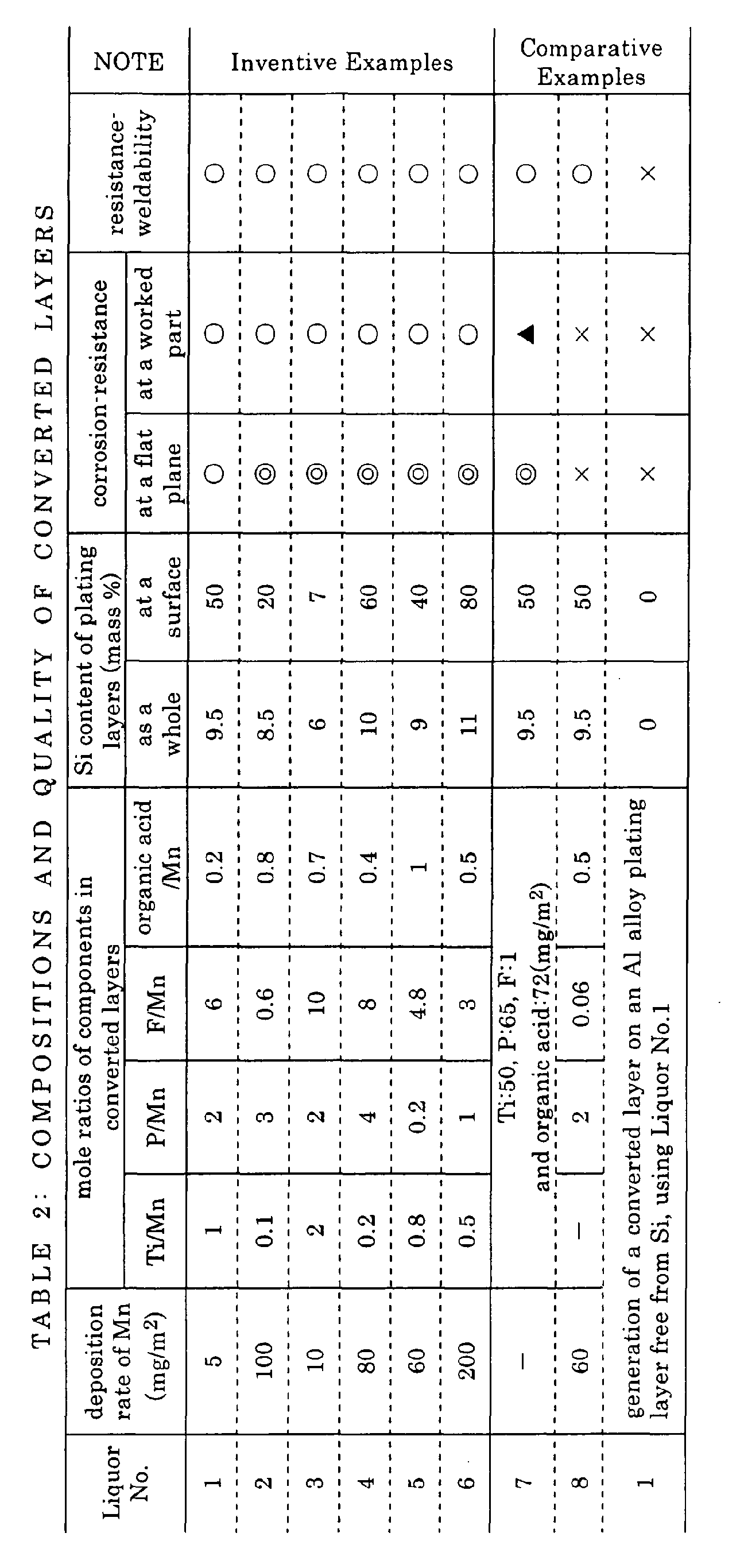
- Several chemical liquors having compositions shown in Table 3 were prepared by addition of Ti and F sources optionally together with various metal compounds, organic acids and phosphates.
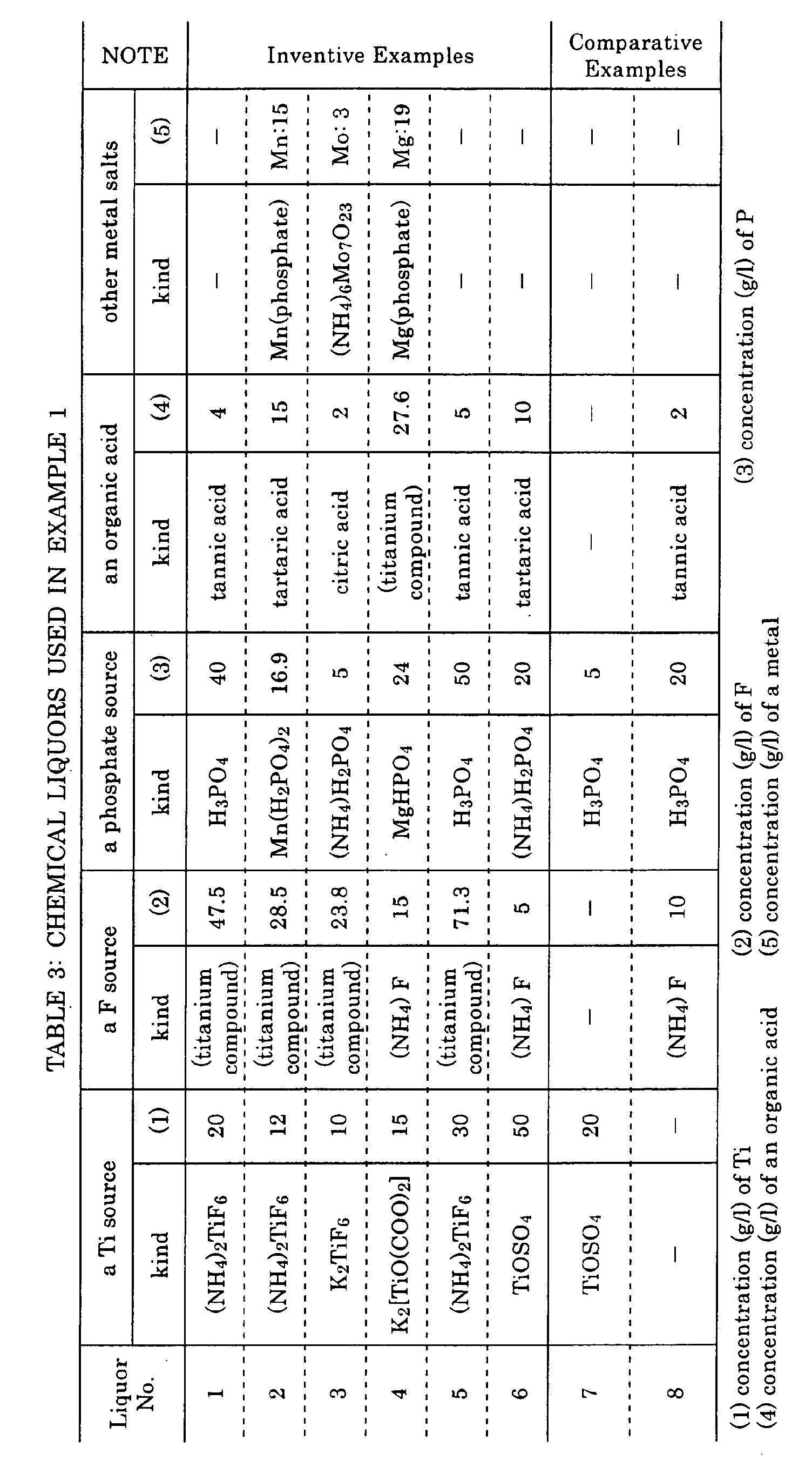
- After each chemical liquor shown in Table 3 was spread to the Al-Si alloy-coated steel sheet by an applicator roll, the steel sheet was carried in an oven without washing and then dried as such at a temperature up to 120°C. A converted layer generated in this way was examined by X-ray fluorescence, AES and ESCA analyses to measure concentration of Si in a region from a surface to 100nm depth of the plating layer and concentration of each component in the converted layer. Results are shown in Table 4.
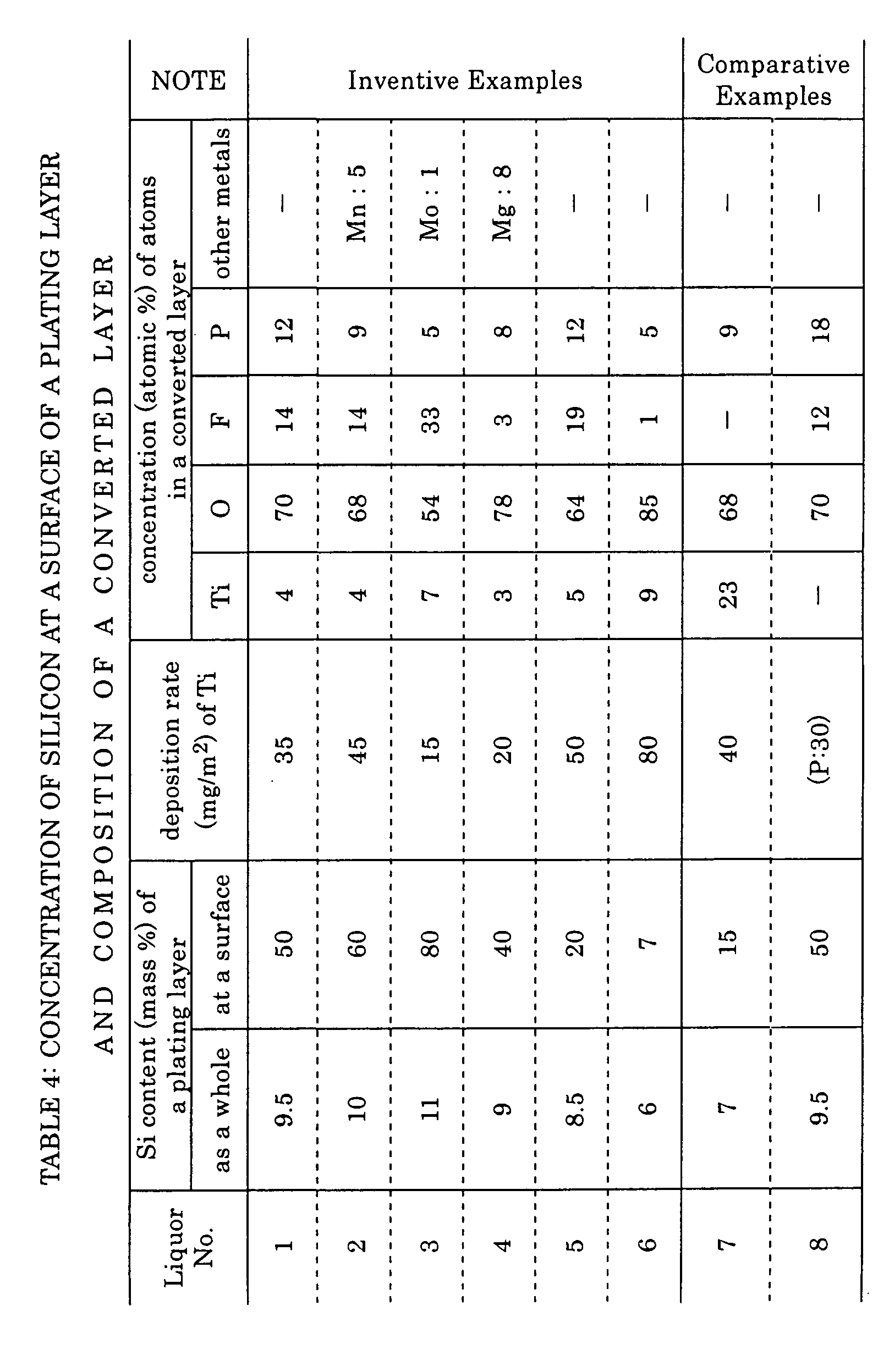
- A test piece was cut off each processed Al-Si alloy-coated steel sheet and subjected to the same tests as above-mentioned.
- Test results are shown in Table 5. It is understood that any of Sample Nos. 1-6, which had converted layers generated according to the present invention, was good of resistance-weldability and corrosion-resistance at both a flat plane and a worked part.
- On the other hand, Sample No. 7 having a converted layer, which did not contain soluble titanium fluoride, was poor of corrosion-resistance at defective parts of the converted layer due to poor self-repairing faculty. Sample No. 8 having a converted layer, which did not contain a titanium compound, was poor of corrosion-resistance at both a flat plane and a worked part due to poor shielding faculty. Sample No 9, which had a converted layer generated on an Al plating layer free from Si, was inferior of quality due to exposure of Al-rich parts, although the same chemical liquor No. 1 was used,

- Several chemical liquors having compositions shown in Table 6 were prepared by mixing valve metal sources other than Ti with F sources, and optionally adding various metal compounds, organic acids and phosphoric acid.
- After each chemical liquor was spread to an Al-Si alloy-coated steel sheet by an applicator roll, the steel sheet was carried in an oven without washing and then dried as such at a temperature up to 160°C to generate a converted layer thereon.

- Each chemically processed steel sheet was examined to measure concentration of Si in a region from a surface to 100nm depth and concentrations of components in a converted layer by the same way as above-mentioned. Results are shown in Table 7.

- A test piece was cut off each processed steel sheet and subjected to the same tests as above-mentioned.
- Results are shown in Table 8. It is understood that any of Sample Nos. 1-6 is excellent in resistance-weldability and corrosion-resistance at both a flat plane and a worked part.
PROPERTIES OF CHEMICALLY PROCESSED STEEL SHEETS Liquor No. corrosion-resistance resistance-weldability at a flat plane at a worked part 1 o ○ ○ ○ 2 o ○ o ○ ○ 3 o ○ ○ ○ 4 o ○ o ○ ○ 5 o ○ ○ ○ 6 o ○ ○ ○ - The steel sheet chemically processed according to the present invention comprises a steel base coated with an Al-Si alloy plating layer and a converted layer generated on a surface of the plating layer. The converted layer contains both soluble and scarcely-soluble compounds. The soluble compound is once dissolved to water in an atmosphere and re-precipitated as an scarcely-soluble compound at defective parts of the converted layer by reaction with a steel base. The scarcely-soluble compound acts as a barrier for corrosion-prevention of a steel base. Since the re-precipitation bestows the converted layer with a self-repairing faculty so as to inhibit exposure of the steel base through the defective parts, the steel sheet still maintains excellent corrosion-resistance after press-working or machining.
- The surface of the Al-Si plating layer can be reformed to a rugged state by concentration of Si at its surface, so that the steel sheet is plastically deformed to an objective shape with slight sliding resistance during press-working. Even if defects are introduced to the converted layer during deformation, such the defects are eliminated by the self-repairing faculty of the manganese compound or fluoride. Consequently, good corrosion-resistance is still maintained after the deformation. Moreover, the converted layer is free from Cr which would put harmful influences on the environment, so that the proposed steel sheet will be used in broad industrial fields instead of a conventional chromated steel sheet.
Claims (9)
- A chemically processed steel sheet comprising:a steel base coated with an Al-Si alloy plating layer, anda converted layer, which contains both of at least one scarcely-soluble compound and at least one soluble manganese or titanium compound, generated on a surface of said plating layer.
- The chemically processed steel sheet defined in Claim 1, wherein the Al-Si alloy plating layer has Si content adjusted to 5-13 mass % Si as a whole and to 7-80 mass % at its surface.
- The chemically processed steel sheet defined in Claim 2, wherein the Al-Si alloy plating layer has the rugged surface that Si-rich particles are distributed as convex parts thereon.
- The chemically processed steel sheet defined in any one of Claims 1 to 3, wherein the scarcely-soluble compound is titanium oxide, hydroxide or phosphate, and the soluble compound is manganese oxide, hydroxide or fluoride.
- The chemically processed steel sheet defined in any one of Claims 1 to 3, wherein the converted layer is composed of an oxide, hydroxide or phosphate of a valve metal as the scarcely-soluble compound and a fluoride of a valve metal as the soluble compound
- The chemically processed steel sheet defined in Claim 5, wherein the valve metal is selected from Ti, Zr, Hf, V, Nb, Ta, Mo and W.
- The chemically processed steel sheet defined in Claim 5 or 6, wherein the converted layer contains the oxide or hydroxide and the fluoride at an F/O atomic ratio not less than 1/100.
- The chemically processed steel sheet defined in any one of Claims 1 to 7, wherein the converted layer further contains one or more of soluble or insoluble metal phosphates and complex phosphates.
- The chemically processed steel sheet defined in any one of Claims 1 to 8, wherein the converted layer further contains at least a lubricant.
Applications Claiming Priority (4)
| Application Number | Priority Date | Filing Date | Title |
|---|---|---|---|
| JP2000338515 | 2000-11-07 | ||
| JP2000338513 | 2000-11-07 | ||
| JP2000338513A JP3261377B1 (en) | 2000-11-07 | 2000-11-07 | Chemical treated steel sheet with excellent corrosion resistance |
| JP2000338515A JP3302676B2 (en) | 2000-11-07 | 2000-11-07 | Chemical treated steel sheet with excellent corrosion resistance |
Publications (2)
| Publication Number | Publication Date |
|---|---|
| EP1205579A1 true EP1205579A1 (en) | 2002-05-15 |
| EP1205579B1 EP1205579B1 (en) | 2007-04-11 |
Family
ID=26603499
Family Applications (1)
| Application Number | Title | Priority Date | Filing Date |
|---|---|---|---|
| EP01125363A Expired - Lifetime EP1205579B1 (en) | 2000-11-07 | 2001-10-29 | A chemically processed steel sheet excellent in corrosion resistance |
Country Status (8)
| Country | Link |
|---|---|
| US (1) | US6730414B2 (en) |
| EP (1) | EP1205579B1 (en) |
| KR (1) | KR100792182B1 (en) |
| CN (1) | CN1201031C (en) |
| AU (1) | AU781710B2 (en) |
| DE (1) | DE60127793T2 (en) |
| MY (1) | MY126690A (en) |
| TW (1) | TW527437B (en) |
Families Citing this family (6)
| Publication number | Priority date | Publication date | Assignee | Title |
|---|---|---|---|---|
| US7147934B2 (en) * | 2000-11-07 | 2006-12-12 | Nisshin Steel Co., Ltd. | Chemically processed steel sheet excellent in corrosion resistance |
| DE10163171A1 (en) * | 2001-12-21 | 2003-07-03 | Solvay Fluor & Derivate | New use for alloys |
| JP4344222B2 (en) * | 2003-11-18 | 2009-10-14 | 新日本製鐵株式会社 | Chemical conversion metal plate |
| JP4490677B2 (en) * | 2003-12-03 | 2010-06-30 | 新日本製鐵株式会社 | Painted metal plate with low environmental impact |
| JP6022433B2 (en) * | 2013-12-03 | 2016-11-09 | 日新製鋼株式会社 | Method for producing hot-dip Zn alloy-plated steel sheet |
| KR20240094462A (en) * | 2022-12-16 | 2024-06-25 | 주식회사 포스코 | Plated steel sheet and method for manufacturing the same |
Citations (4)
| Publication number | Priority date | Publication date | Assignee | Title |
|---|---|---|---|---|
| US5294266A (en) * | 1989-07-28 | 1994-03-15 | Metallgesellschaft Aktiengesellschaft | Process for a passivating postrinsing of conversion layers |
| US5427632A (en) * | 1993-07-30 | 1995-06-27 | Henkel Corporation | Composition and process for treating metals |
| US5449415A (en) * | 1993-07-30 | 1995-09-12 | Henkel Corporation | Composition and process for treating metals |
| WO1997002369A1 (en) * | 1995-06-30 | 1997-01-23 | Henkel Corporation | Composition and process for treating the surface of aluminiferous metals |
Family Cites Families (6)
| Publication number | Priority date | Publication date | Assignee | Title |
|---|---|---|---|---|
| EP0743373B1 (en) * | 1995-05-18 | 1999-08-18 | Nippon Steel Corporation | Hot-dipped aluminum coated steel sheet having excellent corrosion resistance and heat resistance, and production method thereof |
| AU718855B2 (en) * | 1996-07-31 | 2000-04-20 | Nippon Steel Corporation | Rustproof steel sheet for automobile fuel tank with excellent resistance weldability corrosion resistance and press moldability |
| TWI221861B (en) * | 1998-04-22 | 2004-10-11 | Toyo Boseki | Agent for treating metallic surface, surface-treated metal material and coated metal material |
| US6361833B1 (en) * | 1998-10-28 | 2002-03-26 | Henkel Corporation | Composition and process for treating metal surfaces |
| JP3992173B2 (en) * | 1998-10-28 | 2007-10-17 | 日本パーカライジング株式会社 | Metal surface treatment composition, surface treatment liquid, and surface treatment method |
| US6509099B1 (en) * | 1999-08-02 | 2003-01-21 | Nkk Corporation | Phosphate-treated steel plate |
-
2001
- 2001-10-29 DE DE60127793T patent/DE60127793T2/en not_active Expired - Lifetime
- 2001-10-29 MY MYPI20014995A patent/MY126690A/en unknown
- 2001-10-29 EP EP01125363A patent/EP1205579B1/en not_active Expired - Lifetime
- 2001-11-02 TW TW090127272A patent/TW527437B/en not_active IP Right Cessation
- 2001-11-05 KR KR1020010068500A patent/KR100792182B1/en not_active Expired - Lifetime
- 2001-11-06 CN CNB011344873A patent/CN1201031C/en not_active Expired - Lifetime
- 2001-11-06 US US09/992,962 patent/US6730414B2/en not_active Expired - Lifetime
- 2001-11-07 AU AU89255/01A patent/AU781710B2/en not_active Ceased
Patent Citations (5)
| Publication number | Priority date | Publication date | Assignee | Title |
|---|---|---|---|---|
| US5294266A (en) * | 1989-07-28 | 1994-03-15 | Metallgesellschaft Aktiengesellschaft | Process for a passivating postrinsing of conversion layers |
| US5427632A (en) * | 1993-07-30 | 1995-06-27 | Henkel Corporation | Composition and process for treating metals |
| US5449415A (en) * | 1993-07-30 | 1995-09-12 | Henkel Corporation | Composition and process for treating metals |
| WO1996007772A1 (en) * | 1994-09-02 | 1996-03-14 | Henkel Corporation | Composition and process for treating metals |
| WO1997002369A1 (en) * | 1995-06-30 | 1997-01-23 | Henkel Corporation | Composition and process for treating the surface of aluminiferous metals |
Also Published As
| Publication number | Publication date |
|---|---|
| AU781710B2 (en) | 2005-06-09 |
| CN1201031C (en) | 2005-05-11 |
| TW527437B (en) | 2003-04-11 |
| KR100792182B1 (en) | 2008-01-07 |
| US6730414B2 (en) | 2004-05-04 |
| AU8925501A (en) | 2002-05-09 |
| MY126690A (en) | 2006-10-31 |
| EP1205579B1 (en) | 2007-04-11 |
| KR20020035749A (en) | 2002-05-15 |
| CN1354279A (en) | 2002-06-19 |
| DE60127793T2 (en) | 2007-12-27 |
| US20020114971A1 (en) | 2002-08-22 |
| DE60127793D1 (en) | 2007-05-24 |
Similar Documents
| Publication | Publication Date | Title |
|---|---|---|
| JP4205939B2 (en) | Metal surface treatment method | |
| EP1205580B1 (en) | Corrosion resistant steel sheet with a chemically modified zinc coating | |
| JP5215043B2 (en) | Metal surface treatment liquid and surface treatment method | |
| JP3302677B2 (en) | Galvanized steel sheet with excellent corrosion resistance and chemical conversion treatment method | |
| JP3302684B2 (en) | Chemical treated steel sheet with excellent corrosion resistance | |
| US6730414B2 (en) | Chemically processed steel sheet excellent in corrosion resistance | |
| JP3908845B2 (en) | Surface treatment method for hot dip galvanized steel sheet | |
| US7147934B2 (en) | Chemically processed steel sheet excellent in corrosion resistance | |
| JP3219453B2 (en) | Manufacturing method of galvanized steel sheet with excellent blackening resistance | |
| JP3425268B2 (en) | Method for producing galvanized steel sheet with excellent pressability, chemical conversion property, and degreasing solution contamination resistance | |
| JP3261378B1 (en) | Aluminum plated steel sheet for fuel tank | |
| AU2005220243B2 (en) | A chemically processed steel sheet improved in corrosion resistance | |
| JP3425270B2 (en) | Method for producing galvanized steel sheet with excellent pressability, chemical conversion property, and degreasing solution contamination resistance | |
| JP3261377B1 (en) | Chemical treated steel sheet with excellent corrosion resistance | |
| JP4073796B2 (en) | Chemically treated steel plate with excellent corrosion resistance | |
| JP3886913B2 (en) | Chemically treated steel plate with excellent corrosion resistance |
Legal Events
| Date | Code | Title | Description |
|---|---|---|---|
| PUAI | Public reference made under article 153(3) epc to a published international application that has entered the european phase |
Free format text: ORIGINAL CODE: 0009012 |
|
| AK | Designated contracting states |
Kind code of ref document: A1 Designated state(s): AT BE CH CY DE DK ES FI FR GB GR IE IT LI LU MC NL PT SE TR |
|
| AX | Request for extension of the european patent |
Free format text: AL;LT;LV;MK;RO;SI |
|
| 17P | Request for examination filed |
Effective date: 20021107 |
|
| AKX | Designation fees paid |
Designated state(s): DE FR GB |
|
| 17Q | First examination report despatched |
Effective date: 20040513 |
|
| GRAP | Despatch of communication of intention to grant a patent |
Free format text: ORIGINAL CODE: EPIDOSNIGR1 |
|
| GRAS | Grant fee paid |
Free format text: ORIGINAL CODE: EPIDOSNIGR3 |
|
| GRAA | (expected) grant |
Free format text: ORIGINAL CODE: 0009210 |
|
| AK | Designated contracting states |
Kind code of ref document: B1 Designated state(s): DE FR GB |
|
| REG | Reference to a national code |
Ref country code: GB Ref legal event code: FG4D |
|
| REF | Corresponds to: |
Ref document number: 60127793 Country of ref document: DE Date of ref document: 20070524 Kind code of ref document: P |
|
| ET | Fr: translation filed | ||
| PLBE | No opposition filed within time limit |
Free format text: ORIGINAL CODE: 0009261 |
|
| STAA | Information on the status of an ep patent application or granted ep patent |
Free format text: STATUS: NO OPPOSITION FILED WITHIN TIME LIMIT |
|
| 26N | No opposition filed |
Effective date: 20080114 |
|
| PGFP | Annual fee paid to national office [announced via postgrant information from national office to epo] |
Ref country code: DE Payment date: 20091022 Year of fee payment: 9 |
|
| PGFP | Annual fee paid to national office [announced via postgrant information from national office to epo] |
Ref country code: FR Payment date: 20091029 Year of fee payment: 9 Ref country code: GB Payment date: 20091028 Year of fee payment: 9 |
|
| GBPC | Gb: european patent ceased through non-payment of renewal fee |
Effective date: 20101029 |
|
| PG25 | Lapsed in a contracting state [announced via postgrant information from national office to epo] |
Ref country code: FR Free format text: LAPSE BECAUSE OF NON-PAYMENT OF DUE FEES Effective date: 20101102 |
|
| REG | Reference to a national code |
Ref country code: FR Ref legal event code: ST Effective date: 20110630 |
|
| PG25 | Lapsed in a contracting state [announced via postgrant information from national office to epo] |
Ref country code: GB Free format text: LAPSE BECAUSE OF NON-PAYMENT OF DUE FEES Effective date: 20101029 |
|
| REG | Reference to a national code |
Ref country code: DE Ref legal event code: R119 Ref document number: 60127793 Country of ref document: DE Effective date: 20110502 |
|
| PG25 | Lapsed in a contracting state [announced via postgrant information from national office to epo] |
Ref country code: DE Free format text: LAPSE BECAUSE OF NON-PAYMENT OF DUE FEES Effective date: 20110502 |