EP1205525A1 - Water leakage preventive agent, water leakage preventive material made with the same, and method of preventing water leakage - Google Patents
Water leakage preventive agent, water leakage preventive material made with the same, and method of preventing water leakage Download PDFInfo
- Publication number
- EP1205525A1 EP1205525A1 EP00946279A EP00946279A EP1205525A1 EP 1205525 A1 EP1205525 A1 EP 1205525A1 EP 00946279 A EP00946279 A EP 00946279A EP 00946279 A EP00946279 A EP 00946279A EP 1205525 A1 EP1205525 A1 EP 1205525A1
- Authority
- EP
- European Patent Office
- Prior art keywords
- water
- leakage
- agent
- water cut
- cut
- Prior art date
- Legal status (The legal status is an assumption and is not a legal conclusion. Google has not performed a legal analysis and makes no representation as to the accuracy of the status listed.)
- Withdrawn
Links
- XLYOFNOQVPJJNP-UHFFFAOYSA-N water Substances O XLYOFNOQVPJJNP-UHFFFAOYSA-N 0.000 title claims abstract description 426
- 239000003795 chemical substances by application Substances 0.000 title claims abstract description 168
- 238000000034 method Methods 0.000 title claims abstract description 24
- 239000000463 material Substances 0.000 title claims description 42
- 230000003449 preventive effect Effects 0.000 title claims description 17
- 229920000642 polymer Polymers 0.000 claims abstract description 84
- 239000000126 substance Substances 0.000 claims abstract description 42
- -1 alkylene glycol derivatives Chemical class 0.000 claims abstract description 41
- 239000003349 gelling agent Substances 0.000 claims abstract description 33
- 238000003860 storage Methods 0.000 claims abstract description 27
- 239000004744 fabric Substances 0.000 claims abstract description 24
- 239000003381 stabilizer Substances 0.000 claims abstract description 22
- 238000010276 construction Methods 0.000 claims abstract description 20
- 239000002202 Polyethylene glycol Substances 0.000 claims description 45
- 239000004567 concrete Substances 0.000 claims description 45
- 229920001223 polyethylene glycol Polymers 0.000 claims description 45
- 230000008961 swelling Effects 0.000 claims description 18
- LYCAIKOWRPUZTN-UHFFFAOYSA-N Ethylene glycol Chemical compound OCCO LYCAIKOWRPUZTN-UHFFFAOYSA-N 0.000 claims description 10
- 239000006260 foam Substances 0.000 claims description 9
- 229920005615 natural polymer Polymers 0.000 claims description 9
- JOYRKODLDBILNP-UHFFFAOYSA-N Ethyl urethane Chemical compound CCOC(N)=O JOYRKODLDBILNP-UHFFFAOYSA-N 0.000 claims description 8
- 238000010521 absorption reaction Methods 0.000 claims description 8
- 235000010443 alginic acid Nutrition 0.000 claims description 8
- 239000000783 alginic acid Substances 0.000 claims description 8
- 229920000615 alginic acid Polymers 0.000 claims description 8
- 229960001126 alginic acid Drugs 0.000 claims description 8
- 150000004781 alginic acids Chemical class 0.000 claims description 8
- IXPNQXFRVYWDDI-UHFFFAOYSA-N 1-methyl-2,4-dioxo-1,3-diazinane-5-carboximidamide Chemical compound CN1CC(C(N)=N)C(=O)NC1=O IXPNQXFRVYWDDI-UHFFFAOYSA-N 0.000 claims description 7
- 229920002907 Guar gum Polymers 0.000 claims description 7
- 125000004432 carbon atom Chemical group C* 0.000 claims description 7
- 229920002678 cellulose Polymers 0.000 claims description 7
- 239000001913 cellulose Substances 0.000 claims description 7
- 239000000665 guar gum Substances 0.000 claims description 7
- 235000010417 guar gum Nutrition 0.000 claims description 7
- 229960002154 guar gum Drugs 0.000 claims description 7
- 230000037361 pathway Effects 0.000 claims description 7
- 235000010413 sodium alginate Nutrition 0.000 claims description 7
- 239000000661 sodium alginate Substances 0.000 claims description 7
- 229940005550 sodium alginate Drugs 0.000 claims description 7
- CERQOIWHTDAKMF-UHFFFAOYSA-N Methacrylic acid Chemical class CC(=C)C(O)=O CERQOIWHTDAKMF-UHFFFAOYSA-N 0.000 claims description 6
- 239000004372 Polyvinyl alcohol Substances 0.000 claims description 5
- 239000007864 aqueous solution Substances 0.000 claims description 5
- WGCNASOHLSPBMP-UHFFFAOYSA-N hydroxyacetaldehyde Natural products OCC=O WGCNASOHLSPBMP-UHFFFAOYSA-N 0.000 claims description 5
- 238000004519 manufacturing process Methods 0.000 claims description 5
- 229920001451 polypropylene glycol Polymers 0.000 claims description 5
- 229920002451 polyvinyl alcohol Polymers 0.000 claims description 5
- 235000019422 polyvinyl alcohol Nutrition 0.000 claims description 5
- 229920005989 resin Polymers 0.000 claims description 5
- 239000011347 resin Substances 0.000 claims description 5
- 229920002845 Poly(methacrylic acid) Polymers 0.000 claims description 4
- 150000001875 compounds Chemical class 0.000 claims description 4
- 229920001748 polybutylene Polymers 0.000 claims description 4
- 229920003051 synthetic elastomer Polymers 0.000 claims description 4
- 239000005061 synthetic rubber Substances 0.000 claims description 4
- 229920000881 Modified starch Polymers 0.000 claims description 3
- XUIMIQQOPSSXEZ-UHFFFAOYSA-N Silicon Chemical compound [Si] XUIMIQQOPSSXEZ-UHFFFAOYSA-N 0.000 claims description 3
- 238000005341 cation exchange Methods 0.000 claims description 3
- 150000001768 cations Chemical class 0.000 claims description 3
- 229910052751 metal Inorganic materials 0.000 claims description 3
- 239000002184 metal Substances 0.000 claims description 3
- 235000019426 modified starch Nutrition 0.000 claims description 3
- 229910052710 silicon Inorganic materials 0.000 claims description 3
- 239000010703 silicon Substances 0.000 claims description 3
- 229920001145 Poly(N-vinylacetamide) Polymers 0.000 claims description 2
- 230000008569 process Effects 0.000 abstract description 7
- 239000000243 solution Substances 0.000 description 86
- 238000003756 stirring Methods 0.000 description 38
- 238000004078 waterproofing Methods 0.000 description 25
- 239000003153 chemical reaction reagent Substances 0.000 description 19
- SVPXDRXYRYOSEX-UHFFFAOYSA-N bentoquatam Chemical compound O.O=[Si]=O.O=[Al]O[Al]=O SVPXDRXYRYOSEX-UHFFFAOYSA-N 0.000 description 18
- 239000004568 cement Substances 0.000 description 15
- 229920001495 poly(sodium acrylate) polymer Polymers 0.000 description 15
- NNMHYFLPFNGQFZ-UHFFFAOYSA-M sodium polyacrylate Chemical compound [Na+].[O-]C(=O)C=C NNMHYFLPFNGQFZ-UHFFFAOYSA-M 0.000 description 15
- 239000013256 coordination polymer Substances 0.000 description 14
- 238000005259 measurement Methods 0.000 description 13
- 239000000440 bentonite Substances 0.000 description 11
- 229910000278 bentonite Inorganic materials 0.000 description 11
- 230000000855 fungicidal effect Effects 0.000 description 11
- 239000000417 fungicide Substances 0.000 description 11
- 239000000203 mixture Substances 0.000 description 11
- 239000010426 asphalt Substances 0.000 description 10
- 238000012360 testing method Methods 0.000 description 10
- 239000002612 dispersion medium Substances 0.000 description 9
- 229920001059 synthetic polymer Polymers 0.000 description 9
- VYPSYNLAJGMNEJ-UHFFFAOYSA-N Silicium dioxide Chemical compound O=[Si]=O VYPSYNLAJGMNEJ-UHFFFAOYSA-N 0.000 description 8
- 238000001816 cooling Methods 0.000 description 8
- 239000002245 particle Substances 0.000 description 8
- RMAQACBXLXPBSY-UHFFFAOYSA-N silicic acid Chemical compound O[Si](O)(O)O RMAQACBXLXPBSY-UHFFFAOYSA-N 0.000 description 8
- 239000003963 antioxidant agent Substances 0.000 description 7
- 230000003078 antioxidant effect Effects 0.000 description 7
- 235000006708 antioxidants Nutrition 0.000 description 7
- 239000004570 mortar (masonry) Substances 0.000 description 7
- 229910021647 smectite Inorganic materials 0.000 description 7
- IAYPIBMASNFSPL-UHFFFAOYSA-N Ethylene oxide Chemical compound C1CO1 IAYPIBMASNFSPL-UHFFFAOYSA-N 0.000 description 6
- FAPWRFPIFSIZLT-UHFFFAOYSA-M Sodium chloride Chemical compound [Na+].[Cl-] FAPWRFPIFSIZLT-UHFFFAOYSA-M 0.000 description 6
- 230000000694 effects Effects 0.000 description 6
- 238000012856 packing Methods 0.000 description 6
- 241000233866 Fungi Species 0.000 description 5
- 239000002253 acid Substances 0.000 description 5
- 230000008859 change Effects 0.000 description 5
- 239000011248 coating agent Substances 0.000 description 5
- 238000000576 coating method Methods 0.000 description 5
- 230000003247 decreasing effect Effects 0.000 description 5
- 239000006185 dispersion Substances 0.000 description 5
- 239000000835 fiber Substances 0.000 description 5
- 239000000843 powder Substances 0.000 description 5
- 239000007787 solid Substances 0.000 description 5
- SPSPIUSUWPLVKD-UHFFFAOYSA-N 2,3-dibutyl-6-methylphenol Chemical compound CCCCC1=CC=C(C)C(O)=C1CCCC SPSPIUSUWPLVKD-UHFFFAOYSA-N 0.000 description 4
- 229920002134 Carboxymethyl cellulose Polymers 0.000 description 4
- DNIAPMSPPWPWGF-UHFFFAOYSA-N Propylene glycol Chemical class CC(O)CO DNIAPMSPPWPWGF-UHFFFAOYSA-N 0.000 description 4
- 229910000329 aluminium sulfate Inorganic materials 0.000 description 4
- LLEMOWNGBBNAJR-UHFFFAOYSA-N biphenyl-2-ol Chemical compound OC1=CC=CC=C1C1=CC=CC=C1 LLEMOWNGBBNAJR-UHFFFAOYSA-N 0.000 description 4
- 235000010354 butylated hydroxytoluene Nutrition 0.000 description 4
- 235000010948 carboxy methyl cellulose Nutrition 0.000 description 4
- 238000004132 cross linking Methods 0.000 description 4
- GUJOJGAPFQRJSV-UHFFFAOYSA-N dialuminum;dioxosilane;oxygen(2-);hydrate Chemical compound O.[O-2].[O-2].[O-2].[Al+3].[Al+3].O=[Si]=O.O=[Si]=O.O=[Si]=O.O=[Si]=O GUJOJGAPFQRJSV-UHFFFAOYSA-N 0.000 description 4
- 239000000499 gel Substances 0.000 description 4
- 239000011810 insulating material Substances 0.000 description 4
- 239000012528 membrane Substances 0.000 description 4
- 229910052901 montmorillonite Inorganic materials 0.000 description 4
- 229920001296 polysiloxane Polymers 0.000 description 4
- 239000011150 reinforced concrete Substances 0.000 description 4
- VXYADVIJALMOEQ-UHFFFAOYSA-K tris(lactato)aluminium Chemical compound CC(O)C(=O)O[Al](OC(=O)C(C)O)OC(=O)C(C)O VXYADVIJALMOEQ-UHFFFAOYSA-K 0.000 description 4
- IUVCFHHAEHNCFT-INIZCTEOSA-N 2-[(1s)-1-[4-amino-3-(3-fluoro-4-propan-2-yloxyphenyl)pyrazolo[3,4-d]pyrimidin-1-yl]ethyl]-6-fluoro-3-(3-fluorophenyl)chromen-4-one Chemical compound C1=C(F)C(OC(C)C)=CC=C1C(C1=C(N)N=CN=C11)=NN1[C@@H](C)C1=C(C=2C=C(F)C=CC=2)C(=O)C2=CC(F)=CC=C2O1 IUVCFHHAEHNCFT-INIZCTEOSA-N 0.000 description 3
- 229920001817 Agar Polymers 0.000 description 3
- ODINCKMPIJJUCX-UHFFFAOYSA-N Calcium oxide Chemical compound [Ca]=O ODINCKMPIJJUCX-UHFFFAOYSA-N 0.000 description 3
- DGAQECJNVWCQMB-PUAWFVPOSA-M Ilexoside XXIX Chemical compound C[C@@H]1CC[C@@]2(CC[C@@]3(C(=CC[C@H]4[C@]3(CC[C@@H]5[C@@]4(CC[C@@H](C5(C)C)OS(=O)(=O)[O-])C)C)[C@@H]2[C@]1(C)O)C)C(=O)O[C@H]6[C@@H]([C@H]([C@@H]([C@H](O6)CO)O)O)O.[Na+] DGAQECJNVWCQMB-PUAWFVPOSA-M 0.000 description 3
- PPBRXRYQALVLMV-UHFFFAOYSA-N Styrene Chemical compound C=CC1=CC=CC=C1 PPBRXRYQALVLMV-UHFFFAOYSA-N 0.000 description 3
- 239000008272 agar Substances 0.000 description 3
- 235000010419 agar Nutrition 0.000 description 3
- 125000001931 aliphatic group Chemical group 0.000 description 3
- 229910052783 alkali metal Inorganic materials 0.000 description 3
- 229910052784 alkaline earth metal Inorganic materials 0.000 description 3
- 239000011575 calcium Substances 0.000 description 3
- 239000001768 carboxy methyl cellulose Substances 0.000 description 3
- 239000008112 carboxymethyl-cellulose Substances 0.000 description 3
- 238000004939 coking Methods 0.000 description 3
- 239000008119 colloidal silica Substances 0.000 description 3
- 238000000354 decomposition reaction Methods 0.000 description 3
- BEFDCLMNVWHSGT-UHFFFAOYSA-N ethenylcyclopentane Chemical compound C=CC1CCCC1 BEFDCLMNVWHSGT-UHFFFAOYSA-N 0.000 description 3
- 239000007788 liquid Substances 0.000 description 3
- UEGPKNKPLBYCNK-UHFFFAOYSA-L magnesium acetate Chemical compound [Mg+2].CC([O-])=O.CC([O-])=O UEGPKNKPLBYCNK-UHFFFAOYSA-L 0.000 description 3
- 239000011654 magnesium acetate Substances 0.000 description 3
- 235000011285 magnesium acetate Nutrition 0.000 description 3
- 229940069446 magnesium acetate Drugs 0.000 description 3
- 238000002156 mixing Methods 0.000 description 3
- 230000000149 penetrating effect Effects 0.000 description 3
- 229920000728 polyester Polymers 0.000 description 3
- 150000003839 salts Chemical class 0.000 description 3
- 150000004760 silicates Chemical class 0.000 description 3
- 229910052708 sodium Inorganic materials 0.000 description 3
- 239000011734 sodium Substances 0.000 description 3
- 239000011780 sodium chloride Substances 0.000 description 3
- 235000010199 sorbic acid Nutrition 0.000 description 3
- 239000004334 sorbic acid Substances 0.000 description 3
- 229940075582 sorbic acid Drugs 0.000 description 3
- 238000003892 spreading Methods 0.000 description 3
- 230000007480 spreading Effects 0.000 description 3
- ZXDDPOHVAMWLBH-UHFFFAOYSA-N 2,4-Dihydroxybenzophenone Chemical compound OC1=CC(O)=CC=C1C(=O)C1=CC=CC=C1 ZXDDPOHVAMWLBH-UHFFFAOYSA-N 0.000 description 2
- 229920000742 Cotton Polymers 0.000 description 2
- TWRXJAOTZQYOKJ-UHFFFAOYSA-L Magnesium chloride Chemical compound [Mg+2].[Cl-].[Cl-] TWRXJAOTZQYOKJ-UHFFFAOYSA-L 0.000 description 2
- CSNNHWWHGAXBCP-UHFFFAOYSA-L Magnesium sulfate Chemical compound [Mg+2].[O-][S+2]([O-])([O-])[O-] CSNNHWWHGAXBCP-UHFFFAOYSA-L 0.000 description 2
- 229920002125 Sokalan® Polymers 0.000 description 2
- XLOMVQKBTHCTTD-UHFFFAOYSA-N Zinc monoxide Chemical compound [Zn]=O XLOMVQKBTHCTTD-UHFFFAOYSA-N 0.000 description 2
- 229910000287 alkaline earth metal oxide Inorganic materials 0.000 description 2
- 229940037003 alum Drugs 0.000 description 2
- JLDSOYXADOWAKB-UHFFFAOYSA-N aluminium nitrate Chemical compound [Al+3].[O-][N+]([O-])=O.[O-][N+]([O-])=O.[O-][N+]([O-])=O JLDSOYXADOWAKB-UHFFFAOYSA-N 0.000 description 2
- 159000000013 aluminium salts Chemical class 0.000 description 2
- DIZPMCHEQGEION-UHFFFAOYSA-H aluminium sulfate (anhydrous) Chemical compound [Al+3].[Al+3].[O-]S([O-])(=O)=O.[O-]S([O-])(=O)=O.[O-]S([O-])(=O)=O DIZPMCHEQGEION-UHFFFAOYSA-H 0.000 description 2
- 235000011128 aluminium sulphate Nutrition 0.000 description 2
- VSCWAEJMTAWNJL-UHFFFAOYSA-K aluminium trichloride Chemical compound Cl[Al](Cl)Cl VSCWAEJMTAWNJL-UHFFFAOYSA-K 0.000 description 2
- VSGNNIFQASZAOI-UHFFFAOYSA-L calcium acetate Chemical compound [Ca+2].CC([O-])=O.CC([O-])=O VSGNNIFQASZAOI-UHFFFAOYSA-L 0.000 description 2
- 239000001639 calcium acetate Substances 0.000 description 2
- 235000011092 calcium acetate Nutrition 0.000 description 2
- 229960005147 calcium acetate Drugs 0.000 description 2
- ZCCIPPOKBCJFDN-UHFFFAOYSA-N calcium nitrate Chemical compound [Ca+2].[O-][N+]([O-])=O.[O-][N+]([O-])=O ZCCIPPOKBCJFDN-UHFFFAOYSA-N 0.000 description 2
- 239000000292 calcium oxide Substances 0.000 description 2
- 238000006243 chemical reaction Methods 0.000 description 2
- 230000006866 deterioration Effects 0.000 description 2
- WCOATMADISNSBV-UHFFFAOYSA-K diacetyloxyalumanyl acetate Chemical compound [Al+3].CC([O-])=O.CC([O-])=O.CC([O-])=O WCOATMADISNSBV-UHFFFAOYSA-K 0.000 description 2
- 238000009792 diffusion process Methods 0.000 description 2
- 238000001035 drying Methods 0.000 description 2
- 150000002148 esters Chemical class 0.000 description 2
- 150000002334 glycols Chemical class 0.000 description 2
- 229920003088 hydroxypropyl methyl cellulose Polymers 0.000 description 2
- 150000002505 iron Chemical class 0.000 description 2
- YIXJRHPUWRPCBB-UHFFFAOYSA-N magnesium nitrate Chemical compound [Mg+2].[O-][N+]([O-])=O.[O-][N+]([O-])=O YIXJRHPUWRPCBB-UHFFFAOYSA-N 0.000 description 2
- 150000002696 manganese Chemical class 0.000 description 2
- HCZKYJDFEPMADG-TXEJJXNPSA-N masoprocol Chemical compound C([C@H](C)[C@H](C)CC=1C=C(O)C(O)=CC=1)C1=CC=C(O)C(O)=C1 HCZKYJDFEPMADG-TXEJJXNPSA-N 0.000 description 2
- 229910052914 metal silicate Inorganic materials 0.000 description 2
- 235000010292 orthophenyl phenol Nutrition 0.000 description 2
- 239000004584 polyacrylic acid Substances 0.000 description 2
- 230000002265 prevention Effects 0.000 description 2
- 238000012545 processing Methods 0.000 description 2
- 239000000565 sealant Substances 0.000 description 2
- 239000003566 sealing material Substances 0.000 description 2
- 229910052604 silicate mineral Inorganic materials 0.000 description 2
- WJCNZQLZVWNLKY-UHFFFAOYSA-N thiabendazole Chemical compound S1C=NC(C=2NC3=CC=CC=C3N=2)=C1 WJCNZQLZVWNLKY-UHFFFAOYSA-N 0.000 description 2
- 229960004546 thiabendazole Drugs 0.000 description 2
- 229920002554 vinyl polymer Polymers 0.000 description 2
- 229920003169 water-soluble polymer Polymers 0.000 description 2
- 150000003751 zinc Chemical class 0.000 description 2
- JIAARYAFYJHUJI-UHFFFAOYSA-L zinc dichloride Chemical compound [Cl-].[Cl-].[Zn+2] JIAARYAFYJHUJI-UHFFFAOYSA-L 0.000 description 2
- ONDPHDOFVYQSGI-UHFFFAOYSA-N zinc nitrate Chemical compound [Zn+2].[O-][N+]([O-])=O.[O-][N+]([O-])=O ONDPHDOFVYQSGI-UHFFFAOYSA-N 0.000 description 2
- GSRWBDHSNVWQLC-ZETCQYMHSA-N (2s)-6-amino-2-(prop-2-enoylamino)hexanoic acid Chemical compound NCCCC[C@@H](C(O)=O)NC(=O)C=C GSRWBDHSNVWQLC-ZETCQYMHSA-N 0.000 description 1
- 229920002818 (Hydroxyethyl)methacrylate Polymers 0.000 description 1
- GVJHHUAWPYXKBD-IEOSBIPESA-N (R)-alpha-Tocopherol Natural products OC1=C(C)C(C)=C2O[C@@](CCC[C@H](C)CCC[C@H](C)CCCC(C)C)(C)CCC2=C1C GVJHHUAWPYXKBD-IEOSBIPESA-N 0.000 description 1
- CHHHXKFHOYLYRE-UHFFFAOYSA-M 2,4-Hexadienoic acid, potassium salt (1:1), (2E,4E)- Chemical compound [K+].CC=CC=CC([O-])=O CHHHXKFHOYLYRE-UHFFFAOYSA-M 0.000 description 1
- SMZOUWXMTYCWNB-UHFFFAOYSA-N 2-(2-methoxy-5-methylphenyl)ethanamine Chemical compound COC1=CC=C(C)C=C1CCN SMZOUWXMTYCWNB-UHFFFAOYSA-N 0.000 description 1
- NIXOWILDQLNWCW-UHFFFAOYSA-N 2-Propenoic acid Natural products OC(=O)C=C NIXOWILDQLNWCW-UHFFFAOYSA-N 0.000 description 1
- AOBIOSPNXBMOAT-UHFFFAOYSA-N 2-[2-(oxiran-2-ylmethoxy)ethoxymethyl]oxirane Chemical compound C1OC1COCCOCC1CO1 AOBIOSPNXBMOAT-UHFFFAOYSA-N 0.000 description 1
- KQFCXJYQBOCKTN-UHFFFAOYSA-N 2-butyl-6-methoxy-3-propylphenol Chemical compound CCCCC1=C(O)C(OC)=CC=C1CCC KQFCXJYQBOCKTN-UHFFFAOYSA-N 0.000 description 1
- RSWGJHLUYNHPMX-UHFFFAOYSA-N Abietic-Saeure Natural products C12CCC(C(C)C)=CC2=CCC2C1(C)CCCC2(C)C(O)=O RSWGJHLUYNHPMX-UHFFFAOYSA-N 0.000 description 1
- HRPVXLWXLXDGHG-UHFFFAOYSA-N Acrylamide Chemical compound NC(=O)C=C HRPVXLWXLXDGHG-UHFFFAOYSA-N 0.000 description 1
- 239000005995 Aluminium silicate Substances 0.000 description 1
- 241000894006 Bacteria Species 0.000 description 1
- OYPRJOBELJOOCE-UHFFFAOYSA-N Calcium Chemical compound [Ca] OYPRJOBELJOOCE-UHFFFAOYSA-N 0.000 description 1
- UXVMQQNJUSDDNG-UHFFFAOYSA-L Calcium chloride Chemical compound [Cl-].[Cl-].[Ca+2] UXVMQQNJUSDDNG-UHFFFAOYSA-L 0.000 description 1
- BCZXFFBUYPCTSJ-UHFFFAOYSA-L Calcium propionate Chemical compound [Ca+2].CCC([O-])=O.CCC([O-])=O BCZXFFBUYPCTSJ-UHFFFAOYSA-L 0.000 description 1
- 244000025254 Cannabis sativa Species 0.000 description 1
- 235000012766 Cannabis sativa ssp. sativa var. sativa Nutrition 0.000 description 1
- 235000012765 Cannabis sativa ssp. sativa var. spontanea Nutrition 0.000 description 1
- 229920001651 Cyanoacrylate Polymers 0.000 description 1
- LFQSCWFLJHTTHZ-UHFFFAOYSA-N Ethanol Chemical compound CCO LFQSCWFLJHTTHZ-UHFFFAOYSA-N 0.000 description 1
- 108010010803 Gelatin Proteins 0.000 description 1
- WOBHKFSMXKNTIM-UHFFFAOYSA-N Hydroxyethyl methacrylate Chemical compound CC(=C)C(=O)OCCO WOBHKFSMXKNTIM-UHFFFAOYSA-N 0.000 description 1
- XBLJCYOUYPSETL-UHFFFAOYSA-N Isopropyl citrate Chemical compound CC(C)O.CC(=O)CC(O)(C(O)=O)CC(O)=O XBLJCYOUYPSETL-UHFFFAOYSA-N 0.000 description 1
- 239000002310 Isopropyl citrate Substances 0.000 description 1
- 229920002752 Konjac Polymers 0.000 description 1
- 229910021380 Manganese Chloride Inorganic materials 0.000 description 1
- GLFNIEUTAYBVOC-UHFFFAOYSA-L Manganese chloride Chemical compound Cl[Mn]Cl GLFNIEUTAYBVOC-UHFFFAOYSA-L 0.000 description 1
- BPQQTUXANYXVAA-UHFFFAOYSA-N Orthosilicate Chemical compound [O-][Si]([O-])([O-])[O-] BPQQTUXANYXVAA-UHFFFAOYSA-N 0.000 description 1
- 229910019142 PO4 Inorganic materials 0.000 description 1
- 239000004698 Polyethylene Substances 0.000 description 1
- 239000004743 Polypropylene Substances 0.000 description 1
- HDSBZMRLPLPFLQ-UHFFFAOYSA-N Propylene glycol alginate Chemical compound OC1C(O)C(OC)OC(C(O)=O)C1OC1C(O)C(O)C(C)C(C(=O)OCC(C)O)O1 HDSBZMRLPLPFLQ-UHFFFAOYSA-N 0.000 description 1
- 229920000297 Rayon Polymers 0.000 description 1
- KHPCPRHQVVSZAH-HUOMCSJISA-N Rosin Natural products O(C/C=C/c1ccccc1)[C@H]1[C@H](O)[C@@H](O)[C@@H](O)[C@@H](CO)O1 KHPCPRHQVVSZAH-HUOMCSJISA-N 0.000 description 1
- YGSDEFSMJLZEOE-UHFFFAOYSA-N Salicylic acid Natural products OC(=O)C1=CC=CC=C1O YGSDEFSMJLZEOE-UHFFFAOYSA-N 0.000 description 1
- 229920002323 Silicone foam Polymers 0.000 description 1
- 239000004288 Sodium dehydroacetate Substances 0.000 description 1
- BZHJMEDXRYGGRV-UHFFFAOYSA-N Vinyl chloride Chemical compound ClC=C BZHJMEDXRYGGRV-UHFFFAOYSA-N 0.000 description 1
- 238000005299 abrasion Methods 0.000 description 1
- DHKHKXVYLBGOIT-UHFFFAOYSA-N acetaldehyde Diethyl Acetal Natural products CCOC(C)OCC DHKHKXVYLBGOIT-UHFFFAOYSA-N 0.000 description 1
- 150000001241 acetals Chemical class 0.000 description 1
- ZOIORXHNWRGPMV-UHFFFAOYSA-N acetic acid;zinc Chemical compound [Zn].CC(O)=O.CC(O)=O ZOIORXHNWRGPMV-UHFFFAOYSA-N 0.000 description 1
- 239000000654 additive Substances 0.000 description 1
- 230000000996 additive effect Effects 0.000 description 1
- 150000001298 alcohols Chemical class 0.000 description 1
- 125000002947 alkylene group Chemical group 0.000 description 1
- 229940087168 alpha tocopherol Drugs 0.000 description 1
- PZZYQPZGQPZBDN-UHFFFAOYSA-N aluminium silicate Chemical compound O=[Al]O[Si](=O)O[Al]=O PZZYQPZGQPZBDN-UHFFFAOYSA-N 0.000 description 1
- 229910000323 aluminium silicate Inorganic materials 0.000 description 1
- 235000012211 aluminium silicate Nutrition 0.000 description 1
- 230000000844 anti-bacterial effect Effects 0.000 description 1
- QVGXLLKOCUKJST-UHFFFAOYSA-N atomic oxygen Chemical compound [O] QVGXLLKOCUKJST-UHFFFAOYSA-N 0.000 description 1
- LCPUDZUWZDSKMX-UHFFFAOYSA-K azane;hydrogen sulfate;iron(3+);sulfate;dodecahydrate Chemical compound [NH4+].O.O.O.O.O.O.O.O.O.O.O.O.[Fe+3].[O-]S([O-])(=O)=O.[O-]S([O-])(=O)=O LCPUDZUWZDSKMX-UHFFFAOYSA-K 0.000 description 1
- 239000003899 bactericide agent Substances 0.000 description 1
- 239000012965 benzophenone Substances 0.000 description 1
- 239000012964 benzotriazole Substances 0.000 description 1
- 239000002981 blocking agent Substances 0.000 description 1
- 230000000903 blocking effect Effects 0.000 description 1
- 239000011449 brick Substances 0.000 description 1
- WERYXYBDKMZEQL-UHFFFAOYSA-N butane-1,4-diol Chemical class OCCCCO WERYXYBDKMZEQL-UHFFFAOYSA-N 0.000 description 1
- 125000000484 butyl group Chemical group [H]C([*])([H])C([H])([H])C([H])([H])C([H])([H])[H] 0.000 description 1
- 229910052791 calcium Inorganic materials 0.000 description 1
- 239000001110 calcium chloride Substances 0.000 description 1
- 229910001628 calcium chloride Inorganic materials 0.000 description 1
- BRPQOXSCLDDYGP-UHFFFAOYSA-N calcium oxide Chemical compound [O-2].[Ca+2] BRPQOXSCLDDYGP-UHFFFAOYSA-N 0.000 description 1
- 235000010331 calcium propionate Nutrition 0.000 description 1
- 239000004330 calcium propionate Substances 0.000 description 1
- 235000009120 camo Nutrition 0.000 description 1
- 239000011083 cement mortar Substances 0.000 description 1
- 235000005607 chanvre indien Nutrition 0.000 description 1
- 239000004927 clay Substances 0.000 description 1
- 229920001577 copolymer Polymers 0.000 description 1
- 238000004090 dissolution Methods 0.000 description 1
- 229920001971 elastomer Polymers 0.000 description 1
- 239000003822 epoxy resin Substances 0.000 description 1
- HCZKYJDFEPMADG-UHFFFAOYSA-N erythro-nordihydroguaiaretic acid Natural products C=1C=C(O)C(O)=CC=1CC(C)C(C)CC1=CC=C(O)C(O)=C1 HCZKYJDFEPMADG-UHFFFAOYSA-N 0.000 description 1
- NUVBSKCKDOMJSU-UHFFFAOYSA-N ethylparaben Chemical compound CCOC(=O)C1=CC=C(O)C=C1 NUVBSKCKDOMJSU-UHFFFAOYSA-N 0.000 description 1
- 230000002349 favourable effect Effects 0.000 description 1
- 238000011049 filling Methods 0.000 description 1
- 235000013305 food Nutrition 0.000 description 1
- LNTHITQWFMADLM-UHFFFAOYSA-N gallic acid Chemical compound OC(=O)C1=CC(O)=C(O)C(O)=C1 LNTHITQWFMADLM-UHFFFAOYSA-N 0.000 description 1
- 239000008273 gelatin Substances 0.000 description 1
- 229920000159 gelatin Polymers 0.000 description 1
- 235000019322 gelatine Nutrition 0.000 description 1
- 235000011852 gelatine desserts Nutrition 0.000 description 1
- 239000011521 glass Substances 0.000 description 1
- 239000003292 glue Substances 0.000 description 1
- 229920000578 graft copolymer Polymers 0.000 description 1
- 239000003673 groundwater Substances 0.000 description 1
- 239000011487 hemp Substances 0.000 description 1
- 230000006872 improvement Effects 0.000 description 1
- 208000015181 infectious disease Diseases 0.000 description 1
- 239000003112 inhibitor Substances 0.000 description 1
- 238000002347 injection Methods 0.000 description 1
- 239000007924 injection Substances 0.000 description 1
- 229910017053 inorganic salt Inorganic materials 0.000 description 1
- FBAFATDZDUQKNH-UHFFFAOYSA-M iron chloride Chemical compound [Cl-].[Fe] FBAFATDZDUQKNH-UHFFFAOYSA-M 0.000 description 1
- 229910000358 iron sulfate Inorganic materials 0.000 description 1
- BAUYGSIQEAFULO-UHFFFAOYSA-L iron(2+) sulfate (anhydrous) Chemical compound [Fe+2].[O-]S([O-])(=O)=O BAUYGSIQEAFULO-UHFFFAOYSA-L 0.000 description 1
- MVFCKEFYUDZOCX-UHFFFAOYSA-N iron(2+);dinitrate Chemical compound [Fe+2].[O-][N+]([O-])=O.[O-][N+]([O-])=O MVFCKEFYUDZOCX-UHFFFAOYSA-N 0.000 description 1
- PVFSDGKDKFSOTB-UHFFFAOYSA-K iron(3+);triacetate Chemical compound [Fe+3].CC([O-])=O.CC([O-])=O.CC([O-])=O PVFSDGKDKFSOTB-UHFFFAOYSA-K 0.000 description 1
- 230000001788 irregular Effects 0.000 description 1
- 125000000959 isobutyl group Chemical group [H]C([H])([H])C([H])(C([H])([H])[H])C([H])([H])* 0.000 description 1
- 235000019300 isopropyl citrate Nutrition 0.000 description 1
- 125000001449 isopropyl group Chemical group [H]C([H])([H])C([H])(*)C([H])([H])[H] 0.000 description 1
- 235000010485 konjac Nutrition 0.000 description 1
- 229910001629 magnesium chloride Inorganic materials 0.000 description 1
- 239000000395 magnesium oxide Substances 0.000 description 1
- CPLXHLVBOLITMK-UHFFFAOYSA-N magnesium oxide Inorganic materials [Mg]=O CPLXHLVBOLITMK-UHFFFAOYSA-N 0.000 description 1
- 229910052943 magnesium sulfate Inorganic materials 0.000 description 1
- 235000019341 magnesium sulphate Nutrition 0.000 description 1
- AXZKOIWUVFPNLO-UHFFFAOYSA-N magnesium;oxygen(2-) Chemical compound [O-2].[Mg+2] AXZKOIWUVFPNLO-UHFFFAOYSA-N 0.000 description 1
- 238000012423 maintenance Methods 0.000 description 1
- 229940071125 manganese acetate Drugs 0.000 description 1
- 239000011565 manganese chloride Substances 0.000 description 1
- 235000002867 manganese chloride Nutrition 0.000 description 1
- 229940099607 manganese chloride Drugs 0.000 description 1
- 229940099596 manganese sulfate Drugs 0.000 description 1
- 239000011702 manganese sulphate Substances 0.000 description 1
- 235000007079 manganese sulphate Nutrition 0.000 description 1
- UOGMEBQRZBEZQT-UHFFFAOYSA-L manganese(2+);diacetate Chemical compound [Mn+2].CC([O-])=O.CC([O-])=O UOGMEBQRZBEZQT-UHFFFAOYSA-L 0.000 description 1
- SQQMAOCOWKFBNP-UHFFFAOYSA-L manganese(II) sulfate Chemical compound [Mn+2].[O-]S([O-])(=O)=O SQQMAOCOWKFBNP-UHFFFAOYSA-L 0.000 description 1
- 229960003951 masoprocol Drugs 0.000 description 1
- 239000002609 medium Substances 0.000 description 1
- 229910021645 metal ion Inorganic materials 0.000 description 1
- 125000002496 methyl group Chemical group [H]C([H])([H])* 0.000 description 1
- 239000010445 mica Substances 0.000 description 1
- 229910052618 mica group Inorganic materials 0.000 description 1
- 244000005700 microbiome Species 0.000 description 1
- 150000007522 mineralic acids Chemical class 0.000 description 1
- RQAKESSLMFZVMC-UHFFFAOYSA-N n-ethenylacetamide Chemical compound CC(=O)NC=C RQAKESSLMFZVMC-UHFFFAOYSA-N 0.000 description 1
- 150000007524 organic acids Chemical class 0.000 description 1
- 230000003647 oxidation Effects 0.000 description 1
- 238000007254 oxidation reaction Methods 0.000 description 1
- 229910052760 oxygen Inorganic materials 0.000 description 1
- 239000001301 oxygen Substances 0.000 description 1
- FJKROLUGYXJWQN-UHFFFAOYSA-N papa-hydroxy-benzoic acid Natural products OC(=O)C1=CC=C(O)C=C1 FJKROLUGYXJWQN-UHFFFAOYSA-N 0.000 description 1
- 229910001562 pearlite Inorganic materials 0.000 description 1
- 239000010452 phosphate Substances 0.000 description 1
- NBIIXXVUZAFLBC-UHFFFAOYSA-K phosphate Chemical compound [O-]P([O-])([O-])=O NBIIXXVUZAFLBC-UHFFFAOYSA-K 0.000 description 1
- 229920002401 polyacrylamide Chemical class 0.000 description 1
- 229920001515 polyalkylene glycol Polymers 0.000 description 1
- 229920000647 polyepoxide Polymers 0.000 description 1
- 229920006267 polyester film Polymers 0.000 description 1
- 229920000573 polyethylene Polymers 0.000 description 1
- 229920000193 polymethacrylate Polymers 0.000 description 1
- 229920001155 polypropylene Polymers 0.000 description 1
- 229920002635 polyurethane Polymers 0.000 description 1
- 239000004814 polyurethane Substances 0.000 description 1
- 235000010408 potassium alginate Nutrition 0.000 description 1
- 239000000737 potassium alginate Substances 0.000 description 1
- MZYRDLHIWXQJCQ-YZOKENDUSA-L potassium alginate Chemical compound [K+].[K+].O1[C@@H](C([O-])=O)[C@@H](OC)[C@H](O)[C@H](O)[C@@H]1O[C@@H]1[C@@H](C([O-])=O)O[C@@H](O)[C@@H](O)[C@H]1O MZYRDLHIWXQJCQ-YZOKENDUSA-L 0.000 description 1
- GNHOJBNSNUXZQA-UHFFFAOYSA-J potassium aluminium sulfate dodecahydrate Chemical compound O.O.O.O.O.O.O.O.O.O.O.O.[Al+3].[K+].[O-]S([O-])(=O)=O.[O-]S([O-])(=O)=O GNHOJBNSNUXZQA-UHFFFAOYSA-J 0.000 description 1
- 235000010241 potassium sorbate Nutrition 0.000 description 1
- 239000004302 potassium sorbate Substances 0.000 description 1
- 229940069338 potassium sorbate Drugs 0.000 description 1
- 235000010409 propane-1,2-diol alginate Nutrition 0.000 description 1
- 239000000770 propane-1,2-diol alginate Substances 0.000 description 1
- 125000001436 propyl group Chemical group [H]C([*])([H])C([H])([H])C([H])([H])[H] 0.000 description 1
- 239000002964 rayon Substances 0.000 description 1
- 239000005060 rubber Substances 0.000 description 1
- 229960004889 salicylic acid Drugs 0.000 description 1
- 239000013535 sea water Substances 0.000 description 1
- 238000007789 sealing Methods 0.000 description 1
- 239000000377 silicon dioxide Substances 0.000 description 1
- 239000013514 silicone foam Substances 0.000 description 1
- 238000002791 soaking Methods 0.000 description 1
- WXMKPNITSTVMEF-UHFFFAOYSA-M sodium benzoate Chemical compound [Na+].[O-]C(=O)C1=CC=CC=C1 WXMKPNITSTVMEF-UHFFFAOYSA-M 0.000 description 1
- 235000010234 sodium benzoate Nutrition 0.000 description 1
- 239000004299 sodium benzoate Substances 0.000 description 1
- 229960003885 sodium benzoate Drugs 0.000 description 1
- 235000019259 sodium dehydroacetate Nutrition 0.000 description 1
- 229940079839 sodium dehydroacetate Drugs 0.000 description 1
- JXKPEJDQGNYQSM-UHFFFAOYSA-M sodium propionate Chemical compound [Na+].CCC([O-])=O JXKPEJDQGNYQSM-UHFFFAOYSA-M 0.000 description 1
- 235000010334 sodium propionate Nutrition 0.000 description 1
- 239000004324 sodium propionate Substances 0.000 description 1
- 229960003212 sodium propionate Drugs 0.000 description 1
- 229940080313 sodium starch Drugs 0.000 description 1
- 229920003109 sodium starch glycolate Polymers 0.000 description 1
- 229940079832 sodium starch glycolate Drugs 0.000 description 1
- 239000008109 sodium starch glycolate Substances 0.000 description 1
- DSOWAKKSGYUMTF-GZOLSCHFSA-M sodium;(1e)-1-(6-methyl-2,4-dioxopyran-3-ylidene)ethanolate Chemical compound [Na+].C\C([O-])=C1/C(=O)OC(C)=CC1=O DSOWAKKSGYUMTF-GZOLSCHFSA-M 0.000 description 1
- 238000005507 spraying Methods 0.000 description 1
- 150000005846 sugar alcohols Polymers 0.000 description 1
- AOBORMOPSGHCAX-DGHZZKTQSA-N tocofersolan Chemical compound OCCOC(=O)CCC(=O)OC1=C(C)C(C)=C2O[C@](CCC[C@H](C)CCC[C@H](C)CCCC(C)C)(C)CCC2=C1C AOBORMOPSGHCAX-DGHZZKTQSA-N 0.000 description 1
- 229960000984 tocofersolan Drugs 0.000 description 1
- KHPCPRHQVVSZAH-UHFFFAOYSA-N trans-cinnamyl beta-D-glucopyranoside Natural products OC1C(O)C(O)C(CO)OC1OCC=CC1=CC=CC=C1 KHPCPRHQVVSZAH-UHFFFAOYSA-N 0.000 description 1
- 239000002023 wood Substances 0.000 description 1
- 239000004246 zinc acetate Substances 0.000 description 1
- 239000011592 zinc chloride Substances 0.000 description 1
- 235000005074 zinc chloride Nutrition 0.000 description 1
- 239000011787 zinc oxide Substances 0.000 description 1
- NWONKYPBYAMBJT-UHFFFAOYSA-L zinc sulfate Chemical compound [Zn+2].[O-]S([O-])(=O)=O NWONKYPBYAMBJT-UHFFFAOYSA-L 0.000 description 1
- 229910000368 zinc sulfate Inorganic materials 0.000 description 1
- 229960001763 zinc sulfate Drugs 0.000 description 1
- 239000002076 α-tocopherol Substances 0.000 description 1
- 235000004835 α-tocopherol Nutrition 0.000 description 1
Images
Classifications
-
- C—CHEMISTRY; METALLURGY
- C09—DYES; PAINTS; POLISHES; NATURAL RESINS; ADHESIVES; COMPOSITIONS NOT OTHERWISE PROVIDED FOR; APPLICATIONS OF MATERIALS NOT OTHERWISE PROVIDED FOR
- C09K—MATERIALS FOR MISCELLANEOUS APPLICATIONS, NOT PROVIDED FOR ELSEWHERE
- C09K3/00—Materials not provided for elsewhere
- C09K3/12—Materials for stopping leaks, e.g. in radiators, in tanks
-
- C—CHEMISTRY; METALLURGY
- C09—DYES; PAINTS; POLISHES; NATURAL RESINS; ADHESIVES; COMPOSITIONS NOT OTHERWISE PROVIDED FOR; APPLICATIONS OF MATERIALS NOT OTHERWISE PROVIDED FOR
- C09K—MATERIALS FOR MISCELLANEOUS APPLICATIONS, NOT PROVIDED FOR ELSEWHERE
- C09K3/00—Materials not provided for elsewhere
- C09K3/10—Materials in mouldable or extrudable form for sealing or packing joints or covers
-
- E—FIXED CONSTRUCTIONS
- E02—HYDRAULIC ENGINEERING; FOUNDATIONS; SOIL SHIFTING
- E02D—FOUNDATIONS; EXCAVATIONS; EMBANKMENTS; UNDERGROUND OR UNDERWATER STRUCTURES
- E02D19/00—Keeping dry foundation sites or other areas in the ground
- E02D19/06—Restraining of underground water
- E02D19/12—Restraining of underground water by damming or interrupting the passage of underground water
- E02D19/16—Restraining of underground water by damming or interrupting the passage of underground water by placing or applying sealing substances
-
- E—FIXED CONSTRUCTIONS
- E04—BUILDING
- E04B—GENERAL BUILDING CONSTRUCTIONS; WALLS, e.g. PARTITIONS; ROOFS; FLOORS; CEILINGS; INSULATION OR OTHER PROTECTION OF BUILDINGS
- E04B1/00—Constructions in general; Structures which are not restricted either to walls, e.g. partitions, or floors or ceilings or roofs
- E04B1/62—Insulation or other protection; Elements or use of specified material therefor
- E04B1/66—Sealings
-
- E—FIXED CONSTRUCTIONS
- E04—BUILDING
- E04G—SCAFFOLDING; FORMS; SHUTTERING; BUILDING IMPLEMENTS OR AIDS, OR THEIR USE; HANDLING BUILDING MATERIALS ON THE SITE; REPAIRING, BREAKING-UP OR OTHER WORK ON EXISTING BUILDINGS
- E04G23/00—Working measures on existing buildings
- E04G23/02—Repairing, e.g. filling cracks; Restoring; Altering; Enlarging
- E04G23/0203—Arrangements for filling cracks or cavities in building constructions
- E04G23/0214—Arrangements for filling cracks or cavities in building constructions using covering strips
-
- E—FIXED CONSTRUCTIONS
- E04—BUILDING
- E04B—GENERAL BUILDING CONSTRUCTIONS; WALLS, e.g. PARTITIONS; ROOFS; FLOORS; CEILINGS; INSULATION OR OTHER PROTECTION OF BUILDINGS
- E04B1/00—Constructions in general; Structures which are not restricted either to walls, e.g. partitions, or floors or ceilings or roofs
- E04B1/62—Insulation or other protection; Elements or use of specified material therefor
- E04B1/66—Sealings
- E04B1/68—Sealings of joints, e.g. expansion joints
- E04B2001/6818—Joints with swellable parts
Definitions
- the present invention relates to a leakage water cut-off agent having a good water leakage blocking capability and the use thereof, more particularly to a leakage water cut-off agent that can penetrate into cracks or holes causing water leakage, and fill the gaps to prevent water from invading into them; a leakage water cut-off material containing the same; and a method for cut-off leakage water by spreading the leakage water cut-off agent over/injecting the leakage water cut-off agent into the roof, the floor or the wall of a building.
- the water leakage sites such as a hole, a crack and a gap must be coated or filled with a sealant. If the leakage sites cannot be specified, the whole restoration is required such as re-roofing, replacing a waterproof sheet, complete spray coating or re-tiling of the wall. Namely the simple maintenance such as coating or filling with the sealant is not sufficient enough, because of the difficulty in specifying the leakage sites.
- the joint in a concrete construction is often water-proofed with asphalt or urethane. But, if the joint surface is dewy or wetted when operated by the asphalt or urethane, it loses an adhesion property, namely loses the capability to block water leakage. Therefore, the joint surface must be completely dried when the water -proof joint is applied. Incompletely dryness in a part of the joint surface would cause water leakage.
- JP No.96672/1995 discloses a rainwater leakage blocking agent for spreading which is manufactured by mixing a high water absorptive polymer and a water-insoluble powdery substance with water, and a method for sealing a water-leaking crack with the water-insoluble powdery substance by spreading the said agent over a rainwater-leaking sites.
- the said agent manufactured by dissolving a high water absorption polymer is likely to have difficulty in penetrating sufficiently into a leakage site such as cracks because its viscosity is uncontrollable and sometimes shows high viscosity.
- WO99/29798 discloses a penetrating water cut-off agent containing a gelable resin and a gellant as the main components, and a leakage water leakage cut off material manufactured by infiltrating the same agent in a spongy substance.
- the said penetrating waterproofing agent has an excellent waterproofing effect.
- further improvement has been desired because it often meets troubles in viscosity adjustment or gel storage stability.
- the present invention is intended to find out a leakage water cut-off agent which is easy to apply, easy to adjust in viscosity, and excellent in storage stability.
- the present inventors made a diligent study to solve the above problems and, as a result, have found out that a water-absorptive polymer powder can be unexpectedly dispersed in the aqueous high concentration solution of polyalkylene glycol derivatives to give a stable dispersion in which the polymer powder absorbs almost no water or a little only to swell on its surface and that it absorbs substantially to swell only when it contacts with more than a certain amount of water.
- the present invention relates to the followings.
- the water-absorptive polymer ((a) component) to use in the present invention has a performance that it, as in the particle state, can enter a water leakage site such as hole, crack and crevice with other components, then absorb water, swell, and close the site.
- the water-absorptive polymer is not limited to any particular one as long as it can absorb water to swell for a relatively short time to play the role of a leakage water cut-off agent of the present invention.
- a synthetic polymer, a natural polymer and a half-synthetic polymer may be used for. Both a cross linking type and a non-cross linking type of polymer may be used for. These polymers may be used alone or in a combination of two or more.
- a cross linking type and a non-cross linking type of polymers may be used. Any water-absorptive polymer, from a polymer having a swelling degrees by weight of as low as a couple-tens times to a highly water-absorptive polymer having that of as high as several tens-hundreds times, may be used depending on their usages.
- the high water-absorptive polymer include a (half-) synthetic polymer which includes poly(meth)acrylic acid derivatives such as a polyacrylic acid alkali metal salt, sodium (meth)acrylate-vinyl alcohol copolymers ( methyl(meth)acrylate-vinyl acetate copolymer-saponificated products), poly(meth)-acrylonitrile polymer-saponificated products, a hydroxyethyl methacrylate polymer and poly(meth)acrylamide; cellulose derivatives such as carboxymethylcellulose alkali metal salt; polyacrylamide; alginic acid derivatives such as sodium alginate and propylene glycol alginate; starch derivatives such as sodium starch glycolate, sodium starch phosphate and a starch-acrylic acid salt graft copolymer; poly-N-vinylacetoamide derivatives such as a N-vinylacetoamide polymer; polyvinyl alcohol derivatives such as polyvinyl alcohol, polyvin
- a (half-) synthetic polymer in this description shows any of a synthetic polymer and a half-synthetic polymer.
- (meth)acrylic acid shows any of acrylic acid and methacrylic acid.
- the usable water-absorptive polymer having a lower swelling degree than the above polymer is a natural polymer which includes guar gum, alginic acid, sodium alginate, potassium alginate, konjak , agar, funori, gelatin and glue. Alginic acid, sodium alginate or guar gum is preferable. These may be used alone and, if used in combination with the above high water-absorptive polymer, gives a favorable result according to the case.
- One or more natural polymers are in some cases used in combination with one or more highly water-absorptive (half-)synthetic polymers to display an excellent waterproof effect against inorganic salt-rich water such as seawater.
- This combination is not limited to any particular one, but sodium polyacrylate or polyacrylic acid is preferable as the (half-)synthetic polymer to use in the combination, and alginic acid, sodium alginate or guar gum is preferable as the natural polymer to use in the combination.
- the natural polymer is generally mixed in a rate of 20-1,000 parts, preferably 50-500 parts relative to 100 parts of the (half-)synthetic polymer.
- the water-absorptive polymer is better not to be so large a particle but preferably a small particle to powdery form, because it is to be dispersed in a dispersion medium in almost non-swelling or not so much swelling state and has to be carried to a water leakage site kept in that state.
- the particle size is 0.1-700 ⁇ , preferably 1-200 ⁇ , and more preferably about 5-100 ⁇ .
- the water-absorptive polymer is generally added in 0.1-35 parts, preferably 0.4-10 parts relative to 100 parts of the dispersion medium.
- the state that the water-absorptive polymer is "dispersed in the non-swelling state" in the present invention includes a state that the polymer is more or less swelling to such a degree as may not substantially hinder the polymer particle from dispersing in the dispersion medium. It is because such a swelling degree does not block the effect of the present invention and may be considered to be substantially a non-swelling state.
- An alkylene glycol derivative ((b) component) having repeated units of 2 carbon atoms or more to use as the indispensable dispersion medium in the leakage water cut-off agent of the present invention has a role to prevent the water-absorptive polymer from swelling, keep the viscosity of leakage water cut-off agent of the present invention low, decrease the friction resistance in order the leakage water cut-off agent to penetrate or flow into a leakage route and carry the water-absorptive polymer to the leakage route in the non-swelling state.
- the leakage water cut-off agent of the present invention can penetrate even into a little crack smoothly, resulting in an excellent effect on water leakage prevention as the water-absorptive polymer closes the water leakage sites by swelling with invading rainwater, etc..
- the alkylene glycol derivatives ((b) component) having repeated units of 2 carbon atoms or more to use have generally a few or more, preferably 10 or more, more preferably 30 or more, and further more preferably 100 or more repeated units and the upper limit, though not been able to be defined clearly as varies depending on the types of alkylene glycol, is generally about 1,000 or less, and preferably about 500 or less.
- the preferable alkylene glycol derivatives have a molecular weight of, though not specifically limited to, 1,000 or more with no surface-active effect.
- the alkylene group in the alkylene glycol derivatives to use generally have 2 or more and 10 or less, preferably of about 2-4 carbons.
- the usable alkylene glycol derivatives include an ethylene glycol derivative such as polyethylene glycol, polyethylene glycol diglycidyl ether, polyethylene glycol aliphatic acid ester, a higher alcohol ethylene oxide adduct, alphaphenol ethylene oxide adduct, an aliphatic acid ethylene oxide adduct, a polyalcohol aliphatic acid ester ethylene oxide adduct, a higher alcoholamine ethylene oxide adduct, a fat ethylene oxide adduct or a polypropylene glycol ethylene oxide adduct: propylene glycol derivatives such as propylene glycol and a polypropylene glycol polyethylene glycol block polymer; and butylene glycol derivatives such as polybutylene glycol. Polyethylene glycol, polypropylene glycol and polybutylene glycol are preferable. These
- the leakage water cut-off agent of the present invention can be obtained by adding to disperse the water-absorptive polymer under stirring in the dispersion medium containing the alkylene glycol derivatives having repeated units of 2 carbon atoms or more as the indispensable component.
- the alkylene glycol derivatives if they are liquid having a low viscosity, can be used alone, but if they are viscous liquid or solid such as wax, are preferably adjusted in the viscosity by adding water to use as a mix dispersion medium with water.
- the mix ratio of the alkylene glycol derivatives and water in the dispersion medium varies depending on the type of the alkylene glycol derivative and the type of the water-absorptive polymer to use.
- the mix ratio needs to adjust the viscosity of the leakage water cut-off agent of the present invention within an appropriate range so as to inhibit the water-absorptive polymer in the dispersion medium from absorbing water to swell and keep the dispersion in a stable state.
- the alkylene glycol derivatives must have the concentration beyond a specific level depending on the type in order to inhibit the water-absorptive polymer from absorbing water to swell.
- the concentration can be determined by a simple preliminary test that the water-absorptive polymer is dispersed in the prepared several concentrations of the aqueous alkylene glycol derivatives solutions to observe.
- the concentration of the alkylene glycol derivatives is generally 15% by mass or more relative to the whole dispersion medium, (hereinafter the same, unless otherwise stated) preferably 25% by mass or more, more preferably 30% by mass or more, most preferably 35% by mass or more.
- the leakage water cut-off agent of the present invention is preferably manufactured by the following way if it contains water.
- the alkylene glycol derivatives are dissolved to prepare the aqueous solution, in which the water-absorptive polymer is then added to disperse under stirring to obtain the leakage water cut-off agent of the present invention.
- the agent has preferably a viscosity of 3,000cP or less. So, the mix ratio of water is preferably adjusted to get such a viscosity.
- the viscosity is more preferably 2,000cP or less.
- a low viscosity is preferable in view of the fluidity, but if it is too low the water absorption occurs in the water-absorptive polymer. So, the preferable viscosity is 200cP or more, more preferably 300cP or more.
- the aqueous solution of the alkylene glycol derivatives may be prepared by any procedures. However, it is usually preferred to add alkylene glycol derivatives to dissolve in water under stirring to obtain the said aqueous solution.
- a leakage water cut-off agent of the present invention containing a gellant ((c)component) for gelatinizing the water-absorptive polymer and/or a decomposition inhibitor ((d)component) of an organic substance will be described below.
- the gellant ((c)component) for gelatinizing the water-absorptive polymer(hereinafter simply called the gellant) is not limited to any particular one provided that it can bond chemically or physically with the water-absorptive polymer to gelatinize when the polymer absorbs water to swell or dissolve.
- the preferable compound is usually what can give 2 or more valent metal cations in water or can have a cation-exchange power in water.
- the gellant can be simply determined by observing whether the viscosity of the solution of a water-soluble polymer, which is dispersed or dissolved in water, increase or not after adding a test compound. Namely, an increase of viscosity would show that it has a gelatinizing ability, and no increase of viscosity would show the reverse.
- a specific example of the gellant ((c)component) includes a polyvalent metal silicate, a water-soluble alkali-earth metal salt, an alum, a water-soluble aluminium salt, a water-soluble iron salt, a water-soluble manganese salt, a water-soluble zinc salt and an alkali-earth metal oxide, which can give their metal ions in water in amount enough to have the gelatinizing ability.
- the polyvalent metal silicate is an aluminium silicate, a calium silicate or the like, including a Ca type silicate salt (a silicate mineral) such as bentonite, montmorillonite or smectite.
- the Ca type silicate salt such as bentonite, montmorillonite or smectite in the present invention means silicate salt having a relatively higher calcium content, which is preferably 1-2% by weight or more in terms of CaO relative to the whole weight of the bentonite, montmorillonite or smectite.
- the water-soluble alkali-earth metal salt includes the alkali-earth metal salt of a 1-3C organic acid, an inorganic acid or the like, for example, calcium acetate, calcium chloride, calcium nitrate, magnesium acetate, magnesium chloride, magnesium nitrate and magnesium sulfate.
- the alum includes aluminium potassium alum and an iron alum.
- the water-soluble aluminium salt includes aluminium lactate, aluminium acetate, aluminium chloride, aluminium sulfate, and aluminium nitrate.
- the water-soluble iron salt includes iron acetate, iron chloride, iron sulfate and iron nitrate.
- the water-soluble manganese salt includes manganese acetate, manganese chloride and manganese sulfate.
- the water-soluble zinc salt includes zinc acetate, zinc chloride, zinc nitrate and zinc sulfate.
- the alkali-earth metal oxide includes magnesium oxide and calcium oxide. The preferable one includes bentonite, montmorillonite, smectite, magnesium acetate, calcium acetate, aluminium lactate, aluminium acetate, and aluminium sulfate.
- the gellant is added in 0-4,000 parts, preferably 20-3,000 parts, more preferably 50-2,000 parts relative to 100 parts (by mass: hereinafter the same, unless otherwise stated) of water-absorptive resin.
- the gel formed by the gellant closes water leakage sites such as hole, crack and crevice, and then no more flow away by dissolving in water because it is insoluble in water. Therefore, it is preferable.
- the water-absorptive polymer if it does not dissolve in water but absorbs water to swell into a gel for itself, does not always need a gellant.
- a storage stabilizer ((d) component) is preferably used in the leakage water cut-off agent to suppress the change of its viscosity and increase its storage stability.
- the storage stabilizer is not limited to any particular one provided that it has an effect to prevent change of quality such as change of viscosity in the agent.
- the causes of change of quality such as change of viscosity during the storage of the leakage water cut-off agent of the present invention considered as the decomposition of an organic substance in the agent by ultraviolet ray absorption, oxidation or infection of a bacteria or fungi.
- the substance that can prevent the organic substance from decomposition is useful as one of the above storage stabilizers.
- the storage stabilizer includes an ultraviolet-absorptive agent such as a salicylic acid compound, a benzophenone compound, a benzotriazole compound and a cyanoacrylate compound; an antioxidant such as dibutylhydroxy toluene, erysorbic acid, sodium erysorbate, isopropyl citrate, ⁇ -tocopherol, nor- dihydroguaiaretic acid, and propyl butylhydroxyanisol gallate; and a bactericide or a fungicide such as sorbic acid, potassium sorbate, sodium benzoate, dehyeroacetic acid, sodium dehydroacetate, calcium propionate, sodium propionate, isobutyl p-oxybenzoate, isopropyl p-oxybenzoate, ethyl p-oxybenzoate, butyl p-oxybenzoate, propyl p-oxybenzoate, o-phenylphenol and thiabendazol.
- the storage stabilizer is generally mixed in 0.01-5 parts, preferably 0.1-2 parts relative to 100 parts of the alkylene glycol derivatives ((b) component).
- the leakage water cut-off agent of the present invention containing (c) component and/or (d) component can be manufactured by adding to mix (c) component and/or (d) component in the dispersion solution of the water-absorptive polymer as prepared above without these components to use. Water, also in this case, may be added to adjust the leakage water cut-off agent to have a viscosity of 3,000cP or less. But an attention must be paid to the amount of water to add because too much water causes swelling of the water-absorptive polymer.
- a water-insoluble powdery substance, fiber or scale may be mixed if necessary in the leakage water cut-off agent of the present invention in order to increase the closing power of the agent against a water leakage site.
- An organic powdery substance, an inorganic powdery substance, an organic fibrous substance or an inorganic fibrous substance may be used for the water-insoluble powdery substance, fiber or scale.
- a substance such as an inorganic powdery substance that is hardly deteriorated by oxygen, light or microorganism is preferable.
- the powdery substance has preferably a wide and uniform diffusion in particle size of 0.001 ⁇ m-1mm.
- the fibrous substance has preferably a length of about 1 ⁇ m-2mm.
- the scale substance has preferably a diameter of about 0.5-3mm.
- the specific example includes silica sol, silica powder, rosin powder, resin particle, clay, wood powder, pulp fiber, fibrous zinc oxide, bermulite, pearlite and mica. These may be used alone or in mixture of two or more. The mixture of two or more has preferably a combination having a wide diffusion of particle size.
- the water-insoluble powdery substance, fiber or scale is generally mixed in 1-20 parts relative to 100 parts of (b) component.
- the silica sol is used as the water-insoluble powdery substance, the amount is in the above range in terms of the solid content.
- the water-insoluble powdery substance, fiber or scale it is preferable to be added after mixing the (a)-(d) components.
- a preferable composition of the leakage water cut-off agent of the present invention thus obtained is as described below.
- Each component has a rate in terms of % by mass relative to the whole permeable water cut-off agent.
- the leakage water cut-off agent of the present invention thus obtained can be spread around the hole or injected into the hole through an opening set. If a invading water leakage site is not apparent, the agent may be either spread over the whole surface of the possible roof, floor or wall uniformly or injected into the openings set in there. It is not necessary to coat all over the roof, floor or wall.
- the injecting opening has a role to be a pathway from the construction surface to the body thereof through which the leakage water cut-off agent can arrive at the body of the construction directly.
- the injection opening and pathway may have any shape and size if it allows the agent to arrive at the water leakage site.
- the injecting openings are preferably set in zigzag along the both sides of a crack.
- the injecting openings are preferably set considering the pitch and the angle so that the pathways may pass through the crack alternately in the possible deepest section of the construction body. As the result, the leakage water cut-off agent can be injected sufficiently in the body, enabling the complete close of the water leakage site.
- the pitch of an opening is determined by the thickness of a body of concrete etc..
- the openings having a pitch of 25-40cm are preferably bored in zigzag if the body has a thickness of 120-40cm.
- the openings are preferably bored directly on top of the crack if the body has a thickness of 40cm or less. If the crack is wide the agent is preferably injected through the opening having a short pitch of 10-20cm after the crack is blinded with a quick-solidifying cement or is blocked with an epoxy resin because the agent flows out from the wide crack.
- the concrete outer wall of a construction is generally covered with waterproofing jointing asphalt and then veneered or tiled.
- An injecting opening is preferably bored to help the leakage water cut-off agent arrive at the waterproofing joint directly.
- the injecting opening may cut in the joint of the veneer or the tile. In this case, the leakage water cut-off agent can penetrate into the crack formed between the waterproofing joint and the concrete to prevent water leakage.
- the construction laid underground usually suffers from a water leakage caused by ground water.
- An injecting opening is preferably bored to help the leakage water cut-off agent arrive at the waterproofing joint in the outer side of the construction laid underground.
- the leakage water cut-off agent of the present invention is preferably applied to a reinforced concrete flat roof.
- the roof is generally prepared with a combination of concrete joint waterproofing and membrane waterproofing such as asphalt waterproofing, sheet waterproofing and coated membrane waterproofing. So, the agent may be spread over a waterproofing layer.
- the leakage water cut-off agent of the present invention is preferably applied to a naked concrete floor. Even if the floor is covered with mortar, a coating material or a sheet, the agent may be spread over it.
- the leakage water cut-off agent of the present invention is preferably applied to a wall that is prepared with cement mortar, sprayed acryl lysine, tile, brick, naked concrete or the like.
- the leakage water cut-off agent of the present invention can be coated on or infiltrated in string, rope, film, sheet, cloth, unwoven cloth, paper or the like to manufacture a leakage water cut-off material.
- the material can be manufactured with any leakage water cut-off agent prepared by mixing the above components uniformly in their prescribed rates. The components in this case may be mixed by an optional order.
- the leakage water cut-off agent may be coated on or infiltrated in string, rope, film, sheet, cloth, unwoven cloth or paper by any method. The agent may be coated using a coating machine and then dried. The agent may be coated on or infiltrated in the string, the rope, the film, the sheet, the cloth, the unwoven cloth or the paper set on a concrete.
- the string, the rope, the film, the sheet, the cloth, the unwoven cloth or the paper to coat the agent on or infiltrate in is not limited to any particular kind of, provided that it retains the agent or allows the agent to infiltrate in. It is preferably easy to get wet rapidly with the agent.
- the material of film or sheet is preferable to be waterproof.
- the usable material includes polyester, polypropylene, polyethylene, vinyl chloride, polyurethane and rubber sheet.
- the string, the rope, the cloth, or the unwoven cloth also is preferably easy to get wet with the permeable water cut-off agent in order to infiltrate into.
- the example of the usable articles include a hemp rope, a cotton rope, a polyester rope, a cotton cloth, a polyester unwoven cloth and a rayon unwoven cloth.
- the paper is preferably strong enough to keep itself in shape even if it gets wet.
- the water leakage preventive material of the present invention thus obtained can be put around the hole. If a water invading site is not clear, the leakage water cut-off material may be put in the wide range on the possible roof, floor or wall. It is not necessary to put all over the roof, floor or wall.
- the leakage water cut-off agent of the present invention can infiltrate into a spongy substance to obtain the water leakage preventive material of the present invention.
- the alkylene glycol derivative inhibits the water-absorptive polymer from swelling and gelatinization reaction (if gellant is contained). But invading water such as rainwater accelerates the swelling of the water-absorptive polymer and gel is formed by the reaction with the gellant if it is contained.
- the water leakage preventive material of the present invention can be obtained by infiltrating the leakage water cut-off agent into a spongy substance. Therefore, the agent may be infiltrated into a spongy substance followed by drying to use, or may be infiltrated into the spongy substance after placing it in a water leakage site.
- the spongy substance may be used in the present invention and is preferably a urethane foam such as urethane sponge, a silicone foam such as silicone sponge, a synthetic rubber foam such as synthetic rubber sponge or a cellulose sponge such as cellulose sponge.
- the spongy substance For soaking the spongy substance with the leakage water cut-off agent, the spongy substance, preferably in compressed state, can generally be immersed in the leakage water cut-off agent and then freed from the pressure, effecting the agent to infiltrate into the spongy substance rapidly.
- the leakage water cut-off agent can also be coated on the spongy substance to infiltrate into by a coating machine or a brush.
- Construction members may be connected by a common way at their faying surface where the spongy substance infiltrated by the leakage water cut-off agent of the present invention is put. In this case, there will be no problem even if the faying surface gets wet or damp.
- the construction members are preferably placed each other closer enough to have a smaller clearance than the thickness of the water leakage preventive material in order them to be compressed.
- the water leakage preventive material of the present invention can be compressed so that the waterproofing joint may fit the irregular faying surface with no space gap left.
- the thickness of the water leakage preventive material of the present invention is not limited to any one, but is practically 1-3cm.
- the spongy substance may be used to form a waterproofing joint, into which the leakage water cut-off agent is then infiltrated, instead of the water leakage preventive material of the present invention prepared beforehand.
- the water leakage preventive material of the present invention is preferably applied to a reinforced concrete flat roof.
- the roof is generally prepared with a combination of concrete joint waterproofing and membrane waterproofing such as asphalt waterproofing, sheet waterproofing and coated membrane waterproofing. So, the water leakage preventive material of the present invention can be applied to the waterproofing joint.
- the outer surface of the joint may be covered with asphalt, mortar or an elastic sealing material to prevent a roof surface from abrasion by walking and deterioration of the surface by light.
- the water leakage preventive material of the present invention is preferably applied to a naked concrete floor.
- the material can be used to form a waterproofing joint in a concrete construction joint or connection area.
- the waterproofing joint is preferably covered with mortar to give a good appearance.
- the concrete construction connection is a boundary surface that is formed by adding to harden a fresh concrete in touch with another concrete that completes or starts hardening. So, the area is liable to become a water leakage site.
- the leakage water cut-off material of the present invention is preferably applied to a naked concrete wall and is placed at the construction joint between the concretes.
- the outer surface of the joint in this case may be covered with asphalt, mortar or an elastic sealing material.
- Polyethylene glycol (1) was gradually added to dissolve in water (2) under stirring.
- the water-absorptive polymer (3) was gradually added to disperse in the solution under stirring to obtain the leakage water cut-off agent of the present invention.
- the water-absorptive polymer (3) was added in water (2), and Polyethylene glycol (1) was then added in the solution to obtain the test sample, which was too highly viscous to measure the viscosity by the B type viscometer (made by Tokyo Keiki KK).
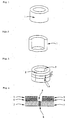
- This concrete container was bisected (as in Fig.2), and the two pieces were then unified again and reinforced with wire as in Fig.3.
- This container was filled with water, but immediately leaked water through the joint.
- the container was filled up with the leakage water cut-off agent of the present invention, left for 30 minutes, and emptied of the agent.
- the container was filled with water again, and it leaked no water through the joint.
- the container was filled up with water left for 3 days. It leaked no water through the joint.
- the container treated with the leakage water cut-off agent of the present invention was emptied of water and dried at 60°C for 3 days.
- the container was filled with water again, and it leaked no water through the joint.
- Polyethylene glycol (1) was gradually added to dissolve in water (2) under stirring.
- the water-absorptive polymer (3) was gradually added to disperse in the solution under stirring to obtain the leakage water cut-off agent of the present invention.
- the water-absorptive polymer (3) was added in water (2), and Polyethylene glycol (1) was then added in the solution to obtain the test sample, which was too highly viscous to measure the viscosity by the B type viscometer (made by Tokyo Keiki KK).
- Example A1 The same container as in Example A1 was filled up with the leakage water cut-off agent of the present invention, left for 30 minutes, and emptied of the agent. The container was filled up with water again, and it leaked no water through the joint. The container filled up with water left for 3 days. It leaked no water through the joint.
- the container treated with the leakage water cut-off agent of the present invention was emptied of water and dried at 60°C for 3 days.
- the container was filled with water again, and leaked no water through the joint.
- Polyethylene glycol (1) was gradually added to dissolve in water (2) under stirring.
- the water-absorptive polymer (3) was gradually added to disperse in the solution under stirring to obtain the leakage water cut-off agent of the present invention.
- the water-absorptive polymer (3) was added in water (2), and Polyethylene glycol (1) was then added in the solution to obtain the test sample, which was too highly viscous to measure the viscosity by the B type viscometer (made by Tokyo Keiki KK).
- Example A1 The same container as in Example A1 was filled up with the leakage water cut-off agent of the present invention, left for 30 minutes and emptied of the agent. The container was filled up with water again, and leaked no water through the joint. The container filled up with water was left for 3 days. It leaked no water through the joint.
- the container treated with the leakage water cut-off agent of the present invention was emptied of water and dried at 60°C for 3 days.
- the container was filled with water again, and leaked no water through the joint.
- Polyethylene glycol (1) was gradually added to dissolve in water (2) under stirring.
- the water-absorptive polymer (4) was gradually added to disperse in the solution under further stirring, followed by adding the gellant (3) to obtain the leakage water cut-off agent of the present invention.
- the water-absorptive polymer (4) was added in water (2), and Polyethylene glycol (1) was then added in the solution, followed by adding the gellant (3) to obtain the test sample, which was too highly viscous to measure the viscosity by the B type viscometer (made by Tokyo Keiki KK).
- the gellant (3) was added in water (2), and the water-absorptive polymer(4) was then added, followed by adding Polyethylene glycol (1) to obtain the test sample, which was too highly viscous to measure the viscosity by the B type viscometer (made by Tokyo Keiki KK).
- This concrete container was bisected (as in Fig.2), and the two pieces were then unified again and reinforced with wire as in Fig. 3.
- This container was filled with water, but immediately leaked water through the joint.
- the container was filled with the leakage water cut-off agent of the present invention, left for 30 minutes, and emptied of the agent.
- the container was filled up with water again, and it leaked no water through the joint.
- the container filled up with water was left for 3 days. It leaked no water through the joint.
- the container treated with the leakage water cut-off agent of the present invention was emptied of water and dried at 60°C for 3 days.
- the container was filled up with water again, and leaked no water through the joint.
- Polyethylene glycol (1) was gradually added to dissolve in water (2) under stirring.
- the water-absorptive polymer (4) was gradually added to disperse in the solution under further stirring, followed by adding the gellant (3) to obtain the leakage water cut-off agent of the present invention.
- the water-absorptive polymer (4) was added in water (2), and Polyethylene glycol (1) was then added in the solution, followed by adding the gellant (3) to obtain the test sample, which was too highly viscous to measure the viscosity by the B type viscometer (made by Tokyo Keiki KK).
- the gellant (3) was added in water (2), and the water-absorptive polymer(4) was then added, followed by adding Polyethylene glycol (1) to obtain the test sample, which was too highly viscous to measure the viscosity by the B type viscometer (made by Tokyo Keiki KK).
- Example B1 The same container as in Example B1 was filled up with the leakage water cut-off agent of the present invention and left for 30 minutes, and emptied of the agent. The container was filled up with water again, and it leaked no water through the joint. The container filled up with water was left for 3 days and leaked no water through the joint.
- the container treated with the leakage water cut-off agent of the present invention was emptied of water and dried at 60°C for 3 days.
- the container was filled up with water again, and it leaked no water through the joint.
- Polyethylene glycol (1) was gradually added to dissolve in water (2) under stirring.
- the water-absorptive polymers (4-1)and (4-2) were gradually added to disperse in the solution under further stirring, followed by adding the gellant (3) under stirring to obtain the leakage water cut-off agent of the present invention.
- This concrete container was bisected (as in Fig. 2), and the two pieces were then unified again and reinforced with wire as in Fig.3.
- This container was filled with water, but immediately leaked water through the joint.
- the inside surface of the container was coated with 20g of the leakage water cut-off agent of the present invention by a brush. After 1 hour, the container was filled up with water, and it leaked no water. The container was left for the further 30 minutes, emptied of water and dried at 60°C for 3 days. After cooling to the room temperature, the container was filled up with water again, and it leaked no water through the joint. The container filled with water was left for 3 days and it leaked no water through the joint.
- Polyethylene glycol (1) was gradually added to dissolve in water (2) under stirring.
- the water-absorptive polymer (4) was gradually added to disperse in the solution under further stirring, followed by adding the gellant (3) to obtain A solution (a leakage water cut-off agent of the present invention containing no storage stabilizer).
- the fungicide (5) was added in the A solution as prepared by the above process to obtain B solution which is a leakage water cut-off agent of the present invention containing a storage stabilizer.
- the A solution containing no fungicide after stored at the room temperature for 3 months, had a black speckle of substance as predicted as a fungus growing in the upper layer and had a decreased viscosity of 430cP.
- the B solution containing the fungicide after also stored at the room temperature for 3 months, had a normal appearance and had a viscosity of 1,580cP.
- Example B1 the same container as in Example B1 was filled up with the leakage water cut-off agent of the present invention (the above B solution), left for 30 minutes, and emptied of the agent.
- the container was filled up with water again, and it leaked no water through the joint.
- the container filled with water was left for 3 days and leaked no water through the joint.
- the container treated with the B solution was emptied of water and dried at 60°C for 3 days.
- the container was filled up with water again, and it leaked no water through the joint.
- Polyethylene glycol (1) was gradually added to dissolve in water (2) under stirring.
- the water-absorptive polymer (4) was gradually added to disperse in the solution under further stirring, followed by adding and dissolving the gellant (3) to obtain C solution (a leakage water cut-off agent of the present invention containing no storage stabilizer).
- the antioxidant (5) was added in the C solution as prepared by the above process and stirred to obtain D solution which is a leakage water cut-off agent of the present invention containing a storage stabilizer.
- This concrete container was bisected (as in Fig.2). The bottom of the crack was notched, and the two pieces were then unified again and reinforced with wire as in Fig.3. The joint had a gap of 0.4-2mm in the bottom. The container was returned to the bisection state. Unwoven cloth (Trade name: Vencot, made by Asahi Kasei KK) 0.85g was put between the joint surfaces, and the two pieces were then unified again and reinforced with wire as in Fig.3. The container was filled with water, and immediately leaked water through the joint. The container was returned to the bisection state.
- Unwoven cloth (Trade name: Vencot, made by Asahi Kasei KK) 0.85g was put between the joint surfaces, and the two pieces were then unified again and reinforced with wire as in Fig.3.
- the container was filled with water, and immediately leaked water through the joint. The container was returned to the bisection state.
- the above D solution 5g was infiltrated in unwoven cloth (Trade name: Vencot, made by Asahi Kasei KK) 0.85g and the unwoven cloth was put between the joint surfaces, and the two pieces were then unified again and reinforced with wire as in Fig.3. After 1 hour, the container was filled up with water, and it leaked no water. The container was left for the further 30 minutes, emptied of water and dried at 60°C for 5 days. After cooling to the room temperature, the container was filled up with water again, and leaked no water through the joint. The container filled with water was left for 5 days and it leaked no water through the joint.
- Polyethylene glycol (1) was gradually added to dissolve in water (2) under stirring.
- the water-absorptive polymers (4-1) and (4-2) were gradually added to disperse in the solution under further stirring, followed by adding and dissolving the gellant (3) to obtain E solution (a leakage water cut-off agent of the present invention containing no storage stabilizer).
- the ultraviolet absorption agent (5) was added in the E solution as prepared by the above process and stirred to obtain F solution which is a leakage water cut-off agent of the present invention containing a storage stabilizer.
- the E solution and the F solution respectively kept in glass vessel were stored in a sunlight room for 3 months.
- the E solution got separated and had a decreased viscosity of 640cP.
- the F solution had a normal appearance and had a viscosity of 1,130cP.
- This concrete container was bisected (as in Fig.2). The bottom of the crack was notched, and the two pieces were then again combined together and reinforced with wire as in Fig.3.
- the joint had a gap of 0.2-3mm in the bottom.
- a polyester film (Trade name: Toyobo Ester film, made by Toyo Boseki KK) having a length of 40cm, a width of 3cm and a thickness of 16 micron was coated with the above F solution to have a thickness of 0.5mm on the hydrophilized surface of the film, and without drying the film, was stuck on the joint in the above concrete container.
- the container was left at the room temperature for 3 days to dry and filled up with water. It leaked no water.
- the container was left for further 30 minutes, emptied of water and dried at 60°C for 3 days. After cooling to the room temperature, the container was filled up with water again, and it leaked no water through the joint. The container filled with water was left for 3 days and it leaked no water through the joint.
- Polyethylene glycol (1) was gradually added to dissolve in water (2) under stirring.
- the water-absorptive polymers (4) was gradually added to disperse in the solution under further stirring, followed by adding the gellant (3) and the antioxidant (5) and stirring to obtain the leakage water cut-off agent of the present invention containing a storage stabilizer.
- Example B3 Separately the inside surface of the same concrete container as in Example B3 was coated with 20g of the above leakage water cut-off agent of the present invention by a brush. After 1 hour, the container was filled up with water, and it leaked no water. The container was left for 30 minutes, emptied of water and dried at 60°C for 3 days. After cooling to the room temperature, the container was filled up with water again, and it leaked no water through the joint. The container filled with water was left for 3 days and it leaked no water through the joint.
- the roof had a reinforced slab-concrete waterproofed with asphalt joint, over which a foamed styrol of heat insulating material (4cm thick) and a heat insulating material-stopping concrete (7cm thick) had been set to pile up (Fig.4).
- An opening (1cm wide ⁇ 1cm long ⁇ 11cm deep)for injecting a leakage water cut-off agent was set in the water leakage site to arrive at the a waterproofing asphalt joint in the slab-concrete through the heat insulating material-holding concrete and the heat insulating material.
- the leakage water cut-off agent 1kg having the same composition as in Example B3 was injected, and then 20liters of water were injected. It rained 3 days after, but there was no water leakage in the roof.
- the wall was constructed with a reinforced slab-concrete in the inside of the angle stopping wall and its surface was waterproofed by coating.
- the openings for injecting a leakage water cut-off agent were set to scatter along the both sides of the crack in the surface of the wall.
- the leakage water cut-off agent 1kg having the same composition as in Example C4 was injected under a high pressure. It kept raining for 3 days, but there was no water leakage from the wall.
- Polyethylene glycol (1) was gradually added to dissolve in water (2) under stirring.
- the water-absorptive polymer (4) was gradually added to disperse in the solution under further stirring, followed by adding the gellant (3) to obtain the leakage water cut-off agent of the present invention.
- This concrete container was bisected (as in Fig.2). The bottom of the crack was further notched, and the two pieces were then unified again and reinforced with wire as in Fig.3.
- the joint had a gap of 1.8-1.1cm in the bottom.
- An oily coking material (Trade name: Polycoke, made by Cemedyne KK) was coated on the side contact surface of the joint, and a silicone sponge (2.5cm ⁇ 2.5cm sectional ⁇ 12cm long; density:0.35g/cm 3 ) was put between the bottom surfaces of the joint, and the two pieces were then unified again and reinforced with wire as in Fig.3.
- the container was filled with water, and it immediately leaked water through the joint.
- the container was emptied of water, and 30g of the above leakage water cut-off agent was contained in the container and infiltrated into the silicon sponge. After 1 hour, the container was filled up with water again, and it leaked no water through the joint. The container was left for the further 24 hours and observed. No trace of water leakage was found in the container bottom.
- the container was emptied of water and dried at 60°C for 3 days. After cooling to the room temperature, the container was filled up with water again, and it leaked no water through the joint. The container filled up with water was left for the further 3 days and it leaked no water through the joint.
- Polyethylene glycol (1) was gradually added to dissolve in water (2) under stirring.
- the water-absorptive polymers (4-1) and (4-2) were gradually added to disperse in the solution under further stirring, followed by adding to dissolve the gellant (3) to obtain the leakage water cut-off agent of the present invention.
- the above leakage water cut-off agent 12g was infiltrated into an urethane sponge (2.5cm ⁇ 2.5cm sectional ⁇ 12cm long; density:0.25g/cm 3 ) and then dried at 50°C for 24 hours to obtain the water leakage preventive material of the present invention.
- Example E1 a concrete cracked container was prepared as in Example E1 so that the joint might have a gap of 1.6-0.8cm in the bottom.
- the container was returned to the bisection state.
- the above water leakage preventive material was put between the bottom surfaces of the joint, and an oily coking material(Trade name: Polycoke, made by Cemedyne KK) was coated on the side contact surface of the joint, and the two pieces were then unified again and reinforced with wire as in Fig.3.
- the container was filled with water, and it leaked no water through the joint. The container was left for the further 24 hours and observed. No trace of water leakage was found in the bottom.
- the container was emptied of water and dried at 60°C for 3 days. After cooling to the room temperature, the container was filled up with water again, and it leaked no water through the joint. The container filled up with water was left for 3 days and it leaked no water through the joint.
- a leakage water cut-off material of the present invention was prepared as in Example E1, but 0.4g of dibutyl hydroxy toluene (antioxidant) was further added. The antioxidant was added after the components (1)-(4) were mixed as in Example E1.
- Example E1 a concrete cracked container was prepared as in Example E1 so that the joint might have a gap of 1.8-1.1cm in the bottom.
- a silicone sponge (2.5cm ⁇ 2.5cm sectional ⁇ 12cm long; density:0.35g/cm 3 )was put between the bottom surfaces of the joint, and the two pieces were then unified again and reinforced with wire as in Fig.3.
- the above composition 30g was added in the container to infiltrate into the silicone sponge. After 1 hour, the container was filled up with water, and it leaked no water. The container was left for 24 hours and observed. No trace of water leakage was found in the container bottom.
- the container was emptied of water and dried at 60°C for 3 days. After cooling to the room temperature, the container was filled up with water again, and it leaked no water through the joint. The container filled up with water was left for 3 days and it leaked no water through the joint.
- a leakage water cut-off material of the present invention was prepared as in Example E2, but 0.3g of 2,4-dihydroxybenzophenone (ultraviolet absorption agent) was further added.
- the ultraviolet absorption agent was added after the components (1)-(4-2) were mixed as in Example E2.
- composition 12g was infiltrated into an urethane sponge as in Example E2 and then dried at 50°C for 24 hours to obtain the water leakage preventive material of the present invention.
- Example E2 a concrete cracked container was prepared as in Example E2.
- the container was returned to the bisection state again.
- the above water leakage preventive material was put between the bottom surfaces of the joint, and an oily coking material(Trade name: Polycoke, made by Cemedyne KK) was coated on the side contact surface of the joint, and the two pieces were then unified again and reinforced with wire as in Fig.3.
- the container was filled with water, and it leaked no water. The container was left for 24 hours. No trace of water leakage was found in the container bottom observed thereafter.
- the container was emptied of water and dried at 60°C for 3 days. After cooling to the room temperature, the container was filled up with water again, and it leaked no water through the joint. The container filled p with water was left for 3 days and it leaked no water through the joint.
- Polyethylene glycol (1) was gradually added to dissolve in water (2) under stirring.
- the water-absorptive polymers (4) and (5) in order were gradually added to disperse in the solution under stirring, followed by adding the silicasol(6) and further the gellant (3) under stirring, to obtain A solution (a leakage water cut-off agent of the present invention containing no storage stabilizer).
- the fungicide (7) was added in the A solution as prepared by the above process to obtain B solution which is a leakage water cut-off agent of the present invention containing a storage stabilizer.
- the above A solution after stored at the room temperature for 2 weeks, had a black speckle of substance as predicted as a fungus growing in the upper layer and had a decreased viscosity of 780cP.
- the B solution after also stored at the room temperature for 3 months, had a normal appearance and had a viscosity of 1,580cP.
- Example B1 the same container as in Example B1 was filled up with the leakage water cut-off agent of the present invention (the above B solution), left for 30 minutes, and emptied of the agent.
- the container was filled up with an aqueous 3% sodium chloride solution, and it leaked no water through the joint.
- the container filled up with water was left for 3 days and it leaked no water through the joint.
- the container treated with the B solution was emptied of water and dried at 60°C for 3 days.
- the container was filled up with water again, and it leaked no water through the joint.
- Polyethylene glycol (1) was gradually added to dissolve in water (2) under stirring.
- the water-absorptive polymers (4) and (5) were gradually added to disperse in the solution under further stirring, followed by adding the silicasol(6) under stirring and further adding the gellant (3) and stirred to obtain A solution (a leakage water cut-off agent of the present invention containing no storage stabilizer).
- the fungicide (7) was added in the A solution as prepared by the above process to obtain B solution which is a leakage water cut-off agent of the present invention containing a storage stabilizer.
- the above A solution after stored at the room temperature for 2 weeks, had a black speckle of substance as predicted as a fungus growing in the upper layer and had a decreased viscosity of 840cP and smelled.
- the B solution after also stored at the room temperature for 3 months, had a normal appearance and had a viscosity of 1,350cP.
- Example B1 Separately the same container as in Example B1 was filled up with the leakage water cut-off agent of the present invention (the above B solution), left for 30 minutes, and emptied of the agent.
- the container was filled up with an aqueous 3% sodium chloride solution, and it leaked no water through the joint.
- the container filled with water was left for 3 days and it leaked no water through the joint.
- the container treated with the B solution was emptied of water and dried at 60°C for 3 days.
- the container was filled up with water again, and it leaked no water through the joint.
- Polyethylene glycol (1) was gradually added to dissolve in water (2) under stirring.
- the water-absorptive polymers (4) and (5) were gradually added to disperse in the solution under further stirring, followed by adding the silicasol(6) under stirring and further adding the gellant (3) to obtain A solution (a leakage water cut-off agent of the present invention containing no storage stabilizer).
- the fungicide (7) was added in the A solution as prepared by the above process to obtain B solution which is a leakage water cut-off agent of the present invention containing a storage stabilizer.
- the above A solution after stored at the room temperature for 2 weeks, had a black speckle of substance as predicted as a fungus growing in the upper layer and had a decreased viscosity of 660cP.
- the B solution after also stored at the room temperature for 3 months, had a normal appearance and had a viscosity of 1,320cP.
- Example B1 the same container as in Example B1 was filled up with the leakage water cut-off agent of the present invention (the above B solution), left for 30 minutes, and emptied of the agent.
- the container was filled up with an aqueous 3% sodium chloride solution, and it leaked no water through the joint.
- the container filled with water was left for 3 days and it leaked no water through the joint.
- the container treated with the B solution was emptied of water and dried at 60°C for 3 days.
- the container was filled up with water again, and leaked no water through the joint.
- a leakage water cut-off agent (material) of the present invention has an excellent function for water leakage prevention, is easy to control the viscosity, and is excellent in storage stability.
- the leakage water cut-off agent (material) if applied to the crack of a mortar or concrete product, is swelled by water invading through the crack, and can close the crack quickly to prevent another water from invading inside.
- the agent (material) does not freeze even in a cold district.
- the leakage water cut-off agent injected into an opening set in a construction can arrive at the water leakage site surely to prevent water from invading inside.
- the present invention allows sure waterproofing, and can prevent the mortar or concrete product from further expanding of the crack and the deterioration. So, the present invention is useful for prolonging the life of a mortar or concrete product such as a construction.
Landscapes
- Engineering & Computer Science (AREA)
- Chemical & Material Sciences (AREA)
- Architecture (AREA)
- Materials Engineering (AREA)
- Organic Chemistry (AREA)
- Life Sciences & Earth Sciences (AREA)
- Civil Engineering (AREA)
- Structural Engineering (AREA)
- Hydrology & Water Resources (AREA)
- Environmental & Geological Engineering (AREA)
- Chemical Kinetics & Catalysis (AREA)
- Mechanical Engineering (AREA)
- Electrochemistry (AREA)
- General Life Sciences & Earth Sciences (AREA)
- Mining & Mineral Resources (AREA)
- Paleontology (AREA)
- General Engineering & Computer Science (AREA)
- Physics & Mathematics (AREA)
- Electromagnetism (AREA)
- Sealing Material Composition (AREA)
- Compositions Of Macromolecular Compounds (AREA)
Abstract
An object of the present invention is to provide a
leakage water cut-off agent that has an excellent power
to close a water leakage site with simple and labor-saving
process and without any damaged appearance of a
construction.
A leakage water cut-off agent of the present
invention comprises (a) a water-absorptive polymer and
(b)alkylene glycol derivatives having a 2C or more
repeated unit as the indispensable components, and
contains a gellant for the water-absorptive polymer
and/or a storage stabilizer as the optional components.
The leakage water cut-off agent of the present invention
can be used to coat on or infiltrate into a spongy
substance, string, rope, film, sheet, cloth, unwoven
cloth or the like.
Description
- The present invention relates to a leakage water cut-off agent having a good water leakage blocking capability and the use thereof, more particularly to a leakage water cut-off agent that can penetrate into cracks or holes causing water leakage, and fill the gaps to prevent water from invading into them; a leakage water cut-off material containing the same; and a method for cut-off leakage water by spreading the leakage water cut-off agent over/injecting the leakage water cut-off agent into the roof, the floor or the wall of a building.
- To prevent water leakage in a roof, a floor or a wall, the water leakage sites such as a hole, a crack and a gap must be coated or filled with a sealant. If the leakage sites cannot be specified, the whole restoration is required such as re-roofing, replacing a waterproof sheet, complete spray coating or re-tiling of the wall. Namely the simple maintenance such as coating or filling with the sealant is not sufficient enough, because of the difficulty in specifying the leakage sites.
- No leakage guarantee term is often as long as 5 to 10 years. The constructor within the guarantee term and, after the expiration of the term, either the owner or constructor is obliged to bear the costly expense for repairing.
- The joint in a concrete construction is often water-proofed with asphalt or urethane. But, if the joint surface is dewy or wetted when operated by the asphalt or urethane, it loses an adhesion property, namely loses the capability to block water leakage. Therefore, the joint surface must be completely dried when the water -proof joint is applied. Incompletely dryness in a part of the joint surface would cause water leakage.
- In this connection, JP No.96672/1995 discloses a rainwater leakage blocking agent for spreading which is manufactured by mixing a high water absorptive polymer and a water-insoluble powdery substance with water, and a method for sealing a water-leaking crack with the water-insoluble powdery substance by spreading the said agent over a rainwater-leaking sites. However, the said agent manufactured by dissolving a high water absorption polymer is likely to have difficulty in penetrating sufficiently into a leakage site such as cracks because its viscosity is uncontrollable and sometimes shows high viscosity.
- WO99/29798 discloses a penetrating water cut-off agent containing a gelable resin and a gellant as the main components, and a leakage water leakage cut off material manufactured by infiltrating the same agent in a spongy substance. The said penetrating waterproofing agent has an excellent waterproofing effect. However, further improvement has been desired because it often meets troubles in viscosity adjustment or gel storage stability.
- The present invention is intended to find out a leakage water cut-off agent which is easy to apply, easy to adjust in viscosity, and excellent in storage stability.
- The present inventors made a diligent study to solve the above problems and, as a result, have found out that a water-absorptive polymer powder can be unexpectedly dispersed in the aqueous high concentration solution of polyalkylene glycol derivatives to give a stable dispersion in which the polymer powder absorbs almost no water or a little only to swell on its surface and that it absorbs substantially to swell only when it contacts with more than a certain amount of water. This finding led the completion of the present invention. Namely, the present invention relates to the followings.
- (1) A leakage water cut-off agent comprising (a) a water-absorptive polymer dispersed without swelling in (b) a dispersing medium containing alkylene glycol derivatives having repeated units of 2 carbon atoms or more as the indispensable component.
- (2) A leakage water cut-off agent according to the above item (1) comprising (c) a gellant of water-soluble polymer.
- (3) A leakage water cut-off agent according to the above item (1) or (2), wherein said gellant is a compound which can release a 2 or more valences of metal cation in water or has a cation-exchange capacity in water.
- (4) A leakage water cut-off agent according to the above item (1) or (2) comprising a storage stabilizer.
- (5) A leakage water cut-off agent according to any one of the above item (1) to (4), wherein said water-absorptive polymer contains both a high water-absorptive polymer and a water-absorptive natural polymer.
- (6) A leakage water cut-off agent according to the above item (5), wherein said high water-absorptive polymer is at least one selected from the group consisting of poly (meth)acrylic acid derivatives, alginic acid derivatives, starch derivatives, poly-N-vinylacetamide derivatives, polyvinylalcohol derivatives and cellulose derivatives.
- (7) A leakage water cut-off agent according to the above item (5) or (6), wherein said water-absorptive natural polymer is at least one selected from the group consisting of alginic acid, sodium alginate and guar gum.
- (8) A leakage water cut-off agent according to any one of the above item (1) to (7), wherein said alkylene glycol derivatives comprise at least one selected from the group consisting of polyethylene glycol, polypropylene glycol and polybutylene glycol.
- (9) A leakage water cut-off agent according to any one of the above item (1) to (8) further comprising water.
- (10) A method for manufacturing the leakage water cut-off agent according to the above item (9) characterized by that (a) said water-absorptive polymer is added to disperse in the aqueous solution of (b) said alkylene glycol derivative having repeated units of 2 carbon atoms or more.
- (11) A leakage water cut-off material characterized by that the leakage water cut-off agent according to any one of the above item (1) to (10) is infiltrated in a spongy substance.
- (12) A leakage water cut-off material according to the above item (11), wherein said spongy substance is at least one selected from the group consisting of an urethane foam, a silicon resin foam, a synthetic rubber foam and a cellulose sponge.
- (13) A leakage water cut-off material comprising at least one selected from the group consisting of string, rope, film, sheet, cloth, unwoven fabric and paper, which is coated or infiltrated by the leakage water cut-off agent according to any one of the above item (1) to (10).
- (14) A method for preventing water leakage characterized in that the leakage water cut-off material according to any one of the above item (11) to (13) is placed to the water leakage pathway of a construction.
- (15) A method for preventing water leakage according to the above item (14), wherein said water leakage pathway is a joint surface or a faying surface of concrete.
- (16) A method for preventing water leakage characterized by that the leakage water cut-off agent according to any one of the above item (1) to (10) is injected into the injecting openings set in a concrete construction.
- (17) A method for preventing water leakage according to the above item (16), wherein said injecting openings, are set in zigzag along the both sides of a crack.
-
-
- Fig.1 shows one example of a concrete container.
- Fig.2 shows one of the bisecting pieces of the concrete container of Fig.1
- Fig.3 shows a water leakage test container in which the two bisecting pieces of the concrete container of Fig.1 are fixed with a wire.
- Fig.4 is a cross-section in the case that an opening for a leakage water cut-off agent is formed on a joint to waterproof.
-
- The numbers given in those drawings show the followings:
- 1: Concrete container
- 2: Seam
- 3: Wire
- 4: Opening for injecting a leakage water cut-off agent
- 5: Heat-insulating material holding concrete
- 6: Heat-insulating material of styrene foam
- 7: reinforced slab concrete
- 8: Asphalt waterproofing joint
-
- The present invention will be described in detail below. The word "part" shows "part by mass", unless otherwise stated, in the description.
- The water-absorptive polymer ((a) component) to use in the present invention has a performance that it, as in the particle state, can enter a water leakage site such as hole, crack and crevice with other components, then absorb water, swell, and close the site. The water-absorptive polymer is not limited to any particular one as long as it can absorb water to swell for a relatively short time to play the role of a leakage water cut-off agent of the present invention. A synthetic polymer, a natural polymer and a half-synthetic polymer may be used for. Both a cross linking type and a non-cross linking type of polymer may be used for. These polymers may be used alone or in a combination of two or more. The combination of a cross linking type and a non-cross linking type of polymers may be used. Any water-absorptive polymer, from a polymer having a swelling degrees by weight of as low as a couple-tens times to a highly water-absorptive polymer having that of as high as several tens-hundreds times, may be used depending on their usages.
- The high water-absorptive polymer include a (half-) synthetic polymer which includes poly(meth)acrylic acid derivatives such as a polyacrylic acid alkali metal salt, sodium (meth)acrylate-vinyl alcohol copolymers ( methyl(meth)acrylate-vinyl acetate copolymer-saponificated products), poly(meth)-acrylonitrile polymer-saponificated products, a hydroxyethyl methacrylate polymer and poly(meth)acrylamide; cellulose derivatives such as carboxymethylcellulose alkali metal salt; polyacrylamide; alginic acid derivatives such as sodium alginate and propylene glycol alginate; starch derivatives such as sodium starch glycolate, sodium starch phosphate and a starch-acrylic acid salt graft copolymer; poly-N-vinylacetoamide derivatives such as a N-vinylacetoamide polymer; polyvinyl alcohol derivatives such as polyvinyl alcohol, polyvinyl formal and polyvinyl acetal. Among these highly water-absorptive polymers, poly(meth)acrylic acid derivatives are preferable. Sodium poly(meth)acrylate or carboxymethylcellulose (alkali metal salt) is especially preferable.
- The term "a (half-) synthetic polymer" in this description shows any of a synthetic polymer and a half-synthetic polymer. The term "(meth)acrylic acid" shows any of acrylic acid and methacrylic acid.
- The usable water-absorptive polymer having a lower swelling degree than the above polymer is a natural polymer which includes guar gum, alginic acid, sodium alginate, potassium alginate, konjak, agar, funori, gelatin and glue. Alginic acid, sodium alginate or guar gum is preferable. These may be used alone and, if used in combination with the above high water-absorptive polymer, gives a favorable result according to the case. One or more natural polymers are in some cases used in combination with one or more highly water-absorptive (half-)synthetic polymers to display an excellent waterproof effect against inorganic salt-rich water such as seawater. This combination is not limited to any particular one, but sodium polyacrylate or polyacrylic acid is preferable as the (half-)synthetic polymer to use in the combination, and alginic acid, sodium alginate or guar gum is preferable as the natural polymer to use in the combination. In the combination, the natural polymer is generally mixed in a rate of 20-1,000 parts, preferably 50-500 parts relative to 100 parts of the (half-)synthetic polymer.
- The water-absorptive polymer is better not to be so large a particle but preferably a small particle to powdery form, because it is to be dispersed in a dispersion medium in almost non-swelling or not so much swelling state and has to be carried to a water leakage site kept in that state. The particle size is 0.1-700µ, preferably 1-200µ, and more preferably about 5-100µ.
- The water-absorptive polymer is generally added in 0.1-35 parts, preferably 0.4-10 parts relative to 100 parts of the dispersion medium.
- The state that the water-absorptive polymer is "dispersed in the non-swelling state" in the present invention includes a state that the polymer is more or less swelling to such a degree as may not substantially hinder the polymer particle from dispersing in the dispersion medium. It is because such a swelling degree does not block the effect of the present invention and may be considered to be substantially a non-swelling state.
- An alkylene glycol derivative ((b) component) having repeated units of 2 carbon atoms or more to use as the indispensable dispersion medium in the leakage water cut-off agent of the present invention has a role to prevent the water-absorptive polymer from swelling, keep the viscosity of leakage water cut-off agent of the present invention low, decrease the friction resistance in order the leakage water cut-off agent to penetrate or flow into a leakage route and carry the water-absorptive polymer to the leakage route in the non-swelling state. Therefore, the leakage water cut-off agent of the present invention can penetrate even into a little crack smoothly, resulting in an excellent effect on water leakage prevention as the water-absorptive polymer closes the water leakage sites by swelling with invading rainwater, etc..
- The alkylene glycol derivatives ((b) component) having repeated units of 2 carbon atoms or more to use have generally a few or more, preferably 10 or more, more preferably 30 or more, and further more preferably 100 or more repeated units and the upper limit, though not been able to be defined clearly as varies depending on the types of alkylene glycol, is generally about 1,000 or less, and preferably about 500 or less. The preferable alkylene glycol derivatives have a molecular weight of, though not specifically limited to, 1,000 or more with no surface-active effect.
- The alkylene group in the alkylene glycol derivatives to use generally have 2 or more and 10 or less, preferably of about 2-4 carbons. The usable alkylene glycol derivatives include an ethylene glycol derivative such as polyethylene glycol, polyethylene glycol diglycidyl ether, polyethylene glycol aliphatic acid ester, a higher alcohol ethylene oxide adduct, alphaphenol ethylene oxide adduct, an aliphatic acid ethylene oxide adduct, a polyalcohol aliphatic acid ester ethylene oxide adduct, a higher alcoholamine ethylene oxide adduct, a fat ethylene oxide adduct or a polypropylene glycol ethylene oxide adduct: propylene glycol derivatives such as propylene glycol and a polypropylene glycol polyethylene glycol block polymer; and butylene glycol derivatives such as polybutylene glycol. Polyethylene glycol, polypropylene glycol and polybutylene glycol are preferable. These may be used alone or in combination of two or more.
- The leakage water cut-off agent of the present invention can be obtained by adding to disperse the water-absorptive polymer under stirring in the dispersion medium containing the alkylene glycol derivatives having repeated units of 2 carbon atoms or more as the indispensable component.
- The alkylene glycol derivatives, if they are liquid having a low viscosity, can be used alone, but if they are viscous liquid or solid such as wax, are preferably adjusted in the viscosity by adding water to use as a mix dispersion medium with water. The mix ratio of the alkylene glycol derivatives and water in the dispersion medium varies depending on the type of the alkylene glycol derivative and the type of the water-absorptive polymer to use. The mix ratio needs to adjust the viscosity of the leakage water cut-off agent of the present invention within an appropriate range so as to inhibit the water-absorptive polymer in the dispersion medium from absorbing water to swell and keep the dispersion in a stable state. The alkylene glycol derivatives must have the concentration beyond a specific level depending on the type in order to inhibit the water-absorptive polymer from absorbing water to swell. The concentration can be determined by a simple preliminary test that the water-absorptive polymer is dispersed in the prepared several concentrations of the aqueous alkylene glycol derivatives solutions to observe. The concentration of the alkylene glycol derivatives is generally 15% by mass or more relative to the whole dispersion medium, (hereinafter the same, unless otherwise stated) preferably 25% by mass or more, more preferably 30% by mass or more, most preferably 35% by mass or more.
- The leakage water cut-off agent of the present invention is preferably manufactured by the following way if it contains water.
- The alkylene glycol derivatives are dissolved to prepare the aqueous solution, in which the water-absorptive polymer is then added to disperse under stirring to obtain the leakage water cut-off agent of the present invention. The agent has preferably a viscosity of 3,000cP or less. So, the mix ratio of water is preferably adjusted to get such a viscosity. The viscosity is more preferably 2,000cP or less. A low viscosity is preferable in view of the fluidity, but if it is too low the water absorption occurs in the water-absorptive polymer. So, the preferable viscosity is 200cP or more, more preferably 300cP or more.
- Other manufacture procedures than the above are not preferable because they may bring swelling and dissolution of the water-absorptive polymer and give a very viscous liquid.
- The aqueous solution of the alkylene glycol derivatives may be prepared by any procedures. However, it is usually preferred to add alkylene glycol derivatives to dissolve in water under stirring to obtain the said aqueous solution.
- A leakage water cut-off agent of the present invention containing a gellant ((c)component) for gelatinizing the water-absorptive polymer and/or a decomposition inhibitor ((d)component) of an organic substance will be described below.
- The gellant ((c)component) for gelatinizing the water-absorptive polymer(hereinafter simply called the gellant) is not limited to any particular one provided that it can bond chemically or physically with the water-absorptive polymer to gelatinize when the polymer absorbs water to swell or dissolve. The preferable compound is usually what can give 2 or more valent metal cations in water or can have a cation-exchange power in water. The gellant can be simply determined by observing whether the viscosity of the solution of a water-soluble polymer, which is dispersed or dissolved in water, increase or not after adding a test compound. Namely, an increase of viscosity would show that it has a gelatinizing ability, and no increase of viscosity would show the reverse.
- A specific example of the gellant ((c)component) includes a polyvalent metal silicate, a water-soluble alkali-earth metal salt, an alum, a water-soluble aluminium salt, a water-soluble iron salt, a water-soluble manganese salt, a water-soluble zinc salt and an alkali-earth metal oxide, which can give their metal ions in water in amount enough to have the gelatinizing ability. The polyvalent metal silicate is an aluminium silicate, a calium silicate or the like, including a Ca type silicate salt (a silicate mineral) such as bentonite, montmorillonite or smectite. The Ca type silicate salt (Silicate Mineral) such as bentonite, montmorillonite or smectite in the present invention means silicate salt having a relatively higher calcium content, which is preferably 1-2% by weight or more in terms of CaO relative to the whole weight of the bentonite, montmorillonite or smectite. The water-soluble alkali-earth metal salt includes the alkali-earth metal salt of a 1-3C organic acid, an inorganic acid or the like, for example, calcium acetate, calcium chloride, calcium nitrate, magnesium acetate, magnesium chloride, magnesium nitrate and magnesium sulfate. The alum includes aluminium potassium alum and an iron alum. The water-soluble aluminium salt includes aluminium lactate, aluminium acetate, aluminium chloride, aluminium sulfate, and aluminium nitrate. The water-soluble iron salt includes iron acetate, iron chloride, iron sulfate and iron nitrate. The water-soluble manganese salt includes manganese acetate, manganese chloride and manganese sulfate. The water-soluble zinc salt includes zinc acetate, zinc chloride, zinc nitrate and zinc sulfate. The alkali-earth metal oxide includes magnesium oxide and calcium oxide. The preferable one includes bentonite, montmorillonite, smectite, magnesium acetate, calcium acetate, aluminium lactate, aluminium acetate, and aluminium sulfate.
- The gellant is added in 0-4,000 parts, preferably 20-3,000 parts, more preferably 50-2,000 parts relative to 100 parts (by mass: hereinafter the same, unless otherwise stated) of water-absorptive resin.
- The gel formed by the gellant closes water leakage sites such as hole, crack and crevice, and then no more flow away by dissolving in water because it is insoluble in water. Therefore, it is preferable.
- The water-absorptive polymer, if it does not dissolve in water but absorbs water to swell into a gel for itself, does not always need a gellant.
- A storage stabilizer ((d) component) is preferably used in the leakage water cut-off agent to suppress the change of its viscosity and increase its storage stability. The storage stabilizer is not limited to any particular one provided that it has an effect to prevent change of quality such as change of viscosity in the agent.
- The causes of change of quality such as change of viscosity during the storage of the leakage water cut-off agent of the present invention considered as the decomposition of an organic substance in the agent by ultraviolet ray absorption, oxidation or infection of a bacteria or fungi. The substance that can prevent the organic substance from decomposition is useful as one of the above storage stabilizers. The storage stabilizer includes an ultraviolet-absorptive agent such as a salicylic acid compound, a benzophenone compound, a benzotriazole compound and a cyanoacrylate compound; an antioxidant such as dibutylhydroxy toluene, erysorbic acid, sodium erysorbate, isopropyl citrate, α-tocopherol, nor- dihydroguaiaretic acid, and propyl butylhydroxyanisol gallate; and a bactericide or a fungicide such as sorbic acid, potassium sorbate, sodium benzoate, dehyeroacetic acid, sodium dehydroacetate, calcium propionate, sodium propionate, isobutyl p-oxybenzoate, isopropyl p-oxybenzoate, ethyl p-oxybenzoate, butyl p-oxybenzoate, propyl p-oxybenzoate, o-phenylphenol and thiabendazol. These may be used alone or in combination of two or more and have preferably no influence on the viscosity or the performance of the leakage water cut-off agent.
- The storage stabilizer is generally mixed in 0.01-5 parts, preferably 0.1-2 parts relative to 100 parts of the alkylene glycol derivatives ((b) component).
- The leakage water cut-off agent of the present invention containing (c) component and/or (d) component can be manufactured by adding to mix (c) component and/or (d) component in the dispersion solution of the water-absorptive polymer as prepared above without these components to use. Water, also in this case, may be added to adjust the leakage water cut-off agent to have a viscosity of 3,000cP or less. But an attention must be paid to the amount of water to add because too much water causes swelling of the water-absorptive polymer.
- A water-insoluble powdery substance, fiber or scale may be mixed if necessary in the leakage water cut-off agent of the present invention in order to increase the closing power of the agent against a water leakage site. An organic powdery substance, an inorganic powdery substance, an organic fibrous substance or an inorganic fibrous substance may be used for the water-insoluble powdery substance, fiber or scale. A substance such as an inorganic powdery substance that is hardly deteriorated by oxygen, light or microorganism is preferable. The powdery substance has preferably a wide and uniform diffusion in particle size of 0.001µm-1mm. The fibrous substance has preferably a length of about 1µm-2mm. The scale substance has preferably a diameter of about 0.5-3mm.
- The specific example includes silica sol, silica powder, rosin powder, resin particle, clay, wood powder, pulp fiber, fibrous zinc oxide, bermulite, pearlite and mica. These may be used alone or in mixture of two or more. The mixture of two or more has preferably a combination having a wide diffusion of particle size.
- The water-insoluble powdery substance, fiber or scale is generally mixed in 1-20 parts relative to 100 parts of (b) component. When the silica sol is used as the water-insoluble powdery substance, the amount is in the above range in terms of the solid content. When the water-insoluble powdery substance, fiber or scale is used, it is preferable to be added after mixing the (a)-(d) components.
- A preferable composition of the leakage water cut-off agent of the present invention thus obtained is as described below. Each component has a rate in terms of % by mass relative to the whole permeable water cut-off agent.
- (1) The polyethylene glycol derivatives: 20% or more, preferably 30% or more, and 99% or less, preferably 80% or less, more preferably 70% or less.
- (2) The water-absorptive polymer: 0.5% or more, preferably 1% or more, more preferably 1.5% or more, and 20% or less, preferably 10% or less, more preferably 5% or less.
- (3) The gellant for the water-absorptive polymer: from 0% to 30%, preferably 20% or less.
- (4) The storage stabilizer: 0% or more, preferably 0.005% or more, more preferably 0.05% or more, further preferably 0.1% or more, and 4% or less, preferably 2% or less.
- (5) The other additive: 0% or more, and 30% or less, preferably 20% or less.
- (6) Water: the remainder
-
- If the place of a water invading hole can be guessed, the leakage water cut-off agent of the present invention thus obtained can be spread around the hole or injected into the hole through an opening set. If a invading water leakage site is not apparent, the agent may be either spread over the whole surface of the possible roof, floor or wall uniformly or injected into the openings set in there. It is not necessary to coat all over the roof, floor or wall.
- The injecting opening has a role to be a pathway from the construction surface to the body thereof through which the leakage water cut-off agent can arrive at the body of the construction directly. The injection opening and pathway may have any shape and size if it allows the agent to arrive at the water leakage site. The injecting openings are preferably set in zigzag along the both sides of a crack. The injecting openings are preferably set considering the pitch and the angle so that the pathways may pass through the crack alternately in the possible deepest section of the construction body. As the result, the leakage water cut-off agent can be injected sufficiently in the body, enabling the complete close of the water leakage site.
- The pitch of an opening is determined by the thickness of a body of concrete etc.. The openings having a pitch of 25-40cm are preferably bored in zigzag if the body has a thickness of 120-40cm. The openings are preferably bored directly on top of the crack if the body has a thickness of 40cm or less. If the crack is wide the agent is preferably injected through the opening having a short pitch of 10-20cm after the crack is blinded with a quick-solidifying cement or is blocked with an epoxy resin because the agent flows out from the wide crack.
- The concrete outer wall of a construction is generally covered with waterproofing jointing asphalt and then veneered or tiled. An injecting opening is preferably bored to help the leakage water cut-off agent arrive at the waterproofing joint directly. The injecting opening may cut in the joint of the veneer or the tile. In this case, the leakage water cut-off agent can penetrate into the crack formed between the waterproofing joint and the concrete to prevent water leakage.
- The construction laid underground usually suffers from a water leakage caused by ground water. An injecting opening is preferably bored to help the leakage water cut-off agent arrive at the waterproofing joint in the outer side of the construction laid underground.
- The leakage water cut-off agent of the present invention is preferably applied to a reinforced concrete flat roof. The roof is generally prepared with a combination of concrete joint waterproofing and membrane waterproofing such as asphalt waterproofing, sheet waterproofing and coated membrane waterproofing. So, the agent may be spread over a waterproofing layer.
- The leakage water cut-off agent of the present invention is preferably applied to a naked concrete floor. Even if the floor is covered with mortar, a coating material or a sheet, the agent may be spread over it.
- The leakage water cut-off agent of the present invention is preferably applied to a wall that is prepared with cement mortar, sprayed acryl lysine, tile, brick, naked concrete or the like.
- The leakage water cut-off agent of the present invention can be coated on or infiltrated in string, rope, film, sheet, cloth, unwoven cloth, paper or the like to manufacture a leakage water cut-off material. To manufacture the material, as the viscosity or fluidity of the agent has almost no need to be taken into account, the material can be manufactured with any leakage water cut-off agent prepared by mixing the above components uniformly in their prescribed rates. The components in this case may be mixed by an optional order. The leakage water cut-off agent may be coated on or infiltrated in string, rope, film, sheet, cloth, unwoven cloth or paper by any method. The agent may be coated using a coating machine and then dried. The agent may be coated on or infiltrated in the string, the rope, the film, the sheet, the cloth, the unwoven cloth or the paper set on a concrete.
- The string, the rope, the film, the sheet, the cloth, the unwoven cloth or the paper to coat the agent on or infiltrate in is not limited to any particular kind of, provided that it retains the agent or allows the agent to infiltrate in. It is preferably easy to get wet rapidly with the agent. The material of film or sheet is preferable to be waterproof. The usable material includes polyester, polypropylene, polyethylene, vinyl chloride, polyurethane and rubber sheet. The string, the rope, the cloth, or the unwoven cloth also is preferably easy to get wet with the permeable water cut-off agent in order to infiltrate into. The example of the usable articles include a hemp rope, a cotton rope, a polyester rope, a cotton cloth, a polyester unwoven cloth and a rayon unwoven cloth. The paper is preferably strong enough to keep itself in shape even if it gets wet.
- If the place of a water invading hole can be guessed, the water leakage preventive material of the present invention thus obtained can be put around the hole. If a water invading site is not clear, the leakage water cut-off material may be put in the wide range on the possible roof, floor or wall. It is not necessary to put all over the roof, floor or wall.
- The leakage water cut-off agent of the present invention can infiltrate into a spongy substance to obtain the water leakage preventive material of the present invention.
- In the leakage water cut-off agent of the present invention, the alkylene glycol derivative inhibits the water-absorptive polymer from swelling and gelatinization reaction (if gellant is contained). But invading water such as rainwater accelerates the swelling of the water-absorptive polymer and gel is formed by the reaction with the gellant if it is contained.
- If a sufficient amount of water-absorptive polymer infiltrated into a spongy substance is placed in a construction joint or connection, where water leakage is likely to be caused, it closes the water leakage site by swelling and gelatinization of water absorptive polymer.
- The water leakage preventive material of the present invention can be obtained by infiltrating the leakage water cut-off agent into a spongy substance. Therefore, the agent may be infiltrated into a spongy substance followed by drying to use, or may be infiltrated into the spongy substance after placing it in a water leakage site. Any kinds of the spongy substance may be used in the present invention and is preferably a urethane foam such as urethane sponge, a silicone foam such as silicone sponge, a synthetic rubber foam such as synthetic rubber sponge or a cellulose sponge such as cellulose sponge.
- For soaking the spongy substance with the leakage water cut-off agent, the spongy substance, preferably in compressed state, can generally be immersed in the leakage water cut-off agent and then freed from the pressure, effecting the agent to infiltrate into the spongy substance rapidly.
- The leakage water cut-off agent can also be coated on the spongy substance to infiltrate into by a coating machine or a brush.
- Construction members may be connected by a common way at their faying surface where the spongy substance infiltrated by the leakage water cut-off agent of the present invention is put. In this case, there will be no problem even if the faying surface gets wet or damp. The construction members are preferably placed each other closer enough to have a smaller clearance than the thickness of the water leakage preventive material in order them to be compressed. The water leakage preventive material of the present invention can be compressed so that the waterproofing joint may fit the irregular faying surface with no space gap left. The thickness of the water leakage preventive material of the present invention is not limited to any one, but is practically 1-3cm.
- The spongy substance may be used to form a waterproofing joint, into which the leakage water cut-off agent is then infiltrated, instead of the water leakage preventive material of the present invention prepared beforehand.
- The water leakage preventive material of the present invention is preferably applied to a reinforced concrete flat roof. The roof is generally prepared with a combination of concrete joint waterproofing and membrane waterproofing such as asphalt waterproofing, sheet waterproofing and coated membrane waterproofing. So, the water leakage preventive material of the present invention can be applied to the waterproofing joint. The outer surface of the joint may be covered with asphalt, mortar or an elastic sealing material to prevent a roof surface from abrasion by walking and deterioration of the surface by light.
- The water leakage preventive material of the present invention is preferably applied to a naked concrete floor. The material can be used to form a waterproofing joint in a concrete construction joint or connection area. The waterproofing joint is preferably covered with mortar to give a good appearance. The concrete construction connection is a boundary surface that is formed by adding to harden a fresh concrete in touch with another concrete that completes or starts hardening. So, the area is liable to become a water leakage site.
- The leakage water cut-off material of the present invention is preferably applied to a naked concrete wall and is placed at the construction joint between the concretes. The outer surface of the joint in this case may be covered with asphalt, mortar or an elastic sealing material.
- The present invention will be described in details with reference to examples.
-
(1) Polyethylene glycol 500g (Reagent made by Kanto Kagaku KK, m.w.7,400-9,000) (2) Water 500g (3) Sodium polyacrylate 12.5g (Trade name:Panakayaku-CP, made by NIPPON KAYAKU KK) - Polyethylene glycol (1) was gradually added to dissolve in water (2) under stirring. The water-absorptive polymer (3) was gradually added to disperse in the solution under stirring to obtain the leakage water cut-off agent of the present invention.
- The measurement by the B type viscometer (made by Tokyo Keiki KK) showed that the leakage water cut-off agent had a viscosity of 1,030cP at 25°C.
- Separately, the water-absorptive polymer (3) was added in water (2), and Polyethylene glycol (1) was then added in the solution to obtain the test sample, which was too highly viscous to measure the viscosity by the B type viscometer (made by Tokyo Keiki KK).
- 600g of water was added in 2.6Kg of the commercially-available sand-mixed cement (Trade name: Katei Cement, made by Tokyo Sun Home KK) to mix thoroughly, followed by packing in a mold-frame to solidify into the shape as shown in Fig.1.
- This concrete container was bisected (as in Fig.2), and the two pieces were then unified again and reinforced with wire as in Fig.3. This container was filled with water, but immediately leaked water through the joint. The container was filled up with the leakage water cut-off agent of the present invention, left for 30 minutes, and emptied of the agent. The container was filled with water again, and it leaked no water through the joint. The container was filled up with water left for 3 days. It leaked no water through the joint.
- The container treated with the leakage water cut-off agent of the present invention was emptied of water and dried at 60°C for 3 days. The container was filled with water again, and it leaked no water through the joint.
-
(1) Polyethylene glycol 500g (Reagent made by Kanto Kagaku KK, m.w.1,300-1,600) (2) Water 500g (3) Sodium polyacrylate 12.5g (Trade name:Panakayaku-CP, made by NIPPON KAYAKU KK) - Polyethylene glycol (1) was gradually added to dissolve in water (2) under stirring. The water-absorptive polymer (3) was gradually added to disperse in the solution under stirring to obtain the leakage water cut-off agent of the present invention.
- The measurement by the B type viscometer (made by Tokyo Keiki KK) showed that the leakage water cut-off agent had a viscosity of 540cP at 25°C.
- Separately, the water-absorptive polymer (3) was added in water (2), and Polyethylene glycol (1) was then added in the solution to obtain the test sample, which was too highly viscous to measure the viscosity by the B type viscometer (made by Tokyo Keiki KK).
- The same container as in Example A1 was filled up with the leakage water cut-off agent of the present invention, left for 30 minutes, and emptied of the agent. The container was filled up with water again, and it leaked no water through the joint. The container filled up with water left for 3 days. It leaked no water through the joint.
- The container treated with the leakage water cut-off agent of the present invention was emptied of water and dried at 60°C for 3 days. The container was filled with water again, and leaked no water through the joint.
-
(1) Polyethylene glycol 500g (Reagent made by Kanto Kagaku KK, m.w.7,400-9,000) (2) Water 500g (3) Carboxymethyl cellulose 15.5g (Trade name:CMC Daicel, made by Daicel Chem. Ind .KK) - Polyethylene glycol (1) was gradually added to dissolve in water (2) under stirring. The water-absorptive polymer (3) was gradually added to disperse in the solution under stirring to obtain the leakage water cut-off agent of the present invention.
- The measurement by the B type viscometer (made by Tokyo Keiki KK) showed that the leakage water cut-off agent had a viscosity of 1,030cP at 25°C.
- Separately, the water-absorptive polymer (3) was added in water (2), and Polyethylene glycol (1) was then added in the solution to obtain the test sample, which was too highly viscous to measure the viscosity by the B type viscometer (made by Tokyo Keiki KK).
- The same container as in Example A1 was filled up with the leakage water cut-off agent of the present invention, left for 30 minutes and emptied of the agent. The container was filled up with water again, and leaked no water through the joint. The container filled up with water was left for 3 days. It leaked no water through the joint.
- The container treated with the leakage water cut-off agent of the present invention was emptied of water and dried at 60°C for 3 days. The container was filled with water again, and leaked no water through the joint.
-
(1) Polyethylene glycol 100g (Reagent made by Kanto Kagaku KK, m.w.7,400-9,000) (2) Water 100g (3) Bentonite 25g (Trade name:Benclay, made by Mizusawa Chem.Ind.KK) (4) Sodium polyacrylate 2.5g (Trade name:Panakayaku-CP, made by NIPPON KAYAKU KK) - Polyethylene glycol (1) was gradually added to dissolve in water (2) under stirring. The water-absorptive polymer (4) was gradually added to disperse in the solution under further stirring, followed by adding the gellant (3) to obtain the leakage water cut-off agent of the present invention.
- The measurement by the B type viscometer (made by Tokyo Keiki KK) showed that the leakage water cut-off agent had a viscosity of 1,540cP at 25°C.
- Separately, the water-absorptive polymer (4) was added in water (2), and Polyethylene glycol (1) was then added in the solution, followed by adding the gellant (3) to obtain the test sample, which was too highly viscous to measure the viscosity by the B type viscometer (made by Tokyo Keiki KK).
- Separately, the gellant (3) was added in water (2), and the water-absorptive polymer(4) was then added, followed by adding Polyethylene glycol (1) to obtain the test sample, which was too highly viscous to measure the viscosity by the B type viscometer (made by Tokyo Keiki KK).
- 200g of water was added in 1.0Kg of the commercially-available sand-mixed cement (Trade name: Katei Cement, made by Tokyo Sun Home KK) to mix thoroughly, followed by packing in a mold-frame to solidify into the shape as shown in Fig.1.
- This concrete container was bisected (as in Fig.2), and the two pieces were then unified again and reinforced with wire as in Fig. 3. This container was filled with water, but immediately leaked water through the joint. The container was filled with the leakage water cut-off agent of the present invention, left for 30 minutes, and emptied of the agent. The container was filled up with water again, and it leaked no water through the joint. The container filled up with water was left for 3 days. It leaked no water through the joint.
- The container treated with the leakage water cut-off agent of the present invention was emptied of water and dried at 60°C for 3 days. The container was filled up with water again, and leaked no water through the joint.
-
(1) Polyethylene glycol 100g (Reagent made by Kanto Kagaku KK, m.w.7,400-9,000) (2) Water 100g (3) Aluminium lactate 8g (4) Sodium polyacrylate 2.5g (Trade name:Panakayaku-CP, made by NIPPON KAYAKU KK) - Polyethylene glycol (1) was gradually added to dissolve in water (2) under stirring. The water-absorptive polymer (4) was gradually added to disperse in the solution under further stirring, followed by adding the gellant (3) to obtain the leakage water cut-off agent of the present invention.
- The measurement by the B type viscometer (made by Tokyo Keiki KK) showed that the leakage water cut-off agent had a viscosity of 1,350cP at 25°C.
- Separately, the water-absorptive polymer (4) was added in water (2), and Polyethylene glycol (1) was then added in the solution, followed by adding the gellant (3) to obtain the test sample, which was too highly viscous to measure the viscosity by the B type viscometer (made by Tokyo Keiki KK).
- Separately, the gellant (3) was added in water (2), and the water-absorptive polymer(4) was then added, followed by adding Polyethylene glycol (1) to obtain the test sample, which was too highly viscous to measure the viscosity by the B type viscometer (made by Tokyo Keiki KK).
- The same container as in Example B1 was filled up with the leakage water cut-off agent of the present invention and left for 30 minutes, and emptied of the agent. The container was filled up with water again, and it leaked no water through the joint. The container filled up with water was left for 3 days and leaked no water through the joint.
- The container treated with the leakage water cut-off agent of the present invention was emptied of water and dried at 60°C for 3 days. The container was filled up with water again, and it leaked no water through the joint.
-
(1) Polyethylene glycol 100g (Reagent made by Kanto Kagaku KK, m.w.7,400-9,000) (2) Water 100g (3) Bentonite 28g (Trade name:Benclay, made by Mizusawa Chem.Ind.KK) (4-1) Sodium polyacrylate 1.5g (Trade name:Panakayaku-CP, made by NIPPON KAYAKU KK) (4-2) Hydroxypropyl methyl cellulose 2.5g (Trade name: Metholose, made by Shinetsu Chem.Ind.KK) - Polyethylene glycol (1) was gradually added to dissolve in water (2) under stirring. The water-absorptive polymers (4-1)and (4-2) were gradually added to disperse in the solution under further stirring, followed by adding the gellant (3) under stirring to obtain the leakage water cut-off agent of the present invention.
- The measurement by the B type viscometer (made by Tokyo Keiki KK) showed that the leakage water cut-off agent had a viscosity of 970cP at 25°C.
- 800g of water was added in 3.0Kg of the commercially-available sand-mixed cement (Trade name: Aso Katei Cement, made by Aso Cement KK) to mix thoroughly, followed by packing in a framework to solidify into the shape as shown in Fig.1.
- This concrete container was bisected (as in Fig. 2), and the two pieces were then unified again and reinforced with wire as in Fig.3. This container was filled with water, but immediately leaked water through the joint. The inside surface of the container was coated with 20g of the leakage water cut-off agent of the present invention by a brush. After 1 hour, the container was filled up with water, and it leaked no water. The container was left for the further 30 minutes, emptied of water and dried at 60°C for 3 days. After cooling to the room temperature, the container was filled up with water again, and it leaked no water through the joint. The container filled with water was left for 3 days and it leaked no water through the joint.
-
(1) Polyethylene glycol 100g (Reagent made by Kanto Kagaku KK, m.w.7,400-9,000) (2) Water 100g (3) Bentonite 25g (Trade name:Benclay, made by Mizusawa Chem.Ind.KK) (4) Sodium polyacrylate 2.5g (Trade name:Panakayaku-CP, made by NIPPON KAYAKU KK) (5) Sorbic acid (fungicide) 0.5g - Polyethylene glycol (1) was gradually added to dissolve in water (2) under stirring. The water-absorptive polymer (4) was gradually added to disperse in the solution under further stirring, followed by adding the gellant (3) to obtain A solution (a leakage water cut-off agent of the present invention containing no storage stabilizer).
- Separately, the fungicide (5) was added in the A solution as prepared by the above process to obtain B solution which is a leakage water cut-off agent of the present invention containing a storage stabilizer.
- The measurement by the B type viscometer (made by Tokyo Keiki KK) showed that both the A solution and the B solution had a viscosity of 1,540cP at 25°C.
- The A solution containing no fungicide, after stored at the room temperature for 3 months, had a black speckle of substance as predicted as a fungus growing in the upper layer and had a decreased viscosity of 430cP. The B solution containing the fungicide, after also stored at the room temperature for 3 months, had a normal appearance and had a viscosity of 1,580cP.
- Separately, the same container as in Example B1 was filled up with the leakage water cut-off agent of the present invention (the above B solution), left for 30 minutes, and emptied of the agent. The container was filled up with water again, and it leaked no water through the joint. The container filled with water was left for 3 days and leaked no water through the joint.
- The container treated with the B solution was emptied of water and dried at 60°C for 3 days. The container was filled up with water again, and it leaked no water through the joint.
-
(1) Polyethylene glycol 70g (Reagent made by Kanto Kagaku KK, m.w.7,400-9,000) (2) Water 100g (3) Aluminium lactate 10g (4) Sodium polyacrylate 2.5g (Trade name:Panakayaku-CP, made by NIPPON KAYAKU KK) (5) Dibutylhydroxytoluene (antioxidant) 0.3g - Polyethylene glycol (1) was gradually added to dissolve in water (2) under stirring. The water-absorptive polymer (4) was gradually added to disperse in the solution under further stirring, followed by adding and dissolving the gellant (3) to obtain C solution (a leakage water cut-off agent of the present invention containing no storage stabilizer).
- Separately, the antioxidant (5) was added in the C solution as prepared by the above process and stirred to obtain D solution which is a leakage water cut-off agent of the present invention containing a storage stabilizer.
- The measurement by the B type viscometer (made by Tokyo Keiki KK) showed that both the C solution and the D solution had a viscosity of 870cP at 25°C.
- 200g of water was added in 1.0Kg of the commercially-available sand-mixed cement (Trade name: Katei Cement, made by Tokyo Sun Home KK) to mix thoroughly, followed by packing in a mold-frame to solidify into the shape as shown in Fig.1.
- This concrete container was bisected (as in Fig.2). The bottom of the crack was notched, and the two pieces were then unified again and reinforced with wire as in Fig.3. The joint had a gap of 0.4-2mm in the bottom. The container was returned to the bisection state. Unwoven cloth (Trade name: Vencot, made by Asahi Kasei KK) 0.85g was put between the joint surfaces, and the two pieces were then unified again and reinforced with wire as in Fig.3. The container was filled with water, and immediately leaked water through the joint. The container was returned to the bisection state. The above D solution 5g was infiltrated in unwoven cloth (Trade name: Vencot, made by Asahi Kasei KK) 0.85g and the unwoven cloth was put between the joint surfaces, and the two pieces were then unified again and reinforced with wire as in Fig.3. After 1 hour, the container was filled up with water, and it leaked no water. The container was left for the further 30 minutes, emptied of water and dried at 60°C for 5 days. After cooling to the room temperature, the container was filled up with water again, and leaked no water through the joint. The container filled with water was left for 5 days and it leaked no water through the joint.
- Each unwoven cloth infiltrated by the C solution and the D solution respectively were left open for 3 months. The unwoven cloth infiltrated by the C solution got sticky and bad for processing. The sample by the D solution kept the dried shape and had no problem for processing.
-
(1) Polyethylene glycol 60g (Reagent made by Kanto Kagaku KK, m.w.7,400-9,000) (2) Water 100g (3) Smectite 20g (Trade name:Smecton, made by Kunimine Ind.KK) (4-1) Sodium polyacrylate 2.5g (Trade name:Panakayaku-CP, made by NIPPON KAYAKU KK) (4-2) Hydroxypropyl methyl cellulose 0.3g (Trade name: Metholose, made by Shinetsu Chem.Ind.KK) (5) 2,4-dihydroxy benzophenone 0.2g (Ultraviolet absorption agent) - Polyethylene glycol (1) was gradually added to dissolve in water (2) under stirring. The water-absorptive polymers (4-1) and (4-2) were gradually added to disperse in the solution under further stirring, followed by adding and dissolving the gellant (3) to obtain E solution (a leakage water cut-off agent of the present invention containing no storage stabilizer).
- Separately, the ultraviolet absorption agent (5) was added in the E solution as prepared by the above process and stirred to obtain F solution which is a leakage water cut-off agent of the present invention containing a storage stabilizer.
- The measurement by the B type viscometer (made by Tokyo Keiki KK) showed that both the E solution and the F solution had a viscosity of 1,070cP at 25°C.
- The E solution and the F solution respectively kept in glass vessel were stored in a sunlight room for 3 months. The E solution got separated and had a decreased viscosity of 640cP. The F solution had a normal appearance and had a viscosity of 1,130cP.
- 200g of water was added in 1.0Kg of the commercially-available sand-mixed cement (Trade name: Katei Cement, made by Tokyo Sun Home KK) to mix thoroughly, followed by packing in a mold-frame to solidify into the shape as shown in Fig.1.
- This concrete container was bisected (as in Fig.2). The bottom of the crack was notched, and the two pieces were then again combined together and reinforced with wire as in Fig.3. The joint had a gap of 0.2-3mm in the bottom. A polyester film (Trade name: Toyobo Ester film, made by Toyo Boseki KK) having a length of 40cm, a width of 3cm and a thickness of 16 micron was coated with the above F solution to have a thickness of 0.5mm on the hydrophilized surface of the film, and without drying the film, was stuck on the joint in the above concrete container. The container was left at the room temperature for 3 days to dry and filled up with water. It leaked no water.
- The container was left for further 30 minutes, emptied of water and dried at 60°C for 3 days. After cooling to the room temperature, the container was filled up with water again, and it leaked no water through the joint. The container filled with water was left for 3 days and it leaked no water through the joint.
-
(1) Polyethylene glycol 80g (Reagent made by Kanto Kagaku KK, m.w.7,400-9,000) (2) Water 100g (3) magnesium acetate 12g (Reagent, made by Wako Junyaku Ind.KK) (4) Sodium polyacrylate 2.2g (Trade name:Panakayaku-CP, made by NIPPON KAYAKU KK) (5) Dibutylhydroxytoluene (antioxidant) 0.3g - Polyethylene glycol (1) was gradually added to dissolve in water (2) under stirring. The water-absorptive polymers (4) was gradually added to disperse in the solution under further stirring, followed by adding the gellant (3) and the antioxidant (5) and stirring to obtain the leakage water cut-off agent of the present invention containing a storage stabilizer.
- The measurement by the B type viscometer (made by Tokyo Keiki KK) showed that the leakage water cut-off agent had a viscosity of 1,140cP at 25°C.
- Separately the inside surface of the same concrete container as in Example B3 was coated with 20g of the above leakage water cut-off agent of the present invention by a brush. After 1 hour, the container was filled up with water, and it leaked no water. The container was left for 30 minutes, emptied of water and dried at 60°C for 3 days. After cooling to the room temperature, the container was filled up with water again, and it leaked no water through the joint. The container filled with water was left for 3 days and it leaked no water through the joint.
- There was a water leakage from the top flat roof of a three-storied reinforced concrete building. The roof had a reinforced slab-concrete waterproofed with asphalt joint, over which a foamed styrol of heat insulating material (4cm thick) and a heat insulating material-stopping concrete (7cm thick) had been set to pile up (Fig.4). An opening (1cm wide×1cm long×11cm deep)for injecting a leakage water cut-off agent was set in the water leakage site to arrive at the a waterproofing asphalt joint in the slab-concrete through the heat insulating material-holding concrete and the heat insulating material. The leakage water cut-off agent 1kg having the same composition as in Example B3 was injected, and then 20liters of water were injected. It rained 3 days after, but there was no water leakage in the roof.
- There was a water leakage from the wall of the underground path in a reinforced concrete building. The wall was constructed with a reinforced slab-concrete in the inside of the angle stopping wall and its surface was waterproofed by coating.
- The openings for injecting a leakage water cut-off agent were set to scatter along the both sides of the crack in the surface of the wall. The leakage water cut-off agent 1kg having the same composition as in Example C4 was injected under a high pressure. It kept raining for 3 days, but there was no water leakage from the wall.
-
(1) Polyethylene glycol 100g (Reagent made by Kanto Kagaku KK, m.w.7,400-9,000) (2) Water 100g (3) Bentonite 25g (Trade name:Bengel, made by Hojun Kogyo KK) (4) Sodium polyacrylate 2.5g (Trade name:Panakayaku-CP, made by NIPPON KAYAKU KK) - Polyethylene glycol (1) was gradually added to dissolve in water (2) under stirring. The water-absorptive polymer (4) was gradually added to disperse in the solution under further stirring, followed by adding the gellant (3) to obtain the leakage water cut-off agent of the present invention.
- Water 800g was added in 3.0Kg of the commercially-available sand-mixed cement (Trade name: Aso Katei Cement, made by Aso Cement KK) to mix thoroughly, followed by packing in a mold-frame to solidify into the shape as shown in Fig.1.
- This concrete container was bisected (as in Fig.2). The bottom of the crack was further notched, and the two pieces were then unified again and reinforced with wire as in Fig.3. The joint had a gap of 1.8-1.1cm in the bottom. The container was returned to the bisection state. An oily coking material(Trade name: Polycoke, made by Cemedyne KK) was coated on the side contact surface of the joint, and a silicone sponge (2.5cm×2.5cm sectional×12cm long; density:0.35g/cm3 ) was put between the bottom surfaces of the joint, and the two pieces were then unified again and reinforced with wire as in Fig.3. The container was filled with water, and it immediately leaked water through the joint. The container was emptied of water, and 30g of the above leakage water cut-off agent was contained in the container and infiltrated into the silicon sponge. After 1 hour, the container was filled up with water again, and it leaked no water through the joint. The container was left for the further 24 hours and observed. No trace of water leakage was found in the container bottom.
- The container was emptied of water and dried at 60°C for 3 days. After cooling to the room temperature, the container was filled up with water again, and it leaked no water through the joint. The container filled up with water was left for the further 3 days and it leaked no water through the joint.
-
(1) Polyethylene glycol 100g (Reagent made by Kanto Kagaku KK, m.w.7,400-9,000) (2) Water 130g (3) Smectite 30g (Trade name:Synthtic smectite, made by Cope Chem.KK) (4-1) Sodium polyacrylate 1.8g (Trade name:Panakayaku-CP, made by NIPPON KAYAKU KK) (4-2) Polyvinyl alcohol 0.5g (Trade name: RS-117, made by KK Kurare) - Polyethylene glycol (1) was gradually added to dissolve in water (2) under stirring. The water-absorptive polymers (4-1) and (4-2) were gradually added to disperse in the solution under further stirring, followed by adding to dissolve the gellant (3) to obtain the leakage water cut-off agent of the present invention.
- The above leakage water cut-off agent 12g was infiltrated into an urethane sponge (2.5cm × 2.5cm sectional × 12cm long; density:0.25g/cm3 ) and then dried at 50°C for 24 hours to obtain the water leakage preventive material of the present invention.
- Separately, a concrete cracked container was prepared as in Example E1 so that the joint might have a gap of 1.6-0.8cm in the bottom. The container was returned to the bisection state. The above water leakage preventive material was put between the bottom surfaces of the joint, and an oily coking material(Trade name: Polycoke, made by Cemedyne KK) was coated on the side contact surface of the joint, and the two pieces were then unified again and reinforced with wire as in Fig.3. The container was filled with water, and it leaked no water through the joint. The container was left for the further 24 hours and observed. No trace of water leakage was found in the bottom.
- The container was emptied of water and dried at 60°C for 3 days. After cooling to the room temperature, the container was filled up with water again, and it leaked no water through the joint. The container filled up with water was left for 3 days and it leaked no water through the joint.
- A leakage water cut-off material of the present invention was prepared as in Example E1, but 0.4g of dibutyl hydroxy toluene (antioxidant) was further added. The antioxidant was added after the components (1)-(4) were mixed as in Example E1.
- Separately, a concrete cracked container was prepared as in Example E1 so that the joint might have a gap of 1.8-1.1cm in the bottom. A silicone sponge (2.5cm × 2.5cm sectional × 12cm long; density:0.35g/cm3 )was put between the bottom surfaces of the joint, and the two pieces were then unified again and reinforced with wire as in Fig.3. The above composition 30g was added in the container to infiltrate into the silicone sponge. After 1 hour, the container was filled up with water, and it leaked no water. The container was left for 24 hours and observed. No trace of water leakage was found in the container bottom.
- The container was emptied of water and dried at 60°C for 3 days. After cooling to the room temperature, the container was filled up with water again, and it leaked no water through the joint. The container filled up with water was left for 3 days and it leaked no water through the joint.
- A leakage water cut-off material of the present invention was prepared as in Example E2, but 0.3g of 2,4-dihydroxybenzophenone (ultraviolet absorption agent) was further added. The ultraviolet absorption agent was added after the components (1)-(4-2) were mixed as in Example E2.
- The above composition 12g was infiltrated into an urethane sponge as in Example E2 and then dried at 50°C for 24 hours to obtain the water leakage preventive material of the present invention.
- Separately, a concrete cracked container was prepared as in Example E2. The container was returned to the bisection state again. The above water leakage preventive material was put between the bottom surfaces of the joint, and an oily coking material(Trade name: Polycoke, made by Cemedyne KK) was coated on the side contact surface of the joint, and the two pieces were then unified again and reinforced with wire as in Fig.3. The container was filled with water, and it leaked no water. The container was left for 24 hours. No trace of water leakage was found in the container bottom observed thereafter.
- The container was emptied of water and dried at 60°C for 3 days. After cooling to the room temperature, the container was filled up with water again, and it leaked no water through the joint. The container filled p with water was left for 3 days and it leaked no water through the joint.
-
(1) Polyethylene glycol 100g (Reagent made by Kanto Kagaku KK, m.w.7,400-9,000) (2) Water 100g (3) Bentonite 25g (Trade name:Benclay, made by Mizusawa Chem.Ind.KK) (4) Sodium polyacrylate 2.5g (Trade name:Panakayaku-CP, made by NIPPON KAYAKU KK) (5) Sodium alginate 2.5g (Trade name: Kimitsu algine, made by Kimitsu Chem.Ind.KK) (6) Silicasol 30g (colloidal silica dispersion solution) (Trade name: Snowtex30, solid: 30% by weight, made by Nissan Chem. Ind. KK ) (7) Sorbic acid (fungicide) 0.5g (Reagent, made by Wako Junyaku Ind.KK) - Polyethylene glycol (1) was gradually added to dissolve in water (2) under stirring. The water-absorptive polymers (4) and (5) in order were gradually added to disperse in the solution under stirring, followed by adding the silicasol(6) and further the gellant (3) under stirring, to obtain A solution (a leakage water cut-off agent of the present invention containing no storage stabilizer).
- Separately, the fungicide (7) was added in the A solution as prepared by the above process to obtain B solution which is a leakage water cut-off agent of the present invention containing a storage stabilizer.
- The measurement by the B type viscometer (made by Tokyo Keiki KK) showed that both the A solution and the B solution had a viscosity of 1,540cP at 25°C.
- The above A solution, after stored at the room temperature for 2 weeks, had a black speckle of substance as predicted as a fungus growing in the upper layer and had a decreased viscosity of 780cP. The B solution, after also stored at the room temperature for 3 months, had a normal appearance and had a viscosity of 1,580cP.
- Separately, the same container as in Example B1 was filled up with the leakage water cut-off agent of the present invention (the above B solution), left for 30 minutes, and emptied of the agent. The container was filled up with an aqueous 3% sodium chloride solution, and it leaked no water through the joint. The container filled up with water was left for 3 days and it leaked no water through the joint.
- The container treated with the B solution was emptied of water and dried at 60°C for 3 days. The container was filled up with water again, and it leaked no water through the joint.
-
(1) Polyethylene glycol 100g (Reagent made by Kanto Kagaku KK, m.w.7,400-9,000) (2) Water 100g (3) Bentonite 25g (Trade name:Benclay, made by Mizusawa Chem.Ind.KK) (4) Sodium polyacrylate 2.5g (Trade name:Panakayaku-CP, made by NIPPON KAYAKU KK) (5) Guar gum 2.5g (Trade name: Guar gum, made by Organo KK) (6) Silicasol 30g (colloidal silica disperse solution) (Trade name: Snowtex30, solid:30% by weight, made by Nissan Chem. Ind. KK ) (7) o-phenyl phenol (fungicide) 0.5g (Reagent, made by Kanto Kagaku KK) - Polyethylene glycol (1) was gradually added to dissolve in water (2) under stirring. The water-absorptive polymers (4) and (5) were gradually added to disperse in the solution under further stirring, followed by adding the silicasol(6) under stirring and further adding the gellant (3) and stirred to obtain A solution (a leakage water cut-off agent of the present invention containing no storage stabilizer).
- Separately, the fungicide (7) was added in the A solution as prepared by the above process to obtain B solution which is a leakage water cut-off agent of the present invention containing a storage stabilizer.
- The measurement by the B type viscometer (made by Tokyo Keiki KK) showed that both the A solution and the B solution had a viscosity of 1,280cP at 25°C.
- The above A solution, after stored at the room temperature for 2 weeks, had a black speckle of substance as predicted as a fungus growing in the upper layer and had a decreased viscosity of 840cP and smelled. On the other hand, the B solution, after also stored at the room temperature for 3 months, had a normal appearance and had a viscosity of 1,350cP.
- Separately the same container as in Example B1 was filled up with the leakage water cut-off agent of the present invention (the above B solution), left for 30 minutes, and emptied of the agent. The container was filled up with an aqueous 3% sodium chloride solution, and it leaked no water through the joint. The container filled with water was left for 3 days and it leaked no water through the joint.
- The container treated with the B solution was emptied of water and dried at 60°C for 3 days. The container was filled up with water again, and it leaked no water through the joint.
-
(1) Polyethylene glycol 100g (Reagent made by Kanto Kagaku KK, m.w.7,400-9,000) (2) Water 100g (3) Bentonite 25g (Trade name:Benclay, made by Mizusawa Chem.Ind.KK) (4) Sodium polyacrylate 2.5g (Trade name:Panakayaku-CP, made by NIPPON KAYAKU KK) (5) Agar 2.5g (Trade name: Ina agar, made by Ina Food Ind.KK) (6) Silicasol 30g (colloidal silica dispersion solution) (Trade name: Snowtex30, solid:30% by weight, made by Nissan Chem. Ind. KK ) (7) Thiabendazol (fungicide) 0.5g (Reagent, made by Tokyo Kasei Ind.KK) - Polyethylene glycol (1) was gradually added to dissolve in water (2) under stirring. The water-absorptive polymers (4) and (5) were gradually added to disperse in the solution under further stirring, followed by adding the silicasol(6) under stirring and further adding the gellant (3) to obtain A solution (a leakage water cut-off agent of the present invention containing no storage stabilizer).
- Separately, the fungicide (7) was added in the A solution as prepared by the above process to obtain B solution which is a leakage water cut-off agent of the present invention containing a storage stabilizer.
- The measurement by the B type viscometer (made by Tokyo Keiki KK) showed that both the A solution and the B solution had a viscosity of 1,220cP at 25°C.
- The above A solution, after stored at the room temperature for 2 weeks, had a black speckle of substance as predicted as a fungus growing in the upper layer and had a decreased viscosity of 660cP. On the other hand, the B solution, after also stored at the room temperature for 3 months, had a normal appearance and had a viscosity of 1,320cP.
- Separately, the same container as in Example B1 was filled up with the leakage water cut-off agent of the present invention (the above B solution), left for 30 minutes, and emptied of the agent. The container was filled up with an aqueous 3% sodium chloride solution, and it leaked no water through the joint. The container filled with water was left for 3 days and it leaked no water through the joint.
- The container treated with the B solution was emptied of water and dried at 60°C for 3 days. The container was filled up with water again, and leaked no water through the joint.
- A leakage water cut-off agent (material) of the present invention has an excellent function for water leakage prevention, is easy to control the viscosity, and is excellent in storage stability. For example, the leakage water cut-off agent (material), if applied to the crack of a mortar or concrete product, is swelled by water invading through the crack, and can close the crack quickly to prevent another water from invading inside. The agent (material) does not freeze even in a cold district. According to a method of the present invention for preventing water leakage, the leakage water cut-off agent injected into an opening set in a construction can arrive at the water leakage site surely to prevent water from invading inside.
- Therefore, the present invention allows sure waterproofing, and can prevent the mortar or concrete product from further expanding of the crack and the deterioration. So, the present invention is useful for prolonging the life of a mortar or concrete product such as a construction.
Claims (17)
- A leakage water cut-off agent comprising (a) a water-absorptive polymer dispersed without swelling in (b) a dispersing medium containing alkylene glycol derivatives having repeated units of 2 carbon atoms or more as the indispensable component.
- A leakage water cut-off agent according to Claim 1 further comprising (c) a gellant of water-absorption polymer.
- A leakage water cut-off agent according to Claim 1 or 2, wherein said gellant is a compound which can release a 2 or more valences of metal cation in water or has a cation-exchange capacity in water.
- A leakage water cut-off agent according to Claim 1 or 2 further comprising a storage stabilizer.
- A leakage water cut-off agent according to any one of Claims 1 to 4, wherein said water-absorptive polymer contains a highly water-absorptive polymer and a water-absorptive natural polymer.
- A leakage water cut-off agent according to Claim 5, wherein said high water-absorptive polymer is at least one selected from the group consisting of poly (meth)acrylic acid derivatives, alginic acid derivatives, starch derivatives, poly-N-vinylacetamide derivatives, polyvinylalcohol derivatives and cellulose derivatives.
- A leakage water cut-off agent according to Claim 5 or 6, wherein said water-absorptive natural polymer is at least one selected from the group consisting of alginic acid, sodium alginate and guar gum.
- A leakage water cut-off agent according to any one of Claims 1 to 7, wherein said alkylene glycol derivatives comprise at least one selected from the group consisting of polyethylene glycol, polypropylene glycol and polybutylene glycol.
- A leakage water cut-off agent according to any one of Claims 1 to 8 comprising water.
- A method for manufacturing the leakage water cut-off agent according to Claim 9 characterized by that (a) said water-absorptive polymer is added to disperse in the aqueous solution of (b) said alkylene glycol derivative having repeated units of 2 carbon atoms or more.
- A leakage water cut-off material characterized by that the leakage water cut-off agent according to any one of Claims 1 to 10 is infiltrated in a spongy substance.
- A leakage water cut-off material according to Claim 11, wherein said spongy substance is at least one selected from the group consisting of an urethane foam, a silicon resin foam, a synthetic rubber foam and a cellulose sponge.
- A leakage water cut-off material comprising at least one selected from the group consisting of string, rope, film, sheet, cloth, unwoven fabric and paper, which is coated or infiltrated by the leakage water cut-off agent according to any one of Claims 1 to 10.
- A method for preventing water leakage characterized by that the water leakage preventive material according to any one of Claims 11 to 13 is placed to the water leakage pathway of a construction.
- A method for preventing water leakage according to Claim 14, wherein said water leakage pathway is a joint sarface or faying surface of concrete.
- A method for preventing water leakage characterized by that the leakage water cut-off agent according to any one of Claims 1 to 10 is injected into the injecting holes set in a concrete construction.
- A method for preventing water leakage according to Claim 16, wherein said injecting holes are set in zigzag along the both sides of a crack.
Applications Claiming Priority (11)
| Application Number | Priority Date | Filing Date | Title |
|---|---|---|---|
| JP11201277A JP2001026766A (en) | 1999-07-15 | 1999-07-15 | Water leakage prevention agent and water leakage prevention method |
| JP20127799 | 1999-07-15 | ||
| JP20855699 | 1999-07-23 | ||
| JP20855699A JP2001031948A (en) | 1999-07-23 | 1999-07-23 | Water leakage prevention agent and water leakage prevention method |
| JP30059299A JP2001115139A (en) | 1999-10-22 | 1999-10-22 | Water leakage prevention agent and water leakage prevention method |
| JP30059299 | 1999-10-22 | ||
| JP32671899 | 1999-11-17 | ||
| JP32671899A JP2001139932A (en) | 1999-11-17 | 1999-11-17 | Water leakage prevention material and water leakage prevention method |
| JP33523499 | 1999-11-26 | ||
| JP33523499A JP2001152131A (en) | 1999-11-26 | 1999-11-26 | Water leakage prevention method |
| PCT/JP2000/004659 WO2001005904A1 (en) | 1999-07-15 | 2000-07-12 | Water leakage preventive agent, water leakage preventive material made with the same, and method of preventing water leakage |
Publications (1)
| Publication Number | Publication Date |
|---|---|
| EP1205525A1 true EP1205525A1 (en) | 2002-05-15 |
Family
ID=27529283
Family Applications (1)
| Application Number | Title | Priority Date | Filing Date |
|---|---|---|---|
| EP00946279A Withdrawn EP1205525A1 (en) | 1999-07-15 | 2000-07-12 | Water leakage preventive agent, water leakage preventive material made with the same, and method of preventing water leakage |
Country Status (4)
| Country | Link |
|---|---|
| EP (1) | EP1205525A1 (en) |
| KR (1) | KR20020026945A (en) |
| CN (1) | CN1360621A (en) |
| WO (1) | WO2001005904A1 (en) |
Cited By (7)
| Publication number | Priority date | Publication date | Assignee | Title |
|---|---|---|---|---|
| WO2006015725A3 (en) * | 2004-08-05 | 2006-04-27 | Henkel Kgaa | Use of ortho-phenylphenol and/or derivatives thereof for inhibiting the asexual reproduction of fungi |
| KR100714796B1 (en) | 2006-03-09 | 2007-05-04 | 주식회사 웰메이드 | Synthetic resin composition using foam |
| FR2914865A1 (en) * | 2007-04-13 | 2008-10-17 | Olivier Revert | PULVERULENT COMPOSITION FOR ABSORBING AQUEOUS LIQUIDS |
| WO2012007761A1 (en) * | 2010-07-14 | 2012-01-19 | Geoffrey Fleet | Method of treating a roof |
| CN102493558A (en) * | 2011-12-19 | 2012-06-13 | 苏州市邦成电子科技有限公司 | Wall surface sealing system |
| DE102012105545A1 (en) * | 2012-06-26 | 2014-01-02 | Gerd Hoffmann | Leakage seal, useful in a container for containing chemical liquids, comprises a leak inert pasty sealing compound containing organic or inorganic fibers |
| EP3234438A4 (en) * | 2014-12-18 | 2018-12-05 | Curapipe System Ltd. | Systems, compositions and methods for curing leakages in pipes |
Families Citing this family (3)
| Publication number | Priority date | Publication date | Assignee | Title |
|---|---|---|---|---|
| CN101649624B (en) * | 2009-07-13 | 2011-06-08 | 河南省绿韵建材有限公司 | Construction method for governing basement leakage |
| EP3246480A1 (en) * | 2016-05-20 | 2017-11-22 | HILTI Aktiengesellschaft | Thermal and acoustic insulating and sealing system for a safing slot in a curtain wall |
| KR102187931B1 (en) * | 2018-11-14 | 2020-12-07 | 중앙대학교 산학협력단 | Cement binder composition containing cationic superabsorbent polymer having rapid crack self-sealing effect and manufacturing method of cationic superabsorbent polymer |
Family Cites Families (4)
| Publication number | Priority date | Publication date | Assignee | Title |
|---|---|---|---|---|
| JPS58213076A (en) * | 1982-06-05 | 1983-12-10 | Hayashibara Biochem Lab Inc | Sealant for sliding part |
| JPS6386790A (en) * | 1986-09-29 | 1988-04-18 | Tatsuta Electric Wire & Cable Co Ltd | Material for forming gap of tube fitting |
| JPH02206657A (en) * | 1989-02-03 | 1990-08-16 | Showa Electric Wire & Cable Co Ltd | Water stop material |
| JPH11256138A (en) * | 1998-03-13 | 1999-09-21 | Nippon Kayaku Co Ltd | Water leakage prevention agent and water leakage prevention method |
-
2000
- 2000-07-12 CN CN00810300A patent/CN1360621A/en active Pending
- 2000-07-12 EP EP00946279A patent/EP1205525A1/en not_active Withdrawn
- 2000-07-12 KR KR1020027000367A patent/KR20020026945A/en not_active Withdrawn
- 2000-07-12 WO PCT/JP2000/004659 patent/WO2001005904A1/en not_active Ceased
Non-Patent Citations (1)
| Title |
|---|
| See references of WO0105904A1 * |
Cited By (9)
| Publication number | Priority date | Publication date | Assignee | Title |
|---|---|---|---|---|
| WO2006015725A3 (en) * | 2004-08-05 | 2006-04-27 | Henkel Kgaa | Use of ortho-phenylphenol and/or derivatives thereof for inhibiting the asexual reproduction of fungi |
| KR100714796B1 (en) | 2006-03-09 | 2007-05-04 | 주식회사 웰메이드 | Synthetic resin composition using foam |
| FR2914865A1 (en) * | 2007-04-13 | 2008-10-17 | Olivier Revert | PULVERULENT COMPOSITION FOR ABSORBING AQUEOUS LIQUIDS |
| EP1982760A1 (en) * | 2007-04-13 | 2008-10-22 | Olivier Revert | Pulverulent composition for absorbing aqueous liquids |
| WO2012007761A1 (en) * | 2010-07-14 | 2012-01-19 | Geoffrey Fleet | Method of treating a roof |
| CN102493558A (en) * | 2011-12-19 | 2012-06-13 | 苏州市邦成电子科技有限公司 | Wall surface sealing system |
| DE102012105545A1 (en) * | 2012-06-26 | 2014-01-02 | Gerd Hoffmann | Leakage seal, useful in a container for containing chemical liquids, comprises a leak inert pasty sealing compound containing organic or inorganic fibers |
| EP3234438A4 (en) * | 2014-12-18 | 2018-12-05 | Curapipe System Ltd. | Systems, compositions and methods for curing leakages in pipes |
| EP3640517A1 (en) * | 2014-12-18 | 2020-04-22 | Curapipe System Ltd. | Method for curing leakages in pipes |
Also Published As
| Publication number | Publication date |
|---|---|
| CN1360621A (en) | 2002-07-24 |
| KR20020026945A (en) | 2002-04-12 |
| WO2001005904A1 (en) | 2001-01-25 |
Similar Documents
| Publication | Publication Date | Title |
|---|---|---|
| US20020055558A1 (en) | Permeable waterproofing agent, waterproofing material, concrete or mortar composition, and method for preventing water leaks | |
| US8784681B2 (en) | Self-situating stimuli-responsive polymer compositions in soil additives and methods for use | |
| WO2001005904A1 (en) | Water leakage preventive agent, water leakage preventive material made with the same, and method of preventing water leakage | |
| JPH07255870A (en) | Extinguishing medium and manufacturing method thereof | |
| CA1329972C (en) | Floor structure and construction method | |
| JP2001115139A (en) | Water leakage prevention agent and water leakage prevention method | |
| JP3467403B2 (en) | Water-swellable composition and water-stopping material | |
| JP2002206085A (en) | Water leakage prevention agent, water leakage prevention material and water leakage prevention method using the same | |
| JP2003292942A (en) | Repair agent for concrete, repair material and repair method using the same | |
| JP2001152131A (en) | Water leakage prevention method | |
| JP2001031948A (en) | Water leakage prevention agent and water leakage prevention method | |
| JP2001139932A (en) | Water leakage prevention material and water leakage prevention method | |
| JPH11315271A (en) | Water leakage prevention material and water leakage prevention method | |
| JPH0796672B2 (en) | Rain leak prevention method and rain leak prevention agent | |
| JPH11190133A (en) | Water leakage prevention method and building | |
| JP2001026766A (en) | Water leakage prevention agent and water leakage prevention method | |
| US6679944B1 (en) | Leakage water cut-off agent and method of preventing water leakage | |
| JP2002285142A (en) | Water leakage prevention agent and water leakage prevention method | |
| JPH11269453A (en) | Water leakage prevention material and water leakage prevention method | |
| JP2602042B2 (en) | Laittance prevention material and prevention method | |
| JP2004182869A (en) | Water leakage preventive agent | |
| JPH11256137A (en) | Water leakage prevention agent and water leakage prevention method | |
| JPS61236668A (en) | Method of curing concrete | |
| JPH11106737A (en) | Water leakage prevention agent and water leakage prevention method | |
| JPH11256138A (en) | Water leakage prevention agent and water leakage prevention method |
Legal Events
| Date | Code | Title | Description |
|---|---|---|---|
| PUAI | Public reference made under article 153(3) epc to a published international application that has entered the european phase |
Free format text: ORIGINAL CODE: 0009012 |
|
| 17P | Request for examination filed |
Effective date: 20020108 |
|
| AK | Designated contracting states |
Kind code of ref document: A1 Designated state(s): AT BE CH CY DE DK ES FI FR GB GR IE IT LI LU MC NL PT SE |
|
| AX | Request for extension of the european patent |
Free format text: AL;LT;LV;MK;RO;SI |
|
| RBV | Designated contracting states (corrected) |
Designated state(s): DE FR GB |
|
| STAA | Information on the status of an ep patent application or granted ep patent |
Free format text: STATUS: THE APPLICATION IS DEEMED TO BE WITHDRAWN |
|
| 18D | Application deemed to be withdrawn |
Effective date: 20040203 |