EP1205510A2 - Method for forming a 2-way coat - Google Patents
Method for forming a 2-way coat Download PDFInfo
- Publication number
- EP1205510A2 EP1205510A2 EP01125411A EP01125411A EP1205510A2 EP 1205510 A2 EP1205510 A2 EP 1205510A2 EP 01125411 A EP01125411 A EP 01125411A EP 01125411 A EP01125411 A EP 01125411A EP 1205510 A2 EP1205510 A2 EP 1205510A2
- Authority
- EP
- European Patent Office
- Prior art keywords
- meth
- acrylate
- acrylic resin
- compound
- methyl
- Prior art date
- Legal status (The legal status is an assumption and is not a legal conclusion. Google has not performed a legal analysis and makes no representation as to the accuracy of the status listed.)
- Granted
Links
Classifications
-
- B—PERFORMING OPERATIONS; TRANSPORTING
- B05—SPRAYING OR ATOMISING IN GENERAL; APPLYING FLUENT MATERIALS TO SURFACES, IN GENERAL
- B05D—PROCESSES FOR APPLYING FLUENT MATERIALS TO SURFACES, IN GENERAL
- B05D7/00—Processes, other than flocking, specially adapted for applying liquids or other fluent materials to particular surfaces or for applying particular liquids or other fluent materials
- B05D7/50—Multilayers
- B05D7/52—Two layers
- B05D7/53—Base coat plus clear coat type
- B05D7/534—Base coat plus clear coat type the first layer being let to dry at least partially before applying the second layer
-
- C—CHEMISTRY; METALLURGY
- C08—ORGANIC MACROMOLECULAR COMPOUNDS; THEIR PREPARATION OR CHEMICAL WORKING-UP; COMPOSITIONS BASED THEREON
- C08J—WORKING-UP; GENERAL PROCESSES OF COMPOUNDING; AFTER-TREATMENT NOT COVERED BY SUBCLASSES C08B, C08C, C08F, C08G or C08H
- C08J7/00—Chemical treatment or coating of shaped articles made of macromolecular substances
- C08J7/04—Coating
- C08J7/0427—Coating with only one layer of a composition containing a polymer binder
-
- C—CHEMISTRY; METALLURGY
- C08—ORGANIC MACROMOLECULAR COMPOUNDS; THEIR PREPARATION OR CHEMICAL WORKING-UP; COMPOSITIONS BASED THEREON
- C08J—WORKING-UP; GENERAL PROCESSES OF COMPOUNDING; AFTER-TREATMENT NOT COVERED BY SUBCLASSES C08B, C08C, C08F, C08G or C08H
- C08J7/00—Chemical treatment or coating of shaped articles made of macromolecular substances
- C08J7/04—Coating
- C08J7/043—Improving the adhesiveness of the coatings per se, e.g. forming primers
-
- C—CHEMISTRY; METALLURGY
- C08—ORGANIC MACROMOLECULAR COMPOUNDS; THEIR PREPARATION OR CHEMICAL WORKING-UP; COMPOSITIONS BASED THEREON
- C08J—WORKING-UP; GENERAL PROCESSES OF COMPOUNDING; AFTER-TREATMENT NOT COVERED BY SUBCLASSES C08B, C08C, C08F, C08G or C08H
- C08J7/00—Chemical treatment or coating of shaped articles made of macromolecular substances
- C08J7/04—Coating
- C08J7/046—Forming abrasion-resistant coatings; Forming surface-hardening coatings
-
- B—PERFORMING OPERATIONS; TRANSPORTING
- B05—SPRAYING OR ATOMISING IN GENERAL; APPLYING FLUENT MATERIALS TO SURFACES, IN GENERAL
- B05D—PROCESSES FOR APPLYING FLUENT MATERIALS TO SURFACES, IN GENERAL
- B05D3/00—Pretreatment of surfaces to which liquids or other fluent materials are to be applied; After-treatment of applied coatings, e.g. intermediate treating of an applied coating preparatory to subsequent applications of liquids or other fluent materials
- B05D3/06—Pretreatment of surfaces to which liquids or other fluent materials are to be applied; After-treatment of applied coatings, e.g. intermediate treating of an applied coating preparatory to subsequent applications of liquids or other fluent materials by exposure to radiation
- B05D3/061—Pretreatment of surfaces to which liquids or other fluent materials are to be applied; After-treatment of applied coatings, e.g. intermediate treating of an applied coating preparatory to subsequent applications of liquids or other fluent materials by exposure to radiation using U.V.
- B05D3/065—After-treatment
- B05D3/067—Curing or cross-linking the coating
-
- C—CHEMISTRY; METALLURGY
- C08—ORGANIC MACROMOLECULAR COMPOUNDS; THEIR PREPARATION OR CHEMICAL WORKING-UP; COMPOSITIONS BASED THEREON
- C08J—WORKING-UP; GENERAL PROCESSES OF COMPOUNDING; AFTER-TREATMENT NOT COVERED BY SUBCLASSES C08B, C08C, C08F, C08G or C08H
- C08J2433/00—Characterised by the use of homopolymers or copolymers of compounds having one or more unsaturated aliphatic radicals, each having only one carbon-to-carbon double bond, and only one being terminated by only one carboxyl radical, or of salts, anhydrides, esters, amides, imides, or nitriles thereof; Derivatives of such polymers
Definitions
- the present invention relates to a novel and useful method of forming a 2-way coat. More specifically, the invention pertains to a method of applying, onto a thermoplastic resin base, a coating composition containing: an acrylic resin obtained by copolymerization of a specific monomer mixture; a coloring agent; and an organic solvent, drying the resulting coating to form a colored layer, applying, onto the colored layer, an energy beam curable overcoat composition containing an acrylic resin obtained by copolymerization of a specific monomer mixture, and then curing the overcoat composition by exposure to energy beams, thereby forming a 2-way coat featuring excellent abrasion resistance, interlayer adhesion between the colored layer and the overcoat composition, and adhesion with the thermoplastic resin base.
- thermoplastic resin-molded articles obtained from an ABS resin, poly(methyl methacrylate) resin, polycarbonate resin or polystyrene resin, or a polymer alloy thereof are light in weight and have excellent mechanical physical properties, they have been used for a wide variety of applications such as household electric appliances, automobiles and communication apparatuses.
- an ultraviolet ray curing system when such an energy beam curable coating composition is used as a pigmented coating, the pigment absorbs most of ultraviolet rays necessary for curing and ultraviolet rays sufficient for curing are not fed to radical polymerizable unsaturated double bonds, leading to insufficient curing. It was therefore difficult to apply, to the surface of the molded article of a thermoplastic resin, an ultraviolet ray curable coating composition colored with a pigment incorporated therein. Accordingly, a 2-way coating system by applying a pigmented coating on the surface of the molded article of a thermoplastic resin and then applying a transparent type ultraviolet ray curable hard coating composition onto the layer of the pigmented coating, is therefore adopted for coloring of the molded article of a thermoplastic resin.
- JP-A-49-92152 discloses a film forming method comprising applying onto a base an undercoat composition comprising an acrylic thermoplastic resin, applying an active energy beam curable coating composition and then exposing it to active energy beams.
- This patent aims to improve air dryness of the undercoat composition and hence adhesion of the undercoat composition to the base by incorporating a vinyl monomer or an organic solvent having a boiling point of 160°C or less in the undercoating composition.
- Such a technique makes it possible to improve the adhesion of the undercoat composition to the base to some extent.
- the undercoat composition is a pigmented coating containing a vinyl monomer and a pigment and it is cured by exposure to ultraviolet rays, however, sufficient adhesion with the base material cannot be attained, because the pigment absorbs most of the ultraviolet rays necessary for curing, which prevents sufficient curing of the vinyl monomer.
- An object of the present invention is to provide a very useful method of forming a 2-way coat capable of forming a film excellent in abrasion resistance, interlayer adhesion between a colored layer and an overcoat composition and adhesion with a thermoplastic resin base.
- a film excellent in abrasion resistance, interlayer adhesion between the colored layer and overcoat composition and adhesion with the thermoplastic resin base can be obtained by applying a coating composition (1) containing a specific acrylic resin (A), a colorant (B) and an organic solvent (C) onto a thermoplastic resin base, drying the resulting coating to form a colored layer, applying thereto an energy beam curable overcoat composition (2) which contains, as essential components, a compound (D) having at least three (meth)acryloyl groups and a molecular weight of 250 to 1,800 and a specific acrylic resin (E), said compound (D) amounting to 50 wt.% or greater of the overcoat film-forming components, and then curing the overcoat composition by exposure to energy beams.
- the invention is based on this finding.
- the present invention provides a method of forming a 2-way coat, which comprises the steps of:
- any coating composition containing, as essential components, an acrylic resin (A) obtained by copolymerization of a monomer mixture comprising n-butyl (meth)acrylate and methyl (meth)acrylate, each in an amount of 30 wt.% or greater, a colorant (B) and an organic solvent (C) may be employed.
- particularly preferred are coating compositions produced using an acrylic resin obtained by copolymerization of a monomer mixture containing n-butyl (meth)acrylate and methyl (meth)acrylate, each in an amount of 35 wt.% or greater and in total, 80 wt.% or greater.
- acrylic resin (A) preferred are those having a number-average molecular weight (Mn) of 5,000 to 100,000 and a weight-average molecular weight (Mw) of 10,000 to 200,0000, especially a number-average molecular weight (Mn) of 10,000 to 70,000 and a weight-average molecular weight (Mw) of 20,000 to 150,000.
- the terms "number-average molecular weight (Mn)" and “weight-average molecular weight” means, respectively, number-average molecular weight in terms of polystyrene conversion and weight-average molecular weight in terms of polystyrene conversion, each measured by using, as a measuring instrument, Millennium 32 of GPC system of Waters Corp.; as an analysis column, Ultrastyragel 500 ⁇ , 10 3 ⁇ , 10 4 ⁇ , 10 5 ⁇ and 10 6 ⁇ in series; and as a detector, an RI detector.
- the monomer mixture used for obtaining the acrylic resin (A) contains n-butyl (meth)acrylate and methyl (meth)acrylate as essential components. Among them, use of n-butyl methacrylate and methyl methacrylate in combination is preferred for an improvement in interlayer adhesion between the colored layer and overcoat composition. Other copolymerizable monomers other than n-butyl (meth)acrylate and methyl (meth)acrylate can be used as needed. The other monomer is preferably added in an amount within a range not exceeding 20 wt.% of the monomer mixture constituting the acrylic resin (A).
- Typical examples of the other copolymerizable monomer other than n-butyl (meth)acrylate and methyl (meth)acrylate include (meth)acrylic acid, ethyl (meth)acrylate, isopropyl (meth)acrylate, 2-ethylhexyl (meth)acrylate, isobutyl (meth)acrylate, tertiary-butyl (meth)acrylate, n-hexyl (meth)acrylate, lauryl (meth)acrylate, N,N-dimethylaminoethyl (meth)acrylate, stearyl (meth)acrylate, maleic acid, itaconic acid, 2-hydroxyethyl (meth)acrylate, 2-hydroxypropyl (meth)acrylate, styrene, (meth)acrylamide, N-methylol (meth)acrylamide, N-methoxymethyl (meth)acrylamide, N-ethoxymethyl (meth)
- colorant (B) No particular limitation is imposed on the colorant (B).
- examples include organic pigments and inorganic pigments such as extender pigments, white pigments, black pigments, gray pigments, red pigments, brown pigments, green pigments, blue pigments, violet pigments, metallic flake pigments, fluorescent pigments and pearlescent pigments, and plastic pigments, each described in "Coating Material Handbook, 1970 (ed. by Japan Paint Manufacturers Association).
- Organic pigments include, for example, insoluble azo pigments such as Benzidine Yellow, Hansa Yellow and Lake Red 4R, soluble azo pigments such as Lake Red C, Carmine 6B and Bordeaux 10, (copper) phthalocyanine pigments such as Phthalocyanine Blue and Phthalocyanine Green, basic dye lakes such as Rhodamine Lake and Methyl Violet Lake, mordant dye type pigments such as Quinoline Lake and Fast Sky Blue, vat dye type pigments such as anthraquinone pigments, thioindigo pigments and perinone pigments, quinacridone pigments such as Cinquasia Red B, dioxazine pigments such as Dioxazine Violet, condensed azo pigments such as chromophthal pigments and aniline black.
- insoluble azo pigments such as Benzidine Yellow, Hansa Yellow and Lake Red 4R
- soluble azo pigments such as Lake Red C, Carmine 6B and Bordeaux 10
- (copper) phthalocyanine pigments
- the inorganic pigment examples include chromates such as Chrome Yellow, Zinc Chromate and Molybdate Orange; ferrocyanide compounds such as iron blue pigments; metal oxides such as Titanium Oxide, Zinc Oxide, Mapico Yellow, Iron Oxide, Red Oxide and Chrome Oxide Green; sulfides or selenides such as Cadmium Yellow, Cadmium Red and Mercury Sulfide; sulfates such as Barium Sulfate and Lead Sulfate; silicates such as Calcium Silicate and Ultramarine Blue; carbonates such as Calcium Carbonate and Magnesium Carbonate; phosphates such as Cobalt Violet and Manganese Violet; metallic power pigments such as aluminum powder, gold powder, silver powder, copper powder, bronze powder and brass powder; flake pigments or mica flake pigments of these metals; metallic pigments or pearlescent pigments such as mica flake pigments covered with a metal oxide and mica-state iron oxide pigments; and graphite and carbon black.
- ferrocyanide compounds such as iron blue pigments
- extender pigment examples include precipitated barium sulfate, precipitated calcium carbonate, calcium bicarbonate, white (Japanese) marble, alumina white, silica, hydrous fine silica particles (white carbon), anhydrous ultrafine silica particles (aerosil), silica sand, talc, precipitated magnesium carbonate, bentonite, clay, kaolin and Chinese Yellow.
- plastic pigments for example, "Grandol PP-1000, PP-20005", each product of Dainippon Ink & Chemicals, Inc.
- plastic pigments for example, "Grandol PP-1000, PP-20005", each product of Dainippon Ink & Chemicals, Inc.
- a ratio of the colorant (B) to the acrylic resin (A) contained in the coating composition (1) of the invention varies depending on the kind of the colorant, desired color hue, composition of the acrylic resin (A) or the like. Although no particular limitation is imposed on it, the colorant (B) is usually added in an amount ranging from 2 to 40 parts by weight per 100 parts by weight of the acrylic resin (A).
- organic solvent (C) to be used in the invention that having a boiling point of 50 to 180°C is usually preferred, because a coating composition obtained using it is excellent in working efficiency upon application and drying properties before or after curing.
- specific examples include alcohol solvents such as methanol, ethanol, isopropanol, n-butanol and isobutanol, ester solvents such as methyl acetate, ethyl acetate, butyl acetate, ethylene glycol monoethyl ether, ethylene glycol monoethyl ether acetate and ethylene glycol monobutyl ether, ketone solvents such as acetone, methyl ethyl ketone and methyl isobutyl ketone, aromatic solvents such as toluene and xylene and cyclic ether solvents such as dioxane.
- alcohol solvents such as methanol, ethanol, isopropanol, n-butanol and isobutano
- organic solvents may be used either singly or in combination as a mixture.
- the amount of the organic solvent (C) it is usually added to give a concentration of the film-forming components in the coating composition (1) within a range of 5 to 40 wt.%.
- a natural or synthetic polymer substance (G) other than the acrylic resin (A), other additive (H) and the like may be added.
- Typical examples of the natural or synthetic polymer substance (G) other than the acrylic resin (A) include various epoxy vinyl ester resins, epoxy resins, acrylic resins other than the acrylic resin (A), alkyd resins, urea resins, melamine resins, polyvinyl acetate, vinyl acetate copolymers, polybutadiene elastomers, saturated polyesters, saturated polyethers, celluloses such as nitrocellulose, ethyl cellulose, acetyl cellulose, butyl cellulose and acetyl butyl cellulose; and polymerizable cellulose derivatives obtained by introducing a polymerizable unsaturated double bond to the above-exemplified cellulose derivatives.
- Examples of the other additive (H) include antioxidants, ultraviolet absorbers, leveling agents, surfactants, slip agents, and anti-foaming agents.
- the energy beam curable overcoat composition (2) to be used in the invention comprises, as essential components, a compound (D) having at least 3 (meth)acryloyl groups and a molecular weight of 250 to 1,800; and an acrylic resin (E) obtained by copolymerization of a monomer mixture containing, as an essential component, methyl (meth)acrylate in an amount of 20 wt.% or greater.
- the content of the compound (D) must be 50 wt.% or greater in the overcoat film-forming components, with 55 wt.% or greater being especially preferred.
- Contents of the compound (D) in the overcoat film-forming components less than 50 wt.% are not preferred, because the crosslinking density of the cured film obtained by exposure to energy beams is insufficient, whereby excellent abrasion resistance cannot be imparted to the cured film.
- the overcoat composition free of the acrylic resin (E) or containing a resin other than the acrylic resin (E) is not preferred, because the interlayer adhesion of it with the colored layer becomes insufficient.
- Examples of the above-described compound (D) having at least 3 (meth)acryloyl groups and having a molecular weight of 250 to 1,800 include (meth)acrylate compounds (D1) having a molecular weight of 550 to 1,800 obtained by reacting a compound having at least 2 isocyanate groups with a hydroxyl-containing (meth)acrylate compound to give a total number of (meth)acryloyl groups of 3 or greater, (meth)acrylate compounds (D2) having a molecular weight of 250 to 1,800 obtained by reacting at least 3 alcoholic hydroxyl groups of polyols having at least 3 hydroxyl groups, and (meth)acrylate compounds (D3) having a molecular weight of 550 to 1,500 obtained by reacting an epoxy compound having at least 3 epoxy groups with (meth)acrylic acid.
- polyfunctional (meth)acrylates obtained by reacting a compound having 2 to 3 isocyanate groups with a hydroxyl-containing (meth)acrylate compound, while using them in combination so that the total number of (meth)acryloyl groups is 3 or greater.
- Examples of the above-described compound having 2 or 3 isocyanate groups include aliphatic or alicyclic diisocyanate compounds such as hexamethylene diisocyanate, isophorone diisocyanate, xylene diisocyanate, hydrogenated xylene diisocyanate and dicyclohexylmethane diisocyanate, aromatic diisocyanates such as toluene diisocyanate and 4,4'-diphenylmethane diisocyanate and isocyanurate type triisocyanates which are a trimer of a diisocyanate compound.
- aliphatic or alicyclic diisocyanate compounds such as hexamethylene diisocyanate, isophorone diisocyanate, xylene diisocyanate, hydrogenated xylene diisocyanate and dicyclohexylmethane diisocyanate, aromatic diisocyanates such as toluene diisocyanate and
- hydroxyl-containing (meth)acrylate examples include ethylene glycol mono(meth)acrylate, propylene glycol mono(meth)acrylate, 1,4-butanediol mono(meth)acrylate, diethylene glycol mono(meth)acrylate, dipropylene glycol mono(meth)acrylate, triethylene glycol mono(meth)acrylate, tripropylene glycol mono(meth)acrylate, polyethylene glycol mono(meth)acrylate, polypropylene glycol mono(meth)acrylate, 2-hydroxyethyl (meth)acrylate, 2-hydroxypropyl (meth)acrylate, 2-hydroxybutyl (meth)acrylate, caprolactone-modified 2-hydroxyethyl (meth)acrylate, tris-2-hydroxyethyl isocyanurate di(meth)acrylate, pentaerythritol tri(meth)acrylate and dipentaerythritol penta(meth)acrylate.
- a portion of the hydroxyl-containing (meth)acrylate compound to be reacted with the compound having at least 2 isocyanate groups may be substituted with a trihydric to tetrahydric alcohol prior to polymerization.
- Examples of the above-described (meth)acrylate compound (D2) include (i) tri(meth)acrylates of a triol, (ii) polyfunctional (meth)acrylates obtained by (meth)acrylating at least 3 alcoholic hydroxyl groups of a polyhydric alcohol having at least 4 alcoholic hydroxyl groups, (iii) polyfunctional (meth)acrylates obtained by modifying a portion of alcoholic hydroxyl groups of the above-described polyhydric alcohol having at last 4 alcoholic hydroxyl groups with an alkyl group or ⁇ -caprolactone and then (meth)acrylating the remaining at least 3, on average, of the hydroxyl groups, and (iv) polyfunctional (meth)acrylates obtained by esterifying a polyhydric alcohol with a polybasic acid and then (meth)acrylating the resulting ester polyol having at least three hydroxyl groups.
- triol used in the above-described (i) include trimethylolpropane, ethoxylated trimethylolpropane, propoxylated trimethylolpropane, tris-2-hydroxyethyl isocyanurate and glycerin.
- polyhydric alcohol having at least 4 alcoholic hydroxyl groups used in the above-described (ii) or (iii) include pentaerythritol, dipentaerythritol and ditrimethylolpropane.
- polybasic acid examples include phthalic anhydride, isophthalic acid, terephthalic acid, adipic acid, tetrahydrophthalic anhydride, hexahydrophthalic anhydride, maleic anhydride, fumaric acid, trimellitic anhydride and pyromellitic anhydride.
- Examples of the above-described (meth)acrylate compounds (D3) include (1) tri(meth)acrylates obtained by reacting (meth)acrylic acid with an epoxy compound such as triglycidyl-ether of trihydric alcohol, (2) polyfunctional aromatic epoxy (meth)acrylates obtained by reacting (meth)acrylic acid with phenol novolac epoxy resin or cresol novolac epoxy resin or glycidyl-ether of alkylene oxide modified novolak resins, and (3) polyfunctional alicyclic epoxy (meth)acrylates which are hydrogenation type of the above-exemplified polyfunctional aromatic epoxy (meth)acrylates.
- an epoxy compound such as triglycidyl-ether of trihydric alcohol
- polyfunctional aromatic epoxy (meth)acrylates obtained by reacting (meth)acrylic acid with phenol novolac epoxy resin or cresol novolac epoxy resin or glycidyl-ether of alkylene oxide modified novolak resins
- polyfunctional alicyclic epoxy (meth)acrylates which are hydrogen
- trihydric alcohol examples include trimethylolpropane, ethoxylated trimethylolpropane, propoxylated trimethylolpropane and glycerin.
- the (meth)acrylate compound (D1) include acrylate having 4 acryloyl groups, which acrylate has tris(2-hydroxyethyl)isocyanurate diacrylate bonded to two isocyanate groups of dicyclohexylmethane diisocyanate; acrylate having 5 acryloyl groups, which acrylate has tris(2-hydroxyethyl)isocyanurate diacrylate bonded to one end of the two isocyanate groups of isophorone diisocyanate and pentaerythritol triacrylate bonded to the other end; acrylate having 6 acryloyl groups which acrylate has pentaerythritol triacrylate bonded to two isocyanate groups of isophorone diisocyanate, acrylate having 6 acryloyl groups, which acrylate has pentaerythritol triacrylate bonded to 2 isocyanate groups of hexamethylene diisocyanate; and
- Specific preferred examples of the above-described (meth)acrylate compound (D2) include acrylates such as pentaerythritol triacrylate, pentaerythritol tetraacrylate, ditrimethylolpropane tetraacrylate, tris(2-hydroxyethyl)isocyanurate triacrylate, dipentaerythritol pentaacrylate and dipentaerythritol hexaacrylate; and acrylates having 4 acryloyl groups, which acrylates are obtained by reacting acrylic acid with a polyester polyol having 4 hydroxyl groups, which polyester polyol has pentaerythritol and ethylene-oxide-modified bisphenol A bonded, each 1 mole, respectively to 2 carboxyl groups of adipic acid or succinic acid.
- acrylates such as pentaerythritol triacrylate, pentaerythritol tetraacrylate, ditrimethylolpropan
- the energy beam curable overcoat composition (2) contains, in addition to the above-described compound (D), an acrylic resin (E) obtained by copolymerizing a monomer mixture containing as an essential component at least 20 wt.% of methyl (meth)acrylate.
- the monomer mixture usable here may contain, in addition to methyl (meth)acrylate, other copolymerizable monomers other than methyl (meth)acrylate if necessary.
- this other copolymerizable monomer usable are n-butyl (meth)acrylate and copolymerizable monomers exemplified above as raw materials of the above-described acrylic resin (A) other than n-butyl (meth)acrylate and methyl (meth)acrylate.
- n-butyl (meth)acrylate is preferred for improvement of interlayer adhesion with the colored layer, with n-butyl methacrylate being particularly preferred.
- acrylic resin (E) acrylic resins obtained by copolymerization of a monomer mixture containing, as essential components, n-butyl (meth)acrylate and methyl (meth)acrylate, each in an amount of 20 wt.% or greater are preferred, because a 2-way coat well-balanced between abrasion resistance and interlayer adhesion with the colored layer is obtained thereby.
- acrylic resins obtained by copolymerization of a monomer mixture containing, as essential components, n-butyl (meth)acrylate and methyl (meth)acrylate, each in an amount of 30 wt.% or greater are especially preferred.
- the acrylic resins (E) having a number-average molecular weight (Mn) of 5,000 to 100,000 and a weight-average molecular weight (Mw) of 10,000 to 200,000 are more preferred, of which those having a number-average molecular weight (Mn) of 10,000 to 70,000 and a weight-average molecular weight (Mw) of 20,000 to 150,000 are still more preferred.
- the acrylic resin (E) does not necessarily have a (meth)acryloyl group.
- a compound (F) having two or less radical polymerizable unsaturated double bonds may be added as an overcoat film-forming component, in addition to the above-described compound (D) and acrylic resin (E).
- the compound (F) having two or less radical polymerizable unsaturated double bonds include 2-hydroxyethyl (meth)acrylate, 2-hydroxypropyl (meth)acrylate, 2-hydroxybutyl (meth)acrylate, n-butyl (meth)acrylate, isobutyl (meth)acrylate, t-butyl (meth)acrylate, glycidyl (meth)acrylate, acryloyl morpholine, N-vinylpyrrolidone, tetrahydrofurfuryl acrylate, cyclohexyl (meth)acrylate, 2-ethylhexyl (meth)acrylate, isobornyl (meth)acrylate, isodecyl (meth)acrylate, lauryl (meth)acrylate, tridecyl (meth)acrylate, cetyl (meth)acrylate, stearyl (meth)acrylate, benzyl (meth)acrylate,
- the above-exemplified compounds (F) having two or less radical polymerizable unsaturated double bonds may be used either singly or in combination.
- an organic solvent (C'), a natural or synthetic polymer substance (G') other than the acrylic resin (E), other additive (H'), photopolymerization initiator (I), matting agent (J) and the like can be added according to the using purpose, in addition to the above-described three components, that is, the compound (D) having at least 3 (meth)acryloyl groups and molecular weight of 250 to 1,800, the acrylic resin (E) and the compound (F) having two or less radical polymerizable unsaturated double bonds.
- the organic solvent (C') As the organic solvent (C'), the natural or synthetic polymer substance (G') other than the acrylic resin (E) and the other additive (H'), those exemplified above in the coating composition (1) as the organic solvent (C), and the natural or synthetic polymer substance (G) other than the acrylic resin (E) and other additive (H) to be added according to the using purpose are usable, respectively.
- the amount of the organic solvent (C') it is usually added so that its concentration in the film-forming components of the energy beam curable overcoat composition (2) falls within a range of 5 to 40 wt.%.
- photopolymerization initiator (I) various types are usable. Representative ones which generate a radical by hydrogen abstraction include benzophenone, benzyl, Michler's ketone, thioxanthone and anthraquinone. These compounds are usually used in combination with a tertiary amine such as methylamine, diethanolamine, N-methyldiethanolamine or tributylamine. On the other hand, those generating a radical by intramolecular cleavage include benzoin, dialkoxyacetophenone, acyloxime ester, benzyl ketal, hydroxyalkylphenone and halogenoketone.
- a polymerization inhibitor such as hydroquinone, hydroquinone monomethyl ether, benzoquinone or para-tertiary butyl catechol can be added as needed.
- Typical examples of the matting agent (J) include calcium carbonate, talc, mica, clay, silica powder, colloidal silica, aluminum hydroxide and zinc stearate.
- a double coating system in which after formation of a colored layer by applying the coating composition (1) to a thermoplastic resin base and drying, an energy beam curable overcoat composition (2) is applied to the colored layer.
- the overcoat composition (2) is then cured by exposure to energy beams such as ultraviolet rays, visible rays, laser beams, electron beams, X-rays, ⁇ -rays, plasmas or microwaves, whereby the coat is formed.
- Formation of a 2-way coat on a thermoplastic resin base is preferably carried out by an in-line coating system usually at a line speed of 3 to 10 m/min.
- a base such as a thermoplastic resin-molded article is mounted on a production line, followed by cleaning and destaticizing operations in order to prevent adhesion of dusts onto the film and generation of seeding.
- the coating composition (1) is then diluted with the organic solvent (C). After adjustment of the concentration of the film-forming components to 5 to 40 wt.%, the diluted coating composition is applied in a first booth to give a dry film thickness of 3 to 15 ⁇ m by a spray gun or the like.
- the organic solvent (C) is then evaporated and removed by heat drying, whereby a colored film is formed.
- Heat drying is usually conducted at 55 to 80°C for 3 to 15 minutes preferably in a drying stove using far infrared rays or hot air.
- the energy beam curable overcoat composition (2) which has been diluted with the organic solvent (C') so as to give a concentration of the overcoat film-forming components of 5 to 40 wt.%, is applied onto the colored layer to give a dry film thickness of 5 to 20 ⁇ m by a spray gun.
- the organic solvent (C') is then evaporated and removed by heat drying.
- heat drying is usually conducted at 55 to 80°C for 3 to 15 minutes preferably in a drying stove using far infrared rays or hot air.
- the film thus heat dried is exposed to energy beams in an energy beam irradiation reactor to cure the overcoat composition (2), whereby an abrasion-resistant colored film is formed on the base.
- a luminescent lamp, flash, laser, electrodeless lamp or the like system can be employed as an ultraviolet lamp emitting ultraviolet rays.
- curing by exposure to ultraviolet rays through a high-pressure mercury lamp, which adopts a fluorescent lamp system is preferably conducted under the conditions of an integrated illuminance of ultraviolet rays of 300 to 1,500 mJ/cm 2
- the film Since energy beam curing instantly forms a hard film, the film tends to have a strain upon curing and fractures or cracks happen to appear in the film. For inhibiting these defects, sufficient drying of the colored layer, thereby reducing the amount of the organic solvent remaining in the film is particularly preferred.
- the colorant (B) may be incorporated in the energy beam curable overcoat composition (2) because it is known that the electron beam curing system does not cause a marked curing failure even in the coloring system containing a pigment.
- thermoplastic resin base examples include thermoplastic resin-molded articles produced from ABS resins (acrylonitrile-butadiene-styrene copolymers), poly(methyl methacrylate) resins, polycarbonate resins and polystyrene resins, and polymer alloys thereof.
- ABS resins acrylonitrile-butadiene-styrene copolymers
- poly(methyl methacrylate) resins poly(methyl methacrylate) resins
- polycarbonate resins and polystyrene resins examples of the thermoplastic resin base
- polymer alloys thereof examples include thermoplastic resin-molded articles produced from an ABS resin or a polymer alloy containing an ABS resin, for example, an alloy of an ABS resin and a polycarbonate resin.
- the molecular weight of the above-described acrylate compound was measured by using, as a measuring instrument, Millennium 32 of GPC system of Waters Corp.; as an analysis column, Ultrastyragel 500 ⁇ , 10 3 ⁇ , 10 4 ⁇ , 10 5 ⁇ and 10 6 ⁇ in series; and as a detector, an RI detector.
- the molecular weight (molecular weight in terms of polystyrene conversion) indicated by the main peak of the measurement chart thus obtained was adopted.
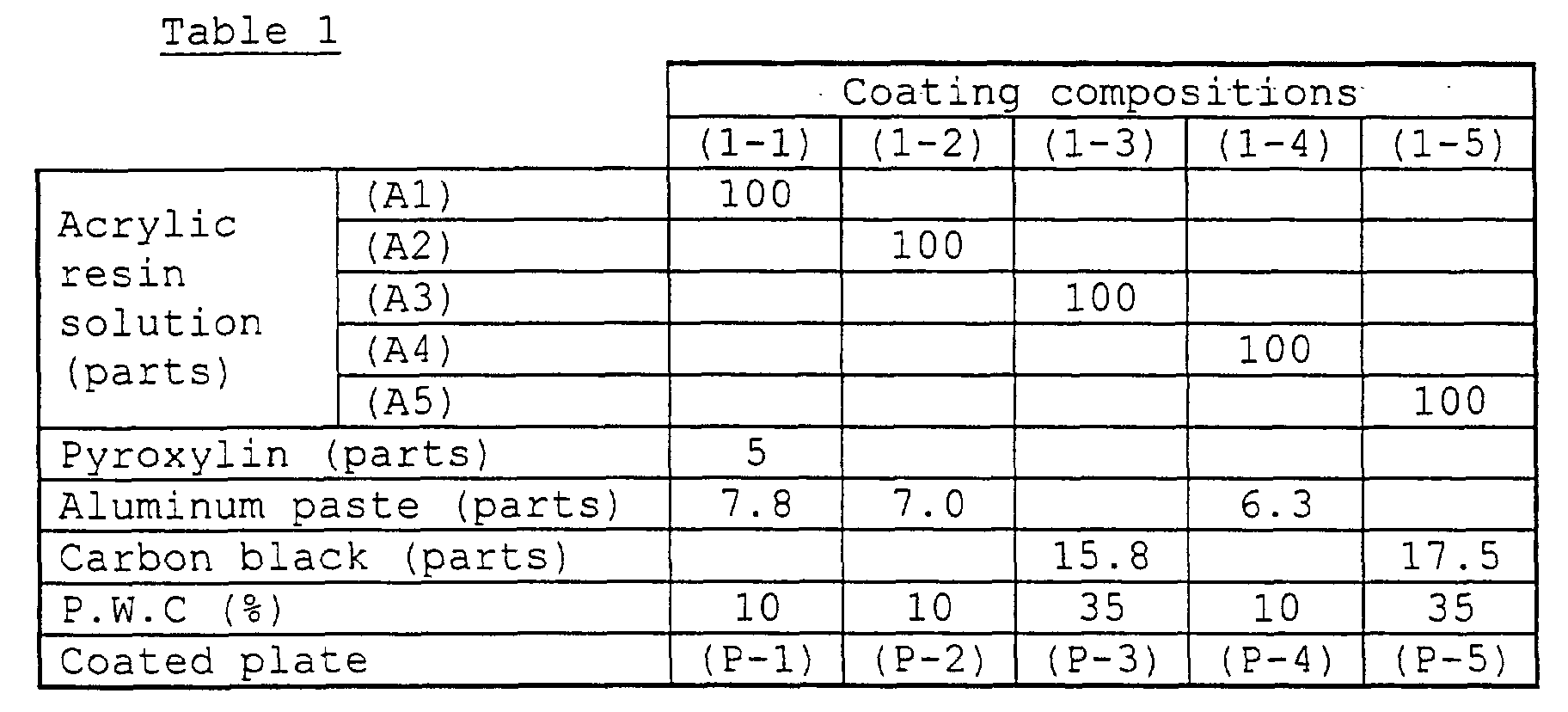
- Coating compositions (1-1) to (1-5) were prepared by mixing each of Acrylic resin solutions (A-1) to (A-5), pyroxylin ("H1/4 pyroxylin", product of Asahi Kasei Corp.), an aluminum paste ("ALPASTE 1109-MA", product of Toyo Aluminum K.K., grain size D50: 18 ⁇ m, nonvolatile content: 64%) and carbon black ("MA-100” product of Mitsubishi Chemical Corp., particle size: 22 ⁇ m) as indicated in Table 1.
- the pigment weight concentration (P.W.C.; wt.% of a pigment in coating solid content) of each of the resulting coating compositions (1-1) to (1-5) is also shown in Table 1.
- the diluted coating composition was applied to an ABS resin plate by spraying, followed by drying under heat at 70°C for 10 minutes in a hot-air oven, whereby coated plates (P-1) to (P-5) having a colored layer of 10 ⁇ m thick were obtained.
- Energy beam curable overcoat compositions (2-1) to (2-5) were prepared by mixing Acrylate compound solution (D-1), "Aronix M-305" (pentaerythritol triacrylate; product of Toagosei Co., Ltd., Gardner viscosity (25°C): R), "Aronix TO-1450” (tetrafunctional type ester acrylate, product of Toagosei Co., Ltd., Gardner viscosity (25°C): Z 1 ), “Karayad DPHA” (dipentaerythritol hexaacrylate, product of Nippon Kayaku Co., Ltd., Gardner viscosity (25°C): Z 4 3 -Z 5 ), "Neomer NA-305" (propoxylated neopentyl glycol diacrylate, Gardner viscosity (25°C): A-A 1 ), Acrylic resin solution (A-1) (used as the acrylic resin (E)), n-butyl acetate
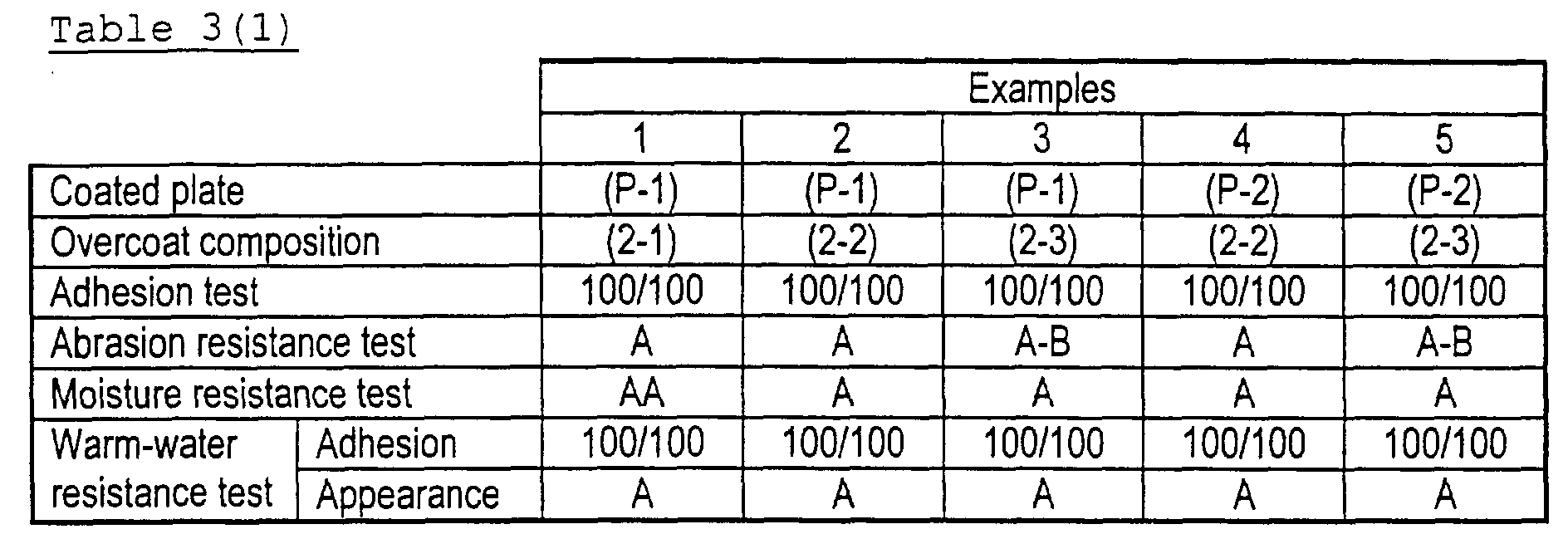
- Adhesion Test On the cured film, 100 cross-cuts were formed at intervals of 1 mm by a cutter knife. After contact bonding of an adhesive cellophane tape to the resulting film, the tape was peeled from the film strongly and the remaining ratio of the film was determined (JIS K-5400).
- Abrasion Resistance Test The film surface was rubbed by a #0000 steel wool under a load of 220 g/cm 2 by 100 reciprocations and the appearance of the film was visually observed. The film without abnormalities was ranked "A”, the film having slight scratches on its surface was ranked “B”, and the film having marked scratches on its surface was ranked "C”.
- Warm Water Resistance Test After immersion of each sample in warm water of 70°C for 5 hours, adhesion test was made and at the same time, appearance of it was visually observed. The film without abnormalities was ranked “A”, the film with blotches was ranked “B” and the film from which whitening or color change was observed was ranked "C”.
- a film excellent in abrasion resistance, interlayer adhesion between a colored layer and an overcoat composition and adhesion with a thermoplastic resin base can be obtained. It is particularly useful for coating of a thermoplastic resin-molded article such as mobile phone.
Landscapes
- Chemical & Material Sciences (AREA)
- Health & Medical Sciences (AREA)
- Chemical Kinetics & Catalysis (AREA)
- Medicinal Chemistry (AREA)
- Polymers & Plastics (AREA)
- Organic Chemistry (AREA)
- Life Sciences & Earth Sciences (AREA)
- Engineering & Computer Science (AREA)
- Wood Science & Technology (AREA)
- Paints Or Removers (AREA)
- Laminated Bodies (AREA)
- Application Of Or Painting With Fluid Materials (AREA)
Abstract
Description


Claims (16)
- A method of forming a 2-way coat, which comprises the steps of:applying (1) a coating composition onto a thermoplastic resin base and drying said coating to form a colored layer, said coating composition (1) comprising:(A) an acrylic resin obtained by copolymerization of a monomer mixture comprising n-butyl (meth)acrylate and methyl (meth)acrylate, each in an amount of at least 30 wt.%;(B) a colorant; and(C) an organic solvent;applying (2) an energy beam curable overcoat composition onto said colored layer, said overcoat composition (2) comprising:(D) a compound having at least three (meth)acryloyl groups and having a molecular weight of 250 to 1,800; and(E) an acrylic resin obtained by copolymerization of a monomer mixture comprising at least 20 wt.% of methyl (meth)acrylate, said compound (D) amounting to at least 50 wt.% of overcoat film-forming components; andcuring said applied overcoat composition by energy beam irradiation.
- The method according to claim 1, wherein said compound (D) is at least one (meth)acrylate compound selected from the group consisting of:(D1) (meth)acrylate compounds having a molecular weight of 550 to 1,800 which is obtained by reacting a compound having at least two isocyanate groups and a hydroxyl-containing (meth)acrylate compound in a combination that gives a total number of (meth)acryloyl groups of at least three;(D2) (meth)acrylate compounds having a molecular weight of 250 to 1,800 which is obtained by reacting at least three alcoholic hydroxyl groups of a polyol having at least three alcoholic hydroxyl groups with (meth)acrylic acid; and(D3) (meth)acrylate compounds having a molecular weight of 550 to 1,800 which is obtained by reacting an epoxy compound having at least three epoxy groups with (meth)acrylic acid.
- The method according to claim 2, wherein said compound (D) has four to six (meth)acryloyl groups.
- The method according to claim 1, wherein said acrylic resin (E) is obtained by copolymerization of a monomer mixture comprising methyl (meth)acrylate and n-butyl (meth)acrylate, each in an amount of at least 20 wt.%.
- The method according to claim 3, wherein said acrylic resin (E) is obtained by copolymerization of a monomer mixture comprising methyl (meth)acrylate and n-butyl (meth)acrylate, each in an amount of at least 20 wt.%.
- The method according to claim 1, wherein a weight ratio ((D)/(E)) of said (meth)acrylate compound (D) to said acrylic resin (E) is from 95/5 to 50/50.
- The method according to claim 5, wherein a weight ratio ((D)/(E)) of said (meth)acrylate compound (D) to said acrylic resin (E) is from 95/5 to 50/50.
- The method according to claim 1, wherein said acrylic resin (A) is obtained by reacting a monomer mixture comprising n-butyl (meth)acrylate and methyl (meth)acrylate, each in an amount of at least 35 wt.% and in a total amount thereof of at least 80 wt.%; and said acrylic resin (E) is obtained by reacting a monomer mixture comprising n-butyl (meth)acrylate and methyl (meth)acrylate, each in an amount of at least 35 wt.% and in a total amount thereof of at least 80 wt.%.
- The method according to claim 5, wherein said acrylic resin (A) is obtained by reacting a monomer mixture comprising n-butyl (meth)acrylate and methyl (meth)acrylate, each in an amount of at least 35 wt.% and in a total amount thereof of at least 80 wt.%; and said acrylic resin (E) is obtained by reacting a monomer mixture comprising n-butyl (meth)acrylate and methyl (meth)acrylate, each in an amount of at least 35 wt.% and in a total amount thereof of at least 80 wt.%.
- The method according to claim 7, wherein said acrylic resin (A) is obtained by reacting a monomer mixture comprising n-butyl (meth)acrylate and methyl (meth)acrylate, each in an amount of at least 35 wt.% and in a total amount thereof of at least 80 wt.%; and said acrylic resin (E) is obtained by reacting a monomer mixture comprising n-butyl (meth)acrylate and methyl (meth)acrylate, each in an amount of at least 35 wt.% and in a total amount thereof of at least 80 wt.%.
- The method according to claim 8, wherein a weight ratio ((D)/(E2)) of said (meth)acrylate compound (D) to said acrylic resin (E2) is from 92/8 to 55/45.
- The method according to claim 9, wherein a weight ratio ((D)/(E2)) of said (meth)acrylate compound (D) to said acrylic resin (E2) is from 92/8 to 55/45.
- The method according to claim 1, wherein said thermoplastic resin base is a thermoplastic resin-molded article obtained from an ABS resin or a polymer alloy containing an ABS resin.
- The method according to claim 8, wherein said thermoplastic resin base is a thermoplastic resin-molded article obtained from an ABS resin or a polymer alloy containing an ABS resin.
- The method according to claim 9, wherein said thermoplastic resin base is a thermoplastic resin-molded article obtained from an ABS resin or a polymer alloy containing an ABS resin.
- The method according to claim 10, wherein said thermoplastic resin base is a thermoplastic resin-molded article obtained from an ABS resin or a polymer alloy containing an ABS resin.
Applications Claiming Priority (2)
| Application Number | Priority Date | Filing Date | Title |
|---|---|---|---|
| JP2000332514 | 2000-10-31 | ||
| JP2000332514 | 2000-10-31 |
Publications (3)
| Publication Number | Publication Date |
|---|---|
| EP1205510A2 true EP1205510A2 (en) | 2002-05-15 |
| EP1205510A3 EP1205510A3 (en) | 2003-06-25 |
| EP1205510B1 EP1205510B1 (en) | 2007-02-14 |
Family
ID=18808709
Family Applications (1)
| Application Number | Title | Priority Date | Filing Date |
|---|---|---|---|
| EP01125411A Expired - Lifetime EP1205510B1 (en) | 2000-10-31 | 2001-10-31 | Method for forming a 2-way coat |
Country Status (5)
| Country | Link |
|---|---|
| US (1) | US6676997B2 (en) |
| EP (1) | EP1205510B1 (en) |
| CN (1) | CN1166708C (en) |
| DE (1) | DE60126552T8 (en) |
| TW (1) | TW581792B (en) |
Cited By (2)
| Publication number | Priority date | Publication date | Assignee | Title |
|---|---|---|---|---|
| EP1366828A1 (en) * | 2002-05-31 | 2003-12-03 | Rohm And Haas Company | Multi-layer coating composition and method of preparation |
| CN110280464A (en) * | 2019-07-08 | 2019-09-27 | 东莞市三诚鑫电子科技有限公司 | The mute androgynous spraying process of the light of plastic part |
Families Citing this family (5)
| Publication number | Priority date | Publication date | Assignee | Title |
|---|---|---|---|---|
| JP4500522B2 (en) * | 2003-09-30 | 2010-07-14 | 大日本印刷株式会社 | Laminate that suppresses curling of hard coat layer |
| CN102463723B (en) * | 2010-10-29 | 2015-11-25 | Jsr株式会社 | Laminated film |
| KR101674766B1 (en) * | 2014-12-23 | 2016-11-10 | 주식회사 포스코 | Method of the manufacturing transparent pattern print steel sheet |
| CN108997600B (en) * | 2018-06-26 | 2021-06-22 | 桐乡市耐箔尔烫印材料有限公司 | White pigment foil |
| CN110982390A (en) * | 2019-12-26 | 2020-04-10 | 中山市大自然木业有限公司 | Clear finish paint and preparation method thereof |
Family Cites Families (5)
| Publication number | Priority date | Publication date | Assignee | Title |
|---|---|---|---|---|
| JPS4992152A (en) | 1972-10-23 | 1974-09-03 | ||
| US6177488B1 (en) | 1995-08-25 | 2001-01-23 | Kansai Paint Company, Limited | Aqueous colored base coating composition |
| JP3894633B2 (en) | 1997-10-23 | 2007-03-22 | 日本化薬株式会社 | Resin composition and cured product thereof |
| JP4204106B2 (en) | 1998-08-12 | 2009-01-07 | 三菱レイヨン株式会社 | Coating composition |
| DE69931888T2 (en) | 1998-10-05 | 2007-06-06 | Nippon Shokubai Co., Ltd. | Ultraviolet absorbing laminated hard material |
-
2001
- 2001-10-30 US US09/984,603 patent/US6676997B2/en not_active Expired - Lifetime
- 2001-10-31 DE DE60126552T patent/DE60126552T8/en active Active
- 2001-10-31 EP EP01125411A patent/EP1205510B1/en not_active Expired - Lifetime
- 2001-10-31 TW TW090127055A patent/TW581792B/en not_active IP Right Cessation
- 2001-10-31 CN CNB011368675A patent/CN1166708C/en not_active Expired - Fee Related
Cited By (2)
| Publication number | Priority date | Publication date | Assignee | Title |
|---|---|---|---|---|
| EP1366828A1 (en) * | 2002-05-31 | 2003-12-03 | Rohm And Haas Company | Multi-layer coating composition and method of preparation |
| CN110280464A (en) * | 2019-07-08 | 2019-09-27 | 东莞市三诚鑫电子科技有限公司 | The mute androgynous spraying process of the light of plastic part |
Also Published As
| Publication number | Publication date |
|---|---|
| DE60126552T2 (en) | 2007-11-15 |
| EP1205510A3 (en) | 2003-06-25 |
| DE60126552T8 (en) | 2008-03-20 |
| CN1166708C (en) | 2004-09-15 |
| EP1205510B1 (en) | 2007-02-14 |
| US20020076505A1 (en) | 2002-06-20 |
| TW581792B (en) | 2004-04-01 |
| US6676997B2 (en) | 2004-01-13 |
| DE60126552D1 (en) | 2007-03-29 |
| CN1351090A (en) | 2002-05-29 |
Similar Documents
| Publication | Publication Date | Title |
|---|---|---|
| JP4581376B2 (en) | How to make a hard coat film | |
| CN101657478B (en) | Active energy ray-curable resin composition, active energy ray-curable coating material, and method for forming protective layer | |
| JP2546871B2 (en) | Resin laminate having metallic luster and method for producing the same | |
| JP3903715B2 (en) | Energy ray curable resin composition and coating film forming method | |
| US6676997B2 (en) | Method of forming a two-layer coat | |
| CA2392100A1 (en) | Lacquered moulded parts consisting of synthetic material, method for their production and the use thereof | |
| US5361616A (en) | Coating composition and process for producing a precoated plate | |
| JP4805628B2 (en) | MULTILAYER COATING FORMATION METHOD, COATING AND COATED ARTICLE USED FOR THE METHOD | |
| JP4374262B2 (en) | Laminated film | |
| JP4569807B2 (en) | How to make a hard coat film | |
| JP2009173755A (en) | Coating composition for plastic base material, and composite coating film formed from the same | |
| JP2002179953A (en) | Energy ray-curable resin composition and coating for plastic coating | |
| JP2008156464A (en) | Paint applicable to nonpolar resin base material, multilayer coating film forming method using the same, and coating resin product | |
| JP2018172638A (en) | Curable composition, film using the same, and molded product using the film | |
| JP2002348499A (en) | Resin composition for energy ray-curable coating agent and coated object | |
| JP3981861B2 (en) | Method for forming laminated coating film | |
| JP2008222816A (en) | Active energy ray curable resin composition, active energy ray curable coating material, and method for forming protective layer | |
| US5021465A (en) | Photocurable resin composition and method of producing decorative material using the same | |
| JP5346262B2 (en) | Laminated film and molded product using the same | |
| JP2022182014A (en) | Laminated film for three-dimensional molding decoration, its manufacturing method and three-dimensional molding decoration method | |
| JP2002241646A (en) | Active energy ray-curable paint resin composition and active energy ray-curable paint | |
| JP4013787B2 (en) | Water pressure transfer film and water pressure transfer body | |
| JPH0623319A (en) | Method for manufacturing fabricated product of coated metal plate | |
| JP2008222772A (en) | Active energy ray curable resin composition, active energy ray curable coating material, and method for forming protective layer | |
| JP2004160932A (en) | Hydraulic transfer body having hydraulic transfer film and cured resin layer |
Legal Events
| Date | Code | Title | Description |
|---|---|---|---|
| PUAI | Public reference made under article 153(3) epc to a published international application that has entered the european phase |
Free format text: ORIGINAL CODE: 0009012 |
|
| AK | Designated contracting states |
Kind code of ref document: A2 Designated state(s): AT BE CH CY DE DK ES FI FR GB GR IE IT LI LU MC NL PT SE TR |
|
| AX | Request for extension of the european patent |
Free format text: AL;LT;LV;MK;RO;SI |
|
| PUAL | Search report despatched |
Free format text: ORIGINAL CODE: 0009013 |
|
| AK | Designated contracting states |
Designated state(s): AT BE CH CY DE DK ES FI FR GB GR IE IT LI LU MC NL PT SE TR |
|
| AX | Request for extension of the european patent |
Extension state: AL LT LV MK RO SI |
|
| 17P | Request for examination filed |
Effective date: 20030904 |
|
| AKX | Designation fees paid |
Designated state(s): DE FI GB NL |
|
| GRAP | Despatch of communication of intention to grant a patent |
Free format text: ORIGINAL CODE: EPIDOSNIGR1 |
|
| GRAS | Grant fee paid |
Free format text: ORIGINAL CODE: EPIDOSNIGR3 |
|
| GRAA | (expected) grant |
Free format text: ORIGINAL CODE: 0009210 |
|
| AK | Designated contracting states |
Kind code of ref document: B1 Designated state(s): DE FI GB NL |
|
| REG | Reference to a national code |
Ref country code: GB Ref legal event code: FG4D |
|
| REF | Corresponds to: |
Ref document number: 60126552 Country of ref document: DE Date of ref document: 20070329 Kind code of ref document: P |
|
| PLBE | No opposition filed within time limit |
Free format text: ORIGINAL CODE: 0009261 |
|
| STAA | Information on the status of an ep patent application or granted ep patent |
Free format text: STATUS: NO OPPOSITION FILED WITHIN TIME LIMIT |
|
| 26N | No opposition filed |
Effective date: 20071115 |
|
| PGFP | Annual fee paid to national office [announced via postgrant information from national office to epo] |
Ref country code: NL Payment date: 20140910 Year of fee payment: 14 |
|
| PGFP | Annual fee paid to national office [announced via postgrant information from national office to epo] |
Ref country code: GB Payment date: 20141029 Year of fee payment: 14 Ref country code: FI Payment date: 20141009 Year of fee payment: 14 |
|
| GBPC | Gb: european patent ceased through non-payment of renewal fee |
Effective date: 20151031 |
|
| REG | Reference to a national code |
Ref country code: NL Ref legal event code: MM Effective date: 20151101 |
|
| PG25 | Lapsed in a contracting state [announced via postgrant information from national office to epo] |
Ref country code: GB Free format text: LAPSE BECAUSE OF NON-PAYMENT OF DUE FEES Effective date: 20151031 |
|
| PG25 | Lapsed in a contracting state [announced via postgrant information from national office to epo] |
Ref country code: NL Free format text: LAPSE BECAUSE OF NON-PAYMENT OF DUE FEES Effective date: 20151101 |
|
| PG25 | Lapsed in a contracting state [announced via postgrant information from national office to epo] |
Ref country code: FI Free format text: LAPSE BECAUSE OF NON-PAYMENT OF DUE FEES Effective date: 20151031 |
|
| PGFP | Annual fee paid to national office [announced via postgrant information from national office to epo] |
Ref country code: DE Payment date: 20171025 Year of fee payment: 17 |
|
| REG | Reference to a national code |
Ref country code: DE Ref legal event code: R119 Ref document number: 60126552 Country of ref document: DE |
|
| PG25 | Lapsed in a contracting state [announced via postgrant information from national office to epo] |
Ref country code: DE Free format text: LAPSE BECAUSE OF NON-PAYMENT OF DUE FEES Effective date: 20190501 |