EP1202191A2 - Methode zur Datenverwaltung und Speichermedium mit gespeicherter Datenverwaltungsmethode - Google Patents
Methode zur Datenverwaltung und Speichermedium mit gespeicherter Datenverwaltungsmethode Download PDFInfo
- Publication number
- EP1202191A2 EP1202191A2 EP01308237A EP01308237A EP1202191A2 EP 1202191 A2 EP1202191 A2 EP 1202191A2 EP 01308237 A EP01308237 A EP 01308237A EP 01308237 A EP01308237 A EP 01308237A EP 1202191 A2 EP1202191 A2 EP 1202191A2
- Authority
- EP
- European Patent Office
- Prior art keywords
- data
- entries
- data management
- address values
- indices
- Prior art date
- Legal status (The legal status is an assumption and is not a legal conclusion. Google has not performed a legal analysis and makes no representation as to the accuracy of the status listed.)
- Withdrawn
Links
Images







Classifications
-
- G—PHYSICS
- G06—COMPUTING OR CALCULATING; COUNTING
- G06F—ELECTRIC DIGITAL DATA PROCESSING
- G06F16/00—Information retrieval; Database structures therefor; File system structures therefor
- G06F16/20—Information retrieval; Database structures therefor; File system structures therefor of structured data, e.g. relational data
- G06F16/22—Indexing; Data structures therefor; Storage structures
- G06F16/2228—Indexing structures
- G06F16/2246—Trees, e.g. B+trees
Definitions
- the present invention relates to a data management method and a storage medium storing a data management program. Particularly, this invention relates to a data management method suitable for managing data on several types of application systems that are stored in a main memory of a computer or that run on a computer.
- databases are one of core components of application systems running on a computer and also one of important factors for the performance and extendability of computer.
- Databases usually mean RDBs (Relational Databases), OODBs (Object oriented Databases) are sometimes used as databases though.
- DBMS Database Management System
- RDB uses a data management framework called a schema.
- the schema-based management predefines a framework (schema) for organizing data and performs registration, updating, deletion and retrieval to data based on the set of data units called data items (attributes) that constitute a schema.
- a framework in which data are registered and a data record to be registered in RDB are called “table” and "tuple”, respectively.
- a schema defines one structure of plurality of tuples to be registered in one table. Users perform data storing with registration of tuples with a structure defined by a schema in several tables for which the schema has been defined by supervisory users. Users also perform data processing (updating) with changing the contents of tuples within a range defined by the schema.
- Databases must handle data of variable length in nature as fixed-length data. This causes increase in data storage regions, procedures and so on. For example, it is not rare that a person owns several cars. Records of enormous personal information having an uncertain number of same data such as mentioned above are usually handled by known databases as follows:
- the method (1) could cause decrease in efficiency due to registration of tuples containing null data.
- the method (2) could also cause decrease in efficiency due to repeated registration of the same tuples except for one data item.
- This problem could be solved by providing another table for an uncertain (variable) number of data items with unique identifier data common to tuples in that extra table and original tuples for providing the correspondence between the variable number of data and the original data record including them.
- This method could, however, cause inevitable introduction of undesired identifier data items that have not been existed for the original data.
- the method (1) further have a problem in that a schema must be changed for database restructuring when handling data including same type of data the number of which exceeds an assumed maximum value.
- a purpose of the present invention is to provide a data management method and a storage medium storing a data management that can enlarge a database flexibly and efficiently without halting services to application systems even when data types different from those assumed first are required after the database has been constructed and services to the application systems has been started.
- a data management method includes: assigning different indices to each of plurality of storage regions that are discriminated from each other by their addresses; forming entries corresponding to records containing address values to the storage regions so that the entries and the address values contained have one-to-one correspondence; and registering the entries in the indices assigned to the storage regions that are designated by the address values corresponding to the entries.
- the indices may be managed by sorting the entries with keys for determining a sorting order of the entries, contents of the records that contain the address values corresponding to the entries being used as the keys.
- the keys for determining the sorting order of the entries may be designated per entry.
- the contents of storage regions designated by other address values contained in the records that contain the address values corresponding to the entries may be used as the keys for determining the sorting order of the entries.
- storage medium includes, for example, a hard disc (HD), DVD-RAM, DVD-ROM, flexible disc (FD), and CD-ROM, and also several types of memory such as RAM and ROM.
- Programs to be stored in these media may be ciphered, modulated or compressed and distributed over on-line or wireless network such as intranet and Internet or once stored in storage media before distribution.
- the present invention can be implemented by software, the present invention encompasses computer code provided to a general purpose computer on any suitable carrier medium.
- the carrier medium can comprise any storage medium or any transient medium such as any signal e.g. an electrical, optical or microwave signal.
- embodiments of the present invention organizes data into data format that is accessible without using a schema by registering entries corresponding to references (pointers) to data units in indices corresponding to the data units.
- This method can handle variable-length data that are hard for known databases to handle with an inflexible schema. Moreover, this method can change data format like usual data updating, which is not efficient for known databases due to schema modification.
- databases can be enlarged flexibly and effectively without halting services to application systems even when data types different from those assumed first is required after a database has been constructed and services to the application systems has been started.
- Efficient data-handling such as registration, updating, deletion and retrieval is achieved in embodiments of the present invention with using a data structure as a unit of data structure (called instances hereinafter), having regions (facades) in which data (rows) of pointer array indicating correlation among plurality of instances are stored, the regions being attached to regions (cells) for storing symbols (codes) for the instances.
- instances a data structure as a unit of data structure
- FIG. 1 is a schematic view showing a cell structure. As shown, a cell corresponds to one-dimensional array in programming languages such as C, C ++ and Java. Several data types are allowed for data used as codes stored in a cell.
- Such data types include characters, byte-stream data, unsigned integer (bit length: 8/16/32/64), signed integer (bit length: 8/16/32/64), floating-point real numbers, double-precision floating-point real numbers, etc.
- a cell is illustrated as a rectangle as shown in FIG. 1 through the drawings. Codes stored in a cell are indicated in a rectangle.
- a cell is a concept expressing a function of storing each value of "data unit", or data item in data management in general.
- FIG. 2 is a schematic view showing an instance structure.
- a cell and a facade are simultaneously generated as elements of an instance.
- An instance (a cell and a facade) is designated by an address that identifies its region. Codes themselves stored in a cell do not designate an instance but are used for retrieval of an instance in a lexicon as disclosed later or identification in a situation limited by, for example, retrieval of a row in a facade.
- registered in a facade is a row used for retrieval of a context as disclosed later.
- a facade is a concept similar to "index" in data management in general.
- a row is a concept corresponding to "entry" to be registered in an index.
- An index is a combination of a cell in which data is stored as codes and a facade in which correlation among data (instances) is stored as a row.
- Data can be structured in the present invention with no special data (table) such as RDB for data management. This is because the data storing means (cell) and the data managing means (facade) are handled as one structure (an instance).
- a cell and a facade are expressed as rectangles as shown in FIG. 2 in which the upper is a cell and the lower is a facade.
- a facade is always attached to a cell.
- Rows have, however, not necessarily been stored in a facade, in other words, empty facades may exist. Empty facades and row-registered facades are illustrated differently in the drawings to discriminate between empty facades and other facades in which rows have been stored.
- a fixed size of region may not be applied to cells and facades in formation of instances. In other words, the size of storage regions may be flexible in accordance with the amount of codes to be stored or the number of rows to be stored.
- Instances are managed by lexicons, a concept corresponding to "name of data group”.
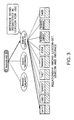
- FIG. 3 is a schematic view showing a group of instances managed by a lexicon. As shown, a cell is registered in any one of lexicons. There are several lexicons managed by a lexicon-set. Each lexicon has own particular name. Any lexicon can be retrieved from the lexicon-set according to its name. An application system retrieves a lexicon required for its processing from the lexicon-set according to the lexicon's name and also retrieves cells managed under the lexicon according to the contents of the cells, thus retrieving desired instances.
- FIG. 3 illustrates a process of retrieving a lexicon "employee” from the lexicon-set and then an instance "SATO".
- cells can be used like a variable.
- the same codes can be stored in cells of different instances, which depends on what types of data are handled by an application system. For example, there are different persons with the same family and personal name. In such a case, the same codes can be stored in different instances for managing the names as different items.
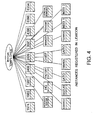
- FIG. 4 is a schematic view showing instances, that are elements constituting an employee data, registered in a lexicon "employee". In this registration, instances are separately connected to the lexicon with no correlation among the instances. Databases usually handle data, a combination of such data units with correlation among the units, such as tuples in RDB and records in file.
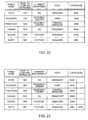
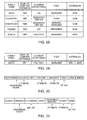
- FIG. 22 shows information on employees classified into categories "FAMILY NAME”, “YEAR OF COMPANY ENTRANCE”, “CURRENT DEPARTMENT”, “POST” and “EXTENSION”.
- duplicated data can be managed by one cell.
- FIG. 22 the year of company entrance for the three out of six employees is 1981.
- An aspect of the present invention does not require three pieces of data "1981" to be stored.
- the aspect of this invention manages just one instance having a cell storing the data "1981", as shown in FIG. 4. This is because this instance can be designated again and again according to necessity, as disclosed later in detail. This is the same for duplicated data such as current department and post. Data storage regions can therefore be drastically reduced for such duplicated data according to an aspect of the present invention.
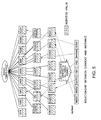
- a structure called “context” such as shown in FIG. 5 is used in an embodiment of the present invention in a method of handling data stored here and there in the lexicon "employee” as one original data row such as "SAITO ⁇ 1981 ⁇ FACTORY ⁇ MANAGER ⁇ 3691" as shown in FIG. 22.
- a context is a concept corresponding to "record" in data management in general.
- a context is one-dimensional array of pointer data for referring to instances.
- stored in a context is not data (codes) itself but a pointer data indicating an instance that manages the codes.
- address of each region storing an instance is used as a pointer to the instance.
- a context is structured so that instances of several cells to be correlated with each other can be designated. Cells can be looked up using pointer data stored in a context.
- links are indicated as rectangles like cells and a cell designated by a pointer is enclosed within parentheses () for expressing the pointer.
- SAITO means a pointer for referring to an instance of a cell containing the contents "SAITO".
- a context expresses correlation among element data stored in instances. Data correlation depends on not only static relation among original data such as shown in FIG. 22 but also a retrieval method required for an application system. A context is therefore structured under consideration of a retrieval method required for an application system based on original data in the application system.
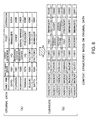
- FIG. 6 indicates correlation between original data and contexts.
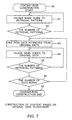
- FIG. 7 is a flow chart of a procedure to construct a context.
- a first step is to add data expressing the two retrieving patterns to the original data before installation in a data management system. This data functions as a facade as disclosed later.
- a facade name is given to each retrieving pattern in steps S1 and S2.
- names "INDEX 1" and "INDEX 2" are given to the two retrieving patterns, respectively.
- these retrieving pattern data are added to the lexicon.
- one row data in the original data is retrieved in step S3, followed by adding facade names of the retrieving patterns to respective one row data.
- One row data is a data array of codes themselves. This data array is replaced with a pointer array that designate instances for managing codes to make up a context.
- Structured in this example are six types of contexts that correspond to the original data, as shown in FIG. 6(b).
- a plurality of elements (pointers) in each context are selected and rearranged (permutation of context elements) are registered as a row in a facade of an instance that is to be looked up by the header element of the permutation so that several contexts can integrated with each other for retrieval.
- the contexts and rows have their own addresses so that they are accessible using the addresses as pointers like the instances. These addresses are used as return values for results of processing such as retrieval by a data management system.
- a row and the context that is the basis of the row are correlated with each other by pointers so that element-to-element correspondence between the row and the context can be mutually determined. It is determined in registration of rows in facades that to what number of elements from the header is used as a combined key for sorting the rows in the facades.
- a combined key is an ordered collection of keys for comparison. As comparison between combined keys is made, any pair of the same lower-order keys are compared only when each pair of the same higher-order keys is pairwise same each other. When they do not coincide, the relation (order) between the pair of highest order keys that do not pairwise coincide is taken as the result of the comparison between them. Comparison between elements as keys is made by comparing codes with each other, that have been stored in cells of instances that are looked up by the elements.
- FIG. 8 is a schematic view showing an example of rows registered in facades.
- a row having an element storing a pointer (INDEX 1) as the header has been stored in a façade of an instance (INDEX 1).
- (INDEX 2) is not involved in rows registered in the facades (INDEX 1) because they do not require (INDEX 2) that is to be used for another retrieval.
- the elements used as combined keys are not all elements in a row but a designated number of elements from the header.
- the fourth row in the façade (index 1) uses only, the elements "1981" and "HEAD QUARTERS (HQ)" (also included in the context corresponding to the row) as the first key and the second key, respectively, and the rest of the elements of the row are not interested in the sorting order of the row in the facade.
- a row is registered in a facade based on a context.
- the contents of the row are rearranged as shown below in a designated order when registered as the row.
- (INDEX1) indicates the facade in which this element has been registered
- (1981) and (HQ) indicate the first and the second keys, respectively
- (SATO)(MANAGER) and (6354) are not used as keys.
- the data management method disclosed above can be realized by for example, using a splay-tree algorithm particularly for facade-row portions.
- the splay-tree algorithm is disclosed, for example, in Robert E. Tarjan, "Data Structure and Network Algorithms", the Society for Industrial and Applied mathematics, 1993.
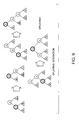
- the splay-tree algorithm executes a splaying operation for each occurrence of data access with a dynamically varying binary-tree structure.
- FIG. 9 is a schematic view illustrating a splaying operation in the splay-tree algorithm.
- a retrieval operation starts at a root and goes down through the tree while comparing nodes with a retrieval key and finally reaches an object (x) to be retrieved.
- Tree structures surrounding the node (x) correspond to any one of the three patters shown in FIG. 9. One of the patterns is selected to reconstruct the tree structure.
- the node (x) goes up the tree structure by one stage and at a new position, selects any one of the tree structures while referring to again the tree structures surrounding the node (x), and the processing proceeds with the same way as above. This processing continues and finally reaches the root of the tree.
- a binary-tree structure is constructed which offers efficient retrieval and update adapting to partial data access.
- This binary-tree structure can be used for row management in facades to yield efficient data sorting facilities.
- FIGS. 1 to 8 The data management method illustrated through FIGS. 1 to 8 is an essential feature of the present invention and provides advantages as described above with no particular hardware systems.
- the original data to be managed is employee data shown in FIG. 22.
- the data items are "FAMILY NAME”, "YEAR OF COMPANY ENTRANCE”, “CURRENT DEPARTMENT”, “POST” and "EXTENSION", six in total.
- the first pattern uses “YEAR OF COMPANY ENTRANCE” as the first key and “CURRENT DEPARTMENT” as the second key.
- the second pattern uses "EXTENSION” as the first (only) key.
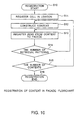
- FIG. 10 is a flow chart of a procedure of a data management method in this embodiment.
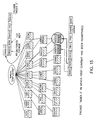
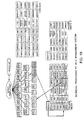
- step S11 instances that constitute original data are registered in a lexicon to construct a tree-structure of the lexicon and the instances as illustrated in FIG. 11.
- a context is constructed next in step S12.
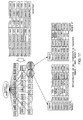
- the context in this embodiment is constructed for example as shown in the lower right of FIG. 11.
- a row is formed using this context and registered in the specific facade.
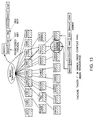
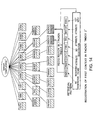
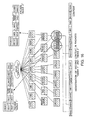
- the context is registered as rows in facades "INDEX 1" and "INDEX 2", respectively, of instances in accordance with retrieval patterns shown in FIGS. 12 and 14.
- one row is registered in the facade "INDEX 1".
- the registered facade, the first key, the second key and the other elements are selected and aligned from the context to form the row for registration.
- step S14 the row-registration operation described above is repeated by the number of retrieval patterns.
- the registered facade, the first key and the other elements are selected and aligned from the context to form the row for registration.
- step S15 the procedure from step S12 for the contexts described above is repeated by the number of contexts and also the number of data.
- FIG. 16 is a schematic view showing registration of two rows registered in each of the facades. Each row has been sorted in the facade in accordance with the order of combined keys.
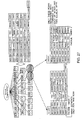
- FIG. 17 is a schematic view showing registered six contexts and twelve rows. Now, all data have been registered for retrieval.
- FIG. 18 is a flow chart of a retrieval procedure according to the aspect of the present invention.
- FIG. 19 is a schematic view explaining the retrieval procedure according to the aspect of the present invention.
- Retrieved first in step S21 is a facade corresponding to a pattern to be retrieved.
- a lexicon to be required for an application system is retrieved from a given lexicon set by using the name of the lexicon. For example, a lexicon "EMPLOYEE" is retrieved in this embodiment.
- the facade must be searched first, however, in the embodiment, an instance that contains the facade is searched in the lexicon.
- an instance "INDEX 1" is retrieved from the lexicon using the codes "INDEX 1" as a key in this embodiment.
- a row registered in the facade is retrieved using a desired key in step S22.
- a desired data is found out in the elements of the row using a pointer.
- data to be required for an application system is found out from the retrieved row.
- a desired item is "FAMILY NAME" in the retrieved data, so that a desired data "SATO" is retrieved from the cell of the instance designated by the pointer, the fourth element in the row.
- a cell is directly looked up from a row in the example disclosed above.
- an essential procedure is to find out a row from facades for constructing a retrieval procedure.
- the instance "INDEX 1" is retrieved from a lexicon in the above disclosure. However, not only that, the instance "INDEX 1" can be retrieved in other ways, for example, by retrieving a context that corresponds to an entry registered in a facade of the instance "INDEX 2", thus the instance "INDEX 1" being retrieved while the header element of the retrieved context is looked up.
- a facade can be decided by a usual data retrieving means, which is fundamentally different from known databases in which a schema- and metadata-managing means is separated from a usual data-managing means.
- FIG. 20 is an illustration of a data management system as a hardware on which a data management according to the aspect of the present invention is installed.
- FIG. 21 is a block diagram of essential components of the data management system according to the aspect of the present invention.
- a data management system 80 is equipped with a data-entry section 80A, a data-processing control section 80B, a data-storage section 80C and a data-output section 80D.
- the data-entry section 80A accepts data to be managed from an external data-input means such as a floppy disc apparatus (floppy disc drive) 81 and an optical disc apparatus (optical disc drive) 82.
- an external data-input means such as a floppy disc apparatus (floppy disc drive) 81 and an optical disc apparatus (optical disc drive) 82.
- a floppy disc 83 is inserted into the floppy disc drive 81 or an optical disc 84 such as CD-ROM and DVD is inserted into the optical disc drive 82, through diskette slot, for a retrieval operation to supply data stored in these storage media into the system.
- a ROM 85 as a semiconductor memory or a cassette 86 as a magnetic tape apparatus can be used.
- data may be supplied to the system via a keyboard 87, or from another computer or a data-output apparatus through an on-line network 88.
- Data thus supplied as described above is stored in the data-storage section 80C while a lexicon set, lexicons, facades, contexts and rows are constructed as disclosed with reference to FIGS. 1 to 19.
- the sequential processing is executed by the data-processing control section 80B. Also executed by the control section 80B are row-sorting, splaying of data stored in facades and so on.
- Data thus managed and sorted as described above are output from the data-output section 80D according to necessity.
- the output section 80D can output desired data through several types of media such as the floppy disc 83 and the on-line network 88.
- a semiconductor memory such as RAM can be used as the data-storage section 80C, which allows high-speed data management for higher data-management performance compared to known systems.
- An aspect of the present invention involves software that can execute the data management method disclosed with reference to FIGS. 1 to 19.
- This software can be stored on a storage medium such as the optical disc 84 like the data-entry section 80A and down loaded to the data-processing control section 80B of the management system 80.
- Such software may also be down loaded through the on-line network 88.
- an aspect of this invention does not require the maximum number for the number of elements of all contexts or lots of same elements with some different elements over several contexts.
- an aspect of this invention does not require distribution of one data over several contexts nor addition of its identity data.
- a context corresponding to the data "SAITO" can be formed as shown in FIG. 24.
- This embodiment has a restriction in that the header element of a row to designate a facade must have one-to-one correspondence with elements of a context when the row is formed based on the context and registered in the facade.
- the maximum number of rows that can be formed based on one context equals to the number of elements of the context. Facades that are allowed for registration are only those of instances that are referred to by each element. Registration of several rows in the same facade thus requires several elements referring to the same instance.
- the row having the (last) element "INDEX 2" as the header is formed as shown in FIG. 26 in accordance with the retrieval pattern shown in FIG. 25 required for an application system.
- This retrieval pattern is different from that shown in FIG. 14 in that "FAMILY NAME" is not designated as a mere attribute but the second key.
- "FAMILY NAME" is not designated as a mere attribute but the second key.
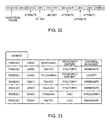
- the number of combined keys for the row is changed so that it matches the retrieval pattern having "FAMILY NAME" as the second key shown in FIG. 31 to be discriminated from the row described above which is newly added for the row having "2406" as the first key and already existed in a facade.
- Each row in the facades "INDEX 1" must include extension involved in the corresponding context as an element.
- a row having the header (INDEX 1) is formed by means of a retrieval pattern having one more element compared to other rows, as shown in FIG. 32.
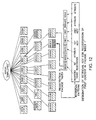
- FIG. 27 Illustrated in FIG. 27 is the overall data structure constructed and registered by the data management method in this embodiment including the sample data with the facades "INDEX 1", “INDEX 2", the contexts, and the lexicons.
- FIG. 27 There are six contexts formed in FIG. 27 for six input data for which the data "SAITO" only is different in data type.
- the original data and the data (contexts) registered in a database have a good correspondence, thus not so long time being required for making correspondence by distribution or duplication.
- addition of null elements is not required for forming the same data type, in other words, different types of data can be registered in a database.
- rows can be registered in facades in accordance with any retrieval pattern required for an application system per context, rows can be registered in a database so that contents just enough for the application system can be retrieved.
- data context
- data context containing two telephone numbers can be retrieved from one facade using each telephone number as a key.
- An aspect of the present invention provides organized different types of contexts per facade by registration of rows, which can be retrieved using combined keys.
- the facades in the aspect of this invention have a function of collecting data that are similar to each other to be compared and sorted, like known RDB tables and views.
- Each façade is, however, not subjected to any restrictions except that the header element of a row to be registered in a facade is an element of a context that looks up the instance of the facade.
- the aspect of the present invention does not need to store and manage any restriction information (so called schema information) on data types and contents to be collected, which is required for known databases.
- the aspect of the present invention neither require any specific operation (application system) for reconstructing a database nor interrupting services to usual application systems. This is because the aspect of this invention can execute updating as mere data updating, which must be executed as schema modification in the known databases.
- the present invention requires almost no change in a database already constructed with the data shown in FIG. 28 and also no reconstruction except that a new row must be registered in a facade with formation of the above context based on the data shown in FIG. 29.
- an aspect of the present invention provides a data management system that can handle various data types together and change data types and contents, which are difficult for known databases using schemas.
- a data management method can efficiently process data that have been registered and updated.
- Data addition has already been explained as data registration.
- explained here is the case in which an element of a registered context is to be updated.
- a data management method can flexibly and dynamically handle several data types with efficient retrieval and updating.
Landscapes
- Engineering & Computer Science (AREA)
- Theoretical Computer Science (AREA)
- Software Systems (AREA)
- Data Mining & Analysis (AREA)
- Databases & Information Systems (AREA)
- Physics & Mathematics (AREA)
- General Engineering & Computer Science (AREA)
- General Physics & Mathematics (AREA)
- Information Retrieval, Db Structures And Fs Structures Therefor (AREA)
Applications Claiming Priority (2)
| Application Number | Priority Date | Filing Date | Title |
|---|---|---|---|
| JP2000332993 | 2000-10-31 | ||
| JP2000332993 | 2000-10-31 |
Publications (2)
| Publication Number | Publication Date |
|---|---|
| EP1202191A2 true EP1202191A2 (de) | 2002-05-02 |
| EP1202191A3 EP1202191A3 (de) | 2003-06-18 |
Family
ID=18809132
Family Applications (1)
| Application Number | Title | Priority Date | Filing Date |
|---|---|---|---|
| EP01308237A Withdrawn EP1202191A3 (de) | 2000-10-31 | 2001-09-27 | Methode zur Datenverwaltung und Speichermedium mit gespeicherter Datenverwaltungsmethode |
Country Status (2)
| Country | Link |
|---|---|
| US (2) | US20020062303A1 (de) |
| EP (1) | EP1202191A3 (de) |
Families Citing this family (7)
| Publication number | Priority date | Publication date | Assignee | Title |
|---|---|---|---|---|
| CN100466602C (zh) * | 2005-04-28 | 2009-03-04 | 华为技术有限公司 | 动态共享存储器存储空间的实现方法 |
| EP2033066A4 (de) | 2006-05-31 | 2012-08-15 | Ibm | Verfahren und system zur transformation logischer datenobjekte zur speicherung |
| US8769311B2 (en) * | 2006-05-31 | 2014-07-01 | International Business Machines Corporation | Systems and methods for transformation of logical data objects for storage |
| US7975149B2 (en) * | 2006-06-30 | 2011-07-05 | Microsoft Corporation | Software protection using data structures |
| US8275750B2 (en) * | 2006-11-08 | 2012-09-25 | International Business Machines Corporation | Method to efficiently use the disk space while unarchiving |
| US9953459B2 (en) * | 2008-11-05 | 2018-04-24 | Hover Inc. | Computer vision database platform for a three-dimensional mapping system |
| CN103164490B (zh) * | 2011-12-19 | 2016-02-17 | 北京新媒传信科技有限公司 | 一种不固定长度数据的高效存储实现方法和装置 |
Family Cites Families (9)
| Publication number | Priority date | Publication date | Assignee | Title |
|---|---|---|---|---|
| US5870764A (en) * | 1993-05-12 | 1999-02-09 | Apple Computer, Inc. | Method of managing a data structure for concurrent serial and parallel revision of a work |
| JPH0916607A (ja) * | 1995-06-26 | 1997-01-17 | Hitachi Ltd | データベース管理システムにおけるインデクス管理方法 |
| JPH0981582A (ja) * | 1995-09-12 | 1997-03-28 | Fujitsu Ltd | 値を基本としたデータ管理装置及びデータ管理方法 |
| US5893104A (en) * | 1996-07-09 | 1999-04-06 | Oracle Corporation | Method and system for processing queries in a database system using index structures that are not native to the database system |
| US5924091A (en) * | 1996-08-28 | 1999-07-13 | Sybase, Inc. | Database system with improved methods for radix sorting |
| US6070164A (en) * | 1998-05-09 | 2000-05-30 | Information Systems Corporation | Database method and apparatus using hierarchical bit vector index structure |
| US6654724B1 (en) * | 1999-02-12 | 2003-11-25 | Adheris, Inc. | System for processing pharmaceutical data while maintaining patient confidentially |
| US6438562B1 (en) * | 1999-08-24 | 2002-08-20 | Oracle Corporation | Parallel index maintenance |
| US20020065815A1 (en) * | 2000-10-04 | 2002-05-30 | Xcelerix, Inc. | Systems and methods for searching a database |
-
2001
- 2001-09-24 US US09/960,337 patent/US20020062303A1/en not_active Abandoned
- 2001-09-27 EP EP01308237A patent/EP1202191A3/de not_active Withdrawn
-
2005
- 2005-11-14 US US11/271,919 patent/US20060080282A1/en not_active Abandoned
Also Published As
| Publication number | Publication date |
|---|---|
| EP1202191A3 (de) | 2003-06-18 |
| US20060080282A1 (en) | 2006-04-13 |
| US20020062303A1 (en) | 2002-05-23 |
Similar Documents
| Publication | Publication Date | Title |
|---|---|---|
| US6480857B1 (en) | Method of organizing hierarchical data in a relational database | |
| US7092956B2 (en) | Deduplication system | |
| JP5377318B2 (ja) | 個別にアクセス可能なデータユニットの格納管理 | |
| US6965894B2 (en) | Efficient implementation of an index structure for multi-column bi-directional searches | |
| US5404510A (en) | Database index design based upon request importance and the reuse and modification of similar existing indexes | |
| EP1234258B1 (de) | System zur verwaltung der rdbm fragmentierungen | |
| US7409401B2 (en) | Method and system for supporting multivalue attributes in a database system | |
| US20050165807A1 (en) | Method and system for representing and accessing object-oriented data in a relational database system | |
| JP3914662B2 (ja) | データベース処理方法及び実施装置並びにその処理プログラムを記憶した媒体 | |
| WO1994020913A1 (en) | Maintaining a hierarchical database as a relational database and vice versa | |
| ZA200100187B (en) | Value-instance-connectivity computer-implemented database. | |
| CA2461871A1 (en) | An efficient index structure to access hierarchical data in a relational database system | |
| US7020656B1 (en) | Partition exchange loading technique for fast addition of data to a data warehousing system | |
| EP0476810B1 (de) | Verfahren und Gerät, um Daten von vereinten Tabellen in einer Rechnerdatenbank aufzufinden | |
| US6438541B1 (en) | Method and article for processing queries that define outer joined views | |
| US7159171B2 (en) | Structured document management system, structured document management method, search device and search method | |
| US7908267B2 (en) | Automatic use of a functional index as a primary filter | |
| US7698257B2 (en) | Apparatus and method for recursively rationalizing data source queries | |
| US7809674B2 (en) | Supporting B+tree indexes on primary B+tree structures with large primary keys | |
| EP1202191A2 (de) | Methode zur Datenverwaltung und Speichermedium mit gespeicherter Datenverwaltungsmethode | |
| JP4562749B2 (ja) | 文書の圧縮格納方法及び装置 | |
| JP3752945B2 (ja) | ディレクトリ検索システム及び方法、ディレクトリ検索プログラムを記録したコンピュータ読取可能な記録媒体 | |
| US7043491B1 (en) | Partition exchange technique for operating a data warehousing system | |
| US8554722B2 (en) | Method for transferring data into database systems | |
| JP3980326B2 (ja) | データ管理方法およびコンピュータ読み取り可能な記録媒体 |
Legal Events
| Date | Code | Title | Description |
|---|---|---|---|
| PUAI | Public reference made under article 153(3) epc to a published international application that has entered the european phase |
Free format text: ORIGINAL CODE: 0009012 |
|
| 17P | Request for examination filed |
Effective date: 20011008 |
|
| AK | Designated contracting states |
Kind code of ref document: A2 Designated state(s): AT BE CH CY DE DK ES FI FR GB GR IE IT LI LU MC NL PT SE TR |
|
| AX | Request for extension of the european patent |
Free format text: AL;LT;LV;MK;RO;SI |
|
| PUAL | Search report despatched |
Free format text: ORIGINAL CODE: 0009013 |
|
| AK | Designated contracting states |
Designated state(s): AT BE CH CY DE DK ES FI FR GB GR IE IT LI LU MC NL PT SE TR |
|
| AX | Request for extension of the european patent |
Extension state: AL LT LV MK RO SI |
|
| AKX | Designation fees paid |
Designated state(s): CH DE FR GB LI SE |
|
| 17Q | First examination report despatched |
Effective date: 20040406 |
|
| 17Q | First examination report despatched |
Effective date: 20040406 |
|
| STAA | Information on the status of an ep patent application or granted ep patent |
Free format text: STATUS: THE APPLICATION IS DEEMED TO BE WITHDRAWN |
|
| 18D | Application deemed to be withdrawn |
Effective date: 20071108 |