EP1201788B1 - Heat exchanger made of aluminum alloy - Google Patents
Heat exchanger made of aluminum alloyInfo
- Publication number
- EP1201788B1 EP1201788B1 EP00935514A EP00935514A EP1201788B1 EP 1201788 B1 EP1201788 B1 EP 1201788B1 EP 00935514 A EP00935514 A EP 00935514A EP 00935514 A EP00935514 A EP 00935514A EP 1201788 B1 EP1201788 B1 EP 1201788B1
- Authority
- EP
- European Patent Office
- Prior art keywords
- vanadium
- compound
- protective layer
- zirconium
- aluminum alloy
- Prior art date
- Legal status (The legal status is an assumption and is not a legal conclusion. Google has not performed a legal analysis and makes no representation as to the accuracy of the status listed.)
- Expired - Lifetime
Links
- 229910000838 Al alloy Inorganic materials 0.000 title claims abstract description 36
- 239000011241 protective layer Substances 0.000 claims abstract description 57
- 229910052720 vanadium Inorganic materials 0.000 claims abstract description 29
- 150000003682 vanadium compounds Chemical class 0.000 claims abstract description 27
- LYCAIKOWRPUZTN-UHFFFAOYSA-N Ethylene glycol Chemical compound OCCO LYCAIKOWRPUZTN-UHFFFAOYSA-N 0.000 claims abstract description 24
- 150000001875 compounds Chemical class 0.000 claims abstract description 24
- QCWXUUIWCKQGHC-UHFFFAOYSA-N Zirconium Chemical compound [Zr] QCWXUUIWCKQGHC-UHFFFAOYSA-N 0.000 claims abstract description 22
- 229910052726 zirconium Inorganic materials 0.000 claims abstract description 22
- 229920002451 polyvinyl alcohol Polymers 0.000 claims abstract description 19
- 150000003755 zirconium compounds Chemical class 0.000 claims abstract description 14
- 229920003171 Poly (ethylene oxide) Polymers 0.000 claims abstract description 13
- -1 polyoxyethylene Polymers 0.000 claims abstract description 13
- WGCNASOHLSPBMP-UHFFFAOYSA-N hydroxyacetaldehyde Natural products OCC=O WGCNASOHLSPBMP-UHFFFAOYSA-N 0.000 claims abstract description 12
- 239000000126 substance Substances 0.000 claims abstract description 11
- IMROMDMJAWUWLK-UHFFFAOYSA-N Ethenol Chemical group OC=C IMROMDMJAWUWLK-UHFFFAOYSA-N 0.000 claims abstract description 10
- 238000007739 conversion coating Methods 0.000 claims abstract description 6
- 238000001035 drying Methods 0.000 claims abstract description 5
- XLYOFNOQVPJJNP-UHFFFAOYSA-N water Substances O XLYOFNOQVPJJNP-UHFFFAOYSA-N 0.000 claims description 23
- 239000007788 liquid Substances 0.000 claims description 9
- 230000001681 protective effect Effects 0.000 claims description 9
- FSJSYDFBTIVUFD-SUKNRPLKSA-N (z)-4-hydroxypent-3-en-2-one;oxovanadium Chemical compound [V]=O.C\C(O)=C\C(C)=O.C\C(O)=C\C(C)=O FSJSYDFBTIVUFD-SUKNRPLKSA-N 0.000 claims description 3
- MFWFDRBPQDXFRC-LNTINUHCSA-N (z)-4-hydroxypent-3-en-2-one;vanadium Chemical compound [V].C\C(O)=C\C(C)=O.C\C(O)=C\C(C)=O.C\C(O)=C\C(C)=O MFWFDRBPQDXFRC-LNTINUHCSA-N 0.000 claims description 3
- 238000006116 polymerization reaction Methods 0.000 claims description 3
- 150000002894 organic compounds Chemical class 0.000 claims description 2
- GPPXJZIENCGNKB-UHFFFAOYSA-N vanadium Chemical compound [V]#[V] GPPXJZIENCGNKB-UHFFFAOYSA-N 0.000 claims 3
- 238000005260 corrosion Methods 0.000 abstract description 27
- 230000007797 corrosion Effects 0.000 abstract description 27
- LEONUFNNVUYDNQ-UHFFFAOYSA-N vanadium atom Chemical compound [V] LEONUFNNVUYDNQ-UHFFFAOYSA-N 0.000 abstract description 26
- 239000004372 Polyvinyl alcohol Substances 0.000 abstract description 6
- VYZAMTAEIAYCRO-UHFFFAOYSA-N Chromium Chemical compound [Cr] VYZAMTAEIAYCRO-UHFFFAOYSA-N 0.000 abstract description 5
- 229910052804 chromium Inorganic materials 0.000 abstract description 5
- 239000011651 chromium Substances 0.000 abstract description 5
- 238000000576 coating method Methods 0.000 abstract description 4
- 229920000642 polymer Polymers 0.000 abstract description 4
- 239000011248 coating agent Substances 0.000 abstract description 3
- 239000012530 fluid Substances 0.000 abstract 3
- 238000000465 moulding Methods 0.000 abstract 1
- 230000000052 comparative effect Effects 0.000 description 15
- 238000000034 method Methods 0.000 description 11
- 230000015572 biosynthetic process Effects 0.000 description 10
- 241001163841 Albugo ipomoeae-panduratae Species 0.000 description 8
- 239000003795 chemical substances by application Substances 0.000 description 7
- 230000000694 effects Effects 0.000 description 7
- 239000004599 antimicrobial Substances 0.000 description 6
- 238000006243 chemical reaction Methods 0.000 description 6
- 239000003431 cross linking reagent Substances 0.000 description 6
- 125000002887 hydroxy group Chemical group [H]O* 0.000 description 5
- 229940068984 polyvinyl alcohol Drugs 0.000 description 5
- 235000019422 polyvinyl alcohol Nutrition 0.000 description 5
- XTXRWKRVRITETP-UHFFFAOYSA-N Vinyl acetate Chemical compound CC(=O)OC=C XTXRWKRVRITETP-UHFFFAOYSA-N 0.000 description 4
- 230000000845 anti-microbial effect Effects 0.000 description 4
- 238000004132 cross linking Methods 0.000 description 4
- 238000007598 dipping method Methods 0.000 description 4
- 230000003449 preventive effect Effects 0.000 description 4
- 150000003839 salts Chemical class 0.000 description 4
- QGZKDVFQNNGYKY-UHFFFAOYSA-O Ammonium Chemical compound [NH4+] QGZKDVFQNNGYKY-UHFFFAOYSA-O 0.000 description 3
- 239000000654 additive Substances 0.000 description 3
- 229910045601 alloy Inorganic materials 0.000 description 3
- 239000000956 alloy Substances 0.000 description 3
- GOZLPQZIQDBYMO-UHFFFAOYSA-N azanium;zirconium;fluoride Chemical compound [NH4+].[F-].[Zr] GOZLPQZIQDBYMO-UHFFFAOYSA-N 0.000 description 3
- 229920001577 copolymer Polymers 0.000 description 3
- XDBSEZHMWGHVIL-UHFFFAOYSA-M hydroxy(dioxo)vanadium Chemical compound O[V](=O)=O XDBSEZHMWGHVIL-UHFFFAOYSA-M 0.000 description 3
- 239000000178 monomer Substances 0.000 description 3
- 239000004094 surface-active agent Substances 0.000 description 3
- 229940117958 vinyl acetate Drugs 0.000 description 3
- 229910019979 (NH4)2ZrF6 Inorganic materials 0.000 description 2
- QGZKDVFQNNGYKY-UHFFFAOYSA-N Ammonia Chemical compound N QGZKDVFQNNGYKY-UHFFFAOYSA-N 0.000 description 2
- WRAGBEWQGHCDDU-UHFFFAOYSA-M C([O-])([O-])=O.[NH4+].[Zr+] Chemical compound C([O-])([O-])=O.[NH4+].[Zr+] WRAGBEWQGHCDDU-UHFFFAOYSA-M 0.000 description 2
- RTZKZFJDLAIYFH-UHFFFAOYSA-N Diethyl ether Chemical compound CCOCC RTZKZFJDLAIYFH-UHFFFAOYSA-N 0.000 description 2
- ZNAAELJKWWBJLJ-UHFFFAOYSA-M F[Zr] Chemical compound F[Zr] ZNAAELJKWWBJLJ-UHFFFAOYSA-M 0.000 description 2
- KRHYYFGTRYWZRS-UHFFFAOYSA-N Fluorane Chemical compound F KRHYYFGTRYWZRS-UHFFFAOYSA-N 0.000 description 2
- 229910003899 H2ZrF6 Inorganic materials 0.000 description 2
- DGAQECJNVWCQMB-PUAWFVPOSA-M Ilexoside XXIX Chemical compound C[C@@H]1CC[C@@]2(CC[C@@]3(C(=CC[C@H]4[C@]3(CC[C@@H]5[C@@]4(CC[C@@H](C5(C)C)OS(=O)(=O)[O-])C)C)[C@@H]2[C@]1(C)O)C)C(=O)O[C@H]6[C@@H]([C@H]([C@@H]([C@H](O6)CO)O)O)O.[Na+] DGAQECJNVWCQMB-PUAWFVPOSA-M 0.000 description 2
- ZLMJMSJWJFRBEC-UHFFFAOYSA-N Potassium Chemical compound [K] ZLMJMSJWJFRBEC-UHFFFAOYSA-N 0.000 description 2
- QAOWNCQODCNURD-UHFFFAOYSA-N Sulfuric acid Chemical compound OS(O)(=O)=O QAOWNCQODCNURD-UHFFFAOYSA-N 0.000 description 2
- CPLPNZFTIJOEIN-UHFFFAOYSA-I [V+5].CC([O-])=O.CC([O-])=O.CC([O-])=O.CC([O-])=O.CC([O-])=O Chemical compound [V+5].CC([O-])=O.CC([O-])=O.CC([O-])=O.CC([O-])=O.CC([O-])=O CPLPNZFTIJOEIN-UHFFFAOYSA-I 0.000 description 2
- AZFUOHYXCLYSQJ-UHFFFAOYSA-N [V+5].[O-][N+]([O-])=O.[O-][N+]([O-])=O.[O-][N+]([O-])=O.[O-][N+]([O-])=O.[O-][N+]([O-])=O Chemical compound [V+5].[O-][N+]([O-])=O.[O-][N+]([O-])=O.[O-][N+]([O-])=O.[O-][N+]([O-])=O.[O-][N+]([O-])=O AZFUOHYXCLYSQJ-UHFFFAOYSA-N 0.000 description 2
- 239000003513 alkali Substances 0.000 description 2
- XAGFODPZIPBFFR-UHFFFAOYSA-N aluminium Chemical compound [Al] XAGFODPZIPBFFR-UHFFFAOYSA-N 0.000 description 2
- 229910052782 aluminium Inorganic materials 0.000 description 2
- 150000001845 chromium compounds Chemical class 0.000 description 2
- 238000004140 cleaning Methods 0.000 description 2
- 239000002131 composite material Substances 0.000 description 2
- WASQWSOJHCZDFK-UHFFFAOYSA-N diketene Chemical compound C=C1CC(=O)O1 WASQWSOJHCZDFK-UHFFFAOYSA-N 0.000 description 2
- GNTDGMZSJNCJKK-UHFFFAOYSA-N divanadium pentaoxide Chemical compound O=[V](=O)O[V](=O)=O GNTDGMZSJNCJKK-UHFFFAOYSA-N 0.000 description 2
- 239000013505 freshwater Substances 0.000 description 2
- LEQAOMBKQFMDFZ-UHFFFAOYSA-N glyoxal Chemical compound O=CC=O LEQAOMBKQFMDFZ-UHFFFAOYSA-N 0.000 description 2
- 239000000203 mixture Substances 0.000 description 2
- 229940075065 polyvinyl acetate Drugs 0.000 description 2
- 239000011118 polyvinyl acetate Substances 0.000 description 2
- 229910052700 potassium Inorganic materials 0.000 description 2
- 239000011591 potassium Substances 0.000 description 2
- 238000007127 saponification reaction Methods 0.000 description 2
- 229910052708 sodium Inorganic materials 0.000 description 2
- 239000011734 sodium Substances 0.000 description 2
- CMZUMMUJMWNLFH-UHFFFAOYSA-N sodium metavanadate Chemical compound [Na+].[O-][V](=O)=O CMZUMMUJMWNLFH-UHFFFAOYSA-N 0.000 description 2
- WQEVDHBJGNOKKO-UHFFFAOYSA-K vanadic acid Chemical compound O[V](O)(O)=O WQEVDHBJGNOKKO-UHFFFAOYSA-K 0.000 description 2
- VLOPEOIIELCUML-UHFFFAOYSA-L vanadium(2+);sulfate Chemical compound [V+2].[O-]S([O-])(=O)=O VLOPEOIIELCUML-UHFFFAOYSA-L 0.000 description 2
- NRKQBMOGOKEWPX-UHFFFAOYSA-N vanadyl nitrate Chemical compound [O-][N+](=O)O[V](=O)(O[N+]([O-])=O)O[N+]([O-])=O NRKQBMOGOKEWPX-UHFFFAOYSA-N 0.000 description 2
- UUUGYDOQQLOJQA-UHFFFAOYSA-L vanadyl sulfate Chemical compound [V+2]=O.[O-]S([O-])(=O)=O UUUGYDOQQLOJQA-UHFFFAOYSA-L 0.000 description 2
- 229940041260 vanadyl sulfate Drugs 0.000 description 2
- 229910000352 vanadyl sulfate Inorganic materials 0.000 description 2
- LGBZAKBGIHHRLI-UHFFFAOYSA-N zirconium hydrofluoride Chemical compound [Zr].F.[Zr] LGBZAKBGIHHRLI-UHFFFAOYSA-N 0.000 description 2
- 229910000166 zirconium phosphate Inorganic materials 0.000 description 2
- GBNDTYKAOXLLID-UHFFFAOYSA-N zirconium(4+) ion Chemical compound [Zr+4] GBNDTYKAOXLLID-UHFFFAOYSA-N 0.000 description 2
- LEHFSLREWWMLPU-UHFFFAOYSA-B zirconium(4+);tetraphosphate Chemical compound [Zr+4].[Zr+4].[Zr+4].[O-]P([O-])([O-])=O.[O-]P([O-])([O-])=O.[O-]P([O-])([O-])=O.[O-]P([O-])([O-])=O LEHFSLREWWMLPU-UHFFFAOYSA-B 0.000 description 2
- IVIDDMGBRCPGLJ-UHFFFAOYSA-N 2,3-bis(oxiran-2-ylmethoxy)propan-1-ol Chemical compound C1OC1COC(CO)COCC1CO1 IVIDDMGBRCPGLJ-UHFFFAOYSA-N 0.000 description 1
- 229910018131 Al-Mn Inorganic materials 0.000 description 1
- 229910018461 Al—Mn Inorganic materials 0.000 description 1
- 241000228245 Aspergillus niger Species 0.000 description 1
- 244000063299 Bacillus subtilis Species 0.000 description 1
- 235000014469 Bacillus subtilis Nutrition 0.000 description 1
- 241000894006 Bacteria Species 0.000 description 1
- OKTJSMMVPCPJKN-UHFFFAOYSA-N Carbon Chemical compound [C] OKTJSMMVPCPJKN-UHFFFAOYSA-N 0.000 description 1
- 241001124759 Cladosporium cladosporides Species 0.000 description 1
- 239000004593 Epoxy Substances 0.000 description 1
- 241000588724 Escherichia coli Species 0.000 description 1
- KRHYYFGTRYWZRS-UHFFFAOYSA-M Fluoride anion Chemical compound [F-] KRHYYFGTRYWZRS-UHFFFAOYSA-M 0.000 description 1
- 229910019501 NaVO3 Inorganic materials 0.000 description 1
- BPQQTUXANYXVAA-UHFFFAOYSA-N Orthosilicate Chemical compound [O-][Si]([O-])([O-])[O-] BPQQTUXANYXVAA-UHFFFAOYSA-N 0.000 description 1
- 241000228153 Penicillium citrinum Species 0.000 description 1
- 239000002202 Polyethylene glycol Substances 0.000 description 1
- 241000589516 Pseudomonas Species 0.000 description 1
- QAOWNCQODCNURD-UHFFFAOYSA-L Sulfate Chemical compound [O-]S([O-])(=O)=O QAOWNCQODCNURD-UHFFFAOYSA-L 0.000 description 1
- GLMOMDXKLRBTDY-UHFFFAOYSA-A [V+5].[V+5].[V+5].[O-]P([O-])([O-])=O.[O-]P([O-])([O-])=O.[O-]P([O-])([O-])=O.[O-]P([O-])([O-])=O.[O-]P([O-])([O-])=O Chemical compound [V+5].[V+5].[V+5].[O-]P([O-])([O-])=O.[O-]P([O-])([O-])=O.[O-]P([O-])([O-])=O.[O-]P([O-])([O-])=O.[O-]P([O-])([O-])=O GLMOMDXKLRBTDY-UHFFFAOYSA-A 0.000 description 1
- 239000002253 acid Substances 0.000 description 1
- 150000001299 aldehydes Chemical class 0.000 description 1
- AZDRQVAHHNSJOQ-UHFFFAOYSA-N alumane Chemical compound [AlH3] AZDRQVAHHNSJOQ-UHFFFAOYSA-N 0.000 description 1
- UNTBPXHCXVWYOI-UHFFFAOYSA-O azanium;oxido(dioxo)vanadium Chemical compound [NH4+].[O-][V](=O)=O UNTBPXHCXVWYOI-UHFFFAOYSA-O 0.000 description 1
- 230000000903 blocking effect Effects 0.000 description 1
- 229910052799 carbon Inorganic materials 0.000 description 1
- 239000007795 chemical reaction product Substances 0.000 description 1
- ZCDOYSPFYFSLEW-UHFFFAOYSA-N chromate(2-) Chemical compound [O-][Cr]([O-])(=O)=O ZCDOYSPFYFSLEW-UHFFFAOYSA-N 0.000 description 1
- KRVSOGSZCMJSLX-UHFFFAOYSA-L chromic acid Substances O[Cr](O)(=O)=O KRVSOGSZCMJSLX-UHFFFAOYSA-L 0.000 description 1
- 229910001430 chromium ion Inorganic materials 0.000 description 1
- JOPOVCBBYLSVDA-UHFFFAOYSA-N chromium(6+) Chemical compound [Cr+6] JOPOVCBBYLSVDA-UHFFFAOYSA-N 0.000 description 1
- 238000001816 cooling Methods 0.000 description 1
- 238000000354 decomposition reaction Methods 0.000 description 1
- 230000003247 decreasing effect Effects 0.000 description 1
- 239000013527 degreasing agent Substances 0.000 description 1
- 238000005237 degreasing agent Methods 0.000 description 1
- WBFZBNKJVDQAMA-UHFFFAOYSA-D dipotassium;zirconium(4+);pentacarbonate Chemical compound [K+].[K+].[Zr+4].[Zr+4].[O-]C([O-])=O.[O-]C([O-])=O.[O-]C([O-])=O.[O-]C([O-])=O.[O-]C([O-])=O WBFZBNKJVDQAMA-UHFFFAOYSA-D 0.000 description 1
- 239000003822 epoxy resin Substances 0.000 description 1
- 238000011156 evaluation Methods 0.000 description 1
- AWJWCTOOIBYHON-UHFFFAOYSA-N furo[3,4-b]pyrazine-5,7-dione Chemical compound C1=CN=C2C(=O)OC(=O)C2=N1 AWJWCTOOIBYHON-UHFFFAOYSA-N 0.000 description 1
- 229940015043 glyoxal Drugs 0.000 description 1
- 239000004519 grease Substances 0.000 description 1
- 230000002209 hydrophobic effect Effects 0.000 description 1
- 239000012948 isocyanate Substances 0.000 description 1
- 150000002513 isocyanates Chemical class 0.000 description 1
- 230000007774 longterm Effects 0.000 description 1
- 238000004519 manufacturing process Methods 0.000 description 1
- 239000000463 material Substances 0.000 description 1
- 238000002156 mixing Methods 0.000 description 1
- 239000002120 nanofilm Substances 0.000 description 1
- UJVRJBAUJYZFIX-UHFFFAOYSA-N nitric acid;oxozirconium Chemical compound [Zr]=O.O[N+]([O-])=O.O[N+]([O-])=O UJVRJBAUJYZFIX-UHFFFAOYSA-N 0.000 description 1
- 239000002736 nonionic surfactant Substances 0.000 description 1
- 235000015097 nutrients Nutrition 0.000 description 1
- LYTNHSCLZRMKON-UHFFFAOYSA-L oxygen(2-);zirconium(4+);diacetate Chemical compound [O-2].[Zr+4].CC([O-])=O.CC([O-])=O LYTNHSCLZRMKON-UHFFFAOYSA-L 0.000 description 1
- 230000036961 partial effect Effects 0.000 description 1
- 229920000647 polyepoxide Polymers 0.000 description 1
- 229920001223 polyethylene glycol Polymers 0.000 description 1
- 229920002689 polyvinyl acetate Polymers 0.000 description 1
- 230000009290 primary effect Effects 0.000 description 1
- 230000005855 radiation Effects 0.000 description 1
- 229920005989 resin Polymers 0.000 description 1
- 239000011347 resin Substances 0.000 description 1
- XNRNJIIJLOFJEK-UHFFFAOYSA-N sodium;1-oxidopyridine-2-thione Chemical compound [Na+].[O-]N1C=CC=CC1=S XNRNJIIJLOFJEK-UHFFFAOYSA-N 0.000 description 1
- 239000007921 spray Substances 0.000 description 1
- 229920003002 synthetic resin Polymers 0.000 description 1
- 239000000057 synthetic resin Substances 0.000 description 1
- 229910001456 vanadium ion Inorganic materials 0.000 description 1
- 239000012002 vanadium phosphate Substances 0.000 description 1
- 238000009423 ventilation Methods 0.000 description 1
- 230000003313 weakening effect Effects 0.000 description 1
- 229910052845 zircon Inorganic materials 0.000 description 1
- GFQYVLUOOAAOGM-UHFFFAOYSA-N zirconium(iv) silicate Chemical compound [Zr+4].[O-][Si]([O-])([O-])[O-] GFQYVLUOOAAOGM-UHFFFAOYSA-N 0.000 description 1
Classifications
-
- C—CHEMISTRY; METALLURGY
- C23—COATING METALLIC MATERIAL; COATING MATERIAL WITH METALLIC MATERIAL; CHEMICAL SURFACE TREATMENT; DIFFUSION TREATMENT OF METALLIC MATERIAL; COATING BY VACUUM EVAPORATION, BY SPUTTERING, BY ION IMPLANTATION OR BY CHEMICAL VAPOUR DEPOSITION, IN GENERAL; INHIBITING CORROSION OF METALLIC MATERIAL OR INCRUSTATION IN GENERAL
- C23C—COATING METALLIC MATERIAL; COATING MATERIAL WITH METALLIC MATERIAL; SURFACE TREATMENT OF METALLIC MATERIAL BY DIFFUSION INTO THE SURFACE, BY CHEMICAL CONVERSION OR SUBSTITUTION; COATING BY VACUUM EVAPORATION, BY SPUTTERING, BY ION IMPLANTATION OR BY CHEMICAL VAPOUR DEPOSITION, IN GENERAL
- C23C22/00—Chemical surface treatment of metallic material by reaction of the surface with a reactive liquid, leaving reaction products of surface material in the coating, e.g. conversion coatings, passivation of metals
- C23C22/82—After-treatment
- C23C22/83—Chemical after-treatment
-
- C—CHEMISTRY; METALLURGY
- C09—DYES; PAINTS; POLISHES; NATURAL RESINS; ADHESIVES; COMPOSITIONS NOT OTHERWISE PROVIDED FOR; APPLICATIONS OF MATERIALS NOT OTHERWISE PROVIDED FOR
- C09D—COATING COMPOSITIONS, e.g. PAINTS, VARNISHES OR LACQUERS; FILLING PASTES; CHEMICAL PAINT OR INK REMOVERS; INKS; CORRECTING FLUIDS; WOODSTAINS; PASTES OR SOLIDS FOR COLOURING OR PRINTING; USE OF MATERIALS THEREFOR
- C09D129/00—Coating compositions based on homopolymers or copolymers of compounds having one or more unsaturated aliphatic radicals, each having only one carbon-to-carbon double bond, and at least one being terminated by an alcohol, ether, aldehydo, ketonic, acetal, or ketal radical; Coating compositions based on hydrolysed polymers of esters of unsaturated alcohols with saturated carboxylic acids; Coating compositions based on derivatives of such polymers
- C09D129/02—Homopolymers or copolymers of unsaturated alcohols
- C09D129/04—Polyvinyl alcohol; Partially hydrolysed homopolymers or copolymers of esters of unsaturated alcohols with saturated carboxylic acids
-
- C—CHEMISTRY; METALLURGY
- C09—DYES; PAINTS; POLISHES; NATURAL RESINS; ADHESIVES; COMPOSITIONS NOT OTHERWISE PROVIDED FOR; APPLICATIONS OF MATERIALS NOT OTHERWISE PROVIDED FOR
- C09D—COATING COMPOSITIONS, e.g. PAINTS, VARNISHES OR LACQUERS; FILLING PASTES; CHEMICAL PAINT OR INK REMOVERS; INKS; CORRECTING FLUIDS; WOODSTAINS; PASTES OR SOLIDS FOR COLOURING OR PRINTING; USE OF MATERIALS THEREFOR
- C09D171/00—Coating compositions based on polyethers obtained by reactions forming an ether link in the main chain; Coating compositions based on derivatives of such polymers
- C09D171/02—Polyalkylene oxides
-
- C—CHEMISTRY; METALLURGY
- C23—COATING METALLIC MATERIAL; COATING MATERIAL WITH METALLIC MATERIAL; CHEMICAL SURFACE TREATMENT; DIFFUSION TREATMENT OF METALLIC MATERIAL; COATING BY VACUUM EVAPORATION, BY SPUTTERING, BY ION IMPLANTATION OR BY CHEMICAL VAPOUR DEPOSITION, IN GENERAL; INHIBITING CORROSION OF METALLIC MATERIAL OR INCRUSTATION IN GENERAL
- C23C—COATING METALLIC MATERIAL; COATING MATERIAL WITH METALLIC MATERIAL; SURFACE TREATMENT OF METALLIC MATERIAL BY DIFFUSION INTO THE SURFACE, BY CHEMICAL CONVERSION OR SUBSTITUTION; COATING BY VACUUM EVAPORATION, BY SPUTTERING, BY ION IMPLANTATION OR BY CHEMICAL VAPOUR DEPOSITION, IN GENERAL
- C23C22/00—Chemical surface treatment of metallic material by reaction of the surface with a reactive liquid, leaving reaction products of surface material in the coating, e.g. conversion coatings, passivation of metals
- C23C22/05—Chemical surface treatment of metallic material by reaction of the surface with a reactive liquid, leaving reaction products of surface material in the coating, e.g. conversion coatings, passivation of metals using aqueous solutions
- C23C22/06—Chemical surface treatment of metallic material by reaction of the surface with a reactive liquid, leaving reaction products of surface material in the coating, e.g. conversion coatings, passivation of metals using aqueous solutions using aqueous acidic solutions with pH less than 6
- C23C22/34—Chemical surface treatment of metallic material by reaction of the surface with a reactive liquid, leaving reaction products of surface material in the coating, e.g. conversion coatings, passivation of metals using aqueous solutions using aqueous acidic solutions with pH less than 6 containing fluorides or complex fluorides
-
- C—CHEMISTRY; METALLURGY
- C23—COATING METALLIC MATERIAL; COATING MATERIAL WITH METALLIC MATERIAL; CHEMICAL SURFACE TREATMENT; DIFFUSION TREATMENT OF METALLIC MATERIAL; COATING BY VACUUM EVAPORATION, BY SPUTTERING, BY ION IMPLANTATION OR BY CHEMICAL VAPOUR DEPOSITION, IN GENERAL; INHIBITING CORROSION OF METALLIC MATERIAL OR INCRUSTATION IN GENERAL
- C23C—COATING METALLIC MATERIAL; COATING MATERIAL WITH METALLIC MATERIAL; SURFACE TREATMENT OF METALLIC MATERIAL BY DIFFUSION INTO THE SURFACE, BY CHEMICAL CONVERSION OR SUBSTITUTION; COATING BY VACUUM EVAPORATION, BY SPUTTERING, BY ION IMPLANTATION OR BY CHEMICAL VAPOUR DEPOSITION, IN GENERAL
- C23C22/00—Chemical surface treatment of metallic material by reaction of the surface with a reactive liquid, leaving reaction products of surface material in the coating, e.g. conversion coatings, passivation of metals
- C23C22/05—Chemical surface treatment of metallic material by reaction of the surface with a reactive liquid, leaving reaction products of surface material in the coating, e.g. conversion coatings, passivation of metals using aqueous solutions
- C23C22/06—Chemical surface treatment of metallic material by reaction of the surface with a reactive liquid, leaving reaction products of surface material in the coating, e.g. conversion coatings, passivation of metals using aqueous solutions using aqueous acidic solutions with pH less than 6
- C23C22/40—Chemical surface treatment of metallic material by reaction of the surface with a reactive liquid, leaving reaction products of surface material in the coating, e.g. conversion coatings, passivation of metals using aqueous solutions using aqueous acidic solutions with pH less than 6 containing molybdates, tungstates or vanadates
-
- C—CHEMISTRY; METALLURGY
- C23—COATING METALLIC MATERIAL; COATING MATERIAL WITH METALLIC MATERIAL; CHEMICAL SURFACE TREATMENT; DIFFUSION TREATMENT OF METALLIC MATERIAL; COATING BY VACUUM EVAPORATION, BY SPUTTERING, BY ION IMPLANTATION OR BY CHEMICAL VAPOUR DEPOSITION, IN GENERAL; INHIBITING CORROSION OF METALLIC MATERIAL OR INCRUSTATION IN GENERAL
- C23C—COATING METALLIC MATERIAL; COATING MATERIAL WITH METALLIC MATERIAL; SURFACE TREATMENT OF METALLIC MATERIAL BY DIFFUSION INTO THE SURFACE, BY CHEMICAL CONVERSION OR SUBSTITUTION; COATING BY VACUUM EVAPORATION, BY SPUTTERING, BY ION IMPLANTATION OR BY CHEMICAL VAPOUR DEPOSITION, IN GENERAL
- C23C22/00—Chemical surface treatment of metallic material by reaction of the surface with a reactive liquid, leaving reaction products of surface material in the coating, e.g. conversion coatings, passivation of metals
- C23C22/05—Chemical surface treatment of metallic material by reaction of the surface with a reactive liquid, leaving reaction products of surface material in the coating, e.g. conversion coatings, passivation of metals using aqueous solutions
- C23C22/06—Chemical surface treatment of metallic material by reaction of the surface with a reactive liquid, leaving reaction products of surface material in the coating, e.g. conversion coatings, passivation of metals using aqueous solutions using aqueous acidic solutions with pH less than 6
- C23C22/40—Chemical surface treatment of metallic material by reaction of the surface with a reactive liquid, leaving reaction products of surface material in the coating, e.g. conversion coatings, passivation of metals using aqueous solutions using aqueous acidic solutions with pH less than 6 containing molybdates, tungstates or vanadates
- C23C22/44—Chemical surface treatment of metallic material by reaction of the surface with a reactive liquid, leaving reaction products of surface material in the coating, e.g. conversion coatings, passivation of metals using aqueous solutions using aqueous acidic solutions with pH less than 6 containing molybdates, tungstates or vanadates containing also fluorides or complex fluorides
-
- C—CHEMISTRY; METALLURGY
- C23—COATING METALLIC MATERIAL; COATING MATERIAL WITH METALLIC MATERIAL; CHEMICAL SURFACE TREATMENT; DIFFUSION TREATMENT OF METALLIC MATERIAL; COATING BY VACUUM EVAPORATION, BY SPUTTERING, BY ION IMPLANTATION OR BY CHEMICAL VAPOUR DEPOSITION, IN GENERAL; INHIBITING CORROSION OF METALLIC MATERIAL OR INCRUSTATION IN GENERAL
- C23C—COATING METALLIC MATERIAL; COATING MATERIAL WITH METALLIC MATERIAL; SURFACE TREATMENT OF METALLIC MATERIAL BY DIFFUSION INTO THE SURFACE, BY CHEMICAL CONVERSION OR SUBSTITUTION; COATING BY VACUUM EVAPORATION, BY SPUTTERING, BY ION IMPLANTATION OR BY CHEMICAL VAPOUR DEPOSITION, IN GENERAL
- C23C22/00—Chemical surface treatment of metallic material by reaction of the surface with a reactive liquid, leaving reaction products of surface material in the coating, e.g. conversion coatings, passivation of metals
- C23C22/73—Chemical surface treatment of metallic material by reaction of the surface with a reactive liquid, leaving reaction products of surface material in the coating, e.g. conversion coatings, passivation of metals characterised by the process
-
- F—MECHANICAL ENGINEERING; LIGHTING; HEATING; WEAPONS; BLASTING
- F28—HEAT EXCHANGE IN GENERAL
- F28F—DETAILS OF HEAT-EXCHANGE AND HEAT-TRANSFER APPARATUS, OF GENERAL APPLICATION
- F28F19/00—Preventing the formation of deposits or corrosion, e.g. by using filters or scrapers
- F28F19/02—Preventing the formation of deposits or corrosion, e.g. by using filters or scrapers by using coatings, e.g. vitreous or enamel coatings
- F28F19/06—Preventing the formation of deposits or corrosion, e.g. by using filters or scrapers by using coatings, e.g. vitreous or enamel coatings of metal
-
- F—MECHANICAL ENGINEERING; LIGHTING; HEATING; WEAPONS; BLASTING
- F28—HEAT EXCHANGE IN GENERAL
- F28F—DETAILS OF HEAT-EXCHANGE AND HEAT-TRANSFER APPARATUS, OF GENERAL APPLICATION
- F28F21/00—Constructions of heat-exchange apparatus characterised by the selection of particular materials
- F28F21/08—Constructions of heat-exchange apparatus characterised by the selection of particular materials of metal
- F28F21/081—Heat exchange elements made from metals or metal alloys
- F28F21/084—Heat exchange elements made from metals or metal alloys from aluminium or aluminium alloys
-
- B—PERFORMING OPERATIONS; TRANSPORTING
- B05—SPRAYING OR ATOMISING IN GENERAL; APPLYING FLUENT MATERIALS TO SURFACES, IN GENERAL
- B05D—PROCESSES FOR APPLYING FLUENT MATERIALS TO SURFACES, IN GENERAL
- B05D2202/00—Metallic substrate
- B05D2202/20—Metallic substrate based on light metals
- B05D2202/25—Metallic substrate based on light metals based on Al
-
- B—PERFORMING OPERATIONS; TRANSPORTING
- B05—SPRAYING OR ATOMISING IN GENERAL; APPLYING FLUENT MATERIALS TO SURFACES, IN GENERAL
- B05D—PROCESSES FOR APPLYING FLUENT MATERIALS TO SURFACES, IN GENERAL
- B05D7/00—Processes, other than flocking, specially adapted for applying liquids or other fluent materials to particular surfaces or for applying particular liquids or other fluent materials
- B05D7/50—Multilayers
- B05D7/51—One specific pretreatment, e.g. phosphatation, chromatation, in combination with one specific coating
-
- F—MECHANICAL ENGINEERING; LIGHTING; HEATING; WEAPONS; BLASTING
- F28—HEAT EXCHANGE IN GENERAL
- F28F—DETAILS OF HEAT-EXCHANGE AND HEAT-TRANSFER APPARATUS, OF GENERAL APPLICATION
- F28F2245/00—Coatings; Surface treatments
- F28F2245/02—Coatings; Surface treatments hydrophilic
-
- Y—GENERAL TAGGING OF NEW TECHNOLOGICAL DEVELOPMENTS; GENERAL TAGGING OF CROSS-SECTIONAL TECHNOLOGIES SPANNING OVER SEVERAL SECTIONS OF THE IPC; TECHNICAL SUBJECTS COVERED BY FORMER USPC CROSS-REFERENCE ART COLLECTIONS [XRACs] AND DIGESTS
- Y10—TECHNICAL SUBJECTS COVERED BY FORMER USPC
- Y10T—TECHNICAL SUBJECTS COVERED BY FORMER US CLASSIFICATION
- Y10T428/00—Stock material or miscellaneous articles
- Y10T428/27—Web or sheet containing structurally defined element or component, the element or component having a specified weight per unit area [e.g., gms/sq cm, lbs/sq ft, etc.]
-
- Y—GENERAL TAGGING OF NEW TECHNOLOGICAL DEVELOPMENTS; GENERAL TAGGING OF CROSS-SECTIONAL TECHNOLOGIES SPANNING OVER SEVERAL SECTIONS OF THE IPC; TECHNICAL SUBJECTS COVERED BY FORMER USPC CROSS-REFERENCE ART COLLECTIONS [XRACs] AND DIGESTS
- Y10—TECHNICAL SUBJECTS COVERED BY FORMER USPC
- Y10T—TECHNICAL SUBJECTS COVERED BY FORMER US CLASSIFICATION
- Y10T428/00—Stock material or miscellaneous articles
- Y10T428/27—Web or sheet containing structurally defined element or component, the element or component having a specified weight per unit area [e.g., gms/sq cm, lbs/sq ft, etc.]
- Y10T428/273—Web or sheet containing structurally defined element or component, the element or component having a specified weight per unit area [e.g., gms/sq cm, lbs/sq ft, etc.] of coating
-
- Y—GENERAL TAGGING OF NEW TECHNOLOGICAL DEVELOPMENTS; GENERAL TAGGING OF CROSS-SECTIONAL TECHNOLOGIES SPANNING OVER SEVERAL SECTIONS OF THE IPC; TECHNICAL SUBJECTS COVERED BY FORMER USPC CROSS-REFERENCE ART COLLECTIONS [XRACs] AND DIGESTS
- Y10—TECHNICAL SUBJECTS COVERED BY FORMER USPC
- Y10T—TECHNICAL SUBJECTS COVERED BY FORMER US CLASSIFICATION
- Y10T428/00—Stock material or miscellaneous articles
- Y10T428/31504—Composite [nonstructural laminate]
- Y10T428/31678—Of metal
Definitions
- This invention relates to an aluminum alloy thermal exchanger, especially in use for car air-conditioner. It further relates to an aluminum alloy thermal exchanger with film not containing chromium and having excellent corrosion resistance and hydrophile property on the surface of the aluminum alloy.
- JP63-171684A has disclosed a process to form an anti-corrosive and hydrophilic film on the surface of aluminum alloy by using a synthetic resin of specific monomer. It is, however, unsatisfactory about its hydrophilicity.
- JP6-116527A has disclosed a process to give a hydrophilicity on aluminum material surface.
- this method is insufficient to eliminate odor due to its inorganic component.
- JP1-270977A has disclosed a method to make aluminum alloy of hydrophilic and corrosion resistance. However, it is not desirable to use a film of this method since it contains chromium compound.
- This invention is provided for resolution of problems against the existing techniques as above mentioned. Namely, it is the purpose of this invention to provide a new aluminum alloy thermal exchanger which has excellent corrosion resistance and hydrophilicity, resolving the problems such as reduction of thermal exchanging efficiency and splash from the condensed water drops, odor exhalation, and of course resolving the problem of harmful chromium.
- the present inventors found the way of two steps coating on aluminum alloy; the first step is a chemical conversion coating of specific vanadium compound with inorganic zirconium compound, and the second step is an organic-inorganic composite film comprizing specific polyvinyl-alcohol polymer, specific polyoxyethylene glycol, and a mixture of vanadium compound and zirconium compound.
- the present invention is the aluminum alloy thermal exchanger being characterized in that the aluminum alloy has the first protective layer of chemical conversion coating being produced by using the treatment liquid containing (a) and (b) explained below on the surface of the aluminum alloy, and it further has the second protective layer of hydrophilic film being produced by adding the treatment liquid containing (c), (d), (e), (f) below, and the weight of zirconium in (f) is 40 ⁇ 350 % to the weight of vanadium in (e), and then drying.
- the Aluminum alloy thermal exchanger of this invention has the first protective layer of a chemical conversion film and the second protective layer of a hydrophilic film on the surface of the aluminum-alloy.
- the first protective layer is built up on the surface of said aluminumalloy, through chemical conversion treatment using a treatment liquid containing (a) watersoluble vanadium compound and (b) fluorozirconium complex compound.
- watersoluble vanadium compound (a) it is preferable to apply organic vanadium complex compound being selected from the inorganic vanadium compounds such as metavanadic acid and vanadic acid and their salt of either sodium, potassium, or ammonium, vanadium sulfate, vanadyl sulfate, vanadium nitrate, and vanadium acetate, and also from the organic vanadium complex compounds such as vanadium acetylacetonate, and vanadyl acetylacetonate.
- organic vanadium complex compound (b) it is more desirable the organic vanadium complex compound.
- fluorozirconium complex compound (b) it is applicable either zirconium hydrofluoride, zirconium-ammonium fluoride, and zirconium-potassium fluoride.
- the first protective layer is, as above mentioned, complex chemical conversion film, containing vanadium and zirconium.
- Fluorozirconium complex compound may be considered to precipitate and to form a framework of oxide or fluoride on the surface of the aluminum alloy, and the frame work may insulate the surface from corrosive matter.
- white rust resistance is given by zirconium, while the vanadium gives to the aluminum alloy a resistance against pitting corrosion.
- the first protective layer contributes to an excellent corrosion resistance without chromium.
- the film weight is preferable at 10 ⁇ 2000 mg/m 2 , and more preferable at 50 ⁇ 500 mg/m 2 .
- the film weight is preferable at 10 ⁇ 2000 mg/m 2 , and more preferable at 50 ⁇ 500 mg/m 2 .
- the film weight exceeds 2000 mg/m 2 , it becomes less uniform in film appearance and it arises a bad odor from the second protective layer, so it is better to control the film weight being not more than 2000 mg/m 2 .
- the vanadium amount in the first protective layer may be preferable at 2 ⁇ 500 mg/m 2 , and more preferable at 10 ⁇ 300 mg/m 2 .
- the zirconium amount may be preferable at 2 ⁇ 500 mg/m 2 , and more preferable at 10 ⁇ 300 mg/m 2 .
- corrosion resistance against white rust may become to decrease.
- each of them become over 500 mg/m 2 , it may become costly and may arise a bad odor.
- the first protective layer of aluminum/alloy thermal exchanger in this invention is covered by the second protective layer.
- This second protective layer is built up by using the treatment liquid containing (c),(d),(e) and (f) as explained below.
- (c) is aqueous polyvinyl alcohol polymer having vinyl-alcohol unit of more than 4 0 mol% and additional polymerization unit (other than the vinyl-alcohol unit of above) of less than 60 mol%.
- (d) is polyoxyethylene glycol of 6,000 ⁇ 1,000,000 in average molecular weight, (e) is vanadium compound and (f) is zirconium compound And the weight ratio of zirconium in the compound (f) to vanadium in the compound (e) is 40 ⁇ 350 %.
- Formula (I) below shows example of polyvinyl alcohol polymer (c) explained above, and it may also be another denatured polymer obtainable as reaction product between the polyvinyl-alcohol polymer (I) and diketene.
- polyvinyl-alcohol polymer shown in formula (I) may include either partial or entire saponificated compounds of poly-vinyl acetate and any copolymers of polyvinyl acetate with other monomer, and there is no limitation to the kind of co-monomer to be copolymerized with vinyl acetate.
- "X" indicates copolymer being different from vinyl-acetate and vinyl-alcohol and "1", "m", and "n” indicates molecular number of vinyl-alcohol unit, vinyl-acetate unit, and additional polymer unit other than vinyl-acetate, respectively.
- [ ⁇ n / (1 +m +n) ⁇ x 100] is desirable to be below 40 mole %, and more desirable to be below 30 mole %.
- [ ⁇ m / (1 +m +n) ⁇ x 100] is desirable to be below 20 mole %, and more desirable to be below 10 mole %. In case of excessive mole ratio of the above, it may reduce water-solubility of the polyvinyl-alcohol.
- a value of [ ⁇ 1 / (1 +m +n) ⁇ x 100] it may results as 40 ⁇ 100 mole % from both values of above.
- Hydroxyl group in polyvinyl-alcohol polymer (c) may give to the second protective layer a water-proof property after cross linking reaction with additional copolymer unit and zirconium. And hydroxyl group being not participated such reaction give hydrophile properties to the second protective layer.
- the average molecular weight is desirable between 6,000 ⁇ 1,000,00 0.
- the above polyoxyethylene glycol (d) becomes immobilized in the second protective layer by formation of polymeric complex compound with zirconium ion in the zirconium compound (f), and may show odor-preventing properties and hydrophile properties.
- the average molecular weight of the polyoxyethylene glycol (d) is below 6,000, immobility in the second protective layer may decrease under wet condition, and a durable time of good odor-preventing properties and of good hydrophile properties may decrease. While in case the average molecular weight is over 1,000, 000, it becomes cost up for production of treatment liquid since it becomes difficult itself to dissolve into the water.
- vanadium compound (e) of the second protective layer in this invention many sort of inorganic and organic vanadium compounds of any vanadium valence may be used, but it is more preferable to use tetravalent or pentavalent vanadium.
- Inorganic vanadium compounds such as metavanadic acid and vanadic acid and their salt of sodium, potassium, or ammonium, vanadium pentoxide, vanadium sulfate, vanadyl sulfate, vanadium nitrate, vanadyl nitrate, vanadium acetate and vanadium phosphate may be used.
- organic vanadium compounds such as vanadium acetylacetonate and vanadyl acetylacetonate may be used.
- Vanadium in the second protective layer shows properties of resisting against pitting corrosion like the vanadium in the first protective layer.
- the effectiveness of vanadium is deemed with a self-remedy process, which is similar to chromate film.
- vanadium may move from the film to the corroded portion and may form there a new strong film again and isolate the aluminum alloy from the corrosive matter. It is also deemed that it may produce some compounds in the second protective layer being difficult to dissolve in water, together with zirconium as mentioned later.
- zirconium compound (f) in the second protective layer in this invention following agent such as zirconium-ammonium carbonate, zirconium-potassium carbonate, zirconyl nitrate, zirconyl sulfate, zirconyl acetate, zircon hydrofluoric acid and its salt may be used.
- Zirconium in the second protective layer shows white-rust resistant effect similarly to the process of zirconium in the first protective layer by isolating the surface of aluminum alloy from external corrosive matter by formation of framework through cross-linking process between zirconium and hydroxyl group in polyvinyl-alcohol polymer (c).
- zirconium has a role of building up some water insoluble compound with vanadium, making vanadium difficult to dissolve.
- For weight ratio of zirconium to vanadium it is preferable between 40 ⁇ 350 %. In case below 40 %, vanadium may decrease its durability time of corrosion resistance. While in case over 350 %, it demerits economically.
- the polyoxyethylene glycol (d) may be at 1 0 ⁇ 1000 weight ratio
- vanadium compound (e) may be at 1 ⁇ 200 weight ratio in vanadium-ion
- zirconium compound (f) may be at 0.4 ⁇ 700 weight ratio in zirconium-ion.
- the second protective layer in this invention it may include other additives (g), such as anti-microbial agent and mildew-preventing agent, cross-linking agent such as aqueous epoxy resin and surface-active agent in the allowable amount of not impairing the primary effect.
- Anti-microbial agent and mildew preventing agent which are to be added to prevent foul odor from bacteria's propagation.
- the decomposition temperature of the anti-microbial agent and mildew-preventing agent is desirable to be at 100°C, and more preferable to be at 150°C in order to keep its effect to the said temperature.
- the contained weight of the anti-microbial agent and mildew preventing agent is desirable at 0.1 ⁇ 70 wt% to the total weight of (c)+(d) of the second protective layer, and more preferable at 0.3 ⁇ 50 wt % and further more preferable at 0.5 ⁇ 30 wt %. In case below 0.1 wt%, it becomes insufficient on effect, while exceeding 70 wt% it degrades waterproof property of the film.
- cross linking agent is added in order to make the second protective layer to be a three dimensional structure through reaction with hydroxyl group in polyvinyl alcohol aqueous polymer (c) or with terminal hydroxyl group in polyoxyethylene glycol (d).
- aldehyde as the cross-linking agent such as polyglycidyl compound, blocking isocyanate, polymethylol compound and glyoxal.
- These addition of cross linking agent may increase more waterproof properties on the second protective layer.
- the content of the cross-linking agent is desirable at 0.1 ⁇ 70 wt% to the total content of (c)+(d). In case below 0.1 % wt%, it becomes insufficient the cross-linking effect, while exceeding 70 wt %, it is not desirable for weakening of film adhesion.
- the content is preferable to be at 0.1 ⁇ 70 wt% to the total content of (c)+(d),and more preferable at 0.3 ⁇ 50 wt %, and further more preferable at 0.5 ⁇ 30 wt%. In case below 0.1 % wt %, it is difficult to obtain a clear effect, while exceeding 70 wt % it degrades the water proof property of the film.
- the film weight of the second protective layer in this invention may be at 30 ⁇ 5000 mg/m 2 , and more preferable at 40 ⁇ 3500 mg/m 2 , and further more preferable at 50 ⁇ 2500 mg/m 2 .
- the film weight of the second protective layer in this invention may be at 30 ⁇ 5000 mg/m 2 , and more preferable at 40 ⁇ 3500 mg/m 2 , and further more preferable at 50 ⁇ 2500 mg/m 2 .
- corrosion resistance, hydrophile properties and odor-preventing properties become insufficient, while exceeding 5000 mg/m 2 may be wasteful.
- the content of the vanadium compound in the second protective layer may be at 2 ⁇ 500 mg/m 2 being calculated in vanadium element, and more preferable to be at 2 ⁇ 250 mg/m 2 in vanadium element.
- zirconium compound may preferably be contained at 1 ⁇ 1750 mg/m 2 being calculated in zirconium element, and is more preferable to be 1 ⁇ 875 mg/m 2 , wherein the weight ratio of zirconium to vanadium should be at 40 ⁇ 350 %.
- the corrosion resistance may be decreased, however when vanadium exceeds 250 mg/m 2 or zirconium exceeds 1750 mg/m 2 , it may be wasteful.
- the film formation method in this invention First, the surface of the aluminum alloy thermal exchanger is chemically cleaned by using alkali cleaner or acid cleaner. Subsequently, the first protective layer is formed on the surface of the thermal exchanger through chemical conversion coating. And then it is coated with the treatment liquid containing (c) ⁇ (f) and other additives in order to form the second protective layer. Many coating method may be applied, however, it is generally used dipping method. After coating, it is preferable to dry it under a hot blast of 80 ⁇ 250°C and more preferably of 100 ⁇ 200°C.
- Aluminum alloy thermal exchanger of embodiment examples 1 ⁇ 9 and comparative examples 1 ⁇ 9 were used as specimens. After cleaning the surface, the first protective layer and the second protective layer were farmed. And then tests were carried on the specimens. However, for anti-microbial test, Al-Mn alloy sheets (JIS-A3004) of 70mm ⁇ 150mm ⁇ 1.2mm were used.
- the treatment solution used in formation of the first protective layer of the embodiment examples are shown in Table 1.
- the treatment solutions used in formation of the first protective layer of the comparative examples are shown in Table 2. Followings are showing the agent used in (a) -1 ⁇ (a) -3 and (b) -1 ⁇ (b) -2 of Table 1 and 2.
- the composition of the element in the second protective film are shown in Table 1 and Table 2. The following is the agent used in (c)-1 ⁇ (c) -2 , (d)-1 ⁇ (d)-2, (e)-1 ⁇ (e)-2, (f)-1 ⁇ (f)-3 and (g) of Table 1 and Table 2.
- the salt spray test according to JID-Z-2371 were carried out for 24 hr, and observed the white rust occurrence at the fin of the thermal exchanger.
- Test specimens were dipped for 72 hr into a flowing water at room temperature, then the specimens were dried for 1 hr at 80 °C. The specimens were cut into the size of 4 cm ⁇ 4 cm, then nutrient and microbe were sprayed on the cut samples, and then they were cultivated for 14 days at 30 ⁇ 2°C. The number of extracting microbe from the cultivated mat was measured.
- Microbes Escherichia coli, Bacillus subtilis, Pseudomona aeruginosa
- the embodiment examples 1 ⁇ 9 of aluminum alloy thermal exchanger having the first protective layer and the second protective layer of this invention showed excellent corrosion resistance as well as excellent hydrophilicity and odor preventive property.
- the first protective layer and the second protective layer of this invention on the surface of alumin um alloy, it became possible to obtain aluminumalloy thermal exchanger of not containing any harmful chromium ion on its surface and having good corrosion resistance, good hydrophilicity, and excellent preventive capacity against odor for a long term.
Landscapes
- Chemical & Material Sciences (AREA)
- Engineering & Computer Science (AREA)
- Mechanical Engineering (AREA)
- Materials Engineering (AREA)
- Organic Chemistry (AREA)
- Chemical Kinetics & Catalysis (AREA)
- General Chemical & Material Sciences (AREA)
- Metallurgy (AREA)
- Physics & Mathematics (AREA)
- Thermal Sciences (AREA)
- General Engineering & Computer Science (AREA)
- Life Sciences & Earth Sciences (AREA)
- Wood Science & Technology (AREA)
- Chemical Treatment Of Metals (AREA)
- Laminated Bodies (AREA)
- Paints Or Removers (AREA)
- Preventing Corrosion Or Incrustation Of Metals (AREA)
Abstract
Description
- This invention relates to an aluminum alloy thermal exchanger, especially in use for car air-conditioner. It further relates to an aluminum alloy thermal exchanger with film not containing chromium and having excellent corrosion resistance and hydrophile property on the surface of the aluminum alloy.
- Up to now, many of thermal exchangers fabricated with aluminum alloy are designed to place fin closely together in order to enlarge radiation and cooling area. However it tends to yield a lot of waterdrops made from moisture in air at narrow fin space because of hydrophobic property of the aluminum alloy which results decrease of the thermal exchanging efficiency and shows splash in ventilation downstream. In order to prevent such problem, therefore, several countermeasures are proposed to remove water drops from the narrow fin space by giving a hydrophilic property to the surface of the aluminum alloy.
- As for the method to give hydrophilicity to the surface of aluminum alloy, there have been two ways ; one is to use a mixed film of organic compound and a alkaline silicate, and another is to use a organic high molecular film. However, both ways are still unsatisfied in order preventing another requirement of corrosion resistance property. A chemical conversion coating using chromic acid is generally carried out on the aluminum alloy in order to improve the corrosion resistance property. However, it includes hexavalent chromium being harmful to human body. Therefore, it is eagerly desired any innovative treatment solution not containing chromium.
- JP63-171684A has disclosed a process to form an anti-corrosive and hydrophilic film on the surface of aluminum alloy by using a synthetic resin of specific monomer. It is, however, unsatisfactory about its hydrophilicity.
- JP6-116527A has disclosed a process to give a hydrophilicity on aluminum material surface. However, this method is insufficient to eliminate odor due to its inorganic component.
- Further, JP1-270977A has disclosed a method to make aluminum alloy of hydrophilic and corrosion resistance. However, it is not desirable to use a film of this method since it contains chromium compound.
- Thus, there is still nothing developed for aluminumalloy thermal exchanger with film being excellent in both corrosion resistance and in hydrophilicity and not containing chromium compound.
- This invention is provided for resolution of problems against the existing techniques as above mentioned. Namely, it is the purpose of this invention to provide a new aluminum alloy thermal exchanger which has excellent corrosion resistance and hydrophilicity, resolving the problems such as reduction of thermal exchanging efficiency and splash from the condensed water drops, odor exhalation, and of course resolving the problem of harmful chromium.
- As the result of various considerations to resolve the above problems, the present inventors found the way of two steps coating on aluminum alloy; the first step is a chemical conversion coating of specific vanadium compound with inorganic zirconium compound, and the second step is an organic-inorganic composite film comprizing specific polyvinyl-alcohol polymer, specific polyoxyethylene glycol, and a mixture of vanadium compound and zirconium compound.
- The present invention is the aluminum alloy thermal exchanger being characterized in that the aluminum alloy has the first protective layer of chemical conversion coating being produced by using the treatment liquid containing (a) and (b) explained below on the surface of the aluminum alloy, and it further has the second protective layer of hydrophilic film being produced by adding the treatment liquid containing (c), (d), (e), (f) below, and the weight of zirconium in (f) is 40~350 % to the weight of vanadium in (e), and then drying.
- (a) water soluble vanadium compound
- (b) fluorozirconium complex compound
- (c) aqueous polyvinyl alcohol polymer having vinyl alcohol unit of more than 40 mol % and additional polymerization unit (other than the vinyl alcohol unit of above) of less than 60 mol %
- (d) polyoxyethylene glycol of 6,000~1,000,000 in average molecular weight
- (e) vanadium compound
- (f) zirconium compound
- Details of this invention are described. The Aluminum alloy thermal exchanger of this invention has the first protective layer of a chemical conversion film and the second protective layer of a hydrophilic film on the surface of the aluminum-alloy.
- The first protective layer is built up on the surface of said aluminumalloy, through chemical conversion treatment using a treatment liquid containing (a) watersoluble vanadium compound and (b) fluorozirconium complex compound.
- As for watersoluble vanadium compound (a), it is preferable to apply organic vanadium complex compound being selected from the inorganic vanadium compounds such as metavanadic acid and vanadic acid and their salt of either sodium, potassium, or ammonium, vanadium sulfate, vanadyl sulfate, vanadium nitrate, and vanadium acetate, and also from the organic vanadium complex compounds such as vanadium acetylacetonate, and vanadyl acetylacetonate. For the above mentioned water soluble vanadium compou nd (a), it is more desirable the organic vanadium complex compound.
For fluorozirconium complex compound (b), it is applicable either zirconium hydrofluoride, zirconium-ammonium fluoride, and zirconium-potassium fluoride. - There is no limitation on blending ratio of (a) and (b) compounds into the treatment liquid.
- The first protective layer is, as above mentioned, complex chemical conversion film, containing vanadium and zirconium. Fluorozirconium complex compound may be considered to precipitate and to form a framework of oxide or fluoride on the surface of the aluminum alloy, and the frame work may insulate the surface from corrosive matter. Thus white rust resistance is given by zirconium, while the vanadium gives to the aluminum alloy a resistance against pitting corrosion. As result of these composite effects, it is deemed that the first protective layer contributes to an excellent corrosion resistance without chromium.
- In this invention, for the first protective layer, the film weight is preferable at 10~2000 mg/m2, and more preferable at 50 ~ 500 mg/m2. In case less than 10 mg/m2, it becomes insufficient on adhesion with the second protective layer and becomes less corrosion resistant, while in case more than 2000 mg/m2 it result not only to saturate the effect but also to lead the cost expensive. Further when the film weight exceeds 2000 mg/m2, it becomes less uniform in film appearance and it arises a bad odor from the second protective layer, so it is better to control the film weight being not more than 2000 mg/m2.
- The vanadium amount in the first protective layer may be preferable at 2~500 mg/m2, and more preferable at 10~300 mg/m2. When the amount is below 2 mg/m2, pitting corrosion resistance may become to decrease. The zirconium amount may be preferable at 2 ~ 500 mg/m2, and more preferable at 10~300 mg/m2. When the amount is below 2 mg/m2, corrosion resistance against white rust may become to decrease. However, when each of them become over 500 mg/m2, it may become costly and may arise a bad odor.
- The first protective layer of aluminum/alloy thermal exchanger in this invention is covered by the second protective layer. This second protective layer is built up by using the treatment liquid containing (c),(d),(e) and (f) as explained below. (c) is aqueous polyvinyl alcohol polymer having vinyl-alcohol unit of more than 4 0 mol% and additional polymerization unit (other than the vinyl-alcohol unit of above) of less than 60 mol%. (d) is polyoxyethylene glycol of 6,000 ~ 1,000,000 in average molecular weight, (e) is vanadium compound and (f) is zirconium compound And the weight ratio of zirconium in the compound (f) to vanadium in the compound (e) is 40~350 %.
- Formula (I) below shows example of polyvinyl alcohol polymer (c) explained above, and it may also be another denatured polymer obtainable as reaction product between the polyvinyl-alcohol polymer (I) and diketene.
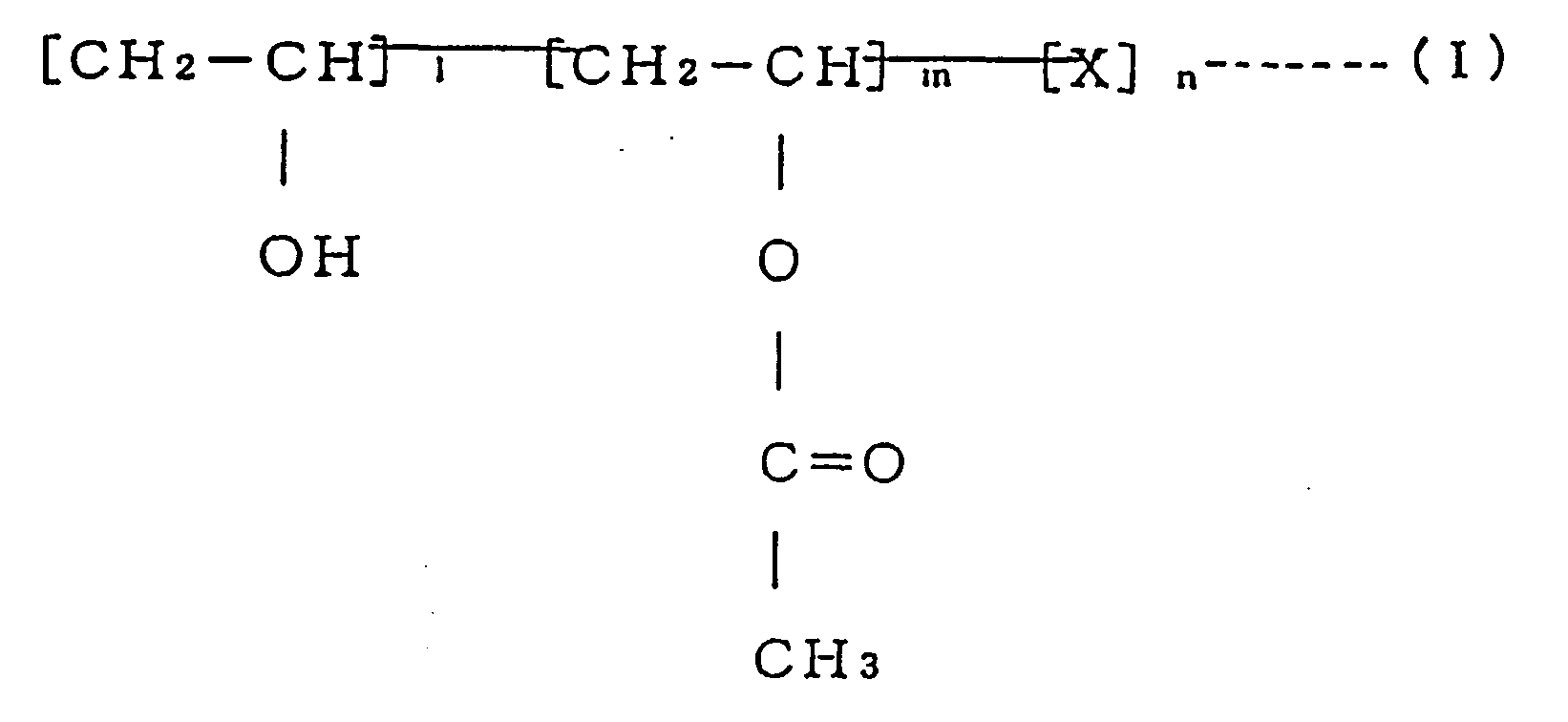
- In polyvinyl-alcohol polymer shown in formula (I), it may include either partial or entire saponificated compounds of poly-vinyl acetate and any copolymers of polyvinyl acetate with other monomer, and there is no limitation to the kind of co-monomer to be copolymerized with vinyl acetate.
In polyvinyl-alcohol compound shown in formula (I), "X" indicates copolymer being different from vinyl-acetate and vinyl-alcohol and "1", "m", and "n" indicates molecular number of vinyl-alcohol unit, vinyl-acetate unit, and additional polymer unit other than vinyl-acetate, respectively. In formula (I), [{n / (1 +m +n)} x 100] is desirable to be below 40 mole %, and more desirable to be below 30 mole %. Also, in polyvinyl-alcohol polymer shown in formula (I), [{m / (1 +m +n)} x 100] is desirable to be below 20 mole %, and more desirable to be below 10 mole %. In case of excessive mole ratio of the above, it may reduce water-solubility of the polyvinyl-alcohol. Regarding a value of [{ 1 / (1 +m +n)} x 100], it may results as 40~100 mole % from both values of above. - Hydroxyl group in polyvinyl-alcohol polymer (c) may give to the second protective layer a water-proof property after cross linking reaction with additional copolymer unit and zirconium. And hydroxyl group being not participated such reaction give hydrophile properties to the second protective layer.
- For polyoxyethylene glycol (d) of the second protective layer, the average molecular weight is desirable between 6,000~1,000,00 0. The above polyoxyethylene glycol (d) becomes immobilized in the second protective layer by formation of polymeric complex compound with zirconium ion in the zirconium compound (f), and may show odor-preventing properties and hydrophile properties.
In case the average molecular weight of the polyoxyethylene glycol (d) is below 6,000, immobility in the second protective layer may decrease under wet condition, and a durable time of good odor-preventing properties and of good hydrophile properties may decrease. While in case the average molecular weight is over 1,000, 000, it becomes cost up for production of treatment liquid since it becomes difficult itself to dissolve into the water.
As for the vanadium compound (e) of the second protective layer in this invention, many sort of inorganic and organic vanadium compounds of any vanadium valence may be used, but it is more preferable to use tetravalent or pentavalent vanadium. Inorganic vanadium compounds such as metavanadic acid and vanadic acid and their salt of sodium, potassium, or ammonium, vanadium pentoxide, vanadium sulfate, vanadyl sulfate, vanadium nitrate, vanadyl nitrate, vanadium acetate and vanadium phosphate may be used. Also organic vanadium compounds such as vanadium acetylacetonate and vanadyl acetylacetonate may be used. - Vanadium in the second protective layer shows properties of resisting against pitting corrosion like the vanadium in the first protective layer. The effectiveness of vanadium is deemed with a self-remedy process, which is similar to chromate film. When a part of aluminum alloy may be corroded, vanadium may move from the film to the corroded portion and may form there a new strong film again and isolate the aluminum alloy from the corrosive matter. It is also deemed that it may produce some compounds in the second protective layer being difficult to dissolve in water, together with zirconium as mentioned later.
- As for the zirconium compound (f) in the second protective layer in this invention, following agent such as zirconium-ammonium carbonate, zirconium-potassium carbonate, zirconyl nitrate, zirconyl sulfate, zirconyl acetate, zircon hydrofluoric acid and its salt may be used.
- Zirconium in the second protective layer shows white-rust resistant effect similarly to the process of zirconium in the first protective layer by isolating the surface of aluminum alloy from external corrosive matter by formation of framework through cross-linking process between zirconium and hydroxyl group in polyvinyl-alcohol polymer (c).
- Also, zirconium has a role of building up some water insoluble compound with vanadium, making vanadium difficult to dissolve. For weight ratio of zirconium to vanadium, it is preferable between 40~350 %. In case below 40 %, vanadium may decrease its durability time of corrosion resistance. While in case over 350 %, it demerits economically. When the content of polyvinyl alcohol polymer (c) is 100 weight ratio in the treatment solution for the second protective layer in this invention, it may be preferable that the polyoxyethylene glycol (d) may be at 1 0~1000 weight ratio, vanadium compound (e) may be at 1~200 weight ratio in vanadium-ion and zirconium compound (f) may be at 0.4~700 weight ratio in zirconium-ion.
Further, for the second protective layer in this invention, it may include other additives (g), such as anti-microbial agent and mildew-preventing agent, cross-linking agent such as aqueous epoxy resin and surface-active agent in the allowable amount of not impairing the primary effect. - Anti-microbial agent and mildew preventing agent which are to be added to prevent foul odor from bacteria's propagation. The decomposition temperature of the anti-microbial agent and mildew-preventing agent is desirable to be at 100°C, and more preferable to be at 150°C in order to keep its effect to the said temperature.
- The contained weight of the anti-microbial agent and mildew preventing agent is desirable at 0.1~70 wt% to the total weight of (c)+(d) of the second protective layer, and more preferable at 0.3~50 wt % and further more preferable at 0.5~30 wt %. In case below 0.1 wt%, it becomes insufficient on effect, while exceeding 70 wt% it degrades waterproof property of the film.
- In this invention, cross linking agent is added in order to make the second protective layer to be a three dimensional structure through reaction with hydroxyl group in polyvinyl alcohol aqueous polymer (c) or with terminal hydroxyl group in polyoxyethylene glycol (d). It is desirable to use aldehyde as the cross-linking agent such as polyglycidyl compound, blocking isocyanate, polymethylol compound and glyoxal. These addition of cross linking agent may increase more waterproof properties on the second protective layer.
The content of the cross-linking agent is desirable at 0.1~70 wt% to the total content of (c)+(d). In case below 0.1 % wt%, it becomes insufficient the cross-linking effect, while exceeding 70 wt %, it is not desirable for weakening of film adhesion. - Many sort of surfactant may be added in order to make smooth the surface of the second protective layer. The content is preferable to be at 0.1~70 wt% to the total content of (c)+(d),and more preferable at 0.3~50 wt %, and further more preferable at 0.5~30 wt%. In case below 0.1 % wt %, it is difficult to obtain a clear effect, while exceeding 70 wt % it degrades the water proof property of the film.
- It is preferable that the film weight of the second protective layer in this invention may be at 30~5000 mg/m2, and more preferable at 40 ~3500 mg/m2, and further more preferable at 50~ 2500 mg/m2. In case below 30 mg/m2, corrosion resistance, hydrophile properties and odor-preventing properties become insufficient, while exceeding 5000 mg/m2 may be wasteful.
- It is preferable that the content of the vanadium compound in the second protective layer may be at 2~500 mg/m2 being calculated in vanadium element, and more preferable to be at 2~250 mg/m2 in vanadium element. Also zirconium compound may preferably be contained at 1~1750 mg/m2 being calculated in zirconium element, and is more preferable to be 1~875 mg/m2, wherein the weight ratio of zirconium to vanadium should be at 40~350 %.
In case when vanadium is below 2 mg/m2 or zirconium is below 1 mg/m2, the corrosion resistance may be decreased, however when vanadium exceeds 250 mg/m2 or zirconium exceeds 1750 mg/m2, it may be wasteful. - It is described the film formation method in this invention. First, the surface of the aluminum alloy thermal exchanger is chemically cleaned by using alkali cleaner or acid cleaner. Subsequently, the first protective layer is formed on the surface of the thermal exchanger through chemical conversion coating. And then it is coated with the treatment liquid containing (c) ~ (f) and other additives in order to form the second protective layer. Many coating method may be applied, however, it is generally used dipping method. After coating, it is preferable to dry it under a hot blast of 80~250°C and more preferably of 100~200°C.
- Aluminum alloy thermal exchanger of embodiment examples 1~9 and comparative examples 1~9 were used as specimens. After cleaning the surface, the first protective layer and the second protective layer were farmed. And then tests were carried on the specimens. However, for anti-microbial test, Al-Mn alloy sheets (JIS-A3004) of 70mm×150mm× 1.2mm were used.
- All specimens were cleaned by dipping into 3 wt% water solution of alkali degreasing agent ( Fine Cleaner 315(R) ; Nihon Parkerising Co.Ltd.) maintained at 60°C and kept for 90 seconds in order to remove such as grease away from the surface, and rinsed with fresh water. Then, dipped into 10 wt% of 10 % sulfuric acid at room temperature for 90 seconds, and rinsed with fresh water.
- The treatment solution used in formation of the first protective layer of the embodiment examples are shown in Table 1. And the treatment solutions used in formation of the first protective layer of the comparative examples are shown in Table 2. Followings are showing the agent used in (a) -①~(a) -③ and (b) -① ~ (b) -② of Table 1 and 2.
- (a) Water soluble vanadium compound
- -① vanadyl-acethylacetonate [(C6H7O2)2VO]
- -② vanadium-acethylacetonate [(C5H7O2)3V]
- -③ meta-vanadic acid ammonium [(NH4)VO3]
- (b) Fluoro zirconium complex compound
- -① zirconium hydrofluoride [H2ZrF6]
- -② zirconium-ammonium fluoride [(NH4)2ZrF6] .
-
- Fluorzirconium complex compound (b) were not used in comparative example 1 and 3.
- · Water soluble vanadium compound (a) was not used in comparative example 2.
- · Zirconium phosphate is applied for the first protective layer instead of the present invention in comparative example 9.
- After the formation of the first protective film, the specimens were dipped into the treatment solution in order to form the second protective film. Then the specimens were dried for 30 minutes in 150 °C. The composition of the element in the second protective film are shown in Table 1 and Table 2. The following is the agent used in (c)-① ~ (c) -② , (d)-①~(d)-②, (e)-①~(e)-②, (f)-①~(f)-③ and (g) of Table 1 and Table 2.
- (c) polyvinyl alcohol polymer
- -① saponificated polyvinyl alcohol (saponification degree: 90 mol%, molecular weight: 100 thousand)
- -② 5 mol% diketene treated polyvinyl alcohol (saponification degree: 90 mol%, molecular weight: 50 thousand)
- (d) polyoxyethylene glycol
- -① polyethylene glycol 20000 (average molecular weight: 20 thousand)
- -② polyethylene oxide(average molecular weight: 300 thousand)
- (e) vanadium compound
- -① sodium meta vanadate [NaVO3]
- -② ammonium meta vanadate [NH4V03]
- (f) zirconium compound
- -① zirconium hydrofluoriide [H2ZrF6]
- -② zirconium-ammonium fluoride [(NH4)2ZrF6]
- -③ zirconium ammonium carbonate [(NH4)2Zr(CO3)3]
- (g) additives (anti-microbial agent)
- -① sodium-2-pyridine-thiol-1-oxide (cross-linking agent)
- -② glycerol diglycidyl ether (aqueous epoxy cross-linking resin, surface active agent)
- -③ polyoxyethylenealcohol ether (non-ionic surfactant, HLB=12)
- The results of the test are explained in Table 1~Table 4.
- It was measured by using a fluorescent X-ray analyzer and a surface carbon analyzer.
- The salt spray test according to JID-Z-2371 were carried out for 24 hr, and observed the white rust occurrence at the fin of the thermal exchanger.
- ⊚
- :no white rust
- ○:
- white rust area below 10 %
- Δ :
- white rust area 10~30 %
- × :
- white rust area over 30 %
- After 72 hours dipping into flowing water at room temperature then 1 hour drying at 80°C, the contact angle of the fin portion of thermal exchanger with water was measured (using an image-processing contact angle meter Type CA-X; Kyowa Surface Chemistry Co.).
- After 72 hours dipping into flowing water at room temperature then 1 hour drying at 80°C, it was examined by smell.
- ○ :
- no odor
- Δ :
- a little odor
- × :
- clear odor
- Test specimens were dipped for 72 hr into a flowing water at room temperature, then the specimens were dried for 1 hr at 80 °C. The specimens were cut into the size of 4 cm×4 cm, then nutrient and microbe were sprayed on the cut samples, and then they were cultivated for 14 days at 30 ± 2°C. The number of extracting microbe from the cultivated mat was measured.
- ○ :
- the number of microbes < 102 /m2
- Δ:
- 102 /m2 ≦ the number of microbes<106 /m2
- × :
- the number of microbes ≧ 106/m2
- Microbes : Escherichia coli, Bacillus subtilis, Pseudomona aeruginosa
- Mildew : Aspergillus niger, Penicillium citrinum, Cladosporium cladosporides
- As seen from Table 1 and 3, the embodiment examples 1 ~ 9 of aluminum alloy thermal exchanger having the first protective layer and the second protective layer of this invention showed excellent corrosion resistance as well as excellent hydrophilicity and odor preventive property.
- Whereas in Table 2 and 4, comparative examples 1 ~ 3, which did not use vanadium compound (a) or fluoro-zirconium complex compound (b) for the first protective layer, they were inferior in corrosion resistance. In comparative example 4 which did not use aqueous polyvinyl-alcohol polymer (c), it was seen insufficient in corrosion resistance, hydrophilicity and odor preventive property. In comparative example 5 which did not use polyoxyethylene glycol (d), it was insufficient in hydrophilicity. Also, in comparative example 6 which did not use vanadium compound (e), it resulted inferior corrosion resistance. In comparative example 7 which did not use zirconium compound (f), it was inferior to corrosion resistance and to odor preventive property. It was also insufficient in corrosion resistance in comparative example 8 where the weight ratio of vanadium to zirconium is below 40 %. Further in comparative example 9 where zirconium phosphate is applied as the first protective layer instead of the present invention, corrosion resistance was unsatisfactory.
- According to the formation of the first protective layer and the second protective layer of this invention on the surface of alumin um alloy, it became possible to obtain aluminumalloy thermal exchanger of not containing any harmful chromium ion on its surface and having good corrosion resistance, good hydrophilicity, and excellent preventive capacity against odor for a long term.


Table 3 Embodytnent Example example Number corrosion resistance hydrophilic property by contact angle (') with water odor-preventing property anti-microbial property before contacting with water flow after 72hr contacting with water flow 1 ⊚ <5 20~25 ○ ○ 2 ⊚ <5 18~24 ○ ○ 3 ○ <5 21~27 ○ ○ 4 ○ <5 17~22 ○ ○ 5 ○ <5 15~19 ○ × 6 ⊚ <5 17~21 ○ ○ 7 ⊚ <5 15~20 ○ × 8 ⊚ <5 23~28 ○ ○ 9 ⊚ <5 19~26 ○ × example Number corrosion resistance hydrophilic property by contact angle (') with water odor-preventing property anti-microbial property before contacting with water flow after 72hr contacting with water flow 1 Δ <5 19~23 ○ ○ 2 Δ <5 22~26 ○ ○ 3 × <5 18~21 ○ ○ 4 × <5 41~52 × Δ 5 ○ 21~25 38~45 ○ × 6 Δ <5 15~20 ○ ○ 7 × <5 17~21 Δ × 8 Δ <5 20~24 ○ × 9 × <5 20~23 Δ ×
Claims (4)
- An aluminum alloy thermal exchanger,
having a first protective layer of a chemical conversion coating produced by using a treatment liquid containing substances (a) and (b) on the surface of the aluminum alloy, and further having a second protective layer, characterized in that said second protective layer consists of a hydrophilic film produced by applying a treatment liquid containing substances (c), (d), (e) and (f) wherein the weight of zirconium in (f) is 40 to 350 % by weight of the vanadium in (e), on the first protective layer and subsequent drying, wherein(a) = water soluble vanadium compound(b) = fluorozirconium complex compound(c) = aqueous polyvinyl alcohol polymer having a vinyl alcohol unit of more than 40 mol % and an additional polymerization unit (other than the vinyl alcohol unit indicated above) of less than 60 mol %(d) = polyoxyethylene glycol with an average molecular weight of 6,000 to 1,000,000(e) = vanadium compound(f) = zirconium compound. - The aluminum alloy thermal exchanger
according to claim 1,
characterized in that the water soluble vanadium compound (a) is one or more than one of organic compounds selected from the group of vanadium acetyl acetonate and vanadyl acetyl acetonate. - The aluminum alloy thermal exchanger
according to claim 1,
characterized in that the weight of the first protective film is 10 to 2000 mg/m2, the vanadium in the first protective film is 2 to 500 mg/m2 and the zirconium in the first protective film is 2 to 500 mg/m2. - The aluminum alloy thermal exchanger
according to claim 1,
characterized in that the weight of the second protective film is 30 to 5000 mg/m2, the vanadium in the second protective film is 2 to 500 mg/m2 and the zirconium in the second protective film is 1 to 1750 mg/m2.
Applications Claiming Priority (3)
| Application Number | Priority Date | Filing Date | Title |
|---|---|---|---|
| JP15783399 | 1999-06-04 | ||
| JP15783399A JP4008620B2 (en) | 1999-06-04 | 1999-06-04 | Aluminum alloy heat exchanger |
| PCT/JP2000/003529 WO2000075397A1 (en) | 1999-06-04 | 2000-06-01 | Heat exchanger made of aluminum alloy |
Publications (3)
| Publication Number | Publication Date |
|---|---|
| EP1201788A1 EP1201788A1 (en) | 2002-05-02 |
| EP1201788A4 EP1201788A4 (en) | 2005-06-01 |
| EP1201788B1 true EP1201788B1 (en) | 2006-08-16 |
Family
ID=15658338
Family Applications (1)
| Application Number | Title | Priority Date | Filing Date |
|---|---|---|---|
| EP00935514A Expired - Lifetime EP1201788B1 (en) | 1999-06-04 | 2000-06-01 | Heat exchanger made of aluminum alloy |
Country Status (11)
| Country | Link |
|---|---|
| US (1) | US6869677B1 (en) |
| EP (1) | EP1201788B1 (en) |
| JP (1) | JP4008620B2 (en) |
| KR (1) | KR100706972B1 (en) |
| CN (1) | CN1239744C (en) |
| AU (1) | AU760097B2 (en) |
| BR (1) | BR0011081A (en) |
| DE (1) | DE60030130T2 (en) |
| MY (1) | MY133514A (en) |
| TW (1) | TW452641B (en) |
| WO (1) | WO2000075397A1 (en) |
Cited By (1)
| Publication number | Priority date | Publication date | Assignee | Title |
|---|---|---|---|---|
| DE102017206940A1 (en) * | 2017-04-25 | 2018-10-25 | Mahle International Gmbh | Method for producing a heat exchanger |
Families Citing this family (29)
| Publication number | Priority date | Publication date | Assignee | Title |
|---|---|---|---|---|
| WO2002028549A1 (en) * | 2000-10-02 | 2002-04-11 | Henkel Kommanditgesellschaft Auf Aktien | Process for coating metal surfaces |
| DE10122329B4 (en) * | 2001-05-08 | 2004-06-03 | Tinox Gmbh | Heat exchanger device with a surface-coated wall that separates medium 1 from medium 2 |
| KR20040051030A (en) * | 2002-12-11 | 2004-06-18 | 엘지전자 주식회사 | Apparatus for preventing corrosion of condenser in air conditioner |
| DE10355833A1 (en) * | 2003-11-26 | 2005-06-23 | Behr Gmbh & Co. Kg | heat exchangers |
| DE10358310A1 (en) * | 2003-12-11 | 2005-07-21 | Henkel Kgaa | Two-stage conversion treatment |
| KR100727181B1 (en) * | 2004-07-13 | 2007-06-13 | 현대자동차주식회사 | Hydrophilic Antimicrobial Composition for Automobile Air Conditioner Evaporator |
| FR2873797B1 (en) | 2004-07-30 | 2006-11-24 | Valeo Climatisation Sa | METHOD FOR MANUFACTURING A HEAT EXCHANGER HAVING SURFACE TREATMENT, AND HEAT EXCHANGER THUS OBTAINED |
| JP4667978B2 (en) * | 2005-06-29 | 2011-04-13 | 古河スカイ株式会社 | Aluminum painted plate and pre-coated aluminum fin material |
| US20100087873A1 (en) * | 2008-10-06 | 2010-04-08 | Warsaw Orthopedics, Inc. | Surgical Connectors for Attaching an Elongated Member to a Bone |
| CN102292404B (en) | 2009-01-21 | 2015-04-01 | 日本帕卡濑精株式会社 | Hydrophilizing agent for aluminum-containing metal material, hydrophilizing method, and hydrophilized aluminum-containing metal material |
| US20100243108A1 (en) * | 2009-03-31 | 2010-09-30 | Ppg Industries Ohio, Inc. | Method for treating and/or coating a substrate with non-chrome materials |
| JP5663174B2 (en) * | 2010-02-15 | 2015-02-04 | 日本パーカライジング株式会社 | Aluminum or aluminum alloy material having surface treatment film and surface treatment method thereof |
| JP5537233B2 (en) * | 2010-03-31 | 2014-07-02 | 日本ペイント株式会社 | Corrosion-resistant treatment method for aluminum heat exchanger |
| US9347134B2 (en) | 2010-06-04 | 2016-05-24 | Prc-Desoto International, Inc. | Corrosion resistant metallate compositions |
| CN102560491A (en) * | 2010-12-30 | 2012-07-11 | 鸿富锦精密工业(深圳)有限公司 | Aluminium and aluminium alloy surface antiseptic treatment method and product prepared by same |
| JP5827053B2 (en) * | 2011-07-15 | 2015-12-02 | 日本パーカライジング株式会社 | Water-based metal surface treatment agent and metal material treated with the treatment agent |
| JP6184051B2 (en) | 2011-09-21 | 2017-08-23 | 日本ペイント・サーフケミカルズ株式会社 | Surface treatment method for aluminum heat exchanger |
| JP6265579B2 (en) * | 2011-09-30 | 2018-01-24 | 日本ペイント・サーフケミカルズ株式会社 | Surface treatment agent for aluminum heat exchanger and surface treatment method |
| CN104271800A (en) | 2012-03-09 | 2015-01-07 | 日本油漆株式会社 | Surface treatment method of aluminum heat exchanger |
| JP6146954B2 (en) | 2012-03-09 | 2017-06-14 | 日本ペイント・サーフケミカルズ株式会社 | Chemical conversion treatment agent and chemical conversion treatment film |
| CN103084321B (en) * | 2013-01-19 | 2015-01-28 | 大连理工大学 | Preparation process for nanometer perfluorocarbon composite coating |
| US9896766B2 (en) | 2013-04-03 | 2018-02-20 | Nippon Paint Surf Chemicals Co., Ltd. | Surface processing method for aluminum heat exchanger |
| JP6055085B2 (en) | 2013-04-03 | 2016-12-27 | 日本ペイント・サーフケミカルズ株式会社 | Chemical conversion treatment agent and metal surface treatment method |
| KR101626212B1 (en) * | 2014-10-15 | 2016-06-13 | 강남제비스코 주식회사 | The enhancer of hydrophilicity for a heat exchanger containing aluminium |
| JP6732644B2 (en) * | 2016-12-02 | 2020-07-29 | 日本ペイント・サーフケミカルズ株式会社 | Heat exchanger and method for hydrophilizing heat exchanger |
| US11293104B2 (en) * | 2017-06-27 | 2022-04-05 | Bulk Chemicals, Inc. | Inorganic non-chrome aqueous treatment composition and process for coating metal surfaces |
| CN107829081A (en) * | 2017-11-07 | 2018-03-23 | 北京安邦之星科技有限公司 | A kind of special passivation film agent of aluminum products and preparation method thereof |
| EP4592428A3 (en) | 2020-08-27 | 2025-11-12 | Carrier Corporation | Methods of anodizing the internal surface of heat transfer tubes |
| JP7720160B2 (en) * | 2021-03-30 | 2025-08-07 | 日本パーカライジング株式会社 | Surface treatment agent for aluminum-containing metal materials |
Family Cites Families (11)
| Publication number | Priority date | Publication date | Assignee | Title |
|---|---|---|---|---|
| DE2905535A1 (en) * | 1979-02-14 | 1980-09-04 | Metallgesellschaft Ag | METHOD FOR SURFACE TREATMENT OF METALS |
| JP2523114B2 (en) | 1986-12-29 | 1996-08-07 | 日本パ−カライジング株式会社 | Method for hydrophilic treatment of aluminum |
| JPH0788588B2 (en) | 1988-02-15 | 1995-09-27 | 日本ペイント株式会社 | Surface treatment agent and treatment bath for aluminum or its alloys |
| JP2506924B2 (en) | 1988-04-20 | 1996-06-12 | 日本パーカライジング株式会社 | Aluminum heat exchanger |
| JPH01306575A (en) * | 1988-06-06 | 1989-12-11 | Mitsubishi Alum Co Ltd | Aluminum or aluminum alloy material having corrosion resistant laminated coating film |
| JPH0272969A (en) * | 1988-09-09 | 1990-03-13 | Hitachi Ltd | Thick-film type thermal recording head |
| JPH06116527A (en) | 1992-10-07 | 1994-04-26 | Nippon Light Metal Co Ltd | Surface treatment that imparts hydrophilicity to the surface of aluminum materials |
| US5538078A (en) * | 1994-04-08 | 1996-07-23 | Nippondenso Co., Ltd. | Aluminum-containing metal composite material and process for producing same |
| GB2295828B (en) * | 1994-12-07 | 1997-05-28 | Nihon Parkerizing | Aqueous hydrophililzation treatment composition and method for aluminum-containing metal material |
| JPH09178392A (en) * | 1995-12-22 | 1997-07-11 | Showa Alum Corp | Method for manufacturing aluminum heat exchanger with excellent corrosion resistance |
| TWI221861B (en) * | 1998-04-22 | 2004-10-11 | Toyo Boseki | Agent for treating metallic surface, surface-treated metal material and coated metal material |
-
1999
- 1999-06-04 JP JP15783399A patent/JP4008620B2/en not_active Expired - Lifetime
-
2000
- 2000-06-01 US US09/980,490 patent/US6869677B1/en not_active Expired - Lifetime
- 2000-06-01 KR KR1020017015583A patent/KR100706972B1/en not_active Expired - Fee Related
- 2000-06-01 AU AU51038/00A patent/AU760097B2/en not_active Ceased
- 2000-06-01 BR BR0011081-7A patent/BR0011081A/en not_active IP Right Cessation
- 2000-06-01 EP EP00935514A patent/EP1201788B1/en not_active Expired - Lifetime
- 2000-06-01 CN CNB008083959A patent/CN1239744C/en not_active Expired - Lifetime
- 2000-06-01 WO PCT/JP2000/003529 patent/WO2000075397A1/en not_active Ceased
- 2000-06-01 DE DE60030130T patent/DE60030130T2/en not_active Expired - Lifetime
- 2000-06-02 TW TW089110826A patent/TW452641B/en not_active IP Right Cessation
- 2000-06-05 MY MYPI20002519 patent/MY133514A/en unknown
Cited By (1)
| Publication number | Priority date | Publication date | Assignee | Title |
|---|---|---|---|---|
| DE102017206940A1 (en) * | 2017-04-25 | 2018-10-25 | Mahle International Gmbh | Method for producing a heat exchanger |
Also Published As
| Publication number | Publication date |
|---|---|
| KR100706972B1 (en) | 2007-04-13 |
| AU760097B2 (en) | 2003-05-08 |
| BR0011081A (en) | 2002-03-19 |
| EP1201788A1 (en) | 2002-05-02 |
| EP1201788A4 (en) | 2005-06-01 |
| US6869677B1 (en) | 2005-03-22 |
| TW452641B (en) | 2001-09-01 |
| CN1239744C (en) | 2006-02-01 |
| DE60030130D1 (en) | 2006-09-28 |
| KR20020013570A (en) | 2002-02-20 |
| AU5103800A (en) | 2000-12-28 |
| JP2000345362A (en) | 2000-12-12 |
| DE60030130T2 (en) | 2007-03-15 |
| JP4008620B2 (en) | 2007-11-14 |
| WO2000075397A1 (en) | 2000-12-14 |
| MY133514A (en) | 2007-11-30 |
| CN1353776A (en) | 2002-06-12 |
Similar Documents
| Publication | Publication Date | Title |
|---|---|---|
| US6869677B1 (en) | Heat exchanger made of aluminum alloy | |
| KR100620296B1 (en) | Non-chrome anti-rust agent for aluminum, anti-rust treatment method and anti-rust treated aluminum product | |
| JP2520308B2 (en) | Hydrophilic surface treatment agent, hydrophilic surface treatment bath, and surface treatment method for aluminum material | |
| US4954372A (en) | Metal surface hydrophilicizing process and composition | |
| US9139913B2 (en) | Anti-corrosion treatment method for aluminum heat exchanger | |
| EP1245622B1 (en) | Hydrophilic modification method and heat exchanger treated thereby | |
| EP0623653A2 (en) | Aqueous polyoxyalkylene surface treating solutions | |
| EP1447460B1 (en) | Rust prevention coating agent and method of rust-proofing | |
| JP4102028B2 (en) | Metal material hydrophilization treatment agent, hydrophilization treatment liquid, hydrophilization treatment method, metal material, and heat exchanger | |
| JPWO2000022188A1 (en) | Hydrophilic treatment agent for metal materials, hydrophilic treatment solution, hydrophilic treatment method, metal material, and heat exchanger | |
| JP3877264B2 (en) | Method for manufacturing aluminum fin material and aluminum fin material manufactured by this method | |
| CN100392341C (en) | Method for producing aluminum heat sink material and aluminum heat sink material produced by the method | |
| JP2574197B2 (en) | Hydrophilizing surface treatment agent for aluminum heat exchanger and hydrophilizing surface treatment method | |
| KR100503118B1 (en) | Aluminum surface treatment agent, teratment method, and terated aluminum | |
| JPH086063B2 (en) | Hydrophilic surface treatment agent and treatment method | |
| JPH086064B2 (en) | Hydrophilic surface treatment agent and treatment method | |
| JP2780250B2 (en) | Hydrophilic surface treatment agent, hydrophilic surface treatment bath and surface treatment method for aluminum material |
Legal Events
| Date | Code | Title | Description |
|---|---|---|---|
| PUAI | Public reference made under article 153(3) epc to a published international application that has entered the european phase |
Free format text: ORIGINAL CODE: 0009012 |
|
| 17P | Request for examination filed |
Effective date: 20011204 |
|
| AK | Designated contracting states |
Kind code of ref document: A1 Designated state(s): AT BE CH CY DE DK ES FI FR GB GR IE IT LI LU MC NL PT SE |
|
| AX | Request for extension of the european patent |
Free format text: LT;RO;SI |
|
| RBV | Designated contracting states (corrected) |
Designated state(s): DE FR GB IT |
|
| A4 | Supplementary search report drawn up and despatched |
Effective date: 20050420 |
|
| RIC1 | Information provided on ipc code assigned before grant |
Ipc: 7F 28F 13/18 B Ipc: 7C 23C 22/83 B Ipc: 7F 28F 19/00 B Ipc: 7C 23C 22/40 B Ipc: 7C 23C 22/73 B Ipc: 7F 28F 19/06 B Ipc: 7F 28F 19/02 B Ipc: 7F 28F 19/04 B Ipc: 7C 23C 22/34 B Ipc: 7C 23C 22/00 A Ipc: 7C 23C 22/44 B |
|
| GRAP | Despatch of communication of intention to grant a patent |
Free format text: ORIGINAL CODE: EPIDOSNIGR1 |
|
| GRAS | Grant fee paid |
Free format text: ORIGINAL CODE: EPIDOSNIGR3 |
|
| RIN1 | Information on inventor provided before grant (corrected) |
Inventor name: NAKADA, KAZUYA,NIHON PARKERIZING CO., LTD. Inventor name: YAMAZAKI, ETSUKO,CALSONIC KANSEI CORP. Inventor name: YOSIDA, CHIZUKO,CALSONIC KANSEI CORP. Inventor name: UEHARA, TOSHIYUKI,CALSONIC KANSEI CORP. |
|
| RAP1 | Party data changed (applicant data changed or rights of an application transferred) |
Owner name: NIHON PARKERIZING CO., LTD. Owner name: CALSONIC KANSEI CORP. |
|
| GRAA | (expected) grant |
Free format text: ORIGINAL CODE: 0009210 |
|
| AK | Designated contracting states |
Kind code of ref document: B1 Designated state(s): DE FR GB IT |
|
| PG25 | Lapsed in a contracting state [announced via postgrant information from national office to epo] |
Ref country code: IT Free format text: LAPSE BECAUSE OF FAILURE TO SUBMIT A TRANSLATION OF THE DESCRIPTION OR TO PAY THE FEE WITHIN THE PRESCRIBED TIME-LIMIT;WARNING: LAPSES OF ITALIAN PATENTS WITH EFFECTIVE DATE BEFORE 2007 MAY HAVE OCCURRED AT ANY TIME BEFORE 2007. THE CORRECT EFFECTIVE DATE MAY BE DIFFERENT FROM THE ONE RECORDED. Effective date: 20060816 |
|
| REG | Reference to a national code |
Ref country code: GB Ref legal event code: FG4D |
|
| REF | Corresponds to: |
Ref document number: 60030130 Country of ref document: DE Date of ref document: 20060928 Kind code of ref document: P |
|
| ET | Fr: translation filed | ||
| PLBE | No opposition filed within time limit |
Free format text: ORIGINAL CODE: 0009261 |
|
| STAA | Information on the status of an ep patent application or granted ep patent |
Free format text: STATUS: NO OPPOSITION FILED WITHIN TIME LIMIT |
|
| 26N | No opposition filed |
Effective date: 20070518 |
|
| PGFP | Annual fee paid to national office [announced via postgrant information from national office to epo] |
Ref country code: GB Payment date: 20140528 Year of fee payment: 15 |
|
| GBPC | Gb: european patent ceased through non-payment of renewal fee |
Effective date: 20150601 |
|
| PG25 | Lapsed in a contracting state [announced via postgrant information from national office to epo] |
Ref country code: GB Free format text: LAPSE BECAUSE OF NON-PAYMENT OF DUE FEES Effective date: 20150601 |
|
| REG | Reference to a national code |
Ref country code: FR Ref legal event code: PLFP Year of fee payment: 17 |
|
| REG | Reference to a national code |
Ref country code: FR Ref legal event code: PLFP Year of fee payment: 18 |
|
| PGFP | Annual fee paid to national office [announced via postgrant information from national office to epo] |
Ref country code: DE Payment date: 20170523 Year of fee payment: 18 |
|
| REG | Reference to a national code |
Ref country code: FR Ref legal event code: PLFP Year of fee payment: 19 |
|
| REG | Reference to a national code |
Ref country code: DE Ref legal event code: R119 Ref document number: 60030130 Country of ref document: DE |
|
| PG25 | Lapsed in a contracting state [announced via postgrant information from national office to epo] |
Ref country code: DE Free format text: LAPSE BECAUSE OF NON-PAYMENT OF DUE FEES Effective date: 20190101 |
|
| PGFP | Annual fee paid to national office [announced via postgrant information from national office to epo] |
Ref country code: FR Payment date: 20190510 Year of fee payment: 20 |