EP1201132A1 - Fermented milk drinks and foods and process for producing the same - Google Patents
Fermented milk drinks and foods and process for producing the same Download PDFInfo
- Publication number
- EP1201132A1 EP1201132A1 EP00948307A EP00948307A EP1201132A1 EP 1201132 A1 EP1201132 A1 EP 1201132A1 EP 00948307 A EP00948307 A EP 00948307A EP 00948307 A EP00948307 A EP 00948307A EP 1201132 A1 EP1201132 A1 EP 1201132A1
- Authority
- EP
- European Patent Office
- Prior art keywords
- lactic acid
- acid bacteria
- fermented milk
- lactobacillus
- extract
- Prior art date
- Legal status (The legal status is an assumption and is not a legal conclusion. Google has not performed a legal analysis and makes no representation as to the accuracy of the status listed.)
- Granted
Links
Images


Classifications
-
- A—HUMAN NECESSITIES
- A23—FOODS OR FOODSTUFFS; TREATMENT THEREOF, NOT COVERED BY OTHER CLASSES
- A23C—DAIRY PRODUCTS, e.g. MILK, BUTTER OR CHEESE; MILK OR CHEESE SUBSTITUTES; PREPARATION THEREOF
- A23C9/00—Milk preparations; Milk powder or milk powder preparations
- A23C9/12—Fermented milk preparations; Treatment using microorganisms or enzymes
- A23C9/123—Fermented milk preparations; Treatment using microorganisms or enzymes using only microorganisms of the genus lactobacteriaceae; Yoghurt
-
- A—HUMAN NECESSITIES
- A23—FOODS OR FOODSTUFFS; TREATMENT THEREOF, NOT COVERED BY OTHER CLASSES
- A23C—DAIRY PRODUCTS, e.g. MILK, BUTTER OR CHEESE; MILK OR CHEESE SUBSTITUTES; PREPARATION THEREOF
- A23C9/00—Milk preparations; Milk powder or milk powder preparations
- A23C9/12—Fermented milk preparations; Treatment using microorganisms or enzymes
- A23C9/13—Fermented milk preparations; Treatment using microorganisms or enzymes using additives
- A23C9/1315—Non-milk proteins or fats; Seeds, pulses, cereals or soja; Fatty acids, phospholipids, mono- or diglycerides or derivatives therefrom; Egg products
-
- A—HUMAN NECESSITIES
- A23—FOODS OR FOODSTUFFS; TREATMENT THEREOF, NOT COVERED BY OTHER CLASSES
- A23C—DAIRY PRODUCTS, e.g. MILK, BUTTER OR CHEESE; MILK OR CHEESE SUBSTITUTES; PREPARATION THEREOF
- A23C9/00—Milk preparations; Milk powder or milk powder preparations
- A23C9/12—Fermented milk preparations; Treatment using microorganisms or enzymes
- A23C9/13—Fermented milk preparations; Treatment using microorganisms or enzymes using additives
- A23C9/1307—Milk products or derivatives; Fruit or vegetable juices; Sugars, sugar alcohols, sweeteners; Oligosaccharides; Organic acids or salts thereof or acidifying agents; Flavours, dyes or pigments; Inert or aerosol gases; Carbonation methods
-
- A—HUMAN NECESSITIES
- A23—FOODS OR FOODSTUFFS; TREATMENT THEREOF, NOT COVERED BY OTHER CLASSES
- A23C—DAIRY PRODUCTS, e.g. MILK, BUTTER OR CHEESE; MILK OR CHEESE SUBSTITUTES; PREPARATION THEREOF
- A23C9/00—Milk preparations; Milk powder or milk powder preparations
- A23C9/12—Fermented milk preparations; Treatment using microorganisms or enzymes
- A23C9/13—Fermented milk preparations; Treatment using microorganisms or enzymes using additives
- A23C9/137—Thickening substances
-
- A—HUMAN NECESSITIES
- A61—MEDICAL OR VETERINARY SCIENCE; HYGIENE
- A61P—SPECIFIC THERAPEUTIC ACTIVITY OF CHEMICAL COMPOUNDS OR MEDICINAL PREPARATIONS
- A61P31/00—Antiinfectives, i.e. antibiotics, antiseptics, chemotherapeutics
- A61P31/04—Antibacterial agents
-
- C—CHEMISTRY; METALLURGY
- C12—BIOCHEMISTRY; BEER; SPIRITS; WINE; VINEGAR; MICROBIOLOGY; ENZYMOLOGY; MUTATION OR GENETIC ENGINEERING
- C12N—MICROORGANISMS OR ENZYMES; COMPOSITIONS THEREOF; PROPAGATING, PRESERVING, OR MAINTAINING MICROORGANISMS; MUTATION OR GENETIC ENGINEERING; CULTURE MEDIA
- C12N1/00—Microorganisms; Compositions thereof; Processes of propagating, maintaining or preserving microorganisms or compositions thereof; Processes of preparing or isolating a composition containing a microorganism; Culture media therefor
- C12N1/38—Chemical stimulation of growth or activity by addition of chemical compounds which are not essential growth factors; Stimulation of growth by removal of a chemical compound
-
- A—HUMAN NECESSITIES
- A23—FOODS OR FOODSTUFFS; TREATMENT THEREOF, NOT COVERED BY OTHER CLASSES
- A23V—INDEXING SCHEME RELATING TO FOODS, FOODSTUFFS OR NON-ALCOHOLIC BEVERAGES AND LACTIC OR PROPIONIC ACID BACTERIA USED IN FOODSTUFFS OR FOOD PREPARATION
- A23V2400/00—Lactic or propionic acid bacteria
- A23V2400/11—Lactobacillus
- A23V2400/125—Casei
Definitions
- This invention relates to fermented milks, each of which contains a fermented milk ingredient and a lactic acid bacteria growth factor selected from specific compounds, and also to processes for the production of the fermented milks.
- Fermented milks such as fermented milk drinks, lactic acid bacteria beverages, yoghurt, cultured milks and cheese, are often produced by providing animal milks, such as cow milk, goat milk, horse milk and the like, as culture media and fermenting them with lactic acid bacteria.
- animal milks such as cow milk, goat milk, horse milk and the like
- culture media such as culture media composed solely of animal milks.
- culture media composed of animal milks alone are considered to require continued cultivation over several days if fermented milk ingredients having acidity sufficient for use in the production of fermented milks are desired.
- fermented milks making use of fermented milk of the viable cell type such as yoghurt
- fermented milks making use of fermented milk of the viable cell type are extensively consumed as health-promoting foods having physiological effects such as intestinal function controlling effect and immunopotentiating effect.
- physiological effects such as intestinal function controlling effect and immunopotentiating effect.
- the flavor of a fermentation product is of importance for a fermented milk. This makes it impossible to choose a bacterial strain from the viewpoint of proliferability alone, and on the contrary, a bacterial strain may have to be selected for its ability to give fermentation products of good flavor despite its poor proliferability.
- growth promoting substances In the cultivation of lactic acid bacteria, it is therefore common practice to add one or more of various growth promoting substances to a culture medium in order to improve the efficiency of the cultivation.
- growth promoting substances or those confirmed to be effective for the promotion of growth include Chlorella extract, iron salts, vitamins, proteolysates containing amino acids and peptides, and yeast extract. They are used for the above-mentioned purpose.
- lactic acid bacteria For the retention of the usefulness of lactic acid bacteria, it is necessary not only to promote its growth but also to inhibit death of its cells and further, is required to maintain a high viable cell count in the final product during storage. A marked reduction is observed in the viability of lactic acid bacteria especially when a low-fat fermented milk such as low-fat yoghurt is produced using skim milk powder or when lactic acid fermentation proceeds excessively. This problem becomes more serious when low-calorie fermented milks or low-pH fermented milks are produced. With a view to maintaining such viable cell counts, substances such as Chlorella are added these days.
- An object of the present invention is therefore to find out a novel growth-promoting or viability-improving substance which is free of a problem with flavor and, when simply added, can increase the viable cell count of lactic acid bacteria and can also maintain the viable cell count in the final product, and further to provide a fermented milk which makes use of the substance to maintain as many cells of the lactic acid bacteria as possible in a viable state and also to keep high the activity (acid producing ability) of the cells.
- the present inventors have proceeded with extensive screening for substances having the property of achieving growth promotion in and improving the viability of lactic acid bacteria.
- extracts of ginger, tea and green onion as well as oleic acid and derivatives thereof have the above-mentioned property and also that their use in the preparation of fermented milks cause no problem with flavor, leading to the completion of the present invention.
- the present invention therefore provides a fermented milk comprising a fermented milk ingredient obtained by lactic acid fermentation and a lactic acid bacteria growth factor selected from ginger extract, tea extract, green onion extract, or oleic acid or a derivative thereof.
- the present invention also provides a process for the production of a fermented milk, which comprises culturing lactic acid bacteria in a culture medium in which one or more lactic acid bacteria growth factors selected from ginger extract, tea extract, green onion extract, and oleic acid and derivatives thereof is contained.
- FIG. 1 is a plot of the relationship between concentration of added sodium oleate and viable cell count upon completion of cultivation of lactic acid bacteria; and FIG. 2 is a plot of the relationship between number of stored days and viable cell count of the lactic acid bacteria.
- fermented milks as used herein embraces drinks such as fermented milk and fermented drinks of lactic acid bacteria as specified in the Ordinance of the Ministry of Health and Welfare, the Government of Japan on Milk and Related Products; and hard yoghurt, soft yoghurt and plain yoghurt, and further kefir, cheese and the like.
- lactic acid bacteria growth factor means a substance which can promote growth of lactic acid bacteria to increase its viable cell count upon cultivation and further can heighten the viability of the lactic acid bacteria to maintain its viable cell count subsequent to formation of a fermented milk, which has been obtained by the fermentation, into a final product.
- the fermented milk according to the present invention is only required to contain a lactic acid bacteria growth factor, which is selected from ginger extract, tea extract or green onion extract, or oleic acid or a derivative thereof, in a fermented milk ingredient obtained by lactic acid fermentation. It is preferred to add the lactic acid bacteria growth factor before the lactic acid fermentation, although no limitation is imposed on the time of its addition. It can therefore be added in the course of the lactic acid fermentation or after completion of the lactic acid fermentation. Further, the lactic acid bacteria growth factor may be added in portions.
- a lactic acid bacteria growth factor which is selected from ginger extract, tea extract or green onion extract, or oleic acid or a derivative thereof
- the ginger extract means an extract obtained by extracting ginger, as it is or after subjecting it to processing such as peeling and/or crushing, in an organic solvent such as ethanol, ethyl acetate, glycerin or propylene glycol or a mixed solvent thereof.
- the tea extract means an extract of tea obtained by processing leaves of tea plant which is an evergreen shrub of genus Camellia, namely, an extract of non-fermented tea, half-fermented tea or fermented tea, specifically an extract obtained by extracting green tea, black tea, oolong tea, jasmine tea or the like in water or in an organic solvent such as ethanol, ethyl acetate, glycerin or propylene glycol or a mixed solvent thereof.
- an organic solvent such as ethanol, ethyl acetate, glycerin or propylene glycol or a mixed solvent thereof.
- the green onion extract means an extract obtained by extracting green onion, as it is or after subjecting it to processing such as chopping or crushing, in water or in an organic solvent such as ethanol, ethyl acetate, glycerin or propylene glycol or a mixed solvent thereof.
- the green onion which is provided for the extraction may be either deep-planted green onion ( Nebuka green onion) - only a white part of a leaf sheath of which, said white part being called "root” in general, is edible - or leaf green onion ( Ha green onion) a green part of which is also edible.
- water especially a water-base acidic solvent is preferred.
- Use of a water-base acidic solvent is considered to result in extraction of a great deal of trace components (substances) which are contained in the extractive and are believed to have growth promoting effect for lactic acid bacteria.
- An extract available from the use of such a water-base acidic solvent can bring about excellent growth promoting effect, so that its influence to the flavor can be minimized.
- water-base solvents such as water and water-alcohol are preferred. It is particularly preferred to conduct the extraction by using a water-base solvent of a pH not higher than 4.0.
- an acid for use in this acid extraction insofar as it is employed in foods Illustrative of the acid are citric acid, malic acid, tartaric acid, succinic acid, lactic acid, and acetic acid.
- conditions for the extraction but it is preferred to extract at 60°C or higher but 120°C or lower, preferably at 80°C or higher but 100°C or lower for 30 to 60 minutes.
- tea extracts and green onion extract available as described above, tea extracts are preferred for their high growth promoting effect on lactic acid bacteria, with oolong tea extract being particularly preferred. These extracts can be used either singly or in combination. When plural ones of the extracts are combined, they may be mixed together after they are obtained separately, or two or more of ginger, tea and green onion are mixed together, followed by extraction.
- solutions immediately after extraction can be used as they are.
- they can also be used in the form of concentrated extracts obtained by a method such as ultrafiltration or centrifugation or in the form of powdery extracts obtained by drying such as spray drying or lyophilization.
- oleic acid or its derivative (hereinafter called “oleic acid or the like") out of the lactic acid bacteria growth factors usable in the present invention.
- Illustrative are, in addition to free oleic acid and inorganic salts of oleic acid, sucrose esters, glycerides, sorbitan esters propylene glycol esters and the like, which are widely used as emulsifiers and contain oleic acid as their fatty acid moieties.
- Specific examples can include sodium oleate, potassium oleate, glyceryl oleate, polyglyceryl oleate, sorbitan oleate, propylene glycol oleate, and sucrose oleate.
- monoglyceryl oleate and polyglyceryl monooleate are preferred as they are highly effective for increasing the viable cell count at the end of cultivation and also improving the viability of the cells.
- Sucrose oleate and the like are also preferred from the standpoint of physical properties such as solubility.
- These lactic acid bacteria growth factors can be used either singly or in combination.
- a food material which contains a great deal of oleic acid or the like can also be used as a substitute for the growth factor. It is however to be noted that even among those containing oleic acid in their structures, those containing it in a form such as lysolecithin may not be able to bring about the advantageous effect of maintaining the count and activity of viable cells in the fermented milk according to the present invention.
- the amount of the lactic acid bacteria growth factor which is selected from ginger extract, tea extract or green onion extract or oleic acid or a derivative thereof, to be added to the fermented milk ingredient varies depending on the kind of the lactic acid bacteria growth factor to be used, the strain of lactic acid bacteria to be used, the kind of the culture medium to be used, the application purpose of the cultured product, and so on. It is therefore desired to empirically determine its amount.
- the extract or the like in the case of ginger extract, tea extract or green onion extract (hereinafter called “the extract or the like"), for example, it is preferred to add it as an extract of 10% soluble solids (Brix 10°) in an amount of from about 0.02 wt.% to 2.0 wt.% (hereinafter simply referred to as "%"), notably from about 0.1% to 1.0% provided that the extract is obtained using hot water.
- % soluble solids
- An amount greater than 2.0% are not expected to bring about additional growth promoting effect and, when various drinks or foods are produced using the culture, may more or less affect their flavors.
- An amount smaller than 0.0 2% leads to a some reduction in the growth promoting effect.
- an extract obtained by acid extraction it is preferred to add it as an extract of 10% soluble solids (Brix 10°) in an amount of from about 0.01% to 2.0%, notably from about 0.05% to 1.0% for similar reasons as mentioned above.
- An acid-extracted extract has high growth promoting effect, and can show excellent effect even when added in half the amount of the hot water extract.
- oleic acid or the like may preferably be added in an amount such that the final concentration after formation into a final product ranges from 15 ⁇ g/mL to 60 ⁇ g/mL, especially from 15 ⁇ g/mL to 40 ⁇ g/mL in terms of oleic acid.
- An amount smaller than 5 ⁇ g/mL leads to weak effect for the prevention of death of cells after formation into the final product, while an amount greater than 60 ⁇ g/mL gives rise to problems in that the product cost increases and the content of fat in the final product also increases, and further results in a reduced growth rate of cells.
- the fermented milk ingredient obtained by lactic acid fermentation can be obtained by fermenting an animal milk medium with lactic acid bacteria.
- the animal milk medium it is possible to use fresh milk such as cow milk, goat milk or horse milk or a milk product such as skim milk powder, whole milk powder or fresh cream.
- additives to ordinary culture media for lactic acid bacteria may also be added. Examples of such additives can include vitamins such as vitamin A, vitamin Bs, vitamin C and vitamin E, various peptides, various amino acids, and salts such as calcium and magnesium.
- lactic acid bacteria for use in the fermentation.
- One or more lactic acid bacteria selected from Lactobacillus bacteria, Streptococcus thermophilus and Lactococcus lactis can be used in combination.
- Specific examples of lactic acid bacteria can include Lactobacillus casei, Lactobacillus acidophilus , Lactobacillus salivalius , Lactobacillus gallinarum, Lactobacillus gasseri, Lactobacillus fermentum , Lactobacillus helveticus, Lactobacillus jugulti , Lactobacillus delbrueckii subsp. bulgaricus, Streptococcus thermophilus , Lactococcus lactis subsp. lactis, and Lactococcus lactis subsp. cremoris.
- oleic acid or a derivative thereof as a lactic acid bacteria growth factor is preferred owing to its high effect for the prevention of death, Lactobacillus species, Lactococcus lactis and Streptococcus thermophilus.
- ginger extract, tea extract or green onion extract is used as a lactic acid bacteria growth factor, Lactobacillus casei , Lactobacillus acidophilus, Lactobacillus gasseri , Lactococcus lactis subsp. lactis, and Lactococcus lactis subsp. cremoris are preferred for a similar reason.
- Lactobacillus casei whichever lactic acid bacteria growth factor is used, Lactobacillus casei is especially preferred. Further, cells commonly eaten, such as Bifidobacterium and yeast, may also be used in combination.
- Oleic acid or the like which is a growth factor for lactic acid bacteria in the present invention, shows particularly good effect when a low-fat fermented milk is prepared using skim milk powder, namely, liquid skim milk or powdery skim milk is used as a culture medium for the fermented milk ingredient of the fermented milk.
- Production of such a low-fat fermented milk can be conducted specifically by adding to a milk ingredient, which is composed of skim milk as a primary material, oleic acid or the like in an amount such that its final concentration after formation into a final product becomes 15 ⁇ g/mL or higher in terms of oleic acid and then fermenting the milk ingredient with lactic acid bacteria or by fermenting a milk ingredient, which is composed of skim milk as a primary material, with lactic acid bacteria and then adding oleic acid or the like in the above-described amount.
- Use of the former process is particularly preferred, because the viable cell count at the time of completion of cultivation is high and the viability of the cells is high.
- the fermentation is practiced by inoculating the milk ingredient with the lactic acid bacteria and cultivating the bacteria at a temperature of about 35 to 37° C for 3 to 5 days.
- the combined use of one or more extracts selected from ginger extract, tea extract and green onion extract with oleic acid or the like in the present invention also makes it possible to synergistically achieve promotion of the growth of the lactic acid bacteria and an improvement in its viability. Excellent effect is available especially when tea extract and oleic acid or the like are used in combination, with combined use of oolong tea extract and oleic acid or the like being more preferred.
- two or more of the lactic acid bacteria growth factors in the present invention are used in combination as described above, they can be added in similar amounts as described above.
- Examples of the fermented milks of the present invention can include drinks or foods making use of various lactic acid bacteria, for example, fermented milk drinks, lactic acid bacteria beverages, yoghurt, cultured milks, kefir, cheese and the like, illustrative types of which can be plain type, flavored type, fruit type, sweet type, soft type, drink type, hard type, frozen type and the like.
- flavors such as yoghurt type, berry type, orange type, (Chinese) quince type, perilla type, citrus type, apple type, mint type, grape type, apricot type, pear, custard cream, peach, melon, banana, tropical, herb type, black tea, and coffee type; sugars such as sucrose, isomerized sugar, glucose, fructose, palatinose, trehalose, lactose, and xylose; sugar alcohols such as sorbitol, xylitol, erythritol, lactitol, paratinit, reducing thick malt syrup, and reducing thick maltose syrup; emulsifiers such as sucrose fatty acid esters, glycerin fatty acid esters, and lecithin; and thickeners (stabilizers) such as agar, gelatin, carageenan, guar gum, xanthan gum, pect
- the lactic acid bacteria growth factor selected from ginger extract, tea extract, green onion extract, or oleic acid or a derivative thereof has growth promoting effect or viability improving effect for lactic acid bacteria.
- ginger extract, tea extract and green onion extract are excellent especially in growth promoting effect for lactic acid bacteria.
- Oleic acid and its derivatives have both growth promoting effect and viability improving effect for lactic acid bacteria, but their viability improving effect is greater.
- the ginger extract, tea extract or green onion extract or oleic acid or the derivative thereof, which is added in the fermented milk according to the present invention has excellent growth promoting effect and viability improving effect for the lactic acid bacteria, and moreover, is free of a flavor which may pose a particular problem. Accordingly, the fermented milk with the growth factor has high utility as a drink or food which is excellent for the promotion of health and is free of a deterioration in flavor.
- lactic acid bacteria growth factor Especially in a low-fat fermented milk product making use of oleic acid or a derivative thereof as a lactic acid bacteria growth factor, death of cells is prevented even when cultivated from the stationary phase until the death phase, and further, excellent death preventing effect can be exhibited during refrigerated storage after formation into a final product and also for temperature rises during the storage.
- the lactic acid bacteria as many as about 1 x 10 8 cfu/mL are allowed to remain as viable cells. Even when the final product is stored at 10°C for 2 weeks, a viability rate of 20% or higher can be maintained.
- skim milk for the provision of a fermented product and addition of oleic acid or a derivative thereof can limit the content of fat at 0.1 wt.% or so in the final product, so that the final product can be sold as a low-fat fermented milk of low calorie.
- Green tea, oolong tea, washed and crushed ginger and washed and crushed green onion were separately extracted for 60 minutes in aliquots (10 times the weights of the respective materials) of hot water of 90°C, whereby respective extracts were prepared. They were separately concentrated in an evaporator, and extracts of [10% soluble solids (Brix 10° )] were obtained.
- the ginger extract, green tea extract, oolong tea extract and green onion extract which were obtained in Example 1, were added at 0.1% as lactic acid bacteria growth factors, respectively, and proliferation degrees of lactic acid bacteria were studied. Described specifically, the sterilized media were inoculated with 1% of a starter of Lactobacillus casei YIT9029, followed by cultivation at 37°C for 48 hours.
- oolong tea extracts were prepared under the same conditions as in Example 1. They were separately concentrated in an evaporator, whereby extracts of [10% soluble solids (Brix 10° )] were obtained.
- Green tea, black tea, oolong tea, ginger and green onion were separately extracted in aliquots of a citric acid solution of pH 4.0. Under the same conditions as in Example 1, respective extracts were prepared. They were separately concentrated in an evaporator, and extracts of [10% soluble solids (Brix 10° )] were obtained.
- the ginger extract, green tea extract, black tea extract, oolong tea extract and green onion extract were added at 0.1% as lactic acid bacteria growth factors, respectively.
- the sterilized media added with the respective extracts were inoculated with 1% of starters of various lactic acid bacteria shown in Table 3, followed by cultivation at 37°C for 48 hours.
- these extracts brought about higher effect than "MEAST" when they were used in combination with Lactobacillus casei, Lactobacillus acidophilus, Lactobacillus gasseri , Lactococcus lactis subsp.Lactis, and Lactococcus lactis subsp. cremoris.
- the oolong tea extract was found to show superior growth promoting effect to any of the lactic acid bacteria to the other tea extracts, i.e., the green tea extract and the black tea extract.
- Example 4 Using aliquots of a 16% skim milk powder solution, which contained 10% of glucose-fructose liquid sugar [10% soluble solids (Brix70° )], as a basal medium, the same ginger extract, oolong tea extract and green onion extract as those employed in Example 4 were added at 0.5%, respectively, whereby test media were provided. After sterilization under heat, the respective media were inoculated with 0.5% of a starter of Lactobacillus casei YIT9029, followed by cultivation at 37°C. Variations in acidity were traced.
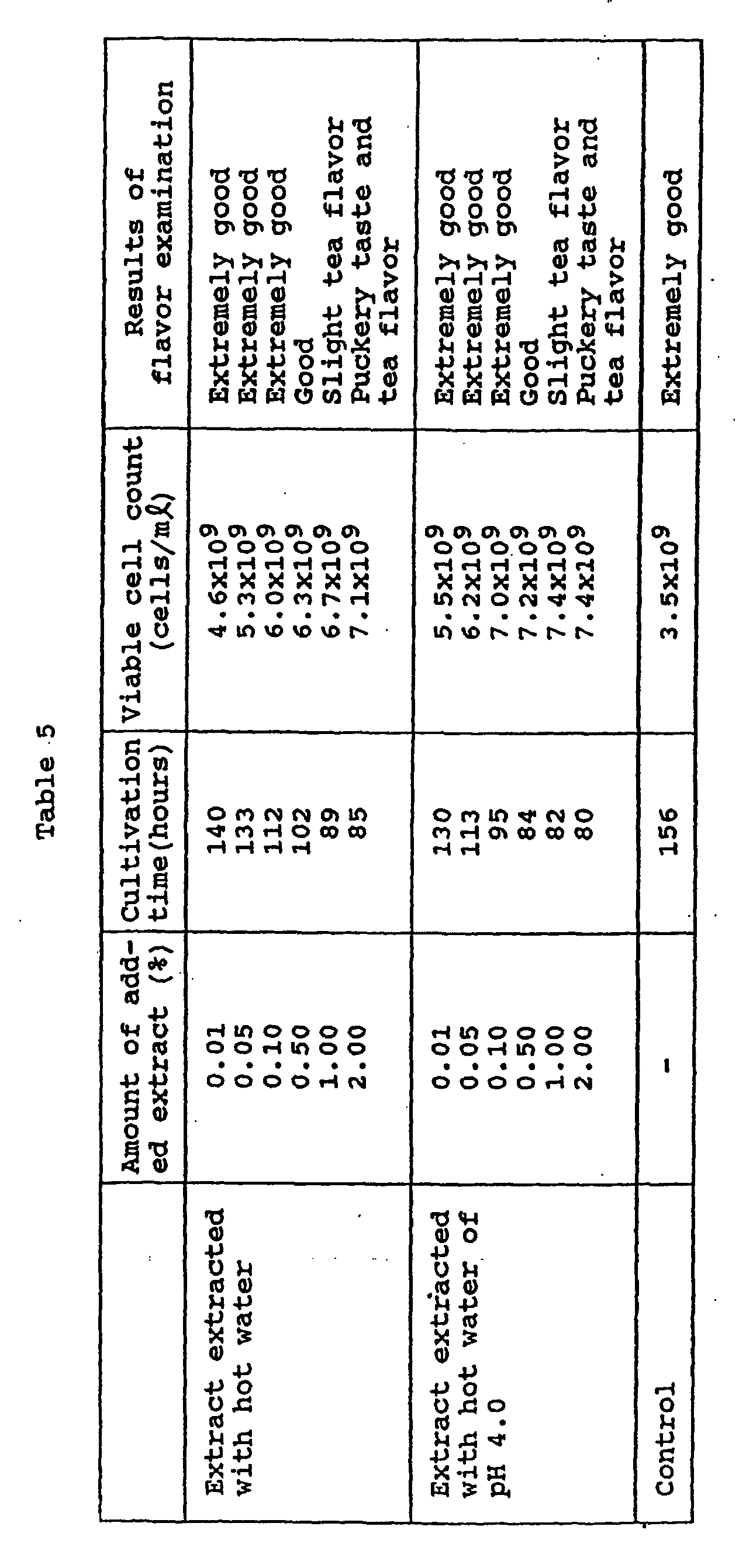
- a 20% skim milk powder solution containing 10% of glucose-fructose liquid sugar [75% soluble solids (Brix 75° )] was used as a basal medium.
- the hot-water extracted oolong tea extract obtained in Example 3 and an oolong tea extract extracted with hot water of pH 4.0 were added in varied amounts.
- the medium samples were each inoculated with 0.5% of lactic acid bacteria L . casei YIT9029, followed by cultivation at 37°C until acidity of 30. Cultivation times and viable cell counts at the time where the acidity reached 30 were recorded.
- a culture obtained by conduction cultivation in the basal medium alone was used.
- a low-fat yoghurt medium was prepared with the composition of 20% skim milk powder (product of YOTSUBA MILK PRODUCTS CO., LTD.) and 3% glucose. Sodium oleate was added at rates of 0.003, 0.005. 0.01, 0.02 and 0.03 wt. % to aliquots of the medium, respectively, followed by sterilization at 100°C for 60 minutes.
- the medium samples were inoculated with 0.5% of Lactobacillus casei YIT9029, followed by cultivation at 37°C for about 200 hours. At the time of completion of the cultivation, the viable cell counts were measured.
- the viable cell counts were each obtained by spreading the corresponding culture, which had been diluted in 0.1% yeast extract as needed, onto a Rogosa agar plate with a spiral plater, incubating the agar plate at 37°C for 3 days, and then counting the resultant colonies by a laser colony counter.
- the results are shown in FIG. 1. From FIG : 1, it has become evident that the count of viable cells upon completion of cultivation of Lactobacillus casei increases by the addition of oleic acid.
- Example 9 To aliquots of the low-fat yoghurt medium of Example 9, sodium oleate was added at rates of 0.003, 0.005 and 0.01 wt. %, respectively. The medium samples were each inoculated with lactic acid bacteria, followed by cultivation to study effect of sodium oleate on the viability of the lactic acid bacteria. The cultivation was conducted at 37°C until pH 3.6 to pH 3.8. Other conditions and the cell strain were the same as in Example 9.
- the thus-obtained products were stored at 10°C for 14 days.
- the viable cell count of the respective products were investigated along the passage of time. The results are shown in FIG. 2. It has become clear from the results of FIG. 2 that high viability is retained even after 7-day storage by the addition of sodium oleate upon cultivation as opposed to the general tendency of a substantial decrease in viable cell count when the storage of a product exceeds 7 days (the variations in viable cell count on the 0th day of the storage of the products reflect the counts of viable cell in the cultures).
- oleic acid, sodium oleate and various emulsifiers were added, respectively, such that their concentrations became 0.01% in terms of oleic acid content.
- Those medium samples were inoculated with 0.5% of Lactobacillus casei YIT9029, followed by cultivation to determine effects of these additives on the viable cell count of the lactic acid bacteria at the time of completion of the cultivation and also on the viability of the lactic acid bacteria.
- the culture was conducted at 37°C until pH 3.6 to 3.8. Other conditions were set as in Example 9.
- the fermented solutions were separately homogenized at 150 kg/cm 2 , and were then mixed with aliquots (4,000 mL) of sterilized 13.8% sugar syrup.
- the resulting mixtures were filled in polystyrene contains and sealed, whereby fermented drinks of the lactic acid bacteria were obtained. After they were stored at 10°C for 14 days, their viable cell count were measured. The results of this measurement are also shown in Table 8.
- Table 9 the orthogonal table shown in Table 9 was prepared in accordance with the method described on pages 292 to 300 in "Gendai Tokei Jitsumu Koza (Contemporary Statistics Practical Series) Text II" [published by Zaidan Hojin Jitsumu Kyoiku Kenkyusho (Practical Education Research Foundation)], and the percent contributions of the individual ingredients to the maintenance of the viable cell count of the lactic acid bacteria during storage were calculated.
- a represents the oolong tea extract, b oleic acid, and c the yeast extract; ab, ac and bc each indicate combined use of the corresponding two ingredients; and abc designates combined use of the three ingredients.
Landscapes
- Life Sciences & Earth Sciences (AREA)
- Chemical & Material Sciences (AREA)
- Engineering & Computer Science (AREA)
- Health & Medical Sciences (AREA)
- Microbiology (AREA)
- Polymers & Plastics (AREA)
- Food Science & Technology (AREA)
- Organic Chemistry (AREA)
- Wood Science & Technology (AREA)
- Zoology (AREA)
- Genetics & Genomics (AREA)
- Bioinformatics & Cheminformatics (AREA)
- Biotechnology (AREA)
- General Chemical & Material Sciences (AREA)
- Medicinal Chemistry (AREA)
- General Health & Medical Sciences (AREA)
- Biophysics (AREA)
- Biomedical Technology (AREA)
- Tropical Medicine & Parasitology (AREA)
- Virology (AREA)
- General Engineering & Computer Science (AREA)
- Biochemistry (AREA)
- Public Health (AREA)
- Veterinary Medicine (AREA)
- Communicable Diseases (AREA)
- Chemical Kinetics & Catalysis (AREA)
- Nuclear Medicine, Radiotherapy & Molecular Imaging (AREA)
- Animal Behavior & Ethology (AREA)
- Pharmacology & Pharmacy (AREA)
- Dairy Products (AREA)
- Oncology (AREA)
- Coloring Foods And Improving Nutritive Qualities (AREA)
- Micro-Organisms Or Cultivation Processes Thereof (AREA)
- General Preparation And Processing Of Foods (AREA)
- Seasonings (AREA)
Abstract
Description
| Lactic acid bacteria growth factor | Acidity |
| None | 9.5 |
| "MEAST" | 11.8 |
| Ginger extract | 12.8 |
| Green tea extract | 13.0 |
| Oolong tea extract | 13.1 |
| Green onion extract | 12.9 |
| Extracting solvent | Acidity |
| Hot water | 13.7 |
| Citric acid solution (pH 3.0) | 17.2 |
| Citric acid solution (pH 4.0) | 17.1 |
| Citric acid solution (pH 5.0) | 15.5 |

| Lactic acid bacteria growth factor | Number of days needed (days) | Viable cell count (cells/mℓ). |
| None | 6.5 | 3.5 x 10⁹ |
| Ginger extract | 4.0 | 4.0 x 10⁹ |
| Oolong tea extract | 3.5 | 7.2 x 10⁹ |
| Green onion extract | 3.8 | 5.2 x 10⁹ |
| Additive | Remarks | |
| 1 | Oleic acid | |
| 2 | Sodium oleate | |
| 3 | Glyceryl oleate | Monoglyceride ≥ 90% |
| 4 | | |
| 5 | Pentaglyceryl trioleate | |
| 6 | | |
| 7 | | |
| 8 | Sucrose oleate | Sucrose oleate ≥ 70% |
| 9 | Glyceryl oleate | Triglyceride |
| Control | Viable cell count (cfu/mℓ) | Viability on Day 14 | ||
| DAY 1 | | DAY 14 | ||
| 1 | 1.3x10⁹ | 7.2x10⁸ | 5.3X10⁸ | 40.8% |
| 2 | 1.2x10⁹ | 7.3x10⁸ | 5.2x10⁸ | 43.3% |
| 3 | 1.1x10⁹ | 7.7x10⁸ | 5.0x10⁸ | 45.5% |
| 4 | 1.2x10⁹ | 8.1x10⁸ | 5.0x10⁸ | 41.7% |
| 5 | 5.6x10⁸ | 2.5x10⁸ | 1.2x10⁸ | 21.4% |
| 6 | 1.3x10⁹ | 7.3x10⁸ | 4.8x10⁸ | 36.9% |
| 7 | 6.5x10⁸ | 2.0x10⁸ | 1.4x10⁸ | 21.5% |
| 8 | 1.1x10⁹ | 6.1x10⁹ | 4.3x10⁸ | 39.1% |
| 9 | 5.9x10⁸ | 2.2x10⁸ | 1.4x10⁸ | 23.7% |
| Control | 3.2x10⁸ | 1.6x10⁸ | 2.6x10⁷ | 8.1% |


Claims (18)
- A fermented milk comprising a fermented milk ingredient obtained by lactic acid fermentation and a lactic acid bacteria growth factor selected from ginger extract, tea extract, green onion extract, or oleic acid or a derivative thereof.
- A fermented milk according to claim 1, wherein said lactic acid fermentation is conducted using one or more lactic acid bacteria selected from genus Lactobacillus, Streptococcus thermophilus and Lactococcus lactis.
- A fermented milk according to claim 1 or 2, wherein said lactic acid fermentation is conducted using one or more lactic acid bacteria selected from Lactobacillus casei, Lactobacillus acidophilus, Lactobacillus salivalius, Lactobacillus gallinarum, Lactobacillus gasseri, Lactobacillus fermentum, Lactobacillus helveticus, Lactobacillus jugulti, Lactobacillus delbrueckii subsp. bulgaricus, Streptococcus thermophilus, Lactococcus lactis subsp. lactis, and Lactococcus lactis subsp. cremoris.
- A fermented milk according to claim 1, wherein said ginger extract, tea extract or green onion extract has been obtained by acid extraction.
- A fermented milk according to claim 4, wherein said acid extraction has been conducted at a pH not higher than 4.0 and a temperature not lower than 80°C.
- A fermented milk according to claim 1, wherein said oleic acid or a derivative thereof is an oleate ester selected from the group consisting of glyceryl oleate, polyglyceryl oleate, sorbitan oleate, propylene glycol oleate and sucrose oleate.
- A fermented milk according to claim 1 or 6, wherein oleic acid or a derivative thereof amounts to at least 15 µg/mL in terms of oleic acid as a final concentration after conversion into a final product.
- A fermented milk according to claim 1, wherein fat amounts to 0.05 to 0.5%.
- A fermentedmilk according to claim 1, 7 or 8, wherein oleic acid or a derivative thereof has been used as a lactic acid bacteria growth factor, said fermented milk comprises at least 1 x 10⁸ cfu/mL of lactic acid bacteria, and said lactic acid bacteria have a viability of at least 20% when said fermented milk is stored at 10°C for 2 weeks.
- A process for the production of a fermented milk, which comprises culturing lactic acid bacteria in a culture medium in which one or more lactic acid bacteria growth factors selected from ginger extract, tea extract, green onion extract, and oleic acid and derivatives thereof is contained.
- A process for the production of a fermented milk, which comprises adding oleic acid or a derivative thereof as a lactic acid bacteria growth factor subsequent to fermentation by lactic acid bacteria.
- A process according to claim 10 or 11, wherein said lactic acid bacteria comprises one or more lactic acid bacteria selected from Lactobacillus casei, Lactobacillus acidophilus. Lactobacillus salivalius, Lactobacillus gallinarum, Lactobacillus gasseri, Lactobacillus fermentum, Lactobacillus helveticus, Lactobacillus jugulti, Lactobacillus delbrueckii subsp. bulgaricus, Streptococcus thermophilus, Lactococcus lactis subsp. lactis, and Lactococcus lactis subsp. cremoris.
- Aprocess according to claim 10, wherein said ginger extract, tea extract or green onion extract has been obtained by acid extraction.
- A process according to claim 13, wherein said acid extraction has been conducted at a pH not higher than 4.0 and a temperature not lower than 80°C.
- A process according to claim 10 or 11, wherein said oleic acid or a derivative thereof is an oleate ester selected from the group consisting of glyceryl oleate, polyglyceryl oleate, sorbitan oleate, propylene glycol oleate and sucrose oleate.
- A process according to claim 10, 11 or 15, wherein oleic acid or a derivative thereof is added such that it amounts to at least 15 µg/mL in terms of oleic acid as a final concentration after conversion into a final product.
- A process according to claim 10, 11, 15 or 16, wherein said fermented milk contains fat in an amount of from 0.05 to 0.5%.
- A process according to claim 10, 11, 15, 16 or 17, wherein oleic acid or a derivative thereof is used as a lactic acid bacteria growth factor, said fermented milk comprises at least 1 x 10⁸ cfu/mL of said lactic acid bacteria, and said lactic acid bacteria have a viability of at least 20% when said fermented milk is stored at 10°C for 2 weeks.
Priority Applications (1)
| Application Number | Priority Date | Filing Date | Title |
|---|---|---|---|
| EP09001555A EP2067405B1 (en) | 1999-08-03 | 2000-08-01 | Improving the viability of lactic acid bacteria in a fermented milk |
Applications Claiming Priority (5)
| Application Number | Priority Date | Filing Date | Title |
|---|---|---|---|
| JP22015799A JP3650711B2 (en) | 1999-08-03 | 1999-08-03 | Method for producing low fat yogurt and low fat yogurt obtained by the method |
| JP22015799 | 1999-08-03 | ||
| JP2000005485A JP3648115B2 (en) | 2000-01-14 | 2000-01-14 | Lactic acid bacteria culture method and food and drink |
| JP2000005485 | 2000-01-14 | ||
| PCT/JP2000/005095 WO2001010233A1 (en) | 1999-08-03 | 2000-08-01 | Fermented milk drinks and foods and process for producing the same |
Related Child Applications (2)
| Application Number | Title | Priority Date | Filing Date |
|---|---|---|---|
| EP09001555A Division EP2067405B1 (en) | 1999-08-03 | 2000-08-01 | Improving the viability of lactic acid bacteria in a fermented milk |
| EP09001555.3 Division-Into | 2009-02-04 |
Publications (3)
| Publication Number | Publication Date |
|---|---|
| EP1201132A1 true EP1201132A1 (en) | 2002-05-02 |
| EP1201132A4 EP1201132A4 (en) | 2004-12-15 |
| EP1201132B1 EP1201132B1 (en) | 2011-04-13 |
Family
ID=26523568
Family Applications (2)
| Application Number | Title | Priority Date | Filing Date |
|---|---|---|---|
| EP09001555A Expired - Lifetime EP2067405B1 (en) | 1999-08-03 | 2000-08-01 | Improving the viability of lactic acid bacteria in a fermented milk |
| EP00948307A Expired - Lifetime EP1201132B1 (en) | 1999-08-03 | 2000-08-01 | Fermented milk drinks and foods and process for producing the same |
Family Applications Before (1)
| Application Number | Title | Priority Date | Filing Date |
|---|---|---|---|
| EP09001555A Expired - Lifetime EP2067405B1 (en) | 1999-08-03 | 2000-08-01 | Improving the viability of lactic acid bacteria in a fermented milk |
Country Status (12)
| Country | Link |
|---|---|
| US (2) | US7115291B1 (en) |
| EP (2) | EP2067405B1 (en) |
| KR (2) | KR100753012B1 (en) |
| CN (2) | CN100496262C (en) |
| AT (2) | ATE554655T1 (en) |
| AU (1) | AU775082B2 (en) |
| BR (1) | BR0007131B1 (en) |
| DE (1) | DE60045841D1 (en) |
| ES (2) | ES2383877T3 (en) |
| MX (1) | MXPA02001201A (en) |
| TW (2) | TW200505350A (en) |
| WO (1) | WO2001010233A1 (en) |
Cited By (6)
| Publication number | Priority date | Publication date | Assignee | Title |
|---|---|---|---|---|
| WO2006052147A1 (en) * | 2004-11-15 | 2006-05-18 | Tine Ba | Process for preparing a fermented product, and the product prepared by the process |
| CN1299585C (en) * | 2002-12-27 | 2007-02-14 | 东北农业大学 | Milk powder for preventing and improving cardio-cerebral vascular diseases and its preparing method |
| WO2008128767A3 (en) * | 2007-04-24 | 2008-12-11 | Lipid Nutrition Bv | Low sugar yoghurt |
| AU2006253588B2 (en) * | 2005-06-02 | 2011-05-19 | Kabushiki Kaisha Yakult Honsha | Fermented food containing bifidobacterium bacteria and method for producing the same |
| EP3949739A4 (en) * | 2019-03-29 | 2022-12-28 | Kabushiki Kaisha Yakult Honsha | METHOD FOR PRODUCING A LACTIC BACTERIAL FERMENTATION FOOD PRODUCT |
| US20240316125A1 (en) * | 2021-08-05 | 2024-09-26 | The Chinese University Of Hong Kong | Probiotic compositions for treating and preventing colorectal cancer |
Families Citing this family (44)
| Publication number | Priority date | Publication date | Assignee | Title |
|---|---|---|---|---|
| CN1309316C (en) * | 2002-03-29 | 2007-04-11 | 富朗泰国际股份有限公司 | Vital cell preparations containing lactic acid bacterium as the ative ingredient and food containing lactic acid |
| KR100576069B1 (en) * | 2002-05-28 | 2006-05-10 | 대한민국 | Method for preparing sangga share containing ginger |
| EP1790715A4 (en) * | 2004-09-10 | 2007-08-29 | Kirin Brewery | METHOD FOR STABILIZING THE ANTIALLERGIC ACTIVITY OF LACTIC ACID BACTERIA WITH HIGH TEMPERATURE TREATMENTS AND PREPARATIONS, STABILIZED FOOD AND BEVERAGES |
| US8182849B2 (en) * | 2005-02-23 | 2012-05-22 | Otsuka Pharmaceutical Co., Ltd. | Fermented tea beverage and tea beverage |
| TWI468513B (en) * | 2005-05-27 | 2015-01-11 | Yakult Honsha Kk | Lactic acid bacteria fermentation products and fermented milk foods |
| JP4800015B2 (en) * | 2005-11-22 | 2011-10-26 | 株式会社カロッツェリアジャパン | Microbial cultures for suppressing the onset of dermatitis and products using them |
| WO2008096419A1 (en) * | 2007-02-06 | 2008-08-14 | Meiji Dairies Corporation | Delicious fermented milk with low milk fat content and process for producing the same |
| TWI510192B (en) * | 2006-04-13 | 2015-12-01 | Meiji Co Ltd | Fermented milk with high flavor and high SNF and/or low milk fat and preparation method thereof |
| ZA200808291B (en) * | 2006-04-28 | 2009-12-30 | Unilever Plc | Method of manufacturing an edible product comprising fruit and omega-3 polyunsaturated fatty acids |
| WO2007137297A2 (en) * | 2006-05-23 | 2007-11-29 | Turmerex Foods | Foods and beverages with additives |
| JP5081242B2 (en) | 2006-08-04 | 2012-11-28 | バイオニア コーポレイション | Lactic acid bacteria with probiotic activity isolated from human breast milk and activity to suppress weight gain |
| TWI392457B (en) * | 2007-02-12 | 2013-04-11 | Meiji Co Ltd | Milk fat composition with less fat and less and its manufacturing method |
| MY146385A (en) * | 2007-02-13 | 2012-08-15 | Morinaga Milk Industry Co Ltd | Method for producing fermented milk using novel lactic acid bacteria |
| DE602008003007D1 (en) * | 2007-03-20 | 2010-11-25 | Unilever Nv | METHOD FOR PRODUCING AN EDIBUTABLE PRODUCT WITH FRUIT, MULTIPLE UNSATURATED OMEGA-3 FATTY ACIDS AND IRON |
| PL2124584T3 (en) * | 2007-03-20 | 2010-12-31 | Unilever Nv | Method of manufacturing a cultured edible product comprising omega-3 polyunsaturated fatty acids and iron |
| FR2924307B1 (en) * | 2007-12-04 | 2010-08-27 | Gervais Danone Sa | USE OF L. CASEI SSP. PARACASEI AS ANTIFUNGAL |
| CN101326931B (en) * | 2008-07-31 | 2010-12-08 | 内蒙古蒙牛乳业(集团)股份有限公司 | Yoghourt and method for making the same |
| BRPI1015366A2 (en) * | 2009-06-30 | 2015-09-01 | Chr Hansen As | Method for producing a fermented milk product. |
| KR100990768B1 (en) * | 2009-11-03 | 2010-10-29 | 이종수 | Composition of mixed microorganism growing in super highly acidic condition |
| CN101731338B (en) * | 2009-12-31 | 2013-06-05 | 内蒙古伊利实业集团股份有限公司 | Tea extract-containing acidophilous milk and preparation method thereof |
| CN101791013A (en) * | 2010-03-03 | 2010-08-04 | 艾克索·劳 | Preparation method of milk curd for making cheese |
| KR101230952B1 (en) * | 2010-06-10 | 2013-02-07 | 한국식품연구원 | Fermented milk by Lactobacillus casei and Process for producing thereof |
| AU2011347348B2 (en) * | 2010-12-20 | 2016-11-03 | Société des Produits Nestlé S.A. | Flavour modulation by bio-processing using flavour forming bacteria strains |
| US20130266689A1 (en) * | 2010-12-20 | 2013-10-10 | Marcel Braun | Flavour modulation by bio-processing using cream-flavour forming bacteria strains |
| CN102318674B (en) * | 2011-06-30 | 2013-03-13 | 鲁东大学 | Preparation method of ginger tea juice active lactobacillary milk beverage |
| RU2461619C1 (en) * | 2011-09-12 | 2012-09-20 | Федеральное государственное бюджетное образовательное учреждение высшего профессионального образования "Горский государственный аграрный университет" | Lactobacillus gallinarum strain used for preparing fermented milk products |
| RU2461618C1 (en) * | 2011-09-12 | 2012-09-20 | Федеральное государственное бюджетное образовательное учреждение высшего профессионального образования "Горский государственный аграрный университет" | Lactobacillus gallinarum strain used for preparing fermented milk products |
| RU2477312C1 (en) * | 2011-09-13 | 2013-03-10 | Федеральное государственное бюджетное образовательное учреждение высшего профессионального образования "Горский государственный аграрный университет" | STRAIN Lactobacillus gallinarum, USED TO PREPARE CULTURED MILK FOODS |
| US9795161B2 (en) * | 2011-09-30 | 2017-10-24 | Riken Vitamin Co., Ltd. | Taste-improving agent |
| CN102422883A (en) * | 2011-10-25 | 2012-04-25 | 内蒙古伊利实业集团股份有限公司 | Yoghourt with ginger extract and preparation method thereof |
| AU2013305725B2 (en) | 2012-08-22 | 2017-05-11 | Kraft Foods Group Brands Llc | Processed cheese with cultured dairy components and method of manufacturing |
| CN102948476A (en) * | 2012-11-19 | 2013-03-06 | 陕西科技大学 | Method for preparing goat milk beverage containing ACE (Angiotensin Converting Enzyme) inhibitory peptide on basis of fermentation of Lactobacillus helveticus |
| KR101255815B1 (en) * | 2012-12-18 | 2013-04-17 | 주식회사 유담 | Method for producing jasmine yogurt and jasmine yogurt produced by the same method |
| AU2014243769A1 (en) * | 2013-03-13 | 2015-11-05 | Making People Better, LLC | Prebiotic composition and method of its use |
| CN103431043B (en) * | 2013-06-14 | 2016-04-06 | 扬州市扬大康源乳业有限公司 | A kind of jasmine yogurt and preparation method thereof |
| CN103349073B (en) * | 2013-06-14 | 2017-03-29 | 扬州市扬大康源乳业有限公司 | A kind of Yoghourt and its production method of probio fruit juice |
| BR102014030865A2 (en) * | 2014-12-09 | 2016-07-05 | Biozer Da Amazônia Indústria E Comércio De Cosméticos E Fitoterápicos Ltda Me | Functional food composition, manufacturing process and use of zingiber zerumbet extract |
| KR20160097419A (en) | 2015-02-06 | 2016-08-18 | 주식회사한국야쿠르트 | Culture medium of Lactic acid bacteria, fermented milk containing thereof, freeze-dried powder containing thereof and method thereof |
| CN104642545A (en) * | 2015-02-25 | 2015-05-27 | 武汉光明乳品有限公司 | Active probiotic tea flavor fermented milk and preparation method thereof |
| JP6961339B2 (en) * | 2015-12-18 | 2021-11-05 | アサヒ飲料株式会社 | Beverage containing microbial cells |
| SG11202108657YA (en) * | 2019-02-19 | 2021-09-29 | Yakult Honsha Kk | Method for producing culture of lactic acid bacterium and/or bacterium belonging to genus bifidobacterium |
| CN110214879A (en) * | 2019-07-08 | 2019-09-10 | 山东省农业科学院农产品研究所 | A kind of coarse cereals bud fermented beverage and preparation method thereof |
| WO2022015248A1 (en) * | 2020-07-16 | 2022-01-20 | National University Of Singapore | A tea-based beverage |
| KR102573406B1 (en) | 2020-12-11 | 2023-09-04 | 안동시(농업기술센터) | Function-enhanced fermented ginger using lactic acid bacteria and making method thereof |
Family Cites Families (35)
| Publication number | Priority date | Publication date | Assignee | Title |
|---|---|---|---|---|
| GB1197257A (en) | 1968-05-22 | 1970-07-01 | Seiji Kuwabara | Fermented Milk |
| US3891773A (en) * | 1971-02-26 | 1975-06-24 | Us Agriculture | Culture of sour dough bacteria |
| US4001628A (en) * | 1976-02-25 | 1977-01-04 | Westinghouse Electric Corporation | Low-pressure fluorescent discharge device which utilizes both inorganic and organic phosphors |
| JPS5592662A (en) | 1979-01-08 | 1980-07-14 | Yoshihide Hagiwara | Beverage made by lactic fermentation of adlay and method of making the same |
| US4668525A (en) * | 1982-01-05 | 1987-05-26 | Thomas J. Lipton, Inc. | Tea extraction process |
| JPS6075233A (en) | 1983-09-29 | 1985-04-27 | Meiji Milk Prod Co Ltd | Preparation of lactic fermentation starter |
| JPS6086633A (en) * | 1983-10-19 | 1985-05-16 | Hitachi Ltd | How to collect execution history of processing device |
| JPS6147178A (en) * | 1984-08-09 | 1986-03-07 | Takara Shuzo Co Ltd | Soybean milk-containing alcoholic drink |
| JP2700542B2 (en) * | 1986-04-30 | 1998-01-21 | 日研フ−ド本社株式会社 | Method for producing lactic acid bacteria rich in natural minerals |
| JPH0799996B2 (en) | 1987-04-02 | 1995-11-01 | 味の素ゼネラルフーヅ株式会社 | Improved processing method of tea extract |
| JP2769168B2 (en) | 1988-11-25 | 1998-06-25 | サッポロビール株式会社 | Medium for detecting beer harmful bacteria |
| JPH04108334A (en) * | 1990-08-27 | 1992-04-09 | Yoshitada Yamanaka | New fermented milk and production thereof |
| JP2571734B2 (en) | 1991-08-23 | 1997-01-16 | 株式会社ヤクルト本社 | Lactic acid bacteria drink |
| DK0649603T3 (en) | 1993-05-11 | 2000-11-27 | Otsuka Pharma Co Ltd | Antioxidant nutrient, antioxidant preparation and method of antioxidation |
| US6068862A (en) * | 1993-06-30 | 2000-05-30 | Taiyo Kagaku Co., Ltd. | Tea-derived feed additive and animal feed containing the same |
| CH686397A5 (en) * | 1993-07-30 | 1996-03-29 | Soremartec Sa | sour drink. |
| JP2673333B2 (en) * | 1993-09-30 | 1997-11-05 | 雪印乳業株式会社 | Lactic acid bacteria growth promoter |
| KR970010858B1 (en) | 1993-10-15 | 1997-07-01 | 한국신발피혁연구소 | Adhesive composition |
| KR100343664B1 (en) * | 1993-12-20 | 2002-11-27 | 산에이겐 에후.에후. 아이. 가부시키가이샤 | Stable Emulsified Composition and Food Containing it |
| JPH07327593A (en) * | 1994-06-10 | 1995-12-19 | Taiyoudou Yakuhin Kk | Lactic acid beverage as dairy product and its production |
| JPH08322464A (en) | 1995-05-26 | 1996-12-10 | Yakult Honsha Co Ltd | Yogurt containing Bifidobacterium and method for producing the same |
| US6096365A (en) * | 1995-11-22 | 2000-08-01 | Thomas J. Lipton Co., Division Of Conopco, Inc. | Beverage intermediate and method for coextracting tea leaves and other vegetable material |
| EP0777972B1 (en) * | 1995-12-07 | 2003-05-14 | Societe Des Produits Nestle S.A. | Producing a tea extract |
| US6063428A (en) * | 1996-02-26 | 2000-05-16 | The Procter & Gamble Company | Green tea extract subjected to cation exchange treatment and nanofiltration to improve clarity and color |
| TW360501B (en) * | 1996-06-27 | 1999-06-11 | Nestle Sa | Dietetically balanced milk product |
| ATE209447T1 (en) * | 1996-09-10 | 2001-12-15 | Nestle Sa | DRIED FOOD CONTAINING LACTIC ACID BACTERIA |
| US5827560A (en) * | 1997-04-14 | 1998-10-27 | Nestec S.A. | Process for producing cold water soluble tea extract |
| JPH114665A (en) * | 1997-06-18 | 1999-01-12 | Otsuka Pharmaceut Co Ltd | Fermented product |
| US5997929A (en) * | 1997-11-03 | 1999-12-07 | Nestec S.A. | Extraction process |
| US6713109B1 (en) * | 1998-08-11 | 2004-03-30 | Food Equipment Technologies Company, Inc. | Method of tea extraction |
| DE19853178A1 (en) | 1998-11-19 | 2000-05-25 | Schwedt & Gesing Intertee Hand | Yoghurt made of milk or cream, with varieties of added constituents contains green tea and/or green tea extract |
| GB9903429D0 (en) * | 1999-02-15 | 1999-04-07 | Unilever Plc | Method for making a cold water soluble tea extract |
| CN1270769A (en) * | 1999-04-21 | 2000-10-25 | 杨明巧 | Active bacterial beverage and its preparation |
| US6299925B1 (en) * | 1999-06-29 | 2001-10-09 | Xel Herbaceuticals, Inc. | Effervescent green tea extract formulation |
| JP4108334B2 (en) | 2001-12-28 | 2008-06-25 | 関東化学株式会社 | Method for synthesizing bridged bisindenyl compound and group 4 metallocene |
-
2000
- 2000-04-18 KR KR1020000020238A patent/KR100753012B1/en not_active Expired - Lifetime
- 2000-05-10 BR BRPI0007131-5A patent/BR0007131B1/en active IP Right Grant
- 2000-08-01 US US10/048,447 patent/US7115291B1/en not_active Expired - Lifetime
- 2000-08-01 CN CNB008138192A patent/CN100496262C/en not_active Expired - Lifetime
- 2000-08-01 AT AT09001555T patent/ATE554655T1/en active
- 2000-08-01 AT AT00948307T patent/ATE505088T1/en active
- 2000-08-01 ES ES09001555T patent/ES2383877T3/en not_active Expired - Lifetime
- 2000-08-01 CN CN2008102136975A patent/CN101491278B/en not_active Expired - Lifetime
- 2000-08-01 WO PCT/JP2000/005095 patent/WO2001010233A1/en not_active Ceased
- 2000-08-01 TW TW093127156A patent/TW200505350A/en not_active IP Right Cessation
- 2000-08-01 EP EP09001555A patent/EP2067405B1/en not_active Expired - Lifetime
- 2000-08-01 EP EP00948307A patent/EP1201132B1/en not_active Expired - Lifetime
- 2000-08-01 DE DE60045841T patent/DE60045841D1/en not_active Expired - Lifetime
- 2000-08-01 AU AU61823/00A patent/AU775082B2/en not_active Expired
- 2000-08-01 MX MXPA02001201A patent/MXPA02001201A/en active IP Right Grant
- 2000-08-01 TW TW089115433A patent/TWI283564B/en not_active IP Right Cessation
- 2000-08-01 ES ES00948307T patent/ES2361296T3/en not_active Expired - Lifetime
-
2005
- 2005-07-22 US US11/186,837 patent/US7927638B2/en not_active Expired - Fee Related
-
2006
- 2006-12-01 KR KR1020060120444A patent/KR20060133512A/en not_active Ceased
Cited By (8)
| Publication number | Priority date | Publication date | Assignee | Title |
|---|---|---|---|---|
| CN1299585C (en) * | 2002-12-27 | 2007-02-14 | 东北农业大学 | Milk powder for preventing and improving cardio-cerebral vascular diseases and its preparing method |
| WO2006052147A1 (en) * | 2004-11-15 | 2006-05-18 | Tine Ba | Process for preparing a fermented product, and the product prepared by the process |
| NO323245B1 (en) * | 2004-11-15 | 2007-02-12 | Tine Sa | Process for the preparation of fermented product and product prepared by the process |
| AU2006253588B2 (en) * | 2005-06-02 | 2011-05-19 | Kabushiki Kaisha Yakult Honsha | Fermented food containing bifidobacterium bacteria and method for producing the same |
| WO2008128767A3 (en) * | 2007-04-24 | 2008-12-11 | Lipid Nutrition Bv | Low sugar yoghurt |
| EP3949739A4 (en) * | 2019-03-29 | 2022-12-28 | Kabushiki Kaisha Yakult Honsha | METHOD FOR PRODUCING A LACTIC BACTERIAL FERMENTATION FOOD PRODUCT |
| AU2020252433B2 (en) * | 2019-03-29 | 2025-06-05 | Kabushiki Kaisha Yakult Honsha | Method for producing lactic acid bacterium fermentation food product |
| US20240316125A1 (en) * | 2021-08-05 | 2024-09-26 | The Chinese University Of Hong Kong | Probiotic compositions for treating and preventing colorectal cancer |
Also Published As
| Publication number | Publication date |
|---|---|
| EP2067405A1 (en) | 2009-06-10 |
| CN1377231A (en) | 2002-10-30 |
| EP1201132A4 (en) | 2004-12-15 |
| US7115291B1 (en) | 2006-10-03 |
| WO2001010233A1 (en) | 2001-02-15 |
| CN101491278B (en) | 2012-06-20 |
| BR0007131A (en) | 2001-08-21 |
| EP2067405B1 (en) | 2012-04-25 |
| ES2383877T3 (en) | 2012-06-27 |
| MXPA02001201A (en) | 2002-08-20 |
| ATE505088T1 (en) | 2011-04-15 |
| HK1134224A1 (en) | 2010-04-23 |
| TW200505350A (en) | 2005-02-16 |
| BR0007131B1 (en) | 2014-03-11 |
| US20050255193A1 (en) | 2005-11-17 |
| CN101491278A (en) | 2009-07-29 |
| KR100753012B1 (en) | 2007-08-30 |
| ATE554655T1 (en) | 2012-05-15 |
| AU6182300A (en) | 2001-03-05 |
| TWI319307B (en) | 2010-01-11 |
| KR20060133512A (en) | 2006-12-26 |
| DE60045841D1 (en) | 2011-05-26 |
| KR20010029649A (en) | 2001-04-06 |
| US7927638B2 (en) | 2011-04-19 |
| CN100496262C (en) | 2009-06-10 |
| ES2361296T3 (en) | 2011-06-15 |
| AU775082B2 (en) | 2004-07-15 |
| EP1201132B1 (en) | 2011-04-13 |
| TWI283564B (en) | 2007-07-11 |
Similar Documents
| Publication | Publication Date | Title |
|---|---|---|
| US7927638B2 (en) | Fermented milk drinks and foods and process for producing the same | |
| CA2609458C (en) | Lactic acid bacteria fermentation culture containing rubus suavissimus | |
| AU2006253588B2 (en) | Fermented food containing bifidobacterium bacteria and method for producing the same | |
| CN102361969B (en) | Method for cultivating lactic acid bacteria and food and drink | |
| JP3648115B2 (en) | Lactic acid bacteria culture method and food and drink | |
| JP3650711B2 (en) | Method for producing low fat yogurt and low fat yogurt obtained by the method | |
| TWI612900B (en) | Fermented dairy products with enhanced iron and tocopherol | |
| JP4076351B2 (en) | Highly surviving Lactobacillus bacteria and their utilization | |
| HK1134224B (en) | Fermented milk drinks and food and process for producing the same | |
| MX2007014876A (en) | Lactic acid bacteria fermented substance and fermented milk food product containing the same. |
Legal Events
| Date | Code | Title | Description |
|---|---|---|---|
| PUAI | Public reference made under article 153(3) epc to a published international application that has entered the european phase |
Free format text: ORIGINAL CODE: 0009012 |
|
| 17P | Request for examination filed |
Effective date: 20020208 |
|
| AK | Designated contracting states |
Kind code of ref document: A1 Designated state(s): AT BE CH CY DE DK ES FI FR GB GR IE IT LI LU MC NL PT SE |
|
| A4 | Supplementary search report drawn up and despatched |
Effective date: 20041027 |
|
| 17Q | First examination report despatched |
Effective date: 20080515 |
|
| GRAP | Despatch of communication of intention to grant a patent |
Free format text: ORIGINAL CODE: EPIDOSNIGR1 |
|
| GRAS | Grant fee paid |
Free format text: ORIGINAL CODE: EPIDOSNIGR3 |
|
| RIN1 | Information on inventor provided before grant (corrected) |
Inventor name: HASHIMOTO, SHINJI,KABUSHIKI KAISHA YAKULT HONSHA Inventor name: AKAHOSHI, RYOICHI,KABUSHIKI KAISHA YAKULT HONSHA Inventor name: KUMA, YOSHIHARU,KABUSHIKI KAISHA YAKULT HONSHA Inventor name: KUDO, TATSUYUKI,KABUSHIKI KAISHA YAKULT HONSHA Inventor name: KAWAMI, KOJIRO,KABUSHIKI KAISHA YAKULT HONSHA Inventor name: SHIBATA, MIKU |
|
| GRAA | (expected) grant |
Free format text: ORIGINAL CODE: 0009210 |
|
| RAP1 | Party data changed (applicant data changed or rights of an application transferred) |
Owner name: KABUSHIKI KAISHA YAKULT HONSHA |
|
| AK | Designated contracting states |
Kind code of ref document: B1 Designated state(s): AT BE CH CY DE DK ES FI FR GB GR IE IT LI LU MC NL PT SE |
|
| REG | Reference to a national code |
Ref country code: GB Ref legal event code: FG4D |
|
| REG | Reference to a national code |
Ref country code: CH Ref legal event code: EP |
|
| REG | Reference to a national code |
Ref country code: NL Ref legal event code: T3 |
|
| REG | Reference to a national code |
Ref country code: IE Ref legal event code: FG4D |
|
| REF | Corresponds to: |
Ref document number: 60045841 Country of ref document: DE Date of ref document: 20110526 Kind code of ref document: P |
|
| REG | Reference to a national code |
Ref country code: DE Ref legal event code: R096 Ref document number: 60045841 Country of ref document: DE Effective date: 20110526 |
|
| REG | Reference to a national code |
Ref country code: ES Ref legal event code: FG2A Ref document number: 2361296 Country of ref document: ES Kind code of ref document: T3 Effective date: 20110615 |
|
| PG25 | Lapsed in a contracting state [announced via postgrant information from national office to epo] |
Ref country code: SE Free format text: LAPSE BECAUSE OF FAILURE TO SUBMIT A TRANSLATION OF THE DESCRIPTION OR TO PAY THE FEE WITHIN THE PRESCRIBED TIME-LIMIT Effective date: 20110413 Ref country code: PT Free format text: LAPSE BECAUSE OF FAILURE TO SUBMIT A TRANSLATION OF THE DESCRIPTION OR TO PAY THE FEE WITHIN THE PRESCRIBED TIME-LIMIT Effective date: 20110816 |
|
| PG25 | Lapsed in a contracting state [announced via postgrant information from national office to epo] |
Ref country code: GR Free format text: LAPSE BECAUSE OF FAILURE TO SUBMIT A TRANSLATION OF THE DESCRIPTION OR TO PAY THE FEE WITHIN THE PRESCRIBED TIME-LIMIT Effective date: 20110714 Ref country code: CY Free format text: LAPSE BECAUSE OF FAILURE TO SUBMIT A TRANSLATION OF THE DESCRIPTION OR TO PAY THE FEE WITHIN THE PRESCRIBED TIME-LIMIT Effective date: 20110413 Ref country code: FI Free format text: LAPSE BECAUSE OF FAILURE TO SUBMIT A TRANSLATION OF THE DESCRIPTION OR TO PAY THE FEE WITHIN THE PRESCRIBED TIME-LIMIT Effective date: 20110413 |
|
| PLBE | No opposition filed within time limit |
Free format text: ORIGINAL CODE: 0009261 |
|
| STAA | Information on the status of an ep patent application or granted ep patent |
Free format text: STATUS: NO OPPOSITION FILED WITHIN TIME LIMIT |
|
| PG25 | Lapsed in a contracting state [announced via postgrant information from national office to epo] |
Ref country code: DK Free format text: LAPSE BECAUSE OF FAILURE TO SUBMIT A TRANSLATION OF THE DESCRIPTION OR TO PAY THE FEE WITHIN THE PRESCRIBED TIME-LIMIT Effective date: 20110413 |
|
| 26N | No opposition filed |
Effective date: 20120116 |
|
| PG25 | Lapsed in a contracting state [announced via postgrant information from national office to epo] |
Ref country code: MC Free format text: LAPSE BECAUSE OF NON-PAYMENT OF DUE FEES Effective date: 20110831 |
|
| REG | Reference to a national code |
Ref country code: CH Ref legal event code: PL |
|
| PG25 | Lapsed in a contracting state [announced via postgrant information from national office to epo] |
Ref country code: CH Free format text: LAPSE BECAUSE OF NON-PAYMENT OF DUE FEES Effective date: 20110831 Ref country code: LI Free format text: LAPSE BECAUSE OF NON-PAYMENT OF DUE FEES Effective date: 20110831 |
|
| REG | Reference to a national code |
Ref country code: DE Ref legal event code: R097 Ref document number: 60045841 Country of ref document: DE Effective date: 20120116 |
|
| REG | Reference to a national code |
Ref country code: FR Ref legal event code: PLFP Year of fee payment: 17 |
|
| REG | Reference to a national code |
Ref country code: FR Ref legal event code: PLFP Year of fee payment: 18 |
|
| REG | Reference to a national code |
Ref country code: FR Ref legal event code: PLFP Year of fee payment: 19 |
|
| PGFP | Annual fee paid to national office [announced via postgrant information from national office to epo] |
Ref country code: NL Payment date: 20190712 Year of fee payment: 20 Ref country code: LU Payment date: 20190724 Year of fee payment: 20 |
|
| PGFP | Annual fee paid to national office [announced via postgrant information from national office to epo] |
Ref country code: FR Payment date: 20190711 Year of fee payment: 20 Ref country code: ES Payment date: 20190903 Year of fee payment: 20 Ref country code: IT Payment date: 20190821 Year of fee payment: 20 Ref country code: IE Payment date: 20190813 Year of fee payment: 20 Ref country code: DE Payment date: 20190716 Year of fee payment: 20 |
|
| PGFP | Annual fee paid to national office [announced via postgrant information from national office to epo] |
Ref country code: BE Payment date: 20190716 Year of fee payment: 20 |
|
| PGFP | Annual fee paid to national office [announced via postgrant information from national office to epo] |
Ref country code: AT Payment date: 20190725 Year of fee payment: 20 Ref country code: GB Payment date: 20190731 Year of fee payment: 20 |
|
| REG | Reference to a national code |
Ref country code: DE Ref legal event code: R071 Ref document number: 60045841 Country of ref document: DE |
|
| REG | Reference to a national code |
Ref country code: GB Ref legal event code: PE20 Expiry date: 20200731 |
|
| REG | Reference to a national code |
Ref country code: BE Ref legal event code: MK Effective date: 20200801 |
|
| REG | Reference to a national code |
Ref country code: IE Ref legal event code: MK9A |
|
| REG | Reference to a national code |
Ref country code: AT Ref legal event code: MK07 Ref document number: 505088 Country of ref document: AT Kind code of ref document: T Effective date: 20200801 |
|
| PG25 | Lapsed in a contracting state [announced via postgrant information from national office to epo] |
Ref country code: GB Free format text: LAPSE BECAUSE OF EXPIRATION OF PROTECTION Effective date: 20200731 Ref country code: IE Free format text: LAPSE BECAUSE OF EXPIRATION OF PROTECTION Effective date: 20200801 |
|
| REG | Reference to a national code |
Ref country code: ES Ref legal event code: FD2A Effective date: 20201126 |
|
| PG25 | Lapsed in a contracting state [announced via postgrant information from national office to epo] |
Ref country code: ES Free format text: LAPSE BECAUSE OF EXPIRATION OF PROTECTION Effective date: 20200802 |