EP1199727A2 - Heating cable - Google Patents
Heating cable Download PDFInfo
- Publication number
- EP1199727A2 EP1199727A2 EP01308865A EP01308865A EP1199727A2 EP 1199727 A2 EP1199727 A2 EP 1199727A2 EP 01308865 A EP01308865 A EP 01308865A EP 01308865 A EP01308865 A EP 01308865A EP 1199727 A2 EP1199727 A2 EP 1199727A2
- Authority
- EP
- European Patent Office
- Prior art keywords
- heating
- conductors
- heating cable
- sheath
- cable
- Prior art date
- Legal status (The legal status is an assumption and is not a legal conclusion. Google has not performed a legal analysis and makes no representation as to the accuracy of the status listed.)
- Granted
Links
Images


Classifications
-
- H—ELECTRICITY
- H01—ELECTRIC ELEMENTS
- H01B—CABLES; CONDUCTORS; INSULATORS; SELECTION OF MATERIALS FOR THEIR CONDUCTIVE, INSULATING OR DIELECTRIC PROPERTIES
- H01B7/00—Insulated conductors or cables characterised by their form
- H01B7/17—Protection against damage caused by external factors, e.g. sheaths or armouring
- H01B7/29—Protection against damage caused by extremes of temperature or by flame
- H01B7/292—Protection against damage caused by extremes of temperature or by flame using material resistant to heat
-
- H—ELECTRICITY
- H05—ELECTRIC TECHNIQUES NOT OTHERWISE PROVIDED FOR
- H05B—ELECTRIC HEATING; ELECTRIC LIGHT SOURCES NOT OTHERWISE PROVIDED FOR; CIRCUIT ARRANGEMENTS FOR ELECTRIC LIGHT SOURCES, IN GENERAL
- H05B3/00—Ohmic-resistance heating
- H05B3/40—Heating elements having the shape of rods or tubes
- H05B3/54—Heating elements having the shape of rods or tubes flexible
- H05B3/56—Heating cables
Definitions
- the present invention relates to a heating cable for use in electric trace heating applications.
- Trace heating cables fall into two general categories, that is parallel resistance cut-to-length types and series resistance fixed length types.
- parallel resistance type cables In parallel resistance type cables, generally two insulated conductors (known as buswires) extend longitudinally along the cable. A resistance heating wire is spiralled around the conductors, electrical connections being made alternately at intervals along the longitudinally extending conductors. This creates a series of short heating zones spaced apart along the length of the cable. The heating wire must be selectively insulated from the conductors and also encased within an insulating sheath.
- Available parallel trace heating cables either use polymeric external insulation sheaths which limit the use of such cables to maximum temperatures of for example 250°C, or use glass insulation for the external sheath which can operate at higher temperatures, for example above 400°C, but which are not waterproof.
- Series resistance heaters must be specifically designed so that the power produced meets the requirements for a particular length of cable. This is not convenient and represents a major constraint.
- Generally series heaters include longitudinally extending resistance wires embedded in a mineral insulation which can withstand high temperatures.
- a typical construction comprises two ni-chrome heating conductors, magnesium oxide powder insulation, and an outer stainless steel sheath. The whole construction may be drawn down from an outside diameter of typically 80mm to an outside diameter of 4mm at which point the heater is flexible to enable it to be installed relatively easily and has an electrical resistance producing a desired output per unit length.
- Unfortunately the available range of resistances is limited and, particularly, short lengths (typically less than 10 metres) with appropriate low power outputs are not available.
- parallel heaters are convenient in use but are not available in forms which combine both a high temperature withstand and a waterproof construction, whereas series heaters are available which can withstand high temperatures and are waterproof but cannot be cut to length and therefore must be designed specially to fit particular applications and are difficult to design for use in short lengths.
- a mineral insulated heating cable comprising two electrical conductors extending along the length of the cable and an array of heating elements distributed along the lengths of the cable and connected in parallel between the conductors, wherein each conductor is encased in an inner sheath of insulating material through which connections are made to each heating element, the inner sheaths and heating elements are encased in an outer sheath of insulating material, and the outer sheath is covered by a metal jacket extruded around the outer sheath.
- the term "mineral insulated” is used herein to indicate a heating cable in which all components can withstand long-term exposure to high temperatures, e.g. 250°C and above.
- insulation could be formed from for example tape manufactured from glass and/or mica.
- the invention is based on the realisation that with careful process control it is possible to extrude a jacket of for example aluminium onto a preformed trace heating cable of the parallel resistance type, the aluminium sheath making the overall assembly waterproof and therefore enabling the use within the cable of components which themselves do not have to be waterproof.
- a waterproof structure which can withstand high temperatures results.
- the conductors and the inner sheaths may be encased in an intermediate sheath of insulating material through which connections are made between each conductor and each heating element.
- the intermediate sheath may be formed from glass tape which may be coated with a stabiliser.
- the conductors may be nickel plated copper
- the heating elements may be formed from a ni-chrome resistance heating wire spiralled around the conductors
- the resistance heating wire may be in contact with the conductors through openings in the inner sheath such that the wire touches the conductors, a positive electrical connection being made between the conductors and the wire by sprayed metal.
- Metal may be sprayed onto the conductors both before and after positioning of the heating wire.
- Each inner sheath may be formed from mica tape and the outer sheath may also comprise mica tape.
- the outer sheath may also comprise glass tape which may be coated with a stabiliser.
- the stabiliser may be for example silicone varnish to provide initial waterproofing, or a ceramic fibre adhesive incorporating a rigidiser and hardener.
- the metal jacket may be of oval section to improve overall flexibility of the product.
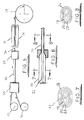
- the illustrated structure comprises two conductors 1, 2 between which a series of heating elements 3 are connected. One end of each heating element is connected to a node 4 on conductor 1 whereas the other end of each heating element is connected to a node 5 on conductor 2.
- Figure 2 illustrates a known structure resulting in an electrical arrangement as illustrated in Figure 1.
- the known cable comprises conductors 1 and 2 each received within an insulating sheath 6 of polymeric material.
- the two conductors are enclosed within a further sheath 7.
- Openings 8 are formed through the sheath 6 and 7 so as to expose the underlying conductors 1, 2 and a ni-chrome heating wire 9 is spiralled around the outside of the sheath 7 so as to contact the conductors through the openings 8.
- the heating elements 3 of Figure 1 correspond to the lengths of wire 9 between successive opening 8.
- the openings 8 will have an axial length of about 20mm and be spaced apart along the length of the cable by 750mm.
- the heating wire 9 is covered with an inner polymeric jacket 10 wrapped in a braided jacket 11 encased in a polymeric sheath 12.
- the overall structure is flexible and waterproof but cannot be used at high temperatures, for example temperatures in excess of 250°C, because such usage would result in damage to the polymeric components.
- the illustrated structure comprises two heating wires 13 and 14 embedded in a mineral insulating material 15 encased within an outer metal sheath of copper, stainless steel or nickel-based alloy.
- the heat output per unit length of such cables is a function of the composition and current through the conductors 13 and 14 and thus it is difficult to fabricate short lengths of appropriate low power and the cable cannot simply be cut to length to fit particular circumstances.
- the illustrated embodiment of the invention comprises two conductors 17, 18 each of which is covered with two layers of high temperature mica insulation tape 19 and each of which is also restrained by a high temperature glass fibre tape layer 20. Openings 21 are formed through the insulation layers 19 and 20 to enable the conductors to be contacted by a ni-chrome resistance heating wire 22 which is spiralled around the outside of the sheath 20.
- the wire 22 is covered with two layers of mica tape and an outer layer of glass fibre tape to form an insulation layer 23 which in turn is covered with an aluminium sheath 24.
- the conductors 17 and 18 may be nickel plated copper, but could also be of aluminium. There are advantages in fabricating the conductors 17 and 18 and the jacket 24 from the same material (e.g. aluminium) to avoid differential expansion between the conductors and the jacket.
- the intermediate sheath 20 may be covered with a stabiliser to provide moisture proofing and robustness during processing.
- the openings 21 may be as in prior art devices, for example typically 20mm in axial length with a space between openings of 750mm.
- the wire 22 may be spiralled around the conductors with typically eight spirals per centimetre. With such an arrangement typically ten or more spirals of resistance wire make touch contact to the conductor 17 and 18.
- the contact areas between the conductors 17 and 18 and the wire 22 may be sprayed with metal, for example aluminium, zinc or an aluminium/zinc alloy. This forms a positive electrical connection.
- the conductors 17 and 18 are sprayed before the wire 22 is positioned, and the contact areas are sprayed again after the wire 22 is positioned.
- the final insulating layer 23 which is in the form of two layers of taped mica over which a single layer of taped glass fibre is wrapped may be coated with a stabiliser for moisture protection and to improve robustness during processing.
- the stabiliser may be a simple silicone varnish or a high temperature resistant rigidiser designed to resist damage during processing and to provide initial waterproofing.
- a suitable rigidiser would be the product "901/901A ceramic fibre adhesive" incorporating a liquid insulation hardener which product is available from Symonds Cableform Limited, Welwyn Garden City, United Kingdom.
- the assembly shown in Figure 4 up to and including the sheath 23 is passed through an aluminium extruder such that the aluminium jacket 24 is extruded around the other components, forming a unitary product which is provided with reliable waterproofing by virtue of the provision of the aluminium jacket 24 and yet which only comprises components which can withstand high temperatures.
- the jacket 24 is of oval cross-section to improve the contact between the cable and a supporting surface and to improve the flexibility of the product.
- the aluminium jacket 24 may be extruded directly onto the sheath 23, but preferably is initially extruded so as to be of relatively large dimensions and then drawn down through a draw down device to be a close fit on the jacket 23.
- Figure 5 illustrates a production line which incorporates such a draw down device.
- the schematically illustrated production line comprises an extruder 25 to which aluminium to be extruded is supplied from a roll 26 and to which cable incorporating all the components 17 to 23 of Figure 4 (but not the aluminium jacket 24) is supplied from a roll 27.
- the extruder 25 may be of conventional type, for example a "conform" machine arranged to produce an oval extrusion 28 the internal dimensions of which are greater than the external dimensions of the cable delivered from the roll 27.
- the extrusion 28 is a loose fit on the sheath 23.
- the "oversize" extrusion 28 is drawn down in a draw down device 29 to produce a final product 30 which corresponds to the cable structure illustrated in Figure 4 in which the aluminium jacket 24 is a close fit on the sheath 23.
- the cable 30 is pulled through the production line by conveyors 31 and wound onto a roll 32.
- this shows the outer sheath 23 of the cable delivered from the roll 27.
- the outer aluminium sheath 28 has dimensions such that a gap 33 is defined between the sheath 23 and the extrusion 28 as shown in Figure 7.
- the extrusion 28 has been converted into the close-fitting outer aluminium jacket 24 as shown in Figure 8.
Landscapes
- Resistance Heating (AREA)
- Insulated Conductors (AREA)
- Processing Of Terminals (AREA)
Abstract
Description
Claims (15)
- A mineral insulated heating cable comprising two electrical conductors extending along the length of the cable and an array of heating elements distributed along the length of the cable and connected in parallel between the conductors, wherein each conductor is encased in an inner sheath of insulating material through which connections are made to each heating element, the inner sheaths and heating elements are encased in an outer sheath of insulating material, and the outer sheath is covered by a metal jacket extruded around the outer sheath.
- A heating cable according to claim 1, wherein the conductors and the inner sheaths are encased in an intermediate sheath of insulating material through which connections are made between each conductor and each heating element.
- A heating element according to claim 2, wherein the intermediate sheath is formed from glass tape.
- A heating element according to claim 2 or 3, wherein the intermediate sheath is coated with a stabiliser
- A heating cable according to any preceding claim, wherein the conductors are nickel plated copper, the heating elements are formed from a ni-chrome resistance heating wire spiralled around the conductors, and the resistance heating wire is in contact with the conductors through openings in the inner sheaths such that the wire touches the conductors, a positive electrical connection being made between the conductors and the wire by sprayed metal.
- A heating cable according to any preceding claim, wherein each inner sheath is formed from mica tape.
- A heating cable according to any preceding claim, wherein the outer sheath comprises mica tape.
- A heating cable according to any preceding claim, wherein the outer sheath comprises glass tape.
- A heating cable according to claim 8, wherein the glass tape forms an outer component of the outer sheath and is coated with a stabiliser.
- A heating cable according to any preceding claim, wherein the metal jacket is of oval section.
- A heating cable according to any preceding claim, wherein the metal jacket is of aluminium.
- A method for forming a heating cable in accordance with any preceding claim.
- A method according to claim 12, wherein the metal jacket is initially extruded such that it is a loose fit on the outer sheath and is then drawn down to be a close fit on the outer sheath.
- A heating cable substantially is hereinbefore described with reference to Figures 4 and 8 of the accompanying drawings.
- A method for forming a heating cable substantially as hereinbefore described with reference to Figures 4 to 8 of the accompanying drawings.
Applications Claiming Priority (4)
| Application Number | Priority Date | Filing Date | Title |
|---|---|---|---|
| GB0025734 | 2000-10-19 | ||
| GB0025734A GB0025734D0 (en) | 2000-10-19 | 2000-10-19 | Heating cable |
| GB0031857 | 2000-12-30 | ||
| GB0031857A GB0031857D0 (en) | 2000-12-30 | 2000-12-30 | Heating cable |
Publications (3)
| Publication Number | Publication Date |
|---|---|
| EP1199727A2 true EP1199727A2 (en) | 2002-04-24 |
| EP1199727A3 EP1199727A3 (en) | 2004-02-04 |
| EP1199727B1 EP1199727B1 (en) | 2007-01-03 |
Family
ID=26245180
Family Applications (1)
| Application Number | Title | Priority Date | Filing Date |
|---|---|---|---|
| EP01308865A Expired - Lifetime EP1199727B1 (en) | 2000-10-19 | 2001-10-18 | Heating cable |
Country Status (6)
| Country | Link |
|---|---|
| US (1) | US6680465B2 (en) |
| EP (1) | EP1199727B1 (en) |
| AT (1) | ATE350881T1 (en) |
| CA (1) | CA2359293C (en) |
| DE (1) | DE60125682T2 (en) |
| ES (1) | ES2278695T3 (en) |
Cited By (3)
| Publication number | Priority date | Publication date | Assignee | Title |
|---|---|---|---|---|
| WO2004010736A1 (en) * | 2002-07-20 | 2004-01-29 | Heat Trace Limited | Electrical heating cable |
| CN106532573A (en) * | 2016-11-09 | 2017-03-22 | 中国化学工程第四建设有限公司 | Heat-tracing construction method for 825 type alloy mineral insulating heating cable |
| CN109379793A (en) * | 2018-11-16 | 2019-02-22 | 安邦电气股份有限公司 | A self-limiting temperature electric heating cable for high temperature boiler |
Families Citing this family (19)
| Publication number | Priority date | Publication date | Assignee | Title |
|---|---|---|---|---|
| WO2000004085A1 (en) * | 1998-07-15 | 2000-01-27 | Thermon Manufacturing Company | Thermally-conductive, electrically non-conductive heat transfer material and articles made thereof |
| US20050167134A1 (en) * | 2004-02-02 | 2005-08-04 | Philippe Charron | Heating cable substantially free from electromagnetic field |
| WO2005089019A2 (en) * | 2004-03-08 | 2005-09-22 | W.E.T. Automotive Systems Ag | Flat heating element |
| MX2010004331A (en) * | 2007-10-24 | 2010-06-09 | Tyco Thermal Controls Llc | Manufacture of heat trace cable, design, installation, and management, and method thereof. |
| CA2616498C (en) * | 2007-12-28 | 2015-06-23 | Drexan Corporation | Multipurpose cable connector |
| US7989740B2 (en) * | 2008-05-16 | 2011-08-02 | Thermon Manufacturing Company | Heating cable |
| US20090283514A1 (en) * | 2008-05-16 | 2009-11-19 | Konrad Mech | Heating cable with insulated heating element |
| US8212191B2 (en) * | 2008-05-16 | 2012-07-03 | Thermon Manufacturing Co. | Heating cable with a heating element positioned in the middle of bus wires |
| US10089443B2 (en) | 2012-05-15 | 2018-10-02 | Baxter International Inc. | Home medical device systems and methods for therapy prescription and tracking, servicing and inventory |
| AR084995A1 (en) * | 2011-12-01 | 2013-07-24 | Pablo Javier Invierno | HEATER CABLE FOR HYDROCARBON EXTRACTION PIPES FOR WELLS EXPOSED TO HIGH PRESSURES AND WELLS WITH FLOODED ANNULAR SPACE IN EVENTUAL, PERMANENT OR COMBINED FORM |
| KR101846981B1 (en) * | 2014-01-20 | 2018-04-09 | 김경숙 | Electric heating cable and dry floor heating system using same |
| WO2015128484A1 (en) * | 2014-02-28 | 2015-09-03 | Leoni Kabel Holding Gmbh | Cable core for a cable, in particular an induction cable, cable, and method for producing a cable core |
| US9881715B2 (en) | 2014-08-21 | 2018-01-30 | Trent Jason Pederson | Heated extension cord |
| CN105551693A (en) * | 2016-01-29 | 2016-05-04 | 中国电子科技集团公司第二十三研究所 | Fabrication method of extruded mineral insulated radio-frequency cable and radio-frequency cable |
| CN105869747A (en) * | 2016-05-20 | 2016-08-17 | 安徽德源电缆集团有限公司 | Acid-and-alkali-resistant and high-temperature-resistant shielded cable for mine |
| CN106128605A (en) * | 2016-08-29 | 2016-11-16 | 江苏长峰电缆有限公司 | A kind of novel energy-conserving water repellent electric cable |
| CN107567119A (en) * | 2017-08-14 | 2018-01-09 | 江阴神辉电工材料有限公司 | Invariable power heater wire can be cut |
| CN114280742B (en) * | 2021-11-18 | 2023-09-26 | 杭州富通通信技术股份有限公司 | Temperature-resistant optical cable |
| WO2025168406A1 (en) * | 2024-02-06 | 2025-08-14 | Shell Internationale Research Maatschappij B.V. | Dual layer mineral insulated cable and method for heating a substance |
Family Cites Families (12)
| Publication number | Priority date | Publication date | Assignee | Title |
|---|---|---|---|---|
| GB272166A (en) * | 1926-06-05 | 1927-06-23 | Skandinaviske Kabel Og Gummifa | An electric heating cable |
| US2905919A (en) * | 1956-01-17 | 1959-09-22 | British Insulated Callenders | Electric heating cables |
| FR1549940A (en) * | 1967-05-23 | 1968-12-13 | ||
| US3986377A (en) * | 1973-11-21 | 1976-10-19 | Industrie Pirelli S.P.A.. | Apparatus for sheathing a cable core with core surrounded by impregnating fluid during sheathing |
| US4100673A (en) * | 1977-05-05 | 1978-07-18 | Leavines Joseph E | Method of making high temperature parallel resistance pipe heater |
| US4631392A (en) * | 1984-07-13 | 1986-12-23 | Raychem Corporation | Flexible high temperature heater |
| GB8600985D0 (en) * | 1986-01-16 | 1986-02-19 | Pyrontenax Of Canada Ltd | Electric cables |
| DE3636738A1 (en) * | 1986-10-29 | 1988-05-05 | Eilentropp Hew Kabel | REMOVABLE FLEXIBLE ELECTRIC HEATING ELEMENT |
| GB2209650B (en) * | 1987-09-05 | 1991-07-03 | Frederick William Bloore | Heating tape |
| US5245161A (en) * | 1990-08-31 | 1993-09-14 | Tokyo Kogyo Boyeki Shokai, Ltd. | Electric heater |
| JPH04272680A (en) * | 1990-09-20 | 1992-09-29 | Thermon Mfg Co | Switch-controlled-zone type heating cable and assembling method thereof |
| US6005232A (en) * | 1996-06-28 | 1999-12-21 | Raychem Corporation | Heating cable |
-
2001
- 2001-10-18 ES ES01308865T patent/ES2278695T3/en not_active Expired - Lifetime
- 2001-10-18 DE DE60125682T patent/DE60125682T2/en not_active Expired - Lifetime
- 2001-10-18 EP EP01308865A patent/EP1199727B1/en not_active Expired - Lifetime
- 2001-10-18 AT AT01308865T patent/ATE350881T1/en not_active IP Right Cessation
- 2001-10-19 US US10/010,328 patent/US6680465B2/en not_active Expired - Lifetime
- 2001-10-19 CA CA002359293A patent/CA2359293C/en not_active Expired - Lifetime
Cited By (3)
| Publication number | Priority date | Publication date | Assignee | Title |
|---|---|---|---|---|
| WO2004010736A1 (en) * | 2002-07-20 | 2004-01-29 | Heat Trace Limited | Electrical heating cable |
| CN106532573A (en) * | 2016-11-09 | 2017-03-22 | 中国化学工程第四建设有限公司 | Heat-tracing construction method for 825 type alloy mineral insulating heating cable |
| CN109379793A (en) * | 2018-11-16 | 2019-02-22 | 安邦电气股份有限公司 | A self-limiting temperature electric heating cable for high temperature boiler |
Also Published As
| Publication number | Publication date |
|---|---|
| US6680465B2 (en) | 2004-01-20 |
| ATE350881T1 (en) | 2007-01-15 |
| ES2278695T3 (en) | 2007-08-16 |
| CA2359293C (en) | 2004-08-24 |
| DE60125682T2 (en) | 2007-11-15 |
| US20020074328A1 (en) | 2002-06-20 |
| DE60125682D1 (en) | 2007-02-15 |
| CA2359293A1 (en) | 2002-04-19 |
| EP1199727B1 (en) | 2007-01-03 |
| EP1199727A3 (en) | 2004-02-04 |
Similar Documents
| Publication | Publication Date | Title |
|---|---|---|
| CA2359293C (en) | Heating cable | |
| US5394507A (en) | Heated tube with a braided electric heater | |
| FI89851B (en) | AVLAENKBART, FLEXIBELT, ELEKTRISKT UPPVAERMNINGSELEMENT | |
| EP3043358B1 (en) | Metal sheathed cable with jacketed, cabled conductor subassembly | |
| EP2641250B1 (en) | Electric sector cable | |
| WO2014022245A1 (en) | High-voltage high-temperature heating cables, connectors and insulations | |
| CA2109439A1 (en) | Corrosion-resistant electric cable | |
| USRE26522E (en) | Cold terminal electrical resistance heating cable | |
| WO2008059997A1 (en) | Twisted electric heating cables and method for manufacturing thereof | |
| GB2041709A (en) | Heating cable | |
| EP3043357B1 (en) | Metal sheathed cable with jacketed, cabled conductor subassembly | |
| JPS59132588A (en) | Electrically sizable flexible heating or temperature measuring element | |
| RU186328U1 (en) | POWER CABLE WITH HEATING ELEMENT | |
| KR101059192B1 (en) | Static electric heating line structure and manufacturing method with improved bendability | |
| CN115662678B (en) | A uniquely shaped high-power supercharging cable and its manufacturing method | |
| CN222852413U (en) | Heating cable | |
| CN223552270U (en) | A torsion-resistant polyethylene insulated cable | |
| CN220774008U (en) | High-temperature-resistant stretch-proof cable conductor | |
| JPS639950Y2 (en) | ||
| CN221406809U (en) | Special instrument cable for explosion-proof type temperature-sensing fire detector | |
| RU2770788C1 (en) | Heating device | |
| EP0098253A1 (en) | A heating cable and a method of making it | |
| RU62284U1 (en) | HEATING CABLE | |
| RU2072116C1 (en) | Electric heating cable | |
| CN119626659A (en) | A high temperature resistant coaxial insulated signal cable and a manufacturing method thereof |
Legal Events
| Date | Code | Title | Description |
|---|---|---|---|
| PUAI | Public reference made under article 153(3) epc to a published international application that has entered the european phase |
Free format text: ORIGINAL CODE: 0009012 |
|
| AK | Designated contracting states |
Kind code of ref document: A2 Designated state(s): AT BE CH CY DE DK ES FI FR GB GR IE IT LI LU MC NL PT SE TR |
|
| AX | Request for extension of the european patent |
Free format text: AL;LT;LV;MK;RO;SI |
|
| PUAL | Search report despatched |
Free format text: ORIGINAL CODE: 0009013 |
|
| AK | Designated contracting states |
Kind code of ref document: A3 Designated state(s): AT BE CH CY DE DK ES FI FR GB GR IE IT LI LU MC NL PT SE TR |
|
| AX | Request for extension of the european patent |
Extension state: AL LT LV MK RO SI |
|
| RIC1 | Information provided on ipc code assigned before grant |
Ipc: 7H 01B 7/00 B Ipc: 7H 01B 1/02 B Ipc: 7H 01B 3/08 B Ipc: 7H 05B 3/56 A Ipc: 7H 01B 3/04 B Ipc: 7H 01B 17/54 B |
|
| 17P | Request for examination filed |
Effective date: 20040630 |
|
| 17Q | First examination report despatched |
Effective date: 20040909 |
|
| AKX | Designation fees paid |
Designated state(s): AT BE CH CY DE DK ES FI FR GB GR IE IT LI LU MC NL PT SE TR |
|
| GRAP | Despatch of communication of intention to grant a patent |
Free format text: ORIGINAL CODE: EPIDOSNIGR1 |
|
| GRAS | Grant fee paid |
Free format text: ORIGINAL CODE: EPIDOSNIGR3 |
|
| GRAA | (expected) grant |
Free format text: ORIGINAL CODE: 0009210 |
|
| AK | Designated contracting states |
Kind code of ref document: B1 Designated state(s): AT BE CH CY DE DK ES FI FR GB GR IE IT LI LU MC NL PT SE TR |
|
| PG25 | Lapsed in a contracting state [announced via postgrant information from national office to epo] |
Ref country code: AT Free format text: LAPSE BECAUSE OF FAILURE TO SUBMIT A TRANSLATION OF THE DESCRIPTION OR TO PAY THE FEE WITHIN THE PRESCRIBED TIME-LIMIT Effective date: 20070103 Ref country code: LI Free format text: LAPSE BECAUSE OF FAILURE TO SUBMIT A TRANSLATION OF THE DESCRIPTION OR TO PAY THE FEE WITHIN THE PRESCRIBED TIME-LIMIT Effective date: 20070103 Ref country code: CH Free format text: LAPSE BECAUSE OF FAILURE TO SUBMIT A TRANSLATION OF THE DESCRIPTION OR TO PAY THE FEE WITHIN THE PRESCRIBED TIME-LIMIT Effective date: 20070103 Ref country code: DK Free format text: LAPSE BECAUSE OF FAILURE TO SUBMIT A TRANSLATION OF THE DESCRIPTION OR TO PAY THE FEE WITHIN THE PRESCRIBED TIME-LIMIT Effective date: 20070103 |
|
| REG | Reference to a national code |
Ref country code: GB Ref legal event code: FG4D |
|
| REF | Corresponds to: |
Ref document number: 60125682 Country of ref document: DE Date of ref document: 20070215 Kind code of ref document: P |
|
| REG | Reference to a national code |
Ref country code: IE Ref legal event code: FG4D |
|
| PG25 | Lapsed in a contracting state [announced via postgrant information from national office to epo] |
Ref country code: SE Free format text: LAPSE BECAUSE OF FAILURE TO SUBMIT A TRANSLATION OF THE DESCRIPTION OR TO PAY THE FEE WITHIN THE PRESCRIBED TIME-LIMIT Effective date: 20070403 |
|
| PG25 | Lapsed in a contracting state [announced via postgrant information from national office to epo] |
Ref country code: PT Free format text: LAPSE BECAUSE OF FAILURE TO SUBMIT A TRANSLATION OF THE DESCRIPTION OR TO PAY THE FEE WITHIN THE PRESCRIBED TIME-LIMIT Effective date: 20070604 |
|
| REG | Reference to a national code |
Ref country code: CH Ref legal event code: PL |
|
| ET | Fr: translation filed | ||
| REG | Reference to a national code |
Ref country code: ES Ref legal event code: FG2A Ref document number: 2278695 Country of ref document: ES Kind code of ref document: T3 |
|
| PLBE | No opposition filed within time limit |
Free format text: ORIGINAL CODE: 0009261 |
|
| STAA | Information on the status of an ep patent application or granted ep patent |
Free format text: STATUS: NO OPPOSITION FILED WITHIN TIME LIMIT |
|
| 26N | No opposition filed |
Effective date: 20071005 |
|
| PG25 | Lapsed in a contracting state [announced via postgrant information from national office to epo] |
Ref country code: BE Free format text: LAPSE BECAUSE OF FAILURE TO SUBMIT A TRANSLATION OF THE DESCRIPTION OR TO PAY THE FEE WITHIN THE PRESCRIBED TIME-LIMIT Effective date: 20070103 |
|
| PG25 | Lapsed in a contracting state [announced via postgrant information from national office to epo] |
Ref country code: GR Free format text: LAPSE BECAUSE OF FAILURE TO SUBMIT A TRANSLATION OF THE DESCRIPTION OR TO PAY THE FEE WITHIN THE PRESCRIBED TIME-LIMIT Effective date: 20070404 |
|
| PG25 | Lapsed in a contracting state [announced via postgrant information from national office to epo] |
Ref country code: MC Free format text: LAPSE BECAUSE OF NON-PAYMENT OF DUE FEES Effective date: 20071031 |
|
| NLV4 | Nl: lapsed or anulled due to non-payment of the annual fee |
Effective date: 20080501 |
|
| PG25 | Lapsed in a contracting state [announced via postgrant information from national office to epo] |
Ref country code: NL Free format text: LAPSE BECAUSE OF NON-PAYMENT OF DUE FEES Effective date: 20080501 Ref country code: IE Free format text: LAPSE BECAUSE OF NON-PAYMENT OF DUE FEES Effective date: 20071018 |
|
| REG | Reference to a national code |
Ref country code: ES Ref legal event code: FD2A Effective date: 20071019 |
|
| PG25 | Lapsed in a contracting state [announced via postgrant information from national office to epo] |
Ref country code: ES Free format text: LAPSE BECAUSE OF NON-PAYMENT OF DUE FEES Effective date: 20071019 |
|
| PG25 | Lapsed in a contracting state [announced via postgrant information from national office to epo] |
Ref country code: CY Free format text: LAPSE BECAUSE OF FAILURE TO SUBMIT A TRANSLATION OF THE DESCRIPTION OR TO PAY THE FEE WITHIN THE PRESCRIBED TIME-LIMIT Effective date: 20070103 |
|
| PG25 | Lapsed in a contracting state [announced via postgrant information from national office to epo] |
Ref country code: LU Free format text: LAPSE BECAUSE OF NON-PAYMENT OF DUE FEES Effective date: 20071018 |
|
| PG25 | Lapsed in a contracting state [announced via postgrant information from national office to epo] |
Ref country code: TR Free format text: LAPSE BECAUSE OF FAILURE TO SUBMIT A TRANSLATION OF THE DESCRIPTION OR TO PAY THE FEE WITHIN THE PRESCRIBED TIME-LIMIT Effective date: 20070103 |
|
| PGFP | Annual fee paid to national office [announced via postgrant information from national office to epo] |
Ref country code: IT Payment date: 20101023 Year of fee payment: 10 |
|
| PG25 | Lapsed in a contracting state [announced via postgrant information from national office to epo] |
Ref country code: IT Free format text: LAPSE BECAUSE OF NON-PAYMENT OF DUE FEES Effective date: 20121018 |
|
| PGFP | Annual fee paid to national office [announced via postgrant information from national office to epo] |
Ref country code: FI Payment date: 20131010 Year of fee payment: 13 |
|
| PG25 | Lapsed in a contracting state [announced via postgrant information from national office to epo] |
Ref country code: FI Free format text: LAPSE BECAUSE OF NON-PAYMENT OF DUE FEES Effective date: 20141018 |
|
| REG | Reference to a national code |
Ref country code: FR Ref legal event code: PLFP Year of fee payment: 15 |
|
| REG | Reference to a national code |
Ref country code: FR Ref legal event code: PLFP Year of fee payment: 16 |
|
| REG | Reference to a national code |
Ref country code: FR Ref legal event code: PLFP Year of fee payment: 17 |
|
| REG | Reference to a national code |
Ref country code: FR Ref legal event code: PLFP Year of fee payment: 18 |
|
| PGFP | Annual fee paid to national office [announced via postgrant information from national office to epo] |
Ref country code: FR Payment date: 20201021 Year of fee payment: 20 Ref country code: DE Payment date: 20201022 Year of fee payment: 20 Ref country code: GB Payment date: 20201027 Year of fee payment: 20 |
|
| REG | Reference to a national code |
Ref country code: DE Ref legal event code: R071 Ref document number: 60125682 Country of ref document: DE |
|
| REG | Reference to a national code |
Ref country code: GB Ref legal event code: PE20 Expiry date: 20211017 |
|
| PG25 | Lapsed in a contracting state [announced via postgrant information from national office to epo] |
Ref country code: GB Free format text: LAPSE BECAUSE OF EXPIRATION OF PROTECTION Effective date: 20211017 |