EP1199184A1 - Write-once optical record medium - Google Patents

Write-once optical record medium Download PDF

Info

Publication number
EP1199184A1
EP1199184A1 EP01917814A EP01917814A EP1199184A1 EP 1199184 A1 EP1199184 A1 EP 1199184A1 EP 01917814 A EP01917814 A EP 01917814A EP 01917814 A EP01917814 A EP 01917814A EP 1199184 A1 EP1199184 A1 EP 1199184A1
Authority
EP
European Patent Office
Prior art keywords
recording medium
once optical
write once
substituted
optical recording
Prior art date
Legal status (The legal status is an assumption and is not a legal conclusion. Google has not performed a legal analysis and makes no representation as to the accuracy of the status listed.)
Withdrawn
Application number
EP01917814A
Other languages
German (de)
French (fr)
Other versions
EP1199184A4 (en
Inventor
Mitsuaki Sony Corporation OYAMADA
Takashi Sony Corporation IWAMURA
Shinichiro Sony Corporation TAMURA
Current Assignee (The listed assignees may be inaccurate. Google has not performed a legal analysis and makes no representation or warranty as to the accuracy of the list.)
Sony Corp
Original Assignee
Sony Corp
Priority date (The priority date is an assumption and is not a legal conclusion. Google has not performed a legal analysis and makes no representation as to the accuracy of the date listed.)
Filing date
Publication date
Application filed by Sony Corp filed Critical Sony Corp
Publication of EP1199184A1 publication Critical patent/EP1199184A1/en
Publication of EP1199184A4 publication Critical patent/EP1199184A4/en
Withdrawn legal-status Critical Current

Links

Images

Classifications

    • GPHYSICS
    • G11INFORMATION STORAGE
    • G11BINFORMATION STORAGE BASED ON RELATIVE MOVEMENT BETWEEN RECORD CARRIER AND TRANSDUCER
    • G11B7/00Recording or reproducing by optical means, e.g. recording using a thermal beam of optical radiation by modifying optical properties or the physical structure, reproducing using an optical beam at lower power by sensing optical properties; Record carriers therefor
    • G11B7/24Record carriers characterised by shape, structure or physical properties, or by the selection of the material
    • G11B7/241Record carriers characterised by shape, structure or physical properties, or by the selection of the material characterised by the selection of the material
    • G11B7/252Record carriers characterised by shape, structure or physical properties, or by the selection of the material characterised by the selection of the material of layers other than recording layers
    • G11B7/254Record carriers characterised by shape, structure or physical properties, or by the selection of the material characterised by the selection of the material of layers other than recording layers of protective topcoat layers
    • G11B7/2548Record carriers characterised by shape, structure or physical properties, or by the selection of the material characterised by the selection of the material of layers other than recording layers of protective topcoat layers consisting essentially of inorganic materials
    • GPHYSICS
    • G11INFORMATION STORAGE
    • G11BINFORMATION STORAGE BASED ON RELATIVE MOVEMENT BETWEEN RECORD CARRIER AND TRANSDUCER
    • G11B7/00Recording or reproducing by optical means, e.g. recording using a thermal beam of optical radiation by modifying optical properties or the physical structure, reproducing using an optical beam at lower power by sensing optical properties; Record carriers therefor
    • G11B7/24Record carriers characterised by shape, structure or physical properties, or by the selection of the material
    • GPHYSICS
    • G11INFORMATION STORAGE
    • G11BINFORMATION STORAGE BASED ON RELATIVE MOVEMENT BETWEEN RECORD CARRIER AND TRANSDUCER
    • G11B7/00Recording or reproducing by optical means, e.g. recording using a thermal beam of optical radiation by modifying optical properties or the physical structure, reproducing using an optical beam at lower power by sensing optical properties; Record carriers therefor
    • G11B7/24Record carriers characterised by shape, structure or physical properties, or by the selection of the material
    • G11B7/241Record carriers characterised by shape, structure or physical properties, or by the selection of the material characterised by the selection of the material
    • G11B7/242Record carriers characterised by shape, structure or physical properties, or by the selection of the material characterised by the selection of the material of recording layers
    • G11B7/244Record carriers characterised by shape, structure or physical properties, or by the selection of the material characterised by the selection of the material of recording layers comprising organic materials only
    • GPHYSICS
    • G11INFORMATION STORAGE
    • G11BINFORMATION STORAGE BASED ON RELATIVE MOVEMENT BETWEEN RECORD CARRIER AND TRANSDUCER
    • G11B7/00Recording or reproducing by optical means, e.g. recording using a thermal beam of optical radiation by modifying optical properties or the physical structure, reproducing using an optical beam at lower power by sensing optical properties; Record carriers therefor
    • G11B7/24Record carriers characterised by shape, structure or physical properties, or by the selection of the material
    • G11B7/241Record carriers characterised by shape, structure or physical properties, or by the selection of the material characterised by the selection of the material
    • G11B7/252Record carriers characterised by shape, structure or physical properties, or by the selection of the material characterised by the selection of the material of layers other than recording layers
    • G11B7/254Record carriers characterised by shape, structure or physical properties, or by the selection of the material characterised by the selection of the material of layers other than recording layers of protective topcoat layers
    • GPHYSICS
    • G11INFORMATION STORAGE
    • G11BINFORMATION STORAGE BASED ON RELATIVE MOVEMENT BETWEEN RECORD CARRIER AND TRANSDUCER
    • G11B7/00Recording or reproducing by optical means, e.g. recording using a thermal beam of optical radiation by modifying optical properties or the physical structure, reproducing using an optical beam at lower power by sensing optical properties; Record carriers therefor
    • G11B7/24Record carriers characterised by shape, structure or physical properties, or by the selection of the material
    • G11B7/241Record carriers characterised by shape, structure or physical properties, or by the selection of the material characterised by the selection of the material
    • G11B7/252Record carriers characterised by shape, structure or physical properties, or by the selection of the material characterised by the selection of the material of layers other than recording layers
    • G11B7/254Record carriers characterised by shape, structure or physical properties, or by the selection of the material characterised by the selection of the material of layers other than recording layers of protective topcoat layers
    • G11B7/2542Record carriers characterised by shape, structure or physical properties, or by the selection of the material characterised by the selection of the material of layers other than recording layers of protective topcoat layers consisting essentially of organic resins
    • GPHYSICS
    • G11INFORMATION STORAGE
    • G11BINFORMATION STORAGE BASED ON RELATIVE MOVEMENT BETWEEN RECORD CARRIER AND TRANSDUCER
    • G11B7/00Recording or reproducing by optical means, e.g. recording using a thermal beam of optical radiation by modifying optical properties or the physical structure, reproducing using an optical beam at lower power by sensing optical properties; Record carriers therefor
    • G11B7/24Record carriers characterised by shape, structure or physical properties, or by the selection of the material
    • G11B7/241Record carriers characterised by shape, structure or physical properties, or by the selection of the material characterised by the selection of the material
    • G11B7/252Record carriers characterised by shape, structure or physical properties, or by the selection of the material characterised by the selection of the material of layers other than recording layers
    • G11B7/254Record carriers characterised by shape, structure or physical properties, or by the selection of the material characterised by the selection of the material of layers other than recording layers of protective topcoat layers
    • G11B2007/25402Record carriers characterised by shape, structure or physical properties, or by the selection of the material characterised by the selection of the material of layers other than recording layers of protective topcoat layers consisting essentially of organic resins
    • GPHYSICS
    • G11INFORMATION STORAGE
    • G11BINFORMATION STORAGE BASED ON RELATIVE MOVEMENT BETWEEN RECORD CARRIER AND TRANSDUCER
    • G11B7/00Recording or reproducing by optical means, e.g. recording using a thermal beam of optical radiation by modifying optical properties or the physical structure, reproducing using an optical beam at lower power by sensing optical properties; Record carriers therefor
    • G11B7/24Record carriers characterised by shape, structure or physical properties, or by the selection of the material
    • G11B7/241Record carriers characterised by shape, structure or physical properties, or by the selection of the material characterised by the selection of the material
    • G11B7/252Record carriers characterised by shape, structure or physical properties, or by the selection of the material characterised by the selection of the material of layers other than recording layers
    • G11B7/254Record carriers characterised by shape, structure or physical properties, or by the selection of the material characterised by the selection of the material of layers other than recording layers of protective topcoat layers
    • G11B2007/25408Record carriers characterised by shape, structure or physical properties, or by the selection of the material characterised by the selection of the material of layers other than recording layers of protective topcoat layers consisting essentially of inorganic materials
    • GPHYSICS
    • G11INFORMATION STORAGE
    • G11BINFORMATION STORAGE BASED ON RELATIVE MOVEMENT BETWEEN RECORD CARRIER AND TRANSDUCER
    • G11B2220/00Record carriers by type
    • G11B2220/20Disc-shaped record carriers
    • G11B2220/21Disc-shaped record carriers characterised in that the disc is of read-only, rewritable, or recordable type
    • G11B2220/215Recordable discs
    • G11B2220/218Write-once discs
    • GPHYSICS
    • G11INFORMATION STORAGE
    • G11BINFORMATION STORAGE BASED ON RELATIVE MOVEMENT BETWEEN RECORD CARRIER AND TRANSDUCER
    • G11B2220/00Record carriers by type
    • G11B2220/20Disc-shaped record carriers
    • G11B2220/25Disc-shaped record carriers characterised in that the disc is based on a specific recording technology
    • G11B2220/2537Optical discs
    • GPHYSICS
    • G11INFORMATION STORAGE
    • G11BINFORMATION STORAGE BASED ON RELATIVE MOVEMENT BETWEEN RECORD CARRIER AND TRANSDUCER
    • G11B7/00Recording or reproducing by optical means, e.g. recording using a thermal beam of optical radiation by modifying optical properties or the physical structure, reproducing using an optical beam at lower power by sensing optical properties; Record carriers therefor
    • G11B7/24Record carriers characterised by shape, structure or physical properties, or by the selection of the material
    • G11B7/241Record carriers characterised by shape, structure or physical properties, or by the selection of the material characterised by the selection of the material
    • G11B7/252Record carriers characterised by shape, structure or physical properties, or by the selection of the material characterised by the selection of the material of layers other than recording layers
    • G11B7/256Record carriers characterised by shape, structure or physical properties, or by the selection of the material characterised by the selection of the material of layers other than recording layers of layers improving adhesion between layers
    • GPHYSICS
    • G11INFORMATION STORAGE
    • G11BINFORMATION STORAGE BASED ON RELATIVE MOVEMENT BETWEEN RECORD CARRIER AND TRANSDUCER
    • G11B7/00Recording or reproducing by optical means, e.g. recording using a thermal beam of optical radiation by modifying optical properties or the physical structure, reproducing using an optical beam at lower power by sensing optical properties; Record carriers therefor
    • G11B7/24Record carriers characterised by shape, structure or physical properties, or by the selection of the material
    • G11B7/241Record carriers characterised by shape, structure or physical properties, or by the selection of the material characterised by the selection of the material
    • G11B7/252Record carriers characterised by shape, structure or physical properties, or by the selection of the material characterised by the selection of the material of layers other than recording layers
    • G11B7/257Record carriers characterised by shape, structure or physical properties, or by the selection of the material characterised by the selection of the material of layers other than recording layers of layers having properties involved in recording or reproduction, e.g. optical interference layers or sensitising layers or dielectric layers, which are protecting the recording layers
    • G11B7/2578Record carriers characterised by shape, structure or physical properties, or by the selection of the material characterised by the selection of the material of layers other than recording layers of layers having properties involved in recording or reproduction, e.g. optical interference layers or sensitising layers or dielectric layers, which are protecting the recording layers consisting essentially of inorganic materials

Definitions

  • the present invention relates to a write once optical recording medium.
  • a CD-R compact disc-recordable
  • CD-ROM compact disc-read only memory
  • DVD-ROM digital versatile disc-read only memory
  • DVD-R digital versatile disc-recordable
  • the CD-R and the DVD-R can be recorded and reproduced by laser beams of 780 nm and 650 nm, respectively.
  • the recording density of the optical recording medium increases inversely proportional to the square of the light wavelength in principle.
  • the laser beam of a 380 to 450 nm wavelength since the laser beam of a 380 to 450 nm wavelength has a high energy density, it may damage a recording layer in an optical system having a large numerical aperture NA with a small laser beam diameter even if the power is small at the time of reading. Therefore, stability in repeated reading is problematic.
  • the present inventors have studied the above-mentioned problem elaborately, and consequently, have realized an optical recording medium employing a recording material preferable for the write once optical recording medium using a laser beam of a 380 to 450 nm wavelength, capable of providing a high stability in repeated reading.
  • a write once optical recording medium comprises a recording layer on a supporting body, and a light transmitting protective layer on the recording layer, for recording and reproduction by directing a laser beam of a 380 to 450 nm wavelength from the light transmitting protective layer surface, characterized by ⁇ max ⁇ 370 nm on the premise that the wavelength providing the peak optical absorption coefficient of the recording layer is defined to be ⁇ max .
  • a write once optical recording medium having a high stability can be obtained even in the case of repeated reading using an optical system having a large numerical aperture NA with a small laser beam diameter with the use of a laser beam of a 380 to 450 nm wavelength.
  • a write once optical recording medium on and from which recording and reproducing are performed by a laser beam 380 to 450 nm wavelength, comprises a supporting body made of a thermoplastic resin provided with a guide groove on the surface, a recording layer on the supporting body surface, and a light transmitting protective layer on the recording layer, for recording and reproducing a signal by directing a laser beam of a 380 to 450 nm wavelength from the light transmitting protective layer side surface.
  • the write once optical recording medium according to the present invention will be explained with reference to embodiments thereof.
  • the write once optical recording medium of the present invention is not limited to the embodiments shown below.
  • FIG. 1 is a schematic sectional view of an embodiment of a write once optical recording medium according to the present invention.
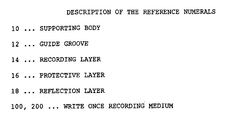
  • a write once optical recording medium 100 comprises a supporting body 10 made of a thermoplastic resin with a guide groove 12 formed on the surface, a recording layer 14 on the supporting body, and a light transmitting protective layer 16 formed on the recording layer 14.
  • an information signal is recorded thereon and reproduced therefrom by irradiating thereto a laser beam of a 380 to 450 nm wavelength from the light transmitting protective layer 16 side.
  • the supporting body 10 made of a thermoplastic resin, for example, a polycarbonate, a polymethacrylate, a polyolefin, or the like, can be used. It can be produced by injection molding using a stamper with ruggedness for transferring the guide groove.
  • a thermoplastic resin for example, a polycarbonate, a polymethacrylate, a polyolefin, or the like. It can be produced by injection molding using a stamper with ruggedness for transferring the guide groove.
  • the supporting body 10 may either be transparent or opaque with respect to the laser beam.
  • the recording layer 14 on the supporting body 10 is made of an organic or inorganic recording material.
  • a spin coat method of dissolving the recording material in a predetermined solvent, applying the solvent by spin coating to thereby apply a drying process, and a vacuum deposition method of setting the supporting body 10 and a recording material in a vacuum vessel, heating the recording material so as to be sublimated, and depositing the same on the supporting body 10, or the like, can be presented.
  • the absorption coefficient k can be presented.
  • the optical constants of the recording layer when the absorption coefficient k value is large with respect to the laser beam wavelength, a calorie sufficient enough for bringing about the change of the recording layer can be generated so that it is necessary for the k value to be small.
  • the k value is preferably small in the visible light and infrared ray range.
  • the absorption spectrum satisfying these conditions, it can be provided as long as the point at which the k is maximal, that is, the absorption peak has a wavelength shorter than the wavelength of the laser beam.
  • each of Ar 1 , Ar 2 , Ar 3 , Ar 4 are a substituted or unsubstituted phenyl group, a substituted or unsubstituted naphthyl group, or a substituted or unsubstituted biphenyl group, that may be same or different.
  • a compound represented by the below-mentioned [Chemical Formula 5] can be adopted as a recording material to be used for the recording layer 14.
  • Ar 5 , Ar 6 , Ar 7 , Ar 8 , Ar 9 , Ar 10 are a substituted or unsubstituted phenyl group, a substituted or unsubstituted naphthyl group, or a substituted or unsubstituted biphenyl group, that may be same or different.
  • a compound represented by the below-mentioned [Chemical Formula 7] can be adopted as a recording material adopted for the recording layer 14.
  • Ar 11 , Ar 12 , Ar 13 , Ar 14 are a substituted or unsubstituted phenyl group, a substituted or unsubstituted naphthyl group, or a substituted or unsubstituted biphenyl group, that may be same or different.
  • the light transmitting protective layer 16 is formed on the above-mentioned recording layer 14.
  • the protective layer 16 can be formed of a light transmitting thermoplastic resin, a glass, or an adhesive layer.
  • the thickness is about 10 to 177 ⁇ m.
  • a light transmitting adhesive layer when a light transmitting adhesive layer is disposed, a light transmitting both side adhesive sheet, a photo curing resin can be adopted. If needed, a transparent protective layer may further be formed.
  • oxide, nitride, sulfide, fluoride, or the like, of a rare earth element, such as Mg, Al, Si, Ti, Zn, Ga, Ge, Zr, In, Sn, Sb, Ba, Hf, Ta, Sc, and Y alone, or a material made of a mixture thereof, can be adopted.
  • a write once optical recording medium according to the present invention may have the structure shown in FIG. 2.
  • the write once optical recording medium 200 shown in FIG. 2 comprises a supporting body 10 made of a thermoplastic resin with a guide groove 12 formed on the surface, a reflection layer 18 and a recording layer 14 on the supporting body 10, and a light transmitting protective layer 16 on the recording layer 14.
  • a signal is recorded and reproduced by directing a laser beam of a 380 to 450 nm wavelength from the protective layer 16 side. It differs from the write once optical recording medium 100 shown in FIG. 1 in that the reflection layer 18 is formed.
  • the reflection layer 18 can be formed by a sputtering method using Al, Ag, Au alone or an alloy thereof, or the like.
  • a recording layer 14 of a compound (refractive index 2.3) represented by the above-mentioned [Chemical Formula 2] was formed a 100 nm thick film by a vacuum deposition method.
  • the wavelength dependency of the absorption wavelength coefficient k of the compound represented by the [Chemical Formula 2] is shown by the curve 31 in FIG. 3, and the wavelength dependency of the refractive index n is shown by the curve 32.
  • the peak wavelength ( ⁇ max ) of the absorption coefficient was 370 nm.
  • the recording layer 14 As the light transmitting protective layer 16, it was bonded via a polycarbonate transparent adhesive film of 100 ⁇ m in thickness, having the same size as that of the supporting body 10 so as to form the protective layer 16, and produce the write once optical recording medium 100.
  • optical system one having an objective lens of a 0.85 numerical aperture NA was used.
  • data was read out from the recorded optical recording medium 100 by irradiating a laser beam from the light transmitting protective layer 16 side with a 0.2 mW laser power weaker than that at the time of recording.
  • the reading operation was executed repeatedly by 10,000 times.
  • the CNR (Carrier to Noise Ratio) immediately after writing was 50.0 dB, and the CNR after repeated reading of 10,000 times was 49.6 dB, which is substantially the same as the value immediately after writing.
  • a recording layer 14 of a compound (refractive index 2.3) represented by the above-mentioned [Chemical Formula 6] was formed by a vacuum deposition method.
  • the absorption wavelength peak of the compound represented by the [Chemical Formula 6] ( ⁇ max ) was 360 nm, and the recording layer film thickness was 100 nm.
  • the recording layer 14 As the light transmitting protective layer 16, it was bonded via a polycarbonate transparent adhesive film of a 100 ⁇ m thickness, having the same size as that of the supporting body 10 so as to form the protective layer 16, and produce the write once optical recording medium 100.
  • data was read out from the recorded optical recording medium 100 by irradiating a laser beam from the light transmitting protective layer 16 side with a 0.2 mW laser power weaker than that at the time of recording.
  • the reading operation was executed repeatedly by 10,000 times.
  • the CNR immediately after writing was 48.9 dB
  • the CNR after repeated reading of 10,000 times was 48.6 dB, which is substantially the same as the value immediately after writing.
  • a fullerene (C 60 ) recording layer 14 (refractive index 2.5) was formed by a vacuum deposition method.
  • the peak absorption coefficient wavelength ( ⁇ max ) of the fullerene was 335 nm, and the recording layer film thickness was 100 nm.
  • the recording layer 14 As the light transmitting protective layer 16, it was bonded via a polycarbonate transparent adhesive film of a 100 ⁇ m thickness, having the same size as that of the supporting body 10 so as to form the protective layer 16, and produce the write once optical recording medium 100.
  • data was read out from the recorded optical recording medium 100 by irradiating a laser beam from the light transmitting protective layer 16 side with a 0.2 mW laser power weaker than that at the time of recording.
  • the reading operation was executed repeatedly by 10,000 times.
  • the CNR immediately after writing was 47.7 dB
  • the CNR after repeated reading of 10,000 times was 47.3 dB, which is substantially the same as the value immediately after writing.
  • a recording layer 14 of a compound (refractive index 2.3) represented by the above-mentioned [Chemical Formula 8] was formed by a vacuum deposition method.
  • the peak absorption coefficient wavelength of the compound represented by the [Chemical Formula 8] ( ⁇ max ) was 308 nm, and the recording layer film thickness was 100 nm.
  • the recording layer 14 As the light transmitting protective layer 16, it was bonded via a polycarbonate transparent adhesive film of a 100 ⁇ m thickness, having the same size as that of the supporting body 10 so as to form the protective layer 16, and produce the write once optical recording medium 100.
  • a cyanine pigment recording layer 14 of a compound represented by the below-mentioned [Chemical Formula 9] was formed by a spin coat method.
  • the peak absorption coefficient wavelength of the compound represented by the [Chemical Formula 9] ( ⁇ max ) was 405 nm, and the recording layer film thickness was 100 nm.
  • the recording layer 14 As the light transmitting protective layer 16, it was bonded via a polycarbonate transparent adhesive film of a 100 ⁇ m thickness, having the same size as that of the supporting body 10 so as to form the protective layer 16, and produce the write once optical recording medium 100.
  • a laser beam of a 405 nm exciting wavelength was directed from the light transmitting protective layer 16 side for recording by a 3 mW laser power, a pit was formed on the recording layer 14.
  • the recorded optical recording medium 100 was read out by directing a laser beam from the light transmitting protective layer 16 side by a 0.2 mW laser power weaker than that at the time of recording. The reading operation was executed repeatedly by 10,000 times. The CNR immediately after writing was 40.8 dB. As to the CNR after repeated reading of 10,000 times, since the pit shape was changed drastically, the signal reproduction was disabled.
  • a highly reliable write once optical recording medium capable of reproducing and recording information with a high stability if a laser beam of a 380 to 450 nm wavelength is used, and even in the case an optical system having a large numerical aperture NA with a small laser beam diameter is used for recording and reproduction, and capable of effectively avoiding deterioration of the recording layer even in the case of repeated reading for many times, can be provided.
Landscapes

  • Chemical & Material Sciences (AREA)
  • Inorganic Chemistry (AREA)
  • Optical Record Carriers And Manufacture Thereof (AREA)
  • Thermal Transfer Or Thermal Recording In General (AREA)

Abstract

In a write once optical recording medium comprising a recording layer and a light transmitting protective layer formed successively on a supporting body, for recording and reproduction by irradiating a laser beam of a 380 to 450 nm wavelength from the light transmitting protective layer side, λmax ≤ 370 nm on the premise that the wavelength providing the peak optical absorption coefficient of the recording layer is defined to be λmax.

Description

TECHNICAL FIELD
The present invention relates to a write once optical recording medium.
BACKGROUND ART
Recently, development and commercialization of an optical recording medium capable of recording and reproducing information by a laser beam have progressed.
Particularly, attention has been paid to a so-called write once optical recording medium, which is an inexpensive medium, capable of storing a tremendous amount of data such as animation or the like and writing information only once.
As the write once optical recording medium, a CD-R (compact disc-recordable) capable of recording and reproducing with the same format as that of a CD-ROM (compact disc-read only memory) has been widely used.
As an optical recording medium having a storage capacity larger than that of the CD-ROM, a DVD-ROM (digital versatile disc-read only memory) has also been developed and used practically. Further, a DVD-R (digital versatile disc-recordable) capable of recording and reproducing with the same format as that of the DVD-ROM has been developed.
Among the write once optical recording media, the CD-R and the DVD-R can be recorded and reproduced by laser beams of 780 nm and 650 nm, respectively.
Here, the recording density of the optical recording medium increases inversely proportional to the square of the light wavelength in principle.
That is, in order to achieve recording with a higher density, it is necessary to use a shorter wavelength laser beam.
Recently, a laser capable of emitting a laser beam having a wavelength of 380 to 450 nm using GaN, SHG (Second Harmonic Generation), or the like has been developed, and thereby development of an optical recording medium having a further larger capacity has been executed actively.
However, at present, a recording layer material necessary for realizing a write once optical recording medium employing the laser beam of a 380 to 450 nm wavelength has not sufficiently been developed yet.
Moreover, since the laser beam of a 380 to 450 nm wavelength has a high energy density, it may damage a recording layer in an optical system having a large numerical aperture NA with a small laser beam diameter even if the power is small at the time of reading. Therefore, stability in repeated reading is problematic.
Accordingly, the present inventors have studied the above-mentioned problem elaborately, and consequently, have realized an optical recording medium employing a recording material preferable for the write once optical recording medium using a laser beam of a 380 to 450 nm wavelength, capable of providing a high stability in repeated reading.
DISCLOSURE OF THE INVENTION
A write once optical recording medium according to the present invention comprises a recording layer on a supporting body, and a light transmitting protective layer on the recording layer, for recording and reproduction by directing a laser beam of a 380 to 450 nm wavelength from the light transmitting protective layer surface, characterized by λmax ≤ 370 nm on the premise that the wavelength providing the peak optical absorption coefficient of the recording layer is defined to be λmax.
According to the present invention, a write once optical recording medium having a high stability can be obtained even in the case of repeated reading using an optical system having a large numerical aperture NA with a small laser beam diameter with the use of a laser beam of a 380 to 450 nm wavelength.
BRIEF DESCRIPTION OF THE DRAWINGS
  • FIG. 1 is a schematic sectional view of an embodiment of a write once optical recording medium according to the present invention.
  • FIG. 2 is a schematic sectional view of another embodiment of a write once optical recording medium according to the present invention.
  • FIG. 3 shows the wavelength dependency of the absorption coefficient k of the compound represented by the [chemical formula 5].
  • BEST MODE FOR CARRYING OUT THE INVENTION
    A write once optical recording medium according to the present invention, on and from which recording and reproducing are performed by a laser beam 380 to 450 nm wavelength, comprises a supporting body made of a thermoplastic resin provided with a guide groove on the surface, a recording layer on the supporting body surface, and a light transmitting protective layer on the recording layer, for recording and reproducing a signal by directing a laser beam of a 380 to 450 nm wavelength from the light transmitting protective layer side surface.
    Hereinafter, the write once optical recording medium according to the present invention will be explained with reference to embodiments thereof. However, the write once optical recording medium of the present invention is not limited to the embodiments shown below.
    FIG. 1 is a schematic sectional view of an embodiment of a write once optical recording medium according to the present invention.
    A write once optical recording medium 100 according to the present invention comprises a supporting body 10 made of a thermoplastic resin with a guide groove 12 formed on the surface, a recording layer 14 on the supporting body, and a light transmitting protective layer 16 formed on the recording layer 14.
    In the write once optical recording medium 100, an information signal is recorded thereon and reproduced therefrom by irradiating thereto a laser beam of a 380 to 450 nm wavelength from the light transmitting protective layer 16 side.
    For the supporting body 10 made of a thermoplastic resin, for example, a polycarbonate, a polymethacrylate, a polyolefin, or the like, can be used. It can be produced by injection molding using a stamper with ruggedness for transferring the guide groove.
    The supporting body 10 may either be transparent or opaque with respect to the laser beam.
    The recording layer 14 on the supporting body 10 is made of an organic or inorganic recording material. As the method for forming the recording layer 14, a spin coat method of dissolving the recording material in a predetermined solvent, applying the solvent by spin coating to thereby apply a drying process, and a vacuum deposition method of setting the supporting body 10 and a recording material in a vacuum vessel, heating the recording material so as to be sublimated, and depositing the same on the supporting body 10, or the like, can be presented.
    In terms of the reading stability, as the physical property required of the recording layer, the absorption coefficient k can be presented. Among the optical constants of the recording layer, when the absorption coefficient k value is large with respect to the laser beam wavelength, a calorie sufficient enough for bringing about the change of the recording layer can be generated so that it is necessary for the k value to be small. Moreover, in order to restrain the change of the recording layer by a visible light, or an infrared ray, which is a beam having a wavelength longer than the wavelength of the laser beam, the k value is preferably small in the visible light and infrared ray range.
    Considering the absorption spectrum satisfying these conditions, it can be provided as long as the point at which the k is maximal, that is, the absorption peak has a wavelength shorter than the wavelength of the laser beam.
    As the recording material to be used for the recording layer 14, a compound represented by the below-mentioned [chemical formula 1] can be presented.
    Figure 00060001
       (wherein each of Ar1, Ar2, Ar3, Ar4 are a substituted or unsubstituted phenyl group, a substituted or unsubstituted naphthyl group, or a substituted or unsubstituted biphenyl group, that may be same or different.)
    As specific examples of the compounds represented by the above-mentioned [chemical formula 1], a compound represented by the below-mentioned [Chemical Formula 2], wherein Ar1, Ar3 are a phenyl group, and Ar2, Ar4 are a 4'(diphenylamino)biphenyl-4-yl group, a compound represented by the below-mentioned [Chemical Formula 3], wherein Ar1, Ar3 are a phenyl group, and Ar2, Ar4 are a naphthyl group, and a compound represented by the below-mentioned [Chemical Formula 4], wherein Ar1, Ar3 are a phenyl group, and Ar2, Ar4 are a 4'(diphenylamino)phenyl group, or the like, can be presented.
    Figure 00070001
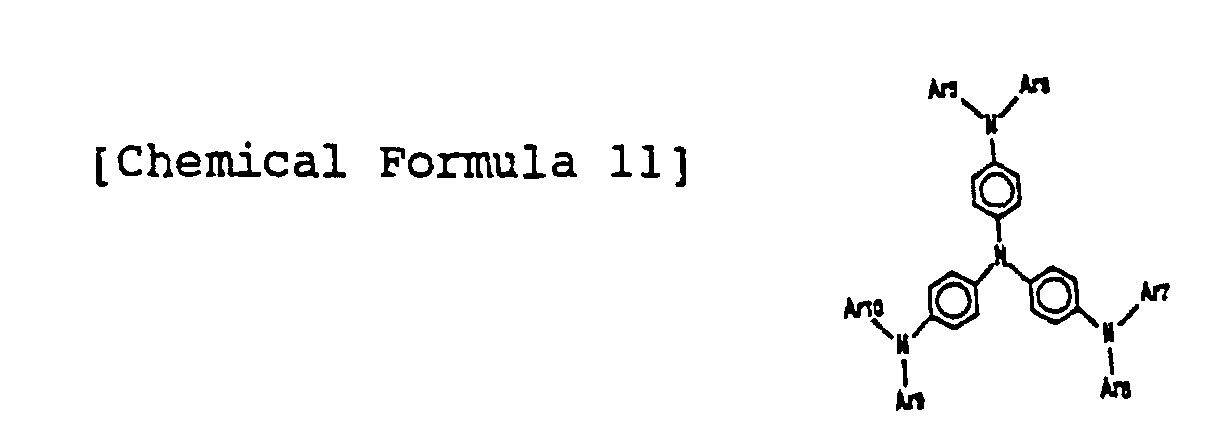
    Moreover, as a recording material to be used for the recording layer 14, a compound represented by the below-mentioned [Chemical Formula 5] can be adopted.
    Figure 00080001
       (wherei n each of Ar5, Ar6, Ar7, Ar8, Ar9, Ar10 are a substituted or unsubstituted phenyl group, a substituted or unsubstituted naphthyl group, or a substituted or unsubstituted biphenyl group, that may be same or different.)
    As specific examples of the compounds represented by the above-mentioned [chemical formula 5], a compound represented by the below-mentioned [compound 6], wherein Ar5, Ar7, Ar9 are a phenyl group, and Ar6, Ar8, Ar10 are a 3-(methyl)phenyl group, can be presented.
    Figure 00080002
    Moreover, as a recording material adopted for the recording layer 14, Cn (wherein, n is an integer capable of obtaining a geometrically spherical compound), in particular, a fullerene with n = 60 can be employed.
    Furthermore, as a recording material adopted for the recording layer 14, a compound represented by the below-mentioned [Chemical Formula 7] can be adopted.
    Figure 00080003
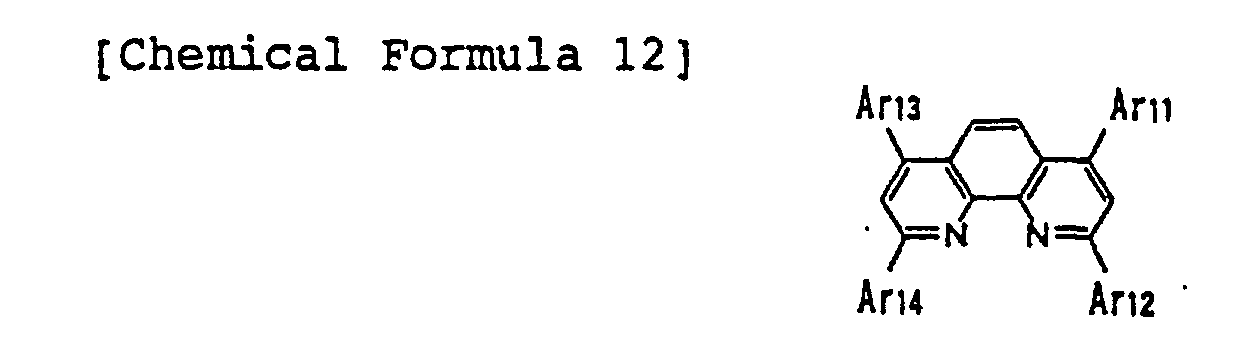
       (wherein each of Ar11, Ar12, Ar13, Ar14 are a substituted or unsubstituted phenyl group, a substituted or unsubstituted naphthyl group, or a substituted or unsubstituted biphenyl group, that may be same or different.)
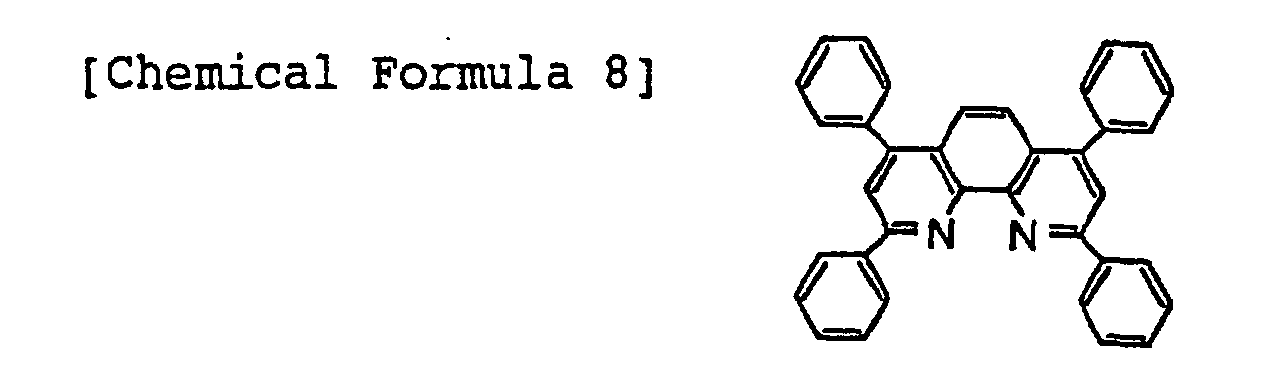
    As specific examples of the compounds represented by the above-mentioned [Chemical Formula 7], a compound represented by the below-mentioned [Chemical Formula 8], wherein Ar11, Ar12, Ar13, Ar14 are a phenyl group, can be presented.
    Figure 00090001
    The light transmitting protective layer 16 is formed on the above-mentioned recording layer 14. The protective layer 16 can be formed of a light transmitting thermoplastic resin, a glass, or an adhesive layer. The thickness is about 10 to 177 µm.
    Moreover, when a light transmitting adhesive layer is disposed, a light transmitting both side adhesive sheet, a photo curing resin can be adopted. If needed, a transparent protective layer may further be formed.
    As the transparent protective layer, oxide, nitride, sulfide, fluoride, or the like, of a rare earth element, such as Mg, Al, Si, Ti, Zn, Ga, Ge, Zr, In, Sn, Sb, Ba, Hf, Ta, Sc, and Y alone, or a material made of a mixture thereof, can be adopted.
    A write once optical recording medium according to the present invention may have the structure shown in FIG. 2.
    The write once optical recording medium 200 shown in FIG. 2 comprises a supporting body 10 made of a thermoplastic resin with a guide groove 12 formed on the surface, a reflection layer 18 and a recording layer 14 on the supporting body 10, and a light transmitting protective layer 16 on the recording layer 14.
    In the write once optical recording medium 200, a signal is recorded and reproduced by directing a laser beam of a 380 to 450 nm wavelength from the protective layer 16 side. It differs from the write once optical recording medium 100 shown in FIG. 1 in that the reflection layer 18 is formed.
    The reflection layer 18 can be formed by a sputtering method using Al, Ag, Au alone or an alloy thereof, or the like.
    Next, the write once optical recording medium according to the present invention will be explained with reference to specific Examples.
    Example 1
    On a polycarbonate supporting body 10 with a guide groove 12, a recording layer 14 of a compound (refractive index 2.3) represented by the above-mentioned [Chemical Formula 2] was formed a 100 nm thick film by a vacuum deposition method.
    The wavelength dependency of the absorption wavelength coefficient k of the compound represented by the [Chemical Formula 2] is shown by the curve 31 in FIG. 3, and the wavelength dependency of the refractive index n is shown by the curve 32.
    The peak wavelength (λmax) of the absorption coefficient was 370 nm.
    On the recording layer 14, as the light transmitting protective layer 16, it was bonded via a polycarbonate transparent adhesive film of 100 µm in thickness, having the same size as that of the supporting body 10 so as to form the protective layer 16, and produce the write once optical recording medium 100.
    When a laser beam of a 405 nm exciting wavelength had been irradiated to the write once optical recording medium 100 such produced from the light transmitting protective layer 16 side, for recording with a 3 mW laser power, a pit was formed on the recording layer 14.
    As the optical system, one having an objective lens of a 0.85 numerical aperture NA was used.
    The same is applied to the following Example and comparative example.
    Moreover, data was read out from the recorded optical recording medium 100 by irradiating a laser beam from the light transmitting protective layer 16 side with a 0.2 mW laser power weaker than that at the time of recording. The reading operation was executed repeatedly by 10,000 times. The CNR (Carrier to Noise Ratio) immediately after writing was 50.0 dB, and the CNR after repeated reading of 10,000 times was 49.6 dB, which is substantially the same as the value immediately after writing.
    Example 2
    On a polycarbonate supporting body 10 with a guide groove 12, a recording layer 14 of a compound (refractive index 2.3) represented by the above-mentioned [Chemical Formula 6] was formed by a vacuum deposition method. The absorption wavelength peak of the compound represented by the [Chemical Formula 6] (λmax) was 360 nm, and the recording layer film thickness was 100 nm.
    On the recording layer 14, as the light transmitting protective layer 16, it was bonded via a polycarbonate transparent adhesive film of a 100 µm thickness, having the same size as that of the supporting body 10 so as to form the protective layer 16, and produce the write once optical recording medium 100.
    When a laser beam of a 405 nm exciting wavelength had been irradiated to the write once optical recording medium 100 such produced from the light transmitting protective layer 16 side, for recording with a 3 mW laser power, a pit was formed on the recording layer 14.
    Moreover, data was read out from the recorded optical recording medium 100 by irradiating a laser beam from the light transmitting protective layer 16 side with a 0.2 mW laser power weaker than that at the time of recording. The reading operation was executed repeatedly by 10,000 times. The CNR immediately after writing was 48.9 dB, and the CNR after repeated reading of 10,000 times was 48.6 dB, which is substantially the same as the value immediately after writing.
    Example 3
    On a polycarbonate supporting body 10 with a guide groove formed 12, a fullerene (C60) recording layer 14 (refractive index 2.5) was formed by a vacuum deposition method. The peak absorption coefficient wavelength (λmax) of the fullerene was 335 nm, and the recording layer film thickness was 100 nm.
    On the recording layer 14, as the light transmitting protective layer 16, it was bonded via a polycarbonate transparent adhesive film of a 100 µm thickness, having the same size as that of the supporting body 10 so as to form the protective layer 16, and produce the write once optical recording medium 100.
    When a laser beam of a 405 nm exciting wavelength had been irradiated to the write once optical recording medium 100 such produced from the light transmitting protective layer 16 side, for recording with a 3 mW laser power, a pit was formed on the recording layer 14.
    Moreover, data was read out from the recorded optical recording medium 100 by irradiating a laser beam from the light transmitting protective layer 16 side with a 0.2 mW laser power weaker than that at the time of recording. The reading operation was executed repeatedly by 10,000 times. The CNR immediately after writing was 47.7 dB, and the CNR after repeated reading of 10,000 times was 47.3 dB, which is substantially the same as the value immediately after writing.
    Example 4
    On a polycarbonate supporting body 10 with a guide groove 12, a recording layer 14 of a compound (refractive index 2.3) represented by the above-mentioned [Chemical Formula 8] was formed by a vacuum deposition method.
    The peak absorption coefficient wavelength of the compound represented by the [Chemical Formula 8] (λmax) was 308 nm, and the recording layer film thickness was 100 nm.
    On the recording layer 14, as the light transmitting protective layer 16, it was bonded via a polycarbonate transparent adhesive film of a 100 µm thickness, having the same size as that of the supporting body 10 so as to form the protective layer 16, and produce the write once optical recording medium 100.
    When a laser beam of a 405 nm exciting wavelength had been irradiated to the write once optical recording medium 100 such produced from the light transmitting protective layer 16 side, for recording with a 3 mW laser power, a pit was formed on the recording layer 14.
    Moreover, data was read out from the recorded optical recording medium 100 by irradiating a laser beam from the light transmitting protective layer 16 side with a 0.2 mW laser power weaker than that at the time of recording. The reading operation was executed repeatedly by 10,000 times. The CNR immediately after writing was 48.8 dB, and the CNR after repeated reading of 10,000 times was 48.3 dB, which is substantially the same as the value immediately after writing. Comparative Example
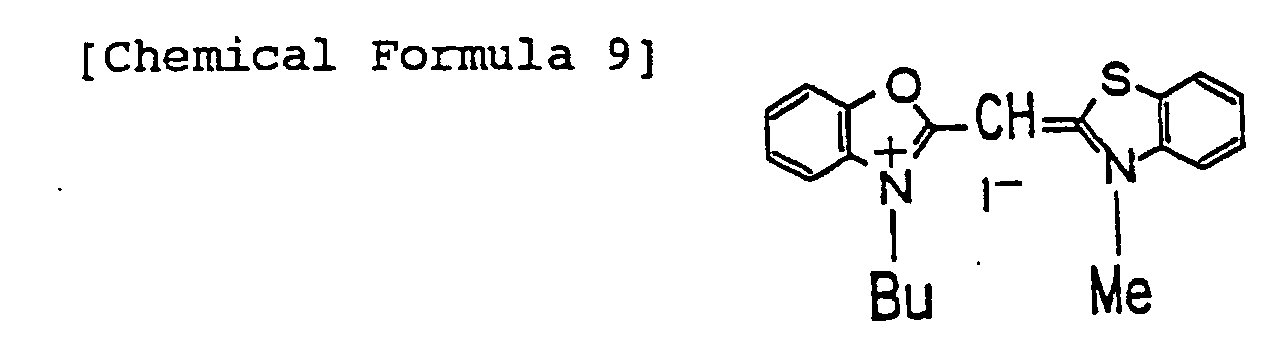
    On a polycarbonate supporting body 10 with a guide groove formed 12, a cyanine pigment recording layer 14 of a compound represented by the below-mentioned [Chemical Formula 9] was formed by a spin coat method.
    Figure 00150001
    The peak absorption coefficient wavelength of the compound represented by the [Chemical Formula 9] (λmax) was 405 nm, and the recording layer film thickness was 100 nm.
    On the recording layer 14, as the light transmitting protective layer 16, it was bonded via a polycarbonate transparent adhesive film of a 100 µm thickness, having the same size as that of the supporting body 10 so as to form the protective layer 16, and produce the write once optical recording medium 100.
    To the write once optical recording medium 100 accordingly produced, a laser beam of a 405 nm exciting wavelength was directed from the light transmitting protective layer 16 side for recording by a 3 mW laser power, a pit was formed on the recording layer 14.
    Moreover, the recorded optical recording medium 100 was read out by directing a laser beam from the light transmitting protective layer 16 side by a 0.2 mW laser power weaker than that at the time of recording. The reading operation was executed repeatedly by 10,000 times. The CNR immediately after writing was 40.8 dB. As to the CNR after repeated reading of 10,000 times, since the pit shape was changed drastically, the signal reproduction was disabled.
    According to the present invention, a highly reliable write once optical recording medium, capable of reproducing and recording information with a high stability if a laser beam of a 380 to 450 nm wavelength is used, and even in the case an optical system having a large numerical aperture NA with a small laser beam diameter is used for recording and reproduction, and capable of effectively avoiding deterioration of the recording layer even in the case of repeated reading for many times, can be provided.

    Claims (6)

    1. A write once optical recording medium comprising a recording layer and a light transmitting protective layer formed successively on a supporting body, for recording and reproduction by irradiating a laser beam of
         a 380 to 450 nm wavelength from the light transmitting protective layer side,
      characterized in that
         λmax ≤ 370 nm
         on the premise that the wavelength providing the peak optical absorption coefficient of the recording layer is defined to be λmax.
    2. The write once optical recording medium according to claim 1, characterized in that the recording layer contains a compound represented by the below-mentioned [chemical formula 10]:
      Figure 00170001
         (wherein each of Ar1, Ar2, Ar3, Ar4 are a substituted or unsubstituted phenyl group, a substituted or unsubstituted naphthyl group, or a substituted or unsubstituted biphenyl group, that may be the same or different.)
    3. The write once optical recording medium according to claim 1, characterized in that the recording layer contains a compound represented by the below-mentioned [chemical formula 11] :
      Figure 00180001
         (wherein each of Ar5, Ar6, Ar7, Ar8, Ar9, Ar10 are a substituted or unsubstituted phenyl group, a substituted or unsubstituted naphthyl group, or a substituted or unsubstituted biphenyl group, that may be same or different.)
    4. The write once optical recording medium according to claim 1, characterized in that said recording layer contains Cn (wherein, n is an integer of 60 or more capable of obtaining a geometrically spherical compound).
    5. The write once optical recording medium according to claim 4, characterized in that n of said Cn is 60.
    6. The write once optical recording medium according to claim 1, characterized in that said recording layer contains a compound represented by the below-mentioned [Chemical Formula 12]:
      Figure 00190001
         (wherein each of Ar11, Ar12, Ar13, Ar14 are a substituted or unsubstituted phenyl group, a substituted or unsubstituted naphthyl group, or a substituted or unsubstituted biphenyl group, that may be the same or different.)
    EP01917814A 2000-04-03 2001-04-03 NON-EFA ABLE OPTICAL RECORDING MEDIUM Withdrawn EP1199184A4 (en)

    Applications Claiming Priority (3)

    Application Number Priority Date Filing Date Title
    JP2000100948 2000-04-03
    JP2000100948 2000-04-03
    PCT/JP2001/002903 WO2001074600A1 (en) 2000-04-03 2001-04-03 Write-once optical record medium

    Publications (2)

    Publication Number Publication Date
    EP1199184A1 true EP1199184A1 (en) 2002-04-24
    EP1199184A4 EP1199184A4 (en) 2006-01-25

    Family

    ID=18615084

    Family Applications (1)

    Application Number Title Priority Date Filing Date
    EP01917814A Withdrawn EP1199184A4 (en) 2000-04-03 2001-04-03 NON-EFA ABLE OPTICAL RECORDING MEDIUM

    Country Status (6)

    Country Link
    US (1) US20020150837A1 (en)
    EP (1) EP1199184A4 (en)
    KR (1) KR20020021793A (en)
    CN (1) CN1366492A (en)
    TW (1) TW556155B (en)
    WO (1) WO2001074600A1 (en)

    Cited By (2)

    * Cited by examiner, † Cited by third party
    Publication number Priority date Publication date Assignee Title
    EP1318511A1 (en) * 2001-11-30 2003-06-11 Fuji Photo Film Co., Ltd. Optical information recording medium
    CN103021263A (en) * 2012-11-13 2013-04-03 朱慧珑 Nano tube password element and manufacturing method thereof

    Families Citing this family (6)

    * Cited by examiner, † Cited by third party
    Publication number Priority date Publication date Assignee Title
    JP3989846B2 (en) * 2001-03-21 2007-10-10 チバ スペシャルティ ケミカルズ ホールディング インコーポレーテッド Optical recording material with high memory density
    US7876666B2 (en) 2004-04-02 2011-01-25 Kabushiki Kaisha Toshiba Write-once information recording medium and coloring matter material therefor
    TWI391927B (en) 2004-07-16 2013-04-01 Mitsubishi Kagaku Media Co Ltd An optical recording medium and an optical recording medium
    WO2006086040A2 (en) 2004-11-24 2006-08-17 The Trustees Of Princeton University Organic photosensitive optoelectronic device having a phenanthroline exciton blocking layer
    JP2007035222A (en) * 2005-07-29 2007-02-08 Toshiba Corp Information recording medium, reproducing method and recording method
    DE602007010092D1 (en) 2006-01-13 2010-12-09 Mitsubishi Kagaku Media Co Ltd OPTICAL RECORDING MEDIUM

    Family Cites Families (18)

    * Cited by examiner, † Cited by third party
    Publication number Priority date Publication date Assignee Title
    DE3503995A1 (en) * 1984-02-06 1985-08-08 Ricoh Co., Ltd., Tokio/Tokyo OPTICAL INFORMATION RECORD CARRIER
    US4670345A (en) * 1985-02-22 1987-06-02 Asahi Kasei Kogyo Kabushiki Kaisha Information recording medium
    US4666819A (en) * 1985-03-11 1987-05-19 Minnesota Mining And Manufacturing Company Optical information storage based on polymeric dyes
    JP2662399B2 (en) * 1987-07-28 1997-10-08 キヤノン株式会社 Infrared absorbing compound and optical recording medium using the same
    US5182186A (en) * 1987-09-29 1993-01-26 Fuji Photo Film Co., Ltd. Optical information recording medium
    US5271979A (en) * 1991-05-01 1993-12-21 Canon Kabushiki Kaisha Optical recording medium containing polymethine compound
    EP0591595A1 (en) * 1992-10-08 1994-04-13 International Business Machines Corporation Molecular recording/reproducing method and recording medium
    JPH0757300A (en) * 1993-08-09 1995-03-03 Yamaha Corp optical disk
    JP3451752B2 (en) * 1994-10-31 2003-09-29 ソニー株式会社 Optical recording medium
    JPH1053710A (en) * 1996-08-09 1998-02-24 Nippon Kayaku Co Ltd Methine compound and optical recording medium containing the same
    KR100295371B1 (en) * 1996-12-27 2001-11-26 사토 히로시 Optical recording medium
    JP2985067B2 (en) * 1997-06-10 1999-11-29 花王株式会社 Optical recording medium
    JPH1153758A (en) * 1997-07-30 1999-02-26 Mitsubishi Chem Corp Recording / playback method
    JPH11334204A (en) * 1998-05-27 1999-12-07 Mitsubishi Chemical Corp Optical recording medium
    EP0962923B1 (en) * 1998-06-04 2011-11-16 FUJIFILM Corporation Information recording medium and novel oxonol compound
    CN1153761C (en) * 1998-06-23 2004-06-16 日本化药株式会社 Ammonium salt or diimonium salt compound and use thereof
    JP2000263936A (en) * 1999-03-15 2000-09-26 Ricoh Co Ltd Optical recording medium
    US6322931B1 (en) * 1999-07-29 2001-11-27 Siros Technologies, Inc. Method and apparatus for optical data storage using non-linear heating by excited state absorption for the alteration of pre-formatted holographic gratings

    Cited By (3)

    * Cited by examiner, † Cited by third party
    Publication number Priority date Publication date Assignee Title
    EP1318511A1 (en) * 2001-11-30 2003-06-11 Fuji Photo Film Co., Ltd. Optical information recording medium
    CN103021263A (en) * 2012-11-13 2013-04-03 朱慧珑 Nano tube password element and manufacturing method thereof
    CN103021263B (en) * 2012-11-13 2015-06-10 朱慧珑 Nano tube password element and manufacturing method thereof

    Also Published As

    Publication number Publication date
    TW556155B (en) 2003-10-01
    CN1366492A (en) 2002-08-28
    KR20020021793A (en) 2002-03-22
    EP1199184A4 (en) 2006-01-25
    WO2001074600A1 (en) 2001-10-11
    US20020150837A1 (en) 2002-10-17

    Similar Documents

    Publication Publication Date Title
    US5252370A (en) Optical recording medium and method for making
    EP0474311A1 (en) Optical data recording medium, method for writing and reading data and apparatus for recording data
    TW200405324A (en) Optical recording medium and method for optically recording data in the same
    US20040191687A1 (en) Optical recording medium
    US6920640B2 (en) Super-resolution recordable optical disk
    EP1199184A1 (en) Write-once optical record medium
    KR100678301B1 (en) Optical record reproducing method and optical recording medium
    US7172798B2 (en) High density read only optical disc
    JP2003203383A (en) Write-once/read-many type optical recording medium and optically recording method
    JP3395104B2 (en) Optical recording medium capable of recording and reproduction and optical recording method
    US6855479B2 (en) Phase-change optical recording media
    JPH05290408A (en) Optical information recording medium
    US5274624A (en) Optical recording medium
    JP2003200663A (en) Worm-type optical recording medium and method for optical recording
    KR100207582B1 (en) Optical recording media
    JP3028520B2 (en) Optical information recording medium
    JP4116422B2 (en) Optical information recording medium and information recording / reproducing method of optical information recording medium
    JPWO2001074600A1 (en) write-once optical recording medium
    WO2002102598A1 (en) Optical recording medium
    JP2004055117A (en) Optical recording medium and optical recording method
    KR100207581B1 (en) Optical recording medium
    JP2004319067A (en) Optical recording medium
    JPH08185642A (en) Optical recording medium and optical recording method
    JPH04286684A (en) Optical recording medium
    JP2001047746A (en) Optical recording medium

    Legal Events

    Date Code Title Description
    PUAI Public reference made under article 153(3) epc to a published international application that has entered the european phase

    Free format text: ORIGINAL CODE: 0009012

    AK Designated contracting states

    Kind code of ref document: A1

    Designated state(s): AT BE CH CY DE DK ES FI FR GB GR IE IT LI LU MC NL PT SE TR

    17P Request for examination filed

    Effective date: 20020314

    RBV Designated contracting states (corrected)

    Designated state(s): AT DE FR GB IT NL

    STAA Information on the status of an ep patent application or granted ep patent

    Free format text: STATUS: THE APPLICATION HAS BEEN WITHDRAWN

    A4 Supplementary search report drawn up and despatched

    Effective date: 20051214

    RIC1 Information provided on ipc code assigned before grant

    Ipc: B41M 5/26 19680901ALI20051208BHEP

    Ipc: G11B 7/24 19680901AFI20051208BHEP

    18W Application withdrawn

    Effective date: 20060105