EP1199086A1 - Safety arrangement against fires to retard, delay, control and extinguish a fire by means of humidification having water as basic extinguishing element - Google Patents
Safety arrangement against fires to retard, delay, control and extinguish a fire by means of humidification having water as basic extinguishing element Download PDFInfo
- Publication number
- EP1199086A1 EP1199086A1 EP01931702A EP01931702A EP1199086A1 EP 1199086 A1 EP1199086 A1 EP 1199086A1 EP 01931702 A EP01931702 A EP 01931702A EP 01931702 A EP01931702 A EP 01931702A EP 1199086 A1 EP1199086 A1 EP 1199086A1
- Authority
- EP
- European Patent Office
- Prior art keywords
- water
- fire
- distribution pipes
- extinguishing
- basic
- Prior art date
- Legal status (The legal status is an assumption and is not a legal conclusion. Google has not performed a legal analysis and makes no representation as to the accuracy of the status listed.)
- Granted
Links
Images

Classifications
-
- A—HUMAN NECESSITIES
- A62—LIFE-SAVING; FIRE-FIGHTING
- A62C—FIRE-FIGHTING
- A62C35/00—Permanently-installed equipment
- A62C35/58—Pipe-line systems
- A62C35/60—Pipe-line systems wet, i.e. containing extinguishing material even when not in use
Definitions
- the following description refers to an application for the patent of an invention, regarding a security disposition against fire applicable for delaying, retaining, controlling and extinguishing the action of fire by means of moisture, with water (which may contain additives or not) as its basic extinguishing element.
- the function of dampening partitions or walls, floors or floor coverings, and ceilings with water, is carried out by means of a water sprinkler system, which takes account of spraying, misting, exudation and similar processes.
- the invention takes advantage of the property of some inorganic materials and all organic materials, both natural and artificial, to absorb and emit humidity according to the surrounding circumstances, a property that is known as being hygroscopic.
- the invention also takes advantage of the capillarity or property of solid bodies to attract and draw up their walls, to a certain extent, the liquid that dampens them, such as the case of the water employed in this invention.
- the invention also takes into account the fact that its stability, resistance and insulating property must not be reduced in the presence of fire, in addition to avoiding the emission of toxic or flammable gases, and the fact that it may be installed in any type of construction with a maximum degree of individualisation, both in a building and mobile structure such as a boat.
- This invention finds its application in the field of the industry devoted to extinguishing fires.
- Water is the extinguishing agent par excellence: it is the cheapest, the most abundant, and the most widely used in extinguishing fires.
- the great extinguishing capacity of water is determined by a series of physical and chemical characteristics that make it irreplaceable, amongst which are the following:
- water acts as an extinguishing agent mainly through cooling and suffocation.
- Suffocation is achieved by displacing the air that surrounds the fire.
- water becomes vapour, and in accordance with an increase in its volume, it manages to displace hot gases and even air, and as there is no oxygen the fire is extinguished by suffocation.
- water also acts by dissolving the combustible liquids and lowering their concentration to extreme limits, giving the vapour-combustible-air mixture a concentration less than that at the point of ignition.
- valves that are joined to a network of water pipes, and that have temperature detecting elements, so that once the limits established are exceeded the valve in question opens, and a stream of micro drops of water falls vertically downwards in order to suppress the fire within the room or rooms where the emission valves have been fitted into the ceiling.
- the security disposition against fire applicable for delaying, retaining, controlling and extinguishing the action of fire by means of moisture, with water as its basic extinguishing element uses a "U" shaped metal ring that embraces the partition or wall of the enclosure.
- the partition has a wooden central core with two plaster panels situated on either side of the wooden core, in addition to two panels of agglomerate on the adjacent sides of the plaster panels, with a supply pipe that is connected to two distribution pipes which, by means of distributors, injects water into the plaster panels.
- Said plaster panels which are prepared beforehand to rapidly absorb water, activate the security disposition by means of an automatic system composing of one or several electrovalves that open and close, depending on requirements, using computerised methods to obtain the correct size of the opening and appropriate degree of pressure, as well as a manual purge valve as a means of security, which permits the state of the installation to be checked periodically.
- partitions or walls, floors and floor coverings, and ceilings can also be built from natural or artificial materials whose properties are similar to those of wood and plaster.
- the security disposition against fire consists of fighting fires from the very beginning by using partitions or walls, floors or floor coverings, and ceilings that make up the enclosure, made from materials with a high hygroscopic and capillary power, in order to dampen these materials in an anticipated and controlled manner by means of water sprinkler methods using artificial pressure, such as spraying, misting, exudation, etc., until the ideal degree of moisture is reached, which is usually when fibres are saturated.
- a metal part or bracket (1) with an inverted "U” shape can be found in the upper part of the five adjoining elements.
- On top of this metal part are the water distribution pipes (6) with outlets or distributors (7), through which the water (whether mixed with other products or not) comes out, dampening parts (2), (2'), (3), (3') and (4) that are fixed by the aforementioned metal bracket (1).
- some piping connects the supply pipe (5) to the distribution pipes (6).
- an open/close electrovalve (8) that is activated automatically, and a manual purge valve (9), have been incorporated.
- Figure 2 shows a plan view of the installation, referring to (11) the group of elements made up by the partition, wall, ceiling or similar structure that is to be dampened by the security disposition.
- FIG 3 it can be seen how a brick wall (12) of a load-bearing structure or a similar structure, can be protected by an outer layer formed by a plaster core (3) that is covered by layers of agglomerate or any other wood by-product (2) and (2'), forming a general covering (11') that can be placed on one or two sides of the wall (12) as shown in Figure 4.
Landscapes
- Health & Medical Sciences (AREA)
- Public Health (AREA)
- Business, Economics & Management (AREA)
- Emergency Management (AREA)
- Fire-Extinguishing By Fire Departments, And Fire-Extinguishing Equipment And Control Thereof (AREA)
- Building Environments (AREA)
Abstract
Description
- The following description refers to an application for the patent of an invention, regarding a security disposition against fire applicable for delaying, retaining, controlling and extinguishing the action of fire by means of moisture, with water (which may contain additives or not) as its basic extinguishing element. The function of dampening partitions or walls, floors or floor coverings, and ceilings with water, is carried out by means of a water sprinkler system, which takes account of spraying, misting, exudation and similar processes. At the same time the invention takes advantage of the property of some inorganic materials and all organic materials, both natural and artificial, to absorb and emit humidity according to the surrounding circumstances, a property that is known as being hygroscopic. The invention also takes advantage of the capillarity or property of solid bodies to attract and draw up their walls, to a certain extent, the liquid that dampens them, such as the case of the water employed in this invention.
- The invention also takes into account the fact that its stability, resistance and insulating property must not be reduced in the presence of fire, in addition to avoiding the emission of toxic or flammable gases, and the fact that it may be installed in any type of construction with a maximum degree of individualisation, both in a building and mobile structure such as a boat.
- This invention finds its application in the field of the industry devoted to extinguishing fires.
- Water is the extinguishing agent par excellence: it is the cheapest, the most abundant, and the most widely used in extinguishing fires.
- Man has always used water for this purpose, and it can be affirmed that practically everyone knows how to use this element to suppress a fire.
- The great extinguishing capacity of water is determined by a series of physical and chemical characteristics that make it irreplaceable, amongst which are the following:
- Stability, since water is a very stable compound that separates into its elements at around 1,200 °C.
- Specific heat, stated as 1 cal/gram per centigrade.
- Latent heat of vaporisation, since 540 calories are required for one gram of water to reach 100°C, that is to say water vapour at 100°C.
- Expansion on vaporising, since each gram of water increases its volume approximately 1,700 times on vaporising, and consequently each litre of water becomes approximately 1,700 litres of water vapour.
- Due to these characteristics, water acts as an extinguishing agent mainly through cooling and suffocation.
- Given the high specific heat of each gram of water, in order to raise the temperature by one degree, 1 calorie is absorbed. On the other hand, given its high latent heat of vaporisation, each gram of water absorbs more heat to become water vapour.
- These two characteristics give it a high refrigerating power, with the result that water "takes out" a large quantity of heat from the fire and the materials cool. Consequently, it is possible to reduce the temperature of the materials involved in the fire, lowering it to below their ignition point.
- Suffocation is achieved by displacing the air that surrounds the fire. When water becomes vapour, and in accordance with an increase in its volume, it manages to displace hot gases and even air, and as there is no oxygen the fire is extinguished by suffocation.
- In certain circumstances, water also acts by dissolving the combustible liquids and lowering their concentration to extreme limits, giving the vapour-combustible-air mixture a concentration less than that at the point of ignition.
- It is clear that water has an enormous extinguishing capacity with the result that, although we do not exactly know the reason, we intuitively know that water is the best element to extinguish a fire, although this depends to a large extent on the techniques employed.
- The applicant is aware of the existence and utilisation at present of valves that are joined to a network of water pipes, and that have temperature detecting elements, so that once the limits established are exceeded the valve in question opens, and a stream of micro drops of water falls vertically downwards in order to suppress the fire within the room or rooms where the emission valves have been fitted into the ceiling.
- Nevertheless, until now, the applicant does not know of the existence of a security disposition against fire which, by using water as a basic extinguishing component, allows partitions or walls, floors or floor coverings, and ceilings to be built from materials with a high hygroscopic and capillary value, without these materials losing their physical and mechanical qualities, and dampening the partitions or walls, floors or floor coverings, and ceilings, in an anticipated and controlled manner. This control makes it possible to avoid, to a large extent, one of the greatest inconveniences of extinguishing a fire with water when it is used indiscriminately and in large quantities, such as the damage caused to recuperated goods, as well as damage to the installations or items of great value.
- The security disposition against fire applicable for delaying, retaining, controlling and extinguishing the action of fire by means of moisture, with water as its basic extinguishing element as proposed by the invention, constitutes per se an evident novelty in the field of application in which it is incorporated, by bringing together in a general context numerous advantages that are not taken into account by fire fighting systems that use water as a basic element to suppress fire, by preserving the structures and items found in the surrounding area and causing practically no damage to them.
- The security disposition against fire applicable for delaying, retaining, controlling and extinguishing the action of fire by means of moisture, with water as its basic extinguishing element, uses a "U" shaped metal ring that embraces the partition or wall of the enclosure. The partition has a wooden central core with two plaster panels situated on either side of the wooden core, in addition to two panels of agglomerate on the adjacent sides of the plaster panels, with a supply pipe that is connected to two distribution pipes which, by means of distributors, injects water into the plaster panels. Said plaster panels, which are prepared beforehand to rapidly absorb water, activate the security disposition by means of an automatic system composing of one or several electrovalves that open and close, depending on requirements, using computerised methods to obtain the correct size of the opening and appropriate degree of pressure, as well as a manual purge valve as a means of security, which permits the state of the installation to be checked periodically.
- It must be reiterated that it is possible to add additives to the water or not, as the case may be.
- These partitions or walls, floors and floor coverings, and ceilings, can also be built from natural or artificial materials whose properties are similar to those of wood and plaster.
- In essence, the security disposition against fire consists of fighting fires from the very beginning by using partitions or walls, floors or floor coverings, and ceilings that make up the enclosure, made from materials with a high hygroscopic and capillary power, in order to dampen these materials in an anticipated and controlled manner by means of water sprinkler methods using artificial pressure, such as spraying, misting, exudation, etc., until the ideal degree of moisture is reached, which is usually when fibres are saturated.
- As a complement of the invention, the use of all types of fire detectors has been envisaged, amongst which smoke optics are employed by means of photographic cameras or video images that measure the luminosity and darkness of the enclosure protected by the invention, and at the same time detect smoke particles with a laser.
- In order to complement this description and to aid a better understanding of the characteristics of the invention, four sheets of plans accompany this description for purely illustrative and not limiting purposes:
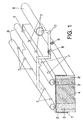
- Figure 1 shows a perspective view of the object of the invention, regarding the security disposition against fire applicable for delaying, retaining, controlling and extinguishing the action of fire by means of moisture, with water as its basic extinguishing element.
- Figure 2 shows a plan view of the distribution of the water sprinkler system including the supply pipe, distribution pipes and partition or wall to be dampened.
- Figure 3 corresponds to a perspective view of the invention, with the aim to protect on one side the base structure of a building such as a brick wall, to which a protective layer is added.
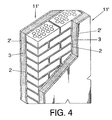
- Figure 4 shows a similar view of the object represented in Figure 3, protecting a brick structure on two sides.
-
- From the figures, and specifically figure 1, it can be seen how the security disposition against fire applicable for delaying, retaining, controlling and extinguishing the action of fire by means of moisture, with water as its basic extinguishing element, is constituted starting from outside walls, floors, ceilings, inside walls, etc., made from wood (4) with an outer layer of plaster (3) and (3'), while the plaster is covered by an agglomerate sheet (2) and (2'), more specifically an agglomerate derived from wood.
- A metal part or bracket (1) with an inverted "U" shape can be found in the upper part of the five adjoining elements. On top of this metal part are the water distribution pipes (6) with outlets or distributors (7), through which the water (whether mixed with other products or not) comes out, dampening parts (2), (2'), (3), (3') and (4) that are fixed by the aforementioned metal bracket (1).
- With the aim of obtaining an adequate flow of water through the distribution pipes (6), some piping (10) connects the supply pipe (5) to the distribution pipes (6). In a straight section of the pipe (10), an open/close electrovalve (8) that is activated automatically, and a manual purge valve (9), have been incorporated.
- Figure 2 shows a plan view of the installation, referring to (11) the group of elements made up by the partition, wall, ceiling or similar structure that is to be dampened by the security disposition. Once a source of fire has been detected, the open/close electrovalve is activated, letting water pass through the piping (10) from the pipes (5) to the distribution and injection pipes (6), in such a way that the water flowing through the distribution and injection pipes (6) gradually comes out through the distributors or injectors directed at this group of elements (11).
- In Figure 3, it can be seen how a brick wall (12) of a load-bearing structure or a similar structure, can be protected by an outer layer formed by a plaster core (3) that is covered by layers of agglomerate or any other wood by-product (2) and (2'), forming a general covering (11') that can be placed on one or two sides of the wall (12) as shown in Figure 4.
- A more extensive description is not considered necessary for any expert in the subject to be able to comprehend the scope of the invention and the advantages that may be derived from it.
- The materials, shape, size and the arrangement of the parts will be subject to variation providing that this does not imply an alteration to the essence of the invention.
- The terminology used in this description should be taken in its widest and nonlimiting meaning.
Claims (2)
- A security disposition against fire applicable for delaying, retaining, controlling and extinguishing the action of fire by means of moisture, with water as its basic extinguishing element, applicable on outside walls, floors, ceilings and inside walls that are constructed from, or protected by, materials with a high hygroscopic and capillary power in order to favour dampening, characterised because in the upper part there will be a part that is made of metal or any other material with identical resistance, upon which water distribution pipes (6) are placed, with distributors (7) that have access to the partition or similar construction. The distribution pipes (6) are joined by connecting piping (10), which at the same time is connected to a supply pipe (5). On the connecting piping (10), between the supply pipe (5) and the distribution pipes (6), is an open/close electrovalve (8) that is activated by conventional fire detecting methods, temperature or smoke, in addition to a purge valve that is activated manually (9).
- A security disposition against fire applicable for delaying, retaining, controlling and extinguishing the action of fire by means of moisture, with water as its basic extinguishing element, according to claim 1, characterised because it is possible to add products that slow down and improve the efficiency of water in the presence of a fire, to the water that flows through the supply pipe (5) towards the distribution pipes (6).
Applications Claiming Priority (4)
| Application Number | Priority Date | Filing Date | Title |
|---|---|---|---|
| ES200001120 | 2000-05-04 | ||
| ES200001120A ES2163374B1 (en) | 2000-05-04 | 2000-05-04 | SAFETY PROVISION AGAINST FIRE APPLICABLE TO DILATE, DELAY CONTROL AND EXTINGUISH THE FIRE ACTION THROUGH HUMECTATION, TAKING WATER AS A BASIC EXTINGUISHING ELEMENT. |
| PCT/ES2001/000171 WO2001085258A1 (en) | 2000-05-04 | 2001-05-04 | Safety arrangement against fires to retard, delay, control and extinguish a fire by means of humidification having water as basic extinguishing element |
| US10/039,180 US6761225B2 (en) | 2000-05-04 | 2002-01-08 | Security disposition against fire applicable for delaying, retaining, controlling and extinguishing the action of fire by means of moisture, with water as its basic extinguishing element |
Publications (2)
| Publication Number | Publication Date |
|---|---|
| EP1199086A1 true EP1199086A1 (en) | 2002-04-24 |
| EP1199086B1 EP1199086B1 (en) | 2008-12-24 |
Family
ID=28455965
Family Applications (1)
| Application Number | Title | Priority Date | Filing Date |
|---|---|---|---|
| EP01931702A Expired - Lifetime EP1199086B1 (en) | 2000-05-04 | 2001-05-04 | Safety arrangement against fires to retard, delay, control and extinguish a fire by means of humidification having water as basic extinguishing element |
Country Status (5)
| Country | Link |
|---|---|
| US (1) | US6761225B2 (en) |
| EP (1) | EP1199086B1 (en) |
| AU (1) | AU5840701A (en) |
| ES (1) | ES2163374B1 (en) |
| WO (1) | WO2001085258A1 (en) |
Families Citing this family (2)
| Publication number | Priority date | Publication date | Assignee | Title |
|---|---|---|---|---|
| CN106730552A (en) * | 2016-11-11 | 2017-05-31 | 安徽新盾消防设备有限公司 | A kind of household fire extinguisher canvas hose layout method |
| CN112337020A (en) * | 2020-11-11 | 2021-02-09 | 陈晓静 | Multifunctional fire extinguishing system for constructional engineering |
Family Cites Families (9)
| Publication number | Priority date | Publication date | Assignee | Title |
|---|---|---|---|---|
| US3974607A (en) * | 1974-10-21 | 1976-08-17 | United States Gypsum Company | Fire-rated common area separation wall structure having break-away clips |
| FR2385854A1 (en) * | 1977-03-28 | 1978-10-27 | Bassem Raymond | UNLIMITED PROTECTION SYSTEM AGAINST FIRE OF A CONSTRUCTION WHOSE FRAMING IS IN NON-COMBUSTIBLE MATERIALS |
| US4301631A (en) * | 1979-12-17 | 1981-11-24 | Michiji Tazaki | Water cooling jacket for protection from fire |
| US4330040A (en) * | 1980-05-12 | 1982-05-18 | Ence Gerald R | Fire prevention and cooling system |
| DE69104773T2 (en) * | 1990-05-21 | 1995-03-02 | Ishikawajima Harima Heavy Ind | Heat protection element. |
| FR2718361B1 (en) * | 1994-04-12 | 1996-08-23 | Moliere Sa Ets | Fixed fire fighting installation. |
| FR2726838A1 (en) * | 1994-11-15 | 1996-05-15 | Dupoyet Brice Valery Michel | Fire resistant framework device for buildings |
| US6044911A (en) * | 1996-09-06 | 2000-04-04 | Haase, Iii; Franz | Parallel-fed nonstagnant integrated water distribution network for domestic water and fire sprinkler application |
| US6158519A (en) * | 2000-01-18 | 2000-12-12 | Kretschmer; Alan P. | Fire suppression method and apparatus |
-
2000
- 2000-05-04 ES ES200001120A patent/ES2163374B1/en not_active Expired - Fee Related
-
2001
- 2001-05-04 WO PCT/ES2001/000171 patent/WO2001085258A1/en not_active Ceased
- 2001-05-04 AU AU58407/01A patent/AU5840701A/en not_active Abandoned
- 2001-05-04 EP EP01931702A patent/EP1199086B1/en not_active Expired - Lifetime
-
2002
- 2002-01-08 US US10/039,180 patent/US6761225B2/en not_active Expired - Fee Related
Non-Patent Citations (1)
| Title |
|---|
| See references of WO0185258A1 * |
Also Published As
| Publication number | Publication date |
|---|---|
| AU5840701A (en) | 2001-11-20 |
| US20030127233A1 (en) | 2003-07-10 |
| ES2163374B1 (en) | 2003-02-16 |
| WO2001085258A1 (en) | 2001-11-15 |
| EP1199086B1 (en) | 2008-12-24 |
| US6761225B2 (en) | 2004-07-13 |
| ES2163374A1 (en) | 2002-01-16 |
Similar Documents
| Publication | Publication Date | Title |
|---|---|---|
| KR101966662B1 (en) | Sprinkler system and installation | |
| WO2013141724A2 (en) | Self-extinguishing sandwich panel | |
| US20140096980A1 (en) | Self-Extinguishing Sandwich Panel | |
| KR102263360B1 (en) | Mobile shelter installed in the building under construction | |
| US20160256717A1 (en) | Sandwich panel having fire-extinguishing function and construction wall using the same | |
| KR102216096B1 (en) | Fire extinguishing control system during and after construction | |
| JP2002098391A (en) | Air conditioner | |
| JP2000512698A (en) | Ventilation type fire-resistant water cooling tower | |
| KR101670360B1 (en) | Struucture for drain pipe including appartus for fire prevention | |
| US20150068777A1 (en) | Asymmetric fire supression system | |
| US6761225B2 (en) | Security disposition against fire applicable for delaying, retaining, controlling and extinguishing the action of fire by means of moisture, with water as its basic extinguishing element | |
| Svensson | Fire ventilation | |
| JP6431416B2 (en) | Fall-off prevention device and fall-off prevention method for fireproof caps installed in the fire-prevention compartment penetration of the refrigerant piping system | |
| KR20070020266A (en) | Fire protection | |
| KR102231652B1 (en) | Fire-fighting firewall system operation system of apartment houses in case of fire | |
| JP2012132206A (en) | Fire prevention and ventilation structure for building | |
| US12152715B2 (en) | Chained fireproof sealing system | |
| KR102387996B1 (en) | Fire Extinguisher Powder Capsule For Styrofoam Insulation | |
| KR20020030074A (en) | Safety arrangement against fires to retard, delay, control and extinguish a fire by means of humidification having water as basic extinguishing element | |
| US11596818B1 (en) | System for dispensing flame retardant foam on exterior of a structure | |
| US4304082A (en) | Protective screen for improving the fire resistance of building structures | |
| US4297821A (en) | Building structures having improved fire resistant properties | |
| US20230009507A1 (en) | A system and method for controlling fire in a building | |
| KR200464519Y1 (en) | Fire Block Damper Mechanism | |
| KR20160023060A (en) | Apparatus and method for fire extinguishing of co2 explosion and offshore structure including the same |
Legal Events
| Date | Code | Title | Description |
|---|---|---|---|
| PUAI | Public reference made under article 153(3) epc to a published international application that has entered the european phase |
Free format text: ORIGINAL CODE: 0009012 |
|
| 17P | Request for examination filed |
Effective date: 20020128 |
|
| AK | Designated contracting states |
Kind code of ref document: A1 Designated state(s): AT BE CH CY DE DK ES FI FR GB GR IE IT LI LU MC NL PT SE TR |
|
| AX | Request for extension of the european patent |
Free format text: AL;LT;LV;MK;RO;SI |
|
| 17Q | First examination report despatched |
Effective date: 20060925 |
|
| GRAP | Despatch of communication of intention to grant a patent |
Free format text: ORIGINAL CODE: EPIDOSNIGR1 |
|
| RIN1 | Information on inventor provided before grant (corrected) |
Inventor name: MATEU CLIMENT, SALVADOR |
|
| GRAS | Grant fee paid |
Free format text: ORIGINAL CODE: EPIDOSNIGR3 |
|
| GRAA | (expected) grant |
Free format text: ORIGINAL CODE: 0009210 |
|
| AK | Designated contracting states |
Kind code of ref document: B1 Designated state(s): AT BE CH CY DE DK ES FI FR GB GR IE IT LI LU MC NL PT SE TR |
|
| REG | Reference to a national code |
Ref country code: GB Ref legal event code: FG4D |
|
| REG | Reference to a national code |
Ref country code: CH Ref legal event code: EP |
|
| REG | Reference to a national code |
Ref country code: IE Ref legal event code: FG4D |
|
| REF | Corresponds to: |
Ref document number: 60137108 Country of ref document: DE Date of ref document: 20090205 Kind code of ref document: P |
|
| REG | Reference to a national code |
Ref country code: DK Ref legal event code: T3 |
|
| PG25 | Lapsed in a contracting state [announced via postgrant information from national office to epo] |
Ref country code: FI Free format text: LAPSE BECAUSE OF FAILURE TO SUBMIT A TRANSLATION OF THE DESCRIPTION OR TO PAY THE FEE WITHIN THE PRESCRIBED TIME-LIMIT Effective date: 20081224 |
|
| PG25 | Lapsed in a contracting state [announced via postgrant information from national office to epo] |
Ref country code: ES Free format text: LAPSE BECAUSE OF FAILURE TO SUBMIT A TRANSLATION OF THE DESCRIPTION OR TO PAY THE FEE WITHIN THE PRESCRIBED TIME-LIMIT Effective date: 20090404 Ref country code: BE Free format text: LAPSE BECAUSE OF FAILURE TO SUBMIT A TRANSLATION OF THE DESCRIPTION OR TO PAY THE FEE WITHIN THE PRESCRIBED TIME-LIMIT Effective date: 20081224 |
|
| PG25 | Lapsed in a contracting state [announced via postgrant information from national office to epo] |
Ref country code: SE Free format text: LAPSE BECAUSE OF FAILURE TO SUBMIT A TRANSLATION OF THE DESCRIPTION OR TO PAY THE FEE WITHIN THE PRESCRIBED TIME-LIMIT Effective date: 20090324 Ref country code: PT Free format text: LAPSE BECAUSE OF FAILURE TO SUBMIT A TRANSLATION OF THE DESCRIPTION OR TO PAY THE FEE WITHIN THE PRESCRIBED TIME-LIMIT Effective date: 20090525 Ref country code: AT Free format text: LAPSE BECAUSE OF FAILURE TO SUBMIT A TRANSLATION OF THE DESCRIPTION OR TO PAY THE FEE WITHIN THE PRESCRIBED TIME-LIMIT Effective date: 20081224 |
|
| PLBE | No opposition filed within time limit |
Free format text: ORIGINAL CODE: 0009261 |
|
| STAA | Information on the status of an ep patent application or granted ep patent |
Free format text: STATUS: NO OPPOSITION FILED WITHIN TIME LIMIT |
|
| 26N | No opposition filed |
Effective date: 20090925 |
|
| PG25 | Lapsed in a contracting state [announced via postgrant information from national office to epo] |
Ref country code: MC Free format text: LAPSE BECAUSE OF NON-PAYMENT OF DUE FEES Effective date: 20090531 |
|
| REG | Reference to a national code |
Ref country code: CH Ref legal event code: PL |
|
| PG25 | Lapsed in a contracting state [announced via postgrant information from national office to epo] |
Ref country code: CH Free format text: LAPSE BECAUSE OF NON-PAYMENT OF DUE FEES Effective date: 20090531 Ref country code: LI Free format text: LAPSE BECAUSE OF NON-PAYMENT OF DUE FEES Effective date: 20090531 |
|
| REG | Reference to a national code |
Ref country code: IE Ref legal event code: MM4A |
|
| PG25 | Lapsed in a contracting state [announced via postgrant information from national office to epo] |
Ref country code: IE Free format text: LAPSE BECAUSE OF NON-PAYMENT OF DUE FEES Effective date: 20090504 |
|
| PGFP | Annual fee paid to national office [announced via postgrant information from national office to epo] |
Ref country code: IT Payment date: 20100527 Year of fee payment: 10 |
|
| PG25 | Lapsed in a contracting state [announced via postgrant information from national office to epo] |
Ref country code: GR Free format text: LAPSE BECAUSE OF FAILURE TO SUBMIT A TRANSLATION OF THE DESCRIPTION OR TO PAY THE FEE WITHIN THE PRESCRIBED TIME-LIMIT Effective date: 20090325 |
|
| PGFP | Annual fee paid to national office [announced via postgrant information from national office to epo] |
Ref country code: GB Payment date: 20100507 Year of fee payment: 10 Ref country code: DE Payment date: 20100629 Year of fee payment: 10 |
|
| PG25 | Lapsed in a contracting state [announced via postgrant information from national office to epo] |
Ref country code: LU Free format text: LAPSE BECAUSE OF NON-PAYMENT OF DUE FEES Effective date: 20090504 |
|
| PG25 | Lapsed in a contracting state [announced via postgrant information from national office to epo] |
Ref country code: TR Free format text: LAPSE BECAUSE OF FAILURE TO SUBMIT A TRANSLATION OF THE DESCRIPTION OR TO PAY THE FEE WITHIN THE PRESCRIBED TIME-LIMIT Effective date: 20081224 |
|
| PG25 | Lapsed in a contracting state [announced via postgrant information from national office to epo] |
Ref country code: CY Free format text: LAPSE BECAUSE OF FAILURE TO SUBMIT A TRANSLATION OF THE DESCRIPTION OR TO PAY THE FEE WITHIN THE PRESCRIBED TIME-LIMIT Effective date: 20081224 |
|
| PGFP | Annual fee paid to national office [announced via postgrant information from national office to epo] |
Ref country code: NL Payment date: 20111203 Year of fee payment: 11 Ref country code: FR Payment date: 20111214 Year of fee payment: 11 Ref country code: DK Payment date: 20111125 Year of fee payment: 11 |
|
| REG | Reference to a national code |
Ref country code: NL Ref legal event code: V1 Effective date: 20121201 |
|
| REG | Reference to a national code |
Ref country code: DK Ref legal event code: EBP |
|
| GBPC | Gb: european patent ceased through non-payment of renewal fee |
Effective date: 20120504 |
|
| PG25 | Lapsed in a contracting state [announced via postgrant information from national office to epo] |
Ref country code: IT Free format text: LAPSE BECAUSE OF NON-PAYMENT OF DUE FEES Effective date: 20120504 |
|
| REG | Reference to a national code |
Ref country code: FR Ref legal event code: ST Effective date: 20130131 |
|
| REG | Reference to a national code |
Ref country code: DE Ref legal event code: R119 Ref document number: 60137108 Country of ref document: DE Effective date: 20121201 |
|
| PG25 | Lapsed in a contracting state [announced via postgrant information from national office to epo] |
Ref country code: NL Free format text: LAPSE BECAUSE OF NON-PAYMENT OF DUE FEES Effective date: 20121201 |
|
| PG25 | Lapsed in a contracting state [announced via postgrant information from national office to epo] |
Ref country code: FR Free format text: LAPSE BECAUSE OF NON-PAYMENT OF DUE FEES Effective date: 20120531 Ref country code: GB Free format text: LAPSE BECAUSE OF NON-PAYMENT OF DUE FEES Effective date: 20120504 Ref country code: DK Free format text: LAPSE BECAUSE OF NON-PAYMENT OF DUE FEES Effective date: 20120531 |
|
| PG25 | Lapsed in a contracting state [announced via postgrant information from national office to epo] |
Ref country code: DE Free format text: LAPSE BECAUSE OF NON-PAYMENT OF DUE FEES Effective date: 20121201 |