EP1197516A1 - Rubber composition, resin modifier comprising the same, and resin composition - Google Patents
Rubber composition, resin modifier comprising the same, and resin composition Download PDFInfo
- Publication number
- EP1197516A1 EP1197516A1 EP00929896A EP00929896A EP1197516A1 EP 1197516 A1 EP1197516 A1 EP 1197516A1 EP 00929896 A EP00929896 A EP 00929896A EP 00929896 A EP00929896 A EP 00929896A EP 1197516 A1 EP1197516 A1 EP 1197516A1
- Authority
- EP
- European Patent Office
- Prior art keywords
- conjugated diene
- weight
- aromatic vinyl
- diene polymer
- rubber composition
- Prior art date
- Legal status (The legal status is an assumption and is not a legal conclusion. Google has not performed a legal analysis and makes no representation as to the accuracy of the status listed.)
- Granted
Links
- 239000000203 mixture Substances 0.000 title claims abstract description 109
- 229920001971 elastomer Polymers 0.000 title claims abstract description 108
- 239000005060 rubber Substances 0.000 title claims abstract description 107
- 239000011342 resin composition Substances 0.000 title claims description 87
- 229920005989 resin Polymers 0.000 title claims description 65
- 239000011347 resin Substances 0.000 title claims description 65
- 239000003607 modifier Substances 0.000 title claims description 28
- 150000001993 dienes Chemical class 0.000 claims abstract description 147
- 229920000642 polymer Polymers 0.000 claims abstract description 143
- 229920002554 vinyl polymer Polymers 0.000 claims abstract description 137
- 239000000178 monomer Substances 0.000 claims abstract description 98
- 229920001577 copolymer Polymers 0.000 claims abstract description 73
- 238000005859 coupling reaction Methods 0.000 claims abstract description 43
- 230000008878 coupling Effects 0.000 claims abstract description 35
- 238000010168 coupling process Methods 0.000 claims abstract description 35
- PPBRXRYQALVLMV-UHFFFAOYSA-N Styrene Chemical compound C=CC1=CC=CC=C1 PPBRXRYQALVLMV-UHFFFAOYSA-N 0.000 claims description 46
- 239000004615 ingredient Substances 0.000 claims description 18
- 229920005992 thermoplastic resin Polymers 0.000 claims description 4
- 239000000243 solution Substances 0.000 description 79
- 238000006116 polymerization reaction Methods 0.000 description 62
- 238000000034 method Methods 0.000 description 58
- 229920005990 polystyrene resin Polymers 0.000 description 55
- 238000004519 manufacturing process Methods 0.000 description 47
- KAKZBPTYRLMSJV-UHFFFAOYSA-N Butadiene Chemical compound C=CC=C KAKZBPTYRLMSJV-UHFFFAOYSA-N 0.000 description 24
- VLKZOEOYAKHREP-UHFFFAOYSA-N n-Hexane Chemical compound CCCCCC VLKZOEOYAKHREP-UHFFFAOYSA-N 0.000 description 24
- 230000000052 comparative effect Effects 0.000 description 17
- MZRVEZGGRBJDDB-UHFFFAOYSA-N N-Butyllithium Chemical compound [Li]CCCC MZRVEZGGRBJDDB-UHFFFAOYSA-N 0.000 description 16
- 238000006243 chemical reaction Methods 0.000 description 13
- KWYHDKDOAIKMQN-UHFFFAOYSA-N N,N,N',N'-tetramethylethylenediamine Chemical compound CN(C)CCN(C)C KWYHDKDOAIKMQN-UHFFFAOYSA-N 0.000 description 12
- 238000011156 evaluation Methods 0.000 description 12
- 229920005669 high impact polystyrene Polymers 0.000 description 9
- 239000004797 high-impact polystyrene Substances 0.000 description 9
- LFQCEHFDDXELDD-UHFFFAOYSA-N tetramethyl orthosilicate Chemical compound CO[Si](OC)(OC)OC LFQCEHFDDXELDD-UHFFFAOYSA-N 0.000 description 9
- KFZMGEQAYNKOFK-UHFFFAOYSA-N Isopropanol Chemical compound CC(C)O KFZMGEQAYNKOFK-UHFFFAOYSA-N 0.000 description 8
- 239000012986 chain transfer agent Substances 0.000 description 7
- -1 ethylene, propylene, 1-butene Chemical class 0.000 description 7
- 239000008188 pellet Substances 0.000 description 7
- OKKJLVBELUTLKV-UHFFFAOYSA-N Methanol Chemical compound OC OKKJLVBELUTLKV-UHFFFAOYSA-N 0.000 description 6
- 230000000694 effects Effects 0.000 description 6
- 238000005259 measurement Methods 0.000 description 6
- 239000007787 solid Substances 0.000 description 6
- 239000002904 solvent Substances 0.000 description 6
- 229910001220 stainless steel Inorganic materials 0.000 description 6
- 239000010935 stainless steel Substances 0.000 description 6
- 150000002736 metal compounds Chemical class 0.000 description 5
- 238000002156 mixing Methods 0.000 description 5
- XWJBRBSPAODJER-UHFFFAOYSA-N 1,7-octadiene Chemical compound C=CCCCCC=C XWJBRBSPAODJER-UHFFFAOYSA-N 0.000 description 4
- RRHGJUQNOFWUDK-UHFFFAOYSA-N Isoprene Chemical compound CC(=C)C=C RRHGJUQNOFWUDK-UHFFFAOYSA-N 0.000 description 4
- BAPJBEWLBFYGME-UHFFFAOYSA-N Methyl acrylate Chemical compound COC(=O)C=C BAPJBEWLBFYGME-UHFFFAOYSA-N 0.000 description 4
- 125000005396 acrylic acid ester group Chemical group 0.000 description 4
- 150000001336 alkenes Chemical class 0.000 description 4
- LPIQUOYDBNQMRZ-UHFFFAOYSA-N cyclopentene Chemical compound C1CC=CC1 LPIQUOYDBNQMRZ-UHFFFAOYSA-N 0.000 description 4
- WNAHIZMDSQCWRP-UHFFFAOYSA-N dodecane-1-thiol Chemical compound CCCCCCCCCCCCS WNAHIZMDSQCWRP-UHFFFAOYSA-N 0.000 description 4
- 239000003999 initiator Substances 0.000 description 4
- SSDSCDGVMJFTEQ-UHFFFAOYSA-N octadecyl 3-(3,5-ditert-butyl-4-hydroxyphenyl)propanoate Chemical compound CCCCCCCCCCCCCCCCCCOC(=O)CCC1=CC(C(C)(C)C)=C(O)C(C(C)(C)C)=C1 SSDSCDGVMJFTEQ-UHFFFAOYSA-N 0.000 description 4
- JRZJOMJEPLMPRA-UHFFFAOYSA-N olefin Natural products CCCCCCCC=C JRZJOMJEPLMPRA-UHFFFAOYSA-N 0.000 description 4
- 239000002530 phenolic antioxidant Substances 0.000 description 4
- 238000010557 suspension polymerization reaction Methods 0.000 description 4
- 238000012360 testing method Methods 0.000 description 4
- VZGDMQKNWNREIO-UHFFFAOYSA-N tetrachloromethane Chemical compound ClC(Cl)(Cl)Cl VZGDMQKNWNREIO-UHFFFAOYSA-N 0.000 description 4
- 239000004215 Carbon black (E152) Substances 0.000 description 3
- 239000003795 chemical substances by application Substances 0.000 description 3
- 229930195733 hydrocarbon Natural products 0.000 description 3
- 150000002430 hydrocarbons Chemical class 0.000 description 3
- 238000002347 injection Methods 0.000 description 3
- 239000007924 injection Substances 0.000 description 3
- 238000001746 injection moulding Methods 0.000 description 3
- 229910052751 metal Inorganic materials 0.000 description 3
- 239000002184 metal Substances 0.000 description 3
- 230000000051 modifying effect Effects 0.000 description 3
- 238000010525 oxidative degradation reaction Methods 0.000 description 3
- 230000000379 polymerizing effect Effects 0.000 description 3
- OJOWICOBYCXEKR-APPZFPTMSA-N (1S,4R)-5-ethylidenebicyclo[2.2.1]hept-2-ene Chemical compound CC=C1C[C@@H]2C[C@@H]1C=C2 OJOWICOBYCXEKR-APPZFPTMSA-N 0.000 description 2
- PRBHEGAFLDMLAL-UHFFFAOYSA-N 1,5-Hexadiene Natural products CC=CCC=C PRBHEGAFLDMLAL-UHFFFAOYSA-N 0.000 description 2
- HECLRDQVFMWTQS-RGOKHQFPSA-N 1755-01-7 Chemical compound C1[C@H]2[C@@H]3CC=C[C@@H]3[C@@H]1C=C2 HECLRDQVFMWTQS-RGOKHQFPSA-N 0.000 description 2
- SDJHPPZKZZWAKF-UHFFFAOYSA-N 2,3-dimethylbuta-1,3-diene Chemical compound CC(=C)C(C)=C SDJHPPZKZZWAKF-UHFFFAOYSA-N 0.000 description 2
- XMNIXWIUMCBBBL-UHFFFAOYSA-N 2-(2-phenylpropan-2-ylperoxy)propan-2-ylbenzene Chemical compound C=1C=CC=CC=1C(C)(C)OOC(C)(C)C1=CC=CC=C1 XMNIXWIUMCBBBL-UHFFFAOYSA-N 0.000 description 2
- IJGRMHOSHXDMSA-UHFFFAOYSA-N Atomic nitrogen Chemical group N#N IJGRMHOSHXDMSA-UHFFFAOYSA-N 0.000 description 2
- 239000004342 Benzoyl peroxide Substances 0.000 description 2
- OMPJBNCRMGITSC-UHFFFAOYSA-N Benzoylperoxide Chemical compound C=1C=CC=CC=1C(=O)OOC(=O)C1=CC=CC=C1 OMPJBNCRMGITSC-UHFFFAOYSA-N 0.000 description 2
- HEDRZPFGACZZDS-UHFFFAOYSA-N Chloroform Chemical compound ClC(Cl)Cl HEDRZPFGACZZDS-UHFFFAOYSA-N 0.000 description 2
- XDTMQSROBMDMFD-UHFFFAOYSA-N Cyclohexane Chemical compound C1CCCCC1 XDTMQSROBMDMFD-UHFFFAOYSA-N 0.000 description 2
- LFQSCWFLJHTTHZ-UHFFFAOYSA-N Ethanol Chemical compound CCO LFQSCWFLJHTTHZ-UHFFFAOYSA-N 0.000 description 2
- 238000004566 IR spectroscopy Methods 0.000 description 2
- 239000002879 Lewis base Substances 0.000 description 2
- VVQNEPGJFQJSBK-UHFFFAOYSA-N Methyl methacrylate Chemical compound COC(=O)C(C)=C VVQNEPGJFQJSBK-UHFFFAOYSA-N 0.000 description 2
- 239000005062 Polybutadiene Substances 0.000 description 2
- 239000004372 Polyvinyl alcohol Substances 0.000 description 2
- 239000002253 acid Substances 0.000 description 2
- 239000003963 antioxidant agent Substances 0.000 description 2
- 230000003078 antioxidant effect Effects 0.000 description 2
- 239000007864 aqueous solution Substances 0.000 description 2
- 125000003118 aryl group Chemical group 0.000 description 2
- 239000012298 atmosphere Substances 0.000 description 2
- 235000019400 benzoyl peroxide Nutrition 0.000 description 2
- 239000012295 chemical reaction liquid Substances 0.000 description 2
- 239000007822 coupling agent Substances 0.000 description 2
- 230000007423 decrease Effects 0.000 description 2
- 229910001873 dinitrogen Inorganic materials 0.000 description 2
- 239000002270 dispersing agent Substances 0.000 description 2
- 239000006185 dispersion Substances 0.000 description 2
- 229920006351 engineering plastic Polymers 0.000 description 2
- 239000012530 fluid Substances 0.000 description 2
- 238000005227 gel permeation chromatography Methods 0.000 description 2
- 238000010438 heat treatment Methods 0.000 description 2
- GEAWFZNTIFJMHR-UHFFFAOYSA-N hepta-1,6-diene Chemical compound C=CCCCC=C GEAWFZNTIFJMHR-UHFFFAOYSA-N 0.000 description 2
- PYGSKMBEVAICCR-UHFFFAOYSA-N hexa-1,5-diene Chemical compound C=CCCC=C PYGSKMBEVAICCR-UHFFFAOYSA-N 0.000 description 2
- 238000004898 kneading Methods 0.000 description 2
- 150000007527 lewis bases Chemical class 0.000 description 2
- 239000000155 melt Substances 0.000 description 2
- 239000002480 mineral oil Substances 0.000 description 2
- 235000010446 mineral oil Nutrition 0.000 description 2
- 239000011259 mixed solution Substances 0.000 description 2
- JFNLZVQOOSMTJK-KNVOCYPGSA-N norbornene Chemical compound C1[C@@H]2CC[C@H]1C=C2 JFNLZVQOOSMTJK-KNVOCYPGSA-N 0.000 description 2
- 239000012188 paraffin wax Substances 0.000 description 2
- RGSFGYAAUTVSQA-UHFFFAOYSA-N pentamethylene Natural products C1CCCC1 RGSFGYAAUTVSQA-UHFFFAOYSA-N 0.000 description 2
- 229920002857 polybutadiene Polymers 0.000 description 2
- 229920005672 polyolefin resin Polymers 0.000 description 2
- 229920002451 polyvinyl alcohol Polymers 0.000 description 2
- 239000007870 radical polymerization initiator Substances 0.000 description 2
- 238000010992 reflux Methods 0.000 description 2
- 229920003048 styrene butadiene rubber Polymers 0.000 description 2
- XLYOFNOQVPJJNP-UHFFFAOYSA-N water Substances O XLYOFNOQVPJJNP-UHFFFAOYSA-N 0.000 description 2
- PMJHHCWVYXUKFD-SNAWJCMRSA-N (E)-1,3-pentadiene Chemical compound C\C=C\C=C PMJHHCWVYXUKFD-SNAWJCMRSA-N 0.000 description 1
- APQIUTYORBAGEZ-UHFFFAOYSA-N 1,1-dibromoethane Chemical compound CC(Br)Br APQIUTYORBAGEZ-UHFFFAOYSA-N 0.000 description 1
- OUSXYCTXXLYBGJ-UHFFFAOYSA-N 1-ethenyl-2,4-di(propan-2-yl)benzene Chemical compound CC(C)C1=CC=C(C=C)C(C(C)C)=C1 OUSXYCTXXLYBGJ-UHFFFAOYSA-N 0.000 description 1
- OEVVKKAVYQFQNV-UHFFFAOYSA-N 1-ethenyl-2,4-dimethylbenzene Chemical compound CC1=CC=C(C=C)C(C)=C1 OEVVKKAVYQFQNV-UHFFFAOYSA-N 0.000 description 1
- NVZWEEGUWXZOKI-UHFFFAOYSA-N 1-ethenyl-2-methylbenzene Chemical compound CC1=CC=CC=C1C=C NVZWEEGUWXZOKI-UHFFFAOYSA-N 0.000 description 1
- JZHGRUMIRATHIU-UHFFFAOYSA-N 1-ethenyl-3-methylbenzene Chemical compound CC1=CC=CC(C=C)=C1 JZHGRUMIRATHIU-UHFFFAOYSA-N 0.000 description 1
- QEDJMOONZLUIMC-UHFFFAOYSA-N 1-tert-butyl-4-ethenylbenzene Chemical compound CC(C)(C)C1=CC=C(C=C)C=C1 QEDJMOONZLUIMC-UHFFFAOYSA-N 0.000 description 1
- CISIJYCKDJSTMX-UHFFFAOYSA-N 2,2-dichloroethenylbenzene Chemical compound ClC(Cl)=CC1=CC=CC=C1 CISIJYCKDJSTMX-UHFFFAOYSA-N 0.000 description 1
- SBYMUDUGTIKLCR-UHFFFAOYSA-N 2-chloroethenylbenzene Chemical compound ClC=CC1=CC=CC=C1 SBYMUDUGTIKLCR-UHFFFAOYSA-N 0.000 description 1
- KBKNKFIRGXQLDB-UHFFFAOYSA-N 2-fluoroethenylbenzene Chemical compound FC=CC1=CC=CC=C1 KBKNKFIRGXQLDB-UHFFFAOYSA-N 0.000 description 1
- JLBJTVDPSNHSKJ-UHFFFAOYSA-N 4-Methylstyrene Chemical compound CC1=CC=C(C=C)C=C1 JLBJTVDPSNHSKJ-UHFFFAOYSA-N 0.000 description 1
- VXEGSRKPIUDPQT-UHFFFAOYSA-N 4-[4-(4-methoxyphenyl)piperazin-1-yl]aniline Chemical compound C1=CC(OC)=CC=C1N1CCN(C=2C=CC(N)=CC=2)CC1 VXEGSRKPIUDPQT-UHFFFAOYSA-N 0.000 description 1
- UTKZHEXXFWCYCH-UHFFFAOYSA-N 4-tert-butyl-2-ethenyl-1-methylbenzene Chemical compound CC1=CC=C(C(C)(C)C)C=C1C=C UTKZHEXXFWCYCH-UHFFFAOYSA-N 0.000 description 1
- 229930182556 Polyacetal Natural products 0.000 description 1
- 239000004952 Polyamide Substances 0.000 description 1
- 239000004698 Polyethylene Substances 0.000 description 1
- 239000004743 Polypropylene Substances 0.000 description 1
- 239000004793 Polystyrene Substances 0.000 description 1
- 229910021627 Tin(IV) chloride Inorganic materials 0.000 description 1
- 239000006096 absorbing agent Substances 0.000 description 1
- XECAHXYUAAWDEL-UHFFFAOYSA-N acrylonitrile butadiene styrene Chemical compound C=CC=C.C=CC#N.C=CC1=CC=CC=C1 XECAHXYUAAWDEL-UHFFFAOYSA-N 0.000 description 1
- 229920000122 acrylonitrile butadiene styrene Polymers 0.000 description 1
- 239000004676 acrylonitrile butadiene styrene Substances 0.000 description 1
- 229920001893 acrylonitrile styrene Polymers 0.000 description 1
- 229920001923 acrylonitrile-ethylene-styrene Polymers 0.000 description 1
- 229910052783 alkali metal Inorganic materials 0.000 description 1
- 150000001340 alkali metals Chemical class 0.000 description 1
- XYLMUPLGERFSHI-UHFFFAOYSA-N alpha-Methylstyrene Chemical compound CC(=C)C1=CC=CC=C1 XYLMUPLGERFSHI-UHFFFAOYSA-N 0.000 description 1
- 239000002216 antistatic agent Substances 0.000 description 1
- 229920001400 block copolymer Polymers 0.000 description 1
- 238000011088 calibration curve Methods 0.000 description 1
- YACLQRRMGMJLJV-UHFFFAOYSA-N chloroprene Chemical compound ClC(=C)C=C YACLQRRMGMJLJV-UHFFFAOYSA-N 0.000 description 1
- 239000003086 colorant Substances 0.000 description 1
- 230000006866 deterioration Effects 0.000 description 1
- 229920003244 diene elastomer Polymers 0.000 description 1
- 238000001035 drying Methods 0.000 description 1
- 230000002708 enhancing effect Effects 0.000 description 1
- 230000001747 exhibiting effect Effects 0.000 description 1
- 239000003063 flame retardant Substances 0.000 description 1
- 239000011521 glass Substances 0.000 description 1
- 150000008282 halocarbons Chemical class 0.000 description 1
- 239000011256 inorganic filler Substances 0.000 description 1
- 229910003475 inorganic filler Inorganic materials 0.000 description 1
- 239000007788 liquid Substances 0.000 description 1
- 238000004811 liquid chromatography Methods 0.000 description 1
- 239000000314 lubricant Substances 0.000 description 1
- ADFPJHOAARPYLP-UHFFFAOYSA-N methyl 2-methylprop-2-enoate;styrene Chemical compound COC(=O)C(C)=C.C=CC1=CC=CC=C1 ADFPJHOAARPYLP-UHFFFAOYSA-N 0.000 description 1
- 239000012766 organic filler Substances 0.000 description 1
- 239000003960 organic solvent Substances 0.000 description 1
- 229910000489 osmium tetroxide Inorganic materials 0.000 description 1
- 239000012285 osmium tetroxide Substances 0.000 description 1
- 238000004806 packaging method and process Methods 0.000 description 1
- PMJHHCWVYXUKFD-UHFFFAOYSA-N piperylene Natural products CC=CC=C PMJHHCWVYXUKFD-UHFFFAOYSA-N 0.000 description 1
- 239000004014 plasticizer Substances 0.000 description 1
- 229920002647 polyamide Polymers 0.000 description 1
- 229920000728 polyester Polymers 0.000 description 1
- 229920000573 polyethylene Polymers 0.000 description 1
- 229920006324 polyoxymethylene Polymers 0.000 description 1
- 229920001955 polyphenylene ether Polymers 0.000 description 1
- 229920001155 polypropylene Polymers 0.000 description 1
- 229920002223 polystyrene Polymers 0.000 description 1
- 239000011148 porous material Substances 0.000 description 1
- 239000000843 powder Substances 0.000 description 1
- 239000002244 precipitate Substances 0.000 description 1
- 230000001376 precipitating effect Effects 0.000 description 1
- QMRNDFMLWNAFQR-UHFFFAOYSA-N prop-2-enenitrile;prop-2-enoic acid;styrene Chemical compound C=CC#N.OC(=O)C=C.C=CC1=CC=CC=C1 QMRNDFMLWNAFQR-UHFFFAOYSA-N 0.000 description 1
- SCUZVMOVTVSBLE-UHFFFAOYSA-N prop-2-enenitrile;styrene Chemical compound C=CC#N.C=CC1=CC=CC=C1 SCUZVMOVTVSBLE-UHFFFAOYSA-N 0.000 description 1
- 238000011160 research Methods 0.000 description 1
- 239000005049 silicon tetrachloride Substances 0.000 description 1
- 239000003381 stabilizer Substances 0.000 description 1
- CIHOLLKRGTVIJN-UHFFFAOYSA-N tert‐butyl hydroperoxide Chemical compound CC(C)(C)OO CIHOLLKRGTVIJN-UHFFFAOYSA-N 0.000 description 1
- HPGGPRDJHPYFRM-UHFFFAOYSA-J tin(iv) chloride Chemical compound Cl[Sn](Cl)(Cl)Cl HPGGPRDJHPYFRM-UHFFFAOYSA-J 0.000 description 1
- 239000012745 toughening agent Substances 0.000 description 1
- 125000000391 vinyl group Chemical group [H]C([*])=C([H])[H] 0.000 description 1
Classifications
-
- C—CHEMISTRY; METALLURGY
- C08—ORGANIC MACROMOLECULAR COMPOUNDS; THEIR PREPARATION OR CHEMICAL WORKING-UP; COMPOSITIONS BASED THEREON
- C08L—COMPOSITIONS OF MACROMOLECULAR COMPOUNDS
- C08L53/00—Compositions of block copolymers containing at least one sequence of a polymer obtained by reactions only involving carbon-to-carbon unsaturated bonds; Compositions of derivatives of such polymers
- C08L53/02—Compositions of block copolymers containing at least one sequence of a polymer obtained by reactions only involving carbon-to-carbon unsaturated bonds; Compositions of derivatives of such polymers of vinyl-aromatic monomers and conjugated dienes
-
- C—CHEMISTRY; METALLURGY
- C08—ORGANIC MACROMOLECULAR COMPOUNDS; THEIR PREPARATION OR CHEMICAL WORKING-UP; COMPOSITIONS BASED THEREON
- C08L—COMPOSITIONS OF MACROMOLECULAR COMPOUNDS
- C08L15/00—Compositions of rubber derivatives
-
- C—CHEMISTRY; METALLURGY
- C08—ORGANIC MACROMOLECULAR COMPOUNDS; THEIR PREPARATION OR CHEMICAL WORKING-UP; COMPOSITIONS BASED THEREON
- C08L—COMPOSITIONS OF MACROMOLECULAR COMPOUNDS
- C08L21/00—Compositions of unspecified rubbers
-
- C—CHEMISTRY; METALLURGY
- C08—ORGANIC MACROMOLECULAR COMPOUNDS; THEIR PREPARATION OR CHEMICAL WORKING-UP; COMPOSITIONS BASED THEREON
- C08L—COMPOSITIONS OF MACROMOLECULAR COMPOUNDS
- C08L9/00—Compositions of homopolymers or copolymers of conjugated diene hydrocarbons
- C08L9/06—Copolymers with styrene
-
- C—CHEMISTRY; METALLURGY
- C08—ORGANIC MACROMOLECULAR COMPOUNDS; THEIR PREPARATION OR CHEMICAL WORKING-UP; COMPOSITIONS BASED THEREON
- C08C—TREATMENT OR CHEMICAL MODIFICATION OF RUBBERS
- C08C19/00—Chemical modification of rubber
- C08C19/30—Addition of a reagent which reacts with a hetero atom or a group containing hetero atoms of the macromolecule
- C08C19/42—Addition of a reagent which reacts with a hetero atom or a group containing hetero atoms of the macromolecule reacting with metals or metal-containing groups
- C08C19/44—Addition of a reagent which reacts with a hetero atom or a group containing hetero atoms of the macromolecule reacting with metals or metal-containing groups of polymers containing metal atoms exclusively at one or both ends of the skeleton
-
- C—CHEMISTRY; METALLURGY
- C08—ORGANIC MACROMOLECULAR COMPOUNDS; THEIR PREPARATION OR CHEMICAL WORKING-UP; COMPOSITIONS BASED THEREON
- C08L—COMPOSITIONS OF MACROMOLECULAR COMPOUNDS
- C08L9/00—Compositions of homopolymers or copolymers of conjugated diene hydrocarbons
Definitions
- This invention relates to a rubber composition used as an effective ingredient of a resin modifier, a resin modifier comprising the rubber composition, and a resin composition comprising the resin modifier.
- a high-impact polystyrene resin is a modified resin made by incorporating a rubbery polymer such as a conjugated diene copolymer as a resin modifier in a polystyrene resin.
- the high-polystyrene resin has good impact resistance, gloss, rigidity and processability and is inexpensive, and thus, is widely used for electrical equipments, office appliances, packaging containers and miscellaneous good.
- high-impact polystyrene resins most of those exhibiting a higher impact strength have poor gloss.
- high-impact polystyrene resins having improved gloss high-impact polystyrene resins having incorporated therein a styrene-butadiene block copolymer as a resin modifier have been proposed, for example, in Japanese Examined Patent Publication No. S48-18594 and ibid. S60-57443. These proposed high-impact polystyrene resins have a problem such that their use is limited because of poor impact resistance.
- An object of the present invention is to provide an impact-resistant aromatic vinyl resin composition having well balanced impact resistance and gloss and being less apt to deteriorate in gloss in a high-temperature environment.
- Another object of the present invention is to provide a rubber composition used as an effective ingredient in a resin modifier capable of providing the above-mentioned impact-resistant aromatic vinyl resin composition.
- the present inventors made extensive research to develop an impact-resistant aromatic vinyl resin composition having well balanced impact resistance and gloss and being less apt to deteriorate in gloss in a high-temperature environment, and found that an impact-resistant aromatic vinyl resin having satisfactory characteristics can be obtained from a rubber composition comprising (A) a specific amount of a conjugated diene polymer selected from (A1) a conjugated diene polymer having a specific vinyl bond content and (A2) a conjugated diene polymer having a specific vinyl bond content in the conjugated diene monomer units and a specific coupling ratio, and (B) an aromatic vinyl-conjugated diene copolymer having a specific aromatic vinyl monomer unit content.
- a rubber composition comprising (A) 2% to 40% by weight of a conjugated diene polymer selected from (A1) a conjugated diene polymer having a vinyl bond content of at least 60% by weight in the conjugated diene monomer units and (A2) a conjugated diene polymer having a vinyl bond content of at least 30% by weight in the conjugated diene monomer units and a coupling ratio of at least 75% by weight, and (B) 98% to 60% by weight of an aromatic vinyl-conjugated diene copolymer having an aromatic vinyl monomer unit content of 25% to 50% by weight.
- a conjugated diene polymer selected from (A1) a conjugated diene polymer having a vinyl bond content of at least 60% by weight in the conjugated diene monomer units and (A2) a conjugated diene polymer having a vinyl bond content of at least 30% by weight in the conjugated diene monomer units and a coupling ratio of at least 75% by weight
- B 98% to 60% by
- a resin modifier comprising as an effective ingredient the above-mentioned rubber composition.
- the conjugated diene polymer (A) used in the present invention is selected from (A1) a conjugated diene polymer having a vinyl bond content of at least 60% by weight in the conjugated diene monomer units, and (A2) a conjugated diene polymer having a vinyl bond content of at least 30% by weight in the conjugated diene monomer units and a coupling ratio of at least 75% by weight.
- conjugated diene monomer used for the production of the conjugated diene polymer (A)
- 1,3-butadiene 2-methyl-1,3-butadiene, 2,3-dimethyl-1,3-butadiene, 2-chloro-1,3-butadiene and 1,3-pentadiene.
- 1,3-butadiene and 2-methyl-1,3-butadiene are preferable.
- 1,3-Butadiene is most preferable.
- These conjugated diene monomers may be used either alone or as a combination of at least two thereof.
- the conjugated diene polymer (A) may be a copolymer of a conjugated diene monomer with other copolymerizable monomer.
- the copolymerizable monomer includes, aromatic vinyl monomers, olefin monomers, non-conjugated diene monomers and acrylic acid ester monomers. Of these, aromatic vinyl monomers are preferable.
- aromatic vinyl monomers styrene, ⁇ -methylstyrene, 2-methylstyrene, 3-methylstyrene, 4-methylstyrene, 2,4-diisopropylstyrene, 2,4-dimethylstyrene, 4-t-butylstyrene, 5-t-butyl-2-methylstyrene, monochlorostyrene, dichlorostyrene and monofluorostyrene. Of these, styrene is preferable.
- the olefin monomers there can be mentioned ethylene, propylene, 1-butene, cyclopentene and 2-norbornene.
- non-conjugated diene monomers there can be mentioned 1,5-hexadiene, 1,6-heptadiene, 1,7-octadiene, dicyclopentadiene and 5-ethylidene-2-norbornene.
- acrylic acid ester monomers there can be mentioned methyl acrylate and methyl methacrylate.
- the lower limit of the conjugated diene monomer units in the conjugated diene polymer (A) is preferably 55% by weight, and more preferably 75% by weight. If the amount of the conjugated diene monomer units is too small, the resulting resin modifier tends to exhibit reduced resin-modifying effect, i.e., reduced impact strength-improving effect.
- the lower limit of the vinyl bond content in the conjugated diene monomer units in the conjugated diene polymer (A1) is 60%, preferably 65% and more preferably 70%.
- the upper limit thereof is preferably 85% and more preferably 80%. If the vinyl bond content is too small, the resulting resin composition has poor gloss and heat stability of gloss. In contrast, the vinyl bond content is too large, the resulting resin composition tends to exhibit reduced impact strength, especially reduced impact strength at a low temperature.
- the type of bond in the conjugated diene monomer units is classified into a vinyl bond including a 1,2-vinyl bond unit and 3,4-vinyl bond unit, and a 1,4-bond including 1,4-cis bond unit and 1,4-trans bond.
- the lower limit of viscosity of a 5% by weight solution in styrene of the conjugated diene polymer (A1) is preferably 3 cps and more preferably 10 cps.
- the upper limit thereof is preferably 1,000 cps and more preferably 200 cps. If the solution viscosity is too low, the resulting resin composition tends to have reduced impact strength. In contrast, when the solution viscosity is too high, the resulting resin composition tends to have reduced gloss and heat stability of gloss.
- the conjugated diene polymer (A1) may have been subjected to a coupling treatment.
- the coupling ratio is preferably smaller than 75% by weight and more preferably less than 65% by weight. If the coupling ratio is large, a long time is required for conducting the coupling treatment and the productivity decreases.
- the coupling ratio of a polymer used herein means a ratio by weight of the coupled polymer molecules to the polymer weight. More specifically the coupling ratio is determined by the peaks detected before and after the coupling treatment by differential refractometer in gel permeation chromatography.
- the coupling ratio in % is defined as the ratio of the area of peaks as detected after coupling, which have a higher molecular weight than the peak as detected before coupling, to the total area of peaks as detected after coupling.
- the process for producing the conjugated diene polymer (A1) is not particularly limited.
- the polymer (A1) can be produced by polymerizing a conjugated diene monomer alone or in combination with an optional copolymerizable monomer by using an organic active metal compound as an initiator and further using a Lewis base as a randomizer or vinylating agent in a hydrocarbon medium.
- the conjugated diene polymer (A2) in the rubber composition of the present invention is a conjugated diene polymer having a vinyl bond content of at least 30% by weight in the conjugated diene monomer units and a coupling ratio of at least 75% by weight.
- the lower limit of the vinyl bond content in the conjugated diene monomer units contained in the conjugated diene polymer (A2) is 30%, preferably 60% and more preferably 70%, and the upper limit thereof is preferably 90% and more preferably 80%.
- the resulting resin composition has reduced gloss and heat stability of gloss.
- the vinyl bond content is large, the resulting resin composition tends to have poor impact strength, especially impact strength at a low temperature.
- the lower limit of the coupling ratio of the conjugated diene polymer (A2) is 75%, preferably 80% and the upper limit thereof is preferably 90%.
- the coupling ratio is small, the resulting resin composition tends to have poor impact strength, especially Du Pont impact strength.
- the coupling ratio is large, a long time is required for coupling and the productivity decreases.
- the lower limit of viscosity of a 5% by weight solution in styrene of the conjugated diene polymer (A2) is preferably 3 cps and more preferably 10 cps.
- the upper limit thereof is preferably 1,000 cps and more preferably 200 cps. If the solution viscosity is too low, the resulting resin composition tends to have reduced impact strength. In contrast, when the solution viscosity is too high, the resulting resin composition tends to have reduced gloss and heat stability of gloss.
- the process for producing the conjugated diene polymer (A2) is not particularly limited.
- a conjugated diene monomer alone or in combination with an optional copolymerizable monomer is polymerized by using an organic active metal compound as an initiator and further using a vinylating agent in a hydrocarbon medium, and the thus-produced polymer is subjected to a coupling treatment.
- the conjugated diene polymer is produced by polymerization using an organic active metal compound as an initiator, an organic active metal is bonded to a terminal of a conjugated diene polymer chain during polymerization, and thus , a polyfunctional coupling agent is allowed to react with the bonded organic active metal as a reaction site.
- the coupling treatment is carried out prior to addition of a terminator such as an alcohol, namely, before the polymerization is terminated thereby eliminating the organic active metal from the terminal of polymer chain.
- the polyfunctional coupling agent used is not particularly limited and includes, for example, halogenated hydrocarbons such as dibromoethane and carbon tetrachloride, halogenated metal compounds such as silicon tetrachloride and tin tetrachloride, and alkoxy metal compounds such as tetramethoxysilane and tetraethoxytin.
- the lower limit for the coupling treatment is preferably 0°C, more preferably 20°C and especially preferably 40°C, and the upper limit thereof is preferably 100°C, more preferably 80°C and especially preferably 70°C.
- an alcohol such as methanol or isopropanol is added as a terminator to terminate polymerization.
- an antioxidant or an crumb-forming aid is added. Then the polymer solution is heated or subjected to steam stripping to remove the solvent, and then dried to give the conjugated diene polymer (A2).
- the aromatic vinyl-conjugated diene copolymer (B) used in the present invention is a copolymer made from an aromatic vinyl monomer and a conjugated diene monomer, and comprises 25% to 50% by weight, preferably 30% to 40% by weight, of aromatic vinyl monomer units and 75% to 25% by weight, preferably 70% to 60% by weight, of conjugated diene monomer units.
- the amount of aromatic vinyl monomer units is small, the resulting resin composition has poor gloss and heat stability of gloss. In contrast, when the amount of aromatic vinyl monomer units is large, the resulting resin composition has reduced impact strength.
- the aromatic vinyl-conjugated diene copolymer (B) may be a copolymer of an aromatic vinyl monomer, a conjugated diene monomer and another monomer copolymerizable therewith, provided that the effect of the present invention can be obtained.
- the copolymerizable monomer includes, for example, olefin monomers, non-conjugated diene monomers and acrylic acid ester monomers.
- the copolymerizable monomers there can be mentioned olefin monomers such as ethylene, propylene, 1-butene, cyclopentene and 2-norbornene; non-conjugated diene monomers such as 1,5-hexadiene, 1,6-heptadiene, 1,7-octadiene, dicyclopentadiene and 5-ethylidene-2-norbornene; and acrylic acid ester monomers such as methyl acrylate and methyl methacrylate.
- the upper limit of the amount of these copolymerizable monomers is preferably 20% by weight, more preferably 10% by weight and especially preferably 5% by weight.
- the amount of vinyl bond in the conjugated diene units in the aromatic vinyl-conjugated diene copolymer (B) is preferably at least 1% by weight and more preferably at least 5% by weight, and preferably smaller than 60% by weight, more preferably smaller than 30% by weight, and especially preferably smaller than 15% by weight.
- the amount of vinyl bond is too small or too large, the resulting resin composition has reduced impact strength.
- the amount of blocked aromatic vinyl monomer units is preferably at least 50% by weight, more preferably at least 80% by weight and especially preferably at least 90% by weight, based on the total weight of aromatic vinyl monomer units in the copolymer.
- the amount of the blocked aromatic vinyl monomer units is small, the resulting resin tends to have poor gloss.
- the content of blocked aromatic vinyl monomer units used herein we mean the ratio, expressed in % by weight, of the weight of blocked aromatic vinyl monomer units, which is measured by the osmic acid oxidative degradation method, to the total weight of aromatic vinyl monomer units in an aromatic vinyl-conjugated diene copolymer rubber (I. M. Kolthoff et al, J. Polym. Sci., 1 , 429 [1948]).
- this ratio is larger, the blocks composed only of consecutive aromatic vinyl monomer units are present in a larger proportion.
- the viscosity of a 5% by weight solution in styrene of the aromatic vinyl-conjugated diene copolymer (B) is such that the lower limit is preferably 3 cps, more preferably 5 cps and especially preferably 10 cps, and the upper limit is preferably 1,000 cps, more preferably 200 cps and especially preferably 100 cps. If the solution viscosity is too low, the resulting resin composition tends to have reduced impact strength. In contrast, when the solution viscosity is too high, the resulting resin composition tends to have reduced gloss.
- the process for producing the aromatic vinyl-conjugated diene copolymer (B) is not particularly limited.
- a conjugated diene monomer, an aromatic vinyl monomer and an optional copolymerizable monomer are copolymerized by using an organic active metal compound as an initiator and further using a Lewis base as a randomizer or a vinylating agent in a hydrocarbon medium.
- a step of polymerizing alone an aromatic vinyl monomer is provided in the course of the production of the copolymer, thereby producing a block copolymer.
- the rubber composition of the present invention comprises (A) 2% to 40% by weight, preferably 5% to 30%, of the conjugated diene polymer selected from conjugated diene polymer (A1) and conjugated diene polymer (A2), and (B) 98% to 60% by weight, preferably 95% to 70% by weight, of the aromatic vinyl-conjugated diene copolymer.
- the resultant resin composition has reduced impact resistance. In contrast, if the amount of polymer (A) is too large, the resulting resin composition has poor thermal stability of gloss.
- the procedure of producing the above-mentioned rubber composition is not particularly limited.
- polymers each in a solution form can be mixed together, or polymers each in a coagulated form can be kneaded together.
- polymers each in a solution form polymer solutions as-obtained when polymerization is terminated or solutions prepared by dissolving collected polymers in an organic solvent are mixed together and the mixture is made uniform.
- an antioxidant and a crumb-forming aid is added to the mixed solution, and then the mixed solution is subjected to steam stripping to remove the solvent, and then dehydrated by a dehydrator or an expansion dryer, to give a rubber composition.
- coagulated polymers i.e., crumbs obtained by subjecting polymer solutions as-obtained upon completion of polymerization to a steam-stripping treatment, and collecting the treated polymers, or dried crumbs prepared by drying the crumbs, or powders or baled mass, are mechanically kneaded together and, if desired, dried to give a rubber composition.
- a resin modifier of the present invention comprises as an effective ingredient the above-mentioned rubber composition, and is useful especially as a modifier for improving impact resistance, i.e., enhancing impact strength, of a resin, namely, as a toughening agent.
- the conjugated diene polymer (A) and the aromatic vinyl-conjugated diene copolymer (B) are mixed together and then incorporated in a resin.
- the polymer (A) and the copolymer (B) are separately incorporated in a resin and then mixed uniformly together with the resin. Rubbers other than the polymer (A) and the copolymer (B), and other ingredients can be contained in the resin modifier, provided that the effect of the present invention is obtained.
- the rubber which can be used in combination with the conjugated diene polymer (A) and the aromatic vinyl-conjugated diene copolymer (B) is not particularly limited, and includes, for example, conjugated diene polymers other than the conjugated diene polymer (A), and aromatic vinyl-conjugated diene copolymers other than the aromatic vinyl-conjugated diene copolymer (B).
- ingredients conventionally used in the resin industry can be incorporated in the resin modifier of the present invention.
- the ingredients there can be mentioned mineral oil and fluid paraffin. If a monomer for a resin is polymerized in the presence of the resin modifier to produce a resin composition, ingredients used should preferably chosen from those which do not give a baneful influence to the polymerization reaction, nor deteriorate the properties of the resulting resin composition.
- a resin composition of the present comprises the above-mentioned resin modifier.
- the resin is not particularly limited, but, is preferably a thermoplastic resin.
- the thermoplastic resin includes, for example, an aromatic vinyl resin, an olefin resin and engineering plastics. Of these, an aromatic vinyl resin is preferable.
- an aromatic vinyl resin is preferable.
- the aromatic vinyl resin there can be mentioned an acrylonitrile-acrylate-styrene resin, an acrylonitrile-ethylene-styrene resin, an acrylonitrile-styrene resin, an acrylonitrile-butadiene-styrene resin, a polystyrene resin, a high-impact polystyrene resin and a methyl methacrylate-styrene resin.
- the olefin resin there can be mentioned polyethylene and polypropylene.
- polypropylene As specific examples of the engineering plastics, there can be mentioned polyphenylene ether, polyamide, poycarbonate, polyacetal and polyester. These resins may be used either alone or as a combination of at least two thereof. Among the resins, a polystyrene resin is most preferably used.
- the ratio of the above-mentioned rubber composition to a resin is appropriately varied depending upon the particular object and the kind and composition of the rubber.
- the amount of the rubber composition to be incorporated in 100 parts by weight of a resin is such that the lower limit is preferably 2 parts by weight, more preferably 3 parts by weight and especially preferably 5 parts by weight, and the upper limit is preferably 30 parts by weight, more preferably 20 parts by weight and especially preferably 15 parts by weight.
- the amount of the rubber composition is small, the effect of modifying impact resistance is minor.
- the amount of the rubber composition is large, resulting resin composition has a reduced gloss.
- ingredients conventionally used in the resin industry can be incorporated in the resin composition of the present invention.
- the ingredients there can be mentioned mineral oil and fluid paraffin, as mentioned above for the rubber composition, and organic and inorganic fillers, stabilizers, plasticizers, lubricants, ultraviolet absorbers, colorants, releasers, antistatic agents and flame-retardants. These ingredients may be used either alone or as a combination of at least two thereof. The amount of the ingredients is appropriately provided that the object of the present invention is achieved.
- the resin composition of the present invention has a melt flow rate as measured at 200°C and a load of 5 kg according to JIS K6871 such that the lower limit is preferably 0.1 and more preferably 0.5, and the upper limit is preferably 20.
- the melt flow rate is too small or too large, the kneading is difficult and the dispersion of rubber becomes non-uniform, with the result of non-uniform quality of resin composition and reduction of impact resistance improving effect.
- the resin composition of the present invention can be made by mixing together the resin modifier and a resin, or by polymerizing a monomer for a resin in the presence of the resin modifier.
- the mixing of the resin modifier with a resin can be by a conventional procedure, for example, by a single-screw or twin-screw extruder, a Banbury mixer, a roll or a kneader.
- the mixing temperature is usually in the range of 100 to 250°C.
- the resin modifier is dissolved or dispersed in the monomer for resin to prepare a monomer solution or dispersion, followed by polymerization in a reactor.
- a reactor quipped with a stirrer, a reflux condenser and a jacket was washed and dried, and the inner atmosphere was replaced with nitrogen gas. Then the reactor was charged with 700 kg of previously purified and dried cyclohexane, 640 milli-mol of N,N,N',N'-tetramethylethylenediamine (TMEDA) and 60 kg of 1,3-butadiene, and the temperature of the content was elevated to 50°C. Then 450 ml of a solution of 1.65 milli-mol/ml of n-butyl lithium in hexane was added to initiate polymerization. From the commencement of polymerization, the polymerization temperature was elevated to 60°C at a rate of 0.5°C/min.
- TEDA N,N,N',N'-tetramethylethylenediamine
- a reactor quipped with a stirrer, a reflux condenser and a jacket was washed and dried, and the inner atmosphere was replaced with nitrogen gas. Then the reactor was charged with 700 kg of previously purified and dried cyclohexane and 60 kg of 1,3-butadiene, and the temperature of the content was elevated to 50°C. Then 500 ml of a solution of 1.65 milli-mol/ml of n-butyl lithium in hexane was added to initiate polymerization. From the commencement of polymerization, the polymerization temperature was elevated to 70°C at a rate of 1°C/min. When the polymerization conversion reached 100%, 40 kg of styrene was added and polymerization was continued.
- a stainless steel reactor equipped with a stirrer was charged with 625 parts of the obtained content and 1,825 parts of an aqueous solution of polyvinyl alcohol ("Gosenol GH-20" available from The Nippon Synthetic Chem. Co.) as a dispersant.
- the content was heated to 70°C while being stirred.
- 1.25 parts of benzoyl peroxide and 0.63 part of dicumyl peroxide were added as a radical polymerization initiator to initiate a suspension polymerization.
- the suspension polymerization was carried out at 70°C for 1 hour, at 90°C for 1 hour, at 110°C for 1 hour, and further at 130°C for 4 hour.
- the polymerization mixture was filtered to collect a polymer composition.
- the polymer composition was washed with water, dehydrated, and then dried in vacuum at 60°C for 120 hours to give a polystyrene resin composition SA.
- Polystyrene resin composition SA was kneaded by rolls at 180°C and shaped into a sheet.
- the sheet was pelletized into a pellet by a sheet-pelletizer. Using the pellet as a test sample, Izod impact strength, gloss and heat stability of gloss were evaluated. The results are shown in Table 3.
- a rubber composition B was prepared by the same procedures as described in Example 1 wherein the solution of conjugated diene polymer ii as obtained by termination of polymerization in Production Example 2 was used instead of the solution of conjugated diene polymer i, and a polystyrene resin composition SB was prepared by the same procedures as described in Example 1 wherein rubber composition B was used instead of rubber composition A. All other conditions remained the same. The properties of polystyrene resin composition SB were evaluated. The results are shown in Table 3.
- a rubber composition C was prepared by the same procedures as described in Example 1 wherein the solution of conjugated diene polymer iii as obtained by termination of polymerization in Production Example 3 was used instead of the solution of conjugated diene polymer i, the solution of aromatic vinyl-conjugated diene copolymer III as obtained by termination of polymerization in Production Example 9 was used instead of the solution of aromatic vinyl-conjugated diene copolymer II, and the two polymers were mixed together at a polymer iii/copolymer III ratio of 10/90 by weight with all other conditions remaining the same.
- polystyrene resin composition SC was prepared by the same procedures as described in Example 1 wherein rubber composition C was used instead of rubber composition A with all other conditions remaining the same. The properties of polystyrene resin composition SC were evaluated. The results are shown in Table 3.
- a polystyrene resin composition SD was prepared by the same procedures as described in Example 1 wherein rubber composition D was used instead of rubber composition A with all other conditions remaining the same. The properties of polystyrene resin composition SD were evaluated. The results are shown in Table 3.
- a polystyrene resin composition SE was prepared by the same procedures as described in Example 1 wherein rubber composition E was used instead of rubber composition A with all other conditions remaining the same. The properties of polystyrene resin composition SE were evaluated. The results are shown in Table 3.
- polystyrene resin composition SG was prepared wherein aromatic vinyl-conjugated diene polymer II was used instead of rubber composition A with all other conditions remaining the same.
- the properties of polystyrene resin composition SG were evaluated. The results are shown in Table 3.
- Polystyrene resin composition SG in this Comparative Example 1 does not contain conjugated diene polymer (A1). Therefore, although polystyrene resin composition SG exhibits excellent heat stability of gloss, it has poor gloss and poor impact strength.
- a rubber composition H was prepared by the same procedures as described in Example 1 wherein the solution of conjugated diene polymer v as obtained by termination of polymerization in Production Example 5 was used, the solution of aromatic vinyl-conjugated diene copolymer III as obtained by termination of polymerization in Production Example 9 was used, and the two polymers were mixed together at a polymer v/copolymer III ratio of 50/50 by weight with all other conditions remaining the same. Further, a polystyrene resin composition SH was prepared by the same procedures as described in Example 1 wherein rubber composition H was used instead of rubber composition A with all other conditions remaining the same. The properties of polystyrene resin composition SH were evaluated. The results are shown in Table 3.
- Polystyrene resin composition SH prepared from rubber composition H containing a large amount of a conjugated diene polymer (A1), has excellent impact strength but poor gloss and heat stability of gloss.
- a rubber composition J was prepared by the same procedures as described in Example 1 wherein the solution of conjugated diene polymer vi as obtained by termination of polymerization in Production Example 6 was used instead of the solution of conjugated diene polymer i.
- a polystyrene resin composition SJ was prepared by the same procedures as described in Example 1 wherein rubber composition J was used instead of rubber composition A. All other conditions remained the same. The properties of polystyrene resin composition SJ were evaluated. The results are shown in Table 3.
- Polystyrene resin composition SJ was prepared from rubber composition J containing a conjugated diene polymer having a low vinyl bond content, and therefore, the composition SJ has poor gloss and heat stability of gloss.
- a polystyrene resin composition SK was prepared by the same procedures as described in Example 1 wherein the monomer solution used was prepared as follows. 13 parts of conjugated diene polymer v and 7 parts of aromatic vinyl-conjugated diene copolymer II were dissolved in 90 parts of a styrene monomer. A chain transfer agent (n-dodecyl mercaptan) was added to the obtained solution to prepare a monomer solution containing 300 ppm of the chain transfer agent. All other conditions remaining the same. The properties of polystyrene resin composition SK were evaluated. The results are shown in Table 3.
- Polystyrene resin composition SK in this Comparative Example 4 was prepared from rubber composition K containing a conjugated diene polymer having a low vinyl bond content, and therefore, the composition SK has poor gloss and heat stability of gloss.
- the polystyrene resin composition of the present invention has well balanced impact resistance and gloss, and exhibits excellent heat stability of gloss.
- a conjugated diene polymer vii was produced wherein the amount of N,N,N',N'-teteramethylethylenediamine (TMEDA) was changed to 1,000 milli-liter and the amount of tetramethoxysilane was changed to 129 milli-mol with all other conditions remaining the same. Evaluation results of conjugated diene polymer vii are shown in Table 4.
- a stainless steel reactor equipped with a stirrer was charged with 625 parts of the obtained content and 1,825 parts of an aqueous solution of polyvinyl alcohol ("Gosenol GH-20" available from The Nippon Synthetic Chem. Co.) as a dispersant.
- the content was heated to 70°C while being stirred.
- 1.25 parts of benzoyl peroxide and 0.63 part of dicumyl peroxide were added as a radical polymerization initiator to initiate a suspension polymerization.
- the suspension polymerization was carried out at 70°C for 1 hour, at 90°C for 1 hour, at 110°C for 1 hour, and further at 130°C for 4 hour.
- the polymerization mixture was filtered to collect a polymer composition.
- the polymer composition was washed with water, dehydrated, and then dried in vacuum at 60°C for 12 hours to give a polystyrene resin composition SL.
- Polystyrene resin composition SL was kneaded by rolls at 180°C and shaped into a sheet.
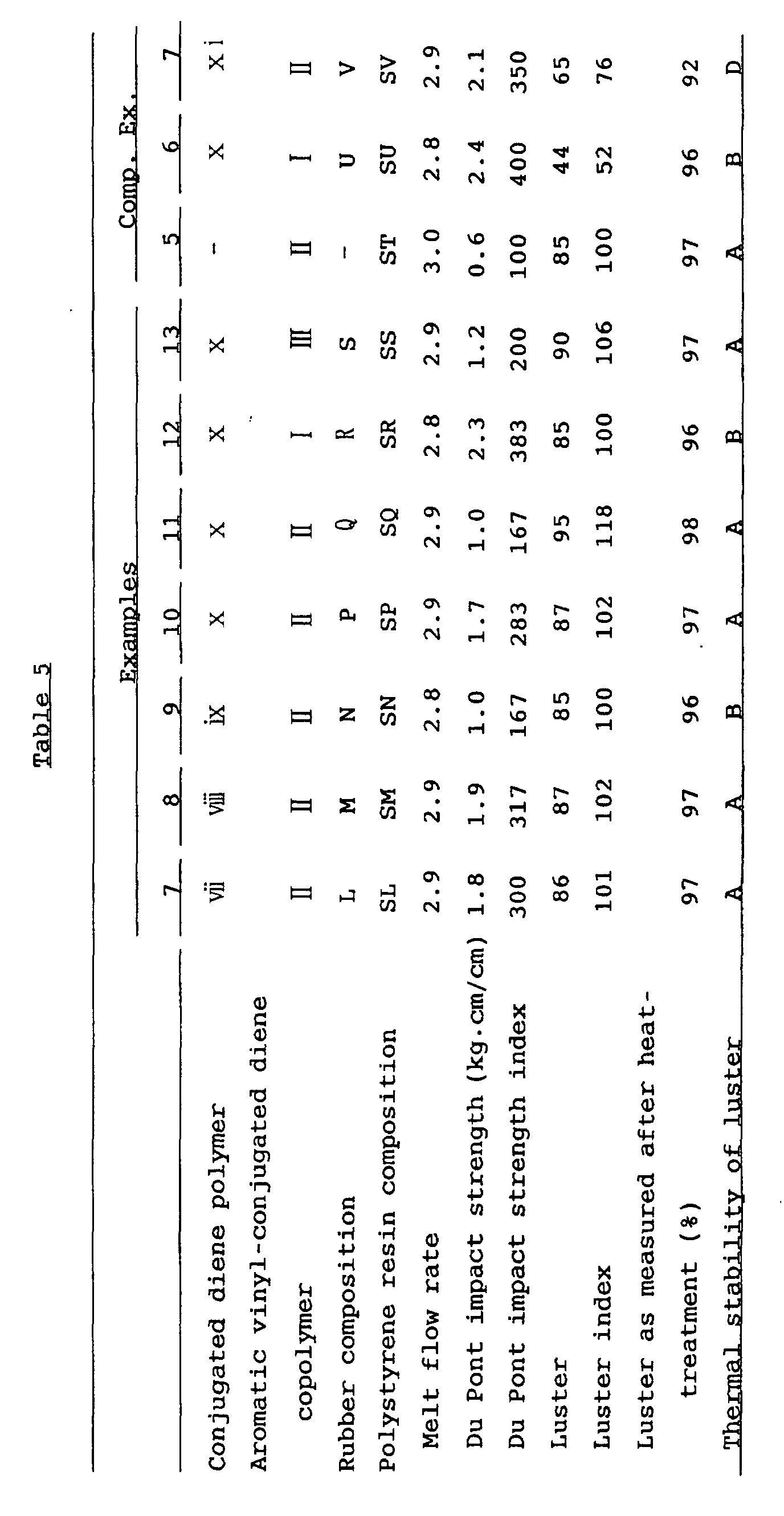
- the sheet was pelletized into a pellet by a sheet-pelletizer. Using the pellet as a test sample, Du Pont impact strength, gloss and heat stability of-gloss were evaluated. The results are shown in Table 5.
- a rubber composition M was prepared by the same procedures as described in Example 7 wherein the solution of conjugated diene polymer viii as obtained by termination of polymerization in Production Example 11 was used instead of the solution of conjugated diene polymer vii, and a polystyrene resin composition SM was prepared by the same procedures as described in Example 7 wherein rubber composition M was used instead of rubber composition L. All other conditions remained the same. The properties of polystyrene resin composition SM were evaluated. The results are shown in Table 5.
- a rubber composition N was prepared by the same procedures as described in Example 7 wherein the solution of conjugated diene polymer ix as obtained by termination of polymerization in Production Example 12 was used instead of the solution of conjugated diene polymer vii; and conjugated diene polymer ix and aromatic vinyl-conjugated diene copolymer II were mixed together at a polymer ix/copolymer II ratio of 25/75 by weight.
- a polystyrene resin composition SN was prepared by the same procedures as described in Example 7 wherein rubber composition N was used instead of rubber composition L. All other conditions remained the same. The properties of polystyrene resin composition SN were evaluated. The results are shown in Table 5.
- a rubber composition P was prepared by the same procedures as described in Example 7 wherein the solution of conjugated diene polymer x as obtained by termination of polymerization in Production Example 13 was used instead of the solution of conjugated diene polymer vii. Further, a polystyrene resin composition SP was prepared by the same procedures as described in Example 7 wherein rubber composition P was used instead of rubber composition L. All other conditions remained the same. The properties of polystyrene resin composition SP were evaluated. The results are shown in Table 5.
- a rubber composition Q was prepared by the same procedures as described in Example 10 wherein the ratio of conjugated diene polymer x to aromatic vinyl-conjugated diene copolymer II was changed to 5/95 by weight. Further, a polystyrene resin composition SQ was prepared by the same procedures as described in Example 7 wherein rubber composition Q was used instead of rubber composition L. All other conditions remained the same. The properties of polystyrene resin composition SQ were evaluated. The results are shown in Table 5.
- a rubber composition R was prepared by the same procedures as described in Example 10 wherein the solution of aromatic vinyl-conjugated diene copolymer I as obtained by termination of polymerization in Production Example 7 was used instead of the solution of aromatic vinyl-conjugated diene copolymer II, and the ratio of conjugated diene polymer x to aromatic vinyl-conjugated diene copolymer I was changed to 30/70 by weight.
- a polystyrene resin composition SR was prepared by the same procedures as described in Example 7 wherein rubber composition R was used instead of rubber composition L. All other conditions remained the same. The properties of polystyrene resin composition SR were evaluated. The results are shown in Table 5.
- a rubber composition S was prepared by the same procedures as described in Example 10 wherein the solution of aromatic vinyl-conjugated diene copolymer III as obtained by termination of polymerization in Production Example 9 was used instead of the solution of aromatic vinyl-conjugated diene copolymer II, and the ratio of conjugated diene polymer x to aromatic vinyl-conjugated diene copolymer III was changed to 10/90 by weight.
- a polystyrene resin composition SS was prepared by the same procedures as described in Example 7 wherein rubber composition S was used instead of rubber composition L. All other conditions remained the same. The properties of polystyrene resin composition SS were evaluated. The results are shown in Table 5.
- polystyrene resin composition ST was prepared wherein dried aromatic vinyl-conjugated diene polymer II was used instead of rubber composition L with all other conditions remaining the same.
- the properties of polystyrene resin composition ST were evaluated. The results are shown in Table 5.
- Polystyrene resin composition ST in this Comparative Example 5 does not contain conjugated diene polymer (A2). Therefore, although polystyrene resin composition ST exhibits excellent heat stability of gloss, it has poor gloss and poor impact strength.
- a rubber composition U was prepared by the same procedures as described in Example 12 wherein the ratio of conjugated diene polymer x to aromatic vinyl-conjugated diene copolymer I was changed to 50/50 by weight. Further, a polystyrene resin composition SU was prepared by the same procedures as described in Example 7 wherein rubber composition U was used instead of rubber composition L. All other conditions remained the same. The properties of polystyrene resin composition SU were evaluated. The results are shown in Table 5.
- Polystyrene resin composition SU in this Comparative Example 6 is prepared from rubber composition U containing a large amount of a conjugated diene polymer (A2), and has excellent impact strength but poor gloss.
- A2 conjugated diene polymer
- a rubber composition V was prepared by the same procedures as described in Example 7 wherein the solution of conjugated diene polymer xi as obtained by termination of polymerization in Production Example 14 and the solution of aromatic vinyl-conjugated diene copolymer II as obtained by termination of polymerization in Production Example 8 were used, and the ratio of conjugated diene polymer xi to aromatic vinyl-conjugated diene copolymer II was changed to 30/70 by weight. Further, a polystyrene resin composition SV was prepared by the same procedures as described in Example 7 wherein rubber composition V was used instead of rubber composition L. All other conditions remained the same. The properties of polystyrene resin composition SV were evaluated. The results are shown in Table 5.
- Polystyrene resin composition SV in this Comparative Example 7 was prepared from rubber composition V containing a conjugated diene polymer having a low vinyl bond content and a small coupling ratio, and therefore, the composition SV has excellent impact strength but poor gloss and heat stability of gloss.
- the polystyrene composition of the present invention has well balanced impact resistance and gloss, and exhibits excellent heat stability of gloss.
- a resin modifier comprising as an effective ingredient a rubber composition of the present invention exhibits enhanced modifying effect on a resin.
- a high-impact styrene resin composition made by modifying polystyrene resin with this resin modifier has well balanced impact resistance and gloss, and exhibits excellent heat stability of gloss.
Landscapes
- Chemical & Material Sciences (AREA)
- Health & Medical Sciences (AREA)
- Chemical Kinetics & Catalysis (AREA)
- Medicinal Chemistry (AREA)
- Polymers & Plastics (AREA)
- Organic Chemistry (AREA)
- Compositions Of Macromolecular Compounds (AREA)
- Graft Or Block Polymers (AREA)
- Addition Polymer Or Copolymer, Post-Treatments, Or Chemical Modifications (AREA)
Abstract
Description
| Conjugated diene polymer | i | ii | iii | iv | v | vi |
| Vinyl bond content (%) | 64 | 64 | 74 | 74 | 78 | 21 |
| Coupling ratio (%) | - | 63 | - | 20 | 62 | 67 |
| Viscosity of 5% solution in styrene (cps) | 39 | 98 | 37 | 56 | 60 | 30 |
| Aromatic vinyl-conjugated diene copolymer | I | II | III |
| Content of aromatic vinyl monomer units (%) | 40 | 40 | 40 |
| Content of blocked aromatic vinyl monomer units (%) | 97 | 98 | 85 |
| Vinyl bond content (%) | 8 | 8 | 8 |
| Viscosity of 5% styrene solution in styrene (cps) | 21 | 30 | 33 |
Polymerization was carried out until the solid concentration reached 45% at 130°C. The content was cooled and then taken out from the reactor.

| Conjugated diene polymer | vii | viii | ix | x | xi |
| Vinyl bond content (%) | 74 | 64 | 43 | 75 | 21 |
| Coupling ratio (%) | 76 | 77 | 82 | 83 | 67 |
| Viscosity of 5% solution in stryrene (cps) | 125 | 130 | 63 | 33 | 30 |
Claims (16)
Applications Claiming Priority (9)
| Application Number | Priority Date | Filing Date | Title |
|---|---|---|---|
| JP15010999 | 1999-05-28 | ||
| JP15010899 | 1999-05-28 | ||
| JP15010999 | 1999-05-28 | ||
| JP15010899 | 1999-05-28 | ||
| JP29020699 | 1999-10-12 | ||
| JP29020599 | 1999-10-12 | ||
| JP29020599A JP4092523B2 (en) | 1999-05-28 | 1999-10-12 | Rubber composition, resin modifier composition containing the same, and resin composition |
| JP29020699A JP4092524B2 (en) | 1999-05-28 | 1999-10-12 | Rubber composition, resin modifier composition containing the same, and resin composition |
| PCT/JP2000/003434 WO2000073381A1 (en) | 1999-05-28 | 2000-05-29 | Rubber composition, resin modifier comprising the same, and resin composition |
Publications (3)
| Publication Number | Publication Date |
|---|---|
| EP1197516A1 true EP1197516A1 (en) | 2002-04-17 |
| EP1197516A4 EP1197516A4 (en) | 2004-07-21 |
| EP1197516B1 EP1197516B1 (en) | 2006-12-20 |
Family
ID=27472996
Family Applications (1)
| Application Number | Title | Priority Date | Filing Date |
|---|---|---|---|
| EP00929896A Expired - Lifetime EP1197516B1 (en) | 1999-05-28 | 2000-05-29 | Rubber composition, resin modifier comprising the same, and resin composition |
Country Status (4)
| Country | Link |
|---|---|
| US (1) | US6635713B1 (en) |
| EP (1) | EP1197516B1 (en) |
| DE (1) | DE60032488T2 (en) |
| WO (1) | WO2000073381A1 (en) |
Cited By (1)
| Publication number | Priority date | Publication date | Assignee | Title |
|---|---|---|---|---|
| WO2009155126A1 (en) * | 2008-06-18 | 2009-12-23 | Dow Global Technologies Inc. | Low chloride polybutadiene |
Family Cites Families (4)
| Publication number | Priority date | Publication date | Assignee | Title |
|---|---|---|---|---|
| JPS5770137A (en) * | 1980-10-17 | 1982-04-30 | Asahi Chem Ind Co Ltd | Improved rubber composition |
| JP3184249B2 (en) * | 1991-06-07 | 2001-07-09 | 株式会社ブリヂストン | Rubber composition for tire tread |
| JP3375424B2 (en) * | 1994-08-12 | 2003-02-10 | 横浜ゴム株式会社 | Pneumatic tire |
| US5902856A (en) * | 1994-11-24 | 1999-05-11 | Nippon Zeon Co., Ltd. | Rubber composition of two diene rubbers |
-
2000
- 2000-05-29 WO PCT/JP2000/003434 patent/WO2000073381A1/en not_active Ceased
- 2000-05-29 DE DE60032488T patent/DE60032488T2/en not_active Expired - Fee Related
- 2000-05-29 EP EP00929896A patent/EP1197516B1/en not_active Expired - Lifetime
- 2000-05-29 US US09/926,652 patent/US6635713B1/en not_active Expired - Fee Related
Cited By (2)
| Publication number | Priority date | Publication date | Assignee | Title |
|---|---|---|---|---|
| WO2009155126A1 (en) * | 2008-06-18 | 2009-12-23 | Dow Global Technologies Inc. | Low chloride polybutadiene |
| US8481644B2 (en) | 2008-06-18 | 2013-07-09 | Styron Europe Gmbh | Low chloride polybutadiene |
Also Published As
| Publication number | Publication date |
|---|---|
| WO2000073381A1 (en) | 2000-12-07 |
| EP1197516A4 (en) | 2004-07-21 |
| DE60032488D1 (en) | 2007-02-01 |
| DE60032488T2 (en) | 2007-09-27 |
| US6635713B1 (en) | 2003-10-21 |
| EP1197516B1 (en) | 2006-12-20 |
Similar Documents
| Publication | Publication Date | Title |
|---|---|---|
| US6835781B2 (en) | Block copolymer rubber, resin modifier, and resin composition | |
| KR910008279B1 (en) | Selectively partially hydrogenated polymer and rubber composition and impact resibtant styrenic resin containing the same | |
| DE69514827T2 (en) | SERVICE RUBBER, PROCESS FOR ITS PRODUCTION AND RUBBER COMPOSITION | |
| HK1000665B (en) | Impact resistant styrenic resin containing a selectively, partially hydrogenated polymer | |
| EP1299442B1 (en) | Block copolymers containing both polystyrene and low vinyl content polydiene hard blocks | |
| WO2004044015A1 (en) | Block copolymer having a hard phase and a soft phase | |
| KR20090052767A (en) | Method for preparing styrene-based composite block copolymer mixture and modified asphalt composition containing the same | |
| EP0924256A1 (en) | Polybutadiene rubber and impact-resistant aromatic vinyl resin compositions | |
| US5013790A (en) | Polymer blends of tapered styrene-butadiene triblock thermoplastic elastomers | |
| JPS6366862B2 (en) | ||
| US6635713B1 (en) | Rubber composition, resin modifier comprising the same, and resin composition | |
| JP4566505B2 (en) | Thermoplastic polymer composition | |
| JP2003073433A (en) | Block copolymer for moldings | |
| US6703449B1 (en) | Block copolymers containing both polystyrene and low vinyl content polydiene hard blocks | |
| EP2042531B1 (en) | Block copolymer, composition for resin modification, and modified resin composition | |
| CA1131839A (en) | Mixtures of rubber with graft copolymers | |
| US5164450A (en) | Butadiene copolymer rubber composition | |
| US5059645A (en) | Thermoplastic molding materials based on polyphenylene ethers | |
| KR101412291B1 (en) | Polyethylene elastomer modified by vinyl aromatic hydrocarbon-conjugated diene block copolymers and method of preparing the same | |
| JPH0686500B2 (en) | Method for producing conjugated diolefin polymer | |
| JP2004091529A (en) | Thermoplastic elastomer composition | |
| JP2844173B2 (en) | Impact resistant transparent resin composition | |
| JP3688069B2 (en) | Resin sheet | |
| JP4092524B2 (en) | Rubber composition, resin modifier composition containing the same, and resin composition | |
| JPS62197409A (en) | Block copolymer and composition containing same |
Legal Events
| Date | Code | Title | Description |
|---|---|---|---|
| PUAI | Public reference made under article 153(3) epc to a published international application that has entered the european phase |
Free format text: ORIGINAL CODE: 0009012 |
|
| 17P | Request for examination filed |
Effective date: 20011228 |
|
| AK | Designated contracting states |
Kind code of ref document: A1 Designated state(s): AT BE CH CY DE DK ES FI FR GB GR IE IT LI LU MC NL PT SE |
|
| RBV | Designated contracting states (corrected) |
Designated state(s): DE FR GB IT |
|
| A4 | Supplementary search report drawn up and despatched |
Effective date: 20040609 |
|
| 17Q | First examination report despatched |
Effective date: 20040915 |
|
| GRAP | Despatch of communication of intention to grant a patent |
Free format text: ORIGINAL CODE: EPIDOSNIGR1 |
|
| GRAS | Grant fee paid |
Free format text: ORIGINAL CODE: EPIDOSNIGR3 |
|
| GRAA | (expected) grant |
Free format text: ORIGINAL CODE: 0009210 |
|
| AK | Designated contracting states |
Kind code of ref document: B1 Designated state(s): DE FR GB IT |
|
| REG | Reference to a national code |
Ref country code: GB Ref legal event code: FG4D |
|
| REF | Corresponds to: |
Ref document number: 60032488 Country of ref document: DE Date of ref document: 20070201 Kind code of ref document: P |
|
| RAP2 | Party data changed (patent owner data changed or rights of a patent transferred) |
Owner name: ZEON CORPORATION |
|
| PGFP | Annual fee paid to national office [announced via postgrant information from national office to epo] |
Ref country code: DE Payment date: 20070524 Year of fee payment: 8 |
|
| ET | Fr: translation filed | ||
| PLBE | No opposition filed within time limit |
Free format text: ORIGINAL CODE: 0009261 |
|
| STAA | Information on the status of an ep patent application or granted ep patent |
Free format text: STATUS: NO OPPOSITION FILED WITHIN TIME LIMIT |
|
| PGFP | Annual fee paid to national office [announced via postgrant information from national office to epo] |
Ref country code: GB Payment date: 20070523 Year of fee payment: 8 |
|
| 26N | No opposition filed |
Effective date: 20070921 |
|
| PGFP | Annual fee paid to national office [announced via postgrant information from national office to epo] |
Ref country code: IT Payment date: 20070508 Year of fee payment: 8 |
|
| PGFP | Annual fee paid to national office [announced via postgrant information from national office to epo] |
Ref country code: FR Payment date: 20070510 Year of fee payment: 8 |
|
| GBPC | Gb: european patent ceased through non-payment of renewal fee |
Effective date: 20080529 |
|
| REG | Reference to a national code |
Ref country code: FR Ref legal event code: ST Effective date: 20090119 |
|
| PG25 | Lapsed in a contracting state [announced via postgrant information from national office to epo] |
Ref country code: FR Free format text: LAPSE BECAUSE OF NON-PAYMENT OF DUE FEES Effective date: 20080602 Ref country code: DE Free format text: LAPSE BECAUSE OF NON-PAYMENT OF DUE FEES Effective date: 20081202 |
|
| PG25 | Lapsed in a contracting state [announced via postgrant information from national office to epo] |
Ref country code: GB Free format text: LAPSE BECAUSE OF NON-PAYMENT OF DUE FEES Effective date: 20080529 |
|
| PG25 | Lapsed in a contracting state [announced via postgrant information from national office to epo] |
Ref country code: IT Free format text: LAPSE BECAUSE OF NON-PAYMENT OF DUE FEES Effective date: 20080529 |