EP1195785A1 - Nonaqueous electrolytic solution, electrode, and capacitor containing the same - Google Patents
Nonaqueous electrolytic solution, electrode, and capacitor containing the same Download PDFInfo
- Publication number
- EP1195785A1 EP1195785A1 EP00931668A EP00931668A EP1195785A1 EP 1195785 A1 EP1195785 A1 EP 1195785A1 EP 00931668 A EP00931668 A EP 00931668A EP 00931668 A EP00931668 A EP 00931668A EP 1195785 A1 EP1195785 A1 EP 1195785A1
- Authority
- EP
- European Patent Office
- Prior art keywords
- group
- formula
- capacitor
- electrolytic solution
- carbon atoms
- Prior art date
- Legal status (The legal status is an assumption and is not a legal conclusion. Google has not performed a legal analysis and makes no representation as to the accuracy of the status listed.)
- Withdrawn
Links
Images
Classifications
-
- H—ELECTRICITY
- H01—ELECTRIC ELEMENTS
- H01G—CAPACITORS; CAPACITORS, RECTIFIERS, DETECTORS, SWITCHING DEVICES, LIGHT-SENSITIVE OR TEMPERATURE-SENSITIVE DEVICES OF THE ELECTROLYTIC TYPE
- H01G9/00—Electrolytic capacitors, rectifiers, detectors, switching devices, light-sensitive or temperature-sensitive devices; Processes of their manufacture
- H01G9/004—Details
- H01G9/022—Electrolytes; Absorbents
-
- H—ELECTRICITY
- H01—ELECTRIC ELEMENTS
- H01G—CAPACITORS; CAPACITORS, RECTIFIERS, DETECTORS, SWITCHING DEVICES, LIGHT-SENSITIVE OR TEMPERATURE-SENSITIVE DEVICES OF THE ELECTROLYTIC TYPE
- H01G11/00—Hybrid capacitors, i.e. capacitors having different positive and negative electrodes; Electric double-layer [EDL] capacitors; Processes for the manufacture thereof or of parts thereof
- H01G11/54—Electrolytes
- H01G11/58—Liquid electrolytes
- H01G11/60—Liquid electrolytes characterised by the solvent
-
- Y—GENERAL TAGGING OF NEW TECHNOLOGICAL DEVELOPMENTS; GENERAL TAGGING OF CROSS-SECTIONAL TECHNOLOGIES SPANNING OVER SEVERAL SECTIONS OF THE IPC; TECHNICAL SUBJECTS COVERED BY FORMER USPC CROSS-REFERENCE ART COLLECTIONS [XRACs] AND DIGESTS
- Y02—TECHNOLOGIES OR APPLICATIONS FOR MITIGATION OR ADAPTATION AGAINST CLIMATE CHANGE
- Y02E—REDUCTION OF GREENHOUSE GAS [GHG] EMISSIONS, RELATED TO ENERGY GENERATION, TRANSMISSION OR DISTRIBUTION
- Y02E60/00—Enabling technologies; Technologies with a potential or indirect contribution to GHG emissions mitigation
- Y02E60/13—Energy storage using capacitors
Definitions
- the present invention relates to a silicone compound-containing non-aqueous electrolytic solution for a capacitor, an electrode and a capacitor constructed thereof, and more particularly a non-aqueous electrolytic solution for a capacitor having high energy density and excellent withstand voltage and charging/discharging cycle properties, an electrode for a capacitor, and a capacitor constructed thereof.
- An electric double layer capacitor being a low-power direct current power source having an intermediate capacity ranked between a battery and an ordinary capacitor, is widely used as a backup power source for IC's and memories and a supplement or alternative to secondary batteries.
- Such new ideas have been conceived recently as to utilize electric double layer capacitors in newly introduced portable electronic devices such as VTR with a built-in camera, cellular phones and laptop computers. It is due to said trend that there is a demand mounting for development of electric double layer capacitors having higher energy densities.
- the electric double layer capacitor different from the battery which takes advantage of chemical reactions to generate electric energy, takes advantage of large capacities of electric double layers created in the interface between electrodes and the electrolytic solution, so as to serve as a power source by inputting/outputting electric charges generated in the double layers similarly to the process of charging/discharging of electricity in the case of the battery.
- Such electric double layer capacitor is constructed of two leaves of electrode, a separator, and generally a corrosion resistant electrolytic solution.
- such capacitor is of such construction as is constructed of two leaves of electrode formed from a material having large surface areas such as activated carbon and a binder such as fluoroplastic which are disposed face-to-face with a porous separator being interposed in between with spaces between the electrodes and the porous separator and an interior of the porous separator, respectively, being filled up with an electrolytic solution.
- Non-aqueous electrolytic solution Included in the category of such electrolytic solution are an aqueous solution-based electrolytic solution and an organic solvent-based electrolytic solution (non-aqueous electrolytic solution).
- the aqueous electrolytic solution having a withstand voltage of as low as about 1.2 V is not suitable for the electric double layer capacitor for which a high energy density is required.
- the organic solvent-based electrolytic solution affords a possibility of producing a capacitor having a high energy density by virtue of its higher withstand voltage compared with the aqueous electrolytic solution.
- the non-aqueous electrolytic solutions have been conventionally manufactured generally by mixing and dissolving an electrolyte, such as a tetrafluoroboric acid compound and tetraethyl ammonium compound, in a non-aqueous solvent such as cyclic carbonic ester having a high dielectric constant. Nevertheless, inasmuch as the cyclic carbonic ester solvent at an elevated temperature undergoes decarboxylation decomposition reaction which is normally accompanied by generation of a large volume of gases, it is said to shorten service life of the capacitor. Furthermore, such electrolytic solution not necessarily possesses a sufficient withstand voltage, and hence further improvement in charging/discharging cycle properties has been wanted.
- an electrolyte such as a tetrafluoroboric acid compound and tetraethyl ammonium compound
- the present invention relates to a non-aqueous electrolytic solution for a capacitor comprising an electrolyte and a solvent for the electrolyte comprising a compound having therein a silicon-containing group represented by the following formula (1), particularly a non-aqueous electrolytic solution for an electric double layer capacitor.
- R 1 , R 2 , and R 3 are each a monovalent group selected from the group consisting of hydrogen atom, halogen atom, hydrocarbon group having 1 - 6 carbon atoms, and oxyhydrocarbon group having 1 - 6 carbon atoms, wherein a hydrocarbon portion of said hydrocarbon group or oxyhydrocarbon group may be of a chain structure or cyclic structure and may be saturated or unsaturated and part of hydrogen atoms in the hydrocarbon portion may be substituted with halogen atom, and R 1 , R 2 , and R 3 may be the same or different.
- the compound having therein the silicon-containing group represented by the formula (1) is preferably a compound represented by the following formula (2).
- X is, as is mentioned later, a group selected from the group consisting of oxazolidinone group, imidazole group, phosphate group, phenyl group, alkoxy group, halogen atom, unsaturated alkyl group, carbamate group, and carbonate group, etc.
- N-trialkyl-silylimidazole tris(trialkylsilyl) phosphate
- 4-trialkyl-silylmethyl-1,3-dioxolan-2-one trialkylchlorosilane
- trifluoroalkyltrialkylsilane allyltrialkylsilane, diallyldialkylsilane, triallylalkylsilane, acetyltrialkylsilane, alkyl-N-trialkylsilyl carbamate, alkyl-N,N-bistrialkylsilyl carbamate, alkyltrialkylsilyl carbonate, and 3-trialkylsilyl-2-oxazolidinone.
- said compound having therein the silicon-containing group is used in the form of a mixed solvent prepared with another solvent, such as cyclic carbonic ester and phosphoric ester, in such manner that it is admixed by 0.01-50 % by weight in the mixed solvent.
- the present invention relates to a capacitor containing said non-aqueous electrolytic solution, particularly an electric double layer capacitor.
- the present invention relates to an electrode for a capacitor which is pre-treated with said non-aqueous electrolytic solution and a capacitor into which such electrode is incorporated.
- the non-aqueous electrolytic solution comprises of the electrolyte and the solvent for such electrolyte, and is suitable for the capacitor, particularly the electric double layer capacitor.
- the non-aqueous electrolytic solution of the present invention comprises a compound having therein a silicon-containing group as represented by the following formula (1) as the solvent for electrolyte.
- R 1 , R 2 , and R 3 are each a monovalent group selected from the group consisting of hydrogen atom, halogen atom, hydrocarbon group having 1 - 6 carbon atoms such as alkyl group, and oxyhydrocarbon group having 1 - 6 carbon atoms such as alkoxy group, wherein a hydrocarbon portion of said hydrocarbon group or oxyhydrocarbon group may be of a chain structure or cyclic structure like that of phenyl group, and may be saturated or unsaturated and part of hydrogen atoms in the hydrocarbon portion may be substituted with halogen atom.
- R 1 , R 2 , and R 3 may be preferably a saturated or unsaturated hydrocarbon group having 1 - 6 carbon atoms, or more preferably an alkyl group having 1 - 3 carbon atoms. Part or all of hydrogen atoms in the alkyl group may be substituted with halogen atom, particularly fluorine atom. Said groups may be the same or different, but it is preferable that they are the same.
- trimethylsilyl group triethylsilyl group, tripropylsilyl group, trifluoromethylsilyl group and trimethoxysilyl group.
- the compound having therein the silicon-containing group represented by the formula (1) is preferably a compound represented by the following formula (2).
- X is optionally selected from among the formulae (3) - (14) which are cited as follows, and constitutes any compound identified as (a) - (1).
- part of hydrogen atoms may be substituted with saturated or unsaturated hydrocarbon group having 1- 4 carbon atoms, alkoxy group, amino group, cyano group, nitro group or halogen atom.
- the hydrocarbon group may have its part or all hydrogen atoms substituted with halogen atoms.
- part of hydrogen atoms may be substituted with a saturated or unsaturated hydrocarbon group having 1 - 4 carbon atoms, alkoxy group, amino group, cyano group, nitro group or halogen atom.
- N-trimethylsilylimidazole N-trimethylsilyl-4-methylimidazole
- N-triethylsilylimidazole N-triethylsilylimidazole
- a 1 and A 2 are each a saturated or unsaturated hydrocarbon group having 1 - 6 carbon atoms, or the silicon-containing group represented by the formula (1), which may be the same or different.
- tris(trimethylsilyl) phosphate tris-(triethylsilyl) phosphate, trimethylsilyldimethyl phosphate, and trimethylsilyldiallyl phosphate.
- part of hydrogen atoms which are bonded to carbon atoms constituting the cyclic structure may be substituted with a saturated or unsaturated hydrocarbon group having 1 - 4 carbon atoms, alkoxy group, amino group, cyano group, nitro group, halogen atom, or the silicon-containing group represented by the formula (1), wherein "n" is a number of 0, 1, or 2.
- part of hydrogen atoms which are bonded to carbon atoms constituting the benzene ring may be substituted with a saturated or unsaturated hydrocarbon group having 1 - 4 carbon atoms, alkoxy group, amino group, cyano group, nitro group, halogen atom, or the silicon-containing group represented by the formula (1).
- B is any bivalent group selected from the group consisting of - NH -, - N(CH 3 ) -, - CH 2 -, - CO -, - S -, and - SO 2 -, wherein part of hydrogen atoms which are bonded to carbon atoms constituting the benzene ring may be substituted with a saturated or unsaturated hydrocarbon group having 1-4 carbon atoms, alkoxy group, amino group, cyano group, nitro group, halogen atom, or the silicon-containing group represented by the formula (1).
- a 3 is a monovalent saturated or unsaturated hydrocarbon grouphaving 1 - 6 carbon atoms, or the silicon-containing group represented by the formula (1), wherein said hydrocarbon group may be of a chain structure or cyclic structure.
- a 3 and B are the same as the groups shown in the aforementioned formulae (8) and (9), respectively.
- D is any group selected from the group consisting of halogen atom, hydrogen atom, a saturated or unsaturated hydrocarbon group having 1 - 6 carbon atoms, acetyl group and the silicon-containing group represented by the formula (1).
- said hydrocarbon group may be of a chain structure or cyclic structure and part of hydrogen atoms in the group may be substituted with halogen atom or alkoxy group.
- trimethylchlorosilane butyldiphenylchlorosilane, trifluoromethyl-trimethylsilane, acetyltrimethylsilane, 3-trimethylsilylcyclopentene, allyltrimethylsilane, and vinyltrimethylsilane.
- a 3 is the same as the group shown in the aforementioned formula (9) and A 4 is a saturated or unsaturated hydrocarbon group having 1 - 6 carbon atoms.
- methyl-N-trimethylsilyl carbamate methyl-N,N-bistrimethylsilyl carbamate, ethyl-N-trimethylsilyl carbamate, methyl-N-triethylsilyl carbamate, and vinyl-N-trimethylsilyl carbamate.
- a 4 is the same as the group shown in the aforementioned formula (12).
- B and D are the same as the groups shown in the aforementioned formulae (8) and (11), respectively.
- the compound of (b), (c), (d), (i), (j) and (k) are preferable.
- N-trialkylsilylimidazole tris(trialkylsilyl) phosphate
- 4-trialkylsilylmethyl-1,3-dioxolan-2-one trialkylchlorosilane
- trifluoroalkyltrialkylsilane allyltrialkylsilane, diallyldialkylsilane, triallylalkylsilane, acetyltrialkylsilane, alkyl-N-trialkylsilyl carbamate, alkyl-N,N-bistrialkylsilyl carbamate, and alkyltrialkylsilyl carbonate.
- N-trimethylsilylimidazole tris(trimethylsilyl) phosphate, allyltrimethylsilane, 4-trimethylsilylmethyl-1,3-dioxolan-2-one, methyl-N-trimethylsilyl carbamate, methyl-N,N-bistrimethylsilyl carbamate and methyltrimethylsilyl carbonate.
- 3-trialkylsilyl-2-oxazolidinone such as 3-trimethylsilyl-2-oxazolidinone is preferably used, too.
- a single kind of silicon compound may be used individually or two or more kinds may be used in combination.
- the silicon compound shown in the formula (2) is chemically stable and highly acid-proof, will be hardly oxidized when allowed to stand in the air, and is less likely to react with water or such highly reactive substance as metallic lithium under normal storage conditions. Furthermore, such silicon compound possesses such properties that it is physically stable and resistive to thermal decomposition, exhibits low flammability and is hardly susceptible to electrochemical oxidation and reduction. Besides, thosesilicon compounds have relatively high flash point, and hence, their safety against fires is excellent.
- said silicon compound is used singularly or in the form of a mixed solvent prepared in combination with another solvent as the solvent for electrolyte.
- the silicon compound shown in the aforementioned formula (2) is admixed with another solvent by 0.01- 50 % by weight, or preferably 0.1 - 30 % by weight, in the solvent. Since electrochemically and physically stable solvent for electrolyte is prepared, the obtained solvent gives improved flame resistance so long as the mixing ratio is adjusted within said ranges.
- any compound may be optionally selected from among the below-exemplified cyclic carbonic esters, chain carbonic esters, cyclic esters, chain esters, cyclic ethers, chain ethers, phosphoric esters, and sulfur-containing compounds.
- Ethylene carbonate (syn.: 1,3-dioxolan-2-one), propylene carbonate (syn.: 4-methyl-1,3-dioxolan-2-one), butylene carbonate (syn.: 4,5-dimethyl-1,3-dioxolan-2-one), and vinylene carbonate, etc.
- Cyclic carbonic esters may be also those which have alkyl groups wherein hydrogen atoms are substituted with halogen atoms such as monofluoromethylethylene carbonate, difluoromethylethylene carbonate, and trifluoromethylethylene carbonate.
- 1,4-Dioxane 1,3-dioxolane, terahydrofuran, 2-methyltetrahydrofuran, 3-methyl-1,3-dioxolane, and 2-methyl-1,3-dioxolane, etc.
- Trimethyl phosphate Triethyl phosphate, and triallyl phosphate, etc.
- cyclic carbonic ester and/or phosphoric ester among the solvents with a view to furthermore improving charging/discharging cycle properties and low flammability of the solvent.
- those solvents may be used singularly or in combination of two or more kinds.
- Ammonium salts, phosphonium salts and the like can be used as the electrolyte contained in the non-aqueous electrolytic solution of the present invention. They may be used either singularly or in combination of two or more kinds. As specific examples of such electrolytes there can be cited the following compounds.
- Tetrabutylammonium tetrafluoroborate (C 4 H 9 ) 4 NBF 4 ), tetraethylammonium tetrafluoroborate ((C 2 H 5 ) 4 NBF 4 ), triethyl-monomethylammonium tetrafluoroborate ((C 2 H 5 ) 3 (CH 3 ) NBF 4 ), tetrabutylammonium hexafluorophosphate ((C 4 H 9 ) 4 NPF 6 ), tetraethylammonium hexafluorophosphate ((C 2 H 5 ) 4 NPF 6 ), and triethyl-monomethylammonium hexafluorophosphate ((C 2 H 5 ) 3 (CH 3 ) NPF 6 ), etc.
- Tetrabutylphosphonium tetrafluoroborate (C 4 H 9 ) 4 PBF 4 ), tetraethylphosphonium tetrafluoroborate ((C 2 H 5 ) 4 PBF 4 ), tetrabutylphosphonium hexafluorophosphate ((C 4 H 9 ) 4 PPF 6 ), and tetraethylphosphonium hexafluorophosphate ((C 2 H 5 ) 4 PPF 6 ), etc.
- the electrolyte is contained in the eletrolytic solution by a concentration of generally 0.1 - 3 mole/liter, or preferably 0.3 - 1.5 mole/liter.
- the non-aqueous electrolytic solution of the present invention is used for capacitors at large including the aluminum electrolytic capacitor, and particularly it is used suitably for the electric double layer capacitor.
- the construction of the electric double layer capacitor is such that it is composed of two leaves of electrodes, a separator, and generally a corrosion resistant electrolytic solution. Specifically, two leaves of electrodes are disposed face-to-face with a separator being interposed in between; and the spaces between the electrode and the porous separator and the interior of the porous separator are filled with the electrolytic solution.
- the electrode is constructed of a material having a large surface area like activated carbon and a binder such as fluoroplastic.
- the kinds of such activated carbon as is preferably used as the material for the electrode are generally phenolic-based, pitch-based, polyacrylonitrile-based, palm shell-derived or coke-based in either the filament form or the powder form.
- activated carbon having a specific surface area of 1000 m 2 /g or more is preferred.
- Such activated carbon is used after it has been activated by the steam activation method or the alkali activation method.
- binder there are used such materials as carboxymethyl cellulose, poly(vinylidene fluoride), poly(vinylpyrrolidone), polyimide, poly(vinyl alcohol), and polyacrylic acid.
- the material for the electrode is bound by a binder and rendered into an intended shape to be obtained as a fabricated electrode.
- the electrode is also put in use after it has been pre-treated with said non-aqueous electrolytic solution.
- the pre-treatment may be carried out by spraying the non-aqueous electrolytic solution onto the electrode or by immersing the electrode in the non-aqueous electrolytic solution. It is by this pre-treatment that the efficiency of wetting may be increased between the electrode and the non-aqueous electrolytic solution and the stability of the electrode surface may be enhanced, and then the capacity of the capacitor may be that much more increased. It is preferable that the thus pre-treated electrode is used at least on either side of the anode or the cathode, while such electrode may be used in various capacitors at large besides the electric double layer capacitor.
- the electrode is often used in a combination of said material for the electrode (the active substance) and a collector body.
- a collector body for example, aluminum foil is preferably used.
- the separator on the other hand, preferably used are such materials as porous film made from polyethylene, polypropylene, and the like, kraft paper, manila paper, and glass filter.
- the non-aqueous electrolytic solution of the present invention may also be usable for a metal surface treatment of the collector body, and then a metal corrosion of the collector body is restrained by the treatment.
- the capacitor element (1) was fabricated as illustrated in Figure 1 by rolling up together into a cylindrical shape the polarizable anode (3), the polarizable cathode (5) and the separator (6) being interposed in between the two.
- Said polarizable electrodes were each produced by adding acetylene black and carboxymethyl cellulose to an activated carbon powder, dispersing the mixed powder in water to reduce to a slurry, coating the slurry onto an aluminum foil whose surface had been roughened in advance, and then drying the coated foil.
- the capacitor element (1) was impregnated with the electrolytic solution prepared in accordance with the procedure specified in each Example, and was inserted into the cylindrical aluminum container (8) provided with bottom as illustrated in Figure 2.
- the anode-side conducting wire (2) was connected to the polarizable anode (3)
- the cathode-side conducting wire (4) was connected to the polarizable cathode (5).
- Each conducting wire was put through the rubber-made closure member (7), and then the closure member (7) was attached to the opening part of the cylindrical container (8).
- the opening part was tightly sealed with the closure member (7) by horizontal drawing and curling jobs.
- a roll-up type electric double layer capacitor (9).
- the thus fabricated capacitor had a diameter of 18 mm and a height of 40 mm.
- 25 ml of an electrolytic solution having an electrolyte concentration of 0.5 mole/liter was prepared by dissolving 2.71 g (0.0125 mole) of tetraethylammonium tetrafluoroborate ((C 2 H 5 ) 4 NBF 4 ) in a mixed solvent prepared by admixing propylene carbonate with N-trimethylsilylimidazole at a ratio of 95 : 5 by weight.
- the obtained electrolytic solution was tested with respect to a leakage current. Test results are shown in Table 1.
- the leakage current was determined in accordance with the following procedure. Said electrolytic solution was put into a tripolar withstand voltage tester cell in which activated carbon electrodes were installed as an active electrode and an opposite electrode and an Ag/Ag + electrode was used as an reference electrode. Then, 2.0 V voltage was impressed on it, using a potentiogalvanostat. When a flow of electricity had become constant, an amperage was measured and recorded as the leakage current value.
- Example 1 The same procedure as in Example 1 was followed except that trimethyl phosphate was used in place of propylene carbonate as in Example 1 for determining the leakage current of the electrolytic solution and the dimensional change of the product by the elevated temperature load test. Test results are shown in Table 1.
- Example 1 The same procedure as in Example 1 was followed except that 3-trimethylsilyl-2-oxazolidinone was used in place of N-trimethylsilylimidazole as in Example 1 for determining the leakage current of the electrolytic solution and the dimensional change of the product by the elevated temperature load test. Test results are shown in Table 1.
- Example 1 The same procedure as in Example 1 was followed except that tris(trimethylsilyl) phosphate was used in place of N-trimethylsilylimidazole as in Example 1 for determining the leakage current of the electrolytic solution and the dimensional change of the product by the elevated temperature load test. Test results are shown in Table 1.
- Example 4 The same procedure as in Example 4 was followed except that trimethyl phosphate was used in place of propylene carbonate as in Example 4 for determining the leakage current of the electrolytic solution and the dimensional change of the product by the elevated temperature load test. Test results are shown in Table 1.
- Example 5 The same procedure as in Example 5 was followed except that a mixed solvent prepared by admixing trimethyl phosphate with tris(trimethylsilyl) phosphate at a ratio of 99 : 1 by weight was used for determining the leakage current of the electrolytic solution and the dimensional change of the product by the elevated temperature load test. Test results are shown in Table 1.
- Example 2 The same procedure as in Example 2 was followed except that trimethylchlorosilane was used in place of N-trimethylsilylimidazole as in Example 2 for determining the leakage current of the electrolytic solution and the dimensional change of the product by the elevated temperature load test. Test results are shown in Table 1.
- Example 2 The same procedure as in Example 2 was followed except that allyltrimethylsilane was used in place of N-trimethylsilylimidazole as in Example 1 for determining the leakage current of the electrolytic solution and the dimensional change of the product by the elevated temperature load test. Test results are shown in Table 1.
- Example 2 The same procedure as in Example 2 was followed except that methyl-N-trimethylsilylcarbamate was used in place of N-trimethylsilylimidazole as in Example 1 for determining the leakage current of the electrolytic solution and the dimensional change of the product by the elevated temperature load test. Test results are shown in Table 1.
- Example 1 An electrolytic solution was prepared in accordance with the same procedure as in Example 1 except that only propylene carbonate was used in place of a mixed solvent consisting of propylene carbonate and N-trimethylsilylimidazole as in Example 1. The thus prepared electolytic solution was tested with respect to the leakage current of the electrolytic solution. Test results are shown in Table 1.
- Kind of Solvent for Electrolyte (Ratio by weight) Leakage Current ( ⁇ A) Dimensional Change of the Product (mm)
- Example 3 Propylene carbonate vs.
- the non-aqueous electrolytic solution of the present invention by virtue of the silicon compound-containing solvent for electrolyte used therein, when it is utilized for the capacitor, proves itself to be the electrolytic solution which releases only little gases at an elevated temperature, gives high withstand voltage and exhibits excellent charging /discharging cycle properties. Additionally, said solvent for electrolyte has a higher flash point and it shows an excellent safety against fires.
- the capacitor employing such non-aqueous electrolytic solution gives high withstand voltage, excellent charging/ discharging cycle properties, and high energy density. Moreover, such capacitor has a long service life and the excellent safety against fires. On account of the above-mentioned advantages, such capacitor employing said non-aqueous electrolytic solution is suitable particularly for the electric double layer capacitor.
- a capacity of the capacitor may be augmented due to increasing of the stability of the electrode surface by treating the electrodes with such non-aqueous electrolytic solution in advance and thus may be obtained a capacitor having a higher efficiency.
Landscapes
- Engineering & Computer Science (AREA)
- Power Engineering (AREA)
- Chemical & Material Sciences (AREA)
- Chemical Kinetics & Catalysis (AREA)
- Electrochemistry (AREA)
- Microelectronics & Electronic Packaging (AREA)
- Electric Double-Layer Capacitors Or The Like (AREA)
- Secondary Cells (AREA)
Abstract
In a solvent for an electrolyte of a capacitor, by using
a compound having a silicon-containing group of the general
formula (R1, R2, R3) Si-, together with an organic solvent such
as carbonic ester, the capacitor which releases little gases
from the solvent and possesses high withstand voltage and
excellent charging/discharging cycle properties can be provided.
The R1, R2, R3 stand for hydrogen, halogen, alkyl group, alkoxy
group, etc. As examples of the compounds there can be cited
3-trialkylsilyl-2-oxazolidinone, N-trialkyl-silylimidazole,
tris(trialkylsilyl) phosphate, allyl-trialkylsilane and
alkyl-N-trialkylsilyl carbamate. A non-aqueous electrolytic
solution comprising such compound is suitable particularly for
an electric double layer capacitor.
Description
- The present invention relates to a silicone compound-containing non-aqueous electrolytic solution for a capacitor, an electrode and a capacitor constructed thereof, and more particularly a non-aqueous electrolytic solution for a capacitor having high energy density and excellent withstand voltage and charging/discharging cycle properties, an electrode for a capacitor, and a capacitor constructed thereof.
- An electric double layer capacitor, being a low-power direct current power source having an intermediate capacity ranked between a battery and an ordinary capacitor, is widely used as a backup power source for IC's and memories and a supplement or alternative to secondary batteries. Such new ideas have been conceived recently as to utilize electric double layer capacitors in newly introduced portable electronic devices such as VTR with a built-in camera, cellular phones and laptop computers. It is due to said trend that there is a demand mounting for development of electric double layer capacitors having higher energy densities.
- The electric double layer capacitor, different from the battery which takes advantage of chemical reactions to generate electric energy, takes advantage of large capacities of electric double layers created in the interface between electrodes and the electrolytic solution, so as to serve as a power source by inputting/outputting electric charges generated in the double layers similarly to the process of charging/discharging of electricity in the case of the battery.
- Such electric double layer capacitor is constructed of two leaves of electrode, a separator, and generally a corrosion resistant electrolytic solution. Namely, such capacitor is of such construction as is constructed of two leaves of electrode formed from a material having large surface areas such as activated carbon and a binder such as fluoroplastic which are disposed face-to-face with a porous separator being interposed in between with spaces between the electrodes and the porous separator and an interior of the porous separator, respectively, being filled up with an electrolytic solution.
- Included in the category of such electrolytic solution are an aqueous solution-based electrolytic solution and an organic solvent-based electrolytic solution (non-aqueous electrolytic solution). The aqueous electrolytic solution having a withstand voltage of as low as about 1.2 V is not suitable for the electric double layer capacitor for which a high energy density is required. On the contrary, the organic solvent-based electrolytic solution (non-aqueous electrolytic solution) affords a possibility of producing a capacitor having a high energy density by virtue of its higher withstand voltage compared with the aqueous electrolytic solution.
- The non-aqueous electrolytic solutions have been conventionally manufactured generally by mixing and dissolving an electrolyte, such as a tetrafluoroboric acid compound and tetraethyl ammonium compound, in a non-aqueous solvent such as cyclic carbonic ester having a high dielectric constant. Nevertheless, inasmuch as the cyclic carbonic ester solvent at an elevated temperature undergoes decarboxylation decomposition reaction which is normally accompanied by generation of a large volume of gases, it is said to shorten service life of the capacitor. Furthermore, such electrolytic solution not necessarily possesses a sufficient withstand voltage, and hence further improvement in charging/discharging cycle properties has been wanted.
- Accordingly, it is an object of the present invention to provide a non-aqueous electrolytic solution for a capacitor which releases little amount of gases from a solvent for an electrolyte, possesses high withstand voltage and excellent charging/discharging cycle properties, and excels in its safety. It is another object of the present invention to provide an electrode for a capacitor and a capacitor in which said non-aqueous electrolytic solution is employed.
- The present invention relates to a non-aqueous electrolytic solution for a capacitor comprising an electrolyte and a solvent for the electrolyte comprising a compound having therein a silicon-containing group represented by the following formula (1), particularly a non-aqueous electrolytic solution for an electric double layer capacitor.
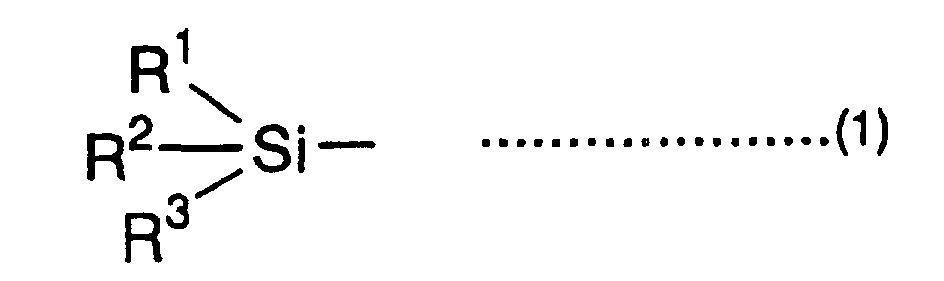
- Wherein R1, R2, and R3 are each a monovalent group selected from the group consisting of hydrogen atom, halogen atom, hydrocarbon group having 1 - 6 carbon atoms, and oxyhydrocarbon group having 1 - 6 carbon atoms, wherein a hydrocarbon portion of said hydrocarbon group or oxyhydrocarbon group may be of a chain structure or cyclic structure and may be saturated or unsaturated and part of hydrogen atoms in the hydrocarbon portion may be substituted with halogen atom, and R1, R2, and R3 may be the same or different.
- The compound having therein the silicon-containing group represented by the formula (1) is preferably a compound represented by the following formula (2).Wherein X is, as is mentioned later, a group selected from the group consisting of oxazolidinone group, imidazole group, phosphate group, phenyl group, alkoxy group, halogen atom, unsaturated alkyl group, carbamate group, and carbonate group, etc.

- Among the above-identified compounds, particularly preferred as the solvent for electrolyte are N-trialkyl-silylimidazole, tris(trialkylsilyl) phosphate, 4-trialkyl-silylmethyl-1,3-dioxolan-2-one, trialkylchlorosilane, trifluoroalkyltrialkylsilane, allyltrialkylsilane, diallyldialkylsilane, triallylalkylsilane, acetyltrialkylsilane, alkyl-N-trialkylsilyl carbamate, alkyl-N,N-bistrialkylsilyl carbamate, alkyltrialkylsilyl carbonate, and 3-trialkylsilyl-2-oxazolidinone.
- It is preferable that said compound having therein the silicon-containing group is used in the form of a mixed solvent prepared with another solvent, such as cyclic carbonic ester and phosphoric ester, in such manner that it is admixed by 0.01-50 % by weight in the mixed solvent.
- Additionally, the present invention relates to a capacitor containing said non-aqueous electrolytic solution, particularly an electric double layer capacitor.
- Furthermore, the present invention relates to an electrode for a capacitor which is pre-treated with said non-aqueous electrolytic solution and a capacitor into which such electrode is incorporated.
-
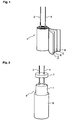
- Figure 1 is a perspective view illustrating the construction of the roll-up type electric double layer capacitor element employed in Examples.
- Figure 2 is a perspective view illustrating the mode of inserting the roll-up type electric double layer capacitor element employed in Examples into a metal container together with a closure member.
-
- Detailed explanations are set forth as follows about the construction of the non-aqueous electrolytic solution, the electrode, and the capacitor constructed thereof. The non-aqueous electrolytic solution comprises of the electrolyte and the solvent for such electrolyte, and is suitable for the capacitor, particularly the electric double layer capacitor.
- The non-aqueous electrolytic solution of the present invention comprises a compound having therein a silicon-containing group as represented by the following formula (1) as the solvent for electrolyte.

- Wherein R1, R2, and R3 are each a monovalent group selected from the group consisting of hydrogen atom, halogen atom, hydrocarbon group having 1 - 6 carbon atoms such as alkyl group, and oxyhydrocarbon group having 1 - 6 carbon atoms such as alkoxy group, wherein a hydrocarbon portion of said hydrocarbon group or oxyhydrocarbon group may be of a chain structure or cyclic structure like that of phenyl group, and may be saturated or unsaturated and part of hydrogen atoms in the hydrocarbon portion may be substituted with halogen atom.
- R1, R2, and R3 may be preferably a saturated or unsaturated hydrocarbon group having 1 - 6 carbon atoms, or more preferably an alkyl group having 1 - 3 carbon atoms. Part or all of hydrogen atoms in the alkyl group may be substituted with halogen atom, particularly fluorine atom. Said groups may be the same or different, but it is preferable that they are the same.
- As specific examples of said groups there can be cited trimethylsilyl group, triethylsilyl group, tripropylsilyl group, trifluoromethylsilyl group and trimethoxysilyl group.
- The compound having therein the silicon-containing group represented by the formula (1) is preferably a compound represented by the following formula (2).Wherein X is optionally selected from among the formulae (3) - (14) which are cited as follows, and constitutes any compound identified as (a) - (1).

-

- In the formula (3), part of hydrogen atoms may be substituted with saturated or unsaturated hydrocarbon group having 1- 4 carbon atoms, alkoxy group, amino group, cyano group, nitro group or halogen atom. Wherein the hydrocarbon group may have its part or all hydrogen atoms substituted with halogen atoms.
- As specific examples of compounds having therein said groups there can be cited 3-trimethylsilyl-2-oxazolidinone, 3-trimethylsilyl-4-trifluoromethyl-2-oxazolidinone, and 3-triethylsilyl-2-oxazolidinone.
-

- In the formula (4), part of hydrogen atoms may be substituted with a saturated or unsaturated hydrocarbon group having 1 - 4 carbon atoms, alkoxy group, amino group, cyano group, nitro group or halogen atom.
- As specific examples of compounds having therein said groups there can be cited N-trimethylsilylimidazole, N-trimethylsilyl-4-methylimidazole, and N-triethylsilylimidazole.
-

- In the formula (5), A1 and A2 are each a saturated or unsaturated hydrocarbon group having 1 - 6 carbon atoms, or the silicon-containing group represented by the formula (1), which may be the same or different.
- As specific examples of compounds having therein said groups there can be cited tris(trimethylsilyl) phosphate, tris-(triethylsilyl) phosphate, trimethylsilyldimethyl phosphate, and trimethylsilyldiallyl phosphate.
-

- In the formula (6), part of hydrogen atoms which are bonded to carbon atoms constituting the cyclic structure may be substituted with a saturated or unsaturated hydrocarbon group having 1 - 4 carbon atoms, alkoxy group, amino group, cyano group, nitro group, halogen atom, or the silicon-containing group represented by the formula (1), wherein "n" is a number of 0, 1, or 2.
- As specific examples of compounds having therein said groups there can be cited 4-trimethylsilyl-1,3-dioxolan-2-one, 4-trimethylsilyl-5-vinyl-1,3-dioxolan-2-one, and 4-trimethylsilylmethyl-1,3-dioxolan-2-one.
-

- In the formula (7), part of hydrogen atoms which are bonded to carbon atoms constituting the benzene ring may be substituted with a saturated or unsaturated hydrocarbon group having 1 - 4 carbon atoms, alkoxy group, amino group, cyano group, nitro group, halogen atom, or the silicon-containing group represented by the formula (1).
- As specific examples of compounds having therein said groups there can be cited phenyltrimethylsilane, phenyltriethylsilane, and phenyltrimethoxysilane.
-

- In the formula (8), B is any bivalent group selected from the group consisting of - NH -, - N(CH3) -, - CH2 -, - CO -, - S -, and - SO2 -, wherein part of hydrogen atoms which are bonded to carbon atoms constituting the benzene ring may be substituted with a saturated or unsaturated hydrocarbon group having 1-4 carbon atoms, alkoxy group, amino group, cyano group, nitro group, halogen atom, or the silicon-containing group represented by the formula (1).
- As specific examples of compounds having therein said groups there can be cited phenylthiotrimethylsilane and phenylthiotriethylsilane.
-
- In the formula (9), A3 is a monovalent saturated or unsaturated hydrocarbon grouphaving 1 - 6 carbon atoms, or the silicon-containing group represented by the formula (1), wherein said hydrocarbon group may be of a chain structure or cyclic structure.
- As specific examples of compounds having therein said groups there can be cited methoxytrimethylsilane, hexamethyldisiloxane, and pentamethyldisiloxane.
-
- In the formula (10), A3 and B are the same as the groups shown in the aforementioned formulae (8) and (9), respectively.
- As specific examples of compounds having therein said groups there can be cited methoxymethyltrimethylsilane.
-
- In the formula (11), D is any group selected from the group consisting of halogen atom, hydrogen atom, a saturated or unsaturated hydrocarbon group having 1 - 6 carbon atoms, acetyl group and the silicon-containing group represented by the formula (1). Wherein said hydrocarbon group may be of a chain structure or cyclic structure and part of hydrogen atoms in the group may be substituted with halogen atom or alkoxy group.
- As specific examples of compounds having therein said groups there can be cited trimethylchlorosilane, butyldiphenylchlorosilane, trifluoromethyl-trimethylsilane, acetyltrimethylsilane, 3-trimethylsilylcyclopentene, allyltrimethylsilane, and vinyltrimethylsilane.
- In the formula (12), A3 is the same as the group shown in the aforementioned formula (9) and A4 is a saturated or unsaturated hydrocarbon group having 1 - 6 carbon atoms.

- As specific examples of compounds having therein said groups there can be cited methyl-N-trimethylsilyl carbamate, methyl-N,N-bistrimethylsilyl carbamate, ethyl-N-trimethylsilyl carbamate, methyl-N-triethylsilyl carbamate, and vinyl-N-trimethylsilyl carbamate.
-

- In the formula (13), A4 is the same as the group shown in the aforementioned formula (12).
- As specific examples of compounds having therein said groups there can be cited methyltrimethylsilyl. carbonate, allyltrimethylsilyl carbonate, and ethyl-trimethylsilyl carbonate.
-
- In the formula (14), B and D are the same as the groups shown in the aforementioned formulae (8) and (11), respectively.
- As specific examples of compounds having therein said groups there can be cited hexamethyldisilazane.
- Among the aforementioned compounds having therein a silicon-containing group, the compound of (b), (c), (d), (i), (j) and (k) are preferable.
- Out of the compounds, preferred for the present invention is any compound selected from the group consisting of N-trialkylsilylimidazole, tris(trialkylsilyl) phosphate, 4-trialkylsilylmethyl-1,3-dioxolan-2-one, trialkylchlorosilane, trifluoroalkyltrialkylsilane, allyltrialkylsilane, diallyldialkylsilane, triallylalkylsilane, acetyltrialkylsilane, alkyl-N-trialkylsilyl carbamate, alkyl-N,N-bistrialkylsilyl carbamate, and alkyltrialkylsilyl carbonate.
- As preferred specific examples among the compounds there can be cited N-trimethylsilylimidazole, tris(trimethylsilyl) phosphate, allyltrimethylsilane, 4-trimethylsilylmethyl-1,3-dioxolan-2-one, methyl-N-trimethylsilyl carbamate, methyl-N,N-bistrimethylsilyl carbamate and methyltrimethylsilyl carbonate.
- In the present invention 3-trialkylsilyl-2-oxazolidinone such as 3-trimethylsilyl-2-oxazolidinone is preferably used, too.
- A single kind of silicon compound may be used individually or two or more kinds may be used in combination.
- The silicon compound shown in the formula (2) is chemically stable and highly acid-proof, will be hardly oxidized when allowed to stand in the air, and is less likely to react with water or such highly reactive substance as metallic lithium under normal storage conditions. Furthermore, such silicon compound possesses such properties that it is physically stable and resistive to thermal decomposition, exhibits low flammability and is hardly susceptible to electrochemical oxidation and reduction. Besides, thosesilicon compounds have relatively high flash point, and hence, their safety against fires is excellent.
- According to the present invention said silicon compound is used singularly or in the form of a mixed solvent prepared in combination with another solvent as the solvent for electrolyte. In cases where it is used in the form of the mixed solvent it is preferable that the silicon compound shown in the aforementioned formula (2) is admixed with another solvent by 0.01- 50 % by weight, or preferably 0.1 - 30 % by weight, in the solvent. Since electrochemically and physically stable solvent for electrolyte is prepared, the obtained solvent gives improved flame resistance so long as the mixing ratio is adjusted within said ranges.
- As such other solvent that can be used in said mixed solvent, any compound may be optionally selected from among the below-exemplified cyclic carbonic esters, chain carbonic esters, cyclic esters, chain esters, cyclic ethers, chain ethers, phosphoric esters, and sulfur-containing compounds.
- Ethylene carbonate (syn.: 1,3-dioxolan-2-one), propylene carbonate (syn.: 4-methyl-1,3-dioxolan-2-one), butylene carbonate (syn.: 4,5-dimethyl-1,3-dioxolan-2-one), and vinylene carbonate, etc.
- Cyclic carbonic esters may be also those which have alkyl groups wherein hydrogen atoms are substituted with halogen atoms such as monofluoromethylethylene carbonate, difluoromethylethylene carbonate, and trifluoromethylethylene carbonate.
- Dimethyl carbonate, methylethyl carbonate, diethyl carbonate, methylpropyl carbonate, and methylisopropyl carbonate, etc.
- γ-butyrolactone, γ-valerolactone, 3-methyl-γ-butyrolactone, and 2-methyl-γ-butyrolactone, etc.
- Methyl formate, ethyl formate, methyl acetate, ethyl acetate, propyl acetate, methyl propionate, methyl butyrate, and methyl valerate, etc.
- 1,4-Dioxane, 1,3-dioxolane, terahydrofuran, 2-methyltetrahydrofuran, 3-methyl-1,3-dioxolane, and 2-methyl-1,3-dioxolane, etc.
- 1,2-Dimethoxyethane, 1,2-diethoxyethane, diethyl ether, dimethyl ether, methylethyl ether, and dipropyl ether, etc.
- Trimethyl phosphate, triethyl phosphate, and triallyl phosphate, etc.
- Sulfolane, etc.
- It is preferable to use cyclic carbonic ester and/or phosphoric ester among the solvents with a view to furthermore improving charging/discharging cycle properties and low flammability of the solvent. Moreover, those solvents may be used singularly or in combination of two or more kinds.
- Ammonium salts, phosphonium salts and the like can be used as the electrolyte contained in the non-aqueous electrolytic solution of the present invention. They may be used either singularly or in combination of two or more kinds. As specific examples of such electrolytes there can be cited the following compounds.
- Tetrabutylammonium tetrafluoroborate ((C4H9)4 NBF4), tetraethylammonium tetrafluoroborate ((C2H5)4 NBF4), triethyl-monomethylammonium tetrafluoroborate ((C2H5)3 (CH3) NBF4), tetrabutylammonium hexafluorophosphate ((C4H9)4 NPF6), tetraethylammonium hexafluorophosphate ((C2H5)4NPF6), and triethyl-monomethylammonium hexafluorophosphate ((C2H5)3 (CH3) NPF6), etc.
- Tetrabutylphosphonium tetrafluoroborate ((C4H9)4PBF4), tetraethylphosphonium tetrafluoroborate ((C2H5)4 PBF4), tetrabutylphosphonium hexafluorophosphate ((C4H9)4 PPF6), and tetraethylphosphonium hexafluorophosphate ((C2H5)4 PPF6), etc.
- Among the compounds preferred ones are tetrabutylammonium tetrafluoroborate ((C4H9)4 NBF4), tetraethylammonium tetrafluoroborate ((C2H5)4 NBF4), and triethyl-monomethylammonium tetrafluoroborate ((C2H5)3 (CH3)NBF4). It is preferable that the electrolyte is contained in the eletrolytic solution by a concentration of generally 0.1 - 3 mole/liter, or preferably 0.3 - 1.5 mole/liter.
- The non-aqueous electrolytic solution of the present invention is used for capacitors at large including the aluminum electrolytic capacitor, and particularly it is used suitably for the electric double layer capacitor.
- The construction of the electric double layer capacitor is such that it is composed of two leaves of electrodes, a separator, and generally a corrosion resistant electrolytic solution. Specifically, two leaves of electrodes are disposed face-to-face with a separator being interposed in between; and the spaces between the electrode and the porous separator and the interior of the porous separator are filled with the electrolytic solution.
- The electrode is constructed of a material having a large surface area like activated carbon and a binder such as fluoroplastic. The kinds of such activated carbon as is preferably used as the material for the electrode are generally phenolic-based, pitch-based, polyacrylonitrile-based, palm shell-derived or coke-based in either the filament form or the powder form. Normally, activated carbon having a specific surface area of 1000 m2/g or more is preferred. Such activated carbon is used after it has been activated by the steam activation method or the alkali activation method.
- As the binder there are used such materials as carboxymethyl cellulose, poly(vinylidene fluoride), poly(vinylpyrrolidone), polyimide, poly(vinyl alcohol), and polyacrylic acid. The material for the electrode is bound by a binder and rendered into an intended shape to be obtained as a fabricated electrode.
- The electrode is also put in use after it has been pre-treated with said non-aqueous electrolytic solution. The pre-treatment may be carried out by spraying the non-aqueous electrolytic solution onto the electrode or by immersing the electrode in the non-aqueous electrolytic solution. It is by this pre-treatment that the efficiency of wetting may be increased between the electrode and the non-aqueous electrolytic solution and the stability of the electrode surface may be enhanced, and then the capacity of the capacitor may be that much more increased. It is preferable that the thus pre-treated electrode is used at least on either side of the anode or the cathode, while such electrode may be used in various capacitors at large besides the electric double layer capacitor.
- The electrode is often used in a combination of said material for the electrode (the active substance) and a collector body. As such collector body, for example, aluminum foil is preferably used. As for the separator, on the other hand, preferably used are such materials as porous film made from polyethylene, polypropylene, and the like, kraft paper, manila paper, and glass filter.
- The non-aqueous electrolytic solution of the present invention may also be usable for a metal surface treatment of the collector body, and then a metal corrosion of the collector body is restrained by the treatment.
- An explanation about the construction of, for example, a roll-up type electric double layer capacitor element is furnished as follows. Namely, it is of such construction that the separator is interposed between the polarizable anode to which an anode-side conducting wire is connected and the polarizable cathode to which a cathode-side conducting wire is connected, which in a three-layer stock are rolled up together. Rubber-made closure members are prepared for threading the anode-side conducting wire and the cathode-side conducting wire therethrough, respectively. After the capacitor element has been immersed in a driving electrolytic solution, it is inserted into an aluminum cylindrical container provided with a bottom. By means of carrying out horizontal drawing and curling jobs at the opening part of the metal container, the closure members are tightly sealed to the opening part of the metal container.
- The present invention will be illustrated in details with reference to the following examples; however, the scope of the invention is not limited by the examples.
- Explanations are furnished as follows in reference to Figure 1 and Figure 2, respectively, about the method of fabricating the roll-up type electric double layer capacitor used in Examples and Comparative Example.
- The capacitor element (1) was fabricated as illustrated in Figure 1 by rolling up together into a cylindrical shape the polarizable anode (3), the polarizable cathode (5) and the separator (6) being interposed in between the two. Said polarizable electrodes were each produced by adding acetylene black and carboxymethyl cellulose to an activated carbon powder, dispersing the mixed powder in water to reduce to a slurry, coating the slurry onto an aluminum foil whose surface had been roughened in advance, and then drying the coated foil.
- The capacitor element (1) was impregnated with the electrolytic solution prepared in accordance with the procedure specified in each Example, and was inserted into the cylindrical aluminum container (8) provided with bottom as illustrated in Figure 2. In the meantime, the anode-side conducting wire (2) was connected to the polarizable anode (3), and the cathode-side conducting wire (4) was connected to the polarizable cathode (5). Each conducting wire was put through the rubber-made closure member (7), and then the closure member (7) was attached to the opening part of the cylindrical container (8). The opening part was tightly sealed with the closure member (7) by horizontal drawing and curling jobs. Thus was fabricated a roll-up type electric double layer capacitor (9). The thus fabricated capacitor had a diameter of 18 mm and a height of 40 mm.
- 25 ml of an electrolytic solution having an electrolyte concentration of 0.5 mole/liter was prepared by dissolving 2.71 g (0.0125 mole) of tetraethylammonium tetrafluoroborate ((C2H5)4 NBF4) in a mixed solvent prepared by admixing propylene carbonate with N-trimethylsilylimidazole at a ratio of 95 : 5 by weight. The obtained electrolytic solution was tested with respect to a leakage current. Test results are shown in Table 1.
- The leakage current was determined in accordance with the following procedure. Said electrolytic solution was put into a tripolar withstand voltage tester cell in which activated carbon electrodes were installed as an active electrode and an opposite electrode and an Ag/Ag+ electrode was used as an reference electrode. Then, 2.0 V voltage was impressed on it, using a potentiogalvanostat. When a flow of electricity had become constant, an amperage was measured and recorded as the leakage current value.
- Next, an electric double layer capacitor having a 2.3V and 50F rating was fabricated using said electrolytic solution. Thereupon, 2.5 V was impressed at an ambient temperature of 70°C, and a time-related dimensional change of the cylindrical container caused by gases built up in said atmosphere was measured as "a dimensional change of the product". The dimensional changes after the lapse of 500 hrs from the beginning of such elevated temperature load test are also shown in Table 1.
- The same procedure as in Example 1 was followed except that trimethyl phosphate was used in place of propylene carbonate as in Example 1 for determining the leakage current of the electrolytic solution and the dimensional change of the product by the elevated temperature load test. Test results are shown in Table 1.
- The same procedure as in Example 1 was followed except that 3-trimethylsilyl-2-oxazolidinone was used in place of N-trimethylsilylimidazole as in Example 1 for determining the leakage current of the electrolytic solution and the dimensional change of the product by the elevated temperature load test. Test results are shown in Table 1.
- The same procedure as in Example 1 was followed except that tris(trimethylsilyl) phosphate was used in place of N-trimethylsilylimidazole as in Example 1 for determining the leakage current of the electrolytic solution and the dimensional change of the product by the elevated temperature load test. Test results are shown in Table 1.
- The same procedure as in Example 4 was followed except that trimethyl phosphate was used in place of propylene carbonate as in Example 4 for determining the leakage current of the electrolytic solution and the dimensional change of the product by the elevated temperature load test. Test results are shown in Table 1.
- The same procedure as in Example 5 was followed except that a mixed solvent prepared by admixing trimethyl phosphate with tris(trimethylsilyl) phosphate at a ratio of 99 : 1 by weight was used for determining the leakage current of the electrolytic solution and the dimensional change of the product by the elevated temperature load test. Test results are shown in Table 1.
- The same procedure as in Example 2 was followed except that trimethylchlorosilane was used in place of N-trimethylsilylimidazole as in Example 2 for determining the leakage current of the electrolytic solution and the dimensional change of the product by the elevated temperature load test. Test results are shown in Table 1.
- The same procedure as in Example 2 was followed except that allyltrimethylsilane was used in place of N-trimethylsilylimidazole as in Example 1 for determining the leakage current of the electrolytic solution and the dimensional change of the product by the elevated temperature load test. Test results are shown in Table 1.
- The same procedure as in Example 2 was followed except that methyl-N-trimethylsilylcarbamate was used in place of N-trimethylsilylimidazole as in Example 1 for determining the leakage current of the electrolytic solution and the dimensional change of the product by the elevated temperature load test. Test results are shown in Table 1.
- An electrolytic solution was prepared in accordance with the same procedure as in Example 1 except that only propylene carbonate was used in place of a mixed solvent consisting of propylene carbonate and N-trimethylsilylimidazole as in Example 1. The thus prepared electolytic solution was tested with respect to the leakage current of the electrolytic solution. Test results are shown in Table 1.
Kind of Solvent for Electrolyte (Ratio by weight) Leakage Current (µA) Dimensional Change of the Product (mm) Example 1 Propylene carbonate vs. N-trimethylsilylimidazole = 95 : 5 180 1.5 Example 2 Trimethyl phosphate vs. N-trimethylsilylimidazole = 95 : 5 270 1.7 Example 3 Propylene carbonate vs. 3-trimethylsilyl-2-oxazolidinone = 95 : 5 270 1.6 Example 4 Propylene carbonate vs. Tris(trimethylsilyl)-phosphate = 95 : 5 90 1.4 Example 5 Trimethyl phospate vs. Tris(trimethylsilyl)-phosphate = 95 : 5 140 1.5 Example 6 Trimethyl phosphate vs. Tris(trimethylsilyl)-phosphate = 99 : 1 250 1.6 Example 7 Trimethyl phosphate vs. Trimethylchlorosilane = 95 : 5 150 1.8 Example 8 Propylene carbonate vs. Allyltrimethylsilane = 95 : 5 80 1.2 Example 9 Propylene carbonate vs. Methy-N-trimethylsilyl-carbamate = 95 : 5 130 1.5 Comparative Example 1 Propylene carbonate = 100 280 2.1 - From Table 1 it is known that the electrolytic solutions in Examples 1 - 9 exhibit less leakage current than that of Comparative Example 1, and hence superior with respect to the withstand voltage. Furthermore, they showed less dimensional changes of the product by the elevated temperature load test than that in case of Comparative Example 1.
- The non-aqueous electrolytic solution of the present invention, by virtue of the silicon compound-containing solvent for electrolyte used therein, when it is utilized for the capacitor, proves itself to be the electrolytic solution which releases only little gases at an elevated temperature, gives high withstand voltage and exhibits excellent charging /discharging cycle properties. Additionally, said solvent for electrolyte has a higher flash point and it shows an excellent safety against fires.
- The capacitor employing such non-aqueous electrolytic solution gives high withstand voltage, excellent charging/ discharging cycle properties, and high energy density. Moreover, such capacitor has a long service life and the excellent safety against fires. On account of the above-mentioned advantages, such capacitor employing said non-aqueous electrolytic solution is suitable particularly for the electric double layer capacitor.
- Furthermore, a capacity of the capacitor may be augmented due to increasing of the stability of the electrode surface by treating the electrodes with such non-aqueous electrolytic solution in advance and thus may be obtained a capacitor having a higher efficiency.
Claims (14)
- A non-aqueous electrolytic solution for a capacitor comprising an electrolyte and a solvent for the electrolyte comprising a compound having therein a silicon-containing group represented by the following formula (1),wherein R1, R2, and R3 are each a monovalent group selected from the group consisting of hydrogen atom, halogen atom, hydrocarbon group having 1 - 6 carbon atoms, and oxyhydrocarbon group having 1 - 6 carbon atoms, wherein a hydrocarbon portion of said hydrocarbon group or oxyhydrocarbon group may be of a chain structure or cyclic structure and may be saturated or unsaturated and part of hydrogen atoms in the hydrocarbon portion may be substituted with halogen atom, and

R1, R2, and R3 may be the same or different. - A non-aqueous electrolytic solution for a capacitor as claimed in claim 1, wherein R1, R2, and R3 in the silicon-containing group of the formula (1) are each a saturated or unsaturated hydrocarbon group having 1 - 6 carbon atoms.
- A non-aqueous electrolytic solution for a capacitor as claimed in claim 1, wherein R1, R2, and R3 in the silicon-containing group of the formula (1) are each an alkyl group having 1 - 3 carbon atoms which are the same.
- A non-aqueous electrolytic solution for a capacitor as claimed in claim 1, wherein R1, R2, and R3 in the silicon-containing group of the formula (1) are selected from the group consisting of methyl group, ethyl group, and trifluoromethyl group.
- A non-aqueous electrolytic solution for a capacitor as claimed in any claim of claims 1 - 3, wherein the compound having therein the silicon-containing group of the formula (1) is represented by the following formula (2),wherein X is any group selected from the group consisting of the groups represented by the following formulae (3) - (14), respectively,
 (a)in the formula (3), part of hydrogen atoms may be substituted with a saturated or unsaturated hydrocarbon group having 1 - 4 carbon atoms, alkoxy group, amino group, cyano group, nitro group or halogen atom,
 (b)in the formula (4), part of hydrogen atoms may be substituted with a saturated or unsaturated hydrocarbon group having 1 - 4 carbon atoms, alkoxy group, amino group, cyano group, nitro group or halogen atom,
 (c)in the formula (5), A1 and A2 are each saturated or unsaturated hydrocarbon group having 1 - 6 carbon atoms or the silicon-containing group of the formula (1) which may be the same or different,
 (d)in the formula (6), part of hydrogen atoms which are bonded to carbon atoms constituting the cyclic structure may be substituted with a saturated or unsaturated hydrocarbon group having 1 - 4 carbon atoms, alkoxy group, amino group, cyano group, nitro group, halogen atom, or the silicon-containing group of the formula (1), wherein "n" is a number of 0, 1, or 2,
 (e)in the formula (7), part of hydrogen atoms which are bonded to carbon atoms constituting the benzene ring may be substituted with a saturated or unsaturated hydrocarbon group having 1 - 4 carbon atoms, alkoxy group, amino group, cyano group, nitro group, halogen atom, or the silicon-containing group of the formula (1),
 (f)in the formula (8), B is any bivalent group selected from the group consisting of - NH -, - N(CH3) -, - CH2-, - CO -, - S -, and - SO2-, wherein part of hydrogen atoms which are bonded to carbon atoms constituting the benzene ring may be substituted with a saturated or unsaturated hydrocarbon group having 1 - 4 carbon atoms, alkoxy group, amino group, cyano group, nitro group, halogen atom, or the silicon-containing group of the formula (1),
 (g)(h)(i)(j)in the formula (12), A3 is the same as the group shown in the aforementioned formula (9) and A4 is a saturated or unsaturated hydrocarbon group having 1 - 6 carbon atoms,
 (k)in the formula (13), A4 is the same as the group shown in the formula (12),
and(l) - A non-aqueous electrolytic solution for a capacitor as claimed in claim 5, wherein the compound of the formula (2) is any compound selected from the group consisting of N-trialkylsilylimidazole, tris(trialkylsilyl) phosphate, 4-trialkylsilylmethyl-1,3-dioxolan-2-one, trialkylchlorosilane, trifluoroalkyltrialkylsilane, allyltrialkylsilane, diallyldialkylsilane, triallylalkylsilane, acetyltrialkylsilane, alkyl-N-trialkylsilyl carbamate, alkyl-N,N-bistrialkylsilyl carbamate, alkyltrialkylsilyl carbonate, and 3-trialkylsilyl-2-oxazolidinone.
- A non-aqueous electrolytic solution for a capacitor as claimed in claim 5, wherein the compound of the formula (2) is any compound selected from the group consisting of N-trimethylsilylimidazole, tris(trimethylsilyl) phosphate, allyltrimethylsilane, 4-trimethylsilylmethyl-1,3-dioxolan-2-one, methyl-N-trimethylsilyl carbamate, methyl-N,N-bistrimethylsilyl carbamate, methyltrimethylsilyl carbonate, and 3-trimethylsilyl-2-oxazolidinone.
- A non-aqueous electrolytic solution for a capacitor as claimed in any claim of claims 1 - 7, wherein said solvent for the electrolyte comprises a mixed solvent prepared by admixing the compound of the formula (2) with a cyclic carbonic ester and/or phosphoric ester.
- A non-aqueous electrolytic solution for a capacitor as claimed in any claim of claims 1 - 8, wherein said solvent for the electrolyte comprises the compound of the formula (2) by 0.01 - 50 % by weight.
- A non-aqueous electrolytic solution for a capacitor as claimed in any claim of claims 1 - 9, wherein said capacitor is an electric double layer capacitor.
- A capacitor which comprises a non-aqueous electrolytic solution for a capacitor as claimed in any claim of claims 1 - 9.
- An electric double layer capacitor which comprises a non-aqueous electrolytic solution for a capacitor as claimed in any claim of claims 1 - 9.
- An electrode for a capacitor which is pre-treated with an electrolytic solution as claimed in any claim of claims 1 - 9.
- A capacitor wherein at least one electrode partly constituting such capacitor is an electrode as claimed in claim 13.
Applications Claiming Priority (3)
| Application Number | Priority Date | Filing Date | Title |
|---|---|---|---|
| JP15760499 | 1999-06-04 | ||
| JP15760499 | 1999-06-04 | ||
| PCT/JP2000/003582 WO2000075941A1 (en) | 1999-06-04 | 2000-06-02 | Nonaqueous electrolytic solution, electrode, and capacitor containing the same |
Publications (1)
| Publication Number | Publication Date |
|---|---|
| EP1195785A1 true EP1195785A1 (en) | 2002-04-10 |
Family
ID=15653366
Family Applications (1)
| Application Number | Title | Priority Date | Filing Date |
|---|---|---|---|
| EP00931668A Withdrawn EP1195785A1 (en) | 1999-06-04 | 2000-06-02 | Nonaqueous electrolytic solution, electrode, and capacitor containing the same |
Country Status (2)
| Country | Link |
|---|---|
| EP (1) | EP1195785A1 (en) |
| WO (1) | WO2000075941A1 (en) |
Cited By (4)
| Publication number | Priority date | Publication date | Assignee | Title |
|---|---|---|---|---|
| CN106025358A (en) * | 2016-06-27 | 2016-10-12 | 中国科学院广州能源研究所 | Double-cyano functionalized organic silicon-amino electrolyte material |
| US20170117579A1 (en) * | 2015-10-23 | 2017-04-27 | Samsung Electronics Co., Ltd. | Nonaqueous electrolyte for lithium secondary battery and lithium secondary battery employing the same |
| US10270130B2 (en) | 2015-10-23 | 2019-04-23 | Samsung Electronics Co., Ltd. | Nonaqueous electrolyte for lithium secondary battery and lithium secondary battery employing the same |
| EP3686981A1 (en) * | 2019-01-23 | 2020-07-29 | Hyundai Motor Company | Electrolyte for lithium secondary battery and lithium secondary battery containing the same |
Families Citing this family (1)
| Publication number | Priority date | Publication date | Assignee | Title |
|---|---|---|---|---|
| BRPI0606477A2 (en) | 2005-01-07 | 2009-06-30 | Gesturetek Inc | optical flow based tilt sensor |
Family Cites Families (8)
| Publication number | Priority date | Publication date | Assignee | Title |
|---|---|---|---|---|
| JP3236857B2 (en) * | 1992-12-23 | 2001-12-10 | 三菱化学株式会社 | Additives for ion conductive polymers and electrolytes |
| JPH0722295A (en) * | 1993-06-18 | 1995-01-24 | Fuji Elelctrochem Co Ltd | Method for manufacturing electric double layer capacitor |
| JP3215436B2 (en) * | 1996-05-08 | 2001-10-09 | ダイソー株式会社 | Crosslinked polymer solid electrolyte and its use |
| JPH1069912A (en) * | 1996-08-27 | 1998-03-10 | Japan Synthetic Rubber Co Ltd | Binder for battery electrode forming |
| JPH10125560A (en) * | 1996-10-21 | 1998-05-15 | Honda Motor Co Ltd | Separator for capacitor using organic solvent as electrolyte and method for producing the same |
| JP3282565B2 (en) * | 1996-11-22 | 2002-05-13 | ダイソー株式会社 | Crosslinked polymer solid electrolyte and its use |
| JP3669804B2 (en) * | 1997-03-03 | 2005-07-13 | 日本ケミコン株式会社 | Electrolytic solution for electrolytic capacitors |
| JPH1187184A (en) * | 1997-09-11 | 1999-03-30 | Mitsui Chem Inc | Non aqueous electrical double-layer capacitor and non-aqueous electrolyte therefor |
-
2000
- 2000-06-02 EP EP00931668A patent/EP1195785A1/en not_active Withdrawn
- 2000-06-02 WO PCT/JP2000/003582 patent/WO2000075941A1/en not_active Ceased
Non-Patent Citations (1)
| Title |
|---|
| See references of WO0075941A1 * |
Cited By (7)
| Publication number | Priority date | Publication date | Assignee | Title |
|---|---|---|---|---|
| US20170117579A1 (en) * | 2015-10-23 | 2017-04-27 | Samsung Electronics Co., Ltd. | Nonaqueous electrolyte for lithium secondary battery and lithium secondary battery employing the same |
| US9728811B2 (en) * | 2015-10-23 | 2017-08-08 | Samsung Electronics Co., Ltd. | Nonaqueous electrolyte for lithium secondary battery and lithium secondary battery employing the same |
| US10270130B2 (en) | 2015-10-23 | 2019-04-23 | Samsung Electronics Co., Ltd. | Nonaqueous electrolyte for lithium secondary battery and lithium secondary battery employing the same |
| CN106025358A (en) * | 2016-06-27 | 2016-10-12 | 中国科学院广州能源研究所 | Double-cyano functionalized organic silicon-amino electrolyte material |
| EP3686981A1 (en) * | 2019-01-23 | 2020-07-29 | Hyundai Motor Company | Electrolyte for lithium secondary battery and lithium secondary battery containing the same |
| CN111477955A (en) * | 2019-01-23 | 2020-07-31 | 现代自动车株式会社 | Electrolyte of lithium secondary battery and lithium secondary battery containing the same |
| US11145902B2 (en) | 2019-01-23 | 2021-10-12 | Hyundai Motor Company | Electrolyte for lithium secondary battery, lithium secondary battery containing the same |
Also Published As
| Publication number | Publication date |
|---|---|
| WO2000075941A1 (en) | 2000-12-14 |
Similar Documents
| Publication | Publication Date | Title |
|---|---|---|
| US6315918B1 (en) | Non-aqueous electrolytic solution for capacitor and capacitor containing non-aqueous electrolytic solution | |
| US9214709B2 (en) | Battery-capacitor hybrid energy storage system for high temperature applications | |
| KR102025969B1 (en) | METHOD FOR STABILIZING LiPF6, ELECTROLYTE SOLUTION FOR NONAQUEOUS SECONDARY BATTERIES HAVING EXCELLENT THERMAL STABILITY, AND NONAQUEOUS SECONDARY BATTERY HAVING EXCELLENT THERMAL STABILITY | |
| JP5190821B2 (en) | Power storage device | |
| CN101587777B (en) | Difunctional electrolyte and preparation method thereof | |
| JP5421853B2 (en) | Non-aqueous electrolyte and lithium secondary battery using the same | |
| CN107452511B (en) | Lithium ion capacitor | |
| CN118630317B (en) | High voltage resistant electrolyte, preparation method and sodium ion battery | |
| CN120600932A (en) | Sodium ion batteries, energy storage devices and energy storage systems | |
| CN111261426B (en) | Super capacitor electrolyte and super capacitor | |
| JP3461997B2 (en) | Organic solvent for electrolyte, lithium secondary battery and electric double layer capacitor | |
| JP6955672B2 (en) | Electrolyte for lithium secondary battery | |
| US6185089B1 (en) | Electrolytic solution for capacitor and capacitor | |
| JP2001052965A (en) | Non-aqueous electrolyte for capacitor, electrode, and capacitor using the same | |
| JP2006024611A (en) | Electric double layer capacitor | |
| CN104779075A (en) | High-voltage nonaqueous electrolyte for supercapacitor | |
| JP2000091162A (en) | Non-aqueous electrolyte for capacitors and capacitors using non-aqueous electrolyte | |
| WO2000075941A1 (en) | Nonaqueous electrolytic solution, electrode, and capacitor containing the same | |
| CN116470139A (en) | Dual-functional high steric hindrance lithium metal battery electrolyte film-forming additive and its application | |
| JP3793905B2 (en) | Non-aqueous electrolyte for electric double layer capacitor and non-aqueous electric double layer capacitor | |
| JP2000091161A (en) | Electrolyte for capacitors and capacitors | |
| JP3689538B2 (en) | Non-aqueous electrolyte for electric double layer capacitor and non-aqueous electric double layer capacitor | |
| JPH11354385A (en) | Nonaqueous electrolytic liquid for capacitor and capacitor using the same | |
| JP3853529B2 (en) | Electrolyte for capacitor and capacitor | |
| JP3689542B2 (en) | Non-aqueous electrolyte for electric double layer capacitor and non-aqueous electric double layer capacitor |
Legal Events
| Date | Code | Title | Description |
|---|---|---|---|
| PUAI | Public reference made under article 153(3) epc to a published international application that has entered the european phase |
Free format text: ORIGINAL CODE: 0009012 |
|
| 17P | Request for examination filed |
Effective date: 20011204 |
|
| AK | Designated contracting states |
Kind code of ref document: A1 Designated state(s): DE FR GB |
|
| STAA | Information on the status of an ep patent application or granted ep patent |
Free format text: STATUS: THE APPLICATION HAS BEEN WITHDRAWN |
|
| 18W | Application withdrawn |
Effective date: 20021028 |
|
| RBV | Designated contracting states (corrected) |
Designated state(s): DE |