Technical Field
The present invention relates to a porous carbon
material and a method of producing the same, and an
electrical double layer capacitor using the porous carbon
material. Particularly, the present invention provides a
porous carbon material which has a large specific surface
area per volume (referred to as a "volume specific surface
area" hereinafter), and which significantly increases in
capacitance per unit volume when used as a polarizable
electrode material, and an industrial method of producing
the porous carbon material in high yield and at low cost.
Also, the present invention provides an electrical double
layer capacitor using the porous carbon material and
having a large capacitance even with a small size.
Background Art
In an interface between two different phases
including a solid electrode and an electrolytic solution,
positive and negative charges are arranged and distributed
with a very short distance therebetween. For example,
with the positively charged electrode, anions in the
solution are arranged for supplement for the charge. A
layer caused by the charge arrangement is referred to as
an "electrical double layer". The electrical double layer
is formed by non-Faradaic reaction without electron
transfer between the electrode and the ions. The
capacitance expressed at the electrode interface
accompanying the formation of the electrical double layer
is referred to as "electrical double layer capacitance",
and an energy storage device utilizing the capacitance is
referred to as an "electrical double layer capacitor".
The electrical double layer capacitor has the
properties that it has excellent instantaneous charge-discharge
performance, and causes less deterioration in
charge-discahrge cycle life performance. Therefore, the
electrical double layer capacitor is useful as a backup
power supply for an electronic apparatus such as a
microcomputer comprising IC memory, and a power supply for
an electric vehicle.
In the electrical double layer capacitor having a
structure in which an electrolyte is held between a pair
of polarizable electrodes, stored capacitance C is
represented by the following equation (1) :
C = ∫ [ε/(4Πδ)] ds
(wherein ε: dielectric constant of electrolytic
solution , δ: distance between the electrode surface and
the ion center, s: surface area of the electrode
interface.)
Therefore, by using a polarizable electrode material
having a large specific surface area, an electrical double
layer capacitor having a large capacitance can be
obtained.
A known material with a large specific surface area
which can be used as the polarizable electrode is
activated carbon. The activated carbon is generally
produced by an oxidizing gas activation method comprising
oxidizing a waste resin, a pulp production residue, coal,
coal cokes, wood, coconut shell, or the like, which is
used as a raw material, with stream, air, oxygen, CO2, or
the like to form pores.
Since the oxidizing gas activation method uses no
special chemical and has no problem of equipment
corrosion, the method is advantageous from the viewpoint
of cost. However, it is known that activated carbon
having a large specific surface area cannot be efficiently
obtained by oxidizing gas activation. For example, in an
attempt to obtain activated carbon having a surface area
per unit weight (referred to as a "weight specific surface
area" hereinafter) of as large as about 1500 to 3000
(m2/g), which is required for the polarizable electrode
material, the yield is as low as 20% or less.
On the other hand, a chemical activation method of
forming pores by using a chemical is also known.
Particularly, an alkali activation method using alkali can
obtain activated carbon having a surface area of 1500 to
3000 (m2/g) per unit weight in a yield of 60% or more. The
alkali activation method can also increase the specific
surface area by increasing the amount of the alkali used.
For example, by using alkali in an amount of about 3 to 5
times (mass ratio) as large as the raw material, a
specific surface area of 2000 m2/g or more can be obtained.
In recent years, electronic apparatus, electric
vehicles, etc. have been required to be decreased in
weight and size, and the energy density of the carbon
material used for these applications has been increasingly
required to be increased.
In an attempt to decrease the weight and size of the
electrical double layer capacitor, therefore, it is
required to increase not only the capacitance per unit
mass (referred to as the "weight specific capacitance"
hereinafter), but also the capacitance per unit volume
(referred to as the "volume specific capacitance"
hereinafter). More specifically, in application of the
electrical double layer capacitor, the target value of the
capacitance per unit volume is as high as 20 F/cm3 or more.
The capacitance per unit volume (F/cm3) is obtained by
multiplying the capacitance per unit mass (F/g) by a
packing density.
The above equation (1) indicates that the capacitance
per unit mass (F/g) increases as the surface area per unit
mass increases. However, in fact, the capacitance per
unit volume (F/cm3) is liable to be saturated when the
surface area per unit weight is about 2000 (m2/g), and
inversely decreased when the surface area per unit weight
exceeds about 2500 (m2/g). Therefore, the target value of
the capacitance per unit volume of 20 F/cm3 or more cannot
be easily achieved by the conventional method of
increasing the specific surface area.
This is possibly mainly due to the fact that the
packing density is decreased by increasing the specific
surface area.
Another conventional method for improving the
capacitance per unit volume has been proposed.
Namely, it has been proposed to secure a high packing
density by using meso carbon micro beads as an alkali
activation raw material (Application No. 2634658).
However, it is disclosed that by the alkali activation
method using meso carbon micro beads having smooth
surfaces, a high packing density of 0.90 g/cm3 can be
achieved with a surface area per unit weight of 470 (m2/g),
but when the surface area per unit weight is increased to
1000 (m2/g) or more by activation, the packing density can
be increased to only about 0.50 g/cm3 at most.
Furthermore, in an attempt to increase the surface area
per unit weight to about 2000 (m2/g), only a packing
density of as low as 0.46 g/cm3 can be obtained.
The alkali activation method is basically a method of
producing micro pores having diameters of less than 2.0 nm
to increase the specific surface area. For example,
Japanese Unexamined Patent Publication No. 1-230414
discloses that in alkali activation of meso carbon micro
beads under an inert atmosphere, the ratio of micro pores
of less than 2.0 nm is 85% or more of the total pore
volume. This publication also discloses in examples that
in activation with potassium hydroxide in an amount of 3
to 5 times as large as the meso carbon micro beads,
activated carbon having a weight specific surface area of
1500 to 3000 (m2/g) can be obtained. In this case, the
ratio of the weight specific surface area of mesopores
having diameters of 2.0 nm or more is only about 0.8 to
3.0% of the total specific surface area.
Pores of the polarizable electrode material for the
electrical double layer capacitor, which are effective to
adsorb and desorb an electrolyte, are generally mesopores
of 2.0 nm or more. However, the conventional alkali
activation method is difficult to produce many mesopores
of 2.0 nm or more.
Although the alkali activation can easily secure a
certain weight specific surface area, it requires a large
amount of alkali, and has the problems of high chemical
cost and equipment corrosion, thereby causing difficulties
in industrial mass production.
Therefore, a method has been proposed, in which a
metal or a salt thereof other than alkali metals is added
in oxidizing gas activation for activating a carbon
material with steam or the like to form mesopores.
For example, Yoshizawa et al. (Tanso, 181, 8-13
(1998)) disclose steam activation for forming mesopores in
which acetylacetonato-complex salt of iron (III), nickel
(II), cobalt (II) is added to coal. By this steam
activation method, activated carbon supporting metal
oxides can be obtained.
Japanese Unexamined Patent Publication Application
No. 10-297912 discloses carbonization or activation in a
weakly oxidizing atmosphere in which a transition metal or
a compound of a transition metal such as Ti, Cr, Mn, Fe,
Co, Ni, Cu, W, or the like is added to facilly
graphitizable carbon such as cokes, or hardly
graphitizable carbon such as phenol resin. In this
method, the pore diameter distribution is maximized to
obtain meso carbon. However, this publication discloses
that although mesopores can be formed regardless of the
type of the metal added, the specific surface area of
cokes is less increased, and the specific surface area of
the phenol resin is not so increased.
Japanese Unexamined Patent Publication Application
No. 10-172870 teaches a method in which activated carbon,
activated carbon fibers or carbon black is activated with
steam together with a metal or metal compound to disperse
fine particles of the metal or metal oxide, imparting
conductivity.
The present invention has been achieved for solving
the above-described problems, and an object of the present
invention is to provide a porous carbon material which has
a volume specific surface area of 1000 (m2/cm3) or more and
which significantly increases in capacitance per unit
volume when used as a polarizable electrode material, and
an industrial method capable of producing the porous
carbon material in high yield and at low cost. Another
object of the present invention is to provide an
electrical double layer capacitor using the porous carbon
material and having a large capacitance even with a small
size.
Disclosure of Invention
The inventors performed study about an industrial
method capable of producing a porous carbon material
suitable as an electrode material for a high-performance
electrical double layer capacitor. As a result, it was
found that a porous carbon material having a large volume
specific surface area and significantly increasing in
capacitance per unit volume when used as a polarizable
electrode could be obtained by alkali activation using a
soft carbon-type carbon material as a raw material in
coexistence with specified metal ion and a carboxylic acid
ion. It was also found that this method uses a smaller
amount of alkali than a conventional method, and thus the
problems of chemical cost and equipment corrosion can be
resolved. These findings resulted in achievement of the
present invention.
Namely, the present invention relates to a method of
producing a porous carbon material comprising activating a
soft carbon-type carbon material with alkali in the
presence of a carboxylic acid ion and at least one metal
ion selected from the group consisting of iron ions,
cobalt ions, manganese ions and nickel ions.
In this production method, the soft carbon-type
carbon material preferably comprises at least one selected
from mesophase microspheres and bulk mesophases.
The metal ion is preferably supplied by a metal
chloride.
The carboxylic acid ion is preferably at least one
ion selected from an acetic acid ion, a citric acid ion,
and a benzoic acid ion.
In the present invention, the porous carbon material
is obtained by any one of the above production methods,
and has a surface area per unit volume is 1000 m2/cm3 or
more. The porous carbon material preferably has a packing
density of 0.5 g/cm3 or more, which is obtained by a
predetermined packing method.
Furthermore, the present invention provides an
electrical double layer capacitor using the porous carbon
material as a polarizable electrode material. The
electrical double layer capacitor preferably has an
capacitance per unit volume of 20 F/cm3 or more.
Best Mode for Carrying Out the Invention
The present invention will be described in further
detail below.
In the present invention, a soft carbon-type carbon
material is activated with alkali in the presence of a
carboxylic acid ion and at least one metal ion selected
from the group consisting of iron ions, cobalt ions,
manganese ions and nickel ions.
At this time, as the soft carbon-type carbon
material, at least one material selected from the group
consisting of mesophase microspheres and bulk mesophases
is preferably used. Known materials can be widely used
as the mesophase microspheres and bulk mesophases, and
particularly, the material is not limited. However, the
material preferably has a particle diameter in the range
of 5 to 100 µm, and more preferably 5 to 40 µm.
As the raw material for producing the mesophase
microspheres and bulk mesophases, for example, pitch such
as coal tar or pitch, petroleum heavy oil or pitch, or the
like can be used. Such pitch is heated, for example, at
350 to 500°C in a nitrogen stream for 0.5 to 10 hours to
produce the mesophase microspheres in the pitch with
proceeding of heating, and then produce the bulk
mesophases due to agglomeration of the mesophase
microspheres. Therefore, the mesophase microspheres
and/or bulk mesophases may be produced by appropriately
selecting the heating conditions according to demand.
After heating, the mesophase microspheres and/or bulk
mesophases can be obtained from the pitch by a solvent
separation method using, for example, a solvent such as
quinoline, tar oil, or the like.
The mesophase microspheres and the bulk mesophases
used as the activation raw material in the present
invention are described in detail in, for example,
Japanese Unexamined Patent Publication Application Nos. 1-230414
and 8-85794 and Patent No. 2950781. In the present
invention, the mesophase microspheres and the bulk
mesophases can be used as the raw material, but commercial
materials may be used.
In the present invention, either of the mesophase
microspheres and bulk mesophases may be used, or a mixture
thereof may be used.
Such a soft carbon-type carbon material is a graphite
precursor, and thus graphitization of the material
proceeds in the activation process to easily form a
graphite structure, thereby preferably forming a micro
structure with low internal resistance after activation.
In the present invention, alkali activation is
performed in the presence of the metal ion and carboxylic
acid ion.
The metal ion used in the present invention is an ion
of at least one metal selected from iron, cobalt,
manganese, and nickel. The valence of the metal ions is
not limited, and it may be, for example, divalent or
trivalent.
The form for supplying the metal ions may be a simple
metal, a metal compound such as a hydroxide or the like,
or an inorganic acid salt such as halide, carbonate,
nitrate, phosphate, or the like. Alternatively, the
supply form may be an organic metal compound such as
cobalt cyanide, or the like, or an organic acid salt such
as metal phenolate, metal carboxylate, or the like. From
the viewpoint of ease of dissociation and handling, a
halide, a hydroxide, and an organic acid metal salt are
preferably used. Particularly, the use of a metal
carboxylate can achieve the coexistence with the
carboxylic acid ion, which is a requirement of the present
invention.
In the present invention, the metal ions can be
supplied in an amount of about 0.01 to 20% by mass in
terms of metal relative to the soft carbon-type carbon
material. However, in consideration of the influence of
the amount of the residual metal on the capacitance, the
upper limit is preferably about 10% by mass, more
preferably 5% by mass.
In the method of the present invention, the
carboxylic acid ion is caused to coexist. Preferred
examples of such carboxylic acid ion includes an acetic
acid ion, a citric acid ion, and a benzoic acid ion. The
carboxylic acid ion may be used in a single type or a
combination of plural types.
Although the amount of the carboxylic acid ion used
in the present invention is not limited, the molar amount
of the carboxylic acid ion supplied is preferably about 1
to 10 times as large as the amount of the metal ion.
The form for supplying the carboxylic acid ions is
not limited, and a carboxylic acid or carboxylate such as
alkali carboxylate or the like may be used. From the
viewpoint of ease of dissociation in the activation system
and handling, the alkali carboxylate is preferably used.
For example, the alkali carboxylate such as sodium acetate
is particularly preferred because setting of activation
conditions is facilitated due to coexistence with the
alkali metal used in alkali activation. Also, for
example, iron acetate may be added to form the above-described
metal compound of carboxylic acid in the
activation reaction system. In this case, the metal
carboxylate may be supplied regardless of the salt type as
long as it is used under conditions in which the
carboxylic acid metal compound can be formed from the
metal ion and the carboxylic acid ion.
The metal ion and the carboxylic acid ion may be
supplied in the form of an aqueous solution.
Alternatively, a carboxylic acid metal compound such as
iron acetate or the like, which is previously formed from
the metal ion and the carboxylic acid ion, may be
supplied, and the ion may be supplied in coexistence with
a solvent such as acetone.
In the present invention, the alkali activation can
be carried out in coexistence of the ions by the same
method as a conventional alkali activation.
The alkali compound is not limited, and it may be
used in a single type or a combination of plural types of
alkali compounds. KOH, NaOH, CsOH, and the like may be
preferably used.
In the present invention, the amount of the alkali
used depends upon the desired final specific surface area,
and the amount may be about 0.1 time (mass ratio) as large
as the amount of the soft carbon-type carbon material used
as the raw material in some cases. However, in order to
obtain a weight specific surface area of about 2000 m2/g,
the amount of KOH may be about 2 times as large as the
amount of the soft carbon-type carbon material. The
necessary amount of the alkali is conventionally about 3
to 5 times.
In the present invention, activation is preferably
performed in an inert atmosphere of nitrogen gas, argon
gas, or the like, to suppress the production of metal
oxide. As a result, a decarbonizing effect can be further
obtained.
In activation of the present invention, the soft
carbon-type carbon material, the metal ion source, the
carboxylic acid ion source, and if required, water and a
solvent, are used for forming a slurry. For example, the
metal ion and the carboxylic acid salt are used in an
aqueous solution to easily obtain the slurry. The
addition order of the materials is not limited.
Then, the thus-obtained slurry is dried to obtain a
dry mixture, and then heated at a temperature of 300 to
1500°C, preferably 500 to 900°C, in the inert atmosphere
for activation. During the activation, any one of various
heating equipments such as a rotary kiln, a fluidized bed,
a moving bed, a fixed bed, or the like can be used. The
activation heating time is generally about 10 minutes to
24 hours. In the heating step, the temperature may be
increased at a constant rate and then kept at a desired
temperature, or may be kept several times in the course of
heating until the final temperature is obtained.
After activation, the mixture is neutralized with a
hydrochloric acid solution, and then washed with ion
exchanged water or the like to obtain the porous carbon
material.
The above-described method of producing a porous
carbon material of the present invention can obtain the
porous carbon material which has a volume specific surface
area of 1000 (m2/cm3) or more and many pores of 2.0 nm or
more, and which exhibits high capacitance not only per
mass but also per volume with a high packing density when
used as a polarizable electrode.
The porous carbon material obtained by the production
method of the present invention is characterized in that a
packing density of as high as 0.5 g/cm3 or more can be
obtained by a predetermined packing method of the present
invention. A packing density of 0.6 g/cm3 or more can also
be obtained.
The predetermined packing method and the method of
measuring the packing density of the present invention
will be described in detail below with reference to
examples.
The average pore diameter (BET method) of the porous
carbon material is preferably 1.8 nm or more, more
preferably 2.0 nm or more. The content of the pores of
2.0 nm or more is preferably 15% or more.
The weight specific surface area (BET method) of the
porous carbon material is preferably about 500 to 2000
(m2/g), more preferably about 1000 to 2000 (m2/g).
As a result of X-ray diffraction analysis (X-ray
diffraction analyzer 1500 produced by Rigaku Co., Ltd.,
conditions including CuKα. 40 kV, and 80 mA) of the state
of iron ion present as the metal ion in the porous carbon
material obtained by the above-described alkali treatment,
an iron carbide peak (Fe3C) was observed.
Since the iron carbide Fe3C is orthorhombic, it is
understood that the difference between graphite crystal
(hexagonal) and orthorhombic crystal structures influences
the formation of the pore structure of the present
invention.
By the production method of the present invention,
the porous carbon material having a volume specific
surface area of as high as about 1000 (m2/cm3) can also be
obtained in a yield of 80% or more. By an example of
conventional alkali activation methods, a porous carbon
material having a weight specific surface area of about
2000 (m2/g) can be obtained in a yield of up to about 50 to
60%.
The method of present invention also exhibits the
surprising effect that the amount of the alkali used for
obtaining the porous carbon material having a specific
surface area equivalent to a conventional method by using
the same material as the conventional method can be
decreased to about a half the amount of the alkali used in
the conventional method. For example, in order to obtain
a weight specific surface area of about 2000 m2/g, the
amount of the alkali used in the present invention may be
about 2 times the carbon raw material, while the amount of
the alkali used in the conventional method must be about 4
times.
The porous carbon material obtained in the present
invention exhibits high capacitance. Therefore, the
porous carbon material is suitable as a polarizable
electrode material for an electrical double layer
capacitor. The present invention also provides an
electrical double layer capacitor using the porous carbon
material as the polarizable electrode material.
The porous carbon material of the present invention
was molded in a polarizable electrode, and evaluated with
respect to the capacitance of an electrical double layer
capacitor. As a result, it was found that by using the
porous carbon material of the present invention, an
electrical double layer capacitor having a high weight
specific capacitance as well as a high volume specific
capacitance can be obtained.
In evaluation of the weight specific capacitance, the
weight specific capacitance of the electrical double layer
capacitor of the present invention is as high as 30 to 32
(F/g) or more, which is higher than a capacitor using a
porous carbon material obtained by the conventional alkali
activation method as a polarizable electrode. In
evaluation of the volume specific capacitance, since the
packing density of the porous carbon material of the
present invention can be increased in forming the
polarizable electrode, the electrical double layer
capacitor exhibiting a volume specific capacitance of as
high as 20 (F/cm3) or more can be obtained even when the
weight specific surface area of the porous carbon material
itself is less than 2000 (m2/g).
An electrical double layer capacitor using a porous
carbon material formed by the conventional alkali
activation method is generally evaluated to be difficult
to obtain a volume specific capacitance of 20 (F/cm3) or
more. For example, even when the same carbon raw material
is used, the packing density of the porous carbon material
obtained by the conventional alkali activation method is
as low as 0.4 to 0.5 g/cm3 even with a weight specific
surface area of 2000 (m2/g) or more. Therefore, in the
electrical double layer capacitor obtained by the
conventional method, the weight specific capacitance
exceeds 30 (F/g), while the volume specific capacitance
does not reach 20 (F/cm3). Also, of porous carbon
materials obtained by the conventional method, a material
exhibiting a high packing density has a weight specific
surface area of about 1500 (m2/g), and an electrical double
layer capacitor has a weight specific capacitance of as
low as about 25 (F/g) at most, and thus has a volume
specific capacitance of less than 20 (F/cm3).
The porous carbon material obtained in the present
invention corresponds to the shape of the mesophase
microspheres or bulk mesophases of the starting raw
material and has an average particle diameter of 5 to 100
µm. In order to form the polarizable electrode of the
electrical double layer capacitor using the porous carbon
material, the polarizable electrode can be produced
according to a general method using the material.
Generally, a binder and a conductive material are
appropriately added to the porous carbon material
according to demand, and the resultant mixture is molded
in a circular disk or rectangular sheet, thereby forming a
porous carbon material layer.
As the binder, polytetrafluoroethylene,
polyvinylidene fluoride, or the like can be used. The
binder can be generally used in an amount of 0.1 to 20% by
mass relative to the porous carbon material. With an
excessively large amount of the binder added, the internal
resistance of a battery is increased, while with the
excessively small amount of the binder, bonding between
the respective porous carbon material particles and
bonding between the porous carbon material and a current
collector are liable to be insufficient.
In the porous carbon material comprising
microspheres, the spheres can secure electrification
points only due to point contacts, and thus the conductive
material is added for forming a polarizable electrode
material. As the conductive material, carbon black is
generally used according to demand. The conductive
material is used in an amount of about 3 to 20% by mass
relative to the porous carbon material.
The polarizable electrode has a structure comprising
a conductive current collecting material layer formed on
one side of the porous carbon material layer. The
conductive current collecting material layer may be
compression molded at the same time the porous carbon
material layer is formed by using the mixture of the
porous carbon material, the binder and the conductive
material. Alternatively, the collecting material may be
electrically connected to one side of the porous carbon
material layer formed by compression molding or the like.
In order to simultaneously form the porous carbon
material thin layer having a thickness of about 10 to 200
µm and the conductive collecting material layer comprising
a metal plate, the binder is preferably used. In an
example using polyvinylidene fluoride as the binder, a
preferred method comprises dissolving the binder in a
solvent such as N-methyl-2-pyrrolidone, adding the porous
carbon material, and if required, the conductive material,
to the resultant solution to form a paste, uniformly
coating the paste on the current collector,and then drying
the paste.
It is also possible to increase the packing density
of the porous carbon material layer by pressing at room
temperature or under heating after drying.
In producing a porous carbon material molded product
having the shape of a disk or thick sheet,
polytetrafluoroethylene is preferably used as the binder.
In this case, a preferred method comprises kneading the
porous carbon material, the binder, and if required, the
conductive material, at room temperature or under heating,
and compression-molding the resultant mixture at room
temperature or under heating.
The method of electrically connecting the current
collector to the porous carbon material layer is also
preferably used. In this case, the method of spraying a
molten metal such as aluminum or the like to form the
current collector, or the method of pressure-bonding the
current collector comprising a metal foil or metal net
made of aluminum or the like may be used.
The unit cell of the electrical double layer
capacitor is formed by opposing a pair of the polarizable
electrodes obtained as described above with a permeable
separator comprising a nonwoven fabric or another porous
material provided therebetween according to demand, and
immersing the pair of the polarizable electrodes in an
electrolytic solution. The pair of the polarizable
electrodes may be either the same or different. In use of
the electrical double layer capacitor, the unit cell is
used singly, or a plurality of the unit cells are
connected in series and/or parallel.
As the electrolytic solution, either a nonaqueous
solvent system or an aqueous system can be used.
The nonaqueous solvent-system electrolytic solution
is obtained by dissolving the electrolyte in an organic
solvent. Examples of the organic solvent which can be
used include ethylene carbonate, propylene carbonate, γ-butyl
lactone, dimethylsulfoxide, dimethylformamide,
acetonitrile, tetrahydrofuran, dimethoxyethane, and the
like. A mixture comprising at least two solvents may be
used.
Examples of the electrolyte include (C2H5)4PBF4,
(C3H7)4PBF4, (C2H5)4NBF4, (C3H7)4NBF4, (C2H5)4PPF5, (C2H5)4PCF3SO3,
LiBF4, LiClO4, LiCF3SO3, and the like.
As the electrolyte for the aqueous-system
electrolytic solution, NaCl, NaOH, HCL, H2SO4, or the like
can be used.
EXAMPLES
The present invention is described in detail below
with reference to examples, but the present invention is
not limited to these examples.
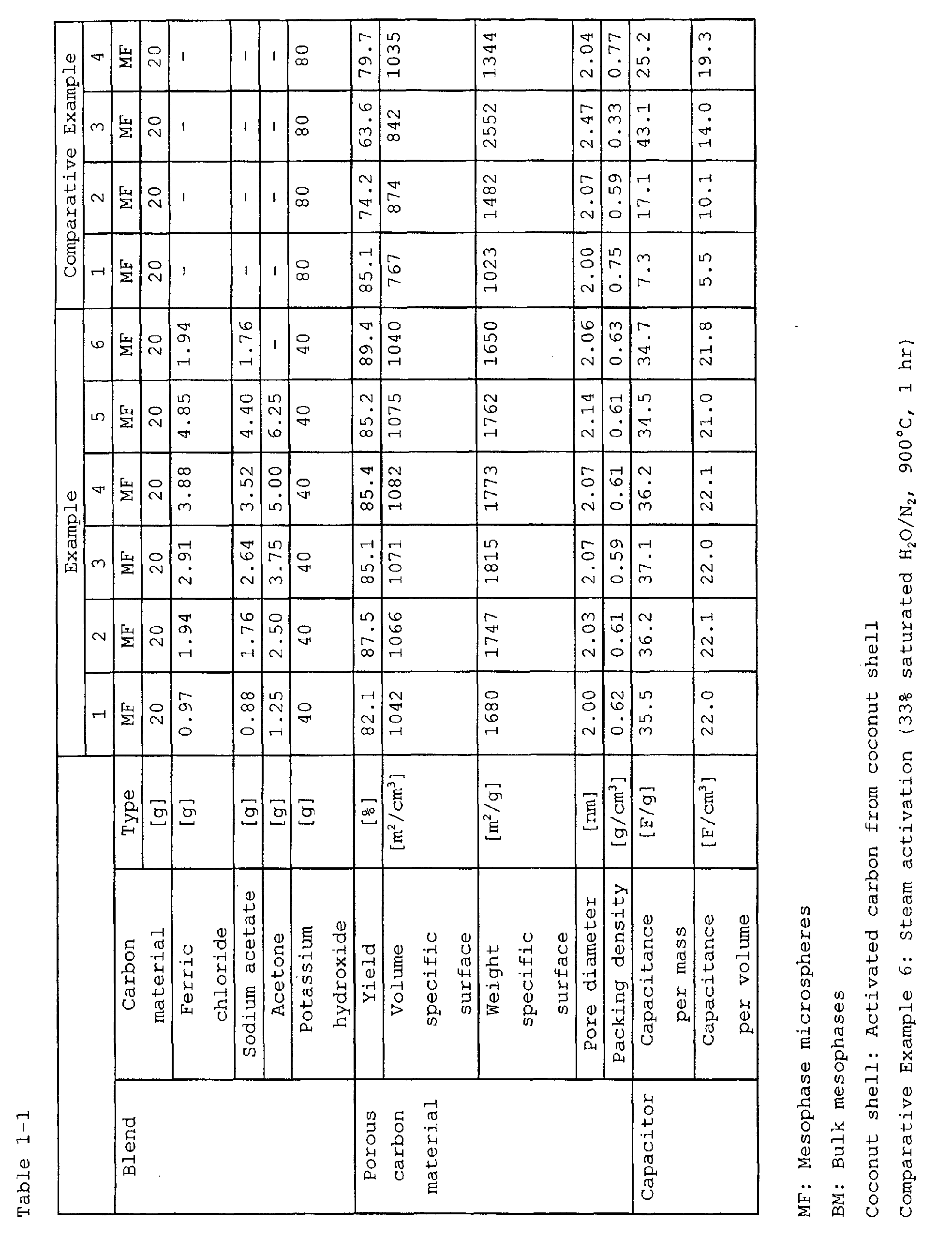
(EXAMPLES 1 to 6)
The predetermined amounts of ferric chloride aqueous
solution, acetone (not used in Example 6), sodium acetate
and potassium hydroxide shown in Table 1 were added to 20
g of mesophase microspheres (produced by Kawasaki Steel
Corporation, trade name KMFC, average particle diameter 17
µm), and uniformly mixed to form a slurry, followed by
drying at 80°C for 3 hours and at 160°C for 24 hours.
Next, the resultant mixture was activated by heating
at 850°C under an argon stream for 3 hours. The
microsphere sample which was made porous by activation was
neutralized with hydrochloric acid, and then washed with
ion exchanged water until the washing solution exhibited
neutrality. The yield was determined by the ratio (%) by
weight of the obtained porous carbon material to the raw
material.
The packing density and pore structure of the
obtained porous carbon material were measured as follows
to evaluate the examples and comparative examples. The
results are shown in Table 1.
(1) Packing density
The packing density means "packing density obtained
by a predetermined packing method", and was measured by
the following method.
1 mg of polytetrafluoroethylene (PTFE 7J, produced by
Du Pont-Mitsui Fluorochemicals) was mixed with 80 mg of
carbon material, and the resultant mixture was compression
molded (pressure 148 GPa) into a disk having a diameter of
13 mm. The packing density (g/cm3) was calculated from the
diameter, the thickness and the mass of the disk.
(2) Pore structure
The specific surface area and the pore diameter were
calculated by the BET method using ASAP2400 produced by
Micrometrics Co., based on an adsorption isotherm of N2
adsorption and desorption at 77K.
The pore diameter was calculated by 4x (pore
volume)/(BET specific surface area).
(COMPARATIVE EXAMPLES 1 to 4)
The same alkali activation method as Example 1 was
repeated except that a ferric chloride aqueous solution,
sodium acetate and acetone were not used, and potassium
hydroxide was used in the amount shown in the table to
obtain porous carbon materials.
The activation time was 30 minutes in Comparative
Example 1; the activation time was 1 hour in Comparative
Example 2; the activation time was 3 hours in Comparative
Examples 3 and 4. The results are shown in Table 1.
(EXAMPLES 7 to 9)
The same method as Example 1 was repeated except that
20 g of bulk mesophase (average particle diameter 25 µm)
was used in place of the mesophase microspheres to obtain
porous carbon materials. The results are shown in Table
1.
(COMPARATIVE EXAMPLE 5)
The same alkali activation method as Comparative
Example 3 was repeated except that the same bulk mesophase
as Examples 7 to 9 was used in place of the mesophase
microspheres to obtain porous carbon materials. The
results are shown in Table 1.
(COMPARATIVE EXAMPLE 6)
The same mesophase microspheres as Example 1 were
activated with steam to obtain a porous carbon material.
The results are shown in Table 1.
(COMPARATIVE EXAMPLE 7)
The properties of commercial activated carbon from
coconut shell (activated with steam, capacitor grade), and
the properties of a polarizable electrode material
comprising the activated carbon are shown in Table 1.
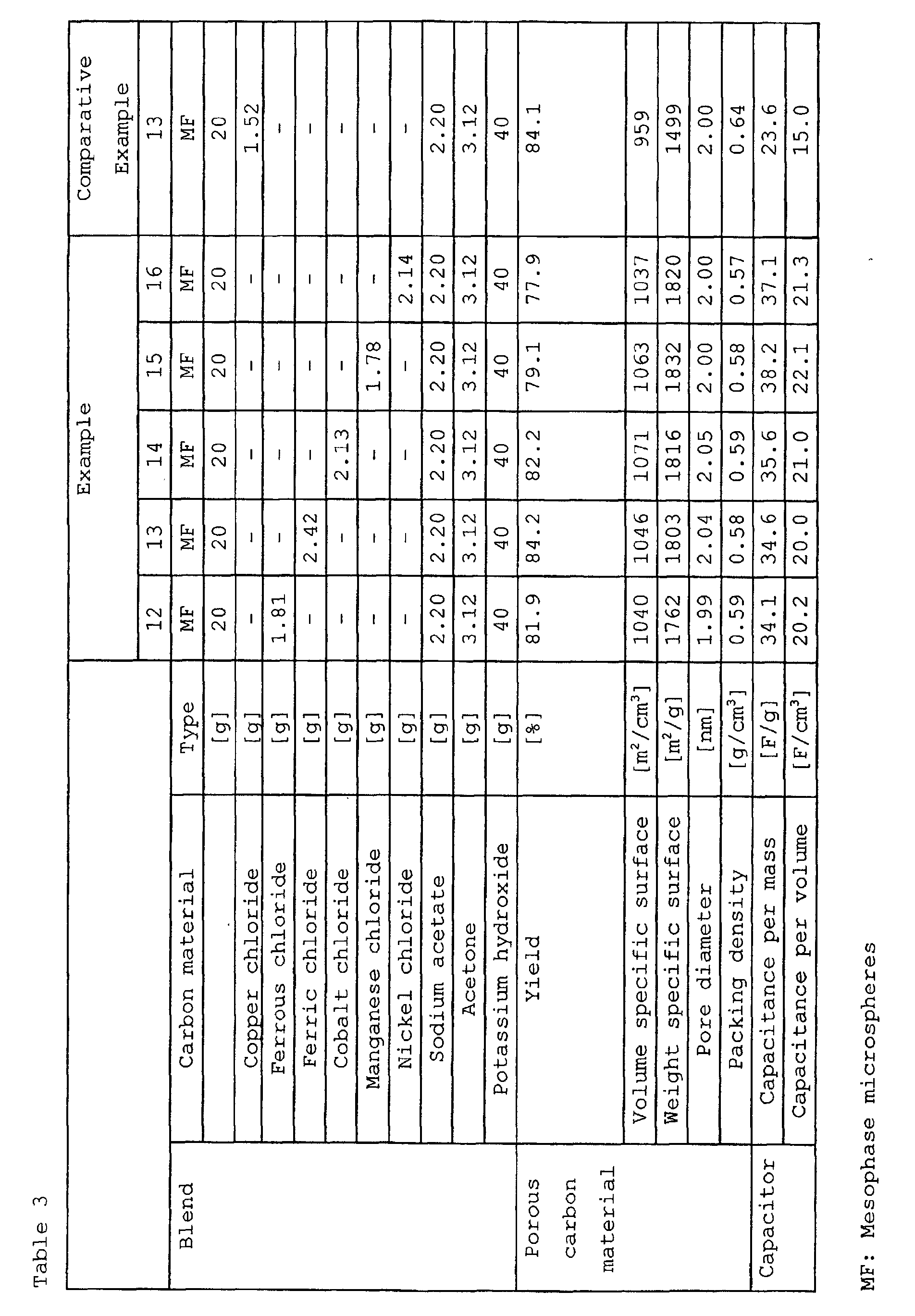
(EXAMPLES 10 to 19 and COMPARATIVE EXAMPLES 8 to 13)
The same method as Example 1 was repeated except that
the mesophase microspheres, metal ions, carboxylic acid
ions shown in Table 2 to 4 were used to obtain porous
carbon materials. The results are shown in Tables 2 to 4.
The porous carbon materials obtained by activation in
Examples 1 to 13 and 17 to 19 (using iron ions) were
subjected to analysis of the state of the present metal by
X-ray diffraction analysis (X-ray diffraction analyzer
1500 produced by Rigaku Co., Ltd., under conditions of
CuKα, 40 kV, and 80 mA). As a result, Fe3C was observed.
An electrical double layer capacitor was produced by
using each of the porous carbon materials obtained in the
Examples and the Comparative Examples, and the performance
of the capacitor was evaluated.
<Formation of electrode>
10 mg of carbon black and 3 mg of
polytetrafluoroethylene were added to 80 mg of porous
carbon material, and mixed in a dry manner, and the
resultant mixture was then molded into a disk having a
diameter of 13 mm under pressure (148 GPa) by using an
aluminum mesh as a current collector to form a polarizable
electrode material. The thus-formed polarizable electrode
material was dried at 160°C under reduced pressure (133.3
Pa) for 6 hours.
<Formation of electrical double layer capacitor>
Porous polypropylene (pore diameter 0.20 µm) was held
between a pair of the polarizable electrode materials
formed as described above in a glove box in which high-purity
argon is flowed and a dew point is kept at -60°C,
and the resultant component was incorporated into a
bipolar cell produced by Hosen Co., Ltd. The cell was
then filled with an electrolytic solution to form a cell.
As the electrolytic solution, a solution obtained by
dissolving 1 M of tetraethylammonium tetrafluoroborate
((C2H5)4NBF4) in propylene carbonate was used.
<Measurement of capacitance>
Charge and discharge were measured by constant-current
charge with 0.5 mA/cm2 and then constant-voltage
charge for 2 hours after the potential reached 2.4 V using
a Hokuto Denko charge-discharge test equipment (HJR-110mSM6).
Then, constant-current discharge with 0.5 mA/cm2 was
performed to the final voltage 0 V.
This cycle was repeated 10 times.
The capacitance was calculated as following:
The discharge energy (total discharge energy (W•s)
obtained by discharge voltage x time integration of
current) was determined from a discharge curve (discharge
voltage-discharge time) at the third cycle to determine
the capacitance by using the following equation:
Capacitance (F) = 2 x discharge energy
(W•s)/(discharge start voltage (V))2
The obtained capacitance was divided by the mass (positive
electrode + negative electrode, unit: g) of the carbon
material of the polarizable electrode material to
determine the capacitance per unit mass.
The capacitance per unit mass was multiplied by the
packing density (g/cm
3) of the polarizable electrode
material to obtain the capacitance per unit volume (F/cm
3).
| | Examples |
| | 17 | 18 | 19 |
| Blend | Carbon material | Type | MF | MF | MF |
| | Adding amount | 20 | 20 | 20 |
| Ferric chloride | [g] | 1.94 | 1.94 | 1.94 |
| Acetic acid | [g] | 1.29 | - | - |
| Citric acid | [g] | - | 1.51 | - |
| Benzoic acid | [g] | - | - | 2.63 |
| Acetone | [g] | 3.12 | 3.12 | 3.12 |
| Potassium hydroxide | [g] | 40 | 40 | 40 |
| Porous carbon material | Yield | [%] | 83.4 | 86.1 | 81.2 |
| Volume specific surface | [m2/cm3] | 1183 | 1022 | 1017 |
| Weight specific surface | [m2/g] | 2191 | 1623 | 1614 |
| Pore diameter | [nm] | 2.07 | 1,92 | 1.96 |
| Packing density | [g/cm3] | 0.54 | 0.63 | 0.63 |
| Capacitor | Capacitance per mass | [F/g] | 39.5 | 34.4 | 34.6 |
| Capacitance per volume | [F/cm3] | 20.5 | 20.9 | 21.8 |
| MF: Mesophase microspheres |
According to the present invention, a porous carbon
material having a specific surface area per unit volume of
1000 m2/cm3 or more can be industrially produced in high
yield and at low cost. The packing density of the porous
carbon material can also be increased, and thus the use of
the porous carbon material as a polarizable electrode
material permits the achievement of not only a high
capacitance per unit mass but also a high capacitance per
unit volume. Therefore, the porous carbon material can be
used for various applications required to have these
properties. Particularly, the porous carbon material is
suitably used as an electrode material for an electrical
double layer capacitor required to increase energy
density.