EP1195195A1 - Adsorbent for gaseous chemical substance and apparatus for adsorbing and removing using the same - Google Patents
Adsorbent for gaseous chemical substance and apparatus for adsorbing and removing using the same Download PDFInfo
- Publication number
- EP1195195A1 EP1195195A1 EP00917302A EP00917302A EP1195195A1 EP 1195195 A1 EP1195195 A1 EP 1195195A1 EP 00917302 A EP00917302 A EP 00917302A EP 00917302 A EP00917302 A EP 00917302A EP 1195195 A1 EP1195195 A1 EP 1195195A1
- Authority
- EP
- European Patent Office
- Prior art keywords
- gas
- gaseous chemical
- rotor
- zeolite
- mole
- Prior art date
- Legal status (The legal status is an assumption and is not a legal conclusion. Google has not performed a legal analysis and makes no representation as to the accuracy of the status listed.)
- Ceased
Links
Images


Classifications
-
- B—PERFORMING OPERATIONS; TRANSPORTING
- B01—PHYSICAL OR CHEMICAL PROCESSES OR APPARATUS IN GENERAL
- B01J—CHEMICAL OR PHYSICAL PROCESSES, e.g. CATALYSIS OR COLLOID CHEMISTRY; THEIR RELEVANT APPARATUS
- B01J20/00—Solid sorbent compositions or filter aid compositions; Sorbents for chromatography; Processes for preparing, regenerating or reactivating thereof
- B01J20/28—Solid sorbent compositions or filter aid compositions; Sorbents for chromatography; Processes for preparing, regenerating or reactivating thereof characterised by their form or physical properties
- B01J20/28014—Solid sorbent compositions or filter aid compositions; Sorbents for chromatography; Processes for preparing, regenerating or reactivating thereof characterised by their form or physical properties characterised by their form
- B01J20/28042—Shaped bodies; Monolithic structures
- B01J20/28045—Honeycomb or cellular structures; Solid foams or sponges
-
- B—PERFORMING OPERATIONS; TRANSPORTING
- B01—PHYSICAL OR CHEMICAL PROCESSES OR APPARATUS IN GENERAL
- B01D—SEPARATION
- B01D53/00—Separation of gases or vapours; Recovering vapours of volatile solvents from gases; Chemical or biological purification of waste gases, e.g. engine exhaust gases, smoke, fumes, flue gases, aerosols
- B01D53/02—Separation of gases or vapours; Recovering vapours of volatile solvents from gases; Chemical or biological purification of waste gases, e.g. engine exhaust gases, smoke, fumes, flue gases, aerosols by adsorption, e.g. preparative gas chromatography
-
- B—PERFORMING OPERATIONS; TRANSPORTING
- B01—PHYSICAL OR CHEMICAL PROCESSES OR APPARATUS IN GENERAL
- B01D—SEPARATION
- B01D53/00—Separation of gases or vapours; Recovering vapours of volatile solvents from gases; Chemical or biological purification of waste gases, e.g. engine exhaust gases, smoke, fumes, flue gases, aerosols
- B01D53/02—Separation of gases or vapours; Recovering vapours of volatile solvents from gases; Chemical or biological purification of waste gases, e.g. engine exhaust gases, smoke, fumes, flue gases, aerosols by adsorption, e.g. preparative gas chromatography
- B01D53/06—Separation of gases or vapours; Recovering vapours of volatile solvents from gases; Chemical or biological purification of waste gases, e.g. engine exhaust gases, smoke, fumes, flue gases, aerosols by adsorption, e.g. preparative gas chromatography with moving adsorbents, e.g. rotating beds
-
- B—PERFORMING OPERATIONS; TRANSPORTING
- B01—PHYSICAL OR CHEMICAL PROCESSES OR APPARATUS IN GENERAL
- B01J—CHEMICAL OR PHYSICAL PROCESSES, e.g. CATALYSIS OR COLLOID CHEMISTRY; THEIR RELEVANT APPARATUS
- B01J20/00—Solid sorbent compositions or filter aid compositions; Sorbents for chromatography; Processes for preparing, regenerating or reactivating thereof
- B01J20/02—Solid sorbent compositions or filter aid compositions; Sorbents for chromatography; Processes for preparing, regenerating or reactivating thereof comprising inorganic material
- B01J20/10—Solid sorbent compositions or filter aid compositions; Sorbents for chromatography; Processes for preparing, regenerating or reactivating thereof comprising inorganic material comprising silica or silicate
- B01J20/16—Alumino-silicates
- B01J20/18—Synthetic zeolitic molecular sieves
-
- F—MECHANICAL ENGINEERING; LIGHTING; HEATING; WEAPONS; BLASTING
- F24—HEATING; RANGES; VENTILATING
- F24F—AIR-CONDITIONING; AIR-HUMIDIFICATION; VENTILATION; USE OF AIR CURRENTS FOR SCREENING
- F24F3/00—Air-conditioning systems in which conditioned primary air is supplied from one or more central stations to distributing units in the rooms or spaces where it may receive secondary treatment; Apparatus specially designed for such systems
- F24F3/12—Air-conditioning systems in which conditioned primary air is supplied from one or more central stations to distributing units in the rooms or spaces where it may receive secondary treatment; Apparatus specially designed for such systems characterised by the treatment of the air otherwise than by heating and cooling
- F24F3/14—Air-conditioning systems in which conditioned primary air is supplied from one or more central stations to distributing units in the rooms or spaces where it may receive secondary treatment; Apparatus specially designed for such systems characterised by the treatment of the air otherwise than by heating and cooling by humidification; by dehumidification
- F24F3/1411—Air-conditioning systems in which conditioned primary air is supplied from one or more central stations to distributing units in the rooms or spaces where it may receive secondary treatment; Apparatus specially designed for such systems characterised by the treatment of the air otherwise than by heating and cooling by humidification; by dehumidification by absorbing or adsorbing water, e.g. using an hygroscopic desiccant
- F24F3/1423—Air-conditioning systems in which conditioned primary air is supplied from one or more central stations to distributing units in the rooms or spaces where it may receive secondary treatment; Apparatus specially designed for such systems characterised by the treatment of the air otherwise than by heating and cooling by humidification; by dehumidification by absorbing or adsorbing water, e.g. using an hygroscopic desiccant with a moving bed of solid desiccants, e.g. a rotary wheel supporting solid desiccants
-
- B—PERFORMING OPERATIONS; TRANSPORTING
- B01—PHYSICAL OR CHEMICAL PROCESSES OR APPARATUS IN GENERAL
- B01D—SEPARATION
- B01D2253/00—Adsorbents used in seperation treatment of gases and vapours
- B01D2253/10—Inorganic adsorbents
- B01D2253/106—Silica or silicates
- B01D2253/108—Zeolites
- B01D2253/1085—Zeolites characterized by a silicon-aluminium ratio
-
- B—PERFORMING OPERATIONS; TRANSPORTING
- B01—PHYSICAL OR CHEMICAL PROCESSES OR APPARATUS IN GENERAL
- B01D—SEPARATION
- B01D2253/00—Adsorbents used in seperation treatment of gases and vapours
- B01D2253/25—Coated, impregnated or composite adsorbents
-
- B—PERFORMING OPERATIONS; TRANSPORTING
- B01—PHYSICAL OR CHEMICAL PROCESSES OR APPARATUS IN GENERAL
- B01D—SEPARATION
- B01D2253/00—Adsorbents used in seperation treatment of gases and vapours
- B01D2253/30—Physical properties of adsorbents
- B01D2253/34—Specific shapes
- B01D2253/342—Monoliths
- B01D2253/3425—Honeycomb shape
-
- B—PERFORMING OPERATIONS; TRANSPORTING
- B01—PHYSICAL OR CHEMICAL PROCESSES OR APPARATUS IN GENERAL
- B01D—SEPARATION
- B01D2257/00—Components to be removed
- B01D2257/40—Nitrogen compounds
-
- B—PERFORMING OPERATIONS; TRANSPORTING
- B01—PHYSICAL OR CHEMICAL PROCESSES OR APPARATUS IN GENERAL
- B01D—SEPARATION
- B01D2257/00—Components to be removed
- B01D2257/40—Nitrogen compounds
- B01D2257/406—Ammonia
-
- B—PERFORMING OPERATIONS; TRANSPORTING
- B01—PHYSICAL OR CHEMICAL PROCESSES OR APPARATUS IN GENERAL
- B01D—SEPARATION
- B01D2257/00—Components to be removed
- B01D2257/70—Organic compounds not provided for in groups B01D2257/00 - B01D2257/602
-
- B—PERFORMING OPERATIONS; TRANSPORTING
- B01—PHYSICAL OR CHEMICAL PROCESSES OR APPARATUS IN GENERAL
- B01D—SEPARATION
- B01D2259/00—Type of treatment
- B01D2259/40—Further details for adsorption processes and devices
- B01D2259/40083—Regeneration of adsorbents in processes other than pressure or temperature swing adsorption
- B01D2259/40088—Regeneration of adsorbents in processes other than pressure or temperature swing adsorption by heating
- B01D2259/4009—Regeneration of adsorbents in processes other than pressure or temperature swing adsorption by heating using hot gas
-
- B—PERFORMING OPERATIONS; TRANSPORTING
- B01—PHYSICAL OR CHEMICAL PROCESSES OR APPARATUS IN GENERAL
- B01J—CHEMICAL OR PHYSICAL PROCESSES, e.g. CATALYSIS OR COLLOID CHEMISTRY; THEIR RELEVANT APPARATUS
- B01J2220/00—Aspects relating to sorbent materials
- B01J2220/40—Aspects relating to the composition of sorbent or filter aid materials
- B01J2220/42—Materials comprising a mixture of inorganic materials
-
- F—MECHANICAL ENGINEERING; LIGHTING; HEATING; WEAPONS; BLASTING
- F24—HEATING; RANGES; VENTILATING
- F24F—AIR-CONDITIONING; AIR-HUMIDIFICATION; VENTILATION; USE OF AIR CURRENTS FOR SCREENING
- F24F2203/00—Devices or apparatus used for air treatment
- F24F2203/10—Rotary wheel
- F24F2203/1032—Desiccant wheel
- F24F2203/1036—Details
-
- F—MECHANICAL ENGINEERING; LIGHTING; HEATING; WEAPONS; BLASTING
- F24—HEATING; RANGES; VENTILATING
- F24F—AIR-CONDITIONING; AIR-HUMIDIFICATION; VENTILATION; USE OF AIR CURRENTS FOR SCREENING
- F24F2203/00—Devices or apparatus used for air treatment
- F24F2203/10—Rotary wheel
- F24F2203/1048—Geometric details
-
- F—MECHANICAL ENGINEERING; LIGHTING; HEATING; WEAPONS; BLASTING
- F24—HEATING; RANGES; VENTILATING
- F24F—AIR-CONDITIONING; AIR-HUMIDIFICATION; VENTILATION; USE OF AIR CURRENTS FOR SCREENING
- F24F2203/00—Devices or apparatus used for air treatment
- F24F2203/10—Rotary wheel
- F24F2203/1056—Rotary wheel comprising a reheater
-
- F—MECHANICAL ENGINEERING; LIGHTING; HEATING; WEAPONS; BLASTING
- F24—HEATING; RANGES; VENTILATING
- F24F—AIR-CONDITIONING; AIR-HUMIDIFICATION; VENTILATION; USE OF AIR CURRENTS FOR SCREENING
- F24F2203/00—Devices or apparatus used for air treatment
- F24F2203/10—Rotary wheel
- F24F2203/1068—Rotary wheel comprising one rotor
-
- F—MECHANICAL ENGINEERING; LIGHTING; HEATING; WEAPONS; BLASTING
- F24—HEATING; RANGES; VENTILATING
- F24F—AIR-CONDITIONING; AIR-HUMIDIFICATION; VENTILATION; USE OF AIR CURRENTS FOR SCREENING
- F24F2203/00—Devices or apparatus used for air treatment
- F24F2203/10—Rotary wheel
- F24F2203/1088—Rotary wheel comprising three flow rotor segments
Definitions
- the present invention relates to an adsorbent for adsorbing gaseous chemical substances, particularly, ammonia and organic gaseous chemical substances, contained in a gas, in an adsorption treatment process and an adsorption and removal apparatus using the same.
- zeolites usually do not adsorb an organic solvent well but selectively adsorb moisture contained in the air. In general, about 10 grams of moisture is present per kilogram of air. This is ten thousand times larger in quantity than an organic solvent contained as a gaseous chemical substance. Zeolite has a problem that its adsorption capability becomes saturated due to adsorption of moisture contained in the air before adsorbing the gaseous chemical substance, which hinders subsequent adsorption of the gaseous chemical substance. On the other hand, a hydrophobic zeolite selectively adsorbs an organic gaseous chemical substance, but it adsorbs poorly inorganic gaseous chemical substances such as ammonia and sulfur compounds.
- An object of the invention is to provide a gaseous chemical substance adsorbent and an adsorption and removal apparatus capable of adsorbing both organic and inorganic gaseous chemical substances with high efficiency.
- the invention provides a gaseous chemical substance adsorbent comprising:
- two or more zeolites are used, namely, one or more zeolites having an SiO 2 /Al 2 O 3 mole-ratio of 70 or more and one or more zeolites having an SiO 2 /Al 2 O 3 mole-ratio of from 5 to 70.
- Zeolites are represented by the following molecular formula: aM 2 O x ⁇ Al 2 O 3 ⁇ mSiO 2 ⁇ bH 2 O, wherein M represents an alkaline or alkaline-earthmetal; x represents a valence thereof; and m represents a mole-ratio SiO 2 /Al 2 O 3 between silica (SiO 2 ) and alumina (Al 2 O 3 ). Note that a zeolite having a mole-ratio m of less than 5 is classed as a hydrophilic zeolite.
- a zeolite having a mole-ratio m within a range of 5 to 70 (hereafter referred to as a weak hydrophobic zeolite) and a zeolite having a mole-ratio m of greater than 70 (hereafter referred to as a strong hydrophobic zeolite) are filled in a fluidized-bed adsorption tower, or are carried on a honeycomb-like laminate in an amount of 30 to 90% by weight.
- a mixture ratio between the weak hydrophobic zeolite and the strong hydrophobic zeolite should preferably be changed according to gaseous chemical substances.
- a weak hydrophobic zeolite of 10 to 90% by weight and a strong hydrophobic zeolite of 90 to 10% by weight are mixed.
- the invention further provides an adsorption and removal apparatus for successively and intermittently adsorbing and removing gaseous chemical substances, comprising:
- the gaseous chemical substance adsorbent is approximately cylindrically shaped, wherein the adsorbing portion, the regenerating portion, and the cooling portion are rotated about the axis of the adsorbent in this order by the driving means.
- a gas containing gaseous chemical substances flows from one axial side to the other axial side of the rotor so that the gaseous chemical substances are adsorbed and removed.
- the gaseous chemical substances adsorbed by the adsorbing portion are desorbed by a gas having been heated by the heating means, whereby the rotor is regenerated.
- the rotor having been heated by a gas for use in regeneration in the regenerating portion is cooled to a suitable temperature so that gaseous chemical substances are adsorbed in the adsorbing portion. In this way, the gas containing gaseous chemical substances is successively processed.
- the invention is characterized in that a total amount of gaseous chemical substances remaining in the gas having undergone the gaseous chemical substances removal treatment is equal to or less than 5ppb.
- the gas treated in the adsorption and removal apparatus is substantially free from chemicals.
- air velocity in front of the rotor needs to be set at 2.5m/sec or below, and the axial length L needs to be set at 400mm.
- FIG. 1 is a schematic diagram of an adsorption and removal apparatus (1) of an embodiment of the invention.
- a rotor (2) is shaped like a cylinder 300mm in diameter D and 400mm in length L, and is rotated about an axis (3) via a belt (5) at 2/hr by a driving motor (4).
- Fig. 2 is a perspective view of the rotor (2).
- the rotor (2) comprises an adsorbing portion (16) circumferentially extending over 300°, a regenerating portion (17), located downstream of the adsorbing portion (16) in a rotation direction (19), circumferentially extending over 30°, a cooling portion (18), located downstream of the regenerating portion (17) in a rotation direction, circumferentially extending over 30°, and a rotation shaft (20) provided at a center of the rotor (2).
- a gas to be treated (hereafter, referred to as a treated gas) is sucked, through a filter (6), into a treated gas fan (7), is fed to the adsorbing portion (16) of the rotor (2) by a treated gas guiding portion (8), and, after a gaseous chemical substance contained therein is adsorbed by the rotor (2), passes through a treated gas guiding portion (8) so as to be discharged to outside.
- a regeneration gas is sucked, through a filter (9), into a regeneration gas fan (10), is heated to 180°C by a heater (11), is fed to the regenerating portion (17) of the rotor (2) by a regeneration gas guiding portion (12), and, after desorbing the gaseous chemical substance adsorbed by the rotor (2), passes through the regeneration gas guiding portion (12) so as to be discharged from the apparatus (1). Since the regenerating portion (17) of the rotor (2) is heated to approximately 180°C due to a regeneration gas heated to 180°C; in the cooling portion (18), it is cooled to an approximately ordinary temperature by a cooling gas.
- the cooling gas is sucked, through a filter (13), into a cooling fan (14), is fed to the cooling portion (18) by a cooling gas guiding portion (15), and is, after cooling the rotor (2), discharged from the cooling gas guiding portion (15).
- a treated gas fed to the adsorbing portion (16), a regeneration gas fed to the regenerating portion (17), and a cooling gas fed to cooling portion (18) flow within the rotor (2) in reverse directions. This makes it possible to achieve adsorption, desorption, and cooling with efficiency.
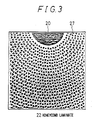
- Fig. 3 is an enlarged partial plan view of a honeycomb-like laminate (22) employed in the gaseous chemical substance adsorbent embodying the invention.
- the laminate (22) is, when formed into a cylindrical rotor (2), so designed that its honeycomb-like pores (27) are formed so as to open in the axial direction of the rotor.
- Fig. 4 is a graph showing a relationship between a mole-ratio between SiO 2 and Al 2 O 3 constituting zeolite (SiO 2 /Al 2 O 3 ) and amounts of water and benzene adsorbed. A point of intersection of two lines representing the amounts of water and benzene adsorbed, respectively, coincides with an SiO 2 /Al 2 O 3 of about 70.
- Example 2 adsorption tests were conducted with use of the rotor (2) formed of the honeycomb-like laminate (22) carrying a weak hydrophobic zeolite having an SiO 2 /Al 2 O 3 mole-ratio of 60 and a strong hydrophobic zeolite having an SiO 2 /Al 2 O 3 mole-ratio of 200 that are equal in quantity.
- a treated gas was prepared by adding to the air 62 to 75 ppb ammonia (as an inorganic gaseous chemical substance) and 740 to 800 ppb N-methylpyrolidone (NMP) (as an organic gaseous chemical substance).
- the treated gas thus obtained was fed to the adsorption and removal apparatus (1) attached to the rotor (2) at a flow rate of about 3m 3 /min.
- regeneration was achieved with air heated to 175°C at a flow rate of about 0.6m 3 /min.
- the treated gas and other were sampled and analyzed 1 hour after setting of the apparatus was completed.
- ammonia the individual gases had been sucked for three hours at a rate of 2L/min by a diaphragm mini-pump via an impinger (two-stage combined structure) filled with an adsorbing solution, and then ammonia contained in the adsorbing solution was analyzed by ion-chromatograph method to calculate the ammonia density of each gas.
- NMP NMP
- the gases were sucked by a diaphragm mini-pump via an adsorption tower filled with an adsorbent, and then an amount of gas sucked was measured by a dry gas meter. In this way, sampling was achieved.
- the NMP adsorbed by the adsorbent was expelled, while being heated, therefromby an inert gas.
- an amount of NMP contained in the inert gas was measured by TCT-GC/MS method. The results of the measurements are shown in Table 1.
- Example Comparative Example 1 Comparative Example 2 NH 3 (ppb) NMP (ppb) NH 3 (ppb) NMP (ppb) NH 3 (ppb) NMP (ppb) Treated gas (enter) 62 740 67 760 75 800 Treated gas (exit) 1.4 0.1 or below 23 0.1 or below 1.0 10 Adsorption/ Removal efficiency 97.7% 100% 65.7% 100% 98.7% 98.8% Gas for regeneration 390 4440 270 4790 460 5130 Concentration magnification 6.4 6.0 6.1 6.3 6.3 6.5
- the adsorption and removal apparatus was operated under the same conditions as those in Example, except that a strong hydrophobic zeolite having an SiO 2 /Al 2 O 3 mole-ratio of 200 is used as zeolite to be carried on the honeycomb-like laminate (22).
- the tests results are shown in Table 1.
- the adsorption and removal apparatus was operated under the same conditions as those in Example, except that a weak hydrophobic zeolite having an SiO 2 /Al 2 O 3 mole-ratio of 60 is used as zeolite to be carried on the honeycomb laminate (22).
- the tests results are shown in Table 1.
- the adsorption and removal apparatus embodying the invention that employs zeolite is capable of adsorbing and removing both inorganic gaseous chemical substances, such as ammonia, and organic gaseous chemical substances, such as NMP, with satisfactorily high adsorption and removal efficiency.
- a weak hydrophobic zeolite and a strong hydrophobic zeolite are used, this allows efficient adsorption of both inorganic and organic gaseous chemical substances.
- the gaseous chemical substance adsorbent embodying the invention is filled in a fluidized-bed adsorption tower or is carried on a honeycomb-like laminate before use.
- a mixture ratio of a weak hydrophobic zeolite is preferably set to a range of from 10 to 90% by weight.
- a gaseous chemical substance can be adsorbed to a degree that a gas is substantially free from chemicals.
Landscapes
- Chemical & Material Sciences (AREA)
- Analytical Chemistry (AREA)
- Chemical Kinetics & Catalysis (AREA)
- Engineering & Computer Science (AREA)
- Organic Chemistry (AREA)
- General Chemical & Material Sciences (AREA)
- Oil, Petroleum & Natural Gas (AREA)
- Inorganic Chemistry (AREA)
- Combustion & Propulsion (AREA)
- Mechanical Engineering (AREA)
- General Engineering & Computer Science (AREA)
- Separation Of Gases By Adsorption (AREA)
Abstract
Description
| Example | Comparative Example 1 | Comparative Example 2 | ||||
| NH3 (ppb) | NMP (ppb) | NH3 (ppb) | NMP (ppb) | NH3 (ppb) | NMP (ppb) | |
| Treated gas (enter) | 62 | 740 | 67 | 760 | 75 | 800 |
| Treated gas (exit) | 1.4 | 0.1 or below | 23 | 0.1 or below | 1.0 | 10 |
| Adsorption/ Removal efficiency | 97.7% | 100% | 65.7% | 100% | 98.7% | 98.8% |
| Gas for regeneration | 390 | 4440 | 270 | 4790 | 460 | 5130 |
| Concentration magnification | 6.4 | 6.0 | 6.1 | 6.3 | 6.3 | 6.5 |
Claims (6)
- A gaseous chemical substance adsorbent comprising:a zeolite having an SiO2/Al2O3 mole-ratio of 70 or more; anda zeolite having an SiO2/Al2O3 mole-ratio of from 5 to 70.
- The gaseous chemical substance adsorbent of claim 1, comprising:the zeolite having an SiO2/Al2O3 mole-ratio of 70 or more of 10 to 90% by weight, andthe zeolite having an SiO2/Al2O3 mole-ratio of from 5 to 70 of 90 to 10% by weight.
- A gaseous chemical substance adsorbent comprising:wherein the two or more zeolites include a zeolite having an SiO2/Al2O3 mole-ratio of 70 or more, and a zeolite having an SiO2/Al2O3 mole-ratio of from 5 to 70.a honeycomb-like laminate having two or more zeolites carried thereon,
- The gaseous chemical substance adsorbent of claim 1, wherein the two or more zeolites include the zeolite having an SiO2/Al2O3 mole-ratio of 70 or more of 10 to 90% by weight and the zeolite having an SiO2/Al2O3 mole-ratio of from 5 to 70 of 90 to 10% by weight.
- An adsorption and removal apparatus for successively and intermittently adsorbing and removing gaseous chemical substances, comprising:a rotor formed of the above-mentioned gaseous chemical substance adsorbent, the rotor being substantially cylindrically shaped so that a gas passes through the rotor in an axial direction thereof;driving means for rotating the rotor about an axial line thereof;a gas guiding portion formed by circumferentially partitioning the rotor at both axial ends into an adsorbing portion, a regenerating portion, and a cooling portion in this order along an rotation direction, the gas guiding portion consisting of: a gas-to-be-treated guiding portion for feeding a gas containing gaseous chemical substances to one axial side of the adsorbing portion of the rotor and discharging the gas from the other axial side thereof to outside; a regeneration-gas guiding portion for feeding a gas for use in regeneration to the other axial side of the regenerating portion of the rotor and discharging the gas into the one axial side thereof; and a cooling-gas guiding portion for feeding a cooling gas to the other axial side of the cooling portion of the rotor and discharging the gas from the one axial side thereof to outside; andheating means for heating a gas which is fed to the regenerating portion.
- The adsorption and removal apparatus of claim 5, wherein a total amount of gaseous chemical substances remaining in the gas having undergone the gaseous chemical substances removal treatment is equal to or less than 5ppb.
Applications Claiming Priority (3)
| Application Number | Priority Date | Filing Date | Title |
|---|---|---|---|
| JP10847999 | 1999-04-15 | ||
| JP10847999 | 1999-04-15 | ||
| PCT/JP2000/002398 WO2000062921A1 (en) | 1999-04-15 | 2000-04-13 | Adsorbent for gaseous chemical substance and apparatus for adsorbing and removing using the same |
Publications (2)
| Publication Number | Publication Date |
|---|---|
| EP1195195A1 true EP1195195A1 (en) | 2002-04-10 |
| EP1195195A4 EP1195195A4 (en) | 2002-11-06 |
Family
ID=14485805
Family Applications (1)
| Application Number | Title | Priority Date | Filing Date |
|---|---|---|---|
| EP00917302A Ceased EP1195195A4 (en) | 1999-04-15 | 2000-04-13 | ADSORBENT FOR GASEOUS CHEMICAL SUBSTANCE AND ADSORPTION AND EXTRACTION APPARATUS USING THE SAME |
Country Status (4)
| Country | Link |
|---|---|
| EP (1) | EP1195195A4 (en) |
| KR (1) | KR100440666B1 (en) |
| TW (1) | TW518249B (en) |
| WO (1) | WO2000062921A1 (en) |
Cited By (3)
| Publication number | Priority date | Publication date | Assignee | Title |
|---|---|---|---|---|
| EP1231439A4 (en) * | 1999-11-12 | 2003-05-07 | Daikin Ind Ltd | WHITE ROOM |
| EP1683563A3 (en) * | 2005-01-21 | 2007-06-20 | POLARIS Srl | Method and system for treating a gaseous stream containing organic and inorganic volatile compounds |
| WO2022034295A1 (en) * | 2020-08-10 | 2022-02-17 | Johnson Matthey Public Limited Company | Exhaust gas treatment system |
Families Citing this family (1)
| Publication number | Priority date | Publication date | Assignee | Title |
|---|---|---|---|---|
| WO2023043918A1 (en) * | 2021-09-15 | 2023-03-23 | Entegris, Inc. | Composite adsorbent-containing bodies and related methods |
Family Cites Families (15)
| Publication number | Priority date | Publication date | Assignee | Title |
|---|---|---|---|---|
| US4134743A (en) * | 1970-03-31 | 1979-01-16 | Gas Developments Corporation | Desiccant apparatus and method |
| US4331694A (en) * | 1978-12-26 | 1982-05-25 | Union Carbide Corporation | Removal of caffeine by selective adsorption using zeolite adsorbents |
| US4402717A (en) * | 1980-05-22 | 1983-09-06 | Daikin Kogyo Co., Ltd. | Apparatus for removing moisture and odors |
| US4795482A (en) * | 1987-06-30 | 1989-01-03 | Union Carbide Corporation | Process for eliminating organic odors and compositions for use therein |
| US5047139A (en) * | 1987-12-08 | 1991-09-10 | Uop | Catalyst for mid-barrel hydrocracking and process using same |
| US5158582A (en) * | 1988-05-30 | 1992-10-27 | Hitachi Zosen Corporation | Method of removing NOx by adsorption, NOx adsorbent and apparatus for purifying NOx-containing gas |
| US5019667A (en) * | 1988-06-14 | 1991-05-28 | Uop | Process for purification of hydrocarbons |
| US5242473A (en) * | 1988-09-22 | 1993-09-07 | Unico Kogyo Kabushiki Kaisha | Apparatus for dehumidifying gas |
| US5284638A (en) * | 1992-08-05 | 1994-02-08 | Corning Incorporated | System and method for removing hydrocarbons from gaseous mixtures using multiple adsorbing agents |
| US5407880A (en) * | 1992-11-09 | 1995-04-18 | Nissan Motor Co., Ltd. | Catalysts for adsorption of hydrocarbons |
| JPH07256048A (en) * | 1994-03-24 | 1995-10-09 | Kobe Steel Ltd | Deodorizer |
| EP0691154A1 (en) * | 1994-07-07 | 1996-01-10 | The Boc Group, Inc. | Purification of nitric oxide |
| SE9403014D0 (en) * | 1994-09-09 | 1994-09-09 | Svenska Tobaks Ab | Tobacco smoke filters |
| JPH09154927A (en) * | 1995-12-11 | 1997-06-17 | Matsushita Electric Ind Co Ltd | Deodorant |
| JP3417309B2 (en) * | 1997-10-28 | 2003-06-16 | トヨタ自動車株式会社 | Hydrocarbon adsorbent |
-
2000
- 2000-04-13 WO PCT/JP2000/002398 patent/WO2000062921A1/en not_active Ceased
- 2000-04-13 EP EP00917302A patent/EP1195195A4/en not_active Ceased
- 2000-04-13 KR KR10-2001-7013040A patent/KR100440666B1/en not_active Expired - Fee Related
- 2000-04-13 TW TW089106901A patent/TW518249B/en not_active IP Right Cessation
Cited By (7)
| Publication number | Priority date | Publication date | Assignee | Title |
|---|---|---|---|---|
| EP1231439A4 (en) * | 1999-11-12 | 2003-05-07 | Daikin Ind Ltd | WHITE ROOM |
| US6960236B1 (en) | 1999-11-12 | 2005-11-01 | Daikin Industries, Ltd. | Clean room |
| EP1683563A3 (en) * | 2005-01-21 | 2007-06-20 | POLARIS Srl | Method and system for treating a gaseous stream containing organic and inorganic volatile compounds |
| WO2022034295A1 (en) * | 2020-08-10 | 2022-02-17 | Johnson Matthey Public Limited Company | Exhaust gas treatment system |
| GB2603979A (en) * | 2020-08-10 | 2022-08-24 | Johnson Matthey Plc | Exhaust gas treatment system |
| GB2603979B (en) * | 2020-08-10 | 2024-10-23 | Johnson Matthey Plc | Exhaust gas treatment system |
| US12325003B2 (en) | 2020-08-10 | 2025-06-10 | Johnson Matthey Public Limited Company | Exhaust gas treatment system |
Also Published As
| Publication number | Publication date |
|---|---|
| KR20020005676A (en) | 2002-01-17 |
| TW518249B (en) | 2003-01-21 |
| EP1195195A4 (en) | 2002-11-06 |
| KR100440666B1 (en) | 2004-07-21 |
| WO2000062921A1 (en) | 2000-10-26 |
Similar Documents
| Publication | Publication Date | Title |
|---|---|---|
| US6521196B2 (en) | Process and catalyst/sorber for treating sulfur compound containing effluent | |
| JP2003311148A (en) | Adsorbent and gas purification method and apparatus | |
| JP3725196B2 (en) | Nitrogen-containing molecular sieve activated carbon, its production method and use | |
| EP1231439A1 (en) | Clean room | |
| JPH09173758A (en) | High boiling point solvent recovery device | |
| JP2022508976A (en) | Adsorbed gas separation process using chemical adsorbent | |
| JP2002204917A (en) | Source gas separation method | |
| KR100440666B1 (en) | Adsorbent for gaseous chemical substance and apparatus for adsorbing and removing using the same | |
| WO2000050154A1 (en) | Humidity swing adsorption process and apparatus | |
| JPH05154339A (en) | Removal of nitrogen oxide | |
| EP2013615B1 (en) | Co2 absorption device for elemental analysis instruments | |
| JP4236443B2 (en) | Clean air generator | |
| JP3183381B2 (en) | Method for recovering organic solvent from small air volume gas containing high concentration organic solvent | |
| JP4774573B2 (en) | Exhaust gas treatment method and apparatus | |
| JPWO2000062921A1 (en) | Gaseous chemical substance adsorbent and adsorption removal device using the same | |
| JPH0824579A (en) | Treatment of low concentration nox containing gas | |
| JPH09248448A (en) | Nitrogen oxide adsorbent and removal system | |
| JP2003103140A (en) | Purification method of nitrogen dioxide containing gas | |
| JPH0655031A (en) | Method for removing gaseous hydrocarbon | |
| JP2025500396A (en) | Installation for recovering CO2 contained in a feed gas stream | |
| WO2024151849A1 (en) | Adsorbent that contains potassium hydroxide and potassium carbonate, and related methods and devices | |
| JPH05277339A (en) | Nitrogen oxide removal method | |
| JP2005028250A (en) | Gas treatment device and gas treatment method | |
| KR20240019523A (en) | System of multi air pollytant cleaning for coal treatment plant | |
| JP2000237583A (en) | Exhaust gas treatment material, treatment element and treatment method |
Legal Events
| Date | Code | Title | Description |
|---|---|---|---|
| PUAI | Public reference made under article 153(3) epc to a published international application that has entered the european phase |
Free format text: ORIGINAL CODE: 0009012 |
|
| 17P | Request for examination filed |
Effective date: 20011102 |
|
| AK | Designated contracting states |
Kind code of ref document: A1 Designated state(s): AT BE CH CY DE DK ES FI FR GB GR IE IT LI LU MC NL PT SE |
|
| A4 | Supplementary search report drawn up and despatched |
Effective date: 20020920 |
|
| AK | Designated contracting states |
Kind code of ref document: A4 Designated state(s): DE FR GB |
|
| 17Q | First examination report despatched |
Effective date: 20021209 |
|
| RBV | Designated contracting states (corrected) |
Designated state(s): DE FR GB |
|
| STAA | Information on the status of an ep patent application or granted ep patent |
Free format text: STATUS: THE APPLICATION HAS BEEN REFUSED |
|
| 18R | Application refused |
Effective date: 20040513 |