EP1193269A1 - Crystalline 1-methylcarbapenem compounds - Google Patents
Crystalline 1-methylcarbapenem compounds Download PDFInfo
- Publication number
- EP1193269A1 EP1193269A1 EP00944289A EP00944289A EP1193269A1 EP 1193269 A1 EP1193269 A1 EP 1193269A1 EP 00944289 A EP00944289 A EP 00944289A EP 00944289 A EP00944289 A EP 00944289A EP 1193269 A1 EP1193269 A1 EP 1193269A1
- Authority
- EP
- European Patent Office
- Prior art keywords
- compound
- crystalline
- crystalline form
- ethanol
- pharmaceutically acceptable
- Prior art date
- Legal status (The legal status is an assumption and is not a legal conclusion. Google has not performed a legal analysis and makes no representation as to the accuracy of the status listed.)
- Withdrawn
Links
- 0 C[C@]([C@]([C@@]([C@]1(C)*)N2C(C(O)=O)=C1S[C@@](C1)CN(C)[C@@]1*1C[C@@](*C*C(N)=N)CC1)C2=O)O Chemical compound C[C@]([C@]([C@@]([C@]1(C)*)N2C(C(O)=O)=C1S[C@@](C1)CN(C)[C@@]1*1C[C@@](*C*C(N)=N)CC1)C2=O)O 0.000 description 1
Images


Classifications
-
- C—CHEMISTRY; METALLURGY
- C07—ORGANIC CHEMISTRY
- C07D—HETEROCYCLIC COMPOUNDS
- C07D477/00—Heterocyclic compounds containing 1-azabicyclo [3.2.0] heptane ring systems, i.e. compounds containing a ring system of the formula:, e.g. carbapenicillins, thienamycins; Such ring systems being further condensed, e.g. 2,3-condensed with an oxygen-, nitrogen- or sulphur-containing hetero ring
- C07D477/10—Heterocyclic compounds containing 1-azabicyclo [3.2.0] heptane ring systems, i.e. compounds containing a ring system of the formula:, e.g. carbapenicillins, thienamycins; Such ring systems being further condensed, e.g. 2,3-condensed with an oxygen-, nitrogen- or sulphur-containing hetero ring with hydrogen atoms, hydrocarbon or substituted hydrocarbon radicals, directly attached in position 4, and with a carbon atom having three bonds to hetero atoms with at the most one bond to halogen, e.g. an ester or nitrile radical, directly attached in position 2
- C07D477/12—Heterocyclic compounds containing 1-azabicyclo [3.2.0] heptane ring systems, i.e. compounds containing a ring system of the formula:, e.g. carbapenicillins, thienamycins; Such ring systems being further condensed, e.g. 2,3-condensed with an oxygen-, nitrogen- or sulphur-containing hetero ring with hydrogen atoms, hydrocarbon or substituted hydrocarbon radicals, directly attached in position 4, and with a carbon atom having three bonds to hetero atoms with at the most one bond to halogen, e.g. an ester or nitrile radical, directly attached in position 2 with hydrogen atoms, hydrocarbon or substituted hydrocarbon radicals, attached in position 6
- C07D477/16—Heterocyclic compounds containing 1-azabicyclo [3.2.0] heptane ring systems, i.e. compounds containing a ring system of the formula:, e.g. carbapenicillins, thienamycins; Such ring systems being further condensed, e.g. 2,3-condensed with an oxygen-, nitrogen- or sulphur-containing hetero ring with hydrogen atoms, hydrocarbon or substituted hydrocarbon radicals, directly attached in position 4, and with a carbon atom having three bonds to hetero atoms with at the most one bond to halogen, e.g. an ester or nitrile radical, directly attached in position 2 with hydrogen atoms, hydrocarbon or substituted hydrocarbon radicals, attached in position 6 with hetero atoms or carbon atoms having three bonds to hetero atoms with at the most one bond to halogen, e.g. an ester or nitrile radical, directly attached in position 3
- C07D477/20—Sulfur atoms
-
- A—HUMAN NECESSITIES
- A61—MEDICAL OR VETERINARY SCIENCE; HYGIENE
- A61K—PREPARATIONS FOR MEDICAL, DENTAL OR TOILETRY PURPOSES
- A61K31/00—Medicinal preparations containing organic active ingredients
- A61K31/33—Heterocyclic compounds
- A61K31/395—Heterocyclic compounds having nitrogen as a ring hetero atom, e.g. guanethidine or rifamycins
- A61K31/40—Heterocyclic compounds having nitrogen as a ring hetero atom, e.g. guanethidine or rifamycins having five-membered rings with one nitrogen as the only ring hetero atom, e.g. sulpiride, succinimide, tolmetin, buflomedil
- A61K31/407—Heterocyclic compounds having nitrogen as a ring hetero atom, e.g. guanethidine or rifamycins having five-membered rings with one nitrogen as the only ring hetero atom, e.g. sulpiride, succinimide, tolmetin, buflomedil condensed with other heterocyclic ring systems, e.g. ketorolac, physostigmine
-
- A—HUMAN NECESSITIES
- A61—MEDICAL OR VETERINARY SCIENCE; HYGIENE
- A61P—SPECIFIC THERAPEUTIC ACTIVITY OF CHEMICAL COMPOUNDS OR MEDICINAL PREPARATIONS
- A61P31/00—Antiinfectives, i.e. antibiotics, antiseptics, chemotherapeutics
-
- A—HUMAN NECESSITIES
- A61—MEDICAL OR VETERINARY SCIENCE; HYGIENE
- A61P—SPECIFIC THERAPEUTIC ACTIVITY OF CHEMICAL COMPOUNDS OR MEDICINAL PREPARATIONS
- A61P31/00—Antiinfectives, i.e. antibiotics, antiseptics, chemotherapeutics
- A61P31/04—Antibacterial agents
Definitions
- This invention is directed to crystalline forms of 1-methylcarbapenem derivatives or of pharmaceutically acceptable salts thereof which exhibit excellent antibiotic activity against various bacterial strains and are stable enough to keep for a long time.
- compositions for the prevention or treatment of bacterial infections containing a crystalline form of the present invention as an active ingredient.
- This invention is directed to uses of a crystalline form of the present invention in order to prepare a medicament for the prevention or treatment of bacterial infections.
- This invention is directed to methods for the preventing or treating bacterial infections which comprise administering to a warm-blooded animal in need of such prevention or treatment an effective amount of a crystalline form of the present invention.
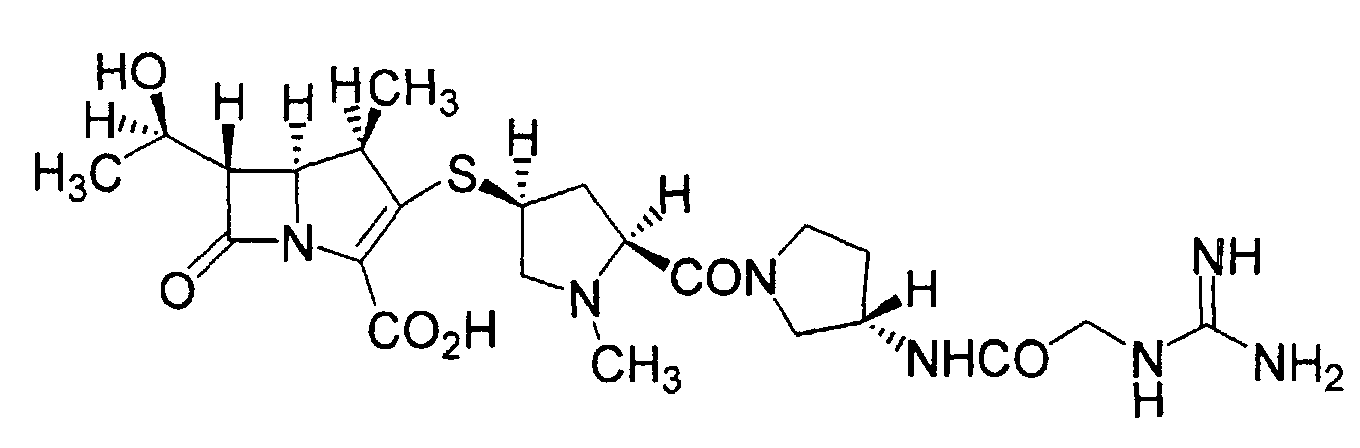
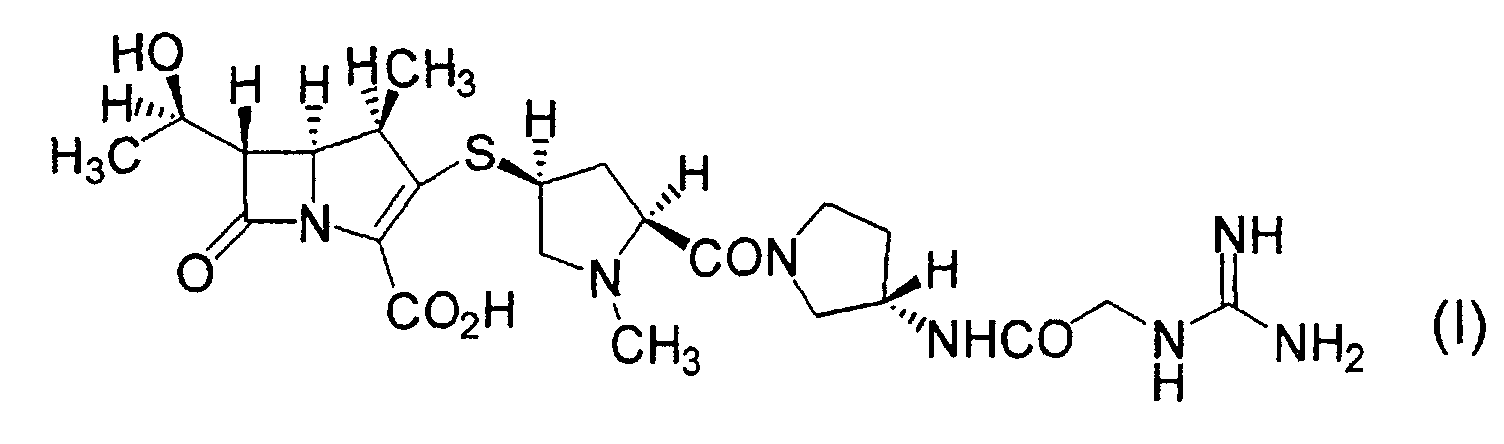
- the 1-methylcarbapenem derivative of fomula (I) is disclosed in Japanese Patent Application Publication Hei-10-204086 and Hei-11-071277.
- This compound (I) exhibits excellent antibiotic activity not only against Gram-positive bacterial strains but also against Gram-negative bacterial strains and can be expected to become a useful antibiotic agent.
- the compound (I) prepared according to the Example of Japanese Patent Application Publication Hei-11-071277 was obtained by lyophilization as a non-crystalline powder. This powder is unstable and is a material difficult to keep for a long time. There are many problems in practical use of the powder as a medicament, especially as an antibiotic agent.
- the inventors made many efforts in order to solve these problems and have found that certain crystalline forms of compound (I) are extremely stable compared to the non-crystalline powder of compound (I) and are useful medicaments, especially, practically useful antibiotic agents.
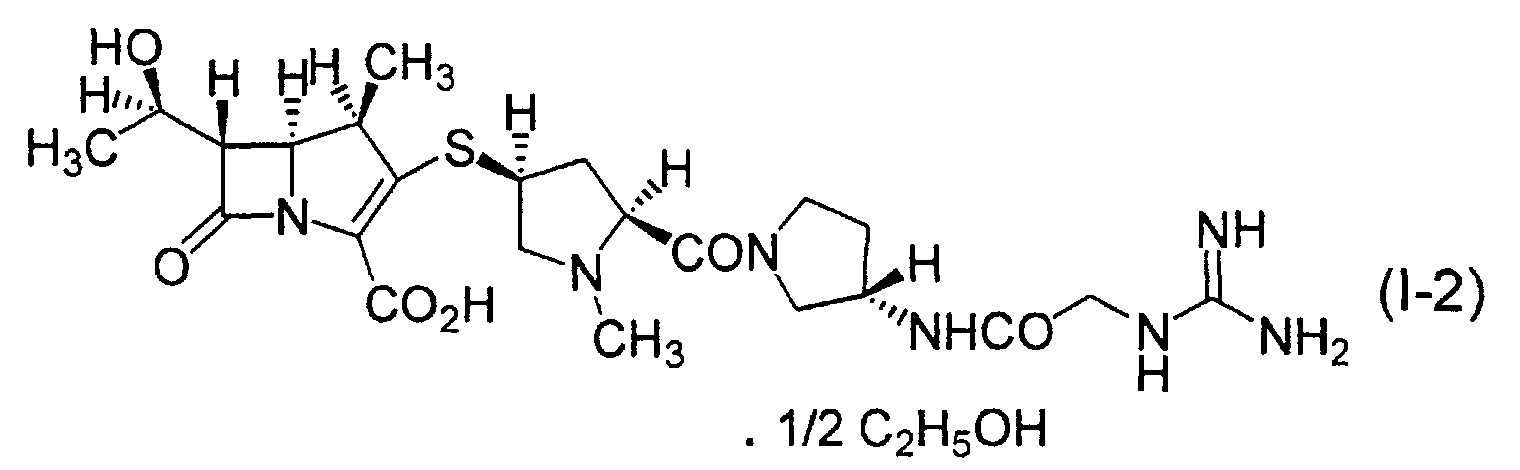
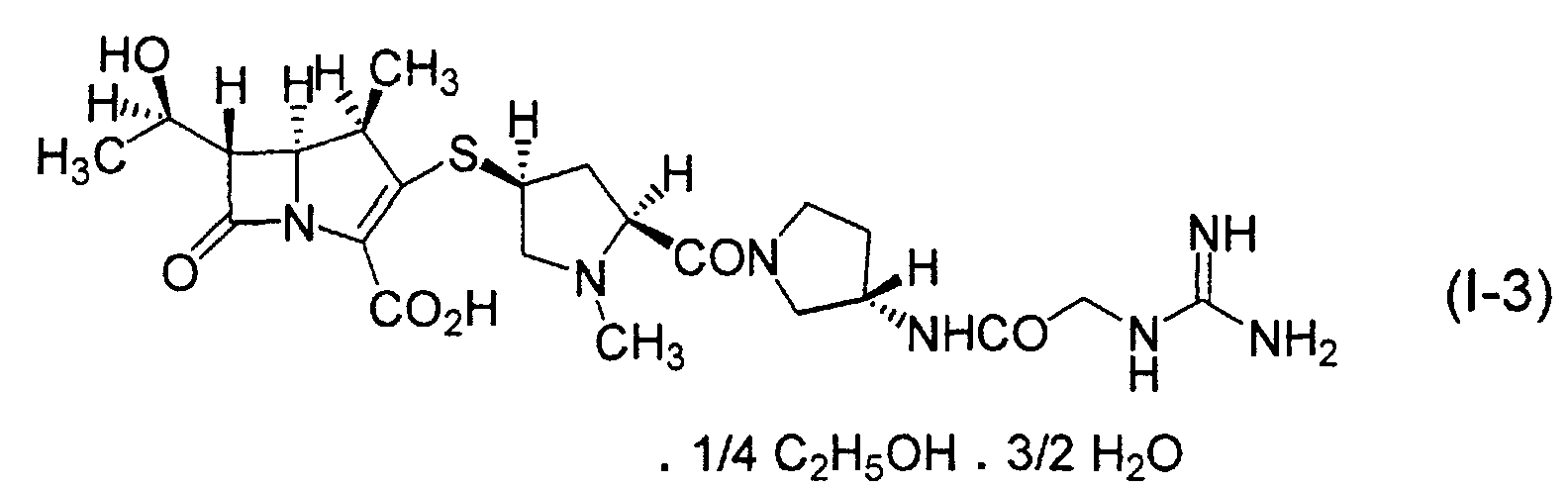
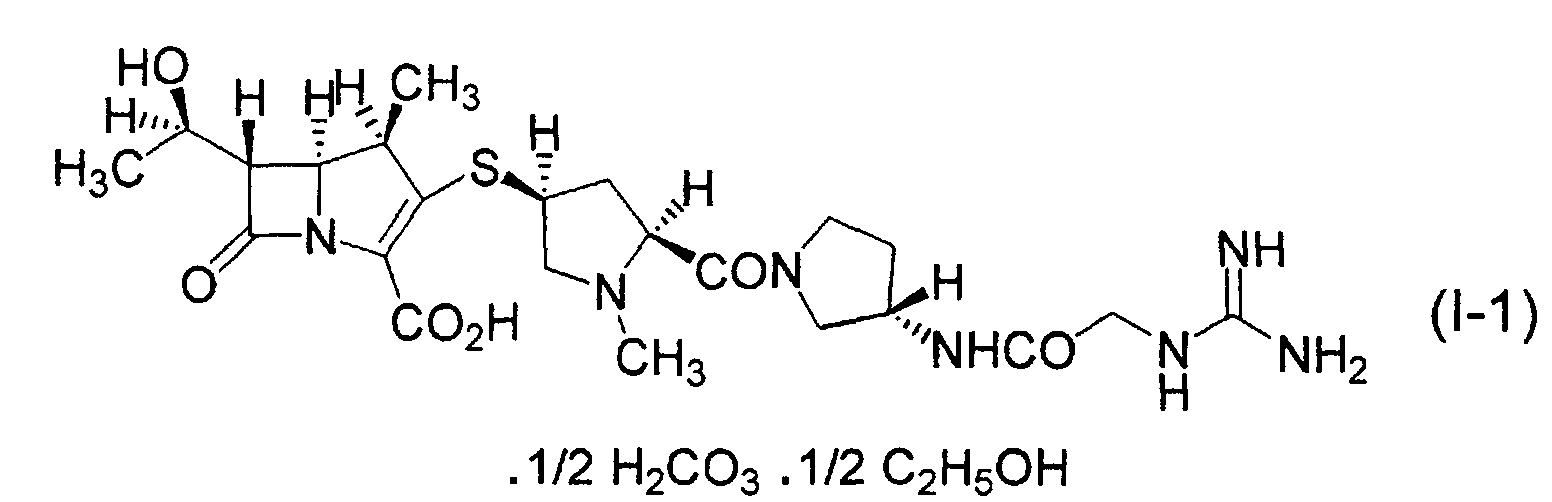
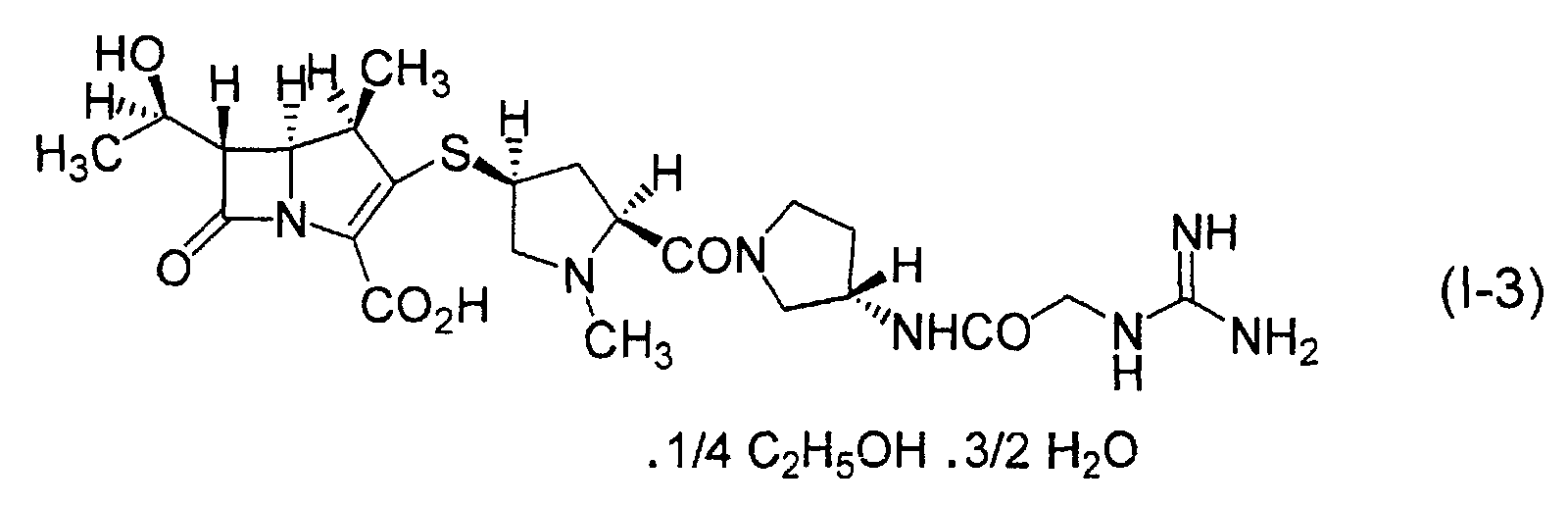
- the stable crystalline forms of this invention include a crystalline form of compound (I) 1/2 carbonate containing 1/2 ethanol (I-1), a crystalline form of compound (I) containing 1/2 ethanol (I-2), a crystalline form of compound (I) and a crystalline form of compound (I) containing 1/4 ethanol and 3/2 water (I-3).
- This invention is directed to
- Carbapenem derivatives of formula (I) are disclosed in Japanese Patent Application Publication Hei-10-204086 and Hei-11-071277 and exhibit potent activity against Gram-positive and Gram-negative bacterial strains.
- Carbapenem derivatives of formula (I) can exist as pharmaceutically acceptable salts.
- a pharmaceutically acceptable salt as used herein and in the claims is intended to include salts which are usually able to be used as medicaments.
- the compound of formula (I) has basic groups such as a tertiary amino group and a guanidino group and can be converted to a pharmaceutically acceptable acid addition salt when treated with an appropriate acid employing conventional techniques.
- acid addition salts include inorganic acid salts such as hydrochlorides, hydrobromides, sulfates and phosphates; organic acid salts such as carbonates, acetates, benzoates, oxalates, maleates, fumarates, tartrates and citrates; and sulfonates such as methanesulfonates, benzenesulfonates and p-toluenesulfonates.
- the compound of formula (I) has an acidic group such as a carboxyl group and can be converted to a pharmaceutically acceptable base addition salt when treated with an appropriate base employing conventional techniques.
- base addition salts include alkali metal salts such as sodium salts, potassium salts and lithium salts; alkaline earth metal salts such as calcium salts and magnesium salts; metal salts such as aluminum salts, iron salts, zinc salts, copper salts, nickel salts, and cobalt salts; and quaternary ammonium salts such as ammonium salts.
- certain forms of the compound (I) and pharmaceutically acceptable salts thereof When allowed to stand in the air, certain forms of the compound (I) and pharmaceutically acceptable salts thereof absorb or adsorb water and can form hydrates. In certain cases forms of the compound (I) and pharmaceutically acceptable salts thereof absorb certain solvents and can form solvates.
- the compound (I) of this invention and pharmaceutically acceptable salts thereof include such hydrates and solvates.
- Such salts, hydrates and solvates are preferably sodium salts, hydrochlorides, sulfates, carbonates, hydrates or solvates of ethanol; most preferably carbonates, hydrates or solvates of ethanol.
- the compound of formula (I-1) represents the 1/2 ethanol solvate of the 1/2 carbonate salt of the 1-methylcarbapenem derivative of formula (I).
- the compound of formula (I-2) represent the 1/2 ethanol solvate of the 1-methylcarbapenem derivative of formula (I).
- the compound of formula (I-3) represents the 3/2 hydrate and 1/4 ethanol solvate of the 1-methylcarbapenem derivative of formula (I).
- the crystalline forms of the present invention are solids which have regular arrangements of atoms (group of atoms) in three-dimensional structure and repeat the arrangements.
- the crystals are different from an amorphous solid that has no such regular arrangement of atoms in a three-dimensional structure.
- certain compounds produce a plurality of crystalline forms (polymorphic crystals) according to crystallization conditions, crystals of which are different in their three-dimensional arrangement of atoms and in physicochemical properties.
- This invention may include each of such crystalline forms and mixtures no less than two thereof.
- the main peaks have intensities not less than 74, which is the relative intensity when the intensity of the peak at 4.57 ⁇ is evaluated as 100.
- the main peaks have intensities not less than 56, which is the relative intensity when the intensity of the peak at 4.91 ⁇ is evaluated as 100.
- the main peaks have intensities not less than 48, which is the relative intensity when the intensity of the peak at 5.08 ⁇ is evaluated as 100.
- the main peaks have intensities not less than 65, which is the relative intensity when the intensity of the peak at 7.02 ⁇ is evaluated as 100.
- the compound of formula (I) can be prepared by the same technique as described, or by a similar procedure to that described in Japanese Patent Application Publication Hei-10-204086 and Hei-11-071277.
- Precipitation of the crystals begins spontaneously in the vessel, or precipitation can also begin or be accelerated by addition of crystalline seeds or by mechanical stimulations such as ultrasonic wave irradiation and scratching on the surface of the vessel.
- Pharmaceutically acceptable salts of compound (I) are preferably hydrochlorides, sulfates and carbonates; most preferably carbonates.
- the pharmaceutically acceptable salts can be prepared by addition of necessary amount of a desired acid or base to a solution of compound (I).
- solutions of the compound (I) or pharmaceutically acceptable salts thereof are treated, the solutions of these compounds are usually treated between 0 and 60°C in order to avoid decomposition of these compounds.
- the preferred temperature of crystallization of these compounds is between 0 and 10°C.
- Methods of concentration of solutions of the compound (I) or pharmaceutically acceptable salts thereof are an evaporation method using a rotary evaporator under reduced or normal pressure upon heating and a concentration method using a reverse osmotic membrane.
- the reverse osmotic membrane used in concentration of an aqueous solution can be selected from polyacrylonitrile membranes, polyvinyl alcohol membranes, polyamide membranes and cellulose acetate membranes.
- solvents which can readily dissolve compound (I) or pharmaceutically acceptable salts thereof are water, dimethyl sulfoxide, dimethylformamide and methanol, preferably water.
- solvents which can slightly dissolve compound (I) or pharmaceutically acceptable salts thereof are C 2 -C 4 alcohols such as ethanol, propanol and butanol; ketones such as acetone and methyl ethyl ketone; ethers such as diethyl ether and tetrahydrofuran; and esters such as methyl acetate and ethyl acetate; preferably ethanol and acetone; most preferably ethanol.
- C 2 -C 4 alcohols such as ethanol, propanol and butanol
- ketones such as acetone and methyl ethyl ketone
- ethers such as diethyl ether and tetrahydrofuran
- esters such as methyl acetate and ethyl acetate; preferably ethanol and acetone; most preferably ethanol.
- the starting compound (I) which is isolated as a lyophilized powder can be used.
- a crude reaction solution containing compound (I) can also be used because it is possible to purify by crystallization.
- Supersaturation can be accomplished by concentration of an aqueous solution of compound (I) at between 30 and 60° to a saturated aqueous solution, followed by gradually cooling to between 0 and 10°C or accomplished by gradual addition of an appropriate solvent which can slightly dissolve compound (I) or pharmaceutically acceptable salts thereof, such as ethanol or acetone, to the saturated aqueous solution, if necessary, followed by cooling.
- an appropriate solvent which can slightly dissolve compound (I) or pharmaceutically acceptable salts thereof, such as ethanol or acetone
- Crystalline forms of this invention preferably precipitate when aqueous solutions of compound (I) or pharmaceutically acceptable salts are concentrated, if necessary, followed by the addition of a solvent which can slightly dissolve these compounds, followed by cooling. More preferably crystals of this invention precipitate when aqueous solutions of compound (I) or pharmaceutically acceptable salts thereof are concentrated, if necessary, followed by the addition of ethanol or acetone and then cooling.
- the preferred crystalline form of compound (I-1) precipitates when an aqueous solution of compound (I) is concentrated, followed by saturation with carbon dioxide, addition of ethanol and cooling;
- the preferred crystalline form of compound (I-2) precipitates when an aqueous solution of compound (I) is concentrated, followed by the addition of ethanol and by cooling (preferably by irradiation with ultrasonic waves);
- the preferred crystalline form of compound (I) precipitates when an aqueous solution of compound (I) is concentrated, followed by cooling;
- the preferred crystalline form of compound (1-3) precipitates when an aqueous solution of compound (I) is concentrated, followed by addition of ethanol and by cooling.
- the precipitated crystals are isolated, for example, by filtration, centrifugation or decantation. If necessary, the isolated crystals can be washed with an appropriate solvent. Preferably the crystals are washed at first with the solvent which is used in crystallization, and then washed with a solvent such as ethanol, acetone, and ether.
- a solvent such as ethanol, acetone, and ether.
- the isolated crystals are dried at between 10 and 50°C, preferably at between 20 and 30°C until the weight of the crystals become constant. If necessary, they may be dried in the presence of drying agents such as silica gel and calcium chloride under reduced pressure.
- the crystalline forms of this invention exhibit a wide spectrum of antibiotic activity and potent antibacterial activities against Gram-positive and Gram-negative strains and anerobic bacteria, as well as bacteria producing cephalosporinase.
- the antibacterial activities of the crystals of this invention were determined by the agar-plate dilution method, they exhibited potent antibacterial activities against various bacteria, for example, Gram-positive strains such as Staphylococcus aureus, methicillin-resistant Staphylococcus aureus, Streptococcus pneumoniae, Enterococcus and the like; Gram-negative strains such as Escherichia coli, Bacillus dysenteriae, Klebsiella pneumoniae, Proteus vulgaris, Serratia, Enterobacteriaceae, Pseudomonas aeruginosa and the like; and anerobic bacteria such as bacteroides fragilis.
- the crystalline forms of this invention exhibited potent antibacterial activity against Helicobacter pylori which
- mice When appropriate solutions of the crystalline forms of this invention were administered to mice, they exhibited long half-value periods of blood concentration and good urinary recovery compared to those of similar compounds known to those skilled in the art.
- crystalline forms of this invention When the crystalline forms of this invention were subcutaneously administered to mice infected systemically with Staphylococcus aureus, Streptococcus pneumoniae, Escherichia coli or Psuedomonas aeruginosa, they exhibited excellent treatment effect.
- the crystalline forms of this invention therefore, are useful medicaments (especially antibacterial agents).
- the crystalline forms of this invention When used as a medicament (especially as an antibacterial agent) they can be administered alone or as a mixture of said crystalline forms of this invention and a pharmaceutically acceptable excipient(s) and diluent(s); they can be administered in various dosage forms such as tablets, capsules, granules, powders, or syrups for oral administration, such as injections for parenteral administration or such as ointments for topical application.
- Such dosage forms are prepared by methods known to those skilled in the art using additives such as excipients, binders, disintegrants, lubricants, stabilizers, corrigents, suspending agents, diluents, solvents for formulation, assisting agents for dissolution, and topical anaesthetic agents.
- additives such as excipients, binders, disintegrants, lubricants, stabilizers, corrigents, suspending agents, diluents, solvents for formulation, assisting agents for dissolution, and topical anaesthetic agents.
- excipients include sugar derivatives such as lactose, sucrose, glucose, mannitol and sorbitol; starch derivatives such as corn starch, potato starch, ⁇ starch, dextrin and carboxymethylstarch; cellulose derivatives such as crystalline cellulose, low-substituted hydroxypropylcellulose, hydroxypropylmethylcellulose, carboxymethylcellulose and internally-cross-linked sodium carboxymethylcellulose; arabic gum; dextran; pululan; silicate derivatives such as light silicic acid anhydride, synthetic aluminum silicate and magnesium aluminate metasilicate; phosphate derivatives such as calcium phosphate; carbonate derivatives such as calcium carbonate, and sulfate derivatives such as calcium sulfate.
- sugar derivatives such as lactose, sucrose, glucose, mannitol and sorbitol
- starch derivatives such as corn starch, potato starch, ⁇ starch, dextrin and carboxymethylstarch
- binders examples include excipients as described above; gelatin; polyvinylpyrrolidone; and macrogol.
- disintegrants include excipients as described above, and chemically modified starch and cellulose derivatives such as sodium cross-carmelose, sodium carboxymethylstarch and cross-linked polyvinylpyrrolidone.
- lubricants include talc; stearic acid; metal stearate derivatives such as calcium stearate and magnesium stearate; colloidal silica; bee gum; waxes such as bee's wax and spermaceti; boric acid; glycol; carboxylic acid derivatives such as fumaric acid and adipic acid; sodium carboxylate derivatives such as sodium benzoate; sulfate derivatives such as sodium sulfate; leucine; lauryl sulfate derivatives such as sodium lauryl sulfate and magnesium lauryl sulfate; silicic acid derivatives such as silicic acid anhydride and silicic acid hydrate; and starch derivatives as described for the excipients.
- stabilizers include para-oxybenzoic acid esters such as methylparaben and propylparaben; alcohols such as chlorobutanol, benzyl alcohol, and phenethyl alcohol; benzalkonium chloride; phenol derivatives such as phenol and cresol; thimerosal; acetic anhydride, and sorbic acid.
- corrigents examples include sweetening, souring and flavoring agents all of which are usually used.
- solvents for formulation examples include water, ethanol, and glycerin.
- Examples of assisting agents for dissolution include non-ionic surfactants, and anionic surfactants.
- topical anaesthetic agents examples include lidocaine hydrochloride, and mepivacaine hydrochloride.
- Dosage forms for oral administration include, for example, solid dosage forms such as tablets, coated tablets, capsules, troches, powders, fine granules, granules, and dry syrups and liquid dosage forms such as syrups.
- Dosage forms for parenteral administration include, for example, injections, dripping infusions and suppositories.
- Dosage forms for topical application include, for example, ointments, tinctures, creams, and gels.
- Preferable dosage forms of the crystalline 1-methylcarbapenem derivatives of this invention are injections and dripping infusions. Suitable dosage levels for the crystalline forms depend on the age, body weight, and symptoms of the patient and are usually from 10 mg (preferably 50 mg) to 6000 mg (preferably 4000 mg) for an adult human per day, which dosage can be administered as a single dose or divided into several doses throughout the day.
- the catalyst was removed by filtration, the filtrate was washed with ether and was filtered through a membrane filter. The resulting filtrate was concentrated to approximately 50 ml in vacuo. To the concentrate was added ethanol (100 ml) and the resulting mixture was irradiated with ultrasonic waves in order to precipitate crystals, and then allowed to stand in an ice bath. The precipitated crystals were filtered and washed successively with a mixture of ethanol and water (2:1), ethanol and ether and then dried to afford the title compound as colorless crystals (3.30 g).
- the resulting solution was washed successively with saturated aqueous sodium hydrogencarbonate solution, water and saturated aqueous sodium chloride solution, dried over anhydrous magnesium sulfate and concentrated in vacuo.
- the resulting residue was chromatographed on a silica gel column using 10% methanol/ethyl acetate and 20% methanol/ethyl acetate as the eluant to afford the crude desired product.
- the product was dissolved in tetrahydrofuran and reprecipitated with a mixture of ethyl acetate and ether (1:1) to give the desired compound (4.02 g) as a pale yellow powder.
- N,N-dimethylformamide 10 ml
- N,N-diisopropylethylamine (0.63 ml)
- 4-nitrobenzyl (1R,5R,6S)-6-[(1R)-1-hydroxyethyl]- 1-methyl-2-diphenylphosphoryloxy-1-carbapen-2-em-3-carboxylate 541 mg
- to the reaction mixture was added 1% aqueous sodium hydrogencarbonate solution.
- the resulting precipitate was filtered, washed with water and dried.
- Example 1 The crystalline compounds obtained in Example 1, 2, 4 and 5 were kept for about 2 months in a desiccator at 40°C and 75% relative humidity and in a desiccator at 60°C in which silica gel was placed, respectively.
- Example 4 Stability in desiccator at 40°C and 75% relative humidity Compound Remaining percentage of compound After 20 days After 56 days Crystals obtained in Example 1 98.5 92.9 Crystals obtained in Example 2 95.8 87.3 Crystals obtained in Example 4 99.4 94.3 Non-crystalline powder (lyophilized product) 30.2 0.3 Stability in desiccator at 60°C in which silica gel was placed Compound Remaining percentage of compound After 21 days After 56 days Crystals obtained in Example 1 98.5 96.4 Crystals obtained in Example 2 100.1 96.8 Crystals obtained in Example 4 100.4 100.9 Non-crystalline powder (lyophilized product) 74.1 56.5 Stability in desiccator at 40°C and 75% relative humidity Compound Remaining percentage of compound After 7 days After 28 days After 56 days Crystals obtained in Example 5 98.9 94.6 83.2 Stability in desiccator at 60°C in which silica gel was placed Compound Remaining percentage of compound After 7 days After 28 days After 56 days Crystals obtained in Example 5 98.9 94.6 83.2
- Test example 2 Antibiotic activity test
- the MIC ( ⁇ g/ml), the lowest concentration of antibiotic which inhibits growth of the test bacterial strain, was determined by the agar-plate dilution method.
- the crystalline compounds obtained in Example 1, 2, 4 and 5 of this invention were evaluated against various bacterial strains by determining the MIC of each compound with respect to each strain. Table 5 illustrates the result of such experiments.
- Antibiotic activity (MIC, ⁇ g/ml) Bacterial strain Crystalline compounds obtained in Example 1 2 4 5 Staphylococcus aureus 209P ⁇ 0.01 ⁇ 0.01 ⁇ 0.01 ⁇ 0.01 S. aureus 535 (MRSA) 1.5 1.5 1.5 1.5 1.5 1.5 1.5 Escherichia coli NIHJ ⁇ 0.01 ⁇ 0.01 ⁇ 0.01 ⁇ 0.01 E.
- Example 1 The crystalline compound obtained in Example 1 (250 mg) is used to fill a vial and shielded with a stopper under sterile conditions.
- Pharmaceutical additives known to those skilled in the art such as a local anaesthetic agent, for example, lidocaine hydrochloride can be added to the vial, if necessary.
- the sterile solid compositions can be dissolved in an injectable medium such as water for injection immediately before use.
- Figure 1 shows the powder diffraction pattern of crystalline (1R,5S,6S)-2-[(2S,4S)-2-[(3 S)-3-(2-guanidinoacetylamino)pyrrolidin-1-ylcarbonyl]-1-methylpyrrolidin-4-ylthio]-6-[(1R)-1-hydroxyethyl]-1-methyl-1-carbapen-2-em-3-carboxylic acid ⁇ 1/2 carbonate ⁇ 1/2 ethanol (I-1).
- the vertical axis of the x-ray powder diffraction pattern indicates the diffraction intensity in units of counts/second (CPS).
- the horizontal axis indicates diffraction angle as the value 2 ⁇ .
- Figure 2 shows the x-ray powder diffraction pattern of crystalline (1R,5S,6S)-2-[(2S,4S)-2-[(3S)-3-(2-guanidinoacetylamino)pyrrolidin-1-ylcarbonyl]-1-methylpyrrolidin-4-ylthio]-6- [(1R)-1-hydroxyethyl]-1-methyl-1-carbapen-2-em-3-carboxylic acid ⁇ 1/2 ethanol (1-2).
- the vertical axis of the x-ray powder diffraction pattern indicates the diffraction intensity in units of counts/second (CPS).
- the horizontal axis indicates diffraction angle as the value 2 ⁇ .
- Figure 3 shows the x-ray powder diffraction pattern of (1R,5S,6S)-2-[(2S,4S)-2-[(3S)-3-(2-guanidinoacetylamino)pyrrolidin-1-ylcarbonyl]-1-methylpyrrolidin-4-ylthio]-6-[(1R)-1-hydroxyethyl]-1-methyl-1-carbapen-2-em-3-carboxylic acid (I).
- the vertical axis of the x-ray powder diffraction pattern indicates the diffraction intensity in units of counts/second (CPS).
- the horizontal axis indicates diffraction angle as the value 2 ⁇ .
- Figure 4 shows the x-ray powder diffraction pattern of crystalline (1R,5S,6S)-2-[(2S,4S)-2-[(3S)-3-(2-guanidinoacetylamino)pyrrolidin-1-ylcarbonyl]-1-methylpyrrolidin-4-ylthio]-6-[(1R)-1-hydroxyethyl]-1-methyl-1-carbapen-2-em-3-carboxylic acid ⁇ 1/4 ethanol ⁇ 3/2 hydrate (I-3).
- the vertical axis of the x-ray powder diffraction pattern indicates the diffraction intensity in units of counts/second (CPS).
- the horizontal axis indicates diffraction angle as the value 2 ⁇ .
Landscapes
- Health & Medical Sciences (AREA)
- Chemical & Material Sciences (AREA)
- Organic Chemistry (AREA)
- Medicinal Chemistry (AREA)
- Pharmacology & Pharmacy (AREA)
- Life Sciences & Earth Sciences (AREA)
- Animal Behavior & Ethology (AREA)
- General Health & Medical Sciences (AREA)
- Public Health (AREA)
- Veterinary Medicine (AREA)
- Epidemiology (AREA)
- Oncology (AREA)
- Chemical Kinetics & Catalysis (AREA)
- General Chemical & Material Sciences (AREA)
- Nuclear Medicine, Radiotherapy & Molecular Imaging (AREA)
- Communicable Diseases (AREA)
- Pharmaceuticals Containing Other Organic And Inorganic Compounds (AREA)
- Nitrogen Condensed Heterocyclic Rings (AREA)
Abstract

Description




Melting point : 228-233°C (dec)
Infrared spectrum (KBr) ν max cm-1 : 3331, 2968, 2875, 2791, 1755, 1669, 1637, 1453, 1386, 1339, 1312, 1283, 1254.
NMR spectrum (400 MHz, D2O) δ ppm: 1.13-1.24 (4.5H, m), 1.30 (3H, d, J=6.4 Hz), 1.57-1.72 (1H, m), 1.93-2.10 (1H, m), 2.15-2.35 (1H, m), 2.27, 2.29 (3H, s × 2), 2.68-2.88 (2H, m), 3.09 (1H, d, J=10.6 Hz), 3.29-3.73 (7H, m), 3.75-3.93 (2H, m), 4.01 (2H, s), 4.12-4.30 (2H, m), 4.38-4.50 (1H, m).
| Elemental analysis : calculated for C23H35N7O6S·1/2H2CO3·1/2C2H6O | ||||
| Cal. | C 49.73%; | H 6.64%; | N 16.57%; | S 5.42%; |
| Found | C 49.57%; | H 6.86%; | N 16.68%; | S 5.47% |

Melting point: 235-250°C (dec)
Infrared spectrum (KBr) ν max cm-1 : 3405, 3344, 3273, 3207, 2969, 2883, 2795, 1760, 1673, 1644, 1591, 1553, 1452, 1415, 1381, 1370, 1341, 1311, 1283, 1255.
NMR spectrum (400 MHz, D2O) δ ppm: 1.15-1.25 (4.5H, m), 1.30 (3H, d, J=6.4 Hz), 1.57-1.72 (1H, m), 1.93-2.13 (1H, m), 2.15-2.35 (1H, m), 2.27, 2.29 (3H, s × 2), 2.68-2.88 (2H, m), 3.08 (1H, d, J=10.7 Hz), 3.29-3.73 (7H, m), 3.75-3.93 (2H, m), 4.01 (2H, s), 4.16-4.31 (2H, m), 4.37-4,49 (1H, m).
| Elemental analysis : calculated for C23H35N7O6S·1/2C2H6O | ||||
| Cal. | C 51.41%; | H 6.83%; | N 17.49%; | S 5.72%; |
| Found | C 51.13%; | H 6.96%; | N 17.17%; | S 5.72% |

Melting point : 235-250 (dec)
Infrared spectrum (KBr) ν max cm-1: 3327, 3177, 3068, 2970, 2904, 2880, 2820, 1751, 1681, 1654, 1629, 1594, 1572, 1536, 1481, 1440, 1423, 1382, 1336, 1314, 1286, 1264.
NMR spectrum (400 MHz, D2O) δ ppm: 1.20 (3H, dd, J=7.2, 2.2 Hz), 1.30 (3H, d, J=6.4 Hz), 1.57-1.72 (1H, m), 1.93-2.13 (1H, m), 2.15-2.35 (1H, m), 2.27, 2.29 (3H, s × 2), 2.68-2.88 (2H, m), 3.09 (1H, d, J=10.5 Hz), 3.29-3.73 (6H, m), 3.75-3.93 (2H, m), 4.01 (2H, s), 4.16-4.31 (2H, m), 4.37-4.49 (1H, m).
| Elemental analysis : calculated for C23H35N7O6S | ||||
| Cal. | C 51.38%; | H 6.56%; | N 18.24%; | S 5.96%; |
| Found | C 51.14%; | H 6.85%; | N 18.26%; | S 6.04% |

Melting point: 226-245°C (dec)
Infrared spectrum (KBr) ν max cm-1 : 3409, 3345. 3275, 3185, 2967, 2884, 1761, 1674, 1644, 1586, 1551, 1452, 1415, 1380, 1369, 1340, 1282, 1254.
NMR spectrum (400 MHz, D2O) δ ppm: 1.17-1.21 (4.7H, m), 1.30 (3H, d, J=6.4 Hz), 1.57-1.70 (1H, m), 1.95-2.08 (1H, m), 2.18-2.31 (1H, m), 2.27, 2.29, (3H, s × 2), 2.70-2.87 (2H, m), 3.08 (1H, d, J=10.8 Hz), 3.31-3.72 (7H, m), 3.76-3.92 (2H, m), 4.00 (2H, S), 4.18-4.28 (2H, m), 4.39-4.48 (1H, m).
| Elemental analysis : calculated for C23H35N7O6S·1/4C2H6O·3/2H2O | ||||
| Cal. | C 48.99%; | H 6.91%; | N 17.02%; | S 5.56%; |
| Found | C 48.35%; | H 6.47%; | N 17.23%; | S 5.67% |

Infrared spectrum (KBr) ν max cm-1 : 3336, 1772, 1741, 1688, 1643, 1610, 1522, 1447, 1378, 1347.
NMR spectrum (270 MHz, CDCl3) δ ppm : 1.17-1.40 (6H, m), 1.64-2.40 (4H, m), 2.33 (3H, s), 2.47-2.80 (2H, m), 3.00-3.38 (3H, m), 3.46-3.83 (5H, m), 3.93-4.60 (5H, m), 5.12-5.54 (6H, m), 7.21 (1H, d, J=6.5 Hz), 7.46-7.70 (6H, m), 8.10-8.28 (6H, m), 8.80-9.10 (1H, br), 11.60 (1H, br).

Infrared spectrum (KBr) ν max cm-1 : 3391, 3307, 3112, 3078, 2949, 2877, 2786, 1732, 1639, 1548, 1522, 1448, 1380, 1347, 1291, 1211, 1154, 1109.
NMR spectrum (400 MHz, CDCl3) δ ppm : 1.64-2.15 (3H, m), 2.20-2.86 (5H, m), 2.93-3.93 (9H, m), 4.16-4.35 (1H, m), 5.12 (2H, s), 6.70-6.90 (1H, br), 7.00-7.85 (1H, br), 7.59 (2H, d, J=8.5 Hz), 8.23 (2H, d, J=8.5Hz), 8.18-8.40 (1H, br).
Infrared spectrum (KBr) ν max cm-1 : 3384, 3113, 3080, 2970, 2875, 2789, 1770, 1643, 1609, 1522, 1450, 1379, 1346, 1322, 1287, 1209, 1181, 1136, 1109.
NMR spectrum (400 MHz, CDCl3) δ ppm : 1.08-2.22 (6H, m), 1.75-2.26 (6H, m), 2.44-2.76 (2H, m), 2.89-3.00 (1H, m), 3.03-3.15 (1H, m), 3.18-3.65 (6H, m), 3.68-3.90 (3H, m), 3.93-4.06 (1H, m), 4.13-4.35 (2H, m), 5.05-5.15 (2H, m), 5.30, 5.45 (each 1H, d, J=14.1), 7.58 (2H, dd, J=8.8, 2.7 Hz), 7.74 (2H, d, J=8.7 Hz), 8.18-8.33 (4H, m).


| Stability in desiccator at 40°C and 75% relative humidity | ||
| Compound | Remaining percentage of compound | |
| After 20 days | After 56 days | |
| Crystals obtained in Example 1 | 98.5 | 92.9 |
| Crystals obtained in Example 2 | 95.8 | 87.3 |
| Crystals obtained in Example 4 | 99.4 | 94.3 |
| Non-crystalline powder (lyophilized product) | 30.2 | 0.3 |
| Stability in desiccator at 60°C in which silica gel was placed | ||
| Compound | Remaining percentage of compound | |
| After 21 days | After 56 days | |
| Crystals obtained in Example 1 | 98.5 | 96.4 |
| Crystals obtained in Example 2 | 100.1 | 96.8 |
| Crystals obtained in Example 4 | 100.4 | 100.9 |
| Non-crystalline powder (lyophilized product) | 74.1 | 56.5 |
| Stability in desiccator at 40°C and 75% relative humidity | |||
| Compound | Remaining percentage of compound | ||
| After 7 days | After 28 days | After 56 days | |
| Crystals obtained in Example 5 | 98.9 | 94.6 | 83.2 |
| Stability in desiccator at 60°C in which silica gel was placed | |||
| Compound | Remaining percentage of compound | ||
| After 7 days | After 28 days | After 56 days | |
| Crystals obtained in Example 5 | 98.3 | 97.0 | 97.6 |
| Antibiotic activity (MIC, µg/ml) | ||||
| Bacterial strain | Crystalline compounds obtained in | |||
| Example 1 | 2 | 4 | 5 | |
| Staphylococcus aureus 209P | ≤0.01 | ≤0.01 | ≤0.01 | ≤0.01 |
| S. aureus 535 (MRSA) | 1.5 | 1.5 | 1.5 | 1.5 |
| Escherichia coli NIHJ | ≤0.01 | ≤0.01 | ≤0.01 | ≤0.01 |
| E. coli 609 | 0.02 | ≤0.01 | 0.02 | ≤0.01 |
| Klebisella pneumoniae 806 | ≤0.01 | ≤0.01 | ≤0.01 | ≤0.01 |
| K. pneumoniae 846 | ≤0.01 | ≤0.01 | ≤0.01 | ≤0.01 |
| Enterobacter cloacae 963 | 0.05 | 0.05 | 0.05 | 0.05 |
| Serratia marcescens 1184 | ≤0.01 | ≤0.01 | ≤0.01 | ≤0.01 |
| Pseudomonas aeruginosa 1001 | 0.2 | 0.2 | 0.2 | 0.39 |
Claims (8)
- A 1-methylcarbapenem derivative of formula (I) or a pharmaceutically acceptable salt thereof in crystalline form:

- A 1-methylcarbapenem derivative of formula (I-1) in crystalline form:
- A 1-methylcarbapenem derivative of formula (I-2) in crystalline form:

- A 1-methylcarbapenem derivative of formula (I) in crystalline form:
- A 1-methylcarbapenem derivative of formula (I-3) in crystalline form:
- A pharmaceutical composition for the prevention or treatment of bacterial infections containing a crystalline form of a 1-methylcarbapenem derivative or a pharmaceutically acceptable salt thereof according to any one of claims 1 to 5 as an active ingredient.
- A use of a crystalline form of a 1-methylcarbapenem derivative or a pharmaceutically acceptable salt thereof according to any one of claims 1 to 5 in order to prepare a medicament for the prevention or treatment of bacterial infections.
- A method for preventing or treating bacterial infections which comprises administering to a warm-blooded animal in need of such prevention or treatment a pharmacologically effective amount of a crystalline form of a 1-methylcarbapenem derivative or a pharmaceutically acceptable salt thereof according to any one of claims 1 to 5.
Applications Claiming Priority (3)
| Application Number | Priority Date | Filing Date | Title |
|---|---|---|---|
| JP19136899 | 1999-07-06 | ||
| JP19136899 | 1999-07-06 | ||
| PCT/JP2000/004496 WO2001002401A1 (en) | 1999-07-06 | 2000-07-06 | Crystalline 1-methylcarbapenem compounds |
Publications (2)
| Publication Number | Publication Date |
|---|---|
| EP1193269A1 true EP1193269A1 (en) | 2002-04-03 |
| EP1193269A4 EP1193269A4 (en) | 2003-05-28 |
Family
ID=16273433
Family Applications (1)
| Application Number | Title | Priority Date | Filing Date |
|---|---|---|---|
| EP00944289A Withdrawn EP1193269A4 (en) | 1999-07-06 | 2000-07-06 | Crystalline 1-methylcarbapenem compounds |
Country Status (21)
| Country | Link |
|---|---|
| US (3) | US20020128254A1 (en) |
| EP (1) | EP1193269A4 (en) |
| JP (1) | JP3476420B2 (en) |
| KR (1) | KR100750552B1 (en) |
| CN (2) | CN101077869A (en) |
| AU (1) | AU758190B2 (en) |
| BR (1) | BR0012253A (en) |
| CA (1) | CA2378483C (en) |
| CZ (1) | CZ20014731A3 (en) |
| HK (1) | HK1044768A1 (en) |
| HU (1) | HUP0202255A3 (en) |
| IL (2) | IL147214A0 (en) |
| MX (1) | MXPA02000061A (en) |
| NO (1) | NO327786B1 (en) |
| NZ (1) | NZ516310A (en) |
| PL (1) | PL352296A1 (en) |
| RU (2) | RU2214411C2 (en) |
| TR (2) | TR200403436T2 (en) |
| TW (1) | TWI250160B (en) |
| WO (1) | WO2001002401A1 (en) |
| ZA (1) | ZA200110413B (en) |
Cited By (1)
| Publication number | Priority date | Publication date | Assignee | Title |
|---|---|---|---|---|
| EP1862456A4 (en) * | 2005-03-22 | 2010-01-27 | Daiichi Sankyo Co Ltd | PROCESS FOR THE PRODUCTION OF CARBAPENEM DERIVATIVES HAVING A 1-ALKYLPYRROLIDINE STRUCTURE |
Families Citing this family (20)
| Publication number | Priority date | Publication date | Assignee | Title |
|---|---|---|---|---|
| CZ20013593A3 (en) | 1999-04-06 | 2002-03-13 | Sankyo Company, Limited | Alpha-substituted derivatives of carboxylic acids |
| US7041660B2 (en) * | 1999-07-06 | 2006-05-09 | Sankyo Company, Limited | Crystalline 1-methylcarbapenem derivatives |
| WO2001023393A1 (en) * | 1999-09-30 | 2001-04-05 | Otsuka Kagaku Kabushiki Kaisha | 3-cephem derivative crystal and method for preparing the same |
| CA2413251C (en) | 2000-06-21 | 2012-06-12 | Cubist Pharmaceuticals, Inc. | Compositions and methods to improve the oral absorption of antimicrobial agents |
| KR100451672B1 (en) * | 2001-06-05 | 2004-10-08 | 한미약품 주식회사 | Crystalline acid salts of cefdinir, process for their preparation and process for the preparation of cefdinir using same |
| WO2003016312A1 (en) * | 2001-08-13 | 2003-02-27 | Eisai Co., Ltd. | Process for preparation of carbapenem antibiotics |
| HRP20040264B1 (en) * | 2001-09-26 | 2012-07-31 | Merck@Sharp@@@Dohme@Corp | Process for making carbapenem compounds |
| IL160413A0 (en) * | 2001-09-26 | 2004-07-25 | Merck & Co Inc | Process for making carbapenem compounds |
| ITMI20012364A1 (en) * | 2001-11-09 | 2003-05-09 | Antibioticos Spa | SUMMARY PROCESS OF CEFIXIMA VIA ALCHIL-O ARILSOLFONATI |
| JP2005097278A (en) * | 2003-08-25 | 2005-04-14 | Sankyo Co Ltd | Crystal of 1-methylcarbapenem compound |
| CN100475817C (en) | 2003-08-25 | 2009-04-08 | 三共株式会社 | Crystal of 1-methylcarbapenem compound |
| CN1960992B (en) * | 2004-06-02 | 2011-10-19 | 桑多斯股份公司 | Meropenem intermediate in crystalline form |
| CA2606386C (en) | 2005-04-29 | 2014-06-10 | Cubist Pharmaceuticals, Inc. | Therapeutic compositions |
| EP1880997A4 (en) * | 2005-05-13 | 2009-03-11 | Daiichi Sankyo Co Ltd | 1-METHYLCARBAPENEM COMPOUND CRYSTAL |
| CN101328179B (en) * | 2007-06-15 | 2011-01-12 | 山东轩竹医药科技有限公司 | Mercaptopyrrolidopenem derivatives containing oxo nitrogen heterocycle |
| CN101412717B (en) * | 2007-10-19 | 2011-01-12 | 山东轩竹医药科技有限公司 | Carbapenem derivative containing guanidyl alkanoylamino heterocycle |
| JPWO2009091031A1 (en) * | 2008-01-17 | 2011-05-26 | 大日本住友製薬株式会社 | Method for producing adenine compound |
| CN102918041A (en) * | 2010-05-21 | 2013-02-06 | 山东轩竹医药科技有限公司 | Crystalline of carbapenem derivative or its hydrate, preparation methods and uses thereof |
| US8822445B2 (en) * | 2010-06-03 | 2014-09-02 | Xuanzhu Pharma Co., Ltd. | Crystalline form of carbapenem derivative or its hydrates and preparation methods and uses thereof |
| CN105102424B (en) * | 2013-01-15 | 2020-09-11 | 默克专利股份公司 | Acylguanidines for the treatment of arthropathy |
Family Cites Families (14)
| Publication number | Priority date | Publication date | Assignee | Title |
|---|---|---|---|---|
| US4260543A (en) | 1978-07-03 | 1981-04-07 | Merck & Co., Inc. | Crystalline N-formimidoyl thienamycin |
| US4748238A (en) | 1984-03-14 | 1988-05-31 | Merck & Co., Inc. | Crystalline 1R,5S,6S,8R-1-methyl-2-(N,N-dimethylcarbamimidoylmethylthio)-6-(1-hydroxyethyl)-1-carbapen-2-em-3-carboxylic acid |
| US4713451A (en) | 1984-04-09 | 1987-12-15 | Merck & Co., Inc. | Crystalline dimethyliminothienamycin |
| IE60588B1 (en) | 1986-07-30 | 1994-07-27 | Sumitomo Pharma | Carbapenem compound in crystalline form, and its production and use |
| US4866171A (en) | 1987-04-11 | 1989-09-12 | Lederle (Japan), Ltd. | (1R,5S,6S)-2-[(6,7-dihydro-5H-pyrazolo[1,2-a][1,2,4]triazolium-6-yl)]thio-6-[R-1-hydroxyethyl]-1-methyl-carbapenum-3-carboxylate |
| CA2036163C (en) * | 1990-02-14 | 2001-06-19 | Makoto Sunagawa | Novel beta-lactam compounds and their production |
| TW209220B (en) * | 1991-11-27 | 1993-07-11 | Manyu Seiyaku Kk | |
| GB9202298D0 (en) * | 1992-02-04 | 1992-03-18 | Ici Plc | Antibiotic compounds |
| ES2131560T3 (en) | 1992-11-17 | 1999-08-01 | Sankyo Co | DERIVATIVE OF CRYSTALLINE CARBAPENEM. |
| JPH06336483A (en) * | 1993-05-26 | 1994-12-06 | Banyu Pharmaceut Co Ltd | Aminoalkylpyrrolidinyl thiocarbapenem derivatives |
| JPH07291973A (en) * | 1994-04-27 | 1995-11-07 | Banyu Pharmaceut Co Ltd | Novel 2-pyrrolidinylthiocarbapenem derivative |
| JPH09110869A (en) * | 1995-10-23 | 1997-04-28 | Lederle Japan Ltd | Carbapenem compounds |
| CN1095843C (en) * | 1995-12-21 | 2002-12-11 | 三共株式会社 | 1-methylcarbapenem derivatives |
| JP2955276B2 (en) * | 1997-06-19 | 1999-10-04 | 三共株式会社 | Antibacterial agent containing 1-methylcarbapenem derivative |
-
2000
- 2000-07-05 TW TW089113337A patent/TWI250160B/en not_active IP Right Cessation
- 2000-07-06 CN CNA2007101096355A patent/CN101077869A/en active Pending
- 2000-07-06 RU RU2002100058/04A patent/RU2214411C2/en not_active IP Right Cessation
- 2000-07-06 CA CA002378483A patent/CA2378483C/en not_active Expired - Fee Related
- 2000-07-06 MX MXPA02000061A patent/MXPA02000061A/en active IP Right Grant
- 2000-07-06 BR BR0012253-0A patent/BR0012253A/en not_active Application Discontinuation
- 2000-07-06 HK HK02106273.3A patent/HK1044768A1/en unknown
- 2000-07-06 HU HU0202255A patent/HUP0202255A3/en unknown
- 2000-07-06 EP EP00944289A patent/EP1193269A4/en not_active Withdrawn
- 2000-07-06 CZ CZ20014731A patent/CZ20014731A3/en unknown
- 2000-07-06 IL IL14721400A patent/IL147214A0/en unknown
- 2000-07-06 WO PCT/JP2000/004496 patent/WO2001002401A1/en not_active Ceased
- 2000-07-06 AU AU58487/00A patent/AU758190B2/en not_active Ceased
- 2000-07-06 PL PL00352296A patent/PL352296A1/en not_active Application Discontinuation
- 2000-07-06 CN CNB008124558A patent/CN100360530C/en not_active Expired - Fee Related
- 2000-07-06 NZ NZ516310A patent/NZ516310A/en not_active IP Right Cessation
- 2000-07-06 KR KR1020027000117A patent/KR100750552B1/en not_active Expired - Fee Related
- 2000-07-06 JP JP2000204430A patent/JP3476420B2/en not_active Expired - Fee Related
- 2000-07-06 TR TR2004/03436T patent/TR200403436T2/en unknown
- 2000-07-06 TR TR2002/00100T patent/TR200200100T2/en unknown
-
2001
- 2001-12-19 ZA ZA200110413A patent/ZA200110413B/en unknown
- 2001-12-20 IL IL147214A patent/IL147214A/en not_active IP Right Cessation
- 2001-12-28 US US10/034,548 patent/US20020128254A1/en not_active Abandoned
-
2002
- 2002-01-04 NO NO20020030A patent/NO327786B1/en not_active IP Right Cessation
-
2003
- 2003-01-27 US US10/351,944 patent/US6924279B2/en not_active Expired - Fee Related
- 2003-04-03 US US10/407,546 patent/US20030232803A1/en not_active Abandoned
- 2003-06-18 RU RU2003118411/04A patent/RU2003118411A/en not_active Application Discontinuation
Cited By (1)
| Publication number | Priority date | Publication date | Assignee | Title |
|---|---|---|---|---|
| EP1862456A4 (en) * | 2005-03-22 | 2010-01-27 | Daiichi Sankyo Co Ltd | PROCESS FOR THE PRODUCTION OF CARBAPENEM DERIVATIVES HAVING A 1-ALKYLPYRROLIDINE STRUCTURE |
Also Published As
Similar Documents
| Publication | Publication Date | Title |
|---|---|---|
| US6924279B2 (en) | Crystalline 1-methylcarbapenem derivatives | |
| US8247402B2 (en) | Crystal form of pyrrolidylthiocarbapenem derivative | |
| JPWO2001072750A1 (en) | A new type of crystal of pyrrolidylthiocarbapenem derivatives | |
| US7041660B2 (en) | Crystalline 1-methylcarbapenem derivatives | |
| WO2006025634A1 (en) | 2-arylmethylazetidine carbapenem derivatives and preparation thereof | |
| HU219582B (en) | A crystalline carbapenem derivative for the preparation of a process comprising a pharmaceutical composition | |
| JP3681116B2 (en) | Antibacterial agent containing crystalline carbapenem compound | |
| US7534782B2 (en) | Crystal of 1-methylcarbapenem solvate | |
| US20080227768A1 (en) | Crystal of 1-Methylcarbapenem Compound | |
| HK1085213A (en) | Crystal of 1-methyl carbapenem compound | |
| HU211964A9 (en) | Crystalline carbapenem derivatives | |
| JP2008143887A (en) | Medicament containing crystals of 1-methylcarbapenem compound | |
| JP2005097278A (en) | Crystal of 1-methylcarbapenem compound | |
| JP2006265235A (en) | Medicine containing crystal of 1-methylcarbapenem compound | |
| WO2000034282A1 (en) | 1-methylcarbapenem derivatives |
Legal Events
| Date | Code | Title | Description |
|---|---|---|---|
| PUAI | Public reference made under article 153(3) epc to a published international application that has entered the european phase |
Free format text: ORIGINAL CODE: 0009012 |
|
| 17P | Request for examination filed |
Effective date: 20011219 |
|
| AK | Designated contracting states |
Kind code of ref document: A1 Designated state(s): AT BE CH CY DE DK ES FI FR GB GR IE IT LI LU MC NL PT SE |
|
| A4 | Supplementary search report drawn up and despatched |
Effective date: 20030416 |
|
| 17Q | First examination report despatched |
Effective date: 20061010 |
|
| REG | Reference to a national code |
Ref country code: HK Ref legal event code: WD Ref document number: 1044768 Country of ref document: HK |
|
| STAA | Information on the status of an ep patent application or granted ep patent |
Free format text: STATUS: THE APPLICATION IS DEEMED TO BE WITHDRAWN |
|
| 18D | Application deemed to be withdrawn |
Effective date: 20111116 |