EP1192260B1 - Arabidopsis thaliana cdc27 homologs - Google Patents
Arabidopsis thaliana cdc27 homologs Download PDFInfo
- Publication number
- EP1192260B1 EP1192260B1 EP00945887A EP00945887A EP1192260B1 EP 1192260 B1 EP1192260 B1 EP 1192260B1 EP 00945887 A EP00945887 A EP 00945887A EP 00945887 A EP00945887 A EP 00945887A EP 1192260 B1 EP1192260 B1 EP 1192260B1
- Authority
- EP
- European Patent Office
- Prior art keywords
- plant
- cdc27
- protein
- cells
- functional analogue
- Prior art date
- Legal status (The legal status is an assumption and is not a legal conclusion. Google has not performed a legal analysis and makes no representation as to the accuracy of the status listed.)
- Expired - Lifetime
Links
- 101100216227 Dictyostelium discoideum anapc3 gene Proteins 0.000 title abstract description 70
- 241000219195 Arabidopsis thaliana Species 0.000 title description 25
- 108700004606 Anaphase-Promoting Complex-Cyclosome Apc3 Subunit Proteins 0.000 claims abstract description 90
- 102000052587 Anaphase-Promoting Complex-Cyclosome Apc3 Subunit Human genes 0.000 claims abstract description 89
- 238000000034 method Methods 0.000 claims abstract description 38
- 150000001413 amino acids Chemical class 0.000 claims abstract description 35
- 230000001131 transforming effect Effects 0.000 claims abstract description 7
- 241000196324 Embryophyta Species 0.000 claims description 164
- 210000004027 cell Anatomy 0.000 claims description 82
- 125000003275 alpha amino acid group Chemical group 0.000 claims description 50
- 230000014509 gene expression Effects 0.000 claims description 38
- 238000003860 storage Methods 0.000 claims description 17
- 210000000056 organ Anatomy 0.000 claims description 8
- 230000009261 transgenic effect Effects 0.000 claims description 8
- 235000013399 edible fruits Nutrition 0.000 claims description 7
- 244000061456 Solanum tuberosum Species 0.000 claims description 4
- 235000002595 Solanum tuberosum Nutrition 0.000 claims description 4
- 240000008042 Zea mays Species 0.000 claims description 4
- 235000016383 Zea mays subsp huehuetenangensis Nutrition 0.000 claims description 4
- 235000002017 Zea mays subsp mays Nutrition 0.000 claims description 4
- 235000009973 maize Nutrition 0.000 claims description 4
- 238000004519 manufacturing process Methods 0.000 claims description 4
- 241000219310 Beta vulgaris subsp. vulgaris Species 0.000 claims description 3
- 240000005979 Hordeum vulgare Species 0.000 claims description 3
- 235000007340 Hordeum vulgare Nutrition 0.000 claims description 3
- 235000021536 Sugar beet Nutrition 0.000 claims description 3
- 235000021307 Triticum Nutrition 0.000 claims description 3
- 244000098338 Triticum aestivum Species 0.000 claims description 3
- 244000038559 crop plants Species 0.000 claims description 3
- 239000000463 material Substances 0.000 claims description 3
- 239000002023 wood Substances 0.000 claims description 3
- 235000017060 Arachis glabrata Nutrition 0.000 claims description 2
- 244000105624 Arachis hypogaea Species 0.000 claims description 2
- 235000010777 Arachis hypogaea Nutrition 0.000 claims description 2
- 235000018262 Arachis monticola Nutrition 0.000 claims description 2
- 235000007319 Avena orientalis Nutrition 0.000 claims description 2
- 244000075850 Avena orientalis Species 0.000 claims description 2
- 240000002791 Brassica napus Species 0.000 claims description 2
- 235000006008 Brassica napus var napus Nutrition 0.000 claims description 2
- 229920000742 Cotton Polymers 0.000 claims description 2
- 235000010469 Glycine max Nutrition 0.000 claims description 2
- 244000068988 Glycine max Species 0.000 claims description 2
- 244000020551 Helianthus annuus Species 0.000 claims description 2
- 235000003222 Helianthus annuus Nutrition 0.000 claims description 2
- 240000007594 Oryza sativa Species 0.000 claims description 2
- 235000007164 Oryza sativa Nutrition 0.000 claims description 2
- 240000004713 Pisum sativum Species 0.000 claims description 2
- 235000010582 Pisum sativum Nutrition 0.000 claims description 2
- 240000000111 Saccharum officinarum Species 0.000 claims description 2
- 235000007201 Saccharum officinarum Nutrition 0.000 claims description 2
- 235000007238 Secale cereale Nutrition 0.000 claims description 2
- 238000012258 culturing Methods 0.000 claims description 2
- 235000020232 peanut Nutrition 0.000 claims description 2
- 235000009566 rice Nutrition 0.000 claims description 2
- 210000000352 storage cell Anatomy 0.000 claims description 2
- 244000299507 Gossypium hirsutum Species 0.000 claims 1
- 244000046052 Phaseolus vulgaris Species 0.000 claims 1
- 235000010627 Phaseolus vulgaris Nutrition 0.000 claims 1
- 244000082988 Secale cereale Species 0.000 claims 1
- 101150108242 CDC27 gene Proteins 0.000 abstract description 68
- 108090000765 processed proteins & peptides Proteins 0.000 abstract description 24
- 102000004196 processed proteins & peptides Human genes 0.000 abstract description 15
- 150000007523 nucleic acids Chemical class 0.000 abstract description 12
- 229920001184 polypeptide Polymers 0.000 abstract description 12
- 102000039446 nucleic acids Human genes 0.000 abstract description 11
- 108020004707 nucleic acids Proteins 0.000 abstract description 11
- 238000012217 deletion Methods 0.000 abstract description 9
- 230000037430 deletion Effects 0.000 abstract description 9
- 108090000623 proteins and genes Proteins 0.000 description 107
- 102000004169 proteins and genes Human genes 0.000 description 81
- 235000018102 proteins Nutrition 0.000 description 78
- 230000004543 DNA replication Effects 0.000 description 32
- 102000005446 Anaphase-Promoting Complex-Cyclosome Human genes 0.000 description 31
- 108010031677 Anaphase-Promoting Complex-Cyclosome Proteins 0.000 description 31
- 239000013598 vector Substances 0.000 description 31
- 239000002299 complementary DNA Substances 0.000 description 27
- 108091028043 Nucleic acid sequence Proteins 0.000 description 21
- 101100166594 Arabidopsis thaliana CDC27B gene Proteins 0.000 description 20
- 108020004414 DNA Proteins 0.000 description 18
- 210000001519 tissue Anatomy 0.000 description 18
- 239000002773 nucleotide Substances 0.000 description 15
- 125000003729 nucleotide group Chemical group 0.000 description 15
- 108700004603 Anaphase-Promoting Complex-Cyclosome Apc6 Subunit Proteins 0.000 description 14
- 102000052591 Anaphase-Promoting Complex-Cyclosome Apc6 Subunit Human genes 0.000 description 14
- 101100166593 Arabidopsis thaliana CDC27A gene Proteins 0.000 description 14
- 240000004808 Saccharomyces cerevisiae Species 0.000 description 14
- 230000006870 function Effects 0.000 description 14
- 101100005736 Arabidopsis thaliana APC6 gene Proteins 0.000 description 13
- 101150017278 CDC16 gene Proteins 0.000 description 13
- 101100327311 Dictyostelium discoideum anapc6 gene Proteins 0.000 description 13
- 230000001105 regulatory effect Effects 0.000 description 13
- 230000000694 effects Effects 0.000 description 12
- 241000219194 Arabidopsis Species 0.000 description 11
- 208000020584 Polyploidy Diseases 0.000 description 11
- 230000022131 cell cycle Effects 0.000 description 11
- 239000000758 substrate Substances 0.000 description 11
- 102000052583 Anaphase-Promoting Complex-Cyclosome Apc8 Subunit Human genes 0.000 description 9
- 108091026890 Coding region Proteins 0.000 description 9
- 101000912124 Homo sapiens Cell division cycle protein 23 homolog Proteins 0.000 description 8
- 230000000692 anti-sense effect Effects 0.000 description 8
- 238000002474 experimental method Methods 0.000 description 8
- 230000011278 mitosis Effects 0.000 description 8
- 230000035772 mutation Effects 0.000 description 8
- 108091034117 Oligonucleotide Proteins 0.000 description 7
- 239000012634 fragment Substances 0.000 description 7
- 230000003993 interaction Effects 0.000 description 7
- 210000001850 polyploid cell Anatomy 0.000 description 7
- 108700024394 Exon Proteins 0.000 description 6
- 230000027455 binding Effects 0.000 description 6
- 238000006243 chemical reaction Methods 0.000 description 6
- 238000003780 insertion Methods 0.000 description 6
- 230000037431 insertion Effects 0.000 description 6
- 108091033319 polynucleotide Proteins 0.000 description 6
- 102000040430 polynucleotide Human genes 0.000 description 6
- 239000002157 polynucleotide Substances 0.000 description 6
- 238000006467 substitution reaction Methods 0.000 description 6
- 230000009466 transformation Effects 0.000 description 6
- VSNHCAURESNICA-UHFFFAOYSA-N Hydroxyurea Chemical compound NC(=O)NO VSNHCAURESNICA-UHFFFAOYSA-N 0.000 description 5
- 108700026244 Open Reading Frames Proteins 0.000 description 5
- 108090000848 Ubiquitin Proteins 0.000 description 5
- 102000044159 Ubiquitin Human genes 0.000 description 5
- 238000007792 addition Methods 0.000 description 5
- 108020001507 fusion proteins Proteins 0.000 description 5
- 102000037865 fusion proteins Human genes 0.000 description 5
- 230000001939 inductive effect Effects 0.000 description 5
- 239000011159 matrix material Substances 0.000 description 5
- 230000007246 mechanism Effects 0.000 description 5
- 230000022983 regulation of cell cycle Effects 0.000 description 5
- 239000000126 substance Substances 0.000 description 5
- 108020004635 Complementary DNA Proteins 0.000 description 4
- JLCPHMBAVCMARE-UHFFFAOYSA-N [3-[[3-[[3-[[3-[[3-[[3-[[3-[[3-[[3-[[3-[[3-[[5-(2-amino-6-oxo-1H-purin-9-yl)-3-[[3-[[3-[[3-[[3-[[3-[[5-(2-amino-6-oxo-1H-purin-9-yl)-3-[[5-(2-amino-6-oxo-1H-purin-9-yl)-3-hydroxyoxolan-2-yl]methoxy-hydroxyphosphoryl]oxyoxolan-2-yl]methoxy-hydroxyphosphoryl]oxy-5-(5-methyl-2,4-dioxopyrimidin-1-yl)oxolan-2-yl]methoxy-hydroxyphosphoryl]oxy-5-(6-aminopurin-9-yl)oxolan-2-yl]methoxy-hydroxyphosphoryl]oxy-5-(6-aminopurin-9-yl)oxolan-2-yl]methoxy-hydroxyphosphoryl]oxy-5-(6-aminopurin-9-yl)oxolan-2-yl]methoxy-hydroxyphosphoryl]oxy-5-(6-aminopurin-9-yl)oxolan-2-yl]methoxy-hydroxyphosphoryl]oxyoxolan-2-yl]methoxy-hydroxyphosphoryl]oxy-5-(5-methyl-2,4-dioxopyrimidin-1-yl)oxolan-2-yl]methoxy-hydroxyphosphoryl]oxy-5-(4-amino-2-oxopyrimidin-1-yl)oxolan-2-yl]methoxy-hydroxyphosphoryl]oxy-5-(5-methyl-2,4-dioxopyrimidin-1-yl)oxolan-2-yl]methoxy-hydroxyphosphoryl]oxy-5-(5-methyl-2,4-dioxopyrimidin-1-yl)oxolan-2-yl]methoxy-hydroxyphosphoryl]oxy-5-(6-aminopurin-9-yl)oxolan-2-yl]methoxy-hydroxyphosphoryl]oxy-5-(6-aminopurin-9-yl)oxolan-2-yl]methoxy-hydroxyphosphoryl]oxy-5-(4-amino-2-oxopyrimidin-1-yl)oxolan-2-yl]methoxy-hydroxyphosphoryl]oxy-5-(4-amino-2-oxopyrimidin-1-yl)oxolan-2-yl]methoxy-hydroxyphosphoryl]oxy-5-(4-amino-2-oxopyrimidin-1-yl)oxolan-2-yl]methoxy-hydroxyphosphoryl]oxy-5-(6-aminopurin-9-yl)oxolan-2-yl]methoxy-hydroxyphosphoryl]oxy-5-(4-amino-2-oxopyrimidin-1-yl)oxolan-2-yl]methyl [5-(6-aminopurin-9-yl)-2-(hydroxymethyl)oxolan-3-yl] hydrogen phosphate Polymers Cc1cn(C2CC(OP(O)(=O)OCC3OC(CC3OP(O)(=O)OCC3OC(CC3O)n3cnc4c3nc(N)[nH]c4=O)n3cnc4c3nc(N)[nH]c4=O)C(COP(O)(=O)OC3CC(OC3COP(O)(=O)OC3CC(OC3COP(O)(=O)OC3CC(OC3COP(O)(=O)OC3CC(OC3COP(O)(=O)OC3CC(OC3COP(O)(=O)OC3CC(OC3COP(O)(=O)OC3CC(OC3COP(O)(=O)OC3CC(OC3COP(O)(=O)OC3CC(OC3COP(O)(=O)OC3CC(OC3COP(O)(=O)OC3CC(OC3COP(O)(=O)OC3CC(OC3COP(O)(=O)OC3CC(OC3COP(O)(=O)OC3CC(OC3COP(O)(=O)OC3CC(OC3COP(O)(=O)OC3CC(OC3COP(O)(=O)OC3CC(OC3CO)n3cnc4c(N)ncnc34)n3ccc(N)nc3=O)n3cnc4c(N)ncnc34)n3ccc(N)nc3=O)n3ccc(N)nc3=O)n3ccc(N)nc3=O)n3cnc4c(N)ncnc34)n3cnc4c(N)ncnc34)n3cc(C)c(=O)[nH]c3=O)n3cc(C)c(=O)[nH]c3=O)n3ccc(N)nc3=O)n3cc(C)c(=O)[nH]c3=O)n3cnc4c3nc(N)[nH]c4=O)n3cnc4c(N)ncnc34)n3cnc4c(N)ncnc34)n3cnc4c(N)ncnc34)n3cnc4c(N)ncnc34)O2)c(=O)[nH]c1=O JLCPHMBAVCMARE-UHFFFAOYSA-N 0.000 description 4
- 125000000539 amino acid group Chemical group 0.000 description 4
- 229960001330 hydroxycarbamide Drugs 0.000 description 4
- 238000002955 isolation Methods 0.000 description 4
- 229960001669 kinetin Drugs 0.000 description 4
- 230000002018 overexpression Effects 0.000 description 4
- 239000013612 plasmid Substances 0.000 description 4
- 230000009467 reduction Effects 0.000 description 4
- 239000005971 1-naphthylacetic acid Substances 0.000 description 3
- 239000005631 2,4-Dichlorophenoxyacetic acid Substances 0.000 description 3
- IIDAJRNSZSFFCB-UHFFFAOYSA-N 4-amino-5-methoxy-2-methylbenzenesulfonamide Chemical compound COC1=CC(S(N)(=O)=O)=C(C)C=C1N IIDAJRNSZSFFCB-UHFFFAOYSA-N 0.000 description 3
- 241000589155 Agrobacterium tumefaciens Species 0.000 description 3
- 101000801664 Homo sapiens Nucleoprotein TPR Proteins 0.000 description 3
- 239000005587 Oryzalin Substances 0.000 description 3
- 230000003321 amplification Effects 0.000 description 3
- 230000015572 biosynthetic process Effects 0.000 description 3
- 230000032823 cell division Effects 0.000 description 3
- 238000010367 cloning Methods 0.000 description 3
- 230000003828 downregulation Effects 0.000 description 3
- 239000003623 enhancer Substances 0.000 description 3
- 239000013604 expression vector Substances 0.000 description 3
- 102000034356 gene-regulatory proteins Human genes 0.000 description 3
- 108091006104 gene-regulatory proteins Proteins 0.000 description 3
- 230000001404 mediated effect Effects 0.000 description 3
- 238000003199 nucleic acid amplification method Methods 0.000 description 3
- 238000003757 reverse transcription PCR Methods 0.000 description 3
- 238000012163 sequencing technique Methods 0.000 description 3
- 241000894007 species Species 0.000 description 3
- 238000013518 transcription Methods 0.000 description 3
- 230000035897 transcription Effects 0.000 description 3
- 238000011144 upstream manufacturing Methods 0.000 description 3
- JLIDBLDQVAYHNE-YKALOCIXSA-N (+)-Abscisic acid Chemical compound OC(=O)/C=C(/C)\C=C\[C@@]1(O)C(C)=CC(=O)CC1(C)C JLIDBLDQVAYHNE-YKALOCIXSA-N 0.000 description 2
- 101150100159 CDC27B gene Proteins 0.000 description 2
- 102000016736 Cyclin Human genes 0.000 description 2
- 108050006400 Cyclin Proteins 0.000 description 2
- 230000006820 DNA synthesis Effects 0.000 description 2
- 241000238631 Hexapoda Species 0.000 description 2
- FAIXYKHYOGVFKA-UHFFFAOYSA-N Kinetin Natural products N=1C=NC=2N=CNC=2C=1N(C)C1=CC=CO1 FAIXYKHYOGVFKA-UHFFFAOYSA-N 0.000 description 2
- 230000027311 M phase Effects 0.000 description 2
- 241000124008 Mammalia Species 0.000 description 2
- 102100033615 Nucleoprotein TPR Human genes 0.000 description 2
- 108010029485 Protein Isoforms Proteins 0.000 description 2
- 102000001708 Protein Isoforms Human genes 0.000 description 2
- 230000018199 S phase Effects 0.000 description 2
- 108091081021 Sense strand Proteins 0.000 description 2
- 241000700605 Viruses Species 0.000 description 2
- 239000002253 acid Substances 0.000 description 2
- 239000011543 agarose gel Substances 0.000 description 2
- 238000004458 analytical method Methods 0.000 description 2
- 230000031016 anaphase Effects 0.000 description 2
- 238000003556 assay Methods 0.000 description 2
- 230000008827 biological function Effects 0.000 description 2
- 230000033228 biological regulation Effects 0.000 description 2
- 230000000903 blocking effect Effects 0.000 description 2
- 230000006369 cell cycle progression Effects 0.000 description 2
- 230000010261 cell growth Effects 0.000 description 2
- 238000012512 characterization method Methods 0.000 description 2
- 230000000295 complement effect Effects 0.000 description 2
- 238000004590 computer program Methods 0.000 description 2
- 108091036078 conserved sequence Proteins 0.000 description 2
- 230000001419 dependent effect Effects 0.000 description 2
- 210000003527 eukaryotic cell Anatomy 0.000 description 2
- 230000002068 genetic effect Effects 0.000 description 2
- 238000010353 genetic engineering Methods 0.000 description 2
- 238000000126 in silico method Methods 0.000 description 2
- 230000002779 inactivation Effects 0.000 description 2
- QANMHLXAZMSUEX-UHFFFAOYSA-N kinetin Chemical compound N=1C=NC=2N=CNC=2C=1NCC1=CC=CO1 QANMHLXAZMSUEX-UHFFFAOYSA-N 0.000 description 2
- 210000004962 mammalian cell Anatomy 0.000 description 2
- 230000004048 modification Effects 0.000 description 2
- 238000012986 modification Methods 0.000 description 2
- 238000010369 molecular cloning Methods 0.000 description 2
- 238000002703 mutagenesis Methods 0.000 description 2
- 231100000350 mutagenesis Toxicity 0.000 description 2
- 239000013642 negative control Substances 0.000 description 2
- UNAHYJYOSSSJHH-UHFFFAOYSA-N oryzalin Chemical compound CCCN(CCC)C1=C([N+]([O-])=O)C=C(S(N)(=O)=O)C=C1[N+]([O-])=O UNAHYJYOSSSJHH-UHFFFAOYSA-N 0.000 description 2
- 244000045947 parasite Species 0.000 description 2
- YYCZLGUOLIWZAW-GVETXGJZSA-N peptide 75 Chemical compound C([C@@H](C(=O)N[C@@H](C)C(=O)N[C@@H]([C@@H](C)CC)C(=O)N[C@@H](CCCCN)C(=O)N[C@@H](CC=1C2=CC=CC=C2NC=1)C(=O)N[C@@H](CCC(O)=O)C(=O)N[C@@H](CC=1C=CC(O)=CC=1)C(=O)N[C@@H](C(C)C)C(=O)N[C@@H](CC(C)C)C(=O)N[C@@H](CC(C)C)C(=O)N[C@@H](CC(C)C)C(=O)N[C@@H](CC=1C=CC=CC=1)C(=O)N[C@@H](CC(C)C)C(=O)N[C@@H](CC(C)C)C(O)=O)NC(=O)[C@H](CO)NC(=O)[C@@H](N)C(C)C)C1=CC=CC=C1 YYCZLGUOLIWZAW-GVETXGJZSA-N 0.000 description 2
- 230000036581 peripheral resistance Effects 0.000 description 2
- 235000012015 potatoes Nutrition 0.000 description 2
- 238000002360 preparation method Methods 0.000 description 2
- 230000008569 process Effects 0.000 description 2
- 230000017854 proteolysis Effects 0.000 description 2
- 230000010076 replication Effects 0.000 description 2
- 230000003362 replicative effect Effects 0.000 description 2
- 108091008146 restriction endonucleases Proteins 0.000 description 2
- 238000002864 sequence alignment Methods 0.000 description 2
- 238000002741 site-directed mutagenesis Methods 0.000 description 2
- UCSJYZPVAKXKNQ-HZYVHMACSA-N streptomycin Chemical compound CN[C@H]1[C@H](O)[C@@H](O)[C@H](CO)O[C@H]1O[C@@H]1[C@](C=O)(O)[C@H](C)O[C@H]1O[C@@H]1[C@@H](NC(N)=N)[C@H](O)[C@@H](NC(N)=N)[C@H](O)[C@H]1O UCSJYZPVAKXKNQ-HZYVHMACSA-N 0.000 description 2
- 238000004114 suspension culture Methods 0.000 description 2
- 230000002103 transcriptional effect Effects 0.000 description 2
- 238000012546 transfer Methods 0.000 description 2
- 108091032973 (ribonucleotides)n+m Proteins 0.000 description 1
- PXFBZOLANLWPMH-UHFFFAOYSA-N 16-Epiaffinine Natural products C1C(C2=CC=CC=C2N2)=C2C(=O)CC2C(=CC)CN(C)C1C2CO PXFBZOLANLWPMH-UHFFFAOYSA-N 0.000 description 1
- OVSKIKFHRZPJSS-UHFFFAOYSA-N 2,4-D Chemical compound OC(=O)COC1=CC=C(Cl)C=C1Cl OVSKIKFHRZPJSS-UHFFFAOYSA-N 0.000 description 1
- HXKWSTRRCHTUEC-UHFFFAOYSA-N 2,4-Dichlorophenoxyaceticacid Chemical compound OC(=O)C(Cl)OC1=CC=C(Cl)C=C1 HXKWSTRRCHTUEC-UHFFFAOYSA-N 0.000 description 1
- 101710168820 2S seed storage albumin protein Proteins 0.000 description 1
- 101150060590 ANAPC5 gene Proteins 0.000 description 1
- 102000007469 Actins Human genes 0.000 description 1
- 108010085238 Actins Proteins 0.000 description 1
- 241000589156 Agrobacterium rhizogenes Species 0.000 description 1
- 108700028369 Alleles Proteins 0.000 description 1
- 102000052567 Anaphase-Promoting Complex-Cyclosome Apc1 Subunit Human genes 0.000 description 1
- 102000052594 Anaphase-Promoting Complex-Cyclosome Apc2 Subunit Human genes 0.000 description 1
- 102000052589 Anaphase-Promoting Complex-Cyclosome Apc4 Subunit Human genes 0.000 description 1
- 102000052588 Anaphase-Promoting Complex-Cyclosome Apc5 Subunit Human genes 0.000 description 1
- 108700004604 Anaphase-Promoting Complex-Cyclosome Apc5 Subunit Proteins 0.000 description 1
- 102000052584 Anaphase-Promoting Complex-Cyclosome Apc7 Subunit Human genes 0.000 description 1
- 241000351920 Aspergillus nidulans Species 0.000 description 1
- 241000894006 Bacteria Species 0.000 description 1
- 102100026189 Beta-galactosidase Human genes 0.000 description 1
- 101100495256 Caenorhabditis elegans mat-3 gene Proteins 0.000 description 1
- 102000053642 Catalytic RNA Human genes 0.000 description 1
- 108090000994 Catalytic RNA Proteins 0.000 description 1
- 108091060290 Chromatid Proteins 0.000 description 1
- 108091035707 Consensus sequence Proteins 0.000 description 1
- 102000002427 Cyclin B Human genes 0.000 description 1
- 108010068150 Cyclin B Proteins 0.000 description 1
- 102000053602 DNA Human genes 0.000 description 1
- 108020003215 DNA Probes Proteins 0.000 description 1
- 239000003298 DNA probe Substances 0.000 description 1
- 230000004568 DNA-binding Effects 0.000 description 1
- 241000255581 Drosophila <fruit fly, genus> Species 0.000 description 1
- YQYJSBFKSSDGFO-UHFFFAOYSA-N Epihygromycin Natural products OC1C(O)C(C(=O)C)OC1OC(C(=C1)O)=CC=C1C=C(C)C(=O)NC1C(O)C(O)C2OCOC2C1O YQYJSBFKSSDGFO-UHFFFAOYSA-N 0.000 description 1
- 241000588724 Escherichia coli Species 0.000 description 1
- 241000206602 Eukaryota Species 0.000 description 1
- 102100039556 Galectin-4 Human genes 0.000 description 1
- 108700028146 Genetic Enhancer Elements Proteins 0.000 description 1
- 241000219146 Gossypium Species 0.000 description 1
- 108010004889 Heat-Shock Proteins Proteins 0.000 description 1
- 102000002812 Heat-Shock Proteins Human genes 0.000 description 1
- 241000282414 Homo sapiens Species 0.000 description 1
- 101000914511 Homo sapiens CD27 antigen Proteins 0.000 description 1
- 101000946837 Homo sapiens Cell division cycle protein 27 homolog Proteins 0.000 description 1
- 101000608765 Homo sapiens Galectin-4 Proteins 0.000 description 1
- 101000869747 Homo sapiens Mitochondrial carrier protein SCaMC-3L Proteins 0.000 description 1
- 101000693970 Homo sapiens Scavenger receptor class A member 3 Proteins 0.000 description 1
- 206010020649 Hyperkeratosis Diseases 0.000 description 1
- 101000743995 Juglans regia 2S seed storage albumin protein Proteins 0.000 description 1
- OUYCCCASQSFEME-QMMMGPOBSA-N L-tyrosine Chemical compound OC(=O)[C@@H](N)CC1=CC=C(O)C=C1 OUYCCCASQSFEME-QMMMGPOBSA-N 0.000 description 1
- 241001465754 Metazoa Species 0.000 description 1
- 108010021466 Mutant Proteins Proteins 0.000 description 1
- 102000008300 Mutant Proteins Human genes 0.000 description 1
- 229930193140 Neomycin Natural products 0.000 description 1
- 239000004677 Nylon Substances 0.000 description 1
- 108091000080 Phosphotransferase Proteins 0.000 description 1
- 108020005120 Plant DNA Proteins 0.000 description 1
- 108010064851 Plant Proteins Proteins 0.000 description 1
- 108020005089 Plant RNA Proteins 0.000 description 1
- 241000276498 Pollachius virens Species 0.000 description 1
- 108010068086 Polyubiquitin Proteins 0.000 description 1
- ONIBWKKTOPOVIA-UHFFFAOYSA-N Proline Natural products OC(=O)C1CCCN1 ONIBWKKTOPOVIA-UHFFFAOYSA-N 0.000 description 1
- 244000046095 Psophocarpus tetragonolobus Species 0.000 description 1
- 102000013009 Pyruvate Kinase Human genes 0.000 description 1
- 108020005115 Pyruvate Kinase Proteins 0.000 description 1
- 108020004511 Recombinant DNA Proteins 0.000 description 1
- 108700008625 Reporter Genes Proteins 0.000 description 1
- 108091006464 SLC25A23 Proteins 0.000 description 1
- 108091006463 SLC25A24 Proteins 0.000 description 1
- 241000235347 Schizosaccharomyces pombe Species 0.000 description 1
- 101000583799 Schizosaccharomyces pombe (strain 972 / ATCC 24843) DNA replication licensing factor mcm10 Proteins 0.000 description 1
- 241000209056 Secale Species 0.000 description 1
- 108700029229 Transcriptional Regulatory Elements Proteins 0.000 description 1
- 102000004243 Tubulin Human genes 0.000 description 1
- 108090000704 Tubulin Proteins 0.000 description 1
- 102000006275 Ubiquitin-Protein Ligases Human genes 0.000 description 1
- 108010083111 Ubiquitin-Protein Ligases Proteins 0.000 description 1
- 241000219873 Vicia Species 0.000 description 1
- 230000009471 action Effects 0.000 description 1
- 239000012190 activator Substances 0.000 description 1
- 230000004075 alteration Effects 0.000 description 1
- 229960000723 ampicillin Drugs 0.000 description 1
- AVKUERGKIZMTKX-NJBDSQKTSA-N ampicillin Chemical compound C1([C@@H](N)C(=O)N[C@H]2[C@H]3SC([C@@H](N3C2=O)C(O)=O)(C)C)=CC=CC=C1 AVKUERGKIZMTKX-NJBDSQKTSA-N 0.000 description 1
- 238000000137 annealing Methods 0.000 description 1
- 101150082657 apc5 gene Proteins 0.000 description 1
- 238000013459 approach Methods 0.000 description 1
- -1 b-actin Proteins 0.000 description 1
- 230000001580 bacterial effect Effects 0.000 description 1
- 108010005774 beta-Galactosidase Proteins 0.000 description 1
- 230000004071 biological effect Effects 0.000 description 1
- 238000004364 calculation method Methods 0.000 description 1
- 239000000969 carrier Substances 0.000 description 1
- 238000004113 cell culture Methods 0.000 description 1
- 230000001413 cellular effect Effects 0.000 description 1
- 235000013339 cereals Nutrition 0.000 description 1
- 210000004756 chromatid Anatomy 0.000 description 1
- 238000004624 confocal microscopy Methods 0.000 description 1
- 239000000470 constituent Substances 0.000 description 1
- 230000001276 controlling effect Effects 0.000 description 1
- 230000008878 coupling Effects 0.000 description 1
- 238000010168 coupling process Methods 0.000 description 1
- 238000005859 coupling reaction Methods 0.000 description 1
- 230000001351 cycling effect Effects 0.000 description 1
- 230000021953 cytokinesis Effects 0.000 description 1
- 230000006378 damage Effects 0.000 description 1
- 230000007423 decrease Effects 0.000 description 1
- 230000007547 defect Effects 0.000 description 1
- 238000013461 design Methods 0.000 description 1
- FCRACOPGPMPSHN-UHFFFAOYSA-N desoxyabscisic acid Natural products OC(=O)C=C(C)C=CC1C(C)=CC(=O)CC1(C)C FCRACOPGPMPSHN-UHFFFAOYSA-N 0.000 description 1
- 239000003085 diluting agent Substances 0.000 description 1
- 241001493065 dsRNA viruses Species 0.000 description 1
- 230000002900 effect on cell Effects 0.000 description 1
- 238000004520 electroporation Methods 0.000 description 1
- 230000000408 embryogenic effect Effects 0.000 description 1
- 210000002257 embryonic structure Anatomy 0.000 description 1
- 230000031376 exit from mitosis Effects 0.000 description 1
- 238000010195 expression analysis Methods 0.000 description 1
- 238000000605 extraction Methods 0.000 description 1
- 238000000684 flow cytometry Methods 0.000 description 1
- 230000004927 fusion Effects 0.000 description 1
- 230000030279 gene silencing Effects 0.000 description 1
- 238000012226 gene silencing method Methods 0.000 description 1
- 230000013595 glycosylation Effects 0.000 description 1
- 238000006206 glycosylation reaction Methods 0.000 description 1
- 239000005556 hormone Substances 0.000 description 1
- 229940088597 hormone Drugs 0.000 description 1
- 238000003898 horticulture Methods 0.000 description 1
- 102000043700 human CDC27 Human genes 0.000 description 1
- 102000050002 human TPR Human genes 0.000 description 1
- 230000008676 import Effects 0.000 description 1
- 230000006872 improvement Effects 0.000 description 1
- 238000001727 in vivo Methods 0.000 description 1
- 108091006086 inhibitor proteins Proteins 0.000 description 1
- 230000002401 inhibitory effect Effects 0.000 description 1
- 238000002347 injection Methods 0.000 description 1
- 239000007924 injection Substances 0.000 description 1
- 239000002502 liposome Substances 0.000 description 1
- 239000003550 marker Substances 0.000 description 1
- 230000021121 meiosis Effects 0.000 description 1
- 239000012528 membrane Substances 0.000 description 1
- 108020004999 messenger RNA Proteins 0.000 description 1
- 230000000394 mitotic effect Effects 0.000 description 1
- 229960004927 neomycin Drugs 0.000 description 1
- 238000007857 nested PCR Methods 0.000 description 1
- 230000004766 neurogenesis Effects 0.000 description 1
- 210000004940 nucleus Anatomy 0.000 description 1
- 229920001778 nylon Polymers 0.000 description 1
- 239000002245 particle Substances 0.000 description 1
- 102000020233 phosphotransferase Human genes 0.000 description 1
- 230000008635 plant growth Effects 0.000 description 1
- 235000021118 plant-derived protein Nutrition 0.000 description 1
- 210000002381 plasma Anatomy 0.000 description 1
- 230000008488 polyadenylation Effects 0.000 description 1
- 230000029279 positive regulation of transcription, DNA-dependent Effects 0.000 description 1
- 230000002028 premature Effects 0.000 description 1
- 244000062804 prey Species 0.000 description 1
- 235000004252 protein component Nutrition 0.000 description 1
- 230000006337 proteolytic cleavage Effects 0.000 description 1
- 210000001938 protoplast Anatomy 0.000 description 1
- 238000000746 purification Methods 0.000 description 1
- 230000000306 recurrent effect Effects 0.000 description 1
- 230000031267 regulation of DNA replication Effects 0.000 description 1
- 230000003252 repetitive effect Effects 0.000 description 1
- 238000011160 research Methods 0.000 description 1
- 238000012552 review Methods 0.000 description 1
- 108091092562 ribozyme Proteins 0.000 description 1
- 239000000523 sample Substances 0.000 description 1
- 230000007226 seed germination Effects 0.000 description 1
- 238000000926 separation method Methods 0.000 description 1
- 238000010532 solid phase synthesis reaction Methods 0.000 description 1
- 229960000268 spectinomycin Drugs 0.000 description 1
- UNFWWIHTNXNPBV-WXKVUWSESA-N spectinomycin Chemical compound O([C@@H]1[C@@H](NC)[C@@H](O)[C@H]([C@@H]([C@H]1O1)O)NC)[C@]2(O)[C@H]1O[C@H](C)CC2=O UNFWWIHTNXNPBV-WXKVUWSESA-N 0.000 description 1
- 229960005322 streptomycin Drugs 0.000 description 1
- 230000001629 suppression Effects 0.000 description 1
- 238000003786 synthesis reaction Methods 0.000 description 1
- 230000005030 transcription termination Effects 0.000 description 1
- 230000007704 transition Effects 0.000 description 1
- 238000011282 treatment Methods 0.000 description 1
- 238000010396 two-hybrid screening Methods 0.000 description 1
- OUYCCCASQSFEME-UHFFFAOYSA-N tyrosine Natural products OC(=O)C(N)CC1=CC=C(O)C=C1 OUYCCCASQSFEME-UHFFFAOYSA-N 0.000 description 1
- 241001515965 unidentified phage Species 0.000 description 1
- 230000003827 upregulation Effects 0.000 description 1
- 235000013311 vegetables Nutrition 0.000 description 1
- 230000003612 virological effect Effects 0.000 description 1
- 210000005253 yeast cell Anatomy 0.000 description 1
- 238000003158 yeast two-hybrid assay Methods 0.000 description 1
Images





Classifications
-
- C—CHEMISTRY; METALLURGY
- C12—BIOCHEMISTRY; BEER; SPIRITS; WINE; VINEGAR; MICROBIOLOGY; ENZYMOLOGY; MUTATION OR GENETIC ENGINEERING
- C12N—MICROORGANISMS OR ENZYMES; COMPOSITIONS THEREOF; PROPAGATING, PRESERVING, OR MAINTAINING MICROORGANISMS; MUTATION OR GENETIC ENGINEERING; CULTURE MEDIA
- C12N9/00—Enzymes; Proenzymes; Compositions thereof; Processes for preparing, activating, inhibiting, separating or purifying enzymes
- C12N9/10—Transferases (2.)
- C12N9/12—Transferases (2.) transferring phosphorus containing groups, e.g. kinases (2.7)
- C12N9/1205—Phosphotransferases with an alcohol group as acceptor (2.7.1), e.g. protein kinases
-
- C—CHEMISTRY; METALLURGY
- C07—ORGANIC CHEMISTRY
- C07K—PEPTIDES
- C07K14/00—Peptides having more than 20 amino acids; Gastrins; Somatostatins; Melanotropins; Derivatives thereof
- C07K14/415—Peptides having more than 20 amino acids; Gastrins; Somatostatins; Melanotropins; Derivatives thereof from plants
-
- C—CHEMISTRY; METALLURGY
- C12—BIOCHEMISTRY; BEER; SPIRITS; WINE; VINEGAR; MICROBIOLOGY; ENZYMOLOGY; MUTATION OR GENETIC ENGINEERING
- C12N—MICROORGANISMS OR ENZYMES; COMPOSITIONS THEREOF; PROPAGATING, PRESERVING, OR MAINTAINING MICROORGANISMS; MUTATION OR GENETIC ENGINEERING; CULTURE MEDIA
- C12N15/00—Mutation or genetic engineering; DNA or RNA concerning genetic engineering, vectors, e.g. plasmids, or their isolation, preparation or purification; Use of hosts therefor
- C12N15/09—Recombinant DNA-technology
- C12N15/63—Introduction of foreign genetic material using vectors; Vectors; Use of hosts therefor; Regulation of expression
- C12N15/79—Vectors or expression systems specially adapted for eukaryotic hosts
- C12N15/82—Vectors or expression systems specially adapted for eukaryotic hosts for plant cells, e.g. plant artificial chromosomes (PACs)
- C12N15/8241—Phenotypically and genetically modified plants via recombinant DNA technology
- C12N15/8261—Phenotypically and genetically modified plants via recombinant DNA technology with agronomic (input) traits, e.g. crop yield
-
- C—CHEMISTRY; METALLURGY
- C12—BIOCHEMISTRY; BEER; SPIRITS; WINE; VINEGAR; MICROBIOLOGY; ENZYMOLOGY; MUTATION OR GENETIC ENGINEERING
- C12N—MICROORGANISMS OR ENZYMES; COMPOSITIONS THEREOF; PROPAGATING, PRESERVING, OR MAINTAINING MICROORGANISMS; MUTATION OR GENETIC ENGINEERING; CULTURE MEDIA
- C12N15/00—Mutation or genetic engineering; DNA or RNA concerning genetic engineering, vectors, e.g. plasmids, or their isolation, preparation or purification; Use of hosts therefor
- C12N15/09—Recombinant DNA-technology
- C12N15/63—Introduction of foreign genetic material using vectors; Vectors; Use of hosts therefor; Regulation of expression
- C12N15/79—Vectors or expression systems specially adapted for eukaryotic hosts
- C12N15/82—Vectors or expression systems specially adapted for eukaryotic hosts for plant cells, e.g. plant artificial chromosomes (PACs)
- C12N15/8241—Phenotypically and genetically modified plants via recombinant DNA technology
- C12N15/8261—Phenotypically and genetically modified plants via recombinant DNA technology with agronomic (input) traits, e.g. crop yield
- C12N15/8271—Phenotypically and genetically modified plants via recombinant DNA technology with agronomic (input) traits, e.g. crop yield for stress resistance, e.g. heavy metal resistance
- C12N15/8279—Phenotypically and genetically modified plants via recombinant DNA technology with agronomic (input) traits, e.g. crop yield for stress resistance, e.g. heavy metal resistance for biotic stress resistance, pathogen resistance, disease resistance
- C12N15/8285—Phenotypically and genetically modified plants via recombinant DNA technology with agronomic (input) traits, e.g. crop yield for stress resistance, e.g. heavy metal resistance for biotic stress resistance, pathogen resistance, disease resistance for nematode resistance
-
- C—CHEMISTRY; METALLURGY
- C12—BIOCHEMISTRY; BEER; SPIRITS; WINE; VINEGAR; MICROBIOLOGY; ENZYMOLOGY; MUTATION OR GENETIC ENGINEERING
- C12N—MICROORGANISMS OR ENZYMES; COMPOSITIONS THEREOF; PROPAGATING, PRESERVING, OR MAINTAINING MICROORGANISMS; MUTATION OR GENETIC ENGINEERING; CULTURE MEDIA
- C12N15/00—Mutation or genetic engineering; DNA or RNA concerning genetic engineering, vectors, e.g. plasmids, or their isolation, preparation or purification; Use of hosts therefor
- C12N15/09—Recombinant DNA-technology
- C12N15/63—Introduction of foreign genetic material using vectors; Vectors; Use of hosts therefor; Regulation of expression
- C12N15/79—Vectors or expression systems specially adapted for eukaryotic hosts
- C12N15/82—Vectors or expression systems specially adapted for eukaryotic hosts for plant cells, e.g. plant artificial chromosomes (PACs)
- C12N15/8241—Phenotypically and genetically modified plants via recombinant DNA technology
- C12N15/8261—Phenotypically and genetically modified plants via recombinant DNA technology with agronomic (input) traits, e.g. crop yield
- C12N15/8287—Phenotypically and genetically modified plants via recombinant DNA technology with agronomic (input) traits, e.g. crop yield for fertility modification, e.g. apomixis
- C12N15/8289—Male sterility
-
- Y—GENERAL TAGGING OF NEW TECHNOLOGICAL DEVELOPMENTS; GENERAL TAGGING OF CROSS-SECTIONAL TECHNOLOGIES SPANNING OVER SEVERAL SECTIONS OF THE IPC; TECHNICAL SUBJECTS COVERED BY FORMER USPC CROSS-REFERENCE ART COLLECTIONS [XRACs] AND DIGESTS
- Y02—TECHNOLOGIES OR APPLICATIONS FOR MITIGATION OR ADAPTATION AGAINST CLIMATE CHANGE
- Y02A—TECHNOLOGIES FOR ADAPTATION TO CLIMATE CHANGE
- Y02A40/00—Adaptation technologies in agriculture, forestry, livestock or agroalimentary production
- Y02A40/10—Adaptation technologies in agriculture, forestry, livestock or agroalimentary production in agriculture
- Y02A40/146—Genetically Modified [GMO] plants, e.g. transgenic plants
Definitions
- the present invention relates to a method to increase storage capacity in plants by transforming plants cells with a DNA coding for a plant CDC27 mutein according to the main claim and claims dependent thereon.
- the invention also relates to plant cells, plants, comprising the said DNA and the progeny thereof. According to claims 12-16.
- DNA replication and mitosis are coupled events in the cell cycle. Paulovich et al., 1997; Cell 88, 315-321 .
- other mechanisms contribute to restrict DNA replication to occur only once during the cell cycle.
- the CDC16, CDC23 and CDC27 proteins are part of a high molecular weight complex, known as the anaphase promoting complex (APC) or cyclosome, (see Romanowski and Maine, Trends in Cell Biology 6, 184-188, 1996 , and Wuarin and Nurse, Cell 85, 785-787 (1996 ), both incorporated herein by reference) .
- APC anaphase promoting complex
- cyclosome see Romanowski and Maine, Trends in Cell Biology 6, 184-188, 1996 , and Wuarin and Nurse, Cell 85, 785-787 (1996 ), both incorporated herein by reference
- the complex in yeast is composed of at least 8 proteins, the TPR (tetratricopeptide repeat) containing proteins CDC16, CDC23 and CDC27, and five other subunits named APC1, APC2, APC4, APC5 and APC7 ( Peters et al. 1996, Science 274, 1199-1201 ).
- the APC targets its substrates for proteolytic degradation by catalyzing the ligation of ubiquitin molecules to these substrates.
- APC-dependent proteolysis is required for the separation of the sister chromatids at meta- to anaphase transition and for the final exit from mitosis.
- APC-substrates are the anaphase inhibitor protein Pdslp and mitotic cyclins such as cyclin B, respectively ( Ciosk et al. 1998, Cell 93, 1067-1076 ; Cohen-Fix et al. 1996, Genes Dev 10, 3081-3093 ; Sudakin et al. 1995, Mol Biol Cell 6, 185-198 ; Jorgensen et al. 1998, Mol Cell Biol 18, 468-476 ; Townsley and Ruderman 1998, Trends Cell Biol 8, 238-244 ).
- CDC16, CDC23 and CDC27 need to be phosphorylated in the M-phase ( Ollendorf and Donoghue 1997, J Biol Chem 272, 32011-32018 ).
- Activated APC persists throughout G1 of the subsequent cell cycle to prevent premature appearance of B-type cycling which would result in an uncontrolled entry into S-phase ( Irniger and Nasmyth 1997, J Cell Sci 110, 1523-1531 ). It has been demonstrated in yeast that mutations in either of at least two of the APC components, CDC16 and CDC27, can result in DNA overreplication without intervening passages through M-phases ( Heichman and Roberts 1996, Cell 85, 39-48 ).
- CDC16,CDC23 and CDC27 all are tetratricopeptide repeat (TPR) containing proteins.
- TPR tetratricopeptide repeat
- a suggested minimal consensus sequence of the TPR motif is as follows: X 3 -W-X 2 -L-G-X 2 -Y-X 8 -A-X 3 -F-X 2 -A-X 4 -P-X 2 ( Lamb et al. 1994, EMBO J 13, 4321-4328 ; X denotes any amino acid, X n a stretch of n of such amino acids).
- the consensus residues can exhibit significant degeneracy and little or no homology is present in non-consensus residues. The hydrophobicity and size of the consensus residues, rather than their identity, seems to be important.
- TPR motifs are present in a wide variety of proteins functional in yeast and higher eukaryotes in mitosis (including the APC protein components CDC16, CDC23 and CDC27), transcription, splicing, protein import and neurogenesis ( Goebl and Yanagida 1991, Trends Biochem Sci 16, 173-177 ).
- the TPR forms a ⁇ -helical structure, tandem repeats organize into a superhelical structure ideally suited as interfaces for protein recognition ( Groves and Barford 1999, Curr Opin Struct Biol 9, 383-389 ).
- Within the ⁇ -helix two amphipathic domains are usually present, one at the NH 2 -terminus and the other near the COOH-terminus ( Sikorski et al. 1990, Cell 60 ,307-317 ).
- the present inventors isolated several novel plant DNA sequences, coding for novel proteins, or novel amino acid sequences thereof involved in the modulation of DNA replication, using degenerated PCR primers based on known genomic or cDNA sequences, e.g. of yeast, mammals and insects.
- Capable of modulating the DNA replication in plants is to be understood as the capacity of a protein to alter the natural DNA replication mechanism in the said plant, e.g. by up- or down-regulation of the DNA replication in a way, different from the natural situation, or to a higher or lower extent with respect to the natural situation.
- the natural situation is to be understood as the situation wherein DNA replication takes place in plants, in which the DNA replication machinery is not affected by the introduction of foreign genetic material. Such altering includes mediating e.g. the onset of DNA replication, the rate and extent of DNA replication, the timing of DNA replication in the cell cycle, coupling or uncoupling DNA replication with/from actual subsequent cell division etcetera.
- oligonucleotides By using degenerated oligonucleotides as amplification primers, based on conserved sequence regions of the CDC27 homologue genes of Schizosaccharomyces pombe and from Aspergillus Nidulans , drosophila and human, the present inventors surprisingly found novel CDC27 proteins and amino acid sequences. Reference is made to the examples.
- CDC27A1 Arabidopsis thaliana cDNA sequence termed CDC27A1 was found, which upon comparison in the above mentioned databanks, showed high homology with an Arabidopsis thaliana genomic DNA sequence (accession number AC 001645).
- the coding sequence of CDC27A1 (SEQ ID NO 9), found by the present inventors, indicated the presence of two additional coding regions in the Arabidopsis CDC27, the gene, corresponding with the amino acid sequences given by SEQ ID NOS 6 and 7.
- novel DNA replication modulating proteins in plants were found, comprising one or more of the above mentioned novel amino acid sequences.
- the novel exon encoded by amino acid sequence SEQ ID No 6 (VNLQLLARCYLSNQAYSAYYILK) is part of a unique NH 2 -terminal domain conserved in CDC27 homologues of different origin.
- the unique domain is located upstream of the NH 2 -terminal TPR unit of CDC27 ( Tugendreich et al. 1993, Proc Natl Acad Sci USA 90, 10031-10035 ).
- the role of this domain is currently not known, but its conservation suggests that it is indispensable for CDC27 function.
- the NH 2 -terminal TPR of CDC27 is not tandemly repeated and spans the amino acid residues 174 to 202 in SEQ ID No 5.
- Proteins, comprising this novel exon sequence according to the invention may therefore promote APC-substrate action and therewith allowing DNA-replication.
- a peptide comprising the novel exon sequence may be used to occupy the binding region of the substrates for the APC complex, and therewith inhibiting the complex-substrate interactions, resulting in inactivation of APC and to polyploiddization/endoreduplication.
- SEQ ID No 7 The novel amino acid sequence SEQ ID No 7 (AYMERLILPDELVTEENL) is located just after the last (10th) TPR of CDC27 spanning the amino acid residues 670-703 in SEQ ID No 5.
- CDC27A2 is characterized in that a fragment of 33 nucleotides present in CDC27A1 (nucleotides 1029-1061 of SEQ ID NO 9) is missing in CDC27A2.
- the nucleotide sequence of the CDC27A2 cDNA is given in SEQ ID NO 14, the corresponding amino acid sequence of the CDC27A2 protein is defined in SEQ ID NO 11.
- SEQ ID NO 11 is different from SEQ ID NO 5 in that the amino acid sequence 'AIPDTVTLNDP' (SEQ ID NO 12) present in CDC27A1 is absent in CDC27A2.
- CDC27B has GenBank accession number AC006081 and is annotated as CDC27. However, upon isolation and characterization of the corresponding cDNA, the present inventors noticed that the amino acid sequence predicted and presented in GenBank is lacking the stretch of 161 NH 2 -terminal amino acids as given in SEQ ID NO 10.
- the cDNA sequence of CDC27B is defined in SEQ ID NO 15 and the derived amino acid sequence of the CDC27B protein is given in SEQ ID NO 13.
- the full-length CDC27B protein comprises a peptide 75% identical to the peptide as defined in SEQ ID NO 6.
- SEQ ID NO 6, and thus also SEQ ID NO 10 are part of a unique NH 2 -terminal domain conserved in CDC27 homologues of different origin.
- TPRs The effect of mutations in one out of the tandem series of TPRs can be very specific. For instance, a point mutation in the most highly conserved 7 th TPR domain of yeast CDC27 results in a greatly reduced affinity for interaction with yeast CDC23, but not for interaction with yeast CDC16 or wild-type CDC27. A single amino acid insertion in the same domain destroys the ⁇ -helix and abolishes interaction with wild-type CDC27 as well as CDC16 ( Lamb et al. 1994, EMBO J 13, 4321-4328 ). Moreover, detailed experiments with the human TPR-containing CDC16 and CDC27 homologues and another TPR-containing protein regulating the APC-activity, PP5, revealed that TPR proteins display discriminate binding to other TPR proteins.
- Any erroneous modulation of APC activity e.g. by mutations in SEQ ID No 6 as part of a conserved sequence in CDC27 proteins and/or SEQ ID No 7 being a putative novel truncated TPR motif in CDC27, will likely result in loss of control over normal DNA replication cycles via the mechanisms described above. Mutations in CDC27 can indeed trigger DNA overreplication and thus the generation of polyploid cells ( Heichmann and Roberts 1996, Cell 85, 399-48 ). Such endoreduplication might be related to cell expansion ( Traas et al. 1998, Curr Opin Plant Biol 1, 498-503 ) and, thus, a higher storage capacity in such polyploid cells. This advantageous property is highly desired in crop plants or parts of plants such as seeds, roots, tubers and fruits.
- Modulating the said amino acid sequence would impair the formation of functional APC, whereas cdc27 comprising such a mutation would still be able to interact with the substrate and therewith titrating the substrate out, leading to the abolishment of APC-function in the plant cell, resulting in polyploid cells.
- DNA replication modulating proteins according to the present invention comprising one or more of the above mentioned amino acid sequences, or having 90% amino acid identity therewith, may originate from plant species as well as from other species as long as the said proteins are capable of modulating DNA replication in one or more plant species.
- proteins is to be understood as any amino acid sequence having a biological function, optionally modified by e.g. glycosylation.
- the protein according to the present invention preferably comprises one or more of the amino acid sequences according to A), the respective amino acid identity preferably being at least 90%.
- protein includes single-chain polypeptide molecules as well as multiple-polypeptide complexes where individual constituent polypeptides are linked by covalent or non-covalent means.
- polypeptide includes peptides of two or more amino acids in length, typically having more than 5, 10 or 20 amino acids.
- amino acid sequences of the invention are not limited to the sequences obtained from the particular protein but also include homologous sequences obtained from any source, for example related plant proteins, cellular homologues and synthetic peptides, as well as variants or derivatives thereof.
- the present invention covers variants, homologue or derivatives of the amino acid sequences of the present invention, as well as variants, homologues or derivatives of the nucleotide sequence coding for the amino acid sequences of the present invention.
- a homologous sequence is taken to include an amino acid sequence which is at least 90% identical, preferably at least 95 or 98% identical at the amino acid level over at least 18, preferably all amino acids within the sequences as shown in SEQ ID Nos 2, 3, 4, 6 and 7 in the sequence listing herein.
- homology should typically be considered with respect to those regions of the sequence known to be essential for the above discussed functions of the novel amino acid sequences rather than non-essential neighbouring sequences.
- homology can also be considered in terms of similarity (i.e. amino acid residues having similar chemical properties/functions), in the context of the present invention it is preferred to express homology in terms of sequence identity.
- Homology comparisons can be conducted by eye, or more usually, with the aid of readily available sequence comparison programs. These commercially available computer programs can calculate % homology between two or more sequences.
- % Homology may be calculated over contiguous sequences, i.e. one sequence is aligned with the other sequence and each amino acid in one sequence directly compared with the corresponding amino acid in the other sequence, one residue at a time. This is called an "ungapped" alignment. Typically, such ungapped alignments are performed only over a relatively short number of residues (for example less than 50 contiguous amino acids.).
- GCG Wisconsin Bestfit package Universal of Wisconsin, U.S.A.; Devereux et al., 1984, Nucleic Acids Research 12:387 .
- Examples of other software than can perform sequence comparisons include, but are not limited to, the BLAST package (see http://www.ncbi.nih.gov/BLAST/), FASTA ( Atschul et al., 1990, J. Mol. Biol., 403-410 ; FASTA is available for online searching at, for example, http://www.2.ebi.ac.uk.fasta3) and the GENEWORKS suite of comparison tools. However it is preferred to use the GCG Bestfit program.
- a scaled similarity score matrix is generally used that assigns scores to each pairwise comparison based on chemical similarity or evolutionary distance.
- An example of such a matrix commonly used is the BLOSUM62 matrix - the default matrix for the BLAST suite of programs.
- GCG Wisconsin programs generally use either the public default values or a custom symbol comparison table if supplied (see user manual for further details). It is preferred to use the public default values for the GCG package, or in the case of other software, the default matrix, such as BLOSUM62.
- % homology preferably % sequence identity.
- the software typically does this as part of the sequence comparison and generates a numerical result.
- variant or derivative in relation to the amino acid sequences of the present invention includes any substitution of, variation of, modification of, replacement of, deletion of or addition of one (or more) amino acids from or to the sequence providing the resultant amino acid sequence has similar activity as the polypeptides presented in the sequence listings.
- sequences of the invention may be modified for use in the present invention. Typically, modifications are made that maintain the activity of the sequence.
- Amino acid substitutions may be made, for example from 1, 2 or 3 to 10, 20 or 30 substitutions provided that the modified sequence retains the relevant activity. E.g. the kinase activity should be maintained in such a variant of a peptide according to the invention comprising SEQ ID NO 2.
- Amino acid substitutions may include the use of non-naturally occurring analogues, for example to increase blood plasma half-life of a therapeutically administered polypeptide.
- Proteins of the invention are typically made by recombinant means. However they may also be made by synthetic means using techniques well known to skilled persons such as solid phase synthesis. Proteins of the invention may also be produced as fusion proteins, for example to aid in extraction and purification. Examples of fusion protein partners include glucathione-S-transferase (GST), 6xHis, GAL4 (DNA binding and/or transcriptional activation domains) and ⁇ -galactosidase. It may also be convenient to include a proteolytic cleavage site between the fusion protein partner and the protein sequence of interest to allow removal of fusion protein sequences. Preferably the fusion protein will not hinder the function of the protein of interest sequence.
- Proteins of the invention may be in a substantially isolated form. It will be understood that the protein may be mixed with carriers or diluents which will not interfere with the intended purpose of the protein and still be regarded as substantially isolated.
- a protein of the invention may also be in a substantially purified form, in which case it will generally comprise the protein in a preparation in which more than 90%, e.g. 95%, 98% or 99% of the protein in the preparation is a protein of the invention.
- the protein identified in the present invention comprises the amino acid sequence as given in SEQ ID NO 5 or NO 11 or NO 13, or has SEQ ID NO 5 is the complete amino acid sequence (727 AA) of the novel plant CDC27A1 comprising SEQ ID NOS 6 and 7 and 12 (AA 37-60 and AA 711-727 and AA 344-354 respectively).
- SEQ ID NO 11 is the complete amino acid sequence (716 AA) of the novel plant CDC27A2 comprising SEQ ID NOS 6 and 7 (AA 37-60 and AA 700-716, respectively) but lacking SEQ ID NO 12.
- SEQ ID NO 13 is the complete amino acid sequence (739 AA) of the novel plant CDC27B comprising SEQ ID NO 10 (AA-1-161) which itself comprises a peptide 75% identical to SEQ ID NO 6 (AA 36-59).
- the protein according to the present invention is preferably a plant CDC27 protein, or a functional analogue thereof.
- a functional analogue is to be understood as any protein or peptide having similar biological effects as a plant CDC27 protein, irrespectively of the origin thereof.
- the present invention describes a mutein of the protein identified in the present invention, said mutein comprising at least one amino acid substitution, deletion or addition, affecting the DNA replicative effect of the said protein.
- the proteins according to the present invention are of high interest for an improvement of e.g. agricultural crops or parasite resistance.
- the modulating effect thereof can be affected, which may lead to desirable or improved properties of the protein.
- DNA replicating modulating proteins according to the invention may also comprise one or more tetratricopeptide repeat (TPR) domains.
- TPR tetratricopeptide repeat
- Such domains have been identified in CDC27 (amino acid regions 174-202, 403-431, 432-465, 466-499, 500-533, 534-567, 568-601, 602-635, 636-669, 670-703 in SEQ ID No 5; delineation of regions based on the yeast CDC27 homologue; Lamb et al. 1994, EMBO J 13, 4321-4328 ) as well as in CDC16, CDC23 and many other proteins ( Goebl and Yanagida 1991, Trends Biochem Sci 16, 173-177 ).
- TPR domains The function of these TPR domains is to enable the protein to interact with other proteins in the anaphase promoting complex (APC).
- APC anaphase promoting complex
- CDC27 protein a novel TPR or TPR-like domain has been identified which includes SEQ ID No 7. Mutation analysis in TPR domains of yeast CDC27 has revealed that intact TPRs are necessary for CDC27 function ( Lamb et al. 1984, EMBO J 13, 4321-4328 ) and, thus, also for a functional APC. In the absence of CDC27 function, DNA synthesis becomes uncoupled from cell cycle progression resulting in the establishment of polyploid cells ( Heichman and Roberts 1996, Cell 85, 39-48 ).
- the present invention describes a non-genomic DNA sequence, coding for a protein or mutein or peptide according to the present invention, or the complementary sequence thereof. These sequences are particularly useful in the generation of DNA vectors to multiply the DNA sequence or to introduce the said sequence in a host organism, in order to obtain the encoded protein. Further said sequences or parts thereof are advantageously used to identify and isolate homologous sequences from other biological species.
- the DNA sequence is preferably substantially free of sequences intervening the coding sequence, and is preferably cDNA.
- DNA-sequences of the invention comprise nucleic acid sequences encoding the amino acid sequences of the invention.
- the invention describes a cDNA sequence, comprising the DNA sequence as given by SEQ ID NO 9 or SEQ ID NO 14 or SEQ ID NO 15, SEQ ID NO 9, is the cDNA sequence of CDC27 of Arabidopsis thaliana , includes the sequences coding for the newly identified amino acid sequences (SEQ ID NOS 6 and 7 and 12) as discussed above.
- SEQ ID NO 14 is the cDNA sequence of CDC27A2 of Arabidopsis thaliana and includes the sequences coding for the newly identified amino acid sequences (SEQ ID Nos 6 and 7) as discussed above but lacks the sequence coding for the newly identified amino acid sequence (SEQ ID NO 12).
- SEQ ID NO 15 is the cDNA sequence of CDC27B of Arabidopsis thaliana and includes the sequences coding for the newly identified amino acid sequence (SEQ ID NO 10) as discussed above.
- the presence of the amino acid sequences as identified in the present invention in the DNA replication modulating proteins CDC27 may play an important role in the biological function of the said proteins.
- the sequences according to SEQ ID NOS 9 and 14 and 15, or parts thereof can advantageously be used to isolate and identify homologous sequences thereof.
- Such a DNA sequence codes for an amino acid sequence that till now was not known to be part of CDC27.
- the DNA sequence, corresponding to nucleotides 109-181 and 2125-2148 of SEQ ID NO 9 code for novel amino acid sequences of plant CDC27A1, of Arabidopsis thaliana .
- the DNA sequence, corresponding to nucleotides 109-181 and 2092-2148 of SEQ ID NO 14 code for novel amino acid sequences of plant CDC27A2 of Arabidopsis thaliana .
- the DNA sequence, corresponding to nucleotides 1-483 of SEQ ID NO 15 codes for novel amino acid sequence of plant CDC27B of Arabidopsis thaliana .
- Said DNA sequences may therefore in particular be used to identify and isolate genes or gene fragments from other plants or organisms that are homologous to the CDC27 sequence discussed above.
- the DNA sequences described in the invention may be used as primers for use in a nucleic acid amplification technique.
- Said primers can be used in a particular amplification technique to identify and isolate substantially homologous nucleic acid molecules from other plant species. The design and use of said primers is known by the person skilled in the art.
- Polynucleotides described in the invention can be incorporated into a recombinant replicable vector.
- the vector may be used to replicate the nucleic acid in a compatible host cell.
- the invention provides a method of making polynucleotides of the invention by introducing a polynucleotide of the invention into a replicable vector, introducing the vector into a compatible host cell, and growing the host cell under conditions which bring about replication of the vector.
- the vector may be recovered from the host cell.
- Suitable host cells include bacteria such as E . coli, yeast, mammalian cell lines and other eukaryotic cell lines, for example insect Sf9 cells.
- a polynucleotide of the invention in a vector is operably linked to a control sequence that is capable of providing for the expression of the coding sequence by the host cell, i.e. the vector is an expression vector.
- the term "operably linked” means that the components described are in a relationship permitting them to function in their intended manner.
- a regulatory sequence "operably linked" to a coding sequence is ligated in such a way that expression of the coding sequence is achieved under condition compatible with the control sequences.
- the control sequences may be modified, for example by the addition of further transcriptional regulatory elements to make the level of transcription directed by the control sequences more responsive to transcriptional modulators.
- Vectors of the invention may be transformed or transfected into a suitable host cell as described below to provide for expression of a protein of the invention. This process may comprise culturing a host cell transformed with an expression vector as described above under conditions to provide for expression by the vector of a coding sequence encoding the protein, and optionally recovering the expressed protein.
- the vectors may be for example, plasmid or virus vectors provided with an origin of replication, optionally a promoter for the expression of the said polynucleotide and optionally a regulator of the promoter.
- the vectors may contain one or more selectable marker genes, for example an ampicillin resistance gene in the case of a bacterial plasmid or a neomycin resistance gene for a mammalian vector.
- Vectors may be used, for example, to transfect or transform a host cell.
- Control sequences operably linked to sequences encoding the protein of the invention include promoters/enhancers and other expression regulation signals. These control sequences may be selected to be compatible with the host cell for which the expression vector is designed to be used in.
- the term promoter is well-known in the art and encompasses nucleic acid regions ranging in size and complexity from minimal promoters to promoters including upstream elements and enhancers.
- the promoter is typically selected from promoters which are functional in mammalian, cells, although prokaryotic promoters and promoters functional in other eukaryotic cells may be used.
- the promoter is typically derived from promoter sequences of viral or eukaryotic genes.
- it may be a promoter derived from the genome of a cell in which expression is to occur.
- eukaryotic promoters they may be promoters that function in a ubiquitous manner (such as promoters of ⁇ -actin, b-actin, tubulin) or, alternatively, a tissue-specific manner (such as promoters of the genes for pyruvate kinase). Tissue-specific promoters specific for selected plant tissue cells are particularly preferred, see below in section "transgenic plants”. It may also be advantageous for the promoters to be inducible so that the levels of expression of the heterologous gene can be regulated during the life-time of the cell. Inducible means that the levels of expression obtained using the promoter can be regulated.
- any of these promoters may be modified by the addition of further regulatory sequences, for example enhancer sequences.
- Chimeric promoters may also be used comprising sequence elements from two or more different promoters described above. Therefore, the invention relates to DNA vectors, particularly plasmids, cosmids, viruses, bacteriophages and other vectors used conventionally in genetic engineering that comprise a DNA sequence according to the invention. Methods which are well known to those skilled in the art can be used to construct various plasmids and vectors: see for example, the techniques described in Sambrook, Molecular Cloning A Laboratory Manual, Cold Spring Habor Laboratory (1989) N.Y . and Ausubel, Current Protocols in Molecular Biology, Green publishing Associates and Wiley Interscience, N.Y.
- Said vector further preferably comprises a promoter, functional in plant cells, operably linked to the DNA sequence, according to the invention.
- the DNA sequence according to the invention can be expressed in plant cells and may modulate the DNA replication in the said cells.
- the present invention relates to a method for identifying and/or obtaining proteins capable of modulating the DNA replication in plants, comprising a two-hybrid screening assay, using CDC27 polynucleotide sequences as a bait and a cDNA library of a cell suspension culture as prey.
- the yeast two-hybrid assay is a genetic strategy developed to identify proteins (encoded by the cDNAs, the 'preys') able to interact in vivo with a known protein (the 'bait'). Interactions between proteins are detected through the reconstitution of the activity of a transcription activator and the subsequent expression of a reporter gene.
- the cell culture may be from any organism possessing cell cycle interacting proteins such as animals, preferably mammals. Particularly preferred are plant cell suspension cultures such as from Arabidopsis .
- the nucleic acid molecules encoding proteins or peptides identified to interact with CDC27 in the above mentioned assay can be easily obtained and sequenced by methods known in the art. Therefore, the present invention also relates to a DNA sequence encoding a cell cycle interacting protein obtainable by the method of the invention.
- transformed plants can be made using the nucleotide sequences according to the invention.
- Such a transformation of the new gene(s), proteins or inactivated variants/muteins thereof will either positively or negatively have an effect on cell division.
- Methods to modify the expression levels and/or the activity are known to persons skilled in the art and include for instance overexpression, co-suppression, the use of ribozymes, sense and anti-sense strategies, gene silencing approaches.
- Sense strand refers to the-strand of a doublestranded DNA molecule that is homologous.to.a mRNA transcript thereof.
- the "anti-sense strand” contains an inverted sequence which is complementary to that of the "sense strand”.
- the nucleic acid molecules according to the invention are in particular useful for the genetic manipulation of plant cells in order to modify the characteristics of plants and to obtain plants with modified, preferably with improved or useful phenotypes.
- the invention can also be used to modulate the cell division and the growth of cells, preferentially plant cells, in in vi tro cultures.
- a transformed plant can thus be obtained by transforming a plant cell with a gene encoding a polypeptide concerned or fragment thereof alone or in combination.
- tissue specific promoters in one construct or being present as a separate construct in addition to the sequence concerned, can be used.
- the present invention relates to a method for the production of transgenic plants, plant cells or plant tissue comprising the introduction of a nucleic acid molecule or vector of the invention into the genome of said plant, plant cell or plant tissue.
- the invention further relates to a method for modulating DNA replication in plant cells, plant parts or plants by conferring to one or more plant cells the capacity to provide a protein, or a mutein thereof according to the invention, in an amount sufficient to modulate DNA replication and/or to block mitosis of the said cells.
- the said capacity is conferred to one or more plant cells, by
- dominant negative mutants of CDC27 are used to modulate DNA replication in plant cells, plant tissues, plant organs and/or whole plants. These embodiments involve the overexpression of a mutein or mutant gene according to the present invention which will inhibit the function of a wild-type allele when expressed in the same cell, thereby the phenotype of a transgenic plant, plant organ or plant cell expressing the mutant will be that of a blocked cell cycle progression.
- Herskowitz, Nature 329: 219-222 (1987 ) reviews the inactivation of genes by interference at the protein level, which is achieved through the expression of specific genetic elements encoding a polypeptide comprising both intact, functional domains of the wild type protein as well as nonfunctional domains of the same wild type protein. Such peptides are known as dominant negative mutant proteins. Examples of dominant negative mutants are given below.
- An embodiment of the invention involves the down regulation of CDC27.
- a further embodiment of the invention involves the downregulation of CDC27 resulting in suppression of the APC complex, modulation of DNA replication and/or blocking mitosis. This can be achieved by expression of CDC27 point mutants.
- An alternative strategy can be envisaged involving a CDC27 mutein consisting of a block of TPR tandem repeats. Such a mutein is still lively to interact with other TPR-containing proteins from the APC such as CDC16 and CDC23 or APC regulator proteins such as PP5. As such, APC component proteins or APC regulator proteins would probably be titrated out and normal APC function be prevented.
- the mutated protein would be still able to interact with the substrate, therewith titrating out the APC, abolishing or at least seriously reducing the APC-function, leading to the formation of polyploid cells.
- mutations in SEQ ID No 6 or 10 could render the mutein incapable of interacting with the substrate but still capable of binding with the other factors of the APC-complex. The result is the generation of a dominant negative, as the complex will not be able to drive the destruction of key components of the cell cycle machinery, responsible to control the number of DNA-replication cycles.
- one or more DNA sequences, vectors or proteins, regulatory sequences or recombinant DNA molecules of the invention can be used to modulate, for instance, endoreduplication in storage cells, storage tissues and/or storage organs of plants or parts thereof.
- Preferred target storage organs and parts thereof for the modulation of endoreduplication are, for instance, seeds (such as from cereals,als, oilseed crops), roots (such as in sugar beet), tubers (such as in potato) and fruits (such as in vegetables and fruit species).
- a plant with modulated endoreduplication in the whole plant or parts thereof can be obtained from a single plant cell by transforming the cell, in a manner known to the skilled person, with the above-described means.
- Another embodiment of the invention relates to a method for modulating DNA replication and the resultant generation of male or female sterile plants. This would be achieved by the expression of dominant negative mutants of cdc27 under the control of very specific promoters - either from male or female gametophytes - to block cell division and disrupt meiosis. The resulting plants would be naturally sterile.
- Another embodiment of the invention relates to the generation of polyploid plant cells, plant parts or plants.
- plant cells are transformed with a vector, comprising the coding sequence of plant CDC27, according to the present invention, under the control of a suitable promotor and optionally other expression controlling elements, these plant cells may produce CDC27.
- a suitable promotor and optionally other expression controlling elements these plant cells may produce CDC27.
- extra rounds of DNA replication may take place before mitosis, leading to polyploid cells.
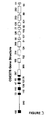
- the architecture of the CDC27 genes are illustrated in figures 1 and 3 .
- the exons are boxed.
- the numbers above the box indicate the length of the exon, the number below and between two boxes indicates the length of the intron.
- the genomic architecture of the CDC27A1 and CDC27B genes, respectively, of Arabidopsis thaliana are depicted as explained above.
- the second and the sixteenth (last) exon (black in figure 2 ) comprise novel coding sequences and were not identified in the known genomic CDC27A1 sequence of Arabidopois thaliana (see text).
- the entire sequence comprises 2184 nucleotides, corresponding to 727 amino acids.
- the first 5 exons (black in figure 5 ) and part of the 6 th exon (black in figure 5 ) comprise novel coding sequences and were not identified in the known genomic CDC27B sequence of Arabidopsis thaliana (see text).
- the entire sequence comprises 2151 nucleotides, corresponding to 716 amino acids.
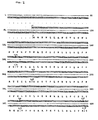
- the complete cDNA sequence of CDC27A1, as identified in the present invention are depicted, with the respective encoded amino acid sequence therebelow.
- Vertical lines in the nucleotide sequence indicate the exon boundaries, i.e. 2
- the exon boundaries are derived from genomic CDC27A1 sequences (see example 1). 2.
- Such lines are also drawn in the amino acid sequence, although, as is indicated above, the amino acids, flanking such a vertical line, may be partially encoded by the adjacent exon. Exact positioning of the vertical line is in such a case not possible and is set at the left or the right of such an amino acid in an arbitrary manner. See example 1 for further details.
- An alignment of the CDC27A1 (SEQ ID NO 5) and CDC27B (SEQ ID NO 13) amino acid sequences is given in Figure 4 with indication of SEQ ID NOS 6, 7, 10 and 12.
- Said CDC27A1 and CDC27B sequences are 49% identical when gaps are introduced in the sequences to ensure optimal alignment and maximal identity.
- Figures 5 and 6 the expression of CDC27A and CDC27B genes is illustrated.
- Figure 5A shows expression of CDC27A genes (both CDC27A1 and CDC27A2 are detected; indicated by the arrows) in several Arabidopsis thaliana tissues: 1-etiolated seedlings; 2-flowers; 3-buds; 4-stems; 5-leaves; 6-roots; siliques; - negative control.
- Figure 7B shows the expression of CDC27A genes in Arabidopois thaliana root cultures treated with different substances: 1-abscisic acid (ABA); 2-2,4-dichlorophenoxyacetic acid (2,4-D); 3-hydroxyurea; 4-kinetin; 5-kinetin + 1-naphthaleneacetic acid (NAA); 6-NAA; 7-oryzalin; 8-starvation; 9-untreated control roots; -negative control.
- Figure 6A shows the expression of the CDC27B gene in several Arabidopsis thaliana tissues as outlined in Figure 5A.
- Figure 5B illustrates the expression of the CDC27B gene in Arabidopois root cultures treated with different substances as outlined in Figure 5B .
- the invention will now be further illustrated by the following examples, that are not intended to limit the scope of the invention.
- oligonucleotides were as follows:
- First strand cDNA prepared from flower buds was used as template in nested PCR reactions.
- the first reaction was carried using the pair of oligos 1 and 4, and the second reaction used oligos 2 and 3.
- PCR conditions were as described ( Ferreira et al., 1991, Plant Cell 3, 531-540 ), except that the annealing temperature of the first reaction was 45 C, and for the second reaction, 37 C was used.
- a fragment of approximately 300 bp was eluted from agarose gel and cloned in pGEM-T. Out of 16 clones sequenced, two showed high homology to published CDC27 sequences ( Sikorski et al., 1991 Cold Spring Harbor Symposia on Quantitative Biology vol LVI, 663-673, 1991 ).
- This fragment was then used to screen a lambda gt10 cDNA library prepared from total Arabidopsis plants.
- the isolated target cDNA approximately 2,5 kb, was completely sequenced by the dideoxy method and is shown in fig 4 and in SEQ ID nr 9.
- a combination of restriction enzymes and oligonucleotide subcloning was used to produce the templates for sequencing.
- the Arabidopsis CDC27A1 cDNA contains one open reading frame, encoding a polypeptide of 727 amino acids ( figure 4 ).
- the databanks EMBL and EMBL new were screened for gene sequences, homologous to the present CDC27 cDNA sequence.
- a genomic sequence from Arabidopsis thaliana (accession number AC001645) was found, comprising 14 exons, coding for a protein of 727 AA.
- the present cDNA-sequence was compared with the said genomic Arabidopsis sequence (1) using the "best fit"-program. It appeared that the present cDNA comprised additional coding information for two novel exons, namely the second and last exon of the Arabidopsis CDC27-gene (exons 2 and 16 in fig 4 ).
- amino acid sequences encoded by the second and last exon are depicted in SEQ ID NOS 6 and 7 respectively.
- A. thaliana An expression cassette as described below is transferred to a binary vector such as pGSC1704 and the resulting vector electroporated into Agrobacterium tumefaciens C58C1RifR (pGV2260). Transformants are selected on streptomycin/spectinomycin containing medium and checked for the presence of the integral transformed binary vector. Arabidopsis thaliana Col-0 is transformed with the selected A. tumefaciens strain by the floral dip method ( Clough and Bent 1998, Plant J 16, 735-743 ). Transgenic plants are selected after seed germination in the presence of hygromycin.
- any of the muteins are operably linked to a constitutive promoter such as the CaMV 35S promoter ( Kay et al. 1987, Science 236, 1299-1302 ) or to a seed endosperm-specific promoter such as from a 2S albumin seed storage protein ( Guerche et al. 1990, Plant Cell 2, 469-478 ) or to the BLZ2 promoter (Carbonero et al, 1999 in press) and to a polyadenylation signal.
- a constitutive promoter such as the CaMV 35S promoter ( Kay et al. 1987, Science 236, 1299-1302 ) or to a seed endosperm-specific promoter such as from a 2S albumin seed storage protein ( Guerche et al. 1990, Plant Cell 2, 469-478 ) or to the BLZ2 promoter (Carbonero et al, 1999 in press) and to a polyadenylation signal.
- a constitutive promoter such as the CaMV 35S promote
- Selected transformant lines have a general higher rate of endoreduplicating cells (CaMV 35S promoter) and/or produce seeds with a higher amount of polyploid endosperm cells (2S albumin promoter). Endoreduplication or polyploidism is assessed in several ways.
- First-strand cDNA was prepared from RNA isolated from different Arabidopsis thaliana tissues (etiolated seedlings, flowers, flower buds; stems; leaves; roots; siliques) and from Arabidopsis thaliana root cultures treated for 48 h with different chemical substances (10 -6 M abscisic acid; 10 -7 M 2,4-dichlorophenoxyacetic acid; 100 mM hydroxyurea; 10 -6 M kinetin; 10 -6 M kinetin + 10 -6 M 1-naphthaleneacetice acid; 10 -6 M 1-naphthaleneacetic acid; 2% (w/v) oryzalin).
- PCR was performed with these cDNAs using CDC27A-specific primers (sense primer 5' CCG TAG TGC TAG AAT AGC A 3' and antisense primer 5' AGT CAG CGT TGA AGT c3') or CDC27B-specific primers (sense primer 5' TCT CTC GAG GAA GAA AGG CAA CAA 3' and antisense primer 5' GGT TCT TGG AGT AGC TAT GGT TTC 3').
- CDC27A-specific primers sense primer 5' CCG TAG TGC TAG AAT AGC A 3' and antisense primer 5' AGT CAG CGT TGA AGT c3'
- CDC27B-specific primers sense primer 5' TCT CTC GAG GAA GAA AGG CAA CAA 3' and antisense primer 5' GGT TCT TGG AGT AGC TAT GGT TTC 3'.
- the resulting fragments generated by PCR were seperated in an agarose gel,
- Results are shown in Figure 5 for CDC27A where the arrows indicate the presence of 2 bands, differing by 30 nucleotides. Sequencing of both fragments showed that they are identical, except for the 30 bp insertion.
- Figure 6 illustrates the results for CDC27B. The pictures in Figures 5 and 6 are representative of 3 independent experiments. Both genes are expressed in all plant tissues, but at reduced levels in open flowers an siliques. Expression of both genes is not drastically affected by hormone treatments, except for a reduction in expression levels observed when roots were incubated with 2,4-D (2,4-dichlorophenoxyacetic acid) .
- CDC27A clones corresponding to the transcripts of different sizes were identified and their nucleotide sequences determined. This revealed that both type of CDC27A clones had identical nucleotide sequences with the exception of a stretch of 33 nucleotides which was absent from the shorter CDC27A cDNA.
- CDC27A1 SEQ ID NO 9
- CDC27A2 SEQ ID NO 14
- the primers used to clone the open reading frame were: sense primer 5' TCT CTC GAG GAA GAA AGG CAA CAA 3' and antisense primer 5' GGT TCT TGG AGT AGC TAT GGT TTC 3'.
- the new Arabidopsis CDC27 homologue is referred to as CDC27B.
- the CDC27A1 and CDC27B proteins are aligned in Figure 4 and are only 49% identical.
Landscapes
- Health & Medical Sciences (AREA)
- Life Sciences & Earth Sciences (AREA)
- Genetics & Genomics (AREA)
- Chemical & Material Sciences (AREA)
- Engineering & Computer Science (AREA)
- Organic Chemistry (AREA)
- Molecular Biology (AREA)
- Bioinformatics & Cheminformatics (AREA)
- Zoology (AREA)
- Wood Science & Technology (AREA)
- Biomedical Technology (AREA)
- General Engineering & Computer Science (AREA)
- Biotechnology (AREA)
- Biochemistry (AREA)
- General Health & Medical Sciences (AREA)
- Microbiology (AREA)
- Biophysics (AREA)
- Cell Biology (AREA)
- Physics & Mathematics (AREA)
- Plant Pathology (AREA)
- Medicinal Chemistry (AREA)
- Botany (AREA)
- Gastroenterology & Hepatology (AREA)
- Proteomics, Peptides & Aminoacids (AREA)
- Peptides Or Proteins (AREA)
- Micro-Organisms Or Cultivation Processes Thereof (AREA)
- Breeding Of Plants And Reproduction By Means Of Culturing (AREA)
- Steroid Compounds (AREA)
- Pharmaceuticals Containing Other Organic And Inorganic Compounds (AREA)
- Measuring Or Testing Involving Enzymes Or Micro-Organisms (AREA)
Priority Applications (1)
| Application Number | Priority Date | Filing Date | Title |
|---|---|---|---|
| EP00945887A EP1192260B1 (en) | 1999-07-05 | 2000-07-05 | Arabidopsis thaliana cdc27 homologs |
Applications Claiming Priority (4)
| Application Number | Priority Date | Filing Date | Title |
|---|---|---|---|
| EP99202214 | 1999-07-05 | ||
| EP99202214 | 1999-07-05 | ||
| EP00945887A EP1192260B1 (en) | 1999-07-05 | 2000-07-05 | Arabidopsis thaliana cdc27 homologs |
| PCT/EP2000/006401 WO2001002430A2 (en) | 1999-07-05 | 2000-07-05 | Arabidopsis thaliana cdc7 and cdc27 homologs |
Publications (2)
| Publication Number | Publication Date |
|---|---|
| EP1192260A2 EP1192260A2 (en) | 2002-04-03 |
| EP1192260B1 true EP1192260B1 (en) | 2008-12-31 |
Family
ID=8240422
Family Applications (1)
| Application Number | Title | Priority Date | Filing Date |
|---|---|---|---|
| EP00945887A Expired - Lifetime EP1192260B1 (en) | 1999-07-05 | 2000-07-05 | Arabidopsis thaliana cdc27 homologs |
Country Status (9)
| Country | Link |
|---|---|
| US (2) | US20020164757A1 (https=) |
| EP (1) | EP1192260B1 (https=) |
| JP (1) | JP2003506015A (https=) |
| AT (1) | ATE419359T1 (https=) |
| AU (1) | AU774577B2 (https=) |
| CA (1) | CA2374386A1 (https=) |
| DE (1) | DE60041257D1 (https=) |
| ES (1) | ES2320524T3 (https=) |
| WO (1) | WO2001002430A2 (https=) |
Families Citing this family (21)
| Publication number | Priority date | Publication date | Assignee | Title |
|---|---|---|---|---|
| DE60041257D1 (de) | 1999-07-05 | 2009-02-12 | Cropdesign Nv | Cdc27-homologe aus arabidopsis thaliana |
| EP1334121B1 (en) | 2000-11-13 | 2013-03-13 | Universiteit Utrecht | A plant development regulating gene and its uses |
| WO2004029257A1 (en) * | 2002-09-05 | 2004-04-08 | Cropdesign N.V. | Plants having changed development and a method for making the same |
| AU2005337132B2 (en) | 2004-12-21 | 2011-01-20 | Monsanto Technology, Llc | Transgenic plants with enhanced agronomic traits |
| EP1954805B1 (en) * | 2005-12-01 | 2015-07-22 | CropDesign N.V. | Plants having improved growth characteristics and methods for making the same |
| CN101365786B (zh) * | 2005-12-01 | 2014-03-05 | 克罗普迪塞恩股份有限公司 | 具有改良的生长特征的植物及其生产方法 |
| WO2013138289A2 (en) * | 2012-03-13 | 2013-09-19 | Pioneer Hi-Bred International, Inc. | Genetic reduction of male fertility in plants |
| KR101512972B1 (ko) | 2013-07-03 | 2015-04-17 | 경북대학교 산학협력단 | 애기장대 투인원 유전자 변이체 tfarm3을 이용한 식물체의 배수성을 조절하는 방법 및 그에 따른 식물체 |
| KR101512979B1 (ko) | 2013-07-03 | 2015-04-17 | 경북대학교 산학협력단 | 애기장대 투인원 유전자 변이체 tffr을 이용한 식물체의 배수성을 조절하는 방법 및 그에 따른 식물체 |
| KR101512981B1 (ko) | 2013-07-03 | 2015-04-17 | 경북대학교 산학협력단 | 애기장대 투인원 유전자 변이체 tfarm0을 이용한 식물체의 배수성을 조절하는 방법 및 그에 따른 식물체 |
| KR101512974B1 (ko) | 2013-07-03 | 2015-04-17 | 경북대학교 산학협력단 | 애기장대 투인원 유전자 변이체 tfarm1을 이용한 식물체의 배수성을 조절하는 방법 및 그에 따른 식물체 |
| KR101512976B1 (ko) | 2013-07-03 | 2015-04-17 | 경북대학교 산학협력단 | 애기장대 투인원 유전자 변이체 ka를 이용한 식물체의 배수성을 조절하는 방법 및 그에 따른 식물체 |
| KR101532565B1 (ko) * | 2013-07-03 | 2015-06-30 | 경북대학교 산학협력단 | 애기장대 투인원 유전자를 이용한 식물체의 배수성을 조절하는 방법 및 그에 따른 식물체 |
| KR101512970B1 (ko) | 2013-07-03 | 2015-04-17 | 경북대학교 산학협력단 | 애기장대 투인원 유전자 변이체 tf△c를 이용한 식물체의 배수성을 조절하는 방법 및 그에 따른 식물체 |
| KR101512973B1 (ko) | 2013-07-03 | 2015-04-17 | 경북대학교 산학협력단 | 애기장대 투인원 유전자 변이체 tfarm2를 이용한 식물체의 배수성을 조절하는 방법 및 그에 따른 식물체 |
| KR101512978B1 (ko) | 2013-07-03 | 2015-04-17 | 경북대학교 산학협력단 | 애기장대 투인원 유전자 변이체 tfft를 이용한 식물체의 배수성을 조절하는 방법 및 그에 따른 식물체 |
| KR101512971B1 (ko) | 2013-07-03 | 2015-04-17 | 경북대학교 산학협력단 | 애기장대 투인원 유전자 변이체 tfarm4를 이용한 식물체의 배수성을 조절하는 방법 및 그에 따른 식물체 |
| KR101512969B1 (ko) | 2013-07-03 | 2015-04-17 | 경북대학교 산학협력단 | 애기장대 투인원 유전자 변이체 tfnr을 이용한 식물체의 배수성을 조절하는 방법 및 그에 따른 식물체 |
| KR101512977B1 (ko) | 2013-07-03 | 2015-04-17 | 경북대학교 산학협력단 | 애기장대 투인원 유전자 변이체 dana를 이용한 식물체의 배수성을 조절하는 방법 및 그에 따른 식물체 |
| KR101512983B1 (ko) | 2013-07-03 | 2015-04-17 | 경북대학교 산학협력단 | 애기장대 투인원 유전자 변이체 cl을 이용한 식물체의 배수성을 조절하는 방법 및 그에 따른 식물체 |
| KR101512980B1 (ko) | 2013-07-03 | 2015-04-17 | 경북대학교 산학협력단 | 애기장대 투인원 유전자 변이체 tfnt를 이용한 식물체의 배수성을 조절하는 방법 및 그에 따른 식물체 |
Family Cites Families (5)
| Publication number | Priority date | Publication date | Assignee | Title |
|---|---|---|---|---|
| BR9408357A (pt) * | 1993-12-20 | 1997-08-26 | Univ Texas | Sequência isolada e purificada de dna vetor de recombinação vetor de expressão sistema de vetor-hospedeiro composição farmacêutica teste de dna proteína de mamífero isolada e purificada e processo para produzir a mesma processo de suprimir fenótico neoplástico anticorpo hibridoma e processo parta detectar a ausência da proteina h-nuc em células tumorais |
| GB9507232D0 (en) * | 1995-04-07 | 1995-05-31 | Gatsby Charitable Foundation | Plant pathogen resistance genes and uses thereof |
| US5726025A (en) * | 1995-04-20 | 1998-03-10 | President And Fellows Of Harvard College | Assay and reagents for detecting inhibitors of ubiquitin-dependent degradation of cell cycle regulatory proteins |
| WO1998041642A1 (en) * | 1997-03-14 | 1998-09-24 | Cropdesign N.V. | Method and means for modulating plant cell cycle proteins and their use in plant cell growth control |
| DE60041257D1 (de) | 1999-07-05 | 2009-02-12 | Cropdesign Nv | Cdc27-homologe aus arabidopsis thaliana |
-
2000
- 2000-07-05 DE DE60041257T patent/DE60041257D1/de not_active Expired - Lifetime
- 2000-07-05 ES ES00945887T patent/ES2320524T3/es not_active Expired - Lifetime
- 2000-07-05 AT AT00945887T patent/ATE419359T1/de not_active IP Right Cessation
- 2000-07-05 WO PCT/EP2000/006401 patent/WO2001002430A2/en not_active Ceased
- 2000-07-05 CA CA002374386A patent/CA2374386A1/en not_active Abandoned
- 2000-07-05 JP JP2001508217A patent/JP2003506015A/ja active Pending
- 2000-07-05 AU AU59829/00A patent/AU774577B2/en not_active Ceased
- 2000-07-05 EP EP00945887A patent/EP1192260B1/en not_active Expired - Lifetime
-
2002
- 2002-01-07 US US10/036,492 patent/US20020164757A1/en not_active Abandoned
-
2005
- 2005-09-30 US US11/239,325 patent/US7622635B2/en not_active Expired - Fee Related
Also Published As
| Publication number | Publication date |
|---|---|
| US20060026720A1 (en) | 2006-02-02 |
| WO2001002430A3 (en) | 2001-09-27 |
| DE60041257D1 (de) | 2009-02-12 |
| CA2374386A1 (en) | 2001-01-11 |
| US7622635B2 (en) | 2009-11-24 |
| US20020164757A1 (en) | 2002-11-07 |
| ATE419359T1 (de) | 2009-01-15 |
| JP2003506015A (ja) | 2003-02-18 |
| AU774577B2 (en) | 2004-07-01 |
| AU5982900A (en) | 2001-01-22 |
| EP1192260A2 (en) | 2002-04-03 |
| WO2001002430A2 (en) | 2001-01-11 |
| ES2320524T3 (es) | 2009-05-25 |
Similar Documents
| Publication | Publication Date | Title |
|---|---|---|
| EP1192260B1 (en) | Arabidopsis thaliana cdc27 homologs | |
| US6559358B1 (en) | Plants with modified growth | |
| AU2003224789B2 (en) | Generation of plants with improved drought tolerance | |
| US6433251B1 (en) | Promoter regulating circadian clock function and photoperiodism | |
| US8044262B2 (en) | Generation of plants with improved drought tolerance | |
| WO2005002325A2 (en) | Generation of plants with improved drought tolerance | |
| CA2498465C (en) | Generation of plants with improved pathogen resistance | |
| US7829759B2 (en) | Generation of plants with improved pathogen resistance | |
| CN101874116B (zh) | 具有增强的产量相关性状的植物及其生产方法 | |
| EP1685242A2 (en) | Generation of plants with improved drought tolerance | |
| JP2002505109A (ja) | 植物における病原体抵抗性の誘導のための方法 | |
| EP0967278A2 (en) | Flowering regulating gene and its use | |
| US20030079252A1 (en) | Floral induction gene | |
| MXPA99008795A (en) | Plants with modified growth |
Legal Events
| Date | Code | Title | Description |
|---|---|---|---|
| PUAI | Public reference made under article 153(3) epc to a published international application that has entered the european phase |
Free format text: ORIGINAL CODE: 0009012 |
|
| 17P | Request for examination filed |
Effective date: 20011218 |
|
| AK | Designated contracting states |
Kind code of ref document: A2 Designated state(s): AT BE CH CY DE DK ES FI FR GB GR IE IT LI LU MC NL PT SE |
|
| AX | Request for extension of the european patent |
Free format text: AL;LT;LV;MK;RO;SI |
|
| 17Q | First examination report despatched |
Effective date: 20051209 |
|
| GRAP | Despatch of communication of intention to grant a patent |
Free format text: ORIGINAL CODE: EPIDOSNIGR1 |
|
| RTI1 | Title (correction) |
Free format text: ARABIDOPSIS THALIANA CDC27 HOMOLOGS |
|
| RAP1 | Party data changed (applicant data changed or rights of an application transferred) |
Owner name: UNIVERSIDADE FEDERAL DO RIO DE JANEIRO Owner name: CROPDESIGN N.V. |
|
| GRAS | Grant fee paid |
Free format text: ORIGINAL CODE: EPIDOSNIGR3 |
|
| GRAA | (expected) grant |
Free format text: ORIGINAL CODE: 0009210 |
|
| AK | Designated contracting states |
Kind code of ref document: B1 Designated state(s): AT BE CH CY DE DK ES FI FR GB GR IE IT LI LU MC NL PT SE |
|
| REG | Reference to a national code |
Ref country code: GB Ref legal event code: FG4D Ref country code: CH Ref legal event code: EP |
|
| REF | Corresponds to: |
Ref document number: 60041257 Country of ref document: DE Date of ref document: 20090212 Kind code of ref document: P |
|
| REG | Reference to a national code |
Ref country code: IE Ref legal event code: FG4D |
|
| REG | Reference to a national code |
Ref country code: SE Ref legal event code: TRGR |
|
| REG | Reference to a national code |
Ref country code: ES Ref legal event code: FG2A Ref document number: 2320524 Country of ref document: ES Kind code of ref document: T3 |
|
| PG25 | Lapsed in a contracting state [announced via postgrant information from national office to epo] |
Ref country code: FI Free format text: LAPSE BECAUSE OF FAILURE TO SUBMIT A TRANSLATION OF THE DESCRIPTION OR TO PAY THE FEE WITHIN THE PRESCRIBED TIME-LIMIT Effective date: 20081231 |
|
| PG25 | Lapsed in a contracting state [announced via postgrant information from national office to epo] |
Ref country code: AT Free format text: LAPSE BECAUSE OF FAILURE TO SUBMIT A TRANSLATION OF THE DESCRIPTION OR TO PAY THE FEE WITHIN THE PRESCRIBED TIME-LIMIT Effective date: 20081231 Ref country code: PT Free format text: LAPSE BECAUSE OF FAILURE TO SUBMIT A TRANSLATION OF THE DESCRIPTION OR TO PAY THE FEE WITHIN THE PRESCRIBED TIME-LIMIT Effective date: 20090601 |
|
| PG25 | Lapsed in a contracting state [announced via postgrant information from national office to epo] |
Ref country code: DK Free format text: LAPSE BECAUSE OF FAILURE TO SUBMIT A TRANSLATION OF THE DESCRIPTION OR TO PAY THE FEE WITHIN THE PRESCRIBED TIME-LIMIT Effective date: 20081231 |
|
| PLBE | No opposition filed within time limit |
Free format text: ORIGINAL CODE: 0009261 |
|
| STAA | Information on the status of an ep patent application or granted ep patent |
Free format text: STATUS: NO OPPOSITION FILED WITHIN TIME LIMIT |
|
| 26N | No opposition filed |
Effective date: 20091001 |
|
| PG25 | Lapsed in a contracting state [announced via postgrant information from national office to epo] |
Ref country code: MC Free format text: LAPSE BECAUSE OF NON-PAYMENT OF DUE FEES Effective date: 20090731 |
|
| PG25 | Lapsed in a contracting state [announced via postgrant information from national office to epo] |
Ref country code: IE Free format text: LAPSE BECAUSE OF NON-PAYMENT OF DUE FEES Effective date: 20090705 |
|
| PG25 | Lapsed in a contracting state [announced via postgrant information from national office to epo] |
Ref country code: GR Free format text: LAPSE BECAUSE OF FAILURE TO SUBMIT A TRANSLATION OF THE DESCRIPTION OR TO PAY THE FEE WITHIN THE PRESCRIBED TIME-LIMIT Effective date: 20090401 |
|
| PG25 | Lapsed in a contracting state [announced via postgrant information from national office to epo] |
Ref country code: IT Free format text: LAPSE BECAUSE OF FAILURE TO SUBMIT A TRANSLATION OF THE DESCRIPTION OR TO PAY THE FEE WITHIN THE PRESCRIBED TIME-LIMIT Effective date: 20081231 |
|
| PG25 | Lapsed in a contracting state [announced via postgrant information from national office to epo] |
Ref country code: LU Free format text: LAPSE BECAUSE OF NON-PAYMENT OF DUE FEES Effective date: 20090705 |
|
| PG25 | Lapsed in a contracting state [announced via postgrant information from national office to epo] |
Ref country code: CY Free format text: LAPSE BECAUSE OF FAILURE TO SUBMIT A TRANSLATION OF THE DESCRIPTION OR TO PAY THE FEE WITHIN THE PRESCRIBED TIME-LIMIT Effective date: 20081231 |
|
| PGFP | Annual fee paid to national office [announced via postgrant information from national office to epo] |
Ref country code: NL Payment date: 20130724 Year of fee payment: 14 Ref country code: SE Payment date: 20130725 Year of fee payment: 14 Ref country code: ES Payment date: 20130830 Year of fee payment: 14 Ref country code: CH Payment date: 20130725 Year of fee payment: 14 |
|
| PGFP | Annual fee paid to national office [announced via postgrant information from national office to epo] |
Ref country code: FR Payment date: 20130731 Year of fee payment: 14 Ref country code: GB Payment date: 20130731 Year of fee payment: 14 |
|
| PGFP | Annual fee paid to national office [announced via postgrant information from national office to epo] |
Ref country code: BE Payment date: 20130830 Year of fee payment: 14 Ref country code: DE Payment date: 20130930 Year of fee payment: 14 |
|
| REG | Reference to a national code |
Ref country code: DE Ref legal event code: R119 Ref document number: 60041257 Country of ref document: DE |
|
| REG | Reference to a national code |
Ref country code: NL Ref legal event code: V1 Effective date: 20150201 |
|
| REG | Reference to a national code |
Ref country code: CH Ref legal event code: PL |
|
| REG | Reference to a national code |
Ref country code: SE Ref legal event code: EUG |
|
| GBPC | Gb: european patent ceased through non-payment of renewal fee |
Effective date: 20140705 |
|
| PG25 | Lapsed in a contracting state [announced via postgrant information from national office to epo] |
Ref country code: NL Free format text: LAPSE BECAUSE OF NON-PAYMENT OF DUE FEES Effective date: 20150201 |
|
| REG | Reference to a national code |
Ref country code: FR Ref legal event code: ST Effective date: 20150331 |
|
| PG25 | Lapsed in a contracting state [announced via postgrant information from national office to epo] |
Ref country code: CH Free format text: LAPSE BECAUSE OF NON-PAYMENT OF DUE FEES Effective date: 20140731 Ref country code: DE Free format text: LAPSE BECAUSE OF NON-PAYMENT OF DUE FEES Effective date: 20150203 Ref country code: LI Free format text: LAPSE BECAUSE OF NON-PAYMENT OF DUE FEES Effective date: 20140731 |
|
| REG | Reference to a national code |
Ref country code: DE Ref legal event code: R119 Ref document number: 60041257 Country of ref document: DE Effective date: 20150203 |
|
| PG25 | Lapsed in a contracting state [announced via postgrant information from national office to epo] |
Ref country code: FR Free format text: LAPSE BECAUSE OF NON-PAYMENT OF DUE FEES Effective date: 20140731 Ref country code: GB Free format text: LAPSE BECAUSE OF NON-PAYMENT OF DUE FEES Effective date: 20140705 Ref country code: SE Free format text: LAPSE BECAUSE OF NON-PAYMENT OF DUE FEES Effective date: 20140706 |
|
| REG | Reference to a national code |
Ref country code: ES Ref legal event code: FD2A Effective date: 20150828 |
|
| PG25 | Lapsed in a contracting state [announced via postgrant information from national office to epo] |
Ref country code: ES Free format text: LAPSE BECAUSE OF NON-PAYMENT OF DUE FEES Effective date: 20140706 |
|
| PG25 | Lapsed in a contracting state [announced via postgrant information from national office to epo] |
Ref country code: BE Free format text: LAPSE BECAUSE OF NON-PAYMENT OF DUE FEES Effective date: 20140731 |