EP1191553A2 - Manufacturing method of an anisotropic magnet powder, precursory anisotropic magnet powder and bonded magnet - Google Patents
Manufacturing method of an anisotropic magnet powder, precursory anisotropic magnet powder and bonded magnet Download PDFInfo
- Publication number
- EP1191553A2 EP1191553A2 EP01122268A EP01122268A EP1191553A2 EP 1191553 A2 EP1191553 A2 EP 1191553A2 EP 01122268 A EP01122268 A EP 01122268A EP 01122268 A EP01122268 A EP 01122268A EP 1191553 A2 EP1191553 A2 EP 1191553A2
- Authority
- EP
- European Patent Office
- Prior art keywords
- powder
- anisotropic magnet
- magnet powder
- manufacturing
- elements
- Prior art date
- Legal status (The legal status is an assumption and is not a legal conclusion. Google has not performed a legal analysis and makes no representation as to the accuracy of the status listed.)
- Granted
Links
Images


Classifications
-
- H—ELECTRICITY
- H01—ELECTRIC ELEMENTS
- H01F—MAGNETS; INDUCTANCES; TRANSFORMERS; SELECTION OF MATERIALS FOR THEIR MAGNETIC PROPERTIES
- H01F41/00—Apparatus or processes specially adapted for manufacturing or assembling magnets, inductances or transformers; Apparatus or processes specially adapted for manufacturing materials characterised by their magnetic properties
- H01F41/02—Apparatus or processes specially adapted for manufacturing or assembling magnets, inductances or transformers; Apparatus or processes specially adapted for manufacturing materials characterised by their magnetic properties for manufacturing cores, coils, or magnets
-
- H—ELECTRICITY
- H01—ELECTRIC ELEMENTS
- H01F—MAGNETS; INDUCTANCES; TRANSFORMERS; SELECTION OF MATERIALS FOR THEIR MAGNETIC PROPERTIES
- H01F1/00—Magnets or magnetic bodies characterised by the magnetic materials therefor; Selection of materials for their magnetic properties
- H01F1/01—Magnets or magnetic bodies characterised by the magnetic materials therefor; Selection of materials for their magnetic properties of inorganic materials
- H01F1/03—Magnets or magnetic bodies characterised by the magnetic materials therefor; Selection of materials for their magnetic properties of inorganic materials characterised by their coercivity
- H01F1/032—Magnets or magnetic bodies characterised by the magnetic materials therefor; Selection of materials for their magnetic properties of inorganic materials characterised by their coercivity of hard-magnetic materials
- H01F1/04—Magnets or magnetic bodies characterised by the magnetic materials therefor; Selection of materials for their magnetic properties of inorganic materials characterised by their coercivity of hard-magnetic materials metals or alloys
- H01F1/047—Alloys characterised by their composition
- H01F1/053—Alloys characterised by their composition containing rare earth metals
- H01F1/055—Alloys characterised by their composition containing rare earth metals and magnetic transition metals, e.g. SmCo5
- H01F1/057—Alloys characterised by their composition containing rare earth metals and magnetic transition metals, e.g. SmCo5 and IIIa elements, e.g. Nd2Fe14B
- H01F1/0571—Alloys characterised by their composition containing rare earth metals and magnetic transition metals, e.g. SmCo5 and IIIa elements, e.g. Nd2Fe14B in the form of particles, e.g. rapid quenched powders or ribbon flakes
- H01F1/0573—Alloys characterised by their composition containing rare earth metals and magnetic transition metals, e.g. SmCo5 and IIIa elements, e.g. Nd2Fe14B in the form of particles, e.g. rapid quenched powders or ribbon flakes obtained by reduction or by hydrogen decrepitation or embrittlement
-
- H—ELECTRICITY
- H01—ELECTRIC ELEMENTS
- H01F—MAGNETS; INDUCTANCES; TRANSFORMERS; SELECTION OF MATERIALS FOR THEIR MAGNETIC PROPERTIES
- H01F41/00—Apparatus or processes specially adapted for manufacturing or assembling magnets, inductances or transformers; Apparatus or processes specially adapted for manufacturing materials characterised by their magnetic properties
- H01F41/02—Apparatus or processes specially adapted for manufacturing or assembling magnets, inductances or transformers; Apparatus or processes specially adapted for manufacturing materials characterised by their magnetic properties for manufacturing cores, coils, or magnets
- H01F41/0253—Apparatus or processes specially adapted for manufacturing or assembling magnets, inductances or transformers; Apparatus or processes specially adapted for manufacturing materials characterised by their magnetic properties for manufacturing cores, coils, or magnets for manufacturing permanent magnets
- H01F41/0293—Apparatus or processes specially adapted for manufacturing or assembling magnets, inductances or transformers; Apparatus or processes specially adapted for manufacturing materials characterised by their magnetic properties for manufacturing cores, coils, or magnets for manufacturing permanent magnets diffusion of rare earth elements, e.g. Tb, Dy or Ho, into permanent magnets
Definitions
- the presetn invention concerns the manufacturing methods of an anisotropic magnet powder, the precursory anisotropic magnet powder and its manufacturing method, as well as a bonded magnet made from this powder.
- Magnets are widely used in many ofthe machines in our surroundings, including various types of motors. There is a need for a stronger permanent magnet in order to reduce the weight, thickness and length of and the increase efficiency of these machines.
- a rare earth element magnet (RFeB magnet) mainly composed of Nd 2 Fe 14 B has been attracting much attention as a candidate for such a permanent magnet, and its range of applications has been expanding greatly.
- RfB magnet rare earth element magnet
- it is being considered as a motor magnet in various types of machines in the automobile engine room.
- the magnet have a high heat resistance because the temperature inside the engine room exceeds 100 °C.
- the precursory anisotropic magnet powder (RFeB magnetic powder) has large temperature dependence (temperature coefficient), which causes a poor heat-resistance.
- the coercivity decreases rapidly at the high range of temperatures. It has been difficult to readily improve the temperature dependency so far.
- a remedy for this may be the use of an anisotropic magnet powder which originally has a very large coercive force (iHc), so that the magnet may keep a large enough coercive force even at the high range of temperatures.
- iHc coercive force
- a desirable anisotropic magnet powder should have large values for both coercivity (iHC) and degree of anisotropy (Br/Bs), where (Br) is the residual magnetic flux density and (Bs) is the saturation magnetic flux density.
- iHC coercivity
- Br/Bs degree of anisotropy
- Dy is efficient for improving the coercivity, it will also reduce the rate of HDDR reaction causing a decline in the degree of anisotropy. For these reasons, until now, these values have not been optimized at the same time.
- the starting material in this method is an anisotropic magnet powder such as Nd 2 Fe 14 B
- the control of oxidization is difficult while Dy coating, there is substantial variation in the end powder's performance and quality.
- a magnet made from this anisotropic magnet powder an uncontrollable loss of magnetization due to structure change, as will be discussed later, and a permanent magnet with stable heat-resistance could not be obtained.
- the invention is proposed in light of the circumstances stated above, and intends to provide a manufacturing method of an anisotropic magnet powder by which a magnet with an improved coercivity and loss of magnetization due to structure change can be obtained with a high productivity and a constant quality.
- the invention is also intended to provide a suitable precursory anisotropic magnet powder and to provide its manufacturing method, as well as to provide a bonded magnet with a high degree of permanent demagnetization.
- the manufacturing method of the present invention comprises the following processes;
- An anisotropic magnet powder with a large coercivity and a consistent quality can be achieved with RFeBHx powder material that can hardly be oxidized, and diffusion of R1 elements with inhibited oxidization.
- a bonded magnet molded from the anisotropic magnet powder obtained by this method will have an improved loss of magnetization due to structure change. This loss of magnetization is calculated using the magnetic flux when the sample magnet is initially put in a magnetic field and the magnetic flux after the sample is left under air atmosphere for 1000 hours at 120 °C , where the magnet does not recover when remagnetized. And the loss of magnetization is a comparison to the initial magnetic flux.
- the precursory anisotropic magnet powder is the RFeB hydride (RFeBHx) powder which is mainly composed of rare earth elements including yttrium (Y), boron (B) and iron (Fe) and is characterized by an average crystal radius ranging from 0.1-1.0 ⁇ m.
- RFeBHx RFeB hydride
- RFeBHx powder or precursory anisotropic magnet powder, makes it easier to manufacture, for example, the anisotropic magnet powder stated above.
- the reasons that the range of 0.1-1.0 ⁇ m was chosen as the average crystal radius is the difficulty to manufacture RFeBHx powder whose average crystal radius is less than 0.1 ⁇ m, and the poor coercivity of anisotropic magnet powder made from RFeBHx powder whose average crystal radius is greater than 1.0 ⁇ m.
- the average crystal radius was determined via TEM (transmission electron microscope). Crystal particles of RFeBHx powder were observed, two-dimensional image processing was carried out, equivalent cross sections of the area circles and crystal particles were assumed and the average radius was calculated.
- anisotropic magnet powder and the anisotropic magnet powder described above there are no particular restrictions to the particle shape or size, so both fine and coarse powders are available.
- the RFeB material is in a powder state, it is not necessary to establish an additional crushing process, however if a crushing process is carried out, anisotropic magnet powder or precursory anitsotropic magnet powder with a narrow distribution of particle radius can be obtained.
- a bonded magnet is mainly composed of rare earth elements including yttrium (Y), boron (B) and iron (Fe), made of an anisotropic magnet powder whose average crystal radius is 0.1-1.0 ⁇ m, was developed with a degree of anisotropy (Br/Bs) (the ratio of the residual magnetic flux density (Br) to the saturation magnetic flux density (Bs)) greater than 0.75, and a loss of magnetization less than 15% due to structural changes.
- Y yttrium
- B boron
- Fe iron
- the bonded magnet is made of an anisotropic magnet powder whose crystal particle is small with a high degree of anisotropy, the bonded magnet not only has greater magnetic characteristics, but also has improved heat-resistance for its low loss of magnetization due to structural changes, which is less than 15%.
- a bonded magnet with a loss of magnetization due to structure changes greater than 15% will have poor heat-resistance that is unsuitable for long-term use under high-temperature conditions.
- the degree of anisotropy which is given by the ratio of Br to Bs, depends on the composition (volume%) of an anisotropic magnet powder. For example, when the anisotropic magnet powder consists of only Nd 2 Fe 14 B, an appropriate Bs is 1.6 T, while with the addition of Dy, Bs is reduced to 1.4 T due to ferromagnetism.
- the present invention consists not only of an RFeBHx powder, but also consists of the manufacturing method of the precursory anisotropic magnet powder.
- the manufacturing method of the present invention comprises the following processes;
- the RFeB material is mainly composed of rare earth elements (R) including Y, B and F. More concretely, the RFeB material is an ingot whose main phase is R 2 Fe 14 B.
- the rare earth element R including Y, is not limited to be one type of element. It may be a combination of a number of rare earth elements, or one part of the main element may be replaced by other elements.
- Lanthanum (La), cerium (Ce), praseodymium (Pr), neodymium (Nd), samarium (Sm), gadolinium (Gd), terbium (Tb), dysprosium (Dy), holmium (Ho), erbium (Er), thulium (a TM element) and lutetium (Lu) are all possible elements for R other than Y. The use of more than one of them is favorable.
- Nd neodymium
- the desired RFeB material should be mainly composed of iron, including 11-15 at% of R and 5.5-8 at% of B.
- gallium (Ga) or niobium (Nb) is included in the RFeB material. Furthermore, a compound addition of both is even more desirable.
- Ga is an efficient element for improvement of the coercivity (iHC) of an anisotropic magnet powder. Between 0.01-2 at% of Ga content is desirable because less than 0.01 at% of Ga content does not bring about sufficient improvement in coercivity, while more than 2 at% of Ga content causes a decline in coercivity.
- Nb is an efficient element for improvement of the residual magnetic flux density (Br). Between 0.01-1 at% of Nb content is desirable because less than 0.01 at% of Nb content does not bring about sufficient improvement in residual magnetic flux density (Br), while more than 1 at% of Nb content slows the hydrogenation reaction in the high-temperature hydrogenation process.
- a compound addition of Ga and Nb brings about an improvement in both coercivity and degree of anisotropy, leading to an increase in the maximum energy product, or (BH)max.
- the RFeB material may also contain Co.
- Co is an efficient element for improvement of the Curie temperature of an anisotropic magnet powder; it becomes especially desirable with Co content less than 20 at%.
- the RFeB material may contain one, or more than one, of Ti, V, Zr, Ni, Cu, Al, Si, Cr, Mn, Mo, Hf, W, Ta and Sn.
- a magnet made of anisotropic magnet powder containing these elements will have an improved coercivity and squareness of the demagnetization curve. It is favorable to keep the content of these elements to less than 3 at% because with the increased content of these elements, a deposited phase will appear, causing a decline in coercivity.
- Ingot melted by various methods high frequency melting method, nuclear melting method and so on
- cast ingot or strips manufactured by a strip-casting method are possible examples of a RFeB material.
- For the crushing process it is possible to use either general hydrogen crushing or mechanical crushing.
- RFeBHx powder is a hydride powder of the abovementioned RFeB material.
- the hydride (RFeBHx) here means not only the case where hydrogen is chemically combined, but also the case where hydrogen is in a solid solution state.
- the RFeBHx powder can be obtained by, for example, using the abovementioned manufacturing processes that includes low-temperature hydrogenation, high-temperature hydrogenation and the first evacuation process.
- RFeB material can be used in a powder state, and it is possible to add crushing and powdering processes at a suitable time during or after manufacturing of the hydride (RFeBHx). Furthermore, a powdering process can be combined with the blending process, as will be mentioned below. Explanation about the present invention of a manufacturing method of the precursory anisotropic magnet powder (RFeBHx powder) will be presented below.
- the temperature of atmospheric hydrogen gas was set to be lower than 600 °C because temperatures higher than 600 °C will induce a structure transformation in the RFeB material, causing inhomogeneity in its structure, which is not favorable.
- An atmospheric hydrogen gas pressure ranging around 0.03-0.1 MPa is also possible. With hydrogen pressure greater than 0.03 MPa, the time required for hydrogen absorption into the RFeB material can be shortened, and with the hydrogen pressure within 0.1 MPa the hydrogen absorption is even more economical.
- the gas that can be used in the process is not limited only to hydrogen gas, but it is also possible to use a mixture hydrogen gas with other inactive gases.
- the hydrogen gas pressure corresponds to the partial pressure of hydrogen gas. This is the same for the high-temperature hydrogenation and the first evacuation process.
- the high-temperature hydrogenation process occurs after the low-temperature hydrogenation process, and the RFeB material is maintained under hydrogen gas atmosphere of 0.1-0.6 MPa and a temperature ranging between 750-850 °C.
- This high-temperature hydrogenation process allows the structure of the RFeB material after the low-temperature hydrogenation process to decompose into three phases ( ⁇ Fe phase, RH 2 phase, Fe 2 B phase). Then the structure transformation reaction can proceed gently with the regulated hydrogen gas pressure, because the RFeB material has already contained hydrogen during the previous low-temperature hydrogenation process.
- the hydrogen gas pressure was maintained within 0.1-0.6 MPa because hydrogen gas pressure lower than 0.1 MPa, the reaction will decrease, leaving non-transformed structure and causing a decline in coercivity, whereas when the hydrogen gas pressure is increased beyond 0.6 MPa, the reaction rate will increase, causing a decline in anisotropy.
- the temperature of atmospheric hydrogen was maintained within 760-860 °C because at a temperature lower than 760 °C , there will be incomplete decomposition of the three phases, causing a decline in the coercivity when it is made into an anisotropic magnet powder, whereas when the temperature is increased beyond 860 °C , crystal particles will get larger and coarser, causing also a decline in the coercivity.
- the RFeB material In the first evacuation process, which occurs after the high-temperature hydrogenation process, the RFeB material is maintained under hydrogen gas atmosphere with a pressure ranging from 0.1-0.6 kPa at a temperature ranging from 750-850 °C. Through this process, the hydrogen is removed from the RH 2 phase of the three abovementioned decomposed phases, leading to the polycrystalline recombined hydride (RfeBHx) in which each crystal has a crystal orientation aligned to the direction of the former Fe 2 B phase.
- RfeBHx polycrystalline recombined hydride
- the hydrogen gas pressure was modulated within 0.1-0.6 MPa because with hydrogen gas pressure less than 0.1 MPa, Br will decrease and hydrogen will be completely eliminated, resulting in a loss of the oxidization-prevention effect, and when the hydrogen gas pressure is increased beyond 0.6 MPa, the reverse transformation will be insufficient, resulting in insufficient coercivity when it is made into an anisotropic magnet powder.
- the RFeB material or the hydride of the RFeB material (RFeBHx) is crushed into a powder state yielding the RFeBHx powder.
- dry or wet type crushing equipment (jaw crusher, disc mill, ball mill, vibration mill, etc.) can be used.
- the suitable average particle size for the RFeBHx powder is 50-200 ⁇ m.
- the powder whose particle size is less than 50 ⁇ m can not be obtained economically, on the other hand, the one whose particle size is greater than 200 ⁇ m can not be mixed uniformly with a diffusion powder.
- the average particle sizes can be determined by putting each powder through sieves of known size. The same method of size determination is used for the diffusion powders.
- Diffusion powder is composed of a simple substance, an alloy, a compound or a hydride of one or more elements in an elemental group that includes Dy, Tb, Nd and Pr (R1 elements).
- the alloy, compound or the hydride of the alloy or compound includes one or more elements in an elemental group which consists of 3d and 4d transition elements (TM elements), wherein R1 elements and TM elements are diffused uniformly on the surface and inside of the RfeBHx powder in a diffusion treatment process.
- TM elements transition elements
- the hydride may also include hydrogen in a solid solution state.
- the diffusion powder is any of, dysprosium hydride powder, dysprosium-cobalt powder, neodymium hydride powder or neodymium-cobalt powder.
- Dy or Nd as a R1 element brings about a high coercivity in the manufactured anisotropic magnet powder.
- the inclusion of Co as a TM element brings about an improvement of the Curie temperature of the manufactured anisotropic magnet powder.
- the desired average particle size for the diffusion powder is 0.1-500 ⁇ m because while it is difficult to obtain diffusion powder whose average particle size less than 0.1 ⁇ m, the diffusion powder whose average particle size greater than 500 ⁇ m is difficult to uniformly blend with the abovementioned RFeBHx powder.
- the powder whose average particle size is around 1-50 ⁇ m is especially desirable to achieve uniform blending with the RFeBHx powder.
- a diffusion powder can be obtained through ordinary hydrogen crushing or dry or wet type mechanical crushing (jaw crusher, disc mill, ball mill, vibration mill, jet mill, etc.) of an R1 elemental simple substance, an alloy, or a compound.
- hydrogen crushing is the most efficient. It is especially desirable when the diffusion powder is a hydride powder because the hydride is automatically obtained when crushing an R1 elemental simple substance, an alloy, or a compound.
- the RFeBHx powder and a diffusion powder are mixed together.
- Henshall mixer rocking mixer, ball mixer, or the like may be used.
- crushing and classification of the mixture powder should be carried out as needed. This classification makes it easier to form the powder into a bonded magnet. And it is more desirable when the blending process is operated under oxidization-preventive atmosphere (for example, under inactive gas atmosphere or under vacuum), resulting in the further prevention of oxidization of the anisotropic magnet powder.
- oxidization-preventive atmosphere for example, under inactive gas atmosphere or under vacuum
- a favorable blending process is one in which 0.1-3.0 mol% of a diffusion powder is blended where the whole mixture powder is 100 mol%.
- R1 elements and TM elements are diffused uniformly on the surface and inside of the RFeBHx powder, where the R1 elements work as an oxygen getter, preventing the anisotropic magnet powder or the magnet made of the powder from being oxidized. As a result, even when the magnet is used under high temperatures, deterioration of the performance of the magnet can be efficiently restrained or prevented.
- the diffusion heat treatment process should be operated under oxidization-preventive atmosphere (for example, under vacuum) and at temperatures ranging from 400-900 °C.
- oxidization-preventive atmosphere for example, under vacuum
- temperatures ranging from 400-900 °C When the temperature is lowered under 400 °C the diffusion rates of R1 and TM elements will decrease, whereas increasing temperature above 900 °C will cause the crystal particles to grow larger and rougher.
- a sintered magnet or a bonded magnet can be produced.
- bonded magnets can be formed by addition of a thermo-setting resin, a thermo-plastic resin, a coupling agent or a lubricant to the anisotropic magnet powder, followed by mixing and blending, and finally by compression, extrusion or injection molding.
- a precursory anisotropic magnet powder, an anisotropic magnet powder and a bonded magnet which are examples of the applied forms of the invention (Sample No. 1-1 ⁇ 5-3), were manufactured as follows.
- Example 1 (Sample No. 1-1 ⁇ 1-4)
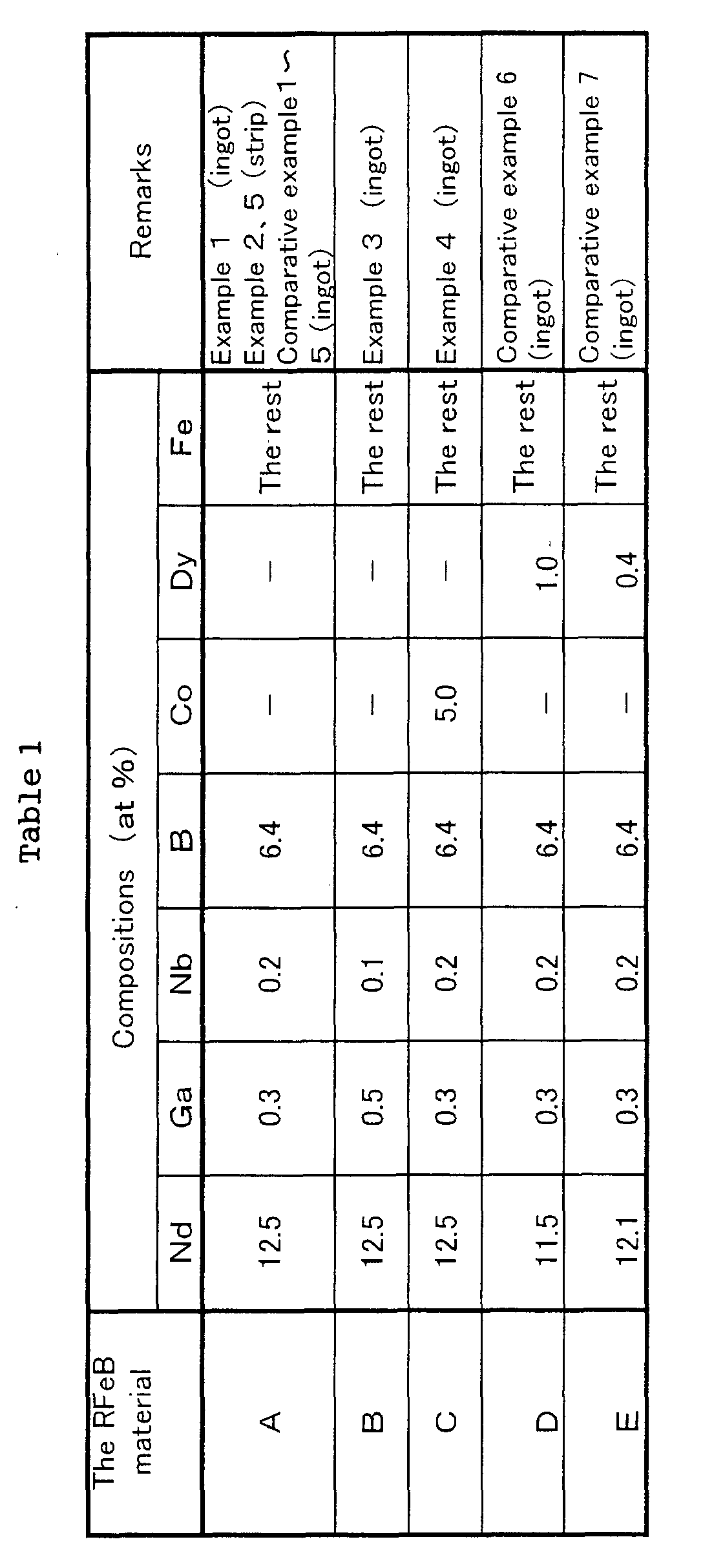
- composition A As shown in Table 1, then melted in high frequency melting furnace to manufacture 100 kg of ingot.
- compositions of each element are represented by at% where the total is 100 at%.
- the ingot alloy was heat-treated under Ar gas atmosphere at 1140 °C for 40 hours to unify its structure. Then, sample material (the RFeB material) was prepared by roughly crushing the unified ingot alloy via jaw crusher to an average particle size less than 10 mm.
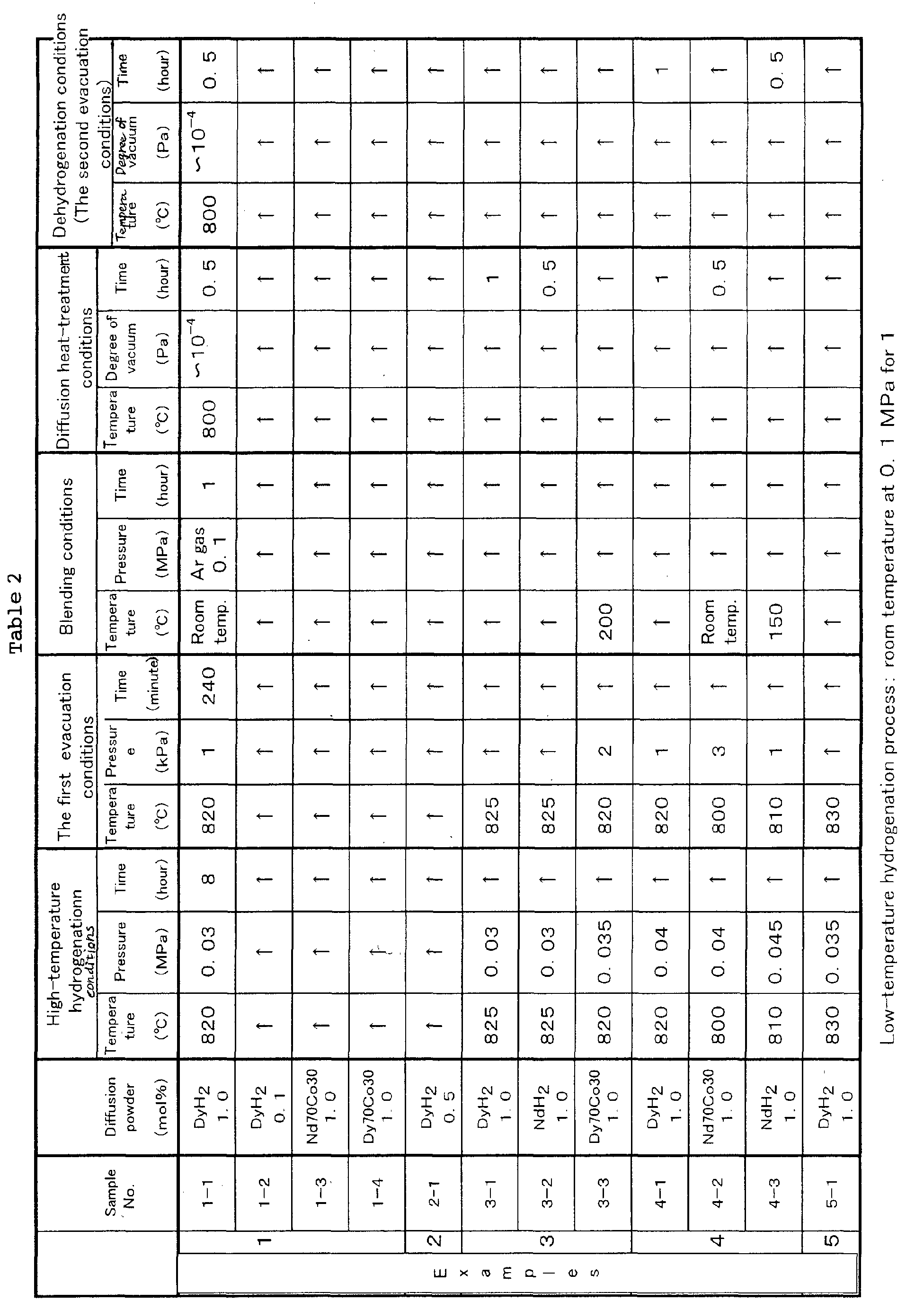
- the hydrogen-absorbed coarse powder is transferred from a low-temperature hydrogen treatment chamber to high-temperature hydrogen treatment chamber, without exposing it to the air, and then maintained under high-temperature hydrogenation conditions as shown in Table 2.
- the high-temperature hydrogen treatment room is equipped with hydrogen gas supply and evacuation parts (for the first and the second evacuation systems), a heater and a heat-compensation (heat balance) mechanism. By employing these, and adjusting the hydrogen gas atmosphere, the reaction rate of an ordered structure transformation was controlled.
- hydride of sample material A was manufactured into the RFeBHx powder, which is the precursory anisotropic magnet powder.
- the particle size of the obtained RFeBHx powder was about 30 ⁇ m ⁇ 1 mm although a dependency on the materials used was seen.
- the diffusion powder shown in Table 2 (an average particle size: 5 ⁇ m) was added to the obtained RFeBHx powder, and blended under the conditions shown in the same table.
- the additive ratio of the diffusion powder in Table 2 represents the molar ratio of the diffusion powder to that of the sum of RFeBHx and the diffusion powders.
- ⁇ Dy (Nd) 70Co30 ⁇ shown in Table 2 means that the diffusion powder is composed of 70 at% of Dy (Nd) and 30 at% of Co (and similarly for others shown).
- the diffusion powder used here was obtained from an ingot manufactured through the same melting method as the RFeB material mentioned above.
- a sample material was prepared, manufacturing a strip that has the same composition as example 1 through a strip-casting method.
- the same series of processes as described in example 1 were employed under the conditions shown in Table 2 to manufacture an anisotropic magnet powder.
- the RFeB material that has composition B in Table 1 was used as a sample material.
- An anisotropic magnet powder was manufactured based on the conditions shown in Table 2, in the same manner as that of example 1.
- the RFeB material that has composition C in Table 1 was used as a sample material.
- An anisotropic magnet powder was manufactured based on the conditions shown in Table 2, in the same manner as that of example 1. Because composition C includes Co, the Curie temperature increased, for example, to 350 °C when sample No. 4-1 was measured via VSM (vibrating Sample Magnetometer).
- sample materials that correspond to each of comparative examples 1 ⁇ 5 were manufactured in the same manner as that of example 1 as follows. However, some of the treatment conditions are slightly different between example 1 and each of comparative examples.
- An anisotropic magnet powder was manufactured by applying a low-temperature hydrogenation, a high-temperature hydrogenation, the first evacuation and a dehydrogenation process to the RFeB material sample material under the conditions shown in Table 3, however unlike the case of example 1, there was no addition and blending of a diffusion powder.
- the additive ratio of the diffusion powder was 4 mol% which exceeds 3 mol%. In all other ways, the same conditions as the case of example 1 were applied.
- a different starting material from that of example 1 was used to manufacture an anisotropic magnet powder.
- the starting material was prepared by applying each of low-temperature hydrogenation, a high-temperature hydrogenation, the first evacuation and a dehydrogenation processes under the conditions shown in Table 3 to the RFeB material that has the same composition as that of example 1.
- the starting material is not a powder with minute crystal particles that contains a hydride, but is a powder with minute crystal particles that contains no hydride.
- An anisotropic magnet powder was manufactured by adding the same diffusion powder as in example 1 (Sample No. 1-1) under the conditions shown in Table 3, and applying each of a blending and a diffusion heat-treatment process to this material powder.
- Dy was initially added to the RFeB material, and an ingot that has composition D in Table 1 was manufactured. And the powder obtained from the ingot was used as a precursory powder. Applying each of a high-temperature hydrogenation, the first evacuation and a dehydrogenation processes (the second evacuation process), an anisotropic magnet powder was manufactured.
- composition D in comparative example 6 to composition E in Table 1, an anisotropic magnet powder was manufactured in the same manner that in comparative example 6.
- Bonded magnets were manufactured from anisotropic magnet powder obtained in each of the examples and comparative examples. Each of the anisotropic magnet powders were heat-formed under a magnetic field of 1200 kA/m into 7 mm square bonded magnets and then magnetized in a magnetic field of approximately 3600 kA/m (45 kOe).
- Solid epoxy resin of 3 mass % was added to each of the anisotropic magnet powders, and the combination was mixed.
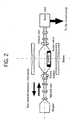
- a precursory anisotropic magnet powder (RFeBHx powder) was manufactured. Then the RFeBHx powder was recovered in a hopper of the equipment displayed in Figure 2 (rotary retort furnace equipment) and each of a blending process, a diffusion heat-treatment process and a dehydrogenation process was performed in turn under the conditions shown in Table 2.
- the rotary retort furnace equipment consists of a hopper from which a material powder is put and recovered (as shown in Figure 2), a rotary retort with one end connected to the hopper and that can rotate via a motor (not shown in figure), a rotary joint connected to a vacuum pump, which supports the other end of the rotary retort, and a heater that heats the rotary retort.
- the rotary retort is equipped in its center with a rotary furnace that can hold a material powder and it consists of a material pipe that connects one end of the rotating furnace with the hopper and an exhaust pipe that connects the other end of the rotating furnace with the rotary joint.
- This invention aims to provide a manufacturing method of an anisotropic magnet powder from which a bonded magnet with an improved loss of magnetization due to structural changes can be achieved.
- This is achieved by employing a low-temperature hydrogenation process, high-temperature hydrogenation process and the first evacuation process to an RFeB material (R: rare earth element) to manufacture a hydride powder (RFeBHx); the obtained RFeBHx powder (the precursory anisotropic magnet powder) is subsequently blended with a diffusion powder composed of hydride of dysprosium or the like and a diffusion heat-treatment process and a dehydrogenation process are employed.
- RFeBHx powder the precursory anisotropic magnet powder
- a diffusion powder composed of hydride of dysprosium or the like
- a diffusion heat-treatment process and a dehydrogenation process are employed.
Landscapes
- Engineering & Computer Science (AREA)
- Power Engineering (AREA)
- Manufacturing & Machinery (AREA)
- Chemical & Material Sciences (AREA)
- Crystallography & Structural Chemistry (AREA)
- Inorganic Chemistry (AREA)
- Hard Magnetic Materials (AREA)
- Powder Metallurgy (AREA)
- Manufacturing Cores, Coils, And Magnets (AREA)
Abstract
Description

| Sample material No. | Anisotropic magnet powder | Bonded magnet | Remarks | ||||
| Mximum energy product (BH)max (kJ/m3) | Residual magnetic flux density Br (T) | Coercivity IHC (kA/m) | Degree of anisotropy Br/Bs | Degree of permanent demagnetization (%) | |||
| E x a m p l e | 1 | 1-1 | 258 | 1.16 | 1527 | 0.83 | 7 |
| 1-2 | 309 | 1.3 | 1320 | 0.92 | 9 | ||
| 1-3 | 288 | 1.27 | 1114 | 0.91 | 12 | ||
| 1-4 | 270 | 1.23 | 1416 | 0.87 | 9 | ||
| 2 | 2-1 | 282 | 1.24 | 1209 | 0.88 | 10 | |
| 3 | 3-1 | 255 | 1.18 | 1511 | 0.84 | 8 | |
| 3-2 | 301 | 1.32 | 1090 | 0.82 | 10 | ||
| 3-3 | 272 | 1.18 | 1479 | 0.84 | 8.2 | ||
| 4 | 4-1 | 278 | 1.22 | 1488 | 0.87 | 7.6 | |
| 4-2 | 307 | 1.34 | 1106 | 0.84 | 9.2 | ||
| 4-3 | 271 | 1.22 | 1448 | 0.87 | 8.1 | ||
| 5 | 5-1 | 246 | 1.15 | 1511 | 0.82 | 10 | |
| C o m p a r a t i v e e x a m p l e s | 1 | C-1 | 298 | 1.32 | 986 | 0.82 | 18 |
| 2 | C-2 | 159 | 0.9 | 1591 | 0.64 | 6 | |
| 3 | C-3 | 199 | 1.12 | 398 | 0.8 | 20 | |
| 4 | C-4 | 95 | 1.02 | 103 | 0.73 | - | |
| 5 | C-5 | 239/207 | 1.13/1.04 | 1488/1138 | 0.81/0.74 | 11/20 | Uppper /Lower |
| 6 | C-6 | 95 | 0.74 | 1432 | 0.5 | - | |
| 7 | C-7 | 239 | 1.15 | 1273 | 0.82 | 18 |
Claims (12)
- A manufacturing method of an anisotropic magnet powder comprising the following processes;A blending process of RFeB hydride (RFeBHx) powder, which is mainly composed of rare earth elements including yttrium (Y) (hereafter referred to as "R"), boron (B) and iron (Fe), with diffusion powder that is composed of a simple substance, an alloy, a compound or a hydride of one or more elements in a elemental group which includes dysprosium (Dy), terbium (Tb), neodymium (Nd) and praseodymium (Pr) [hereafter referred to as "R1 elements"];a diffusion heat-treatment process in which R1 elements are diffused uniformly on the surface and inside of the RFeBHx powder; anda dehydrogenation process (the second evacuation process) in which hydrogen is removed from the mixture of the powder after the diffusion heat-treatment process.
- The manufacturing method of an anisotropic magnet powder described in claim 1 wherein an alloy or compound of R1 elements stated above or their hydride (alloy, compound) comprises one or more elements in an elemental group which consists of 3d and 4d transition elements (hereafter referred to as "TM elements"), and wherein R1 elements and TM elements are diffused uniformly on the surface and inside of the RfeBHx powder in a diffusion heat-treatment process.
- The manufacturing method of an anisotropic magnet powder described in claim 1 wherein the RFeBHx powder is manufactured applying a low-temperature hydrogenation process in which the abovementioned RFeB material is maintained under hydrogen gas atmosphere at a temperature lower than 600 °C , a high-temperature hydrogenation process in which the RFeB material is maintained under hydrogen gas atmosphere with hydrogen gas pressure of 0.1-0.6 MPa at a temperature between 750-850 °C and the first evacuation process in which the RFeB material is maintained under hydrogen gas atmosphere with hydrogen pressure of 0.1-6.0 MPa at a temperature between 750-850 °C .
- The manufacturing method of an anisotropic magnet powder described in claim 1 and 2 wherein the diffusion powder is any of a dysprosium hydride powder, a dysprosium-cobalt powder, a neodymium hydride powder or a neodymium-cobalt powder.
- The manufacturing method of an anisotropic magnet powder described in claim 1 wherein 0.1-3.0 mol% of a diffusion powder is blended with the entire mixture powder of 100 mol% in the blending process.
- The manufacturing method of an anisotropic magnet powder described in claims 1 and 2 wherein the abovementioned diffusion heat-treatment process is operated under oxidization-preventive atmosphere at a temperature between 400-900 °C.
- The manufacturing method of an anisotropic magnet powder described in claim 1 wherein the abovementioned dehydrogenation process is operated at 750-850°C under vacuum with pressure less than 1 Pa.
- The manufacturing method of an anisotropic magnet powder described in claim 1 wherein the abovementioned RFeB material is mainly composed of iron, and including 11-15 at% of R and 5.5-8 at% of B.
- The manufacturing method of an anisotropic magnet powder described in claim 8 wherein the abovementioned R is neodymium (Nd).
- The manufacturing method of an anisotropic magnet powder described in claims 1 wherein the abovementioned RFeB material contains either gallium (Ga) or niobium (Nb), or both.
- The precursory anisotropic magnet powder that is a RFeB hydride (RFeBHx) powder which is mainly composed of rare earth elements including yttrium (Y), boron (B) and iron (Fe), and is characterized with an average crystal radius ranging from 0.1-1.0 µm.
- The bonded magnet whose loss of magnetization due to structure change is less than 15%, made of an anisotropic magnet powder comprising rare earth elements including yttrium (Y), boron(B) and iron (Fe), with a degree of anisotropy (Br/Bs), which is given by the ratio of the residual magnetic flux density (Br) to the saturation magnetic flux density (Bs), greater than 0.75, and with an average crystal radius between 0.1-1.0 µm.
Applications Claiming Priority (2)
| Application Number | Priority Date | Filing Date | Title |
|---|---|---|---|
| JP2000285679A JP3452254B2 (en) | 2000-09-20 | 2000-09-20 | Method for producing anisotropic magnet powder, raw material powder for anisotropic magnet powder, and bonded magnet |
| JP2000285679 | 2000-09-20 |
Publications (3)
| Publication Number | Publication Date |
|---|---|
| EP1191553A2 true EP1191553A2 (en) | 2002-03-27 |
| EP1191553A3 EP1191553A3 (en) | 2003-07-30 |
| EP1191553B1 EP1191553B1 (en) | 2009-09-09 |
Family
ID=18769707
Family Applications (1)
| Application Number | Title | Priority Date | Filing Date |
|---|---|---|---|
| EP01122268A Expired - Lifetime EP1191553B1 (en) | 2000-09-20 | 2001-09-18 | Manufacturing method of an anisotropic magnet powder |
Country Status (7)
| Country | Link |
|---|---|
| US (2) | US6709533B2 (en) |
| EP (1) | EP1191553B1 (en) |
| JP (1) | JP3452254B2 (en) |
| KR (1) | KR100452787B1 (en) |
| CN (1) | CN1198291C (en) |
| DE (1) | DE60139844D1 (en) |
| TW (1) | TW527611B (en) |
Cited By (11)
| Publication number | Priority date | Publication date | Assignee | Title |
|---|---|---|---|---|
| WO2004049359A1 (en) * | 2002-11-28 | 2004-06-10 | Vacuumschmelze Gmbh & Co. Kg | Method for the production of an anisotropic magnetic powder and a bonded anisotropic magnet produced therefrom |
| EP1523017A3 (en) * | 2003-10-10 | 2007-07-11 | Aichi Steel Corporation | A composite rare-earth anisotropic bonded magnet, composite rare-earth anisotropic bonded magnet compound, and methods for their production |
| EP1494251A4 (en) * | 2002-04-09 | 2007-07-25 | Aichi Steel Corp | RARE EARTH COMPOSITE ANISOTROPIC LITE MAGNET, RARE EARTH COMPOSITE ANISOTROPIC LIE COMPOSITE MAGNET, AND MAGNET PRODUCTION PROCESS |
| EP1946837A3 (en) * | 2002-10-17 | 2008-07-30 | Carnegie Mellon University | Catalyst comprising an interstitial metal hydride for the treatment of organic compounds |
| US7632360B2 (en) | 2003-08-27 | 2009-12-15 | Nissan Motor Co., Ltd. | Rare earth magnet powder and method of producing the same |
| CN101853724A (en) * | 2009-03-30 | 2010-10-06 | Tdk株式会社 | The manufacture method of rare earth element magnet |
| EP2133891A4 (en) * | 2007-03-30 | 2011-01-26 | Tdk Corp | METHOD FOR MANUFACTURING A MAGNET |
| JP2012109369A (en) * | 2010-11-17 | 2012-06-07 | Hitachi Metals Ltd | METHOD OF PRODUCING R-Fe-B-BASED SINTERED MAGNET |
| US20130009736A1 (en) * | 2009-12-09 | 2013-01-10 | Aichi Steel Corporation | Anisotropic rare earth magnet powder, method for producing the same, and bonded magnet |
| WO2013107713A1 (en) * | 2012-01-20 | 2013-07-25 | Robert Bosch Gmbh | Method for producing a magnetic material and permanent magnet |
| FR3044161A1 (en) * | 2015-11-25 | 2017-05-26 | Commissariat Energie Atomique | PERMANENT FRITTE MAGNET |
Families Citing this family (55)
| Publication number | Priority date | Publication date | Assignee | Title |
|---|---|---|---|---|
| DE10291914B3 (en) * | 2001-06-29 | 2013-03-28 | Hitachi Metals, Ltd. | Apparatus for subjecting a rare earth alloy to a hydrogenation process |
| CN1300807C (en) * | 2001-12-19 | 2007-02-14 | 株式会社新王磁材 | Rare earth-iron-boron alloy and magnetically anisotropic permanent magnet powder and manufacturing method thereof |
| US6955729B2 (en) | 2002-04-09 | 2005-10-18 | Aichi Steel Corporation | Alloy for bonded magnets, isotropic magnet powder and anisotropic magnet powder and their production method, and bonded magnet |
| US7311788B2 (en) * | 2002-09-30 | 2007-12-25 | Tdk Corporation | R-T-B system rare earth permanent magnet |
| JP4076178B2 (en) * | 2002-09-30 | 2008-04-16 | Tdk株式会社 | R-T-B rare earth permanent magnet |
| US7255751B2 (en) * | 2002-09-30 | 2007-08-14 | Tdk Corporation | Method for manufacturing R-T-B system rare earth permanent magnet |
| KR100517642B1 (en) * | 2002-10-25 | 2005-09-29 | 한국과학기술연구원 | COMPOSITION AND FABRICATION OF Pr-Fe-B TYPE MAGNET POWDER |
| US7138018B2 (en) | 2003-01-16 | 2006-11-21 | Aichi Steel Corporation | Process for producing anisotropic magnet powder |
| KR100516512B1 (en) * | 2003-10-15 | 2005-09-26 | 자화전자 주식회사 | The making method of high coercive micro-structured powder for bonded magnets and The magnet powder thereof |
| CN1622237B (en) * | 2003-11-28 | 2010-04-28 | Tdk株式会社 | Manufacturing apparatus and method of alloy powder for permanent magnet |
| CN1901105B (en) * | 2005-07-18 | 2010-05-12 | 漯河市三鑫稀土永磁材料有限责任公司 | High anti-high temperature HDDR neodymium iron boron anisotropic magnetic powder |
| JP4730545B2 (en) * | 2006-04-14 | 2011-07-20 | 信越化学工業株式会社 | Method for producing rare earth permanent magnet material |
| JP4730546B2 (en) * | 2006-04-14 | 2011-07-20 | 信越化学工業株式会社 | Rare earth permanent magnet manufacturing method |
| JP4605396B2 (en) | 2006-04-14 | 2011-01-05 | 信越化学工業株式会社 | Method for producing rare earth permanent magnet material |
| JP4656323B2 (en) * | 2006-04-14 | 2011-03-23 | 信越化学工業株式会社 | Method for producing rare earth permanent magnet material |
| US7955443B2 (en) * | 2006-04-14 | 2011-06-07 | Shin-Etsu Chemical Co., Ltd. | Method for preparing rare earth permanent magnet material |
| DE102006019614B4 (en) * | 2006-04-25 | 2010-06-17 | Vacuumschmelze Gmbh & Co. Kg | Aging resistant permanent magnet made of an alloy powder and process for its preparation |
| JP4840606B2 (en) | 2006-11-17 | 2011-12-21 | 信越化学工業株式会社 | Rare earth permanent magnet manufacturing method |
| US9324485B2 (en) | 2008-02-29 | 2016-04-26 | Daido Steel Co., Ltd. | Material for anisotropic magnet and method of manufacturing the same |
| CN101770843B (en) * | 2009-01-07 | 2014-08-20 | 大同特殊钢株式会社 | Magnetic anisotropic magnet raw material and manufacturing method thereof |
| JP2010255098A (en) * | 2009-03-30 | 2010-11-11 | Tdk Corp | Rare earth alloy powder, method for producing the same, compound for anisotropic bond magnet, and anisotropic bond magnet |
| JP5381435B2 (en) * | 2009-07-14 | 2014-01-08 | 富士電機株式会社 | Method for producing magnet powder for permanent magnet, permanent magnet powder and permanent magnet |
| EP2460609B1 (en) * | 2009-07-31 | 2019-06-12 | Hitachi Metals, Ltd. | Method of recovering a raw-material alloy powder for rare-earth magnet pulverized with hydrogen |
| JP5059929B2 (en) | 2009-12-04 | 2012-10-31 | 住友電気工業株式会社 | Magnet powder |
| CN102640238B (en) * | 2009-12-09 | 2015-01-21 | 爱知制钢株式会社 | Rare earth anisotropic magnet and process for production thereof |
| KR101195450B1 (en) * | 2010-01-22 | 2012-10-30 | 한국기계연구원 | The method for preparation of R-Fe-B type rare earth magnet powder for bonded magnet, R-Fe-B type rare earth magnet powder thereby and the method for preparation of bonded magnet using the magnet powder, bonded magnet thereby |
| JP5059955B2 (en) | 2010-04-15 | 2012-10-31 | 住友電気工業株式会社 | Magnet powder |
| CN103151130A (en) | 2010-05-19 | 2013-06-12 | 住友电气工业株式会社 | Powder for magnetic member, powder compact, and magnetic member |
| WO2011145674A1 (en) * | 2010-05-20 | 2011-11-24 | 独立行政法人物質・材料研究機構 | Method for producing rare earth permanent magnets, and rare earth permanent magnets |
| KR101219515B1 (en) * | 2010-07-02 | 2013-01-11 | 한국기계연구원 | The method for preparation of R-Fe-B type rare earth magnet powder for bonded magnet, R-Fe-B type rare earth magnet powder thereby and method for preparation of bonded magnet using the magnet powder, bonded magnet thereby |
| JP5757394B2 (en) * | 2010-07-30 | 2015-07-29 | 日立金属株式会社 | Rare earth permanent magnet manufacturing method |
| CN103140903B (en) | 2010-09-30 | 2016-06-29 | 日立金属株式会社 | The manufacture method of R-T-B class sintered magnet |
| JP5854304B2 (en) * | 2011-01-19 | 2016-02-09 | 日立金属株式会社 | Method for producing RTB-based sintered magnet |
| JP5708241B2 (en) * | 2011-05-24 | 2015-04-30 | トヨタ自動車株式会社 | Rare earth magnet manufacturing method |
| DE102011108174A1 (en) * | 2011-07-20 | 2013-01-24 | Aichi Steel Corporation | Magnetic material and process for its production |
| DE102011108173A1 (en) * | 2011-07-20 | 2013-01-24 | Aichi Steel Corporation | Magnetic material and process for its production |
| CN104036945A (en) * | 2014-06-11 | 2014-09-10 | 北京工业大学 | Method for manufacturing high-temperature stable regenerated sintered neodymium-iron-boron magnet by waste permanent-magnet motor magnet steel |
| CN104036944A (en) * | 2014-06-11 | 2014-09-10 | 北京工业大学 | Method for using bulk sintered neodymium iron boron (NdFeB) machining waste to prepare high-temperature-stability regenerated sintered NdFeB magnet |
| CN104036949A (en) * | 2014-06-11 | 2014-09-10 | 北京工业大学 | Method for using bulk sintered neodymium iron boron (NdFeB) machining waste to prepare high-performance regenerated NdFeB magnet |
| CN104036947A (en) * | 2014-06-11 | 2014-09-10 | 北京工业大学 | Method for manufacturing high-coercivity regenerated sintered neodymium-iron-boron magnet by waste permanent-magnet motor magnet steel |
| CN104036942A (en) * | 2014-06-11 | 2014-09-10 | 北京工业大学 | Method for using bulk sintered neodymium iron boron (NdFeB) machining waste to prepare high-performance regenerated NdFeB magnet |
| CN105839006B (en) | 2015-01-29 | 2020-08-11 | 户田工业株式会社 | Method for producing R-T-B-based rare earth magnet powder, and bonded magnet |
| CN106205992B (en) * | 2016-06-28 | 2019-05-07 | 上海交通大学 | Sintered NdFeB magnets with high coercivity and low remanence temperature sensitivity and their preparation |
| US10490326B2 (en) * | 2016-12-12 | 2019-11-26 | Hyundai Motor Company | Method of producing rare earth permanent magnet |
| CN108220732B (en) | 2016-12-22 | 2019-12-31 | 有研稀土新材料股份有限公司 | Alloy material, bonded magnet and modification method of rare earth permanent magnet powder |
| KR102045402B1 (en) * | 2018-04-30 | 2019-11-15 | 성림첨단산업(주) | Manufacturing method of rare earth sintered magnet |
| JP7167673B2 (en) * | 2018-12-03 | 2022-11-09 | Tdk株式会社 | Manufacturing method of RTB system permanent magnet |
| CN110752087B (en) * | 2019-11-06 | 2021-12-14 | 有研稀土新材料股份有限公司 | Preparation method of rare earth anisotropic bonded magnetic powder |
| CN110890190A (en) * | 2019-11-06 | 2020-03-17 | 有研稀土新材料股份有限公司 | Anisotropic bonded magnetic powder and preparation method thereof |
| CN112017835B (en) * | 2020-08-20 | 2023-03-17 | 合肥工业大学 | Low-heavy rare earth high-coercivity sintered neodymium-iron-boron magnet and preparation method thereof |
| USD1008321S1 (en) | 2021-01-18 | 2023-12-19 | Samsung Electronics Co., Ltd. | Refrigerator |
| CN115394550B (en) * | 2022-08-19 | 2026-01-23 | 中国船舶重工集团公司第七二五研究所 | Device and method for preparing anisotropic neodymium iron boron magnetic powder and neodymium iron boron magnetic powder |
| CN115728684B (en) * | 2022-11-17 | 2025-11-25 | 杭州美磁科技有限公司 | Method for identifying irreversible demagnetization of grain boundary diffused NdFeB magnets by magnetic field distribution |
| KR102698757B1 (en) | 2023-01-30 | 2024-08-26 | 성림첨단산업(주) | Manufacturing method of rare earth sintered magnet |
| CN118565222A (en) * | 2024-05-17 | 2024-08-30 | 包头稀土研究院 | Hydrogen absorption vacuum heat treatment device, system and use method for LaFeSi series materials |
Family Cites Families (21)
| Publication number | Priority date | Publication date | Assignee | Title |
|---|---|---|---|---|
| FR2566758B1 (en) * | 1984-06-29 | 1990-01-12 | Centre Nat Rech Scient | NOVEL MAGNETIC RARE EARTH / IRON / BORON AND RARE EARTH / COBALT / BORON HYDRIDES, THEIR MANUFACTURING AND MANUFACTURING PROCESS FOR POWDER DEHYDRIDE PRODUCTS, THEIR APPLICATIONS |
| CN1012477B (en) * | 1987-08-19 | 1991-05-01 | 三菱金属株式会社 | Rare earth-iron-boron magnet powder and preparation method thereof |
| US5143560A (en) * | 1990-04-20 | 1992-09-01 | Hitachi Metals, Inc., Ltd. | Method for forming Fe-B-R-T alloy powder by hydrogen decrepitation of die-upset billets |
| US5580396A (en) * | 1990-07-02 | 1996-12-03 | Centre National De La Recherche Scientifique (Cnrs) | Treatment of pulverant magnetic materials and products thus obtained |
| FR2665295B1 (en) * | 1990-07-25 | 1994-09-16 | Aimants Ugimag Sa | METHOD OF OBTAINING IN DIVIDED FORM A MAGNETIC MATERIAL OF THE RARE EARTH TYPE - TRANSITION METALS - BORON FOR MAGNETS RESISTANT TO CORROSION. |
| US5091020A (en) * | 1990-11-20 | 1992-02-25 | Crucible Materials Corporation | Method and particle mixture for making rare earth element, iron and boron permanent sintered magnets |
| US5127970A (en) * | 1991-05-21 | 1992-07-07 | Crucible Materials Corporation | Method for producing rare earth magnet particles of improved coercivity |
| JPH05179313A (en) * | 1992-01-06 | 1993-07-20 | Daido Steel Co Ltd | Production of magnet material containing rare earth element |
| JP3611870B2 (en) * | 1993-09-06 | 2005-01-19 | 株式会社Neomax | Method for producing R-Fe-B permanent magnet material |
| US5454998A (en) * | 1994-02-04 | 1995-10-03 | Ybm Technologies, Inc. | Method for producing permanent magnet |
| JPH07245206A (en) * | 1994-03-04 | 1995-09-19 | Tokin Corp | Powder for rare earth permanent magnet and method for producing the same |
| JPH07278615A (en) * | 1994-04-07 | 1995-10-24 | Sumitomo Special Metals Co Ltd | Method for producing anisotropic rare earth alloy powder for permanent magnet |
| JPH08176617A (en) * | 1994-12-26 | 1996-07-09 | Aichi Steel Works Ltd | Method for producing rare earth-Fe-B based alloy magnet powder excellent in magnetic anisotropy |
| JP3623564B2 (en) * | 1995-10-13 | 2005-02-23 | 株式会社Neomax | Anisotropic bonded magnet |
| JPH09165601A (en) * | 1995-12-12 | 1997-06-24 | Sumitomo Special Metals Co Ltd | Anisotropic rare earth alloy powder for permanent magnet and production of anisotropic bonded magnet |
| JPH10326705A (en) * | 1997-05-26 | 1998-12-08 | Aichi Steel Works Ltd | Rare earth magnet powder and method for producing the same |
| JP3463911B2 (en) * | 1997-06-23 | 2003-11-05 | 愛知製鋼株式会社 | Anisotropic magnet powder |
| JPH1131610A (en) * | 1997-07-11 | 1999-02-02 | Mitsubishi Materials Corp | Method for producing rare earth magnet powder excellent in magnetic anisotropy |
| JP3865180B2 (en) * | 1998-09-18 | 2007-01-10 | 愛知製鋼株式会社 | Heat-resistant rare earth alloy anisotropic magnet powder |
| FR2783964A1 (en) * | 1998-09-28 | 2000-03-31 | Rhodia Chimie Sa | MAGNETIC MATERIAL BASED ON IRON, COBALT, RARE EARTHS AND BORON AND MAGNET BASED ON THIS MATERIAL |
| JP3250551B2 (en) | 1999-06-28 | 2002-01-28 | 愛知製鋼株式会社 | Method for producing anisotropic rare earth magnet powder |
-
2000
- 2000-09-20 JP JP2000285679A patent/JP3452254B2/en not_active Expired - Fee Related
-
2001
- 2001-08-30 TW TW090121502A patent/TW527611B/en not_active IP Right Cessation
- 2001-09-18 DE DE60139844T patent/DE60139844D1/en not_active Expired - Lifetime
- 2001-09-18 EP EP01122268A patent/EP1191553B1/en not_active Expired - Lifetime
- 2001-09-18 KR KR10-2001-0057440A patent/KR100452787B1/en not_active Expired - Lifetime
- 2001-09-19 US US09/955,078 patent/US6709533B2/en not_active Expired - Lifetime
- 2001-09-20 CN CNB011406968A patent/CN1198291C/en not_active Expired - Lifetime
-
2002
- 2002-08-27 US US10/228,096 patent/US20030047240A1/en not_active Abandoned
Cited By (19)
| Publication number | Priority date | Publication date | Assignee | Title |
|---|---|---|---|---|
| EP1494251A4 (en) * | 2002-04-09 | 2007-07-25 | Aichi Steel Corp | RARE EARTH COMPOSITE ANISOTROPIC LITE MAGNET, RARE EARTH COMPOSITE ANISOTROPIC LIE COMPOSITE MAGNET, AND MAGNET PRODUCTION PROCESS |
| EP1946837A3 (en) * | 2002-10-17 | 2008-07-30 | Carnegie Mellon University | Catalyst comprising an interstitial metal hydride for the treatment of organic compounds |
| US7625832B2 (en) | 2002-10-17 | 2009-12-01 | Carnegie Mellon University | Catalyst for the treatment of organic compounds |
| US7972448B2 (en) | 2002-11-28 | 2011-07-05 | Vacuumschmelze Gmbh & Co. Kg | Method for the production of an anisotropic magnetic powder and a bonded anisotropic magnet produced therefrom |
| WO2004049359A1 (en) * | 2002-11-28 | 2004-06-10 | Vacuumschmelze Gmbh & Co. Kg | Method for the production of an anisotropic magnetic powder and a bonded anisotropic magnet produced therefrom |
| US7632360B2 (en) | 2003-08-27 | 2009-12-15 | Nissan Motor Co., Ltd. | Rare earth magnet powder and method of producing the same |
| EP1523017A3 (en) * | 2003-10-10 | 2007-07-11 | Aichi Steel Corporation | A composite rare-earth anisotropic bonded magnet, composite rare-earth anisotropic bonded magnet compound, and methods for their production |
| US7357880B2 (en) | 2003-10-10 | 2008-04-15 | Aichi Steel Corporation | Composite rare-earth anisotropic bonded magnet, composite rare-earth anisotropic bonded magnet compound, and methods for their production |
| EP2133891A4 (en) * | 2007-03-30 | 2011-01-26 | Tdk Corp | METHOD FOR MANUFACTURING A MAGNET |
| EP2237289A1 (en) * | 2009-03-30 | 2010-10-06 | TDK Corporation | Method of Producing Rare-Earth Magnet |
| CN101853724A (en) * | 2009-03-30 | 2010-10-06 | Tdk株式会社 | The manufacture method of rare earth element magnet |
| CN101853724B (en) * | 2009-03-30 | 2012-06-20 | Tdk株式会社 | Method of producing rare-earth magnet |
| US20130009736A1 (en) * | 2009-12-09 | 2013-01-10 | Aichi Steel Corporation | Anisotropic rare earth magnet powder, method for producing the same, and bonded magnet |
| US9640319B2 (en) * | 2009-12-09 | 2017-05-02 | Aichi Steel Corporation | Anisotropic rare earth magnet powder, method for producing the same, and bonded magnet |
| US10607755B2 (en) | 2009-12-09 | 2020-03-31 | Aichi Steel Corporation | Anisotropic rare earth magnet powder, method for producing the same, and bonded magnet |
| JP2012109369A (en) * | 2010-11-17 | 2012-06-07 | Hitachi Metals Ltd | METHOD OF PRODUCING R-Fe-B-BASED SINTERED MAGNET |
| WO2013107713A1 (en) * | 2012-01-20 | 2013-07-25 | Robert Bosch Gmbh | Method for producing a magnetic material and permanent magnet |
| FR3044161A1 (en) * | 2015-11-25 | 2017-05-26 | Commissariat Energie Atomique | PERMANENT FRITTE MAGNET |
| WO2017089488A1 (en) * | 2015-11-25 | 2017-06-01 | Commissariat A L'energie Atomique Et Aux Energies Alternatives | Sintered permanent magnet |
Also Published As
| Publication number | Publication date |
|---|---|
| TW527611B (en) | 2003-04-11 |
| KR100452787B1 (en) | 2004-10-14 |
| CN1345073A (en) | 2002-04-17 |
| EP1191553A3 (en) | 2003-07-30 |
| US20020059965A1 (en) | 2002-05-23 |
| JP3452254B2 (en) | 2003-09-29 |
| CN1198291C (en) | 2005-04-20 |
| US20030047240A1 (en) | 2003-03-13 |
| DE60139844D1 (en) | 2009-10-22 |
| EP1191553B1 (en) | 2009-09-09 |
| US6709533B2 (en) | 2004-03-23 |
| JP2002093610A (en) | 2002-03-29 |
| KR20020033504A (en) | 2002-05-07 |
Similar Documents
| Publication | Publication Date | Title |
|---|---|---|
| US6709533B2 (en) | Manufacturing method of an anisotropic magnet powder, precursory anisotropic magnet powder and bonded magnet | |
| US7138018B2 (en) | Process for producing anisotropic magnet powder | |
| US7867343B2 (en) | Rare earth magnet and method for production thereof | |
| US5597425A (en) | Rare earth cast alloy permanent magnets and methods of preparation | |
| EP1195779A2 (en) | Rare-earth sintered magnet and method of producing the same | |
| JP5288277B2 (en) | Manufacturing method of RTB-based permanent magnet | |
| WO2011070827A1 (en) | Rare earth anisotropic magnet and process for production thereof | |
| CN100334660C (en) | Method for producing R-T-B based rare earth element permanent magnet | |
| GB2357089A (en) | Production method of anisotropic rare earth magnet powder | |
| EP0248981A2 (en) | Permanent magnet and permanent magnetic alloy | |
| JP4076178B2 (en) | R-T-B rare earth permanent magnet | |
| JP5288276B2 (en) | Manufacturing method of RTB-based permanent magnet | |
| US6136099A (en) | Rare earth-iron series permanent magnets and method of preparation | |
| US5186761A (en) | Magnetic alloy and method of production | |
| JP3597615B2 (en) | Method for producing RTB based anisotropic bonded magnet | |
| EP0288637B1 (en) | Permanent magnet and method of making the same | |
| CN113571278A (en) | Magnetic powder, method for forming magnetic powder, rare earth sintered permanent magnet and preparation method thereof | |
| US5460662A (en) | Permanent magnet and method of production | |
| JP3623564B2 (en) | Anisotropic bonded magnet | |
| JP3086334B2 (en) | Anisotropic rare earth alloy powder for permanent magnet | |
| EP0599815B1 (en) | Magnetic alloy and method of making the same | |
| JP2023173696A (en) | Rare earth magnet and its manufacturing method | |
| EP0289680B1 (en) | Permanent magnet and method of producing the same | |
| JP2004071949A (en) | Manufacturing method of rare earth sintered magnet | |
| CN1067134A (en) | Heat-resisting R-iron-boron system permanent magnetic material and manufacture method thereof |
Legal Events
| Date | Code | Title | Description |
|---|---|---|---|
| PUAI | Public reference made under article 153(3) epc to a published international application that has entered the european phase |
Free format text: ORIGINAL CODE: 0009012 |
|
| 17P | Request for examination filed |
Effective date: 20010918 |
|
| AK | Designated contracting states |
Kind code of ref document: A2 Designated state(s): AT BE CH CY DE DK ES FI FR GB GR IE IT LI LU MC NL PT SE TR |
|
| AX | Request for extension of the european patent |
Free format text: AL;LT;LV;MK;RO;SI |
|
| PUAL | Search report despatched |
Free format text: ORIGINAL CODE: 0009013 |
|
| AK | Designated contracting states |
Designated state(s): AT BE CH CY DE DK ES FI FR GB GR IE IT LI LU MC NL PT SE TR |
|
| AX | Request for extension of the european patent |
Extension state: AL LT LV MK RO SI |
|
| AKX | Designation fees paid |
Designated state(s): DE FR GB IT |
|
| 17Q | First examination report despatched |
Effective date: 20050304 |
|
| 17Q | First examination report despatched |
Effective date: 20050304 |
|
| RTI1 | Title (correction) |
Free format text: MANUFACTURING METHOD OF AN ANISOTROPIC MAGNET POWDER |
|
| GRAP | Despatch of communication of intention to grant a patent |
Free format text: ORIGINAL CODE: EPIDOSNIGR1 |
|
| GRAS | Grant fee paid |
Free format text: ORIGINAL CODE: EPIDOSNIGR3 |
|
| GRAA | (expected) grant |
Free format text: ORIGINAL CODE: 0009210 |
|
| AK | Designated contracting states |
Kind code of ref document: B1 Designated state(s): DE FR GB IT |
|
| REG | Reference to a national code |
Ref country code: GB Ref legal event code: FG4D |
|
| REF | Corresponds to: |
Ref document number: 60139844 Country of ref document: DE Date of ref document: 20091022 Kind code of ref document: P |
|
| PLBE | No opposition filed within time limit |
Free format text: ORIGINAL CODE: 0009261 |
|
| STAA | Information on the status of an ep patent application or granted ep patent |
Free format text: STATUS: NO OPPOSITION FILED WITHIN TIME LIMIT |
|
| 26N | No opposition filed |
Effective date: 20100610 |
|
| PG25 | Lapsed in a contracting state [announced via postgrant information from national office to epo] |
Ref country code: IT Free format text: LAPSE BECAUSE OF FAILURE TO SUBMIT A TRANSLATION OF THE DESCRIPTION OR TO PAY THE FEE WITHIN THE PRESCRIBED TIME-LIMIT Effective date: 20090909 |
|
| REG | Reference to a national code |
Ref country code: FR Ref legal event code: ST Effective date: 20110422 |
|
| PG25 | Lapsed in a contracting state [announced via postgrant information from national office to epo] |
Ref country code: FR Free format text: LAPSE BECAUSE OF NON-PAYMENT OF DUE FEES Effective date: 20091109 |
|
| PGFP | Annual fee paid to national office [announced via postgrant information from national office to epo] |
Ref country code: GB Payment date: 20200922 Year of fee payment: 20 Ref country code: DE Payment date: 20200925 Year of fee payment: 20 |
|
| REG | Reference to a national code |
Ref country code: DE Ref legal event code: R071 Ref document number: 60139844 Country of ref document: DE |
|
| REG | Reference to a national code |
Ref country code: GB Ref legal event code: PE20 Expiry date: 20210917 |
|
| PG25 | Lapsed in a contracting state [announced via postgrant information from national office to epo] |
Ref country code: GB Free format text: LAPSE BECAUSE OF EXPIRATION OF PROTECTION Effective date: 20210917 |