EP1191402A2 - Méthode et système de réduction de la contamination d'un dispositif de déchargement à effet corona - Google Patents
Méthode et système de réduction de la contamination d'un dispositif de déchargement à effet corona Download PDFInfo
- Publication number
- EP1191402A2 EP1191402A2 EP01119725A EP01119725A EP1191402A2 EP 1191402 A2 EP1191402 A2 EP 1191402A2 EP 01119725 A EP01119725 A EP 01119725A EP 01119725 A EP01119725 A EP 01119725A EP 1191402 A2 EP1191402 A2 EP 1191402A2
- Authority
- EP
- European Patent Office
- Prior art keywords
- corona charger
- charger
- plate
- corona
- contaminated air
- Prior art date
- Legal status (The legal status is an assumption and is not a legal conclusion. Google has not performed a legal analysis and makes no representation as to the accuracy of the status listed.)
- Withdrawn
Links
Images


Classifications
-
- G—PHYSICS
- G03—PHOTOGRAPHY; CINEMATOGRAPHY; ANALOGOUS TECHNIQUES USING WAVES OTHER THAN OPTICAL WAVES; ELECTROGRAPHY; HOLOGRAPHY
- G03G—ELECTROGRAPHY; ELECTROPHOTOGRAPHY; MAGNETOGRAPHY
- G03G15/00—Apparatus for electrographic processes using a charge pattern
- G03G15/02—Apparatus for electrographic processes using a charge pattern for laying down a uniform charge, e.g. for sensitising; Corona discharge devices
- G03G15/0208—Apparatus for electrographic processes using a charge pattern for laying down a uniform charge, e.g. for sensitising; Corona discharge devices by contact, friction or induction, e.g. liquid charging apparatus
- G03G15/0216—Apparatus for electrographic processes using a charge pattern for laying down a uniform charge, e.g. for sensitising; Corona discharge devices by contact, friction or induction, e.g. liquid charging apparatus by bringing a charging member into contact with the member to be charged, e.g. roller, brush chargers
- G03G15/0225—Apparatus for electrographic processes using a charge pattern for laying down a uniform charge, e.g. for sensitising; Corona discharge devices by contact, friction or induction, e.g. liquid charging apparatus by bringing a charging member into contact with the member to be charged, e.g. roller, brush chargers provided with means for cleaning the charging member
-
- G—PHYSICS
- G03—PHOTOGRAPHY; CINEMATOGRAPHY; ANALOGOUS TECHNIQUES USING WAVES OTHER THAN OPTICAL WAVES; ELECTROGRAPHY; HOLOGRAPHY
- G03G—ELECTROGRAPHY; ELECTROPHOTOGRAPHY; MAGNETOGRAPHY
- G03G15/00—Apparatus for electrographic processes using a charge pattern
- G03G15/02—Apparatus for electrographic processes using a charge pattern for laying down a uniform charge, e.g. for sensitising; Corona discharge devices
- G03G15/0258—Apparatus for electrographic processes using a charge pattern for laying down a uniform charge, e.g. for sensitising; Corona discharge devices provided with means for the maintenance of the charging apparatus, e.g. cleaning devices, ozone removing devices G03G15/0225, G03G15/0291 takes precedence
-
- G—PHYSICS
- G03—PHOTOGRAPHY; CINEMATOGRAPHY; ANALOGOUS TECHNIQUES USING WAVES OTHER THAN OPTICAL WAVES; ELECTROGRAPHY; HOLOGRAPHY
- G03G—ELECTROGRAPHY; ELECTROPHOTOGRAPHY; MAGNETOGRAPHY
- G03G15/00—Apparatus for electrographic processes using a charge pattern
- G03G15/02—Apparatus for electrographic processes using a charge pattern for laying down a uniform charge, e.g. for sensitising; Corona discharge devices
- G03G15/0291—Apparatus for electrographic processes using a charge pattern for laying down a uniform charge, e.g. for sensitising; Corona discharge devices corona discharge devices, e.g. wires, pointed electrodes, means for cleaning the corona discharge device
Definitions
- This invention relates to a method for reducing contamination of a corona charger in an electrophotographic process by identifying and directing contaminated airflow streams away from the corona charger.
- corona charges are used to impart a charge to a photoconductive film which is subsequently passed to an imaging section, a developing section and an image transfer section where the image on the photoconductor film is transferred to a paper to produce a copy of the image on the paper.
- the paper is subsequently passed to a fuser section where a toner image on the paper is fixed to the paper by elevated temperature and pressure in the fuser section.
- the photoconductor film then passes through a neutralization section and thereafter past a brush cleaner which removes contaminants from the film prior to passing the photoconductor film back to the primary charging section.
- contaminated air streams which may be directed to and passed by or into the corona charger.
- Such streams are typically produced in copier machine systems such as the environmental control system, the cleaning blower system, the writer blower system, paper transport fan systems, cooler fan systems, the charger rest blower system and the like. All of these systems produce air streams which may contain contaminants of one sort or another. Particularly, streams which may contain fuser oil or toner represent significant contaminants to the corona charger.
- corona chargers typically include bare corona wires which are located between a grid electrode and a shield. These wires are relatively small in diameter and since they are highly charged, contamination of these wires by materials such as fuser oil, toner dust particles and the like can create charger arcing which causes machine errors and non-uniform charging which creates copy image problems.
- contamination of a corona charger is reduced in an electrophotographic process wherein the corona charger imparts a charge to a photoconductor film passed by the corona charger by: identifying contaminated air flow streams and determining the direction of flow of the contaminated air flow stream flowing past or into the corona charger and positioning at least one plate to divert the contaminated air flow streams away from the corona charger.
- the invention further comprises a contamination protected corona charger system comprising: a corona charger; at least one plate positioned to direct contaminated air flows away from the corona charger and at least partially enclose a controlled air circulation space around the corona charger and a clean gas supply positioned to discharge a clean gas between the at least one plate and a photoconductor film passed by the corona charger to provide a positive clean gas pressure between the at least one plate and the phtoconductor film in the controlled air circulation space.
- a contamination protected corona charger system comprising: a corona charger; at least one plate positioned to direct contaminated air flows away from the corona charger and at least partially enclose a controlled air circulation space around the corona charger and a clean gas supply positioned to discharge a clean gas between the at least one plate and a photoconductor film passed by the corona charger to provide a positive clean gas pressure between the at least one plate and the phtoconductor film in the controlled air circulation space.
- the invention also comprises an improvement in a method for producing photocopies wherein a corona charger is used to charge a photoconductor film passed by the corona charger, the improvement comprising identifying and determining the flow direction of contaminated air flow streams and positioning at least one plate to divert the contaminated air flow streams away from the corona charger.
- FIG. 1 is a schematic diagram of the flow path 10 of a photoconductor film in an electrophotographic process.
- a photoconductor film 12 is shown schematically supported by three rollers 14.
- the photoconductor film is typically charged in a primary charging section by a corona charger 16.
- the charged film then passes to an imaging section 18 where an image it is transmitted electrophotographically or digitally or the like as known to those skilled in the art to the film.
- the film then passes through a developing section 20 where a toner which comprises a polymeric material which is adapted to become fixed to paper to produce a copy as positioned on the desired image.
- the image may be either a positive or a negative image as desired.
- the film is then passed to an image transfer section 22 where a toner forming the image is transferred to a paper which is typically charged to received the toner from the photoconductor film.
- the paper is subsequently passed through a fuser section (not shown) where the toner is caused to become fixed to the paper by heat and pressure to produce the finished copy.
- the photoconductor film is then passed to a neutralization section shown as a corona charger 24 where it is neutralized.
- the photoconductor film is then contacted by a brush cleaner 26 which typically rotates in a direction such that the brush surface contacts the film in a direction opposite the flow of the film passed by the brush. Contaminants removed by the brush are at least partially removed from the brush by any suitable means.
- the photoconductor film then passes back to the primary charging section and the process is repeated.
- Such processes are well known to those skilled in the art and while they involve considerably more complexity than detailed above, it is considered that such processes are well known and need not be discussed further.
- the corona charges are an important feature of the copying process.
- Such processes may incorporate at least two corona chargers.
- a similar charger may be used with the paper prior to transferring the color image to the paper.
- the corona charging devices comprise at least one corona wire in a housing.
- the corona wires are basically bare conductor wires which are located between a grid electrode and a shield and typically carry a relatively high voltage. These wires are relatively small and since they are highly charged they tend to attract contaminants. When they become contaminated, the contamination can result in charger arcing which causes machine errors and malfunctions and non-uniform charging which causes copy quality defects.
- contaminated air streams can be generated from normal machine operations by environmental control systems, cleaning blowers, writer blowers, paper transport fans, cooler fans, charger rests, blowers and the like.
- Major contaminants which have been found to be detrimental to corona charger operations are fuser oil residues from the fusing operation and toner.
- FIG 2 a typical position of a corona charger 16 adjacent a photoconductor film 12 is shown.
- the film typically passes by the charger and is charged as it passes to the image forming section.
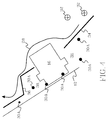
- FIG 3 the results of a determination of air currents in the vicinity of and entering into the corona discharger in a copier/duplicator machine is shown.
- the contaminated airflows are shown by lines 28.
- Contaminated airflows are also shown by a dot 30 which represents an airflow directed out of the page and by a cross in a circle 32 which represents an airflow stream which is passing into the page.
- This view is taken from the front of a copier/duplicator machine in the vicinity of the corona charger. Many machine elements have been eliminated from the Figure for simplicity.
- FIG 4 the corona charger of Figure 3 is shown with shields 34 and 36 in position to deflect air streams away from corona charger 16.
- the injection of cleaned gas is shown by dots 30A representing the flow of clean gas outwardly from the vicinity of corona charger 16. Gas flow into the page is shown by crossed circles 32.
- a controlled air circulation space 38 is formed by photoconductor film 12 and plates 34 and 36. Desirably plates 34 and 36 are placed to closely join corona charger 16.
- the injection of cleaned gas which is typically cleaned air obtained by filtering air from a suitable source and the like, is passed into this controlled air circulation space at a rate sufficient to maintain a slight but positive pressure in the controlled gas circulation space. This positive pressure in combination with the plates and the photoconductor film results in preventing the entry of contaminated airflow streams into the controlled gas circulation space thereby preventing contamination of the corona charger by airborne contaminants.
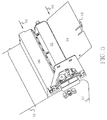
- FIG 5 a drawing of an embodiment of the present invention is shown.
- the corona charger is shown positioned next to the photoconductor film so that plates 34 and 36 along with corona charger 16 define the controlled gas circulation space 38.
- plate 34 may have a fastener 42 which enables it to be fastened to a bottom of the copier/duplicator machine or the like.
- the plates can be of a variety of configurations as required for the deflection of the contaminated air streams away from corona charger 16.
- a major difficulty in designing deflector plates 34 and 36 is the determination of the position and direction of contaminated airflows in the vicinity of the corona charger. This is readily accomplished by the use of smoke, fog produced by the interaction of water and dry ice or preferably by the use of neutrally buoyant helium-filled bubbles.
- Such helium-filled bubbles basically comprise an aqueous soap solution film filled with helium.
- the net density of the bubble is substantially the same as that of air so that the bubbles remain suspended indefinitely if left alone in the absence of any airflow.
- Such bubbles are readily observed either as they remain in the air or as they flow with the air by the use of any suitable high intensity light.
- the bubbles are typically from about 50 to about 100 microns in diameter, although other sizes may be used if desired.
- a cleaned gas stream which may be filtered air or any other suitable gas into the space defined by the photoconductor film, the plates and the corona charger.
- the presence of a positive pressure of clean air in this space prevents the entry of contaminated airflows into this space.
- the pressure may be small, i.e., as small as one inch of water or less, but should be a definite positive pressure so that contaminated airflows do not enter areas of the corona charger.
- This protection may be used for the primary corona charger for the preclean corona charger or for any other corona charger used in the copier/duplicator machine.
- the air is injected by any suitable means, such as by open lines passing the air into or directed toward the controlled air circulation space or the like. Such air injection is shown schematically in Figure 5 by lines 40.
Landscapes
- Physics & Mathematics (AREA)
- Engineering & Computer Science (AREA)
- Plasma & Fusion (AREA)
- General Physics & Mathematics (AREA)
- Electrostatic Charge, Transfer And Separation In Electrography (AREA)
- Control Or Security For Electrophotography (AREA)
Applications Claiming Priority (2)
| Application Number | Priority Date | Filing Date | Title |
|---|---|---|---|
| US09/665,397 US6397024B1 (en) | 2000-09-20 | 2000-09-20 | Method and system for reducing contamination of a corona charger |
| US665397 | 2000-09-20 |
Publications (2)
| Publication Number | Publication Date |
|---|---|
| EP1191402A2 true EP1191402A2 (fr) | 2002-03-27 |
| EP1191402A3 EP1191402A3 (fr) | 2006-10-04 |
Family
ID=24669949
Family Applications (1)
| Application Number | Title | Priority Date | Filing Date |
|---|---|---|---|
| EP01119725A Withdrawn EP1191402A3 (fr) | 2000-09-20 | 2001-08-27 | Méthode et système de réduction de la contamination d'un dispositif de déchargement à effet corona |
Country Status (4)
| Country | Link |
|---|---|
| US (1) | US6397024B1 (fr) |
| EP (1) | EP1191402A3 (fr) |
| AU (1) | AU2001290526A1 (fr) |
| WO (1) | WO2002025380A1 (fr) |
Families Citing this family (7)
| Publication number | Priority date | Publication date | Assignee | Title |
|---|---|---|---|---|
| US6678486B2 (en) * | 2001-09-05 | 2004-01-13 | Nexpress Solutions Llc | Integrated contamination control system for a corona charger |
| EP1367454A1 (fr) * | 2002-05-27 | 2003-12-03 | Seiko Epson Corporation | Appareil de formation d'image utilisant un dispositv de corona à charger et conduit de ventilation |
| US7085512B2 (en) * | 2004-11-04 | 2006-08-01 | Xerox Corporation | Compact contamination reducing multi-corona system and method for reducing contamination of surfaces being acted upon by corona generating devices |
| US7822355B2 (en) * | 2007-01-24 | 2010-10-26 | Ventiva, Inc. | Method and device to prevent dust agglomeration on corona electrodes |
| US8326173B2 (en) * | 2009-09-18 | 2012-12-04 | Hewlett-Packard Development Company, L.P. | Hard imaging devices, humidity control systems and hard imaging methods |
| US8634742B2 (en) * | 2011-10-21 | 2014-01-21 | Eastman Kodak Company | Airflow management system for corona charger |
| US8655217B2 (en) * | 2011-10-21 | 2014-02-18 | Eastman Kodak Company | Airflow management method for corona charger |
Family Cites Families (11)
| Publication number | Priority date | Publication date | Assignee | Title |
|---|---|---|---|---|
| US3769833A (en) | 1972-05-30 | 1973-11-06 | Us Navy | Bubble generator |
| US3869909A (en) | 1973-10-01 | 1975-03-11 | Sage Action Inc | Gas flow visualization system and control apparatus |
| US4388274A (en) * | 1980-06-02 | 1983-06-14 | Xerox Corporation | Ozone collection and filtration system |
| US4725731A (en) * | 1986-07-02 | 1988-02-16 | Xerox Corporation | Photoreceptor deletion control by utilization of corona wind |
| JPH03192285A (ja) * | 1989-12-21 | 1991-08-22 | Minolta Camera Co Ltd | 画像形成装置 |
| US5128720A (en) * | 1991-01-18 | 1992-07-07 | Eastman Kodak Company | Device for collecting contamination products and ozone from a corona charger |
| US5424540A (en) | 1994-08-19 | 1995-06-13 | Eastman Kodak Company | Corona charger wire tensioning mechanism |
| KR0148425B1 (ko) * | 1994-11-12 | 1998-12-01 | 김광호 | 화상형성 장치의 방전기 오염방지 장치 |
| US5802424A (en) * | 1997-11-26 | 1998-09-01 | Eastman Kodak Company | Control for environment of a charger for reproduction apparatus |
| US6038120A (en) | 1998-09-30 | 2000-03-14 | Eastman Kodak Company | AC corona charger with buried floor electrode |
| US6070026A (en) * | 1999-05-10 | 2000-05-30 | Xerox Corporation | Charging device with separate pressure and vacuum air flows |
-
2000
- 2000-09-20 US US09/665,397 patent/US6397024B1/en not_active Expired - Fee Related
-
2001
- 2001-08-10 AU AU2001290526A patent/AU2001290526A1/en not_active Abandoned
- 2001-08-10 WO PCT/US2001/025050 patent/WO2002025380A1/fr not_active Ceased
- 2001-08-27 EP EP01119725A patent/EP1191402A3/fr not_active Withdrawn
Also Published As
| Publication number | Publication date |
|---|---|
| AU2001290526A1 (en) | 2002-04-02 |
| US6397024B1 (en) | 2002-05-28 |
| WO2002025380A1 (fr) | 2002-03-28 |
| EP1191402A3 (fr) | 2006-10-04 |
Similar Documents
| Publication | Publication Date | Title |
|---|---|---|
| JP2004117389A (ja) | 転写方法および画像形成方法および画像形成装置 | |
| EP0233589A1 (fr) | Dispositif de nettoyage et appareil électrophotographique de reproduction en plusieurs couleurs | |
| US4435073A (en) | Toner removal apparatus | |
| US4697914A (en) | Toner containment method and apparatus | |
| CN1153325A (zh) | 成象装置中的防充电器污染装置 | |
| EP0016300B1 (fr) | Copieuse électrostatique | |
| US6397024B1 (en) | Method and system for reducing contamination of a corona charger | |
| US5602629A (en) | Image forming apparatus with a purge control means | |
| US5121167A (en) | Sweep and vacuum xerographic cleaning method and apparatus | |
| JPH1010942A (ja) | 予備清掃無しで負摩擦帯電性トナーを清掃する装置及び方法 | |
| US5381218A (en) | Conductive cleaning brush belt and detoning thereof | |
| JP2002062773A (ja) | 自己生成気流を使用する導電性コア繊維ブラシクリーニングシステムにおける塵埃制御 | |
| US6754466B1 (en) | Toner removal apparatus for copier or printer | |
| JPH02123379A (ja) | 感光体の縁を現像しない現像方法及び装置 | |
| US3357400A (en) | Electrostatic apparatus for paper detacking | |
| JPS6130273B2 (fr) | ||
| US6876829B2 (en) | Xerographic printing system with magnetic seal between development and transfer | |
| US6014540A (en) | Image forming apparatus having a device for removing charged materials prior to cleaning | |
| JPH07175338A (ja) | 画像形成装置 | |
| JP2732846B2 (ja) | ノンインパクト式印刷機又は複写機 | |
| CN1424630B (zh) | 非接触式成像系统及成像方法 | |
| JPH0619626B2 (ja) | コロナ放電装置 | |
| JPH06214491A (ja) | 除去装置 | |
| JP4688323B2 (ja) | 画像形成装置及び画像形成方法 | |
| JPH08166697A (ja) | 多色画像形成装置 |
Legal Events
| Date | Code | Title | Description |
|---|---|---|---|
| PUAI | Public reference made under article 153(3) epc to a published international application that has entered the european phase |
Free format text: ORIGINAL CODE: 0009012 |
|
| AK | Designated contracting states |
Kind code of ref document: A2 Designated state(s): AT BE CH CY DE DK ES FI FR GB GR IE IT LI LU MC NL PT SE TR |
|
| AX | Request for extension of the european patent |
Free format text: AL;LT;LV;MK;RO;SI |
|
| RAP1 | Party data changed (applicant data changed or rights of an application transferred) |
Owner name: EASTMAN KODAK COMPANY |
|
| PUAL | Search report despatched |
Free format text: ORIGINAL CODE: 0009013 |
|
| AK | Designated contracting states |
Kind code of ref document: A3 Designated state(s): AT BE CH CY DE DK ES FI FR GB GR IE IT LI LU MC NL PT SE TR |
|
| AX | Request for extension of the european patent |
Extension state: AL LT LV MK RO SI |
|
| 17P | Request for examination filed |
Effective date: 20070226 |
|
| AKX | Designation fees paid |
Designated state(s): DE GB NL |
|
| 17Q | First examination report despatched |
Effective date: 20070808 |
|
| STAA | Information on the status of an ep patent application or granted ep patent |
Free format text: STATUS: THE APPLICATION IS DEEMED TO BE WITHDRAWN |
|
| 18D | Application deemed to be withdrawn |
Effective date: 20071219 |