EP1189294A2 - Battery pack - Google Patents
Battery pack Download PDFInfo
- Publication number
- EP1189294A2 EP1189294A2 EP20010121305 EP01121305A EP1189294A2 EP 1189294 A2 EP1189294 A2 EP 1189294A2 EP 20010121305 EP20010121305 EP 20010121305 EP 01121305 A EP01121305 A EP 01121305A EP 1189294 A2 EP1189294 A2 EP 1189294A2
- Authority
- EP
- European Patent Office
- Prior art keywords
- battery
- battery modules
- pair
- case
- modules
- Prior art date
- Legal status (The legal status is an assumption and is not a legal conclusion. Google has not performed a legal analysis and makes no representation as to the accuracy of the status listed.)
- Granted
Links
Images


Classifications
-
- H—ELECTRICITY
- H01—ELECTRIC ELEMENTS
- H01M—PROCESSES OR MEANS, e.g. BATTERIES, FOR THE DIRECT CONVERSION OF CHEMICAL ENERGY INTO ELECTRICAL ENERGY
- H01M6/00—Primary cells; Manufacture thereof
- H01M6/50—Methods or arrangements for servicing or maintenance, e.g. for maintaining operating temperature
- H01M6/5038—Heating or cooling of cells or batteries
-
- H—ELECTRICITY
- H01—ELECTRIC ELEMENTS
- H01M—PROCESSES OR MEANS, e.g. BATTERIES, FOR THE DIRECT CONVERSION OF CHEMICAL ENERGY INTO ELECTRICAL ENERGY
- H01M10/00—Secondary cells; Manufacture thereof
- H01M10/60—Heating or cooling; Temperature control
- H01M10/61—Types of temperature control
- H01M10/617—Types of temperature control for achieving uniformity or desired distribution of temperature
-
- B—PERFORMING OPERATIONS; TRANSPORTING
- B60—VEHICLES IN GENERAL
- B60L—PROPULSION OF ELECTRICALLY-PROPELLED VEHICLES; SUPPLYING ELECTRIC POWER FOR AUXILIARY EQUIPMENT OF ELECTRICALLY-PROPELLED VEHICLES; ELECTRODYNAMIC BRAKE SYSTEMS FOR VEHICLES IN GENERAL; MAGNETIC SUSPENSION OR LEVITATION FOR VEHICLES; MONITORING OPERATING VARIABLES OF ELECTRICALLY-PROPELLED VEHICLES; ELECTRIC SAFETY DEVICES FOR ELECTRICALLY-PROPELLED VEHICLES
- B60L50/00—Electric propulsion with power supplied within the vehicle
- B60L50/50—Electric propulsion with power supplied within the vehicle using propulsion power supplied by batteries or fuel cells
- B60L50/60—Electric propulsion with power supplied within the vehicle using propulsion power supplied by batteries or fuel cells using power supplied by batteries
- B60L50/64—Constructional details of batteries specially adapted for electric vehicles
-
- B—PERFORMING OPERATIONS; TRANSPORTING
- B60—VEHICLES IN GENERAL
- B60L—PROPULSION OF ELECTRICALLY-PROPELLED VEHICLES; SUPPLYING ELECTRIC POWER FOR AUXILIARY EQUIPMENT OF ELECTRICALLY-PROPELLED VEHICLES; ELECTRODYNAMIC BRAKE SYSTEMS FOR VEHICLES IN GENERAL; MAGNETIC SUSPENSION OR LEVITATION FOR VEHICLES; MONITORING OPERATING VARIABLES OF ELECTRICALLY-PROPELLED VEHICLES; ELECTRIC SAFETY DEVICES FOR ELECTRICALLY-PROPELLED VEHICLES
- B60L58/00—Methods or circuit arrangements for monitoring or controlling batteries or fuel cells, specially adapted for electric vehicles
- B60L58/10—Methods or circuit arrangements for monitoring or controlling batteries or fuel cells, specially adapted for electric vehicles for monitoring or controlling batteries
- B60L58/18—Methods or circuit arrangements for monitoring or controlling batteries or fuel cells, specially adapted for electric vehicles for monitoring or controlling batteries of two or more battery modules
- B60L58/19—Switching between serial connection and parallel connection of battery modules
-
- B—PERFORMING OPERATIONS; TRANSPORTING
- B60—VEHICLES IN GENERAL
- B60L—PROPULSION OF ELECTRICALLY-PROPELLED VEHICLES; SUPPLYING ELECTRIC POWER FOR AUXILIARY EQUIPMENT OF ELECTRICALLY-PROPELLED VEHICLES; ELECTRODYNAMIC BRAKE SYSTEMS FOR VEHICLES IN GENERAL; MAGNETIC SUSPENSION OR LEVITATION FOR VEHICLES; MONITORING OPERATING VARIABLES OF ELECTRICALLY-PROPELLED VEHICLES; ELECTRIC SAFETY DEVICES FOR ELECTRICALLY-PROPELLED VEHICLES
- B60L58/00—Methods or circuit arrangements for monitoring or controlling batteries or fuel cells, specially adapted for electric vehicles
- B60L58/10—Methods or circuit arrangements for monitoring or controlling batteries or fuel cells, specially adapted for electric vehicles for monitoring or controlling batteries
- B60L58/24—Methods or circuit arrangements for monitoring or controlling batteries or fuel cells, specially adapted for electric vehicles for monitoring or controlling batteries for controlling the temperature of batteries
- B60L58/26—Methods or circuit arrangements for monitoring or controlling batteries or fuel cells, specially adapted for electric vehicles for monitoring or controlling batteries for controlling the temperature of batteries by cooling
-
- H—ELECTRICITY
- H01—ELECTRIC ELEMENTS
- H01M—PROCESSES OR MEANS, e.g. BATTERIES, FOR THE DIRECT CONVERSION OF CHEMICAL ENERGY INTO ELECTRICAL ENERGY
- H01M10/00—Secondary cells; Manufacture thereof
- H01M10/60—Heating or cooling; Temperature control
- H01M10/62—Heating or cooling; Temperature control specially adapted for specific applications
- H01M10/625—Vehicles
-
- H—ELECTRICITY
- H01—ELECTRIC ELEMENTS
- H01M—PROCESSES OR MEANS, e.g. BATTERIES, FOR THE DIRECT CONVERSION OF CHEMICAL ENERGY INTO ELECTRICAL ENERGY
- H01M10/00—Secondary cells; Manufacture thereof
- H01M10/60—Heating or cooling; Temperature control
- H01M10/65—Means for temperature control structurally associated with the cells
- H01M10/655—Solid structures for heat exchange or heat conduction
- H01M10/6554—Rods or plates
-
- H—ELECTRICITY
- H01—ELECTRIC ELEMENTS
- H01M—PROCESSES OR MEANS, e.g. BATTERIES, FOR THE DIRECT CONVERSION OF CHEMICAL ENERGY INTO ELECTRICAL ENERGY
- H01M10/00—Secondary cells; Manufacture thereof
- H01M10/60—Heating or cooling; Temperature control
- H01M10/65—Means for temperature control structurally associated with the cells
- H01M10/656—Means for temperature control structurally associated with the cells characterised by the type of heat-exchange fluid
- H01M10/6561—Gases
-
- H—ELECTRICITY
- H01—ELECTRIC ELEMENTS
- H01M—PROCESSES OR MEANS, e.g. BATTERIES, FOR THE DIRECT CONVERSION OF CHEMICAL ENERGY INTO ELECTRICAL ENERGY
- H01M50/00—Constructional details or processes of manufacture of the non-active parts of electrochemical cells other than fuel cells, e.g. hybrid cells
- H01M50/20—Mountings; Secondary casings or frames; Racks, modules or packs; Suspension devices; Shock absorbers; Transport or carrying devices; Holders
- H01M50/204—Racks, modules or packs for multiple batteries or multiple cells
-
- H—ELECTRICITY
- H01—ELECTRIC ELEMENTS
- H01M—PROCESSES OR MEANS, e.g. BATTERIES, FOR THE DIRECT CONVERSION OF CHEMICAL ENERGY INTO ELECTRICAL ENERGY
- H01M10/00—Secondary cells; Manufacture thereof
- H01M10/34—Gastight accumulators
- H01M10/345—Gastight metal hydride accumulators
-
- Y—GENERAL TAGGING OF NEW TECHNOLOGICAL DEVELOPMENTS; GENERAL TAGGING OF CROSS-SECTIONAL TECHNOLOGIES SPANNING OVER SEVERAL SECTIONS OF THE IPC; TECHNICAL SUBJECTS COVERED BY FORMER USPC CROSS-REFERENCE ART COLLECTIONS [XRACs] AND DIGESTS
- Y02—TECHNOLOGIES OR APPLICATIONS FOR MITIGATION OR ADAPTATION AGAINST CLIMATE CHANGE
- Y02E—REDUCTION OF GREENHOUSE GAS [GHG] EMISSIONS, RELATED TO ENERGY GENERATION, TRANSMISSION OR DISTRIBUTION
- Y02E60/00—Enabling technologies; Technologies with a potential or indirect contribution to GHG emissions mitigation
- Y02E60/10—Energy storage using batteries
-
- Y—GENERAL TAGGING OF NEW TECHNOLOGICAL DEVELOPMENTS; GENERAL TAGGING OF CROSS-SECTIONAL TECHNOLOGIES SPANNING OVER SEVERAL SECTIONS OF THE IPC; TECHNICAL SUBJECTS COVERED BY FORMER USPC CROSS-REFERENCE ART COLLECTIONS [XRACs] AND DIGESTS
- Y02—TECHNOLOGIES OR APPLICATIONS FOR MITIGATION OR ADAPTATION AGAINST CLIMATE CHANGE
- Y02T—CLIMATE CHANGE MITIGATION TECHNOLOGIES RELATED TO TRANSPORTATION
- Y02T10/00—Road transport of goods or passengers
- Y02T10/60—Other road transportation technologies with climate change mitigation effect
- Y02T10/70—Energy storage systems for electromobility, e.g. batteries
Definitions
- the present invention relates to a battery pack suitably used in an electric vehicle, such as hybrid electric vehicle (HEV), pure electric vehicle (PEV), or the like, which uses an electric motor as at least a part of its power source.
- an electric vehicle such as hybrid electric vehicle (HEV), pure electric vehicle (PEV), or the like
- the present invention relates to a battery pack in which a pair of battery modules connected to each other in parallel, with each battery module including a plurality of battery cells connected in series.
- An electric vehicle such as HEV, PEV, or the like, uses a high-voltage battery for powering its electric motor.
- a high-voltage battery includes a plurality of battery modules connected in series or in parallel, and each of the battery modules includes a plurality of battery cells connected in series.
- a positional arrangement of the battery modules is determined such that high-voltage wires for connecting the battery modules may be efficiently arranged.
- a battery pack including battery modules connected in parallel has a characteristic of the size of a charging current flowing into each battery module depending only on a voltage of the battery modules.
- the voltage of each battery module depends on charging conditions, temperature, etc., of each battery cell.
- FIG. 5 shows an equivalent circuit of a battery pack including battery modules connected in parallel.
- a charging current I flowing through the entire battery pack is divided such that the voltages V 1 -V n of battery modules 2 1 -2 n have the same value, and the divided currents flow through the battery modules 2 1 -2 n as battery currents I 1 -I n .
- Electromotive forces E 1 -E n and internal resistances R 1 -R n of the battery modules 2 1 -2 n depend on conditions of battery cells in the battery modules 2 1 -2 n , such as temperature, state of charge (hereinafter, referred to as SOC), etc.
- NiMH nickel metal hydride
- a battery pack including at least one pair of battery modules, each of the battery modules including a plurality of battery cells connected in series, wherein the at least one pair of the battery modules are connected in parallel and are positioned in close vicinity to each other such that radiant heat can be transferred between the pair battery modules.
- a battery pack including at least one pair of battery modules, each of the battery modules including a plurality of battery cells connected in series, wherein the at least one pair of the battery modules are connected in parallel and are coupled to each other by a heat transfer member.
- a battery pack including at least one pair of battery modules, each of the battery modules including a plurality of battery cells connected in series, wherein the at least one pair of the battery modules are connected in parallel and are positioned in a region of a case which has a uniform cooling condition.
- a battery pack including at least one pair of battery modules located in a case, each of the battery modules including a plurality of battery cells connected in series, wherein the at least one pair of the battery modules are connected in parallel and are positioned so as to obtain the same cooling condition from a cooling medium flowing through the case.
- the invention described herein makes possible the advantages of providing a battery pack including battery modules connected in parallel, wherein differences in the state of charge between the battery modules is reduced by decreasing differences in temperatures between battery modules.
- Figure 1 schematically shows a structure of a substantial part of a battery pack according to Embodiment 1 of the present invention.
- Figure 2 schematically shows a structure of a substantial part of a battery pack according to Embodiment 2 of the present invention.
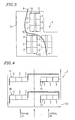
- Figure 3 schematically shows a structure of a substantial part of a battery pack according to Embodiment 3 of the present invention.
- Figure 4 schematically shows a structure of a substantial part of a battery pack according to Embodiment 4 of the present invention.
- Figure 5 shows an equivalent circuit of a plurality of battery modules connected in parallel.
- Figure 6 is a graph showing a relationship between the voltage and the state of charge (SOC) of a battery during a charging operation.
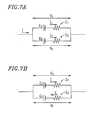
- Figures 7A and 7B show equivalent circuits for explaining situations when one of a pair of battery modules connected in parallel is fully charged.
- FIG 1 schematically shows a structure of a substantial part of a battery pack 1 according to Embodiment 1 of the present invention.
- the battery pack 1 includes a pair of battery modules 3 and 4 and a pair of battery modules 5 and 6 , each battery module including a plurality of battery cells 2 connected in series.
- the pair of the battery modules 3 and 4 are connected to each other in parallel.
- the other pair of the battery modules 5 and 6 are also connected to each other in parallel.
- the pair of battery modules 3 and 4 are positioned in close vicinity to each other.
- the other pair of the battery modules 5 and 6 are also positioned in close vicinity to each other.
- the pair of battery modules 3 and 4 connected in parallel are positioned in close vicinity to each other because as the distance between the battery modules 3 and 4 decreases, radiant heat is more easily transferred between the battery modules 3 and 4 . As a result, the difference in the temperature between the battery modules 3 and 4 is decreased.
- the pair of the battery modules 5 and 6 are positioned in close vicinity to each other, radiant heat can be easily transferred between the battery modules 5 and 6 . Accordingly, the difference in the temperature between the battery modules 5 and 6 is decreased. As a result, the variation in the amount of electric power charged in the battery cells 2 of the battery modules 5 and 6 can be suppressed, and the state of charge the battery cells 2 can become uniform. As a result, deterioration of the battery cells 2 can be suppressed.
- FIG. 2 schematically shows a structure of a substantial part of a battery pack 1 according to Embodiment 2 of the present invention.
- the battery pack 1 includes a pair of battery modules 7 and 8 , each of the battery modules 7 and 8 including a plurality of battery cells 2 connected in series.
- the battery modules 7 and 8 are connected to each other in parallel.
- a high heat conductive member 9 is provided so as to bridge over the battery modules 7 and 8 .
- the high heat conductive member 9 is formed of an aluminum plate, or the like.
- FIG 3 schematically shows a structure of a substantial part of a battery pack 1 according to Embodiment 3 of the present invention.
- the battery pack 1 includes a pair of battery modules 10 and 11 , each of the battery modules 10 and 11 including a plurality of battery cells 2 connected in series.
- the pair of battery modules 10 and 11 are connected to each other in parallel.
- the battery pack 1 further includes a pair of battery modules 12 and 13 connected to each other in parallel.
- the pair of battery modules 10 and 11 and the pair of battery modules 12 and 13 are contained in a case 31 .
- the pair of battery modules 10 and 11 are positioned in a region having a uniform cooling condition.
- the other pair of battery modules 12 and 13 are positioned in a region having uniform cooling condition.
- the pair of battery modules 10 and 11 are positioned in the case 31 such that both are located in one of the regions divided by the isotherm A.
- the other pair of battery modules 12 and 13 also positioned in the case 31 such that both are located in another region divided by the isotherm A.
- the pair of battery modules 10 and 11 and the other pair of battery modules 12 and 13 are positioned in the case 31 such that each pair is entirely in a region having a uniform cooling condition.
- No pair of battery modules is positioned across two or more regions having different cooling conditions, such as those shown in Figure 3 with a broken line, for example.
- the isotherm A in the case 31 may be examined beforehand based on cooling conditions which depend on the shape of the case 31 , etc.
- each of the pair of battery modules 10 and 11 and the other pair of battery modules 12 and 13 is positioned in regions of the case 31 which have a uniform cooling condition as described above, the differences in temperature between the battery modules 10 and 11 and between the battery modules 12 and 13 can be decreased. Therefore, the variation in the amount of electric power charged in the battery cells 2 in the battery modules can be suppressed, and the state of charge of the battery cells 2 can become uniform.
- FIG 4 schematically shows a structure of a substantial part of a battery pack 1 according to Embodiment 4 of the present invention.
- the battery pack 1 includes a plurality of battery modules 14-17 , with each battery module including a plurality of battery cells 2 connected in series.
- the battery modules 14 and 15 are connected to each other in parallel as a pair.
- the battery modules 16 and 17 are also connected to each other in parallel as another pair.
- the battery modules 14-17 are contained in a case 31 .
- cooling air enters into the case 31 from one end thereof and flows linearly through every part of the case 31 in the direction indicated by arrows in Figure 4.
- the battery modules 14 and 15 are positioned along a direction perpendicular to the direction in which the cooling air flows (i.e., along a width direction of the case 31 ) such that the distance from the end of the case 31 through which the cooling air enters to the battery module 14 is equal to the distance from the source of the cooling air to the battery module 15.
- the battery modules 14 and 15 are positioned symmetrically with respect to the center line which halves the case 31 .
- the battery modules 16 and 17 are also positioned along the width direction of the case 31 such that the distance from the end of the case 31 through which the cooling air enters to the battery module 16 is equal to the distance from the source of the cooling air to the battery module 17 .
- the battery modules 16 and 17 are positioned symmetrically with respect to the center line of the case 31 .
- the air flow distribution in the case 31 is symmetrical with respect to the center line of the case 31 along the direction perpendicular to the width direction (shown by a chain line). Accordingly, the cooling condition in the case 31 is distributed symmetrically with respect to the center line of the width direction. That is, in the case 31 having such a symmetrically-distributed cooling condition, the battery modules 14 and 15 are in the same cooling condition. Thus, the battery modules 14 and 15 can be cooled equally, and the difference in temperature between the battery modules 14 and 15 is decreased.
- the pair of the battery modules 16 and 17 are positioned such that the battery modules 16 and 17 are in the same cooling condition.
- the battery modules 16 and 17 can be cooled equally, and the difference in temperature between the battery modules 16 and 17 is decreased. Therefore, the variation in temperature of the battery cells 2 included in the battery modules 14-17 can be suppressed and the variation in the amount of electric power charged in the battery cells 2 is decreased. As a result, the state of charge of the battery cells 2 can become uniform.
- a battery pack according to the present invention is structured such that the difference in temperature between the battery modules connected to each other in parallel can be decreased. With such a structure, overcharging of each battery cell included in the battery modules can be prevented. Accordingly, danger caused by overcharging can also be prevented. As a result, reliability of the battery pack is significantly improved, and the lifetime of the battery pack can be extended.
Landscapes
- Engineering & Computer Science (AREA)
- Chemical & Material Sciences (AREA)
- Chemical Kinetics & Catalysis (AREA)
- Electrochemistry (AREA)
- General Chemical & Material Sciences (AREA)
- Manufacturing & Machinery (AREA)
- Life Sciences & Earth Sciences (AREA)
- Sustainable Development (AREA)
- Sustainable Energy (AREA)
- Power Engineering (AREA)
- Transportation (AREA)
- Mechanical Engineering (AREA)
- Secondary Cells (AREA)
- Battery Mounting, Suspending (AREA)
Abstract
Description
- The present invention relates to a battery pack suitably used in an electric vehicle, such as hybrid electric vehicle (HEV), pure electric vehicle (PEV), or the like, which uses an electric motor as at least a part of its power source. Specifically, the present invention relates to a battery pack in which a pair of battery modules connected to each other in parallel, with each battery module including a plurality of battery cells connected in series.
- An electric vehicle, such as HEV, PEV, or the like, uses a high-voltage battery for powering its electric motor. Usually, in order to gain a high voltage, such a high-voltage battery includes a plurality of battery modules connected in series or in parallel, and each of the battery modules includes a plurality of battery cells connected in series.
- Generally, in designing such a battery pack, a positional arrangement of the battery modules is determined such that high-voltage wires for connecting the battery modules may be efficiently arranged.
- A battery pack including battery modules connected in parallel has a characteristic of the size of a charging current flowing into each battery module depending only on a voltage of the battery modules. The voltage of each battery module depends on charging conditions, temperature, etc., of each battery cell.
- The problems caused by such a characteristic are described with reference to Figures 5-7B.
- Figure 5 shows an equivalent circuit of a battery pack including battery modules connected in parallel. Referring to Figure 5, a charging current I flowing through the entire battery pack is divided such that the voltages V1-Vn of battery modules 21-2n have the same value, and the divided currents flow through the battery modules 21-2n as battery currents I1-In. Electromotive forces E1-En and internal resistances R1-Rn of the battery modules 21-2n depend on conditions of battery cells in the battery modules 21-2n, such as temperature, state of charge (hereinafter, referred to as SOC), etc. As shown in Figure 6, in general, when charging an NiMH (nickel metal hydride) battery, the voltage of the battery gradually increases until the SOC reaches a full-charge region, but after the SOC has reached the full-charge region, the battery voltage gradually decreases.
- In such a NiMH battery including battery modules connected in parallel, in the case where the amount of charged electric power is different among the battery modules when the SOC of one of the battery modules reaches the full-charge region, the battery voltage of the battery module decreases, and accordingly, a charging current flows into the battery module. For example, in Figure 7A, a pair of
battery modules battery module 21 is fully charged and the battery voltage V1 decreases, a charging current flows into thebattery module 21 so that the battery voltage V1 has the same value as a battery voltage V2 of theother battery module 22. In Figure 7B, a case where there is no charging current flowing from outside is shown. Even in this case, when thebattery module 21 is fully charged, a current flows from theother battery module 22 which is not fully charged into thebattery module 21. As a result, thebattery module 21 is overcharged. When the overcharging of the battery module continues, battery cells in the battery module deteriorate. Such a problem may occur due to variation in the amount of electric power charged in battery cells. - According to one aspect of this invention, there is provided a battery pack including at least one pair of battery modules, each of the battery modules including a plurality of battery cells connected in series, wherein the at least one pair of the battery modules are connected in parallel and are positioned in close vicinity to each other such that radiant heat can be transferred between the pair battery modules.
- According to another aspect of this invention, there is provided a battery pack including at least one pair of battery modules, each of the battery modules including a plurality of battery cells connected in series, wherein the at least one pair of the battery modules are connected in parallel and are coupled to each other by a heat transfer member.
- According to still another aspect of this invention, there is provided a battery pack including at least one pair of battery modules, each of the battery modules including a plurality of battery cells connected in series, wherein the at least one pair of the battery modules are connected in parallel and are positioned in a region of a case which has a uniform cooling condition.
- According to still another aspect of this invention, there is provided a battery pack including at least one pair of battery modules located in a case, each of the battery modules including a plurality of battery cells connected in series, wherein the at least one pair of the battery modules are connected in parallel and are positioned so as to obtain the same cooling condition from a cooling medium flowing through the case.
- Thus, the invention described herein makes possible the advantages of providing a battery pack including battery modules connected in parallel, wherein differences in the state of charge between the battery modules is reduced by decreasing differences in temperatures between battery modules.
- These and other advantages of the present invention will become apparent to those skilled in the art upon reading and understanding the following detailed description with reference to the accompanying figures.
- Figure 1 schematically shows a structure of a substantial part of a battery pack according to
Embodiment 1 of the present invention. - Figure 2 schematically shows a structure of a substantial part of a battery pack according to
Embodiment 2 of the present invention. - Figure 3 schematically shows a structure of a substantial part of a battery pack according to
Embodiment 3 of the present invention. - Figure 4 schematically shows a structure of a substantial part of a battery pack according to
Embodiment 4 of the present invention. - Figure 5 shows an equivalent circuit of a plurality of battery modules connected in parallel.
- Figure 6 is a graph showing a relationship between the voltage and the state of charge (SOC) of a battery during a charging operation.
- Figures 7A and 7B show equivalent circuits for explaining situations when one of a pair of battery modules connected in parallel is fully charged.
- Hereinafter,
Embodiment 1 of the present invention is described with reference to Figure 1. - Figure 1 schematically shows a structure of a substantial part of a
battery pack 1 according toEmbodiment 1 of the present invention. Thebattery pack 1 includes a pair ofbattery modules battery modules battery cells 2 connected in series. The pair of thebattery modules battery modules - The pair of
battery modules battery modules - The pair of
battery modules battery modules battery modules battery modules - By decreasing the difference in the temperature between the
battery modules battery cells 2 of thebattery modules battery cell 2 can be suppressed. - Similarly, since the pair of the
battery modules battery modules battery modules battery cells 2 of thebattery modules battery cells 2 can become uniform. As a result, deterioration of thebattery cells 2 can be suppressed. - Figure 2 schematically shows a structure of a substantial part of a
battery pack 1 according toEmbodiment 2 of the present invention. Thebattery pack 1 includes a pair ofbattery modules battery modules battery cells 2 connected in series. Thebattery modules - In a central part of the
battery modules conductive member 9 is provided so as to bridge over thebattery modules conductive member 9 is formed of an aluminum plate, or the like. - With the high heat
conductive member 9 provided over thebattery modules battery modules battery modules battery cells 2 of thebattery modules battery cells 2 can become uniform. As a result, deterioration of thebattery cells 2 can be suppressed. - Figure 3 schematically shows a structure of a substantial part of a
battery pack 1 according toEmbodiment 3 of the present invention. Thebattery pack 1 includes a pair ofbattery modules battery modules battery cells 2 connected in series. The pair ofbattery modules battery pack 1 further includes a pair ofbattery modules battery modules battery modules case 31. - In the
case 31, the pair ofbattery modules battery modules - For example, when there is an isotherm A in the
case 31 as shown in Figure 3, the pair ofbattery modules case 31 such that both are located in one of the regions divided by the isotherm A. The other pair ofbattery modules case 31 such that both are located in another region divided by the isotherm A. - In Figure 3, in the
case 31, the pair ofbattery modules battery modules - The pair of
battery modules battery modules case 31 such that each pair is entirely in a region having a uniform cooling condition. No pair of battery modules is positioned across two or more regions having different cooling conditions, such as those shown in Figure 3 with a broken line, for example. - For example, the isotherm A in the
case 31 may be examined beforehand based on cooling conditions which depend on the shape of thecase 31, etc. - Since each of the pair of
battery modules battery modules case 31 which have a uniform cooling condition as described above, the differences in temperature between thebattery modules battery modules battery cells 2 in the battery modules can be suppressed, and the state of charge of thebattery cells 2 can become uniform. - The above-described structure in which a pair of battery modules connected to each other in parallel are positioned in a region of a case which has a uniform cooling condition is preferable for use as a battery pack in an electric vehicle which has a case of a complicated shape due to a limited space for containing a battery pack.
- Figure 4 schematically shows a structure of a substantial part of a
battery pack 1 according toEmbodiment 4 of the present invention. Thebattery pack 1 includes a plurality of battery modules 14-17, with each battery module including a plurality ofbattery cells 2 connected in series. Thebattery modules battery modules case 31. - In the example illustrated in Figure 4, if the
case 31 is empty, i.e., if thecase 31 does not contain a battery module, cooling air enters into thecase 31 from one end thereof and flows linearly through every part of thecase 31 in the direction indicated by arrows in Figure 4. In thecase 31, thebattery modules case 31 through which the cooling air enters to thebattery module 14 is equal to the distance from the source of the cooling air to thebattery module 15. Thebattery modules case 31. Thebattery modules case 31 such that the distance from the end of thecase 31 through which the cooling air enters to thebattery module 16 is equal to the distance from the source of the cooling air to thebattery module 17. Thebattery modules case 31. - When the cooling air linearly enters the
case 31 in the direction shown in Figure 4, the air flow distribution in thecase 31 is symmetrical with respect to the center line of thecase 31 along the direction perpendicular to the width direction (shown by a chain line). Accordingly, the cooling condition in thecase 31 is distributed symmetrically with respect to the center line of the width direction. That is, in thecase 31 having such a symmetrically-distributed cooling condition, thebattery modules battery modules battery modules - Similarly, inside the
case 31 having the symmetrically-distributed cooling condition, the pair of thebattery modules battery modules battery modules battery modules battery cells 2 included in the battery modules 14-17 can be suppressed and the variation in the amount of electric power charged in thebattery cells 2 is decreased. As a result, the state of charge of thebattery cells 2 can become uniform. - As can been seen from the above description, a battery pack according to the present invention is structured such that the difference in temperature between the battery modules connected to each other in parallel can be decreased. With such a structure, overcharging of each battery cell included in the battery modules can be prevented. Accordingly, danger caused by overcharging can also be prevented. As a result, reliability of the battery pack is significantly improved, and the lifetime of the battery pack can be extended.
- Various other modifications will be apparent to and can be readily made by those skilled in the art without departing from the scope and spirit of this invention. Accordingly, it is not intended that the scope of the claims appended hereto be limited to the description as set forth herein, but rather that the claims be broadly construed.
Claims (4)
- A battery pack comprising at least one pair of battery modules, each of the battery modules including a plurality of battery cells connected in series,
wherein the at least one pair of the battery modules are connected in parallel and are positioned in close vicinity to each other such that radiant heat can be transferred between the pair battery modules. - A battery pack comprising at least one pair of battery modules, each of the battery modules including a plurality of battery cells connected in series,
wherein the at least one pair of the battery modules are connected in parallel and are coupled to each other by a heat transfer member. - A battery pack comprising at least one pair of battery modules, each of the battery modules including a plurality of battery cells connected in series,
wherein the at least one pair of the battery modules are connected in parallel and are positioned in a region of a case which has a uniform cooling condition. - A battery pack comprising at least one pair of battery modules located in a case, each of the battery modules including a plurality of battery cells connected in series,
wherein the at least one pair of the battery modules are connected in parallel and are positioned so as to obtain the same cooling condition from a cooling medium flowing through the case.
Applications Claiming Priority (2)
| Application Number | Priority Date | Filing Date | Title |
|---|---|---|---|
| JP2000278948 | 2000-09-13 | ||
| JP2000278948A JP4717990B2 (en) | 2000-09-13 | 2000-09-13 | Battery pack |
Publications (3)
| Publication Number | Publication Date |
|---|---|
| EP1189294A2 true EP1189294A2 (en) | 2002-03-20 |
| EP1189294A3 EP1189294A3 (en) | 2006-05-17 |
| EP1189294B1 EP1189294B1 (en) | 2015-03-25 |
Family
ID=18764031
Family Applications (1)
| Application Number | Title | Priority Date | Filing Date |
|---|---|---|---|
| EP20010121305 Expired - Lifetime EP1189294B1 (en) | 2000-09-13 | 2001-09-05 | Battery pack |
Country Status (3)
| Country | Link |
|---|---|
| US (1) | US6504342B2 (en) |
| EP (1) | EP1189294B1 (en) |
| JP (1) | JP4717990B2 (en) |
Cited By (1)
| Publication number | Priority date | Publication date | Assignee | Title |
|---|---|---|---|---|
| EP3588666A4 (en) * | 2017-08-14 | 2020-05-27 | LG Chem, Ltd. | BATTERY PACK HAVING IMPROVED TEMPERATURE REGULATION EFFICIENCY |
Families Citing this family (20)
| Publication number | Priority date | Publication date | Assignee | Title |
|---|---|---|---|---|
| JP4489369B2 (en) * | 2003-03-26 | 2010-06-23 | パナソニックEvエナジー株式会社 | Battery pack |
| US20060113965A1 (en) * | 2004-11-30 | 2006-06-01 | Yoon-Cheol Jeon | Secondary battery module |
| CN101395781B (en) * | 2005-03-16 | 2011-09-14 | 福特全球技术公司 | Power supply temperature sensor and system |
| US7604896B2 (en) | 2005-03-16 | 2009-10-20 | Ford Global Technologies, Llc | High voltage battery assembly for a motor vehicle |
| KR20060102852A (en) * | 2005-03-25 | 2006-09-28 | 삼성에스디아이 주식회사 | Secondary battery module |
| KR20060102853A (en) * | 2005-03-25 | 2006-09-28 | 삼성에스디아이 주식회사 | Secondary battery module |
| JP4902164B2 (en) * | 2005-09-28 | 2012-03-21 | 三洋電機株式会社 | Power supply |
| US7808131B2 (en) * | 2006-10-12 | 2010-10-05 | Xtreme Power Inc. | Precision battery pack circuits |
| US8237407B2 (en) * | 2006-10-12 | 2012-08-07 | Xtreme Power Inc. | Power supply modules having a uniform DC environment |
| BRPI0820662A2 (en) * | 2007-11-27 | 2017-05-09 | Xtreme Power Inc | portable power supply having married resistance battery connections |
| EP2253037B1 (en) * | 2008-02-15 | 2015-06-10 | Atieva, Inc. | Method of electrically connecting cell terminals in a battery pack |
| US8231996B2 (en) * | 2008-02-15 | 2012-07-31 | Atieva Usa, Inc | Method of cooling a battery pack using flat heat pipes |
| US20100291418A1 (en) * | 2009-05-15 | 2010-11-18 | Sinoelectric Powertrain Corporation | Battery packs, systems, and methods |
| US8846232B2 (en) * | 2009-11-11 | 2014-09-30 | Atieva, Inc. | Flash cooling system for increased battery safety |
| JP5455725B2 (en) * | 2010-03-15 | 2014-03-26 | 三菱重工業株式会社 | Assembled battery |
| JP5508923B2 (en) * | 2010-04-09 | 2014-06-04 | 日立ビークルエナジー株式会社 | Power storage module |
| US8722223B2 (en) * | 2011-09-01 | 2014-05-13 | Samsung Sdi Co., Ltd. | Battery pack |
| CN107994659A (en) * | 2018-01-18 | 2018-05-04 | 苏州妙益科技股份有限公司 | A kind of discharge and recharge implementation method of power battery |
| MX2021011134A (en) | 2019-03-14 | 2021-12-10 | Generac Power Systems Inc | THERMAL MANAGEMENT OF THE BATTERY MODULE. |
| WO2021217315A1 (en) * | 2020-04-26 | 2021-11-04 | 深圳市大疆创新科技有限公司 | Charging control method, charger, charging system, and storage medium |
Citations (2)
| Publication number | Priority date | Publication date | Assignee | Title |
|---|---|---|---|---|
| US4707420A (en) | 1983-03-16 | 1987-11-17 | South African Inventions Development Corporation | Power storage battery |
| EP1026770A1 (en) | 1998-05-21 | 2000-08-09 | Toshiba Battery Co., Ltd. | Battery |
Family Cites Families (16)
| Publication number | Priority date | Publication date | Assignee | Title |
|---|---|---|---|---|
| GB8715708D0 (en) * | 1987-07-03 | 1987-08-12 | Chloride Silent Power Ltd | Batteries |
| JPH03214570A (en) * | 1990-01-17 | 1991-09-19 | Ngk Insulators Ltd | High temperature battery device |
| JP3244533B2 (en) * | 1992-06-09 | 2002-01-07 | 本田技研工業株式会社 | Temperature control structure for battery module, battery having the same, and electric vehicle |
| JP2903913B2 (en) * | 1992-11-10 | 1999-06-14 | 松下電器産業株式会社 | Storage battery system |
| JP3401568B2 (en) * | 1993-08-04 | 2003-04-28 | 株式会社東京アールアンドデー | Mounting mechanism for cylindrical batteries for electric vehicles |
| JPH08241705A (en) * | 1995-03-07 | 1996-09-17 | Matsushita Electric Ind Co Ltd | Battery pack |
| US5879833A (en) * | 1996-06-12 | 1999-03-09 | Matsushita Electric Industrial Co., Ltd. | Power supply unit and heat radiation method therefor |
| US5916515A (en) * | 1997-02-27 | 1999-06-29 | Valence Technology, Inc. | Two-stage lamination process |
| JP3829391B2 (en) * | 1997-03-07 | 2006-10-04 | トヨタ自動車株式会社 | Battery assembly and electric vehicle |
| JP3829396B2 (en) * | 1997-03-24 | 2006-10-04 | トヨタ自動車株式会社 | Battery power cooling system |
| EP1030389B1 (en) * | 1997-03-24 | 2003-01-08 | Matsushita Electric Industrial Co., Ltd. | Battery housing with integrated cables for voltage measuring |
| US6270920B1 (en) * | 1998-03-19 | 2001-08-07 | Sanyo Electric Co., Ltd. | Battery module and container for battery module |
| JP2000021456A (en) * | 1998-07-03 | 2000-01-21 | Hitachi Ltd | Rechargeable battery |
| JP2000133225A (en) * | 1998-10-30 | 2000-05-12 | Sanyo Electric Co Ltd | Battery pack |
| JP2000182582A (en) * | 1998-12-11 | 2000-06-30 | Sanyo Electric Co Ltd | Battery pack |
| JP3548033B2 (en) * | 1999-01-29 | 2004-07-28 | 三洋電機株式会社 | Power supply |
-
2000
- 2000-09-13 JP JP2000278948A patent/JP4717990B2/en not_active Expired - Lifetime
-
2001
- 2001-09-05 EP EP20010121305 patent/EP1189294B1/en not_active Expired - Lifetime
- 2001-09-13 US US09/954,921 patent/US6504342B2/en not_active Expired - Lifetime
Patent Citations (2)
| Publication number | Priority date | Publication date | Assignee | Title |
|---|---|---|---|---|
| US4707420A (en) | 1983-03-16 | 1987-11-17 | South African Inventions Development Corporation | Power storage battery |
| EP1026770A1 (en) | 1998-05-21 | 2000-08-09 | Toshiba Battery Co., Ltd. | Battery |
Cited By (2)
| Publication number | Priority date | Publication date | Assignee | Title |
|---|---|---|---|---|
| EP3588666A4 (en) * | 2017-08-14 | 2020-05-27 | LG Chem, Ltd. | BATTERY PACK HAVING IMPROVED TEMPERATURE REGULATION EFFICIENCY |
| US12388125B2 (en) | 2017-08-14 | 2025-08-12 | Lg Energy Solution, Ltd. | Battery pack having improved temperature control performance |
Also Published As
| Publication number | Publication date |
|---|---|
| JP2002093469A (en) | 2002-03-29 |
| US6504342B2 (en) | 2003-01-07 |
| EP1189294B1 (en) | 2015-03-25 |
| JP4717990B2 (en) | 2011-07-06 |
| US20020030468A1 (en) | 2002-03-14 |
| EP1189294A3 (en) | 2006-05-17 |
Similar Documents
| Publication | Publication Date | Title |
|---|---|---|
| US6504342B2 (en) | Battery pack | |
| JP5178154B2 (en) | Battery power system comprising an assembled battery unit and a plurality of assembled battery units | |
| US6953638B2 (en) | Fluid-cooled battery pack system | |
| US7807289B2 (en) | Battery pack and battery module and method for operating a battery module | |
| KR101965373B1 (en) | Cylindrical Battery Module | |
| US9947976B2 (en) | System and method for regulating the temperature of an electrochemical battery | |
| US20190305389A1 (en) | Temperature regulated current shunts for electrified vehicle battery packs | |
| WO2020013455A1 (en) | Electric vehicle battery pack cooling system and electric vehicle battery pack system cooling method using same | |
| JP7600153B2 (en) | BATTERY MODULE, POWER SUPPLY DEVICE EQUIPPED WITH BATTERY MODULE, ELECTRIC VEHICLE EQUIPPED WITH POWER SUPPLY DEVICE, AND ELECTRIC STORAGE DEVICE | |
| EP4040565A1 (en) | Battery module, and electric vehicle and power storage device comprising battery module | |
| WO2006068380A1 (en) | Heat radiation structure for secondary battery module, and switching board and secondary battery module having the same | |
| JP7582769B2 (en) | Power supply device, electric vehicle equipped with the power supply device, and power storage device | |
| KR20170006171A (en) | Battery pack and vehicle comprising the same | |
| EP4360945A2 (en) | Vehicular energy storage module, battery pack and vehicle | |
| US5993992A (en) | Battery pack with connecting battery modules | |
| TW202220273A (en) | Battery module and device having the same | |
| Alaoui | Modular energy efficient and solid-state Battery Thermal Management System | |
| JP4956881B2 (en) | How to replace an abnormal battery | |
| JP7523847B2 (en) | Battery isolation unit including moving plate | |
| CN114824666B (en) | Bus Bar Assembly for Current Sensing | |
| KR20260053843A (en) | Cell assembly and Battery pack and vehicle including the same | |
| JP2003272596A (en) | Secondary battery connection structure |
Legal Events
| Date | Code | Title | Description |
|---|---|---|---|
| PUAI | Public reference made under article 153(3) epc to a published international application that has entered the european phase |
Free format text: ORIGINAL CODE: 0009012 |
|
| 17P | Request for examination filed |
Effective date: 20010925 |
|
| AK | Designated contracting states |
Kind code of ref document: A2 Designated state(s): AT BE CH CY DE DK ES FI FR GB GR IE IT LI LU MC NL PT SE TR |
|
| AX | Request for extension of the european patent |
Free format text: AL;LT;LV;MK;RO;SI |
|
| RIN1 | Information on inventor provided before grant (corrected) |
Inventor name: NAKANISHI, TOSHIAKI Inventor name: INUI, KIWAMU |
|
| PUAL | Search report despatched |
Free format text: ORIGINAL CODE: 0009013 |
|
| AK | Designated contracting states |
Kind code of ref document: A3 Designated state(s): AT BE CH CY DE DK ES FI FR GB GR IE IT LI LU MC NL PT SE TR |
|
| AX | Request for extension of the european patent |
Extension state: AL LT LV MK RO SI |
|
| RIC1 | Information provided on ipc code assigned before grant |
Ipc: H01M 10/50 20060101ALI20060329BHEP Ipc: H01M 2/10 20060101AFI20020117BHEP |
|
| AKX | Designation fees paid |
Designated state(s): DE FR GB |
|
| 17Q | First examination report despatched |
Effective date: 20070122 |
|
| RAP1 | Party data changed (applicant data changed or rights of an application transferred) |
Owner name: TOYOTA JIDOSHA KABUSHIKI KAISHA Owner name: PANASONIC CORPORATION |
|
| RAP1 | Party data changed (applicant data changed or rights of an application transferred) |
Owner name: PANASONIC CORPORATION Owner name: TOYOTA JIDOSHA KABUSHIKI KAISHA |
|
| RIC1 | Information provided on ipc code assigned before grant |
Ipc: H01M 10/6561 20140101ALI20141022BHEP Ipc: H01M 10/625 20140101ALI20141022BHEP Ipc: H01M 10/617 20140101ALI20141022BHEP Ipc: H01M 10/34 20060101ALN20141022BHEP Ipc: H01M 2/10 20060101AFI20141022BHEP Ipc: H01M 6/50 20060101ALI20141022BHEP Ipc: B60L 11/18 20060101ALI20141022BHEP Ipc: H01M 10/6554 20140101ALI20141022BHEP |
|
| GRAP | Despatch of communication of intention to grant a patent |
Free format text: ORIGINAL CODE: EPIDOSNIGR1 |
|
| INTG | Intention to grant announced |
Effective date: 20141222 |
|
| RIC1 | Information provided on ipc code assigned before grant |
Ipc: H01M 10/6561 20140101ALI20141212BHEP Ipc: H01M 10/617 20140101ALI20141212BHEP Ipc: H01M 10/34 20060101ALN20141212BHEP Ipc: H01M 10/625 20140101ALI20141212BHEP Ipc: H01M 2/10 20060101AFI20141212BHEP Ipc: H01M 6/50 20060101ALI20141212BHEP Ipc: B60L 11/18 20060101ALI20141212BHEP Ipc: H01M 10/6554 20140101ALI20141212BHEP |
|
| RIN1 | Information on inventor provided before grant (corrected) |
Inventor name: NAKANISHI, TOSHIAKI Inventor name: INUI, KIWAMU |
|
| GRAS | Grant fee paid |
Free format text: ORIGINAL CODE: EPIDOSNIGR3 |
|
| GRAA | (expected) grant |
Free format text: ORIGINAL CODE: 0009210 |
|
| AK | Designated contracting states |
Kind code of ref document: B1 Designated state(s): DE FR GB |
|
| REG | Reference to a national code |
Ref country code: GB Ref legal event code: FG4D |
|
| REG | Reference to a national code |
Ref country code: DE Ref legal event code: R096 Ref document number: 60149290 Country of ref document: DE Effective date: 20150507 |
|
| REG | Reference to a national code |
Ref country code: DE Ref legal event code: R097 Ref document number: 60149290 Country of ref document: DE |
|
| PLBE | No opposition filed within time limit |
Free format text: ORIGINAL CODE: 0009261 |
|
| STAA | Information on the status of an ep patent application or granted ep patent |
Free format text: STATUS: NO OPPOSITION FILED WITHIN TIME LIMIT |
|
| 26N | No opposition filed |
Effective date: 20160105 |
|
| REG | Reference to a national code |
Ref country code: FR Ref legal event code: PLFP Year of fee payment: 16 |
|
| REG | Reference to a national code |
Ref country code: DE Ref legal event code: R084 Ref document number: 60149290 Country of ref document: DE |
|
| REG | Reference to a national code |
Ref country code: GB Ref legal event code: 746 Effective date: 20170621 |
|
| REG | Reference to a national code |
Ref country code: FR Ref legal event code: PLFP Year of fee payment: 17 |
|
| REG | Reference to a national code |
Ref country code: FR Ref legal event code: PLFP Year of fee payment: 18 |
|
| PGFP | Annual fee paid to national office [announced via postgrant information from national office to epo] |
Ref country code: DE Payment date: 20200826 Year of fee payment: 20 Ref country code: GB Payment date: 20200826 Year of fee payment: 20 Ref country code: FR Payment date: 20200812 Year of fee payment: 20 |
|
| REG | Reference to a national code |
Ref country code: DE Ref legal event code: R079 Ref document number: 60149290 Country of ref document: DE Free format text: PREVIOUS MAIN CLASS: H01M0002100000 Ipc: H01M0050200000 |
|
| REG | Reference to a national code |
Ref country code: DE Ref legal event code: R071 Ref document number: 60149290 Country of ref document: DE |
|
| REG | Reference to a national code |
Ref country code: GB Ref legal event code: PE20 Expiry date: 20210904 |
|
| PG25 | Lapsed in a contracting state [announced via postgrant information from national office to epo] |
Ref country code: GB Free format text: LAPSE BECAUSE OF EXPIRATION OF PROTECTION Effective date: 20210904 |