EP1185572B1 - Phosphatstabilisierte, kondensationsvernetzende polyurethanmassen, ein verfahren zu ihrer herstellung sowie ihre verwendung - Google Patents
Phosphatstabilisierte, kondensationsvernetzende polyurethanmassen, ein verfahren zu ihrer herstellung sowie ihre verwendung Download PDFInfo
- Publication number
- EP1185572B1 EP1185572B1 EP00931146A EP00931146A EP1185572B1 EP 1185572 B1 EP1185572 B1 EP 1185572B1 EP 00931146 A EP00931146 A EP 00931146A EP 00931146 A EP00931146 A EP 00931146A EP 1185572 B1 EP1185572 B1 EP 1185572B1
- Authority
- EP
- European Patent Office
- Prior art keywords
- group
- radical
- polyurethane
- general formula
- polyurethane compositions
- Prior art date
- Legal status (The legal status is an assumption and is not a legal conclusion. Google has not performed a legal analysis and makes no representation as to the accuracy of the status listed.)
- Expired - Lifetime
Links
- 229920002635 polyurethane Polymers 0.000 title claims abstract description 35
- 239000004814 polyurethane Substances 0.000 title claims abstract description 34
- 239000000463 material Substances 0.000 title claims abstract description 6
- 238000000034 method Methods 0.000 title claims abstract description 4
- 238000009833 condensation Methods 0.000 title claims 3
- 230000005494 condensation Effects 0.000 title claims 3
- 238000004519 manufacturing process Methods 0.000 title abstract description 6
- -1 phosphorous compounds aminosilanes Chemical class 0.000 claims abstract description 13
- BLRPTPMANUNPDV-UHFFFAOYSA-N Silane Chemical compound [SiH4] BLRPTPMANUNPDV-UHFFFAOYSA-N 0.000 claims abstract description 11
- 238000006068 polycondensation reaction Methods 0.000 claims abstract description 11
- 229910000077 silane Inorganic materials 0.000 claims abstract description 11
- 239000000945 filler Substances 0.000 claims abstract description 10
- 150000002902 organometallic compounds Chemical class 0.000 claims abstract description 4
- 239000000203 mixture Substances 0.000 claims description 22
- 150000003254 radicals Chemical class 0.000 claims description 13
- 125000004432 carbon atom Chemical group C* 0.000 claims description 12
- FZHAPNGMFPVSLP-UHFFFAOYSA-N silanamine Chemical compound [SiH3]N FZHAPNGMFPVSLP-UHFFFAOYSA-N 0.000 claims description 12
- NBIIXXVUZAFLBC-UHFFFAOYSA-N Phosphoric acid Chemical compound OP(O)(O)=O NBIIXXVUZAFLBC-UHFFFAOYSA-N 0.000 claims description 11
- 150000002148 esters Chemical class 0.000 claims description 10
- 125000000956 methoxy group Chemical group [H]C([H])([H])O* 0.000 claims description 6
- 125000002252 acyl group Chemical group 0.000 claims description 5
- 239000000853 adhesive Substances 0.000 claims description 5
- 230000001070 adhesive effect Effects 0.000 claims description 5
- 125000004183 alkoxy alkyl group Chemical group 0.000 claims description 5
- 125000000217 alkyl group Chemical group 0.000 claims description 5
- 235000011007 phosphoric acid Nutrition 0.000 claims description 5
- 229920000137 polyphosphoric acid Polymers 0.000 claims description 5
- 125000000022 2-aminoethyl group Chemical group [H]C([*])([H])C([H])([H])N([H])[H] 0.000 claims description 4
- 125000000923 (C1-C30) alkyl group Chemical group 0.000 claims description 3
- 125000000739 C2-C30 alkenyl group Chemical group 0.000 claims description 3
- 125000003545 alkoxy group Chemical group 0.000 claims description 3
- 150000005840 aryl radicals Chemical class 0.000 claims description 3
- 239000011248 coating agent Substances 0.000 claims description 3
- 238000000576 coating method Methods 0.000 claims description 3
- 125000000753 cycloalkyl group Chemical group 0.000 claims description 3
- 125000001301 ethoxy group Chemical group [H]C([H])([H])C([H])([H])O* 0.000 claims description 3
- 125000004435 hydrogen atom Chemical group [H]* 0.000 claims description 3
- 229910052698 phosphorus Inorganic materials 0.000 claims description 3
- 239000011574 phosphorus Substances 0.000 claims description 3
- 230000007717 exclusion Effects 0.000 claims description 2
- 239000000126 substance Substances 0.000 claims description 2
- 239000002671 adjuvant Substances 0.000 claims 1
- 239000003566 sealing material Substances 0.000 claims 1
- 239000012752 auxiliary agent Substances 0.000 abstract 1
- 238000003860 storage Methods 0.000 description 9
- DNIAPMSPPWPWGF-UHFFFAOYSA-N Propylene glycol Chemical compound CC(O)CO DNIAPMSPPWPWGF-UHFFFAOYSA-N 0.000 description 6
- 125000005370 alkoxysilyl group Chemical group 0.000 description 5
- 238000004132 cross linking Methods 0.000 description 5
- 239000000565 sealant Substances 0.000 description 5
- 239000004721 Polyphenylene oxide Substances 0.000 description 4
- AYOHIQLKSOJJQH-UHFFFAOYSA-N dibutyltin Chemical compound CCCC[Sn]CCCC AYOHIQLKSOJJQH-UHFFFAOYSA-N 0.000 description 4
- 150000002903 organophosphorus compounds Chemical class 0.000 description 4
- 239000004014 plasticizer Substances 0.000 description 4
- 229920000570 polyether Polymers 0.000 description 4
- UKLDJPRMSDWDSL-UHFFFAOYSA-L [dibutyl(dodecanoyloxy)stannyl] dodecanoate Chemical compound CCCCCCCCCCCC(=O)O[Sn](CCCC)(CCCC)OC(=O)CCCCCCCCCCC UKLDJPRMSDWDSL-UHFFFAOYSA-L 0.000 description 3
- 230000015572 biosynthetic process Effects 0.000 description 3
- 239000012975 dibutyltin dilaurate Substances 0.000 description 3
- 150000002009 diols Chemical class 0.000 description 3
- NKSJNEHGWDZZQF-UHFFFAOYSA-N ethenyl(trimethoxy)silane Chemical compound CO[Si](OC)(OC)C=C NKSJNEHGWDZZQF-UHFFFAOYSA-N 0.000 description 3
- PHQOGHDTIVQXHL-UHFFFAOYSA-N n'-(3-trimethoxysilylpropyl)ethane-1,2-diamine Chemical compound CO[Si](OC)(OC)CCCNCCN PHQOGHDTIVQXHL-UHFFFAOYSA-N 0.000 description 3
- 238000002360 preparation method Methods 0.000 description 3
- 230000003014 reinforcing effect Effects 0.000 description 3
- 238000003756 stirring Methods 0.000 description 3
- LJKDOMVGKKPJBH-UHFFFAOYSA-N 2-ethylhexyl dihydrogen phosphate Chemical compound CCCCC(CC)COP(O)(O)=O LJKDOMVGKKPJBH-UHFFFAOYSA-N 0.000 description 2
- 239000005058 Isophorone diisocyanate Substances 0.000 description 2
- 229920001730 Moisture cure polyurethane Polymers 0.000 description 2
- RTAQQCXQSZGOHL-UHFFFAOYSA-N Titanium Chemical compound [Ti] RTAQQCXQSZGOHL-UHFFFAOYSA-N 0.000 description 2
- 239000002318 adhesion promoter Substances 0.000 description 2
- LGBAGUMSAPUZPU-UHFFFAOYSA-N bis(9-methyldecyl) benzene-1,2-dicarboxylate Chemical compound CC(C)CCCCCCCCOC(=O)C1=CC=CC=C1C(=O)OCCCCCCCCC(C)C LGBAGUMSAPUZPU-UHFFFAOYSA-N 0.000 description 2
- 239000003054 catalyst Substances 0.000 description 2
- 238000001816 cooling Methods 0.000 description 2
- 238000001723 curing Methods 0.000 description 2
- 239000002274 desiccant Substances 0.000 description 2
- 238000007046 ethoxylation reaction Methods 0.000 description 2
- 238000002329 infrared spectrum Methods 0.000 description 2
- 239000012948 isocyanate Substances 0.000 description 2
- 150000002513 isocyanates Chemical class 0.000 description 2
- NIMLQBUJDJZYEJ-UHFFFAOYSA-N isophorone diisocyanate Chemical compound CC1(C)CC(N=C=O)CC(C)(CN=C=O)C1 NIMLQBUJDJZYEJ-UHFFFAOYSA-N 0.000 description 2
- KBJFYLLAMSZSOG-UHFFFAOYSA-N n-(3-trimethoxysilylpropyl)aniline Chemical compound CO[Si](OC)(OC)CCCNC1=CC=CC=C1 KBJFYLLAMSZSOG-UHFFFAOYSA-N 0.000 description 2
- DVYVMJLSUSGYMH-UHFFFAOYSA-N n-methyl-3-trimethoxysilylpropan-1-amine Chemical compound CNCCC[Si](OC)(OC)OC DVYVMJLSUSGYMH-UHFFFAOYSA-N 0.000 description 2
- 125000002524 organometallic group Chemical group 0.000 description 2
- GJVFBWCTGUSGDD-UHFFFAOYSA-L pentamethonium bromide Chemical compound [Br-].[Br-].C[N+](C)(C)CCCCC[N+](C)(C)C GJVFBWCTGUSGDD-UHFFFAOYSA-L 0.000 description 2
- 150000003014 phosphoric acid esters Chemical class 0.000 description 2
- 150000003018 phosphorus compounds Chemical class 0.000 description 2
- 238000001556 precipitation Methods 0.000 description 2
- 230000001698 pyrogenic effect Effects 0.000 description 2
- 150000004756 silanes Chemical class 0.000 description 2
- 239000000758 substrate Substances 0.000 description 2
- 239000013008 thixotropic agent Substances 0.000 description 2
- 150000003609 titanium compounds Chemical class 0.000 description 2
- VXUYXOFXAQZZMF-UHFFFAOYSA-N titanium(IV) isopropoxide Chemical compound CC(C)O[Ti](OC(C)C)(OC(C)C)OC(C)C VXUYXOFXAQZZMF-UHFFFAOYSA-N 0.000 description 2
- WYTZZXDRDKSJID-UHFFFAOYSA-N (3-aminopropyl)triethoxysilane Chemical compound CCO[Si](OCC)(OCC)CCCN WYTZZXDRDKSJID-UHFFFAOYSA-N 0.000 description 1
- HXLAEGYMDGUSBD-UHFFFAOYSA-N 3-[diethoxy(methyl)silyl]propan-1-amine Chemical compound CCO[Si](C)(OCC)CCCN HXLAEGYMDGUSBD-UHFFFAOYSA-N 0.000 description 1
- SJECZPVISLOESU-UHFFFAOYSA-N 3-trimethoxysilylpropan-1-amine Chemical compound CO[Si](OC)(OC)CCCN SJECZPVISLOESU-UHFFFAOYSA-N 0.000 description 1
- OZFLRNPZLCUVFP-UHFFFAOYSA-N 8-methylnonyl dihydrogen phosphate Chemical compound CC(C)CCCCCCCOP(O)(O)=O OZFLRNPZLCUVFP-UHFFFAOYSA-N 0.000 description 1
- BVKZGUZCCUSVTD-UHFFFAOYSA-M Bicarbonate Chemical class OC([O-])=O BVKZGUZCCUSVTD-UHFFFAOYSA-M 0.000 description 1
- OIDSRTGLEMTJLY-UHFFFAOYSA-N C(CC(=O)C)(=O)OCC(C)C.C(CC(=O)C)(=O)OCC(C)C Chemical compound C(CC(=O)C)(=O)OCC(C)C.C(CC(=O)C)(=O)OCC(C)C OIDSRTGLEMTJLY-UHFFFAOYSA-N 0.000 description 1
- 0 CCCCN(C)* Chemical compound CCCCN(C)* 0.000 description 1
- VZCYOOQTPOCHFL-OWOJBTEDSA-N Fumaric acid Chemical class OC(=O)\C=C\C(O)=O VZCYOOQTPOCHFL-OWOJBTEDSA-N 0.000 description 1
- CKLJMWTZIZZHCS-REOHCLBHSA-N L-aspartic acid Chemical compound OC(=O)[C@@H](N)CC(O)=O CKLJMWTZIZZHCS-REOHCLBHSA-N 0.000 description 1
- ISWSIDIOOBJBQZ-UHFFFAOYSA-N Phenol Chemical compound OC1=CC=CC=C1 ISWSIDIOOBJBQZ-UHFFFAOYSA-N 0.000 description 1
- OAICVXFJPJFONN-UHFFFAOYSA-N Phosphorus Chemical compound [P] OAICVXFJPJFONN-UHFFFAOYSA-N 0.000 description 1
- 239000004952 Polyamide Substances 0.000 description 1
- OFOBLEOULBTSOW-UHFFFAOYSA-N Propanedioic acid Natural products OC(=O)CC(O)=O OFOBLEOULBTSOW-UHFFFAOYSA-N 0.000 description 1
- ATJFFYVFTNAWJD-UHFFFAOYSA-N Tin Chemical compound [Sn] ATJFFYVFTNAWJD-UHFFFAOYSA-N 0.000 description 1
- ISKQADXMHQSTHK-UHFFFAOYSA-N [4-(aminomethyl)phenyl]methanamine Chemical compound NCC1=CC=C(CN)C=C1 ISKQADXMHQSTHK-UHFFFAOYSA-N 0.000 description 1
- 239000000654 additive Substances 0.000 description 1
- 150000001278 adipic acid derivatives Chemical class 0.000 description 1
- 229910052783 alkali metal Inorganic materials 0.000 description 1
- 229910000147 aluminium phosphate Inorganic materials 0.000 description 1
- 229940009098 aspartate Drugs 0.000 description 1
- 150000001510 aspartic acids Chemical class 0.000 description 1
- CELFQJLWIWWAPB-UHFFFAOYSA-N bis(7-methyloctyl) hydrogen phosphate Chemical compound CC(C)CCCCCCOP(O)(=O)OCCCCCCC(C)C CELFQJLWIWWAPB-UHFFFAOYSA-N 0.000 description 1
- PZGVVCOOWYSSGB-UHFFFAOYSA-L but-2-enedioate;dioctyltin(2+) Chemical compound CCCCCCCC[Sn]1(CCCCCCCC)OC(=O)C=CC(=O)O1 PZGVVCOOWYSSGB-UHFFFAOYSA-L 0.000 description 1
- YHWCPXVTRSHPNY-UHFFFAOYSA-N butan-1-olate;titanium(4+) Chemical compound [Ti+4].CCCC[O-].CCCC[O-].CCCC[O-].CCCC[O-] YHWCPXVTRSHPNY-UHFFFAOYSA-N 0.000 description 1
- 150000004649 carbonic acid derivatives Chemical class 0.000 description 1
- 239000004359 castor oil Substances 0.000 description 1
- 235000019438 castor oil Nutrition 0.000 description 1
- 239000000919 ceramic Substances 0.000 description 1
- 238000006243 chemical reaction Methods 0.000 description 1
- 239000003795 chemical substances by application Substances 0.000 description 1
- 150000001875 compounds Chemical class 0.000 description 1
- 239000004567 concrete Substances 0.000 description 1
- 238000010276 construction Methods 0.000 description 1
- 229920006037 cross link polymer Polymers 0.000 description 1
- JQZRVMZHTADUSY-UHFFFAOYSA-L di(octanoyloxy)tin Chemical compound [Sn+2].CCCCCCCC([O-])=O.CCCCCCCC([O-])=O JQZRVMZHTADUSY-UHFFFAOYSA-L 0.000 description 1
- SEGLCEQVOFDUPX-UHFFFAOYSA-N di-(2-ethylhexyl)phosphoric acid Chemical compound CCCCC(CC)COP(O)(=O)OCC(CC)CCCC SEGLCEQVOFDUPX-UHFFFAOYSA-N 0.000 description 1
- RNPXCFINMKSQPQ-UHFFFAOYSA-N dicetyl hydrogen phosphate Chemical compound CCCCCCCCCCCCCCCCOP(O)(=O)OCCCCCCCCCCCCCCCC RNPXCFINMKSQPQ-UHFFFAOYSA-N 0.000 description 1
- 125000004177 diethyl group Chemical group [H]C([H])([H])C([H])([H])* 0.000 description 1
- 125000005442 diisocyanate group Chemical group 0.000 description 1
- 125000001495 ethyl group Chemical group [H]C([H])([H])C([H])([H])* 0.000 description 1
- 229910021485 fumed silica Inorganic materials 0.000 description 1
- 239000000417 fungicide Substances 0.000 description 1
- ZEMPKEQAKRGZGQ-XOQCFJPHSA-N glycerol triricinoleate Natural products CCCCCC[C@@H](O)CC=CCCCCCCCC(=O)OC[C@@H](COC(=O)CCCCCCCC=CC[C@@H](O)CCCCCC)OC(=O)CCCCCCCC=CC[C@H](O)CCCCCC ZEMPKEQAKRGZGQ-XOQCFJPHSA-N 0.000 description 1
- RSKGMYDENCAJEN-UHFFFAOYSA-N hexadecyl(trimethoxy)silane Chemical compound CCCCCCCCCCCCCCCC[Si](OC)(OC)OC RSKGMYDENCAJEN-UHFFFAOYSA-N 0.000 description 1
- 150000004679 hydroxides Chemical class 0.000 description 1
- 239000004611 light stabiliser Substances 0.000 description 1
- VZCYOOQTPOCHFL-UPHRSURJSA-N maleic acid Chemical compound OC(=O)\C=C/C(O)=O VZCYOOQTPOCHFL-UPHRSURJSA-N 0.000 description 1
- 239000011976 maleic acid Substances 0.000 description 1
- 229910052751 metal Inorganic materials 0.000 description 1
- 239000002184 metal Substances 0.000 description 1
- 229910044991 metal oxide Inorganic materials 0.000 description 1
- 150000004706 metal oxides Chemical class 0.000 description 1
- BFXIKLCIZHOAAZ-UHFFFAOYSA-N methyltrimethoxysilane Chemical compound CO[Si](C)(OC)OC BFXIKLCIZHOAAZ-UHFFFAOYSA-N 0.000 description 1
- 238000013008 moisture curing Methods 0.000 description 1
- INJVFBCDVXYHGQ-UHFFFAOYSA-N n'-(3-triethoxysilylpropyl)ethane-1,2-diamine Chemical compound CCO[Si](OCC)(OCC)CCCNCCN INJVFBCDVXYHGQ-UHFFFAOYSA-N 0.000 description 1
- MQWFLKHKWJMCEN-UHFFFAOYSA-N n'-[3-[dimethoxy(methyl)silyl]propyl]ethane-1,2-diamine Chemical compound CO[Si](C)(OC)CCCNCCN MQWFLKHKWJMCEN-UHFFFAOYSA-N 0.000 description 1
- AGJAGDZKBOREGL-UHFFFAOYSA-N n,n-bis(trimethoxysilyl)propan-1-amine Chemical compound CCCN([Si](OC)(OC)OC)[Si](OC)(OC)OC AGJAGDZKBOREGL-UHFFFAOYSA-N 0.000 description 1
- XCOASYLMDUQBHW-UHFFFAOYSA-N n-(3-trimethoxysilylpropyl)butan-1-amine Chemical compound CCCCNCCC[Si](OC)(OC)OC XCOASYLMDUQBHW-UHFFFAOYSA-N 0.000 description 1
- DTPZJXALAREFEY-UHFFFAOYSA-N n-methyl-3-triethoxysilylpropan-1-amine Chemical compound CCO[Si](OCC)(OCC)CCCNC DTPZJXALAREFEY-UHFFFAOYSA-N 0.000 description 1
- 125000001997 phenyl group Chemical group [H]C1=C([H])C([H])=C(*)C([H])=C1[H] 0.000 description 1
- 150000003021 phthalic acid derivatives Chemical class 0.000 description 1
- 239000000049 pigment Substances 0.000 description 1
- 229920003023 plastic Polymers 0.000 description 1
- 239000004033 plastic Substances 0.000 description 1
- 229920002647 polyamide Polymers 0.000 description 1
- 229920005862 polyol Polymers 0.000 description 1
- 150000003077 polyols Chemical class 0.000 description 1
- 239000004800 polyvinyl chloride Substances 0.000 description 1
- 229920000915 polyvinyl chloride Polymers 0.000 description 1
- 239000000843 powder Substances 0.000 description 1
- 125000002924 primary amino group Chemical group [H]N([H])* 0.000 description 1
- 150000005374 primary esters Chemical class 0.000 description 1
- LVTJOONKWUXEFR-FZRMHRINSA-N protoneodioscin Natural products O(C[C@@H](CC[C@]1(O)[C@H](C)[C@@H]2[C@]3(C)[C@H]([C@H]4[C@@H]([C@]5(C)C(=CC4)C[C@@H](O[C@@H]4[C@H](O[C@H]6[C@@H](O)[C@@H](O)[C@@H](O)[C@H](C)O6)[C@@H](O)[C@H](O[C@H]6[C@@H](O)[C@@H](O)[C@@H](O)[C@H](C)O6)[C@H](CO)O4)CC5)CC3)C[C@@H]2O1)C)[C@H]1[C@H](O)[C@H](O)[C@H](O)[C@@H](CO)O1 LVTJOONKWUXEFR-FZRMHRINSA-N 0.000 description 1
- 239000010453 quartz Substances 0.000 description 1
- 239000012763 reinforcing filler Substances 0.000 description 1
- 150000003839 salts Chemical class 0.000 description 1
- 238000007789 sealing Methods 0.000 description 1
- 150000008028 secondary esters Chemical class 0.000 description 1
- 150000004760 silicates Chemical class 0.000 description 1
- VYPSYNLAJGMNEJ-UHFFFAOYSA-N silicon dioxide Inorganic materials O=[Si]=O VYPSYNLAJGMNEJ-UHFFFAOYSA-N 0.000 description 1
- 239000004590 silicone sealant Substances 0.000 description 1
- 239000004071 soot Substances 0.000 description 1
- 239000004575 stone Substances 0.000 description 1
- TXDNPSYEJHXKMK-UHFFFAOYSA-N sulfanylsilane Chemical class S[SiH3] TXDNPSYEJHXKMK-UHFFFAOYSA-N 0.000 description 1
- 150000003467 sulfuric acid derivatives Chemical class 0.000 description 1
- 150000003606 tin compounds Chemical class 0.000 description 1
- 239000010936 titanium Substances 0.000 description 1
- 229910052719 titanium Inorganic materials 0.000 description 1
- VZCYOOQTPOCHFL-UHFFFAOYSA-N trans-butenedioic acid Natural products OC(=O)C=CC(O)=O VZCYOOQTPOCHFL-UHFFFAOYSA-N 0.000 description 1
Classifications
-
- C—CHEMISTRY; METALLURGY
- C08—ORGANIC MACROMOLECULAR COMPOUNDS; THEIR PREPARATION OR CHEMICAL WORKING-UP; COMPOSITIONS BASED THEREON
- C08G—MACROMOLECULAR COMPOUNDS OBTAINED OTHERWISE THAN BY REACTIONS ONLY INVOLVING UNSATURATED CARBON-TO-CARBON BONDS
- C08G18/00—Polymeric products of isocyanates or isothiocyanates
- C08G18/06—Polymeric products of isocyanates or isothiocyanates with compounds having active hydrogen
- C08G18/08—Processes
- C08G18/10—Prepolymer processes involving reaction of isocyanates or isothiocyanates with compounds having active hydrogen in a first reaction step
-
- C—CHEMISTRY; METALLURGY
- C08—ORGANIC MACROMOLECULAR COMPOUNDS; THEIR PREPARATION OR CHEMICAL WORKING-UP; COMPOSITIONS BASED THEREON
- C08G—MACROMOLECULAR COMPOUNDS OBTAINED OTHERWISE THAN BY REACTIONS ONLY INVOLVING UNSATURATED CARBON-TO-CARBON BONDS
- C08G2190/00—Compositions for sealing or packing joints
Definitions
- the invention relates to polyurethane compositions which crosslink via a silane polycondensation from alkoxysilane-functional polyurethanes, basic fillers, phosphorus compounds, Aminosilanes, organometallic compounds and optionally other auxiliaries, a process for their preparation and their use.
- Alkoxysilane-functional polyurethanes that crosslink via silane polycondensation belong to the long known state of the art.
- An overview article on The topic can be found in "Adhesives Age” 4/1995, page 30 ff. (Authors: Ta-Min Feng, B.A. Waldmann).
- Such alkoxysilane-terminated, moisture-curing One-component polyurethanes are increasingly considered to be flexible Coating, sealing and adhesive compositions in construction and in the automotive industry used. In these applications, high requirements are e.g. on the elasticity, adhesiveness and the curing speed.
- the object of the present invention was therefore to contain aminosilanes to provide a silane polycondensation crosslinking polyurethane compositions which have improved storage stability.
- organophosphorus compounds to stabilize silicone sealant systems, namely RTV 1 systems is e.g. from DE-A 19 507 416 known.
- the addition of the organophosphorus compounds improves the storage stability of the RTV 1 systems.
- the organophosphorus compounds prevents depolymerization, which occurs in alkoxysilane end groups naturally occurring polyurethanes do not occur at all can.
- the organophosphorus compounds according to the invention also the storage stability of have a positive influence on polyurethane systems that crosslink via silane polycondensation.
- R particularly preferably represents a radical of the general structural formula (II) where R 1 has the abovementioned meaning.
- n stands for the number 2, 3 or 4, preferably 3.
- X, Y, Z in the above structural formula mean the same or different organic residues, with the proviso that at least one of the residues is a Alkoxy group having 1 to 4 carbon atoms. Preferably at least one of the residues is a methoxy or ethoxy group. X, Y is particularly preferred and Z for one methoxy group each.
- suitable amino functional Silanes are N-methyl-3-aminopropyltrimethoxysilane, N-methyl-3-aminopropyltriethoxysilane, N-butyl-3-aminopropyltrimethoxysilane. N-phenyl-3-aminopropyltrimethoxysilane can preferably be used.
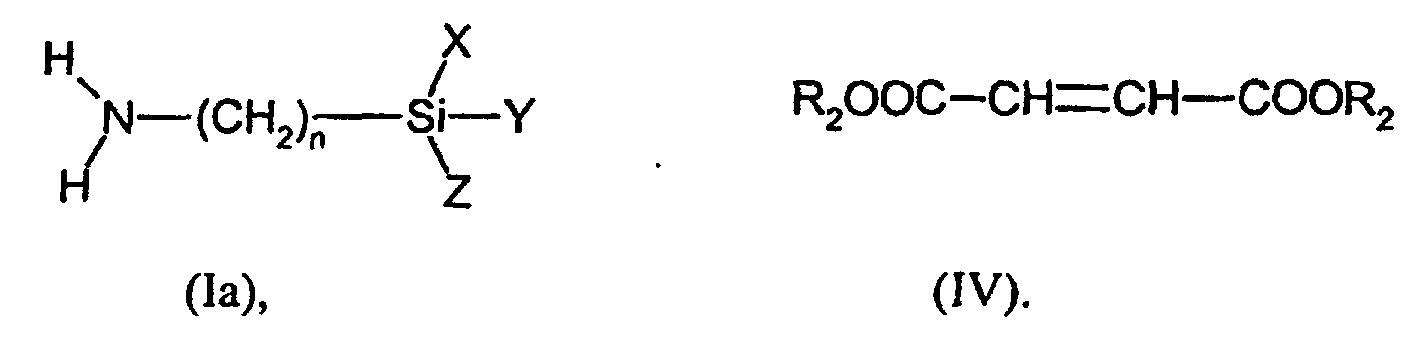
- the aspartic acid esters described in EP-A 596360 can be used with particular preference as they result from the reaction of aminosilanes of the general structural formula (Ia) with maleic or fumaric acid esters of the formula (IV).
- R 2 represents an alkyl radical with 1 to 4 carbon atoms.
- NCO prepolymers are prepared in a known manner by reacting polyether polyols, preferably prepared and have polyether diols with diisocyanates an NCO content between 0.4 and 4%.
- the basic fillers B) which can be used according to the invention are precipitated or ground Chalks, metal oxides, sulfates, silicates, hydroxides, carbonates and bicarbonates.
- Other fillers are e.g. reinforcing and non-reinforcing fillers, such as pyrogenic or precipitated silicas, soot or quartz powder.
- Both the basic fillers as well as the other reinforcing or non-reinforcing ones Fillers can optionally be surface modified.
- Particularly preferred are as basic fillers B) precipitated or ground chalk and pyrogenic Silicas can be used, which can optionally be surface-treated.
- at Component B) can of course also be mixtures of fillers act.
- the phosphorus compound C) is an ester of orthophosphoric acid with at least one optionally substituted linear or branched C 4 -C 30 -alkyl radical R '.
- phosphoric acid esters C) according to the invention are primary and secondary esters of orthophosphoric acid and mixtures thereof, such as di- (2-ethylhexyl) phosphate, dihexadecyl phosphate, diisononyl phosphate, mono-isodecyl phosphate and mono- (2-ethylhexyl) phosphate, component C) also be an ester of polyphosphoric acid or a mixture of several polyphosphoric acid esters. Salts of ortho- and polyphosphoric acid esters, such as alkali metal salts, are also suitable.
- Examples of usable aminosilane compounds are 3-aminopropyltrimethoxysilane, 3-aminopropyltriethoxysilane, N-methyl-3-aminopropyltrimethoxysilane, N-aminoethyl-3-aminopropyltrimethoxysilane, N-aminoethyl-3-aminopropyltriethoxysilane, 3-aminopropyl-methyl-diethoxysilane and N, N-bis-trimethoxysilyl-propylamine, N-aminoethyl-3-aminopropylmethyldimethoxysilane.
- All organometallic catalysts can be used as component E) which are known to promote silane polycondensation. These are connections in particular of tin and titanium.
- Preferred tin compounds are, for example Dibutyltin dilaurate, dibutyltin diacetate and dioctyltin maleate, tin (II) octoate or dibutyltin bis-acetoacetonate.
- Preferred titanium compounds are exemplary Alkyl titanates such as tetraisopropyl titanate, tetrabutyl titanate and chelated Titanium compounds such as ethyl diisobutyl bisacetoacetate titanate.
- Dibutyltin bis-acetoacetonate is preferably used as component E).
- Additives and auxiliary substances F) within the meaning of the invention may be mentioned: desiccants, Light stabilizers, plasticizers, adhesives other than those mentioned under D), Thixotropic agents, pigments and fungicides.
- Alkoxysilyl compounds such as vinyltrimethoxysilane may be mentioned in particular as drying agents, Methyltrimethoxysilane, i-butyltrimethoxysilane, hexadecyltrimethoxysilane.
- plasticizers are phthalic acid esters, adipic acid esters, Called alkyl sulfonic acid ester of phenol or phosphoric acid ester.
- a thixotropic agent examples include polyamides, hydrogenated castor oil derivatives or Called polyvinyl chloride.
- adhesion promoters in addition to those under D) mentioned compounds epoxysilanes and / or mercaptosilanes are used.
- the polyurethane compositions according to the invention preferably consist of 30 to 80% by weight of component A), 10 to 50% by weight of component B), 0.5 to 5% by weight of component C), 0.5 to 3% by weight of component D), 0.02 to 1% by weight of component E) and 0 to 40% by weight of component F).
- the present invention also relates to a method for producing the Condensation-crosslinking polyurethane compositions according to the invention, characterized in that that the components A), B), C), E) and optionally F) under Exclusion of moisture to be mixed and then with the component D) are transferred.
- the present invention also relates to the use of the invention condensation-crosslinking polyurethane materials as sealant, adhesive or coating material.
- condensation-crosslinking polyurethane compositions according to the invention show on the one hand, rapid curing with skin formation times between 15 and 120 Minutes, but on the other hand have excellent storage stability in the temperature range up to 60 ° C.
- the cross-linked polymers are characterized by excellent mechanical properties and excellent adhesion, especially wet adhesion on all imaginable substrates such as metal, ceramic, plastic, Stone or concrete.
- the mixture is dispersed for 10 minutes at a pressure of 100 mbar the internal temperature rises to 60 ° C. Then 1.5 parts by weight of N-aminoethyl-3-aminopropyltrimethoxysilane added and at a pressure of 100 mbar incorporated by stirring for 10 minutes.
- the sealant so produced shows excellent stability, adheres to almost all surfaces and cures with a skin formation time of 30 minutes.
- the product is filled into a commercially available cartridge and stored at 50 ° C. After a storage period of 90 days, the product can still be processed without any problems and shows unchanged product properties.
- the following components are processed into a ready-to-use sealant in a commercially available planetary mixer: 36.0 parts by weight Polyurethane from example 2 12.6 parts by weight Diisoundecyl phthalate (plasticizer) 0.02 parts by weight Dibutyltin bis-acetoacetonate (10% dissolved in Solventnaphta® 100) 2.20 parts by weight vinyltrimethoxysilane 45.68 parts by weight Precipitation chalk (type: Socal® U1S2 from Solvay GmbH) 2.5 parts by weight Mono-2-ethylhexyl 1.4 parts by weight Cabosil® TS 720 (pyrogenic silica from Cabot GmbH)
- the mixture is dispersed for 10 minutes at a pressure of 100 mbar the internal temperature rises to 60 ° C. Then 2.1 parts by weight of N-aminoethyl-3-aminopropyltrimethoxysilane added and at a pressure of 100 mbar incorporated by stirring for 10 minutes.
- the sealant so produced shows excellent stability, adheres to almost all surfaces and cures with a skin formation time of 40 minutes.
- the product is filled into a commercially available cartridge and stored at 50 ° C. After a storage period of 90 days, the product can still be processed without any problems and shows unchanged product properties.
- Example 3 is repeated, except that no di-2-ethylhexyl phosphate is added becomes.
- the product is filled into a commercial cartridge and included in the Stored at 50 ° C. After a storage period of 22 days, the product can no longer be used Squeeze out of the cartridge and is gelled.
- Example 4 is repeated, except that no mono-2-ethylhexyl phosphate is added.
- the product is filled into a commercial cartridge and included in the Stored at 50 ° C. After a storage period of 25 days, the product can no longer be used Squeeze out of the cartridge and is gelled.
Landscapes
- Chemical & Material Sciences (AREA)
- Health & Medical Sciences (AREA)
- Chemical Kinetics & Catalysis (AREA)
- Medicinal Chemistry (AREA)
- Polymers & Plastics (AREA)
- Organic Chemistry (AREA)
- Compositions Of Macromolecular Compounds (AREA)
- Sealing Material Composition (AREA)
- Polyurethanes Or Polyureas (AREA)
- Silicon Polymers (AREA)
- Processes Of Treating Macromolecular Substances (AREA)
Description
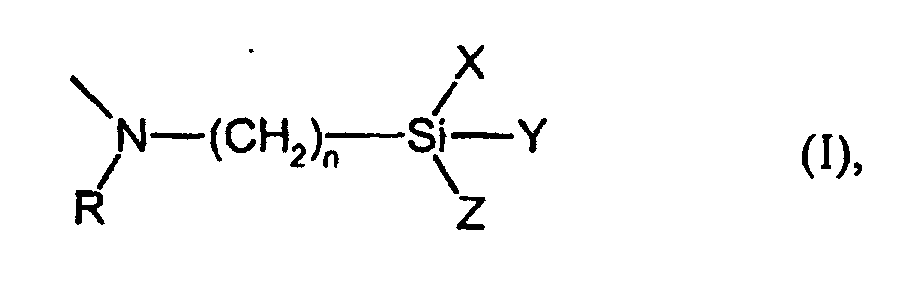
- R
- für einen organischen Rest mit 1 bis 12 Kohlenstoffatomen steht,
- n
- für die Zahl 2, 3 oder 4 steht und
- X, Y, Z
- gleiche oder verschiedene organische Reste darstellen, mit der Maßgabe, daß mindestens einer der Reste eine Alkoxygruppe mit bis 4 Kohlenstoffatomen, vorzugsweise eine Methoxy- oder Ethoxygruppe darstellt,
- m
- für die Zahl 1 oder 2 steht,
- R'
- für einen gegebenenfalls substituierten linearen oder verzweigten C1-C30-Alkyl-, Acyl-, C2-C30-Alkenyl- oder Alkoxyalkyl-, C5-C14-Cycloalkyl- oder Arylrest oder ein Triorganosilyl- oder Diorganolkoxysilylrest steht, der innerhalb des Moleküls gleich oder verschieden sein kann,

- R"
- für ein Wasserstoffatom, einen aliphatischen Kohlenwasserstoffrest mit 1 bis 4 Kohlenstoffatomen, eine Trialkoxysilylpropylgruppe oder eine Aminoethylgruppe steht und n, bzw. X, Y, Z die bei Formel (I) genannte Bedeutung haben,

- R
- für einen organischen Rest mit 1 bis 12 Kohlenstoffatomen vorzugsweise eine Phenylgruppe oder einen Rest der allgemeinen Strukturformel (Ib)
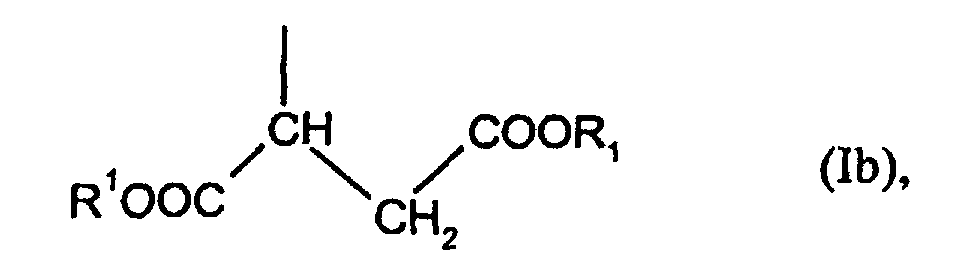
in welcher
- R1
- für eine Alkylgruppe mit 1 bis 4 Kohlenstoffatomen steht.
- m
- für die Zahl 1 oder 2 steht und
- R'
- die Bedeutung von einem gegebenenfalls substituierten linearen oder verzweigten C1-C30-Alkyl-, Acyl-, C2-C30-Alkenyl- oder Alkoxyalkyl-, C5-C14-Cycloalkyl- oder Arylrest oder ein Triorganosilyl- oder Diorganoalkoxysilylrest hat, und R' innerhalb des Moleküls gleich oder verschieden sein kann.
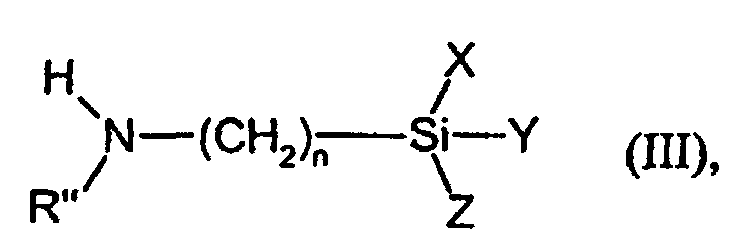
- R"
- für ein Wasserstoffatom, einen aliphatischen Kohlenwasserstoffrest mit 1 bis 4 Kohlenstoffatomen, eine Trialkoxysilylpropylgruppe oder eine Aminoethylgruppe steht und n, bzw. X, Y, Z die obengenannte Bedeutung haben,
| 36,4 Gew.-Teile | Polyurethan aus Beispiel 1 |
| 12,9 Gew.-Teile | Diisoundecylphtalat (Weichmacher) |
| 0,02 Gew.-Teile | Dibutylzinn-bis-acetoacetonat (10 %ige gelöst in Solventnaphta® 100) |
| 1,50 Gew.-Teile | Vinyltrimethoxysilan |
| 46,2 Gew.-Teile | Fällungskreide (Typ: Socal® U1S2 der Firma Solvay GmbH) |
| 2,00 Gew.-Teile | Di-2-ethylhexylphosphat |
| 1,40 Gew.-Teile | Disparlon® NVG 8403 S (Thioxotropiermittel der Kusumoto Chem. Ltd.) |
| 36,0 Gew.-Teile | Polyurethan aus Beispiel 2 |
| 12,6 Gew.-Teile | Diisoundecylphtalat (Weichmacher) |
| 0,02 Gew.-Teile | Dibutylzinn-bis-acetoacetonat (10 %ige gelöst in Solventnaphta® 100) |
| 2,20 Gew.-Teile | Vinyltrimethoxysilan |
| 45,68 Gew.-Teile | Fällungskreide (Typ: Socal® U1S2 der Fa. Solvay GmbH) |
| 2,5 Gew.-Teile | Mono-2-ethylhexylphosphat |
| 1,4 Gew.-Teile | Cabosil® TS 720 (pyrogene Kieselsäure der Fa. Cabot GmbH) |
Claims (6)
- Über eine Silanpolykondendation vernetzende Polyurethanmassen ausA) mindestens einem alkoxysilanfunktionellen Polyurethan mit Endgruppen der allgemeinen Formel (I)in welcher
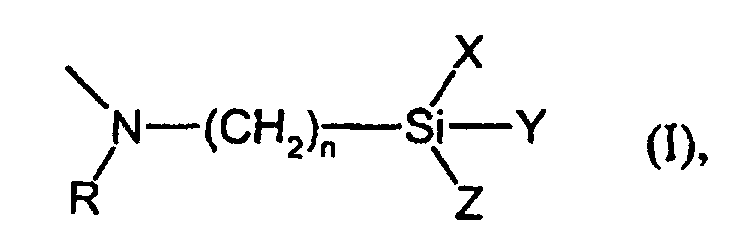
- R
- für einen organischen Rest mit 1 bis 12 Kohlenstoffatomen steht,
- n
- für die Zahl 2, 3 oder 4 steht und
- X, Y, Z
- gleiche oder verschiedene organische Reste darstellen, mit der Maßgabe, daß mindestens einer der Reste eine Alkoxygruppe mit 1 bis 4 Kohlenstoffatomen, vorzugsweise eine Methoxy- oder Ethoxygruppe darstellt,
B) mindestens einem basischen Füllstoff,C) mindestens einer Phosphorverbindung aus der Gruppe der Orthophosphorsäureester und/oder eines Esters oder Polyphosphorsäure der allgemeinen Formel (II)- m
- für die Zahl 1 oder 2 steht
- R'
- für einen gegebenenfalls substituierten linearen oder verzweigten C1-C30-Alkyl-, Acyl-, C2-C30-Alkenyl- oder Alkoxyalkyl-, C5-C14-Cycloalkyl- oder Arylrest oder ein Triorganosilyl- oder Diorganolkoxysilylrest steht, der innerhalb des Moleküls gleich oder verschieden sein kann
D) mindestens einem Aminosilan der allgemeinen Formel (III)in welcher
- R"
- für ein Wasserstoffatom, einen aliphatischen Kohlenwasserstoffrest mit 1 bis 4 Kohlenstoffatomen, eine Trialkoxysilylpropylgruppe oder eine Aminoethylgruppe steht und n, bzw. X, Y, Z die bei Formel (I) genannte Bedeutung haben,
E) metallorganischen Verbindungen undF) gegebenenfalls weiteren Hilfsstoffen. - Über eine Silanpolykondensation vernetzende Polyurethanmassen gemäß Anspruch 1, dadurch gekennzeichnet, daß als Komponente A) mindestens ein Alkoxysilyl-funktionelles Polyurethan der allgemeinen Formel (I)eingesetzt wird,
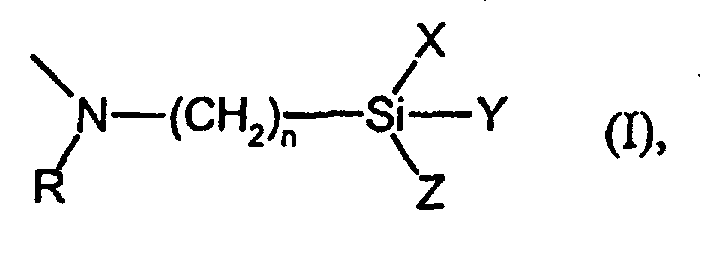
worin
X, Y und Z jeweils für eine Methoxygruppe steht. - Über eine Silanpolykondensation vernetzende Polyurethanmassen gemäß Anspruch 1, dadurch gekennzeichnet, daß als Komponente A) mindestens ein Alkoxysilyl-funktionelles Polyurethan der allgemeinen Formel (I)eingesetzt wird,

worin- R
- für einen Rest der allgemeinen Strukturformel (Ib)
steht,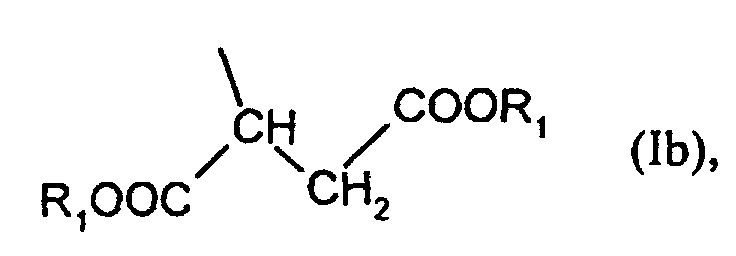
in welcher- R1
- eine Alkylgruppe mit 1 bis 4 Kohlenstoffatomen bedeutet,
- Über eine Silanpolykondensation vernetzende Polyurethanmassen gemäß Anspruch 1, dadurch gekennzeichnet, daß als Komponente D) Aminosilanverbindungen der allgemeinen Strukturformel (Ia)in welcher

- R"
- für eine Aminoethylgruppe steht,
- n
- für die Zahl 3 steht und
- X, Y, Z
- für Methoxy oder Ethoxyreste stehen,
- Verfahren zur Herstellung von kondensationsvernetzenden Polyurethanmassen gemäß Anspruch 1, dadurch gekennzeichnet, daß die Komponenten A), B), C), E) sowie gegebenenfalls F) unter Ausschluß von Feuchtigkeit vermischt werden und anschließend mit der Komponente D) versetzt werden.
- Verwendung von kondensationsvernetzenden Polyurethanmassen gemäß Anspruch 1 als Dichtstoff, Kleb- oder Beschichtungsmaterial.
Applications Claiming Priority (3)
| Application Number | Priority Date | Filing Date | Title |
|---|---|---|---|
| DE19923300 | 1999-05-21 | ||
| DE19923300A DE19923300A1 (de) | 1999-05-21 | 1999-05-21 | Phosphatstabilisierte, kondensationsvernetzende Polyurethanmassen, ein Verfahren zu ihrer Herstellung sowie ihre Verwendung |
| PCT/EP2000/004132 WO2000071595A1 (de) | 1999-05-21 | 2000-05-09 | Phosphatstabilisierte, kondensationsvernetzende polyurethanmassen, ein verfahren zu ihrer herstellung sowie ihre verwendung |
Publications (2)
| Publication Number | Publication Date |
|---|---|
| EP1185572A1 EP1185572A1 (de) | 2002-03-13 |
| EP1185572B1 true EP1185572B1 (de) | 2002-10-16 |
Family
ID=7908715
Family Applications (1)
| Application Number | Title | Priority Date | Filing Date |
|---|---|---|---|
| EP00931146A Expired - Lifetime EP1185572B1 (de) | 1999-05-21 | 2000-05-09 | Phosphatstabilisierte, kondensationsvernetzende polyurethanmassen, ein verfahren zu ihrer herstellung sowie ihre verwendung |
Country Status (8)
| Country | Link |
|---|---|
| US (1) | US6626988B1 (de) |
| EP (1) | EP1185572B1 (de) |
| AT (1) | ATE226220T1 (de) |
| AU (1) | AU4918100A (de) |
| CA (1) | CA2374229C (de) |
| DE (2) | DE19923300A1 (de) |
| ES (1) | ES2183797T3 (de) |
| WO (1) | WO2000071595A1 (de) |
Families Citing this family (20)
| Publication number | Priority date | Publication date | Assignee | Title |
|---|---|---|---|---|
| JP2001311056A (ja) * | 2000-04-28 | 2001-11-09 | Kanegafuchi Chem Ind Co Ltd | 被着体の接着方法 |
| EP1256595A1 (de) * | 2001-05-10 | 2002-11-13 | Sika AG, vorm. Kaspar Winkler & Co. | Klebstoff, gefüllt mit oberflächenbehandelter Kreide und Russ |
| EP1281740A1 (de) * | 2001-07-31 | 2003-02-05 | Sika AG, vorm. Kaspar Winkler & Co. | Silikonfluid enthaltende Dichtstoffe |
| DE10139132A1 (de) | 2001-08-09 | 2003-02-27 | Consortium Elektrochem Ind | Alkoxyvernetzende einkomponentige feuchtigkeitshärtende Massen |
| DE10351804A1 (de) | 2003-11-06 | 2005-06-09 | Wacker-Chemie Gmbh | Verfahren zur Erhöhung der Elastizität von feuchtigkeitsgehärteten Elastomeren |
| US7482420B2 (en) * | 2004-03-24 | 2009-01-27 | Construction Research & Technology Gmbh | Silane-terminated polyurethanes with high strength and high elongation |
| US20050215426A1 (en) * | 2004-03-26 | 2005-09-29 | Putzig Donald E | Esterification catalyst and process therewith |
| US8083853B2 (en) | 2004-05-12 | 2011-12-27 | Applied Materials, Inc. | Plasma uniformity control by gas diffuser hole design |
| US8328939B2 (en) | 2004-05-12 | 2012-12-11 | Applied Materials, Inc. | Diffuser plate with slit valve compensation |
| US8074599B2 (en) * | 2004-05-12 | 2011-12-13 | Applied Materials, Inc. | Plasma uniformity control by gas diffuser curvature |
| US7429410B2 (en) | 2004-09-20 | 2008-09-30 | Applied Materials, Inc. | Diffuser gravity support |
| CN101405316B (zh) * | 2006-01-26 | 2012-03-14 | Sika技术股份公司 | 具有良好的粘附性的含有硅烷官能的聚合物和氨基硅烷-加合物的湿固化组合物 |
| US20080317973A1 (en) * | 2007-06-22 | 2008-12-25 | White John M | Diffuser support |
| DE102008047362A1 (de) | 2008-09-15 | 2010-04-15 | Henkel Ag & Co. Kgaa | Zusammensetzung zur Hautaufhellung |
| DE102009026679A1 (de) * | 2009-06-03 | 2010-12-16 | Henkel Ag & Co. Kgaa | Kleb- und Dichtstoffe auf Basis silanterminierter Bindemittel zum Verkleben und Abdichten von flexiblen Solarfolien / Photovoltaikmodulen |
| DE102009029200A1 (de) * | 2009-09-04 | 2011-03-17 | Wacker Chemie Ag | Isocyanatfreie silanvernetzende Zusammensetzungen |
| DE102009046190A1 (de) * | 2009-10-30 | 2011-05-05 | Henkel Ag & Co. Kgaa | Kaschierklebstoff mit Silanvernetzung |
| WO2015125578A1 (ja) * | 2014-02-19 | 2015-08-27 | 株式会社オートネットワーク技術研究所 | 粘着性組成物およびこれを用いた複合材料 |
| DE102016111590A1 (de) | 2016-06-24 | 2017-12-28 | Delo Industrie Klebstoffe Gmbh & Co. Kgaa | Einkomponentenmasse auf Basis von Alkoxysilanen und Verfahren zum Fügen oder Vergießen von Bauteilen unter Verwendung der Masse |
| CN111961197B (zh) * | 2020-08-25 | 2021-05-14 | 山东万达有机硅新材料有限公司 | 一种氨基酸改性硅烷封端聚醚及其制备方法 |
Family Cites Families (8)
| Publication number | Priority date | Publication date | Assignee | Title |
|---|---|---|---|---|
| US4361692A (en) | 1980-07-30 | 1982-11-30 | Ppg Industries, Inc. | Extended pot life polyurethane |
| US4889903A (en) * | 1988-08-03 | 1989-12-26 | Basf Corporation | Fast-cure polyurethane sealant composition containing titanium ester accelerators |
| DE4237468A1 (de) | 1992-11-06 | 1994-05-11 | Bayer Ag | Alkoxysilan- und Aminogruppen aufweisende Verbindungen |
| DE4302393A1 (de) * | 1993-01-28 | 1994-08-04 | Wacker Chemie Gmbh | Zu Elastomeren vernetzende Organopolysiloxanmassen |
| JP2594024B2 (ja) | 1994-04-08 | 1997-03-26 | オーエスアイ・スペシヤルテイーズ・インコーポレーテツド | アリールアミノシラン末端キヤツプドウレタンのシーラント |
| DE19507416C1 (de) * | 1995-03-03 | 1996-09-19 | Bayer Ag | Kondensationsvernetzende Polysiloxanmassen, ein Verfahren zu deren Herstellung sowie deren Verwendung |
| DE19619538A1 (de) | 1996-05-15 | 1997-11-20 | Bayer Ag | Alkoxysilan- und Hydantoingruppen aufweisende Polyurethanprepolymere, ein Verfahren zu ihrer Herstellung sowie ihre Verwendung zur Herstellung von Dichtstoffen |
| US6001946A (en) * | 1996-09-23 | 1999-12-14 | Witco Corporation | Curable silane-encapped compositions having improved performances |
-
1999
- 1999-05-21 DE DE19923300A patent/DE19923300A1/de not_active Withdrawn
-
2000
- 2000-05-09 AT AT00931146T patent/ATE226220T1/de not_active IP Right Cessation
- 2000-05-09 US US09/980,941 patent/US6626988B1/en not_active Expired - Lifetime
- 2000-05-09 DE DE50000660T patent/DE50000660D1/de not_active Expired - Lifetime
- 2000-05-09 AU AU49181/00A patent/AU4918100A/en not_active Abandoned
- 2000-05-09 EP EP00931146A patent/EP1185572B1/de not_active Expired - Lifetime
- 2000-05-09 WO PCT/EP2000/004132 patent/WO2000071595A1/de not_active Ceased
- 2000-05-09 ES ES00931146T patent/ES2183797T3/es not_active Expired - Lifetime
- 2000-05-09 CA CA002374229A patent/CA2374229C/en not_active Expired - Fee Related
Also Published As
| Publication number | Publication date |
|---|---|
| DE50000660D1 (de) | 2002-11-21 |
| US6626988B1 (en) | 2003-09-30 |
| WO2000071595A1 (de) | 2000-11-30 |
| ATE226220T1 (de) | 2002-11-15 |
| AU4918100A (en) | 2000-12-12 |
| EP1185572A1 (de) | 2002-03-13 |
| DE19923300A1 (de) | 2000-11-23 |
| CA2374229A1 (en) | 2000-11-30 |
| CA2374229C (en) | 2009-07-28 |
| ES2183797T3 (es) | 2003-04-01 |
Similar Documents
| Publication | Publication Date | Title |
|---|---|---|
| EP1196469B1 (de) | Spezielle aminosilane enthaltende, kondensationsvernetzende polyurethanmassen, ein verfahren zu ihrer herstellung sowie ihre verwendung | |
| EP0549626B1 (de) | Feuchtigkeitshärtende, alkoxysilanterminierte polyurethane | |
| EP1124872B1 (de) | Alkoxysilan-endgruppen aufweisende polyurethanprepolymere, ein verfahren zu ihrer herstellung sowie ihre verwendung zur herstellung von dichtstoffen | |
| EP1185572A1 (de) | Phosphatstabilisierte, kondensationsvernetzende polyurethanmassen, ein verfahren zu ihrer herstellung sowie ihre verwendung | |
| EP2098548B1 (de) | Zusammensetzung mit verbesserter Haftung auf porösen Substraten | |
| WO2005000931A1 (de) | Alkoxysilanterminierte prepolymere | |
| EP3715397A1 (de) | Zusammensetzung und verfahren zur herstellung feuchtigkeitsvernetzender polymere und deren verwendung | |
| DE102004035764A1 (de) | Niedrigviskose Polyurethan-Prepolymere auf Basis von 2,4'-MDI | |
| WO2006117338A2 (de) | Feuchtigkeitshärtende zusammensetzung mit erhöhter dehnbarkeit | |
| EP1397406A1 (de) | Klebstoff, gefüllt mit oberflächenbehandelter kreide und russ | |
| DE19929011A1 (de) | Spezielle Aminosilane enthaltende, kondensationsvernetzende Polyurethanmassen, ein Verfahren zu ihrer Herstellung sowie ihre Verwendung | |
| EP1717240A1 (de) | Organoalkoxysilane zur Verwendung in feuchtigkeitshärtenden Zusammensetzungen | |
| EP2828331B1 (de) | Zusammensetzung auf basis von silanterminierten polymeren | |
| EP0813570A1 (de) | Kondensationsvernetzende polysiloxanmassen, ein herstellungsverfahren und oberflächenmodifizierte füllstoffe | |
| EP2813528B1 (de) | Härtbare zusammensetzung auf basis von alkoxysilangruppen-haltigen polyethern und einer phosphazen-base | |
| EP3976684B1 (de) | Verfahren zur herstellung eines gemischten silanterminierten polymers | |
| EP3613786A1 (de) | Trocknungsmittel für feuchtigkeitshärtende zusammensetzungen | |
| EP3131993B1 (de) | Zusammensetzung auf basis von silanterminierten polymeren mit carbodiimid-additiven zur verbesserung der mechanischen eigenschaften | |
| EP4069790B1 (de) | Vernetzbare zusammensetzungen auf basis von organyloxysilanterminierten polymeren | |
| EP3309187A1 (de) | Reaktivweichmacher für feuchtigkeitshärtende zusammensetzungen mit silanfunktionellen polymeren | |
| WO2022189382A1 (de) | Alterungsbeständige feuchtigkeitshärtende zusammensetzungen | |
| DE19929029A1 (de) | Alkoxysilangruppen aufweisende Piperazinonderivate |
Legal Events
| Date | Code | Title | Description |
|---|---|---|---|
| PUAI | Public reference made under article 153(3) epc to a published international application that has entered the european phase |
Free format text: ORIGINAL CODE: 0009012 |
|
| 17P | Request for examination filed |
Effective date: 20011221 |
|
| AK | Designated contracting states |
Kind code of ref document: A1 Designated state(s): AT BE CH CY DE DK ES FI FR GB GR IE IT LI LU MC NL PT SE |
|
| AX | Request for extension of the european patent |
Free format text: AL;LT;LV;MK;RO;SI |
|
| GRAG | Despatch of communication of intention to grant |
Free format text: ORIGINAL CODE: EPIDOS AGRA |
|
| GRAG | Despatch of communication of intention to grant |
Free format text: ORIGINAL CODE: EPIDOS AGRA |
|
| GRAH | Despatch of communication of intention to grant a patent |
Free format text: ORIGINAL CODE: EPIDOS IGRA |
|
| 17Q | First examination report despatched |
Effective date: 20020416 |
|
| GRAH | Despatch of communication of intention to grant a patent |
Free format text: ORIGINAL CODE: EPIDOS IGRA |
|
| GRAA | (expected) grant |
Free format text: ORIGINAL CODE: 0009210 |
|
| AK | Designated contracting states |
Kind code of ref document: B1 Designated state(s): AT BE CH CY DE DK ES FI FR GB GR IE IT LI LU MC NL PT SE |
|
| PG25 | Lapsed in a contracting state [announced via postgrant information from national office to epo] |
Ref country code: FI Free format text: LAPSE BECAUSE OF FAILURE TO SUBMIT A TRANSLATION OF THE DESCRIPTION OR TO PAY THE FEE WITHIN THE PRESCRIBED TIME-LIMIT Effective date: 20021016 Ref country code: GR Free format text: LAPSE BECAUSE OF FAILURE TO SUBMIT A TRANSLATION OF THE DESCRIPTION OR TO PAY THE FEE WITHIN THE PRESCRIBED TIME-LIMIT Effective date: 20021016 Ref country code: IE Free format text: LAPSE BECAUSE OF FAILURE TO SUBMIT A TRANSLATION OF THE DESCRIPTION OR TO PAY THE FEE WITHIN THE PRESCRIBED TIME-LIMIT Effective date: 20021016 |
|
| REF | Corresponds to: |
Ref document number: 226220 Country of ref document: AT Date of ref document: 20021115 Kind code of ref document: T |
|
| REG | Reference to a national code |
Ref country code: GB Ref legal event code: FG4D Free format text: NOT ENGLISH |
|
| REG | Reference to a national code |
Ref country code: CH Ref legal event code: EP |
|
| GBT | Gb: translation of ep patent filed (gb section 77(6)(a)/1977) |
Effective date: 20021016 |
|
| REG | Reference to a national code |
Ref country code: IE Ref legal event code: FG4D Free format text: GERMAN |
|
| REF | Corresponds to: |
Ref document number: 50000660 Country of ref document: DE Date of ref document: 20021121 |
|
| PG25 | Lapsed in a contracting state [announced via postgrant information from national office to epo] |
Ref country code: SE Free format text: LAPSE BECAUSE OF FAILURE TO SUBMIT A TRANSLATION OF THE DESCRIPTION OR TO PAY THE FEE WITHIN THE PRESCRIBED TIME-LIMIT Effective date: 20030116 Ref country code: DK Free format text: LAPSE BECAUSE OF FAILURE TO SUBMIT A TRANSLATION OF THE DESCRIPTION OR TO PAY THE FEE WITHIN THE PRESCRIBED TIME-LIMIT Effective date: 20030116 Ref country code: PT Free format text: LAPSE BECAUSE OF FAILURE TO SUBMIT A TRANSLATION OF THE DESCRIPTION OR TO PAY THE FEE WITHIN THE PRESCRIBED TIME-LIMIT Effective date: 20030116 |
|
| LTIE | Lt: invalidation of european patent or patent extension |
Effective date: 20021016 |
|
| REG | Reference to a national code |
Ref country code: ES Ref legal event code: FG2A Ref document number: 2183797 Country of ref document: ES Kind code of ref document: T3 |
|
| ET | Fr: translation filed | ||
| PG25 | Lapsed in a contracting state [announced via postgrant information from national office to epo] |
Ref country code: CY Free format text: LAPSE BECAUSE OF FAILURE TO SUBMIT A TRANSLATION OF THE DESCRIPTION OR TO PAY THE FEE WITHIN THE PRESCRIBED TIME-LIMIT Effective date: 20030509 Ref country code: AT Free format text: LAPSE BECAUSE OF NON-PAYMENT OF DUE FEES Effective date: 20030509 Ref country code: LU Free format text: LAPSE BECAUSE OF NON-PAYMENT OF DUE FEES Effective date: 20030509 |
|
| PG25 | Lapsed in a contracting state [announced via postgrant information from national office to epo] |
Ref country code: MC Free format text: LAPSE BECAUSE OF NON-PAYMENT OF DUE FEES Effective date: 20030531 |
|
| REG | Reference to a national code |
Ref country code: IE Ref legal event code: FD4D Ref document number: 1185572E Country of ref document: IE |
|
| PLBE | No opposition filed within time limit |
Free format text: ORIGINAL CODE: 0009261 |
|
| STAA | Information on the status of an ep patent application or granted ep patent |
Free format text: STATUS: NO OPPOSITION FILED WITHIN TIME LIMIT |
|
| 26N | No opposition filed |
Effective date: 20030717 |
|
| PG25 | Lapsed in a contracting state [announced via postgrant information from national office to epo] |
Ref country code: CH Free format text: LAPSE BECAUSE OF NON-PAYMENT OF DUE FEES Effective date: 20040531 Ref country code: LI Free format text: LAPSE BECAUSE OF NON-PAYMENT OF DUE FEES Effective date: 20040531 |
|
| REG | Reference to a national code |
Ref country code: CH Ref legal event code: PL |
|
| REG | Reference to a national code |
Ref country code: DE Ref legal event code: R081 Ref document number: 50000660 Country of ref document: DE Owner name: BAYER INTELLECTUAL PROPERTY GMBH, DE Free format text: FORMER OWNER: BAYER MATERIALSCIENCE AKTIENGESELLSCHAFT, 51373 LEVERKUSEN, DE Effective date: 20140317 Ref country code: DE Ref legal event code: R081 Ref document number: 50000660 Country of ref document: DE Owner name: COVESTRO DEUTSCHLAND AG, DE Free format text: FORMER OWNER: BAYER MATERIALSCIENCE AKTIENGESELLSCHAFT, 51373 LEVERKUSEN, DE Effective date: 20140317 |
|
| PGFP | Annual fee paid to national office [announced via postgrant information from national office to epo] |
Ref country code: NL Payment date: 20150426 Year of fee payment: 16 |
|
| PGFP | Annual fee paid to national office [announced via postgrant information from national office to epo] |
Ref country code: GB Payment date: 20150506 Year of fee payment: 16 Ref country code: ES Payment date: 20150428 Year of fee payment: 16 |
|
| PGFP | Annual fee paid to national office [announced via postgrant information from national office to epo] |
Ref country code: IT Payment date: 20150515 Year of fee payment: 16 |
|
| REG | Reference to a national code |
Ref country code: DE Ref legal event code: R081 Ref document number: 50000660 Country of ref document: DE Owner name: COVESTRO DEUTSCHLAND AG, DE Free format text: FORMER OWNER: BAYER INTELLECTUAL PROPERTY GMBH, 40789 MONHEIM, DE |
|
| REG | Reference to a national code |
Ref country code: FR Ref legal event code: PLFP Year of fee payment: 17 |
|
| REG | Reference to a national code |
Ref country code: NL Ref legal event code: MM Effective date: 20160601 |
|
| GBPC | Gb: european patent ceased through non-payment of renewal fee |
Effective date: 20160509 |
|
| PG25 | Lapsed in a contracting state [announced via postgrant information from national office to epo] |
Ref country code: IT Free format text: LAPSE BECAUSE OF NON-PAYMENT OF DUE FEES Effective date: 20160509 Ref country code: NL Free format text: LAPSE BECAUSE OF NON-PAYMENT OF DUE FEES Effective date: 20160601 |
|
| REG | Reference to a national code |
Ref country code: FR Ref legal event code: TP Owner name: COVESTRO DEUTSCHLAND AG, DE Effective date: 20170213 |
|
| REG | Reference to a national code |
Ref country code: FR Ref legal event code: PLFP Year of fee payment: 18 |
|
| PG25 | Lapsed in a contracting state [announced via postgrant information from national office to epo] |
Ref country code: GB Free format text: LAPSE BECAUSE OF NON-PAYMENT OF DUE FEES Effective date: 20160509 |
|
| PGFP | Annual fee paid to national office [announced via postgrant information from national office to epo] |
Ref country code: DE Payment date: 20170502 Year of fee payment: 18 Ref country code: FR Payment date: 20170427 Year of fee payment: 18 |
|
| PGFP | Annual fee paid to national office [announced via postgrant information from national office to epo] |
Ref country code: BE Payment date: 20170424 Year of fee payment: 18 |
|
| PG25 | Lapsed in a contracting state [announced via postgrant information from national office to epo] |
Ref country code: ES Free format text: LAPSE BECAUSE OF NON-PAYMENT OF DUE FEES Effective date: 20160510 |
|
| REG | Reference to a national code |
Ref country code: ES Ref legal event code: FD2A Effective date: 20181128 |
|
| REG | Reference to a national code |
Ref country code: DE Ref legal event code: R119 Ref document number: 50000660 Country of ref document: DE |
|
| REG | Reference to a national code |
Ref country code: BE Ref legal event code: MM Effective date: 20180531 |
|
| PG25 | Lapsed in a contracting state [announced via postgrant information from national office to epo] |
Ref country code: FR Free format text: LAPSE BECAUSE OF NON-PAYMENT OF DUE FEES Effective date: 20180531 Ref country code: DE Free format text: LAPSE BECAUSE OF NON-PAYMENT OF DUE FEES Effective date: 20181201 |
|
| PG25 | Lapsed in a contracting state [announced via postgrant information from national office to epo] |
Ref country code: BE Free format text: LAPSE BECAUSE OF NON-PAYMENT OF DUE FEES Effective date: 20180531 |