EP1184336A1 - Apparatus for selective oxidation of carbon monoxide - Google Patents
Apparatus for selective oxidation of carbon monoxide Download PDFInfo
- Publication number
- EP1184336A1 EP1184336A1 EP00917307A EP00917307A EP1184336A1 EP 1184336 A1 EP1184336 A1 EP 1184336A1 EP 00917307 A EP00917307 A EP 00917307A EP 00917307 A EP00917307 A EP 00917307A EP 1184336 A1 EP1184336 A1 EP 1184336A1
- Authority
- EP
- European Patent Office
- Prior art keywords
- hydrogen
- reaction vessel
- carbon monoxide
- oxygen
- stream
- Prior art date
- Legal status (The legal status is an assumption and is not a legal conclusion. Google has not performed a legal analysis and makes no representation as to the accuracy of the status listed.)
- Withdrawn
Links
Images



Classifications
-
- H—ELECTRICITY
- H01—ELECTRIC ELEMENTS
- H01M—PROCESSES OR MEANS, e.g. BATTERIES, FOR THE DIRECT CONVERSION OF CHEMICAL ENERGY INTO ELECTRICAL ENERGY
- H01M8/00—Fuel cells; Manufacture thereof
- H01M8/06—Combination of fuel cells with means for production of reactants or for treatment of residues
- H01M8/0606—Combination of fuel cells with means for production of reactants or for treatment of residues with means for production of gaseous reactants
- H01M8/0612—Combination of fuel cells with means for production of reactants or for treatment of residues with means for production of gaseous reactants from carbon-containing material
- H01M8/0625—Combination of fuel cells with means for production of reactants or for treatment of residues with means for production of gaseous reactants from carbon-containing material in a modular combined reactor/fuel cell structure
- H01M8/0631—Reactor construction specially adapted for combination reactor/fuel cell
-
- B—PERFORMING OPERATIONS; TRANSPORTING
- B01—PHYSICAL OR CHEMICAL PROCESSES OR APPARATUS IN GENERAL
- B01J—CHEMICAL OR PHYSICAL PROCESSES, e.g. CATALYSIS OR COLLOID CHEMISTRY; THEIR RELEVANT APPARATUS
- B01J19/00—Chemical, physical or physico-chemical processes in general; Their relevant apparatus
- B01J19/24—Stationary reactors without moving elements inside
- B01J19/248—Reactors comprising multiple separated flow channels
- B01J19/2485—Monolithic reactors
-
- B—PERFORMING OPERATIONS; TRANSPORTING
- B01—PHYSICAL OR CHEMICAL PROCESSES OR APPARATUS IN GENERAL
- B01J—CHEMICAL OR PHYSICAL PROCESSES, e.g. CATALYSIS OR COLLOID CHEMISTRY; THEIR RELEVANT APPARATUS
- B01J8/00—Chemical or physical processes in general, conducted in the presence of fluids and solid particles; Apparatus for such processes
- B01J8/02—Chemical or physical processes in general, conducted in the presence of fluids and solid particles; Apparatus for such processes with stationary particles, e.g. in fixed beds
- B01J8/04—Chemical or physical processes in general, conducted in the presence of fluids and solid particles; Apparatus for such processes with stationary particles, e.g. in fixed beds the fluid passing successively through two or more beds
- B01J8/0403—Chemical or physical processes in general, conducted in the presence of fluids and solid particles; Apparatus for such processes with stationary particles, e.g. in fixed beds the fluid passing successively through two or more beds the fluid flow within the beds being predominantly horizontal
- B01J8/0423—Chemical or physical processes in general, conducted in the presence of fluids and solid particles; Apparatus for such processes with stationary particles, e.g. in fixed beds the fluid passing successively through two or more beds the fluid flow within the beds being predominantly horizontal through two or more otherwise shaped beds
-
- B—PERFORMING OPERATIONS; TRANSPORTING
- B01—PHYSICAL OR CHEMICAL PROCESSES OR APPARATUS IN GENERAL
- B01J—CHEMICAL OR PHYSICAL PROCESSES, e.g. CATALYSIS OR COLLOID CHEMISTRY; THEIR RELEVANT APPARATUS
- B01J8/00—Chemical or physical processes in general, conducted in the presence of fluids and solid particles; Apparatus for such processes
- B01J8/02—Chemical or physical processes in general, conducted in the presence of fluids and solid particles; Apparatus for such processes with stationary particles, e.g. in fixed beds
- B01J8/04—Chemical or physical processes in general, conducted in the presence of fluids and solid particles; Apparatus for such processes with stationary particles, e.g. in fixed beds the fluid passing successively through two or more beds
- B01J8/0492—Feeding reactive fluids
-
- B—PERFORMING OPERATIONS; TRANSPORTING
- B01—PHYSICAL OR CHEMICAL PROCESSES OR APPARATUS IN GENERAL
- B01J—CHEMICAL OR PHYSICAL PROCESSES, e.g. CATALYSIS OR COLLOID CHEMISTRY; THEIR RELEVANT APPARATUS
- B01J8/00—Chemical or physical processes in general, conducted in the presence of fluids and solid particles; Apparatus for such processes
- B01J8/02—Chemical or physical processes in general, conducted in the presence of fluids and solid particles; Apparatus for such processes with stationary particles, e.g. in fixed beds
- B01J8/04—Chemical or physical processes in general, conducted in the presence of fluids and solid particles; Apparatus for such processes with stationary particles, e.g. in fixed beds the fluid passing successively through two or more beds
- B01J8/0496—Heating or cooling the reactor
-
- C—CHEMISTRY; METALLURGY
- C01—INORGANIC CHEMISTRY
- C01B—NON-METALLIC ELEMENTS; COMPOUNDS THEREOF; METALLOIDS OR COMPOUNDS THEREOF NOT COVERED BY SUBCLASS C01C
- C01B3/00—Hydrogen; Gaseous mixtures containing hydrogen; Separation of hydrogen from mixtures containing it; Purification of hydrogen; Reversible storage of hydrogen
- C01B3/50—Separation of hydrogen or hydrogen-containing gases from gaseous mixtures, e.g. purification
- C01B3/56—Separation of hydrogen or hydrogen-containing gases from gaseous mixtures, e.g. purification by contacting with solids; Regeneration of used solids
- C01B3/58—Separation of hydrogen or hydrogen-containing gases from gaseous mixtures, e.g. purification by contacting with solids; Regeneration of used solids including a catalytic reaction
- C01B3/583—Separation of hydrogen or hydrogen-containing gases from gaseous mixtures, e.g. purification by contacting with solids; Regeneration of used solids including a catalytic reaction the reaction being the selective oxidation of carbon monoxide
-
- C—CHEMISTRY; METALLURGY
- C10—PETROLEUM, GAS OR COKE INDUSTRIES; TECHNICAL GASES CONTAINING CARBON MONOXIDE; FUELS; LUBRICANTS; PEAT
- C10K—PURIFYING OR MODIFYING THE CHEMICAL COMPOSITION OF COMBUSTIBLE GASES CONTAINING CARBON MONOXIDE
- C10K3/00—Modifying the chemical composition of combustible gases containing carbon monoxide to produce an improved fuel, e.g. one of different calorific value, which may be free from carbon monoxide
- C10K3/02—Modifying the chemical composition of combustible gases containing carbon monoxide to produce an improved fuel, e.g. one of different calorific value, which may be free from carbon monoxide by catalytic treatment
- C10K3/04—Modifying the chemical composition of combustible gases containing carbon monoxide to produce an improved fuel, e.g. one of different calorific value, which may be free from carbon monoxide by catalytic treatment reducing the carbon monoxide content, e.g. water-gas shift [WGS]
-
- H—ELECTRICITY
- H01—ELECTRIC ELEMENTS
- H01M—PROCESSES OR MEANS, e.g. BATTERIES, FOR THE DIRECT CONVERSION OF CHEMICAL ENERGY INTO ELECTRICAL ENERGY
- H01M8/00—Fuel cells; Manufacture thereof
- H01M8/06—Combination of fuel cells with means for production of reactants or for treatment of residues
- H01M8/0662—Treatment of gaseous reactants or gaseous residues, e.g. cleaning
-
- B—PERFORMING OPERATIONS; TRANSPORTING
- B01—PHYSICAL OR CHEMICAL PROCESSES OR APPARATUS IN GENERAL
- B01J—CHEMICAL OR PHYSICAL PROCESSES, e.g. CATALYSIS OR COLLOID CHEMISTRY; THEIR RELEVANT APPARATUS
- B01J2208/00—Processes carried out in the presence of solid particles; Reactors therefor
- B01J2208/00008—Controlling the process
- B01J2208/00017—Controlling the temperature
- B01J2208/00106—Controlling the temperature by indirect heat exchange
- B01J2208/00115—Controlling the temperature by indirect heat exchange with heat exchange elements inside the bed of solid particles
- B01J2208/00132—Tubes
-
- B—PERFORMING OPERATIONS; TRANSPORTING
- B01—PHYSICAL OR CHEMICAL PROCESSES OR APPARATUS IN GENERAL
- B01J—CHEMICAL OR PHYSICAL PROCESSES, e.g. CATALYSIS OR COLLOID CHEMISTRY; THEIR RELEVANT APPARATUS
- B01J2219/00—Chemical, physical or physico-chemical processes in general; Their relevant apparatus
- B01J2219/00049—Controlling or regulating processes
- B01J2219/00051—Controlling the temperature
- B01J2219/00074—Controlling the temperature by indirect heating or cooling employing heat exchange fluids
- B01J2219/00076—Controlling the temperature by indirect heating or cooling employing heat exchange fluids with heat exchange elements inside the reactor
- B01J2219/00081—Tubes
-
- C—CHEMISTRY; METALLURGY
- C01—INORGANIC CHEMISTRY
- C01B—NON-METALLIC ELEMENTS; COMPOUNDS THEREOF; METALLOIDS OR COMPOUNDS THEREOF NOT COVERED BY SUBCLASS C01C
- C01B2203/00—Integrated processes for the production of hydrogen or synthesis gas
- C01B2203/04—Integrated processes for the production of hydrogen or synthesis gas containing a purification step for the hydrogen or the synthesis gas
- C01B2203/0435—Catalytic purification
- C01B2203/044—Selective oxidation of carbon monoxide
-
- C—CHEMISTRY; METALLURGY
- C01—INORGANIC CHEMISTRY
- C01B—NON-METALLIC ELEMENTS; COMPOUNDS THEREOF; METALLOIDS OR COMPOUNDS THEREOF NOT COVERED BY SUBCLASS C01C
- C01B2203/00—Integrated processes for the production of hydrogen or synthesis gas
- C01B2203/04—Integrated processes for the production of hydrogen or synthesis gas containing a purification step for the hydrogen or the synthesis gas
- C01B2203/0465—Composition of the impurity
- C01B2203/047—Composition of the impurity the impurity being carbon monoxide
-
- Y—GENERAL TAGGING OF NEW TECHNOLOGICAL DEVELOPMENTS; GENERAL TAGGING OF CROSS-SECTIONAL TECHNOLOGIES SPANNING OVER SEVERAL SECTIONS OF THE IPC; TECHNICAL SUBJECTS COVERED BY FORMER USPC CROSS-REFERENCE ART COLLECTIONS [XRACs] AND DIGESTS
- Y02—TECHNOLOGIES OR APPLICATIONS FOR MITIGATION OR ADAPTATION AGAINST CLIMATE CHANGE
- Y02E—REDUCTION OF GREENHOUSE GAS [GHG] EMISSIONS, RELATED TO ENERGY GENERATION, TRANSMISSION OR DISTRIBUTION
- Y02E60/00—Enabling technologies; Technologies with a potential or indirect contribution to GHG emissions mitigation
- Y02E60/30—Hydrogen technology
- Y02E60/50—Fuel cells
Definitions
- the present invention relates to an apparatus for selectively oxidizing carbon monoxide, particularly to an apparatus for selective oxidation of carbon monoxide having a reaction vessel filled with a catalyst which catalyzes oxidation of carbon monoxide in preference to hydrogen in a hydrogen-rich gas in the presence of oxygen.
- the apparatus in which carbon monoxide in a hydrogen-rich gas, obtained by steam forming a hydrocarbon based fuel, is oxidized by a catalyst such as ruthenium or rhodium for catalyzing oxidation of carbon monoxide in preference to hydrogen in the presence of oxygen (e.g., Japanese Patent Application Laid-Open No. 201702/1993).
- the catalyst may be contained in an elongated steel tube vessel, and the hydrogen-rich gas is introduced together with air into the reaction vessel along a longitudinal direction. With such a constitution, carbon monoxide in the hydrogen-rich gas is oxidized as the hydrogen-rich gas passes through the reaction vessel.
- the present applicant has proposed an apparatus for selective oxidation of carbon monoxide for supplying oxygen to the reaction vessel filled with the catalyst from a plurality of positions along a stream of the hydrogen-rich gas (Japanese Patent Application No. 204325/1994).
- the concentration of oxygen in the hydrogen-rich gas is lowered, the oxidizing reaction of hydrogen is inhibited, and the oxidizing reaction of carbon monoxide is performed througout the entire reaction vessel in order to obtain a hydrogen-rich gas with remarkably low carbon monoxide concentration.
- An apparatus for selective oxidation of carbon monoxide according to the present invention is a further improvement of the apparatus for selective oxidation of carbon monoxide proposed by the present applicant, and an object thereof is to reduce a concentration of carbon monoxide in a hydrogen-rich gas. Moreover, another object of the apparatus for selective oxidation of carbon monoxide according to the present invention is to maintain a high concentration of hydrogen in the hydrogen-rich gas.
- the apparatus for selective oxidation of carbon monoxide according to the present invention is configured as described below.
- an apparatus for selective oxidation of carbon monoxide having a reaction vessel filled with a catalyst which catalyzes the oxidation of carbon monoxide in a hydrogen-rich gas in preference to hydrogen in the presence of oxygen, the apparatus comprising an oxygen-containing gas supply unit for supplying an oxygen-containing gas to the reaction vessel from a plurality of positions along a stream of the hydrogen-rich gas, wherein the reaction vessel is formed so that the cross sectional area of a gas channel increases toward a downstream side with respect to the stream of the hydrogen-rich gas.
- the oxygen-containing gas supply unit supplies the oxygen-containing gas from the plurality of positions along the stream of the hydrogen-rich gas to the reaction vessel formed such that the cross sectional area of the gas channel increases toward the downstream side with respect to the stream of the hydrogen-rich gas.
- the reaction vessel is formed such that the cross section of the gas channel increases toward the downstream side with respect to the stream of the hydrogen-rich gas.
- the reaction vessel comprises a casing whose cross sectional area increases toward the downstream side with respect to the stream of the hydrogen-rich gas.
- the reaction vessel can be constituted by employing a monolithic carrier whose cell number decreases toward the downstream side with respect to the stream of the hydrogen-rich gas to carry the catalyst.
- the reaction vessel can be formed such that the cross sectional area of the gas channel increases toward the downstream side with respect to the stream of the hydrogen-rich gas.
- the reaction vessel can be filled with the catalyst in such a manner that a gas channel resistance in a filled catalyst phase decreases toward the downstream side with respect to the stream of the hydrogen-rich gas.
- the "monolithic carrier” may be a carrier constituted of a plurality of cells as a plurality of divided gas channels, and may correspond, for example, to a honeycomb tube or the like.
- the oxygen-containing gas supply unit supplies the oxygen-containing gas such that the amount of oxygen supplied to the reaction vessel decreases toward the downstream side with respect to the stream of the hydrogen-rich gas in the reaction vessel.
- the oxygen-containing gas may be supplied by a piping which has a smaller cross sectional area channel on the downstream side with respect to the stream of the hydrogen-rich gas in the reaction vessel. Because the concentration of carbon monoxide in the hydrogen-rich gas is higher upstream with respect to the stream of the hydrogen-rich gas in the reaction vessel, the oxidizing reaction of carbon monoxide occurs more frequently.
- the oxygen-containing gas supply unit may also be constituted such that a larger number of pipes are disposed on the downstream side with respect to the stream of the hydrogen-rich gas in the reaction vessel in order to supply the oxygen-containing gas. In this case, since the oxygen-containing gas is rapidly diffused and mixed into the hydrogen-rich gas, and carbon monoxide can be more efficiently oxidized.
- the first apparatus for selective oxidation of carbon monoxide may comprise a cooling apparatus for cooling the reaction vessel so that a cooling effect to the reaction vessel decreases downstream with respect to the stream of the hydrogen-rich gas in the reaction vessel.
- a cooling apparatus for cooling the reaction vessel so that a cooling effect to the reaction vessel decreases downstream with respect to the stream of the hydrogen-rich gas in the reaction vessel.
- the cooling apparatus may be constituted such that a cooling medium is circulated in the reaction vessel through a channel having a smaller contact area on the downstream side with respect to the stream of the hydrogen-rich gas in the reaction vessel, or the cooling medium may be circulated in the reaction vessel through a smaller number of channels on the downstream side.
- the reaction vessel can thereby be configured with a larger gas channel section on the downstream side.
- an apparatus for selective oxidation of carbon monoxide having a reaction vessel filled with a catalyst which catalyzes oxidation of carbon monoxide in a hydrogen-rich gas in preference to hydrogen in the presence of oxygen, the apparatus comprising an oxygen-containing gas supply unit for supplying an oxygen-containing gas to the reaction vessel from a plurality of positions along a stream of the hydrogen-rich gas, wherein the reaction vessel is filled with the catalyst so that a gas channel resistance in a filled catalyst phase decreases toward a downstream side with respect to the stream of the hydrogen-rich gas.
- the oxygen-containing gas supply unit supplies the oxygen-containing gas from the plurality of positions along the stream of the hydrogen-rich gas to the reaction vessel filled with the catalyst so that the gas channel resistance in the filled catalyst phase decreases toward the downstream side with respect to the stream of the hydrogen-rich gas.
- the reaction vessel is filled with the catalyst so that the gas channel resistance in the filled catalyst phase decreases toward the downstream side with respect to the stream of the hydrogen-rich gas.
- the reaction vessel comprises a plurality of filled portions filled with the catalyst so that the gas channel resistance in the catalyst phase differs.
- the reaction vessel can be constituted by allowing the monolithic carrier whose cell number decreases toward the downstream side with respect to the stream of the hydrogen-rich gas to carry the catalyst.
- the reaction vessel can be formed such that the gas channel section increases toward the downstream side with respect to the stream of the hydrogen-rich gas.
- the reaction vessel can be filled with the catalyst so that the gas channel resistance in the filled catalyst phase decreases toward the downstream side.
- the oxygen-containing gas supply unit may supply the oxygen-containing gas in such a manner that the amount of oxygen supplied to the reaction vessel decreases toward the downstream side with respect to the stream of the hydrogen-rich gas in the reaction vessel.
- the oxygen-containing gas may also be supplied by piping having a smaller cross sectional area on the downstream side with respect to the stream of the hydrogen-rich gas in the reaction vessel. Because the concentration of carbon monoxide in the hydrogen-rich gas is higher on the upstream side with respect to the stream of the hydrogen-rich gas in the reaction vessel, oxidizing reactions of carbon monoxide occur more frequently.
- the oxygen-containing gas supply unit may also be constituted such that a larger number of pipes are disposed on the downstream side with respect the stream of the hydrogen-rich gas in the reaction vessel in order to supply the oxygen-containing gas.
- the apparatus for selective oxidation of carbon monoxide may comprise a cooling apparatus for cooling the reaction vessel in which the cooling effect to the reaction vessel decreases toward the downstream side with respect to the stream of the hydrogen-rich gas in the reaction vessel.
- a cooling apparatus for cooling the reaction vessel in which the cooling effect to the reaction vessel decreases toward the downstream side with respect to the stream of the hydrogen-rich gas in the reaction vessel.
- the cooling apparatus may also be constituted such that the cooling medium is circulated in the reaction vessel through channel with a smaller contact area on the downstream side with respect to the stream of the hydrogen-rich gas in the reaction vessel, or the cooling medium may be circulated in the reaction vessel through a smaller number of channels on the downstream side.
- the reaction vessel can be made to have a larger cross sectional area on the downstream side.
- FIG. 1 is a diagram schematically showing a constitution of a reformer 20 including a CO selective oxidation apparatus 30 according to one embodiment of the present invention.
- the reformer 20 is an apparatus for steam reforming of a hydrocarbon-based fuel and obtaining a hydrogen-rich gas to be supplied to a hydrogen consuming engine having a low allowable concentration of carbon monoxide, such as a solid polymeric fuel cell.
- the apparatus comprises a heater 22 for heating a mixture gas of a hydrocarbon based fuel (e.g., methane or the like) and an oxygen-containing gas (e.g., air or the like) containing water vapor and oxygen; a reforming portion 24 for reforming the heated mixture gas by a reaction of the following equations (1) to (3) to obtain the hydrogen-rich gas; a heat exchanger 26 for cooling the reformed/obtained hydrogen-rich gas; and the CO selective oxidation apparatus 30 for oxidizing carbon monoxide as a byproduct contained in the cooled hydrogen-rich gas in preference to hydrogen.
- a heater 22 for heating a mixture gas of a hydrocarbon based fuel (e.g., methane or the like) and an oxygen-containing gas (e.g., air or the like) containing water vapor and oxygen
- a reforming portion 24 for reforming the heated mixture gas by a reaction of the following equations (1) to (3) to obtain the hydrogen-rich gas
- a heat exchanger 26 for cooling the reformed
- a reforming reaction in the reformer 24 is efficiently performed in a range of about 600°C to 800°C
- a selective oxidizing reaction in the CO selective oxidation apparatus 30 is efficiently performed in a range of about 140°C to 170°C
- the hydrogen-rich gas is cooled by the heat exchanger 26. Therefore, in the present embodiment, the CO selective oxidation apparatus 30 is constituted to oxidize carbon monoxide in the hydrogen-rich gas obtained by the reforming reaction of the reformer 24.
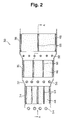
- FIG. 2 is a sectional schematic showing the constitution of the CO selective oxidation apparatus 30 of the present embodiment
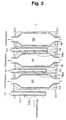
- FIG. 3 is a view showing a section along line A-A of the CO selective oxidation apparatus 30 of the apparatus of FIG. 2.
- the CO selective oxidation apparatus 30 of the present embodiment comprises a casing 32 forming an outer wall of the CO selective oxidation apparatus 30; catalyst filled portions 44 to 48 filled with a catalyst which catalyzes oxidation of carbon monoxide in preference to hydrogen in the hydrogen-rich gas in the presence of oxygen; air-introducing pipes 54 to 58 for introducing air as an oxygen-containing gas into the hydrogen-rich gas; and cooling-water passages 64 to 68 for passing a cooling medium to cool the catalyst filled portions 44 to 48.
- catalyst disposing portions 34 to 38 are formed in which a gas channel sectional area is enlarged in three stages along a stream of the hydrogen-rich gas from an upstream side, and a plurality of catalyst filled portions 44 to 48 are disposed for the respective catalyst disposing portions 34 to 38.
- the catalyst filled portions 44 to 48 are filled with a carrier carrying the catalyst (e.g., ruthenium or rhodium) which catalyzes oxidation of carbon monoxide in preference to hydrogen in the hydrogen-rich gas in the presence of oxygen so that the catalyst filled portion on the upstream side has a higher density.
- the catalyst e.g., ruthenium or rhodium
- the catalyst filled portion 44 is filled with the catalyst carried by the carrier having a small particle diameter
- the catalyst filled portion 48 is filled with the catalyst carried by the carrier having a particle diameter larger than that of the carrier with which the catalyst filled portion 44 is filled.
- the catalyst filled portion 46 is filled with the catalyst carried by the carrier having a particle diameter larger than that of the carrier with which fills the catalyst filled portion 44, and smaller than that of the carrier with which fills the catalyst filled portion 48. Therefore, in the catalyst filled portions 44 to 48, the gas channel cross sectional area increases and gas channel resistance decreases toward the downstream side.
- the air-introducing pipes 54 to 58 are disposed to cross at right angles to upstream middle portions of the respective catalyst disposing portions 34 to 38 of the casing 32 with respect to the stream of the hydrogen-rich gas.
- the air-introducing pipes 54 to 58 have a smaller air channel cross sectional area on the downstream side along the stream of the hydrogen-rich gas, and the amount of air supply decreases toward the downstream side.
- a plurality of air supply holes 54a to 58a are formed on the upstream side of the hydrogen-rich gas, so that air is introduced into the hydrogen-rich gas.
- the cooling-water passages 64 to 68 are formed as flat channels which have enlarged widths and which cross at right angles to the stream of the hydrogen-rich gas, and are disposed to be laminated on the respective catalyst filled portions 44 to 48.
- the respective cooling-water passages 64 to 68 have the same shape, and are disposed so that the number of disposed pipes decreases toward the downstream side along the stream of the hydrogen-rich gas. Therefore, the cross sectional area of the cooling water channel and the cooling effect decrease toward the downstream side.
- the CO selective oxidation apparatus 30 of the apparatus constituted as described above is constituted to have a larger gas channel sectional area, a smaller gas channel resistance, a smaller amount of introduced air, a larger number of introduced air-supplying pipes, and a smaller cooling effect toward the downstream side along the stream of the hydrogen-rich gas. Therefore, even when air is introduced to increase a gas flow rate, gas can flow without stagnating, and a discharge pressure of the hydrogen-rich gas in an outlet of the CO selective oxidation apparatus 30 can be prevented from increasing. As a result, reactions adverse or reverse to reforming reactions, such as a hydrocarbon reaction of carbon monoxide by hydrogen and a carbon monoxide reaction of carbon dioxide, can be prevented.
- an oxidizing reaction of carbon monoxide is smoothly carried out and a concentration of carbon monoxide in the hydrogen-rich gas can be remarkably lowered.
- a corresponding amount of air is introduced via the air-introducing pipes 54 to 58, and therefore the oxidizing reaction of carbon monoxide can be performed in preference to that of hydrogen.
- carbon monoxide can be efficiently oxidized. As a result, the hydrogen content of the hydrogen-rich gas can be increased.
- the entire CO selective oxidation apparatus 30 can be set at a temperature suitable for the oxidizing reaction of carbon monoxide. As a result, the oxidizing reaction of carbon monoxide can be smoothly performed, and the concentration of carbon monoxide in the hydrogen-rich gas can be further lowered.
- FIG. 4 schematically shows the constitution of a modified example CO selective oxidation apparatus 130.
- components corresponding to those of the CO selective oxidation apparatus 30 of the embodiment are denoted by using corresponding reference numbers formed by adding 100 to the numbers used to describe the apparatus 30.
- the casing 132 of the CO selective oxidation apparatus 130 of the modification example has a constant cross sectional area with respect to the stream of the hydrogen-rich gas.
- the particle diameter of the carrier of the catalyst with which catalyst filled portions 144 to 148 are filled is adjusted.
- the CO selective oxidation apparatus 130 of the modification example can also be constituted to have a larger gas channel cross sectional area, a smaller gas channel resistance, a smaller amount of introduced air, a larger number of introduced air-supplying pipes, and a smaller cooling effect toward the downstream side along the stream of the hydrogen-rich gas.
- the catalyst carried by a monolithic carrier having a plurality of divided channels e.g., a honeycomb tube shown in FIG. 5 is disposed in the catalyst filled portions 144 to 148, and a monolithic carrier having a smaller number of cells is used on the downstream side. Then, the gas channel area increases and gas channel resistance decreases toward the downstream side.
- the CO selective oxidation apparatus 130 of the modification example is able to produce effects similar to the effects of the CO selective oxidation apparatus 30 of the preferred embodiment.
- a casing having a constant cross sectional area such as the casing 132, may facilitate configuration or installation of the CO selective oxidation apparatus 130.
- Both the CO selective oxidation apparatus 30 and the CO selective oxidation apparatus 130 may be constituted to have a larger gas channel sectional area, a smaller gas channel resistance, a smaller amount of introduced air, a larger number of introduced air-supplying pipes, and a smaller cooling effect toward the downstream side along the stream of the hydrogen-rich gas.
- the present invention does not require the disposition of all of the above elements, and some of the elements may be eliminated where the effect of their elimination is not overly detrimental.
- Examples of such constitution include a constitution in which only an element having a larger gas channel sectional area, a smaller gas channel resistance, a smaller amount of introduced air, a larger number of introduced air-supplying pipes, or a smaller cooling effect toward the downstream side along the stream of the hydrogen-rich gas is removed and a constitution in which a combination of two or more elements is removed.
- the selective oxidation of carbon monoxide in the hydrogen-rich gas to be supplied to a hydrogen consuming engine having a low allowable concentration of carbon monoxide, such as a solid polymeric fuel cell was described.
- carbon monoxide in the hydrogen-rich gas to be supplied to any hydrogen consuming engine may also be selectively oxidized.
Landscapes
- Chemical & Material Sciences (AREA)
- Chemical Kinetics & Catalysis (AREA)
- Organic Chemistry (AREA)
- Engineering & Computer Science (AREA)
- Combustion & Propulsion (AREA)
- General Chemical & Material Sciences (AREA)
- Manufacturing & Machinery (AREA)
- Sustainable Development (AREA)
- Sustainable Energy (AREA)
- Electrochemistry (AREA)
- Life Sciences & Earth Sciences (AREA)
- Fluid Mechanics (AREA)
- Physics & Mathematics (AREA)
- Oil, Petroleum & Natural Gas (AREA)
- Inorganic Chemistry (AREA)
- Fuel Cell (AREA)
- Hydrogen, Water And Hydrids (AREA)
- Exhaust Gas Treatment By Means Of Catalyst (AREA)
- Catalysts (AREA)
Abstract
An apparatus for selective oxidation of carbon
monoxide having a reaction vessel filled with a catalyst which
catalyzes the oxidation of carbon monoxide in preference to
that of hydrogen in the oxidation of a hydrogen-rich gas in the
presence of oxygen, which provides, at a more downstream point
along the stream of the hydrogen-rich gas, a larger cross
section and a smaller resistance for the passage of a gas, a
smaller amount of the air introduced, a larger number of air-supplying
pipes and a smaller cooling effect, that is, wherein
a casing having a larger diameter in a more downstream point is
employed, and at a more downstream point,.a catalyst having a
carrier of a larger diameter, air-introducing pipes of a
smaller diameter, a large number of air-introducing pipes and a
smaller number of cooling pipes are disposed. The apparatus
can comply with the increase of the amount of the gas that
accompanies the introduction of air and to the characteristics
of the oxidation of carbon monoxide, and thus can be used for
achieving a reduced concentration of carbon monoxide in a
hydrogen-rich gas, while maintaining a high concentration of
hydrogen in the gas.
Description
The present invention relates to an apparatus for
selectively oxidizing carbon monoxide, particularly to an
apparatus for selective oxidation of carbon monoxide having a
reaction vessel filled with a catalyst which catalyzes
oxidation of carbon monoxide in preference to hydrogen in a
hydrogen-rich gas in the presence of oxygen.
As an apparatus for selective oxidation of carbon
monoxide, heretofore has been proposed the apparatus in which
carbon monoxide in a hydrogen-rich gas, obtained by steam
forming a hydrocarbon based fuel, is oxidized by a catalyst
such as ruthenium or rhodium for catalyzing oxidation of carbon
monoxide in preference to hydrogen in the presence of oxygen
(e.g., Japanese Patent Application Laid-Open No. 201702/1993).
Here, the catalyst may be contained in an elongated steel tube
vessel, and the hydrogen-rich gas is introduced together with
air into the reaction vessel along a longitudinal direction.
With such a constitution, carbon monoxide in the hydrogen-rich
gas is oxidized as the hydrogen-rich gas passes through the
reaction vessel.
However, in this apparatus for selective oxidation of
carbon monoxide, there is a problem that a concentration of
carbon monoxide in the hydrogen-rich gas cannot sufficiently be
lowered. This problem occurs because, even when a necessary
amount of oxygen for oxidizing carbon monoxide in the hydrogen-rich
gas is supplied to the reaction vessel, the concentration
of oxygen in the hydrogen-rich gas is high in the vicinity of
an inlet of the reaction vessel, an oxidizing reaction of
hydrogen is therefore carried out in addition to the oxidizing
reaction of carbon monoxide, and oxygen for oxidizing carbon
monoxide is consumed.
To deal with this problem, increasing the amount of
oxygen introduced has been considered. However, an increase in
the amount of oxygen introduced is accompanied by an increase
of the amount of hydrogen oxidized, and a problem results in
that the hydrogen content of the hydrogen-rich gas is thereby
lowered.
To solve these problems, the present applicant has
proposed an apparatus for selective oxidation of carbon
monoxide for supplying oxygen to the reaction vessel filled
with the catalyst from a plurality of positions along a stream
of the hydrogen-rich gas (Japanese Patent Application No.
204325/1994). In the apparatus for supplying oxygen from the
plurality of positions, the concentration of oxygen in the
hydrogen-rich gas is lowered, the oxidizing reaction of
hydrogen is inhibited, and the oxidizing reaction of carbon
monoxide is performed througout the entire reaction vessel in
order to obtain a hydrogen-rich gas with remarkably low carbon
monoxide concentration.
An apparatus for selective oxidation of carbon
monoxide according to the present invention is a further
improvement of the apparatus for selective oxidation of carbon
monoxide proposed by the present applicant, and an object
thereof is to reduce a concentration of carbon monoxide in a
hydrogen-rich gas. Moreover, another object of the apparatus
for selective oxidation of carbon monoxide according to the
present invention is to maintain a high concentration of
hydrogen in the hydrogen-rich gas.
To achieve the aforementioned objects, the apparatus
for selective oxidation of carbon monoxide according to the
present invention is configured as described below.
According to a first aspect of the present invention,
there is provided an apparatus for selective oxidation of
carbon monoxide having a reaction vessel filled with a catalyst
which catalyzes the oxidation of carbon monoxide in a hydrogen-rich
gas in preference to hydrogen in the presence of oxygen,
the apparatus comprising an oxygen-containing gas supply unit
for supplying an oxygen-containing gas to the reaction vessel
from a plurality of positions along a stream of the hydrogen-rich
gas, wherein the reaction vessel is formed so that the
cross sectional area of a gas channel increases toward a
downstream side with respect to the stream of the hydrogen-rich
gas.
In the first aspect for selective oxidation of carbon
monoxide according to the present invention, the oxygen-containing
gas supply unit supplies the oxygen-containing gas
from the plurality of positions along the stream of the
hydrogen-rich gas to the reaction vessel formed such that the
cross sectional area of the gas channel increases toward the
downstream side with respect to the stream of the hydrogen-rich
gas. The reaction vessel is formed such that the cross section
of the gas channel increases toward the downstream side with
respect to the stream of the hydrogen-rich gas. Therefore,
even when an amount of the gas flowing through the reaction
vessel increases through the supply of the oxygen-containing
gas, an increase in the gas discharge pressure on an outlet
side of the reaction vessel and gas stagnation inside the
reaction vessel can be prevented, as can reactions, such as a
hydrocarbon reaction of carbon monoxide by hydrogen and a
carbon monoxide reaction of carbon dioxide. As a result, the
oxidizing reaction of carbon monoxide can be smoothly carried
out.
In this first aspect for selective oxidation of carbon
monoxide according to the present invention, the reaction
vessel comprises a casing whose cross sectional area increases
toward the downstream side with respect to the stream of the
hydrogen-rich gas.
Moreover, in the first aspect for selective oxidation
of carbon monoxide according to the present invention, the
reaction vessel can be constituted by employing a monolithic
carrier whose cell number decreases toward the downstream side
with respect to the stream of the hydrogen-rich gas to carry
the catalyst. In this case as well, the reaction vessel can be
formed such that the cross sectional area of the gas channel
increases toward the downstream side with respect to the stream
of the hydrogen-rich gas. Additionally, the reaction vessel
can be filled with the catalyst in such a manner that a gas
channel resistance in a filled catalyst phase decreases toward
the downstream side with respect to the stream of the hydrogen-rich
gas. Additionally, the "monolithic carrier" may be a
carrier constituted of a plurality of cells as a plurality of
divided gas channels, and may correspond, for example, to a
honeycomb tube or the like.
Furthermore, in the first aspect for selective
oxidation of carbon monoxide according to the present invention,
the oxygen-containing gas supply unit supplies the oxygen-containing
gas such that the amount of oxygen supplied to the
reaction vessel decreases toward the downstream side with
respect to the stream of the hydrogen-rich gas in the reaction
vessel. Alternatively, the oxygen-containing gas may be
supplied by a piping which has a smaller cross sectional area
channel on the downstream side with respect to the stream of
the hydrogen-rich gas in the reaction vessel. Because the
concentration of carbon monoxide in the hydrogen-rich gas is
higher upstream with respect to the stream of the hydrogen-rich
gas in the reaction vessel, the oxidizing reaction of carbon
monoxide occurs more frequently. Therefore, when a smaller
amount of oxygen-containing gas is supplied or when the oxygen-containing
gas is supplied through piping having a smaller
cross section on the downstream side, the amount of oxygen
supplied to the oxidizing reaction of carbon monoxide is more
appropriate. In these modes of the first apparatus for
selective oxidation of carbon monoxide according to the present
invention, the oxygen-containing gas supply unit may also be
constituted such that a larger number of pipes are disposed on
the downstream side with respect to the stream of the hydrogen-rich
gas in the reaction vessel in order to supply the oxygen-containing
gas. In this case, since the oxygen-containing gas
is rapidly diffused and mixed into the hydrogen-rich gas, and
carbon monoxide can be more efficiently oxidized.
Additionally, the first apparatus for selective
oxidation of carbon monoxide according to the present invention
may comprise a cooling apparatus for cooling the reaction
vessel so that a cooling effect to the reaction vessel
decreases downstream with respect to the stream of the
hydrogen-rich gas in the reaction vessel. As described above,
because the oxidizing reaction of carbon monoxide occurs more
frequently on the upstream side with respect to the stream of
the hydrogen-rich gas in the reaction vessel, heat is easily
generated such that a higher temperature is created on the
upstream side. Therefore, when the reaction vessel is cooled
in order to produce a smaller cooling effect on the downstream
side, the temperature of the reaction vessel as a whole can be
maintained at a more uniform proper temperature. In this mode
of the first aspect of the present invention, the cooling
apparatus may be constituted such that a cooling medium is
circulated in the reaction vessel through a channel having a
smaller contact area on the downstream side with respect to the
stream of the hydrogen-rich gas in the reaction vessel, or the
cooling medium may be circulated in the reaction vessel through
a smaller number of channels on the downstream side. The
reaction vessel can thereby be configured with a larger gas
channel section on the downstream side.
According to another aspect of the present invention,
there is provided an apparatus for selective oxidation of
carbon monoxide having a reaction vessel filled with a catalyst
which catalyzes oxidation of carbon monoxide in a hydrogen-rich
gas in preference to hydrogen in the presence of oxygen, the
apparatus comprising an oxygen-containing gas supply unit for
supplying an oxygen-containing gas to the reaction vessel from
a plurality of positions along a stream of the hydrogen-rich
gas, wherein the reaction vessel is filled with the catalyst so
that a gas channel resistance in a filled catalyst phase
decreases toward a downstream side with respect to the stream
of the hydrogen-rich gas.
In the apparatus according to the second aspect, the
oxygen-containing gas supply unit supplies the oxygen-containing
gas from the plurality of positions along the stream
of the hydrogen-rich gas to the reaction vessel filled with the
catalyst so that the gas channel resistance in the filled
catalyst phase decreases toward the downstream side with
respect to the stream of the hydrogen-rich gas. The reaction
vessel is filled with the catalyst so that the gas channel
resistance in the filled catalyst phase decreases toward the
downstream side with respect to the stream of the hydrogen-rich
gas. Therefore, even when the gas amount flowing through the
reaction vessel increases midway as a result of the supply of
the oxygen-containing gas, increase of the gas discharge
pressure on the outlet side of the reaction vessel can be
prevented, gas stagnation inside the reaction vessel can be
eliminated, and reactions such as the hydrocarbon reaction of
carbon monoxide by hydrogen and the carbon monoxide reaction of
carbon dioxide can be prevented. As a result, the oxidizing
reaction of carbon monoxide can be smoothly carried out.
In this second aspect of the present invention, the
reaction vessel comprises a plurality of filled portions filled
with the catalyst so that the gas channel resistance in the
catalyst phase differs.
Moreover, in this second aspect of the present
invention, the reaction vessel can be constituted by allowing
the monolithic carrier whose cell number decreases toward the
downstream side with respect to the stream of the hydrogen-rich
gas to carry the catalyst. In this case, the reaction vessel
can be formed such that the gas channel section increases
toward the downstream side with respect to the stream of the
hydrogen-rich gas. Additionally, the reaction vessel can be
filled with the catalyst so that the gas channel resistance in
the filled catalyst phase decreases toward the downstream side.
Furthermore, in the apparatus for selective oxidation
of carbon monoxide according to the second aspect of the
present invention, the oxygen-containing gas supply unit may
supply the oxygen-containing gas in such a manner that the
amount of oxygen supplied to the reaction vessel decreases
toward the downstream side with respect to the stream of the
hydrogen-rich gas in the reaction vessel. Alternatively, the
oxygen-containing gas may also be supplied by piping having a
smaller cross sectional area on the downstream side with
respect to the stream of the hydrogen-rich gas in the reaction
vessel. Because the concentration of carbon monoxide in the
hydrogen-rich gas is higher on the upstream side with respect
to the stream of the hydrogen-rich gas in the reaction vessel,
oxidizing reactions of carbon monoxide occur more frequently.
Therefore, when a smaller amount of oxygen-containing gas is
supplied or the oxygen-containing gas is supplied by piping
narrower on the downstream side, a more appropriate amount of
oxygen can be supplied to the oxidizing reaction of carbon
monoxide. In these modes of the aforementioned second aspect
of the present invention, the oxygen-containing gas supply unit
may also be constituted such that a larger number of pipes are
disposed on the downstream side with respect the stream of the
hydrogen-rich gas in the reaction vessel in order to supply the
oxygen-containing gas. With such a configuration, because the
oxygen-containing gas is rapidly diffused, or mixed into, the
hydrogen-rich gas, carbon monoxide can be efficiently oxidized.
Additionally, the apparatus for selective oxidation of
carbon monoxide according to the second aspect of the present
invention may comprise a cooling apparatus for cooling the
reaction vessel in which the cooling effect to the reaction
vessel decreases toward the downstream side with respect to the
stream of the hydrogen-rich gas in the reaction vessel. As
described above, because the oxidizing reaction of carbon
monoxide occurs more frequently on the upstream side with
respect to the stream of the hydrogen-rich gas in the reaction
vessel, more heat is generated on the upstream side. Therefore,
when the reaction vessel is cooled in order to produce a
smaller cooling effect on the downstream side, the temperature
of the whole reaction vessel can be more uniform maintained at
the proper temperature. In this mode of the apparatus
according to the present invention, the cooling apparatus may
also be constituted such that the cooling medium is circulated
in the reaction vessel through channel with a smaller contact
area on the downstream side with respect to the stream of the
hydrogen-rich gas in the reaction vessel, or the cooling medium
may be circulated in the reaction vessel through a smaller
number of channels on the downstream side. In this manner, the
reaction vessel can be made to have a larger cross sectional
area on the downstream side.
The best mode for carrying out the present invention
will next be described by way of an illustrative embodiment.
FIG. 1 is a diagram schematically showing a constitution of a
reformer 20 including a CO selective oxidation apparatus 30
according to one embodiment of the present invention. The
reformer 20 is an apparatus for steam reforming of a
hydrocarbon-based fuel and obtaining a hydrogen-rich gas to be
supplied to a hydrogen consuming engine having a low allowable
concentration of carbon monoxide, such as a solid polymeric
fuel cell. The apparatus comprises a heater 22 for heating a
mixture gas of a hydrocarbon based fuel (e.g., methane or the
like) and an oxygen-containing gas (e.g., air or the like)
containing water vapor and oxygen; a reforming portion 24 for
reforming the heated mixture gas by a reaction of the following
equations (1) to (3) to obtain the hydrogen-rich gas; a heat
exchanger 26 for cooling the reformed/obtained hydrogen-rich
gas; and the CO selective oxidation apparatus 30 for oxidizing
carbon monoxide as a byproduct contained in the cooled
hydrogen-rich gas in preference to hydrogen. A reforming
reaction in the reformer 24 is efficiently performed in a range
of about 600°C to 800°C, a selective oxidizing reaction in the
CO selective oxidation apparatus 30 is efficiently performed in
a range of about 140°C to 170°C, and the hydrogen-rich gas is
cooled by the heat exchanger 26. Therefore, in the present
embodiment, the CO selective oxidation apparatus 30 is
constituted to oxidize carbon monoxide in the hydrogen-rich gas
obtained by the reforming reaction of the reformer 24.
CH4 + (1/2)O2 → 2H2 + CO + 35.7kJ
CH4 + H2O → 3H2 + CO - 206.2kJ
CO + H2O → H2 + CO2 + 41.2kJ
FIG. 2 is a sectional schematic showing the
constitution of the CO selective oxidation apparatus 30 of the
present embodiment, and FIG. 3 is a view showing a section
along line A-A of the CO selective oxidation apparatus 30 of
the apparatus of FIG. 2. As shown in the drawing, the CO
selective oxidation apparatus 30 of the present embodiment
comprises a casing 32 forming an outer wall of the CO selective
oxidation apparatus 30; catalyst filled portions 44 to 48
filled with a catalyst which catalyzes oxidation of carbon
monoxide in preference to hydrogen in the hydrogen-rich gas in
the presence of oxygen; air-introducing pipes 54 to 58 for
introducing air as an oxygen-containing gas into the hydrogen-rich
gas; and cooling-water passages 64 to 68 for passing a
cooling medium to cool the catalyst filled portions 44 to 48.
In the casing 32, catalyst disposing portions 34 to 38
are formed in which a gas channel sectional area is enlarged in
three stages along a stream of the hydrogen-rich gas from an
upstream side, and a plurality of catalyst filled portions 44
to 48 are disposed for the respective catalyst disposing
portions 34 to 38. The catalyst filled portions 44 to 48 are
filled with a carrier carrying the catalyst (e.g., ruthenium or
rhodium) which catalyzes oxidation of carbon monoxide in
preference to hydrogen in the hydrogen-rich gas in the presence
of oxygen so that the catalyst filled portion on the upstream
side has a higher density. That is, the catalyst filled
portion 44 is filled with the catalyst carried by the carrier
having a small particle diameter, and the catalyst filled
portion 48 is filled with the catalyst carried by the carrier
having a particle diameter larger than that of the carrier with
which the catalyst filled portion 44 is filled. The catalyst
filled portion 46 is filled with the catalyst carried by the
carrier having a particle diameter larger than that of the
carrier with which fills the catalyst filled portion 44, and
smaller than that of the carrier with which fills the catalyst
filled portion 48. Therefore, in the catalyst filled portions
44 to 48, the gas channel cross sectional area increases and
gas channel resistance decreases toward the downstream side.
The air-introducing pipes 54 to 58 are disposed to
cross at right angles to upstream middle portions of the
respective catalyst disposing portions 34 to 38 of the casing
32 with respect to the stream of the hydrogen-rich gas. The
air-introducing pipes 54 to 58 have a smaller air channel cross
sectional area on the downstream side along the stream of the
hydrogen-rich gas, and the amount of air supply decreases
toward the downstream side. In the respective air-introducing
pipes 54 to 58, as shown in FIG. 3, a plurality of air supply
holes 54a to 58a are formed on the upstream side of the
hydrogen-rich gas, so that air is introduced into the hydrogen-rich
gas.
As shown in FIGS. 2 and 3, the cooling-water passages
64 to 68 are formed as flat channels which have enlarged widths
and which cross at right angles to the stream of the hydrogen-rich
gas, and are disposed to be laminated on the respective
catalyst filled portions 44 to 48. The respective cooling-water
passages 64 to 68 have the same shape, and are disposed
so that the number of disposed pipes decreases toward the
downstream side along the stream of the hydrogen-rich gas.
Therefore, the cross sectional area of the cooling water
channel and the cooling effect decrease toward the downstream
side.
The CO selective oxidation apparatus 30 of the
apparatus constituted as described above is constituted to have
a larger gas channel sectional area, a smaller gas channel
resistance, a smaller amount of introduced air, a larger number
of introduced air-supplying pipes, and a smaller cooling effect
toward the downstream side along the stream of the hydrogen-rich
gas. Therefore, even when air is introduced to increase a
gas flow rate, gas can flow without stagnating, and a discharge
pressure of the hydrogen-rich gas in an outlet of the CO
selective oxidation apparatus 30 can be prevented from
increasing. As a result, reactions adverse or reverse to
reforming reactions, such as a hydrocarbon reaction of carbon
monoxide by hydrogen and a carbon monoxide reaction of carbon
dioxide, can be prevented. Additionally, an oxidizing reaction
of carbon monoxide is smoothly carried out and a concentration
of carbon monoxide in the hydrogen-rich gas can be remarkably
lowered. Moreover, as the oxidizing reaction of carbon
monoxide progresses, a corresponding amount of air is
introduced via the air-introducing pipes 54 to 58, and
therefore the oxidizing reaction of carbon monoxide can be
performed in preference to that of hydrogen. Additionally,
because a larger number of air-introducing pipes are disposed
to facilitate the mixing of the hydrogen-rich gas with air on
the downstream side, carbon monoxide can be efficiently
oxidized. As a result, the hydrogen content of the hydrogen-rich
gas can be increased. Furthermore, because the respective
catalyst filled portions 44 to 48 are cooled in accordance with
the progress of oxidizing reaction of carbon monoxide, the
entire CO selective oxidation apparatus 30 can be set at a
temperature suitable for the oxidizing reaction of carbon
monoxide. As a result, the oxidizing reaction of carbon
monoxide can be smoothly performed, and the concentration of
carbon monoxide in the hydrogen-rich gas can be further lowered.
The cross sectional area of the casing 32 of the
reformer 20 described above is enlarged in three stages along
the stream of the hydrogen-rich gas, but the cross section may
also remain constant along the stream of the hydrogen-rich gas.
FIG. 4 schematically shows the constitution of a modified
example CO selective oxidation apparatus 130. In the figure
and in the following description, components corresponding to
those of the CO selective oxidation apparatus 30 of the
embodiment are denoted by using corresponding reference numbers
formed by adding 100 to the numbers used to describe the
apparatus 30. As shown in FIG. 4, the casing 132 of the CO
selective oxidation apparatus 130 of the modification example
has a constant cross sectional area with respect to the stream
of the hydrogen-rich gas. However, the particle diameter of
the carrier of the catalyst with which catalyst filled portions
144 to 148 are filled is adjusted. Therefore, the CO selective
oxidation apparatus 130 of the modification example can also be
constituted to have a larger gas channel cross sectional area,
a smaller gas channel resistance, a smaller amount of
introduced air, a larger number of introduced air-supplying
pipes, and a smaller cooling effect toward the downstream side
along the stream of the hydrogen-rich gas. For example, the
catalyst carried by a monolithic carrier having a plurality of
divided channels (e.g., a honeycomb tube shown in FIG. 5) is
disposed in the catalyst filled portions 144 to 148, and a
monolithic carrier having a smaller number of cells is used on
the downstream side. Then, the gas channel area increases and
gas channel resistance decreases toward the downstream side.
Therefore, the CO selective oxidation apparatus 130 of the
modification example is able to produce effects similar to the
effects of the CO selective oxidation apparatus 30 of the
preferred embodiment. Additionally, a casing having a constant
cross sectional area, such as the casing 132, may facilitate
configuration or installation of the CO selective oxidation
apparatus 130.
Both the CO selective oxidation apparatus 30 and the
CO selective oxidation apparatus 130 may be constituted to have
a larger gas channel sectional area, a smaller gas channel
resistance, a smaller amount of introduced air, a larger number
of introduced air-supplying pipes, and a smaller cooling effect
toward the downstream side along the stream of the hydrogen-rich
gas. However, the present invention does not require the
disposition of all of the above elements, and some of the
elements may be eliminated where the effect of their
elimination is not overly detrimental. Examples of such
constitution include a constitution in which only an element
having a larger gas channel sectional area, a smaller gas
channel resistance, a smaller amount of introduced air, a
larger number of introduced air-supplying pipes, or a smaller
cooling effect toward the downstream side along the stream of
the hydrogen-rich gas is removed and a constitution in which a
combination of two or more elements is removed.
In both the CO selective oxidation apparatus 30 or the
CO selective oxidation apparatus 130 described above, the
selective oxidation of carbon monoxide in a reformed gas
obtained by steam reforming of a hydrocarbon based fuel was
described. An apparatus for oxidizing carbon monoxide in the
hydrogen-rich gas in preference to hydrogen in the presence of
oxygen may be applied to any hydrogen-rich gas. Therefore,
while the CO selective oxidation apparatus 30 and the CO
selective oxidation apparatus 130 were both described as a part
of a reformer 20, but may be a part of an apparatus which does
not include another constitution of the reformer 20, and need
not be a part of the reformer 20.
For the CO selective oxidation apparatuses 30 or 130,
the selective oxidation of carbon monoxide in the hydrogen-rich
gas to be supplied to a hydrogen consuming engine having a low
allowable concentration of carbon monoxide, such as a solid
polymeric fuel cell was described. However, carbon monoxide in
the hydrogen-rich gas to be supplied to any hydrogen consuming
engine may also be selectively oxidized.
While the preferred embodiment of the present
invention was described above, the present invention is not
limited to the embodiment, and can variously be carried out in
a range which does not depart from the scope of the present
invention.
Claims (20)
- An apparatus for selective oxidation of carbon monoxide having a reaction vessel filled with a catalyst which catalyzes oxidation of carbon monoxide in a hydrogen-rich gas in preference to hydrogen in the presence of oxygen, said apparatus comprising:an oxygen-containing gas supply unit for supplying an oxygen-containing gas to said reaction vessel from a plurality of positions along a stream of said hydrogen-rich gas,wherein said reaction vessel is formed so that the cross sectional area of a gas channel increases toward a downstream side with respect to the stream of said hydrogen-rich gas.
- The apparatus for selective oxidation of carbon monoxide according to claim 1 wherein said oxygen-containing gas supply unit comprises a casing formed such that a cross sectional area increases toward the downstream side with respect to the stream of said hydrogen-rich gas.
- The apparatus for selective oxidation of carbon monoxide according to claim 1 wherein said reaction vessel is constituted by employing a monolithic carrier whose cell number decreases toward the downstream side with respect to the stream of said hydrogen-rich gas for carrying said catalyst.
- The apparatus for selective oxidation of carbon monoxide according to claim 1 wherein said oxygen-containing gas supply unit supplies said oxygen-containing gas such that the amount of oxygen supplied to the reaction vessel decreases toward the downstream side with respect to the stream of said hydrogen-rich gas in said reaction vessel.
- The apparatus for selective oxidation of carbon monoxide according to claim 4 wherein the number of conduits of said oxygen-containing gas supply unit supplies said oxygen-containing gas increases toward the downstream side with respect to the stream of said hydrogen-rich gas in said reaction vessel.
- The apparatus for selective oxidation of carbon monoxide according to claim 1 wherein said oxygen-containing gas supply unit supplies said oxygen-containing gas through piping which has a smaller cross sectional area on the downstream side with respect to the stream of said hydrogen-rich gas in said reaction vessel.
- The apparatus for selective oxidation of carbon monoxide according to claim 6 wherein the number of conduits of said oxygen-containing gas supply unit supplies said oxygen-containing gas increases toward the downstream side with respect to the stream of said hydrogen-rich gas in said reaction vessel.
- The apparatus for selective oxidation of carbon monoxide according to claim 1, further comprising a cooling apparatus for cooling the reaction vessel such that the cooling effect decreases toward the downstream side with respect to the stream of said hydrogen-rich gas in said reaction vessel.
- The apparatus for selective oxidation of carbon monoxide according to claim 8 wherein said cooling apparatus circulates a cooling medium in the reaction vessel through a channel having a smaller contact area on the downstream side with respect to the stream of said hydrogen-rich gas in said reaction vessel.
- The apparatus for selective oxidation of carbon monoxide according to claim 8 wherein the number of channels through which said cooling apparatus circulates a cooling medium in the reaction vessel decreases toward the downstream side with respect to the stream of said hydrogen-rich gas in said reaction vessel.
- An apparatus for selective oxidation of carbon monoxide having a reaction vessel filled with a catalyst which catalyzes oxidation of carbon monoxide in a hydrogen-rich gas in preference to hydrogen in the presence of oxygen, said apparatus comprising:an oxygen-containing gas supply unit for supplying an oxygen-containing gas to said reaction vessel from a plurality of positions along a stream of said hydrogen-rich gas,wherein said reaction vessel is filled with the catalyst such that the gas channel resistance in a filled catalyst phase decreases toward a downstream side with respect to the stream of said hydrogen-rich gas.
- The apparatus for selective oxidation of carbon monoxide according to claim 11 wherein said reaction vessel comprises a plurality of filled portions filled with said catalyst such that gas channel resistance in the catalyst phase has a plurality of values.
- The apparatus for selective oxidation of carbon monoxide according to claim 12 wherein said reaction vessel is constituted by employing a monolithic carrier whose cell number decreases toward the downstream side with respect to the stream of said hydrogen-rich gas to carry said catalyst.
- The apparatus for selective oxidation of carbon monoxide according to claim 11 wherein said oxygen-containing gas supply unit supplies said oxygen-containing gas such that the amount of oxygen supplied to the reaction vessel decreases toward the downstream side with respect to the stream of said hydrogen-rich gas in said reaction vessel.
- The apparatus for selective oxidation of carbon monoxide according to claim 14 wherein the number of conduits of said oxygen-containing gas supply unit supplies said oxygen-containing gas increases toward the downstream side with respect to the stream of said hydrogen-rich gas in said reaction vessel.
- The apparatus for selective oxidation of carbon monoxide according to claim 11 wherein said oxygen-containing gas supply unit supplies said oxygen-containing gas through piping which has a smaller cross sectional area on the downstream side with respect to the stream of said hydrogen-rich gas in said reaction vessel.
- The apparatus for selective oxidation of carbon monoxide according to claim 16 wherein the number of conduits of said oxygen-containing gas supply unit supplies said oxygen-containing gas increases toward the downstream side with respect to the stream of said hydrogen-rich gas in said reaction vessel.
- The apparatus for selective oxidation of carbon monoxide according to claim 11, further comprising a cooling apparatus for cooling the reaction vessel such that the cooling effect decreases toward the downstream side with respect to the stream of said hydrogen-rich gas in said reaction vessel.
- The apparatus for selective oxidation of carbon monoxide according to claim 18 wherein said cooling apparatus circulates a cooling medium in the reaction vessel through a channel having a smaller contact area on the downstream side with respect to the stream of said hydrogen-rich gas in said reaction vessel.
- The apparatus for selective oxidation of carbon monoxide according to claim 18 wherein the number of channels through which said cooling apparatus circulates a cooling medium in the reaction vessel decreases toward the downstream side with respect to the stream of said hydrogen-rich gas in said reaction vessel.
Applications Claiming Priority (3)
| Application Number | Priority Date | Filing Date | Title |
|---|---|---|---|
| JP11106230A JP2000302407A (en) | 1999-04-14 | 1999-04-14 | Carbon monoxide selective oxidation equipment |
| JP10623099 | 1999-04-14 | ||
| PCT/JP2000/002419 WO2000061491A1 (en) | 1999-04-14 | 2000-04-13 | Apparatus for selective oxidation of carbon monoxide |
Publications (2)
| Publication Number | Publication Date |
|---|---|
| EP1184336A1 true EP1184336A1 (en) | 2002-03-06 |
| EP1184336A4 EP1184336A4 (en) | 2003-06-25 |
Family
ID=14428334
Family Applications (1)
| Application Number | Title | Priority Date | Filing Date |
|---|---|---|---|
| EP00917307A Withdrawn EP1184336A4 (en) | 1999-04-14 | 2000-04-13 | CARBON MONOXIDE LECTIVE OXIDATION APPARATUS |
Country Status (3)
| Country | Link |
|---|---|
| EP (1) | EP1184336A4 (en) |
| JP (1) | JP2000302407A (en) |
| WO (1) | WO2000061491A1 (en) |
Cited By (5)
| Publication number | Priority date | Publication date | Assignee | Title |
|---|---|---|---|---|
| EP1742287A1 (en) | 2005-06-24 | 2007-01-10 | Samsung SDI Co., Ltd. | Reformer having a specified ratio of inlet to outlet cross-sectional area |
| WO2007015823A1 (en) * | 2005-08-01 | 2007-02-08 | Engelhard Corporation | Two-stage prox system with single air injection |
| US20110116980A1 (en) * | 2009-11-17 | 2011-05-19 | Samsung Sdi Co., Ltd. | Preferential oxidation reactor |
| US8357341B2 (en) | 2001-03-28 | 2013-01-22 | Osaka Gas Co., Ltd. | Carbon monoxide removal method, operating method for fuel reforming system, carbon monoxide remover, fuel removal system having the carbon monoxide remover, and filter |
| WO2015018961A1 (en) * | 2013-08-07 | 2015-02-12 | Abengoa Hidrógeno, S.A. | Reactor for preferential oxidation of carbon monoxide |
Families Citing this family (4)
| Publication number | Priority date | Publication date | Assignee | Title |
|---|---|---|---|---|
| KR100422804B1 (en) * | 2001-09-05 | 2004-03-16 | 현대자동차주식회사 | Apparatus to remove carbon monoxide for fuel cell |
| JP2005231965A (en) * | 2004-02-20 | 2005-09-02 | Matsushita Electric Ind Co Ltd | Carbon monoxide removal device and fuel cell power generation device |
| KR100570697B1 (en) | 2004-09-24 | 2006-04-12 | 삼성에스디아이 주식회사 | Fuel cell system and reformer used therein |
| KR100814887B1 (en) | 2007-04-13 | 2008-03-20 | 삼성에스디아이 주식회사 | Carbon monoxide processor for fuel cell |
Family Cites Families (8)
| Publication number | Priority date | Publication date | Assignee | Title |
|---|---|---|---|---|
| JP3096302B2 (en) * | 1989-12-11 | 2000-10-10 | ゲブリユーダー ズルツアー アクチエンゲゼルシヤフト | Heterogeneous reaction type reactor and reactor catalyst |
| DE4334983A1 (en) * | 1993-10-14 | 1995-04-20 | Daimler Benz Ag | Process for the catalytic removal of CO in H¶2¶-rich gas |
| JPH07185303A (en) * | 1993-12-28 | 1995-07-25 | Aqueous Res:Kk | Carbon monoxide remover |
| JP3773967B2 (en) * | 1994-05-17 | 2006-05-10 | 出光興産株式会社 | Method for producing hydrogen-containing gas for fuel cell |
| JPH0847621A (en) * | 1994-08-05 | 1996-02-20 | Toyota Motor Corp | Carbon monoxide remover |
| DE19544895C1 (en) * | 1995-12-01 | 1997-02-27 | Daimler Benz Ag | Oxidising carbon mon:oxide in gas mixt. from hydrocarbon reforming plant |
| DE19719997A1 (en) * | 1997-05-13 | 1998-05-28 | Daimler Benz Ag | Reformer for stream reforming methanol |
| US6576203B2 (en) * | 1998-06-29 | 2003-06-10 | Ngk Insulators, Ltd. | Reformer |
-
1999
- 1999-04-14 JP JP11106230A patent/JP2000302407A/en active Pending
-
2000
- 2000-04-13 WO PCT/JP2000/002419 patent/WO2000061491A1/en not_active Ceased
- 2000-04-13 EP EP00917307A patent/EP1184336A4/en not_active Withdrawn
Cited By (9)
| Publication number | Priority date | Publication date | Assignee | Title |
|---|---|---|---|---|
| US8357341B2 (en) | 2001-03-28 | 2013-01-22 | Osaka Gas Co., Ltd. | Carbon monoxide removal method, operating method for fuel reforming system, carbon monoxide remover, fuel removal system having the carbon monoxide remover, and filter |
| US8591850B2 (en) | 2001-03-28 | 2013-11-26 | Osaka Gas Co., Ltd. | Carbon monoxide removal method, operating method for fuel reforming system, carbon monoxide remover, fuel reforming system having the carbon monoxide remover, and filter |
| EP1742287A1 (en) | 2005-06-24 | 2007-01-10 | Samsung SDI Co., Ltd. | Reformer having a specified ratio of inlet to outlet cross-sectional area |
| EP1742287B1 (en) * | 2005-06-24 | 2010-08-11 | Samsung SDI Co., Ltd. | Reformer having a specified ratio of inlet to outlet cross-sectional area |
| US8092949B2 (en) | 2005-06-24 | 2012-01-10 | Samsung Sdi Co., Ltd. | Fuel cell system with fuel conversion reactor |
| WO2007015823A1 (en) * | 2005-08-01 | 2007-02-08 | Engelhard Corporation | Two-stage prox system with single air injection |
| US8221693B2 (en) | 2005-08-01 | 2012-07-17 | Basf Corporation | Use of a radial zone coating to facilitate a two-stage prox system with single air injection |
| US20110116980A1 (en) * | 2009-11-17 | 2011-05-19 | Samsung Sdi Co., Ltd. | Preferential oxidation reactor |
| WO2015018961A1 (en) * | 2013-08-07 | 2015-02-12 | Abengoa Hidrógeno, S.A. | Reactor for preferential oxidation of carbon monoxide |
Also Published As
| Publication number | Publication date |
|---|---|
| WO2000061491A1 (en) | 2000-10-19 |
| JP2000302407A (en) | 2000-10-31 |
| EP1184336A4 (en) | 2003-06-25 |
Similar Documents
| Publication | Publication Date | Title |
|---|---|---|
| US5750076A (en) | Apparatus for the two-stage selective oxidation of carbon monoxide in a hydrogen-containing gas mixture | |
| US6835482B2 (en) | Fuel reforming apparatus for polymer electrolyte membrane fuel cell | |
| JP3129670B2 (en) | Fuel reformer | |
| US6290913B1 (en) | Apparatus for reducing concentration of carbon monoxide | |
| US20040126288A1 (en) | Hydrogen generator for fuel cell | |
| EP0616733A1 (en) | METHOD AND DEVICE FOR THE SELECTIVE OXIDATION OF CARBON MONOXYDE IN A GAS MIXTURE CONTAINING HYDROGEN. | |
| KR960043322A (en) | An apparatus for reducing carbon monoxide concentration and methanol concentration and a fuel reforming apparatus using the same | |
| EP1184336A1 (en) | Apparatus for selective oxidation of carbon monoxide | |
| CA2317992A1 (en) | Down-sized water-gas-shift reactor | |
| JP4663321B2 (en) | Preferred oxidation reactor and process | |
| US6387555B1 (en) | Selective oxidizer in cell stack manifold | |
| JP3604941B2 (en) | CO removal device | |
| JP2000169102A (en) | Fuel reformer | |
| JPH0847621A (en) | Carbon monoxide remover | |
| JP3515438B2 (en) | CO removal device and fuel cell power generation system | |
| JP5165407B2 (en) | Cylindrical steam reformer | |
| JP2004182494A (en) | Co reduction device in reformed gas | |
| US6896986B2 (en) | Multi-stage rapid vaporization apparatus and method | |
| JP4356330B2 (en) | Fuel cell reformer | |
| JP2820165B2 (en) | Reforming reactor | |
| US8992642B2 (en) | Fuel processing system with temperature-control fluid circuit | |
| JP4641115B2 (en) | CO remover | |
| JPWO2009144923A1 (en) | Fuel processor | |
| JP3545254B2 (en) | Fuel cell carbon monoxide remover | |
| CN100356622C (en) | Reformate cooling system and method for use in a fuel processing subsystem |
Legal Events
| Date | Code | Title | Description |
|---|---|---|---|
| PUAI | Public reference made under article 153(3) epc to a published international application that has entered the european phase |
Free format text: ORIGINAL CODE: 0009012 |
|
| 17P | Request for examination filed |
Effective date: 20011012 |
|
| AK | Designated contracting states |
Kind code of ref document: A1 Designated state(s): AT BE CH CY DE DK ES FI FR GB GR IE IT LI LU MC NL PT SE |
|
| A4 | Supplementary search report drawn up and despatched |
Effective date: 20030513 |
|
| RBV | Designated contracting states (corrected) |
Designated state(s): DE |
|
| STAA | Information on the status of an ep patent application or granted ep patent |
Free format text: STATUS: THE APPLICATION HAS BEEN WITHDRAWN |
|
| 18W | Application withdrawn |
Effective date: 20041117 |