EP1184125B1 - Method of diffusion bonding thin foils made of metal alloys selectively permeable to hydrogen, particularly providing membrane devices, and apparatus for carrying out the same - Google Patents
Method of diffusion bonding thin foils made of metal alloys selectively permeable to hydrogen, particularly providing membrane devices, and apparatus for carrying out the same Download PDFInfo
- Publication number
- EP1184125B1 EP1184125B1 EP01830465A EP01830465A EP1184125B1 EP 1184125 B1 EP1184125 B1 EP 1184125B1 EP 01830465 A EP01830465 A EP 01830465A EP 01830465 A EP01830465 A EP 01830465A EP 1184125 B1 EP1184125 B1 EP 1184125B1
- Authority
- EP
- European Patent Office
- Prior art keywords
- hydrogen
- joined
- foil
- edges
- metal alloys
- Prior art date
- Legal status (The legal status is an assumption and is not a legal conclusion. Google has not performed a legal analysis and makes no representation as to the accuracy of the status listed.)
- Expired - Lifetime
Links
Images


Classifications
-
- C—CHEMISTRY; METALLURGY
- C01—INORGANIC CHEMISTRY
- C01B—NON-METALLIC ELEMENTS; COMPOUNDS THEREOF; METALLOIDS OR COMPOUNDS THEREOF NOT COVERED BY SUBCLASS C01C
- C01B3/00—Hydrogen; Gaseous mixtures containing hydrogen; Separation of hydrogen from mixtures containing it; Purification of hydrogen; Reversible storage of hydrogen
- C01B3/50—Separation of hydrogen or hydrogen-containing gases from gaseous mixtures, e.g. purification
- C01B3/501—Separation of hydrogen or hydrogen-containing gases from gaseous mixtures, e.g. purification by diffusion
- C01B3/503—Separation of hydrogen or hydrogen-containing gases from gaseous mixtures, e.g. purification by diffusion characterised by membranes
- C01B3/505—Membranes containing palladium
-
- B—PERFORMING OPERATIONS; TRANSPORTING
- B01—PHYSICAL OR CHEMICAL PROCESSES OR APPARATUS IN GENERAL
- B01D—SEPARATION
- B01D69/00—Semi-permeable membranes for separation processes or apparatus characterised by their form, structure or properties; Manufacturing processes specially adapted therefor
- B01D69/04—Tubular membranes
-
- B—PERFORMING OPERATIONS; TRANSPORTING
- B01—PHYSICAL OR CHEMICAL PROCESSES OR APPARATUS IN GENERAL
- B01D—SEPARATION
- B01D71/00—Semi-permeable membranes for separation processes or apparatus characterised by the material; Manufacturing processes specially adapted therefor
- B01D71/02—Inorganic material
- B01D71/022—Metals
- B01D71/0223—Group 8, 9 or 10 metals
- B01D71/02231—Palladium
-
- B—PERFORMING OPERATIONS; TRANSPORTING
- B23—MACHINE TOOLS; METAL-WORKING NOT OTHERWISE PROVIDED FOR
- B23K—SOLDERING OR UNSOLDERING; WELDING; CLADDING OR PLATING BY SOLDERING OR WELDING; CUTTING BY APPLYING HEAT LOCALLY, e.g. FLAME CUTTING; WORKING BY LASER BEAM
- B23K20/00—Non-electric welding by applying impact or other pressure, with or without the application of heat, e.g. cladding or plating
- B23K20/02—Non-electric welding by applying impact or other pressure, with or without the application of heat, e.g. cladding or plating by means of a press ; Diffusion bonding
-
- B—PERFORMING OPERATIONS; TRANSPORTING
- B23—MACHINE TOOLS; METAL-WORKING NOT OTHERWISE PROVIDED FOR
- B23K—SOLDERING OR UNSOLDERING; WELDING; CLADDING OR PLATING BY SOLDERING OR WELDING; CUTTING BY APPLYING HEAT LOCALLY, e.g. FLAME CUTTING; WORKING BY LASER BEAM
- B23K20/00—Non-electric welding by applying impact or other pressure, with or without the application of heat, e.g. cladding or plating
- B23K20/02—Non-electric welding by applying impact or other pressure, with or without the application of heat, e.g. cladding or plating by means of a press ; Diffusion bonding
- B23K20/023—Thermo-compression bonding
-
- B—PERFORMING OPERATIONS; TRANSPORTING
- B23—MACHINE TOOLS; METAL-WORKING NOT OTHERWISE PROVIDED FOR
- B23K—SOLDERING OR UNSOLDERING; WELDING; CLADDING OR PLATING BY SOLDERING OR WELDING; CUTTING BY APPLYING HEAT LOCALLY, e.g. FLAME CUTTING; WORKING BY LASER BEAM
- B23K20/00—Non-electric welding by applying impact or other pressure, with or without the application of heat, e.g. cladding or plating
- B23K20/02—Non-electric welding by applying impact or other pressure, with or without the application of heat, e.g. cladding or plating by means of a press ; Diffusion bonding
- B23K20/023—Thermo-compression bonding
- B23K20/025—Bonding tips therefor
-
- B—PERFORMING OPERATIONS; TRANSPORTING
- B23—MACHINE TOOLS; METAL-WORKING NOT OTHERWISE PROVIDED FOR
- B23K—SOLDERING OR UNSOLDERING; WELDING; CLADDING OR PLATING BY SOLDERING OR WELDING; CUTTING BY APPLYING HEAT LOCALLY, e.g. FLAME CUTTING; WORKING BY LASER BEAM
- B23K20/00—Non-electric welding by applying impact or other pressure, with or without the application of heat, e.g. cladding or plating
- B23K20/02—Non-electric welding by applying impact or other pressure, with or without the application of heat, e.g. cladding or plating by means of a press ; Diffusion bonding
- B23K20/028—Butt welding
-
- C—CHEMISTRY; METALLURGY
- C01—INORGANIC CHEMISTRY
- C01B—NON-METALLIC ELEMENTS; COMPOUNDS THEREOF; METALLOIDS OR COMPOUNDS THEREOF NOT COVERED BY SUBCLASS C01C
- C01B2203/00—Integrated processes for the production of hydrogen or synthesis gas
- C01B2203/04—Integrated processes for the production of hydrogen or synthesis gas containing a purification step for the hydrogen or the synthesis gas
- C01B2203/0405—Purification by membrane separation
- C01B2203/041—In-situ membrane purification during hydrogen production
Definitions
- the present invention relates to the industrial field relative to the production of ultra-pure hydrogen.
- ultra-pure hydrogen tubes of palladium alloy selectively permeable to hydrogen with a thickness of 100-150 ⁇ m are presently manufactured and marketed.
- Such permeable tubes are used in separation processes operating under high pressures greater than 1 MPa (10 atm) and at temperatures higher than 400°C.
- the invention seeks to overcome such problems by providing a bonding that do not cause tension or hardening which can cause in turn the brittleness mentioned above. This is accomplished according to the invention by providing a bonding method using a hot diffusion bonding technique.
- the diffusion bonding for joining thin foils made of metal alloys permeable to hydrogen mainly occurs because of a hot diffusion of the silver in the alloy.
- the thin membrane permeable to hydrogen can be joined in the flat state ( Fig. 1 ) or in the bent state to form permeable tubes ( Fig. 2 ).
- the described embodiments relates to thin foils permeable to hydrogen which are preferably made of a palladium-silver (Pd-Ag) alloy.
- the thin foils made of an alloy formed by palladium and silver (25% by weight) are manufactured from thick metal sheets. Bands with suitable width and thickness lower than 50 ⁇ m are provided by cold-rolling such sheets. Upon rolling the material undergoes a work-hardening so that an annealing is necessary that is carried out under a partially reducing atmosphere (mixture of Ar and 5% H) in order to avoid the oxidation of the alloy, with a thermal cycle which reaches and keeps the temperature of 1200°C for 1 hour.
- a partially reducing atmosphere mixture of Ar and 5% H
- FIG. 1 shows schematically the diffusion bonding apparatus for flat thin foils according to the invention.
- both foils 1 are laid down on a flat rigid support plate 4, preferably of alumina, so that their edges to be joined are overlapped and positioned under a pressure blade 2 having a circular edge 3, preferably also of alumina, which is straight and parallel to flat plate 4 on which foils 1 lie.
- Pressure blade 2 evenly presses the overlapped edges of the foils to be joined by its lower circular edge.
- the pressure can be adjusted, for example, by set screws preferably located at the upper portion of the device.
- the diffusion bonding is carried out in an oven under controlled atmosphere preferably with a flow rate of 1 litre/min of a mixture of argon (Ar) and 5% hydrogen (H) at the pressure of 1 atm according to the following thermal cycle:
- the permeable tubes manufactured by such bonding technique showed no defects in the junction (microholes and cracks), thus ensuring the total selectivity to hydrogen.
- such bonding technique does not change the composition of the palladium-silver alloy, thus ensuring high permeability and good resistance to brittleness (due to the thermal cycles and the hydrogen loading).
- the use of such permeable means is particularly interesting over other processes as the reduced thickness of the tubes allows cost to be decreased and permeation fluxes to be increased, while the total selectivity guarantees the production of ultra-pure gas.
- the applications range from separation processes (production of hydrogen from gas mixtures) to the generation of hydrogen in catalytic membrane reactors with molecular reforming reactions.
- the present invention is particularly suitable also for automotive industry.
Landscapes
- Chemical & Material Sciences (AREA)
- Engineering & Computer Science (AREA)
- Mechanical Engineering (AREA)
- Inorganic Chemistry (AREA)
- Chemical Kinetics & Catalysis (AREA)
- Organic Chemistry (AREA)
- Combustion & Propulsion (AREA)
- Separation Using Semi-Permeable Membranes (AREA)
- Hydrogen, Water And Hydrids (AREA)
Description
- The present invention relates to the industrial field relative to the production of ultra-pure hydrogen.
- To separate and produce ultra-pure hydrogen tubes of palladium alloy selectively permeable to hydrogen with a thickness of 100-150 µm are presently manufactured and marketed.
Such permeable tubes are used in separation processes operating under high pressures greater than 1 MPa (10 atm) and at temperatures higher than 400°C. - In recent times, devices including a catalytic reactor and permeable membrane means, so-called catalytic membrane reactor, have been developed and applied to the production of hydrogen in molecular reforming reactions. Such devices are used in novel processes having some advantages including:
- reaching high reaction conversion rates (over the thermodynamic equilibrium);
- reduction in the number of apparatus as well as in the cost with the result of an increase in the reliability of the installation.
- Such a diffusion bonding technique is disclosed in "Dunkerton s.b.: diffusion bonding-process and applications. Welding and metal Fabrication, April 1991, pages 132, 134-136", according to the preamble of
claim 1 and ofclaim 9. - The invention seeks to overcome such problems by providing a bonding that do not cause tension or hardening which can cause in turn the brittleness mentioned above. This is accomplished according to the invention by providing a bonding method using a hot diffusion bonding technique.
- A better understanding of the invention will result from the following detailed description with reference to the accompanying drawings that show some preferred embodiments thereof only by way of a not limiting example.
In the drawings: -
Figure 1 shows schematically the essential components of the bonding apparatus upon joining two flat foils placed side by side; -
Figure 2 similar to the preceding figure relates to the joining of a foil which is bent to form a tube; -
Figures 3, 4 and 5 are the three partially sectioned orthogonal projections of the apparatus ofFig. 2 , respectively; -
Figures 6 and 7 show a TIG welding seam on a tube of Pd-Ag with thin wall and the cracks which are formed along the same welding seam after thermal treatment and hydrogenation, respectively; -
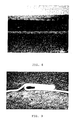
Figures 8 and 9 show a welding seam according to the present invention and a cross section of the same welding seam, respectively. - With reference to
Figures 6 and 7 , it is self-evident that in case of TIG welding of tubes with thin wall made of Pd-Ag alloy, thermal treatments and hydrogenation cause cracks along the welding seam, while in case of a diffusion bonding according to the invention (Figs. 8 and 9 ) the welding seam is quite uniform so that no tension or hardening that would cause strains and cracks are provided.
According to the invention, the diffusion bonding for joining thin foils made of metal alloys permeable to hydrogen, such as Pd-Ag alloy, mainly occurs because of a hot diffusion of the silver in the alloy.
In particular, the thin membrane permeable to hydrogen can be joined in the flat state (Fig. 1 ) or in the bent state to form permeable tubes (Fig. 2 ).
The described embodiments relates to thin foils permeable to hydrogen which are preferably made of a palladium-silver (Pd-Ag) alloy.
As described above, the thin foils made of an alloy formed by palladium and silver (25% by weight) are manufactured from thick metal sheets. Bands with suitable width and thickness lower than 50 µm are provided by cold-rolling such sheets. Upon rolling the material undergoes a work-hardening so that an annealing is necessary that is carried out under a partially reducing atmosphere (mixture of Ar and 5% H) in order to avoid the oxidation of the alloy, with a thermal cycle which reaches and keeps the temperature of 1200°C for 1 hour.
Such thin foils are then cut to measure by providing also a side margin sufficient to allow the edges to be overlapped in the area of the diffusion bonding (for example 1-2 mm).
Figure 1 shows schematically the diffusion bonding apparatus for flat thin foils according to the invention.
In this case, bothfoils 1 are laid down on a flatrigid support plate 4, preferably of alumina, so that their edges to be joined are overlapped and positioned under apressure blade 2 having acircular edge 3, preferably also of alumina, which is straight and parallel toflat plate 4 on which foils 1 lie.
Pressure blade 2 evenly presses the overlapped edges of the foils to be joined by its lower circular edge.
The pressure can be adjusted, for example, by set screws preferably located at the upper portion of the device.
According to the present invention, the diffusion bonding is carried out in an oven under controlled atmosphere preferably with a flow rate of 1 litre/min of a mixture of argon (Ar) and 5% hydrogen (H) at the pressure of 1 atm according to the following thermal cycle: - heating rate of 6°C/min up to 720°C;
- heating rate of 12°C/min up to 1100°C;
- keeping 1100°C for 1 hour;
- natural cooling down to room temperature for about three hours.
- a
steel blade 2 with arounded edge 3 made of alumina; - a
cylinder 4B of alumina capable of supporting atube 1B of palladium-silver with thin wall; - an alumina bearing
shell 5 having a shape conjugated to the surface ofrounded edge 3; - set
screws 6 to adjust height and pressure ofblade 2; - screws for tightening
cover 7. - Do = pre-exponential coefficient = 0.67 cm2/s
- E/R = activation energy = 22830 K
- T = temperature, K
- using the self-diffusion coefficient of silver instead of the diffusion coefficient of silver in Pd-Ag alloy;
- neglecting the dependence of the diffusion coefficient on the concentration of the solute;
- extrapolating the above formula also out of the temperature range mentioned in the literature;
- neglecting the mobility of the palladium atoms (the diffusion coefficient of palladium is about six orders of magnidude lower than silver).
- Advantageously, according to the invention, the permeable tubes manufactured by such bonding technique showed no defects in the junction (microholes and cracks), thus ensuring the total selectivity to hydrogen. In addition, such bonding technique does not change the composition of the palladium-silver alloy, thus ensuring high permeability and good resistance to brittleness (due to the thermal cycles and the hydrogen loading).
By the way, some applications in which such technology is particularly useful should be appreciated.
For example, applications of such permeable tubes to the ITER fuel cycle (recovery of tritium from tritiated water in catalytic membrane reactors for the water shift reaction) have been studied. In particular, the lack of defects guarantees the selectivity of such membranes, a requirement that cannot be disregarded in nuclear applications.
In the field of chemical, petrochemical industry the use of such permeable means is particularly interesting over other processes as the reduced thickness of the tubes allows cost to be decreased and permeation fluxes to be increased, while the total selectivity guarantees the production of ultra-pure gas. In this connection, the applications range from separation processes (production of hydrogen from gas mixtures) to the generation of hydrogen in catalytic membrane reactors with molecular reforming reactions. Furthermore, considering the recent developments in the production of ultra-pure hydrogen for fuel cells used in the electric vehicles, the present invention is particularly suitable also for automotive industry.
It should be noted that, if any other condition remains unchanged, the reduction in the thickness involves an increase in the permeating hydrogen flux and the reaction conversions (yields) too.
To this purpose the Applicant has developed a technology for producing permeable tubes of palladium-silver alloy (Ag 25% by weight) having a thickness lower than 50 µm. Such tubes find application in the manufacturing of catalytic membrane reactors used in processes operating at low pressure (lower than 1 MPa) and temperatures up to 450°C.
"Tosti et al : thin Pd and Pd-Ag membranes for hydrogen separation and production. Internal journal of hydrogen energy, Elsevier sciences Publishers, April 2000, pages 319-325" discloses a diffusion welding procedure for joining thin foils of metal alloys selectively permeable to hydrogen.
The technology developed for the manufacturing of permeable Pd-Ag tubes with thin wall provides the rolling of metal foils up to a thickness lower than 50 µm and the following joining of the metal foil edges which are overlapped along a generatrix of the tube which is being formed.
In particular, the rolling mill process consists of a number of metal foil rolling and annealing operations in order to control the work-hardening of the material, however, the autogenous welding or brazing techniques used until today cause penetration of metal impurities contaminating and altering the palladium-silver alloy.
By the way, it should be appreciated that the lack of defects and the purity of the Pd-Ag alloy are essential requirements to provide the selectivity of the permeable tube (production of ultra-pure hydrogen) and high permeability factors (high hydrogen flux).
A disadvantage of the presently used welding processes, such as autogenous welding (argon arc welding, TIG) made along the generatrix of the tube with thin wall, is due to the fact that the thermal and hydrogen loading cycles cause a brittleness with the result of producing microcracks in the welding area which cause the membrane not to be selective to hydrogen any longer.
Should permeable tubes be manufactured, the size of each
In particular, the tube to be joined is placed in the device shown in
Turning now to the phenomenon of diffusion bonding, it is interesting to note that the use of literature information [Handbook of Chemistry and Physics, CRC Press] for the self-diffusion coefficient of silver at the solid state in the temperature range 640-955°C gives:

where:
In particular, the Table shows the length of the thermal treatment of foils with a thickness of 35 to 50 µm at different temperatures.
| Treatment length (hours) for foils with thickness: | ||
| T [°C] | 35 µm | 50 µm |
| 800 | 8.81 | 17.97 |
| 900 | 1.44 | 2.93 |
| 1000 | 0.31 | 0.64 |
| 1100 | 0.08 | 0.17 |
| 1200 | 0.03 | 0.056 |
Claims (12)
- An apparatus for joining thin foils made of metal alloys selectively permeable to hydrogen, which is capable of carrying out a hot diffusion bonding in an oven under controlled temperature and includes in combination:- rigid support means (4, 4B) able to keep the edges of the foil(s) (1, 1B) to be joined in the desired over lapping position- a pressure blade (2) able to press evenly the edges of the foil(s) (1,1B) to be joined in order to weld them, all over their length;- means for adjusting the pressure which is applied edges of the foil(s) (1,1B) to be joined in order to weld them, by pressure blade (2);said pressure blade (2) is provided with a straight circular edge resting on the characterized in that and parallel to support means (4, 4B).
- The apparatus of the preceding claim, characterized in that said support means (4, 4B) for the foil(s) (1, 1B) to be joined is made of alumina.
- The apparatus of the preceding claims, characterized in that in order to join two flat foils (1), said support means for the foils is formed of a rigid flat plate (4).
- The apparatus according to one of claims 1 or 2, characterized in that in order to form permeable tubes, said support means for the foil (1B) is formed of a rigid cylinder (4B).
- The apparatus according to claim 4, characterized in that there is additionally provided a bearing shell (5) of alumina having a shape which is conjugated to support cylinder (4B).
- The apparatus of the preceding claims, characterized in that the overlap of the edges to be joined is 1-2 mm, the foil(s) (1, 1B) to be joined having an additional margin of corresponding size.
- The apparatus of the preceding claims, characterized in that the pressure exerted on the junction area by said pressure blade (2) is adjusted by set screws (6).
- The apparatus of the preceding claims, characterized in that it is particularly suitable for joining thin foils made of palladium-silver alloy with a thickness lower than 50 µm.
- A method of joining thin foils made of metal alloys selectively permeable to hydrogen, particularly for membrane devices, characterized in that a hot diffusion bonding technique is provided that includes the following steps:overlapping the edges to be joined;drawing the edges near each other and tightening them by a pressure blade (2) able to press evenlythe edges of the foil(s) (1,1B) to be joined in order to weld them, all over their length;performing a thermal cycle in an oven under controlled atmosphere, for preventing any oxidation in the metal alloys and for preventing any changes in the composition of the alloys, according to the following thermal cycle;heating rate of 6°C/min up to 720°C;heating rate of 12°C/min up to 1100°C;keeping 1100°C for 1 hour;natural cooling down to room temperature for about three hours.
- The method according to preceding claim, characterized in that said controlled atmosphere is formed by an argon and hydrogen flux.
- The method according to preceding claim, characterized in that said flux has a flow rate of 1 litre/min of a mixture of argon (Ar) and 5% hydrogen (H) at the pressure of 1 atm.
- The method according to anyone of claims 9 to 11, characterized in that said metal alloys selectively permeable to hydrogen include silver.
Applications Claiming Priority (2)
| Application Number | Priority Date | Filing Date | Title |
|---|---|---|---|
| ITRM200412 | 2000-07-25 | ||
| IT2000RM000412A IT1317878B1 (en) | 2000-07-25 | 2000-07-25 | WELDING PROCESS OF THIN METAL ALLOY LAMINES SELECTIVELY PERMEABLE TO HYDROGEN, IN PARTICULAR FOR THE |
Publications (2)
| Publication Number | Publication Date |
|---|---|
| EP1184125A1 EP1184125A1 (en) | 2002-03-06 |
| EP1184125B1 true EP1184125B1 (en) | 2012-07-11 |
Family
ID=11454851
Family Applications (1)
| Application Number | Title | Priority Date | Filing Date |
|---|---|---|---|
| EP01830465A Expired - Lifetime EP1184125B1 (en) | 2000-07-25 | 2001-07-12 | Method of diffusion bonding thin foils made of metal alloys selectively permeable to hydrogen, particularly providing membrane devices, and apparatus for carrying out the same |
Country Status (2)
| Country | Link |
|---|---|
| EP (1) | EP1184125B1 (en) |
| IT (1) | IT1317878B1 (en) |
Families Citing this family (4)
| Publication number | Priority date | Publication date | Assignee | Title |
|---|---|---|---|---|
| US7353982B2 (en) * | 2003-11-25 | 2008-04-08 | Membrane Reactor Technologies Ltd. | Diffusion bonding for metallic membrane joining with metallic module |
| ITRM20060102A1 (en) | 2006-03-01 | 2007-09-02 | Cnr Consiglio Naz Delle Ricerche | MEMBRANE PROCEDURE FOR THE PRODUCTION OF REFORMING HYDROGEN OF ORGANIC COMPOUNDS IN PARTICULAR HYDROCARBONS OR ALCOHOLS |
| ES2561033T3 (en) | 2006-09-29 | 2016-02-24 | Sinvent As | Method of manufacturing a leak-proof membrane element |
| IT1401192B1 (en) | 2010-06-16 | 2013-07-12 | Enea Agenzia Naz Per Le Nuove Tecnologie L En E Lo Sviluppo Economico Sostenibile | MEMBRANE REACTOR FOR THE TREATMENT OF GAS CONTAINING TRIZIO |
Family Cites Families (3)
| Publication number | Priority date | Publication date | Assignee | Title |
|---|---|---|---|---|
| US4013210A (en) * | 1972-08-21 | 1977-03-22 | Czeslaw Deminet | Method of diffusion bonding |
| DE3332348A1 (en) * | 1983-09-08 | 1985-04-04 | Kernforschungsanlage Jülich GmbH, 5170 Jülich | HYDROGEN PERMEATION WALL |
| US5904754A (en) * | 1997-06-20 | 1999-05-18 | Walter Juda Associates | Diffusion-bonded palladium-copper alloy framed membrane for pure hydrogen generators and the like and method of preparing the same |
-
2000
- 2000-07-25 IT IT2000RM000412A patent/IT1317878B1/en active
-
2001
- 2001-07-12 EP EP01830465A patent/EP1184125B1/en not_active Expired - Lifetime
Also Published As
| Publication number | Publication date |
|---|---|
| EP1184125A1 (en) | 2002-03-06 |
| IT1317878B1 (en) | 2003-07-15 |
| ITRM20000412A1 (en) | 2002-01-25 |
| ITRM20000412A0 (en) | 2000-07-25 |
Similar Documents
| Publication | Publication Date | Title |
|---|---|---|
| Tosti | Supported and laminated Pd-based metallic membranes | |
| Tosti et al. | Sputtered, electroless, and rolled palladium–ceramic membranes | |
| Tosti et al. | Diffusion bonding of Pd-Ag rolled membranes | |
| US5498278A (en) | Composite hydrogen separation element and module | |
| US3208198A (en) | Method for hydrogen diffusion | |
| JP3421283B2 (en) | Method for producing tubular hydrogen permeable membrane, such membrane and its use | |
| Tosti et al. | Characterization of thin wall Pd–Ag rolled membranes | |
| US20100263538A1 (en) | Hydrogen Purifier Module and Method for Forming the Same | |
| JPH11276866A (en) | Hydrogen permeable membrane and method for producing the same | |
| CA2547011C (en) | Diffusion bonding for metallic membrane joining with metallic module | |
| US20020028345A1 (en) | Process for preparing a composite metal membrane, the composite metal membrane prepared therewith and its use | |
| US8226751B2 (en) | Composite membrane material for hydrogen separation and element for hydrogen separation using the same | |
| US8226750B2 (en) | Hydrogen purifier module with membrane support | |
| EP1184125A1 (en) | Method of diffusion bonding thin foils made of metal alloys selectively permeable to hydrogen, particularly providing membrane devices, and apparatus for carrying out the same | |
| JP2001162144A (en) | Gas separator | |
| JP2000005580A (en) | Composite hydrogen permeable membrane having pressure resistance, method of manufacturing and repairing the same | |
| Tosti et al. | Catalytic membrane reactors for tritium recovery from tritiated water in the ITER fuel cycle | |
| JPH11276867A (en) | Bonding method of hydrogen permeable membrane | |
| JP3926708B2 (en) | Hydrogen permeable membrane | |
| CN112281004A (en) | Preparation method of tubular palladium alloy membrane | |
| JP4792598B2 (en) | Hydrogen permeation module and method of use thereof | |
| Ryi et al. | Low temperature diffusion bonding of Pd-based composite membranes with metallic module for hydrogen separation | |
| GB1080655A (en) | Inflated metal products | |
| JP2008155118A (en) | Composite membrane for separating hydrogen and module for separating hydrogen using this hydrogen permeable membrane | |
| JP2013209729A (en) | Hydrogen permeable copper alloy, hydrogen permeation membrane and steam reformer |
Legal Events
| Date | Code | Title | Description |
|---|---|---|---|
| PUAI | Public reference made under article 153(3) epc to a published international application that has entered the european phase |
Free format text: ORIGINAL CODE: 0009012 |
|
| AK | Designated contracting states |
Kind code of ref document: A1 Designated state(s): AT BE CH CY DE DK ES FI FR GB GR IE IT LI LU MC NL PT SE TR |
|
| AX | Request for extension of the european patent |
Free format text: AL;LT;LV;MK;RO;SI |
|
| 17P | Request for examination filed |
Effective date: 20020904 |
|
| AKX | Designation fees paid |
Free format text: AT BE CH CY DE DK ES FI FR GB GR IE IT LI LU MC NL PT SE TR |
|
| 17Q | First examination report despatched |
Effective date: 20040521 |
|
| GRAP | Despatch of communication of intention to grant a patent |
Free format text: ORIGINAL CODE: EPIDOSNIGR1 |
|
| GRAS | Grant fee paid |
Free format text: ORIGINAL CODE: EPIDOSNIGR3 |
|
| GRAA | (expected) grant |
Free format text: ORIGINAL CODE: 0009210 |
|
| AK | Designated contracting states |
Kind code of ref document: B1 Designated state(s): AT BE CH CY DE DK ES FI FR GB GR IE IT LI LU MC NL PT SE TR |
|
| REG | Reference to a national code |
Ref country code: GB Ref legal event code: FG4D |
|
| REG | Reference to a national code |
Ref country code: CH Ref legal event code: EP |
|
| REG | Reference to a national code |
Ref country code: AT Ref legal event code: REF Ref document number: 565838 Country of ref document: AT Kind code of ref document: T Effective date: 20120715 |
|
| REG | Reference to a national code |
Ref country code: IE Ref legal event code: FG4D |
|
| REG | Reference to a national code |
Ref country code: DE Ref legal event code: R096 Ref document number: 60146803 Country of ref document: DE Effective date: 20120906 |
|
| REG | Reference to a national code |
Ref country code: NL Ref legal event code: VDEP Effective date: 20120711 |
|
| REG | Reference to a national code |
Ref country code: AT Ref legal event code: MK05 Ref document number: 565838 Country of ref document: AT Kind code of ref document: T Effective date: 20120711 |
|
| PG25 | Lapsed in a contracting state [announced via postgrant information from national office to epo] |
Ref country code: AT Free format text: LAPSE BECAUSE OF FAILURE TO SUBMIT A TRANSLATION OF THE DESCRIPTION OR TO PAY THE FEE WITHIN THE PRESCRIBED TIME-LIMIT Effective date: 20120711 Ref country code: FI Free format text: LAPSE BECAUSE OF FAILURE TO SUBMIT A TRANSLATION OF THE DESCRIPTION OR TO PAY THE FEE WITHIN THE PRESCRIBED TIME-LIMIT Effective date: 20120711 Ref country code: BE Free format text: LAPSE BECAUSE OF FAILURE TO SUBMIT A TRANSLATION OF THE DESCRIPTION OR TO PAY THE FEE WITHIN THE PRESCRIBED TIME-LIMIT Effective date: 20120711 Ref country code: CY Free format text: LAPSE BECAUSE OF FAILURE TO SUBMIT A TRANSLATION OF THE DESCRIPTION OR TO PAY THE FEE WITHIN THE PRESCRIBED TIME-LIMIT Effective date: 20120711 |
|
| PG25 | Lapsed in a contracting state [announced via postgrant information from national office to epo] |
Ref country code: GR Free format text: LAPSE BECAUSE OF FAILURE TO SUBMIT A TRANSLATION OF THE DESCRIPTION OR TO PAY THE FEE WITHIN THE PRESCRIBED TIME-LIMIT Effective date: 20121012 Ref country code: PT Free format text: LAPSE BECAUSE OF FAILURE TO SUBMIT A TRANSLATION OF THE DESCRIPTION OR TO PAY THE FEE WITHIN THE PRESCRIBED TIME-LIMIT Effective date: 20121112 Ref country code: SE Free format text: LAPSE BECAUSE OF FAILURE TO SUBMIT A TRANSLATION OF THE DESCRIPTION OR TO PAY THE FEE WITHIN THE PRESCRIBED TIME-LIMIT Effective date: 20120711 Ref country code: MC Free format text: LAPSE BECAUSE OF NON-PAYMENT OF DUE FEES Effective date: 20120731 |
|
| REG | Reference to a national code |
Ref country code: CH Ref legal event code: PL |
|
| PG25 | Lapsed in a contracting state [announced via postgrant information from national office to epo] |
Ref country code: NL Free format text: LAPSE BECAUSE OF FAILURE TO SUBMIT A TRANSLATION OF THE DESCRIPTION OR TO PAY THE FEE WITHIN THE PRESCRIBED TIME-LIMIT Effective date: 20120711 |
|
| PG25 | Lapsed in a contracting state [announced via postgrant information from national office to epo] |
Ref country code: DK Free format text: LAPSE BECAUSE OF FAILURE TO SUBMIT A TRANSLATION OF THE DESCRIPTION OR TO PAY THE FEE WITHIN THE PRESCRIBED TIME-LIMIT Effective date: 20120711 Ref country code: LI Free format text: LAPSE BECAUSE OF NON-PAYMENT OF DUE FEES Effective date: 20120731 Ref country code: DE Free format text: LAPSE BECAUSE OF NON-PAYMENT OF DUE FEES Effective date: 20130201 Ref country code: CH Free format text: LAPSE BECAUSE OF NON-PAYMENT OF DUE FEES Effective date: 20120731 Ref country code: ES Free format text: LAPSE BECAUSE OF FAILURE TO SUBMIT A TRANSLATION OF THE DESCRIPTION OR TO PAY THE FEE WITHIN THE PRESCRIBED TIME-LIMIT Effective date: 20121022 |
|
| REG | Reference to a national code |
Ref country code: IE Ref legal event code: MM4A |
|
| REG | Reference to a national code |
Ref country code: DE Ref legal event code: R119 Ref document number: 60146803 Country of ref document: DE Effective date: 20130201 |
|
| PLBE | No opposition filed within time limit |
Free format text: ORIGINAL CODE: 0009261 |
|
| STAA | Information on the status of an ep patent application or granted ep patent |
Free format text: STATUS: NO OPPOSITION FILED WITHIN TIME LIMIT |
|
| PG25 | Lapsed in a contracting state [announced via postgrant information from national office to epo] |
Ref country code: IT Free format text: LAPSE BECAUSE OF FAILURE TO SUBMIT A TRANSLATION OF THE DESCRIPTION OR TO PAY THE FEE WITHIN THE PRESCRIBED TIME-LIMIT Effective date: 20120711 |
|
| REG | Reference to a national code |
Ref country code: FR Ref legal event code: ST Effective date: 20130426 |
|
| 26N | No opposition filed |
Effective date: 20130412 |
|
| GBPC | Gb: european patent ceased through non-payment of renewal fee |
Effective date: 20121011 |
|
| PG25 | Lapsed in a contracting state [announced via postgrant information from national office to epo] |
Ref country code: GB Free format text: LAPSE BECAUSE OF NON-PAYMENT OF DUE FEES Effective date: 20121011 Ref country code: IE Free format text: LAPSE BECAUSE OF NON-PAYMENT OF DUE FEES Effective date: 20120712 |
|
| PG25 | Lapsed in a contracting state [announced via postgrant information from national office to epo] |
Ref country code: FR Free format text: LAPSE BECAUSE OF NON-PAYMENT OF DUE FEES Effective date: 20120911 |
|
| PG25 | Lapsed in a contracting state [announced via postgrant information from national office to epo] |
Ref country code: TR Free format text: LAPSE BECAUSE OF FAILURE TO SUBMIT A TRANSLATION OF THE DESCRIPTION OR TO PAY THE FEE WITHIN THE PRESCRIBED TIME-LIMIT Effective date: 20120711 |
|
| PG25 | Lapsed in a contracting state [announced via postgrant information from national office to epo] |
Ref country code: LU Free format text: LAPSE BECAUSE OF NON-PAYMENT OF DUE FEES Effective date: 20120712 |