EP1183653B1 - A method for forming a perspective rendering from a voxel space - Google Patents
A method for forming a perspective rendering from a voxel space Download PDFInfo
- Publication number
- EP1183653B1 EP1183653B1 EP99973146A EP99973146A EP1183653B1 EP 1183653 B1 EP1183653 B1 EP 1183653B1 EP 99973146 A EP99973146 A EP 99973146A EP 99973146 A EP99973146 A EP 99973146A EP 1183653 B1 EP1183653 B1 EP 1183653B1
- Authority
- EP
- European Patent Office
- Prior art keywords
- value
- ray
- voxel
- point
- cast
- Prior art date
- Legal status (The legal status is an assumption and is not a legal conclusion. Google has not performed a legal analysis and makes no representation as to the accuracy of the status listed.)
- Expired - Lifetime
Links
Images



Classifications
-
- G—PHYSICS
- G06—COMPUTING OR CALCULATING; COUNTING
- G06T—IMAGE DATA PROCESSING OR GENERATION, IN GENERAL
- G06T15/00—Three-dimensional [3D] image rendering
- G06T15/10—Geometric effects
- G06T15/40—Hidden part removal
-
- G—PHYSICS
- G06—COMPUTING OR CALCULATING; COUNTING
- G06T—IMAGE DATA PROCESSING OR GENERATION, IN GENERAL
- G06T15/00—Three-dimensional [3D] image rendering
- G06T15/06—Ray-tracing
Definitions
- This invention relates to a method for forming a perspective rendering from a space of volume elements (voxels). More specifically, this invention relates to a family of algorithmic optimizations, which are useful in the forming of a perspective rendering from a voxel space. '
- Voxels are volume elements in three (or more) dimensions; and are analogous to pixels (two dimensional picture elements).
- the professional expects the visualization to facilitate elevated insights and to evoke increased understanding of the data. This is often accomplished by imposing (onto a rendering of the data) subjective criteria such as depth, shading, perspective, lighting, or shadowing; which are not necessarily generic to the data being rendered. For example, depth or shadow are not natural features of geophysical cross-sections; but may be helpful to the professional who is looking for ways to understand such a complex data set. Alternately, the professional may expect the visualization to be life-like (of realistic appearance).
- the present invention relates to a method for forming a high spatial resolution perspective rendering from a low spatial resolution voxel space, in accordance with claim 1.
- the present invention provides a feasible method, both visually and algorithmically, for forming a high spatial resolution image perspective volume rendering from a low spatial resolution voxel space.
- the data, to be rendered into a visualization is represented in a three-dimensional array of volume elements (voxels). Since the data stored in the voxels is not necessarily of a format, magnitude, or distribution useful for representation (e.g. on a display device such as a TV screen, a plotter, or the like), a transformation step is required in order to conform the data to a form that may be presented on a display device.
- These classes are used to transform one or more ranges of voxel values to doublets of a transparency-value and a representation-value (e.g.
- RGB for color, or gray-level, or the like.
- transparency-value and opacity-value are inverse quantifications of the same visualization aspect, so it is only by convenience of conceptualization that the present invention is described according to transparency-values or opacity-value.
- Interpolation is one of the key tools used to render a high-resolution image from a lower resolution representation.
- volume lighting occurs (is desired) when an external light source illuminates the surfaces of the classes.
- surface lighting originates from the same predetermined vantage-point as the "eye of the observer”.
- volume lighting derives from (is desired when) one or more voxels, in the "voxel space", are of themselves sources of illumination (radiant).
- surface lighting is used exclusively or volume lighting is used to complement surface lighting. According to one embodiment of the present invention, volume lighting is used exclusively.
- surface lighting values are proportional to the cosine of the angle formed between a vector connecting the eye and a point on an iso-surface and a normal to the iso-surface at that point; according to the embodiment where the light source is coterminous with the eye.
- volume lighting is proportional to the luminance (radiance) associated with one or more points in the voxel space, the distance between the luminescent point an the vantage-point (the eye), and the opacity (or equivalently but inversely - the transparency) of relevant voxels between the luminescent point an the vantage-point (the eye).
- opacity accumulates differently (between each voxel and the eye) according to the lighting model: surface, volume, or combination.
- cumulative opacity represents the ''Fraction of Light" ( “FoL” ) (also referred to as “CT” - Cumulative Transparency) reaching the eye from a point in the voxel space; due to the light absorptive nature of the medium between the two (the eye and the point).
- CT Cumulative Transparency
- luminescence (radiance) of the point is scaled (attenuated) by FoL by the time it reaches the eye.
- luminescence (radiance) of the eye is scaled (attenuated) by FoL*FoL by the time it completes the path of from the eye to point and back to the eye.
- the surface normal direction used in the surface lighting calculation for iso-surfaces is determined using any one of many well-known analytic estimates for a gradient (of the interpolated iso-surface).
- a further significant aspect in "the process of volume rendering a visualization of data” relates to a well-known general technique called "ray-casting".
- Ray-casting substantially simulates a plurality of optical-information vectors that converge at the focal point of the eye.
- ray-casting simulates an algorithmic process wherein an accumulation of optical-information is organized with respect to a plurality of coterminous vectors; emanating outward from the eye. This algorithmic process enables a truncation of the vector (the cast ray) when the cumulative transparency of the traversed path becomes negligible.
- positions along the vector are selected for accumulating transparency values, and the step size between a present position and a next position is selected to be dependent on the opacity at the present position; albeit minimal and maximal step sizes limit the bounds of this proportionality.
- a change of class is detected by noting a change in opacity between two consecutive steps on a vector.
- the step size is large and in a region traversed by the vector having a low transparency the step size is small.
- volume lighting contributions are produced everywhere, whereas surface lighting contributions are only produced when crossing from a class of lower opacity to a class of higher opacity.
- This crossing is at a surface that is facing the eye (a front surface), while a crossing from higher to lower classes of opacity is a "hidden" surface (a back surface).
- a crossing from higher to lower classes of opacity is a "hidden" surface (a back surface).
- a high order of spatial precision is necessary whenever a front surface's surface lighting contribution (to the cumulative opacity of the ray-cast vector) is to be calculated. Therefore, according to the preferred embodiment of the present invention, whenever a front surface is detected between two consecutive steps - a smaller step-size search is performed between the two "consecutive steps". This search is in order to achieve a higher order of spatial positioning for a point on the front surface intersecting with the vector; and also for the normal to this point on the iso-surface.
- This processing is intended to substantially prevent a situation from occurring wherein two consecutive steps skip over a front surface without detecting it.
- a membrane or thin film of tissue or a bone fragment, etc
- the step size risks "jumping over" the membrane without detecting the existence of the membrane.
- an opacity-perturbation operation (“opacification") is performed.
- This opacification process is intended to prevent jumping over front surfaces without detecting their presence.
- a table (or equation) is prepared from which an opacity value can be assigned to each voxel value.
- opacity for each voxel value is taken as the maximum value of a predetermined neighborhood with respect to the original voxel value.
- step size on the vector is according to this table.
- this table effectively flags regions wherein there may be a front surface, the step size on the vector is always reduced whenever the vector is passing in the region of a front surface; even if there is no actual intersection between them.
- the perturbed values from the table (or equation) are NOT used in the accumulation of a cumulative opacity; and are only used as a conservative strategy for properly optimizing (better choosing of appropriate) step sizes so as to achieve a visually acceptable rendering.
- volume rendering relates to selective ray-casting.
- each actual vector that is cast (from the eye), and by virtue of which opacity data is accumulated causes a measure of algorithmic complexity to be added into the cost of a volume rendering.
- an object of the present invention is to produce a high spatial resolution perspective rendering from a low spatial resolution voxel space.
- the preferred embodiment of the present invention is directed to minimizing the extent to which actual ray-casting is performed. According to a first approximation of this minimizing of ray-casting, a predetermined plurality of rays are cast.
- this predetermined plurality is distributed in a symmetric regular dispersion such that values for all intermediary rays can be interpolated from the cast rays without any additional ray-casting.
- intermediary rays are cast whenever the accumulated values from the heretofore cast rays are not statistically homogenous, and are otherwise interpolated.
- a first plurality of regularly distributed rays are cast; and in each region between these regularly cast rays a statistical homogeneity metric is computed. From these cast rays - EITHER values in the region are interpolated from neighboring cast-rays' values OR a next plurality of regularly distributed rays are cast in the region, and a next resolution metric is computed. This either-or processing is repeated UNTIL values for all rays in a desired spatial resolution of rays have associated values.
- This variation embodiment is an iterative zoom-in value filling process that uses, as appropriate, the previous embodiments of the present invention.
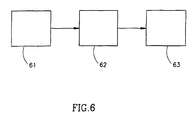
- the present invention can be defined as "A method for forming a high spatial resolution perspective rendering from a low spatial resolution voxel space”. This method includes the four steps ("a” through “d") of:
- step (a) the spatial resolution of the pixels is higher than that of a cross-section of voxels in the voxel space.
- step (b) if the vantage-point is far from the virtual window, then the rays cast through the virtual window will effectively be parallel each to another. Alternately, if the vantage-point is close to the virtual window, then the rays cast will effectively be approximating a divergent perspective; as subtended through the angle defined by the virtual window.
- step (c) all four conditions must be satisfied in order for the "calculating and storing" operation to be performed.
- step (c) condition (i) note that vectors are cast in step (b) and also in step (d) (at the "ELSE” sub-step).
- step (c) condition (ii), the "calculating and storing" are independently done for each position on the vector.
- condition (iii) there are two possible orderings in ray-casting. These orderings depend on whether the virtual window is between the voxel space and the vantage-point (as is the case for the present description); or equivalently whether the voxel space is between the vantage-point and the virtual window.
- the expression of "from the vantage-point through the pixel" is a convenient choice of nomenclature, which is not intended to exclude any equivalent logically consistent ordering. For example, if the virtual window were to be placed in the midst of the voxel space or if the vantage-point were to be placed in the midst of the voxel space, then there would be optional orderings such as:
- condition (iv) "whichever is sooner” relates to accumulating transparency until further accumulation will not effect the visualization or until there is no further data to effect the visualization.
- ''transparency threshold is a lower bound (or if stated equivalently - to an opacity threshold that is an upper bound).
- step (c) "FIRSTLY", there are numerous methods for accomplishing the interpolation.
- step (c) "SECONDLY"
- the transforming is according to the representation that is desired on a display device. Should the transforming be for interfacing with further image processing, then the transforming is according to the values appropriate to that processing.
- step (c) "THIRDLY"
- the accumulating is according to a lighting model, such as the surface lighting model, the volume lighting model, a combination of these two lighting models, a lighting model wherein the illumination source is not coterminous with the eye, or the like.
- step (d) it should be recognized that if the sparse ray-casting of step (b) is sufficient (as might be the case when implemented using parallel processing on the order of a processor per cast ray), then the supplemental ray-casting of the "ELSE" sub-step may never occur. This is not particularly problematic given the visual and algorithmic considerations motivating the method of the present invention.
- step (d) is expected to reduce to "selecting" and "interpolating" substantially without any further "ray-casting".
- the present invention relates to a method for forming a high spatial resolution perspective rendering from a low spatial resolution voxel space.
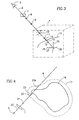
- Figure 1 is a schematic diagram of ray-casting geometry. This geometry is a typical geometry that is used in many embodiments of the present invention.
- the method includes the four steps of:
- a next position in step (c), in the (transformed - see step (c) "SECONDLY" step-dependent series of positions along the vector is selected using a variable step size from a present position; and the variable step size depends on an associated transparency for the transparency value of the present position. For most applications the step size increases with the transparency. Nevertheless there may be applications wherein the visualization of the transparent portions of the transformed voxel space is the important aspect of the rendering.
- the step size from the present position to the next position is never greater than a voxel cross-section for the voxel space. This maintains that the ultimate visual quality of the image (being captured in the pixels of the virtual window for eventual display on a display device of media) will not be less than the spatial resolution of the voxel space.
- a first present position (of the transformed step-dependent series of positions) along the vector is at the pixel corresponding to the vector. This is equivalent to disregarding any portion of the voxel space that is between the vantage-point and the virtual window.
- the first present position is at the eye (vantage point).
- every next position (of the transformed step-dependent series of positions) is tested such that IF a (interpolated) voxel-value class iso-surface (as heretofore defined) has been detected along the vector between the next position and the present position, by virtue of the indication that the transparency value of the next position is smaller than that of the present position, THEN at least one position between the present and next positions is examined to provide a higher spatial resolution positioning for the iso-surface.
- positions (11) and (12) are on opposite sides of an iso-surface (13). If the computed visualization value for position (12) is greater that that computed at position (11) then the front facing portion of the iso-surface has been traversed by the cast ray. This constitutes the detection of a class iso-surface.
- every next position (of the transformed step-dependent series of positions) is tested such that IF a class iso-surface has been detected along the vector between the next position and the present position, by virtue of the indication that the transparency value of the next position is smaller than that of the present position, THEN a position between the present and next positions is assigned as the location for the detected iso-surface.
- Another optional enhancement which is applied to embodiments wherein iso-surfaces are detected relates to a visualization-value for the detected iso-surface being applied to the vector's associated pixel (by finding a normal (25) to the iso-surface (26) at the vector intersection point or equivalently) using a contiguous gradient to the vector iso-surface intersection location or from proximate elements of the intersection. This is applied by calculating a current surface lighting contribution to the cumulative visualization-value, and accumulating this surface lighting visulazation-value into the pixel.
- the surface lighting contribution is the visualization-value at the intersection position multiplied by the cosine of the angle (27) formed by the vector and the normal to the iso-surface at that location (28); and multiplying that by the cumulative transparency (accumulated in the associated pixel) squared.
- an interpolated voxel value is calculated for a position along the vector from proximate voxels: using cubic interpolation for a position close to the vantage-point, or using linear interpolation for a position far from the vantage-point, or using a distance dependent graded mixture of cubic and linear interpolation for a position of a predetermined intermediate distance from the vantage-point.
- This is the preferred embodiment since the calculations are simple, the results are smooth and visually continuous, and the weighting of algorithmic efforts is high precision for close positions to the eye with a smooth decrease of precision as the position is further from the eye. Equivalently, any interpolation function, which traverses smoothly from high order precision for close positions to lower order precision for more distant position, is acceptable.
- the unit normalized transparency value is exponentiated by the actual step size.
- Accumulating a transparency value into a pixel is by: multiplying the transparency value of the pixel by the transparency value for the interval.
- the predetermined selection rule of accumulating in step (c) includes a front surface detection and a surface-lighting. Furthermore, according to the preferred embodiment of the present invention, selecting a next position in the step dependent series of positions is coordinated with an opacification process.
- class iso-surfaces are opacificied to facilitate a higher probability of detection.
- Figure 4 is a schematic diagram of a ray cast near an opacified iso-surface.
- the opacification is performed by stretching the intervals defining the classes, where the more opaque classes take precedence. This has the effect that the iso-surfaces are shifted (inflated) from their actual location outward (to enclose less opaque regions).
- Iso-surfaces (16) has been opacified into expanded surface "buffers" bounded by iso-surface (17).
- steps (20), (21) and (22) occur at regular intervals along the ray.
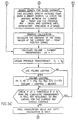
- the predetermined selection rule of accumulating in step (c) includes a volume-lighting (see Figure 5).
- step (c) is executed in parallel, by processing for the "each ray-cast vector of any more than one ray-cast vectors requiring the processing of step (c). This may result in allocating a processor (for effecting the algorithm of step (c)) to each cast ray.
- step (d) is executed in parallel; by processing for the each ray-cast vector of any more than one ray-cast vectors requiring the processing of step (d). Likewise, this may result in allocating a processor (for effecting the algorithm of step (d)) to each cast ray.
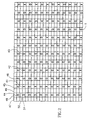
- step (d) "selecting" of pixels is ordered for progressively generating nested levels of resolution at the virtual window. This selecting may be as described in Figure 2, or in quad-tree fashion, or by simulated zoom (or pan), or the like.
- each transparency value is associated with a visualization-value for representation on a graphics display device.
- the representation is for associated color or gray levels.
- the present invention is amenable for adaptation to numerous geometric permutations.
- a center surface region of the virtual window is placed perpendicular to an orientation vector from the vantage-point; and the orientation vector is an average of the plurality of vectors.
- the virtual window is planar. Alternately, the virtual window is curved or warped.
- the pixels are preferentially arranged in the virtual window as a uniformly spaced rectangular grid. However alternatively, the pixels are arranged in the virtual window using circular coordinates, elliptic coordinates, or another conic projection of coordinates.
- the method of the present invention is directed to rendering the voxel space contains data derived from a Computer Tomographic (CT) scan, Magnetic Resonance Image (MRI), an ultrasound scan, a Nuclear Magnetic Resonance (NMR) scan, a geophysical survey, a meteorological survey, a scientific simulation, an animation from a model having more than two dimensions, or a set of simultaneous equations.
- CT Computer Tomographic
- MRI Magnetic Resonance Image
- NMR Nuclear Magnetic Resonance
- geophysical survey a meteorological survey
- meteorological survey a scientific simulation
- an animation from a model having more than two dimensions or a set of simultaneous equations.
- the virtual window having calculated, interpolated, or accumulated visualization-values stored in the pixels thereof; is rendered onto a display device.
- the present invention also relates to a computer system for forming a perspective rendering from a voxel space.
- a computer system for forming a perspective rendering from a voxel space includes:
- the preferred embodiment of the present invention also relates to generating an index mapping of the homogeneity of the voxel space and to consulting this index mapping in order to decide if an interpolation computation is required - as part of the process of interpolating values of proximate voxels (step "c" FIRSTLY).
- an additional data-type is used, referred to as a BIT-VOLUME.
- this data-type there is a single bit corresponding to each voxel.
- a bit-volume may be used to facilitate ray-casting:
Landscapes
- Engineering & Computer Science (AREA)
- Physics & Mathematics (AREA)
- Computer Graphics (AREA)
- General Physics & Mathematics (AREA)
- Theoretical Computer Science (AREA)
- Geometry (AREA)
- Image Generation (AREA)
- Manufacturing Of Printed Circuit Boards (AREA)
Applications Claiming Priority (3)
| Application Number | Priority Date | Filing Date | Title |
|---|---|---|---|
| IL12731498 | 1998-11-27 | ||
| IL12731498A IL127314A0 (en) | 1998-11-27 | 1998-11-27 | A method for forming a perspective rendering from a voxel space |
| PCT/IL1999/000639 WO2000033257A1 (en) | 1998-11-27 | 1999-11-26 | A method for forming a perspective rendering from a voxel space |
Publications (2)
| Publication Number | Publication Date |
|---|---|
| EP1183653A1 EP1183653A1 (en) | 2002-03-06 |
| EP1183653B1 true EP1183653B1 (en) | 2004-11-03 |
Family
ID=11072195
Family Applications (1)
| Application Number | Title | Priority Date | Filing Date |
|---|---|---|---|
| EP99973146A Expired - Lifetime EP1183653B1 (en) | 1998-11-27 | 1999-11-26 | A method for forming a perspective rendering from a voxel space |
Country Status (9)
| Country | Link |
|---|---|
| US (1) | US6999078B1 (enExample) |
| EP (1) | EP1183653B1 (enExample) |
| JP (1) | JP2002531905A (enExample) |
| AT (1) | ATE281676T1 (enExample) |
| AU (1) | AU763382B2 (enExample) |
| CA (1) | CA2352580A1 (enExample) |
| DE (1) | DE69921696T2 (enExample) |
| IL (1) | IL127314A0 (enExample) |
| WO (1) | WO2000033257A1 (enExample) |
Cited By (1)
| Publication number | Priority date | Publication date | Assignee | Title |
|---|---|---|---|---|
| WO2016178825A1 (en) * | 2015-05-01 | 2016-11-10 | Otoy Inc. | Rendering via ray-depth field intersection |
Families Citing this family (22)
| Publication number | Priority date | Publication date | Assignee | Title |
|---|---|---|---|---|
| EP1209629A1 (en) * | 2000-11-28 | 2002-05-29 | TeraRecon, Inc., A Delaware Corporation | Early ray termination in a parallel pipelined volume rendering system |
| EP1390917B1 (en) | 2001-05-23 | 2008-12-10 | Vital Images, Inc. | Occlusion culling for object-order volume rendering |
| US7262770B2 (en) | 2002-03-21 | 2007-08-28 | Microsoft Corporation | Graphics image rendering with radiance self-transfer for low-frequency lighting environments |
| DE602004016993D1 (de) | 2003-06-05 | 2008-11-20 | Philips Intellectual Property | Adaptive bildinterpolation für volumendarstellung |
| US7339586B2 (en) * | 2004-04-23 | 2008-03-04 | Siemens Medical Solutions Usa, Inc. | Method and system for mesh-to-image registration using raycasting |
| WO2006024973A1 (en) * | 2004-08-31 | 2006-03-09 | Philips Intellectual Property & Standard Gmbh | Direct volume rendering with shading |
| US7755625B2 (en) * | 2005-05-04 | 2010-07-13 | Medison Co., Ltd. | Apparatus and method for rendering volume data |
| US7692651B2 (en) * | 2005-09-22 | 2010-04-06 | Siemens Medical Solutions Usa, Inc. | Method and apparatus for providing efficient space leaping using a neighbor guided emptiness map in octree traversal for a fast ray casting algorithm |
| US8525825B2 (en) | 2008-02-27 | 2013-09-03 | Google Inc. | Using image content to facilitate navigation in panoramic image data |
| KR101653203B1 (ko) * | 2010-02-01 | 2016-09-02 | 삼성전자주식회사 | 영상 처리 장치 및 방법 |
| US8379955B2 (en) | 2010-11-27 | 2013-02-19 | Intrinsic Medical Imaging, LLC | Visualizing a 3D volume dataset of an image at any position or orientation from within or outside |
| KR102111626B1 (ko) | 2013-09-10 | 2020-05-15 | 삼성전자주식회사 | 영상 처리 장치 및 영상 처리 방법 |
| US9842424B2 (en) * | 2014-02-10 | 2017-12-12 | Pixar | Volume rendering using adaptive buckets |
| GB2528655B (en) | 2014-07-24 | 2020-10-07 | Advanced Risc Mach Ltd | Graphics Processing Systems |
| WO2016135498A1 (en) | 2015-02-27 | 2016-09-01 | Arm Limited | Graphics processing systems |
| US9754413B1 (en) | 2015-03-26 | 2017-09-05 | Google Inc. | Method and system for navigating in panoramic images using voxel maps |
| US9754405B1 (en) | 2015-08-10 | 2017-09-05 | Ngrain (Canada) Corporation | System, method and computer-readable medium for organizing and rendering 3D voxel models in a tree structure |
| GB2541928B (en) * | 2015-09-04 | 2018-01-31 | Advanced Risc Mach Ltd | Graphics processing systems |
| GB2543766B (en) | 2015-10-26 | 2018-02-14 | Advanced Risc Mach Ltd | Graphics processing systems |
| US10861242B2 (en) | 2018-05-22 | 2020-12-08 | Magic Leap, Inc. | Transmodal input fusion for a wearable system |
| JP7480547B2 (ja) * | 2020-03-25 | 2024-05-10 | 富士フイルムビジネスイノベーション株式会社 | 情報処理装置、及び情報処理プログラム |
| US11688125B2 (en) * | 2021-03-09 | 2023-06-27 | Canon Medical Systems Corporation | Image processing apparatus and method to perform a ray casting algorithm to generate a rendered image from a volumetric data set |
Family Cites Families (17)
| Publication number | Priority date | Publication date | Assignee | Title |
|---|---|---|---|---|
| CA1258923A (en) * | 1986-04-14 | 1989-08-29 | Robert A. Drebin | Methods and apparatus for imaging volume data |
| US5091960A (en) | 1988-09-26 | 1992-02-25 | Visual Information Technologies, Inc. | High-speed image rendering method using look-ahead images |
| US5138699A (en) | 1990-02-13 | 1992-08-11 | International Business Machines Corporation | Hardware utilization of color interpolation capability in a color imaging system |
| FR2662524A1 (fr) | 1990-05-25 | 1991-11-29 | Dillenseger Jean Louis | Procede de visualisation tridimensionnelle par lancer de rayons avec interpolation locale. |
| US5201035A (en) | 1990-07-09 | 1993-04-06 | The United States Of America As Represented By The Secretary Of The Air Force | Dynamic algorithm selection for volume rendering, isocontour and body extraction within a multiple-instruction, multiple-data multiprocessor |
| US5557711A (en) | 1990-10-17 | 1996-09-17 | Hewlett-Packard Company | Apparatus and method for volume rendering |
| US5555352A (en) * | 1991-04-23 | 1996-09-10 | International Business Machines Corporation | Object-based irregular-grid volume rendering |
| JPH06510759A (ja) * | 1991-08-05 | 1994-12-01 | マリンクロッド・インコーポレイテッド | 造影剤として使用する重金属クラスター |
| JPH06223198A (ja) | 1993-01-26 | 1994-08-12 | Hitachi Ltd | 光線追跡による画像生成装置及び方法 |
| JPH06290276A (ja) | 1993-02-15 | 1994-10-18 | Philips Electron Nv | 3次元場面の映像化用配置及び方法 |
| JP2627607B2 (ja) | 1993-06-16 | 1997-07-09 | 日本アイ・ビー・エム株式会社 | ボリュームレンダリング方法 |
| US5694530A (en) * | 1994-01-18 | 1997-12-02 | Hitachi Medical Corporation | Method of constructing three-dimensional image according to central projection method and apparatus for same |
| NO943696D0 (no) | 1994-10-04 | 1994-10-04 | Vingmed Sound As | Fremgangsmåte ved ultralydavbildning |
| US5986662A (en) * | 1996-10-16 | 1999-11-16 | Vital Images, Inc. | Advanced diagnostic viewer employing automated protocol selection for volume-rendered imaging |
| CA2285966A1 (en) * | 1997-04-15 | 1998-10-22 | The Research Foundation Of State University Of New York | Apparatus and method for parallel and perspective real-time volume visualization |
| US6313841B1 (en) * | 1998-04-13 | 2001-11-06 | Terarecon, Inc. | Parallel volume rendering system with a resampling module for parallel and perspective projections |
| US6297799B1 (en) * | 1998-11-12 | 2001-10-02 | James Knittel | Three-dimensional cursor for a real-time volume rendering system |
-
1998
- 1998-11-27 IL IL12731498A patent/IL127314A0/xx unknown
-
1999
- 1999-11-26 AT AT99973146T patent/ATE281676T1/de not_active IP Right Cessation
- 1999-11-26 CA CA002352580A patent/CA2352580A1/en not_active Abandoned
- 1999-11-26 JP JP2000585829A patent/JP2002531905A/ja not_active Withdrawn
- 1999-11-26 AU AU14065/00A patent/AU763382B2/en not_active Ceased
- 1999-11-26 WO PCT/IL1999/000639 patent/WO2000033257A1/en not_active Ceased
- 1999-11-26 DE DE69921696T patent/DE69921696T2/de not_active Expired - Lifetime
- 1999-11-26 EP EP99973146A patent/EP1183653B1/en not_active Expired - Lifetime
- 1999-11-26 US US09/856,761 patent/US6999078B1/en not_active Expired - Lifetime
Cited By (3)
| Publication number | Priority date | Publication date | Assignee | Title |
|---|---|---|---|---|
| WO2016178825A1 (en) * | 2015-05-01 | 2016-11-10 | Otoy Inc. | Rendering via ray-depth field intersection |
| US9852537B2 (en) | 2015-05-01 | 2017-12-26 | Otoy Inc. | Rendering via ray-depth field intersection |
| US10186072B2 (en) | 2015-05-01 | 2019-01-22 | Otoy, Inc. | Rendering via ray-depth field intersection |
Also Published As
| Publication number | Publication date |
|---|---|
| CA2352580A1 (en) | 2000-06-08 |
| US6999078B1 (en) | 2006-02-14 |
| IL127314A0 (en) | 1999-09-22 |
| DE69921696D1 (de) | 2004-12-09 |
| AU763382B2 (en) | 2003-07-24 |
| EP1183653A1 (en) | 2002-03-06 |
| JP2002531905A (ja) | 2002-09-24 |
| WO2000033257A1 (en) | 2000-06-08 |
| AU1406500A (en) | 2000-06-19 |
| DE69921696T2 (de) | 2005-10-27 |
| ATE281676T1 (de) | 2004-11-15 |
Similar Documents
| Publication | Publication Date | Title |
|---|---|---|
| US6999078B1 (en) | Method of forming a perspective rendering from a voxel space | |
| US5442733A (en) | Method and apparatus for generating realistic images using a discrete representation | |
| US7301538B2 (en) | Method and system for adaptive direct volume rendering | |
| EP3462418B1 (en) | Method and apparatus for rendering material properties | |
| Wang et al. | Volume sampled voxelization of geometric primitives | |
| Roth | Ray casting for modeling solids | |
| US5043922A (en) | Graphics system shadow generation using a depth buffer | |
| US7525543B2 (en) | High performance shading of large volumetric data using screen-space partial derivatives | |
| US20210383599A1 (en) | Graphics processing using directional representations of lighting at probe positions within a scene | |
| US7808514B2 (en) | Multiplanar reformatting visualization with multiple scrolling speeds | |
| US10755474B1 (en) | Method of processing a volumetric dataset and a method of rendering a volumetric dataset | |
| JPH0896161A (ja) | 陰影描画方法及び3次元グラフィック・コンピュータ・システム | |
| US12524951B2 (en) | Direct volume rendering apparatus using segment lighting values | |
| EP4407562A1 (en) | Technique for dynamically adapting an exposure value in interactive rendering | |
| Haubner et al. | Virtual reality in medicine-computer graphics and interaction techniques | |
| Şahıstan et al. | Ray-traced shell traversal of tetrahedral meshes for direct volume visualization | |
| Myszkowski | Lighting reconstruction using fast and adaptive density estimation techniques | |
| JP7131080B2 (ja) | ボリュームレンダリング装置 | |
| US20080246770A1 (en) | Method of Generating a 2-D Image of a 3-D Object | |
| US8203553B2 (en) | Distributed calculation of images of volumetric objects | |
| Marroquim et al. | Gpu-based cell projection for interactive volume rendering | |
| Wicke et al. | CSG tree rendering for point-sampled objects | |
| Campbell III et al. | An analytic approach to illumination with area light sources | |
| Mueller et al. | Rapid 3D cone-beam reconstruction with the Algebraic Reconstruction Technique (ART) by utilizing texture mapping graphics hardware | |
| Bruckner | Performing Maximum Intensity Projection with the Visualization Toolkit |
Legal Events
| Date | Code | Title | Description |
|---|---|---|---|
| PUAI | Public reference made under article 153(3) epc to a published international application that has entered the european phase |
Free format text: ORIGINAL CODE: 0009012 |
|
| 17P | Request for examination filed |
Effective date: 20010626 |
|
| AK | Designated contracting states |
Kind code of ref document: A1 Designated state(s): AT BE CH CY DE DK ES FI FR GB GR IE IT LI LU MC NL PT SE |
|
| AX | Request for extension of the european patent |
Free format text: AL;LT;LV;MK;RO;SI |
|
| 17Q | First examination report despatched |
Effective date: 20030321 |
|
| GRAP | Despatch of communication of intention to grant a patent |
Free format text: ORIGINAL CODE: EPIDOSNIGR1 |
|
| RIN1 | Information on inventor provided before grant (corrected) |
Inventor name: MILLER, GAD Inventor name: AKERMAN, SHMUEL |
|
| GRAS | Grant fee paid |
Free format text: ORIGINAL CODE: EPIDOSNIGR3 |
|
| GRAA | (expected) grant |
Free format text: ORIGINAL CODE: 0009210 |
|
| AK | Designated contracting states |
Kind code of ref document: B1 Designated state(s): AT BE CH CY DE DK ES FI FR GB GR IE IT LI LU MC NL PT SE |
|
| PG25 | Lapsed in a contracting state [announced via postgrant information from national office to epo] |
Ref country code: SE Free format text: LAPSE BECAUSE OF FAILURE TO SUBMIT A TRANSLATION OF THE DESCRIPTION OR TO PAY THE FEE WITHIN THE PRESCRIBED TIME-LIMIT Effective date: 20041103 Ref country code: LI Free format text: LAPSE BECAUSE OF FAILURE TO SUBMIT A TRANSLATION OF THE DESCRIPTION OR TO PAY THE FEE WITHIN THE PRESCRIBED TIME-LIMIT Effective date: 20041103 Ref country code: FI Free format text: LAPSE BECAUSE OF FAILURE TO SUBMIT A TRANSLATION OF THE DESCRIPTION OR TO PAY THE FEE WITHIN THE PRESCRIBED TIME-LIMIT Effective date: 20041103 Ref country code: CY Free format text: LAPSE BECAUSE OF FAILURE TO SUBMIT A TRANSLATION OF THE DESCRIPTION OR TO PAY THE FEE WITHIN THE PRESCRIBED TIME-LIMIT Effective date: 20041103 Ref country code: CH Free format text: LAPSE BECAUSE OF FAILURE TO SUBMIT A TRANSLATION OF THE DESCRIPTION OR TO PAY THE FEE WITHIN THE PRESCRIBED TIME-LIMIT Effective date: 20041103 Ref country code: BE Free format text: LAPSE BECAUSE OF FAILURE TO SUBMIT A TRANSLATION OF THE DESCRIPTION OR TO PAY THE FEE WITHIN THE PRESCRIBED TIME-LIMIT Effective date: 20041103 Ref country code: AT Free format text: LAPSE BECAUSE OF FAILURE TO SUBMIT A TRANSLATION OF THE DESCRIPTION OR TO PAY THE FEE WITHIN THE PRESCRIBED TIME-LIMIT Effective date: 20041103 |
|
| REG | Reference to a national code |
Ref country code: GB Ref legal event code: FG4D |
|
| REG | Reference to a national code |
Ref country code: CH Ref legal event code: EP |
|
| PG25 | Lapsed in a contracting state [announced via postgrant information from national office to epo] |
Ref country code: IE Free format text: LAPSE BECAUSE OF NON-PAYMENT OF DUE FEES Effective date: 20041126 |
|
| PG25 | Lapsed in a contracting state [announced via postgrant information from national office to epo] |
Ref country code: MC Free format text: LAPSE BECAUSE OF NON-PAYMENT OF DUE FEES Effective date: 20041130 |
|
| REF | Corresponds to: |
Ref document number: 69921696 Country of ref document: DE Date of ref document: 20041209 Kind code of ref document: P |
|
| REG | Reference to a national code |
Ref country code: IE Ref legal event code: FG4D |
|
| PG25 | Lapsed in a contracting state [announced via postgrant information from national office to epo] |
Ref country code: LU Free format text: LAPSE BECAUSE OF NON-PAYMENT OF DUE FEES Effective date: 20050103 |
|
| PG25 | Lapsed in a contracting state [announced via postgrant information from national office to epo] |
Ref country code: GR Free format text: LAPSE BECAUSE OF FAILURE TO SUBMIT A TRANSLATION OF THE DESCRIPTION OR TO PAY THE FEE WITHIN THE PRESCRIBED TIME-LIMIT Effective date: 20050203 Ref country code: DK Free format text: LAPSE BECAUSE OF FAILURE TO SUBMIT A TRANSLATION OF THE DESCRIPTION OR TO PAY THE FEE WITHIN THE PRESCRIBED TIME-LIMIT Effective date: 20050203 |
|
| PG25 | Lapsed in a contracting state [announced via postgrant information from national office to epo] |
Ref country code: ES Free format text: LAPSE BECAUSE OF FAILURE TO SUBMIT A TRANSLATION OF THE DESCRIPTION OR TO PAY THE FEE WITHIN THE PRESCRIBED TIME-LIMIT Effective date: 20050214 |
|
| REG | Reference to a national code |
Ref country code: CH Ref legal event code: PL |
|
| PLBE | No opposition filed within time limit |
Free format text: ORIGINAL CODE: 0009261 |
|
| STAA | Information on the status of an ep patent application or granted ep patent |
Free format text: STATUS: NO OPPOSITION FILED WITHIN TIME LIMIT |
|
| ET | Fr: translation filed | ||
| 26N | No opposition filed |
Effective date: 20050804 |
|
| REG | Reference to a national code |
Ref country code: IE Ref legal event code: MM4A |
|
| PG25 | Lapsed in a contracting state [announced via postgrant information from national office to epo] |
Ref country code: PT Free format text: LAPSE BECAUSE OF NON-PAYMENT OF DUE FEES Effective date: 20050403 |
|
| PGFP | Annual fee paid to national office [announced via postgrant information from national office to epo] |
Ref country code: NL Payment date: 20071010 Year of fee payment: 9 |
|
| PGFP | Annual fee paid to national office [announced via postgrant information from national office to epo] |
Ref country code: IT Payment date: 20071114 Year of fee payment: 9 |
|
| PGFP | Annual fee paid to national office [announced via postgrant information from national office to epo] |
Ref country code: GB Payment date: 20071005 Year of fee payment: 9 Ref country code: FR Payment date: 20071105 Year of fee payment: 9 |
|
| GBPC | Gb: european patent ceased through non-payment of renewal fee |
Effective date: 20081126 |
|
| PG25 | Lapsed in a contracting state [announced via postgrant information from national office to epo] |
Ref country code: NL Free format text: LAPSE BECAUSE OF NON-PAYMENT OF DUE FEES Effective date: 20090601 |
|
| NLV4 | Nl: lapsed or anulled due to non-payment of the annual fee |
Effective date: 20090601 |
|
| PG25 | Lapsed in a contracting state [announced via postgrant information from national office to epo] |
Ref country code: IT Free format text: LAPSE BECAUSE OF NON-PAYMENT OF DUE FEES Effective date: 20081126 |
|
| REG | Reference to a national code |
Ref country code: FR Ref legal event code: ST Effective date: 20090731 |
|
| PG25 | Lapsed in a contracting state [announced via postgrant information from national office to epo] |
Ref country code: GB Free format text: LAPSE BECAUSE OF NON-PAYMENT OF DUE FEES Effective date: 20081126 |
|
| PG25 | Lapsed in a contracting state [announced via postgrant information from national office to epo] |
Ref country code: FR Free format text: LAPSE BECAUSE OF NON-PAYMENT OF DUE FEES Effective date: 20081130 |
|
| PGFP | Annual fee paid to national office [announced via postgrant information from national office to epo] |
Ref country code: DE Payment date: 20141201 Year of fee payment: 16 |
|
| REG | Reference to a national code |
Ref country code: DE Ref legal event code: R119 Ref document number: 69921696 Country of ref document: DE |
|
| PG25 | Lapsed in a contracting state [announced via postgrant information from national office to epo] |
Ref country code: DE Free format text: LAPSE BECAUSE OF NON-PAYMENT OF DUE FEES Effective date: 20160601 |