EP1182714A1 - Package for material containing nonaqueous solvent and cell comprising the same - Google Patents
Package for material containing nonaqueous solvent and cell comprising the same Download PDFInfo
- Publication number
- EP1182714A1 EP1182714A1 EP00900879A EP00900879A EP1182714A1 EP 1182714 A1 EP1182714 A1 EP 1182714A1 EP 00900879 A EP00900879 A EP 00900879A EP 00900879 A EP00900879 A EP 00900879A EP 1182714 A1 EP1182714 A1 EP 1182714A1
- Authority
- EP
- European Patent Office
- Prior art keywords
- package
- aqueous solvent
- material containing
- adhesion
- battery
- Prior art date
- Legal status (The legal status is an assumption and is not a legal conclusion. Google has not performed a legal analysis and makes no representation as to the accuracy of the status listed.)
- Withdrawn
Links
Images
Classifications
-
- B—PERFORMING OPERATIONS; TRANSPORTING
- B32—LAYERED PRODUCTS
- B32B—LAYERED PRODUCTS, i.e. PRODUCTS BUILT-UP OF STRATA OF FLAT OR NON-FLAT, e.g. CELLULAR OR HONEYCOMB, FORM
- B32B15/00—Layered products comprising a layer of metal
- B32B15/04—Layered products comprising a layer of metal comprising metal as the main or only constituent of a layer, which is next to another layer of the same or of a different material
- B32B15/08—Layered products comprising a layer of metal comprising metal as the main or only constituent of a layer, which is next to another layer of the same or of a different material of synthetic resin
-
- B—PERFORMING OPERATIONS; TRANSPORTING
- B65—CONVEYING; PACKING; STORING; HANDLING THIN OR FILAMENTARY MATERIAL
- B65D—CONTAINERS FOR STORAGE OR TRANSPORT OF ARTICLES OR MATERIALS, e.g. BAGS, BARRELS, BOTTLES, BOXES, CANS, CARTONS, CRATES, DRUMS, JARS, TANKS, HOPPERS, FORWARDING CONTAINERS; ACCESSORIES, CLOSURES, OR FITTINGS THEREFOR; PACKAGING ELEMENTS; PACKAGES
- B65D31/00—Bags or like containers made of paper and having structural provision for thickness of contents
- B65D31/02—Bags or like containers made of paper and having structural provision for thickness of contents with laminated walls
Definitions
- the present invention relates to a package for a material containing a non-aqueous solvent. More particularly, the present invention relates to a package for a material containing a non-aqueous solvent which can prevent water from invading externally and strength from decreasing over the long term, and to a non-aqueous electrolytic battery whose life is lengthened and reliability is heightened by using said package.
- Packages comprising a film such as an aluminum-laminated film are used in a wide range of fields including category of food because of its lightness in weight and excellent blocking for water or gas. While an outer housing made of metal such as stainless or aluminum is applied to practically used non-aqueous electrolytic batteries including typical lithium ion batteries so far, it is expected to apply these packages to non-aqueous electrolytic batteries. This is because weight saving and thin construction will be possible if the outer housing is replaced by the package comprising a film.
- a part of the film folded to cover a battery content is thermally melted to adhere and is formed liked a bag to prepare such a package comprising the film.
- these packages have inferior blocking against water invading into a battery and insufficient strength because of its adhesion part, which possibly causes troubles with long-term battery performance or reliability in high temperature.
- the present invention has been carried out in order to solve the above problems.
- the object of the present invention is to provide a package for a material containing a non-aqueous solvent using a laminated film, by which water blocking is ensured and strength is maintained easily for a long time, and to provide a non-aqueous electrolytic battery using the same.
- the present inventors have studied on and found some important facts about water blocking and durability of adhesion strength concerning a package for a material containing a non-aqueous solvent using a laminated film.
- water blocking and adhesion strength of the package remarkably decreased because of the non-aqueous solvent diffused from the interior side of the package. This is because diffusion rate of water increases due to diffusion of the non-aqueous solvent into an organic layer of the adhesion part and also because strength of the organic layer itself decreases. Prevention of the diffusion from the interior side of the package is highly effective in improving package performances.
- the present invention relates to:
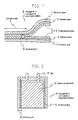
- Fig. 1 is a cross-sectional view schematically showing the adhesion construction of the package for a material containing a non-aqueous solvent according to one embodiment of the present invention
- Fig. 2 is a cross-sectional view schematically showing the construction of the non-aqueous electrolytic battery prepared in Example 1.
- numeral 1 indicates an aluminum layer, 2 a polypropylene layer, 3 an adhesive layer, 4 adhesion part and 5 an aluminum fiber.
- numeral 4 indicates the adhesion part
- 5 the aluminum fiber
- 6 a rolled out electrode
- 7 a terminal for current collection (tab)
- 8 a package for a material containing an aqueous solvent.
- the present invention relates to a package for a material containing a non-aqueous solvent, having a bag construction made by adhesion of a part of a lamination film comprising a metal layer and a resin layer, wherein a structure is positioned in an organic layer (i.e., the resin layer and an adhesive layer) between the metal layers at the adhesion part to inhibit permeation of the non-aqueous solvent contained in the package.
- a structure is positioned in an organic layer (i.e., the resin layer and an adhesive layer) between the metal layers at the adhesion part to inhibit permeation of the non-aqueous solvent contained in the package.
- a film used for the package is formed by laminating at least a metal layer and a resin layer coating the package interior side of the metal layer.
- Metal foil such as aluminum foil, stainless foil or titanium foil can be used for the metal layer.
- the thickness of the metal layer is preferably 3 to 200 ⁇ m, more preferably 10 to 100 ⁇ m. Too thin a metal film tends to cause easy generation of defects, such as pinholes, leading to inferior reliability. Too thick a metal layer tends to cause increase of weight.
- the surface of the metal layer may be treated, for example, so that an oxide film or a nitride film is formed thereon in order to improve endurance.
- Any resin layer may be available as long as it does not dissolve into a non-aqueous solvent such as that of an electrolytic solution and prevents the metal layer from corroding.
- a polyolefin film such as polypropylene, polyethylene or a copolymer thereof is preferably used as the resin layer.
- Other useful films include a film comprising a fluorine resin, a vinyl polymer such as polystyrene, a cross-linked acrylic resin and the like.
- the thickness of the resin layer is preferably 5 to 200 ⁇ m, more preferably 20 to 100 ⁇ m. When the resin layer is thin, steady heat-sealing tends to become difficult. When the resin layer is thick, the strength at the heat-sealing part tends to decrease.
- An adhesive can be used for the adhesion of the metal layer and the resin layer, if necessary. Coating or film lamination onto the package exterior side of the metal layer is also preferable for improving strength and preventing corrosion.
- the package of the present invention has a bag construction made by adhesion of a part of a lamination film comprising a metal layer and a resin layer.
- An adhesive can be used for the adhesion of the film.
- a hot-melt adhesive is preferable as the adhesive in terms of workability, moisture permeability or the like. When polyolefin is used for the resin layer of the film, this can be used as a hot-melt adhesive for the adhesion of the film.
- An epoxy adhesive or an urethane adhesive can be also used as long as it is resistant to the non-aqueous solvent in the package. These adhesives can be combined for use.
- the resin layer at the adhesion part of the film may be removed if necessary. In this case attention should be paid not to generate defects such as crack on the metal layer. Also useful is an adhesive in the form of tape.
- any material can be used as long as it prevents the non-aqueous solvent in the package from diffusing into the organic layer between the metal layers at the adhesion part.
- Those capable of reacting with or absorbing the non-aqueous solvent are preferable as the structure for inhibiting permeation of the non-aqueous solvent in the package.
- Useful structures for inhibiting permeation of the non-aqueous solvent in the package include metal such as aluminum, iron or stainless, an inorganic material such as alumina or silica, an organic material such as a fluorine resin, a polyolefin or a polyether resin. Preferably, these substances may also be surface-treated to fit with the organic layer if necessary.
- the useful shape for the material of the structure which inhibits permeation of the non-aqueous solvent in the package is powdery, flaky or filament form while a material of a variety of sizes can be used considering the width and the length of the adhesion part, the thickness of the organic layer and the like.
- particle size of the material is preferably about 0.1 to 100 ⁇ m, more preferably about 1 to 20 ⁇ m. Small particle size tends to make it difficult for the structure to be positioned within the adhesive effectively while large particle size causes to form clearance showing a tendency that diffusion of the non-aqueous solution is not prevented sufficiently.
- thickness of the material is preferably about 0.5 to 200 ⁇ m, more preferably 5 to 100 ⁇ m.
- the longest diameter is preferably about five times, more preferably about ten times the thickness. This flaky material is easier to be aligned to prevent effectively the non-aqueous solution from diffusion. When the longest diameter is too short, the alignment of the structure tends to be difficult, leading to decrease of the advantage.
- diameter of the filament is preferably about 0.1 to 200 ⁇ m, more preferably about 5 to 100 ⁇ m while length of the filament is preferably at least 10 ⁇ m, more preferably at least 5 mm.
- diameter of the filament is small the effect on preventing diffusion of a non-aqueous solution tends to be low.
- heat-sealing tends to be difficult.
- length of the filament is long, the effect on preventing diffusion of a non-aqueous solution tends to be low.
- the filament structure it is preferable to position the filament structure so that it parallels the longitudinal direction of the adhesion part, in other words, across the diffusion direction of the non-aqueous solution in order to prevent the diffusion since such a construction acts most effectively.
- the structure for inhibiting permeation of the non-aqueous solvent in the package is distributed inwardly to the package interior side, that is, more to the inside from the centric position between the interior edge and the exterior edge of the adhesion part.
- a non-aqueous solvent such as a solvent of a non-aqueous electrolytic solution in the package
- the effect on preventing permeation of a non-aqueous solution and the like may be reduced at the organic layer, and prevention of water invasion and maintenance of strength may not be achieved sufficiently.
- a package of the present invention can be applied to various package products using a non-aqueous solvent such as a non-aqueous electrolytic battery.
- a non-aqueous electrolytic battery possible battery construction is a laminated construction of plane electrodes and separators, a rolled out construction, a folded construction or a combination thereof.
- an ether solvent such as dimethoxy ethane or diethyl ether, or a carbonate or ester solvent such as ethylene carbonate or propylene carbonate is used alone or in combination thereof.
- LiPF 6 , LiClO 4 , LiBF 4 and the like can be used as an electrolyte.
- a piece of 15- ⁇ m-thick aluminum foil was laminated with a 12- ⁇ m-thick film of polyethylene terephtharate by using an urethane adhesive (5 ⁇ m in thickness).
- a resin layer was formed by extrusion coating of polyethylene on the opposite side of the aluminum foil in a thickness of 50 ⁇ m to prepare an aluminum laminated film. The film was cut into pieces of 70 mm ⁇ 120 mm.
- Example 2 The construction of the non-aqueous electrolytic battery prepared in Example 1 is schematically shown in Fig. 2. Explanation is made as to a process for preparing a battery with reference to Fig. 2 in the following.
- a positive electrode material was prepared by applying a paste for a positive electrode active material obtained by mixing 87 % by weight of LiCoO 2 , 8 % by weight of a graphite powder (KS-6, available from LONZA Co., Ltd. and 5 % by weight of poly(vinylidene fluoride) as a binder resin onto a piece of 20- ⁇ m-thick aluminum foil according to Doctor Blade method in the thickness of about 100 ⁇ m.
- KS-6 graphite powder
- a negative electrode material was prepared by applying a paste for a negative electrode active material obtained by mixing 95 % by weight of mesophase microbeads carbon (available from Osaka Gas Co., Ltd.) and 5 % by weight of poly(vinylidene fluoride) as a binder onto a piece of 12- ⁇ m-thick copper foil according to Doctor Blade method in a thickness of about 100 ⁇ m.
- mesophase microbeads carbon available from Osaka Gas Co., Ltd.
- Each of the positive and negative electrode materials was cut into a size of 50 mm ⁇ 200 mm to prepare a positive electrode and a negative electrode, and current collector terminals (tabs) were attached thereto.
- the separator cut into a size of 52 mm ⁇ 210 mm was interposed between the positive electrode and the negative electrode. Upon rolling out the same in a width of about 5 cm, it was fixed by using a strip of polyimide tape.
- the rolled out electrode 6 was interposed by the aluminum laminated film as shown in Fig. 2, and each side end where no tab is positioned was heat-sealed in a width of about 7 mm.
- an aluminum fiber having the diameter of 150 ⁇ m was distributed at a position about 2 mm from the interior edge of the adhesion part to interpose the aluminum fiber inside the adhesion part.
- the end of the aluminum fiber at the tab side of the battery was about 5 mm inward from the exterior edge of the aluminum laminated film.
- the prepared battery was kept under conditions of temperature of 80°C and humidity of 100 % for four weeks.
- the water invasion amount after the keeping was 11 mg.
- the peeling strength of the adhesion part including the aluminum fiber was 30 g/cm before the keeping and 25 g/cm after the keeping, respectively.
- a battery was prepared in the same manner as in Example 1 except that a poly(vinylidene fluoride) fiber having the diameter of 45 ⁇ m was used instead of the aluminum fiber. In this case the poly(vinylidene fluoride) fiber was inserted even into the side of the adhesion part from which the tabs are drawn out.
- the prepared battery was kept under the same conditions as that of Example 1 to evaluate performance of the package.
- the water invasion amount after the keeping was 13 mg.
- the peeling strength of the adhesion part including the poly(vinylidene fluoride) fiber was 32 g/cm before the keeping and 28 g/cm after the keeping, respectively.
- a battery was prepared in the same manner as in Example 1 but without disposing any aluminum fiber.
- the prepared battery was kept under the same conditions as that of Example 1 to evaluate performance of the package.
- the water invasion amount after the keeping was 25 mg.
- the peeling strength of the adhesion part where the aluminum fiber is to be disposed was 33 g/cm before the keeping and 10 g/cm after the keeping, respectively.
- a polypropylene hot-melt adhesive having a thickness of about 30 ⁇ m was shaped by cutting into 7-mm-wide tapes. Aluminum fibers having the diameter of 50 ⁇ m were fixed thereto by light hot press at a position about 3 mm from an edge.
- An aluminum laminated film and a battery content were prepared in the same manner as in Example 1 and each side end where no tab is positioned was heat-sealed by using the tapes of the hot-melt adhesive containing the aluminum fiber.
- the aluminum fiber was distributed inwardly to the interior side of the battery.
- the end of the aluminum fiber at the tab side of the battery was about 5 mm inward from the edge of the aluminum laminated film.
- an electrolytic solution of LiBF 4 as an electrolyte in ethylene carbonate and 1,2-dimethoxyethane as a solvent was injected from the remaining edge followed by preliminary charge, and then the remaining edge was heat-sealed by using a hot-melt adhesive tape containing no aluminum fiber.
- the prepared battery was kept under the same conditions as that of Example 1 to evaluate performance of the package.
- the water invasion amount after the keeping was 13 mg.
- the peeling strength of the adhesion part including the aluminum fiber was 28 g/cm before the keeping and 25 g/cm after the keeping, respectively.
- a battery was prepared in the same manner as in Example 3 except that a poly(vinylidene fluoride) fiber having the diameter of 45 ⁇ m was used instead of the aluminum fiber.
- the poly(vinylidene fluoride) fiber was inserted even into the portion of the adhesion part from which tabs are drawn out, as well as to both side ends.
- the prepared battery was kept under the same conditions as that of Example 1 to evaluate performance of the package.
- the water invasion amount after the keeping was 14 mg.
- the peeling strength of the adhesion part including the aluminum fiber was 29 g/cm before the keeping and 25 g/cm after the keeping, respectively.
- a battery was prepared in the same manner as in Example 3 except that a hot-melt adhesive agent tape containing no aluminum fiber was used instead of the hot-melt adhesive agent tape containing an aluminum fiber.
- the prepared battery was kept under the same conditions as that of Example 1 to evaluate performance of the package.
- the water invasion amount after the keeping was 30 mg.
- the peeling strength of the adhesion part where an aluminum fiber is to be disposed was 30 g/cm before the keeping and 9 g/cm after the keeping, respectively.
- the package for a material containing a non-aqueous solvent according to the present invention can be applied to various package products using non-aqueous solvent.
- it can be used not only for a lithium ion secondary battery of an organic electrolytic solution type or a gel electrolyte type, but also for a primary battery such as a lithium battery or another secondary battery.
Landscapes
- Engineering & Computer Science (AREA)
- Mechanical Engineering (AREA)
- Sealing Battery Cases Or Jackets (AREA)
Abstract
Description
Claims (10)
- A package for a material containing a non-aqueous solvent, having a bag construction made by adhesion of a part of a lamination film comprising a metal layer and a resin layer,
wherein a structure is positioned in an organic layer between the metal layers at the adhesion part to inhibit permeation of the non-aqueous solvent contained in the package. - A package for a material containing a non-aqueous solvent, having a bag construction made by adhesion of a part of a lamination film comprising a metal layer and a resin layer,
wherein a hot-melt adhesive tape containing a structure for inhibiting permeation of the non-aqueous solvent contained in the package is used for the adhesion of the film. - The package for a material containing a non-aqueous solvent of Claim 1,
wherein the material containing a non-aqueous solvent is an electrolytic solution, and
wherein the structure for inhibiting permeation of the non-aqueous solvent contained in the package is capable of reacting with or absorbing the electrolytic solution. - The package for a material containing a non-aqueous solution of Claim 2,
wherein the material containing a non-aqueous solvent is an electrolytic solution, and
wherein the structure for inhibiting permeation of a non-aqueous solvent contained in the package is capable of reacting with or absorbing the electrolytic solution. - The package for a material containing a non-aqueous solvent of Claim 1,
wherein the structure for inhibiting permeation of the non-aqueous solvent contained in the package is distributed at the adhesion part inwardly to the package interior side. - The package for a material containing a non-aqueous solvent of Claim 2,
wherein the structure for inhibiting permeation of the non-aqueous solvent contained in the package is distributed at the adhesion part inwardly to the package interior side. - The package for a material containing a non-aqueous solvent of Claim 1,
wherein the structure for inhibiting permeation of the non-aqueous solvent contained in the package is linear and positioned in parallel to the longitudinal direction of the adhesion part. - The package for a material containing a non-aqueous solvent of Claim 2,
wherein the structure for inhibiting permeation of the non-aqueous solvent contained in the package is linear and positioned in parallel to the longitudinal direction of the adhesion part. - A battery using the package for a material containing a non-aqueous solvent of Claim 1.
- A battery using the package for a material containing a non-aqueous solvent of Claim 2.
Applications Claiming Priority (1)
| Application Number | Priority Date | Filing Date | Title |
|---|---|---|---|
| PCT/JP2000/000308 WO2001056096A1 (en) | 2000-01-24 | 2000-01-24 | Package for material containing nonaqueous solvent and cell comprising the same |
Publications (2)
| Publication Number | Publication Date |
|---|---|
| EP1182714A1 true EP1182714A1 (en) | 2002-02-27 |
| EP1182714A4 EP1182714A4 (en) | 2003-02-12 |
Family
ID=11735600
Family Applications (1)
| Application Number | Title | Priority Date | Filing Date |
|---|---|---|---|
| EP00900879A Withdrawn EP1182714A4 (en) | 2000-01-24 | 2000-01-24 | PACKAGE FOR MATERIAL CONTAINING A NON-AQUEOUS SOLVENT AND CELL CONTAINING THIS TYPE OF SOLVENT |
Country Status (3)
| Country | Link |
|---|---|
| EP (1) | EP1182714A4 (en) |
| KR (1) | KR20020007338A (en) |
| WO (1) | WO2001056096A1 (en) |
Cited By (1)
| Publication number | Priority date | Publication date | Assignee | Title |
|---|---|---|---|---|
| US20180166664A1 (en) * | 2015-08-12 | 2018-06-14 | Lg Chem, Ltd. | Battery cell having improved reliability of preventing humidity penetration |
Families Citing this family (3)
| Publication number | Priority date | Publication date | Assignee | Title |
|---|---|---|---|---|
| JP4609306B2 (en) * | 2005-12-21 | 2011-01-12 | トヨタ自動車株式会社 | Laminated battery and method of manufacturing the same |
| JP2012519366A (en) * | 2009-03-02 | 2012-08-23 | エルジー ケム. エルティーディ. | Pouch and secondary battery including the same |
| KR102297821B1 (en) * | 2016-09-29 | 2021-09-02 | 삼성에스디아이 주식회사 | Pouch type rechargeable battery |
Family Cites Families (8)
| Publication number | Priority date | Publication date | Assignee | Title |
|---|---|---|---|---|
| JPH0380964U (en) * | 1989-12-09 | 1991-08-19 | ||
| US5227264A (en) * | 1991-02-14 | 1993-07-13 | Hydro-Quebec | Device for packaging a lithium battery |
| JP3289797B2 (en) * | 1993-04-14 | 2002-06-10 | 株式会社ユアサコーポレーション | Flat battery |
| JP3448389B2 (en) * | 1995-04-17 | 2003-09-22 | 三洋電機株式会社 | Method for manufacturing thin polymer solid electrolyte battery |
| JPH11195405A (en) * | 1997-12-26 | 1999-07-21 | Sanyo Electric Co Ltd | Thin battery |
| AU3357599A (en) * | 1998-03-18 | 1999-10-11 | Ntk Powerdex, Inc. | Packaging material for hermetically sealed batteries |
| JPH11312505A (en) * | 1998-04-28 | 1999-11-09 | Sony Corp | Thin battery |
| JP2000173561A (en) * | 1998-12-01 | 2000-06-23 | Tokai Rubber Ind Ltd | Thin battery bag |
-
2000
- 2000-01-24 EP EP00900879A patent/EP1182714A4/en not_active Withdrawn
- 2000-01-24 WO PCT/JP2000/000308 patent/WO2001056096A1/en not_active Ceased
- 2000-01-24 KR KR1020017012016A patent/KR20020007338A/en not_active Ceased
Cited By (4)
| Publication number | Priority date | Publication date | Assignee | Title |
|---|---|---|---|---|
| US20180166664A1 (en) * | 2015-08-12 | 2018-06-14 | Lg Chem, Ltd. | Battery cell having improved reliability of preventing humidity penetration |
| EP3336923A4 (en) * | 2015-08-12 | 2019-04-24 | LG Chem, Ltd. | BATTERY ELEMENT HAVING IMPROVED RELIABILITY IN PREVENTING PENETRATION OF MOISTURE |
| US10637012B2 (en) | 2015-08-12 | 2020-04-28 | Lg Chem, Ltd. | Battery cell having improved reliability of preventing humidity penetration |
| TWI708418B (en) * | 2015-08-12 | 2020-10-21 | 南韓商Lg化學股份有限公司 | Battery cell having improved reliability of preventing humidity penetration |
Also Published As
| Publication number | Publication date |
|---|---|
| KR20020007338A (en) | 2002-01-26 |
| WO2001056096A1 (en) | 2001-08-02 |
| EP1182714A4 (en) | 2003-02-12 |
Similar Documents
| Publication | Publication Date | Title |
|---|---|---|
| EP1184914A1 (en) | Package for material containing nonaqueous solvent and cell comprising the same | |
| JP3830008B2 (en) | Non-aqueous electrolyte battery | |
| US7972722B2 (en) | Lead sealant film and non-aqueous electrolyte battery | |
| US6001505A (en) | Nonaqueous electrolyte battery | |
| EP2264813B1 (en) | Non-aqueous electrolyte secondary battery | |
| EP2600435B1 (en) | Electrical component, nonaqueous-electrolyte cell, and lead wire and sealable container both for use therein | |
| US6617074B1 (en) | Lithium ion polymer secondary battery and gelatinous polymer electrolyte for sheet battery | |
| US6780544B2 (en) | Polymeric gel electrolyte and lithium battery employing the same | |
| EP1445806B1 (en) | Electric cell | |
| KR20000029239A (en) | Nonaqueous-Electrolyte Secondary Battery | |
| EP3660940B1 (en) | Battery and device | |
| US6337153B1 (en) | Sealed non-aqueous electrolyte cell having a casing of a sheet of laminated material | |
| US9595717B2 (en) | Nonaqueous electrolyte composition and nonaqueous electrolyte secondary battery | |
| US6245456B1 (en) | Non-aqueous electrolyte battery using a sealing bag comprising heat laminated layers | |
| US6660430B1 (en) | Package for nonaqueous electrolyte cell and cell comprising the same | |
| KR102608407B1 (en) | A secondary battery | |
| JP3379417B2 (en) | Enclosure bag for non-aqueous electrolyte batteries | |
| JP4449214B2 (en) | Non-aqueous electrolyte battery | |
| EP1182714A1 (en) | Package for material containing nonaqueous solvent and cell comprising the same | |
| JP4815845B2 (en) | Polymer battery | |
| JPWO2000025373A1 (en) | non-aqueous electrolyte battery | |
| JP3059708B2 (en) | Sheet-shaped lithium secondary battery | |
| JPH10172607A (en) | Sheet-like lithium secondary battery | |
| JPH10172608A (en) | Sheet-like lithium secondary battery | |
| KR20250099032A (en) | Adhesive film for secondary battery and lithium secondary battery comprising the same |
Legal Events
| Date | Code | Title | Description |
|---|---|---|---|
| PUAI | Public reference made under article 153(3) epc to a published international application that has entered the european phase |
Free format text: ORIGINAL CODE: 0009012 |
|
| 17P | Request for examination filed |
Effective date: 20011018 |
|
| AK | Designated contracting states |
Kind code of ref document: A1 Designated state(s): DE FR |
|
| A4 | Supplementary search report drawn up and despatched |
Effective date: 20021230 |
|
| RIC1 | Information provided on ipc code assigned before grant |
Ipc: 7B 32B 15/08 B Ipc: 7H 01M 2/02 B Ipc: 7B 65D 65/40 B Ipc: 7H 01M 2/08 A |
|
| STAA | Information on the status of an ep patent application or granted ep patent |
Free format text: STATUS: THE APPLICATION IS DEEMED TO BE WITHDRAWN |
|
| 18D | Application deemed to be withdrawn |
Effective date: 20030320 |