Technical Field
The present invention relates to novel cyclic
ring compounds, which possess CCR antagonistic actions,
particularly a CCR5 antagonistic action, and uses thereof.
Background Art
In recent years, inhibitors of HIV (human
immunodeficiency virus) protease have been developed as
therapeutic agents against AIDS (acquired immunodeficiency
syndrome), and the use of these drugs in combination with
the two HIV reverse transcriptase inhibitors, which have
been heretofore employed, have brought a remarkable
progress in the treatment of AIDS, whereas this progress is
not yet sufficient for eradicating AIDS, whereby the
development of new anti-AIDS drugs, which act by still
another mechanism, has been desired.
CD4 has been known for some time as a receptor
through which HIV enters the target cells, while G-protein-coupled,
seven trans-membrane chemokine receptors called
CCR5 and CXCR4 have recently been found out as the second
group of receptors for macrophage-trophic HIV and T-cell-trophic
HIV, respectively, and it is speculated that these
chemokine receptors play essential roles in the
establishment of infection and transmission of HIV. In
fact, there is a report that people who remained resistant
to HIV infection in spite of repeated exposures were found
to have homozygous deletion in CCR5 gene. Therefore, CCR5
antagonists are expected to be new anti-HIV drugs, and
examples of synthesizing new anilide derivatives possessing
the CCR5-antagonistic activity are described in patent
applications such as PCT/JP98/05708 (WO99/32100), Japanese
Patent Application No. 1998-234388 (WO00/10965) and
Japanese Patent Application No. 1998-363404
(PCT/JP99/07148), whereas there have so far been no report
on commercialization of CCR5 antagonists as the therapeutic
agents against AIDS.
Disclosure of the Invention
The present invention is to provide novel
bicyclic ring compounds, which are useful as the
prophylactic and therapeutic agents against HIV infectious
diseases, particularly AIDS, on the basis of CCR
antagonistic actions, particularly a CCR5 antagonistic
action.
As a result of intensive investigations on
compounds possessing a CCR5 antagonistic action, the
present inventors have found that compounds represented by
the following formula (I) or salts thereof (hereinafter,
may be designated as compounds (I)) possess clinically
desirable, medicinal effects such as exhibition of CCR
antagonistic actions, particularly an excellent CCR5
antagonistic action, and the like, completing the present
invention on the basis of this finding.
In other words, the present invention relates to:
"A 5- to 6-membered cyclic ring" of "a 5- to 6-membered
cyclic ring group that may be substituted", which
is indicated by R1 in the above-mentioned formula (I), is
exemplified by a group that is formed by removing one
hydrogen atom from a 6-membered aromatic hydrocarbon such
as benzene or the like, a 5- to 6-membered aliphatic
hydrocarbon such as cyclopentane, cyclohexane, cyclopentene,
cyclohexene, cyclopentadiene, cyclohexadiene or the like, a
5- to 6-membered, aromatic heterocyclic ring, which
contains 1 to 4 heteroatoms of 1 to 2 kinds selected from
the nitrogen atom, the sulfur atom and the oxygen atom,
such as furan, thiophene, pyrrole, imidazole, pyrazole,
thiazole, oxazole, isothiazole, isoxazole, tetrazole,
pyridine, pyrazine, pyrimidine, pyridazine, triazole or the
like, a 5- to 6-membered, non-aromatic heterocyclic ring,
which contains 1 to 4 heteroatoms of 1 to 2 kinds selected
from the nitrogen atom, the sulfur atom and the oxygen atom,
such as tetrahydrofuran, tetrahydrothiophene, dithiolan,
oxathiolan, pyrrolidine, pyrroline, imidazolidine,
imidazoline, pyrazolidine, pyrazoline, piperidine,
piperazine, oxazine, oxadiazine, thiazine, thiadiazine,
morpholine, thiomorpholine, pyran, tetrahydropyran,
tetrahydrothiopyran or the like, or the like, where as for
"a 5- to 6-membered cyclic ring" is preferably benzene,
furan, thiophene, pyridine, cyclopentane, cyclohexane,
pyrrolidine, piperidine, piperazine, morpholine,
thiomorpholine, tetrahydropyran (preferably, a 6-membered
cyclic ring) or the like, particularly benzene.
Examples of "a substituent" that may be possessed
by "a 5- to 6-membered cyclic ring" of "a 5- to 6-membered
cyclic ring group that may be substituted", which is
indicated by R1 in the above-mentioned formula (I), to be
used include a halogen atom, nitro, cyano, an alkyl that
may be substituted, a cycloalkyl that may be substituted,
the hydroxyl group that may be substituted, the thiol group
that may be substituted (the sulfur atom may be oxidized to
form a sulfinyl group that may be substituted or a sulfonyl
group that may be substituted), an amino group that may be
substituted, an acyl that may be substituted, the carboxyl
group that may be substituted, an aromatic group that may
be substituted and the like.
A halogen as a substituent of R1 is exemplified
by fluorine, chlorine, bromine, iodine or the like, where
fluorine and chlorine are particularly preferable.
An alkyl for an alkyl that may be substituted as
a substituent of R1 is exemplified by a straight-chain or
branched alkyl having a carbon number of 1 to 10, for
example, a C1-10 alkyl such as methyl, ethyl, propyl,
isopropyl, butyl, isobutyl, sec-butyl, tert-butyl, pentyl,
isopentyl, neopentyl, hexyl, heptyl, octyl, nonyl, decyl or
the like, preferably a lower (C1-6) alkyl. A substituent in
said alkyl that may be substituted is exemplified by a
halogen (for example, fluorine, chlorine, bromine, iodine
or the like), nitro, cyano, the hydroxyl group, the thiol
group that may be substituted (for example, thiol, a C1-4
alkylthio or the like), an amino group that may be
substituted (for example, amino, a mono-C1-4 alkylamino, a
di-C1-4 alkylamino, a 5- to 6-membered cyclic ring amino
such as tetrahydropyrrole, piperazine, piperidine,
morpholine, thiomorpholine, pyrrole, imidazole or the like,
or the like), the carboxyl group that may be esterified or
amidated (for example, carboxyl, a C1-4 alkoxycarbonyl,
carbamoyl, a mono-C1-4 alkylcarbamoyl, a di-C1-4
alkylcarbamoyl or the like), a C1-4 alkoxyl that may be
halogenated (for example, methoxy, ethoxy, propoxy, butoxy,
trifluoromethoxy, trifluoroethoxy or the like), a C1-4
alkoxy-C1-4 alkoxyl that may be halogenated (for example,
methoxymethoxy, methoxyethoxy, ethoxyethoxy,
trifluoromethoxyethoxy, trifluoroethoxyethoxy or the like),
formyl, a C2-4 alkanoyl (for example, acetyl, propionyl or
the like), a C1-4 alkylsulfonyl (for example,
methanesulfonyl, ethanesulfonyl or the like) or the like,
where the number of the substituents is preferably 1 to 3.
A cycloalkyl for a cycloalkyl that may be
substituted as a substituent of R1 is exemplified by, for
example, a C3-7 cycloalkyl such as cyclopropyl, cyclobutyl,
cyclopentyl, cyclohexyl, cycloheptyl or the like. A
substituent in said cycloalkyl that may be substituted is
exemplified by a halogen (for example, fluorine, chlorine,
bromine, iodine or the like), nitro, cyano, the hydroxyl
group, the thiol group that may be substituted (for example,
thiol, a C1-4 alkylthio or the like), an amino group that
may be substituted (for example, amino, a mono-C1-4
alkylamino, a di-C1-4 alkylamino, a 5- to 6-membered cyclic
ring amino such as tetrahydropyrrole, piperazine,
piperidine, morpholine, thiomorpholine, pyrrole, imidazole
or the like, or the like), the carboxyl group that may be
esterified or amidated (for example, carboxyl, a C1-4
alkoxycarbonyl, carbamoyl, a mono-C1-4 alkylcarbamoyl, a di-C1-4
alkylcarbamoyl or the like), a C1-4 alkoxyl that may be
halogenated (for example, methoxy, ethoxy, propoxy, butoxy,
trifluoromethoxy, trifluoroethoxy or the like), a C1-4
alkoxy-C1-4 alkoxyl that may be halogenated (for example,
methoxymethoxy, methoxyethoxy, ethoxyethoxy,
trifluoromethoxyethoxy, trifluoroethoxyethoxy or the like),
formyl, a C2-4 alkanoyl (for example, acetyl, propionyl or
the like), a C1-4 alkylsulfonyl (for example,
methanesulfonyl, ethanesulfonyl or the like) or the like,
where the number of the substituents is preferably 1 to 3.
A substituent for the hydroxyl group that may be
substituted as a substituent of R1 is exemplified by a
substituent such as (1) an alkyl that may be substituted
(for example, a C1-10 alkyl such as methyl, ethyl, propyl,
isopropyl, butyl, isobutyl, sec-butyl, tert-butyl, pentyl,
isopentyl, neopentyl, hexyl, heptyl, octyl, nonyl, decyl or
the like, preferably a lower (C1-6) alkyl, or the like is
exemplified) ;
(2) a cycloalkyl that may be substituted and may contain
heteroatoms (for example, a C3-7 cycloalkyl such as
cyclopropyl, cyclobutyl, cyclopentyl, cyclohexyl,
cycloheptyl or the like; a saturated, 5- to 6-membered
heterocyclic ring group containing 1 to 2 heteroatoms such
as tetrahydrofuranyl, tetrahydrothienyl, pyrrolidinyl,
pyrazolidinyl, piperidyl, piperazinyl, morpholinyl,
thiomorpholinyl, tetrahydropyranyl, tetrahydrothiopyranyl
or the like (preferably, tetrahydropyranyl or the like); or
the like is exemplified);
(3) an alkenyl that may be substituted (for example, an
alkenyl that has the carbon number of 2 to 10 such as allyl,
crotyl, 2-pentenyl, 3-hexenyl or the like, preferably a
lower (C2-6) alkenyl, or the like is exemplified);
(4) a cycloalkenyl that may be substituted (for example, an
cycloalkenyl that has the carbon number of 3 to 7 such as
2-cyclopentenyl, 2-cyclohexenyl 2-cyclopentenylmethyl, 2-cyclohexenylmethyl
or the like, or the like is
exemplified) ;
(5) an aralkyl that may be substituted (for example, a
phenyl-C1-4 alkyl (for example, benzyl, phenethyl or the
like) or the like is exemplified);
(6) formyl or an acyl that may be substituted (for example,
an alkanoyl that has the carbon number of 2 to 4 (for
example, acetyl, propionyl, butyryl, isobutyryl or the
like), an alkylsulfonyl that has the carbon number of 1 to
4 (for example, methanesulfonyl, ethanesulfonyl or the
like) or the like is exemplified); and
(7) an aryl that may be substituted (for example, phenyl,
naphthyl or the like is exemplified),
where examples of the substituents that may be possessed by
(1) an alkyl that may be substituted, (2) a cycloalkyl that
may be substituted, (3) an alkenyl that may be substituted,
(4) a cycloalkenyl that may be substituted, (5) an aralkyl
that may be substituted, (6) an acyl that may be
substituted and (7) an aryl that may be substituted, which
are described above, include a halogen (for example,
fluorine, chlorine, bromine, iodine or the like); nitro,
cyano, the hydroxyl group, the thiol group that may be
substituted (for example, thiol, a C1-4 alkylthio or the
like), an amino group that may be substituted (for example,
amino, a mono-C1-4 alkylamino, a di-C1-4 alkylamino, a 5- to
6-membered cyclic ring amino such as tetrahydropyrrole,
piperazine, piperidine, morpholine, thiomorpholine, pyrrole,
imidazole or the like, or the like), the carboxyl group
that may be esterified or amidated (for example, carboxyl,
a C1-4 alkoxycarbonyl, carbamoyl, a mono-C1-4 alkylcarbamoyl,
a di-C1-4 alkylcarbamoyl or the like), a C1-4 alkyl that may
be halogenated (for example, trifluoromethyl, methyl, ethyl
or the like), a C1-6 alkoxyl that may be halogenated (for
example, methoxy, ethoxy, propoxy, butoxy, trifluoromethoxy,
trifluoroethoxy or the like; preferably, a C1-4 alkoxyl that
may be halogenated), formyl, a C2-4 alkanoyl (for example,
acetyl, propionyl or the like), a C1-4 alkylsulfonyl (for
example, methanesulfonyl, ethanesulfonyl or the like), a 5-
to 6-membered, aromatic heterocyclic ring that may be
substituted [for example, an aromatic heterocyclic ring,
which contains 1 to 4 heteroatoms of 1 to 2 kinds selected
from the nitrogen atom, the sulfur atom and the oxygen atom,
such as furan, thiophene, pyrrole, imidazole, pyrazole,
thiazole, oxazole, isothiazole, isoxazole, tetrazole,
pyridine, pyrazine, pyrimidine, pyridazine, triazole or the
like; the substituent that may be possessed by said
heteroaromatic ring is exemplified by a halogen (for
example, fluorine, chlorine, bromine, iodine or the like),
nitro, cyano, the hydroxyl group, the thiol group, an amino
group, the carboxyl group, a C1-4 alkyl that may be
halogenated (for example, trifluoromethyl, methyl, ethyl or
the like), a C1-6 alkoxyl that may be halogenated (for
example, methoxy, ethoxy, propoxy, butoxy, trifluoromethoxy,
trifluoroethoxy or the like), formyl, a C2-4 alkanoyl (for
example, acetyl, propionyl or the like), a C1-4
alkylsulfonyl (for example, methanesulfonyl, ethanesulfonyl
or the like), where the number of the substituents is
preferably 1 to 3.], or the like, where the number of the
substituents is preferably 1 to 3.
A substituent for the thiol group that may be
substituted as a substituent of R
1 is exemplified by a
substituent similar to "a substituent for the hydroxyl
group that may be substituted as a substituent of R
1",
among which preferable is
where examples of the substituents that may be possessed by
(1) an alkyl that may be substituted, (2) a cycloalkyl that
may be substituted, (3) an aralkyl that may be substituted
and (4) an aryl that may be substituted, which are
described above, include a halogen (for example, fluorine,
chlorine, bromine, iodine or the like), nitro, cyano, the
hydroxyl group, the thiol group that may be substituted
(for example, thiol, a C
1-4 alkylthio or the like), an amino
group that may be substituted (for example, amino, a mono-C
1-4
alkylamino, a di-C
1-4 alkylamino, a 5- to 6-membered
cyclic ring amino such as tetrahydropyrrole, piperazine,
piperidine, morpholine, thiomorpholine, pyrrole, imidazole
or the like, or the like), the carboxyl group that may be
esterified or amidated (for example, carboxyl, a C
1-4
alkoxycarbonyl, carbamoyl, a mono-C
1-4 alkylcarbamoyl, a di-C
1-4
alkylcarbamoyl or the like), a C
1-4 alkoxyl that may be
halogenated (for example, methoxy, ethoxy, propoxy, butoxy,
trifluoromethoxy, trifluoroethoxy or the like), a C
1-4
alkoxy-C
1-4 alkoxyl that may be halogenated (for example,
methoxymethoxy, methoxyethoxy, ethoxyethoxy,
trifluoromethoxyethoxy, trifluoroethoxyethoxy or the like),
formyl, a C
2-4 alkanoyl (for example, acetyl, propionyl or
the like), a C
1-4 alkylsulfonyl (for example,
methanesulfonyl, ethanesulfonyl or the like), where the
number of the substituents is preferably 1 to 3.
A substituent for an amino group that may be
substituted as a substituent of R1 is exemplified by an
amino group that may have 1 to 2 substituents similar to "a
substituent for the hydroxyl group that may be substituted
as a substituent of R1", among which preferable is (1) an
alkyl that may be substituted (for example, a C1-10 alkyl
such as methyl, ethyl, propyl, isopropyl, butyl, isobutyl,
sec-butyl, tert-butyl, pentyl, isopentyl, neopentyl, hexyl,
heptyl, octyl, nonyl, decyl or the like, preferably a lower
(C1-6) alkyl, or the like is exemplified);
(2) a cycloalkyl that may be substituted and may contain
heteroatoms (for example, a C3-7 cycloalkyl such as
cyclopropyl, cyclobutyl, cyclopentyl, cyclohexyl,
cycloheptyl or the like);
(3) an alkenyl that may be substituted (for example, an
alkenyl that has the carbon number of 2 to 10 such as allyl,
crotyl, 2-pentenyl, 3-hexenyl or the like, preferably a
lower (C2-6) alkenyl, or the like is exemplified);
(4) a cycloalkenyl that may be substituted (for example, an
cycloalkenyl that has the carbon number of 3 to 7 such as
2-cyclopentenyl, 2-cyclohexenyl 2-cyclopentenylmethyl, 2-cyclohexenylmethyl
or the like, or the like is
exemplified) ;
(5) formyl, or an acyl that may be substituted (for example,
an alkanoyl that has the carbon number of 2 to 4 (for
example, acetyl, propionyl, butyryl, isobutyryl or the
like), an alkylsulfonyl that has the carbon number of 1 to
4 (for example, methanesulfonyl, ethanesulfonyl or the
like) or the like is exemplified); and
(6) an aryl that may be substituted (for example, phenyl,
naphthyl or the like is exemplified),
where examples of the substituents that may be possessed by
(1) an alkyl that may be substituted, (2) a cycloalkyl that
may be substituted, (3) an alkenyl that may be substituted,
(4) a cycloalkenyl that may be substituted, (5) an acyl
that may be substituted and (6) an aryl that may be
substituted, which are described above, include a halogen
(for example, fluorine, chlorine, bromine, iodine or the
like), nitro, cyano, the hydroxyl group, the thiol group
that may be substituted (for example, thiol, a C1-4
alkylthio or the like), an amino group that may be
substituted (for example, amino, a mono-C1-4 alkylamino, a
di-C1-4 alkylamino, a 5- to 6-membered cyclic ring amino
such as tetrahydropyrrole, piperazine, piperidine,
morpholine, thiomorpholine, pyrrole, imidazole or the like,
or the like), the carboxyl group that may be esterified or
amidated (for example, carboxyl, a C1-4 alkoxycarbonyl,
carbamoyl, a mono-C1-4 alkylcarbamoyl, a di-C1-4
alkylcarbamoyl or the like), a C1-6 alkoxyl that may be
halogenated (for example, methoxy, ethoxy, propoxy, butoxy,
trifluoromethoxy, trifluoroethoxy or the like), formyl, a
C2-4 alkanoyl (for example, acetyl, propionyl or the like),
a C1-4 alkylsulfonyl (for example, methanesulfonyl,
ethanesulfonyl or the like), where the number of the
substituents is preferably 1 to 3.
Also, as for the substituents for an amino group
that may be substituted as a substituent of R1, the
substituents for the amino group may bind together to form
a cyclic ring amino group (for example, a cyclic ring amino
group that is formed by removing one hydrogen from the
nitrogen atom constituting the ring of a 5- to 6-membered
cyclic ring such as tetrahydropyrrole, piperazine,
piperidine, morpholine, thiomorpholine, pyrrole, imidazole
or the like, and has a bond on the nitrogen atom). Said
cyclic ring amino group may have substituents, and such
substituents are exemplified by a halogen (for example,
fluorine, chlorine, bromine, iodine or the like), nitro,
cyano, the hydroxyl group, the thiol group that may be
substituted (for example, thiol, a C1-4 alkylthio or the
like), an amino group that may be substituted (for example,
amino, a mono-C1-4 alkylamino, a di-C1-4 alkylamino, a 5- to
6-membered cyclic ring amino such as tetrahydropyrrole,
piperazine, piperidine, morpholine, thiomorpholine, pyrrole,
imidazole or the like, or the like), the carboxyl group
that may be esterified or amidated (for example, carboxyl,
a C1-4 alkoxycarbonyl, carbamoyl, a mono-C1-4 alkylcarbamoyl,
a di-C1-4 alkylcarbamoyl or the like), a C1-6 alkoxyl that
may be halogenated (for example, methoxy, ethoxy, propoxy,
butoxy, trifluoromethoxy, trifluoroethoxy or the like), a
C1-4 alkoxy-C1-4 alkoxyl that may be halogenated (for example,
methoxymethoxy, methoxyethoxy, ethoxyethoxy,
trifluoromethoxyethoxy, trifluoroethoxyethoxy or the like),
formyl, a C2-4 alkanoyl (for example, acetyl, propionyl or
the like), a C1-4 alkylsulfonyl (for example,
methanesulfonyl, ethanesulfonyl or the like), where the
number of the substituents is preferably 1 to 3.
An acyl that may be substituted as a substituent
of R
1 is exemplified by a group, wherein the carbonyl group
or the sulfonyl group is bonded with
The carbonyl group that may be esterified as a
substituent of R
1 is exemplified by a group, wherein the
carbonyloxy group is bonded with
The aromatic group for an aromatic group that may
be substituted as a substituent of R1 is exemplified by a
5- to 6-membered, same element or heterocyclic ring,
aromatic group such as phenyl, pyridyl, furyl, thienyl,
pyrrolyl, imidazolyl, pyrazolyl, thiazolyl, oxazolyl,
isothiazolyl, isooxazolyl, tetrazolyl, pirazinyl,
pyrimidinyl, pyridazinyl, triazinyl or the like, a
condensed, heterocyclic ring aromatic group such as
benzofuran, indole, benzothiophene, benzoxazole,
benzthiazole, indazole, benzimidazole, quinoline,
isoquinoline, quinoxaline, phthalazine, quinazoline,
cinnoline or the like, or the like. Examples of the
substituents for these aromatic groups include a halogen
(for example, fluorine, chlorine, bromine, iodine or the
like), nitro, cyano, the hydroxyl group, the thiol group
that may be substituted (for example, thiol, a C1-4
alkylthio or the like), an amino group that may be
substituted (for example, amino, a mono-C1-4 alkylamino, a
di-C1-4 alkylamino, a 5- to 6-membered cyclic ring amino
such as tetrahydropyrrole, piperazine, piperidine,
morpholine, thiomorpholine, pyrrole, imidazole or the like,
or the like), the carboxyl group that may be esterified or
amidated (for example, carboxyl, a C1-4 alkoxycarbonyl,
carbamoyl, a mono-C1-4 alkylcarbamoyl, a di-C1-4
alkylcarbamoyl or the like), a C1-4 alkyl that may be
halogenated (for example, trifluoromethyl, methyl, ethyl or
the like), a C1-6 alkoxyl that may be halogenated (for
example, methoxy, ethoxy, propoxy, butoxy, trifluoromethoxy,
trifluoroethoxy or the like), formyl, a C2-4 alkanoyl (for
example, acetyl, propionyl or the like), a C1-4
alkylsulfonyl (for example, methanesulfonyl, ethanesulfonyl
or the like), where the number of the substituents is
preferably 1 to 3.
Such a substituent of R1 may be substituted at
any position of 1 to 4 (preferably, 1 to 2) of the same or
different cyclic rings. Also, in the case where "a 5- to
6-membered cyclic ring" of "a 5- to 6-membered cyclic ring
that may be substituted", which is indicated by R1, has 2
or more substituents, 2 substituents of them may be bonded
together to form, for example, a lower (C1-6) alkylene (for
example, trimethylene, tetramethylene or the like), a lower
(C1-6) alkyleneoxy (for example, -CH2-O-CH2-, -O-CH2-CH2-,-O-CH2-CH2-CH2-,
-O-CH2-CH2-CH2-CH2-, -O-C(CH3)(CH3)-CH2-CH2- or
the like), a lower (C1-6) alkylenethio (for example, -CH2-S-CH2-,
-S-CH2-CH2-, -S-CH2-CH2-CH2-, -S-CH2-CH2-CH2-CH2-, -S-C
(CH3) (CH3)-CH2-CH2- or the like), a lower (C1-6)
alkylenedioxy (for example, -O-CH2-O-, -O-CH2-CH2-O-, -O-CH2-CH2-CH2-O-
or the like) , a lower (C1-6) alkylenedithio
(for example, -S-CH2-S-, -S-CH2-CH2-S-, -S-CH2-CH2-CH2-S- or
the like), an oxy-lower (C1-6) alkylenamino (for example,-O-CH2-NH-,
-O-CH2-CH2-NH- or the like), an oxy-lower (C1-6)
alkylenethio (for example, -O-CH2-S-, -O-CH2-CH2-S- or the
like), a lower (C1-6) alkylenamino (for example, -NH-CH2-CH2-,
-NH-CH2-CH2-CH2- or the like), a lower (C1-6) alkylenediamino
(for example, -NH-CH2-NH-, -NH-CH2-CH2-NH- or the like), a
thia-lower (C1-6) alkylenamino (for example, -S-CH2-NH-, -S-CH2-CH2-NH-
or the like) , a lower (C2-6) alkenylene (for
example, -CH2-CH=CH-, -CH2-CH2-CH=CH-, -CH2-CH=CH-CH2-CH2- or
the like), a lower (C4-6) alkadienylene (for example,-CH=CH-CH=CH-
or the like) or the like.
Furthermore, the bivalent group that is formed by
binding each other 2 substituents of R1 may have 1 to 3
substituents similar to "the substituent" that may be
possessed by "a 5- to 6-membered cyclic ring" of "a 5- to
6-membered cyclic ring that may be substituted", which is
indicated by R1, (a halogen atom, nitro, cyano, an alkyl
that may be substituted, a cycloalkyl that may be
substituted, the hydroxyl group that may be substituted,
the thiol group that may be substituted (the sulfur atom
may be oxidized to form a sulfinyl group that may be
substituted or a sulfonyl group that may be substituted),
an amino group that may be substituted, an acyl that may be
substituted, the carboxyl group that may be esterified or
amidated, an aromatic group that may be substituted and the
like).
"The substituent" that may be possessed by "a 5-
to 6-membered cyclic ring" of "a 5- to 6-membered cyclic
ring that may be substituted", which is indicated by R1, is
exemplified particularly by a lower (C1-4) alkyl that may be
halogenated or alkoxylated with a lower (C1-4) (for example,
methyl, ethyl, t-butyl, trifluoromethyl, methoxymethyl,
ethoxymethyl, propoxymethyl, butoxymethyl, methoxyethyl,
ethoxyethyl, propoxyethyl, butoxyethyl, or the like), a
lower (C1-4) alkoxyl that may be halogenated or alkoxylated
with a lower (C1-4) (for example, methoxy, ethoxy, propoxy,
butoxy, t-butoxy, trifluoromethoxy, methoxymethoxy,
ethoxymethoxy, propoxymethoxy, butoxymethoxy, methoxyethoxy,
ethoxymethoxy, propoxyethoxy, butoxyethoxy, methoxypropoxy,
ethoxypropoxy, propoxypropoxy, butoxypropoxy or the like),
a halogen (for example, fluorine, chlorine or the like),
nitro, cyano, an amino group that may be substituted with 1
to 2 of a lower (C1-4) alkyl, formyl or a lower (C1-4)
alkanoyl (for example, amino, methylamino, dimethylamino,
formylamino, acetylamino or the like), a 5- to 6-membered
cyclic ring amino group (for example, 1-pyrrolidinyl, 1-piperazinyl,
1-piperidinyl, 4-morpholino, 4-thiomorpholino,
1-imidazolyl, 4-tetrahydropyranyl or the like) or the like.
"A bivalent group, in which the number of atoms
constituting the straight-chain portion is 1 to 4",
indicated by X1 and X2, is exemplified by, for example,-(CH2)a,-
[a' indicates an integer of 1 to 4 (preferably, an
integer of 1 to 2)], -(CH2)b,-X3- [b' indicates an integer
of 0 to 3 (preferably, an integer of 0 to 1) and X3
indicates an imino group that may be substituted (for
example, an imino group that may be substituted with a
lower (C1-6) lower alkyl, a lower (C3-7) cycloalkyl, formyl,
a lower (C2-7) lower alkanoyl, a lower (C1-6) lower
alkoxycarbonyl or the like), the carbonyl group, the oxygen
atom, the sulfur atom that may be oxidized by the oxygen
atom (for example, -S(O)m- (m indicates an integer of 0 to
2) or the like)], -CH=CH-, -C≡C-, -CO-NH-, -SO2-NH- or the
like. Although these groups may be bonded with W through
either of the left or right bond, it is preferable to be
bonded with W through the right hand in the case of X1,
whereas it is preferable to be bonded with W through the
left hand in the case of X2.
As for X1, a bond, -(CH2)b'-O- [b' indicates an
integer of 0, 1 or 2 (preferably, an integer of 0 to 1),-C≡C-
or the like is preferable, and a bond is more
preferable.
As for X2, -(CH2)a,- [a' indicates an integer of 1
to 2], -(CH2)b,-X3- [b' indicates an integer of 0 to 1 and X3
indicates an imino group that may be substituted, the
carbonyl group, the oxygen atom, the sulfur atom that may
be oxidized by the oxygen atom], -CH=CH-, -CO-NH-, -SO2-NH-
or the like is preferable, and -CO-NH- is more preferable.
In the above-mentioned formula (I), a bivalent
group that is represented by formula indicated by W
and
(wherein each of ring A and ring B indicates a 5- to 7-membered
cyclic ring group that may be substituted, each of
E
1 and E
4 indicates the carbon atom that may be substituted
or the nitrogen atom that may be substituted, each of E
2
and E
3 indicates the carbon atom that may be substituted or
the nitrogen atom that may be substituted, the sulfur atom
that may be oxidized (for example, -S(O)
m- (m indicates an
integer of 0 to 2) or the like) or the oxygen atom and each
of a and b indicates to be a single bond or a double bond)
indicates that the bonding with adjacent X
1 and X
2 is made
in a mode that is shown respectively by
and
(wherein each of the symbols has the same meaning as that
described hereinabove).
In the above-mentioned formula (I), "a 5- to 7-membered
cyclic ring" of "a 5- to 7-membered cyclic ring
that may be substituted", which is indicated by A, is
exemplified by a 5- to 7-membered (preferably, 5- to 6-membered,
saturated or unsaturated alicyclic hydrocarbon
such as a C5-7 cycloalkane (for example, cyclopentane,
cyclohexane, cycloheptane or the like), a C5-7 cycloalkene
(for example, 1-cyclopentene, 2-cyclopentene, 3-cyclopentene,
2-cyclohexene, 3-cyclohexene or the like), a
C5-6 cycloalkadiene (for example, 2,4-cyclopentadiene, 2,4-cyclohexadiene,
2,5-cyclohexadiene or the like); a 6-membered
aromatic hydrocarbon such as benzene; a 5- to 7-membered,
aromatic heterocyclic ring, a saturated or
unsaturated non-aromatic heterocyclic ring (aliphatic
heterocyclic ring) or the like, which contains at least one
(preferably, 1 to 4, more preferably 1 to 2) of heteroatoms
of 1 to 3 kinds (preferably, 1 to 2 kinds) selected from
the oxygen atom, the sulfur atom and the nitrogen atom; or
the like.
Herein, "an aromatic heterocyclic ring" is
exemplified by a 5- to 7-membered, aromatic monocyclic,
heterocyclic ring (for example, furan, thiophene, pyrrole,
oxazole, isoxazole, thiazole, isothiazole, imidazole,
pyrazole, 1,2,3-oxadiazole, 1,2,4-oxadiazole, 1,3,4-oxadiazole,
furazane, 1,2,3-thiadiazole, 1,2,4-thiadiazole,
1,3,4-thiadiazole, 1,2,3-triazole, 1,2,4-triazole,
tetrazole, pyridine, pyridazine, pyrimidine, pyrazine,
triazine or the like) or the like, and "a non-aromatic
heterocyclic ring" is exemplified by, for example, a 5- to
7-membered (preferably, 5- to 6-membered), saturated or
unsaturated non-aromatic heterocyclic ring (aliphatic
heterocyclic ring) such as pyrrolidine, tetrahydrofuran,
thiolan, piperidine, tetrahydropyran, morpholine,
thiomorpholine, piperazine, pyran, oxepine, azepine or the
like, a 5- to 6-membered, non-aromatic heterocyclic ring,
where a part or all of the double bonds in the above-mentioned
aromatic monocyclic heterocyclic ring are
saturated, or the like.
As for "a 5- to 7-membered cyclic ring" of "a 5-
to 7-membered cyclic ring that may be substituted", which
is indicated by A, a 5- to 6-membered, aromatic ring is
preferable, and further benzene, furan, thiophene, pyrrole,
pyridine (preferably, 6-membered) or the like is preferable,
where benzene is particularly preferable.
"The substituent" that may be possessed by "a 5-
to 7-membered cyclic ring" of "a 5- to 7-membered cyclic
ring that may be substituted", which is indicated by A, is
exemplified by a group similar to "the substituent" that
may be possessed by "a 5- to 6-membered cyclic ring" of "a
5- to 6-membered cyclic ring that may be substituted",
which is indicated by R1. Also, such a substituent for A
may be substituted at any positions of 1 to 4 (preferably,
1 to 2) of the same or different rings, and the substituent
may be possessed at any substitutable position, whether it
is any of the positions that are indicated by E1 and E2 or
any of other positions.
In the above-mentioned formula (I), "a 5- to 7-membered
cyclic ring" of "a 5- to 7-membered cyclic ring
that may be substituted", which is indicated by B, is
exemplified by a 5- to 7-membered cyclic ring that may have
substituents at optional, substitutable positions, which is
represented by formula
or the like.
In the above-mentioned formula (I), the bivalent
group that is indicated by Y indicates a bivalent group,
with which ring B forms a 5- to 7-membered cyclic ring that
may be substituted, and is exemplified by a bivalent group
such as, for example,
In addition, said bivalent group may have a
substituent, and said substituent is exemplified by a group
similar to "the substituent" that may be possessed by "a 5-
to 6-membered cyclic ring" of "a 5- to 6-membered cyclic
ring that may be substituted", which is indicated by R1,
oxo and the like, where a lower (C1-3) alkyl (for example,
methyl, ethyl, propyl or the like), phenyl, oxo, the
hydroxyl group or the like is particularly preferable.
Furthermore, said bivalent group may be -O-C(O)- (the
bonding indicated starts from ring A) or the like. The
substituent for such a bivalent group may be substituted at
any same or different positions of 1 to 4 (preferably, 1 to
2). The substituent position may be any position that is
substitutable to said bivalent group.
As for the bivalent group that is indicated by Y,
a group such as -Y'-(CH2)m'- (Y' indicates -S(O)m- (m
indicates an integer of 0 to 2), -O-, -NH- or -CH2-, and m'
indicates an integer of 0 to 2), -CH=, -CH=CH-, -N=CH-,-(CH2)m'-Y'-
(Y' indicates -S(O)m- (m indicates an integer
of 0 to 2), -O-, -NH- or -CH2-, and m' indicates an integer
of 0 to 2), -CH=N- or the like, with starting the bonding
indicated from ring A, is preferable, where a group such as
-Y'-(CH2)m'- (Y' indicates -S(O)m- (m indicates an integer
of 0 to 2), -O-, -NH- or -CH2-, and m' indicates an integer
of 0 to 2), -CH=, -CH=CH-, -N=CH- or the like, with
starting the bonding indicated from ring A, is more
preferable, and a group (ring B indicates a 7-membered
ring) such as -Y'-(CH2)2- (Y' indicates -S(O)m- (m indicates
an integer of 0 to 2), -O-, -NH- or -CH2-), with starting
the bonding indicated from ring A, is most preferable.
"The substituent" that may be possessed by "a 5-
to 7-membered cyclic ring" of "a 5- to 7-membered cyclic
ring that may be substituted", which is indicated by B, is
exemplified by a group similar to "the substituent" that
may be possessed by "a 5- to 6-membered cyclic ring" of "a
5- to 6-membered cyclic ring that may be substituted",
which is indicated by R1. Also, such a substituent for B
may be substituted at any positions of 1 to 4 (preferably,
1 to 2) of the same or different rings, but it is
preferable that the position of E3 is unsubstituted.
In the above-mentioned formula (I), it is
preferable that each of E3 and E4 is the carbon atom that
may be substituted (preferably, the carbon atom that is not
substituted), and b indicates a double bond.
In the above-mentioned formula (I), "a bivalent
cyclic ring group" indicated by Z1 is exemplified by a
group that is formed by removing two hydrogen atoms from a
group similar to "a 5- to 6-membered cyclic ring" of "a 5-
to 6-membered cyclic ring that may be substituted", or the
like, where a bivalent cyclic ring group, which is formed
by removing two hydrogen atoms from benzene, furan,
thiophene, pyridine, cyclopentane, cyclohexane, pyrrolidine,
piperidine, piperazine, morpholine, thiomorpholine or
tetrahydropyran, is more preferable, and a bivalent cyclic
ring group, which is formed by removing two hydrogen atoms
from benzene, cyclohexane or piperidine (preferably,
benzene) is most preferably used.
"A bivalent cyclic ring group" indicated by Z1
may have a substituent similar to "a substituent" that is
possessed by "a 5- to 6-membered cyclic ring" of "a 5- to
6-membered cyclic ring that may be substituted", but it is
preferable not to have a substituent other than X2 and Z2,
and also it is preferable that the substitution position
for Z2 is para to X2 in the case where Z1 is a 6-membered,
bivalent cyclic ring group (preferably, phenylene).
In the above-mentioned formula (I), "a bivalent
group, in which the number of atoms constituting the
straight-chain portion is 1 to 4", which is indicated by Z2,
is exemplified by a bivalent group that has a hydrocarbon
chain having the carbon number of 1 to 4, which may be
substituted (for example, a C1-4 alkylene, a C2-4 alkenylene
or the like, preferably a C1-3 alkylene, more preferably
methylene), or the like.
A bivalent group, which is indicated by Z2, may
be any group having a bivalent chain, in which the number
of atoms constituting the straight-chain portion is 1 to 4,
and is exemplified by, for example, an alkylene chain
represented by -(CH2)k1- (k1 is an integer of 1 to 4), an
alkenylene chain represented by-(CH2)k2 - (CH=CH) - (CH2)k3-
(each of k2 and k3 indicates an integer of 1 to 4 in the
same or different manner. Hereupon, the sum of k2 and k3
is 2 or less) or the like.
A bivalent group, which is indicated by X1, X2
and Z2, may have a substituent at an optional position
(preferably, on the carbon atom), where such a substituent
may be any one that is capable of being bonded to a
bivalent chain constituting the straight-chain portion, is
exemplified by, for example, a lower (C1-6) alkyl (for
example, methyl, ethyl, propyl, isopropyl, butyl, isobutyl,
sec-butyl, tert-butyl, pentyl, isopentyl, neopentyl, hexyl
or the like), a lower (C3-7) cycloalkyl (for example,
cyclopropyl, cyclobutyl, cyclopentyl, cyclohexyl,
cycloheptyl or the like), formyl, a lower (C2-7) alkanoyl
(for example, acetyl, propionyl, butyryl or the like), a
phosphono group that may be esterified, the carboxyl group
that may be esterified, the hydroxyl group, oxo or the like,
where preferably a lower alkyl having the carbon number of
1 to 6 (preferably a C1-3 alkyl), the hydroxyl group, oxo or
the like is exemplified.
Said phosphono group that may be esterified is
exemplified by a group represented by -P(O)(OR7)(OR8)
[wherein each of R7 and R8 indicates hydrogen, an alkyl
group having the carbon number of 1 to 6 or a cycloalkyl
group having the carbon number of 3 to 7, and may be bonded
together to form a 5- to 7-membered cyclic ring].
In the above-mentioned formula, an alkyl group
having the carbon number of 1 to 6, which is represented by
R7 and R8, is exemplified by methyl, ethyl, propyl,
isopropyl, butyl, isobutyl, sec-butyl, tert-butyl, pentyl,
isopentyl, neopentyl, hexyl or the like, and a cycloalkyl
having the carbon number of 3 to 7 is exemplified by
cyclopropyl, cyclobutyl, cyclopentyl, cyclohexyl,
cycloheptyl or the like), where a lower alkyl having the
carbon number of 1 to 6 is exemplified preferably, and a
lower alkyl having the carbon number of 1 to 3 is
exemplified more preferably. R7 and R8 may be the same or
different, but it is preferable to be the same. Also, in
the case where R7 and R8 are bonded together to form a 5- to
7-membered cyclic ring, R7 and R8 are bonded together to
form a straight-chained C2-4 alkylene side chain represented
by -(CH2)2-, -(CH2)3-, -(CH2)4-. Said side chain may have
substituents, and such a substituent is exemplified by, for
example, the hydroxyl group, a halogen or the like.
The carboxyl group, which is esterified for the
carboxyl group that may be esterified, is exemplified by a
group, wherein the carboxyl group is bonded with an alkyl
group having the carbon number of 1 to 6 or a cycloalkyl
having the carbon number of 3 to 7, such as methoxycarbonyl,
ethoxycarbonyl, propoxycarbonyl, isopropoxycarbonyl,
butoxycarbonyl, isobutoxycarbonyl, sec-butoxycarbonyl,
tert-butoxycarbonyl, pentyloxycarbonyl, hexyloxycarbonyl or
the like.
A bivalent group, which is indicated by Z2, is
exemplified by a C1-3 alkylene that may be substituted,
where a C1-3 alkylene that may be substituted with a C1-3
alkyl, the hydroxyl group or oxo is more preferable.
Furthermore, as for a bivalent group, which is
indicated by Z2, a group represented by -Z'-(CH2)n- or-(CH2)n-Z'-
(Z' indicates -CH(OH)-, -C(O)- or -CH2-, n
indicates an integer of 0 to 2 and each methylene group may
have 1 to 2 groups of the same or different substituent),
with starting from the benzene ring, is preferable, a group
represented by -Z'-(CH2)n- (Z' indicates -CH(OH)-, -C(O)-
or -CH2-, n indicates an integer of 0 to 2 (preferably, n
indicates 0) and each methylene group may have 1 to 2
groups of the same or different substituents), with
starting from the benzene ring, is more preferable and
methylene is most preferable.
In the above-mentioned formula (I), "an amino
group" of "an amino group that may be substituted, where
the nitrogen atom may be converted into a quaternary
ammonium or the N-oxide" indicated by R2, is exemplified by
an amino group that may have 1 to 2 substituents, an amino
group that has 4 substituents, where the nitrogen atom may
be converted into a quaternary ammonium, or the like. In
the case where the substituents on the nitrogen atom are 2
or more, these substituents may be the same or different,
and in the case where the substituents on the nitrogen atom
are 3, the amino group may be of any type of -N+R3, -N+R2R',
-N-RR'R'' (each of R, R' and R'' indicates hydrogen or a
substituent in a different manner). In addition, a counter
anion for the amino group, in which the nitrogen atom is
converted into a quaternary ammonium, is exemplified by, in
addition to an anion of a halogen atom (for example, Cl-,
Br-, I- or the like) or the like, an anion derived from an
inorganic acid such as hydrochloric acid, hydrobromic acid,
nitric acid, sulfuric acid, phosphoric acid and the like,
an anion derived from an organic acid such as formic acid,
acetic acid, trifluoroacetic acid, fumaric acid, oxalic
acid, tartaric acid, maleic acid, citric acid, succinic
acid, malic acid, methanesulfonic acid, benzenesulfonic
acid, p-toluenesulfonic acid and the like and an anion
derived from an acidic amino acid such as aspartic acid,
glutamic acid and the like, where Cl-, Br-, I- or the like
is more preferable.
Examples of substituents for said amino group
include substituents such as,
Examples of the substituents that may be
possessed by (1) an alkyl that may be substituted, (2) a
cycloalkyl that may be substituted, (3) an alkenyl that may
be substituted, (4) a cycloalkenyl that may be substituted,
(5) an aralkyl that may be substituted, (6) an acyl that
may be substituted, (7) an aryl that may be substituted and
(8) a heterocyclic ring group that may be substituted,
which are described above, include a halogen (for example,
fluorine, chlorine, bromine, iodine or the like), a lower
(C1-4) alkyl that may be halogenated, a C1-4 alkoxyl that may
be halogenated (for example, methoxy, ethoxy, propoxy,
butoxy, trifluoromethoxy, trifluoroethoxy or the like), a
C1-4 alkylenedioxy (for example, -O-CH2-O-, -O-CH2-CH2-O- or
the like), formyl, a C2-4 alkanoyl (for example, acetyl,
propionyl or the like), a C1-4 alkylsulfonyl (for example,
methanesulfonyl, ethanesulfonyl or the like), a phenyl-lower
(C1-4) alkyl, a C3-7 cycloalkyl, cyano, nitro, the
hydroxyl group, the thiol group that may be substituted
(for example, thiol, a C1-4 alkylthio or the like), an amino
group that may be substituted (for example, amino, a mono-C1-4
alkylamino, a di-C1-4 alkylamino, a 5- to 6-membered
cyclic ring amino such as tetrahydropyrrole, piperazine,
piperidine, morpholine, thiomorpholine, pyrrole, imidazole
or the like, or the like), the carboxyl group that may be
esterified or amidated (for example, carboxyl, a C1-4
alkoxycarbonyl, carbamoyl, a mono-C1-4 alkylcarbamoyl, a di-C1-4
alkylcarbamoyl or the like), a lower (C1-4)
alkoxycarbonyl, a lower (C7-10) aralkyloxycarbonyl, the oxo
group (preferably, a halogen, a lower (C1-4) alkyl that may
be halogenated, a C1-4 alkoxyl that may be halogenated, a
phenyl-lower (C1-4) alkyl, a C3-7 cycloalkyl, cyano, the
hydroxyl group or the like) and the like, where the number
of the substituents is preferably 1 to 3.
In the above-mentioned formula (I), "an amino
group that may be substituted, where the nitrogen atom may
be converted into a quaternary ammonium or the N-oxide"
indicated by R
2, is preferably an amino group that may have
1 to 3 substituents selected from,
In the above-mentioned formula (I), "a nitrogen-containing,
heterocyclic ring" of "a nitrogen-containing,
heterocyclic ring group that may be substituted and may
contain the sulfur atom or the oxygen atom as a ring-constituting
atom, where the nitrogen atom may be converted
into a quaternary ammonium or the N-oxide" is exemplified
by a 5- to 6-membered, aromatic heterocyclic ring, which
may contain, in addition to one nitrogen atom, 1 to 3
heteroatoms of 1 to 2 kinds selected from the nitrogen atom,
the sulfur atom and the oxygen atom, such as pyrrole,
imidazole, pyrazole, thiazole, oxazole, isothiazole,
isoxazole, tetrazole, pyridine, pyrazine, pyrimidine,
pyridazine, triazole or the like, a 5- to 8-membered, non-aromatic
heterocyclic ring, which may contain, in addition
to one nitrogen atom, 1 to 3 heteroatoms of 1 to 2 kinds
selected from the nitrogen atom, the sulfur atom and the
oxygen atom, such as pyrrolidine, pyrroline, imidazolidine,
imidazoline, pyrazolidine, pyrazoline, piperidine,
piperazine, oxazine, oxadiazine, thiazine, thiadiazine,
morpholine, thiomorpholine, azacycloheptane, azacyclooctane
(azokane) or the like, or the like, where each of these
nitrogen-containing, heterocyclic rings may be crosslinked
via a straight-chained, atom chain having the carbon number
of 1 to 2 and may form a crosslinked, nitrogen-containing,
heterocyclic ring such as azabicyclo[2.2.1]heptane,
azabicyclo[2.2.2]octane (quinuclidine) or the like
(preferably, piperidine, which may have a crosslink via a
straight-chained, atom chain having the carbon number of 1
to 2, or the like).
Among the specific examples of the above-mentioned,
nitrogen-containing, heterocyclic ring, pyridine,
imidazole, pyrrolidine, piperidine, piperazine, morpholine,
thiomorpholine and azabicyclo[2.2.2]octane (preferably, 6-membered,
cyclic rings) are preferable.
The nitrogen atom of said "nitrogen-containing,
heterocyclic ring" may be converted into a quaternary
ammonium, or may be oxidized. In the case where the
nitrogen atom of said "nitrogen-containing, heterocyclic
ring" is converted into a quaternary ammonium, a counter
anion for "the nitrogen-containing, heterocyclic ring group,
in which the nitrogen atom is converted into a quaternary
ammonium", is exemplified by, in addition to an anion of a
halogen atom (for example, Cl-, Br-, I- or the like) or the
like, an anion derived from an inorganic acid such as
hydrochloric acid, hydrobromic acid, nitric acid, sulfuric
acid, phosphoric acid and the like, an anion derived from
an organic acid such as formic acid, acetic acid,
trifluoroacetic acid, fumaric acid, oxalic acid, tartaric
acid, maleic acid, citric acid, succinic acid, malic acid,
methanesulfonic acid, benzenesulfonic acid, p-toluenesulfonic
acid and the like and an anion derived from
an acidic amino acid such as aspartic acid, glutamic acid
and the like, where Cl-, Br-, I- or the like is more
preferable.
Said "nitrogen-containing, heterocyclic ring" may
be bonded with a bivalent group, which is indicated by Z
2,
via either of the carbon atom or the nitrogen atom and may
be bonded on the carbon atom constituting the cyclic ring,
as in the case of 2-pyridyl, 3-pyridyl, 2-piperidyl or the
like, whereas a bonding as in the case of
or the like is preferable.
Examples of substituents of said "nitrogen-containing,
heterocyclic ring" include a halogen (for
example, fluorine, chlorine, bromine, iodine or the like),
a lower (C1-4) alkyl that may be substituted, a lower (C1-4)
alkoxyl that may be substituted, a phenyl that may be
substituted, a mono- or diphenyl-lower (C1-4) alkyl that may
be substituted, a C3-7 cycloalkyl that may be substituted,
cyano, nitro, the hydroxyl group, the thiol group that may
be substituted (for example, thiol, a C1-4 alkylthio or the
like), an amino group that may be substituted (for example,
amino, a mono-C1-4 alkylamino, a di-C1-4 alkylamino, a 5- to
6-membered cyclic ring amino such as tetrahydropyrrole,
piperazine, piperidine, morpholine, thiomorpholine, pyrrole,
imidazole or the like, or the like), the carboxyl group
that may be esterified or amidated (for example, carboxyl,
a C1-4 alkoxycarbonyl, carbamoyl, a mono-C1-4 alkylcarbamoyl,
a di-C1-4 alkylcarbamoyl or the like), a lower (C1-4)
alkoxycarbonyl, formyl, a (C2-4) alkanoyl, a (C1-4)
alkylsulfonyl, a heterocyclic ring group that may be
substituted (a group that is formed by removing one
hydrogen atom from a 5- to 6-membered, aromatic
heterocyclic ring, which contains 1 to 4 heteroatoms of 1
to 2 kinds selected from the nitrogen atom, the sulfur atom
and the oxygen atom, such as furan, thiophene, pyrrole,
imidazole, pyrazole, thiazole, oxazole, isothiazole,
isoxazole, tetrazole, pyridine, pyrazine, pyrimidine,
pyridazine, triazole or the like, a group that is formed by
removing one hydrogen atom from a 5- to 6-membered, non-aromatic
heterocyclic ring, which contains 1 to 4
heteroatoms of 1 to 2 kinds selected from the nitrogen atom,
the sulfur atom and the oxygen atom, such as
tetrahydrofuran, tetrahydrothiophene, dithiolan, oxathiolan,
pyrrolidine, pyrroline, imidazolidine, imidazoline,
pyrazolidine, pyrazoline, piperidine, piperazine, oxazine,
oxadiazine, thiazine, thiadiazine, morpholine,
thiomorpholine, pyran, tetrahydropyran, tetrahydrothiopyran
or the like, or the like, where the number of the
substituents is preferably 1 to 3. Also, the nitrogen in
said "nitrogen-containing, heterocyclic ring" may be
oxidized.
Examples of the substituents, which may be
possessed by "a lower (C1-4) alkyl that may be substituted",
"a lower (C1-4) alkoxyl that may be substituted", "a phenyl
that may be substituted", "a mono- or diphenyl-lower (C1-4)
alkyl that may be substituted", "a C3-7 cycloalkyl that may
be substituted" and "a heterocyclic ring group that may be
substituted", as the substituents that may be possessed by
said "nitrogen-containing, heterocyclic ring", include, for
example, a halogen (for example, fluorine, chlorine,
bromine, iodine or the like), a lower (C1-4) alkyl that may
be halogenated, a lower (C3-10) cycloalkyl, a lower (C3-10)
cycloalkenyl, a C1-4 alkoxyl that may be halogenated (for
example, methoxy, ethoxy, trifluoromethoxy, trifluoroethoxy
or the like), formyl, a C2-4 alkanoyl (for example, acetyl,
propionyl or the like), a C1-4 alkylsulfonyl (for example,
methanesulfonyl, ethanesulfonyl or the like), a C1-3
alkylenedioxy (for example, methylenedioxy, ethylenedioxy
or the like), cyano, nitro, the hydroxyl group, the thiol
group that may be substituted (for example, thiol, a C1-4
alkylthio or the like), an amino group that may be
substituted (for example, amino, a mono-C1-4 alkylamino, a
di-C1-4 alkylamino, a 5- to 6-membered cyclic ring amino
such as tetrahydropyrrole, piperazine, piperidine,
morpholine, thiomorpholine, pyrrole, imidazole or the like,
or the like), the carboxyl group that may be esterified or
amidated (for example, carboxyl, a C1-4 alkoxycarbonyl,
carbamoyl, a mono-C1-4 alkylcarbamoyl, a di-C1-4
alkylcarbamoyl or the like), a lower (C1-4) alkoxycarbonyl
and the like, where the number of the substituents is
preferably 1 to 3.
In the above-mentioned formula (I), the
substituent, which may be possessed by "a nitrogen-containing,
heterocyclic ring" of "a nitrogen-containing,
heterocyclic ring group that may be substituted and may
contain the sulfur atom or the oxygen atom as a ring-constituting
atom, where the nitrogen atom may be converted
into a quaternary ammonium or the N-oxide" is exemplified
preferably by (1) a halogen, (2) cyano, (3) the hydroxyl
group, (4) the carboxyl group, (5) a lower (C1-4)
alkoxycarbonyl, (6) a lower (C1-4) alkyl that may be
substituted with a halogen, the hydroxyl group or a lower
(C1-4) alkoxyl, (7) a lower (C1-4) alkoxyl that may be
substituted with a halogen, the hydroxyl group or a lower
(C1-4) alkoxyl, (8) a phenyl that may be substituted with a
halogen, a lower (C1-4) alkyl, the hydroxyl group, a lower
(C1-4) alkoxyl or a C1-3 alkylenedioxy, (9) a mono- or
diphenyl-lower (C1-4) alkyl that may be substituted with a
halogen, a lower (C1-4) alkyl, the hydroxyl group, a lower
(C1-4) alkoxyl or a C1-3 alkylenedioxy, (10) a group that is
formed by removing one hydrogen atom from a 5- to 6-membered,
aromatic heterocyclic ring, such as furan,
thiophene, pyrrole, pyridine or the like, or the like.
In the above-mentioned formula (I), "a group that
is bonded via the sulfur atom", which is indicated by R
2,
is exemplified by a group represented by -S(O)m-R
S (wherein
m indicates an integer of 0 to 2 and R
S indicates a
substituent). In the above-mentioned formula, examples of
the substituent indicated by R
S include, for example,
In the above-mentioned formula (I), "the
hydrocarbon atom" for the hydrocarbon atom that may be
substituted, which is indicated by R
5' and R
6', in "a group
represented by formula
(wherein k indicates 0 or 1, the phosphorus atom may form a
phosphonium salt when k is 0, and each of R
5' and R
6'
indicates the hydrocarbon atom that may be substituted, the
hydroxyl group that may be substituted or an amino group
that may be substituted (preferably, the hydrocarbon atom
that may be substituted or an amino group that may be
substituted; more preferably the hydrocarbon atom that may
be substituted) and R
5' and R
6' may bind each other to form
a cyclic ring group together with the adjacent phosphorus
atom)", which is indicated by R
2, is exemplified by,
The hydroxyl group that may be substituted, which
is indicated by R
5' and R
6', is exemplified by the hydroxyl
group that may be possessed by, for example, (1) an alkyl
that may be substituted (for example, a C
1-10 alkyl such as
methyl, ethyl, propyl, isopropyl, butyl, isobutyl, sec-butyl,
tert-butyl, pentyl, isopentyl, neopentyl, hexyl,
heptyl, octyl, nonyl, decyl or the like, preferably a lower
(C
1-6) alkyl, or the like is exemplified);
Examples of the substituents that may be
possessed by (1) an alkyl that may be substituted, (2) a
cycloalkyl that may be substituted, (3) an alkenyl that may
be substituted, (4) a cycloalkenyl that may be substituted,
(5) an aralkyl that may be substituted, (6) an acyl that
may be substituted and (7) an aryl that may be substituted,
which are described above, include a halogen (for example,
fluorine, chlorine, bromine, iodine or the like), nitro,
cyano, the hydroxyl group, the thiol group that may be
substituted (for example, thiol, a C1-4 alkylthio or the
like), an amino group that may be substituted (for example,
amino, a mono-C1-4 alkylamino, a di-C1-4 alkylamino, a 5- to
6-membered cyclic ring amino such as tetrahydropyrrole,
piperazine, piperidine, morpholine, thiomorpholine, pyrrole,
imidazole or the like, or the like), the carboxyl group
that may be esterified or amidated (for example, carboxyl,
a C1-4 alkoxycarbonyl, carbamoyl, a mono-C1-4 alkylcarbamoyl,
a di-C1-4 alkylcarbamoyl or the like), a C1-4 alkyl that may
be halogenated (for example, trifluoromethyl, methyl, ethyl
or the like), a C1-6 alkoxyl that may be halogenated (for
example, methoxy, ethoxy, propoxy, butoxy, trifluoromethoxy,
trifluoroethoxy or the like, formyl, a C2-4 alkanoyl (for
example, acetyl, propionyl or the like), a C1-4
alkylsulfonyl (for example, methanesulfonyl, ethanesulfonyl
or the like) and the like, where the number of the
substituents is preferably 1 to 3.
Also, in the above-mentioned formula, R5' and R6'
may bind each other to form a cyclic ring group together
with the adjacent phosphorus atom (preferably, a 5- to 7-membered
cyclic ring). Such a cyclic ring may have
substituents and examples of said substituents include a
halogen (for example, fluorine, chlorine, bromine, iodine
or the like), nitro, cyano, the hydroxyl group, the thiol
group that may be substituted (for example, thiol, a C1-4
alkylthio or the like), an amino group that may be
substituted (for example, amino, a mono-C1-4 alkylamino, a
di-C1-4 alkylamino, a 5- to 6-membered cyclic ring amino
such as tetrahydropyrrole, piperazine, piperidine,
morpholine, thiomorpholine, pyrrole, imidazole or the like,
or the like), the carboxyl group that may be esterified or
amidated (for example, carboxyl, a C1-4 alkoxycarbonyl,
carbamoyl, a mono-C1-4 alkylcarbamoyl, a di-C1-4
alkylcarbamoyl or the like), a C1-4 alkyl that may be
halogenated (for example, trifluoromethyl, methyl, ethyl or
the like), a C1-6 alkoxyl that may be halogenated (for
example, methoxy, ethoxy, propoxy, butoxy, trifluoromethoxy,
trifluoroethoxy or the like, formyl, a C2-4 alkanoyl (for
example, acetyl, propionyl or the like), a C1-4
alkylsulfonyl (for example, methanesulfonyl, ethanesulfonyl
or the like) and the like, where the number of the
substituents is preferably 1 to 3.
In the above-mentioned formula (I), a counter
anion in the case where the phosphorus atom forms a
phosphonium salt is exemplified by, in addition to an anion
of a halogen atom (for example, Cl-, Br-, I- or the like) or
the like, an anion derived from an inorganic acid such as
hydrochloric acid, hydrobromic acid, nitric acid, sulfuric
acid, phosphoric acid and the like, an anion derived from
an organic acid such as formic acid, acetic acid,
trifluoroacetic acid, fumaric acid, oxalic acid, tartaric
acid, maleic acid, citric acid, succinic acid, malic acid,
methanesulfonic acid, benzenesulfonic acid, p-toluenesulfonic
acid and the like and an anion derived from
an acidic amino acid such as aspartic acid, glutamic acid
and the like, where Cl-, Br-, I- or the like is more
preferable.
An amino group that may be substituted, which is
indicated by R
5' and R
6', is exemplified by an amino group
that may have 1 to 2 groups such as,
Examples of the substituents that may be
possessed by (1) an alkyl that may be substituted, (2) a
cycloalkyl that may be substituted, (3) an alkenyl that may
be substituted, (4) a cycloalkenyl that may be substituted,
(5) an acyl that may be substituted and (6) an aryl that
may be substituted, which are described above, include a
halogen (for example, fluorine, chlorine, bromine, iodine
or the like), nitro, cyano, the hydroxyl group, the thiol
group that may be substituted (for example, thiol, a C1-4
alkylthio or the like), an amino group that may be
substituted (for example, amino, a mono-C1-4 alkylamino, a
di-C1-4 alkylamino, a 5- to 6-membered cyclic ring amino
such as tetrahydropyrrole, piperazine, piperidine,
morpholine, thiomorpholine, pyrrole, imidazole or the like,
or the like), the carboxyl group that may be esterified or
amidated (for example, carboxyl, a C1-4 alkoxycarbonyl,
carbamoyl, a mono-C1-4 alkylcarbamoyl, a di-C1-4
alkylcarbamoyl or the like), a C1-4 alkyl that may be
halogenated (for example, trifluoromethyl, methyl, ethyl or
the like), a C1-6 alkoxyl that may be halogenated (for
example, methoxy, ethoxy, propoxy, butoxy, trifluoromethoxy,
trifluoroethoxy or the like, formyl, a C2-4 alkanoyl (for
example, acetyl, propionyl or the like), a C1-4
alkylsulfonyl (for example, methanesulfonyl, ethanesulfonyl
or the like) and the like, where the number of the
substituents is preferably 1 to 3.
The substituents for "an amidino group that may
be substituted" and "a guanidino group that may be
substituted" are exemplified by substituents similar to
those for "an amino group that may be substituted, where
the nitrogen atom may be converted into a quaternary
ammonium or the N-oxide" that is indicated by R2.
It is preferable that R2 is (1) an amino group
that may be substituted, where the nitrogen atom may be
converted into a quaternary ammonium or the N-oxide, (2) a
nitrogen-containing, heterocyclic ring group that may be
substituted and may contain the sulfur atom or the oxygen
atom as a ring-constituting atom, where the nitrogen atom
may be converted into a quaternary ammonium or the N-oxide,
(3) an amidino group that may be substituted or (4) a
guanidino group that may be substituted and it is more
preferable that R2 is an amino group that may be
substituted, where the nitrogen atom may be converted into
a quaternary ammonium or the N-oxide, or the like. Also,
R2 may be an amidino group that may be substituted or a
guanidino group that may be substituted.
It is more preferable that R2 is -NRR'' or-N+RR'R''
(wherein each of R, R' and R'' indicates an
aliphatic hydrocarbon group (an aliphatic-chain hydrocarbon
group and an aliphatic, cyclic hydrocarbon group) that may
be substituted or an alicyclic (non-aromatic), heterocyclic
ring group that may be substituted).
In the above-mentioned formula, "an aliphatic
hydrocarbon group that may be substituted" and "an
alicyclic, heterocyclic ring group that may be substituted",
which are indicated by R, R' and R', are exemplified by
substituents similar to "an aliphatic hydrocarbon group
that may be substituted (for example, an alkyl, a
cycloalkyl, an alkenyl, a cycloalkenyl or the like, each of
which may be substituted)" and "an alicyclic, heterocyclic
ring group that may be substituted (for example, a 5- to 6-membered,
non-aromatic, heterocyclic ring that may be
substituted or the like)", which are exemplified by as the
substituents that may be possessed by "an amino group that
may be substituted" indicated by R2.
Especially, as for R and R', an aliphatic
hydrocarbon group that may be substituted (for example, an
alkyl, an alkenyl or the like, each of which may be
substituted) is preferable, a C1-6 alkyl group that may be
substituted is more preferable and the methyl that may be
substituted is particularly preferable.
It is preferable that R'' is an aliphatic
hydrocarbon group that may be substituted (preferably, a
C3-8 cycloalkyl group that may be substituted; more
preferably, a cyclohexyl that may be substituted) or an
alicyclic, heterocyclic ring group that may be substituted
(preferably, a saturated alicyclic, heterocyclic ring group
that may be substituted (preferably, a 6-membered cyclic
ring group); more preferably, tetrahydropyranyl that may be
substituted, tetrahydrothiopyranyl that may be substituted
or piperidyl that may be substituted; and particularly
preferably, tetrahydropyranyl that may be substituted).
The following compounds are preferable as the
compounds represented by formula (I).
As for a salt of any of the compounds represented
by formula (I) of the present invention, a pharmaceutically
permissible salt is preferable and is exemplified by a salt
with an inorganic base, a salt with an organic base, a salt
with an inorganic acid, a salt with an organic acid, a salt
with a basic or acidic amino acid and the like.
Preferable examples of a salt with an inorganic base
include an alkali metal salt such as the sodium salt, the
potassium salt and the like; an alkaline earth metal salt
such as the calcium salt, the magnesium salt and the like;
as well as the aluminum salt, the ammonium salt and the
like. Preferable examples of a salt with an organic base
include salts with any of trimethylamine, triethylamine,
pyridine, picoline, ethanolamine, diethanolamine,
triethanolamine, dicyclohexylamine, N,N'-dibenzylethylenediamine
and the like. Preferable examples
of a salt with an inorganic acid include salts with any of
hydrochloric acid, hydrobromic acid, nitric acid, sulfuric
acid, phosphoric acid and the like. Preferable examples of
a salt with an organic acid include salts with any of
formic acid, acetic acid, trifluoroacetic acid, fumaric
acid, oxalic acid, tartaric acid, maleic acid, citric acid,
succinic acid, malic acid, methanesulfonic acid,
benzenesulfonic acid, p-toluenesulfonic acid and the like.
Preferable examples of a salt with a basic amino acid
include salts with any of arginine, lysine, ornithine and
the like, and preferable examples of a salt with an acidic
amino acid include salts with any of aspartic acid,
glutamic acid and the like. The compounds represented by
formula (I) of the present invention may be in the form of
hydrates or may be in the form of non-hydrates. Also, in
the case where any of the compounds represented by formula
(I) of the present invention exists in configurational
isomers, diastereomers, conformers or the like, they can be
separated into each isomer according to a well-known,
separation/purification means. Also, in the case where any
of the compounds represented by formula (I) of the-present
invention is in the form of racemates, they may be
separated according to a conventional optical resolution
means into the (S) form and the (R) form, where each of the
optically active compounds and the racemates is encompassed
in the present invention.
The prodrug of any of the compounds represented
by formula (I) to be employed in the present invention or a
salt thereof [hereinafter, it may be designated as compound
(I).] refers to a compound that is converted into compound
(I) by a reaction with an enzyme, gastric acid or the like
under a physiological condition in the living body, namely,
a compound that is converted into compound (I) by oxidation,
reduction, hydrolysis or the like, each of which is carried
out enzymatically, and a compound that is converted into
compound (I) by hydrolysis with gastric acid or the like.
Examples of the prodrug of compound (I) include a compound,
wherein the amino group in compound (I) is acylated,
alkylated or phosphorylated (for example, a compound,
wherein the amino group in compound (I) is converted into
eicosanoylamino, alanylamino, pentylaminocarbonylamino, (5-methyl-2-oxo-1,3-dioxolan-4-yl)methoxycarbonylamino,
tetrahydrofuranylamino, pyrrolidylmethylamino,
pivaloyloxymethylamino or tert-butylamino, or the like); a
compound, wherein the hydroxyl group in compound (I) is
acylated, alkylated, phosphorylated or converted into the
borate (for example, a compound, wherein the hydroxyl group
in compound (I) is converted into acetyloxy, palmitoyloxy,
propanoyloxy, pivaloyloxy, succinyloxy, fumaryloxy,
alanyloxy, or dimethylaminomethylcarbonyloxy, or the like);
a compound, wherein the carboxyl group in compound (I) is
esterified or amidated (for example, a compound, wherein
the carboxyl group in compound (I) is subjected to ethyl
esterification, phenyl esterification, carboxyoxymethyl
esterification, dimethylaminomethyl esterification,
pivaloyloxymethyl esterification, ethoxycarbonyloxyethyl
esterification, phthalidyl esterification, (5-methyl-2-oxo-1,3-dioxolan-4-yl)methyl
esterification,
cyclohexyloxycarbonyl esterification, or conversion into
the methyl amide, or the like); and the like. These
compounds can be produced from compound (I) according to a
well-known method.
Moreover, the prodrug of compound (I) may be a
compound that is converted into compound (I) under a
physiological condition as described in "Development of
Drugs", Volume 7, Molecular Design, Hirokawa Shoten, 1990;
pages 163-198.
Also, compound (I) may be labeled with an isotope
(for example, 3H, 14C, 35S, 125I or the like) or the like.
Any of the compounds represented by formula (I)
of the present invention or a salt thereof (hereina-fter, in
the case where it abbreviated as compound (I), a salt
thereof as well as any of the compounds represented by
formula (I) and a salt thereof shall be included) can be
alone, or by compounding with a pharmaceutically
permissible carrier, orally or parenterally administered as
a solid formulation such as a tablet, a capsule, a granule,
a powder or the like; or a liquid formulation such as a
syrup, an injection or the like.
The parenterally administered form is exemplified
by an injection, a drip, a suppository, a pessary and the
like, where a pessary is particularly useful for the
prophylaxis of the HIV infectious diseases.
As for the pharmaceutically permissible carrier,
any of a variety of organic or inorganic carrier substances,
which have been conventionally employed as formulation
materials, is used and compounded as a bulking agent, a
lubricant, a binding agent and a disintegrator in a solid
formulation; a vehicle, a solubilizing agent, a suspending
agent, an isotonicity agent, a buffering agent and an
analgesic in a liquid formulation. Also, as needed,
formulation excipients such as a preservative, an
antioxidant, a stabilizer, a coloring agent, a sweetening
agent and the like can be used. Preferable examples of the
bulking agent include, for example, lactose, sucrose, D-mannitol,
starch, crystalline cellulose, light anhydrous
silicic acid and the like. Preferable examples of the
lubricant include, for example, magnesium stearate,
potassium stearate, talc, colloidal silica and the like.
Preferable examples of the binding agent include, for
example, crystalline cellulose, sucrose, D-mannitol,
dextrin, hydroxypropyl cellulose, hydroxypropylmethyl
cellulose, polyvinyl pyrrolidone and the like. Preferable
examples of the disintegrator include, for example, starch,
carboxymethyl cellulose, calcium carboxymethyl cellulose,
croscarmellose sodium, sodium carboxymethyl starch and the
like. Preferable examples of the vehicle include, for
example, water for injection, alcohol, propylene glycol,
macrogol, sesame oil, corn oil and the like. Preferable
examples of the solubilizing agent include, for example,
polyethylene glycol, propylene glycol, D-mannitol, benzyl
benzoate, ethanol, trisamiomethane, cholesterol,
triethanolamine, sodium carbonate, sodium citrate and the
like. Preferable examples of the suspending agent include,
for example, a surface active agent such as
stearyltriethanolamine, sodium lauryl sulfate,
laurylaminopropionic acid, lecithin, benzalkonium chloride,
benzethonium chloride, glycerin monostearate and the like;
a hydrophilic, high molecular substance such as polyvinyl
alcohol, polyvinyl pyrrolidone, sodium carboxymethyl
cellulose, methyl cellulose, hydroxymethyl cellulose,
hydroxyethyl cellulose, hydroxypropyl cellulose and the
like, and the like. Preferable examples of the isotonicity
agent include, for example, sodium chloride, glycerin, D-mannitol,
and the like. Preferable examples of the
buffering agent include, for example, a buffer solution of
a phosphate, an acetate, a carbonate or a citrate and the
like. Preferable examples of the analgesic include, for
example, benzyl alcohol and the like. Preferable examples
of the preservative include, for example, paraoxybenzoic
acid esters, chlorobutanol, benzyl alcohol, phenethyl
alcohol, dehydroacetic acid, sorbic acid and the like.
Preferable examples of the antioxidant include, for example,
sulfites, ascorbic acid and the like.
Any of the compounds represented by formula (I)
of the present invention or a salt thereof may be employed
in combination with another prophylactic/therapeutic agent
of HIV infectious diseases (particularly a
prophylactic/therapeutic agent of AIDS). In this case,
these drugs can be formulated by compounding, separately or
at the same time, with a pharmacologically permissible
carrier, a bulking agent, a binding agent, a diluent and
the like, and the resulting preparation can be orally or
parenterally administered as the pharmaceutical composition
for the prophylaxis and/or therapeutics. In the case where
the drugs are formulated separately, the separately
formulated preparations can be administered by admixing by
the use of a diluent at the time of usage, whereas each of
the separately formulated preparations may be administered
to the same subject at the same time or separately with a
time difference. A kit product for administering the
separately formulated preparations by admixing by the use
of a diluent at the time of usage (for example, a kit for
injection comprising ampoules, each containing a particular
drug, and a diluent for dissolving 2 or more kinds of drugs
by admixing at the time of usage, or the like), a kit
product for administering each of the separately formulated
preparations to the same subject at the same time or
separately with a time difference (for example, a kit for
tablets, which encloses the tablets, each containing a
particular drug, in a same bag or separate bags, as needed,
fitted with a time field where the times for administration
of the drugs are described, and allows to administer 2 or
more kinds of drugs at the same time or separately with a
time difference, or the like) and the like are encompassed
in the pharmaceutical compositions of the present invention.
Specific examples of other
prophylactic/therapeutic agents of HIV infectious diseases,
which are to be employed in combination with the compounds
represented by formula (I) of the present invention or
salts thereof, include nucleic acid reverse transcriptase
inhibitors such as zidovudine, didanosine, zalcitabine,
lamivudine, stavudine, abacavir, adefovir, adefovir
dipivoxil, fozivudine tidoxil and the like; non-nucleic
acid reverse transcriptase inhibitors such as nevirapine,
delavirdine, efavirenz, loviride, immunocal, olitipraz and
the like (contain drugs, which have an antioxidant action,
such as immunocal, olitipraz and the like); protease
inhibitors such as saquinavir, ritonavir, indinavir,
nelfinavir, amprenavir, palinavir, lasinavir and the like;
and the like.
As for the nucleic acid reverse transcriptase
inhibitors, zidovudine, didanosine, zalcitabine, lamivudine,
stavudine and the like are preferable, as for non-nucleic
acid reverse transcriptase inhibitors, nevirapine,
delavirdine and the like are preferable and as for the
protease inhibitors, saquinavir, ritonavir, indinavir,
nelfinavir and the like are preferable.
Processes for the production of the compounds
represented by formula (I) or salts thereof are shown in
the following.
The compounds represented by formula (I) or salts
thereof can be produced according to the well-known
processes. For instance, they can be produced according to
the following processes. Also, the compounds represented
by formula (I) or salts thereof can be produced according
to the process described in Japanese Patent Kokai
Publication No. 1996-73476 or a modified process thereof.
Compounds, which are to be used in each of the
following production processes, may form salts similar to
compounds (I), as far as the reactions are not disturbed.
Also, in the case where a compound to be used as
the raw material has an amino group, the carboxyl group and
the hydroxyl group as substituents in each of the following
reactions, such protective groups that are employed in
general in the peptide chemistry may be introduced to these
groups, where the objective compounds can be obtained by
removal of the protecting groups after the reactions, as
needed.
As for the protective group for an amino group,
there is employed, for example, a C1-6 alkylcarbonyl (for
example, acetyl, propionyl or the like), formyl, a
phenylcarbonyl, a C1-6 alkyloxycarbonyl (for example,
methoxycarbonyl, ethoxycarbonyl, t-butoxycarbonyl or the
like), a phenyloxycarbonyl (for example, benzoxycarbonyl or
the like), a C7-10 aralkyloxycarbonyl (for example,
benzyloxycarbonyl or the like), trityl, phthaloyl or the
like, each of which may have substituents. As for these
substituents, there is employed a halogen atom (for example,
fluorine, chlorine, bromine, iodine or the like), a C1-6
alkylcarbonyl (for example, acetyl, propionyl, butyryl or
the like), the nitro group or the like, where the number of
the substituents is about 1 to 3.
As for the protective group for the carboxyl
group, there is employed, for example, a C1-6 alkyl (for
example, methyl, ethyl, propyl, isopropyl, butyl, tert-butyl
or the like), phenyl, trityl, silyl or the like, each
of which may have substituents. As for these substituents,
there is employed a halogen atom (for example, fluorine,
chlorine, bromine, iodine or the like), a C1-6 alkylcarbonyl
(for example, acetyl, propionyl, butyryl or the like),
formyl, the nitro group or the like, where the number of
the substituents is about 1 to 3.
As for the protective group for the hydroxyl
group, there is employed, for example, a C1-6 alkyl (for
example, methyl, ethyl, propyl, isopropyl, butyl, tert-butyl
or the like), phenyl, a C7-10 aralkyl (for example,
benzyl or the like), a C1-6 alkylcarbonyl (for example,
acetyl, propionyl or the like), formyl, a phenylcarbonyl, a
C7-10 aralkyloxycarbonyl (for example, benzyloxycarbonyl or
the like), pyranyl, furanyl, silyl or the like, each of
which may have substituents. As for these substituents,
there is employed a halogen atom (for example, fluorine,
chlorine, bromine, iodine or the like), a C1-6 alkyl, phenyl,
a C7-10 aralkyl, the nitro group or the like, where the
number of the substituents is about 1 to 4.
Also, as for the methods for introduction and
removal of the protective groups, the well-known methods or
modified methods thereof [for example, methods described in
PROTECTIVE GROUPS IN ORGANIC SYNTHESIS (by J. F. W. McOmie
et al., Plenum Press Company) are employed, where methods
to treat with, for example, an acid, a base, a ultraviolet
light, hydrazine, phenylhydrazine, sodium N-methyldithiocarbamate,
tetrabutylammonium fluoride,
palladium acetate or the like are employed as the methods
for removal.
[Method A]
Compound (I) or a salt thereof can be produced,
according to the reaction shown below, by reacting compound
[II] or a salt thereof with compound [III] or a salt
thereof.
[wherein a group, which reacts with the substituent Xb
2 in
compound [III] or a salt thereof to form X
2, is indicated
by Xa
2 (for example, the carboxyl group or the like) and a
group, which reacts with the substituent Xa
2 in compound
[II] or a salt thereof to form X
2, is indicated by Xb
2 (for
example, the amino group or the like) and other symbols
have the same meanings as mentioned hereinabove.]
In the following is shown the production process
in the case where Xa
2 is the carboxyl group, Xb
2 is the
amino group and X
2 is -CO-NH-.
[each symbol of the formula has the same meaning as
mentioned hereinabove]
In the present method, compound [I-1] is produced
be reacting a carboxylic acid derivative [II-1] with an
amine derivative [III-1].
The condensation reaction of [II-1] and [III-1]
is carried out according to a conventional means for
peptide synthesis. Said means for peptide synthesis may be
followed by an optional known method, a method described in,
for example, M. Bodansky and M. A. Ondetti, Peptide
Synthesis, Interscience, New York, 1996; F. M. Finn and K.
Hofmann, The Proteins, Volume 2, H. Nenrath and R. L.
Hillor, Ed., Academic Press Inc., New York, 1976; Nobuo
Izumiya et al. "Bases and Experiments for Peptide
Synthesis", Maruzen Kabushiki Kaisha, 1985, or the like, as
exemplified by the azide method, the chloride method, the
acid anhydride method, the mixed acid anhydride method, the
DCC method, the active ester method, the method by the use
of Woodward reagent K, the carbonyl diimidazole method, the
oxidation-reduction method, the DCC/HONB method or the like,
as well as the WSC method, the method by the use of diethyl
cyanophosphonate or the like. The present condensation
reaction can be carried out in a solvent. The solvent is
exemplified by, for example, N,N-dimethylformamide,
dimethyl sulfoxide, pyridine, chloroform, dichloromethane,
tetrahydrofuran, dioxane, acetonitrile or an adequate
mixture of these solvents. The reaction temperature is
usually about -20°C to about 50°C, preferably about -10°C to
about 30°C. The reaction time is usually about 2 hour to
about 40 hours. The thus-obtained compound (I-1) can be
subjected to isolation and purification according to the
known separation and purification means such as
concentration, concentration under reduced pressure,
solvent extraction, crystallization, recrystallization,
trans-solubilization, chromatography and the like.
[Method B]
[1] In the case where R
2" represented in compound [I-2] is,
for example, a tertiary amine residue, quaternary compound
[I'] can be produced by reacting compound [I-2] with a
halogenated alkyl or a halogenated aralkyl. Herein, the
halogen atom is exemplified by chlorine, bromine, iodine or
the like, and a halogenated alkyl (for example, a
halogenated, lower (C
1-6) alkyl or the like) or a
halogenated aralkyl (for example, a halogenated, lower (C
1- 4) alkylphenyl or the like) is used usually in an amount of
about 1 to 5 moles per one mole of compound [I-2]. The
present reaction can be carried out in an inactive solvent,
as exemplified by, for example, toluene, benzene, xylene,
dichloromethane, chloroform, 1,2-dichloroethane,
dimethylformamide (DMF), dimethyl acetamide or a mixed
solvent thereof. The reaction temperature is a temperature
range of about 10°C to about 160°C, preferably about 20°C to
about 120°C. The reaction time is usually about one hour
to about 100 hours, preferably, about 2 hours to about 40
hours. In addition, the present reaction is carried out
preferably under an atmosphere of an inert gas (for example,
nitrogen, argon or the like).
[2] In the case where R
2" represented in compound [I-2] is,
for example, a secondary amine residue, tertiary compound
[I'] can be produced by reacting compound [I-2] with a
halogenated alkyl or a halogenated aralkyl. Herein, the
halogen atom is exemplified by chlorine, bromine, iodine or
the like, and a halogenated alkyl or a halogenated aralkyl
is used usually in an amount of about 1 to 2 moles per one
mole of compound [I-2]. This reaction can be allowed to
proceed smoothly, as needed, by addition of an about
equimolar amount to 3 molar amount of a base such as
triethylamine, diisopropylethylamine, pyridine, lithium
hydride, sodium hydride, sodium methoxide, sodium ethoxide,
sodium carbonate, potassium carbonate, sodium hydrogen
carbonate or the like, and further by addition of sodium
iodide, potassium iodide or the like.
The present tertiary amination reaction can be
carried out in an inactive solvent, as exemplified by, for
example, methanol, ethanol, propanol, isopropanol, n-butanol,
tetrahydrofuran, diethyl ether, dimethoxyethane,
1,4-dioxane, toluene, benzene, xylene, dichloromethane,
chloroform, 1,2-dichloroethane, dimethylformamide (DMF),
dimethyl sulfoxide (DMSO), pyridine or the like, or a mixed
solvent thereof. The reaction temperature is a temperature
range of about 0°C to about 180°C for about one hour to
about 40 hours. In addition, the present reaction is
carried out preferably under an atmosphere of an inert gas
(for example, nitrogen, argon or the like).
[3] In the case where R2'' represented in compound [I-2] is,
for example, a secondary amine residue, tertiary compound
[I'] can be produced by reacting compound [I-2] with an
aldehyde compound in the presence of a reductive amination
reagent such as sodium triacetoxyborohydride, sodium
cyanoborohydride, sodium borohydride or the like. It is
preferable that the reaction conditions of the present
reductive amination reaction are altered depending on the
reagent to be used, where, for instance, in the case where
sodium triacetoxyborohydride is used, the reaction can be
carried out in an inactive solvent, as exemplified by, for
example, dichloromethane, chloroform, 1,2-dichloroethane,
tetrahydrofuran (THF), diethyl ether, dioxane, acetonitrile,
dimethylformamide (DMF) or the like, or a mixed solvent
thereof. The present reagent is used in an amount of about
1 to 2 molar equivalents per one mole of compound [I-2].
The reaction is carried out usually at a temperature range
of about 0°C to about 80°C for about one hour to about 40
hours. In addition, the present reaction is carried out
preferably under an atmosphere of an inert gas (for example,
nitrogen, argon or the like).
[4] In the case where R2" represented in compound [I-2] is,
for example, a sulfide residue or a tertiary amine residue,
compound [I'] having the sulfinyl group, the sulfonyl group
or the amine oxide group can be produced by reacting
compound [I-2] with an oxidizing agent such as m-chloroperbenzoic
acid, perbenzoic acid, paranitroperbenzoic
acid, magnesium monoperoxyphthalate, peracetic acid,
hydrogen peroxide, sodium periodate, potassium periodate or
the like. It is preferable that the reaction conditions of
this oxidation reaction are altered depending on the
oxidizing reagent to be used, where, for instance, in the
case where m-chloroperbenzoic acid is used, the reaction
can be carried out in an inactive solvent, as exemplified
by, for example, dichloromethane, chloroform, 1,2-dichloroethane,
tetrahydrofuran, acetone, ethyl acetate or
the like, or a mixed solvent thereof. The oxidizing
reagent is used in an amount of about 1 to 3 molar
equivalents per one mole of compound [1-2]. The reaction
is carried out usually at a temperature range of about-20°C
to about 80°C, (preferably, about -25°C to about 25°C
for about one hour to about 40 hours.
[Method C]
V in compound [IV] indicates a halogen atom (for example,
chlorine, bromine, iodine or the like) or a sulfonyloxy
group (the methanesulfonyloxy group, the
trifluoromethanesulfonyloxy group, the benzenesulfonyloxy
group or the toluenesulfonyloxy group) and other symbols
indicate the same meanings as indicated hereinabove.
[1] Quaternary compound [I'] can be produced by reacting
compound [IV] with a tertiary amine. The present reaction
can be carried out in an inactive solvent, as exemplified
by, for example, toluene, benzene, xylene, dichloromethane,
chloroform, 1,2-dichloroethane, dimethylformamide (DMF),
dimethyl acetamide or the like, or a mixed solvent thereof.
The tertiary amine is used in an amount of about 1 to 3
moles per one mole of compound [IV]. The present reaction
is carried out at a temperature range of about 10°C to
about 120°C for about one hour to about 40 hours. In
addition, the present reaction is carried out preferably
under an atmosphere of an inert gas (for example, nitrogen,
argon or the like).
[2] Quaternary compound [I'] can be produced by reacting
compound [IV] with a tertiary phosphine. The present
reaction can be carried out in an inactive solvent, as
exemplified by, for example, toluene, benzene, xylene,
dichloromethane, chloroform, 1,2-dichloroethane,
acetonitrile, dimethylformamide (DMF) or the like, or a
mixed solvent thereof. The tertiary phosphine is used in
an amount of about 1 to 2 moles per one mole of compound
[IV]. The present reaction is carried out at a temperature
range of about 20°C to about 150°C for about one hour to
about 50 hours. In addition, the present reaction is
carried out preferably under an atmosphere of an inert gas
(for example, nitrogen, argon or the like).
[3] Compound [I'] having a secondary or tertiary amino
group or a thio group can be produced by reacting compound
[IV] with a primary or secondary amine compound or a thiol
compound. The primary or secondary amine compound or the
thiol compound is used usually in an amount of about 1 to 3
moles per one mole of compound [IV]. This reaction can be
allowed to proceed smoothly, as needed, by addition of an
about equimolar amount to 3 molar amount of a base such as
triethylamine, diisopropylethylamine, pyridine, lithium
hydride, sodium hydride, sodium methoxide, sodium ethoxide,
sodium carbonate, potassium carbonate, sodium hydrogen
carbonate or the like, and further by addition of sodium
iodide, potassium iodide or the like. The present
substitution reaction can be carried out in an inactive
solvent, as exemplified by, for example, methanol, ethanol,
propanol, isopropanol, n-butanol, tetrahydrofuran, diethyl
ether, dimethoxyethane, 1,4-dioxane, toluene, benzene,
xylene, dichloromethane, chloroform, 1,2-dichloroethane,
dimethylformamide (DMF), dimethyl sulfoxide (DMSO),
pyridine or the like, or a mixed solvent thereof. The
reaction is carried out at a temperature range of about-10°C
to about 180°C for about one hour to about 40 hours.
In addition, the present reaction is carried out preferably
under an atmosphere of an inert gas (for example, nitrogen,
argon or the like).
[Method D]
[1] Compound [V] [wherein V' indicates a halogen atom (for
example, bromine, iodine or the like) or a sulfonyloxy
group (the trifluoromethanesulfonyloxy group or the like)
and other symbols indicate the same meanings as indicated
hereinabove] is subjected to, for example, the Suzuki
reaction [a cross condensation reaction of an arylboric
acid and, for example, an aryl halide or an
aryloxytrifluoromethanesulfonate by the use of a palladium
catalyst; A. Suzuki, et al., Synth. Commun.
1981, 11, 513]
to be able to produce compound [I''], wherein X
1 indicates
a bond and R
1' indicates a 5- to 6-membered, cyclic ring
aromatic group. Compound [I''] can be obtained by the use
of an arylboric acid in an about equimolar amount to 1.5
molar amount per one mole of compound [V].
Also, compound [V] is subjected to, for example,
a cross condensation reaction with an arylacetylene
compound in the presence of a palladium catalyst
[dichlorobis(triphenylphosphine)palladium or the like] [K.
S. Y. Lau, et al., J. Org. Chem. 1981, 46, 2280; J. W.
Tilley, S. Zawoisky, et al., J. Org. Chem. 1988, 53, 386]
to be able to produce compound [I''] having an acetylenic
bond, wherein X1 indicates -C≡C-. Compound [I''] can be
obtained by the use of an arylacetylene compound, usually,
in an about equimolar amount to 2 molar amount per one mole
of compound [V].
[2] Compound [V] [wherein V' indicates the hydroxyl group
and other symbols indicate the same meanings as indicated
hereinabove] is subjected to, for example, the Mitsunobu
reaction [the etherification reaction by the use of a
condensing agent such as, for example, triphenylphosphine
and diethyl azodicarboxylate; O. Mitsunobu, et al.,
Synthesis, 1981, 1] to be able to produce compound [I'']
having an ether bond. Compound [I''] can be obtained by
the use of the corresponding alcohol compound or phenol
compound in an about equimolar amount to 3 molar amount per
one mole of compound [V].
In addition, compound [I''] having an ether bond
can be produced also by the etherification reaction of
compound [V] with a reactive compound such as a halo
(chloro, iodo or the like) compound, a tosylate compound, a
mesylate compound or the like. Said reactive compound is
used usually in an about equimolar amount to 3 molar amount
per one mole of compound [V]. This reaction can be allowed
to proceed smoothly, as needed, by addition of an about
equimolar amount to 3 molar amount of a base such as
triethylamine, diisopropylethylamine, pyridine, lithium
hydride, sodium hydride, sodium hydroxide, potassium
hydroxide, sodium methoxide, sodium ethoxide, sodium
carbonate, potassium carbonate, sodium hydrogen carbonate
or the like, and further by addition of sodium iodide,
potassium iodide or the like. The present substitution
reaction can be carried out in an inactive solvent, as
exemplified by, for example, tetrahydrofuran, diethyl ether,
dimethoxyethane, 1,4-dioxane, toluene, benzene, xylene,
dichloromethane, chloroform, 1,2-dichloroethane,
dimethylformamide (DMF), dimethyl sulfoxide (DMSO),
pyridine or the like, or a mixed solvent thereof. The
reaction is carried out at a temperature range of about-10°C
to about 180°C for about one hour to about 40 hours.
In addition, the present reaction is carried out preferably
under an atmosphere of an inert gas (for example, nitrogen,
argon or the like).
[3] Compound [V] [wherein V' indicates the carbonyl group
or a phosphonium salt, each of which may be substituted, or
a phosphorous acid ester residue and other symbols indicate
the same meanings as indicated hereinabove] is subjected to,
for example, the Wittig reaction [A. Maercker, Org. React.
14, 270 (1965)] or the Wittig-Horner-Emmons reaction [J.
Boutagy, R. Thomas, Chem. Rev., 74, 87 (1974)] to be able
to produce compound [I''] having a vinyl bond. The
corresponding carbonyl compound or phosphonium salt, or the
phosphorous acid ester residue is used usually, in an about
equimolar amount to 1.5 molar amount per one mole of
compound [V].
[Method E]
[1] First, compound [VI] [wherein V'' indicates the cyano
group and other symbols indicate the same meanings as
indicated hereinabove] is reacted with a lower alcohol such
as methanol, ethanol, propanol or the like in the presence
of an acid such as hydrochloric acid or the like to obtain
an imidate compound. The present reaction is carried out
usually by the use of an excess amount of the above-mentioned
alcohol at a temperature range of about -10°C to
about 50°C for about one hour to about 40 hours. Also, the
present reaction can be carried out in an inactive solvent,
as exemplified by, for example, diethyl ether, 1,4-dioxane,
toluene, benzene, xylene, dichloromethane, chloroform, 1,2-dichloroethane
or the like, or a mixed solvent thereof.
Next, the thus-obtained imidate compound is
subjected to the substitution reaction with a primary or
secondary amine compound to be able to produce an amidine
compound [I''']. The primary or secondary amine compound
is used usually in an amount of about 1 to 5 moles per one
mole of the imidate compound. This reaction can be allowed
to proceed smoothly, as needed, by addition of an about
equimolar amount to 3 molar amount of a desalting agent
such as triethylamine, pyridine, sodium hydroxide,
potassium hydroxide, sodium methoxide, sodium ethoxide,
sodium carbonate, potassium carbonate or the like. The
present substitution reaction can be carried out in an
inactive solvent, as exemplified by, for example, methanol,
ethanol, propanol, isopropanol, n-butanol, tetrahydrofuran,
diethyl ether, dimethoxyethane, 1,4-dioxane, toluene,
benzene, xylene, dichloromethane, chloroform, 1,2-dichloroethane,
dimethylformamide (DMF), dimethyl sulfoxide
(DMSO), pyridine or the like, or a mixed solvent thereof.
The reaction is carried out at a temperature range of about
0°C to about 150°C for about one hour to about 50 hours.
In addition, the present reaction is carried out preferably
under an atmosphere of an inert gas (for example, nitrogen,
argon or the like).
[2] Compound [VI] [wherein V'' indicates the amino group
and other symbols indicate the same meanings as indicated
hereinabove] is subjected to the substitution reaction with
an S-alkyl (for example, methyl, ethyl or the like)-isothiourea
compound to be able to produce a guanidine
compound [I''']. The S-alkyl-isothiourea compound is used
usually in an equimolar amount to about 2 molar amount per
one mole of compound [VI]. This reaction can be allowed to
proceed smoothly, as needed, by addition of an about
equimolar amount to 3 molar amount of a desalting agent
such as triethylamine, pyridine, sodium hydroxide,
potassium hydroxide, sodium methoxide, sodium ethoxide,
sodium carbonate, potassium carbonate or the like. The
present substitution reaction can be carried out in an
inactive solvent, as exemplified by, for example, methanol,
ethanol, propanol, isopropanol, n-butanol, tetrahydrofuran,
diethyl ether, dimethoxyethane, 1,4-dioxane, toluene,
benzene, xylene, dichloromethane, chloroform, 1,2-dichloroethane,
dimethylformamide (DMF), dimethyl sulfoxide
(DMSO), pyridine or the like, or a mixed solvent thereof.
The reaction is carried out at a temperature range of about
0°C to about 150°C for about one hour to about 50 hours.
In addition, the present reaction is carried out preferably
under an atmosphere of an inert gas (for example, nitrogen,
argon or the like).
The thus-obtained compound (I) can be subjected
to isolation and purification according to the known
separation and purification means such as concentration,
concentration under reduced pressure, solvent extraction,
crystallization, recrystallization, trans-solubilization,
chromatography and the like.
Compound [II-1] to be used as the starting
material can be produced according to a known process (for
instance, the process described in Japanese Patent Kokai
Publication No. 1996-73476 or the like) or a modified
process thereof, where, for instance, the material can be
produced according to the process shown in reaction scheme
I as well as the process indicated in Reference Examples
described hereinafter or a modified process thereof.
[wherein R
9 indicates a C
1-4 alkyl group, Y'' indicates a
bivalent group without an unsaturated bond, through which
ring B forms a 5- to 7-membered cyclic ring, and other
symbols indicate the same meanings as indicated
hereinabove.]
In the present process, first, a compound
represented by formula [VII] is heated with polyphosphoric
acid, or compound [VII] is treated with thionyl chloride,
oxalyl chloride, phosphorus pentachloride or the like to be
converted into the corresponding acid chloride, which is
then subjected to cyclization by the conventional Friedel-Crafts
reaction to produce compound [III]. Next, compound
[III] is reacted with a carbonic acid ester in the presence
of a base to produce a keto ester [IX]. Compound [IX] is
converted into compound [X] by catalytic hydrogenation or
the reduction reaction with sodium borohydride or the like.
Compound [X] is subjected to the dehydration reaction
according to a conventional method to produce an
unsaturated carboxylic acid ester [XI], which is then
subjected to the ester-hydrolysis reaction to produce an
unsaturated carboxylic acid [II'].
Of compound [II] to be used as the starting
material, a compound wherein Xa
2 is not the carboxylic acid
(for example, compound [II] wherein Xa
2 is the
chlorosulfonyl group, the hydroxymethyl group, a halo
(chloro or bromo) methyl group, the formyl group, the
acetamido group or the like) can be produced according to
the process shown in reaction scheme II as well as the
process indicated in Reference Examples described
hereinafter or a modified process thereof.
The sulfonyl chloride compound [II'a] can be
produced by subjecting a compound represented by formula
[VIII] to the reduction according to a conventional method
(the reduction with sodium borohydride or by catalytic
hydrogenation or the like) followed by the dehydration
reaction to produce compound [XII], which is subjected to
the reaction with sulfuryl chloride.
The hydroxymethyl compound [II'b] can be produced
by subjecting an ester compound represented by formula [XI]
to the reduction according to a conventional method (the
reduction with sodium borohydride, lithium aluminum hydride,
diisobutylaluminum hydride (DIBAL) or the like). The thus-obtained
hydroxymethyl compound [II'b] is subjected to the
chlorination reaction with thionyl chloride or the like, or
to the bromination reaction with triphenylphosphine-carbon
tetrabromide or the like to be able to produce the
halomethyl compound [II'c].
Also, the formyl compound [II'd] can be produced
by subjecting a hydroxymethyl compound to the oxidation
reaction with activated manganese dioxide or the like.
Furthermore, the amine compound [II'f] can be
produced by subjecting a carboxylic acid compound
represented by formula [II'] to the rearrangement reaction
according to a conventional method with, for example,
diphenylphosphoric acid amide (DPPA)-t-butanol to produce a
urethane compound [II'e], which is then subjected to the
acid-hydrolysis reaction.
The thus-obtained compound [II'a], [II'b], [II'c],
[II'd], [II'e] or [II'f] and a compound represented by
formula [III] are subjected to a variety of the above-mentioned
reactions such as the amidation reaction, the
tertiary amination reaction, the reductive amination
reaction, the vinylation reaction, the etherification
reaction, the alkylation (aralkylation) reaction and the
like to be able to be converted into the compounds
represented by formula (I) wherein X2 is not the
carbonylamido group.
In addition, compound [III-1] also can be
produced according to a known process (for instance, the
process described in Japanese Patent Kokai Publication No.
1996-73476 or the like) or a modified process thereof,
where, for instance, the material can be produced according
to the process shown in reaction scheme III as well as the
process indicated in Reference Examples described
hereinafter or a modified process thereof.
The reduction reaction of compound [III] can be
carried out according to the well-known methods. For
instance, the reduction with a metal, the reduction with a
metal hydride, the reduction with a metal hydride complex,
the reduction with diborane and a substituted diborane,
catalytic hydrogenation or the like. In other words, this
reaction is carried out by treating compound [XIII] with a
reducing agent. The reducing agent is exemplified by a
metal and a metallic salt such as a metal such as reduced
iron, zinc powder or the like, an alkaline metal
borohydride (for example, sodium borohydride, lithium
borohydride or the like), a metal hydride complex such as
lithium aluminum hydride or the like, a metal hydride such
as sodium hydride or the like, an organotin compound (such
as triphenyltin hydride or the like), a nickel compound, a
zinc compound or the like, a catalytic hydrogenation agent
by the use of a transition-metal catalyst such as platinum,
rhodium or the like and hydrogen, diborane and the like,
where a catalytic hydrogenation agent by the use of a
transition-metal catalyst such as platinum, rhodium or the
like and hydrogen as well as the reduction with a metal
such as reduced iron or the like are advantageously carried
out. The reaction is carried out in an organic solvent
that is inert to the reaction. As for said solvent to be
used, there is selected appropriately, depending on the
kind of the reducing agent, from, for example, benzene,
toluene, xylene, chloroform, carbon tetrachloride,
dichloromethane, 1,2-dichloroethane, 1,1,2,2-tetrachloroethane,
diethyl ether, tetrahydrofuran, dioxane,
methanol, ethanol, propanol, isopropanol, 2-methoxyethanol,
N,N-dimethylformamide, acetic acid or a mixed solvent
thereof. The reaction temperature is about -20°C to about
150°C, particularly preferably, about -0°C to about 100°C,
and the reaction hour is about one hour to about 24 hours.
The thus-obtained compound (III') can be
subjected to isolation and purification according to the
known separation and purification means such as
concentration, concentration under reduced pressure,
solvent extraction, crystallization, recrystallization,
trans-solubilization, chromatography and the like.
Because any of the compounds represented by
formula (I) of the present invention or a salt thereof
possesses a potent CCR5 antagonistic action, it is employed
for the prophylaxis and the therapeutics of a variety of
HIV infectious diseases in the human, for example, AIDS.
Any of the compounds represented by formula (I) of the
present invention or a salt thereof is of a low toxicity
and can be employed safely.
Any of the compounds represented by formula (I)
of the present invention or a salt thereof can be employed
as a CCR5 antagonistic agent, for instance, as a
prophylactic and therapeutic agent of AIDS and a depressant
against the pathologic progress of AIDS.
The daily dosage of any of the compounds
represented by formula (I) or a salt thereof is different
depending on the condition and the weight of the patient as
well as the administration method, where, in the case of
the oral administration, the dosage as the active
ingredient [any of the compounds represented by formula (I)
or a salt thereof] per an adult (a body weight of 50 kg) is
about 5 mg to 1000 mg, preferably about 10 mg to 600 mg,
further preferably about 10 mg to 300 mg, particularly
preferably about 15 to 150 mg, where the daily dosage is
administered once or with being divided in 2 to 3 times.
Also, in the case where any of the compounds
represented by formula (I) or a salt thereof is employed in
combination with a reverse transcriptase inhibitor and/or a
protease inhibitor, the dosage of the reverse transcriptase
inhibitor or the protease inhibitor is appropriately
selected, for example, in a range of more than about 1/200
to 1/2 fold and less than 2 to 3 fold on the basis of the
ordinary dosage. Furthermore, in the case where 2 or more
kinds of drugs are employed in combination, when a drug
affects the metabolism of other drugs, the dosage of each
of the drugs is appropriately modulated, but the dosage of
each of the drugs in the case of the administration as a
single formulation is employed in general.
The ordinary dosages of the representative
reverse transcriptase inhibitors and protease inhibitors
are indicated, for instances, in the following.
In addition, in the following are shown the
specific embodiments for the case where any of the
compounds represented by formula (I) or a salt thereof is
employed in combination with the reverse transcriptase
inhibitor and/or the protease inhibitor.
[1] About 10 to 300 mg of any of the compounds represented
by formula (I) or a salt thereof per an adult (a body
weight of 50 kg) is administered to the same subject in a
pattern of combination with about 50 to 200 mg of
zidovudine. Each of the drugs may be administered
respectively at the same time, or may be administered at a
time difference within 12 hours.
[2] About 10 to 300 mg of any of the compounds represented
by formula (I) or a salt thereof per an adult (a body
weight of 50 kg) is administered to the same subject in a
pattern of combination with about 300 to 1200 mg of
saquinavir. Each of the drugs may be administered
respectively at the same time, or may be administered at a
time difference within 12 hours.
Best Mode for Carrying out the Invention
The present invention is embodied in more detail
by the following Experimental Examples, Formulation
Examples, Reference Examples and Examples, but this
embodiment is merely illustrative, and is not intended to
restrict the present invention.
The genetic engineering procedures described
below were based on the methods described in the textbook
(Maniatis, et al., Molecular Cloning, Cold Spring Harbor
Laboratory, 1989) or the methods described in the protocols
attached to the reagents.
Examples
Experimental Examples
(1) Cloning of human CCR5 chemokine receptor
CCR5 gene was cloned from human splenic cDNA by
PCR method. With the use of 0.5 ng of splenic cDNA (Toyobo
Co., Ltd., QUICK-Clone cDNA) as the template, the primer
set, which were prepared by referring to the base sequence
of the CCR5 gene reported by Samson et al. (Biochemistry 35
(11), 3362-3367 (1996)),
Sequence Number 1 described in experimental example (1) of
WO99/32100 [sequence length: 34; sequence type: nucleic
acid; chain number: single chain; topology: linear;
sequence species: other nucleic acid, synthetic DNA] and
Sequence Number 2 described in experimental example (1) of
WO99/32100 [sequence length: 34; sequence type: nucleic
acid; chain number: single chain; topology: linear;
sequence species: other nucleic acid, synthetic DNA]
were added in amounts of 25 pmol each, and the PCR reaction
was carried out in a DNA Thermal Cycler 480 (Perkin-Elmer
Corp.) by the use of TaKaRa EX Taq (Takara Shuzo Co., Ltd.)
(reaction conditions: 30 cycles of treatments at 95°C for
one minute, at 60°C for one minute and at 75°C for 5
minutes). The PCR product was electrophoresed on an
agarose gel, a DNA fragment of about 1.0 kb was recovered
and then CCR5 gene was cloned by the use of Original TA
Cloning Kit (Funakoshi Co., Ltd.).
(2) Preparation of expression plasmid of human
CCR5
After the above-obtained plasmid was digested
with restriction enzymes Xbal (Takara Shuzo Co., Ltd.) and
BamHI (Takara Shuzo Co., Ltd.), the product was
electrophoresed on an agarose gel to recover a DNA fragment
of about 1.0 kb. This DNA fragment and a plasmid pcDNA3.1
(Funakoshi) expressible in animal cells, which is digested
with Xbal and BamHI, were mixed and ligated by the use of
DNA Ligation Kit Ver. 2 (Takara Shuzo Co., Ltd.), and
competent cells of Escherichia coli JM109 (Takara Shuzo Co.,
Ltd.) were transformed with the ligation product to obtain
plasmid pCKRS.
(3) Introduction of expression plasmid of human
CCR5 into CHO-K1 cells and expression thereof
After CHO-K1 cells, which were grown in a 750-ml,
tissue culture flask (Beckton, Dickinson and Company) using
Ham F12 medium (Nihon Pharmaceutical Co., Ltd.) containing
10% fetal calf serum (Life Technologies Oriental, Inc.),
were removed from the flask with 0.5/L trypsin-0.2 g/L EDTA
(Life Technologies Oriental, Inc.), the cells were washed
with PBS (Life Technologies Oriental, Inc.), were
centrifuged (1000 rpm, 5 minutes) and were suspended in PBS.
Next, DNA was introduced into the cells by the use of Gene
Pulser (Bio-Rad Laboratories Inc.) under the following
conditions. In other words, 8 × 10⁶ cells and 10 µg human
CCR5 expression plasmid pCKR5 were added into a cuvette
with a 0.4-cm gap, and the cells were electroporated at
0.25 kV under a capacitance of 960 µF. Subsequently, the
cells were transferred to Ham F12 medium containing 10%
fetal calf serum, and were cultivated for 24 hours. The
cells were then removed from the flask again for
centrifugation, were then suspended in Ham F12 medium
containing 10% fetal serum albumin containing geneticin
(Life Technologies Oriental, Inc.) at a final concentration
of 500 µg/ml, were diluted to 104 cells/ml and were seeded
into 96-well plates (Beckton, Dickinson and Company) to
obtain geneticin-resistant strains.
Next, after the thus-obtained geneticin-resistant
strains were cultivated in a 96-well plate (Beckton,
Dickinson and Company), cells expressing CCR5 were selected
from the resistant strains. In other words, the binding
reaction was carried out at room temperature for 40 minutes
in an assay buffer (Ham F12 medium containing 0.5% BSA and
20 mM HEPES (Wako Pure Chemical Industries, Ltd.)) that is
supplemented with 200 pM [125I]-RANTES (Amersham plc) as a
ligand, and the cells were washed with ice-cold PBS, were
then stirred after adding 50 µl/well of 1M NaOH and were
counted for radioactivity in a γ-counter to select CHO/CCR5
strains, the cells to which the ligand was specifically
bound.
(4) Evaluation of compounds based on CCR5-antagonistic
activity
CHO/CCR5 strains were seeded into 96-well
microplates at a density of 5 × 10⁴ cells/well, and were
cultivated for 24 hours. After the culture fluid was
removed by suction, the assay buffer containing a test
compound (1 µM) was added to each well, and a ligand [125I]-RANTES
(Amersham Corporation) was added to a final
concentration of 100 pM, after which the reaction was
carried out at room temperature for 30. minutes. Next,
after the assay buffer was removed by suction, the cells
were washed twice with ice-cold PBS. Subsequently, 200 µl
of MicroScint-20 (Packard Industry Company, Inc.) was added
to each well, which was counted for radioactivity in a Top
Count (Packard Industry Company, Inc.).
Percentages of CCR5-binding inhibition by test
compounds were determined according to the method described
above. The results are shown in Table 1.
| Compound No. | Inhibition of binding (%) |
| 19 | 86 |
| 20 | 94 |
| 21 | 98 |
| 56 | 74 |
| 94 | 76 |
| 100 | 89 |
| 108 | 86 |
| 121 | 82 |
Preparations of a CCR5 antagonist (for example,
prophylactic and therapeutic drugs of HIV infection,
prophylactic and therapeutic drugs of AIDS or the like),
which contains as the active ingredient any of the
compounds represented by formula (1) of the present
invention or salts thereof, may be manufactured, for
example, according to the following formulations:
| Formulation Examples |
| 1. Capsule preparation |
| (1) Compound obtained in Example 21 | 40 mg |
| (2) Lactose | 70 mg |
| (3) Microcrystalline cellulose | 9 mg |
| (4) Magnesium stearate | 1 mg |
| 1 capsule | 120 mg |
(1), (2), (3) and a half of (4) are mixed and are
then granulated. Thereto is added the remaining (4), and
the entire components are encapsulated.
| 2. Tablets |
| (1) Compound obtained in Example 21 | 40 mg |
| (2) Lactose | 58 mg |
| (3) Corn starch | 18 mg |
| (4) Microcrystalline cellulose | 3.5 mg |
| (5) Magnesium stearate | 0.5 mg |
| 1 tablet | 120 mg |
(1), (2), (3), 2/3 of (4) and 1/2 of (5) are
mixed and are then granulated. To the granules are added
the remaining (4) and (5), and the resulting mixture is
pressure-molded into tablets.
Reference Example 1
A solution of 4-methoxythiophenol (9.66 g), ethyl
4-bromobutyrate (13.5 g) and potassium carbonate (18.8 g)
in DMF (200 ml) was stirred at room temperature for 4 hours.
The reaction mixture was mixed with water and was extracted
with ethyl acetate. The organic layer was washed with
water and an aqueous saturated solution of sodium chloride,
and was dried with magnesium sulfate. After concentration
under reduced pressure, into a solution of the residue in
ethanol (200 ml) was added at room temperature a 1 N
aqueous solution of sodium hydroxide (85 ml), and the
resulting mixture was stirred at room temperature for 4
hours. The reaction mixture was evaporated under reduced
pressure to remove the ethanol and was then extracted with
diethyl ether. The organic layer was washed with an
aqueous saturated solution of sodium chloride and was dried
with magnesium sulfate. After concentration under reduced
pressure, the precipitated crystals were collected by
filtration. The crystals were washed with hexane to obtain
4-[(4-methoxyphenyl)thio]butyric acid (13.09 g) as
colorless crystals.
1H-NMR (200 MHz, CDCl3) δ 1.81-1.96 (2H, m), 2.51
(2H, t, J = 7.3 Hz), 2.87 (2H, t, J = 7.1 Hz), 3.80, (3H, s),
6.85 (2H, d, J = 8.8 Hz), 7.35 (2H, d, J = 8.8 Hz).
Reference Example 2
A mixture of 4-[(4-methoxyphenyl)thio]butyric
acid (10.0 g) and polyphosphoric acid (145 g) was stirred
at 80-90°C for 25 minutes. The reaction mixture was mixed
with ice and was extracted with ethyl acetate. The organic
layer was washed with water, an aqueous saturated solution
of sodium bicarbonate and an aqueous saturated solution of
sodium chloride, and was dried with magnesium sulfate.
After concentration under reduced pressure, the residue was
subjected to separation and purification using column
chromatography (ethyl acetate/hexane 1 : 7) to obtain 7-methoxy-3,4-dihydro-1-benzothiepin-5(2H)-one
(3.87 g) as a
yellow oily substance.
1H-NMR (200 MHz, CDCl3) δ 2.17-2.31 (2H, m), 2.94
(2H, t, J = 6.8 Hz), 3.07 (2H, t, J = 6.6 Hz), 3.83 (3H, s),
6.94 (1H, dd, J = 8.6, 3.0 Hz), 7.383 (1H, d, J = 8.6 Hz),
8.384 (1H, d, J = 3.0 Hz).
Reference Example 3
A suspension of 7-methoxy-3,4-dihydro-1-benzothiepin-5(2H)-one
(3.87 g) and sodium methoxide (5.0
g) in dimethyl carbonate (50 ml) was heated at reflux for 4
hours. The reaction mixture was mixed with 1 N
hydrochloric acid (100 ml) and was then extracted with
ethyl acetate. The organic layer was washed with an
aqueous saturated solution of sodium chloride and was dried
with magnesium sulfate. The resulting organic layer was
concentrated under reduced pressure to obtain a yellow oily
substance (4.96 g). Into a mixture of the thus-obtained
oily substance, sodium borohydride (0.7 g) and THF (50 ml)
was added dropwise at -40°C methanol (5 ml), and the
resulting mixture was stirred at -10°C to -20°C for one
hour. The reaction mixture was mixed with water and was
then extracted with ethyl acetate. The organic layer was
washed with an aqueous saturated solution of sodium
chloride and was dried with magnesium sulfate. The
resulting organic layer was concentrated under reduced
pressure to obtain a yellow oily substance (4.80 g). Into
a solution of the thus-obtained oily substance and
triethylamine (7.5 ml) in THF (50 ml) was added at 0°C
methanesulfonyl chloride (2.09 ml), and the resulting
mixture was stirred at 0°C for 0.5 hour and at room
temperature for one hour. To this reaction mixture was
added 1,8-diazabicyclo[5,4,0]-7-undecene (DBU) (4.0 ml),
and the resulting mixture was stirred for 2.5 hours. The
reaction mixture was mixed with water and was then
extracted with ethyl acetate. The organic layer was washed
with an aqueous saturated solution of sodium chloride and
was dried with magnesium sulfate. After concentration
under reduced pressure, the residue was subjected to
separation and purification using column chromatography
(ethyl acetate/hexane 1 : 5) to obtain methyl 7-methoxy-2,3-dihydro-1-benzothiepine-4-carboxylate
(3.00 g) as a
yellow oily substance.
1H-NMR (200 MHz, CDCl3) δ 2.86-2.92 (2H, m), 3.18-3.24
(2H, m), 3.81 (3H, s), 3.84 (3H, s), 6.78 (1H, dd, J =
8.4, 3.0 Hz), 6.90 (1H, d, J = 3.0 Hz), 7.41 (1H, d, J =
8.4 Hz), 7.77 (1H, s).
Reference Example 4
Into a solution of methyl 7-methoxy-2,3-dihydro-1-benzothiepine-4-carboxylate
(3.00 g) in THF (30 ml) was
added at 0°C 70% 3-chloroperbenzoic acid (6.5 g), and the
resulting mixture was stirred at 0°C for 0.5 hour and at
room temperature for one hour. The reaction mixture was
mixed with an aqueous solution of sodium thiosulfate, was
stirred for a few minutes and was then extracted with ethyl
acetate. The organic layer was washed with an aqueous
saturated solution of sodium bicarbonate (3 times) and an
aqueous saturated solution of sodium chloride, and was
dried with magnesium sulfate. After concentration under
reduced pressure, the precipitated crystals were collected
by filtration. The crystals were washed with diisopropyl
ether to obtain methyl 7-methoxy-1,1-dioxo-2,3-dihydro-1-benzothiepine-4-carboxylate
(3.15 g) as colorless crystals.
M. p. 144-145°C
1H-NMR (200 MHz, CDCl3) δ 3.04-3.10 (2H, m), 3.59-3.65
(2H, m), 3.86 (3H, s), 3.90 (3H, s), 6.96-7.02 (2H, m),
7.79 (1H, s), 8.10 (1H, d, J = 10.0 Hz).
Elemental Analysis. Calcd. for C13H14O5S: C, 55.31;
H, 5.00. Found: C, 55.18; H, 5.01.
Reference Example 5
A mixture of methyl 7-methoxy-1,1-dioxo-2,3-dihydro-1-benzothiepine-4-carboxylate
(300 mg), 48%
hydrobromic acid (3 ml) and acetic acid (3 ml) was heated
at reflux for 4 hours. After concentration under reduced
pressure, 48% hydrobromic acid (3 ml) and acetic acid (3
ml) were further added to the reaction mixture, which was
heated at reflux for 8 hours. After concentration under
reduced pressure, the precipitated crystals were collected
by filtration. The crystals were washed with diisopropyl
ether to obtain 7-hydroxy-1,1-dioxo-2,3-dihydro-1-benzothiepine-4-carboxylic
acid (224 mg) as light yellow
crystals.
M. p. 260-265°C
1H-NMR (200 MHz, DMSO-d6) δ 2.84-2.90 (2H, m),
3.61-3.68 (2H, m), 6.92-7.02 (2H, m), 7.62 (1H, s), 7.85
(1H, d, J = 8.4 Hz).
Elemental Analysis. Calcd. for C11H10O5S·0.1 H2O: C,
51.59; H, 4.02. Found: C, 51.38; H, 3.87.
Reference Example 6
To a solution of 7-hydroxy-1,1-dioxo-2,3-dihydro-1-benzothiepine-4-carboxylic
acid (856 mg) in methanol (10
ml) was added sulfuric acid (0.1 ml), and the resulting
mixture was heated at reflux for 23 hours. After
concentration under reduced pressure, the reaction mixture
was mixed with water and was then extracted with ethyl
acetate. The organic layer was washed with an aqueous
saturated solution of sodium chloride and was dried with
magnesium sulfate. After concentration under reduced
pressure, the precipitated crystals were collected by
filtration. The crystals were washed with diisopropyl
ether to obtain methyl 7-hydroxy-1,1-dioxo-2,3-dihydro-1-benzothiepine-4-carboxylate
(848 mg) as light yellow
crystals.
M. p. 176-178°C
1H-NMR (200 MHz, CDCl3) δ 3.04-3.10 (2H, m), 3.59-3.66
(2H, m), 3.86 (3H, s), 6.01 (1H, br s), 6.90-6.94 (2H,
m), 7.74 (1H, s), 8.05 (1H, d, J = 9.4 Hz).
Elemental Analysis. Calcd. for C12H12O5S: C, 53.72;
H, 4.51. Found: C, 53.67; H, 4.58.
Reference Example 7
A mixture cf methyl 7-hydroxy-1,1-dioxo-2,3-dihydro-1-benzothiepine-4-carboxylate
(300 mg), 4-chlorobenzyl
chloride (210 mg), potassium carbonate (214
mg) and DMF (10 ml) was stirred at room temperature for 13
hours and at 50°C for 3 hours. The reaction mixture was
mixed with water and was then extracted with ethyl acetate.
The organic layer was washed with an aqueous saturated
solution of sodium chloride and was dried with magnesium
sulfate. After concentration under reduced pressure, the
residue was subjected to separation and purification using
column chromatography (ethyl acetate/hexane 1 : 1) to
obtain methyl 7-[(4-chlorobenzyl)oxy]-1,1-dioxo-2,3-dihydro-1-benzothiepine-4-carboxylate
(272 mg) as colorless
crystals.
M. p. 130-133°C
1H-NMR (200 MHz, CDCl3) δ 3.07 (2H, t, J = 6.2 Hz),
3.58-3.65 (2H, m), 3.86 (3H, s), 5.12 (2H, s), 7.00-7.05
(2H, m), 7.32-7.42 (4H, m), 7.77 (1H, s), 8.10 (1H, d, J =
8.4 Hz).
Elemental Analysis. Calcd. for C19R17O5SCl: C,
58.09; H, 4.36. Found: C, 58.11; H, 4.61.
Reference Example 8
Into a solution of methyl 7-[(4-chlorobenzyl)oxy]-1,1-dioxo-2,3-dihydro-1-benzothiepine-4-carboxylate
(200 mg) in THF/methanol (3/1.5 ml) was added
at room temperature an aqueous solution (0.7 ml) of
potassium carbonate (140 mg), and the resulting mixture was
stirred at 65-70°C for 23 hours. After cooling to room
temperature, 1 N hydrochloric acid was added to the
reaction mixture until the pH was adjusted to 5, and the
precipitated crystals were collected by filtration. The
crystals were washed with water, 2-propanol and diisopropyl
ether to obtain 7-[(4-chlorobenzyl)oxy]-1,1-dioxo-2,3-dihydro-1-benzothiepine-4-carboxylic
acid (149 mg) as light
yellow crystals.
1H-NMR (200 MHz, DMSO-d6) δ 2.91 (2H, t, J = 6.6
Hz), 3.68 (2H, t, J = 6.6 Hz), 5.26 (2H, s), 7.22 (1H, dd,
J = 8.8, 2.6 Hz), 7.37-7.54 (5H, m), 7.72 (1H, s), 7.95 (1H,
d, J = 8.8 Hz).
Reference Example 9
To a solution of methyl 7-hydroxy-1,1-dioxo-2,3-dihydro-1-benzothiepine-4-carboxylate
(300 mg), 4-ethoxybenzyl
alcohol (0.36 g) and triphenylphosphine (0.62
g) in THF (10 ml) was added at 0°C diisopropyl
azodicarboxylate (0.47 ml), and the resulting mixture was
stirred at room temperature for 3.5 days. After
concentration under reduced pressure, the residue was
subjected to separation and purification using column
chromatography (ethyl acetate/hexane 1 : 1) to obtain
methyl 7-[(4-ethoxybenzyl)oxy]-1,1-dioxo-2,3-dihydro-1-benzothiepine-4-carboxylate
(279 mg) as colorless crystals.
1H-NMR (200 MHz, CDCl3) δ 1.43 (3H, t, J = 7.0 Hz),
3.03-3.10 (2H, m), 3.58-3.65 (2H, m), 3.85 (3H, s), 4.05
(2H, q, J = 7.0 Hz), 5.07 (2H, s), 6.92 (2H, d, J = 8.8 Hz)
7.01-7.06 (2H, m), 7.33 (2H, d, J = 8.8 Hz), 7.77 (1H, s),
8.08 (1H, d, J = 9.2 Hz).
Reference Example 10
Into a suspension of methyl 7-[(4-ethoxybenzyl)oxy]-1,1-dioxo-2,3-dihydro-1-benzothiepine-4-carboxylate
(200 mg) in THF/methanol (6/3 ml) was added at
room temperature an aqueous solution (0.7 ml) of potassium
carbonate (137 mg), and the resulting mixture was stirred
at 70°C for 16.5 hours. After cooling to room temperature,
1 N hydrochloric acid was added to the reaction mixture,
which was extracted with ethyl acetate. The organic layer
was washed with water and an aqueous saturated solution of
sodium chloride, and was dried with magnesium sulfate.
After concentration under reduced pressure, the
precipitated crystals were collected by filtration. The
crystals were washed with diisopropyl ether to obtain
methyl 7-[(4-ethoxybenzyl)oxy]-1,1-dioxo-2,3-dihydro-1-benzothiepine-4-carboxylic
acid (147 mg) as colorless
crystals.
M. p. 180-184°C
1H-NMR (200 MHz, DMSO-d6) δ 1.33 (3H, t, J = 7.0
Hz), 2.86-2.93 (2H, m), 3.65-3.71 (2H, m), 4.03 (2H, q, J =
7.0 Hz), 5.15 (2H, s), 6.95 (2H, d, J = 8.8 Hz), 7.21 (1H,
dd, J = 8.6, 2.4 Hz), 7.37-7.41 (3H, m), 7.72 (1H, m), 7.94
(1H, d, J = 8.6 Hz).
Elemental Analysis. Calcd. for C20H20O6S: C, 61.84;
H, 5.19. Found: C, 61.85; H, 5.35.
Reference Example 11
A mixture of methyl 7-hydroxy-1,1-dioxo-2,3-dihydro-1-benzothiepine-4-carboxylate
(200 mg), 4-fluorobenzyl
chloride (0.090 ml), potassium carbonate (134
mg) and DMF (5 ml) was stirred at 55°C for 7 hours. The
reaction mixture was mixed with water and was extracted
with ethyl acetate. The organic layer was washed with an
aqueous saturated solution of sodium chloride and was dried
with magnesium sulfate. After concentration under reduced
pressure, the residue was subjected to separation and
purification using column chromatography (ethyl
acetate/hexane 1 : 1) to obtain methyl 7-[(4-fluorobenzyl)oxy]-1,1-dioxo-2,3-dihydro-1-benzothiepine-4-carboxylate
(162 mg) as colorless crystals.
M. p. 141-143°C
1H-NMR (200 MHz, CDCl3) δ 3.03-3.10 (2H, m), 3.58-3.65
(2H, m) , 3.85 (3H, s), 5.11 (2H, s), 7.01-7.14 (4H, m),
7.37-7.44 (2H, m), 7.77 (1H, m), 8.10 (1H, d, J = 9.2 Hz).
Elemental Analysis. Calcd. for C19H17O5SF: C,
60.63; H, 4.55. Found: C, 60.52; H, 4.66.
Reference Example 12
Into a suspension of methyl 7-[(4-fluorobenzyl)oxy]-1,1-dioxo-2,3-dihydro-1-benzothiepine-4-carboxylate
(327.4 mg) in THF/methanol (4/2 ml) was added
at room temperature an aqueous solution (1.0 ml) of
potassium carbonate (240 mg), and the resulting mixture was
stirred at 60°C for 20 hours. After cooling to room
temperature, 1 N hydrochloric acid (5 ml) was added to the
reaction mixture, which was extracted with ethyl acetate.
The organic layer was washed with an aqueous saturated
solution of sodium chloride and was dried with magnesium
sulfate. After concentration under reduced pressure, the
precipitated crystals were collected by filtration. The
crystals were washed with diisopropyl ether to obtain 7-[(4-fluorobenzyl)oxy]-1,1-dioxo-2,3-dihydro-1-benzothiepine-4-carboxylic
acid (241 mg) as light yellow
crystals.
M. p. 270-273°C
1H-NMR (200 MHz, DMSO-d6) δ 2.87-2.94 (2H, m),
3.65-3.72 (2H, m), 5.23 (2H, s), 7.20-7.29 (3H, m), 7.43
(1H, d, J = 2.2 Hz), 7.50-7.57 (2H, m), 7.72 (1H, s), 7.95
(1H, d, J = 8.8 Hz).
Elemental Analysis. Calcd. for C18H15O5SF: C,
59.66; H, 4.17. Found: C, 59.43; H, 4.41.
Reference Example 13
Into a solution of methyl 7-hydroxy-1,1-dioxo-2,3-dihydro-1-benzothiepine-4-carboxylate
(500 mg), 3-pyridinemethanol
(405 mg) and triphenylphosphine (0.98 g)
in THF (10 ml) was added at 0°C diethyl azodicarboxylate (a
40% solution in toluene) (1.62 g), and the resulting
mixture was stirred at room temperature for 20 hours.
After concentration under reduced pressure, the residue was
subjected to separation and purification using column
chromatography (ethyl acetate) to obtain methyl 7-(3-pyridylmethoxy)-1,1-dioxo-2,3-dihydro-1-benzothiepine-4-carboxylate
(694 mg) as colorless crystals.
Into a suspension of methyl 7-(3-pyridylmethoxy)-1,1-dioxo-2,3-dihydro-1-benzothiepine-4-carboxylate
(650
mg) in THF/methanol (6/3 ml) was added at room temperature
an aqueous solution (1.4 ml) of potassium carbonate (415
mg), and the resulting mixture was stirred at 60°C for 19
hours. Into this reaction mixture was added further an
aqueous solution (0.7 ml) of potassium carbonate (207 mg),
and the resulting mixture was stirred further at 60°C for 3
days. After cooling to room temperature, 1 N hydrochloric
acid was added to the reaction mixture until the pH was
adjusted to 7-8, and the precipitated crystals were
collected by filtration. The crystals were washed with
diisopropyl ether to obtain methyl 7-(3-pyridylmethoxy)-1,1-dioxo-2,3-dihydro-1-benzcthiepine-4-carboxylic
acid
(493 mg) as colorless crystals.
1H-NMR (200 MHz, DMSO-d6) δ 2.87-2.94 (2H, m),
3.66-3.72 (2H, m), 5.31 (2H, s), 7.25 (1H, dd, J = .8.8, 2.6
Hz), 7.43-7.49 (2H, m), 7.73 (1H, s), 7.89-7.93 (1H, m),
7.96 (1H, d, J = 8.8 Hz), 8.58 (1H, dd, J = 4.8, 1.4 Hz),
8.70 (1H, d, J = 1.4 Hz).
Reference Example 14
Into a solution of methyl 4-hydroxymethylbenzoate
in DMF (100 ml) was added at 0°C 60% sodium hydride (1.3 g),
and the resulting mixture was stirred at room temperature
for 4 days. The reaction mixture was mixed with water and
was extracted with ethyl acetate. The organic layer was
washed with water and an aqueous saturated solution of
sodium chloride, and was dried with magnesium sulfate.
After concentration under reduced pressure, the residue was
subjected to separation and purification using column
chromatography (ethyl acetate/hexane 1 : 9) to obtain
methyl 4-propoxymethylbenzoate (2.09 g) as a colorless oily
substance.
1H-NMR (200 MHz, CDCl3) δ 0.95 (3H, t, J = 7.3 Hz),
1.57-1.74 (2H, m), 3.46 (2H, t, J = 6.6 Hz), 3.92 (3H, s),
4.56 (2H, s), 7.41 (2H, d, J = 8.7 Hz), 8.02 (2H, d, J =
8.7 Hz).
Reference Example 15
Into a suspension of lithium aluminum hydride
(0.40 g) in diethyl ether (25 ml) was added dropwise at 0°C
a solution of methyl 4-(propoxymethyl)benzoate (2.09 g) in
diethyl ether (25 ml) over a period of one hour. After
stirring at room temperature for 2 hours, water (0.4 ml), a
15% aqueous solution of sodium hydroxide (0.4 ml) and water
(0.4 ml) were added to the reaction mixture at 0°C, and the
resulting mixture was stirred at room temperature for 2
hours. After addition of magnesium sulfate, the solid was
removed by filtration. The filtrate was evaporated under
reduced pressure to remove the solvent to obtain 4-(propoxymethyl)benzyl
alcohol (1.81 g) as a colorless oily
substance.
1H-NMR (200 MHz, CDCl3) δ 0.94 (3H, t, J = 7.3 Hz),
1.57-1.69 (3H, m), 3.43 (2H, t, J = 6.6 Hz), 4.51 (2H, s),
4.69 (2H, d, J = 5.8 Hz), 7.35 (4H, s).
Reference Example 16
Into a sclution of methyl 7-hydroxy-1,1-dioxo-2,3-dihydro-1-benzothiepine-4-carboxylate
(400 mg), 4-(propoxymethyl)benzyl
alcohol (502 mg) and
triphenylphosphine (782 mg) in THF (10 ml) was added at 0°C
diethyl azodicarboxylate (a 40% solution in toluene) (1.30
g), and the resulting mixture was stirred at room
temperature for 68 hours. After concentration under
reduced pressure, the residue was subjected to separation
and purification using column chromatography (ethyl
acetate/hexane 1 : 1) to obtain methyl 7-[[4-(propoxymethyl)benzyl]oxy]-1,1-dioxo-2,3-dihydro-1-benzothiepine-4-carboxylate
(1.15 g) as colorless crystals.
Into a solution of methyl 7-[[4-(propoxymethyl)benzyl]oxy]-1,1-dioxo-2,3-dihydro-1-benzothiepine-4-carboxylate
(1.15 g) in THF/methanol (10/5
ml) was added at room temperature an aqueous solution (2.1
ml) of potassium carbonate (622 mg), and the resulting
mixture was stirred at 60°C for 2 days. After cooling to
room temperature, the reaction mixture was extracted with
ethyl acetate. To the aqueous layer was added 1 N
hydrochloric acid until the pH was adjusted to 2-3, and the
resulting mixture was extracted with ethyl acetate. The
organic layer was washed with an aqueous saturated solution
of sodium chloride and was dried with magnesium sulfate.
After concentration under reduced pressure, the
precipitated crystals were collected by filtration. The
crystals were washed with diisopropyl ether to obtain 7-[[4-(propoxymethyl)benzyl]oxy]-1,1-dioxo-2,3-dihydro-1-benzothiepine-4-carboxylic
acid (425 mg) as colorless
crystals.
M. p. 210-213°C
1H-NMR (200 MHz, DMSO-d6) δ 0.88 (3H, t, J = 7.4
Hz), 1.46-1.64 (2H, m), 2.87-2.93 (2H, m), 3.38 (2H, t, J =
6.6 Hz), 3.65-3.71 (2H, m), 4.46 (2H, s), 5.24 (2H, s),
7.22 (1H, dd, J = 8.8, 2.6 Hz), 7.33-7.47 (5H, m), 7.72 (1H,
s), 7.94 (1H, d, J = 8.8 Hz).
Elemental Analysis. Calcd. for C22H24O6S: C, 63.44;
H, 5.81. Found: C, 63.29; H, 5.76.
Example 1 (Production of compound 1)
Into a suspension of 7-[(4-chlorobenzyl)oxy]-1,1-dioxo-2,3-dihydro-1-benzothiepine-4-carboxylic
acid (110
mg) in THF (5 ml) were added at room temperature thionyl
chloride (0.042 ml) and one drop of DMF, and the resulting
mixture was stirred for one hour. After concentration
under reduced pressure to remove the solvent, the residue
dissolved in THF (5 ml) was added dropwise to a solution of
4-[N-methyl-N-(tetrahydropyran-4-yl)aminomethyl]aniline (70
mg) and triethylamine (0.2 ml) in THF (5 ml) at room
temperature. After being stirred at room temperature for
2.5 hours, the reaction mixture was mixed with water and
was extracted with ethyl acetate. The organic layer was
washed with an aqueous saturated solution of sodium
chloride and was dried with magnesium sulfate. After
concentration under reduced pressure, the residue was
subjected to purification using column chromatography
(ethanol/ethyl acetate 1 : 3) and to recrystallization
(ethanol) to obtain 7-[[4-(chlorobenzyl)oxy]-N-[4-[N-methyl-N-(tetrahydropyran-4-yl)aminomethyl]phenyl]-1,1-dioxo-3,4-dihydro-1-benzothiepine-4-carboxamide
(compound
1) (104 mg) as colorless crystals.
M. p. 237-239°C
1H-NMR (200 MHz, CDCl3) δ 1.67-1.82 (4H, m), 2.21
(3H, s), 2.55-2.72 (1H, m), 3.09 (2H, t, J = 6.8 Hz), 3.30-3.44
(2H, m), 3.58 (2H, s), 3.69 (2H, t, J = 6.8 Hz), 3.98-4.09
(2H, m), 5.12 (2H, s), 6.98-7.09 (2H, m), 7.21 (1H, s),
7.32 (2H, d, J = 8.4 Hz), 7.37-7.42 (4H, m), 7.54 (2H, d, J
= 8.4 Hz), 7.91 (1H, s), 8.10 (1H, d, J = 8.8 Hz).
Elemental Analysis. Calcd. for C31H33N2O5SCl: C, 64.07; H, 5.72, N, 4.82. Found: C, 64.03; H, 5.81, N, 5.00.
Example 2 (Production of compound 2)
Into a solution of 7-[(4-ethoxybenzyl)oxy]-1,1-dioxo-2,3-dihydro-1-benzothiepine-4-carboxylic
acid (110
mg) in THF (5 ml) were added at room temperature thionyl
chloride (0.041 ml) and one drop of DMF, and the resulting
mixture was stirred for one hour. After concentration
under reduced pressure to remove the solvent, the residue
dissolved in THF (5 ml) was added dropwise to a solution of
4-[N-methyl-N-(tetrahydropyran-4-yl)aminomethyl]aniline (69
mg) and triethylamine (0.2 ml) in THF (5 ml) at room
temperature. After being stirred at room temperature for
1.5 hours, the reaction mixture was mixed with water and
was extracted with ethyl acetate. The organic layer was
washed with an aqueous saturated solution of sodium
chloride and was dried with magnesium sulfate. After
concentration under reduced pressure, the residue was
subjected to purification using column chromatography
(ethanol/ethyl acetate 1 : 3) and to recrystallization
(ethanol) to obtain 7-[[4-(ethoxybenzyl)oxy]-N-[4-[N-methyl-N-(tetrahydropyran-4-yl)aminomethyl]phenyl]-1,1-dioxo-3,4-dihydro-1-benzothiepine-4-carboxamide
(compound
2) (109 mg) as colorless crystals.
M. p. 211-213°C
1H-NMR (200 MHz, CDCl3) δ 1.43 (3H, t, J = 7.2 Hz),
1.68-1.82 (4H, m), 2.21 (3H, s), 2.54-2.74 (1H, m), 3.05-3.12
(2H, m), 3.29-3.44 (2H, m), 3.58 (2H, s), 3.66-3.72
(2H, m), 3.98-4.10 (4H, m), 5.07 (2H, s), 6.92 (2H, d, J =
8.8 Hz), 6.98 (1H, d, J = 2.6 Hz), 7.04 (1H, dd, J = 8.4,
2.6 Hz), 7.20 (1H, s), 7.30-7.35 (4H, m), 7.54 (2H, d, J =
8.8 Hz), 7.91 (1H, s), 8.09 (1H, d, J = 8.4 Hz).
Elemental Analysis. Calcd. for C33H38N2O6S: C,
67.10; H, 6.48, N, 4.74. Found: C, 66.94; H, 6.50, N, 4.89.
Example 3 (Production of compound 3)
Into a suspension of 7-[(4-fluorobenzyl)oxy]-1,1-dioxo-2,3-dihydro-1-benzothiepine-4-carboxylic
acid (170
mg) in THF (5 ml) were added at room temperature thionyl
chloride (0.068 ml) and one drop of DMF, and the resulting
mixture was stirred for one hour. After concentration
under reduced pressure to remove the solvent, the residue
dissolved in THF (10 ml) was added dropwise to a solution
of 4-[N-methyl-N-(tetrahydropyran-4-yl)aminomethyl]aniline
(114 mg) and triethylamine (0.2 ml) in THF (5 ml) at 0°C.
After being stirred at room temperature for 20 hours, the
reaction mixture was mixed with water and was extracted
with ethyl acetate. The organic layer was washed with an
aqueous saturated solution of sodium chloride and was dried
with magnesium sulfate. After concentration under reduced
pressure, the residue was subjected to purification using
column chromatography (ethanol/ethyl acetate 1 : 3) and to
recrystallization (ethanol) to obtain 7-(4-fluorobenzyloxy)-N-[4-[N-methyl-N-(tetrahydropyran-4-yl)aminomethyl]phenyl]-1,1-dioxo-3,4-dihydro-1-benzothiepine-4-carboxamide
(compound 3) (206 mg) as
colorless crystals.
M. p. 232-234°C
1H-NMR (200 MHz, CDCl3) δ 1.67-1.83 (4H, m), 2.20
(3H, s), 2.55-2.72 (1H, m), 3.06-3.13 (2H, m), 3.31-3.44
(2H, m), 3.57 (2H, s), 3.65-3.72 (2H, m), 3.99-4.10 (2H, m),
5.11 (2H, s), 6.98-7.15 (4H, m), 7.21 (1H, s), 7.32 (2H, d,
J = 8.4 Hz), 7.37-7.44 (2H, m), 7.53 (2H, d, J = 8.4 Hz),
7.80 (1H, s), 8.10 (1H, d, J = 8.8 Hz).
Elemental Analysis. Calcd. for C31H33N2O5SF: C,
65.94; H, 5.89, N, 4.96. Found: C, 65.59; H, 5.67, N, 4.97.
Example 4 (Production of compound 4)
Into a solution of 7-(3-pyridylmethoxy)-1,1-dioxo-2,3-dihydro-1-benzothiepine-4-carboxylic
acid (200
mg) in DMF (5 ml) was added at room temperature thionyl
chloride (0.084 ml), and the resulting mixture was stirred
for one hour. After concentration under reduced pressure
to remove the solvent, the residue dissolved in DMF (5 ml)
was added dropwise to a solution of 4-[N-methyl-N-(tetrahydropyran-4-yl)aminomethyl]aniline
(141 mg) and
triethylamine (0.4 ml) in THF (5 ml) at room temperature.
After being stirred at room temperature for 18 hours, the
reaction mixture was mixed with water and was extracted
with ethyl acetate. The organic layer was washed with an
aqueous saturated solution of sodium chloride and was dried
with magnesium sulfate. After concentration under reduced
pressure, the residue was subjected to purification using
column chromatography (ethyl acetate) and to
recrystallization (ethanol) to obtain N-[4-[N-methyl-N-(tetrahydropyran-4-yl)aminomethyl]phenyl]-7-(3-pyridylmethoxy)-1,1-dioxo-2,3-dihydro-1-benzothiepine-4-carboxamide
(compound 4) (77 mg) as colorless crystals.
M. p. 225-229°C
1H-NMR (200 MHz, CDCl3) δ 1.67-1.80 (4H, m), 2.21
(3H, s), 2.55-2.74 (1H, m), 3.07-3.14 (2H, m), 3.30-3.44
(2H, m), 3.57 (2H, s), 3.67-3.73 (2H, m), 3.99-4.09 (2H, m),
5.17 (2H, s), 7.01-7.08 (2H, m), 7.22 (1H, s), 7.30-7.40
(3H, m), 7.53 (2H, d, J = 8.4 Hz), 7.73-7.81 (1H, m), 7.83-7.89
(1H, m), 8.12 (1H, d, J = 8.6 Hz), 8.62-8.72 (2H, m).
Elemental Analysis. Calcd. for C30H33N3O5S·0.2 H2O:
C, 65.36; H, 6.11, N, 7.62. Found: C, 65.13; H, 6.07, N,
7.50.
Example 5 (Production of compound 5)
Into a solution of 7-[[(4-(propoxymethyl)benzyl)oxy]-1,1-dioxo-2,3-dihydro-1-benzothiepine-4-carboxylic
acid (200 mg) in THF (5 ml) were
added at room temperature thionyl chloride (0.070 ml) and
one drop of DMF, and the resulting mixture was stirred for
one hour. After concentration under reduced pressure to
remove the solvent, the residue dissolved in THF (10 ml)
was added dropwise to a solution of 4-[N-methyl-N-(tetrahydropyran-4-yl)aminomethyl]aniline
(116 mg) and
triethylamine (0.27 ml) in THF (5 ml) at 0°C. After being
stirred at room temperature for 2 days, the reaction
mixture was mixed with water and was extracted with ethyl
acetate. The organic layer was washed with an aqueous
saturated solution of sodium chloride and was dried with
magnesium sulfate. After concentration under reduced
pressure, the residue was subjected to purification using
column chromatography (ethanol/ethyl acetate 1 : 3) and to
recrystallization (ethanol) to obtain N-[4-[N-methyl-N-(tetrahydropyran-4-yl)aminomethyl]phenyl]-7-[[(4-(propoxymethyl)benzyl)oxy]-1,1-dioxo-2,3-dihydro-1-benzothiepine-4-carboxamide
(compound 5) (199 mg) as
colorless crystals.
M. p. 201-203°C
1H-NMR (200 MHz, CDCl3) δ 0.95 (3H, t, J = 7.5 Hz),
1.58-1.84 (6H, m), 2.20 (3H, s), 2.56-2.73 (1H, m), 3.05-3.12
(2H, m), 3.31-3.44 (2H, m), 3.46 (2H, t, J = 6.6 Hz),
3.57 (2H, s), 3.65-3.72 (2H, m), 3.99-4.10 (2H, m), 4.52
(2H, s), 5.15 (2H, s), 6.98-7.07 (2H, m), 7.20 (1H, s),
7.32 (2H, d, J = 8.6 Hz), 7.39 (4H, m), 7.53 (2H, d, J =
8.6 Hz), 7.85 (1H, s), 8.09 (1H, d, J = 8.8 Hz).
Elemental Analysis. Calcd. for C35H42N2O6S: C,
67.94; H, 6.84, N, 4.53. Found: C, 67.86; H, 6.69, N, 4.57.
Reference Example 17
A mixture of ethynylbenzene (511 mg, 5.00 mmol),
methyl 7-bromo-2,3-dihydro-1-benzooxepine-4-carboxylate
(708 mg, 2.50 mmol),
dichlorobis(triphenylphosphine)palladium (176 mg, 0.25
mmol), copper iodide (48 mg, 0.25 mmol) and triethylamine
(15 ml) was stirred at 80°C for 17 hours. The reaction
mixture was concentrated under reduced pressure and was
mixed with ethyl acetate (70 ml), and the resulting mixture
was washed successively with 1 N hydrochloric acid (5 ml ×
3) and an aqueous saturated solution of sodium chloride (5
ml). The organic layer was dried with anhydrous magnesium
sulfate and was then concentrated under reduced pressure,
and the residue was subjected to column chromatography
(silica gel: 35 g, ethyl acetate/hexane = 1/19). The
objective fractions were concentrated under reduced
pressure and were mixed with diisopropyl ether, and an
insoluble material was collected by filtration. The
insoluble material was washed with diisopropyl ether and
was then dried under reduced pressure to obtain methyl 7-phenylethynyl-2,3-dihydro-1-benzooxepine-4-carboxylate
(525
mg, 1.73 mmol, 69%).
IR (KBr) : 1709, 1501 cm-1.
1H-NMR (CDCl3) δ: 2.9-3.05 (2H, m), 3.83 (3H, s),
4.2-4.35 (2H, m), 6.96 (1H, d, J = 8.6 Hz), 7.3-7.6 (8H, m).
Reference Example 18
To methyl 7-phenylethynyl-2,3-dihydro-1-benzooxepine-4-carboxylate
(463 mg, 1.52 mmol) were added
methanol (10 ml), THF (10 ml) and a 1 N aqueous solution
of sodium hydroxide (4.56 ml), and the resulting mixture
was stirred at room temperature for 24 hours. After
addition of 1 N hydrochloric acid (4.56 ml), the reaction
mixture was concentrated under reduced pressure and was
mixed with water, and an insoluble material was collected
by filtration. The insoluble material was successively
washed with water and diisopropyl ether, and was then dried
under reduced pressure to obtain 7-phenylethynyl-2,3-dihydro-1-benzooxepine-4-carboxylic
acid (417 mg, 1.44 mmol,
94%).
1H-NMR (DMSO-d6) δ: 2.8-2.95 (2H, m), 4.2-4.35 (2H,
m), 7.02 (1H, d, J = 8.6 Hz), 7.35-7.6 (7H, m), 7.72 (1H, d,
J = 2.2 Hz).
Example 6 (Production of compound 6)
To 7-phenylethynyl-2,3-dihydro-1-benzooxepine-4-carboxylic
acid (140 mg, 0.48 mmol) dissolved in DMF (7 ml)
were added at 0°C 1-hydroxybenzotriazole (72 mg, 0.53 mmol),
4-[N-methyl-N-(tetrahydropyranyl)aminomethyl]aniline (117
mg, 0.53 mmol), 1-ethyl-3-(3-dimethylaminopropyl)carbodiimide
hydrochloride (139 mg,
0.73 mmol), triethylamine (0.202 ml, 1.45 mmol) and 4-dimethylaminopyridine
(3 mg), and the resulting mixture was
stirred at room temperature for 14 hours. The reaction
mixture was concentrated under reduced pressure and was
mixed with ethyl acetate (60 ml), and the resulting mixture
was washed successively with water (5 ml × 3), an aqueous
saturated solution of sodium bicarbonate (5 ml × 3) and an
aqueous saturated solution of sodium chloride (5 ml). The
organic layer was dried with anhydrous magnesium sulfate
and was then concentrated under reduced pressure, and the
residue was subjected to column chromatography (silica gel:
15 g, ethyl acetate). The objective fractions were
concentrated under reduced pressure and were mixed with
diisopropyl ether, and an insoluble material was collected
by filtration. The insoluble material was washed with
diisopropyl ether and was then dried under reduced pressure
to obtain N-[4-[N-methyl-N-(4-tetrahydropyranyl)aminomethyl]phenyl]-7-phenylethynyl-2,3-dihydro-1-benzooxepine-4-carboxamide
(compound 6) (202 mg,
0.41 mmol, 85%).
IR (KBr) : 1653, 1595, 1514, 1501 cm-1.
1H-NMR (CDCl3) δ: 1.5-1.85 (4H, m), 2.22 (3H, s),
2.5-2.8 (1H, m), 3.0-3.15 (2H, m), 3.3-3.45 (2H, m), 3.58
(2H, s), 3.95-4.15 (2H, m), 4.3-4.45 (2H, m), 6.99 (1H, d,
J = 8.4 Hz), 7.15 (1H, s), 7.25-7.6 (11H, m).
Reference Example 19
To 3-hydroxy-5-oxo-6,7,8,9-tetrahydro-5H-benzocycloheptene
(1.76 g, 10.0 mmol) dissolved in DMF (10
ml) were added potassium carbonate (2.76 g, 20.2 mmol) and
benzyl bromide (1.308 ml, 11.0 mmol), and the resulting
mixture was stirred at room temperature for 24 hours. The
reaction mixture was concentrated under reduced pressure,
and the residue was mixed with water (20 ml) and extracted
with ethyl acetate (20 ml × 3). The combined organic
layers were dried with anhydrous magnesium sulfate and were
then concentrated under reduced pressure, and the residue
was subjected to column chromatography (silica gel: 35 g,
ethyl acetate/hexane = 1/9). The objective fractions were
concentrated under reduced pressure to obtain 3-benzyloxy-5-oxo-6,7,8,9-tetrahydro-5H-benzocycloheptene
(2.79 g).
IR (KBr) : 1674 cm-1.
1H-NMR (CDCl3) δ: 1.7-1.95 (4H, m), 2.65-2.8 (2H,
m), 2.8-2.95 (2H, m), 5.08 (2H, s), 7.04 (1H, dd, J = 2.6,
8.4 Hz), 7.13 (1H, d, J = 8.4 Hz), 7.25-7.5 (6H, m).
Reference Example 20
To 3-benzyloxy-5-oxo-6,7,8,9-tetrahydro-5H-benzocycloheptene
(2.72 g) dissolved in dimethyl carbonate
(30 ml) was added sodium methoxide (2.70 g, 50.0 mmol), and
the resulting mixture was stirred at reflux with heating
(110°C) for 6 hours. The reaction mixture was mixed with 1
N hydrochloric acid (60 ml) under ice cooling and was
concentrated under reduced pressure to remove the organic
solvent, and the aqueous layer was then extracted with
ethyl acetate (30 ml × 3). The combined organic layers
were dried with anhydrous magnesium sulfate and were then
concentrated under reduced pressure, and the residue was
subjected to column chromatography (silica gel: 40 g, ethyl
acetate/hexane = 1/30). The objective fractions were
concentrated under reduced pressure to obtain methyl 3-benzyloxy-5-oxo-6,7,8,9-tetrahydro-5H-benzocycloheptene-6-carboxylate
(2.83 g, 8.88 mmol).
Reference Example 21
To methyl 3-benzyloxy-5-oxo-6,7,8,9-tetrahydro-5H-benzocycloheptene-6-carboxylate
(2.81 g, 8.66 mmol)
dissolved in a mixed solvent of dichloromethane (40 ml) and
methanol (10 ml) was added at -40°C (inner temperature)
sodium borohydride (500 mg, 13.2 mmol), and the resulting
mixture was stirred at -15°C to -10°C for 2 hours. The
reaction mixture was cooled to -40°C, was mixed with water
(20 ml) and extracted with dichloromethane (40 ml, 10 ml ×
2). The combined organic layers were dried with anhydrous
magnesium sulfate and were then concentrated under reduced
pressure. To the residue dissolved in THF (30 ml) were
added at 0°C triethylamine (6.04 ml, 43.3 mmol) and
methanesulfonyl chloride (1.10 ml, 13.0 mmol), and the
resulting mixture was stirred at room temperature for 20
hours. In order to complete the reaction, DBU (3.89 ml,
26.0 mmol) was added, and the resulting mixture was stirred
at room temperature for 24 hours. The reaction mixture was
concentrated under reduced pressure, was mixed with water
and was extracted with ethyl acetate (30 ml × 3). The
combined organic layers were washed with 1 N hydrochloric
acid (5 ml × 3), were dried with anhydrous magnesium
sulfate and were then concentrated under reduced pressure,
and the residue was subjected to column chromatography
(silica gel: 60 g, ethyl acetate/hexane = 1/30 → 1/9).
The objective fractions were concentrated under reduced
pressure to obtain methyl 2-benzyloxy-6,7-dihydro-5H-benzocycloheptene-8-carboxylate
(2.32 g, 7.52 mmol, 87%).
IR (KBr) : 1709 cm-1.
1H-NMR (CDCl3) δ: 1.95-2.1 (2H, m), 2.55-2.65 (2H,
m), 2.7-2.8 (2H, m), 3.81 (3H, s), 5.06 (2H, s), 6.84 (1H,
dd, J = 2.6, 8.4 Hz), 6.94 (1H, d, J = 2.6 Hz), 7.06 (1H, d,
J = 8.4 Hz), 7.5-7.7 (5H, m), 7.64 (1H, s).
Reference Example 22
To methyl 2-benzyloxy-6,7-dihydro-5H-benzocycloheptene-8-carboxylate
(2.28 g, 7.39 mmol)
suspended in methanol (25 ml) was added a IN aqueous
solution of sodium hydroxide (23 ml), and the resulting
mixture was stirred at room temperature for 13 hours. In
order to complete the reaction, tetrahydrofuran (25 ml) was
added, and the resulting mixture was stirred at 60°C for 2
hours. The reaction mixture was mixed with 1 N
hydrochloric acid (23 ml) at room temperature, was
concentrated under reduced pressure and was mixed with
water, and an insoluble material was collected by
filtration. The insoluble material was washed with water
and was dried under reduced pressure to obtain 2-benzyloxy-6,7-dihydro-5H-benzocyclohepter.e-8-carboxylic
acid (2.09 g,
7.10 mmol, 96%).
1H-NMR (CDCl3) δ: 1.95-2.15 (2H, m), 2.55-2.7 (2H,
m), 2.7-2.85 (2H, m), 5.07 (2H, s), 6.87 (1H, dd, J = 2.7,
8.3 Hz), 6.96 (1H, d, J = 2.7 Hz), 7.08 (1H, d, J = 8.3 Hz),
7.25-7.5 (5H, m), 7.77 (1H, s).
Example 7 (Production of compound 7)
To a mixture of 2-benzyloxy-6,7-dihydro-5H-benzocycloheptene-8-carboxylic
acid (200 mg, 0.68 mmol), 4-[N-methyl-N-(tetrahydropyran-4-yl)aminomethyl]aniline
(165
mg, 0.75 mmol), 1-hydroxybenzotriazole (101 mg, 0.75 mmol)
and DMF (10 ml) were added at 0°C 1-[3-(dimethylamino)propyl]-3-ethylcarbodiimide
hydrochloride
(235 mg, 1.23 mmol) and triethylamine (0.284 ml, 2.04 mmol),
and the resulting mixture was stirred at room temperature
for 3 days. The reaction mixture was concentrated under
reduced pressure, ethyl acetate (40 ml) was added to the
residue and the resulting mixture was washed successively
with water (5 ml × 3), an aqueous saturated solution of
sodium bicarbonate (5 ml × 3) and an aqueous saturated
solution of sodium chloride (5 ml). The organic layer was
dried with anhydrous magnesium sulfate and was then
concentrated under reduced pressure, and the residue was
subjected to column chromatography (silica gel: 15 g, ethyl
acetate). The objective fractions were concentrated under
reduced pressure and were mixed with diisopropyl ether, and
an insoluble material was collected by filtration. The
insoluble material was washed with diisopropyl ether and
was then dried under reduced pressure to obtain 2-benzyloxy-N-[4-[N-methyl-N-(4-tetrahydropyran-4-yl)aminomethyl]phenyl]-6,7-dihydro-5H-benzocycloheptene-8-carboxamide
(compound 7) (276 mg, 0.56 mmol, 82%).
IR (KBr) : 1651, 1601, 1514 cm-1.
1H-NMR (CDCl3) δ: 1.6-1.85 (4H, m), 2.0-2.25 (2H,
m), 2.21 (3H, s), 2.5-2.85 (5H, m), 3.3-3.45 (2H, m), 3.57
(2H, s), 3.95-4.1 (2H, m), 5.07 (2H, s), 6.85 (1H, dd, J =
2.7, 8.2 Hz), 6.92 (1H, d, J = 2.7 Hz), 7.09 (1H, d, J =
8.2 Hz), 7.25-7.5 (5H, m), 7.31 (2H, d, J = 8.6 Hz), 7.55
(2H, d, J = 8.6 Hz), 7.58 (1H, s).
Reference Example 23
To 3-hydroxy-5-oxo-6,7,8,9-tetrahydro-5H-benzocycloheptene
(1.76 g, 10.0 mmol) dissolved in DMF (10
ml) were added potassium carbonate (2.76 g, 20.0 mmol) and
4-methylbenzyl bromide (2.04 g, 11.0 mmol), and the
resulting mixture was stirred at room temperature for 24
hours. The reaction mixture was concentrated under reduced
pressure, and the residue was mixed with water (20 ml) and
extracted with ethyl acetate (20 ml × 3). The combined
organic layers were dried with anhydrous magnesium sulfate
and were then concentrated under reduced pressure, and the
residue was subjected to column chromatography (silica gel:
40 g, ethyl acetate/hexane = 1/30). The objective
fractions were concentrated under reduced pressure to
obtain 3-(4-methylbenzyloxy)-5-oxo-6,7,8,9-tetrahydro-5H-benzocycloheptene
(2.74 g, 9.77 mmol, 98%).
IR (KBr) : 1674 cm-1.
1H-NMR (CDCl3) δ: 1.7-1.95 (4H, m), 2.36 (3H, s),
2.7-2.8 (2H, m), 2.8-2.95 (2H, m), 5.04 (2H, s), 7.03 (1H,
dd, J = 2.8, 8.5 Hz), 7.12 (1H, d, J = 8.5 Hz), 7.19 (2H, d,
J = 7.9 Hz), 7.32 (2H, d, J = 7.9 Hz), 7.36 (1H, d, J = 2.8
Hz).
Reference Example 24
To 3-(4-methylbenzyloxy)-5-oxo-6,7,8,9-tetrahydro-5H-benzocycloheptene
(2.67 g, 9.52 mmol)
dissolved in dimethyl carbonate (40 ml) was added sodium
methoxide (2.57 g, 47.6 mmol), and the resulting mixture
was stirred at reflux with heating (110°C) for 6 hours.
The reaction mixture was mixed with 1 N hydrochloric acid
(60 ml) under ice cooling and was concentrated under
reduced pressure to remove the organic solvent, and then
the aqueous layer was extracted with ethyl acetate (30 ml ×
3). The combined organic layers were dried with anhydrous
magnesium sulfate and were then concentrated under reduced
pressure, and the residue was subjected to column
chromatography (silica gel: 40 g, ethyl acetate/hexane =
1/30). The objective fractions were concentrated under
reduced pressure to obtain methyl 3-(4-methylbenzyloxy)-5-oxo-6,7,8,9-tetrahydro-5H-benzocycloheptene-6-carboxylate
(2.84 g, 8.39 mmol, 88%).
Reference Example 25
To methyl 3-(4-methylbenzyloxy)-5-oxo-6,7,8,9-tetrahydro-5H-benzocycloheptene-6-carboxylate
(2.77 g, 8.19
mmol) dissolved in a mixed solvent of dichloromethane (40
ml) and methanol (10 ml) was added at -40°C (inner
temperature) sodium borohydride (465 mg, 12.3 mmol), and
the resulting mixture was stirred at -20°C to -10°C for 2
hours. The reaction mixture was cooled to -40°C, was mixed
with water (20 ml) and extracted with dichloromethane (40
ml, 10 ml × 2). The combined organic layers were dried
with anhydrous magnesium sulfate and were then concentrated
under reduced pressure. To the residue dissolved in THF
(30 ml) were added at 0°C triethylamine (5.70 ml, 40.9
mmol) and methanesulfonyl chloride (0.95 ml, 12.3 mmol),
and the resulting mixture was stirred at room temperature
for 12 hours. In order to complete the reaction, DBU (3.67
ml, 24.5 mmol) and dichloromethane (30 ml) were added, and
the resulting mixture was stirred at room temperature for 3
hours. The reaction mixture was concentrated under reduced
pressure, was mixed with water (30 ml) and was extracted
with ethyl acetate (30 ml × 3). The combined organic
layers were washed with 1 N hydrochloric acid (5 ml × 3),
were dried with anhydrous magnesium sulfate and were then
concentrated under reduced pressure, and the residue was
subjected to column chromatography (silica gel: 60 g, ethyl
acetate/hexane = 1/30 → 1/9). The objective fractions
were concentrated under reduced pressure to obtain methyl
2-(4-methylbenzyloxy)-6,7-dihydro-5H-benzocycloheptene-8-carboxylate
(2.40 g, 7.44 mmol, 91%).
IR (KBr) : 1709 cm-1.
1H-NMR (CDCl3) δ: 1.95-2.1 (2H, m), 2.36 (3H, s),
2.55-2.65 (2H, m), 2.7-2.8 (2H, m), 3.81 (3H, s), 5.01 (2H,
s), 6.83 (1H, dd, J = 3.0, 8.4 Hz), 6.92 (1H, d, J = 3.0
Hz), 7.05 (1H, d, J = 8.4 Hz), 7.19 (2H, d, J = 8.0 Hz),
7.32 (2H, d, J = 8.0 Hz), 7.64 (1H, s).
Reference Example 26
To methyl 2-(4-methylbenzyloxy)-6,7-dihydro-5H-benzocycloheptene-8-carboxylate
(2.34 g, 7.26 mmol)
dissolved in a mixed solvent of methanol (25 ml) and THF
(25 ml) was added a IN aqueous solution of sodium hydroxide
(23 ml), and the resulting mixture was stirred at room
temperature for 18 hours. The reaction mixture was mixed
with 1 N hydrochloric acid (23 ml) at room temperature, was
concentrated under reduced pressure and was mixed with
water, and an insoluble material was collected by
filtration. The insoluble material was washed successively
with water and hexane, and was dried under reduced pressure
to obtain 2-(4-methylbenzyloxy)-6,7-dihydro-5H-benzocycloheptene-8-carboxylic
acid (2.11 g, 6.84 mmol,
94%).
IR (KBr) : 1663 cm-1.
1H-NMR (CDCl3) δ: 1.95-2.1 (2H, m), 2.36 (3H, s),
2.55-2.7 (2H, m), 2.7-2.85 (2H, m), 5.02 (2H, s), 6.86 (1H,
dd, J = 2.7, 8.1 Hz), 6.95 (1H, d, J = 2.7 Hz), 7.07 (1H, d,
J = 8.1 Hz), 7.19 (2H, d, J = 8.1 Hz), 7.32 (2H, d, J = 8.1
Hz), 7.77 (1H, s).
Example 8 (Production of compound 8)
To a mixture of 2-(4-methylbenzyloxy)-6,7-dihydro-5H-benzocycloheptene-8-carboxylic
acid (200 mg,
0.65 mmol), 4-[N-methyl-N-(tetrahydropyran-4-yl)aminomethyl]aniline
(157 mg, 0.71 mmol), 1-hydroxybenzotriazole
(96 mg, 0.71 mmol) and DMF (10 ml)
were added at 0°C 1-[3-(dimethylamino)propyl]-3-ethylcarbodiimide
hydrochloride (186 mg, 0.97 mmol) and
triethylamine (0.271 ml, 1.94 mmol), and the resulting
mixture was stirred at room temperature for 4 days. The
reaction mixture was concentrated under reduced pressure,
ethyl acetate (40 ml) was added to the residue and the
resulting mixture was washed successively with water (5 ml
× 3), an aqueous saturated solution of sodium bicarbonate
(5 ml × 3) and an aqueous saturated solution of sodium
chloride (5 ml). The organic layer was dried with
anhydrous magnesium sulfate and was then concentrated under
reduced pressure, and the residue was subjected to column
chromatography (silica gel: 15 g, ethyl acetate). The
objective fractions were concentrated under reduced
pressure and were mixed with diisopropyl ether, and an
insoluble material was collected by filtration. The
insoluble material was washed with diisopropyl ether and
was then dried under reduced pressure to obtain 2-(4-methylbenzyloxy)-N-[4-[N-methyl-N-(4-tetrahydropyran-4-yl)aminomethyl]phenyl]-6,7-dihydro-5H-benzocycloheptene-8-carboxamide
(compound 8) (273 mg, 0.53 mmol, 82%).
IR (KBr) : 1651, 1601, 1518 cm-1.
1H-NMR (CDCl3) δ: 1.6-1.85 (4H, m), 2.0-2.2 (2H,
m), 2.21 (3H, s), 2.36 (3H, s), 2.5-2.85 (5H, m), 3.3-3.45
(2H, m), 3.57 (2H, s), 3.95-4.1 (2H, m), 5.02 (2H, s), 6.84
(1H, dd, J = 2.5, 8.1 Hz), 6.91 (1H, d, J = 2.5 Hz), 7.08
(1H, d, J = 8.1 Hz), 7.19 (2H, d, J = 8.3 Hz), 7.31 (2H, d,
J = 8.6 Hz), 7.32 (2H, d, J = 8.3 Hz), 7.55 (2H, d, J = 8.6
Hz), 7.60 (1H, s).
Reference Example 27
To 3-hydroxy-5-oxo-6,7,8,9-tetrahydro-5H-benzocycloheptene
(1.76 g, 10.0 mmol) dissolved in DMF (20
ml) were added potassium carbonate (2.76 g, 20.0 mmol) and
4-phenylbenzyl bromide (2.72 g, 11.0 mmol), and the
resulting mixture was stirred at room temperature for 24
hours. The reaction mixture was concentrated under reduced
pressure, ethyl acetate (30 ml) and THF (30 ml) were added
to the residue and the resulting mixture was washed with
water (10 ml, 5 ml × 3) and an aqueous saturated solution
of sodium chloride (5 ml). The organic layer was dried
with anhydrous magnesium sulfate and was then concentrated
under reduced pressure, and the residue was mixed with
diisopropyl ether, and an insoluble material was collected
by filtration. The insoluble material was washed with
diisopropyl ether and was then dried under reduced pressure
to obtain 3-(4-phenylbenzyloxy)-5-oxo-6,7,8,9-tetrahydro-5H-benzocycloheptene
(3.00 g, 8.76 mmol, 88%).
IR (KBr): 1674 cm-1.
1H-NMR (CDCl3) δ: 1.7-1.95 (4H, m), 2.7-2.8 (2H,
m), 2.8-2.95 (2H, m), 5.13 (2H, s), 7.06 (1H, dd, J = 2.6,
8.4 Hz), 7.14 (1H, d, J = 8.4 Hz), 7.3-7.65 (10H, m).
Reference Example 28
To 3-(4-phenylbenzyloxy)-5-oxo-6,7,8,9-tetrahydro-5H-benzocycloheptene
(2.90 g, 8.47 mmol)
dissolved in dimethyl carbonate (80 ml) was added sodium
methoxide (2.29 g, 42.4 mmol), and the resulting mixture
was stirred at reflux with heating (110°C) for 6 hours.
The reaction mixture was mixed with 1 N hydrochloric acid
(60 ml) under ice cooling and was concentrated under
reduced pressure to remove the organic solvent, and then
the aqueous layer was extracted with a mixed solvent of
ethyl acetate and THF ((30 ml/15 ml) × 3). The combined
organic layers were dried with anhydrous magnesium sulfate
and were then concentrated under reduced pressure, and the
residue was subjected to column chromatography (silica gel:
50 g, ethyl acetate/hexane = 1/30). The objective
fractions were concentrated under reduced pressure,
diisopropyl ether was added to the residue and an insoluble
material was collected by filtration. The insoluble
material was washed with diisopropyl ether and was then
dried under reduced pressure to obtain methyl 3-(4-phenylbenzyloxy)-5-oxo-6,7,8,9-tetrahydro-5H-benzocycloheptene-6-carboxylate
(2.47 g, 6.17 mmol, 73%).
Reference Example 29
To methyl 3-(4-phenylbenzyloxy)-5-oxo-6,7,8,9-tetrahydro-5H-benzocycloheptene-6-carboxylate
(2.31 g, 5.77
mmol) dissolved in a mixed solvent of dichloromethane (50
ml) and methanol (15 ml) was added at -40°C (inner
temperature) sodium borohydride (327 mg, 8.64 mmol), and
the resulting mixture was stirred at -20°C to -10°C for 2
hours. The reaction mixture was cooled to -40°C, was mixed
with water (20 ml) and extracted with dichloromethane (50
ml, 10 ml × 2). The combined organic layers were dried
with anhydrous magnesium sulfate and were then concentrated
under reduced pressure. To the residue dissolved in
dichloromethane (40 ml) were added at 0°C triethylamine
(4.02 ml, 28.8 mmol) and methanesulfonyl chloride (0.67 ml,
8.7 mmol), and the resulting mixture was stirred at room
temperature for 16 hours. In order to complete the
reaction, DBU (2.59 ml, 17.3 mmol) was added, and the
resulting mixture was stirred at room temperature for 12
hours. The reaction mixture was concentrated under reduced
pressure, was mixed with water (30 ml) and was extracted
with ethyl acetate (40 ml, 15 ml × 2). The combined
organic layers were washed with 1 N hydrochloric acid (5 ml
x 3), were dried with anhydrous magnesium sulfate and were
then concentrated under reduced pressure, and the residue
was subjected to column chromatography (silica gel: 60 g,
toluene). The objective fractions were concentrated under
reduced pressure and the residue was mixed with ethyl
acetate and diisopropyl ether, and an insoluble material
was collected by filtration. The insoluble material was
washed with diisopropyl ether and was then dried under
reduced pressure to obtain methyl 2-(4-phenylbenzyloxy)-6,7-dihydro-5H-benzocycloheptene-8-carboxylate
(1.31 g,
3.41 mmol, 59%).
IR (KBr) : 1707 cm-1.
1H-NMR (CDCl3) δ: 1.95-2.15 (2H, m), 2.55-2.7 (2H,
m), 2.7-2.8 (2H, m), 3.82 (3H, s), 5.10 (2H, s), 6.87 (1H,
dd, J = 2.7, 8.3 Hz), 6.96 (1H, d, J = 2.7 Hz), 7.08 (1H, d,
J = 8.3 Hz), 7.3-7.7 (10H, m).
Reference Example 30
To methyl 2-(4-phenylbenzyloxy)-6,7-dihydro-5H-benzocycloheptene-8-carboxylate
(1.22 g, 3.17 mmol)
dissolved in a mixed solvent of methanol (20 ml) and THF
(35 ml) was added a IN aqueous solution of sodium hydroxide
(10 ml), and the resulting mixture was stirred at room
temperature for 18 hours and at 60°C for 2 hours. The
reaction mixture was mixed with 1 N hydrochloric acid (12
ml) at room temperature, was concentrated under reduced
pressure and was mixed with water, and an insoluble
material was collected by filtration. The insoluble
material was washed successively with water and hexane, and
was dried under reduced pressure to obtain 2-(4-phenylbenzyloxy)-6,7-dihydro-5H-benzocycloheptene-8-carboxylic
acid (1.38 g).
1H-NMR (DMSO-d6) δ: 1.8-2.0 (2H, m), 2.4-2.55 (2H,
m), 2.65-2.8 (2H, m), 5.16 (2H, s), 6.91 (1H, dd, J = 2.6,
8.4 Hz), 7.08 (1H, d, J = 2.6 Hz), 7.12 (1H, d, J = 8.4 Hz),
7.3-7.75 (10H, m).
Example 9 (Production of compound 9)
To a mixture of 2-(4-phenylbenzyloxy)-6,7-dihydro-5H-benzocycloheptene-8-carboxylic
acid (200 mg,
0.54 mmol), 4-[N-methyl-N-(tetrahydropyran-4-yl)aminomethyl]aniline
(131 mg, 0.59 mmol), 1-hydroxybenzotriazole
(80 mg, 0.59 mmol) and DMF (10 ml)
were added at 0°C 1-[3-(dimethylamino)propyl]-3-ethylcarbodiimide
hydrochloride (207 mg, 1.08 mmol) and
triethylamine (0.226 ml, 1.62 mmol), and the resulting
mixture was stirred at room temperature for 3 days. The
reaction mixture was concentrated under reduced pressure,
ethyl acetate (40 ml) was added to the residue and the
resulting mixture was washed successively with water (5 ml
x 3), an aqueous saturated solution of sodium bicarbonate
(5 ml × 3) and an aqueous saturated solution of sodium
chloride (5 ml). The organic layer was dried with
anhydrous magnesium sulfate and was then concentrated under
reduced pressure, and the residue was subjected to column
chromatography (silica gel: 15 g, ethyl acetate). The
objective fractions were concentrated under reduced
pressure and were mixed with diisopropyl ether, and an
insoluble material was collected by filtration. The
insoluble material was washed with diisopropyl ether and
was then dried under reduced pressure to obtain 2-(4-phenylbenzyloxy)-N-[4-[N-methyl-N-(4-tetrahydropyran-4-yl)aminomethyl]phenyl]-6,7-dihydro-5H-benzocycloheptene-8-carboxamide
(compound 9) (243 mg, 0.42 mmol, 79%).
IR (KBr): 1651, 1601, 1516 cm-1.
1H-NMR (CDCl3) δ: 1.55-1.85 (4H, m), 2.0-2.25 (2H,
m), 2.21 (3H, s), 2.5-2.85 (5H, m), 3.25-3.45 (2H, m), 3.58
(2H, s), 3.95-4.15 (2H, m), 5.11 (2H, s), 6.87 (1H, dd, J =
2.9, 8.0 Hz), 6.94 (1H, d, J = 2.9 Hz), 7.10 (1H, d, J =
8.0 Hz), 7.2-7.7 (14H, m).
Reference Example 31
To methyl 2-hydroxy-6,7-dihydro-5H-benzocycloheptene-8-carboxylate
(327 mg, 1.50 mmol)
dissolved in DMF (6 ml) were added potassium carbonate (415
mg, 3.00 mmol) and 4-fluorobenzyl bromide (0.206 ml, 1.65
mmol), and the resulting mixture was stirred at room
temperature for 15 hours. The reaction mixture was
concentrated under reduced pressure, ethyl acetate (40 ml)
was added to the residue and the resulting mixture was
washed with water (5 ml × 3) and an aqueous saturated
solution of sodium chloride (5 ml). The organic layer was
dried with anhydrous magnesium sulfate and was then
concentrated under reduced pressure, and the residue was
subjected to column chromatography (silica gel: 15 g, ethyl
acetate/hexane = 1/25). The objective fractions were
concentrated under reduced pressure to obtain methyl 2-(4-fluorobenzyloxy)-6,7-dihydro-5H-benzocycloheptene-8-carboxylate
(485 mg, 1.49 mmol, 99%).
IR (KBr) : 1707 cm-1.
1H-NMR (CDCl3) δ: 1.95-2.15 (2H, m), 2.55-2.8 (4H,
m), 3.82 (3H, s), 5.02 (2H, s), 6.83 (1H, dd, J = 2.7, 8.2
Hz), 6.92 (1H, d, J = 2.7 Hz), 7.0-7.15 (2H, m), 7.07 (1H,
d, J = 8.2 Hz), 7.35-7.45 (2H, m), 7.64 (1H, s).
Reference Example 32
To 2-(4-fluorobenzyloxy)-6,7-dihydro-5H-benzocycloheptene-8-carboxylate
(462 mg, 1.42 mmol)
dissolved in a mixed solvent of methanol (5 ml) and THF (5
ml) was added a 1N aqueous solution of sodium hydroxide
(4.3 ml), and the resulting mixture was stirred at 50°C for
2 hours. The reaction mixture was mixed with 1 N
hydrochloric acid (4.3 ml) at 0°C, was concentrated under
reduced pressure and was mixed with water, and an insoluble
material was collected by filtration. The insoluble
material was washed with water and was dried under reduced
pressure to obtain 2-(4-fluorobenzyloxy)-6,7-dihydro-5H-benzocycloheptene-8-carboxylic
acid (458 mg).
Example 10 (Production of compound 10)
To a mixture of 2-(4-fluorobenzyloxy)-6,7-dihydro-5H-benzocycloheptene-8-carboxylic
acid (170 mg,
0.54 mmol), 4-[N-methyl-N-(tetrahydropyran-4-yl)aminomethyl]aniline
(144 mg, 0.65 mmol), 1-hydroxybenzotriazole
(88 mg, 0.65 mmol) and DMF (6 ml) were
added at 0°C 1-[3-(dimethylamino)propyl]-3-ethylcarbodiimide
hydrochloride (209 mg, 1.09 mmol) and
triethylamine (0.228 ml, 1.64 mmol), and the resulting
mixture was stirred at room temperature for 2 days. The
reaction mixture was concentrated under reduced pressure,
ethyl acetate (40 ml) was added to the residue and the
resulting mixture was washed with an aqueous saturated
solution of sodium bicarbonate (10 ml, 5 ml × 2). The
organic layer was dried with anhydrous magnesium sulfate
and was then concentrated under reduced pressure, and the
residue was subjected to column chromatography (silica gel:
15 g, ethyl acetate) . The objective fractions were
concentrated under reduced pressure, diisopropyl ether was
added to the residue and an insoluble material was
collected by filtration. The insoluble material was washed
with diisopropyl ether and was then dried under reduced
pressure to obtain 2-(4-fluorobenzyloxy)-N-[4-[N-methyl-N-(4-tetrahydropyran-4-yl)aminomethyl]phenyl]-6,7-dihydro-5H-benzocycloheptene-8-carboxamide
(compound 10) (228 mg, 0.44
mmol, 81%).
IR (KBr): 1651, 1603, 1514 cm-1.
1H-NMR (CDCl3) δ: 1.5-1.85 (4H, m), 2.0-2.25 (2H,
m), 2.21 (3H, s), 2.55-2.85 (5H, m), 3.3-3.45 (2H, m), 3.58
(2H, s), 3.95-4.15 (2H, m), 5.02 (2H, s), 6.83 (1H, dd, J =
2.7, 8.3 Hz), 6.90 (1H, d, J = 2.7 Hz), 7.0-7.15 (2H, m),
7.09 (1H, d, J = 8.3 Hz), 7.29 (1H, s), 7.31 (2H, d, J =
8.5 Hz), 7.35-7.45 (2H, m), 7.55 (2H, d, J = 8.5 Hz), 7.59
(1H, s).
Reference Example 33
To methyl 2-hydroxy-6,7-dihydro-5H-benzocycloheptene-8-carboxylate
(327 mg, 1.50 mmol)
dissolved in DMF (6 ml) were added potassium carbonate (415
mg, 3.00 mmol) and 2,4-difluorobenzyl bromide (0.212 ml,
1.65 mmol), and the resulting mixture was stirred at room
temperature for 17 hours. The reaction mixture was
concentrated under reduced pressure, ethyl acetate (40 ml)
was added to the residue and the resulting mixture was
washed with water (5 ml × 2) and an aqueous saturated
solution of sodium chloride (5 ml). The organic layer was
dried with anhydrous magnesium sulfate and was then
concentrated under reduced pressure, and the residue was
subjected to column chromatography (silica gel: 15 g, ethyl
acetate/hexane = 1/25). The objective fractions were
concentrated under reduced pressure to obtain methyl 2-(2,4-difluorobenzyloxy)
-6,7-dihydro-5H-benzocycloheptene-8-carboxylate
(500 mg, 1.45 mmol, 97%).
IR (KBr) : 1709 cm-1.
1H-NMR (CDCl3) δ: 1.95-2.1 (2H, m), 2.55-2.8 (4H,
m) , 3.82 (3H, s), 5.07 (2H, s), 6.75-7.0 (4H, m), 7.07 (1H,
d, J = 8.0 Hz), 7.4-7.55 (1H, m), 7.64 (1H, s).
Reference Example 34
To 2-(2,4-difluorobenzyloxy)-6,7-dihydro-5H-benzocycloheptene-8-carboxylate
(477 mg, 1.39 mmol)
dissolved in a mixed solvent of methanol (5 ml) and THF (5
ml) was added a IN aqueous solution of sodium hydroxide
(4.2 ml), and the resulting mixture was stirred at 50°C for
2 hours. The reaction mixture was mixed with 1 N
hydrochloric acid (4.2 ml) at 0°C, was concentrated under
reduced pressure and was mixed with water, and an insoluble
material was collected by filtration. The insoluble
material was washed with water and was dried under reduced
pressure to obtain 2-(2,4-difluorobenzyloxy)-6,7-dihydro-5H-benzocycloheptene-8-carboxylic
acid (436 mg, 1.32 mmol,
95%).
Example 11 (Production of compound 11)
To a mixture of 2-(2,4-difluorobenzyloxy)-6,7-dihydro-5H-benzocycloheptene-8-carboxylic
acid (170 mg,
0.51 mmol), 4-[N-methyl-N-(tetrahydropyran-4-yl)aminomethyl]aniline
(136 mg, 0.62 mmol), 1-hydroxybenzotriazole
(83 mg, 0.61 mmol) and DMF (6 ml) were
added at 0°C 1-[3-(dimethylamino)propyl]-3-ethylcarbodiimide
hydrochloride (197 mg, 1.03 mmol) and
triethylamine (0.215 ml, 1.54 mmol), and the resulting
mixture was stirred at room temperature for 2 days. The
reaction mixture was concentrated under reduced pressure,
ethyl acetate (40 ml) was added to the residue and the
resulting mixture was washed with an aqueous saturated
solution of sodium bicarbonate (10 ml, 5 ml × 2). The
organic layer was dried with anhydrous magnesium sulfate
and was then concentrated under reduced pressure, and the
residue was subjected to column chromatography (silica gel:
15 g, ethyl acetate). The objective fractions were
concentrated under reduced pressure, diisopropyl ether was
added to the residue and an insoluble material was
collected by filtration. The insoluble material was washed
with diisopropyl ether and was then dried under reduced
pressure to obtain 2-(2,4-difluorobenzyloxy)-N-[4-[N-methyl-N-(4-tetrahydropyran-4-yl)aminomethyl]phenyl]-6,7-dihydro-5H-benzocycloheptene-8-carboxamide
(compound 11)
(228 mg, 0.43 mmol, 83%).
IR (KBr) : 1651, 1601, 1510 cm-1.
1H-NMR (CDCl3) δ: 1.5-1.85 (4H, m), 2.0-2.25 (2H,
m), 2.21 (3H, s), 2.55-2.85 (5H, m), 3.25-3.45 (2H, m),
3.57 (2H, s), 3.95-4.1 (2H, m), 5.07 (2H, s), 6.75-7.0 (4H,
m), 7.09 (1H, d, J = 8.0 Hz), 7.29 (1H, s), 7.31 (2H, d, J
= 8.6 Hz), 7.4-7.65 (1H, m), 7.55 (2H, d, J = 8.6 Hz), 7.59
(1H, s).
Reference Example 35
To methyl 2-hydroxy-6,7-dihydro-5H-benzocycloheptene-8-carboxylate
(327 mg, 1.50 mmol)
dissolved in DMF (6 ml) were added potassium carbonate (415
mg, 3.00 mmol) and 2,6-difluorobenzyl chloride (268 mg,
1.65 mmol), and the resulting mixture was stirred at room
temperature for 24 hours. The reaction mixture was
concentrated under reduced pressure, ethyl acetate (40 ml)
was added to the residue and the resulting mixture was
washed with water (5 ml × 2) and an aqueous saturated
solution of sodium chloride (5 ml). The organic layer was
dried with anhydrous magnesium sulfate and was then
concentrated under reduced pressure, and the residue was
subjected to column chromatography (silica gel: 15 g, ethyl
acetate/hexane = 1/25). The objective fractions were
concentrated under reduced pressure to obtain methyl 2-(2,6-difluorobenzyloxy)-6,7-dihydro-5H-benzocycloheptene-8-carboxylate
(507 mg, 1.47 mmol, 98%).
IR (KBr): 1709 cm-1.
1H-NMR (CDCl3) δ: 1.95-2.15 (2H, m), 2.55-2.8 (4H,
m), 3.82 (3H, s), 5.11 (2H, s), 6.85-7.0 (2H, m), 6.87 (1H,
dd, J = 2.8, 8.2 Hz), 7.08 (1H, d, J = 8.2 Hz), 7.25-7.45
(1H, m), 7.66 (1H, s).
Reference Example 36
To 2-(2,6-difluorobenzyloxy)-6,7-dihydro-5H-benzocycloheptene-8-carboxylate
(486 mg, 1.41 mmol)
dissolved in a mixed solvent of methanol (7 ml) and THF (7
ml) was added a IN aqueous solution of sodium hydroxide
(4.4 ml), and the resulting mixture was stirred at 50°C for
6 hours. The reaction mixture was mixed with 1 N
hydrochloric acid (4.4 ml) at 0°C, was concentrated under
reduced pressure and was mixed with water, and an insoluble
material was collected by filtration. The insoluble
material was washed with water and was dried under reduced
pressure to obtain 2-(2,6-difluorobenzyloxy)-6,7-dihydro-5H-benzocycloheptene-8-carboxylic
acid (450 mg, 1.36 mmol,
97%).
Example 12 (Production of compound 12)
To a mixture of 2-(2,6-difluorobenzyloxy)-6,7-dihydro-5H-benzocycloheptene-8-carboxylic
acid (170 mg,
0.51 mmol), 4-[N-methyl-N-(tetrahydropyran-4-yl)aminomethyl]aniline
(136 mg, 0.62 mmol), 1-hydroxybenzotriazole
(83 mg, 0.61 mmol) and DMF (8 ml) were
added at 0°C 1-[3-(dimethylamino)propyl]-3-ethylcarbodiimide
hydrochloride (197 mg, 1.03 mmol) and
triethylamine (0.215 ml, 1.54 mmol), and the resulting
mixture was stirred at room temperature for 3 days. The
reaction mixture was concentrated under reduced pressure,
ethyl acetate (40 ml) was added to the residue and the
resulting mixture was washed with an aqueous saturated
solution of sodium bicarbonate (10 ml, 5 ml × 2). The
organic layer was dried with anhydrous magnesium sulfate
and was then concentrated under reduced pressure, and the
residue was subjected to column chromatography (silica gel:
15 g, ethyl acetate) . The objective fractions were
concentrated under reduced pressure, and the residue was
dissolved in ethyl acetate (10 ml). Thereto was added at
0°C 4 N hydrogen chloride (a solution in ethyl acetate, 0.5
ml), and an insoluble material was collected by filtration.
The insoluble material was washed with ethyl acetate and
was then dried under reduced pressure to obtain 2-(2,6-difluorobenzyloxy)-N-[4-[N-methyl-N-(4-tetrahydropyran-4-yl)aminomethyl]phenyl]-6,7-dihydro-5H-benzocycloheptene-8-carboxamide
hydrochloride (compound 12) (255 mg, 0.45 mmol,
87%).
IR (KBr): 1651, 1597, 1522 cm-1.
1H-NMR (DMSO-d6) δ: 1.55-2.2 (6H, m), 2.45-2.65
(2H, m), 2.59 (3H, s), 2.65-2.85 (2H, m), 3.2-3.6 (3H, m),
3.9-4.1 (2H, m), 4.12 (1H, d, J = 12.4 Hz), 4.44 (1H, d, J
= 12.4 Hz), 5.11 (2H, s), 6.93 (1H, dd, J = 2.4, 8.1 Hz),
7.07 (1H, d, J = 2.4 Hz), 7.1-7.3 (3H, m), 7.25 (1H, s),
7.45-7.65 (1H, m), 7.53 (2H, d, J = 8.4 Hz), 7.82 (2H, d, J
= 8.4 Hz).
Reference Example 37
To methyl 2-hydroxy-6,7-dihydro-5H-benzocycloheptene-8-carboxylate
(327 mg, 1.50 mmol)
dissolved in DMF (6 ml) were added potassium carbonate (415
mg, 3.00 mmol) and 3,5-bis(trifluoromethyl)benzyl bromide
(302 mg, 1.65 mmol), and the resulting mixture was stirred
at room temperature for 17 hours. The reaction mixture was
concentrated under reduced pressure, ethyl acetate (40 ml)
was added to the residue and the resulting mixture was
washed with water (5 ml × 2) and an aqueous saturated
solution of sodium chloride (5 ml). The organic layer was
dried with anhydrous magnesium sulfate and was then
concentrated under reduced pressure, and the residue was
subjected to column chromatography (silica gel: 15 g, ethyl
acetate/hexane = 1/25). The objective fractions were
concentrated under reduced pressure, hexane was added to
the residue and an insoluble material was collected by
filtration. The insoluble material was washed with hexane
and was then dried under reduced pressure to obtain methyl
2-[3,5-bis(trifluoromethyl)benzyloxy]-6,7-dihydro-5H-benzocycloheptene-8-carboxylate
(524 mg, 1.22 mmol, 81%).
IR (KBr) : 1709 cm-1.
1H-NMR (CDCl3) δ: 1.95-2.15 (2H, m), 2.55-2.7 (2H,
m), 2.7-2.85 (2H, m), 3.82 (3H, s), 5.16 (2H, s), 6.85 (1H,
dd, J = 2.7, 8.2 Hz), 6.95 (1H, d, J = 2.7 Hz), 7.11 (1H, d,
J = 8.2 Hz), 7.66 (1H, s), 7.86 (1H, s), 7.91 (2H, s).
Reference Example 38
To methyl 2-[3,5-bis(trifluoromethyl)benzyloxy]-6,7-dihydro-5H-benzocycloheptene-8-carboxylate
(494 mg,
1.15 mmol) dissolved in a mixed solvent of methanol (7 ml)
and THF (7 ml) was added a IN aqueous solution of sodium
hydroxide (3.5 ml), and the resulting mixture was stirred
at 50°C for 4 hours. The reaction mixture was mixed with 1
N hydrochloric acid (3.5 ml) at 0°C, was concentrated under
reduced pressure and was mixed with water, and an insoluble
material was collected by filtration. The insoluble
material was washed with water and was dried under reduced
pressure to obtain 2-[3,5-bis(trifluoromethyl)benzyloxy]-6,7-dihydro-5H-benzocycloheptene-8-carboxylic
acid (475 mg,
1.10 mmol, 96%).
Example 13 (Production of compound 13)
To a mixture of 2-[3,5-bis(trifluoromethyl)benzyloxy]-6,7-dihydro-5H-benzocycloheptene-8-carboxylic
acid (170 mg, 0.40 mmol), 4-[N-methyl-N-(tetrahydropyran-4-yl)aminomethyl]aniline
dihydrochloride (127 mg, 0.43 mmol), 1-hydroxybenzotriazole
(64 mg, 0.47 mmol) and DMF (8 ml) were added at 0°C 1-[3-(dimethylamino)propyl]-3-ethylcarbodiimide
hydrochloride
(151 mg, 0.79 mmol) and triethylamine (0.275 ml, 1.97 mmol),
and the resulting mixture was stirred at room temperature
for 3 days. The reaction mixture was concentrated under
reduced pressure, ethyl acetate (40 ml) was added to the
residue and the resulting mixture was washed with an
aqueous saturated solution of sodium bicarbonate (10 ml, 5
ml × 2). The organic layer was dried with anhydrous
magnesium sulfate and was then concentrated under reduced
pressure, and the residue was subjected to column
chromatography (silica gel: 15 g, ethyl acetate). The
objective fractions were concentrated under reduced
pressure, diisopropyl ether was added to the residue and an
insoluble material was collected by filtration. The
insoluble material was washed with diisopropyl ether and
was then dried under reduced pressure to obtain 2-[3,5-bis(trifluoromethyl)benzyloxy]-N-[4-[N-methyl-N-(4-tetrahydropyran-4-yl)aminomethyl]phenyl]-6,7-dihydro-5H-benzocycloheptene-8-carboxamide
(compound 13) (189 mg, 0.30
mmol, 76%).
IR (KBr) : 1653, 1601, 1514 cm-1.
1H-NMR (CDCl3) δ: 1.6-1.85 (4H, m), 2.0-2.25 (2H,
m), 2.21 (3H, s), 2.55-2.85 (5H, m), 3.25-3.45 (2H, m),
3.58 (2H, s), 3.95-4.1 (2H, m), 5.16 (2H, s), 6.85 (1H, dd,
J = 2.7, 8.2 Hz), 6.94 (1H, d, J = 2.7 Hz), 7.13 (1H, d, J
= 8.2 Hz), 7.31 (1H, s), 7.32 (2H, d, J = 8.6 Hz), 7.55 (2H,
d, J = 8.6 Hz), 7.60 (1H, s), 7.86 (1H, s), 7.91 (2H, s).
Reference Example 39
To triphenylphosphine (590 mg, 2.25 mmol), 4-ethoxybenzyl
alcohol (342 mg, 2.25 mmol) and methyl 2-hydroxy-6,7-dihydro-5H-benzocycloheptene-8-carboxylate
(327
mg, 1.50 mmol) dissolved in THF (6 ml) was added at 0°C a
solution of diisopropyl azodicarboxylate (0.439 ml, 2.23
mmol) in THF (2 ml), and the resulting mixture was stirred
at room temperature for 6 hours. The reaction mixture was
concentrated under reduced pressure and the residue was
subjected to column chromatography (silica gel: 50 g, ethyl
acetate/hexane = 1/25 → 1/19). The objective fractions
were concentrated under reduced pressure, diisopropyl ether
was added to the residue and an insoluble material was
collected by filtration. The insoluble material was washed
with diisopropyl ether and was then dried under reduced
pressure to obtain methyl 2-(4-ethoxybenzyloxy)-6,7-dihydro-5H-benzocycloheptene-8-carboxylate
(308 mg, 0.87
mmol, 58%).
IR (KBr) : 1709 cm-1.
1H-NMR (CDCl3) : δ 1.42 (3H, t, J = 7.0 Hz), 1.95-2.1
(2H, m), 2.55-2.8 (4H, m), 3.81 (3H, s), 4.05 (2H, q, J
= 7.0 Hz), 4.97 (2H, s), 6.84 (1H, dd, J = 2.7, 8.3 Hz),
6.91 (2H, d, J = 8.7 Hz), 6.92 (1H, d, J = 2.7 Hz), 7.34
(2H, d, J = 8.7 Hz), 7.65 (1H, s).
Reference Example 40
To methyl 2-(4-ethoxybenzyloxy)-6,7-dihydro-5H-benzocycloheptene-8-carboxylate
(296 mg, 0.84 mmol)
dissolved in a mixed solvent of methanol (4 ml) and THF (4
ml) was added a IN aqueous solution of sodium hydroxide
(2.5 ml), and the resulting mixture was stirred at 50°C for
4 hours. The reaction mixture was mixed with 1 N
hydrochloric acid (2.5 ml) at 0°C, was concentrated under
reduced pressure and was mixed with water, and an insoluble
material was collected by filtration. The insoluble
material was washed with water, and was dried under reduced
pressure to obtain 2-(4-ethoxybenzyloxy)-6,7-dihydro-5H-benzocycloheptene-8-carboxylic
acid (283 mg, 0.84 mmol).
Example 14 (Production of compound 14)
To a mixture of 2-(4-ethoxybenzyloxy)-6,7-dihydro-5H-benzocycloheptene-8-carboxylic
acid (170 mg,
0.50 mmol), 4-[N-methyl-N-(tetrahydropyran-4-yl)aminomethyl]aniline
(133 mg, 0.60 mmol), 1-hydroxybenzotriazole
(81 mg, 0.60 mmol) and DMF (8 ml) were
added at 0°C 1-[3-(dimethylamino)propyl]-3-ethylcarbodiimide
hydrochloride (193 mg, 1.01 mmol) and
triethylamine (0.21 ml, 1.51 mmol), and the resulting
mixture was stirred at room temperature for 24 hours. The
reaction mixture was concentrated under reduced pressure,
ethyl acetate (40 ml) was added to the residue and the
resulting mixture was washed with an aqueous saturated
solution of sodium bicarbonate (10 ml, 5 ml × 2). 'The
organic layer was dried with anhydrous magnesium sulfate
and was then concentrated under reduced pressure, and the
residue was subjected to column chromatography (silica gel:
15 g, ethyl acetate). The objective fractions were
concentrated under reduced pressure, diisopropyl ether was
added to the residue and an insoluble material was
collected by filtration. The insoluble material was washed
with diisopropyl ether and was then dried under reduced
pressure to obtain 2-(4-ethoxybenzyloxy)-N-[4-[N-methyl-N-(4-tetrahydropyran-4-yl)aminomethyl]phenyl]-6,7-dihydro-5H-benzocycloheptene-8-carboxamide
(compound 14) (234 mg, 0.43
mmol, 86%).
IR (KBr) : 1651, 1601, 1514 cm-1.
1H-NMR (CDCl3) δ: 1.42 (3H, t, J = 7.0 Hz), 1.55-1.85
(4H, m), 2.0-2.25 (2H, m), 2.21 (3H, s), 2.55-2.85 (5H,
m), 3.3-3.45 (2H, m), 3.57 (2H, s), 3.95-4.15 (2H, m), 4.04
(2H, q, J =7.0 Hz), 4.98 (2H, s), 6.84 (1H, dd, J = 2.8,
8.4 Hz), 6.90 (1H, d, J = 2.8 Hz), 6.91 (2H, d, J = 8.8 Hz),
7.08 (1H, d, J = 8.4 Hz), 7.28 (1H, s), 7.31 (2H, d, J =
8.4 Hz), 7.34 (2H, d, J = 8.8 Hz), 7.55 (2H, d, J = 8.4 Hz),
7.61 (1H, s).
Reference Example 41
To 3-methoxy-5-oxo-6,7,8,9-tetrahydro-5H-benzocycloheptene
(20.32 mg, 107 mmol) dissolved in
dimethyl carbonate (500 ml) was added sodium methoxide
(28.85 g, 534 mmol), and the resulting mixture was stirred
at reflux with heating (110°C) for 6 hours. The reaction
mixture was mixed with 2 N hydrochloric acid (320 ml) under
ice cooling and was concentrated under reduced pressure to
remove the organic solvent, and then the aqueous layer was
extracted with ethyl acetate (200 ml, 150 ml × 3). The
combined organic layers were dried with anhydrous magnesium
sulfate and were then concentrated under reduced pressure,
and the residue was subjected to column chromatography
(silica gel: 150 g, ethyl acetate/hexane = 1/19). The
objective fractions were concentrated under reduced
pressure to obtain methyl 3-methoxy-5-oxo-6,7,8,9-tetrahydro-5H-benzocycloheptene-6-carboxylate
(24.20 g,
97.5 mmol, 91%).
Reference Example 42
To methyl 3-methoxy-5-oxo-6,7,8,9-tetrahydro-5H-benzocycloheptene-6-carboxylate
(1079 mg, 4.35 mmol)
dissolved in a mixed solvent of dichloromethane (10 ml) and
methanol (2.5 ml) was added at -40°C (inner temperature)
sodium borohydride (300 mg, 7.93 mmol), and the resulting
mixture was stirred at -15°C to -10°C for 1.5 hours. The
reaction mixture was cooled to -40°C, was mixed with water
(10 ml) and extracted with dichloromethane (× 3). The
combined organic layers were dried with anhydrous magnesium
sulfate and were then concentrated under reduced pressure.
To the residue dissolved in dichloromethane (15 ml) were
added at 0°C triethylamine (3.03 ml, 21.7 mmol) and
methanesulfonyl chloride (0.505 ml, 6.52 mmol), and the
resulting mixture was stirred at room temperature for 18
hours. In order to complete the reaction, DBU (1.95 ml,
13.0 mmol) was added, and the resulting mixture was stirred
at room temperature for 3 hours. The reaction mixture was
concentrated under reduced pressure, was mixed with water
and was extracted with ethyl acetate (× 3). The combined
organic layers were washed with 1 N hydrochloric acid (× 3)
and an aqueous saturated solution of sodium chloride, were
dried with anhydrous magnesium sulfate and were then
concentrated under reduced pressure, and the residue was
subjected to column chromatography (silica gel, ethyl
acetate/hexane = 1/9). The objective fractions were
concentrated under reduced pressure to obtain methyl 2-methoxy-6,7-dihydro-5H-benzocycloheptene-8-carboxylate
(730
mg, 3.14 mmol, 72%).
IR (KBr): 1709 cm-1.
1H-NMR (CDCl3) δ: 1.95-2.1 (2H, m), 2.55-2.8 (4H,
m), 3.80 (3H, s), 3.82 (3H, s), 6.77 (1H, dd, J = 2.7, 8.3
Hz), 6.85 (1H, d, J = 2.7 Hz), 7.06 (1H, d, J = 8.3 Hz),
7.66 (1H, s).
Reference Example 43
To methyl 2-methoxy-6,7-dihydro-5H-benzocycloheptene-8-carboxylate
(5.07 g, 21.8 mmol)
dissolved in dichloromethane (100 ml) was added dropwise at
-60°C to -70°C (inner temperature) boron tribromide (a 1 M
solution in dichloromethane, 87 ml), and the resulting
mixture was stirred for 5 hours while raising the
temperature from -70°C to room temperature. The reaction
mixture was mixed with diethyl ether and water (100 ml) in
the order, and was extracted with dichloromethane (100 ml,
50 ml × 2). The combined organic layers were dried with
anhydrous magnesium sulfate, and were then concentrated
under reduced pressure. To the residue dissolved in
methanol (150 ml) was added sulfuric acid (0.5 ml), and the
resulting mixture was stirred under reflux with heating
(100°C) for 24 hours. The reaction mixture was
concentrated under reduced pressure, was mixed with ethyl
acetate (150 ml) and was washed with an aqueous saturated
solution of sodium chloride (30 ml × 3). After drying with
anhydrous magnesium sulfate, the organic layer was
concentrated under reduced pressure, diisopropyl ether was
added to the residue and an insoluble material was
collected by filtration. The insoluble material was washed
with diisopropyl ether and was then dried under reduced
pressure to obtain methyl 2-hydroxy-6,7-dihydro-5H-benzocycloheptene-8-carboxylate
(4.31 g, 19.7 mmol, 90%).
IR (KBr) : 1686 cm-1.
1H-NMR (CDCl3) δ: 1.95-2.15 (2H, m), 2.55-2.8 (4H,
m), 3.82 (3H, s), 6.71 (1H, dd, J = 2.5, 8.1 Hz), 6.81 (1H,
d, J = 2.5 Hz), 7.02 (1H, d, J = 8.1 Hz), 7.63 (1H, s).
Reference Example 44
To methyl 2-hydroxy-6,7-dihydro-5H-benzocycloheptene-8-carboxylate
(400 mg, 1.83 mmol)
dissolved in DMF (8 ml) were added potassium carbonate (507
mg, 3.67 mmol) and cyclohexylmethyl bromide (0.511 ml, 3.66
mmol), and the resulting mixture was stirred at room
temperature for 23 hours and at 100°C for 6 hours. The
reaction mixture was concentrated under reduced pressure,
water was added to the residue and the resulting mixture
was extracted with ethyl acetate (× 3). The combined
organic layers were dried with anhydrous magnesium sulfate
and were then concentrated under reduced pressure, and the
residue was subjected to column chromatography (silica gel:
15 g, ethyl acetate/hexane = 1/19). The objective
fractions were concentrated under reduced pressure, hexane
was added to the residue and an insoluble material was
collected by filtration. The insoluble material was washed
with hexane and was then dried under reduced pressure to
obtain methyl 2-cyclohexylmethyloxy-6,7-dihydro-5H-benzocycloheptene-8-carboxylate
(452 mg, 1.44 mmol, 78%).
IR (KBr): 1709 cm-1.
1H-NMR (CDCl3) δ: 0.9-2.1 (13H, m), 2.55-2.8 (4H,
m), 3.74 (2H, d, J = 6.2 Hz), 3.81 (3H, s), 6.76 (1H, dd, J
= 2.5, 8.1 Hz), 6.84 (1H, d, J = 2.5 Hz), 7.04 (1H, d, J =
8.1 Hz), 7.65 (1H, s).
Reference Example 45
To methyl 2-cyclohexylmethyloxy-6,7-dihydro-5H-benzocycloheptene-8-carboxylate
(425 mg, 1.35 mmol)
dissolved in a mixed solvent of methanol (5 ml) and THF (5
ml) was added a IN aqueous solution of sodium hydroxide (4
ml), and the resulting mixture was stirred at 50°C for 6
hours. The reaction mixture was mixed with 1 N
hydrochloric acid (4 ml) at 0°C, was concentrated under
reduced pressure and was mixed with water, and an insoluble
material was collected by filtration. The insoluble
material was washed with water and was dried under reduced
pressure to obtain 2-cyclohexylmethyloxy-6,7-dihydro-5H-benzocycloheptene-8-carboxylic
acid (389 mg, 1.29 mmol,
96%).
Example 15 (Production of compound 15)
To a mixture of 2-cyclohexylmethyloxy-6,7-dihydro-5H-benzocycloheptene-8-carboxylic
acid (170 mg,
0.57 mmol), 4-[N-methyl-N-(tetrahydropyran-4-yl)aminomethyl]aniline
(150 mg, 0.68 mmol), 1-hydroxybenzotriazole
(84 mg, 0.62 mmol) and DMF (6 ml) were
added at 0°C 1-[3-(dimethylamino)propyl]-3-ethylcarbodiimide
hydrochloride (217 mg, 1.13 mmol) and
triethylamine (0.237 ml, 1.70 mmol), and the resulting
mixture was stirred at room temperature for 4 days. The
reaction mixture was concentrated under reduced pressure,
ethyl acetate (40 ml) was added to the residue and the
resulting mixture was washed with an aqueous saturated
solution of sodium bicarbonate (10 ml, 5 ml × 2). The
organic layer was dried with anhydrous magnesium sulfate
and was then concentrated under reduced pressure, and the
residue was subjected to column chromatography (silica gel:
15 g, ethyl acetate). The objective fractions were
concentrated under reduced pressure, and the residue was
dissolved in ethyl acetate (10 ml). Thereto was added at
0°C 4 N hydrogen chloride (a solution in ethyl acetate,
0.285 ml), and an insoluble material was collected by
filtration. The insoluble material was washed with ethyl
acetate and was then dried under reduced pressure to obtain
2-cyclohexylmethyloxy-N-[4-[N-methyl-N-(4-tetrahydropyran-4-yl)aminomethyl]phenyl]-6,7-dihydro-5H-benzocycloheptene-8-carboxamide
hydrochloride (compound 15) (258 mg, 0.48
mmol, 85%).
IR (KBr) : 1651, 1601, 1522 cm-1.
1H-NMR (DMSO-d6) δ: 0.9-1.4 (5H, m), 1.5-2.2 (12H,
m), 2.4-2.65 (2H, m), 2.59 (3H, s), 2.65-2.8 (2H, m), 3.2-3.6
(3H, m), 3.77 (2H, d, J = 5.8 Hz), 3.9-4.1 (2H, m),
4.12 (1H, d, J = 12.4 Hz), 4.43 (1H, d, J = 12.4 Hz), 6.80
(1H, dd, J = 2.5, 8.6 Hz), 6.94 (1H, d, J = 2.5 Hz), 7.12
(1H, d, J = 8.6 Hz), 7.25 (1H, s), 7.54 (2H, d, J = 8.6 Hz),
7.81 (2H, d, J = 8.6 Hz), 10.14 (1H, s).
Reference Example 46
To triphenylphosphine (1.18 g, 4.50 mmol),
cyclohexanol (0.468 ml, 4.50 mmol) and methyl 2-hydroxy-6,7-dihydro-5H-benzocycloheptene-8-carboxylate
(327 mg,
1.50 mmol) dissolved in THF (6 ml) was added at 0°C a
solution of diisopropyl azodicarboxylate (0.886 ml, 4.50
mmol) in THF (4 ml), and the resulting mixture was stirred
at room temperature for 3 days. The reaction mixture was
concentrated under reduced pressure and the residue was
subjected to column chromatography (silica gel: 45 g, ethyl
acetate/hexane = 1/25). The objective fractions were
concentrated under reduced pressure to obtain methyl 2-cyclohexyloxy-6,7-dihydro-5H-benzocycloheptene-8-carboxylate
(434 mg, 1.44 mmol, 96%).
IR (KBr) : 1709 cm-1.
1H-NMR (CDCl3) : δ 1.15-2.1 (12H, m), 2.55-2.65 (2H,
m), 2.65-2.8 (2H, m), 3.81 (3H, s), 4.1-4.3 (1H, m), 6.77
(1H, dd, J = 2.7, 8.1 Hz), 6.85 (1H, d, J = 2.7 Hz), 7.03
(1H, d, J = 8.1 Hz), 7.64 (1H, s).
Reference Example 47
To methyl 2-cyclohexyloxy-6,7-dihydro-5H-benzocycloheptene-8-carboxylate
(412 mg, 1.37 mmol)
dissolved in a mixed solvent of methanol (5 ml) and THF (5
ml) was added a IN aqueous solution of sodium hydroxide
(4.0 ml), and the resulting mixture was stirred at 50°C for
6 hours. The reaction mixture was mixed with 1 N
hydrochloric acid (4.0 ml) at 0°C, was concentrated under
reduced pressure and was mixed with water, and an insoluble
material was collected by filtration. The insoluble
material was washed with water and was dried under reduced
pressure to obtain 2-cyclohexyloxy-6,7-dihydro-5H-benzocycloheptene-8-carboxylic
acid (388 mg, 1.35 mmol,
99%).
Example 16 (Production of compound 16)
To a mixture of 2-cyclohexyloxy-6,7-dihydro-5H-benzocycloheptene-8-carboxylic
acid (170 mg, 0.59 mmol), 4-[N-methyl-N-(tetrahydropyran-4-yl)aminomethyl]aniline
(157
mg, 0.71 mmol), 1-hydroxybenzotriazole (96 mg, 0.71 mmol)
and DMF (8 ml) were added at 0°C 1-[3-(dimethylamino)propyl]-3-ethylcarbodiimide
hydrochloride
(228 mg, 1.19 mmol) and triethylamine (0.248 ml, 1.78 mmol),
and the resulting mixture was stirred at room temperature
for 24 hours. The reaction mixture was concentrated under
reduced pressure, ethyl acetate (40 ml) was added to the
residue and the resulting mixture was washed with an
aqueous saturated solution of sodium bicarbonate (10 ml, 5
ml × 2). The organic layer was dried with anhydrous
magnesium sulfate and was then concentrated under reduced
pressure, and the residue was subjected to column
chromatography (silica gel: 15 g, ethyl acetate). The
objective fractions were concentrated under reduced
pressure, diisopropyl ether was added to the residue and an
insoluble material was collected by filtration. The
insoluble material was washed with diisopropyl ether and
was then dried under reduced pressure to obtain 2-cyclohexyloxy-N-[4-[N-methyl-N-(4-tetrahydropyran-4-yl)aminomethyl]phenyl]-6,7-dihydro-5H-benzocycloheptene-8-carboxamide
(compound 16) (248 mg, 0.51 mmol, 85%).
IR (KBr) : 1651, 1601, 1514 cm-1.
1H-NMR (CDCl3) δ: 1.15-2.25 (16H, m), 2.21 (3H, s),
2.5-2.85 (5H, m), 3.25-3.45 (2H, m), 3.57 (2H, s), 3.95-4.1
(2H, m), 4.1-4.3 (1H, m), 6.77 (1H, dd, J = 2.7, 8.2 Hz),
6.85 (1H, d, J = 2.7 Hz), 7.06 (1H, d, J = 8.2 Hz), 7.29
(1H, s), 7.31 (2H, d, J = 8.4 Hz), 7.55 (2H, d, J = 8.4 Hz),
7.60 (1H, s).
Reference Example 48
To triphenylphosphine (2361 mg, 9.00 mmol), 1-tert-butoxycarbonyl-4-hydroxypiperidine
(1812 mg, 9.00
mmol) and methyl 2-hydroxy-6,7-dihydro-5H-benzocycloheptene-8-carboxylate
(655 mg, 3.00 mmol)
dissolved in THF (15 ml) was added at 0°C a solution of
diisopropyl azodicarboxylate (1.772 ml, 9.00 mmol) in THF
(2 ml), and the resulting mixture was stirred at room
temperature for 24 hours. The reaction mixture was
concentrated under reduced pressure and the residue was
subjected to column chromatography (silica gel: 70 g, ethyl
acetate/hexane = 1/9 → 1/7). The objective fractions were
concentrated under reduced pressure to obtain methyl 2-[(1-tert-butoxycarbonylpiperidin-4-yl)oxy]-6,7-dihydro-5H-benzocycloheptene-8-carboxylate
(1270 mg).
IR (KBr) : 1698 cm-1.
1H-NMR (CDCl3) : δ 1.47 (9H, s), 1.6-2.1 (6H, m),
2.55-2.7 (2H, m), 2.7-2.8 (2H, m), 3.2-3.45 (2H, m), 3.6-3.8
(2H, m), 3.82 (3H, s), 4.35-4.55 (1H, m), 6.78 (1H, dd,
J = 2.7, 8.3 Hz), 6.87 (1H, d, J = 2.7 Hz), 7.05 (1H, d, J
= 8.3 Hz), 7.63 (1H, s).
Reference Example 49
To methyl 2-[(1-tert-butoxycarbonylpiperidin-4-yl)oxy]-6,7-dihydro-5H-benzocycloheptene-8-carboxylate
(1245 mg, 3.10 mmol) dissolved in a mixed solvent of
methanol (10 ml) and THF (10 ml) was added a IN aqueous
solution of sodium hydroxide (9.3 ml), and the resulting
mixture was stirred at room temperature for 23 hours. The
reaction mixture was mixed with 1 N hydrochloric acid (9.3
ml) at 0°C, was concentrated under reduced pressure and was
mixed with water, and an insoluble material was collected
by filtration. The insoluble material was washed with
water, and was dried under reduced pressure to obtain 2-[(1-tert-butoxycarbonylpiperidin-4-yl)oxy]-6,7-dihydro-5H-benzocycloheptene-8-carboxylic
acid (1150 mg, 2.97 mmol,
96%).
Example 17 (Production of compound 17)
To a mixture of 2-[(1-tert-butoxycarbonylpiperidin-4-yl)oxy]-6,7-dihydro-5H-benzocycloheptene-8-carboxylic
acid (1088 mg, 2.81 mmol),
4-[N-methyl-N-(tetrahydropyran-4-yl)aminomethyl]aniline
hydrochloride (742 mg, 3.37 mmol), 1-hydroxybenzotriazole
(455 mg, 3.37 mmol) and DMF (30 ml) were added at 0°C 1-[3-(dimethylamino)propyl]-3-ethylcarbodiimide
hydrochloride
(1077 mg, 5.62 mmol) and triethylamine (1.174 ml, 8.42
mmol), and the resulting mixture was stirred at room
temperature for 3 days. The reaction mixture was
concentrated under reduced pressure, ethyl acetate (160 ml)
was added to the residue and the resulting mixture was
washed with an aqueous saturated solution of sodium
bicarbonate (40 ml, 20 ml × 2). The organic layer was
dried with anhydrous magnesium sulfate and was then
concentrated under reduced pressure, and the residue was
subjected to column chromatography (silica gel: 70 g, ethyl
acetate). The objective fractions were concentrated under
reduced pressure to obtain 2-[(1-tert-butoxycarbonylpiperidin-4-yl)oxy]-N-[4-[N-methyl-N-(4-tetrahydropyran-4-yl)aminomethyl]phenyl]-6,7-dihydro-5H-benzocycloheptene-8-carboxamide
(compound 17) (1446 mg,
2.45 mmol, 87%).
IR (KBr): 1694, 1667, 1599, 1514 cm-1.
1H-NMR (CDCl3) δ: 1.47 (9H, s), 1.5-2.0 (8H, m),
2.0-2.25 (2H, m), 2.21 (3H, s), 2.5-2.85 (5H, m), 3.2-3.45
(4H, m), 3.57 (2H, s), 3.6-3.8 (2H, m), 3.95-4.1 (2H, m),
4.35-4.5 (1H, m), 6.78 (1H, dd, J = 2.6, 8.2 Hz), 6.85 (1H,
d, J = 2.6 Hz), 7.07 (1H, d, J = 8.2 Hz), 7.29 (1H, s),
7.31 (2H, d, J = 8.4 Hz), 7.55 (2H, d, J = 8.4 Hz), 7.61
(1H, s).
Reference Example 50
To triphenylphosphine (1.18 g, 4.50 mmol),
tetrahydropyran-4-ol (0.429 g, 4.50 mmol) and methyl 2-hydroxy-6,7-dihydro-5H-benzocycloheptene-8-carboxylate
(327
mg, 1.50 mmol) dissolved in THF (10 ml) was added at 0°C a
solution of diisopropyl azodicarboxylate (0.886 ml, 4.50
mmol) in THF (2 ml), and the resulting mixture was stirred
at room temperature for 3 days. The reaction mixture was
concentrated under reduced pressure and the residue was
subjected to column chromatography (silica gel: 45 g, ethyl
acetate/hexane = 1/25). The objective fractions were
concentrated under reduced pressure to obtain methyl 2-[(tetrahydropyran-4-yl)oxy]-6,7-dihydro-5H-benzocycloheptene-8-carboxylate
(427 mg, 1.41 mmol, 94%).
IR (KBr): 1709 cm-1.
1H-NMR (CDCl3) : δ 1.65-1.9 (2H, m), 1.9-2.1 (4H,
m), 2.55-2.7 (2H, m), 2.7-2.8 (2H, m), 3.5-3.65 (2H, m),
3.82 (3H, s), 3.9-4.05 (2H, m), 4.35-4.55 (1H, m), 6.79 (1H,
dd, J = 2.4, 8.3 Hz), 6.87 (1H, d, J = 2.4 Hz), 7.05 (1H, d,
J = 8.3 Hz), 7.63 (1H, s).
Reference Example 51
To methyl 2-[(tetrahydropyran-4-yl)oxy]-6,7-dihydro-5H-benzocycloheptene-8-carboxylate
(406 mg, 1.34
mmol) dissolved in a mixed solvent of methanol (7 ml) and
THF (7 ml) was added a IN aqueous solution of sodium
hydroxide (4.0 ml), and the resulting mixture was stirred
at 60°C for 5 hours. The reaction mixture was mixed with 1
N hydrochloric acid (4.0 ml) at 0°C, was concentrated under
reduced pressure and was mixed with water, and an insoluble
material was collected by filtration. The insoluble
material was washed with water and was dried under reduced
pressure to obtain 2-[(tetrahydropyran-4-yl)oxy]-6,7-dihydro-5H-benzocycloheptene-8-carboxylic
acid (307 mg,
1.28 mmol, 96%).
Example 18 (Production of compound 18)
To a mixture of 2-[(tetrahydropyran-4-yl)oxy]-6,7-dihydro-5H-benzocycloheptene-8-carboxylic
acid (170 mg,
0.59 mmol), 4-[N-methyl-N-(tetrahydropyran-4-yl)aminomethyl]aniline
dihydrochloride (190 mg, 0.65 mmol),
1-hydroxybenzotriazole (96 mg, 0.71 mmol) and DMF (8 ml)
were added at 0°C 1-[3-(dimethylamino)propyl]-3-ethylcarbodiimide
hydrochloride (226 mg, 1.18 mmol) and
triethylamine (0.411 ml, 2.95 mmol), and the resulting
mixture was stirred at room temperature for 3 days. The
reaction mixture was concentrated under reduced pressure,
.ethyl acetate (40 ml) was added to the residue and the
resulting mixture was washed with an aqueous saturated
solution of sodium bicarbonate (10 ml, 5 ml × 2). The
organic layer was dried with anhydrous magnesium sulfate
and was then concentrated under reduced pressure, and the
residue was subjected to column chromatography (silica gel:
15 g, ethyl acetate). The objective fractions were
concentrated under reduced pressure, and the residue was
dissolved in ethyl acetate (10 ml). Thereto was added at
0°C 4 N hydrogen chloride (a solution in ethyl acetate, 0.6
ml), and an insoluble material was collected by filtration.
The insoluble material was washed with ethyl acetate and
was then dried under reduced pressure to obtain 2-[(tetrahydropyran-4-yl)oxy]-N-[4-[N-methyl-N-(4-tetrahydropyran-4-yl)aminomethyl]phenyl]-6,7-dihydro-5H-benzocycloheptene-8-carboxamide
hydrochloride (compound 18)
(264 mg, 0.50 mmol, 85%).
IR (KBr) : 1649, 1597, 1522 cm-1.
1H-NMR (DMSO-d6) δ: 1.45-2.2 (10H, m), 2.45-2.65
(2H, m), 2.59 (3H, s), 2.65-2.8 (2H, m), 3.2-3.55 (5H, m),
3.75-4.1 (4H, m), 4.12 (1H, d, J = 13.1 Hz), 4.44 (1H, d, J
= 13.1 Hz), 4.45-4.65 (1H, m), 6.86 (1H, dd, J = 2.4, 8.1
Hz), 7.02 (1H, d, J = 2.4 Hz), 7.13 (1H, d, J = 8.1 Hz),
7.25 (1H, s), 7.55 (2H, d, J = 8.4 Hz), 7.82 (2H, d, J =
8.4 Hz).
Reference Example 52
Into a solution of methyl 7-hydroxy-1,1-dioxo-2,3-dihydro-1-benzothiepine-4-carboxylate
(400 mg), 4-propoxyphenethyl
alcohol (537 mg) and triphenylphosphine
(782 mg) in THF (10 ml) was added at 0°C diethyl
azodicarboxylate (a 40% solution in toluene) (1.36 ml), and
the resulting mixture was stirred at room temperature for
24 hours. After concentration under reduced pressure, the
residue was subjected to separation and purification using
column chromatography (ethyl acetate/hexane 1 : 1) to
obtain methyl 7-[[4-(propoxyphenethyl)oxy]-1,1-dioxo-2,3-dihydro-1-benzothiepine-4-carboxylate
(1.2 g).
Into a solution of methyl 7-[[4-(propoxyphenethyl)oxy]-1,1-dioxo-2,3-dihydro-1-benzothiepine-4-carboxylate
(1.2 g) in THF/methanol (10/5
ml) was added at room temperature an aqueous solution (2.1
ml) of potassium carbonate (622 mg), and the resulting
mixture was stirred at 60°C for 24 hours. After cooling to
room temperature, the reaction mixture was extracted with
ethyl acetate. To the aqueous layer was added 1 N
hydrochloric acid (10 ml), and the resulting mixture was
extracted with ethyl acetate. The organic layer was washed
with an aqueous saturated solution of sodium chloride and
was dried with magnesium sulfate. After concentration
under reduced pressure, the precipitated crystals were
collected by filtration. The crystals were washed with
diisopropyl ether to obtain 7-[[4-(propoxyphenethyl)oxy]-1,1-dioxo-2,3-dihydro-1-benzothiepine-4-carboxylic
acid
(330 mg) as colorless crystals.
1H-NMR (200 MHz, DMSO-d6) δ 0.97 (3H, t, J = 7.5
Hz), 1.62-1.80 (2H, m), 2.86-2.92 (2H, m), 2.99 (2H, t, J =
7.0 Hz), 3.63-3.70 (2H, m), 3.89 (2H, t, J = 6.6 Hz), 4.28
(2H, t, J = 7.0 Hz), 6.86 (2H, d, J = 8.8 Hz), 7.13 (1H, dd,
J = 8.8, 2.6 Hz), 7.23 (2H, d, J = 8.8 Hz), 7.33 (1H, d, J
= 2.6 Hz), 7.72 (1H, s), 7.91 (1H, d, J = 8.8 Hz).
Reference Example 53
Into a solution of methyl 7-hydroxy-1,1-dioxo-2,3-dihydro-1-benzothiepine-4-carboxylate
(400 mg), 3-propoxybenzyl
alcohol (495 mg) and triphenylphosphine (782
mg) in THF (10 ml) was added at 0°C diethyl
azodicarboxylate (a 40% solution in toluene) (1.36 ml), and
the resulting mixture was stirred at room temperature for
24 hours. After concentration under reduced pressure, the
residue was subjected to separation and purification using
column chromatography (ethyl acetate/hexane 1 : 2) to
obtain methyl 7-(3-propoxybenzyl)oxy]-1,1-dioxo-2,3-dihydro-1-benzothiepine-4-carboxylate
(650 mg).
Into a solution of methyl 7-(3-propoxybenzyl)oxy]-1,1-dioxo-2,3-dihydro-1-benzothiepine-4-carboxylate
(650 mg) in THF/methanol (5/2.5 ml) was added
at room temperature an aqueous solution (2.1 ml) of
potassium carbonate (622 mg), and the resulting mixture was
stirred at 60°C for 24 hours. After cooling to room
temperature, the reaction mixture was extracted with ethyl
acetate. To the aqueous layer was added 1 N hydrochloric
acid (10 ml), and the resulting mixture was extracted with
ethyl acetate. The organic layer was washed with an
aqueous saturated solution of sodium chloride and was dried
with magnesium sulfate. After concentration under reduced
pressure, the precipitated crystals were collected by
filtration. The crystals were washed with diisopropyl
ether to obtain 7-(3-propoxybenzyl)oxy]-1,1-dioxo-2,3-dihydro-1-benzothiepine-4-carboxylic
acid (379 mg) as
colorless crystals.
M. p. 205-206°C
1H-NMR (200 MHz, DMSO-d6) δ 0.97 (3H, t, J = 7.3
Hz), 1.63-1.82 (2H, m), 2.87-2.93 (2H, m), 3.65-3.71 (2H,
m), 3.93 (2H, t, J = 6.4 Hz), 5.22 (2H, s), 6.88-6.93 (1H,
m), 6.99-7.03 (2H, m), 7.22 (1H, dd, J = 8.7, 2.5 Hz), 7.30
(1H, t, J = 8.8 Hz), 7.43 (1H, d, J = 2.5 Hz), 7.72 (1H, s),
7.94 (1H, d, J = 8.7 Hz).
Elemental Analysis. Calcd. for C21H22O6S: C, 62.67;
H, 5.51. Found: C, 62.35; H, 5.45.
Reference Example 54
Into a solution of methyl 7-hydroxy-1,1-dioxo-2,3-dihydro-1-benzothiepine-4-carboxylate
(400 mg), 2-propoxybenzyl
alcohol (537 mg) and triphenylphosphine (782
mg) in THF (10 ml) was added at 0°C diethyl
azodicarboxylate (a 40% solution in toluene) (1.36 ml), and
the resulting mixture was stirred at room temperature for
24 hours. After concentration under reduced pressure, the
residue was subjected to separation and purification using
column chromatography (ethyl acetate/hexane 1 : 2) to
obtain methyl 7-(2-propoxybenzyl)oxy]-1,1-dioxo-2,3-dihydro-1-benzothiepine-4-carboxylate
(0.67 g).
Into a solution of methyl 7-(2-propoxybenzyl)oxy]-1,1-dioxo-2,3-dihydro-1-benzothiepine-4-carboxylate
(0.67 g) in THF/methanol (10/5 ml) was added at
room temperature an aqueous solution (2.1 ml) of potassium
carbonate (622 mg), and the resulting mixture was stirred
at 60°C for 24 hours. After cooling to room temperature,
the reaction mixture was extracted with ethyl acetate. To
the aqueous layer was added 1 N hydrochloric acid (15 ml),
and the resulting mixture was extracted with ethyl acetate.
The organic layer was washed with an aqueous saturated
solution of sodium chloride and was dried with magnesium
sulfate. After concentration under reduced pressure, the
precipitated crystals were collected by filtration. The
crystals were washed with diisopropyl ether to obtain 7-(2-propoxybenzyl)oxy]-1,1-dioxo-2,3-dihydro-1-benzothiepine-4-carboxylic
acid (270 mg) as light yellow crystals.
M. p. 157-160°C
1H-NMR (200 MHz, DMSO-d6) δ 0.96 (3H, t, J = 7.4
Hz), 1.64-1.82 (2H, m), 2.91 (2H, t, J = 6.4 Hz), 3.68 (2H,
t, J = 6.4 Hz), 4.00 (2H, t, J = 6.4 Hz), 5.20 (2H, s),
6.96 (1H, t, J = 7.2 Hz), 7.05 (1H, d, J = 8.4 Hz), 7.20
(1H, dd, J = 8.8, 2.4 Hz), 7.28-7.44 (3H, m), 7.72 (1H, s),
7.94 (1H, d, J = 8.8 Hz).
Elemental Analysis. Calcd. for C21H22O6S: C, 62.67;
H, 5.51. Found: C, 62.40; H, 5.38.
Example 19 (Production of compound 19)
Into a solution of 7-[(4-(propoxyphenethyl)oxy]-1,1-dioxo-2,3-dihydro-1-benzothiepine-4-carboxylic
acid
(180 mg) in THF (5 ml) were added at room temperature
thionyl chloride (0.063 ml) and DMF (one drop), and the
resulting mixture was stirred for one hour. After
concentration under reduced pressure to remove the solvent,
the residue dissolved in THF (10 ml) was added dropwise to
a solution of 4-[N-methyl-N-(tetrahydropyran-4-yl)aminomethyl]aniline
(105 mg) and triethylamine (0.18 ml)
in THF (2 ml) at room temperature. After being stirred at
room temperature for 5 hours, the reaction mixture was
mixed with water and was extracted with ethyl acetate. The
organic layer was washed with an aqueous saturated solution
of sodium chloride and was dried with magnesium sulfate.
After concentration under reduced pressure, the residue was
subjected to purification using column chromatography
(ethanol/ethyl acetate 1 : 2) and to recrystallization
(ethanol) to obtain N-[4-[N-methyl-N-(tetrahydropyran-4-yl)aminomethyl]phenyl]-7-[(4-(propoxyphenethyl)oxy]-1,1-dioxo-2,3-dihydro-1-benzothiepine-4-carboxamide
(compound
19) (153 mg) as colorless crystals.
M. p. 157-158°C
1H-NMR (200 MHz, CDCl3) δ 1.03 (3H, t, J = 7.3 Hz),
1.62-1.86 (6H, m), 2.21 (3H, s), 2.54-2.71 (1H, m), 2.99-3.13
(4H, m), 3.29-3.45 (2H, m), 3.57 (2H, s), 3.63-3.70
(2H, m), 3.90 (2H, t, J = 6.6 Hz), 3.97-4.09 (2H, m), 4.19
(2H, t, J = 7.0 Hz), 6.84-6.95 (4H, m), 7.18 (2H, d, J =
8.4 Hz), 7.19 (1H, s), 7.32 (2H, d, J = 8.4 Hz), 7.53 (2H,
d, J = 8.4 Hz), 7.79 (1H, s), 8.06 (1H, d, J = 8.8 Hz).
Elemental Analysis. Calcd. for C35H42N2O6S: C,
67.94; H, 6.84, N, 4.35. Found: C, 68.13; H, 6.83, N, 4.49.
Example 20 (Production of compound 20)
Into a solution of 7-[(3-(propoxybenzyl)oxy)-1,1-dioxo-2,3-dihydro-1-benzothiepine-4-carboxylic
acid (180
mg) in THF (5 ml) were added at room temperature thionyl
chloride (0.065 ml) and DMF (one drop), and the resulting
mixture was stirred for one hour. After concentration
under reduced pressure to remove the solvent, the residue
dissolved in THF (10 ml) was added dropwise to a solution
of 4-[N-methyl-N-(tetrahydropyran-4-yl)aminomethyl]aniline
(108 mg) and triethylamine (0.19 ml) in THF (2 ml) at room
temperature. After being stirred at room temperature for
67 hours, the reaction mixture was mixed with water and was
extracted with ethyl acetate. The organic layer was washed
with an aqueous saturated solution of sodium chloride and
was dried with magnesium sulfate. After concentration
under reduced pressure, the residue was subjected to
purification using column chromatography (ethanol/ethyl
acetate 1 : 3) and to recrystallization (ethanol) to obtain
N-[4-[N-methyl-N-(tetrahydropyran-4-yl)aminomethyl]phenyl]-7-[(3-(propoxybenzyl)oxy)-1,1-dioxo-2,3-dihydro-1-benzothiepine-4-carboxamide
(compound 20) (204 mg) as
colorless crystals.
M. p. 197-199°C
1H-NMR (200 MHz, CDCl3) δ 1.04 (3H, t, J = 7.3 Hz),
1.64-1.87 (6H, m), 2.20 (3H, s), 2.54-2.72 (1H, m), 3.06-3.13
(2H, m), 3.29-3.45 (2H, m), 3.57 (2H, s), 3.65-3.72
(2H, m), 3.93 (2H, t, J = 6.4 Hz), 3.98-4.09 (2H, m), 5.12
(2H, s), 6.85-7.07 (4H, m), 7.20 (1H, s), 7.30-7.34 (4H, m),
7.53 (2H, d, J = 8.4 Hz), 7.76 (1H, s), 8.09 (1H, d, J =
8.8 Hz).
Elemental Analysis. Calcd. for C34H40N2O6S: C,
67.53; H, 6.67, N, 4.63. Found: C, 67.49; H, 6.63, N, 4.46.
Example 21 (Production of compound 21)
Into a solution of 7-[(2-propoxybenzyl)oxy]-1,1-dioxo-2,3-dihydro-1-benzothiepine-4-carboxylic
acid (180
mg) in THF (5 ml) were added at room temperature thionyl
chloride (0.065 ml) and DMF (one drop), and the resulting
mixture was stirred for one hour. After concentration
under reduced pressure to remove the solvent, the residue
dissolved in THF (10 ml) was added dropwise into a solution
of 4-[N-methyl-N-(tetrahydropyran-4-yl)aminomethyl]aniline
(108 mg) and triethylamine (0.18 ml) in THF (2 ml) at room
temperature. After being stirred at room temperature for 2
days, the reaction mixture was mixed with water and was
extracted with ethyl acetate. The organic layer was washed
with an aqueous saturated solution of sodium chloride and
was dried with magnesium sulfate. After concentration
under reduced pressure, the residue was subjected to
purification using column chromatography (silica gel:
ethanol/ethyl acetate 1 : 3) and to recrystallization
(ethanol) to obtain N-[4-[N-methyl-N-(tetrahydropyran-4-yl)aminomethyl]phenyl]-7-[(2-propoxybenzyl)oxy]-1,1-dioxo-2,3-dihydro-1-benzothiepine-4-carboxamide
(compound 21)
(139 mg) as colorless crystals.
M. p. 190-192°C
1H-NMR (200 MHz, CDCl3) δ 1.03 (3H, t, J = 7.3 Hz),
1.63-1.87 (6H, m), 2.20 (3H, s), 2.55-2.73 (1H, m), 3.09
(2H, t, J = 6.6 Hz), 3.31-3.43 (2H, m), 3.57 (2H, s), 3.68
(2H, t, J = 6.6 Hz), 4.00 (2H, t, J = 6.4 Hz), 3.98-4.10
(2H, m), 5.21 (2H, s), 6.90-7.02 (3H, m), 7.07 (1H, dd, J =
8.8, 2.6 Hz), 7.21 (1H, s), 7.28-7.41 (4H, m), 7.53 (2H, d,
J = 8.4 Hz), 7.77 (1H, s), 8.08 (1H, d, J = 8.4 Hz).
Elemental Analysis. Calcd. for C34H40N2O6S: C,
67.53; H, 6.67; N, 4.63. Found: C, 67.69; H, 6.65; N, 4.53.
Reference Example 55
A mixed solution of 2-hydroxy-5-bromobenzyl
alcohol (3.00 g) and 2-bromo-4'-methylacetophenone (3.50 g)
and potassium carbonate (2.45 g) in acetone (50 ml) was
stirred at 80°C for 4 hours. After cooling to room
temperature, a solid material was removed by filtration and
the filtrate was concentrated under reduced pressure. The
residue was subjected to separation and purification using
column chromatography (ethyl acetate/hexane 2 : 3 → 1 : 1)
to obtain 2-[4-bromo-2-(hydroxymethyl)phenoxy]-1-(4-methylphenyl)-1-ethanone
(3.60 g) as colorless crystals.
M. p. 125-127°C
1H-NMR (200 MHz, CDCl3) δ 2.44 (3H, s), 3.43 (1H,
t, J = 6.8 Hz), 4.73 (2H, d, J = 6.8 Hz), 5.36 (2H, s),
6.72 (1H, d, J = 8.8 Hz), 7.24-7.36 (3H, m), 7.45 (1H, d, J
= 2.6 Hz), 7.86 (2H, d, J = 8.4 Hz)
IR (KBr) 3412, 1686, 1606, 1483, 1412, 1234, 1018,
810 cm-1.
Elemental Analysis. Calcd. for C16H15O3Br: C,
57.33; H, 4.51; Br, 23.84. Found: C, 57.33; H, 4.41; Br,
23.86.
Reference Example 56
Into a solution of 2-[4-bromo-2-(hydroxymethyl)phenoxy]-1-(4-methylphenyl)-1-ethanone
(3.00
g) in acetonitrile (20 ml) was added at room temperature
triphenylphosphine hydrobromide (3.17 g), and the resulting
mixture was refluxed with heating for 2 days under a
nitrogen atmosphere. After cooling to room temperature,
the reaction mixture was mixed with diethyl ether, and the
resulting crystals were collected by filtration to obtain
[5-bromo-2-[2-(4-methylphenyl)-2-oxyoethoxy]benzyl](triphenyl)phosphonium
bromide (5.94 g)
as colorless crystals.
1H-NMR (200 MHz, CDCl3) δ 2.44 (3H, s), 4.82 (2H,
s), 5.29 (2H, d, J = 14.0 Hz), 6.75 (1H, d, J = 8.8 Hz),
7.25-7.39 (4H, m), 7.52-7.81 (15H, m), 7.88 (2H, d, J = 8.2
Hz).
IR (KBr) 1691, 1489, 1437, 1234, 1120, 816, 748,
717, 689, 505 cm-1.
Reference Example 57
Into a suspension of [5-bromo-2-[2-(4-methylphenyl)-2-oxoethoxy]benzyl](triphenyl)phosphonium
bromide (5.53 g) in ethanol (20 ml) was added at room
temperature a 20% solution of sodium ethoxide in ethanol
(2.85 g), and the resulting mixture was stirred for 24
hours. After addition of water (15 ml) to the reaction
mixture, a solid material was collected by filtration and
was washed with water. The solid material were purified by
recrystallization (ethanol) to obtain 6-bromo-3-(4-methylphenyl)-2H-1-benzopyran
(2.16 g) as colorless
crystals.
M. p. 143°C (dec.)
1H-NMR (200 MHz, CDCl3) δ 2.38 (3H, s), 5.15 (2H,
d, J = 1.4 Hz), 6.69-6.74 (2H, m), 7.16-7.28 (4H, m), 7.33
(2H, d, J = 8.4 Hz).
IR (KBr) 1479, 1217, 898, 813 cm-1.
Elemental Analysis. Calcd. for C16H13OBr: C,
63.81; H, 4.35; Br, 26.53. Found: C, 63.67; H, 4.37; Br,
26.50.
Reference Example 58
Into a solution of 6-bromo-3-(4-methylphenyl)-2H-1-benzopyran
(0.5 g) in THF (15 ml) was added at -78°C 1.6
M butyl lithium (a hexane solution) (1.14 ml) under a
nitrogen atmosphere. The resulting mixture was stirred at
-78°C for one hour, was then mixed with dry ice and was
stirred for additional one hour. After addition of 1 N
hydrochloric acid (10 ml), the resulting mixture was
extracted with ethyl acetate. The organic layer was washed
with an aqueous saturated solution of sodium chloride and
was dried with magnesium sulfate. After concentration
under reduced pressure, the resulting crystals were
collected by filtration, and the crystals were washed with
diethyl ether and hexane to obtain 3-(4-methylphenyl)-2H-1-benzopyran-6-carboxylic
acid (218 mg) as colorless crystals.
M. p. 255°C (dec.)
1H-NMR (200 MHz, CDCl3) δ 2.33 (3H, s), 5.27 (2H,
d, J = 1.0 Hz), 6.89 (1H, d, J = 8.2 Hz), 7.10 (1H, s),
7.24 (2H, d, J = 8.3 Hz), 7.48 (2H, d, J = 8.3 Hz), 7.71
(1H, dd, J = 8.2, 2.2 Hz), 7.77 (1H, d, J = 2.2 Hz).
IR (KBr) 2976, 1676, 1302, 1223, 806 cm-1.
Elemental Analysis. Calcd. for C17H14O3: C, 76.68;
H, 5.30. Found: C, 76.47; H, 5.37.
Example 22 (Production of compound 22)
Into a solution of 3-(4-methylphenyl)-2H-1-benzopyran-6-carboxylic
acid (130 mg) in THF (10 ml) were
added at room temperature oxalyl chloride (0.07 ml) and one
drop of DMF, and the resulting mixture was stirred for one
hour. After concentration under reduced pressure to remove
the solvent, to the residue dissolved in THF (20 ml) were
added at 0°C 4-[N-methyl-N-(tetrahydropyran-4-yl)aminomethyl]aniline
(118 mg) and triethylamine (0.15 ml),
and the reaction mixture was stirred at room temperature
for 3 hours. The reaction mixture was poured into water
with vigorous stirring to stop the reaction, and the
resulting mixture was extracted with chloroform. The
organic layer was washed with an aqueous saturated solution
of sodium chloride and was dried with magnesium sulfate.
After concentration under reduced pressure, the residue was
purified by recrystallization (ethanol) to obtain 3-(4-methylphenyl)-N-[4-[N-methyl-N-(tetrahydropyran-4-yl)aminomethyl]phenyl]-2H-1-benzopyran-6-carboxamide
(compound 22) (162 mg) as light yellow crystals.
M. p. 230-235°C
1H-NMR (200 MHz, CDCl3) δ 1.52-1.84 (4H, m), 2.21
(3H, s), 2.39 (3H, s), 2.56-2.74 (1H, m), 3.30-3.45 (2H, m),
3.58 (2H, s), 3.99-4.10 (2H, m), 5.26 (2H, d, J = 1.6 Hz),
6.82 (1H, s), 6.90 (1H, d, J = 9.2 Hz), 7.22 (2H, d, J =
8.0 Hz), 7.30-7.37 (4H, m), 7.56-7.66 (4H, m), 7.72 (1H, br
s).
IR (KBr) 3305, 2947, 2843, 1647, 1599, 1518, 1491,
1406, 1315, 1238, 1140, 810 cm-1.
Elemental Analysis. Calcd. for C30H32N2O3·0.2 H2O:
C, 76.31; H, 6.92; N, 5.93. Found: C, 76.31; H, 7.02; N,
5.88.
Reference Example 59
Into a solution of sodium ethoxide (a 20%
solution in ethanol, 22.2 g) in toluene (100 ml) was added
at 0°C over a period of more than 10 minutes a solution of
4-bromobenzaldehyde (10 g) and ethyl azidoacetate (7.0 g)
in toluene (50 ml). After being stirred at room
temperature for 2 hours, the reaction mixture was mixed
with water and was extracted with ethyl acetate. The
organic layer was washed with an aqueous saturated solution
of sodium chloride and was dried with magnesium sulfate.
After concentration under reduced pressure, the residue was
subjected to separation and purification using column
chromatography (ethyl acetate/hexane 1 : 19) to obtain
ethyl (Z)-2-azido-3-(4-bromophenyl)acrylate (6.24 g) as a
yellow oily substance.
1H-NMR (200 MHz, CDCl3) δ 1.40 (3H, t, J = 7.2 Hz),
4.38 (2H, q, J = 7.2 Hz), 6.83 (1H, s), 7.51 (2H, d, J =
8.6 Hz), 7.69 (2H, d, J = 8.6 Hz).
IR (neat): 2121, 1713, 1398, 1379, 1315, 1281,
1250, 1076, 1011, 824 cm-1.
Reference Example 60
A solution of ethyl (Z)-2-azido-3-(4-bromophenyl)acrylate
(6.24 g) in xylene (200 ml) was heated
at reflux for 4 hours. After cooling to room temperature,
the reaction mixture was concentrated under reduced
pressure, and the precipitated crystals were collected by
filtration. The crystals were washed with xylene and
hexane to obtain ethyl 6-bromo-1H-indole-2-carboxylate
(3.21 g) as colorless crystals.
M. p. 187-188°C
1H-NMR (200 MHz, CDCl3) δ 1.43 (3H, t, J = 7.2 Hz),
4.41 (2H, q, J = 7.2 Hz), 7.18-7.28 (2H, m), 7.53-7.59 (2H,
m), 8.78-8.97 (1H, m).
IR (KBr) 3321, 1695, 1522, 1315, 1240, 1201, 1020,
822, 763, 733 cm-1.
Elemental Analysis. Calcd. for C11H10NO2Br: C,
49.28; H, 3.76; N, 5.22. Found: C, 49.45; H, 3.63; N, 5.06.
Reference Example 61
A mixture of ethyl 6-bromo-1H-indole-2-carboxylate
(2.5 g) and 4-methylphenylboric acid (1.39 g),
potassium carbonate (2.58 g) and toluene/ethanol/water
(90/9/9 ml) was stirred at room temperature for one hour.
Into the reaction mixture was added
tetrakis(triphenylphosphine)palladium (0.32 g), and the
resulting mixture was heated at reflux for 18 hours. After
cooling to room temperature, the mixture was extracted with
ethyl acetate. The organic layer was washed with an
aqueous saturated solution of sodium chloride and was dried
with magnesium sulfate. After concentration under reduced
pressure, the residue was subjected to purification using
column chromatography (ethyl acetate/hexane 1 : 5 → 1 : 2
→ 1 : 1) and to recrystallization (ethyl acetate/hexane)
to obtain ethyl 6-(4-methylphenyl)-1H-indole-2-carboxylate
(1.92 g) as colorless crystals.
M. p. 163-165°C
1H-NMR (200 MHz, CDCl3) δ 1.43 (3H, t, J = 7.2 Hz),
2.41 (3H, s), 4.42 (2H, q, J = 7.2 Hz), 7.23-7.27 (2H, m),
7.29 (1H, s), 7.41 (1H, dd, J = 8.4, 1.6 Hz), 7.51-7.61 (3H,
m), 7.73 (1H, d, J = 8.4 Hz), 8.86-8.98 (1H, m).
IR (KBr) 3290, 1689, 1520, 1333, 1282, 1217, 820,
795 cm-1.
Elemental Analysis. Calcd. for C18H17NO2: C, 77.40;
H, 6.13; N, 5.01. Found: C, 77.48; H, 6.21; N, 4.89.
Reference Example 62
Into a mixed solution of ethyl 6-(4-methylphenyl)-1H-indole-2-carboxylate
(0.6 g) in
ethanol/THF (10/10 ml) was added at room temperature a 2 N
aqueous solution of sodium hydroxide (5 ml), and the
resulting mixture was stirred for 64 hours. After addition
of 1 N hydrochloric acid (15 ml), the reaction mixture was
concentrated under reduced pressure. Water was added to
the residue, and the resulting mixture was extracted with
ethyl acetate. The organic layer was washed with an
aqueous saturated solution of sodium chloride and was dried
with magnesium sulfate. After concentration of the organic
layer under reduced pressure, the precipitated crystals
were collected by filtration. The crystals were washed
with hexane to obtain 6-(4-methylphenyl)-1H-indole-2-carboxylic
acid (509 mg) as colorless crystals.
M. p. 260°C (dec.)
1H-NMR (200 MHz, DMSO-d6) δ 2.35 (3H, s), 7.10 (1H,
s), 7.28 (2H, d, J = 8.0 Hz), 7.35 (1H, dd, J = 8.4, 1.8
Hz), 7.56 (2H, d, J = 8.0 Hz), 7.61 (1H, d, J = 1.8 Hz),
7.71 (1H, d, J = 8.4 Hz), 11.81 (1H, s).
IR (KBr) 3410, 1666, 1525, 1439, 1273, 1215, 800
cm-1.
Elemental Analysis. Calcd. for C16H13NO2: C, 76.48;
H, 5.21; N, 5.57. Found: C, 76.66; H, 5.05; N, 5.34.
Example 23 (Production of compound 23)
Into a solution of 6-(4-methylphenyl)-1H-indole-2-carboxylic
acid (200 mg) in THF (10 ml) were added at
room temperature oxalyl chloride (0.35 ml) and one drop of
DMF, and the resulting mixture was stirred for one hour.
After concentration under reduced pressure to remove the
solvent, to the residue dissolved in THF (20 ml) were added
at 0°C 4-[N-methyl-N-(tetrahydropyran-4-yl)aminomethyl]aniline
(193 mg) and triethylamine (0.22 ml)
and the resulting mixture was stirred at room temperature
for 18 hours. The reaction mixture was poured into water
with vigorous stirring to stop the reaction, and the
resulting mixture was extracted with ethyl acetate. The
organic layer was washed with an aqueous saturated solution
of sodium chloride and was dried with magnesium sulfate.
After concentration of the organic layer under reduced
pressure, the precipitated crystals were purified by
recrystallization (ethanol) to obtain 6-(4-methylphenyl)-N-[4-[N-methyl-N-(tetrahydropyran-4-yl)aminomethyl]phenyl]-1H-indole-2-carboxamide
(compound 23) (97 mg) as colorless
crystals.
M. p. 246-250°C
1H-NMR (200 MHz, DMSO-d6) δ 1.45-1.79 (4H, m),
2.12 (3H, s), 2.36 (3H, s), 2.46-2.69 (1H, m), 3.19-3.38
(2H, m), 3.54 (2H, s), 3.84-3.96 (2H, m), 7.24-7.46 (6H, m),
7.57 (2H, d, J = 8.0 Hz), 7.66 (1H, s), 7.69-7.80 (3H, m),
10.20 (1H, s), 11.78 (1H, s).
IR (KBr) 3298, 1655, 1601, 1537, 1333, 812 cm-1.
Elemental Analysis. Calcd. for C29H31N3O2·0.2 H2O:
C, 76.19; H, 6.92; N, 9.19. Found: C, 76.01; H, 6.81; N,
9.12.
Reference Example 63
Into a solution of ethyl 6-(4-methylphenyl)-1H-indole-2-carboxylate
(0.9 g) in DMF (10 ml) was added at
0°C sodium hydride (60%, 0.14 g), and the resulting mixture
was stirred for 15 minutes. Into the reaction mixture was
added methyl iodide (0.22 ml), and the resulting mixture
was stirred at room temperature for 3 hours. The reaction
mixture was mixed with water and was extracted with ethyl
acetate. The organic layer was washed with an aqueous
saturated solution of sodium chloride and was dried with
magnesium sulfate. After concentration of the organic
layer under reduced pressure, the residue was subjected to
separation and purification using column chromatography
(ethyl acetate/hexane 1 : 4) and further to
recrystallization (ethyl acetate/hexane) to obtain ethyl 1-methyl-6-(4-methylphenyl)-1H-indole-2-carboxylate
(0.80 g)
as colorless crystals.
M. p. 98-99°C
1H-NMR (200 MHz, CDCl3) δ 1.42 (3H, t, J = 7.0 Hz),
2.41 (3H, s), 4.12 (3H, s), 4.38 (2H, q, J = 7.0 Hz),
7.26-7.32 (3H, m), 7.40 (1H, dd, J = 8.4, 1.4 Hz), 7.54-7.60
(3H, m), 7.71 (1H, d, J = 8.4 Hz).
IR (KBr) 1705, 1504, 1400, 1223, 1153, 1084, 822,
798 cm-1.
Elemental Analysis. Calcd. for C19H19NO2: C, 77.79;
H, 6.53; N, 4.77. Found: C, 77.99; H, 6.50; N, 4.60.
Reference Example 64
Into a mixed solution of ethyl 1-methyl-6-(4-methylphenyl)-1H-indole-2-carboxylate
(0.7 g) in
ethanol/THF (20/10 ml) was added at room temperature a 2 N
aqueous solution of sodium hydroxide (1.5 ml), and the
resulting mixture was stirred for 24 hours. After addition
of 1 N hydrochloric acid (5 ml), the reaction mixture was
concentrated under reduced pressure. Water was added to
the residue, and the resulting mixture was extracted with
ethyl acetate. The organic layer was washed with an
aqueous saturated solution of sodium chloride and was dried
with magnesium sulfate. After concentration under reduced
pressure, the precipitated crystals were collected by
filtration. The crystals were washed with hexane to obtain
1-methyl-6-(4-methylphenyl)-1H-indole-2-carboxylic acid
(600 mg) as colorless crystals.
M. p. 259°C (dec.)
1H-NMR (200 MHz, DMSO-d6) δ 2.36 (3H, s), 4.09 (3H,
s), 7.23 (1H, s), 7.29 (2H, d, J = 7.6 Hz), 7.42 (1H, dd, J
= 8.4, 1.4 Hz), 7.66-7.74 (3H, m), 7.80 (1H, s).
IR (KBr) 2916, 1680, 1512, 1470, 1433, 1257, 1228,
920, 820, 798 cm-1.
Elemental Analysis. Calcd. for C17H15NO2: C, 76.96;
H, 5.70; N, 5.28. Found: C, 76.87; H, 5.76; N, 5.22.
Example 24 (Production of compound 24)
Into a solution of 1-methyl-6-(4-methylphenyl)-1H-indole-2-carboxylic
acid (200 mg) in THF (10 ml) were
added at room temperature oxalyl chloride (0.20 ml) and one
drop of DMF, and the resulting mixture was stirred for one
hour. After concentration under reduced pressure to remove
the solvent, to the residue dissolved in THF (30 ml) were
added 4-[N-methyl-N-(tetrahydropyran-4-yl)aminomethyl]aniline
(183 mg) and triethylamine (0.21 ml)
at 0°C, and the resulting mixture was stirred at room
temperature for 18 hours. After pouring into water with
vigorous stirring to stop the reaction, the reaction
mixture was concentrated under reduced pressure, and the
precipitate was collected by filtration. The precipitate
was washed with ethanol and ethyl acetate to obtain a crude
product. The crude product was purified by
recrystallization (ethanol) to obtain 1-methyl-6-(4-methylphenyl)-N-[4-[N-methyl-N-(tetrahydropyran-4-yl)aminomethyl]phenyl]-1H-indole-2-carboxamide
(compound
24) (298 mg) as colorless crystals.
M. p. 225-226°C
1H-NMR (200 MHz, CDCl3) δ 1.62-1.83 (4H, m), 2.22
(3H, s), 2.42 (3H, s), 2.56-2.75 (1H, m), 3.29-3.45. (2H, m),
3.59 (2H, s), 3.98-4.11 (2H, m), 4.14 (3H, s), 7.02 (1H, s),
7.26-7.36 (4H, m), 7.43 (1H, dd, J = 8.0, 1.4 Hz), 7.57-7.61
(5H, m), 7.71 (1H, d, J = 8.8 Hz), 7.91 (1H, s).
IR (KBr) 3298, 1647, 1516, 1462, 1389, 1300, 1250,
1142, 810 cm-1.
Elemental Analysis. Calcd. for C30H33N3O2: C,
77.06; H, 7.11; N, 8.99. Found: C, 76.98; H, 7.02; N, 8.99.
Reference Example 65
Into a suspension of 7-(4-methylphenyl)-2,3-dihydro-1-benzooxepine-4-carboxylic
acid (280 mg) in
methanol (20 ml)/ethyl acetate (10 ml) was added 10%
palladium on charcoal (50% water content, 70 mg). Hydrogen
gas was introduced, and the resulting mixture was stirred
at room temperature for 17 hours and at 50°C for 3 hours,
and was then filtered to remove the catalyst. The filtrate
was concentrated, and the residue was recrystallized from
ethyl acetate/hexane to obtain 7-(4-methylphenyl)-2,3,4,5-tetrahydro-1-benzooxepine-4-carboxylic
acid (187 mg) as
colorless crystals.
M. p. 182-184°C
1H-NMR (200 MHz, CDCl3) δ: 2.2-2.3 (2H, m), 2.38
(3H, s), 2.7-2.85 (1H, m), 3.05-3.3 (2H, m), 3.8-3.9 (1H,
m), 4.3-4.4 (1H, m), 7.04 (1H, d, J = 8.6), 7.22 (2H, d, J
= 8.2), 7.3-7.4 (2H, m), 7.44 (2H, d, J = 8.4).
IR (KBr) 1692, 1491, 1310, 1250, 1227, 1051, 964,
814 cm-1.
Elemental Analysis. Calcd. for C18H18O3: C, 76.57;
H, 6.43. Found: C, 76.48; H, 6.30.
Example 25 (Production of compound 25)
Into a solution of 7-(4-methylphenyl)-2,3,4,5-tetrahydro-1-benzooxepine-4-carboxylic
acid (141 mg) and 4-[N-methyl-N-(tetrahydropyran-4-yl)aminomethyl]aniline
(110
mg) in DMF (4 ml) were added under ice cooling diethyl
cyanophosphonate (0.08 ml) and triethylamine (0.08 ml).
After being stirred at 0°C for 30 minutes and at room
temperature for 8 hours, an aqueous solution of sodium
bicarbonate was added into the reaction mixture under ice
cooling. The resulting mixture was extracted with ethyl
acetate, and the extract was washed with an aqueous
saturated solution of sodium chloride. The extract was
dried with anhydrous magnesium sulfate and was then
concentrated under reduced pressure. The residue was
subjected to purification using silica gel column
chromatography (ethyl acetate/hexane = 4/1) and further to
recrystallization from ethyl acetate/hexane to obtain N-[4-[(N-methyl-N-(tetrahydropyran-4-yl)aminomethyl)phenyl]-7-(4-methylphenyl)-2,3,4,5-tetrahydro-1-benzooxepine-4-carboxamide
(compound 25) (43 mg) as colorless crystals.
M. p. 172-174°C
1H-NMR (200 MHz, CDCl3) δ: 1.4-2.0 (4H, m), 2.15-2.45
(2H, m), 2.38 (6H, s), 2.65-2.85 (1H, m), 2.9-3.1 (2H,
m), 3.2-3.4 (3H, m), 3.7-3.9 (3H, m), 3.9-4.1 (2H, m), 4.4-4.55
(1H, m), 7.05 (2H, d, J = 8.8), 7.22 (2H, d, J = 8.2),
7.3-7.5 (5H, m), 7.6-7.75 (2H, m).
IR (KBr) 1665, 1609, 1541, 1491, 1418, 1252, 1061,
818 cm-1.
Reference Example 66
1,4-Dibromobenzene (25 g) was dissolved in
concentrated sulfuric acid (30 ml). Thereto was added
dropwise under ice cooling a mixed solution of concentrated
sulfuric acid (30 ml)/nitric acid (8.9 ml). After 14 hours
at room temperature, the reaction mixture was poured into
ice water, was mixed with potassium carbonate and was
extracted with ethyl acetate. The extract was washed
successively with an aqueous solution of potassium
bicarbonate and an aqueous saturated solution of sodium
chloride, was dried (anhydrous magnesium sulfate) and was
then concentrated. The residue was subjected to
purification using silica gel column chromatography
(hexane) to obtain 1,4-dibromo-2-nitrobenzene (13.3 g) as
light yellow crystals.
1H-NMR (200 MHz, CDCl3) δ: 7.56 (dd, 1H, J = 2.2,
8.6), 7.62 (d, 1H, J = 8.6), 7.99 (d, 1H, J = 2.2).
IR (KBr) 1537, 1458, 1352, 1034 cm-1.
Reference Example 67
Into a solution of 1,4-dibromo-2-nitrobenzene
(5.4 g) in THF (300 ml) was added phenyllithium (11.7 ml)
under cooling at -100°C in a liquid nitrogen/diethyl ether
bath. After stirring for 30 minutes, DMF (5.9 ml) was
added dropwise, and the resulting mixture was stirred for
one hour in a dry ice/ acetone bath. Thereto was added 1 N
sulfuric acid (40 ml), and the resulting mixture was
extracted with ethyl acetate. The organic layer was washed
with an aqueous solution of sodium chloride, was dried
(anhydrous magnesium sulfate) and was then concentrated.
The residue was subjected to purification using silica gel
column chromatography (ethyl acetate/hexane = 1/8) to
obtain 4-dibromo-2-nitrobenzaldehyde (3.53 g) as a brown
solid.
1H-NMR (200 MHz, CDCl3) δ: 7.85 (d, 1H, J = 8.2),
7.94 (dd, 1H, J = 1.8, 8.2), 8.27 (d, 1H, J = 1.8), 10.39
(s, 1H).
IR (KBr) 1699, 1595, 1559, 1534, 1346, 1190, 878,
820 cm-1.
Reference Example 68
To 4-dibromo-2-nitrobenzaldehyde (1.89 g) were
added 4-methylphenylboric acid (1.23 g), a 2 M aqueous
solution of potassium carbonate (10 ml), ethanol (10 ml)
and toluene (30 ml), and, after stirring at room
temperature under an argon atmosphere for 30 minutes,
tetrakis(triphenylphosphine)palladium (380 mg) was added
thereto, and the resulting mixture was refluxed overnight.
The reaction mixture was extracted with ethyl acetate, and
the extract was washed successively with water and an
aqueous solution of sodium chloride, was dried (anhydrous
magnesium sulfate) and was then concentrated. The residue
was subjected to purification using silica gel column
chromatography (ethyl acetate/hexane = 1/9) to obtain 4-(4-methylphenyl)-2-nitrobenzaldehyde
(1.17 g) as a light brown
powder.
1H-NMR (200 MHz, CDCl3) δ: 2.44 (s, 3H), 7.33 (d,
2H, J = 8.4), 7.57 (d, 2H, J = 8.4), 7.96 (dd, 1H, J = 1.6,
8.2), 8.04 (d, 1H, J = 8.2), 8.29 (d, 1H, J = 1.6), 10.44
(s, 1H).
IR (KBr) 1696, 1609, 1534, 1520, 1350, 1188, 814
cm-1.
Reference Example 69
Into a solution of 4-(4-methylphenyl)-2-nitrobenzaldehyde
(590 mg) in THF (50 ml) was added a
solution of sodium hydrosulfite (2.66 g)/water (25 ml).
After being stirred at room temperature for 10 minutes, the
reaction mixture was extracted with ethyl acetate, and the
extract was washed with an aqueous solution of sodium
chloride. The extract was dried (anhydrous magnesium
sulfate) and was then concentrated to obtain 2-amino-4-(4-methylphenyl)benzaldehyde
(0.26 g) as a light brown powder.
1H-NMR (200 MHz, CDCl3) δ: 2.41 (s, 3H), 5.8-6.4
(br, 2H), 6.84 (d, 1H, J = 1.6), 6.98 (dd, 1H, J = 1.6,
8.2), 7.26 (d, 2H, J = 8.2), 7.45-7.6 (m, 3H), 9.89 (s, 1H).
IR (KBr) 1671, 1620, 1591, 1539, 1393, 1208, 1192,
795 cm-1.
Reference Example 70
Into a solution of 2-amino-4-(4-methylphenyl)benzaldehyde
(0.23 g) and pyruvic acid (192
mg) in methanol (20 ml) was added a solution of sodium
hydroxide (349 mg)/methanol (20 ml), and the resulting
mixture was stirred at 50-60°C for 9 hours and was then
concentrated. The concentrate was extracted with water,
and the aqueous layer was washed twice with diethyl ether
and was then mixed with 1 N hydrochloric acid to adjust the
pH to 1-2. The resulting mixture was extracted with ethyl
acetate, and the extract was washed with an aqueous
solution of sodium chloride. The extract was dried
(anhydrous magnesium sulfate) and was then concentrated.
The residue was subjected to purification using silica gel
column chromatography (ethyl acetate/methanol = 4/1) to
obtain 4-(4-methylphenyl)quinoline-2-carboxylic acid (117
mg) as an orange powder.
1H-NMR (200 MHz, CDCl3) δ: 2.40 (s, 3H), 7.37 (d,
2H, J = 8.2), 7.80 (d, 2H, J = 8.2), 8.0-8.2 (m, 3H), 8.39
(s, 1H), 8.59 (d, 1H, J = 8.0).
IR (KBr) 1620, 1555, 1454, 1404, 1173, 816 cm-1.
Example 26 (Production of compound 26)
Into a solution of 4-(4-methylphenyl)quinoline-2-carboxylic
acid (100 mg) in THF (5 ml) were added under ice
cooling DMF (one drop) and oxalyl chloride (0.04 ml), and
the resulting mixture was stirred at 0°C for 30 minutes.
On the other hand, into a solution of 4-[N-methyl-N-(tetrahydropyran-4-yl)aminomethyl]aniline
(92 mg) in THF (5
ml) were added under ice cooling triethylamine (0.33 ml)
and then the above-prepared, acid chloride solution, and
the resulting mixture was stirred at room temperature for
one hour. The reaction mixture was mixed with water under
ice cooling and was extracted with ethyl acetate. The
extract was washed with an aqueous solution of sodium
chloride, was dried (anhydrous magnesium sulfate) and was
concentrated under reduced pressure. The residue was
subjected to purification using silica gel column
chromatography (ethyl acetate/methanol = 9/1) and further
to recrystallization from ethyl acetate/diethyl ether to
obtain N-[4-[(N-methyl-N-(tetrahydropyran-4-yl))aminomethyl]phenyl]-7-(4-methylphenyl)quinoline-2-carboxamide
(compound 26) (27 mg) as colorless crystals.
M. p. 148-150°C
1H-NMR (200 MHz, CD3OD) δ: 1.6-1.9 (m, 4H), 2.25
(s, 3H), 2.43 (s, 3H), 2.6-2.8 (m, 1H), 3.3-3.5 (m, 2H),
3.66 (s, 2H), 3.9-4.1 (m, 2H), 7.35 (d, 2H, J = 7.8), 7.39
(d, 2H, J = 7.8), 7.74 (d, 2H, J = 7.8), 7.85 (d, 2H, J =
7.8), 7.95-8.05 (m, 1H), 8.08 (d, 1H, J = 8.8), 8.26 (d, 1H,
J = 8.2), 8.45-8.5 (m, 1H), 8.51 (d, 1H, J = 8.2).
IR (KBr) 1678, 1522, 1497, 1410, 812 cm-1.
Elemental Analysis. Calcd. for C30H31N3O2·0.2 H2O:
C, 76.80; H, 6.75; N, 8.96. Found: C, 76.84; H, 6.59; N,
8.86.
Example 27 (Production of compound 27)
Into a solution of 3-(4-methylphenyl)-2H-1-benzopyran-6-carboxylic
acid (150 mg) in THF (10 ml) were
added at room temperature oxalyl chloride (0.07 ml) and
subsequently one drop of DMF, and the resulting mixture was
stirred for one hour. After evaporation of the solvent
under reduced pressure, to the residue dissolved in THF (20
ml) were added at 0°C 1-(4-aminobenzyl)phosphorinan-1-oxide
(138 mg) and triethylamine (0.16 ml), and the reaction
mixture was stirred at room temperature for 4 hours. The
reaction mixture was poured into water with vigorous
stirring to stop the reaction and was extracted with
chloroform. The organic layer was washed with an aqueous
saturated solution of sodium chloride and was dried with
magnesium sulfate. After concentration under reduced
pressure, the residue was purified by recrystallization
(ethanol) to obtain 3- (4-methylphenyl)-N-(4-pentamethylenephosphorylmethylphenyl)-2H-1-benzopyran-6-carboxamide
(compound 27) (204 mg) as light yellow crystals.
M. p. 235°C (dec.)
1H-NMR (200 MHz, CDCl3) δ 1.40-2.16 (10H, m), 2.39
(3H, s), 3.15 (2H, d, J = 13.6 Hz), 5.25 (2H, d, J = 1.4
Hz), 6.82 (1H, s), 6.89 (1H, d, J = 9.2 Hz), 7.18-7.29 (4H,
m), 7.35 (2H, d, J = 8.4 Hz), 7.62-7.70 (4H, m), 8.21-8.32
(1H, m).
IR (KBr) 3226, 1645, 1603, 1541, 1514, 1491, 1410,
1329, 1201, 1165, 1134, 837 cm-1.
Elemental Analysis. Calcd. for C29H30NO3P·0.3 H2O:
C, 73.03; H, 6.47; N, 2.94. Found: C, 73.07; H, 6.57; N,
2.87.
Example 28 (Production of compound 28)
Into a solution of 3-(4-methylphenyl)-N-[4-[N-methyl-N-(tetrahydropyran-4-yl)aminomethyl]phenyl]-2H-1-benzopyran-6-carboxamide
(80 mg) in DMF (30 ml) was added
at room temperature methyl iodide (0.04 ml), and the
resulting mixture was stirred for 3 days. After
evaporation of the solvent under reduced pressure, ethyl
acetate was added to the residue, and the precipitated
crystals were collected by filtration to obtain N,N-dimethyl-N-[4-[[3-(4-methylphenyl)
-2H-1-benzopyran-6-carbonyl]amino]benzyl]-4-tetrahydropyranylammonium
iodide
(compound 28) (87 mg) as light yellow crystals.
M. p. 215-218°C (dec.)
1H-NMR (200 MHz, DMSO-d6) δ 1.75-2.00 (2H, m),
2.10-2.23 (2H, m), 2.34 (3H, s), 2.89 (6H, s), 3.26-3.43
(2H, m), 3.49-3.68 (1H, m), 4.01-4.12 (2H, m), 4.47 (2H, s),
5.29 (2H, d, J = 1.0 Hz), 6.96 (1H, d, J = 8.0 Hz), 7.10
(1H, s), 7.26 (2H, d, J = 8.0 Hz), 7.48-7.57 (4H, m), 7.75-7.80
(2H, m), 7.92 (2H, d, J = 8.8 Hz), 10.34 (1H, s).
IR (KBr) 3273, 1647, 1597, 1524, 1493, 1323, 810
cm-1.
Elemental Analysis. Calcd. for C31H35N2O3I·1.2 H2O:
C, 58.90; H, 5.96; N, 4.43. Found: C, 58.85; H, 5.66; N,
4.48.
Reference Example 71
Into acetic acid (42 ml) were added dropwise
under ice cooling sulfuric acid (28 ml), subsequently N-(2-(4-bromophenyl)ethyl)trifluoroacetamide
(7.8 g) and
paraformamide (1.27 g) and the resulting mixture was
stirred overnight under a nitrogen atmosphere. The
reaction mixture was poured into ice water and was
extracted with ethyl acetate. The organic layer was washed
with an aqueous solution of sodium hydrogen carbonate,
water and an aqueous saturated solution of sodium chloride,
and was then dried with anhydrous magnesium sulfate. The
resulting organic layer was evaporated under reduced
pressure to remove the solvent to obtain 7-bromo-2-trifluoroacetyl-1,2,3,4-tetrahydroisoquinoline
(8.1 g) as a
colorless oil.
1H-NMR (δ ppm, CDCl3) 2.87-2.94 (2H, m), 3.81-3.91
(2H, m), 4.72 (0.7H, s), 4.77 (1.3H, s), 7.02-7.09 (1H, m),
7.27-7.37 (2H, m).
IR (neat) ν: 2907, 1696 cm-1.
Reference Example 72
To 7-bromo-2-trifluoroacetyl-1,2,3,4-tetrahydroisoquinoline
(8.1 g), 4-methylphenylboric acid
(3.9 g), a 2 M aqueous solution of potassium carbonate (40
ml) and ethanol (40 ml) was added toluene (100 ml), and the
resulting mixture was stirred at room temperature under an
argon atmosphere for 30 minutes. Thereto was added
tetrakis(triphenylphosphine)palladium (1.26 g), and the
resulting mixture was refluxed under an argon atmosphere
for 4.5 hours. The reaction mixture was extracted with
ethyl acetate, and the organic layer was washed with water
and an aqueous saturated solution of sodium chloride, and
was then dried with anhydrous magnesium sulfate. After
evaporation of the solvent under reduced pressure, methanol
(200 ml) and a 2 M aqueous solution of potassium carbonate
(50 ml) were added to the residue, and the resulting
mixture was stirred overnight at room temperature. After
concentration, the reaction mixture was extracted with
ethyl acetate. The organic layer was washed with water and
was then back-extracted with 1 N hydrochloric acid. The
aqueous layer was made alkaline with a 1 N aqueous solution
of sodium hydroxide, was then saturated with sodium
chloride and was extracted with ethyl acetate. The organic
layer was washed with an aqueous saturated solution of
sodium chloride and was dried with anhydrous magnesium
sulfate. The resulting organic layer was evaporated under
reduced pressure to remove the solvent to obtain 7-(4-methylphenyl)-1,2,3,4-tetrahydroisoquinoline
(4.2 g) as
colorless crystals.
1H-NMR (δ ppm, CDCl3) 2.39 (3H, s), 2.83 (1.5H, t,
J = 6.0 Hz), 2.91-2.93 (1H, m), 3.17 (1.5H, t, J = 6.0 Hz),
3.33 (0.5H, s), 3.82 (0.5H, s), 4.08 (1.5H, s), 7.13-7.25
(4H, m), 7.36 (1H, dd, J = 1.8, 7.8), 7.44-7.49 (2H, m).
IR (KBr) ν: 2919, 1427 cm-1.
Elemental Analysis. Calcd. for C16H17N·0.1 H2O: C,
85.37; H, 7.70; N, 6.22. Found: C, 85.34; H, 7.57; N, 6.10.
Reference Example 73
A solution of 4-(chloromethyl)phenylisocyanate
(0.38 g) in tetrahydrofuran was added dropwise under ice
cooling into a solution of 7-(4-methylphenyl)-1,2,3,4-tetrahydroisoquinoline
(0.5 g) in tetrahydrofuran. The
resulting mixture was stirred for one hour and was then
evaporated to remove the solvent to obtain 4-(7-(4-methylphenyl)-1,2,3,4-tetrahydroisoquinolin-2-ylcarbonylamino)benzyl
chloride (0.82 g) as colorless
crystals.
1H-NMR (δ ppm, CDCl3) 2.40 (3H, s), 2.98 (2H, t, J
= 5.8 Hz), 3.77 (2H, t, J = 6.1 Hz), 4.57 (2H, s), 4.73 (2H,
s), 6.48 (1H, br), 7.23-7.30 (4H, m), 7.34-7.49 (7H, m).
IR (KBr) ν: 3303, 3023, 1645 cm-1.
Elemental Analysis. Calcd. for C24H23ClN2O·0.2 H2O:
C, 73.07; H, 5.98; N, 7.10. Found: C, 73.04; H, 5.86; N,
7.10.
Reference Example 74
Oxalyl chloride (0.4 ml) was added under ice
cooling into a suspension of 4-bromomethylphenylacetic acid
(0.52 g) in dichloromethane (4 ml). Dimethylformamide (a
catalytic amount) was then added thereto, and the resulting
mixture was stirred at room temperature for 2 hours. After
the reaction mixture was evaporated to remove the solvent,
a solution of the residue in tetrahydrofuran was added
dropwise under ice cooling into a solution of 7-(4-methylphenyl)-1,2,3,4-tetrahydroisoquinoline
(0.5 g) and
diisopropylethylamine (0.5 ml) in tetrahydrofuran. After
being stirred at room temperature for 30 minutes, the
resulting mixture was mixed with ethyl acetate, and the
precipitate was removed by filtration. The filtrate was
washed with water and an aqueous saturated solution of
sodium chloride and was then dried with anhydrous magnesium
sulfate. The resulting organic layer was evaporated under
reduced pressure to remove the solvent to obtain 2-(4-bromomethylphenylacetyl)-7-(4-methylphenyl)-1,2,3,4-tetrahydroisoquinoline
(0.7 g) as a light yellow oil.
1H-NMR (δ ppm, CDCl3) 2.39 (3H, s), 2.75 (1.1H, t,
J = 5.9 Hz), 2.89 (0.9H, t, J = 6.0 Hz), 3.69 (1.1H, t, J =
5.9 Hz), 3.82 (2H, s), 3.88 (0.9H, t, J = 6.0 Hz), 4.44-4.57
(2H, m), 4.66 (0.9H, s), 4.82 (1.1H, s), 7.13-7.47
(11H, m).
IR (neat) ν: 3023, 2922, 1642 cm-1.
Example 29 (Production of compound 29)
A solution of 4-(7-(4-methylphenyl)-1,2,3,4-tetrahydroisoquinolin-2-ylcarbonylamino)benzyl
chloride
(0.2 g) and 1-methyl piperidine (0.19 ml) in
dimethylformamide (5 ml) was stirred overnight at room
temperature under a nitrogen atmosphere. The reaction
mixture was evaporated to remove the solvent and was mixed
with ethyl acetate, and the precipitate was collected by
filtration. The precipitate was recrystallized from
ethanol to obtain 1-methyl-1-(4-((7-(4-methylphenyl)-1,2,3,4-tetrahydroisoquinolin-2-yl)carbonylamino)benzyl)piperidinium
chloride (compound 29)
(0.23 g) as colorless crystals.
M. p. 179-180°C (dec.)
1H-NMR (δ ppm, DMSO-d6) 1.45-1.65 (2H, m), 1.75-1.95
(4H, m), 2.34 (3H, s), 2.86-2.92 (5H, m), 3.24-3.32
(4H, m), 3.76 (2H, t, J = 5.9 Hz), 4.48 (2H, s), 4.73 (2H,
s), 7.25-7.29 (3H, m), 7.38-7.49 (4H, m), 7.55 (2H, d, J =
8.2 Hz), 7.65 (2H, d, J = 8.6 Hz), 8.91 (1H, br).
IR (KBr) ν: 3364, 3285, 2948, 1663 cm-1.
Elemental Analysis. Calcd. for C30H36ClN3O·H2O: C,
70.92; H, 7.54; N, 8.27. Found: C, 70.97; H, 7.80; N, 8.03.
Example 30 (Production of compound 30)
A solution of 4-(7-(4-methylphenyl)-1,2,3,4-tetrahydroisoquinolin-2-ylcarbonylamino)benzyl
chloride
(0.2 g) and 1-ethylpiperidine (0.21 ml) in
dimethylformamide (5 ml) was stirred overnight at room
temperature under a nitrogen atmosphere. The reaction
mixture was evaporated to remove the solvent and was mixed
with ethyl acetate, and the precipitate was collected by
filtration to obtain 1-ethyl-1-(4-((7-(4-methylphenyl)-1,2,3,4-tetrahydroisoquinolin-2-yl)carbonylamino)benzyl)piperidinium
chloride (compound 30)
(0.24 g) as a light red, amorphous substance.
1H-NMR (δ ppm, DMSO-d6) 1.33 (3H, t, J = 7.2 Hz),
1.40-1.65 (2H, m), 1.75-1.95 (4H, m), 2.35 (3H, s), 2.89
(2H, t, J = 5.6 Hz), 3.10-3.33 (6H, m), 3.76 (2H, t, J =
5.6 Hz), 4.45 (2H, s), 4.73 (2H, s), 7.24-7.29 (3H, m),
7.35-7.48 (4H, m), 7.55 (2H, d, J = 8.2 Hz), 7.65 (2H, d, J
= 8.4 Hz), 8.91 (1H, br).
IR (KBr) ν: 3236, 2948, 1651 cm-1.
Elemental Analysis. Calcd. for C31H38ClN3O·0.8 H2O:
C, 71.81; H, 7.70; N, 8.10. Found: C, 71.87; H, 7.79; N,
7.91.
Example 31 (Production of compound 31)
A solution of 2-(4-bromomethylphenylacetyl)-7-(4-methylphenyl)-1,2,3,4-tetrahydroisoquinoline
(0.2 g) and 1-methylpiperidine
(0.17 ml) in dimethylformamide (5 ml) was
stirred overnight at room temperature under a nitrogen
atmosphere. The reaction mixture was evaporated to remove
the solvent and was mixed with ethyl acetate, and the
precipitate was collected by filtration. The precipitate
was dissolved in ethanol, and the solvent was evaporated to
obtain 1-methyl-1-(4-((7-(4-methylphenyl)-1,2,3,4-tetrahydroisoquinolin-2-yl)carbonylmethyl)benzyl)piperidinium
bromide (compound 31)
(0.24 g) as a colorless amorphous substance.
1H-NMR (δ ppm, DMSO-d6) 1.40-1.70 (2H, m), 1.78-1.91
(4H, m), 2.34 (3H, s), 2.77-2.88 (2H, m), 2.93 (3H, s),
3.21-3.27 (4H, m), 3.69-3.82 (2H, m), 3.90 (2H, s), 4.53
(2H, d, J = 8.0 Hz), 4.76 (2H, d, J = 20.8 Hz), 7.20-7.30
(3H, m), 7.39-7.56 (8H, m).
IR (KBr) ν: 3345, 2942, 1636 cm-1.
Elemental Analysis. Calcd. for C31H37BrN2O·0.5 H2O:
C, 68.63; H, 7.06; N, 5.16. Found: C, 68.54; H, 7.06; N,
4.95.
Example 32 (Production of compound 32)
A solution of 2-(4-bromomethylphenylacetyl)-7-(4-methylphenyl)-1,2,3,4-tetrahydroisoquinoline
(0.2 g) and 1-ethylpiperidine
(0.19 ml) in dimethylformamide (5 ml) was
stirred overnight at room temperature under a nitrogen
atmosphere. The reaction mixture was evaporated to remove
the solvent and was mixed with ethyl acetate, and the
precipitate was collected by filtration. The precipitate
was dissolved in ethanol, and the solvent was evaporated to
obtain 1-ethyl-1-(4-((7-(4-methylphenyl)-1,2,3,4-tetrahydroisoquinolin-2-yl)carbonylmethyl)benzyl)piperidinium
bromide (compound 32)
(0.23 g) as a colorless amorphous substance.
1H-NMR (δ ppm, DMSO-d6) 1.34 (3H, t, J = 7.2 Hz)
1.40-1.65 (2H, m), 1.75-1.90 (4H, m), 2.34 (3H, s), 2.75-2.85
(2H, m), 3.20-3.33 (6H, m), 3.70-3.80 (2H, m), 3.89
(2H, s), 4.49 (2H, d, J = 8.4 Hz), 4.76 (2H, d, J = 22.0
Hz), 7.23-7.27 (3H, m), 7.40-7.56 (8H, m).
IR (KBr) ν: 3353, 2942, 1638 cm-1.
Elemental Analysis. Calcd. for C32H39BrN2O·0.5 H2O:
C, 69.06; H, 7.24; N, 5.03. Found: C, 68.82; H, 7.38; N,
4.78.
Reference Example 75
Into a solution of 4-methoxybenzylamine (4.12 g)
and tetrahydro-4H-pyran-4-one (3.00 g) in 1,2-dichloroethane
(50 ml) was added sodium
triacetoxyborohydride (6.99 g). After stirring at room
temperature for 2 hours, 37% formalin solution (2.5 ml) and
sodium triacetoxyborohydride (6.99 g) were added thereto.
After stirring for additional one hour, the reaction
mixture was mixed with an aqueous solution of sodium
bicarbonate and was extracted with dichloromethane. The
extract was washed with an aqueous solution of sodium
chloride, was dried (anhydrous magnesium sulfate) and was
then concentrated under reduced pressure. The residue was
subjected to purification using silica gel column
chromatography (ethyl acetate) to obtain N-methyl-N-(tetrahydropyran-4-yl)-4-methoxybenzylamine
(3.56 g) as a
light yellow, oily substance.
1H-NMR (200 MHz, CDCl3) δ: 1.6-1.8 (4H, m), 2.19
(3H, s), 2.55-2.75 (1H, m), 3.37 (2H, dt, J = 3.0, 11.2),
3.53 (2H, s), 3.80 (3H, s), 4.0-4.1 (2H, m), 6.85 (2H, d, J
= 8.6), 7.22 (2H, d, J = 8.6).
IR (KBr) 1613, 1510, 1456, 1300, 1246, 1173, 1142,
1038 cm-1.
Reference Example 76
Into a solution of N-methyl-N-(tetrahydropyran-4-yl)-4-methoxybenzylamine
(2.19 g) in dichloromethane (20
ml) was added at -78°C a solution of boron tribromide in
dichloromethane (11 ml). After gradually raising the
temperature from -78°C to room temperature, the resulting
mixture was stirred for 2 hours, an additional solution of
boron tribromide in dichloromethane (5 ml) was again added
thereto, and the resulting mixture was stirred at room
temperature for 30 minutes. The reaction mixture was mixed
with an aqueous solution of sodium bicarbonate under ice
cooling and was extracted with dichloromethane, and the
extract was concentrated under reduced pressure. Thereto
were added 1 N hydrochloric acid and diethyl ether to
extract the aqueous layer. The extract was adjusted to pH
8 by adding an aqueous solution of potassium carbonate and
was then extracted with ethyl acetate. The extract was
washed with an aqueous solution of sodium chloride, was
dried (anhydrous magnesium sulfate) and was then
concentrated under reduced pressure. The residue was
subjected to purification using silica gel column
chromatography (ethyl acetate/methanol) to obtain N-methyl-N-(tetrahydropyran-4-yl)-4-hydroxybenzylamine
(206 mg) as a
light yellow, oily substance.
1H-NMR (200 MHz, CDCl3) δ: 1.6-1.8 (4H, m), 2.21
(3H, s), 2.55-2.75 (1H, m), 3.37 (2H, dt, J = 2.8, 11.2),
3.54 (2H, s), 4.0-4.1 (2H, m) , 6.74 (2H, d, J = 8.6), 7.17
(2H, d, J = 8.6).
IR (KBr) 1613, 1520, 1458, 1246 cm-1.
Reference Example 77
Into a solution of 7-(4-methylphenyl)-2,3-dihydro-1-benzooxepine-4-carboxylic
acid (841 mg) and
triethylamine (0.42 ml) in THF (15 ml) was added dropwise
at -5°C a solution of ethyl chloroformate (0.29 ml)/THF (2
ml). The resulting mixture was stirred at -5°C for 30
minutes, and an insoluble material was removed by
filtration. Into the filtrate was added dropwise under ice
cooling a solution of sodium borohydride (284 mg)/water (6
ml). After stirring at room temperature for 1.5 hours, the
reaction mixture was mixed with 1 N hydrochloric acid and
was extracted with ethyl acetate. The extract was washed
successively with water, a 1 N aqueous solution of sodium
hydroxide, water and an aqueous solution of sodium chloride,
was dried (anhydrous magnesium sulfate) and was then
concentrated under reduced pressure. The residue was
recrystallized from ethyl acetate/diethyl ether /hexane to
obtain 4-hydroxymethyl-7-(4-methylphenyl)-2,3-dihydro-1-benzooxepine
(708 mg) as colorless crystals.
M. p. 91-92°C
1H-NMR (200 MHz, CDCl3) δ: 2.39 (3H, s), 2.71 (2H,
t, J = 4.8), 4.25 (2H, s), 4.30 (2H, t, J = 4.8), 6.46 (1H,
s), 7.00 (1H, d, J = 8.4 z), 7.23 (2H, d, J = 8.2), 7.3-7.5
(4H, m).
IR (KBr) 1497, 1331, 1265, 1231, 1125, 1040, 1028,
918, 901, 806 cm-1.
Elemental Analysis. Calcd. for C18H18O2: C, 81.17;
H, 6.81. Found: C, 81.29; H, 6.88.
Example 33 (Production of compound 33)
To 4-hydroxymethyl-7-(4-methylphenyl)-2,3-dihydro-1-benzooxepine
(89 mg), N-methyl-N-(tetrahydropyran-4-yl)-4-hydroxybenzylamine
(92 mg) and
tributylphosphine (0.13 ml) was added under ice cooling
1,1-(azodicarbonyl)dipiperidine (129 mg). After the
resulting mixture was stirred at 0°C for 10 minutes and at
room temperature for one hour, an insoluble material was
removed by filtration. The filtrate was extracted with
ethyl acetate, and the extract was washed twice with an
aqueous solution of sodium chloride. The extract was dried
(anhydrous magnesium sulfate) and then was concentrated
under reduced pressure. The residue was subjected to
purification using silica gel column chromatography (ethyl
acetate/hexane = 4/1) and further to recrystallization from
ethyl acetate/hexane to obtain 4-[4-[(N-methyl-N-(tetrahydropyran-4-yl)aminomethyl]phenoxymethyl]-7-(4-methylphenyl)-2,3-dihydro-1-benzooxepine
(compound 33) (45
mg) as colorless crystals.
M. p. 135-136°C
1H-NMR (200 MHz, CDCl3) δ: 1.6-1.8 (4H, m), 2.20
(3H, s), 2.39 (3H, s), 2.55-2.75 (1H, m), 2.75-2.8 (2H, m),
3.36 (2H, dt, J = 2.8, 11.2), 3.53 (2H, s), 4.0-4.1 (2H, m),
4.32 (2H, t, J = 4.6), 4.61 (2H, s), 6.55 (1H, s), 6.91 (2H,
d, J = 8.8), 7.00 (1H, d, J = 8.0), 7.2-7.3 (4H, m), 7.3-7.4
(2H, m), 7.44 (2H, d, J = 8.2).
IR (KBr) 1508, 1493, 1235, 1161, 1003, 816 cm-1.
Elemental Analysis. Calcd. for C31H35NO2·H2O: C,
78.95; H, 7.91; N, 2.97. Found: C, 78.83; H, 7.55; N, 2.88.
Reference Example 78
Into a solution of 4-hydroxymethyl-7-(4-methylphenyl)-2,3-dihydro-1-benzooxepine
(320 mg) in
dichloromethane (10 ml) were added triphenylphosphine (378
mg) and carbon tetrabromide (597 mg), and the resulting
mixture was stirred at room temperature for 2 hours.
Thereto were additionally added triphenylphosphine (157 mg)
and carbon tetrabromide (249 mg), and the resulting mixture
was stirred further for 30 minutes, was then mixed with an
aqueous solution of sodium bicarbonate under ice cooling
and was extracted with ethyl acetate. The extract was
washed with an aqueous solution of sodium chloride, was
dried (anhydrous magnesium sulfate) and was concentrated
under reduced pressure. The residue was subjected to
purification using silica gel column chromatography (ethyl
acetate/hexane = 1/9) and further to washing with diethyl
ether/hexane to obtain 4-bromomethyl-7-(4-methylphenyl)-2,3-dihydro-1-benzooxepine
(286 mg) as a white powder.
1H-NMR (200 MHz, CDCl3) δ: 2.39 (3H, s), 2.85 (2H,
t, J = 4.6), 4.20 (2H, s), 4.30 (2H, t, J = 4.6), 6.59 (1H,
s), 7.00 (1H, d, J = 8.8), 7.23 (2H, d, J = 8.2), 7.3-7.4
(2H, m), 7.43 (2H, d, J = 8.2).
IR (KBr) 1493, 1265, 1236, 1196, 912, 808 cm-1.
Reference Example 79
Into a solution of 4-[N-methyl-N-(tetrahydropyran-4-yl)aminomethyl]aniline
(551 mg) in THF
(50 ml) were added triethylamine (0.42 ml) and acetic
anhydride (0.26 ml), and the resulting mixture was stirred
at room temperature for 3 hours. After evaporation of THF,
the residue was extracted with ethyl acetate. The extract
was washed successively with an aqueous solution of sodium
bicarbonate and an aqueous solution of sodium chloride, was
dried with anhydrous magnesium sulfate and was then
concentrated under reduced pressure. The residue was
recrystallized from ethyl acetate/hexane to obtain N-[4-[N-methyl-N-(tetrahydropyran-4-yl)aminomethyl]phenyl]acetamide
(472 mg) as light yellow crystals.
M. p. 105-106°C
1H-NMR (200 MHz, CDCl3) δ: 1.6-1.8 (4H, m), 2.17
(3H, s), 2.19 (3H, s), 2.55-2.7 (1H, m), 3.36 (2H, dt, J =
3.2, 11.4), 3.55 (2H, s), 3.95-4.1 (2H, m), 7.1-7.2 (1H,
br), 7.27 (2H, d, J = 8.8), 7.44 (2H, d, J = 8.8).
IR (KBr) 1665, 1601, 1537, 1408, 1316, 1140, 1009,
839 cm-1.
Elemental Analysis. Calcd. for C15H22N2O2: C,
68.67; H, 8.45; N, 10.68. Found: C, 68.56; H, 8.38; N,
10.76.
Example 34 (Production of compound 91)
Into a solution of N-[4-[N-methyl-N-(tetrahydropyran-4-yl)aminomethyl]phenyl]acetamide
(227 mg)
in DMF (4 ml) was added under ice cooling sodium hydride
(36 mg). The resulting mixture was stirred at room
temperature for 20 minutes, and 4-bromomethyl-7-(4-methylphenyl)-2,3-dihydro-1-benzooxepine
(285 mg) was then
added under ice cooling. After stirring at room
temperature for one hour, the reaction mixture was mixed
with water under ice cooling. The resulting mixture was
salted out and was extracted with ethyl acetate/THF. The
extract was dried (anhydrous magnesium sulfate) and was
then concentrated under reduce pressure. The residue was
subjected to purification using silica gel column
chromatography (ethyl acetate/methanol = 40/1), and the
resulting product was triturated with diisopropyl ether.
The powder was collected by filtration and was washed with
diisopropyl ether to obtain N-[4-[(N-methyl-N-(tetrahydropyran-4-yl)aminomethyl]phenyl]-N-[[7-(4-methylphenyl)-2,3-dihydro-1-benzooxepin-4-yl]methyl]acetamide
(compound 91) (209 mg) as a light
yellow, amorphous substance.
1H-NMR (200 MHz, CDCl3) 1.6-1.8 (4H, m), 1.91 (3H,
s), 2.16 (3H, s), 2.37 (3H, s), 2.5-2.65 (1H, brm), 2.65-2.75
(2H, m), 3.25-3.45 (2H, m), 3.55 (2H, s), 3.9-4.1 (2H,
m), 4.23 (2H, d, J = 4.8), 4.50 (2H, s), 6.06 (1H, s), 6.96
(1H, d, J = 8.6), 7.08 (2H, d, J = 7.6), 7.15-7.4 (8H, m).
IR (KBr) : 1661, 1508, 1491, 1387, 1235, 814 cm-1.
Reference Example 80
Into a solution of 4-hydroxymethyl-7-(4-methylphenyl)-2,3-dihydro-1-benzooxepine
(0.21 g) in
dichloromethane (10 ml) were added manganese dioxide (687
mg), and the resulting mixture was stirred at room
temperature for 3 hours. An insoluble material was removed
by filtration, and the filtrate was evaporated to remove
dichloromethane. The residue was recrystallized from ethyl
acetate/hexane to obtain 7-(4-methylphenyl)-2,3-dihydro-1-benzooxepine-4-carbaldehyde
(192 mg) as colorless crystals.
M. p. 132-133°C
1H-NMR (200 MHz, CDCl3) δ: 2.40 (3H, s), 2.90 (2H,
t, J = 4.4), 4.31 (2H, t, J = 4.4), 7.09 (1H, d, J = 8.4),
7.2-7.3 (3H, m), 7.4-7.6 (4H, m), 9.58 (1H, s).
IR (KBr) 1672, 1626, 1495, 1296, 1242, 1163, 1134,
1080, 1028, 810 cm-1.
Elemental Analysis. Calcd. for C18H16O2·0.1 H2O: C,
81.24; H, 6.14. Found: C, 81.43; H, 6.09.
Example 35 (Production of compound 34)
Into a solution of 7-(4-methylphenyl)-2,3-dihydro-1-benzooxepine-4-carbaldehyde
(191 mg)) and 4-[N-methyl-N-(tetrahydropyran-4-yl)aminomethyl]aniline
(159 mg)
in 1,2-dichloroethane (5 ml) was added sodium
triacetoxyborohydride (168 mg). The resulting mixture was
stirred at room temperature for 4.5 hours, additional
sodium triacetoxyborohydride (76 mg) was added thereto and
the resulting mixture was stirred further for 4 days. The
reaction mixture was mixed with an aqueous solution of
sodium bicarbonate under ice cooling and was extracted with
dichloromethane, and the extract was washed with an aqueous
solution of sodium chloride. The extract was dried
(anhydrous magnesium sulfate) and was then concentrated
under reduced pressure. The residue was subjected to
purification using silica gel column chromatography (ethyl
acetate/methanol = 10/1), 4 N hydrochloric acid was added
to the resulting product and the precipitate was collected
by filtration and was washed with ethyl acetate to obtain
N-[4-[(N-methyl-N-(tetrahydropyran-4-yl)aminomethyl)]phenyl]-N-[7-(4-methylphenyl)-2,3-dihydro-1-benzooxepin-4-yl]methylamine
(compound 34) (88 mg) as a
light yellow powder.
M. p. 158-160°C
1H-NMR (200 MHz, DMSO-d6) δ: 1.6-2.1 (4H, m), 2.33
(3H, s), 2.56 (3H, s), 2.6-2.7 (2H, m), 3.2-3.4 (3H, m),
3.8-4.0 (5H, m), 4.15-4.3 (3H, m), 6.50 (1H, s), 6.67 (2H,
d, J = 8.8), 6.94 (1H, d, J = 8.0), 7.2-7.3 (4H, m), 7.3-7.45
(2H, m), 7.48 (2H, d, J = 8.2), 8.32 (1H, s), 9.8-10.0
(1H, br).
IR (KBr) 1493, 1456, 1238, 816 cm-1.
Reference Example 81
Into a solution of 4-bromomethyl-7-(4-methylphenyl)-2,3-dihydro-1-benzooxepine
(329 mg) in
toluene (10 ml) was added triphenylphosphine (393 mg), and
the resulting mixture was refluxed for 2 hours. After
gradual cooling, the precipitate was collected by
filtration and was washed with toluene. The precipitate
was dried under reduced pressure to obtain [7-(4-methylphenyl)-2,3-dihydro-1-benzooxepin-4-yl]methyltriphenylphosphonium
bromide (549 mg) as a white
powder.
1H-NMR (200 MHz, CDCl3) δ: 2.35 (3H, s), 2.35-2.45
(2H, m), 4.07 (2H, t, J = 4.4), 4.48, 4.55 (1H, s), 6.22,
6.25 (1H, s), 6.93 (1H, d, J = 8.0), 6.95-7.05 (1H, m),
7.21 (2H, d, J = 8.6), 7.3-7.4 (3H, m), 7.7-8.0 (15H, m).
IR (KBr) 1489, 1435, 1235, 1115, 810, 723 cm-1.
Reference Example 82
Into a solution of N-methyl-N-(tetrahydropyran-4-yl)-4-hydroxybenzylamine
(0.94 g) in dichloromethane (20
ml) was added manganese dioxide (3.48 g), and the resulting
mixture was stirred at room temperature for 24 hours.
Manganese dioxide was removed by filtration, and the
filtrate was evaporated. The residue was subjected to
purification using silica gel column chromatography (ethyl
acetate/hexane = 2/1) to obtain 4-[N-methyl-N-(tetrahydropyran-4-yl)aminomethyl]benzaldehyde
(931 mg) as
a colorless oily substance.
1H-NMR (200 MHz, CDCl3) δ: 1.5-1.85 (4H, m), 2.22
(3H, s), 2.55-2.75 (1H, m), 3.38 (2H, dt, J = 2.8, 11.4),
3.67 (2H, s), 3.95-4.15 (2H, m), 7.51 (2H, d, J = 8.0),
7.84 (2H, d, J = 8.0), 10.01 (1H, s).
IR (KBr) 1699, 1607, 1209, 1142, 1086 cm-1.
Example 36 (Production of compounds 35 and 36)
Into a solution of [7-(4-methylphenyl)-2,3-dihydro-1-benzooxepin-4-yl]methyltriphenylphosphonium
bromide (549 mg) and 4-[N-methyl-N-(tetrahydropyran-4-yl)aminomethyl]benzaldehyde
(217 mg) in THF (10 ml) was
added under ice cooling potassium t-butoxide (104 mg).
After stirring at 0°C for one hour, the reaction mixture
was mixed with water under ice cooling, was salted out and
was extracted with ethyl acetate. The extract was dried
(anhydrous magnesium sulfate) and was then concentrated
under reduced pressure. The residue was subjected to
purification using silica gel column chromatography (ethyl
acetate/hexane = 2/1), and the product from the first
eluent was recrystallized from ethyl acetate/hexane to
obtain (Z)-4-[2-[4-[(N-methyl-N-(tetrahydropyran-4-yl)aminomethyl]phenyl]ethenyl]-7-(4-methylphenyl)-2,3-dihydro-1-benzooxepine
(compound 35) (80 mg) as colorless
crystals. The product from the second eluent was
recrystallized from ethyl acetate/hexane to obtain (E)-4-[2-[4-[(N-methyl-N-(tetrahydropyran-4-yl)aminomethyl]phenyl]ethenyl]-7-(4-methylphenyl)-2,3-dihydro-1-benzooxepine
(compound 36) (22 mg) as colorless
crystals,
Compound 35: M. p. 115-116°C
1H-NMR (200 MHz, CDCl3) δ: 1.5-1.8 (4H, m), 2.18
(3H, s), 2.38 (3H, s), 2.5-2.7 (3H, m), 3.36 (2H, dt, J =
2.2, 11.2), 3.56 (2H, s), 3.95-4.1 (2H, m), 4.16 (2H, t, J
= 4.6), 6.32 (1H, d, J = 12.2), 6.49 (1H, d, J = 12.2),
6.52 (1H, s), 6.97 (1H, d, J = 8.4), 7.15-7.35 (8H, m),
7.42 (2H, d, J = 8.4).
IR (KBr) 1493, 1264, 1240, 1136, 1080, 1028, 1007,
912, 862, 845, 816 cm-1.
Elemental Analysis. Calcd. for C32H35NO2: C, 82.54;
H, 7.58; N, 3.01. Found: C, 82.38; H, 7.75; N, 2.84.
Compound 36: M. p. 119-120°C
1H-NMR (200 MHz, CDCl3) δ: 1.6-1.8 (4H, m), 2.23
(3H, s), 2.40 (3H, s), 2.6-2.8 (1H, m), 2.95 (2H, t, J =
4.6), 3.38 (2H, dt, J = 3.0, 11.2), 3.59 (2H, s), 4.0-4.1
(2H, m), 4.38 (2H, t, J = 4.6), 6.58 (1H, d, J = 17.0),
6.59 (1H, s), 6.98 (1H, d, J = 17.0), 7.01 (1H, d, J = 8.4),
7.2-7.45 (8H, m), 7.46 (2H, d, J = 8.4).
IR (KBr) 1491, 1377, 1262, 1231, 1140, 1086, 963,
810 cm-1.
Elemental Analysis. Calcd. for C32H35NO2: C, 82.54;
H, 7.58; N, 3.01. Found: C, 82.19; H, 7.33; N, 2.85.
Reference Example 83
A mixture of 7-(4-methylphenyl)-2,3-dihydro-1-benzooxepine-4-carboxylic
acid (561 mg), diphenylphosphoryl
azide (0.43 ml), triethylamine (0.28 ml) and methanol (10
ml) was refluxed for 5 hours. The reaction mixture was
evaporated to remove the solvent and was then extracted
with ethyl acetate. The extract was washed successively
with a 5% aqueous solution of citric acid, water, an
aqueous solution of sodium bicarbonate, water and an
aqueous solution of sodium chloride, was dried (anhydrous
magnesium sulfate) and was then concentrated under reduced
pressure. The residue was subjected to purification using
silica gel column chromatography (ethyl acetate/hexane =
1/4) to obtain 4-methoxycarbonylamino-7-(4-methylphenyl)-2,3-dihydro-1-benzooxepine
(180 mg) as a light yellow solid.
1H-NMR (200 MHz, CDCl3) δ: 2.38 (3H, s), 2.93 (2H,
t, J = 5.2), 3.74 (3H, s), 4.28 (2H, t, J = 5.2), 6.13 (1H,
brs), 6.62 (1H, s), 6.96 (1H, d, J = 8.2), 7.2-7.4 (4H, m),
7.44 (2H, d, J = 8.2).
IR (KBr) 1715, 1469, 1269, 1186, 1047, 1026, 959,
812 cm-1.
Reference Example 84
Into a solution of N-methyl-N-(tetrahydropyran-4-yl)-4-(hydroxymethyl)benzylamine
(0.68 g) and
triphenylphosphine (0.91 g) in dichloromethane (10 ml) was
added under ice cooling carbon tetrabromide (1.44 g), and
the resulting mixture was stirred at room temperature for 2
hours. The reaction mixture was mixed with an aqueous
solution of sodium bicarbonate under ice cooling and was
extracted with ethyl acetate. The extract was washed with
an aqueous solution of sodium chloride, was dried
(anhydrous magnesium sulfate) and was concentrated under
reduced pressure. The residue was subjected to
purification using silica gel column chromatography (ethyl
acetate/hexane 1/9) and further to washing with diethyl
ether/hexane to obtain N-methyl-N-(tetrahydropyran-4-yl)-4-(bromomethyl)benzylamine
(687 mg) as a white solid.
1H-NMR (200 MHz, CDCl3) δ: 1.6-1.8 (4H, m), 2.20
(3H, s), 2.55-2.75 (1H, m) , 3.37 (2H, dt, J = 3.0, 11.4),
3.58 (2H, s), 4.0-4.1 (2H, m), 4.50 (2H, s), 7.3-7.6 (4H,
m).
IR (KBr) 1474, 1456, 1431, 1387, 1248, 1142, 1084,
1013, 853 cm-1.
Example 37 (Production of compound 37)
Into a solution of 4-methoxycarbonylamino-7-(4-methylphenyl)-2,3-dihydro-1-benzooxepine
(179 mg) in DMF (4
ml) was added under ice cooling sodium hydride (27 mg).
After stirring at room temperature for 30 minutes, N-methyl-N-(tetrahydropyran-4-yl)-4-(bromomethyl)benzylamine
(273 mg) was added into the resulting mixture under ice
cooling. After stirring at room temperature for one hour.
the reaction mixture was mixed with water under ice cooling.
The resulting mixture was salted out and was extracted with
ethyl acetate. The extract was dried (anhydrous magnesium
sulfate) and was then concentrated under reduced pressure.
The residue was subjected to purification using silica gel
column chromatography (ethyl acetate/hexane 4/1) and the
resulting product was triturated with diisopropyl
ether/hexane. The powder was collected by filtration and
was washed with diisopropyl ether to obtain N-methoxycarbonyl-N-[7-(4-methylphenyl)-2,3-dihydro-1-benzooxepin-4-yl]-N-[[4-[N-methyl-N-(tetrahydropyran-4-yl)]aminomethyl]phenylmethyl]amine
(compound 37) (25 mg) as
a light yellow, amorphous substance.
1H-NMR (200 MHz, CDCl3) δ: 1.5-1.8 (4H, m), 2.23
(3H, brs), 2.2-2.3 (1H, m), 2.6-2.7 (2H, m), 3.25-3.4 (2H,
m), 3.6-3.7 (2H, m), 3.76 (3H, s), 4.0-4.1 (2H, m), 4.1-4.2
(2H, m), 4.72 (2H, s), 6.24 (1H, s), 6.96 (1H, d, J = 8.4),
7.2-7.7 (10H, m).
IR (KBr) 1701, 1493, 1449, 1375, 1264, 1236, 1121
cm-1.
Example 38 (Production of compound 38)
To N-methyl-N-(tetrahydropyran-4-yl)-4-((7-(4-methylphenyl)-2,3-dihydro-1-benzooxepin-4-yl)-methylamino)benzylamine
dihydrochloride (0.25 g) dissolved
in 1,2-dichloroethane (5 ml) were added triethylamine (0.13
ml) and a 37% aqueous solution of formaldehyde (0.05 ml),
and thereto was added under ice cooling sodium
triacetoxyborohydride (0.14 g). The resulting mixture was
stirred at room temperature overnight under a nitrogen
atmosphere. The reaction mixture was evaporated to remove
the solvent, was neutralized with a 1 N aqueous solution of
sodium hydroxide and was extracted with ethyl acetate. The
organic layer was washed with water and an aqueous
saturated solution of sodium chloride, and was then dried
with anhydrous magnesium sulfate. The organic layer was
evaporated under reduced pressure to remove the solvent to
obtain crude crystals. The crude crystals were
recrystallized from ethyl acetate/hexane to obtain N-methyl-N-(tetrahydropyran-4-yl)-4-((N-methyl-N-(7-(4-methylphenyl)-2,3-dihydro-1-benzooxepin-4-yl)-methyl)amino)benzylamine
(compound 38) (0.11 g) as
colorless crystals.
M. p. 110-114°C
1H-NMR (δ ppm, CDCl3) 1.60-1.75 (4H, m), 2.21 (3H,
s), 2.37 (3H, s), 2.61 (2H, t, J = 4.8 Hz), 2.63-2.75 (1H,
m), 2.97 (3H, s), 3.36 (2H, dt, J = 3.0, 9.7 Hz), 3.52 (2H,
s), 3.98 (2H, s), 3.98-4.05 (2H, m), 4.29 (2H, t, J = 4.8
Hz), 6.33 (1H, s), 6.72 (2H, d, J = 8.8 Hz), 6.99 (1H, d, J
= 9.2 Hz), 7.15-7.23 (4H, m), 7.28-7.33 (2H, m), 7.43 (2H,
d, J = 8.2 Hz).
IR (KBr) ν: 2949, 1615, 1520, 1491 cm-1.
Elemental Analysis. Calcd. for C32H38N2O2·0.2 H2O:
C, 79.04; H, 7.96; N, 5.76. Found: C, 79.18; H, 7.89; N,
5.75.
Reference Example 85
To 7-(4-methylphenyl)-2,3,4,5-tetrahydro-1-benzooxepin-5-one
(1 g) dissolved in ethanol (50 ml) was
added under ice cooling sodium borohydride (0.3 g). The
resulting mixture was stirred at room temperature for 30
minutes, was mixed with water and was concentrated. The
residue was extracted with ethyl acetate, and the organic
layer was washed with water and was then concentrated. To
the residue dissolved in bis(2-methoxyethyl)ether (20 ml)
was added hydrochloric acid (5 ml), and the resulting
mixture was stirred with heating at 75°C for one hour. The
reaction mixture was poured into water and was extracted
with ethyl acetate. The organic layer was washed with
water and an aqueous saturated solution of sodium chloride,
was then dried with anhydrous magnesium sulfate and was
evaporated to remove the solvent. The precipitate was
collected by filtration using hexane to obtain 7-(4-methylphenyl)-2,3-dihydro-1-benzooxepine
(0.78 g) as
colorless crystals.
M. p. 98-100°C
1H-NMR (δ ppm, CDCl3) 2.38 (3H, s), 2.65-2.74 (2H,
m), 4.27 (2H, t, J = 4.9 Hz), 6.01 (1H, dt, J = 11.7, 4.4
Hz), 6.39 (1H, d, J = 11.7 Hz), 7.01 (1H, d, J = 8.0 Hz),
7.23 (2H, d, J = 8.2 Hz), 7.31-7.38 (2H, m), 7.45 (2H, d, J
= 8.0 Hz).
IR (KBr) ν: 3025, 1491 cm-1.
Elemental Analysis. Calcd. for C17H16O: C, 86.41;
H, 6.82. Found: C, 86.17; H, 6.61.
Reference Example 86
Into dimethylformamide (0.2 ml) was added
dropwise under ice ccoling sulfuryl chloride (0.17 ml), and
the resulting mixture was stirred at room temperature for
10 minutes under a nitrogen atmosphere. Thereto was added
7-(4-methylphenyl)-2,3-dihydro-1-benzooxepine (0.3 g), and
the resulting mixture was heated at 90°C for 3 hours under
a nitrogen atmosphere. The reaction mixture was mixed with
ice water and was extracted with ethyl acetate. The
organic layer was washed with water and an aqueous
saturated solution of sodium chloride, was then dried with
anhydrous magnesium sulfate and was evaporated to remove
the solvent to obtain 7-(4-methylphenyl)-2,3-dihydro-1-benzooxepine-4-sulfonyl
chloride (0.36 g) as light yellow
crystals.
M. p. 162-166°C
1H-NMR (δ ppm, CDCl3) 2.40 (3H, s), 3.27 (2H, t, J
= 4.7 Hz), 4.41 (2H, t, J = 4.7 Hz), 7.11 (1H, d, J = 9.6
Hz), 7.26 (2H, d, J = 8.2 Hz), 7.44 (2H, d, J = 8.2 Hz),
7.57-7.62 (2H, m), 7.70 (1H, s).
IR (KBr) ν: 3027, 1634, 1493 cm-1.
Elemental Analysis. Calcd. for C17H15ClO3S: C,
60.98; H, 4.52. Found: C, 61.14; H, 4.26.
Example 39 (Production of compound 39)
To 4-(N-methyl-N-(tetrahydropyran-4-yl)aminomethyl)aniline
(0.13 g) and triethylamine (0.22 ml)
dissolved in tetrahydrofuran (10 ml) was added under ice
cooling 7-(4-methylphenyl)-2,3-dihydro-1-benzooxepine-4-sulfonyl
chloride (0.18 g), and the resulting mixture was
stirred at room temperature overnight under a nitrogen
atmosphere. The reaction mixture was evaporated to remove
the solvent, was then mixed with water and was extracted
with ethyl acetate. The organic layer was washed with
water and an aqueous saturated solution of sodium chloride,
was then dried with anhydrous magnesium sulfate and was
evaporated to remove the solvent. The residue was
subjected to purification using silica gel column (ethyl
acetate) to obtain crude crystals. The crude crystals were
recrystallized from ethyl acetate/hexane to obtain 7-(4-methylphenyl)-N-(4-((N-methyl-N-tetrahydropyran-4-yl)aminomethyl)phenyl)-2,3-dihydro-1-benzooxepine-4-sulfonamide
(compound 39) (0.19 g) as colorless crystals.
M. p. 157-162°C
1H-NMR (δ ppm, CDCl3) 1.54-1.71 (4H, m), 2.12 (3H,
s), 2.39 (3H, s), 2.50-2.65 (1H, m), 2.98 (2H, t, J = 4.5
Hz), 3.31 (2H, dt, J = 0.8, 11.0 Hz), 3.49 (2H, s), 3.97-4.11
(2H, m), 4.25 (2H, t, J = 4.5 Hz), 7.02 (1H, d, J =
9.2 Hz), 7.11 (2H, d, J = 8.8 Hz), 7.22-7.26 (4H, m), 7.40-7.50
(5H, m).
IR (KBr) ν: 2949, 2847, 1493 cm-1.
Elemental Analysis. Calcd. for C30H34N2O4S: C,
69.47; H, 6.61; N, 5.40. Found: C, 69.27; H, 6.50; N, 5.37.
Reference Example 87
A solution of 4-nitrobenzylamine (5.24 g, 34.4
mmol) and S-methyl-N,N'-bis(tert-butoxycarbonyl)isothiourea
(5.00 g, 17.2 mmol) in THF (60 ml) was stirred at 55°C for
9 hours and at room temperature for 11 hours. The reaction
mixture was concentrated under reduced pressure, was then
mixed with ethyl acetate (150 ml) and was washed with 1 N
hydrochloric acid (30 ml × 3) and an aqueous saturated
solution of sodium chloride (30 ml) in the order. The
organic layer was dried with anhydrous magnesium sulfate
and was then concentrated under reduced pressure, and the
residue was subjected to column chromatography (silica gel,
150 g: ethyl acetate/hexane 1/9 → 1/6). The objective
fractions were concentrated under reduced pressure,
diisopropyl ether was added to the residue and an insoluble
material was collected by filtration. The insoluble
material was washed with diisopropyl ether and was then
dried under reduced pressure to obtain N-(4-nitrobenzyl)-N',N''-bis(tert-butoxycarbonyl)guanidine
(5.67 g, 14.4 mmol,
83%).
IR (KBr) : 1723, 1644, 1620, 1570, 1524 cm-1.
1H-NMR (CDCl3) δ: 1.50 (18H, s), 4.7-4.8 (2H, m),
7.48 (2H, d, J = 8.5 Hz), 8.21 (2H, d, J = 8.5 Hz).
Reference Example 88
To N-(4-nitrobenzyl)-N',N''-bis(tert-butoxycarbonyl)guanidine
(1.97 g, 4.99 mmol) dissolved in a
mixed solvent of THF (25 ml) and methanol (25 ml) were
added at 0°C nickel bromide (109 mg, 0.50 mmol) and sodium
borohydride (757 mg, 20.0 mmol) in the order, and the
resulting mixture was stirred at room temperature for 30
minutes. The reaction mixture was mixed with 1 N
hydrochloric acid (40 ml) at 0°C, and the resulting mixture
was stirred at the same temperature for 5 minutes. The
resulting mixture was adjusted to about pH 8 by adding an
aqueous saturated solution of sodium bicarbonate and was
extracted with ethyl acetate. The organic layer was dried
with anhydrous sodium sulfate and was then concentrated
under reduced pressure, diisopropyl ether was added to the
residue, and an insoluble material was collected by
filtration. The insoluble material was washed with
diisopropyl ether and was then dried under reduced pressure
to obtain 4-[N',N''-bis(tert-butoxycarbonyl)guanidinomethyl]aniline
(1.21 g, 3.32 mmol,
66%).
IR (KBr) : 1622, 1516 cm-1.
1H-NMR (CDCl3) δ: 1.47(9H, s), 1.52 (9H, s), 4.45-4.55
(2H, m), 6.66 (2H, d, J = 8.6 Hz), 7.11 (2H, d, J =
8.6 Hz).
Example 40 (Production of compound 40)
To 7-(4-methylphenyl)-2,3-dihydro-1-benzooxepine-4-carboxylic
acid (300 mg, 1.07 mmol) dissolved in DMF (10
ml) were added at 0°C 1-hydroxybenzotriazole (159 mg, 1.18
mmol), 4-[N',N''-bis (tert-butoxycarbonyl)guanidinomethyl]aniline
(429 mg, 1.18 mmol),
1-ethyl-3-(3-dimethylaminopropyl)carbodiimide hydrochloride
(308 mg, 1.61 mmol), triethylamine (0.447 ml, 3.21 mmol)
and 4-dimethylaminopyridine (6 mg), and the resulting
mixture was stirred at room temperature for 48 hours. The
reaction mixture was concentrated under reduced pressure
and was mixed with ethyl acetate (70 ml) and the resulting
mixture was washed with water (5 ml × 3), an aqueous
saturated solution of sodium bicarbonate (5 ml × 3) and an
aqueous saturated solution of sodium chloride (5 ml) in the
order. The organic layer was dried with anhydrous sodium
sulfate and was concentrated under reduced pressure, and
the residue was subjected to column chromatography (silica
gel: 15 g, ethyl acetate/hexane = 1/4). The objective
fractions were concentrated under reduced pressure, a mixed
solvent (ethyl acetate/hexane = 1/1) was added to the
residue and an insoluble material was collected by
filtration. The insoluble material was washed with the
mixed solvent (ethyl acetate/hexane = 1/1) and was then
dried under reduced pressure to obtain N-[4-[N',N''-bis(tert-butoxycarbonyl)guanidinomethyl]phenyl]-7-(4-methylphenyl)-2,3-dihydro-1-benzooxepine-4-carboxamide
(compound 40) (390 mg, 0.62 mmol, 58%).
IR (KBr) : 1723, 1647, 1617, 1576, 1518 cm-1.
1H-NMR (CDCl3) δ: 1.48 (9H, s), 1.52 (9H, s), 2.40
(3H, s), 3.0-3.15 (2H, m), 4.3-4.45 (2H, m), 4.55-4.7 (2H,
m) , 7.06 (1H, d, J = 8.4 Hz), 7.2-7.7 (11H, m).
Example 41 (Production of compound 41)
To N-[4-[N',N''-bis(tert-butoxycarbonyl)guanidinomethyl]phenyl]
-7- (4-methylphenyl)-2,3-dihydro-1-benzooxepine-4-carboxamide
(170 mg, 0.27
mmol) was added 4 N hydrogen chloride (a solution in ethyl
acetate), and the resulting mixture was stirred at room
temperature for 18 hours. The reaction mixture was
concentrated under reduced pressure and was mixed with
diethyl ether to collect an insoluble material by
filtration. The insoluble material was washed with diethyl
ether and was then dried under reduced pressure to obtain
N-(4-guanidinomethylphenyl)-7-(4-methylphenyl)-2,3-dihydro-1-benzooxepine-4-carboxamide
hydrochloride (compound 41)
(130 mg, 0.28 mmol).
IR (KBr) : 1655, 1613, 1597, 1522 cm-1.
1H-NMR (DMSO-d6) δ: 2.35 (3H, s), 2.9-3.05 (2H, m),
4.2-4.4 (4H, m), 7.06 (1H, d, J = 8.4 Hz), 7.2-7.8 (7H, m).
Reference Example 89
Into a solution of 7-(4-methylphenyl)-2,3-dihydro-1-benzooxepine-4-carboxylic
acid (0.93 g) in
dichloromethane (20 ml) were added under ice cooling DMF (4
drops) and oxalyl chloride (0.34 ml). After 2 hours at
room temperature, the reaction mixture was concentrated,
and the residue was dissolved in THF (20 ml). In addition,
into a solution of 4-aminobenzonitrile (412 mg) in THF (10
ml) were added under ice cooling triethylamine (1.38 ml)
and then the above-prepared acid chloride solution, and the
resulting mixture was stirred at room temperature for 17
hours. The reaction mixture was mixed with water under ice
cooling and was extracted with ethyl acetate. The extract
was washed with an aqueous solution of sodium chloride, was
dried (anhydrous magnesium sulfate) and was then evaporated
under reduced pressure to remove the solvent. The residue
was subjected to purification using silica gel column
chromatography (ethyl acetate/hexane = 1/4) and further to
recrystallization from ethyl acetate/hexane to obtain N-(4-cyanophenyl)-7-(4-methylphenyl)-2,3-dihydro-1-benzooxepine-4-carboxamide
(986 mg) as colorless crystals.
M. p. 187-189°C
1H-NMR (200 MHz, CDCl3) δ: 2.40 (s, 3H), 3.07 (t,
2H, J = 4.6), 4.36 (t, 2H, J = 4.6), 7.07 (d, 1H, J = 8.0),
7.2-7.3 (m, 3H), 7.4-7.55 (m, 4H), 7.64 (d, 2H, J = 8.8),
7.74 (d, 2H, J = 8.8).
IR (KBr) 2222, 1671, 1588, 1514, 1404, 1316, 1225,
1175, 837, 812 cm-1.
Elemental Analysis. Calcd. for C25K20N2O2: C,
78.93; H, 5.30; N, 7.36. Found: C, 78.98; H, 5.24; N, 7.26.
Reference Example 90
To N-(4-cyanophenyl)-7-(4-methylphenyl)-2,3-dihydro-1-benzooxepine-4-carboxamide
(347 mg) was added a
solution of 28% hydrogen chloride/ethanol/dioxane (5 ml).
After the resulting mixture was stirred at room temperature
for 20 hours, the precipitate was collected by filtration
and was washed with ethyl acetate to obtain N-[4-(ethoxycarbonimidoyl)phenyl]-7-(4-methylphenyl)-2,3-dihydro-1-benzooxepine-4-carboxamide
hydrochloride (369 mg)
as yellow crystals.
1H-NMR (DMSO-d6) δ: 1.50 (t, 2H, J = 7.0), 2.34 (s,
3H), 2.9-3.1 (m, 2H), 4.1-4.4 (m, 2H), 4.60 (q, 2H, J =
7.0), 7.06 (d, 1H, J = 8.8), 7.26 (d, 2H, J = 8.4), 7.45-7.65
(m, 4H), 7.7-7.85 (m, 1H), 8.01 (d, 2H, J = 8.8), 8.12
(d, 2H, J = 8.8), 10.59 (s, 1H), 10.8-11.2 (br, 1H).
Example 42 (Production of compound 42)
To N-[4-(ethoxycarbonimidoyl)phenyl]-7-(4-methylphenyl)-2,3-dihydro-1-benzooxepine-4-carboxamide
hydrochloride (364 mg) was added a solution of 14%
ammonia/ethanol (5 ml). The resulting mixture was stirred
at room temperature overnight and then at 50°C for 3 hours.
The reaction mixture was concentrated, the residue was
suspended in ethyl acetate and 4 N hydrochloric acid/ethyl
acetate was added. The precipitate was collected by
filtration, was washed with ethyl acetate and further was
recrystallized from acetonitrile/methanol/ethyl acetate to
obtain N-(4-amidinophenyl)-7-(4-methylphenyl)-2,3-dihydro-1-benzooxepine-4-carboxamide
hydrochloride (compound 42)
(127 mg) as colorless crystals.
M. p. 294-296°C
1H-NMR (200 MHz, DMSO-d6) δ: 2.35 (s, 3H), 2.95-3.05
(m, 2H), 4.25-4.35 (m, 2H), 7.06 (d, 1H, J = 8.4),
7.26 (d, 2H, J = 8.0), 7.45 (s, 1H), 7.56 (d, 2H, J = 8.0),
7.5-7.6 (m, 1H), 7.75-7.85 (m, 1H), 7.84 (d, 2H, J = 8.8),
7.96 (d, 2H, J = 8.8), 8.8-9.0 (brm, 2H), 9.2-9.3 (brm, 2H),
10.45 (s, 1H).
IR (KBr) 1676, 1644, 1597, 1493, 1329, 1258, 845,
814 cm-1.
Elemental Analysis. Calcd. for C25H23N3O2·HCl·0.3
H2O: C, 68.35; H, 5.64; N, 9.56. Found: C, 68.09; H, 5.56;
N, 9.87.
Example 43 (Production of compound 43)
Into a suspension (4 ml) of N-[4-(ethoxycarbonimidoyl)phenyl]-7-(4-methylphenyl)-2,3-dihydro-1-benzooxepine-4-carboxamide
hydrochloride (169 mg)
in ethanol was added ethylamine (1 ml). The resulting
mixture was stirred at room temperature for 4 days and was
then concentrated. The residue was suspended in ethyl
acetate, 4 N hydrochloric acid/ethyl acetate was added and
the precipitate was collected by filtration. The
precipitate was recrystallized from ethyl acetate/methanol
to obtain N-(4-ethylamidinophenyl)-7-(4-methylphenyl)-2,3-dihydro-1-benzooxepine-4-carboxamide
hydrochloride
(compound 43) (25 mg) as colorless crystals.
M. p. >300°C
1H-NMR (200 MHz, DMSO-d6) δ: 1.25 (t, 3H, J = 7.2),
2.34 (s, 3H), 2.9-3.1 (m, 2H), 3.3-3.5 (m, 2H), 4.25-4.4 (m,
2H), 7.06 (d, 1H, J = 8.6), 7.26 (d, 2H, J = 7.6), 7.46 (s,
1H), 7.5-7.65 (m, 3H), 7.75 (d, 2H, J = 8.6), 7.7-7.8 (m,
1H), 7.95 (d, 2H, J = 8.6), 8.9 (brs, 1H), 9.33 (brs, 1H),
9.6-9.7 (m, 1H), 10.12 (s, 1H).
IR (KBr) 1671, 1518, 1456, 1318, 1231, 816 cm-1.
Elemental Analysis. Calcd. for C27H27N3O2·HCl·0.5
H2O: C, 68.85; H, 6.21; N, 8.92. Found: C, 68.61; H, 6.21;
N, 8.94.
Example 44 (Production of compound 44)
Into a solution of N-[4-(ethoxycarbonimidoyl)phenyl]-7-(4-methylphenyl)-2,3-dihydro-1-benzooxepine-4-carbcxamide
hydrochloride (200 mg)
in ethanol (4 ml) was added morpholine (1 ml). The
resulting mixture was stirred at room temperature overnight,
was then concentrated and was mixed with an aqueous
solution of sodium bicarbonate. The resulting mixture was
extracted with ethyl acetate, and the extract was washed
with an aqueous solution of sodium chloride. The extract
was dried (anhydrous magnesium sulfate) and was then mixed
with 4 N hydrochloric acid/ethyl acetate, and the
precipitate was collected by filtration and was washed with
ethyl acetate to obtain N-[4-(4-morpholino)
carbonimidoylphenyl]-7-(4-methylphenyl)-2,3-dihydro-1-benzooxepine-4-carboxamide
hydrochloride (compound 44) (104
mg) as colorless crystals.
M. p. 209-211°C
1H-NMR (200 MHz, DMSO-d6) δ: 2.3 (s, 3H), 2.9-3.1
(m, 2H), 3.3-3.55 (m, 2H), 3.6-3.75 (m, 2H), 3.75-3.9 (m,
4H), 4.25-4.4 (m, 2H), 7.07 (d, 1H, J = 8.6), 7.27 (d, 2H,
J = 7.6), 7.45 (s, 1H), 7.5-7.7 (m, 3H), 7.60 (d, 2H, J =
7.6), 7.75-7.8 (m, 1H), 7.98 (d, 2H, J = 8.6), 9.30 (s, 1H),
9.54 (s, 1H), 10.43 (s, 1H).
IR (KBr) 1663, 1603, 1522, 1493, 1460, 1318, 1248,
1184, 1115, 850, 812 cm-1.
Elemental Analysis. Calcd. for C29H29N3O3 · HCl · 0.6
H2O: C, 67.66; H, 6.11; N, 8.16. Found: C, 67.45; H, 5.96;
N, 7.94.
Example 45 (Production of compound 45)
To N-(4-cyanomethylphenyl)-7-(4-methylphenyl)-2,3-dihydro-1-benzooxepine-4-carboxamide
hydrochloride (200
mg) was added a solution of 28% hydrogen
chloride/ethanol/dioxane (2 ml). The resulting mixture was
kept overnight in a refrigerator and then was concentrated,
and ethanol (4 ml) and morpholine (1 ml) were added to the
residue. After being stirred at room temperature for one
hour, the reaction mixture was concentrated and was mixed
with an aqueous solution of sodium bicarbonate. The
resulting mixture was extracted with ethyl acetate. The
extract was dried (magnesium sulfate) and was concentrated,
and the residue was recrystallized from methanol/ethyl
acetate/hexane to obtain N-[4-[(4-morpholino)
carbonimidoylmethyl]phenyl]-7-(4-methylphenyl)-2,3-dihydro-1-benzooxepine-4-carboxamide
(compound 45) (93 mg) as
colorless crystals.
M. p. 196-198°C
1H-NMR (200 MHz, CDCl3) δ: 2.39 (3H, s), 3.07 (2H,
t, J = 4.8), 3.4-3.55 (4H, m), 3.6-3.7 (6H, m), 4.34 (2H, t,
J = 4.8), 7.04 (1H, d, J = 8.4), 7.19 (2H, d, J = 8.8),
7.2-7.3 (2H, m), 7.4-7.55 (5H, m), 7.60 (2H, d, J = 8.0),
7.79 (1H, brs).
IR (KBr) 1659, 1582, 1522, 1493, 1318, 1171, 1123,
1030, 814 cm-1.
Elemental Analysis. Calcd. for C30H31N3O3·0.5 H2O:
C, 73.45; H, 6.57; N, 8.57. Found: C, 73.46; H, 6.43; N,
8.48.
Example 46 (Production of compound 46)
To N-(4-cyanomethylphenyl)-7-(4-methylphenyl)-2,3-dihydro-1-benzooxepine-4-carboxamide
(200 mg) was added
a solution of a 28% hydrogen chloride/ethanol/dioxane (2
ml). The resulting mixture was kept overnight in a
refrigerator and then was concentrated, and ethanol (4 ml)
and piperidine (1 ml) were added to the residue. After
being stirred at room temperature for one hour, the
reaction mixture was concentrated and was mixed with an
aqueous solution of sodium bicarbonate. The mixture was
extracted with ethyl acetate/methanol. The extract was
dried (magnesium sulfate) and was then concentrated. To
the residue was added 4 N hydrochloric acid/ethyl acetate,
and the precipitate was collected by filtration and was
washed with ethyl acetate to obtain N-[4-(1-piperidino)carbonimidoylmethyl]phenyl]-7-(4-methylphenyl)-2,3-dihydro-1-benzooxepine-4-carboxamide
(compound 46) (103
mg) as a white powder.
M. p. 195-197°C
1H-NMR (200 MHz, DMSO-d6) δ: 1.2-1.35 (2H, m),
1.5-1.65 (4H, m), 2.34 (3H, s), 2.95-3.05 (2H, m), 3.42 (4H,
s), 3.5-3.7 (2H, m), 3.95-4.05 (2H, m), 4.25-4.35 (2H, m),
7.05 (1H, d, J = 8.6), 7.2-7.4 (5H, m), 7.5-7.6 (3H, m),
7.7-7.8 (3H, m), 8.88 (1H, brs), 9.4-9.5 (1H, m), 10.07 (1H,
s) .
IR (KBr) 1647, 1630, 1518, 1491, 1321, 1264, 814
cm-1.
Elemental Analysis. Calcd. for C31H33N3O2 · HCl · H2O:
C, 69.71; H, 6.79; N, 7.87. Found: C, 69.67; H, 6.84; N,
7.81.
Reference Example 91
To 7-(4-methylphenyl)-2,3-dihydro-1-benzooxepine-4-carboxylic
acid (1402 mg, 5.00 mmol) dissolved in DMF (30
ml) were added at 0°C 1-hydroxybenzotriazole (743 mg, 5.50
mmol), 2-[1-(tert-butoxycarbonyl)piperidin-4-yl]ethylamine
(1256 mg, 5.50 mmol) and 1-[3-(dimethylamino)propyl]-3-ethylcarbodiimide
hydrochloride (1438 mg, 7.50 mmol), and
the resulting mixture was stirred at room temperature for 8
hours. The reaction mixture was concentrated, ethyl
acetate (120 ml) was added to the residue and the resulting
mixture was washed successively with water (30 ml), an
aqueous saturated solution of sodium bicarbonate (20 ml ×
3) and an aqueous saturated solution of sodium chloride (20
ml). The organic layer was dried with anhydrous magnesium
sulfate and was then concentrated under reduced pressure,
and the residue was subjected to column chromatography
(silica gel, ethyl acetate/hexane = 1/2 → 1/1). The
objective fractions were concentrated under reduced
pressure and were mixed with diisopropyl ether to collect
an insoluble material by filtration. The insoluble
material was washed with diisopropyl ether and was dried
under reduced pressure to obtain N-[2-[1-(tert-butoxycarbonyl)piperidin-4-yl]ethyl]-7-(4-methylphenyl)-2,3-dihydro-1-benzooxepine-4-carboxamide
(1.64 g, 3.34 mmol,
67%).
IR (KBr): 1694, 1674, 1653, 1617, 1539 cm-1.
1H-NMR (CDCl3) δ: 1.0-1.8 (7H, m), 1.46 (9H, s),
2.39 (3H, s), 2.6-2.8 (2H, m), 2.9-3.05 (2H, m), 3.35-3.5
(2H, m), 4.0-4.2 (2H, m), 4.25-4.35 (2H, m), 5.75-5.85 (1H,
m), 7.03 (1H, d, J = 8.2 Hz), 7.16 (1H, s), 7.24 (2H, d, J
= 8.0 Hz), 7.43 (1H, dd, J = 2.5, 8.2 Hz), 7.45 (2H, d, J =
8.0 Hz), 7.49 (1H, d, J = 2.5 Hz).
Example 47 (Production of compound 47)
To N-[2-[1-(tert-butoxycarbonyl)piperidin-4-yl]ethyl]-7-(4-methylphenyl)-2,3-dihydro-1-benzooxepine-4-carboxamide
(491 mg, 1.00 mmol) was added 4 N hydrogen
chloride (an ethyl acetate solution, 10 ml), and the
resulting mixture was stirred at room temperature for 3
hours. The reaction mixture was concentrated under reduced
pressure, ethyl acetate (15 ml) was added to the residue
and the resulting mixture was extracted with water (10ml)
and 1 N hydrochloric acid (5 ml × 2). The aqueous layer
was adjusted to pH >11 with an 8 N aqueous solution of
sodium hydroxide and was extracted with dichloromethane (15
ml × 3). The combined organic layers were dried with
anhydrous sodium sulfate, were then concentrated under
reduced pressure and were mixed with diethyl ether to
collect an insoluble material by filtration. The insoluble
material was washed with diethyl ether and was then dried
under reduced pressure to obtain N-[2-(4-piperidyl)ethyl]-7-(4-methylphenyl)-2,3-dihydro-1-benzooxepine-4-carboxamide
(compound 47) (361 mg, 0.92 mmol, 92%).
IR (KBr) : 1649, 1607, 1537 cm-1.
1H-NMR (CDCl3) δ: 1.05-1.8 (7H, m), 2.39 (3H, s),
2.5-2.7 (2H, m), 2.9-3.15 (4H, m), 3.35-3.5 (2H, m), 4.25-4.4
(2H, m), 5.75-5.85 (1H, m), 7.03 (1H, d, J = 8.3 Hz),
7.16 (1H, s), 7.24 (2H, d, J = 8.2 Hz), 7.43 (1H, dd, J =
2.5, 8.3 Hz), 7.45 (2H, d, J = 8.2 Hz), 7.49 (1H, d, J =
2.5 Hz).
Example 48 (Production of compound 48)
To N-[2-(4-piperidyl)ethyl]-7-(4-methylphenyl)-2,3-dihydro-1-benzooxepine-4-carboxamide
(150 mg, 0.38
mmol) and tetrahydropyran-4-one (38 mg, 0.38 mmol)
dissolved in 1,2-dichloroethane (6 ml) were added sodium
triacetoxyborohydride (122 mg, 0.58 mmol) and acetic acid
(0.022 ml, 0.38 mmol), and the resulting mixture was
stirred at room temperature for 23 hours. The reaction
mixture was mixed with a 1 N aqueous solution of sodium
hydroxide (20 ml) and was extracted with dichloromethane
(20 ml, 10 ml × 2). The combined organic layers were dried
with anhydrous sodium sulfate and were concentrated under
reduced pressure, and the residue was subjected to column
chromatography (silica gel 15 g: dichloromethane/methanol =
1/0 → 9/1). The objective fractions were concentrated
under reduced pressure and were mixed with diisopropyl
ether to collect an insoluble material by filtration. The
insoluble material was washed with diisopropyl ether and
was dried under reduced pressure to obtain N-[2-[1-(tetrahydropyran-4-yl)piperidin-4-yl]ethyl]-7-(4-methylphenyl)-2,3-dihydro-1-benzooxepine-4-carboxamide
(compound 48) (119 mg, 0.25 mmol, 65%).
IR (KBr) : 1651, 1615, 1539 cm-1.
1H-NMR (CDCl3) δ: 1.2-1.9 (11H, m), 2.1-2.3 (2H,
m), 2.39 (3H, s), 2.4-2.65 (1H, m), 2.9-3.1 (4H, m), 3.25-3.5
(4H, m), 3.95-4.1 (2H, m), 4.35-4.4 (2H, m), 5.75-5.9
(1H, m), 7.03 (1H, d, J = 8.3 Hz), 7.16 (1H, s), 7.24 (2H,
d, J = 8.2 Hz), 7.43 (1H, dd, J = 2.4, 8.3 Hz), 7.45 (2H, d,
J = 8.2 Hz), 7.49 (1H, d, J = 2.4 Hz).
Example 49 (Production of compound 49)
To N-[2-(4-piperidyl)ethyl] -7-(4-methylphenyl)-2,3-dihydro-1-benzooxepine-4-carboxamide
(150 mg, 0.38
mmol) dissolved in DMF (4 ml) were added potassium
carbonate (106 mg, 0.77 mmol) and benzyl bromide (0.046 ml,
0.39 mmol), and the resulting mixture was stirred at room
temperature for 20 hours. The reaction mixture was
concentrated under reduced pressure, and the residue was
mixed with water (15 ml) and was extracted with ethyl
acetate (15 ml × 3). The combined organic layers were
dried with anhydrous sodium sulfate and were then
concentrated under reduced pressure, and the residue was
subjected to column chromatography (silica gel 15 g, ethyl
acetate/methanol = 1/0 → 95/5). The objective fractions
were concentrated under reduced pressure and were mixed
with diisopropyl ether to collect an insoluble material by
filtration, and the insoluble material was washed with
diisopropyl ether and then was dried under reduced pressure
to obtain N-[2-(1-benzylpiperidin-4-yl)ethyl]-7-(4-methylphenyl)-2,3-dihydro-1-benzooxepine-4-carboxamide
(compound 49) (154 mg, 0.32 mmol, 83%).
IR (KBr): 1651, 1615, 1537 cm-1.
1H-NMR (CDCl3) δ: 1.15-1.8 (7H, m), 1.85-2.1 (2H,
m), 2.39 (3H, s), 2.8-3.0 (4H, m), 3.3-3.5 (2H, m), 3.50
(2H, s), 4.25-4.35 (2H, m), 5.7-5.85 (1H, m), 7.03 (1H, d,
J = 8.5 Hz), 7.15 (1H, s), 7.2-7.35 (5H, m), 7.24 (2H, d, J
= 8.0 Hz), 7.43 (1H, dd, J = 2.4, 8.5 Hz), 7.45 (2H, d, J =
8.0 Hz), 7.48 (1H, d, J = 2.4 Hz).
Reference Example 92
To 7-(4-methylphenyl)-2,3-dihydro-1-benzooxepine-4-carboxylic
acid (1402 mg, 5.00 mmol) dissolved in DMF (30
ml) were added at 0°C 1-hydroxybenzotriazole (743 mg, 5.50
mmol), [1-(tert-butoxycarbonyl)piperidin-4-yl]methylamine
(1393 mg, 6.50 mmol) and 1-[3-(dimethylamino)propyl]-3-ethylcarbodiimide
hydrochloride (1438 mg, 7.50 mmol), and
the resulting mixture was stirred at room temperature for
61 hours. The reaction mixture was concentrated under
reduced pressure, ethyl acetate (100 ml) was added to the
residue, and the resulting mixture was washed successively
with water (10 ml × 3), a 10% aqueous solution of potassium
hydrogensulfate (10 ml × 3), an aqueous saturated solution
of sodium bicarbonate (10 ml × 3) and an aqueous saturated
solution of sodium chloride (10 ml). The organic layer was
dried with anhydrous magnesium sulfate and then was
concentrated under reduced pressure, and the residue was
subjected to column chromatography (silica gel 80g, ethyl
acetate/hexane 1/2 → 1/1). The objective fractions were
concentrated under reduced pressure to obtain N-[1-(tert-butoxycarbonyl)piperidin-4-yl]methyl]-7-(4-methylphenyl)-2,3-dihydro-1-benzooxepine-4-carboxamide
(2409 mg).
IR (KBr) : 1671, 1617, 1537 cm-1.
1H-NMR (CDCl3) δ: 1.0-1.85 (5H, m), 1.46 (9H, s),
2.39 (3H, s), 2.6-2.8 (2H, m), 2.9-3.05 (2H, m), 3.2-3.35
(2H, m), 4.0-4.25 (2H, m), 4.25-4.4 (2H, m), 5.85-6.05 (1H,
m), 7.03 (1H, d, J = 8.3 Hz), 7.17 (1H, s), 7.24 (2H, d, J
= 8.0 Hz), 7.44 (1H, dd, J = 2.3, 8.3 Hz), 7.45 (2H, d, J =
8.0 Hz), 7.49 (1H, d, J = 2.3 Hz).
Example 50 (Production of compound 50)
To N-[1-(tert-butoxycarbonyl)piperidin-4-yl]methyl-7-(4-methylphenyl)-2,3-dihydro-1-benzooxepine-4-carboxamide
(1430 mg, 3.00 mmol) was added 4 N hydrogen
chloride (an ethyl acetate solution, 50 ml), and the
resulting mixture was stirred at room temperature for 13
hours. The reaction mixture was concentrated under reduced
pressure, ethyl acetate (50 ml) was added to the residue,
and an insoluble material was collected by filtration. The
insoluble material was washed with ethyl acetate and then
was dried under reduced pressure to obtain N-(4-piperidylmethyl)-7-(4-methylphenyl)-2,3-dihydro-1-benzooxepine-4-carboxamide
hydrochloride (compound 50)
(1195 mg, 2.89 mmol, 96%).
IR (KBr): 1647, 1609, 1535 cm-1.
1H-NMR (DMSO-d6) δ: 1.2-1.55 (2H, m), 1.65-1.95
(3H, m), 2.34 (3H, s), 2.65-2.95 (4H, m), 3.05-3.35 (4H, m),
4.15-4.3 (2H, m), 7.02 (1H, d, J = 8.4 Hz), 7.26 (1H, s),
7.26 (2H, d, J = 8.1 Hz), 7.51 (1H, dd, J = 2.2, 8.4 Hz),
7.55 (2H, d, J = 8.1 Hz), 7.67 (1H, d, J = 2.2 Hz), 8.15-8.3
(1H, m).
Example 51 (Production of compound 51)
To N-(4-piperidylmethyl)-7-(4-methylphenyl)-2,3-dihydro-1-benzooxepine-4-carboxamide
hydrochloride (250 mg,
0.61 mmol) suspended in 1,2-dichloroethane (10 ml were
added successively triethylamine (0.101 ml, 0.72 mmol),
tetrahydropyran-4-one (0.067 ml, 0.73 mmol), sodium
triacetoxyborohydride (205 mg, 0.97 mmol) and acetic acid
(0.042 ml, 0.73 mmol), and the resulting mixture was
stirred at room temperature for 23 hours. The reaction
mixture was mixed with a 1 N aqueous solution of sodium
hydroxide (10 ml) and was extracted with dichloromethane
(10 ml × 3). The combined organic layers were dried with
anhydrous sodium sulfate and were concentrated under
reduced pressure, and the residue was subjected to column
chromatography (silica gel 15 g, dichloromethane/methanol =
1/0 → 9/1). The objective fractions were concentrated
under reduced pressure and were mixed with diisopropyl
ether to collect an insoluble material by filtration. The
insoluble material was washed with diisopropyl ether and
then was dried under reduced pressure to obtain N-[1-(tetrahydropyran-4-yl)piperidin-4-yl]methyl-7-(4methylphenyl)-2,3-dihydro-1-benzooxepine-4-carboxamide
(compound 51) (183 mg, 0.40 mmol, 66%).
IR (KBr): 1651, 1615, 1537 cm-1.
1H-NMR (CDCl3) δ: 1.2-1.9 (9H, m), 2.15-2.3 (2H,
m), 2.39 (3H, s), 2.45-2.65 (1H, m), 2.9-3.1 (4H, m), 3.2-3.45
(4H, m), 3.95-4.1 (2H, m), 4.25-4.35 (2H, m), 5.9-6.05
(1H, m), 7.03 (1H, d, J = 8.4 Hz), 7.18 (1H, s), 7.24 (2H,
d, J = 8.2 Hz), 7.43 (1H, dd, J = 2.4, 8.4 Hz), 7.45 (2H, d,
J = 8.2 Hz), 7.50 (1H, d, J = 2.4 Hz).
Reference Example 93
To 7-(4-methylphenyl)-2,3-dihydro-1-benzooxepine-4-carboxylic
acid (1402 mg, 5.00 mmol) dissolved in DMF (30
ml) were added at 0°C 1-hydroxybenzotriazole (743 mg, 5.50
mmol), 3-[1-(tert-butoxycarbonyl)piperidin-4-yl]propylamine
(1333 mg, 5.50 mmol) and 1-[3-(dimethylamino)propyl]-3-ethylcarbodiimide
hydrochloride (1438 mg, 7.50 mmol), and
the resulting mixture was stirred at room temperature for
18 hours. The reaction mixture was concentrated under
reduced pressure, ethyl acetate (100 ml) was added to the
residue and the resulting mixture was washed successively
with water (10 × 3 ml), a 10% aqueous solution of potassium
hydrogensulfate (10 ml × 3), an aqueous saturated solution
of sodium bicarbonate (10 ml × 3) and an aqueous saturated
solution of sodium chloride (10 ml). The organic layer was
dried with anhydrous magnesium sulfate and was then
concentrated under reduced pressure, and the residue was
subjected to column chromatography (silica gel 80g, ethyl
acetate/hexane = 1/3 → 1/1)]. The objective fractions
were concentrated under reduced pressure to obtain N-[3-[1-(tert-butoxycarbonyl)piperidin-4-yl]propyl]-7-(4-methylphenyl)-2,3-dihydro-1-benzooxepine-4-carboxamide
(2498 mg, 4.95 mmol, 99%).
IR (KBr): 1694, 1671, 1653, 1620, 1537 cm-1.
1H-NMR (CDCl3) δ: 0.9-1.8 (9H, m), 2.39 (3H, s),
2.55-2.8 (2H, m), 2.9-3.0 2H, m), 3.3-3.45 (2H, m), 4.0-4.15
(2H, m), 4.25-4.4 (2H, m), 5.8-5.9 (1H, m), 7.03 (1H,
d, J = 8.2 Hz), 7.16 (1H, s), 7.24 (2H, d, J = 8.0 Hz),
7.43 (1H, dd, J = 2.3, 8.2 Hz), 7.45 (2H, d, J = 8.0 Hz),
7.49 (1H, d, J = 2.3 Hz).
Example 52 (Production of compound 52)
To N-[3-[1- (tert-butoxycarbonyl)piperidin-4-yl]
propyl]-7-(4-methylphenyl) -2,3-dihydro-1-benzooxepine-4-carboxamide
(1514 mg, 3.00 mmol) was added 4 N hydrogen
chloride (an ethyl acetate solution, 50 ml), and the
resulting mixture was stirred at room temperature for 16
hours. The reaction mixture was concentrated under reduced
pressure, and the residue was mixed with ethyl acetate (50
ml) to collect an insoluble material by filtration. The
insoluble material was washed with ethyl acetate and was
then dried under reduced pressure to obtain N-[3-(4-piperidyl)propyl]-7-(4-methylphenyl)-2,3-dihydro-1-benzooxepine-4-carboxamide
hydrochloride (compound 52)
(1286 mg, 2.92 mmol, 97%).
IR (KBr) : 1647, 1599, 1545 cm-1.
1H-NMR (DMSO-d6) δ: 1.1-1.9 (9H, m), 2.34 (3H, s),
2.7-2.95 (4H, m), 3.05-3.4 (4H, m), 4.15-4.3 (2H, m), 7.02
(1H, d, J = 8.4 Hz), 7.24 (1H, s), 7.26 (2H, d, J = 8.0 Hz),
7.51 (1H, dd, J = 2.2, 8.4 Hz), 7.55 (2H, d, J = 8.0 Hz),
7.64 (1H, d, J = 2.2 Hz), 8.0-8.15 (1H, m).
Example 53 (Production of compound 53)
To N-[3-(4-piperidyl)propyl]-7-(4-methylphenyl)-2,3-dihydro-1-benzooxepine-4-carboxamide
hydrochloride (250
mg, 0.57 mmol) suspended in 1,2-dichloroethane (10 ml) were
added successively triethylamine (0.095 ml, 0.68 mmol),
tetrahydropyran-4-one (0.084 ml, 0.91 mmol), sodium
triacetoxyborohydride (192 mg, 0.91 mmol) and acetic acid
(0.039 ml, 0.68 mmol), and the resulting mixture was
stirred at room temperature for 16 hours. The -reaction
mixture was mixed with a 1 N aqueous solution of sodium
hydroxide (10 ml) and was extracted with dichloromethane
(10 ml × 3). The combined organic layers were dried with
anhydrous sodium sulfate and were then concentrated under
reduced pressure, and the residue was subjected to column
chromatography (silica gel 15 g, dichloromethane/methanol =
1/0 → 9/1). The objective fractions were concentrated
under reduced pressure and were mixed with diisopropyl
ether to collect an insoluble material by filtration. The
insoluble material was washed with diisopropyl ether and
were then dried under reduced pressure to obtain N-[3-[1-(4-tetrahydropyranyl)piperidin-4-yl]propyl]-7-(4-methylphenyl)-2,3-dihycro-1-benzooxepine-4-carboxamide
(compound 53) (198 mg, 0.41 mmol, 71%).
IR (KBr) : 1649, 1605, 1541 cm-1.
1H-NMR (CDCl3) δ: 1.15-1.9 (13H, m), 2.05-2.3 (2H,
m), 2.39 (3H, s), 2.4-2.65 (1H, m), 2.9-3.1 (4H, m), 3.25-3.
5 (4H, m), 3.95-4.1 (2H, m), 4.25-4.4 (2H, m), 5.8-5.95 (1H,
m), 7.03 (1H, d, J = 8.3 Hz), 7.16 (1H, s), 7.24 (2H, d, J
= 8.2 Hz), 7.43 (1H, dd, J = 2.3, 8.3 Hz), 7.45 (2H, d, J =
8.2 Hz), 7.49 (1H, d, J = 2.3 Hz).
Reference Example 94
To 7-(4-methylphenyl)-2,3-dihydro-1-benzooxepine-4-carboxylic
acid (1.0 g) suspended in dichloromethane (14
ml) were added under ice cooling oxalyl chloride (0.93 ml)
and DMF (one drop), and the resulting mixture was stirred
at room temperature for 1.5 hours. After the reaction
mixture was evaporated to remove the solvent, the residue
dissolved in THF (20 ml) was added dropwise into a solution
of 1-(t-butoxycarbonyl)piperidine (1.4 g) and triethylamine
(1.5 ml) in tetrahydrofuran (10 ml) under ice cooling. The
resulting mixture was stirred at room temperature overnight
under a nitrogen atmosphere. The reaction mixture was
evaporated to remove the solvent, was mixed with water and
was extracted with ethyl acetate. The organic layer was
washed with water and an aqueous saturated solution of
sodium chloride and then was dried with anhydrous magnesium
sulfate. The resulting organic layer was evaporated to
remove the solvent to obtain crude crystals. The crude
crystals were recrystallized from ethyl acetate/hexane to
obtain N-[1-(t-butoxycarbonyl)piperidin-4-yl]-7-(4-methyiphenyl)-2,3-dihydro-1-benzooxepine-4-carboxamide
(1.54 g) as colorless prisms.
M. p. 205-208°C
1H-NMR (δ ppm, CDCl3) 1.37-1.42 (2H, m), 1.47 (9H,
s), 1.96-2.04 (2H, m), 2.39 (3H, s), 2.84-2.98 (4H, m),
3.99-4.11 (3H, m), 4.31 (2H, t, J = 4.7 Hz), 5.72 (1H, d, J
= 7.4 Hz), 7.03 (1H, d, J = 8.4 Hz), 7.13 (1H, s), 7.24 (2H,
d, J = 9.2 Hz), 7.41-7.49 (4H, m).
IR (KBr) ν: 2976, 1694 cm-1.
Anal. Calcd. for C28H34N2O4: C, 72.70; H, 7.41; N,
6.06. Found: C, 72.51; H, 7.20; N, 6.20.
Reference Example 95
To cyclooctanone (4.07 g) and p-toluenesulfonyl
hydrazide (6 g) suspended in methanol (40 ml) was added
hydrochloric acid (1 ml), and the resulting mixture was
stirred at room temperature for 3 days. The reaction
mixture was concentrated, and the precipitated crystals
were collected by filtration and were washed with methanol,
hexane and diethyl ether to obtain cyclooctanone p-toluenesulfonyl
hydrazone (7.29 g) as colorless crystals.
M. p. 140-143°C
1H-NMR (δ ppm, CDCl3) 1.10-1.25 (2H, m), 1.35-1.45
(4H, m), 1.55-1.73 (4H, m), 1.88 (1H, br), 2.19-2.35 (4H,
m), 2.42 (3H, s), 7.30 (2H, d, J = 8.3 Hz), 7.84 (2H, d, J
= 8.3 Hz).
IR (KBr) ν: 3221, 2926, 2857 cm-1.
Anal. Calcd. for C15H22N2O2s: C, 61.19; H, 7.53; N,
9.52. Found: C, 61.22; H, 7.31; N, 9.66.
Reference Example 96
To cyclooctanone p-toluenesulfonyl hydrazone (4.5
g) suspended in N,N,N',N'-tetraethylenediamine (46 ml) was
added dropwise at -55°C a 1.6 M solution of n-butyllithium
in hexane (38 ml). The resulting mixture was stirred at
room temperature for 30 minutes under an argon atmosphere,
was then cooled with ice, was mixed with DMF (5.9 ml) and
was stirred at room temperature for one hour. The reaction
mixture was poured into water and was extracted with ethyl
acetate. The organic layer was washed with 1 N
hydrochloric acid, water and an aqueous saturated solution
of sodium chloride, and was then dried with anhydrous
magnesium sulfate. The resulting organic layer was
evaporated under reduced pressure to remove the solvent.
The residue was subjected to purification using a silica
gel column (ethyl acetate : hexane = 1 : 9) to obtain
cyclooctene-1-carbaldehyde (1.5 g) as a light yellow oil.
1H-NMR (δ ppm, CDCl3) 1.39-1.69 (8H, m), 2.38-2.52
(4H, m), 6.72 (1H, t, J = 8.3 Hz), 9.41 (1H, s).
IR (neat) ν: 2932, 2859, 1675 cm-1.
Reference Example 97
To cyclononanone (1.36 g) and p-toluenesulfonyl
hydrazide (1.81 g) suspended in methanol (12 ml) was added
hydrochloric acid (0.3 ml), and the resulting mixture was
stirred at room temperature overnight. The reaction
mixture was evaporated to remove the solvent, and the
precipitated crystals were collected by filtration and were
washed with cold methanol, and diethyl ether-hexane to
obtain cyclononanone p-toluenesulfonyl hydrazone (2.29 g)
as colorless crystals.
M. p. 135-138°C
1H-NMR (δ ppm, CDCl3) 1.00-1.10 (2H, m), 1.10-1.25
(2H, m), 1.38-1.76 (8H, m), 2.18-2.24 (2H, m), 2.28-2.34
(2H, m), 2.41 (3H, s), 7.30 (2H, d, J = 8.0 Hz), 7.32 (1H,
br), 7.85 (2H, d, J = 8.0 Hz).
IR (KBr) ν: 3223, 2922 cm-1.
Anal. Calcd. for C16H24N2O2S: C, 62.30; H, 7.84; N,
9.08. Found: C, 62.42; H, 7.66; N, 9.21
Reference Example 98
To cyclononanone p-toluenesulfonyl hydrazone (2.0
g) suspended in N,N,N',N'-tetraethylenediamine (20 ml) was
added dropwise at -55°C a 1.6 M solution of n-butyllithium
in hexane (16.2 ml). The resulting mixture was stirred at
room temperature for 30 minutes under an argon atmosphere,
was then cooled with ice, was mixed with DMF (2.5 ml) and
was stirred at room temperature for one hour. The reaction
mixture was poured into ice water and was extracted with
ethyl acetate. The organic layer was washed with 1 N
hydrochloric acid, water and an aqueous saturated solution
of sodium chloride, and was then dried with anhydrous
magnesium sulfate. The resulting organic layer was
evaporated under reduced pressure to remove the solvent.
The residue was subjected to purification using a silica
gel column (ethyl acetate : hexane = 1 : 10) to obtain
cyclononene-1-carbaldehyde (0.7 g) as a light yellow oil.
1H-NMR (δ ppm, CDCl3) : 1.35-1.60 (8H, m), 1.60-1.75
(2H, m), 2.36-2.54 (4H, m), 6.61 (1H, t, J = 8.8 Hz),
9.41 (1H, s).
IR (neat) ν: 2928, 2857, 1684 cm-1.
Example 54 (Production of compound 54)
To N-[1-(t-butoxycarbonyl)piperidin-4-yl]-7-(4-methylphenyl)-2,3-dihydro-1-benzooxepine-4-carboxamide
(1.56 g) dissolved in ethyl acetate (100 ml) was added 4 N
hydrochloric acid/ethyl acetate (25 ml), and the resulting
mixture was stirred at room temperature overnight. The
reaction mixture was mixed with a 1 N aqueous solution of
sodium hydroxide and was extracted with ethyl acetate. The
organic layer was washed with water and an aqueous
saturated solution of sodium chloride, and then was dried
with anhydrous magnesium sulfate. The resulting organic
layer was evaporated under reduced pressure to remove the
solvent to obtain N-(4-piperidinyl)-7-(4-methylphenyl)-2,3-dihydro-1-benzooxepine-4-carboxamide
(compound 54) (1.1 g)
as colorless prisms.
M. p. 183-185°C
1H-NMR (δ ppm, CDCl3) 1.31-1.50 (2H, m), 1.98-2.06
(2H, m), 2.39 (3H, s), 2.75 (2H, dt, J = 2.6, 12.0 Hz),
2.97 (2H, t, J = 4.5 Hz), 3.12 (2H, dt, J = 12.8, 3.4 Hz),
3.90-4.10 (1H, m), 4.32 (2H, t, J = 4.5 Hz), 5.75 (1H, d, J
= 8.2 Hz), 7.03 (1H, d, J = 8.2 Hz), 7.14 (1H, s), 7.24 (2H,
d, J = 8.0 Hz), 7.40-7.50 (4H, m).
IR (KBr) ν: 3299, 2938, 1651 cm-1.
Anal. Calcd. for C23H26N2O2·0.2 H2O: C, 75.46; H,
7.27; N, 7.65. Found: C, 75.49; H, 7.15; N, 7.56.
Example 55 (Production of compound 55)
To N-(4-piperidinyl)-7-(4-methylphenyl)-2,3-dihydro-1-benzooxepine-4-carboxamide
(0.15 g) and
cyclohexane carbaldehyde (0.056 g) dissolved in 1,2-dichloroethane
(10 ml) was added sodium
triacetoxyborohydride (0.13 g) under ice cooling, and the
resulting mixture was stirred at room temperature overnight
under a nitrogen atmosphere. The reaction mixture was
neutralized with a 1 N aqueous solution of sodium hydroxide,
was then concentrated and was extracted with ethyl acetate.
The organic layer was washed with water and an aqueous
saturated solution of sodium chloride, and was then dried
with anhydrous magnesium sulfate. The resulting organic
layer was evaporated under reduced pressure to remove the
solvent to obtain crude crystals. The crude crystals were
recrystallized from ethyl acetate/hexane to obtain N-(1-cyclohexylmethylpiperidin-4-yl)-7-(4-methylphenyl)-2,3-dihydro-1-benzooxepine-4-carboxamide
(compound 55) (0.13 g)
as colorless prisms.
M. p. 180-181°C
1H-NMR (δ ppm, CDCl3) 0.80-1.00 (2H, m), 1.10-1.17
(4H, m), 1.40-1.80 (7H, m), 1.95-2.14 (4H, m), 2.16 (2H, d,
J = 7.0 Hz), 2.39 (3H, s), 2.81-2.88 (2H, m), 2.96 (2H, t,
J = 4.5 Hz), 3.80-4.00 (1H, m), 4.31 (2H, t, J = 4.5 Hz),
5.74 (1H, br), 7.02 (1H, d, J = 8.4 Hz), 7.14 (1H, s), 7.24
(2H, d, J = 8.8 Hz), 7.36-7.50 (4H, m).
IR (KBr) ν: 2924, 2851, 1651 cm-1.
Anal. Calcd. for C30H38N2O2: C, 78.56; H, 8.35; N,
6.11. Found: C, 78.31; H, 8.17; N, 6.16.
Example 56 (Production of compound 56)
To N-(4-piperidinyl)-7-(4-methylphenyl)-2,3-dihydro-1-benzooxepine-4-carboxamide
(0.15 g) and
tetrahydro-4H-pyran-4-one (0.06 g) dissolved in 1,2-dichloroethane
(7 ml) was added under ice cooling sodium
triacetoxyborohydride (0.13 g), and the resulting mixture
was stirred at room temperature overnight under a nitrogen
atmosphere. The reaction mixture was neutralized with a 1
N aqueous solution of sodium hydroxide, was then
concentrated and was extracted with ethyl acetate. The
organic layer was washed with water and an aqueous
saturated solution of sodium chloride, and was then dried
with anhydrous magnesium sulfate. The resulting organic
layer was evaporated under reduced pressure to remove the
solvent to obtain crude crystals. The crude crystals were
recrystallized from ethyl acetate/hexane to obtain N-(1-(tetrahydropyran-4-yl)piperidin-4-yl)-7-(4-methylphenyl)-2,3-dihydro-1-benzooxepine-4-carboxamide
(compound 56)
(0.13 g) as colorless prisms.
M. p. 199-204°C (dec.)
1H-NMR (δ ppm, CDCl3) 1.40-1.80 (6H, m), 2.00-2.15
(2H, m), 2.25-2.39 (2H, m), 2.39 (3H, s), 2.43-2.55 (1H, m),
2.90-3.00 (4H, m), 3.28 (2H, dt, J = 1.8, 11.6 Hz), 3.80-4.00
(1H, m), 4.00-4.10 (2H, m), 4.31 (2H, t, J = 4.7 Hz),
5.72 (1H, d, J = 9.2 Hz), 7.03 (1H, d, J = 8.0 Hz), 7.14
(1H, s), 7.24 (2H, d, J = 9.2 Hz), 7.40-7.50 (4H, m).
IR (KBr) ν: 3287, 2951, 1651 cm-1.
Anal. Calcd. for C28H34N2O3·0.2 H2O: C, 74.70; H,
7.70; N, 6.22. Found: C, 74.90; H, 7.89; N, 6.39.
Example 57 (Production of compound 57)
To N-(4-piperidinyl)-7-(4-methylphenyl)-2,3-dihydro-1-benzooxepine-4-carboxamide
(0.15 g) and
cyclooctene-1-calbaldehyde (0.08 g) dissolved in 1,2-dichloroethane
(10 ml) was added sodium
triacetoxyborohydride (0.12 g) under ice cooling, and the
resulting mixture was stirred at room temperature overnight
under a nitrogen atmosphere. The reaction mixture was
neutralized with a 1 N aqueous solution of sodium hydroxide,
was then concentrated and was extracted with ethyl acetate.
The organic layer was washed with water and an aqueous
saturated solution of sodium chloride, and was then dried
with anhydrous magnesium sulfate. The resulting organic
layer was evaporated under reduced pressure to remove the
solvent. The residue was subjected to purification using a
silica gel column (ethyl acetate) to obtain crude crystals.
The crude crystals were recrystallized from ethyl
acetate/diethyl ether/hexane to obtain N-(1-(cycloocten-1-yl)methylpiperidin-4-yl)-7-(4-methylphenyl)-2,3-dihydro-1-benzooxepine-4-carboxamide
(compound 57) (0.11 g) as
colorless prisms.
M. p. 148-151°C
1H-NMR (δ ppm, CDCl3) 1.48-1.65 (10H, m), 1.69-2.20
(8H, m), 2.39 (3H, s), 2.78-2.84 (4H, m), 2.96 (2H, t,
J = 4.6 Hz), 3.80-4.00 (1H, m), 4.31 (2H, t, J = 4.6 Hz),
5.49 (1H, t, J = 8.0 Hz), 5.72 (1H, d, J = 7.8 Hz), 7.03
(1H, d, J = 8.2 Hz), 7.14 (1H, s), 7.24 (2H, d, J =8.8 Hz),
7.40-7.50 (4H, m).
IR (KBr) ν: 3295, 2924, 1647, 1609 cm-1.
Anal. Calcd. for C32H40N2O2: C, 79.30; H, 8.32; N,
5.78. Found: C, 79.02; H, 8.12; N, 5.71.
Example 58 (Production of compound 58)
To N-(4-piperidinyl)-7-(4-methylphenyl)-2,3-dihydro-1-benzooxepine-4-carboxamide
(0.15 g) and
benzaldehyde (0.05 g) dissolved in 1,2-dichloroethane (10
ml) was added under ice cooling sodium
triacetoxyborohydride (0.12 g), and the resulting mixture
was stirred at room temperature overnight under a nitrogen
atmosphere. The reaction mixture was evaporated to remove
the solvent, was neutralized with a 1 N aqueous solution of
sodium hydroxide and was extracted with ethyl acetate. The
organic layer was washed with water and an aqueous
saturated solution of sodium chloride, and then was dried
with anhydrous magnesium sulfate. The resulting organic
layer was evaporated under reduced pressure to remove the
solvent to obtain crude crystals. The crude crystals were
recrystallized from ethyl acetate/hexane to obtain N-(1-benzylpiperidin-4-yl)-7-(4-methylphenyl)-2,3-dihydro-1-benzooxepine-4-carboxamide
(compound 58) (0.17 g) as
colorless prisms.
M. p. 161-162°C (dec.)
1H-NMR (δ ppm, CDCl3) 1.45-1.60 (2H, m), 1.95-2.05
(2H, m), 2.18 (2H, t, J = 11.5 Hz), 2.39 (3H, s), 2.83-2.89
(2H, m), 2.96 (2H, t, J = 4.7 Hz), 3.53 (2H, s), 3.80-4.00
(1H, m), 4.31 (2H, t, J = 4.7 Hz), 5.71 (1H, d, J = 8.0 Hz),
7.03 (1H, d, J = 8.4 Hz), 7.13 (1H, s), 7.22-7.30 (3H, m),
7.32-7.34 (4H, m), 7.40-7.50 (4H, m).
IR (KBr) ν: 3250, 2942, 1649, 1609 cm-1.
Anal. Calcd. for C30H32N2O2·0.2 H2O: C, 78.99; H,
7.16; N, 6.14. Found: C, 78.97; H, 7.10; N, 6.20.
Example 59 (Production of compound 59)
To N-(4-piperidinyl)-7-(4-methylphenyl)-2,3-dihydro-1-benzooxepine-4-carboxamide
(0.15 g) and
cyclononene-1-calbaldehyde (0.085 g) dissolved -in 1,2-dichloroethane
(10 ml) was added under ice cooling sodium
triacetoxyborohydride (0.12 g), and the resulting mixture
was stirred at room temperature overnight under a nitrogen
atmosphere. The reaction mixture was evaporated to remove
the solvent, was neutralized with a 1 N aqueous solution of
sodium hydroxide, was then concentrated and was extracted
with ethyl acetate. The organic layer was washed with
water and an aqueous saturated solution of sodium chloride,
and was then dried with anhydrous magnesium sulfate. The
resulting organic layer was evaporated under reduced
pressure to remove the solvent. The residue was subjected
to purification using a silica gel column (ethyl acetate)
to obtain crude crystals. The crude crystals were
recrystallized from ethyl acetate/hexane to obtain N-(1-(cyclononen-1-yl)methylpiperidin-4-yl)
-7-(4-methylphenyl)-2,3-dihydro-1-benzooxepine-4-carboxamide
(compound 59)
(0.08 g) as colorless prisms.
M. p. 128-130°C
1H-NMR (δ ppm, CDCl3) 1.46-1.67 (12H, m), 1.96-2.25
(8H, m), 2.39 (3H, s), 2.75-2.85 (2H, m), 2.84 (2H, s),
2.96 (2H, t, J = 4.5 Hz), 3.80-4.00 (1H, m), 4.31 (2H, t, J
= 4.5 Hz), 5.43 (1H, t, J = 8.6 Hz), 5.74 (1H, d, J = 8.0
Hz), 7.03 (1H, d, J = 8.4 Hz), 7.14 (1H, s), 7.24 (2H, d, J
=8.8 Hz), 7.40-7.50 (4H, m).
IR (KBr) ν: 3299, 2926, 1647, 1609 cm-1.
Anal. Calcd. for C33H42N2O2: C, 79.48; H, 8.49; N,
5.62. Found: C, 79.60; H, 8.44; N, 5.61.
Example 60 (Production of compound 60)
To N-(4-piperidinyl)-7-(4-methylphenyl)-2,3-dihydro-1-benzooxepine-4-carboxamide
(0.15 g) and
cyclohexylactaldehyde (0.07 g) dissolved in 1,2-dichloroethane
(10 ml) was added under ice cooling sodium
triacetoxyborohydride (0.12 g), and the resulting mixture
was stirred at room temperature overnight under a nitrogen
atmosphere. The reaction mixture was evaporated to remove
the solvent, was mixed with a 1 N aqueous solution of
sodium hydroxide and was extracted with ethyl acetate. The
organic layer was washed with water and an aqueous
saturated solution of sodium chloride, and was then dried
with anhydrous magnesium sulfate. The resulting organic
layer was evaporated under reduced pressure to remove the
solvent to obtain crude crystals. The crude crystals were
recrystallized from ethyl acetate/hexane to obtain N-(1-(2-cyclohexylethyl)piperidin-4-yl)-7-(4-methylphenyl)-2,3-dihydro-1-benzooxepine-4-carboxamide
(compound 60) (0.16 g)
as colorless prisms.
M. p. 193-196°C
1H-NMR (δ ppm, CDCl3) 0.80-1.00 (2H, m), 1.10-1.50
(6H, m), 1.50-1.74 (7H, m), 1.95-2.19 (4H, m), 2.34-2.42
(2H, m), 2.39 (3H, s), 2.86-2.98 (4H, m), 3.80-4.00- (1H, m),
4.32 (2H, t, J = 4.7 Hz), 5.74 (1H, d, J = 7.6 Hz), 7.03
(1H, d, J = 8.4 Hz), 7.14 (1H, s), 7.25 (2H, d, J =9.2 Hz),
7.40-7.51 (4H, m).
IR (KBr) ν: 3287, 2924, 2851, 1651 cm-1.
Anal. Calcd. for C31H40N2O2: C, 78.77; H, 8.53; N,
5.93. Found: C, 78.76; H, 8.42; N, 6.05.
Example 61 (Production of compound 61)
To N-(4-piperidinyl)-7-(4-methylphenyl)-2,3-dihydro-1-benzooxepine-4-carboxamide
(0.13 g) and a 37%
aqueous solution of formaldehyde (0.04 ml) suspended in
1,2-dichloroethane (5 ml) was added under ice cooling
sodium triacetoxyborohydride (0.11 g), and the resulting
mixture was stirred at room temperature overnight under a
nitrogen atmosphere. The reaction mixture was evaporated
to remove the solvent, was then neutralized with a 1 N
aqueous solution of sodium hydroxide and was extracted with
ethyl acetate. The organic layer was washed with water and
an aqueous saturated solution of sodium chloride, and was
then dried with anhydrous magnesium sulfate. The resulting
organic layer was evaporated under reduced pressure to
remove the solvent to obtain crude crystals. The crude
crystals were recrystallized from ethyl acetate/hexane to
obtain N-(1-methylpiperidin-4-yl)-7-(4-methylphenyl)-2,3-dihydro-1-benzooxepine-4-carboxamide
(compound 61) (0.11 g)
as colorless prisms.
M. p. 180-182°C
1H-NMR (δ ppm, CDCl3) 1.47-1.64 (2H, m), 1.99-2.10
(2H, m), 2.16 (2H, dt, J = 2.2, 11.5 Hz), 2.31 (3H, s),
2.39 (3H, s), 2.81-2.87 (2H, m), 2.96 (2H, t, J = 4.6 Hz),
3.83-3.94 (1H, m), 4.32 (2H, t, J = 4.6 Hz), 5.72 (1H, d, J
= 6.8 Hz), 7.03 (1H, d, J = 8.6 Hz), 7.14 (1H, s), 7.24 (2H,
d, J =9.2 Hz), 7.40-7.51 (4H, m).
IR (KBr) ν: 3287, 2940, 1647, 1607 cm-1.
Anal. Calcd. for C24H28N2O2·0.1 H2O: C, 76.20; H,
7.51; N, 7.41. Found: C, 76.19; H, 7.53; N, 7.38.
Reference Example 99
Into a solution of 2-bromoethylamine hydrobromide
(5.0 g) and potassium carbonate (5.06 g) in THF/water (20/5
ml) was added at 0°C benzyl chloroformate (4.16 g), and the
resulting mixture was stirred at room temperature for 16
hours. The reaction mixture was mixed with water and was
extracted with ethyl acetate. The organic layer was washed
with an aqueous saturated solution of sodium chloride and
was dried with anhydrous magnesium sulfate. The resulting
organic layer was evaporated under reduced pressure to
obtain benzyl 2-bromoethylcarbamate (7.32 g). A solution
of benzyl 2-bromoethylcarbamate (7.23 g), tert-butyl 4-piperidinyl-carbamate
formic acid salt (4.63 g) and
triethylamine (8 ml) in acetonitrile (30 ml) was heated at
reflux for 24 hours. After the reaction mixture was
concentrated under reduced pressure, water was added to the
residue, and the resulting mixture was extracted with ethyl
acetate. The organic layer was washed with an aqueous
saturated solution of sodium chloride and was dried with
magnesium sulfate. After concentration under reduced
pressure, the residue was subjected to purification using
column chromatography (ethyl acetate/hexane) to obtain
benzyl 2-[4-(tert-butoxycarbonylamino)piperidin-1-yl]ethylcarbamate
(5.5 g) as colorless crystals.
1H-NMR (200 MHz, CDCl3) δ 1.22-1.43 (2H, m), 1.44
(9H, s), 1.84-1.97 (2H, m), 2.01-2.16 (2H, m), 2.39-2.49
(2H, m), 2.71-2.85 (2H, m), 3.23-3.35 (2H, m), 3.36-3.54
(1H, m), 4.29-4.54 (1H, m), 5.10 (2H, s), 5.18-5.32 (1H, m),
7.29-7.42 (5H, m).
Reference Example 100
A mixture of benzyl 2-[4-(tert-butoxycarbonylamino)piperidin-1-yl]ethylcarbamate
(3.0 g),
Pd-C (0.3 g), and ethanol (100 ml) was stirred vigorously
for 3 days under a hydrogen atmosphere. Pd-C was removed
by filtration, and the filtrate was concentrated under
reduced pressure to obtain tert-butyl 1-(2-aminoethyl)-4-piperidinylcarbamate
(2.4 g) as a colorless oily substance.
1H-NMR (200 MHz, CDCl3) δ 1.28-1.46 (2H, m), 1.45
(9H, s), 1.84-2.00 (2H, m), 2.02-2.15 (2H, m), 2.39 (2H, t,
J = 6.3 Hz), 2.67-2.88 (4H, m), 3.30-3.56 (1H, m), 4.36-4.57
(1H, m).
Reference Example 101
Into a solution of tert-butyl 1-(2-aminoethyl)-4-piperidinylcarbamate
(2.4 g) and tetrahydro-4H-pyran-4-one
(0.79 g) in dichloroethane (35 ml) was added at room
temperature sodium triacetoxyborohydride (2.19 g), and the
resulting mixture was stirred for 2.5 hours. To the
reaction mixture were added 37% formalin (0.65 g) and
sodium triacetoxyborohydride (2.19 g), and the resulting
mixture was stirred for 64 hours. The reaction mixture was
mixed with an aqueous solution of sodium bicarbonate and
was extracted with chloroform. The organic layer was
washed with an aqueous saturated solution of sodium
chloride and was dried with magnesium sulfate. The
resulting organic layer was concentrated under reduced
pressure to obtain tert-butyl 1-[2-[N-methyl-N-(tetrahydropyran-4-yl)amino]ethyl]-4-piperidinylcarbamate
(2.72 g) as a yellow oil.
Into a solution of tert-butyl 1-[2-[N-methyl-N-(tetrahydropyran-4-yl)amino]ethyl]-4-piperidinylcarbamate
(2.72 g) in ethanol (30 ml) was added concentrated
hydrochloric acid (10 ml), and the resulting mixture was
stirred for 7 hours. After the reaction mixture was
concentrated under reduced pressure, ethanol and methanol
are added to the residue, and the resulting mixture was
concentrated further. The precipitate was collected by
filtration and was washed with ethanol and methanol to
obtain 4-amino-1-[2-[N-methyl-N-(tetrahydropyran-4-yl)amino]ethyl]piperidine
dihydrochloride (1.65 g) as a
light yellow powder.
1H-NMR (200 MHz, DMSO-d6) δ 1.64-2.30 (8H, m),
2.76 (3H, s), 2.96-3.84 (12H, m), 3.90-4.06 (2H, m), 8.30-8.54
(1H, m).
Example 62 (Production of compound 62)
Into a solution of 7-(4-methylphenyl)-2,3-dihydro-1-benzooxepine-4-carboxylic
acid (150 mg) and 1-hydroxybenzotriazole
(0.14 g) in acetonitrile (10 ml) was
added at room temperature 1-ethyl-3-(3'-dimethylaminopropyl)carbodiimide
hydrochloride (0.20 g),
and the resulting mixture was stirred for one hour. Into
the reaction mixture was added a solution of 4-amino-1-[2-[N-methyl-N-(tetrahydropyran-4-yl)amino]ethyl]piperidine
dihydrochloride (282 mg), triethylamine (0.15 ml) and
diazabicyclo[5,4,0]-7-undecene (0.37 g) in acetonitrile (15
ml), and the resulting mixture was stirred for 18 hours.
After the reaction mixture was concentrated under reduced
pressure, water was added to the residue and the resulting
mixture was extracted with ethyl acetate. The organic
layer was washed with an aqueous saturated solution of
sodium chloride and was dried with magnesium sulfate. The
resulting organic layer was evaporated to remove the
solvent, and then the residue was subjected to purification
using column chromatography (triethylamine/ethanol/ethyl
acetate 1 : 10 : 10) and further to recrystallization
(ethyl acetate/hexane) to obtain 7-(4-methylphenyl)-N-[1-[2-[N-methyl-N-(tetrahydropyran-4-yl)amino]ethyl]piperidin-4-yl]-2,3-dihydro-1-benzooxepine-4-carboxamide
(compound
62) (99 mg) as colorless crystals.
1H-NMR (200 MHz, CDCl3) δ 1.51-1.87 (8H, m), 1.95-2.08
(2H, m), 2.17-2.32 (2H, m), 2.34 (3H, s), 2.39 (3H, s),
2.52-2.76 (4H, m), 2.89-3.04 (3H, m), 3.29-3.44 (2H, m),
3.80-4.10 (3H, m), 4.32 (2H, t, J = 4.8 Hz), 5.69-5.79 (1H,
m), 7.03 (1H, d, J = 8.4 Hz), 7.15 (1H, s), 7.24 (2H, d, J
= 8.8 Hz), 7.41-7.51 (4H, m).
IR (KBr) 3317, 1641, 1616, 1530, 1493, 1331, 1238,
1140, 816 cm-1.
Elemental Analysis. Calcd. for C31H41N3O3·0.5 H2O:
C, 72.63; H, 8.26; N, 8.20. Found: C, 72.53; H, 8.26; N,
8.20.
Reference Example 102
A solution of trans-4-(tert-butoxycarbonylaminomethyl)cyclohexanecarboxylic
acid (19.76
g), diphenylphosphoryl azide (25.36 g) and triethylamine
(12 ml) in toluene (210 ml) was stirred at room temperature
for 30 minutes and at 100°C for 30 minutes. Into the
reaction mixture was added benzyl alcohol (9.7 ml), and the
resulting mixture was heated at reflux for 24 hours. After
cooling to room temperature, the reaction mixture was mixed
with water and was extracted with ethyl acetate. The
organic layer was washed with 1 N hydrochloric acid, water,
an aqueous saturated solution of sodium bicarbonate and an
aqueous saturated solution of sodium chloride, and was
dried with magnesium sulfate. After the resulting organic
layer was concentrated under reduced pressure, the residue
was subjected to purification using column chromatography
(ethyl acetate/hexane 1 : 2) and to recrystallization
(ethyl acetate/hexane) to obtain benzyl trans-4-(tert-butoxycarbonylaminomethyl)cyclohexylcarbamate
(18.93 g) as
colorless crystals.
M. p. 130-131°C
1H-NMR (200 MHz, CDCl3) δ 0.95-1.16 (4H, m), 1.44
(9H, s), 1.32-1.50 (1H, m), 1.70-1.83 (2H, m), 1.98-2.12
(2H, m), 2.97 (2H, t, J = 6.4 Hz), 3.31-3.56 (1H, m), 4.48-4.65
(2H, m), 5.08 (2H, s), 7.27-7.39 (5H, m).
IR (KBr) 3369, 3344, 1689, 1529, 1282, 1250, 1176
cm-1.
Elemental Analysis. Calcd. for C20H30N2O4: C,
66.27; H, 8.34; N, 7.73. Found: C, 66.16; H, 8.11; N, 7.97.
Reference Example 103
To benzyl trans-4-(tert-butoxycarbonylaminomethyl)cyclohexylcarbamate
(18.93 g) was
added concentrated hydrochloric acid (60 ml), and the
resulting mixture was stirred at room temperature for 16
hours. The reaction mixture was mixed with ethanol and was
then concentrated under reduced pressure. The residue was
mixed with diethyl ether, and the precipitated crystals
were collected by filtration. The crystals were washed
with diethyl ether to obtain benzyl trans-4-aminomethylcyclohexylcarbamate
hydrochloride (11.76 g) as
colorless crystals.
1H-NMR (200 MHz, DMSO-d6) δ 0.86-1.32 (4H, m),
1.39-1.62 (1H, m), 1.69-1.91 (4H, m), 2.53-2.70 (2H, m),
3.12-3.31 (1H, m), 5.00 (2H, s), 7.20 (1H, d, J = 7.8 Hz),
7.29-7.46 (5H, m), 7.92-8.28 (3H, m).
IR (KBr) 3365, 1693, 1527, 1267, 1232, 1041, 698
cm-1.
Reference Example 104
To a solution of benzyl trans-4-aminomethylcyclohexylcarbamate
hydrochloride (11.56 g),
tetrahydro-4H-pyran-4-one (3.85 g), triethylamine (8 ml)
and 1,8-diazabicyco[5,4,0]-7-undecene (5.85 g) in 1,2-dichloroethane
(100 ml) was added at room temperature
sodium triacetoxyborohydride (8.96 g), and the resulting
mixture was stirred for 14 hours. To the reaction mixture
were added 37% formalin (3.43 g) and sodium
triacetoxyborohydride, and the resulting mixture was
stirred further for 7 hours. The reaction mixture was
mixed with water and was extracted with dichloromethane.
The organic layer was washed with an aqueous saturated
solution of sodium chloride and was dried with anhydrous
magnesium sulfate. After the resulting organic layer was
concentrated under reduced pressure, the residue was
subjected to separation and purification using column
chromatography (ethanol/ethyl acetate 1 : 4 → 1 : 2) to
obtain benzyl trans-4-[N-methyl-N-(tetrahydropyran-4-yl)aminomethyl]cyclohexylcarbamate
(8.45 g) as colorless
crystals.
M. p. 81-84°C
1H-NMR (200 MHz, CDCl3) δ 0.81-1.16 (4H, m), 1.22-1.42
(2H, m), 1.48-1.71 (3H, m), 1.76-1.91 (2H, m), 1.96-2.10
(2H, m), 2.19 (2H, d, J = 7.0 Hz), 2.23 (3H, s), 2.41-2.59
(1H, m), 3.25-3.55 (1H, m), 3.35 (2H, dt, J = 2.8,
11.4 Hz), 3.93-4.07 (2H, m), 4.50-4.64 (1H, m), 5.09 (2H,
s), 7.26-7.39 (5H, m).
IR (KBr) 3317, 1713, 1682, 1539, 1265, 1232, 1041,
741 cm-1.
Elemental Analysis. Calcd. for C21H32N2O3: C,
69.97; H, 8.95; N, 7.77. Found: C, 69.57; H, 8.80; N, 7.81.
Reference Example 105
To a mixture of benzyl trans-4-[N-methyl-N-(tetrahydropyran-4-yl)aminomethyl]cyclohexylcarbamate
(6.00
g) and 10% Pd-C (0.6 g) in ethanol (100 ml) was added
dropwise at room temperature formic acid (2.5 ml), and the
resulting mixture was stirred for 16 hours. Pd-C was
removed by filtration, and the filtrate was concentrated
under reduced pressure. Ethanol (100 ml) and concentrated
hydrochloric acid (6 ml) were added to the residue, and the
resulting mixture was then concentrated under reduced
pressure. The residue was mixed with diethyl ether, and
the resulting powder was collected by filtration and was
washed with ethanol and diethyl ether to obtain trans-4-[N-methyl-N-(tetrahydropyran-4-yl)aminomethyl]cyclohexylamine
dihydrochloride (4.07 g) as colorless crystals.
1H-NMR (200 MHz, DMSO-d6) δ 0.89-1.19 (2H, m),
1.22-1.50 (2H, m), 1.59-2.21 (9H, m), 2.65-3.12 (6H, m),
3.25-3.52 (2H, m), 3.89-4.03 (2H, m), 8.00-8.21 (3H, m),
10.00-10.19 (1H, m).
IR (KBr) 3440, 1462, 1086, 1012 cm-1.
Example 63 (Production of compound 63)
Into a suspension of 7-(4-methylphenyl)-2,3-dihydrobenzooxepine-4-carboxylic
acid (200 mg) and 1-
hydroxybenzotriazole (145 mg) in acetonitrile (10 ml) was
added at room temperature 1-ethyl-3-(3'-dimethylaminopropyl)carbodiimide
hydrochloride (205 mg),
and the resulting mixture was stirred for 2 hours. To the
reaction mixture was added a solution of trans-4-[N-methyl-N-(tetrahydropyran-4-yl)aminomethyl]cyclohexylamine
dihydrochloride (320 mg), 1,8-diazabicyclo[5,4,0]-7-undecene
(326 mg) and triethylamine (0.2 ml) in
acetonitrile (10 ml), and the resulting mixture was stirred
for 4 hours. After the reaction mixture was concentrated
under reduced pressure, water was added to the residue, and
the resulting mixture was extracted with ethyl acetate.
The organic layer was washed with an aqueous saturated
solution of sodium chloride and was dried with magnesium
sulfate. The resulting organic layer was evaporated under
reduced pressure to remove the solvent and the residue was
then subjected to purification using column chromatography
(ethanol/ethyl acetate 1 : 1) and to recrystallization
(ethyl acetate/hexane) to obtain trans-7-(4-methylphenyl)-N-[4-[N-methyl-N-(tetrahydropyran-4-yl)aminomethyl]cyclohexyl]-2,3-dihydro-1-benzooxepine-4-carboxamide
(compound 63) (233 mg) as colorless crystals.
M. p. 144-146°C
1H-NMR (200 MHz, CDCl3) δ 0.92-1.26 (4H, m), 1.46-1.73
(5H, m), 1.82-1.96 (2H, m), 2.02-2.17 (2H, m), 2.23
(2H, d, J = 8.4 Hz), 2.25 (3H, s), 2.39 (3H, s), 2.43-2.63
(1H, m), 2.96 (2H, t, J = 4.8 Hz), 3.29-3.45 (2H, m), 3.73-3.92
(1H, m), 3.96-4.09 (2H, m), 4.31 (2H, t, J = 4.8 Hz),
5.64 (1H, d, J = 7.4 Hz), 7.02 (1H, d, J = 8.4 Hz), 7.12
(1H, s), 7.24 (2H, d, J = 9.2 Hz), 7.40-7.50 (4H, m).
IR (KBr) 3323, 1612, 1527, 1493, 1319, 1238, 812
cm-1.
Elemental Analysis. Calcd. for C31H40N2O3: C,
76.19; H, 8.25; N, 5.73. Found: C, 75.90; H, 8.10; N, 5.75.
Example 64 (Production of compound 64)
Into a suspension of 2-(4-methylphenyl)-6,7-dihydro-5H-benzocycloheptene-8-carboxylic
acid (200 mg) and
1-hydroxybenzotriazole (146 mg) in acetonitrile (10 ml) was
added at room temperature 1-ethyl-3-(3'-dimethylaminopropyl)carbodiimide
hydrochloride (207 mg),
and the resulting mixture was stirred for 2 hours. Into
the reaction mixture was added a solution of trans-4-[N-methyl-N-(tetrahydropyran-4-yl)aminomethyl]cyclohexylamine
dihydrochloride (323 mg), 1,8-diazabicyclo[5,4,0]-7-undecene
(326 mg) and triethylamine (0.2 ml) in
acetonitrile (15 ml), and the resulting mixture was stirred
for 10 hours. After the reaction mixture was concentrated
under reduced pressure, water was added to the residue, and
the resulting mixture was extracted with ethyl acetate.
The organic layer was washed with an aqueous saturated
solution of sodium chloride and was dried with anhydrous
magnesium sulfate. The resulting organic layer was
evaporated under reduced pressure to remove the solvent and
the residue was then subjected to purification using column
chromatography (ethanol/ethyl acetate 1 : 1) and to
recrystallization (ethyl acetate/hexane) to obtain trans-2-(4-methylphenyl)-N-[4-[N-methyl-N-(tetrahydropyran-4-yl)aminomethyl]cyclohexyl]-6,7-dihydro-5H-benzocycloheptene-8-carboxamide
(compound 64) (253 mg) as
colorless crystals.
M. p. 163-165°C
1H-NMR (200 MHz, CDCl3) δ 0.88-1.23 (4H, m), 1.31-1.71
(5H, m), 1.80-1.95 (2H, m), 1.99-2.18 (4H, m), 2.23
(2H, d, J = 8.4 Hz), 2.25 (3H, s), 2.39 (3H, s), 2.43-2.65
(3H, m), 2.76-2.88 (2H, m), 3.26-3.43 (2H, m), 3.69-3.92
(1H, m), 3.95-4.06 (2H, m), 5.64-5.75 (1H, m), 7.17-7.26
(3H, m), 7.38-7.50 (5H, m).
IR (KBr) 3354, 1641, 1616, 1514, 1446, 812 cm-1.
Elemental Analysis. Calcd. for C32H42N2O2·0.1 H2O:
C, 78.68; H, 8.71; N, 5.73. Found: C, 78.44; H, 8.64; N,
5.70.
Reference Example 106
To a solution of benzyl trans-4-aminomethylcyclohexylcarbamate
hydrochloride (5.0 g), tert-butyl
4-piperidone-1-carboxylate (3.31 g) and 1,8-diazabicyco[5,4,0]-7-undecene
(2.53 g) in acetonitrile/THF
(50/100 ml) was added at room temperature sodium
triacetoxyborohydride (3.87 g), and the resulting mixture
was stirred for 9 hours. To the reaction mixture were
added 37% formalin (1.48 g) and sodium
triacetoxyborohydride (3.9 g), and the resulting mixture
was stirred further for 64 hours. The reaction mixture was
evaporated to remove the solvent, was then mixed with water
and was extracted with ethyl acetate. The organic layer
was washed with an aqueous saturated solution of sodium
chloride and was dried with magnesium sulfate. After the
resulting organic layer was concentrated under reduced
pressure, the precipitated crystals were collected by
filtration. The crystals were washed with diethyl ether to
obtain tert-butyl trans-4-[N-[4-(N-benzyloxycarbonylamino)cyclohexylmethyl]-N-methylamino]piperidine-1-carboxylate
(5.28 g) as colorless
crystals.
1H-NMR (200 MHz, CDCl3) δ 1.04-1.28 (4H, m), 1.46
(9H, s), 1.53-1.72 (4H, m), 1.80-2.44 (5H, m), 2.52-3.00
(4H, m), 2.77 (3H, s), 3.19-3.56 (2H, m), 4.19-4.41 (2H, m),
4.61-4.71 (1H, m), 5.08 (2H, s), 7.29-7.42 (5H, m).
IR (KBr) 3242, 1713, 1687, 1537, 1422, 1248, 1169,
1045, 746 cm-1.
Reference Example 107
A mixture of tert-butyl trans-4-[N-[4-(N-benzyloxycarbonylamino)cyclohexylmethyl]-N-methylamino]piperidine-1-carboxylate
(4.5 g), Pd-C (0.43 g)
and ethanol (300 ml) was stirred vigorously for 24 hours
under a hydrogen atmosphere. The catalyst was removed by
filtration, and the filtrate was concentrated under reduced
pressure. The precipitated crystals were collected by
filtration. The crystals were washed with diethyl ether to
obtain tert-butyl trans-4-[N-(4-aminocycohexylmethyl)-N-methylamino]piperidine-1-carboxylate
(2.80 g) as colorless
crystals.
1H-NMR (200 MHz, CDCl3) δ 0.75-1.00 (2H, m), 1.24-1.56
(5H, m), 1.45 (9H, s), 1.59-1.74 (2H, m), 1.79-1.95
(2H, m), 2.00-2.26 (4H, m), 2.21 (3H, s), 2.33-2.52 (1H, m),
2.55-2.76 (2H, m), 2.81-3.04 (1H, m), 3.45-4.00 (2H, m),
4.04-4.28 (2H, m).
IR (KBr) 2925, 1687, 1433, 1267, 1246, 1169 cm-1.
Example 65 (Production of compound 65)
Into a suspension of 7-(4-methylphenyl)-2,3-dihydro-1-benzooxepine-4-carboxylic
acid (400 mg) and 1-hydroxybenzotriazole
(289 mg) in acetonitrile (20 ml) was
added at room temperature 1-ethyl-3-(3'-dimethylaminopropyl)carbodiimide
hydrochloride (0.41 g),
and the resulting mixture was stirred for 2 hours. Into
the reaction mixture was added a solution of tert-butyl
trans-4-[N-(4-aminocycohexylmethyl)-N-methylamino]piperidine-1-carboxylate
(698 mg) and
triethylamine (0.4 ml) in acetonitrile (30 ml), and the
resulting mixture was stirred for 20 hours. After the
reaction mixture was concentrated under reduced pressure,
water was added to the residue, and the resulting mixture
was extracted with ethyl acetate. The organic layer was
washed with an aqueous saturated solution of sodium
chloride and was dried with magnesium sulfate. After the
resulting organic layer was concentrated under reduced
pressure to remove the solvent, the residue was subjected
to purification using column chromatography (ethanol/ethyl
acetate 1 : 3 → 1 : 2) and to recrystallization (ethyl
acetate/hexane) to obtain trans-N-[4-[N-(1-tert-butoxycarbonylpiperidin-4-yl)-N-methylaminomethyl]cyclohexyl]-7-(4-methylphenyl)-2,3-dihydro-1-benzooxepine-4-carboxamide
(compound 65) (560 mg)
as colorless crystals.
M. p. 146-150°C
1H-NMR (200 MHz, CDCl3) δ 0.94-1.32 (4H, m), 1.46
(9H, s), 1.55-1.79 (5H, m), 1.81-1.96 (2H, m), 2.01-2.12
(2H, m), 2.22 (2H, d, J = 9.0 Hz), 2.25 (3H, s), 2.39 (3H,
s), 2.36-2.54 (1H, m), 2.57-2.76 (2H, m), 2.96 (2H, t, J =
4.4 Hz), 3.72-3.93 (1H, m), 4.04-4.22 (2H, m), 4.31 (2H, t,
J = 4.4 Hz), 5.66 (1H, d, J = 7.8 Hz), 7.02 (1H, d, J = 8.4
Hz), 7.12 (1H, s), 7.19-7.28 (2H, m), 7.38-7.52 (4H, m)
IR (KBr) 3352, 1701, 1686, 1618, 1527, 1491, 1425,
1240, 1163, 1043, 812 cm-1.
Elemental Analysis. Calcd. for C36H49N3O4: C,
73.56; H, 8.40; N, 7.15. Found: C, 73.38; H, 8.13; N, 7.16.
Example 66 (Production of compound 66)
Into a solution of trans-N-[4-[N-(1-tert-butoxycarbonylpiperidin-4-yl)-N-methylaminomethyl]cyclohexyl]-7-(4-methylphenyl)-2,3-dihydro-1-benzooxepine-4-carboxamide
(0.41 g) in ethanol
(30 ml) was added at room temperature concentrated
hydrochloric acid (5 ml), and the resulting mixture was
stirred for 2 days. After the reaction mixture was
concentrated under reduced pressure, the resulting crystals
were purified by recrystallization (ethanol/diethyl ether)
to obtain trans-N-[4-[N-(piperidin-4-yl)-N-methylaminomethyl]cyclohexyl]-7-(4-methylphenyl)-2,3-dihydro-1-benzooxepine-4-carboxamide
dihydrochloride
(compound 66) (381 mg) as colorless crystals.
M. p. 249°C (dec.)
1H-NMR (200 MHz, DMSO-d6) δ 0.93-1.47 (4H, m),
1.62-2.28 (9H, m), 2.34 (3H, s), 2.73 (3H, s), 2.79-3.10
(4H, m), 3.25-3.71 (3H, m), 4.15-4.54 (5H, m), 7.01 (1H, d,
J = 8.4 Hz), 7.19-7.28 (3H, m), 7.48-7.57 (3H, m), 7.62-7.68
(1H, m), 7.91 (1H, d, J = 7.8 Hz), 8.98-9.29 (1H, m).
IR (KBr) 3390, 2939, 1639, 1493, 1460, 1352, 1267
cm-1.
Elemental Analysis. Calcd. for C31H43N3O2·2.5 H2O:
C, 61.48; H, 7.99; N, 6.94. Found: C, 61.68; H, 7.54; N,
6.91.
Example 67 (Production of compound 67)
Into a suspension of 6-(4-methylphenyl)-2H-1-benzopyran-3-carboxylic
acid (150 mg) and 1-hydroxybenzotriazole
(114 mg) in acetonitrile (15 ml) was
added at room temperature 1-ethyl-3-(3'-dimethylaminopropyl)carbodiimide
hydrochloride (162 mg),
and the resulting mixture was stirred for 2 hours. Into
the reaction mixture was added a solution of trans-4-(N-methyl-N-(tetrahydropyran-4-yl)aminomethyl]cyclohexylamine
dihydrochloride (253 mg), 1,8-diazabicyclo[5,4,0]-7-undecene
(257 mg) and triethylamine (0.16 ml) in
acetonitrile (20 ml), and the resulting mixture was stirred
for 5 hours. After the reaction mixture was concentrated
under reduced pressure, water was added to the residue, and
the resulting mixture was extracted with ethyl acetate.
The organic layer was washed with an aqueous saturated
solution of sodium chloride and was dried with magnesium
sulfate. After the resulting organic layer was
concentrated under reduced pressure to remove the solvent,
the residue was subjected to purification using column
chromatography (ethanol/ethyl acetate 1 : 1) and to
recrystallization (ethyl acetate/hexane) to obtain trans-6-(4-methylphenyl)-N-[4-[N-methyl-N-(tetrahydropyran-4-yl)aminomethyl]cyclohexyl]-2H-1-benzopyran-3-carboxamide
(compound 67) (144 mg) as colorless crystals.
M. p. 141-143°C
1H-NMR (200 MHz, CDCl3) δ 0.92-1.31 (4H, m), 1.49-1.71
(5H, m), 1.82-1.95 (2H, m), 1.98-2.13 (2H, m), 2.24
(2H, d, J = 8.8 Hz), 2.26 (3H, s), 2.39 (3H, s), 2.44-2.63
(1H, m), 3.28-3.42 (2H, m), 3.70-3.92 (1H, m), 3.95-4.06
(2H, m), 5.02 (2H, s), 5.65 (1H, d, J = 8.8 Hz), 6.90 (1H,
d, J = 8.6 Hz), 6.97 (1H, s), 7.21-7.30 (3H, m), 7.40-7.44
(3H, m).
IR (KBr) 3315, 1647, 1606, 1545, 1487, 1336, 1240,
1142, 808 cm-1.
Elemental Analysis. Calcd. for C30H38N2O3: C,
75.92; H, 8.07; N, 5.90. Found: C, 75.22; H, 7.96; N, 5.90.
Example 68 (Production of compound 68)
Into a suspension of 3-(4-methylphenyl)-2H-1-benzopyran-6-carboxylic
acid (150 mg) and 1-hydroxybenzotriazole
(114 mg) in acetonitrile (15 ml) was
added at room temperature 1-ethyl-3-(3'-dimethylaminopropyl)carbodiimide
hydrochloride (162 mg),
and the resulting mixture was stirred for 2 hours. Into
the reaction mixture was added a solution of trans-4-[N-methyl-N-(tetrahydropyran-4-yl)aminomethyl]cyclohexylamine
dihydrochloride (253 mg), 1,8-diazabicyclo[5,4,0]-7-undecene
(257 mg) and triethylamine (0.16 ml) in
acetonitrile (20 ml), and the resulting mixture was stirred
for 4 hours. After the reaction mixture was concentrated
under reduced pressure, water was added to the residue, and
the resulting mixture was extracted with chloroform. The
organic layer was washed with an aqueous saturated solution
of sodium chloride and was dried with magnesium sulfate.
After the resulting organic layer was concentrated under
reduced pressure to remove the solvent, the residue was
subjected to purification using column chromatography
(ethanol/ethyl acetate 1 : 2) and to recrystallization
(ethanol) to obtain trans-3-(4-methylphenyl)-N-[4-[N-methyl-N-(tetrahydropyran-4-yl)aminomethyl]cyclohexyl]-2H-1-benzopyran-6-carboxamide
(compound 68) (190 mg) as
colorless crystals.
M. p. 205-207°C
1H-NMR (200 MHz, CDCl3) δ 0.96-1.27 (4H, m), 1.52-1.76
(5H, m), 1.83-1.96 (2H, m), 2.04-2.20 (2H, m), 2.24
(2H, d, J = 7.8 Hz), 2.26 (3H, s), 2.38 (3H, s), 2.45-2.62
(1H, m), 3.29-3.45 (2H, m), 3.83-4.09 (3H, m), 5.22 (2H, d,
J = 1.4 Hz), 5.82 (1H, d, J = 6.8 Hz), 6.79 (1H, s), 6.84
(1H, d, J = 7.8 Hz), 7.21 (2H, d, J = 8.0 Hz), 7.34 (2H, d,
J = 8.0 Hz), 7.46-7.51 (2H, m).
IR (KBr) 3356, 1633, 1529, 1493, 1331, 1221, 1140,
808 cm-1.
Elemental Analysis. Calcd. for C30H38N2O3: C,
75.92; H, 8.07; N, 5.90. Found: C, 75.82; H, 8.08; N, 5.93.
Example 69 (Production of compound 69)
Into a suspension of 2-(4-methylphenyl)-7,8-dihydro-6H-cyclohepta[b]thiophene-5-carboxylic
acid (150
mg) and 1-hydroxybenzotriazole (107 mg) in acetonitrile (15
ml) was added at room temperature 1-ethyl-3-(3'-dimethylaminopropyl)carbodiimide
hydrochloride (152 mg),
and the resulting mixture was stirred for 2 hours. Into
the reaction mixture was added a solution of trans-4-[N-methyl-N-(tetrahydropyran-4-yl)aminomethyl]cyclohexylamine
dihydrochloride (236 mg), 1,8-diazabicyclo[5,4,0]-7-undecene
(240 mg) and triethylamine (0.15 ml) in
acetonitrile (20 ml), and the resulting mixture was stirred
for 20 hours. After the reaction mixture was concentrated
under reduced pressure, water was added to the residue, and
the resulting mixture was extracted with ethyl acetate.
The organic layer was washed with an aqueous saturated
solution of sodium chloride and was dried with magnesium
sulfate. After the resulting organic layer was
concentrated under reduced pressure to remove the solvent,
the residue was subjected to purification using column
chromatography (ethanol/ethyl acetate 1 : 2 → 2 : 3) and
to recrystallization (ethyl acetate/hexane) to obtain
trans-2-(4-methylphenyl)-N-[4-[N-methyl-N-(tetrahydropyran-4-yl)aminomethyl]cyclohexyl-7,8-dihydro-6H-cyclohepta[b]thiophene-5-carboxamide
(compound 69) (137 mg)
as light yellow crystals.
M. p. 192-197°C
1H-NMR (200 MHz, CDCl3) δ 0.81-1.23 (4H, m), 1.52-1.72
(5H, m), 1.80-1.95 (2H, m), 2.00-2.15 (4H, m), 2.24
(2H, d, J = 8.8 Hz), 2.26 (3H, s), 2.36 (3H, s), 2.43-2.63
(1H, m), 2.65-2.77 (2H, m), 3.01-3.10 (2H, m), 3.27-3.44
(2H, m), 3.66-3.92 (1H, m), 3.96-4.07 (2H, m), 5.62 (1H, d,
J = 8.0 Hz), 7.05 (2H, s), 7.17 (2H, d, J = 7.8 Hz), 7.42
(2H, d, J = 7.8 Hz).
IR (KBr) 3278, 1641, 1608, 1535, 1452, 1319, 1236,
1140, 810 cm-1.
Elemental Analysis. Calcd. for C30H40N2O2S·0.2 H2O:
C, 72.60; H, 8.20; N, 5.64. Found: C, 72.58; H, 8.03; N,
5.65.
Example 70 (Production of compound 70)
Into a suspension of 2-methyl-6-(4-methylphenyl)-quinoline-3-carboxylic
acid (150 mg) and 1-hydroxybenzotriazole
(109 mg) in acetonitrile (15 ml) was
added at room temperature 1-ethyl-3-(3'-dimethylaminopropyl)carbodiimide
hydrochloride (156 mg),
and the resulting mixture was stirred for 2 hours. Into
the reaction mixture was added a solution of trans-4-[N-methyl-N-(tetrahydropyran-4-yl)aminomethyl]cyclohexylamine
dihydrochloride (242 mg), 1,8-diazabicyclo[5,4,0]-7-undecene
(246 mg) and triethylamine (0.15 -ml) in
acetonitrile (15 ml), and the resulting mixture was stirred
for 4 days. After the reaction mixture was concentrated
under reduced pressure, water was added to the residue, and
the resulting mixture was extracted with ethyl acetate.
The organic layer was washed with an aqueous saturated
solution of sodium chloride and was dried with magnesium
sulfate. After the resulting organic layer was
concentrated under reduced pressure to remove the solvent,
the residue was subjected to purification using column
chromatography (ethanol/ethyl acetate 1 : 2 → 1 : 1) and
to recrystallization (ethyl acetate/hexane) to obtain
trans-2-methyl-6-(4-methylphenyl)-N-[4-[N-methyl-N-(tetrahydropyran-4-yl)aminomethyl]cyclohexyl]quinoline-3-carboxamide
(compound 70) (142 mg) as colorless crystals.
M. p. 163-165°C
1H-NMR (200 MHz, CDCl3) δ 0.93-1.34 (4H, m), 1.52-1.75
(5H, m), 1.86-2.00 (2H, m), 2.12-2.32 (2H, m), 2.26
(2H, d, J = 5.4 Hz), 2.27 (3H, s), 2.43 (3H, s), 2.45-2.65
(1H, m), 2.83 (3H, s), 3.29-3.43 (2H, m), 3.86-4.09 (3H, m),
5.84 (1H, d, J = 8.8 Hz), 7.30 (2H, d, J = 8.1 Hz), 7.59
(2H, d, J = 8.1 Hz), 7.91 (1H, d, J = 2.2 Hz), 7.98 (1H, dd,
J = 8.8, 2.2 Hz), 8.04-8.09 (2H, m).
IR (KBr) 3277, 1639, 1539, 1491, 1448, 1140, 812
cm-1.
Elemental Analysis. Calcd. for C31H39N3O2·0.2 H2O:
C, 76.10; H, 8.12; N, 8.59. Found: C, 76.00; H, 8.03; N,
8.60.
Example 71 (Production of compound 71)
Into a suspension of (E)-3-[5-(4-methylphenyl)-thiophen-2-yl]acrylic
acid (200 mg) and 1-hydroxybenzotriazole
(166 mg) in acetonitrile (10 ml) was
added at room temperature 1-ethyl-3-(3'-dimethylaminopropyl)carbodiimide
hydrochloride (235 mg),
and the resulting mixture was stirred for 2 hours. Into
the reaction mixture was added a solution of trans-4-[N-methyl-N-(tetrahydropyran-4-yl)aminomethyl]cyclohexylamine
dihydrochloride (368 mg), triethylamine (0.23 ml) and 1,8-diazabicyclo[5,4,0]-7-undecene
(374 mg) in acetonitrile (10
ml), and the resulting mixture was stirred further for 18
hours. After the reaction mixture was concentrated under
reduced pressure, water was added to the residue, and the
resulting mixture was extracted with ethyl acetate. The
organic layer was washed with an aqueous saturated solution
of sodium chloride and was dried with magnesium sulfate.
After the resulting organic layer was concentrated under
reduced pressure to remove the solvent, the residue was
subjected to purification using column chromatography
(ethanol/ethyl acetate 1 : 1) and to recrystallization
(ethanol/ethyl acetate) to obtain trans-(E)-N-[4-(N-methyl-N-(tetrahydropyran-4-yl)aminomethylcyclohexyl]-3-[5-(4-methylphenyl)thiophen-2-yl]acrylamide
(compound 71) (246
mg) as yellow crystals.
M. p. 199-201°C
1H-NMR (200 MHz, CDCl3) δ 0.95-1.27 (4H, m), 1.48-1.70
(5H, m), 1.80-1.93 (2H, m), 2.02-2.14 (2H, m), 2.23
(2H, dd, J = 8.8 Hz), 2.25 (3H, s), 2.37 (3H, s), 2.42-2.61
(1H, m), 3.28-3.43 (2H, m), 3.74-3.93 (1H, m), 3.96-4.06
(2H, m), 5.35 (1H, d, J = 8.2 Hz), 6.13 (1H, d, J = 15.2
Hz), 7.14-7.22 (4H, m), 7.49 (2H, d, J = 8.0 Hz), 7.69 (1H,
d, J = 15.2 Hz).
IR (KBr) 3273, 1645, 1603, 1549, 1456, 1236, 1211,
797 cm-1.
Elemental Analysis. Calcd. for C27H36N2O2S·0.2 H2O:
C, 71.08; H, 8.04; N, 6.14. Found: C, 71.11; H, 7.99; N,
6.17.
Example 72 (Production of compound 72)
Into a suspension of (E)-3-[4-(4-methylphenyl)-thiophen-2-yl]acrylic
acid (150 mg) and 1-hydroxybenzotriazole
(124 mg) in acetonitrile (10 ml) was
added at room temperature 1-ethyl-3-(3'-dimethylaminopropyl)carbodiimide
hydrochloride (177 mg),
and the resulting mixture was stirred for 2 hours. Into
the reaction mixture was added a solution of trans-4-[N-methyl-N-(tetrahydropyran-4-yl)aminomethyl]cyclohexylamine
dihydrochloride (276 mg), 1,8-diazabicyclo[5,4,0]-7-undecene
(281 mg) and triethylamine (0.17 ml) in
acetonitrile (15 ml), and the resulting mixture was stirred
for 16 hours. After the reaction mixture was concentrated
under reduced pressure, water was added to the residue, and
the resulting mixture was extracted with ethyl acetate.
The organic layer was washed with an aqueous saturated
solution of sodium chloride and was dried with magnesium
sulfate. After the resulting organic layer was
concentrated under reduced pressure to remove the solvent,
the residue was subjected to purification using column
chromatography (ethanol/ethyl acetate 1 : 2) and to
recrystallization (ethanol) to obtain (trans, E)-3-[4-(4-methylphenyl)thiophen-2-yl]-N-[4-[N-methyl-N-(tetrahydropyran-4-yl)aminomethyl]cyclohexyl]acrylamide
(compound 72) (191 mg) as colorless crystals.
M. p. 180-183°C
1H-NMR (200 MHz, CDCl3) δ 0.94-1.26 (4H, m), 1.50-1.74
(5H, m), 1.79-1.94 (2H, m), 2.01-2.15 (2H, m), 2.23
(2H, d, J = 8.4 Hz), 2.25 (3H, s), 2.37 (3H, s), 2.42-2.62
(1H, m), 3.36 (2H, dt, J = 2.8, 11.0 Hz), 3.75-3.94 (1H, m),
3.96-4.06 (2H, m), 5.41 (1H, d, J = 8.4 Hz), 6.18 (1H, d, J
= 15.4 Hz), 7.21 (2H, d, J = 8.0 Hz), 7.36 (1H, s), 7.43-7.48
(3H, m), 7.75 (1H, d, J = 15.4 Hz).
IR (KBr) 3317, 1649, 1614, 1539, 1333, 1201, 816
cm-1.
Elemental Analysis. Calcd. for C27H36N2O2S: C,
71.64; H, 8.02; N, 6.19. Found: C, 71.34; H, 7.97; N, 6.29.
Example 73 (Production of compound 73)
Into a suspension of (E)-3-[5-(4-methylphenyl)pyridin-3-yl]acrylic
acid (150 mg) and 1-hydroxybenzotriazole
(134 mg) in acetonitrile (15 ml) was
added at room temperature 1-ethyl-3-(3'-dimethylaminopropyl)carbodiimide
hydrochloride (0.19 g),
and the resulting mixture was stirred for 2 hours. Into
the reaction mixture was added a solution of trans-4-[N-methyl-N-(tetrahydropyran-4-yl)aminomethyl]cyclohexylamine
dihydrochloride (198 mg), 1,8-diazabicyclo[5,4,0]-7-undecene
(0.2 g) and triethylamine (0.18 ml) in
acetonitrile (20 ml), and the resulting mixture was stirred
for 64 hours. After the reaction mixture was concentrated
under reduced pressure, water was added to the residue, and
the resulting mixture was extracted with chloroform. The
organic layer was washed with an aqueous saturated solution
of sodium chloride and was dried with magnesium sulfate.
After the resulting organic layer was concentrated under
reduced pressure to remove the solvent, the precipitated
crystals were purified by recrystallization (ethanol/ethyl
acetate) to obtain (trans, E)-3-[5-(4-methylphenyl)pyridin-3-yl]-N-[4-[N-methyl-N-(tetrahydropyran-4-yl)aminomethyl]cyclohexyl]acrylamide
(compound 73) (226 mg)
as colorless crystals.
M. p. 233-236°C
1H-NMR (200 MHz, CDCl3) δ 0.96-1.30 (4H, m), 1.51-1.71
(5H, m), 1.81-1.95 (2H, m), 2.03-2.18 (2H, m), 2.23
(2H, d, J = 8.0 Hz), 2.25 (3H, s), 2.42 (3H, s), 2.45-2.61
(1H, m), 3.36 (2H, dt, J = 3.0, 11.4 Hz), 3.77-4.08 (3H, m),
5.53 (1H, d, J = 9.2 Hz), 6.50 (1H, d, J = 15.4 Hz), 7.30
(2H, d, J = 8.1 Hz), 7.49 (2H, d, J = 8.1 Hz), 7.67 (1H, d,
J = 15.4 Hz), 7.93 (1H, dd, J = 2.2, 2.2 Hz), 8.69 (1H, d,
J = 2.2 Hz), 8.78 (1H, d, J = 2.2 Hz).
IR (KBr) 3302, 1659, 1612, 1541, 1344, 976, 822
cm-1.
Elemental Analysis. Calcd. for C28H37N3O2: C,
75.13; H, 8.33; N, 9.39. Found: C, 75.06; H, 8.11; N, 9.34.
Example 74 (Production of compound 74)
Into a suspension of (E)-3-[4-(4-methylphenyl)
furan-2-yl]acrylic acid (150 mg) and 1-hydroxybenzotriazole
(133 mg) in acetonitrile (15 ml) was added at room
temperature 1-ethyl-3-(3'-dimethylaminopropyl)carbodiimide
hydrochloride (189 mg), and the resulting mixture was
stirred for 2 hours. Into the reaction mixture was added a
solution of trans-4-[N-methyl-N-(tetrahydropyran-4-yl)aminomethyl]cyclohexylamine
dihydrochloride (295 mg),
1,8-diazabicyclo[5,4,0]-7-undecene (0.3 g) and
triethylamine (0.18 ml) in acetonitrile (15 ml), and the
resulting mixture was stirred for 4 days. After the
reaction mixture was concentrated under reduced pressure,
water was added to the residue, and the resulting mixture
was extracted with ethyl acetate. The organic layer was
washed with an aqueous saturated solution of sodium
chloride and was dried with magnesium sulfate. After the
resulting organic layer was concentrated under reduced
pressure to remove the solvent, the residue was subjected
to purification using column chromatography (ethanol/ethyl
acetate 1 : 3 → 1 : 2) and to recrystallization (ethyl
acetate/hexane) to obtain (trans, E)-3-[4-(4-methylphenyl)furan-2-yl]-N-[4-[N-methyl-N-(tetrahydropyran-4-yl)aminomethyl]cyclohexyl]acrylamide
(compound 74) (137
mg) as light yellow crystals.
M. p. 165-167°C
1H-NMR (200 MHz, CDCl3) δ 0.87-1.28 (4H, m), 1.47-1.66
(5H, m), 1.76-1.96 (2H, m), 2.02-2.15 (2H, m), 2.22
(2H, d, J = 8.4 Hz), 2.24 (3H, s), 2.38 (3H, s), 2.42-2.60
(1H, m), 3.28-3.42 (2H, m), 3.73-3.92 (1H, m), 3.95-4.06
(2H, m), 5.40 (1H, d, J = 8.8 Hz), 6.33 (1H, d, J = 15.4
Hz), 6.60 (1H, d, J = 3.4 Hz), 6.65 (1H, d, J = 3.4 Hz),
7.20 (2H, d, J = 8.0 Hz), 7.39 (1H, d, J = 15.4 Hz), 7.60
(2H, d, J = 8.0 Hz).
IR (KBr) 3319, 1651, 1614, 1541, 1989, 1219, 1142,
955, 779 cm-1.
Elemental Analysis. Calcd. for C27H36N2O3: C,
74.28; H, 8.31; N, 6.42. Found: C, 74.13; H, 8.07; N, 6.36.
Example 75 (Production of compound 75)
Into a solution of trans-(E)-N-[4-(N-methyl-N-(tetrahydropyran-4-yl)aminomethylcyclohexyl)-3-[5-(4-methylphenyl)thiophen-2-yl]acrylamide
(100 mg) in DMF (3
ml) was added at room temperature methyl iodide (0.03 ml),
and the resulting mixture was stirred for 24 hours. The
reaction mixture was evaporated under reduced pressure to
remove the solvent, and the residue was mixed with ethanol.
The precipitated crystals were collected by filtration to
obtain N,N-dimethyl-N-[trans-4-[(E) -3-[5-(4-methylphenyl)-2-thienyl]-2-propenoylamino]cyclohexylmethyl]-4-tetrahydropyranylammonium
iodide (compound 75) (87 mg) as
light yellow crystals.
M. p. 229-232°C
1H-NMR (200 MHz, DMSO-d6) δ 1.12-1.37 (4H, m),
1.63-2.05 (8H, m), 2.33 (3H, s), 2.99 (6H, s), 3.10-3.23
(2H, m), 3.26-3.42 (3H, m), 3.46-3.80 (2H, m), 3.97-4.11
(2H, m), 6.35 (1H, d, J = 15.4 Hz), 7.25 (2H, d, J = 8.0
Hz), 7.34 (1H, d, J = 4.1 Hz), 7.44 (1H, d, J = 4.1 Hz),
7.53 (1H, d, J = 15.4 Hz), 7.56 (2H, d, J = 8.0 Hz), 8.03
(1H, d, J = 7.6 Hz).
IR (KBr) 3442, 3240, 2933, 1653, 1606, 1543, 1452,
808 cm-1.
Elemental Analysis. Calcd. for C28H39N2O2sI·0.3
H2O: C, 56.05; H, 6.65; N, 4.67. Found: C, 55.95; H, 6.50;
N, 4.70.
Reference Example 108
Into a suspension of 7-(4-methylphenyl)-2,3-dihydro-1-benzooxepine-4-carboxylic
acid (1.2 g) in
dichloromethane (10 ml) were added under ice cooling oxalyl
chloride (1.1 ml) and dimethylformamide (a catalytic
amount), and the resulting mixture was stirred at room
temperature for 2 hours. After evaporation of the solvent,
the residue dissolved in tetrahydrofuran (15 ml) was added
dropwise under ice cooling to a solution of 4-trifluoroacetamidopiperidine
(0.85 g) and triethylamine
(1.8 ml) in THF (10 ml). The resulting mixture was stirred
at room temperature overnight under a nitrogen atmosphere.
After the reaction mixture was concentrated under reduced
pressure, water was added to the residue, and the resulting
mixture was extracted with ethyl acetate. The organic
layer was washed with an aqueous saturated solution of
sodium chloride and was dried with magnesium sulfate. The
resulting organic layer was concentrated under reduced
pressure to remove the solvent to obtain crude crystals.
The crude crystals were recrystallized from ethyl
acetate/hexane to obtain 1-(7-(4-methylphenyl)-2,3-dihydro-1-benzooxepine-4-carbonyl)-4-trifluoroacetamidopiperidine
as colorless prisms.
M. p. 189-192°C
1H-NMR (δ ppm, CDCl3) 1.40-1.62 (2H, m), 2.05-2.15
(2H, m), 2.39 (3H, s), 2.90 (2H, t, J = 4.4 Hz), 2.98-3.15
(2H, m), 4.00-4.20 (1H, m), 4.34 (2H, t, J = 4.4 Hz),
4.34-4.45 (2H, m), 6.30 (1H, d, J = 8.0 Hz), 6.47 (1H, S),
7.04 (1H, d, J = 8.0 Hz), 7.24 (2H, d, J = 7.8 Hz), 7.35-7.45
(4H, m).
IR (KBr) ν: 3250, 2926, 1715 cm-1.
Anal. Calcd. for C25H25F3N2O3: C, 65.49; H, 5.50; N,
6.11. Found: C, 65.32; H, 5.57; N, 6.08.
Example 76 (Production of compound 76)
To 1-(7-(4-methylphenyl)-2,3-dihydro-1-benzooxepine-4-carbonyl)-4-trifluoroacetamidopiperidine
(1.6 g) dissolved in methanol (100 ml) was added a 1 N
aqueous solution of sodium hydroxide (7 ml), and the
resulting mixture was stirred at room temperature overnight.
The reaction mixture was concentrated and was then
extracted with ethyl acetate. The organic layer was washed
with water and an aqueous saturated solution of sodium
chloride, and was then dried with anhydrous magnesium
sulfate. The resulting organic layer was evaporated under
reduced pressure to remove the solvent to obtain crude
crystals. The crude crystals were recrystallized from
ethyl acetate/hexane to obtain 4-amino-1-(7-(4-methylphenyl)-2,3-dihydro-1-benzooxepine-4-carbonyl)piperidine
(compound 76) (1.1 g) as colorless
prisms.
M. p. 123-127°C
1H-NMR (δ ppm, CDCl3) 1.22-1.40 (2H, m), 1.80-1.95
(2H, m), 2.39 (3H, s), 2.90 (2H, t, J = 4.4 Hz), 2.92-3.05
(3H, m), 4.14-4.36 (2H, m), 4.34 (2H, t, J = 4.4 Hz), 6.46
(1H, s), 7.04 (1H, d, J = 8.0 Hz), 7.24 (2H, d, J = 8.0 Hz),
7.37-7.46 (4H, m).
IR (KBr) ν: 2938, 1605 cm-1.
Anal. Calcd. for C23H26N2O2: C, 76.21; H, 7.23; N,
7.73. Found: C, 75.92; H, 7.14; N, 7.77.
Example 77 (Production of compound 77)
To 4-amino-1-(7-(4-methylphenyl) -2,3-dihydro-1-benzooxepine-4-carbonyl)piperidine
(0.3 g) and tetrahydro-4H-pyran-4-one
(0.083 g) dissolved in 1,2-dichloroethane (6
ml) was added under ice cooling sodium
triacetoxyborohydride (0.25 g), and the resulting mixture
was stirred at room temperature overnight under a nitrogen
atmosphere. The reaction mixture was evaporated to remove
the solvent, was neutralized with a 1 N aqueous solution of
sodium hydroxide and was extracted with ethyl acetate. The
organic layer was washed with water and an aqueous
saturated solution of sodium chloride, and then was dried
with anhydrous magnesium sulfate. The resulting organic
layer was evaporated under reduced pressure to remove the
solvent, and the residue dissolved in ethyl acetate was
mixed with 4 N hydrochloric acid/ethyl acetate (0.5 ml) to
collect the precipitated powder by filtration. The powder
was washed with hexane to obtain 1-(7-(4-methylphenyl)-2,3-dihydro-1-benzooxepine-4-carbonyl)-4-((tetrahydropyran-4-yl)amino)piperidine
hydrochloride (compound 77) (0.35 g) as
a colorless amorphous substance.
1H-NMR (δ ppm, DMSO-d6) 1.62 (4H, br), 1.93-2.13
(4H, m), 2.34 (3H, s), 2.80 (2H, s-like), 2.98 (2H, br),
3.40-3.53 (4H, m), 3.89-3.94 (2H, m), 4.17-4.28 (4H, m),
6.54 (1H, s), 7.02 (1H, d, J = 8.4 Hz), 7.24 (2H, d, J =
7.8 Hz), 7.46-7.61 (4H, m), 9.07 (2H, br).
IR (KBr) ν: 2951, 2791, 2737, 2693, 1620 cm-1.
Anal. Calcd. for C28H34N2O3·HCl·0.2 H2O: C, 69.11;
H, 7.33; N, 5.76. Found: C, 69.08; H, 7.20; N, 5.97.
Example 78 (Production of compound 78)
To 1-(7-(4-methylphenyl)-2,3-dihydro-1-benzooxepine-4-carbonyl)-4-((tetrahydropyran-4-yl)amino)piperidine
hydrochloride (0.2 g), 37% formalin
(0.05 ml) and triethylamine (0.06 ml) suspended in 1,2-dichloroethane
(5 ml) was added under ice cooling sodium
triacetoxyborohydride (0.13 g), and the resulting mixture
was stirred at room temperature overnight under a nitrogen
atmosphere. The reaction mixture was evaporated to remove
the solvent, was neutralized with a 1 N aqueous solution of
sodium hydroxide and was extracted with ethyl acetate. The
organic layer was washed with water and an aqueous
saturated solution of sodium chloride, and was then dried
with anhydrous magnesium sulfate. The resulting organic
layer was evaporated under reduced pressure to remove the
solvent, and the residue dissolved in ethyl acetate was
mixed with 4 N hydrochloric acid/ethyl acetate (0.5 ml) to
collect the precipitated powder by filtration. The powder
was washed with diethyl ether to obtain 1-(7-(4-methylphenyl)-2,3-dihydro-1-benzooxepine-4-carbonyl)-4-((N-methyl-N-(tetrahydropyran-4-yl))amino)piperidine
hydrochloride (compound 78) (0.19 g) as a colorless
amorphous substance.
1H-NMR (δ ppm, DMSO-d6) 1.60-1.85 (4H, m), 1.85-2.20
(4H, m), 2.34 (3H, s), 2.67 (3H, d, J = 4.6 Hz), 2.80
(2H, t-like), 2.96 (2H, br), 3.29-3.46 (3H, m), 3.70 (1H,
br), 3.94-4.00 (2H, m), 4.25 (2H, br), 4.28 (2H, t-like),
6.59 (1H, s), 7.03 (1H, d, J = 8.4 Hz), 7.25 (2H, d, J =
8.0 Hz), 7.46-7.55 (3H, m), 7.64 (1H, d, J = 2.6 Hz), 10.07
(1H, br).
IR (KBr) ν: 2963, 2649, 1605 cm-1.
Anal. Calcd. for C29H36N2O3·HCl·H2O: C, 67.62; H,
7.63; N, 5.44. Found: C, 67.48; H, 7.65; N, 5.43.
Reference Example 109
To 7-(4-methylphenyl) -2,3-dihydro-1-benzooxepine-4-carbaldehyde
(2.0 g) and 4-trifluoroacetamidopiperidine
(1.56 g) dissolved in 1,2-dichloroethane (50 ml) was added
under ice cooling sodium triacetoxyborohydride (1.8 g), and
the resulting mixture was stirred at room temperature
overnight under a nitrogen atmosphere. Thereto were added
triethylamine (1.1 ml) and sodium triacetoxyborohydride
(0.8 g), and the resulting mixture was stirred at room
temperature overnight under a nitrogen atmosphere. The
reaction mixture was evaporated to remove the solvent, was
neutralized with a 1 N aqueous solution of sodium hydrogen
carbonate and was extracted with ethyl acetate. The
organic layer was washed with water and an aqueous
saturated solution of sodium chloride, and then was dried
with anhydrous magnesium sulfate. The resulting organic
layer was evaporated under reduced pressure to remove the
solvent to obtain crude crystals (3.0 g). A portion of the
crystals was recrystallized from ethyl acetate/hexane to
obtain 1-(7-(4-methylphenyl)-2,3-dihydro-1-benzooxepin-4-ylmethy)-4-trifluoroacetamidopiperidine
as light yellow
crystals.
M. p. 94-96°C
1H-NMR (δ ppm, CDCl3) 1.43-1.61 (2H, m), 1.96-2.17
(4H, m), 2.38 (3H, s), 2.69 (2H, t, J = 4.8 Hz), 2.82- 2.88
(2H, m), 3.05 (2H, s), 3.75-3.95 (1H, m), 4.26 (2H, t, J =
4.8 Hz), 6.13 (1H, d, J = 7.2 Hz), 6.35 (1H, s), 6.99 (1H,
d, J = 8.0 Hz), 7.22 (2H, d, J = 8.1 Hz), 7.29-7.36 (2H, m),
7.44 (2H, d, J = 8.1 Hz).
IR (KBr) v: 3299, 2948, 1703 cm-1.
Anal. Calcd. for C25H27F3N2O2·0.2 H2O: C, 67.01; H,
6.16; N, 6.25. Found: C, 67.16; H, 6.13; N, 6.07
Example 79 (Production of compound 79)
To 1-(7-(4-methylphenyl)-2,3-dihydro-1-benzooxepin-4-yl)-methy-4-(trifluoroacetamido)piperidine
(2.7 g) dissolved in methanol (200 ml) was added a 1 N
aqueous solution of sodium hydroxide (20 ml), and the
resulting mixture was stirred at room temperature for 2
days. The reaction mixture was concentrated and then was
extracted with ethyl acetate. The organic layer was washed
with water and an aqueous saturated solution of sodium
chloride and then was dried with anhydrous magnesium
sulfate. The resulting organic layer was evaporated to
remove the solvent under reduced pressure to obtain 4-amino-1-(7-(4-methylphenyl)-2,3-dihydro-1-benzooxepin-4-yl)methylpiperidine
(compound 79) (1.44 g) as a colorless
amorphous substance.
1H-NMR (δ ppm, CDCl3) 1.26-1.47 (2H, m), 1.77-1.83 (2H, m),
1.92-2.05 (2H, m), 2.38 (3H, s), 2.61-2.69 (1H, m), 2.71
(2H, t, J = 4.8 Hz), 2.80-2.85 (2H, m), 3.03 (2H, s), 4.26
(2H, t, J = 4.8 Hz), 6.34 (1H, s), 6.99 (1H, d, J = 8.4 Hz),
7.22 (2H, d, J = 8.0 Hz), 7.28-7.36 (2H, m), 7.45 (2H, d, J
= 8.0 Hz).
IR (KBr) ν: 2936, 1576, 1493 cm-1.
Anal. Calcd. for C23H28N2O·0.2 H2O: C, 78.46; H,
8.13; N, 7.96. Found: C, 78.35; H, 7.97; N, 7.56.
Example 80 (Production of compound 80)
To 4-amino-1-(7-(4-methylphenyl)-2,3-dihydro-1-benzooxepin-4-yl)methylpiperidine
(0.4 g) and tetrahydro-4H-pyran-4-one
(0.12 g) dissolved in 1,2-dichloroethane (10
ml) was added under ice cooling sodium
triacetoxyborohydride (0.34 g), and the resulting mixture
was stirred at room temperature overnight under a nitrogen
atmosphere. The reaction mixture was evaporated to remove
the solvent, was neutralized with a 1 N aqueous solution of
sodium hydroxide and was then extracted with ethyl acetate.
The organic layer was washed with water and an aqueous
saturated solution of sodium chloride, was then dried with
anhydrous magnesium sulfate, and was evaporated under
reduced pressure to remove the solvent. The residue was
subjected to purification using a silica gel column
(methanol/triethylamine/ethyl acetate) to obtain crude
crystals. The crude crystals were recrystallized from
ethyl acetate/hexane to obtain 1-(7-(4-methylphenyl)-2,3-dihydro-1-benzooxepin-4-yl)methyl-4-((tetrahydropyran-4-yl)amino)piperidine
(compound 80) (0.17 g) as colorless
crystals.
M. p. 101-103°C
1H-NMR (δ ppm, CDCl3) 1.26-1.50 (4H, m), 1.78-2.05
(6H, m), 2.38 (3H, s), 2.60-2.72 (3H, m), 2.76-2.89 (3H, m),
3.04 (2H, s), 3.40 (2H, dt, J = 2.2, 11.7 Hz), 3.94-4.00
(2H, m), 4.26 (2H, t, J = 5.0 Hz), 6.34 (1H, s), 6.99 (1H,
d, J = 8.0 Hz), 7.22 (2H, d, J = 8.1 Hz), 7.28-7.36 (2H, m),
7.45 (2H, d, J = 8.1 Hz).
IR (KBr) ν: 2936, 1493 cm-1.
Anal. Calcd. for C28H36N2O2: C, 77.74; H, 8.39; N,
6.48. Found: C, 77.49; H, 8.44; N, 6.71.
Example 81 (Production of compound 81)
To 4-amino-1-(7-(4-methylphenyl)-2,3-dihydro-1-benzooxepin-4-yl)methylpiperidine
(0.3 g) and tetrahydro-4H-pyran-4-one
(0.09 g) dissolved in 1,2-dichloroethane (10
ml) was added under ice cooling sodium
triacetoxyborohydride (0.26 g). The resulting mixture was
stirred at room temperature overnight under a nitrogen
atmosphere. Thereto was added a 37% aqueous solution of
formaldehyde (0.1 ml) and was then added under ice cooling
sodium triacetoxyborohydride (0.3 g), and the resulting
mixture was stirred at room temperature overnight under a
nitrogen atmosphere. The reaction mixture was evaporated
to remove the solvent, was neutralized with a 1 N aqueous
solution of sodium hydroxide and was then extracted with
ethyl acetate. The organic layer was washed with water and
an aqueous saturated solution of sodium chloride and was
then dried with anhydrous magnesium sulfate, and the
solvent was evaporated. The residue was subjected to
purification using a silica gel column
(methanol/triethylamine/ethyl acetate). The purified
material dissolved in ethyl acetate was mixed with 4 N
hydrochloric acid/ethyl acetate (0.4 ml) and hexane to
collect the precipitated powder by filtration. The powder
was washed with hexane to obtain 1-(7-(4-methylphenyl)-2,3-dihydro-1-benzooxepin-4-yl)methyl-4-(N-methyl-N-(tetrahydropyran-4-yl)amino)piperidine
dihydrochloride
(compound 81) (0.21 g) as a colorless amorphous substance.
1H-NMR (δ ppm, DMSO-d6) 1.70-1.99 (2H, m), 2.07-2.24
(2H, m), 2.34 (3H, s), 2.34-2.39 (2H, m), 2.63-2.74
(3H, m), 2.91 (2H, br), 3.00-3.20 (2H, m), 3.26-3.40 (2H,
m), 3.45-3.61 (2H, m), 3.70-3.90 (3H, m), 3.90-4.20 (3H, m),
4.25 (2H, br), 6.77 (1H, s), 7.02 (1H, d, J = 8.4 Hz), 7.26
(2H, d, J = 8.2 Hz), 7.45-7.53 (4H, m), 11.06 (2H, br).
IR (KBr) ν: 2940, 2654, 1493 cm-1.
Reference Example 110
To 7-phenyl-3,4-dihydronaphthalene-2-carboxylic
acid (1.00 g) dissolved in methanol (25 ml) was added a
concentrated sulfuric acid (0.1 ml), and the resulting
mixture was heated at reflux for 48 hours. After cooling
to room temperature, the reaction mixture was mixed with a
5% aqueous solution of sodium hydrogen carbonate and was
extracted with ethyl acetate. The organic layer was washed
with an aqueous saturated solution of sodium chloride, was
dried with anhydrous sodium sulfate and was then evaporated
under reduced pressure to remove the solvent. To the
resulting residue dissolved in ethanol (50 ml) was added
dried 10% palladium on charcoal (0.05 g), and the resulting
mixture was stirred at an ordinary temperature and under an
atmospheric pressure for 48 hours. The palladium on
charcoal was removed by a filtration operation, the
filtrate was concentrated and the residue was then
subjected to purification using column chromatography
(ethyl acetate/hexane = 1/2) to obtain an oily material.
To this material dissolved in methanol (15 ml) was added a
1 N aqueous solution of sodium hydroxide (10 ml), and the
resulting mixture was heated at reflux for 3 hours. After
cooling to room temperature, the reaction mixture was
acidified by the addition of a diluted hydrochloric acid
and was extracted with ethyl acetate. The organic layer
was washed with an aqueous saturated solution of sodium
chloride and was dried with anhydrous magnesium sulfate,
and then the solvent was evaporated under reduced pressure.
The resulting residue was recrystallized from ethyl
acetate/hexane to obtain 7-phenyl-1,2,3,4-tetrahydronaphthalene-2-carboxylic
acid (677 mg) as
colorless crystals.
M. p. 164-166°C
Elemental Analysis. Calcd. for C17H16O2: C, 80.93;
H, 6.39. Found: C, 80.83; H, 6.30.
IR (KBr) cm-1: 3030, 2924, 1693, 1483, 1294, 1234,
764, 700.
1H-NMR (200 MHz, CDCl3) δ: 1.83-2.05 (1H, m),
2.22-2.35 (1H, m), 2.75-3.05 (3H, m), 3.12 (2H, d, J = 7.4
Hz), 7.18 (1H, d, J = 7.8 Hz), 7.27-7.46 (5H, m), 7.52-7.60
(2H, m).
Example 82 (Production of compound 82)
To 7-phenyl-1,2,3,4-tetrahydronaphthalene-2-carboxylic
acid (400 mg) dissolved in THF (7 ml) were added
oxalyl chloride (207 µl) and one drop of DMF, and the
resulting mixture was stirred at room temperature for one
hour. After the reaction mixture was evaporated under
reduced pressure to remove the solvent, to the residue
dissolved in THF (7 ml) were added at room temperature 1-(4-aminobenzyl)piperidine
(333 mg) and triethylamine (267
µl). The resulting mixture was stirred at room temperature
for 17 hours, water (100 ml) was then added and the
resulting mixture was extracted with ethyl acetate. The
organic layer was washed with an aqueous saturated solution
of sodium chloride and was dried with anhydrous magnesium
sulfate, and the solvent was then evaporated under reduced
pressure. The resulting residue was recrystallized from
ethyl acetate/diisopropyl ether to obtain N-[4-(piperidinomethyl)phenyl]-7-phenyl-1,2,3,4-tetrahydronaphthalene-2-carboxamide
(compound 82) (604 mg)
as light brown crystals.
M. p. 185-187°C
Elemental Analysis. Calcd. for C29H32N2O: C, 82.04;
H, 7.60; N, 6.60. Found: C, 81.98; H, 7.45; N, 6.63.
IR (KBr) cm-1: 3288, 2933, 1657, 1603, 1537, 1485,
1410, 1321, 760, 696.
1H-NMR (200 MHz, CDCl3) δ: 1.35-1.75 (6H, m),
1.90-2.15 (1H, m), 2.18-2.42 (5H, m), 2.60-2.78 (1H, m),
2.88-3.05 (2H, m), 3.08-3.30 (2H, m), 3.44 (2H, m), 7.15-7.60
(13H, m).
Example 83 (Production of compound 83)
To N-[4-(piperidinomethyl)phenyl]-7-phenyl-1,2,3,4-tetrahydronaphthalene-2-carboxamide
(300 mg)
dissolved in DMF (3 ml) was added methyl iodide (132 µl),
and the resulting mixture was stirred at room temperature
for 17 hours. The reaction mixture was mixed with ethyl
acetate (100 ml), and the resulting precipitate was
collected by filtration to obtain 1-[4-(7-phenyl-1,2,3,4-tetrahydronaphthalene-2-carboxamido)benzyl]-1-methylpiperidium
iodide (compound 83) (374 mg) as colorless
crystals.
M. p. 205-208°C
Elemental Analysis. Calcd. for C30H35N2OI·0.5 H2O:
C, 62.61; H, 6.30; N, 4.87. Found: C, 62.94; H, 6.08; N,
5.05.
IR (KBr) cm-1: 3439, 1660, 1599, 1531, 1485, 1417,
1321, 760.
1H-NMR (200 MHz, DMSO-d6) δ: 1.40-1.95 (6H, m), 2.05-2.20
(1H, m), 2.75-3.10 (9H, m), 3.20-3.35 (4H, m), 4.52
(2H, s), 7.20 (1H, d, J = 8.4 Hz), 7.35-7.55 (7H, m), 7.64
(2H, d, J = 7.6 Hz), 7.78 (2H, d, J = 8.2 Hz), 10.28 (1H,
s) .
Reference Example 111
A mixture comprising ethyl 3-hydroxybenzoate
(5.00 g), benzyl bromide (4.29 ml), potassium carbonate
(6.24 g) and acetone (50 ml) was stirred at room
temperature for 16 hours. After the reaction mixture was
evaporated under reduced pressure to remove the solvent,
water (200 ml) was added to the residue, and the resulting
mixture was extracted with ethyl acetate. After the
organic layer was concentrated, a 1 N aqueous solution of
sodium hydroxide (50 ml) was added to the residue dissolved
in methanol (50 ml), and the resulting mixture was heated
at reflux for 2 hours. After cooling to room temperature,
the reaction mixture was acidified by the addition of
concentrated hydrochloric acid and was then extracted with
ethyl acetate. The organic layer was washed with an
aqueous saturated solution of sodium chloride, was dried
with anhydrous sodium sulfate and was then evaporated under
reduced pressure to remove the solvent. The resulting
residue was recrystallized from ethyl acetate/hexane to
obtain 3-benzyloxybenzoic acid (5.10 g) as colorless
crystals.
M. p. 140-141°C
Elemental Analysis. Calcd. for C14H12O3: C, 73.67;
H, 5.30. Found: C, 73.70; H, 5.32.
IR (KBr) cm-1: 3030, 2897, 1684, 1603, 1450, 1323,
1296, 1250, 1039, 760, 733.
1H-NMR (200 MHz, CDCl3) δ: 5.13 (2H, s), 7.18-7.28 (1H,
m), 7.28-7.48 (6H, m), 7.70-7.77 (2H, m).
Reference Example 112
A mixture comprising ethyl 3-hydroxybenzoate
(5.00 g), 4-methylbenzyl chloride (4.78 ml), potassium
carbonate (6.24 g), methyl iodide (5.41 g) and acetone (50
ml) was heated at reflux for 15 hours. After the reaction
mixture was evaporated under reduced pressure to remove the
solvent, the residue was mixed with water (200 ml) and was
extracted with ethyl acetate. After the organic layer was
concentrated, a 1 N aqueous solution of sodium hydroxide
(50 ml) was added to the residue dissolved in methanol (50
ml), and the resulting mixture was heated at reflux for 3
hours. After cooling to room temperature, the reaction
mixture was acidified by the addition of concentrated
hydrochloric acid and then was extracted with ethyl acetate.
The organic layer was washed with an aqueous saturated
solution of sodium chloride, was dried with anhydrous
sodium sulfate and was evaporated under reduced pressure to
remove the solvent. The resulting residue was
recrystallized from ethyl acetate/hexane to obtain 3-(4-methylbenzyloxy)benzoic
acid (5.92 g) as colorless crystals.
M. p. 152-154°C
Elemental Analysis. Calcd. for C15H14O3: C, 74.36;
H, 5.82. Found: C, 74.16; H, 5.77.
IR (KBr) cm-1: 3010, 2897, 1684, 1605, 1454, 1298,
1248, 1041, 802, 760.
1H-NMR (200 MHz, CDCl3) δ: 2.37 (3H, s), 5.08 (2H, s),
7.17-7.27 (3H, m), 7.31-7.43 (3H, m), 7.70-7.77 (2H, m).
Reference Example 113
A mixture comprising ethyl 3-hydroxybenzoate
(5.00 g), 1-(chloromethyl)naphthalene (5.40 ml), potassium
carbonate (6.24 g), methyl iodide (a catalytic amount) and
acetone (50 ml) was heated at reflux for 24 hours. After
the reaction mixture was concentrated under reduced
pressure to remove the solvent, the residue was mixed with
water (200 ml) and was extracted with ethyl acetate. After
the organic layer was concentrated, a 1 N aqueous solution
of sodium hydroxide (50 ml) was added to the residue
dissolved in methanol (50 ml), and the resulting mixture
was heated at reflux for 2 hours. After being cooled to
room temperature, the reaction mixture was acidified by the
addition of concentrated hydrochloric acid and was then
extracted with ethyl acetate. The organic layer was washed
with an aqueous saturated solution of sodium chloride, was
dried with anhydrous sodium sulfate and was then evaporated
under reduced pressure to remove the solvent. The
resulting residue was recrystallized from ethyl
acetate/hexane to obtain 3-(1-naphthylmethoxy)benzoic acid
(7.14 g) as colorless crystals.
M. p. 177-179°C
Elemental Analysis. Calcd. for C18H14O3: C, 77.68;
H, 5.07. Found: C, 77.41; H, 4.89.
IR (KBr) cm-1: 3049, 2887, 1714, 1691, 1595, 1439,
1308, 1277, 1238, 1014, 781, 756.
1H-NMR (200 MHz, CDCl3) δ: 5.55 (2H, s), 7.24-7.32 (1H,
m), 7.35-7.65 (5H, m), 7.73-7.95 (4H, m), 8.02-8.10 (1H, m).
Example 84 (Production of compound 84)
To 3-benzyloxybenzoic acid (800 mg) dissolved in
THF (10 ml) were added oxalyl chloride (397 µl) and one
drop of DMF, and the resulting mixture was stirred at room
temperature for one hour. After the reaction mixture was
evaporated to remove the solvent, to the residue dissolved
in THF (15 ml) were added dropwise at room temperature 1-(4-aminobenzyl)piperidine
(733 mg) and triethylamine (589
µl). This reaction mixture was stirred at room temperature
for 17 hours, was then mixed with water (100 ml) and was
extracted with ethyl acetate. The organic layer was washed
with an aqueous saturated solution of sodium chloride, was
dried with anhydrous sodium sulfate and was then evaporated
under reduced pressure to remove the solvent. The
resulting residue was recrystallized from ethyl
acetate/hexane to obtain 3-benzyloxy-4'-(piperidinomethyl)benzanilide
(compound 84) (1.06 g) as
colorless crystals.
M. p. 137-138°C
Elemental Analysis. Calcd. for C26H28N2O2: C,
77.97; H, 7.05; N, 6.99. Found: C, 77.73; H, 7.15; N, 6.91.
IR (KBr) cm-1: 3348, 2929, 1645, 1597, 1524, 1319,
1273, 750, 698.
1H-NMR (200 MHz, CDCl3) δ: 1.38-1.70 (6H, m),
2.32-2.43 (4H, m), 3.46 (2H, s), 5.13 (2H, s), 7.11-7.20
(1H, m), 7.28-7.60 (12H, m), 7.77 (1H, s).
Example 85 (Production of compound 85)
To 3-(4-methylbenzyloxy)benzoic acid (1.00 g)
dissolved in THF (15 ml) were added oxalyl chloride (468
µl) and one drop of DMF, and the resulting mixture was
stirred at room temperature for one hour. After the
reaction mixture was evaporated under reduced pressure to
remove the solvent, to the residue dissolved in THF (15 ml)
were added at room temperature 1-(4-aminobenzyl)piperidine
(864 mg) and triethylamine (695 µl). The resulting mixture
was stirred at room temperature for 3 hours, was then mixed
with water (100 ml) and was extracted with ethyl acetate.
The organic layer was washed with an aqueous saturated
solution of sodium chloride, was dried with anhydrous
sodium sulfate and was then evaporated under reduced
pressure to remove the solvent. The resulting residue was
recrystallized from ethyl acetate/hexane to obtain 3-(4-methylbenzyloxy)-4'-(piperidinomethyl)benzanilide
(compound
85) (1.25 g) as colorless crystals.
M. p. 153-155°C
Elemental Analysis. Calcd. for C27H30N2O2: C,
78.23; H, 7.29; N, 6.76. Found: C, 78.05; H, 7.25; N, 6.75.
IR (KBr) cm-1: 3348, 2941, 1655, 1597, 1581, 1524,
1410, 1321, 1269, 1051, 800.
1H-NMR (200 MHz, CDCl3) δ: 1.35-1.75 (6H, m),
2.30-2.45 (7H, m), 3.47 (2H, s), 5.09 (2H, s), 7.10-7.40
(9H, m), 7.47-7.60 (3H, m), 7.78 (1H, s).
Example 86 (Production of compound 86)
To 3-(1-naphthylmethoxy)benzoic acid (1.00 g)
dissolved in THF (10 ml) were added oxalyl chloride (407
µl) and one drop of DMF, and the resulting mixture was
stirred at room temperature for one hour. After the
reaction mixture was evaporated to remove the solvent, to
the residue dissolved in THF (15 ml) were added at room
temperature 1-(4-aminobenzyl)piperidine (751 mg) and
triethylamine (604 µl). The resulting mixture was stirred
at room temperature for 96 hours, was then mixed with water
(100 ml) and was extracted with ethyl acetate. The organic
layer was washed with an aqueous saturated solution of
sodium chloride, was dried with anhydrous sodium sulfate
and was then evaporated under reduced pressure to remove
the solvent. The resulting residue was recrystallized from
ethyl acetate/hexane to obtain 3-(1-naphthylmethoxy)-4'-(piperidinomethyl)benzanilide
(compound 86) (1.25 g) as
colorless crystals.
M. p. 171-173°C
Elemental Analysis. Calcd. for C30H30N2O2·0.1 H2O:
C, 79.65; H, 6.73; N, 6.19. Found: C, 79.55; H, 6.76; N,
6.19.
IR (KBr) cm-1: 3350, 2929, 1655, 1597, 1581, 1522,
1410, 1321, 1290, 1269, 793.
1H-NMR (200 MHz, CDCl3) δ: 1.35-1.70 (6H, m),
2.33-2.43 (4H, m), 3.47 (2H, s), 5.57 (2H, s), 7.20-7.65
(12H, m), 7.78 (1H, s), 7.84-7.93 (2H, m), 8.03-8.08 (1H,
m).
Example 87 (Production of compound 87)
To 3-bezyloxy-4'-(piperidinomethyl)benzanilide
(560 mg) dissolved in DMF (3 ml) was added methyl iodide
(261 µl), and the resulting mixture was stirred at room
temperature for 14 hours. Ethyl acetate (100 ml) was added
to this reaction mixture, and the resulting precipitate was
collected by filtration to obtain 1-[4-(3-benzyloxybenzoylamino)benzyl]-1-methylpiperidinium
iodide
(compound 87) (724 mg) as colorless crystals.
M. p. 192-194°C
Elemental Analysis. Calcd. for C27H31N2O2I: C,
59.78; H, 5.76; N, 5.16. Found: C, 59.51; H, 5.67; N, 5.46.
IR (KBr) cm-1: 3437, 3317, 1662, 1593, 1520, 1317,
1273, 1016, 750, 700.
1H-NMR (200 MHz, DMSO-d6) δ: 1.40-2.00 (6H, m),
2.92 (3H, s), 3.20-3.40 (4H, m), 4.54 (2H, s), 5.20 (2H, s),
7.23-7.60 (11H, m), 7.92 (2H, d, J = 8.4 Hz), 10.42 (1H, s).
Example 88 (Production of compound 88)
To 3-(4-methylbezyloxy)-4'-(piperidinomethyl)benzanilide
(900 mg) dissolved in DMF (5
ml) was added methyl iodide (405 µl), and the resulting
mixture was stirred at room temperature for 15 hours.
Ethyl acetate (200 ml) was added to this reaction mixture,
and the resulting precipitate was collected by filtration
to obtain 1-methyl-1-[4-[3-(4-methylbenzyloxy)benzoylamino]benzyl]piperidinium
iodide
(compound 88) (1.05 g) as colorless crystals.
M. p. 210-212°C
Elemental Analysis. Calcd. for C28H33N2O2I·0.5 H2O:
C, 59.47; H, 6.06; N, 4.95. Found: C, 59.77; H, 5.94; N,
5.10.
IR (KBr) cm-1: 3298, 2949, 1657, 1595, 1520, 1483,
1416, 1321, 1275, 1213, 1012, 804.
1H-NMR (200 MHz, DMSO-d6) δ: 1.40-2.00 (6H, m), 2.32
(3H, s), 2.93 (3H, s), 3.20-3.40 (4H, m), 4.56 (2H, s),
5.15 (2H, s), 7.17-7.60 (10H, m), 7.93 (2H, d, J = 8.4 Hz),
10.43 (1H, s).
Example 89 (Production of compound 89)
To 3-(1-naphthylmethoxy)-4'-(piperidinomethyl)benzanilide
(950 mg) dissolved in DMF (8
ml) was added methyl iodide (394 µl), and the resulting
mixture was stirred at room temperature for 38 hours.
Ethyl acetate (200 ml) was added to this reaction mixture,
and the resulting precipitate was collected by filtration
to obtain 1-methyl-1-[4-[3-(1-naphthylmethoxy)benzoylamino]benzyl]piperidinium
iodide
(compound 89) (1.21 g) as colorless crystals.
M. p. 211-213°C
Elemental Analysis. Calcd. for C31H33N2O2I: C,
62.84; H, 5.61; N, 4.73. Found: C, 62.47; H, 5.61; N, 4.73.
IR (KBr) cm-1: 3442, 3282, 1655, 1597, 1520, 1485,
1417, 1325, 1273, 793.
1H-NMR (200 MHz, DMSO-d6) δ: 1.40-2.00 (6H, m),
2.92 (3H, s), 3.20-3.40 (4H, m), 4.54 (2H, s), 5.66 (2H, s),
7.35-7.75 (10H, m), 7.80-8.05 (4H, m), 8.07-8.17 (1H, m),
10.44 (1H, s).
Example 90 (Production of compound 90)
To 3-(4-methylbezyloxy)-4'-(piperidinomethyl)benzanilide
(150 mg) dissolved in THF (5
ml) was added at 0°C 70% mCPBA (m-chloroperbenzoic acid)
(116 mg), and the resulting mixture was stirred at 0°C for
one hour. An aqueous saturated solution of sodium
thiosulfate (10 ml) and an aqueous saturated solution of
potassium carbonate were added to this reaction mixture,
and the resulting mixture was stirred at room temperature
for 30 minutes and was then extracted with ethyl acetate.
The organic layer was washed with an aqueous saturated
solution of sodium chloride, was dried with anhydrous
sodium sulfate and was then evaporated under reduced
pressure to remove the solvent. The resulting residue was
recrystallized from ethyl acetate/methanol to obtain 3-(4-methylbenzyloxy)-4'-(1-oxypiperidinomethyl)benzanilide
(compound 90) (77 mg) as colorless crystals.
M. p. 128-130°C
Elemental Analysis. Calcd. for C27H30N2O3·1.0 H2O:
C, 72.30; H, 7.19; N, 6.25. Found: C, 72.53; H, 6.96; N,
6.28.
IR (KBr) cm-1: 3388, 2939, 1662, 1597, 1520, 1414,
1321, 1271, 1211, 806, 748.
1H-NMR (200 MHz, CDCl3) δ: 1.15-1.80 (4H, m), 2.10-2.50
(5H, m), 3.00-3.18 (4H, m), 4.33 (2H, s), 5.09 (2H, s),
7.09-7.60 (10H, m), 7.77 (2H, d, J = 8.0 Hz), 8.69 (1H, s).
Example 91 (Production of compound 92)
Into a solution of N-[4-(ethoxycarbonimidoyl)phenyl)-7-(4-methylphenyl)-2,3-dihydro-1-benzooxepine-4-carboxamide
hydrochloride (200 mg)
in ethanol (4 ml) was added ethylenediamine (0.09 ml). The
resulting mixture was stirred at room temperature overnight,
was then concentrated and was mixed with an aqueous
solution of sodium bicarbonate. The resulting mixture was
extracted with ethyl acetate/tetrahydrofuran, and the
extract was washed with an aqueous solution of sodium
chloride. The extract was dried (anhydrous magnesium
sulfate) and was then concentrated, and the residue was
recrystallized from ethyl acetate/methanol to obtain N-[4-(2-imidazolin-2-yl)phenyl]-7-(4-methylphenyl)-2,3-dihydro-1-benzooxepine-4-carboxamide
(compound 92). (60 mg)
as colorless crystals.
M. p. 282-283°C
1H-NMR (200 MHz, DMSO-d6) δ: 2.34 (s, 3H), 2.9-3.1
(m, 2H), 3.60 (brs, 4H), 4.2-4.4 (m, 2H), 6.87 (brs, 1H),
7.06 (d, 1H, J = 8.0), 7.27 (d, 2H, J = 8.4), 7.37 (s, 1H),
7.5-7.6 (m, 3H), 7.7-7.8 (m, 5H), 10.15 (s, 1H).
IR (KBr) 1649, 1605, 1525, 1508, 1489, 1321, 1260,
810 cm-1.
Elemental Analysis. Calcd. for C27H25N3O2: C,
76.57; H, 5.95; N, 9.92. Found: C, 76.45; H, 6.08; N, 9.97.
Example 92 (Production of compound 93)
Into a solution of N-[4-(imidazolin-2-yl)phenyl]-7-(methylphenyl)-2,3-dihydro-1-benzooxepine-4-carboxamide
(120 mg) in THF/DMF (10 ml/1 ml) were added triethylamine
(0.09 ml) and acetyl chloride (0.024 ml), and the resulting
mixture was stirred at room temperature for one hour. The
reaction mixture was mixed with water under ice cooling and
was extracted with ethyl acetate. The extract was washed
with an aqueous solution of sodium chloride, was dried
(anhydrous magnesium sulfate) and was then concentrated.
The residue was subjected to purification using silica gel
column chromatography (ethyl acetate/methanol) and further
to recrystallization from ethyl acetate/methanol to obtain
N-[4-(acetyl-2-imidazolin-2-yl)phenyl]-2,3-dihydro-1-benzooxepine-4-carboxamide
(compound 93) (56 mg) as
colorless crystals.
M. p. 222 - 224°C
1H-NMR (200 MHz, CDCl3) δ: 1.90 (3H, s), 2.39 (3H,
s), 3.05-3.15 (2H, m), 3.85-4.15 (4H, m), 4.36 (2H, t, J =
4.6), 7.06 (1H, d, J = 8.6), 7.2-7.3 (2H, m), 7.4-7.6 (6H,
m), 7.67 (2H, d, J = 8.8), 7.78 (1H, brs).
IR (KBr) : 1665, 1649, 1530, 1512, 1391, 1279,
841, 814 cm-1.
Elemental Analysis. Calcd. for C29H27N3O3: C,
74.82; H, 5.85; N, 9.03. Found: C, 74.58; H, 5.67; N, 8.95.
Example 93 (Production of compound 94)
To N-(4-cyanomethylphenyl)-7-(4-methylphenyl)-2,3-dihydro-1-benzooxepine-4-carboxamide
(789 mg) was added
under ice cooling a solution of 24% hydrogen
chloride/ethanol/dioxane (10 ml). The resulting mixture
was stirred at room temperature for one hour and was then
concentrated. To the residue suspended in ethanol (20 ml)
was added ethylenediamine (0.4 ml) under ice cooling. The
resulting mixture was stirred at room temperature for 15
hours, was then concentrated and was mixed with an aqueous
solution of sodium bicarbonate. The resulting mixture was
extracted with ethyl acetate, and the extract was washed
with an aqueous solution of sodium chloride. After drying
(magnesium sulfate), the extract was concentrated, and the
residue was recrystallized from ethyl acetate/methanol to
obtain N-(4-imidazolin-2-yl)methyl]phenyl]-7-(4-methylphenyl)-2,3-dihydro-1-benzooxepine-4-carboxamide
(compound 94) (580 mg) as colorless crystals.
M. p. 210 - 212°C
1H-NMR (200 MHz, CDCl3) δ: 2.38 (3H, s), 3.0-3.1
(2H, m), 3.49 (2H, s), 3.59 (4H, s), 4.25-4.35 (2H, m),
7.03 (d, 1H, J = 8.2), 7.15-7.35 (5H, m), 7.4-7.6 (6H, m).
IR (KBr): 1649, 1603, 1516, 1493, 1327, 1265,
1256, 816 cm-1.
Elemental Analysis. Calcd. for C28H27N3O2·0.1 H2O:
C, 73.82; H, 6.42; N, 9.22. Found: C, 73.85; H, 6.31; N,
9.08.
Example 94 (Production of compound 95)
Into a solution of N-[4-(imidazolin-2-yl)methyl]phenyl]-7-(4-methylphenyl)-2,3-dihydro-1-benzooxepine-4-carboxamide
(200 mg) in THF (10 ml)/DMF (1
ml) were added triethylamine (0.095 ml) and acetyl chloride
(0.036 ml), and the resulting mixture was stirred at room
temperature for one hour. The reaction mixture was mixed
with an aqueous solution of sodium bicarbonate under ice
cooling and was extracted with ethyl acetate. The extract
was washed with an aqueous solution of sodium chloride, was
dried (magnesium sulfate) and was then concentrated. The
residue was subjected to purification using silica gel
column chromatography (ethyl acetate) and further to
recrystallization from ethyl acetate/diethyl ether to
obtain N-[4-(1-acetyl-2-imidazolin-2-yl)methyl]phenyl]-7-(4-methylphenyl)-2,3-dihydro-1-benzooxepine-4-carboxamide
(compound 95) (77 mg) as colorless crystals.
M. p. 174 - 176°C
1H-NMR (200 MHz, CDCl3) δ: 2.13 (3H, s), 2.39 (3H,
s), 3.0-3.15 (2H, m), 3.8-3.9 (4H, m), 4.15 (2H, s), 4.36
(2H, t, J = 4.8), 7.05 (1H, d, J = 8.0), 7.2-7.35 (4H, m),
7.4-7.6 (7H, m).
IR (KBr): 1655, 1532, 1516, 1493, 1395, 1319,
1244, 814 cm-1.
Elemental Analysis. Calcd. for C30H29N3O3·0.8 H2O:
C, 72.94; H, 6.24; N, 8.51. Found: C, 72.99; H, 6.00; N,
8.53.
Example 95 (Production of compound 96)
Into a suspension of N-[4-(2-imidazolin-2-yl)methyl]phenyl]-7-(4-methylphenyl)-2,3-dihydro-1-benzooxepine-4-carboxamide
(150 mg) in THF (5 ml) were
added triethylamine (0.06 ml) and methyl chlorocarbonate
(0.03 ml). After being stirred at 0°C for one hour, the
reaction mixture was mixed with an aqueous solution of
sodium bicarbonate under ice cooling and was extracted with
ethyl acetate. The extract was washed with an aqueous
solution of sodium chloride, was dried (magnesium sulfate),
and was then concentrated under reduced pressure. The
residue was subjected to purification using silica gel
column chromatography (ethyl acetate/hexane = 4/1) and
further to recrystallization from ethyl acetate/hexane to
obtain N-[4-[(1-methoxycarbonyl-2-imidazolin-2-yl)methyl]phenyl]-7-(4-methylphenyl)-2,3-dihydro-1-benzooxepine-4-carboxamide
(compound 96) (71 mg) as
colorless crystals.
M. p. 170 - 171°C
1H-NMR (200 MHz, CDCl3) δ: 2.39 (3H, s), 3.07 (2H,
t, J = 5.0), 3.73 (3H, s), 3.81 (4H, s), 4.08 (2H, s), 4.36
(2H, t, J = 5.0), 7.06 (1H, d, J = 8.6), 7.2-7.35 (4H, m),
7.4-7.6 (7H, m).
IR (KBr): 1730, 1663, 1514, 1491, 1381, 1318,
1265, 1020, 810 cm-1.
Elemental Analysis. Calcd. for C30H29N3O4: C,
72.71; H, 5.90; N, 8.48. Found: C, 72.43; H, 5.94; N, 8.33.
Reference Example 114
To 3-hydroxybenzaldehyde (5.00 g) dissolved in
acetone (70 ml) were added 4-methylbenzyl chloride (6.51
ml), potassium carbonate (8.49 g) and sodium iodide (7.36
g), and the resulting mixture was heated at reflux for 24
hours and was then evaporated under reduced pressure to
remove the solvent. The residue was mixed with water (200
ml) and was extracted with ethyl acetate. The organic
layer was washed with an aqueous saturated solution of
sodium chloride was dried with anhydrous sodium sulfate,
and was then evaporated under reduced pressure to remove
the solvent. The thus-obtained residue was subjected to
purification using column chromatography (ethyl
acetate/hexane = 1/10) to obtain 3-(4-methylbenzyloxy)benzaldehyde
(7.86 g) as a colorless oily
substance.
IR (KBr) cm-1: 2922, 1697, 1599, 1483, 1450, 1383,
1261, 1147, 1020, 789, 683.
1H-NMR (200 MHz, CDCl3) δ: 2.37 (3H, s), 5.09 (2H,
s), 7.17-7.37 (5H, m), 7.52-7.60 (3H, m), 9.98 (1H, s).
Reference Example 115
To α,α'-Dibromo-p-xylene (12.5 g) dissolved in
THF (100 ml) was added piperidine (4.68 ml), and the
resulting mixture was stirred at room temperature for 4
hours. The reaction mixture was mixed with IN hydrochloric
acid (100 ml) and was stirred at room temperature for 5
minutes. After two layers were separated, the aqueous
layer was washed with diethyl ether, was made alkaline by
adding a IN aqueous solution of sodium hydroxide and was
then extracted with ethyl acetate. The organic layer was
washed with an aqueous saturated solution of sodium
chloride and was subjected directly to purification using
column chromatography (ethyl acetate/hexane = 2/1), and the
objective fractions were concentrated to a solvent volume
of approximately 200 ml. To this solution were added
triphenylphosphine (7.46 g) and toluene (100 ml), and the
resulting mixture was heated at reflux for 40 hours. The
resulting precipitate was collected by filtration to obtain
triphenyl[4-(piperidinomethyl)benzyl]phosphonium bromide
(8.14) as colorless crystals.
M. p. 234 - 236°C
Elemental Analysis. Calcd. for C31H33NBrP: C,
70.19; H, 6.27; N, 2.64. Found: C, 70.03; H, 6.37; N, 2.65.
IR (KBr) cm-1: 2845, 1441, 1113, 995, 752, 719,
689.
1H-NMR (200 MHz, DMSO-d6) δ: 1.30-1.55 (6H, m),
2.12-2.32 (4H, m), 3.28-3.40 (2H, m), 5.14 (2H, d, J = 15.4
Hz), 6.91 (2H, dd, J = 2.2, 8.0 Hz), 7.12 (2H, d, J = 8.0
Hz), 7.60-7.78 (12H, m), 7.85-7.95 (3H, m).
Example 96 (Production of compound 97)
To a mixture comprising triphenyl[4-(piperidinomethyl)benzyl]phosphonium
bromide (1.06 g) and
THF (10 ml) was added dropwise under a nitrogen atmosphere
a 1.6 M solution of butyllithium in hexane (1.28 ml), and
the resulting mixture was stirred for 30 minutes. To this
reaction mixture was added 3-(4-methylbenzyloxy)benzaldehyde
(453 mg), and the resulting
mixture was stirred at room temperature for one hour, was
then mixed with water (100 ml) and was extracted with ethyl
acetate. The organic layer was washed with an aqueous
saturated solution of sodium chloride, was dried with
anhydrous sodium sulfate and was then evaporated under
reduced pressure to remove the solvent. The resulting
residue was subjected to purification using column
chromatography (ethyl acetate/triethylamine = 20/1) and to
recrystallization to obtain (E)-1-[4-[3-(4-methylbenzyloxy)styryl]benzyl]piperidine
(compound 97) (330
mg) as colorless crystals.
M. p. 87 - 88°C
Elemental Analysis. Calcd. for C28H31NO: C, 84.59;
H, 7.86; N, 3.52. Found: C, 84.30; H, 7.78; N, 3.60.
IR (KBr) cm-1: 2924, 1601, 1578, 1443, 1281, 1157,
1036, 968, 797, 781, 685.
1H-NMR (200 MHz, CDCl3) δ: 1.38-1.65 (6H, m),
2.33-2.46 (7H, m), 3.48 (2H, s), 5.07 (2H, s), 6.83-6.90
(1H, m), 7.05-7.38 (11H, m), 7.46 (2H, d, J = 8.2 Hz).
Example 97 (Production of compound 98)
To (E)-1-[4-[3-(4-methylbenzyloxy)styryl]benzyl]piperidine
(150 mg) dissolved
in DMF (3 ml) was added methyl iodide (70 µl), and the
resulting mixture was stirred at room temperature for 66
hours. The reaction mixture was mixed with ethyl acetate
(100 ml) and the resulting precipitate was collected by
filtration and recrystallized from ethyl acetate/methanol
to obtain (E)-1-methyl-1-[4-[3-(4-methylbenzyloxy)styryl]benzyl]piperidinium
iodide (compound
100) (183 mg) as colorless crystals.
M. p. 189-192°C
Elemental Analysis. Calcd. for C29H34NOI: C,
64.56; H, 6.35; N, 2.60. Found: C, 64.29; H, 6.27; N, 2.88.
IR (KBr) cm-1: 3442, 2956, 1593, 1466, 1443, 1267, 1211,
1189, 1014, 878, 806.
1H-NMR (200 MHz, CDCl3) δ: 1.75-2.05 (6H, m), 2.37
(3H, s), 3.21 (3H, s), 3.52-3.66 (2H, m), 3.75-3.90 (2H, m),
5.04 (2H, s), 5.16 (2H, s), 6.86-6.95 (1H, m), 7.03-7.15
(4H, m), 7.18-7.37 (5H, m), 7.49 (2H, d, J = 8.4 Hz), 7.66
(2H, J = 8.4 Hz).
Reference Example 116
A mixture of 2-hydroxybenzyl alcohol (3.00 g), 2-chloroethyl
propyl ether (4.0 ml), sodium iodide (4.75 g),
potassium carbonate (6.68 g) and DMF (30 ml) was stirred at
90°C for 24 hours. The reaction mixture was mixed with
water and was extracted with ethyl acetate. The organic
layer was washed with water and an aqueous saturated
solution of sodium chloride, and was dried with magnesium
sulfate. After concentration under reduced pressure, the
residue was subjected to purification using column
chromatography (ethyl acetate : hexane 1 : 2) to obtain 2-(2-propoxyethoxy)benzyl
alcohol (2.35 g) as a yellow oily
substance.
1H-NMR (200 MHz, CDCl3) δ 0.92 (3H, t, J = 7.4 Hz),
1.54-1.68 (2H, m), 3.31 (1H, t, J = 7.0 Hz), 3.48 (2H, t, J
= 6.8 Hz), 3.76-3.81 (2H, m), 4.19-4.24 (2H, m), 4.67 (2H,
d, J = 7.0 Hz), 6.89-6.99 (2H, m), 7.22-7.30 (2H, m).
IR (neat) 3427, 1603, 1601, 1495, 1454, 1288,
1244, 1120, 1051, 754 cm-1.
Reference Example 117
Into a solution of methyl 7-hydroxy-1,1-dioxo-2,3-dihydro-1-benzothiepine-4-carboxylate
(400 mg), 2-(2-propoxyethoxy)benzyl
alcohol (0.63 g) and
triphenylphosphine (782 mg) in THF (10 ml) was added at 0°C
diethyl azodicarboxylate (a 40% solution in toluene, 1.36
ml), and the resulting mixture was stirred at room
temperature for 20 hours. After concentration under
reduced pressure, the residue was subjected to separation
and purification using column chromatography (ethyl
acetate/hexane 1 : 2) to obtain crude methyl 7-[[2-(2-propoxyethoxy)benzyl]oxy]-1,1-dioxo-2,3-dihydro-1-benzothiepine-4-carboxylate
(1.04 g).
Into a solution of crude methyl 7-[[2-(2-propoxyethoxy)benzyl]oxy]-1,1-dioxo-2,
3-dihydro-1-benzothiepine-4-carboxylate
in THF-methanol (10-5 ml) was
added at room temperature an aqueous solution (2.1 ml) of
potassium carbonate (622 mg), and the resulting mixture was
stirred at 60°C for 24 hours. After cooling to room
temperature, the reaction mixture was extracted with ethyl
acetate. To the aqueous layer was added 1 N hydrochloric
acid (10 ml), and the resulting mixture was extracted with
ethyl acetate. The organic layer was washed with an
aqueous saturated solution of sodium chloride, and was
dried with magnesium sulfate. The resulting organic layer
was concentrated under reduced pressure to obtain 7-[[2-(2-propoxyethoxy)benzyl]oxy]-1,1-dioxo-2,3-dihydro-1-benzothiepine-4-carboxylaic
acid (136 mg) as a yellow
amorphous substance.
1H-NMR (200 MHz, CDCl3) δ 0.91 (3H, t, J = 7.5 Hz),
1.55-1.65 (2H, m), 3.05-3.12 (2H, m), 3.48 (2H, t, J = 6.6
Hz), 3.59-3.66 (2H, m), 3.78-3.83 (2H, m), 4.17-4.24 (2H,
m), 5.24 (2H, s), 6.92-7.03 (2H, m), 7.09-7.12 (2H, m),
7.28-7.41 (2H, m), 7.87 (1H, s), 8.09 (1H, d, J = 9.4 Hz).
Reference Example 118
A mixture (50 ml) of 4-hydroxybenzyl alcohol (1.5
g), 1-bromopropane (1.3 ml), potassium carbonate (2.5 g)
and acetone (50 ml) was stirred at 60°C for 8 hours. After
concentration under reduced pressure, the residue was mixed
with water and was extracted with ethyl acetate. The
organic layer was washed with a 1N aqueous solution of
sodium hydroxide and an aqueous saturated solution of
sodium chloride, and was dried with magnesium sulfate. The
resulting organic layer was concentrated under reduced
pressure to obtain 4-propoxybenzyl alcohol (1.37 g) as a
yellow oily substance.
1H-NMR (200 MHz, CDCl3) δ 1.04 (3H, t, J = 7.3 Hz),
1.52 (1H, t, J = 5.4 Hz), 1.72-1.90 (2H, m), 3.93 (2H, t, J
= 6.6 Hz), 4.62 (2H, d, J = 5.4 Hz), 6.89 (2H, d, J = 8.8
Hz), 7.29 (2H, d, J = 8.8 Hz).
Reference Example 119
Into a solution of methyl 7-hydroxy-1,1-dioxo-2,3-dihydro-1-benzothiepine-4-carboxylate
(400 mg), 4-propoxybenzyl
alcohol (495 mg) and triphenylphosphine (782
mg) in THF (10 ml) was added at 0°C diethyl
azodicarboxylate (a 40% solution in toluene, 1.36 ml), and
the resulting mixture was stirred at room temperature for
64 hours. After concentration under reduced pressure, the
residue was subjected to separation and purification using
column chromatography (ethyl acetate/hexane 1 : 2) to
obtain methyl 7-[[4-(prcpoxybenzyl)oxy]-1,1-dioxo-2,3-dihydro-1-benzothiepine-4-carboxylate
(500 m g).
Into a solution of methyl 7-[[4-(propoxybenzyl)oxy]-1,1-dioxo-2,3-dihydro-1-benzothiepine-4-carboxylate
(500 m g) in THF-methanol (10-5 ml) was added
at room temperature an aqueous solution (1.7 ml) of
potassium carbonate (498 mg), and the resulting mixture was
stirred at 60°C for 24 hours. After cooling to room
temperature, the reaction mixture was extracted with ethyl
acetate. To the aqueous layer was added 1 N hydrochloric
acid (10 ml), and the resulting mixture was extracted with
ethyl acetate. The organic layer was washed with an
aqueous saturated solution of sodium chloride and was dried
with magnesium sulfate. After concentration under reduced
pressure, the precipitated crystals were collected by
filtration. The crystals were washed with diisopropyl
ether to obtain 7-[(4-(propoxybenzyl)oxy)-1,1-dioxo-2,3-dihydro-1-benzothiepine-4-carboxylic
acid (255 mg) as light
yellow crystals.
M. p. 250-254°C
1H-NMR (200 MHz, DMSO-d6) δ 0.97 (3H, t, J = 7.3
Hz), 1.63-1.81 (2H, m), 2.90 (2H, t, J = 6.6 Hz), 3.78 (2H,
t, J = 6.6 Hz), 3.93 (2H, t, J = 6.6 Hz), 5.15 (2H, s),
6.95 (2H, d, J = 8.8 Hz), 7.20 (1H, dd, J = 8.8, 2.6 Hz),
7.36-7.40 (3H, m), 7.71 (1H, s), 7.93 (1H, d, J = 8.8 Hz).
IR (KBr) 3075, 1674, 1597, 1566, 1512, 1416, 1294,
1277, 1163, 1128, 1069 cm-1.
Elemental Analysis. Calcd. for C21H22O6S: C, 62.67;
H, 5.51. Found: C, 62.36; H, 5.60.
Reference Example 120
Into a solution of 2-ethoxybenzyl alcohol (0.46
g) in THF (10 ml) were added at room temperature thionyl
chloride (0.44 ml) and pyridine (one drop), and the
resulting mixture was stirred for 2 hours. After
concentration under reduced pressure, into a solution of
the residue in DMF (10 ml) were added methyl 7-hydroxy-1,1-dioxo-2,3-dihydro-1-benzothiepine-4-carboxylate
(400 mg)
and potassium carbonate (615 mg), and the resulting mixture
was stirred at 60°C for 20 hours. The reaction mixture was
mixed with water and was extracted with ethyl acetate. The
organic layer was washed with water and an aqueous
saturated solution of sodium chloride, and was dried with
magnesium sulfate. After concentration under reduced
pressure, the residue was subjected to separation and
purification using column chromatography (ethyl acetate :
hexane 1 : 2) to obtain methyl 7-[[2-(ethoxybenzyl)oxy]-1,1-dioxo-2,3-dihydro-1-benzo-hiepine-4-carboxylate
(249
mg) as orange crystals.
Into a solution of methyl 7-[(2-ethoxybenzyl)oxy]-1,1-dioxo-2,3-dihydro-1-benzothiepine-4-carboxylate
(220 mg) in THF-methanol (5-2.5 ml) was added
at room temperature an aqueous solution (1.0 ml) of
potassium carbonate (151 mg), and the resulting mixture was
stirred at 60°C for 20 hours. After cooling to room
temperature, the reaction mixture was mixed with 1 N
hydrochloric acid (10 ml) and was extracted with ethyl
acetate. The organic layer was washed with an aqueous
saturated solution of sodium chloride and was dried with
magnesium sulfate. After concentration under reduced
pressure, the precipitated crystals were collected by
filtration. The crystals were washed with diisopropyl
ether to obtain 7-[(2-ethoxybenzyl) oxy]-1,1-dioxo-2,3-dihydro-1-benzothiepine-4-carboxylic
acid (156 mg) as
colorless crystals.
M. p. 158 - 160°C
1H-NMR (200 MHz, DMSO-d6) δ 1.32 (3H, t, J = 6.9
Hz), 2.87-2.93 (2H, m), 3.65-3.71 (2H, m), 4.10 (2H, q, J =
6.9 Hz), 5.19 (2H, s), 6.92-7.07 (2H, m), 7.20 (1H, dd, J =
8.6, 2.6 Hz), 7.30-7.41 (3H, m), 7.72 (1H, s), 7.94 (1H, d,
J = 8.6 Hz).
IR (KBr) 3076, 1690, 1591, 1564, 1494, 1292, 1281,
1246, 1165, 1128, 1069 cm-1.
Elemental Analysis. Calcd. for C22H20O6S·0.2 H2O: C,
61.27; H, 5.24. Found: C, 61.18; H, 5.17.
Reference Example 121
Into a solution of 2-methoxybenzyl alcohol (0.42
g) in THF (10 ml) were added at room temperature thionyl
chloride (0.44 ml) and pyridine (one drop), and the
resulting mixture was stirred for one hour. After
concentration under reduced pressure, into a solution of
the residue in DMF (10 ml) was added methyl 7-hydroxy-1,1-dioxo-2,3-dihydro-1-benzothiepine-4-carboxylate
(400 mg)
and potassium carbonate (830 mg), and the resulting mixture
was stirred at 60°C for 16 hours. The reaction mixture was
mixed with water and was extracted with ethyl acetate. The
organic layer was washed with water and an aqueous
saturated solution of sodium chloride, and was dried with
magnesium sulfate. After concentration under reduced
pressure, the residue was subjected to separation and
purification using column chromatography (ethyl acetate :
hexane 1 : 2) to obtain methyl 7-[[2-(ethoxybenzyl)oxy]-1,1-dioxo-2,3-dihydro-1-benzothiepine-4-carboxylate
(250
mg) as orange crystals.
Into a solution of methyl 7-[(2-methoxybenzyl)oxy]-1,1-dioxo-2,3-dihydro-1-benzothiepine-4-carboxylate
(230 mg) in THF-methanol (5-2.5 ml) was added
at room temperature an aqueous solution (1.0 ml) of
potassium carbonate (164 mg), and the resulting mixture was
stirred at 60°C for 20 hours. After cooling to room
temperature, the reaction mixture was mixed with 1 N
hydrochloric acid (10 ml) and was extracted with ethyl
acetate. The organic layer was washed with an aqueous
saturated solution of sodium chloride and was dried with
magnesium sulfate. After concentration under reduced
pressure, the precipitated crystals were collected by
filtration. The crystals were washed with diisopropyl
ether to obtain 7-[(2-methoxybenzyl)oxy]-1,1-dioxo-2,3-dihydro-1-benzothiepine-4-carboxylic
acid (172 mg) as
colorless crystals.
M. p. 168-171°C
1H-NMR (200 MHz, DMSO-d6) δ 2.90 (2H, t, J = 6.4
Hz), 3.68 (2H, t, J = 6.4 Hz), 3.83 (3H, s), 5.19 (2H, s),
6.98 (1H, t, J = 7.3 Hz), 7.07 (1H, d, J = 7.8 Hz), 7.21
(1H, dd, J = 8.8, 2.4 Hz), 7.32-7.44 (3H, m), 7.73 (1H, S),
7.94 (1H, d, J = 8.8 Hz).
IR (KBr) 3185, 1676, 1588, 1497, 1325, 1296, 1283,
1252, 1165, 1128 cm-1.
Elemental Analysis. Calcd. for C19H18O6S·0.25 H2O:
C, 60.23; H, 4.92. Found: C, 60.02; H, 5.20.
Reference Example 122
A mixture of methyl 7-hydroxy-1,1-dioxo-2,3-dihydro-1-benzothiepine-4-carboxylate
(400 mg), 2-chlorobenzyl
chloride (0.25 ml), potassium carbonate (309
mg) and DMF (10 ml) was stirred at 60°C for 5 hours. The
reaction mixture was mixed with water and was extracted
with ethyl acetate. The organic layer was washed with an
aqueous saturated solution of sodium chloride and was dried
with magnesium sulfate. After concentration under reduced
pressure, the residue was subjected to separation and
purification using column chromatography (ethyl
acetate/hexane 1 : 2) to obtain methyl 7-[(2-chlorobenzyl)oxy]-1,1-dioxo-2,3-dihydro-1-benzothiepine-4-carboxylate
(413 mg) as colcrless crystals.
M. p. 182-184°C
1H-NMR (200 MHz, CDCl3) δ 3.04-3.11 (2H, m), 3.59-3.66
(2H, m), 3.86 (3H, s), 5.25 (2H, s), 7.04-7.09 (2H, m),
7.29-7.36 (2H, m), 7.40-7.53 (2H, m), 7.79 (1H, s), 8.12
(1H, d, J = 8.4 Hz).
IR (KBr) 1701, 1583, 1433, 1329, 1312, 1285, 1260,
1167, 1128 cm-1.
Elemental Analysis. Calcd. for C19H17O5SCl: C,
58.09; H, 4.36. Found: C, 57.84; H, 4.42.
Reference Example 123
Into a solution of methyl 7-[(2-chlorobenzyl)oxy]-1,1-dioxo-2,3-dihydro-1-benzothiepine-4-carboxylate
(350 mg) in THF-methanol (7-3.5 ml) was added
at room temperature a 2 M aqueous solution of potassium
carbonate (0.9 mg), and the resulting mixture was stirred
at 65°C for 20 hours. After cooling to room temperature,
the reaction mixture was mixed with 1 N hydrochloric acid
(10 ml) and was extracted with ethyl acetate. The organic
layer was washed with an aqueous saturated solution of
sodium chloride and was dried with magnesium sulfate.
After concentration under reduced pressure, the
precipitated crystals were collected by filtration. The
crystals were washed with diisopropyl ether to obtain 7-[(2-chlorobenzyl)oxy]-1,1-dioxo-2,
3-dihydro-1-benzothiepine-4-carboxylic
acid (303 mg) as colorless
crystals.
M. p. 238-241°C
1H-NMR (200 MHz, DMSO-d6) δ 2.88 (2H, m), 3.66-3.73
(2H, m), 5.30 (2H, s), 7.25 (1H, dd, J = 8.8, 2.6 Hz),
7.40-7.66 (5H, m), 7.74 (1H, s), 7.97 (1H, d, J = 8.8 Hz).
IR (KBr) 3086, 1672, 1590, 1318, 1296, 1260, 1167,
1127 cm-1.
Elemental Analysis. Calcd. for C18H15O5SCl: C,
57.07; H, 3.99. Found: C, 56.81; H, 4.12.
Reference Example 124
A mixture of 2-hydroxybenzyl alcohol (2.00 g), 2-bromoethyl
ethyl ether (2.7 ml), potassium carbonate (4.45
g) and DMF (20 ml) was stirred at 90°C for 3 days. The
reaction mixture was mixed with water and was extracted
with ethyl acetate. The organic layer was washed with a 1
N aqueous solution of sodium hydroxide and an aqueous
saturated solution of sodium chloride, and was dried with
magnesium sulfate. After concentration under reduced
pressure, the residue was subjected to purification using
column chromatography (ethyl acetate : hexane 1 : 2) to
obtain 2-(2-ethoxyethoxy)benzyl alcohol (2.30 g) as a light
yellow oily substance.
1H-NMR (200 MHz, CDCl3) δ 1.23 (3H, t, J = 7.0 Hz),
3.58 (2H, q, J = 7.0 Hz), 3.76-3.81 (2H, m), 4.19-4.24 (2H,
m), 4.67 (2H, s), 6.89-6.99 (2F, m), 7.22-7.31 (2H, m).
IR (neat): 3441, 1603, 1590, 1493, 1453, 1244,
1119, 1049 cm-1.
Reference Example 125
Into a solution of 2-(2-ethoxyethoxy)benzyl
alcohol (0.60 g) in toluene (5 ml) were added at room
temperature thionyl chloride (0.33 ml) and pyridine (one
drop), and the resulting mixture was stirred for one hour.
The reaction mixture was mixed with water and was extracted
with ethyl acetate. The organic layer was washed with an
aqueous saturated solution of sodium chloride and was dried
with magnesium sulfate. After concentration under reduced
pressure, into a solution of the residue in DMF (10 ml)
were added methyl 7-hydroxy-1,1-dioxo-2,3-dihydro-1-benzothiepine-4-carboxylate
(400 mg) and potassium
carbonate (415 mg), and the resulting mixture was stirred
at 65°C for 3 hours. The reaction mixture was mixed with
water and was extracted with ethyl acetate. The organic
layer was washed with water and an aqueous saturated
solution of sodium chloride, and was dried with magnesium
sulfate. After concentration under reduced pressure, the
residue was subjected to separation and purification using
column chromatography (ethyl acetate : hexane 1 : 2 → 1 :
1) to obtain methyl 7-[[2-(2-ethoxyethoxy)benzyl]oxy]-1,1-dioxo-2,3-dihydro-1-benzothiepine-4-carboxylate
(0.64 g) as
a light yellow, oily substance.
Into a solution of methyl 7-[[2-(2-ethoxyethoxy)benzyl]oxy]-1,1-dioxo-2,3-dihydro-1-benzothiepine-4-carboxylate
(0.64 g) in THF-methanol (6-3
ml) was added at room temperature a 1 M aqueous solution of
potassium carbonate (2.9 ml), and the resulting mixture was
stirred at 60°C for 20 hours. After cooling to room
temperature, the reaction mixture was extracted with ethyl
acetate. To the aqueous layer was added 1 N hydrochloric
acid (10 ml), and the resulting mixture was extracted with
ethyl acetate. The organic layer was washed with an
aqueous saturated solution of sodium chloride and was dried
with magnesium sulfate. After concentration under reduced
pressure, the precipitated crystals were collected by
filtration. The crystals were washed with diisopropyl
ether to obtain 7-[[2-(2-ethoxyethoxy)benzyl]oxy]-1,1-dioxo-2,3-dihydro-1-benzothiepine-4-carboxylic
acid (385
mg) as light yellow crystals.
M. p. 134-136°C
1H-NMR (200 MHz, DMSO-d6) δ 1.04 (3H, t, J = 7.0
Hz), 2.90 (2H, t, J = 6.4 Hz), 3.46 (2H, q, J = 7.0 Hz),
3.65-3.71 (4H, m), 4.14-4.18 (2H, m), 5.20 (2H, s), 6.95-7.10
(2H, m), 7.21 (1H, dd, J = 8.8, 2.6 Hz), 7.30-7.44 (3H,
m), 7.72 (1H, s), 7.94 (1H, d, J = 8.8 Hz).
IR (KBr) 3447, 1686, 1622, 1586, 1281, 1250, 1163,
1127 cm-1.
Elemental Analysis. Calcd. for C22H24O7S: C, 61.10;
H, 5.59. Found: C, 60.90; H, 5.72.
Reference Example 126
A mixture of 2-hydroxyphenethyl alcohol (1.50 g),
bromopropane (1.3 ml, 14.9 mmol), potassium carbonate (2.25
g) and acetone (50 ml) was heated at reflux for 3 days.
After concentration under reduced pressure, the residue was
mixed with water and was extracted with ethyl acetate. The
organic layer was washed with a 1 N aqueous solution of
sodium hydroxide and an aqueous saturated solution of
sodium chloride, and was dried with magnesium sulfate. The
resulting organic layer was concentrated under reduced
pressure to obtain 3-propoxyphenethyl alcohol (1.70 g) as a
light yellow, oily substance.
1H-NMR (200 MHz, CDCl3) δ 1.04 (3H, t, J = 7.3 Hz),
1.40 (1H, t, J = 5.8 Hz), 1.72-1.80 (2H, m), 2.84 (2H, t, J
= 6.4 Hz), 3.82-3.95 (4H, m), 6.74-6.82 (3H, m), 7.18-7.26
(1H, m).
IR (neat) 3289, 1601, 1583, 1487, 1449, 1392,
1259, 1157, 1047, 779, 696 cm-1.
Reference Example 127
Into a solution of 3-propoxyphenethyl alcohol
(0.54 g) and triethylamine (0.84 ml) in THF (10 ml) was
added at 0°C methanesulfonyl chloride (0.35 ml), and the
resulting mixture was stirred for one hour. The reaction
mixture was mixed with water and was extracted with ethyl
acetate. The organic layer was washed with an aqueous
saturated solution of sodium chloride and was dried with
magnesium sulfate. After concentration under reduced
pressure, into a solution of the residue in DMF (10 ml)
were added methyl 7-hydroxy-1,1-dioxo-2,3-dihydro-1-benzothiepine-4-carboxylate
(400 mg) and potassium
carbonate (0.48 g), and the resulting mixture was stirred
at 70°C for 5 hours. The reaction mixture was mixed with
water and was extracted with ethyl acetate. The organic
layer was washed with an aqueous saturated solution of
sodium chloride and was dried with magnesium sulfate.
After concentration under reduced pressure, the residue was
subjected to separation and purification using column
chromatography (ethyl acetate/hexane 1 : 2) to obtain
methyl 7-[(3-(propoxyphenethyl)oxy)-1,1-dioxo-2,3-dihydro-1-benzothiepine-4-carboxylate
(0.42 g) as a light yellow,
oily substance.
Into a solution of methyl 7-[(3-(propoxyphenethyl)oxy)-1,1-dioxo-2,3-dihydro-1-benzothiepine-4-carboxylate
(0.42 g) in THF-methanol (10-5
ml) was added at room temperature a 1 M aqueous solution of
potassium carbonate (2 ml), and the resulting mixture was
stirred at 65°C for 24 hours. After cooling to room
temperature, 1 N hydrochloric acid was added to the
reaction mixture, which was extracted with ethyl acetate.
The organic layer was washed with an aqueous saturated
solution of sodium chloride and was dried with magnesium
sulfate. After concentration under reduced pressure, the
precipitated crystals were collected by filtration. The
crystals were washed with hexane to obtain the objective
substance (291 mg) as brown crystals.
M. p. 86-38°C
1H-NMR (200 MHz, DMSO-d6) δ 0.97 (3H, t, J = 7.3
Hz), 1.63-1.81 (2H, m), 2.89 (2H, t, J = 7.0 Hz), 3.03 (2H,
t, J = 6.8 Hz), 3.67 (2H, t, J = 6.8 Hz), 3.91 (2H, t, J =
6.4 Hz), 4.33 (2H, t, J = 7.0 Hz), 6.76-6.81 (1H, m), 6.86-6.90
(2H, m), 7.12-7.25 (2H, m), 7.34 (1H, d, J = 2.6 Hz),
7.92 (1H, d, J = 8.8 Hz).
IR (KBr) 3466, 1682, 1588, 1291, 1260, 1161, 1127,
1067 cm-1.
Elemental Analysis. Calcd. for C22H24O6S·0.25 H2O:
C, 62.77; H, 5.87. Found: C, 62.66; H, 5.83.
Reference Example 128
A mixture of 2-hydroxyphenethyl alcohol (1.5 g),
1-bromopropane (1.3 ml), potassium carbonate (2.25 g) and
acetone (50 ml) was stirred at 60°C for 64 hours. After
concentration under reduced pressure, the residue was mixed
with water and was extracted with ethyl acetate. The
organic layer was washed with a 1 N aqueous solution of
sodium hydroxide and an aqueous saturated solution of
sodium chloride, and was dried with magnesium sulfate. The
resulting organic layer was concentrated under reduced
pressure to obtain 2-propoxyphenethyl alcohol (2.02 g) as a
yellow oily substance.
1H-NMR (200 MHz, CDCl3) δ 1.06 (3H, t, J = 7.5 Hz),
1.68-1.92 (3H, m), 2.93 (2H, t, J = 6.4 Hz), 3.81-3.87 (2H,
m), 3.95 (2H, t, J = 6.4 Hz), 6.84-6.94 (2H, m), 7.15-7.25
(2H, m).
IR (neat) 3343, 1601, 1494, 1474, 1454, 1242,
1119, 1049, 1019, 982, 752 cm-1.
Reference Example 129
Into a solution of 2-propoxyphenethyl alcohol
(0.54 g) and triethylamine (0.84 ml) in THF (10 ml) was
added at 0°C methanesulfonyl chloride (0.35 ml), and the
resulting mixture was stirred for 1.5 hour. The reaction
mixture was mixed with water and was extracted with ethyl
acetate. The organic layer was washed with an aqueous
saturated solution of sodium chloride and was dried with
magnesium sulfate. After concentration under reduced
pressure, into a solution of the residue in DMF (10 ml)
were added methyl 7-hydroxy-1,1-dioxo-2,3-dihydro-1-benzothiepine-4-carboxylate
(400 mg) and potassium
carbonate (414 mg), and the resulting mixture was stirred
at 60°C for 22 hours. The reaction mixture was mixed with
water and was extracted with ethyl acetate. The organic
layer was washed with an aqueous saturated solution of
sodium chloride and was dried with magnesium -sulfate.
After concentration under reduced pressure, the residue was
subjected to separation and purification using column
chromatography (ethyl acetate/hexane 1 : 2) to obtain
methyl 7-[(2-(propoxyphenethyl)oxy)-1,1-dioxo-2,3-dihydro-1-benzothiepine-4-carboxylate
(0.31 g) as a light yellow,
oily substance.
Into a solution of methyl 7-[(2-(propoxyphenethyl)oxy)-1,1-dioxo-2,3-dihydro-1-benzothiepine-4-carboxylate
(0.31 g) in THF-methanol (10-5
ml) was added at room temperature a 1 M aqueous solution of
potassium carbonate (1.5 ml), and the resulting mixture was
stirred at 65°C for 24 hours. After cooling to room
temperature, the reaction mixture was extracted with ethyl
acetate. To the aqueous layer was added 1 N hydrochloric
acid (10 ml), and the resulting mixture was extracted with
ethyl acetate. The organic layer was washed with an
aqueous saturated solution of sodium chloride and was dried
with magnesium sulfate. After concentration under reduced
pressure, the precipitated crystals were collected by
filtration. The crystals were washed with diisopropyl
ether to obtain 7-[(2-(propoxyphenethyl)oxy)-1,1-dioxo-2,3-dihydro-1-benzothiepine-4-carboxylic
acid (136 mg) as
colorless crystals.
M. p. 184-186°C
1H-NMR (200 MHz, DMSO-d6) δ 0.99 (3H, t, J = 7.5
Hz), 1.65-1.81 (2H, m), 2.85-2.94 (2H, m), 3.01-3.09 (2H,
m), 3.62-3.70 (2H, m), 3.96 (2H, t, J = 6.4 Hz), 4.25-4.32
(2H, m), 6.83-6.98 (2H, m), 7.12-7.32 (4H, m), 7.72 (1H, s),
7.92 (1H, d, J = 8.8 Hz).
IR (KBr) 1674, 1588, 1291, 1252, 1167, 1127 cm-1.
Elemental Analysis. Calcd. for C22H24O6S: C, 63.44;
H, 5.81. Found: C, 63.06; H, 5.97.
Reference Example 130
A mixture of 4-hydroxybenzyl alcohol (3.00 g), 2-bromoethyl
ethyl ether (4.1 ml), potassium carbonate (6.68
g) and DMF (30 ml) was stirred at 90°C for 3 days. The
reaction mixture was mixed with water and was extracted
with ethyl acetate. The organic layer was washed with a 1
N aqueous solution of sodium hydroxide and an aqueous
saturated solution of sodium chloride, and was dried with
magnesium sulfate. After concentration under reduced
pressure, the residue was subjected to separation and
purification using column chromatography (ethyl
acetate/hexane 1 : 2 → 1 : 1) to obtain 4-(2-ethoxyethoxy)benzyl
alcohol (2.45 g) as a light yellow,
oily substance.
1H-NMR (200 MHz, CDCl3) δ 1.25 (3H, t, J = 7.0 Hz),
1.56 (1H, t, J = 5.4 Hz), 3.61 (2H, q, J = 7.0 Hz), 3.77-3.82
(2H, m), 4.10-4.15 (2H, m), 4.62 (2H, d, J = 5.4 Hz),
6.92 (2H, d, J = 8.6 Hz), 7.29 (2H, d, J = 8.6 Hz).
IR (neat) 3385, 1613, 1514, 1248, 1175, 1117,
1065 cm-1.
Reference Example 131
Into a solution of 4-(2-ethoxyethoxy)benzyl
alcohol (0.60 g) in toluene (5 ml) were
added at room temperature thionyl chloride (0.33 ml) and
pyridine (one drop), and the resulting mixture was stirred
for 2 hours. The reaction mixture was mixed with water and
was extracted with ethyl acetate. The organic layer was
washed with an aqueous solution of sodium bicarbonate and
an aqueous saturated solution of sodium chloride, and was
dried with magnesium sulfate. After concentration under
reduced pressure, into a solution of the residue in DMF (10
ml) were added methyl 7-hydroxy-1,1-dioxo-2,3-dihydro-1-benzothiepine-4-carboxylate
(400 mg) and potassium
carbonate (414 mg), and the resulting mixture was stirred
at 70°C for 3 hours. The reaction mixture was mixed with
water and was extracted with ethyl acetate. The organic
layer was washed with an aqueous saturated solution of
sodium chloride and was dried with magnesium sulfate.
After concentration under reduced pressure, the residue was
subjected to separation and purification using column
chromatography (ethyl acetate : hexane 1 : 2) to obtain
methyl 7-[[4-(2-ethoxyethoxy)benzyl]oxy]-1,1-dioxo-2,3-dihydro-1-benzothiepine-4-carboxylate
(0.59 g) as-a light
yellow, oily substance.
Into a solution of methyl 7-[[4-(2-ethoxyethoxy)benzyl]oxy]-1,1-dioxo-2,3-dihydro-1-benzothiepine-4-carboxylate
(0.59 g) in THF-methanol (10-5
ml) was added at room temperature a 1 M aqueous solution of
potassium carbonate (2.6 ml), and the resulting mixture was
stirred at 65°C for 24 hours. Into this reaction mixture
was added further a 1 M aqueous solution of potassium
carbonate (1.3 ml), and the resulting mixture was stirred
at 65°C for 16 hours. After cooling to room temperature,
the reaction mixture was extracted with ethyl acetate. To
the aqueous layer was added 1 N hydrochloric acid (10 ml),
and the resulting mixture was extracted with ethyl acetate.
The organic layer was washed with an aqueous saturated
solution of sodium chloride and was dried with magnesium
sulfate. After concentration under reduced pressure, the
precipitated crystals were collected by filtration. The
crystals were washed with diisopropyl ether to obtain 7-[[4-(2-ethoxyethoxy)benzyl]oxy]-1,1-dioxo-2,3-dihydro-1-benzothiepine-4-carboxylic
acid (215 mg) as light yellow
crystals.
M. p. 256-256°C
1H-NMR (200 MHz, DMSO-d6) δ 1.14 (3H, t, J = 7.0
Hz), 2.90 (2H, t, J = 6.2 Hz), 3.50 (2H, q, J = 7.0 Hz),
3.65-3.71 (4H, m), 4.07-4.11 (2H, m), 5.16 (2H, s), 6.97
(2H, d, J = 8.4 Hz), 7.21 1H, dd, J = 8.8, 2.6 Hz), 7.37-7.41
(3H, m), 7.72 (1H, s), 7.93 (1H, d, J = 8.8 Hz).
IR (KBr) 3073, 1672, 1620, 1595, 1566, 1512, 1415,
1292, 1269, 1223, 1161, 1123, 1067 cm-1.
Elemental Analysis. Calcd. for C22H24O7S·0.25 H2O:
C, 60.47; H, 5.65. Found: C, 60.40; H, 5.62.
Reference Example 132
A mixture of 4-hydroxybenzyl alcohol (3.00 g), 2-bromoethyl
propyl ether (4.0 ml), sodium iodide (4.75 g),
potassium carbonate (6.68 g and DMF (30 ml) was stirred at
90°C for 3 days. The reaction mixture was mixed with water,
and was extracted with ethyl acetate. The organic layer
was washed with water and an aqueous saturated solution of
sodium chloride, and was dried with magnesium sulfate.
After concentration under reduced pressure, the residue was
subjected to separation and purification using column
chromatography (ethyl acetate : hexane 1 : 2 → 1 : 1) to
obtain 4-(2-propoxyethoxy)benzyl alcohol (2.27 g) as a
light yellow, oily substance.
1H-NMR (200 MHz, CDCl3) δ 0.93 (3H, t, J = 7.5 Hz),
1.52-1.69 (3H, m), 3.50 (2H, t, J = 6.8 Hz), 3.79 (2H, t, J
= 4.9 Hz), 4.13 (2H, t, J = 4.9 Hz), 4.62 (2H, d, J = 6.0
Hz), 6.92 (2H, d, J = 8.6 Hz), 7.28 (2H, d, J = 8.6 Hz).
IR (neat) 3382, 1613, 1586, 1514, 1456, 1302,
1246, 1175, 1125, 1065, 1022, 1069, 993, 824 cm-1.
Reference Example 133
Into a solution of 4-(2-propoxyethoxy)benzyl
alcohol (0.63 g) in toluene (5 ml) were added at room
temperature thionyl chloride (0.33 ml) and pyridine (one
drop), and the resulting mixture was stirred for 1.5 hours.
The reaction mixture was mixed with water and was extracted
with ethyl acetate. The organic layer was washed with an
aqueous solution of sodium bicarbonate and an aqueous
saturated solution of sodium chloride, and was dried with
magnesium sulfate. After concentration under reduced
pressure, into a solution of the residue in DMF (10 ml)
were added methyl 7-hydroxy-1,1-dioxo-2,3-dihydro-1-benzothiepine-4-carboxylate
(400 mg) and potassium
carbonate (414 mg), and the resulting mixture was stirred
at 65°C for 2 hours. The reaction mixture was mixed with
water and was extracted with ethyl acetate. The organic
layer was washed with an aqueous saturated solution of
sodium chloride and was dried with magnesium sulfate.
After concentration under reduced pressure, the residue was
subjected to separation and purification using column
chromatography (ethyl acetate : hexane = 1 : 2) to obtain
methyl 7-[[4-(2-propoxyethoxy)benzyl]oxy]-1,1-dioxo-2,3-dihydro-1-benzothiepine-4-carboxylate
(0.54 g) as a light
yellow, oily substance.
Into a solution of methyl 7-[[4-(2-propoxyethoxy)benzyl]oxy]-1,1-dioxo-2,3-dihydro-1-benzothiepine-4-carboxylate
(0.54 g) in THF-methanol (10-5
ml) was added at room temperature 2.4 ml of a 1 M aqueous
solution of potassium carbonate (2.6 mmol), and the
resulting mixture was stirred at 65°C for 20 hours. After
cooling to room temperature, the reaction mixture was
extracted with ethyl acetate. To the aqueous layer was
added 1 N hydrochloric acid (10 ml), and the resulting
mixture was extracted with ethyl acetate. The organic
layer was washed with an aqueous saturated solution of
sodium chloride and was dried with magnesium sulfate.
After concentration under reduced pressure, the
precipitated crystals were collected by filtration. The
crystals were washed with diisopropyl ether to obtain 7-[[4-(2-propoxyethoxy)benzyl]oxy]-1,1-dioxo-2,3-dihydro-1-benzothiepine-4-carboxylic
acid (321 mg) as light yellow
crystals.
M. p. 244-250°C
1H-NMR (200 MHz, DMSO-d6) δ 0.87 (3H, t, J = 7.5
Hz), 1.44-1.61 (2H, m), 2.90 (2H, t, J = 6.7 Hz), 3.41 (2H,
t, J = 6.6 Hz), 3.64-3.72 (4H, m), 4.07-4.12 (2H, m), 5.16
(2H, s), 6.97 (2H, d, J = 8.4 Hz), 7.20 (1H, dd, J = 8.4,
2.4 Hz), 7.37-7.41 (3H, m), 7.72 (1H, s), 7.93 (1H, d, J =
8.4 Hz).
IR (KBr) 3418, 1688, 1615, 1588, 1566, 1514, 1417,
1292, 1250, 1163, 1128 cm-1.
Elemental Analysis. Calcd. for C23H26O7S·0.5 H2O: C,
60.65; H, 5.97. Found: C, 60.61; H, 5.75.
Reference Example 134
To protocatechualdehyde (4.45 g) dissolved in
dimethylformamide (65 ml) were added 1-propylbromide (9.91
g) and potassium carbonate (13.4 g), and the resulting
mixture was stirred at room temperature for 19 hours. The
reaction mixture was diluted with ethyl acetate, washed
respectively with water, a 1 N aqueous solution of sodium
hydroxide, water and an aqueous saturated solution of
sodium chloride, and the organic layer was dried with
anhydrous magnesium sulfate. After concentration under
reduced pressure to remove the solvent, the residue was
subjected to purification using silica gel column
chromatography (hexane : ethyl acetate = 4 : 1) to obtain
3,4-dipropoxybenzaldehyde (6.72 g) as a yellow oil.
1H-NMR (200 MHz, CDCl3) δ 1.06 (3H, t, J = 7.5 Hz),
1.07 (3H, t, J = 7.4 Hz), 1.88 (2H, sextet, J = 7.1 Hz),
1.89 (2H, sextet, J = 7.1 Hz), 4.03 (2H, t, J = 6.6 Hz),
4.05 (2H, t, J = 6.6 Hz), 6.96 (1H, d, J = 8.4 Hz), 7.40
(1H, s), 7.42 (1H, dd, J = 8.4, 2.0 Hz), 9.83 (1H, s).
Reference Example 135
To a mixture of 3,4-dipropoxybenzaldehyde (6.65
g) and methanol (90 ml) was added sodium borohydride (1.13
g) at 0°C. The resulting mixture was stirred at 0°C for 30
minutes. The reaction mixture was mixed with water and was
extracted with ethyl acetate. The organic layer was washed
with an aqueous saturated solution of sodium chloride and
was dried with anhydrous magnesium sulfate. The solvent
was evaporated under reduced pressure to obtain 3,4-dipropoxybenzyl
alcohol (6.22 g) as a yellow oily substance.
1H-NMR (200 MHz, CDCl3) δ 1.040 (3H, t, J = 7.5
Hz), 1.044 (3H, t, J = 7.4 Hz), 1.60 (1H, br s), 1.84 (2H,
sextet, J = 7.2 Hz), 1.85 (2H, sextet, J = 7.1 Hz), 3.96
(2H, t, J = 6.5 Hz), 3.98 (2H, t, J = 6.6 Hz), 4.60 (2H, s),
6.86-6.93 (3H, m).
Reference Example 136
Into a solution of 3,4-dipropoxybenzyl alcohol
(673 mg) in toluene (5 ml) were added at room temperature
thionyl chloride (0.33 ml) and pyridine (one drop), and the
resulting mixture was stirred for 2 hours. The reaction
mixture was mixed with water and was extracted with ethyl
acetate. The organic layer was washed with an aqueous
solution of sodium bicarbonate and an aqueous saturated
solution of sodium chloride, and was dried with magnesium
sulfate. After concentration under reduced pressure, into
a solution of the residue in DMF (10 ml) were added methyl
7-hydroxy-1,1-dioxo-2,3-dihydro-1-benzothiepine-4-carboxylate
(400 mg) and potassium carbonate (414 mg), and
the resulting mixture was stirred at 70°C for 5 hours. The
reaction mixture was mixed with water and was extracted
with ethyl acetate. The organic layer was washed with an
aqueous saturated solution of sodium chloride and was dried
with magnesium sulfate. After concentration under reduced
pressure, the residue was subjected to separation and
purification using column chromatography (ethyl acetate :
hexane 1 : 2) to obtain methyl 7-[3,4-dipropoxy]benzyl]oxy]-1,1-dioxo-2,3-dihydro-1-benzothiepine-4-carboxylate
(0.45 g) as a light yellow,
oily substance.
Into a solution of methyl 7-[3,4-dipropoxy]benzyl]oxy]-1,1-dioxo-2,3-dihydro-1-benzothiepine-4-carboxylate
(0.45 g) in THF-methanol (5-2.5
ml) was added at room temperature a 1 M aqueous solution of
potassium carbonate (2.0 ml), and the resulting mixture was
stirred at 65°C for 24 hours. After cooling to room
temperature, 1 N hydrochloric acid (10 ml) was added to the
reaction mixture, which was extracted with ethyl acetate.
The organic layer was washed with an aqueous saturated
solution of sodium chloride and was dried with magnesium
sulfate. After concentration under reduced pressure, the
precipitated crystals were collected by filtration. The
crystals were washed with diisopropyl ether to obtain 7-[(3,4-dipropoxy)benzyl]oxy]-1,1-dioxo-2,3-dihydro-1-benzothiepine-4-carboxylic
acid (306 mg) as colorless
crystals.
M. p. 147-150°C
1H-NMR (200 MHz, DMSO-d6) δ 0.98 (6H, t, J = 7.6
Hz), 1.63-1.81 (4H, m), 2.69-2.93 (2H, m), 3.64-3.71 (2H,
m), 3.92 (2H, t, J = 6.6 Hz), 3.93 (2H, t, J = 6.4 Hz),
5.14 (2H, s), 6.90-7.02 (2H, m), 7.07 (1H, s), 7.20 (1H, dd,
J = 8.8, 2.6 Hz), 7.41 (1H, d, J = 2.6 Hz), 7.72 (1H, s),
7.94 (1H, d, J = 8.8 Hz).
IR (KBr) 3076, 1674, 1593, 1566, 1512, 1294, 1275,
1256, 1163, 1128, 1067 cm-1.
Elemental Analysis. Calcd. for C24H28O7S: C, 62.59;
H, 6.13. Found: C, 62.36; H, 6.14.
Reference Example 137
A mixture of ethyl vanillin (5.0 g), 2-chloroethyl
propyl ether (4.6 ml), sodium iodide (5.46 g),
potassium carbonate (6.23 g) and DMF (50 ml) was stirred at
90°C for 3 days. The reaction mixture was mixed with water
and was extracted with ethyl acetate. The organic layer
was washed with water and an aqueous saturated solution of
sodium chloride, and was dried with magnesium sulfate.
After concentration under reduced pressure, the residue was
subjected to separation and purification using column
chromatography (ethyl acetate : hexane 1 : 2) to obtain 3-ethoxy-4-(2-propoxyethoxy)benzaldehyde
(7.34 g) as a light
yellow, oily substance.
1H-NMR (200 MHz, CDCl3) δ 0.93 (3H, t, J = 7.4 Hz),
1.47 (3H, t, J = 7.0 Hz), 1.53-1.70 (2H, m), 3.53 (2H, t, J
= 6.7 Hz), 3.86 (2H, t, J = 5.0 Hz), 4.14 (2H, q, J = 7.0
Hz), 4.26 (2H, t, J = 5.0 Hz), 7.02 (1H, d, J = 8.0 Hz),
7.40-7.45 (2H, m), 9.84 (1H, s).
IR (neat) 1686, 1586, 1508, 1435, 1395, 1265,
1132, 1042 cm-1.
Reference Example 138
Into a solution of 3-ethoxy-4-(2-propoxyethoxy)benzaldehyde
(7.34 g) in methanol (30 ml) was
added at 0°C sodium borohydride (1.10 g), and the resulting
mixture was stirred for one hour. After concentration
under reduced pressure, 1 N hydrochloric acid was added to
the reaction mixture, which was extracted with ethyl
acetate. The organic layer was washed with an aqueous
saturated solution of sodium chloride and was dried with
magnesium sulfate. The resulting organic layer was
concentrated under reduced pressure to obtain 3-ethoxy-4-(2-propoxyethoxy)benzyl
alcohol (7.35 g) as a colorless
oily substance.
1H-NMR (200 MHz, CDCl3) δ 0.93 (3H, t, J = 7.3 Hz),
1.44 (3H, t, J = 6.9 Hz), 1.62-1.71 (3H, m), 3.51 (2H, t, J
= 6.6 Hz), 3.81 (2H, t, J = 5.1 Hz), 4.04-4.19 (4H, m),
4.61 (2H, d, J = 5.8 Hz), 6.83-6.94 (3H, m).
IR (neat) 3418, 1514, 1427, 1262, 1233, 1136,
1044 cm-1.
Reference Example 139
Into a solution of 3-ethoxy-4-(2-propoxyethoxy)benzyl
alcohol (0.76 g) in toluene (5 ml)
were added at room temperature thionyl chloride (0.33 ml)
and pyridine (one drop), and the resulting mixture was
stirred for 2 hours. The reaction mixture was mixed with
water and was extracted with ethyl acetate. The organic
layer was washed with an aqueous solution of sodium
bicarbonate and an aqueous saturated solution of sodium
chloride, and was dried with magnesium sulfate. After
concentration under reduced pressure, into a solution of
the residue in DMF (10 ml) were added methyl 7-hydroxy-1,1-dioxo-2,3-dihydro-1-benzothiepine-4-carboxylate
(400 mg)
and potassium carbonate (414 mg), and the resulting mixture
was stirred at 70°C for 2 hours. The reaction mixture was
mixed with water and was extracted with ethyl acetate. The
organic layer was washed with an aqueous saturated solution
of sodium chloride and was dried with magnesium sulfate.
After concentration under reduced pressure, the residue was
subjected to separation and purification using column
chromatography (ethyl acetate : hexane 1 : 2 → 1 : 1) to
obtain methyl 7-[[3-ethoxy-4-(propoxyethoxy)benzyl]oxy]-1,1-dioxo-2,3-dihydro-1-benzothiepine-4-carboxylate
(0.76
g) as a light yellow, oily substance.
Into a solution of methyl 7-[[3-ethoxy-4-(propoxyethoxy)benzyl]oxy]-1,1-dioxo-2,3-dihydro-1-benzothiepine-4-carboxylate
(0.76 g) in THF-methanol (10-5
ml) was added at room temperature a 1 M aqueous solution of
potassium carbonate (3.0 ml), and the resulting mixture was
stirred at 65°C for 20 hours. After cooling to room
temperature, the reaction mixture was extracted with ethyl
acetate. To the aqueous layer was added 1 N hydrochloric
acid (10 ml), and the resulting mixture was extracted with
ethyl acetate. The organic layer was washed with an
aqueous saturated solution of sodium chloride and was dried
with magnesium sulfate. After concentration under reduced
pressure, the precipitated crystals were collected by
filtration. The crystals were washed with diisopropyl
ether to obtain 7-[[3-ethoxy-4-(2-propoxyethoxy)benzyl]oxy]-1,1-dioxo-2,3-dihydro-1-benzothiepine-4-carboxylic
acid (178 mg) as yellow crystals.
1H-NMR (200 MHz, DMSO-d6) δ 0.87 (3H, t, J = 7.3
Hz), 1.32 (3H, t, J = 7.0 Hz), 1.44-1.62 (2H, m), 2.90 (2H,
t, J = 6.2 Hz), 3.43 (2H, t, J = 6.6 Hz), 3.64-3.71 (4H, m),
3.98-4.10 (4H, m), 5.14 (2H, s), 6.94-7.01 (2H, m), 7.08
(1H, s), 7.20 (1H, dd, J = 8.8, 2.6 Hz), 7.41 (1H, d, J =
2.6 Hz), 7.72 (1H, s), 7.94 (1H, d, J = 8.8 Hz).
IR (KBr) 3422, 1674, 1593, 1568, 1514, 1294, 1258,
1163, 1128, 1065 cm-1.
Reference Example 140
To a mixture of methyl 7-hydroxy-1,1-dioxo-2,3-dihydro-1-benzothiepine-4-carboxylate
(400 mg), 4-propoxyphenylboric
acid (536 mg), cupric acetate (271 mg),
MS (molecular sieves) 4A (1.0 g) and dichloromethane (15
ml) was added at room temperature triethylamine (1.04 ml),
and the resulting mixture was stirred for 20 hours. The
reaction mixture was filtered to remove an insoluble
material and the filtrate was concentrated under reduced
pressure. The residue was subjected to separation and
purification using column chromatography (ethyl acetate :
hexane 1 : 2) to obtain methyl 7-(4-propoxyphenoxy)-1,1-dioxo-2,3-dihydro-1-benzothiepine-4-carboxylate
(0.31 g) as
a light yellow, oily substance.
1H-NMR (200 MHz, CDCl3) δ 1.06 (3H, t, J = 7.5 Hz),
1.74-1.90 (2H, m), 3.04-3.10 (2H, m), 3.59-3.65 (2H, m),
3.84 (3H, s), 3.94 (2H, t, J = 6.4 Hz), 6.91-7.03 (6H, m),
7.70 (1H, s), 8.07 (1H, d, J = 8.8 Hz).
IR (neat) 1715, 1590, 1566, 1505, 1472, 1435,
1323, 1294, 1279, 1240, 1202, 1125, 912, 839, 747 cm-1.
Reference Example 141
Into a solution of methyl 7-(4-propoxyphenoxy)-1,1-dioxo-2,3-dihydro-1-benzothiepine-4-carboxylate
(0.31
g) in THF-methanol (5-2.5 ml) was added at room temperature
a 1 M aqueous solution of potassium carbonate (1.5 ml), and
the resulting mixture was stirred at 65°C for 40 hours.
After cooling to room temperature, 1 N hydrochloric acid
(10 ml) was added to the reaction mixture, which was
extracted with ethyl acetate. The organic layer was washed
with an aqueous saturated solution of sodium chloride and
was dried with magnesium sulfate. After concentration
under reduced pressure, the precipitated crystals were
collected by filtration. The crystals were washed with
diisopropyl ether to obtain 7-(4-propoxyphenoxy)-1,1-dioxo-2,3-dihydro-1-benzothiepine-4-carboxylic
acid (226 mg) as
light yellow crystals.
M. p. 192-194°C
1H-NMR (200 MHz, DMSO-d6) δ 1.00 (3H, t, J = 7.3
Hz), 1.65-1.83 (2H, m), 2.91 (2H, t, J = 6.7 Hz), 3.71 (2H,
t, J = 6.7 Hz), 3.94 (2H, t, J = 6.4 Hz), 6.99-7.13 (5H, m),
7.27 (1H, d, J = 2.2 Hz), 7.66 (1H, s), 7.98 (1H, d, J =
8.8 Hz).
IR (KBr) 1696, 1508, 1472, 1296, 1242, 1202, 1127
cm-1.
Elemental Analysis. Calcd. for C22H20O6S·0.5 H2O: C,
60.44; H, 5.33. Found: C, 60.43; H, 5.25.
Reference Example 142
To a mixture of methyl 7-hydroxy-1,1-dioxo-2,3-dihydro-1-benzothiepine-4-carboxylate
(400 mg), 3-propoxyphenylboric
acid (536 mg), cupric acetate (271 mg),
MS 4A (0.8 g) and dichloromethane (15 ml) was added at room
temperature triethylamine (1.04 ml), and the resulting
mixture was stirred for 17 hours. The reaction mixture was
filtered to remove an insoluble material and the filtrate
was concentrated under reduced pressure. The residue was
subjected to separation and purification using column
chromatography (ethyl acetate : hexane 1 : 2) to obtain
methyl 7-(3-propoxyphenoxy)-1,1-dioxo-2,3-dihydro-1-benzothiepine-4-carboxylate
(0.39 g) as a light yellow,
oily substance.
1H-NMR (200 MHz, CDCl3) δ 1.04 (3H, t, J = 7.3 Hz),
1.72-1.90 (2H, m), 3.05-3.12 (2H, m), 3.59-3.66 (2H, m),
3.84 (3H, s), 3.91 (2H, t, J = 6.6 Hz), 6.60-6.66 (2H, m),
6.76-6.82 (1H, m), 7.04-7.09 (2H, m), 7.26-7.35 (1H, m),
7.12 (1H, s), 8.11 (1H, d, J = 9.0 Hz).
IR (neat) 1715, 1609, 1586, 1566, 1487, 1472,
1435, 1321, 1277, 1242, 1215, 1163, 1128, 748 cm-1.
Reference Example 143
Into a solution of methyl 7-(3-propoxyphenoxy)-1,1-dioxo-2,3-dihydro-1-benzothiepine-4-carboxylate
(0.53
g) in THF-methanol (10-5 ml) was added at room temperature
a 1 M aqueous solution of potassium carbonate (2.6 ml), and
the resulting mixture was stirred at 65°C for 40 hours.
After cooling to room temperature, 1 N hydrochloric acid
(10 ml) was added to the reaction mixture, which was
extracted with ethyl acetate. The organic layer was washed
with an aqueous saturated solution of sodium chloride and
was dried with magnesium sulfate. After concentration
under reduced pressure, the precipitated crystals were
collected by filtration. The crystals were washed with
diisopropyl ether to obtain 7-(3-propoxyphenoxy)-1,1-dioxo-2,3-dihydro-1-benzothiepine-4-carboxylic
acid (412 mg) as
light yellow crystals.
M. p. 180-181°C
1H-NMR (200 MHz, DMSO-d6) δ 0.97 (3H, t, J = 7.3
Hz), 1.63-1.82 (2H, m), 2.88-2.95 (2H, m), 3.69-3.75 (2H,
m), 3.93 (2H, t, J = 6.4 Hz), 6.65-6.76 (2H, m), 6.81-6.85
(1H, m), 7.11 (1H, dd, J = 8.8, 2.6 Hz), 7.31-7.40 (2H, m),
7.68 (1H, s), 8.00 (d, J = 8.8 Hz).
IR (KBr) 3068, 1678, 1609, 1586, 1568, 1487, 1283,
1242, 1159, 1128, 1036 cm-1.
Elemental Analysis. Calcd. for C20H20O6S: C, 61.84;
H, 5.19. Found: C, 61.63; H, 5.16.
Reference Example 144
To a mixture of methyl 7-hydroxy-1,1-dioxo-2,3-dihydro-1-benzothiepine-4-carboxylate
(0.40 g), 4-propylphenylboric
acid (0.49 g), cupric acetate (0.27 g),
MS 4A (0.8 g) and dichloromethane (15 ml) was added at room
temperature triethylamine (1.04 ml), and the resulting
mixture was stirred for 20 hours. The reaction mixture was
filtered to remove an insoluble material and the filtrate
was concentrated under reduced pressure. The residue was
subjected to separation and purification using column
chromatography (ethyl acetate : hexane 1 : 2) to obtain
methyl 7-(4-propylphenoxy)-1,1-dioxo-2,3-dihydro-1-benzothiepine-4-carboxylate
(0.40 g) as a light yellow,
oily substance.
1H-NMR (200 MHz, CDCl3) δ 0.97 (3H, t, J = 7.1 Hz),
1.57-1.77 (6H, m), 2.62 (2H, t, J = 7.7 Hz), 3.04-3.11 (2H,
m), 3.59-3.66 (2H, m), 3.84 (3H, s), 6.96-7.05 (4H, m),
7.23 (2H, d, J = 8.4 Hz), 7.71 (1H, s), 8.09 (1H, d, J =
9.2 Hz).
IR (neat) 1714, 1586, 1564, 1505, 1323, 1294,
1279, 1252, 1215, 1167, 1127, 748 cm-1.
Reference Example 145
Into a solution of methyl 7-(4-propylphenoxy)-1,1-dioxo-2,3-dihydro-1-benzothiepine-4-carboxylate
(0.40
g) in THF-methanol (10-5 ml) was added at room temperature
a 1 M aqueous solution of potassium carbonate (3.0 ml), and
the resulting mixture was stirred at 65°C for 20 hours.
After cooling to room temperature, 1 N hydrochloric acid
(10 ml) was added to the reaction mixture, which was
extracted with ethyl acetate. The organic layer was washed
with an aqueous saturated solution of sodium chloride and
was dried with magnesium sulfate. After concentration
under reduced pressure, the precipitated crystals were
collected by filtration. The crystals were washed with
hexane to obtain 7-(4-propylphenoxy)-1,1-dioxo-2,3-dihydro-1-benzothiepine-4-carboxylic
acid (254 mg) as light yellow
crystals.
M. p. 147-149°C
1H-NMR (200 MHz, DMSO-d6) δ 0.93 (3H, t, J = 7.4
Hz), 1.52-1.71 (2H, m), 2.54-2.62 (2H, m), 2.88-2.94 (2H,
m), 3.68-3.75 (2H, m), 7.03-7.09 (3H, m), 7.29 (2H, d, J =
8.8 Hz), 7.33 (1H, d, J = 2.6 Hz), 7.66 (1H, s), 7.99 (1H,
d, J = 8.4 Hz).
IR (KBr) 1692, 1588, 1566, 1505, 1294, 1254, 1211,
1167, 1127 cm-1.
Elemental Analysis. Calcd. for C20H20O5S: C, 64.50;
H, 5.41. Found: C, 64.32; H, 5.21.
Reference Example 146
To a mixture of methyl 7-hydroxy-1,1-dioxo-2,3-dihydro-1-benzothiepine-4-carboxylate
(0.40 g), 3-ethoxy-4-(2-propoxyethoxy)phenylboric
acid (0.80 g), cupric acetate
(0.27 g), MS4A (0.8 g) and dichloromethane (15 ml) was
added at room temperature triethylamine (1.04 ml), and the
resulting mixture was stirred for 16 hours. The reaction
mixture was filtered to remove an insoluble material and
the filtrate was concentrated under reduced pressure. The
residue was subjected to separation and purification using
column chromatography (ethyl acetate : hexane 1 : 2 → 2 :
3) to obtain methyl 7-[3-ethoxy-4-(2-propoxyethoxy)phenoxy]-1,1-dioxo-2,3-dihydro-1-benzothiepine-4-carboxylate
(0.45 g) as a light yellow,
oily substance.
1H-NMR (200 MHz, CDCl3) δ 0.95 (3H, t, J = 7.4 Hz),
1.44 (3H, t, J = 7.0 Hz), 1.56-1.70 (2H, m), 3.04-3.11 (2H,
m), 3.53 (2H, t, J = 6.8 Hz), 3.58-3.65 (2H, m), 3.80-3.85
(5H, m), 4.03 (2H, q, j = 7.0 Hz), 4.17-4.22 (2H, m), 6.56-6.63
(2H, m), 6.94-7.04 (3H, m), 7.70 (1H, s), 8.08 (1H, d,
J = 8.4 Hz).
IR (neat) 1715, 1588, 1566, 1507, 1480, 1321,
1277, 1244, 1219, 1165, 1127 cm-1.
Reference Example 147
Into a solution of methyl 7-[3-ethoxy-4-(2-propoxyethoxy)phenoxy]-1,1-dioxo-2,3-dihydro-1-benzothiepine-4-carboxylate
(0.45 g) in THF-methanol (10-5
ml) was added at room temperature a 1 M aqueous solution of
potassium carbonate (1.8 ml), and the resulting mixture was
stirred at 65°C for 20 hours. After cooling to room
temperature, 1 N hydrochloric acid (10 ml) was added to the
reaction mixture, which was extracted with ethyl acetate.
The organic layer was washed with an aqueous saturated
solution of sodium chloride and was dried with magnesium
sulfate. After concentration under reduced pressure, the
precipitated crystals were collected by filtration. The
crystals were washed with hexane to obtain 7-[3-ethoxy-4-(2-propoxyethoxy)phenoxy]-1,1-dioxo-2,3-dihydro-1-benzothiepine-4-carboxylic
acid (283 mg) as light yellow
crystals.
M. p. 116-118°C
1H-NMR (200 MHz, DMSO-d6) δ 0.88 (3H, t, J = 7.5
Hz), 1.31 (3H, t, J = 7.0 Hz), 1.44-1.62 (2H, m), 2.85-2.96
(2H, m), 3.44 (2H, t, J = 6.6 Hz), 3.68-3.73 (4H, m), 4.01
(2H, q, J = 7.0 Hz), 4.08-4.12 (2H, m), 6.66 (1H, dd, J =
8.8, 2.4 Hz), 6.82 (1H, d, J = 2.4 Hz), 7.01-7.07 (2H, m),
7.28 (1H, d, J = 2.6 Hz), 7.66 (1H, s), 7.98 (1H, d, J =
8.6 Hz).
IR (KBr) 3397, 1694, 1593, 1562, 1507, 1291, 1248,
1223, 1128 cm-1.
Elemental Analysis. Calcd. for C24H28O8S·0.5 H2O: C,
59.37; H, 6.02. Found: C, 59.23; H, 6.03.
Reference Example 148
Into a solution of 2-bromobenzyl alcohol (10.0 g)
in THF (100 ml) was added at 0°C sodium hydride (60%, 2.35
g), and the resulting mixture was stirred at room
temperature for 2 hours. 1-Bromopropane (5.8 ml) was added
to the reaction mixture, which was stirred at 60°C for 20
hours. The reaction mixture was mixed with water and was
extracted with ethyl acetate. The organic layer was washed
with an aqueous saturated solution of sodium chloride and
was dried with magnesium sulfate. After concentration
under reduced pressure, the residue was subjected to
separation and purification using column chromatography
(ethyl acetate : hexane 1 : 9) to obtain 2-bromobenzyl
propyl ether (7.88 g) as a colorless oily substance.
1H-NMR (200 MHz, CDCl3) 6 0.97 (3H, t, J = 7.3
Hz), 1.59-1.77 (2H, m), 3.52 (2H, t, J = 6.6 Hz), 4.57 (2H,
s), 7.09-7.18 (1H, m), 7.28-7.35 (1H, m), 7.45-7.56 (2H, m).
Reference Example 149
To a mixture of magnesium (0.83 g) and THF (30
ml) was added 1,2-dibromoethane (0.1 ml) at room
temperature and subsequently was added dropwise a solution
of 2-bromobenzyl propyl ether (7.88 g) in THF (40 ml) at
60°C over a period of 30 minutes, under an argon atmosphere.
After the dropwise addition, the resulting mixture was
stirred further at 60°C for 2 hours and was then cooled to
-78°C, and a solution of trimethylboric acid (12 ml) in THF
(24 ml) was added dropwise. The resulting mixture was
stirred at 78°C for one hour and then at room temperature
for 10 hours. To the reaction mixture was added 1 N
hydrochloric acid (100 ml), and the resulting mixture was
stirred for 30 minutes and was then extracted with ethyl
acetate. The organic layer was washed with an aqueous
saturated solution of sodium chloride and was dried with
magnesium sulfate. After concentration under reduced
pressure, the precipitated crystals were collected by
filtration. The crystals were washed with hexane to obtain
2-propoxymethylphenylboric acid (2.95 g) as colorless
crystals.
1H-NMR (200 MHz, DMSO-d6) δ 0.88 (3H, t, J = 7.3
Hz), 1.44-1.63 (2H, m), 3.38 (2H, t, J = 6.6 Hz), 4.57 (2H,
s), 7.19-7.33 (3H, m), 7.51 (1H, d, J = 6.6 Hz).
Reference Example 150
To a mixture of methyl 7-hydroxy-1,1-dioxo-2,3-dihydro-1-benzothiepine-4-carboxylate
(0.40 g), 2-propoxymethylphenylboric
acid (0.80 g), cupric acetate
(0.27 g), MS 4A (0.8 g) and dichloromethane (15 ml) was
added at room temperature triethylamine (1.04 ml), and the
resulting mixture was stirred for 20 hours. The reaction
mixture was filtered to remove an insoluble material and
the filtrate was concentrated under reduced pressure. The
residue was subjected to separation and purification using
column chromatography (ethyl acetate : hexane 1 : 2) to
obtain methyl 7-(2-propoxymethylphenoxy)-1,1-dioxo-2,3-dihydro-1-benzothiepine-4-carboxylate
(0.13 g) as a light
yellow, oily substance.
1H-NMR (200 MHz, CDCl3) δ 0.86 (3H, t, J = 7.6 Hz),
1.44-1.62 (2H, m), 3.05-3.11 (2H, m), 3.39 (2H, t, J = 6.8
Hz), 3.59-3.65 (2H, m), 3.84 (3H, s), 4.46 (2H, s), 6.97-7.02
(3H, m), 7.35-7.40 (2H, m), 7.58 (1H, dd, J = 7.1, 2.1
Hz), 7.70 (1H, s), 8.09 (1H, d, J = 9.6 Hz).
Reference Example 151
Into a solution of methyl 7-(2-propoxymethylphenoxy)-1,1-dioxo-2,3-dihydro-1-benzothiepine-4-carboxylate
(0.37 g) in THF-methanol (10-5
ml) was added at room temperature a 1 M aqueous solution of
potassium carbonate (1.8 ml), and the resulting mixture was
stirred at 65°C for 20 hours. After cooling to room
temperature, 1 N hydrochloric acid (10 ml) was added to the
reaction mixture, which was extracted with ethyl acetate.
The organic layer was washed with an aqueous saturated
solution of sodium chloride and was dried with magnesium
sulfate. After concentration under reduced pressure, the
precipitated crystals were collected by filtration. The
crystals were washed with diisopropyl ether to obtain 7-(2-propoxymethylphenoxy)-1,1-dioxo-2,3-dihydro-1-benzothiepine-4-carboxylic
acid (229 mg) as light yellow
crystals.
M. p. 139-141°C
1H-NMR (200 MHz, DMSO-d6) δ 0.78 (3H t, J = 7.5
Hz), 1.32-1.50 (2H, m), 2.91 (2H, t, J = 6.3 Hz), 3.16-3.46
(2H, m), 3.71 (2H, t, J = 6.3 Hz), 4.42 (2H, s), 7.00 (1H,
dd, J = 8.4, 2.6 Hz), 7.09-7.14 (1H, m), 7.27 (1H, d, J =
2.6 Hz), 7.31-7.48 (2H, m), 7.55 (1H, dd, J = 7.4, 1.8 Hz),
7.65 (1H, s), 7.98 (1H, d, J = 8.4 Hz).
IR (KBr) 1676, 1563, 1296, 1264, 1219, 1123 cm-1.
Elemental Analysis. Calcd. for C21H22O6S: C, 62.67;
H, 5.51. Found: C, 62.28; H, 5.79.
Example 98 (Production of compound 99)
Into a solution of 7-[[2-(2-propoxyethoxy)benzyl]oxy]-1,1-dioxo-2,3-dihydro-1-benzothiepine-4-carboxylic
acid
(136 mg) in THF (10 ml) were added at room temperature
thionyl chloride (0.095 ml) and DMF (one drop), and the
resulting mixture was stirred for one hour. After
concentration under reduced pressure to remove the solvent,
the residue dissolved in THF (10 ml) was added dropwise at
0°C to a solution of 4-[N-methyl-N-(tetrahydropyran-4-yl)amino]methyl]aniline
(79 mg) and triethylamine (0.2 ml)
in THF (2 ml). After being stirred at room temperature for
40 hours, the reaction mixture was mixed with water and was
extracted with ethyl acetate. The organic layer was washed
with an aqueous saturated solution of sodium chloride and
was dried with magnesium sulfate. After concentration
under reduced pressure, the residue was purified by column
chromatography (ethanol : ethyl acetate 1 : 3), and further
the resulting crystals were purified by recrystallization
(ethanol) to obtain N-[4-[[N-methyl-N-(tetrahydropyran-4-yl)amino]methyl]phenyl]-7-[[2-(2-propoxyethoxy)benzyl]oxy]-1,1-dioxo-2,3-dihydro-1-benzothiepine-4-carboxamide
(compound 99) (65 mg) as colorless crystals.
M. p. 136-138°C
1H-NMR (200 MHz, CDCl3) δ 0.89 (3H, t, J = 7.5 Hz),
1.53-1.77 (6H, m), 2.21 (3H, s), 2.54-2.74 (1H, m), 3.09
(2H, t, J = 6.7 Hz), 3.31-3.45 (2H, m), 3.48 (2H, t, J =
6.7 Hz), 3.57 (2H, s), 3.69 (2H, t, J = 6.7 Hz), 3.78-3.83
(2H, m), 3.99-4.09 (2H, m), 4.17-4.22 (2H, m), 5.24 (2H, s),
6.91-7.09 (4H, m), 7.22 (1H, s), 7.30-7.41 (4H, m), 7.52
(2H, d, J = 8.4 Hz), 7.89 (1H, s), 8.07 (1H, d, J = 8.4 Hz).
IR (KBr) 3235, 1653, 1636, 1591, 1532, 1514, 1495,
1412, 1316, 1292, 1258, 1121 cm-1.
Elemental Analysis. Calcd. for C36H44N2O7S: C,
66.64; H, 6.84, N, 4.32. Found: C, 66.45; H, 6.96, N, 4.22.
Example 99 (Production of compound 100)
Into a solution of 7-[(4-propoxybenzyl)oxy]-1,1-dioxo-2,3-dihydro-1-benzothiepine-4-carboxylic
acid (180
mg) in THF (10 ml) were added at room temperature thionyl
chloride (0.065 ml) and DMF (one drop), and the resulting
mixture was stirred for one hour. After concentration
under reduced pressure to remove the solvent, the residue
dissolved in THF (10 ml) was added dropwise at 0°C to a
solution of 4-[[N-methyl-N-(tetrahydropyran-4-yl)amino]methyl]aniline
(108 mg) and triethylamine (0.25
ml) in THF (2 ml). After being stirred at room temperature
for 40 hours, the reaction mixture was mixed with water and
was extracted with ethyl acetate. The organic layer was
washed with an aqueous saturated solution of sodium
chloride and was dried with magnesium sulfate. After
concentration under reduced pressure, the residue was
purified by column chromatography (ethanol : ethyl acetate
1 : 3), and further the resulting crystals were purified by
recrystallization (ethanol) to obtain N-[4-[[N-methyl-N-(tetrahydropyran-4-yl)amino]methyl]phenyl]-7-[[(4-propoxybenzyl)oxy]-1,1-dioxo-2,3-dihydro-1-benzothiepine-4-carboxamide
(compound 100) (139 mg) as colorless crystals.
M. p. 205-207°C
1H-NMR (200 MHz, CDCl3) δ 1.04 (3H, t, J = 7.5 Hz),
1.64-1.87 (6H, m), 2.21 (3H, s), 2.56-2.73 (1H, m), 3.09
(2H, t, J = 7.0 Hz), 3.30-3.44 (2H, m), 3.57 (2H, s), 3.69
(2H, t, J = 7.0 Hz), 3.94 (2H, t, J = 7.0 Hz), 4.00-4.10
(2H, m), 5.07 (2H, s), 6.93 (2H, d, J = 8.8 Hz), 6.98-7.07
(2H, m), 7.20 (1H, s), 7.31-7.35 (4H, m), 7.53 (2H, d, J =
8.4 Hz), 7.83 (1H, s), 8.09 (1H, d, J = 8.4 Hz).
IR (KBr) 3244, 1653, 1634, 1599, 1514, 1410, 1319,
1292, 1254, 1123 cm-1.
Elemental Analysis. Calcd. for C34H40N2O6S: C,
67.53; H, 6.67, N, 4.63. Found: C, 67.31; H, 6.72, N, 4.62.
Example 100 (Production of compound 101)
Into a solution of 7-[(2-ethoxybenzyl)oxy]-1,1-dioxo-2,3-dihydro-1-benzothiepine-4-carboxylic
acid (130
mg) in THF (10 ml) were added at room temperature thionyl
chloride (0.045 ml) and DMF (one drop), and the resulting
mixture was stirred for one hour. After concentration
under reduced pressure to remove the solvent, the residue
dissolved in THF (10 ml) was added dropwise at 0°C to a
solution of 4-[[N-methyl-N-(tetrahydropyran-4-yl)amino]methyl]aniline
(80 mg) and triethylamine (0.18 ml)
in THF (2 ml). After being stirred at room temperature for
16 hours, the reaction mixture was mixed with water and was
extracted with ethyl acetate. The organic layer was washed
with an aqueous saturated solution of sodium chloride and
was dried with magnesium sulfate. After concentration
under reduced pressure, the residue was purified by column
chromatography (ethanol : ethyl acetate 1 : 3), and further
the resulting crystals were purified by recrystallization
(ethanol) to obtain 7-[(2-ethoxybenzyl)oxy]-N-[4-[[N-methyl-N-(tetrahydropyran-4-yl)amino]methyl]phenyl]-1,1-dioxo-2,3-dihydro-1-benzothiepine-4-carboxamide
(compound
101) (103 mg) as colorless crystals.
M. p. 211-214°C
1H-NMR (200 MHz, CDCl3) δ 1.42 (3H, t, J = 7.0 Hz),
1.66-1.83 (4H, m), 2.21 (3H, s), 2.55-2.74 (1H, m), 3.09
(2H, t, J = 6.6 Hz), 3.31-3.42 (2H, m), 3.57 (2H, s), 3.69
(2H, t, J = 6.6 Hz), 3.99-4.09 (2H, m), 4.11 (2H, q, J =
7.0 Hz), 5.21 (2H, s), 6.89-7.02 (3H, m), 7.08 (1H, dd, J =
8.8, 2.2 Hz), 7.22 (1H, s), 7.30-7.40 (4H, m), 7.53 (2H, d,
J = 8.4 Hz), 7.84 (1H, s), 8.08 (1H, d, J = 8.8 Hz).
IR (KBr) 3252, 1655, 1636, 1605, 1590, 1530, 1497,
1412, 1318, 1292, 1250, 1167, 1121, 1044 cm-1.
Elemental Analysis. Calcd. for C33H38N2O6S: C,
67.10; H, 6.48, N, 4.74. Found: C, 66.93; H, 6.34, N, 4.70.
Example 101 (Production of compound 102)
Into a solution of 7-[(2-methoxybenzyl)oxy]-1,1-dioxo-2,3-dihydro-1-benzothiepine-4-carboxylic
acid (140
mg) in THF (10 ml) were added at room temperature thionyl
chloride (0.055 ml) and DMF (one drop), and the resulting
mixture was stirred for one hour. After concentration
under reduced pressure to remove the solvent, the residue
dissolved in THF (10 ml) was added dropwise at 0°C to a
solution of 4-[[N-methyl-N-(tetrahydropyran-4-yl)amino]methyl]aniline
(91 mg) and triethylamine (0.21 ml)
in THF (2 ml). After being stirred at room temperature for
16 hours, the reaction mixture was mixed with water and was
extracted with ethyl acetate. The organic layer was washed
with an aqueous saturated solution of sodium chloride and
was dried with magnesium sulfate. After concentration
under reduced pressure, the residue was purified by column
chromatography (ethanol : ethyl acetate 1 : 3), and further
the resulting crystals were purified by recrystallization
(ethanol) to obtain 7-[(2-methoxybenzyl)oxy]-N-[4-[[N-methyl-N-(tetrahydropyran-4-yl)amino]methyl]phenyl]-1,1-dioxo-2,3-dihydro-1-benzothiepine-4-carboxamide
(compound
102) (101 mg) as colorless crystals.
M. p. 223-225°C
1H-NMR (200 MHz, CDCl3) δ 1.62-1.82 (4H, m), 2.21
(3H, s), 2.55-2.73 (1H, m), 3.09 (2H, t, J = 6.8 Hz), 3.31-3.43
(2H, m), 3.57 (2H, s), 3.69 (2H, t, J = 6.8 Hz), 3.88
(3H, s), 3.98-4.10 (2H, m), 5.19 (2H, s), 6.92-7.02 (3H, m),
7.07 (1H, dd, J = 8.8, 2.6 Hz), 7.21 (1H, s), 7.30-7.41 (4H,
m), 7.53 (2H, d, J = 8.4 Hz), 7.84 (1H, s), 8.08 (1H, d, J
= 8.8 Hz).
IR (KBr) 3256, 1655, 1603, 1590, 1528, 1497, 1412,
1318, 1292, 1254, 1167, 1121 cm-1.
Elemental Analysis. Calcd. for C32H36N2O6S: C,
66.64; H, 6.29, N, 4.86. Found: C, 66.41; H, 6.30, N, 4.80.
Example 102 (Production of compound 103)
Into a solution of 7-[(2-chlorobenzyl)oxy]-1,1-dioxo-2,3-dihydro-1-benzothiepine-4-carboxylic
acid (180
mg) in THF (10 ml) were added at room temperature thionyl
chloride (0.070 ml) and DMF (one drop), and the resulting
mixture was stirred for one hour. After concentration
under reduced pressure to remove the solvent, the residue
dissolved in THF (15 ml) was added dropwise at 0°C to a
solution of 4-[[N-methyl-N-(tetrahydropyran-4-yl)amino]methyl]aniline
(115 mg) and triethylamine (0.26
ml) in THF (2 ml). After being stirred at room temperature
for 20 hours, the reaction mixture was mixed with water and
was extracted with ethyl acetate. The organic layer was
washed with an aqueous saturated solution of sodium
chloride and was dried with magnesium sulfate. After
concentration under reduced pressure, the residue was
purified by column chromatography (ethanol : ethyl acetate
1 : 3), and further the resulting crystals were purified by
recrystallization (ethanol) to obtain 7-[(2-chlorobenzyl)oxy]-N-[4-[[N-methyl-N-(tetrahydropyran-4-yl)amino]methyl]phenyl]-1,1-dioxo-2,3-dihydro-1-benzothiepine-4-carboxamide
(compound 103) (131 mg) as
colorless crystals.
M. p. 205-207°C
1H-NMR (200 MHz, CDCl3) δ 1.68-1.83 (4H, m), 2.21
(3H, s), 2.55-2.72 (1H, m), 3.10 (2H, t, J = 6.8 Hz), 3.31-3.43
(2H, m), 3.57 (2H, s), 3.70 (2H, t, J = 6.8 Hz), 3.98-4.09
(2H, m), 5.25 (2H, s), 7.01-7.10 (2H, m), 7.23 (1H, s),
7.29-7.36 (4H, m), 7.40-7.56 (4H, m), 7.90 (1H, s), 8.11
(1H, d, J = 8.8 Hz).
IR (KBr) 3282, 1657, 1637, 1591, 1530, 1410, 1318,
1292, 1254, 1167, 1142, 1123 cm-1.
Elemental Analysis. Calcd. for C31H33N2O5SCl·0.3
H2O: C, 63.48; H, 5.77, N, 4.78. Found: C, 63.29; H, 5.73,
N, 4.55.
Example 103 (Production of compound 104)
Into a solution of 7-[[2-(2-ethoxyethoxy)benzyl]oxy]-1,1-dioxo-2,3-dihydro-1-benzothiepine-4-carboxylic
acid (180 mg) in THF (10 ml)
were added at room temperature thionyl chloride (0.061 ml)
and DMF (one drop), and the resulting mixture was stirred
for one hour. After concentration under reduced pressure
to remove the solvent, the residue dissolved in THF (10 ml)
was added dropwise at 0°C to a solution of 4-[[N-methyl-N-(tetrahydropyran-4-yl)amino]methyl]aniline
(102 mg) and
triethylamine (0.23 ml) in THF (2 ml). After being stirred
at room temperature for 16 hours, the reaction mixture was
mixed with water and was extracted with ethyl acetate. The
organic layer was washed with an aqueous saturated solution
of sodium chloride and was dried with magnesium sulfate.
After concentration under reduced pressure, the residue was
purified by column chromatography (ethanol : ethyl acetate
1 : 3), and further the resulting crystals were purified by
recrystallization (ethanol) to obtain 7-[[2-(2-ethoxyethoxy)benzyl]oxy]-N-[4-[[N-methyl-N-(tetrahydropyran-4-yl)amino]methyl]phenyl]-1,1-dioxo-2,3-dihydro-1-benzothiepine-4-carboxamide
(compound 104) (109
mg) as colorless crystals.
M. p. 132-136°C
1H-NMR (200 MHz, CDCl3) δ 1.20 (3H, t, J = 7.0 Hz),
1.68-1.83 (4H, m), 2.21 (3H, s), 2.56-2.75 (1H, m), 3.05-3.11
(2H, m), 3.31-3.45 (2H, m), 3.57 (2H, s), 3.59 (2H, q,
J = 7.0 Hz), 3.65-3.72 (2H, m), 3.79-3.84 (2H, m), 3.99-4.10
(2H, m), 4.17-4.22 (2H, m), 5.25 (2H, s), 6.90-7.10
(4H, m), 7.23 (1H, s), 7.30-7.41 (4H, m), 7.53 (2H, d, J =
8.4 Hz), 8.02 (1H, s), 8.07 (1H, d, J = 8.4 Hz).
IR (KBr) 3254, 1655, 1636, 1591, 1530, 1410, 1314,
1292, 1258, 1121 cm-1.
Elemental Analysis. Calcd. for C35H42N2O7S: C,
66.22; H, 6.67, N, 4.41. Found: C, 65.88; H, 6.56, N, 4.43.
Example 104 (Production of compound 105)
Into a solution of 7-[(3-propoxyphenethyl)oxy]-1,1-dioxo-2,3-dihydro-1-benzothiepine-4-carboxylic
acid
(140 mg) in THF (10 ml) were added at room temperature
thionyl chloride (0.049 ml) and DMF (one drop), and the
resulting mixture was stirred for 1.5 hours. After
concentration under reduced pressure to remove the solvent,
the residue dissolved in THF (10 ml) was added dropwise at
0°C to a solution of 4-[[N-methyl-N-(tetrahydropyran-4-yl)amino]methyl]aniline
(82 mg) and triethylamine (0.19 ml)
in THF (2 ml). After being stirred at room temperature for
16 hours, the reaction mixture was mixed with water and was
extracted with ethyl acetate. The organic layer was washed
with an aqueous saturated solution of sodium chloride and
was dried with magnesium sulfate. After concentration
under reduced pressure, the residue was purified by column
chromatography (ethanol : ethyl acetate 1 : 3), and further
the resulting crystals were purified by recrystallization
(ethanol) to obtain N-[4-[[N-methyl-N-(tetrahydropyran-4-yl)amino]methyl]phenyl]-7-[(3-propoxyphenethyl)oxy]-1,1-dioxo-2,3-dihydro-1-benzothiepine-4-carboxamide
(compound
105) (95 mg) as light yellow crystals.
M. p. 153-154°C
1H-NMR (200 MHz, CDCl3) δ 1.04 (3H, t, J = 7.3 Hz),
1.67-1.90 (6H, m), 2.21 (3H, s), 2.54-2.73 (1H, m), 3.02-3.14
(4H, m), 3.29-3.45 (2H, m), 3.57 (2H, s), 3.65-3.71
(2H, m), 3.92 (2H, t, J = 6.5 Hz), 3.99-4.09 (2H, m), 4.24
(2H, t, J = 7.0 Hz), 6.77-6.97 (5H, m), 7.19 (1H, s), 7.23-7.34
(3H, m), 7.53 (2H, d, J = 8.4 Hz), 7.92 (1H, s), 8.06
(1H, d, J = 8.8 Hz).
IR (KBr) 3254, 1655, 1634, 1599, 1530, 1410, 1318,
1292, 1260, 1159, 1123 cm-1.
Elemental Analysis. Calcd. for C35H42N2O6S: C,
67.94; H, 6.84, N, 4.53. Found: C, 67.78; H, 6.56, N, 4.39.
Example 105 (Production of compound 106)
Into a solution of 7-[(2-propoxyphenethyl)oxy]-1,1-dioxo-2,3-dihydro-1-benzothiepine-4-carboxylic
acid
(100 mg) in THF (10 ml) were added at room temperature
thionyl chloride (0.035 ml) and DMF (one drop), and the
resulting mixture was stirred for 1.5 hours. After
concentration under reduced pressure to remove the solvent,
the residue dissolved in THF (10 ml) was added dropwise at
0°C to a solution of 4-[[N-methyl-N-(tetrahydropyran-4-yl)amino]methyl]aniline
(59 mg) and triethylamine (0.13 ml)
in THF (2 ml). After being stirred at room temperature for
20 hours, the reaction mixture was mixed with water and was
extracted with ethyl acetate. The organic layer was washed
with an aqueous saturated solution of sodium chloride and
was dried with magnesium sulfate. After concentration
under reduced pressure, the residue was purified by column
chromatography (ethancl : ethyl acetate 1 : 3), and further
the resulting crystals were purified by recrystallization
(ethanol) to obtain N-[4-[[N-methyl-N-(tetrahydropyran-4-yl)amino]methy]phenyl]-7-[(2-propoxyphenethyl)oxy]-1,1-dioxo-2,3-dihydro-1-benzothiepine-4-carboxamide
(compound
106) (89 mg) as colorless crystals.
M. p. 161-162°C
1H-NMR (200 MHz, CDCl3) δ 1.06 (3H, t, J = 7.5 Hz),
1.63-1.94 (6H, m), 2.21 (3H, s), 2.55-2.73 (1H, m), 3.05-3.18
(4H, m), 3.29-3.45 (2H, m), 3.57 (2H, s), 3.68 (2H, t,
J = 6.7 Hz), 3.97 (2H, t, J = 6.4 Hz), 3.99-4.09 (2H, m),
4.25 (2H, t, J = 7.5 Hz), 6.83-7.03 (4H, m), 7.19-7.23 (3H,
m), 7.32 (2H, d, J = 8.4 Hz), 7.53 (2H, d, J = 8.4 Hz),
7.80 (1H, s), 8.06 (1H, d, J = 8.6 Hz).
IR (KBr) 3268, 1651, 1634, 1599, 1530, 1495, 1410,
1316, 1291, 1256, 1240, 1121 cm-1.
Elemental Analysis. Calcd. for C35H42N2O6S: C,
67.94; H, 6.84, N, 4.53. Found: C, 67.72; H, 6.56, N, 4.36.
Example 106 (Production of compound 107)
Into a solution of 7-[[4-(2-ethoxyethoxy)benzyl]oxy]-1,1-dioxo-2,3-dihydro-1-benzothiepine-4-carboxylic
acid (160 mg) in THF (10 ml)
were added at room temperature thionyl chloride (0.054 ml)
and DMF (one drop), and the resulting mixture was stirred
for 1.5 hours. After concentration under reduced pressure
to remove the solvent, the residue dissolved in THF (10 ml)
was added dropwise at 0°C to a solution of 4-[[N-methyl-N-(tetrahydropyran-4-yl)amino]methyl]aniline
(90 mg) and
triethylamine (0.21 ml) in THF (2 ml). After being stirred
at room temperature for 3 days, the reaction mixture was
mixed with water and was extracted with ethyl acetate. The
organic layer was washed with an aqueous saturated solution
of sodium chloride and was dried with magnesium sulfate.
After concentration under reduced pressure, the residue was
purified by column chromatography (ethanol : ethyl acetate
1 : 3), and further the resulting crystals were purified by
recrystallization (ethanol) to obtain N-[4-[[N-methyl-N-(tetrahydropyran-4-yl)amino]methyl]phenyl]-7-[[4-(2-ethoxyethoxy)benzyl]oxy]-1,1-dioxo-2,3-dihydro-1-benzothiepine-4-carboxamide
(compound 107) (135 mg) as
colorless crystals.
M. p. 185-187°C
1H-NMR (200 MHz, CDCl3) δ 1.25 (3H, t, J = 7.0 Hz),
1.66-1.82 (4H, m), 2.20 (3H, s), 2.56-2.73 (1H, m), 3.04-3.11
(2H, m), 3.29-3.44 (2H, m), 3.57 (2H, s), 3.61 (2H, q,
J = 7.0 Hz), 3.66-3.72 (2H, m), 3.78-3.83 (2H, m), 3.98-4.09
(2H, m), 4.11-4.16 (2H, m), 5.07 (2H, s), 6.94-7.06
(4H, m), 7.20 (1H, s), 7.29-7.35 (4H, m), 7.53 (2H, d, J =
8.0 Hz), 7.96 (1H, s), 8.C8 (1H, d, J = 8.8 Hz).
IR (KBr) 3227, 1655, 1638, 1597, 1518, 1410, 1314,
1292, 1254, 1123 cm-1.
Elemental Analysis. Calcd. for C35H42N2O7S: C,
66.22; H, 6.67, N, 4.41. Found: C, 65.95; H, 6.57, N, 4.30.
Example 107 (Prcduction of compound 108)
Into a solution of 7-[[4-(2-propoxyethoxy)benzyl]oxy]-1,1-dioxo-2,3-dihydro-1-benzothiepine-4-carboxylic
acid (180 mg) in THF (10 ml)
were added at room temperature thionyl chloride (0.059 ml)
and DMF (one drop), and the resulting mixture was stirred
for 1.5 hours. After concentration under reduced pressure
to remove the solvent, the residue dissolved in THF (10 ml)
was added dropwise at 0°C to a solution of 4-[[N-methyl-N-(tetrahydropyran-4-yl)amino]methyl]aniline
(97 mg) and
triethylamine (0.22 ml) in THF (2 ml). After being stirred
at room temperature for 18 hours, the reaction mixture was
mixed with water and was extracted with ethyl acetate. The
organic layer was washed with an aqueous saturated solution
of sodium chloride and was dried with magnesium sulfate.
After concentration under reduced pressure, the residue was
purified by column chromatography (ethanol : ethyl acetate
1 : 3), and further the resulting crystals were purified by
recrystallization (ethanol) to obtain N-[4-[[N-methyl-N-(tetrahydropyran-4-yl)amino]methyl]phenyl]-7-[[4-(2-propoxyethoxy)benzyl]oxy]-1,1-dioxo-2,3-dihydro-1-benzothiepine-4-carboxamide
(compound 108) (141 mg) as
colorless crystals.
M. p. 175-176°C
1H-NMR (200 MHz, CDCl3) δ 0.93 (3H, t, J = 7.3 Hz),
1.56-1.78 (6H, m), 2.20 (3H, s), 2.55-2.71(1H, m), 3.05-3.11
(2H, m), 3.30-3.45 (2H, m), 3.50 (2H, t, J = 6.7 Hz),
3.57 (2H, s), 3.66-3.73 (2H, m), 3.77-3.82 (2H, m), 3.98-4.09
(2H, m), 4.11-4.16 (2H, m), 5.07 (2H, s), 6.94-7.07
(4H, m), 7.20 (1H, s), 7.30-7.51 (4H, m), 7.54 (2H, d, J =
8.4 Hz), 7.94 (1H, s), 8.08 (1H, d, J = 8.4 Hz).
IR (KBr) 3258, 1655, 1636, 1595, 1516, 1410, 1316,
1292, 1251, 1165, 1123 cm-1.
Elemental Analysis. Calcd. for C36H44N2O7S: C,
66.64; H, 6.84, N, 4.32. Found: C, 66.78; H, 6.67, N, 4.08.
Example 108 (Production of compound 109)
Into a solution of 7-[(3,4-dipropoxy)benzyl]oxy]-1,1-dioxo-2,3-dihydro-1-benzothiepine-4-carboxylic
acid
(180 mg) in THF (10 ml) were added at room temperature
thionyl chloride (0.057 ml) and DMF (one drop), and the
resulting mixture was stirred for 1.5 hours. After
concentration under reduced pressure to remove the solvent,
the residue dissolved in THF (15 ml) was added dropwise at
0°C to a solution of 4-[[N-methyl-N-(tetrahydropyran-4-yl)amino]methyl]aniline
(95 mg) and triethylamine (0.22 ml)
in THF (2 ml). After being stirred at room temperature for
20 hours, the reaction mixture was mixed with water and was
extracted with ethyl acetate. The organic layer was washed
with an aqueous saturated solution of sodium chloride and
was dried with magnesium sulfate. After concentration
under reduced pressure, the residue was purified by column
chromatography (ethanol : ethyl acetate 1 : 3), and further
the resulting crystals were purified by recrystallization
(ethanol) to obtain 7-[(3,4-dipropoxy)benzyl]oxy]-N-[4-[[N-methyl-N-(tetrahydropyran-4-yl)amino]methyl]phenyl]-1,1-dioxo-2,3-dihydro-1-benzothiepine-4-carboxamide
(compound
109) (161 mg) as colorless crystals.
M. p. 186-187°C
1H-NMR (200 MHz, CDCl3) δ 1.04 (6H, t, J = 7.4 Hz),
1.65-1.93 (8H, m), 2.20 (3H, s), 2.53-2.71 (1H, m), 3.05-3.12
(2H, m), 3.31-3.44 (2H, m), 3.57 (2H, s), 3.65-3.72
(2H, m), 3.97 (4H, t, J = 6.5 Hz), 3.99-4.10 (2H, m), 5.05
(2H, s), 6.90-6.99 (4H, m), 7.04 (1H, dd, J = 8.8, 2.6 Hz),
7.20 (1H, s), 7.32 (2H, d, J = 8.6 Hz), 7.53 (2H, d, J =
8.6 Hz), 7.84 (1H, s), 8.09 (1H, d, J = 8.8 Hz).
IR (KBr) 3238, 1653, 1634, 1593, 1514, 1410, 1316,
1292, 1258, 1167, 1140, 1121 cm-1.
Elemental Analysis. Calcd. for C37H46N2O7S: C,
67.04; H, 6.99, N, 4.23. Found: C, 66.83; H, 6.86, N, 4.31.
Example 109 (Production of compound 110)
Into a solution of 7-[[3-ethoxy-4-(2-propoxyethoxy)benzyl]oxy]-1,1-dioxo-2,3-dihydro-1-benzothiepine-4-carboxylic
acid (120 mg) in THF (10 ml)
were added at room temperature thionyl chloride (0.036 ml)
and DMF (one drop), and the resulting mixture was stirred
for 1.5 hours. After concentration under reduced pressure
to remove the solvent, the residue dissolved in THF (10 ml)
was added dropwise at 0°C to a solution of 4-[[N-methyl-N-(tetrahydropyran-4-yl)amino]methyl]aniline
(58 mg) and
triethylamine (0.13 ml) in THF (2 ml). After being stirred
at room temperature for 20 hours, the reaction mixture was
mixed with water and was extracted with ethyl acetate. The
organic layer was washed with an aqueous saturated solution
of sodium chloride and was dried with magnesium sulfate.
After concentration under reduced pressure, the residue was
purified by column chromatography (ethanol : ethyl'acetate
1 : 3), and further the resulting crystals were purified by
recrystallization (ethanol) to obtain 7-[[3-ethoxy-4-(2-propoxyethoxy)benzyl]oxy]-N-[4-[[N-methyl-N-(tetrahydropyran-4-yl)amino]methyl]phenyl]-1,1-dioxo-2,3-dihydro-1-benzothiepine-4-carboxamide
(compound 110) (47
mg) as light yellow crystals.
M. p. 146-147°C
1H-NMR (200 MHz, CDCl3) δ 0.93 (3H, t, J = 7.3 Hz),
1.44 (3H, t, J = 7.0 Hz), 1.54-1.81 (6H, m), 2.22 (3H, s),
2.56-2.76 (1H, m), 3.05-3.12 (2H, m), 3.30-3.44 (2H, m),
3.52 (2H, t, J = 6.8 Hz), 3.59 (2H, s), 3.65-3.72 (2H, m),
3.82 (2H, t, J = 5.2 Hz), 3.98-4.12 (4H, m), 4.18 (2H, t, J
= 5.2 Hz), 5.06 (2H, s), 6.94-7.07 (5H, m), 7.21 (1H, s),
7.33 (2H, d, J = 8.2 Hz), 7.53 (2H, d, J = 8.2 Hz), 7.81
(1H, s), 8.09 (1H, d, J = 8.4 Hz).
IR (KBr) 3115, 1653, 1595, 1514, 1410, 1316, 1291,
1260, 1123 cm-1.
Elemental Analysis. Calcd. for C38H48N2O8S·1.0 H2O:
C, 64.20; H, 7.09, N, 3.94. Found: C, 64.47; H, 6.86, N,
3.99.
Example 110 (Production of compound 111)
Into a solution of 7-(4-propoxyphenoxy)-1,1-dioxo-2,3-dihydro-1-benzothiepine-4-carboxylic
acid (110
mg) in THF (10 ml) were added at room temperature thionyl
chloride (0.041 ml) and DMF (one drop), and the resulting
mixture was stirred for one hour. After concentration
under reduced pressure to remove the solvent, the residue
dissolved in THF (10 ml) was added dropwise at 0°C to a
solution of 4-[[N-methyl-N-(tetrahydropyran-4-yl)amino]methyl]aniline
(69 mg) and triethylamine (0.16 ml)
in THF (2 ml). After being stirred at room temperature for
20 hours, the reaction mixture was mixed with water and was
extracted with ethyl acetate. The organic layer was washed
with an aqueous saturated solution of sodium chloride and
was dried with magnesium sulfate. After concentration
under reduced pressure, the residue was purified by column
chromatography (ethanol : ethyl acetate 1 : 3), and further
the resulting crystals were purified by recrystallization
(ethanol) to obtain N-[4-[[N-methyl-N-(tetrahydropyran-4-yl)amino]methyl]phenyl]-7-(4-propoxyphenoxy)-1,1-dioxo-2,3-dihydro-1-benzothiepine-4-carboxamide
(compound 111) (68
mg) as colorless crystals.
M. p. 139-141°C
1H-NMR (200 MHz, CDCl3) δ 1.05 (3H, t, J = 7.3 Hz),
1.61-1.88 (6H, m), 2.20 (3H, s), 2.53-2.72 (1H, m), 3.10
(2H, t, J = 6.8 Hz), 3.30-3.46 (2H, m), 3.57 (2H, s), 3.70
(2H, t, J = 6.8 Hz), 3.93 (2H, t, J = 6.6 Hz), 3.99-4.10
(2H, m), 6.91-7.04 (6H, m), 7.15 (1H, s), 7.31 (2H, d, J =
8.6 Hz), 7.52 (2H, d, J = 8.6 Hz), 7.86 (1H, s), 8.08 (1H,
d, J = 8.8 Hz).
IR (KBr) 3262, 1649, 1601, 1534, 1503, 1410, 1318,
1308, 1294, 1236, 1204, 1125 cm-1.
Elemental Analysis. Calcd. for C33H38N2O6S: C,
67.10; H, 6.48, N, 4.74. Found: C, 66.99; H, 6.38, N, 4.71.
Example 111 (Production of compound 112)
Into a sclution of 7-(3-propoxyphenoxy)-1,1-dioxo-2,3-dihydro-1-benzothiepine-4-carboxylic
acid (200
mg) in THF (10 ml) were added at room temperature thionyl
chloride (0.075 ml) and DMF (one drop), and the resulting
mixture was stirred for 1.5 hours. After concentration
under reduced pressure tc remove the solvent, the residue
dissolved in THF (10 ml) was added dropwise at 0°C to a
solution of 4-[[N-methyl-N-(tetrahydropyran-4-yl)amino]methyl]aniline
(124 mg) and triethylamine (0.28
ml) in THF (2 ml). After being stirred at room temperature
for 67 hours, the reaction mixture was mixed with water and
was extracted with ethyl acetate. The organic layer was
washed with an aqueous saturated solution of sodium
chloride and was dried with magnesium sulfate. After
concentration under reduced pressure, the residue was
purified by column chromatography (ethanol : ethyl acetate
1 : 3), and further the resulting crystals were purified by
recrystallization (ethanol) to obtain N-[4-[[N-methyl-N-(tetrahydropyran-4-yl)amino]methyl]phenyl]-7-(3-propoxyphenoxy)-1,1-dioxo-2,3-dihydro-1-benzothiepine-4-carboxamide
(compound 112) (146 mg) as colorless crystals.
M. p. 143-144°C
1H-NMR (200 MHz, CDCl3) δ 1.04 (3H, t, J = 7.3 Hz),
1.67-1.89 (6H, m), 2.20 (3H, s), 2.54-2.70 (1H, m), 3.08-3.14
(2H, m), 3.30-3.43 (2H, m), 3.56 (2H, s), 3.67-3.74
(2H, m), 3.91 (2H, t, J = 6.6 Hz), 3.98-4.08 (2H, m), 6.62-6.66
(2H, m), 6.78 (1H, dd, J = 9.0, 2.2 Hz), 6.97 (1H, d,
J = 2.2 Hz), 7.06 (1H, dd, J = 8.8, 2.2 Hz), 7.16 (1H, s),
7.29-7.50 (3H, m), 7.51 (2H, d, J = 8.4 Hz), 7.88 (1H, s),
8.10 (1H, d, J = 8.8 Hz).
IR (KBr) 3241, 1651, 1630, 1599, 1563, 1530, 1473,
1410, 1319, 1294, 1267, 1165, 1138, 1125 cm-1.
Elemental Analysis. Calcd. for C33H38N2O6S: C,
67.10; H, 6.48, N, 4.74. Found: C, 67.34; H, 6.50, N, 4.88.
Example 112 (Production of compound 113)
Into a solution of 7-(4-propylphenoxy)-1,1-dioxo-2,3-dihydro-1-benzothiepine-4-carboxylic
acid (150 mg) in
THF (10 ml) were added at room temperature thionyl chloride
(0.059 ml) and DMF (one drop), and the resulting mixture
was stirred for 1.5 hours. After concentration under
reduced pressure to remove the solvent, the residue
dissolved in THF (10 ml) was added dropwise at 0°C to a
solution of 4-[[N-methyl-N-(tetrahydropyran-4-yl)amino]methyl]aniline
(97 mg) and triethylamine (0.22 ml)
in THF (2 ml). After being stirred at room temperature for
13 hours, the reaction mixture was mixed with water and was
extracted with ethyl acetate. The organic layer was washed
with an aqueous saturated solution of sodium chloride and
was dried with magnesium sulfate. After concentration
under reduced pressure, the residue was purified by column
chromatography (ethanol : ethyl acetate 1 : 3), and further
the resulting crystals were purified by recrystallization
(ethanol) to obtain N-[4-[[N-methyl-N-(tetrahydropyran-4-yl)amino]methyl]phenyl]-7-(4-propylphenoxy)-1,1-dioxo-2,3-dihydro-1-benzothiepine-4-carboxamide
(compound 113) (124
mg) as colorless crystals.
M. p. 147-149°C
1H-NMR (200 MHz, CDCl3) δ 0.97 (3H, t, J = 6.8 Hz),
1.57-1.81 (6H, m), 2.20 (3H, s), 2.55-2.73 (3H, m), 3.07-3.14
(2H, m), 3.29-3.44 (2H, m), 3.57 (2H, s), 3.67-3.74
(2H, m), 3.98-4.10 (2H, m), 6.95-7.06 (4H, m), 7.15 (1H, s),
7.23 (2H, d, J = 8.8 Hz), 7.31 (2H, d, J = 8.4 Hz), 7.51
(2H, d, J = 8.4 Hz), 7.88 (1H, s), 8.09 (1H, d, J = 8.4 Hz).
IR (KBr) 3289, 1651, 1597, 1566, 1507, 1410, 1318,
1294, 1254, 1206, 1140, 1121 cm-1.
Elemental Analysis. Calcd. for C33H38N2O5S: C,
68.96; H, 6.66, N, 4.87. Found: C, 69.22; H, 6.48, N, 4.93.
Example 113 (Production of compound 114)
Into a solution of 7-[3-ethoxy-4-(2-propoxyethoxy)phenoxy]-1,1-dioxo-2,3-dihydro-1-benzothiepine-4-carboxylic
acid (180 mg) in THF (10 ml)
were added at room temperature thionyl chloride (0.055 ml)
and DMF (one drop), and the resulting mixture was stirred
for 1.5 hours. After concentration under reduced pressure
to remove the solvent, the residue dissolved in THF (10 ml)
was added dropwise at 0°C to a solution of 4-[[N-methyl-N-(tetrahydropyran-4-yl)amino]methyl]aniline
(92 mg) and
triethylamine (0.21 ml) in THF (2 ml). After being stirred
at room temperature for 4 hours, the reaction mixture was
mixed with water and was extracted with ethyl acetate. The
organic layer was washed with an aqueous saturated solution
of sodium chloride and was dried with magnesium sulfate.
After concentration under reduced pressure, the residue was
purified by column chromatography (ethanol : ethyl acetate
1 : 3), and further the resulting crystals were purified by
recrystallization (ethanol) to obtain 7-[3-ethoxy-4-(2-propoxyethoxy)phenoxy]-N-[4-[[N-methyl-N-(tetrahydropyran-4-yl)amino]methyl]phenyl]-1,1-dioxo-2,3-dihydro-1-benzothiepine-4-carboxamide
(compound 114) (140 mg) as
colorless crystals.
M. p. 159-60°C
1H-NMR (200 MHz, CDCl3) δ 0.94 (3H, t, J = 7.4 Hz),
1.44 (3H, t, J = 7.0 Hz), 1.50-1.83 (6H, m), 2.20 (3H, s),
2.54-2.75 (1H, m), 3.07-3.14 (2H, m), 3.30-3.43 (2H, m),
3.52 (2H, t, J = 6.7 Hz), 3.57 (2H, s), 3.66-3.73 (2H, m),
3.82 (2H, t, J = 5.0 Hz), 3.98-4.08 (4H, m), 4.18 (2H, t, J
= 5.0 Hz), 6.57-6.63 (2H, m), 6.91-7.04 (3H, m), 7.15 (1H,
s), 7.31 (2H, d, J = 8.3 Hz), 7.52 (2H, d, J = 8.3 Hz),
7.91 (1H, s), 8.09 (1H, d, J = 8.8 Hz).
IR (KBr) 3310, 1655, 1601, 1534, 1508, 1408, 1312,
1250, 1219, 1169, 1140, 1125 cm-1.
Elemental Analysis. Calcd. for C37H46N2O8S·0.25
H2O: C, 65.03; H, 6.86, N, 4.10. Found: C, 65.05; H, 6.94,
N, 4.03.
Example 114 (Production of compound 115)
Into a solution of 7-(2-propoxymethylphenoxy)-1,1-dioxo-2,3-dihydro-1-benzothiepine-4-carboxylic
acid
(150 mg) in THF (10 ml) were added at room temperature
thionyl chloride (0.054 ml) and DMF (one drop), and the
resulting mixture was stirred for 1.5 hours. After
concentration under reduced pressure to remove the solvent,
the residue dissolved in THF (10 ml) was added dropwise at
0°C to a solution of 4-[[N-methyl-N-(tetrahydropyran-4-yl)amino]methyl]aniline
(90 mg) and triethylamine (0.21 ml)
in THF (2 ml). After being stirred at room temperature for
20 hours, the reaction mixture was mixed with water and was
extracted with ethyl acetate. The organic layer was washed
with an aqueous saturated solution of sodium chloride and
was dried with magnesium sulfate. After concentration
under reduced pressure, the residue was purified by column
chromatography (ethanol : ethyl acetate 1 : 3), and further
the resulting crystals were purified by recrystallization
(ethanol) to obtain N-[4-[[N-methyl-N-(tetrahydropyran-4-yl)amino]methyl]phenyl]-7-(2-propoxymethylphenoxy)-1,1-dioxo-2,3-dihydro-1-benzothiepine-4-carboxamide
(compound
115) (130 mg) as colorless crystals.
M. p. 162-164°C
1H-NMR (200 MHz, CDCl3) δ 0.86 (3H, t, J = 7.5 Hz),
1.45-1.80 (6H, m), 2.20 (3H, s), 2.55-2.72 (1H, m), 3.08-3.15
(2H, m), 3.30-3.42 (4H, m), 3.57 (2H, s), 3.67-3.74
(2H, m), 3.99-4.11 (2H, m), 4.47 (2H, s), 6.92 (1H, d, J =
2.6 Hz), 6.99-7.03 (2H, m), 7.14 (1H, s), 7.24-7.40 (4H, m),
7.48-7.61 (3H, m), 7.74 (1H, s), 8.10 (1H, d, J = 8.8 Hz).
IR (KBr) 3329, 1646, 1626, 1599, 1562, 1531, 1512,
1411, 1314, 1259, 1159, 1125 cm-1.
Elemental Analysis. Calcd. for C34H40N2O6S: C,
67.53; H, 6.67, N, 4.63. Found: C, 67.25; H, 6.81, N, 4.51.
Reference Example 152
To 3-methyl-4-propoxyethoxyphenylboric acid (710
mg), methyl 7-hydroxy-1,1-dioxo-2,3-dihydro-1-benzothiepine-4-carboxylate
(400 mg) and cupric acetate
(270 mg) suspended in dichloromethane (15 ml) was added
triethylamine (1.04 ml). The resulting mixture was stirred
for one day with a calcium chloride tube attached to the
reaction vessel, was then mixed with celite and was
filtered to remove an insoluble material. The filtrate was
concentrated and the residue was subjected to purification
using silica gel column chromatography to obtain methyl 7-[3-methyl-4-(2-propoxyethoxy)phenoxy]-1,1-dioxo-2,3-dihydro-1-benzothiepine-4-carboxylate
(475 mg) as a brown
oily substance.
1H-NMR (200 MHz, CDCl3) δ 0.95 (t, 3H, J = 7.4 Hz),
1.55-1.70 (m, 2H), 2.25 (s, 3H), 3.07 (t, 2H, J = 7.2 Hz),
3.53 (t, 2H, J = 6.6 Hz), 3.62 (t, 2H, J = 5.8 Hz), 3.80-3.85
(m, 5H), 4.15 (t, 2H, J = 4.8 Hz), 6.85-6.86 (m, 3H),
6.95-7.02 (m, 2H), 7.70 (s, 1H), 8.07 (d, 1H, J = 8.2 Hz).
Reference Example 153
Into a mixed solution of methyl 7-[3-methyl-4-(2-propoxyethoxy)phenoxy]-1,1-dioxo-2,3-dihydro-1-benzothiepine-4-carboxylate
(470 mg) in tetrahydrofuran (10
ml) and methanol (5 ml) was added a 1 N aqueous solution of
potassium carbonate (2.9 ml), and the resulting mixture was
heated at 65°C for one day. After cooling, the reaction
mixture was mixed with water, was acidified (pH = 4) with
1N hydrochloric acid and was extracted with ethyl acetate.
The organic layer was washed with an aqueous saturated
solution of sodium chloride and was dried with magnesium
sulfate. The solvent was evaporated under reduced pressure
to obtain 7-[3-methyl-4-(2-propoxyethoxy)phenoxy]-1,1-dioxo-2,3-dihydro-1-benzothiepine-4-carboxylic
acid (375
mg) as a brown oily substance.
1H-NMR (200 MHz, CDCl3) δ 0.95 (t, 3H, J = 7.4 Hz),
1.60-1.70 (m, 2H), 2.25 (s, 3H), 3.09 (t, 2H, J = 6.6 Hz),
3.54 (t, 2H, J = 6.6 Hz), 3.63 (t, 2H, J = 6.2 Hz), 3.83 (t,
2H, J = 5.2 Hz), 4.15 (t, 2H, J = 4.8 Hz), 6.85-6.86 (m,
3H), 6.98-7.02 (m, 2H), 7.79 (s, 1H), 8.09 (d, 1H, J = 8.8
Hz).
Example 115 (Production of compound 116)
To 7-[3-methyl-4-(2-propoxyethoxy)phenoxy]-1,1-dioxo-2,3-dihydro-1-benzothiepine-4-carboxylic
acid (370
mg) dissolved in tetrahydrofuran (10 ml) was added DMF (0.1
ml). Thionyl chloride (196 mg) was then added at 0°C to
the resulting mixture, which was stirred for 1.5 hr at room
temperature under a nitrogen atmosphere. After
concentration under reduced pressure to remove the solvent
and excess thionyl chloride, the residue dissolved in
tetrahydrofuran (10 ml) was added at 0°C to a solution of
4-[[N-methyl-N-(tetrahydropyran-4-yl)amino]methyl]aniline
(201 mg) and triethylamine (185 mg) in tetrahydrofuran (10
ml). The temperature of the resulting mixture was brought
back to the room temperature, and after being stirred
overnight, the reaction mixture was mixed with water and
was extracted with ethyl acetate. The organic layer was
washed with an aqueous saturated solution of sodium
chloride and was dried with magnesium sulfate. After
concentration under reduced pressure to remove the solvent,
the residue was subjected to separation and purification
using silica gel column chromatography and to
recrystallization from hexane/ethyl acetate to obtain
(compound 116) (94 mg) as colorless crystals.
1H-NMR (200 MHz, CDCl3) δ 0.94 (t, 3H, J = 6.2 Hz),
1.60-1.80 (m, 6H), 2.20 (s, 3H), 2.25 (s, 3H), 2.64 (br,
1H), 3.10 (t, 2H, J = 7.2 Hz), 3.36 (dt, 2H, J = 11.0, 2.2
Hz), 3.52 (t, 2H, J = 6.6 Hz), 3.57 (s, 2H), 3.70 (t, 2H, J
= 7.4 Hz), 3.81 (t, 2H, J = 5.6 Hz), 4.04 (d, 2H, J = 11.8
Hz), 4.14 (t, 2H, J = 5.2 Hz), 6.86-6.90 (m, 4H), 6.99 (dd,
2H, J = 9.2, 2.2 Hz), 7.14 (s, 1H), 7.31 (d, 2H, J = 8.2
Hz), 7.51 (d, 2H, J = 8.4 Hz), 7.87 (s, 1H), 8.08 (d, 1H, J
= 8.8 Hz).
Elemental Analysis. Calcd. for C36H44N2O7S: C,
66.64; H, 6.84, N, 4.32. Found: C, 66.59; H, 6.76, N, 4.27.
Reference Example 154
Methyl 7-hydroxy-1,1-dioxo-2,3-dihydro-1-benzothiepine-4-carboxylate
(400 mg), 3-methoxybenzyl
chloride (350 mg) and potassium carbonate (412 mg) were
suspended in DMF (15 ml), and the resulting suspension was
stirred at 60°C for 13 hours. The reaction mixture was
diluted with ethyl acetate and washed respectively with
water and an aqueous saturated solution of sodium chloride,
and the organic layer was dried with anhydrous magnesium
sulfate. After concentration under reduced pressure to
remove the solvent, the residue was subjected to
purification using silica gel column chromatography
(hexane : ethyl acetate = 4 : 1 → hexane : ethyl acetate =
3 : 1) to obtain methyl 7-(3-methoxybenzyloxy)-1,1-dioxo-2,3-dihydro-1-benzothiepine-4-carboxylate
(459 mg) as a
light yellow, amorphous substance.
1H-NMR (200 MHz, CDCl3) δ 3.06 (2H, t, J = 6.6 Hz),
3.61 (2H, t, J = 7.0 Hz), 3.83 (3H, s), 3.85 (3H, s), 5.13
(2H, s), 6.87-7.02 (4H, m), 7.06 (1H, s), 7.32 (1H, t, J =
7.7 Hz), 7.77 (1H, s), 8.08 (1H, d, J = 8.4 Hz).
IR (KBr) 1713, 1590, 1493, 1321, 1292, 1269, 1246,
1217, 1163, 1128 cm-1.
Reference Example 155
To methyl 7-(3-methoxybenzyloxy)-1,1-dioxo-2,3-dihydro-1-benzothiepine-4-carboxylate
(436 mg) dissolved in
THF-methanol (10-5 ml) was added a 2 M aqueous solution of
potassium carbonate (1.2 ml), and the resulting mixture was
stirred at 60°C for 14.5 hours. The reaction mixture was
treated with 1 N hydrochloric acid to bring the pH to 2.
The resulting mixture was diluted with ethyl acetate and
was washed respectively with water and an aqueous saturated
solution of sodium chloride, and the organic layer was
dried with anhydrous magnesium sulfate. After
concentration under reduced pressure to remove the solvent,
the precipitated crystals were washed with hexane-ethyl
acetate to obtain 7-(3-methoxybenzyloxy)-1,1-dioxo-2,3-dihydro-1-benzothiepine-4-carboxylic
acid (271 mg) as white
crystals.
M. p. 220-222°C
1H-NMR (200 MHz, DMSO-d6) δ 2.91 (2H, t-like),
3.69 (2H, t, J = 6.2 Hz), 3.77 (3H, s), 5.23 (2H, s), 6.90-6.94
(1H, m), 7.05 (2H, s, d-like), 7.20-7.43 (3H, m), 7.72
(1H, s), 7.95 (1H, d, J = 8.8 Hz).
IR (KBr) 1684, 1597, 1564, 1493, 1454, 1285, 1256,
1173, 1130, 1130, 1073, 1032, 772 cm-1.
Anal. Calcd. for C19H18O6S: C, 60.95; H, 4.85.
Found: C, 60.70; H, 4.94.
Example 116 (Production of compound 117)
To 7-(3-methoxybenzyloxy)-1,1-dioxo-2,3-dihydro-1-benzothiepine-4-carboxylic
acid (204 mg) suspended in THF
(10 ml) were added DMF (one drop) and thionyl chloride
(0.079 ml), and the resulting mixture was stirred at room
temperature for one hour. After concentration under
reduced pressure, the residue was dissolved in THF (10 ml).
To 4-[[N-methyl-N-(tetrahydropyran-4-yl)amino]methyl]aniline
dihydrochloride (192 mg) suspended
in THF (10 ml) was added dropwise triethylamine (0.57 ml),
and then thereto was added dropwise at 0°C the above-prepared
solution of the acid chloride in THF. The
resulting mixture was stirred at room temperature for 3
hours. The reaction mixture was concentrated, ethyl
acetate was added to the residue and the resulting mixture
was washed successively with water and an aqueous saturated
solution of sodium chloride, and was then dried with
anhydrous magnesium sulfate. After concentration under
reduced pressure to remove the solvent, the residue was
subjected to purification using silica gel column
chromatography (ethyl acetate → ethyl acetate : ethanol =
10 : 1), and further to recrystallization from ethanol to
obtain 7-(3-methoxybenzyloxy)-N-[4-[[N-methyl-N-(tetrahydropyran-4-yl)amino]methyl]phenyl]-1,1-dioxo-2,3-dihydro-1-benzothiepine-4-carboxamide
(compound 117) (217
mg) as light yellow crystals.
M. p. 181-185°C
1H-NMR (200 MHz, CDCl3) δ 1.69-1.77 (4H, m), 2.21
(3H, s), 2.57-2.69 (1H, m), 3.09 (2H, t, J = 6.6 Hz), 3.37
(2H, td, J = 11.1, 3.3 Hz), 3.57 (2H, s), 3.69 (2H, t, J =
6.8 Hz), 3.83 (3H, s), 4.01-4.07 (2H, m), 5.13 (2H, s),
6.87-7.07 (5H, m), 7.20 (1H, s), 7.29-7.37 (3H, m), 7.53
(2H, d, J = 8.8 Hz), 7.81 (1H, s), 8.09 (1H, d, J = 8.4 Hz).
IR (KBr) 1667, 1597, 1566, 1522, 1491, 1410, 1314,
1287, 1267, 1163, 1142, 1127, 1065, 737 cm-1.
Anal. Calcd. for C32H36N2O6S (0.4 H2O): C, 65.82; H,
6.35, N, 4.80. Found: C, 65.76; H, 6.33, N, 4.50.
Reference Example 156
To a mixture of 3-hydroxybenzyl alcohol (3.56 g) and
acetone (100 ml) were added iodoethane (6.7 g) and
potassium carbonate (7.9 g), and the resulting mixture was
heated at reflux for 61 hours. The reaction mixture was
concentrated, ethyl acetate was added to the residue and
the resulting mixture was washed successively with water
and an aqueous saturated solution of sodium chloride, and
was then dried with anhydrous magnesium sulfate. The
solvent was evaporated under reduced pressure to obtain 3-ethoxybenzyl
alcohol (4.15 g) as an oil.
1H-NMR (200 MHz, CDCl3) δ 1.42 (3H, t, J = 7.0 Hz),
1.69-1.73 (1H, m), 4.05 (2H, q, J = 6.9 Hz), 4.67 (2H, d, J
= 5.8 Hz), 6.83 (1H, dd, J = 8.2, 2.6 Hz), 6.91-6.95 (2H,
m), 7.27 (1H, t, J = 8.1 Hz).
Reference Example 157
To a mixture of 3-ethoxybenzyl alcohol (4.15 g)
and toluene (50 ml) were added one drop of pyridine and
thionyl chloride (3.0 ml), and the resulting mixture was
stirred at room temperature for one hour. The reaction
mixture was diluted with ethyl acetate, washed successively
with water, an aqueous saturated solution of sodium
bicarbonate, water and an aqueous saturated solution of
sodium chloride, and was then dried with anhydrous
magnesium sulfate. The resulting organic layer was
evaporated under reduced pressure to remove the solvent to
obtain 3-ethoxybenzyl chloride (5.34 g) as an oil.
Methyl 7-hydroxy-1,1-dioxo-2,3-dihydro-1-benzothiepine-4-carboxylate
(400 mg), the above-mentioned
3-ethoxybenzyl chloride (636 mg) and potassium carbonate
(515 mg) were suspended in DMF (15 ml), and the resulting
suspension was stirred at 60°C for 14 hours. The reaction
mixture was diluted with ethyl acetate and was washed
respectively with water and an aqueous saturated solution
of sodium chloride, and the organic layer was dried with
anhydrous magnesium sulfate. The resulting organic layer
was concentrated under reduced pressure to remove the
solvent, and the residue was subjected to purification
using silica gel column chromatography (hexane : ethyl
acetate = 3 : 1) to obtain methyl 7-(3-ethoxybenzyloxy)-1,1-dioxo-2,3-dihydro-1-benzothiepine-4-carboxylate
(308
mg) as a yellow amorphous substance.
1H-NMR (200 MHz, CDCl3) δ 1.43 (3H, t, J = 7.2 Hz),
3.07 (2H, t, J = 6.6 Hz), 3.61 (2H, t, J = 6.7 Hz), 3.86
(3H, s), 4.05 (2H, q, J = 7.2 Hz), 5.13 (2H, s), 6.91-7.06
(4H, m), 7.24-7.31 (2H, m), 7.77 (1H, s), 8.08 (1H, d, J =
8.4 Hz).
IR (KBr) 1713, 1590, 1289, 1267, 1215, 1163, 1128
cm-1.
Reference Example 158
To methyl 7-(3-ethoxybenzyloxy)-1,1-dioxo-2,3-dihydro-1-benzothiepine-4-carboxylate
(298 mg) dissolved in
THF-methanol (10-5 ml) was added a 2 M aqueous solution of
potassium carbonate (0.75 ml), and the resulting mixture
was stirred at 60°C for 16.5 hours. The reaction mixture
was treated with 1 N hydrochloric acid to bring the pH to 2.
The resulting mixture was extracted with ethyl acetate, and
the organic layer was dried with anhydrous magnesium
sulfate. After concentration under reduced pressure to
remove the solvent, the precipitated crystals were washed
with hexane-ethyl acetate to obtain 7-(3-ethoxybenzyloxy)-1,1-dioxo-2,3-dihydro-1-benzothiepine-4-carboxylic
acid (45
mg) as white crystals. The mother liquor was concentrated
under reduced pressure to obtain 7-(3-ethoxybenzyloxy)-1,1-dioxo-2,3-dihydro-1-benzothiepine-4-carboxylic
acid (340
mg) as a brown oil. This compound was used in the next
reaction without further purification.
M. p. 150-154°C
1H-NMR (200 MHz, DMSO-d6) δ 1.33 (3H, t, J = 7.0
Hz), 2.90 (2H, t, J = 6.2 Hz), 3.67 (2H, t, J = 6.7 Hz),
4.03 (2H, q, J = 7.1 Hz), 5.21 (2H, s), 6.86-6.91 (1H, m),
6.99-7.02 (2H, m), 7.21 (1H, d, J = 8.8 Hz), 7.30 (1H, t, J
= 8.0 Hz), 7.41 (1H, d-like), 7.72 (1H, s), 7.94 (1H, d, J
= 8.8 Hz).
IR (KBr) 1692, 1588, 1292, 1277, 1258, 1159, 1127
cm-1.
Anal. Calcd. for C22H20O6S (0.2 H2O) : C, 61.27; H,
5.19. Found: C, 61.06; H, 5.26.
Example 117 (Production of compound 118)
To 7-(3-ethoxybenzyloxy)-1,1-dioxo-2,3-dihydro-1-benzothiepine-4-carboxylic
acid (250 mg) suspended in THF
(10 ml) were added DMF (one drop) and thionyl chloride
(0.090 ml), and the resulting mixture was stirred at room
temperature for one hour. After concentration under
reduced pressure, the residue was dissolved in THF (10 ml).
To 4-[N-methyl-N-(tetrahydropyran-4-yl) amino]methyl]aniline
dihydrochloride (226 mg) suspended in THF (5 ml) was added
dropwise triethylamine (0.67 ml), and then thereto was
added dropwise at 0°C the above-prepared solution of the
acid chloride in THF. The resulting mixture was stirred at
0°C for 20 minutes and at room temperature for 16 hours.
The reaction mixture was concentrated, ethyl acetate was
added to the residue and the resulting mixture was washed
successively with water and an aqueous saturated solution
of sodium chloride, and was then dried with anhydrous
magnesium sulfate. After concentration under reduced
pressure to remove the solvent, the residue was subjected
to purification using silica gel column chromatography
(ethyl acetate → ethyl acetate : ethanol = 10 : 1), and
further to recrystallization from ethanol to obtain 7-(3-ethoxybenzyloxy)-N-[4-[[N-methyl-N-(tetrahydropyran-4-yl)amino]methyl]phenyl]-1,1-dioxo-2,3-dihydro-1-benzothiepine-4-carboxamide
(compound 118) (71 mg) as white
crystals.
M. p. 189-192°C
1H-NMR (200 MHz, CDCl3) δ 1.42 (3H, t, J = 6.9 Hz),
1.60-1.75 (4H, m), 2.21 (3H, s), 2.60-2.69 (1H, m), 3.08
(2H, t, J = 6.8 Hz), 3.37 (2H, td, J = 11.2, 3.1 Hz), 3.57
(2H, s), 3.68 (2H, t, J = 6.8 Hz), 4.04 (2H, q, J = 7.0 Hz),
3.99-4.10 (2H, m), 5.12 (2H, s), 6.86-7.06 (5H, m), 7.20
(1H, s), 7.29-7.34 (3H, m), 7.53 (2H, d, J = 8.4 Hz), 7.85
(1H, s), 8.08 (1H, d, J = 8.4 Hz).
IR (KBr) 1663, 1597, 1566, 1410, 1291, 1264, 1163,
1142, 1125, 1065, 735 cm-1.
Anal. Calcd. for C33H38N2O6S (0.3 H2O) : C, 66.49; H,
6.53, N, 4.70. Found: C, 66.29; H, 6.42, N, 4.47.
Reference Example 159
To salicylaldehyde (12.2 g) dissolved in DMF (100
ml) were added 1-bromopropane (14.7 g) and potassium
carbonate (20.7 g), and the resulting mixture was stirred
at room temperature for 21.5 hours. The reaction mixture
was diluted with ethyl acetate and washed with water and an
aqueous saturated solution of sodium chloride, and the
organic layer was dried with anhydrous magnesium sulfate.
The resulting organic layer was evaporated under reduced
pressure to remove the solvent to obtain 2-propoxybenzaldehyde
(15.47 g) as an oil.
1H-NMR (200 MHz, CDCl3) δ 1.08 (3H, t, J = 7.3 Hz),
1.89 (2H, sextet, J = 7.0 Hz), 4.05 (2H, t, J = 6.4 Hz),
6.96-7.05 (2H, m), 7.54 (1H, td, J = 7.9, 1.9 Hz), 7.84 (1H,
dd, J = 7.6, 1.8 Hz), 10.53 (1H, s).
Reference Example 160
3-Propoxybenzaldehyde (15.47 g) and methyl
(triphenylphosphoranylidene)acetate was suspended in
toluene (150 ml), and the resulting suspension was heated
at reflux for 2 hours. The reaction mixture was diluted
with ethyl acetate and was washed respectively with water
and an aqueous saturated solution of sodium chloride, and
the organic layer was dried with anhydrous magnesium
sulfate. After concentration under reduced pressure to
remove the solvent, the precipitated triphenylphosphine
oxide was removed and was washed with ether. The filtrate
was concentrated under reduced pressure, and the residue
was purified by silica gel column chromatography (hexane :
ethyl acetate = 6 : 1) to obtain ethyl 2-propoxycinnamate
(21.24 g) as a yellow oil.
1H-NMR (200 MHz, CDCl3, ratio: ca. 5 : 1) δ 1.03
(0.5H, t, J = 7.5 Hz), 1.08 (2.5H, t, J = 7.5 Hz), 1.21
(0.5H, t, J = 7.1 Hz), 1.34 (2.5H, t, J = 7.1 Hz), 1.85 and
1.89 (2H, each sextet, J = 7.1 Hz), 3.94 (0.33H, t, J = 6.4
Hz), 4.00 (1.67H, t, J = 6.6 Hz), 4.14 (0.33H, q, J = 7.4
Hz), 4.26 (1.67H, q, J = 7.2 Hz), 5.95 (0.17H, d, J = 12.4
Hz), 6.54 (0.83H, d, J = 16.2 Hz), 6.85 (0.17H, d, J = 8.4
Hz), 6.90 (0.83H, d, J = 9.2 Hz), 6.94 (1H, t, J = 7.1 Hz),
7.00 (0.17H, d, J = 12.8 Hz), 7.32 (1H, td, J = 7.8, 1.6
Hz), 7.51 (0.83H, dd, J = 7.5, 1.7 Hz), 7.58 (0.17H, dd, J
= 7.5, 1.7 Hz), 8.02 (0.83H, d, J = 16.6 Hz).
Reference Example 161
To lithium aluminum hydride (6.87 g) suspended in
diethyl ether (300 ml) was added dropwise at 0°C a solution
of ethyl 2-propoxycinnamate (21.2 g) in diethyl ether (100
ml) over a period of 40 minutes. After the dropwise
addition, the resulting mixture was stirred at room
temperature for one hour. Water (7 ml), a 15% aqueous
solution of sodium hydroxide (7 ml) and water (21 ml) were
added to the reaction mixture, and the resulting mixture
was further stirred at room temperature for one hour. The
reaction mixture was diluted with diethyl ether and was
dried by addition of anhydrous magnesium sulfate. After
the resulting mixture was filtered, the filtrate was
concentrated under reduced pressure to obtain 3-(2-propoxyphenyl)-1-propanol
(17.01 g) as a colorless oil.
1H-NMR (200 MHz, CDCl3) δ 1.06 (3H, t, J = 7.3 Hz),
1.75-1.93 (4H, m), 2.75 (2H, t, J = 7.1 Hz), 3.60 (2H, q, J
= 5.7 Hz), 3.95 (2H, t, J = 6.4 Hz), 6.83-6.92 (2H, m),
7.13-7.24 (2H, m).
Reference Example 162
To 3-(2-propoxyphenyl)-1-propanol (729 mg)
dissolved in THF (35 ml) were added at 0°C triethylamine
(1.57 ml) and methanesulfonyl chloride (0.44 ml). The
resulting mixture was stirred at 0°C for 20 minutes and at
room temperature for 2 hours. The reaction mixture was
diluted with ethyl acetate and was washed respectively with
water and an aqueous saturated solution of sodium chloride,
and the organic layer was dried with magnesium sulfate.
The resulting organic layer was evaporated under reduced
pressure to remove the solvent to obtain 3-(2-propoxyphenyl)propyl
methanesulfonate (1.06 g) as a
colorless oil.
1H-NMR (200 MHz, CDCl3) δ 1.06 (3H, t, J = 7.5 Hz),
1.83 (2H, sextet, J = 7.0 Hz), 2.07 (2H, quint, J = 6.9 Hz),
2.76 (2H, t, J = 7.3 Hz), 2.98 (3H, s), 3.93 (2H, t, J =
6.4 Hz), 4.24 (2H, t, J = 6.6 Hz), 6.82-6.91 (2H, m), 7.11-7.22
(2H, m).
Reference Example 163
Methyl 7-hydroxy-1,1-dioxo-2,3-dihydro-1-benzothiepine-4-carboxylate
(400 mg), 3-(2-propoxyphenyl)propyl
methanesulfonate (1.06 g) and
potassium carbonate (309 mg) were suspended in DMF (15 ml),
and the resulting suspension was stirred at 60°C for 3
hours. The reaction mixture was diluted with ethyl acetate
and was washed respectively with water and an aqueous
saturated solution of sodium chloride, and the organic
layer was dried with anhydrous magnesium sulfate. After
concentration under reduced pressure to remove the solvent,
the residue was purified by silica gel column
chromatography (hexane : ethyl acetate = 3 : 1) to obtain
methyl 7-[3-(2-propoxyphenyl)propoxy]-1,1-dioxo-2,3-dihydro-1-benzothiepine-4-carboxylate
(832 mg) as a yellow
oil.
To methyl 7-[3-(2-propoxyphenyl)propoxy]-1,1-dioxo-2,3-dihydro-1-ber.zothiepine-4-carboxylate
(832
mg) dissolved in THF-methanol (15-7.5 ml) was added a 2 M
aqueous solution of potassium carbonate (1.5 ml), and the
resulting mixture was stirred at 60°C for 20 hours. The
reaction mixture was treated with 1 N hydrochloric acid to
bring the pH to 2. The resulting mixture was extracted
with ethyl acetate, and the organic layer was washed with
an aqueous saturated solution of sodium chloride and was
dried with anhydrous magnesium sulfate. After
concentration under reduced pressure to remove the solvent,
the precipitated crystals were washed with ethyl acetate to
obtain 7-[3-(2-propoxyphenyl)propoxy]-1,1-dioxo-2,3-dihydro-1-benzothiepine-4-carboxylic
acid (474 mg) as white
crystals.
M. p. 153-157°C
1H-NMR (200 MHz, DMSO-d6) δ 0.98 (3H, t, J = 7.3
Hz), 1.70 (2H, sextet, J = 6.9 Hz), 2.00 (2H, quint-like),
2.72 (2H, t, J = 7.6 Hz), 2.90 (2H, t, J = 6.4 Hz), 3.67
(2H, t, J = 6.6 Hz), 3.90 (2H, t, J = 6.3 Hz), 4.11 (2H, t,
J = 6.3 Hz), 6.84 (1H, t, J = 7.3 Hz), 6.92 (1H, d, J = 7.2
Hz), 7.09-7.19 (3H, m), 7.30 (1H, d, J = 2.2 Hz), 7.72 (1H,
s), 7.92 (1H, d, J = 8.8 Hz).
IR (KBr) 1674, 1597, 1566, 1493, 1454, 1319, 1296,
1279, 1251, 1167, 1130, 1071, 747, 527 cm-1.
Anal. Calcd. for C23H26O6S (0.4 H2O) : C, 63.11; H,
6.17. Found: C, 62.92; H, 6.37
Example 118 (Production of compound 119)
To 7-[3-(2-propoxyphenyl)propoxy]-1,1-dioxo-2,3-dihydro-1-benzothiepine-4-carboxylic
acid (504 mg)
suspended in THF (20 ml) were added DMF (one drop) and
thionyl chloride (0.17 ml), and the resulting mixture was
stirred at room temperature for one hour. After
concentration under reduced pressure, the residue was
dissolved in THF (25 ml). To 4-[[N-methyl-N-(tetrahydropyran-4-yl)amino]methyl]aniline
dihydrochloride
(412 mg) suspended in THF (12 ml) was added dropwise
triethylamine (1.22 ml), and then thereto was added
dropwise at 0°C the above-prepared solution of the acid
chloride in THF. The resulting mixture was stirred- at room
temperature for 4 hours. The reaction mixture was
concentrated, ethyl acetate was added to the residue, and
the resulting mixture was washed successively with water
and an aqueous saturated solution of sodium chloride, and
was then dried with anhydrous magnesium sulfate. After
concentration under reduced pressure to remove the solvent,
the solid residue was recrystallized from ethanol to obtain
N-[4-[[N-methyl-N-(tetrahydropyran-4-yl)amino]methyl]phenyl]-7-[3-(2-propoxyphenyl)propoxy]-1,1-dioxo-2,3-dihydro-1-benzothiepine-4-carboxamide
(compound
119) (469 mg) as white crystals.
M. p. 184-186°C
1H-NMR (200 MHz, CDCl3) δ 1.05 (3H, t, J = 7.5 Hz),
1.64-1.82 (4H, m), 1.80 (2H, sextet, J = 7.1 Hz), 2.12 (2H,
quint, J = 7.3 Hz), 2.21 (3H, s), 2.57-2.72 (1H, m), 2.82
(2H, t, J = 7.3 Hz), 3.08 (2H, t, J = 6.6 Hz), 3.37 (2H, td,
J = 11.2, 3.0 Hz), 3.58 (2H, s), 3.68 (2H, t, J = 6.8 Hz),
3.92 (2H, t, J = 6.4 Hz), 4.00-4.07 (2H, m), 4.03 (2H, t, J
= 6.4 Hz), 6.82-6.96 (4H, m), 7.11-7.22 (3H, m), 7.32 (2H,
d, J = 8.4 Hz), 7.54 (2H, d, J = 8.4 Hz), 7.84 (1H, s),
8.06 (1H, d, J = 8.8 Hz).
IR (KBr) 2940, 1667, 1595, 1522, 1493, 1454, 1410,
1291, 1260, 1242, 1163, 1125, 1065, 754, 735 cm-1.
Anal. Calcd. for C36H44N2O6S (0.1 H2O) : C, 68.13; H,
7.02, N, 4.41. Found: C, 67.93; H, 7.02, N, 4.24.
Reference Example 164
To 3-hydroxybezaldehyde (12.2 g) dissolved in DMF
(100 ml) were added 1-bromopropane (14.7 g) and potassium
carbonate (20.7 g), and the resulting mixture was stirred
at room temperature for 17 hours. The reaction mixture was
diluted with ethyl acetate and washed respectively with
water and an aqueous saturated solution of sodium chloride,
and the organic layer was dried with anhydrous magnesium
sulfate. The resulting organic layer was evaporated under
reduced pressure to remove the solvent to obtain 2-propoxybenzaldehyde
(16.18 g) as an oil.
1H-NMR (200 MHz, CDCl3) δ 1.05 (3H, t, J = 7.5 Hz),
1.84 (2H, sextet, J = 7.0 Hz), 3.98 (2H, t, J = 6.6 Hz),
7.15-7.22 (1H, m), 7.38-7.46 (3H, m), 9.97 (1H, s).
Reference Example 165
To ethyl diethylphosphonoacetate (24.7 g) was
added THF (200 ml), and sodium hydride (60%, 4.4 g) was
added at 0°C to the resulting mixture, to which was then
added dropwise a solution of 3-propoxybenzaldehyde (16.1 g)
in THF (100 ml). The resulting mixture was stirred at room
temperature for 1.5 hours. The reaction mixture was poured
into water, was neutralized with hydrochloric acid and was
extracted with ethyl acetate. The organic layer was washed
with an aqueous saturated solution of sodium chloride and
was dried with anhydrous magnesium sulfate. After
concentration under reduced pressure to remove the solvent,
the residue was purified by silica gel column
chromatography (hexane : ethyl acetate = 6 : 1) to obtain
ethyl 3-propoxycinnamate (24.0 g) as a yellow oil.
1H-NMR (200 MHz, CDCl3) δ 1.05 (3H, t, J = 7.5 Hz),
1.34 (3H, t, J = 7.1 Hz), 1.82 (2H, sextet, J = 7.0 Hz),
3.94 (2H, t, J = 6.4 Hz), 4.27 (2H, q, J = 7.2 Hz), 6.42
(1H, d, J = 16.2 Hz), 6.90-6.95 (1H, m), 7.05-7.12 (2H, m),
7.29 (1H, t, J = 7.7 Hz), 7.65 (1H, d, J = 16.2 Hz).
Reference Example 166
To lithium aluminum hydride (7.58 g) suspended in
diethyl ether (300 ml) was added dropwise at 0°C a solution
of ethyl 3-propoxycinnamate (24.0 g) in diethyl ether (100
ml) over a period of one hour. After the dropwise addition,
the resulting mixture was stirred at room temperature for
one hour. Water (7.6 ml), a 15% aqueous solution of sodium
hydroxide (7.6 ml) and water (22 ml) were added to the
reaction mixture, which was further stirred at room
temperature for 0.5 hour. The reaction mixture was diluted
with diethyl ether and was dried with anhydrous magnesium
sulfate. After the resulting mixture was filtered, the
filtrate was concentrated under reduced pressure, and the
residue was purified by silica gel column chromatography
(hexane : ethyl acetate = 4 : 1) to obtain 3-(3-propoxyphenyl)-1-propanol
(15.23 g) as a colorless oil.
1H-NMR (200 MHz, CDCl3) δ 1.04 (3H, t, J = 7.5 Hz),
1.27 (1H, t, J = 3.7 Hz), 1.83 (2H, sextet, J = 7.1 Hz),
1.81-1.96 (2H, m), 2.68 (2H, t, J = 7.7 Hz), 3.68 (2H, q, J
= 5.9 Hz), 3.91 (2H, t, J = 6.6 Hz), 6.70-6.80 (3H, m),
7.19 (1H, t, J = 8.1 Hz).
Reference Example 167
To a mixture of 3-(3-propoxyphenyl)-1-propanol
(731 mg) and THF (20 ml) were added at 0°C triethylamine
(1.57 ml) and methanesulfonyl chloride (0.44 ml). The
resulting mixture was stirred at 0°C for 20 minutes and at
room temperature for 0.5 hour. The reaction mixture was
diluted with ethyl acetate and was washed respectively with
water and an aqueous saturated solution of sodium chloride,
and the organic layer was dried with anhydrous magnesium
sulfate. The resulting organic layer was evaporated under
reduced pressure to remove the solvent to obtain 3-(3-propoxyphenyl)propyl
methanesulfonate (1.10 g) as a
colorless oil.
1H-NMR (200 MHz, CDCl3) δ 1.04 (3H, t, J = 7.3 Hz),
1.80 (2H, sextet, J = 7.1 Hz), 2.01-2.14 (2H, m), 2.72 (2H,
t, J = 7.5 Hz), 3.00 (3H, s), 3.91 (2H, t, J = 6.6 Hz),
4.23 (2H, t, J = 6.2 Hz), 6.74-6.78 (3H, m), 7.16-7.24 (1H,
m).
Reference Example 168
Methyl 7-hydroxy-1,1-dioxo-2,3-dihydro-1-benzothiepine-4-carboxylate
(394 mg), 3-(3-propoxyphenyl)propyl
methanesulfonate (1099 mg) and
potassium carbonate (304 mg) were suspended in DMF (15 ml),
and the resulting suspension was stirred at 70°C for 5
hours. The reaction mixture was diluted with ethyl acetate
and was washed respectively with water and an aqueous
saturated solution of sodium chloride, and the organic
layer was dried with anhydrous magnesium sulfate. After
concentration under reduced pressure to remove the solvent,
the residue was purified by silica gel column
chromatography (hexane : ethyl acetate = 3 : 1) to obtain
methyl 7-[3-(3-propoxyphenyl)propoxy]-1,1-dioxo-2,3-dihydro-1-benzothiepine-4-carboxylate
(765 mg) as a yellow
oil.
To methyl 7-[3-(3-propoxyphenyl)propoxy]-1,1-dioxo-2,3-dihydro-1-benzothiepine-4-carboxylate
(765 mg)
dissolved in THF-methanol (15-7.5 ml) was added a 2 M
aqueous solution of potassium carbonate (1.5 ml), and the
resulting mixture was stirred at 60°C for 18 hours. The
reaction mixture was treated with 1 N hydrochloric acid to
bring the pH to 2. The resulting mixture was extracted
with ethyl acetate and the organic layer was washed with an
aqueous saturated solution of sodium chloride and was dried
with anhydrous magnesium sulfate. After concentration
under reduced pressure to remove the solvent, the
precipitated crystals were washed with hexane-ethyl acetate
to obtain 7-[3-(3-propoxyphenyl)propoxy]-1,1-dioxo-2,3-dihydro-1-benzothiepine-4-carboxylic
acid (470 mg) as white
crystals.
M. p. 128-131°C
1H-NMR (200 MHz, DMSO-d6) δ 0.95 (3H, t, J = 7.3
Hz), 1.69 (2H, sextet, J = 7.0 Hz), 2.04 (2H, quint, J =
7.1 Hz), 2.71 (2H, t, J = 7.4 Hz), 2.90 (2H, t, J = 6.6 Hz),
3.67 (2H, t, J = 6.6 Hz), 3.87 (2H, t, J = 6.6 Hz), 4.09
(2H, t, J = 6.2 Hz), 6.72-6.80 (3H, m), 7.14 (1H, dd, J =
8.4, 2.2 Hz), 7.18 (1H, t, J = 7.9 Hz), 7.32 (1H, d-like),
7.72 (1H, s), 7.93 (1H, d, J = 8.4 Hz).
IR (KBr) 1698, 1595, 1564, 1319, 1291, 1277, 1258,
1163, 1130, 1071, 748 cm-1.
Anal. Calcd. for C23H26O5S (0.4 H2O): C, 63.11; H,
6.17. Found: C, 62.95; H, 5.95.
Example 119 (Production of compound 120)
To 7-[3-(3-propoxyphenyl) propoxy]-1,1-dioxo-2,3-dihydro-1-benzothiepine-4-carboxylic
acid (395 mg)
suspended in THF (12 ml) were added DMF (one drop) and
thionyl chloride (0.13 ml), and the resulting mixture was
stirred at room temperature for one hour. After
concentration under reduced pressure, the residue was
dissolved in THF (10 ml). To 4-[[N-methyl-N-(tetrahydropyran-4-yl)amino]methyl]aniline
dihydrochloride
(323 mg) suspended in THF (12 ml) was added dropwise
triethylamine (0.96 ml), and then thereto was added
dropwise at 0°C the above-prepared solution of the acid
chloride in THF. The resulting mixture was stirred at room
temperature for 15 hours. The reaction mixture was
concentrated and was diluted with ethyl acetate, ant the
resulting mixture was washed successively with water and an
aqueous saturated solution of sodium chloride, and was then
dried with anhydrous magnesium sulfate. After
concentration under reduced pressure to remove the solvent,
the residue was subjected to purification using silica gel
column chromatography (ethyl acetate → ethyl acetate :
ethanol = 10 : 1) and further to recrystallization from
ethanol to obtain N-[4-[[N-methyl-N-(tetrahydropyran-4-yl)amino]methyl]phenyl]-7-[3-(3-propoxyphenyl)propoxy]-1,1-dioxo-2,3-dihydro-1-benzothiepine-4-carboxamide
(compound
120) (302 mg) as white crystals.
M. p. 145-146°C
1H-NMR (200 MHz, CDCl3) δ 1.02 (3H, t, J = 7.5 Hz),
1.66-1.81 (4H, m), 1.79 (2H, sextet, J = 7.2 Hz), 2.14 (2H,
quint, J = 7.1 Hz), 2.21 (3H, s), 2.57-2.70 (1H, m), 2.78
(2H, t, J = 7.5 Hz), 3.09 (2H, t, J = 6.8 Hz), 3.37 (2H, td,
J = 11.2, 2.9 Hz), 3.57 (2H, s), 3.68 (2H, t, J = 6.7 Hz),
3.89 (2H, t, J = 6.6 Hz), 4.00-4.06 (2H, m), 4.03 (2H, t, J
= 6.3 Hz), 6.73-6.79 (3H, m), 6.88 (1H, d, J = 2.2 Hz),
6.94 (1H, dd, J = 8.8, 2.6 Hz), 7.20 (1H, s and 1H, t, J =
8.1 Hz), 7.32 (2H, d, J = 8.4 Hz), 7.54 (2H, d, J = 8.4 Hz),
7.84 (1H, s), 8.07 (1H, d, J = 8.8 Hz).
IR (KBr) 2948, 1667, 1595, 1564, 1526, 1518, 1408,
1316, 1289, 1262, 1161, 1142, 1125, 1065 cm-1.
Anal. Calcd. for C36H44N2O6S (0.4 H2O) : C, 67.56; H,
7.06, N, 4.38. Found: C, 67.32; H, 6.82, N, 4.30.
Reference Example 169
A mixture of 3-(4-hydroxyphenyl)-1-propanol (1.33
g), 1-bromopropane (1.2 ml) and potassium carbonate (2.25
g) and acetone (100 ml) was heated at reflux for 2 days.
After concentration under reduced pressure, the residue was
mixed with water and was extracted with ethyl acetate. The
organic layer was washed with a 1 N aqueous solution of
sodium hydroxide and an aqueous saturated solution of
sodium chloride, and was dried with magnesium sulfate. The
resulting organic layer was evaporated under reduced
pressure to remove the solvent to obtain 3-(4-propoxyphenyl)-1-propanol
(1.61 g) as a colorless oily
substance.
1H-NMR (200 MHz, CDCl3) δ 1.03 (3H, t, J = 7.5 Hz),
1.70-1.91 (4H, m), 2.61-2.69 (3H, m), 3.67 (2H, t, J = 6.5
Hz), 3.90 (2H, t, J = 6.6 Hz), 6.83 (2H, d, J = 8.4 Hz),
7.10 (2H, d, J = 8.4 Hz).
Reference Example 170
To a mixture of 3-(4-propoxyphenyl)-1-propanol
(735 mg) and THF (20 ml) were added at 0°C triethylamine
(1.58 ml) and methanesulfonyl chloride (0.44 ml). The
resulting mixture was stirred at 0°C for 20 minutes and at
room temperature for 20 minutes. The reaction mixture was
diluted with ethyl acetate and was washed respectively with
water and an aqueous saturated solution of sodium chloride,
and the organic layer was dried with anhydrous magnesium
sulfate. The resulting organic layer was evaporated under
reduced pressure to remove the solvent to obtain 3-(4-propoxyphenyl)propyl
methanesulfonate (1.02 g) as a
colorless oil.
1H-NMR (200 MHz, CDCl3) δ 1.03 (3H, t, J = 7.5 Hz),
1.80 (2H, sextet, J = 7.0 Hz), 2.04 (2H, quint, J = 7.0 Hz),
2.69 (2H, t, J = 7.5 Hz), 2.99 (3H, s), 3.90 (2H, t, J =
6.6 Hz), 4.22 (2H, t, J = 6.4 Hz), 6.81-6.87 (2H, m), 7.07-7.11
(2H, m).
Reference Example 171
Methyl 7-hydroxy-1,1-dioxo-2,3-dihydro-1-benzothiepine-4-carboxylate
(401 mg), 3-(4-propoxyphenyl)propyl
methanesulfonate (1017 mg) and
potassium carbonate (310 mg) were suspended in DMF (15 ml),
and the resulting suspension was stirred at 70°C for 5
hours. The reaction mixture was diluted with ethyl acetate
and was washed respectively with water and an aqueous
saturated solution of sodium chloride, and the organic
layer was dried with anhydrous magnesium sulfate. After
concentration under reduced pressure to remove the solvent,
the residue was purified by silica gel column
chromatography (hexane : ethyl acetate = 3 : 1) to obtain
methyl 7-[3-(4-propoxyphenyl)propoxy]-1,1-dioxo-2,3-dihydro-1-benzothiepine-4-carboxylate
(937 mg) as a yellow
oil.
To methyl 7-[3-(4-propoxyphenyl)propoxy]-1,1-dioxo-2,3-dihydro-1-benzothiepine-4-carboxylate
(937 mg)
dissolved in THF-methanol (15-7.5 ml) was added a 2 M
aqueous solution (1.5 ml) of potassium carbonate, and the
resulting mixture was stirred at 60°C for 18.5 hours. The
reaction mixture was treated with 1 N hydrochloric acid to
bring the pH to 2. The resulting mixture was extracted
with ethyl acetate, and the organic layer was washed with
an aqueous saturated solution of sodium chloride and was
dried with anhydrous magnesium sulfate. After evaporation
under reduced pressure to remove the solvent, the
precipitated crystals were washed with hexane-ethyl acetate
to obtain 7-[3-(4-propoxyphenyl)propoxy]-1,1-dioxo-2,3-dihydro-1-benzothiepine-4-carboxylic
acid (333 mg) as white
crystals.
M. p. 168-170°C
1H-NMR (200 MHz, DMSO-d6) δ 0.97 (3H, t, J = 7.3
Hz), 1.71 (2H, sextet, J = 7.1 Hz), 2.00 (2H, quint-like),
2.67 (2H, t, J = 7.3 Hz), 2.90 (2H, t-like), 3.67 (2H, t, J
= 6.6 Hz), 3.87 (2H, t, J = 6.6 Hz), 4.08 (2H, t-like),
6.83 (2H, d, J = 8.4 Hz), 7.10-7.14 (1H, m), 7.12 (2H, d, J
= 8.4 Hz), 7.30 (1H, d-like), 7.72 (1H, s), 7.93 (1H, d, J
= 9.0 Hz).
IR (KBr) 1686, 1593, 1564, 1510, 1294, 1279, 1240,
1163, 1130, 1073 cm-1.
Anal. Calcd. for C23H26O6S (0.3 H2O): C, 63.37; H,
6.15. Found: C, 63.07; H, 6.21.
Example 120 (Production of compound 121)
To 7-[3- (4-propoxyphenyl)propoxy]-1,1-dioxo-2,3-dihydro-1-benzothiepine-4-carboxylic
acid (260 mg)
suspended in THF (12 ml) were added DMF (one drop) and
thionyl chloride (0.088 ml), and the resulting mixture was
stirred at room temperature for one hour. After
concentration under reduced pressure, the residue was
dissolved in THF (10 ml). To 4-[[N-methyl-N-(tetrahydropyran-4-yl)amino]methyl]aniline
dihydrochloride
(213 mg) suspended in THF (12 ml) was added dropwise
triethylamine (0.63 ml), and then thereto was added
dropwise at 0°C the above-prepared solution of the acid
chloride in THF. The resulting mixture was stirred at room
temperature for 15 hours. The reaction mixture was
concentrated and was diluted with ethyl acetate, and the
resulting mixture was washed successively with water and an
aqueous saturated solution of sodium chloride, and was then
dried with anhydrous magnesium sulfate. After
concentration under reduced pressure to remove the solvent,
the residue was subjected to purification using silica gel
column chromatography (ethyl acetate → ethyl acetate :
ethanol = 10 : 1) and further to recrystallization from
ethanol to obtain N-[4-[[N-methyl-N-(tetrahydropyran-4-yl)amino]methyl]phenyl]-7-[3-(4-propoxyphenyl)propoxy]-1,1-dioxo-2,3-dihydro-1-benzothiepine-4-carboxamide
(compound
121) (281 mg) as white crystals.
M. p. 178-181°C
1H-NMR (200 MHz, CDCl3) δ 1.02 (3H, t, J = 7.4 Hz),
1.69-1.81 (4H, m), 1.79 (2H, sextet, J = 7.1 Hz), 2.10 (2H,
quint, J = 7.3 Hz), 2.20 (3H, s), 2.57-2.67 (1H, m), 2.75
(2H, t, J = 7.4 Hz), 3.08 (2H, t, J = 6.6 Hz), 3.37 (2H, td,
J = 11.1, 3.1 Hz), 3.57 (2H, s), 3.68 (2H, t, J = 6.7 Hz),
3.89 (2H, t, J = 6.6 Hz), 4.01 (2H, t, J = 6.2 Hz), 4.01-4.06
(2H, m), 6.83 (2H, d, J = 8.4 Hz), 6.89 (1H, d, J =
2.2 Hz), 6.94 (1H, dd, J = 8.6, 2.4 Hz), 7.09 (2H, d, J =
8.8 Hz), 7.20 (1H, s), 7.32 (2H, d, J = 8.8 Hz), 7.53 (2H,
d, J = 8.4 Hz), 7.84 (1H, s), 8.07 (1H, d, J = 8.8 Hz)
IR (KBr) 2942, 1665, 1595, 1512, 1408, 1314, 1289,
1244, 1163, 1125, 1065 cm-1.
Anal. Calcd. for C36H44N2O6S (0.6 H2O): C, 67.18; H,
7.08, N, 4.35. Found: C, 66.93; H, 6.93, N, 4.43.
Reference Example 172
To protocatechualdehyde (5.15 g) dissolved in DMF
(70 ml) were added iodoethane (14.5 g) and potassium
carbonate (15.5 g), and the resulting mixture was stirred
at room temperature for 17.5 hours. The reaction mixture
was diluted with ethyl acetate and washed respectively with
water, a 1 N aqueous solution of sodium hydroxide, water
and an aqueous saturated solution of sodium chloride, and
the organic layer was dried with anhydrous magnesium
sulfate. After evaporation under reduced pressure to
remove the solvent, the residue was purified by silica gel
column chromatography (hexane : ethyl acetate = 4 : 1) to
obtain 3,4-diethoxybenzaldehyde (6.73 g) as a yellow oil.
1H-NMR (200 MHz, CDCl3) δ 1.48 (3H, t, J = 6.9 Hz),
1.51 (3H, t, J = 6.9 Hz), 4.16 (2H, q, J = 7.0 Hz), 4.19
(2H, q, J = 6.9 Hz), 6.96 (1H, d, J = 8.0 Hz), 7.40 (1H, s),
7.43 (1H, dd, J = 8.0, 1.8 Hz), 9.84 (1H, s).
Reference Example 173
To a mixture of 3,4-diethoxybenzaldehyde (6.68 g)
and methanol (100 ml) was added sodium borohydride (1.30 g)
at 0°C. The resulting mixture was stirred at 0°C for 45
minutes. The reaction mixture was mixed with water and was
extracted with ethyl acetate. The organic layer was washed
with an aqueous saturated solution of sodium chloride and
was dried with anhydrous magnesium sulfate. The resulting
organic layer was evaporated under reduced pressure to
remove the solvent to obtain 3,4-diethoxybenzyl alcohol
(6.64 g) as a yellow oil.
1H-NMR (200 MHz, CDCl3) δ 1.445 (3H, t, J = 7.0
Hz), 1.452 (3H, t, J = 7.1 Hz), 1.62 (1H, br s), 4.09 (2H,
q, J = 6.9 Hz), 4.11 (2H, q, J = 7.0 Hz), 4.60 (2H, s),
6.86-6.93 (3H, m).
Reference Example 174
To 3,4-diethoxybenzyl alcohol (736 mg) dissolved
in toluene (10 ml) were added pyridine (one drop) and
thionyl chloride (0.41 ml), and the resulting mixture was
stirred at room temperature for 20 minutes. The reaction
mixture was diluted with ethyl acetate and the resulting
mixture was washed with water, an aqueous saturated
solution of sodium hydrogen carbonate and an aqueous
saturated solution of sodium chloride, and was dried with
anhydrous magnesium sulfate. The resulting organic layer
was evaporated under reduced pressure to remove the solvent
to obtain 3,4-diethoxybenzyl chloride (802 mg) as an oil.
Methyl 7-hydroxy-1,1-dioxo-2,3-dihydro-1-benzothiepine-4-carboxylate
(403 mg), 3,4-diethoxybenzyl
chloride (802 mg) and potassium carbonate (311 mg) were
suspended in DMF (15 ml), and the resulting suspension was
stirred at 70°C for 3 hours. The reaction mixture was
diluted with ethyl acetate and was washed respectively with
water and an aqueous saturated solution of sodium chloride,
and the organic layer was dried with anhydrous magnesium
sulfate. After evaporation under reduced pressure to
remove the solvent, the residue was purified by silica gel
column chromatography (hexane : ethyl acetate = 3 : 1) to
obtain methyl 7-(3,4-diethoxybenzyloxy)-1,1-dioxo-2,3-dihydro-1-benzothiepine-4-carboxylate
(818 mg) as a yellow
amorphous substance.
To methyl 7-(3,4-diethoxybenzyloxy)-1,1-dioxo-2,3-dihydro-1-benzothiepine-4-carboxylate
(818 mg)
dissolved in THF-methanol (15-7.5 ml) was added a 2 M
aqueous solution of potassium carbonate (1.5 ml), and the
resulting mixture was stirred at 60°C for 14 hours. The
reaction mixture was treated with 1 N hydrochloric acid to
bring the pH to 2. The resulting mixture was extracted
with ethyl acetate, and the organic layer was washed with
an aqueous saturated solution of sodium chloride and was
dried with anhydrous magnesium sulfate. After evaporation
under reduced pressure to remove the solvent, the
precipitated crystals were washed with hexane-ethyl acetate
to obtain 7-(3,4-diethoxybenzyloxy)-1,1-dioxo-2,3-dihydro-1-benzothiepine-4-carboxylic
acid (3.02 g) as white
crystals.
M. p. 145-146°C (dec.).
1H-NMR (200 MHz, DMSO-d6) δ 1.32 (6H, t, J = 6.9
Hz), 2.90 (2H, t, J = 6.6 Hz), 3.68 (2H, t, J = 6.4 Hz),
4.02 (2H, q, J = 7.2 Hz), 4.03 (2H, q, J = 7.0 Hz), 5.14
(2H, s), 6.94 (1H, d, J = 8.0 Hz), 6.99 (1H, d, J = 9.8 Hz),
7.07 (1H, s), 7.21 (1H, dd, J = 8.9, 2.3 Hz), 7.41 (1H, d,
J = 2.2 Hz), 7.72 (1H, s), 7.94 (1H, d, J = 8.8 Hz).
IR (KBr) 1674, 1593, 1566, 1514, 1292, 1258, 1225,
1165, 1128, 1069, 1038 cm-1.
Anal. Calcd. for C22H24O7S (0.3 H2O) : C, 60.34; H,
5.66. Found: C, 60.15; H, 5.58.
Example 121 (Production of compound 122)
To 7-(3,4-diethoxybenzyloxy)-1,1-dioxo-2,3-dihydro-1-benzothiepine-4-carboxylic
acid (293 mg)
suspended in THF (13 ml) were added DMF (one drop) and
thionyl chloride (0.15 ml), and the resulting mixture was
stirred at room temperature for one hour. After
concentration under reduced pressure, the residue was
dissolved in THF (10 ml). To 4-[[N-methyl-N-(tetrahydropyran-4-yl)amino]methyl]aniline
dihydrochloride
(298 mg) suspended in THF (12 ml) was added dropwise
triethylamine (0.91 ml), and then thereto was added
dropwise at 0°C the above-prepared solution of the acid
chloride in THF. The resulting mixture was stirred at room
temperature for 60.5 hours. The reaction mixture was
concentrated and was diluted with ethyl acetate, -and the
resulting mixture was washed successively with water and an
aqueous saturated solution of sodium chloride, and was then
dried with anhydrous magnesium sulfate. After evaporation
under reduced pressure to remove the solvent, the residue
was subjected to purification using silica gel column
chromatography (ethyl acetate → ethyl acetate : ethanol =
10 : 1) and further to recrystallization from ethanol to
obtain N-[4-[[N-methyl-N-(tetrahydropyran-4-yl)amino]methyl]phenyl]-7-(3,4-diethoxybenzyloxy)-1,1-dioxo-2,3-dihydro-1-benzothiepine-4-carboxamide
(compound
122) (212 mg) as white crystals.
M. p. 186-188°C
1H-NMR (200 MHz, CDCl3) δ 1.46 (6H, t, J = 7.0 Hz),
1.69-1.77 (4H, m), 2.21 (3H, s), 2.57-2.70 (1H, m), 3.09
(2H, t, J = 6.8 Hz), 3.37 (2H, td, J = 11.2, 2.9 Hz), 3.57
(2H, s), 3.69 (2H, t, J = 6.8 Hz), 4.01-4.05 (2H, m), 4.11
(4H, q, J = 7.1 Hz), 5.05 (2H, s), 6.86-6.98 (4H, m), 7.04
(1H, dd, J = 8.6, 2.4 Hz), 7.21 (1H, s), 7.32 (2H, d, J =
8.6 Hz), 7.54 (2H, d, J = 8.4 Hz), 7.87 (1H, s), 8.09 (1H,
d, J = 8.8 Hz)
IR (KBr) 1669, 1595, 1514, 1410, 1312, 1289, 1260,
1236, 1163, 1140, 1125, 1063, 1042, 737 cm-1.
Anal. Calcd. for C35H42N2O7S (0.3 H2O): C, 65.66; H,
6.71, N, 4.38. Found: C, 65.56; H, 6.56, N, 4.35.
Reference Example 175
To methyl 7-hydroxy-1,1-dioxo-2,3-dihydro-1-benzothiepine-4-carboxylate
(0.40 g) dissolved in methylene
chloride (15 ml) was added 4-(2-propoxyethoxy)phenylboric
acid (0.67 g) and molecular sieves 4A (0.8 g), and the
resulting mixture was stirred for 5 minutes. To the
reaction mixture were added cupric acetate (0.27 g) and
triethylamine (1.04 ml), and the resulting mixture was
stirred at room temperature for 5 hours. The reaction
mixture was filtered through celite, and the filtrate was
washed with ethyl acetate. The resulting solution was
evaporated under reduced pressure to remove the solvent,
and the residue was purified by silica gel column
chromatography (hexane/ethyl acetate = 3/2) to obtain
methyl 7-[4-(2-propoxyethoxy)phenoxy]-1,1-dioxo-2,3-dihydro-1-benzothiepine-4-carboxylate
(0.23 g).
1H-NMR (200 MHz, CDCl3) δ 0.95 (3H, t, J = 7.4 Hz),
1.57-1.71 (2H, m), 3.07 (2H, t, J = 6.6 Hz), 3.55 (2H, t, J
= 6.6 Hz), 3.65 (2H, t, 6.6 Hz), 3.78-3.85 (2H, m), 3.84
(3H, s), 4.10-4.17 (2H, m), 6.95-7.02 (6H, m), 7.69 (1H, s),
8.08 (1H, d, J = 8.8 Hz).
Reference Example 176
To methyl 7-[4-(2-propoxyethoxy)phenoxy]-1,1-dioxo-2,3-dihydro-1-benzothiepine-4-carboxylate
(0.40 g)
dissolved in THF (12 ml)/methanol (6.0 ml) was added a 1 N
aqueous solution (2.7 ml) of sodium hydroxide, and the
resulting mixture was stirred at 65°C for 16 hours. After
cooling to the room temperature, the reaction mixture was
concentrated under reduced pressure to remove a half of the
solvent. A 1 N aqueous solution of sodium hydroxide (3.0
ml) was added to the resulting mixture, which was washed
with ethyl acetate. After being adjusted to pH = about 5,
the resulting aqueous layer was extracted with ethyl
acetate and the extract was washed with an aqueous
saturated solution of sodium chloride and was then dried
with magnesium sulfate. After evaporation to remove the
solvent, the resulting residue was washed with hexane/ethyl
acetate (= 8/1) to obtain 7-[4-(2-propoxyethoxy)phenoxy]-1,1-dioxo-2,3-dihydro-1-benzothiepine-4-carboxylic
acid
(0.25 g).
1H-NMR (200 MHz, CDCl3) δ 0.95 (3H, t, J = 7.4 Hz),
1.56-1.74 (2H, m), 3.08 (2H, t, J = 6.2 Hz), 3.52 (2H, t, J
= 6.6 Hz), 3.59-3.67 (2H, m), 3.79-3.84 (2H, m), 4.10-4.17
(2H, m), 6.97-7.03 (6H, m), 7.29 (1H, m), 8.09 (1H, d, J =
8.6 Hz).
Example 122 (Production of compound 123)
To 7-[4-(2-propoxyethoxy)phenoxy]-1,1-dioxo-2,3-dihydro-1-benzothiepine-4-carboxylic
acid (0.25 g)
dissolved in THF (7.5 ml) were added DMF (2 drops) and
thionyl chloride (50 µl), and the resulting solution, which
was stirred at room temperature for one hour, was added
dropwise under ice cooling to a solution of 4-[N-methyl-N-(tetrahydropyranyl-4-yl)aminomethyl]aniline
(140 mg) and
triethylamine (0.40 ml) in THF (7.5 ml), and the resulting
mixture was stirred at room temperature for 2 hours. The
reaction mixture was added into water, and the resulting
mixture was extracted with ethyl acetate. The organic
layer was washed with an aqueous saturated solution of
sodium chloride and was then dried with magnesium sulfate.
After evaporation under reduced pressure to remove the
solvent, the resulting residue was subjected to
purification using silica gel column chromatography (ethyl
acetate/ethanol = 3/1) and to recrystallization from
hexane/ethyl acetate to obtain N-[4-[N-methyl-N-(tetrahydropyranyl-4-yl)aminomethyl]phenyl]-7-[4-(2-propoxyethoxy)phenoxy]-1,1-dioxo-2,3-dihydro-1-benzothiepine-4-carboxamide
(compound 123) (115 mg).
M. p. 106-109°C
1H-NMR (200 MHz, CDCl3) δ 0.94 (3H, t, J = 7.4 Hz),
1.55-1.75 (6H, m), 2.20 (3H, s), 2.64 (1H, m), 3.10 (2H, t,
J = 6.6 Hz), 3.37 (2H, td, J = 11.0, 3.0 Hz), 3.50 (2H, t,
J = 6.6 Hz), 3.57 (2H, s), 3.70 (2H, t, J = 6.6 Hz), 3.77-3.83
(2H, m), 4.00-4.16 (4H, m), 6.89-7.02 (5H, m), 7.04
(1H, s), 7.31 (2H, d, J = 8.4 Hz), 7.51 (2H, d, J = 8.6 Hz),
7.89 (1H, s), 8.08 (1H, d, J = 8.4 Hz)
IR (KBr) 3281, 2955, 1649, 1599, 1501, 1410, 1238,
1204, 1125, 988, 829 cm-1.
Reference Example 177
To methyl 7-hydroxy-1,1-dioxo-2,3-dihydro-1-benzothiepine-4-carboxylate
(0.40 g) dissolved in methylene
chloride (15 ml) were added 3-(2-propoxyethoxy)phenylboric
acid (0.67 g) and molecular sieves 4A (0.8 g), and the
resulting mixture was stirred for 5 minutes. Thereto were
added cupric acetate (0.27 g) and triethylamine (1.04 ml),
and the resulting mixture was stirred at room temperature
for 5 hours. The reaction mixture was filtered through
celite, and the filtrate was washed with ethyl acetate.
The resulting solution was evaporated under reduced
pressure to remove the solvent, and the residue was
purified by silica gel column chromatography (hexane/ethyl
acetate = 3/2) to obtain methyl 7-[3-(2-propoxyethoxy)phenoxy]-1,1-dioxo-2,3-dihydro-1-benzothiepine-4-carboxylate
(0.36 g).
1H-NMR (200 MHz, CDCl3) δ 0.93 (3H, t, J = 7.4 Hz),
1.56-1.69 (2H, m), 3.09 (2H, t, J = 6.4 Hz), 3.49 (2H, t, J
= 6.6 Hz), 3.59-3.66 (2H, m), 3.76-3.81 (2H, m), 3.84 (3H,
s), 4.09-4.14 (2H, m), 6.63-6.69 (2H, m), 6.79-6.85 (1H, m),
7.03-7.09 (2H, m), 7.31-7.35 (1H, m), 7.71 (1H, s), 8.10
(1H, d, J = 8.4 Hz).
Reference Example 178
To methyl 7- [3-(2-propoxyethoxy) phenoxy]-1,1-dioxo-2,3-dihydro-1-benzothiepine-4-carboxylate
(0.36 g)
dissolved in THF (10.8 ml)/methanol (5.4 ml) was added a 1
N aqueous solution (2.4 ml) of sodium hydroxide, and the
resulting mixture was stirred at 65°C for 16 hours. After
cooling to the room temperature, the reaction mixture was
concentrated under reduced pressure to remove a half of the
solvent. A 1 N aqueous solution (3.0 ml) of sodium
hydroxide was added to the resulting mixture, which was
washed with ethyl acetate. After being adjusted to pH =
about 5 with a 1 N aqueous solution of hydrochloric acid,
the resulting aqueous layer was extracted with ethyl
acetate, and the extract was washed with an aqueous
saturated solution of sodium chloride and was then dried
with magnesium sulfate. After evaporation to remove the
solvent, the resulting residue was washed with hexane/ethyl
acetate (= 8/1) to obtain 7-[3-(2-propoxyethoxy)phenoxy]-1,1-dioxo-2,3-dihydro-1-benzothiepine-4-carboxylic
acid
(0.27 g).
1H-NMR (200 MHz, CDCl3) δ 0.93 (3H, t, J = 7.4 Hz),
1.54-1.71 (2H, m), 3.06-3.13 (2H, m), 3.50 (2H, t, J = 6.6
Hz), 3.60-3.67 (2H, m), 3.76-3.82 (2H, m), 4.07-4.13 (2H,
m), 6.64-6.69 (2H, m), 6.79-6.85 (1H, m), 7.04-7.10 (2H, m),
7.26-7.36 (1H, m), 7.81 (1H, s), 8.12 (1H, d, J = 9.4 Hz).
Example 123 (Production of compound 124)
To 7-[3-(2-propoxyethoxy)phenoxy]-1,1-dioxo-2,3-dihydro-1-benzothiepine-4-carboxylic
acid (0.26 g)
dissolved in THF (7.8 ml) were added DMF (2 drops) and
thionyl chloride (53 µl), and the resulting mixture, which
was stirred at room temperature for one hour, was added
dropwise under ice cooling to a solution of 4-[N-methyl-N-(tetrahydropyranyl-4-yl)aminomethyl]aniline
(146 mg) and
triethylamine (0.42 ml) in THF (7.8 ml), and the resulting
mixture was stirred at room temperature for 2 hours. The
reaction mixture was mixed with water and was extracted
with ethyl acetate. The organic layer was washed with an
aqueous saturated solution of sodium chloride and was then
dried with magnesium sulfate. After evaporation under
reduced pressure to remove the solvent, the resulting
residue was subjected to purification using silica gel
column chromatography (ethyl acetate/ethanol = 4/1) and to
recrystallization from hexane/ethyl acetate to obtain N-[4-[N-methyl-N-(tetrahydropyranyl-4-yl)aminomethyl]phenyl]-7-[3-(2-propoxyethoxy)phenoxy]-1,1-dioxo-2,3-dihydro-1-benzothiepine-4-carboxamide
(compound 124) (108 mg).
M. p. 98-102°C
1H-NMR (200 MHz, CDCl3) δ 0.92 (3H, t, J = 7.2 Hz),
1.56-1.82 (6H, m), 2.20 (3H, s), 2.65 (1H, m), 3.10 (2H, t,
J = 6.6 Hz), 3.36 (2H, td, J = 11.0, 2.6 Hz), 3.48 (2H, t,
J = 6.6 Hz), 3.57 (2H, s), 3.64-3.72 (2H, m), 3.75-3.81 (2H,
m), 4.10-4.13 (4H, m), 6.63-6.68 (2H, m), 6.77-6.83 (1H, m),
6.95 (1H, d, J = 2.2 Hz), 7.05 (1H, dd, J = 8.8, 2.4 Hz),
7.17 (1H, s), 7.26-7.35 (3H, m), 7.52 (2H, d, J = 8.4 Hz),
8.05 (1H, s), 8.09 (1H, d, J = 8.4 Hz).
IR (KBr) 3289, 2942, 1647, 1599, 1530, 1410, 1304,
1138, 1055 cm-1.
Example 124 (Production of compound 125)
To 7-[4-(3-ethoxypropyl)phenoxy]-1,1-dioxo-2,3-dihydro-1-benzothiepine-4-carboxylic
acid (0.12 g)
dissolved in THF (5 ml) were added under ice cooling
thionyl chloride (0.05 ml) and DMF (a catalytic amount),
and the resulting mixture was stirred at room temperature
for 1.5 hours. After evaporation under reduced pressure to
remove the solvent, the residue dissolved in THF (10 ml)
was added dropwise to a solution of 4-[N-methyl-N-(tetrahydro-2H-pyran-4-yl)aminomethyl]aniline
(0.08 g) and
triethylamine (0.21 ml) in THF (5 ml) under ice cooling.
After being stirred under a nitrogen atmosphere at room
temperature for 4 hours, the reaction mixture was
evaporated under reduced pressure to remove the solvent,
was mixed with water and was extracted with ethyl acetate.
The organic layer was washed with water and an aqueous
saturated solution of sodium chloride, and was dried with
anhydrous magnesium sulfate. After resulting organic layer
was evaporated under reduced pressure to remove the solvent,
the residue was subjected to purification using silica gel
column chromatography (ethyl
acetate/methanol/triethylamine) to obtain crude crystals.
The crude crystals were recrystallized from ethyl
acetate/hexane to obtain 7-[4-(3-ethoxypropyl)phenoxy]-N-[4-[[N-methyl-N-(tetrahydro-2H-pyran-4-yl)amino]methyl]phenyl]-1,1-dioxo-2,3-dihydro-1-benzothiepine-4-carboxamide
(compound 125) (0.15 g) as
colorless crystals.
M. p. 156-157°C
1H-NMR (δ ppm, CDCl3) 1.22 (3H, t, J = 6.9 Hz),
1.57-1.76 (4H, m), 1.84-1.98 (2H, m), 2.20 (3H, s), 2.59-2.69
(1H, m), 2.72 (2H, t, J = 6.2 Hz), 3.11 (2H, t, J =
6.6 Hz), 3.30-3.54 (6H, m), 3.56 (2H, s), 3.69 (2H, t, J =
6.8 Hz), 4.01-4.07 (2H, m), 6.95-7.05 (4H, m), 7.16 (1H, s),
7.23-7.33 (4H, m), 7.51 (2H, d, J = 8.4 Hz), 7.75 (1H, s),
8.09 (1H, d, J = 8.4 Hz).
IR (KBr) ν: 2946, 2853, 1667, 1595, 1507 cm-1.
Anal. Calcd. for C35H42N2O6S: C, 67.94; H, 6.84; N,
4.53. Found: C, 67.64; H, 6.82; N, 4.41.
Example 125 (Production of compound 126)
To 7-[4-(2-ethoxyethoxy)-3,5-dimethylphenoxy]-1,1-dioxo-2,3-dihydro-1-benzothiepine-4-carboxylic
acid
(0.25 g) dissolved in THF (5 ml) were added under ice
cooling thionyl chloride (0.08 ml) and DMF (a catalytic
amount), and the resulting mixture was stirred at room
temperature for 1.5 hours. After evaporation under reduced
pressure to remove the solvent, the residue dissolved in
THF (10 ml) was added dropwise to a solution of 4-[N-methyl-N-(tetrahydro-2H-pyran-4-yl)aminomethyl]aniline
(0.14 g) and triethylamine (0.4 ml) in THF (5 ml) under ice
cooling. The resulting mixture was stirred overnight
under a nitrogen atmosphere at room temperature. The
reaction mixture was evaporated under reduced pressure to
remove the solvent, was mixed with water and was extracted
with ethyl acetate. The organic layer was washed with
water and an aqueous saturated solution of sodium chloride,
and was dried with anhydrous magnesium sulfate. The
resulting organic layer was evaporated under reduced
pressure to remove the solvent, and the residue was
subjected to purification using silica gel column
chromatography (ethyl acetate/methanol/triethylamine) to
obtain crude crystals. The crude crystals were
recrystallized from ethyl acetate/hexane to obtain 7-[4-(2-ethoxyethoxy)-3,5-dimethylphenoxy]-N-[4-[[N-methyl-N-(tetrahydro-2H-pyran-4-yl)amino]methyl]phenyl]-1,1-dioxo-2,3-dihydro-1-benzothiepine-4-carboxamide
(compound 126)
(0.28 g) as colorless crystals.
M. p. 111-113°C
1H-NMR (δ ppm, CDCl3) 1.26 (3H, t, J = 6.9 Hz),
1.63-1.74 (4H, m), 2.20 (3H, s), 2.30 (6H, s), 2.50-2.71
(1H, m), 3.11 (2H, t, J = 6.8 Hz), 3.37 (2H, dt, J = 3.0,
11.0 Hz), 3.57 (2H, s), 3.60-3.80 (6H, m), 3.94-4.06 (4H,
m), 6.72 (2H, s), 6.93 (1H, d, J = 2.4 Hz), 7.02 (1H, dd, J
= 2.4, 8.4 Hz), 7.16 (1H, s), 7.31 (2H, d, J = 8.6 Hz),
7.51 (2H, d, J = 8.6 Hz), 7.72 (1H, s), 8.09 (1H, d, J =
8.8 Hz).
IR (KBr) ν: 2934, 2849, 1669, 1597, 1564, 1520
cm-1.
Anal. Calcd. for C36H44N2O7S: C, 66.64; H, 6.84; N, 4.32.
Found: C, 66.52; H, 6.87; N, 4.10.
Reference Example 179
A suspension of magnesium (0.37 g) in THF (5 ml)
was stirred under a nitrogen atmosphere, and thereto was
then added dibromoethane (a catalytic amount) and was
subsequently added dropwise a solution of 1-bromo-4-(3-ethoxypropyl)benzene
(3.4 g) in anhydrous THF (30 ml). The
resulting mixture was heated at 50°C for 1.5 hours and was
then cooled to -78°C, and thereto was added dropwise
trimethyl borate (3.1 ml). The reaction mixture was
brought back to the room temperature and was stirred
overnight. The reaction mixture was mixed with 1 N
hydrochloric acid, was concentrated and was extracted with
ethyl acetate. The organic layer was washed with water and
an aqueous saturated solution of sodium chloride, and was
dried with anhydrous magnesium sulfate. The resulting
organic layer was evaporated under reduced pressure to
remove the solvent, and the residue was purified by silica
gel chromatography (ethyl acetate/triethylamine) to obtain
4-(3-ethoxypropyl)phenylboric acid (1.25 g) as a light
yellow, oily substance.
1H-NMR (δ ppm, CDCl3) 1.23 (3H, t, J = 7.0 Hz),
1.90-2.00 (2H, m), 2.79 (2H, t, J = 7.7 Hz), 3.42-3.55 (4H,
m), 7.34 (2H, d, J = 7.6 Hz), 8.16 (2H, d, J = 7.6 Hz).
Reference Example 180
To methyl 7-hydroxy-1,1-dioxo-2,3-dihydro-1-benzothiepine-4-carboxylate
(0.4 g), 4-(3-ethoxypropyl)phenylboric
acid (0.65 g), cupric acetate
(0.27 g) and molecular sieves 4A (0.8 g) suspended in
dichloromethane (15 ml) was added triethylamine (1.0 ml),
and the resulting mixture was stirred overnight at room
temperature. The reaction mixture was filtered through
celite, and the filtrate was evaporated to remove the
solvent. The residue was purified by silica gel column
chromatography (ethyl acetate/hexane) to obtain methyl 7-[4-(3-ethoxypropyl)phenoxy]-1,1-dioxo-2,3-dihydro-1-benzothiepine-4-carboxylate
(0.28 g) as colorless crystals.
M. p. 93-94°C
1H-NMR (δ ppm, CDCl3) 1.23 (3H, t, J = 6.9 Hz),
1.85-1.99 (2H, m), 2.73 (2H, t, J = 7.7 Hz), 3.08 (2H, t, J
= 6.6 Hz), 3.43-3.66 (6H, m), 3.84 (3H, s), 6.97-7.05 (4H,
m), 7.25 (2H, d, J = 8.4 Hz), 7.71 (1H, s), 8.09 (1H, d, J
= 9.6 Hz).
IR (KBr) ν: 2975, 2949, 2865, 1713 cm-1.
Reference Example 181
To methyl 7-[4-(3-ethoxypropyl)phenoxy]-1,1-dioxo-2,3-dihydro-1-benzothiepine-4-carboxylate
(0.28 g)
dissolved methanol (5 ml) and THF (10 ml) was added a 1 N
aqueous solution of sodium hydroxide (0.6 ml), and the
resulting mixture was stirred at 70°C for 5 hours. The
reaction mixture was concentrated, was then neutralized
with 1 N hydrochloric acid and was extracted with ethyl
acetate. The organic layer was washed with water and an
aqueous saturated solution of sodium chloride, and was
dried with anhydrous magnesium sulfate. The resulting
organic layer was evaporated under reduced pressure to
remove the solvent to obtain 7-[4-(3-ethoxypropyl)phenoxy]-1,1-dioxo-2,3-dihydro-1-benzothiepine-4-carboxylic
acid
(0.12 g) as colorless crystals.
1H-NMR (δ ppm, CDCl3) 1.23 (3H, t, J = 7.2 Hz),
1.85-1.99 (2H, m), 2.73 (2H, t, J = 7.9 Hz), 3.09 (2H, t, J
= 6.6 Hz), 3.43-3.56 (4H, m), 3.64 (2H, t, J = 6.8 Hz),
6.96-7.05 (4H, m), 7.23-7.26 (2H, m), 7.81 (1H, s), 8.10
(1H, d, J = 9.6 Hz).
IR (KBr) ν: 2975, 2934, 2870, 1713 cm-1.
Reference Example 182
To 60% sodium hydride (4.4 g) suspended in DMF
(50 ml) was added dropwise under ice cooling a solution of
4-bromo-2,6-dimethylphenol (20 g) in DMF (100 ml). After
stirring at room temperature for 2 hours under a nitrogen
atmosphere, bromoethyl ethyl ether (12.3 ml) and sodium
iodide (16.4 g) were added thereto, and the resulting
mixture was heated overnight at 75°C. The reaction mixture
was poured into water and was extracted with ethyl acetate.
The organic layer was washed with water and an aqueous
saturated solution of sodium chloride, and was dried with
anhydrous magnesium sulfate. The resulting organic layer
was evaporated under reduced pressure to remove the solvent,
and the residue was purified by silica gel chromatography
(ethyl acetate/hexane) to obtain 5-bromo-2-(2-ethoxyethoxy)-1,3-dimethylbenzene
(24.1 g) as a colorless
oil.
1H-NMR (δ ppm, CDCl3) 1.25 (3H, t, J = 7.0 Hz),
2.26 (6H, s), 3.60 (2H, q, J = 7.0 Hz), 3.72-3.77 (2H, m),
3.88-3.93 (2H, m), 7.13 (2H, s).
IR (neat) ν: 2975, 2926, 2870, 1472 cm-1.
Reference Example 183
A suspension of magnesium (2.36 g) in THF (100
ml) was stirred under a nitrogen atmosphere, and thereto
was added dibromoethane (a catalytic amount) and was
subsequently added dropwise a solution of 5-bromo-2-(2-ethoxyethoxy)-1,3-dimethylbenzene
(24.1 g) in anhydrous THF
(100 ml). The resulting mixture was heated at 55°C for 2.5
hours and was then cooled to -78°C, and thereto was added
dropwise trimethyl borate (19.8 ml). The reaction mixture
was brought back to the room temperature and was stirred
overnight. The reaction mixture was mixed with 1 N
hydrochloric acid, was concentrated and was extracted with
ethyl acetate. The organic layer was washed with water and
an aqueous saturated solution of sodium chloride, and was
dried with anhydrous magnesium sulfate. The resulting
organic layer was evaporated under reduced pressure to
remove the solvent to obtain 4-(2-ethoxyethoxy)-3,5-dimethylphenylboric
acid (8.4 g) as colorless crystals.
1H-NMR (δ ppm, CDCl3) 1.16 (3H, t, J = 7.2 Hz),
2.21 (3H, s), 2.26 (3H, s), 3.46 (2H, q, J = 7.2 Hz), 3.65-3.69
(2H, m), 3.85-3.90 (2H, m), 7.48 (2H, s).
Reference Example 184
To methyl 7-hydroxy-1,1-dioxo-2,3-dihydro-1-benzothiepine-4-carboxylate
(0.4 g), 4-(2-ethoxyethoxy)-3,5-dimethylphenylboric
acid (0.71 g), cupric acetate (0.27
g) and molecular sieves 4A (0.8 g) suspended in
dichloromethane (15 ml) was added triethylamine (1.0 ml),
and the resulting mixture was stirred overnight at room
temperature. The reaction mixture was filtered through
celite, and the filtrate was evaporated to remove the
solvent. The residue was purified by silica gel column
chromatography (ethyl acetate/hexane) to obtain methyl 7-[4-(2-ethoxyethoxy)-3,5-dimethylphenoxy]-1,1-dioxo-2,3-dihydro-1-benzothiepine-4-carboxylate
(0.39 g) as a light
yellow oil.
1H-NMR (δ ppm, CDCl3) 1.27 (3H, t, J = 7.0 Hz),
2.31 (6H, s), 3.08 (2H, t, J = 6.4 Hz), 3.58-3.68 (4H, m),
3.76-3.81 (2H, m), 3.84 (3H, s), 3.95-4.00 (2H, m), 6.71
(2H, s), 6.99-7.04 (2H, m), 7.71 (1H, s), 8.08 (1H, d, J =
8.4 Hz).
IR (neat) ν: 2975, 2951, 2926, 2868, 1713 cm-1.
Reference Example 185
To methyl 7-[4-(2-ethoxyethoxy)-3,5-dimethylphenoxy]-1,1-dioxo-2,3-dihydro-1-benzothiepine-4-carboxylate
(0.39 g) dissolved in methanol (5 ml) and THF
(10 ml) was added a 1 M aqueous solution of potassium
carbonate (2.5 ml), and the resulting mixture was stirred
overnight at 70°C. The reaction mixture was concentrated,
was then neutralized with 1 N hydrochloric acid and was
extracted with ethyl acetate. The organic layer was washed
with water and an aqueous saturated solution of sodium
chloride, and was dried with anhydrous magnesium sulfate.
The resulting organic layer was evaporated under reduced
pressure to remove the solvent to obtain 7-[4-(2-ethoxyethoxy)-3,5-dimethylphenoxy]-1,1-dioxo-2,3-dihydro-1-benzothiepine-4-carboxylic
acid (0.33 g) as colorless
crystals.
M. p. 149-153°C
1H-NMR (δ ppm, CDCl3) 1.27 (3H, t, J = 7.0 Hz),
2.31 (6H, s), 3.10 (2H, t, J = 6.4 Hz), 3.58-3.69 (4H, m),
3.77-3.81 (2H, m), 3.96-4.00 (2H, m), 6.72 (2H, s), 7.02-7.06
(2H, m), 7.83 (1H, s), 8.10 (1H, d, J = 9.0 Hz).
IR (KBr) ν: 2976, 2865, 1709, 1694 cm-1.
Anal. Calcd. for C23H26O7S: C, 61.87; H, 5.87.
Found: C, 61.59; H, 5.71.
Industrial Applicability
Since compounds represented by formula (1) or
salts thereof of the present invention have a potent
antagonistic activity against CCR5, they may be used
advantageously for the treatment of a variety of HIV
infectious diseases in humans, for example, for the
prophylaxis and the therapeutics of AIDS.

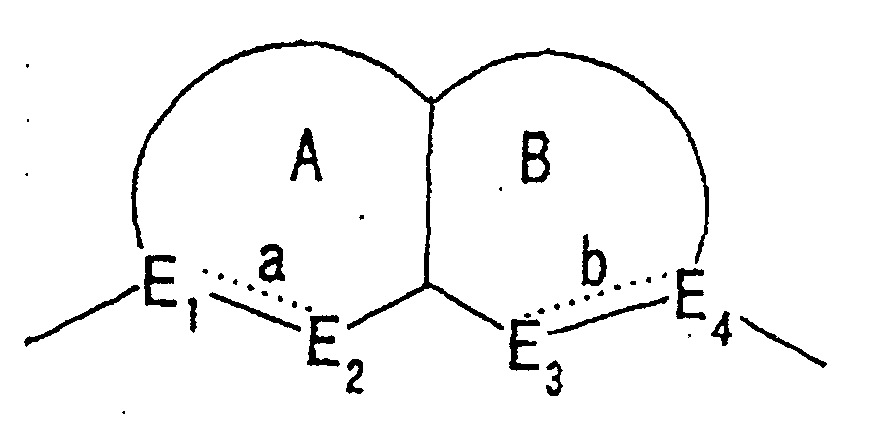

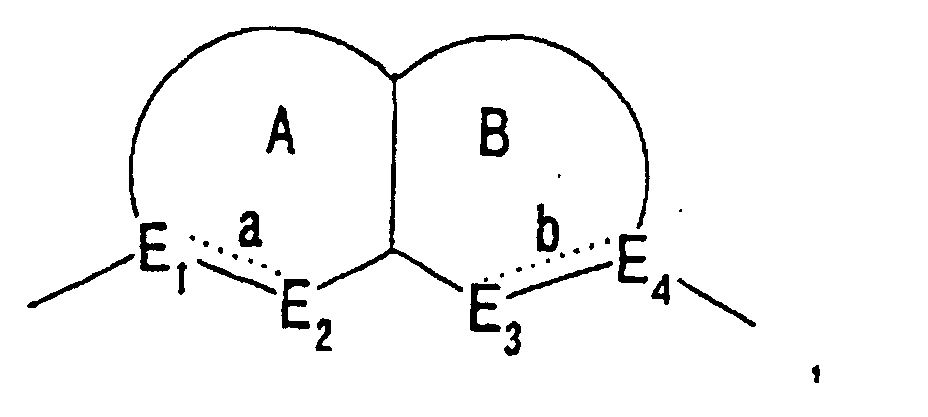
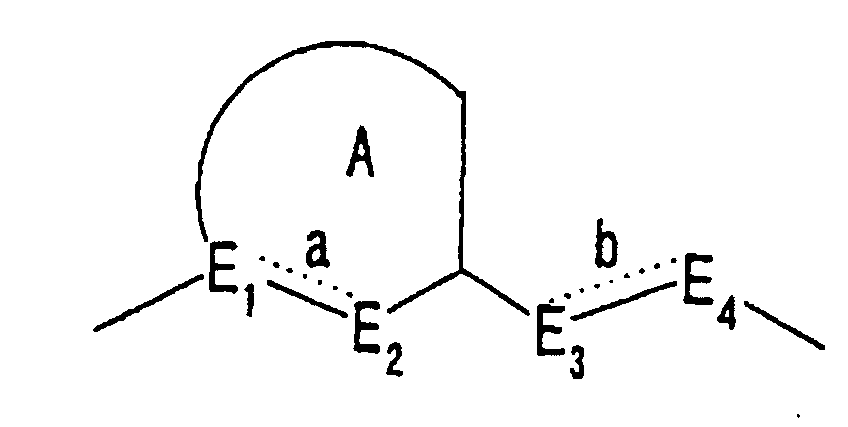
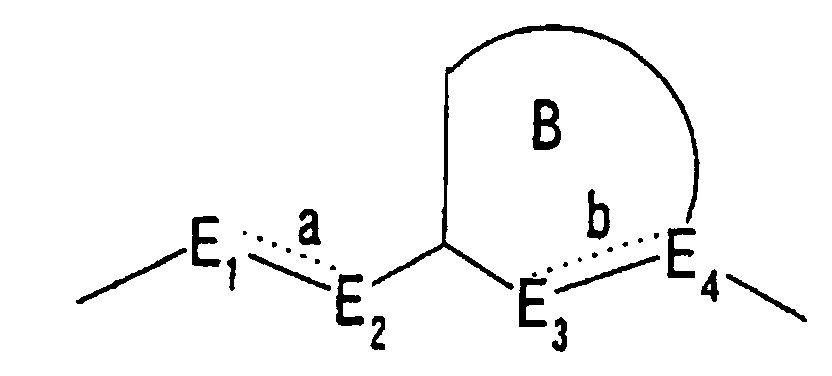


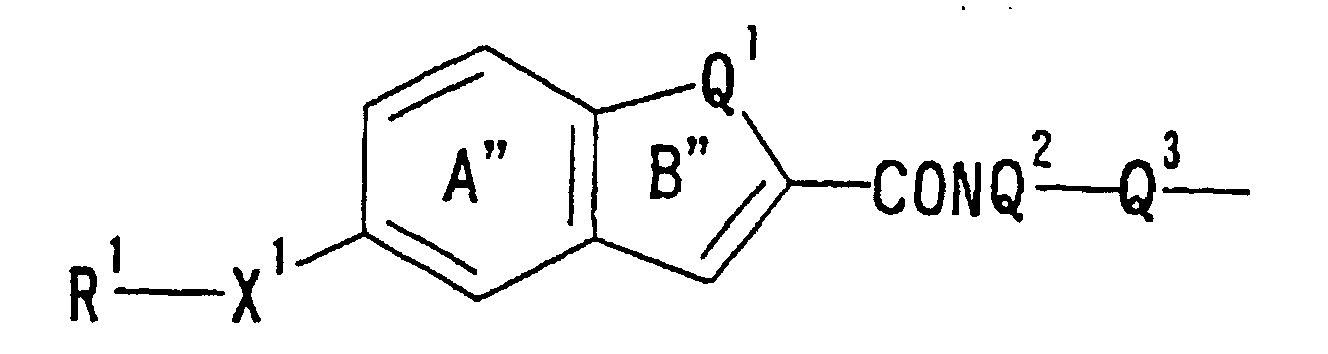


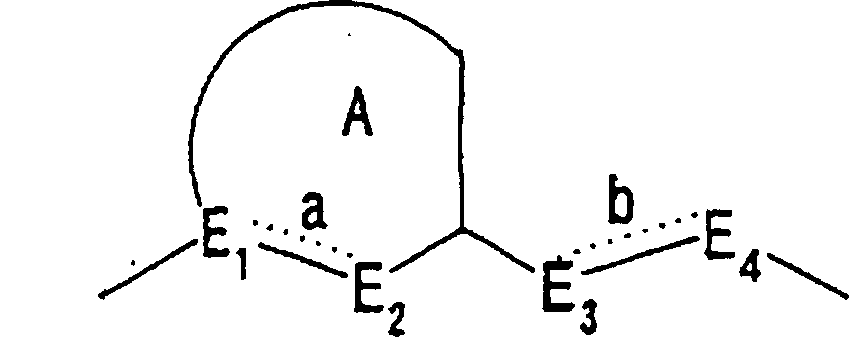


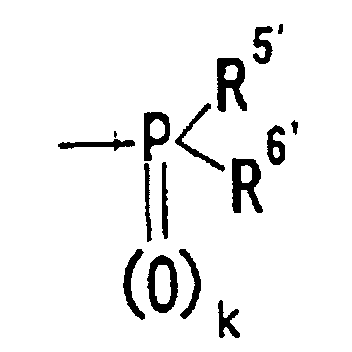


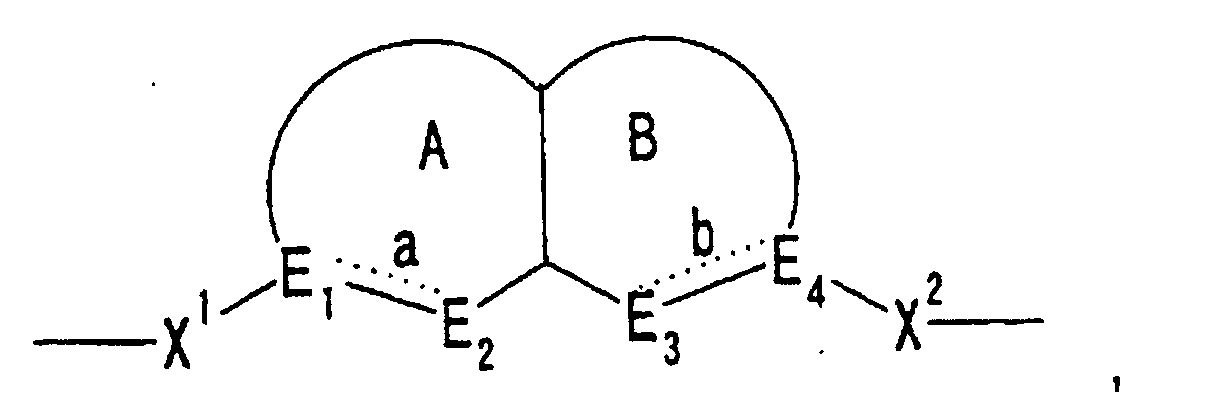
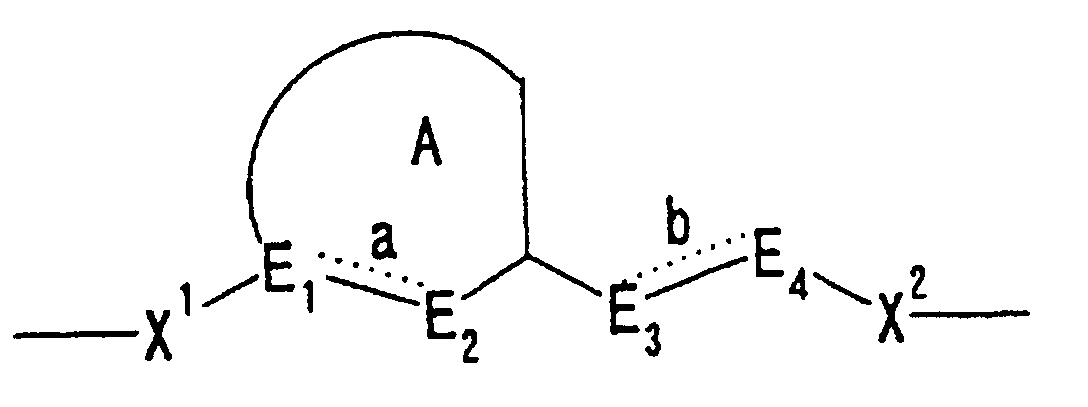
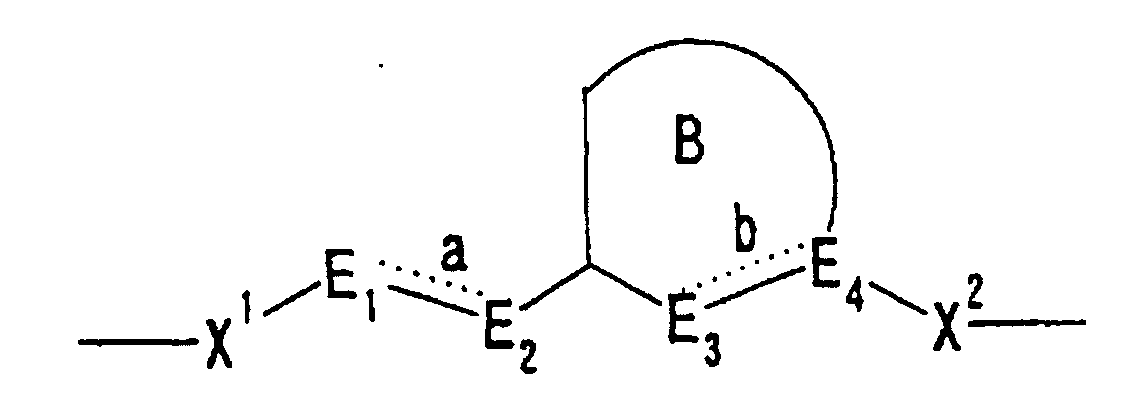








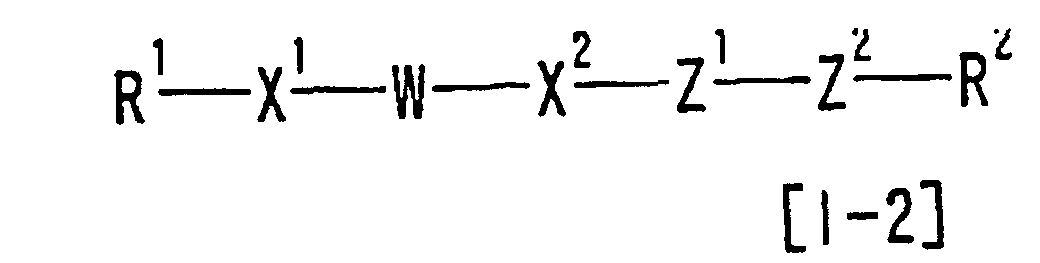
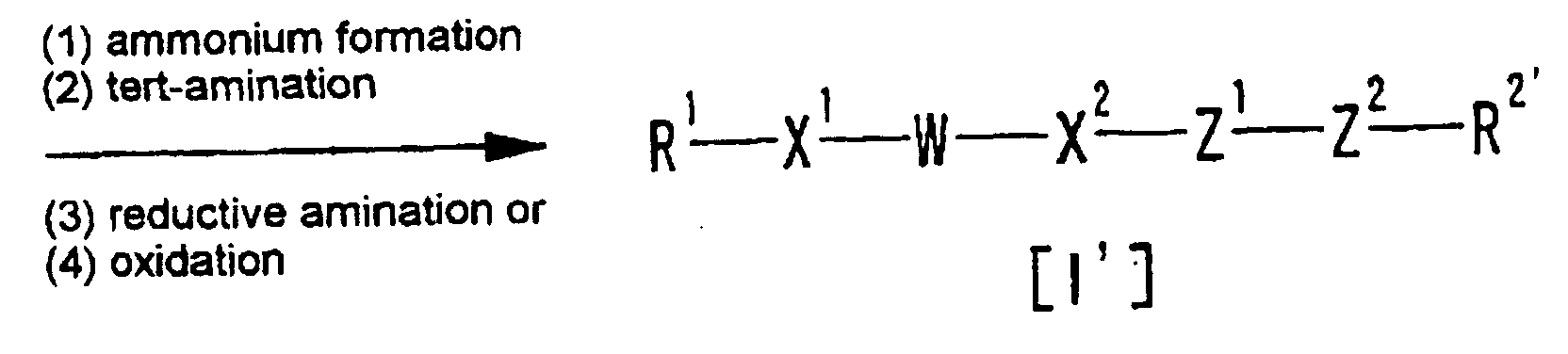



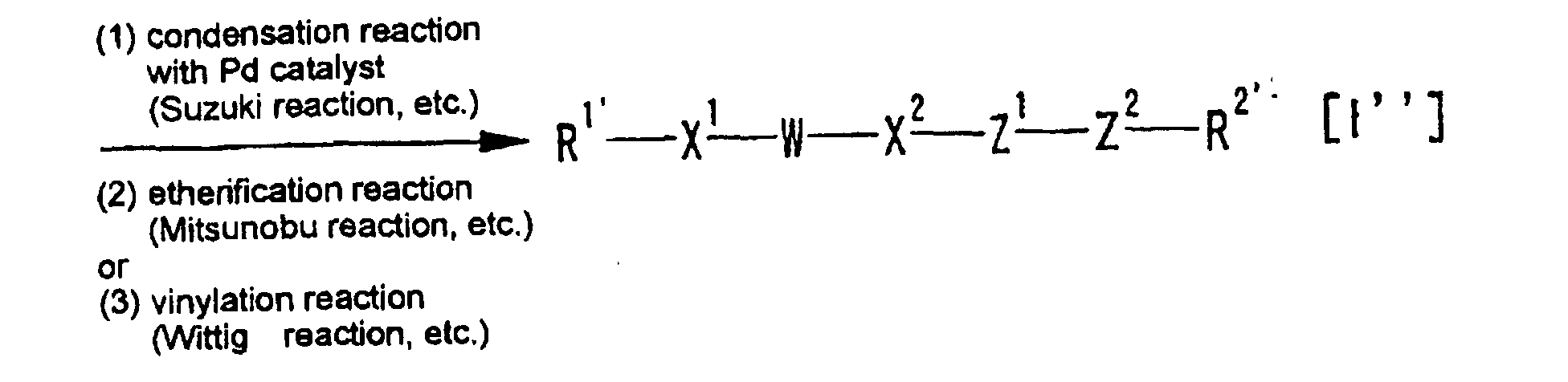



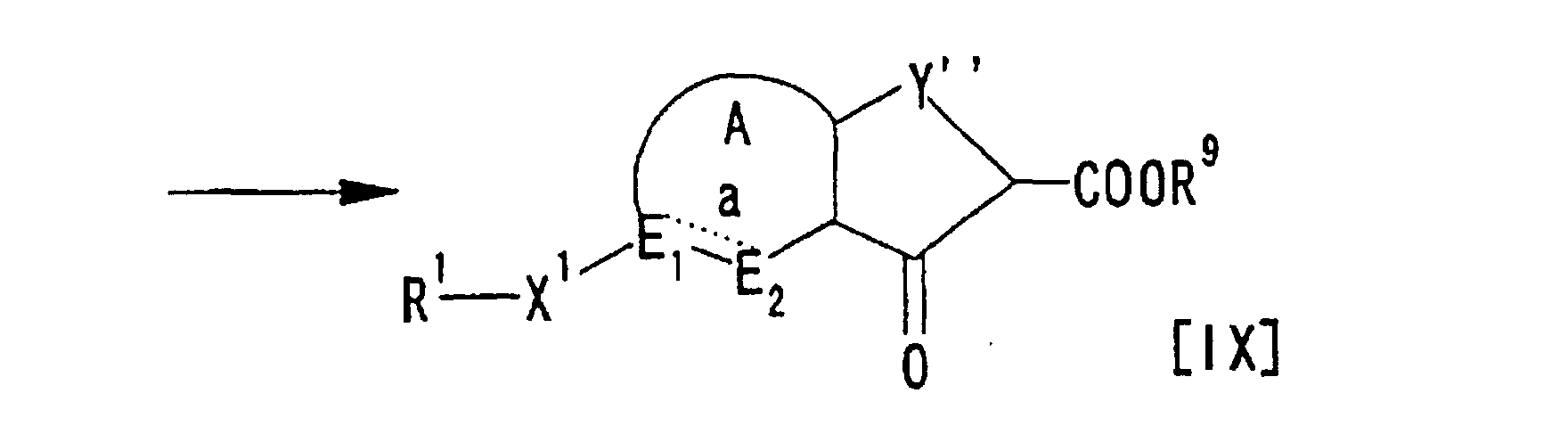
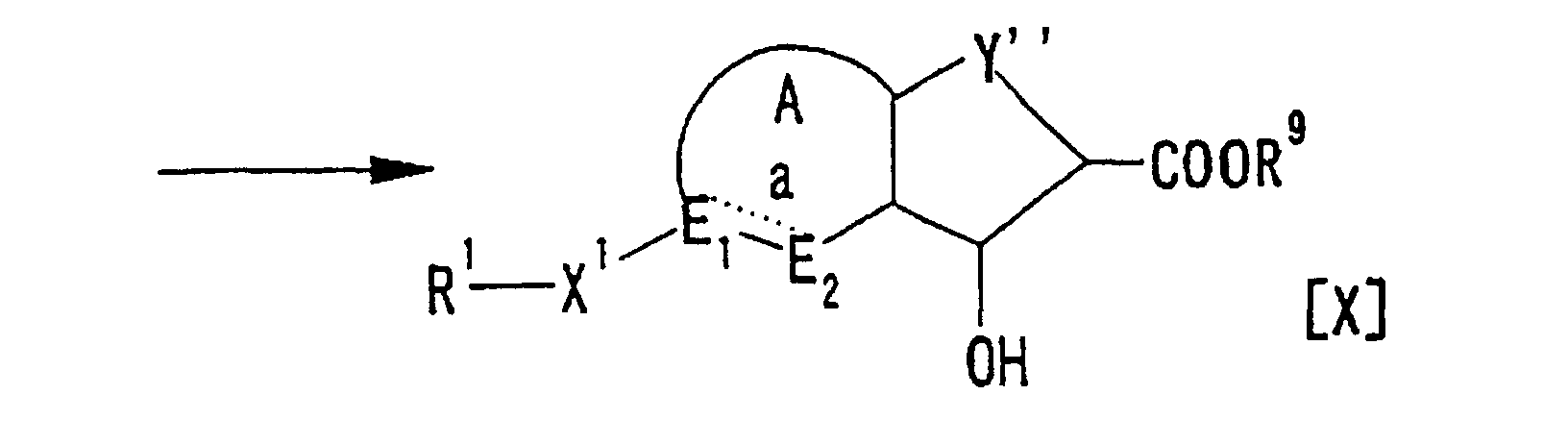
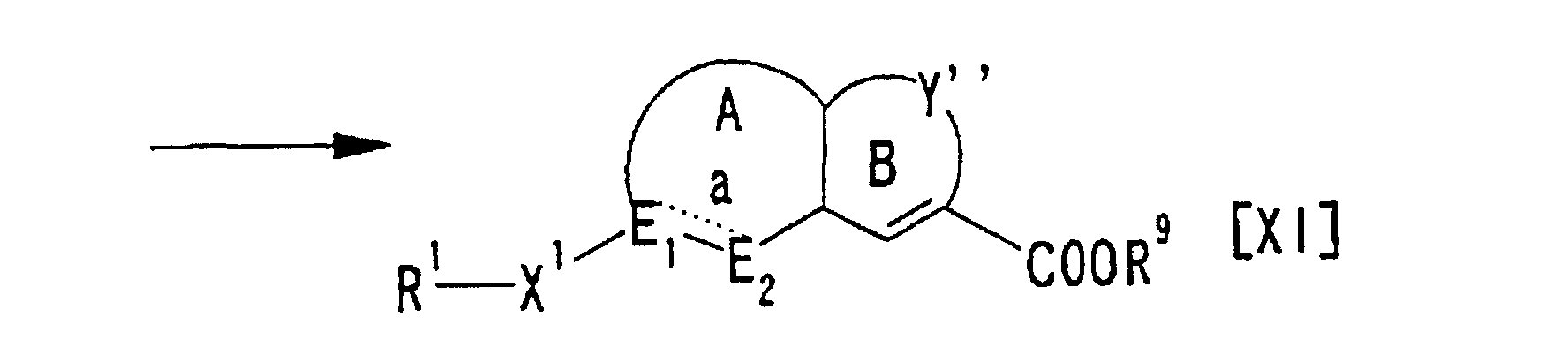
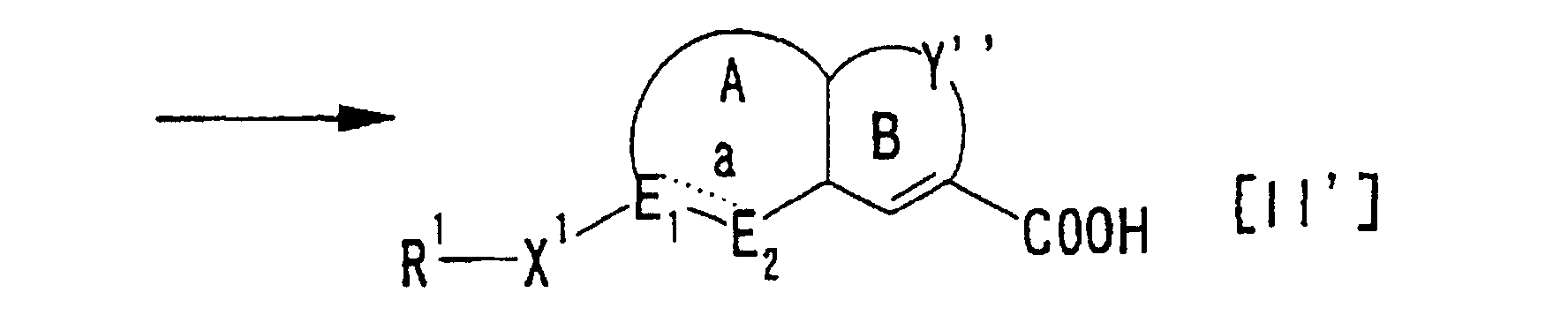

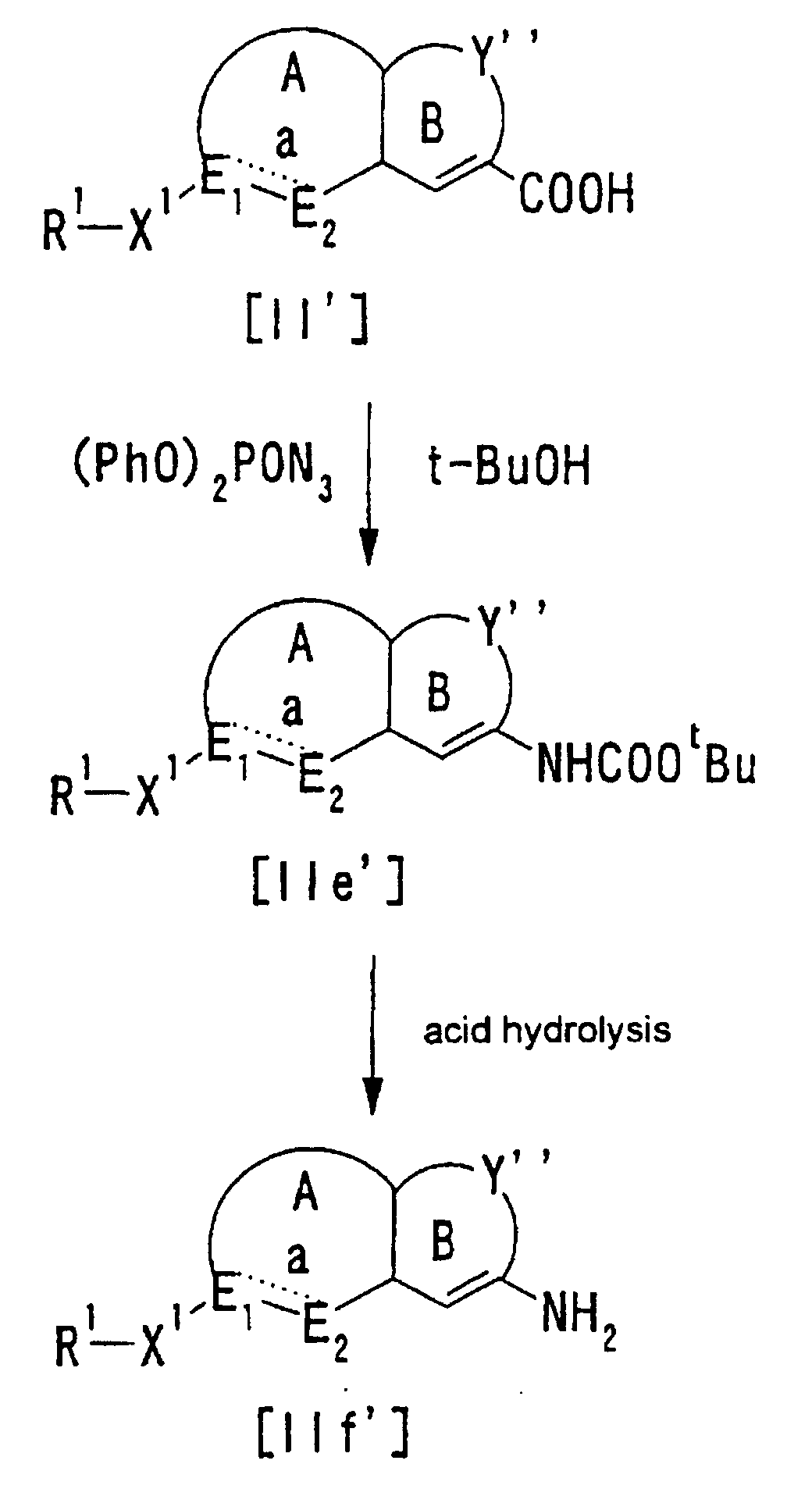
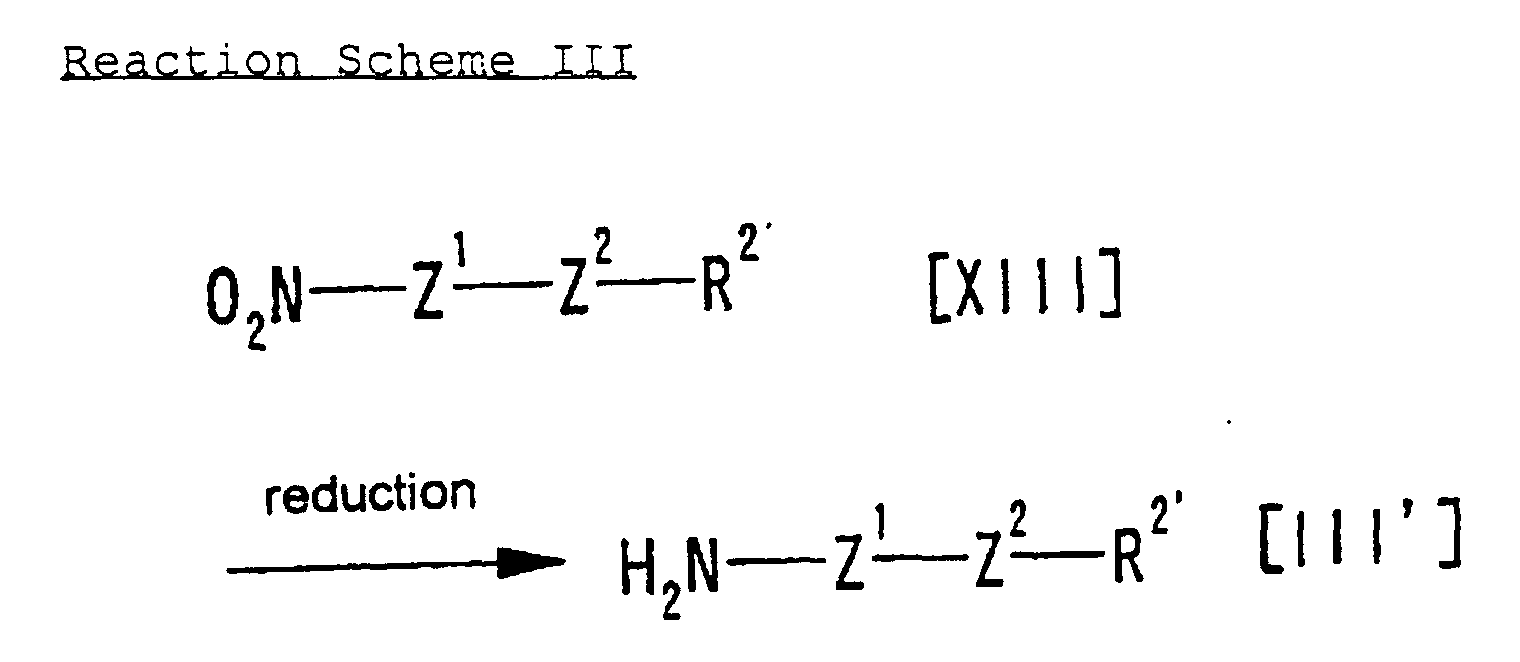

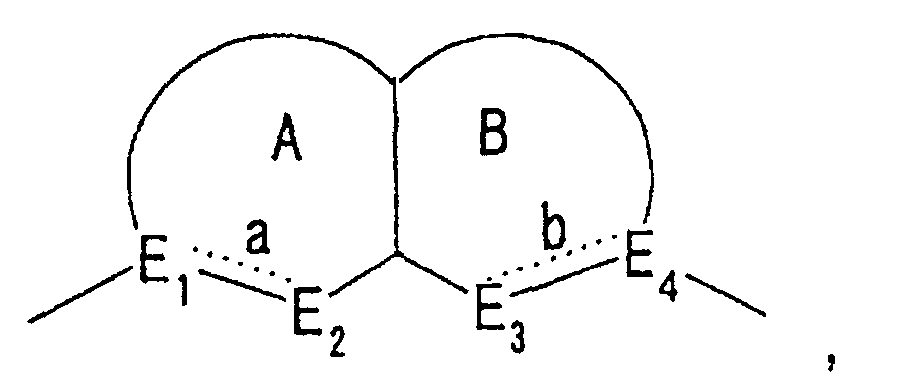 or
or (wherein each of ring A and ring B indicates a 5- to 7-membered cyclic ring group that may be substituted, each of E1 and E4 indicates the carbon atom that may be substituted or the nitrogen atom that may be substituted, each of E2 and E3 indicates the carbon atom that may be substituted or the nitrogen atom that may be substituted, the sulfur atom that may be oxidized or the oxygen atom and each of a and b indicates to be a single bond or a double bond), X2 indicates a bivalent group, in which the number of atoms constituting the straight-chain portion is 1 to 4, Z1 indicates a bond or a bivalent cyclic ring group, Z2 indicates a bond or a bivalent cyclic ring group, in which the number of atoms constituting the straight-chain portion is 1 to 4, and R2 indicates (1) an amino group that may be substituted, where the nitrogen atom may be converted into a quaternary ammonium or the N-oxide, (2) a nitrogen-containing, heterocyclic ring group that may be substituted and may contain the sulfur atom or the oxygen atom as a ring-constituting atom, where the nitrogen atom may be converted into a quaternary ammonium or the N-oxide, (3) a group that is bonded via the sulfur atom, (4) a group represented by formula
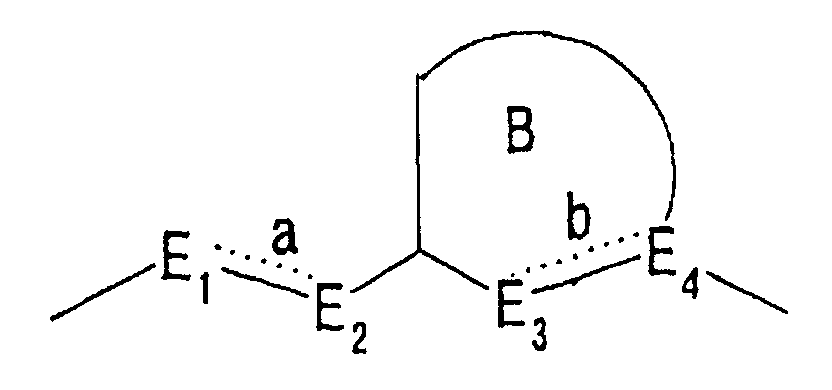 (wherein k indicates 0 or 1, the phosphorus atom may form a phosphonium salt when k is 0, and each of R5' and R6' indicates the hydrocarbon atom that may be substituted, the hydroxyl group that may be substituted or an amino group that may be substituted, and R5' and R6' may bind each other to form a cyclic ring group together with the adjacent phosphorus atom), (5) an amidino group that may be substituted or (6) a guanidino group that may be substituted; provided that, when a group represented by formula R1-X1-W-X2-Z1-Z2- indicates a group represented by formula
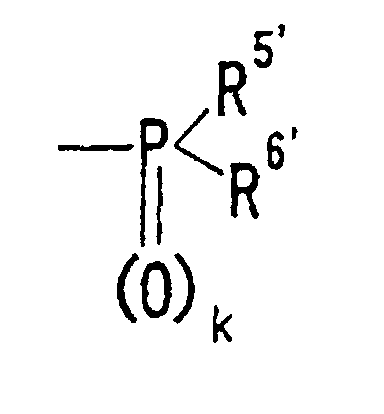 (wherein R1 indicates the same meaning as described above, W' indicates a bivalent group represented by formula
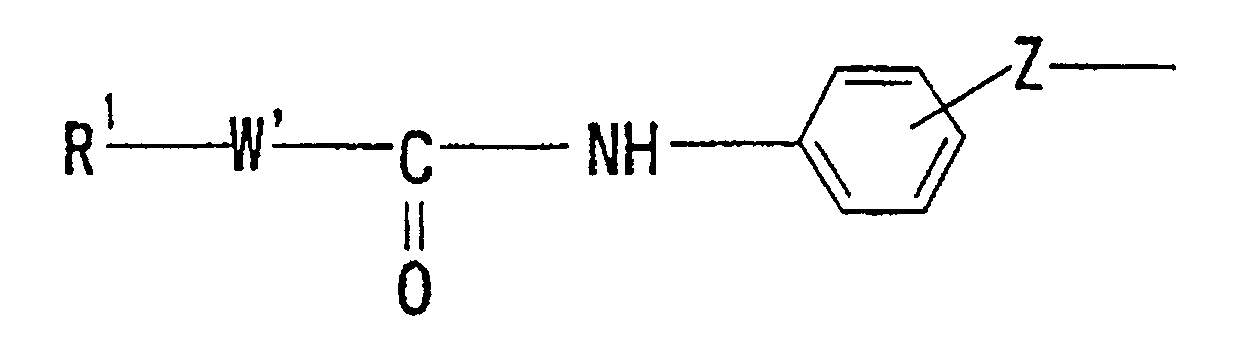 (wherein ring A' indicates a 5- to 6-membered aromatic ring that may be substituted, X indicates the carbon atom that may be substituted, the nitrogen atom that may be substituted, the sulfur atom or the oxygen atom and ring B' indicates a 5- to 7-membered ring that may be substituted) and Z indicates a bivalent group, in which the number of atoms constituting the straight-chain portion is 1 to 4, R2 indicates an amidino group that may be substituted or a guanidino group that may be substituted; when a group represented by formula R1-X1-W-X2-Z1-Z2- indicates a group represented by formula
 (wherein R1 and X1 indicate the same meanings as described above, ring A'' indicates a benzene ring that may be substituted, Q1 indicates a bivalent group, in which ring B'' forms a 5- to 7-membered ring, Q2 indicates the hydrogen atom, a hydrocarbon group that may be substituted, a heterocyclic ring group that may be substituted and Q3 indicates a bond or a bivalent group), R2 does not indicate a group represented by formula
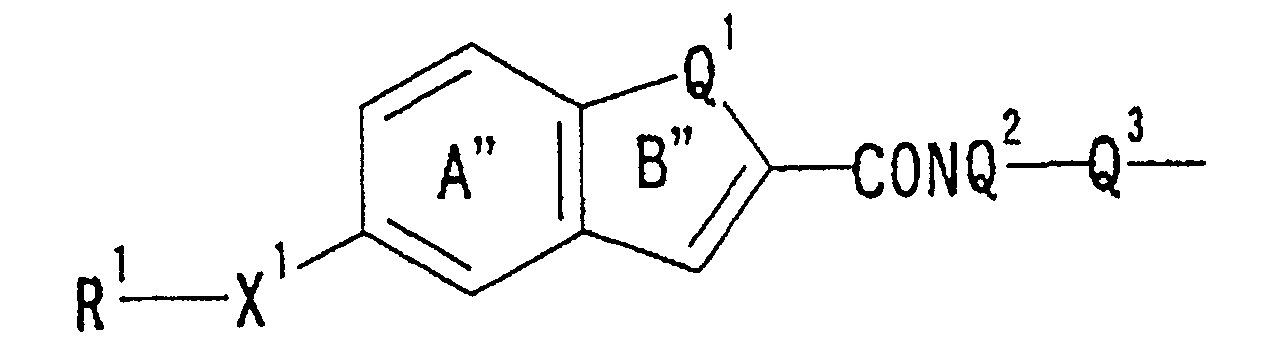 (wherein each of R5" and R6" indicates the hydroxyl group that may be substituted, and R5" and R6" may bind each other to form a cyclic ring group together with the adjacent phosphorus atom); or salts thereof.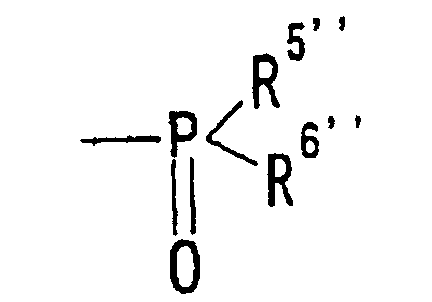


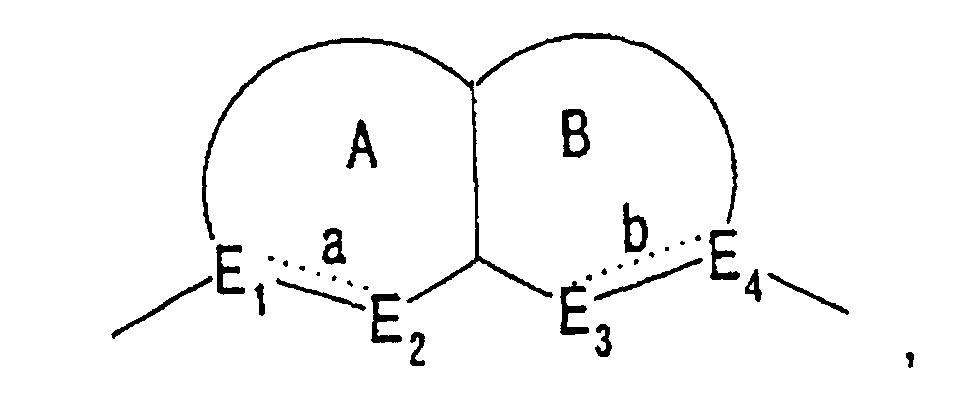 or
or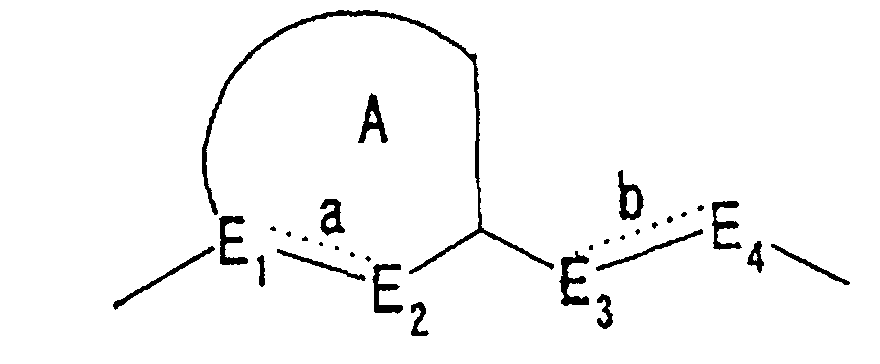 (wherein each of ring A and ring B indicates a 5- to 7-membered cyclic ring group that may be substituted, each of E1 and E4 indicates the carbon atom that may be substituted or the nitrogen atom that may be substituted, each of E2 and E3 indicates the carbon atom that may be substituted or the nitrogen atom that may be substituted, the sulfur atom that may be oxidized or the oxygen atom and each of a and b indicates to be a single bond or a double bond), X2 indicates a bivalent group, in which the number of atoms constituting the straight-chain portion is 1 to 4, Z1 indicates a bond or a bivalent cyclic ring group, Z2 indicates a bond or a bivalent cyclic ring group, in which the number of atoms constituting the straight-chain portion is 1 to 4, and R2 indicates (1) an amino group that may be substituted, where the nitrogen atom may be converted into a quaternary ammonium or the N-oxide, (2) a nitrogen-containing, heterocyclic ring group that may be substituted and may contain the sulfur atom or the oxygen atom as a ring-constituting atom, where the nitrogen atom may be converted into a quaternary ammonium or the N-oxide, (3) a group that bonded via the sulfur atom, (4) a group represented by formula
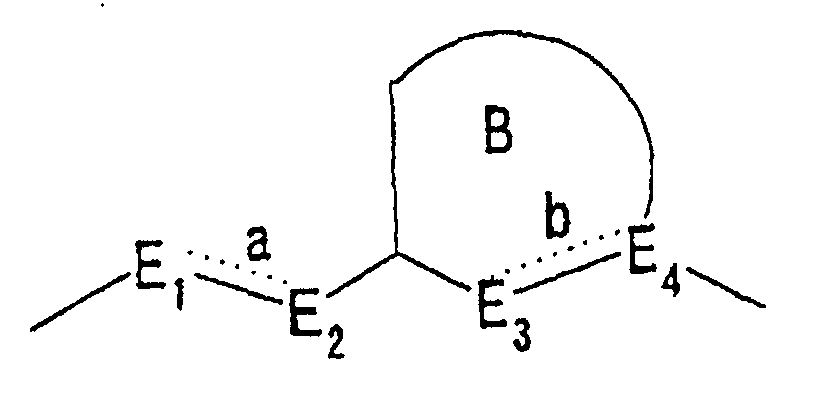 (wherein k indicates 0 or 1, the phosphorus atom may form a phosphonium salt when k is 0, and each of R5' and R6' indicates the hydrocarbon atom that may be substituted, the hydroxyl group that may be substituted or an amino group that may be substituted and R5' and R6' may bind each other to form a cyclic ring group together with the adjacent phosphorus atom), (5) an amidino group that may be substituted or (6) a guanidino group that may be substituted; provided that, when a group represented by formula R1-X1-W-X2-Z1-Z2- indicates a group represented by formula
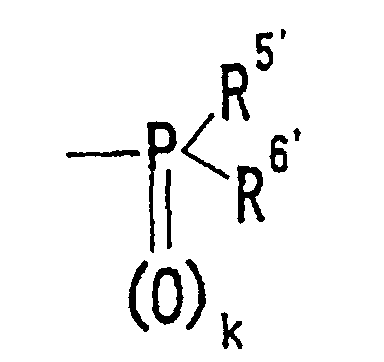 (wherein R1 indicates the same meaning as described above, W' indicates a bivalent group represented by formula
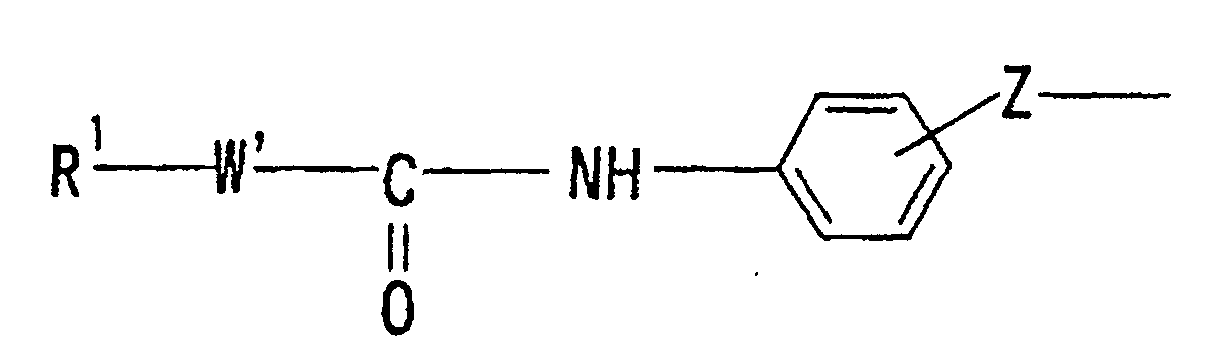 (wherein ring A' indicates a 5- to 6-membered aromatic ring that may be substituted, X indicates the carbon atom that may be substituted, the nitrogen atom that may be substituted, the sulfur atom or the oxygen atom and ring B' indicates a 5- to 7-membered ring that may be substituted) and Z indicates a bivalent group, in which the number of atoms constituting the straight-chain portion is 1 to 4), R2 indicates an amidino group that may be substituted or a guanidino group that may be substituted; or a salt thereof.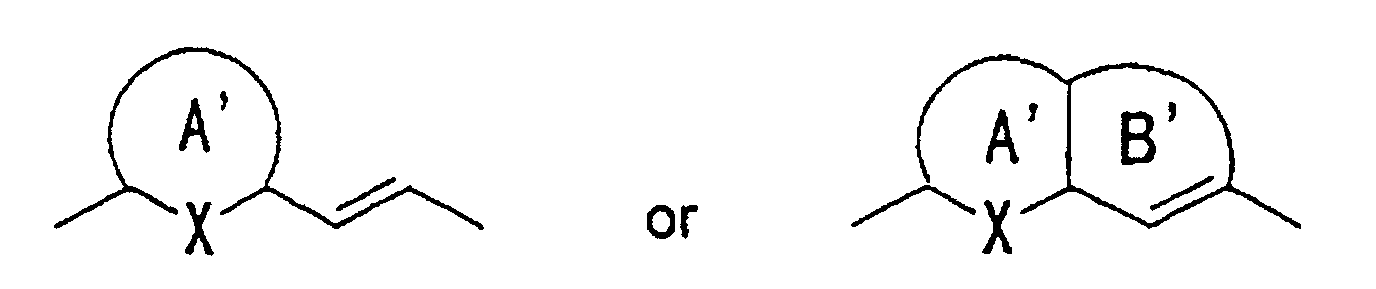

 or
or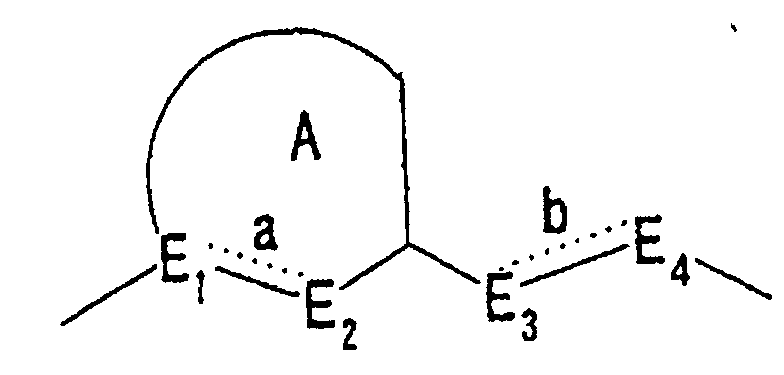 (wherein each of ring A and ring B indicates a 5- to 7-membered cyclic ring group that may be substituted, each of E1 and E4 indicates the carbon atom that may be substituted or the nitrogen atom that may be substituted, each of E2 and E3 indicates the carbon atom that may be substituted or the nitrogen atom that may be substituted, the sulfur atom that may be oxidized or the oxygen atom and each of a and b indicates to be a single bond or a double bond), X2 indicates a bivalent group, in which the number of atoms constituting the straight-chain portion is 1 to 4, Z1 indicates a bond or a bivalent cyclic ring group, Z2 indicates a bond or a bivalent cyclic ring group, in which the number of atoms constituting the straight-chain portion is 1 to 4, and R2 indicates (1) an amino group that may be substituted, where the nitrogen atom may be converted into a quaternary ammonium or the N-oxide, (2) a nitrogen-containing, heterocyclic ring group that may be substituted and may contain the sulfur atom or the oxygen atom as a ring-constituting atom, where the nitrogen atom may be converted into a quaternary ammonium or the N-oxide, (3) a group that bonded via the sulfur atom, (4) a group represented by formula
 (wherein k indicates 0 or 1, the phosphorus atom may form a phosphonium salt when k is 0, and each of R5' and R6' indicates the hydrocarbon atom that may be substituted, the hydroxyl group that may be substituted or an amino group that may be substituted and R5' and R6' may bind each other to form a cyclic ring group together with the adjacent phosphorus atom), (5) an amidino group that may be substituted or (6) a guanidino group that may be substituted; provided that, when a group represented by formula R1-X1-W-X2-Z1-Z2- indicates a group represented by formula
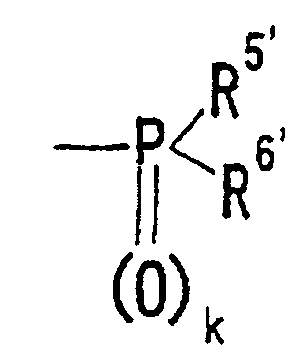 (wherein R1 indicates the same meaning as described above, W' indicates a bivalent group represented by formula
 (wherein ring A' indicates a 5- to 6-membered aromatic ring that may be substituted, X indicates the carbon atom that may be substituted, the nitrogen atom that may be substituted, the sulfur atom or the oxygen atom and ring B' indicates a 5- to 7-membered ring that may be substituted) and Z indicates a bivalent group, in which the number of atoms constituting the straight-chain portion is 1 to 4), R2 indicates an amidino group that may be substituted or a guanidino group that may be substituted; or a salt thereof, together with a protease inhibitor and/or a reverse transcriptase inhibitor, for preventing and/or treating HIV infectious diseases.