EP1178082A1 - Thermoplastic resin composition - Google Patents
Thermoplastic resin composition Download PDFInfo
- Publication number
- EP1178082A1 EP1178082A1 EP00917383A EP00917383A EP1178082A1 EP 1178082 A1 EP1178082 A1 EP 1178082A1 EP 00917383 A EP00917383 A EP 00917383A EP 00917383 A EP00917383 A EP 00917383A EP 1178082 A1 EP1178082 A1 EP 1178082A1
- Authority
- EP
- European Patent Office
- Prior art keywords
- thermoplastic resin
- resin composition
- anionic surfactant
- graft
- trunk polymer
- Prior art date
- Legal status (The legal status is an assumption and is not a legal conclusion. Google has not performed a legal analysis and makes no representation as to the accuracy of the status listed.)
- Granted
Links
Classifications
-
- C—CHEMISTRY; METALLURGY
- C08—ORGANIC MACROMOLECULAR COMPOUNDS; THEIR PREPARATION OR CHEMICAL WORKING-UP; COMPOSITIONS BASED THEREON
- C08L—COMPOSITIONS OF MACROMOLECULAR COMPOUNDS
- C08L51/00—Compositions of graft polymers in which the grafted component is obtained by reactions only involving carbon-to-carbon unsaturated bonds; Compositions of derivatives of such polymers
- C08L51/04—Compositions of graft polymers in which the grafted component is obtained by reactions only involving carbon-to-carbon unsaturated bonds; Compositions of derivatives of such polymers grafted on to rubbers
-
- C—CHEMISTRY; METALLURGY
- C08—ORGANIC MACROMOLECULAR COMPOUNDS; THEIR PREPARATION OR CHEMICAL WORKING-UP; COMPOSITIONS BASED THEREON
- C08F—MACROMOLECULAR COMPOUNDS OBTAINED BY REACTIONS ONLY INVOLVING CARBON-TO-CARBON UNSATURATED BONDS
- C08F265/00—Macromolecular compounds obtained by polymerising monomers on to polymers of unsaturated monocarboxylic acids or derivatives thereof as defined in group C08F20/00
- C08F265/04—Macromolecular compounds obtained by polymerising monomers on to polymers of unsaturated monocarboxylic acids or derivatives thereof as defined in group C08F20/00 on to polymers of esters
-
- C—CHEMISTRY; METALLURGY
- C08—ORGANIC MACROMOLECULAR COMPOUNDS; THEIR PREPARATION OR CHEMICAL WORKING-UP; COMPOSITIONS BASED THEREON
- C08F—MACROMOLECULAR COMPOUNDS OBTAINED BY REACTIONS ONLY INVOLVING CARBON-TO-CARBON UNSATURATED BONDS
- C08F279/00—Macromolecular compounds obtained by polymerising monomers on to polymers of monomers having two or more carbon-to-carbon double bonds as defined in group C08F36/00
- C08F279/02—Macromolecular compounds obtained by polymerising monomers on to polymers of monomers having two or more carbon-to-carbon double bonds as defined in group C08F36/00 on to polymers of conjugated dienes
-
- C—CHEMISTRY; METALLURGY
- C08—ORGANIC MACROMOLECULAR COMPOUNDS; THEIR PREPARATION OR CHEMICAL WORKING-UP; COMPOSITIONS BASED THEREON
- C08F—MACROMOLECULAR COMPOUNDS OBTAINED BY REACTIONS ONLY INVOLVING CARBON-TO-CARBON UNSATURATED BONDS
- C08F283/00—Macromolecular compounds obtained by polymerising monomers on to polymers provided for in subclass C08G
- C08F283/06—Macromolecular compounds obtained by polymerising monomers on to polymers provided for in subclass C08G on to polyethers, polyoxymethylenes or polyacetals
-
- C—CHEMISTRY; METALLURGY
- C08—ORGANIC MACROMOLECULAR COMPOUNDS; THEIR PREPARATION OR CHEMICAL WORKING-UP; COMPOSITIONS BASED THEREON
- C08K—Use of inorganic or non-macromolecular organic substances as compounding ingredients
- C08K5/00—Use of organic ingredients
- C08K5/0008—Organic ingredients according to more than one of the "one dot" groups of C08K5/01 - C08K5/59
- C08K5/0075—Antistatics
-
- C—CHEMISTRY; METALLURGY
- C08—ORGANIC MACROMOLECULAR COMPOUNDS; THEIR PREPARATION OR CHEMICAL WORKING-UP; COMPOSITIONS BASED THEREON
- C08K—Use of inorganic or non-macromolecular organic substances as compounding ingredients
- C08K5/00—Use of organic ingredients
- C08K5/36—Sulfur-, selenium-, or tellurium-containing compounds
- C08K5/41—Compounds containing sulfur bound to oxygen
- C08K5/42—Sulfonic acids; Derivatives thereof
Definitions
- the present invention relates to a non-black thermoplastic resin composition which can provide a shaped product showing a sufficiently short static decay time (time in which an applied voltage is attenuated to a prescribed voltage) and is suitable for use as an ESD (electrical static dissipative) material.
- a synthetic resin having a surface resistivity of 10 6 to 10 11 ohm/square (ohm/ ⁇ ) is strongly desired as an ESD control material in a field of industry where static electricity has to be removed.
- the method of surface-application of an antistatic agent or a silicone compound is accompanied with a practically great problem that the antistatic effect is markedly reduced by washing or rubbing.
- the method of shaping a composition containing an antistatic agent as an additive is not sufficient for permanent static prevention and is accompanied with problems such that the antistatic effect is lost when the antistatic agent present at the surface is removed by washing with water or rubbing, and excessive bleeding to the surface of the antistatic agent not only causes adhesive sticking of refuse or dust but also is liable to soil the environment due to elution or vaporization of the antistatic agent.
- JP-B 59-2462 corr.
- thermoplastic resin composition showing a permanent antistatic function obtained by adding an anionic surfactant to a thermoplastic resin containing a graft-copolymer based on a rubber trunk polymer having an alkylene oxide group, but the antistatic function is insufficient for use as an ESD control material.
- a mixture comprising a good-conductivity filler material having a low electrical resistivity, such as electroconductive carbon black, graphite, carbon fiber, metal fiber or metal powder, and a synthetic resin is formed into a synthetic resin composition.
- a good-conductivity filler material having a low electrical resistivity such as electroconductive carbon black, graphite, carbon fiber, metal fiber or metal powder
- a synthetic resin is formed into a synthetic resin composition.
- the electrical resistivity of the resultant resin composition remarkably varies depending on a content of the filler.
- the electrical resistivity of a resin composition sharply varies depending on the filler content.
- a principal object of the present invention is to provide a non-black thermoplastic resin composition which shows a sufficiently short static decay time for use as an ESD control material and can be colored into arbitrary hues.
- thermoplastic resin composition comprising: (A) 30 - 84.9 wt. % of a crystalline thermoplastic resin, (B) 15 - 65 wt. % of a graft-copolymer formed by graft-polymerizing an ethylenically unsaturated monomer onto a rubber trunk polymer having an alkylene oxide group and (C) 0.1 - 5 wt. % of an anionic surfactant.
- thermoplastic resin composition providing a shaped article exhibiting a very short decay time from 5000 volts to 50 volts of at most 10 sec and a surface resistivity of at least 10 ohm/square.
- thermoplastic resin composition of the present invention relies on the function of the anionic surfactant selectively adsorbed onto the rubber trunk polymer of the graft copolymer (B).
- This is the same as in the antistatic resin composition disclosed in the above-mentioned JP-B 59-2462.
- JP-B 59-2462 also describes that a portion of the graft copolymer can be replaced with a thermoplastic resin compatible with the graft copolymer (A), and examples of the thermoplastic resin disclosed therein include some specific examples of crystalline thermoplastic resin used in the present invention.
- the present invention corresponds to a selection invention which has succeeded in a remarkable improvement in ESD property by selecting a crystalline thermoplastic resin which has been included in examples of the thermoplastic resin compatible with the graft copolymer but not specially noted in the JP-B 59-2462.
- the invention of the JP reference aimed at providing an antistatic resin composition having a good transparency as is understood from enumerated products or usage, such as covers of electrical appliances or accessories, as an object.
- the compositions described in Examples are those exhibiting a whole-ray light transmittance of ca. 90 % and a haze of ca. 3 - 5 %).
- a crystalline thermoplastic resin used in the present invention has a compatibility with the graft copolymer in a sense that it is thermally mixable with the graft copolymer but does not have a microscopic mutual solubility (miscibility or a good level of compatibility) with the graft copolymer sufficient to provide a good transparency.
- thermoplastic resin composition of the present invention may be referred to as an invention which has been arrived at by parting from the transparency, an objective property aimed at by the invention of the above JP reference.
- anionic surfactant (C) is not mutually soluble with such a reproduced crystal but is preferentially adsorbed onto the rubber trunk polymer of the graft copolymer (B) or the anionic surfactant (C) is present at the crystal boundaries, to contribute to the development of the ESD property.
- the crystalline thermoplastic resin (A), as a first characterizing component of the thermoplastic resin composition of the present invention, may preferably be one exhibiting a heat-adsorption peak based on a crystal melting point showing a crystal melting enthalpy ( ⁇ Hc) of at least 10 J/g, particularly at least 15 J/g, when measured at a temperature-raising rate of 10 °C/min. in a nitrogen atmosphere by using a differential scanning calorimeter (DSC). Particularly, it is preferred to use one showing a melting point (Tm) of at most 300 °C, further preferably at most 290 °C. A resin having a higher melting point is liable to thermally degrade an anionic surfactant (C) in the stage of kneading with the anionic surfactant (C) described hereinafter.
- ⁇ Hc crystal melting enthalpy
- Tm melting point
- a resin having a higher melting point is liable to thermally degrade an anionic surfactant (C) in the stage
- crystalline thermoplastic resin (A) may include: crystalline polyamide resins, such as polyamide 6, polyamide 66 and polyamide 46; crystalline polyester resins, such as polybutylene terephthalate and polyethylene terephthalate; polyphenylene sulfide, polyacetal, polyethylene, polypropylene, totally aromatic polyesters; fluorine-containing resins, such as polyvinylidene fluoride, and tetrafluoroethylene/ hexafluoropropylene copolymer; and modified products of these. It is also possible to use a mixture of two or more species selected from synthetic resins as mentioned above.
- the content of the crystalline thermoplastic resin (A) in the thermoplastic resin composition is in the range of 30 - 84.4 wt. %, preferably 30 - 79.9 wt. %. If the content of the thermoplastic resin (A) is excessively large, the static decay time becomes longer, thus failing to provide a resin composition showing a sufficient antistatic function. If the content of the crystalline thermoplastic resin is excessively small, the desired ESD property-development effect becomes scarce, and the thermoplastic resin composition is liable to have a lower elastic modulus and the processing thereof as by injection molding or extrusion is liable to become difficult in some cases.
- the graft copolymer (B), as a second component of the thermoplastic resin composition according to the present invention, has a rubber trunk polymer and preferably comprise a graft copolymer formed by graft-copolymerizing an ethylenically unsaturated monomer onto a rubber trunk polymer having an alkylene oxide group. It is particularly preferred to use a graft copolymer which is basically similar to the one described in the above-mentioned JP-B 59-2462.
- the rubber trunk polymer preferably used for constituting the graft copolymer of the present invention is a rubbery copolymer comprising: 50 - 95 wt. % of at least one monomer selected from conjugated dienes and acrylate esters, 5 - 50 wt. % of at least one monomer having 4 - 500 alkylene oxide groups and an ethylenically unsaturated bond (hereinafter referred to as a "polyalkylene oxide monomer”), and optionally 0 - 50 wt. %, preferably 0-40 wt. %, of one or more copolymerizable ethylenically unsaturated monomers.
- the rubber trunk polymer may principally comprise at least one monomer selected from conjugated dienes and acrylate esters.
- the conjugated dienes may include: 1,3-butadiene, isoprene, chloroprene, 1,3-pentadiene, etc.
- the acrylate esters may include: ethyl acrylate, propyl acrylate, butyl acrylate, hexyl acrylate, octyl acrylate, nonyl acrylate, etc.
- the rubber trunk polymer cannot be provided with a sufficiently low glass-transition temperature, thus resulting in only a small antistatic effect.
- the addition amount of the polyalkylene oxide monomer is inevitably lowered, so that it becomes impossible to attain the desired ESD property.
- the polyalkylene oxide monomer has an alkylene oxide chain bonded to an ethylenically unsaturated group and represented by wherein R 2 and R 3 independently denote hydrogen or an alkyl group having 1 - 4 carbon atoms; and m and n are integers satisfying 4 ⁇ m+n ⁇ 500; and is particularly preferably one having an ethylene oxide block including at least 4 ethylene oxide groups obtained with at least one of R 2 and R 3 being hydrogen.
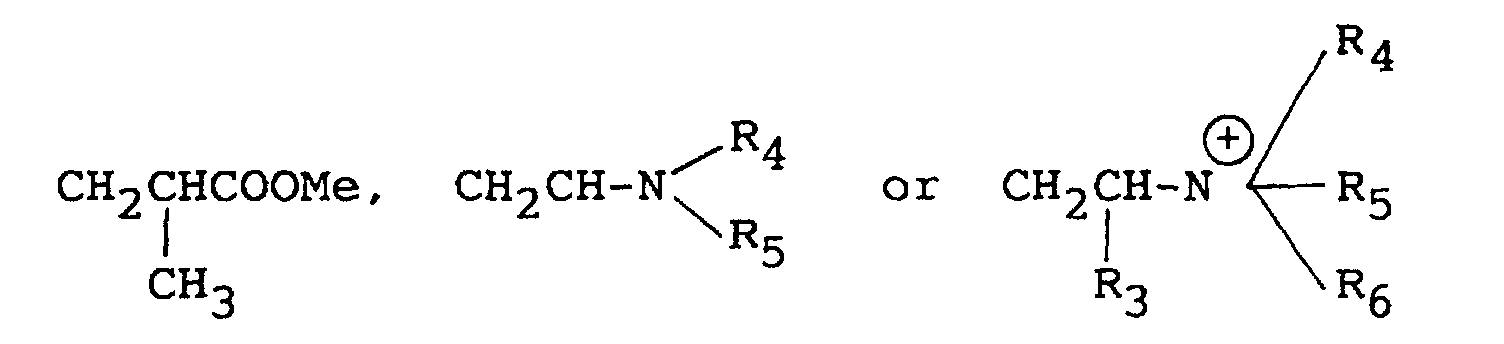
- the polyalkylene oxide monomer it is preferred to use at least one species of monomer represented by the following structural formula (2) or (3): wherein R 1 denotes hydrogen or an alkyl group having 1- 4 carbon atoms; X denotes hydrogen, an alkyl group having 1 - 9 carbon atoms, phenyl group, SO 3 Me, SO 2 Me, PO 3 Me 2 , wherein R 4 , R 5 and R 6 denote hydrogen or an alkyl group having 1 - 9 carbon atoms; Me denotes hydrogen or an alkaline metal; and R 2 , R 3 , m and n have the same meanings as in the formula (1); or wherein Z denotes hydrogen, an alkyl group having 1-40 carbon atoms, a cycloalkyl group having 3 - 6 carbon atoms, phenyl group, or wherein p and q are integers satisfying 4 ⁇ p+1 ⁇ 500.
- R 1 denotes hydrogen or an alkyl group having 1- 4 carbon atoms
- those including at least one of R 2 and R 3 being hydrogen and having at least 4 ethylene oxide groups are particularly preferably used. It is of course possible to use similar monomers other than those represented by the formula (2) and formula (3) as far as they have an ethylenically unsaturated bond and a polyalkylene oxide unit and can be copolymerized with a conjugated diene or/and an acrylate ester to provide a rubber trunk polymer with a lower volumetric electrical resistivity.
- the polyalkylene oxide monomer is not contained at 5 wt. % or higher in the rubber trunk polymer, it is impossible to provide a sufficient antistatic effect. Further, if not below 50 wt. %, it becomes difficult to effect the polymerization for formation of the rubber trunk polymer or in the graft co-polymerization or the post treatment by acid precipitation of the resultant polymer.
- ethylenically unsaturated monomer copolymerizable with the conjugated diene or acrylate ester and optionally used for producing the rubber trunk polymer known monomers may be used.
- one or more species of monomers may be used, such as methyl acrylate, alkyl methacrylates, acrylic acid, methacrylic acid, acrylamide, vinyl acetate, unsaturated nitriles, aromatic vinyls, alkyl vinyl ethers, alkyl vinyl ketones, 2-hydroxyethyl (meth)acrylate, diacetone acrylamide, vinyl chloride, vinylidene chloride, itaconic acid, alkyl itaconates, isobutene, 2-acid-pheophoxyethyl methacrylate, 3-chloro-2-acid-phosphoxypropyl methacrylate, and sodium styrenesulfonate.
- a further enhanced antistatic effect can be attained, if a monomer having a large polarity, such as acrylonitrile, or a monomer having an anionic substituent, such as sulfonic acid group, phosphoric acid group or carboxylic acid group, is used as the above-mentioned ethylenically unsaturated monomer.
- a monomer having a large polarity such as acrylonitrile
- a monomer having an anionic substituent such as sulfonic acid group, phosphoric acid group or carboxylic acid group
- Such a copolymerizable ethylenically unsaturated monomer is used within a range of not exceeding 40 wt. % of the rubber trunk polymer. Beyond the range, the rubber trunk polymer is caused to have a high glass transition temperature and lose a rubber characteristic.
- a polyfunctional monomer having two or more of at least one species of ethylenically unsaturated groups such as vinyl group, 1,3-butadienyl group, acryl group, methacryl group and alkyl group, as desired.
- a polyfunctional monomer further having 4 - 500, preferably 9 - 50, polyalkylene glycol groups is preferred since it functions as an antistatic property-imparting agent as well as a crosslinking agent.
- the polymerization for the rubber trunk polymer used in the present invention may preferably be performed by emulsion polymerization in the presence of a carboxylic acid-type surfactant.
- the carboxylic acid-type surfactant effectively functions in acid precipitation with a strong acid, such as hydrochloric acid, described hereinafter, and is also preferred in consideration from environmental aspect compared with other weak acid salt-type surfactants, such as organic phosphoric acid salt-type surfactants inclusive of alkylphosphoric acid salts and alkyl etherphosphoric acid salts.
- Preferred examples of the carboxylic acid-type surfactant may include: aliphatic acid salts, rosin acid salts, N-acylamino acid salts, alkyl ethercarboxylic acid salts.
- These carboxylic acid salt-type surfactants may preferably be incorporated in a proportion of 0.5 - 25 g/l in an aqueous dispersion medium at the time of emulsion polymerization for the rubber trunk poly
- a known monomer may be used as the ethylenically unsaturated monomer graft-polymerized onto the rubber trunk polymer.
- a known monomer may include: alkyl acrylate, alkyl methacrylates, acrylic acid, methacrylic acid, (meth)acrylamide, vinyl acetate, unsaturated nitriles, aromatic vinyls, conjugated dienes, alkyl vinyl ethers, alkyl vinyl ketones, 2-hydroxyethyl (meth)acrylate, (alkoxy)polyethylene glycol (meth)acrylate, diacetoneacrylamide, vinyl chloride, vinylidene chloride, itaconic acid, alkyl itaconates, and isobutene, and at least one species of these monomers may be used.
- aqueous dispersion medium and surfactant may be added as desired.
- the influence of the surfactant additionally used at this time on the acid precipitation is not so serious as the surfactant used in the emulsion polymerization for the rubber trunk polymer, but the use of a carboxylic acid-type surfactant is still preferred.
- the former may be used in 5 - 95 wt. %, preferably 8-80 wt. %, and the latter may be used in 5 - 95 wt. %, preferably 20 - 92 wt. %. If the rubber trunk polymer is less than 5 wt. %, it becomes difficult to impart the antistatic property, and in excess of 95 wt. %, it becomes difficult to obtain a thermoplastic resin composition through thermal mixing with the crystalline thermoplastic resin.
- an aqueous solution of a strong acid preferably hydrochloric acid
- a strong acid preferably hydrochloric acid
- the latex of the graft copolymer (B) stabilized with the carboxylic acid-type surfactant as described loses its stability as a result of rapid neutralization of the system by the addition under stirring of the strong acid aqueous solution, to be recovered as strongly aggregated solid powder having a low moisture content.
- effective acid precipitation can be realized by 100 - 500 wt.
- hydrochloric acid aqueous solution at a relatively low, concentration of 0.1 - 2 wt. % to 100 wt. parts of the latex of the graft copolymer (B) at a solid matter concentration of 20 - 40 wt. %, and the product can be effectively dried by a drier adapted to-mass production, such as an airborne-type instantaneous drier or a fluidized bed-type drier to be recovered as a solid powdery form of graft copolymer (B).
- a drier adapted to-mass production such as an airborne-type instantaneous drier or a fluidized bed-type drier to be recovered as a solid powdery form of graft copolymer (B).
- the content of the graft copolymer (B) in the thermoplastic resin composition is 15 - 65 wt. %, preferably 20 - 65 wt. %, particularly preferably 25-60 wt. %. If the content of the graft copolymer (B) is excessively large, the thermoplastic resin composition is caused to have a lower elasticity modulus, and the processing thereof as by injection molding or extrusion is liable to be difficult in some cases. If the content of the graft copolymer having the rubber trunk polymer is too small, the thermoplastic resin composition is liable to have an insufficient antistatic property.
- anionic surfactant (C) used in the present invention it is preferred to use at least one species of anionic surfactant selected from the group consisting of alkylbenzenesulfonic acid salts, alkylnaphthalenesulfonic acid salts, perfluoroalkylsulfonic acid salts, trifluoromethane-sulfonic acid salts, perfluoroalkylcarboxylic acid salts and fatty acid salts.
- Tng thermal weight loss initiation temperature according to JIS-K7120 (hereinafter sometimes denoted by "Tng") of at least 250 °C.
- the thermal weight loss initiation temperature has been recognized to have some degree of correlation with the structure of an anionic surfactant, and examples of the anionic surfactant having a thermal weight loss initiation temperature of at least 250 °C may include: alkylbenzenesulfonic acid salts, alkylnaphthalenesulfonic acid salts, aliphatic acid salts, perfloroalkylsulfonic acid salts, trifluoromethane-sulfonic acid salts, and perfluoroalkylcarboxylic acid salts.
- the selection of metal species constituting an anionic surfactant also has a relation with the effect of the anionic surfactant also has a relation with the effect of the anionic surfactant as an antistatic agent, and a salt of an alkaline metal having an atomic number of 19 (corresponding to potassium) or larger is preferred so as the shorten the time for blending with the graft copolymer (B) and the crystalline thermoplastic resin (A) and improve the properties of the shaped product, because the addition of a relatively small amount thereof provides a necessary antistatic effect.
- a salt of an alkaline metal having an atomic number of 19 (corresponding to potassium) or larger is preferred so as the shorten the time for blending with the graft copolymer (B) and the crystalline thermoplastic resin (A) and improve the properties of the shaped product, because the addition of a relatively small amount thereof provides a necessary antistatic effect.
- the anionic surfactant (C) is used in a proportion of 0.1 - 5 wt. % in the thermoplastic resin composition of the present invention. Below 0.1 wt. %, the ESD property-improving effect is scarce, and in excess of 5 wt. %, the blending-out to the surface of a shaped product becomes remarkable to provide undesirable properties of the shaped product.
- the contents of the above-mentioned components (A) - (C) are defined as propositions in the resinous components in the thermoplastic resin composition of the present invention (and non-resinous fillers described hereinafter are not concerned with the above-mentioned contents). Accordingly, as far as the above-mentioned contents of the components are satisfied and a necessary level of ESD property is maintained, a relatively small amount of non-crystalline thermoplastic resin is allowed to be incorporated.
- a fibrous reinforcing material examples of which may include: inorganic fibrous materials, such as glass fiber, carbon fiber, asbestos fiber, silica fiber, alumina fiber, zirconia fiber, boron nitride fiber, silicon nitride fiber, boron fiber, and potassium titanate fiber; metal fibrous materials of, e.g., stainless steel, aluminum, titanium, steel and bronze; and fibrous materials of high melting point organics, such as polyamide, fluorine-containing resin, polyester resin and acrylic resin.
- inorganic fibrous materials such as glass fiber, carbon fiber, asbestos fiber, silica fiber, alumina fiber, zirconia fiber, boron nitride fiber, silicon nitride fiber, boron fiber, and potassium titanate fiber
- metal fibrous materials e.g., stainless steel, aluminum, titanium, steel and bronze
- fibrous materials of high melting point organics such as polyamide, fluorine-containing resin, polyester resin and acrylic resin.
- fillers may for example include: particulate or powdery fillers of, e.g., mica, silica, tale, alumina, kaolin, calcium sulfate, calcium carbonate, titanium oxide, ferrite, clay, glass powder, zinc oxide, nickel carbonate, iron oxide, quartz powder, magnesium carbonate and barium sulfate.
- particulate or powdery fillers of, e.g., mica, silica, tale, alumina, kaolin, calcium sulfate, calcium carbonate, titanium oxide, ferrite, clay, glass powder, zinc oxide, nickel carbonate, iron oxide, quartz powder, magnesium carbonate and barium sulfate.
- a filler of a relatively good conductivity such as metal fiber, metal powder or semiconductor powder so as to provide a shaped product with further lowered surface resistivity.
- a filler of a relatively good conductivity such as metal fiber, metal powder or semiconductor powder
- the above-mentioned fillers can be respectively used singly or in combination of two or more species. Further, it is possible that the filler has been treated with a binding agent or a surface-treating agent, as desired.
- a binding agent or a surface-treating agent may include: functional compounds, such as epoxy compounds, isocyanate compounds, silane compounds and titanate compounds. Such a compound may be used for surface-treatment or binding treatment before the use of the filler or may be added simultaneously at the time of preparation of the composition.
- thermoplastic resin composition of the present invention can further contain another additive other than the above, examples of which may include: impact modifiers, such as epoxy group-containing ⁇ -olefin copolymers; resin modifiers, such as ethylene glycidyl methacrylate; lubricants, such as pentaerythritol tetrastearate; thermosetting resins; antioxidants, such as phenolic antioxidants and phosphoric acid-type antioxidants; peroxide decomposers, such as sulfur-type or phosphorus-type secondary antioxidants; ultraviolet absorbers; nucleating agents, such as boron nitride; flame-retardant; and colorants, such as dyes and pigments.
- impact modifiers such as epoxy group-containing ⁇ -olefin copolymers
- resin modifiers such as ethylene glycidyl methacrylate
- lubricants such as pentaerythritol tetrastearate
- thermosetting resins such as phenolic antioxidants
- thermoplastic resin composition of the present invention can be prepared by using equipments and methods generally used for preparation of synthetic resin compositions.
- the respective starting ingredients may be preliminary blended by means of a Hersehel mixer or a tumbler, and optional fillers, such as glass fiber, may be added thereto as desired, followed by extrusion through a single-screw or twin-screw extruder into pellets for molding.
- optional fillers such as glass fiber
- thermoplastic resin composition of the present invention can be shaped and processed into shaped products, such as sheets, films, tubes, pipes and others, through ordinary melt-forming processing methods, such as injection molding or extrusion.
- shaped products can be used in wide fields where antistatic property is required.
- Specific usages may include: in the electric or electronic field and semiconductor-related fields, wafer carriers, wafer cassettes, tote bins, wafer boats, IC chip trays, IC chip carriers, IC conveyer tubes, IC cards, tapes, reel packings, various cases, storing trays, storing bins, conveyer parts such as bearings and conveyer belts; in the fields of magnetic card readers and OA apparatus, transfer rollers for recording apparatus, transfer belts, developing rollers, transfer drums for recording apparatus, print circuit board cassettes, liquid crystal glass substrate cassettes, bushings, paper and paper bill-conveyer parts, paper feed rails, font cartridge, ink ribbon canisters, guide bins, trays, rollers, gears, sprockets, computer housings, modem housings, monitor housings, CD-ROM housings, printer housings, connectors, and computer slots; in the field of communication apparatus, portable telephone accessories, papers, various sliding members; in the field of automobiles, interior trims, underhoods, electric and electronic member housing
- Electroconductive part (Dotite D-550", made by Fujikura Kasei K.K.) was applied onto both front and back surfaces of a molded test piece (measuring 100 mm x 127 mm x 3mm-thickness) to form electrodes thereon. More specifically, the electrode on the front surface comprised an inner circle having a diameter of 50 mm and an annular ring having an inner diameter of 70 mm and an outer diameter of 83 mm.
- the measurement was performed by applying a voltage of 100 volts between the inner circle and the annular ring of the electrode on the front surface while using the electrode on the back surface as a guard electrode to measure a resistance between the inner circle and the annular ring, and a surface resistivity was calculated from the resistance according to a prescribed formula.
- Measured according to MIL-B-81705 The outline of the measurement is as follows.
- the apparatus used was "STATIC DECAY METER-406C" (made by Electro-Tech Systems, Inc.). A voltage of 5000 volts was applied to a molded test piece (flat sheet of 100 mm x 127 mm x 3 mm-thickness), and a time after removal of the voltage in which the potential of the test piece was lowered to 50 volts was measured as a static decay time. A shorter static decay time represents a better antistatic effect.
- an ethylenically unsaturated monomer mixture including 35 parts of methyl methacrylate, 0.3 part of normal-octyl mercaptan, 0.018 part of diisopropylbenzene hydroperoxide, 0.007 part of formaldehyde sodium sulfoxylate and 1.0 part of potassium oleate, and 50 parts of deionized water, were added, and after nitrogen substitution, the system was subjected to graft copolymerization under stirring at 60 °C for 10 hours. The resultant latex was taken out and precipitated by adding 200 parts of aqueous hydrochloric acid solution at a concentration of 0.7 wt.
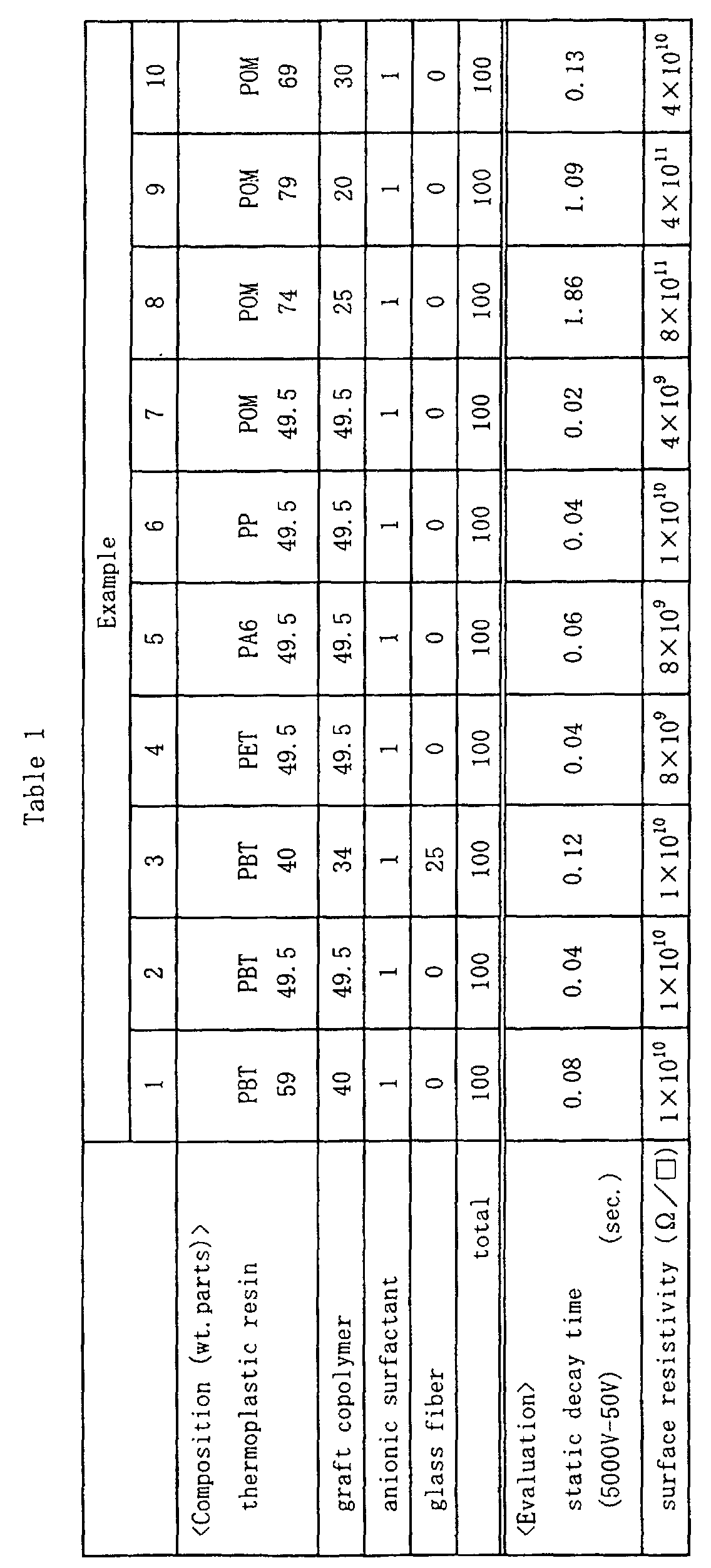
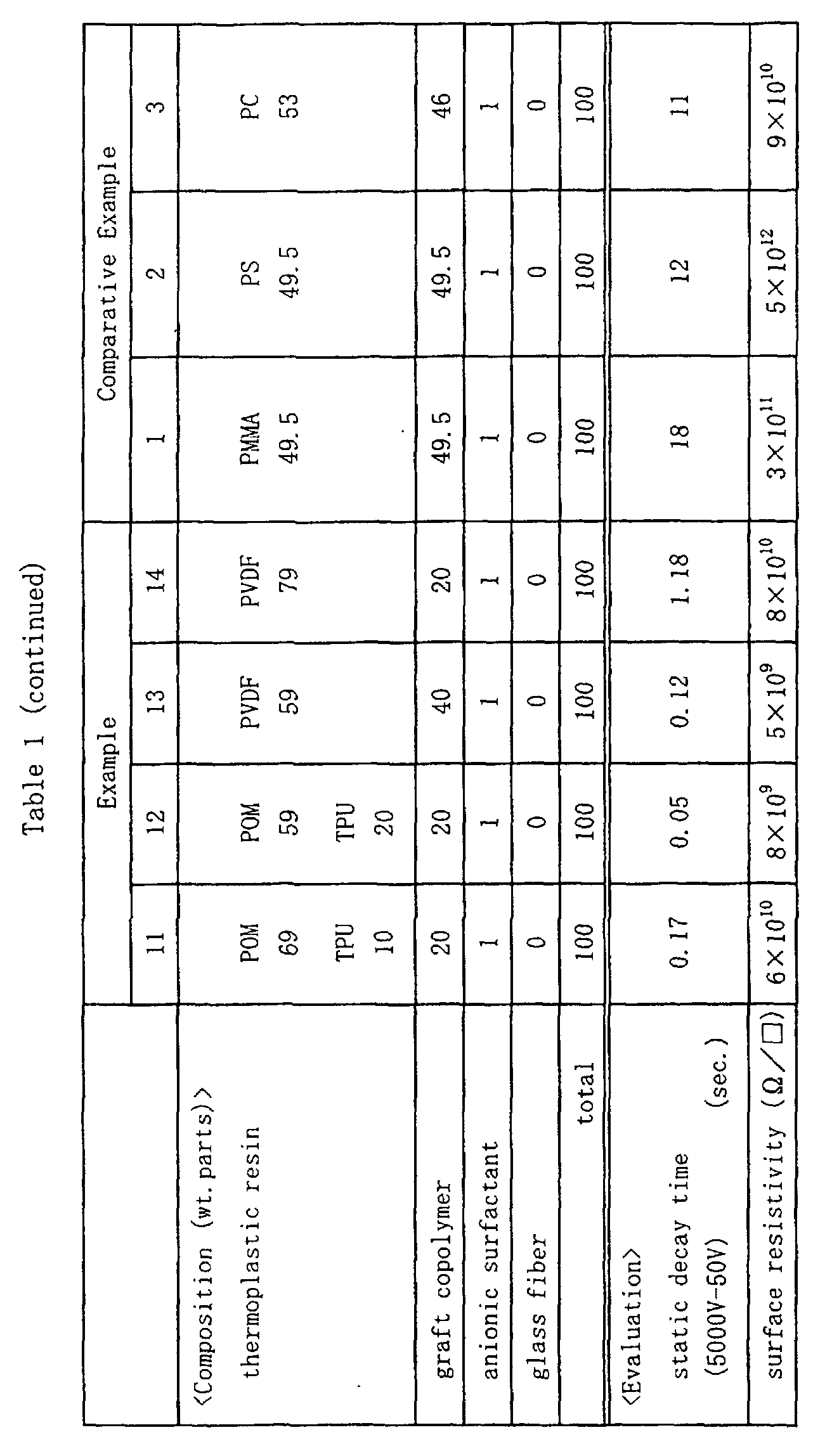
- graft copolymer and thermoplastic resins and an anionic surfactant (and glass fiber in some cases) shown below were uniformly blended in ratios shown in Table 1 appearing hereinafter and supplied to a kneading extruder ("BT-30", made by Plastic Kogaku Kenkyusho) for melt-kneading to obtain pelletized products.
- BT-30 kneading extruder
- the cylinder temperature of the extruder was adjusted to different temperatures depending on the species of the thermoplastic resins used, such as 230 - 250 °C for PBT and PA 6, 260 - 280 °C for PET, 205 - 225 °C for PP, 190 - 200 °C for POM alone and in mixture with TPU, 180 - 200 °C for PMMA and PS, 280 - 300 °C for PC, and 200 - 250 °C for PVDF.
- the species of the thermoplastic resins used such as 230 - 250 °C for PBT and PA 6, 260 - 280 °C for PET, 205 - 225 °C for PP, 190 - 200 °C for POM alone and in mixture with TPU, 180 - 200 °C for PMMA and PS, 280 - 300 °C for PC, and 200 - 250 °C for PVDF.
- the shaped products (of Examples 1 - 14) obtained from thermoplastic resin compositions according to the present invention using crystalline thermoplastic resins exhibited a remarkably shorter static decay time compared with the shaped products (of Comparative Examples 1 - 3) obtained by using amorphous thermoplastic resins, thus showing a clear difference in antistatic effect.
- Examples exhibited values which were smaller by about one digit than those of Comparative Examples, so that it is understood that the ESD property has been realized.
- thermoplastic resin composition suitable for use as an ESD (electrical static dissipative) material and capable of being colored into arbitrary hues is provided by incorporating a crystalline thermoplastic resin (A) in combination with a graft copolymer (B) and an anionic surfactant (C).
- ESD electrical static dissipative
Landscapes
- Chemical & Material Sciences (AREA)
- Health & Medical Sciences (AREA)
- Chemical Kinetics & Catalysis (AREA)
- Medicinal Chemistry (AREA)
- Polymers & Plastics (AREA)
- Organic Chemistry (AREA)
- Compositions Of Macromolecular Compounds (AREA)
- Reinforced Plastic Materials (AREA)
Abstract
Description
(A) 30 - 84.9 wt. % of a crystalline thermoplastic resin, (B) 15 - 65 wt. % of a graft-copolymer formed by graft-polymerizing an ethylenically unsaturated monomer onto a rubber trunk polymer having an alkylene oxide group and (C) 0.1 - 5 wt. % of an anionic surfactant. As a result, according to another aspect, it is possible to obtain a non-black thermoplastic resin composition providing a shaped article exhibiting a very short decay time from 5000 volts to 50 volts of at most 10 sec and a surface resistivity of at least 10 ohm/square.




Claims (6)
- A non-black, thermoplastic resin composition comprising: (A) 30 - 84.9 wt. % of a crystalline thermoplastic resin, (B) 15 - 65 wt. % of a graft-copolymer formed by graft-polymerizing an ethylenically unsaturated monomer onto a rubber trunk polymer having an alkylene oxide group and (C) 0.1 - 5 wt. % of an anionic surfactant.
- A thermoplastic resin composition according to Claim 1, comprising 30 - 79.9 wt. % of the crystalline thermoplastic resin (A), 20 - 65 wt. % of the graft-copolymer (B) and 0.1 - 5 wt. % of the anionic surfactant (C).
- A thermoplastic resin composition according to Claim 1, wherein the rubber trunk polymer (B) has been obtained by using a carboxylic acid-type surfactant as an emulsifier for polymerization.
- A thermoplastic resin composition according to Claim 1, wherein the anionic surfactant (A) has a thermal weight loss initiation temperature of at least 250 °C.
- A non-black thermoplastic resin composition, comprising (A) a crystalline thermoplastic resin, (B) a graft-copolymer having a rubber trunk polymer and (C) an anionic surfactant, and providing a shaped article exhibiting a static decay time from 5000 volts to 50 volts of at most 10 sec. and a surface resistivity of at least 10 ohm/square.
- A thermoplastic resin composition according to any of Claims 1 to 5, further including a fibrous reinforcing material.
Applications Claiming Priority (5)
| Application Number | Priority Date | Filing Date | Title |
|---|---|---|---|
| JP11527199 | 1999-04-22 | ||
| JP11527199 | 1999-04-22 | ||
| JP29060899A JP3942326B2 (en) | 1999-04-22 | 1999-10-13 | Thermoplastic resin composition |
| JP29060899 | 1999-10-13 | ||
| PCT/JP2000/002585 WO2000064984A1 (en) | 1999-04-22 | 2000-04-20 | Thermoplastic resin composition |
Publications (3)
| Publication Number | Publication Date |
|---|---|
| EP1178082A1 true EP1178082A1 (en) | 2002-02-06 |
| EP1178082A4 EP1178082A4 (en) | 2003-05-28 |
| EP1178082B1 EP1178082B1 (en) | 2005-10-19 |
Family
ID=26453808
Family Applications (1)
| Application Number | Title | Priority Date | Filing Date |
|---|---|---|---|
| EP00917383A Expired - Lifetime EP1178082B1 (en) | 1999-04-22 | 2000-04-20 | Thermoplastic resin composition |
Country Status (7)
| Country | Link |
|---|---|
| US (1) | US6657005B1 (en) |
| EP (1) | EP1178082B1 (en) |
| JP (1) | JP3942326B2 (en) |
| CN (1) | CN1148418C (en) |
| AT (1) | ATE307170T1 (en) |
| DE (1) | DE60023287T8 (en) |
| WO (1) | WO2000064984A1 (en) |
Cited By (2)
| Publication number | Priority date | Publication date | Assignee | Title |
|---|---|---|---|---|
| FR2876696A1 (en) * | 2004-10-20 | 2006-04-21 | Solvay | ARTICLE COMPRISING A POLYOLEFINIC SUBSTRATE AND A LAYER COATING AT LEAST ONE PART OF THE SURFACE OF SAID POLYOLEFIN SUBSTRATE, METHOD OF MANUFACTURING SUCH ARTICLE |
| WO2012058253A1 (en) * | 2010-10-26 | 2012-05-03 | Lubrizol Advanced Materials, Inc. | Salt modified inherently electrostatic dissipative polymers |
Families Citing this family (22)
| Publication number | Priority date | Publication date | Assignee | Title |
|---|---|---|---|---|
| JP3901534B2 (en) * | 2001-10-11 | 2007-04-04 | 株式会社クレハ | Antistatic resin composition |
| TWI291439B (en) * | 2002-09-02 | 2007-12-21 | Kureha Corp | Charge controlling members |
| US7233479B2 (en) * | 2003-04-04 | 2007-06-19 | Daimlerchrysler Ag | Device for protecting a battery from electrostatic charging |
| JP4424971B2 (en) * | 2003-11-11 | 2010-03-03 | 株式会社クレハ | Antistatic resin container preparation kit |
| WO2005084097A1 (en) * | 2004-02-27 | 2005-09-09 | Mitsubishi Gas Chemical Company, Inc. | Radio wave absorber and radio wave absorber manufacturing method |
| US20060046593A1 (en) * | 2004-08-27 | 2006-03-02 | Jean Senellart | Antistatic transfer belt for nonwovens process |
| JP4461970B2 (en) * | 2004-09-06 | 2010-05-12 | 三菱瓦斯化学株式会社 | Radio wave absorber |
| JP2006299104A (en) * | 2005-04-21 | 2006-11-02 | Mitsubishi Rayon Co Ltd | Thermoplastic resin composition and molded article |
| DE102005036693A1 (en) * | 2005-08-04 | 2007-02-08 | Degussa Ag | Process for the preparation of 2,4,6-trimercapto-1,3,5-triazine |
| JP4800094B2 (en) * | 2006-04-19 | 2011-10-26 | 株式会社クレハ | Method for measuring moisture content of thermoplastic resin by thermobalance |
| JP4913478B2 (en) * | 2006-05-25 | 2012-04-11 | 信越ポリマー株式会社 | Molded body and RFID system |
| CN100447185C (en) * | 2006-05-26 | 2008-12-31 | 扬州大学 | A Surface Modification Method for Improving the Antistatic Properties of Polymer Materials |
| US8168292B2 (en) * | 2006-06-15 | 2012-05-01 | Innegra Technologies, Llc | Composite materials including amorphous thermoplastic fibers |
| US20080188153A1 (en) * | 2007-02-06 | 2008-08-07 | Innegrity, Llc | Method of Forming a Low Dielectric Loss Composite Material |
| US7648758B2 (en) | 2007-02-06 | 2010-01-19 | Innegrity, Llc | Low dielectric loss composite material |
| JP4562100B2 (en) * | 2008-03-14 | 2010-10-13 | 株式会社沖データ | Lenticular lens medium |
| US8190042B1 (en) | 2008-05-16 | 2012-05-29 | Oki Data Americas, Inc. | Electrophotographic printing apparatus |
| WO2012118882A1 (en) * | 2011-03-01 | 2012-09-07 | Lubrizol Advanced Materials, Inc. | Flame retardant thermoplastic polyurethane compositions |
| JP5711575B2 (en) * | 2011-03-11 | 2015-05-07 | 株式会社カネカ | Acrylic resin film |
| CN106448988A (en) * | 2015-08-04 | 2017-02-22 | 青岛金立磁性材料有限公司 | Ferrite-neodymium iron boron composite injection molding granular material and preparation method thereof |
| US20240170315A1 (en) * | 2021-03-26 | 2024-05-23 | Bae Systems Information And Electronic Systems Integration Inc. | Clip and lid system for a chip tray |
| CN115609791B (en) * | 2022-12-20 | 2023-05-02 | 中国电子科技集团公司第四十六研究所 | Method for controlling uniformity of high-filler-content glue solution multi-impregnated glass fiber cloth |
Family Cites Families (9)
| Publication number | Priority date | Publication date | Assignee | Title |
|---|---|---|---|---|
| JPS592462B2 (en) * | 1980-02-22 | 1984-01-18 | 呉羽化学工業株式会社 | Antistatic resin composition |
| JPS5839860B2 (en) * | 1980-12-15 | 1983-09-01 | 呉羽化学工業株式会社 | Antistatic resin composition |
| JP2807322B2 (en) * | 1989-10-09 | 1998-10-08 | 三井化学株式会社 | Resin composition with excellent antistatic properties |
| US5182338A (en) * | 1989-11-17 | 1993-01-26 | General Electric Company | Polymer blend compositions |
| US5270367A (en) * | 1989-11-29 | 1993-12-14 | Denki Kagaku Kogyo Kabushiki Kaisha | Permanent antistatic resin composition |
| JP2873893B2 (en) * | 1992-09-24 | 1999-03-24 | 三菱レイヨン株式会社 | Thermoplastic resin composition |
| US5652326A (en) * | 1993-03-03 | 1997-07-29 | Sanyo Chemical Industries, Ltd. | Polyetheresteramide and antistatic resin composition |
| DE59611354D1 (en) * | 1995-06-28 | 2006-07-20 | Crompton Vinyl Additives Gmbh | Antistatic-equipped halogen-containing polymers |
| JPH107872A (en) * | 1996-06-28 | 1998-01-13 | Polyplastics Co | Vibration damping polyacetal resin composition |
-
1999
- 1999-10-13 JP JP29060899A patent/JP3942326B2/en not_active Expired - Fee Related
-
2000
- 2000-04-20 AT AT00917383T patent/ATE307170T1/en not_active IP Right Cessation
- 2000-04-20 DE DE60023287T patent/DE60023287T8/en not_active Expired - Fee Related
- 2000-04-20 CN CNB008078246A patent/CN1148418C/en not_active Expired - Fee Related
- 2000-04-20 US US09/959,074 patent/US6657005B1/en not_active Expired - Fee Related
- 2000-04-20 EP EP00917383A patent/EP1178082B1/en not_active Expired - Lifetime
- 2000-04-20 WO PCT/JP2000/002585 patent/WO2000064984A1/en not_active Ceased
Cited By (3)
| Publication number | Priority date | Publication date | Assignee | Title |
|---|---|---|---|---|
| FR2876696A1 (en) * | 2004-10-20 | 2006-04-21 | Solvay | ARTICLE COMPRISING A POLYOLEFINIC SUBSTRATE AND A LAYER COATING AT LEAST ONE PART OF THE SURFACE OF SAID POLYOLEFIN SUBSTRATE, METHOD OF MANUFACTURING SUCH ARTICLE |
| WO2006045732A1 (en) * | 2004-10-20 | 2006-05-04 | Solvay (Société Anonyme) | Article comprising a polyolefin substrate and a layer coating at least a portion of the surface of the said polyolefin substrate, and process and use |
| WO2012058253A1 (en) * | 2010-10-26 | 2012-05-03 | Lubrizol Advanced Materials, Inc. | Salt modified inherently electrostatic dissipative polymers |
Also Published As
| Publication number | Publication date |
|---|---|
| DE60023287D1 (en) | 2006-03-02 |
| CN1148418C (en) | 2004-05-05 |
| EP1178082A4 (en) | 2003-05-28 |
| US6657005B1 (en) | 2003-12-02 |
| CN1351633A (en) | 2002-05-29 |
| WO2000064984A1 (en) | 2000-11-02 |
| ATE307170T1 (en) | 2005-11-15 |
| JP3942326B2 (en) | 2007-07-11 |
| EP1178082B1 (en) | 2005-10-19 |
| DE60023287T8 (en) | 2007-03-08 |
| DE60023287T2 (en) | 2006-07-13 |
| JP2001002950A (en) | 2001-01-09 |
Similar Documents
| Publication | Publication Date | Title |
|---|---|---|
| EP1178082B1 (en) | Thermoplastic resin composition | |
| EP1069156B1 (en) | Flame retardant thermoplastic resin composition | |
| CN101747601B (en) | Environmentally friendly thermoplastic resin composition using recycled polyester resin | |
| KR20090073702A (en) | High weatherability thermoplastic resin composition with excellent scratch resistance and colorability | |
| WO2009082096A2 (en) | Flame-retardant polyester resin composition having excellent heat resistance | |
| US6528567B1 (en) | Antistatic resin composition | |
| KR20190082074A (en) | Thermoplastic resin composition and molded article using the same | |
| KR20120021786A (en) | Thermoplastic resin composition having improved aluminium deposition and adhesion strength | |
| KR101053833B1 (en) | (Meth) acrylate copolymer and thermoplastic resin composition comprising the same | |
| CN119242011A (en) | A PC/PMMA/ABS composite material and its preparation method and application | |
| US20050020761A1 (en) | Antistatic resin composition | |
| KR101382784B1 (en) | Biodegradable antistatic multilayer sheet having excellent impact resistance and heat resistance and method of manufacturing the same | |
| KR101233383B1 (en) | Antistatic thermoplastic resin composition | |
| KR100872410B1 (en) | Permanent antistatic rubber modified aromatic vinyl-vinyl cyanide copolymer resin, its preparation method and thermoplastic resin composition using same | |
| JP3509334B2 (en) | Thermoplastic resin composition | |
| JPH07258557A (en) | Thermoplastic resin composition | |
| JP6547352B2 (en) | Thermoplastic resin composition | |
| JP3226052B2 (en) | Polyester resin composition | |
| KR20130082222A (en) | Methylmethacrylate-butadiene-styrene impact modifier and environment-friendly polylactic acid resin composition comprising the same | |
| JPH09124863A (en) | Flame retardant resin composition | |
| KR102235391B1 (en) | Transparent thermoplastic resin composition, method for preparing the thermoplastic resin and molding products | |
| JPH05230308A (en) | Copolymer type flame retardant and flame retardant resin composition | |
| US20040230013A1 (en) | Blends of poly (alpha-methylene-gamma-methyl-gamma-butyrolactone-co-glycidyl methacrylate) and polyphenylene sulfide polymer, articles therefrom and preparation thereof | |
| JP2016210933A (en) | Thermoplastic resin composition and molded article | |
| JP2003003036A (en) | Thermoplastic resin composition |
Legal Events
| Date | Code | Title | Description |
|---|---|---|---|
| PUAI | Public reference made under article 153(3) epc to a published international application that has entered the european phase |
Free format text: ORIGINAL CODE: 0009012 |
|
| 17P | Request for examination filed |
Effective date: 20011119 |
|
| AK | Designated contracting states |
Kind code of ref document: A1 Designated state(s): AT BE CH CY DE DK ES FI FR GB GR IE IT LI LU MC NL PT SE |
|
| A4 | Supplementary search report drawn up and despatched |
Effective date: 20030410 |
|
| 17Q | First examination report despatched |
Effective date: 20030901 |
|
| GRAP | Despatch of communication of intention to grant a patent |
Free format text: ORIGINAL CODE: EPIDOSNIGR1 |
|
| GRAS | Grant fee paid |
Free format text: ORIGINAL CODE: EPIDOSNIGR3 |
|
| GRAA | (expected) grant |
Free format text: ORIGINAL CODE: 0009210 |
|
| AK | Designated contracting states |
Kind code of ref document: B1 Designated state(s): AT BE CH CY DE DK ES FI FR GB GR IE IT LI LU MC NL PT SE |
|
| PG25 | Lapsed in a contracting state [announced via postgrant information from national office to epo] |
Ref country code: IT Free format text: LAPSE BECAUSE OF FAILURE TO SUBMIT A TRANSLATION OF THE DESCRIPTION OR TO PAY THE FEE WITHIN THE PRESCRIBED TIME-LIMIT;WARNING: LAPSES OF ITALIAN PATENTS WITH EFFECTIVE DATE BEFORE 2007 MAY HAVE OCCURRED AT ANY TIME BEFORE 2007. THE CORRECT EFFECTIVE DATE MAY BE DIFFERENT FROM THE ONE RECORDED. Effective date: 20051019 Ref country code: AT Free format text: LAPSE BECAUSE OF FAILURE TO SUBMIT A TRANSLATION OF THE DESCRIPTION OR TO PAY THE FEE WITHIN THE PRESCRIBED TIME-LIMIT Effective date: 20051019 Ref country code: BE Free format text: LAPSE BECAUSE OF FAILURE TO SUBMIT A TRANSLATION OF THE DESCRIPTION OR TO PAY THE FEE WITHIN THE PRESCRIBED TIME-LIMIT Effective date: 20051019 Ref country code: CH Free format text: LAPSE BECAUSE OF FAILURE TO SUBMIT A TRANSLATION OF THE DESCRIPTION OR TO PAY THE FEE WITHIN THE PRESCRIBED TIME-LIMIT Effective date: 20051019 Ref country code: LI Free format text: LAPSE BECAUSE OF FAILURE TO SUBMIT A TRANSLATION OF THE DESCRIPTION OR TO PAY THE FEE WITHIN THE PRESCRIBED TIME-LIMIT Effective date: 20051019 Ref country code: FI Free format text: LAPSE BECAUSE OF FAILURE TO SUBMIT A TRANSLATION OF THE DESCRIPTION OR TO PAY THE FEE WITHIN THE PRESCRIBED TIME-LIMIT Effective date: 20051019 Ref country code: NL Free format text: LAPSE BECAUSE OF FAILURE TO SUBMIT A TRANSLATION OF THE DESCRIPTION OR TO PAY THE FEE WITHIN THE PRESCRIBED TIME-LIMIT Effective date: 20051019 |
|
| REG | Reference to a national code |
Ref country code: GB Ref legal event code: FG4D |
|
| REG | Reference to a national code |
Ref country code: CH Ref legal event code: EP |
|
| REG | Reference to a national code |
Ref country code: IE Ref legal event code: FG4D |
|
| RAP2 | Party data changed (patent owner data changed or rights of a patent transferred) |
Owner name: KUREHA CORPORATION |
|
| PG25 | Lapsed in a contracting state [announced via postgrant information from national office to epo] |
Ref country code: GR Free format text: LAPSE BECAUSE OF FAILURE TO SUBMIT A TRANSLATION OF THE DESCRIPTION OR TO PAY THE FEE WITHIN THE PRESCRIBED TIME-LIMIT Effective date: 20060119 Ref country code: DK Free format text: LAPSE BECAUSE OF FAILURE TO SUBMIT A TRANSLATION OF THE DESCRIPTION OR TO PAY THE FEE WITHIN THE PRESCRIBED TIME-LIMIT Effective date: 20060119 Ref country code: SE Free format text: LAPSE BECAUSE OF FAILURE TO SUBMIT A TRANSLATION OF THE DESCRIPTION OR TO PAY THE FEE WITHIN THE PRESCRIBED TIME-LIMIT Effective date: 20060119 |
|
| PG25 | Lapsed in a contracting state [announced via postgrant information from national office to epo] |
Ref country code: ES Free format text: LAPSE BECAUSE OF FAILURE TO SUBMIT A TRANSLATION OF THE DESCRIPTION OR TO PAY THE FEE WITHIN THE PRESCRIBED TIME-LIMIT Effective date: 20060130 |
|
| NLT2 | Nl: modifications (of names), taken from the european patent patent bulletin |
Owner name: KUREHA CORPORATION Effective date: 20060104 |
|
| REF | Corresponds to: |
Ref document number: 60023287 Country of ref document: DE Date of ref document: 20060302 Kind code of ref document: P |
|
| PG25 | Lapsed in a contracting state [announced via postgrant information from national office to epo] |
Ref country code: PT Free format text: LAPSE BECAUSE OF FAILURE TO SUBMIT A TRANSLATION OF THE DESCRIPTION OR TO PAY THE FEE WITHIN THE PRESCRIBED TIME-LIMIT Effective date: 20060320 |
|
| NLV1 | Nl: lapsed or annulled due to failure to fulfill the requirements of art. 29p and 29m of the patents act | ||
| PG25 | Lapsed in a contracting state [announced via postgrant information from national office to epo] |
Ref country code: GB Free format text: LAPSE BECAUSE OF NON-PAYMENT OF DUE FEES Effective date: 20060420 Ref country code: IE Free format text: LAPSE BECAUSE OF NON-PAYMENT OF DUE FEES Effective date: 20060420 |
|
| REG | Reference to a national code |
Ref country code: CH Ref legal event code: PL |
|
| PG25 | Lapsed in a contracting state [announced via postgrant information from national office to epo] |
Ref country code: MC Free format text: LAPSE BECAUSE OF NON-PAYMENT OF DUE FEES Effective date: 20060430 |
|
| PLBE | No opposition filed within time limit |
Free format text: ORIGINAL CODE: 0009261 |
|
| STAA | Information on the status of an ep patent application or granted ep patent |
Free format text: STATUS: NO OPPOSITION FILED WITHIN TIME LIMIT |
|
| 26N | No opposition filed |
Effective date: 20060720 |
|
| EN | Fr: translation not filed | ||
| PG25 | Lapsed in a contracting state [announced via postgrant information from national office to epo] |
Ref country code: FR Free format text: LAPSE BECAUSE OF FAILURE TO SUBMIT A TRANSLATION OF THE DESCRIPTION OR TO PAY THE FEE WITHIN THE PRESCRIBED TIME-LIMIT Effective date: 20061208 |
|
| GBPC | Gb: european patent ceased through non-payment of renewal fee |
Effective date: 20060420 |
|
| REG | Reference to a national code |
Ref country code: IE Ref legal event code: MM4A |
|
| PGFP | Annual fee paid to national office [announced via postgrant information from national office to epo] |
Ref country code: FR Payment date: 20070510 Year of fee payment: 8 |
|
| PG25 | Lapsed in a contracting state [announced via postgrant information from national office to epo] |
Ref country code: LU Free format text: LAPSE BECAUSE OF NON-PAYMENT OF DUE FEES Effective date: 20060420 |
|
| PGFP | Annual fee paid to national office [announced via postgrant information from national office to epo] |
Ref country code: DE Payment date: 20080424 Year of fee payment: 9 |
|
| PG25 | Lapsed in a contracting state [announced via postgrant information from national office to epo] |
Ref country code: CY Free format text: LAPSE BECAUSE OF FAILURE TO SUBMIT A TRANSLATION OF THE DESCRIPTION OR TO PAY THE FEE WITHIN THE PRESCRIBED TIME-LIMIT Effective date: 20051019 |
|
| PG25 | Lapsed in a contracting state [announced via postgrant information from national office to epo] |
Ref country code: DE Free format text: LAPSE BECAUSE OF NON-PAYMENT OF DUE FEES Effective date: 20091103 |