EP1177176B1 - Tri-aryl acid derivatives as ppar receptor ligands - Google Patents
Tri-aryl acid derivatives as ppar receptor ligands Download PDFInfo
- Publication number
- EP1177176B1 EP1177176B1 EP00930210A EP00930210A EP1177176B1 EP 1177176 B1 EP1177176 B1 EP 1177176B1 EP 00930210 A EP00930210 A EP 00930210A EP 00930210 A EP00930210 A EP 00930210A EP 1177176 B1 EP1177176 B1 EP 1177176B1
- Authority
- EP
- European Patent Office
- Prior art keywords
- methyl
- compound
- compound according
- compounds
- ppar
- Prior art date
- Legal status (The legal status is an assumption and is not a legal conclusion. Google has not performed a legal analysis and makes no representation as to the accuracy of the status listed.)
- Expired - Lifetime
Links
- 239000003446 ligand Substances 0.000 title claims description 16
- 239000002253 acid Substances 0.000 title abstract description 30
- 101150014691 PPARA gene Proteins 0.000 title 1
- 150000001875 compounds Chemical class 0.000 claims description 213
- 150000003839 salts Chemical class 0.000 claims description 66
- NOESYZHRGYRDHS-UHFFFAOYSA-N insulin Chemical compound N1C(=O)C(NC(=O)C(CCC(N)=O)NC(=O)C(CCC(O)=O)NC(=O)C(C(C)C)NC(=O)C(NC(=O)CN)C(C)CC)CSSCC(C(NC(CO)C(=O)NC(CC(C)C)C(=O)NC(CC=2C=CC(O)=CC=2)C(=O)NC(CCC(N)=O)C(=O)NC(CC(C)C)C(=O)NC(CCC(O)=O)C(=O)NC(CC(N)=O)C(=O)NC(CC=2C=CC(O)=CC=2)C(=O)NC(CSSCC(NC(=O)C(C(C)C)NC(=O)C(CC(C)C)NC(=O)C(CC=2C=CC(O)=CC=2)NC(=O)C(CC(C)C)NC(=O)C(C)NC(=O)C(CCC(O)=O)NC(=O)C(C(C)C)NC(=O)C(CC(C)C)NC(=O)C(CC=2NC=NC=2)NC(=O)C(CO)NC(=O)CNC2=O)C(=O)NCC(=O)NC(CCC(O)=O)C(=O)NC(CCCNC(N)=N)C(=O)NCC(=O)NC(CC=3C=CC=CC=3)C(=O)NC(CC=3C=CC=CC=3)C(=O)NC(CC=3C=CC(O)=CC=3)C(=O)NC(C(C)O)C(=O)N3C(CCC3)C(=O)NC(CCCCN)C(=O)NC(C)C(O)=O)C(=O)NC(CC(N)=O)C(O)=O)=O)NC(=O)C(C(C)CC)NC(=O)C(CO)NC(=O)C(C(C)O)NC(=O)C1CSSCC2NC(=O)C(CC(C)C)NC(=O)C(NC(=O)C(CCC(N)=O)NC(=O)C(CC(N)=O)NC(=O)C(NC(=O)C(N)CC=1C=CC=CC=1)C(C)C)CC1=CN=CN1 NOESYZHRGYRDHS-UHFFFAOYSA-N 0.000 claims description 44
- 238000011282 treatment Methods 0.000 claims description 30
- 102000003728 Peroxisome Proliferator-Activated Receptors Human genes 0.000 claims description 26
- 108090000029 Peroxisome Proliferator-Activated Receptors Proteins 0.000 claims description 26
- 208000037265 diseases, disorders, signs and symptoms Diseases 0.000 claims description 26
- 208000001072 type 2 diabetes mellitus Diseases 0.000 claims description 24
- 102000004877 Insulin Human genes 0.000 claims description 22
- 108090001061 Insulin Proteins 0.000 claims description 22
- 229940125396 insulin Drugs 0.000 claims description 22
- 239000003814 drug Substances 0.000 claims description 20
- 201000010099 disease Diseases 0.000 claims description 19
- 238000002360 preparation method Methods 0.000 claims description 19
- WQZGKKKJIJFFOK-GASJEMHNSA-N Glucose Natural products OC[C@H]1OC(O)[C@H](O)[C@@H](O)[C@@H]1O WQZGKKKJIJFFOK-GASJEMHNSA-N 0.000 claims description 14
- WQZGKKKJIJFFOK-VFUOTHLCSA-N beta-D-glucose Chemical compound OC[C@H]1O[C@@H](O)[C@H](O)[C@@H](O)[C@@H]1O WQZGKKKJIJFFOK-VFUOTHLCSA-N 0.000 claims description 14
- 206010012601 diabetes mellitus Diseases 0.000 claims description 14
- 239000008103 glucose Substances 0.000 claims description 14
- 206010022489 Insulin Resistance Diseases 0.000 claims description 12
- 235000021588 free fatty acids Nutrition 0.000 claims description 10
- 208000011580 syndromic disease Diseases 0.000 claims description 8
- 230000001627 detrimental effect Effects 0.000 claims description 6
- 201000008980 hyperinsulinism Diseases 0.000 claims description 6
- 239000008194 pharmaceutical composition Substances 0.000 claims description 6
- 206010020772 Hypertension Diseases 0.000 claims description 5
- 201000001421 hyperglycemia Diseases 0.000 claims description 5
- 201000001320 Atherosclerosis Diseases 0.000 claims description 4
- 208000031226 Hyperlipidaemia Diseases 0.000 claims description 4
- 230000027455 binding Effects 0.000 claims description 3
- 239000003937 drug carrier Substances 0.000 claims description 3
- 230000036765 blood level Effects 0.000 claims description 2
- 230000002526 effect on cardiovascular system Effects 0.000 claims 1
- 238000000034 method Methods 0.000 description 53
- 239000000243 solution Substances 0.000 description 52
- XEKOWRVHYACXOJ-UHFFFAOYSA-N Ethyl acetate Chemical compound CCOC(C)=O XEKOWRVHYACXOJ-UHFFFAOYSA-N 0.000 description 51
- 239000000203 mixture Substances 0.000 description 34
- 108010016731 PPAR gamma Proteins 0.000 description 31
- 102100038825 Peroxisome proliferator-activated receptor gamma Human genes 0.000 description 31
- OKKJLVBELUTLKV-UHFFFAOYSA-N Methanol Chemical compound OC OKKJLVBELUTLKV-UHFFFAOYSA-N 0.000 description 30
- YMWUJEATGCHHMB-UHFFFAOYSA-N Dichloromethane Chemical compound ClCCl YMWUJEATGCHHMB-UHFFFAOYSA-N 0.000 description 28
- HEDRZPFGACZZDS-MICDWDOJSA-N Trichloro(2H)methane Chemical compound [2H]C(Cl)(Cl)Cl HEDRZPFGACZZDS-MICDWDOJSA-N 0.000 description 28
- 102000023984 PPAR alpha Human genes 0.000 description 27
- 108091008725 peroxisome proliferator-activated receptors alpha Proteins 0.000 description 27
- VYPSYNLAJGMNEJ-UHFFFAOYSA-N Silicium dioxide Chemical compound O=[Si]=O VYPSYNLAJGMNEJ-UHFFFAOYSA-N 0.000 description 25
- CSNNHWWHGAXBCP-UHFFFAOYSA-L Magnesium sulfate Chemical compound [Mg+2].[O-][S+2]([O-])([O-])[O-] CSNNHWWHGAXBCP-UHFFFAOYSA-L 0.000 description 24
- XLYOFNOQVPJJNP-UHFFFAOYSA-N water Substances O XLYOFNOQVPJJNP-UHFFFAOYSA-N 0.000 description 23
- WYURNTSHIVDZCO-UHFFFAOYSA-N Tetrahydrofuran Chemical compound C1CCOC1 WYURNTSHIVDZCO-UHFFFAOYSA-N 0.000 description 22
- -1 genfibrozil Chemical compound 0.000 description 22
- LFQSCWFLJHTTHZ-UHFFFAOYSA-N Ethanol Chemical compound CCO LFQSCWFLJHTTHZ-UHFFFAOYSA-N 0.000 description 21
- HEMHJVSKTPXQMS-UHFFFAOYSA-M Sodium hydroxide Chemical compound [OH-].[Na+] HEMHJVSKTPXQMS-UHFFFAOYSA-M 0.000 description 18
- 235000019439 ethyl acetate Nutrition 0.000 description 18
- 238000005160 1H NMR spectroscopy Methods 0.000 description 17
- 102000005962 receptors Human genes 0.000 description 16
- 108020003175 receptors Proteins 0.000 description 16
- 238000012360 testing method Methods 0.000 description 16
- 230000000694 effects Effects 0.000 description 15
- VEXZGXHMUGYJMC-UHFFFAOYSA-N Hydrochloric acid Chemical compound Cl VEXZGXHMUGYJMC-UHFFFAOYSA-N 0.000 description 14
- 102100038824 Peroxisome proliferator-activated receptor delta Human genes 0.000 description 14
- 210000004027 cell Anatomy 0.000 description 14
- 108091008765 peroxisome proliferator-activated receptors β/δ Proteins 0.000 description 14
- BWHMMNNQKKPAPP-UHFFFAOYSA-L potassium carbonate Chemical compound [K+].[K+].[O-]C([O-])=O BWHMMNNQKKPAPP-UHFFFAOYSA-L 0.000 description 14
- 239000000018 receptor agonist Substances 0.000 description 13
- 229940044601 receptor agonist Drugs 0.000 description 13
- 239000002464 receptor antagonist Substances 0.000 description 13
- 229940044551 receptor antagonist Drugs 0.000 description 13
- IAZDPXIOMUYVGZ-UHFFFAOYSA-N Dimethylsulphoxide Chemical compound CS(C)=O IAZDPXIOMUYVGZ-UHFFFAOYSA-N 0.000 description 12
- 229910052943 magnesium sulfate Inorganic materials 0.000 description 12
- 239000007787 solid Substances 0.000 description 12
- 239000003472 antidiabetic agent Substances 0.000 description 11
- 238000006243 chemical reaction Methods 0.000 description 11
- 239000000377 silicon dioxide Substances 0.000 description 11
- 239000012458 free base Substances 0.000 description 10
- 229940126904 hypoglycaemic agent Drugs 0.000 description 10
- VLKZOEOYAKHREP-UHFFFAOYSA-N n-Hexane Chemical class CCCCCC VLKZOEOYAKHREP-UHFFFAOYSA-N 0.000 description 10
- 239000000047 product Substances 0.000 description 10
- 238000000159 protein binding assay Methods 0.000 description 10
- CSCPPACGZOOCGX-UHFFFAOYSA-N Acetone Chemical compound CC(C)=O CSCPPACGZOOCGX-UHFFFAOYSA-N 0.000 description 9
- WEVYAHXRMPXWCK-UHFFFAOYSA-N Acetonitrile Chemical compound CC#N WEVYAHXRMPXWCK-UHFFFAOYSA-N 0.000 description 9
- 0 Cc1c(C(*)=O)c(COc2cccc(OCC3=CIC(c4ccccc4)=I3)c2)ccc1 Chemical compound Cc1c(C(*)=O)c(COc2cccc(OCC3=CIC(c4ccccc4)=I3)c2)ccc1 0.000 description 9
- 210000001789 adipocyte Anatomy 0.000 description 9
- 239000000556 agonist Substances 0.000 description 9
- 239000012267 brine Substances 0.000 description 9
- 230000014509 gene expression Effects 0.000 description 9
- 239000011541 reaction mixture Substances 0.000 description 9
- HPALAKNZSZLMCH-UHFFFAOYSA-M sodium;chloride;hydrate Chemical compound O.[Na+].[Cl-] HPALAKNZSZLMCH-UHFFFAOYSA-M 0.000 description 9
- HIXDQWDOVZUNNA-UHFFFAOYSA-N 2-(3,4-dimethoxyphenyl)-5-hydroxy-7-methoxychromen-4-one Chemical compound C=1C(OC)=CC(O)=C(C(C=2)=O)C=1OC=2C1=CC=C(OC)C(OC)=C1 HIXDQWDOVZUNNA-UHFFFAOYSA-N 0.000 description 8
- 239000012190 activator Substances 0.000 description 8
- 230000006978 adaptation Effects 0.000 description 8
- 239000002585 base Substances 0.000 description 8
- 239000011230 binding agent Substances 0.000 description 8
- 239000008280 blood Substances 0.000 description 8
- 210000004369 blood Anatomy 0.000 description 8
- 230000004069 differentiation Effects 0.000 description 8
- RTZKZFJDLAIYFH-UHFFFAOYSA-N ether Substances CCOCC RTZKZFJDLAIYFH-UHFFFAOYSA-N 0.000 description 8
- 239000000543 intermediate Substances 0.000 description 8
- 238000004519 manufacturing process Methods 0.000 description 8
- XZWYZXLIPXDOLR-UHFFFAOYSA-N metformin Chemical compound CN(C)C(=N)NC(N)=N XZWYZXLIPXDOLR-UHFFFAOYSA-N 0.000 description 8
- 229960003105 metformin Drugs 0.000 description 8
- 238000000746 purification Methods 0.000 description 8
- 230000001225 therapeutic effect Effects 0.000 description 8
- 210000002237 B-cell of pancreatic islet Anatomy 0.000 description 7
- 208000008589 Obesity Diseases 0.000 description 7
- 108010015181 PPAR delta Proteins 0.000 description 7
- 238000002330 electrospray ionisation mass spectrometry Methods 0.000 description 7
- 150000002148 esters Chemical class 0.000 description 7
- 238000003818 flash chromatography Methods 0.000 description 7
- 235000020824 obesity Nutrition 0.000 description 7
- 229910000027 potassium carbonate Inorganic materials 0.000 description 7
- 230000009467 reduction Effects 0.000 description 7
- 238000006722 reduction reaction Methods 0.000 description 7
- GXPHKUHSUJUWKP-UHFFFAOYSA-N troglitazone Chemical compound C1CC=2C(C)=C(O)C(C)=C(C)C=2OC1(C)COC(C=C1)=CC=C1CC1SC(=O)NC1=O GXPHKUHSUJUWKP-UHFFFAOYSA-N 0.000 description 7
- 229960001641 troglitazone Drugs 0.000 description 7
- GXPHKUHSUJUWKP-NTKDMRAZSA-N troglitazone Natural products C([C@@]1(OC=2C(C)=C(C(=C(C)C=2CC1)O)C)C)OC(C=C1)=CC=C1C[C@H]1SC(=O)NC1=O GXPHKUHSUJUWKP-NTKDMRAZSA-N 0.000 description 7
- QTBSBXVTEAMEQO-UHFFFAOYSA-N Acetic acid Chemical compound CC(O)=O QTBSBXVTEAMEQO-UHFFFAOYSA-N 0.000 description 6
- KXDAEFPNCMNJSK-UHFFFAOYSA-N Benzamide Chemical compound NC(=O)C1=CC=CC=C1 KXDAEFPNCMNJSK-UHFFFAOYSA-N 0.000 description 6
- PEDCQBHIVMGVHV-UHFFFAOYSA-N Glycerine Chemical compound OCC(O)CO PEDCQBHIVMGVHV-UHFFFAOYSA-N 0.000 description 6
- 102000015779 HDL Lipoproteins Human genes 0.000 description 6
- 108010010234 HDL Lipoproteins Proteins 0.000 description 6
- ZMANZCXQSJIPKH-UHFFFAOYSA-N Triethylamine Chemical compound CCN(CC)CC ZMANZCXQSJIPKH-UHFFFAOYSA-N 0.000 description 6
- 230000037396 body weight Effects 0.000 description 6
- 208000035475 disorder Diseases 0.000 description 6
- RWSXRVCMGQZWBV-WDSKDSINSA-N glutathione Chemical compound OC(=O)[C@@H](N)CCC(=O)N[C@@H](CS)C(=O)NCC(O)=O RWSXRVCMGQZWBV-WDSKDSINSA-N 0.000 description 6
- 238000001727 in vivo Methods 0.000 description 6
- 239000003921 oil Substances 0.000 description 6
- 235000019198 oils Nutrition 0.000 description 6
- 108090000623 proteins and genes Proteins 0.000 description 6
- VZGDMQKNWNREIO-UHFFFAOYSA-N tetrachloromethane Chemical compound ClC(Cl)(Cl)Cl VZGDMQKNWNREIO-UHFFFAOYSA-N 0.000 description 6
- 102000005720 Glutathione transferase Human genes 0.000 description 5
- 108010070675 Glutathione transferase Proteins 0.000 description 5
- 229940100389 Sulfonylurea Drugs 0.000 description 5
- 229940123464 Thiazolidinedione Drugs 0.000 description 5
- 239000012148 binding buffer Substances 0.000 description 5
- 230000015572 biosynthetic process Effects 0.000 description 5
- 239000002775 capsule Substances 0.000 description 5
- 238000004440 column chromatography Methods 0.000 description 5
- 208000029078 coronary artery disease Diseases 0.000 description 5
- 239000006185 dispersion Substances 0.000 description 5
- 238000009472 formulation Methods 0.000 description 5
- 230000003914 insulin secretion Effects 0.000 description 5
- 230000000144 pharmacologic effect Effects 0.000 description 5
- 125000006239 protecting group Chemical group 0.000 description 5
- 239000007858 starting material Substances 0.000 description 5
- 230000004936 stimulating effect Effects 0.000 description 5
- 125000001424 substituent group Chemical group 0.000 description 5
- 239000003826 tablet Substances 0.000 description 5
- 210000001519 tissue Anatomy 0.000 description 5
- 150000003626 triacylglycerols Chemical class 0.000 description 5
- SUNMBRGCANLOEG-UHFFFAOYSA-N 1,3-dichloroacetone Chemical compound ClCC(=O)CCl SUNMBRGCANLOEG-UHFFFAOYSA-N 0.000 description 4
- JYWHQBLLIBQGCU-UHFFFAOYSA-N 2-(5-methyl-2-phenyl-1,3-oxazol-4-yl)ethanol Chemical compound OCCC1=C(C)OC(C=2C=CC=CC=2)=N1 JYWHQBLLIBQGCU-UHFFFAOYSA-N 0.000 description 4
- CHDBKJCPABWQEL-UHFFFAOYSA-N 2-[2-[(3-hydroxyphenoxy)methyl]-6-methylphenoxy]acetonitrile Chemical compound CC1=CC=CC(COC=2C=C(O)C=CC=2)=C1OCC#N CHDBKJCPABWQEL-UHFFFAOYSA-N 0.000 description 4
- 229940077274 Alpha glucosidase inhibitor Drugs 0.000 description 4
- IJGRMHOSHXDMSA-UHFFFAOYSA-N Atomic nitrogen Chemical compound N#N IJGRMHOSHXDMSA-UHFFFAOYSA-N 0.000 description 4
- OKKJLVBELUTLKV-MZCSYVLQSA-N Deuterated methanol Chemical compound [2H]OC([2H])([2H])[2H] OKKJLVBELUTLKV-MZCSYVLQSA-N 0.000 description 4
- PCLIMKBDDGJMGD-UHFFFAOYSA-N N-bromosuccinimide Chemical compound BrN1C(=O)CCC1=O PCLIMKBDDGJMGD-UHFFFAOYSA-N 0.000 description 4
- 206010028980 Neoplasm Diseases 0.000 description 4
- ISWSIDIOOBJBQZ-UHFFFAOYSA-N Phenol Chemical compound OC1=CC=CC=C1 ISWSIDIOOBJBQZ-UHFFFAOYSA-N 0.000 description 4
- RJKFOVLPORLFTN-LEKSSAKUSA-N Progesterone Chemical compound C1CC2=CC(=O)CC[C@]2(C)[C@@H]2[C@@H]1[C@@H]1CC[C@H](C(=O)C)[C@@]1(C)CC2 RJKFOVLPORLFTN-LEKSSAKUSA-N 0.000 description 4
- UIIMBOGNXHQVGW-UHFFFAOYSA-M Sodium bicarbonate Chemical compound [Na+].OC([O-])=O UIIMBOGNXHQVGW-UHFFFAOYSA-M 0.000 description 4
- FAPWRFPIFSIZLT-UHFFFAOYSA-M Sodium chloride Chemical compound [Na+].[Cl-] FAPWRFPIFSIZLT-UHFFFAOYSA-M 0.000 description 4
- 150000007513 acids Chemical class 0.000 description 4
- 239000004480 active ingredient Substances 0.000 description 4
- 239000003125 aqueous solvent Substances 0.000 description 4
- 238000003556 assay Methods 0.000 description 4
- 230000003143 atherosclerotic effect Effects 0.000 description 4
- 239000003795 chemical substances by application Substances 0.000 description 4
- 239000000706 filtrate Substances 0.000 description 4
- 230000007062 hydrolysis Effects 0.000 description 4
- 238000006460 hydrolysis reaction Methods 0.000 description 4
- 230000028709 inflammatory response Effects 0.000 description 4
- 108020001756 ligand binding domains Proteins 0.000 description 4
- 239000007788 liquid Substances 0.000 description 4
- CXGXJNFJXPUDOV-UHFFFAOYSA-N methyl 2-[(3-hydroxyphenoxy)methyl]-6-methylbenzoate Chemical compound COC(=O)C1=C(C)C=CC=C1COC1=CC=CC(O)=C1 CXGXJNFJXPUDOV-UHFFFAOYSA-N 0.000 description 4
- 125000002496 methyl group Chemical group [H]C([H])([H])* 0.000 description 4
- 231100000252 nontoxic Toxicity 0.000 description 4
- 230000003000 nontoxic effect Effects 0.000 description 4
- 239000003960 organic solvent Substances 0.000 description 4
- CTSLXHKWHWQRSH-UHFFFAOYSA-N oxalyl chloride Chemical compound ClC(=O)C(Cl)=O CTSLXHKWHWQRSH-UHFFFAOYSA-N 0.000 description 4
- 230000036542 oxidative stress Effects 0.000 description 4
- 238000003752 polymerase chain reaction Methods 0.000 description 4
- 239000002002 slurry Substances 0.000 description 4
- 238000003756 stirring Methods 0.000 description 4
- 150000001467 thiazolidinediones Chemical class 0.000 description 4
- JOXIMZWYDAKGHI-UHFFFAOYSA-N toluene-4-sulfonic acid Chemical compound CC1=CC=C(S(O)(=O)=O)C=C1 JOXIMZWYDAKGHI-UHFFFAOYSA-N 0.000 description 4
- VZCYOOQTPOCHFL-UHFFFAOYSA-N trans-butenedioic acid Natural products OC(=O)C=CC(O)=O VZCYOOQTPOCHFL-UHFFFAOYSA-N 0.000 description 4
- RIOQSEWOXXDEQQ-UHFFFAOYSA-N triphenylphosphine Chemical compound C1=CC=CC=C1P(C=1C=CC=CC=1)C1=CC=CC=C1 RIOQSEWOXXDEQQ-UHFFFAOYSA-N 0.000 description 4
- LENZDBCJOHFCAS-UHFFFAOYSA-N tris Chemical compound OCC(N)(CO)CO LENZDBCJOHFCAS-UHFFFAOYSA-N 0.000 description 4
- XUFXOAAUWZOOIT-SXARVLRPSA-N (2R,3R,4R,5S,6R)-5-[[(2R,3R,4R,5S,6R)-5-[[(2R,3R,4S,5S,6R)-3,4-dihydroxy-6-methyl-5-[[(1S,4R,5S,6S)-4,5,6-trihydroxy-3-(hydroxymethyl)-1-cyclohex-2-enyl]amino]-2-oxanyl]oxy]-3,4-dihydroxy-6-(hydroxymethyl)-2-oxanyl]oxy]-6-(hydroxymethyl)oxane-2,3,4-triol Chemical compound O([C@H]1O[C@H](CO)[C@H]([C@@H]([C@H]1O)O)O[C@H]1O[C@@H]([C@H]([C@H](O)[C@H]1O)N[C@@H]1[C@@H]([C@@H](O)[C@H](O)C(CO)=C1)O)C)[C@@H]1[C@@H](CO)O[C@@H](O)[C@H](O)[C@H]1O XUFXOAAUWZOOIT-SXARVLRPSA-N 0.000 description 3
- WKZPEPYQSLALEE-UHFFFAOYSA-N 2-[2-(bromomethyl)-6-methylphenoxy]acetonitrile Chemical compound CC1=CC=CC(CBr)=C1OCC#N WKZPEPYQSLALEE-UHFFFAOYSA-N 0.000 description 3
- JPZPEJDBZKWALY-UHFFFAOYSA-N 2-[[3-[[2-(hydroxymethyl)-3-methylphenyl]methoxy]phenoxy]methyl]-3-methylquinazolin-4-one Chemical compound CC1=CC=CC(COC=2C=C(OCC=3N(C(=O)C4=CC=CC=C4N=3)C)C=CC=2)=C1CO JPZPEJDBZKWALY-UHFFFAOYSA-N 0.000 description 3
- NVWIRJHCQPDULZ-UHFFFAOYSA-N 2-methyl-6-[[3-[(3-methyl-4-oxoquinazolin-2-yl)methoxy]phenoxy]methyl]benzaldehyde Chemical compound CC1=CC=CC(COC=2C=C(OCC=3N(C(=O)C4=CC=CC=C4N=3)C)C=CC=2)=C1C=O NVWIRJHCQPDULZ-UHFFFAOYSA-N 0.000 description 3
- ANSKJZIDWXDAJW-UHFFFAOYSA-N 4-(chloromethyl)-2-phenyl-1,3-oxazole Chemical compound ClCC1=COC(C=2C=CC=CC=2)=N1 ANSKJZIDWXDAJW-UHFFFAOYSA-N 0.000 description 3
- 241000894006 Bacteria Species 0.000 description 3
- 208000005623 Carcinogenesis Diseases 0.000 description 3
- RKWGIWYCVPQPMF-UHFFFAOYSA-N Chloropropamide Chemical compound CCCNC(=O)NS(=O)(=O)C1=CC=C(Cl)C=C1 RKWGIWYCVPQPMF-UHFFFAOYSA-N 0.000 description 3
- FEWJPZIEWOKRBE-JCYAYHJZSA-N Dextrotartaric acid Chemical compound OC(=O)[C@H](O)[C@@H](O)C(O)=O FEWJPZIEWOKRBE-JCYAYHJZSA-N 0.000 description 3
- 208000030814 Eating disease Diseases 0.000 description 3
- 201000001376 Familial Combined Hyperlipidemia Diseases 0.000 description 3
- 208000019454 Feeding and Eating disease Diseases 0.000 description 3
- 108010010803 Gelatin Proteins 0.000 description 3
- 108010024636 Glutathione Proteins 0.000 description 3
- 206010060378 Hyperinsulinaemia Diseases 0.000 description 3
- 208000013016 Hypoglycemia Diseases 0.000 description 3
- 102000007330 LDL Lipoproteins Human genes 0.000 description 3
- 108010007622 LDL Lipoproteins Proteins 0.000 description 3
- WMFOQBRAJBCJND-UHFFFAOYSA-M Lithium hydroxide Chemical compound [Li+].[OH-] WMFOQBRAJBCJND-UHFFFAOYSA-M 0.000 description 3
- 102000008299 Nitric Oxide Synthase Human genes 0.000 description 3
- 108010021487 Nitric Oxide Synthase Proteins 0.000 description 3
- 229910019142 PO4 Inorganic materials 0.000 description 3
- KWYUFKZDYYNOTN-UHFFFAOYSA-M Potassium hydroxide Chemical compound [OH-].[K+] KWYUFKZDYYNOTN-UHFFFAOYSA-M 0.000 description 3
- DNIAPMSPPWPWGF-UHFFFAOYSA-N Propylene glycol Chemical compound CC(O)CO DNIAPMSPPWPWGF-UHFFFAOYSA-N 0.000 description 3
- JLRGJRBPOGGCBT-UHFFFAOYSA-N Tolbutamide Chemical compound CCCCNC(=O)NS(=O)(=O)C1=CC=C(C)C=C1 JLRGJRBPOGGCBT-UHFFFAOYSA-N 0.000 description 3
- YXFVVABEGXRONW-UHFFFAOYSA-N Toluene Chemical compound CC1=CC=CC=C1 YXFVVABEGXRONW-UHFFFAOYSA-N 0.000 description 3
- 239000007983 Tris buffer Substances 0.000 description 3
- 229960002632 acarbose Drugs 0.000 description 3
- XUFXOAAUWZOOIT-UHFFFAOYSA-N acarviostatin I01 Natural products OC1C(O)C(NC2C(C(O)C(O)C(CO)=C2)O)C(C)OC1OC(C(C1O)O)C(CO)OC1OC1C(CO)OC(O)C(O)C1O XUFXOAAUWZOOIT-UHFFFAOYSA-N 0.000 description 3
- 229960001466 acetohexamide Drugs 0.000 description 3
- VGZSUPCWNCWDAN-UHFFFAOYSA-N acetohexamide Chemical compound C1=CC(C(=O)C)=CC=C1S(=O)(=O)NC(=O)NC1CCCCC1 VGZSUPCWNCWDAN-UHFFFAOYSA-N 0.000 description 3
- 230000004913 activation Effects 0.000 description 3
- 150000001413 amino acids Chemical class 0.000 description 3
- 125000003277 amino group Chemical group 0.000 description 3
- QGZKDVFQNNGYKY-UHFFFAOYSA-N ammonia Natural products N QGZKDVFQNNGYKY-UHFFFAOYSA-N 0.000 description 3
- 238000004458 analytical method Methods 0.000 description 3
- 239000005557 antagonist Substances 0.000 description 3
- 230000009286 beneficial effect Effects 0.000 description 3
- XSEUMFJMFFMCIU-UHFFFAOYSA-N buformin Chemical compound CCCC\N=C(/N)N=C(N)N XSEUMFJMFFMCIU-UHFFFAOYSA-N 0.000 description 3
- 229960004111 buformin Drugs 0.000 description 3
- 230000036952 cancer formation Effects 0.000 description 3
- 231100000504 carcinogenesis Toxicity 0.000 description 3
- 229960001761 chlorpropamide Drugs 0.000 description 3
- KRKNYBCHXYNGOX-UHFFFAOYSA-N citric acid Chemical compound OC(=O)CC(O)(C(O)=O)CC(O)=O KRKNYBCHXYNGOX-UHFFFAOYSA-N 0.000 description 3
- 238000002648 combination therapy Methods 0.000 description 3
- 239000013068 control sample Substances 0.000 description 3
- 238000011161 development Methods 0.000 description 3
- 230000018109 developmental process Effects 0.000 description 3
- 235000014113 dietary fatty acids Nutrition 0.000 description 3
- 229940079593 drug Drugs 0.000 description 3
- 239000000194 fatty acid Substances 0.000 description 3
- 229930195729 fatty acid Natural products 0.000 description 3
- 150000004665 fatty acids Chemical class 0.000 description 3
- 239000012530 fluid Substances 0.000 description 3
- 102000037865 fusion proteins Human genes 0.000 description 3
- 108020001507 fusion proteins Proteins 0.000 description 3
- 229920000159 gelatin Polymers 0.000 description 3
- 239000008273 gelatin Substances 0.000 description 3
- 235000019322 gelatine Nutrition 0.000 description 3
- 235000011852 gelatine desserts Nutrition 0.000 description 3
- 229960004580 glibenclamide Drugs 0.000 description 3
- 229960003180 glutathione Drugs 0.000 description 3
- ZNNLBTZKUZBEKO-UHFFFAOYSA-N glyburide Chemical compound COC1=CC=C(Cl)C=C1C(=O)NCCC1=CC=C(S(=O)(=O)NC(=O)NC2CCCCC2)C=C1 ZNNLBTZKUZBEKO-UHFFFAOYSA-N 0.000 description 3
- 206010020718 hyperplasia Diseases 0.000 description 3
- 208000006575 hypertriglyceridemia Diseases 0.000 description 3
- 230000002218 hypoglycaemic effect Effects 0.000 description 3
- 238000000338 in vitro Methods 0.000 description 3
- 208000027866 inflammatory disease Diseases 0.000 description 3
- 239000004615 ingredient Substances 0.000 description 3
- 150000002576 ketones Chemical class 0.000 description 3
- 150000002632 lipids Chemical class 0.000 description 3
- 210000004185 liver Anatomy 0.000 description 3
- 238000012423 maintenance Methods 0.000 description 3
- 239000000463 material Substances 0.000 description 3
- 244000005700 microbiome Species 0.000 description 3
- QJGQUHMNIGDVPM-UHFFFAOYSA-N nitrogen group Chemical group [N] QJGQUHMNIGDVPM-UHFFFAOYSA-N 0.000 description 3
- 150000007524 organic acids Chemical class 0.000 description 3
- 239000012044 organic layer Substances 0.000 description 3
- 210000002824 peroxisome Anatomy 0.000 description 3
- NBIIXXVUZAFLBC-UHFFFAOYSA-K phosphate Chemical compound [O-]P([O-])([O-])=O NBIIXXVUZAFLBC-UHFFFAOYSA-K 0.000 description 3
- 239000010452 phosphate Substances 0.000 description 3
- 201000010065 polycystic ovary syndrome Diseases 0.000 description 3
- 239000000843 powder Substances 0.000 description 3
- GHMLBKRAJCXXBS-UHFFFAOYSA-N resorcinol Chemical compound OC1=CC=CC(O)=C1 GHMLBKRAJCXXBS-UHFFFAOYSA-N 0.000 description 3
- 239000000523 sample Substances 0.000 description 3
- 230000003248 secreting effect Effects 0.000 description 3
- 210000002027 skeletal muscle Anatomy 0.000 description 3
- 239000002904 solvent Substances 0.000 description 3
- 239000000126 substance Substances 0.000 description 3
- 239000000725 suspension Substances 0.000 description 3
- 229960002277 tolazamide Drugs 0.000 description 3
- OUDSBRTVNLOZBN-UHFFFAOYSA-N tolazamide Chemical compound C1=CC(C)=CC=C1S(=O)(=O)NC(=O)NN1CCCCCC1 OUDSBRTVNLOZBN-UHFFFAOYSA-N 0.000 description 3
- 229960005371 tolbutamide Drugs 0.000 description 3
- VGSJXSLGVQINOL-MHZLTWQESA-N (2s)-2-[4-[2-[(2,4-difluorophenyl)carbamoyl-heptylamino]ethyl]phenoxy]-2-methylbutanoic acid Chemical compound C=1C=C(F)C=C(F)C=1NC(=O)N(CCCCCCC)CCC1=CC=C(O[C@@](C)(CC)C(O)=O)C=C1 VGSJXSLGVQINOL-MHZLTWQESA-N 0.000 description 2
- VHRUMKCAEVRUBK-GODQJPCRSA-N 15-deoxy-Delta(12,14)-prostaglandin J2 Chemical compound CCCCC\C=C\C=C1/[C@@H](C\C=C/CCCC(O)=O)C=CC1=O VHRUMKCAEVRUBK-GODQJPCRSA-N 0.000 description 2
- NDYMABNTFFJQLH-UHFFFAOYSA-N 2-(chloromethyl)-3-methylquinazolin-4-one Chemical compound C1=CC=C2C(=O)N(C)C(CCl)=NC2=C1 NDYMABNTFFJQLH-UHFFFAOYSA-N 0.000 description 2
- AAUVNJJBLOZTAO-UHFFFAOYSA-N 2-(chloromethyl)quinoxaline Chemical compound C1=CC=CC2=NC(CCl)=CN=C21 AAUVNJJBLOZTAO-UHFFFAOYSA-N 0.000 description 2
- ZILVNHNSYBNLSZ-UHFFFAOYSA-N 2-(diaminomethylideneamino)guanidine Chemical compound NC(N)=NNC(N)=N ZILVNHNSYBNLSZ-UHFFFAOYSA-N 0.000 description 2
- SIZIZUJLNDIVKO-UHFFFAOYSA-N 2-[2-(hydroxymethyl)-6-methylphenoxy]acetonitrile Chemical compound CC1=CC=CC(CO)=C1OCC#N SIZIZUJLNDIVKO-UHFFFAOYSA-N 0.000 description 2
- PSLFDJBNJYPLSW-UHFFFAOYSA-N 2-[2-methyl-6-[[3-[(quinolin-2-ylamino)methyl]phenoxy]methyl]phenoxy]acetonitrile Chemical compound CC1=CC=CC(COC=2C=C(CNC=3N=C4C=CC=CC4=CC=3)C=CC=2)=C1OCC#N PSLFDJBNJYPLSW-UHFFFAOYSA-N 0.000 description 2
- KCSKAVRXOOAYQF-UHFFFAOYSA-N 2-[[3-[(5-cyclobutyl-1,2,4-oxadiazol-3-yl)methoxy]phenoxy]methyl]-6-methylbenzaldehyde Chemical compound CC1=CC=CC(COC=2C=C(OCC=3N=C(ON=3)C3CCC3)C=CC=2)=C1C=O KCSKAVRXOOAYQF-UHFFFAOYSA-N 0.000 description 2
- GYFDHLLMQDABGH-UHFFFAOYSA-N 2-methyl-6-[[3-[2-(5-methyl-2-phenyl-1,3-oxazol-4-yl)ethoxy]phenoxy]methyl]benzoic acid Chemical compound CC=1OC(C=2C=CC=CC=2)=NC=1CCOC(C=1)=CC=CC=1OCC1=CC=CC(C)=C1C(O)=O GYFDHLLMQDABGH-UHFFFAOYSA-N 0.000 description 2
- BXGYBSJAZFGIPX-UHFFFAOYSA-N 2-pyridin-2-ylethanol Chemical compound OCCC1=CC=CC=N1 BXGYBSJAZFGIPX-UHFFFAOYSA-N 0.000 description 2
- MGVDCJNVPDPACI-UHFFFAOYSA-N 3-[[2-(hydroxymethyl)-3-methylphenyl]methoxy]phenol Chemical compound CC1=CC=CC(COC=2C=C(O)C=CC=2)=C1CO MGVDCJNVPDPACI-UHFFFAOYSA-N 0.000 description 2
- AGMLELBIDWXNKF-UHFFFAOYSA-N 4-(chloromethyl)-2-(3-fluorophenyl)-1,3-oxazole Chemical compound FC1=CC=CC(C=2OC=C(CCl)N=2)=C1 AGMLELBIDWXNKF-UHFFFAOYSA-N 0.000 description 2
- GVPZSTFLDSJXRT-UHFFFAOYSA-N 4-(chloromethyl)-2-(4-fluorophenyl)-1,3-oxazole Chemical compound C1=CC(F)=CC=C1C1=NC(CCl)=CO1 GVPZSTFLDSJXRT-UHFFFAOYSA-N 0.000 description 2
- XIRGVEDJBFANTN-UHFFFAOYSA-N 4-(chloromethyl)-2-(5-methylthiophen-2-yl)-1,3-oxazole Chemical compound S1C(C)=CC=C1C1=NC(CCl)=CO1 XIRGVEDJBFANTN-UHFFFAOYSA-N 0.000 description 2
- BMFBHBSLWMGSRE-UHFFFAOYSA-N 4-(chloromethyl)-2-cyclohexyl-1,3-oxazole Chemical compound ClCC1=COC(C2CCCCC2)=N1 BMFBHBSLWMGSRE-UHFFFAOYSA-N 0.000 description 2
- SVEGSFSFMLCNFF-UHFFFAOYSA-N 4-(chloromethyl)-2-phenyl-1,3-thiazole Chemical compound ClCC1=CSC(C=2C=CC=CC=2)=N1 SVEGSFSFMLCNFF-UHFFFAOYSA-N 0.000 description 2
- QTBSBXVTEAMEQO-UHFFFAOYSA-M Acetate Chemical compound CC([O-])=O QTBSBXVTEAMEQO-UHFFFAOYSA-M 0.000 description 2
- 201000005670 Anovulation Diseases 0.000 description 2
- 206010002659 Anovulatory cycle Diseases 0.000 description 2
- 208000037260 Atherosclerotic Plaque Diseases 0.000 description 2
- 241000167854 Bourreria succulenta Species 0.000 description 2
- 102100035882 Catalase Human genes 0.000 description 2
- 108010053835 Catalase Proteins 0.000 description 2
- HEDRZPFGACZZDS-UHFFFAOYSA-N Chloroform Chemical compound ClC(Cl)Cl HEDRZPFGACZZDS-UHFFFAOYSA-N 0.000 description 2
- KRKNYBCHXYNGOX-UHFFFAOYSA-K Citrate Chemical compound [O-]C(=O)CC(O)(CC([O-])=O)C([O-])=O KRKNYBCHXYNGOX-UHFFFAOYSA-K 0.000 description 2
- 108020004635 Complementary DNA Proteins 0.000 description 2
- 229920002261 Corn starch Polymers 0.000 description 2
- 108010037462 Cyclooxygenase 2 Proteins 0.000 description 2
- AOJJSUZBOXZQNB-TZSSRYMLSA-N Doxorubicin Chemical compound O([C@H]1C[C@@](O)(CC=2C(O)=C3C(=O)C=4C=CC=C(C=4C(=O)C3=C(O)C=21)OC)C(=O)CO)[C@H]1C[C@H](N)[C@H](O)[C@H](C)O1 AOJJSUZBOXZQNB-TZSSRYMLSA-N 0.000 description 2
- 208000032928 Dyslipidaemia Diseases 0.000 description 2
- 206010014561 Emphysema Diseases 0.000 description 2
- 241001198387 Escherichia coli BL21(DE3) Species 0.000 description 2
- VZCYOOQTPOCHFL-OWOJBTEDSA-N Fumaric acid Chemical compound OC(=O)\C=C\C(O)=O VZCYOOQTPOCHFL-OWOJBTEDSA-N 0.000 description 2
- 101710107035 Gamma-glutamyltranspeptidase Proteins 0.000 description 2
- 101710173228 Glutathione hydrolase proenzyme Proteins 0.000 description 2
- 241000282412 Homo Species 0.000 description 2
- CPELXLSAUQHCOX-UHFFFAOYSA-N Hydrogen bromide Chemical compound Br CPELXLSAUQHCOX-UHFFFAOYSA-N 0.000 description 2
- MHAJPDPJQMAIIY-UHFFFAOYSA-N Hydrogen peroxide Chemical compound OO MHAJPDPJQMAIIY-UHFFFAOYSA-N 0.000 description 2
- 102000003746 Insulin Receptor Human genes 0.000 description 2
- 108010001127 Insulin Receptor Proteins 0.000 description 2
- VQTUBCCKSQIDNK-UHFFFAOYSA-N Isobutene Chemical compound CC(C)=C VQTUBCCKSQIDNK-UHFFFAOYSA-N 0.000 description 2
- 238000008214 LDL Cholesterol Methods 0.000 description 2
- JVTAAEKCZFNVCJ-UHFFFAOYSA-M Lactate Chemical compound CC(O)C([O-])=O JVTAAEKCZFNVCJ-UHFFFAOYSA-M 0.000 description 2
- OFOBLEOULBTSOW-UHFFFAOYSA-N Malonic acid Chemical compound OC(=O)CC(O)=O OFOBLEOULBTSOW-UHFFFAOYSA-N 0.000 description 2
- 241000124008 Mammalia Species 0.000 description 2
- AFVFQIVMOAPDHO-UHFFFAOYSA-N Methanesulfonic acid Chemical compound CS(O)(=O)=O AFVFQIVMOAPDHO-UHFFFAOYSA-N 0.000 description 2
- 150000001204 N-oxides Chemical class 0.000 description 2
- 229910002651 NO3 Inorganic materials 0.000 description 2
- NHNBFGGVMKEFGY-UHFFFAOYSA-N Nitrate Chemical compound [O-][N+]([O-])=O NHNBFGGVMKEFGY-UHFFFAOYSA-N 0.000 description 2
- MUBZPKHOEPUJKR-UHFFFAOYSA-N Oxalic acid Chemical compound OC(=O)C(O)=O MUBZPKHOEPUJKR-UHFFFAOYSA-N 0.000 description 2
- KFSLWBXXFJQRDL-UHFFFAOYSA-N Peracetic acid Chemical compound CC(=O)OO KFSLWBXXFJQRDL-UHFFFAOYSA-N 0.000 description 2
- NBIIXXVUZAFLBC-UHFFFAOYSA-N Phosphoric acid Chemical compound OP(O)(O)=O NBIIXXVUZAFLBC-UHFFFAOYSA-N 0.000 description 2
- GLUUGHFHXGJENI-UHFFFAOYSA-N Piperazine Chemical compound C1CNCCN1 GLUUGHFHXGJENI-UHFFFAOYSA-N 0.000 description 2
- 229920001213 Polysorbate 20 Polymers 0.000 description 2
- 102100038280 Prostaglandin G/H synthase 2 Human genes 0.000 description 2
- CZMRCDWAGMRECN-UGDNZRGBSA-N Sucrose Chemical compound O[C@H]1[C@H](O)[C@@H](CO)O[C@@]1(CO)O[C@@H]1[C@H](O)[C@@H](O)[C@H](O)[C@@H](CO)O1 CZMRCDWAGMRECN-UGDNZRGBSA-N 0.000 description 2
- 229930006000 Sucrose Natural products 0.000 description 2
- QAOWNCQODCNURD-UHFFFAOYSA-L Sulfate Chemical compound [O-]S([O-])(=O)=O QAOWNCQODCNURD-UHFFFAOYSA-L 0.000 description 2
- QAOWNCQODCNURD-UHFFFAOYSA-N Sulfuric acid Chemical compound OS(O)(=O)=O QAOWNCQODCNURD-UHFFFAOYSA-N 0.000 description 2
- DKGAVHZHDRPRBM-UHFFFAOYSA-N Tert-Butanol Chemical compound CC(C)(C)O DKGAVHZHDRPRBM-UHFFFAOYSA-N 0.000 description 2
- DTQVDTLACAAQTR-UHFFFAOYSA-N Trifluoroacetic acid Chemical compound OC(=O)C(F)(F)F DTQVDTLACAAQTR-UHFFFAOYSA-N 0.000 description 2
- 108060008682 Tumor Necrosis Factor Proteins 0.000 description 2
- 102000000852 Tumor Necrosis Factor-alpha Human genes 0.000 description 2
- 230000002159 abnormal effect Effects 0.000 description 2
- 238000010521 absorption reaction Methods 0.000 description 2
- 235000011054 acetic acid Nutrition 0.000 description 2
- 230000009471 action Effects 0.000 description 2
- 230000003213 activating effect Effects 0.000 description 2
- 125000002252 acyl group Chemical group 0.000 description 2
- 210000000577 adipose tissue Anatomy 0.000 description 2
- 239000003513 alkali Substances 0.000 description 2
- 229910052784 alkaline earth metal Inorganic materials 0.000 description 2
- 150000001450 anions Chemical class 0.000 description 2
- 231100000552 anovulation Toxicity 0.000 description 2
- 230000003178 anti-diabetic effect Effects 0.000 description 2
- 230000003276 anti-hypertensive effect Effects 0.000 description 2
- 230000002402 anti-lipaemic effect Effects 0.000 description 2
- 125000003118 aryl group Chemical group 0.000 description 2
- 230000001363 autoimmune Effects 0.000 description 2
- 239000011324 bead Substances 0.000 description 2
- 230000008901 benefit Effects 0.000 description 2
- SRSXLGNVWSONIS-UHFFFAOYSA-N benzenesulfonic acid Chemical compound OS(=O)(=O)C1=CC=CC=C1 SRSXLGNVWSONIS-UHFFFAOYSA-N 0.000 description 2
- WPYMKLBDIGXBTP-UHFFFAOYSA-N benzoic acid Chemical compound OC(=O)C1=CC=CC=C1 WPYMKLBDIGXBTP-UHFFFAOYSA-N 0.000 description 2
- 230000033228 biological regulation Effects 0.000 description 2
- 125000004432 carbon atom Chemical group C* 0.000 description 2
- 125000003178 carboxy group Chemical group [H]OC(*)=O 0.000 description 2
- 150000001768 cations Chemical class 0.000 description 2
- 230000003915 cell function Effects 0.000 description 2
- 230000010261 cell growth Effects 0.000 description 2
- 208000026106 cerebrovascular disease Diseases 0.000 description 2
- 239000003610 charcoal Substances 0.000 description 2
- 235000019693 cherries Nutrition 0.000 description 2
- OSASVXMJTNOKOY-UHFFFAOYSA-N chlorobutanol Chemical compound CC(C)(O)C(Cl)(Cl)Cl OSASVXMJTNOKOY-UHFFFAOYSA-N 0.000 description 2
- 230000001684 chronic effect Effects 0.000 description 2
- 238000000576 coating method Methods 0.000 description 2
- 239000008120 corn starch Substances 0.000 description 2
- HCAJEUSONLESMK-UHFFFAOYSA-N cyclohexylsulfamic acid Chemical compound OS(=O)(=O)NC1CCCCC1 HCAJEUSONLESMK-UHFFFAOYSA-N 0.000 description 2
- 230000007423 decrease Effects 0.000 description 2
- 230000007812 deficiency Effects 0.000 description 2
- 239000003085 diluting agent Substances 0.000 description 2
- 235000014632 disordered eating Nutrition 0.000 description 2
- 239000002612 dispersion medium Substances 0.000 description 2
- 239000012153 distilled water Substances 0.000 description 2
- 150000002170 ethers Chemical class 0.000 description 2
- GPTFGGLNEGYMBT-UHFFFAOYSA-N ethyl 2-methyl-6-[[3-[(5-methyl-2-phenyl-1,3-oxazol-4-yl)methoxy]phenoxy]methyl]benzoate Chemical compound CCOC(=O)C1=C(C)C=CC=C1COC1=CC=CC(OCC2=C(OC(=N2)C=2C=CC=CC=2)C)=C1 GPTFGGLNEGYMBT-UHFFFAOYSA-N 0.000 description 2
- 238000002474 experimental method Methods 0.000 description 2
- 239000000284 extract Substances 0.000 description 2
- 235000019197 fats Nutrition 0.000 description 2
- 239000012467 final product Substances 0.000 description 2
- 235000003599 food sweetener Nutrition 0.000 description 2
- 238000001640 fractional crystallisation Methods 0.000 description 2
- 102000006640 gamma-Glutamyltransferase Human genes 0.000 description 2
- 238000002523 gelfiltration Methods 0.000 description 2
- 230000014101 glucose homeostasis Effects 0.000 description 2
- 230000002440 hepatic effect Effects 0.000 description 2
- 125000002887 hydroxy group Chemical group [H]O* 0.000 description 2
- 201000010066 hyperandrogenism Diseases 0.000 description 2
- 230000003451 hyperinsulinaemic effect Effects 0.000 description 2
- 230000001771 impaired effect Effects 0.000 description 2
- JVTAAEKCZFNVCJ-UHFFFAOYSA-N lactic acid Chemical compound CC(O)C(O)=O JVTAAEKCZFNVCJ-UHFFFAOYSA-N 0.000 description 2
- 206010024627 liposarcoma Diseases 0.000 description 2
- 239000012280 lithium aluminium hydride Substances 0.000 description 2
- 238000011866 long-term treatment Methods 0.000 description 2
- 210000002540 macrophage Anatomy 0.000 description 2
- HQKMJHAJHXVSDF-UHFFFAOYSA-L magnesium stearate Chemical compound [Mg+2].CCCCCCCCCCCCCCCCCC([O-])=O.CCCCCCCCCCCCCCCCCC([O-])=O HQKMJHAJHXVSDF-UHFFFAOYSA-L 0.000 description 2
- 235000019341 magnesium sulphate Nutrition 0.000 description 2
- VZCYOOQTPOCHFL-UPHRSURJSA-N maleic acid Chemical compound OC(=O)\C=C/C(O)=O VZCYOOQTPOCHFL-UPHRSURJSA-N 0.000 description 2
- 230000002503 metabolic effect Effects 0.000 description 2
- 229910052751 metal Inorganic materials 0.000 description 2
- 239000002184 metal Substances 0.000 description 2
- XJMULMWDHLJUKP-UHFFFAOYSA-N methyl 2,6-dimethylbenzoate Chemical compound COC(=O)C1=C(C)C=CC=C1C XJMULMWDHLJUKP-UHFFFAOYSA-N 0.000 description 2
- UDWQWRFEUXUBHR-UHFFFAOYSA-N methyl 2-(5-methyl-2-phenyl-1,3-oxazol-4-yl)acetate Chemical compound O1C(C)=C(CC(=O)OC)N=C1C1=CC=CC=C1 UDWQWRFEUXUBHR-UHFFFAOYSA-N 0.000 description 2
- UDNSKBMNXZVXKW-UHFFFAOYSA-N methyl 2-(bromomethyl)-6-methylbenzoate Chemical compound COC(=O)C1=C(C)C=CC=C1CBr UDNSKBMNXZVXKW-UHFFFAOYSA-N 0.000 description 2
- HWKMLNOBBANACI-UHFFFAOYSA-N methyl 2-[[3-[(2-cyclohexyl-1,3-oxazol-4-yl)methoxy]phenoxy]methyl]-6-methylbenzoate Chemical compound COC(=O)C1=C(C)C=CC=C1COC1=CC=CC(OCC=2N=C(OC=2)C2CCCCC2)=C1 HWKMLNOBBANACI-UHFFFAOYSA-N 0.000 description 2
- GOSAGHMJTSKBOD-UHFFFAOYSA-N methyl 2-[[3-[(3,5-dimethyl-1,2-oxazol-4-yl)methoxy]phenoxy]methyl]-6-methylbenzoate Chemical compound COC(=O)C1=C(C)C=CC=C1COC1=CC=CC(OCC2=C(ON=C2C)C)=C1 GOSAGHMJTSKBOD-UHFFFAOYSA-N 0.000 description 2
- BETKFKYGYMTJON-UHFFFAOYSA-N methyl 2-[[3-[(5-tert-butyl-1,2,4-oxadiazol-3-yl)methoxy]phenoxy]methyl]-6-methylbenzoate Chemical compound COC(=O)C1=C(C)C=CC=C1COC1=CC=CC(OCC=2N=C(ON=2)C(C)(C)C)=C1 BETKFKYGYMTJON-UHFFFAOYSA-N 0.000 description 2
- IJJUPNBBPYGZGR-UHFFFAOYSA-N methyl 2-[[3-[[2-(3-fluorophenyl)-1,3-oxazol-4-yl]methoxy]phenoxy]methyl]-6-methylbenzoate Chemical compound COC(=O)C1=C(C)C=CC=C1COC1=CC=CC(OCC=2N=C(OC=2)C=2C=C(F)C=CC=2)=C1 IJJUPNBBPYGZGR-UHFFFAOYSA-N 0.000 description 2
- SVSSNKPHYQUAFF-UHFFFAOYSA-N methyl 2-[[3-[[2-(4-fluorophenyl)-1,3-oxazol-4-yl]methoxy]phenoxy]methyl]-6-methylbenzoate Chemical compound COC(=O)C1=C(C)C=CC=C1COC1=CC=CC(OCC=2N=C(OC=2)C=2C=CC(F)=CC=2)=C1 SVSSNKPHYQUAFF-UHFFFAOYSA-N 0.000 description 2
- DIWDSBUPTUXHQD-UHFFFAOYSA-N methyl 2-[[3-[[3-(2,6-dichlorophenyl)-5-methyl-1,2-oxazol-4-yl]methoxy]phenoxy]methyl]-6-methylbenzoate Chemical compound COC(=O)C1=C(C)C=CC=C1COC1=CC=CC(OCC=2C(=NOC=2C)C=2C(=CC=CC=2Cl)Cl)=C1 DIWDSBUPTUXHQD-UHFFFAOYSA-N 0.000 description 2
- NYOQCBNWZJUEPS-UHFFFAOYSA-N methyl 2-methyl-6-[[3-(quinolin-2-ylmethoxy)phenoxy]methyl]benzoate Chemical compound COC(=O)C1=C(C)C=CC=C1COC1=CC=CC(OCC=2N=C3C=CC=CC3=CC=2)=C1 NYOQCBNWZJUEPS-UHFFFAOYSA-N 0.000 description 2
- SDMBKTYFSDHECZ-UHFFFAOYSA-N methyl 2-methyl-6-[[3-[(2-phenyl-1,3-oxazol-4-yl)methoxy]phenoxy]methyl]benzoate Chemical compound COC(=O)C1=C(C)C=CC=C1COC1=CC=CC(OCC=2N=C(OC=2)C=2C=CC=CC=2)=C1 SDMBKTYFSDHECZ-UHFFFAOYSA-N 0.000 description 2
- TZKWIYQMFHSDQV-UHFFFAOYSA-N methyl 2-methyl-6-[[3-[(2-phenyl-1,3-thiazol-4-yl)methoxy]phenoxy]methyl]benzoate Chemical compound COC(=O)C1=C(C)C=CC=C1COC1=CC=CC(OCC=2N=C(SC=2)C=2C=CC=CC=2)=C1 TZKWIYQMFHSDQV-UHFFFAOYSA-N 0.000 description 2
- BBXCJXQTYTWFCW-UHFFFAOYSA-N methyl 2-methyl-6-[[3-[2-(5-methyl-2-phenyl-1,3-oxazol-4-yl)ethoxy]phenoxy]methyl]benzoate Chemical compound COC(=O)C1=C(C)C=CC=C1COC1=CC=CC(OCCC2=C(OC(=N2)C=2C=CC=CC=2)C)=C1 BBXCJXQTYTWFCW-UHFFFAOYSA-N 0.000 description 2
- YOCKQIBMIWCJCH-UHFFFAOYSA-N methyl 2-methyl-6-[[3-[[2-(5-methylthiophen-2-yl)-1,3-oxazol-4-yl]methoxy]phenoxy]methyl]benzoate Chemical compound COC(=O)C1=C(C)C=CC=C1COC1=CC=CC(OCC=2N=C(OC=2)C=2SC(C)=CC=2)=C1 YOCKQIBMIWCJCH-UHFFFAOYSA-N 0.000 description 2
- HCBQTGAZENNMLM-UHFFFAOYSA-N methyl 4-bromo-3-oxopentanoate Chemical compound COC(=O)CC(=O)C(C)Br HCBQTGAZENNMLM-UHFFFAOYSA-N 0.000 description 2
- 150000007522 mineralic acids Chemical class 0.000 description 2
- 150000002825 nitriles Chemical class 0.000 description 2
- 125000000449 nitro group Chemical group [O-][N+](*)=O 0.000 description 2
- 229910052757 nitrogen Inorganic materials 0.000 description 2
- 210000000056 organ Anatomy 0.000 description 2
- 239000003614 peroxisome proliferator Substances 0.000 description 2
- 230000004526 pharmaceutical effect Effects 0.000 description 2
- 239000000546 pharmaceutical excipient Substances 0.000 description 2
- 239000006187 pill Substances 0.000 description 2
- 239000013612 plasmid Substances 0.000 description 2
- 229920001223 polyethylene glycol Polymers 0.000 description 2
- 239000000256 polyoxyethylene sorbitan monolaurate Substances 0.000 description 2
- 235000010486 polyoxyethylene sorbitan monolaurate Nutrition 0.000 description 2
- 230000003389 potentiating effect Effects 0.000 description 2
- 239000002243 precursor Substances 0.000 description 2
- 239000003755 preservative agent Substances 0.000 description 2
- 230000008569 process Effects 0.000 description 2
- 229940002612 prodrug Drugs 0.000 description 2
- 239000000651 prodrug Substances 0.000 description 2
- 239000000186 progesterone Substances 0.000 description 2
- 229960003387 progesterone Drugs 0.000 description 2
- 238000011321 prophylaxis Methods 0.000 description 2
- 102000004169 proteins and genes Human genes 0.000 description 2
- 230000002829 reductive effect Effects 0.000 description 2
- 238000010992 reflux Methods 0.000 description 2
- 230000035945 sensitivity Effects 0.000 description 2
- 235000017557 sodium bicarbonate Nutrition 0.000 description 2
- 229910000030 sodium bicarbonate Inorganic materials 0.000 description 2
- 239000011780 sodium chloride Substances 0.000 description 2
- 239000012453 solvate Substances 0.000 description 2
- 230000010009 steroidogenesis Effects 0.000 description 2
- 238000003860 storage Methods 0.000 description 2
- 238000006467 substitution reaction Methods 0.000 description 2
- KDYFGRWQOYBRFD-UHFFFAOYSA-L succinate(2-) Chemical compound [O-]C(=O)CCC([O-])=O KDYFGRWQOYBRFD-UHFFFAOYSA-L 0.000 description 2
- 239000005720 sucrose Substances 0.000 description 2
- 235000000346 sugar Nutrition 0.000 description 2
- 239000004094 surface-active agent Substances 0.000 description 2
- 239000003765 sweetening agent Substances 0.000 description 2
- 239000006188 syrup Substances 0.000 description 2
- 235000020357 syrup Nutrition 0.000 description 2
- 125000000999 tert-butyl group Chemical group [H]C([H])([H])C(*)(C([H])([H])[H])C([H])([H])[H] 0.000 description 2
- YLQBMQCUIZJEEH-UHFFFAOYSA-N tetrahydrofuran Natural products C=1C=COC=1 YLQBMQCUIZJEEH-UHFFFAOYSA-N 0.000 description 2
- WGTYBPLFGIVFAS-UHFFFAOYSA-M tetramethylammonium hydroxide Chemical compound [OH-].C[N+](C)(C)C WGTYBPLFGIVFAS-UHFFFAOYSA-M 0.000 description 2
- 229940124597 therapeutic agent Drugs 0.000 description 2
- UFTFJSFQGQCHQW-UHFFFAOYSA-N triformin Chemical compound O=COCC(OC=O)COC=O UFTFJSFQGQCHQW-UHFFFAOYSA-N 0.000 description 2
- 239000011534 wash buffer Substances 0.000 description 2
- AAWZDTNXLSGCEK-LNVDRNJUSA-N (3r,5r)-1,3,4,5-tetrahydroxycyclohexane-1-carboxylic acid Chemical compound O[C@@H]1CC(O)(C(O)=O)C[C@@H](O)C1O AAWZDTNXLSGCEK-LNVDRNJUSA-N 0.000 description 1
- ZOBPZXTWZATXDG-UHFFFAOYSA-N 1,3-thiazolidine-2,4-dione Chemical compound O=C1CSC(=O)N1 ZOBPZXTWZATXDG-UHFFFAOYSA-N 0.000 description 1
- LDMOEFOXLIZJOW-UHFFFAOYSA-N 1-dodecanesulfonic acid Chemical class CCCCCCCCCCCCS(O)(=O)=O LDMOEFOXLIZJOW-UHFFFAOYSA-N 0.000 description 1
- IIZPXYDJLKNOIY-JXPKJXOSSA-N 1-palmitoyl-2-arachidonoyl-sn-glycero-3-phosphocholine Chemical compound CCCCCCCCCCCCCCCC(=O)OC[C@H](COP([O-])(=O)OCC[N+](C)(C)C)OC(=O)CCC\C=C/C\C=C/C\C=C/C\C=C/CCCCC IIZPXYDJLKNOIY-JXPKJXOSSA-N 0.000 description 1
- NTOIKDYVJIWVSU-UHFFFAOYSA-N 2,3-dihydroxy-2,3-bis(4-methylbenzoyl)butanedioic acid Chemical class C1=CC(C)=CC=C1C(=O)C(O)(C(O)=O)C(O)(C(O)=O)C(=O)C1=CC=C(C)C=C1 NTOIKDYVJIWVSU-UHFFFAOYSA-N 0.000 description 1
- WXTMDXOMEHJXQO-UHFFFAOYSA-N 2,5-dihydroxybenzoic acid Chemical class OC(=O)C1=CC(O)=CC=C1O WXTMDXOMEHJXQO-UHFFFAOYSA-N 0.000 description 1
- HCBHQDKBSKYGCK-UHFFFAOYSA-N 2,6-dimethylbenzoic acid Chemical compound CC1=CC=CC(C)=C1C(O)=O HCBHQDKBSKYGCK-UHFFFAOYSA-N 0.000 description 1
- CTTDEBFGDMECPC-UHFFFAOYSA-N 2-(2-formyl-6-methylphenoxy)acetonitrile Chemical compound CC1=CC=CC(C=O)=C1OCC#N CTTDEBFGDMECPC-UHFFFAOYSA-N 0.000 description 1
- LDKLCVRBYMIFQX-UHFFFAOYSA-N 2-[(3-hydroxyphenoxy)methyl]-6-methylbenzoic acid Chemical compound CC1=CC=CC(COC=2C=C(O)C=CC=2)=C1C(O)=O LDKLCVRBYMIFQX-UHFFFAOYSA-N 0.000 description 1
- SYWRWYQAXUIVAI-UHFFFAOYSA-N 2-[2-methyl-6-[[3-(2-pyridin-2-ylethoxy)phenoxy]methyl]phenoxy]acetonitrile Chemical compound CC1=CC=CC(COC=2C=C(OCCC=3N=CC=CC=3)C=CC=2)=C1OCC#N SYWRWYQAXUIVAI-UHFFFAOYSA-N 0.000 description 1
- VUIOHECBJUSILI-UHFFFAOYSA-N 2-[2-methyl-6-[[3-(quinoxalin-2-ylmethoxy)phenoxy]methyl]phenoxy]acetonitrile Chemical compound CC1=CC=CC(COC=2C=C(OCC=3N=C4C=CC=CC4=NC=3)C=CC=2)=C1OCC#N VUIOHECBJUSILI-UHFFFAOYSA-N 0.000 description 1
- PXSSXLXRFCBVMY-UHFFFAOYSA-N 2-[2-methyl-6-[[3-[(2-phenyl-1,3-thiazol-4-yl)methoxy]phenoxy]methyl]phenoxy]acetic acid Chemical compound CC1=CC=CC(COC=2C=C(OCC=3N=C(SC=3)C=3C=CC=CC=3)C=CC=2)=C1OCC(O)=O PXSSXLXRFCBVMY-UHFFFAOYSA-N 0.000 description 1
- ASZXVYRRDIZLQV-UHFFFAOYSA-N 2-[2-methyl-6-[[3-[(2-phenyl-1,3-thiazol-4-yl)methoxy]phenoxy]methyl]phenoxy]acetonitrile Chemical compound CC1=CC=CC(COC=2C=C(OCC=3N=C(SC=3)C=3C=CC=CC=3)C=CC=2)=C1OCC#N ASZXVYRRDIZLQV-UHFFFAOYSA-N 0.000 description 1
- ZEUSAOYJYGRVNX-UHFFFAOYSA-N 2-[2-methyl-6-[[3-[(quinolin-2-ylamino)methyl]phenoxy]methyl]phenoxy]acetic acid Chemical compound CC1=CC=CC(COC=2C=C(CNC=3N=C4C=CC=CC4=CC=3)C=CC=2)=C1OCC(O)=O ZEUSAOYJYGRVNX-UHFFFAOYSA-N 0.000 description 1
- VGSJXSLGVQINOL-UHFFFAOYSA-N 2-[4-[2-[(2,4-difluorophenyl)carbamoyl-heptylamino]ethyl]phenoxy]-2-methylbutanoic acid Chemical compound C=1C=C(F)C=C(F)C=1NC(=O)N(CCCCCCC)CCC1=CC=C(OC(C)(CC)C(O)=O)C=C1 VGSJXSLGVQINOL-UHFFFAOYSA-N 0.000 description 1
- GEENREOGYOEXOF-UHFFFAOYSA-N 2-[[3-[(2-cyclohexyl-1,3-oxazol-4-yl)methoxy]phenoxy]methyl]-6-methylbenzoic acid Chemical compound CC1=CC=CC(COC=2C=C(OCC=3N=C(OC=3)C3CCCCC3)C=CC=2)=C1C(O)=O GEENREOGYOEXOF-UHFFFAOYSA-N 0.000 description 1
- DLSFXWHOMLPHOU-UHFFFAOYSA-N 2-[[3-[(3,5-dimethyl-1,2-oxazol-4-yl)methoxy]phenoxy]methyl]-6-methylbenzoic acid Chemical compound CC1=NOC(C)=C1COC1=CC=CC(OCC=2C(=C(C)C=CC=2)C(O)=O)=C1 DLSFXWHOMLPHOU-UHFFFAOYSA-N 0.000 description 1
- MFOOWLHGQGQORI-UHFFFAOYSA-N 2-[[3-[(5-cyclobutyl-1,2,4-oxadiazol-3-yl)methoxy]phenoxy]methyl]-6-methylbenzoic acid Chemical compound CC1=CC=CC(COC=2C=C(OCC=3N=C(ON=3)C3CCC3)C=CC=2)=C1C(O)=O MFOOWLHGQGQORI-UHFFFAOYSA-N 0.000 description 1
- WENKSQXOAPQUPS-UHFFFAOYSA-N 2-[[3-[(5-tert-butyl-1,2,4-oxadiazol-3-yl)methoxy]phenoxy]methyl]-6-methylbenzoic acid Chemical compound CC1=CC=CC(COC=2C=C(OCC=3N=C(ON=3)C(C)(C)C)C=CC=2)=C1C(O)=O WENKSQXOAPQUPS-UHFFFAOYSA-N 0.000 description 1
- YVGZUKGDZUBUCK-UHFFFAOYSA-N 2-[[3-[[2-(3-fluorophenyl)-1,3-oxazol-4-yl]methoxy]phenoxy]methyl]-6-methylbenzoic acid Chemical compound CC1=CC=CC(COC=2C=C(OCC=3N=C(OC=3)C=3C=C(F)C=CC=3)C=CC=2)=C1C(O)=O YVGZUKGDZUBUCK-UHFFFAOYSA-N 0.000 description 1
- JYLHSTHXYVMLLU-UHFFFAOYSA-N 2-[[3-[[2-(4-fluorophenyl)-1,3-oxazol-4-yl]methoxy]phenoxy]methyl]-6-methylbenzoic acid Chemical compound CC1=CC=CC(COC=2C=C(OCC=3N=C(OC=3)C=3C=CC(F)=CC=3)C=CC=2)=C1C(O)=O JYLHSTHXYVMLLU-UHFFFAOYSA-N 0.000 description 1
- IJBQXLGDMPMXAU-UHFFFAOYSA-N 2-[[3-[[3-(2,6-dichlorophenyl)-5-methyl-1,2-oxazol-4-yl]methoxy]phenoxy]methyl]-6-methylbenzoic acid Chemical compound CC=1ON=C(C=2C(=CC=CC=2Cl)Cl)C=1COC(C=1)=CC=CC=1OCC1=CC=CC(C)=C1C(O)=O IJBQXLGDMPMXAU-UHFFFAOYSA-N 0.000 description 1
- XMXOIKWCPWJDMR-UHFFFAOYSA-N 2-methyl-6-[[3-(quinolin-2-ylmethoxy)phenoxy]methyl]benzoic acid Chemical compound CC1=CC=CC(COC=2C=C(OCC=3N=C4C=CC=CC4=CC=3)C=CC=2)=C1C(O)=O XMXOIKWCPWJDMR-UHFFFAOYSA-N 0.000 description 1
- SVEFCMFUFYKQJN-UHFFFAOYSA-N 2-methyl-6-[[3-[(2-phenyl-1,3-oxazol-4-yl)methoxy]phenoxy]methyl]benzoic acid Chemical compound CC1=CC=CC(COC=2C=C(OCC=3N=C(OC=3)C=3C=CC=CC=3)C=CC=2)=C1C(O)=O SVEFCMFUFYKQJN-UHFFFAOYSA-N 0.000 description 1
- ZJFGVJSVVUDGTQ-UHFFFAOYSA-N 2-methyl-6-[[3-[(2-phenyl-1,3-thiazol-4-yl)methoxy]phenoxy]methyl]benzoic acid Chemical compound CC1=CC=CC(COC=2C=C(OCC=3N=C(SC=3)C=3C=CC=CC=3)C=CC=2)=C1C(O)=O ZJFGVJSVVUDGTQ-UHFFFAOYSA-N 0.000 description 1
- KVTLUKBYZMAFGG-UHFFFAOYSA-N 2-methyl-6-[[3-[(3-methyl-4-oxoquinazolin-2-yl)methoxy]phenoxy]methyl]benzoic acid Chemical compound CC1=CC=CC(COC=2C=C(OCC=3N(C(=O)C4=CC=CC=C4N=3)C)C=CC=2)=C1C(O)=O KVTLUKBYZMAFGG-UHFFFAOYSA-N 0.000 description 1
- YPFAPHKKUVQNNY-UHFFFAOYSA-N 2-methyl-6-[[3-[(5-methyl-2-phenyl-1,3-oxazol-4-yl)methoxy]phenoxy]methyl]benzoic acid Chemical compound CC=1OC(C=2C=CC=CC=2)=NC=1COC(C=1)=CC=CC=1OCC1=CC=CC(C)=C1C(O)=O YPFAPHKKUVQNNY-UHFFFAOYSA-N 0.000 description 1
- PRHCGBJFEGBGFZ-UHFFFAOYSA-N 2-methyl-6-[[3-[(5-phenyl-1,2,4-oxadiazol-3-yl)methoxy]phenoxy]methyl]benzoic acid Chemical compound CC1=CC=CC(COC=2C=C(OCC=3N=C(ON=3)C=3C=CC=CC=3)C=CC=2)=C1C(O)=O PRHCGBJFEGBGFZ-UHFFFAOYSA-N 0.000 description 1
- PYDMWKLUXOIONG-UHFFFAOYSA-N 2-methyl-6-[[3-[[2-(5-methylthiophen-2-yl)-1,3-oxazol-4-yl]methoxy]phenoxy]methyl]benzoic acid Chemical compound S1C(C)=CC=C1C1=NC(COC=2C=C(OCC=3C(=C(C)C=CC=3)C(O)=O)C=CC=2)=CO1 PYDMWKLUXOIONG-UHFFFAOYSA-N 0.000 description 1
- OHNJTQRSUDKTKX-UHFFFAOYSA-N 3-(chloromethyl)-5-cyclobutyl-1,2,4-oxadiazole Chemical compound ClCC1=NOC(C2CCC2)=N1 OHNJTQRSUDKTKX-UHFFFAOYSA-N 0.000 description 1
- NHQDETIJWKXCTC-UHFFFAOYSA-N 3-chloroperbenzoic acid Chemical compound OOC(=O)C1=CC=CC(Cl)=C1 NHQDETIJWKXCTC-UHFFFAOYSA-N 0.000 description 1
- YPIGHNIIXYSPKF-UHFFFAOYSA-N 3-fluorobenzamide Chemical compound NC(=O)C1=CC=CC(F)=C1 YPIGHNIIXYSPKF-UHFFFAOYSA-N 0.000 description 1
- NIFAUKBQIAURIM-UHFFFAOYSA-N 4-(chloromethyl)-3,5-dimethyl-1,2-oxazole Chemical compound CC1=NOC(C)=C1CCl NIFAUKBQIAURIM-UHFFFAOYSA-N 0.000 description 1
- PPUGTWAPVDDBEW-UHFFFAOYSA-N 4-(chloromethyl)-3-(2,6-dichlorophenyl)-5-methyl-1,2-oxazole Chemical compound ClCC1=C(C)ON=C1C1=C(Cl)C=CC=C1Cl PPUGTWAPVDDBEW-UHFFFAOYSA-N 0.000 description 1
- VCTKYTBWZTZPHF-UHFFFAOYSA-N 4-(chloromethyl)-5-methyl-2-phenyl-1,3-oxazole Chemical compound ClCC1=C(C)OC(C=2C=CC=CC=2)=N1 VCTKYTBWZTZPHF-UHFFFAOYSA-N 0.000 description 1
- VNDHYTGVCGVETQ-UHFFFAOYSA-N 4-fluorobenzamide Chemical compound NC(=O)C1=CC=C(F)C=C1 VNDHYTGVCGVETQ-UHFFFAOYSA-N 0.000 description 1
- HKKCYMCHJZENJO-UHFFFAOYSA-N 5-methylthiophene-2-carboxamide Chemical compound CC1=CC=C(C(N)=O)S1 HKKCYMCHJZENJO-UHFFFAOYSA-N 0.000 description 1
- AIVSLDAXUIRICJ-UHFFFAOYSA-N 5-tert-butyl-3-(chloromethyl)-1,2,4-oxadiazole Chemical compound CC(C)(C)C1=NC(CCl)=NO1 AIVSLDAXUIRICJ-UHFFFAOYSA-N 0.000 description 1
- GUBGYTABKSRVRQ-XLOQQCSPSA-N Alpha-Lactose Chemical compound O[C@@H]1[C@@H](O)[C@@H](O)[C@@H](CO)O[C@H]1O[C@@H]1[C@@H](CO)O[C@H](O)[C@H](O)[C@H]1O GUBGYTABKSRVRQ-XLOQQCSPSA-N 0.000 description 1
- NLXLAEXVIDQMFP-UHFFFAOYSA-N Ammonium chloride Substances [NH4+].[Cl-] NLXLAEXVIDQMFP-UHFFFAOYSA-N 0.000 description 1
- VHUUQVKOLVNVRT-UHFFFAOYSA-N Ammonium hydroxide Chemical compound [NH4+].[OH-] VHUUQVKOLVNVRT-UHFFFAOYSA-N 0.000 description 1
- 208000000103 Anorexia Nervosa Diseases 0.000 description 1
- 239000004475 Arginine Substances 0.000 description 1
- 241000416162 Astragalus gummifer Species 0.000 description 1
- 239000004342 Benzoyl peroxide Substances 0.000 description 1
- OMPJBNCRMGITSC-UHFFFAOYSA-N Benzoylperoxide Chemical compound C=1C=CC=CC=1C(=O)OOC(=O)C1=CC=CC=C1 OMPJBNCRMGITSC-UHFFFAOYSA-N 0.000 description 1
- BTBUEUYNUDRHOZ-UHFFFAOYSA-N Borate Chemical compound [O-]B([O-])[O-] BTBUEUYNUDRHOZ-UHFFFAOYSA-N 0.000 description 1
- 206010006187 Breast cancer Diseases 0.000 description 1
- 208000026310 Breast neoplasm Diseases 0.000 description 1
- CPELXLSAUQHCOX-UHFFFAOYSA-M Bromide Chemical compound [Br-] CPELXLSAUQHCOX-UHFFFAOYSA-M 0.000 description 1
- WKBOTKDWSSQWDR-UHFFFAOYSA-N Bromine atom Chemical compound [Br] WKBOTKDWSSQWDR-UHFFFAOYSA-N 0.000 description 1
- 206010006458 Bronchitis chronic Diseases 0.000 description 1
- 208000032841 Bulimia Diseases 0.000 description 1
- 206010006550 Bulimia nervosa Diseases 0.000 description 1
- QOMVOSOJKHQOIG-OBGWFSINSA-N C/C(/COc1cccc(OCc2c(C(O)=O)c(C)ccc2)c1)=C\OC(c(cc1)ccc1F)=C Chemical compound C/C(/COc1cccc(OCc2c(C(O)=O)c(C)ccc2)c1)=C\OC(c(cc1)ccc1F)=C QOMVOSOJKHQOIG-OBGWFSINSA-N 0.000 description 1
- FQCMZFRQFYVCRB-QURGRASLSA-N CC1C(CO)=C(COc2cc(OC/C(/C)=C(\C)/OC(c3ccccc3)=C)ccc2)C=CC1 Chemical compound CC1C(CO)=C(COc2cc(OC/C(/C)=C(\C)/OC(c3ccccc3)=C)ccc2)C=CC1 FQCMZFRQFYVCRB-QURGRASLSA-N 0.000 description 1
- BVKZGUZCCUSVTD-UHFFFAOYSA-L Carbonate Chemical compound [O-]C([O-])=O BVKZGUZCCUSVTD-UHFFFAOYSA-L 0.000 description 1
- 208000024172 Cardiovascular disease Diseases 0.000 description 1
- DYGSRRIRQNKSGQ-UHFFFAOYSA-N Cc1cccc(COc2cccc(OCc3c[o]c(-c4ccccc4)n3)c2)c1C(C1NC1)=O Chemical compound Cc1cccc(COc2cccc(OCc3c[o]c(-c4ccccc4)n3)c2)c1C(C1NC1)=O DYGSRRIRQNKSGQ-UHFFFAOYSA-N 0.000 description 1
- VEXZGXHMUGYJMC-UHFFFAOYSA-M Chloride anion Chemical compound [Cl-] VEXZGXHMUGYJMC-UHFFFAOYSA-M 0.000 description 1
- 208000006545 Chronic Obstructive Pulmonary Disease Diseases 0.000 description 1
- 101100007328 Cocos nucifera COS-1 gene Proteins 0.000 description 1
- 206010009944 Colon cancer Diseases 0.000 description 1
- AAWZDTNXLSGCEK-UHFFFAOYSA-N Cordycepinsaeure Natural products OC1CC(O)(C(O)=O)CC(O)C1O AAWZDTNXLSGCEK-UHFFFAOYSA-N 0.000 description 1
- 229920002307 Dextran Polymers 0.000 description 1
- 235000019739 Dicalciumphosphate Nutrition 0.000 description 1
- 101100326341 Drosophila melanogaster brun gene Proteins 0.000 description 1
- 206010072268 Drug-induced liver injury Diseases 0.000 description 1
- 102000004190 Enzymes Human genes 0.000 description 1
- 108090000790 Enzymes Proteins 0.000 description 1
- PIICEJLVQHRZGT-UHFFFAOYSA-N Ethylenediamine Chemical compound NCCN PIICEJLVQHRZGT-UHFFFAOYSA-N 0.000 description 1
- 238000005863 Friedel-Crafts acylation reaction Methods 0.000 description 1
- 241000233866 Fungi Species 0.000 description 1
- 208000002705 Glucose Intolerance Diseases 0.000 description 1
- 208000013875 Heart injury Diseases 0.000 description 1
- 208000016988 Hemorrhagic Stroke Diseases 0.000 description 1
- 101000979342 Homo sapiens Nuclear factor NF-kappa-B p105 subunit Proteins 0.000 description 1
- 101000741788 Homo sapiens Peroxisome proliferator-activated receptor alpha Proteins 0.000 description 1
- 101000741790 Homo sapiens Peroxisome proliferator-activated receptor gamma Proteins 0.000 description 1
- 229920002153 Hydroxypropyl cellulose Polymers 0.000 description 1
- 208000035150 Hypercholesterolemia Diseases 0.000 description 1
- 206010020710 Hyperphagia Diseases 0.000 description 1
- 208000032382 Ischaemic stroke Diseases 0.000 description 1
- ODKSFYDXXFIFQN-BYPYZUCNSA-P L-argininium(2+) Chemical compound NC(=[NH2+])NCCC[C@H]([NH3+])C(O)=O ODKSFYDXXFIFQN-BYPYZUCNSA-P 0.000 description 1
- KDXKERNSBIXSRK-YFKPBYRVSA-N L-lysine Chemical compound NCCCC[C@H](N)C(O)=O KDXKERNSBIXSRK-YFKPBYRVSA-N 0.000 description 1
- GUBGYTABKSRVRQ-QKKXKWKRSA-N Lactose Natural products OC[C@H]1O[C@@H](O[C@H]2[C@H](O)[C@@H](O)C(O)O[C@@H]2CO)[C@H](O)[C@@H](O)[C@H]1O GUBGYTABKSRVRQ-QKKXKWKRSA-N 0.000 description 1
- 235000010643 Leucaena leucocephala Nutrition 0.000 description 1
- 240000007472 Leucaena leucocephala Species 0.000 description 1
- 208000017170 Lipid metabolism disease Diseases 0.000 description 1
- 208000004852 Lung Injury Diseases 0.000 description 1
- KDXKERNSBIXSRK-UHFFFAOYSA-N Lysine Natural products NCCCCC(N)C(O)=O KDXKERNSBIXSRK-UHFFFAOYSA-N 0.000 description 1
- 239000004472 Lysine Substances 0.000 description 1
- OFOBLEOULBTSOW-UHFFFAOYSA-L Malonate Chemical compound [O-]C(=O)CC([O-])=O OFOBLEOULBTSOW-UHFFFAOYSA-L 0.000 description 1
- 244000246386 Mentha pulegium Species 0.000 description 1
- 235000016257 Mentha pulegium Nutrition 0.000 description 1
- 235000004357 Mentha x piperita Nutrition 0.000 description 1
- 241001465754 Metazoa Species 0.000 description 1
- 241000238367 Mya arenaria Species 0.000 description 1
- MBBZMMPHUWSWHV-BDVNFPICSA-N N-methylglucamine Chemical compound CNC[C@H](O)[C@@H](O)[C@H](O)[C@H](O)CO MBBZMMPHUWSWHV-BDVNFPICSA-N 0.000 description 1
- 208000028389 Nerve injury Diseases 0.000 description 1
- 102000011779 Nitric Oxide Synthase Type II Human genes 0.000 description 1
- 108010076864 Nitric Oxide Synthase Type II Proteins 0.000 description 1
- 102100023050 Nuclear factor NF-kappa-B p105 subunit Human genes 0.000 description 1
- 108091028043 Nucleic acid sequence Proteins 0.000 description 1
- 108010044210 PPAR-beta Proteins 0.000 description 1
- 239000002202 Polyethylene glycol Substances 0.000 description 1
- XBDQKXXYIPTUBI-UHFFFAOYSA-M Propionate Chemical compound CCC([O-])=O XBDQKXXYIPTUBI-UHFFFAOYSA-M 0.000 description 1
- 102000001708 Protein Isoforms Human genes 0.000 description 1
- 108010029485 Protein Isoforms Proteins 0.000 description 1
- AAWZDTNXLSGCEK-ZHQZDSKASA-N Quinic acid Natural products O[C@H]1CC(O)(C(O)=O)C[C@H](O)C1O AAWZDTNXLSGCEK-ZHQZDSKASA-N 0.000 description 1
- 241000283984 Rodentia Species 0.000 description 1
- 229920001800 Shellac Polymers 0.000 description 1
- KEAYESYHFKHZAL-UHFFFAOYSA-N Sodium Chemical compound [Na] KEAYESYHFKHZAL-UHFFFAOYSA-N 0.000 description 1
- FEWJPZIEWOKRBE-UHFFFAOYSA-N Tartaric acid Natural products [H+].[H+].[O-]C(=O)C(O)C(O)C([O-])=O FEWJPZIEWOKRBE-UHFFFAOYSA-N 0.000 description 1
- QIOZLISABUUKJY-UHFFFAOYSA-N Thiobenzamide Chemical compound NC(=S)C1=CC=CC=C1 QIOZLISABUUKJY-UHFFFAOYSA-N 0.000 description 1
- 229920001615 Tragacanth Polymers 0.000 description 1
- 102000040945 Transcription factor Human genes 0.000 description 1
- 108091023040 Transcription factor Proteins 0.000 description 1
- 208000032109 Transient ischaemic attack Diseases 0.000 description 1
- DTQVDTLACAAQTR-UHFFFAOYSA-M Trifluoroacetate Chemical compound [O-]C(=O)C(F)(F)F DTQVDTLACAAQTR-UHFFFAOYSA-M 0.000 description 1
- 206010047513 Vision blurred Diseases 0.000 description 1
- 238000005644 Wolff-Kishner reduction reaction Methods 0.000 description 1
- 208000027418 Wounds and injury Diseases 0.000 description 1
- UXXSEMZKKMTNMT-UHFFFAOYSA-N [2-[[3-[(5-cyclobutyl-1,2,4-oxadiazol-3-yl)methoxy]phenoxy]methoxy]-6-methylphenyl]methanol Chemical compound CC1=CC=CC(OCOC=2C=C(OCC=3N=C(ON=3)C3CCC3)C=CC=2)=C1CO UXXSEMZKKMTNMT-UHFFFAOYSA-N 0.000 description 1
- UMAIMECXDAUWHD-UHFFFAOYSA-N [2-[[3-[(5-cyclobutyl-1,2,4-oxadiazol-3-yl)methoxy]phenoxy]methyl]-6-methylphenyl]methanol Chemical compound CC1=CC=CC(COC=2C=C(OCC=3N=C(ON=3)C3CCC3)C=CC=2)=C1CO UMAIMECXDAUWHD-UHFFFAOYSA-N 0.000 description 1
- 230000005856 abnormality Effects 0.000 description 1
- 238000009825 accumulation Methods 0.000 description 1
- 229940022663 acetate Drugs 0.000 description 1
- 238000005903 acid hydrolysis reaction Methods 0.000 description 1
- 230000002378 acidificating effect Effects 0.000 description 1
- 230000002293 adipogenic effect Effects 0.000 description 1
- 210000003486 adipose tissue brown Anatomy 0.000 description 1
- 230000011759 adipose tissue development Effects 0.000 description 1
- 239000000443 aerosol Substances 0.000 description 1
- 238000013019 agitation Methods 0.000 description 1
- 150000001298 alcohols Chemical class 0.000 description 1
- 150000001299 aldehydes Chemical class 0.000 description 1
- 239000000783 alginic acid Substances 0.000 description 1
- 235000010443 alginic acid Nutrition 0.000 description 1
- 229920000615 alginic acid Polymers 0.000 description 1
- 229960001126 alginic acid Drugs 0.000 description 1
- 150000004781 alginic acids Chemical class 0.000 description 1
- 125000001931 aliphatic group Chemical group 0.000 description 1
- 125000003342 alkenyl group Chemical group 0.000 description 1
- 125000000217 alkyl group Chemical group 0.000 description 1
- 150000001350 alkyl halides Chemical class 0.000 description 1
- 230000029936 alkylation Effects 0.000 description 1
- 238000005804 alkylation reaction Methods 0.000 description 1
- 230000004075 alteration Effects 0.000 description 1
- WNROFYMDJYEPJX-UHFFFAOYSA-K aluminium hydroxide Chemical compound [OH-].[OH-].[OH-].[Al+3] WNROFYMDJYEPJX-UHFFFAOYSA-K 0.000 description 1
- 229910000147 aluminium phosphate Inorganic materials 0.000 description 1
- 238000010640 amide synthesis reaction Methods 0.000 description 1
- 150000001408 amides Chemical class 0.000 description 1
- 150000001412 amines Chemical class 0.000 description 1
- 229910021529 ammonia Inorganic materials 0.000 description 1
- 235000011114 ammonium hydroxide Nutrition 0.000 description 1
- 210000004102 animal cell Anatomy 0.000 description 1
- 208000022531 anorexia Diseases 0.000 description 1
- 239000003242 anti bacterial agent Substances 0.000 description 1
- 230000000844 anti-bacterial effect Effects 0.000 description 1
- 230000003466 anti-cipated effect Effects 0.000 description 1
- 239000003429 antifungal agent Substances 0.000 description 1
- 229940121375 antifungal agent Drugs 0.000 description 1
- 239000007864 aqueous solution Substances 0.000 description 1
- YZXBAPSDXZZRGB-DOFZRALJSA-N arachidonic acid Chemical class CCCCC\C=C/C\C=C/C\C=C/C\C=C/CCCC(O)=O YZXBAPSDXZZRGB-DOFZRALJSA-N 0.000 description 1
- ODKSFYDXXFIFQN-UHFFFAOYSA-N arginine Natural products OC(=O)C(N)CCCNC(N)=N ODKSFYDXXFIFQN-UHFFFAOYSA-N 0.000 description 1
- 150000001491 aromatic compounds Chemical class 0.000 description 1
- 208000006673 asthma Diseases 0.000 description 1
- 230000000778 atheroprotective effect Effects 0.000 description 1
- 150000007514 bases Chemical class 0.000 description 1
- 210000000227 basophil cell of anterior lobe of hypophysis Anatomy 0.000 description 1
- UPABQMWFWCMOFV-UHFFFAOYSA-N benethamine Chemical compound C=1C=CC=CC=1CNCCC1=CC=CC=C1 UPABQMWFWCMOFV-UHFFFAOYSA-N 0.000 description 1
- JUHORIMYRDESRB-UHFFFAOYSA-N benzathine Chemical compound C=1C=CC=CC=1CNCCNCC1=CC=CC=C1 JUHORIMYRDESRB-UHFFFAOYSA-N 0.000 description 1
- 229940092714 benzenesulfonic acid Drugs 0.000 description 1
- 235000019400 benzoyl peroxide Nutrition 0.000 description 1
- 229960000516 bezafibrate Drugs 0.000 description 1
- IIBYAHWJQTYFKB-UHFFFAOYSA-N bezafibrate Chemical compound C1=CC(OC(C)(C)C(O)=O)=CC=C1CCNC(=O)C1=CC=C(Cl)C=C1 IIBYAHWJQTYFKB-UHFFFAOYSA-N 0.000 description 1
- 230000031018 biological processes and functions Effects 0.000 description 1
- 210000000481 breast Anatomy 0.000 description 1
- GDTBXPJZTBHREO-UHFFFAOYSA-N bromine Substances BrBr GDTBXPJZTBHREO-UHFFFAOYSA-N 0.000 description 1
- 229910052794 bromium Inorganic materials 0.000 description 1
- 206010006451 bronchitis Diseases 0.000 description 1
- 239000006189 buccal tablet Substances 0.000 description 1
- 239000006227 byproduct Substances 0.000 description 1
- AXCZMVOFGPJBDE-UHFFFAOYSA-L calcium dihydroxide Chemical compound [OH-].[OH-].[Ca+2] AXCZMVOFGPJBDE-UHFFFAOYSA-L 0.000 description 1
- FATUQANACHZLRT-KMRXSBRUSA-L calcium glucoheptonate Chemical compound [Ca+2].OC[C@@H](O)[C@@H](O)[C@H](O)[C@@H](O)C(O)C([O-])=O.OC[C@@H](O)[C@@H](O)[C@H](O)[C@@H](O)C(O)C([O-])=O FATUQANACHZLRT-KMRXSBRUSA-L 0.000 description 1
- 239000000920 calcium hydroxide Substances 0.000 description 1
- 229910001861 calcium hydroxide Inorganic materials 0.000 description 1
- 239000001506 calcium phosphate Substances 0.000 description 1
- 229910052799 carbon Inorganic materials 0.000 description 1
- 150000001735 carboxylic acids Chemical class 0.000 description 1
- 230000015556 catabolic process Effects 0.000 description 1
- 238000004113 cell culture Methods 0.000 description 1
- 230000024245 cell differentiation Effects 0.000 description 1
- 230000004663 cell proliferation Effects 0.000 description 1
- 230000001413 cellular effect Effects 0.000 description 1
- 238000005119 centrifugation Methods 0.000 description 1
- 230000008859 change Effects 0.000 description 1
- PBAYDYUZOSNJGU-UHFFFAOYSA-N chelidonic acid Natural products OC(=O)C1=CC(=O)C=C(C(O)=O)O1 PBAYDYUZOSNJGU-UHFFFAOYSA-N 0.000 description 1
- 239000007958 cherry flavor Substances 0.000 description 1
- 229960004926 chlorobutanol Drugs 0.000 description 1
- VDANGULDQQJODZ-UHFFFAOYSA-N chloroprocaine Chemical compound CCN(CC)CCOC(=O)C1=CC=C(N)C=C1Cl VDANGULDQQJODZ-UHFFFAOYSA-N 0.000 description 1
- 229960002023 chloroprocaine Drugs 0.000 description 1
- OEYIOHPDSNJKLS-UHFFFAOYSA-N choline Chemical compound C[N+](C)(C)CCO OEYIOHPDSNJKLS-UHFFFAOYSA-N 0.000 description 1
- 229960001231 choline Drugs 0.000 description 1
- 238000004587 chromatography analysis Methods 0.000 description 1
- 208000007451 chronic bronchitis Diseases 0.000 description 1
- 235000015165 citric acid Nutrition 0.000 description 1
- 229960001214 clofibrate Drugs 0.000 description 1
- KNHUKKLJHYUCFP-UHFFFAOYSA-N clofibrate Chemical compound CCOC(=O)C(C)(C)OC1=CC=C(Cl)C=C1 KNHUKKLJHYUCFP-UHFFFAOYSA-N 0.000 description 1
- 239000011248 coating agent Substances 0.000 description 1
- 208000029742 colonic neoplasm Diseases 0.000 description 1
- 239000002299 complementary DNA Substances 0.000 description 1
- 238000006482 condensation reaction Methods 0.000 description 1
- 230000001276 controlling effect Effects 0.000 description 1
- 238000007796 conventional method Methods 0.000 description 1
- 238000002425 crystallisation Methods 0.000 description 1
- 230000008025 crystallization Effects 0.000 description 1
- PNZXMIKHJXIPEK-UHFFFAOYSA-N cyclohexanecarboxamide Chemical compound NC(=O)C1CCCCC1 PNZXMIKHJXIPEK-UHFFFAOYSA-N 0.000 description 1
- 230000001086 cytosolic effect Effects 0.000 description 1
- 230000006378 damage Effects 0.000 description 1
- 230000034994 death Effects 0.000 description 1
- 206010061428 decreased appetite Diseases 0.000 description 1
- 230000007547 defect Effects 0.000 description 1
- 239000003405 delayed action preparation Substances 0.000 description 1
- 230000001419 dependent effect Effects 0.000 description 1
- 230000006866 deterioration Effects 0.000 description 1
- 125000004663 dialkyl amino group Chemical group 0.000 description 1
- 125000000664 diazo group Chemical group [N-]=[N+]=[*] 0.000 description 1
- 238000006193 diazotization reaction Methods 0.000 description 1
- NEFBYIFKOOEVPA-UHFFFAOYSA-K dicalcium phosphate Chemical compound [Ca+2].[Ca+2].[O-]P([O-])([O-])=O NEFBYIFKOOEVPA-UHFFFAOYSA-K 0.000 description 1
- 229940038472 dicalcium phosphate Drugs 0.000 description 1
- 229910000390 dicalcium phosphate Inorganic materials 0.000 description 1
- 235000005911 diet Nutrition 0.000 description 1
- 230000037213 diet Effects 0.000 description 1
- ZBCBWPMODOFKDW-UHFFFAOYSA-N diethanolamine Chemical compound OCCNCCO ZBCBWPMODOFKDW-UHFFFAOYSA-N 0.000 description 1
- 229940043237 diethanolamine Drugs 0.000 description 1
- HPNMFZURTQLUMO-UHFFFAOYSA-N diethylamine Chemical compound CCNCC HPNMFZURTQLUMO-UHFFFAOYSA-N 0.000 description 1
- POULHZVOKOAJMA-UHFFFAOYSA-M dodecanoate Chemical compound CCCCCCCCCCCC([O-])=O POULHZVOKOAJMA-UHFFFAOYSA-M 0.000 description 1
- RUZYUOTYCVRMRZ-UHFFFAOYSA-N doxazosin Chemical compound C1OC2=CC=CC=C2OC1C(=O)N(CC1)CCN1C1=NC(N)=C(C=C(C(OC)=C2)OC)C2=N1 RUZYUOTYCVRMRZ-UHFFFAOYSA-N 0.000 description 1
- 229960004679 doxorubicin Drugs 0.000 description 1
- 230000002500 effect on skin Effects 0.000 description 1
- 230000002124 endocrine Effects 0.000 description 1
- 230000002708 enhancing effect Effects 0.000 description 1
- 230000002255 enzymatic effect Effects 0.000 description 1
- 238000011067 equilibration Methods 0.000 description 1
- CCIVGXIOQKPBKL-UHFFFAOYSA-M ethanesulfonate Chemical compound CCS([O-])(=O)=O CCIVGXIOQKPBKL-UHFFFAOYSA-M 0.000 description 1
- CCIVGXIOQKPBKL-UHFFFAOYSA-N ethanesulfonic acid Chemical class CCS(O)(=O)=O CCIVGXIOQKPBKL-UHFFFAOYSA-N 0.000 description 1
- BEFDCLMNVWHSGT-UHFFFAOYSA-N ethenylcyclopentane Chemical compound C=CC1CCCC1 BEFDCLMNVWHSGT-UHFFFAOYSA-N 0.000 description 1
- 239000012259 ether extract Substances 0.000 description 1
- 125000001495 ethyl group Chemical group [H]C([H])([H])C([H])([H])* 0.000 description 1
- 238000001704 evaporation Methods 0.000 description 1
- 229960002297 fenofibrate Drugs 0.000 description 1
- YMTINGFKWWXKFG-UHFFFAOYSA-N fenofibrate Chemical compound C1=CC(OC(C)(C)C(=O)OC(C)C)=CC=C1C(=O)C1=CC=C(Cl)C=C1 YMTINGFKWWXKFG-UHFFFAOYSA-N 0.000 description 1
- 229940125753 fibrate Drugs 0.000 description 1
- 239000000796 flavoring agent Substances 0.000 description 1
- 239000006260 foam Substances 0.000 description 1
- 235000013305 food Nutrition 0.000 description 1
- 235000013355 food flavoring agent Nutrition 0.000 description 1
- 230000037406 food intake Effects 0.000 description 1
- 235000012631 food intake Nutrition 0.000 description 1
- 238000004108 freeze drying Methods 0.000 description 1
- 230000006870 function Effects 0.000 description 1
- 125000000524 functional group Chemical group 0.000 description 1
- 239000007903 gelatin capsule Substances 0.000 description 1
- 230000009229 glucose formation Effects 0.000 description 1
- 210000002503 granulosa cell Anatomy 0.000 description 1
- 230000012010 growth Effects 0.000 description 1
- 150000004820 halides Chemical class 0.000 description 1
- 125000001475 halogen functional group Chemical group 0.000 description 1
- 230000035876 healing Effects 0.000 description 1
- 210000002216 heart Anatomy 0.000 description 1
- 238000010438 heat treatment Methods 0.000 description 1
- 125000001072 heteroaryl group Chemical group 0.000 description 1
- IPCSVZSSVZVIGE-UHFFFAOYSA-M hexadecanoate Chemical compound CCCCCCCCCCCCCCCC([O-])=O IPCSVZSSVZVIGE-UHFFFAOYSA-M 0.000 description 1
- 229940088597 hormone Drugs 0.000 description 1
- 239000005556 hormone Substances 0.000 description 1
- 235000001050 hortel pimenta Nutrition 0.000 description 1
- 102000054223 human PPARA Human genes 0.000 description 1
- 210000005260 human cell Anatomy 0.000 description 1
- 150000004677 hydrates Chemical class 0.000 description 1
- 150000004678 hydrides Chemical class 0.000 description 1
- QAOWNCQODCNURD-UHFFFAOYSA-M hydrogensulfate Chemical compound OS([O-])(=O)=O QAOWNCQODCNURD-UHFFFAOYSA-M 0.000 description 1
- XLYOFNOQVPJJNP-UHFFFAOYSA-M hydroxide Chemical compound [OH-] XLYOFNOQVPJJNP-UHFFFAOYSA-M 0.000 description 1
- 239000001863 hydroxypropyl cellulose Substances 0.000 description 1
- 235000010977 hydroxypropyl cellulose Nutrition 0.000 description 1
- 229940071676 hydroxypropylcellulose Drugs 0.000 description 1
- 230000003345 hyperglycaemic effect Effects 0.000 description 1
- 230000035879 hyperinsulinaemia Effects 0.000 description 1
- 230000000222 hyperoxic effect Effects 0.000 description 1
- 230000000999 hypotriglyceridemic effect Effects 0.000 description 1
- 150000002466 imines Chemical class 0.000 description 1
- 238000011065 in-situ storage Methods 0.000 description 1
- 239000000411 inducer Substances 0.000 description 1
- 239000003701 inert diluent Substances 0.000 description 1
- 239000012442 inert solvent Substances 0.000 description 1
- 208000015181 infectious disease Diseases 0.000 description 1
- 230000005764 inhibitory process Effects 0.000 description 1
- 239000007972 injectable composition Substances 0.000 description 1
- 208000014674 injury Diseases 0.000 description 1
- 229910052500 inorganic mineral Inorganic materials 0.000 description 1
- 239000013067 intermediate product Substances 0.000 description 1
- 208000020658 intracerebral hemorrhage Diseases 0.000 description 1
- 238000007918 intramuscular administration Methods 0.000 description 1
- 238000007919 intrasynovial administration Methods 0.000 description 1
- 238000001990 intravenous administration Methods 0.000 description 1
- 238000005342 ion exchange Methods 0.000 description 1
- 208000028867 ischemia Diseases 0.000 description 1
- 230000000302 ischemic effect Effects 0.000 description 1
- 125000000959 isobutyl group Chemical group [H]C([H])([H])C([H])(C([H])([H])[H])C([H])([H])* 0.000 description 1
- 238000002955 isolation Methods 0.000 description 1
- 239000007951 isotonicity adjuster Substances 0.000 description 1
- 208000017169 kidney disease Diseases 0.000 description 1
- 239000004310 lactic acid Substances 0.000 description 1
- 235000014655 lactic acid Nutrition 0.000 description 1
- 239000008101 lactose Substances 0.000 description 1
- 229940070765 laurate Drugs 0.000 description 1
- 239000010410 layer Substances 0.000 description 1
- 239000000787 lecithin Substances 0.000 description 1
- 235000010445 lecithin Nutrition 0.000 description 1
- 229940067606 lecithin Drugs 0.000 description 1
- XMGQYMWWDOXHJM-UHFFFAOYSA-N limonene Chemical compound CC(=C)C1CCC(C)=CC1 XMGQYMWWDOXHJM-UHFFFAOYSA-N 0.000 description 1
- 150000004668 long chain fatty acids Chemical class 0.000 description 1
- 239000000314 lubricant Substances 0.000 description 1
- 231100000515 lung injury Toxicity 0.000 description 1
- 239000006166 lysate Substances 0.000 description 1
- VTHJTEIRLNZDEV-UHFFFAOYSA-L magnesium dihydroxide Chemical compound [OH-].[OH-].[Mg+2] VTHJTEIRLNZDEV-UHFFFAOYSA-L 0.000 description 1
- 239000000347 magnesium hydroxide Substances 0.000 description 1
- 229910001862 magnesium hydroxide Inorganic materials 0.000 description 1
- 235000019359 magnesium stearate Nutrition 0.000 description 1
- 230000036210 malignancy Effects 0.000 description 1
- 210000001161 mammalian embryo Anatomy 0.000 description 1
- 230000001404 mediated effect Effects 0.000 description 1
- 239000002609 medium Substances 0.000 description 1
- 150000004667 medium chain fatty acids Chemical class 0.000 description 1
- 108020004999 messenger RNA Proteins 0.000 description 1
- 208000030159 metabolic disease Diseases 0.000 description 1
- AFVFQIVMOAPDHO-UHFFFAOYSA-M methanesulfonate group Chemical class CS(=O)(=O)[O-] AFVFQIVMOAPDHO-UHFFFAOYSA-M 0.000 description 1
- HBWQSSONZQZPIG-UHFFFAOYSA-N methyl 2-methyl-6-[[3-[(5-phenyl-1,2,4-oxadiazol-3-yl)methoxy]phenoxy]methyl]benzoate Chemical compound COC(=O)C1=C(C)C=CC=C1COC1=CC=CC(OCC=2N=C(ON=2)C=2C=CC=CC=2)=C1 HBWQSSONZQZPIG-UHFFFAOYSA-N 0.000 description 1
- XJMIXEAZMCTAGH-UHFFFAOYSA-N methyl 3-oxopentanoate Chemical compound CCC(=O)CC(=O)OC XJMIXEAZMCTAGH-UHFFFAOYSA-N 0.000 description 1
- 235000010270 methyl p-hydroxybenzoate Nutrition 0.000 description 1
- OSWPMRLSEDHDFF-UHFFFAOYSA-N methyl salicylate Chemical compound COC(=O)C1=CC=CC=C1O OSWPMRLSEDHDFF-UHFFFAOYSA-N 0.000 description 1
- 230000027939 micturition Effects 0.000 description 1
- 235000010755 mineral Nutrition 0.000 description 1
- 239000011707 mineral Substances 0.000 description 1
- 208000010125 myocardial infarction Diseases 0.000 description 1
- LNOPIUAQISRISI-UHFFFAOYSA-N n'-hydroxy-2-propan-2-ylsulfonylethanimidamide Chemical compound CC(C)S(=O)(=O)CC(N)=NO LNOPIUAQISRISI-UHFFFAOYSA-N 0.000 description 1
- 125000005487 naphthalate group Chemical group 0.000 description 1
- 230000008764 nerve damage Effects 0.000 description 1
- 238000006396 nitration reaction Methods 0.000 description 1
- 230000009871 nonspecific binding Effects 0.000 description 1
- QIQXTHQIDYTFRH-UHFFFAOYSA-N octadecanoic acid Chemical compound CCCCCCCCCCCCCCCCCC(O)=O QIQXTHQIDYTFRH-UHFFFAOYSA-N 0.000 description 1
- OIPZNTLJVJGRCI-UHFFFAOYSA-M octadecanoyloxyaluminum;dihydrate Chemical compound O.O.CCCCCCCCCCCCCCCCCC(=O)O[Al] OIPZNTLJVJGRCI-UHFFFAOYSA-M 0.000 description 1
- 229940049964 oleate Drugs 0.000 description 1
- ZQPPMHVWECSIRJ-KTKRTIGZSA-N oleic acid Chemical compound CCCCCCCC\C=C/CCCCCCCC(O)=O ZQPPMHVWECSIRJ-KTKRTIGZSA-N 0.000 description 1
- 230000003287 optical effect Effects 0.000 description 1
- 239000007968 orange flavor Substances 0.000 description 1
- 210000003463 organelle Anatomy 0.000 description 1
- 235000005985 organic acids Nutrition 0.000 description 1
- 239000012074 organic phase Substances 0.000 description 1
- 201000008968 osteosarcoma Diseases 0.000 description 1
- 235000020830 overeating Nutrition 0.000 description 1
- 229940039748 oxalate Drugs 0.000 description 1
- 239000007800 oxidant agent Substances 0.000 description 1
- 238000007254 oxidation reaction Methods 0.000 description 1
- 238000007911 parenteral administration Methods 0.000 description 1
- 230000036961 partial effect Effects 0.000 description 1
- 239000002245 particle Substances 0.000 description 1
- 230000008506 pathogenesis Effects 0.000 description 1
- 230000007170 pathology Effects 0.000 description 1
- 230000037361 pathway Effects 0.000 description 1
- 230000002093 peripheral effect Effects 0.000 description 1
- 150000004965 peroxy acids Chemical class 0.000 description 1
- 229960003742 phenol Drugs 0.000 description 1
- 230000036470 plasma concentration Effects 0.000 description 1
- 229920000642 polymer Polymers 0.000 description 1
- 229920005862 polyol Polymers 0.000 description 1
- 150000003077 polyols Chemical class 0.000 description 1
- 229920001592 potato starch Polymers 0.000 description 1
- 201000009104 prediabetes syndrome Diseases 0.000 description 1
- 230000002335 preservative effect Effects 0.000 description 1
- 230000002265 prevention Effects 0.000 description 1
- 150000003138 primary alcohols Chemical class 0.000 description 1
- 125000002924 primary amino group Chemical group [H]N([H])* 0.000 description 1
- MFDFERRIHVXMIY-UHFFFAOYSA-N procaine Chemical compound CCN(CC)CCOC(=O)C1=CC=C(N)C=C1 MFDFERRIHVXMIY-UHFFFAOYSA-N 0.000 description 1
- 229960004919 procaine Drugs 0.000 description 1
- 230000035755 proliferation Effects 0.000 description 1
- 230000002035 prolonged effect Effects 0.000 description 1
- 235000010232 propyl p-hydroxybenzoate Nutrition 0.000 description 1
- 150000003176 prostaglandin J2 derivatives Chemical class 0.000 description 1
- 150000003180 prostaglandins Chemical class 0.000 description 1
- ZHNFLHYOFXQIOW-LPYZJUEESA-N quinine sulfate dihydrate Chemical compound [H+].[H+].O.O.[O-]S([O-])(=O)=O.C([C@H]([C@H](C1)C=C)C2)C[N@@]1[C@@H]2[C@H](O)C1=CC=NC2=CC=C(OC)C=C21.C([C@H]([C@H](C1)C=C)C2)C[N@@]1[C@@H]2[C@H](O)C1=CC=NC2=CC=C(OC)C=C21 ZHNFLHYOFXQIOW-LPYZJUEESA-N 0.000 description 1
- 239000003642 reactive oxygen metabolite Substances 0.000 description 1
- 238000001953 recrystallisation Methods 0.000 description 1
- 230000003893 regulation of appetite Effects 0.000 description 1
- 230000001105 regulatory effect Effects 0.000 description 1
- 230000001850 reproductive effect Effects 0.000 description 1
- 230000004044 response Effects 0.000 description 1
- 230000000250 revascularization Effects 0.000 description 1
- 206010039073 rheumatoid arthritis Diseases 0.000 description 1
- CVHZOJJKTDOEJC-UHFFFAOYSA-N saccharin Chemical compound C1=CC=C2C(=O)NS(=O)(=O)C2=C1 CVHZOJJKTDOEJC-UHFFFAOYSA-N 0.000 description 1
- 229940081974 saccharin Drugs 0.000 description 1
- 235000019204 saccharin Nutrition 0.000 description 1
- 239000000901 saccharin and its Na,K and Ca salt Substances 0.000 description 1
- YGSDEFSMJLZEOE-UHFFFAOYSA-M salicylate Chemical compound OC1=CC=CC=C1C([O-])=O YGSDEFSMJLZEOE-UHFFFAOYSA-M 0.000 description 1
- 229960001860 salicylate Drugs 0.000 description 1
- 229920006395 saturated elastomer Polymers 0.000 description 1
- 150000003333 secondary alcohols Chemical class 0.000 description 1
- ZLGIYFNHBLSMPS-ATJNOEHPSA-N shellac Chemical compound OCCCCCC(O)C(O)CCCCCCCC(O)=O.C1C23[C@H](C(O)=O)CCC2[C@](C)(CO)[C@@H]1C(C(O)=O)=C[C@@H]3O ZLGIYFNHBLSMPS-ATJNOEHPSA-N 0.000 description 1
- 239000004208 shellac Substances 0.000 description 1
- 229940113147 shellac Drugs 0.000 description 1
- 235000013874 shellac Nutrition 0.000 description 1
- 230000035939 shock Effects 0.000 description 1
- 239000012279 sodium borohydride Substances 0.000 description 1
- 229910000033 sodium borohydride Inorganic materials 0.000 description 1
- UKLNMMHNWFDKNT-UHFFFAOYSA-M sodium chlorite Chemical compound [Na+].[O-]Cl=O UKLNMMHNWFDKNT-UHFFFAOYSA-M 0.000 description 1
- AJPJDKMHJJGVTQ-UHFFFAOYSA-M sodium dihydrogen phosphate Chemical compound [Na+].OP(O)([O-])=O AJPJDKMHJJGVTQ-UHFFFAOYSA-M 0.000 description 1
- 239000012312 sodium hydride Substances 0.000 description 1
- 229910000104 sodium hydride Inorganic materials 0.000 description 1
- 229910000162 sodium phosphate Inorganic materials 0.000 description 1
- 230000000392 somatic effect Effects 0.000 description 1
- 235000010199 sorbic acid Nutrition 0.000 description 1
- 239000004334 sorbic acid Substances 0.000 description 1
- 229940075582 sorbic acid Drugs 0.000 description 1
- 230000001954 sterilising effect Effects 0.000 description 1
- 238000004659 sterilization and disinfection Methods 0.000 description 1
- 238000007920 subcutaneous administration Methods 0.000 description 1
- 239000000758 substrate Substances 0.000 description 1
- 150000008163 sugars Chemical class 0.000 description 1
- IIACRCGMVDHOTQ-UHFFFAOYSA-M sulfamate Chemical compound NS([O-])(=O)=O IIACRCGMVDHOTQ-UHFFFAOYSA-M 0.000 description 1
- PXQLVRUNWNTZOS-UHFFFAOYSA-N sulfanyl Chemical class [SH] PXQLVRUNWNTZOS-UHFFFAOYSA-N 0.000 description 1
- YROXIXLRRCOBKF-UHFFFAOYSA-N sulfonylurea Chemical class OC(=N)N=S(=O)=O YROXIXLRRCOBKF-UHFFFAOYSA-N 0.000 description 1
- 239000012134 supernatant fraction Substances 0.000 description 1
- 208000024891 symptom Diseases 0.000 description 1
- 238000003786 synthesis reaction Methods 0.000 description 1
- 230000009885 systemic effect Effects 0.000 description 1
- 239000011975 tartaric acid Substances 0.000 description 1
- 235000002906 tartaric acid Nutrition 0.000 description 1
- 229940095064 tartrate Drugs 0.000 description 1
- RTKIYNMVFMVABJ-UHFFFAOYSA-L thimerosal Chemical compound [Na+].CC[Hg]SC1=CC=CC=C1C([O-])=O RTKIYNMVFMVABJ-UHFFFAOYSA-L 0.000 description 1
- 229940033663 thimerosal Drugs 0.000 description 1
- 230000035922 thirst Effects 0.000 description 1
- 208000037816 tissue injury Diseases 0.000 description 1
- 230000035897 transcription Effects 0.000 description 1
- 238000013518 transcription Methods 0.000 description 1
- 230000002103 transcriptional effect Effects 0.000 description 1
- 230000009466 transformation Effects 0.000 description 1
- 238000000844 transformation Methods 0.000 description 1
- 201000010875 transient cerebral ischemia Diseases 0.000 description 1
- 230000032258 transport Effects 0.000 description 1
- YFNKIDBQEZZDLK-UHFFFAOYSA-N triglyme Chemical compound COCCOCCOCCOC YFNKIDBQEZZDLK-UHFFFAOYSA-N 0.000 description 1
- 238000001291 vacuum drying Methods 0.000 description 1
- 229940070710 valerate Drugs 0.000 description 1
- NQPDZGIKBAWPEJ-UHFFFAOYSA-N valeric acid Chemical compound CCCCC(O)=O NQPDZGIKBAWPEJ-UHFFFAOYSA-N 0.000 description 1
- 208000019553 vascular disease Diseases 0.000 description 1
- 235000015112 vegetable and seed oil Nutrition 0.000 description 1
- 239000008158 vegetable oil Substances 0.000 description 1
- 239000003981 vehicle Substances 0.000 description 1
- 235000012431 wafers Nutrition 0.000 description 1
- 239000009637 wintergreen oil Substances 0.000 description 1
- UGZADUVQMDAIAO-UHFFFAOYSA-L zinc hydroxide Chemical compound [OH-].[OH-].[Zn+2] UGZADUVQMDAIAO-UHFFFAOYSA-L 0.000 description 1
- 229940007718 zinc hydroxide Drugs 0.000 description 1
- 229910021511 zinc hydroxide Inorganic materials 0.000 description 1
Classifications
-
- C—CHEMISTRY; METALLURGY
- C07—ORGANIC CHEMISTRY
- C07D—HETEROCYCLIC COMPOUNDS
- C07D213/00—Heterocyclic compounds containing six-membered rings, not condensed with other rings, with one nitrogen atom as the only ring hetero atom and three or more double bonds between ring members or between ring members and non-ring members
- C07D213/02—Heterocyclic compounds containing six-membered rings, not condensed with other rings, with one nitrogen atom as the only ring hetero atom and three or more double bonds between ring members or between ring members and non-ring members having three double bonds between ring members or between ring members and non-ring members
- C07D213/04—Heterocyclic compounds containing six-membered rings, not condensed with other rings, with one nitrogen atom as the only ring hetero atom and three or more double bonds between ring members or between ring members and non-ring members having three double bonds between ring members or between ring members and non-ring members having no bond between the ring nitrogen atom and a non-ring member or having only hydrogen or carbon atoms directly attached to the ring nitrogen atom
- C07D213/24—Heterocyclic compounds containing six-membered rings, not condensed with other rings, with one nitrogen atom as the only ring hetero atom and three or more double bonds between ring members or between ring members and non-ring members having three double bonds between ring members or between ring members and non-ring members having no bond between the ring nitrogen atom and a non-ring member or having only hydrogen or carbon atoms directly attached to the ring nitrogen atom with substituted hydrocarbon radicals attached to ring carbon atoms
- C07D213/28—Radicals substituted by singly-bound oxygen or sulphur atoms
- C07D213/30—Oxygen atoms
-
- A—HUMAN NECESSITIES
- A61—MEDICAL OR VETERINARY SCIENCE; HYGIENE
- A61P—SPECIFIC THERAPEUTIC ACTIVITY OF CHEMICAL COMPOUNDS OR MEDICINAL PREPARATIONS
- A61P3/00—Drugs for disorders of the metabolism
- A61P3/06—Antihyperlipidemics
-
- A—HUMAN NECESSITIES
- A61—MEDICAL OR VETERINARY SCIENCE; HYGIENE
- A61P—SPECIFIC THERAPEUTIC ACTIVITY OF CHEMICAL COMPOUNDS OR MEDICINAL PREPARATIONS
- A61P3/00—Drugs for disorders of the metabolism
- A61P3/08—Drugs for disorders of the metabolism for glucose homeostasis
- A61P3/10—Drugs for disorders of the metabolism for glucose homeostasis for hyperglycaemia, e.g. antidiabetics
-
- A—HUMAN NECESSITIES
- A61—MEDICAL OR VETERINARY SCIENCE; HYGIENE
- A61P—SPECIFIC THERAPEUTIC ACTIVITY OF CHEMICAL COMPOUNDS OR MEDICINAL PREPARATIONS
- A61P43/00—Drugs for specific purposes, not provided for in groups A61P1/00-A61P41/00
-
- A—HUMAN NECESSITIES
- A61—MEDICAL OR VETERINARY SCIENCE; HYGIENE
- A61P—SPECIFIC THERAPEUTIC ACTIVITY OF CHEMICAL COMPOUNDS OR MEDICINAL PREPARATIONS
- A61P9/00—Drugs for disorders of the cardiovascular system
- A61P9/10—Drugs for disorders of the cardiovascular system for treating ischaemic or atherosclerotic diseases, e.g. antianginal drugs, coronary vasodilators, drugs for myocardial infarction, retinopathy, cerebrovascula insufficiency, renal arteriosclerosis
-
- A—HUMAN NECESSITIES
- A61—MEDICAL OR VETERINARY SCIENCE; HYGIENE
- A61P—SPECIFIC THERAPEUTIC ACTIVITY OF CHEMICAL COMPOUNDS OR MEDICINAL PREPARATIONS
- A61P9/00—Drugs for disorders of the cardiovascular system
- A61P9/12—Antihypertensives
-
- C—CHEMISTRY; METALLURGY
- C07—ORGANIC CHEMISTRY
- C07C—ACYCLIC OR CARBOCYCLIC COMPOUNDS
- C07C65/00—Compounds having carboxyl groups bound to carbon atoms of six—membered aromatic rings and containing any of the groups OH, O—metal, —CHO, keto, ether, groups, groups, or groups
- C07C65/21—Compounds having carboxyl groups bound to carbon atoms of six—membered aromatic rings and containing any of the groups OH, O—metal, —CHO, keto, ether, groups, groups, or groups containing ether groups, groups, groups, or groups
- C07C65/24—Compounds having carboxyl groups bound to carbon atoms of six—membered aromatic rings and containing any of the groups OH, O—metal, —CHO, keto, ether, groups, groups, or groups containing ether groups, groups, groups, or groups polycyclic
-
- C—CHEMISTRY; METALLURGY
- C07—ORGANIC CHEMISTRY
- C07D—HETEROCYCLIC COMPOUNDS
- C07D213/00—Heterocyclic compounds containing six-membered rings, not condensed with other rings, with one nitrogen atom as the only ring hetero atom and three or more double bonds between ring members or between ring members and non-ring members
- C07D213/02—Heterocyclic compounds containing six-membered rings, not condensed with other rings, with one nitrogen atom as the only ring hetero atom and three or more double bonds between ring members or between ring members and non-ring members having three double bonds between ring members or between ring members and non-ring members
- C07D213/04—Heterocyclic compounds containing six-membered rings, not condensed with other rings, with one nitrogen atom as the only ring hetero atom and three or more double bonds between ring members or between ring members and non-ring members having three double bonds between ring members or between ring members and non-ring members having no bond between the ring nitrogen atom and a non-ring member or having only hydrogen or carbon atoms directly attached to the ring nitrogen atom
- C07D213/60—Heterocyclic compounds containing six-membered rings, not condensed with other rings, with one nitrogen atom as the only ring hetero atom and three or more double bonds between ring members or between ring members and non-ring members having three double bonds between ring members or between ring members and non-ring members having no bond between the ring nitrogen atom and a non-ring member or having only hydrogen or carbon atoms directly attached to the ring nitrogen atom with hetero atoms or with carbon atoms having three bonds to hetero atoms with at the most one bond to halogen, e.g. ester or nitrile radicals, directly attached to ring carbon atoms
- C07D213/61—Halogen atoms or nitro radicals
-
- C—CHEMISTRY; METALLURGY
- C07—ORGANIC CHEMISTRY
- C07D—HETEROCYCLIC COMPOUNDS
- C07D215/00—Heterocyclic compounds containing quinoline or hydrogenated quinoline ring systems
- C07D215/02—Heterocyclic compounds containing quinoline or hydrogenated quinoline ring systems having no bond between the ring nitrogen atom and a non-ring member or having only hydrogen atoms or carbon atoms directly attached to the ring nitrogen atom
- C07D215/12—Heterocyclic compounds containing quinoline or hydrogenated quinoline ring systems having no bond between the ring nitrogen atom and a non-ring member or having only hydrogen atoms or carbon atoms directly attached to the ring nitrogen atom with substituted hydrocarbon radicals attached to ring carbon atoms
- C07D215/14—Radicals substituted by oxygen atoms
-
- C—CHEMISTRY; METALLURGY
- C07—ORGANIC CHEMISTRY
- C07D—HETEROCYCLIC COMPOUNDS
- C07D215/00—Heterocyclic compounds containing quinoline or hydrogenated quinoline ring systems
- C07D215/02—Heterocyclic compounds containing quinoline or hydrogenated quinoline ring systems having no bond between the ring nitrogen atom and a non-ring member or having only hydrogen atoms or carbon atoms directly attached to the ring nitrogen atom
- C07D215/16—Heterocyclic compounds containing quinoline or hydrogenated quinoline ring systems having no bond between the ring nitrogen atom and a non-ring member or having only hydrogen atoms or carbon atoms directly attached to the ring nitrogen atom with hetero atoms or with carbon atoms having three bonds to hetero atoms with at the most one bond to halogen, e.g. ester or nitrile radicals, directly attached to ring carbon atoms
- C07D215/18—Halogen atoms or nitro radicals
-
- C—CHEMISTRY; METALLURGY
- C07—ORGANIC CHEMISTRY
- C07D—HETEROCYCLIC COMPOUNDS
- C07D215/00—Heterocyclic compounds containing quinoline or hydrogenated quinoline ring systems
- C07D215/02—Heterocyclic compounds containing quinoline or hydrogenated quinoline ring systems having no bond between the ring nitrogen atom and a non-ring member or having only hydrogen atoms or carbon atoms directly attached to the ring nitrogen atom
- C07D215/16—Heterocyclic compounds containing quinoline or hydrogenated quinoline ring systems having no bond between the ring nitrogen atom and a non-ring member or having only hydrogen atoms or carbon atoms directly attached to the ring nitrogen atom with hetero atoms or with carbon atoms having three bonds to hetero atoms with at the most one bond to halogen, e.g. ester or nitrile radicals, directly attached to ring carbon atoms
- C07D215/20—Oxygen atoms
-
- C—CHEMISTRY; METALLURGY
- C07—ORGANIC CHEMISTRY
- C07D—HETEROCYCLIC COMPOUNDS
- C07D215/00—Heterocyclic compounds containing quinoline or hydrogenated quinoline ring systems
- C07D215/02—Heterocyclic compounds containing quinoline or hydrogenated quinoline ring systems having no bond between the ring nitrogen atom and a non-ring member or having only hydrogen atoms or carbon atoms directly attached to the ring nitrogen atom
- C07D215/16—Heterocyclic compounds containing quinoline or hydrogenated quinoline ring systems having no bond between the ring nitrogen atom and a non-ring member or having only hydrogen atoms or carbon atoms directly attached to the ring nitrogen atom with hetero atoms or with carbon atoms having three bonds to hetero atoms with at the most one bond to halogen, e.g. ester or nitrile radicals, directly attached to ring carbon atoms
- C07D215/38—Nitrogen atoms
-
- C—CHEMISTRY; METALLURGY
- C07—ORGANIC CHEMISTRY
- C07D—HETEROCYCLIC COMPOUNDS
- C07D215/00—Heterocyclic compounds containing quinoline or hydrogenated quinoline ring systems
- C07D215/58—Heterocyclic compounds containing quinoline or hydrogenated quinoline ring systems with hetero atoms directly attached to the ring nitrogen atom
- C07D215/60—N-oxides
-
- C—CHEMISTRY; METALLURGY
- C07—ORGANIC CHEMISTRY
- C07D—HETEROCYCLIC COMPOUNDS
- C07D239/00—Heterocyclic compounds containing 1,3-diazine or hydrogenated 1,3-diazine rings
- C07D239/70—Heterocyclic compounds containing 1,3-diazine or hydrogenated 1,3-diazine rings condensed with carbocyclic rings or ring systems
- C07D239/72—Quinazolines; Hydrogenated quinazolines
- C07D239/74—Quinazolines; Hydrogenated quinazolines with only hydrogen atoms, hydrocarbon or substituted hydrocarbon radicals, attached to ring carbon atoms of the hetero ring
-
- C—CHEMISTRY; METALLURGY
- C07—ORGANIC CHEMISTRY
- C07D—HETEROCYCLIC COMPOUNDS
- C07D241/00—Heterocyclic compounds containing 1,4-diazine or hydrogenated 1,4-diazine rings
- C07D241/36—Heterocyclic compounds containing 1,4-diazine or hydrogenated 1,4-diazine rings condensed with carbocyclic rings or ring systems
- C07D241/38—Heterocyclic compounds containing 1,4-diazine or hydrogenated 1,4-diazine rings condensed with carbocyclic rings or ring systems with only hydrogen or carbon atoms directly attached to the ring nitrogen atoms
- C07D241/40—Benzopyrazines
- C07D241/42—Benzopyrazines with only hydrogen atoms, hydrocarbon or substituted hydrocarbon radicals, directly attached to carbon atoms of the hetero ring
-
- C—CHEMISTRY; METALLURGY
- C07—ORGANIC CHEMISTRY
- C07D—HETEROCYCLIC COMPOUNDS
- C07D261/00—Heterocyclic compounds containing 1,2-oxazole or hydrogenated 1,2-oxazole rings
- C07D261/02—Heterocyclic compounds containing 1,2-oxazole or hydrogenated 1,2-oxazole rings not condensed with other rings
- C07D261/06—Heterocyclic compounds containing 1,2-oxazole or hydrogenated 1,2-oxazole rings not condensed with other rings having two or more double bonds between ring members or between ring members and non-ring members
- C07D261/08—Heterocyclic compounds containing 1,2-oxazole or hydrogenated 1,2-oxazole rings not condensed with other rings having two or more double bonds between ring members or between ring members and non-ring members with only hydrogen atoms, hydrocarbon or substituted hydrocarbon radicals, directly attached to ring carbon atoms
-
- C—CHEMISTRY; METALLURGY
- C07—ORGANIC CHEMISTRY
- C07D—HETEROCYCLIC COMPOUNDS
- C07D263/00—Heterocyclic compounds containing 1,3-oxazole or hydrogenated 1,3-oxazole rings
- C07D263/02—Heterocyclic compounds containing 1,3-oxazole or hydrogenated 1,3-oxazole rings not condensed with other rings
- C07D263/30—Heterocyclic compounds containing 1,3-oxazole or hydrogenated 1,3-oxazole rings not condensed with other rings having two or three double bonds between ring members or between ring members and non-ring members
- C07D263/32—Heterocyclic compounds containing 1,3-oxazole or hydrogenated 1,3-oxazole rings not condensed with other rings having two or three double bonds between ring members or between ring members and non-ring members with only hydrogen atoms, hydrocarbon or substituted hydrocarbon radicals, directly attached to ring carbon atoms
-
- C—CHEMISTRY; METALLURGY
- C07—ORGANIC CHEMISTRY
- C07D—HETEROCYCLIC COMPOUNDS
- C07D263/00—Heterocyclic compounds containing 1,3-oxazole or hydrogenated 1,3-oxazole rings
- C07D263/52—Heterocyclic compounds containing 1,3-oxazole or hydrogenated 1,3-oxazole rings condensed with carbocyclic rings or ring systems
- C07D263/54—Benzoxazoles; Hydrogenated benzoxazoles
- C07D263/58—Benzoxazoles; Hydrogenated benzoxazoles with hetero atoms or with carbon atoms having three bonds to hetero atoms with at the most one bond to halogen, e.g. ester or nitrile radicals, directly attached in position 2
-
- C—CHEMISTRY; METALLURGY
- C07—ORGANIC CHEMISTRY
- C07D—HETEROCYCLIC COMPOUNDS
- C07D271/00—Heterocyclic compounds containing five-membered rings having two nitrogen atoms and one oxygen atom as the only ring hetero atoms
- C07D271/02—Heterocyclic compounds containing five-membered rings having two nitrogen atoms and one oxygen atom as the only ring hetero atoms not condensed with other rings
- C07D271/06—1,2,4-Oxadiazoles; Hydrogenated 1,2,4-oxadiazoles
-
- C—CHEMISTRY; METALLURGY
- C07—ORGANIC CHEMISTRY
- C07D—HETEROCYCLIC COMPOUNDS
- C07D277/00—Heterocyclic compounds containing 1,3-thiazole or hydrogenated 1,3-thiazole rings
- C07D277/02—Heterocyclic compounds containing 1,3-thiazole or hydrogenated 1,3-thiazole rings not condensed with other rings
- C07D277/20—Heterocyclic compounds containing 1,3-thiazole or hydrogenated 1,3-thiazole rings not condensed with other rings having two or three double bonds between ring members or between ring members and non-ring members
- C07D277/22—Heterocyclic compounds containing 1,3-thiazole or hydrogenated 1,3-thiazole rings not condensed with other rings having two or three double bonds between ring members or between ring members and non-ring members with only hydrogen atoms, hydrocarbon or substituted hydrocarbon radicals, directly attached to ring carbon atoms
- C07D277/24—Radicals substituted by oxygen atoms
-
- C—CHEMISTRY; METALLURGY
- C07—ORGANIC CHEMISTRY
- C07D—HETEROCYCLIC COMPOUNDS
- C07D277/00—Heterocyclic compounds containing 1,3-thiazole or hydrogenated 1,3-thiazole rings
- C07D277/60—Heterocyclic compounds containing 1,3-thiazole or hydrogenated 1,3-thiazole rings condensed with carbocyclic rings or ring systems
- C07D277/62—Benzothiazoles
- C07D277/64—Benzothiazoles with only hydrocarbon or substituted hydrocarbon radicals attached in position 2
-
- C—CHEMISTRY; METALLURGY
- C07—ORGANIC CHEMISTRY
- C07D—HETEROCYCLIC COMPOUNDS
- C07D401/00—Heterocyclic compounds containing two or more hetero rings, having nitrogen atoms as the only ring hetero atoms, at least one ring being a six-membered ring with only one nitrogen atom
- C07D401/02—Heterocyclic compounds containing two or more hetero rings, having nitrogen atoms as the only ring hetero atoms, at least one ring being a six-membered ring with only one nitrogen atom containing two hetero rings
- C07D401/06—Heterocyclic compounds containing two or more hetero rings, having nitrogen atoms as the only ring hetero atoms, at least one ring being a six-membered ring with only one nitrogen atom containing two hetero rings linked by a carbon chain containing only aliphatic carbon atoms
-
- C—CHEMISTRY; METALLURGY
- C07—ORGANIC CHEMISTRY
- C07D—HETEROCYCLIC COMPOUNDS
- C07D401/00—Heterocyclic compounds containing two or more hetero rings, having nitrogen atoms as the only ring hetero atoms, at least one ring being a six-membered ring with only one nitrogen atom
- C07D401/02—Heterocyclic compounds containing two or more hetero rings, having nitrogen atoms as the only ring hetero atoms, at least one ring being a six-membered ring with only one nitrogen atom containing two hetero rings
- C07D401/12—Heterocyclic compounds containing two or more hetero rings, having nitrogen atoms as the only ring hetero atoms, at least one ring being a six-membered ring with only one nitrogen atom containing two hetero rings linked by a chain containing hetero atoms as chain links
-
- C—CHEMISTRY; METALLURGY
- C07—ORGANIC CHEMISTRY
- C07D—HETEROCYCLIC COMPOUNDS
- C07D401/00—Heterocyclic compounds containing two or more hetero rings, having nitrogen atoms as the only ring hetero atoms, at least one ring being a six-membered ring with only one nitrogen atom
- C07D401/14—Heterocyclic compounds containing two or more hetero rings, having nitrogen atoms as the only ring hetero atoms, at least one ring being a six-membered ring with only one nitrogen atom containing three or more hetero rings
-
- C—CHEMISTRY; METALLURGY
- C07—ORGANIC CHEMISTRY
- C07D—HETEROCYCLIC COMPOUNDS
- C07D405/00—Heterocyclic compounds containing both one or more hetero rings having oxygen atoms as the only ring hetero atoms, and one or more rings having nitrogen as the only ring hetero atom
- C07D405/02—Heterocyclic compounds containing both one or more hetero rings having oxygen atoms as the only ring hetero atoms, and one or more rings having nitrogen as the only ring hetero atom containing two hetero rings
- C07D405/12—Heterocyclic compounds containing both one or more hetero rings having oxygen atoms as the only ring hetero atoms, and one or more rings having nitrogen as the only ring hetero atom containing two hetero rings linked by a chain containing hetero atoms as chain links
-
- C—CHEMISTRY; METALLURGY
- C07—ORGANIC CHEMISTRY
- C07D—HETEROCYCLIC COMPOUNDS
- C07D409/00—Heterocyclic compounds containing two or more hetero rings, at least one ring having sulfur atoms as the only ring hetero atoms
- C07D409/02—Heterocyclic compounds containing two or more hetero rings, at least one ring having sulfur atoms as the only ring hetero atoms containing two hetero rings
- C07D409/12—Heterocyclic compounds containing two or more hetero rings, at least one ring having sulfur atoms as the only ring hetero atoms containing two hetero rings linked by a chain containing hetero atoms as chain links
-
- C—CHEMISTRY; METALLURGY
- C07—ORGANIC CHEMISTRY
- C07D—HETEROCYCLIC COMPOUNDS
- C07D413/00—Heterocyclic compounds containing two or more hetero rings, at least one ring having nitrogen and oxygen atoms as the only ring hetero atoms
- C07D413/02—Heterocyclic compounds containing two or more hetero rings, at least one ring having nitrogen and oxygen atoms as the only ring hetero atoms containing two hetero rings
- C07D413/04—Heterocyclic compounds containing two or more hetero rings, at least one ring having nitrogen and oxygen atoms as the only ring hetero atoms containing two hetero rings directly linked by a ring-member-to-ring-member bond
Definitions
- This invention is directed to the use of triaryl acid derivatives and their pharmaceutical compositions as PPAR ligand receptor binders.
- the PPAR ligand receptor binders of this invention are useful as agonists or antagonists of the PPAR receptor.
- Peroxisome proliferator-activated receptors can be subdivided into three subtypes, namely: PPAR ⁇ , PPAR ⁇ , and PPAR ⁇ . These are encoded by different genes (Motojima, Cell Structure and Function, 18:267-277, 1993). Moreover, 2 isoforms of PPAR ⁇ also exist, PPAR ⁇ , and ⁇ 2 . These 2 proteins differ in their NH 2 -terminal-30 amino acids and are the result of alternative promoter usage and differential mRNA splicing (Vidal-Puig, Jimenez, Linan, Lowell, Hamann, Hu, Spiegelman, Flier, Moller, J. Clin. Invest., 97:2553-2561, 1996).
- Biological processes modulated by PPAR are those modulated by receptors, or receptor combinations, which are responsive to the PPAR receptor ligands described herein. These processes include, for example, plasma lipid transport and fatty acid catabolism, regulation of insulin sensitivity and blood glucose levels, which are involved in hypoglycemia/hyperinsulinism (resulting from, for example, abnormal pancreatic beta cell function, insulin secreting tumors and/or autoimmune hypoglycemia due to autoantibodies to insulin, the insulin receptor, or autoantibodies that are stimulatory to pancreatic beta cells), macrophage differentiation which lead to the formation of atherosclerotic plaques, inflammatory response, carcinogenesis, hyperplasia or adipocyte differentiation.
- hypoglycemia/hyperinsulinism resulting from, for example, abnormal pancreatic beta cell function, insulin secreting tumors and/or autoimmune hypoglycemia due to autoantibodies to insulin, the insulin receptor, or autoantibodies that are stimulatory to pancreatic beta cells
- Obesity is an excessive accumulation of adipose tissue.
- PPAR ⁇ plays a central role in the adipocyte gene expression and differentiation.
- Excess adipose tissue is associated with the development of serious medical conditions, for example, non-insulin-dependent diabetes mellitus (NIDDM), hypertension, coronary artery disease, hyperlipidemia and certain malignancies.
- NIDDM non-insulin-dependent diabetes mellitus
- the adipocyte may also influence glucose homeostasis through the production of tumor necrosis factor ⁇ (TNF ⁇ ) and other molecules.
- TNF ⁇ tumor necrosis factor ⁇
- Non-insulin-dependent diabetes mellitus is the more common form of diabetes, with 90-95% of hyperglycemic patients experiencing this form of the disease.
- NIDDM Non-insulin-dependent diabetes mellitus
- the symptoms of this form of diabetes include fatigue, frequent urination, thirst, blurred vision, frequent infections and slow healing of sores, diabetic nerve damage and renal disease.
- NIDDM non-insulin dependent diabetes
- Insulin resistance is characterised by impaired uptake and utilization of glucose in insulin-sensitive target organs, for example, adipocytes and skeletal muscle, and by impaired inhibition of hepatic glucose output.
- the functional insulin deficiency and the failure of insulin to supress hepatic glucose output results in fasting hyperglycemia.
- Pancreatic ⁇ -cells compensate for the insulin resistance by secreting increased levels of insulin. However, the ⁇ -cells are unable to maintain this high output of insulin, and, eventually, the glucose-induced insulin secretion falls, leading to the deterioration of glucose homeostasis and to the subsequent development of overt diabetes.
- Hyperinsulinemia is also linked to insulin resistance, hypertriglyceridaemia and increased plasma concentration of low density lipoproteins.
- the association of insulin resistance and hyperinsulinemia with these metabolic disorders has been termed "Syndrome X" and has been strongly linked to an increased risk of hypertension and coronary artery disease.
- Metformin is known in the art to be used in the treatment of diabetes in humans (US Patent No. 3,174,901). Metformin acts primarily to decrease liver glucose production. Troglitazone® is known to work primarily on enhancing the ability of skeletal muscle to respond to insulin and take up glucose. It is known that combination therapy comprising metformin and troglitazone can be used in the treatment of abnormalities associated with diabetes (DDT 3:79-88, 1998).
- PPAR ⁇ activators in particular Troglitazone®, have been found to convert cancerous tissue to normal cells in liposarcoma, a tumor of fat (PNAS 96:3951-3956, 1999). Furthermore, it has been suggested that PPAR ⁇ activators may be useful in the treatment of breast and colon cancer (PNAS 95:8806-8811, 1998, Nature Medicine 4:1046-1052, 1998).
- PPAR ⁇ activators for example Troglitazone®
- Troglitazone® have been implicated in the treatment of polycystic ovary syndrome (PCO). This is a syndrome in women that is characterized by chronic anovulation and hyperandrogenism. Women with this syndrome often have insulin resistance and an increased risk for the development of noninsulin-dependent diabetes mellitus. (Dunaif, Scott, Finegood, Quintana, Whitcomb, J. Clin. Endocrinol. Metab., 81:3299,1996.
- PPAR ⁇ activators have recently been discovered to increase the production of progesterone and inhibit steroidogenesis in granulosa cell cultures and therefore may be useful in the treatment of climacteric.
- Climacteric is defined as the syndrome of endocrine, somatic and psychological changes occurring at the termination of the reproductive period in the female.
- Peroxisomes are cellular organelles which play a role in controlling the redox potential and oxidative stress of cells by metabolizing a variety of substrates such as hydrogen peroxide.
- oxidative stress There are a number of disorders associated with oxidative stress. For example, inflammatory response to tissue injury, pathogenesis of emphysema, ischemia-associated organ injury (shock), doxorubicin-induced cardiac injury, drug-induced hepatotoxicity, atherosclerosis, and hyperoxic lung injuries, are each associated with the production of reactive oxygen species and a change in the reductive capacity of the cell.
- PPAR ⁇ activators regulate the redox potential and oxidative stress in cells, would be effective in the treatment of these disorders (Poynter et al, J. Biol. Chem. 273, 32833-41, 1998).
- PPAR ⁇ agonists inhibit NF ⁇ B-mediated transcription thereby modulating various inflammatory responses such as the inducible nitric oxide synthase (NOS) and cyclooxygenase-2 (COX-2) enzyme pathways (Pineda-Torra, I. T al, 1999, Curr. Opinion in Lipidology, 10.151-9) and thus can be used in the therapeutic intervention of a wide variety of inflammatory diseases and other pathologies (Colville-Nash, et al., Journal of Immunology, 161, 978-84, 1998; Staels et al, Nature, 393, 790-3, 1998).
- NOS inducible nitric oxide synthase
- COX-2 cyclooxygenase-2
- Peroxisome proliferators activate PPAR , which in turn, acts as a transcription factor, and causes differentiation, cell growth and proliferation of peroxisomes.
- PPAR activators are also thought to play a role in hyperplasia and carcinogenesis as well as altering the enzymatic capability of animal cells, such as rodent cells, but these PPAR activators appear to have minimal negative effects in human cells (Green, Biochem. Pharm. 43(3):393, 1992). Activation of PPAR results in the rapid increase of gamma glutamyl transpeptidase and catalase.
- PPAR ⁇ is activated by a number of medium and long-chain fatty acids and is involved in stimulating ⁇ -oxidation of fatty acids in tissues such as liver, heart, skeletal muscle, and brown adipose tissue (Isseman and Green, supra; Beck et al., Proc. R. Soc. Lond. 247:83-87, 1992; Gottlich et al., Proc. Natl. Acad. Sci. USA 89:4653-4657, 1992).
- Pharmacological PPAR ⁇ activators for example fenofibrate, clofibrate, genfibrozil, and bezafibrate, are also involved in substantial reduction in plasma triglycerides along with moderate reduction in LDL cholesterol, and they are used particularly for the treatment of hypertriglyceridemia, hyperlipidemia and obesity.
- PPAR ⁇ is also known to be involved in inflammatory disorders. (Schoonjans, K., Current Opionion in Lipidology, 8, 159-66, 1997).
- the human nuclear receptor PPAR ⁇ has been cloned from a human osteosarcoma cell cDNA library and is fully described in A. Schmidt et al., Molecular Endocrinology, 6:1634-1641 (1992), the contents of which are hereby incorporated herein by reference. It should be noted that PPAR ⁇ is also referred to in the literature as PPAR ⁇ and as NUCl, and each of these names refers to the same receptor. For example, in A. Schmidt et al., Molecular Endocrinology, 6: pp. 1634-1641,1992, the receptor is referred to as NUCl. PPAR ⁇ is observed in both embryo and adult tissues. This receptor has been reported to be involved in regulating the expression of some fat-specific genes, and plays a role in the adipogenic process (Amri, E. et al., J. Biol. Chem. 270, 2367-71, 1995).
- Atherosclerotic disease is known to be caused by a number of factors, for example, hypertension, diabetes, low levels of high density lipoprotein (HDL), and high levels of low density lipoprotein (LDL).
- HDL high density lipoprotein
- LDL low density lipoprotein
- PPAR ⁇ agonists exert direct atheroprotective effects (Frick, M. H.,et al. 1997. Circulation 96:2137-2143, de Faire, et al. 1997. Cardiovasc. Drugs Ther. 11 Suppl 1:257-63:257-263).
- Atherosclerotic diseases include vascular disease, coronary heart disease, cerebrovascular disease and peripheral vessel disease.
- Coronary heart disease includes CHD death, myocardial infarction, and coronary revascularization.
- Cerebrovascular disease includes ischemic or hemorrhagic stroke and transient ischemic attacks.
- PPAR ⁇ subtypes are involved in activating adipocyte differentiation, and are not involved in stimulating peroxisome proliferation in the liver. Activation of PPAR ⁇ is implicated in adipocyte differentiation through the activation of adipocyte-specific gene expression (Lehmann, Moore, Smith-Oliver, Wilkison, Willson, Kliewer, J. Biol. Chem., 270:12953-12956, 1995). The DNA sequences for the PPAR ⁇ receptors are described in Elbrecht et al., BBRC 224;431-437 (1996).
- prostaglandin J 2 derivatives such as the arachidonic acid metabolite 15-deoxy-delta 12 ,14 -prostaglandin J 2 (15d-PGJ 2 ) have been identified as natural ligands specific for the PPAR ⁇ subtype, which also binds thiazolidinediones.
- This prostaglandin activates PPAR ⁇ -dependent adipogenesis, but activates PPAR ⁇ only at high concentrations (Forman, Tontonoz, Chen, Brun, Spiegelman, Evans, Cell, 83:803-812, 1995; Kliewer, Lenhard, Wilson, Patel, Morris, Lehman, Cell, 83:813-819, 1995).
- This is further evidence that the PPAR family subtypes are distinct from one another in their pharmacological response to ligands.
- the present invention is directed to a series of compounds that are useful in modulating PPAR receptors, as well as to a number of other pharmaceutical uses associated therewith.
- This invention provides new aromatic compounds and pharmaceutical compositions prepared therewith that are PPAR ligand receptor binders, and which are useful as agonists or antagonists of the PPAR receptors.
- the invention also includes the discovery of new uses for previously known compounds.
- Prodrug means a compound which is convertible in vivo by metabolic means (e.g. by hydrolysis) to a compound of Formula (I), including N-oxides thereof.
- an ester of a compound of Formula (I) containing a hydroxy group may be convertible by hydrolysis in vivo to the parent molecule.
- an ester of a compound of Formula (I) containing a carboxy group may be convertible by hydrolysis in vivo to the parent molecule.
- Patient includes both human and other mammals.
- PPAR ligand receptor binder means a ligand which binds to the PPAR receptor.
- PPAR lig and receptor binders of this invention are useful as agonists or antagonists of the PPAR- ⁇ , PPAR- ⁇ , or PPAR- ⁇ receptor.
- pharmaceutically acceptable salt refers to a relatively non-toxic, inorganic or organic acid addition salt of a compound of the present invention.
- a salt can be prepared in situ during the final isolation and purification of a compound or by separately reacting the purified compound in its free base form with a suitable organic or inorganic acid and isolating the salt thus formed.
- Representative salts include the hydrobromide, hydrochloride, sulfate, bisulfate, phosphate, nitrate, acetate, oxalate, valerate, oleate, palmitate, stearate, laurate, borate, benzoate, lactate, phosphate, tosylate, citrate, maleate, fumarate, succinate, tartrate, naphthylate, mesylate, glucoheptonate, lactiobionate, laurylsulphonate salts, and the like.
- S. M. Berge, et al. "Pharmaceutical Salts," J . Pharm . Sci. , 66: 1-19, 1977, the contents of which are hereby incorporated herein by reference.)
- Treating means the partial or complete relieving or preventing of one or more physiological or biochemical parameters associated with PPAR activity.
- modulate refers to the ability of a compound to either directly (by binding to the receptor as a ligand) or indirectly (as a precursor for a ligand or an inducer which promotes production of a ligand from a precursor) induce expression of gene(s) maintained under hormone control, or to repress expression of gene (s) maintained under such control.
- the term "obesity” refers generally to individuals who are at least about 20-30% over the average weight for the person's age, sex and height.
- "obese” is defined, for males, as individuals whose body mass index is greater than 27.3 kg/m 2 .
- the invention method is not limited to those who fall within the above criteria. Indeed, the invention method can also be advantageously practiced by individuals who fall outside of these traditional criteria, for example by those who are prone to obesity.
- amount effective to lower blood glucose levels refers to levels of a compound sufficient to provide circulating concentrations high enough to accomplish the desired effect. Such a concentration typically falls in the range of about 10nM up to 2 ⁇ M, with concentrations in the range of about 100nm up to about 500nM being preferred.
- amount effective to lower triclyceride levels refers to levels of a compound sufficient to provide circulating concentrations high enough to accomplish the desired effect. Such a concentration typically falls in the range of about 10nM up to 2 ⁇ M; with concentrations in the range of about 100nm up to about 500nM being preferred.
- Preferred embodiments according to the invention includes the use of the compounds of claim 1 (and their pharmaceutical compositions) as binders for PPAR receptors.
- compounds of claim 1 that bind to the PPAR- ⁇ receptor compounds of claim 1 that bind to the PPAR- ⁇ receptor, compounds of claim 1 that bind to the PPAR- ⁇ receptor, compounds of claim 1 that bind to the PPAR- ⁇ and the PPAR- ⁇ receptor, compounds of claim 1 that bind to the PPAR- ⁇ and the PPAR- ⁇ receptor, compounds of claim 1 that bind to the PPAR- ⁇ and the PPAR- ⁇ receptor, compounds of claim 1 that bind to the PPAR- ⁇ and the PPAR- ⁇ receptor, compounds of claim 1 that act as PPAR receptor agonists, compounds of claim 1 that act as PPAR- ⁇ receptor agonists, compounds of claim 1 that act as PPAR- ⁇ receptor agonists, compounds of claim 1 that act as both PPAR- ⁇ and PPAR- ⁇ receptor agonists, compounds of claim 1 that act as both PPAR- ⁇ and PPAR- ⁇ receptor agonists, compounds of claim 1 that act as both PPAR- ⁇ and PPAR-
- An embodiment according to the invention is directed to treatin a patient suffering from a physiological disorder capable of being modulated by a compound of claim 1 having PPAR ligand binding activity, comprising administering to the patient a pharmaceutically effective amount of the compound, or a pharmaceutically acceptable salt thereof.
- Physiological disorders capable of being so modulated include, for example, cell differentiation to produce lipid accumulating cells, regulation of insulin sensitivity and blood glucose levels, which are involved in hypoglyeemia/hyperinsulinism (resulting from, for example, abnormal pancreatic beta cell function, insulin secreting tumors and /or autoimmune hypoglycemia due to autoantibodies to insulin, autoantibodies to the insulin receptor, or autoantibodies that are stimulatory to pancreatic beta cells), macrophage differentiation which leads to the formation of atherosclerotic plaques, inflammatory response, carcinogenesis, hyperplasia, adipocyte gene expression, adipocyte differentiation, reduction in the pancreatic ⁇ -cell mass, insulin secretion, tissue sensitivity to insulin, liposarcoma cell growth, chronic anovulation, hyperandrogenism, progesterone production, steroidogenesis, redox potential and oxidative stress in cells, nitric oxide synthase (NOS) production, increased gamma glutamyl trans
- Another embodiment according to the invention is directed to a method of treating a disease state in a patient with a pharmaceutically effective amount of a compound of claim 1, or a pharmaceutically acceptable salt thereof, wherein the disease is associated with a physiological detrimental blood level of insulin, glucose, free fatty acids (FFA), or triclycerides.
- a pharmaceutically effective amount of a compound of claim 1, or a pharmaceutically acceptable salt thereof wherein the disease is associated with a physiological detrimental blood level of insulin, glucose, free fatty acids (FFA), or triclycerides.
- An embodiment according to the invention is directed to treating a patient suffering from a physiological disorder associated with physiologically detrimental levels of triclycerides in the blood, by administering to the patient a pharmaceutically effective amount of the compound, or of a pharmaceutically acceptable salt thereof.
- An embodiment according to the invention is the use of compounds of claim 1 and their pharmaceutical compositions as anti-diabetic, anti-lipidemic, anti-hypertensive or anti-arteriosclerotic agents, or in the treatment of obesity.
- Another embodiment according to the invention is directed to a method of treating hyperglycemia in a patient, by administering to the patient a pharmaceutically effective amount to lower blood glucose levels of a compound of claim 1 or a pharmaceutically acceptable salt thereof.
- the form of hyperglycemia treated in accordance with this invention is Type II diabetes.
- Another embodiment according to the invention is directed to a method of reducing triglyceride levels in a patient, comprising administering to the patient a therapeutically effective amount (to lower triglyceride levels) of a compound of claim 1, or a pharmaceutically acceptable salt thereof.
- Another embodiment according to the invention is directed to a method of treating hyperinsulinism in a patient, comprising administering to the patient a therapeutically effective amount of a compound of claim 1, or a pharmaceutically acceptable salt thereof.
- Another embodiment according to the invention is directed to a method of treating insulin resistance in a patient, comprising administering to the patient a therapeutically effective amount of a compound of claim 1, or a pharmaceutically acceptable salt thereof.
- Another embodiment according to the invention is directed to a method of treating cardiovascular disease, such as atherosclerosis in a patient, comprising administering to the patient a therapeutically effective amount of a compound of claim 1, or a pharmaceutically acceptable salt thereof.
- Another embodiment according to the invention is directed to treating of hyperlipidemia in a patient, comprising administering to the patient a therapeutically effective amount of a compound of claim 1, or a pharmaceutically acceptable salt thereof.
- Another embodiment according to the invention is directed to treating of hypertension in a patient, comprising administering to the patient a therapeutically effective amount of a compound of claim 1, or a pharmaceutically acceptable salt thereof.
- Another embodiment according to the invention is directed to treating eating disorders in a patient, comprising administering to the patient a therapeutically effective amount of a compound of claim 1, or a pharmaceutically acceptable salt thereof.
- Treatment of eating disorders includes the regulation of appetite andor food intake in patients suffering from under-eating disorders such as anorexia nervosa as well as over-eating disorders such as obesity and anorexia bulimia.
- Another embodiment according to the invention is directed to treating a disease state associated with low levels of HDL comprising administering to the patient a therapeutically effective amount of a compound of claim 1, or a pharmaceutically acceptable salt thereof.
- Diseases associated with low levels of HDL include atherosclerotic diseases.
- Another embodiment according to the invention is directed to treating polycystic ovary syndrome comprising administering to the patient a therapeutically effective amount of a compound of Formula I, or a pharmaceutically acceptable salt thereof.
- Another embodiment according to the invention is directed to treating climacteric comprising administering to the patient a therapeutically effective amount of a compound of claim 1, or a pharmaceutically acceptable salt thereof.
- Another embodiment according to the invention is directed to treating inflammatory diseases such as rheumatoid arthritis, chronic obstructive pulmonary disease (emphysema or chronic bronchitis), or asthma comprising administering to the patient a therapeutically effective amount of a compound of claim 1, or a pharmaceutically acceptable salt thereof.
- inflammatory diseases such as rheumatoid arthritis, chronic obstructive pulmonary disease (emphysema or chronic bronchitis), or asthma
- emphysema or chronic bronchitis chronic obstructive pulmonary disease
- Another aspect of the invention is to provide a novel pharmaceutical composition which is effective, in and of itself, for utilization in a beneficial combination therapy because it includes a plurality of active ingredients which may be utilized in accordance with the invention.
- the present invention provides a method for treating a disease state in a patient, wherein the disease is associated with a physiological detrimental level of insulin, glucose, free fatty acids (FFA), or triglycerides, in the blood, comprising administering to the patient a therapeutically effective amount of a compound of claim 1, and also administering a therapeutically effective amount of an additional hypoglycemic agent.
- a physiological detrimental level of insulin glucose, free fatty acids (FFA), or triglycerides
- the present invention provides a method for treating a disease state in a patient, wherein the disease is associated with a physiological detrimental level of insulin, glucose, free fatty acids (FFA), or triglycerides, in the blood, comprising administering to the patient a therapeutically effective amount of a compound of claim 1, and also administering a therapeutically effective amount of a biguanidine compound.
- a physiological detrimental level of insulin glucose, free fatty acids (FFA), or triglycerides
- the present invention provides a method for treating a disease state in a patient, wherein the disease is associated with a physiological detrimental level of insulin, glucose, free fatty acids (FFA), or triglycerides, in the blood, comprising administering to the patient a therapeutically effective amount of a compound of claim 1, and also administering a therapeutically effective amount of metformin.
- a physiological detrimental level of insulin glucose, free fatty acids (FFA), or triglycerides
- kits or single packages combining two or more active ingredients useful in treating the disease.
- a kit may provide (alone or in combination with a pharmaceutically acceptable diluent or carrier), a compound of claim 1 and an additional hypoglycaemic agent (alone or in combination with diluent or carrier).
- hypoglycemic agents for example, insulin; biguanidines, such as metformin and buformin; sulfonylureas, such as acetohexamide, chloropropamide, tolazamide, tolbutamide, glyburide, glypizide and glyclazide; thiazolidinediones, such as troglitazone; ⁇ -glycosidase inhibitors, such as acarbose and miglatol; and B 3 adrenoreceptor agonists such as CL-316, 243.
- biguanidines such as metformin and buformin
- sulfonylureas such as acetohexamide, chloropropamide, tolazamide, tolbutamide, glyburide, glypizide and glyclazide
- thiazolidinediones such as troglitazone
- ⁇ -glycosidase inhibitors
- sulfonylureas are known to be capable of stimulating insulin release, but are not capable of acting on insulin resistance, and compounds of Formula I are able to act on insulin resistance, it is envisaged that a combination of these medicaments could be used as a remedy for conditions associated with both deficiency in insulin secretion and insulin-resistance.
- the invention also provides a method of treating diabetes mellitus of type II in a patient comprising administering a compound of claim 1 and one or more additional hypoglycemic agents selected from the group consisting of sulfonylureas, biguanidines, thiazolidinediones, B 3- adrenoreceptor agonists; ⁇ -glycosidase inhibitors and insulin.
- additional hypoglycemic agents selected from the group consisting of sulfonylureas, biguanidines, thiazolidinediones, B 3- adrenoreceptor agonists; ⁇ -glycosidase inhibitors and insulin.
- the invention also provides a method of treating diabetes mellitus of type II in a patient comprising administering a compound of claim 1 and a sulfonylurea selected from the group consisting of acetohexamide, chlorpropamide, tolazamide, tolbutamide, glyburide, glypizide and glyclazide.
- the invention also provides a method of treating diabetes mellitus of type II in a patient comprising administering a compound of claim 1 and a biguanidine selected from the group consisting of metformin and buformin.
- the invention also provides a method of treating diabetes mellitus of type II in a patient comprising administering a compound of claim 1 and an ⁇ -glycosidase inhibitor selected from the group consisting acarbose and miglatol.
- the invention also provides a method of treating diabetes mellitus of type II in a patient comprising administering a compound of claim 1 and an thiazolidinedione, for example, troglitazone.
- a compound of claim 1 may be administered alone or in combination with one or more additional hypoglycemic agents.
- Combination therapy includes administration of a single pharmaceutical dosage formulation which contains a compound of claim 1 and one or more additional hypoglycemic agent, as well as administration of the compound of claim 1 and each additional hypoglycemic agents in its own separate pharmaceutical dosage formulation.
- a compound of claim 1 and hypoglycemic agent can be administered to the patient together in a single oral dosage composition such as a tablet or capsule, or each agent administered in separate oral dosage formulations.
- the compound of claim 1 and one or more additional hypoglycemic agents can be administered at essentially the same time, i.e., concurrently, or at separately staggered times, i.e., sequentially.
- the compound of claim 1 may be administered in combination with one or more of the following additional hypoglycemic agents: insulin; biguanidines such as metformin or buformin; sulfonylureas such as acetohexamide, chloropropamide, tolazamide, tolbutamide, glyburide, glypizide or glyclazide; thiazolidinediones such as troglitazone; ⁇ -glycosidase inhibitors such as acarbose or miglatol; or B 3 adrenoreceptor agonists such as CL-316, 243.
- additional hypoglycemic agents such as insulin; biguanidines such as metformin or buformin; sulfonylureas such as acetohexamide, chloropropamide, tolazamide, tolbutamide, glyburide, glypizide or glyclazide; thiazolidinediones
- the compound of claim 1 is preferably administered with a biguanidine, in particular, metformin.
- Compounds according to the invention are selected from the group consisting of A preferred compound according to the invention is selected from the group consisting of A more preferred compound according to the invention is selected from the group consisting
- a preferred compound according to the invention that is selective for PPAR ⁇ is selected from the group consisting of
- Compounds useful according to this invention can be prepared in segments as is common to a long chain molecule. Thus it is convenient to synthesize these molecules by employing condensation reactions at the A, B and D sites of the molecule.
- Compounds of claim 1 can be prepared by the application or adaptation of known methods, by which is meant methods used heretofore or described in the literature.
- Compounds of claim 1 are preparable by recognized procedures from known compounds or readily preparable intermediates.
- compounds useful according to the invention may be prepared by interconversion of other compounds of the invention.
- a peracid for example peracetic acid in acetic acid or m-chloroperoxybenzoic acid in an inert solvent such as dichloromethane
- the products of this invention may be obtained as racemic mixtures of their dextro and levorotatory isomers since at least one asymmetric carbon atom may be present.
- the product may exist as a mixtures of diastereomers based on syn and anti configurations. These diastereomers may be separated by fractional crystallization. Each diastereomer may then be resolved into dextro and levorotatory optical isomers by conventional methods.
- Geometrical isomers include the cis and trans forms of compounds of the invention having an alkenyl moiety.
- the present invention comprises the individual geometrical isomers and stereoisomers and mixtures thereof.
- Such isomers can be separated from their mixtures, by the application or adaptation of known methods, for example chromatographic techniques and recrystallization techniques, or they are separately prepared from the appropriate isomers of their intermediates, for example by the application or adaptation of methods described herein.
- Resolution may best be carried out in the intermediate stage where it is convenient to combine the racemic compound with an optically active compound by salt formation, ester formation, or amide formation to form two diasteromeric products. If an acid is added to an optically active base, then two diastereomeric salts are produced which possesses different properties and different solubilities and can be separated by fractional crystallization. When the salts have been completely separated by repeated crystallization, the base is split off by acid hydrolysis and enantiomerically purified acids are obtained.
- acid addition salts are formed and are simply a more convenient form for use; in practice, use of the salt form inherently amounts to use of the free base form.
- the acids which can be used to prepare the acid addition salts include preferably those which produce, when combined with the free base, pharmaceutically acceptable salts, that is, salts whose anions are non-toxic to the patient in pharmaceutical doses of the salts, so that the beneficial pharmaceutical effects of these compounds in the free base are not vitiated by side effects ascribable to the anions.
- salts useful within the scope of the invention are those derived from the following acids: mineral acids such as hydrochloric acid, trifluoroacetic acid, sulfuric acid; phosphoric acid and sulfamic acid; and organic acids such as acetic acid, citric acid, lactic acid, tartaric acid, malonic acid, methanesufonic acid, ethanesulfonic acid, benzenesulfonic acid, p-toluenesulfonic acid, cyclohexylsulfamic acid, quinic acid, and the like.
- the corresponding acid addition salts comprise the following: hydrohalides, e.g.
- hydrochloride and hydrobromide trifluoroacetate, sulfate, phosphate, nitrate, sulfamate, acetate, citrate, lactate, tartarate, malonate, oxalate, salicylate, propionate, succinate, fumarate, maleate, methylene-bis- ⁇ -hydroxynaphthoates, gentisates, mesylates, isothionates, di-p-toluoyltartrates, methanesulfonates, ethanesulfonates, benzenesulfonates, p-toluenesulfonates, cyclohexylsulfamate and quinate, respectively.
- the acid addition salts of the compounds useful according to the invention are prepared by reaction of the free base with the appropriate acid, by the application or adaptation of known methods.
- the acid addition salts of the compounds of this invention are prepared either by dissolving the free base in aqueous or aqueous-alcohol solution or other suitable solvents containing the appropriate acid and isolating the salt by evaporating the solution, or by reacting the free base and acid in an organic solvent, in which case the salt separates directly or can be obtained by concentration of the solution.
- the compounds useful according to the invention may be regenerated from the acid addition salts by the application or adaptation of known methods.
- parent compounds useful according to the invention can be regenerated from their acid addition salts by treatment with an alkali, e.g., aqueous sodium bicarbonate solution or aqueous ammonia solution.
- base addition salts may be formed and are simply a more convenient form for use; in practice, use of the salt form inherently amounts to use of the free acid form.
- the bases which can be used to prepare the base addition salts include preferably those which produce, when combined with the free acid, pharmaceutically acceptable salts, that is, salts whose cations are non-toxic to the animal organism in pharmaceutical doses of the salts, so that the beneficial pharmaceutical effects on the activity of the compounds of the present invention in the free acid are not vitiated by side effects ascribable to the cations.
- Pharmaceutically acceptable salts useful according to the invention include for example alkali and alkaline earth metal salts, including those derived from the following bases: sodium hydride, sodium hydroxide, potassium hydroxide, calcium hydroxide, aluminum hydroxide, lithium hydroxide, magnesium hydroxide, zinc hydroxide, ammonia, ethylenediamine, N-methyl-glucamine, lysine, arginine, omithine, choline, N,N'-dibenzylethylenediamine, chloroprocaine, diethanolamine, procaine, diethylamine, N-benzylphenethylamine, piperazine, tris(hydroxymethyl)aminomethane, tetramethylammonium hydroxide, and the like.
- bases sodium hydride, sodium hydroxide, potassium hydroxide, calcium hydroxide, aluminum hydroxide, lithium hydroxide, magnesium hydroxide, zinc hydroxide, ammonia, ethylenediamine, N-methyl-glucamine, ly
- Metal salts of compounds useful according to the present invention may be obtained by contacting a hydride, hydroxide, carbonate or similar reactive compound of the chosen metal in an aqueous or organic solvent with the free acid form of the compound.
- the aqueous solvent employed may be water or it may be a mixture of water with an organic solvent, preferably an alcohol such as methanol or ethanol, a ketone such as acetone, an aliphatic ether such as tetrahydrofuran, or an ester such as ethyl acetate.
- Such reactions are normally conducted at ambient temperature but they may, if desired, be conducted with heating.
- Amine salts of compounds useful according to the present invention may be obtained by contacting an amine in an aqueous or organic solvent with the free acid form of the compound.
- Suitable aqueous solvents include water and mixtures of water with alcohols such as methanol or ethanol, ethers such as tetrahydrofuran, nitriles such as acetonitrile, or ketones such as acetone.
- Amino acid salts may be similarly prepared.
- the base addition salts of the compounds useful according to the invention can be regenerated from the salts by the application or adaptation of known methods.
- parent compounds useful according to the invention can be regenerated from their base addition salts by treatment with an acid, e.g. hydrochloric acid.
- Salt forms useful according to the invention also include compounds having a quarternarized nitrogen.
- the quarternarized salts are formed by methods such as by alkylation of sp 3 or sp 2 hybridized nitrogen in the compounds.
- acid addition salts are most likely to be formed by compounds useful according to the invention having a nitrogen-containing heteroaryl group and/or wherein the compounds contain an amino group as a substituent.
- Preferable acid addition salts of the compounds useful according to the invention are those wherein there is not an acid labile group.
- the salts of the compounds useful according to the invention are useful for the purposes of purification of the compounds, for example by exploitation of the solubility differences between the salts and the parent compounds, side products and/or starting materials by techniques well known to those skilled in the art.
- substituents on the compounds useful according to the invention can be present in the starting compounds, added to any one of the intermediates or added after formation of the final products by known methods of substitution or conversion reactions. If the substituents themselves are reactive, then the substituents can themselves be protected according to the techniques known in the art. A variety of protecting groups known in the art may be employed. Examples of many of these possible groups may be found in "Protective Groups in Organic Synthesis" by T. W. Green, John Wiley and Sons, 1981. For example, nitro groups can be added to the aromatic ring by nitration, and the nitro group then converted to other groups, such as amino, by reduction, and halo, by diazotization of the amino group and replacement of the diazo group.
- Acyl groups can be substituted onto the aryl groups by Friedel-Crafts acylation. The acyl groups then can be transformed to the corresponding alkyl groups by various methods, including the Wolff-Kishner reduction and Clemmenson reduction.
- Amino groups can be alkylated to form mono and dialkylamino groups; and mercapto and hydroxy groups can be alkylated to form corresponding ethers.
- Primary alcohols can be oxidized by oxidizing agents known in the art to form carboxylic acids or aldehydes, and secondary alcohols can be oxidized to form ketones. Thus, substitution or alteration reactions can be employed to provide a variety of substituents throughout the molecule of the starting material, intermediates, or the final product.
- the starting materials, intermediates and some compounds of the invention are prepared by the application or adaptation of known methods, for example methods as described in US Patent No.s 4,920,132; 4,920,131; and 5,059,610; publications Huang, Fu Chih et al , J. Med. Chem. (1991), 34(5), 1704-7; and Huang, Fu Chih et al , J. Med. Chem. (1990), 33(4), 1194-200; and the Reference Examples or their obvious chemical equivalents.
- the present invention is further exemplified but not limited by the following examples, which illustrate the preparation of the compounds according to the invention.
- Example 5 The following compounds are prepared using essentially the same procedure used in Example 6 except using the cited alkyl halide in place of 4-chloromethyl-2-phenyl-oxazole with either methyl (ethyl or isobutyl) 2-methyl-6-[(3-hydroxy-phenoxy)-methyl]-benzoate (example 5).
- An alternate set of conditions that can be used for the hydrolysis of a benzoate ester is to heat a 0.1 M solution of the ester in THF/methanol (1:1) with 10 equivalents of a sodium hydroxide solution (10 N) at 60 °C for 3 h or until starting material disappears, as monitered by TLC analysis.
- Triphenylphosphine (15.2g, 57.8 mmoles) is added to 2-cyanomethoxy-3-methylbenzylalcohol (9.3g, 52.5 mmoles, example 23) in THF (175 mL). The mixture is stirred until homogeneous and cooled to 0°C, followed by addition, in three portions, of N -bromosuccinimide (10.3g, 57.8 mmoles). After 90 minutes the reaction is concentrated and the residue purified by column chromatography (silica, 5:1 hex: EtOAc) to yield the title compound as a pale yellow crystalline solid. MS (EI) 239, 241 (M) + , Br pattern.
- the title compound is prepared using essentially the same procedure used in example 103 except using 2-[3-(5-Cyclobutyl-[1,2,4]oxadiazol-3-ylmethoxy)-phenoxymethyl]-6-methylbenzaldehyde (example 102a) in place of 2-methyl-6-[3-(3-methyl-4-oxo-3,4-dihydro-quinazolin-2-ylmethoxy)-phenoxymethyl]-benzaldehyde.
- the compounds of the present invention have potent activity as PPAR ligand receptor binders and possess anti-diabetic, anti-lipidemic, anti-hypertensive, and anti-arteriosclerotic activity and are also anticipated to be effective in the treatment of diabetes, obesity and other related diseases.
- the activity of the compounds of the invention as PPAR ⁇ modulators may be examined in several relevant in vitro and in vivo preclinical assays, for example benchmarking with a known PPAR ⁇ modulator, for example, [ 3 H]-GW2331(2-(4-[2-(3-[2,4-Difluorophenyl]-1-heptylureido)-ethyl]phenoxy)-2-methylbutyric acid).
- a known PPAR ⁇ modulator for example, [ 3 H]-GW2331(2-(4-[2-(3-[2,4-Difluorophenyl]-1-heptylureido)-ethyl]phenoxy)-2-methylbutyric acid).
- a binding assay for PPAR ⁇ could be carried out by the following procedure: cDNAs encoding the putative ligand binding domain of human PPAR ⁇ (amino acids 167-468) (Sher,T., Yi, H.-F., McBride, O. W.& Gonzalez, F. J. (1993) Biochemistry 32, 5598-5604) are amplified by PCR (Polymerase Chain Reaction) and inserted in frame into the BamHI site of pGEX-2T plasmid (Pharmacia). The soluble fraction of GST-hPPAR ⁇ fusion proteins or glutathione S-transferase (GST) alone are overexpressed in E. coli BL21(DE3)pLysS cells and purified from bacteria extracts as described in (S. Kliewer, et al. Proc. Natl. Acad. Sci. USA 94 (1997), 4318-4323).
- the competition binding assay 20 ml of the slurry is then added in 30 ml of the binding buffer containing 75 nM of 3 H-GW2331 and 0.03 ⁇ 20 mM of the test compounds.
- the glutathione coated SPA beads 1.5 mg/ml
- GST proteins 10 mg/ml
- 20 ml of the slurry are mixed with 30 ml of 75 nM of 3 H-GW2331 with or without 10 mM of GW2331.
- the above experiments are all performed in a 96-well plates. The sealed plates with the reaction mixtures are allowed to equilibrate for 2 h and counted in the Microbeta counter (Wallac.).
- the activity of the compounds of the invention as PPAR ⁇ modulators may be examined in several relevant in vitro and in vivo preclinical assays, for example benchmarking with a known PPAR ⁇ modulator, for example, [ 3 H]-BRL 49853 (Lehman L.J. et al, J. Biol. Chem. 270, 12953-12956; Lehman L.J. et al, J. Biol. Chem. 272, 3406-3410 (1997), and Nichols, J. S.; et al Analytical Biochemistry 257, 112-119(1998)).
- a binding assay for PPAR ⁇ could be carried out by the following procedure: cDNAs encoding the putative ligand binding domain of human PPAR ⁇ (amino acids 176-477) (Green, M.E. et al. Gene expression 281-299(1995)) are amplified by PCR (polymerase chain reaction) and inserted in frame into the BamHI site of pGEX-2T plasmid (Pharmacia). The soluble fraction of GST-hPPAR ⁇ fusion proteins or glutathione S-transferase (GST) alone are overexpressed in E . coli BL21(DE3)pLysS cells and purified from bacteria extracts.
- Binding Assay The fusion proteins, GST-PPAR ⁇ -LBD in PBS (5 mg/100ml/well) are incubated in the glutathione coated 96 well plates for 4 hours. Unbound proteins are then discarded and the plates are washed two times with the wash buffer (10 mM Tris, 50 mM KCl and 0.05% Tween-20). 100 ml of reaction mixtures containing 60 nM of 3 H-BRL-49853 and 10 mM of the testing compounds (10 ml of 0.1mM compounds from each well of the child plates) in the binding buffer (10mM Tris, 50mM KCl and 10mM DTT) are then added and incubated at room temperature for 2.5h. The reaction mixtures are discarded and the plates are washed two times with the wash buffer. 100ml of scintillation fluid is added to each well and plates are counted on ⁇ -counter.
- the activity of the compounds of the invention as PPAR ⁇ modulators may be examined in several relevant in vitro and in vivo preclinical assays (See references WO 97/28149; Brown P. et al Chemistry & Biology, 4, 909-18, (1997)), for example benchmarking with a known PPAR ⁇ modulator, for example [ 3 H 2 ] GW2433 or [ 3 H 2 ] Compound X
- the hPPAR ⁇ binding assay comprises the steps of:
- hPPAR ⁇ binding assay preferably at least four test samples of varying concentrations of a single test compound are prepared in order to determine the IC 50 .
- the compounds useful according to the invention can be administered to a patient in a variety of forms adapted to the chosen route of administration, i.e., orally, or parenterally.
- Parenteral administration in this respect includes administration by the following routes: intravenous, intramuscular, subcutaneous, intraocular, intrasynovial, transepthelially including transdermal, opthalmic, sublingual and buccal; topically including opthalmic, dermal, ocular, rectal and nasal inhalation via insufflation and aerosol and rectal systemic.
- the active compound may be orally administered, for example, with an inert diluent or with an assimilable edible carrier, or it may be enclosed in hard or soft shell gelatin capsules, or it may be compressed into tablets, or it may be incorporated directly with the food of the diet.
- the active compound may be incorporated with excipient and used in the form of ingestible tablets, buccal tablets, troches, capsules, elixirs, suspensions, syrups, wafers, and the like.
- Such compositions and preparations should contain at least 0.1% of active compound.
- the percentage of the compositions and preparations may, of course, be varied and may conveniently be from about 2% to about 6% of the weight of the unit.
- the amount of active compound in such therapeutically useful compositions is such that a suitable dosage will be obtained.
- Preferred compositions or preparations according to the present invention are prepared so that an oral dosage unit form contains between about 50 and 300 mg of active compound.
- the tablets, troches, pills, capsules and the like may also contain the following: A binder such as gum tragacanth, acacia, corn starch or gelatin; excipients such as dicalcium phosphate; a disintegrating agent such as corn starch, potato starch, alginic acid and the like; a lubricant such as magnesium stearate; and a sweetening agent such as sucrose, lactose or saccharin may be added or a flavoring agent such as peppermint, oil of wintergreen, or cherry flavoring.
- a binder such as gum tragacanth, acacia, corn starch or gelatin
- excipients such as dicalcium phosphate
- a disintegrating agent such as corn starch, potato starch, alginic acid and the like
- a lubricant such as magnesium stearate
- a sweetening agent such as sucrose, lactose or saccharin may be added or a flavoring agent such as peppermint,
- tablets, pills, or capsules may be coated with shellac, sugar or both.
- a syrup or elixir may contain the active compound, sucrose as a sweetening agent, methyl and propylparabens a preservatives, a dye and flavoring such as cherry or orange flavor.
- any material used in preparing any dosage unit form should be pharmaceutically pure and substantially non-toxic in the amounts employed.
- the active compound may be incorporated into sustained-release preparations and formulations.
- the active compound may also be administered parenterally or intraperitoneally.
- Solutions of the active compound as a free base or pharmacologically acceptable salt can be prepared in water suitably mixed with a surfactant such as hydroxypropyl-cellulose.
- Dispersion can also be prepared in glycerol, liquid polyethylene glycols, and mixtures thereof and in oils. Under ordinary conditions of storage and use, these preparations contain a preservative to prevent the growth of microorganisms.
- the pharmaceutical forms suitable for injectable use include sterile aqueous solutions or dispersions and sterile powders for the extemporaneous preparation of sterile injectable solutions or dispersions.
- the form must be sterile and must be fluid to the extent that easy syringability exists. It may be stable under the conditions of manufacture and storage and must be preserved against the contaminating action of microorganisms such as bacteria and fungi.
- the carrier can be a solvent or dispersion medium containing, for example, water, ethanol, polyol (for example, glycerol, propylene glycol, and liquid polyethylene glycol, and the like), suitable mixtures thereof, and vegetable oils.
- the proper fluidity can be maintained , for example, by the use of a coating such as lecithin, by the maintenance of the required particle size in the case of dispersion and by the use of surfactants.
- the prevention of the action of microorganisms can be brought about by various antibacterial and antifungal agents, for example, parabens, chlorobutanol, phenol, sorbic acid, thimerosal, and the like. In many cases, it will be preferable to include isotonic agents, for example, sugars or sodium chloride. Prolonged absorption of the injectable compositions of agents delaying absorption, for example, aluminum monostearate and gelatin.
- Sterile injectable solutions are prepared by incorporating the active compound in the required amount in the appropriate solvent with various of the other ingredients enumerated above, as required, followed by filtered sterilization.
- dispersions are prepared by incorporating the various sterilized active ingredient into a sterile vehicle which contains the basic dispersion medium and the required other ingredients from those enumerated above.
- the preferred methods of preparation are vacuum drying and the freeze drying technique which yield a powder of the active ingredient plus any additional desired ingredient from previously sterile-filtered solution thereof.
- the therapeutic compounds useful according to this invention may be administered to a patient alone or in combination with pharmaceutically acceptable carriers, as noted above, the proportion of which is determined by the solubility and chemical nature of the compound, chosen route of administration and standard pharmaceutical practice.
- the physician will determine the dosage of the present therapeutic agents which will be most suitable for prophylaxis or treatment and it will vary with the form of administration and the particular compound chosen, and also, it will vary with the particular patient under treatment. He will generally wish to initiate treatment with small dosages by small increments until the optimum effect under the circumstances is reached.
- the therapeutic dosage will generally be from 0.1 to 100 mM/day or from about 0.1mg to about 50 mg/kg of body weight per day, or 10mg to about 50 mg/kg of body weight per day, or more preferably 30mg to about 50 mg/kg of body weight per day, and higher, although it may be administered in several different dosage units. Higher dosages are required for oral administration.
- the compounds useful according to the invention may be administered as frequently as necessary in order to obtain the desired therapeutic effect. Some patients may respond rapidly to a higher or lower dose and may find much weaker maintenance doses adequate. For other patients, it may be necessary to have long-term treatments at the rate of 1 to 4 doses per day, in accordance with the physiological requirements of each particular patient. Generally, the active product may be administered orally 1 to 4 times per day. It goes without saying that, for other patients, it will be necessary to prescribe not more than one or two doses per day.
- the therapeutic compounds useful according to this invention may be administered to a patient alone or in combination with pharmaceutically acceptable carriers, as noted above, the proportion of which is determined by the solubility and chemical nature of the compound, chosen route of administration and standard pharmaceutical practice.
- the physician will determine the dosage of the present therapeutic agents which will be most suitable for prophylaxis or treatment and it will vary with the form of administration and the particular compound chosen, and also, it will vary with the particular patient under treatment. He will generally wish to initiate treatment with small dosages by small increments until the optimum effect under the circumstances is reached.
- the therapeutic dosage will generally be from 0.1 to 100 mM/day or from about 0.1mg to about 50 mg/kg of body weight per day, or 10mg to about 50 mg/kg of body weight per day, or more preferably 30mg to about 50 mg/kg of body weight per day, and higher, although it may be administered in several different dosage units. Higher dosages are required for oral administration.
- the compounds useful according to the invention may be administered as frequently as necessary in order to obtain the desired therapeutic effect. Some patients may respond rapidly to a higher or lower dose and may find much weaker maintenance doses adequate. For other patients, it may be necessary to have long-term treatments at the rate of 1 to 4 doses per day, in accordance with the physiological requirements of each particular patient. Generally, the active product may be administered orally 1 to 4 times per day. It goes without saying that, for other patients, it will be necessary to prescribe not more than one or two doses per day.
Landscapes
- Organic Chemistry (AREA)
- Chemical & Material Sciences (AREA)
- Health & Medical Sciences (AREA)
- Bioinformatics & Cheminformatics (AREA)
- Engineering & Computer Science (AREA)
- Animal Behavior & Ethology (AREA)
- Nuclear Medicine, Radiotherapy & Molecular Imaging (AREA)
- Veterinary Medicine (AREA)
- Public Health (AREA)
- Chemical Kinetics & Catalysis (AREA)
- General Chemical & Material Sciences (AREA)
- Medicinal Chemistry (AREA)
- General Health & Medical Sciences (AREA)
- Life Sciences & Earth Sciences (AREA)
- Pharmacology & Pharmacy (AREA)
- Diabetes (AREA)
- Cardiology (AREA)
- Hematology (AREA)
- Heart & Thoracic Surgery (AREA)
- Obesity (AREA)
- Urology & Nephrology (AREA)
- Emergency Medicine (AREA)
- Endocrinology (AREA)
- Vascular Medicine (AREA)
- Pharmaceuticals Containing Other Organic And Inorganic Compounds (AREA)
- Organic Low-Molecular-Weight Compounds And Preparation Thereof (AREA)
- Nitrogen Condensed Heterocyclic Rings (AREA)
- Acyclic And Carbocyclic Compounds In Medicinal Compositions (AREA)
- Plural Heterocyclic Compounds (AREA)
- Heterocyclic Carbon Compounds Containing A Hetero Ring Having Nitrogen And Oxygen As The Only Ring Hetero Atoms (AREA)
- Quinoline Compounds (AREA)
- Thiazole And Isothizaole Compounds (AREA)
- Pyridine Compounds (AREA)
- Catalysts (AREA)
Abstract
Description
- This invention is directed to the use of triaryl acid derivatives and their pharmaceutical compositions as PPAR ligand receptor binders. The PPAR ligand receptor binders of this invention are useful as agonists or antagonists of the PPAR receptor.
- Peroxisome proliferator-activated receptors (PPAR) can be subdivided into three subtypes, namely: PPARα, PPARδ, and PPARγ. These are encoded by different genes (Motojima, Cell Structure and Function, 18:267-277, 1993). Moreover, 2 isoforms of PPARγ also exist, PPARγ, and γ2. These 2 proteins differ in their NH2 -terminal-30 amino acids and are the result of alternative promoter usage and differential mRNA splicing (Vidal-Puig, Jimenez, Linan, Lowell, Hamann, Hu, Spiegelman, Flier, Moller, J. Clin. Invest., 97:2553-2561, 1996).
- Biological processes modulated by PPAR are those modulated by receptors, or receptor combinations, which are responsive to the PPAR receptor ligands described herein. These processes include, for example, plasma lipid transport and fatty acid catabolism, regulation of insulin sensitivity and blood glucose levels, which are involved in hypoglycemia/hyperinsulinism (resulting from, for example, abnormal pancreatic beta cell function, insulin secreting tumors and/or autoimmune hypoglycemia due to autoantibodies to insulin, the insulin receptor, or autoantibodies that are stimulatory to pancreatic beta cells), macrophage differentiation which lead to the formation of atherosclerotic plaques, inflammatory response, carcinogenesis, hyperplasia or adipocyte differentiation.
- Obesity is an excessive accumulation of adipose tissue. Recent work in this area indicates that PPARγ plays a central role in the adipocyte gene expression and differentiation. Excess adipose tissue is associated with the development of serious medical conditions, for example, non-insulin-dependent diabetes mellitus (NIDDM), hypertension, coronary artery disease, hyperlipidemia and certain malignancies. The adipocyte may also influence glucose homeostasis through the production of tumor necrosis factor α (TNFα) and other molecules.
- Non-insulin-dependent diabetes mellitus (NIDDM), or Type II diabetes, is the more common form of diabetes, with 90-95% of hyperglycemic patients experiencing this form of the disease. In NIDDM there appears to be a reduction in the pancreatic β-cell mass, several distinct defects in insulin secretion or a decrease in tissue sensitivity to insulin. The symptoms of this form of diabetes include fatigue, frequent urination, thirst, blurred vision, frequent infections and slow healing of sores, diabetic nerve damage and renal disease.
- Resistance to the metabolic actions of insulin is one of the key features of non-insulin dependent diabetes (NIDDM). Insulin resistance is characterised by impaired uptake and utilization of glucose in insulin-sensitive target organs, for example, adipocytes and skeletal muscle, and by impaired inhibition of hepatic glucose output. The functional insulin deficiency and the failure of insulin to supress hepatic glucose output results in fasting hyperglycemia. Pancreatic β-cells compensate for the insulin resistance by secreting increased levels of insulin. However, the β-cells are unable to maintain this high output of insulin, and, eventually, the glucose-induced insulin secretion falls, leading to the deterioration of glucose homeostasis and to the subsequent development of overt diabetes.
- Hyperinsulinemia is also linked to insulin resistance, hypertriglyceridaemia and increased plasma concentration of low density lipoproteins. The association of insulin resistance and hyperinsulinemia with these metabolic disorders has been termed "Syndrome X" and has been strongly linked to an increased risk of hypertension and coronary artery disease.
- Metformin is known in the art to be used in the treatment of diabetes in humans (US Patent No. 3,174,901). Metformin acts primarily to decrease liver glucose production. Troglitazone® is known to work primarily on enhancing the ability of skeletal muscle to respond to insulin and take up glucose. It is known that combination therapy comprising metformin and troglitazone can be used in the treatment of abnormalities associated with diabetes (DDT 3:79-88, 1998).
- PPARγ activators, in particular Troglitazone®, have been found to convert cancerous tissue to normal cells in liposarcoma, a tumor of fat (PNAS 96:3951-3956, 1999). Furthermore, it has been suggested that PPARγ activators may be useful in the treatment of breast and colon cancer (PNAS 95:8806-8811, 1998, Nature Medicine 4:1046-1052, 1998).
- Moreover, PPARγ activators, for example Troglitazone®, have been implicated in the treatment of polycystic ovary syndrome (PCO). This is a syndrome in women that is characterized by chronic anovulation and hyperandrogenism. Women with this syndrome often have insulin resistance and an increased risk for the development of noninsulin-dependent diabetes mellitus. (Dunaif, Scott, Finegood, Quintana, Whitcomb, J. Clin. Endocrinol. Metab., 81:3299,1996.
- Furthermore, PPARγ activators have recently been discovered to increase the production of progesterone and inhibit steroidogenesis in granulosa cell cultures and therefore may be useful in the treatment of climacteric. (United States Patent 5,814,647 Urban et al. September 29, 1998; B. Lohrke et al. Journal of Edocrinology. 159,429-39, 1998). Climacteric is defined as the syndrome of endocrine, somatic and psychological changes occurring at the termination of the reproductive period in the female.
- Peroxisomes are cellular organelles which play a role in controlling the redox potential and oxidative stress of cells by metabolizing a variety of substrates such as hydrogen peroxide. There are a number of disorders associated with oxidative stress. For example, inflammatory response to tissue injury, pathogenesis of emphysema, ischemia-associated organ injury (shock), doxorubicin-induced cardiac injury, drug-induced hepatotoxicity, atherosclerosis, and hyperoxic lung injuries, are each associated with the production of reactive oxygen species and a change in the reductive capacity of the cell. Therefore, it is envisaged that PPARα activators, among other things, regulate the redox potential and oxidative stress in cells, would be effective in the treatment of these disorders (Poynter et al, J. Biol. Chem. 273, 32833-41, 1998).
- It has also been discovered that PPARα agonists inhibit NFκB-mediated transcription thereby modulating various inflammatory responses such as the inducible nitric oxide synthase (NOS) and cyclooxygenase-2 (COX-2) enzyme pathways (Pineda-Torra, I. T al, 1999, Curr. Opinion in Lipidology, 10.151-9) and thus can be used in the therapeutic intervention of a wide variety of inflammatory diseases and other pathologies (Colville-Nash, et al., Journal of Immunology, 161, 978-84, 1998; Staels et al, Nature, 393, 790-3, 1998).
- Peroxisome proliferators activate PPAR , which in turn, acts as a transcription factor, and causes differentiation, cell growth and proliferation of peroxisomes. PPAR activators are also thought to play a role in hyperplasia and carcinogenesis as well as altering the enzymatic capability of animal cells, such as rodent cells, but these PPAR activators appear to have minimal negative effects in human cells (Green, Biochem. Pharm. 43(3):393, 1992). Activation of PPAR results in the rapid increase of gamma glutamyl transpeptidase and catalase.
- PPARα is activated by a number of medium and long-chain fatty acids and is involved in stimulating β-oxidation of fatty acids in tissues such as liver, heart, skeletal muscle, and brown adipose tissue (Isseman and Green, supra; Beck et al., Proc. R. Soc. Lond. 247:83-87, 1992; Gottlicher et al., Proc. Natl. Acad. Sci. USA 89:4653-4657, 1992). Pharmacological PPARα activators, for example fenofibrate, clofibrate, genfibrozil, and bezafibrate, are also involved in substantial reduction in plasma triglycerides along with moderate reduction in LDL cholesterol, and they are used particularly for the treatment of hypertriglyceridemia, hyperlipidemia and obesity. PPARα is also known to be involved in inflammatory disorders. (Schoonjans, K., Current Opionion in Lipidology, 8, 159-66, 1997).
- The human nuclear receptor PPARδ has been cloned from a human osteosarcoma cell cDNA library and is fully described in A. Schmidt et al., Molecular Endocrinology, 6:1634-1641 (1992), the contents of which are hereby incorporated herein by reference. It should be noted that PPARδ is also referred to in the literature as PPARβ and as NUCl, and each of these names refers to the same receptor. For example, in A. Schmidt et al., Molecular Endocrinology, 6: pp. 1634-1641,1992, the receptor is referred to as NUCl. PPARδ is observed in both embryo and adult tissues. This receptor has been reported to be involved in regulating the expression of some fat-specific genes, and plays a role in the adipogenic process (Amri, E. et al., J. Biol. Chem. 270, 2367-71, 1995).
- Atherosclerotic disease is known to be caused by a number of factors, for example, hypertension, diabetes, low levels of high density lipoprotein (HDL), and high levels of low density lipoprotein (LDL). In addition to risk reduction via effects on plasma lipid concentrations and other risk factors, PPARα agonists exert direct atheroprotective effects (Frick, M. H.,et al. 1997. Circulation 96:2137-2143, de Faire, et al. 1997. Cardiovasc. Drugs Ther. 11 Suppl 1:257-63:257-263).
- It has recently been discovered that PPARδ agonists are useful in raising HDL levels and therefore useful in treating atherosclerotic diseases. (Leibowitz et al.; WO/9728149). Atherosclerotic diseases include vascular disease, coronary heart disease, cerebrovascular disease and peripheral vessel disease. Coronary heart disease includes CHD death, myocardial infarction, and coronary revascularization. Cerebrovascular disease includes ischemic or hemorrhagic stroke and transient ischemic attacks.
- PPARγ subtypes are involved in activating adipocyte differentiation, and are not involved in stimulating peroxisome proliferation in the liver. Activation of PPARγ is implicated in adipocyte differentiation through the activation of adipocyte-specific gene expression (Lehmann, Moore, Smith-Oliver, Wilkison, Willson, Kliewer, J. Biol. Chem., 270:12953-12956, 1995). The DNA sequences for the PPARγ receptors are described in Elbrecht et al., BBRC 224;431-437 (1996). Although peroxisome proliferators, including fibrates and fatty acids, activate the transcriptional activity of PPAR's, only prostaglandin J2 derivatives such as the arachidonic acid metabolite 15-deoxy-delta12,14 -prostaglandin J2 (15d-PGJ2) have been identified as natural ligands specific for the PPARγ subtype, which also binds thiazolidinediones.This prostaglandin activates PPARγ-dependent adipogenesis, but activates PPARα only at high concentrations (Forman, Tontonoz, Chen, Brun, Spiegelman, Evans, Cell, 83:803-812, 1995; Kliewer, Lenhard, Wilson, Patel, Morris, Lehman, Cell, 83:813-819, 1995). This is further evidence that the PPAR family subtypes are distinct from one another in their pharmacological response to ligands.
- It has been suggested that compounds activating both PPARα and PPARγ should be potent hypotriglyceridemic drugs, which could be used in the treatment of dyslipidemia associated with atherosclerosis, non-insulin dependent diabetes mellitus,Syndrome X,. (Staels, B. et al., Curr. Pharm. Des., 3 (1), 1-14 (1997)) and familial combined hyperlipidemia (FCH). Syndrome X is the syndrome characterized by an initial insulin resistant state, generating hyperinsulinaemia, dyslipidaemia and impaired glucose tolerance, which can progress to non-insulin dependent diabetes mellitus (Type II diabetes), characterized by hyperglycemia. FCH is characterized by hypercholesterolemia and hypertriglyceridemia within the same patient and family.
- The present invention is directed to a series of compounds that are useful in modulating PPAR receptors, as well as to a number of other pharmaceutical uses associated therewith.
- This invention provides new aromatic compounds and pharmaceutical compositions prepared therewith that are PPAR ligand receptor binders, and which are useful as agonists or antagonists of the PPAR receptors. The invention also includes the discovery of new uses for previously known compounds.
- As employed above and throughout the disclosure, the following terms, unless otherwise indicated, shall be understood to have the following meanings:
- In the present specification, the term "compounds for use according to the invention", and equivalent expressions, are meant to embrace compounds of general Formula (I) as hereinbefore described, which expression includes the prodrugs, the pharmaceutically acceptable salts, and the solvates, e.g. hydrates, where the context so permits. Similarly, reference to intermediates, whether or not they themselves are claimed, is meant to embrace their salts, and solvates, where the context so permits. For the sake of clarity, particular instances when the context so permits are sometimes indicated in the text, but these instances are purely illustrative and it is not intended to exclude other instances when the context so permits.
- "Prodrug" means a compound which is convertible in vivo by metabolic means (e.g. by hydrolysis) to a compound of Formula (I), including N-oxides thereof. For example an ester of a compound of Formula (I) containing a hydroxy group may be convertible by hydrolysis in vivo to the parent molecule. Alternatively an ester of a compound of Formula (I) containing a carboxy group may be convertible by hydrolysis in vivo to the parent molecule.
- "Patient" includes both human and other mammals.
- "PPAR ligand receptor binder" means a ligand which binds to the PPAR receptor. PPAR lig and receptor binders of this invention are useful as agonists or antagonists of the PPAR-α, PPAR-δ, or PPAR-γ receptor.
- The term "pharmaceutically acceptable salt" refers to a relatively non-toxic, inorganic or organic acid addition salt of a compound of the present invention. A salt can be prepared in situ during the final isolation and purification of a compound or by separately reacting the purified compound in its free base form with a suitable organic or inorganic acid and isolating the salt thus formed. Representative salts include the hydrobromide, hydrochloride, sulfate, bisulfate, phosphate, nitrate, acetate, oxalate, valerate, oleate, palmitate, stearate, laurate, borate, benzoate, lactate, phosphate, tosylate, citrate, maleate, fumarate, succinate, tartrate, naphthylate, mesylate, glucoheptonate, lactiobionate, laurylsulphonate salts, and the like. (See, for example S. M. Berge, et al., "Pharmaceutical Salts," J. Pharm. Sci., 66: 1-19, 1977, the contents of which are hereby incorporated herein by reference.)
- "Treating" means the partial or complete relieving or preventing of one or more physiological or biochemical parameters associated with PPAR activity.
- The term "modulate" refers to the ability of a compound to either directly (by binding to the receptor as a ligand) or indirectly (as a precursor for a ligand or an inducer which promotes production of a ligand from a precursor) induce expression of gene(s) maintained under hormone control, or to repress expression of gene (s) maintained under such control.
- The term "obesity" refers generally to individuals who are at least about 20-30% over the average weight for the person's age, sex and height. Technically, "obese" is defined, for males, as individuals whose body mass index is greater than 27.3 kg/m2. Those skilled in the art readily recognize that the invention method is not limited to those who fall within the above criteria. Indeed, the invention method can also be advantageously practiced by individuals who fall outside of these traditional criteria, for example by those who are prone to obesity.
- The phrase "amount effective to lower blood glucose levels refers to levels of a compound sufficient to provide circulating concentrations high enough to accomplish the desired effect. Such a concentration typically falls in the range of about 10nM up to 2µM, with concentrations in the range of about 100nm up to about 500nM being preferred.
- The phrase "amount effective to lower triclyceride levels" refers to levels of a compound sufficient to provide circulating concentrations high enough to accomplish the desired effect. Such a concentration typically falls in the range of about 10nM up to 2µM; with concentrations in the range of about 100nm up to about 500nM being preferred.
- Preferred embodiments according to the invention includes the use of the compounds of claim 1 (and their pharmaceutical compositions) as binders for PPAR receptors.
- More particularly, the use of compounds of claim 1 that bind to the PPAR-α receptor,
compounds of claim 1 that bind to the PPAR-δ receptor,
compounds of claim 1 that bind to the PPAR-γ receptor,
compounds of claim 1 that bind to the PPAR-α and the PPAR-γ receptor,
compounds of claim 1 that bind to the PPAR-α and the PPAR-δ receptor,
compounds of claim 1 that bind to the PPAR-γ and the PPAR-δ receptor,
compounds of claim 1 that act as PPAR receptor agonists,
compounds of claim 1 that act as PPAR-α receptor agonists,
compounds of claim 1 that act as PPAR-δ receptor agonists,
compounds of claim 1 that act as PPAR-γ receptor agonists,
compounds of claim 1 that act as both PPAR-α and PPAR-γ receptor agonists,
compounds of claim 1 that act as both PPAR-α and PPAR-δ receptor agonists,
compounds of claim 1 that act as both PPAR-γ and PPAR-δ receptor agonists,
compounds of claim 1 that act as both PPAR-α receptor antagonists and PPAR-γ receptor agonists,
compounds of claim 1 that act as both PPAR-α receptor antagonists and PPAR-δ receptor agonists,
compounds of claim 1 and act as both PPAR-γ receptor antagonists and PPAR-δ receptor agonists,
compounds of claim 1 that act as both PPAR-α receptor agonists and PPAR-γ receptor antagonists,
compounds of claim 1 that act as both PPAR-α receptor agonists and PPAR-δ receptor antagonists,
compounds of claim 1 that act as both PPAR-γ receptor agonists and PPAR-δ receptor antagonists,
compounds of claim 1 that act as PPAR receptor antagonists,
compounds of claim 1 that act as PPAR-α receptor antagonists,
compounds of claim 1 that act as PPAR-δ receptor antagonists,
compounds of claim 1 that act as PPAR-γ receptor antagonists,
compounds of claim 1 that act as both PPAR-α and PPAR-γ receptor antagonists,
compounds of claim 1 that act as both PPAR-α and PPAR-δ receptor antagonists, and
compounds of claim 1 that act as both PPAR-γ and PPAR-δ receptor antagonists. - An embodiment according to the invention is directed to treatin a patient suffering from a physiological disorder capable of being modulated by a compound of claim 1 having PPAR ligand binding activity, comprising administering to the patient a pharmaceutically effective amount of the compound, or a pharmaceutically acceptable salt thereof. Physiological disorders capable of being so modulated include, for example, cell differentiation to produce lipid accumulating cells, regulation of insulin sensitivity and blood glucose levels, which are involved in hypoglyeemia/hyperinsulinism (resulting from, for example, abnormal pancreatic beta cell function, insulin secreting tumors and /or autoimmune hypoglycemia due to autoantibodies to insulin, autoantibodies to the insulin receptor, or autoantibodies that are stimulatory to pancreatic beta cells), macrophage differentiation which leads to the formation of atherosclerotic plaques, inflammatory response, carcinogenesis, hyperplasia, adipocyte gene expression, adipocyte differentiation, reduction in the pancreatic β-cell mass, insulin secretion, tissue sensitivity to insulin, liposarcoma cell growth, chronic anovulation, hyperandrogenism, progesterone production, steroidogenesis, redox potential and oxidative stress in cells, nitric oxide synthase (NOS) production, increased gamma glutamyl transpeptidase, catalase, plasma triglycerides, HDL and LDL cholesterol levels and the like.
- Another embodiment according to the invention is directed to a method of treating a disease state in a patient with a pharmaceutically effective amount of a compound of claim 1, or a pharmaceutically acceptable salt thereof, wherein the disease is associated with a physiological detrimental blood level of insulin, glucose, free fatty acids (FFA), or triclycerides.
- An embodiment according to the invention is directed to treating a patient suffering from a physiological disorder associated with physiologically detrimental levels of triclycerides in the blood, by administering to the patient a pharmaceutically effective amount of the compound, or of a pharmaceutically acceptable salt thereof.
- An embodiment according to the invention is the use of compounds of claim 1 and their pharmaceutical compositions as anti-diabetic, anti-lipidemic, anti-hypertensive or anti-arteriosclerotic agents, or in the treatment of obesity.
- Another embodiment according to the invention is directed to a method of treating hyperglycemia in a patient, by administering to the patient a pharmaceutically effective amount to lower blood glucose levels of a compound of claim 1 or a pharmaceutically acceptable salt thereof. Preferably, the form of hyperglycemia treated in accordance with this invention is Type II diabetes.
- Another embodiment according to the invention is directed to a method of reducing triglyceride levels in a patient, comprising administering to the patient a therapeutically effective amount (to lower triglyceride levels) of a compound of claim 1, or a pharmaceutically acceptable salt thereof.
- Another embodiment according to the invention is directed to a method of treating hyperinsulinism in a patient, comprising administering to the patient a therapeutically effective amount of a compound of claim 1, or a pharmaceutically acceptable salt thereof.
- Another embodiment according to the invention is directed to a method of treating insulin resistance in a patient, comprising administering to the patient a therapeutically effective amount of a compound of claim 1, or a pharmaceutically acceptable salt thereof.
- Another embodiment according to the invention is directed to a method of treating cardiovascular disease, such as atherosclerosis in a patient, comprising administering to the patient a therapeutically effective amount of a compound of claim 1, or a pharmaceutically acceptable salt thereof.
- Another embodiment according to the invention is directed to treating of hyperlipidemia in a patient, comprising administering to the patient a therapeutically effective amount of a compound of claim 1, or a pharmaceutically acceptable salt thereof.
- Another embodiment according to the invention is directed to treating of hypertension in a patient, comprising administering to the patient a therapeutically effective amount of a compound of claim 1, or a pharmaceutically acceptable salt thereof.
- Another embodiment according to the invention is directed to treating eating disorders in a patient, comprising administering to the patient a therapeutically effective amount of a compound of claim 1, or a pharmaceutically acceptable salt thereof. Treatment of eating disorders includes the regulation of appetite andor food intake in patients suffering from under-eating disorders such as anorexia nervosa as well as over-eating disorders such as obesity and anorexia bulimia.
- Another embodiment according to the invention is directed to treating a disease state associated with low levels of HDL comprising administering to the patient a therapeutically effective amount of a compound of claim 1, or a pharmaceutically acceptable salt thereof. Diseases associated with low levels of HDL include atherosclerotic diseases.
- Another embodiment according to the invention is directed to treating polycystic ovary syndrome comprising administering to the patient a therapeutically effective amount of a compound of Formula I, or a pharmaceutically acceptable salt thereof.
- Another embodiment according to the invention is directed to treating climacteric comprising administering to the patient a therapeutically effective amount of a compound of claim 1, or a pharmaceutically acceptable salt thereof.
- Another embodiment according to the invention is directed to treating inflammatory diseases such as rheumatoid arthritis, chronic obstructive pulmonary disease (emphysema or chronic bronchitis), or asthma comprising administering to the patient a therapeutically effective amount of a compound of claim 1, or a pharmaceutically acceptable salt thereof.
- Another aspect of the invention is to provide a novel pharmaceutical composition which is effective, in and of itself, for utilization in a beneficial combination therapy because it includes a plurality of active ingredients which may be utilized in accordance with the invention.
- In another aspect, the present invention provides a method for treating a disease state in a patient, wherein the disease is associated with a physiological detrimental level of insulin, glucose, free fatty acids (FFA), or triglycerides, in the blood, comprising administering to the patient a therapeutically effective amount of a compound of claim 1, and also administering a therapeutically effective amount of an additional hypoglycemic agent.
- In another aspect, the present invention provides a method for treating a disease state in a patient, wherein the disease is associated with a physiological detrimental level of insulin, glucose, free fatty acids (FFA), or triglycerides, in the blood, comprising administering to the patient a therapeutically effective amount of a compound of claim 1, and also administering a therapeutically effective amount of a biguanidine compound.
- In another aspect, the present invention provides a method for treating a disease state in a patient, wherein the disease is associated with a physiological detrimental level of insulin, glucose, free fatty acids (FFA), or triglycerides, in the blood, comprising administering to the patient a therapeutically effective amount of a compound of claim 1, and also administering a therapeutically effective amount of metformin.
- The invention also provides kits or single packages combining two or more active ingredients useful in treating the disease. A kit may provide (alone or in combination with a pharmaceutically acceptable diluent or carrier), a compound of claim 1 and an additional hypoglycaemic agent (alone or in combination with diluent or carrier).
- There are many known hypoglycemic agents in the art, for example, insulin; biguanidines, such as metformin and buformin; sulfonylureas, such as acetohexamide, chloropropamide, tolazamide, tolbutamide, glyburide, glypizide and glyclazide; thiazolidinediones, such as troglitazone; α-glycosidase inhibitors, such as acarbose and miglatol; and B3 adrenoreceptor agonists such as CL-316, 243.
- Since sulfonylureas are known to be capable of stimulating insulin release, but are not capable of acting on insulin resistance, and compounds of Formula I are able to act on insulin resistance, it is envisaged that a combination of these medicaments could be used as a remedy for conditions associated with both deficiency in insulin secretion and insulin-resistance.
- Therefore, the invention also provides a method of treating diabetes mellitus of type II in a patient comprising administering a compound of claim 1 and one or more additional hypoglycemic agents selected from the group consisting of sulfonylureas, biguanidines, thiazolidinediones, B3-adrenoreceptor agonists; α-glycosidase inhibitors and insulin.
- The invention also provides a method of treating diabetes mellitus of type II in a patient comprising administering a compound of claim 1 and a sulfonylurea selected from the group consisting of acetohexamide, chlorpropamide, tolazamide, tolbutamide, glyburide, glypizide and glyclazide.
- The invention also provides a method of treating diabetes mellitus of type II in a patient comprising administering a compound of claim 1 and a biguanidine selected from the group consisting of metformin and buformin.
- The invention also provides a method of treating diabetes mellitus of type II in a patient comprising administering a compound of claim 1 and an α-glycosidase inhibitor selected from the group consisting acarbose and miglatol.
- The invention also provides a method of treating diabetes mellitus of type II in a patient comprising administering a compound of claim 1 and an thiazolidinedione, for example, troglitazone.
- As indicated above, a compound of claim 1 may be administered alone or in combination with one or more additional hypoglycemic agents. Combination therapy includes administration of a single pharmaceutical dosage formulation which contains a compound of claim 1 and one or more additional hypoglycemic agent, as well as administration of the compound of claim 1 and each additional hypoglycemic agents in its own separate pharmaceutical dosage formulation. For example, a compound of claim 1 and hypoglycemic agent can be administered to the patient together in a single oral dosage composition such as a tablet or capsule, or each agent administered in separate oral dosage formulations. Where separate dosage formulations are used, the compound of claim 1 and one or more additional hypoglycemic agents can be administered at essentially the same time, i.e., concurrently, or at separately staggered times, i.e., sequentially.
- For example, the compound of claim 1 may be administered in combination with one or more of the following additional hypoglycemic agents: insulin; biguanidines such as metformin or buformin; sulfonylureas such as acetohexamide, chloropropamide, tolazamide, tolbutamide, glyburide, glypizide or glyclazide; thiazolidinediones such as troglitazone; α-glycosidase inhibitors such as acarbose or miglatol; or B3 adrenoreceptor agonists such as CL-316, 243.
- The compound of claim 1 is preferably administered with a biguanidine, in particular, metformin.
- Compounds according to the invention are selected from the group consisting of


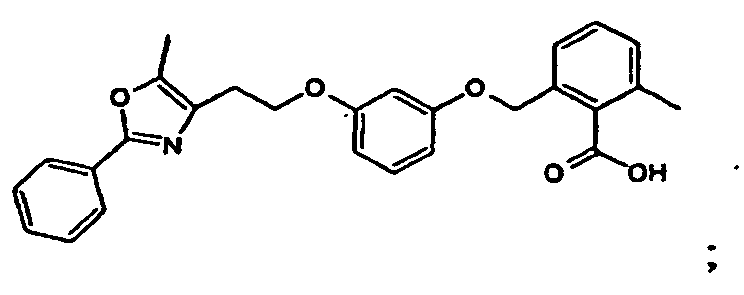


- A preferred compound according to the invention that is selective for PPARα is selected from the group consisting of

- This invention also encompasses all combinations of preferred aspects of the invention noted herein.
- Compounds useful according to this invention can be prepared in segments as is common to a long chain molecule. Thus it is convenient to synthesize these molecules by employing condensation reactions at the A, B and D sites of the molecule. Compounds of claim 1 can be prepared by the application or adaptation of known methods, by which is meant methods used heretofore or described in the literature. Compounds of claim 1 are preparable by recognized procedures from known compounds or readily preparable intermediates.
- Compounds useful according to the invention may also be prepared by the application or adaptation of known methods, by which is meant methods used heretofore or described in the literature, for example those described by R. C. Larock in Comprehensive Organic Transformations, VCH publishers, 1989.
- In the reactions described hereinafter, it may be necessary to protect reactive functional groups, for example hydroxy, amino, imino, thio or carboxy groups, where these are desired in the final product, to avoid their unwanted participation in the reactions. Conventional protecting groups may be used in accordance with standard practice, for examples see T.W. Green and P.G.M.Wuts in "Protective Groups in Organic Chemistry" John Wiley and Sons, 1991; J. F. W. McOmie in "Protective Groups in Organic Chemistry" Plenum Press, 1973.
- According to a further feature of the present invention, compounds useful according to the invention may be prepared by interconversion of other compounds of the invention.
- A compound of the invention including a group containing one or more nitrogen ring atoms, preferably imine (=N-), may be converted to the corresponding compound wherein one or more nitrogen ring atom of the group is oxidized to an N-oxide, preferably by reacting with a peracid, for example peracetic acid in acetic acid or m-chloroperoxybenzoic acid in an inert solvent such as dichloromethane, at a temperature from about room temperature to reflux, preferably at elevated temperature.
- The products of this invention may be obtained as racemic mixtures of their dextro and levorotatory isomers since at least one asymmetric carbon atom may be present. When two asymmetric carbon atoms are present, the product may exist as a mixtures of diastereomers based on syn and anti configurations. These diastereomers may be separated by fractional crystallization. Each diastereomer may then be resolved into dextro and levorotatory optical isomers by conventional methods.
- It will also be apparent to those skilled in the art that certain compounds of Formula I may exhibit geometrical isomerism. Geometrical isomers include the cis and trans forms of compounds of the invention having an alkenyl moiety. The present invention comprises the individual geometrical isomers and stereoisomers and mixtures thereof.
- Such isomers can be separated from their mixtures, by the application or adaptation of known methods, for example chromatographic techniques and recrystallization techniques, or they are separately prepared from the appropriate isomers of their intermediates, for example by the application or adaptation of methods described herein.
- Resolution may best be carried out in the intermediate stage where it is convenient to combine the racemic compound with an optically active compound by salt formation, ester formation, or amide formation to form two diasteromeric products. If an acid is added to an optically active base, then two diastereomeric salts are produced which possesses different properties and different solubilities and can be separated by fractional crystallization. When the salts have been completely separated by repeated crystallization, the base is split off by acid hydrolysis and enantiomerically purified acids are obtained.
- Compounds useful according to the invention are useful in the form of the free base or acid or in the form of a pharmaceutically acceptable salt thereof. All forms are within the scope of the invention.
- Where a compound useful according to the invention is substituted with a basic moiety, acid addition salts are formed and are simply a more convenient form for use; in practice, use of the salt form inherently amounts to use of the free base form. The acids which can be used to prepare the acid addition salts include preferably those which produce, when combined with the free base, pharmaceutically acceptable salts, that is, salts whose anions are non-toxic to the patient in pharmaceutical doses of the salts, so that the beneficial pharmaceutical effects of these compounds in the free base are not vitiated by side effects ascribable to the anions. Although pharmaceutically acceptable salts of said basic compounds are preferred, all acid addition salts are useful as sources of the free base form even if the particular salt, per se, is desired only as an intermediate product as, for example, when the salt is formed only for purposes of purification, and identification, or when it is used as an intermediate in preparing a pharmaceutically acceptable salt by ion exchange procedures. Pharmaceutically acceptable salts useful within the scope of the invention are those derived from the following acids: mineral acids such as hydrochloric acid, trifluoroacetic acid, sulfuric acid; phosphoric acid and sulfamic acid; and organic acids such as acetic acid, citric acid, lactic acid, tartaric acid, malonic acid, methanesufonic acid, ethanesulfonic acid, benzenesulfonic acid, p-toluenesulfonic acid, cyclohexylsulfamic acid, quinic acid, and the like. The corresponding acid addition salts comprise the following: hydrohalides, e.g. hydrochloride and hydrobromide, trifluoroacetate, sulfate, phosphate, nitrate, sulfamate, acetate, citrate, lactate, tartarate, malonate, oxalate, salicylate, propionate, succinate, fumarate, maleate, methylene-bis-β-hydroxynaphthoates, gentisates, mesylates, isothionates, di-p-toluoyltartrates, methanesulfonates, ethanesulfonates, benzenesulfonates, p-toluenesulfonates, cyclohexylsulfamate and quinate, respectively.
- The acid addition salts of the compounds useful according to the invention are prepared by reaction of the free base with the appropriate acid, by the application or adaptation of known methods. For example, the acid addition salts of the compounds of this invention are prepared either by dissolving the free base in aqueous or aqueous-alcohol solution or other suitable solvents containing the appropriate acid and isolating the salt by evaporating the solution, or by reacting the free base and acid in an organic solvent, in which case the salt separates directly or can be obtained by concentration of the solution.
- The compounds useful according to the invention may be regenerated from the acid addition salts by the application or adaptation of known methods. For example, parent compounds useful according to the invention can be regenerated from their acid addition salts by treatment with an alkali, e.g., aqueous sodium bicarbonate solution or aqueous ammonia solution.
- Where the compound useful according to the invention is substituted with an acidic moiety, base addition salts may be formed and are simply a more convenient form for use; in practice, use of the salt form inherently amounts to use of the free acid form. The bases which can be used to prepare the base addition salts include preferably those which produce, when combined with the free acid, pharmaceutically acceptable salts, that is, salts whose cations are non-toxic to the animal organism in pharmaceutical doses of the salts, so that the beneficial pharmaceutical effects on the activity of the compounds of the present invention in the free acid are not vitiated by side effects ascribable to the cations. Pharmaceutically acceptable salts useful according to the invention, include for example alkali and alkaline earth metal salts, including those derived from the following bases: sodium hydride, sodium hydroxide, potassium hydroxide, calcium hydroxide, aluminum hydroxide, lithium hydroxide, magnesium hydroxide, zinc hydroxide, ammonia, ethylenediamine, N-methyl-glucamine, lysine, arginine, omithine, choline, N,N'-dibenzylethylenediamine, chloroprocaine, diethanolamine, procaine, diethylamine, N-benzylphenethylamine, piperazine, tris(hydroxymethyl)aminomethane, tetramethylammonium hydroxide, and the like.
- Metal salts of compounds useful according to the present invention may be obtained by contacting a hydride, hydroxide, carbonate or similar reactive compound of the chosen metal in an aqueous or organic solvent with the free acid form of the compound. The aqueous solvent employed may be water or it may be a mixture of water with an organic solvent, preferably an alcohol such as methanol or ethanol, a ketone such as acetone, an aliphatic ether such as tetrahydrofuran, or an ester such as ethyl acetate. Such reactions are normally conducted at ambient temperature but they may, if desired, be conducted with heating.
- Amine salts of compounds useful according to the present invention may be obtained by contacting an amine in an aqueous or organic solvent with the free acid form of the compound. Suitable aqueous solvents include water and mixtures of water with alcohols such as methanol or ethanol, ethers such as tetrahydrofuran, nitriles such as acetonitrile, or ketones such as acetone. Amino acid salts may be similarly prepared.
- The base addition salts of the compounds useful according to the invention can be regenerated from the salts by the application or adaptation of known methods. For example, parent compounds useful according to the invention can be regenerated from their base addition salts by treatment with an acid, e.g. hydrochloric acid.
- Salt forms useful according to the invention also include compounds having a quarternarized nitrogen. The quarternarized salts are formed by methods such as by alkylation of sp3 or sp2 hybridized nitrogen in the compounds.
- As will be self-evident to those skilled in the art, some of the compounds useful according to the invention do not form stable salts. However, acid addition salts are most likely to be formed by compounds useful according to the invention having a nitrogen-containing heteroaryl group and/or wherein the compounds contain an amino group as a substituent. Preferable acid addition salts of the compounds useful according to the invention are those wherein there is not an acid labile group.
- As well as being useful in themselves as active compounds, the salts of the compounds useful according to the invention are useful for the purposes of purification of the compounds, for example by exploitation of the solubility differences between the salts and the parent compounds, side products and/or starting materials by techniques well known to those skilled in the art.
- Various substituents on the compounds useful according to the invention, can be present in the starting compounds, added to any one of the intermediates or added after formation of the final products by known methods of substitution or conversion reactions. If the substituents themselves are reactive, then the substituents can themselves be protected according to the techniques known in the art. A variety of protecting groups known in the art may be employed. Examples of many of these possible groups may be found in "Protective Groups in Organic Synthesis" by T. W. Green, John Wiley and Sons, 1981. For example, nitro groups can be added to the aromatic ring by nitration, and the nitro group then converted to other groups, such as amino, by reduction, and halo, by diazotization of the amino group and replacement of the diazo group. Acyl groups can be substituted onto the aryl groups by Friedel-Crafts acylation. The acyl groups then can be transformed to the corresponding alkyl groups by various methods, including the Wolff-Kishner reduction and Clemmenson reduction. Amino groups can be alkylated to form mono and dialkylamino groups; and mercapto and hydroxy groups can be alkylated to form corresponding ethers. Primary alcohols can be oxidized by oxidizing agents known in the art to form carboxylic acids or aldehydes, and secondary alcohols can be oxidized to form ketones. Thus, substitution or alteration reactions can be employed to provide a variety of substituents throughout the molecule of the starting material, intermediates, or the final product.
- The starting materials, intermediates and some compounds of the invention are prepared by the application or adaptation of known methods, for example methods as described in US Patent No.s 4,920,132; 4,920,131; and 5,059,610; publications Huang, Fu Chih et al , J. Med. Chem. (1991), 34(5), 1704-7; and Huang, Fu Chih et al , J. Med. Chem. (1990), 33(4), 1194-200; and the Reference Examples or their obvious chemical equivalents.
- The present invention is further exemplified but not limited by the following examples, which illustrate the preparation of the compounds according to the invention.
- To a cooled (0 °C) solution of 2,6-dimethylbenzoic acid (20.2g, 134 mmol) in dichloromethane (200 mL) is added DMF (1 mL) followed by oxalyl chloride (14 mL, 162 mmol). On cornpletionof addition, the cold bath is removed and stirring continued for 3h. The resulting solution is concentrated under vacuum and the residue added slowly to a cooled (0 °C) solution comprising methanol (200 mL) and triethylamine (40 mL). On completion of addition, the reaction mixture is stirred for 30 min. then poured into hydrochloric acid solution (400 mL, 2N) which is then extracted with ether. The ether extract is washed with hydrochloric acid solution (1N), sodium bicarbonate solution and brine then dried over MgSO4 and concentrated to give the title compound which is used without further purification. MS (EI) 164 (M)+.
- To a solution of methyl 2,6-dimethyl-benzoate (22.0 g , 134 mmol, example 1) in CCl4 (250 mL) is added N-bromo-succinimide (19g, 107 mmol) followed by benzoyl peroxide (1.0 g, 4.0 mmol). The resulting solution is warmed to reflux and stirred at this temperature for 20 min. The reaction mixture is then allowed to cool before being diluted with ether (200 mL), filtered and concentrated. The residue is purified by flash chromatography (silica, 4% acetone in hexanes) to give the title compound. This product (approx. 85% purity, remainder is methyl 2,6dimethyl benzoate) is used without further purification. MS (EI) 242, 244 (M+, Br pattern).
- To a solution of 3-hydroxy-phenol (1.5g, 13.6 mmol) in acetonitrile (50 mL) is added methyl 2-(bromomethyl)-6-methyl-benzoate (0.82g, 3.4 mmol, example 2) followed by K2CO3 (3.76g, 27.2 mmol). The resulting mixture is heated to 50 °C and stirred at this temperature for 90 min. then cooled, filtered and the filtrate concentrated under vacuum. The residue is purified by flash chromatography (silica, 5% ethyl acetate in dichloromethane) to give the title compound as a white solid. MS (EI) 272 (M+).
- To a solution of 4-chloromethyl-2-phenyl-oxazole (100mg, 0.5 mmol, example 19) in DMF (2 mL) is added methyl 2-methyl-6-[(3-hydroxy-phenoxy)-methyl]-benzoate (136 mg; 0.5 mmol, example 5) followed by K2CO3 (75 mg, 0.54 mmol). The resulting mixture is heated to 60°C and stirred at this temperature for 8 h. This mixture is then cooled to room temperature, diluted with ether, washed with water and brine, dried over MgSO4 and concentrated. The residue is purified by flash chromatography (silica, 20% ethyl acetate in hexanes) to give the title compound. MS (ESI) 429 (M+H)+.
- The following compounds are prepared using essentially the same procedure used in Example 6 except using the cited alkyl halide in place of 4-chloromethyl-2-phenyl-oxazole with either methyl (ethyl or isobutyl) 2-methyl-6-[(3-hydroxy-phenoxy)-methyl]-benzoate (example 5).
- MS (ESI) 446 (M+H)+. Prepared from 4-chloromethyl-2-phenyl-thiazole (example 20).
- MS (ESI) 382 (M+H)+. Prepared from 3,5-dimethyl-isoxazol-4-ylmethyl chloride.
- MS (ESI) 431 (M+H)+. Prepared from 5-phenyl-[1.2,4]oxadiazoI-3-ylmethyl chloride.
- MS (ESI) 411 (M+H)+. Prepared from 5-tert-butyl-[1,2,4]oxadiazol-3-ylmethyl chloride.
- MS (ESI) 512 (M+H)+. Prepared from (3-(2,6-dichloro-phenyl)-5-methyl-isoxazol-4-yl)-methyl chloride.
- MS (ESI) 450 (M+H)+. Prepared from 2-(5-methylthiophen-2-yl)oxazol-4-ylmethyl chloride (example 19a).
- MS (ESI) 436 (M+H)+. Prepared from 2-cyclohexyloxazol-4-ylmethyl chloride (example 19b).
- MS (ESI) 448 (M+H)+. Prepared from 2-(3-fluorophenyl)oxazol-4-ylmethyl chloride (example 19c).
- MS (ESI) 448 (M+H)+. Prepared from 2-(4-fluorophenyl)oxazol-4-ylmethyl chloride (example 19d).
- MS (ESI) 458 (M+H)+. Prepared from 4-chloromethyl-5-methyl-2-phenyloxazole.
- A solution of methyl 2-methyl-6-[3-(quinolin-2-ylmethoxy)-phenoxymethyl]-benzoate (1.6 g, 3.8 mmol, example 4) in ethanol (25 mL) is heated with a 10N sodium hydroxide solution (4.0 mL, 40 mmol) at 70°C for 14 h. The reaction is cooled, neutralized with a 2N HCl solution (20 mL) and concentrated to remove the ethanol. Ethyl acetate is added and washed with water. The aqueous layer is saturated with sodium chloride and back extracted with ethyl acetate. The organic layers are combined, dried over magnesium sulfate, filtered and concentrated to yield a crude solid. The solid is purified by column chromatography (silica, 5 to 10% methanol in dichloromethane) to provide the title compound. An analytically pure sample is prepared by recystallization from methanol: m.p. 167-168 °C, 1H NMR (300 MHz, CDCl3) δ.15 (d, 2H), 7.80 (d, 1H), 7.71 (t, 1H), 7.61-7.51 1 (m, 2H), 7.26-7.10 (m, 3H), 7.00 (t, 1H), 6.66 (s, 1H), 6.52 (d, 1H), 6.46 (d, 1H), 5.26 (s, 2H), 5.15 (s, 2H), 2.44 (s, 3H); MS (ESI) 400 (M+H)+.
- An alternate set of conditions that can be used for the hydrolysis of a benzoate ester is to heat a 0.1 M solution of the ester in THF/methanol (1:1) with 10 equivalents of a sodium hydroxide solution (10 N) at 60 °C for 3 h or until starting material disappears, as monitered by TLC analysis.
- The following compounds are prepared using essentially the same procedure used in example 7 except using the cited ester in place of methyl 2-methyl-6-[3-(quinolin-2-ylmethoxy)-phenoxymethyl]-benzoate.
- 1H NMR (300 MHz, DMSO) d 8.30 (s, 1H), 8.00 (m, 2H), 7.55 (m, 3H), 7.30 (m, 2H), 7.22 (m, 2H), 6.66 (m, 2H), 6.60 (d, 1H), 5.10 (s, 2H), 5.06 (s, 2H), 2.34 (s, 3H). MS (ESI) 416 (M+H)+. Prepared from methyl 2-methyl-6-[3-(2-phenyl-oxazol-4-ylmethoxy)-phenoxymethyl]-benzoate (example 6).
- 1H NMR (300 MHz, CDCl3) δ 7.95 (m, 2H), 7.43 (m, 3H), 7.32 (m, 2H), 7.24 (d, 1H), 7.20 (m, 1H), 7.14 (t, 1H), 6.66 (m, 1H), 6.56 (m, 1H), 5.20 (s, 2H), 5.15 (s, 2H), 2.41 (s, 3H). MS (ESI) 432 (M+H)+. Prepared from methyl 2-methyl-6-[3-(2-phenyl-thiazol-4-ylmethoxy)-phenoxymethyl]-benzoate (example 6a).
- 1H NMR (300 MHz, CDCl3) δ 7.34 (m, 2H), 7.20 (m, 1H), 7.15 (t, 1H), 6.56 (m, 3H), 5.19 (s, 2H), 4.71 (s, 2H), 2.43 (s, 3H), 2.34 (s, 3H), 2.22 (s, 3H). MS (ESI) 368 (M+H)+. Prepared from methyl 2-[3-(3,5-dimethyl-isoxazol-4-ylmethoxy)-phenoxymethyl]-6-methyl-benzoate (example 6b).
- 1H NMR (300 MHz, CDCl3) δ8.15 (m, 2H), 7.59 (m, 1H), 7.50 (m, 2H), 7.33 (m, 2H), 7.20 (m; 1H), 7.14 (t, 1H), 6.70 (m, 1H), 6.61 (m, 2H), 5.19 (s, 2H), 2.44 (s, 3H). MS (ESI) 417 (M+H)+. Prepared from methyl 2-methyl-6-[3-(5-phenyl-[1,2,4]oxadiazol-3-ylmethoxy)-phenoxymethyl]= benzoate (example 6c).
- 1H NMR (300 MHz, CDCl3) δ 7.32 (m, 2H), 7.19 (m, 1H), 7.15 (t, 1H), 6.66 (d, 1H), 6.60 (d, 1H), 6.59 (d, 1H), 5.17 (s, 2H), 5.10 (s, 2H), 1.45 (s, 9H). MS (ESI) 395 (M-H)-. Prepared from methyl 2-[3-(5-tert-butyl-[1,2,4]oxadiazol-3-ylmethoxy)-phenoxymethyl]-6-methyl-benzoate (example 6f).
- 1H NMR (300 MHz, CDCl3) δ 7.24-7.41 (m, 5H), 7.21 (m, 1H), 7.08 (t, 1H), 6.53 (m, 1H), 6.40 (m, 2H), 5.11 (s, 2H), 4.65 (s, 2H), 2.48 (s, 3H), 2.41 (s, 3H). MS (ESI) 496 (M-H)-. Prepared from methyl 2- {3-[3-(2,6-dichloro-phenyl)-5-methyl-isoxazol-4-ylmethoxy]-phenoxymethyl}-6-methyl-benzoate (example 6g).
- m.p. 129-130 °C. 1H NMR (300 MHz, CDCl3): δ 7.54 (s, 1H), 7.48 (d, 1H), 7.27 (m, 2H), 7.11 (m, 2H), 6.74 (m, 1H), 6.66 (s, 1H), 6.53 (m, 2H), 5.12 (s, 2H), 4.95 (s, 2H), 2.51 (s, 3H), 2.39 (s, 3H). MS (ESI) 436 (M+H)+. Prepared from methyl 2-methyl-6-{3-[2-(5-methylthiophen-2-yl)-oxazol-4-ylmethoxy]phenoxymethyl}benzoate (example 6r).
- m.p. 158-159 °C. 1H NMR (300 MHz, CDCl3): δ 7.57 (s, 1H), 7.30 (m, 2H), 7.20 (m, 1H), 7.12 (m, 1H), 6.72 (m, 1H), 6.53 (m, 2H), 5.13 (s, 2H), 4.95 (s, 2H), 2.84 (m, 1H), 2.45 (s, 3H), 2.06 (m, 2H), 1.81 (m, 2H), 1.73-1.20 (m, 6H). Prepared from methyl 2-[3-(2-cyclohexyloxazol-4-ylmethoxy)-phenoxymethyl]-6-methylbenzoate 6s).
- m.p. 152-154 °C. 1H NMR (300 MHz, 5:1 CDCl3: CD3OD): δ 7.84 (d, 1H), 7.80 (s, 1H), 7.74 (d, 1H), 7.46 (m, 1H), 7.31 (m, 2H), 7.19 (m, 3H), 6.64 (m, 3H), 5.17 (s, 2H), 5.04 (s, 2H), 2.44 (s, 3H). MS (ESI) 434 (M+H)+. Prepared from methyl 2-{3-[2-(3-fluorophenyl)oxazol-4-ylmethoxy]phenoxymethyl}-6-methylbenzoate (example 6t).
- m.p. 159-160 °C. 1H NMR (300 MHz, CDCl3): δ 8.03 (m, 2H), 7.70 (s, 1H), 7.32 (d; 2H), 7.16 (m, 3H), 6.93 (m, 1H), 6.69 (m, 1H), 6.55 (m, 2H), 5.16 (s, 2H), 5.03 (s, 2H), 2.44 (s, 3H). MS (ESI) 434 (M+H)+. Prepared from methyl 2-{3-[2-(4-fluorophenyl)oxazol-4-ylmethoxy]phenoxymethyl}-6-methylbenzoate (example 6u).
- m.p. 144-145 °C. 1H NMR (300 MHz, 3:1 CDCl3:CD3OD): δ 7.99 (m, 2H), 7.42 (m, 3H), 7.30 (m, 2H), 7.19 (m, 2H), 6.63 (m, 3H), 5.17 (s, 2H), 4.95 (s, 2H), 2.45 (s, 3H), 2.43 (s, 3H). MS (ESI) 430 (M+H)+. Prepared from ethyl 2-methyl-6-[3-(5-methyl-2-phenyloxazol-4-ylmethoxy)-phenoxymethyl]benzoate (example 6w). Example 7bc
- 1H NMR (300 MHz, CDCl3): δ 8.03 (m, 2H), 7.43 (m, 3H); 7.26 (m, 2H), 7,17 (m, 1H), 7.10 (m, 1H), 6.68 (s, 1H), 6.51 (m, 2H), 5.18 (s, 2H), 4.22 (m, 2H), 2.96 (m, 2H), 2.41 (s, 3H), 2.36 (s, 3H). MS (ESI) 444 (M+H)+. Prepared from methyl 2-methyl-6-{3-[2-(5-methyl-2-phenyloxazol-4-yl)ethoxy]phenoxymethyl}benzoate (example 21a).
- To a cooled (0 °C) solution of t-butyl (3-([2-methoxyethoxy]-methoxy)-phenoxy])-acetate (1.2g, 3.8 mmol, example 12) in THF (10 mL) is added a solution of lithium aluminum hydride (5 mL, 1M in THF). The resulting solution is stirred for 10 min. then water (0.2 mL) is added dropwise, followed by NaOH solution (0.2 mL, 5M) and water (0.2 mL). The resulting mixture is diluted with ether, filtered through celite and the filtrate concentrated to give the title compound as an oil which is used without further purification. MS (EI) 242 (M)+.
- The title compound is prepared using essentially the same procedure used in Example 11 except using methyl 2-(5-methyl-2-phenyloxazol-4-yl)acetate (example 32) in place of t-butyl (3-([2-rnethoxyethoxy]-methoxy)-phenoxy])-acetate. MS (ESI) 204 (M+H)+.
- Benzamide (1.21g, 10 mmol) is mixed with 1,3-dichloroacetone (1.26g, 10 mmol) and the mixture heated to 130 °C and stirred at this temperature for 1 h. The resulting mixture is then cooled, diluted with ethyl acetate, washed with K2CO3 solution (sat.), then brine, dried over MgSO4 and concentrated to give the title compound as a solid, which is used without further purification. MS (ESI) 194 (M+H. Cl pattern)+.
- The following compounds are prepared using essentially the same procedure used in Example 19 except using the cited amide in place of benzamide.
- MS (ESI) 214, 216 (M+H)+, Cl pattern. Prepared from 5-methylthiophene-2-carboxamide.
- MS (ESI) 200, 202 (M+H)+, Cl pattern. Prepared from cyclohexanecarboxamide.
- MS (ESI) 212, 214 (M+H)+, Cl pattern. Prepared from 3-fluorobenzamide.
- MS (ESI) 212, 214 (M+H)+, Cl pattern. Prepared from 4-fluorobenzamide
- A solution of thiobenzamide (1.37g, 10 mmol) and 1,3-dichloro-acetone (1.27g, 10 mmol) in ethanol (25 mL) is warmed to 75 °C and stirred at this temperature for 1h. The resulting solution is cooled, poured into ice then brought to pH 8 with K2CO3 solution (sat.). This mixture is extracted with ethyl acetate, dried over MgSO4 and concentrated to give the title compound. This product is used without further purification. MS (ESI) 210 (M+H)+.
- To a solution of [2-methyl-6-(3-hydroxy-phenoxymethyl)-phenoxy]-acetonitrile (135 mg, 0.5 mmol, example 25) and 2-(pyridin-2-yl)-ethanol (126 mL, 0.94 mmol) in THF (2 mL) is added triphenylphosphine (262 mg, 1 mmol) folowed by DEAD (118 mL, 0.75 mmol). The resulting solution is stirred for 2h, then concentrated and the residue purified by flash chromatography (silica, 50% ethyl acetate in hexanes) to give the title compound as an oil. MS (ESI) 375 (M+H)+.
- The following compound is prepared using essentially the same procedure used in Example 21 except using the cited alcohol and phenol in place of 2-(pyridin-2-yl)-ethanol and [2-methyl-6-(3-hydroxy-phenoxymethyl)-phenoxy]-acetonitrile respectively.
- MS (ESI) 458 (M+H)+. Prepared from 2-(5-methyl-2-phenyloxazol-4-yl)ethanol (example 11a) and methyl 2-(3-hydroxyphenoxymethyl)-6-methylbenzoate (example 5).
- A 2M triglyme solution of sodium borohydride (16.0 mL, 32.1 mmoles) is slowly added to a cooled (-78°C) solution of 2-cyanomethoxy-3-methylbenzaldehyde (11.25g, 64.2 mmoles, example 22) in THF (180 mL). After stirring for one hour, the reaction is warmed to 0°C for two hours, then quenched with 2N HCl (16.8 mL) and diluted with ether. The organic layer is isolated and washed with twice with distilled water and brine, then dried over MgSO4. The organic solution is concentrated to give the title compound as a yellow oil.
- Triphenylphosphine (15.2g, 57.8 mmoles) is added to 2-cyanomethoxy-3-methylbenzylalcohol (9.3g, 52.5 mmoles, example 23) in THF (175 mL). The mixture is stirred until homogeneous and cooled to 0°C, followed by addition, in three portions, of N-bromosuccinimide (10.3g, 57.8 mmoles). After 90 minutes the reaction is concentrated and the residue purified by column chromatography (silica, 5:1 hex: EtOAc) to yield the title compound as a pale yellow crystalline solid. MS (EI) 239, 241 (M)+, Br pattern.
- Heated (60°C) a mixture of 2-cyanomethoxy-3-methylbenzyl bromide (10.2g, 42.7 mmoles, example 24), resorcinol (18.8g, 171 mmoles), and potassium carbonate (47.2g, 342 mmoles) in acetonitrile (140 mL) for two hours. The reaction is diluted with ether and washed three times with distilled water, once with brine, and dried over MgSO4. The organic layer is isolated and concentrated, and the resulting residue is purified by column chromatography (silica, 5% EtOAc/CH2Cl2) to yield the title compound as a white crystalline solid. MS(EI) 269 (M)+.
- The following compounds are prepared using essentially the same procedure used in example 25 except using the cited bromide in place of 2-cyanomethoxy-3-methylbenzyl bromide.
- To a cooled (0°C) solution of methyl 3-oxopentanoate (9.62 mL, 76.8 mmoles, Acros) in carbon tetrachloride (60 mL) is added dropwise over a period of 45 minutes a solution of bromine (3.96 mL, 76.8 mmoles) in carbon tetrachloride (10 mL). After 30 minutes, let stir at room temperature for one hour. Bubbled N2 through reaction mixture for twenty minutes. Concentrated to yield the title compound as a brown oil. MS (EI) 208, 210 (M)+, Br pattern.
- A solution of benzamide (0.606g, 5.00 mmoles) and methyl 4-bromo-3-oxopentanoate (1.05g, 5.00 mmoles, example 31) are heated in toluene (6 ml) to 120°C for 18 hours. The reaction is then purified by column chromatography (silica, 4:1 hex: EtOAc) to give the title compound as a clear oil. MS (APcI) 232 (M+H)+.
- A solution of (2-[3-hydroxyphenoxymethyl]-6-methylphenoxy)acetonitrile (100 mg, 0.37 mmol, example 25), quinoxalin-2-ylmethyl chloride [72 mg, 0.40 mmol (See Chem. Ber. 1987, 120, 649-651)] in DMF (1 mL) is heated with potassium carbonate (105 mg, 0.75 mmol) at 60 °C for 16 h. The reaction is filtered and partioned between ethyl acetate and water. The organic phase is washed with water, dried over magnesium sulfate, concentrated and purified by column chromatography (silica, 30% ethyl acetate in hexanes) to provide the title compound. MS (ESI) 412 (M+H)+.
- The following compounds are prepared using essentially the same procedure used in example 39 except using the cited halide in place of quinoxalin-2-ylmethyl chloride.
- To a solution of {2-methyl-6-[3-(quinolin-2-ylaminomethyl)-phenoxymethyl]-phenoxy}-acetonitrile (134 mg, 0.31 mmol, example 35a) in methanol (1 mL) is added THF (1 mL) followed by sodium hydroxide solution (0.2 mL, 10N). The resulting mixture is warmed to 60 °C and stirred at this temperature for 3h. The reaction mixture is then cooled to room temperature and acidified to ca. pH 5 with hydrochloric acid (1 mL, 2N), then extracted with ethyl acetate, washed with brine, dried over MgSO4 and concentrated. The residue is purified by flash chromatography (silica, 10% methanol in dichloromethane) to give the title compound. 1H NMR (300 MHz, CDCl3) δ 8.10 (d, 1H), 7.80 (d, 1H), 7.68 (t, 2H), 7.40 (t, 1H), 7.25 (m, 2H), 7.04 (m, 3H), 6.90 (m, 3H), 6.6 (bs, 1H), 5.15 (s, 2H), 4.60 (d, 2H), 4.50 (s, 2H), 2.27 (s, 3H). MS (ESI) 429 (M+H)+.
- The following compounds are prepared using essentially the same procedure used in example 41 except using the cited nitrile or ester in place of {2-methyl-6-[3-(quinolin-2-ylaminomethyl)-phenoxymethyl]-phenoxy}-acetonitrile.
- 1H NMR (300 MHz, DMSO): δ 7.92 (m, 2H), 7.77 (s, 1H), 7.47 (m, 3H), 7.20 (m, 1H), 7.15 (m, 2H), 6.98 (t, 1H), 6.72 (t, 1H), 6.60 (m, 2H), 5.15 (s, 2H), 5.14 (s, 2H), 4.15 (s, 2H), 2.23 (s, 3H); MS (ESI) 462 (M+H)+. Prepared from {2-methyl-6-[3-(2-phenyl-thiazol-4-ylmethoxy)-phenoxymethyl]-phenoxy}-acetonitrile (example 39u).
- To a cooled (0 °C) solution of methyl 2-methyl-6-[(3-hydroxy-phenoxy)-methyl]-benzoate (220 mg, 0.76 mmol, example 5) in THF (2 mL) is added lithium aluminum hydride solution (1.5 mL, 1M in THF). The resulting solution is stirred for 10 min then warmed to room temperature and stirred for 40 min. This solution is then cooled to 0 °C and water (75 mL) added, dropwise, followed by sodium hydroxide solution (75 mL, 5N) and water (75 mL). The resulting suspension is diluted with ether, filtered through celite and the solid washed thoroughly with methanol (until the solid is free of product by TLC analysis). The combined filtrates are concentrated under vacuum to give the title compound as a white solid. MS (EI) 244 (M)+.
- To a solution of 3-(2-hydroxymethyl-3-methyl-benzyloxy)-phenol (87 mg, 0.38 mmol, example 100) and (3-methyl-4-oxo-3,4-dihydro-quinazolin-2-yl)-methyl chloride (94 mg, 0.45 mmol, example 99) in DMF (1 mL) is added powdered K2CO3 (78 mg, 0.5 mmol). The resulting mixture is warmed to 60 °C and stirred at this temperature for 5h. This mixture is cooled to room temperature, diluted with ethyl acetate, washed with water and brine, dried over MgSO4 and concentrated. The residue is purified by flash chromatography (silica, 40% ethyl acetate / 30% dichloromethane in hexanes) to give the title compound as a foam. MS (ESI) 417 (M+H)+.
- The title compound is prepared using essentially the same procedure used in example 101 except using 3-chloromethyl-5-cyclobutyl-[1,2,4]oxadiazole in place of (3-methyl-4-oxo-3,4-dihydro-quinazolin-2-yl)-methyl chloride. MS (ESI) 381 (M+H)+
- To a cooled (-78 °C) solution of oxalyl chloride (2.5 mL, 1.75 M in CH2Cl2) is added, dropwise, DMSO (80 mL). On complete addition, a solution of 2-[3-(2-hydroxymethyl-3-methyl-benzyloxy)-phenoxymethyl]-3-methyl-3H-quinazolin-4-one (120 mg, 0.28 mmol, example 101) in dichloromethane (1 mL) is added dropwise. This solution is stirred for 5 min then triethylamine (276 mL, 2mmol) is added in one portion. The cold bath is removed and stirring continued for 10 min. The mixture is then diluted with ethyl acetate, washed with water and brine, dried over MgSO4 and concentrated to give the title compound as a solid. MS (ESI) 415 (M+H)+.
- The title compound is prepared using essentially the same procedure used in example 102 except using {2-[3-(5-cyclobutyl-[1,2,4]oxadiazol-3-ylmethoxy)-phenoxymethyl]-6-methyl-phenyl}-methanol (example 101a) in place of 2-[3-(2-hydroxymethyl-3-methyl-benzyloxy)-phenoxymethyl]-3-methyl-3H-quinazolin-4-one. MS (ESI) 379 (M+H)+.
- To a suspension of 2-methyl-6-[3-(3-methyl-4-oxo-3,4-dihydro-quinazolin-2-ylmethoxy)-phenoxymethyl]-benzaldehyde (120 mg, 0.28 mmol, example 102) in t-butanol (1.5 mL) is added iso-butene (0.5 mL) followed by NaClO2 (220 mg, tech.grade 1.6 mmol) in water (1.5 mL) and NaH2PO4.H2O (220 mg, 1.6 mmol) in water (1.5 mL). This mixture is stirred for 1h (during which time the solids dissolve) then diluted with ethyl acetate, washed with water and brine, dried over MgSO4 and concentrated. The residue is purified by flash chromatography (10% methanol in dichloromethane). This product was suspended in chloroform and filtered through celite. The filtrate is concentrated under reduced pressure to give the title compound as an amorphous solid. 1H NMR (300 MHz, CDCl3): δ 8.41 (d, 1H), 7.84 (m, 2H), 7.62 (m, 1H), 7.33 (m, 2H), 7.20 (m, 1H), 7.14 (t, 1H), 6.81 (m, 1H), 6.70 (m, 2H), 5.29 (s, 2H), 5.25 (s, 2H), 3.80 (s, 2H), 2.52 (s, 3H). MS (ESI) 430 (M+H)+.
- The title compound is prepared using essentially the same procedure used in example 103 except using 2-[3-(5-Cyclobutyl-[1,2,4]oxadiazol-3-ylmethoxy)-phenoxymethyl]-6-methylbenzaldehyde (example 102a) in place of 2-methyl-6-[3-(3-methyl-4-oxo-3,4-dihydro-quinazolin-2-ylmethoxy)-phenoxymethyl]-benzaldehyde. 1H NMR (300MHz, DMSO) δ 7.10 (m, 4H), 6.68 (s, 1H), 6.60 (m, 2H), 5.19 (s, 2H), 5.13 (s, 2H), 3.86 (m, 1H), 2.36 (m, 4H), 2.28 (s, 3H), 2.08 (m, 1H), 1.96 (m, 1H). MS (ESI) 395 (M+H)+.
- Using a combination of the above Examples, various compounds may be made within the scope of this invention.
- Compounds according to the invention exhibit marked pharmacological activities according to tests described in the literature which tests results are believed to correlate to pharmacological activity in humans and other mammals. The following pharmacological test results are typical characteristics of compounds of the present invention.
- The compounds of the present invention have potent activity as PPAR ligand receptor binders and possess anti-diabetic, anti-lipidemic, anti-hypertensive, and anti-arteriosclerotic activity and are also anticipated to be effective in the treatment of diabetes, obesity and other related diseases.
- The activity of the compounds of the invention as PPARα modulators may be examined in several relevant in vitro and in vivo preclinical assays, for example benchmarking with a known PPARα modulator, for example, [3H]-GW2331(2-(4-[2-(3-[2,4-Difluorophenyl]-1-heptylureido)-ethyl]phenoxy)-2-methylbutyric acid). (S. Kliewer, et al. Proc. Natl. Acad. Sci. USA 94 (1997).
- A binding assay for PPARα could be carried out by the following procedure: cDNAs encoding the putative ligand binding domain of human PPARα (amino acids 167-468) (Sher,T., Yi, H.-F., McBride, O. W.& Gonzalez, F. J. (1993) Biochemistry 32, 5598-5604) are amplified by PCR (Polymerase Chain Reaction) and inserted in frame into the BamHI site of pGEX-2T plasmid (Pharmacia). The soluble fraction of GST-hPPARα fusion proteins or glutathione S-transferase (GST) alone are overexpressed in E. coli BL21(DE3)pLysS cells and purified from bacteria extracts as described in (S. Kliewer, et al. Proc. Natl. Acad. Sci. USA 94 (1997), 4318-4323).
- Gel-Filtration Assays: 30 ml of 90 nM GST-hPPARα-LBD is mixed with 20 ml of 50 nM 3H-GW2331 with or without 5 ml of 10 mM test compounds in the binding buffer containing 10 mM Tris, 50 mM KCI, 0.05% Tween 20 and 10 mM DTT. The reaction mixtures are incubated in 96-well plates for 2h at room temperature. 50 ml of the reaction mixtures are then loaded on a 96-well gel filtration block (following manufacture instructions)(EdgeBioSystems). The block placed on top of a clean 96-well plate is centrifuged at 1,500 rpm for 2 min. The block is discarded. 100 ml of Scintillation fluid is added to each well of the 96-well plate. After overnight equilibration, the plate is counted in the Microbeta counter (Wallac.).
- Homogenous Scintillation Proximity Binding Assay. For the Scarchard analysis, glutathione coated SPA beads (1.5 mg/ml)(Amersham) are mixed with GST-hPPARα-LBD (10 mg/ml) in the binding buffer. The resulting slurry is incubated at room temperature with agitation for 15 min. 20 ml of the slurry is then added in 30 ml of binding buffer containing various amount 3H-GW2331(10-500 nM). Nonspecific binding is determined in the present of 100 mM of GW2331. For the competition binding assay, 20 ml of the slurry is then added in 30 ml of the binding buffer containing 75 nM of 3H-GW2331 and 0.03~20 mM of the test compounds. For the control experiments, the glutathione coated SPA beads (1.5 mg/ml) are coated with GST proteins (10 mg/ml). 20 ml of the slurry are mixed with 30 ml of 75 nM of 3H-GW2331 with or without 10 mM of GW2331. The above experiments are all performed in a 96-well plates. The sealed plates with the reaction mixtures are allowed to equilibrate for 2 h and counted in the Microbeta counter (Wallac.).
- The activity of the compounds of the invention as PPARγ modulators may be examined in several relevant in vitro and in vivo preclinical assays, for example benchmarking with a known PPARγ modulator, for example, [3H]-BRL 49853 (Lehman L.J. et al, J. Biol. Chem. 270, 12953-12956; Lehman L.J. et al, J. Biol. Chem. 272, 3406-3410 (1997), and Nichols, J. S.; et al Analytical Biochemistry 257, 112-119(1998)).
- A binding assay for PPARγ could be carried out by the following procedure: cDNAs encoding the putative ligand binding domain of human PPARγ (amino acids 176-477) (Green, M.E. et al. Gene expression 281-299(1995)) are amplified by PCR (polymerase chain reaction) and inserted in frame into the BamHI site of pGEX-2T plasmid (Pharmacia). The soluble fraction of GST-hPPARγ fusion proteins or glutathione S-transferase (GST) alone are overexpressed in E. coli BL21(DE3)pLysS cells and purified from bacteria extracts.
- Binding Assay: The fusion proteins, GST-PPARγ -LBD in PBS (5 mg/100ml/well) are incubated in the glutathione coated 96 well plates for 4 hours. Unbound proteins are then discarded and the plates are washed two times with the wash buffer (10 mM Tris, 50 mM KCl and 0.05% Tween-20). 100 ml of reaction mixtures containing 60 nM of 3H-BRL-49853 and 10 mM of the testing compounds (10 ml of 0.1mM compounds from each well of the child plates) in the binding buffer (10mM Tris, 50mM KCl and 10mM DTT) are then added and incubated at room temperature for 2.5h. The reaction mixtures are discarded and the plates are washed two times with the wash buffer. 100ml of scintillation fluid is added to each well and plates are counted on β-counter.
- The activity of the compounds of the invention as PPARδ modulators may be examined in several relevant in vitro and in vivo preclinical assays (See references WO 97/28149; Brown P. et al Chemistry & Biology, 4, 909-18, (1997)), for example benchmarking with a known PPARδ modulator, for example [3H2] GW2433 or [3H2] Compound X

- The hPPARδ binding assay comprises the steps of:
- (a) preparing multiple test samples by incubating separate aliquots of the receptor hPPARδ with a test compound in TEGM containing 5-10% COS-1 cell cytoplasmic lysate and 2.5 nM labeled ([3H]Compound X, 17 Ci/mmol) for a minimum of 12 hours, and preferably for about 16 hours, at 4°C, wherein the concentration of the test compound in each test sample is different, and preparing a control sample by incubating a further separate aliquot of the receptor HPPARδ under the same conditions but without the test compound; then
- (b) removing unbound ligand by adding dextran/gelatin-coated charcoal to each sample while maintaining the samples at 4°C and allowing at least 10 minutes to pass, then
- (c) subjecting each of the test samples and control sample from step (b) to centrifugation at 4°C until the charcoal is pelleted; then
- (d) counting a portion of the supernatant fraction of each of the test samples and the control sample from step (c) in a liquid scinitillation counter and analyzing the results to determine the IC50 of the test compound.
- In the hPPARδ binding assay, preferably at least four test samples of varying concentrations of a single test compound are prepared in order to determine the IC50.
- The compounds useful according to the invention can be administered to a patient in a variety of forms adapted to the chosen route of administration, i.e., orally, or parenterally. Parenteral administration in this respect includes administration by the following routes: intravenous, intramuscular, subcutaneous, intraocular, intrasynovial, transepthelially including transdermal, opthalmic, sublingual and buccal; topically including opthalmic, dermal, ocular, rectal and nasal inhalation via insufflation and aerosol and rectal systemic.
- The active compound may be orally administered, for example, with an inert diluent or with an assimilable edible carrier, or it may be enclosed in hard or soft shell gelatin capsules, or it may be compressed into tablets, or it may be incorporated directly with the food of the diet. For oral therapeutic administration, the active compound may be incorporated with excipient and used in the form of ingestible tablets, buccal tablets, troches, capsules, elixirs, suspensions, syrups, wafers, and the like. Such compositions and preparations should contain at least 0.1% of active compound. The percentage of the compositions and preparations may, of course, be varied and may conveniently be from about 2% to about 6% of the weight of the unit. The amount of active compound in such therapeutically useful compositions is such that a suitable dosage will be obtained. Preferred compositions or preparations according to the present invention are prepared so that an oral dosage unit form contains between about 50 and 300 mg of active compound.
- The tablets, troches, pills, capsules and the like may also contain the following: A binder such as gum tragacanth, acacia, corn starch or gelatin; excipients such as dicalcium phosphate; a disintegrating agent such as corn starch, potato starch, alginic acid and the like; a lubricant such as magnesium stearate; and a sweetening agent such as sucrose, lactose or saccharin may be added or a flavoring agent such as peppermint, oil of wintergreen, or cherry flavoring. When the dosage unit form is a capsule, it may contain, in addition to materials of the above type, a liquid carrier. Various other materials may be present as coatings or to otherwise modify the physical form of the dosage unit. For instance, tablets, pills, or capsules may be coated with shellac, sugar or both. A syrup or elixir may contain the active compound, sucrose as a sweetening agent, methyl and propylparabens a preservatives, a dye and flavoring such as cherry or orange flavor. Of course, any material used in preparing any dosage unit form should be pharmaceutically pure and substantially non-toxic in the amounts employed. In addition, the active compound may be incorporated into sustained-release preparations and formulations.
- The active compound may also be administered parenterally or intraperitoneally. Solutions of the active compound as a free base or pharmacologically acceptable salt can be prepared in water suitably mixed with a surfactant such as hydroxypropyl-cellulose. Dispersion can also be prepared in glycerol, liquid polyethylene glycols, and mixtures thereof and in oils. Under ordinary conditions of storage and use, these preparations contain a preservative to prevent the growth of microorganisms.
- The pharmaceutical forms suitable for injectable use include sterile aqueous solutions or dispersions and sterile powders for the extemporaneous preparation of sterile injectable solutions or dispersions. In all cases, the form must be sterile and must be fluid to the extent that easy syringability exists. It may be stable under the conditions of manufacture and storage and must be preserved against the contaminating action of microorganisms such as bacteria and fungi. The carrier can be a solvent or dispersion medium containing, for example, water, ethanol, polyol (for example, glycerol, propylene glycol, and liquid polyethylene glycol, and the like), suitable mixtures thereof, and vegetable oils. The proper fluidity can be maintained , for example, by the use of a coating such as lecithin, by the maintenance of the required particle size in the case of dispersion and by the use of surfactants. The prevention of the action of microorganisms can be brought about by various antibacterial and antifungal agents, for example, parabens, chlorobutanol, phenol, sorbic acid, thimerosal, and the like. In many cases, it will be preferable to include isotonic agents, for example, sugars or sodium chloride. Prolonged absorption of the injectable compositions of agents delaying absorption, for example, aluminum monostearate and gelatin.
- Sterile injectable solutions are prepared by incorporating the active compound in the required amount in the appropriate solvent with various of the other ingredients enumerated above, as required, followed by filtered sterilization. Generally, dispersions are prepared by incorporating the various sterilized active ingredient into a sterile vehicle which contains the basic dispersion medium and the required other ingredients from those enumerated above. In the case of sterile powders for the preparation of sterile injectable solutions, the preferred methods of preparation are vacuum drying and the freeze drying technique which yield a powder of the active ingredient plus any additional desired ingredient from previously sterile-filtered solution thereof.
- The therapeutic compounds useful according to this invention may be administered to a patient alone or in combination with pharmaceutically acceptable carriers, as noted above, the proportion of which is determined by the solubility and chemical nature of the compound, chosen route of administration and standard pharmaceutical practice.
- The physician will determine the dosage of the present therapeutic agents which will be most suitable for prophylaxis or treatment and it will vary with the form of administration and the particular compound chosen, and also, it will vary with the particular patient under treatment. He will generally wish to initiate treatment with small dosages by small increments until the optimum effect under the circumstances is reached. The therapeutic dosage will generally be from 0.1 to 100 mM/day or from about 0.1mg to about 50 mg/kg of body weight per day, or 10mg to about 50 mg/kg of body weight per day, or more preferably 30mg to about 50 mg/kg of body weight per day, and higher, although it may be administered in several different dosage units. Higher dosages are required for oral administration.
- The compounds useful according to the invention may be administered as frequently as necessary in order to obtain the desired therapeutic effect. Some patients may respond rapidly to a higher or lower dose and may find much weaker maintenance doses adequate. For other patients, it may be necessary to have long-term treatments at the rate of 1 to 4 doses per day, in accordance with the physiological requirements of each particular patient. Generally, the active product may be administered orally 1 to 4 times per day. It goes without saying that, for other patients, it will be necessary to prescribe not more than one or two doses per day.
- One skilled in the art will readily appreciate that the present invention is well adapted to carry out the objects of the invention and obtain the ends and advantages mentioned, as well as those inherent therein. The compounds, compositions and methods described herein are presented as representative of the preferred embodiments, or intended to be exemplary and not intended as limitations on the scope of the present invention.
- The therapeutic compounds useful according to this invention may be administered to a patient alone or in combination with pharmaceutically acceptable carriers, as noted above, the proportion of which is determined by the solubility and chemical nature of the compound, chosen route of administration and standard pharmaceutical practice.
- The physician will determine the dosage of the present therapeutic agents which will be most suitable for prophylaxis or treatment and it will vary with the form of administration and the particular compound chosen, and also, it will vary with the particular patient under treatment. He will generally wish to initiate treatment with small dosages by small increments until the optimum effect under the circumstances is reached. The therapeutic dosage will generally be from 0.1 to 100 mM/day or from about 0.1mg to about 50 mg/kg of body weight per day, or 10mg to about 50 mg/kg of body weight per day, or more preferably 30mg to about 50 mg/kg of body weight per day, and higher, although it may be administered in several different dosage units. Higher dosages are required for oral administration.
- The compounds useful according to the invention may be administered as frequently as necessary in order to obtain the desired therapeutic effect. Some patients may respond rapidly to a higher or lower dose and may find much weaker maintenance doses adequate. For other patients, it may be necessary to have long-term treatments at the rate of 1 to 4 doses per day, in accordance with the physiological requirements of each particular patient. Generally, the active product may be administered orally 1 to 4 times per day. It goes without saying that, for other patients, it will be necessary to prescribe not more than one or two doses per day.
- One skilled in the art will readily appreciate that the present invention is well adapted to carry out the objects of the invention and obtain the ends and advantages mentioned, as well as those inherent therein. The compounds, compositions and methods described herein are presented as representative of the preferred embodiments, or intended to be exemplary and not intended as limitations on the scope of the present invention.
Claims (21)
- A compound selected from the group





- A compound according to claim 1 selected from the group consisting of


- A compound according to claims 1 to 2 selected from the group consisting of


- A compound according to claims 1 to 3, which is

- A compound, which is

- A compound, which is

- A pharmaceutical composition comprising a pharmaceutically acceptable amount of the compound according to claims 1 to 6 and a pharmaceutically acceptable carrier.
- A compound according to claims 1 to 6 for use as a medicament.
- Use of a compound according to claims 1 to 6 in the preparation of a medicament having PPAR ligand binding activity.
- Use of a compound according to claims 1 to 6 in the preparation of a medicament in the treatment of diseases associated with a physiological detrimental blood level of insulin, glucose, free fatty acids (FFA), or triclycerides.
- Use of a compound according to claims 1 to 6 in the preparation of a medicament in the treatment of hyperglycemia.
- Use of a compound according to claims 1 to 6 the preparation of a medicament in the treatment of diabetes.
- Use of a compound according to claims 1 to 6 in the preparation of a medicament in the treatment of Type II diabetes.
- Use of a compound according to claims 1 to 6 in the preparation of a medicament in the treatment of physiological disorder hyperinsulinism.
- Use of a compound according to claims 1 to 6 in the preparationg of a medicament in the treatment of Syndrome X.
- Use of a compound according to claims 1 to 6 in the preparation of a medicament in the treatment of insulin resistance.
- Use of a compound according to claims 1 to 6 in the preparation of a medicament in the treatment of cardiovascular condition.
- Use of a compound according to claims 1 to 6 in the preparation of a medicament in the treatment of atherosclerosis.
- Use of a compound according to claims 1 to 6 in the preparation of a medicament in the treatment of hyperlipidemia.
- Use of a compound according to claims 1 to 6 in the preparation of a medicament in the treatment of hypertension.
- Medicament comprising a compound according to claims 1 to 6.
Applications Claiming Priority (3)
| Application Number | Priority Date | Filing Date | Title |
|---|---|---|---|
| US13145499P | 1999-04-28 | 1999-04-28 | |
| US131454P | 1999-04-28 | ||
| PCT/US2000/011490 WO2000064876A1 (en) | 1999-04-28 | 2000-04-28 | Tri-aryl acid derivatives as ppar receptor ligands |
Publications (2)
| Publication Number | Publication Date |
|---|---|
| EP1177176A1 EP1177176A1 (en) | 2002-02-06 |
| EP1177176B1 true EP1177176B1 (en) | 2006-04-19 |
Family
ID=22449538
Family Applications (1)
| Application Number | Title | Priority Date | Filing Date |
|---|---|---|---|
| EP00930210A Expired - Lifetime EP1177176B1 (en) | 1999-04-28 | 2000-04-28 | Tri-aryl acid derivatives as ppar receptor ligands |
Country Status (27)
| Country | Link |
|---|---|
| US (1) | US7005440B1 (en) |
| EP (1) | EP1177176B1 (en) |
| JP (1) | JP2002543065A (en) |
| KR (1) | KR100693771B1 (en) |
| CN (1) | CN1183113C (en) |
| AT (1) | ATE323678T1 (en) |
| AU (1) | AU782404B2 (en) |
| BR (1) | BR0010126A (en) |
| CA (1) | CA2371308A1 (en) |
| CY (1) | CY1104899T1 (en) |
| CZ (1) | CZ20013834A3 (en) |
| DE (1) | DE60027420T2 (en) |
| DK (1) | DK1177176T3 (en) |
| EE (1) | EE200100558A (en) |
| ES (1) | ES2261202T3 (en) |
| HR (1) | HRP20010793A2 (en) |
| HU (1) | HUP0200997A3 (en) |
| IL (2) | IL145923A0 (en) |
| NO (1) | NO20015226L (en) |
| NZ (1) | NZ515087A (en) |
| PL (1) | PL351470A1 (en) |
| PT (1) | PT1177176E (en) |
| RU (1) | RU2278860C2 (en) |
| SK (1) | SK15522001A3 (en) |
| WO (1) | WO2000064876A1 (en) |
| YU (1) | YU74701A (en) |
| ZA (1) | ZA200108800B (en) |
Families Citing this family (234)
| Publication number | Priority date | Publication date | Assignee | Title |
|---|---|---|---|---|
| IL145922A0 (en) | 1999-04-28 | 2002-07-25 | Aventis Pharma Gmbh | Di-aryl acid derivatives as ppar receptor ligands |
| US6414002B1 (en) | 1999-09-22 | 2002-07-02 | Bristol-Myers Squibb Company | Substituted acid derivatives useful as antidiabetic and antiobesity agents and method |
| TW200528436A (en) | 1999-09-22 | 2005-09-01 | Bristol Myers Squibb Co | Substituted acid derivatives useful as antiodiabetic and antiobesity agents and method |
| IL151517A0 (en) * | 2000-03-09 | 2003-04-10 | Aventis Pharma Gmbh | Therapeutic uses of ppar mediators |
| JP2001261654A (en) * | 2000-03-21 | 2001-09-26 | Mitsui Chemicals Inc | Quinoline derivative and intranuclear receptor agonist containing the same as active ingredient |
| US7022725B2 (en) * | 2000-11-17 | 2006-04-04 | Takeda Pharmaceutical Company Limited | Isoxazole derivatives |
| GB0029974D0 (en) * | 2000-12-08 | 2001-01-24 | Glaxo Group Ltd | Chemical compounds |
| DE60139025D1 (en) | 2000-12-28 | 2009-07-30 | Takeda Pharmaceutical | ALKANIC ACID DERIVATIVES, PROCESS FOR THEIR PRODUCTION AND THEIR USE |
| WO2002064632A2 (en) * | 2001-02-01 | 2002-08-22 | Smithkline Beecham Corporation | Crystallized ppar$g(a) ligand binding domain polypeptide and screening methods employing same |
| US7241785B2 (en) | 2001-03-23 | 2007-07-10 | Takeda Pharmaceutical Company Limited | Five-membered heterocyclic alkanoic acid derivative |
| US7253178B2 (en) | 2001-03-28 | 2007-08-07 | Eisai Co., Ltd. | Carboxylic acids |
| JP4549021B2 (en) | 2001-03-30 | 2010-09-22 | エーザイ・アール・アンド・ディー・マネジメント株式会社 | Benzene compounds and their salts |
| TWI311133B (en) | 2001-04-20 | 2009-06-21 | Eisai R&D Man Co Ltd | Carboxylic acid derivativeand the salt thereof |
| US20030092736A1 (en) * | 2001-05-30 | 2003-05-15 | Cheng Peter T. | Substituted azole acid derivatives useful as antidiabetic and antiobesity agents and method |
| GB0113231D0 (en) | 2001-05-31 | 2001-07-25 | Glaxo Group Ltd | Chemical compounds |
| US7687664B2 (en) | 2001-06-04 | 2010-03-30 | Eisai R&D Management Co., Ltd. | Carboxylic acid derivative, a salt thereof or an ester of them, and medicament comprising it |
| TWI224101B (en) | 2001-06-20 | 2004-11-21 | Wyeth Corp | Substituted naphthyl indole derivatives as inhibitors of plasminogen activator inhibitor type-1 (PAI-1) |
| DE60221391T2 (en) | 2001-06-20 | 2008-04-17 | Wyeth | SUBSTITUTED INDOLESE DERIVATIVES AS INHIBITORS OF PLASMINOGEN ACTIVATOR INHIBITOR-1 (PAI-1) |
| US20110065129A1 (en) | 2001-07-27 | 2011-03-17 | Lowe Derek B | Indane acetic acid derivatives and their use as pharmaceutical agents, intermediates, and method of preparation |
| AR036237A1 (en) | 2001-07-27 | 2004-08-25 | Bayer Corp | DERIVATIVES OF THE INDAN ACETIC ACID, INTERMEDIARIES, AND METHOD FOR THE PREPARATION, PHARMACEUTICAL COMPOSITION AND THE USE OF SUCH DERIVATIVES FOR THE MANUFACTURE OF A MEDICINAL PRODUCT |
| EP1285914B1 (en) * | 2001-08-13 | 2007-12-19 | PheneX Pharmaceuticals AG | Nr1h4 nuclear receptor binding compounds |
| EP1452521A4 (en) | 2001-08-17 | 2007-03-14 | Eisai R&D Man Co Ltd | Cyclic compound and ppar agonist |
| US7399777B2 (en) | 2001-08-31 | 2008-07-15 | Sanofi-Aventis Deutschland Gmbh | Diarylcycloalkyl derivatives, processes for their preparation and their use as pharmceuticals |
| JP4436129B2 (en) * | 2001-08-31 | 2010-03-24 | サノフィ−アベンティス・ドイチュラント・ゲゼルシャフト・ミット・ベシュレンクテル・ハフツング | Diarylcycloalkyl derivatives, process for their preparation and their use as PPAR-activators |
| US6884812B2 (en) | 2001-08-31 | 2005-04-26 | Aventis Pharma Deutschland Gmbh | Diarylcycloalkyl derivatives, processes for their preparation and their use as pharmaceuticals |
| US6716842B2 (en) | 2002-04-05 | 2004-04-06 | Warner-Lambert Company, Llc | Antidiabetic agents |
| US7078404B2 (en) | 2002-04-11 | 2006-07-18 | Sanofi-Aventis Deutschland Gmbh | Acyl-3-carboxyphenylurea derivatives, processes for preparing them and their use |
| US7223796B2 (en) | 2002-04-11 | 2007-05-29 | Sanofi-Aventis Deutschland Gmbh | Acyl-4-carboxyphenylurea derivatives, processes for preparing them and their use |
| US20060148858A1 (en) * | 2002-05-24 | 2006-07-06 | Tsuyoshi Maekawa | 1, 2-Azole derivatives with hypoglycemic and hypolipidemic activity |
| JP2004277397A (en) * | 2002-05-24 | 2004-10-07 | Takeda Chem Ind Ltd | 1, 2-azole derivative |
| US7049341B2 (en) | 2002-06-07 | 2006-05-23 | Aventis Pharma Deutschland Gmbh | N-benzoylureidocinnamic acid derivatives, processes for preparing them and their use |
| GB0214149D0 (en) * | 2002-06-19 | 2002-07-31 | Glaxo Group Ltd | Chemical compounds |
| EP1517883B8 (en) | 2002-06-20 | 2008-05-21 | AstraZeneca AB | Ortho-substituted benzoic acid derivatives for the treatment of insulin resistance |
| SE0201937D0 (en) | 2002-06-20 | 2002-06-20 | Astrazeneca Ab | Therapeutic agents |
| US7351858B2 (en) | 2002-06-20 | 2008-04-01 | Astrazeneca Ab | Ortho-substituted benzoic acid derivatives for the treatment of insulin resistance |
| AU2003259131A1 (en) | 2002-07-09 | 2004-01-23 | Bristol-Myers Squibb Company | Substituted heterocyclic derivatives useful as antidiabetic and antiobesity agents and method |
| JPWO2004007439A1 (en) * | 2002-07-10 | 2005-11-10 | 住友製薬株式会社 | Biaryl derivatives |
| DE10231370B4 (en) | 2002-07-11 | 2006-04-06 | Sanofi-Aventis Deutschland Gmbh | Thiophene glycoside derivatives, medicaments containing these compounds and methods of making these medicaments |
| US7262220B2 (en) | 2002-07-11 | 2007-08-28 | Sanofi-Aventis Deutschland Gmbh | Urea- and urethane-substituted acylureas, process for their preparation and their use |
| ATE452879T1 (en) | 2002-07-12 | 2010-01-15 | Sanofi Aventis Deutschland | HETEROCYCLIC SUBSTITUTED BENZOYL UREASES, METHOD FOR THEIR PRODUCTION AND THEIR USE AS MEDICINAL PRODUCTS |
| CA2493913A1 (en) * | 2002-07-30 | 2004-02-05 | Merck & Co., Inc. | Ppar alpha selective compounds for the treatment of dyslipidemia and other lipid disorders |
| JP2004123732A (en) * | 2002-09-10 | 2004-04-22 | Takeda Chem Ind Ltd | Five-membered heterocyclic compound |
| AU2003262023A1 (en) | 2002-09-10 | 2004-04-30 | Takeda Pharmaceutical Company Limited | Five-membered heterocyclic compounds |
| US20040157922A1 (en) | 2002-10-04 | 2004-08-12 | Aventis Pharma Deutschland Gmbh | Carboxyalkoxy-substituted acyl-carboxyphenylurea derivatives and their use as medicaments |
| US7208504B2 (en) | 2002-10-12 | 2007-04-24 | Sanofi-Aventis Deutschland Gmbh | Bicyclic inhibitors of hormone sensitive lipase |
| AU2003291227A1 (en) | 2002-11-05 | 2004-06-07 | Smithkline Beecham Corporation | Antibacterial agents |
| EP1559422B1 (en) | 2002-11-08 | 2014-04-30 | Takeda Pharmaceutical Company Limited | Receptor function controlling agent |
| JP2006515838A (en) | 2002-11-22 | 2006-06-08 | スミスクライン ビーチャム コーポレーション | Farnesoid X receptor agonist |
| DK1569899T3 (en) | 2002-12-10 | 2006-10-23 | Wyeth Corp | Substituted 3-alkyl and 3-arylalkyl-1H-indol-1-yl acetic acid derivatives as inhibitors of plasminogen activator inhibitor-1 (PAI-1) |
| BR0316574A (en) | 2002-12-10 | 2005-10-04 | Wyeth Corp | Substituted 3-carbonyl-1h-indol-1-yl acetic acid derivatives as plasminogen activator inhibitor-1 inhibitors (parent-1) |
| CA2509191A1 (en) | 2002-12-10 | 2004-06-24 | Wyeth | Aryl, aryloxy, and alkyloxy substituted 1h-indol-3-yl glyoxylic acid derivatives as inhibitors of plasminogen activator inhibitor-1 (pai-1) |
| UA80453C2 (en) | 2002-12-10 | 2007-09-25 | Derivatives of substituted dyhydropyranoindol-3,4-dion as inhibitors of plasminogen activator inhibitor-1 (pai-1) | |
| DE10258007B4 (en) | 2002-12-12 | 2006-02-09 | Sanofi-Aventis Deutschland Gmbh | Aromatic fluoroglycoside derivatives, medicaments containing these compounds and methods for the preparation of these medicaments |
| US6653334B1 (en) * | 2002-12-27 | 2003-11-25 | Kowa Co., Ltd. | Benzoxazole compound and pharmaceutical composition containing the same |
| CA2509202A1 (en) | 2003-01-06 | 2004-07-29 | Eli Lilly And Company | Fused heterocyclic derivatives as ppar modulators |
| US20040242583A1 (en) | 2003-01-20 | 2004-12-02 | Aventis Pharma Deutschland Gmbh | Pyrimido[5,4-e][1,2,4]triazine-5,7-diones, processes for preparing them and their use |
| US7179941B2 (en) | 2003-01-23 | 2007-02-20 | Sanofi-Aventis Deutschland Gmbh | Carbonylamino-substituted acyl phenyl urea derivatives, process for their preparation and their use |
| US7196114B2 (en) | 2003-02-17 | 2007-03-27 | Sanofi-Aventis Deutschland Gmbh | Substituted 3-(benzoylureido) thiophene derivatives, processes for preparing them and their use |
| DE10308351A1 (en) * | 2003-02-27 | 2004-11-25 | Aventis Pharma Deutschland Gmbh | 1,3-substituted cycloalkyl derivatives having acidic, usually heterocyclic groups, processes for their preparation and their use as medicaments |
| DE10308355A1 (en) | 2003-02-27 | 2004-12-23 | Aventis Pharma Deutschland Gmbh | Aryl-cycloalkyl-substituted alkanoic acid derivatives, process for their preparation and their use as medicaments |
| DE10308352A1 (en) | 2003-02-27 | 2004-09-09 | Aventis Pharma Deutschland Gmbh | Branched side chain arylcycloalkyl derivatives, process for their preparation and their use as medicaments |
| DE10308354A1 (en) * | 2003-02-27 | 2004-12-23 | Aventis Pharma Deutschland Gmbh | Cycloalkyl derivatives with biostear carboxylic acid groups, process for their preparation and their use as medicaments |
| DE10308350B4 (en) * | 2003-02-27 | 2006-06-01 | Sanofi-Aventis Deutschland Gmbh | Process for preparing the enantiomeric forms of cis-configured 1,3-cyclohexanediol derivatives |
| US7148246B2 (en) | 2003-02-27 | 2006-12-12 | Sanofi-Aventis Deutschland Gmbh | Cycloalkyl derivatives having bioisosteric carboxylic acid groups, processes for their preparation and their use as pharmaceuticals |
| DE10308353A1 (en) * | 2003-02-27 | 2004-12-02 | Aventis Pharma Deutschland Gmbh | Diarylcycloalkyl derivatives, processes for their preparation and their use as medicines |
| US7501440B2 (en) | 2003-03-07 | 2009-03-10 | Sanofi-Aventis Deutschland Gmbh | Substituted benzoylureidopyridylpiperidine-and-pyrrolidinecarboxylic acid derivatives, processes for preparing them and their use |
| US6989462B2 (en) | 2003-03-25 | 2006-01-24 | Sanofi-Aventis Deutschland Gmbh | Synthesis of 2-chloromethyl-6-methylbenzoic ester |
| DE10313228A1 (en) * | 2003-03-25 | 2004-10-21 | Aventis Pharma Deutschland Gmbh | Synthesis of 2-chloromethyl-6-methylbenzoic acid esters |
| DE10314610A1 (en) | 2003-04-01 | 2004-11-04 | Aventis Pharma Deutschland Gmbh | New diphenylazetidinone with improved physiological properties, process for its preparation, medicaments containing these compounds and its use |
| US7244763B2 (en) * | 2003-04-17 | 2007-07-17 | Warner Lambert Company Llc | Compounds that modulate PPAR activity and methods of preparation |
| EP1630152A4 (en) | 2003-05-30 | 2009-09-23 | Takeda Pharmaceutical | CONNECTION WITH CONDENSED RING |
| US7348338B2 (en) | 2003-07-17 | 2008-03-25 | Plexxikon, Inc. | PPAR active compounds |
| KR101415503B1 (en) | 2003-07-17 | 2014-07-04 | 플렉시콘, 인코퍼레이티드 | PPAR active compound |
| US7008957B2 (en) | 2003-07-25 | 2006-03-07 | Sanofi-Aventis Deutschland Gmbh | Bicyclic cyanoheterocycles, process for their preparation and their use as medicaments |
| US7094800B2 (en) | 2003-07-25 | 2006-08-22 | Sanofi-Aventis Deutschland Gmbh | Cyanopyrrolidides, process for their preparation and their use as medicaments |
| US7094794B2 (en) | 2003-07-28 | 2006-08-22 | Sanofi-Aventis Deutschland Gmbh | Substituted thiazole-benzoisothiazole dioxide derivatives, process for their preparation and their use |
| CA2534298C (en) * | 2003-08-01 | 2013-12-31 | Nobex Corporation | Aryl carbamate oligomers for hydrolyzable prodrugs and prodrugs comprising same |
| DE10335092B3 (en) | 2003-08-01 | 2005-02-03 | Aventis Pharma Deutschland Gmbh | Substituted benzoylureido-o-benzoylamides, process for their preparation and their use |
| DE10335450A1 (en) * | 2003-08-02 | 2005-02-17 | Bayer Ag | New N-(4-(indoline-1-sulfonyl)-phenyl)-amino acid derivatives, are peroxisome proliferator activated receptor delta activators used e.g. for treating or preventing stroke, arteriosclerosis, coronary heart disease and dyslipidemia |
| WO2005012221A1 (en) * | 2003-08-04 | 2005-02-10 | Ono Pharmaceutical Co., Ltd. | Diphenyl ether compound, process for producing the same, and use |
| RS20060143A (en) | 2003-09-03 | 2008-06-05 | Pfizer Inc., | Phenyl or pyridil amide compounds as prostaglandin e2 antagonists |
| WO2005026134A1 (en) * | 2003-09-17 | 2005-03-24 | Novartis Ag | Organic compounds |
| US7534894B2 (en) | 2003-09-25 | 2009-05-19 | Wyeth | Biphenyloxy-acids |
| US7342039B2 (en) | 2003-09-25 | 2008-03-11 | Wyeth | Substituted indole oximes |
| US7351726B2 (en) | 2003-09-25 | 2008-04-01 | Wyeth | Substituted oxadiazolidinediones |
| US7582773B2 (en) | 2003-09-25 | 2009-09-01 | Wyeth | Substituted phenyl indoles |
| US7141592B2 (en) | 2003-09-25 | 2006-11-28 | Wyeth | Substituted oxadiazolidinediones |
| US7420083B2 (en) | 2003-09-25 | 2008-09-02 | Wyeth | Substituted aryloximes |
| US7332521B2 (en) | 2003-09-25 | 2008-02-19 | Wyeth | Substituted indoles |
| US7442805B2 (en) | 2003-09-25 | 2008-10-28 | Wyeth | Substituted sulfonamide-indoles |
| US7268159B2 (en) | 2003-09-25 | 2007-09-11 | Wyeth | Substituted indoles |
| US7411083B2 (en) | 2003-09-25 | 2008-08-12 | Wyeth | Substituted acetic acid derivatives |
| US7163954B2 (en) | 2003-09-25 | 2007-01-16 | Wyeth | Substituted naphthyl benzothiophene acids |
| US7265148B2 (en) | 2003-09-25 | 2007-09-04 | Wyeth | Substituted pyrrole-indoles |
| US7446201B2 (en) | 2003-09-25 | 2008-11-04 | Wyeth | Substituted heteroaryl benzofuran acids |
| CN1897939A (en) | 2003-10-31 | 2007-01-17 | 詹森药业有限公司 | Phenoxyacetic acids derivatives useful as peroxisome proliferator-activated receptor (ppar) dual agonists |
| EP1689383B1 (en) | 2003-11-19 | 2012-10-31 | Metabasis Therapeutics, Inc. | Novel phosphorus-containing thyromimetics |
| EP1688138A4 (en) | 2003-11-26 | 2008-01-16 | Takeda Pharmaceutical | AGENT FOR REGULATING THE FUNCTION OF A RECEIVER |
| DE10360525B3 (en) * | 2003-12-22 | 2005-08-18 | Aventis Pharma Deutschland Gmbh | Process for the preparation of substituted 2- (phenoxymethyl) benzoic acids |
| US7238835B2 (en) | 2003-12-22 | 2007-07-03 | Sanofi-Aventis Deutschland Gmbh | Process for the preparation of substituted 2-(phenoxymethyl) benzoic acids |
| CA2551610A1 (en) | 2003-12-25 | 2005-07-14 | Takeda Pharmaceutical Company Limited | 3-(4-benzyloxyphenyl)propanoic acid derivatives |
| JP4855777B2 (en) * | 2003-12-26 | 2012-01-18 | 武田薬品工業株式会社 | Phenylpropanoic acid derivatives |
| US7498341B2 (en) | 2004-01-31 | 2009-03-03 | Sanofi Aventis Deutschland Gmbh | Heterocyclically substituted 7-amino-4-quinolone-3-carboxylic acid derivatives, process for their preparation and their use as medicaments |
| US7470706B2 (en) | 2004-01-31 | 2008-12-30 | Sanofi-Aventis Deutschland Gmbh | Cycloalkyl-substituted 7-amino-4-quinolone-3-carboxylic acid derivatives, process for their preparation and their use as medicaments |
| DE102004005172A1 (en) | 2004-02-02 | 2005-08-18 | Aventis Pharma Deutschland Gmbh | Indazole derivatives as inhibitors of the hormone sensitive lipase |
| EA011010B1 (en) | 2004-02-27 | 2008-12-30 | Эмджен, Инк. | Compounds modulating of gpr40 receptor, pharmaceutical composition, method for treating diseases responsive to the modulation of gpr40 receptor (embodiments), method for modulating gpr40 function (embodiments) and method for modulating circulating insulin concentration |
| EP1586573B1 (en) | 2004-04-01 | 2007-02-07 | Sanofi-Aventis Deutschland GmbH | Oxadiazolones, processes for their preparation and their use as pharmaceuticals |
| US7166738B2 (en) | 2004-04-23 | 2007-01-23 | Roche Palo Alto Llc | Non-nucleoside reverse transcriptase inhibitors |
| US7625949B2 (en) | 2004-04-23 | 2009-12-01 | Roche Palo Alto Llc | Methods for treating retroviral infections |
| TW200606157A (en) * | 2004-07-02 | 2006-02-16 | Sankyo Co | Suppressant of production of tissue factor |
| RU2391340C2 (en) | 2004-08-11 | 2010-06-10 | Киорин Фармасьютикал Ко., Лтд. | Novel cyclic derivative of aminobenzoic acid |
| DE102004039509B4 (en) | 2004-08-14 | 2006-09-21 | Sanofi-Aventis Deutschland Gmbh | Aryl-cycloalkyl substituted alkanoic acid derivatives, process for their preparation and their use as medicaments |
| CA2577846A1 (en) | 2004-08-23 | 2006-03-02 | Wyeth | Thiazolo-naphthyl acids as inhibitors of plasminogen activator inhibitor-1 |
| JP2008510814A (en) | 2004-08-23 | 2008-04-10 | ワイス | Pyrrolo-naphthylic acid as a PAI-1 inhibitor |
| US7754747B2 (en) | 2004-08-23 | 2010-07-13 | Wyeth Llc | Oxazolo-naphthyl acids |
| WO2006044602A2 (en) * | 2004-10-18 | 2006-04-27 | Merck & Co., Inc. | Diphenyl substituted alkanes as flap inhiibitors |
| KR101021828B1 (en) | 2004-10-27 | 2011-03-17 | 다이이찌 산쿄 가부시키가이샤 | Benzene Compounds Having Two or More Substituents |
| US20080051418A1 (en) * | 2004-11-26 | 2008-02-28 | Tsuyoshi Maekawa | Arylalkanoic Acid Derivative |
| US7531568B2 (en) | 2004-11-30 | 2009-05-12 | Plexxikon, Inc. | PPAR active compounds |
| US20090036489A1 (en) * | 2005-03-22 | 2009-02-05 | Masahiro Nomura | Novel Cyclic Aminophenylalkanoic Acid Derivative |
| DE102005026762A1 (en) | 2005-06-09 | 2006-12-21 | Sanofi-Aventis Deutschland Gmbh | Azolopyridin-2-one derivatives as inhibitors of lipases and phospholipases |
| EP1919866A2 (en) | 2005-08-17 | 2008-05-14 | Wyeth a Corporation of the State of Delaware | Substituted indoles and use thereof |
| EP1940767A2 (en) * | 2005-09-07 | 2008-07-09 | Plexxikon, Inc. | Pparactive compounds |
| CA2624102A1 (en) | 2005-09-29 | 2007-04-12 | Sanofi-Aventis | Phenyl- and pyridinyl- 1, 2 , 4 - oxadiazolone derivatives, processes for their preparation and their use as pharmaceuticals |
| EP1940781A1 (en) | 2005-10-19 | 2008-07-09 | F.Hoffmann-La Roche Ag | Phenyl-acetamide nnrt inhibitors |
| DE102006028862A1 (en) | 2006-06-23 | 2007-12-27 | Merck Patent Gmbh | 3-amino-imidazo [1,2-a] pyridine |
| CL2007001873A1 (en) | 2006-06-27 | 2008-01-04 | Takeda Pharmaceutical | ((3s)) - 6 - ((¨2,6-dimethyl-4- (3- (methylsulfonyl) -propoxy) biphenyl-3-yl) methoxy-2,3-dihydro-1-benzofuran-3-yl acid ) acetic or salt thereof |
| BRPI0718510A2 (en) * | 2006-09-21 | 2013-11-19 | Piramal Life Sciences Ltd | 3-AMINO PYRIDINE DERIVATIVES FOR TREATMENT OF METABOLIC DISORDERS |
| DE102007002260A1 (en) | 2007-01-16 | 2008-07-31 | Sanofi-Aventis | Use of substituted pyranonic acid derivatives for the preparation of medicaments for the treatment of the metabolic syndrome |
| DE102007008420A1 (en) | 2007-02-21 | 2008-08-28 | Merck Patent Gmbh | benzimidazole derivatives |
| PE20090159A1 (en) | 2007-03-08 | 2009-02-21 | Plexxikon Inc | INDOL-PROPIONIC ACID DERIVED COMPOUNDS AS PPARs MODULATORS |
| ES2445049T3 (en) * | 2007-03-08 | 2014-02-27 | Albireo Ab | Derivatives of 3-phenylpropionic acid and its use in the treatment of inflammatory bowel disease |
| BRPI0701664A2 (en) * | 2007-05-28 | 2009-01-13 | Fundacao Universidade Fed De Sco Carlos | 4-quinolinones and quinolines, preparation process, pharmaceutical formulations and their use |
| EP2025674A1 (en) | 2007-08-15 | 2009-02-18 | sanofi-aventis | Substituted tetra hydro naphthalines, method for their manufacture and their use as drugs |
| CN101381302B (en) * | 2007-09-07 | 2013-04-03 | 上海睿智化学研究有限公司 | 2-bromomethyl-6-methyl benzoyl chloride/bromium and preparation method thereof |
| DE102007048716A1 (en) | 2007-10-11 | 2009-04-23 | Merck Patent Gmbh | Imidazo [1,2-a] pyrimidine derivatives |
| DE102007054497B3 (en) | 2007-11-13 | 2009-07-23 | Sanofi-Aventis Deutschland Gmbh | Novel crystalline diphenylazetidinone hydrates and process for their preparation |
| WO2009078981A2 (en) * | 2007-12-13 | 2009-06-25 | Sri International | Ppar-delta ligands and methods of their use |
| CA2707492A1 (en) * | 2007-12-13 | 2009-06-18 | Amgen Inc. | Gamma secretase modulators |
| CA2713139C (en) | 2008-02-01 | 2013-04-23 | Amira Pharmaceuticals, Inc. | N,n-disubstituted aminoalkylbiphenyl antagonists of prostaglandin d2 receptors |
| EP2257536A4 (en) * | 2008-02-14 | 2011-03-23 | Amira Pharmaceuticals Inc | Cyclic diaryl ether as antagonists of prostaglandin d2 receptors |
| EP2245022A4 (en) | 2008-02-25 | 2012-02-22 | Panmira Pharmaceuticals Llc | Antagonists of prostaglandin d2 receptors |
| US8426449B2 (en) * | 2008-04-02 | 2013-04-23 | Panmira Pharmaceuticals, Llc | Aminoalkylphenyl antagonists of prostaglandin D2 receptors |
| DE102008017590A1 (en) | 2008-04-07 | 2009-10-08 | Merck Patent Gmbh | Glucopyranosidderivate |
| DE102008018675A1 (en) * | 2008-04-14 | 2009-10-15 | Bayer Schering Pharma Aktiengesellschaft | Oxo-heterocyclic substituted carboxylic acid derivatives and their use |
| CA2729292C (en) | 2008-07-03 | 2013-09-03 | Amira Pharmaceuticals, Inc. | Phenoxyphenyl sulfide, sulfinyl and sulfonyl antagonists of prostaglandin d2 receptors |
| WO2010003624A2 (en) | 2008-07-09 | 2010-01-14 | Sanofi-Aventis | Heterocyclic compounds, processes for their preparation, medicaments comprising these compounds, and the use thereof |
| US8865746B2 (en) | 2008-07-18 | 2014-10-21 | Zafgen, Inc. | Methods of treating an overweight or obese subject |
| WO2010039977A2 (en) | 2008-10-01 | 2010-04-08 | Amira Pharmaceuticals, Inc. | Heteroaryl antagonists of prostaglandin d2 receptors |
| WO2010042652A2 (en) | 2008-10-08 | 2010-04-15 | Amira Pharmaceuticals, Inc. | Heteroalkyl biphenyl antagonists of prostaglandin d2 receptors |
| WO2010057118A2 (en) | 2008-11-17 | 2010-05-20 | Amira Pharmaceuticals, Inc. | Heterocyclic antagonists of prostaglandin d2 receptors |
| WO2010065877A2 (en) | 2008-12-04 | 2010-06-10 | Zafgen Corporation | Methods of treating an overweight or obese subject |
| WO2010065883A2 (en) | 2008-12-04 | 2010-06-10 | Zafgen Corporation | Method of treating an overweight or obese subject |
| WO2010068601A1 (en) | 2008-12-08 | 2010-06-17 | Sanofi-Aventis | A crystalline heteroaromatic fluoroglycoside hydrate, processes for making, methods of use and pharmaceutical compositions thereof |
| US20100173313A1 (en) * | 2009-01-08 | 2010-07-08 | Amira Pharmaceuticals, Inc. | Biomarkers of inflammation |
| US20120046364A1 (en) | 2009-02-10 | 2012-02-23 | Metabasis Therapeutics, Inc. | Novel Sulfonic Acid-Containing Thyromimetics, and Methods for Their Use |
| CA2765030C (en) | 2009-06-09 | 2015-10-27 | California Capital Equity, Llc | Triazine derivatives and their therapeutical applications |
| CN102573484B (en) | 2009-06-09 | 2015-07-01 | 加利福尼亚资本权益有限责任公司 | Benzyl substituted triazine derivatives and their therapeutical applications |
| CN102573473B (en) | 2009-06-09 | 2015-05-27 | 加利福尼亚资本权益有限责任公司 | Isoquinoline, quinoline, and quinazoline derivatives as inhibitors of HEDGEHOG signaling |
| CN102596902A (en) * | 2009-08-05 | 2012-07-18 | 潘米拉制药公司 | DP2 antagonists and uses thereof |
| DK2470552T3 (en) | 2009-08-26 | 2014-02-17 | Sanofi Sa | NOVEL, CRYSTALLINE, heteroaromatic FLUORGLYCOSIDHYDRATER, MEDICINES COVERING THESE COMPOUNDS AND THEIR USE |
| MX2012003400A (en) | 2009-10-02 | 2012-04-10 | Sanofi Sa | Use of compounds with sglt-1/sglt-2 inhibitor activity for producing medicaments for treatment of bone diseases. |
| EP2486004B1 (en) | 2009-10-09 | 2017-05-03 | Zafgen, Inc. | Sulphone compounds for use in the treatment of obesity |
| DE102009046115A1 (en) * | 2009-10-28 | 2011-09-08 | Bayer Schering Pharma Aktiengesellschaft | Substituted 3-phenylpropanoic acids and their use |
| JP2013516475A (en) | 2010-01-06 | 2013-05-13 | アミラ ファーマシューティカルズ,インク. | DP2 antagonists and uses thereof |
| US8815309B2 (en) | 2010-01-08 | 2014-08-26 | Zafgen, Inc. | Methods of treating a subject with benign prostate hyperplasia |
| AU2011204267B2 (en) | 2010-01-08 | 2015-12-03 | Zafgen Corporation | Fumagillol type compounds and methods of making and using same |
| WO2011107494A1 (en) | 2010-03-03 | 2011-09-09 | Sanofi | Novel aromatic glycoside derivatives, medicaments containing said compounds, and the use thereof |
| WO2011127304A2 (en) | 2010-04-07 | 2011-10-13 | Zafgen Corporation | Methods of treating an overweight subject |
| US8933024B2 (en) | 2010-06-18 | 2015-01-13 | Sanofi | Azolopyridin-3-one derivatives as inhibitors of lipases and phospholipases |
| US8530413B2 (en) | 2010-06-21 | 2013-09-10 | Sanofi | Heterocyclically substituted methoxyphenyl derivatives with an oxo group, processes for preparation thereof and use thereof as medicaments |
| TW201221505A (en) | 2010-07-05 | 2012-06-01 | Sanofi Sa | Aryloxyalkylene-substituted hydroxyphenylhexynoic acids, process for preparation thereof and use thereof as a medicament |
| TW201215387A (en) | 2010-07-05 | 2012-04-16 | Sanofi Aventis | Spirocyclically substituted 1,3-propane dioxide derivatives, processes for preparation thereof and use thereof as a medicament |
| TW201215388A (en) | 2010-07-05 | 2012-04-16 | Sanofi Sa | (2-aryloxyacetylamino)phenylpropionic acid derivatives, processes for preparation thereof and use thereof as medicaments |
| CA2804593C (en) | 2010-07-09 | 2015-11-24 | Pfizer Limited | Biphenyloxybenzensulphonamide derivatives useful as sodium channel inhibitors |
| CA2801032A1 (en) | 2010-07-12 | 2012-01-19 | Pfizer Limited | N-sulfonylbenzamide derivatives useful as voltage gated sodium channel inhibitors |
| JP2013531030A (en) | 2010-07-12 | 2013-08-01 | ファイザー・リミテッド | N-sulfonylbenzamide as an inhibitor of voltage-gated sodium channels |
| ES2526541T3 (en) | 2010-07-12 | 2015-01-13 | Pfizer Limited | N-sulfonylbenzamides as voltage dependent sodium channel inhibitors |
| WO2012007883A1 (en) | 2010-07-12 | 2012-01-19 | Pfizer Limited | Sulfonamide derivatives as nav1.7 inhibitors for the treatment of pain |
| CA2804716A1 (en) | 2010-07-12 | 2012-01-19 | Pfizer Limited | Chemical compounds |
| CN103249735B (en) | 2010-07-22 | 2016-04-06 | 扎夫根股份有限公司 | Tricyclic compounds and methods for their preparation and use |
| PH12013500934A1 (en) | 2010-11-09 | 2022-10-24 | Zafgen Inc | Crystalline solids of a metap-2 inhibitor and methods of making and using same |
| WO2012075020A1 (en) | 2010-11-29 | 2012-06-07 | Zafgen Corporation | Treatment of obesity using non-daily administration of 6 - 0 - (4 - dimethylaminoethoxy) cinnamoyl fumagillol |
| SG190296A1 (en) | 2010-12-07 | 2013-06-28 | Bayer Ip Gmbh | Substituted 1-benzylcycloalkylcarboxlic acids and use thereof |
| MX2013006768A (en) | 2010-12-23 | 2013-07-22 | Pfizer | Glucagon receptor modulators. |
| KR20140006888A (en) | 2011-01-26 | 2014-01-16 | 자프겐 인크. | Tetrazole compounds and methods of making and using same |
| ES2597972T3 (en) | 2011-02-08 | 2017-01-24 | Pfizer Inc | Glucagon receptor modulator |
| WO2012120054A1 (en) | 2011-03-08 | 2012-09-13 | Sanofi | Di- and tri-substituted oxathiazine derivates, method for the production thereof, use thereof as medicine and drug containing said derivatives and use thereof |
| EP2683704B1 (en) | 2011-03-08 | 2014-12-17 | Sanofi | Branched oxathiazine derivatives, method for the production thereof, use thereof as medicine and drug containing said derivatives and use thereof |
| CN103534244B (en) | 2011-03-08 | 2016-10-12 | 扎夫根股份有限公司 | Oxaspiro [2.5] Octane derivatives and the like |
| EP2766349B1 (en) | 2011-03-08 | 2016-06-01 | Sanofi | Oxathiazine derivatives substituted with carbocycles or heterocycles, method for producing same, drugs containing said compounds, and use thereof |
| WO2012120056A1 (en) | 2011-03-08 | 2012-09-13 | Sanofi | Tetrasubstituted oxathiazine derivatives, method for producing them, their use as medicine and drug containing said derivatives and the use thereof |
| US8710050B2 (en) | 2011-03-08 | 2014-04-29 | Sanofi | Di and tri- substituted oxathiazine derivatives, method for the production, method for the production thereof, use thereof as medicine and drug containing said derivatives and use thereof |
| DE102011007272A1 (en) | 2011-04-13 | 2012-10-18 | Bayer Pharma Aktiengesellschaft | Branched 3-phenylpropionic acid derivatives and their use |
| CA2835261C (en) | 2011-05-06 | 2019-06-04 | Zafgen, Inc. | Partially saturated tricyclic compounds and methods of making and using same |
| BR112013028666A2 (en) | 2011-05-06 | 2017-08-08 | Zafgen Inc | tricyclic pyrazolo sulfonamide compounds and methods for making and using the same |
| AU2012253759B2 (en) | 2011-05-06 | 2016-01-21 | Zafgen Inc. | Tricyclic sulfonamide compounds and methods of making and using same |
| RU2013157388A (en) | 2011-07-22 | 2015-08-27 | Пфайзер Инк. | QUINOLINYL MODULATORS OF THE GLUCAGON RECEPTOR |
| CA2844982A1 (en) | 2011-08-15 | 2013-02-21 | Intermune, Inc. | Lysophosphatidic acid receptor antagonists |
| EP2567959B1 (en) | 2011-09-12 | 2014-04-16 | Sanofi | 6-(4-hydroxy-phenyl)-3-styryl-1h-pyrazolo[3,4-b]pyridine-4-carboxylic acid amide derivatives as kinase inhibitors |
| WO2013037390A1 (en) | 2011-09-12 | 2013-03-21 | Sanofi | 6-(4-hydroxy-phenyl)-3-styryl-1h-pyrazolo[3,4-b]pyridine-4-carboxylic acid amide derivatives as kinase inhibitors |
| WO2013045413A1 (en) | 2011-09-27 | 2013-04-04 | Sanofi | 6-(4-hydroxy-phenyl)-3-alkyl-1h-pyrazolo[3,4-b]pyridine-4-carboxylic acid amide derivatives as kinase inhibitors |
| EP2763671A2 (en) | 2011-10-03 | 2014-08-13 | Zafgen, Inc. | Methods of treating age related disorders |
| JP2015509102A (en) | 2012-01-18 | 2015-03-26 | ザフゲン,インコーポレイテッド | Tricyclic sulfone compounds and methods for making and using the same |
| MX2014008706A (en) | 2012-01-18 | 2015-03-05 | Zafgen Inc | Tricyclic sulfonamide compounds and methods of making and using same. |
| US9260419B2 (en) | 2012-05-07 | 2016-02-16 | Zafgen, Inc. | Polymorphic salt of a metap-2 inhibitor and methods of making and using same |
| AU2013259617A1 (en) | 2012-05-08 | 2014-11-27 | Zafgen, Inc. | Treating hypothalamic obesity with MetAP2 inhibitors |
| MX356755B (en) | 2012-05-09 | 2018-06-11 | Zafgen Inc | Fumigillol type compounds and methods of making and using same. |
| DE102012208530A1 (en) | 2012-05-22 | 2013-11-28 | Bayer Pharma AG | Substituted piperidinoacetamides and their use |
| BR112015010223A2 (en) | 2012-11-05 | 2017-07-11 | Zafgen Inc | tricyclic compounds for use in the treatment and / or control of obesity |
| JP2015536981A (en) | 2012-11-05 | 2015-12-24 | ザフゲン,インコーポレイテッド | Tricyclic compounds and methods for their production and use |
| NZ707773A (en) | 2012-11-05 | 2019-05-31 | Zafgen Inc | Methods of treating liver diseases |
| CN105228610A (en) | 2013-03-14 | 2016-01-06 | 扎夫根股份有限公司 | The method for the treatment of kidney diaseases and other disease |
| KR102280614B1 (en) | 2013-03-15 | 2021-07-21 | 글로벌 블러드 테라퓨틱스, 인크. | Compounds and uses thereof for the modulation of hemoglobin |
| TWI624467B (en) | 2013-10-14 | 2018-05-21 | 衛材R&D企管股份有限公司 | Selective substituted quinoline compound |
| US9663486B2 (en) | 2013-10-14 | 2017-05-30 | Eisai R&D Management Co., Ltd. | Selectively substituted quinoline compounds |
| EA201992707A1 (en) | 2013-11-18 | 2020-06-30 | Глобал Блад Терапьютикс, Инк. | COMPOUNDS AND THEIR APPLICATIONS FOR HEMOGLOBIN MODULATION |
| JP6699011B2 (en) * | 2014-07-04 | 2020-05-27 | 国立大学法人 東京大学 | Lysophosphatidylserine derivatives containing fatty acid surrogates |
| EP2982667A1 (en) * | 2014-08-04 | 2016-02-10 | Fraunhofer Gesellschaft zur Förderung der angewandten Forschung e.V. | Competitive PPAR-gamma antagonists |
| JP6675407B2 (en) | 2014-10-10 | 2020-04-01 | プルモシデ リミテド | Novel 5,6-dihydro-4H-benzo [b] thieno- [2,3-d] azepine derivatives |
| WO2016097761A1 (en) | 2014-12-18 | 2016-06-23 | Pulmocide Limited | 4,5-dihydro-6h-thieno[3,2-d]benzazepine derivatives and their use to treat respiratory syncytial virus (rsv) infections |
| CA2970987A1 (en) | 2014-12-18 | 2016-06-23 | Bayer Pharma Aktiengesellschaft | Substituted pyridyl-cycloalkyl-carboxylic acids, compositions containing them and medical uses thereof |
| AR105671A1 (en) | 2015-08-11 | 2017-10-25 | Zafgen Inc | HUMEROCYCLIC COMPOUNDS OF FUMAGILLOL AND ITS METHODS OF ELABORATION AND USE |
| CN106432255A (en) | 2015-08-11 | 2017-02-22 | 扎夫根公司 | Fumigillol spiro-compound, preparation and use method thereof |
| CA3069720A1 (en) | 2017-07-11 | 2019-01-17 | Vertex Pharmaceuticals Incorporated | Carboxamides as modulators of sodium channels |
| WO2019079222A1 (en) * | 2017-10-16 | 2019-04-25 | Board Of Regents Of The University Of Texas System | Compositions for inhibiting 3' repair exonuclease 2 and methods of screening for such compositions |
| US10905667B2 (en) | 2018-07-24 | 2021-02-02 | Bayer Pharma Aktiengesellschaft | Orally administrable modified-release pharmaceutical dosage form |
| AU2019318209B2 (en) | 2018-08-10 | 2025-09-25 | Diapin Therapeutics, Llc | Tri-peptides and treatment of metabolic, cardiovascular and inflammatory disorders |
| WO2020146682A1 (en) | 2019-01-10 | 2020-07-16 | Vertex Pharmaceuticals Incorporated | Carboxamides as modulators of sodium channels |
| WO2020146612A1 (en) | 2019-01-10 | 2020-07-16 | Vertex Pharmaceuticals Incorporated | Esters and carbamates as modulators of sodium channels |
| MX2022006865A (en) | 2019-12-06 | 2022-07-11 | Vertex Pharma | Substituted tetrahydrofurans as modulators of sodium channels. |
| CN113912547B (en) | 2020-07-10 | 2024-04-30 | 成都凡诺西生物医药科技有限公司 | Substituted benzoimidazole derivatives and their applications |
| CN117794920A (en) | 2021-06-04 | 2024-03-29 | 沃泰克斯药物股份有限公司 | N-(Hydroxyalkyl(hetero)aryl)tetrahydrofurancarboxamide as a sodium channel modulator |
| US20260049064A1 (en) * | 2022-08-19 | 2026-02-19 | Purdue Research Foundation | Protein:protein interaction inhibitors |
Family Cites Families (19)
| Publication number | Priority date | Publication date | Assignee | Title |
|---|---|---|---|---|
| ES2059527T3 (en) * | 1987-09-09 | 1994-11-16 | Zeneca Ltd | FUNGICIDES. |
| US4920133A (en) * | 1987-11-03 | 1990-04-24 | Rorer Pharmaceutical Corp. | Quinoline derivatives and use thereof as antagonists of leukotriene D4 |
| US4920132A (en) * | 1987-11-03 | 1990-04-24 | Rorer Pharmaceutical Corp. | Quinoline derivatives and use thereof as antagonists of leukotriene D4 |
| US4920131A (en) * | 1987-11-03 | 1990-04-24 | Rorer Pharmaceutical Corp. | Quinoline derivatives and use thereof as antagonists of leukotriene D4 |
| US5051427A (en) * | 1987-11-03 | 1991-09-24 | Rhone-Poulenc Rorer Pharmaceuticals Inc. | Quinoline derivatives as antagonists of leukotriene D4 |
| GB8728051D0 (en) * | 1987-12-01 | 1988-01-06 | Leo Pharm Prod Ltd | Chemical compounds |
| US4918081A (en) * | 1988-06-20 | 1990-04-17 | Rorer Pharmaceutical Corp. | Quinoline derivatives and use thereof as antagonists of leukotriene d4 |
| JPH05213884A (en) * | 1991-06-14 | 1993-08-24 | Upjohn Co:The | Novel 4-aminoquinoline and prophylatic/ therapeutic agent for hypertensive/congestive heart failure using same as effective component |
| US5508408A (en) | 1993-09-10 | 1996-04-16 | Ciba-Geigy Corporation | Quinoline compound |
| EP0643045B1 (en) * | 1993-09-10 | 2000-03-08 | Novartis AG | Quinoline derivatives as leukotriene antagonists |
| ES2117551B1 (en) * | 1995-12-29 | 1999-04-01 | Menarini Lab | NAPHTHALENIC QUINOLINS WITH ANTAGONIST ACTION OF THE LEUKOTRENEES, PROCEDURE FOR THE PREPARATION AND USE OF THE SAME. |
| ES2217392T3 (en) * | 1996-02-02 | 2004-11-01 | MERCK & CO., INC. | ANTIDIABETIC AGENTS. |
| AU1856997A (en) * | 1996-02-02 | 1997-08-22 | Merck & Co., Inc. | Method for raising hdl cholesterol levels |
| GB9604242D0 (en) * | 1996-02-28 | 1996-05-01 | Glaxo Wellcome Inc | Chemical compounds |
| ES2258799T3 (en) * | 1996-12-23 | 2006-09-01 | MERCK & CO., INC. | ANTIDIABETIC AGENTS. |
| AU8559598A (en) * | 1997-08-08 | 1999-03-01 | Ono Pharmaceutical Co. Ltd. | Gamma-type regulators for peroxisome proliferator-activated receptor |
| IL135673A0 (en) * | 1997-10-17 | 2001-05-20 | Aventis Pharm Prod Inc | Therapeutic uses of quinoline derivatives |
| WO1999008501A2 (en) * | 1998-04-23 | 1999-02-25 | Dr. Reddy's Research Foundation | New heterocyclic compounds and their use in medicine, process for their preparation and pharmaceutical compositions containing them |
| IL145922A0 (en) | 1999-04-28 | 2002-07-25 | Aventis Pharma Gmbh | Di-aryl acid derivatives as ppar receptor ligands |
-
2000
- 2000-04-28 PT PT00930210T patent/PT1177176E/en unknown
- 2000-04-28 CN CNB008068178A patent/CN1183113C/en not_active Expired - Fee Related
- 2000-04-28 SK SK1552-2001A patent/SK15522001A3/en unknown
- 2000-04-28 KR KR1020017013772A patent/KR100693771B1/en not_active Expired - Fee Related
- 2000-04-28 AT AT00930210T patent/ATE323678T1/en not_active IP Right Cessation
- 2000-04-28 IL IL14592300A patent/IL145923A0/en active IP Right Grant
- 2000-04-28 BR BR0010126-5A patent/BR0010126A/en not_active Application Discontinuation
- 2000-04-28 WO PCT/US2000/011490 patent/WO2000064876A1/en not_active Ceased
- 2000-04-28 CA CA002371308A patent/CA2371308A1/en not_active Abandoned
- 2000-04-28 YU YU74701A patent/YU74701A/en unknown
- 2000-04-28 RU RU2001132081/04A patent/RU2278860C2/en not_active IP Right Cessation
- 2000-04-28 PL PL00351470A patent/PL351470A1/en not_active IP Right Cessation
- 2000-04-28 DE DE60027420T patent/DE60027420T2/en not_active Expired - Lifetime
- 2000-04-28 NZ NZ515087A patent/NZ515087A/en unknown
- 2000-04-28 EE EEP200100558A patent/EE200100558A/en unknown
- 2000-04-28 AU AU48070/00A patent/AU782404B2/en not_active Ceased
- 2000-04-28 EP EP00930210A patent/EP1177176B1/en not_active Expired - Lifetime
- 2000-04-28 ES ES00930210T patent/ES2261202T3/en not_active Expired - Lifetime
- 2000-04-28 DK DK00930210T patent/DK1177176T3/en active
- 2000-04-28 HR HR20010793A patent/HRP20010793A2/en not_active Application Discontinuation
- 2000-04-28 CZ CZ20013834A patent/CZ20013834A3/en unknown
- 2000-04-28 JP JP2000613829A patent/JP2002543065A/en active Pending
- 2000-04-28 HU HU0200997A patent/HUP0200997A3/en unknown
- 2000-11-28 US US09/724,496 patent/US7005440B1/en not_active Expired - Lifetime
-
2001
- 2001-10-14 IL IL145923A patent/IL145923A/en not_active IP Right Cessation
- 2001-10-24 ZA ZA200108800A patent/ZA200108800B/en unknown
- 2001-10-25 NO NO20015226A patent/NO20015226L/en not_active Application Discontinuation
-
2006
- 2006-06-21 CY CY20061100831T patent/CY1104899T1/en unknown
Also Published As
Similar Documents
| Publication | Publication Date | Title |
|---|---|---|
| EP1177187B1 (en) | Di-aryl acid derivatives as ppar receptor ligands | |
| IL145923A (en) | Tri-aryl acid derivatives as ppar receptor ligands | |
| US20030220373A1 (en) | Therapeutic uses of PPAR mediators | |
| JP2003525217A (en) | Obesity treatment drugs | |
| US5541205A (en) | Aryl-n-hydroxyureas as inhbitors of 5-lipoxygenase and anti-arteriosclerotic agents | |
| JPH07149636A (en) | 3-Aryl-2-hydroxypropionic acid derivatives and analogs as hypoglycemic agents | |
| EP1572180B1 (en) | Use of alpha-phenylthiocarboxylic acids with serum-glucose-lowering and serum-lipid-lowering activity | |
| HK1109621A (en) | Di-aryl acid derivatives as ppar receptor ligands |
Legal Events
| Date | Code | Title | Description |
|---|---|---|---|
| PUAI | Public reference made under article 153(3) epc to a published international application that has entered the european phase |
Free format text: ORIGINAL CODE: 0009012 |
|
| 17P | Request for examination filed |
Effective date: 20011128 |
|
| AK | Designated contracting states |
Kind code of ref document: A1 Designated state(s): AT BE CH CY DE DK ES FI FR GB GR IE IT LI LU MC NL PT SE |
|
| AX | Request for extension of the european patent |
Free format text: AL;LT;LV;MK;RO;SI |
|
| 17Q | First examination report despatched |
Effective date: 20031010 |
|
| RBV | Designated contracting states (corrected) |
Designated state(s): AT BE CH CY DE DK ES FI FR GB GR IE IT LI LU NL PT SE |
|
| GRAP | Despatch of communication of intention to grant a patent |
Free format text: ORIGINAL CODE: EPIDOSNIGR1 |
|
| GRAS | Grant fee paid |
Free format text: ORIGINAL CODE: EPIDOSNIGR3 |
|
| GRAA | (expected) grant |
Free format text: ORIGINAL CODE: 0009210 |
|
| AK | Designated contracting states |
Kind code of ref document: B1 Designated state(s): AT BE CH CY DE DK ES FI FR GB GR IE IT LI LU NL PT SE |
|
| REG | Reference to a national code |
Ref country code: GB Ref legal event code: FG4D |
|
| PGFP | Annual fee paid to national office [announced via postgrant information from national office to epo] |
Ref country code: CY Payment date: 20060427 Year of fee payment: 7 |
|
| PGFP | Annual fee paid to national office [announced via postgrant information from national office to epo] |
Ref country code: LU Payment date: 20060428 Year of fee payment: 7 |
|
| REF | Corresponds to: |
Ref document number: 60027420 Country of ref document: DE Date of ref document: 20060524 Kind code of ref document: P |
|
| REG | Reference to a national code |
Ref country code: IE Ref legal event code: FG4D |
|
| REG | Reference to a national code |
Ref country code: SE Ref legal event code: TRGR |
|
| REG | Reference to a national code |
Ref country code: GR Ref legal event code: EP Ref document number: 20060402029 Country of ref document: GR |
|
| RAP2 | Party data changed (patent owner data changed or rights of a patent transferred) |
Owner name: SANOFI-AVENTIS DEUTSCHLAND GMBH |
|
| REG | Reference to a national code |
Ref country code: DK Ref legal event code: T3 |
|
| REG | Reference to a national code |
Ref country code: PT Ref legal event code: SC4A Effective date: 20060627 |
|
| NLT2 | Nl: modifications (of names), taken from the european patent patent bulletin |
Owner name: SANOFI-AVENTIS DEUTSCHLAND GMBH Effective date: 20060816 |
|
| REG | Reference to a national code |
Ref country code: ES Ref legal event code: FG2A Ref document number: 2261202 Country of ref document: ES Kind code of ref document: T3 |
|
| ET | Fr: translation filed | ||
| PLBE | No opposition filed within time limit |
Free format text: ORIGINAL CODE: 0009261 |
|
| STAA | Information on the status of an ep patent application or granted ep patent |
Free format text: STATUS: NO OPPOSITION FILED WITHIN TIME LIMIT |
|
| 26N | No opposition filed |
Effective date: 20070122 |
|
| PG25 | Lapsed in a contracting state [announced via postgrant information from national office to epo] |
Ref country code: CY Free format text: LAPSE BECAUSE OF NON-PAYMENT OF DUE FEES Effective date: 20070428 |
|
| PG25 | Lapsed in a contracting state [announced via postgrant information from national office to epo] |
Ref country code: LU Free format text: LAPSE BECAUSE OF NON-PAYMENT OF DUE FEES Effective date: 20070428 |
|
| PGFP | Annual fee paid to national office [announced via postgrant information from national office to epo] |
Ref country code: IE Payment date: 20100416 Year of fee payment: 11 Ref country code: PT Payment date: 20100407 Year of fee payment: 11 Ref country code: FI Payment date: 20100414 Year of fee payment: 11 Ref country code: DK Payment date: 20100412 Year of fee payment: 11 Ref country code: ES Payment date: 20100505 Year of fee payment: 11 |
|
| PGFP | Annual fee paid to national office [announced via postgrant information from national office to epo] |
Ref country code: NL Payment date: 20100402 Year of fee payment: 11 Ref country code: IT Payment date: 20100421 Year of fee payment: 11 Ref country code: AT Payment date: 20100413 Year of fee payment: 11 |
|
| PGFP | Annual fee paid to national office [announced via postgrant information from national office to epo] |
Ref country code: CH Payment date: 20100414 Year of fee payment: 11 Ref country code: BE Payment date: 20100423 Year of fee payment: 11 |
|
| PGFP | Annual fee paid to national office [announced via postgrant information from national office to epo] |
Ref country code: SE Payment date: 20100409 Year of fee payment: 11 |
|
| PGFP | Annual fee paid to national office [announced via postgrant information from national office to epo] |
Ref country code: GR Payment date: 20100317 Year of fee payment: 11 |
|
| BERE | Be: lapsed |
Owner name: *AVENTIS PHARMA DEUTSCHLAND G.M.B.H. Effective date: 20110430 |
|
| REG | Reference to a national code |
Ref country code: PT Ref legal event code: MM4A Free format text: LAPSE DUE TO NON-PAYMENT OF FEES Effective date: 20111028 |
|
| REG | Reference to a national code |
Ref country code: NL Ref legal event code: V1 Effective date: 20111101 |
|
| REG | Reference to a national code |
Ref country code: SE Ref legal event code: EUG |
|
| REG | Reference to a national code |
Ref country code: CH Ref legal event code: PL |
|
| REG | Reference to a national code |
Ref country code: AT Ref legal event code: MM01 Ref document number: 323678 Country of ref document: AT Kind code of ref document: T Effective date: 20110428 |
|
| REG | Reference to a national code |
Ref country code: GR Ref legal event code: ML Ref document number: 20060402029 Country of ref document: GR Effective date: 20111102 |
|
| PG25 | Lapsed in a contracting state [announced via postgrant information from national office to epo] |
Ref country code: PT Free format text: LAPSE BECAUSE OF NON-PAYMENT OF DUE FEES Effective date: 20111028 Ref country code: FI Free format text: LAPSE BECAUSE OF NON-PAYMENT OF DUE FEES Effective date: 20110428 Ref country code: CH Free format text: LAPSE BECAUSE OF NON-PAYMENT OF DUE FEES Effective date: 20110430 Ref country code: NL Free format text: LAPSE BECAUSE OF NON-PAYMENT OF DUE FEES Effective date: 20111101 Ref country code: BE Free format text: LAPSE BECAUSE OF NON-PAYMENT OF DUE FEES Effective date: 20110430 Ref country code: LI Free format text: LAPSE BECAUSE OF NON-PAYMENT OF DUE FEES Effective date: 20110430 |
|
| REG | Reference to a national code |
Ref country code: IE Ref legal event code: MM4A |
|
| REG | Reference to a national code |
Ref country code: DK Ref legal event code: EBP |
|
| PG25 | Lapsed in a contracting state [announced via postgrant information from national office to epo] |
Ref country code: GR Free format text: LAPSE BECAUSE OF NON-PAYMENT OF DUE FEES Effective date: 20111102 Ref country code: IT Free format text: LAPSE BECAUSE OF NON-PAYMENT OF DUE FEES Effective date: 20110428 Ref country code: AT Free format text: LAPSE BECAUSE OF NON-PAYMENT OF DUE FEES Effective date: 20110428 |
|
| PG25 | Lapsed in a contracting state [announced via postgrant information from national office to epo] |
Ref country code: IE Free format text: LAPSE BECAUSE OF NON-PAYMENT OF DUE FEES Effective date: 20110428 |
|
| REG | Reference to a national code |
Ref country code: ES Ref legal event code: FD2A Effective date: 20120524 |
|
| PG25 | Lapsed in a contracting state [announced via postgrant information from national office to epo] |
Ref country code: DK Free format text: LAPSE BECAUSE OF NON-PAYMENT OF DUE FEES Effective date: 20110430 |
|
| PG25 | Lapsed in a contracting state [announced via postgrant information from national office to epo] |
Ref country code: ES Free format text: LAPSE BECAUSE OF NON-PAYMENT OF DUE FEES Effective date: 20110429 |
|
| PG25 | Lapsed in a contracting state [announced via postgrant information from national office to epo] |
Ref country code: SE Free format text: LAPSE BECAUSE OF NON-PAYMENT OF DUE FEES Effective date: 20110429 |
|
| PGFP | Annual fee paid to national office [announced via postgrant information from national office to epo] |
Ref country code: GB Payment date: 20140423 Year of fee payment: 15 |
|
| PGFP | Annual fee paid to national office [announced via postgrant information from national office to epo] |
Ref country code: FR Payment date: 20140409 Year of fee payment: 15 Ref country code: DE Payment date: 20140430 Year of fee payment: 15 |
|
| REG | Reference to a national code |
Ref country code: DE Ref legal event code: R119 Ref document number: 60027420 Country of ref document: DE |
|
| GBPC | Gb: european patent ceased through non-payment of renewal fee |
Effective date: 20150428 |
|
| PG25 | Lapsed in a contracting state [announced via postgrant information from national office to epo] |
Ref country code: DE Free format text: LAPSE BECAUSE OF NON-PAYMENT OF DUE FEES Effective date: 20151103 Ref country code: GB Free format text: LAPSE BECAUSE OF NON-PAYMENT OF DUE FEES Effective date: 20150428 |
|
| REG | Reference to a national code |
Ref country code: FR Ref legal event code: ST Effective date: 20151231 |
|
| PG25 | Lapsed in a contracting state [announced via postgrant information from national office to epo] |
Ref country code: FR Free format text: LAPSE BECAUSE OF NON-PAYMENT OF DUE FEES Effective date: 20150430 |