EP1176774B1 - TDM über IP (IP-Schaltungsemulation) - Google Patents
TDM über IP (IP-Schaltungsemulation) Download PDFInfo
- Publication number
- EP1176774B1 EP1176774B1 EP01114108A EP01114108A EP1176774B1 EP 1176774 B1 EP1176774 B1 EP 1176774B1 EP 01114108 A EP01114108 A EP 01114108A EP 01114108 A EP01114108 A EP 01114108A EP 1176774 B1 EP1176774 B1 EP 1176774B1
- Authority
- EP
- European Patent Office
- Prior art keywords
- tdm
- over
- tdmoip
- internet protocol
- per
- Prior art date
- Legal status (The legal status is an assumption and is not a legal conclusion. Google has not performed a legal analysis and makes no representation as to the accuracy of the status listed.)
- Expired - Lifetime
Links
- 238000000034 method Methods 0.000 claims abstract description 51
- 239000000872 buffer Substances 0.000 claims abstract description 33
- 238000004891 communication Methods 0.000 claims abstract description 29
- 230000003044 adaptive effect Effects 0.000 claims abstract description 20
- 238000012546 transfer Methods 0.000 claims abstract description 12
- 230000005540 biological transmission Effects 0.000 claims description 12
- 230000001413 cellular effect Effects 0.000 claims description 8
- RPOCQUTXCSLYFJ-UHFFFAOYSA-N n-(4-ethylphenyl)-2-(2-methyl-3,5-dioxothiomorpholin-4-yl)acetamide Chemical compound C1=CC(CC)=CC=C1NC(=O)CN1C(=O)C(C)SCC1=O RPOCQUTXCSLYFJ-UHFFFAOYSA-N 0.000 claims description 7
- 230000003247 decreasing effect Effects 0.000 claims description 4
- 238000001914 filtration Methods 0.000 claims 2
- 230000001934 delay Effects 0.000 claims 1
- 238000009432 framing Methods 0.000 claims 1
- 238000005192 partition Methods 0.000 claims 1
- 238000000638 solvent extraction Methods 0.000 claims 1
- 230000001360 synchronised effect Effects 0.000 abstract description 9
- 238000012545 processing Methods 0.000 abstract description 3
- 238000005516 engineering process Methods 0.000 description 23
- 230000011664 signaling Effects 0.000 description 19
- 230000008901 benefit Effects 0.000 description 17
- 239000000969 carrier Substances 0.000 description 15
- 108091006146 Channels Proteins 0.000 description 14
- 239000000835 fiber Substances 0.000 description 8
- RGNPBRKPHBKNKX-UHFFFAOYSA-N hexaflumuron Chemical compound C1=C(Cl)C(OC(F)(F)C(F)F)=C(Cl)C=C1NC(=O)NC(=O)C1=C(F)C=CC=C1F RGNPBRKPHBKNKX-UHFFFAOYSA-N 0.000 description 8
- 230000032258 transport Effects 0.000 description 7
- 230000002860 competitive effect Effects 0.000 description 6
- 238000010586 diagram Methods 0.000 description 6
- 230000003287 optical effect Effects 0.000 description 6
- 230000000295 complement effect Effects 0.000 description 5
- 230000007246 mechanism Effects 0.000 description 5
- 238000013459 approach Methods 0.000 description 4
- 230000006835 compression Effects 0.000 description 4
- 238000007906 compression Methods 0.000 description 4
- 230000003370 grooming effect Effects 0.000 description 4
- 238000011084 recovery Methods 0.000 description 4
- 238000005538 encapsulation Methods 0.000 description 3
- 230000008520 organization Effects 0.000 description 3
- 230000011218 segmentation Effects 0.000 description 3
- RYGMFSIKBFXOCR-UHFFFAOYSA-N Copper Chemical compound [Cu] RYGMFSIKBFXOCR-UHFFFAOYSA-N 0.000 description 2
- 230000033228 biological regulation Effects 0.000 description 2
- 230000008859 change Effects 0.000 description 2
- 238000010276 construction Methods 0.000 description 2
- 230000006870 function Effects 0.000 description 2
- 238000013508 migration Methods 0.000 description 2
- 230000005012 migration Effects 0.000 description 2
- 230000005641 tunneling Effects 0.000 description 2
- 102100028668 C-type lectin domain family 4 member C Human genes 0.000 description 1
- 101000766907 Homo sapiens C-type lectin domain family 4 member C Proteins 0.000 description 1
- 241001122315 Polites Species 0.000 description 1
- 101100345332 Schizosaccharomyces pombe (strain 972 / ATCC 24843) mfr1 gene Proteins 0.000 description 1
- 241000282887 Suidae Species 0.000 description 1
- 238000007792 addition Methods 0.000 description 1
- 230000003139 buffering effect Effects 0.000 description 1
- 239000003054 catalyst Substances 0.000 description 1
- 230000004656 cell transport Effects 0.000 description 1
- 239000012141 concentrate Substances 0.000 description 1
- 238000007596 consolidation process Methods 0.000 description 1
- 229910052802 copper Inorganic materials 0.000 description 1
- 239000010949 copper Substances 0.000 description 1
- 238000012937 correction Methods 0.000 description 1
- 238000013461 design Methods 0.000 description 1
- 230000003467 diminishing effect Effects 0.000 description 1
- 235000019800 disodium phosphate Nutrition 0.000 description 1
- 230000000694 effects Effects 0.000 description 1
- 230000007613 environmental effect Effects 0.000 description 1
- 230000010354 integration Effects 0.000 description 1
- 238000000869 ion-assisted deposition Methods 0.000 description 1
- 230000007774 longterm Effects 0.000 description 1
- 238000012423 maintenance Methods 0.000 description 1
- 239000000463 material Substances 0.000 description 1
- 238000012986 modification Methods 0.000 description 1
- 230000004048 modification Effects 0.000 description 1
- 230000006855 networking Effects 0.000 description 1
- 238000005457 optimization Methods 0.000 description 1
- 230000035515 penetration Effects 0.000 description 1
- 230000003389 potentiating effect Effects 0.000 description 1
- 230000008569 process Effects 0.000 description 1
- 230000009467 reduction Effects 0.000 description 1
- 230000008929 regeneration Effects 0.000 description 1
- 238000011069 regeneration method Methods 0.000 description 1
- 230000009131 signaling function Effects 0.000 description 1
- 230000001629 suppression Effects 0.000 description 1
- 238000012549 training Methods 0.000 description 1
- 230000007704 transition Effects 0.000 description 1
- 238000013519 translation Methods 0.000 description 1
Images


Classifications
-
- H—ELECTRICITY
- H04—ELECTRIC COMMUNICATION TECHNIQUE
- H04Q—SELECTING
- H04Q11/00—Selecting arrangements for multiplex systems
- H04Q11/04—Selecting arrangements for multiplex systems for time-division multiplexing
- H04Q11/0428—Integrated services digital network, i.e. systems for transmission of different types of digitised signals, e.g. speech, data, telecentral, television signals
- H04Q11/0478—Provisions for broadband connections
-
- H—ELECTRICITY
- H04—ELECTRIC COMMUNICATION TECHNIQUE
- H04L—TRANSMISSION OF DIGITAL INFORMATION, e.g. TELEGRAPHIC COMMUNICATION
- H04L12/00—Data switching networks
- H04L12/54—Store-and-forward switching systems
- H04L12/56—Packet switching systems
- H04L12/5601—Transfer mode dependent, e.g. ATM
- H04L2012/5638—Services, e.g. multimedia, GOS, QOS
- H04L2012/5646—Cell characteristics, e.g. loss, delay, jitter, sequence integrity
- H04L2012/5652—Cell construction, e.g. including header, packetisation, depacketisation, assembly, reassembly
- H04L2012/5653—Cell construction, e.g. including header, packetisation, depacketisation, assembly, reassembly using the ATM adaptation layer [AAL]
- H04L2012/5654—Cell construction, e.g. including header, packetisation, depacketisation, assembly, reassembly using the ATM adaptation layer [AAL] using the AAL1
-
- H—ELECTRICITY
- H04—ELECTRIC COMMUNICATION TECHNIQUE
- H04L—TRANSMISSION OF DIGITAL INFORMATION, e.g. TELEGRAPHIC COMMUNICATION
- H04L12/00—Data switching networks
- H04L12/54—Store-and-forward switching systems
- H04L12/56—Packet switching systems
- H04L12/5601—Transfer mode dependent, e.g. ATM
- H04L2012/5638—Services, e.g. multimedia, GOS, QOS
- H04L2012/5663—Support of N-ISDN
-
- H—ELECTRICITY
- H04—ELECTRIC COMMUNICATION TECHNIQUE
- H04L—TRANSMISSION OF DIGITAL INFORMATION, e.g. TELEGRAPHIC COMMUNICATION
- H04L12/00—Data switching networks
- H04L12/54—Store-and-forward switching systems
- H04L12/56—Packet switching systems
- H04L12/5601—Transfer mode dependent, e.g. ATM
- H04L2012/5638—Services, e.g. multimedia, GOS, QOS
- H04L2012/5665—Interaction of ATM with other protocols
- H04L2012/5667—IP over ATM
Definitions
- the present invention relates generally to the field of communications. More specifically, the present invention is related to a system and method for transferring TDM over IP.
- the present invention is related to co-pending applications entitled “Frame Relay over IP”, filed February 7, 2000, Serial no. 499,214 and “ATM over IP”, filed February 7, 2000, Serial No. 499,213 hereby incorporated by reference.
- the Internet comprises a global network connecting millions of computers. As of 1999, the Internet had more than 200 million users worldwide, and that number is growing rapidly. More than 100 countries are linked into exchanges of data, news and opinions. Unlike online services, which are centrally controlled, the Internet is decentralized by design. Each Internet computer, called a host, is independent. Its operators can choose which Internet services to use and which local services to make available to the global Internet community.
- T-1 lines are a popular leased line option for businesses connecting to the Internet and for Internet Service Providers (ISPs) connecting to the Internet backbone. Similar to the North American T-1, E1 is the European format for digital transmission.
- the Internet backbone itself consists of faster T-3 connections.
- T-1 (DS1) lines are dedicated phone lines supporting data rates of 1.544Mbits per second.
- a T-1 line actually consists of 24 individual channels, each of which supports 64Kbits per second. Each 64Kbit/second channel can be configured to carry voice or data traffic. Most telephone companies allow you to buy just some of these individual channels, known as fractional T-1 access.
- T-3 lines comprise dedicated phone lines supporting data rates of about 43 Mbps.
- a T-3 line actually consists of 672 individual channels, each of which supports 64 Kbps.
- E1 lines carry signals at 2.048 Mbps (32 channels at 64Kbps). E1 and T1 lines may be interconnected for international use.
- TDM Time Division Multiplexing
- TDM is a type of multiplexing that combines data streams by assigning each stream a different time slot in a set.
- TDM repeatedly transmits a fixed sequence of time slots over a single transmission channel.
- T-Carrier systems such as T-1 and T-3 (DS3), TDM combines Pulse Code Modulated (PCM) streams created for each conversation or data stream.
- PCM Pulse Code Modulated
- ATM short for Asynchronous Transfer Mode, represents a network technology based on transferring data in cells of a fixed size.
- the cell used with ATM is relatively small (53 bytes) compared to units used with older technologies.
- the small, constant cell size allows ATM equipment to transmit video, audio, and computer data over the same network, and assure that no single type of data hogs the line.
- ATM over IP pseudo OSI layers comprise an upper protocol, ATM Service Specific Convergence Sublayer (ATM-SSCS), necessary to translate between the ATM layer and RTD/UDP/IP sublayers.
- ATM-SSCS ATM Service Specific Convergence Sublayer
- the User Datagram Protocol (UDP) is a connectionless protocol that, like TCP, runs on top of IP networks. Unlike TCP/IP, UDP/IP provides very few error recovery services, offering instead a direct way to send and receive data grams over an IP network.
- Sub-layers provide the Ethernet type, MAC header and PHY Ethernet respectively.
- IP-based networks are the latest innovation in the world of communications.
- the capacity of these networks is increasing at a prodigious rate, fueled by the popularity of the Internet and decreasing costs associated with the technology.
- Worldwide data traffic volume has already surpassed that of the telephone network, and for many applications, the pricing of IP traffic has dropped below the tariffs associated with traditional TDM service. For this reason, significant effort is being expended on VoIP technologies.
- Internet telephony software essentially provides free telephone calls anywhere in the world. To date, however, Internet telephony does not offer the same quality of telephone service as direct telephone connections.
- Internet telephony applications available. Some come bundled with popular Web browsers; others are stand-alone products. Internet telephony products are sometimes called IP telephony, Voice over the Internet (VOI) or Voice over IP (VOIP) products.
- IP networks The part of the economic advantage of IP networks is shared by all packet networks; namely, that multiple packetized data streams can share a circuit, while a TDM timeslot occupies a dedicated circuit for the call's duration.
- packet networks Under "polite conversation" assumption of each party speaking only half of the time, and the "optimal engineering" assumption of minimal overhead, packet networks will, on average, double the bandwidth efficiency, thus halving operational costs. Taking overhead and peak statistics into account, the savings will be somewhat less, but a 30% reduction is attainable. However, it is doubtful whether this savings alone would be a strong enough encouragement to make the switch from TDM to IP.
- the added catalyst has to do with the raw rates for data traffic as compared to voice traffic.
- data communications are metered separately from traditional voice communications and are offered at substantial savings. These savings are partly due to tariffs and access charges that increase the cost of traditional voice services, and partly due to the attractive pricing of IP traffic.
- voice service pricing is still mostly determined by incumbent carriers with high overhead costs, while IP traffic costs are much more competitive, as the provider incurs lower costs and is more focused on increasing market share.
- the technological incentive has come to be called convergence.
- the reasoning is that technological simplification and synergy will result from consolidation of the various sources into an integrated environment. For example, a single residential information source provisioned for telephony, IP data and entertainment programming would in principle decrease end user prices, result in a single unified billing package, and eventually enable advanced services, such as video-on-demand.
- signaling we mean the exchange of information needed for a telephone call other than the speech itself.
- Signaling consists of basic features such as the fact that the phone is off-hook or needs to ring; more advanced properties required for reaching the proper destination and billing; and still more sophisticated characteristics, such as caller identification, call forwarding, and conference calls; as well as more recent additions necessitated by intelligent networking.
- Adding auxiliary information to digital voice on an IP network is in principle much simpler than signaling in telephone networks.
- the advantage of VoIP is that it becomes possible to add features that could not exist in the classic telephony world, for example video and "whiteboards.” This is true as long as the two sides to the conversation are using special VoIP terminals or computers.
- the problems arise when one must interface between the IP network and the standard telephony network, a connection that is imperative in light of the universal availability of standard telephone sets.
- VoIP enthusiasts often emphasize conversations between two PC users or a PC user conversing with a telephone user.
- a conversation between two telephone users each connected via a standard Local Loop to a central office, but with an IP-based network replacing the TDM network between the central offices.
- IP network has to be enhanced to handle all the thousands of features and their variations (for example, 911 and *67 service).
- 911 and *67 service Although not an impossible task, it is one that VoIP developers have not yet accomplished.
- Keshav et al. (5,623,605), assigned to Lucent Technologies, Inc., provides for Methods and Systems for Interprocess Communication and Inter-Network Data Transfer .
- Disclosed is the transmission of data packets between source and destination devices wherein generated and received data are in ATM-formatted frames and the network transmits data in Internet protocol packets.
- Such data transfer is accomplished using encapsulators and decapsulators to encapsulate ATM formatted frames in data portions of IP packets for transmission on the network. (See Column 2, Line 59 - Column 3, Line 25).
- Aziz et al. (5,548,646), assigned to Sun Microsystems, Inc., provides for a System for Signatureless Transmission and Reception of Data Packets Between Computer Networks .
- Aziz et al. disclose a system for automatically encrypting (by adding an IP header) and and decrypting a data packet sent from a source host to a destination host across a network (See Column 2, Lines 13+).
- the present invention offers a solution for transferring transparently E1 or T1 (or fractional E1/T1) TDM services over the new widely deployed high speed IP networks.
- This technology can be used as a migration path to Voice over IP or a complementary solution to VoIP in places where voice over IP solution is not suitable.
- the same TDM over IP approach be adopted to transfer other TDM rates (e.g., E3/T3, STMI etc.) over the IP network.
- TDM rates e.g., E3/T3, STMI etc.
- a method and system for processing one or more TDMs for communication over IP networks includes encapsulating ATM cells (packets) using AAL 1 cells within UDP over IP frames to provide synchronous bit streams into fixed size cells. This allows for an IP header to be added to the packets, with such packets forwarded to its destination host across the IP network.
- the destination regenerates the clock, decrypts/strips the IP header and delivers a synchronous bit stream.
- an adaptive clock is provided for clock transfer across the network. The adaptive clock regenerates the far end T1/E1 receive clock out of the incoming arrival frame rate. Frames arriving from the IP network are stored in a buffer and taken out for TDM stream assembly.
- the present method and apparatus provide an alternative method of exploiting IP networks for telephony service that is evolutionary rather than revolutionary.
- This method uses IP networks as a drop-in replacement for native TDM networks. It seamlessly interfaces to all existing equipment, such as legacy PBXs and switches, and inherently provides all the hundreds of telephony features and the PSTN quality to which customers have become accustomed.
- This alternative is circuit extension over IP using TDMoIP.
- Another advantage is a simple gateway between ATM CES and TDM over IP.
- a T1 frame consists of 24 single-byte timeslots and a single synchronization bit, for a total of 193 bits.
- An E1 frame consists of precisely 32 bytes (256 bits), one of which is used for synchronization and one traditionally reserved for signaling. In both cases, frames are transmitted 8,000 times per second.
- TDMoIP encapsulates each T1 or E1 frame in an IP packet by tacking on the appropriate header. Since the packets provide the segmentation, the synchronization bit/byte need not be included. Accordingly, the payload length is 24 or 31 bytes for T1 or E1, respectively.
- TCP/IP which requires a 20-byte TCP header and a 20-byte IP header, for a total of 40 overhead bytes per packet.
- the end-to-end reliability offered by TCP is not useful for voice packets since re-transmitted voice packets will reach the receiving side out of order and be dropped anyway.
- the first solution involves header compression schemes.
- RFCs exist that reduce the average header of both TCP and RTP to only three bytes, diminishing the overhead percentage to between eight and nine percent.
- the second solution involves grouping together multiple frames into a super-frame before encapsulation. For example, grouping eight T1 (E1) frames results in a payload of 192 (248) bytes, so that the overhead percentage drops to a reasonable 17 (14) percent. Grouping does add a certain amount of buffering delay, but since each frame is only 125 m sec in duration, this latency is negligible as compared with that of VoIP systems. For example, a super-frame comprised of eight successive frames introduces a one millisecond one-way delay, about half that of the standard 16 kbps low delay encoder used in VoIP, and much lower than the 15 millisecond delay of the 8 kbps encoder.
- Simple encapsulation of the raw frames is not the only way of implementing TDMoIP.
- Alternative approaches first encode the TDM data in some other protocol before IP encapsulation.
- Intermediate encoding may be employed when the natural TDM-induced frame sizes are not appropriate; to provide error correction; to enable interoperability with other systems; and to allow us to compress the speech or to enhance QoS.
- CES Circuit Emulation Service
- ATM Forum AF-VTOA-0078
- AAL1 cells is defined by ITU-T I.363.1.
- IP CES is based on ATM CES using AAL1 cells (stripped from the cell header) encapsulated in IP frames, that way minimum regulation activity is needed to set this service standard.
- AAL1 cells stripped from the cell header
- DBCES Dynamic bandwidth CES over AAL1
- AAL2 encapsulated within IP frames without departing from the scope of the present invention.
- ATM cells (stripped from cell header) will be encapsulated within UDP over IP frames. Addressing comprises use of the UDP source port field to specify the destination of the AAL1 cells termination Inter working function at the receiving device (will define the 'connection')
- the IP network is not a Synchronous network and a common clock is not available at its nodes and TDM services and CES functionality require synchronous timing at both ends.
- the present invention substitutes for clock transfer across the network an adaptive clock method, described hereafter.
- the adaptive clock is a method to regenerate the far end E1/T1 receive clock out of the incoming arrival frame rate. Frames arriving from the IP network are stored in a buffer and taken out for TDM stream assembly, the fill level of this buffer is monitored and uses to adjust a PLL. When the buffer is filling up the regenerated clock rate will be increased and when the buffer is getting empty the regenerated clock rate will be decreased.
- FIG. 1 illustrates one embodiment of a communications infrastructure using the present invention.
- a fast IP backbone based MAN 100 is used to interconnect several sites ( 102, 103 and 104 ) to create a private network which handles both organization data and voice.
- All organization PBX's at all 3 locations A, B and C ( 102 , 103 and 104 ) are connected by a TDM over IP device 105 to give transparent TDM links over the MAN IP backbone.
- 'TDM' packets can be tagged by a ToS field in the IP header to get high priority when going through the IP network.
- Data connectivity is given on the same network (A and C) by routers 106 connected to the IP backbone.
- the access to the network is done by an Ethernet switch 107 connecting both TDM over IP device 105 and organization data to the MAN 100.
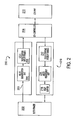
- FIG. 2 illustrates a block diagram of the present invention system with downlink path 200 converting E1/T1 TDM to IP Ethernet compatible protocols and an uplink path 218 converting IP Ethernet to E1/T1 TDM compatible protocols.
- E1/T1 framer 202 decodes incoming TDM signals from line and frame alignment.
- a PCM bus 203 is the output from the E1/T1 framer 202 to the next block, AAL1/2 segmentation unit 204.
- the TDM bit stream is packed into AAL1/2 cells by the segmentation unit.
- the next block 206 packs the cells (with no cell header) into UDP over IP frames.
- the packets are transferred to an Ethernet controller 208 that transmits using Ethernet PHY device 210 .
- packets received by the Ethernet PHY 210 are transferred to the Ethernet controller 208 and from it to a unit 212 that strips the cells out of a UDP payload.
- the received cells arrive to the AAL1/2 reassembly unit 214 that takes out the TDM bytes out of the cells and store them in a PDVT buffer 216.
- the PDVT (Packet Delay Variation Tolerance) buffer is a unit designed to absorb network PDV. Generally the PDVT buffer works as follows.
- TDM bytes are stored into the buffer, the buffer is not being emptied to the E1/T1 stream until reaching it's half full size (the PDVT required), that way the PDVT buffer ensures the packets late or early up to it's half full size will not cause buffer overflows or underflows and E1/T1 traffic will not be damaged (the PDVT is described hereafter in greater detail - see figure 4 and corresponding discussion).
- the E1/T1 TDM stream is then transferred to the E1/T1 framer 202 and out to the TDM line.
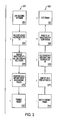
- Figure 3 illustrates a flow diagram of the down 300 and up link 302 paths.
- TDMoIP in unframed mode transparently transports the TDM frame without any attempt at interpreting the data. It is completely oblivious to such TDM internals as time slots, signaling channels, etc.
- TDMoIP can be used to transport arbitrary T1/E1 services, even if some of the channels are actually used to carry data or if the entire frame is an unstructured bit-stream.
- the basic TDMoIP concept can be extended to fractional T1 or channelized E1 systems. To reduce traffic, only the information carrying bytes need be included in the IP packet.
- TDMoIP solve the signaling problem inherent in interfacing between IP networks and the telephony network? To answer this question we should differentiate between three types of signaling: in-band, CAS and CCS.
- In-band signaling is transferred in the same audio band as the speech. It can take the form of call progress tones such as dial tone and ring back, DTMF tones, FSK for caller identification, MFR1 in North America or MFCR2 in Europe, etc. Since these are all audible tones, they are encoded in the TDM timeslot and automatically forwarded by TDMoIP. Speech compression algorithms used by VoIP systems often do not pass these tones well. Therefore, VoIP systems need to implement tone relay protocols to ensure that in-band signaling functions properly.
- T1 CAS, or channel associated signaling
- T1 robs bits for this purpose while E1 devotes an entire timeslot to carry four bits for each of the 30 remaining channels. Since CAS bits are carried in the same T1 or E1 stream, once again they are automatically forwarded by TDMoIP. We take the same approach in TDM over IP as in VoIP by terminating the CAS and forwarding it . This is not a problem and does not add much complexity because CAS are only 4 bits per channel (maximum 16 combinations with low rate of change).
- SS7 is a CCS, or common channel signaling, method.
- SS7 links are 56 or 64 kbps data links and are thus often found occupying a TDM timeslot. In such cases, they are automatically forwarded by TDMoIP. If not, one can get the required information already in IP format from a SS7 signaling gateway, and readily forward it as additional traffic through the network without any further processing.
- Packets in IP networks reach their destination with delay that has a random component, known as jitter.
- jitter a random component
- Figure 4 illustrates a block diagram of the packet delay compensation method of the present invention and the adaptive clock generation method.
- TDMoIP Time Division Multiple Access
- a competitive carrier introduces an alternative link, based on TDMoIP, between two central offices. Due to the cost advantages discussed above, "toll bypass" services can be offered to customers at a lower rate than the incumbent's rate. In such applications, both TDMoIP devices should receive a time reference from the central offices to which they connect.
- IP networks also disseminate clock information through a protocol known as NTP; but unless the IP network is completely private and dedicated to the TDMoIP link, there will be no connection between the NTP clock and the desired TDM one.
- NTP a protocol known as NTP
- One solution is to provide time standards, such as atomic clocks or GPS receivers, to all TDMoIP devices, thus relieving the IP network of the need to send synchronization information. When the provision of accurate local time references is not possible or too costly, then recovery is possible when the destination regenerates and synchronizes the clock.
- TDMoIP is simpler than VoIP because it is transparent to voice and data signaling and protocols, even when they are proprietary. VoIP, on the other hand, still has issues with new protocols and translation between signaling formats. VoIP does hold the promise of new applications, whereas TDMoIP automatically takes advantage of existing PBX and CTI features. As far as bandwidth optimization, VoIP gateways include DSPs which allow voice compression and silence suppression and therefore reduce bandwidth requirements. However, this is at the expense of lower quality and higher latency. The simplicity of TDMoIP translates into lower cost of ownership with initial expenditure savings and operational cost benefits. These savings are significant for the enterprise consumer who is typically not interested in replacing his legacy TDM equipment and dealing with "forklift upgrades" with the associated training and maintenance expenses. Another important difference is that due to transparency, TDMoIP can offer mixed voice-data services.
- TDMoIP and VoIP complement each other.
- Extending TDM trunks over the IP network transparently from the customer site to the carrier POP makes it simple for the carrier to deploy larger, scalable VoIP gateways and softswitches at the POP where resources are available, and provide the user with a simple TDMoIP Network Termination Unit (NTU) at the customer premises.
- NTU TDMoIP Network Termination Unit
- TDMoIP provides many of the benefits of ATM in that end-to-end delay starts at less than 2 ms and integrity of structured or unstructured T1s or E1s is maintained. TDMoIP is much simpler, cheaper and more efficient than ATM. Most importantly, it can be carried over IP and Ethernet networks. TDMoIP is more efficient than ATM because its payload size and therefore percentage of overhead can be set on a per-application basis. This is possible because the number of octets per frame is configurable. With ATM, payload is always 48 bytes, and therefore the percentage of overhead is much higher.
- Gigabit Ethernet and 10-Gigabit Ethernet are being used in Metropolitan Area Networks (MANs) and Wide Area Networks (WANs).
- MANs Metropolitan Area Networks
- WANs Wide Area Networks
- Ethernet is basically a data network technology and cannot by itself handle voice traffic.
- TDMoIP empowers Gigabit Ethernet with voice and circuit extension capabilities and therefore is an excellent complementary technology.
- Ethernet and Frame Relay tend to prevail over the more complex and expensive alternatives such as FDDI, ATM and Token Ring, even if the latter are more robust.
- TDMoIP packets using 802.1p&q, ToS, and set UDP port numbers
- TDMoIP with Gigabit Ethernet switches and Terabit routers ensures a worthy alternative to SONET and ATM, providing a simpler, more cost-effective solution with more bandwidth and more efficient grooming of T1s or E1s to Gigabit optical networks.
- ISPs incumbent local exchange carriers
- CLECs state-certified competitive local exchange carriers
- ISPs that provide Internet access as well.
- the ISP is a subsidiary of the ILEC, but state regulation means that these ISPs must be customers of the ILEC, just like everyone else. This arrangement retains the split between basic transport and enhanced services.
- ISPs are also offering Web and application hosting for the business user. Enhanced services such as unified messaging and VoIP are being targeted at the residential and small business customer. VoIP is also being used to offer savings on international calls, and once QoS is assured we can expect to see more businesses adopt this technology.
- CLECs are becoming ISPs by offering data services and ISPs are becoming CLECs by offering IP telephony.
- Network unbundling the process of breaking the network into separate functional elements, opens the local access area to competition.
- CLECs select unbundled components they need to provide their own service. If the unbundled price is still too expensive, the service provider will provide its own private resources or turn to an alternative access vendor (AAV), which can offer private line service between an entity and facilities at another location.
- AAV alternative access vendor
- Innovative providers will take advantage of whatever technology is available to attack the competition, including wireless microwave systems, leased dark fiber, infrared and laser-based wireless and CATV.
- Next Generation carriers employ wireless for its easy deployment and fiber for its bandwidth. Additional new breeds of CLEC have emerged, such as the data CLEC or DLEC that deliver high speed Internet connectivity and other data offerings, or the building CLEC or BLEC that wire commercial buildings with fiber optic cable to provide Shared Tenant Service (STS).
- CLEC Shared Tenant Service
- Interexchange carriers provide telecommunications service between local calling areas.
- the IXCs have to pay access charges to the ILECs and therefore have an interest in being offered competitive basic transport services from facilities-based CLECs with alternative access solutions.
- IXCs with spare capacity can take advantage of this available bandwidth for circuit extension services across their own packet networks.
- Circuit Extension over IP benefits the IXC because it offers more local access alternatives and more options for providing voice trunking solutions to their customers across their own IP networks.
- CLECs Competitive local exchange carriers
- POPs points of presence
- IRCs Incumbent local exchange carriers
- TDMoIP providing basic transport of circuits wholesale to the CLEC
- TDMoIP to extend the T1 or E1 circuits cost-effectively over optical or wireless links back to the CLEC Service POP.
- the TDM over IP device offers unprecedented flexibility to carriers looking for low cost extension of T1 or E1 services over an IP or Gigabit Ethernet network. Some emerging applications are shown on the following pages.
- TDMoIP offers the CLEC an alternative method of extending services to their customers.
- Traditionally it was necessary to lease the Local Loop from the incumbent local exchange carrier (ILEC), but now any packet network will do.
- All voice and data services that traditionally run on T1 or E1 circuits are automatically supported over IP. This not only includes simple PSTN access, but also PRI, Centrex, and VoIP for voice services and ATM, Frame Relay, PPP, ISDN, SNA, X.25 for data services.
- the packet networks are also no longer limited to synchronous ATM and SONET, but can run equally well on 10/100BaseT wireless radios, Gigabit Ethernet, or any other network.
- T1/E1 circuit extension is made possible by TDMoIP technology.
- the CLEC now has an alternative to leasing "unbundled" facilities from the ILEC.
- Multi-tenant broadband buildings are wired to offer high speed data to each suite over fiber or copper lines.
- the CLEC has a small POP (typically in the basement). This POP is then connected to the CLEC Central Office using an optical network made up of Gigabit Ethernet, SONET, or even FDDI (this broadband connection could also be wireless or laser). Ethernet or IP is used to provide high speed data. TDMoIP is then used to extend traditional T1 or E1 circuits from the central office to each building over this network. In this way, the tenants can be offered a variety of services either directly from this CLEC or from third-party providers contracted by the CLEC. This architecture is also relevant for the Building or Data CLEC that simply wants to provide basic transport service to other CLECs or IXCs and lets them offer bundled services over these leased lines.
- Telephony services such as PSTN access, Centrex and VoIP can simply and inexpensively be provided to customers over a metropolitan area network (MAN).
- MAN metropolitan area network
- Alternate routing and switching capabilities found in Gigabit Ethernet switches and Terabit routers can be used to reroute traffic quickly in the event of network failure.
- Private point-to-point leased line services between customer sites can also be offered over the same fiber IP-based network.
- Carriers with a high speed IP infrastructure can take advantage of under-utilized bandwidth and offer virtual T1/E1 leased lines. If packet delay and loss through the network is low, then this service is just like any other T1/E1 leased line. In this way, carriers can also offer E1 services in the US and T1 circuits internationally.
- a pure IP network architecture can be used not only for data and management, but also for voice and circuit extension over IP.
- the ability of the TDM over IP device to groom DS0s and extend T1 or E1 circuits efficiently and transparently over IP networks provides service providers with a simple, low cost alternative to the traditional digital cross connect (DACS). In this way, the service provider can use the efficiency and flexibility of IP routing to extend its network into tier 4 towns and multi-tenant broadband buildings without compromising integrity and quality.
- DAS digital cross connect
- the network can be divided into four segments starting at the multi-tenant building where the customers can be offered a variety of services, which when bundled together provide the convenience of a single bill and single point of contact. Bundled services do not need to originate from the same service POP.
- an IP service POP provides Web hosting and Internet access
- a TDM service POP acts as the gateway to third-party service providers such as voice CLECs and IXCs.
- the building CLEC will frequently want to use the building's existing copper wire infrastructure to deliver services to the customers' office suites.
- xDSL modems and routers are usually installed in the office suites with a DSLAM in the basement to concentrate the data sources for transmission to the network.
- voice services continue to be provided by the ILEC.
- the CLEC wants to increase revenue and market share, he must be able to also offer voice and leased line services.
- Integrated access devices (IADs) with SDSL links provide one way of doing this. However, it is important that the services that the CLEC offers are not inferior to those currently delivered by the ILEC.
- IP-IADs compress and packetize the voice using VoIP techniques which are not 100% transparent, and therefore compromise the level of service with limited support for V.90 modems, faxes and standard voice features such as 911, *67 and caller ID. This alternative also adds considerable delay, complexity and cost that will make the business customer more reluctant to switch service.
- An alternative embodiment is to provide identical service with the same analog voice and digital lines, but now use TDMoIP technology with the TDM over IP device to provide a scalable and efficient grooming platform. Voice and leased lines from the TDM over IP device and data from the DSLAM can then be aggregated and routed across the network.
- the TDM over IP device solution is scalable because it is now possible to use IP to grow the voice and leased line services from a single DS0 to many T1 or E1 circuits without needing a digital cross connect (DACS).
- DAS digital cross connect
- increasing bandwidth to the building is simple and inexpensive because just the link interface of the access router needs to be matched to that of the line coming from the network. Everything behind the router stays the same because it is all IP.
- the building CLEC still depends on the unbundled Local Loop from the incumbent local exchange carriers (ILEC) to connect multi-tenant buildings to the service POPs.
- T1 circuits can be added and MLPPP or MLFR can be used to bond the circuits together to provide a high speed IP link.
- T3 and OC3 provide even higher speed options. If a wireless, laser or optical alternative becomes available then the CLEC can easily take advantage of the fact that IP works with any link layer protocol, including Ethernet and SONET. Therefore, building a pure IP access network makes this transition simpler.
- This service POP routes IP packets. Packets containing voice and leased line services can simply be forwarded to the TDM Service POP. Similarly, packets requiring ISP value-added services, such as Web hosting, can be forwarded to the relevant servers. In addition, simple Internet access can be provided from this POP.
- Private leased line services can also be offered between buildings by tunneling DS0 bundles across this CLECs IP network.
- an TDM over IP device is responsible for packetizing the TDM bit streams, which are then prioritized and routed between buildings.
- IP packet streams carrying voice, ATM, Frame Relay and other tunneled protocols that are not being used for private line services are routed to the TDM Service POP where the circuits are terminated.
- the CLEC may decide to offer voice services by connecting the T1 or E1 circuits to its own class 4/5 switch or VoIP gateway, or deliver the circuits directly to third-party providers such as Voice CLECs and IXCs.
- the Voice CLEC would receive voice channels in DS0 bundles and provides voice services ranging from regular PSTN access and Centrex to clearinghouses and VoIP for lowest cost international telephony services.
- the IXC (or Data CLEC) could provide traditional data services such as ATM and Frame Relay over these full or fractional T1 or E1 circuits.
- a large corporation uses Sprint's ATM network for connecting its head office to all branches, and now wants to open an office in one of the CLEC multi-tenant buildings. It would now be possible for the CLEC to extend a T1 circuit from the IXC at the TDM service POP to the office suite as a leased line, and the new branch office will receive ATM service just like any other branch.
- TDM Time Division Multiple Access
- BTSs base stations
- BSCs base station controllers
- MSC mobile switching center
- ATM was the most logical alternative. Because of pressure from environmental groups, cellular carriers are looking for an alternative to microwave, and leased lines are costly. With the introduction of QoS in Gigabit Ethernet networks and the availability of TDMoIP, IP is very seriously considered as the preferred solution.
- UMTS Third-generation cellular
- TDMoIP Circuit extension over IP using TDMoIP technology provides the benefits of IP networks without the dangers of a new technology. It supports legacy telephony switches and PBXs over data infrastructures with no loss of functionality. In addition, it empowers IP networks with leased line services for voice, ATM, Frame Relay, SNA, and so on. Finally, the fact that it is simple, inexpensive and transparent to all signaling and protocols makes TDMoIP an ideal complement to Gigabit Ethernet in Next Generation Networks.
- the present invention offers a solution for transparently transferring E1 or T1 (or fractional E1/T1) TDM services over the new widely deployed high speed IP networks. This technology can be used as a migration path to Voice over IP or a complementary solution to VoIP in places where a voice over IP solution is not suitable.
Landscapes
- Engineering & Computer Science (AREA)
- Computer Networks & Wireless Communication (AREA)
- Data Exchanges In Wide-Area Networks (AREA)
- Transmission Systems Not Characterized By The Medium Used For Transmission (AREA)
Claims (40)
- Rechnergestütztes Kommunikationssystem, welches TDM über ein Internet-Protokoll-Netzwerk (TDM über IP, TDMoIP) implementiert, wobei das System umfasst:ein IP-Netzwerk;einen TDM-Quellstrom;einen Decodierer (304, 202), um den TDM-Quellstrom zu decodieren;einen Umsetzer (306) zum Umsetzen eines oder mehrerer Teile des decodierten TDM-Quellstroms in eine Circuit-Emulation-Service(CES)-Struktur;einen Segmentierer (204, 308), um den umgesetzten einen Teil oder die umgesetzten mehreren Teile in Zellen abzuteilen und den(die) Zellen-Header zu entfernen;einen Paketierer (206, 310), der einen Ausgang von dem Segmentierer (204, 308) empfängt, und sein Paketieren, und wobei Pakete, die von dem Paketierer ausgegeben werden, ein IP-kompatibles Format sind, das sich zur Übertragung über das IP-Netzwerk eignet.
- Rechnergestütztes Kommunikationssystem, welches TDM über ein Internet-Protokoll-Netzwerk (TDM über IP, TDMoIP) implementiert, nach Anspruch 1, wobei der TDM-Quellstrom einen E1/T1-TDM-Strom umfasst.
- Rechnergestütztes Kommunikationssystem, welches TDM über ein Internet-Protokoll-Netzwerk (TDM über IP, TDMoIP) implementiert, nach Anspruch 2, wobei der decodierte E1/T1-TDM-Strom über einen PCM-Bus (203) übertragen wird.
- Rechnergestütztes Kommunikationssystem, welches TDM über ein Internet-Protokoll-Netzwerk (TDM über IP, TDMoIP) implementiert, nach Anspruch 3, wobei die Circuit-Emulation-Service(CES)-Struktur CES 2.0 umfasst.
- Rechnergestütztes Kommunikationssystem, welches TDM über ein Internet-Protokoll-Netzwerk (TDM über IP, TDMoIP) implementiert, nach Anspruch 1, wobei die Circuit-Emulation-Service(CES)-Struktur einen beliebigen von drei Typen umfasst: unstrukturiert, strukturiert oder strukturiert mit CAS.
- Rechnergestütztes Kommunikationssystem, welches TDM über ein Internet-Protokoll-Netzwerk (TDM über IP, TDMoIP) implementiert, nach Anspruch 1, wobei das Abteilen die ITU-T 363.1-Norm widerspiegelt.
- Rechnergestütztes Kommunikationssystem, welches TDM über ein Internet-Protokoll-Netzwerk (TDM über IP, TDMoIP) implementiert, nach Anspruch 1, wobei der Ausgang von dem Segmentierer (204, 308) AAL1-Header und Payload umfasst.
- Rechnergestütztes Kommunikationssystem, welches TDM über ein Internet-Protokoll-Netzwerk (TDM über IP, TDMoIP) implementiert, nach Anspruch 1, wobei der Paketierer (206, 310) die Zellen zu UDP-über-IP-Rahmen paketiert, wobei in den UDP-Header Verbindungsinformationen hinzugefügt werden.
- Rechnergestütztes Kommunikationssystem, welches TDM über ein Internet-Protokoll-Netzwerk (TDM über IP, TDMoIP) implementiert, nach Anspruch 8, wobei die Verbindungsinformationen mindestens eine Ziel-IP, die eine Gegenstelle angibt, und eine Adressierung, die einen Ziel-E1/T1-Port und -Bündel angibt, welches eine Gruppe von Zeitschlitzen ist, umfassen.
- Rechnergestütztes Kommunikationssystem, welches TDM über ein Internet-Protokoll-Netzwerk (TDM über IP, TDMoIP) implementiert, nach Anspruch 1, wobei das System ferner einen Empfangsteil umfasst, der Pakete erfasst, die von dem Paketierer (206, 310) ausgegeben und über das IP-Netzwerk übertragen werden.
- Rechnergestütztes Kommunikationssystem, welches TDM über ein Internet-Protokoll-Netzwerk (TDM über IP, TDMoIP) implementiert, nach Anspruch 10, wobei der Empfangsteil umfasst:einen Zellenextrahierer (212, 316), um die Zellen von der UDP-Payload zu entfernen;einen Wiedervereiniger (214, 318), um die entfernten Zellen gemäß Circuit-Emulation-Service(CES)-Normen neu zu strukturieren;einen Paketverzögerungsschwankungspuffer (216, 320), um Netzwerkverzögerungsschwankungen zu kompensieren;einen Framer und Encoder (202, 322) und wobei der Ausgang von dem Framer und Encoder (202, 322) als TDM-Strom übertragen wird.
- Rechnergestütztes Kommunikationssystem, welches TDM über ein Internet-Protokoll-Netzwerk (TDM über IP, TDMoIP) implementiert, nach Anspruch 1, wobei das System ferner einen adaptiven Takt (420) umfasst.
- Rechnergestütztes Kommunikationssystem, welches TDM über ein Internet-Protokoll-Netzwerk (TDM über IP, TDMoIP) implementiert, nach Anspruch 11, wobei das System ferner einen adaptiven Takt (420) umfasst, der verwendet wird, um einen E1/T1-Empfangstakt zu regenerieren.
- Rechnergestütztes Kommunikationssystem, welches TDM über ein Internet-Protokoll-Netzwerk (TDM über IP, TDMoIP) implementiert, nach Anspruch 13, wobei der adaptive Takt (420) einen überwachten Füllpuffer (402) und PLL umfasst.
- Rechnergestütztes Kommunikationssystem, welches TDM über ein Internet-Protokoll-Netzwerk (TDM über IP, TDMoIP) implementiert, nach Anspruch 14, wobei, wenn sich der überwachte Füllpuffer (402) auffüllt, die regenerierte Taktrate erhöht wird, und wenn sich der überwachte Füllpuffer (402) leert, die regenerierte Taktrate gesenkt wird.
- Rechnergestütztes Kommunikationssystem, welches TDM über ein Internet-Protokoll-Netzwerk (TDM über IP, TDMoIP) implementiert, nach Anspruch 1, wobei das System über Netzwerke implementiert ist, die ein beliebiges aus der Gruppe umfassend LANs, WANs, Mobilfunk- oder Internet-basierte Netzwerke umfassen können.
- Rechnergestütztes Kommunikationsverfahren, welches TDM über ein Internet-Protokoll-Netzwerk (TDM über IP, TDMoIP) implementiert, umfassend die folgenden Schritte für den TDM-Aufwärts- und Abwärtsstreckenportfluss:A. wobei der Abwärtsstreckenfluss (300) des TDM-Stroms die Schritte umfasst:(1) Empfangen eines oder mehrerer TDM-Signale;(2) Decodieren des empfangenen einen oder der empfangenen mehreren TDM-Signale von Leitungs- und Rahmensynchronisation (304);(3) Aufbauen von Strukturen gemäß den Circuit-Emulation-Service(CES)-Normen aus den decodierten TDM-Signalen (306);(4) Segmentieren der Strukturen in ATM-Zellen (308);(5) Entfernen des ATM-Headers;(6) Paketieren der entfernten Zellen zu UDP-über-IP-Ethernet-Rahmen (310); und(7) Übertragen der paketierten Zellen über IP-Netzwerke (312);B. wobei der Aufwärtsstreckenfluss (302) des TDM-Strom-Aufwärtsstreckenports die Schritte umfasst:(1) Empfangen von Ethernet-Rahmen von dem IP-Netzwerk (314);(2) Entfernen der ATM-Zellen von einer UDP-Payload (316);(3) Wiedervereinigen der entfernten Zellen gemäß Circuit-Emulation-Service(CES)-Normen (318);(4) Kompensieren von Netzwerkverzögerungsschwankungen (320);(5) Rahmen der neuzusammengesetzten Zellen (322);(6) Codieren der gerahmten Ausgabe (322);(7) Übertragen der codierten Ausgabe über TDM-Leitungen.
- Rechnergestütztes Verfahren, welches TDM über ein Internet-Protokoll-Netzwerk (TDM über IP, TDMoIP) implementiert, nach Anspruch 17, wobei die TDM-Signale einen E1/T1-TDM-Strom umfassen.
- Rechnergestütztes Verfahren, welches TDM über ein Internet-Protokoll-Netzwerk (TDM über IP, TDMoIP) implementiert, nach Anspruch 18, wobei die decodierten E1/T1-TDM-Signale über einen PCM-Bus (203) übertragen werden.
- Rechnergestütztes Verfahren, welches TDM über ein Internet-Protokoll-Netzwerk (TDM über IP, TDMoIP) implementiert, nach Anspruch 17, wobei die Circuit-Emulation-Service(CES)-Struktur CES 2.0 umfasst.
- Rechnergestütztes Verfahren, welches TDM über ein Internet-Protokoll-Netzwerk (TDM über IP, TDMoIP) implementiert, nach Anspruch 17, wobei die Circuit-Emulation-Service(CES)-Struktur einen beliebigen von drei Typen umfasst: unstrukturiert, strukturiert oder strukturiert mit CAS.
- Rechnergestütztes Kommunikationsverfahren, welches TDM über ein Internet-Protokoll-Netzwerk (TDM über IP, TDMoIP) implementiert, nach Anspruch 17, wobei das Segmentieren der Strukturen in ATM-Zellen die ITU-T 363.1-Norm widerspiegelt.
- Rechnergestütztes Verfahren, welches TDM über ein Internet-Protokoll-Netzwerk (TDM über IP, TDMoIP) implementiert, nach Anspruch 17, wobei der Ausgang von dem Segmentieren der Strukturen in ATM-Zellen AAL1-Header und Payload umfasst.
- Rechnergestütztes Verfahren, welches TDM über ein Internet-Protokoll-Netzwerk (TDM über IP, TDMoIP) implementiert, nach Anspruch 17, wobei der Paketierungsschritt die Zellen zu UDP-über-IP-Rahmen paketiert, wobei in einen UDP-Header Verbindungsinformationen hinzugefügt werden.
- Rechnergestütztes Verfahren, welches TDM über ein Internet-Protokoll-Netzwerk (TDM über IP, TDMoIP) implementiert, nach Anspruch 24, wobei die Verbindungsinformationen mindestens eine Ziel-IP, die eine Gegenstelle angibt, und eine Adressierung, die einen Ziel-E1/T1-Port und -Bündel angibt, welches eine Gruppe von Zeitschlitzen ist, umfassen.
- Rechnergestütztes Verfahren, welches TDM über ein Internet-Protokoll-Netzwerk (TDM über IP, TDMoIP) implementiert, nach Anspruch 17, wobei der Kompensationsschritt mit einem adaptiven Takt (420) implementiert ist.
- Rechnergestütztes Verfahren, welches TDM über ein Internet-Protokoll-Netzwerk (TDM über IP, TDMoIP) implementiert, nach Anspruch 26, wobei der adaptive Takt (420) verwendet wird, um einen E1/T1-Empfangstakt zu regenerieren.
- Rechnergestütztes Verfahren, welches TDM über ein Internet-Protokoll-Netzwerk (TDM über IP, TDMoIP) implementiert, nach Anspruch 27, wobei der adaptive Takt (420) einen überwachten Füllpuffer (402) und PLL umfasst.
- Rechnergestütztes Verfahren, welches TDM über ein Internet-Protokoll-Netzwerk (TDM über IP, TDMoIP) implementiert, nach Anspruch 28, wobei, wenn sich der überwachte Füllpuffer (402) auffüllt, die regenerierte Taktrate erhöht wird, und wenn sich der überwachte Füllpuffer (402) leert, die regenerierte Taktrate gesenkt wird.
- Rechnergestütztes Verfahren, welches TDM über ein Internet-Protokoll-Netzwerk (TDM über IP, TDMoIP) implementiert, nach Anspruch 17, wobei der Kompensationsschritt durch die folgenden Schritte implementiert wird:(1) Befüllen eines Puffers (402) mit TDM-Bytes, die aus ankommenden Rahmen extrahiert werden;(2) Leeren des Puffers (402) nach Erreichen von mindestens einem halb befüllten Zustand gemäß einer Rate, die durch einen Übertragungstakt (407) bestimmt wird;(3) Erzeugen einer Füllstandanzeige (408);(4) Vergleichen der Füllstandsanzeige mit einem Nennfüllstand (412);(5) Filtern des Ausgangs, um einen adaptiven Takt (420) zu erzeugen; und(6) rekursive Verwendung des adaptiven Taktes (420) als Übertragungstakt (407) in Schritt (2).
- Rechnergestütztes Verfahren, welches TDM über ein Internet-Protokoll-Netzwerk (TDM über IP, TDMoIP) implementiert, nach Anspruch 30, wobei der Schritt (2) mit einem PLL implementiert ist.
- Rechnergestütztes Verfahren, welches TDM über ein Internet-Protokoll-Netzwerk (TDM über IP, TDMoIP) implementiert, nach Anspruch 17, wobei das Verfahren über Netzwerke implementiert ist, die ein beliebiges aus der Gruppe umfassend LANs, WANs, Mobilfunk- oder Internet-basierte Netzwerke umfassen können.
- Rechnergestütztes Verfahren, welches TDM über ein Internet-Protokoll-Netzwerk (TDM über IP, TDMoIP) implementiert, umfassend das Folgende:Empfangen eines oder mehrerer TDM-Signale;Decodieren des empfangenen einen oder der empfangenen mehreren TDM-Signale (304);Aufbauen von ATM-CES-Strukturen aus den decodierten TDM-Signalen (306), und Segmentieren dieser Strukturen zu AAL1-Zellen ohne einen Zellen-Header (308);Verkapseln der ATM-CES-Strukturen zu UDP-über-IP-Rahmen (310); undSenden der UDP-über-IP-Rahmen über IP-Netzwerke (312).
- Rechnergestütztes Verfahren, welches TDM über ein Internet-Protokoll-Netzwerk (TDM über IP, TDMoIP) implementiert, nach Anspruch 33, ferner umfassend das Angeben eines Ziels der AAL1-Zellen-Abschluss-Interworking-Funktion.
- Rechnergestütztes Verfahren, welches TDM über ein Internet-Protokoll-Netzwerk (TDM über IP, TDMoIP) implementiert, nach Anspruch 34, wobei sich der Schritt des Angebens eines UDP-Quellportfeldes bedient.
- Rechnergestütztes Verfahren, welches TDM über ein Internet-Protokoll-Netzwerk (TDM über IP, TDMoIP) implementiert, nach Anspruch 33, ferner umfassend den Schritt des Kompensierens von Netzwerkverzögerungen.
- Rechnergestütztes Verfahren, welches TDM über ein Internet-Protokoll-Netzwerk (TDM über IP, TDMoIP) implementiert, nach Anspruch 36, wobei der Kompensationsschritt durch folgende Schritte implementiert wird:(1) Laden eines Puffers (402) mit TDM-Bytes, die aus ankommenden Rahmen extrahiert werden;(2) Leeren des Puffers (402) nach Erreichen eines mindestens halbvollen Zustands gemäß einer Rate, die durch den Sendetakt (407) bestimmt wird;(3) Erzeugen einer Füllstandsanzeigen (408);(4) Vergleichen der Füllstandsanzeige mit einem Nennfüllstand (412);(5) Filtern des Ausgangs, um einen adaptiven Takt (420) zu erzeugen, und(6) Ersetzen des adaptiven Taktes (420) als Sendetakt (407) in Schritt (2).
- Rechnergestütztes System, welches TDM über ein Internet-Protokoll-Netzwerk (TDM über IP, TDMoIP) implementiert, nach Anspruch 1, wobei das System Voice over IP (VoIP) implementiert.
- Rechnergestütztes Verfahren, welches TDM über ein Internet-Protokoll-Netzwerk (TDM über IP, TDMoIP) implementiert, nach Anspruch 17, wobei das Verfahren Voice over IP (VoIP) implementiert.
- Rechnergestütztes Verfahren, welches TDM über ein Internet-Protokoll-Netzwerk (TDM über IP, TDMoIP) implementiert, nach Anspruch 36, wobei das Verfahren Voice over IP (VoIP) implementiert.
Applications Claiming Priority (2)
| Application Number | Priority Date | Filing Date | Title |
|---|---|---|---|
| US09/626,335 US6731649B1 (en) | 2000-07-26 | 2000-07-26 | TDM over IP (IP circuit emulation service) |
| US626335 | 2000-07-26 |
Publications (3)
| Publication Number | Publication Date |
|---|---|
| EP1176774A2 EP1176774A2 (de) | 2002-01-30 |
| EP1176774A3 EP1176774A3 (de) | 2004-04-14 |
| EP1176774B1 true EP1176774B1 (de) | 2006-12-13 |
Family
ID=24509956
Family Applications (1)
| Application Number | Title | Priority Date | Filing Date |
|---|---|---|---|
| EP01114108A Expired - Lifetime EP1176774B1 (de) | 2000-07-26 | 2001-06-09 | TDM über IP (IP-Schaltungsemulation) |
Country Status (4)
| Country | Link |
|---|---|
| US (1) | US6731649B1 (de) |
| EP (1) | EP1176774B1 (de) |
| AT (1) | ATE348490T1 (de) |
| DE (1) | DE60125107T2 (de) |
Cited By (6)
| Publication number | Priority date | Publication date | Assignee | Title |
|---|---|---|---|---|
| CN102388594A (zh) * | 2011-09-27 | 2012-03-21 | 华为技术有限公司 | 数据传输的方法、设备及系统 |
| US8681611B2 (en) | 2004-04-05 | 2014-03-25 | Verizon Business Global Llc | System and method for controlling communication |
| CN101926132B (zh) * | 2008-01-25 | 2014-04-30 | 阿尔卡特朗讯公司 | 基于ip互通虚拟租用线路的电路仿真的方法和系统 |
| US8913623B2 (en) | 2004-04-05 | 2014-12-16 | Verizon Patent And Licensing Inc. | Method and apparatus for processing labeled flows in a communications access network |
| US8976797B2 (en) | 2004-04-05 | 2015-03-10 | Verizon Patent And Licensing Inc. | System and method for indicating classification of a communications flow |
| US9025605B2 (en) | 2004-04-05 | 2015-05-05 | Verizon Patent And Licensing Inc. | Apparatus and method for providing a network termination point |
Families Citing this family (224)
| Publication number | Priority date | Publication date | Assignee | Title |
|---|---|---|---|---|
| FI20000316A7 (fi) * | 2000-02-14 | 2001-08-15 | Nokia Corp | Informaatiovirran jäljittely |
| JP2002077243A (ja) * | 2000-08-24 | 2002-03-15 | Fujitsu Ltd | セル/パケット混在の伝送方法および伝送装置 |
| US7260101B2 (en) * | 2000-10-31 | 2007-08-21 | Hewlett-Packard Development Company, L.P. | Auto-configuration process for a point code in a common channel signaling network |
| US7116683B1 (en) * | 2000-11-21 | 2006-10-03 | Telefonaktiebolaget Lm Ericsson (Publ) | Sequencing of user data packets segmented into AAL2 packets transported over internet protocol (IP) |
| US6963561B1 (en) * | 2000-12-15 | 2005-11-08 | Atrica Israel Ltd. | Facility for transporting TDM streams over an asynchronous ethernet network using internet protocol |
| US7333512B2 (en) * | 2000-12-18 | 2008-02-19 | Rmi Corporation | Dynamic mixing TDM data with data packets |
| US7023883B1 (en) * | 2000-12-27 | 2006-04-04 | Cisco Technology, Inc. | Method for providing a network timing reference clock in ethernet-connected VOIP equipment |
| US8670446B2 (en) * | 2001-01-30 | 2014-03-11 | At&T Intellectual Property Ii, L.P. | Technique for Ethernet access to packet-based services |
| US7120150B2 (en) | 2001-01-30 | 2006-10-10 | At & T Corp. | Technique for ethernet access to packet-based services |
| US6891805B2 (en) * | 2001-02-06 | 2005-05-10 | Telephonics Corporation | Communications system |
| US7626999B2 (en) * | 2001-03-16 | 2009-12-01 | Tellabs San Jose, Inc. | Apparatus and methods for circuit emulation of a point-to-point protocol operating over a multi-packet label switching network |
| US7161905B1 (en) | 2001-05-03 | 2007-01-09 | Cisco Technology, Inc. | Method and system for managing time-sensitive packetized data streams at a receiver |
| US7630359B1 (en) * | 2001-09-28 | 2009-12-08 | At&T Corp. | Technique for providing translation between the packet environment and the PSTN environment |
| US7227845B2 (en) * | 2001-12-11 | 2007-06-05 | Motorola, Inc. | Method and apparatus for enabling a communication resource reset |
| WO2003087997A2 (en) * | 2002-04-10 | 2003-10-23 | Akamai Technologies, Inc. | Method and system for enhancing live stream delivery quality using prebursting |
| DE10221425A1 (de) * | 2002-05-14 | 2003-12-04 | Siemens Ag | Datennetzschnittstelle und Kommunikationseinrichtungen mit Datennetzschnittstelle |
| US7420988B1 (en) * | 2002-08-14 | 2008-09-02 | Juniper Networks, Inc. | Network relay protocol having timed packet aggregation |
| US7324516B2 (en) * | 2002-08-14 | 2008-01-29 | Intel Corporation | Data packet header conversion |
| US7079554B2 (en) * | 2002-10-16 | 2006-07-18 | Terasync, Ltd. | System and method for synchronizing between communication terminals of asynchronous packets networks |
| US7457906B2 (en) * | 2003-01-21 | 2008-11-25 | Nextio, Inc. | Method and apparatus for shared I/O in a load/store fabric |
| CN1319348C (zh) * | 2003-02-26 | 2007-05-30 | 华为技术有限公司 | Ip接入网业务服务质量保障方法 |
| AU2004202550A1 (en) * | 2003-06-18 | 2005-01-13 | Nec Australia Pty Ltd | Cell search process for wireless communication system |
| US7453852B2 (en) * | 2003-07-14 | 2008-11-18 | Lucent Technologies Inc. | Method and system for mobility across heterogeneous address spaces |
| DE602004030696D1 (de) | 2003-09-09 | 2011-02-03 | Sonus Networks Inc | Verfahren und vorrichtung zum synchronisierten transport von daten durch ein asynchrones medium |
| US7586925B2 (en) | 2003-09-09 | 2009-09-08 | Sonus Networks, Inc. | Data adaptation protocol |
| US7743164B2 (en) * | 2004-02-13 | 2010-06-22 | Alcatel-Lucent Usa Inc. | Method and apparatus for transmitting frequency shift key data in a packetized format |
| US8948207B2 (en) * | 2004-04-05 | 2015-02-03 | Verizon Patent And Licensing Inc. | System and method for transporting time-division multiplexed communications through a packet-switched access network |
| US8218569B2 (en) * | 2004-04-05 | 2012-07-10 | Verizon Business Global Llc | Apparatus and method for terminating service emulation instances |
| US20050220059A1 (en) * | 2004-04-05 | 2005-10-06 | Delregno Dick | System and method for providing a multiple-protocol crossconnect |
| US8249082B2 (en) * | 2004-04-05 | 2012-08-21 | Verizon Business Global Llc | System method for a communications access network |
| US7606235B1 (en) | 2004-06-03 | 2009-10-20 | Juniper Networks, Inc. | Constraint-based label switched path selection within a computer network |
| FR2872654B1 (fr) * | 2004-06-30 | 2006-09-08 | Alcatel Sa | Procede de re-synchronisation de flux beneficiant de services d'emulation de circuits, pour un reseau de communications a commutation de paquets |
| US7773578B2 (en) * | 2004-07-13 | 2010-08-10 | Utstarcom Telecom Co., Ltd. | Packet transmission method for wireless signals in a wireless base station system |
| FR2875654B1 (fr) * | 2004-09-17 | 2006-11-24 | Cit Alcatel | Commutateur a generateur de trames ethernet composites, pour un reseau de communication a multiplexage temporel |
| US7369572B1 (en) * | 2004-12-03 | 2008-05-06 | Sprint Communications Company L.P. | Quality management for a packet communication system |
| US7881712B1 (en) * | 2004-12-23 | 2011-02-01 | Cisco Technology, Inc. | Generating and signaling tones in a communications network |
| US20060221983A1 (en) * | 2005-03-30 | 2006-10-05 | Lucent Technologies Inc. | Communications backbone, a method of providing a communications backbone and a telecommunication network employing the backbone and the method |
| WO2006116396A2 (en) * | 2005-04-26 | 2006-11-02 | Anders Joseph C | Voice over internet protocol system and method for processing of telephonic voice over a data network |
| US7627004B2 (en) * | 2005-05-26 | 2009-12-01 | Cisco Technology, Inc. | Transporting synchronization channel information across a packet network |
| CN100484093C (zh) * | 2005-06-29 | 2009-04-29 | 华为技术有限公司 | 网络间数据业务互通的方法 |
| CN1859063A (zh) | 2005-08-29 | 2006-11-08 | 华为技术有限公司 | 业务数据传送方法及装置 |
| US7974308B2 (en) * | 2005-09-26 | 2011-07-05 | Alcatel Lucent | Interworking circuit emulation service over packet and IP/MPLS packet processing |
| ATE554583T1 (de) * | 2006-07-04 | 2012-05-15 | Vastech Sa Pty Ltd | Gateway zur verwendung in einem elektronischen kommunikationsaufzeichnungssystem |
| US8098691B2 (en) * | 2006-12-11 | 2012-01-17 | Broadcom Corporation | Base-band ethernet over point-to-multipoint shared single conductor channel |
| EP1936881B1 (de) * | 2006-12-21 | 2012-05-30 | Alcatel Lucent | Überwachung von durch Paketverzögerungsveränderung induziertem Abgleiten in einem TDM-über-Ethernet-Übertragungsnetzwerk |
| US8184786B2 (en) * | 2007-02-26 | 2012-05-22 | Service Bureau Intetel S.A. | Updating routing patterns in an enterprise network |
| US20080298345A1 (en) * | 2007-05-30 | 2008-12-04 | Llija Hadzic | Cross-connect for emulated circuit-base communications |
| EP2043313B1 (de) | 2007-09-28 | 2013-08-14 | Alcatel Lucent | Circuit-Emulation-Service-Verfahren und Telekommunikationssystem zur Implementierung des Verfahrens |
| US8094679B2 (en) * | 2007-12-07 | 2012-01-10 | Nsgdatacom, Inc. | Apparatus, method and computer program product for providing automated backup to TDM network connections over an IP network |
| US8687650B2 (en) | 2007-12-07 | 2014-04-01 | Nsgdatacom, Inc. | System, method, and computer program product for connecting or coupling analog audio tone based communications systems over a packet data network |
| US20090257345A1 (en) * | 2007-12-07 | 2009-10-15 | Nsgdatacom, Inc. | Apparatus, method and computer program product for providing self adapting transport of public switched telephone network (pstn) circuits over a wireless network |
| CN101197778B (zh) * | 2007-12-27 | 2010-08-18 | 腾讯科技(深圳)有限公司 | 数据包传输的方法、装置和系统 |
| US8509114B1 (en) * | 2008-04-22 | 2013-08-13 | Avaya Inc. | Circuit emulation service over IP with dynamic bandwidth allocation |
| JP2010153955A (ja) * | 2008-12-24 | 2010-07-08 | Hitachi Ltd | 交換装置 |
| GB2475331A (en) * | 2009-11-17 | 2011-05-18 | Rad Data Comm Ltd | Reference frequency source |
| US8780933B2 (en) * | 2010-02-04 | 2014-07-15 | Hubbell Incorporated | Method and apparatus for automated subscriber-based TDM-IP conversion |
| CN102546112B (zh) * | 2012-01-16 | 2015-05-13 | 瑞斯康达科技发展股份有限公司 | 一种数据封装方法及装置 |
| US10009065B2 (en) | 2012-12-05 | 2018-06-26 | At&T Intellectual Property I, L.P. | Backhaul link for distributed antenna system |
| US9113347B2 (en) | 2012-12-05 | 2015-08-18 | At&T Intellectual Property I, Lp | Backhaul link for distributed antenna system |
| US9999038B2 (en) | 2013-05-31 | 2018-06-12 | At&T Intellectual Property I, L.P. | Remote distributed antenna system |
| US9525524B2 (en) | 2013-05-31 | 2016-12-20 | At&T Intellectual Property I, L.P. | Remote distributed antenna system |
| WO2014194517A1 (zh) * | 2013-06-07 | 2014-12-11 | 华为技术有限公司 | 一种传输数据的方法及设备 |
| US8897697B1 (en) | 2013-11-06 | 2014-11-25 | At&T Intellectual Property I, Lp | Millimeter-wave surface-wave communications |
| US9209902B2 (en) | 2013-12-10 | 2015-12-08 | At&T Intellectual Property I, L.P. | Quasi-optical coupler |
| US9973545B2 (en) | 2014-08-20 | 2018-05-15 | At&T Intellectual Property I, L.P. | Method and device for managing circuit switched data calls |
| US9692101B2 (en) | 2014-08-26 | 2017-06-27 | At&T Intellectual Property I, L.P. | Guided wave couplers for coupling electromagnetic waves between a waveguide surface and a surface of a wire |
| US9768833B2 (en) | 2014-09-15 | 2017-09-19 | At&T Intellectual Property I, L.P. | Method and apparatus for sensing a condition in a transmission medium of electromagnetic waves |
| US10063280B2 (en) | 2014-09-17 | 2018-08-28 | At&T Intellectual Property I, L.P. | Monitoring and mitigating conditions in a communication network |
| US9628854B2 (en) | 2014-09-29 | 2017-04-18 | At&T Intellectual Property I, L.P. | Method and apparatus for distributing content in a communication network |
| US9615269B2 (en) | 2014-10-02 | 2017-04-04 | At&T Intellectual Property I, L.P. | Method and apparatus that provides fault tolerance in a communication network |
| US9685992B2 (en) | 2014-10-03 | 2017-06-20 | At&T Intellectual Property I, L.P. | Circuit panel network and methods thereof |
| US9503189B2 (en) | 2014-10-10 | 2016-11-22 | At&T Intellectual Property I, L.P. | Method and apparatus for arranging communication sessions in a communication system |
| US9973299B2 (en) | 2014-10-14 | 2018-05-15 | At&T Intellectual Property I, L.P. | Method and apparatus for adjusting a mode of communication in a communication network |
| US9762289B2 (en) | 2014-10-14 | 2017-09-12 | At&T Intellectual Property I, L.P. | Method and apparatus for transmitting or receiving signals in a transportation system |
| US9520945B2 (en) | 2014-10-21 | 2016-12-13 | At&T Intellectual Property I, L.P. | Apparatus for providing communication services and methods thereof |
| US9564947B2 (en) | 2014-10-21 | 2017-02-07 | At&T Intellectual Property I, L.P. | Guided-wave transmission device with diversity and methods for use therewith |
| US9769020B2 (en) | 2014-10-21 | 2017-09-19 | At&T Intellectual Property I, L.P. | Method and apparatus for responding to events affecting communications in a communication network |
| US9312919B1 (en) | 2014-10-21 | 2016-04-12 | At&T Intellectual Property I, Lp | Transmission device with impairment compensation and methods for use therewith |
| US9577306B2 (en) | 2014-10-21 | 2017-02-21 | At&T Intellectual Property I, L.P. | Guided-wave transmission device and methods for use therewith |
| US9653770B2 (en) | 2014-10-21 | 2017-05-16 | At&T Intellectual Property I, L.P. | Guided wave coupler, coupling module and methods for use therewith |
| US9627768B2 (en) | 2014-10-21 | 2017-04-18 | At&T Intellectual Property I, L.P. | Guided-wave transmission device with non-fundamental mode propagation and methods for use therewith |
| US9780834B2 (en) | 2014-10-21 | 2017-10-03 | At&T Intellectual Property I, L.P. | Method and apparatus for transmitting electromagnetic waves |
| US9680670B2 (en) | 2014-11-20 | 2017-06-13 | At&T Intellectual Property I, L.P. | Transmission device with channel equalization and control and methods for use therewith |
| US9654173B2 (en) | 2014-11-20 | 2017-05-16 | At&T Intellectual Property I, L.P. | Apparatus for powering a communication device and methods thereof |
| US10009067B2 (en) | 2014-12-04 | 2018-06-26 | At&T Intellectual Property I, L.P. | Method and apparatus for configuring a communication interface |
| US9800327B2 (en) | 2014-11-20 | 2017-10-24 | At&T Intellectual Property I, L.P. | Apparatus for controlling operations of a communication device and methods thereof |
| US9997819B2 (en) | 2015-06-09 | 2018-06-12 | At&T Intellectual Property I, L.P. | Transmission medium and method for facilitating propagation of electromagnetic waves via a core |
| US9954287B2 (en) | 2014-11-20 | 2018-04-24 | At&T Intellectual Property I, L.P. | Apparatus for converting wireless signals and electromagnetic waves and methods thereof |
| US10340573B2 (en) | 2016-10-26 | 2019-07-02 | At&T Intellectual Property I, L.P. | Launcher with cylindrical coupling device and methods for use therewith |
| US9544006B2 (en) | 2014-11-20 | 2017-01-10 | At&T Intellectual Property I, L.P. | Transmission device with mode division multiplexing and methods for use therewith |
| US9742462B2 (en) | 2014-12-04 | 2017-08-22 | At&T Intellectual Property I, L.P. | Transmission medium and communication interfaces and methods for use therewith |
| US9461706B1 (en) | 2015-07-31 | 2016-10-04 | At&T Intellectual Property I, Lp | Method and apparatus for exchanging communication signals |
| US10243784B2 (en) | 2014-11-20 | 2019-03-26 | At&T Intellectual Property I, L.P. | System for generating topology information and methods thereof |
| US10144036B2 (en) | 2015-01-30 | 2018-12-04 | At&T Intellectual Property I, L.P. | Method and apparatus for mitigating interference affecting a propagation of electromagnetic waves guided by a transmission medium |
| US9876570B2 (en) | 2015-02-20 | 2018-01-23 | At&T Intellectual Property I, Lp | Guided-wave transmission device with non-fundamental mode propagation and methods for use therewith |
| US9749013B2 (en) | 2015-03-17 | 2017-08-29 | At&T Intellectual Property I, L.P. | Method and apparatus for reducing attenuation of electromagnetic waves guided by a transmission medium |
| US9705561B2 (en) | 2015-04-24 | 2017-07-11 | At&T Intellectual Property I, L.P. | Directional coupling device and methods for use therewith |
| US10224981B2 (en) | 2015-04-24 | 2019-03-05 | At&T Intellectual Property I, Lp | Passive electrical coupling device and methods for use therewith |
| US9948354B2 (en) | 2015-04-28 | 2018-04-17 | At&T Intellectual Property I, L.P. | Magnetic coupling device with reflective plate and methods for use therewith |
| US9793954B2 (en) | 2015-04-28 | 2017-10-17 | At&T Intellectual Property I, L.P. | Magnetic coupling device and methods for use therewith |
| US9748626B2 (en) | 2015-05-14 | 2017-08-29 | At&T Intellectual Property I, L.P. | Plurality of cables having different cross-sectional shapes which are bundled together to form a transmission medium |
| US9490869B1 (en) | 2015-05-14 | 2016-11-08 | At&T Intellectual Property I, L.P. | Transmission medium having multiple cores and methods for use therewith |
| US9871282B2 (en) | 2015-05-14 | 2018-01-16 | At&T Intellectual Property I, L.P. | At least one transmission medium having a dielectric surface that is covered at least in part by a second dielectric |
| US10650940B2 (en) | 2015-05-15 | 2020-05-12 | At&T Intellectual Property I, L.P. | Transmission medium having a conductive material and methods for use therewith |
| US10679767B2 (en) | 2015-05-15 | 2020-06-09 | At&T Intellectual Property I, L.P. | Transmission medium having a conductive material and methods for use therewith |
| US9917341B2 (en) | 2015-05-27 | 2018-03-13 | At&T Intellectual Property I, L.P. | Apparatus and method for launching electromagnetic waves and for modifying radial dimensions of the propagating electromagnetic waves |
| US10812174B2 (en) | 2015-06-03 | 2020-10-20 | At&T Intellectual Property I, L.P. | Client node device and methods for use therewith |
| US10154493B2 (en) | 2015-06-03 | 2018-12-11 | At&T Intellectual Property I, L.P. | Network termination and methods for use therewith |
| US9912381B2 (en) | 2015-06-03 | 2018-03-06 | At&T Intellectual Property I, Lp | Network termination and methods for use therewith |
| US9866309B2 (en) | 2015-06-03 | 2018-01-09 | At&T Intellectual Property I, Lp | Host node device and methods for use therewith |
| US10348391B2 (en) | 2015-06-03 | 2019-07-09 | At&T Intellectual Property I, L.P. | Client node device with frequency conversion and methods for use therewith |
| US10103801B2 (en) | 2015-06-03 | 2018-10-16 | At&T Intellectual Property I, L.P. | Host node device and methods for use therewith |
| US9913139B2 (en) | 2015-06-09 | 2018-03-06 | At&T Intellectual Property I, L.P. | Signal fingerprinting for authentication of communicating devices |
| US9608692B2 (en) | 2015-06-11 | 2017-03-28 | At&T Intellectual Property I, L.P. | Repeater and methods for use therewith |
| US10142086B2 (en) | 2015-06-11 | 2018-11-27 | At&T Intellectual Property I, L.P. | Repeater and methods for use therewith |
| US9820146B2 (en) | 2015-06-12 | 2017-11-14 | At&T Intellectual Property I, L.P. | Method and apparatus for authentication and identity management of communicating devices |
| US9667317B2 (en) | 2015-06-15 | 2017-05-30 | At&T Intellectual Property I, L.P. | Method and apparatus for providing security using network traffic adjustments |
| US9865911B2 (en) | 2015-06-25 | 2018-01-09 | At&T Intellectual Property I, L.P. | Waveguide system for slot radiating first electromagnetic waves that are combined into a non-fundamental wave mode second electromagnetic wave on a transmission medium |
| US9509415B1 (en) | 2015-06-25 | 2016-11-29 | At&T Intellectual Property I, L.P. | Methods and apparatus for inducing a fundamental wave mode on a transmission medium |
| US9640850B2 (en) | 2015-06-25 | 2017-05-02 | At&T Intellectual Property I, L.P. | Methods and apparatus for inducing a non-fundamental wave mode on a transmission medium |
| US9628116B2 (en) | 2015-07-14 | 2017-04-18 | At&T Intellectual Property I, L.P. | Apparatus and methods for transmitting wireless signals |
| US9722318B2 (en) | 2015-07-14 | 2017-08-01 | At&T Intellectual Property I, L.P. | Method and apparatus for coupling an antenna to a device |
| US10148016B2 (en) | 2015-07-14 | 2018-12-04 | At&T Intellectual Property I, L.P. | Apparatus and methods for communicating utilizing an antenna array |
| US10044409B2 (en) | 2015-07-14 | 2018-08-07 | At&T Intellectual Property I, L.P. | Transmission medium and methods for use therewith |
| US9882257B2 (en) | 2015-07-14 | 2018-01-30 | At&T Intellectual Property I, L.P. | Method and apparatus for launching a wave mode that mitigates interference |
| US10320586B2 (en) | 2015-07-14 | 2019-06-11 | At&T Intellectual Property I, L.P. | Apparatus and methods for generating non-interfering electromagnetic waves on an insulated transmission medium |
| US9836957B2 (en) | 2015-07-14 | 2017-12-05 | At&T Intellectual Property I, L.P. | Method and apparatus for communicating with premises equipment |
| US10341142B2 (en) | 2015-07-14 | 2019-07-02 | At&T Intellectual Property I, L.P. | Apparatus and methods for generating non-interfering electromagnetic waves on an uninsulated conductor |
| US9853342B2 (en) | 2015-07-14 | 2017-12-26 | At&T Intellectual Property I, L.P. | Dielectric transmission medium connector and methods for use therewith |
| US10033108B2 (en) | 2015-07-14 | 2018-07-24 | At&T Intellectual Property I, L.P. | Apparatus and methods for generating an electromagnetic wave having a wave mode that mitigates interference |
| US10033107B2 (en) | 2015-07-14 | 2018-07-24 | At&T Intellectual Property I, L.P. | Method and apparatus for coupling an antenna to a device |
| US10205655B2 (en) | 2015-07-14 | 2019-02-12 | At&T Intellectual Property I, L.P. | Apparatus and methods for communicating utilizing an antenna array and multiple communication paths |
| US9847566B2 (en) | 2015-07-14 | 2017-12-19 | At&T Intellectual Property I, L.P. | Method and apparatus for adjusting a field of a signal to mitigate interference |
| US10170840B2 (en) | 2015-07-14 | 2019-01-01 | At&T Intellectual Property I, L.P. | Apparatus and methods for sending or receiving electromagnetic signals |
| US9793951B2 (en) | 2015-07-15 | 2017-10-17 | At&T Intellectual Property I, L.P. | Method and apparatus for launching a wave mode that mitigates interference |
| US10090606B2 (en) | 2015-07-15 | 2018-10-02 | At&T Intellectual Property I, L.P. | Antenna system with dielectric array and methods for use therewith |
| US9608740B2 (en) | 2015-07-15 | 2017-03-28 | At&T Intellectual Property I, L.P. | Method and apparatus for launching a wave mode that mitigates interference |
| US10484513B2 (en) | 2015-07-17 | 2019-11-19 | Nsgdatacom, Inc. | System, method, and computer program product for connecting or coupling audio communications systems over a software defined wide area network |
| US10784670B2 (en) | 2015-07-23 | 2020-09-22 | At&T Intellectual Property I, L.P. | Antenna support for aligning an antenna |
| US9912027B2 (en) | 2015-07-23 | 2018-03-06 | At&T Intellectual Property I, L.P. | Method and apparatus for exchanging communication signals |
| US9871283B2 (en) | 2015-07-23 | 2018-01-16 | At&T Intellectual Property I, Lp | Transmission medium having a dielectric core comprised of plural members connected by a ball and socket configuration |
| US9948333B2 (en) | 2015-07-23 | 2018-04-17 | At&T Intellectual Property I, L.P. | Method and apparatus for wireless communications to mitigate interference |
| US9749053B2 (en) | 2015-07-23 | 2017-08-29 | At&T Intellectual Property I, L.P. | Node device, repeater and methods for use therewith |
| US9735833B2 (en) | 2015-07-31 | 2017-08-15 | At&T Intellectual Property I, L.P. | Method and apparatus for communications management in a neighborhood network |
| US10020587B2 (en) | 2015-07-31 | 2018-07-10 | At&T Intellectual Property I, L.P. | Radial antenna and methods for use therewith |
| US9967173B2 (en) | 2015-07-31 | 2018-05-08 | At&T Intellectual Property I, L.P. | Method and apparatus for authentication and identity management of communicating devices |
| US9904535B2 (en) | 2015-09-14 | 2018-02-27 | At&T Intellectual Property I, L.P. | Method and apparatus for distributing software |
| US10079661B2 (en) | 2015-09-16 | 2018-09-18 | At&T Intellectual Property I, L.P. | Method and apparatus for use with a radio distributed antenna system having a clock reference |
| US10009901B2 (en) | 2015-09-16 | 2018-06-26 | At&T Intellectual Property I, L.P. | Method, apparatus, and computer-readable storage medium for managing utilization of wireless resources between base stations |
| US10136434B2 (en) | 2015-09-16 | 2018-11-20 | At&T Intellectual Property I, L.P. | Method and apparatus for use with a radio distributed antenna system having an ultra-wideband control channel |
| US9705571B2 (en) | 2015-09-16 | 2017-07-11 | At&T Intellectual Property I, L.P. | Method and apparatus for use with a radio distributed antenna system |
| US10009063B2 (en) | 2015-09-16 | 2018-06-26 | At&T Intellectual Property I, L.P. | Method and apparatus for use with a radio distributed antenna system having an out-of-band reference signal |
| US10051629B2 (en) | 2015-09-16 | 2018-08-14 | At&T Intellectual Property I, L.P. | Method and apparatus for use with a radio distributed antenna system having an in-band reference signal |
| US9769128B2 (en) | 2015-09-28 | 2017-09-19 | At&T Intellectual Property I, L.P. | Method and apparatus for encryption of communications over a network |
| US9729197B2 (en) | 2015-10-01 | 2017-08-08 | At&T Intellectual Property I, L.P. | Method and apparatus for communicating network management traffic over a network |
| US9882277B2 (en) | 2015-10-02 | 2018-01-30 | At&T Intellectual Property I, Lp | Communication device and antenna assembly with actuated gimbal mount |
| US10074890B2 (en) | 2015-10-02 | 2018-09-11 | At&T Intellectual Property I, L.P. | Communication device and antenna with integrated light assembly |
| US9876264B2 (en) | 2015-10-02 | 2018-01-23 | At&T Intellectual Property I, Lp | Communication system, guided wave switch and methods for use therewith |
| US10355367B2 (en) | 2015-10-16 | 2019-07-16 | At&T Intellectual Property I, L.P. | Antenna structure for exchanging wireless signals |
| US10665942B2 (en) | 2015-10-16 | 2020-05-26 | At&T Intellectual Property I, L.P. | Method and apparatus for adjusting wireless communications |
| US10051483B2 (en) | 2015-10-16 | 2018-08-14 | At&T Intellectual Property I, L.P. | Method and apparatus for directing wireless signals |
| US9912419B1 (en) | 2016-08-24 | 2018-03-06 | At&T Intellectual Property I, L.P. | Method and apparatus for managing a fault in a distributed antenna system |
| US9860075B1 (en) | 2016-08-26 | 2018-01-02 | At&T Intellectual Property I, L.P. | Method and communication node for broadband distribution |
| US10291311B2 (en) | 2016-09-09 | 2019-05-14 | At&T Intellectual Property I, L.P. | Method and apparatus for mitigating a fault in a distributed antenna system |
| US11032819B2 (en) | 2016-09-15 | 2021-06-08 | At&T Intellectual Property I, L.P. | Method and apparatus for use with a radio distributed antenna system having a control channel reference signal |
| US10135146B2 (en) | 2016-10-18 | 2018-11-20 | At&T Intellectual Property I, L.P. | Apparatus and methods for launching guided waves via circuits |
| US10340600B2 (en) | 2016-10-18 | 2019-07-02 | At&T Intellectual Property I, L.P. | Apparatus and methods for launching guided waves via plural waveguide systems |
| US10135147B2 (en) | 2016-10-18 | 2018-11-20 | At&T Intellectual Property I, L.P. | Apparatus and methods for launching guided waves via an antenna |
| US9991580B2 (en) | 2016-10-21 | 2018-06-05 | At&T Intellectual Property I, L.P. | Launcher and coupling system for guided wave mode cancellation |
| US10374316B2 (en) | 2016-10-21 | 2019-08-06 | At&T Intellectual Property I, L.P. | System and dielectric antenna with non-uniform dielectric |
| US9876605B1 (en) | 2016-10-21 | 2018-01-23 | At&T Intellectual Property I, L.P. | Launcher and coupling system to support desired guided wave mode |
| US10811767B2 (en) | 2016-10-21 | 2020-10-20 | At&T Intellectual Property I, L.P. | System and dielectric antenna with convex dielectric radome |
| US10312567B2 (en) | 2016-10-26 | 2019-06-04 | At&T Intellectual Property I, L.P. | Launcher with planar strip antenna and methods for use therewith |
| US10225025B2 (en) | 2016-11-03 | 2019-03-05 | At&T Intellectual Property I, L.P. | Method and apparatus for detecting a fault in a communication system |
| US10498044B2 (en) | 2016-11-03 | 2019-12-03 | At&T Intellectual Property I, L.P. | Apparatus for configuring a surface of an antenna |
| US10291334B2 (en) | 2016-11-03 | 2019-05-14 | At&T Intellectual Property I, L.P. | System for detecting a fault in a communication system |
| US10224634B2 (en) | 2016-11-03 | 2019-03-05 | At&T Intellectual Property I, L.P. | Methods and apparatus for adjusting an operational characteristic of an antenna |
| US10178445B2 (en) | 2016-11-23 | 2019-01-08 | At&T Intellectual Property I, L.P. | Methods, devices, and systems for load balancing between a plurality of waveguides |
| US10090594B2 (en) | 2016-11-23 | 2018-10-02 | At&T Intellectual Property I, L.P. | Antenna system having structural configurations for assembly |
| US10340603B2 (en) | 2016-11-23 | 2019-07-02 | At&T Intellectual Property I, L.P. | Antenna system having shielded structural configurations for assembly |
| US10340601B2 (en) | 2016-11-23 | 2019-07-02 | At&T Intellectual Property I, L.P. | Multi-antenna system and methods for use therewith |
| US10535928B2 (en) | 2016-11-23 | 2020-01-14 | At&T Intellectual Property I, L.P. | Antenna system and methods for use therewith |
| US10305190B2 (en) | 2016-12-01 | 2019-05-28 | At&T Intellectual Property I, L.P. | Reflecting dielectric antenna system and methods for use therewith |
| US10361489B2 (en) | 2016-12-01 | 2019-07-23 | At&T Intellectual Property I, L.P. | Dielectric dish antenna system and methods for use therewith |
| US10755542B2 (en) | 2016-12-06 | 2020-08-25 | At&T Intellectual Property I, L.P. | Method and apparatus for surveillance via guided wave communication |
| US10439675B2 (en) | 2016-12-06 | 2019-10-08 | At&T Intellectual Property I, L.P. | Method and apparatus for repeating guided wave communication signals |
| US10637149B2 (en) | 2016-12-06 | 2020-04-28 | At&T Intellectual Property I, L.P. | Injection molded dielectric antenna and methods for use therewith |
| US10326494B2 (en) | 2016-12-06 | 2019-06-18 | At&T Intellectual Property I, L.P. | Apparatus for measurement de-embedding and methods for use therewith |
| US10382976B2 (en) | 2016-12-06 | 2019-08-13 | At&T Intellectual Property I, L.P. | Method and apparatus for managing wireless communications based on communication paths and network device positions |
| US10819035B2 (en) | 2016-12-06 | 2020-10-27 | At&T Intellectual Property I, L.P. | Launcher with helical antenna and methods for use therewith |
| US9927517B1 (en) | 2016-12-06 | 2018-03-27 | At&T Intellectual Property I, L.P. | Apparatus and methods for sensing rainfall |
| US10727599B2 (en) | 2016-12-06 | 2020-07-28 | At&T Intellectual Property I, L.P. | Launcher with slot antenna and methods for use therewith |
| US10694379B2 (en) | 2016-12-06 | 2020-06-23 | At&T Intellectual Property I, L.P. | Waveguide system with device-based authentication and methods for use therewith |
| US10020844B2 (en) | 2016-12-06 | 2018-07-10 | T&T Intellectual Property I, L.P. | Method and apparatus for broadcast communication via guided waves |
| US10135145B2 (en) | 2016-12-06 | 2018-11-20 | At&T Intellectual Property I, L.P. | Apparatus and methods for generating an electromagnetic wave along a transmission medium |
| US10446936B2 (en) | 2016-12-07 | 2019-10-15 | At&T Intellectual Property I, L.P. | Multi-feed dielectric antenna system and methods for use therewith |
| US10168695B2 (en) | 2016-12-07 | 2019-01-01 | At&T Intellectual Property I, L.P. | Method and apparatus for controlling an unmanned aircraft |
| US10389029B2 (en) | 2016-12-07 | 2019-08-20 | At&T Intellectual Property I, L.P. | Multi-feed dielectric antenna system with core selection and methods for use therewith |
| US10547348B2 (en) | 2016-12-07 | 2020-01-28 | At&T Intellectual Property I, L.P. | Method and apparatus for switching transmission mediums in a communication system |
| US10359749B2 (en) | 2016-12-07 | 2019-07-23 | At&T Intellectual Property I, L.P. | Method and apparatus for utilities management via guided wave communication |
| US9893795B1 (en) | 2016-12-07 | 2018-02-13 | At&T Intellectual Property I, Lp | Method and repeater for broadband distribution |
| US10243270B2 (en) | 2016-12-07 | 2019-03-26 | At&T Intellectual Property I, L.P. | Beam adaptive multi-feed dielectric antenna system and methods for use therewith |
| US10139820B2 (en) | 2016-12-07 | 2018-11-27 | At&T Intellectual Property I, L.P. | Method and apparatus for deploying equipment of a communication system |
| US10027397B2 (en) | 2016-12-07 | 2018-07-17 | At&T Intellectual Property I, L.P. | Distributed antenna system and methods for use therewith |
| US9998870B1 (en) | 2016-12-08 | 2018-06-12 | At&T Intellectual Property I, L.P. | Method and apparatus for proximity sensing |
| US10411356B2 (en) | 2016-12-08 | 2019-09-10 | At&T Intellectual Property I, L.P. | Apparatus and methods for selectively targeting communication devices with an antenna array |
| US10389037B2 (en) | 2016-12-08 | 2019-08-20 | At&T Intellectual Property I, L.P. | Apparatus and methods for selecting sections of an antenna array and use therewith |
| US10103422B2 (en) | 2016-12-08 | 2018-10-16 | At&T Intellectual Property I, L.P. | Method and apparatus for mounting network devices |
| US10938108B2 (en) | 2016-12-08 | 2021-03-02 | At&T Intellectual Property I, L.P. | Frequency selective multi-feed dielectric antenna system and methods for use therewith |
| US10601494B2 (en) | 2016-12-08 | 2020-03-24 | At&T Intellectual Property I, L.P. | Dual-band communication device and method for use therewith |
| US9911020B1 (en) | 2016-12-08 | 2018-03-06 | At&T Intellectual Property I, L.P. | Method and apparatus for tracking via a radio frequency identification device |
| US10916969B2 (en) | 2016-12-08 | 2021-02-09 | At&T Intellectual Property I, L.P. | Method and apparatus for providing power using an inductive coupling |
| US10530505B2 (en) | 2016-12-08 | 2020-01-07 | At&T Intellectual Property I, L.P. | Apparatus and methods for launching electromagnetic waves along a transmission medium |
| US10326689B2 (en) | 2016-12-08 | 2019-06-18 | At&T Intellectual Property I, L.P. | Method and system for providing alternative communication paths |
| US10069535B2 (en) | 2016-12-08 | 2018-09-04 | At&T Intellectual Property I, L.P. | Apparatus and methods for launching electromagnetic waves having a certain electric field structure |
| US10777873B2 (en) | 2016-12-08 | 2020-09-15 | At&T Intellectual Property I, L.P. | Method and apparatus for mounting network devices |
| US10340983B2 (en) | 2016-12-09 | 2019-07-02 | At&T Intellectual Property I, L.P. | Method and apparatus for surveying remote sites via guided wave communications |
| US10264586B2 (en) | 2016-12-09 | 2019-04-16 | At&T Mobility Ii Llc | Cloud-based packet controller and methods for use therewith |
| US9838896B1 (en) | 2016-12-09 | 2017-12-05 | At&T Intellectual Property I, L.P. | Method and apparatus for assessing network coverage |
| US9973940B1 (en) | 2017-02-27 | 2018-05-15 | At&T Intellectual Property I, L.P. | Apparatus and methods for dynamic impedance matching of a guided wave launcher |
| US10298293B2 (en) | 2017-03-13 | 2019-05-21 | At&T Intellectual Property I, L.P. | Apparatus of communication utilizing wireless network devices |
| CN106953771B (zh) * | 2017-05-12 | 2020-04-21 | 深圳市四海众联网络科技有限公司 | 一种主从设备的角色变换和管理方法 |
| CN111586721B (zh) * | 2020-05-18 | 2022-07-08 | 福建天海通信科技集团有限公司 | 一种基于cpe的e1数据传输方法 |
| CN112995465B (zh) * | 2021-02-05 | 2022-06-21 | 中电海康集团有限公司 | 一种基于zynq的图像传输系统及方法 |
Family Cites Families (16)
| Publication number | Priority date | Publication date | Assignee | Title |
|---|---|---|---|---|
| US5396492A (en) * | 1993-04-28 | 1995-03-07 | At&T Corp. | Method and apparatus for adaptive clock recovery |
| EP0691769A1 (de) * | 1994-07-07 | 1996-01-10 | International Business Machines Corporation | System zur Emulation geschalteter Sprachverbindungen in einem Paketvermittlungsnetz |
| US5623605A (en) * | 1994-08-29 | 1997-04-22 | Lucent Technologies Inc. | Methods and systems for interprocess communication and inter-network data transfer |
| US5548646A (en) | 1994-09-15 | 1996-08-20 | Sun Microsystems, Inc. | System for signatureless transmission and reception of data packets between computer networks |
| JP2723071B2 (ja) | 1995-03-31 | 1998-03-09 | 日本電気株式会社 | Atm−lan接続装置及びatm−lan |
| US5936965A (en) | 1996-07-08 | 1999-08-10 | Lucent Technologies, Inc. | Method and apparatus for transmission of asynchronous, synchronous, and variable length mode protocols multiplexed over a common bytestream |
| US5903559A (en) | 1996-12-20 | 1999-05-11 | Nec Usa, Inc. | Method for internet protocol switching over fast ATM cell transport |
| US5946313A (en) | 1997-03-20 | 1999-08-31 | Northern Telecom Limited | Mechanism for multiplexing ATM AAL5 virtual circuits over ethernet |
| US5936936A (en) | 1997-04-11 | 1999-08-10 | International Business Machines Corporation | Redundancy mechanisms for classical internet protocol over asynchronous transfer mode networks |
| US6195353B1 (en) * | 1997-05-06 | 2001-02-27 | Telefonaktiebolaget Lm Ericsson (Publ) | Short packet circuit emulation |
| US6480511B1 (en) * | 1998-09-15 | 2002-11-12 | Avaya Technology Corp. | Arrangement for synchronization of a stream of synchronous traffic delivered by an asynchronous medium |
| US6519261B1 (en) * | 1999-07-02 | 2003-02-11 | Nortel Networks Limited | Asynchronous transfer mode adaptation arrangements |
| US6574224B1 (en) * | 1999-07-02 | 2003-06-03 | Nortel Networks Limited | Processing communication traffic |
| US6870837B2 (en) * | 1999-08-19 | 2005-03-22 | Nokia Corporation | Circuit emulation service over an internet protocol network |
| US6459708B1 (en) | 1999-12-21 | 2002-10-01 | Toledo Communications, Inc. | Apparatus and method for providing T1/E1 telecommunications trunks over IP networks |
| US6603850B1 (en) * | 2002-01-11 | 2003-08-05 | Thomson Licensing S.A. | Telephone line rollover service for ATM/ADSL based systems |
-
2000
- 2000-07-26 US US09/626,335 patent/US6731649B1/en not_active Expired - Lifetime
-
2001
- 2001-06-09 EP EP01114108A patent/EP1176774B1/de not_active Expired - Lifetime
- 2001-06-09 DE DE60125107T patent/DE60125107T2/de not_active Expired - Lifetime
- 2001-06-09 AT AT01114108T patent/ATE348490T1/de not_active IP Right Cessation
Cited By (7)
| Publication number | Priority date | Publication date | Assignee | Title |
|---|---|---|---|---|
| US8681611B2 (en) | 2004-04-05 | 2014-03-25 | Verizon Business Global Llc | System and method for controlling communication |
| US8913623B2 (en) | 2004-04-05 | 2014-12-16 | Verizon Patent And Licensing Inc. | Method and apparatus for processing labeled flows in a communications access network |
| US8976797B2 (en) | 2004-04-05 | 2015-03-10 | Verizon Patent And Licensing Inc. | System and method for indicating classification of a communications flow |
| US9025605B2 (en) | 2004-04-05 | 2015-05-05 | Verizon Patent And Licensing Inc. | Apparatus and method for providing a network termination point |
| CN101926132B (zh) * | 2008-01-25 | 2014-04-30 | 阿尔卡特朗讯公司 | 基于ip互通虚拟租用线路的电路仿真的方法和系统 |
| CN102388594A (zh) * | 2011-09-27 | 2012-03-21 | 华为技术有限公司 | 数据传输的方法、设备及系统 |
| CN102388594B (zh) * | 2011-09-27 | 2014-08-13 | 华为技术有限公司 | 数据传输的方法、设备及系统 |
Also Published As
| Publication number | Publication date |
|---|---|
| DE60125107D1 (de) | 2007-01-25 |
| EP1176774A2 (de) | 2002-01-30 |
| ATE348490T1 (de) | 2007-01-15 |
| US6731649B1 (en) | 2004-05-04 |
| EP1176774A3 (de) | 2004-04-14 |
| DE60125107T2 (de) | 2007-06-06 |
Similar Documents
| Publication | Publication Date | Title |
|---|---|---|
| EP1176774B1 (de) | TDM über IP (IP-Schaltungsemulation) | |
| EP1364499B1 (de) | Verfahren und vorrichtung zur vermittlung von sprachpaketen | |
| EP0815703B1 (de) | Vorrichtung zur anpassung von smallband-sprach-verkehr eines lokalen zugangsnetzwerkes zum übertragen über ein breitband-netzwerk mit asynchronem transfermodus | |
| US6963561B1 (en) | Facility for transporting TDM streams over an asynchronous ethernet network using internet protocol | |
| US7190676B2 (en) | Traffic manager, gateway signaling and provisioning service for all packetized networks with total system-wide standards for broadband applications including all legacy services | |
| US6459708B1 (en) | Apparatus and method for providing T1/E1 telecommunications trunks over IP networks | |
| US6961335B1 (en) | Multi-layer ring architecture for fiber-to-the-home telco carrier network | |
| WO1996028940A2 (en) | System and method for signalling and call processing for private and hybrid communications systems including multimedia systems | |
| US20040042444A1 (en) | Voice over internet protocol service through broadband network | |
| EP0722237A1 (de) | Verfahren zur Übertragung von Sprachsignalen im Paketvermittlungsnetz | |
| Ellis et al. | Voice, video, and data network convergence: architecture and design, from VoIP to wireless | |
| EP1405474A1 (de) | Netzübergangseinrichtung zur nachbildung einer tdm-schnittstelle mittels atm-pvcs | |
| US6172973B1 (en) | Apparatus and method for reducing delay for voice over ATM using co-located switches | |
| Stein et al. | Circuit extension over IP: The evolutionary approach to transporting voice and legacy data over IP networks | |
| Aweya | Trunking of TDM and narrowband services over IP networks | |
| US7492761B1 (en) | Broadband loop carrier system | |
| CN101729706A (zh) | 通信系统、通信装置及终端收容装置 | |
| EP1113696A2 (de) | ATM uber einem DSL-Dienst | |
| WO2002058352A9 (en) | Simultaneous, transparent use of a telephone line for voice and data communications | |
| US20060133350A1 (en) | System and method for inter-working centrex with a managed VoIP provider | |
| AU770481B2 (en) | Bandwidth transfer switching system | |
| Whang et al. | Voice over PacketStar™ gateway solution for service provider networks | |
| Stein et al. | Ever thought about extending circuits over IP? | |
| Sharma | VoP (voice over packet) | |
| Volkening | Voice over DSL: CVoDSL, VoATM, and VoIP |
Legal Events
| Date | Code | Title | Description |
|---|---|---|---|
| PUAI | Public reference made under article 153(3) epc to a published international application that has entered the european phase |
Free format text: ORIGINAL CODE: 0009012 |
|
| AK | Designated contracting states |
Kind code of ref document: A2 Designated state(s): AT BE CH CY DE DK ES FI FR GB GR IE IT LI LU MC NL PT SE TR |
|
| AX | Request for extension of the european patent |
Free format text: AL;LT;LV;MK;RO;SI |
|
| PUAL | Search report despatched |
Free format text: ORIGINAL CODE: 0009013 |
|
| RIC1 | Information provided on ipc code assigned before grant |
Ipc: 7H 04Q 11/04 A |
|
| AK | Designated contracting states |
Kind code of ref document: A3 Designated state(s): AT BE CH CY DE DK ES FI FR GB GR IE IT LI LU MC NL PT SE TR |
|
| AX | Request for extension of the european patent |
Extension state: AL LT LV MK RO SI |
|
| 17P | Request for examination filed |
Effective date: 20040810 |
|
| AKX | Designation fees paid |
Designated state(s): AT BE CH CY DE DK ES FI FR GB GR IE IT LI LU MC NL PT SE TR |
|
| 17Q | First examination report despatched |
Effective date: 20050112 |
|
| RIN1 | Information on inventor provided before grant (corrected) |
Inventor name: SILBERMAN, HUGO |
|
| GRAP | Despatch of communication of intention to grant a patent |
Free format text: ORIGINAL CODE: EPIDOSNIGR1 |
|
| GRAS | Grant fee paid |
Free format text: ORIGINAL CODE: EPIDOSNIGR3 |
|
| GRAA | (expected) grant |
Free format text: ORIGINAL CODE: 0009210 |
|
| AK | Designated contracting states |
Kind code of ref document: B1 Designated state(s): AT BE CH CY DE DK ES FI FR GB GR IE IT LI LU MC NL PT SE TR |
|
| PG25 | Lapsed in a contracting state [announced via postgrant information from national office to epo] |
Ref country code: IT Free format text: LAPSE BECAUSE OF FAILURE TO SUBMIT A TRANSLATION OF THE DESCRIPTION OR TO PAY THE FEE WITHIN THE PRESCRIBED TIME-LIMIT;WARNING: LAPSES OF ITALIAN PATENTS WITH EFFECTIVE DATE BEFORE 2007 MAY HAVE OCCURRED AT ANY TIME BEFORE 2007. THE CORRECT EFFECTIVE DATE MAY BE DIFFERENT FROM THE ONE RECORDED. Effective date: 20061213 Ref country code: FI Free format text: LAPSE BECAUSE OF FAILURE TO SUBMIT A TRANSLATION OF THE DESCRIPTION OR TO PAY THE FEE WITHIN THE PRESCRIBED TIME-LIMIT Effective date: 20061213 Ref country code: BE Free format text: LAPSE BECAUSE OF FAILURE TO SUBMIT A TRANSLATION OF THE DESCRIPTION OR TO PAY THE FEE WITHIN THE PRESCRIBED TIME-LIMIT Effective date: 20061213 Ref country code: CH Free format text: LAPSE BECAUSE OF FAILURE TO SUBMIT A TRANSLATION OF THE DESCRIPTION OR TO PAY THE FEE WITHIN THE PRESCRIBED TIME-LIMIT Effective date: 20061213 Ref country code: LI Free format text: LAPSE BECAUSE OF FAILURE TO SUBMIT A TRANSLATION OF THE DESCRIPTION OR TO PAY THE FEE WITHIN THE PRESCRIBED TIME-LIMIT Effective date: 20061213 Ref country code: NL Free format text: LAPSE BECAUSE OF FAILURE TO SUBMIT A TRANSLATION OF THE DESCRIPTION OR TO PAY THE FEE WITHIN THE PRESCRIBED TIME-LIMIT Effective date: 20061213 Ref country code: DK Free format text: LAPSE BECAUSE OF FAILURE TO SUBMIT A TRANSLATION OF THE DESCRIPTION OR TO PAY THE FEE WITHIN THE PRESCRIBED TIME-LIMIT Effective date: 20061213 Ref country code: AT Free format text: LAPSE BECAUSE OF FAILURE TO SUBMIT A TRANSLATION OF THE DESCRIPTION OR TO PAY THE FEE WITHIN THE PRESCRIBED TIME-LIMIT Effective date: 20061213 |
|
| REG | Reference to a national code |
Ref country code: GB Ref legal event code: FG4D |
|
| REG | Reference to a national code |
Ref country code: CH Ref legal event code: EP |
|
| REG | Reference to a national code |
Ref country code: IE Ref legal event code: FG4D |
|
| REF | Corresponds to: |
Ref document number: 60125107 Country of ref document: DE Date of ref document: 20070125 Kind code of ref document: P |
|
| PG25 | Lapsed in a contracting state [announced via postgrant information from national office to epo] |
Ref country code: SE Free format text: LAPSE BECAUSE OF FAILURE TO SUBMIT A TRANSLATION OF THE DESCRIPTION OR TO PAY THE FEE WITHIN THE PRESCRIBED TIME-LIMIT Effective date: 20070313 |
|
| PG25 | Lapsed in a contracting state [announced via postgrant information from national office to epo] |
Ref country code: ES Free format text: LAPSE BECAUSE OF FAILURE TO SUBMIT A TRANSLATION OF THE DESCRIPTION OR TO PAY THE FEE WITHIN THE PRESCRIBED TIME-LIMIT Effective date: 20070324 |
|
| PG25 | Lapsed in a contracting state [announced via postgrant information from national office to epo] |
Ref country code: PT Free format text: LAPSE BECAUSE OF FAILURE TO SUBMIT A TRANSLATION OF THE DESCRIPTION OR TO PAY THE FEE WITHIN THE PRESCRIBED TIME-LIMIT Effective date: 20070514 |
|
| NLV1 | Nl: lapsed or annulled due to failure to fulfill the requirements of art. 29p and 29m of the patents act | ||
| ET | Fr: translation filed | ||
| REG | Reference to a national code |
Ref country code: CH Ref legal event code: PL |
|
| PLBI | Opposition filed |
Free format text: ORIGINAL CODE: 0009260 |
|
| 26 | Opposition filed |
Opponent name: TELES AG INFORMATIONSTECHNOLOGIEN Effective date: 20070913 |
|
| PLAX | Notice of opposition and request to file observation + time limit sent |
Free format text: ORIGINAL CODE: EPIDOSNOBS2 |
|
| PG25 | Lapsed in a contracting state [announced via postgrant information from national office to epo] |
Ref country code: MC Free format text: LAPSE BECAUSE OF NON-PAYMENT OF DUE FEES Effective date: 20070630 |
|
| PLAF | Information modified related to communication of a notice of opposition and request to file observations + time limit |
Free format text: ORIGINAL CODE: EPIDOSCOBS2 |
|
| PG25 | Lapsed in a contracting state [announced via postgrant information from national office to epo] |
Ref country code: GR Free format text: LAPSE BECAUSE OF FAILURE TO SUBMIT A TRANSLATION OF THE DESCRIPTION OR TO PAY THE FEE WITHIN THE PRESCRIBED TIME-LIMIT Effective date: 20070314 |
|
| PG25 | Lapsed in a contracting state [announced via postgrant information from national office to epo] |
Ref country code: IE Free format text: LAPSE BECAUSE OF NON-PAYMENT OF DUE FEES Effective date: 20070611 |
|
| PLBB | Reply of patent proprietor to notice(s) of opposition received |
Free format text: ORIGINAL CODE: EPIDOSNOBS3 |
|
| PLCK | Communication despatched that opposition was rejected |
Free format text: ORIGINAL CODE: EPIDOSNREJ1 |
|
| PG25 | Lapsed in a contracting state [announced via postgrant information from national office to epo] |
Ref country code: CY Free format text: LAPSE BECAUSE OF FAILURE TO SUBMIT A TRANSLATION OF THE DESCRIPTION OR TO PAY THE FEE WITHIN THE PRESCRIBED TIME-LIMIT Effective date: 20061213 Ref country code: LU Free format text: LAPSE BECAUSE OF NON-PAYMENT OF DUE FEES Effective date: 20070609 |
|
| PG25 | Lapsed in a contracting state [announced via postgrant information from national office to epo] |
Ref country code: TR Free format text: LAPSE BECAUSE OF FAILURE TO SUBMIT A TRANSLATION OF THE DESCRIPTION OR TO PAY THE FEE WITHIN THE PRESCRIBED TIME-LIMIT Effective date: 20061213 |
|
| PLBN | Opposition rejected |
Free format text: ORIGINAL CODE: 0009273 |
|
| STAA | Information on the status of an ep patent application or granted ep patent |
Free format text: STATUS: OPPOSITION REJECTED |
|
| 27O | Opposition rejected |
Effective date: 20090423 |
|
| REG | Reference to a national code |
Ref country code: FR Ref legal event code: PLFP Year of fee payment: 15 |
|
| REG | Reference to a national code |
Ref country code: FR Ref legal event code: PLFP Year of fee payment: 16 |
|
| REG | Reference to a national code |
Ref country code: FR Ref legal event code: PLFP Year of fee payment: 17 |
|
| REG | Reference to a national code |
Ref country code: FR Ref legal event code: PLFP Year of fee payment: 18 |
|
| PGFP | Annual fee paid to national office [announced via postgrant information from national office to epo] |
Ref country code: DE Payment date: 20180613 Year of fee payment: 18 |
|
| PGFP | Annual fee paid to national office [announced via postgrant information from national office to epo] |
Ref country code: FR Payment date: 20180626 Year of fee payment: 18 |
|
| PGFP | Annual fee paid to national office [announced via postgrant information from national office to epo] |
Ref country code: GB Payment date: 20180629 Year of fee payment: 18 |
|
| REG | Reference to a national code |
Ref country code: DE Ref legal event code: R119 Ref document number: 60125107 Country of ref document: DE |
|
| GBPC | Gb: european patent ceased through non-payment of renewal fee |
Effective date: 20190609 |
|
| PG25 | Lapsed in a contracting state [announced via postgrant information from national office to epo] |
Ref country code: GB Free format text: LAPSE BECAUSE OF NON-PAYMENT OF DUE FEES Effective date: 20190609 Ref country code: DE Free format text: LAPSE BECAUSE OF NON-PAYMENT OF DUE FEES Effective date: 20200101 |
|
| PG25 | Lapsed in a contracting state [announced via postgrant information from national office to epo] |
Ref country code: FR Free format text: LAPSE BECAUSE OF NON-PAYMENT OF DUE FEES Effective date: 20190630 |