EP1176167A2 - Rubber composition for tyre and pneumatic tyre - Google Patents
Rubber composition for tyre and pneumatic tyre Download PDFInfo
- Publication number
- EP1176167A2 EP1176167A2 EP01306381A EP01306381A EP1176167A2 EP 1176167 A2 EP1176167 A2 EP 1176167A2 EP 01306381 A EP01306381 A EP 01306381A EP 01306381 A EP01306381 A EP 01306381A EP 1176167 A2 EP1176167 A2 EP 1176167A2
- Authority
- EP
- European Patent Office
- Prior art keywords
- rubber composition
- weight
- rubber
- parts
- tyre
- Prior art date
- Legal status (The legal status is an assumption and is not a legal conclusion. Google has not performed a legal analysis and makes no representation as to the accuracy of the status listed.)
- Granted
Links
Images

Classifications
-
- C—CHEMISTRY; METALLURGY
- C08—ORGANIC MACROMOLECULAR COMPOUNDS; THEIR PREPARATION OR CHEMICAL WORKING-UP; COMPOSITIONS BASED THEREON
- C08L—COMPOSITIONS OF MACROMOLECULAR COMPOUNDS
- C08L7/00—Compositions of natural rubber
-
- B—PERFORMING OPERATIONS; TRANSPORTING
- B60—VEHICLES IN GENERAL
- B60C—VEHICLE TYRES; TYRE INFLATION; TYRE CHANGING; CONNECTING VALVES TO INFLATABLE ELASTIC BODIES IN GENERAL; DEVICES OR ARRANGEMENTS RELATED TO TYRES
- B60C1/00—Tyres characterised by the chemical composition or the physical arrangement or mixture of the composition
-
- B—PERFORMING OPERATIONS; TRANSPORTING
- B60—VEHICLES IN GENERAL
- B60C—VEHICLE TYRES; TYRE INFLATION; TYRE CHANGING; CONNECTING VALVES TO INFLATABLE ELASTIC BODIES IN GENERAL; DEVICES OR ARRANGEMENTS RELATED TO TYRES
- B60C1/00—Tyres characterised by the chemical composition or the physical arrangement or mixture of the composition
- B60C1/0016—Compositions of the tread
-
- C—CHEMISTRY; METALLURGY
- C08—ORGANIC MACROMOLECULAR COMPOUNDS; THEIR PREPARATION OR CHEMICAL WORKING-UP; COMPOSITIONS BASED THEREON
- C08K—Use of inorganic or non-macromolecular organic substances as compounding ingredients
- C08K5/00—Use of organic ingredients
- C08K5/04—Oxygen-containing compounds
- C08K5/10—Esters; Ether-esters
- C08K5/11—Esters; Ether-esters of acyclic polycarboxylic acids
-
- C—CHEMISTRY; METALLURGY
- C08—ORGANIC MACROMOLECULAR COMPOUNDS; THEIR PREPARATION OR CHEMICAL WORKING-UP; COMPOSITIONS BASED THEREON
- C08K—Use of inorganic or non-macromolecular organic substances as compounding ingredients
- C08K7/00—Use of ingredients characterised by shape
- C08K7/02—Fibres or whiskers
-
- C—CHEMISTRY; METALLURGY
- C08—ORGANIC MACROMOLECULAR COMPOUNDS; THEIR PREPARATION OR CHEMICAL WORKING-UP; COMPOSITIONS BASED THEREON
- C08L—COMPOSITIONS OF MACROMOLECULAR COMPOUNDS
- C08L21/00—Compositions of unspecified rubbers
-
- C—CHEMISTRY; METALLURGY
- C08—ORGANIC MACROMOLECULAR COMPOUNDS; THEIR PREPARATION OR CHEMICAL WORKING-UP; COMPOSITIONS BASED THEREON
- C08K—Use of inorganic or non-macromolecular organic substances as compounding ingredients
- C08K3/00—Use of inorganic substances as compounding ingredients
- C08K3/02—Elements
- C08K3/04—Carbon
-
- C—CHEMISTRY; METALLURGY
- C08—ORGANIC MACROMOLECULAR COMPOUNDS; THEIR PREPARATION OR CHEMICAL WORKING-UP; COMPOSITIONS BASED THEREON
- C08K—Use of inorganic or non-macromolecular organic substances as compounding ingredients
- C08K3/00—Use of inorganic substances as compounding ingredients
- C08K3/34—Silicon-containing compounds
- C08K3/36—Silica
-
- C—CHEMISTRY; METALLURGY
- C08—ORGANIC MACROMOLECULAR COMPOUNDS; THEIR PREPARATION OR CHEMICAL WORKING-UP; COMPOSITIONS BASED THEREON
- C08K—Use of inorganic or non-macromolecular organic substances as compounding ingredients
- C08K3/00—Use of inorganic substances as compounding ingredients
- C08K3/40—Glass
-
- C—CHEMISTRY; METALLURGY
- C08—ORGANIC MACROMOLECULAR COMPOUNDS; THEIR PREPARATION OR CHEMICAL WORKING-UP; COMPOSITIONS BASED THEREON
- C08K—Use of inorganic or non-macromolecular organic substances as compounding ingredients
- C08K5/00—Use of organic ingredients
- C08K5/54—Silicon-containing compounds
- C08K5/548—Silicon-containing compounds containing sulfur
-
- C—CHEMISTRY; METALLURGY
- C08—ORGANIC MACROMOLECULAR COMPOUNDS; THEIR PREPARATION OR CHEMICAL WORKING-UP; COMPOSITIONS BASED THEREON
- C08L—COMPOSITIONS OF MACROMOLECULAR COMPOUNDS
- C08L1/00—Compositions of cellulose, modified cellulose or cellulose derivatives
-
- C—CHEMISTRY; METALLURGY
- C08—ORGANIC MACROMOLECULAR COMPOUNDS; THEIR PREPARATION OR CHEMICAL WORKING-UP; COMPOSITIONS BASED THEREON
- C08L—COMPOSITIONS OF MACROMOLECULAR COMPOUNDS
- C08L9/00—Compositions of homopolymers or copolymers of conjugated diene hydrocarbons
Definitions
- studded tyres The use of studded tyres is legally prohibited for the purpose of preventing dust pollution caused by the studded tyres.
- studless tyres have recently been used in cold climates.
- Technical development in the last few years achieves braking performance for studless tyres close to the braking performance of studded tyres.
- One of the factors affecting the braking performance of studless tyres is frictional force between the tread rubber of a tyre and a road surface.
- the frictional force includes adhesive friction, digging friction and hysteresis friction.
- the rubber composition is made softer to increase the area of contact between the tyre and the road surface.
- the amount of filler added to the rubber is decreased, any rubber component which is less prone to become hard at low temperatures, polybutadiene rubber or polyisoprene rubber for example is used, or a softener is further added.
- tyres employing such a rubber softener composition deteriorate in terms of steering stability and abrasion resistance. Therefore, the rubber composition cannot be made too soft.
- Blending of the organic or inorganic fibre can improve the elastic modulus and tear strength of the rubber composition and further decrease the amount of rubber used in a tyre product. Accordingly, resource saving and weight saving are effectively achieved.
- the fibre material used in the rubber composition is usually produced by fibre manufacturers by cutting a fibre which is newly spun for the purpose of short fibre reinforcement. Thus, the manufactured rubber composition is likely to become costly.
- Japanese Patent Publication No. 57-43575 discloses a composite produced by blending thermoplastic resin and synthetic rubber or natural rubber with stearic acid as a lubricant, fusing the blended materials, and kneading chopped pieces of used paper with the fused product in a liquid phase.
- Japanese Patent Laying-Open No. 11-217466 proposed a method of manufacturing a rubber reinforced by used paper, the reinforced rubber manufactured by melting the used paper in an alkaline solution in advance, blending the used paper with a rubber latex, and thereafter coagulating the rubber.
- the present invention has been made to solve the problems above, providing a rubber composition for a tyre and a pneumatic tyre using the rubber composition, providing a remarkable reduction in the cost of manufacturing a tyre through an effective recycling of used paper by employing the used paper for reinforcing the tyre rubber composition in terms of resource saving and environmental protection and further achieving improvement in cornering performance on snowy and icy roads and braking performance in the forward and backward directions without deteriorating basic characteristics of a manufactured tyre such as hardness, dynamic modulus of elasticity, abrasion resistance and the like.
- a rubber composition for a tyre includes from 0.5 to 12 parts by weight of paper and from 5 to 100 parts by weight of silica relative to 100 parts by weight of a rubber components.
- the rubber composition further includes from 10 to 100 parts by weight of carbon black relative to 100 parts by weight of the rubber component.
- the rubber composition more preferably includes a silane coupling agent.
- a rubber composition for a tyre includes from 0.5 to 12 parts by weight of paper, from 5 to 100 parts by weight of silica and from 2 to 15 parts by weight of short fibre relative to 100 parts by weight of a rubber component.
- the rubber composition includes a powder product containing a cellulose material.
- the rubber composition for a tyre is preferably used in a tread portion and/or a bead apex of a pneumatic tyre.
- Figure 1 is a left half cross section of a pneumatic tyre according to the present invention.
- the paper serving as a reinforcing agent employed according to the present invention is newspaper waste, used copy paper, used cardboard or the like.
- Newspaper waste is particularly preferably since resultant tyre compositions have uniform physical properties.
- the paper to be compounded in the rubber composition is preferably cut into pieces having a width of 5mm or less, preferably 3mm, and a length of 100mm or less, preferably 30 to 70mm.
- the paper can be cut by any cutting machine such as a shredder. Before cutting, a dehydration process can be performed for dehydration of the paper.
- silica from 5 to 100 parts by weight of silica may be compounded per 100 parts by weight of a rubber component.
- the silica employed by the present invention can be any which is usually applied to general purpose rubber. Examples of the silica are dry white, wet white, colloidal silica and the like used as a reinforcing agent.
- the wet white is particularly preferably which contains hydrated silica as a main component.
- the paper and silica can be used together to improve the abrasion resistance as well as hardness, cornering and braking characteristics of a tyre employing the rubber composition. If less than 5 parts by weight of silica are compounded, the reinforcing effect is insufficient and characteristics such as abrasion resistance and the like cannot fully be improved. On the other hand, if more than 100 parts by weight of silica are compounded, the unvulcanised rubber composition has an increased viscosity which results in a deteriorated processability. So more preferably, from 5 to 60 parts by weight of silica are compounded.
- silica preferably has a specific surface area by nitrogen adsorption (BET (Brunauer-Emett and Teller's adsorption) method) that is usually 50 to 350 m 2 /g, preferably 100 to 280 m 2 /g and more preferably 110 to 250 m 2 /g. If the specific surface area exceeds 350 m 2 /g, a resultant rubber composition has a deteriorated processability, leading to a deteriorated braking performance.
- BET Brunauer-Emett and Teller's adsorption
- Such a silica is commercially available for example as Nipsil VN3 and Nipsil AQ manufactured by Nippon Silica Industrial Co. Ltd., Z1165MP and Z1652Gr manufactured by Rhone-Poulenc, Ultrasil VN3 manufactured by Degussa AG, and the like.
- silane coupling agent further improves the abrasion resistance and the braking performance. If less than 0.5 parts by weight of silane coupling agent are used, the above effect cannot be achieved. On the other hand, if more than 10 parts by weight of silane coupling agent are used, burning (scorching) is likely to occur in the kneading and extrusion processes of rubber which is not preferable.
- the rubber composition may contain a white filler besides silica.
- a white filler besides silica.
- An increased amount of white filler contained in a rubber composition for a tyre has a tendency to deteriorate various physical properties of the tyre rubber composition.
- the present invention adds paper to allow the white filler to be used in combination with silica.
- the white filler are clay, alumina, talc, calcium carbonate, magnesium carbonate, aluminum hydroxide, magnesium hydroxide, magnesium oxide, titanium oxide and the like, and one or at least two of these materials can be used.
- short fibre is compounded with the rubber composition according to the present invention.
- the short fibre is compounded with the rubber composition and oriented in an extrusion process.
- short fibre examples include glass fibre, aluminum whisker, polyester fibre, nylon fibre, polyvinyl formal fibre, aromatic polyamide fibre and the like.
- inorganic type short fibre of at least 2.0 in specific gravity like glass fibre, aluminum whisker and the like are preferred in view of dispersion in the kneading process, optimum shaping by the kneading, and orientation.
- the short fibre preferably has a diameter of 5 to 100 ⁇ m and more preferably has that of 20 to 80 ⁇ m. If the diameter of the short fibre is smaller than 5 ⁇ m, the slits or holes (microscopic long and thin grooves) generated after short fibres drop off therefrom are too small in size and accordingly the objective effect of removing a water film between the tread rubber and road surface cannot fully be exhibited.
- the diameter of short fibre exceeding 100 ⁇ m provides an insufficient reinforcing effect, adversely affects the abrasion resistance, causes the tread surface to readily become rough after running, and reduces the area of contact between the rubber itself and an icy surface, resulting in deterioration in tackiness effect (ice grip performance). Further, in terms of the balance between the reinforcing effect and the ice grip performance, particularly the short fibre preferably has a diameter of 35 to 65 ⁇ m.
- the length of short fibre is preferably from 0.2 to 5.0mm and more preferably from 1.4 to 2.6mm. If the length of short fibre is smaller than 0.2mm, it is likely that the effect of removing a water film between the tread rubber and a road surface cannot sufficiently be achieved. The length exceeding 5.0mm has a tendency to reduce the tackiness effect.
- the rubber composition includes powder product containing a cellulose material.
- the content of powder product containing the cellulose material is preferably from 3 to 15 parts by weight and particularly from 5 to 10 parts by weight relative to 100 parts by weight of the rubber component. If the content of powder product is less than 3 parts by weight, it is likely that the objective spike effect cannot fully be exhibited. On the other hand, if the content of powder product exceeds 15 parts by weight, the rubber itself has a higher hardness and the powder product itself contacts a road surface. As a result, the area of contact between the base rubber itself and an icy surface decreases and thus the tackiness effect is likely to decrease. Further, it is likely that a sufficient abrasion resistance cannot be achieved.
- Cellulose material contained in the powder product as one component promotes the solubility of the powder product with the rubber.
- the powder product is readily dispersed in the kneading process. Further, a weak bonding between the powder product and the rubber is generated.
- the powder product readily drops off as the tyre wears during running, the powder product allows the tear strength not to decrease considerably. For example, a cracking in the grooves is unlikely to occur.
- the cellulose material does not cause problems of abrasion of the pavement or road surface and deterioration in the tackiness effect between the rubber and a frozen road surface due to an increased hardness of the rubber itself, compared with a high-hardness material such as metal contained in the powder product.
- any material having a lower hardness than the cellulose material cannot provide a satisfactory spike effect.
- the above-mentioned rice chaff, wheat chaff, cork pieces, sawdust and the like that are crushed pieces of plants have the optimum hardness.
- rice chaff has the optimum hardness.
- Chaff which is a natural product, is powder having an uneven surface and has features that it is readily soluble with the rubber and it allows the tear strength and resistance to cracking of groove to deteriorate to a smaller degree.
- the powder product has an average grain size which is preferably from 20 to 600 ⁇ m and more preferably from 100 to 200 ⁇ m. If the average grain size of the powder product is smaller than 20 ⁇ m, it is likely that the objective spike effect cannot fully be achieved. If the average grain size exceeds 600 ⁇ m, the reinforcing effect is insufficient and the abrasion resistance is adversely affected. Further, the tread surface becomes readily rough after running and the area of contact between the rubber itself and an icy surface decreases. Thus, the tackiness effect is likely to decrease. Further, in terms of the balance between the reinforcing effect and the ice grip performance, particularly the average grain size is preferably from 100 to 120 ⁇ m.
- vulcanising agent vulcanisation accelerator, softener, plasticiser, antioxidant, blowing agent, antiscorching agent and the like may be added in addition to those compounding ingredients described above.
- the dicumyl peroxide, t-butyl peroxy benzene and di-t-butyl; peroxy-diisopropyl benzene are preferred.
- sulfur-based vulcanising agent sulfur and morpholine disulfide can be used and particularly the sulfur is preferred.
- any accelerator can be employed that contains at least one of sulfenamide type accelerator, thiazole type accelerator, thiuram type accelerator, thiourea type accelerator, guanidine type accelerator, dithiocarbamate type accelerator, aldehyde-amine type or aldehyde-ammonia type accelerator, imidazoline type accelerator and xanthate type accelerator.
- sulfenamide type accelerator examples include sulfenamide type compounds such as CBS (N-cyclohexyl-2-benzothiazyl sulfen amide), TBBS (N-ter-butyl-2-benzothiazyl sulfen amide), N,N-dicyclohexyl-2-benzothiazyl sulfen amide, N-oxydiethylene-2-benzothiazyl sulfen amide, N,N-diisopropyl-2-benzothiazole sulfen amide and the like.
- CBS N-cyclohexyl-2-benzothiazyl sulfen amide
- TBBS N-ter-butyl-2-benzothiazyl sulfen amide
- N,N-dicyclohexyl-2-benzothiazyl sulfen amide N-oxydiethylene-2-benzothiazyl sulfen amide
- thiazole type accelerator examples include MBT (2-mercaptobenzothiazole), MBTS (dibenzothiazyl disulphide), sodium salt of 2-mercaptobenzothiazole, zinc salt of 2-mercaptobenzothiazole, copper salt of 2-mercaptobenzothiazole, cyclohexyl amine sale, 2-2(2,4-dinitrophenyl) mercaptobenzothiazole, 2-(2,6-diethyl-4-morpholinothio) benzothiazole and the like,
- thiuram type accelerator examples include TMTD (tetramethylthiuram disulfide), tetraethylthiuram disulfide, tetramethylthiuram monosulfide, dipentamethylenethiuram disulfide, dipentamethylenethiuram monosulfide, dipentamethylenethiuram tetrasulfide, dipentamethylenethiuram hexasulfide, tetrabutylthiuram disulfide, pentamethylenethiuram tetrasulfide and the like.
- TMTD tetramethylthiuram disulfide
- tetraethylthiuram disulfide examples include tetramethylthiuram monosulfide, dipentamethylenethiuram disulfide, dipentamethylenethiuram monosulfide, dipentamethylenethiuram tetrasulfide, dipentamethylenethiuram hexasulfide, t
- guanidine type accelerator examples include guanidine-based compounds such as diphenylguanidine, diorthotolyl guanidine, triphenylguanidine, orthotolylbiguanide, diphenylguanidine phthalate and the like.
- aldehyde-amine type or aldehyde-ammonia type accelerator are reaction product of acetaldehyde and aniline, condensation product of butyraldehyde and aniline, hexamethylene tetramine, reaction product of acetaldehyde and ammonia and the like.
- the antioxidant can appropriately be selected for use from amine type antioxidant, phenol type antioxidant, imidazole type antioxidant, metal salt of carbamate, wax and the like.
- softener can be used in combination with other ingredients in order to further enhance processability in kneading.
- the softener are petroleum softener such as process oil, lubricating oil, paraffin, liquid paraffin, petroleum asphalt, petrolatum and the like, fatty oil type softener such as castor oil, linseed oil, rap oil coconut oil and the like, waxes such as tall oil, factice, beeswax, carnauba wax, lanolin and the like, linoleic acid, palmitic acid, stearic acid, lauric acid and the like.
- petroleum softener such as process oil, lubricating oil, paraffin, liquid paraffin, petroleum asphalt, petrolatum and the like
- fatty oil type softener such as castor oil, linseed oil, rap oil coconut oil and the like
- waxes such as tall oil, factice, beeswax, carnauba wax, lanolin and the like
- plasticiser may be used as required, such as DMP (dimethyl phthalate), DEP (diethyl phthalate), DBP (dibutyl phthalate), DHP (diheptyl phthalate), DOP (dioctyl phthalate), DINP (diisononyl phthalate_), DIDP (diisodecyl phthalate), BBP (butyl benzyl phthalate), DLP (dilauryl phthalate), DCHP (dicyclohexyl phthalate), tetrahydrophthalic anhydride ester, DOZ (azelic acid di-2-ethylhexyl), DBS (dibutyl sebacate), DOS (dioctyl sebacate), acetyl triethyl citrate, acetyl tributyl citrate, DBM (dibutyl maleate), DOM (maleate-2-ethylhexyl), DBF
- antiscorching agent may be used for preventing or retarding scorching, for example, organic acid such as phthalic anhydride, salicylic acid and benzoic acid, nitroso compound such as N-nitroso diphenylamine, N-cyclohexyl thiophthalimide and the like.
- FIG. 1 shows the left half of a cross section of a pneumatic radial tyre for use with a passenger car according to the present invention.
- Tyre 1 includes a tread portion 2, a pair of sidewall portions 2 extending from respective ends of the tread portion 2 inwardly in the radial direction of tyre 1, and bead portions 4 each located at the inner end of sidewall portion 3.
- a carcass 6 is provided to extend between bead portions 4,4, and a belt layer 7 having hoop effect is further provided in the radial direction outside carcass 6.
- Carcass 6 is formed of at least one carcass ply 6a having carcass cords arranged at an angle of 70-90° relative to tyre equator C, for example.
- the carcass ply 6a extends from tread portion 2 to a bead core 5 of bead portion 4 through a sidewall portion 3 and further extends around a bead core 5 where the carcass ply 6a is folded back from the inside to the outside relative to the direction of the tyre axis to be secured accordingly.
- a bead apex rubber 8 is arranged to extend from bead core 5 outwardly in the radial direction.
- An inner liner rubber 9 is provided adjacent to the inside of carcass 6 to form a tyre inner surface.
- the outside of carcass 6 is protected by a chafer rubber 4G and a sidewall rubber 3G.
- the rubber composition of the present invention is used in the tread portion 2 or the bead apex rubber 8 of pneumatic tyre 1 to exhibit excellent cornering performance, braking performance and abrasion resistance.
- the pneumatic radial tyre in which the rubber composition of the present invention is used is not limited in structure to the structure as detailed above.
- Rubber compositions were prepared according to the rubber recipe shown in Table 1. The rubber composition thus prepared was used to form a sheet of approximately 2mm in gauge, which is vulcanised at approximately 175°C with 25 kgf for 14 minutes to prepare a test sample. Physical properties were evaluated by the methods described below.
- the hardness was measured at 25°C by using a hardness tester according to ISO-7619.
- a test sample from the rubber composition was used to measure the elastic modulus E* and loss tangent (tan ⁇ ) by means of a viscoelasticity spectrometer manufactured by Iwamoto Seisakusho, under the conditions where the frequency was 10 kHz, the dynamic strain was 1% and the temperature was 60°C.
- a greater elastic modulus E* means that the stiffness is higher and a lower loss tangent (tan ⁇ ) means that the heat build-up property is lower and thus a better performance and a better rolling resistance are exhibited.
- a tensile test was conducted on a test sample by means of a #3 dumbbell according to JIS-K6251 to measure 100% modulus (M100 (MPa)), 200% modulus (M200 (MPa)) and 300% modulus (M300 (MPa)).
- M100 (MPa) 100% modulus
- M200 (MPa) 200% modulus
- M300 (MPa) 300% modulus
- a greater modulus value means that the stiffness is higher.
- a test sample produced from the prepared rubber composition was used to measure abrasion thereof by means of a Lambourn abrasion tester manufactured by Iwamoto Seisakusho, under the conditions that the surface rotating speed was 50 m/min, the load was 1.5 kg, the amount of dripped sand was 15 g/min, the slip ratio was 20% and the measurement time was 3 minutes. Results of the wear test were evaluated relatively by defining the value of Comparative Example 1 described below as 100. A greater abrasion index means that the abrasion resistance is excellent.
- a rubber composition according to Example 1 had Shore A hardness of 61.3, elastic modulus E* of 4.50 (MPa), loss tangent (tan ⁇ ) of 0.122, M100 of 1.8 (MPa), M200 of 5.2 (MPa), M300 of 10.1 (MPa), and abrasion index of 96 relative to the value 100 of Comparative Example 1 discussed below.
- the quantitative makeup of a rubber composition for a tyre was similar to that of Example 1 except that the amount of compounded old newspaper was 3 parts by weight. Additionally, the rubber composition was manufactured and tested by similar methods to those for Example 1.
- the rubber composition according to Example 2 had Shore A hardness of 63.0, elastic modulus E* of 5.70 (MPa), loss tangent (tan ⁇ ) of 0.122, M100 of 2.3 (MPa), M200 of 5.6 (MPa), M300 of 10.4 (MPa), and abrasion index of 89 relative to the value 100 of Comparative Example 1 discussed below.
- the quantitative makeup of a rubber composition for a tyre was similar to that of Example 1 except that the amount of compounded old newspaper was 6 parts by weight.
- the rubber composition was manufactured and tested by similar methods to those for Example 1.
- the rubber composition according to Example 3 has Shore A hardness of 65.7, elastic modulus E* of 6.90 (MPa), loss tangent (tan ⁇ ) of 0.122, M100 of 2.7 (MPa), M200 of 6.0 (MPa), M300 of 11.0 (MPa), and abrasion index of 85 relative to the value 100 of Comparative Example 1 discussed below.
- the quantitative makeup of a rubber composition for a tyre was similar to that of Example 1 except that the amount of compounded old newspaper was 10 parts by weight.
- the rubber composition was manufactured and tested by similar methods to those for Example 1.
- the rubber composition according to Example 4 has Shore A hardness of 68.0, elastic modulus E* of 7.70 (MPa), loss tangent (tan ⁇ ) of 0.128, M100 of 3.6 (MPa), M200 of 7.4 (MPa), M300 of 13.4 (MPa), and abrasion index of 80 relative to the value 100 of Comparative Example 1 discussed below.
- the quantitative makeup of a rubber composition for a tyre was similar to that of Example 1 except that the amount of compounded old newspaper was 12 parts by weight.
- the rubber composition was manufactured and tested by similar methods to those for Example 1.
- the rubber composition according to Example 5 has Shore A hardness of 71.0, elastic modulus E* of 8.10 (MPa), loss tangent (tan ⁇ ) of 0.133, M100 of 4.0 (MPa), M200 of 9.0 (MPa), M300 of 17.0 (MPa), and abrasion index of 73 relative to the value 100 of comparative Example 1 discussed below.
- the quantitative makeup of a rubber composition for a tyre was similar to that of Example 1 except that the amount of compounded old newspaper was 15 parts by weight.
- the rubber composition was manufactured and tested by similar methods to those for Example 1.
- the rubber composition according to Comparative Example 2 had Shore A hardness of 72.9, elastic modulus E* of 8.29 (MPa), loss tangent (tan ⁇ ) of 0.135, M100 of 4.3 (MPa), M200 of 9.4 (MPa), M300 of 17.9 (MPa), and abrasion index of 62 relative to the value 100 of Comparative Example 1 discussed below. Resultant measurements are shown in Table 1 above.
- Examples 1 to 5 and Comparative Examples 1 and 2 provide rubber compositions used in the tread of a pneumatic tyre. It is seen from Table 1 that the old newspaper can be compounded with the rubber composition to enhance the hardness. Additionally, the elastic modulus E* and moduli can be increased and accordingly a higher stiffness can be achieved by blending the old newspaper.
- the loss tangent (tan ⁇ ) of the rubber composition with which old newspaper is compounded is almost equal to that of the rubber composition without old newspaper.
- the rubber composition with the old newspaper exhibits heat build-up property and rolling resistance almost similar to those of the rubber composition without old newspaper.
- the results of wear test show that compounding of old newspaper somewhat deteriorates abrasion resistance.
- Comparative Example 2 shows that the amount of compounded newspaper greater than 12 parts by weight considerably deteriorates the abrasion resistance.
- Rubber compositions were prepared according to the rubber recipe shown in Table 2.
- the resultant rubber composition was used to form a sheet of about 2mm in gauge to be vulcanised at approximately 175°C for 14 minutes with 25 kgf, and a test sample was prepared accordingly.
- the adhesion test was used to examine the adhesioness with respect to a ply rubber which is a component adjacent to the bead apex. According to JIS K6256, a strip-shaped test sample was used to draw it at the rate of elongation of 50.0mm/min for comparison of peeling state.
- the occurrence of cohesive failure means there is no problem in terms of the degree of adhesion and the interfacial peeling is not desirable in terms of durability.
- a rubber composition according to Example 6 had Shore A hardness of 83.1, elastic modulus E* of 17.3 (MPa), loss tangent (tan ⁇ ) of 0.200, M100 of 7 (MPa), and M200 of 14 (MPa), and exhibited cohesive failure as adhesiveness with respect to the ply.
- the quantitative makeup of a rubber composition for a tyre was similar to that of Example 6 described above except that the amount of compounded old newspaper was 3 parts by weight.
- the rubber composition was manufactured and tested by similar methods to those for Example 6.
- the rubber composition according to Example 7 had Shore A hardness of 85.6, elastic modulus E* of 19.1 (MPa), loss tangent (tan ⁇ ) of 0.202, M100 of 8 (MPa), and M200 of 15 (MPa), and exhibited cohesive failure as adhesiveness with respect to the ply.
- the quantitative makeup of a rubber composition for a tyre was similar to that of Example 6 described above except that the amount of compounded old newspaper was 6 parts by weight.
- the rubber composition was manufactured and tested by similar methods to those for Example 6.
- the rubber composition according to Example 8 had Shore A hardness of 88.7, elastic modulus E* of 23.8 (MPa), loss tangent (tans) of 0.195, M100 of 8 (MPa), and M200 of 15 (MPa), and exhibited cohesive failure as adhesiveness with respect to the ply.
- the quantitative makeup of a rubber composition for a tyre was similar to that of Example 6 described above except that the amount of compounded old newspaper was 10 parts by weight.
- the rubber composition was manufactured and tested by similar methods to those for Example 6.
- the rubber composition according to Example 9 had Shore A hardness of 92.0, elastic modulus E* of 25.0 (MPa), loss tangent (tan ⁇ ) of 0.191, M100 of 11 (MPa), and M200 of 20 (MPa), and exhibited cohesive failure as adhesiveness with respect to the ply.
- the quantitative makeup of a rubber composition for a tyre was similar to that of Example 6 described above except that the amount of compounded old newspaper was 12 parts by weight.
- the rubber composition was manufactured and tested by similar methods to those for Example 6.
- the rubber composition according to Example 10 had Shore A hardness of 94.0, elastic modulus E* of 27.0 (MPa), loss tangent (tans) of 0.190, M100 of 14 (MPa), and M200 of 32 (MPa), and exhibited cohesive failure as adhesiveness with respect to the ply.
- the quantitative makeup of a rubber composition for a tyre was similar to that of Example 6 described above except that nom newspaper was compounded.
- the rubber composition was manufactured and tested by similar methods to those for Example 6.
- the rubber composition according to Comparative Example 3 had Shore A hardness of 82.0, elastic modulus E* of 16.0 (MPa), loss tangent (tans) of 0.201, M100 of 7 (MPa), and M200 of 14 (MPa), and exhibited cohesive failure as adhesiveness with respect to the ply.
- the quantitative makeup of a rubber composition for a tyre was similar to that of Example 6 described above except that the amount of compounded old newspaper was 15 parts by weight.
- the rubber composition was manufactured and tested by similar methods to those for Example 6.
- the rubber composition according to Comparative Example 4 had Shore A hardness of 98.2, elastic modulus E* of 27.8 (MPa), loss tangent (tans) of 0.191, M100 of 17 (MPa), and M200 of 37 (MPa), and exhibited interfacial peeling as adhesiveness with respect to the ply.
- Examples 6 to 10 and Comparative Examples 3 and 4 provide rubber compositions used for the bead apex rubber of a pneumatic tyre. It is seen from Table 2 that the old newspaper can be compounded with the rubber composition to enhance the hardness. Additionally, the elastic modulus E* and moduli can be increased and accordingly a higher stiffness can be achieved by blending the old newspaper. The loss tangent (tan ⁇ ) of Examples 6, 8, 9 and 10 can be made low, and accordingly it can be understood these examples have a tendency that the heat build-up property can relatively be kept low. The adhesion test with respect to the ply indicates that the amount of compounded old newspaper exceeding 12 parts by weight results in interfacial peeling.
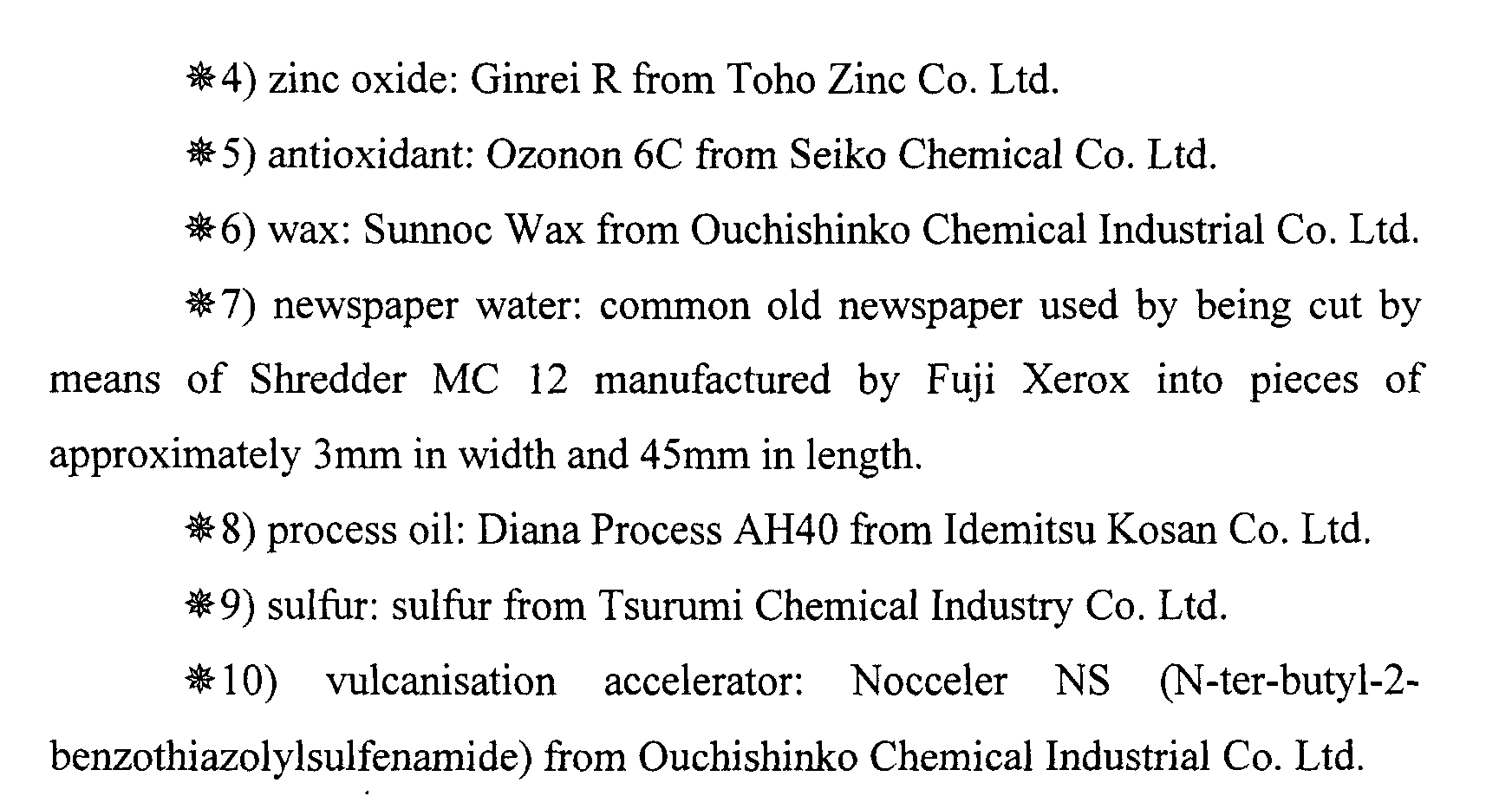
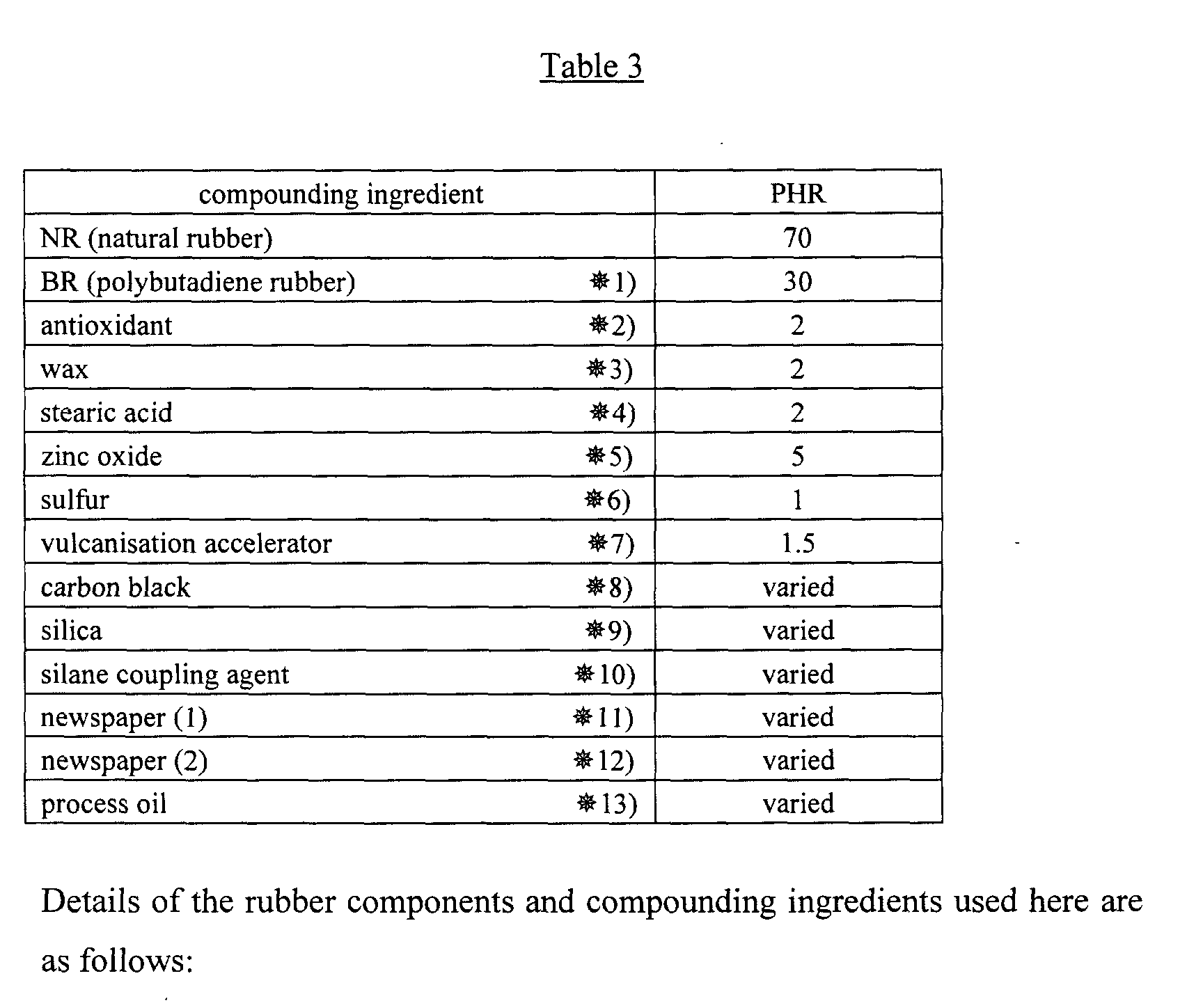
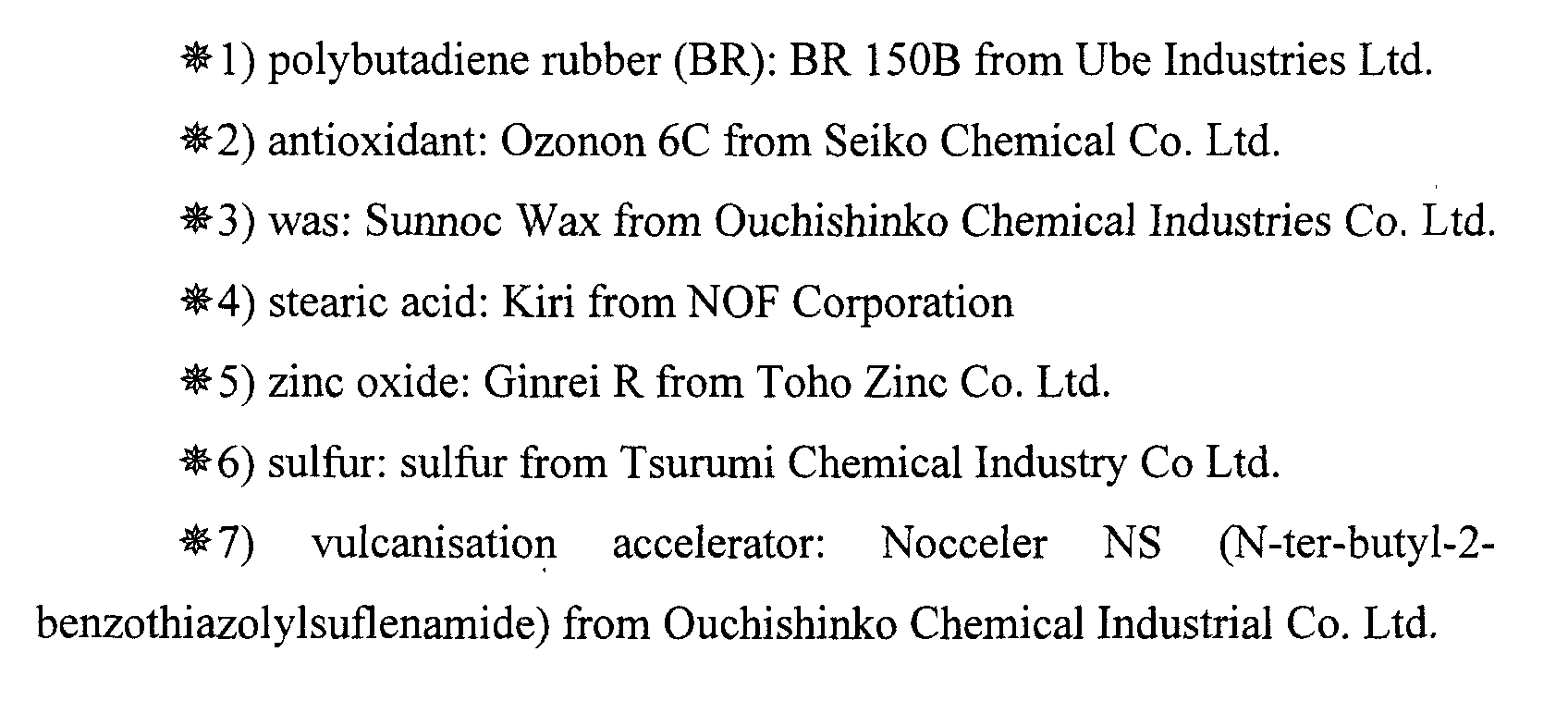
- a rubber composition having the basic composition as shown in Table 3 was used.
- rubber compositions were prepared with the amounts of silica, silane coupling agent, carbon black, newspapers and process oil varied respectively for Examples 11 to 16 and Comparative Examples 5 to 12 as shown in Table 4 and further for Examples 19 to 30 as shown in Table 5.
- Hardness (Shore A) and abrasion resistance were measure by the methods as described above and actual driving performance was tested by the following method.
- the time is indicated by means of indices with the index of Comparative Example 1 defined as 100.
- a greater numerical value of the index means that a higher cornering performance is achieved.
- a rubber composition having the basic composition as shown in Table 6 was used.
- Tyres were attached to the front wheels of a 10-ton truck and the stopping distance was measured that was required to stop the truck on an icy road running at the speed of 30 km/h.
- the distance is indicated by means of indices (ice skid index) represented by the following equation with the index of the stopping distance of Comparative Example 13 defined as 100. A greater index means a higher on-ice braking performance is achieved.
- (ice skid index) (stopping distance of Comparative Example 13) ⁇ (stopping distance of each rubber composition) x 100
- Tyres were attached to the front wheels of a 10-ton truck and the time was measured taken to tun on an icy and snowy road of a course in the shape of numerical character "8" having the total length of several hundred metres.
- the performance was evaluated by means of indices (ice grip index) represented by the following equation with the index of time for Comparative Example 13 defined as 100. A greater index means a higher steering performance is achieved.
- (ice grip index) (running time of Comparative Example 13) ⁇ (running time of each rubber composition) x 100
- a Lambourn abrasion tester was used to measure an amount of abrasion of vulcanised rubber under the conditions that the temperature was 20°C, the slip ratio was 25% and test time was 3 minutes to calculate volume loss for each rubber composition.
- the abrasion resistance is indicated by means of indices (Lambourn abrasion index) represented by the following equation with the volume loss for Comparative Example 13 defined as 100. A greater index means a superior abrasion resistance is achieved.
- (Lambourn abrasion index) (volume loss of Comparative Example 13) ⁇ (volume loss of each rubber composition) x 100
- Table 7 shows results of the evaluation described above. Examples 31 to 45 in which glass fibres, old newspapers and silica are blended therein by specific amounts respectively provide an excellent on-icy/snowy road performance. It can be understood from comparison of results between Examples 50, 32, 44 and 45 that if the amount of old newspaper is too large, the effect of enhancing the on-icy/snowy-road performance is small. Comparison of results between Examples 46, 48, and 32-34 shows that if glass fibres are compounded by too large or too small amount, merely a small effect of enhancing on on-icy-road performance is accomplished.
- a rubber composition for a tyre can be provided that effectively utilises paper as waste without deterioration in various physical properties such as hardness and abrasion resistance. Accordingly, the cost for manufacturing tyres can considerably be decreased while the tyres are reinforced in view of resource saving and environmental protection. Moreover, when the rubber composition of the present invention is used in a tread portion of a tyre, abrasion resistance as well as cornering and braking performances can remarkably be enhanced.
Landscapes
- Chemical & Material Sciences (AREA)
- Health & Medical Sciences (AREA)
- Chemical Kinetics & Catalysis (AREA)
- Medicinal Chemistry (AREA)
- Polymers & Plastics (AREA)
- Organic Chemistry (AREA)
- Engineering & Computer Science (AREA)
- Mechanical Engineering (AREA)
- Compositions Of Macromolecular Compounds (AREA)
- Tires In General (AREA)
Abstract
Description
γ-glycidoxypropyltrimethoxysilane, γ-methacryloxypropyltrimethoxysilane,
γ-(2-aminoethyl) aminopropyltrimethoxysilane,
γ-chloropropyltrimethoxysilane, γ-aminopropyltriethoxysilane and the like.

Physical properties were evaluated by the methods described below.
The rubber composition according to Example 2 had Shore A hardness of 63.0, elastic modulus E* of 5.70 (MPa), loss tangent (tanδ) of 0.122, M100 of 2.3 (MPa), M200 of 5.6 (MPa), M300 of 10.4 (MPa), and abrasion index of 89 relative to the value 100 of Comparative Example 1 discussed below.
The rubber composition according to Example 3 has Shore A hardness of 65.7, elastic modulus E* of 6.90 (MPa), loss tangent (tanδ) of 0.122, M100 of 2.7 (MPa), M200 of 6.0 (MPa), M300 of 11.0 (MPa), and abrasion index of 85 relative to the value 100 of Comparative Example 1 discussed below.
The rubber composition according to Example 5 has Shore A hardness of 71.0, elastic modulus E* of 8.10 (MPa), loss tangent (tanδ) of 0.133, M100 of 4.0 (MPa), M200 of 9.0 (MPa), M300 of 17.0 (MPa), and abrasion index of 73 relative to the value 100 of comparative Example 1 discussed below.
The rubber composition according to Comparative Example 1 had Shore A hardness of 60.8, elastic modulus E* of 4.20 (MPa), loss tangent (tanδ) of 0.125, M100 of 1.7 (MPa), M200 of 5.2 (MPa), M300 of 9.9 (MPa), and abrasion index was defined as 100 to make a relative evaluation for Comparative Example 2 and Examples 1-5.
The rubber composition according to Comparative Example 2 had Shore A hardness of 72.9, elastic modulus E* of 8.29 (MPa), loss tangent (tanδ) of 0.135, M100 of 4.3 (MPa), M200 of 9.4 (MPa), M300 of 17.9 (MPa), and abrasion index of 62 relative to the value 100 of Comparative Example 1 discussed below. Resultant measurements are shown in Table 1 above.

The rubber composition according to Example 7 had Shore A hardness of 85.6, elastic modulus E* of 19.1 (MPa), loss tangent (tanδ) of 0.202, M100 of 8 (MPa), and M200 of 15 (MPa), and exhibited cohesive failure as adhesiveness with respect to the ply.
The rubber composition according to Example 8 had Shore A hardness of 88.7, elastic modulus E* of 23.8 (MPa), loss tangent (tans) of 0.195, M100 of 8 (MPa), and M200 of 15 (MPa), and exhibited cohesive failure as adhesiveness with respect to the ply.
The rubber composition according to Example 9 had Shore A hardness of 92.0, elastic modulus E* of 25.0 (MPa), loss tangent (tanδ) of 0.191, M100 of 11 (MPa), and M200 of 20 (MPa), and exhibited cohesive failure as adhesiveness with respect to the ply.
The rubber composition according to Example 10 had Shore A hardness of 94.0, elastic modulus E* of 27.0 (MPa), loss tangent (tans) of 0.190, M100 of 14 (MPa), and M200 of 32 (MPa), and exhibited cohesive failure as adhesiveness with respect to the ply.
The rubber composition according to Comparative Example 3 had Shore A hardness of 82.0, elastic modulus E* of 16.0 (MPa), loss tangent (tans) of 0.201, M100 of 7 (MPa), and M200 of 14 (MPa), and exhibited cohesive failure as adhesiveness with respect to the ply.
The rubber composition according to Comparative Example 4 had Shore A hardness of 98.2, elastic modulus E* of 27.8 (MPa), loss tangent (tans) of 0.191, M100 of 17 (MPa), and M200 of 37 (MPa), and exhibited interfacial peeling as adhesiveness with respect to the ply.

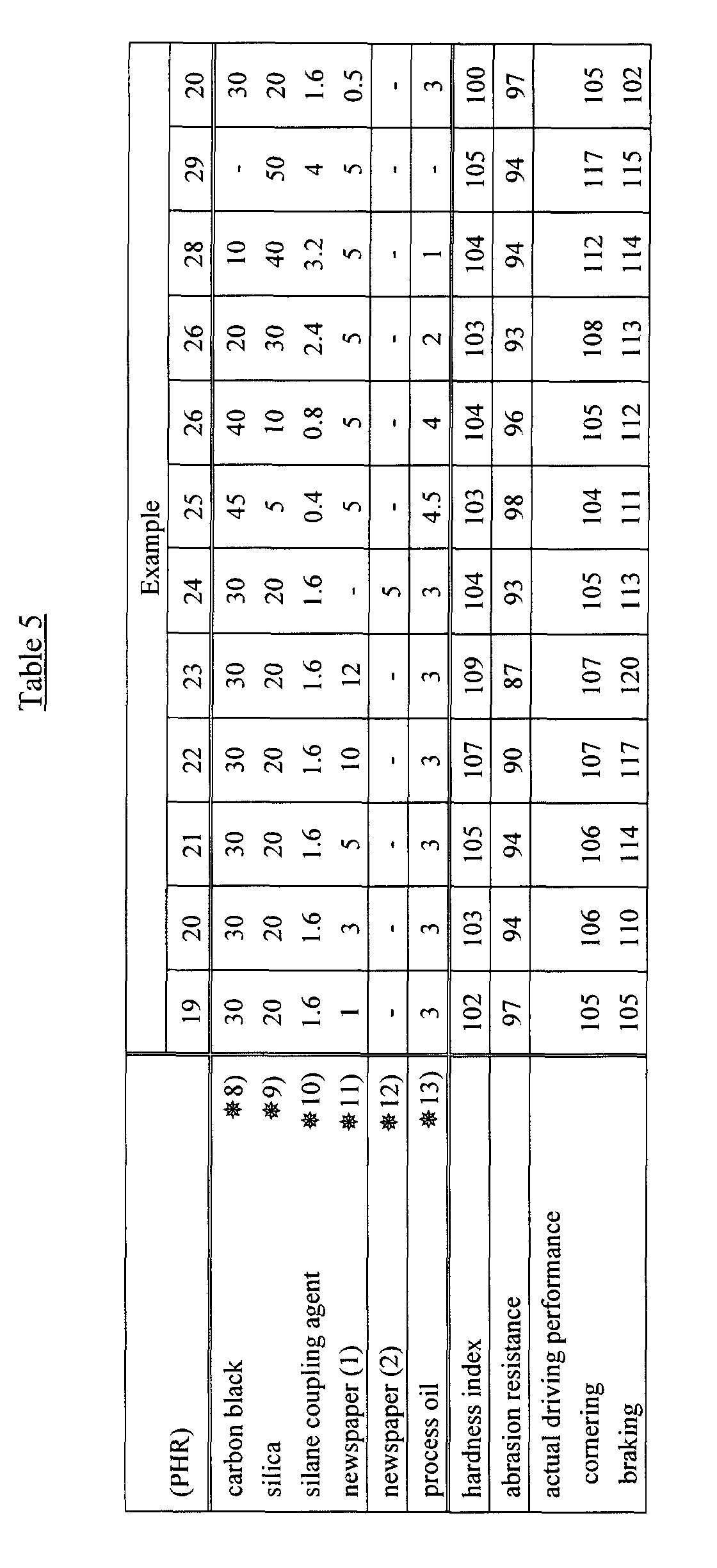
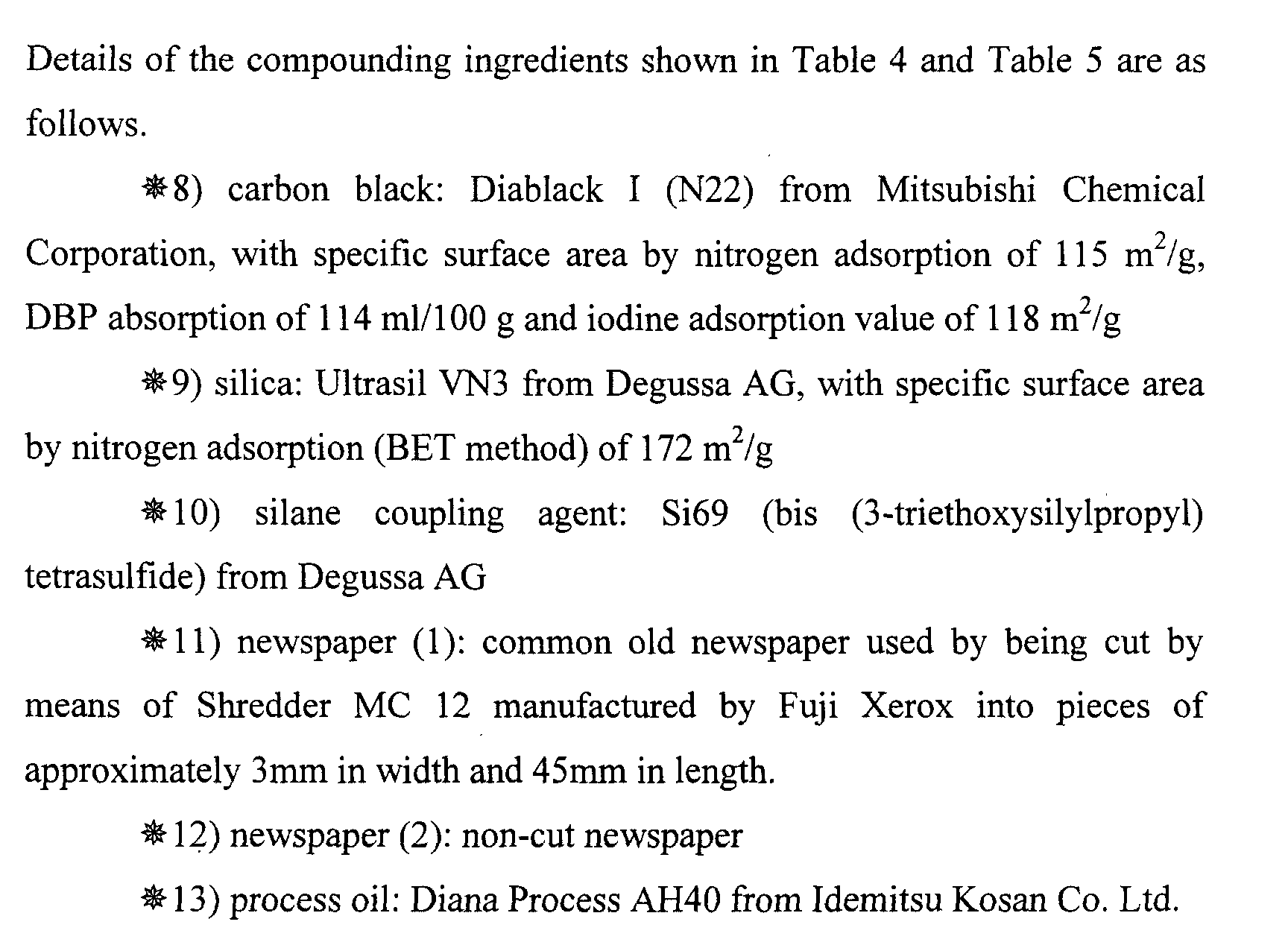
The rubber compositions of Examples 19 to 30 include predetermined amounts of silica, carbon black and used paper that are comprehensively excellent in abrasion resistance, cornering performance and braking performance. It can be seen that the rubber composition of Example 29 including no carbon black has improved cornering and braking performances without deterioration in abrasion resistance. The rubber composition of Example 24 containing non-cut used paper exhibits its performance similar to those of other rubber compositions including cut used papers. The rubber composition of Example 30 containing silica, carbon black and used paper blended therein, with the amount of compounded used paper being 0.5 parts by weight, has improved cornering and braking performances.
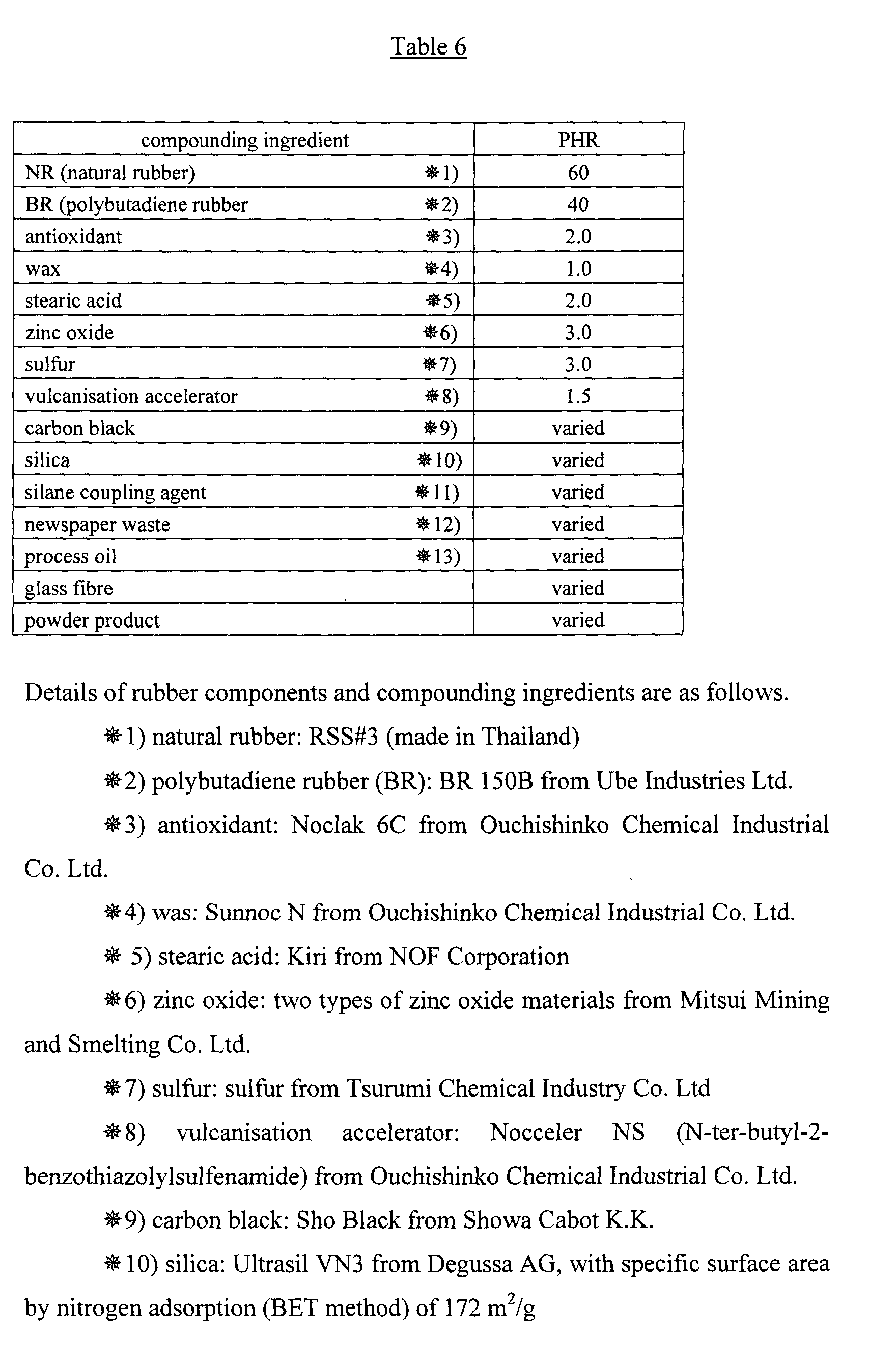


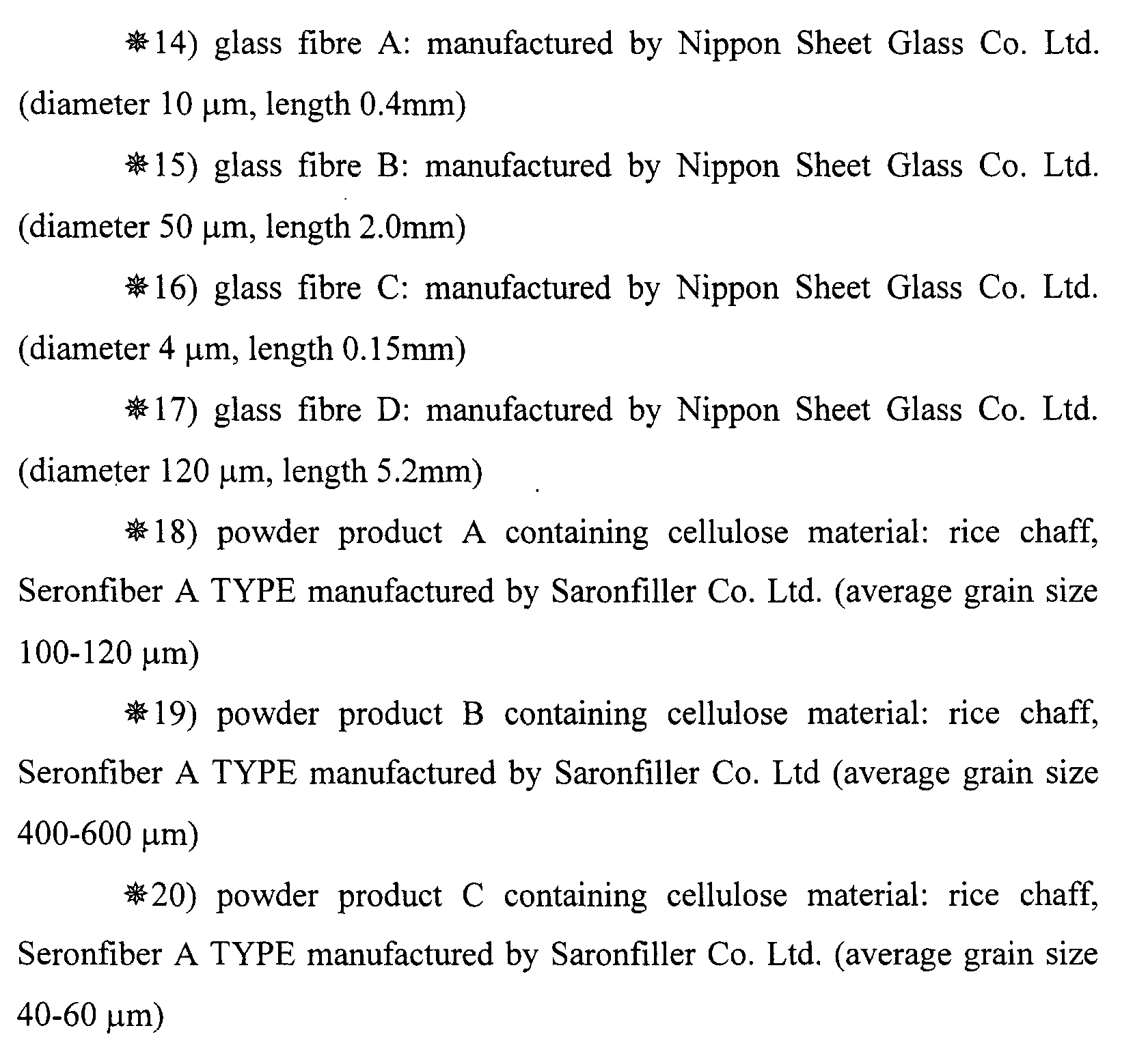
Examples 31 to 45 in which glass fibres, old newspapers and silica are blended therein by specific amounts respectively provide an excellent on-icy/snowy road performance.
It can be understood from comparison of results between Examples 50, 32, 44 and 45 that if the amount of old newspaper is too large, the effect of enhancing the on-icy/snowy-road performance is small.
Comparison of results between Examples 46, 48, and 32-34 shows that if glass fibres are compounded by too large or too small amount, merely a small effect of enhancing on on-icy-road performance is accomplished.
Further, comparison of results between Examples 47, 49, 32 and 40 shows that if silica is compounded by too large or too small amount, merely a small effect of enhancing the on-icy/snowy-road performance is accomplished.
It can be seen from comparison of results between Examples 32, 37-39 and 41 that the on-icy/snowy road performance is further enhanced by compounding powder product containing a specific amount of cellulose material.
The results described above clearly show that the rubber composition of the present invention can dramatically improve the ice grip performance by including short fibre, paper and silica compounded therein by specific amounts respectively when the composition is used in a tread for a studless tyre or the like. In addition, since used paper or paper waste is compounded, a remarkable cost-down is possible while the ice grip performance and abrasion resistance are maintained.
Claims (8)
- A rubber composition for a tyre characterised by from 0.5 to 12 parts by weight of paper relative to 100 parts by weight of a rubber component.
- A rubber composition according to claim 1, characterised in that said paper is newspaper waste.
- A rubber composition according to claim 1 or 2, characterised by 5 to 100 parts by weight of silica relative to 100 parts by weight of a rubber component.
- A rubber composition according to any of claims 1 to 3, characterised by from 10 to 100 parts by weight of carbon black relative to 100 parts by weight of the rubber component.
- A rubber composition according to claim 3 or 4 as dependant on claim 3, characterised by silane coupling agent.
- A rubber composition according to any of claims 1 to 5, characterised by from 2 to 15 parts by weight of short fibre relative to 100 parts by weight of rubber component.
- A rubber composition according to any of claims 1 to 6, characterised by from 3 to 15 parts by weight of a powder product containing a cellulose material relative to 100 parts by weight of the rubber component.
- A pneumatic tyre characterised by the rubber composition for a tyre according to any of claims 1 to 7 in a tread portion (2) and/or a bead apex (8).
Applications Claiming Priority (6)
| Application Number | Priority Date | Filing Date | Title |
|---|---|---|---|
| JP2000224798 | 2000-07-26 | ||
| JP2000224798A JP2002037929A (en) | 2000-07-26 | 2000-07-26 | Rubber composition for tire and pneumatic tire |
| JP2001028711 | 2001-02-05 | ||
| JP2001028711A JP2002226634A (en) | 2001-02-05 | 2001-02-05 | Rubber composition for tire and pneumatic tire |
| JP2001050247A JP4076729B2 (en) | 2001-02-26 | 2001-02-26 | Rubber composition for studless tire |
| JP2001050247 | 2001-02-26 |
Publications (3)
| Publication Number | Publication Date |
|---|---|
| EP1176167A2 true EP1176167A2 (en) | 2002-01-30 |
| EP1176167A3 EP1176167A3 (en) | 2003-06-18 |
| EP1176167B1 EP1176167B1 (en) | 2007-03-07 |
Family
ID=27344171
Family Applications (1)
| Application Number | Title | Priority Date | Filing Date |
|---|---|---|---|
| EP01306381A Expired - Lifetime EP1176167B1 (en) | 2000-07-26 | 2001-07-25 | Rubber composition for tyre and pneumatic tyre |
Country Status (3)
| Country | Link |
|---|---|
| US (1) | US6881770B2 (en) |
| EP (1) | EP1176167B1 (en) |
| DE (1) | DE60127044T2 (en) |
Cited By (6)
| Publication number | Priority date | Publication date | Assignee | Title |
|---|---|---|---|---|
| EP1172406B1 (en) * | 2000-07-14 | 2005-09-28 | Sumitomo Rubber Industries Ltd. | Rubber composition for tyre tread |
| EP1621578A1 (en) * | 2004-07-29 | 2006-02-01 | The Goodyear Tire & Rubber Company | Rubber composition comprising a corncob granule dispersion and tire having a component thereof |
| DE102005027747B4 (en) * | 2004-06-30 | 2008-04-24 | The Goodyear Tire & Rubber Co., Akron | A pneumatic tire with an inner liner consisting of butyl rubber and dispersion of corn cob granules |
| WO2010006889A3 (en) * | 2008-07-18 | 2010-09-23 | Basf Se | Coupling agents for filled rubbers |
| EP2883442A1 (en) * | 2002-03-21 | 2015-06-17 | Xyleco, Inc. | Compositions and Composites of Cellulosic and Lignocellulosic Materials and Resins, and Methods of Making the Same |
| EP3269759A4 (en) * | 2015-03-11 | 2018-03-28 | Bridgestone Corporation | Method for producing rubber composition for tires |
Families Citing this family (17)
| Publication number | Priority date | Publication date | Assignee | Title |
|---|---|---|---|---|
| JP4014156B2 (en) * | 2003-04-16 | 2007-11-28 | 日信工業株式会社 | Piston seal member and disc brake using the piston seal member |
| JP2006213193A (en) * | 2005-02-04 | 2006-08-17 | Sumitomo Rubber Ind Ltd | Pneumatic radial tire |
| JP4229967B2 (en) * | 2007-03-08 | 2009-02-25 | 日信工業株式会社 | Piston seal member and disc brake using the piston seal member |
| KR101461253B1 (en) * | 2007-05-15 | 2014-11-12 | 스미토모 고무 고교 가부시키가이샤 | Rubber composition for tire and pneumatic tire |
| CN101688029B (en) * | 2007-06-06 | 2013-07-31 | 住友橡胶工业株式会社 | Rubber composition for tire and pneumatic tire made with the same |
| JP4638950B2 (en) * | 2008-09-01 | 2011-02-23 | 住友ゴム工業株式会社 | Rubber composition for studless tire and studless tire |
| US20110136939A1 (en) * | 2009-12-08 | 2011-06-09 | Annette Lechtenboehmer | Tire with component containing cellulose |
| US9273195B2 (en) | 2010-06-29 | 2016-03-01 | Eastman Chemical Company | Tires comprising cellulose ester/elastomer compositions |
| US9068063B2 (en) | 2010-06-29 | 2015-06-30 | Eastman Chemical Company | Cellulose ester/elastomer compositions |
| US9708474B2 (en) | 2011-12-07 | 2017-07-18 | Eastman Chemical Company | Cellulose esters in pneumatic tires |
| WO2014066754A2 (en) * | 2012-10-26 | 2014-05-01 | E. I. Du Pont De Nemours And Company | Composite layer for reinforcement of objects such as tires or belts |
| JP5850201B2 (en) * | 2013-03-29 | 2016-02-03 | 横浜ゴム株式会社 | Heavy duty pneumatic tire |
| US20160237256A1 (en) * | 2015-02-12 | 2016-08-18 | Eastman Chemical Company | Elastomeric compositions comprising vinyl acetal polymers |
| JP6437391B2 (en) | 2015-07-07 | 2018-12-12 | 東洋ゴム工業株式会社 | Rubber composition for tire, tire and method for producing the same |
| US10077343B2 (en) | 2016-01-21 | 2018-09-18 | Eastman Chemical Company | Process to produce elastomeric compositions comprising cellulose ester additives |
| CN108129706A (en) * | 2018-01-11 | 2018-06-08 | 三角轮胎股份有限公司 | The triangular rubber core rubber composition of high-modulus low-heat-generation |
| JP7224196B2 (en) | 2019-02-01 | 2023-02-17 | 住友ゴム工業株式会社 | Rubber composition for tread and pneumatic tire |
Family Cites Families (9)
| Publication number | Priority date | Publication date | Assignee | Title |
|---|---|---|---|---|
| US3697364A (en) * | 1970-04-16 | 1972-10-10 | Monsanto Co | Discontinuous cellulose reinforced elastomer |
| US4125493A (en) * | 1977-04-01 | 1978-11-14 | The Gates Rubber Company | Fibrated admix or polymer and process therefore |
| CA1138588A (en) | 1979-07-03 | 1982-12-28 | Kabushiki Kaisha Mikuni Seisakusho | Composite material compositions using wastepaper and method of producing same |
| JP2554536B2 (en) * | 1988-03-10 | 1996-11-13 | 住友ゴム工業株式会社 | Rubber composition and tire using the same for tread |
| US5569697A (en) * | 1995-05-08 | 1996-10-29 | Uniroyal Chemical Company, Inc. | Tire tread composition |
| US5672639A (en) * | 1996-03-12 | 1997-09-30 | The Goodyear Tire & Rubber Company | Starch composite reinforced rubber composition and tire with at least one component thereof |
| US5967211A (en) * | 1997-09-24 | 1999-10-19 | The Goodyear Tire & Rubber Company | Tire tread for ice traction |
| JPH11217466A (en) | 1998-02-02 | 1999-08-10 | Yokohama Rubber Co Ltd:The | Production of reinforced rubber by using waste paper and rubber composition prepared by using same |
| JPH11255966A (en) | 1998-03-13 | 1999-09-21 | Sumitomo Rubber Ind Ltd | Rubber composition for tire tread |
-
2001
- 2001-07-25 DE DE60127044T patent/DE60127044T2/en not_active Expired - Fee Related
- 2001-07-25 EP EP01306381A patent/EP1176167B1/en not_active Expired - Lifetime
- 2001-07-25 US US09/911,734 patent/US6881770B2/en not_active Expired - Fee Related
Cited By (8)
| Publication number | Priority date | Publication date | Assignee | Title |
|---|---|---|---|---|
| EP1172406B1 (en) * | 2000-07-14 | 2005-09-28 | Sumitomo Rubber Industries Ltd. | Rubber composition for tyre tread |
| EP2883442A1 (en) * | 2002-03-21 | 2015-06-17 | Xyleco, Inc. | Compositions and Composites of Cellulosic and Lignocellulosic Materials and Resins, and Methods of Making the Same |
| DE102005027747B4 (en) * | 2004-06-30 | 2008-04-24 | The Goodyear Tire & Rubber Co., Akron | A pneumatic tire with an inner liner consisting of butyl rubber and dispersion of corn cob granules |
| EP1621578A1 (en) * | 2004-07-29 | 2006-02-01 | The Goodyear Tire & Rubber Company | Rubber composition comprising a corncob granule dispersion and tire having a component thereof |
| US7249621B2 (en) | 2004-07-29 | 2007-07-31 | The Goodyear Tire & Rubber Company | Rubber composition and tire with component of diene-based elastomer composition with corncob granule dispersion |
| CN100406507C (en) * | 2004-07-29 | 2008-07-30 | 固特异轮胎和橡胶公司 | Rubber composition and tire |
| WO2010006889A3 (en) * | 2008-07-18 | 2010-09-23 | Basf Se | Coupling agents for filled rubbers |
| EP3269759A4 (en) * | 2015-03-11 | 2018-03-28 | Bridgestone Corporation | Method for producing rubber composition for tires |
Also Published As
| Publication number | Publication date |
|---|---|
| DE60127044D1 (en) | 2007-04-19 |
| US20020037950A1 (en) | 2002-03-28 |
| EP1176167A3 (en) | 2003-06-18 |
| EP1176167B1 (en) | 2007-03-07 |
| US6881770B2 (en) | 2005-04-19 |
| DE60127044T2 (en) | 2007-08-16 |
Similar Documents
| Publication | Publication Date | Title |
|---|---|---|
| US6881770B2 (en) | Rubber composition for tire and pneumatic tire | |
| EP1688275B1 (en) | Pneumatic radial tire | |
| CA2491190C (en) | Tire with rubber tread of circumferential zones with graduated physical properties | |
| RU2472816C2 (en) | Rubber mixture for tyre and pneumatic tyre made from said mixture | |
| JP4901591B2 (en) | Rubber composition for sidewall and pneumatic tire using the same | |
| EP2379349B1 (en) | Tire for vehicle wheels provided with tread band protected against groove anomalies | |
| EP1621578A1 (en) | Rubber composition comprising a corncob granule dispersion and tire having a component thereof | |
| WO2009080144A1 (en) | Run-flat tire | |
| EP3496957B1 (en) | Pneumatic tires with low tearing base compound for tire tread | |
| JP2006089552A (en) | Rubber composition for tire and pneumatic tire | |
| JP4353915B2 (en) | Rubber composition for tire and pneumatic tire using the same | |
| JP4076729B2 (en) | Rubber composition for studless tire | |
| JP5495152B2 (en) | Pneumatic tire | |
| JP7757622B2 (en) | tire | |
| JP2010163560A (en) | Rubber composition and tire using the same | |
| JP4968732B2 (en) | Rubber composition for bead apex and pneumatic tire using the same | |
| JP4084348B2 (en) | Pneumatic radial tire | |
| EP2231422A1 (en) | Run-flat tire | |
| JP4249113B2 (en) | Rubber composition for tire and pneumatic tire | |
| JP2007112834A (en) | Rubber composition for tire and pneumatic tire using the same | |
| JP5393141B2 (en) | Rubber composition and tire using the same | |
| JP2002226634A (en) | Rubber composition for tire and pneumatic tire | |
| JP2024032595A (en) | tire | |
| JP4759150B2 (en) | tire | |
| JP4738283B2 (en) | Pneumatic tire |
Legal Events
| Date | Code | Title | Description |
|---|---|---|---|
| PUAI | Public reference made under article 153(3) epc to a published international application that has entered the european phase |
Free format text: ORIGINAL CODE: 0009012 |
|
| AK | Designated contracting states |
Kind code of ref document: A2 Designated state(s): AT BE CH CY DE DK ES FI FR GB GR IE IT LI LU MC NL PT SE TR |
|
| AX | Request for extension of the european patent |
Free format text: AL;LT;LV;MK;RO;SI |
|
| PUAL | Search report despatched |
Free format text: ORIGINAL CODE: 0009013 |
|
| AK | Designated contracting states |
Designated state(s): AT BE CH CY DE DK ES FI FR GB GR IE IT LI LU MC NL PT SE TR |
|
| AX | Request for extension of the european patent |
Extension state: AL LT LV MK RO SI |
|
| 17P | Request for examination filed |
Effective date: 20030711 |
|
| AKX | Designation fees paid |
Designated state(s): DE FR GB |
|
| 17Q | First examination report despatched |
Effective date: 20041129 |
|
| GRAP | Despatch of communication of intention to grant a patent |
Free format text: ORIGINAL CODE: EPIDOSNIGR1 |
|
| GRAS | Grant fee paid |
Free format text: ORIGINAL CODE: EPIDOSNIGR3 |
|
| GRAA | (expected) grant |
Free format text: ORIGINAL CODE: 0009210 |
|
| AK | Designated contracting states |
Kind code of ref document: B1 Designated state(s): DE FR GB |
|
| REG | Reference to a national code |
Ref country code: GB Ref legal event code: FG4D |
|
| REF | Corresponds to: |
Ref document number: 60127044 Country of ref document: DE Date of ref document: 20070419 Kind code of ref document: P |
|
| ET | Fr: translation filed | ||
| PGFP | Annual fee paid to national office [announced via postgrant information from national office to epo] |
Ref country code: GB Payment date: 20070720 Year of fee payment: 7 |
|
| PLBE | No opposition filed within time limit |
Free format text: ORIGINAL CODE: 0009261 |
|
| STAA | Information on the status of an ep patent application or granted ep patent |
Free format text: STATUS: NO OPPOSITION FILED WITHIN TIME LIMIT |
|
| PGFP | Annual fee paid to national office [announced via postgrant information from national office to epo] |
Ref country code: DE Payment date: 20070928 Year of fee payment: 7 |
|
| 26N | No opposition filed |
Effective date: 20071210 |
|
| PGFP | Annual fee paid to national office [announced via postgrant information from national office to epo] |
Ref country code: FR Payment date: 20070710 Year of fee payment: 7 |
|
| GBPC | Gb: european patent ceased through non-payment of renewal fee |
Effective date: 20080725 |
|
| PG25 | Lapsed in a contracting state [announced via postgrant information from national office to epo] |
Ref country code: DE Free format text: LAPSE BECAUSE OF NON-PAYMENT OF DUE FEES Effective date: 20090203 |
|
| REG | Reference to a national code |
Ref country code: FR Ref legal event code: ST Effective date: 20090331 |
|
| PG25 | Lapsed in a contracting state [announced via postgrant information from national office to epo] |
Ref country code: GB Free format text: LAPSE BECAUSE OF NON-PAYMENT OF DUE FEES Effective date: 20080725 |
|
| PG25 | Lapsed in a contracting state [announced via postgrant information from national office to epo] |
Ref country code: FR Free format text: LAPSE BECAUSE OF NON-PAYMENT OF DUE FEES Effective date: 20080731 |