EP1174732A2 - Acoustical proximity detection for mobile terminals and other devices - Google Patents
Acoustical proximity detection for mobile terminals and other devices Download PDFInfo
- Publication number
- EP1174732A2 EP1174732A2 EP01305615A EP01305615A EP1174732A2 EP 1174732 A2 EP1174732 A2 EP 1174732A2 EP 01305615 A EP01305615 A EP 01305615A EP 01305615 A EP01305615 A EP 01305615A EP 1174732 A2 EP1174732 A2 EP 1174732A2
- Authority
- EP
- European Patent Office
- Prior art keywords
- determining
- measurement signal
- mobile telephone
- signal
- proximity
- Prior art date
- Legal status (The legal status is an assumption and is not a legal conclusion. Google has not performed a legal analysis and makes no representation as to the accuracy of the status listed.)
- Granted
Links
Images


Classifications
-
- G—PHYSICS
- G01—MEASURING; TESTING
- G01S—RADIO DIRECTION-FINDING; RADIO NAVIGATION; DETERMINING DISTANCE OR VELOCITY BY USE OF RADIO WAVES; LOCATING OR PRESENCE-DETECTING BY USE OF THE REFLECTION OR RERADIATION OF RADIO WAVES; ANALOGOUS ARRANGEMENTS USING OTHER WAVES
- G01S15/00—Systems using the reflection or reradiation of acoustic waves, e.g. sonar systems
- G01S15/88—Sonar systems specially adapted for specific applications
-
- G—PHYSICS
- G01—MEASURING; TESTING
- G01S—RADIO DIRECTION-FINDING; RADIO NAVIGATION; DETERMINING DISTANCE OR VELOCITY BY USE OF RADIO WAVES; LOCATING OR PRESENCE-DETECTING BY USE OF THE REFLECTION OR RERADIATION OF RADIO WAVES; ANALOGOUS ARRANGEMENTS USING OTHER WAVES
- G01S15/00—Systems using the reflection or reradiation of acoustic waves, e.g. sonar systems
- G01S15/02—Systems using the reflection or reradiation of acoustic waves, e.g. sonar systems using reflection of acoustic waves
- G01S15/04—Systems determining presence of a target
-
- G—PHYSICS
- G01—MEASURING; TESTING
- G01S—RADIO DIRECTION-FINDING; RADIO NAVIGATION; DETERMINING DISTANCE OR VELOCITY BY USE OF RADIO WAVES; LOCATING OR PRESENCE-DETECTING BY USE OF THE REFLECTION OR RERADIATION OF RADIO WAVES; ANALOGOUS ARRANGEMENTS USING OTHER WAVES
- G01S15/00—Systems using the reflection or reradiation of acoustic waves, e.g. sonar systems
- G01S15/02—Systems using the reflection or reradiation of acoustic waves, e.g. sonar systems using reflection of acoustic waves
- G01S15/06—Systems determining the position data of a target
- G01S15/08—Systems for measuring distance only
- G01S15/10—Systems for measuring distance only using transmission of interrupted, pulse-modulated waves
- G01S15/102—Systems for measuring distance only using transmission of interrupted, pulse-modulated waves using transmission of pulses having some particular characteristics
-
- G—PHYSICS
- G01—MEASURING; TESTING
- G01S—RADIO DIRECTION-FINDING; RADIO NAVIGATION; DETERMINING DISTANCE OR VELOCITY BY USE OF RADIO WAVES; LOCATING OR PRESENCE-DETECTING BY USE OF THE REFLECTION OR RERADIATION OF RADIO WAVES; ANALOGOUS ARRANGEMENTS USING OTHER WAVES
- G01S7/00—Details of systems according to groups G01S13/00, G01S15/00, G01S17/00
- G01S7/52—Details of systems according to groups G01S13/00, G01S15/00, G01S17/00 of systems according to group G01S15/00
- G01S7/523—Details of pulse systems
- G01S7/526—Receivers
- G01S7/527—Extracting wanted echo signals
-
- H—ELECTRICITY
- H04—ELECTRIC COMMUNICATION TECHNIQUE
- H04M—TELEPHONIC COMMUNICATION
- H04M1/00—Substation equipment, e.g. for use by subscribers
- H04M1/60—Substation equipment, e.g. for use by subscribers including speech amplifiers
- H04M1/6033—Substation equipment, e.g. for use by subscribers including speech amplifiers for providing handsfree use or a loudspeaker mode in telephone sets
- H04M1/6041—Portable telephones adapted for handsfree use
- H04M1/605—Portable telephones adapted for handsfree use involving control of the receiver volume to provide a dual operational mode at close or far distance from the user
-
- G—PHYSICS
- G01—MEASURING; TESTING
- G01S—RADIO DIRECTION-FINDING; RADIO NAVIGATION; DETERMINING DISTANCE OR VELOCITY BY USE OF RADIO WAVES; LOCATING OR PRESENCE-DETECTING BY USE OF THE REFLECTION OR RERADIATION OF RADIO WAVES; ANALOGOUS ARRANGEMENTS USING OTHER WAVES
- G01S7/00—Details of systems according to groups G01S13/00, G01S15/00, G01S17/00
- G01S7/52—Details of systems according to groups G01S13/00, G01S15/00, G01S17/00 of systems according to group G01S15/00
- G01S7/523—Details of pulse systems
- G01S7/526—Receivers
- G01S7/53—Means for transforming coordinates or for evaluating data, e.g. using computers
- G01S7/533—Data rate converters
Definitions
- This invention relates generally to devices, such as mobile terminals, radiotelephones and cellular telephones and, in particular, to techniques for sensing the proximity of a user to the device.
- proximity sensors There are many kinds of proximity sensors which are used, for example, as limit switches in various kinds of equipment, or to detect motion of objects relative to each other, as well as for other types of control purposes.
- these sensors are based on photoelectric, ultrasonic or capacitive principles.
- One example of the use of the proximity detection is related to telephones, in particular (but not exclusively) radiotelephones, such as cellular telephones and personal communicators.
- Afeature known as Integrated HandsFree (IHF) makes it possible to use the phone without holding it on the ear or in the hand.
- IHF Integrated HandsFree
- the sound pressures produced by the earpiece capsule (which may be thought of as a miniature audio speaker) should be much louder to make far-end speech audible to longer distances.
- the phone is used on the ear, the sound pressures should be in a normal range. The problem then is how to detect and switch between these two modes.
- Proximity detection solves this problem by detecting when the phone is leaving or approaching the ear. According to this detection information the correct level or processing for the earpiece capsule can be selected. Thus, the proximity detection can make the IHF feature fully automatic.
- Proximity sensors can be classified into several major types related to the specific properties used to initiate a controlling action. These include the following: field-based, photoelectric and ultrasonic sensors. Furthermore, there are two types of sensors that use field-based detection methods: inductive and capacitive sensors.
- the photoelectric principle is the most widely used, while the capacitive is the second most widely used for proximity detection purposes.
- Ultrasounds are used mainly for accurate range detection, and not for simple proximity detection.
- proximity sensor In a typical case where there is a need for proximity detection, some type of proximity sensor is required to be installed in the device. However, this involves adding cost, weight, complexity and, typically, an additional power drain to the device.
- the teachings of this invention provide a method and a system which can be used to detect objects and, more generally, environmental changes near a device, such as a mobile telephone, within which the method and system are embodied.
- the detection information can be used to determine whether there are objects near the device, or if the device has a certain orientation relative its environment, and/or if the device is approaching or leaving a certain orientation.
- the proximity detection method and system are based on an acoustic principle.
- audio transducers already found in the device to realize the proximity detection function, along with digital signal processing or equivalent means.
- the audio transducers employed by the invention are preferably those designed for use with human hearing and speaking capabilities in the range of about 20Hz to about 20kHz, and need not be specially designed transducers, such as transducers designed for ultrasonic applications above 20kHz.
- the invention can utilize the sound transducers that are already used in the device for speech transmission (output speech and input speech) or for some other purpose. Thus, there is no need for additional sensor elements.
- the device can provide digital processing means, such as A/D and D/A converters and a signal processor, the device can be constructed to include the proximity detection function without requiring any additional hardware components. Only a suitable operating program is required to implement the proximity detection function in accordance with these teachings.
- the proximity sensing can be done in parallel with the ordinary use of transducers. In this case the transducers are in use already, and the additional power required to implement the proximity sensing function is minimal.
- the resulting sensing result is that there is an object in close proximity.
- the sensing is used with the IHF function, the phone remains in the handset mode and there is no possibility that high sound pressures will be generated near the user's ear. If the earpiece sensor element fails, then there is clearly no possibility to generate excessive sound pressure near the user's ear. Further, the sensing algorithm can detect if one of the sensors have failed.
- the method is based on a measurement signal that drives the acoustical transducer in the application device.
- the other transducer in the application device monitors the measurement signal. Any objects near the device alter the measurement signal in a certain way, and these alterations indicate if there are objects near or on the device.
- the method includes steps of generating a measurement signal; driving an output acoustic transducer of the device with the measurement signal; monitoring an input acoustic transducer of the device to detect the measurement signal; and determining that an object is in proximity to the device based on a detected alteration of the measurement signal.
- the device may comprise a mobile telephone, such as a cellular telephone, or a personal communicator.
- the step of determining can be used to verify that a handsfree mode of operation can be entered, and/or to set a volume of a signal driving a speaker, and/or to select, modify, or tune an audio processing technique.
- the step of determining can also be used to automatically enter a handset mode of operation from a handsfree mode of operation.
- the steps of monitoring and determining include steps of operating plural adaptive filters in parallel on the same input signal, with different step sizes, for generating first and second impulse response estimates, respectively, and comparing a difference between the first and second impulse response estimates to a threshold.
- a monitoring unit and a determining unit include a decimator for decimating a measurement signal received from a microphone; an anti-comb filter for enhancing the signal to noise ratio (SNR) of the received measurement signal; first and second adaptive filters operated in parallel on the filtered measurement signal, with different step sizes, for generating first and second impulse response estimates, respectively; and a comparator for comparing a difference between the first and the second impulse response estimates to a threshold.
- SNR signal to noise ratio
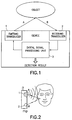
- Fig. 1 illustrates the acoustic-based proximity detection system at a general level.
- a measurement signal (A) is fed through a sound emitting transducer 1.
- a sound receiving transducer 2 is used to measure or monitor the response of the measurement signal (B). If there are any objects near the application device, the measurement signal (A) is reflected from the object back to the application device and to the receiving transducer 2. If there are no objects in close proximity, there are no reflections. The lack of or existence of the reflections is detected from the response signal (B) measured by the receiving transducer 2.
- a signal processing unit 3 generates the measurement signal (A) and the response signal (B) is fed to it. Finally, utilizing both of the signals (A, B) the signal processing unit 3 calculates the proximity detection result.
- Fig. 2 illustrates an example of the detection method in a mobile phone (MP),
- the microphone and the earpiece capsule of the phone are used as the sound emitting transducer 1 and the sound receiving transducer 2, respectively.
- the presently preferred embodiment is based on adaptive filtering.
- the adaptive filter models the impulse response between the emitting transducer 1 and the receiving transducer 2 utilizing both the measurement signal (A) and its response signal (B).
- a new impulse response estimate is calculated for each new sample obtained from the receiving transducer 2.
- the update rate of the detection depends on the sampling frequency.
- pattern recognition algorithms can be used to classify these impulse response estimates into two categories, for example, an object present and an object not present. This information is then used for control purposes (e.g., to control the level of sound that is generated by the earpiece transducer).
- Fig. 3 illustrates a simplified example of a system which utilizes the above described acoustic proximity detection method in the mobile phone.
- the system operates as follows:
- Fig. 4 is a block diagram of a presently preferred embodiment of the proximity sensing signal processing unit 3.
- the illustrated circuitry is assumed for this discussion to be embodied in a mobile phone, although other types of devices can benefit from these teachings as well.
- the sound emitting transducer 1 of Fig. 1 is preferably embodied as the already present earpiece capsule or speaker 10, while the sound receiving transducer 2 of Fig. 1 is preferably embodied as the already present microphone 12. While the use of these already present components is preferred, in some applications it may be desirable to provide a speaker and/or a microphone that is dedicated to the proximity detection function.
- Driving the speaker 10 is a measurement signal generator 14 for the 40kHz sampling frequency.
- An analog signal generator can be used, although it is preferred to employ digital techniques wherein (8kHz case) an odd-perfect bit sequence of length 8 (0, 1, 1, -1, 1, 1, 1, -1) forms a first part of the period, and a second part of the period is formed by changing the sign (0, -1, -1, 1, -1, -1, -1, 1). The period is then repeated. Because of the periodicity of this signal, the interpolation to 40kHz can be done off-line, and only one sequence of the interpolated signal is needed to generate the 40kHz signal. Thus, the measurement signal output from block 14 is generated by fetching the sequence of length 40 from memory, and only the sign needs be changed from sequence to sequence.
- the output of the microphone 12 is coupled to a decimator 16 which lowers the sampling frequency from 40kHz to 8kHz. After decimation, all signal processing is performed at the 8kHz sampling frequency.
- an anti-comb filter 18 is used to filter the decimated microphone signal. Anti-comb filtering is preferred as it enhances the signal to noise ratio (SNR). The enhancement effect is achieved since the power spectrum of the measurement signal is composed of regularly spaced peaks. During filtering, only the peaks remain intact, and all other frequencies are attenuated.
- Fig. 5A depicts in greater detail a preferred embodiment of the anti-comb filter 18, where the L, a and b coefficients define the filter response.
- An 8kHz measurement generator 20 provides a reference signal for two adaptive filters 22 and 24.
- the adaptive filters 22 and 24 are preferably LMS-type filters, although other types might be used in other applications.
- the downlink speech signal is used as the measurement signal. This measurement is done during the handset mode of operation and the proximity is determined from the impulse response power, not from the shape, as described in more detail below. In this mode the measurement signal generators 14 and 20 are not required, the downlink speech is delivered from the speaker 10 in a normal fashion, but an 8kHz version of the downlink speech is provided via S 1.
- the LMS adaptive filter 22 also referred to as a monitoring filter, performs impulse response estimation, wherein the adaptive LMS filter coefficients can be considered as the impulse response taps.
- a total of eight taps have been found to be sufficient to detect changes that occur in the environment close to the phone.
- Filter 22 performs the actual measuring, that is, it functions to monitor rapid changes near the phone. Since speed is of importance, relatively large step sizes are used.
- a delay line function feeds an internal LMS filter delay line with the reference signal, which can be the output of the 8kHz measurement signal generator 20, or the downlink speech signal, as discussed above.
- the desired response signal i.e., the signal which the adaptive filter 22 attempts to estimate by filtering the reference signal, is the processed microphone 12 signal after decimation or anti-comb filtering.
- the anti-comb filtering function 18' is not used when the downlink speech signal is used.
- new filter coefficients W1 are generated at each sampling instant. These coefficients are then compared in difference block 26 (after scaling in block 22A) to the (scaled) coefficients (W2) that represent the handsfree situation.
- the second (modelling) LMS adaptive filter 24 functions to update the handsfree impulse response model and, as such, operates only in the handsfree situation.
- the handsfree impulse response has been found to be relatively stable, although it may drift between various handsfree situations, as well as during the same handsfree situation.
- the step size is made relatively small (relative to the monitoring LMS filter 22). This is preferably accomplished by operating the LMS filter 24 with 32-bit accuracy, and the LMS filter 22 with 16-bit accuracy. Note that both filters 22 and 24 use the same input signals, and that only the computational accuracy is made different to allow for the difference in step size.
- both the monitoring LMS adaptive filter 22 and the modelling LMS adaptive filter 24 are active, and their respective coefficients W1 and W2 are compared in difference block 26. Since the monitoring LMS adaptive filter 22 responds to rapid changes, while the modelling LMS adaptive filter does not, there will be a difference between their coefficients when some object comes near to the phone or, more precisely, to the earpiece. When this happens, the phone is switched to the handset mode.
- the scaling blocks 22A and 24A are used to scale or normalize the impulse response estimates provided by the monitoring LMS adaptive filter 22 and the modelling LMS adaptive filter 24, respectively. After scaling the sum of the impulse response coefficients is one, and the original sum, before scaling, is stored into an additional (ninth) coefficient. In addition, both of the scaled responses are represented with 16-bit accuracy.
- the scaling is performed in order to remove the effect of power or gain changes on the impulse response path. As such, after scaling only the shape or model of the impulse response affects the comparison result performed by block 26. The result is that the comparison is more robust against background noise and any gain changes. However, if the power information should be required for some purpose, as described below, it is conveniently available as the ninth coefficient of the responses.
- the difference block 26 computes the difference of the scaled impulse response estimates. Simply, each of the corresponding coefficients are subtracted from one another and the absolute values of the differences are summed together to form a single measure of the similarity of the two response estimates. As long as the result is zero or close to zero, the phone remains in the handsfree mode. However, as soon as the difference deviates from zero by more than some threshold amount, the phone is switched to the handset mode.
- the phone will be in a default, handset mode. Since the handsfree activation is normally commanded by the user, such as by pressing a button, the proximity detection function is not required to be activated until the handsfree made is indicated. However, since information as to whether the phone is on the user's ear, or some millimeters away, may be useful for other functions in the phone, the proximity detection circuitry can be used as well in the handset mode. It is in this case that the downlink speech signal can be used instead of the generated frequency signals. Since the speech is the measurement signal, bandpass filtering is used in the decimation block 16 and the anti-comb filtering block 18 is bypassed.
- the LMS adaptive filter 22 is used to estimate the impulse response and the relevant proximity measure, the impulse response power, is obtained as the above-mentioned ninth coefficient of the of the resulting W1 vector. If the power measure is larger than some threshold, the phone is assumed to be on the ear, otherwise it is assumed that the phone is not on the ear.
- the scaling block 22A outputs a current impulse response estimate W1, which is compared to a stored handsfree model W2 in the difference block 26. If the difference is larger than some threshold, the phone is assumed to be on the ear, otherwise the phone is assumed to not be on the ear.
- the handsfree verification mode Before transitioning from the handset mode to the handsfree mode it is preferred to first transition through a handsfree verification mode where the phone actually verifies that the phone is not on the user's ear.
- the handsfree verification mode it is preferred to use, for robustness, the impulse response power measurement method that was described above.
- the impulse response power does not behave consistently according to the handset and handsfree situations.
- switching between the handset and the handsfree modes can involve more than simply adjusting the volume of the audio signal output from the speaker 10.
- any number of audio enhancement signal processing techniques or algorithms can be selected, or modified, or tuned depending on whether the handset or the handsfree mode is currently in effect.
- teachings of this invention are not limited for use in only mobile telephones, such as cellular telephones and personal communicators, but may be used in other devices and applications as well.
Landscapes
- Engineering & Computer Science (AREA)
- Radar, Positioning & Navigation (AREA)
- Remote Sensing (AREA)
- Physics & Mathematics (AREA)
- Computer Networks & Wireless Communication (AREA)
- General Physics & Mathematics (AREA)
- Acoustics & Sound (AREA)
- Signal Processing (AREA)
- Telephone Function (AREA)
- Mobile Radio Communication Systems (AREA)
- Measurement Of Velocity Or Position Using Acoustic Or Ultrasonic Waves (AREA)
Abstract
Description
Claims (16)
- A method for detecting if an object is in proximity to a device, comprising steps of:generating a measurement signal;driving an output acoustic transducer of the device with the measurement signal;monitoring an input acoustic transducer of the device to detect the measurement signal; anddetermining that an object is in proximity to the device based on a detected alteration of the measurement signal.
- A method as in claim 1, wherein the device comprises a mobile telephone.
- A method as in claim 1, wherein the device comprises a personal communicator.
- A method as in claim 1, wherein the device comprises a mobile telephone, and wherein the step of determining is used to verify that a handsfree mode of operation can be entered.
- A method as in claim 1, wherein the device comprises a mobile telephone, and wherein the step of determining is used to set a volume of a signal driving a speaker.
- A method as in claim 1, wherein the device comprises a mobile telephone, and wherein the step of determining is used to select, modify, or tune an audio processing technique.
- A method as in claim 1, wherein the device comprises a mobile telephone, and wherein the step of determining is used to automatically enter a handset mode of operation from a handsfree mode of operation.
- A method as in claim 1, wherein the steps of monitoring and determining comprise steps of operating plural adaptive filters in parallel on the same input data, with different step sizes, for generating first and second impulse response estimates, respectively, and comparing a difference between the first and second impulse response estimates to a threshold.
- A device comprising an output acoustic transducer and an input acoustic transducer, said device further comprising a unit for detecting if an object is in proximity to the device, comprising:a measurement signal generator for driving said output acoustic transducer of said device;means for monitoring said input acoustic transducer of said device to detect the measurement signal; andmeans for determining that an object is in proximity to said device based on a detected alteration of the measurement signal.
- A device as in claim 9, wherein the device comprises a mobile telephone.
- A device as in claim 9, wherein the device comprises a personal communicator.
- A device as in claim 9, wherein the device comprises a mobile telephone, and wherein said means for determining is used to verify that a handsfree mode of operation can be entered.
- A device as in claim 9, wherein the device comprises a mobile telephone, and wherein said means for determining is used to set a volume of a signal driving a speaker.
- A device as in claim 9, wherein the device comprises a mobile telephone, and wherein said means for determining is used to select, modify, or tune an audio processing technique.
- A device as in claim 9, wherein the device comprises a mobile telephone, and wherein said means for determining is used to automatically enter a handset mode of operation from a handsfree mode of operation.
- A device as in claim 9, wherein said means for monitoring and said means for determining comprise:a decimator for decimating a measurement signal received from a microphone;an anti-comb filter for enhancing the signal to noise ratio (SNR) of the received measurement signal;first and second adaptive filters operated in parallel on the filtered measurement signal, with different step sizes, for generating first and second impulse response estimates, respectively; anda comparator for comparing a difference between the first and second impulse response estimates to a threshold.
Applications Claiming Priority (2)
| Application Number | Priority Date | Filing Date | Title |
|---|---|---|---|
| US09/608,090 US6542436B1 (en) | 2000-06-30 | 2000-06-30 | Acoustical proximity detection for mobile terminals and other devices |
| US608090 | 2000-06-30 |
Publications (3)
| Publication Number | Publication Date |
|---|---|
| EP1174732A2 true EP1174732A2 (en) | 2002-01-23 |
| EP1174732A3 EP1174732A3 (en) | 2002-12-11 |
| EP1174732B1 EP1174732B1 (en) | 2007-01-10 |
Family
ID=24434985
Family Applications (1)
| Application Number | Title | Priority Date | Filing Date |
|---|---|---|---|
| EP01305615A Expired - Lifetime EP1174732B1 (en) | 2000-06-30 | 2001-06-28 | Acoustical proximity detection for mobile terminals and other devices |
Country Status (6)
| Country | Link |
|---|---|
| US (1) | US6542436B1 (en) |
| EP (1) | EP1174732B1 (en) |
| JP (1) | JP2002111852A (en) |
| CN (1) | CN1197422C (en) |
| DE (1) | DE60125874T2 (en) |
| HK (1) | HK1043467A1 (en) |
Cited By (21)
| Publication number | Priority date | Publication date | Assignee | Title |
|---|---|---|---|---|
| DE10208096A1 (en) * | 2001-08-27 | 2003-04-10 | Siemens Ag | Mobile telephone for controlling call signal volume/hands-free functions with a microphone and a loudspeaker measures acoustic distance between the loudspeaker and an obstruction. |
| FR2838893A1 (en) * | 2002-04-23 | 2003-10-24 | Nec Technologies Uk Ltd | Hand-held to hands-free communication terminal switching procedure adjusts loudspeaker volume using time delay based distance estimate |
| DE10230898A1 (en) * | 2002-07-09 | 2004-01-22 | Siemens Ag | Operating communications terminal with acoustic output device involves producing protective sound signal with minimal loudness at minimum distance in addition to acoustic useful data in second mode |
| GB2366932B (en) * | 2000-09-07 | 2004-08-25 | Mitel Corp | Ultrasonic proximity detector for a telephone device |
| DE102005007683A1 (en) * | 2005-02-19 | 2006-08-31 | Deutsche Telekom Ag | Telecommunication subscriber identification or identification supporting method for bank, involves carrying out identification of subscriber or supporting identification of subscriber based on evaluation of received signals |
| EP1496670A4 (en) * | 2002-04-10 | 2007-01-31 | Matsushita Electric Industrial Co Ltd | Speech control device and speech control method |
| EP1552608A4 (en) * | 2002-07-26 | 2007-06-06 | Motorola Inc | Electrical impedance based audio compensation in audio devices and methods therefor |
| DE10247525B4 (en) * | 2002-10-11 | 2010-12-16 | Palm, Inc. (n.d.Ges. d. Staates Delaware), Sunnyvale | Portable communication device |
| EP2271129A1 (en) * | 2009-07-02 | 2011-01-05 | Nxp B.V. | Transducer with resonant cavity |
| EP2278356A1 (en) * | 2009-07-02 | 2011-01-26 | Nxp B.V. | Apparatus and method for detecting usage profiles of mobile devices |
| WO2012045724A1 (en) | 2010-10-04 | 2012-04-12 | Ident Technology Ag | Electrode configuration, hand-held device as well as method for the detection of a touch of a hand-held device |
| WO2012063104A1 (en) * | 2010-11-12 | 2012-05-18 | Nokia Corporation | Proximity detecting apparatus and method based on audio signals |
| EP2582045A1 (en) * | 2011-10-13 | 2013-04-17 | Research In Motion Limited | Proximity sensing for user detection and automatic volume regulation with sensor interruption override |
| WO2014143448A1 (en) * | 2013-03-12 | 2014-09-18 | Motorola Mobility Llc | Method and apparatus for acoustically characterizing an environment in which an electronic device resides |
| US8848932B2 (en) | 2011-10-13 | 2014-09-30 | Blackberry Limited | Proximity sensing for user detection and automatic volume regulation with sensor interruption override |
| EP2814263A1 (en) * | 2013-06-14 | 2014-12-17 | BlackBerry Limited | Obstructed port audio signal alteration |
| US20140369512A1 (en) * | 2013-06-14 | 2014-12-18 | Research In Motion Limited | Obstructed port audio signal alteration |
| US9401749B2 (en) | 2013-03-08 | 2016-07-26 | Google Technology Holdings LLC | Method for codebook enhancement for multi-user multiple-input multiple-output systems |
| GB2558768A (en) * | 2016-11-28 | 2018-07-18 | Elliptic Laboratories As | Proximity detection |
| CN112291689A (en) * | 2020-11-27 | 2021-01-29 | 歌尔光学科技有限公司 | Sound playback method, wearable device and readable storage medium |
| NO20211333A1 (en) * | 2021-11-05 | 2023-05-08 | Elliptic Laboratories As | Person or object detection |
Families Citing this family (89)
| Publication number | Priority date | Publication date | Assignee | Title |
|---|---|---|---|---|
| US9189069B2 (en) | 2000-07-17 | 2015-11-17 | Microsoft Technology Licensing, Llc | Throwing gestures for mobile devices |
| US8120625B2 (en) * | 2000-07-17 | 2012-02-21 | Microsoft Corporation | Method and apparatus using multiple sensors in a device with a display |
| US7289102B2 (en) * | 2000-07-17 | 2007-10-30 | Microsoft Corporation | Method and apparatus using multiple sensors in a device with a display |
| US7302280B2 (en) * | 2000-07-17 | 2007-11-27 | Microsoft Corporation | Mobile phone operation based upon context sensing |
| SE518418C2 (en) * | 2000-12-28 | 2002-10-08 | Ericsson Telefon Ab L M | Sound-based proximity detector |
| US6952672B2 (en) * | 2001-04-25 | 2005-10-04 | International Business Machines Corporation | Audio source position detection and audio adjustment |
| US7159194B2 (en) * | 2001-11-30 | 2007-01-02 | Palm, Inc. | Orientation dependent functionality of an electronic device |
| GB2389254B (en) * | 2002-05-31 | 2005-09-07 | Hitachi Ltd | Semiconductor integrated circuit device for communication |
| US7184025B2 (en) * | 2002-05-31 | 2007-02-27 | Microsoft Corporation | Altering a display on a viewing device based upon a user controlled orientation of the viewing device |
| US20030231189A1 (en) * | 2002-05-31 | 2003-12-18 | Microsoft Corporation | Altering a display on a viewing device based upon a user controlled orientation of the viewing device |
| US7426329B2 (en) | 2003-03-06 | 2008-09-16 | Microsoft Corporation | Systems and methods for receiving, storing, and rendering digital video, music, and pictures on a personal media player |
| US20050123164A1 (en) * | 2003-12-08 | 2005-06-09 | Yao Caroline L. | Mobile device cord holder |
| JP2005244579A (en) * | 2004-02-26 | 2005-09-08 | Sharp Corp | Telephone |
| US7130385B1 (en) * | 2004-03-05 | 2006-10-31 | Avaya Technology Corp. | Advanced port-based E911 strategy for IP telephony |
| US7764782B1 (en) * | 2004-03-27 | 2010-07-27 | Avaya Inc. | Method and apparatus for routing telecommunication calls |
| US20050219223A1 (en) * | 2004-03-31 | 2005-10-06 | Kotzin Michael D | Method and apparatus for determining the context of a device |
| US20050219228A1 (en) * | 2004-03-31 | 2005-10-06 | Motorola, Inc. | Intuitive user interface and method |
| US20050232405A1 (en) * | 2004-04-15 | 2005-10-20 | Sharp Laboratories Of America, Inc. | Method and apparatus for determining a user presence state |
| US20050232404A1 (en) * | 2004-04-15 | 2005-10-20 | Sharp Laboratories Of America, Inc. | Method of determining a user presence state |
| US8107625B2 (en) * | 2005-03-31 | 2012-01-31 | Avaya Inc. | IP phone intruder security monitoring system |
| EP1753210A3 (en) * | 2005-08-12 | 2008-09-03 | LG Electronics Inc. | Mobile communication terminal providing memo function |
| WO2007106806A2 (en) * | 2006-03-13 | 2007-09-20 | Nielsen Media Research, Inc. | Methods and apparatus for using radar to monitor audiences in media environments |
| JP2008054085A (en) * | 2006-08-25 | 2008-03-06 | Hitachi Ltd | Broadcast receiving apparatus and activation method thereof |
| US20080051165A1 (en) * | 2006-08-28 | 2008-02-28 | Motorola, Inc. | Rf power control using proximity sensor |
| US20090215439A1 (en) * | 2008-02-27 | 2009-08-27 | Palm, Inc. | Techniques to manage audio settings |
| US8238590B2 (en) * | 2008-03-07 | 2012-08-07 | Bose Corporation | Automated audio source control based on audio output device placement detection |
| US8189429B2 (en) * | 2008-09-30 | 2012-05-29 | Apple Inc. | Microphone proximity detection |
| US8098838B2 (en) * | 2008-11-24 | 2012-01-17 | Apple Inc. | Detecting the repositioning of an earphone using a microphone and associated action |
| JP5163533B2 (en) * | 2009-02-20 | 2013-03-13 | Necインフロンティア株式会社 | Telephone device and transmission / reception signal control method for telephone device |
| US8699719B2 (en) * | 2009-03-30 | 2014-04-15 | Bose Corporation | Personal acoustic device position determination |
| US8238570B2 (en) * | 2009-03-30 | 2012-08-07 | Bose Corporation | Personal acoustic device position determination |
| US8238567B2 (en) * | 2009-03-30 | 2012-08-07 | Bose Corporation | Personal acoustic device position determination |
| US8243946B2 (en) * | 2009-03-30 | 2012-08-14 | Bose Corporation | Personal acoustic device position determination |
| US9344051B2 (en) * | 2009-06-29 | 2016-05-17 | Nokia Technologies Oy | Apparatus, method and storage medium for performing adaptive audio equalization |
| EP2271134A1 (en) * | 2009-07-02 | 2011-01-05 | Nxp B.V. | Proximity sensor comprising an acoustic transducer for receiving sound signals in the human audible range and for emitting and receiving ultrasonic signals. |
| USD641009S1 (en) | 2010-05-18 | 2011-07-05 | Moblissity LLC | Wireless headset |
| US9185233B2 (en) * | 2010-05-25 | 2015-11-10 | Intel Deutschland Gmbh | Audio communication device and method using fixed echo cancellation filter coefficients |
| WO2012075343A2 (en) | 2010-12-03 | 2012-06-07 | Cirrus Logic, Inc. | Oversight control of an adaptive noise canceler in a personal audio device |
| US8908877B2 (en) | 2010-12-03 | 2014-12-09 | Cirrus Logic, Inc. | Ear-coupling detection and adjustment of adaptive response in noise-canceling in personal audio devices |
| WO2012123787A1 (en) * | 2011-03-14 | 2012-09-20 | Nokia Corporation | An echolocation apparatus |
| WO2012131570A1 (en) | 2011-03-30 | 2012-10-04 | Koninklijke Philips Electronics N.V. | Determining the distance and/or acoustic quality between a mobile device and a base unit |
| US8958571B2 (en) | 2011-06-03 | 2015-02-17 | Cirrus Logic, Inc. | MIC covering detection in personal audio devices |
| US9824677B2 (en) | 2011-06-03 | 2017-11-21 | Cirrus Logic, Inc. | Bandlimiting anti-noise in personal audio devices having adaptive noise cancellation (ANC) |
| US8948407B2 (en) | 2011-06-03 | 2015-02-03 | Cirrus Logic, Inc. | Bandlimiting anti-noise in personal audio devices having adaptive noise cancellation (ANC) |
| US9318094B2 (en) | 2011-06-03 | 2016-04-19 | Cirrus Logic, Inc. | Adaptive noise canceling architecture for a personal audio device |
| WO2012172322A2 (en) * | 2011-06-13 | 2012-12-20 | Elliptic Laboratories As | Touchless interaction |
| US9176214B2 (en) | 2011-08-10 | 2015-11-03 | Microsoft Technology Licensing, Llc | Proximity detection for shared computing experiences |
| US9325821B1 (en) | 2011-09-30 | 2016-04-26 | Cirrus Logic, Inc. | Sidetone management in an adaptive noise canceling (ANC) system including secondary path modeling |
| US9123321B2 (en) | 2012-05-10 | 2015-09-01 | Cirrus Logic, Inc. | Sequenced adaptation of anti-noise generator response and secondary path response in an adaptive noise canceling system |
| US9319781B2 (en) | 2012-05-10 | 2016-04-19 | Cirrus Logic, Inc. | Frequency and direction-dependent ambient sound handling in personal audio devices having adaptive noise cancellation (ANC) |
| US9318090B2 (en) | 2012-05-10 | 2016-04-19 | Cirrus Logic, Inc. | Downlink tone detection and adaptation of a secondary path response model in an adaptive noise canceling system |
| US9532139B1 (en) | 2012-09-14 | 2016-12-27 | Cirrus Logic, Inc. | Dual-microphone frequency amplitude response self-calibration |
| CN103945048A (en) * | 2013-01-23 | 2014-07-23 | 中兴通讯股份有限公司 | A call adjustment method and device |
| US9369798B1 (en) | 2013-03-12 | 2016-06-14 | Cirrus Logic, Inc. | Internal dynamic range control in an adaptive noise cancellation (ANC) system |
| US9414150B2 (en) | 2013-03-14 | 2016-08-09 | Cirrus Logic, Inc. | Low-latency multi-driver adaptive noise canceling (ANC) system for a personal audio device |
| US9502020B1 (en) | 2013-03-15 | 2016-11-22 | Cirrus Logic, Inc. | Robust adaptive noise canceling (ANC) in a personal audio device |
| US9578432B1 (en) | 2013-04-24 | 2017-02-21 | Cirrus Logic, Inc. | Metric and tool to evaluate secondary path design in adaptive noise cancellation systems |
| US9992568B2 (en) | 2013-05-02 | 2018-06-05 | Nokia Technologies Oy | Method and apparatus for audio playback |
| WO2014135067A1 (en) * | 2013-10-22 | 2014-09-12 | 中兴通讯股份有限公司 | Mode switching method and device |
| US9369557B2 (en) | 2014-03-05 | 2016-06-14 | Cirrus Logic, Inc. | Frequency-dependent sidetone calibration |
| US10119864B2 (en) | 2014-03-11 | 2018-11-06 | Google Technology Holdings LLC | Display viewing detection |
| US9319784B2 (en) | 2014-04-14 | 2016-04-19 | Cirrus Logic, Inc. | Frequency-shaped noise-based adaptation of secondary path adaptive response in noise-canceling personal audio devices |
| KR20160014418A (en) * | 2014-07-29 | 2016-02-11 | 삼성전자주식회사 | User interface apparatus and user interface method |
| US20160044394A1 (en) * | 2014-08-07 | 2016-02-11 | Nxp B.V. | Low-power environment monitoring and activation triggering for mobile devices through ultrasound echo analysis |
| US10067220B2 (en) * | 2014-12-31 | 2018-09-04 | Oath Inc. | Positional state identification of mobile devices |
| WO2016129987A1 (en) | 2015-02-11 | 2016-08-18 | Knowles Ipc (M) Sdn. Bhd. | Electrodynamic transducer in ultrasonic mode |
| US9736782B2 (en) * | 2015-04-13 | 2017-08-15 | Sony Corporation | Mobile device environment detection using an audio sensor and a reference signal |
| KR102688257B1 (en) | 2015-08-20 | 2024-07-26 | 시러스 로직 인터내셔널 세미컨덕터 리미티드 | Method with feedback response provided in part by a feedback adaptive noise cancellation (ANC) controller and a fixed response filter |
| US10021241B2 (en) | 2016-02-03 | 2018-07-10 | Qualcomm Incorporated | System, apparatus, and method for proximity detection |
| GB201602319D0 (en) | 2016-02-09 | 2016-03-23 | Elliptic Laboratories As | Proximity detection |
| US9860626B2 (en) | 2016-05-18 | 2018-01-02 | Bose Corporation | On/off head detection of personal acoustic device |
| US9838812B1 (en) | 2016-11-03 | 2017-12-05 | Bose Corporation | On/off head detection of personal acoustic device using an earpiece microphone |
| US9894452B1 (en) | 2017-02-24 | 2018-02-13 | Bose Corporation | Off-head detection of in-ear headset |
| US10299039B2 (en) | 2017-06-02 | 2019-05-21 | Apple Inc. | Audio adaptation to room |
| GB201804129D0 (en) * | 2017-12-15 | 2018-05-02 | Cirrus Logic Int Semiconductor Ltd | Proximity sensing |
| US12578832B2 (en) * | 2018-07-17 | 2026-03-17 | Comcast Cable Communications, Llc | Distance-based user interfaces |
| US10923097B2 (en) * | 2018-08-20 | 2021-02-16 | Cirrus Logic, Inc. | Pinna proximity detection |
| US10462551B1 (en) | 2018-12-06 | 2019-10-29 | Bose Corporation | Wearable audio device with head on/off state detection |
| US10754475B2 (en) * | 2018-12-21 | 2020-08-25 | Intel Corporation | Near ultrasound based proximity sensing for mobile devices |
| DE102019202922B4 (en) * | 2019-03-05 | 2025-07-17 | Stellantis Auto Sas | Method for uninterrupted communication between at least two communication partners, corresponding system and motor vehicle |
| US10725588B2 (en) | 2019-03-25 | 2020-07-28 | Intel Corporation | Methods and apparatus to detect proximity of objects to computing devices using near ultrasonic sound waves |
| KR102544082B1 (en) * | 2019-05-27 | 2023-06-16 | 삼성전자주식회사 | Method for controlling 5g antenna and electronic device therefor |
| CN110601771B (en) * | 2019-09-18 | 2021-04-13 | Oppo广东移动通信有限公司 | Ultrasonic-based frame loss processing method, device, mobile terminal and storage medium |
| US12111712B2 (en) | 2021-03-24 | 2024-10-08 | Intel Corporation | Methods and apparatus to detect proximity of objects to computing devices using near ultrasonic sound waves |
| US12327432B2 (en) | 2021-05-19 | 2025-06-10 | Google Llc | Pattern recognition for face-authentication anti-spoofing |
| EP4285209A1 (en) | 2021-05-28 | 2023-12-06 | Google LLC | Hand-grip location detection using ultrasound |
| US12181931B2 (en) | 2021-06-25 | 2024-12-31 | Intel Corporation | Technologies for ultrasound-based hinge angle estimation |
| WO2023075751A1 (en) | 2021-10-26 | 2023-05-04 | Google Llc | Face authentication anti-spoofing using ultrasound |
| EP4405711A1 (en) | 2021-10-26 | 2024-07-31 | Google LLC | Face authentication anti-spoofing using interferometry-based coherence |
Family Cites Families (13)
| Publication number | Priority date | Publication date | Assignee | Title |
|---|---|---|---|---|
| GB978741A (en) | 1959-11-27 | 1964-12-23 | Nat Res Dev | A new or improved apparatus for furnishing information as to position of objects |
| US4417278A (en) | 1981-06-19 | 1983-11-22 | Hensleigh Robert H | Television receiver scrambling system |
| JPH01252053A (en) * | 1988-03-31 | 1989-10-06 | Juki Corp | Transmitting tone control device for hands free phone |
| JPH08223275A (en) * | 1995-02-15 | 1996-08-30 | Matsushita Electric Works Ltd | Hand-free talking device |
| US5884156A (en) * | 1996-02-20 | 1999-03-16 | Geotek Communications Inc. | Portable communication device |
| US5729604A (en) * | 1996-03-14 | 1998-03-17 | Northern Telecom Limited | Safety switch for communication device |
| JPH09252333A (en) * | 1996-03-15 | 1997-09-22 | Kyocera Corp | Audio conference equipment |
| JP3187715B2 (en) * | 1996-05-10 | 2001-07-11 | 岩崎通信機株式会社 | Echo canceller |
| US5790679A (en) * | 1996-06-06 | 1998-08-04 | Northern Telecom Limited | Communications terminal having a single transducer for handset and handsfree receive functionality |
| JPH1028169A (en) * | 1996-07-12 | 1998-01-27 | Saitama Nippon Denki Kk | Portable telephone set |
| US6002949A (en) * | 1997-11-18 | 1999-12-14 | Nortel Networks Corporation | Handset with a single transducer for handset and handsfree functionality |
| US6115620A (en) * | 1998-05-20 | 2000-09-05 | Motorola, Inc. | Mode-switchable portable communication device and method therefor |
| US6104808A (en) * | 1998-08-31 | 2000-08-15 | Motorola, Inc. | Portable communication device with speakerphone operation |
-
2000
- 2000-06-30 US US09/608,090 patent/US6542436B1/en not_active Expired - Lifetime
-
2001
- 2001-06-28 EP EP01305615A patent/EP1174732B1/en not_active Expired - Lifetime
- 2001-06-28 DE DE60125874T patent/DE60125874T2/en not_active Expired - Fee Related
- 2001-06-29 JP JP2001198510A patent/JP2002111852A/en active Pending
- 2001-06-29 CN CNB011248254A patent/CN1197422C/en not_active Expired - Fee Related
-
2002
- 2002-07-12 HK HK02105195.0A patent/HK1043467A1/en unknown
Cited By (29)
| Publication number | Priority date | Publication date | Assignee | Title |
|---|---|---|---|---|
| GB2366932B (en) * | 2000-09-07 | 2004-08-25 | Mitel Corp | Ultrasonic proximity detector for a telephone device |
| US7010098B2 (en) | 2000-09-07 | 2006-03-07 | Mitel Corporation | Ultrasonic proximity detector for a telephone device |
| DE10208096A1 (en) * | 2001-08-27 | 2003-04-10 | Siemens Ag | Mobile telephone for controlling call signal volume/hands-free functions with a microphone and a loudspeaker measures acoustic distance between the loudspeaker and an obstruction. |
| EP1496670A4 (en) * | 2002-04-10 | 2007-01-31 | Matsushita Electric Industrial Co Ltd | Speech control device and speech control method |
| FR2838893A1 (en) * | 2002-04-23 | 2003-10-24 | Nec Technologies Uk Ltd | Hand-held to hands-free communication terminal switching procedure adjusts loudspeaker volume using time delay based distance estimate |
| DE10230898A1 (en) * | 2002-07-09 | 2004-01-22 | Siemens Ag | Operating communications terminal with acoustic output device involves producing protective sound signal with minimal loudness at minimum distance in addition to acoustic useful data in second mode |
| EP1552608A4 (en) * | 2002-07-26 | 2007-06-06 | Motorola Inc | Electrical impedance based audio compensation in audio devices and methods therefor |
| DE10247525B4 (en) * | 2002-10-11 | 2010-12-16 | Palm, Inc. (n.d.Ges. d. Staates Delaware), Sunnyvale | Portable communication device |
| DE102005007683A1 (en) * | 2005-02-19 | 2006-08-31 | Deutsche Telekom Ag | Telecommunication subscriber identification or identification supporting method for bank, involves carrying out identification of subscriber or supporting identification of subscriber based on evaluation of received signals |
| EP2271129A1 (en) * | 2009-07-02 | 2011-01-05 | Nxp B.V. | Transducer with resonant cavity |
| WO2011001405A1 (en) * | 2009-07-02 | 2011-01-06 | Nxp B.V. | Transducer with resonant cavity |
| EP2278356A1 (en) * | 2009-07-02 | 2011-01-26 | Nxp B.V. | Apparatus and method for detecting usage profiles of mobile devices |
| WO2012045724A1 (en) | 2010-10-04 | 2012-04-12 | Ident Technology Ag | Electrode configuration, hand-held device as well as method for the detection of a touch of a hand-held device |
| US9097795B2 (en) | 2010-11-12 | 2015-08-04 | Nokia Technologies Oy | Proximity detecting apparatus and method based on audio signals |
| WO2012063104A1 (en) * | 2010-11-12 | 2012-05-18 | Nokia Corporation | Proximity detecting apparatus and method based on audio signals |
| US9562970B2 (en) | 2010-11-12 | 2017-02-07 | Nokia Technologies Oy | Proximity detecting apparatus and method based on audio signals |
| EP2582045A1 (en) * | 2011-10-13 | 2013-04-17 | Research In Motion Limited | Proximity sensing for user detection and automatic volume regulation with sensor interruption override |
| US8848932B2 (en) | 2011-10-13 | 2014-09-30 | Blackberry Limited | Proximity sensing for user detection and automatic volume regulation with sensor interruption override |
| US9401749B2 (en) | 2013-03-08 | 2016-07-26 | Google Technology Holdings LLC | Method for codebook enhancement for multi-user multiple-input multiple-output systems |
| US9185199B2 (en) | 2013-03-12 | 2015-11-10 | Google Technology Holdings LLC | Method and apparatus for acoustically characterizing an environment in which an electronic device resides |
| CN105580076A (en) * | 2013-03-12 | 2016-05-11 | 谷歌技术控股有限责任公司 | Delivery of medical devices |
| WO2014143448A1 (en) * | 2013-03-12 | 2014-09-18 | Motorola Mobility Llc | Method and apparatus for acoustically characterizing an environment in which an electronic device resides |
| EP2814263A1 (en) * | 2013-06-14 | 2014-12-17 | BlackBerry Limited | Obstructed port audio signal alteration |
| US20140369512A1 (en) * | 2013-06-14 | 2014-12-18 | Research In Motion Limited | Obstructed port audio signal alteration |
| US9351068B2 (en) | 2013-06-14 | 2016-05-24 | Blackberry Limited | Obstructed port audio signal alteration |
| GB2558768A (en) * | 2016-11-28 | 2018-07-18 | Elliptic Laboratories As | Proximity detection |
| CN112291689A (en) * | 2020-11-27 | 2021-01-29 | 歌尔光学科技有限公司 | Sound playback method, wearable device and readable storage medium |
| NO20211333A1 (en) * | 2021-11-05 | 2023-05-08 | Elliptic Laboratories As | Person or object detection |
| NO347534B1 (en) * | 2021-11-05 | 2023-12-11 | Elliptic Laboratories Asa | Person or object detection |
Also Published As
| Publication number | Publication date |
|---|---|
| US6542436B1 (en) | 2003-04-01 |
| EP1174732A3 (en) | 2002-12-11 |
| DE60125874D1 (en) | 2007-02-22 |
| DE60125874T2 (en) | 2007-10-18 |
| EP1174732B1 (en) | 2007-01-10 |
| JP2002111852A (en) | 2002-04-12 |
| HK1043467A1 (en) | 2002-09-13 |
| CN1331552A (en) | 2002-01-16 |
| CN1197422C (en) | 2005-04-13 |
Similar Documents
| Publication | Publication Date | Title |
|---|---|---|
| EP1174732B1 (en) | Acoustical proximity detection for mobile terminals and other devices | |
| JP4082649B2 (en) | Method and apparatus for measuring signal level and delay with multiple sensors | |
| EP2973558B1 (en) | Methods for adaptive acoustic processing based on characterising the acoustic environment | |
| EP2396958B1 (en) | Controlling an adaptation of a behavior of an audio device to a current acoustic environmental condition | |
| KR101444100B1 (en) | Noise cancelling method and apparatus from the mixed sound | |
| KR102205574B1 (en) | Systems and methods for detection and cancellation of narrow-band noise | |
| US9674625B2 (en) | Passive proximity detection | |
| EP2286406B1 (en) | Adaptively filtering a microphone signal responsive to vibration sensed in a user's face while speaking | |
| KR102081568B1 (en) | Ambient noise root mean square(rms) detector | |
| KR100989266B1 (en) | Double talk detection method based on spectral acoustic characteristics | |
| US6952672B2 (en) | Audio source position detection and audio adjustment | |
| EP3392668A1 (en) | Method and apparatus for voice activity determination | |
| KR20010014756A (en) | Volume control for an alert generator | |
| JP2008507926A (en) | Headset for separating audio signals in noisy environments | |
| GB2366932A (en) | Ultrasonic proximity detector for telephone device | |
| GB2375276A (en) | Method and system of sound processing | |
| US20060062380A1 (en) | Method and apparatus for canceling acoustic echo in a mobile terminal | |
| JP5130368B2 (en) | Method and communication terminal device for detecting the state of a telephone handset | |
| JPH0622025A (en) | Echo canceller | |
| JPH08298537A (en) | Telephone set with automatic sound response function | |
| CN117768829A (en) | State detection for wearable audio devices | |
| JP2001218292A (en) | Bidirectional amplification system for electroacoustic system | |
| JPH0854897A (en) | Sound signal rise detection method |
Legal Events
| Date | Code | Title | Description |
|---|---|---|---|
| PUAI | Public reference made under article 153(3) epc to a published international application that has entered the european phase |
Free format text: ORIGINAL CODE: 0009012 |
|
| AK | Designated contracting states |
Kind code of ref document: A2 Designated state(s): AT BE CH CY DE DK ES FI FR GB GR IE IT LI LU MC NL PT SE TR |
|
| AX | Request for extension of the european patent |
Free format text: AL;LT;LV;MK;RO;SI |
|
| RAP1 | Party data changed (applicant data changed or rights of an application transferred) |
Owner name: NOKIA CORPORATION |
|
| PUAL | Search report despatched |
Free format text: ORIGINAL CODE: 0009013 |
|
| AK | Designated contracting states |
Kind code of ref document: A3 Designated state(s): AT BE CH CY DE DK ES FI FR GB GR IE IT LI LU MC NL PT SE TR |
|
| AX | Request for extension of the european patent |
Free format text: AL;LT;LV;MK;RO;SI |
|
| RIC1 | Information provided on ipc code assigned before grant |
Free format text: 7G 01S 15/04 A, 7G 01S 15/88 B, 7G 01S 15/10 B, 7H 04M 1/60 B |
|
| 17P | Request for examination filed |
Effective date: 20030603 |
|
| AKX | Designation fees paid |
Designated state(s): DE FR GB IT |
|
| GRAP | Despatch of communication of intention to grant a patent |
Free format text: ORIGINAL CODE: EPIDOSNIGR1 |
|
| GRAS | Grant fee paid |
Free format text: ORIGINAL CODE: EPIDOSNIGR3 |
|
| GRAA | (expected) grant |
Free format text: ORIGINAL CODE: 0009210 |
|
| AK | Designated contracting states |
Kind code of ref document: B1 Designated state(s): DE FR GB IT |
|
| REG | Reference to a national code |
Ref country code: GB Ref legal event code: FG4D |
|
| REF | Corresponds to: |
Ref document number: 60125874 Country of ref document: DE Date of ref document: 20070222 Kind code of ref document: P |
|
| ET | Fr: translation filed | ||
| PLBE | No opposition filed within time limit |
Free format text: ORIGINAL CODE: 0009261 |
|
| STAA | Information on the status of an ep patent application or granted ep patent |
Free format text: STATUS: NO OPPOSITION FILED WITHIN TIME LIMIT |
|
| 26N | No opposition filed |
Effective date: 20071011 |
|
| PGFP | Annual fee paid to national office [announced via postgrant information from national office to epo] |
Ref country code: IT Payment date: 20090619 Year of fee payment: 9 |
|
| PGFP | Annual fee paid to national office [announced via postgrant information from national office to epo] |
Ref country code: DE Payment date: 20090626 Year of fee payment: 9 |
|
| REG | Reference to a national code |
Ref country code: FR Ref legal event code: ST Effective date: 20110228 |
|
| PG25 | Lapsed in a contracting state [announced via postgrant information from national office to epo] |
Ref country code: IT Free format text: LAPSE BECAUSE OF NON-PAYMENT OF DUE FEES Effective date: 20100628 |
|
| PG25 | Lapsed in a contracting state [announced via postgrant information from national office to epo] |
Ref country code: DE Free format text: LAPSE BECAUSE OF NON-PAYMENT OF DUE FEES Effective date: 20110101 |
|
| PG25 | Lapsed in a contracting state [announced via postgrant information from national office to epo] |
Ref country code: FR Free format text: LAPSE BECAUSE OF NON-PAYMENT OF DUE FEES Effective date: 20100630 |
|
| PGFP | Annual fee paid to national office [announced via postgrant information from national office to epo] |
Ref country code: FR Payment date: 20090611 Year of fee payment: 9 |
|
| REG | Reference to a national code |
Ref country code: GB Ref legal event code: 732E Free format text: REGISTERED BETWEEN 20150910 AND 20150916 |
|
| PGFP | Annual fee paid to national office [announced via postgrant information from national office to epo] |
Ref country code: GB Payment date: 20170628 Year of fee payment: 17 |
|
| GBPC | Gb: european patent ceased through non-payment of renewal fee |
Effective date: 20180628 |
|
| PG25 | Lapsed in a contracting state [announced via postgrant information from national office to epo] |
Ref country code: GB Free format text: LAPSE BECAUSE OF NON-PAYMENT OF DUE FEES Effective date: 20180628 |
|
| REG | Reference to a national code |
Ref country code: GB Ref legal event code: 732E Free format text: REGISTERED BETWEEN 20200820 AND 20200826 |