EP1174468A1 - Addition curable silicone rubber compositions, their preparation and use - Google Patents
Addition curable silicone rubber compositions, their preparation and use Download PDFInfo
- Publication number
- EP1174468A1 EP1174468A1 EP20010306183 EP01306183A EP1174468A1 EP 1174468 A1 EP1174468 A1 EP 1174468A1 EP 20010306183 EP20010306183 EP 20010306183 EP 01306183 A EP01306183 A EP 01306183A EP 1174468 A1 EP1174468 A1 EP 1174468A1
- Authority
- EP
- European Patent Office
- Prior art keywords
- silicone rubber
- carbonate powder
- diorganopolysiloxane
- rubber composition
- alkaline earth
- Prior art date
- Legal status (The legal status is an assumption and is not a legal conclusion. Google has not performed a legal analysis and makes no representation as to the accuracy of the status listed.)
- Granted
Links
- 239000000203 mixture Substances 0.000 title claims abstract description 80
- 239000004945 silicone rubber Substances 0.000 title claims abstract description 44
- 229920002379 silicone rubber Polymers 0.000 title claims abstract description 42
- 238000002360 preparation method Methods 0.000 title claims 2
- -1 alkaline earth metal carbonate Chemical class 0.000 claims abstract description 52
- 239000000843 powder Substances 0.000 claims abstract description 34
- 125000003342 alkenyl group Chemical group 0.000 claims abstract description 30
- 229920005645 diorganopolysiloxane polymer Polymers 0.000 claims abstract description 30
- 229910052784 alkaline earth metal Inorganic materials 0.000 claims abstract description 29
- 229910052751 metal Inorganic materials 0.000 claims abstract description 21
- 239000002184 metal Substances 0.000 claims abstract description 21
- 229920006136 organohydrogenpolysiloxane Polymers 0.000 claims abstract description 20
- 238000007259 addition reaction Methods 0.000 claims abstract description 19
- BASFCYQUMIYNBI-UHFFFAOYSA-N platinum Chemical group [Pt] BASFCYQUMIYNBI-UHFFFAOYSA-N 0.000 claims abstract description 16
- 239000003054 catalyst Substances 0.000 claims abstract description 12
- 238000007789 sealing Methods 0.000 claims abstract description 4
- VTYYLEPIZMXCLO-UHFFFAOYSA-L Calcium carbonate Chemical group [Ca+2].[O-]C([O-])=O VTYYLEPIZMXCLO-UHFFFAOYSA-L 0.000 claims description 28
- XUIMIQQOPSSXEZ-UHFFFAOYSA-N Silicon Chemical group [Si] XUIMIQQOPSSXEZ-UHFFFAOYSA-N 0.000 claims description 23
- 229910000019 calcium carbonate Inorganic materials 0.000 claims description 14
- 238000002156 mixing Methods 0.000 claims description 13
- 229910052710 silicon Inorganic materials 0.000 claims description 13
- 239000000853 adhesive Substances 0.000 claims description 12
- 125000004435 hydrogen atom Chemical group [H]* 0.000 claims description 10
- 238000000034 method Methods 0.000 claims description 9
- 125000001997 phenyl group Chemical group [H]C1=C([H])C([H])=C(*)C([H])=C1[H] 0.000 claims description 8
- 229920005989 resin Polymers 0.000 claims description 8
- 239000011347 resin Substances 0.000 claims description 8
- 229920001296 polysiloxane Polymers 0.000 claims description 7
- 239000002245 particle Substances 0.000 claims description 6
- 239000004593 Epoxy Substances 0.000 claims description 5
- 125000005370 alkoxysilyl group Chemical group 0.000 claims description 4
- 125000000524 functional group Chemical group 0.000 claims description 4
- BVKZGUZCCUSVTD-UHFFFAOYSA-L Carbonate Chemical compound [O-]C([O-])=O BVKZGUZCCUSVTD-UHFFFAOYSA-L 0.000 claims description 3
- 125000003700 epoxy group Chemical group 0.000 claims description 3
- 150000002739 metals Chemical class 0.000 claims description 3
- 125000002915 carbonyl group Chemical group [*:2]C([*:1])=O 0.000 claims 1
- 238000005260 corrosion Methods 0.000 abstract description 7
- 230000007797 corrosion Effects 0.000 abstract description 7
- UFHFLCQGNIYNRP-UHFFFAOYSA-N Hydrogen Chemical compound [H][H] UFHFLCQGNIYNRP-UHFFFAOYSA-N 0.000 abstract description 5
- 150000001875 compounds Chemical class 0.000 description 12
- 125000004432 carbon atom Chemical group C* 0.000 description 9
- 239000007789 gas Substances 0.000 description 8
- 150000002430 hydrocarbons Chemical group 0.000 description 8
- 239000004615 ingredient Substances 0.000 description 8
- VYPSYNLAJGMNEJ-UHFFFAOYSA-N Silicium dioxide Chemical group O=[Si]=O VYPSYNLAJGMNEJ-UHFFFAOYSA-N 0.000 description 7
- 230000000052 comparative effect Effects 0.000 description 7
- 238000010438 heat treatment Methods 0.000 description 7
- KDLHZDBZIXYQEI-UHFFFAOYSA-N Palladium Chemical compound [Pd] KDLHZDBZIXYQEI-UHFFFAOYSA-N 0.000 description 6
- YXFVVABEGXRONW-UHFFFAOYSA-N Toluene Chemical compound CC1=CC=CC=C1 YXFVVABEGXRONW-UHFFFAOYSA-N 0.000 description 6
- 239000002253 acid Substances 0.000 description 6
- 239000011256 inorganic filler Substances 0.000 description 6
- 229910003475 inorganic filler Inorganic materials 0.000 description 6
- 229920001971 elastomer Polymers 0.000 description 5
- 229920001843 polymethylhydrosiloxane Polymers 0.000 description 5
- 239000005060 rubber Substances 0.000 description 5
- 125000000391 vinyl group Chemical group [H]C([*])=C([H])[H] 0.000 description 5
- GWEVSGVZZGPLCZ-UHFFFAOYSA-N Titan oxide Chemical compound O=[Ti]=O GWEVSGVZZGPLCZ-UHFFFAOYSA-N 0.000 description 4
- NIXOWILDQLNWCW-UHFFFAOYSA-N acrylic acid group Chemical group C(C=C)(=O)O NIXOWILDQLNWCW-UHFFFAOYSA-N 0.000 description 4
- 229910052782 aluminium Inorganic materials 0.000 description 4
- ZLNQQNXFFQJAID-UHFFFAOYSA-L magnesium carbonate Chemical compound [Mg+2].[O-]C([O-])=O ZLNQQNXFFQJAID-UHFFFAOYSA-L 0.000 description 4
- 239000001095 magnesium carbonate Substances 0.000 description 4
- 229910000021 magnesium carbonate Inorganic materials 0.000 description 4
- 125000005395 methacrylic acid group Chemical group 0.000 description 4
- 125000002496 methyl group Chemical group [H]C([H])([H])* 0.000 description 4
- 229920001707 polybutylene terephthalate Polymers 0.000 description 4
- 229920002554 vinyl polymer Polymers 0.000 description 4
- 239000005046 Chlorosilane Substances 0.000 description 3
- 230000001070 adhesive effect Effects 0.000 description 3
- 125000001931 aliphatic group Chemical group 0.000 description 3
- 125000000217 alkyl group Chemical group 0.000 description 3
- 125000003368 amide group Chemical group 0.000 description 3
- KOPOQZFJUQMUML-UHFFFAOYSA-N chlorosilane Chemical compound Cl[SiH3] KOPOQZFJUQMUML-UHFFFAOYSA-N 0.000 description 3
- 238000004132 cross linking Methods 0.000 description 3
- 239000004205 dimethyl polysiloxane Substances 0.000 description 3
- 235000013870 dimethyl polysiloxane Nutrition 0.000 description 3
- 150000002148 esters Chemical class 0.000 description 3
- 238000011156 evaluation Methods 0.000 description 3
- 239000006260 foam Substances 0.000 description 3
- 238000003801 milling Methods 0.000 description 3
- 150000003961 organosilicon compounds Chemical class 0.000 description 3
- 229910052763 palladium Inorganic materials 0.000 description 3
- 125000000843 phenylene group Chemical group C1(=C(C=CC=C1)*)* 0.000 description 3
- 229910052697 platinum Inorganic materials 0.000 description 3
- 229920000435 poly(dimethylsiloxane) Polymers 0.000 description 3
- 125000002924 primary amino group Chemical group [H]N([H])* 0.000 description 3
- 230000003014 reinforcing effect Effects 0.000 description 3
- 238000004381 surface treatment Methods 0.000 description 3
- RSWGJHLUYNHPMX-UHFFFAOYSA-N 1,4a-dimethyl-7-propan-2-yl-2,3,4,4b,5,6,10,10a-octahydrophenanthrene-1-carboxylic acid Chemical compound C12CCC(C(C)C)=CC2=CCC2C1(C)CCCC2(C)C(O)=O RSWGJHLUYNHPMX-UHFFFAOYSA-N 0.000 description 2
- 125000001731 2-cyanoethyl group Chemical group [H]C([H])(*)C([H])([H])C#N 0.000 description 2
- 125000003903 2-propenyl group Chemical group [H]C([*])([H])C([H])=C([H])[H] 0.000 description 2
- OKTJSMMVPCPJKN-UHFFFAOYSA-N Carbon Chemical compound [C] OKTJSMMVPCPJKN-UHFFFAOYSA-N 0.000 description 2
- AFCARXCZXQIEQB-UHFFFAOYSA-N N-[3-oxo-3-(2,4,6,7-tetrahydrotriazolo[4,5-c]pyridin-5-yl)propyl]-2-[[3-(trifluoromethoxy)phenyl]methylamino]pyrimidine-5-carboxamide Chemical compound O=C(CCNC(=O)C=1C=NC(=NC=1)NCC1=CC(=CC=C1)OC(F)(F)F)N1CC2=C(CC1)NN=N2 AFCARXCZXQIEQB-UHFFFAOYSA-N 0.000 description 2
- 239000004734 Polyphenylene sulfide Substances 0.000 description 2
- 229910020388 SiO1/2 Inorganic materials 0.000 description 2
- 229910020487 SiO3/2 Inorganic materials 0.000 description 2
- XAGFODPZIPBFFR-UHFFFAOYSA-N aluminium Chemical compound [Al] XAGFODPZIPBFFR-UHFFFAOYSA-N 0.000 description 2
- 125000004218 chloromethyl group Chemical group [H]C([H])(Cl)* 0.000 description 2
- 125000000068 chlorophenyl group Chemical group 0.000 description 2
- 238000009833 condensation Methods 0.000 description 2
- 230000005494 condensation Effects 0.000 description 2
- 239000003431 cross linking reagent Substances 0.000 description 2
- 125000004122 cyclic group Chemical group 0.000 description 2
- ZUOUZKKEUPVFJK-UHFFFAOYSA-N diphenyl Chemical group C1=CC=CC=C1C1=CC=CC=C1 ZUOUZKKEUPVFJK-UHFFFAOYSA-N 0.000 description 2
- 238000010292 electrical insulation Methods 0.000 description 2
- 125000001495 ethyl group Chemical group [H]C([H])([H])C([H])([H])* 0.000 description 2
- 125000001207 fluorophenyl group Chemical group 0.000 description 2
- 229910021485 fumed silica Inorganic materials 0.000 description 2
- 239000011521 glass Substances 0.000 description 2
- 230000000704 physical effect Effects 0.000 description 2
- CLSUSRZJUQMOHH-UHFFFAOYSA-L platinum dichloride Chemical compound Cl[Pt]Cl CLSUSRZJUQMOHH-UHFFFAOYSA-L 0.000 description 2
- 229920000069 polyphenylene sulfide Polymers 0.000 description 2
- 125000001436 propyl group Chemical group [H]C([*])([H])C([H])([H])C([H])([H])[H] 0.000 description 2
- 229910052703 rhodium Inorganic materials 0.000 description 2
- 239000010948 rhodium Substances 0.000 description 2
- MHOVAHRLVXNVSD-UHFFFAOYSA-N rhodium atom Chemical compound [Rh] MHOVAHRLVXNVSD-UHFFFAOYSA-N 0.000 description 2
- QBERHIJABFXGRZ-UHFFFAOYSA-M rhodium;triphenylphosphane;chloride Chemical compound [Cl-].[Rh].C1=CC=CC=C1P(C=1C=CC=CC=1)C1=CC=CC=C1.C1=CC=CC=C1P(C=1C=CC=CC=1)C1=CC=CC=C1.C1=CC=CC=C1P(C=1C=CC=CC=1)C1=CC=CC=C1 QBERHIJABFXGRZ-UHFFFAOYSA-M 0.000 description 2
- 229920002631 room-temperature vulcanizate silicone Polymers 0.000 description 2
- 239000000565 sealant Substances 0.000 description 2
- 239000010703 silicon Substances 0.000 description 2
- 239000000377 silicon dioxide Substances 0.000 description 2
- 229920002050 silicone resin Polymers 0.000 description 2
- 238000010998 test method Methods 0.000 description 2
- 239000004408 titanium dioxide Substances 0.000 description 2
- WYTZZXDRDKSJID-UHFFFAOYSA-N (3-aminopropyl)triethoxysilane Chemical compound CCO[Si](OCC)(OCC)CCCN WYTZZXDRDKSJID-UHFFFAOYSA-N 0.000 description 1
- KWEKXPWNFQBJAY-UHFFFAOYSA-N (dimethyl-$l^{3}-silanyl)oxy-dimethylsilicon Chemical compound C[Si](C)O[Si](C)C KWEKXPWNFQBJAY-UHFFFAOYSA-N 0.000 description 1
- QYLFHLNFIHBCPR-UHFFFAOYSA-N 1-ethynylcyclohexan-1-ol Chemical compound C#CC1(O)CCCCC1 QYLFHLNFIHBCPR-UHFFFAOYSA-N 0.000 description 1
- STMDPCBYJCIZOD-UHFFFAOYSA-N 2-(2,4-dinitroanilino)-4-methylpentanoic acid Chemical compound CC(C)CC(C(O)=O)NC1=CC=C([N+]([O-])=O)C=C1[N+]([O-])=O STMDPCBYJCIZOD-UHFFFAOYSA-N 0.000 description 1
- 125000005999 2-bromoethyl group Chemical group 0.000 description 1
- SJECZPVISLOESU-UHFFFAOYSA-N 3-trimethoxysilylpropan-1-amine Chemical compound CO[Si](OC)(OC)CCCN SJECZPVISLOESU-UHFFFAOYSA-N 0.000 description 1
- XDLMVUHYZWKMMD-UHFFFAOYSA-N 3-trimethoxysilylpropyl 2-methylprop-2-enoate Chemical compound CO[Si](OC)(OC)CCCOC(=O)C(C)=C XDLMVUHYZWKMMD-UHFFFAOYSA-N 0.000 description 1
- KBQVDAIIQCXKPI-UHFFFAOYSA-N 3-trimethoxysilylpropyl prop-2-enoate Chemical compound CO[Si](OC)(OC)CCCOC(=O)C=C KBQVDAIIQCXKPI-UHFFFAOYSA-N 0.000 description 1
- RYGMFSIKBFXOCR-UHFFFAOYSA-N Copper Chemical compound [Cu] RYGMFSIKBFXOCR-UHFFFAOYSA-N 0.000 description 1
- SNRUBQQJIBEYMU-UHFFFAOYSA-N Dodecane Natural products CCCCCCCCCCCC SNRUBQQJIBEYMU-UHFFFAOYSA-N 0.000 description 1
- 229910003609 H2PtCl4 Inorganic materials 0.000 description 1
- 229910002621 H2PtCl6 Inorganic materials 0.000 description 1
- 229910020427 K2PtCl4 Inorganic materials 0.000 description 1
- JGVBUFCUJBMOTR-UHFFFAOYSA-N O=[O]c(cc1)ccc1[O]=O Chemical compound O=[O]c(cc1)ccc1[O]=O JGVBUFCUJBMOTR-UHFFFAOYSA-N 0.000 description 1
- 229910019032 PtCl2 Inorganic materials 0.000 description 1
- 229910019029 PtCl4 Inorganic materials 0.000 description 1
- 229910020447 SiO2/2 Inorganic materials 0.000 description 1
- 229910020485 SiO4/2 Inorganic materials 0.000 description 1
- 230000001133 acceleration Effects 0.000 description 1
- 150000007513 acids Chemical class 0.000 description 1
- 150000001336 alkenes Chemical class 0.000 description 1
- 125000003545 alkoxy group Chemical group 0.000 description 1
- PNEYBMLMFCGWSK-UHFFFAOYSA-N aluminium oxide Inorganic materials [O-2].[O-2].[O-2].[Al+3].[Al+3] PNEYBMLMFCGWSK-UHFFFAOYSA-N 0.000 description 1
- 125000003277 amino group Chemical group 0.000 description 1
- 150000008064 anhydrides Chemical group 0.000 description 1
- 125000003710 aryl alkyl group Chemical group 0.000 description 1
- 125000003118 aryl group Chemical group 0.000 description 1
- 239000012298 atmosphere Substances 0.000 description 1
- QVGXLLKOCUKJST-UHFFFAOYSA-N atomic oxygen Chemical compound [O] QVGXLLKOCUKJST-UHFFFAOYSA-N 0.000 description 1
- 230000004888 barrier function Effects 0.000 description 1
- 229920005601 base polymer Polymers 0.000 description 1
- 125000001797 benzyl group Chemical group [H]C1=C([H])C([H])=C(C([H])=C1[H])C([H])([H])* 0.000 description 1
- 239000004305 biphenyl Chemical group 0.000 description 1
- 235000010290 biphenyl Nutrition 0.000 description 1
- DSVRVHYFPPQFTI-UHFFFAOYSA-N bis(ethenyl)-methyl-trimethylsilyloxysilane;platinum Chemical compound [Pt].C[Si](C)(C)O[Si](C)(C=C)C=C DSVRVHYFPPQFTI-UHFFFAOYSA-N 0.000 description 1
- 125000001246 bromo group Chemical group Br* 0.000 description 1
- 125000005998 bromoethyl group Chemical group 0.000 description 1
- 125000004369 butenyl group Chemical group C(=CCC)* 0.000 description 1
- 125000000484 butyl group Chemical group [H]C([*])([H])C([H])([H])C([H])([H])C([H])([H])[H] 0.000 description 1
- 229910052791 calcium Inorganic materials 0.000 description 1
- 239000000378 calcium silicate Substances 0.000 description 1
- 229910052918 calcium silicate Inorganic materials 0.000 description 1
- OYACROKNLOSFPA-UHFFFAOYSA-N calcium;dioxido(oxo)silane Chemical compound [Ca+2].[O-][Si]([O-])=O OYACROKNLOSFPA-UHFFFAOYSA-N 0.000 description 1
- 229910052799 carbon Inorganic materials 0.000 description 1
- 239000006229 carbon black Substances 0.000 description 1
- 125000003178 carboxy group Chemical group [H]OC(*)=O 0.000 description 1
- 239000000969 carrier Substances 0.000 description 1
- 230000003197 catalytic effect Effects 0.000 description 1
- 238000006243 chemical reaction Methods 0.000 description 1
- 125000001309 chloro group Chemical group Cl* 0.000 description 1
- 238000003776 cleavage reaction Methods 0.000 description 1
- 238000001816 cooling Methods 0.000 description 1
- 229910052802 copper Inorganic materials 0.000 description 1
- 239000010949 copper Substances 0.000 description 1
- 125000004093 cyano group Chemical group *C#N 0.000 description 1
- 125000000753 cycloalkyl group Chemical group 0.000 description 1
- 125000000582 cycloheptyl group Chemical group [H]C1([H])C([H])([H])C([H])([H])C([H])([H])C([H])(*)C([H])([H])C1([H])[H] 0.000 description 1
- 125000000596 cyclohexenyl group Chemical group C1(=CCCCC1)* 0.000 description 1
- 125000000113 cyclohexyl group Chemical group [H]C1([H])C([H])([H])C([H])([H])C([H])(*)C([H])([H])C1([H])[H] 0.000 description 1
- 125000001511 cyclopentyl group Chemical group [H]C1([H])C([H])([H])C([H])([H])C([H])(*)C1([H])[H] 0.000 description 1
- 125000002704 decyl group Chemical group [H]C([H])([H])C([H])([H])C([H])([H])C([H])([H])C([H])([H])C([H])([H])C([H])([H])C([H])([H])C([H])([H])C([H])([H])* 0.000 description 1
- KPUWHANPEXNPJT-UHFFFAOYSA-N disiloxane Chemical class [SiH3]O[SiH3] KPUWHANPEXNPJT-UHFFFAOYSA-N 0.000 description 1
- 125000003438 dodecyl group Chemical group [H]C([H])([H])C([H])([H])C([H])([H])C([H])([H])C([H])([H])C([H])([H])C([H])([H])C([H])([H])C([H])([H])C([H])([H])C([H])([H])C([H])([H])* 0.000 description 1
- 230000000694 effects Effects 0.000 description 1
- 238000011067 equilibration Methods 0.000 description 1
- FWDBOZPQNFPOLF-UHFFFAOYSA-N ethenyl(triethoxy)silane Chemical compound CCO[Si](OCC)(OCC)C=C FWDBOZPQNFPOLF-UHFFFAOYSA-N 0.000 description 1
- NKSJNEHGWDZZQF-UHFFFAOYSA-N ethenyl(trimethoxy)silane Chemical compound CO[Si](OC)(OC)C=C NKSJNEHGWDZZQF-UHFFFAOYSA-N 0.000 description 1
- WOXXJEVNDJOOLV-UHFFFAOYSA-N ethenyl-tris(2-methoxyethoxy)silane Chemical compound COCCO[Si](OCCOC)(OCCOC)C=C WOXXJEVNDJOOLV-UHFFFAOYSA-N 0.000 description 1
- 239000000945 filler Substances 0.000 description 1
- 125000001153 fluoro group Chemical group F* 0.000 description 1
- 125000005843 halogen group Chemical group 0.000 description 1
- 125000003187 heptyl group Chemical group [H]C([*])([H])C([H])([H])C([H])([H])C([H])([H])C([H])([H])C([H])([H])C([H])([H])[H] 0.000 description 1
- 125000006038 hexenyl group Chemical group 0.000 description 1
- 125000004051 hexyl group Chemical group [H]C([H])([H])C([H])([H])C([H])([H])C([H])([H])C([H])([H])C([H])([H])* 0.000 description 1
- 230000007062 hydrolysis Effects 0.000 description 1
- 238000006460 hydrolysis reaction Methods 0.000 description 1
- 238000006459 hydrosilylation reaction Methods 0.000 description 1
- 125000002887 hydroxy group Chemical group [H]O* 0.000 description 1
- UQSXHKLRYXJYBZ-UHFFFAOYSA-N iron oxide Inorganic materials [Fe]=O UQSXHKLRYXJYBZ-UHFFFAOYSA-N 0.000 description 1
- 125000000959 isobutyl group Chemical group [H]C([H])([H])C([H])(C([H])([H])[H])C([H])([H])* 0.000 description 1
- 125000000555 isopropenyl group Chemical group [H]\C([H])=C(\*)C([H])([H])[H] 0.000 description 1
- 125000001449 isopropyl group Chemical group [H]C([H])([H])C([H])(*)C([H])([H])[H] 0.000 description 1
- 239000007788 liquid Substances 0.000 description 1
- 125000006178 methyl benzyl group Chemical group 0.000 description 1
- 238000012986 modification Methods 0.000 description 1
- 230000004048 modification Effects 0.000 description 1
- KBJFYLLAMSZSOG-UHFFFAOYSA-N n-(3-trimethoxysilylpropyl)aniline Chemical compound CO[Si](OC)(OC)CCCNC1=CC=CC=C1 KBJFYLLAMSZSOG-UHFFFAOYSA-N 0.000 description 1
- 125000001624 naphthyl group Chemical group 0.000 description 1
- 125000001971 neopentyl group Chemical group [H]C([*])([H])C(C([H])([H])[H])(C([H])([H])[H])C([H])([H])[H] 0.000 description 1
- 125000001400 nonyl group Chemical group [H]C([*])([H])C([H])([H])C([H])([H])C([H])([H])C([H])([H])C([H])([H])C([H])([H])C([H])([H])C([H])([H])[H] 0.000 description 1
- 125000002347 octyl group Chemical group [H]C([*])([H])C([H])([H])C([H])([H])C([H])([H])C([H])([H])C([H])([H])C([H])([H])C([H])([H])[H] 0.000 description 1
- 150000002894 organic compounds Chemical class 0.000 description 1
- 125000000962 organic group Chemical group 0.000 description 1
- 150000001451 organic peroxides Chemical class 0.000 description 1
- 125000005375 organosiloxane group Chemical group 0.000 description 1
- NDLPOXTZKUMGOV-UHFFFAOYSA-N oxo(oxoferriooxy)iron hydrate Chemical compound O.O=[Fe]O[Fe]=O NDLPOXTZKUMGOV-UHFFFAOYSA-N 0.000 description 1
- 239000001301 oxygen Substances 0.000 description 1
- 229910052760 oxygen Inorganic materials 0.000 description 1
- 125000001147 pentyl group Chemical group C(CCCC)* 0.000 description 1
- 125000000286 phenylethyl group Chemical group [H]C1=C([H])C([H])=C(C([H])=C1[H])C([H])([H])C([H])([H])* 0.000 description 1
- 125000004344 phenylpropyl group Chemical group 0.000 description 1
- 238000006116 polymerization reaction Methods 0.000 description 1
- 230000001737 promoting effect Effects 0.000 description 1
- 125000004368 propenyl group Chemical group C(=CC)* 0.000 description 1
- 230000002787 reinforcement Effects 0.000 description 1
- 230000007017 scission Effects 0.000 description 1
- 238000007790 scraping Methods 0.000 description 1
- 125000005372 silanol group Chemical group 0.000 description 1
- 150000003377 silicon compounds Chemical class 0.000 description 1
- 125000000999 tert-butyl group Chemical group [H]C([H])([H])C(*)(C([H])([H])[H])C([H])([H])[H] 0.000 description 1
- FBEIPJNQGITEBL-UHFFFAOYSA-J tetrachloroplatinum Chemical compound Cl[Pt](Cl)(Cl)Cl FBEIPJNQGITEBL-UHFFFAOYSA-J 0.000 description 1
- 229920005992 thermoplastic resin Polymers 0.000 description 1
- 125000003944 tolyl group Chemical group 0.000 description 1
- DQZNLOXENNXVAD-UHFFFAOYSA-N trimethoxy-[2-(7-oxabicyclo[4.1.0]heptan-4-yl)ethyl]silane Chemical compound C1C(CC[Si](OC)(OC)OC)CCC2OC21 DQZNLOXENNXVAD-UHFFFAOYSA-N 0.000 description 1
- BPSIOYPQMFLKFR-UHFFFAOYSA-N trimethoxy-[3-(oxiran-2-ylmethoxy)propyl]silane Chemical compound CO[Si](OC)(OC)CCCOCC1CO1 BPSIOYPQMFLKFR-UHFFFAOYSA-N 0.000 description 1
- PZJJKWKADRNWSW-UHFFFAOYSA-N trimethoxysilicon Chemical group CO[Si](OC)OC PZJJKWKADRNWSW-UHFFFAOYSA-N 0.000 description 1
- 239000011995 wilkinson's catalyst Substances 0.000 description 1
- 125000005023 xylyl group Chemical group 0.000 description 1
Classifications
-
- C—CHEMISTRY; METALLURGY
- C08—ORGANIC MACROMOLECULAR COMPOUNDS; THEIR PREPARATION OR CHEMICAL WORKING-UP; COMPOSITIONS BASED THEREON
- C08K—Use of inorganic or non-macromolecular organic substances as compounding ingredients
- C08K9/00—Use of pretreated ingredients
- C08K9/04—Ingredients treated with organic substances
- C08K9/06—Ingredients treated with organic substances with silicon-containing compounds
-
- C—CHEMISTRY; METALLURGY
- C08—ORGANIC MACROMOLECULAR COMPOUNDS; THEIR PREPARATION OR CHEMICAL WORKING-UP; COMPOSITIONS BASED THEREON
- C08L—COMPOSITIONS OF MACROMOLECULAR COMPOUNDS
- C08L83/00—Compositions of macromolecular compounds obtained by reactions forming in the main chain of the macromolecule a linkage containing silicon with or without sulfur, nitrogen, oxygen or carbon only; Compositions of derivatives of such polymers
- C08L83/04—Polysiloxanes
-
- C—CHEMISTRY; METALLURGY
- C08—ORGANIC MACROMOLECULAR COMPOUNDS; THEIR PREPARATION OR CHEMICAL WORKING-UP; COMPOSITIONS BASED THEREON
- C08G—MACROMOLECULAR COMPOUNDS OBTAINED OTHERWISE THAN BY REACTIONS ONLY INVOLVING UNSATURATED CARBON-TO-CARBON BONDS
- C08G77/00—Macromolecular compounds obtained by reactions forming a linkage containing silicon with or without sulfur, nitrogen, oxygen or carbon in the main chain of the macromolecule
- C08G77/04—Polysiloxanes
- C08G77/12—Polysiloxanes containing silicon bound to hydrogen
-
- C—CHEMISTRY; METALLURGY
- C08—ORGANIC MACROMOLECULAR COMPOUNDS; THEIR PREPARATION OR CHEMICAL WORKING-UP; COMPOSITIONS BASED THEREON
- C08G—MACROMOLECULAR COMPOUNDS OBTAINED OTHERWISE THAN BY REACTIONS ONLY INVOLVING UNSATURATED CARBON-TO-CARBON BONDS
- C08G77/00—Macromolecular compounds obtained by reactions forming a linkage containing silicon with or without sulfur, nitrogen, oxygen or carbon in the main chain of the macromolecule
- C08G77/04—Polysiloxanes
- C08G77/20—Polysiloxanes containing silicon bound to unsaturated aliphatic groups
-
- Y—GENERAL TAGGING OF NEW TECHNOLOGICAL DEVELOPMENTS; GENERAL TAGGING OF CROSS-SECTIONAL TECHNOLOGIES SPANNING OVER SEVERAL SECTIONS OF THE IPC; TECHNICAL SUBJECTS COVERED BY FORMER USPC CROSS-REFERENCE ART COLLECTIONS [XRACs] AND DIGESTS
- Y10—TECHNICAL SUBJECTS COVERED BY FORMER USPC
- Y10T—TECHNICAL SUBJECTS COVERED BY FORMER US CLASSIFICATION
- Y10T428/00—Stock material or miscellaneous articles
- Y10T428/31504—Composite [nonstructural laminate]
- Y10T428/31652—Of asbestos
- Y10T428/31663—As siloxane, silicone or silane
Definitions
- This invention relates to a silicone rubber composition of the addition reaction curing type loaded with alkaline earth metal carbonate powder and a method for preparing the same.
- alkaline earth metal carbonate powder is used in combination with rubbers for the purposes of improving the heat resistance and electrical insulation of silicone rubber and the acid resistance of cured rubber.
- the alkaline earth metal carbonate powder is used in millable silicone rubber compositions relying on organic peroxide crosslinking and RTV silicone rubber compositions relying on condensation crosslinking.
- it is not used in silicone rubber compositions relying on addition reaction crosslinking.
- customary alkaline earth metal carbonate powder used as a filler is alkaline and can react with an organohydrogenpolysiloxane contained as the crosslinking agent in silicone rubber compositions of the addition reaction curing type, giving off hydrogen gas.
- the evolution of hydrogen gas causes the composition to foam during shelf storage or boosts the internal pressure of a container having the composition received therein, with the danger of eventual rupture of the container.
- the addition reaction curing type silicone rubber compositions have many advantages over the condensation type RTV silicone rubber compositions.
- the former do not require a long time for curing as do the latter.
- the latter suffers from the reversion that a polysiloxane contained therein undergoes cleavage at elevated temperature under sealed conditions, whereas the former does not give rise to the reversion. Therefore, there is a need for an addition reaction curing type silicone rubber composition loaded with alkaline earth metal carbonate powder would be highly desirable.
- One particular preferred desire is for an addition reaction curing type silicone rubber composition loaded with alkaline earth metal carbonate powder and adapted to improve its adhesion, e.g. for use as an adhesive, and which composition remains stable during storage.
- an object of the invention is to provide an addition reaction curing type silicone rubber composition loaded with alkaline earth metal carbonate powder, which composition has good storage stability e.g. gives off a minimized amount of hydrogen gas during storage. Another object is to provide a method for preparing the same composition.
- an addition reaction curing type silicone rubber composition having improved storage stability is obtainable using an alkaline earth metal carbonate which has been surface treated substantially with a diorganopolysiloxane.
- the resulting silicone rubber composition is used in conjunction with electric and electronic parts for the purpose of providing a seal around the parts, the rubber is also effective for preventing the parts from corrosion by air-borne corrosive gases. This offers a useful means for overcoming the corrosion problem of electric and electronic parts with automotive emissions such as NOx and SOx.
- the invention is predicated on this finding.
- the invention provides an addition reaction curing type silicone rubber composition
- a diorganopolysiloxane containing at least two alkenyl groups in a molecule (B) an alkaline earth metal carbonate powder surface treated substantially with a diorganopolysiloxane, (C) an organohydrogenpolysiloxane containing at least two hydrogen atoms each attached to a silicon atom in a molecule, and (D) a platinum group metal catalyst.
- the invention provides a method for preparing a silicone rubber composition of the addition reaction curing type, comprising the steps of mixing a portion or all of a diorganopolysiloxane containing at least two alkenyl groups in a molecule with an alkaline earth metal carbonate at an elevated temperature for surface treating the alkaline earth metal carbonate; mixing the mixture with the remainder of the diorganopolysiloxane if the portion thereof is used in the first mixing step; and mixing the mixture with an organohydrogenpolysiloxane containing at least two hydrogen atoms each attached to a silicon atom in a molecule and a platinum group metal catalyst.
- the alkenyl-containing diorganopolysiloxane used as a base polymer in the inventive composition is a diorganopolysiloxane containing at least two alkenyl groups in a molecule. It may be chosen freely in line with conventional practice. Preferably it has the average compositional formula (1) : R a SiO (4-a) wherein R, which may be the same or different, is a substituted or unsubstituted monovalent hydrocarbon group of 1 to 12 carbon atoms, preferably 1 to 10 carbon atoms, more preferably 1 to 6 carbon atoms, and "a" is a positive number of 1.5 to 2.8, preferably 1.8 to 2.5, and more preferably 1.95 to 2.05.
- Examples of the substituted or unsubstituted monovalent hydrocarbon groups attached to silicon atoms, represented by R, include alkyl groups such as methyl, ethyl, propyl, isopropyl, butyl, isobutyl, tert-butyl, pentyl, neopentyl, hexyl, heptyl, octyl, nonyl, decyl and dodecyl; cycloalkyl groups such as cyclopentyl, cyclohexyl and cycloheptyl; aryl groups such as phenyl, tolyl, xylyl, naphthyl and biphenyl; aralkyl groups such as benzyl, phenylethyl, phenylpropyl and methylbenzyl; alkenyl groups such as vinyl, allyl, propenyl, isopropenyl, butenyl, hexenyl
- substituted or unsubstituted alkyl groups of 1 to 3 carbon atoms such as methyl, ethyl, propyl, chloromethyl, bromoethyl, 3,3,3-trifluoropropyl, and cyanoethyl
- substituted or unsubstituted phenyl groups such as phenyl, chlorophenyl and fluorophenyl
- alkenyl groups lower alkenyl groups such as vinyl and allyl are preferred. This is all established practice.
- At least two of the R groups must be alkenyl groups, preferably of 2 to 8 carbon atoms, more preferably 2 to 6 carbon atoms. It is noted that the content of alkenyl groups is preferably 0.001 to 20 mol%, especially 0.01 to 10 mol% based on the entire organic groups attached to silicon atoms (that is, the substituted or unsubstituted monovalent hydrocarbon groups included as R in average compositional formula (1)).
- the alkenyl groups may be attached to silicon atoms at ends of the molecular chain and/or silicon atoms midway the molecular chain. When the cure rate of the composition and the physical properties of cured products are taken into account, the organopolysiloxane should preferably have at least some alkenyls attached to the silicon atoms at molecular chain ends.
- the organopolysiloxane is generally a linear diorganopolysiloxane whose backbone is comprised of recurring diorganosiloxane units and which is blocked with a triorganosiloxy group at either end of the molecular chain. However, it may have a partially branched or cyclic structure.
- a linear diorganopolysiloxane is preferred from the standpoint of the mechanical strength and other physical properties of cured products.
- the alkenyl-containing diorganopolysiloxane preferably has a viscosity of about 10 to 1,000,000 centistokes (cSt) at 25°C, and more preferably about 100 to 500,000 cSt at 25°C.
- R 1 is independently a substituted or unsubstituted monovalent hydrocarbon group free of aliphatic unsaturation, examples of which are the same as exemplified above for R except the alkenyl groups.
- X is an alkenyl group, examples of which are the same as exemplified above.
- Letter n is 0 or an integer of at least 1
- m is 0 or an integer of at least 1, preferably satisfying 10 ⁇ n+m ⁇ 10,000, more preferably 50 ⁇ n+m ⁇ 2,000 and 0 ⁇ m/(n+m) ⁇ 0.2.
- the alkaline earth metal carbonate powder used herein is originally a basic one such as calcium carbonate and magnesium carbonate.
- the alkaline earth metal carbonate powder should have been surface treated substantially with a diorganopolysiloxane.
- the alkaline earth metal carbonate powder is typically selected from calcium carbonate and magnesium carbonate. Of these, calcium carbonate is readily available and suitable on commercial use.
- the calcium carbonate powder used herein may be selected from well-known species such as heavy, precipitated and colloidal ones. Since those calcium carbonate powders which have been surface treated with resin acids alone or in admixture can alter the organohydrogenpolysiloxane (C), originally untreated calcium carbonate powders are preferred.
- the alkaline earth metal carbonate powder including secondary agglomerates preferably has an average particle size of 0.05 to 50 ⁇ m, more preferably 0.5 to 30 ⁇ m when the flow and reinforcement of silicone rubber compositions loaded therewith are taken into consideration.
- the average particle size as used herein may be determined, for example, as a weight-average value (median size) by laser light diffraction.
- the diorganopolysiloxane used for the surface treatment of alkaline earth metal carbonate powder may be substantially a linear organopolysiloxane having diorganosiloxane units as a main chain and blocked with silanol groups (i.e., hydroxy groups bonded to silicon atoms) or triorganosiloxy groups such as trimethylsiloxy groups and vinyldimethylsiloxy groups at both ends of the molecular chain, and may be selected from nonfunctional diorganopolysiloxanes (not containing a reactive functional group such as alkenyl in a molecule) such as dimethylpolysiloxane and methylphenylpolysiloxane, and diorganopolysiloxanes containing alkenyl groups in a molecule.
- silanol groups i.e., hydroxy groups bonded to silicon atoms
- triorganosiloxy groups such as trimethylsiloxy groups and vinyldimethylsiloxy groups at both ends
- the diorganopolysiloxane having a viscosity of about 10 to 1,000,000 cSt, especially about 100 to 500,000 cSt at 25°C is preferably used.
- it is an alkenyl-containing diorganopolysiloxane selected from the above options for (A), and most preferably is the same as the specific (A) used.
- the alkaline earth metal carbonate powder may be pre-surface treated with a portion of component (A) and the resulting mixture is admixed with the remainder of component (A) and other components.
- the alkaline earth metal carbonate powder is mixed with the entirety of component (A) to effect surface treatment with component (A).
- Typical surface treating means is by heating a mixture of the diorgano(e.g. methyl)polysiloxane and the metal carbonate powder at an elevated temperature.
- Suitable elevated temperature is about 50°C or higher, preferably about 80 to 200°C.
- Heat treatment may be effected under atmospheric pressure (1 atm.) although a vacuum may be used to promote the heat treatment.
- the vacuum is not critical as long as it is lower than 760 mmHg.
- heat treatment is effected under a vacuum of about 1 to 250 mmHg, preferably about 5 to 100 mmHg.
- the treating time is preferably about 10 to 600 minutes, and especially about 30 to 180 minutes.
- the treatment with diorganopolysiloxane causes the alkaline earth metal carbonate powder to release moisture that it has borne, with the result that the carbonate powder can be blended in an addition reaction curing type silicone rubber composition without the risk of altering the organohydrogenpolysiloxane (C).
- the resulting addition reaction curing type silicone rubber composition can be substantially or fully stable.
- An appropriate amount of the alkaline earth metal carbonate powder (B) blended is usually 1 to 100 parts, especially about 3 to 50 parts by weight per 100 parts by weight of component (A) (inclusive of the portion of component (A) used for the surface treatment of component (B)). Too less an amount of component (B) may result in a composition which is inferior in adhesion and barrier seal against corrosive gases. Too much an amount of component (B) may result in a failure to provide cured silicone rubber having stable rubber elasticity.
- the organohydrogenpolysiloxane used herein serves as a crosslinking agent and may be selected from linear, branched and cyclic ones and three-dimensional network resinous ones as long as it contains at least two, preferably at least three silicon atom-bound hydrogen atoms (i.e., SiH groups).
- Typical organohydrogenpolysiloxanes have the following average compositional formula (2).
- R 2 is independently a substituted or unsubstituted monovalent hydrocarbon group free of aliphatic unsaturation
- b and c are numbers in the range of 0 ⁇ b ⁇ 2.0, 0.8 ⁇ c ⁇ 2 and 0.8 ⁇ b+c ⁇ 3, and preferably 0.01 ⁇ b ⁇ 1, 1.5 ⁇ c ⁇ 2 and 1.8 ⁇ b+c ⁇ 2.7.
- Examples of the substituted or unsubstituted monovalent hydrocarbon group free of aliphatic unsaturation, represented by R 2 , are the same as exemplified for R in average compositional formula (1).
- Typical hydrocarbon groups are those having 1 to 10 carbon atoms, especially 1 to 7 carbon atoms, preferably lower alkyl groups of 1 to 3 carbon atoms such as methyl, phenyl and 3,3,3-trifluoropropyl.
- organohydrogenpolysiloxanes include siloxane oligomers such as 1,1,3,3-tetramethyldisiloxane, 1,3,5,7-tetramethyltetracyclosiloxane and 1,3,5,7,8-pentamethylpentacyclosiloxane; both end trimethylsiloxy-blocked methylhydrogenpolysiloxane, both end trimethylsiloxy-blocked dimethylsiloxane-methylhydrogensiloxane copolymers, both end silanol-blocked methylhydrogenpolysiloxane, both end silanol-blocked dimethylsiloxane-methylhydrogensiloxane copolymers, both end dimethylhydrogensiloxy-blocked dimethylpolysiloxane, both end dimethylhydrogensiloxy-blocked methylhydrogenpolysiloxane, both end dimethylhydrogensiloxy-blocked dimethylsiloxane-methylhydrogen
- organohydrogenpolysiloxanes of the following formulae.
- L is an integer of 1 to 200
- M is an integer of 0 to 300
- L+M is an integer of 1 to 300
- P is an integer of 1 to 200
- Q is an integer of 2 to 300
- P+Q is an integer of 2 to 300.
- the organohydrogenpolysiloxane may have a degree of polymerization (number of silicon atoms per molecule) in the range of about 2 to about 300, desirably about 4 to about 200, and a viscosity of about 0.1 to 1,000 cSt at 25°C, desirably about 0.5 to 500 cSt at 25°C.
- the organohydrogenpolysiloxane used herein may be prepared by well-known methods, for example, by subjecting to (co)hydrolysis at least one chlorosilane selected from the following formulae: R 2 SiHCl 2 and R 2 2 SiHCl wherein R 2 is as defined above, or by subjecting to cohydrolysis a combination of the chlorosilane with at least one chlorosilane selected from the following formulae: R 2 3 SiCl and R 2 2 SiCl 2 wherein R 2 is as defined above. If desired, the polysiloxanes resulting from such cohydrolysis is further subjected to equilibration reaction, resulting in an organohydrogenpolysiloxane which is also useful.
- the organohydrogenpolysiloxane (C) is preferably used in such amounts that 0.5 to 4 mol, especially 1 to 2.5 mol of silicon atom-bound hydrogen atoms (i.e., SiH groups) in the organohydrogenpolysiloxane (C) are available per mol of alkenyl groups in the alkenyl-containing diorganopolysiloxane (A). All of the above may be in accordance with conventional practice as regards organohydrogenpolysiloxanes.
- the platinum group metal catalyst used herein is a catalyst for promoting addition reaction between silicon atom-bound alkenyl groups in component (A) and silicon atom-bound hydrogen atoms in component (B).
- catalysts used in hydrosilylation reaction are useful.
- Exemplary catalysts are platinum, palladium and rhodium base catalysts including elemental platinum group metals such as platinum (inclusive of platinum black), rhodium and palladium; platinum chloride, chloroplatinic acid and chloroplatinates such as H 2 PtCl 4 ⁇ nH 2 O, H 2 PtCl 6 ⁇ nH 2 O, NaHPtCl 6 ⁇ nH 2 O, KHPtCl 6 ⁇ nH 2 O, Na 2 PtCl 6 ⁇ nH 2 O, K 2 PtCl 4 ⁇ nH 2 O, PtCl 4 ⁇ nH 2 O, PtCl 2 and Na 2 HPtCl 4 ⁇ nH 2 O wherein n is an integer of 0 to 6,
- the catalyst (D) is used in a catalytic amount, typically about 0.1 to 1,000 parts, preferably about 0.2 to 500 parts, and more preferably about 0.5 to 200 parts by weight of platinum group metal per million parts by weight of components (A) and (C) combined.
- An adhesive agent or adhesiveness-imparting component (E) is optionally blended in the inventive composition.
- the adhesive agent (E) is selected from organic compounds or organosilicon compounds containing in a molecule at least one group selected from among Si-H (i.e., silicon atom-bound hydrogen atom), alkenyl, acrylic, methacrylic, epoxy, alkoxysilyl, ester, carboxy anhydride, amino and amide groups, or a mixture thereof.
- Si-H i.e., silicon atom-bound hydrogen atom
- alkenyl acrylic, methacrylic, epoxy, alkoxysilyl, ester, carboxy anhydride, amino and amide groups, or a mixture thereof.
- the preferred adhesive agents are organosilicon compounds, typically linear or cyclic organosiloxane oligomers and organoalkoxysilanes of about 1 to 30 silicon atoms, preferably about 2 to 20 silicon atoms, and more preferably about 4 to 10 silicon atoms, having in a molecule at least one, often 1 to 10, especially 2 to 6, Si-H groups (i.e., silicon atom-bound hydrogen atoms) and/or alkenyl groups as well as one or more groups selected from among epoxy groups (e.g.
- alkoxysilyl groups e.g., trimethoxysilyl, triethoxysilyl and methyldimethoxysilyl
- acrylic, methacrylic, ester, carboxy anhydride, amino, and amide groups e.g., trimethoxysilyl, triethoxysilyl and methyldimethoxysilyl
- acrylic, methacrylic, ester, carboxy anhydride, amino, and amide groups e.g., trimethoxysilyl, triethoxysilyl and methyldimethoxysilyl
- suitable compounds containing epoxy, alkoxysilyl, ester, alkenyl, amino, carboxy anhydride, acrylic, and methacrylic groups include non-silicon organic compounds having alkenyl and epoxy groups such as allyl glycidyl ether; and organoalkoxysilanes, for example, epoxy functional group-containing alkoxysilanes such as ⁇ -glycidoxypropyltrimethoxysilane and ⁇ -(3,4-epoxycyclohexyl)ethyltrimethoxysilane; alkenyl group-containing alkoxysilanes such as vinyltrimethoxysilane, vinyltriethoxysilane and vinyltri(methoxyethoxy)silane; amino group-containing alkoxysilanes such as ⁇ -aminopropyl-trimethoxysilane, ⁇ -aminopropyltriethoxysilane, N- ⁇ -(aminoethy
- silicon compounds containing epoxy, alkoxy and carboxy anhydride groups can promote effective bonding with metals and organic resins.
- organosilicon compounds including linear, branched or cyclic organosiloxane oligomers of about 1 to 30 silicon atoms, preferably about 2 to 20 silicon atoms, and especially about 4 to 12 silicon atoms, containing at least one, preferably about 1 to 20, and more preferably about 3 to 10, Si-H groups in a molecule and having a mono- to trivalent phenyl or phenylene skeleton not directly bound to a silicon atom.
- organosilicon compounds including linear, branched or cyclic organosiloxane oligomers of about 1 to 30 silicon atoms, preferably about 2 to 20 silicon atoms, and especially about 4 to 12 silicon atoms, containing at least one, preferably about 1 to 20, and more preferably about 3 to 10, Si-H groups in a molecule and having a mono- to trivalent phenyl or phenylene skeleton not directly bound to a silicon atom.
- n is 2 to 30, and R 1 is as previously defined.
- An appropriate amount of the adhesive agent (E) used is usually up to 10 parts by weight (i.e., 0 to 10 parts by weight), preferably 0.1 to 10 parts, more preferably 0.5 to 5 parts by weight per 100 parts by weight of component (A).
- Other components are usually up to 10 parts by weight (i.e., 0 to 10 parts by weight), preferably 0.1 to 10 parts, more preferably 0.5 to 5 parts by weight per 100 parts by weight of component (A).
- reinforcing inorganic fillers such as fumed silica, precipitated silica, and fumed titanium dioxide; reinforcing silicone resins; and non-reinforcing inorganic fillers such as calcium silicate, titanium dioxide, ferric oxide, and carbon black.
- reinforcing inorganic fillers such as fumed silica, precipitated silica, and fumed titanium dioxide; reinforcing silicone resins; and non-reinforcing inorganic fillers such as calcium silicate, titanium dioxide, ferric oxide, and carbon black.
- the silicone rubber composition may be prepared for example by mixing a portion of component (A) with component (B) and heating the mixture for surface treating component (B) with component (A), adding the remainder of component (A) and an optional inorganic filler to the mixture, and milling the mixture to form a silicone rubber base compound.
- a silicone rubber base compound is obtained by adding the entirety of component (A), component (B) and an optional inorganic filler, mixing them, and heat treating the mixture for surface treating component (B) with component (A).
- components (C) and (D) and optional component (E) are added to the silicone rubber base compound, followed by milling, resulting in a one part type silicone rubber composition.
- the silicone rubber composition may be prepared as two part type consisting of the silicone rubber base compound and a blend obtained by separately milling components (C) and (D) and optional component (E), the two parts being admixed on use.
- the silicone rubber composition of the invention is liquid and has a viscosity of about 1 to 1,000 Pa ⁇ sec (about 1,000 to 1,000,000 centipoise) at 25°C, and especially about 5 to 300 Pa ⁇ sec at 25°C.
- the silicone rubber composition obtained by the above method exhibits a smooth flow.
- Curing conditions may be the same as used in prior art addition reaction curing type silicone rubber compositions.
- the inventive composition satisfactorily cures even at room temperature, for example. If desired, the composition is heated at about 40 to 200°C, and especially about 60 to 180°C.
- the inventive silicone rubber composition cures into a product or silicone rubber having good heat resistance and electrical insulation.
- Silicone rubber compositions as shown in Tables 1 and 2 were prepared using the following ingredients.
- the composition was placed in a 500-ml metal container, which was sealed and held for 24 hours at 40°C. Then an internal pressure within the container was inspected.
- the composition was cured to a metal or resin at 120°C for one hour.
- the appearance of a cross section of the cured product was observed, and the adhesion of the cured product to the metal or resin was examined.
- the rating was "Bond” when a firm bond was ascertained and "Strip” when the cured product was stripped from the metal or resin.
- the metal was aluminum and the resins were polybutylene terephthalate (PBT) and polyphenylene sulfide (PPS).
- Examples 1-5 and 7 using initially untreated calcium carbonate or magnesium carbonate exhibit satisfactory rubber characteristics, attaining the intended purposes.
- Example 3 Example 3
- Comparative Example 5 Example 3
- Test atmosphere a mixture of air with 30 ppm of NO 2 gas and 30 ppm of SO 2 gas
- the degree of corrosion was examined by scraping off the sealant to expose the electrode surface at the end of the test and observing whether or not the appearance of the electrode surface changed.
Landscapes
- Chemical & Material Sciences (AREA)
- Health & Medical Sciences (AREA)
- Chemical Kinetics & Catalysis (AREA)
- Medicinal Chemistry (AREA)
- Polymers & Plastics (AREA)
- Organic Chemistry (AREA)
- Compositions Of Macromolecular Compounds (AREA)
- Adhesives Or Adhesive Processes (AREA)
- Sealing Material Composition (AREA)
- Gasket Seals (AREA)
Abstract
Description
- This invention relates to a silicone rubber composition of the addition reaction curing type loaded with alkaline earth metal carbonate powder and a method for preparing the same.
- In the prior art, alkaline earth metal carbonate powder is used in combination with rubbers for the purposes of improving the heat resistance and electrical insulation of silicone rubber and the acid resistance of cured rubber. Most often, the alkaline earth metal carbonate powder is used in millable silicone rubber compositions relying on organic peroxide crosslinking and RTV silicone rubber compositions relying on condensation crosslinking. However, it is not used in silicone rubber compositions relying on addition reaction crosslinking. The reason is that customary alkaline earth metal carbonate powder used as a filler is alkaline and can react with an organohydrogenpolysiloxane contained as the crosslinking agent in silicone rubber compositions of the addition reaction curing type, giving off hydrogen gas. The evolution of hydrogen gas causes the composition to foam during shelf storage or boosts the internal pressure of a container having the composition received therein, with the danger of eventual rupture of the container.
- On the other hand, the addition reaction curing type silicone rubber compositions have many advantages over the condensation type RTV silicone rubber compositions. The former do not require a long time for curing as do the latter. The latter suffers from the reversion that a polysiloxane contained therein undergoes cleavage at elevated temperature under sealed conditions, whereas the former does not give rise to the reversion. Therefore, there is a need for an addition reaction curing type silicone rubber composition loaded with alkaline earth metal carbonate powder would be highly desirable.
- One particular preferred desire is for an addition reaction curing type silicone rubber composition loaded with alkaline earth metal carbonate powder and adapted to improve its adhesion, e.g. for use as an adhesive, and which composition remains stable during storage.
- Therefore, an object of the invention is to provide an addition reaction curing type silicone rubber composition loaded with alkaline earth metal carbonate powder, which composition has good storage stability e.g. gives off a minimized amount of hydrogen gas during storage. Another object is to provide a method for preparing the same composition.
- It has been found that an addition reaction curing type silicone rubber composition having improved storage stability is obtainable using an alkaline earth metal carbonate which has been surface treated substantially with a diorganopolysiloxane. When the resulting silicone rubber composition is used in conjunction with electric and electronic parts for the purpose of providing a seal around the parts, the rubber is also effective for preventing the parts from corrosion by air-borne corrosive gases. This offers a useful means for overcoming the corrosion problem of electric and electronic parts with automotive emissions such as NOx and SOx. The invention is predicated on this finding.
- In one aspect, the invention provides an addition reaction curing type silicone rubber composition comprising (A) a diorganopolysiloxane containing at least two alkenyl groups in a molecule, (B) an alkaline earth metal carbonate powder surface treated substantially with a diorganopolysiloxane, (C) an organohydrogenpolysiloxane containing at least two hydrogen atoms each attached to a silicon atom in a molecule, and (D) a platinum group metal catalyst.
- In another aspect, the invention provides a method for preparing a silicone rubber composition of the addition reaction curing type, comprising the steps of mixing a portion or all of a diorganopolysiloxane containing at least two alkenyl groups in a molecule with an alkaline earth metal carbonate at an elevated temperature for surface treating the alkaline earth metal carbonate; mixing the mixture with the remainder of the diorganopolysiloxane if the portion thereof is used in the first mixing step; and mixing the mixture with an organohydrogenpolysiloxane containing at least two hydrogen atoms each attached to a silicon atom in a molecule and a platinum group metal catalyst.
- The alkenyl-containing diorganopolysiloxane used as a base polymer in the inventive composition is a diorganopolysiloxane containing at least two alkenyl groups in a molecule. It may be chosen freely in line with conventional practice. Preferably it has the average compositional formula (1) :
- Examples of the substituted or unsubstituted monovalent hydrocarbon groups attached to silicon atoms, represented by R, include alkyl groups such as methyl, ethyl, propyl, isopropyl, butyl, isobutyl, tert-butyl, pentyl, neopentyl, hexyl, heptyl, octyl, nonyl, decyl and dodecyl; cycloalkyl groups such as cyclopentyl, cyclohexyl and cycloheptyl; aryl groups such as phenyl, tolyl, xylyl, naphthyl and biphenyl; aralkyl groups such as benzyl, phenylethyl, phenylpropyl and methylbenzyl; alkenyl groups such as vinyl, allyl, propenyl, isopropenyl, butenyl, hexenyl and cyclohexenyl; and substituted ones of the foregoing groups in which some or all of the hydrogen atoms are replaced by halogen atoms (e.g., fluoro, bromo and chloro), cyano groups or the like, such as chloromethyl, 2-bromoethyl, 3-chloropropyl, 3,3,3-trifluoropropyl, chlorophenyl, fluorophenyl, cyanoethyl and 3,3,4,4,5,5,6,6,6-nonafluorohexyl.
- Of these, preferred are substituted or unsubstituted alkyl groups of 1 to 3 carbon atoms such as methyl, ethyl, propyl, chloromethyl, bromoethyl, 3,3,3-trifluoropropyl, and cyanoethyl, and substituted or unsubstituted phenyl groups such as phenyl, chlorophenyl and fluorophenyl. Of the alkenyl groups, lower alkenyl groups such as vinyl and allyl are preferred. This is all established practice.
- At least two of the R groups must be alkenyl groups, preferably of 2 to 8 carbon atoms, more preferably 2 to 6 carbon atoms. It is noted that the content of alkenyl groups is preferably 0.001 to 20 mol%, especially 0.01 to 10 mol% based on the entire organic groups attached to silicon atoms (that is, the substituted or unsubstituted monovalent hydrocarbon groups included as R in average compositional formula (1)). The alkenyl groups may be attached to silicon atoms at ends of the molecular chain and/or silicon atoms midway the molecular chain. When the cure rate of the composition and the physical properties of cured products are taken into account, the organopolysiloxane should preferably have at least some alkenyls attached to the silicon atoms at molecular chain ends.
- With respect to the structure, the organopolysiloxane is generally a linear diorganopolysiloxane whose backbone is comprised of recurring diorganosiloxane units and which is blocked with a triorganosiloxy group at either end of the molecular chain. However, it may have a partially branched or cyclic structure. A linear diorganopolysiloxane is preferred from the standpoint of the mechanical strength and other physical properties of cured products. The alkenyl-containing diorganopolysiloxane preferably has a viscosity of about 10 to 1,000,000 centistokes (cSt) at 25°C, and more preferably about 100 to 500,000 cSt at 25°C.
- One preferred, non-limiting, class of alkenyl-containing diorganopolysiloxanes includes those of the following general formula.Herein, R1 is independently a substituted or unsubstituted monovalent hydrocarbon group free of aliphatic unsaturation, examples of which are the same as exemplified above for R except the alkenyl groups. X is an alkenyl group, examples of which are the same as exemplified above. Letter n is 0 or an integer of at least 1, m is 0 or an integer of at least 1, preferably satisfying 10 ≤ n+m ≤ 10,000, more preferably 50 ≤ n+m ≤ 2,000 and 0 ≤ m/(n+m) ≤ 0.2.

- The alkaline earth metal carbonate powder used herein is originally a basic one such as calcium carbonate and magnesium carbonate. The alkaline earth metal carbonate powder should have been surface treated substantially with a diorganopolysiloxane.
- The alkaline earth metal carbonate powder is typically selected from calcium carbonate and magnesium carbonate. Of these, calcium carbonate is readily available and suitable on commercial use. The calcium carbonate powder used herein may be selected from well-known species such as heavy, precipitated and colloidal ones. Since those calcium carbonate powders which have been surface treated with resin acids alone or in admixture can alter the organohydrogenpolysiloxane (C), originally untreated calcium carbonate powders are preferred. The alkaline earth metal carbonate powder including secondary agglomerates preferably has an average particle size of 0.05 to 50 µm, more preferably 0.5 to 30 µm when the flow and reinforcement of silicone rubber compositions loaded therewith are taken into consideration. The average particle size as used herein may be determined, for example, as a weight-average value (median size) by laser light diffraction.
- The diorganopolysiloxane used for the surface treatment of alkaline earth metal carbonate powder may be substantially a linear organopolysiloxane having diorganosiloxane units as a main chain and blocked with silanol groups (i.e., hydroxy groups bonded to silicon atoms) or triorganosiloxy groups such as trimethylsiloxy groups and vinyldimethylsiloxy groups at both ends of the molecular chain, and may be selected from nonfunctional diorganopolysiloxanes (not containing a reactive functional group such as alkenyl in a molecule) such as dimethylpolysiloxane and methylphenylpolysiloxane, and diorganopolysiloxanes containing alkenyl groups in a molecule. The diorganopolysiloxane having a viscosity of about 10 to 1,000,000 cSt, especially about 100 to 500,000 cSt at 25°C is preferably used. Preferably it is an alkenyl-containing diorganopolysiloxane selected from the above options for (A), and most preferably is the same as the specific (A) used. In this embodiment, the alkaline earth metal carbonate powder may be pre-surface treated with a portion of component (A) and the resulting mixture is admixed with the remainder of component (A) and other components. Alternatively, the alkaline earth metal carbonate powder is mixed with the entirety of component (A) to effect surface treatment with component (A). Typical surface treating means is by heating a mixture of the diorgano(e.g. methyl)polysiloxane and the metal carbonate powder at an elevated temperature. Suitable elevated temperature is about 50°C or higher, preferably about 80 to 200°C. Heat treatment may be effected under atmospheric pressure (1 atm.) although a vacuum may be used to promote the heat treatment. The vacuum is not critical as long as it is lower than 760 mmHg. Often heat treatment is effected under a vacuum of about 1 to 250 mmHg, preferably about 5 to 100 mmHg. The treating time is preferably about 10 to 600 minutes, and especially about 30 to 180 minutes. It appears that the treatment with diorganopolysiloxane causes the alkaline earth metal carbonate powder to release moisture that it has borne, with the result that the carbonate powder can be blended in an addition reaction curing type silicone rubber composition without the risk of altering the organohydrogenpolysiloxane (C). The resulting addition reaction curing type silicone rubber composition can be substantially or fully stable.
- An appropriate amount of the alkaline earth metal carbonate powder (B) blended is usually 1 to 100 parts, especially about 3 to 50 parts by weight per 100 parts by weight of component (A) (inclusive of the portion of component (A) used for the surface treatment of component (B)). Too less an amount of component (B) may result in a composition which is inferior in adhesion and barrier seal against corrosive gases. Too much an amount of component (B) may result in a failure to provide cured silicone rubber having stable rubber elasticity.
- The organohydrogenpolysiloxane used herein serves as a crosslinking agent and may be selected from linear, branched and cyclic ones and three-dimensional network resinous ones as long as it contains at least two, preferably at least three silicon atom-bound hydrogen atoms (i.e., SiH groups). Typical organohydrogenpolysiloxanes have the following average compositional formula (2).
- Examples of the substituted or unsubstituted monovalent hydrocarbon group free of aliphatic unsaturation, represented by R2, are the same as exemplified for R in average compositional formula (1). Typical hydrocarbon groups are those having 1 to 10 carbon atoms, especially 1 to 7 carbon atoms, preferably lower alkyl groups of 1 to 3 carbon atoms such as methyl, phenyl and 3,3,3-trifluoropropyl.
- Exemplary organohydrogenpolysiloxanes include siloxane oligomers such as 1,1,3,3-tetramethyldisiloxane, 1,3,5,7-tetramethyltetracyclosiloxane and 1,3,5,7,8-pentamethylpentacyclosiloxane; both end trimethylsiloxy-blocked methylhydrogenpolysiloxane, both end trimethylsiloxy-blocked dimethylsiloxane-methylhydrogensiloxane copolymers, both end silanol-blocked methylhydrogenpolysiloxane, both end silanol-blocked dimethylsiloxane-methylhydrogensiloxane copolymers, both end dimethylhydrogensiloxy-blocked dimethylpolysiloxane, both end dimethylhydrogensiloxy-blocked methylhydrogenpolysiloxane, both end dimethylhydrogensiloxy-blocked dimethylsiloxane-methylhydrogensiloxane copolymers, both end trimethylsiloxy-blocked dimethylsiloxane-diphenylsiloxane-methylhydrogensiloxane copolymers, and both end dimethylhydrogensiloxy-blocked dimethylsiloxane-diphenylsiloxane-methylhydrogensiloxane copolymers, as well as silicone resins comprising R2 2(H)SiO1/2 units and SiO4/2 units which optionally contain R2 3SiO1/2 units, R2 2SiO2/2 units, R2(H)SiO2/2 units, (H)SiO3/2 units or R2SiO3/2 units wherein R2 is a substituted or unsubstituted monovalent hydrocarbon group as defined above. Also included are organohydrogenpolysiloxanes of the following formulae.Herein L is an integer of 1 to 200, M is an integer of 0 to 300, L+M is an integer of 1 to 300, P is an integer of 1 to 200, Q is an integer of 2 to 300, and P+Q is an integer of 2 to 300.

- It is noted that the organohydrogenpolysiloxane may have a degree of polymerization (number of silicon atoms per molecule) in the range of about 2 to about 300, desirably about 4 to about 200, and a viscosity of about 0.1 to 1,000 cSt at 25°C, desirably about 0.5 to 500 cSt at 25°C.
- The organohydrogenpolysiloxane used herein may be prepared by well-known methods, for example, by subjecting to (co)hydrolysis at least one chlorosilane selected from the following formulae:
- The organohydrogenpolysiloxane (C) is preferably used in such amounts that 0.5 to 4 mol, especially 1 to 2.5 mol of silicon atom-bound hydrogen atoms (i.e., SiH groups) in the organohydrogenpolysiloxane (C) are available per mol of alkenyl groups in the alkenyl-containing diorganopolysiloxane (A).
All of the above may be in accordance with conventional practice as regards organohydrogenpolysiloxanes. - The platinum group metal catalyst used herein is a catalyst for promoting addition reaction between silicon atom-bound alkenyl groups in component (A) and silicon atom-bound hydrogen atoms in component (B). Well-known catalysts used in hydrosilylation reaction are useful. Exemplary catalysts are platinum, palladium and rhodium base catalysts including elemental platinum group metals such as platinum (inclusive of platinum black), rhodium and palladium; platinum chloride, chloroplatinic acid and chloroplatinates such as H2PtCl4·nH2O, H2PtCl6·nH2O, NaHPtCl6·nH2O, KHPtCl6·nH2O, Na2PtCl6·nH2O, K2PtCl4·nH2O, PtCl4·nH2O, PtCl2 and Na2HPtCl4·nH2O wherein n is an integer of 0 to 6, preferably 0 or 6; alcohol-modified chloroplatinic acid (see USP 3,220,972); complexes of chloroplatinic acid with olefins (see USP 3,159,601, 3,159,662 and 3,775,452); platinum group metals such as platinum black and palladium on carriers such as alumina, silica and carbon; rhodium-olefin complexes; chlorotris(triphenylphosphine)rhodium (Wilkinson catalyst); and complexes of platinum chloride, chloroplatinic acid or chloroplatinates with vinyl-containing siloxanes, especially vinyl-containing cyclic siloxanes.
- The catalyst (D) is used in a catalytic amount, typically about 0.1 to 1,000 parts, preferably about 0.2 to 500 parts, and more preferably about 0.5 to 200 parts by weight of platinum group metal per million parts by weight of components (A) and (C) combined.
- An adhesive agent or adhesiveness-imparting component (E) is optionally blended in the inventive composition.
- In a preferred embodiment, the adhesive agent (E) is selected from organic compounds or organosilicon compounds containing in a molecule at least one group selected from among Si-H (i.e., silicon atom-bound hydrogen atom), alkenyl, acrylic, methacrylic, epoxy, alkoxysilyl, ester, carboxy anhydride, amino and amide groups, or a mixture thereof. The preferred adhesive agents are organosilicon compounds, typically linear or cyclic organosiloxane oligomers and organoalkoxysilanes of about 1 to 30 silicon atoms, preferably about 2 to 20 silicon atoms, and more preferably about 4 to 10 silicon atoms, having in a molecule at least one, often 1 to 10, especially 2 to 6, Si-H groups (i.e., silicon atom-bound hydrogen atoms) and/or alkenyl groups as well as one or more groups selected from among epoxy groups (e.g. glycidoxy), alkoxysilyl groups (e.g., trimethoxysilyl, triethoxysilyl and methyldimethoxysilyl), acrylic, methacrylic, ester, carboxy anhydride, amino, and amide groups.
- More illustratively, suitable compounds containing epoxy, alkoxysilyl, ester, alkenyl, amino, carboxy anhydride, acrylic, and methacrylic groups include non-silicon organic compounds having alkenyl and epoxy groups such as allyl glycidyl ether; and organoalkoxysilanes, for example, epoxy functional group-containing alkoxysilanes such as γ-glycidoxypropyltrimethoxysilane and β-(3,4-epoxycyclohexyl)ethyltrimethoxysilane; alkenyl group-containing alkoxysilanes such as vinyltrimethoxysilane, vinyltriethoxysilane and vinyltri(methoxyethoxy)silane; amino group-containing alkoxysilanes such as γ-aminopropyl-trimethoxysilane, γ-aminopropyltriethoxysilane, N-β-(aminoethyl)-γ-aminopropyltrimethoxysilane, N-β-(aminoethyl)-γ-aminopropylmethyldimethoxysilane, and N-phenyl-γ-aminopropyltrimethoxysilane; and acrylic or methacrylic group-containing alkoxysilanes such as γ-methacryloxypropyltrimethoxysilane and γ-acryloxypropyl-trimethoxysilane. Other useful compounds are organosiloxane oligomers carrying such functional group(s) e.g. as shown below:


- The foregoing silicon compounds containing epoxy, alkoxy and carboxy anhydride groups can promote effective bonding with metals and organic resins.
- As compounds which promote effective bonding with thermoplastic resins or compositions comprising the same, but not easily with metals, use may be made of organosilicon compounds including linear, branched or cyclic organosiloxane oligomers of about 1 to 30 silicon atoms, preferably about 2 to 20 silicon atoms, and especially about 4 to 12 silicon atoms, containing at least one, preferably about 1 to 20, and more preferably about 3 to 10, Si-H groups in a molecule and having a mono- to trivalent phenyl or phenylene skeleton not directly bound to a silicon atom. These compounds are exemplified below. Among others, those compounds having two or more phenyl or phenylene skeletons are especially preferred.
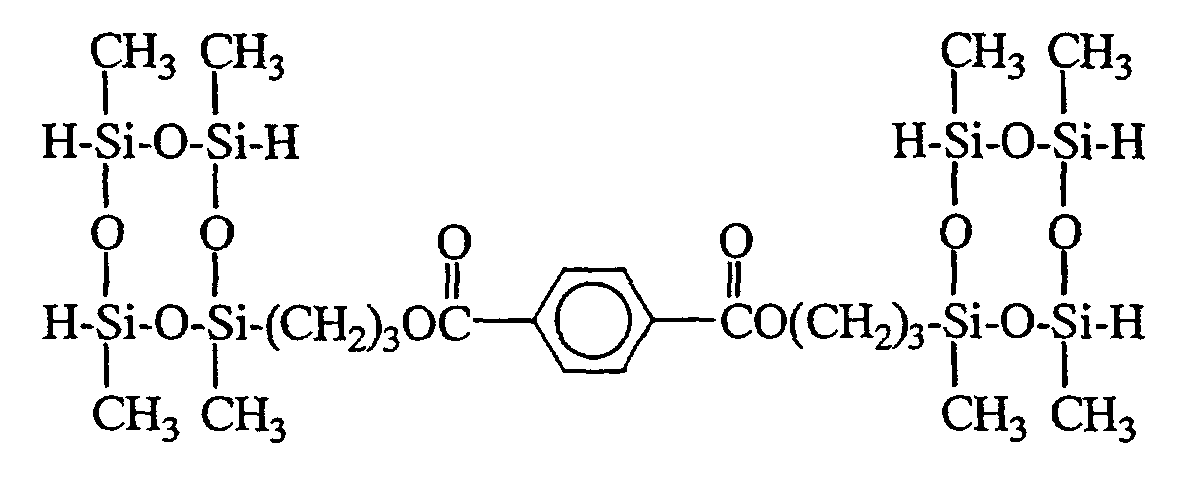


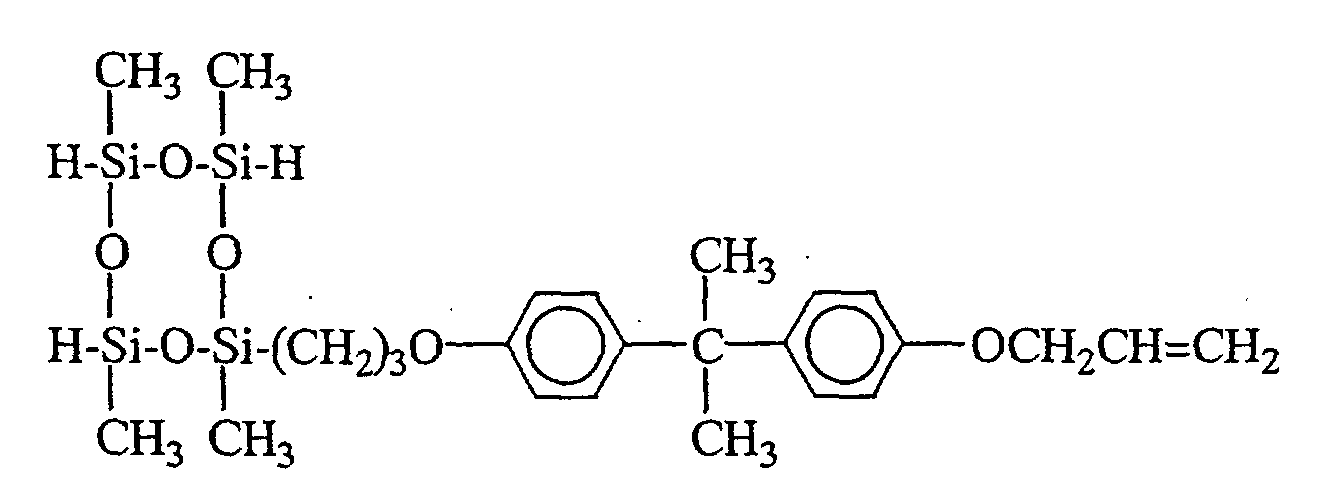

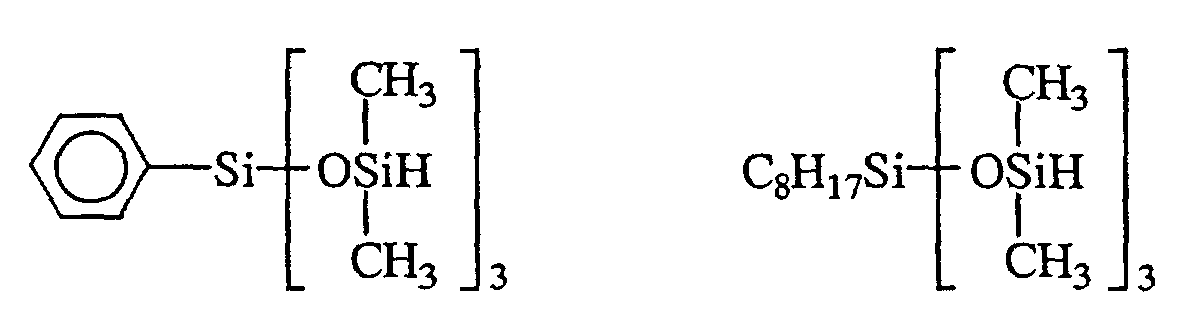
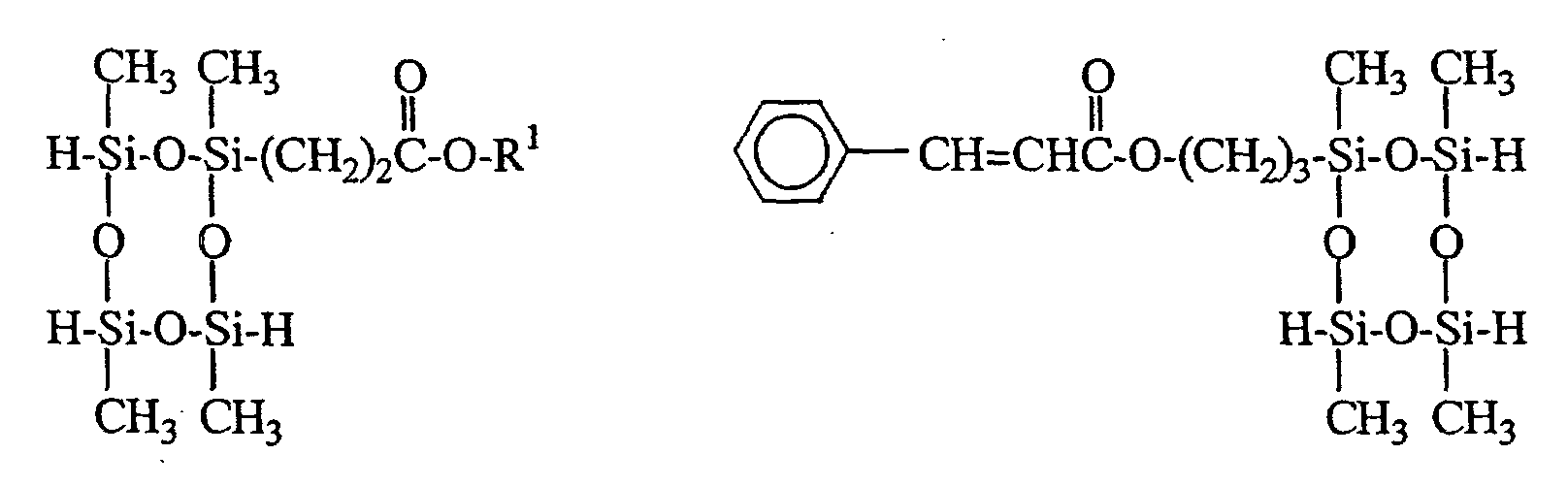

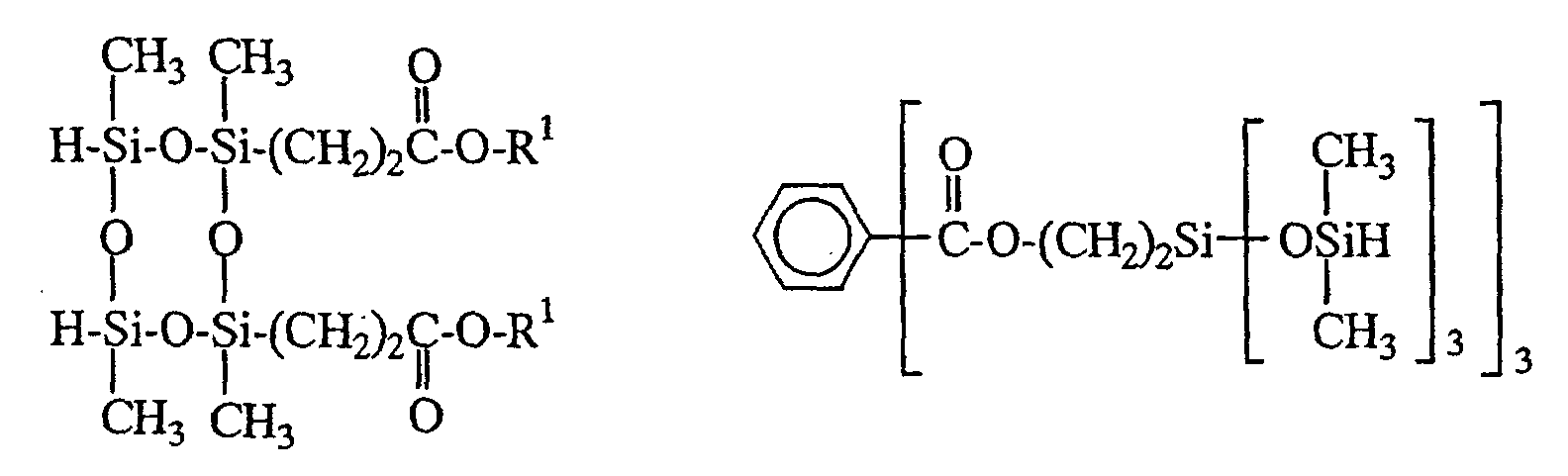
 In the formulae, n is 2 to 30, and R1 is as previously defined.
- As the adhesive agent compounds having amino and amide groups, art-recognized compounds are useful. Other useful compounds are exemplified below.
- An appropriate amount of the adhesive agent (E) used is usually up to 10 parts by weight (i.e., 0 to 10 parts by weight), preferably 0.1 to 10 parts, more preferably 0.5 to 5 parts by weight per 100 parts by weight of component (A). Other components
- In addition to the above-described components, there may be added reinforcing inorganic fillers such as fumed silica, precipitated silica, and fumed titanium dioxide; reinforcing silicone resins; and non-reinforcing inorganic fillers such as calcium silicate, titanium dioxide, ferric oxide, and carbon black. These inorganic fillers are generally used in amounts of 0 to 200 parts by weight, preferably 0.1 to 100 parts by weight per 100 parts by weight of all the components excluding the inorganic fillers.
- The silicone rubber composition may be prepared for example by mixing a portion of component (A) with component (B) and heating the mixture for surface treating component (B) with component (A), adding the remainder of component (A) and an optional inorganic filler to the mixture, and milling the mixture to form a silicone rubber base compound. Alternatively, a silicone rubber base compound is obtained by adding the entirety of component (A), component (B) and an optional inorganic filler, mixing them, and heat treating the mixture for surface treating component (B) with component (A). Then components (C) and (D) and optional component (E) are added to the silicone rubber base compound, followed by milling, resulting in a one part type silicone rubber composition. Alternatively, the silicone rubber composition may be prepared as two part type consisting of the silicone rubber base compound and a blend obtained by separately milling components (C) and (D) and optional component (E), the two parts being admixed on use.
- Preferably the silicone rubber composition of the invention is liquid and has a viscosity of about 1 to 1,000 Pa·sec (about 1,000 to 1,000,000 centipoise) at 25°C, and especially about 5 to 300 Pa·sec at 25°C. The silicone rubber composition obtained by the above method exhibits a smooth flow.
- Curing conditions may be the same as used in prior art addition reaction curing type silicone rubber compositions. The inventive composition satisfactorily cures even at room temperature, for example. If desired, the composition is heated at about 40 to 200°C, and especially about 60 to 180°C.
- The inventive silicone rubber composition cures into a product or silicone rubber having good heat resistance and electrical insulation.
- We have also found that when addition reaction curing type silicone rubber compositions of this kind were used for providing a seal around an electric or electronic part, the cured composition is effective for protecting the electric or electronic part from corrosion by air-borne corrosive gases. Then the composition is quite effective as a means for reducing the corrosion problem with NOx and SOx of electric and electronic parts in vehicle-mounted electrical equipment (including air flow sensors, pressure sensors, slot control modules, crank angle sensors, knocking sensors, temperature sensors, oxygen sensors, NOx sensors, acceleration sensors, engine control circuits, and discharge lamp control circuits).
- Examples of the invention are given below by way of illustration and not by way of limitation.
- Silicone rubber compositions as shown in Tables 1 and 2 were prepared using the following ingredients.
- (a) Diorganopolysiloxane
Vinyl group-containing linear dimethylpolysiloxane of the formula:wherein n is such a number that the diorganopolysiloxane has a viscosity of 10,000 cSt at 25°C.
- (b) Powder
- (b-1) untreated calcium carbonate (Whiten SSB by Shiraishi Industry Co., Ltd., average particle size about 1.5 µm)
- (b-2) resin acid-treated calcium carbonate (MT-100 by Maruo Calcium Co., Ltd., average particle size about 2 µm)
- (b-3) untreated magnesium carbonate
- (c) Platinum-divinyltetramethyldisiloxane complex/toluene solution (platinum element content 0.5 wt%)
- (d) Organohydrogenpolysiloxane
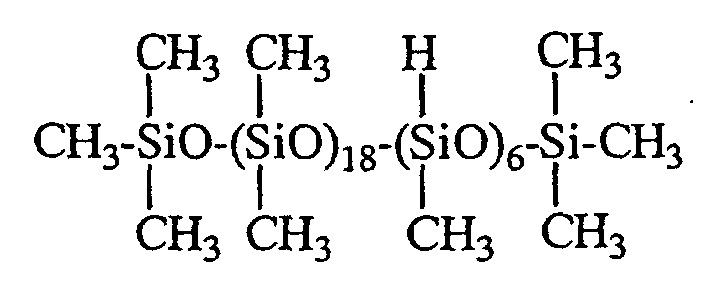
- (e) Curing regulator (50% toluene solution of ethynyl cyclohexanol)
- (f) Adhesive agent

- (g) Fumed silica (Degussa R8200)
-
- The above ingredients were milled in a 3-liter Sinagawa universal mixer which could be heated in vacuum. First, ingredients (a), (b) and (g) were mixed and heat treated for 2 hours under the conditions shown in Table 1. After cooling, ingredients (c), (d), (e) and (f) were added to the mixture, which was further mixed (Examples 1-7). Compositions of Comparative Examples were prepared as in Examples except that ingredients (a), (b) and (g) were mixed without heating, that is, at 30°C in Comparative Examples 1-4; and ingredient (b) was omitted from the mixing/heating step in Comparative Examples 5.
- For the evaluation of storage stability, the composition was placed in a 500-ml metal container, which was sealed and held for 24 hours at 40°C. Then an internal pressure within the container was inspected.
- For the evaluation of cure and adhesion, the composition was cured to a metal or resin at 120°C for one hour. The appearance of a cross section of the cured product was observed, and the adhesion of the cured product to the metal or resin was examined. The rating was "Bond" when a firm bond was ascertained and "Strip" when the cured product was stripped from the metal or resin. The metal was aluminum and the resins were polybutylene terephthalate (PBT) and polyphenylene sulfide (PPS).
- The results are shown in Tables 1 and 2.
Ingredients
(pbw)Example 1 2 3 4 5 6 7 a 500 500 500 500 500 500 500 b-1 200 200 200 200 200 b-2 200 b-3 200 g 5 5 5 5 5 5 Treatment Temperature (°C) 80 100 150 100 100 150 100 Pressure (mmHg) 760 760 760 200 760 200 200 c 0.1 0.1 0.1 0.1 0.1 0.1 0.1 e 0.3 0.3 0.3 0.3 0.3 0.3 0.3 d 2 2 2 2 2 2 2 f 3 3 3 3 3 3 3 Viscosity (Pa·sec) 82 76 76 79 55 96 72 Hardness (Durometer A) 29 34 35 34 28 33 36 Storage stability (gas evolution) No No No No No Some No Cured appearance (foam) No No No No No Some No Adhesive Aluminum Bond Bond Bond Bond Bond Bond Bond PBT Bond Bond Bond Bond Bond Bond Bond PPS Bond Bond Bond Bond Bond Strip Bond Ingredients
(pbw)Comparative Example 1 2 3 4 5 a 500 500 500 500 500 b-1 200 200 b-2 b-3 g 5 5 5 Treatment Temperature (°C) 30 30 30 30 100 Pressure (mmHg) 760 760 760 760 760 c 0.1 0.1 0.1 0.1 0.1 e 0.3 0.3 0.3 0.3 0.3 d 2 2 2 2 2 f 3 3 3 3 3 Viscosity (Pa·sec) 62 83 42 59 60 Hardness (Durometer A) 35 26 29 18 35 Storage stability (gas evolution) No Found No Found No Cured appearance (foam) No Found No Found No Adhesive Aluminum Bond Bond Bond Bond Bond PBT Bond Bond Bond Bond Bond PPS Strip Bond Strip Bond Strip - As seen from Tables 1 and 2, the compositions (Examples 1-5) within the scope of the invention were improved in adhesion to metal and resin, storage stability and cured appearance, due to the addition of calcium carbonate. The composition of Example 6 exhibits satisfactory adhesion, but somewhat unfavorable in storage stability and cured appearance, indicating that resin acid-treated calcium carbonate is less preferable. Examples 1-5 and 7 using initially untreated calcium carbonate or magnesium carbonate exhibit satisfactory rubber characteristics, attaining the intended purposes.
- Additionally, the compositions of Example 3 and Comparative Example 5 were examined for an ability as a sealant to protect electric or electronic parts from corrosive gases. Examination was made by two test procedures under the conditions described below. Test procedures:
- (1) The composition was directly applied onto a B type comb-shaped electrode, and heat cured at 120°C for one hour.
- (2) An electrode was placed in a case consisting of a glass casing and a glass lid. The composition was applied as a bonding seal between the casing and the lid and heat cured at 120°C for one hour.
-
- Test atmosphere: a mixture of air with 30 ppm of NO2 gas and 30 ppm of SO2 gas
- Test temperature: 23°C
- Time: 500 hours
- Electrode: JIS B type comb-shaped electrodes
of copper and aluminum - Applied voltage: DC 12 volts
-
- The degree of corrosion was examined by scraping off the sealant to expose the electrode surface at the end of the test and observing whether or not the appearance of the electrode surface changed.
- The results are shown in Table 3.
Composition Example 3 Comparative Example 5 Electrode Copper Aluminum Copper Aluminum Sealing procedure (1) (2) (1) (2) (1) (2) (1) (2) Evaluation 0hr OK OK OK OK OK OK OK OK 100hr OK OK OK OK OK OK Corroded OK 200hr OK OK OK OK OK OK Corroded Corroded 300hr OK OK OK OK Corroded OK Corroded Corroded 400hr OK OK OK OK Corroded Corroded Corroded Corroded 500hr OK OK OK OK Corroded Corroded Corroded Corroded - There have been described addition reaction curing type silicone rubber compositions loaded with alkaline earth metal carbonate powder, which compositions have good storage stability. They gave off a minimized amount of hydrogen gas during storage. Embodiments showed improved adhesion and a good ability to protect electric or electronic parts from corrosion and finds use in a variety of applications, typically in the sealing of electric or electronic parts.
- Japanese Patent Application No. 2000-219502 is incorporated herein by reference.
- Although some preferred embodiments have been described, many modifications and variations may be made thereto in light of the above teachings. It is therefore to be understood that the invention may be practiced otherwise than as specifically described in the Examples.
Claims (12)
- An addition reaction curing type silicone rubber composition comprising(A) diorganopolysiloxane containing at least two alkenyl groups in a molecule,(B) alkaline earth metal carbonate powder surface treated with diorganopolysiloxane,(C) organohydrogenpolysiloxane containing at least two hydrogen atoms each attached to a silicon atom in a molecule, and(D) platinum group metal catalyst.
- The silicone rubber composition of claim 1 wherein the alkaline earth metal carbonate powder surface treated with diorganopolysiloxane (B) is one obtainable by mixing a starting alkaline earth metal carbonate powder with a diorganopolysiloxane at an elevated temperature.
- The silicone rubber composition of claim 2 wherein the starting alkaline earth metal carbonate powder is a calcium carbonate powder.
- The silicone rubber composition of claim 3 wherein the starting calcium carbonate powder has not been treated on particle surfaces.
- Silicone rubber composition of claim 3 or 4 wherein the calcium carbonate powder has an average particle size of 0.05 to 50 µm.
- Composition of any one of claims 1 to 5 comprising (E) an adhesive agent having a functional group selected from the class consisting of epoxy, alkoxysilyl, carbonyl and phenyl groups.
- The silicone rubber composition of claim 6 wherein the adhesive agent imparts self-adhesion to metals and/or organic resins.
- Composition according to any one of claims 1 to 7 which is of one part type.
- Use of a silicone rubber composition according to any one of claims 1 to 8 in the sealing of vehicle-mounted electric equipment.
- A method comprising the preparation of a composition according to any one of claims 1 to 8.
- A method according to claim 10, comprising the step of treating the metal carbonate powder with the organopolysiloxane before blending with other elements of the composition.
- A method for preparing an addition reaction curing type silicone rubber composition, comprising the steps of:mixing a portion or all of a diorganopolysiloxane containing at least two alkenyl groups in a molecule with an alkaline earth metal carbonate at an elevated temperature for surface treating the alkaline earth metal carbonate,mixing the mixture with the remainder of the diorganopolysiloxane if the portion thereof is used in the first mixing step, andmixing the mixture with an organohydrogenpolysiloxane containing at least two hydrogen atoms each attached to a silicon atom in a molecule and a platinum group metal catalyst.
Applications Claiming Priority (2)
| Application Number | Priority Date | Filing Date | Title |
|---|---|---|---|
| JP2000219502A JP3705343B2 (en) | 2000-07-19 | 2000-07-19 | Addition reaction curable silicone rubber composition and method for producing the same |
| JP2000219502 | 2000-07-19 |
Publications (2)
| Publication Number | Publication Date |
|---|---|
| EP1174468A1 true EP1174468A1 (en) | 2002-01-23 |
| EP1174468B1 EP1174468B1 (en) | 2004-10-06 |
Family
ID=18714279
Family Applications (1)
| Application Number | Title | Priority Date | Filing Date |
|---|---|---|---|
| EP20010306183 Expired - Lifetime EP1174468B1 (en) | 2000-07-19 | 2001-07-18 | Addition curable silicone rubber compositions, their preparation and use |
Country Status (4)
| Country | Link |
|---|---|
| US (1) | US6613440B2 (en) |
| EP (1) | EP1174468B1 (en) |
| JP (1) | JP3705343B2 (en) |
| DE (1) | DE60106151T2 (en) |
Cited By (3)
| Publication number | Priority date | Publication date | Assignee | Title |
|---|---|---|---|---|
| WO2009138798A1 (en) * | 2008-05-14 | 2009-11-19 | Dow Corning Corporation | Silicone rubber compositions |
| EP1829524A3 (en) * | 2006-03-03 | 2010-11-10 | Shin-Etsu Chemical Co., Ltd. | Organopolysiloxane powder treating agent, power treated with the agent and cosmetic comprising the powder |
| WO2025140702A1 (en) | 2023-12-29 | 2025-07-03 | Elkem Silicones Shanghai Co., Ltd. | Composite with high air-holding property |
Families Citing this family (32)
| Publication number | Priority date | Publication date | Assignee | Title |
|---|---|---|---|---|
| JP4162390B2 (en) * | 2001-01-17 | 2008-10-08 | 東レ・ダウコーニング株式会社 | Silicone rubber adhesive |
| JP4114037B2 (en) * | 2001-09-25 | 2008-07-09 | 信越化学工業株式会社 | Silicone rubber sealing / sealing material for preventing or delaying sulfidation of electric / electronic parts and sulfidation preventing or delaying method |
| JP4572056B2 (en) * | 2002-10-04 | 2010-10-27 | 信越化学工業株式会社 | Thermally conductive silicone rubber composite sheet |
| JP4766222B2 (en) * | 2003-03-12 | 2011-09-07 | 信越化学工業株式会社 | Light emitting semiconductor coating protective material and light emitting semiconductor device |
| JP4607429B2 (en) * | 2003-03-25 | 2011-01-05 | 東レ・ダウコーニング株式会社 | Semiconductor device manufacturing method and semiconductor device |
| WO2005006451A1 (en) | 2003-07-07 | 2005-01-20 | Dow Corning Corporation | Encapsulation of solar cells |
| JP4628715B2 (en) * | 2004-07-13 | 2011-02-09 | 信越化学工業株式会社 | Curable organopolysiloxane composition and casting mold |
| CN101048448A (en) * | 2004-10-25 | 2007-10-03 | 南农股份公司 | Process for the preparation of silicone rubber articles and products obtained by this process |
| DE102005005634A1 (en) * | 2005-02-08 | 2006-08-24 | Wacker Chemie Ag | Crosslinkable compositions based on organosilicon compounds |
| JP4804775B2 (en) * | 2005-03-18 | 2011-11-02 | モメンティブ・パフォーマンス・マテリアルズ・ジャパン合同会社 | Curable polyorganosiloxane composition for seal and gasket |
| JP5004437B2 (en) * | 2005-06-02 | 2012-08-22 | 東レ・ダウコーニング株式会社 | Silicone rubber composition |
| JP2007119974A (en) * | 2005-10-31 | 2007-05-17 | Shin Etsu Chem Co Ltd | Silicone rubber composition for sewing air bag sealant |
| JP2007161999A (en) * | 2005-11-17 | 2007-06-28 | Shin Etsu Chem Co Ltd | Addition-curable silicone composition for CIPG that gives a cured product excellent in compression set characteristics, and method for reducing compression set of cured product of the composition |
| DE602007004594D1 (en) * | 2006-05-10 | 2010-03-18 | Dow Corning Toray Co Ltd | SILICON RUBBER COMPOSITION |
| DE102006022097A1 (en) * | 2006-05-11 | 2007-11-15 | Wacker Chemie Ag | Self-adhesive addition-curing silicone compositions |
| JP2008074882A (en) * | 2006-09-19 | 2008-04-03 | Shin Etsu Chem Co Ltd | Two-component addition reaction curable adhesive for silicone rubber |
| JP5551351B2 (en) * | 2007-10-26 | 2014-07-16 | 東レ・ダウコーニング株式会社 | Method for bonding silicone rubber members |
| GB0808678D0 (en) * | 2008-05-14 | 2008-06-18 | Dow Corning | Silicone rubber compositions |
| JP5158371B2 (en) * | 2009-02-27 | 2013-03-06 | 信越化学工業株式会社 | Addition-curing self-adhesive silicone rubber composition |
| ES2619847T5 (en) | 2010-03-05 | 2024-06-24 | Momentive Performance Mat Gmbh | Use of a curable polyorganosiloxane composition as an encapsulant for a solar cell module |
| EP2545103B1 (en) * | 2010-03-09 | 2016-09-14 | University Of Virginia Patent Foundation | Viscoelastic silicone rubber compositions |
| JP2012207192A (en) | 2011-03-30 | 2012-10-25 | Dow Corning Toray Co Ltd | Two-component silicone rubber composition |
| US20130005844A1 (en) * | 2011-06-30 | 2013-01-03 | Yeung K C Ricky | Self-adhesive silicone rubber compositions and articles comprising same |
| US20130005843A1 (en) * | 2011-06-30 | 2013-01-03 | Yeung K C Ricky | Self-adhesive silicone rubber compositions and articles comprising same |
| WO2013023174A1 (en) | 2011-08-10 | 2013-02-14 | University Of Virginia Patent Foundation | Viscoelastic silicone rubber compositions |
| KR101560038B1 (en) * | 2011-11-25 | 2015-10-15 | 주식회사 엘지화학 | Curable composition |
| JP5761122B2 (en) * | 2012-05-21 | 2015-08-12 | 信越化学工業株式会社 | Addition-curing self-adhesive liquid silicone rubber composition |
| KR20150039766A (en) | 2012-07-30 | 2015-04-13 | 다우 코닝 도레이 캄파니 리미티드 | Two-part curable liquid silicone rubber composition |
| JP5748226B2 (en) * | 2012-09-12 | 2015-07-15 | 信越化学工業株式会社 | Method for producing polyorganosiloxane |
| CN104387644A (en) * | 2014-10-24 | 2015-03-04 | 安徽杰奥玛克合成材料科技有限公司 | Geocell master batch containing superfine slag powder |
| JP6618302B2 (en) | 2015-08-31 | 2019-12-11 | 旭化成ワッカーシリコーン株式会社 | Silicone rubber composition for airbag seal material |
| JP7475791B2 (en) * | 2021-01-19 | 2024-04-30 | 信越化学工業株式会社 | Method for producing addition-curable silicone composition |
Citations (3)
| Publication number | Priority date | Publication date | Assignee | Title |
|---|---|---|---|---|
| JPH1060281A (en) * | 1996-08-20 | 1998-03-03 | Shin Etsu Chem Co Ltd | Addition-curable silicone rubber composition filled with calcium carbonate |
| US6043309A (en) * | 1997-01-31 | 2000-03-28 | Dow Corning Toray Silicone Co., Ltd. | Silicone rubber composition for use in high-voltage electrical insulating parts and method for manufacturing |
| EP1106654A2 (en) * | 1999-12-10 | 2001-06-13 | Dow Corning Toray Silicone Co., Ltd. | Silicone rubber composition keypads |
Family Cites Families (2)
| Publication number | Priority date | Publication date | Assignee | Title |
|---|---|---|---|---|
| US4102852A (en) * | 1977-03-23 | 1978-07-25 | General Electric Company | Self-extinguishing room temperature vulcanizable silicone rubber compositions |
| US5283307A (en) * | 1992-08-31 | 1994-02-01 | Dow Corning Corporation | Organosiloxane compositions exhibiting improved bonding to substrates during curing |
-
2000
- 2000-07-19 JP JP2000219502A patent/JP3705343B2/en not_active Expired - Lifetime
-
2001
- 2001-07-17 US US09/905,979 patent/US6613440B2/en not_active Expired - Fee Related
- 2001-07-18 EP EP20010306183 patent/EP1174468B1/en not_active Expired - Lifetime
- 2001-07-18 DE DE2001606151 patent/DE60106151T2/en not_active Expired - Lifetime
Patent Citations (3)
| Publication number | Priority date | Publication date | Assignee | Title |
|---|---|---|---|---|
| JPH1060281A (en) * | 1996-08-20 | 1998-03-03 | Shin Etsu Chem Co Ltd | Addition-curable silicone rubber composition filled with calcium carbonate |
| US6043309A (en) * | 1997-01-31 | 2000-03-28 | Dow Corning Toray Silicone Co., Ltd. | Silicone rubber composition for use in high-voltage electrical insulating parts and method for manufacturing |
| EP1106654A2 (en) * | 1999-12-10 | 2001-06-13 | Dow Corning Toray Silicone Co., Ltd. | Silicone rubber composition keypads |
Non-Patent Citations (1)
| Title |
|---|
| PATENT ABSTRACTS OF JAPAN vol. 1998, no. 08 30 June 1998 (1998-06-30) * |
Cited By (4)
| Publication number | Priority date | Publication date | Assignee | Title |
|---|---|---|---|---|
| EP1829524A3 (en) * | 2006-03-03 | 2010-11-10 | Shin-Etsu Chemical Co., Ltd. | Organopolysiloxane powder treating agent, power treated with the agent and cosmetic comprising the powder |
| US8734771B2 (en) | 2006-03-03 | 2014-05-27 | Shin-Etsu Chemical Co., Ltd. | Powder treated with a power treating agent comprising an organopolysiloxane and cosmetic comprising the powder |
| WO2009138798A1 (en) * | 2008-05-14 | 2009-11-19 | Dow Corning Corporation | Silicone rubber compositions |
| WO2025140702A1 (en) | 2023-12-29 | 2025-07-03 | Elkem Silicones Shanghai Co., Ltd. | Composite with high air-holding property |
Also Published As
| Publication number | Publication date |
|---|---|
| US20020037963A1 (en) | 2002-03-28 |
| EP1174468B1 (en) | 2004-10-06 |
| JP2002038016A (en) | 2002-02-06 |
| US6613440B2 (en) | 2003-09-02 |
| DE60106151D1 (en) | 2004-11-11 |
| DE60106151T2 (en) | 2006-03-09 |
| JP3705343B2 (en) | 2005-10-12 |
Similar Documents
| Publication | Publication Date | Title |
|---|---|---|
| EP1174468B1 (en) | Addition curable silicone rubber compositions, their preparation and use | |
| CN110088206B (en) | Curable organopolysiloxane composition and protective agent or adhesive composition for electrical and electronic parts | |
| JP6472094B2 (en) | Curable organopolysiloxane composition and protective agent or adhesive composition for electrical and electronic parts | |
| JP6722581B2 (en) | Adhesion promoter, curable organopolysiloxane composition containing the same | |
| JP4114037B2 (en) | Silicone rubber sealing / sealing material for preventing or delaying sulfidation of electric / electronic parts and sulfidation preventing or delaying method | |
| US7150803B2 (en) | Air bag sealer silicone rubber composition | |
| US12378414B2 (en) | Curable organopolysiloxane composition, cured product, and electric/electronic equipment | |
| JP2002322364A (en) | Silicone gel composition | |
| US20200165455A1 (en) | Addition-curable silicone composition and cured silicone rubber | |
| EP1942169B1 (en) | Addition cure silicone rubber adhesive composition and making method | |
| JP4314454B2 (en) | Self-adhesive heat curable liquid silicone rubber composition | |
| JP2013060493A (en) | Addition curable silicone adhesive composition | |
| JP4088778B2 (en) | Silicone rubber composition for airbag sealing material, airbag and method for improving adhesion | |
| JP2002226708A (en) | Room temperature curable sealing material composition for automobiles | |
| JP4190460B2 (en) | Self-adhesive organopolysiloxane composition | |
| JP3874057B2 (en) | Liquid silicone rubber composition for cap sealing, cap sealing method and cap | |
| EP3500629B1 (en) | Room temperature curable organopolysiloxane composition for protecting electric/electronic parts |
Legal Events
| Date | Code | Title | Description |
|---|---|---|---|
| PUAI | Public reference made under article 153(3) epc to a published international application that has entered the european phase |
Free format text: ORIGINAL CODE: 0009012 |
|
| AK | Designated contracting states |
Kind code of ref document: A1 Designated state(s): AT BE CH CY DE DK ES FI FR GB GR IE IT LI LU MC NL PT SE TR Kind code of ref document: A1 Designated state(s): DE FR GB |
|
| AX | Request for extension of the european patent |
Free format text: AL;LT;LV;MK;RO;SI |
|
| 17P | Request for examination filed |
Effective date: 20020412 |
|
| 17Q | First examination report despatched |
Effective date: 20020823 |
|
| AKX | Designation fees paid |
Free format text: DE FR GB |
|
| GRAP | Despatch of communication of intention to grant a patent |
Free format text: ORIGINAL CODE: EPIDOSNIGR1 |
|
| GRAS | Grant fee paid |
Free format text: ORIGINAL CODE: EPIDOSNIGR3 |
|
| GRAA | (expected) grant |
Free format text: ORIGINAL CODE: 0009210 |
|
| AK | Designated contracting states |
Kind code of ref document: B1 Designated state(s): DE FR GB |
|
| REG | Reference to a national code |
Ref country code: GB Ref legal event code: FG4D |
|
| REG | Reference to a national code |
Ref country code: IE Ref legal event code: FG4D |
|
| REF | Corresponds to: |
Ref document number: 60106151 Country of ref document: DE Date of ref document: 20041111 Kind code of ref document: P |
|
| PG25 | Lapsed in a contracting state [announced via postgrant information from national office to epo] |
Ref country code: GB Free format text: LAPSE BECAUSE OF NON-PAYMENT OF DUE FEES Effective date: 20050718 |
|
| ET | Fr: translation filed | ||
| PLBE | No opposition filed within time limit |
Free format text: ORIGINAL CODE: 0009261 |
|
| STAA | Information on the status of an ep patent application or granted ep patent |
Free format text: STATUS: NO OPPOSITION FILED WITHIN TIME LIMIT |
|
| 26N | No opposition filed |
Effective date: 20050707 |
|
| GBPC | Gb: european patent ceased through non-payment of renewal fee |
Effective date: 20050718 |
|
| PG25 | Lapsed in a contracting state [announced via postgrant information from national office to epo] |
Ref country code: FR Free format text: LAPSE BECAUSE OF NON-PAYMENT OF DUE FEES Effective date: 20060331 |
|
| REG | Reference to a national code |
Ref country code: FR Ref legal event code: ST Effective date: 20060331 |
|
| PGFP | Annual fee paid to national office [announced via postgrant information from national office to epo] |
Ref country code: DE Payment date: 20190702 Year of fee payment: 19 |
|
| REG | Reference to a national code |
Ref country code: DE Ref legal event code: R119 Ref document number: 60106151 Country of ref document: DE |
|
| PG25 | Lapsed in a contracting state [announced via postgrant information from national office to epo] |
Ref country code: DE Free format text: LAPSE BECAUSE OF NON-PAYMENT OF DUE FEES Effective date: 20210202 |