EP1174259A1 - Transparent plastic film having hard coat layer - Google Patents
Transparent plastic film having hard coat layer Download PDFInfo
- Publication number
- EP1174259A1 EP1174259A1 EP00974952A EP00974952A EP1174259A1 EP 1174259 A1 EP1174259 A1 EP 1174259A1 EP 00974952 A EP00974952 A EP 00974952A EP 00974952 A EP00974952 A EP 00974952A EP 1174259 A1 EP1174259 A1 EP 1174259A1
- Authority
- EP
- European Patent Office
- Prior art keywords
- hard
- coating layer
- film
- molded article
- plastic
- Prior art date
- Legal status (The legal status is an assumption and is not a legal conclusion. Google has not performed a legal analysis and makes no representation as to the accuracy of the status listed.)
- Withdrawn
Links
- 239000002985 plastic film Substances 0.000 title claims abstract description 75
- 229920003023 plastic Polymers 0.000 title claims abstract description 61
- 239000011247 coating layer Substances 0.000 claims abstract description 160
- 229920006255 plastic film Polymers 0.000 claims abstract description 51
- 238000001746 injection moulding Methods 0.000 claims abstract description 45
- 239000004033 plastic Substances 0.000 claims abstract description 37
- 238000009864 tensile test Methods 0.000 claims abstract description 17
- 229920006289 polycarbonate film Polymers 0.000 claims description 37
- 229920005989 resin Polymers 0.000 claims description 17
- 239000011347 resin Substances 0.000 claims description 17
- 238000001816 cooling Methods 0.000 claims description 9
- 238000004806 packaging method and process Methods 0.000 claims description 3
- 238000000465 moulding Methods 0.000 abstract description 18
- 239000000463 material Substances 0.000 description 62
- 238000000576 coating method Methods 0.000 description 55
- 238000000034 method Methods 0.000 description 55
- 239000011248 coating agent Substances 0.000 description 53
- 230000000052 comparative effect Effects 0.000 description 34
- 239000000203 mixture Substances 0.000 description 27
- NIXOWILDQLNWCW-UHFFFAOYSA-M Acrylate Chemical compound [O-]C(=O)C=C NIXOWILDQLNWCW-UHFFFAOYSA-M 0.000 description 23
- YXFVVABEGXRONW-UHFFFAOYSA-N Toluene Chemical compound CC1=CC=CC=C1 YXFVVABEGXRONW-UHFFFAOYSA-N 0.000 description 10
- ZWEHNKRNPOVVGH-UHFFFAOYSA-N 2-Butanone Chemical compound CCC(C)=O ZWEHNKRNPOVVGH-UHFFFAOYSA-N 0.000 description 9
- KFZMGEQAYNKOFK-UHFFFAOYSA-N Isopropanol Chemical compound CC(C)O KFZMGEQAYNKOFK-UHFFFAOYSA-N 0.000 description 9
- 229920005668 polycarbonate resin Polymers 0.000 description 9
- 239000004431 polycarbonate resin Substances 0.000 description 9
- 239000003999 initiator Substances 0.000 description 8
- 229920000642 polymer Polymers 0.000 description 8
- 239000003960 organic solvent Substances 0.000 description 7
- PPBRXRYQALVLMV-UHFFFAOYSA-N Styrene Chemical compound C=CC1=CC=CC=C1 PPBRXRYQALVLMV-UHFFFAOYSA-N 0.000 description 6
- 150000001252 acrylic acid derivatives Chemical class 0.000 description 6
- 239000000758 substrate Substances 0.000 description 6
- QSHDDOUJBYECFT-UHFFFAOYSA-N mercury Chemical compound [Hg] QSHDDOUJBYECFT-UHFFFAOYSA-N 0.000 description 5
- 238000001035 drying Methods 0.000 description 4
- 239000010410 layer Substances 0.000 description 4
- 238000004519 manufacturing process Methods 0.000 description 4
- WXZMFSXDPGVJKK-UHFFFAOYSA-N pentaerythritol Chemical compound OCC(CO)(CO)CO WXZMFSXDPGVJKK-UHFFFAOYSA-N 0.000 description 4
- 229920000515 polycarbonate Polymers 0.000 description 4
- 239000004417 polycarbonate Substances 0.000 description 4
- MYWOJODOMFBVCB-UHFFFAOYSA-N 1,2,6-trimethylphenanthrene Chemical compound CC1=CC=C2C3=CC(C)=CC=C3C=CC2=C1C MYWOJODOMFBVCB-UHFFFAOYSA-N 0.000 description 3
- 229920000178 Acrylic resin Polymers 0.000 description 3
- 239000004925 Acrylic resin Substances 0.000 description 3
- 239000004593 Epoxy Substances 0.000 description 3
- XEKOWRVHYACXOJ-UHFFFAOYSA-N Ethyl acetate Chemical compound CCOC(C)=O XEKOWRVHYACXOJ-UHFFFAOYSA-N 0.000 description 3
- PEDCQBHIVMGVHV-UHFFFAOYSA-N Glycerine Chemical compound OCC(O)CO PEDCQBHIVMGVHV-UHFFFAOYSA-N 0.000 description 3
- LRHPLDYGYMQRHN-UHFFFAOYSA-N N-Butanol Chemical compound CCCCO LRHPLDYGYMQRHN-UHFFFAOYSA-N 0.000 description 3
- DNIAPMSPPWPWGF-UHFFFAOYSA-N Propylene glycol Chemical compound CC(O)CO DNIAPMSPPWPWGF-UHFFFAOYSA-N 0.000 description 3
- NIXOWILDQLNWCW-UHFFFAOYSA-N acrylic acid group Chemical group C(C=C)(=O)O NIXOWILDQLNWCW-UHFFFAOYSA-N 0.000 description 3
- 238000003618 dip coating Methods 0.000 description 3
- 239000012770 industrial material Substances 0.000 description 3
- 239000000178 monomer Substances 0.000 description 3
- 229920000728 polyester Polymers 0.000 description 3
- -1 polysiloxane Polymers 0.000 description 3
- 239000011342 resin composition Substances 0.000 description 3
- QNODIIQQMGDSEF-UHFFFAOYSA-N (1-hydroxycyclohexyl)-phenylmethanone Chemical compound C=1C=CC=CC=1C(=O)C1(O)CCCCC1 QNODIIQQMGDSEF-UHFFFAOYSA-N 0.000 description 2
- XNWFRZJHXBZDAG-UHFFFAOYSA-N 2-METHOXYETHANOL Chemical compound COCCO XNWFRZJHXBZDAG-UHFFFAOYSA-N 0.000 description 2
- TXBCBTDQIULDIA-UHFFFAOYSA-N 2-[[3-hydroxy-2,2-bis(hydroxymethyl)propoxy]methyl]-2-(hydroxymethyl)propane-1,3-diol Chemical compound OCC(CO)(CO)COCC(CO)(CO)CO TXBCBTDQIULDIA-UHFFFAOYSA-N 0.000 description 2
- ZNQVEEAIQZEUHB-UHFFFAOYSA-N 2-ethoxyethanol Chemical compound CCOCCO ZNQVEEAIQZEUHB-UHFFFAOYSA-N 0.000 description 2
- KWOLFJPFCHCOCG-UHFFFAOYSA-N Acetophenone Chemical compound CC(=O)C1=CC=CC=C1 KWOLFJPFCHCOCG-UHFFFAOYSA-N 0.000 description 2
- DKPFZGUDAPQIHT-UHFFFAOYSA-N Butyl acetate Natural products CCCCOC(C)=O DKPFZGUDAPQIHT-UHFFFAOYSA-N 0.000 description 2
- XTHFKEDIFFGKHM-UHFFFAOYSA-N Dimethoxyethane Chemical compound COCCOC XTHFKEDIFFGKHM-UHFFFAOYSA-N 0.000 description 2
- LFQSCWFLJHTTHZ-UHFFFAOYSA-N Ethanol Chemical compound CCO LFQSCWFLJHTTHZ-UHFFFAOYSA-N 0.000 description 2
- JOYRKODLDBILNP-UHFFFAOYSA-N Ethyl urethane Chemical compound CCOC(N)=O JOYRKODLDBILNP-UHFFFAOYSA-N 0.000 description 2
- CERQOIWHTDAKMF-UHFFFAOYSA-N Methacrylic acid Chemical compound CC(=C)C(O)=O CERQOIWHTDAKMF-UHFFFAOYSA-N 0.000 description 2
- HVVWZTWDBSEWIH-UHFFFAOYSA-N [2-(hydroxymethyl)-3-prop-2-enoyloxy-2-(prop-2-enoyloxymethyl)propyl] prop-2-enoate Chemical compound C=CC(=O)OCC(CO)(COC(=O)C=C)COC(=O)C=C HVVWZTWDBSEWIH-UHFFFAOYSA-N 0.000 description 2
- 125000003647 acryloyl group Chemical group O=C([*])C([H])=C([H])[H] 0.000 description 2
- 230000015572 biosynthetic process Effects 0.000 description 2
- 229920001577 copolymer Polymers 0.000 description 2
- JHIVVAPYMSGYDF-UHFFFAOYSA-N cyclohexanone Chemical compound O=C1CCCCC1 JHIVVAPYMSGYDF-UHFFFAOYSA-N 0.000 description 2
- 235000019441 ethanol Nutrition 0.000 description 2
- 238000011049 filling Methods 0.000 description 2
- 230000010354 integration Effects 0.000 description 2
- 150000002576 ketones Chemical class 0.000 description 2
- 238000007760 metering rod coating Methods 0.000 description 2
- 230000003287 optical effect Effects 0.000 description 2
- 229920001296 polysiloxane Polymers 0.000 description 2
- 229920005990 polystyrene resin Polymers 0.000 description 2
- BDERNNFJNOPAEC-UHFFFAOYSA-N propan-1-ol Chemical compound CCCO BDERNNFJNOPAEC-UHFFFAOYSA-N 0.000 description 2
- 230000009257 reactivity Effects 0.000 description 2
- 238000005507 spraying Methods 0.000 description 2
- 150000005846 sugar alcohols Polymers 0.000 description 2
- 238000004804 winding Methods 0.000 description 2
- LZDKZFUFMNSQCJ-UHFFFAOYSA-N 1,2-diethoxyethane Chemical compound CCOCCOCC LZDKZFUFMNSQCJ-UHFFFAOYSA-N 0.000 description 1
- SPSPIUSUWPLVKD-UHFFFAOYSA-N 2,3-dibutyl-6-methylphenol Chemical compound CCCCC1=CC=C(C)C(O)=C1CCCC SPSPIUSUWPLVKD-UHFFFAOYSA-N 0.000 description 1
- KMNCBSZOIQAUFX-UHFFFAOYSA-N 2-ethoxy-1,2-diphenylethanone Chemical compound C=1C=CC=CC=1C(OCC)C(=O)C1=CC=CC=C1 KMNCBSZOIQAUFX-UHFFFAOYSA-N 0.000 description 1
- 229940093475 2-ethoxyethanol Drugs 0.000 description 1
- BQZJOQXSCSZQPS-UHFFFAOYSA-N 2-methoxy-1,2-diphenylethanone Chemical compound C=1C=CC=CC=1C(OC)C(=O)C1=CC=CC=C1 BQZJOQXSCSZQPS-UHFFFAOYSA-N 0.000 description 1
- LWRBVKNFOYUCNP-UHFFFAOYSA-N 2-methyl-1-(4-methylsulfanylphenyl)-2-morpholin-4-ylpropan-1-one Chemical compound C1=CC(SC)=CC=C1C(=O)C(C)(C)N1CCOCC1 LWRBVKNFOYUCNP-UHFFFAOYSA-N 0.000 description 1
- FIHBHSQYSYVZQE-UHFFFAOYSA-N 6-prop-2-enoyloxyhexyl prop-2-enoate Chemical compound C=CC(=O)OCCCCCCOC(=O)C=C FIHBHSQYSYVZQE-UHFFFAOYSA-N 0.000 description 1
- OKTJSMMVPCPJKN-UHFFFAOYSA-N Carbon Chemical compound [C] OKTJSMMVPCPJKN-UHFFFAOYSA-N 0.000 description 1
- PDSCSYLDRHAHOX-UHFFFAOYSA-N Dibutyl malate Chemical compound CCCCOC(=O)CC(O)C(=O)OCCCC PDSCSYLDRHAHOX-UHFFFAOYSA-N 0.000 description 1
- 229920000877 Melamine resin Polymers 0.000 description 1
- CERQOIWHTDAKMF-UHFFFAOYSA-M Methacrylate Chemical compound CC(=C)C([O-])=O CERQOIWHTDAKMF-UHFFFAOYSA-M 0.000 description 1
- NTIZESTWPVYFNL-UHFFFAOYSA-N Methyl isobutyl ketone Chemical compound CC(C)CC(C)=O NTIZESTWPVYFNL-UHFFFAOYSA-N 0.000 description 1
- UIHCLUNTQKBZGK-UHFFFAOYSA-N Methyl isobutyl ketone Natural products CCC(C)C(C)=O UIHCLUNTQKBZGK-UHFFFAOYSA-N 0.000 description 1
- CTQNGGLPUBDAKN-UHFFFAOYSA-N O-Xylene Chemical compound CC1=CC=CC=C1C CTQNGGLPUBDAKN-UHFFFAOYSA-N 0.000 description 1
- 239000005062 Polybutadiene Substances 0.000 description 1
- 244000028419 Styrax benzoin Species 0.000 description 1
- 235000000126 Styrax benzoin Nutrition 0.000 description 1
- 235000008411 Sumatra benzointree Nutrition 0.000 description 1
- ZJCCRDAZUWHFQH-UHFFFAOYSA-N Trimethylolpropane Chemical compound CCC(CO)(CO)CO ZJCCRDAZUWHFQH-UHFFFAOYSA-N 0.000 description 1
- QYKIQEUNHZKYBP-UHFFFAOYSA-N Vinyl ether Chemical compound C=COC=C QYKIQEUNHZKYBP-UHFFFAOYSA-N 0.000 description 1
- 230000002745 absorbent Effects 0.000 description 1
- 239000002250 absorbent Substances 0.000 description 1
- 239000000654 additive Substances 0.000 description 1
- 230000001070 adhesive effect Effects 0.000 description 1
- 150000001298 alcohols Chemical class 0.000 description 1
- 229920003180 amino resin Polymers 0.000 description 1
- 150000008064 anhydrides Chemical class 0.000 description 1
- PYKYMHQGRFAEBM-UHFFFAOYSA-N anthraquinone Natural products CCC(=O)c1c(O)c2C(=O)C3C(C=CC=C3O)C(=O)c2cc1CC(=O)OC PYKYMHQGRFAEBM-UHFFFAOYSA-N 0.000 description 1
- 150000004056 anthraquinones Chemical class 0.000 description 1
- 239000003963 antioxidant agent Substances 0.000 description 1
- 230000003078 antioxidant effect Effects 0.000 description 1
- 238000007611 bar coating method Methods 0.000 description 1
- 150000001558 benzoic acid derivatives Chemical class 0.000 description 1
- 229960002130 benzoin Drugs 0.000 description 1
- RWCCWEUUXYIKHB-UHFFFAOYSA-N benzophenone Chemical compound C=1C=CC=CC=1C(=O)C1=CC=CC=C1 RWCCWEUUXYIKHB-UHFFFAOYSA-N 0.000 description 1
- 239000012965 benzophenone Substances 0.000 description 1
- 230000001588 bifunctional effect Effects 0.000 description 1
- 235000010354 butylated hydroxytoluene Nutrition 0.000 description 1
- 229910052799 carbon Inorganic materials 0.000 description 1
- 150000001732 carboxylic acid derivatives Chemical class 0.000 description 1
- 150000001875 compounds Chemical class 0.000 description 1
- 239000000470 constituent Substances 0.000 description 1
- 238000011437 continuous method Methods 0.000 description 1
- 238000010924 continuous production Methods 0.000 description 1
- ISAOCJYIOMOJEB-UHFFFAOYSA-N desyl alcohol Natural products C=1C=CC=CC=1C(O)C(=O)C1=CC=CC=C1 ISAOCJYIOMOJEB-UHFFFAOYSA-N 0.000 description 1
- 238000007607 die coating method Methods 0.000 description 1
- SBZXBUIDTXKZTM-UHFFFAOYSA-N diglyme Chemical compound COCCOCCOC SBZXBUIDTXKZTM-UHFFFAOYSA-N 0.000 description 1
- 238000007606 doctor blade method Methods 0.000 description 1
- BXKDSDJJOVIHMX-UHFFFAOYSA-N edrophonium chloride Chemical compound [Cl-].CC[N+](C)(C)C1=CC=CC(O)=C1 BXKDSDJJOVIHMX-UHFFFAOYSA-N 0.000 description 1
- 125000003700 epoxy group Chemical group 0.000 description 1
- 239000003822 epoxy resin Substances 0.000 description 1
- UHESRSKEBRADOO-UHFFFAOYSA-N ethyl carbamate;prop-2-enoic acid Chemical compound OC(=O)C=C.CCOC(N)=O UHESRSKEBRADOO-UHFFFAOYSA-N 0.000 description 1
- 238000001125 extrusion Methods 0.000 description 1
- 235000013305 food Nutrition 0.000 description 1
- 239000011521 glass Substances 0.000 description 1
- 238000007756 gravure coating Methods 0.000 description 1
- 235000019382 gum benzoic Nutrition 0.000 description 1
- 238000010438 heat treatment Methods 0.000 description 1
- VLKZOEOYAKHREP-UHFFFAOYSA-N hexane Substances CCCCCC VLKZOEOYAKHREP-UHFFFAOYSA-N 0.000 description 1
- FUZZWVXGSFPDMH-UHFFFAOYSA-N hexanoic acid Chemical compound CCCCCC(O)=O FUZZWVXGSFPDMH-UHFFFAOYSA-N 0.000 description 1
- 125000002887 hydroxy group Chemical group [H]O* 0.000 description 1
- 238000009776 industrial production Methods 0.000 description 1
- 230000001678 irradiating effect Effects 0.000 description 1
- 239000012948 isocyanate Substances 0.000 description 1
- 150000002513 isocyanates Chemical class 0.000 description 1
- JDSHMPZPIAZGSV-UHFFFAOYSA-N melamine Chemical compound NC1=NC(N)=NC(N)=N1 JDSHMPZPIAZGSV-UHFFFAOYSA-N 0.000 description 1
- 229910052751 metal Inorganic materials 0.000 description 1
- 239000002184 metal Substances 0.000 description 1
- 229910001507 metal halide Inorganic materials 0.000 description 1
- 150000005309 metal halides Chemical class 0.000 description 1
- DBQGARDMYOMOOS-UHFFFAOYSA-N methyl 4-(dimethylamino)benzoate Chemical compound COC(=O)C1=CC=C(N(C)C)C=C1 DBQGARDMYOMOOS-UHFFFAOYSA-N 0.000 description 1
- 238000002156 mixing Methods 0.000 description 1
- SLCVBVWXLSEKPL-UHFFFAOYSA-N neopentyl glycol Chemical compound OCC(C)(C)CO SLCVBVWXLSEKPL-UHFFFAOYSA-N 0.000 description 1
- 229920002587 poly(1,3-butadiene) polymer Polymers 0.000 description 1
- 229920000058 polyacrylate Polymers 0.000 description 1
- 229920006122 polyamide resin Polymers 0.000 description 1
- 229920002857 polybutadiene Polymers 0.000 description 1
- 229920000647 polyepoxide Polymers 0.000 description 1
- 229920001225 polyester resin Polymers 0.000 description 1
- 239000004645 polyester resin Substances 0.000 description 1
- 229920001223 polyethylene glycol Polymers 0.000 description 1
- 229920001721 polyimide Polymers 0.000 description 1
- 239000009719 polyimide resin Substances 0.000 description 1
- KRIOVPPHQSLHCZ-UHFFFAOYSA-N propiophenone Chemical compound CCC(=O)C1=CC=CC=C1 KRIOVPPHQSLHCZ-UHFFFAOYSA-N 0.000 description 1
- 229920005573 silicon-containing polymer Polymers 0.000 description 1
- 239000007787 solid Substances 0.000 description 1
- 239000002904 solvent Substances 0.000 description 1
- 229920003002 synthetic resin Polymers 0.000 description 1
- 239000000057 synthetic resin Substances 0.000 description 1
- 238000012719 thermal polymerization Methods 0.000 description 1
- 229920001187 thermosetting polymer Polymers 0.000 description 1
- YRHRIQCWCFGUEQ-UHFFFAOYSA-N thioxanthen-9-one Chemical compound C1=CC=C2C(=O)C3=CC=CC=C3SC2=C1 YRHRIQCWCFGUEQ-UHFFFAOYSA-N 0.000 description 1
- WFKWXMTUELFFGS-UHFFFAOYSA-N tungsten Chemical compound [W] WFKWXMTUELFFGS-UHFFFAOYSA-N 0.000 description 1
- 229910052721 tungsten Inorganic materials 0.000 description 1
- 239000010937 tungsten Substances 0.000 description 1
- 238000009281 ultraviolet germicidal irradiation Methods 0.000 description 1
- 239000000326 ultraviolet stabilizing agent Substances 0.000 description 1
- 229920006337 unsaturated polyester resin Polymers 0.000 description 1
- 230000037303 wrinkles Effects 0.000 description 1
- 229910052724 xenon Inorganic materials 0.000 description 1
- FHNFHKCVQCLJFQ-UHFFFAOYSA-N xenon atom Chemical compound [Xe] FHNFHKCVQCLJFQ-UHFFFAOYSA-N 0.000 description 1
- 239000008096 xylene Substances 0.000 description 1
Images
Classifications
-
- B—PERFORMING OPERATIONS; TRANSPORTING
- B29—WORKING OF PLASTICS; WORKING OF SUBSTANCES IN A PLASTIC STATE IN GENERAL
- B29C—SHAPING OR JOINING OF PLASTICS; SHAPING OF MATERIAL IN A PLASTIC STATE, NOT OTHERWISE PROVIDED FOR; AFTER-TREATMENT OF THE SHAPED PRODUCTS, e.g. REPAIRING
- B29C45/00—Injection moulding, i.e. forcing the required volume of moulding material through a nozzle into a closed mould; Apparatus therefor
- B29C45/14—Injection moulding, i.e. forcing the required volume of moulding material through a nozzle into a closed mould; Apparatus therefor incorporating preformed parts or layers, e.g. injection moulding around inserts or for coating articles
- B29C45/14778—Injection moulding, i.e. forcing the required volume of moulding material through a nozzle into a closed mould; Apparatus therefor incorporating preformed parts or layers, e.g. injection moulding around inserts or for coating articles the article consisting of a material with particular properties, e.g. porous, brittle
- B29C45/14811—Multilayered articles
-
- B—PERFORMING OPERATIONS; TRANSPORTING
- B32—LAYERED PRODUCTS
- B32B—LAYERED PRODUCTS, i.e. PRODUCTS BUILT-UP OF STRATA OF FLAT OR NON-FLAT, e.g. CELLULAR OR HONEYCOMB, FORM
- B32B27/00—Layered products comprising a layer of synthetic resin
- B32B27/06—Layered products comprising a layer of synthetic resin as the main or only constituent of a layer, which is next to another layer of the same or of a different material
- B32B27/08—Layered products comprising a layer of synthetic resin as the main or only constituent of a layer, which is next to another layer of the same or of a different material of synthetic resin
-
- C—CHEMISTRY; METALLURGY
- C08—ORGANIC MACROMOLECULAR COMPOUNDS; THEIR PREPARATION OR CHEMICAL WORKING-UP; COMPOSITIONS BASED THEREON
- C08J—WORKING-UP; GENERAL PROCESSES OF COMPOUNDING; AFTER-TREATMENT NOT COVERED BY SUBCLASSES C08B, C08C, C08F, C08G or C08H
- C08J7/00—Chemical treatment or coating of shaped articles made of macromolecular substances
- C08J7/04—Coating
- C08J7/0427—Coating with only one layer of a composition containing a polymer binder
-
- C—CHEMISTRY; METALLURGY
- C08—ORGANIC MACROMOLECULAR COMPOUNDS; THEIR PREPARATION OR CHEMICAL WORKING-UP; COMPOSITIONS BASED THEREON
- C08J—WORKING-UP; GENERAL PROCESSES OF COMPOUNDING; AFTER-TREATMENT NOT COVERED BY SUBCLASSES C08B, C08C, C08F, C08G or C08H
- C08J7/00—Chemical treatment or coating of shaped articles made of macromolecular substances
- C08J7/04—Coating
- C08J7/043—Improving the adhesiveness of the coatings per se, e.g. forming primers
-
- C—CHEMISTRY; METALLURGY
- C08—ORGANIC MACROMOLECULAR COMPOUNDS; THEIR PREPARATION OR CHEMICAL WORKING-UP; COMPOSITIONS BASED THEREON
- C08J—WORKING-UP; GENERAL PROCESSES OF COMPOUNDING; AFTER-TREATMENT NOT COVERED BY SUBCLASSES C08B, C08C, C08F, C08G or C08H
- C08J7/00—Chemical treatment or coating of shaped articles made of macromolecular substances
- C08J7/04—Coating
- C08J7/046—Forming abrasion-resistant coatings; Forming surface-hardening coatings
-
- C—CHEMISTRY; METALLURGY
- C08—ORGANIC MACROMOLECULAR COMPOUNDS; THEIR PREPARATION OR CHEMICAL WORKING-UP; COMPOSITIONS BASED THEREON
- C08J—WORKING-UP; GENERAL PROCESSES OF COMPOUNDING; AFTER-TREATMENT NOT COVERED BY SUBCLASSES C08B, C08C, C08F, C08G or C08H
- C08J2369/00—Characterised by the use of polycarbonates; Derivatives of polycarbonates
-
- C—CHEMISTRY; METALLURGY
- C08—ORGANIC MACROMOLECULAR COMPOUNDS; THEIR PREPARATION OR CHEMICAL WORKING-UP; COMPOSITIONS BASED THEREON
- C08J—WORKING-UP; GENERAL PROCESSES OF COMPOUNDING; AFTER-TREATMENT NOT COVERED BY SUBCLASSES C08B, C08C, C08F, C08G or C08H
- C08J2433/00—Characterised by the use of homopolymers or copolymers of compounds having one or more unsaturated aliphatic radicals, each having only one carbon-to-carbon double bond, and only one being terminated by only one carboxyl radical, or of salts, anhydrides, esters, amides, imides, or nitriles thereof; Derivatives of such polymers
Definitions
- the present invention relates to a transparent plastic film having a hard-coating layer on one surface thereof, and more particularly to a polycarbonate film with a hard-coating layer which film is used for application for various industrial materials or in fabricating a polycarbonate molded article (for example, a substrate or the like) to which the hard-coating layer is given by the injection molding method.
- plastic molded articles composed of acrylic resins, polystyrene resins, polycarbonate resins, or other synthetic resins have advantages such as having a good moldability, being excellent in transparency, being lightweight, and being inexpensive, so that they are widely used as various industrial materials, architectural materials, ornamental materials, optical materials, home materials, and others.
- plastic molded articles have a poor scuff resistance because of their low surface hardness, and the surface thereof is liable to be damaged, thereby raising problems such as decrease in transparency and rise in stainability. For this reason, the surface hardness of the plastic molded articles must be raised to improve the scuff resistance.
- the surface hardness is improved by forming a hard-coating layer composed of a hard-coating material on the surface of the plastic molded articles.
- the hard-coating material there are epoxy resin type, acrylic resin type, amino resin type, polysiloxane type and the like.
- the hard-coating layer is formed by dissolving these hard-coating material compositions in a suitable solvent, and forming a hard-coating film having a thickness of from several ⁇ m to several ten ⁇ m by means of coating such as spray coating or dip coating onto a molded article surface, followed by curing by means such as heating or ultraviolet irradiation.
- this method is not preferable from the view point of industrial production although it can improve the surface hardness of the resin molded article.
- the following 1 ⁇ to 5 ⁇ and others may be mentioned.
- the hard-coating layer must be formed for each molded article, thereby providing a low production efficiency. Even in the case of obtaining a plate-shaped molded article such as a window of an automobile or the like, continuous production is difficult, and it is inevitable to adopt a sheet-to-sheet method in which the application and curing are carried out sheet by sheet for each molded substrate. 2 ⁇ Since uniform thickness is not obtained by means of coating such as spray coating or dip coating, nonuniformity is generated in the surface hardness of the articles. 3 ⁇ By the dip coating in the case of forming the hard-coating layer only on one surface of the molded article (for example, only on one surface of a substrate), a part not to be coated must be masked.
- a method in which a plastic film having a hard-coating layer given thereto in advance is supplied when a plastic molded article is injection-molded.
- This is a method in which the plastic film having the hard-coating layer given thereto in advance is mounted so that the hard-coating layer faces towards one mold surface of the mold of an injection molding apparatus, i.e. so that the hard-coating layer is positioned as an intended external surface of the final molded article, and then the mold is closed, and a molten resin is injected from a nozzle into a cavity between the base surface of the plastic film and the other mold surface of the mold, followed by cooling for molding.
- plastic film and the molten resin are resins of the same kind or the same type, the two are dissolved with each other at their interface and are completely integrated.
- final molded articles having the hard-coating layer given thereto are obtained simultaneously with the injection molding.
- this method it is possible to give the hard-coating layers on both external surfaces of the final plate-shaped molded article through one integration process by using two sheets of the plastic films to which the hard-coating layer is given in advance, and mounting the two sheets of the films so that the respective hard-coating layers face towards one mold surface and the other mold surface of the mold, i.e. so that the hard-coating layers are positioned as both of the intended external surfaces of the final plate-shaped molded article, for carrying out the injection molding.
- Japanese Examined Patent Publication No. 01-47284/1989 Japanese Examined Patent Publication No. 04-9648/1992
- Japanese Examined Patent Publication No. 04-9649/1992 Japanese Examined Patent Publication No. 04-9649/1992.
- the temperature of the molten resin used at the time of injection molding is high (for example, 310 to 320°C in the case of polycarbonate), the temperature of the hard-coating layer also rises via the plastic film. At this time, since the hard-coating layer is already cross-linked and cured, the hard-coating layer cannot follow the elongation of the plastic film. Further, it seems that a crack is generated in the hard-coating layer because the shrinkage factor greatly differs between the hard-coating layer and the plastic film or the molten resin in the process of being cooled from a high temperature state to an ordinary temperature.
- a method may be considered in which the thickness of the plastic film is increased to restrain the temperature imposed upon the hard-coating layer at the time of injection molding as much as possible.
- the thickness of the plastic film must be increased to about 500 ⁇ m or more. Since it requires a considerably much labor to wind up the plastic film having the thickness exceeding 500 ⁇ m nicely in a roll form, the formation of the hard-coating layer on such a thick plastic film must be carried out by the sheet-to-sheet method, because it is difficult to carry out the formation of the hard-coating layer by the continuous method. In other words, at the time of preparing the plastic film with the hard-coating layer, there occurs the same problem as in the case of giving the hard-coating layer directly to the molded article substrate.
- Japanese Laid-open Patent Publication No. 11-70606/1999 discloses a hard-coating film which is a plastic film having a hard-coating layer formed thereon, which is used for a touch panel or the like of an electric appliance, in which the pencil hardness of the hard-coating is 2H or more, and in which a crack is not generated at the time of curvature of 10 mm or more by a mandrel test.
- this Publication does not consider the elongation percentage of the hard-coating layer at all.
- an object of the present invention is to provide a plastic film with a hard-coating layer which is used in fabricating a plastic molded article having the hard-coating layer given thereto by the injection molding method, and in which no crack is generated in the hard-coating layer after molding.
- an object of the present invention is to provide a polycarbonate film with a hard-coating layer for obtaining a polycarbonate molded article to which the hard-coating layer is given by the injection molding method.
- the present inventors have found out that the generation of a crack in a hard-coating layer after molding is related to the elongation percentage of the hard-coating layer at an ordinary temperature (22°C).
- the present inventors have made a study in further detail and found out that no crack is generated even after molding if it is a plastic film with a hard-coating layer in which no crack is generated in the hard-coating layer in a region where the plastic base film thickness x and the elongation percentage y at the time when the plastic film with the hard-coating layer is pulled under a specific condition satisfy a specific relationship, thereby arriving at the present invention.
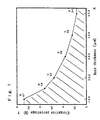
- the present invention is a transparent plastic film having a hard-coating layer on one surface of a plastic base film, wherein, with x ( ⁇ m) representing a thickness of said base film, and y (%) representing an elongation percentage at the time when said plastic film having the hard-coating layer is pulled under a condition at 22°C with one side fixed and at a pulling speed of 20 mm/min, no crack is generated in the hard-coating layer in a region satisfying a relationship: y ⁇ 5.7 if x ⁇ 100, y ⁇ -0.018x + 7.5 if 100 ⁇ x ⁇ 150, y ⁇ -0.008x + 6.0 if 150 ⁇ x ⁇ 200, y ⁇ -0.005x + 5.4 if 200 ⁇ x ⁇ 300, y ⁇ -0.003x + 4.8 if 300 ⁇ x ⁇ 400, y ⁇ -0.002x + 4.4 if 400 ⁇ x ⁇ 500, and y
- Fig. 1 is a graph illustrating a relationship between the base film thickness x ( ⁇ m) and the elongation percentage y (%)of the plastic film with the hard-coating layer in the tensile test.
- a polycarbonate film is suitable as the plastic base film.
- the transparent plastic film having the hard-coating layer is preferably wound in a roll form, from the viewpoint of production efficiency.
- the plastic base film preferably has a thickness of from 100 ⁇ m to 500 ⁇ m, from the viewpoint of production efficiency.
- the plastic film with the hard-coating layer of the present invention is suitably used for any one of applications for a display cover, a nameplate, and a packaging container.
- the plastic film with the hard-coating layer of the present invention is preferably used for obtaining a molded article having the hard-coating layer given thereto by setting the transparent plastic film having the hard-coating layer on one surface of the plastic base film so that the hard-coating layer faces towards one mold surface in a mold for injection molding, clamping the plastic film so that a cavity is formed between a base surface of said film and the other mold surface, thereafter injecting a molten resin into said cavity and cooling the resin to mold a molded article body, and simultaneously to laminate and integrate said plastic film on a surface of the molded article body, in producing the plastic molded article by injection molding.
- the plastic film having the hard-coating layer of the present invention is preferably used for obtaining a plate-shaped molded article having the hard-coating layers given thereto on both surfaces by setting two sheets of the transparent plastic films having the hard-coating layer on one surface of the plastic base film so that the hard-coating layers respectively face towards one mold surface and the other mold surface in a mold for injection molding, clamping the plastic films so that a cavity is formed between base surfaces of said two sheets of the films, thereafter injecting a molten resin into said cavity and cooling the resin to mold a molded article body, and simultaneously to laminate and integrate said plastic films on both surfaces of the molded article body, in producing the plastic plate-shaped molded article by injection molding.
- Such a molded article may be, for example, a window of an automobile such as a passenger car or a bus, a window of an electric train or an airplane, a show window, a transparent plate for a sun terrace, a sun roof of an automobile, or the like; however, the transparent plastic film with the hard-coating layer of the present invention can be applied to various other molded articles.
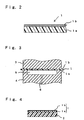
- Fig. 2 is a cross-sectional view of a transparent plastic film with a hard-coating layer of the present invention.
- the transparent plastic film (1) with the hard-coating layer of the present invention has the hard-coating layer (1b) on one surface of a plastic base film (1a).
- the plastic base film (1a) As a material for the plastic base film (1a), polycarbonate resin, polyester resin, polyamide resin, polyimide resin, acrylic resin, polystyrene resin, and others may be mentioned; however, the polycarbonate resin is suitable in view of being excellent in transparency, being lightweight, and being excellent in impact resistance. Further, in the case where the molded article body is composed of polycarbonate resin as in the window of an automobile or the like, the polycarbonate resin is suitable as a material for the plastic base film when one considers the integration of the molded article body with the base film. If the molded article body and the base film are of the same material or of materials having similar compatible structures, it is preferable because they are easily integrated by dissolving with each other at the time of injection molding.
- the hard-coating layer (1b) is formed by applying a hard-coating material composition on the plastic base film (1a), followed by drying and curing.
- thermosetting type hard-coating materials such as silicone type and melamine type
- ultraviolet-curable type hard-coating materials are preferable in view of productivity such as curing reactivity.
- Radical-polymerizing hard-coating materials such as unsaturated polyester resin type and acrylic type, and cationic-polymerizing hard-coating materials such as epoxy type and vinyl ether type can be used as the ultraviolet-curable type hard-coating material.
- the acrylic type radical-polymerizing hard-coating materials are desirable.
- the acrylic type radical-polymerizing hard-coating material comprises multi-functional (meth)acrylate having two or more (meth)acryloyl groups in a molecule and a photopolymerization initiator as main constituents.
- multi-functional (meth)acrylate for example, bifunctional (meth)acrylates such as 1,6-hexane di(meth)acrylate, (poly)ethylene glycol di(meth)acrylate, (poly)propylene glycol di(meth)acrylate and neopentyl glycol di(meth)acrylate, trifunctional (meth)acrylates such as pentaerythritol tri(meth)acrylate, trimethylolpropane tri(meth)acrylate, glycerol tri(meth)acrylate and tris-(2-hydroxyethyl)-isocyanuric acid ester (meth)acrylate, and (tetra or more)-functional (meth)acrylates such as pentaerythritol tetra(meth)acrylate and dipentaerythritol hexa(meth)acrylate may be mentioned.
- bifunctional (meth)acrylates such as 1,6-hexane di(meth)acryl
- pentaerythritol tri(meth)acrylate pentaerythritol tetra(meth)acrylate, dipentaerythritol hexa(meth)acrylate, and others are preferable in view of obtaining a high hardness.
- the amount of the aforesaid multi-functional (meth)acrylate to be used is about 20 to 80 wt% (as converted to solid components) in the hard-coating material.
- a photopolymerizing oligomer or polymer can be used.
- it is an oligomer or polymer having (meth)acryloyl group at its terminal end and having a weight-average molecular weight Mw of, for example, about 1000 to 50000.
- the oligomer or polymer part for example, those formed from urethane polymer, epoxy polymer, polyester polymer, styrene polymer, styrene/acrylonitrile copolymer, styrene/(meth)acrylate copolymer, (meth)acrylate polymer, butadiene polymer, or silicone polymer, and others may be mentioned.
- urethane (meth)acrylates obtained by allowing polyhydric alcohol, polyvalent isocyanate, and hydroxyl-group-containing (meth)acrylate to react; polyester (meth)acrylates obtained by esterifying polyhydric alcohol, polyvalent carboxylic acid and/or anhydride thereof, and (meth)acrylic acid; epoxy (meth)acrylates obtained by allowing a compound having two or more epoxy groups in a molecule to react with (meth)acrylic acid; polystyryl methacrylate; polybutadiene (meth)acrylate; and others may be mentioned.
- photopolymerization initiator various known ones can be used. For example, one may select from ketones (acetophenone, propiophenone, anthraquinone, thioxanthone, benzophenone, or their derivatives), benzoic acid esters (for example, methyl p-dimethylaminobenzoate), benzoin ethers or derivatives thereof (for example, benzoin methyl ether or benzoin ethyl ether), acylphosphine oxide, and others. Needless to say, photopolymerization initiators other than these may be used as well.
- ketones acetophenone, propiophenone, anthraquinone, thioxanthone, benzophenone, or their derivatives
- benzoic acid esters for example, methyl p-dimethylaminobenzoate
- benzoin ethers or derivatives thereof for example, benzoin methyl ether or benzoin ethyl ether
- the amount of the photopolymerizing initiator to be used can be selected, for example, from a range of about 0.1 to 30 parts by weight, preferably about 1 to 20 parts by weight with respect to 100 parts by weight of the aforesaid multi-functional (meth)acrylate (A).
- organic solvent that dilutes the aforesaid hard-coating material
- those that dissolve the material constituting the hard-coating material can be used without limitation.
- alcohols such as ethyl alcohol, n-propyl alcohol, isopropyl alcohol and n-butyl alcohol
- ketones such as methyl ethyl ketone (MEK), methyl isobutyl ketone and cyclohexanone, ethyl acetate, butyl acetate, toluene, dibutylhydroxytoluene, xylene, 2-methoxyethanol, 2-ethoxyethanol, ethylene glycol dimethyl ether, ethylene glycol diethyl ether, diethylene glycol dimethyl ether, methyl cellosolve, ethyl cellosolve, dibutyl malate, and others may be mentioned as the organic solvent.
- the organic solvent may be used alone; however, in view of adhesive properties of the hard-coating layer to the plastic base
- the blending ratio of the ultraviolet-curable type hard-coating material and the organic solvent in the hard-coating material composition is normally about 20 to 80 wt% of the ultraviolet-curable type hard-coating material and about 20 to 80 wt% of the organic solvent with respect to the total composition. It may be determined so that a good solubility and a suitable viscosity (suitability for coating) of the hard-coating material will be obtained.
- various known additives such as an ultraviolet absorbent, an ultraviolet stabilizer, an antioxidant, and a thermal polymerization prohibitor may be contained in the hard-coating material composition in accordance with the needs.
- the hard-coating material composition can be obtained by dispersing or dissolving the hard-coating material components such as the multi-functional (meth)acrylate and the photopolymerization initiator into the aforesaid specific organic solvent by an ordinary method.
- a method comprising applying continuously a hard-coating material composition on a long plastic base film wound in a roll form, drying, curing, and thereafter winding it in a roll form, is suitable in view of production efficiency.
- the continuous application of the hard-coating material composition can be carried out by a known method such as the bar coating method, the doctor blade method, the reverse coating method, the Meyer bar coating method, the gravure coating method, the comma coating method, or the slit die coating method.
- the drying after the application may be carried out, for example, within a temperature range of from 50 to 120°C, for' about 10 seconds to 5 minutes, for example.
- ultraviolet rays are irradiated for curing.
- the ultraviolet rays may be irradiated by irradiating ultraviolet rays for about 200 to 2000 mJ/cm 2 with the use of a lamp such as a xenon lamp, a low pressure mercury-vapor lamp, a middle pressure mercury-vapor lamp, a high pressure mercury-vapor lamp, a super high pressure mercury-vapor lamp, a metal halide lamp, a carbon arc lamp, or a tungsten lamp.
- the film having the hard-coating layer formed thereon is wound in a roll form.
- the curing generally proceeds more if the amount of ultraviolet irradiation is increased. For this reason, when the aforesaid tensile test is carried out, the crack tends to be generated at a smaller elongation percentage y.
- the plastic base film preferably has a thickness of from 100 ⁇ m to 500 ⁇ m, more preferably from 200 ⁇ m to 400 ⁇ m. If the thickness is smaller than 100 ⁇ m, wrinkles are generated in the film and the workability becomes poor in mounting the film with the hard-coating layer into a mold for injection molding. On the other hand, in the case of a film having a thickness larger than 500 ⁇ m, more labor is required in conveying the base film at the time of application and in winding the film in a roll form.
- the requirements of the present invention can be satisfied even if the crack is generated at a smaller elongation percentage y when the aforesaid tensile test is carried out.
- the temperature imposed upon the hard-coating layer is restrained when the plastic film with the hard-coating layer is used for injection molding, so that practical performance can be satisfied even if the elongation percentage y at the time of generation of the crack is low in the aforesaid tensile test.
- the thickness of the hard-coating layer may be normally about 0.5 ⁇ m to 20 ⁇ m after curing, preferably about 2 ⁇ m to 15 ⁇ m after curing.
- the crack tends to be generated at a smaller elongation percentage y when the aforesaid tensile test is carried out.
- the following may be carried out in order to obtain the plastic film with the hard-coating layer in which no crack is generated in the hard-coating layer when the tensile test is carried out under the aforesaid condition in the region satisfying the requirements of the present invention, namely, in the region in which oblique lines are drawn in the graph of Fig. 1.
- each hard-coating material there is a difference in the absolute thickness of each hard-coating material depending on the hard-coating material to be used.
- the hardness specific to the hard-coating material is taken into account.
- the crack tends to be generated at a smaller elongation percentage y when the aforesaid tensile test is carried out.
- the requirements of the present invention tend to be satisfied even if the crack is generated at a smaller elongation percentage y when the aforesaid tensile test is carried out.
- Fig. 3 is a cross-sectional view illustrating a state in which a mold for injection molding is clamped
- Fig. 4 is a cross-sectional view illustrating a layer constitution of a molded article obtained by the injection molding of Fig. 3 to which the hard-coating layer is given.
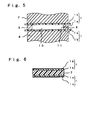
- Fig. 5 is a cross-sectional view illustrating a state in which a mold for injection molding is clamped
- Fig. 6 is a cross-sectional view illustrating a layer constitution of a molded article obtained by the injection molding of Fig. 5 to which the hard-coating layers are given on both surfaces.
- the plastic film (1) with the hard-coating layer of the present invention is set so that the hard-coating layer (1b) faces towards a movable mold (3) of the mold for injection molding, and is clamped so that a cavity (5) is formed between a surface of the film base (1a) and a surface of a fixed mold (4). Thereafter, a molten resin is injected into the cavity (5) from a gate (6) and cooled by an ordinary method.
- this operation molds a molded article body (2) and, at the same time, laminates and integrates the plastic film (1) on the surface of the molded article body (2) to obtain the molded article to which the hard-coating layer (1b) is given.
- the molten resin to be injected that constitutes the molded article body (2) and the material of the base film (1a) are easily compatible with each other, particularly of the same material.
- Fig. 5 shows a case of producing the molded article to which the hard-coating layers are given on both surfaces, and two sheets of the plastic film with the hard-coating layer of the present invention are used.
- the plastic films (1) (1) with the hard-coating layer are sandwiched and set surrounding by a movable mold (7), a fixed mold (8) and a slide mold (9) so that the hard-coating layers (1b) (1b) face respectively towards a movable mold (7) surface and a fixed mold (8) surface of the mold for injection molding, and are clamped so that a cavity (10) is formed between the surface of the film bases (1a) (1a). Thereafter, a molten resin is injected into the cavity (10) from a gate (11) and cooled by an ordinary method.
- this operation molds a molded article body (2) and, at the same time, laminates and integrates the plastic films (1) (1) on both surfaces of the molded article body (2) to obtain the molded article to which the hard-coating layers (1b) (1b) are given on both surfaces.
- the molds (7) (8) and (9) are opened to take the molded article out, and a required part is trimmed to obtain a completed article.
- the plastic films (1) (1) (1) with the hard-coating layer of the present invention By using the plastic films (1) (1) with the hard-coating layer of the present invention, no crack is generated in the hard-coating layer by the heat at the time of injection molding or by cooling from a high temperature state to an ordinary temperature. Thus, the molded article having the hard-coating layers given thereto on both surfaces can be obtained. Further, if the hard-coating layers in the two sheets of films (1) (1) to be used are made to differ within the range of the present invention, it is possible to give the hard-coating layers having different characteristics on the two surfaces of the molded article body (2). For example, in the case of a window of an automobile, it is possible to give optimal hard-coating layers to the outside of the window and to the inside of the car.
- a polycarbonate film having a width of 12 cm and a thickness of 100 ⁇ m fabricated by extrusion molding was used.
- photopolymerizing monomer pentaerythritol triacrylate 4 parts pentaerythritol tetraacrylate 10 parts
- photopolymerizing oligomer 13 parts urethane acrylate (having a molecular weight of about 1000 to 2000)
- photopolymerization initiator Irgacure 184 (manufactured by Chiba Geigy Co., Ltd.) 3 parts
- MEK / toluene / butyl acetate / isopropyl alcohol 1 / 1 / 1 / 1 (weight ratio) 70 parts
- the obtained polycarbonate film with the hard-coating layer was cut into a size of 15 cm x 1 cm, and was mounted onto Tensilon so that the chucking distance of the sample would be 10 cm.
- the upper chucking part was pulled upwards at a speed of 20 mm/min to observe what elongation percentage (in percent) of the film caused generation of a crack in the hard-coating layer.
- the observation of the crack was carried out with the use of a 10-fold magnifier.
- the tensile test was carried out at 22°C.
- the elongation percentage of the polycarbonate film with the hard-coating layer of Example 1 at the time of generation of the crack was 8.2%.
- the obtained polycarbonate film with the hard-coating layer was cut into a size of 10 cm x 20 cm. With reference to Fig. 3, this film was mounted on molds (3) (4) for injection molding and clamped so that the hard-coating layer (1b) faces upwards.
- injection molding was carried out with a molten polycarbonate resin temperature of 315°C, a mold temperature of 80°C, and a molding time of 30 sec including the molten polycarbonate resin filling time and the cooling time, thereby to obtain a molded article substrate having the hard-coating layer given thereto on one surface. Whether the crack had been generated in the hard-coating layer after molding or not was observed by viewing and with the use of a 10-fold magnifier.
- Example 1 With respect to the polycarbonate films with the hard-coating layer obtained in the following Examples 2 to 24 and Comparative Examples 1 to 12, the tensile test was carried out in the same manner as in Example 1 to determine the elongation percentage at the time of the generation of the crack. Also, the injection molding was carried out in the same manner as in Example 1 to evaluate the presence or absence of the generation of the crack in the hard-coating layer after molding.
- Example 2 The process was carried out in the same manner as in Example 1 except that a polycarbonate film having a thickness of 150 ⁇ m was used.
- Example 2 The process was carried out in the same manner as in Example 1 except that a polycarbonate film having a thickness of 200 ⁇ m was used.
- Example 2 The process was carried out in the same manner as in Example 1 except that a polycarbonate film having a thickness of 300 ⁇ m was used.
- Example 2 The process was carried out in the same manner as in Example 1 except that a polycarbonate film having a thickness of 400 ⁇ m was used.
- Example 2 The process was carried out in the same manner as in Example 1 except that a polycarbonate film having a thickness of 500 ⁇ m was used.
- Example 2 The process was carried out in the same manner as in Example 1 except that the amount of application of the hard-coating material composition A was changed to allow the thickness of the hard-coating layer to be 3 ⁇ m.
- Example 2 The process was carried out in the same manner as in Example 1 except that the amount of application of the hard-coating material composition A was changed to allow the thickness of the hard-coating layer to be 10 ⁇ m.
- the process was carried out in the same manner as in Example 8 except that the amount of ultraviolet irradiation was changed to be 1000 mJ/cm 2 .
- Example 9 The process was carried out in the same manner as in Example 9 except that the amount of application of the hard-coating material composition A was changed to allow the thickness of the hard-coating layer to be 15 ⁇ m.
- the process was carried out in the same manner as in Example 2 except that the hard-coating material composition B was used in place of the hard-coating material composition A.
- Example 10 The process was carried out in the same manner as in Example 10 except that a polycarbonate film having a thickness of 200 ⁇ m was used.
- Example 10 The process was carried out in the same manner as in Example 10 except that a polycarbonate film having a thickness of 300 ⁇ m was used.
- Example 10 The process was carried out in the same manner as in Example 10 except that a polycarbonate film having a thickness of 400 ⁇ m was used.
- Example 10 The process was carried out in the same manner as in Example 10 except that a polycarbonate film having a thickness of 500 ⁇ m was used.
- Example 10 The process was carried out in the same manner as in Example 10 except that a polycarbonate film having a thickness of 100 ⁇ m was used.
- the process was carried out in the same manner as in Example 11 except that the amount of ultraviolet irradiation was changed to be 1000 mJ/cm 2 .
- Example 16 The process was carried out in the same manner as in Example 16 except that a polycarbonate film having a thickness of 300 ⁇ m was used.
- the process was carried out in the same manner as in Example 17 except that the amount of application of the hard-coating material composition B was changed to allow the thickness of the hard-coating layer to be 10 ⁇ m.
- Example 18 The process was carried out in the same manner as in Example 18 except that a polycarbonate film having a thickness of 400 ⁇ m was used.
- Example 18 The process was carried out in the same manner as in Example 18 except that a polycarbonate film having a thickness of 500 ⁇ m was used.
- Example 16 The process was carried out in the same manner as in Example 16 except that a polycarbonate film having a thickness of 150 ⁇ m was used.
- Example 18 The process was carried out in the same manner as in Example 18 except that a polycarbonate film having a thickness of 200 ⁇ m was used.
- Example 18 The process was carried out in the same manner as in Example 18 except that the amount of application of the hard-coating material composition B was changed to allow the thickness of the hard-coating layer to be 15 ⁇ m.
- Example 19 The process was carried out in the same manner as in Example 19 except that the amount of application of the hard-coating material composition B was changed to allow the thickness of the hard-coating layer to be 15 ⁇ m.
- Example 21 The process was carried out in the same manner as in Example 21 except that a polycarbonate film having a thickness of 500 ⁇ m was used.
- photopolymerizing monomer pentaerythritol tetraacrylate 15 parts
- photopolymerizing oligomer polyester acrylate (having a molecular weight of about 1200 to 1500) 12 parts
- the process was carried out in the same manner as in Example 17 except that the hard-coating material composition C was used in place of the hard-coating material composition B.
- the process was carried out in the same manner as in Example 23 except that the amount of ultraviolet irradiation was changed to be 1000 mJ/cm 2 .
- Example 1 The results of Examples 1 to 24 and Comparative Examples 1 to 11 are shown in Table 1.
- Hard-coating material composition Base thickness ( ⁇ m)
- Hard-coating layer thickness ( ⁇ m) UV irradiation amount (mJ/cm 2 ) Elongation percentage (%) at the time of generation of a crack in tensile test Presence or absence of generation of a crack at the time of injection molding
- Example 1 A 100 5 300 8.2 absent
- Example 2 A 150 5 300 8.5 absent
- Example 3 A 200 5 300 9.3 absent
- Example 4 A 300 5 300 9.7 absent Example 5 A 400 5 300 10.2 absent
- Example 6 A 500 5 300 10.6 absent Example 7 A 100 3 300 10.0 absent
- Example 8 A 100 10 300 7.0 absent
- Example 9 A 100 10 1000 5.7 absent Comparative Example 1
- Example 11 B 200 5 300 5.3 absent
- Injection molding was carried out as follows with the use of the polycarbonate film with the hard-coating layer obtained in Example 1.
- the obtained polycarbonate film with the hard-coating layer was cut into a size of 10 cm x 20 cm, and two sheets thereof were prepared. With reference to Fig. 5, the two sheets of the films were mounted on molds (7) (8) (9) for injection molding so that the hard-coating layers (1b) (1b) respectively face upwards and downwards, and were clamped so that a cavity (10) would be formed between the bases (1a) (1a) of the two films. Next, injection molding was carried out with a molten polycarbonate resin temperature of 315°C, a mold temperature of 80°C, and a molding time of 30 sec including the molten polycarbonate resin filling time and the cooling time, thereby to obtain a molded article substrate having the hard-coating layers given on both surfaces. Whether the crack had been generated in the hard-coating layer after molding or not was observed by viewing and with the use of a 10-fold magnifier. No crack had been generated in the hard-coating layer on any of the two surfaces after molding.
- the present invention provides a plastic film having a hard-coating layer in which no crack is generated.
- the aforesaid plastic film with the hard-coating layer is excellent in scuff resistance, and can be used widely, for example, as various industrial materials such as a display cover of an OA apparatus, a nameplate, and a food packaging container, an architectural material, an ornamental material, an optical material, a home material, and others.
- the present invention provides a polycarbonate film with a hard-coating layer for obtaining a polycarbonate molded article having the hard-coating layer given thereto by the injection molding method.
- the plastic film with the hard-coating layer of the present invention can be used in the case of producing various injection-molded articles; however, the plastic film of the present invention is especially suitable in the case of producing a window of an automobile, a window of an electric train, an airplane or the like, a show window, a transparent plate for a sun terrace, a sun roof of an automobile, and others having the hard-coating layer given thereto.
Landscapes
- Chemical & Material Sciences (AREA)
- Health & Medical Sciences (AREA)
- Chemical Kinetics & Catalysis (AREA)
- Medicinal Chemistry (AREA)
- Polymers & Plastics (AREA)
- Organic Chemistry (AREA)
- Engineering & Computer Science (AREA)
- Manufacturing & Machinery (AREA)
- Mechanical Engineering (AREA)
- Laminated Bodies (AREA)
- Injection Moulding Of Plastics Or The Like (AREA)
Abstract
Description
| photopolymerizing monomer: | |
| pentaerythritol triacrylate | 4 parts |
| pentaerythritol tetraacrylate | 10 parts |
| photopolymerizing oligomer: | 13 parts |
| urethane acrylate (having a molecular weight of about 1000 to 2000) | |
| photopolymerization initiator: Irgacure 184 (manufactured by Chiba Geigy Co., Ltd.) | 3 parts |
| MEK / toluene / butyl acetate / isopropyl alcohol = 1 / 1 / 1 / 1 (weight ratio) | 70 parts |
| photopolymerizing monomer: | |
| |
8 |
| pentaerythritol triacrylate | |
| 9 | |
| pentaerythritol tetraacrylate | |
| 7 |
|
| 1,6- |
3 parts |
| photopolymerization initiator: Irgacure 907 (manufactured by Chiba Geigy Co., Ltd.) | 3 parts |
| toluene / isopropyl alcohol = 1 / 1 (weight ratio) | 70 parts |
| photopolymerizing monomer: pentaerythritol tetraacrylate |
15 parts |
| photopolymerizing oligomer: polyester acrylate (having a molecular weight of about 1200 to 1500) |
12 parts |
| photopolymerization initiator: Irgacure 184 (manufactured by Chiba Geigy Co., Ltd.) | 3 parts |
| toluene / isopropyl alcohol = 1 / 1 (weight ratio) | 70 parts |
| Hard-coating material composition | Base thickness (µm) | Hard-coating layer thickness (µm) | UV irradiation amount (mJ/cm2) | Elongation percentage (%) at the time of generation of a crack in tensile test | Presence or absence of generation of a crack at the time of injection molding | |
| Example 1 | A | 100 | 5 | 300 | 8.2 | absent |
| Example 2 | A | 150 | 5 | 300 | 8.5 | absent |
| Example 3 | A | 200 | 5 | 300 | 9.3 | absent |
| Example 4 | A | 300 | 5 | 300 | 9.7 | absent |
| Example 5 | A | 400 | 5 | 300 | 10.2 | absent |
| Example 6 | A | 500 | 5 | 300 | 10.6 | absent |
| Example 7 | A | 100 | 3 | 300 | 10.0 | absent |
| Example 8 | A | 100 | 10 | 300 | 7.0 | absent |
| Example 9 | A | 100 | 10 | 1000 | 5.7 | absent |
| Comparative Example 1 | A | 100 | 15 | 1000 | 5.1 | present |
| Example 10 | B | 150 | 5 | 300 | 4.8 | absent |
| Example 11 | B | 200 | 5 | 300 | 5.3 | absent |
| Example 12 | B | 300 | 5 | 300 | 5.6 | absent |
| Example 13 | B | 400 | 5 | 300 | 5.8 | absent |
| Example 14 | B | 500 | 5 | 300 | 6.0 | absent |
| Example 15 | B | 100 | 3 | 300 | 5.8 | absent |
| Comparative Example 2 | B | 100 | 5 | 300 | 4.6 | present |
| Example 16 | B | 200 | 5 | 1000 | 4.4 | absent |
| Example 17 | B | 300 | 5 | 1000 | 4.5 | absent |
| Example 18 | B | 300 | 10 | 1000 | 3.9 | absent |
| Example 19 | B | 400 | 10 | 1000 | 4.1 | absent |
| Example 20 | B | 500 | 10 | 1000 | 4.3 | absent |
| Comparative Example 3 | B | 150 | 5 | 1000 | 4.2 | present |
| Comparative Example 4 | B | 200 | 10 | 1000 | 3.8 | present |
| Comparative Example 5 | B | 300 | 15 | 1000 | 3.5 | present |
| Example 21 | B | 400 | 15 | 1000 | 3.6 | absent |
| Example 22 | B | 500 | 15 | 1000 | 3.8 | absent |
| Comparative Example 6 | C | 300 | 5 | 1000 | 3.0 | present |
| Comparative Example 7 | C | 100 | 5 | 300 | 2.9 | present |
| Comparative Example 8 | C | 150 | 5 | 300 | 3.2 | present |
| Comparative Example 9 | C | 200 | 5 | 300 | 3.4 | present |
| Comparative Example 10 | C | 300 | 5 | 300 | 3.6 | present |
| Example 23 | C | 400 | 5 | 300 | 3.8 | absent |
| Example 24 | C | 500 | 5 | 300 | 3.9 | absent |
| Comparative Example 11 | C | 400 | 5 | 1000 | 3.0 | present |
| Comparative Example 12 | C | 500 | 5 | 1000 | 3.1 | present |
Claims (7)
- A transparent plastic film having a hard-coating layer on one surface of a plastic base film, wherein, with x (µm) representing a thickness of said base film, and y (%) representing an elongation percentage at the time when said plastic film having the hard-coating layer is pulled under a condition at 22°C with one side fixed and at a pulling speed of 20 mm/min, no crack is generated in the hard-coating layer in a region satisfying a relationship:
- The transparent plastic film having the hard-coating layer according to claim 1, wherein said plastic base film is a polycarbonate film.
- The transparent plastic film having the hard-coating layer according to claim 1, which is wound in a roll form.
- The transparent plastic film having the hard-coating layer according to any one of claims 1 to 3, wherein said plastic base film has a thickness of from 100 µm to 500 µm.
- The transparent plastic film having the hard-coating layer according to any one of claims 1 to 4, which is used for any one of applications for a display cover, a nameplate, and a packaging container.
- The transparent plastic film having the hard-coating layer according to any one of claims 1 to 4, which is used for obtaining a molded article having the hard-coating layer given thereto by setting the transparent plastic film having the hard-coating layer on one surface of the plastic base film so that the hard-coating layer faces towards one mold surface in a mold for injection molding, clamping the plastic film so that a cavity is formed between a base surface of said film and the other mold surface, thereafter injecting a molten resin into said cavity and cooling the resin to mold a molded article body, and simultaneously to laminate and integrate said plastic film on a surface of the molded article body, in producing the plastic molded article by injection molding.
- The transparent plastic film having the hard-coating layer according to any one of claims 1 to 4, which is used for obtaining a plate-shaped molded article having the hard-coating layers given thereto on both surfaces by setting two sheets of the transparent plastic films having the hard-coating layer on one surface of the plastic base film so that the hard-coating layers respectively face towards one mold surface and the other mold surface in a mold for injection molding, clamping the plastic films so that a cavity is formed between base surfaces of said two sheets of the films, thereafter injecting a molten resin into said cavity and cooling the resin to mold a molded article body, and simultaneously to laminate and integrate said plastic films on both surfaces of the molded article body, in producing the plastic plate-shaped molded article by injection molding.
Applications Claiming Priority (3)
| Application Number | Priority Date | Filing Date | Title |
|---|---|---|---|
| JP32135999 | 1999-11-11 | ||
| JP32135999 | 1999-11-11 | ||
| PCT/JP2000/007983 WO2001034386A1 (en) | 1999-11-11 | 2000-11-10 | Transparent plastic film having hard coat layer |
Publications (2)
| Publication Number | Publication Date |
|---|---|
| EP1174259A1 true EP1174259A1 (en) | 2002-01-23 |
| EP1174259A4 EP1174259A4 (en) | 2006-03-22 |
Family
ID=18131701
Family Applications (1)
| Application Number | Title | Priority Date | Filing Date |
|---|---|---|---|
| EP00974952A Withdrawn EP1174259A4 (en) | 1999-11-11 | 2000-11-10 | Transparent plastic film having hard coat layer |
Country Status (2)
| Country | Link |
|---|---|
| EP (1) | EP1174259A4 (en) |
| WO (1) | WO2001034386A1 (en) |
Cited By (4)
| Publication number | Priority date | Publication date | Assignee | Title |
|---|---|---|---|---|
| WO2009139082A1 (en) * | 2008-05-16 | 2009-11-19 | Sanwa Screen Co., Ltd. | Film for film insert molding and molded product |
| EP1688248A4 (en) * | 2003-11-28 | 2010-05-26 | Dainippon Printing Co Ltd | Decorating sheet, decorated resin molded article and method for production thereof |
| CN107531037A (en) * | 2015-03-31 | 2018-01-02 | 三菱化学株式会社 | laminate |
| EP3991939A1 (en) * | 2020-10-30 | 2022-05-04 | Sumitomo Chemical Company Limited | Molded article and method of producing the same |
Family Cites Families (9)
| Publication number | Priority date | Publication date | Assignee | Title |
|---|---|---|---|---|
| GB2089826B (en) | 1980-12-18 | 1985-01-03 | Gen Electric | Abrasion resistant ultraviolet light curable hard coating compositions |
| US4683169A (en) * | 1985-11-04 | 1987-07-28 | General Electric Company | Methyl methacrylic coatings on thermoplastic film |
| US4929506A (en) | 1987-12-31 | 1990-05-29 | General Electric Company | Coated polycarbonate articles |
| JPH03114719A (en) * | 1990-09-14 | 1991-05-15 | Hashimoto Forming Ind Co Ltd | Manufacture of resin molded product |
| JPH06270350A (en) * | 1993-03-24 | 1994-09-27 | Sekisui Jushi Co Ltd | Surface-modified polycarbonate resin molded piece |
| JPH0811420A (en) * | 1994-06-30 | 1996-01-16 | Dainippon Printing Co Ltd | Transfer sheet |
| JPH08108695A (en) * | 1994-10-11 | 1996-04-30 | Dainippon Printing Co Ltd | Transfer sheet |
| JPH09156015A (en) * | 1995-11-30 | 1997-06-17 | Kimoto & Co Ltd | Hard coat film |
| JP4201365B2 (en) * | 1997-08-29 | 2008-12-24 | 大日本印刷株式会社 | Flexible hard coat film |
-
2000
- 2000-11-10 WO PCT/JP2000/007983 patent/WO2001034386A1/en not_active Ceased
- 2000-11-10 EP EP00974952A patent/EP1174259A4/en not_active Withdrawn
Cited By (7)
| Publication number | Priority date | Publication date | Assignee | Title |
|---|---|---|---|---|
| EP1688248A4 (en) * | 2003-11-28 | 2010-05-26 | Dainippon Printing Co Ltd | Decorating sheet, decorated resin molded article and method for production thereof |
| EP2623319A1 (en) * | 2003-11-28 | 2013-08-07 | Dai Nippon Printing Co., Ltd. | Use of a decorating sheet and of a decorated moulding resin, as well as their methods of production |
| WO2009139082A1 (en) * | 2008-05-16 | 2009-11-19 | Sanwa Screen Co., Ltd. | Film for film insert molding and molded product |
| CN107531037A (en) * | 2015-03-31 | 2018-01-02 | 三菱化学株式会社 | laminate |
| EP3991939A1 (en) * | 2020-10-30 | 2022-05-04 | Sumitomo Chemical Company Limited | Molded article and method of producing the same |
| CN114437485A (en) * | 2020-10-30 | 2022-05-06 | 住友化学株式会社 | Molded article and method for producing same |
| US12042963B2 (en) | 2020-10-30 | 2024-07-23 | Sumitomo Chemical Company, Limited | Molded article and method of producing the same |
Also Published As
| Publication number | Publication date |
|---|---|
| WO2001034386A1 (en) | 2001-05-17 |
| EP1174259A4 (en) | 2006-03-22 |
Similar Documents
| Publication | Publication Date | Title |
|---|---|---|
| TWI447012B (en) | An optical film manufacturing method, an optical film, a polarizing film, and a display device | |
| KR20120015780A (en) | Polarizing plate and liquid crystal display including the same | |
| JPWO2017188338A1 (en) | Hard coat film and method for producing the same | |
| EP1238797B1 (en) | Laminated polyester film | |
| JP3377301B2 (en) | Thermoplastic norbornene-based resin molded article having hard coat layer and method for producing the same | |
| KR102426430B1 (en) | Coextruded film and display cover window including the same | |
| JP2001205726A (en) | Transparent plastic film having hard coat layer and plastic molding provided with hard coat layer | |
| JP2004070290A (en) | Polarizer | |
| JPH03501955A (en) | Flexible stretchable sheet material useful in forming protective decorative coatings | |
| EP1162246A1 (en) | Coating composition for hard-coat formation on polycarbonate substrate, polycarbonate film with hard coat layer, and polycarbonate molding with hard coat layer | |
| US20050017384A1 (en) | Substrate for optical disk provided with hard-coating layer and method of producing the same | |
| CN102481768B (en) | Molding film | |
| KR101857577B1 (en) | Method for manufacturing low haze acrylic resin film | |
| JP2001114916A (en) | Hard coat agent composition for polycarbonate base material, polycarbonate film with hard coat layer and polycarbonate molded item with hard coat layer | |
| WO2001034386A1 (en) | Transparent plastic film having hard coat layer | |
| US8246896B2 (en) | Impression composition for the preparation of precision optics | |
| JP2002121306A (en) | Polycarbonate film with hard coat layer and its production method | |
| KR20100053277A (en) | Water dispersion anti static hard coating solution, and hard coating film and image display apparatus using the same | |
| KR101936674B1 (en) | Coating acryl film | |
| JP2024040722A (en) | Anti-glare laminate and its manufacturing method | |
| EP3680281A1 (en) | Acrylic film | |
| CN114929478A (en) | Laminated resin sheet for molding and molded article using the same | |
| JPH04268313A (en) | Production of synthetic resin molding excellent in mar resistance | |
| KR101894811B1 (en) | Coating acryl film | |
| EP4635737A1 (en) | Paint substitute film, laminate, shaped article, vehicle exterior part, and laminate manufacturing method |
Legal Events
| Date | Code | Title | Description |
|---|---|---|---|
| PUAI | Public reference made under article 153(3) epc to a published international application that has entered the european phase |
Free format text: ORIGINAL CODE: 0009012 |
|
| 17P | Request for examination filed |
Effective date: 20010808 |
|
| AK | Designated contracting states |
Kind code of ref document: A1 Designated state(s): AT BE CH CY DE DK ES FI FR GB GR IE IT LI LU MC NL PT SE TR |
|
| RBV | Designated contracting states (corrected) |
Designated state(s): DE FR GB |
|
| A4 | Supplementary search report drawn up and despatched |
Effective date: 20060206 |
|
| RIC1 | Information provided on ipc code assigned before grant |
Ipc: B29C 45/14 20060101ALI20060131BHEP Ipc: B32B 27/08 20060101ALI20060131BHEP Ipc: C08J 7/04 20060101AFI20060131BHEP |
|
| 17Q | First examination report despatched |
Effective date: 20071227 |
|
| GRAP | Despatch of communication of intention to grant a patent |
Free format text: ORIGINAL CODE: EPIDOSNIGR1 |
|
| STAA | Information on the status of an ep patent application or granted ep patent |
Free format text: STATUS: THE APPLICATION IS DEEMED TO BE WITHDRAWN |
|
| 18D | Application deemed to be withdrawn |
Effective date: 20110913 |