EP1172251A2 - Folding seat - Google Patents
Folding seat Download PDFInfo
- Publication number
- EP1172251A2 EP1172251A2 EP01115775A EP01115775A EP1172251A2 EP 1172251 A2 EP1172251 A2 EP 1172251A2 EP 01115775 A EP01115775 A EP 01115775A EP 01115775 A EP01115775 A EP 01115775A EP 1172251 A2 EP1172251 A2 EP 1172251A2
- Authority
- EP
- European Patent Office
- Prior art keywords
- frame
- seat
- folded
- cushioning member
- back frame
- Prior art date
- Legal status (The legal status is an assumption and is not a legal conclusion. Google has not performed a legal analysis and makes no representation as to the accuracy of the status listed.)
- Granted
Links
Images




Classifications
-
- B—PERFORMING OPERATIONS; TRANSPORTING
- B60—VEHICLES IN GENERAL
- B60N—SEATS SPECIALLY ADAPTED FOR VEHICLES; VEHICLE PASSENGER ACCOMMODATION NOT OTHERWISE PROVIDED FOR
- B60N2/00—Seats specially adapted for vehicles; Arrangement or mounting of seats in vehicles
- B60N2/24—Seats specially adapted for vehicles; Arrangement or mounting of seats in vehicles for particular purposes or particular vehicles
- B60N2/32—Seats specially adapted for vehicles; Arrangement or mounting of seats in vehicles for particular purposes or particular vehicles convertible for other use
- B60N2/36—Seats specially adapted for vehicles; Arrangement or mounting of seats in vehicles for particular purposes or particular vehicles convertible for other use into a loading platform
-
- B—PERFORMING OPERATIONS; TRANSPORTING
- B60—VEHICLES IN GENERAL
- B60N—SEATS SPECIALLY ADAPTED FOR VEHICLES; VEHICLE PASSENGER ACCOMMODATION NOT OTHERWISE PROVIDED FOR
- B60N2/00—Seats specially adapted for vehicles; Arrangement or mounting of seats in vehicles
- B60N2/24—Seats specially adapted for vehicles; Arrangement or mounting of seats in vehicles for particular purposes or particular vehicles
- B60N2/30—Non-dismountable or dismountable seats storable in a non-use position, e.g. foldable spare seats
- B60N2/3002—Non-dismountable or dismountable seats storable in a non-use position, e.g. foldable spare seats back-rest movements
- B60N2/3004—Non-dismountable or dismountable seats storable in a non-use position, e.g. foldable spare seats back-rest movements by rotation only
- B60N2/3009—Non-dismountable or dismountable seats storable in a non-use position, e.g. foldable spare seats back-rest movements by rotation only about transversal axis
- B60N2/3011—Non-dismountable or dismountable seats storable in a non-use position, e.g. foldable spare seats back-rest movements by rotation only about transversal axis the back-rest being hinged on the cushion, e.g. "portefeuille movement"
-
- B—PERFORMING OPERATIONS; TRANSPORTING
- B60—VEHICLES IN GENERAL
- B60N—SEATS SPECIALLY ADAPTED FOR VEHICLES; VEHICLE PASSENGER ACCOMMODATION NOT OTHERWISE PROVIDED FOR
- B60N2/00—Seats specially adapted for vehicles; Arrangement or mounting of seats in vehicles
- B60N2/70—Upholstery springs ; Upholstery
- B60N2/7011—Upholstery springs ; Upholstery of substantially two-dimensional shape, e.g. hammock-like, plastic shells, fabrics
Definitions
- the present invention relates to a folding seat used for, for instance, a seat of a car.
- a folding seat which can be folded by pivoting a seat back forward to get close to a seat cushion has been known. Folding a seat in this way is popular to make a baggage space wide, when a number of baggage have to be loaded into the car.
- a generally used folding seat for a vehicle is such that polyurethane foam as a cushioning member is supported by a frame and the whole is covered with a covering member. Even rather thin seat cushion and seat back still have a thickness of about 70 mm respectively. Accordingly, when they are folded into layers, the folded seat is about 140 mm thick.
- the present invention is carried out in view of the above-described circumstances, and its object is to provide a folding seat which enables a total thickness of a seat cushion and a seat back to be thinner than the thickness of a conventional folding seat upon folding each other so that the bagage space can be widened.
- a folding seat is provided to solve the above-described problem.
- the folding seat comprises: a seat cushion having a cushioning member supported by a seat frame; and a seat back having a cushioning member supported by a back frame which is pivoted forward with respect to the seat frame so that a seat comprised of the seat cushion and the seat back can be folded, wherein a distance between inner sides of side frames composing the seat frame is arranged to be wider than a distance between outer side of side frames composing the back frame, and the front end frame of the seat frame is positioned outside of the upper end frame of the back frame when the seat frame and the back frame come close upon folding the seat; and wherein the back frame is surrounded by each of the side frames and the front end frame of the seat frame when the seat is folded so that the seat can be folded in a condition that the back frame is positioned inside these frames composing the seat frame.
- a preferred embodiment of the present invention provides a folding seat comprising: a base plate having side plates disposed facing to each other at a predetermined space, each having a long hole formed in a substantially arc shape; a pair of brackets protruding at a predetermined space with each other near the rear end on the upper face of the base plate; connection plates of which each one end is pivotably connected to each of the brackets; a back frame comprised of an upper end frame and a pair of side frames extending from both ends of the upper frame to support a cushioning member, and each lower end of the side frames is connected to the other end of the connection plate; linkage plates sandwitching each side frame of the back frame, disposed in the opposite side with respect to each connection plate, and linked to each side frame; a shaft inserting through into a lower end of each linkage plate, and provided to be capable of linking with each substantially arc-shaped long holes of the base plate; a seat frame comprising a front end frame to support the cushioning member, long holes extending longitudinally from both
- the cushioning member supported by the seat frame is capable of changing its shape as if it sunk when pressed by the back frame upon being folded.
- the cushioning member supported by the seat frame is made of a net member in a three-dimensional structure in which a front mesh layer and a back mesh layer are connected with a large number of piles.
- the cushioning members supported by the seat frame and the cushioning member supported by the back frame are made of a net member in a three-dimensional structure in which a front mesh layer and a back mesh layer are connected with a large number of piles, and have one-piece structure united integrally with two cushioning members.
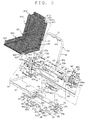
- FIG. 1 is a perspective view showing the state of using a folding seat 10 relating to the present embodiment
- FIG. 2 is a perspective view showing a state when it is being folded
- FIG. 3 is an exploded perspective view of the folding seat.
- the folding seat 10 of this embodiment comprises a base plate 20, a back frame 30, a seat frame 40 and a net member 90 as a cushioning member.
- the base plate 20 comprises a base 21 having a width wider than the width of the seat frame 40, and side plates 22 and 23 disposed facing each other at a predetermined space between both side plates by bending upward from side edges of the base 21.
- the base 21 is fixed or supported to be slidable back and forth on a car floor, if it is used, for instance, in a car.
- a pair of brackets 24 and 25 protrude at a predetermined space between both brackets, near the rear end on the upper face of the base 21.
- Long holes 22a and 23a each having substantially an arc shape when seen from a side (hereinafter, arc-shaped long hole) are bored in the side plates 22 and 23.
- the back frame 30 is formed substantially in the shape of the letter U, and has an upper end frame 31 and a pair of side frames 32 and 33 extending from both ends of the upper end frame 31, and facing each other.
- Four through-holes 32a, 32b, 33a, and 33b, two through-holes each are bored at a predetermined space in the longitudinal direction of each of the side frames 32 and 33 near lower ends of the side frames 32 and 33 (ends on the lower side when the seat is used).
- the seat frame 40 is formed substantially in the shape of the letter U similar to the back frame 30, and has a front end frame 41 and a pair of side frames 42 and 43 extending from both ends of the front end frame 41, and facing each other.
- Long holes 42a and 43a each having a predetermined length are bored near the rear ends of the side frames 42 and 43 (ends on the seat cushion side when in use).
- Through-holes 42b and 43b are bored between the long holes 42a, and 43a and the rear ends of the side frames 42 and 43 respectively.
- the space between the side frames 42 and 43 composing the seat frame 40 is made wider than the space between the side frames 32 and 33 composing the back frame 30.
- connection plates 50 and 51 are pivotably fixed to the respective brackets 24 and 25 provided on the base plate 20 with shaft members 52 and 53.
- the upper ends of the connection plates 50 and 51 are pivotably fixed into the upper side through-holes 32a and 33a formed in respective side frames 32 and 33 of the back frame 30 with the shaft members 54 and 55.
- the shaft members 54 and 55 are inserted through the through-holes 32a and 33a from inside in a state that the connection plates 50 and 51 are positioned in the inside of respective side frames 32 and 33 of the back frame 30 as shown in FIG. 3.
- Linkage plates 60 and 61 are disposed on the opposite side of respective side frames 32 and 33, and the shaft members 54 and 55 are connected to bushes 62 and 63 through the through-holes 60c and 61c formed at the highest portion of the linkage plates 60 and 61.
- the linkage plates 60 and 61 are made of a plate member processed into the shape of the letter Z when seen from the side end face, which are composed of first flat portions 60a and 61a which are from the upper end to a halfway portion, and second flat portions 60b and 61b obtained by bending outward at a nearly right angle from the halfway portion and then further bending downward at a nearly right angle.
- first flat portions 60a and 61a respective two through-holes 60c and 60d, and 61c and 61d are provided, and the shaft members 54 and 55 are inserted into the upper through-holes 60c and 61c as described above. Screws 64 and 65 to connect the linkage plates 60 and 61 with respective side frames 32 and 33 of the back frame 30 are screwed into the lower through-holes 60d and 61 d.
- the second flat portions 60b and 61b are provided with respective three through-holes 60e, 60f, and 60g, and 61e, 61f and 61g at certain intervals along the vertical direction, and the second flat portions 60b and 61b are disposed to locate in the inside of respective side frames 42 and 43 of the seat frame 40.
- the upper through-holes 60e and 61e are placed along the long holes 42a and 43a formed in the side frames 42 and 43 of the seat frame 40, and the guide shafts 66 and 67 are inserted between the through-holes 60e, 61e and the long holes 42a, 43a.
- the guide shafts 66 and 67 have a diameter in a condition that the guide shafts 66 and 67 can move along the long holes 42a and 43a.
- the second flat plates 60b and 61b are placed so that the lower through-holes 60f and 61f formed below the second flat plates are located along the inside of the arc-shaped long holes 22a and 23a formed in the base plate 20.
- Shafts 68 and 69 having a diameter in a condition that the shafts can move along the arc-shaped long holes 22a and 23a, are inserted between the through-holes 60f, and 61f, and the arc-shaped long holes 22a and 23a.
- connection plates 50 and 51 or the linkage plates 60 and 61 with respect to the back frame 30, the position and size of the arc-shaped long holes 22a and 23a formed in the side plates 22 and 23 of the base plate 20, and the position and size of the long holes 42a and 43a formed in the side frames 42 and 43 of the seat frame 40 are determined in such a manner that the position of the upper end frame 31 of the back frame 30 is located to be inside of the front end frame 41 of the seat frame 40 when the back plate 30 is pivoted to come close to the seat plate 40 to be folded (see FIG. 2).
- the back frame 30 and the seat frame 40 are formed in such a manner that the distance between the inner sides of the side frames 42 and 43 of the seat frame 40 is wider than the distance between the outer sides of the side frames 32 and 33 of the back frame 30, the back plate 30 can be folded in a state that the back plate 30 is surrounded by the seat frame 40 by setting the positional relation between the front end frame 41 and the upper end frame 31 to be as described above.
- the numeral 70 indicates a frame located around the back of the waist of a person sitting on the seat, that is, a waist frame disposed almost horizontally between the connection plates 50 and 51 facing each other. More concretely, as shown in FIG. 3, the waist frame 70 is supported by being inserted into protruding portions of bushes 73 and 74 toward the inside of the connection plates 50 and 51, wherein the bushes 73 and 74 are inserted into through-holes formed near the center of the connection plates 50 and 51, and the connection plates 50 and 51 are pivotable with respect to the bushes 73 and 74.
- Protruding portions of the bushes 73 and 74 which protrude outward through the connection plates 50 and 51 are disposed to fit to shaft members 71 and 72 which are inserted into the through-holes 42b and 43b formed near the rear end of the side frames 42 and 43 of the seat frame 40.
- the numeral 75 indicates a seat rear frame disposed almost horizontally between the second flat portions 60b and 61b of the linkage plates 60 and 61.
- the numeral 76 is a reinforcing plate to be fixed to each front end face by welding after the linkage plates 60 and 61 are put together with the side frames 32 and 33, and the numeral 77 is an auxiliary plate being laid between rear end faces of the connection plates 50 and 51 to help in supporting the load on the back frame 30 and the connection plates 50 and 51, when in use.
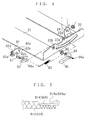
- the locking mechanism comprises: locking shafts 81 and 81 to be inserted into locking bushes 80 and 80 which fit to holes 22b and 23b formed in front of the arc-shaped long holes 22a and 23a in the respective side plates 22 and 23 of the base plate 20; and locking plates 82 and 82 of which base ends 82a and 82a are connected to protruding portions of the locking shafts 81 and 81 protruding toward the inside of the side plates 22 and 23.
- the locking plates 82 and 82 have front ends 82b and 82b of which end faces are curved, and have cut-out portions 82c and 82c with a predetermined width which are cut out from the lower ends in the upward slanting direction.
- the position of the shafts 68 and 69 can be locked by engaging respective shafts 68 and 69 which are inserted into the arc-shaped long holes 22a and 23a of the respective side plates 22 and 23, to the cut-out portions 82c and 82c.
- the locking plates 82 and 82 are downwardly forced around the front ends 82a and 82a, and when the shafts 68 and 69 touch the end faces of the curved front ends 82b and 82b, the shafts 68 and 69 push up the front ends 82b and 82b so that the shafts are housed inside the cut-out portions 82c and 82c.
- coil springs 83 and 83 are used, which are arranged to engage one ends of the coil springs with engaging holes 82d and 82d formed on the upper portions near the base ends of the locking plates 82 and 82, and to engage the other ends with the engaging holes 22d and 23d formed on the upper portions of the arc-shaped long holes 22a and 23a of the side plates 22 and 23 of the base plate 20. Since the one ends of the coil springs 83 and 83 are engaged with the engaging holes 82d and 82d formed on the upper portions near the base ends of the locking plate 82 and 82, the front ends 82b and 82b are forced downward around the base ends 82a and 82a.
- the locking mechanism has a lock release lever 85 which connects with a locking shaft 81 protruding toward the outside of the side plate 22 through the locking bush 80 disposed on one of the side plates 22 side, and an e-ring is disposed between the locking bush 80 and the lock release lever 85 which is connected to the locking shaft 81 with a screw 84a.
- the lock release lever 85 is designed to be placed along the longitudinal direction of one of the side plates 22 of the base plate 20.
- a protrusion 82e provided on the front end of the locking plate 82 pushes up a protruding piece 104a of a set plate 104 which is always forced to pivot downward in FIG. 3 by a spring member 105 supported by the shaft 68, against the elastic force of the spring member 105.
- the set plate 104 is connected to a boss 102.
- the boss 102 is connected to a bush 101 attached to the through-hole 60g placed in the center of three through-holes formed in the second flat portion 60b of the linkage plate 60.
- a connection shaft 100 rotatably inserted into a seat rear frame 75 is attached to the bush 101 and the boss 102, and the bush 101 is connected to the connection shaft 100 through a snap pin 103. Accordingly, when the set plate 104 is pushed up as above to pivot in the left direction in FIG. 3, the connection shaft 100 pivots in the same direction, accompanied by the rotational movement.
- a bush 111 is attached to the through-hole 61g which locates in the center among three through-holes formed in the second flat portion 61b of the other linkage plate 61, and a boss 112 and a set plate 114 are further connected to the bush 111.
- the other end of the connection shaft 100 is inserted into the bush 111 and the boss 112 and is connected through a snap pin 113.
- a spring member 115 is attached to the shaft 69 inserted into the through-hole 61f formed in the lower end of the second flat portion 61b of the other linkage plate 61, and this spring member 115 is linked to the set plate 114 and is forced downward in FIG. 3.
- the set plate 114 is provided with a protruding piece 114a which is able to abut on a protrusion 82e of the locking plate 82 disposed on the other side plate 23 side.
- connection shaft 100 pivots as above
- the set plate 114 disposed on the other linkage plate 61 side pivots in the same direction against the elastic force of the spring member 115, and its protruding piece 114a abuts on the protrusion 82e of the locking plate 82 disposed on the other side plate 23 side to allow the locking plate 82 to pivot upward around the base end 82a, that is, to pivot in a direction to detach the shaft 69 away from the cut-out portion 82c.
- the lock on the other side plate 23 side can be released in synchronization with the release of lock on the one of the side plates 22 side.
- Stopper plates 86 and 86 which lie between the side plates 22, 23 and the locking plates 82, 82 in the inside of the side plates 22 and 23, are connected to the locking bushes 80 and 80 attached to holes 22b and 23b of respective side plates 22 and 23.
- Front end faces 86a and 86a of the stopper plates 86 and 86 are cut-out to form substantially arc-shaped recesses, and when the shaft 68 and 69 reach the front ends of the arc-shaped long holes 22a and 23a, the front end faces 86a and 86a abut on the shafts 68 and 69 to prevent the shafts 68 and 69 from falling down forward.
- the cushioning member of the present embodiment is composed of a net member in a three-dimensional structure in which a front mesh layer and a back mesh layer are bonded with a large number of piles.
- the net member 90 in the three-dimensional structure has a truss structure (a three-dimensional structure) in which a front mesh layer and a back mesh layer are connected with a large number of piles.
- This net member has an elastic structure with resistance to settling, is excellent in air permeability, in pressure dispersion characteristic caused by body weight, and in impact absorption characteristic, and can show a high cushioning ability even it is of a thin type.
- the present invention is characterized in that the total thickness in a folded state can be thinner than ever, since the back frame 30 is surrounded by the seat frame 40 in the folded state. Therefore, it becomes necessary for the cushioning member supported by the seat frame 40 to be pressed by the back frame 30 to be depressed so that the back frame 30 is placed in the inside of the seat frame 40 when the seat is folded.
- a cushioning member from a net member having a three-dimensional structure which has a sufficient impact absorption characteristic, etc.
- a cushioning member supported by the seat frame 40 is preferably a net member having such a three-dimensional structure, but a cushioning member supported by the back frame 30 is not particularly limited to the net member having a three-dimensioned structure. However, in a sense to make the thickness of the whole seat cushion including a cushioning member and the back frame 30 thin, it is also preferable to compose the cushioning member supported by the back frame 30 from a net member having a three-dimensional structure.
- Respective cushioning members supported by the back frame 30 and the seat frame 40 can be set separately, but it is preferable to use a net member 90 which has a one-piece structure united integrally with two cushioning members as in the present embodiment.
- the central portion having the best cushioning property is located under a portion from the haunches to the waist where receives the largest load when being seated. Accordingly, the cushioning property of the net member 90 is effectively exhibited, the hard touch feeling caused by the waist frame 70 and the seat rear frame 75 which are disposed on the border of the seat back and the seat cushion is reduced and the feeling of seating can be improved. It is needless to say that a backing cloth (not shown) can be provided, if necessary.
- the net member 90 is formed to constitute a back cushion 910 supported by the back frame 30 and a seat cushion 920 supported by the seat frame 40, being bounded by around the center.
- the back cushion 910 is comprised of side edges 911, 912 which are sewed together to be substantially a cylindrical shape, and an upper edge 913 formed to protrude upward.
- an engaging plate 914 made of plastic and provided with an engaging portion 914a which is folded back toward the opposite side at the front end, is fixed tightly on the back face of the upper edge 913 by means of vibration welding, etc.
- the respective side frames 32 and 33 of the back frame 30 are inserted into the nearly cylindrical side edges 911 and 912, the upper edge 913 is pulled round backward from the upper end frame 31 of the back frame 30, and an engaging wire 31 a protrudedly fixed downward on the upper end frame 31 is engaged with the engaging portion 914a of the engaging plate 914.
- a seat cushion 920 includes side edges 921 and 922 which are sewed together to be substantially a cylindrical shape, and a front edge 923 formed to protrude forward.
- an engaging plate 924 provided with an engaging portion 924a similar to the above-described back cushion 910 is fixed tightly on the back face of the front edge 923.
- the respective side frames 42 and 43 of the seat frame 40 are inserted into nearly cylindrical side edges 921 and 922, the front edge 923 is pulled round from the front side of the front end frame 41 of the seat frame 40 to the back side, and the engaging portion 924a of the engaging plate 924 of the front edge 923 is engaged with an engaging wire 41 a provided on the front end frame 41 of the seat frame 40.
- the net member 90 in a one-piece structure is supported by the back frame 30 and the seat frame 40 to serve as a cushioning member.
- the nearly cylindrical side edges 921 and 922 of the seat cushion 920 which are disposed at least around respective side frames 42 and 43 of the seat frame 40, are formed to have their inside diameters a little larger than the diameter of the side frames 42 and 43 with a clearance in order that the cushioning member can be depressed in such a manner that the side edges 921 and 922 slide inward around the side frames 42 and 43 when pressed by the back frame 30.
- the numeral 930 indicates a straining member provided near a lower portion of the back face of the back cushion 910. As shown with a broken line in FIG. 1, the straining member 930 is fixed on the back cushion 910 to protrude backward with a smaller width than the space between respective side frames 32 and 33 of the back frame 30, and is wound around the waist frame 70. With this straining member 930, the back cushion 910 is securely strained.
- the straining member 930 is acceptable so far as it has such a function. Accordingly, it can be composed of a net member having a three-dimensional structure similar to the back cushion 910, or it can be composed of cloth, or a plastic sheet, etc.
- the net member 90 in a three-dimensional structure has formation as follows. As shown in FIG. 6, the net member 90 is formed of a stereoscopic truss structure (a three-dimensional structure) including the front mesh layer 91, the back mesh layer 92, and a number of piles 93 which connects the front mesh layer 91 and the back mesh layer 92.
- a stereoscopic truss structure (a three-dimensional structure) including the front mesh layer 91, the back mesh layer 92, and a number of piles 93 which connects the front mesh layer 91 and the back mesh layer 92.
- the front mesh layer 91 is formed into a structure having, for instance, a honeycombed (hexagonal) mesh made from multifilaments stranded of monofilaments, as shown in FIG. 7.
- the back mesh layer 92 is formed, for instance, by rib knitting of multifilaments stranded from monofilaments, as shown in FIG. 8, into a structure having a smaller mesh (fine mesh) than the honeycombed mesh of the front mesh layer 91.
- the pile 93 is formed of monofilaments or multifilaments which are knitted connecting between the front mesh layer 91 and the back mesh layer 92 so that the front mesh layer 91 and the back mesh layer 92 maintain a predetermined space from each other, thereby giving a predetermined stiffness to the net member 90 which is now a stereoscopic mesh knit.
- fiber when the word "fiber” is simply used in this description, it means to include spun yarn as well as a monofilament and a multifilament.
- a layer having a honeycombed mesh is defined as the front face (for instance, a surface of the seat cushion and seat back being in contact with the human body), it is acceptable to define the above as the back face, and a layer having fine mesh as the front face. It is also acceptable to adopt a mesh shape other than a honeycombed shape or a fine mesh shape as a structure of the mesh layer, as shown in table 1 to be described later.
- thermoplastic resin As a material to compose the front mesh layer 91, the back mesh layer 92 or the pile 93, a thermoplastic resin is preferable.
- the following resins can be used, for instance, thermoplastic polyester resin such as polyethylene terephthalate (PET) and polybutylene terephthalate (PBT), polyamide resin such as nylon 6 and nylon 66, polyolefin resin such as polyethylene and polypropylene, or a mixed resin containing more than two kinds of these resins.
- the thickness of a fiber composing the pile 93 should be, for instance, more than 380 d, preferably 600 d or more. Then, the load generated by a person who sits on the seat can be supported through deformation of the mesh composing respective mesh layers 91 and 92, and falling of the pile 93, so that the seat can be of a soft structure without concentration of stress.
- d indicates “denier” and "1 d” is a unit of thickness when one gram of a fiber material is pulled to 9,000 m.
- the letter “f” means “filament” which is a unit for expressing the number of monofilaments.
- 70 f means that one piece of thread is composed of 70 pieces of monofilaments.
- An expression “kg/5 cm” used for tensile strength is the strength required to pull a test piece of 5 cm width.
- An expression "parallel” used for the pile structure means a state that the piles 93 connecting the front mesh layer 91 and the back mesh layer 92 do not cross each other seen from a side, while “cross” means a state that the piles cross each other seen from a side.
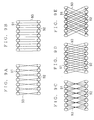
- FIG. 9 A and FIG. 9B show a straight type in which the piles 93 are disposed to connect between respective fibers composing the front mesh layer 91 and respective opposing fibers composing the back mesh layer 92, in which FIG. 9 A shows a straight type knitted in the shape of the letter "8", while FIG. 9 B shows a type which is simply knitted straight. From FIG. 9 C to FIG.
- FIG. 9 E show cross types in which the piles 93 are knitted between respective adjacent threads for the front mesh layer 91 and respective adjacent threads for the back mesh layer 92 in such a manner that the piles 93 cross each other at the halfway.
- FIG. 9 C shows a type in which the piles 93 cross in the shape of the letter "8”
- FIG. 9 D shows another cross type in which the pile 93 are knitted in a simple cross
- FIG. 9 E shows still another cross type in which the piles 93 are crossed each other bringing two pieces together (double cross).
- both of the locking plate 82 and 82 are pivoted through the connection shaft 100 against the coil springs 83 and 83 by pushing down the front end side of the lock release lever 85 to release the engagement between the locking plates 82, 82 and the shafts 68, 69. Then, the seat back is pushed down forward. While the seat back is falling down forward, the linkage plates 60 and 61 linked to the back frame 30 also fall down forward.
- the shafts 68 and 69 inserted into the through-holes 60f and 61f provided below the linkage plate 60 and 61 move backward in a manner that they draw an arc along a lower orbit of the linkage plates 60 and 61, in other words, along the arc-shaped long holes 22a and 22b of the base plate 20.
- connection plates 50 and 51 connected to the back frame 30 pivot around the shaft members 54 and 55 disposed on the brackets 24 and 25 of the base plate 20 as if they fall forward.
- the connection plates 50 and 51 pivot with respect to the side frames 42 and 43 of the seat frame 40 by pivoting around the bushes 73 and 74 supporting the waist frame 70.
- the linkage plates 60 and 61 the spaces between the lower portions of respective linkage plates and the connection plates are getting close from a state that the linkage plates and the connection plate form an inverted shape of the letter "V" when seen from the side.
- the guide shafts 66 and 67 linked to the linkage plates 60 and 61 also move backward along an orbit drawing an arc, and the guide shafts 66 and 67 are linked to the long holes 42a and 43a of the seat frame 40.
- the seat frame 40 approaches the base plate 20 while coming up forward. Since accompanied by coming up of the seat frame 40 forward, the guide shafts 66 and 67 move backward in the long holes 42a and 43a relatively, the back frame 30 approaches the seat frame 40. As described above, since the dimension of the back frame 30 is smaller than the seat frame 40, the back frame 30 abuts the seat cushion 920 supported by the seat frame 40 in the net members 90.
- the back frame 30 presses the seat cushion 920.
- the substantially cylindrical side edges 921 and 922 of the seat cushion 920 slide inward with respect to the side frames 42 and 43 so that the seat cushion 920 is depressed by being pressed with the back frame 30 and the back cushion 910.
- the back frame 30 is folded in a state to be surrounded by the seat frame 40.
- the total thickness of the seat 10 in a folded state is not the thickness of the seat cushion composed of the seat frame 40 and the seat cushion 920 plus the thickness of the seat back composed of the back frame 30 and the back cushion 910, but the thickness can be within nearly the same thickness as the thickness of the seat cushion or the seat back alone.
- the distance between the inner sides of side framed composing the seat frame is arranged to be wider than the distance between the outer sides of side frames composing the back frame and the front end frame of the seat frame is positioned outside of the upper end frame of the back frame when the seat frame and the back frame come close upon folding the seat, and the back frame is surrounded by each side frame and the front end frame of the seat frame when the seat is folded so that the seat can be folded in a condition that the back frame is positioned inside these frames of the seat frame.
- the total thickness of the seat in a folded state is not the thickness of the seat cushion plus the thickness of the seat back, but it can be within nearly the same thickness as the thickness of the seat cushion or the seat back alone, thereby increasing the space for baggage compared with the case using a conventional folding seat.
Landscapes
- Engineering & Computer Science (AREA)
- Aviation & Aerospace Engineering (AREA)
- Transportation (AREA)
- Mechanical Engineering (AREA)
- Seats For Vehicles (AREA)
- Chair Legs, Seat Parts, And Backrests (AREA)
- Chairs For Special Purposes, Such As Reclining Chairs (AREA)
Abstract
Description
- The present invention relates to a folding seat used for, for instance, a seat of a car.
- A folding seat which can be folded by pivoting a seat back forward to get close to a seat cushion has been known. Folding a seat in this way is popular to make a baggage space wide, when a number of baggage have to be loaded into the car.
- However, when a conventional folding seat is folded, the seat back is simply placed on the seat cushion. Therefore, even folded, a space for layers of the seat cushion and the seat back occupies a portion of the baggage space. A generally used folding seat for a vehicle is such that polyurethane foam as a cushioning member is supported by a frame and the whole is covered with a covering member. Even rather thin seat cushion and seat back still have a thickness of about 70 mm respectively. Accordingly, when they are folded into layers, the folded seat is about 140 mm thick.
- The present invention is carried out in view of the above-described circumstances, and its object is to provide a folding seat which enables a total thickness of a seat cushion and a seat back to be thinner than the thickness of a conventional folding seat upon folding each other so that the bagage space can be widened.
- In accordance with one aspect of the present invention, a folding seat is provided to solve the above-described problem. The folding seat comprises: a seat cushion having a cushioning member supported by a seat frame; and a seat back having a cushioning member supported by a back frame which is pivoted forward with respect to the seat frame so that a seat comprised of the seat cushion and the seat back can be folded, wherein a distance between inner sides of side frames composing the seat frame is arranged to be wider than a distance between outer side of side frames composing the back frame, and the front end frame of the seat frame is positioned outside of the upper end frame of the back frame when the seat frame and the back frame come close upon folding the seat; and wherein the back frame is surrounded by each of the side frames and the front end frame of the seat frame when the seat is folded so that the seat can be folded in a condition that the back frame is positioned inside these frames composing the seat frame.
- A preferred embodiment of the present invention provides a folding seat comprising: a base plate having side plates disposed facing to each other at a predetermined space, each having a long hole formed in a substantially arc shape; a pair of brackets protruding at a predetermined space with each other near the rear end on the upper face of the base plate; connection plates of which each one end is pivotably connected to each of the brackets; a back frame comprised of an upper end frame and a pair of side frames extending from both ends of the upper frame to support a cushioning member, and each lower end of the side frames is connected to the other end of the connection plate; linkage plates sandwitching each side frame of the back frame, disposed in the opposite side with respect to each connection plate, and linked to each side frame; a shaft inserting through into a lower end of each linkage plate, and provided to be capable of linking with each substantially arc-shaped long holes of the base plate; a seat frame comprising a front end frame to support the cushioning member, long holes extending longitudinally from both ends of the front end frame toward the vicinity of the rear end, and a pair of side frames having a through-hole between the long hole and the rear end; a shaft member inserting into the through-hole formed on each side frame of the seat frame, and fixed in such a manner that the connection plates are installed pivotable with respect to each side frame; and guide shafts inserting into the through-hole formed on each side frame of the seat frame, and linked to a halfway portion of the linkage plate, wherein a distance between inner sides of side frames forming the seat frame is arranged to be wider than a distance between outer sides of side frames forming the back frame, and the front end frame of the seat frame is positioned outside of the upper end frame of the back frame when the seat frame and the back frame come close upon folding the seat; and wherein said guide shaft positions in front in each long hole formed on said seat frame, and said shaft positions in front in each substantially arc-shaped long hole formed on said base plate when the seat is in use, and when the seat is folded, the back frame can be folded to be surrounded by the seat frame in such a manner that each connection plate pivots together with the back frame around the bracket, the shaft moves backward in each substantially arc-shaped long hole, and the guide shaft also moves backward in each long hole.
- In a preferred embodiment of the present invention, the cushioning member supported by the seat frame is capable of changing its shape as if it sunk when pressed by the back frame upon being folded.
- In a preferred embodiment of the present invention, the cushioning member supported by the seat frame is made of a net member in a three-dimensional structure in which a front mesh layer and a back mesh layer are connected with a large number of piles.
- In a preferred embodiment of the present invention, the cushioning members supported by the seat frame and the cushioning member supported by the back frame are made of a net member in a three-dimensional structure in which a front mesh layer and a back mesh layer are connected with a large number of piles, and have one-piece structure united integrally with two cushioning members.
-
- FIG. 1 is a perspective view showing the state of a folding seat relating to an embodiment of the present invention when it is in use;
- FIG. 2 is a perspective view showing the state of the folding seat relating to the above embodiment when it is folded;
- FIG. 3 is an exploded perspective view of the folding seat relating to the above embodiment;
- FIG. 4 is an enlarged view to explain a locking mechanism;
- FIG. 5 is a view to explain an engaging plate;
- FIG. 6 is a sectional view showing a portion of a net member in a three-dimensional structure, which is used in the above embodiment;
- FIG. 7 is an enlarged view showing a front mesh layer of the net member shown in FIG. 6;
- FIG. 8 is an enlarged view showing a back mesh layer of the net member shown in FIG. 6; and
- FIG. 9 A to FIG. 9 E are views to explain the way of arranging piles.
-
- The present invention will be explained in more detail according to embodiments shown in the drawings. FIG. 1 is a perspective view showing the state of using a folding
seat 10 relating to the present embodiment, and FIG. 2 is a perspective view showing a state when it is being folded. FIG. 3 is an exploded perspective view of the folding seat. As shown in FIG. 1 to FIG. 3, thefolding seat 10 of this embodiment comprises abase plate 20, aback frame 30, aseat frame 40 and anet member 90 as a cushioning member. - The
base plate 20 comprises abase 21 having a width wider than the width of theseat frame 40, andside plates base 21. Thebase 21 is fixed or supported to be slidable back and forth on a car floor, if it is used, for instance, in a car. A pair ofbrackets base 21.Long holes side plates - The
back frame 30 is formed substantially in the shape of the letter U, and has anupper end frame 31 and a pair ofside frames upper end frame 31, and facing each other. Four through-holes side frames side frames 32 and 33 (ends on the lower side when the seat is used). - The
seat frame 40 is formed substantially in the shape of the letter U similar to theback frame 30, and has afront end frame 41 and a pair ofside frames front end frame 41, and facing each other.Long holes 42a and 43a each having a predetermined length are bored near the rear ends of theside frames 42 and 43 (ends on the seat cushion side when in use). Through-holes 42b and 43b are bored between thelong holes 42a, and 43a and the rear ends of theside frames side frames seat frame 40 is made wider than the space between theside frames back frame 30. - Respective lower ends of
connection plates respective brackets base plate 20 withshaft members connection plates holes respective side frames back frame 30 with theshaft members - The
shaft members holes connection plates respective side frames back frame 30 as shown in FIG. 3.Linkage plates respective side frames shaft members bushes holes linkage plates - The
linkage plates flat portions flat portions 60b and 61b obtained by bending outward at a nearly right angle from the halfway portion and then further bending downward at a nearly right angle. - In the first
flat portions holes shaft members holes linkage plates respective side frames back frame 30 are screwed into the lower through-holes 60d and 61 d. - The second
flat portions 60b and 61b are provided with respective three through-holes flat portions 60b and 61b are disposed to locate in the inside ofrespective side frames seat frame 40. The upper through-holes 60e and 61e are placed along thelong holes 42a and 43a formed in theside frames seat frame 40, and theguide shafts holes 60e, 61e and thelong holes 42a, 43a. Note that theguide shafts long holes 42a and 43a. - The second
flat plates 60b and 61b are placed so that the lower through-holes 60f and 61f formed below the second flat plates are located along the inside of the arc-shapedlong holes base plate 20.Shafts long holes holes 60f, and 61f, and the arc-shapedlong holes - As a result of being assembled in this way, as shown in FIG. 1, when it is in use, the
guide shafts long holes 42a and 43a, and theshafts long holes flat portions 60b and 61b are pushed forwarder in a slant direction than the firstflat portions linkage plates back frame 30 is supported by thelinkage plates connection plates back frame 30 and theseat frame 40 can be securely and stably supported in a wide opened position when in use. - Furthermore, the connecting position of the
connection plates linkage plates back frame 30, the position and size of the arc-shapedlong holes side plates base plate 20, and the position and size of thelong holes 42a and 43a formed in theside frames seat frame 40 are determined in such a manner that the position of theupper end frame 31 of theback frame 30 is located to be inside of thefront end frame 41 of theseat frame 40 when theback plate 30 is pivoted to come close to theseat plate 40 to be folded (see FIG. 2). As above, since theback frame 30 and theseat frame 40 are formed in such a manner that the distance between the inner sides of theside frames seat frame 40 is wider than the distance between the outer sides of theside frames back frame 30, theback plate 30 can be folded in a state that theback plate 30 is surrounded by theseat frame 40 by setting the positional relation between thefront end frame 41 and theupper end frame 31 to be as described above. - Here, the
numeral 70 indicates a frame located around the back of the waist of a person sitting on the seat, that is, a waist frame disposed almost horizontally between theconnection plates waist frame 70 is supported by being inserted into protruding portions ofbushes 73 and 74 toward the inside of theconnection plates bushes 73 and 74 are inserted into through-holes formed near the center of theconnection plates connection plates bushes 73 and 74. Protruding portions of thebushes 73 and 74 which protrude outward through theconnection plates shaft members 71 and 72 which are inserted into the through-holes 42b and 43b formed near the rear end of theside frames seat frame 40. - The
numeral 75 indicates a seat rear frame disposed almost horizontally between the secondflat portions 60b and 61b of thelinkage plates numeral 76 is a reinforcing plate to be fixed to each front end face by welding after thelinkage plates side frames numeral 77 is an auxiliary plate being laid between rear end faces of theconnection plates back frame 30 and theconnection plates - Next, a locking mechanism to keep the
back plate 30 and theseat plate 40 in a wide opened state when the seat is in use will be explained with FIG. 3 and FIG. 4. The locking mechanism comprises:locking shafts locking bushes holes long holes respective side plates base plate 20; andlocking plates base ends locking shafts side plates plates front ends portions shafts respective shafts long holes respective side plates portions - In more detail, in a normal condition, the locking
plates shafts shafts portions plates holes plates holes long holes side plates base plate 20. Since the one ends of the coil springs 83 and 83 are engaged with the engagingholes plate - The locking mechanism has a
lock release lever 85 which connects with a lockingshaft 81 protruding toward the outside of theside plate 22 through the lockingbush 80 disposed on one of theside plates 22 side, and an e-ring is disposed between the lockingbush 80 and thelock release lever 85 which is connected to the lockingshaft 81 with ascrew 84a. At a normal position where thelock release lever 85 is forced by elastic force of thecoil spring 83, as shown in FIG. 1, thelock release lever 85 is designed to be placed along the longitudinal direction of one of theside plates 22 of thebase plate 20. When the front end of thelock release lever 85 is pulled down, one of the lockingplates 82 pivots in a direction to break away theshaft 68 from the cut-outportion 82c through the lockingshaft 81 so that the lock can be released. - At this time, a
protrusion 82e provided on the front end of the lockingplate 82 pushes up a protrudingpiece 104a of aset plate 104 which is always forced to pivot downward in FIG. 3 by aspring member 105 supported by theshaft 68, against the elastic force of thespring member 105. Theset plate 104 is connected to a boss 102. The boss 102 is connected to abush 101 attached to the through-hole 60g placed in the center of three through-holes formed in the second flat portion 60b of thelinkage plate 60. Aconnection shaft 100 rotatably inserted into a seatrear frame 75 is attached to thebush 101 and the boss 102, and thebush 101 is connected to theconnection shaft 100 through asnap pin 103. Accordingly, when theset plate 104 is pushed up as above to pivot in the left direction in FIG. 3, theconnection shaft 100 pivots in the same direction, accompanied by the rotational movement. - On the other hand, a bush 111 is attached to the through-
hole 61g which locates in the center among three through-holes formed in the secondflat portion 61b of theother linkage plate 61, and a boss 112 and aset plate 114 are further connected to the bush 111. The other end of theconnection shaft 100 is inserted into the bush 111 and the boss 112 and is connected through asnap pin 113. A spring member 115 is attached to theshaft 69 inserted into the through-hole 61f formed in the lower end of the secondflat portion 61b of theother linkage plate 61, and this spring member 115 is linked to theset plate 114 and is forced downward in FIG. 3. Theset plate 114 is provided with a protrudingpiece 114a which is able to abut on aprotrusion 82e of the lockingplate 82 disposed on theother side plate 23 side. - Accordingly, when the
connection shaft 100 pivots as above, theset plate 114 disposed on theother linkage plate 61 side pivots in the same direction against the elastic force of the spring member 115, and its protrudingpiece 114a abuts on theprotrusion 82e of the lockingplate 82 disposed on theother side plate 23 side to allow the lockingplate 82 to pivot upward around thebase end 82a, that is, to pivot in a direction to detach theshaft 69 away from the cut-outportion 82c. Thus, the lock on theother side plate 23 side can be released in synchronization with the release of lock on the one of theside plates 22 side. -
Stopper plates side plates plates side plates bushes holes respective side plates stopper plates shaft long holes shafts shafts - Next, the cushioning member in the present embodiment supported by the above-described back
frame 30 and theseat frame 40 will be explained here. The cushioning member of the present embodiment is composed of a net member in a three-dimensional structure in which a front mesh layer and a back mesh layer are bonded with a large number of piles. Thenet member 90 in the three-dimensional structure has a truss structure (a three-dimensional structure) in which a front mesh layer and a back mesh layer are connected with a large number of piles. This net member has an elastic structure with resistance to settling, is excellent in air permeability, in pressure dispersion characteristic caused by body weight, and in impact absorption characteristic, and can show a high cushioning ability even it is of a thin type. - As described above, the present invention is characterized in that the total thickness in a folded state can be thinner than ever, since the
back frame 30 is surrounded by theseat frame 40 in the folded state. Therefore, it becomes necessary for the cushioning member supported by theseat frame 40 to be pressed by theback frame 30 to be depressed so that theback frame 30 is placed in the inside of theseat frame 40 when the seat is folded. For this purpose, it is preferable to compose a cushioning member from a net member having a three-dimensional structure which has a sufficient impact absorption characteristic, etc. even it is of a thin type, can be set by hanging around its edge onto the side frames 42 and 43, and is possible to be depressed in such a manner that the edge of the net member slides turning inward around the side frames 42 and 43 when the net member is pressed by theback frame 30. - As above, a cushioning member supported by the
seat frame 40 is preferably a net member having such a three-dimensional structure, but a cushioning member supported by theback frame 30 is not particularly limited to the net member having a three-dimensioned structure. However, in a sense to make the thickness of the whole seat cushion including a cushioning member and theback frame 30 thin, it is also preferable to compose the cushioning member supported by theback frame 30 from a net member having a three-dimensional structure. - Respective cushioning members supported by the
back frame 30 and theseat frame 40 can be set separately, but it is preferable to use anet member 90 which has a one-piece structure united integrally with two cushioning members as in the present embodiment. - By adopting the
net member 90 having such a one-piece structure as in the present embodiment, the central portion having the best cushioning property is located under a portion from the haunches to the waist where receives the largest load when being seated. Accordingly, the cushioning property of thenet member 90 is effectively exhibited, the hard touch feeling caused by thewaist frame 70 and the seatrear frame 75 which are disposed on the border of the seat back and the seat cushion is reduced and the feeling of seating can be improved. It is needless to say that a backing cloth (not shown) can be provided, if necessary. - More concretely, as shown in FIG. 3, the
net member 90 is formed to constitute aback cushion 910 supported by theback frame 30 and aseat cushion 920 supported by theseat frame 40, being bounded by around the center. Theback cushion 910 is comprised of side edges 911, 912 which are sewed together to be substantially a cylindrical shape, and anupper edge 913 formed to protrude upward. As shown in FIG. 5, anengaging plate 914, made of plastic and provided with an engagingportion 914a which is folded back toward the opposite side at the front end, is fixed tightly on the back face of theupper edge 913 by means of vibration welding, etc. The respective side frames 32 and 33 of theback frame 30 are inserted into the nearly cylindrical side edges 911 and 912, theupper edge 913 is pulled round backward from theupper end frame 31 of theback frame 30, and anengaging wire 31 a protrudedly fixed downward on theupper end frame 31 is engaged with the engagingportion 914a of theengaging plate 914. - A
seat cushion 920 includes side edges 921 and 922 which are sewed together to be substantially a cylindrical shape, and afront edge 923 formed to protrude forward. As shown in FIG. 5, anengaging plate 924 provided with an engagingportion 924a similar to the above-describedback cushion 910 is fixed tightly on the back face of thefront edge 923. The respective side frames 42 and 43 of theseat frame 40 are inserted into nearly cylindrical side edges 921 and 922, thefront edge 923 is pulled round from the front side of thefront end frame 41 of theseat frame 40 to the back side, and the engagingportion 924a of theengaging plate 924 of thefront edge 923 is engaged with anengaging wire 41 a provided on thefront end frame 41 of theseat frame 40. - Thus, the
net member 90 in a one-piece structure is supported by theback frame 30 and theseat frame 40 to serve as a cushioning member. It should be noted that the nearly cylindrical side edges 921 and 922 of theseat cushion 920, which are disposed at least around respective side frames 42 and 43 of theseat frame 40, are formed to have their inside diameters a little larger than the diameter of the side frames 42 and 43 with a clearance in order that the cushioning member can be depressed in such a manner that the side edges 921 and 922 slide inward around the side frames 42 and 43 when pressed by theback frame 30. - The numeral 930 indicates a straining member provided near a lower portion of the back face of the
back cushion 910. As shown with a broken line in FIG. 1, the strainingmember 930 is fixed on theback cushion 910 to protrude backward with a smaller width than the space between respective side frames 32 and 33 of theback frame 30, and is wound around thewaist frame 70. With this strainingmember 930, theback cushion 910 is securely strained. The strainingmember 930 is acceptable so far as it has such a function. Accordingly, it can be composed of a net member having a three-dimensional structure similar to theback cushion 910, or it can be composed of cloth, or a plastic sheet, etc. - The
net member 90 in a three-dimensional structure has formation as follows. As shown in FIG. 6, thenet member 90 is formed of a stereoscopic truss structure (a three-dimensional structure) including thefront mesh layer 91, theback mesh layer 92, and a number ofpiles 93 which connects thefront mesh layer 91 and theback mesh layer 92. - The
front mesh layer 91 is formed into a structure having, for instance, a honeycombed (hexagonal) mesh made from multifilaments stranded of monofilaments, as shown in FIG. 7. Theback mesh layer 92 is formed, for instance, by rib knitting of multifilaments stranded from monofilaments, as shown in FIG. 8, into a structure having a smaller mesh (fine mesh) than the honeycombed mesh of thefront mesh layer 91. Thepile 93 is formed of monofilaments or multifilaments which are knitted connecting between thefront mesh layer 91 and theback mesh layer 92 so that thefront mesh layer 91 and theback mesh layer 92 maintain a predetermined space from each other, thereby giving a predetermined stiffness to thenet member 90 which is now a stereoscopic mesh knit. Incidentally, when the word "fiber" is simply used in this description, it means to include spun yarn as well as a monofilament and a multifilament. - In addition, though in the above explanation, a layer having a honeycombed mesh is defined as the front face (for instance, a surface of the seat cushion and seat back being in contact with the human body), it is acceptable to define the above as the back face, and a layer having fine mesh as the front face. It is also acceptable to adopt a mesh shape other than a honeycombed shape or a fine mesh shape as a structure of the mesh layer, as shown in table 1 to be described later.
- As a material to compose the
front mesh layer 91, theback mesh layer 92 or thepile 93, a thermoplastic resin is preferable. The following resins can be used, for instance, thermoplastic polyester resin such as polyethylene terephthalate (PET) and polybutylene terephthalate (PBT), polyamide resin such as nylon 6 andnylon 66, polyolefin resin such as polyethylene and polypropylene, or a mixed resin containing more than two kinds of these resins. - The thickness of a fiber composing the
pile 93 should be, for instance, more than 380 d, preferably 600 d or more. Then, the load generated by a person who sits on the seat can be supported through deformation of the mesh composing respective mesh layers 91 and 92, and falling of thepile 93, so that the seat can be of a soft structure without concentration of stress. - Several characteristics of the examples usable as the
net member 90 in a three-dimensional structure relating to the present embodiment will be shown in Table 1.
- In table 1, "d" indicates "denier" and "1 d" is a unit of thickness when one gram of a fiber material is pulled to 9,000 m. For example, "220 d" means that the fiber has a thickness obtained by pulling one gram of the fiber to 9,000/220 = 40.9 m. The letter "f" means "filament" which is a unit for expressing the number of monofilaments. For example, "70 f" means that one piece of thread is composed of 70 pieces of monofilaments. An expression "kg/5 cm" used for tensile strength is the strength required to pull a test piece of 5 cm width. An expression "parallel" used for the pile structure means a state that the
piles 93 connecting thefront mesh layer 91 and theback mesh layer 92 do not cross each other seen from a side, while "cross" means a state that the piles cross each other seen from a side. - As a manner of disposing the pile 93 (pile structure), it can be classified by a state of the
piles 93 connecting between thefront mesh layer 91 and theback mesh layer 92 seen from the side of the pile, more concretely, for instance, it can be classified into the following types shown in FIG. 9. FIG. 9 A and FIG. 9B show a straight type in which thepiles 93 are disposed to connect between respective fibers composing thefront mesh layer 91 and respective opposing fibers composing theback mesh layer 92, in which FIG. 9 A shows a straight type knitted in the shape of the letter "8", while FIG. 9 B shows a type which is simply knitted straight. From FIG. 9 C to FIG. 9 E show cross types in which thepiles 93 are knitted between respective adjacent threads for thefront mesh layer 91 and respective adjacent threads for theback mesh layer 92 in such a manner that thepiles 93 cross each other at the halfway. Among them, FIG. 9 C shows a type in which thepiles 93 cross in the shape of the letter "8", FIG. 9 D shows another cross type in which thepile 93 are knitted in a simple cross, and FIG. 9 E shows still another cross type in which thepiles 93 are crossed each other bringing two pieces together (double cross). - When the
folding seat 10 of the present embodiment is folded from the state shown in FIG. 1 in which the seat is in use to the state shown in FIG. 2, both of the lockingplate connection shaft 100 against the coil springs 83 and 83 by pushing down the front end side of thelock release lever 85 to release the engagement between the lockingplates shafts linkage plates back frame 30 also fall down forward. Accordingly, theshafts holes 60f and 61f provided below thelinkage plate linkage plates long holes base plate 20. - Simultaneously, the
connection plates back frame 30 pivot around theshaft members brackets base plate 20 as if they fall forward. At this time, theconnection plates seat frame 40 by pivoting around thebushes 73 and 74 supporting thewaist frame 70. - On the other hand, as for the
linkage plates guide shafts linkage plates guide shafts long holes 42a and 43a of theseat frame 40. - As a result, when the
connection plates seat frame 40 approaches thebase plate 20 while coming up forward. Since accompanied by coming up of theseat frame 40 forward, theguide shafts long holes 42a and 43a relatively, theback frame 30 approaches theseat frame 40. As described above, since the dimension of theback frame 30 is smaller than theseat frame 40, theback frame 30 abuts theseat cushion 920 supported by theseat frame 40 in thenet members 90. - Furthermore, when the
back frame 30 falls forward, theback frame 30 presses theseat cushion 920. At this time, the substantially cylindrical side edges 921 and 922 of theseat cushion 920 slide inward with respect to the side frames 42 and 43 so that theseat cushion 920 is depressed by being pressed with theback frame 30 and theback cushion 910. As a result, theback frame 30 is folded in a state to be surrounded by theseat frame 40. - Accordingly, the total thickness of the
seat 10 in a folded state is not the thickness of the seat cushion composed of theseat frame 40 and theseat cushion 920 plus the thickness of the seat back composed of theback frame 30 and theback cushion 910, but the thickness can be within nearly the same thickness as the thickness of the seat cushion or the seat back alone. - When the seat changes its state from being folded as shown in FIG. 2 to being in use as shown in FIG. 1, reversely to the above, the seat back is raised backward. Then, each member moves completely in the reverse direction. When the
shafts long holes long holes shafts plate 82, and are linked and locked into the cut-outportions plate 82 with the help of elastic force of the coil springs 83 and 83. Sincerespective shafts stopper plates - As described above, according to the folding seat of the present invention, the distance between the inner sides of side framed composing the seat frame is arranged to be wider than the distance between the outer sides of side frames composing the back frame and the front end frame of the seat frame is positioned outside of the upper end frame of the back frame when the seat frame and the back frame come close upon folding the seat, and the back frame is surrounded by each side frame and the front end frame of the seat frame when the seat is folded so that the seat can be folded in a condition that the back frame is positioned inside these frames of the seat frame.
- Accordingly, the total thickness of the seat in a folded state is not the thickness of the seat cushion plus the thickness of the seat back, but it can be within nearly the same thickness as the thickness of the seat cushion or the seat back alone, thereby increasing the space for baggage compared with the case using a conventional folding seat.
- While preferred embodiments of the invention have been described with a certain degree of particularity with reference to the drawings, obvious modifications and variations are possible in light of the above teachings. The scope of the invention is to be determined from the claims appended thereto.
Claims (8)
- A folding seat comprising:wherein the distance between the inner sides of side frames composing said seat frame is arranged to be wider than the distance between the outer sides of side frames composing said back frame, and the front end frame of the seat frame is positioned outside the upper end frame of the back frame when the seat frame and the back frame come close upon folding the seat; anda seat cushion having a cushioning member supported by a seat frame; anda seat back having a cushioning member supported by a back frame which is pivoted forward with respect to said seat frame so that a seat comprised of said seat cushion and said seat back can be folded,
wherein said back frame is surrounded by each of the side frames and the front end frame of said seat frame when the seat is folded so that the seat can be folded in a condition that said back frame is positioned inside these frames of said seat frame. - The folding seat according to claim 1, wherein the cushioning member supported by said seat frame is capable of sinking when pressed by the back frame upon being folded.
- The folding seat according to claim 2, wherein the cushioning member supported by said seat frame is made of a net member in a three-dimensional structure in which a front mesh layer and a back mesh layer are connected with a large number of piles.
- The folding seat according to claim 1, wherein the cushioning member supported by said seat frame and the cushioning member supported by said back frame are made of a net member in a three-dimensional structure in which a front mesh layer and a back mesh layer are connected with a large number of piles, and have a one-piece structure united integrally with two cushioning members.
- A folding seat comprising:wherein the distance between the inner sides of side frames composing said seat frame is arranged to be wider than the distance between the outer sides of side frames composing said back frame, and the front end frame of the seat frame is positioned outside the upper end frame of the back frame when the seat frame and the back frame come close upon folding the seat; anda base plate having side plates disposed facing each other at a predetermined space, each having a long hole formed in a substantially arc shape;a pair of brackets protruding at a predetermined space from each other near the back end on the upper face of said base plate;a connection plate, of which one end is pivotably connected to each of said brackets;a back frame composed of an upper end frame and a pair of side frames extending from both ends of the upper frame to support a cushioning member, each lower end of the side frame being connected to the other end of said connection plate;linkage plates sandwitching each side frame of said back frame, disposed on the opposite side of said each connection plate, and linked to each side frame;a shaft inserted into a lower end portion of said each linkage plate, and provided to be capable of linking with each substantially arc-shaped long hole of said base plate;a seat frame comprising a front end frame to support the cushioning member, long holes extending longitudinally from both ends of the front end frame toward the vicinity of the rear end, and a pair of side frames having a through-hole between the long hole and the rear end;a shaft member inserted into the through-hole formed in each side frame of said seat frame, and fixed in such a manner that said connection plates are installed pivotably with respect to each side frame; anda guide shaft inserted into the through-hole formed in each side frame of said seat frame, and linked to a halfway portion of said linkage plate,
wherein said guide shaft is positioned in front in each long hole formed in said seat frame and said shaft is positioned in front in each substantially arc shaped long hole formed in said base plate when the seat is in use, and when the seat is folded, the back frame can be folded to be surrounded by said seat frame in such a manner that each connection plate pivots together with the back frame around the bracket, the shaft moves backward in each substantially arc-shaped long hole, and the guide shaft also moves backward in each long hole. - The folding seat according to claim 5, wherein the cushioning member supported by said seat frame is capable of sinking when pressed by the back frame upon being folded.
- The folding seat according to claim 6, wherein the cushioning member supported by said seat frame is made of a net member in a three-dimensional structure in which a front mesh layer and a back mesh layer are connected with a large number of piles.
- The folding seat according to claim 5, wherein the cushioning member supported by said seat frame and the cushioning member supported by said back frame are made of a net member in a three-dimensional structure in which a front mesh layer and a back mesh layer are connected with a large number of piles, and have a one-piece structure united integrally with two cushioning members.
Applications Claiming Priority (2)
| Application Number | Priority Date | Filing Date | Title |
|---|---|---|---|
| JP2000208780 | 2000-07-10 | ||
| JP2000208780A JP4666724B2 (en) | 2000-07-10 | 2000-07-10 | Folding seat |
Publications (3)
| Publication Number | Publication Date |
|---|---|
| EP1172251A2 true EP1172251A2 (en) | 2002-01-16 |
| EP1172251A3 EP1172251A3 (en) | 2003-05-14 |
| EP1172251B1 EP1172251B1 (en) | 2005-06-15 |
Family
ID=18705302
Family Applications (1)
| Application Number | Title | Priority Date | Filing Date |
|---|---|---|---|
| EP01115775A Expired - Lifetime EP1172251B1 (en) | 2000-07-10 | 2001-07-10 | Folding seat |
Country Status (7)
| Country | Link |
|---|---|
| US (1) | US6860561B2 (en) |
| EP (1) | EP1172251B1 (en) |
| JP (1) | JP4666724B2 (en) |
| KR (1) | KR100447835B1 (en) |
| CN (1) | CN1189345C (en) |
| DE (1) | DE60111458T2 (en) |
| TW (1) | TW579343B (en) |
Cited By (2)
| Publication number | Priority date | Publication date | Assignee | Title |
|---|---|---|---|---|
| CN101616821B (en) * | 2007-02-23 | 2013-04-24 | 丰田自动车株式会社 | vehicle seat |
| EP4585515A1 (en) * | 2024-01-15 | 2025-07-16 | B/E Aerospace, Inc. | Seat bottom assembly with self tensioning diaphragm and under seat access |
Families Citing this family (37)
| Publication number | Priority date | Publication date | Assignee | Title |
|---|---|---|---|---|
| TWI231750B (en) * | 2002-07-17 | 2005-05-01 | Delta Tooling Co Ltd | Seat structure |
| KR20040043037A (en) * | 2002-11-15 | 2004-05-22 | 현대자동차주식회사 | An apparatus for folding the seat of a car |
| US7140680B2 (en) * | 2003-01-22 | 2006-11-28 | L&P Property Management Company | Fold down seat lumbar support apparatus and method |
| US7137664B2 (en) * | 2003-01-22 | 2006-11-21 | L&P Property Management Company | Automatically actuating ergonomic support system for a fold down seat |
| US6736459B1 (en) * | 2003-04-17 | 2004-05-18 | Lear Corporation | Spring element seat |
| US7775595B2 (en) | 2004-02-06 | 2010-08-17 | Schukra Of North America | Drive mechanism |
| US7513574B2 (en) * | 2004-07-21 | 2009-04-07 | Ts Tech Co., Ltd. | Light alloy seat back frame for vehicle seat, and reclining vehicle-seat with the seat back frame |
| EP1771315B1 (en) | 2004-07-30 | 2008-12-10 | L&P Property Management Company | Modular lumbar support apparatus |
| US7100989B2 (en) * | 2004-11-12 | 2006-09-05 | Lear Corporation | Collapsible seat cushion |
| JP4926078B2 (en) * | 2005-02-07 | 2012-05-09 | エル アンド ピー プロパティ マネジメント カンパニー | Automotive ventilation, temperature control and ergonomic comfort system |
| US20060267382A1 (en) * | 2005-05-18 | 2006-11-30 | Schukra Of North America | Arm rest return |
| US7267406B2 (en) * | 2005-10-21 | 2007-09-11 | Lear Corporation | Foldable vehicle seat |
| US7309105B2 (en) * | 2006-01-09 | 2007-12-18 | L&P Property Management Company | Lift wire lumbar |
| WO2007112564A1 (en) * | 2006-03-30 | 2007-10-11 | Schukra Of North America, Ltd. | Combination lumbar-bolster system |
| US8075059B2 (en) * | 2006-08-25 | 2011-12-13 | North Pole Limited | Portable seating system and method of manufacture |
| DE102006051076B4 (en) * | 2006-10-25 | 2013-11-28 | Faurecia Autositze Gmbh | Folding vehicle seat |
| US7709763B2 (en) * | 2007-04-13 | 2010-05-04 | Lear Corporation | Rotational based actuator configured to impart linear movement |
| US20080252129A1 (en) * | 2007-04-13 | 2008-10-16 | Lear Corporation | Seat fold actuator |
| US7984949B2 (en) * | 2007-04-24 | 2011-07-26 | Schukra Of North America | Lumbar and bolster support for second row seat |
| US20090021066A1 (en) * | 2007-07-17 | 2009-01-22 | Lear Corporation | Smartfold power drive |
| US20090084821A1 (en) * | 2007-09-27 | 2009-04-02 | Marco Antonio Lenzi | Convertible backpack frame |
| JP2009106346A (en) * | 2007-10-26 | 2009-05-21 | Kariya Mokuzai Kogyo Kk | Chair |
| KR20100095548A (en) * | 2007-11-02 | 2010-08-31 | 가부시끼가이샤 오까무라세이사꾸쇼 | Backrest of chair and its fixing device |
| US8033612B2 (en) | 2008-12-24 | 2011-10-11 | Mity-Lite, Inc. | Comfortable mesh folding chair |
| US8454093B2 (en) * | 2008-12-24 | 2013-06-04 | Mity-Lite, Inc. | Mesh chair with open-end hoop |
| DE102010018822B4 (en) | 2010-04-29 | 2016-03-24 | Grammer Aktiengesellschaft | Weatherproof seat for recreational vehicles |
| US9145073B2 (en) | 2011-03-15 | 2015-09-29 | Lear Corporation | Collapsible bolster cushion |
| US8939510B2 (en) | 2011-10-06 | 2015-01-27 | Lear Corporation | Seat assembly having a collapsible cushion support assembly |
| WO2014027627A1 (en) * | 2012-08-14 | 2014-02-20 | 株式会社デルタツーリング | Vehicle seat |
| US8998339B2 (en) * | 2012-09-20 | 2015-04-07 | Steelcase Inc. | Chair assembly with upholstery covering |
| CN105455486A (en) * | 2015-11-19 | 2016-04-06 | 重庆跃发日用品有限公司 | Chair capable of being folded into stool |
| ITUB20161022A1 (en) * | 2016-02-24 | 2017-08-24 | Torre Srl | BODY FOR SEATING AND RELATIVE METHOD |
| JP6439724B2 (en) * | 2016-03-16 | 2018-12-19 | トヨタ自動車株式会社 | Vehicle seat |
| US10220745B2 (en) | 2016-08-05 | 2019-03-05 | Ford Global Technologies, Llc | Inner carrier substrate trim cover attachment |
| US10220750B2 (en) | 2016-08-05 | 2019-03-05 | Ford Global Technologies, Llc | Inner carrier substrate mechanical lock with head restraint guide sleeves |
| US10011204B2 (en) * | 2016-08-05 | 2018-07-03 | Ford Global Technologies, Llc | Molded soft back panel |
| US9845032B1 (en) * | 2016-08-05 | 2017-12-19 | Ford Global Technologies, Llc | Modular back panel sub-assembly |
Family Cites Families (23)
| Publication number | Priority date | Publication date | Assignee | Title |
|---|---|---|---|---|
| US2237188A (en) * | 1939-02-02 | 1941-04-01 | Mcclelland Joseph Creig | Folding back with seat |
| US3034829A (en) * | 1958-11-21 | 1962-05-15 | Hyland C Flint | Hinged back cushion movable with the seat cushion |
| JPS6056351U (en) * | 1980-07-22 | 1985-04-19 | 日本発条株式会社 | Stepless locking mechanism of reclining device |
| DE3102845A1 (en) | 1981-01-29 | 1982-08-19 | Volkswagenwerk Ag, 3180 Wolfsburg | Emergency seat arrangement for a vehicle |
| JPS6076435A (en) * | 1983-09-30 | 1985-04-30 | Nissan Shatai Co Ltd | Car-mounting handy seat |
| JPS60187642U (en) * | 1984-05-22 | 1985-12-12 | 池田物産株式会社 | Seat reclining device |
| JPS63117635U (en) * | 1987-01-26 | 1988-07-29 | ||
| JPH0411870Y2 (en) | 1987-04-17 | 1992-03-24 | ||
| JPH02142353U (en) * | 1989-04-27 | 1990-12-03 | ||
| US4914836A (en) * | 1989-05-11 | 1990-04-10 | Zvi Horovitz | Cushioning and impact absorptive structure |
| JPH078305Y2 (en) * | 1989-10-20 | 1995-03-01 | スズキ株式会社 | Vehicle auxiliary seat |
| US5139308A (en) * | 1991-08-02 | 1992-08-18 | Ziman Malcolm G | Chair with storage bag and carrying straps |
| JPH0753600Y2 (en) * | 1992-09-10 | 1995-12-13 | 住江織物株式会社 | Vehicle seat |
| JP3527545B2 (en) * | 1994-07-29 | 2004-05-17 | デルタ工業株式会社 | Lumbar support structure for folding seats for automobiles |
| US5941602A (en) * | 1997-10-15 | 1999-08-24 | Lear Corporation | Folding seat assembly |
| TW381996B (en) * | 1997-10-21 | 2000-02-11 | Delta Tooling Co Ltd | Cushion and seat having a net-shaped skin |
| JP3532855B2 (en) * | 1998-01-28 | 2004-05-31 | バートランド・フォーレ・コンポーネンツ・リミテッド | Rotary recliner control mechanism for multifunctional vehicle seats |
| SE511299C2 (en) | 1998-02-16 | 1999-09-06 | Volvo Ab | vehicle Seat |
| JP2000325174A (en) * | 1999-05-18 | 2000-11-28 | Delta Tooling Co Ltd | Seat |
| JP4245232B2 (en) * | 1999-07-21 | 2009-03-25 | 株式会社デルタツーリング | Structure using sheet material, sheet, and method for processing terminal portion of net material |
| JP2001087077A (en) * | 1999-09-20 | 2001-04-03 | Delta Tooling Co Ltd | Seat provided with three-dimensional net |
| US6371558B1 (en) * | 1999-10-14 | 2002-04-16 | Bertrand Faure Components Ltd. | Fold flat vehicle seat |
| FR2810279B1 (en) * | 2000-06-16 | 2002-10-11 | Faure Bertrand Equipements Sa | VEHICLE SEAT HAVING A SWIVEL BACK RECORDED FORWARD BY A TORSION BAR |
-
2000
- 2000-07-10 JP JP2000208780A patent/JP4666724B2/en not_active Expired - Fee Related
-
2001
- 2001-07-03 TW TW090116283A patent/TW579343B/en not_active IP Right Cessation
- 2001-07-05 US US09/899,477 patent/US6860561B2/en not_active Expired - Fee Related
- 2001-07-09 KR KR10-2001-0040861A patent/KR100447835B1/en not_active Expired - Fee Related
- 2001-07-10 DE DE60111458T patent/DE60111458T2/en not_active Expired - Lifetime
- 2001-07-10 CN CNB011228245A patent/CN1189345C/en not_active Expired - Fee Related
- 2001-07-10 EP EP01115775A patent/EP1172251B1/en not_active Expired - Lifetime
Non-Patent Citations (1)
| Title |
|---|
| None |
Cited By (3)
| Publication number | Priority date | Publication date | Assignee | Title |
|---|---|---|---|---|
| CN101616821B (en) * | 2007-02-23 | 2013-04-24 | 丰田自动车株式会社 | vehicle seat |
| EP4585515A1 (en) * | 2024-01-15 | 2025-07-16 | B/E Aerospace, Inc. | Seat bottom assembly with self tensioning diaphragm and under seat access |
| US12371168B1 (en) | 2024-01-15 | 2025-07-29 | B/E Aerospace, Inc. | Seat bottom assembly with self tensioning diaphragm and under seat access |
Also Published As
| Publication number | Publication date |
|---|---|
| US20020041121A1 (en) | 2002-04-11 |
| JP2002017495A (en) | 2002-01-22 |
| KR20020005978A (en) | 2002-01-18 |
| CN1332097A (en) | 2002-01-23 |
| DE60111458T2 (en) | 2006-05-11 |
| CN1189345C (en) | 2005-02-16 |
| TW579343B (en) | 2004-03-11 |
| KR100447835B1 (en) | 2004-09-08 |
| JP4666724B2 (en) | 2011-04-06 |
| EP1172251A3 (en) | 2003-05-14 |
| DE60111458D1 (en) | 2005-07-21 |
| US6860561B2 (en) | 2005-03-01 |
| EP1172251B1 (en) | 2005-06-15 |
Similar Documents
| Publication | Publication Date | Title |
|---|---|---|
| EP1172251B1 (en) | Folding seat | |
| EP1177935B1 (en) | Vehicle seat | |
| EP1226999B1 (en) | Vehicle seat | |
| US6231125B1 (en) | Seat with resilient sheet-formed seat cushion | |
| EP1033098B1 (en) | Cushion and seat each having net-like skin | |
| US20020096932A1 (en) | Vehicle seat | |
| EP1053908B1 (en) | Seat | |
| US20020034901A1 (en) | Net fabric to be processed into net product | |
| US7503627B2 (en) | Seat | |
| KR20030078029A (en) | Seat structure | |
| EP1743800B1 (en) | Seat | |
| EP1023861A1 (en) | Cushion structure having a three-dimensional net | |
| JP5347696B2 (en) | Vehicle seat | |
| JP2002238689A (en) | Vehicle seat | |
| JP2001088231A (en) | Method for treating end of net material | |
| JPH0840123A (en) | Lumbar support structure of folding seat for automobile | |
| JP2002054059A (en) | Processing net place | |
| JP2001178592A (en) | Swing type face-to-face sitting seat |
Legal Events
| Date | Code | Title | Description |
|---|---|---|---|
| PUAI | Public reference made under article 153(3) epc to a published international application that has entered the european phase |
Free format text: ORIGINAL CODE: 0009012 |
|
| AK | Designated contracting states |
Kind code of ref document: A2 Designated state(s): AT BE CH CY DE DK ES FI FR GB GR IE IT LI LU MC NL PT SE TR |
|
| AX | Request for extension of the european patent |
Free format text: AL;LT;LV;MK;RO;SI |
|
| PUAL | Search report despatched |
Free format text: ORIGINAL CODE: 0009013 |
|
| AK | Designated contracting states |
Designated state(s): AT BE CH CY DE DK ES FI FR GB GR IE IT LI LU MC NL PT SE TR |
|
| AX | Request for extension of the european patent |
Extension state: AL LT LV MK RO SI |
|
| RIC1 | Information provided on ipc code assigned before grant |
Ipc: 7B 60N 2/30 B Ipc: 7B 60N 2/36 A |
|
| 17P | Request for examination filed |
Effective date: 20030711 |
|
| AKX | Designation fees paid |
Designated state(s): DE FR GB |
|
| 17Q | First examination report despatched |
Effective date: 20040128 |
|
| GRAP | Despatch of communication of intention to grant a patent |
Free format text: ORIGINAL CODE: EPIDOSNIGR1 |
|
| GRAS | Grant fee paid |
Free format text: ORIGINAL CODE: EPIDOSNIGR3 |
|
| GRAA | (expected) grant |
Free format text: ORIGINAL CODE: 0009210 |
|
| AK | Designated contracting states |
Kind code of ref document: B1 Designated state(s): DE FR GB |
|
| REG | Reference to a national code |
Ref country code: GB Ref legal event code: FG4D |
|
| REF | Corresponds to: |
Ref document number: 60111458 Country of ref document: DE Date of ref document: 20050721 Kind code of ref document: P |
|
| ET | Fr: translation filed | ||
| PLBE | No opposition filed within time limit |
Free format text: ORIGINAL CODE: 0009261 |
|
| STAA | Information on the status of an ep patent application or granted ep patent |
Free format text: STATUS: NO OPPOSITION FILED WITHIN TIME LIMIT |
|
| 26N | No opposition filed |
Effective date: 20060316 |
|
| PGFP | Annual fee paid to national office [announced via postgrant information from national office to epo] |
Ref country code: FR Payment date: 20100806 Year of fee payment: 10 Ref country code: DE Payment date: 20100729 Year of fee payment: 10 |
|
| PGFP | Annual fee paid to national office [announced via postgrant information from national office to epo] |
Ref country code: GB Payment date: 20100727 Year of fee payment: 10 |
|
| GBPC | Gb: european patent ceased through non-payment of renewal fee |
Effective date: 20110710 |
|
| REG | Reference to a national code |
Ref country code: FR Ref legal event code: ST Effective date: 20120330 |
|
| PG25 | Lapsed in a contracting state [announced via postgrant information from national office to epo] |
Ref country code: FR Free format text: LAPSE BECAUSE OF NON-PAYMENT OF DUE FEES Effective date: 20110801 Ref country code: DE Free format text: LAPSE BECAUSE OF NON-PAYMENT OF DUE FEES Effective date: 20120201 |
|
| REG | Reference to a national code |
Ref country code: DE Ref legal event code: R119 Ref document number: 60111458 Country of ref document: DE Effective date: 20120201 |
|
| PG25 | Lapsed in a contracting state [announced via postgrant information from national office to epo] |
Ref country code: GB Free format text: LAPSE BECAUSE OF NON-PAYMENT OF DUE FEES Effective date: 20110710 |