EP1172244A1 - Open roof construction for a vehicle - Google Patents
Open roof construction for a vehicle Download PDFInfo
- Publication number
- EP1172244A1 EP1172244A1 EP01202040A EP01202040A EP1172244A1 EP 1172244 A1 EP1172244 A1 EP 1172244A1 EP 01202040 A EP01202040 A EP 01202040A EP 01202040 A EP01202040 A EP 01202040A EP 1172244 A1 EP1172244 A1 EP 1172244A1
- Authority
- EP
- European Patent Office
- Prior art keywords
- flap
- air flow
- roof construction
- vehicle
- closure element
- Prior art date
- Legal status (The legal status is an assumption and is not a legal conclusion. Google has not performed a legal analysis and makes no representation as to the accuracy of the status listed.)
- Granted
Links
- 238000010276 construction Methods 0.000 title claims abstract description 27
- 230000000977 initiatory effect Effects 0.000 description 3
- 230000000694 effects Effects 0.000 description 2
- 230000003247 decreasing effect Effects 0.000 description 1
Images
Classifications
-
- B—PERFORMING OPERATIONS; TRANSPORTING
- B60—VEHICLES IN GENERAL
- B60J—WINDOWS, WINDSCREENS, NON-FIXED ROOFS, DOORS, OR SIMILAR DEVICES FOR VEHICLES; REMOVABLE EXTERNAL PROTECTIVE COVERINGS SPECIALLY ADAPTED FOR VEHICLES
- B60J7/00—Non-fixed roofs; Roofs with movable panels, e.g. rotary sunroofs
- B60J7/22—Wind deflectors for open roofs
Definitions
- the invention relates to an open roof construction for a vehicle, comprising a roof opening formed in the roof of the vehicle, which can be closed by means of at least one closure element which can be moved forward and backward between an open position and a closed position.
- the open roof construction according to the invention is characterized in that a flow-influencing flap is mounted at the location of the part of the open roof construction which co-operates with the front edge of the closure element in the closed position of said closure element, which flap is pivotable about a pivot pin extending substantially transversely to the longitudinal axis of the vehicle, between a first position, in which it extends substantially parallel to the local air flow, and a second position, in which it extends at an angle with respect to the local air flow, wherein pivoting of the flap is prevented in the closed position of the closure element, whilst pivoting of the flap to a second position, under the influence of the local air flow, is possible in the open position of the closure element.
- said flap In the closed position of the closure element, said flap extends substantially parallel to the local air flow. This means that the flap does not encounter any appreciable resistance in this position, and that it hardly influences the air flow round the vehicle roof, if at all. As a matter of fact, such influencing of the flow is not necessary in this position, since the roof opening is closed by the closure element and wind entry is not possible.
- the flap When the closure element has been moved to its open position, on the other hand, and the roof opening is open, the flap can pivot about its pivot pin to the second position, in which it extends at an angle with respect to the local air flow. As a result, the air flow is influenced in such a way that there is hardly any entry of wind into the open roof opening, if at all.
- the moment at which pivoting of the flap from the first position to the second takes place depends on various factors.
- the force of the local air flow plays a significant role, of course.
- the dimensions and the shape of the flap are important in this connection, as well as its location relative to the roof.
- the flap thus comprises a part extending in front of the pivot pin, seen in the longitudinal direction of the vehicle, which part is in contact with the air flow and which, in the second position, extends at a positive angle with respect to the local flow at that location.
- the flap is provided with an inlet opening for the air flow at its front end, seen in the longitudinal direction of the vehicle.
- an inlet opening can be conducive to the cooperation between the air flow and the flap with a view to initiating the pivoting movement of the flap.
- said flap is fitted with a spring member, which loads the flap towards the first position.
- a spring member ensures that the flap will take up the first position, and remain in this position, for example when the vehicle is stationary or moving at a low speed. Uncontrolled vibration of the flap is prevented in a reliable manner under these circumstances. In that case the spring force (spring constant) determines the moment (force of the local flow) at which pivoting of the flap becomes possible.
- Such a spring member may be a torsion spring acting round the pivot pin. Also other constructional solutions are possible, however.
- the flap is accommodated in a recess in the respective part of the open roof construction in its first position.
- the aerodynamics of the open roof construction are optimized in this manner, whilst on the other hand this makes it possible to pay attention to the aesthetic aspect of the vehicle.
- the flap can be mounted at various places. It is possible, for example, to mount the flap on the fixed roof of the vehicle, that is, at the front edge of the roof opening. In that case the flap co-operates with the front edge of said closure element in the closed position of said closure element, and pivoting of the flap to the second position is possible only when the closure element is at least partially open.
- the flap includes a part which extends beyond the pivot pin.
- a part can perform a function in balancing the flap, but on the other hand such a part can also be used for engaging, in the first position of the flap, a closure element occupying its closed position. In that case the part in question functions to lock the flap in position.
- FIG. 1 With reference to Fig. 1, there is shown a part of the fixed roof 1 of a vehicle.
- a roof opening 2 is formed in said roof, which opening can be closed by means of a closure element 3.
- Said closure element can be moved forward and backward between a closed position (Fig. 1) and an open position (Fig. 2).
- a flap 4 is mounted on roof 1 at the front edge of the roof opening 2, which flap is capable of pivoting movement about a pivot pin 5 which extends substantially transversely to the longitudinal axis of the vehicle. Said flap can be pivoted between a first position (Fig. 1), in which it extends substantially parallel to local air flow 6, and a second position (Fig. 2), in which it extends at an angle to local air flow 6.
- valve 4 When the vehicle is stationary or moving at a low speed, valve 4 will take up a position as shown in Fig. 1, therefore.
- a spring member such as a torsion spring acting round the pivot pin 5
- a spring member which spring member loads the flap 4 to the first position that is shown in Fig. 1.
- the air flow 6 must first overcome the force of said torsion spring before the flap pivots to the position that is shown in Fig. 2.
- valve 4 Since the illustrated valve 4, as already said before, also includes a part which extends beyond pivot pin 5 (seen in the longitudinal direction of the vehicle), pivoting of valve 4 is prevented in the position that is shown in Fig. 1, since said part will be in contact with the closure element 3 in that position. Unimpeded pivoting of flap 4 is not possible until closure element 3 has released the roof opening at least partially (Fig. 2).
- Figs. 3 and 5 show an alternative embodiment, wherein a flap 7 is pivotally connected to the rear end of a wind deflector 8 that is known per se.
- this embodiment comprises a roof 1 having a roof opening 2 formed therein, which opening can be closed by means of a closure element 3 which can be moved forward and backward (and also by means of the wind deflector 8).
- Fig. 6 is a schematic, sectional view along line VI-VI in Fig. 1. This sectional view clearly shows that flap 4 is accommodated in a recess 11 in roof 1. In this manner a continuous contour of the roof is obtained in the first position of flap 4, which is advantageous from an aerodynamic and aesthetic viewpoint.
- the sectional view according to Fig. 6 furthermore shows that the flap is provided with an inlet opening 12 for the air flow at its front end, which inlet opening 12 may be of assistance in initiating the pivoting movement of flap 4.
- the flap 4 In the closed position of the roof opening, or also in the open position of the roof opening, when the vehicle is driving at a low speed, the flap 4 takes up the first position (Figs. 1 and 3).
- the flap 4 When the roof opening is opened and the vehicle speed is high enough, pivoting of the flap about the pivot pin in question takes place under the influence of the air flow acting on said flap, to a position in which the flap extends at a angle with respect to the local air flow (Figs. 2, 4 and 5).
- Pivoting of the flap from the first position to the second will not take place until a certain value of the air flow is exceeded (or, in other words, at a specific speed of the vehicle).
- the flap may be so designed that it will not return to its first position until the value of the air flow has decreased to a level well below that of the former value. In this way a hysteresis effect is obtained, as it were, which prevents uncontrolled pivoting to and fro (vibrating) of the flap.
- aerodynamic facilities may be mentioned, which are easy to realise.
Landscapes
- Engineering & Computer Science (AREA)
- Mechanical Engineering (AREA)
- Body Structure For Vehicles (AREA)
- Air-Conditioning For Vehicles (AREA)
- Seal Device For Vehicle (AREA)
Abstract
Description
- The invention relates to an open roof construction for a vehicle, comprising a roof opening formed in the roof of the vehicle, which can be closed by means of at least one closure element which can be moved forward and backward between an open position and a closed position.
- With an open roof construction of the type to which the present invention relates, undesirable entry of wind into the opened roof opening forms a major problem. In the past several proposals were made to prevent or at least minimize such wind entry.
- It is an object of the present invention to provide a new way of preventing or at least minimizing such wind entry.
- In order to accomplish that objective, the open roof construction according to the invention is characterized in that a flow-influencing flap is mounted at the location of the part of the open roof construction which co-operates with the front edge of the closure element in the closed position of said closure element, which flap is pivotable about a pivot pin extending substantially transversely to the longitudinal axis of the vehicle, between a first position, in which it extends substantially parallel to the local air flow, and a second position, in which it extends at an angle with respect to the local air flow, wherein pivoting of the flap is prevented in the closed position of the closure element, whilst pivoting of the flap to a second position, under the influence of the local air flow, is possible in the open position of the closure element.
- In the closed position of the closure element, said flap extends substantially parallel to the local air flow. This means that the flap does not encounter any appreciable resistance in this position, and that it hardly influences the air flow round the vehicle roof, if at all. As a matter of fact, such influencing of the flow is not necessary in this position, since the roof opening is closed by the closure element and wind entry is not possible. When the closure element has been moved to its open position, on the other hand, and the roof opening is open, the flap can pivot about its pivot pin to the second position, in which it extends at an angle with respect to the local air flow. As a result, the air flow is influenced in such a way that there is hardly any entry of wind into the open roof opening, if at all. Said pivoting of the flap to the second position takes place under the influence of the aforesaid local air flow. This means that such pivoting of the flap will thus occur only when there is a sufficiently strong local air flow. When the vehicle is stationary, for example, there is no such air flow, and the flap will take up the first position. Only when the vehicle starts to move will the flap be caused to pivot under the influence of the local air flow that occurs at that point in time.
- The moment at which pivoting of the flap from the first position to the second takes place depends on various factors. The force of the local air flow plays a significant role, of course. In addition, the dimensions and the shape of the flap are important in this connection, as well as its location relative to the roof.
- The co-operation between the local air flow and the flap can be realised in various ways. In accordance with a preferred embodiment of the open roof construction according to the invention the flap thus comprises a part extending in front of the pivot pin, seen in the longitudinal direction of the vehicle, which part is in contact with the air flow and which, in the second position, extends at a positive angle with respect to the local flow at that location.
- The result of the air flow acting on such a part extending in front of the pivot pin is that an angle of contact, once obtained, tends to become larger, so that the flap is automatically moved to the second position.
- In this connection it may furthermore be advantageous if the flap is provided with an inlet opening for the air flow at its front end, seen in the longitudinal direction of the vehicle. Such an inlet opening can be conducive to the cooperation between the air flow and the flap with a view to initiating the pivoting movement of the flap.
- In another embodiment of the open roof construction according to the invention, said flap is fitted with a spring member, which loads the flap towards the first position. Such a spring member ensures that the flap will take up the first position, and remain in this position, for example when the vehicle is stationary or moving at a low speed. Uncontrolled vibration of the flap is prevented in a reliable manner under these circumstances. In that case the spring force (spring constant) determines the moment (force of the local flow) at which pivoting of the flap becomes possible.
- Such a spring member may be a torsion spring acting round the pivot pin. Also other constructional solutions are possible, however.
- Furthermore it is possible that the pivoting of the flap from the first position to the second takes place upon exceeding a value of the air flow which is higher than the value below which the air flow must decrease before the flap returns to the first position. This gives the flap a so-called hysteresis effect, thus preventing the flap from pivoting to and fro between the aforesaid two positions at certain limiting values, which is objectionable.
- According to another possibility, the flap is accommodated in a recess in the respective part of the open roof construction in its first position. On the one hand the aerodynamics of the open roof construction are optimized in this manner, whilst on the other hand this makes it possible to pay attention to the aesthetic aspect of the vehicle.
- The flap can be mounted at various places. It is possible, for example, to mount the flap on the fixed roof of the vehicle, that is, at the front edge of the roof opening. In that case the flap co-operates with the front edge of said closure element in the closed position of said closure element, and pivoting of the flap to the second position is possible only when the closure element is at least partially open.
- It is also possible, however, to mount the flap on another part of the open roof construction, for example on a pivotable wind deflector. Such a pivotable wind deflector, which is known per se, will have said flap mounted on its free rear edge in that case. Pivoting of the flap is only possible once the rear edge of the wind deflector is no longer in contact with the front edge of the closure element. Such a situation can occur in several ways. The wind deflector itself may still be in its closed position, whilst the closure element is at least partially open. It is also possible for the closure element to be closed, whilst the wind deflector is at least partially open; finally, both parts may be at least partially open.
- According to a final possibility, the flap includes a part which extends beyond the pivot pin. On the one hand such a part can perform a function in balancing the flap, but on the other hand such a part can also be used for engaging, in the first position of the flap, a closure element occupying its closed position. In that case the part in question functions to lock the flap in position.
- The invention will now be explained in more detail with reference to the drawing, which shows a number of embodiments of the open roof construction according to the invention.
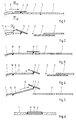
- Fig. 1 is a schematic, longitudinal sectional view of a first embodiment of the open roof construction according to the invention, showing a first position thereof;
- Fig. 2 shows a second position of the embodiment of Fig. 1;
- Fig. 3 shows a second embodiment of the open roof construction according to the invention in a first position thereof;
- Fig. 4 shows the embodiment of Fig. 3 in a second position thereof;
- Fig. 5 shows the embodiment of Fig. 3 in a third position thereof; and
- Fig. 6 is a schematic, sectional view along line VI-VI in Fig. 1.
-
- With reference to Fig. 1, there is shown a part of the
fixed roof 1 of a vehicle. Aroof opening 2 is formed in said roof, which opening can be closed by means of aclosure element 3. Said closure element can be moved forward and backward between a closed position (Fig. 1) and an open position (Fig. 2). - A
flap 4 is mounted onroof 1 at the front edge of theroof opening 2, which flap is capable of pivoting movement about apivot pin 5 which extends substantially transversely to the longitudinal axis of the vehicle. Said flap can be pivoted between a first position (Fig. 1), in which it extends substantially parallel tolocal air flow 6, and a second position (Fig. 2), in which it extends at an angle tolocal air flow 6. - Such pivoting takes place under the influence of the
local air flow 6, which acts on a part offlap 4 that extends in front ofpivot pin 5 in the illustrated embodiment. When the vehicle is stationary or moving at a low speed,valve 4 will take up a position as shown in Fig. 1, therefore. - The figure does not show that a spring member, such as a torsion spring acting round the
pivot pin 5, may be used, which spring member loads theflap 4 to the first position that is shown in Fig. 1. In such a case theair flow 6 must first overcome the force of said torsion spring before the flap pivots to the position that is shown in Fig. 2. - In the position of
flap 4 that is shown in Fig. 2, said flap extends at a positive angle α with respect to thelocal air flow 6. This means that pivoting offlap 4 will take place automatically under the influence of theair flow 6. - Since the illustrated
valve 4, as already said before, also includes a part which extends beyond pivot pin 5 (seen in the longitudinal direction of the vehicle), pivoting ofvalve 4 is prevented in the position that is shown in Fig. 1, since said part will be in contact with theclosure element 3 in that position. Unimpeded pivoting offlap 4 is not possible untilclosure element 3 has released the roof opening at least partially (Fig. 2). - Whilst
flap 4 is mounted on a fixed part of theroof 1 in the embodiment according to Figs. 1 and 2, Figs. 3 and 5 show an alternative embodiment, wherein aflap 7 is pivotally connected to the rear end of awind deflector 8 that is known per se. Also this embodiment comprises aroof 1 having aroof opening 2 formed therein, which opening can be closed by means of aclosure element 3 which can be moved forward and backward (and also by means of the wind deflector 8). - In the situation as shown in Fig. 3, the roof opening is completely closed, and
flap 7 cannot pivot about apivot pin 9 because a rear part offlap 7 would be stopped byclosure element 3 upon doing so. Only when theclosure element 3 is no longer present in the immediate vicinity offlap 7can flap 7 move to a position in which it extends at an angle to thelocal air flow 6. Such a situation occurs, for example, when theclosure element 3 has been moved to an open position (Fig. 4).Wind deflector 8 still takes up its original position in this situation. It is also possible, however, forclosure element 3 to maintain its original, closed position, whilstwind deflector 8 is pivoted outwards about a pivot pin 10 (Fig. 5). Pivoting movement offlap 7 aboutpivot pin 9 is possible in this situation as well. - Fig. 6 is a schematic, sectional view along line VI-VI in Fig. 1. This sectional view clearly shows that
flap 4 is accommodated in arecess 11 inroof 1. In this manner a continuous contour of the roof is obtained in the first position offlap 4, which is advantageous from an aerodynamic and aesthetic viewpoint. The sectional view according to Fig. 6 furthermore shows that the flap is provided with aninlet opening 12 for the air flow at its front end, whichinlet opening 12 may be of assistance in initiating the pivoting movement offlap 4. - In the closed position of the roof opening, or also in the open position of the roof opening, when the vehicle is driving at a low speed, the
flap 4 takes up the first position (Figs. 1 and 3). When the roof opening is opened and the vehicle speed is high enough, pivoting of the flap about the pivot pin in question takes place under the influence of the air flow acting on said flap, to a position in which the flap extends at a angle with respect to the local air flow (Figs. 2, 4 and 5). - Pivoting of the flap from the first position to the second will not take place until a certain value of the air flow is exceeded (or, in other words, at a specific speed of the vehicle). In order to prevent situations wherein a very small decrease of said air flow value already causes the flap to return to its first position, and vice versa, the flap may be so designed that it will not return to its first position until the value of the air flow has decreased to a level well below that of the former value. In this way a hysteresis effect is obtained, as it were, which prevents uncontrolled pivoting to and fro (vibrating) of the flap. Aspects suitable for realising this can be implemented in a various ways. For example, aerodynamic facilities may be mentioned, which are easy to realise. After all, a specific air flow value is required for initiating the pivoting movement of the flap from the position that is shown in Fig. 1, since the contact area of the flap is relatively small in this position. Once the valve has started to pivot, its contact area increases in an aerodynamic sense, and the force with which the air flow acts on the flap will quickly increase. Consequently, the value of the air flow will have to decrease significantly, due to the increased flap angle, before the flap returns to its original, first position.
- The invention is not restricted to the embodiments as described above, which can be varied in several ways without departing from the scope of the invention as defined in the claims.
Claims (10)
- An open roof construction for a vehicle, comprising a roof opening formed in the roof of the vehicle, which can be closed by means of at least one closure element which can be moved forward and backward between an open position and a closed position, characterized in that a flow-influencing flap is mounted at the location of the part of the open roof construction which co-operates with the front edge of the closure element in the closed position of said closure element, which flap is pivotable about a pivot pin extending substantially transversely to the longitudinal axis of the vehicle, between a first position, in which it extends substantially parallel to the local air flow, and a second position, in which it extends at an angle with respect to the local air flow, wherein pivoting of the flap is prevented in the closed position of the closure element, whilst pivoting of the flap to a second position, under the influence of the local air flow, is possible in the open position of the closure element.
- An open roof construction according to claim 1, characterized in that the flap comprises a part extending in front of the pivot pin, seen in the longitudinal direction of the vehicle, which part is in contact with the air flow and which, in the second position, extends at a positive angle with respect to the local flow at that location.
- An open roof construction according to claim 2, characterized in that the flap is provided with an inlet opening for the air flow at its front end, seen in the longitudinal direction of the vehicle.
- An open roof construction according to claim 1, 2 or 3, characterized in that said flap is fitted with a spring member, which loads the flap towards the first position.
- An open roof construction according to claim 4, characterized in that said spring member is a torsion spring acting round the pivot pin.
- An open roof construction according to any one of the preceding claims, characterized in that said pivoting of the flap from the first position to the second takes place upon exceeding a value of the air flow which is higher than the value below which the air flow must decrease before the flap returns to the first position.
- An open roof construction according to any one of the preceding claims, characterized in that the flap is accommodated in a recess in the respective part of the open roof construction in its first position.
- An open roof construction according to any one of the preceding claims, characterized in that the flap is mounted on the fixed roof of the vehicle
- An open roof construction according to any one of the claims 1 - 7, characterized in that the flap is mounted on a pivotable wind deflector.
- An open roof construction according to any one of the preceding claims, characterized in that the flap includes a part which extends beyond the pivot pin.
Applications Claiming Priority (2)
| Application Number | Priority Date | Filing Date | Title |
|---|---|---|---|
| NL1015492A NL1015492C2 (en) | 2000-06-21 | 2000-06-21 | Open roof construction for a vehicle. |
| NL1015492 | 2000-06-21 |
Publications (2)
| Publication Number | Publication Date |
|---|---|
| EP1172244A1 true EP1172244A1 (en) | 2002-01-16 |
| EP1172244B1 EP1172244B1 (en) | 2008-10-15 |
Family
ID=19771574
Family Applications (1)
| Application Number | Title | Priority Date | Filing Date |
|---|---|---|---|
| EP01202040A Expired - Lifetime EP1172244B1 (en) | 2000-06-21 | 2001-05-30 | Open roof construction for a vehicle |
Country Status (5)
| Country | Link |
|---|---|
| US (1) | US6450568B1 (en) |
| EP (1) | EP1172244B1 (en) |
| JP (1) | JP4805480B2 (en) |
| DE (1) | DE60136132D1 (en) |
| NL (1) | NL1015492C2 (en) |
Families Citing this family (1)
| Publication number | Priority date | Publication date | Assignee | Title |
|---|---|---|---|---|
| NL1013832C2 (en) * | 1999-12-13 | 2001-06-14 | Inalfa Ind Bv | Open roof construction for a vehicle. |
Citations (5)
| Publication number | Priority date | Publication date | Assignee | Title |
|---|---|---|---|---|
| FR2431383A1 (en) * | 1978-07-22 | 1980-02-15 | Hamann Ferdinand | Deflector for sliding car roof - has plate which pivots on cylindrical roller and can be locked in several positions |
| US5031959A (en) * | 1988-09-26 | 1991-07-16 | Gerard Queveau | Roof opening device with at least two orientable shutters |
| US5833305A (en) * | 1995-12-30 | 1998-11-10 | Webasto Karosseriesysteme Gmbh | Wind deflector element for a motor vehicle roof |
| DE19732699A1 (en) * | 1997-07-30 | 1999-02-25 | Webasto Systemkomponenten Gmbh | Wind deflector or spoiler for motor vehicle |
| EP0955194A1 (en) * | 1998-05-06 | 1999-11-10 | Inalfa Industries B.V. | Open roof construction for a vehicle |
Family Cites Families (6)
| Publication number | Priority date | Publication date | Assignee | Title |
|---|---|---|---|---|
| BE531265A (en) * | 1953-09-26 | |||
| DE2522035C3 (en) * | 1975-05-17 | 1978-09-21 | Dr.Ing.H.C. F. Porsche Ag, 7000 Stuttgart | Air guiding element on an opening of a movable roof of a motor vehicle |
| DE4102660C1 (en) * | 1991-01-30 | 1992-05-27 | Webasto Ag Fahrzeugtechnik, 8035 Stockdorf, De | Wind deflector for car with sun roof - is swivelably mounted in region of opposite long sides at distance from roof frame |
| NL1007065C2 (en) * | 1997-09-18 | 1999-03-24 | Inalfa Ind Bv | Open roof construction for a vehicle. |
| EP0919415B1 (en) * | 1997-11-07 | 2004-02-04 | Inalfa Roof Systems Group B.V. | An open roof construction for a vehicle |
| JP2000264071A (en) * | 1999-03-16 | 2000-09-26 | Inalfa Ind Bv | Open roof structure for vehicle |
-
2000
- 2000-06-21 NL NL1015492A patent/NL1015492C2/en not_active IP Right Cessation
-
2001
- 2001-05-30 EP EP01202040A patent/EP1172244B1/en not_active Expired - Lifetime
- 2001-05-30 DE DE60136132T patent/DE60136132D1/en not_active Expired - Lifetime
- 2001-06-20 JP JP2001187070A patent/JP4805480B2/en not_active Expired - Fee Related
- 2001-06-21 US US09/886,458 patent/US6450568B1/en not_active Expired - Lifetime
Patent Citations (5)
| Publication number | Priority date | Publication date | Assignee | Title |
|---|---|---|---|---|
| FR2431383A1 (en) * | 1978-07-22 | 1980-02-15 | Hamann Ferdinand | Deflector for sliding car roof - has plate which pivots on cylindrical roller and can be locked in several positions |
| US5031959A (en) * | 1988-09-26 | 1991-07-16 | Gerard Queveau | Roof opening device with at least two orientable shutters |
| US5833305A (en) * | 1995-12-30 | 1998-11-10 | Webasto Karosseriesysteme Gmbh | Wind deflector element for a motor vehicle roof |
| DE19732699A1 (en) * | 1997-07-30 | 1999-02-25 | Webasto Systemkomponenten Gmbh | Wind deflector or spoiler for motor vehicle |
| EP0955194A1 (en) * | 1998-05-06 | 1999-11-10 | Inalfa Industries B.V. | Open roof construction for a vehicle |
Also Published As
| Publication number | Publication date |
|---|---|
| NL1015492C2 (en) | 2001-12-28 |
| DE60136132D1 (en) | 2008-11-27 |
| JP4805480B2 (en) | 2011-11-02 |
| US6450568B1 (en) | 2002-09-17 |
| US20020067055A1 (en) | 2002-06-06 |
| JP2002029265A (en) | 2002-01-29 |
| EP1172244B1 (en) | 2008-10-15 |
Similar Documents
| Publication | Publication Date | Title |
|---|---|---|
| JP3631780B2 (en) | Vehicle hood | |
| US5054844A (en) | Aerodynamic motorcar | |
| US5996439A (en) | Brake pedal mechanism | |
| US20070236046A1 (en) | Air guiding system for a vehicle | |
| US10933925B2 (en) | Vehicle underbody | |
| US20090256387A1 (en) | Motor vehicle with a roof arrangement | |
| EP3186136B1 (en) | Self-adjusting side fairings | |
| EP3377394B1 (en) | Active deflector | |
| EP0323065A1 (en) | Traversing hood hinge | |
| US4260188A (en) | Hoop arrangement for foldable tops of automotive vehicles | |
| EP1172244B1 (en) | Open roof construction for a vehicle | |
| US5178436A (en) | Draft deflector for sliding roofs, removable roof sections or the like of motor vehicles | |
| CA1168678A (en) | Velocity sensitive air deflector | |
| US6047445A (en) | Hinge device | |
| US6594854B1 (en) | Wiper device having wiper blade easily attachable to and detachable from wiper arm | |
| US6019417A (en) | Articulated device for attaching a top storage well cover | |
| US4271700A (en) | Pitot tube assembly | |
| US4671171A (en) | Aerodynamically operated rain cap | |
| WO2010081952A1 (en) | Motor vehicle comprising an opening roof mounted such that it can move on the roof of this vehicle | |
| CA2245308C (en) | Aerodynamic mirror exterior shell | |
| WO1985003910A1 (en) | Actuator for an openable vehicle roof | |
| NL1013832C2 (en) | Open roof construction for a vehicle. | |
| JPH0390485A (en) | Front spoiler device for vehicle | |
| US20060163916A1 (en) | Wind deflector for a sliding roof system | |
| JPS6129599Y2 (en) |
Legal Events
| Date | Code | Title | Description |
|---|---|---|---|
| PUAI | Public reference made under article 153(3) epc to a published international application that has entered the european phase |
Free format text: ORIGINAL CODE: 0009012 |
|
| AK | Designated contracting states |
Kind code of ref document: A1 Designated state(s): AT BE CH CY DE DK ES FI FR GB GR IE IT LI LU MC NL PT SE TR Kind code of ref document: A1 Designated state(s): DE FR GB |
|
| AX | Request for extension of the european patent |
Free format text: AL;LT;LV;MK;RO;SI |
|
| 17P | Request for examination filed |
Effective date: 20020702 |
|
| AKX | Designation fees paid |
Free format text: DE FR GB |
|
| RAP1 | Party data changed (applicant data changed or rights of an application transferred) |
Owner name: INALFA ROOF SYSTEMS GROUP B.V. |
|
| GRAP | Despatch of communication of intention to grant a patent |
Free format text: ORIGINAL CODE: EPIDOSNIGR1 |
|
| GRAS | Grant fee paid |
Free format text: ORIGINAL CODE: EPIDOSNIGR3 |
|
| GRAA | (expected) grant |
Free format text: ORIGINAL CODE: 0009210 |
|
| AK | Designated contracting states |
Kind code of ref document: B1 Designated state(s): DE FR GB |
|
| REG | Reference to a national code |
Ref country code: GB Ref legal event code: FG4D |
|
| REF | Corresponds to: |
Ref document number: 60136132 Country of ref document: DE Date of ref document: 20081127 Kind code of ref document: P |
|
| PLBE | No opposition filed within time limit |
Free format text: ORIGINAL CODE: 0009261 |
|
| STAA | Information on the status of an ep patent application or granted ep patent |
Free format text: STATUS: NO OPPOSITION FILED WITHIN TIME LIMIT |
|
| 26N | No opposition filed |
Effective date: 20090716 |
|
| GBPC | Gb: european patent ceased through non-payment of renewal fee |
Effective date: 20090530 |
|
| PG25 | Lapsed in a contracting state [announced via postgrant information from national office to epo] |
Ref country code: GB Free format text: LAPSE BECAUSE OF NON-PAYMENT OF DUE FEES Effective date: 20090530 |
|
| PGFP | Annual fee paid to national office [announced via postgrant information from national office to epo] |
Ref country code: FR Payment date: 20130620 Year of fee payment: 13 |
|
| REG | Reference to a national code |
Ref country code: FR Ref legal event code: ST Effective date: 20150130 |
|
| PG25 | Lapsed in a contracting state [announced via postgrant information from national office to epo] |
Ref country code: FR Free format text: LAPSE BECAUSE OF NON-PAYMENT OF DUE FEES Effective date: 20140602 |
|
| PGFP | Annual fee paid to national office [announced via postgrant information from national office to epo] |
Ref country code: DE Payment date: 20160519 Year of fee payment: 16 |
|
| REG | Reference to a national code |
Ref country code: DE Ref legal event code: R119 Ref document number: 60136132 Country of ref document: DE |
|
| PG25 | Lapsed in a contracting state [announced via postgrant information from national office to epo] |
Ref country code: DE Free format text: LAPSE BECAUSE OF NON-PAYMENT OF DUE FEES Effective date: 20171201 |