EP1170884A2 - Method for assigning codes in uplink of synchronous wireless telecommunication system - Google Patents
Method for assigning codes in uplink of synchronous wireless telecommunication system Download PDFInfo
- Publication number
- EP1170884A2 EP1170884A2 EP20010305771 EP01305771A EP1170884A2 EP 1170884 A2 EP1170884 A2 EP 1170884A2 EP 20010305771 EP20010305771 EP 20010305771 EP 01305771 A EP01305771 A EP 01305771A EP 1170884 A2 EP1170884 A2 EP 1170884A2
- Authority
- EP
- European Patent Office
- Prior art keywords
- scrambling code
- mobile station
- base station
- code
- matching information
- Prior art date
- Legal status (The legal status is an assumption and is not a legal conclusion. Google has not performed a legal analysis and makes no representation as to the accuracy of the status listed.)
- Withdrawn
Links
Images


Classifications
-
- H—ELECTRICITY
- H04—ELECTRIC COMMUNICATION TECHNIQUE
- H04B—TRANSMISSION
- H04B7/00—Radio transmission systems, i.e. using radiation field
- H04B7/24—Radio transmission systems, i.e. using radiation field for communication between two or more posts
- H04B7/26—Radio transmission systems, i.e. using radiation field for communication between two or more posts at least one of which is mobile
-
- H—ELECTRICITY
- H04—ELECTRIC COMMUNICATION TECHNIQUE
- H04J—MULTIPLEX COMMUNICATION
- H04J13/00—Code division multiplex systems
- H04J13/0007—Code type
- H04J13/004—Orthogonal
-
- H—ELECTRICITY
- H04—ELECTRIC COMMUNICATION TECHNIQUE
- H04B—TRANSMISSION
- H04B7/00—Radio transmission systems, i.e. using radiation field
- H04B7/24—Radio transmission systems, i.e. using radiation field for communication between two or more posts
- H04B7/26—Radio transmission systems, i.e. using radiation field for communication between two or more posts at least one of which is mobile
- H04B7/2628—Radio transmission systems, i.e. using radiation field for communication between two or more posts at least one of which is mobile using code-division multiple access [CDMA] or spread spectrum multiple access [SSMA]
-
- H—ELECTRICITY
- H04—ELECTRIC COMMUNICATION TECHNIQUE
- H04J—MULTIPLEX COMMUNICATION
- H04J13/00—Code division multiplex systems
- H04J13/16—Code allocation
- H04J13/18—Allocation of orthogonal codes
Definitions
- a method for assigning codes in a reverse channel of a synchronous wireless telecommunication system comprising the steps of: a) at a mobile station, receiving time matching information of a scrambling code from a base station; b) at the mobile station, spreading data frame to be transmitted by an orthogonal code, thereby generating a spread data; and c) at the mobile station, multiplying the spread data by a scrambling code based on the time matching information of the scrambling code, thereby generating an encoded data.
- Fig. 3 is a flow chart of a code assigning method in an uplink of a synchronous wireless telecommunication system in accordance with the present invention.
Landscapes
- Engineering & Computer Science (AREA)
- Computer Networks & Wireless Communication (AREA)
- Signal Processing (AREA)
- Mobile Radio Communication Systems (AREA)
Abstract
Description
- The present invention relates to a method for assigning codes in an uplink of a synchronous code division multiple access (CDMA) telecommunication system; and, more particularly, to a method for assigning codes in an uplink of a synchronous CDMA telecommunication system in which a signal to be transmitted is spread by an orthogonal code and then multiplied by a scrambling code based on a synchronization control message from a base station.
- A traffic channel between a base station and a mobile station in a conventional code division multiple access (CDMA) system includes a forward channel (downlink) and a reverse channel (uplink). At this time, multiple forward channels between the base station and multiple mobile stations located within coverage (cell) of one base station are synchronized with each other based on timing information. Therefore, when demodulating signals, interference between the channels can be considerably reduced by using orthogonal codes that are orthogonal from each other.
- However, in the reverse channel, since the timing information is not used, the reverse channels cannot be synchronized. As the number of the reverse channels is increased, the interference in the reverse channel is increased. Therefore, capacity of the reverse channel is limited.
- To increase the capacity of the reverse channel, it is necessary for multiple reverse channels to be synchronized by using the same timing information. The reverse channels are synchronized, and then, the interference between the reverse channels can be minimized by identifying the channels based on the orthogonal codes each having orthogonality. This method is referred to as "an uplink synchronous transmission scheme (USTS)".
- One of core technologies necessary for the USTS is a code assignment, which has not been developed.
- Therefore, it is an object of the present invention to provide a method for assigning codes so as to synchronize reverse channels in an uplink of a synchronous CDMA telecommunication system.
- In accordance with an aspect of the present invention, there is provided a method for assigning codes in a reverse channel of a synchronous wireless telecommunication system, comprising the steps of: a) at a mobile station, receiving time matching information of a scrambling code from a base station; b) at the mobile station, spreading data frame to be transmitted by an orthogonal code, thereby generating a spread data; and c) at the mobile station, multiplying the spread data by a scrambling code based on the time matching information of the scrambling code, thereby generating an encoded data.
- In accordance with another aspect of the present invention, there is provided a method for assigning a code in a reverse channel of a synchronous wireless telecommunication system, comprising the steps of: a) at a base station, transmitting time matching information of a scrambling code to a mobile station; b) at a base station, receiving an encoded data which is scrambled based on the time matching information from the mobile station; and c) decoding the encoded data by despreading and descrambling the encoded data.
- In accordance with further another aspect of the present invention, there is provided a computer readable recording medium in a mobile station having a processor, which stores instructions for executing a method for assigning a code in a reverse channel of a synchronous wireless telecommunication system, the method comprising the steps of: a) at a mobile station, receiving time matching information of a scrambling code from a base station; b) at the mobile station, spreading data frame to be transmitted by an orthogonal code, thereby generating a spread data; and c) at the mobile station, multiplying the spread data by a scrambling code based on the time matching information of the scrambling code, thereby generating an encoded data.
- In accordance with still further another aspect of the present invention, there is provided a computer readable recording medium in a base station having a processor, which stores instructions for executing a method for assigning a code in a reverse channel of a synchronous wireless telecommunication system, comprising the steps of: a) at a base station, transmitting time matching information of a scrambling code to a mobile station; b) at a base station, receiving an encoded data which is scrambled based on the time matching information from the mobile station; and c) decoding the encoded data by despreading and descrambling the encoded data.
- Other objects and aspects of the invention will become apparent from the following description of the embodiments with reference to the accompanying drawings, in which:
- Fig. 1 is a block diagram of an encoder applied to the present invention;
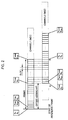
- Fig. 2 is a diagram for illustrating data formats of an orthogonal code and a scrambling code in which there are two mobile stations, and for showing a method of matching timing of codes in a node B in accordance with the present invention; and
- Fig. 3 is a flow chart of a code assigning method in an uplink of a synchronous wireless telecommunication system in accordance with the present invention.
-
- Uplink synchronous transmission scheme (USTS) technology will be described in more detail.
- When a mobile station located in a coverage (cell) of a base station tries to set up a call through a reverse channel, a node B (base transceiver station) of the base station sets a reference time based on a round trip propagation delay and computes time offset between the reference time and start time of frame of the mobile station trying to set up the call. When the mobile station receives a signal from the base station, also, the base station computes time offset between the reference time and start time of frame of the mobile station. The base station informs the mobile station of the time offset through a control information channel. The mobile station adjusts start time of its frame in a transmission channel to the reference time of the base station.
- Another mobile station adjusts start time of its frame based on the time offset received from the base station. The time offset is necessary for the mobile station to generate a scrambling code to be multiplied by transmission data. Each scrambling code is assigned to a base station, and all the mobile stations in the coverage of the base station use the same scrambling code. The scrambling code is multiplied by the transmission data in order to identify the base station to which the transmission data is transmitted.
- All the mobile stations within the coverage of the same base station have the same reference time, such that the orthogonal code can be used.
- The orthogonal code has a faster chip rate than that of the transmission data. A bandwidth of the transmission data is increased to 1/chip rate by being multiplied by the orthogonal code. The orthogonal code is referred to as "a spreading code". In the forward channel, the orthogonal code is also referred to as "a channelization code". Since the orthogonal code has a high correlation between the same codes, the orthogonal code is accurately decoded. However, the orthogonal code has zero (0) correlation with the other codes. Therefore, the orthogonal code can make the correlation between the channels zero (0). In other words, the correlation between one channel and another channel spread by a different orthogonal codes is zero (0).
- There are multiple channels from the mobile station to the base station. Each of the multiple channels is multiplied by a different orthogonal code in order to identify the channel and then multiplied by the same scrambling code in order to synchronize the multiple channels.
- As mentioned above, one scrambling code is assigned to all of the mobile stations within the same cell, and the channels of the mobile stations are synchronized, thereby being capable of using the orthogonal characteristics between the channels.
- Hereinafter, embodiments of the present invention will be described in detail referring to the accompanying drawings.
- Fig. 1 is a block diagram of an encoder applied to the present invention.
- Referring to Fig. 1, a signal to be transmitted is spread by being multiplied by an orthogonal code (spreading code) in a
first multiplier 11, to thereby generate a spread signal. The spread signal is scrambled by being multiplied by the scrambling code in asecond multiplier 12. - When decoding a received signal, the received signal is descrambled and then despread, such that an original signal is obtained.
- Fig. 2 is a diagram for illustrating data formats of an orthogonal code and a scrambling code in which there are two mobile stations, and for showing a method of matching timing of codes in a node B.
- The reference numeral "a" and "b" denote orthogonal codes, "s" a scrambling code. A spreading factor is 256.
- Referring to Fig. 2, data frame in each of mobile stations within a cell has a different start time, because each of the mobile stations independently tries to set up a call. The base station informs each mobile station of the time offset from the reference time, such that each of the mobile stations can have the same reference time. The scrambling code which is multiplied to the multiple channels at the same time has the same number of chip.
- When a first mobile station tries to set up a call, from front of the first frame to end of the last frame of a first channel of the first mobile station are multiplied by chips So to S38390 of a scrambling code. When a second mobile station tries to set up a call during communication between the first mobile station and the base station, from front of the first frame to end of the last frame of a second channel are multiplied by chips S5120 to S38390 and S0 to S5119 of the scrambling code.
- The second channel is delayed from the first channel by the time offset 〈 (256 X n chip), however, the scrambling code multiplied by the data frame in the second channel at time A is S5120 which is the same as the first channel. At time B, one frame of the first channel is end and the frame of the second channel is not end, however, the scrambling code of the second channel is newly started as the same as that of the first channel.
- Therefore, the data frame in the channel for each of the mobile stations is multiplied by the same scrambling code at the same time. The decoder of the base station can entirely obtain the data from the mobile stations by descrambling the received signals which are synchronized and can reduce interference between the channels by despreading the descrambled signals.
- Here, the scrambling code and the frame has the same length, 38400 chips, and the scrambling code is multiplied by one frame. A slot has a length of 2560 chips, the orthogonal code is repeatedly multiplied by 256-chip (1/10 slot) of the data frame.
- Fig. 3 is a flow chart of a code assigning method in an uplink of a synchronous wireless telecommunication system in accordance with the present invention.
- A mobile station receives a synchronization control message from a base station at step S31. The synchronization control message includes time matching information that m_th slot of the spread data should be multiplied by n_th chip of the scrambling code. Here, m and n are integer numbers lager than 0.
- Data frames to be transmitted are inputted to an encoder bit by bit at step S33.
- In the mobile station, one data frame, 150 bits, is divided into 15 slots, and one slot is multiplied by a 256-chip orthogonal code, thereby spreading a bit into 256 chips at step S35. One frame is spread into 38400 chips.
- The spread data is multiplied by the scrambling code based on the time matching information of the synchronization control message, thereby generating an encoded data at step S37. In other words, the spread data is multiplied by the scrambling code corresponding to the start slot of the frame based on the synchronization control message. By multiplying the same scrambling code to the channels of all mobile stations in the same cell at the same time, the decoder of the base station can perform accurate descrambling of the received signals from the mobile stations.
- The encoded data is transmitted to the base station at step S39.
- Using the code assigning method according to the present invention, the uplink synchronous transmission scheme is implemented, and the interference between the reverse channels can be minimized, to thereby increase capacity of the base station. By synchronizing the channels, orthogonality between the channels can be effectively used, thereby increasing quality of the communication.
- Although the preferred embodiments of the invention have been disclosed for illustrative purposes, those skilled in the art will appreciate that various modifications, additions and substitutions are possible, without departing from the scope and spirit of the invention as disclosed in the accompanying claims.
Claims (8)
- A method for assigning codes in a reverse channel of a synchronous wireless telecommunication system, comprising the steps of:a) at a mobile station, receiving time matching information of a scrambling code from a base station;b) at the mobile station, spreading data frame to be transmitted by an orthogonal code, thereby generating a spread data; andc) at the mobile station, multiplying the spread data by a scrambling code based on the time matching information of the scrambling code, thereby generating an encoded data.
- The method as recited in claim 1, wherein the time matching information of the scrambling code is transmitted from the base station to the mobile station through a synchronization control message.
- The method as recited in claim 1, wherein the time matching information of the scrambling code includes information indicating that m_th slot of the spread data should be multiplied by n_th chip of the scrambling code (here, m and n are integer numbers).
- A method for assigning a code in a reverse channel of a synchronous wireless telecommunication system, comprising the steps of:a) at a base station, transmitting time matching information of a scrambling code to a mobile station;b) at the base station, receiving an encoded data which is scrambled based on the time matching information from the mobile station; andc) at the base station, decoding the encoded data by despreading and descrambling the encoded data.
- The method as recited in claim 4, wherein the time matching information of the scrambling code is transmitted from the base station to the mobile station through a synchronization control message.
- The method as recited in claim 4, wherein the time matching information of the scrambling code includes information indicating that m_th slot of the spread data should be multiplied by n_th chip of the scrambling code (here, m and n are integer numbers).
- A computer readable recording medium in a mobile station having a processor, which stores instructions for executing a method for assigning a code in a reverse channel of a synchronous wireless telecommunication system, the method comprising the steps of:a) at a mobile station, receiving time matching information of a scrambling code from a base station;b) at the mobile station, spreading data frame to be transmitted by an orthogonal code, thereby generating a spread data; andc) at the mobile station, multiplying the spread data by a scrambling code based on the time matching information of the scrambling code, thereby generating an encoded data.
- A computer readable recording medium in a base station having a processor, which stores instructions for executing a method for assigning a code in a reverse channel of a synchronous wireless telecommunication system, comprising the steps of:a) at a base station, transmitting time matching information of a scrambling code to a mobile station;b) at the base station, receiving an encoded data which is scrambled based on the time matching information from the mobile station; andc) at the base station, decoding the encoded data by despreading and descrambling the encoded data.
Priority Applications (1)
| Application Number | Priority Date | Filing Date | Title |
|---|---|---|---|
| GB0215432A GB2378701A (en) | 2001-07-04 | 2002-07-03 | Process for the preparation of alkylene glycols |
Applications Claiming Priority (2)
| Application Number | Priority Date | Filing Date | Title |
|---|---|---|---|
| KR20000038046A KR100627188B1 (en) | 2000-07-04 | 2000-07-04 | Code Assignment Method in the Reverse Synchronization Method of Wireless Communication |
| KR2000038046 | 2000-07-04 |
Publications (2)
| Publication Number | Publication Date |
|---|---|
| EP1170884A2 true EP1170884A2 (en) | 2002-01-09 |
| EP1170884A3 EP1170884A3 (en) | 2003-05-14 |
Family
ID=19676161
Family Applications (1)
| Application Number | Title | Priority Date | Filing Date |
|---|---|---|---|
| EP20010305771 Withdrawn EP1170884A3 (en) | 2000-07-04 | 2001-07-04 | Method for assigning codes in uplink of synchronous wireless telecommunication system |
Country Status (5)
| Country | Link |
|---|---|
| US (1) | US7012948B2 (en) |
| EP (1) | EP1170884A3 (en) |
| JP (1) | JP2002064879A (en) |
| KR (1) | KR100627188B1 (en) |
| CN (1) | CN1200530C (en) |
Cited By (2)
| Publication number | Priority date | Publication date | Assignee | Title |
|---|---|---|---|---|
| CN100421367C (en) * | 2004-07-26 | 2008-09-24 | 华为技术有限公司 | A method for realizing synchronous transmission of base stations |
| US11777629B2 (en) * | 2018-09-27 | 2023-10-03 | Huawei Technologies Co., Ltd. | Reference time determining method and apparatus |
Families Citing this family (23)
| Publication number | Priority date | Publication date | Assignee | Title |
|---|---|---|---|---|
| ATE271301T1 (en) * | 2000-08-09 | 2004-07-15 | Sk Telecom Co Ltd | HANDOVER PROCEDURES IN WIRELESS TELECOMMUNICATIONS SYSTEMS WITH USTS SUPPORT |
| WO2002067479A2 (en) * | 2001-02-16 | 2002-08-29 | Cape Range Wireless, Inc. | System and method for spread spectrum communication using orthogonal coding |
| TWI240724B (en) * | 2001-12-17 | 2005-10-01 | Kuraray Co | Polyvinyl alcohol film and polarizing film |
| US20040076170A1 (en) * | 2002-10-18 | 2004-04-22 | Nortel Networks Limited | Orthogonal signaling for CDMA |
| US9143255B2 (en) * | 2002-10-18 | 2015-09-22 | Microsoft Technology Licensing, Llc | Orthogonal signaling for CDMA |
| US7002900B2 (en) | 2002-10-25 | 2006-02-21 | Qualcomm Incorporated | Transmit diversity processing for a multi-antenna communication system |
| US8208364B2 (en) | 2002-10-25 | 2012-06-26 | Qualcomm Incorporated | MIMO system with multiple spatial multiplexing modes |
| US8320301B2 (en) | 2002-10-25 | 2012-11-27 | Qualcomm Incorporated | MIMO WLAN system |
| US7986742B2 (en) | 2002-10-25 | 2011-07-26 | Qualcomm Incorporated | Pilots for MIMO communication system |
| US20040081131A1 (en) | 2002-10-25 | 2004-04-29 | Walton Jay Rod | OFDM communication system with multiple OFDM symbol sizes |
| US7280467B2 (en) * | 2003-01-07 | 2007-10-09 | Qualcomm Incorporated | Pilot transmission schemes for wireless multi-carrier communication systems |
| US9473269B2 (en) | 2003-12-01 | 2016-10-18 | Qualcomm Incorporated | Method and apparatus for providing an efficient control channel structure in a wireless communication system |
| CN100369401C (en) * | 2005-02-03 | 2008-02-13 | 北京北方烽火科技有限公司 | Method of uplink scrambling code distribution in WCDMA system |
| US8045599B2 (en) | 2005-02-17 | 2011-10-25 | Sony Corporation | Selection of training sequences for multiple-in multiple-out transmissions |
| US7466749B2 (en) | 2005-05-12 | 2008-12-16 | Qualcomm Incorporated | Rate selection with margin sharing |
| US8036205B2 (en) * | 2005-06-13 | 2011-10-11 | Qualcomm Incorporated | Methods and apparatus for supporting uplinks with remote base stations |
| US7574224B2 (en) * | 2005-06-13 | 2009-08-11 | Qualcomm Incorporated | Methods and apparatus for performing timing synchronization with base stations |
| US7974261B2 (en) * | 2005-06-13 | 2011-07-05 | Qualcomm Incorporated | Basestation methods and apparatus for supporting timing synchronization |
| US8064424B2 (en) * | 2005-07-22 | 2011-11-22 | Qualcomm Incorporated | SDMA for WCDMA |
| JP4907133B2 (en) * | 2005-08-08 | 2012-03-28 | 三星電子株式会社 | Wireless communication system, wireless communication method, and communication apparatus |
| TWI458284B (en) * | 2007-12-07 | 2014-10-21 | Koninkl Philips Electronics Nv | Multiple channel support in distributed wireless systems |
| JP5127588B2 (en) * | 2008-06-23 | 2013-01-23 | 株式会社エヌ・ティ・ティ・ドコモ | User apparatus, base station apparatus and communication method in mobile communication system |
| US9357514B2 (en) * | 2011-03-18 | 2016-05-31 | Alcatel Lucent | Methods for synchronizing macro cell and small cell systems |
Family Cites Families (13)
| Publication number | Priority date | Publication date | Assignee | Title |
|---|---|---|---|---|
| US6049535A (en) * | 1996-06-27 | 2000-04-11 | Interdigital Technology Corporation | Code division multiple access (CDMA) communication system |
| ZA965340B (en) * | 1995-06-30 | 1997-01-27 | Interdigital Tech Corp | Code division multiple access (cdma) communication system |
| US5689526A (en) * | 1996-01-29 | 1997-11-18 | Motorola, Inc. | Method and apparatus for synchronizing a plurality of code division multiple access signals to enable acquisition and tracking based upon a single pseudonoise spreading code |
| US6263013B1 (en) * | 1996-11-21 | 2001-07-17 | Dsp Group, Inc. | Fast tracking of PN synchronization in a direct-sequence spread-spectrum digital communications system |
| US5930366A (en) * | 1997-08-29 | 1999-07-27 | Telefonaktiebolaget L M Ericsson | Synchronization to a base station and code acquisition within a spread spectrum communication system |
| US5956368A (en) * | 1997-08-29 | 1999-09-21 | Telefonaktiebolaget Lm Ericsson | Downlink channel handling within a spread spectrum communications system |
| KR100532328B1 (en) * | 1998-08-29 | 2006-03-23 | 삼성전자주식회사 | P. Sequence Identifier of Code Division Multiple Access Communication System |
| KR100340932B1 (en) * | 1998-10-26 | 2002-06-20 | 조정남 | Cell searching method in asynchronous wideband code division multiple access system |
| US6731673B1 (en) * | 1999-02-19 | 2004-05-04 | Nortel Networks Limited | Synchronization channel with cyclic hierarchical sequences and method for cell site search with low detector complexity |
| KR100320424B1 (en) * | 1999-08-04 | 2002-01-15 | 서평원 | Transmission Method in Radio Communication System |
| US6680902B1 (en) * | 2000-01-20 | 2004-01-20 | Nortel Networks Limited | Spreading code selection process for equalization in CDMA communications systems |
| US6289039B1 (en) * | 2000-06-14 | 2001-09-11 | Linex Technologies, Inc. | Spread-spectrum communications utilizing variable throughput reduction |
| DE60134107D1 (en) * | 2000-06-24 | 2008-07-03 | Samsung Electronics Co Ltd | DEVICE AND METHOD FOR SYNCHRONIZING A SYNCHRONOUS TRANSMISSION PROCESS IN UPWARD DIRECTION IN A CDMA COMMUNICATION SYSTEM |
-
2000
- 2000-07-04 KR KR20000038046A patent/KR100627188B1/en not_active Expired - Fee Related
-
2001
- 2001-07-03 US US09/898,954 patent/US7012948B2/en not_active Expired - Fee Related
- 2001-07-04 JP JP2001203732A patent/JP2002064879A/en active Pending
- 2001-07-04 EP EP20010305771 patent/EP1170884A3/en not_active Withdrawn
- 2001-07-04 CN CNB011248211A patent/CN1200530C/en not_active Expired - Fee Related
Non-Patent Citations (3)
| Title |
|---|
| "UNIVERSAL MOBILE TELECOMMUNICATIONS SYSTEMS (UMTS) SPREADING AND MODULATION (FDD)(3G TS 25.213 VERSION 3.2.0 RELEASE 1999)" ETSI TS 125 213 V3.2.0, XX, XX, March 2000 (2000-03), pages 1-27, XP002203809 * |
| "Uplink Synchronization Transmission Scheme" TSG-RAN WORKING GROUP 1 MEETING NO. 7, [Online] 30 August 1999 (1999-08-30) - 3 September 1999 (1999-09-03), XP002235509 Retrieved from the Internet: <URL:http://www.3gpp.org/ftp/tsg_ran/WG1_R L1/TSGR1_07/Docs/Pdfs/R1-99c35.pdf> [retrieved on 2003-03-20] * |
| "Uplink Synchronous Transmission Scheme (USTS)" TSG-RAN WORKING GROUP 1 MEETING NO. 14, 4 July 2000 (2000-07-04), XP002185297 Retrieved from the Internet: <URL:www.3gpp.org/ftp/tsg_ran/WG1_RL1/TSGR 1_14/Docs/PDFs/R1-00-0903.pdf> [retrieved on 2001-12-11] * |
Cited By (2)
| Publication number | Priority date | Publication date | Assignee | Title |
|---|---|---|---|---|
| CN100421367C (en) * | 2004-07-26 | 2008-09-24 | 华为技术有限公司 | A method for realizing synchronous transmission of base stations |
| US11777629B2 (en) * | 2018-09-27 | 2023-10-03 | Huawei Technologies Co., Ltd. | Reference time determining method and apparatus |
Also Published As
| Publication number | Publication date |
|---|---|
| CN1200530C (en) | 2005-05-04 |
| US7012948B2 (en) | 2006-03-14 |
| EP1170884A3 (en) | 2003-05-14 |
| KR100627188B1 (en) | 2006-09-22 |
| CN1331527A (en) | 2002-01-16 |
| JP2002064879A (en) | 2002-02-28 |
| US20020003786A1 (en) | 2002-01-10 |
| KR20020004299A (en) | 2002-01-16 |
Similar Documents
| Publication | Publication Date | Title |
|---|---|---|
| US7012948B2 (en) | Method for assigning codes in uplink of synchronous wireless telecommunication system | |
| JP3408545B2 (en) | Mobile station synchronization in spread spectrum communication systems. | |
| KR100378738B1 (en) | Synchronization to a base station and code acquisition within a spread spectrum communication system | |
| US7421279B2 (en) | Method, system and apparatus for improving reception in multiple access communication systems | |
| US6301289B1 (en) | To a telecommunication system using code division multiple access (CDMA) | |
| JP3565856B2 (en) | Method and apparatus for time aligning signals for reception in a code division multiple access communication system | |
| EP0711477B1 (en) | Method for synchronizing subscriber equipments, a base station and a subscriber equipment | |
| KR100389663B1 (en) | Data transmission within a spread-spectrum communication system | |
| US6643275B1 (en) | Random access in a mobile telecommunications system | |
| US20030112852A1 (en) | Spectrum spreading communication system using single spreading code | |
| US20030133429A1 (en) | Uplink synchronization method in a CDMA communication system employing USTS | |
| JPH10126331A (en) | Mobile communication system and its device | |
| CN1319296C (en) | Method for transferring synchronous signal in synchronous time gap of time division complexing radio communication system | |
| EP1299960B1 (en) | A reverse synchronization method in a wireless system | |
| JP2941651B2 (en) | Mobile communication system | |
| KR100331870B1 (en) | Optimal pilot pattern allocation and arrangement method | |
| JP2000349703A (en) | Pilot signal for synchronization and / or channel estimation | |
| KR100331871B1 (en) | method of confirming a frame synchronization, which is used slot by slot correlation results | |
| KR100827139B1 (en) | Method and apparatus for synchronizing between base station in umts mobile communication system | |
| KR100320421B1 (en) | Frame Synchronization Confirmation Method using Optimal Pilot Symbol | |
| KR100323767B1 (en) | Frame Synchronization Maintenance Method | |
| KR20050070177A (en) | Method for synchronization node in wcdma system | |
| KR20010019994A (en) | Channel Transmission Method in Radio Communication System |
Legal Events
| Date | Code | Title | Description |
|---|---|---|---|
| PUAI | Public reference made under article 153(3) epc to a published international application that has entered the european phase |
Free format text: ORIGINAL CODE: 0009012 |
|
| AK | Designated contracting states |
Kind code of ref document: A2 Designated state(s): AT BE CH CY DE DK ES FI FR GB GR IE IT LI LU MC NL PT SE TR |
|
| AX | Request for extension of the european patent |
Free format text: AL;LT;LV;MK;RO;SI |
|
| RIN1 | Information on inventor provided before grant (corrected) |
Inventor name: KIM, DUK-KYUNG |
|
| 17P | Request for examination filed |
Effective date: 20020705 |
|
| PUAL | Search report despatched |
Free format text: ORIGINAL CODE: 0009013 |
|
| AK | Designated contracting states |
Designated state(s): AT BE CH CY DE DK ES FI FR GB GR IE IT LI LU MC NL PT SE TR |
|
| AX | Request for extension of the european patent |
Extension state: AL LT LV MK RO SI |
|
| AKX | Designation fees paid |
Designated state(s): AT BE CH CY DE DK ES FI FR GB GR IE IT LI LU MC NL PT SE TR |
|
| 17Q | First examination report despatched |
Effective date: 20060505 |
|
| RIN1 | Information on inventor provided before grant (corrected) |
Inventor name: KIM, DUK-KYUNG |
|
| STAA | Information on the status of an ep patent application or granted ep patent |
Free format text: STATUS: THE APPLICATION IS DEEMED TO BE WITHDRAWN |
|
| 18D | Application deemed to be withdrawn |
Effective date: 20071013 |