EP1170361A2 - New mutant N-Acetylglutamate synthase and method for L-Arginine production - Google Patents
New mutant N-Acetylglutamate synthase and method for L-Arginine production Download PDFInfo
- Publication number
- EP1170361A2 EP1170361A2 EP01114572A EP01114572A EP1170361A2 EP 1170361 A2 EP1170361 A2 EP 1170361A2 EP 01114572 A EP01114572 A EP 01114572A EP 01114572 A EP01114572 A EP 01114572A EP 1170361 A2 EP1170361 A2 EP 1170361A2
- Authority
- EP
- European Patent Office
- Prior art keywords
- mutant
- arginine
- arga
- nags
- amino acid
- Prior art date
- Legal status (The legal status is an assumption and is not a legal conclusion. Google has not performed a legal analysis and makes no representation as to the accuracy of the status listed.)
- Granted
Links
- 108010032178 Amino-acid N-acetyltransferase Proteins 0.000 title claims abstract description 72
- ODKSFYDXXFIFQN-BYPYZUCNSA-N L-arginine Chemical compound OC(=O)[C@@H](N)CCCN=C(N)N ODKSFYDXXFIFQN-BYPYZUCNSA-N 0.000 title claims abstract description 44
- 229930064664 L-arginine Natural products 0.000 title claims abstract description 38
- 235000014852 L-arginine Nutrition 0.000 title claims abstract description 38
- 102000007610 Amino-acid N-acetyltransferase Human genes 0.000 title claims abstract 9
- 238000004519 manufacturing process Methods 0.000 title claims description 10
- 238000000034 method Methods 0.000 title description 18
- 241000894006 Bacteria Species 0.000 claims abstract description 22
- 241000588722 Escherichia Species 0.000 claims abstract description 14
- 150000001413 amino acids Chemical group 0.000 claims abstract description 10
- 230000005764 inhibitory process Effects 0.000 claims abstract description 8
- 238000006467 substitution reaction Methods 0.000 claims description 12
- 235000001014 amino acid Nutrition 0.000 claims description 7
- 238000007792 addition Methods 0.000 claims description 5
- 238000012217 deletion Methods 0.000 claims description 5
- 230000037430 deletion Effects 0.000 claims description 5
- 238000003780 insertion Methods 0.000 claims description 5
- 230000037431 insertion Effects 0.000 claims description 5
- 102100032618 N-acetylglutamate synthase, mitochondrial Human genes 0.000 description 65
- 101150072344 argA gene Proteins 0.000 description 58
- 230000000694 effects Effects 0.000 description 31
- 108020004414 DNA Proteins 0.000 description 21
- 239000002609 medium Substances 0.000 description 17
- 241000588724 Escherichia coli Species 0.000 description 16
- 125000000539 amino acid group Chemical group 0.000 description 16
- 239000013612 plasmid Substances 0.000 description 15
- 102000004190 Enzymes Human genes 0.000 description 14
- 108090000790 Enzymes Proteins 0.000 description 14
- 239000012634 fragment Substances 0.000 description 14
- 210000004027 cell Anatomy 0.000 description 13
- 230000035772 mutation Effects 0.000 description 13
- 108090000623 proteins and genes Proteins 0.000 description 13
- 125000003275 alpha amino acid group Chemical group 0.000 description 11
- 235000018102 proteins Nutrition 0.000 description 10
- 102000004169 proteins and genes Human genes 0.000 description 10
- 239000004475 Arginine Substances 0.000 description 8
- ODKSFYDXXFIFQN-UHFFFAOYSA-N arginine Natural products OC(=O)C(N)CCCNC(N)=N ODKSFYDXXFIFQN-UHFFFAOYSA-N 0.000 description 8
- 235000009697 arginine Nutrition 0.000 description 8
- 239000002773 nucleotide Substances 0.000 description 8
- LFQSCWFLJHTTHZ-UHFFFAOYSA-N Ethanol Chemical compound CCO LFQSCWFLJHTTHZ-UHFFFAOYSA-N 0.000 description 7
- IJGRMHOSHXDMSA-UHFFFAOYSA-N Atomic nitrogen Chemical compound N#N IJGRMHOSHXDMSA-UHFFFAOYSA-N 0.000 description 6
- PEDCQBHIVMGVHV-UHFFFAOYSA-N Glycerine Chemical compound OCC(O)CO PEDCQBHIVMGVHV-UHFFFAOYSA-N 0.000 description 6
- WHUUTDBJXJRKMK-VKHMYHEASA-N L-glutamic acid Chemical compound OC(=O)[C@@H](N)CCC(O)=O WHUUTDBJXJRKMK-VKHMYHEASA-N 0.000 description 6
- 229940024606 amino acid Drugs 0.000 description 5
- 239000011541 reaction mixture Substances 0.000 description 5
- QGZKDVFQNNGYKY-UHFFFAOYSA-N Ammonia Chemical compound N QGZKDVFQNNGYKY-UHFFFAOYSA-N 0.000 description 4
- VTYYLEPIZMXCLO-UHFFFAOYSA-L Calcium carbonate Chemical compound [Ca+2].[O-]C([O-])=O VTYYLEPIZMXCLO-UHFFFAOYSA-L 0.000 description 4
- 108020004705 Codon Proteins 0.000 description 4
- CSNNHWWHGAXBCP-UHFFFAOYSA-L Magnesium sulfate Chemical compound [Mg+2].[O-][S+2]([O-])([O-])[O-] CSNNHWWHGAXBCP-UHFFFAOYSA-L 0.000 description 4
- 108091022908 Serine O-acetyltransferase Proteins 0.000 description 4
- FAPWRFPIFSIZLT-UHFFFAOYSA-M Sodium chloride Chemical compound [Na+].[Cl-] FAPWRFPIFSIZLT-UHFFFAOYSA-M 0.000 description 4
- ZSLZBFCDCINBPY-ZSJPKINUSA-N acetyl-CoA Chemical compound O[C@@H]1[C@H](OP(O)(O)=O)[C@@H](COP(O)(=O)OP(O)(=O)OCC(C)(C)[C@@H](O)C(=O)NCCC(=O)NCCSC(=O)C)O[C@H]1N1C2=NC=NC(N)=C2N=C1 ZSLZBFCDCINBPY-ZSJPKINUSA-N 0.000 description 4
- 230000015572 biosynthetic process Effects 0.000 description 4
- 125000003729 nucleotide group Chemical group 0.000 description 4
- 239000013598 vector Substances 0.000 description 4
- WQZGKKKJIJFFOK-GASJEMHNSA-N Glucose Natural products OC[C@H]1OC(O)[C@H](O)[C@@H](O)[C@@H]1O WQZGKKKJIJFFOK-GASJEMHNSA-N 0.000 description 3
- RHGKLRLOHDJJDR-BYPYZUCNSA-N L-citrulline Chemical compound NC(=O)NCCC[C@H]([NH3+])C([O-])=O RHGKLRLOHDJJDR-BYPYZUCNSA-N 0.000 description 3
- 108091028043 Nucleic acid sequence Proteins 0.000 description 3
- 238000006243 chemical reaction Methods 0.000 description 3
- 238000000855 fermentation Methods 0.000 description 3
- 230000004151 fermentation Effects 0.000 description 3
- 239000008103 glucose Substances 0.000 description 3
- 229930195712 glutamate Natural products 0.000 description 3
- 229940049906 glutamate Drugs 0.000 description 3
- 230000012010 growth Effects 0.000 description 3
- 244000005700 microbiome Species 0.000 description 3
- 229910052757 nitrogen Inorganic materials 0.000 description 3
- 235000002639 sodium chloride Nutrition 0.000 description 3
- 229920001817 Agar Polymers 0.000 description 2
- 101710191958 Amino-acid acetyltransferase Proteins 0.000 description 2
- 101710185938 Amino-acid acetyltransferase, mitochondrial Proteins 0.000 description 2
- OKTJSMMVPCPJKN-UHFFFAOYSA-N Carbon Chemical compound [C] OKTJSMMVPCPJKN-UHFFFAOYSA-N 0.000 description 2
- ONIBWKKTOPOVIA-BYPYZUCNSA-N L-Proline Chemical compound OC(=O)[C@@H]1CCCN1 ONIBWKKTOPOVIA-BYPYZUCNSA-N 0.000 description 2
- 229930182821 L-proline Natural products 0.000 description 2
- 108010021466 Mutant Proteins Proteins 0.000 description 2
- 102000008300 Mutant Proteins Human genes 0.000 description 2
- RHGKLRLOHDJJDR-UHFFFAOYSA-N Ndelta-carbamoyl-DL-ornithine Natural products OC(=O)C(N)CCCNC(N)=O RHGKLRLOHDJJDR-UHFFFAOYSA-N 0.000 description 2
- 108010033276 Peptide Fragments Proteins 0.000 description 2
- 102000007079 Peptide Fragments Human genes 0.000 description 2
- 101100217185 Pseudomonas aeruginosa (strain ATCC 15692 / DSM 22644 / CIP 104116 / JCM 14847 / LMG 12228 / 1C / PRS 101 / PAO1) aruC gene Proteins 0.000 description 2
- 101100022072 Sulfolobus acidocaldarius (strain ATCC 33909 / DSM 639 / JCM 8929 / NBRC 15157 / NCIMB 11770) lysJ gene Proteins 0.000 description 2
- 229940100228 acetyl coenzyme a Drugs 0.000 description 2
- 230000021736 acetylation Effects 0.000 description 2
- 238000006640 acetylation reaction Methods 0.000 description 2
- 239000008272 agar Substances 0.000 description 2
- 229910021529 ammonia Inorganic materials 0.000 description 2
- BFNBIHQBYMNNAN-UHFFFAOYSA-N ammonium sulfate Chemical compound N.N.OS(O)(=O)=O BFNBIHQBYMNNAN-UHFFFAOYSA-N 0.000 description 2
- 230000000692 anti-sense effect Effects 0.000 description 2
- 101150050866 argD gene Proteins 0.000 description 2
- 229910000019 calcium carbonate Inorganic materials 0.000 description 2
- 235000010216 calcium carbonate Nutrition 0.000 description 2
- 229910052799 carbon Inorganic materials 0.000 description 2
- 230000003197 catalytic effect Effects 0.000 description 2
- 230000010261 cell growth Effects 0.000 description 2
- 229960002173 citrulline Drugs 0.000 description 2
- 235000013477 citrulline Nutrition 0.000 description 2
- 239000013604 expression vector Substances 0.000 description 2
- -1 glucose and sucrose Chemical class 0.000 description 2
- 239000001963 growth medium Substances 0.000 description 2
- 229910052500 inorganic mineral Inorganic materials 0.000 description 2
- 238000002955 isolation Methods 0.000 description 2
- 229910052943 magnesium sulfate Inorganic materials 0.000 description 2
- 239000011707 mineral Substances 0.000 description 2
- 235000010755 mineral Nutrition 0.000 description 2
- 229910000402 monopotassium phosphate Inorganic materials 0.000 description 2
- 238000002703 mutagenesis Methods 0.000 description 2
- 231100000350 mutagenesis Toxicity 0.000 description 2
- 239000008363 phosphate buffer Substances 0.000 description 2
- 239000013600 plasmid vector Substances 0.000 description 2
- GNSKLFRGEWLPPA-UHFFFAOYSA-M potassium dihydrogen phosphate Chemical compound [K+].OP(O)([O-])=O GNSKLFRGEWLPPA-UHFFFAOYSA-M 0.000 description 2
- 239000002243 precursor Substances 0.000 description 2
- 108090000765 processed proteins & peptides Proteins 0.000 description 2
- 239000000047 product Substances 0.000 description 2
- 229960002429 proline Drugs 0.000 description 2
- 102220093670 rs371299772 Human genes 0.000 description 2
- 238000002741 site-directed mutagenesis Methods 0.000 description 2
- 239000011780 sodium chloride Substances 0.000 description 2
- 239000000126 substance Substances 0.000 description 2
- 230000009466 transformation Effects 0.000 description 2
- QKNYBSVHEMOAJP-UHFFFAOYSA-N 2-amino-2-(hydroxymethyl)propane-1,3-diol;hydron;chloride Chemical compound Cl.OCC(N)(CO)CO QKNYBSVHEMOAJP-UHFFFAOYSA-N 0.000 description 1
- KIUMMUBSPKGMOY-UHFFFAOYSA-N 3,3'-Dithiobis(6-nitrobenzoic acid) Chemical compound C1=C([N+]([O-])=O)C(C(=O)O)=CC(SSC=2C=C(C(=CC=2)[N+]([O-])=O)C(O)=O)=C1 KIUMMUBSPKGMOY-UHFFFAOYSA-N 0.000 description 1
- 108030006759 Acetylornithine deacetylases Proteins 0.000 description 1
- 241000370685 Arge Species 0.000 description 1
- 101100290837 Bacillus subtilis (strain 168) metAA gene Proteins 0.000 description 1
- UXVMQQNJUSDDNG-UHFFFAOYSA-L Calcium chloride Chemical compound [Cl-].[Cl-].[Ca+2] UXVMQQNJUSDDNG-UHFFFAOYSA-L 0.000 description 1
- 108091026890 Coding region Proteins 0.000 description 1
- 102000016928 DNA-directed DNA polymerase Human genes 0.000 description 1
- 108010014303 DNA-directed DNA polymerase Proteins 0.000 description 1
- 230000005526 G1 to G0 transition Effects 0.000 description 1
- 244000068988 Glycine max Species 0.000 description 1
- 235000010469 Glycine max Nutrition 0.000 description 1
- AVXURJPOCDRRFD-UHFFFAOYSA-N Hydroxylamine Chemical compound ON AVXURJPOCDRRFD-UHFFFAOYSA-N 0.000 description 1
- 239000007836 KH2PO4 Substances 0.000 description 1
- 229930195714 L-glutamate Natural products 0.000 description 1
- KABXUUFDPUOJMW-BYPYZUCNSA-N L-glutamic 5-semialdehyde Chemical compound OC(=O)[C@@H](N)CCC=O KABXUUFDPUOJMW-BYPYZUCNSA-N 0.000 description 1
- 239000006142 Luria-Bertani Agar Substances 0.000 description 1
- RFMMMVDNIPUKGG-YFKPBYRVSA-N N-acetyl-L-glutamic acid Chemical compound CC(=O)N[C@H](C(O)=O)CCC(O)=O RFMMMVDNIPUKGG-YFKPBYRVSA-N 0.000 description 1
- VZUNGTLZRAYYDE-UHFFFAOYSA-N N-methyl-N'-nitro-N-nitrosoguanidine Chemical compound O=NN(C)C(=N)N[N+]([O-])=O VZUNGTLZRAYYDE-UHFFFAOYSA-N 0.000 description 1
- IOVCWXUNBOPUCH-UHFFFAOYSA-N Nitrous acid Chemical compound ON=O IOVCWXUNBOPUCH-UHFFFAOYSA-N 0.000 description 1
- 238000012408 PCR amplification Methods 0.000 description 1
- 239000001888 Peptone Substances 0.000 description 1
- 108010080698 Peptones Proteins 0.000 description 1
- 108020004511 Recombinant DNA Proteins 0.000 description 1
- 241000607715 Serratia marcescens Species 0.000 description 1
- 238000002105 Southern blotting Methods 0.000 description 1
- 229930006000 Sucrose Natural products 0.000 description 1
- CZMRCDWAGMRECN-UGDNZRGBSA-N Sucrose Chemical compound O[C@H]1[C@H](O)[C@@H](CO)O[C@@]1(CO)O[C@@H]1[C@H](O)[C@@H](O)[C@H](O)[C@@H](CO)O1 CZMRCDWAGMRECN-UGDNZRGBSA-N 0.000 description 1
- JZRWCGZRTZMZEH-UHFFFAOYSA-N Thiamine Natural products CC1=C(CCO)SC=[N+]1CC1=CN=C(C)N=C1N JZRWCGZRTZMZEH-UHFFFAOYSA-N 0.000 description 1
- 238000002835 absorbance Methods 0.000 description 1
- 238000009825 accumulation Methods 0.000 description 1
- 239000002253 acid Substances 0.000 description 1
- 150000007513 acids Chemical class 0.000 description 1
- 238000005273 aeration Methods 0.000 description 1
- 238000000246 agarose gel electrophoresis Methods 0.000 description 1
- 150000001412 amines Chemical class 0.000 description 1
- BIGPRXCJEDHCLP-UHFFFAOYSA-N ammonium bisulfate Chemical compound [NH4+].OS([O-])(=O)=O BIGPRXCJEDHCLP-UHFFFAOYSA-N 0.000 description 1
- 150000003863 ammonium salts Chemical class 0.000 description 1
- 229910052921 ammonium sulfate Inorganic materials 0.000 description 1
- 238000012870 ammonium sulfate precipitation Methods 0.000 description 1
- 235000011130 ammonium sulphate Nutrition 0.000 description 1
- AVKUERGKIZMTKX-NJBDSQKTSA-N ampicillin Chemical compound C1([C@@H](N)C(=O)N[C@H]2[C@H]3SC([C@@H](N3C2=O)C(O)=O)(C)C)=CC=CC=C1 AVKUERGKIZMTKX-NJBDSQKTSA-N 0.000 description 1
- 229960000723 ampicillin Drugs 0.000 description 1
- 230000003321 amplification Effects 0.000 description 1
- 230000001580 bacterial effect Effects 0.000 description 1
- WQZGKKKJIJFFOK-VFUOTHLCSA-N beta-D-glucose Chemical compound OC[C@H]1O[C@@H](O)[C@H](O)[C@@H](O)[C@@H]1O WQZGKKKJIJFFOK-VFUOTHLCSA-N 0.000 description 1
- 230000004071 biological effect Effects 0.000 description 1
- 230000006696 biosynthetic metabolic pathway Effects 0.000 description 1
- 239000000872 buffer Substances 0.000 description 1
- 239000001110 calcium chloride Substances 0.000 description 1
- 229910001628 calcium chloride Inorganic materials 0.000 description 1
- 229940041514 candida albicans extract Drugs 0.000 description 1
- 150000001720 carbohydrates Chemical class 0.000 description 1
- 235000014633 carbohydrates Nutrition 0.000 description 1
- 238000005119 centrifugation Methods 0.000 description 1
- 230000008859 change Effects 0.000 description 1
- 239000003795 chemical substances by application Substances 0.000 description 1
- 239000013611 chromosomal DNA Substances 0.000 description 1
- 230000002759 chromosomal effect Effects 0.000 description 1
- 210000000349 chromosome Anatomy 0.000 description 1
- 238000010367 cloning Methods 0.000 description 1
- 238000010276 construction Methods 0.000 description 1
- 238000007796 conventional method Methods 0.000 description 1
- 101150111114 cysE gene Proteins 0.000 description 1
- 238000001952 enzyme assay Methods 0.000 description 1
- 238000002474 experimental method Methods 0.000 description 1
- 239000011790 ferrous sulphate Substances 0.000 description 1
- 235000003891 ferrous sulphate Nutrition 0.000 description 1
- 239000012737 fresh medium Substances 0.000 description 1
- 102000054767 gene variant Human genes 0.000 description 1
- 229960002989 glutamic acid Drugs 0.000 description 1
- 238000000338 in vitro Methods 0.000 description 1
- 238000005342 ion exchange Methods 0.000 description 1
- BAUYGSIQEAFULO-UHFFFAOYSA-L iron(2+) sulfate (anhydrous) Chemical compound [Fe+2].[O-]S([O-])(=O)=O BAUYGSIQEAFULO-UHFFFAOYSA-L 0.000 description 1
- 229910000359 iron(II) sulfate Inorganic materials 0.000 description 1
- 101150109249 lacI gene Proteins 0.000 description 1
- 239000007788 liquid Substances 0.000 description 1
- 235000019341 magnesium sulphate Nutrition 0.000 description 1
- 229940099596 manganese sulfate Drugs 0.000 description 1
- 239000011702 manganese sulphate Substances 0.000 description 1
- 235000007079 manganese sulphate Nutrition 0.000 description 1
- SQQMAOCOWKFBNP-UHFFFAOYSA-L manganese(II) sulfate Chemical compound [Mn+2].[O-]S([O-])(=O)=O SQQMAOCOWKFBNP-UHFFFAOYSA-L 0.000 description 1
- 238000005374 membrane filtration Methods 0.000 description 1
- 101150003180 metB gene Proteins 0.000 description 1
- 230000002906 microbiologic effect Effects 0.000 description 1
- 239000000203 mixture Substances 0.000 description 1
- 238000010369 molecular cloning Methods 0.000 description 1
- 235000019796 monopotassium phosphate Nutrition 0.000 description 1
- 229910017464 nitrogen compound Inorganic materials 0.000 description 1
- 150000002830 nitrogen compounds Chemical class 0.000 description 1
- 238000003199 nucleic acid amplification method Methods 0.000 description 1
- 235000015097 nutrients Nutrition 0.000 description 1
- 150000007524 organic acids Chemical class 0.000 description 1
- 235000005985 organic acids Nutrition 0.000 description 1
- 239000008188 pellet Substances 0.000 description 1
- 235000019319 peptone Nutrition 0.000 description 1
- 230000035699 permeability Effects 0.000 description 1
- LWIHDJKSTIGBAC-UHFFFAOYSA-K potassium phosphate Substances [K+].[K+].[K+].[O-]P([O-])([O-])=O LWIHDJKSTIGBAC-UHFFFAOYSA-K 0.000 description 1
- 230000008569 process Effects 0.000 description 1
- 238000000746 purification Methods 0.000 description 1
- 230000001105 regulatory effect Effects 0.000 description 1
- 150000003839 salts Chemical class 0.000 description 1
- 239000000523 sample Substances 0.000 description 1
- 238000012216 screening Methods 0.000 description 1
- 239000007787 solid Substances 0.000 description 1
- 241000894007 species Species 0.000 description 1
- 230000002269 spontaneous effect Effects 0.000 description 1
- 238000003756 stirring Methods 0.000 description 1
- 239000005720 sucrose Substances 0.000 description 1
- 239000006228 supernatant Substances 0.000 description 1
- 238000003786 synthesis reaction Methods 0.000 description 1
- 239000008399 tap water Substances 0.000 description 1
- 235000020679 tap water Nutrition 0.000 description 1
- 235000019157 thiamine Nutrition 0.000 description 1
- KYMBYSLLVAOCFI-UHFFFAOYSA-N thiamine Chemical compound CC1=C(CCO)SCN1CC1=CN=C(C)N=C1N KYMBYSLLVAOCFI-UHFFFAOYSA-N 0.000 description 1
- 229960003495 thiamine Drugs 0.000 description 1
- 239000011721 thiamine Substances 0.000 description 1
- 238000013518 transcription Methods 0.000 description 1
- 230000035897 transcription Effects 0.000 description 1
- 238000011144 upstream manufacturing Methods 0.000 description 1
- 238000005406 washing Methods 0.000 description 1
- 239000012138 yeast extract Substances 0.000 description 1
Images

Classifications
-
- C—CHEMISTRY; METALLURGY
- C12—BIOCHEMISTRY; BEER; SPIRITS; WINE; VINEGAR; MICROBIOLOGY; ENZYMOLOGY; MUTATION OR GENETIC ENGINEERING
- C12P—FERMENTATION OR ENZYME-USING PROCESSES TO SYNTHESISE A DESIRED CHEMICAL COMPOUND OR COMPOSITION OR TO SEPARATE OPTICAL ISOMERS FROM A RACEMIC MIXTURE
- C12P13/00—Preparation of nitrogen-containing organic compounds
- C12P13/04—Alpha- or beta- amino acids
- C12P13/10—Citrulline; Arginine; Ornithine
-
- C—CHEMISTRY; METALLURGY
- C12—BIOCHEMISTRY; BEER; SPIRITS; WINE; VINEGAR; MICROBIOLOGY; ENZYMOLOGY; MUTATION OR GENETIC ENGINEERING
- C12N—MICROORGANISMS OR ENZYMES; COMPOSITIONS THEREOF; PROPAGATING, PRESERVING, OR MAINTAINING MICROORGANISMS; MUTATION OR GENETIC ENGINEERING; CULTURE MEDIA
- C12N9/00—Enzymes; Proenzymes; Compositions thereof; Processes for preparing, activating, inhibiting, separating or purifying enzymes
- C12N9/10—Transferases (2.)
- C12N9/1025—Acyltransferases (2.3)
Definitions
- the present invention relates to microbiological industry, to the method of L-arginine production and concerns the using of new feedback-resistant mutant enzymes in arginine biosynthesis pathway of E. coli arginine-producer strains.
- the biosynthesis of arginine from glutamate in E. coli cells is carried out by a series of reactions initiated by the acetylation of glutamate by N -acetylglutamate synthase (NAGS) encoded by argA. This process is regulated via transcription repression of the arg regulon and by feedback inhibition of NAGS by arginine [Cunin R., et al., Microbiol. Rev ., vol.50 , p.314-352, 1986].
- the feedback-resistant (may be referred to as "fbr") NAGS enzymes are required for enhanced biosynthesis of arginine in E. coli.
- the feedback-resistant mutants of enzymes can be obtained by spontaneous, chemical or site-directed mutagenesis.
- argA fbr mutants were isolated and studied.
- the Serratia marcescens cells carrying the chromosomal fbr argA mutations were unstable and gave rise to argA mutants with reduced activity or with altered affinity for glutamate [Takagi T., et al ., J.Biochem. vol.99, p.357-364 1986].
- fbr argA genes from the five E. coli strains with fbr NAGS were cloned and different single-base substitutions in argA genes were found in each of the fbr NAGS strains and it was revealed that the substitutions cause replacing His-15 with Tyr, Tyr-19 with Cys, Ser-54 with Asn, Arg-58 with His, Gly-287 with Ser and Gln-432 with Arg (Rajagopal B.S. et al ., Appl. Environ. Microbiol ., 1998, vol.64, No.5, p. 1805-1811).
- the fbr phenotype of enzyme arises as a result of the replacing the amino acid residue with another in a single or in a few sites of protein sequence and these replacements lead to reducing the activity of enzyme.
- SAT E. coli serine acetyltransferase
- the disadvantage of the mutant enzymes, obtained by these methods is a reduce in the activity of mutant enzymes as compared to wild type enzymes.
- An object of the present invention is to provide mutant feedback resistant and high active enzymes which play a key role in biosynthesis of arginine by E. coli.
- the novel procedure for synthesis a large set of mutant argA genes is proposed by using the full randomization of fragment of argA gene.
- the simultaneous substitutions of some amino acid residues in fragment of protein sequence, in which the fbr mutation can be localized, can be able to give a mutant proteins with restored the level of its activity near to natural due to more correct restored three dimensional structure of enzyme.
- the present invention described below has been accomplished.
- That is the present invention provides:
- the NAGS having any of fbr mutation as described above may be referred to as "the mutant NAGS", a DNA coding for the mutant NAGS may be referred to as “the mutant argA gene”, and a NAGS without mutation may be referred to as "a wild type NAGS”.
- the mutant NAGSs and the mutant argA genes coding the same were obtained by randomized fragment-directed mutagenesis.
- To obtain the numerous mutations in argA gene the full randomization of 15-nucleotide fragment of argA gene which codes the region from 15-th to 19-th amino acid residues in protein sequence was carried out.
- the full randomized 15-nucleotide fragment gives 4 15 or near 10 9 different DNA sequences which can code 20 5 different amino acid residues in 5-mer peptide.
- the likelihood of in frame non-introducing the stop codons in this sequences is equal of about 0.95 5 or 78%.
- the full randomization of the argA gene fragment coded the peptide from 15-th to 19-th amino acid residues must give approximately 2.5 million different protein sequences with diversity in this peptide fragment of NAGS structure.
- Subsequent selection and screening of recombinant clones carrying mutant argA genes cloned into expression vector allows to choose the fbr variants of mutant NAGS with different level of its biological activity up to level of activity of derepressed wild-type (wt) NAGS.
- fbr NAGS having high activity it is difficult to obtain fbr NAGS having high activity by the above method as described in the abter-mentioned following Example, and that fbr NAGS having high activity can be obtained by introducing the mutant argA into a wild type strain and selection of a strain which shows delay of cell growth.
- the amino acid sequences of the mutant NAGS suitable for fbr phenotype of NAGS were defined by the present invention. Therefore, the mutant NAGS can be obtained based on the sequences by introducing mutations into a wild type argA using ordinary methods.
- a wild type argA gene the argA gene of E. coil can be mentioned (GenBank Accession Y00492).
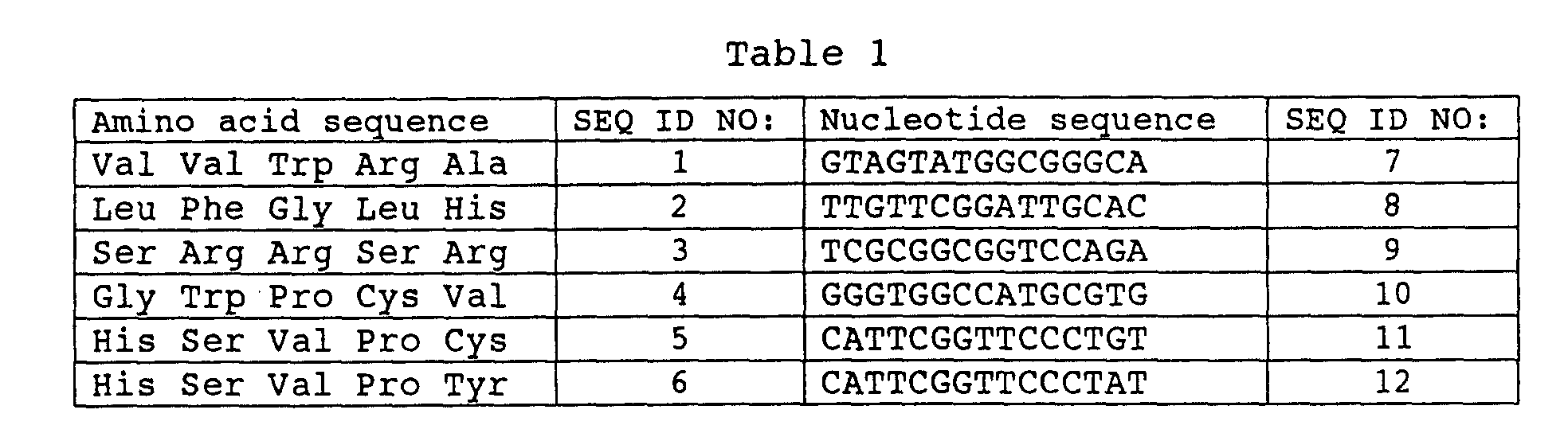
- the amino acid sequence of positions from 15 to 19 in the mutant NAGS of the present invention is any one of the sequnece of SEQ ID NOS: 1 to 4.
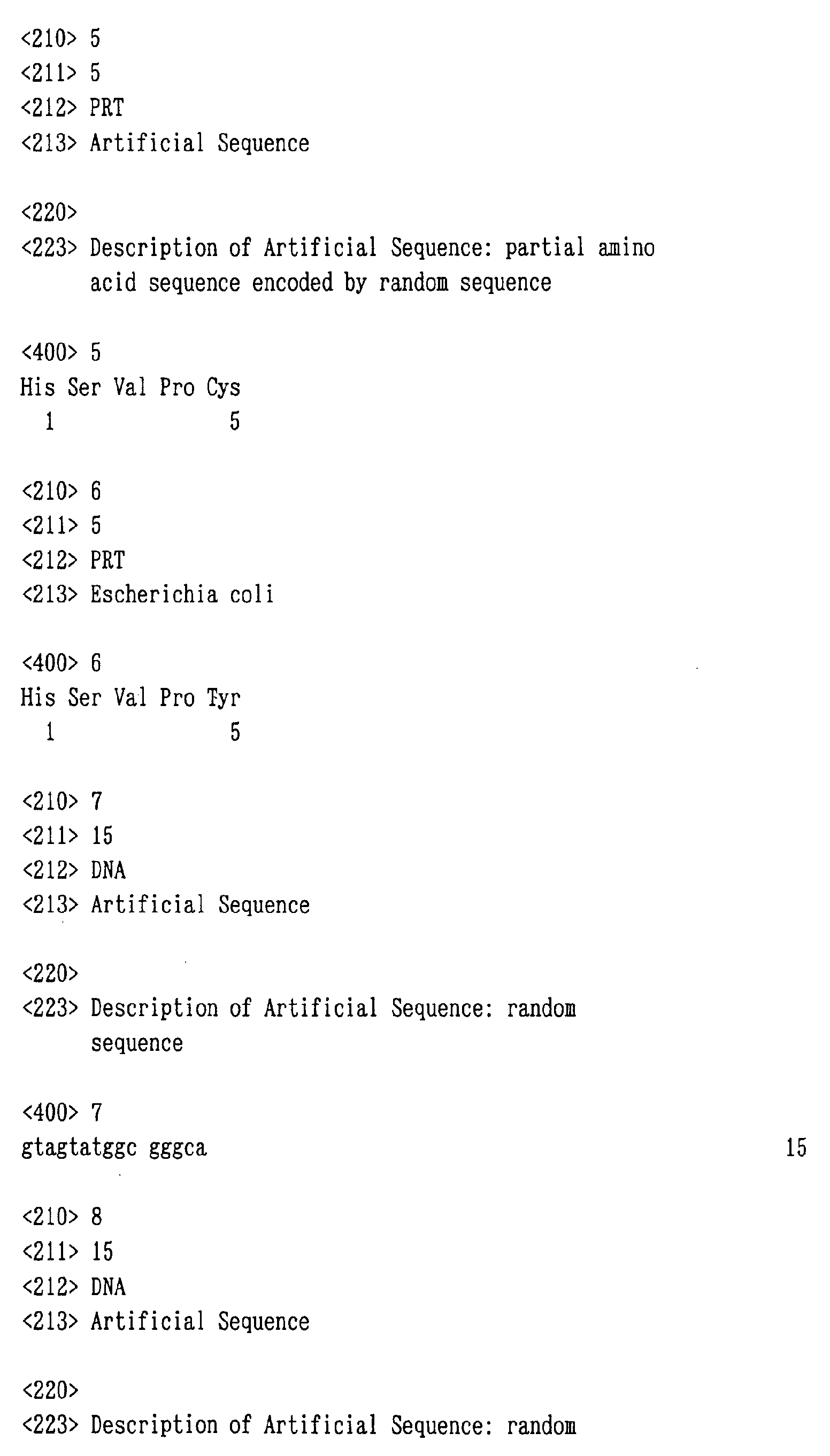
- the corresponding amino acid sequence of known mutant NAGS, in which tyr at a position 19 is replaced with Cys, and the wild type NAGS of E. coli are illustrated in SEQ ID NOS: 5 and 6. Examples of nucleotide sequence encoding these amino acid sequences are shown in SEQ ID NOS: 7 to 12. Table 1 shows these sequence.
- the mutant NAGS may including deletion, substitution, insertion, or addition of one or several amino acids at one or a plurality of positions other than 15th to 19th, provided that the NAGS activity, that is an activity to catalyze the reaction of acetylation of L-glutamic acid which produces N-acetylglutamate, is not deteriorated.
- the mutant NAGS of the present invention may be one which has homology of not less than 30 to 50 %, preferably 50 to 70 % with respect to the entire amino acid residues for constituting NAGS, and which has the fbr NAGS activity.
- amino acid sequence correspoding to the sequence of positions from 15 to 19 means an amino acid sequence corresponding to the amino acid sequence of positions from 15 to 19 in the amino acid sequence of E. coli wild type NAGS.
- a position of amino acid residue may change. For example, if an amino acid residue is inserted at N-terminus portion, the amino acid residue inherently locates at the position 15 becomes position 16. In such a case, the amino acid residue corresponding to the original position 15 is designated as the amino acid residue at the position 15 in the present invention.
- the DNA which codes for the substantially same protein as the mutant NAGS as described above, may be obtained, for example, by modifying the nucleotide sequence, for example, by means of the site-directed mutagenesis method so that one or more amino acid residues at a specified site involve deletion, substitution, insertion, or addition.
- DNA modified as described above may be obtained by the conventionally known mutation treatment.
- the mutation treatment includes a method for treating a DNA containing the mutant argA gene in vitro, for example, with hydroxylamine, and a method for treating a microorganism, for example, a bacterium, belonging to the genus Escherichia harboring the mutant argA gene with ultraviolet irradiation or a mutating agent such as N-methyl-N'-nitro-N-nitrosoquanidine (NTG) and nitrous acid usually used for the mutation treatment.
- NTG N-methyl-N'-nitro-N-nitrosoquanidine
- substitution, deletion, insertion, or addition of nucleotide as described above also includes mutation which naturally occurs (mutant or variant), for example, on the basis of the individual difference or the difference in species or genus of bacterium which harbors NAGS.
- the DNA which codes for substantially the same protein as the mutant argA gene, is obtained by expressing DNA having mutation as described above in an appropriate cell, and investigating NAGS activity of an expressed product.
- the DNA which codes for substantially the same protein as the mutant NAGS, can be obtained by isolating a DNA which hybridizes with DNA having known argA gene sequence or a probe obtainable therefrom under stringent conditions, and which codes for a protein having the NAGS activity, from a cell harboring the mutant NAGS which is subjected to mutation treatment.
- stringent conditions referred to herein is a condition under which so-called specific hybrid is formed, and non-specific hybrid is not formed. It is difficult to clearly express this condition by using any numerical value.
- the stringent conditions include a condition under which DNAs having high homology, for example, DNAs having homology of not less than 50% with each other are hybridized, and DNAs having homology lower than the above with each other are not hybridized.
- the stringent condition is exemplified by a condition under which DNA's are hybridized with each other at a salt concentration corresponding to an ordinary condition of washing in Southern hybridization, i.e., 60°C, preferably 65°C, 1 x SSC, 0.1 % SDS, preferably 0.1 x SSC, 0.1 % SDS.
- the gene which is hybridizable under the condition as described above, includes those having a stop codon generated within a coding region of the gene, and those having no activity due to mutation of active center.
- Such inconveniences can be easily removed by ligating the gene with a commercially available expression vector, and investigating NAGS activity.
- the bacterium belonging the genus Escherichia of the present invention is a bacterium belonging to the genus Escherichia to which the mutant argA gene as described above is introduced.
- a bacterium belonging to the genus Escherichia is exemplified by E. coli.
- the mutant argA gene can be introduced by, for example, transformation of a bacterium belonging to the genus Escherichia with a recombinant DNA comprising a vector which functions in a bacterium belonging to the genus Escherihia and the mutant argA gene.
- the mutant argA gene can be also introduced by substitution of argA gene on a chromosome with the mutant argA gene.
- Vector using for introduction of the mutant argA gene is exemplified by plasmid vectors such as pBR322, pMW118, pUC19 or the like, phage vectors such as 11059, 1BF101, M13mp9 or the like and transposon such as Mu, Tn10, Tn5 or the like.
- the introduction of a DNA into a bacterium belonging to the genus Escherichia can be performed, for example, by a method of D. A. Morrison (Methods in Enzymology, 68, 326 (1979)) or a method in which recipient bacterial cell are treated with calcium chloride to increase permeability of DNA (Mandel, M., and Higa, A., J. Mol. Biol ., 53, 159, (1970)) and the like.
- the mutant argA gene is introduced into L-arginine-producing bacterium belonging to the genus Escherichia as described above, a produced amount of L-arginine can be increased. Besides, an ability to produce L-arginine may be imparted to a bacterium to which the mutant argA gene is introduced.
- E. coli 237 strain As the bacterium belonging to the genus Escherichia which has an activity to produce L-arginine is exemplified by E. coli 237 strain (VKPM B-7925).
- the 237 strain has been deposited in Russian National Collection of Industrial Microorganisms (VKPM) under the accession number VKPM B-7925 since April 10, 2000, and transferred to the original deposit to international deposit based on Budapest Treaty, on May 18, 2001.
- L-arginine can be efficiently produced by cultivating the bacterium to which the mutant argA gene is introduced and which has an ability to produce L-arginine, in a culture medium, producing and accumulating L-arginine in the medium, and collecting L-arginine from the medium.
- the cultivation of the bacterium belonging to the genus Escherichia , the collection and purification of L-arginine from the liquid medium may be performed in a manner similar to those of the conventional method for producing L-arginine by fermentation using a bacterium.
- a medium used in cultivation may be either a synthetic medium or a natural medium, so long as the medium includes a carbon and a nitrogen source and minerals and, if necessary, nutrients which the bacterium used requires for growth in appropriate amount.
- the carbon source may include various carbohydrates such as glucose and sucrose, and various organic acids, depending on assimilatory ability of the used bacterium. Alcohol including ethanol and glycerol may be used.
- ammonia As the nitrogen source, ammonia, various ammonium salts as ammonium sulfate, other nitrogen compounds such as amines, a natural nitrogen source such as peptone, soybean hydrolyzate and digested fermentative microbe are used.
- minerals monopotassium phosphate, magnesium sulfate, sodium chloride, ferrous sulfate, manganese sulfate, calcium carbonate are used.
- the cultivation is preferably culture under an aerobic condition such as a shaking, and an aeration and stirring culture.
- the temperature of culture is usually 20 to 40°C, preferably 30 to 38°C.
- the pH of the culture is usually between 5 and 9, preferably between 6.5 and 7.2.
- the pH of the culture can be adjusted with ammonia, calcium carbonate, various acids, various bases, and buffers. Usually, a 1 to 3-day cultivation leads to the accumulation of L-arginine in the medium.
- Collecting L-arginine can be performed by removing solids such as cells from the medium by centrifugation or membrane filtration after cultivation, and then collecting and purifying L-arginine by ion exchange, concentration and crystalline fraction methods and the like.
- Fig. 1 shows scheme of construction of pool of mutant argA genes.
- the Bam HI -Sal I chromosomal DNA fragment (2.02 kb) with wt argA gene was cloned into plasmid pUC19 (plasmid pUC19-ArgA).
- PyrobestTM DNA Polymerase used for PCR amplification was obtained from Takara Shuzo Co. (Japan) and is used under the conditions recommended by the supplier.
- the fragment of argA gene coded the sequence from 20-th amino acid residue to the end of NAGS was amplifying (Fig.1).
- the plasmid pUC19-ArgA is used as the template, the sense primer P1: 5'-CGAGGGATTCCGCNNNNNNNNNNNNNATCAATACCCACCGGG-3'(SEQ ID NO:13), is designed based on the nucleotide sequence of argA and the standard M13 reverse sequence primer is used as a antisense primer P2.
- the fixed 16-nucleotide 3'-end sequence of primer P1 is homologous to the sequence of argA gene downstream Tyr-19 codon and the fixed 13'-nucleotide 5'-end - to the sequence upstream His-15.
- the homology of 3'-end part of P1 to argA sequence was used to synthesize the 1.75 kbp DNA fragment by using twenty PCR cycles.
- PCR solution 50 ⁇ l
- primers 40 pmol
- Twenty PCR cycles (94°C for 0.6 min, 55°C for 0.5 min, 72°C for 2 min) is carrying out with a model 2400 DNA thermal cycler (Perkin-Elmer Co., Foster City, Calif.)
- the 10 ⁇ l aliquot of the reaction mixture is added to a fresh reaction mixture (40 ⁇ l) containing 100 pmol of the sense primer P3: 5'-TGCCATGGTAAAGGAACGTAAAACC-3'(SEQ ID NO:14), homologous to 5'-end sequence of argA gene, and primer P2 as antisense, and additional ten cycles (94°C for 0.5 min, 52°C for 0.5 min, 72°C for 2 min) are performed.
- the 1.78 kbp DNA fragment coding the pool of mutant variants of full length argA genes is purified by agarose gel electrophoresis, is digested with Nco I (the site which includes the initial ATG codon of argA gene) and Hin dIII, and then is ligated to the pKK233-2 vector (Pharmacia, Sweden) digested with Nco I and Hin dIII.
- the plasmid vector pKK 233-2 (Pharmacia, Sweden) was used for cloning and expression of argA gene variants.
- the E. coli recipient strain was TG1 ( supE hsd ⁇ 5 thi ⁇ ( lac-proAB ) F'[ traD 36 proAB + lacI q lacZ ⁇ M15]) (J.Sambrook et al., Molecular Cloning, 1989).
- the selection TG1 cells carrying the set of recombinant plasmids pKK-argA-random (with argA gene mutants) was carried out on LB agar plates.
- the delay of cell growth of some mutant clones was observed and this effect was supposed to correlate with production of the active fbr NAGS mutant enzymes.
- the plasmids from some clones was purified and DNA sequence of 5'-fragments of mutant argA genes was determined by using dideoxy chain termination method (table 2).
- the arginine auxotroph strain E. coli B3083 ( argA - , metB - ) is transformed with these plasmids.
- the enzymes in the soluble fractions obtained from sonicated recombinant cells is partly purified by ammonium sulfate precipitation and assayed as described below.
- the NAGS activity of strains carrying plasmids pKK-argA-r11 (3390 nmol/min x mg), pKK-argA-r12 (1220 nmol/min x mg) and pKK-argA-r13 (3120 nmol/min x m g) is significantly higher than the NAGS activity of the strain harboring pKK-argA-r4 (300 nmol/min x mg).
- the last plasmid carried the mutant argA gene with the same substitution (Y19C) as it was described for most active variant of argA gene with single substitution by Rajagopal B.S. et al. (Rajagopal B.S. et al ., Appl. Environ. Microbiol., 1998, v. 64 , No.5, p. 1805-1811).
- the activity of NAGS in strain carrying the plasmid pKK-argA(wt) is lower than in the case of pKK-argA-r11, -r12 and -r13.
- the levels of activity of mutant enzymes are approximately the same in presence of 10 mM arginine, while the wild-type enzyme is markedly inhibited by arginine (less than one-tenth).
- acetyl coenzyme A and all chemicals used were purchased from Sigma Chemical Co., St. Louis, Mo.
- cells E. coli B3083 ( argA - , metB - ) carrying recombinant plasmids are grown in M9 medium (5 ml) to the late exponential phase, washed with 0.14 M NaCl solution, and resuspended in 2 ml of 40 mM K-phosphate buffer (pH 7.0) with 100 mM KCl. The cells is sonicated and centrifuged.
- the NAGS containing fractions are precipitated by 5 volumes of saturated (NH 4 ) 2 SO 4 and pellets are dissolved in 2 ml of 40 mM K-phosphate buffer (pH 7.0) with 100 mM KCl and 30% (vol/vol) glycerol.
- the NAGS solution is added to 0.1 ml of reaction mixture (100 mM tris-HCl (pH 8.5), 35 mM KCl, 20 mM L-glutamate, 1.2 mM acetyl coenzyme A) and reaction mixture is incubated at 37°C for 10 min. The reaction is stopped by adding 0.3 ml of ethanol and reaction mixture is centrifuged.
- mutant argA (pKK-argA-random) in E. coli B16-4 strain ( pro - argD - ) was carried out by the above described procedure.
- the recombinant clones from agar plates were suspended in M9 medium with L-arginine, and were grown to stationary phase. The aliquot of culture was suspended in the fresh medium and the growth procedure was repeated four times. After that aliquot of culture is plated on M9 agar with 5 mg/ml of L-arginine and 100 ⁇ g of ampicillin.
- the plasmids from some clones were purified, 5'-fragments of mutant argA genes were sequenced and the levels of activity of mutant NAGS were assayed as described above.
- mutants carried the sequence -Gly-Trp-Pro-Cys-Val- (SEQ ID NO: 4) in a mutagenized fragment of enzyme and possessed a weak (about 10 nmol/min x mg) but fbr NAGS activity.
- this mutant protein provides the optimal level of NAGS activity for the growth of pro - argD- cells in the selection conditions used. So, the conditions of selection are supposed to determine the activity of the mutant NAGS obtained.
- the recombinant plasmids pKKArgA-r4, 11, 12, 13 and 32 were digested by Bam HI and Sal I, and the fragments which contained mutant argA genes under trc promoter were sub-cloned onto low copy plasmid pMW119 (Nippon Gene Co., Tokyo). Resulting plasmids were designated pMADS4, pMADS11, pMADS12, pMADS13 and pMADS32, respectively. These plasmids were introduced into an L-arginine-producing strain E. coli 237 (VKPM B-7925). The L-arginine (Arg) and citrulline (Cit) production of transformants are shown in Table 3.
- the fermentation medium contained 60 g/l glucose, 25 g/l ammonia sulfate, 2 g/l KH 2 PO 4 , 1 g/l MgSO 4 , 0.1 mg/l thiamine, 5 g/l yeast extract Difco, 25 g/l chalk, per 1 liter of tap water (pH 7.2). Glucose and chalk were sterilized separately. 2 ml of the medium was placed into test-tubes, inoculated with one loop of the tested microorganisms, and the cultivation was carried out at 32° C for 3 days with shaking.
Landscapes
- Chemical & Material Sciences (AREA)
- Life Sciences & Earth Sciences (AREA)
- Organic Chemistry (AREA)
- Zoology (AREA)
- Engineering & Computer Science (AREA)
- Wood Science & Technology (AREA)
- Health & Medical Sciences (AREA)
- Genetics & Genomics (AREA)
- Bioinformatics & Cheminformatics (AREA)
- Microbiology (AREA)
- Biotechnology (AREA)
- Biochemistry (AREA)
- General Engineering & Computer Science (AREA)
- General Health & Medical Sciences (AREA)
- Biomedical Technology (AREA)
- Molecular Biology (AREA)
- Medicinal Chemistry (AREA)
- Chemical Kinetics & Catalysis (AREA)
- General Chemical & Material Sciences (AREA)
- Micro-Organisms Or Cultivation Processes Thereof (AREA)
- Enzymes And Modification Thereof (AREA)
- Preparation Of Compounds By Using Micro-Organisms (AREA)
Abstract
Description
As the bacterium belonging to the genus Escherichia which has an activity to produce L-arginine is exemplified by E. coli 237 strain (VKPM B-7925). The 237 strain has been deposited in Russian National Collection of Industrial Microorganisms (VKPM) under the accession number VKPM B-7925 since April 10, 2000, and transferred to the original deposit to international deposit based on Budapest Treaty, on May 18, 2001.

| Production of L-arginine and citrulline. | |||
| Strain | Arg ( g/l ) | Cit ( g/l ) | Arg + Cit ( g/l ) |
| 237 | 4.7 | 0 | 4.7 |
| 237/pMADS4 | 8.7 | 0 | 8.7 |
| 237/pMADS11 | 10.0 | 3.0 | 13.0 |
| 237/pMADS12 | 7.6 | 2.6 | 10.2 |
| 237/pMADS13 | 9.1 | 3.7 | 12.8 |
| 237/pMADS32 | 8.2 | 0 | 8.2 |




Claims (6)
- A mutant N-acetylglutamate synthase wherein the amino acid sequence corresponding to positions from 15 to 19 in a wild type N-acetylglutamate synthase is replaced with any one of amino acid sequences of SEQ ID NOS: 1 to 4, and feedback inhibition by L-arginine is desensitized.
- The mutant N-acetylglutamate synthase according to claim 1, wherein a wild type N-acetylglutamate synthase is that of Escherichia coll.
- The mutant N-acetylglutamate synthase according to claim 1, which includes deletion, substitution, insertion, or addition of one or several amino acids at one or a plurality of positions other than positions from 15 to 19, wherein feedback inhibition by L-arginine is desensitized.
- A DNA coding for the mutant N-acetylglutamate synthase as defined in any one of claims 1 to 3.
- A bacterium belonging to the genus Escherichia which contains the DNA as defined in claim 4.
- A method for producing L-arginine comprising the steps of cultivating the bacterium as defined in claim 5 in a medium to produce and accumulate L-arginine in the medium.
Applications Claiming Priority (4)
| Application Number | Priority Date | Filing Date | Title |
|---|---|---|---|
| RU2000116481 | 2000-06-28 | ||
| RU2000116481/13A RU2000116481A (en) | 2000-06-28 | MUTANT N-ACETYL GLUTAMATE SYNTHESIS, A BACTERIA BELONGING TO THE GENUS ESCHERICHIA, METHOD FOR PRODUCING L-ARGININE | |
| RU2001112869 | 2001-05-15 | ||
| RU2001112869/13A RU2215783C2 (en) | 2001-05-15 | 2001-05-15 | Mutant n-acetylglutamate synthase (variants), dna fragment, strain of microorganism escherichia coli as producer of arginine and method for preparing l-arginine |
Publications (3)
| Publication Number | Publication Date |
|---|---|
| EP1170361A2 true EP1170361A2 (en) | 2002-01-09 |
| EP1170361A3 EP1170361A3 (en) | 2002-06-05 |
| EP1170361B1 EP1170361B1 (en) | 2004-10-20 |
Family
ID=26654056
Family Applications (1)
| Application Number | Title | Priority Date | Filing Date |
|---|---|---|---|
| EP01114572A Expired - Lifetime EP1170361B1 (en) | 2000-06-28 | 2001-06-18 | New mutant N-Acetylglutamate synthase and method for L-Arginine production |
Country Status (6)
| Country | Link |
|---|---|
| US (2) | US6790647B2 (en) |
| EP (1) | EP1170361B1 (en) |
| JP (1) | JP4682454B2 (en) |
| CN (1) | CN1180082C (en) |
| DE (1) | DE60106526T2 (en) |
| ES (1) | ES2228699T3 (en) |
Cited By (59)
| Publication number | Priority date | Publication date | Assignee | Title |
|---|---|---|---|---|
| US6790647B2 (en) * | 2000-06-28 | 2004-09-14 | Ajinomoto Co., Inc. | Mutant N-acetylglutamate synthase and method for L-arginine production |
| EP1510582A1 (en) * | 2003-08-29 | 2005-03-02 | Ajinomoto Co., Inc. | Method for producing L-amino acid using bacterium of Enterobacteriaceae family, having nir operon inactivated |
| WO2007100009A1 (en) | 2006-03-03 | 2007-09-07 | Ajinomoto Co., Inc. | Method for production of l-amino acid |
| WO2007125954A1 (en) | 2006-04-28 | 2007-11-08 | Ajinomoto Co., Inc. | Microorganism capable of producing l-amino acid, and process for production of l-amino acid |
| WO2008075483A1 (en) | 2006-12-19 | 2008-06-26 | Ajinomoto Co., Inc. | Process for production of l-amino acid |
| WO2008090770A1 (en) | 2007-01-22 | 2008-07-31 | Ajinomoto Co., Inc. | Microorganism capable of producing l-amino acid, and method for production of l-amino acid |
| WO2008093829A1 (en) | 2007-02-01 | 2008-08-07 | Ajinomoto Co., Inc. | Method for production of l-amino acid |
| WO2008102861A1 (en) | 2007-02-22 | 2008-08-28 | Ajinomoto Co., Inc. | Method of producing l-amino acid |
| WO2008114721A1 (en) | 2007-03-14 | 2008-09-25 | Ajinomoto Co., Inc. | Microorganism capable of producing l-glutamic acid-type amino acid, and method for production of amino acid |
| EP2055771A2 (en) | 2006-03-23 | 2009-05-06 | Ajinomoto Co., Inc. | A method for producing an L-amino acid using bacterium of the Enterobacteriaceae family with attenuated expression of a gene coding for small RNA |
| DE102008049533A1 (en) | 2007-09-27 | 2009-06-18 | Ajinomoto Co., Inc. | A method for producing amino acids using a bacterium of the family Enterobacteriaceae |
| WO2009088049A1 (en) | 2008-01-10 | 2009-07-16 | Ajinomoto Co., Inc. | Method for production of desired substance by fermentation process |
| WO2009093703A1 (en) | 2008-01-23 | 2009-07-30 | Ajinomoto Co., Inc. | Method of producing l-amino acid |
| EP2093291A1 (en) | 2008-02-19 | 2009-08-26 | Ajinomoto Co., Inc. | A method for constructing an operon containing translationally coupled genes |
| WO2010027022A1 (en) | 2008-09-05 | 2010-03-11 | 味の素株式会社 | Bacterium capable of producing l-amino acid, and method for producing l-amino acid |
| WO2010027045A1 (en) | 2008-09-08 | 2010-03-11 | 味の素株式会社 | Microorganism capable of producing l-amino acid, and method for producing l-amino acid |
| US7749738B2 (en) | 2004-03-10 | 2010-07-06 | Centre For Dna Fingerprinting And Diagnostics | Microbial process for arginine production |
| WO2010084995A2 (en) | 2009-01-23 | 2010-07-29 | Ajinomoto Co.,Inc. | A method for producing an l-amino acid |
| WO2011013707A1 (en) | 2009-07-29 | 2011-02-03 | 味の素株式会社 | Method for producing l-amino acid |
| EP2345667A2 (en) | 2010-01-15 | 2011-07-20 | Ajinomoto Co., Inc. | A method for producing an L-amino acid using a bacterium of the enterobacteriaceae family |
| WO2011087139A2 (en) | 2010-01-15 | 2011-07-21 | Ajinomoto Co.,Inc. | A BACTERIUM OF Enterobacteriaceae FAMILY PRODUCING L-ASPARTIC ACID OR L-ASPARTIC ACID-DERIVED METABOLITES AND A METHOD FOR PRODUCING L-ASPARTIC ACID OR L-ASPARTIC ACID-DERIVED METABOLITES |
| WO2011096554A1 (en) | 2010-02-08 | 2011-08-11 | 味の素株式会社 | MANUFACTURING METHOD FOR MUTANT rpsA GENE AND L-AMINO ACID |
| WO2011102305A2 (en) | 2010-02-18 | 2011-08-25 | Ajinomoto Co.,Inc. | A METHOD FOR PRODUCING AN L-AMINO ACID USING A BACTERIUM OF THE Enterobacteriaceae FAMILY HAVING A MUTANT ADENYLATE CYCLASE |
| WO2011152565A1 (en) | 2010-06-03 | 2011-12-08 | Ajinomoto Co.,Inc. | A method for producing an l-amino acid using a bacterium of the enterobacteriaceae family, having attenuated expression of gene(s) encoding peptidase |
| WO2011152568A1 (en) | 2010-06-03 | 2011-12-08 | Ajinomoto Co.,Inc. | A method for producing an l-amino acid using a bacterium of the enterobacteriaceae family, having attenuated expression of genes encoding a lysine/arginine/ornithine transporter |
| WO2012011595A1 (en) | 2010-07-21 | 2012-01-26 | Ajinomoto Co.,Inc. | A METHOD FOR PRODUCING AN L-AMINO ACID USING A BACTERIUM OF THE ENTEROBACTERIACEAE FAMILY HAVING ATTENUATED EXPRESSION OF THE astCADBE OPERON |
| WO2012011596A1 (en) | 2010-07-21 | 2012-01-26 | Ajinomoto Co.,Inc. | A method for producing an l- amino acid using a bacterium of the enterobacteriaceae family with enhanced expression of the bssr gene |
| EP2460873A1 (en) | 2006-12-12 | 2012-06-06 | Ajinomoto Co., Inc. | A method for producing an L-amino acid using a bacterium of the Enterobacteriaceae family with attenuated expression of any of the cynT, cynS, cynX or cynR genes or a combination thereof |
| WO2012077739A1 (en) | 2010-12-10 | 2012-06-14 | 味の素株式会社 | Method for producing l-amino acid |
| US8372606B2 (en) | 2006-12-25 | 2013-02-12 | Ajinomoto Co., Inc. | Methods for obtaining crystals of a basic amino acid hydrochloride |
| EP2559754A2 (en) | 2011-08-18 | 2013-02-20 | Ajinomoto Co., Inc. | Method for producing an L-amino acid using a bacterium of the family enterobacteriaceae having enhanced expression of the flagella formation and motility cascade genes |
| WO2013069634A1 (en) | 2011-11-11 | 2013-05-16 | 味の素株式会社 | Method for producing target substance by fermentation |
| WO2014027702A1 (en) | 2012-08-17 | 2014-02-20 | Ajinomoto Co.,Inc. | Method for producing l-arginine using bacterium of the family enterobacteriaceae having n-acetylornithine deacetylase with downregulated activity |
| EP2796560A1 (en) | 2013-04-23 | 2014-10-29 | Ajinomoto Co., Inc. | A method for producing an L-amino acid using a bacterium of the family Enterobacteriaceae having attenuated expression of the yjjK gene |
| WO2014185430A1 (en) | 2013-05-13 | 2014-11-20 | 味の素株式会社 | Method for manufacturing l-amino acid |
| WO2015005406A1 (en) | 2013-07-09 | 2015-01-15 | 味の素株式会社 | Method for manufacturing useful substance |
| WO2015030019A1 (en) | 2013-08-30 | 2015-03-05 | Ajinomoto Co.,Inc. | A METHOD FOR PRODUCING AN L-AMINO ACID USING A BACTERIUM OF THE FAMILY ENTEROBACTERIACEAE HAVING ATTENUATED EXPRESSION OF THE znuACB GENE CLUSTER |
| WO2015041265A1 (en) | 2013-09-17 | 2015-03-26 | 味の素株式会社 | Method for producing l-amino acid from seaweed-derived biomass |
| WO2015050234A1 (en) | 2013-10-02 | 2015-04-09 | 味の素株式会社 | Ammonia control apparatus and ammonia control method |
| WO2015050276A1 (en) | 2013-10-02 | 2015-04-09 | Ajinomoto Co.,Inc. | A method for producing an l-amino acid using a bacterium of the family enterobacteriaceae having attenuated expression of a phosphate transporter-encoding gene |
| WO2015060314A1 (en) | 2013-10-21 | 2015-04-30 | 味の素株式会社 | Method for producing l-amino acid |
| WO2015060391A1 (en) | 2013-10-23 | 2015-04-30 | 味の素株式会社 | Method for producing target substance |
| WO2015122544A1 (en) | 2014-02-14 | 2015-08-20 | Ajinomoto Co.,Inc. | A METHOD FOR PRODUCING AN L-AMINO ACID USING A BACTERIUM OF THE FAMILY ENTEROBACTERIACEAE HAVING OVEREXPRESSED THE yajL GENE |
| WO2016004024A1 (en) | 2014-07-02 | 2016-01-07 | Sutro Biopharma, Inc. | High growth capacity auxotrophic escherichia coli and methods of use |
| WO2016090343A1 (en) * | 2014-12-05 | 2016-06-09 | Synlogic, Inc. | Bacteria engineered to treat diseases associated with hyperammonemia |
| EP3098319A1 (en) | 2015-05-28 | 2016-11-30 | Ajinomoto Co., Inc. | A method for producing an l-amino acid using a bacterium of the family enterobacteriaceae having an attenuated expression of a gsha gene |
| EP3165608A1 (en) | 2015-10-30 | 2017-05-10 | Ajinomoto Co., Inc. | Method for producing l-amino acid of glutamate family |
| US9688967B2 (en) | 2014-12-05 | 2017-06-27 | Synlogic, Inc. | Bacteria engineered to treat diseases associated with hyperammonemia |
| WO2017146195A1 (en) | 2016-02-25 | 2017-08-31 | Ajinomoto Co., Inc. | A method for producing l-amino acids using a bacterium of the family enterobacteriaceae overexpressing a gene encoding an iron exporter |
| EP3385389A1 (en) | 2017-04-03 | 2018-10-10 | Ajinomoto Co., Inc. | Method for producing l-amino acid from fructose |
| CN110734887A (en) * | 2018-07-18 | 2020-01-31 | 中国科学院微生物研究所 | Genetically engineered bacteria producing N-acetylglutamic acid and its construction method and application |
| WO2020071538A1 (en) | 2018-10-05 | 2020-04-09 | Ajinomoto Co., Inc. | Method for producing target substance by bacterial fermentation |
| WO2020138178A1 (en) | 2018-12-27 | 2020-07-02 | Ajinomoto Co., Inc. | Method for producing basic l-amino acids or salts thereof by fermentation of an enterobacteriaceae bacterium |
| WO2020171227A1 (en) | 2019-02-22 | 2020-08-27 | Ajinomoto Co., Inc. | METHOD FOR PRODUCING L-AMINO ACIDS USING A BACTERIUM BELONGING TO THE FAMILY Enterobacteriaceae HAVING OVEREXPRESSED ydiJ GENE |
| EP3716274A1 (en) | 2019-03-29 | 2020-09-30 | Ajinomoto Co., Inc. | Control device, control method, computer program, and method for producing organic compound |
| WO2020204179A1 (en) | 2019-04-05 | 2020-10-08 | Ajinomoto Co., Inc. | Method of producing l-amino acids |
| WO2021060438A1 (en) | 2019-09-25 | 2021-04-01 | Ajinomoto Co., Inc. | Method for producing l-amino acids by bacterial fermentation |
| WO2022092018A1 (en) | 2020-10-28 | 2022-05-05 | 味の素株式会社 | Method of producing l-amino acid |
| EP4345166A2 (en) | 2022-09-30 | 2024-04-03 | Ajinomoto Co., Inc. | Method for producing l-amino acid |
Families Citing this family (10)
| Publication number | Priority date | Publication date | Assignee | Title |
|---|---|---|---|---|
| RU2208640C2 (en) * | 2000-07-06 | 2003-07-20 | Закрытое акционерное общество "Научно-исследовательский институт Аджиномото-Генетика" | Methof for preparing l-arginine, strain escherichia coli as producer of l-arginine |
| WO2010020290A1 (en) * | 2008-08-22 | 2010-02-25 | Metabolic Explorer | Producing methionine without n-acetyl methionine |
| WO2010020289A1 (en) * | 2008-08-22 | 2010-02-25 | Metabolic Explorer | Production of n-acetylated sulphur-containing amino acids with microorganisms having enhanced n-acetyltransferase enzymatic activity |
| DE102012016716A1 (en) | 2012-08-22 | 2014-02-27 | Forschungszentrum Jülich GmbH | A process for the preparation of vectors comprising a gene coding for an enzyme which has been reduced or eliminated in its feedback inhibition and the use thereof for the production of amino acids and nucleotides |
| EP3227440B1 (en) * | 2014-12-05 | 2021-07-14 | Synlogic Operating Company, Inc. | Bacteria engineered to treat diseases associated with hyperammonemia |
| EP3294760B1 (en) | 2015-05-13 | 2021-03-24 | Synlogic Operating Company, Inc. | Bacteria engineered to reduce hyperphenylalaninemia |
| KR101735935B1 (en) * | 2015-07-20 | 2017-05-16 | 씨제이제일제당 (주) | Microorganisms for producing putrescine or ornithine and process for producing putrescine or ornithine using them |
| CN105907735B (en) * | 2016-05-03 | 2019-07-30 | 江南大学 | A kind of N-acetylglutamat kinase mutants of catalytic efficiency and thermal stability raising |
| AU2018290278B2 (en) | 2017-06-21 | 2022-12-15 | Synlogic Operating Company, Inc. | Bacteria for the treatment of disorders |
| JP2023518184A (en) | 2020-03-20 | 2023-04-28 | シンロジック オペレーティング カンパニー インコーポレイテッド | Microorganisms genetically modified to reduce hyperphenylalaninemia |
Family Cites Families (1)
| Publication number | Priority date | Publication date | Assignee | Title |
|---|---|---|---|---|
| JP4682454B2 (en) * | 2000-06-28 | 2011-05-11 | 味の素株式会社 | Process for producing novel mutant N-acetylglutamate synthase and L-arginine |
-
2001
- 2001-06-14 JP JP2001180219A patent/JP4682454B2/en not_active Expired - Lifetime
- 2001-06-18 DE DE60106526T patent/DE60106526T2/en not_active Expired - Lifetime
- 2001-06-18 ES ES01114572T patent/ES2228699T3/en not_active Expired - Lifetime
- 2001-06-18 EP EP01114572A patent/EP1170361B1/en not_active Expired - Lifetime
- 2001-06-22 US US09/886,135 patent/US6790647B2/en not_active Expired - Lifetime
- 2001-06-28 CN CNB011259191A patent/CN1180082C/en not_active Expired - Lifetime
-
2004
- 2004-07-15 US US10/891,122 patent/US7169586B2/en not_active Expired - Lifetime
Non-Patent Citations (4)
| Title |
|---|
| BROWN K ET AL.: "Complete nucleotide sequence of the Escherichia coli argA gene" NUCLEIC ACID RESEARCH, vol. 15, no. 24, 1987, page 10586 XP001063143 * |
| CUNIN R ET AL.: "Biosynthesis and metabolism of arginine in bacteria" MICROBIOLOGICAL REVIEWS, vol. 50, no. 3, September 1986 (1986-09), pages 314-352, XP001068304 * |
| RAJAGOPAL B S ET AL: "Use of inducible feedback-resistant N-acetylglutamate synthetase (argA) genes for enhanced arginine biosynthesis by genetically engineered Escherichia coli K-12 strains" APPLIED AND ENVIRONMENTAL MICROBIOLOGY, WASHINGTON,DC, US, vol. 64, no. 5, May 1998 (1998-05), pages 1805-1811, XP002169946 ISSN: 0099-2240 * |
| SAKANYAN VEHARY ET AL: "Genes and enzymes of the acetyl cycle of arginine biosynthesis of Corynebacterium glutamicum: Enzyme evolution in the early steps of the arginine pathway." MICROBIOLOGY (READING), vol. 142, no. 1, 1996, pages 99-108, XP001063142 ISSN: 1350-0872 * |
Cited By (72)
| Publication number | Priority date | Publication date | Assignee | Title |
|---|---|---|---|---|
| US7169586B2 (en) | 2000-06-28 | 2007-01-30 | Ajinomoto Co., Inc. | Mutant N-acetylglutamate synthase and method for L-arginine production |
| US6790647B2 (en) * | 2000-06-28 | 2004-09-14 | Ajinomoto Co., Inc. | Mutant N-acetylglutamate synthase and method for L-arginine production |
| EP1510582A1 (en) * | 2003-08-29 | 2005-03-02 | Ajinomoto Co., Inc. | Method for producing L-amino acid using bacterium of Enterobacteriaceae family, having nir operon inactivated |
| US7749738B2 (en) | 2004-03-10 | 2010-07-06 | Centre For Dna Fingerprinting And Diagnostics | Microbial process for arginine production |
| WO2007100009A1 (en) | 2006-03-03 | 2007-09-07 | Ajinomoto Co., Inc. | Method for production of l-amino acid |
| EP2055771A2 (en) | 2006-03-23 | 2009-05-06 | Ajinomoto Co., Inc. | A method for producing an L-amino acid using bacterium of the Enterobacteriaceae family with attenuated expression of a gene coding for small RNA |
| EP2351830A1 (en) | 2006-03-23 | 2011-08-03 | Ajinomoto Co., Inc. | A method for producing an L-amino acid using bacterium of the Enterobacteriaceae family with attenuated expression of a gene coding for small RNA |
| WO2007125954A1 (en) | 2006-04-28 | 2007-11-08 | Ajinomoto Co., Inc. | Microorganism capable of producing l-amino acid, and process for production of l-amino acid |
| EP2460873A1 (en) | 2006-12-12 | 2012-06-06 | Ajinomoto Co., Inc. | A method for producing an L-amino acid using a bacterium of the Enterobacteriaceae family with attenuated expression of any of the cynT, cynS, cynX or cynR genes or a combination thereof |
| WO2008075483A1 (en) | 2006-12-19 | 2008-06-26 | Ajinomoto Co., Inc. | Process for production of l-amino acid |
| US8372606B2 (en) | 2006-12-25 | 2013-02-12 | Ajinomoto Co., Inc. | Methods for obtaining crystals of a basic amino acid hydrochloride |
| WO2008090770A1 (en) | 2007-01-22 | 2008-07-31 | Ajinomoto Co., Inc. | Microorganism capable of producing l-amino acid, and method for production of l-amino acid |
| WO2008093829A1 (en) | 2007-02-01 | 2008-08-07 | Ajinomoto Co., Inc. | Method for production of l-amino acid |
| WO2008102861A1 (en) | 2007-02-22 | 2008-08-28 | Ajinomoto Co., Inc. | Method of producing l-amino acid |
| WO2008114721A1 (en) | 2007-03-14 | 2008-09-25 | Ajinomoto Co., Inc. | Microorganism capable of producing l-glutamic acid-type amino acid, and method for production of amino acid |
| EP2657332A1 (en) | 2007-03-14 | 2013-10-30 | Ajinomoto Co., Inc. | Methods for producing an amino acid of the L-glutamic acid family |
| DE102008049533A1 (en) | 2007-09-27 | 2009-06-18 | Ajinomoto Co., Inc. | A method for producing amino acids using a bacterium of the family Enterobacteriaceae |
| EP2749652A2 (en) | 2008-01-10 | 2014-07-02 | Ajinomoto Co., Inc. | A method for producing a target substance by fermentation |
| WO2009088049A1 (en) | 2008-01-10 | 2009-07-16 | Ajinomoto Co., Inc. | Method for production of desired substance by fermentation process |
| WO2009093703A1 (en) | 2008-01-23 | 2009-07-30 | Ajinomoto Co., Inc. | Method of producing l-amino acid |
| EP2093291A1 (en) | 2008-02-19 | 2009-08-26 | Ajinomoto Co., Inc. | A method for constructing an operon containing translationally coupled genes |
| WO2010027022A1 (en) | 2008-09-05 | 2010-03-11 | 味の素株式会社 | Bacterium capable of producing l-amino acid, and method for producing l-amino acid |
| WO2010027045A1 (en) | 2008-09-08 | 2010-03-11 | 味の素株式会社 | Microorganism capable of producing l-amino acid, and method for producing l-amino acid |
| WO2010084995A2 (en) | 2009-01-23 | 2010-07-29 | Ajinomoto Co.,Inc. | A method for producing an l-amino acid |
| WO2011013707A1 (en) | 2009-07-29 | 2011-02-03 | 味の素株式会社 | Method for producing l-amino acid |
| EP2345667A2 (en) | 2010-01-15 | 2011-07-20 | Ajinomoto Co., Inc. | A method for producing an L-amino acid using a bacterium of the enterobacteriaceae family |
| WO2011087139A2 (en) | 2010-01-15 | 2011-07-21 | Ajinomoto Co.,Inc. | A BACTERIUM OF Enterobacteriaceae FAMILY PRODUCING L-ASPARTIC ACID OR L-ASPARTIC ACID-DERIVED METABOLITES AND A METHOD FOR PRODUCING L-ASPARTIC ACID OR L-ASPARTIC ACID-DERIVED METABOLITES |
| WO2011096554A1 (en) | 2010-02-08 | 2011-08-11 | 味の素株式会社 | MANUFACTURING METHOD FOR MUTANT rpsA GENE AND L-AMINO ACID |
| WO2011102305A2 (en) | 2010-02-18 | 2011-08-25 | Ajinomoto Co.,Inc. | A METHOD FOR PRODUCING AN L-AMINO ACID USING A BACTERIUM OF THE Enterobacteriaceae FAMILY HAVING A MUTANT ADENYLATE CYCLASE |
| WO2011152565A1 (en) | 2010-06-03 | 2011-12-08 | Ajinomoto Co.,Inc. | A method for producing an l-amino acid using a bacterium of the enterobacteriaceae family, having attenuated expression of gene(s) encoding peptidase |
| WO2011152568A1 (en) | 2010-06-03 | 2011-12-08 | Ajinomoto Co.,Inc. | A method for producing an l-amino acid using a bacterium of the enterobacteriaceae family, having attenuated expression of genes encoding a lysine/arginine/ornithine transporter |
| WO2012011595A1 (en) | 2010-07-21 | 2012-01-26 | Ajinomoto Co.,Inc. | A METHOD FOR PRODUCING AN L-AMINO ACID USING A BACTERIUM OF THE ENTEROBACTERIACEAE FAMILY HAVING ATTENUATED EXPRESSION OF THE astCADBE OPERON |
| WO2012011596A1 (en) | 2010-07-21 | 2012-01-26 | Ajinomoto Co.,Inc. | A method for producing an l- amino acid using a bacterium of the enterobacteriaceae family with enhanced expression of the bssr gene |
| WO2012077739A1 (en) | 2010-12-10 | 2012-06-14 | 味の素株式会社 | Method for producing l-amino acid |
| WO2013024904A1 (en) | 2011-08-18 | 2013-02-21 | Ajinomoto Co.,Inc. | A method for producing an l-amino acid using a bacterium of the family enterobacteriaceae having enhanced expression of the flagella formation and motility cascade genes |
| EP2559754A2 (en) | 2011-08-18 | 2013-02-20 | Ajinomoto Co., Inc. | Method for producing an L-amino acid using a bacterium of the family enterobacteriaceae having enhanced expression of the flagella formation and motility cascade genes |
| WO2013069634A1 (en) | 2011-11-11 | 2013-05-16 | 味の素株式会社 | Method for producing target substance by fermentation |
| WO2014027702A1 (en) | 2012-08-17 | 2014-02-20 | Ajinomoto Co.,Inc. | Method for producing l-arginine using bacterium of the family enterobacteriaceae having n-acetylornithine deacetylase with downregulated activity |
| EP2796560A1 (en) | 2013-04-23 | 2014-10-29 | Ajinomoto Co., Inc. | A method for producing an L-amino acid using a bacterium of the family Enterobacteriaceae having attenuated expression of the yjjK gene |
| WO2014185430A1 (en) | 2013-05-13 | 2014-11-20 | 味の素株式会社 | Method for manufacturing l-amino acid |
| WO2015005406A1 (en) | 2013-07-09 | 2015-01-15 | 味の素株式会社 | Method for manufacturing useful substance |
| EP3521433A1 (en) | 2013-07-09 | 2019-08-07 | Ajinomoto Co., Inc. | Process for producing l-glutamic acid |
| WO2015030019A1 (en) | 2013-08-30 | 2015-03-05 | Ajinomoto Co.,Inc. | A METHOD FOR PRODUCING AN L-AMINO ACID USING A BACTERIUM OF THE FAMILY ENTEROBACTERIACEAE HAVING ATTENUATED EXPRESSION OF THE znuACB GENE CLUSTER |
| WO2015041265A1 (en) | 2013-09-17 | 2015-03-26 | 味の素株式会社 | Method for producing l-amino acid from seaweed-derived biomass |
| WO2015050234A1 (en) | 2013-10-02 | 2015-04-09 | 味の素株式会社 | Ammonia control apparatus and ammonia control method |
| WO2015050276A1 (en) | 2013-10-02 | 2015-04-09 | Ajinomoto Co.,Inc. | A method for producing an l-amino acid using a bacterium of the family enterobacteriaceae having attenuated expression of a phosphate transporter-encoding gene |
| WO2015060314A1 (en) | 2013-10-21 | 2015-04-30 | 味の素株式会社 | Method for producing l-amino acid |
| WO2015060391A1 (en) | 2013-10-23 | 2015-04-30 | 味の素株式会社 | Method for producing target substance |
| WO2015122544A1 (en) | 2014-02-14 | 2015-08-20 | Ajinomoto Co.,Inc. | A METHOD FOR PRODUCING AN L-AMINO ACID USING A BACTERIUM OF THE FAMILY ENTEROBACTERIACEAE HAVING OVEREXPRESSED THE yajL GENE |
| WO2016004024A1 (en) | 2014-07-02 | 2016-01-07 | Sutro Biopharma, Inc. | High growth capacity auxotrophic escherichia coli and methods of use |
| EP3164501A4 (en) * | 2014-07-02 | 2018-01-17 | Sutro Biopharma, Inc. | High growth capacity auxotrophic escherichia coli and methods of use |
| US10316322B2 (en) | 2014-07-02 | 2019-06-11 | Sutro Biopharma, Inc. | High growth capacity auxotrophic Escherichia coli and methods of use |
| US11060073B2 (en) | 2014-12-05 | 2021-07-13 | Synlogic Operating Company, Inc. | Bacteria engineered to treat diseases associated with hyperammonemia |
| US9688967B2 (en) | 2014-12-05 | 2017-06-27 | Synlogic, Inc. | Bacteria engineered to treat diseases associated with hyperammonemia |
| WO2016090343A1 (en) * | 2014-12-05 | 2016-06-09 | Synlogic, Inc. | Bacteria engineered to treat diseases associated with hyperammonemia |
| US11845964B2 (en) | 2014-12-05 | 2023-12-19 | Synlogic Operating Company, Inc. | Bacteria engineered to treat diseases associated with hyperammonemia |
| EP3098319A1 (en) | 2015-05-28 | 2016-11-30 | Ajinomoto Co., Inc. | A method for producing an l-amino acid using a bacterium of the family enterobacteriaceae having an attenuated expression of a gsha gene |
| EP3165608A1 (en) | 2015-10-30 | 2017-05-10 | Ajinomoto Co., Inc. | Method for producing l-amino acid of glutamate family |
| WO2017146195A1 (en) | 2016-02-25 | 2017-08-31 | Ajinomoto Co., Inc. | A method for producing l-amino acids using a bacterium of the family enterobacteriaceae overexpressing a gene encoding an iron exporter |
| EP3385389A1 (en) | 2017-04-03 | 2018-10-10 | Ajinomoto Co., Inc. | Method for producing l-amino acid from fructose |
| CN110734887B (en) * | 2018-07-18 | 2021-09-03 | 中国科学院微生物研究所 | Genetically engineered bacterium for producing N-acetylglutamic acid and construction method and application thereof |
| CN110734887A (en) * | 2018-07-18 | 2020-01-31 | 中国科学院微生物研究所 | Genetically engineered bacteria producing N-acetylglutamic acid and its construction method and application |
| WO2020071538A1 (en) | 2018-10-05 | 2020-04-09 | Ajinomoto Co., Inc. | Method for producing target substance by bacterial fermentation |
| WO2020138178A1 (en) | 2018-12-27 | 2020-07-02 | Ajinomoto Co., Inc. | Method for producing basic l-amino acids or salts thereof by fermentation of an enterobacteriaceae bacterium |
| US11999983B2 (en) | 2018-12-27 | 2024-06-04 | Ajinomoto Co., Inc. | Method for producing basic L-amino acids or salts thereof by fermentation of an Enterobacteriaceae bacterium |
| WO2020171227A1 (en) | 2019-02-22 | 2020-08-27 | Ajinomoto Co., Inc. | METHOD FOR PRODUCING L-AMINO ACIDS USING A BACTERIUM BELONGING TO THE FAMILY Enterobacteriaceae HAVING OVEREXPRESSED ydiJ GENE |
| EP3716274A1 (en) | 2019-03-29 | 2020-09-30 | Ajinomoto Co., Inc. | Control device, control method, computer program, and method for producing organic compound |
| WO2020204179A1 (en) | 2019-04-05 | 2020-10-08 | Ajinomoto Co., Inc. | Method of producing l-amino acids |
| WO2021060438A1 (en) | 2019-09-25 | 2021-04-01 | Ajinomoto Co., Inc. | Method for producing l-amino acids by bacterial fermentation |
| WO2022092018A1 (en) | 2020-10-28 | 2022-05-05 | 味の素株式会社 | Method of producing l-amino acid |
| EP4345166A2 (en) | 2022-09-30 | 2024-04-03 | Ajinomoto Co., Inc. | Method for producing l-amino acid |
| EP4567123A2 (en) | 2022-09-30 | 2025-06-11 | Ajinomoto Co., Inc. | Method for producing l-amino acid |
Also Published As
| Publication number | Publication date |
|---|---|
| US7169586B2 (en) | 2007-01-30 |
| CN1180082C (en) | 2004-12-15 |
| DE60106526T2 (en) | 2005-08-18 |
| EP1170361B1 (en) | 2004-10-20 |
| JP2002253268A (en) | 2002-09-10 |
| JP4682454B2 (en) | 2011-05-11 |
| US6790647B2 (en) | 2004-09-14 |
| EP1170361A3 (en) | 2002-06-05 |
| ES2228699T3 (en) | 2005-04-16 |
| DE60106526D1 (en) | 2004-11-25 |
| US20030148475A1 (en) | 2003-08-07 |
| CN1341715A (en) | 2002-03-27 |
| US20050026258A1 (en) | 2005-02-03 |
Similar Documents
| Publication | Publication Date | Title |
|---|---|---|
| EP1170361B1 (en) | New mutant N-Acetylglutamate synthase and method for L-Arginine production | |
| RU2215783C2 (en) | Mutant n-acetylglutamate synthase (variants), dna fragment, strain of microorganism escherichia coli as producer of arginine and method for preparing l-arginine | |
| KR100420743B1 (en) | Methods for the preparation of novel lysine decarboxylase genes and L-lysine | |
| US6991924B2 (en) | Mutant carbamoylphosphate synthetase and method for producing compounds derived from carbamoylphosphate | |
| EP1172437B1 (en) | Novel desensitized aspartokinase | |
| US7399618B2 (en) | Method for producing L-histidine using bacteria of Enterobacteriaceae family | |
| US20030148474A1 (en) | New mutant glutamine synthetase and method for producing amino acids | |
| EP1510570B1 (en) | Method for producing L-histidine using bacteria of enterobacteriaceae family | |
| EP1650296A1 (en) | Variant serine acetyltransferase and process for producing l-cysteine | |
| JPWO1999002692A1 (en) | Temperature-sensitive dtsR gene | |
| WO1999002692A1 (en) | TEMPERATURE SENSITIVE dtsR GENES | |
| JP4852839B2 (en) | Method for producing mutant phosphoribosyl pyrophosphate synthetase and L-histidine | |
| CN1316015C (en) | New-mutant carbamyl-phosphate synthesized enzyme and method for producing compound derivated from carbamyl-phosphate | |
| US6933365B2 (en) | Mutant tyrosine repressor proteins | |
| RU2215785C2 (en) | Method for preparing l-amino acids, strain escherichia coli as producer of l-amino acid (variants) | |
| JP2000287688A (en) | Pyrimidine biosynthetic enzyme genes of coryneform bacteria | |
| JP2007135602A (en) | Method for producing l-glutamic acid |
Legal Events
| Date | Code | Title | Description |
|---|---|---|---|
| PUAI | Public reference made under article 153(3) epc to a published international application that has entered the european phase |
Free format text: ORIGINAL CODE: 0009012 |
|
| AK | Designated contracting states |
Kind code of ref document: A2 Designated state(s): AT BE CH CY DE DK ES FI FR GB GR IE IT LI LU MC NL PT SE TR |
|
| AX | Request for extension of the european patent |
Free format text: AL;LT;LV;MK;RO;SI |
|
| PUAL | Search report despatched |
Free format text: ORIGINAL CODE: 0009013 |
|
| AK | Designated contracting states |
Kind code of ref document: A3 Designated state(s): AT BE CH CY DE DK ES FI FR GB GR IE IT LI LU MC NL PT SE TR |
|
| AX | Request for extension of the european patent |
Free format text: AL;LT;LV;MK;RO;SI |
|
| 17P | Request for examination filed |
Effective date: 20021129 |
|
| AKX | Designation fees paid |
Designated state(s): DE ES FR GB IT |
|
| 17Q | First examination report despatched |
Effective date: 20031121 |
|
| GRAP | Despatch of communication of intention to grant a patent |
Free format text: ORIGINAL CODE: EPIDOSNIGR1 |
|
| GRAA | (expected) grant |
Free format text: ORIGINAL CODE: 0009210 |
|
| GRAS | Grant fee paid |
Free format text: ORIGINAL CODE: EPIDOSNIGR3 |
|
| AK | Designated contracting states |
Kind code of ref document: B1 Designated state(s): DE ES FR GB IT |
|
| REG | Reference to a national code |
Ref country code: GB Ref legal event code: FG4D |
|
| REG | Reference to a national code |
Ref country code: IE Ref legal event code: FG4D |
|
| REF | Corresponds to: |
Ref document number: 60106526 Country of ref document: DE Date of ref document: 20041125 Kind code of ref document: P |
|
| REG | Reference to a national code |
Ref country code: ES Ref legal event code: FG2A Ref document number: 2228699 Country of ref document: ES Kind code of ref document: T3 |
|
| PLBE | No opposition filed within time limit |
Free format text: ORIGINAL CODE: 0009261 |
|
| STAA | Information on the status of an ep patent application or granted ep patent |
Free format text: STATUS: NO OPPOSITION FILED WITHIN TIME LIMIT |
|
| ET | Fr: translation filed | ||
| 26N | No opposition filed |
Effective date: 20050721 |
|
| PGFP | Annual fee paid to national office [announced via postgrant information from national office to epo] |
Ref country code: IT Payment date: 20140618 Year of fee payment: 14 Ref country code: ES Payment date: 20140513 Year of fee payment: 14 |
|
| PG25 | Lapsed in a contracting state [announced via postgrant information from national office to epo] |
Ref country code: IT Free format text: LAPSE BECAUSE OF NON-PAYMENT OF DUE FEES Effective date: 20150618 |
|
| REG | Reference to a national code |
Ref country code: FR Ref legal event code: PLFP Year of fee payment: 16 |
|
| REG | Reference to a national code |
Ref country code: ES Ref legal event code: FD2A Effective date: 20160729 |
|
| PG25 | Lapsed in a contracting state [announced via postgrant information from national office to epo] |
Ref country code: ES Free format text: LAPSE BECAUSE OF NON-PAYMENT OF DUE FEES Effective date: 20150619 |
|
| REG | Reference to a national code |
Ref country code: FR Ref legal event code: PLFP Year of fee payment: 17 |
|
| REG | Reference to a national code |
Ref country code: FR Ref legal event code: PLFP Year of fee payment: 18 |
|
| PGFP | Annual fee paid to national office [announced via postgrant information from national office to epo] |
Ref country code: DE Payment date: 20200602 Year of fee payment: 20 Ref country code: FR Payment date: 20200512 Year of fee payment: 20 |
|
| PGFP | Annual fee paid to national office [announced via postgrant information from national office to epo] |
Ref country code: GB Payment date: 20200610 Year of fee payment: 20 |
|
| REG | Reference to a national code |
Ref country code: DE Ref legal event code: R071 Ref document number: 60106526 Country of ref document: DE |
|
| REG | Reference to a national code |
Ref country code: GB Ref legal event code: PE20 Expiry date: 20210617 |
|
| PG25 | Lapsed in a contracting state [announced via postgrant information from national office to epo] |
Ref country code: GB Free format text: LAPSE BECAUSE OF EXPIRATION OF PROTECTION Effective date: 20210617 |