EP1170310A2 - Partially fluorinated copolymer based on trifluorostyrene and substituted vinyl compound and ionic conductive polymer membrane formed therefrom - Google Patents
Partially fluorinated copolymer based on trifluorostyrene and substituted vinyl compound and ionic conductive polymer membrane formed therefrom Download PDFInfo
- Publication number
- EP1170310A2 EP1170310A2 EP01305699A EP01305699A EP1170310A2 EP 1170310 A2 EP1170310 A2 EP 1170310A2 EP 01305699 A EP01305699 A EP 01305699A EP 01305699 A EP01305699 A EP 01305699A EP 1170310 A2 EP1170310 A2 EP 1170310A2
- Authority
- EP
- European Patent Office
- Prior art keywords
- zero
- copolymer
- partially fluorinated
- ionic conductive
- fluorinated copolymer
- Prior art date
- Legal status (The legal status is an assumption and is not a legal conclusion. Google has not performed a legal analysis and makes no representation as to the accuracy of the status listed.)
- Granted
Links
- 0 C*(C)C(C)(C1CCCCC1)F Chemical compound C*(C)C(C)(C1CCCCC1)F 0.000 description 1
Images


Classifications
-
- C—CHEMISTRY; METALLURGY
- C08—ORGANIC MACROMOLECULAR COMPOUNDS; THEIR PREPARATION OR CHEMICAL WORKING-UP; COMPOSITIONS BASED THEREON
- C08J—WORKING-UP; GENERAL PROCESSES OF COMPOUNDING; AFTER-TREATMENT NOT COVERED BY SUBCLASSES C08B, C08C, C08F, C08G or C08H
- C08J5/00—Manufacture of articles or shaped materials containing macromolecular substances
- C08J5/20—Manufacture of shaped structures of ion-exchange resins
- C08J5/22—Films, membranes or diaphragms
- C08J5/2206—Films, membranes or diaphragms based on organic and/or inorganic macromolecular compounds
- C08J5/2218—Synthetic macromolecular compounds
- C08J5/2231—Synthetic macromolecular compounds based on macromolecular compounds obtained by reactions involving unsaturated carbon-to-carbon bonds
- C08J5/2237—Synthetic macromolecular compounds based on macromolecular compounds obtained by reactions involving unsaturated carbon-to-carbon bonds containing fluorine
-
- C—CHEMISTRY; METALLURGY
- C08—ORGANIC MACROMOLECULAR COMPOUNDS; THEIR PREPARATION OR CHEMICAL WORKING-UP; COMPOSITIONS BASED THEREON
- C08F—MACROMOLECULAR COMPOUNDS OBTAINED BY REACTIONS ONLY INVOLVING CARBON-TO-CARBON UNSATURATED BONDS
- C08F212/00—Copolymers of compounds having one or more unsaturated aliphatic radicals, each having only one carbon-to-carbon double bond, and at least one being terminated by an aromatic carbocyclic ring
- C08F212/02—Monomers containing only one unsaturated aliphatic radical
- C08F212/04—Monomers containing only one unsaturated aliphatic radical containing one ring
- C08F212/06—Hydrocarbons
- C08F212/08—Styrene
-
- B—PERFORMING OPERATIONS; TRANSPORTING
- B01—PHYSICAL OR CHEMICAL PROCESSES OR APPARATUS IN GENERAL
- B01D—SEPARATION
- B01D71/00—Semi-permeable membranes for separation processes or apparatus characterised by the material; Manufacturing processes specially adapted therefor
- B01D71/06—Organic material
- B01D71/28—Polymers of vinyl aromatic compounds
- B01D71/281—Polystyrene
-
- B—PERFORMING OPERATIONS; TRANSPORTING
- B01—PHYSICAL OR CHEMICAL PROCESSES OR APPARATUS IN GENERAL
- B01D—SEPARATION
- B01D71/00—Semi-permeable membranes for separation processes or apparatus characterised by the material; Manufacturing processes specially adapted therefor
- B01D71/06—Organic material
- B01D71/76—Macromolecular material not specifically provided for in a single one of groups B01D71/08 - B01D71/74
-
- C—CHEMISTRY; METALLURGY
- C08—ORGANIC MACROMOLECULAR COMPOUNDS; THEIR PREPARATION OR CHEMICAL WORKING-UP; COMPOSITIONS BASED THEREON
- C08F—MACROMOLECULAR COMPOUNDS OBTAINED BY REACTIONS ONLY INVOLVING CARBON-TO-CARBON UNSATURATED BONDS
- C08F212/00—Copolymers of compounds having one or more unsaturated aliphatic radicals, each having only one carbon-to-carbon double bond, and at least one being terminated by an aromatic carbocyclic ring
- C08F212/02—Monomers containing only one unsaturated aliphatic radical
- C08F212/04—Monomers containing only one unsaturated aliphatic radical containing one ring
- C08F212/14—Monomers containing only one unsaturated aliphatic radical containing one ring substituted by heteroatoms or groups containing heteroatoms
- C08F212/16—Halogens
- C08F212/20—Fluorine
-
- C—CHEMISTRY; METALLURGY
- C08—ORGANIC MACROMOLECULAR COMPOUNDS; THEIR PREPARATION OR CHEMICAL WORKING-UP; COMPOSITIONS BASED THEREON
- C08F—MACROMOLECULAR COMPOUNDS OBTAINED BY REACTIONS ONLY INVOLVING CARBON-TO-CARBON UNSATURATED BONDS
- C08F8/00—Chemical modification by after-treatment
- C08F8/34—Introducing sulfur atoms or sulfur-containing groups
- C08F8/36—Sulfonation; Sulfation
-
- C—CHEMISTRY; METALLURGY
- C08—ORGANIC MACROMOLECULAR COMPOUNDS; THEIR PREPARATION OR CHEMICAL WORKING-UP; COMPOSITIONS BASED THEREON
- C08J—WORKING-UP; GENERAL PROCESSES OF COMPOUNDING; AFTER-TREATMENT NOT COVERED BY SUBCLASSES C08B, C08C, C08F, C08G or C08H
- C08J5/00—Manufacture of articles or shaped materials containing macromolecular substances
- C08J5/20—Manufacture of shaped structures of ion-exchange resins
- C08J5/22—Films, membranes or diaphragms
- C08J5/2206—Films, membranes or diaphragms based on organic and/or inorganic macromolecular compounds
- C08J5/2218—Synthetic macromolecular compounds
- C08J5/2231—Synthetic macromolecular compounds based on macromolecular compounds obtained by reactions involving unsaturated carbon-to-carbon bonds
- C08J5/2243—Synthetic macromolecular compounds based on macromolecular compounds obtained by reactions involving unsaturated carbon-to-carbon bonds obtained by introduction of active groups capable of ion-exchange into compounds of the type C08J5/2231
- C08J5/225—Synthetic macromolecular compounds based on macromolecular compounds obtained by reactions involving unsaturated carbon-to-carbon bonds obtained by introduction of active groups capable of ion-exchange into compounds of the type C08J5/2231 containing fluorine
-
- H—ELECTRICITY
- H01—ELECTRIC ELEMENTS
- H01M—PROCESSES OR MEANS, e.g. BATTERIES, FOR THE DIRECT CONVERSION OF CHEMICAL ENERGY INTO ELECTRICAL ENERGY
- H01M8/00—Fuel cells; Manufacture thereof
- H01M8/10—Fuel cells with solid electrolytes
- H01M8/1016—Fuel cells with solid electrolytes characterised by the electrolyte material
- H01M8/1018—Polymeric electrolyte materials
- H01M8/102—Polymeric electrolyte materials characterised by the chemical structure of the main chain of the ion-conducting polymer
- H01M8/1023—Polymeric electrolyte materials characterised by the chemical structure of the main chain of the ion-conducting polymer having only carbon, e.g. polyarylenes, polystyrenes or polybutadiene-styrenes
-
- H—ELECTRICITY
- H01—ELECTRIC ELEMENTS
- H01M—PROCESSES OR MEANS, e.g. BATTERIES, FOR THE DIRECT CONVERSION OF CHEMICAL ENERGY INTO ELECTRICAL ENERGY
- H01M8/00—Fuel cells; Manufacture thereof
- H01M8/10—Fuel cells with solid electrolytes
- H01M8/1016—Fuel cells with solid electrolytes characterised by the electrolyte material
- H01M8/1018—Polymeric electrolyte materials
- H01M8/1039—Polymeric electrolyte materials halogenated, e.g. sulfonated polyvinylidene fluorides
-
- H—ELECTRICITY
- H01—ELECTRIC ELEMENTS
- H01M—PROCESSES OR MEANS, e.g. BATTERIES, FOR THE DIRECT CONVERSION OF CHEMICAL ENERGY INTO ELECTRICAL ENERGY
- H01M8/00—Fuel cells; Manufacture thereof
- H01M8/10—Fuel cells with solid electrolytes
- H01M8/1016—Fuel cells with solid electrolytes characterised by the electrolyte material
- H01M8/1018—Polymeric electrolyte materials
- H01M8/1069—Polymeric electrolyte materials characterised by the manufacturing processes
- H01M8/1072—Polymeric electrolyte materials characterised by the manufacturing processes by chemical reactions, e.g. in situ polymerisation or in situ crosslinking
-
- B—PERFORMING OPERATIONS; TRANSPORTING
- B01—PHYSICAL OR CHEMICAL PROCESSES OR APPARATUS IN GENERAL
- B01D—SEPARATION
- B01D71/00—Semi-permeable membranes for separation processes or apparatus characterised by the material; Manufacturing processes specially adapted therefor
- B01D71/06—Organic material
- B01D71/30—Polyalkenyl halides
- B01D71/32—Polyalkenyl halides containing fluorine atoms
-
- C—CHEMISTRY; METALLURGY
- C08—ORGANIC MACROMOLECULAR COMPOUNDS; THEIR PREPARATION OR CHEMICAL WORKING-UP; COMPOSITIONS BASED THEREON
- C08J—WORKING-UP; GENERAL PROCESSES OF COMPOUNDING; AFTER-TREATMENT NOT COVERED BY SUBCLASSES C08B, C08C, C08F, C08G or C08H
- C08J2327/00—Characterised by the use of homopolymers or copolymers of compounds having one or more unsaturated aliphatic radicals, each having only one carbon-to-carbon double bond, and at least one being terminated by a halogen; Derivatives of such polymers
- C08J2327/02—Characterised by the use of homopolymers or copolymers of compounds having one or more unsaturated aliphatic radicals, each having only one carbon-to-carbon double bond, and at least one being terminated by a halogen; Derivatives of such polymers not modified by chemical after-treatment
- C08J2327/12—Characterised by the use of homopolymers or copolymers of compounds having one or more unsaturated aliphatic radicals, each having only one carbon-to-carbon double bond, and at least one being terminated by a halogen; Derivatives of such polymers not modified by chemical after-treatment containing fluorine atoms
-
- H—ELECTRICITY
- H01—ELECTRIC ELEMENTS
- H01M—PROCESSES OR MEANS, e.g. BATTERIES, FOR THE DIRECT CONVERSION OF CHEMICAL ENERGY INTO ELECTRICAL ENERGY
- H01M2300/00—Electrolytes
- H01M2300/0017—Non-aqueous electrolytes
- H01M2300/0065—Solid electrolytes
- H01M2300/0082—Organic polymers
-
- Y—GENERAL TAGGING OF NEW TECHNOLOGICAL DEVELOPMENTS; GENERAL TAGGING OF CROSS-SECTIONAL TECHNOLOGIES SPANNING OVER SEVERAL SECTIONS OF THE IPC; TECHNICAL SUBJECTS COVERED BY FORMER USPC CROSS-REFERENCE ART COLLECTIONS [XRACs] AND DIGESTS
- Y02—TECHNOLOGIES OR APPLICATIONS FOR MITIGATION OR ADAPTATION AGAINST CLIMATE CHANGE
- Y02E—REDUCTION OF GREENHOUSE GAS [GHG] EMISSIONS, RELATED TO ENERGY GENERATION, TRANSMISSION OR DISTRIBUTION
- Y02E60/00—Enabling technologies; Technologies with a potential or indirect contribution to GHG emissions mitigation
- Y02E60/30—Hydrogen technology
- Y02E60/50—Fuel cells
-
- Y—GENERAL TAGGING OF NEW TECHNOLOGICAL DEVELOPMENTS; GENERAL TAGGING OF CROSS-SECTIONAL TECHNOLOGIES SPANNING OVER SEVERAL SECTIONS OF THE IPC; TECHNICAL SUBJECTS COVERED BY FORMER USPC CROSS-REFERENCE ART COLLECTIONS [XRACs] AND DIGESTS
- Y02—TECHNOLOGIES OR APPLICATIONS FOR MITIGATION OR ADAPTATION AGAINST CLIMATE CHANGE
- Y02P—CLIMATE CHANGE MITIGATION TECHNOLOGIES IN THE PRODUCTION OR PROCESSING OF GOODS
- Y02P70/00—Climate change mitigation technologies in the production process for final industrial or consumer products
- Y02P70/50—Manufacturing or production processes characterised by the final manufactured product
Definitions
- the present invention relates to a trifluorostyrene and substituted vinyl compound based partially fluorinated copolymer, and an ionic conductive polymer membrane formed of the same, and more particularly, a partially fluorinated copolymer with trifluorostyrene units and substituted vinyl compound units, an ionic conductive polymer membrane formed of the copolymer, which has excellent mechanical properties and a low degree of swelling caused by water absorption, and a fuel cell having the ionic conductive polymer membrane.
- Fuel cells are novel power generating systems which convert the energy generated by the electrochemical reaction of a fuel and an oxidizing gas to electrical energy for use.
- Fuel cells are classified into, for example, fuel cells with molten carbonate salt electrolyte operable at a high temperature of 500-700°C, fuel cells with phosphoric acid electrolyte operable around 200°C, fuel cells with alkali electrolyte operable in the wide range of temperatures from room temperature to 100°C or less, fuel cells with a proton exchange membrane as the electrolyte, and fuel cells with solid electrolyte operable at a high temperature of 600-1000°C.
- the polymer electrolyte fuel cell includes a proton exchange membrane fuel cell (PEMFC) using hydrogen gas as fuel, and a direct methanol fuel cell (DMFC) which uses liquid methanol from the anode as direct fuel.
- PEMFC proton exchange membrane fuel cell
- DMFC direct methanol fuel cell
- the proton exchange membrane fuel cell (PEMFC), a future clean energy source emerging as a substitute for fossil energy, has high output density and energy conversion efficiency. Also, the PEMFC is workable at room temperature and is easy to seal and miniaturize, so that it can be extensively used in the fields of pollution-free vehicles, household power generating systems, mobile telecommunications, portable power generating systems, and medical, military and space equipment.
- the PEMFC is a power generator for producing direct current through the electrochemical reaction of hydrogen and oxygen.
- the basic structure of such a cell is shown in FIG. 1. Referring to FIG. 1, the PEMFC has a proton exchange membrane 11 interposed between the anode and the cathode.
- the proton exchange membrane 11 is formed of a solid polymer electrolyte with a thickness of 20-200 ⁇ m.
- the anode and cathode includes support layers 14 and 15 for supplying reaction gas, and catalytic layers 12 and 13 in which oxidation/reduction of the reaction gas occurs, which collectively form a "gas diffusion electrode.”
- reference numeral 16 represents a current collector.
- oxygen molecules take electrons from the anode through the membrane and are reduced to oxygen ions by reduction.
- the produced oxygen ions react with hydrogen ions from the anode and produce water molecules.
- the catalytic layers 12 and 13 of the gas diffusion electrode are formed over the support layers 14 and 15, respectively.
- the support layers 14 and 15 are formed of carbon cloth or carbon paper. The surface of the support layers 14 and 15 are treated so as to allow easy passing of reaction gas, water to the proton ion exchange membrane 11, and water obtained as the reaction product.
- the DMFC has the same structure as that of the PEMFC, but using liquid methanol, instead of hydrogen, as a reaction fuel.
- liquid methanol As the liquid methanol is supplied to the anode, an oxidation reaction occurs in the presence of a catalyst, so that hydrogen ions, electrons and carbon dioxide are generated.
- the DMFC has poor cell efficiency compared with the PEMFC because of lower catalytic activities of anodic fuel.
- the use of liquid fuel makes its application to portable electronic devices easier.
- the previously mentioned fuel cells usually employ an ionic conductive polymer membrane as the proton exchange membrane disposed between the anode and the cathode.
- the ionic conductive polymer membrane as an electrolyte of the fuel cell, serves to transfer hydrogen ions from the anode to the cathode, and prevents the fuels for each of the anode and cathode from mixing with each other.
- the ionic conductive polymer membrane is formed of a polymer membrane with sulfonyl group as side chain. Because the polymer membrane contains water, a sulfonic acid group of the polymer electrolyte is dissociated in the water medium so that the sulfonyl group is produced with ionic conductivity.
- the ionic conductive polymer membrane should have the following characteristics: a high ionic conductivity, electrochemical stability, mechanical properties suitable as a membrane, thermal stability at working temperature, easy processing into a thin film for reduced resistance, low cost and low degree of swelling caused by liquid absorption, etc.
- the most widely known ionic conductive polymer membrane has a polytetrafluoroethylene backbone having sulfonyl group as side chains.
- this polymer membrane is of little practical use due to its high manufacturing cost and complicated manufacturing process.
- an ionic conductive polymer membrane formed of polytrifluorostyrene, a partially fluorinated polymer has been suggested in U.S. Patent Nos. 5,422,411; 5,498,639; 5,602,185; 5,684,192; 5,773,480; and 5,834,523.
- the ionic conductive polymer based on sulfonated polytrifluorostyrene is known to be very brittle and thus has difficulty in practical use.
- a copolymer of trifluorostyrene and a polymer which is able to be polymerized with trifluorostyrene, for example, a monomer containing fluorine with long side chain, such as heptadecafluoro decyl acrylate, heptadecafluoro decene, hydroxypropyl methacrylate, hydroxybutyl acrylate and hydroxyethyl methacrylate.
- the polymer membrane When the ionic conductive polymer membrane is applied to a fuel cell, the polymer membrane absorbs water and serves as a medium which allows hydrogen ions to pass. As the polymer membrane absorbs water, the thickness and the area of the polymer membrane varies by swelling. However, if the degree of the swelling is excessive, due to the difference between the dry state and the full water absorption state, there is a difficulty in fuel cell manufacturing with the polymer membrane.
- a second objective of the present invention is to provide an ionic conductive polymer membrane formed of the copolymer, which has a low degree of swelling caused by water absorption and excellent mechanical properties.
- a third objective of the present invention is to provide a fuel cell with improved efficiency, which employs the ionic conductive polymer membrane.
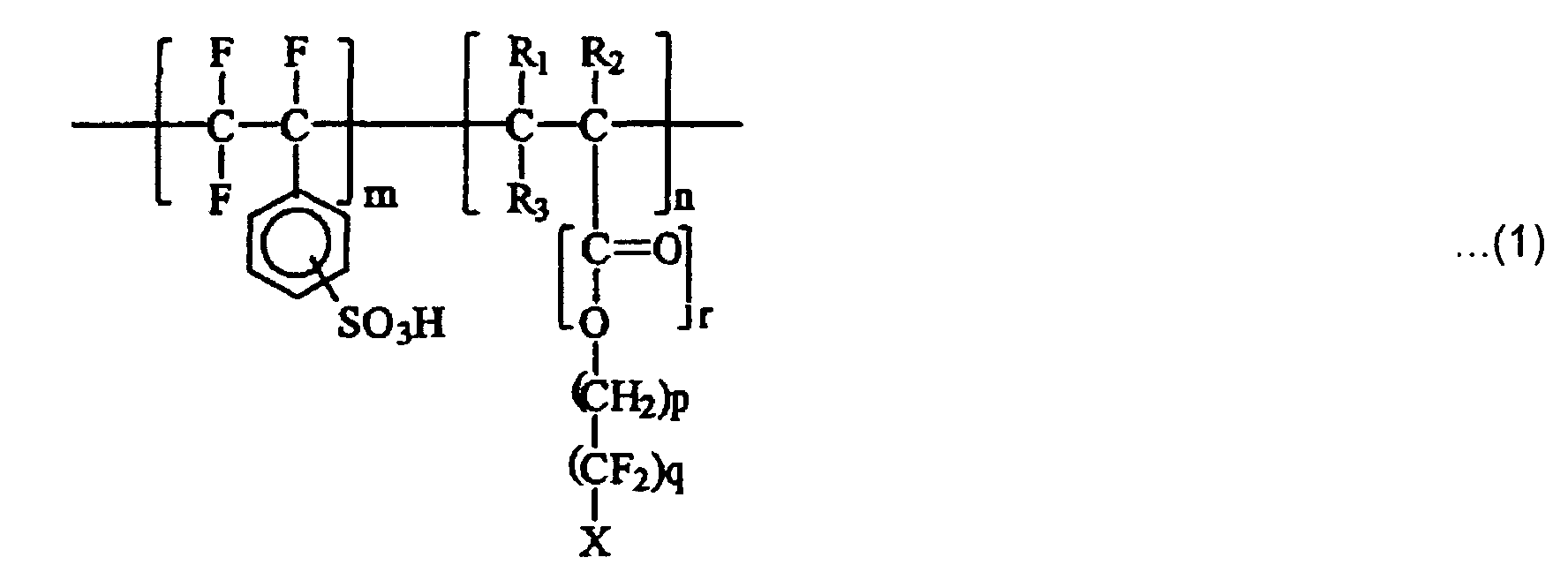
- a partially fluorinated copolymer having formula (1) below comprising trifluorostyrene units and substituted vinyl compound units: where each of R 1 , R 2 and R 3 is F, H or CH 3 ; X is a hydroxy group or a trifluoromethyl group; m is an integer greater than zero; n is an integer greater than zero; p , q and r are zero or integers greater than zero.
- the second objective of the present invention is achieved by an ionic conductive polymer membrane comprising a partially fluorinated copolymer having formula (1) with trifluorostyrene units and substituted vinyl compound units: where each of R 1 , R 2 and R 3 is F, H or CH 3 ; X is a hydroxy group or a trifluoromethyl group; m is an integer greater than zero; n is an integer greater than zero; p , q and r are zero or integers greater than zero.
- the third objective of the present invention is achieved by a fuel cell adopting an ionic conductive layer including a partially fluorinated copolymer having formula (1) with trifluorostyrene units and substituted vinyl compound units: where each of R 1 , R 2 and R 3 is F, H or CH 3 ; X is a hydroxy group or a trifluoromethyl group; m is an integer greater than zero; n is an integer greater than zero; p , q and r are zero or integers greater than zero.
- a partially fluorinated copolymer having formula (1) above according to the present invention is derived by polymerizing a trifluorostyrene monomer and a substituted vinyl compound monomer, and sulfonating the polymerized product.
- the trifluorostyrene monomer may include, for example, ⁇ , ⁇ , ⁇ -trifluorostyrene, heptadecafluoro decyl methacrylate, heptadecafluoro decene and heptadecafluoro decyl acrylate.
- the polymerization reaction is performed by an emulsion polymerization method.
- a polymerization initiator for example, potassium persulfate, can be added for the polymerization.
- Dodecylamine hydrochloride or sodium stearate (soap) can be used as an emulsifier.
- an emulsifier used in the emulsion polymerization is removed and the copolymer is subjected to sulfonation with a chlorosulfonic acid.
- the degree of sulfonation can be varied by adjusting the amount of a sulfonation agent such as chlorosulfonic acid.
- an ionic conductive polymer membrane for fuel cells is obtained by casting a solution containing the resultant sulfonated copolymer or hot pressing the resultant sulfonated copolymer.
- m is an integer from 1 to 50
- n is an integer from 1 to 50
- p is zero or an integer from 1 to 12
- q is zero or an integer from 1 to 12.
- the partially fluorinated copolymer having formula (1) above has a weight average molecular weight of 30,000-500,000. If the weight average molecular weight of the partially fluorinated copolymer is less than 30,000, formation of a film is difficult. If the weight average molecular weight of the partially fluorinated copolymer exceeds 500,000, unfavorably its solubility in organic solvent is poor.
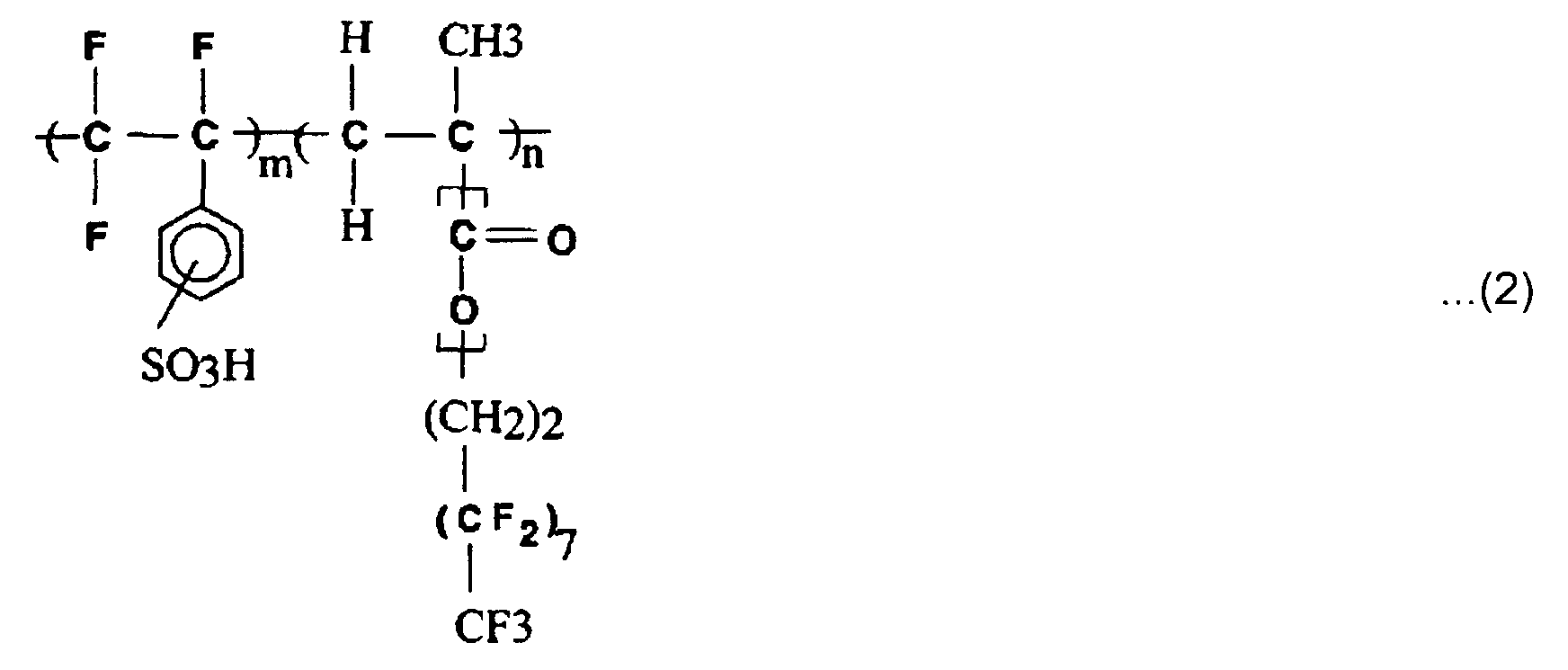
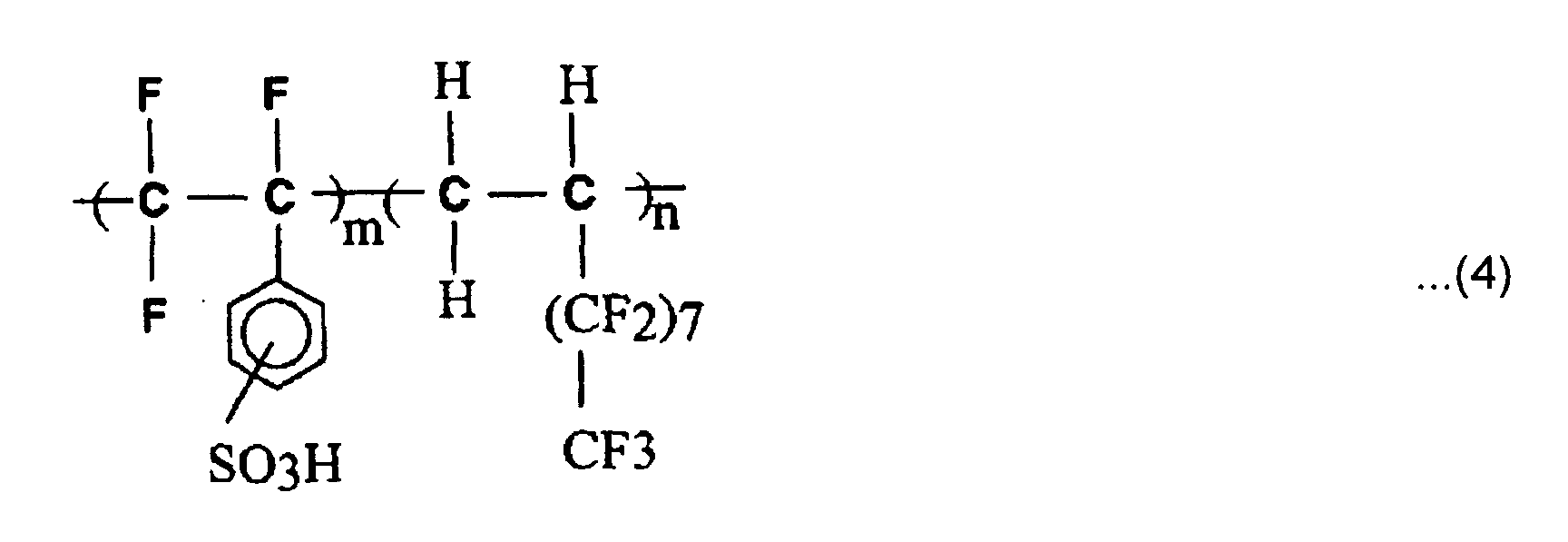
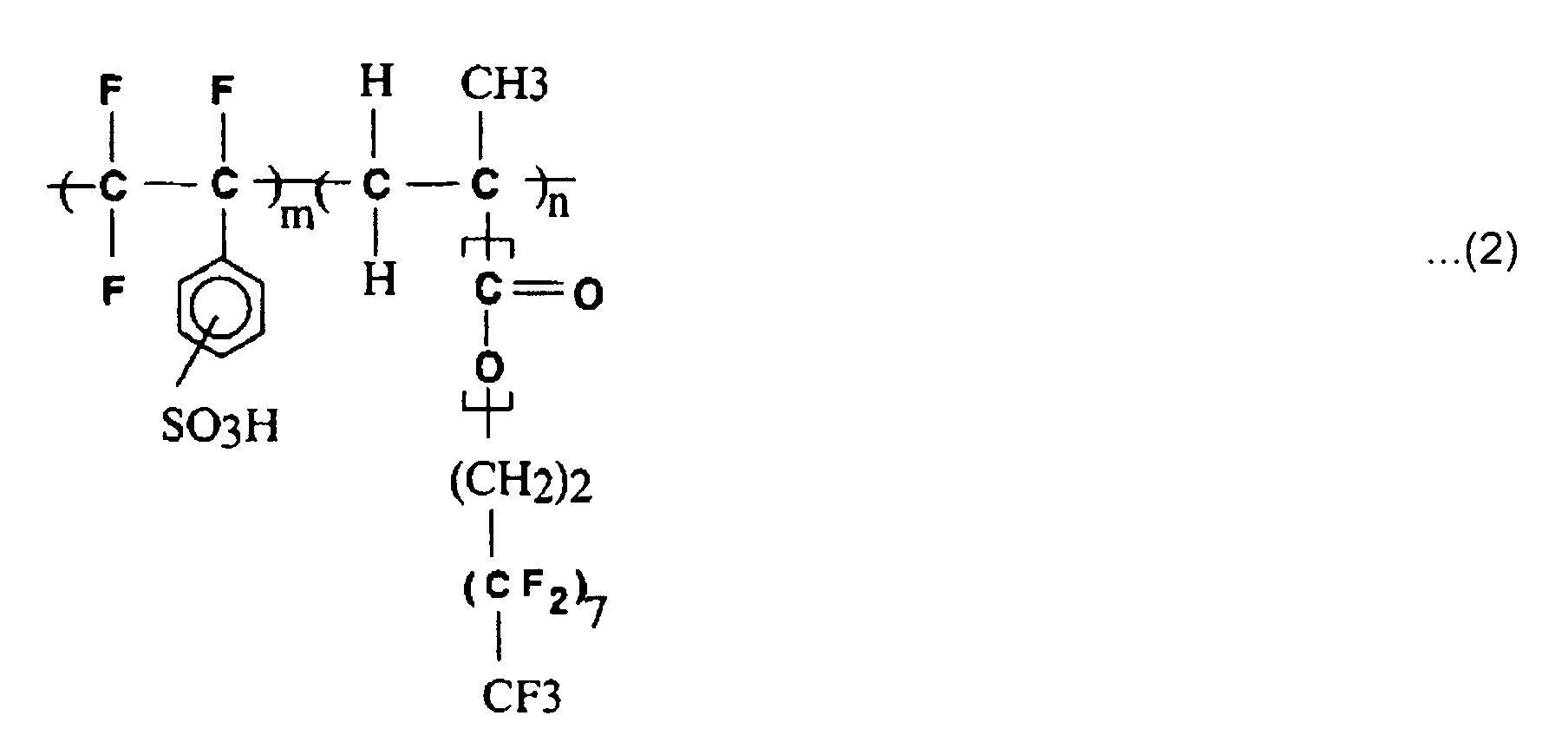
- the partially fluorinated copolymer having formula (1) above is any compound having formula (2) through (5): where m is an integer greater than zero; and n is an integer greater than zero.
- the copolymer having formula (1) above can be partially crosslinked with a crosslinking agent, which is a multi-functional compound having two or more unsaturated groups per molecule.
- the crosslinking reaction takes place when a mixture of the copolymer having formula (1) and the crosslinking agent is subjected to casting or hot pressing to form a polymer membrane.
- the crosslinking agent may be divinyl benzene, diallyl ether, triallyether, diglycidyl ether, ethyleneglycol dimethacrylate, or a mixture of these compounds.
- ionic conductivity slightly decreases and the degree of swelling in the wet state is reduced.
- a difference in volumes of the polymer membrane in the dry and wet states is decreased.
- m is an integer greater than zero
- n is an integer greater than zero
- p and r are zero or integers grater than zero.
- m is an integer from 1 to 50
- n is an integer from 1 yo 50
- p is zero or an integer from 1 to 12
- q is zero or an integer from 1 to 12.
- a catalylic layer is formed over both sides of the ionic conductive polymer membrane formed of the copolymer having formula (1), and bonded with each electrode support layer, so that a membrane and electrode assembly (MEA) is completed.
- MEA membrane and electrode assembly
- copolymer powder 30 g sodium chloride and 50 g ice were added to the reaction mixture and filtered in a vacuum to obtain copolymer powder.
- the resultant copolymer powder was washed with deionized water and then with cold methanol. The washed copolymer powder was dried at room temperature for a day, and dried again in a vacuum oven at room temperature for 5-6 hours.
- copolymer powder 25 g sodium chloride and 50 g ice were added to the reaction mixture and filtered in a vacuum to obtain copolymer powder.
- the resultant copolymer powder was washed with deionized water and then with cold methanol. The washed copolymer powder was dried at room temperature for a day, and dried again in a vacuum oven at room temperature for 5-6 hours.
- copolymer powder After the reaction was completed, 50 g ice and 25 g sodium chloride were added to the reaction mixture and filtered in a vacuum to obtain copolymer powder. The resultant copolymer powder was washed with deionized water and then with cold methanol. The washed copolymer powder was dried at room temperature for a day, and dried again in a vacuum oven at room temperature for 5-6 hours.
- the flask containing the reactants was purged with nitrogen gas for 30 minutes, and was kept at 55 ⁇ 1°C. While maintaining the temperature of the reaction mixture at the temperature, a solution obtained by dissolving 0.445 g potassium persulfate in 5 g deionized water was injected into the reaction mixture with a syringe. The mixture was left at 55 ⁇ 1°C for 72 hours for reaction.
- copolymer powder After the reaction was completed, 30 g sodium chloride and 50 g ice were added to the reaction mixture and filtered in a vacuum to obtain copolymer powder. The resultant copolymer powder was washed with deionized water and then with cold methanol. The washed copolymer powder was dried at room temperature for a day, and dried again in a vacuum oven at room temperature for 5-6 hours.
- Ionic conductive polymer membranes were manufactured by hot pressing the sulfonated copolymers derived in Synthesis Examples 1 to 4 at a temperature of 100°C and a pressure of 23 Mton for 5 minutes. Variations in ionic conductivity of the obtained ionic conductive polymer membranes with respect to temperature were measured.
- FIG. 2 illustrates the ionic conductivity of the ionic conductive polymer membrane formed of the sulfonated copolymer of Synthesis Example 1 with respect to temperature.
- the ionic conductivity of the ionic conductive polymer membrane is 10 -1 S/cm or more in the range of 30-70°C, which is satisfactory to be used as a proton exchange membrane for fuel cells.
- the ionic conductive properties show a tendency similar to those of the ionic conductive polymer membrane for Synthesis Example 1.
- the flask containing the reactants was purged with nitrogen gas for 30 minutes, and was kept at 55 ⁇ 1°C. After dissolving 0.8 g potassium persulfate in deionized water, the solution was injected into the reaction mixture with a syringe.
- the mixture was left for 48 hours for reaction. After the reaction was completed, 50 g ice and 100 g sodium chloride were added to the reaction mixture and filtered in a vacuum to obtain copolymer powder.
- the resultant copolymer powder was washed with deionized water and then with cold methanol. The washed copolymer powder was dried at room temperature for a day, and dried again in a vacuum oven at room temperature for 5-6 hours.
- An ionic conductive polymer membrane was manufactured by hot pressing the sulfonated copolymer obtained in Synthesis Example 1 at a temperature of 100°C and a pressure of 23 Mton for 5 minutes.
- a catalytic layer was formed on both sides of the ionic conductive polymer membrane, and bonded with each electrode support layer, so that a membrane and electrode assembly (MEA) was manufactured.
- MEA membrane and electrode assembly
- a current collector was attached to both sides of the completed MEA, thereby resulting in a complete proton exchange membrane fuel cell (PEMFC).
- a PEMFC was manufactured in the same manner as in Example 1, except that the sulfonated copolymer of Synthesis Example 2 was used instead of the sulfonated copolymer of Synthesis Example 1.
- An ionic conductive polymer membrane was manufactured by hot pressing the sulfonated copolymer obtained in Synthesis Example 1 at a temperature of 100°C and a pressure of 23 Mton for 5 minutes.
- a catalytic layer was formed on both sides of the ionic conductive polymer membrane, and bonded with each electrode support layer, so that a membrane and electrode assembly (MEA) was manufactured.
- MEA membrane and electrode assembly
- a current collector was attached to both sides of the completed MEA, thereby resulting in a complete direct methanol fuel cell (DMFC).
- FIGS. 3 and 4 show variations in cell potential of the PEMFC of Example 1 and the DMFC of Example 3, respectively, with respect to current density.
- the PEMFC and DMFC which adopt the ionic conductive layer formed of the copolymer of Synthesis Example 1 have good cell potential characteristic at a temperature of 70-80°C.
- the cell potential characteristic of the PEMFC and DMFC was measured by measuring a voltage level with application of current while fuel is supplied to the cell. The cell potential characteristic is evaluated as excellent when the voltage level increases with application of a constant current.
- the copolymer having formula (1) according to the present invention includes trifluorostyrene units and substituted vinyl compound units, which may be partially crosslinked.
- Ionic conductive polymer membranes can be manufactured using the copolymer at low cost, with excellent mechanical properties.
- a partially crosslinked copolymer is used, the degree of swelling of the resulting polymer membrane and fuel crossover can be reduced compared with a conventional polymer.
- the efficiency of fuel cells can be improved by applying the polytrifluorostyrene-based ionic conductive polymer membrane.
Landscapes
- Chemical & Material Sciences (AREA)
- Chemical Kinetics & Catalysis (AREA)
- Engineering & Computer Science (AREA)
- Manufacturing & Machinery (AREA)
- General Chemical & Material Sciences (AREA)
- Medicinal Chemistry (AREA)
- Organic Chemistry (AREA)
- Polymers & Plastics (AREA)
- Health & Medical Sciences (AREA)
- Life Sciences & Earth Sciences (AREA)
- Sustainable Development (AREA)
- Sustainable Energy (AREA)
- Electrochemistry (AREA)
- Inorganic Chemistry (AREA)
- Materials Engineering (AREA)
- Crystallography & Structural Chemistry (AREA)
- Fuel Cell (AREA)
- Addition Polymer Or Copolymer, Post-Treatments, Or Chemical Modifications (AREA)
Abstract

Description





Claims (8)
- A partially fluorinated copolymer having formula (1) below, comprising trifluorostyrene units and substituted vinyl compound units:where each of R1, R2 and R3 is F, H or CH3; X is a hydroxy group or a trifluoromethyl group; m is an integer greater than zero; n is an integer greater than zero; and p, q and r are zero or integers greater than zero.

- The partially fluorinated copolymer of claim 1, wherein, in formula (1), m is an integer from 1 to 50, n is an integer from 1 to 50; p is zero or an integer from 1 to 12; and q is zero or an integer from 1 to 12.
- The partially fluorinated copolymer of claim 1, wherein the partially fluorinated copolymer is a compound having any formulae (2) to (5):

 where m is an integer from 1 to 50; and n is zero or an integer from 1 to 50.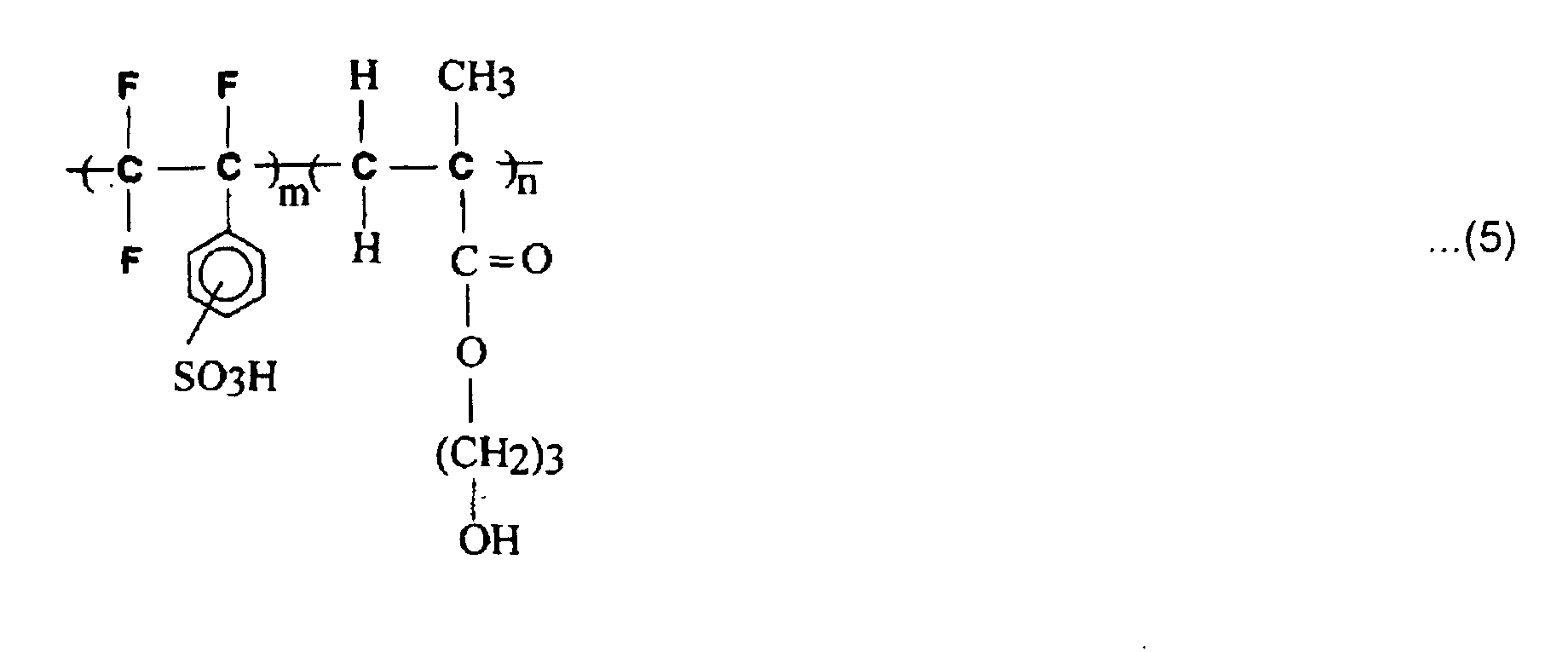
- The partially fluorinated copolymer of any one of claims 1 to 3, wherein the partially fluorinated copolymer having formula (1) has a weight average molecular weight of 30,000-500,000.
- The partially fluorinated copolymer of any one of claims 1 to 4, wherein the partially fluorinated copolymer is partially crossliriked using a crosslinking agent.
- The partially fluorinated copolymer of any one of claims 1 to 5, wherein at least one crosslinking agent is divinyl benzene, diallyl ether, triallylether, diglycidyl ether and ethyleneglycol dimethacrylate.
- An ionic conductive polymer membrane comprising a partially fluorinated copolymer according to any one of claims 1 to 6.
- A fuel cell adopting an ionic conductive membrane according to claim 7.
Applications Claiming Priority (2)
| Application Number | Priority Date | Filing Date | Title |
|---|---|---|---|
| KR2000037394 | 2000-06-30 | ||
| KR10-2000-0037394A KR100370399B1 (en) | 2000-06-30 | 2000-06-30 | Partially fluorinated copolymer based on trifluorostyrene and substituted vinyl compound and ion conductive polymer layer formed therefrom |
Publications (3)
| Publication Number | Publication Date |
|---|---|
| EP1170310A2 true EP1170310A2 (en) | 2002-01-09 |
| EP1170310A3 EP1170310A3 (en) | 2002-01-30 |
| EP1170310B1 EP1170310B1 (en) | 2008-05-14 |
Family
ID=19675625
Family Applications (1)
| Application Number | Title | Priority Date | Filing Date |
|---|---|---|---|
| EP01305699A Expired - Lifetime EP1170310B1 (en) | 2000-06-30 | 2001-06-29 | Partially fluorinated copolymer based on trifluorostyrene and substituted vinyl compound and ionic conductive polymer membrane formed therefrom |
Country Status (4)
| Country | Link |
|---|---|
| US (3) | US6774150B2 (en) |
| EP (1) | EP1170310B1 (en) |
| KR (1) | KR100370399B1 (en) |
| DE (1) | DE60133971D1 (en) |
Cited By (10)
| Publication number | Priority date | Publication date | Assignee | Title |
|---|---|---|---|---|
| EP1348716A1 (en) * | 2002-03-25 | 2003-10-01 | Sumitomo Chemical Company, Limited | Aromatic polymer, method for producing the same and uses thereof |
| WO2005003083A1 (en) * | 2003-06-27 | 2005-01-13 | E.I. Dupont De Nemours And Company | Trifluorostyrene containing compounds, and their use in polymer electrolyte membranes |
| WO2004045014A3 (en) * | 2002-11-07 | 2005-11-10 | Gas Technology Inst | High stability membrane for proton exchange membrane fuel cells |
| US7094490B2 (en) | 2002-05-13 | 2006-08-22 | Polyfuel, Inc. | Ion conductive block copolymers |
| JP2006294266A (en) * | 2005-04-05 | 2006-10-26 | Toyota Motor Corp | Solid electrolyte material for fuel cell and fuel cell |
| EP1788655A1 (en) * | 2005-11-22 | 2007-05-23 | Samsung SDI Co., Ltd. | Polymer membrane for fuel cell, method of preparing same, and membrane-electrode assemby for fuel cell comprising same |
| US7504461B2 (en) | 2004-03-12 | 2009-03-17 | Polyfuel, Inc. | Ion-conductive copolymers containing one or more ion-conducting oligomers |
| US7507771B2 (en) | 2003-11-13 | 2009-03-24 | Polyfuel, Inc. | Ion conductive copolymers containing one or more hydrophobic oligomers |
| US7572535B2 (en) | 2002-05-13 | 2009-08-11 | Polyfuel, Inc. | Ion conductive copolymers containing one or more hydrophobic oligomers |
| EP3247745A4 (en) * | 2015-01-23 | 2018-07-11 | Akron Polymer Systems, Inc. | Fluoropolymer-based polymer blends, polymer films, and polarizer protective films |
Families Citing this family (11)
| Publication number | Priority date | Publication date | Assignee | Title |
|---|---|---|---|---|
| JP3637392B2 (en) * | 2002-04-08 | 2005-04-13 | 独立行政法人産業技術総合研究所 | Fuel cell |
| DE10216078A1 (en) * | 2002-04-11 | 2003-10-23 | Tesa Ag | Soft flame-retardant wrapping film |
| KR100509298B1 (en) | 2003-05-31 | 2005-08-22 | 한국과학기술연구원 | Method to manufacture composite polymer electrolyte membranes coated with inorganic thin films for direct methanol fuel cells |
| KR100696460B1 (en) * | 2003-06-05 | 2007-03-19 | 삼성에스디아이 주식회사 | Hydrogen ion conductive polymer |
| US7785751B2 (en) * | 2004-12-03 | 2010-08-31 | Nitto Denko Corporation | Production method of electrolyte membrane, electrolyte membrane and solid polymer fuel cell using same |
| GB2432836A (en) * | 2005-12-01 | 2007-06-06 | 3M Innovative Properties Co | Fluorinated surfactant |
| KR100789756B1 (en) | 2005-12-09 | 2008-01-02 | 한국전자통신연구원 | Apparatus for determining transmission format using variable frame length, method thereof, and decoding method using same |
| US8871882B2 (en) | 2012-02-14 | 2014-10-28 | Akron Polymer Systems, Inc. | Method for the preparation of styrenic fluoropolymers |
| JP2016207610A (en) * | 2015-04-28 | 2016-12-08 | 東洋紡株式会社 | Composite polymer electrolyte membrane and manufacturing method therefor and membrane electrode assembly, fuel cell |
| JP2016207609A (en) * | 2015-04-28 | 2016-12-08 | 東洋紡株式会社 | Composite polymer electrolyte membrane, production method thereof, membrane electrode assembly, and fuel cell |
| US10130918B2 (en) * | 2016-09-16 | 2018-11-20 | Pall Corporation | Fluoropolymers and membranes comprising fluoropolymers (III) |
Family Cites Families (11)
| Publication number | Priority date | Publication date | Assignee | Title |
|---|---|---|---|---|
| US3341366A (en) * | 1964-08-19 | 1967-09-12 | Gen Electric | Sulfonated polymers of alpha, beta, beta-trifluorostyrene, with applications to structures and cells |
| US4012303A (en) * | 1974-12-23 | 1977-03-15 | Hooker Chemicals & Plastics Corporation | Trifluorostyrene sulfonic acid membranes |
| US5422411A (en) | 1993-09-21 | 1995-06-06 | Ballard Power Systems Inc. | Trifluorostyrene and substituted trifluorostyrene copolymeric compositions and ion-exchange membranes formed therefrom |
| US5834523A (en) | 1993-09-21 | 1998-11-10 | Ballard Power Systems, Inc. | Substituted α,β,β-trifluorostyrene-based composite membranes |
| US5773480A (en) | 1993-09-21 | 1998-06-30 | Ballard Power Systems Inc. | Trifluorostyrene and substituted trifluorostyrene copolymeric compositions and ion-exchange membranes formed therefrom |
| US5602185A (en) | 1993-09-21 | 1997-02-11 | Ballard Power Systems Inc. | Substituted trifluorostyrene compositions |
| WO1996040798A1 (en) * | 1995-06-07 | 1996-12-19 | Ballard Power Systems Inc. | Copolymeric compositions of trifluorostyrene, substituted trifluorostyrene and substituted ethylene, and ion-exchange membranes formed therefrom |
| US5876571A (en) * | 1996-05-10 | 1999-03-02 | E. I. Du Pont De Nemours And Company | Process for making cation exchange membranes with enhanced electrochemical properties |
| EP0913422A2 (en) * | 1997-11-03 | 1999-05-06 | Pall Corporation | Ion exchange membrane |
| JP3729626B2 (en) * | 1997-11-07 | 2005-12-21 | コニカミノルタホールディングス株式会社 | Latex composition and sheet material |
| JPH11250921A (en) * | 1998-02-27 | 1999-09-17 | Aisin Seiki Co Ltd | Solid polymer electrolyte fuel cell |
-
2000
- 2000-06-30 KR KR10-2000-0037394A patent/KR100370399B1/en not_active Expired - Fee Related
-
2001
- 2001-06-29 DE DE60133971T patent/DE60133971D1/en not_active Expired - Lifetime
- 2001-06-29 EP EP01305699A patent/EP1170310B1/en not_active Expired - Lifetime
- 2001-07-02 US US09/895,163 patent/US6774150B2/en not_active Expired - Lifetime
-
2004
- 2004-05-03 US US10/836,343 patent/US7037950B2/en not_active Expired - Lifetime
-
2005
- 2005-12-22 US US11/313,778 patent/US7285612B2/en not_active Expired - Fee Related
Cited By (14)
| Publication number | Priority date | Publication date | Assignee | Title |
|---|---|---|---|---|
| EP1348716A1 (en) * | 2002-03-25 | 2003-10-01 | Sumitomo Chemical Company, Limited | Aromatic polymer, method for producing the same and uses thereof |
| US7094490B2 (en) | 2002-05-13 | 2006-08-22 | Polyfuel, Inc. | Ion conductive block copolymers |
| US7572535B2 (en) | 2002-05-13 | 2009-08-11 | Polyfuel, Inc. | Ion conductive copolymers containing one or more hydrophobic oligomers |
| US7323265B2 (en) | 2002-07-05 | 2008-01-29 | Gas Technology Institute | High stability membrane for proton exchange membrane fuel cells |
| WO2004045014A3 (en) * | 2002-11-07 | 2005-11-10 | Gas Technology Inst | High stability membrane for proton exchange membrane fuel cells |
| WO2005003083A1 (en) * | 2003-06-27 | 2005-01-13 | E.I. Dupont De Nemours And Company | Trifluorostyrene containing compounds, and their use in polymer electrolyte membranes |
| US7507771B2 (en) | 2003-11-13 | 2009-03-24 | Polyfuel, Inc. | Ion conductive copolymers containing one or more hydrophobic oligomers |
| US7504461B2 (en) | 2004-03-12 | 2009-03-17 | Polyfuel, Inc. | Ion-conductive copolymers containing one or more ion-conducting oligomers |
| JP2006294266A (en) * | 2005-04-05 | 2006-10-26 | Toyota Motor Corp | Solid electrolyte material for fuel cell and fuel cell |
| JP2007141849A (en) * | 2005-11-22 | 2007-06-07 | Samsung Sdi Co Ltd | POLYMER ELECTROLYTE MEMBRANE FOR FUEL CELL, PROCESS FOR PRODUCING THE SAME, AND ELECTRODE ASSEMBLY FOR FUEL CELL INCLUDING THE SAME |
| EP1788655A1 (en) * | 2005-11-22 | 2007-05-23 | Samsung SDI Co., Ltd. | Polymer membrane for fuel cell, method of preparing same, and membrane-electrode assemby for fuel cell comprising same |
| US7871736B2 (en) | 2005-11-22 | 2011-01-18 | Samsung Sdi Co., Ltd. | Polymer membrane for fuel cell, method of preparing same, and membrane-electrode assembly for fuel cell comprising same |
| CN1982357B (en) * | 2005-11-22 | 2012-08-29 | 三星Sdi株式会社 | Polymer membrane for fuel cell, method of preparing same and membrane-electrode assembly comprising same |
| EP3247745A4 (en) * | 2015-01-23 | 2018-07-11 | Akron Polymer Systems, Inc. | Fluoropolymer-based polymer blends, polymer films, and polarizer protective films |
Also Published As
| Publication number | Publication date |
|---|---|
| US7285612B2 (en) | 2007-10-23 |
| US6774150B2 (en) | 2004-08-10 |
| EP1170310A3 (en) | 2002-01-30 |
| KR20020004065A (en) | 2002-01-16 |
| EP1170310B1 (en) | 2008-05-14 |
| US20040202913A1 (en) | 2004-10-14 |
| DE60133971D1 (en) | 2008-06-26 |
| US20020015874A1 (en) | 2002-02-07 |
| US7037950B2 (en) | 2006-05-02 |
| US20060100294A1 (en) | 2006-05-11 |
| KR100370399B1 (en) | 2003-01-29 |
Similar Documents
| Publication | Publication Date | Title |
|---|---|---|
| EP1170310B1 (en) | Partially fluorinated copolymer based on trifluorostyrene and substituted vinyl compound and ionic conductive polymer membrane formed therefrom | |
| KR101137277B1 (en) | Polymer electrolyte membrane, method for producing the same, membrane-electrode assembly and solid p0lymer fuel cell | |
| JP3724064B2 (en) | Polymer electrolyte for fuel cell and fuel cell | |
| CA2450346C (en) | Electrode structure for solid polymer fuel cell, its production method, and solid polymer fuel cell | |
| CN102449006B (en) | Electrolyte material, liquid composite, and membrane electrode assembly for solid polymer fuel cells | |
| JP2007523230A (en) | Branched sulfonated multiblock copolymer and electrolyte membrane using the same | |
| JP4887580B2 (en) | Gas diffusion electrode and polymer electrolyte fuel cell having the same | |
| WO2004097851A1 (en) | Solid polymeric electrolyte material, process for producing the same and membrane/electrode assembly for solid polymer fuel cell | |
| US7135537B2 (en) | Sulfonimide-containing poly(arylene ether)s and poly(arylene ether sulfone)s, methods for producing the same, and uses thereof | |
| WO2011013577A1 (en) | Electrolyte material, liquid composition, and membrane electrode assembly for solid polymer fuel cells | |
| CN107108781B (en) | Electrolyte material, liquid composition, and membrane electrode assembly for polymer electrolyte fuel cell | |
| CA2662066A1 (en) | Development of novel proton-conductive polymers for proton exchange membrane fuel cell (pemfc) technology | |
| US7160926B2 (en) | Ion exchange fluorocarbon resin membrane | |
| KR100956652B1 (en) | A crosslinked polymer electrolyte membrane, a method for producing a crosslinked polymer electrolyte membrane, and a fuel cell including the electrolyte membrane | |
| JP4170973B2 (en) | Polymer containing terminal sulfonic acid group and polymer electrolyte and fuel cell employing the same | |
| CN100404503C (en) | Monomer compound, graft copolymer compound and preparation method thereof, polymer electrolyte membrane and fuel cell | |
| JP2007012617A (en) | POLYMER ELECTROLYTE MEMBRANE FOR FUEL CELL, ITS MANUFACTURING METHOD, AND FUEL CELL SYSTEM INCLUDING THE SAME | |
| CN107001254B (en) | Halogenated compound, polymer comprising the halogenated compound, and polymer electrolyte membrane comprising the polymer | |
| KR101648839B1 (en) | Electrolyte membrane made of ion-conducting polymer comprising phenyl pendant substituted with at least two sulfonated aromatic groups and membrane-electrode assembly for fuel cells comprising the same | |
| JP2005060516A (en) | Fluorine ion exchange membrane | |
| US20220131186A1 (en) | Single-ion polymer electrolyte molecular design | |
| KR100880092B1 (en) | Surface Modification of Hydrocarbon-Based Polymer Electrolyte Membrane | |
| KR102728980B1 (en) | Ion transport polymer, method for preparing the same and electrolyte membrane comprising the same | |
| JPH06275301A (en) | Fuel cell | |
| KR101574245B1 (en) | Electrolyte membrane made of ion-conducting polymer comprising partially branched multiblock copolymer and membrane-electrode assembly for fuel cells comprising the same |
Legal Events
| Date | Code | Title | Description |
|---|---|---|---|
| PUAI | Public reference made under article 153(3) epc to a published international application that has entered the european phase |
Free format text: ORIGINAL CODE: 0009012 |
|
| PUAL | Search report despatched |
Free format text: ORIGINAL CODE: 0009013 |
|
| AK | Designated contracting states |
Kind code of ref document: A2 Designated state(s): AT BE CH CY DE DK ES FI FR GB GR IE IT LI LU MC NL PT SE TR Kind code of ref document: A2 Designated state(s): DE FI GB IT NL |
|
| AX | Request for extension of the european patent |
Free format text: AL;LT;LV;MK;RO;SI |
|
| AK | Designated contracting states |
Kind code of ref document: A3 Designated state(s): AT BE CH CY DE DK ES FI FR GB GR IE IT LI LU MC NL PT SE TR |
|
| AX | Request for extension of the european patent |
Free format text: AL;LT;LV;MK;RO;SI |
|
| 17P | Request for examination filed |
Effective date: 20020320 |
|
| AKX | Designation fees paid |
Free format text: DE FI GB IT NL |
|
| 17Q | First examination report despatched |
Effective date: 20050309 |
|
| RAP1 | Party data changed (applicant data changed or rights of an application transferred) |
Owner name: SAMSUNG SDI CO., LTD. |
|
| 17Q | First examination report despatched |
Effective date: 20050309 |
|
| GRAP | Despatch of communication of intention to grant a patent |
Free format text: ORIGINAL CODE: EPIDOSNIGR1 |
|
| GRAS | Grant fee paid |
Free format text: ORIGINAL CODE: EPIDOSNIGR3 |
|
| GRAA | (expected) grant |
Free format text: ORIGINAL CODE: 0009210 |
|
| AK | Designated contracting states |
Kind code of ref document: B1 Designated state(s): DE FI GB IT NL |
|
| REG | Reference to a national code |
Ref country code: GB Ref legal event code: FG4D |
|
| REF | Corresponds to: |
Ref document number: 60133971 Country of ref document: DE Date of ref document: 20080626 Kind code of ref document: P |
|
| PLBE | No opposition filed within time limit |
Free format text: ORIGINAL CODE: 0009261 |
|
| STAA | Information on the status of an ep patent application or granted ep patent |
Free format text: STATUS: NO OPPOSITION FILED WITHIN TIME LIMIT |
|
| 26N | No opposition filed |
Effective date: 20090217 |
|
| PGFP | Annual fee paid to national office [announced via postgrant information from national office to epo] |
Ref country code: GB Payment date: 20170628 Year of fee payment: 17 |
|
| PGFP | Annual fee paid to national office [announced via postgrant information from national office to epo] |
Ref country code: IT Payment date: 20170619 Year of fee payment: 17 Ref country code: FI Payment date: 20170609 Year of fee payment: 17 Ref country code: NL Payment date: 20170614 Year of fee payment: 17 |
|
| PGFP | Annual fee paid to national office [announced via postgrant information from national office to epo] |
Ref country code: DE Payment date: 20170621 Year of fee payment: 17 |
|
| REG | Reference to a national code |
Ref country code: DE Ref legal event code: R119 Ref document number: 60133971 Country of ref document: DE |
|
| PG25 | Lapsed in a contracting state [announced via postgrant information from national office to epo] |
Ref country code: FI Free format text: LAPSE BECAUSE OF NON-PAYMENT OF DUE FEES Effective date: 20180629 |
|
| REG | Reference to a national code |
Ref country code: NL Ref legal event code: MM Effective date: 20180701 |
|
| GBPC | Gb: european patent ceased through non-payment of renewal fee |
Effective date: 20180629 |
|
| PG25 | Lapsed in a contracting state [announced via postgrant information from national office to epo] |
Ref country code: NL Free format text: LAPSE BECAUSE OF NON-PAYMENT OF DUE FEES Effective date: 20180701 |
|
| PG25 | Lapsed in a contracting state [announced via postgrant information from national office to epo] |
Ref country code: GB Free format text: LAPSE BECAUSE OF NON-PAYMENT OF DUE FEES Effective date: 20180629 Ref country code: DE Free format text: LAPSE BECAUSE OF NON-PAYMENT OF DUE FEES Effective date: 20190101 Ref country code: IT Free format text: LAPSE BECAUSE OF NON-PAYMENT OF DUE FEES Effective date: 20180629 |