EP1168876B1 - Transmission of mobile unit requests in wireless uplink systems - Google Patents
Transmission of mobile unit requests in wireless uplink systems Download PDFInfo
- Publication number
- EP1168876B1 EP1168876B1 EP01305050A EP01305050A EP1168876B1 EP 1168876 B1 EP1168876 B1 EP 1168876B1 EP 01305050 A EP01305050 A EP 01305050A EP 01305050 A EP01305050 A EP 01305050A EP 1168876 B1 EP1168876 B1 EP 1168876B1
- Authority
- EP
- European Patent Office
- Prior art keywords
- mobile unit
- resource
- received
- base station
- request
- Prior art date
- Legal status (The legal status is an assumption and is not a legal conclusion. Google has not performed a legal analysis and makes no representation as to the accuracy of the status listed.)
- Expired - Lifetime
Links
- 230000005540 biological transmission Effects 0.000 title description 18
- 238000000034 method Methods 0.000 claims description 21
- 238000004891 communication Methods 0.000 claims description 9
- 238000012544 monitoring process Methods 0.000 claims 2
- 238000010586 diagram Methods 0.000 description 2
- 238000001514 detection method Methods 0.000 description 1
- 230000000977 initiatory effect Effects 0.000 description 1
- 238000013507 mapping Methods 0.000 description 1
- 238000010295 mobile communication Methods 0.000 description 1
Images
Classifications
-
- H—ELECTRICITY
- H04—ELECTRIC COMMUNICATION TECHNIQUE
- H04W—WIRELESS COMMUNICATION NETWORKS
- H04W72/00—Local resource management
- H04W72/20—Control channels or signalling for resource management
- H04W72/21—Control channels or signalling for resource management in the uplink direction of a wireless link, i.e. towards the network
-
- H—ELECTRICITY
- H04—ELECTRIC COMMUNICATION TECHNIQUE
- H04W—WIRELESS COMMUNICATION NETWORKS
- H04W72/00—Local resource management
- H04W72/20—Control channels or signalling for resource management
-
- H—ELECTRICITY
- H04—ELECTRIC COMMUNICATION TECHNIQUE
- H04L—TRANSMISSION OF DIGITAL INFORMATION, e.g. TELEGRAPHIC COMMUNICATION
- H04L1/00—Arrangements for detecting or preventing errors in the information received
- H04L1/0001—Systems modifying transmission characteristics according to link quality, e.g. power backoff
- H04L1/0015—Systems modifying transmission characteristics according to link quality, e.g. power backoff characterised by the adaptation strategy
- H04L1/0017—Systems modifying transmission characteristics according to link quality, e.g. power backoff characterised by the adaptation strategy where the mode-switching is based on Quality of Service requirement
- H04L1/0018—Systems modifying transmission characteristics according to link quality, e.g. power backoff characterised by the adaptation strategy where the mode-switching is based on Quality of Service requirement based on latency requirement
-
- H—ELECTRICITY
- H04—ELECTRIC COMMUNICATION TECHNIQUE
- H04W—WIRELESS COMMUNICATION NETWORKS
- H04W72/00—Local resource management
- H04W72/04—Wireless resource allocation
- H04W72/044—Wireless resource allocation based on the type of the allocated resource
- H04W72/0446—Resources in time domain, e.g. slots or frames
-
- H—ELECTRICITY
- H04—ELECTRIC COMMUNICATION TECHNIQUE
- H04W—WIRELESS COMMUNICATION NETWORKS
- H04W72/00—Local resource management
- H04W72/20—Control channels or signalling for resource management
- H04W72/23—Control channels or signalling for resource management in the downlink direction of a wireless link, i.e. towards a terminal
Definitions
- This invention relates to methods and apparatus for use in wireless communication.
- the basic mechanism in wireless communication systems for a base station and one or more mobile units to communicate is to exchange messages by utilizing a so-called segment.
- One such wireless system is the Orthogonal Frequency Division Multiplex (OFDM) system.
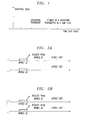
- a segment as shown in FIG. 1, is a combination of a time slot index and a waveform index.
- a time slot is a basic time unit having a unique time slot index associated with it.
- Each waveform has a unique waveform index.
- Messages of particular interest in wireless communication systems are mobile unit requests on an uplink.
- the same uplink resource is shared by more than one mobile unit to convey access requests to a base station.
- different mobile units may be assigned segments that have the same time slot index, and either the same waveform index or different waveform indices, but the waveforms that are not orthogonal.
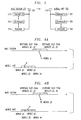
- one mobile unit, for example #1 is transmitting a request while another mobile unit, for example #2, is not. Consequently, there is no collision between the request from mobile unit #1 with a request from mobile unit #2.
- requests from the individual mobile units may arrive at a base station randomly, there is a distinct possibility of a collision between requests from mobile unit #1 and mobile unit #2, as shown in FIG. 2B. Consequently, both requests must be re-transmitted resulting in undesirable delay.
- the uplink request process is very slow and its reliability is less than desirable.
- US-A-4815073 discloses a system for establishing communication transmission between subscriber stations served by a central base station.
- the system includes a duplex transmission channel and a subscriber station transmitting initially a short access signal for gaining access to the duplex transmission channel to initiate an information transmission to the central base station.
- the central base station Upon reception of the short access signal, which carries call request information amounting to less than a complete identification of the subscriber station, the central base station responds with a response signal that includes a request for a complete access signal of the subscriber station thereby initiating an information transmission from and to the subscriber station.
- US-A-5577024 discloses a mobile communications system in which it is possible to transmit acknowledgements and channel allocation information from a mobile station to base station without information loss due to collisions. This is realized by the mobile stations using substantially orthogonal signals for acknowledgements so that the collisions are either avoided or it is possible to recover from them.
- the transmissions can be made orthogonal, either in frequency or in time so that collisions are avoided.
- Orthogonal transmissions can also be realized by using substantially orthogonal bit sequences and a code access technique. Such transmissions collide if they are transmitted in the same time slot but because they are orthogonal they still can be detected and the system recovers from the collision.
- each mobile unit is assigned segments with distinct time slot indices and/or waveform indices, where waveforms with distinct indices are orthogonal.
- a base station can identify the mobile that has made an access request from the dedicated uplink resource. Therefore, no mobile identification number is needed in the uplink request message. Then, the base station can transmit a request response message on a shared downlink resource that may include the identification number of the requesting mobile unit to acknowledge reception of the request.
- the mobile unit may transmit on a shared uplink resource an acknowledgment of reception of the downlink request response message.
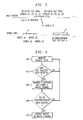
- FIG. 3 shows, in simplified block diagram form, details of a base station and a mobile unit in which the invention may be employed.
- base station 301 includes transmitter 303, receiver 304 and controller 305 for transmitting and receiving wireless messages via antenna 306.
- Controller 305 is employed to control operation of transmitter 303 and receiver 304, in accordance with the invention.
- mobile unit 302 includes transmitter 307, receiver 308 and controller 309 for transmitting and receiving wireless messages via antenna 310.
- Controller 309 is employed to control operation of transmitter 307 and receiver 308, in accordance with the invention.
- FIGs. 4A and 4B are graphical representations of a contention-free transmission of mobile unit requests on an uplink and including a shared downlink resource for transmitting request response messages useful in describing the invention.
- each mobile unit is assigned a dedicated uplink resource.
- the dedicated uplink resource is not shared with any other mobile unit.
- each mobile unit is assigned segments, as shown in FIG. 1, with distinct time slot indices and/or waveform indices, where waveforms with distinct indices are orthogonal. As shown in FIGs. 4A and 4B, this is realized by assigning mobile unit #1 and mobile unit #2 two different time slots.
- base station 301 After receiving a mobile request, base station 301 can identify which mobile 302 has transmitted the request. This is realized by employing the dedicated uplink resource assigned to the mobile unit 302 that transmitted the request on the uplink. Then, base station 301 can transmit a request response message on a downlink, which may include the identification of the mobile unit 302 that transmitted the request on the uplink in order to acknowledge the request. It is noted that the downlink resource for transmitting the request response messages is not dedicated to any particular mobile unit or units, but is a shared resource for all mobile units sharing base station 301. It is also important to note that segments for transmitting downlink request response messages from base station 301 do not necessarily have a one-to-one mapping to dedicated segments for transmitting uplink requests from mobile unit 302. As shown in FIG.
- base station 301 after receiving a request from mobile unit #1, base station 301 transmits back a request response message in a downlink segment.
- base station 301 after receiving a request message from mobile unit #2, base station 301 transmits back a request response message in the same downlink segment as the request response message transmitted to mobile unit #1.
- FIG. 5 is a graphical representation of the transmission of acknowledgments for downlink request response messages on a shared uplink resource useful in describing the invention.
- the amount of a dedicated resource for an individual mobile unit is generally smaller than what may be available in the prior contention-based implementation.
- dedicated mobile unit request transmission may not be reliable in a wireless channel.
- the mobile unit request must be re-transmitted, which is very similar to the collision situation in the contention-based implementation.
- the error of false alarm where base station 301 perceives receiving some mobile unit request that has not really been transmitted, also causes wasted use of the system resource.
- acknowledgment segments are added on the uplink for each downlink request response message.
- an uplink acknowledgment segment is slaved to a downlink request response segment. Therefore, acknowledgment segments are not dedicated for any particular mobile units, but shared by all mobile units. Whichever mobile unit transmits a request in its dedicated uplink segment and detects its own identification number in one of the request response message segments transmits an acknowledgment in the corresponding acknowledgment segment.
- each segment on the shared uplink resource has a one-to-one correspondence to a response message.
- acknowledgment segments are shared, no collision occurs unless two mobile units transmit their requests and both detect their identification numbers in the same request response message segment.
- At least one of the mobile units must have decoded the request response message in-error.
- the advantage of employing a shared resource for transmitting acknowledgments is that acknowledgment segments can be made to contain sufficient energy to ensure needed reliability without causing any significant system resource overhead.
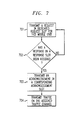
- FIG. 6 is a flowchart illustrating the steps in a process employed in base station 301 to detect reception of mobile unit requests and transmit request response messages.
- step 601 causes base station 301 to monitor mobile unit request time slots.
- step 602 tests to determine if any mobile unit requests have been detected. If the test result in step 602 is No, control is returned to step 601 and steps 601 and 602 are iterated until step 602 yields a YES result.
- the YES result in step 602 indicates the detection of a mobile unit request in a dedicated uplink resource.
- step 603 causes the transmission of a request response message on the downlink. It is noted that the request response message may include the identification number of the mobile unit that transmitted the request.
- Step 603 also causes a traffic channel to be assigned to the requesting mobile unit.
- step 604 tests to determine if an acknowledgment has been received from the mobile unit that the request response message was directed to. If the test result in step 604 is NO, the assigned traffic channel is retracted by base station 301, and control is returned to step 601 and steps 601 through 604 are iterated until step 604 yields a YES result.
- a YES result in step 604 indicates that an acknowledgment has been received from the mobile unit that a request response message was transmitted toward.
- Step 605 causes base station 301 to receive data traffic in the assigned traffic channel from the requesting mobile unit, for example mobile unit 302.
- FIG. 7 is a flowchart illustrating steps in a process employed in a mobile unit to transmit requests, receive request response messages and transmit acknowledgments.
- Step 701 causes a mobile unit, for example mobile unit 302, to transmit on the uplink a request in its dedicated time slot to a base station, for example base station 301.
- step 702 tests to determine if a request response message from base station 301 has been received in a shared request response message downlink resource, namely, a downlink time slot. If the test result in step 702 is NO, control is returned to step 701 and steps 701 and 702 are iterated until step 702 yields a YES result. That is, a request response message has been received in the shared downlink request response message time slot indicating that base station 301 has received the request from this mobile unit, i.e., mobile unit 302. Thereafter, step 703 causes mobile unit 302 to transmit an acknowledgment of receiving the request response message in a shared acknowledgment time slot. Then, step 704 causes mobile unit 302 to transmit data traffic on the traffic channel assigned to it by base station 301.
Landscapes
- Engineering & Computer Science (AREA)
- Computer Networks & Wireless Communication (AREA)
- Signal Processing (AREA)
- Quality & Reliability (AREA)
- Mobile Radio Communication Systems (AREA)
Applications Claiming Priority (2)
| Application Number | Priority Date | Filing Date | Title |
|---|---|---|---|
| US09/596,434 US6807160B1 (en) | 2000-06-19 | 2000-06-19 | Transmission of mobile requests in wireless uplink system |
| US596434 | 2000-06-19 |
Publications (2)
| Publication Number | Publication Date |
|---|---|
| EP1168876A1 EP1168876A1 (en) | 2002-01-02 |
| EP1168876B1 true EP1168876B1 (en) | 2003-10-22 |
Family
ID=24387251
Family Applications (1)
| Application Number | Title | Priority Date | Filing Date |
|---|---|---|---|
| EP01305050A Expired - Lifetime EP1168876B1 (en) | 2000-06-19 | 2001-06-11 | Transmission of mobile unit requests in wireless uplink systems |
Country Status (9)
| Country | Link |
|---|---|
| US (1) | US6807160B1 (enExample) |
| EP (1) | EP1168876B1 (enExample) |
| JP (1) | JP3787286B2 (enExample) |
| KR (1) | KR100799985B1 (enExample) |
| CN (1) | CN100433592C (enExample) |
| AU (1) | AU774935B2 (enExample) |
| BR (1) | BR0102332A (enExample) |
| CA (1) | CA2344839C (enExample) |
| DE (1) | DE60101022T2 (enExample) |
Families Citing this family (18)
| Publication number | Priority date | Publication date | Assignee | Title |
|---|---|---|---|---|
| US7551663B1 (en) | 2001-02-01 | 2009-06-23 | Ipr Licensing, Inc. | Use of correlation combination to achieve channel detection |
| GB2377585B (en) | 2001-07-06 | 2005-08-24 | Ipwireless Inc | Communication resource access request |
| WO2003058829A2 (en) | 2002-01-08 | 2003-07-17 | Ipr Licensing, Inc. | Maintaining a maintenance channel in a reverse link of a wireless communications system |
| TWI479837B (zh) * | 2002-02-19 | 2015-04-01 | Interdigital Tech Corp | 提供一高可靠度之確認/反確認給分時雙工及分頻雙工之方法及裝置 |
| US7440399B2 (en) * | 2004-12-22 | 2008-10-21 | Qualcomm Incorporated | Apparatus and method for efficient transmission of acknowledgments |
| US7974253B2 (en) * | 2005-03-08 | 2011-07-05 | Qualcomm Incorporated | Methods and apparatus for implementing and using a rate indicator |
| US7894324B2 (en) * | 2005-03-08 | 2011-02-22 | Qualcomm Incorporated | Methods and apparatus for signaling data rate option information |
| US7885293B2 (en) * | 2005-03-08 | 2011-02-08 | Qualcomm Incorporated | Methods and apparatus for implementing and using a maximum rate option indicator |
| US8306541B2 (en) * | 2005-03-08 | 2012-11-06 | Qualcomm Incorporated | Data rate methods and apparatus |
| CN101151821A (zh) * | 2005-03-28 | 2008-03-26 | 株式会社泛泰 | 用在超宽带无线接入网络中的多路接入数字通信方法 |
| KR100703303B1 (ko) * | 2005-04-28 | 2007-04-03 | 삼성전자주식회사 | 무선 통신 시스템에서 확장 실시간 폴링 서비스의 상향링크 자원 할당 요청 방법 |
| US8315240B2 (en) * | 2005-07-20 | 2012-11-20 | Qualcomm Incorporated | Enhanced uplink rate indicator |
| GB2429605B (en) | 2005-08-24 | 2008-06-04 | Ipwireless Inc | Apparatus and method for communicating signalling information |
| CN100407802C (zh) * | 2005-08-28 | 2008-07-30 | 华为技术有限公司 | 一种多载波ev-do的反向链路管理方法及接入终端 |
| TWI472198B (zh) | 2006-01-31 | 2015-02-01 | 內數位科技公司 | 無線通信系統中提供及利用非競爭基礎頻道方法及裝置 |
| EP1843489A1 (fr) * | 2006-04-05 | 2007-10-10 | Alcatel Lucent | Dispositif de traitement de données à transmettre sur une voie retour d'un réseau de communication et ne necessitant pas d'acquittement systématique sur une voie aller |
| US10491512B2 (en) * | 2015-05-20 | 2019-11-26 | Qualcomm Incorporated | Supporting packet query-response transactions at lower layer |
| WO2018204584A1 (en) | 2017-05-04 | 2018-11-08 | Carrier Corporation | Synchronized wireless networks system including time-based identity of devices |
Family Cites Families (10)
| Publication number | Priority date | Publication date | Assignee | Title |
|---|---|---|---|---|
| DE3133347A1 (de) | 1981-08-22 | 1983-03-10 | TE KA DE Felten & Guilleaume Fernmeldeanlagen GmbH, 8500 Nürnberg | Verfahren zum zugreifen auf uebertragungskanaele eines nachrichtenuebertragungssystems |
| DE3230999A1 (de) | 1982-08-20 | 1984-02-23 | Philips Kommunikations Industrie AG, 8500 Nürnberg | Verfahren zur zugriffssteuerung bei einem nachrichtensystem |
| GB2244890B (en) * | 1987-06-03 | 1992-06-03 | Ericsson Ge Mobile Communicat | Trunked radio repeater system |
| CA1316986C (en) * | 1988-05-09 | 1993-04-27 | Eugene Joseph Bruckert | Method and arrangement for channel monitor and control |
| US5012469A (en) * | 1988-07-29 | 1991-04-30 | Karamvir Sardana | Adaptive hybrid multiple access protocols |
| US5297144A (en) | 1991-01-22 | 1994-03-22 | Spectrix Corporation | Reservation-based polling protocol for a wireless data communications network |
| FI933129A0 (fi) | 1993-07-08 | 1993-07-08 | Nokia Mobile Phones Ltd | Dataoeverfoeringsfoerfarande foer ett digitalt cellulaert mobiltelefonsystem och ett digitalt cellulaert mobiltelefonsystem |
| US6259724B1 (en) | 1996-10-18 | 2001-07-10 | Telefonaktiebolaget L M Ericsson (Publ) | Random access in a mobile telecommunications system |
| KR100606661B1 (ko) * | 1998-05-09 | 2006-09-22 | 엘지전자 주식회사 | 통신네트워크에서 제어동작을 수행하는 방법 |
| CA2272875A1 (en) * | 1999-05-26 | 2000-11-26 | Telecommunications Research Laboratories | Spread spectrum time-division multiple access communication scheme |
-
2000
- 2000-06-19 US US09/596,434 patent/US6807160B1/en not_active Expired - Lifetime
-
2001
- 2001-04-23 CA CA002344839A patent/CA2344839C/en not_active Expired - Lifetime
- 2001-06-11 BR BR0102332-2A patent/BR0102332A/pt not_active Application Discontinuation
- 2001-06-11 DE DE60101022T patent/DE60101022T2/de not_active Expired - Lifetime
- 2001-06-11 EP EP01305050A patent/EP1168876B1/en not_active Expired - Lifetime
- 2001-06-14 AU AU51923/01A patent/AU774935B2/en not_active Expired
- 2001-06-18 KR KR1020010034254A patent/KR100799985B1/ko not_active Expired - Lifetime
- 2001-06-19 JP JP2001184199A patent/JP3787286B2/ja not_active Expired - Lifetime
- 2001-06-19 CN CNB011216263A patent/CN100433592C/zh not_active Expired - Lifetime
Also Published As
| Publication number | Publication date |
|---|---|
| KR20010113529A (ko) | 2001-12-28 |
| CA2344839C (en) | 2005-06-07 |
| AU5192301A (en) | 2001-12-20 |
| CN1330465A (zh) | 2002-01-09 |
| JP2002058065A (ja) | 2002-02-22 |
| CN100433592C (zh) | 2008-11-12 |
| DE60101022T2 (de) | 2004-07-08 |
| JP3787286B2 (ja) | 2006-06-21 |
| AU774935B2 (en) | 2004-07-15 |
| CA2344839A1 (en) | 2001-12-19 |
| KR100799985B1 (ko) | 2008-01-31 |
| BR0102332A (pt) | 2002-04-23 |
| DE60101022D1 (de) | 2003-11-27 |
| EP1168876A1 (en) | 2002-01-02 |
| US6807160B1 (en) | 2004-10-19 |
Similar Documents
| Publication | Publication Date | Title |
|---|---|---|
| EP1168877B1 (en) | Access requests and paging messages in a wireless system | |
| CA2344839C (en) | Transmission of mobile unit requests in wireless uplink systems | |
| US5239677A (en) | Method and apparatus for initiating communication on an assigned frequency | |
| US5619530A (en) | Method and apparatus for detecting and handling collisions in a radio communication system | |
| US6545994B2 (en) | Access probe acknowledgment including collision detection to avoid oversetting initial power level | |
| WO1998049781A1 (en) | Repeater assisted channel hopping system and method therefor | |
| JPS62107542A (ja) | 無線通信方式 | |
| KR890001309A (ko) | 정보 패킷 전송방법 및 송수신기 | |
| US5691979A (en) | Signaling protocol for an infrastructureless communication system and method of using same | |
| WO2009151291A2 (en) | Apparatus and method for transmitting and receiving data | |
| KR100959123B1 (ko) | 무선 네트워크 통신 방법 | |
| MXPA00005014A (es) | Metodo para mejorar la eficiencia en una red de tiempo compartido. | |
| US20040017789A1 (en) | Method for controlling access in a radio communications system | |
| US7411933B2 (en) | Radio communication device, radio communication method, and computer program | |
| US20090170513A1 (en) | Mobile station, radio access network apparatus and resource request method | |
| JP3950081B2 (ja) | 無線中継方法および装置 | |
| JP3003406B2 (ja) | パケット通信システム | |
| JP2001156824A (ja) | 加入者系ネットワーク装置および中継局 | |
| RU2099877C1 (ru) | Способ доступа с опознованием несущей | |
| KR20010028874A (ko) | 무선패킷 데이터망에서의 전력제어 신호를 이용한 패킷 데이터 전송 방법 | |
| CN120050749A (zh) | 一种无线通信方法、终端和接入点 | |
| JPH01276935A (ja) | 移動通信システムのデータ伝送方式 | |
| JPH04262631A (ja) | 衛星通信方式 | |
| KR20000074758A (ko) | 부호분할다중접속 통신시스템의 접근채널 통신장치 및 방법 |
Legal Events
| Date | Code | Title | Description |
|---|---|---|---|
| PUAI | Public reference made under article 153(3) epc to a published international application that has entered the european phase |
Free format text: ORIGINAL CODE: 0009012 |
|
| AK | Designated contracting states |
Kind code of ref document: A1 Designated state(s): DE FI FR GB SE Kind code of ref document: A1 Designated state(s): AT BE CH CY DE DK ES FI FR GB GR IE IT LI LU MC NL PT SE TR |
|
| AX | Request for extension of the european patent |
Free format text: AL;LT;LV;MK;RO;SI |
|
| 17P | Request for examination filed |
Effective date: 20020622 |
|
| AKX | Designation fees paid |
Free format text: DE FI FR GB SE |
|
| 17Q | First examination report despatched |
Effective date: 20020812 |
|
| GRAH | Despatch of communication of intention to grant a patent |
Free format text: ORIGINAL CODE: EPIDOS IGRA |
|
| GRAS | Grant fee paid |
Free format text: ORIGINAL CODE: EPIDOSNIGR3 |
|
| GRAA | (expected) grant |
Free format text: ORIGINAL CODE: 0009210 |
|
| AK | Designated contracting states |
Kind code of ref document: B1 Designated state(s): DE FI FR GB SE |
|
| REG | Reference to a national code |
Ref country code: GB Ref legal event code: FG4D |
|
| REG | Reference to a national code |
Ref country code: IE Ref legal event code: FG4D |
|
| REF | Corresponds to: |
Ref document number: 60101022 Country of ref document: DE Date of ref document: 20031127 Kind code of ref document: P |
|
| REG | Reference to a national code |
Ref country code: SE Ref legal event code: TRGR |
|
| ET | Fr: translation filed | ||
| PLBE | No opposition filed within time limit |
Free format text: ORIGINAL CODE: 0009261 |
|
| STAA | Information on the status of an ep patent application or granted ep patent |
Free format text: STATUS: NO OPPOSITION FILED WITHIN TIME LIMIT |
|
| 26N | No opposition filed |
Effective date: 20040723 |
|
| REG | Reference to a national code |
Ref country code: IE Ref legal event code: MM4A |
|
| REG | Reference to a national code |
Ref country code: GB Ref legal event code: 732E Free format text: REGISTERED BETWEEN 20131031 AND 20131106 |
|
| REG | Reference to a national code |
Ref country code: FR Ref legal event code: CD Owner name: ALCATEL-LUCENT USA INC. Effective date: 20131122 |
|
| REG | Reference to a national code |
Ref country code: FR Ref legal event code: GC Effective date: 20140410 |
|
| REG | Reference to a national code |
Ref country code: FR Ref legal event code: RG Effective date: 20141015 |
|
| REG | Reference to a national code |
Ref country code: FR Ref legal event code: PLFP Year of fee payment: 15 |
|
| REG | Reference to a national code |
Ref country code: FR Ref legal event code: PLFP Year of fee payment: 16 |
|
| REG | Reference to a national code |
Ref country code: FR Ref legal event code: PLFP Year of fee payment: 17 |
|
| REG | Reference to a national code |
Ref country code: FR Ref legal event code: PLFP Year of fee payment: 18 |
|
| REG | Reference to a national code |
Ref country code: DE Ref legal event code: R081 Ref document number: 60101022 Country of ref document: DE Owner name: NOKIA TECHNOLOGIES OY, FI Free format text: FORMER OWNER: LUCENT TECHNOLOGIES INC., MURRAY HILL, N.J., US |
|
| PGFP | Annual fee paid to national office [announced via postgrant information from national office to epo] |
Ref country code: FR Payment date: 20200512 Year of fee payment: 20 Ref country code: FI Payment date: 20200609 Year of fee payment: 20 Ref country code: DE Payment date: 20200527 Year of fee payment: 20 |
|
| PGFP | Annual fee paid to national office [announced via postgrant information from national office to epo] |
Ref country code: SE Payment date: 20200610 Year of fee payment: 20 Ref country code: GB Payment date: 20200603 Year of fee payment: 20 |
|
| REG | Reference to a national code |
Ref country code: DE Ref legal event code: R071 Ref document number: 60101022 Country of ref document: DE |
|
| REG | Reference to a national code |
Ref country code: GB Ref legal event code: PE20 Expiry date: 20210610 |
|
| REG | Reference to a national code |
Ref country code: FI Ref legal event code: MAE |
|
| REG | Reference to a national code |
Ref country code: SE Ref legal event code: EUG |
|
| PG25 | Lapsed in a contracting state [announced via postgrant information from national office to epo] |
Ref country code: GB Free format text: LAPSE BECAUSE OF EXPIRATION OF PROTECTION Effective date: 20210610 |